Coyote Gulch on the Yampa River Core Trail August 2022 during the Colorado Water Congress Annual Summer Conference.
2000 days ago WordPress decided to keep track of the number of days in a row that I (and maybe all WordPress users) posted. I think they were hoping to motivate bloggers to post often. Coyote Gulch’s 21st blog birthday is coming up on March 29th and so far I’ve published 28,784 posts, according to the WordPress stats, with no plans to let up. Thank you to all the Coyote Gulch readers — you are my motivation! When I’m up early in the morning looking for stuff to inform Coyote Gulch fans it is good to know that someone reads the blog.
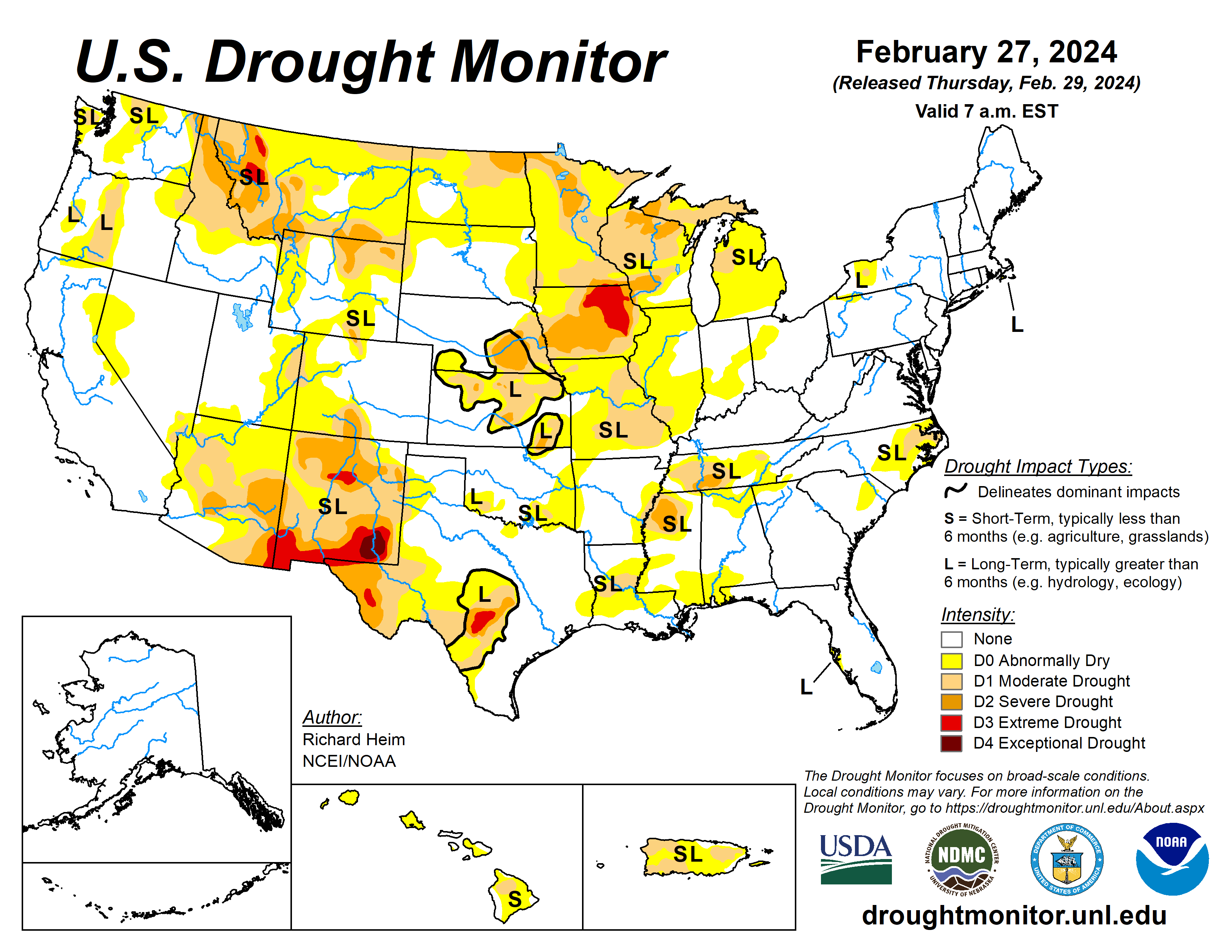
Several weather systems moved across the contiguous U.S. (CONUS) during this U.S. Drought Monitor (USDM) week (February 21-27). Their fronts and surface lows spread rain and snow across parts of the West at the beginning and end of the week, and over the Tennessee to Ohio Valleys and Appalachians at mid-week. These systems were associated with an upper-level circulation pattern that consisted of low-pressure troughs just off the west coast and east coast, with a high-pressure ridge over the central part of the country. The ridge brought above-normal temperatures to much of the CONUS, from the Rocky Mountains to Appalachian Mountains, with weekly temperatures averaging 15-20 degrees F above normal from Texas to the northern Plains and Upper Mississippi Valley. Temperatures averaged near to cooler than normal in parts of the interior West to Pacific Coast and along the Eastern Seaboard. The ridge also inhibited precipitation from the Rockies to Mississippi Valley. The precipitation in the West was mainly over mountain ranges but was not enough to improve drought conditions. The precipitation in the Midwest was enough to prevent further drought expansion or intensification where it was wetter than normal for the week. In other areas, drought or abnormal dryness expanded or intensified in parts of the Plains and Midwest, and a few parts of the Pacific Northwest, Gulf of Mexico coast, and Mid-Atlantic coast…
There were a few areas of half an inch to locally 2 inches of precipitation in the High Plains region this week – in North Dakota and parts of Colorado and Wyoming. But the rest of the region had little to no precipitation. Daily high temperatures reached into the 80s F some days in Kansas and up to the 50s and 60s in the Dakotas. Weekly temperatures averaged 10 to 20 degrees above normal across most of the region, increasing evapotranspiration (ET). Since this is February and vegetation is still dormant, the above-normal ET had little effect on vegetation, but soil temperatures were well above freezing in southern parts of the region and the high ET helped to dry soils. D0 expanded in the Dakotas, and D1 crept into northwest North Dakota, to reflect the 1- to 2-month dryness and unusually warm temperatures, and D0 expanded in eastern Kansas where recent precipitation has been low and soils were drying. In Wyoming, very low mountain SWE (snow water content) and dry 1- to 4-month SPI values prompted the expansion of D0-D2…
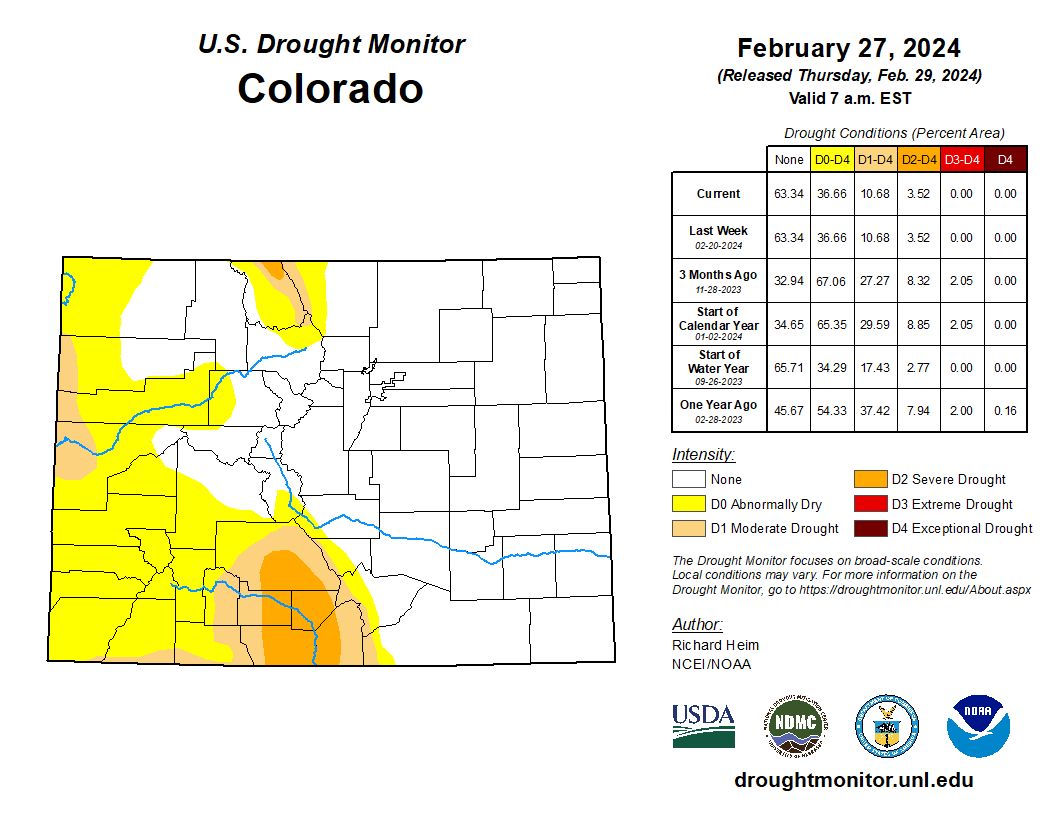
Colorado Drought Monitor one week change map ending February 27, 2024.
Two to locally 5 inches of precipitation fell in the Oregon and Washington Cascade and Coastal mountains this week, with half an inch to locally 2 inches in the northern and central Rockies and southern California, and 0.5 to 1.5 inches in the Sierra Nevada and parts of coastal California. Outside of these areas, precipitation was generally less than a fourth of an inch, with rainshadow areas and the Southwest (Four Corners States) mostly dry. The precipitation was above normal for the week in some areas, particularly parts of the Cascades, Rockies, and southern California. But amounts were not enough to bring month-to-date totals to near normal values, with these areas still well below normal for the month. And snowpack improved little, with just a few inches of new snow added to most Cascade and Coastal mountain SNOTEL sites. Mountain snowpack and SWE values were still well below normal to near-record low in Washington, Oregon, Idaho, and Montana. In California, as of February 27, mountain SWE was 94% of normal in the northern Sierra Nevada Mountains, 78% of normal in the Central Sierra, and 76% of normal in the southern Sierra. In Washington, D0-D1 was expanded in the northern Cascades and D1 added to the Olympic Mountains to reflect the low snowpack and subnormal precipitation. Low SWE and 1- to 4-month SPEI values resulted in expansion of D0-D3 in parts of Montana…
Northern parts of Tennessee received 0.5-1.5 inches of precipitation this week, but most of the South region was dry with no precipitation occurring. Much warmer-than-normal temperatures accompanied the dryness, with daytime maximum temperatures in excess of 90 degrees F recorded in Texas. Dallas/Fort Worth reached 94 on February 26, which was a daily record and 31 degrees above normal. The hot temperatures increased evapotranspiration which drew moisture out of the soils. The recent dry weather, accompanied by low relative humidity and windy conditions, contributed to an outbreak of wildfires across parts of the region. D0 expanded in southwest Texas where air temperatures were hot, soils were hot and dry, and the last 3 months were drier than normal. Dry 1- to 3-month SPI values prompted expansion of D0 in eastern Oklahoma and adjacent parts of northeast Texas and western Arkansas. Dead fields in Sebastian County, Arkansas, were reported via the CMOR (Condition Monitoring Observer Reports) reporting system. D0 expanded in southern Mississippi, adjacent parts of Louisiana, and southeast Texas where SPI was dry, streamflow was low, and some soil moisture indicators showed dryness, and D0 expanded in southeast Tennessee where 1- to 2-month SPEI (Standardized Precipitation Evapotranspiration Index) showed dry conditions. A reassessment of data resulted in the deletion of the relic D0 along the southeast Louisiana coast…
Looking Ahead
In the two days since the Tuesday valid time of this USDM, Pacific moisture continued to move across the Coastal and Cascade ranges in the Pacific Northwest, with precipitation falling in areas east of the Mississippi River and in parts of the southern Plains. For February 29-March 5, a ridge over the eastern CONUS will bring warmer-than-normal temperatures to much of the country east of the Rockies while a trough contributes to cooler-than-normal temperatures in the West. Forecast models predict a wet period for much of the West, in the Upper Rio Grande Valley, and from the Lower Mississippi Valley to the East Coast, as low-pressure systems and fronts bring locally heavy precipitation. The Coastal, Cascade, and Sierra Nevada mountain ranges could see 5 to 10 inches of precipitation, or locally more, while the central to northern Rockies could receive 2 to 4 inches of precipitation. Parts of southern New Mexico and western Texas could receive up to an inch of rain. An inch or more of precipitation is predicted from southern Louisiana to southern New England. Outside of these wet areas, up to half an inch of moisture could fall in the lower elevations of the West, across the northern and southern Plains, and Midwest to Northeast. Areas that could miss out on the precipitation stretch from southern California to the central Plains, where little to no precipitation is expected, and the southern Plains and Mid-Mississippi Valley to eastern Great Lakes, where less than a fourth of an inch may fall.
For much of the next 2 weeks, the atmospheric circulation is expected to continue an upper-level trough over the western CONUS and a ridge over the eastern two-thirds of the country, with Pacific weather systems migrating through the trough/ridge pattern. The Climate Prediction Center’s (CPC) 6-10 Day Outlook (valid March 4-8) and 8-14 Day Outlook (valid March 6-12) favor a fairly stable pattern of warmer-than-normal temperatures from the Plains to East Coast and cooler-than-normal temperatures over the West and Alaska. The outlook is for above-normal precipitation over eastern and southern Alaska and much of the CONUS, especially east of the Mississippi River, with odds favoring near to below-normal precipitation over the northern Rockies to northern Plains and over the west coast of Alaska.
US Drought Monitor one week change map ending February 27, 2024.
From email from the Colorado Water Trust (Barrett Donavan):
Here are the details:
Write a maximum 300-word story about a river (or rivers) in Colorado.
Stories should inspire your fellow Coloradans to love and care about Colorado’s rivers.
Submissions may be poetry or prose and silly, serious, or sweet. You can do a fairytale, a real river story, or anything in between. It can be as short as you like, but no more than 300 words. Title not included in word count. The field is wide open! Have fun! The more creative the better!
Illustrations and/or photos are welcome but not required.
You may submit more than one entry and all ages of writers are encouraged.
We have four great judges who will choose the top five stories. First, second, and third place winners will receive an awesome prize, and all top five submissions will be shared on our website, in our newsletter, and on our social media accounts.
The Judges:
Anne Castle: Senior Fellow, Getches-Wilkinson Center, University of Colorado; US Commissioner, Upper Colorado River Commission; Water Trust Board of Directors
Luke Runyon: Journalist; Co-director of The Water Desk at the University of Colorado’s Center for Environmental Journalism
Radha Marcum: Poet and writer with a focus on the intersection of the environment, culture, and personal history
Amelia Marsh: Editor in Chief, University of Denver Water Law Review
Judging Criteria:
River Inspiration: Your story must inspire readers to love and care for their Colorado rivers.
Quality of Story: Entries must tell a story, including a main character of some kind and a true story arc even if it’s tiny. Entries must not be merely descriptions or mood pieces.
Quality of Writing: If you’re going to rhyme, give us your best. Overall writing quality and use of language are also important.
Originality and Creativity: These two elements are often what sets one story above another. You will want yours to stand out from the crowd!
Colorado lawmakers OK’d a measure this week backing efforts to restore Grand Lake, the state’s deepest natural lake once known for its clear waters.
Advocates hope the resolution will help fuel statewide support for the complicated work involved in restoring the lake and give them leverage with the federal government to secure funding for a new fix.
The resolution is largely symbolic and doesn’t come with any money, but it adds to the growing coalition of water interests on the Western Slope and Front Range backing the effort.
After more than a year of work, Mike Cassio, president of the Three Lakes Watershed Association, said he is hopeful the resolution will create a new path forward after years of bureaucratic stalemate. The association advocates on behalf of Grand Lake, Shadow Mountain and Lake Granby.
“It’s been a long process, but this resolution puts the state legislators in support of what we are trying to do and we will be able to take that to our congressional representatives,” Cassio said.
The measure was carried by Sen. Dylan Roberts, a Democrat from Frisco, and House Speaker Julie McCluskie, a Democrat from Dillon.
“I’m really encouraged with all the work that has been done in the past few months and I think it will hopefully lead to more progress,” Roberts said.
Colorado-Big Thompson Project map. Courtesy of Northern Water.
Owned by the U.S. Bureau of Reclamation and operated by Northern Water, what’s known as the Colorado-Big Thompson Project gathers water from streams and rivers in Rocky Mountain National Park and Grand County, and stores it in Lake Granby and Shadow Mountain Reservoir. From there it is eventually moved into Grand Lake and delivered via the Adams Tunnel under the Continental Divide to Carter Lake and Horsetooth Reservoir, just west of Berthoud and Fort Collins, respectively.
On the Front Range, the water serves more than 1 million people and thousands of acres of irrigated farmlands. But during the pumping process on the Western Slope, algae and sediment are carried into Grand Lake, clouding its formerly clear waters and causing algae blooms and weed growth, and harming recreation.
Advocates have long been frustrated at the failure to find a permanent fix to the lake’s clarity issues, whether it’s through a major redesign of the giant federal system or operational changes.
The Bureau of Reclamation, Northern Water, Grand County and other agencies and local groups have been working since 2008 to find a way to keep the lake clearer, and Northern Water and others have experimented with different pumping patterns and other techniques to reduce disturbances to the lake’s waters.
Now an even broader coalition has come together, Cassio said, led by Grand County commissioners and Northern Water’s board of directors.
“Northern Water is fully committed to the continued and collaborative exploration of options to improve clarity in Grand Lake and water quality in the three lakes,” said Esther Vincent, Northern Water’s director of environmental services.
Last year, a technical working group reconvened, and is now studying new fixes that may be possible, including taking steps to reduce algae growth and introduce aeration in Shadow Mountain, a shallow artificial reservoir whose warm temperatures, weeds and sediment loads do the most damage to Grand Lake, Cassio said.
Though much more work lies ahead, the work at the legislature is critical, he said.
“This resolution is one piece of the puzzle,” Cassio said. “We’re at the finish line and everybody is coming together. It’s a wonderful thing.”
More by Jerd SmithJerd Smith is editor of Fresh Water News. She can be reached at 720-398-6474, via email at jerd@wateredco.org or @jerd_smith.