#Drought news November 14, 2024: In some of the higher elevations of #Colorado, precipitation fell as heavy snow, with a few locations reporting snow piling up 3 to 4.5 feet deep (50 to 54 inches buried #FortGarland while 44 to 47 inches were reported near #LaVeta, #Elbert, and #Trinidad)

Click on a thumbnail graphic to view a gallery of drought data from the US Drought Monitor website:
Click the link to go to the US Drought Monitor website. Here’s an excerpt:

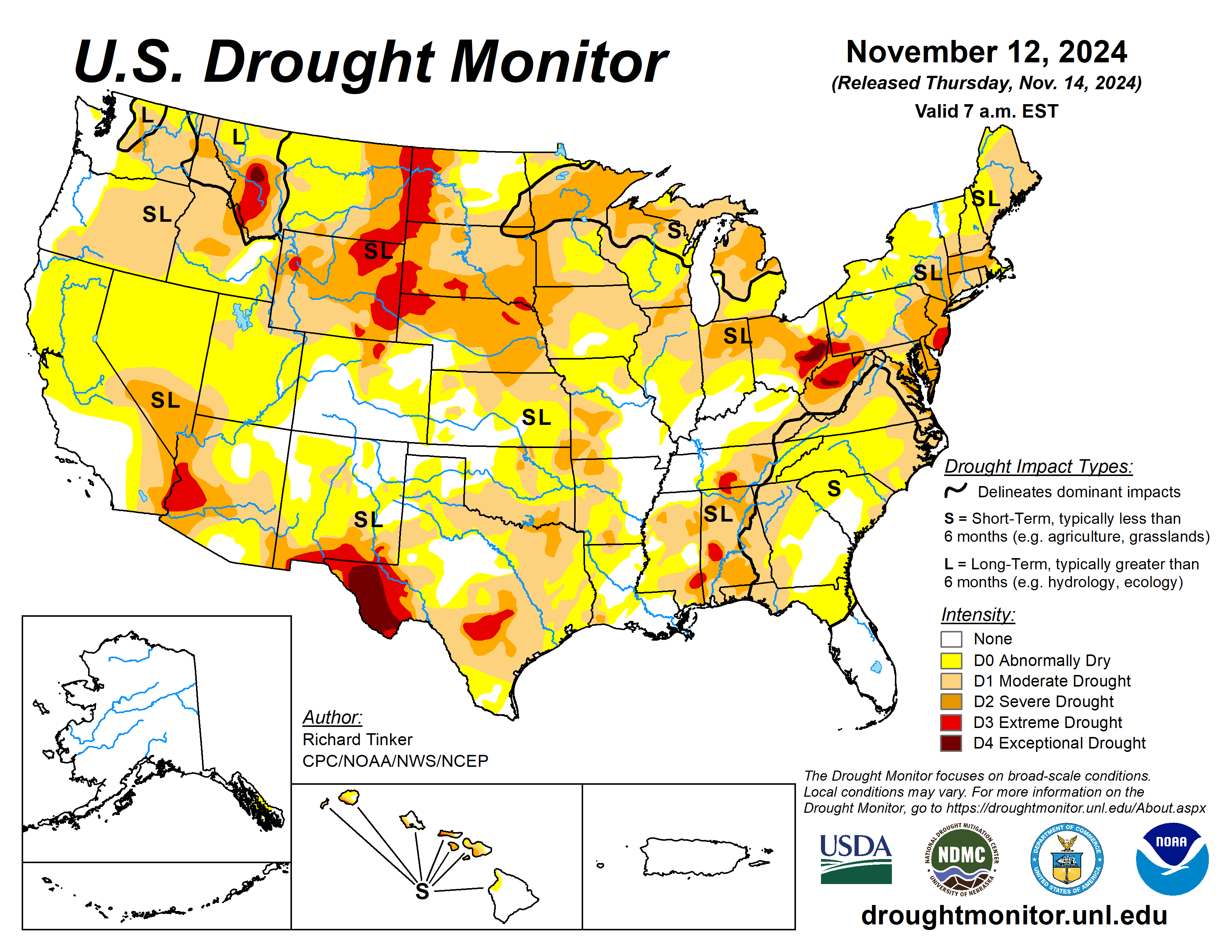
This Week’s Drought Summary

Storm systems brought significant precipitation and drought relief to broad areas in the central Rockies, central and southern Plains, Lower and Middle Mississippi Valley, Lower and Middle Ohio Valley, and the South Atlantic Region. Meanwhile, subnormal precipitation and some unseasonable warmth led to deterioration in dryness and drought conditions in portions of the Southwest, southern and western Texas, the interior Southeast, the northeastern Gulf Coast, the central and southern Appalachians, the mid-Atlantic region, the Northeast. Excessive precipitation totals fell on some areas. From central South Carolina through much of southeastern Georgia, amounts of 4 inches to locally a foot of rain were reported. Similar totals fell on central Louisiana, a band through central and north-central Texas, small parts of the Lower Ohio Valley, and orographically-favored areas in the Northwest. In addition, a broad area covering the eastern half of Colorado and adjacent areas in New Mexico and the central High Plains recorded 2 to 4 inches of precipitation, much of which fell as snow in the middle and higher elevations. A few scattered sites reported 3 to 4.5 feet of snow, mainly in the higher elevations of Colorado…

High Plains

A potent 500-hPa low triggered widespread heavy precipitation over southern half of the Region, except along the eastern fringe, while amounts were limited to several tenths of an inch at most farther north. Between 2 and 4 inches of precipitation fell on a large swath covering the eastern half of Colorado, most of central and western Kansas, and adjacent Nebraska. In nearby areas, amounts ranging from a few tenths of an inch to a couple of inches were observed over the western half of Colorado amounts of 0.5 inch to approaching 2 inches in spots was observed across southeastern Wyoming, most other areas in Nebraska, and eastern Kansas. Moderate amounts fell on a swath across the central and southwestern Dakotas the remainder of this region reported little or no precipitation, as well as most of Wyoming. In some of the higher elevations of Colorado, this precipitation fell as heavy snow, with a few locations reporting snow piling up 3 to 4.5 feet deep (50 to 54 inches buried Fort Garland CO while 44 to 47 inches were reported near La Veta, Elbert, and Trinidad CO). All of this resulted in a large area of improvement depicted over southern and western Kansas, most of northern and eastern Colorado, part of southwestern Nebraska, and a few spots in eastern Wyoming. There were a few areas of 2-class improvement in southeastern Colorado, northwestern Kansas, and the fringes of south-central and southeastern Kansas. Elsewhere, due to relatively cool weather, the dry week didn’t engender much deterioration, with most of these locations remaining unchanged from last week. One exception was in a small patch of northeastern Nebraska and adjacent South Dakota, where a new patch of extreme drought (D3) was identified…

Colorado Drought Monitor one week change map ending November 12, 2024.

West

Heavy precipitation In northeastern New Mexico, with snow reported in some of the higher elevations, produced areas of improvement to dryness and drought. A few high spots in New Mexico reported near 3 feet of snow, including locations near Las Vegas NM and Folsom NM. The only other area of improvement in the West Region was in eastern Washington. Not much precipitation fell last week…

South

Like the Southeastern Region, the South Region experienced highly variable rainfall this past week. Heavy precipitation – in some areas for the second consecutive week – soaked a swath from Louisiana and eastern Texas northward through much of the Lower and Middle Mississippi Valley and the Tennessee Valley. A broad swath reaching as far west as central Arkansas recorded at least 1.5 inches in most places, with some areas recording much higher amounts (3 to 8 inches in part of western Tennessee, and over a foot in parts of central Louisiana). This resulted in reductions in dryness and drought severity across affected areas of the Lower Mississippi Valley and eastern Texas, with some 2-class improvements imposed in a small part of both southwestern Louisiana and an area straddling southwesternmost Mississippi and adjacent southeastern Louisiana. To the north, the heavy rains also removed abnormal dryness from across western Tennessee. Farther west, another area of heavy precipitation accompanied a frontal passage in a swath from central Texas into the central Red River (south) Valley, where totals reached 4 to 8 inches along the axis of heaviest amounts. To the north, heavy precipitation associated with a pair of potent upper-level low pressure systems dropped over 2 inches on a large part of central and western Oklahoma and much of the Texas Panhandle, with localized totals exceeding 4 inches in the eastern Texas Panhandle northward to the Oklahoma/Kansas border. There was also a patch of heavy rainfall to the east across portions of eastern Oklahoma, where isolated amounts peaked at around 3 inches. Dryness and drought affecting these areas were significantly eased, with a couple patches of 2-class improvements in north-central and northeastern Oklahoma. In stark contrast, little or no precipitation was observed from parts of southeastern Oklahoma southward through Deep South Texas, and across western Texas as well. Dryness and drought worsened in some of the areas, with the most widespread deterioration noted in western Texas. The broad area of exceptional drought (D4, the most intense category) expanded there to cover most or all of eastern Hudspeth, Culberson, western Reeves, Jeff Davis, Presidio, and Brewster Counties. Also, D3 (extreme drought) also expanded to cover most of the remainder of the Big Bend of Texas…

Looking Ahead

During the next five days (November 14-18), moderate to heavy precipitation is again expected from the Cascades westward to the Pacific Coast, with totals expected to exceed 5 inches expected in some of the higher elevations and orographically-favored sites. One or more inches are also anticipated in the Sierra Nevada, with several tenths of an inch possible along most of the California Coast down to the Mexican border. Parts of the northern Intermountain West are expected to receive over an inch of precipitation, with 2 to locally 4 inches forecast across the Idaho Panhandle. A low pressure system and trailing front should trigger another round of heavy precipitation in the central and southern Great Plains from central Texas northward into southeastern Nebraska and the Middle Mississippi Valley, with 1.5 to locally 4.0 inches anticipated from central and east-central Kansas southward through the Red River (south) Valley and adjacent northern Texas. At least an inch is also anticipated east of the Lower and Middle Mississippi River through the interior Southeast, Lower Ohio Valley, central and southern Appalachians, and the mid-Atlantic region. Over 2 inches may fall on parts of the central Appalachians and adjacent Piedmont. Meanwhile, moderate amounts should fall on the southern Rockies and adjacent High Plains and across the Great Lakes region and the northern Ohio Valley. In contrast, little or no precipitation is expected across much of the Northeast, Florida and the adjacent South Atlantic region, southern Texas, the northern Plains, the central and southern Rockies, and the Southwest.

The Climate Prediction Center’s 6-10 day outlook (valid November 19-23) features enhanced chances for both above-normal precipitation and temperatures across the Upper Midwest and across most areas east of the Mississippi River, with odds for significantly above-normal rainfall reaching 50 to near 70 percent on the Florida Peninsula. Wetter than normal weather is also slightly favored across Hawaii. Meanwhile, subnormal precipitation seems more likely across Texas and adjacent locations as well as the western Rockies, most of the Intermountain West, and the Sierra Nevada. Below normal temperatures are favored across the central and southern Plains and adjacent Mississippi Valley, the Rockies, and the Intermountain West. Southeastern Alaska should also average colder than normal while in Hawaii, neither extreme of temperature is favored.
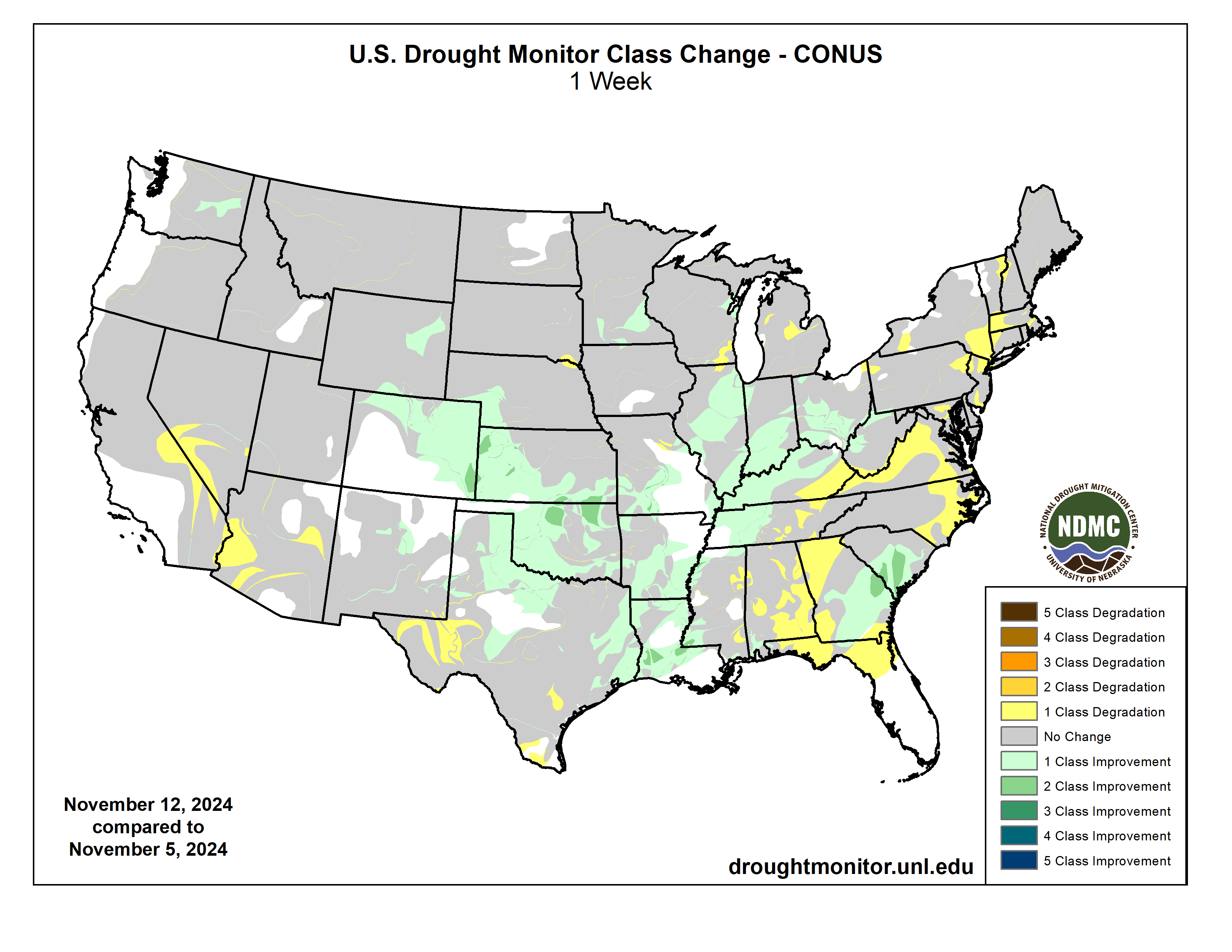
US Drought Monitor one week change map ending November 12, 2024.

Romancing the River: Forging on in the Era of Fear and Loathing — George Sibley (SibleysRivers.com) #ColoradoRiver #COriver

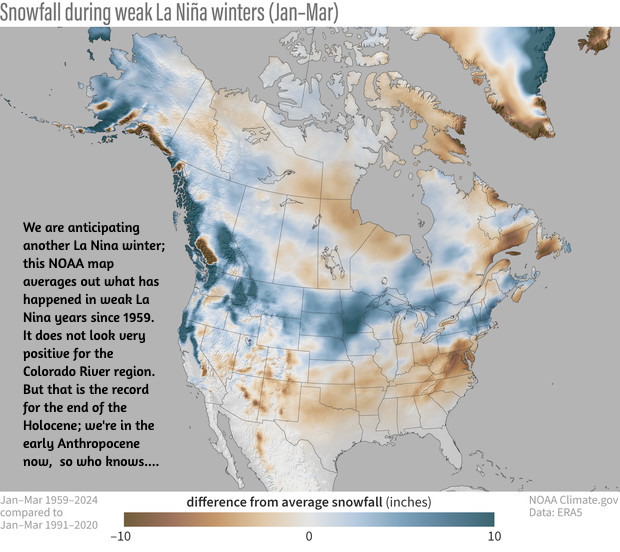
Credit: George Sibley/NOAA

Click the link to read the article on the Sibley’s Rivers website (George Sibley):

November 12, 2024

Hunter Thompson put the term ā€˜fear and loathing’ into our cultural dialogue in the early 1970s: first in 1971 with ā€˜Fear and Loathing in Las Vegas,’ then with ā€˜Fear and Loathing on the Campaign Trail’ in 1973, a long rambling essay into America’s political character based on his coverage for Rolling Stone of the 1972 election of Richard Nixon over George McGovern.

ā€˜Fear and loathing’ is a pretty accurate description of the campaign that Donald Trump ran: fear of a tidal wave of immigrants, mostly criminals; fear of a tidal wave of crime; fear of Promethian women unbound; fear of – well, fear of the future in general, along with a massive denial of things that most Americans apparently don’t want to think about, as discussed in my last post. That those tidal waves of fear were devoid of any factual reality, and the denials chin-deep in ignored factual realities – all that was immaterial; fear and anger work their dark magic best in darkness.

As for ā€˜loathing’: he and his minions worked hard, with considerable success, to make the gullible loath liberals, progressives, enviros, believers in the rule of law, people wanting to make their own decisions about their own bodies, anyone who still harbors the vision that we can save the planet from ourselves and that life can be made decent for everyone. He and his minions have said, will continue saying, things about people like me that are vicious fictions – I am the evil spawn of the devil just because I’d like to see more equity in our society, and have a commitment to the now-receding hope that we can pass a still-livable planet on to the next generations?

And he won with that campaign. The vote by a majority of my fellow Americans indicate that the Untied States (sic) is no longer going to even be trying to be Thompson’s ā€˜monument to all the best instincts of the human race this country might have been.’ Not now, anyways. Might we hope that we will recover our more positive vision after four more years with Trump and his dark xenophobic vision? There’s really nothing but hope, but like the guy in the lifeboat said, ā€˜Pull for the horizon, boys. It’s better than nothing.’

So – back to the river: ā€˜Let us gather by the river, the beautiful, the beautiful river….’

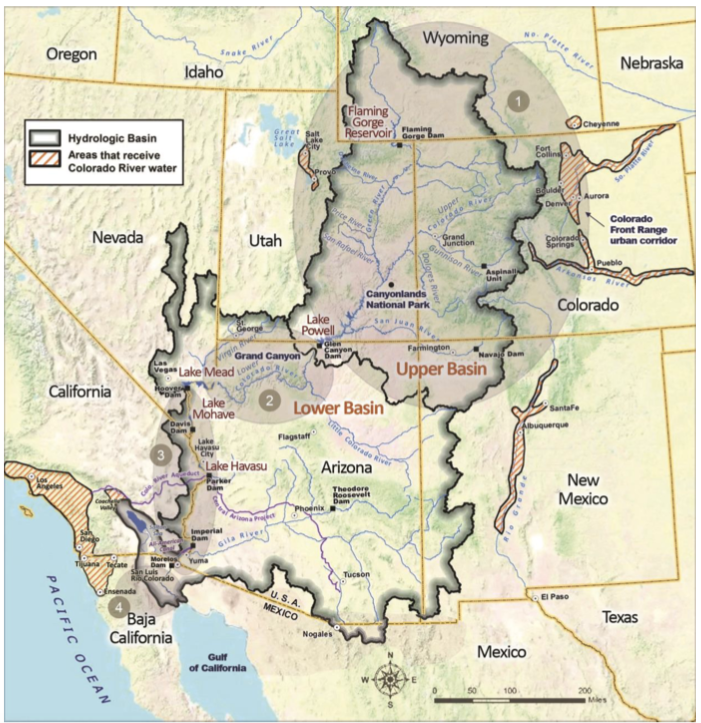
This map shows the Colorado River Basin and surrounding areas that use Colorado River Water, with four regions delineated, based on the degree to which flow is regulated and the channel physically manipulated. The dividing line for the upper and lower basin is Lee Ferry near Glen Canyon Dam. CREDIT: CENTER FOR COLORADO RIVER STUDIES

What were we doing when so rudely interrupted by the election? We were taking advantage of these ā€˜interim months’ in the Colorado River Basin to engage in a little thinking ā€˜outside the box’ about the Colorado River, while the seven basin states remain stalemated in the ā€˜Colorado River Compact Box.’ The Compact’s division into Upper and Lower Basins has devolved at this point to a situation that can legitimately be compared to the 1860 division of states into North and South with a downward spiral toward conflict and chaos. Only in the rich imagination of Paolo Bacigalupi does it descend to open uncivil warfare physically in the Colorado River region (read his worst-case book,Ā The Water Knife,Ā if you haven’t already). But the biggest action step recently in the stalemate was when Arizona’s state director of Water Resources, Tom Buschatzke, asked his governor and legislature to ā€˜set aside’ a million dollars in the event that going to court becomes unavoidable.

So in our ongoing ā€˜romance’ with the river, we could either hover and dither over that stalemate, like the rest of the media, trapped in the ā€˜Compact Box’ – or just take advantage of the ominous quiet to heist ourselves up on the edge of the box, to look over and out at possible alternative futures.

We’ve been exploring the anomaly of a river in a desert – a river created through natural atmospheric processes in a mountainous region of sufficient elevation to force precipitation onto land steep enough so that a large portion of the water created runs off its slopes rather than sinking in – a water-producing region. Whose produced water then runs off into desert lands, where the water produced in the highlands is gradually consumed by the same natural processes – evaporation, transpiration from riparian vegetation, and replenishment of low groundwater tables, and also by human cultures that learn how to use the river to grow things – mainly food crops and cities. The river is not significantly replenished for those losses by precipitation in the arid deserts, so it gradually diminishes, disappears on its way to sea level. The sun giveth the river, and the sun taketh the river away. The vaporized river water rides the wind, usually eastward in search of another condensing factor in the environment, to again become liquid precipitating on the increasingly thirsty earth as we relentlessly drive the planet’s temperature upward.

For cultures trying to live in desert lands with a heavy dependence on a river in the desert, there are two kind of obvious fundamental principles for using the river’s water: 1) first, collaborate on an equitable and efficient division of the use of the river’s water among all its desert consumers, and make that use contingent on the application of best practices in avoiding waste. And 2) take care of the water-producing region in order to maintain or achieve its optimal flows into the deserts. I’ll say that again: it is the responsibility of all the desert water users to take care of the water-producing region for their water, as well as being careful with the water that reaches their desert. Another principle the Colorado River Compact not only ignored, but made worse with the assumption that management of the Headwaters for the river would be up to high-desert users in the Upper Basin, and none of the Lower Basin’s business.

Despite the current disputatious stalemate between the seven states trying to share the river and their division into two camps of north states and south states (with the state boundaries themselves making no geographic or hydrological sense) – there are actually things going on internally within the states, mostly led by the huge metropolitan ā€˜city states,’ that work toward that first principle of collaboration on the best use of the river and its water. There are water-sharing agreements between desert cities and desert farmers; there are expensive efforts by the cities to maximize efficiency in the use of their current shares of the river, as well as the usual striving for larger shares. Considering that the division of the use of the waters is still bound by the foundational ā€˜first come first served’ appropriation doctrine, it is all the more remarkable that cooperation and efforts toward maximal and equitable efficiency are beginning to break out here and there, transcending strict appropriation law enforcement.

There is not, however, much conscious and coordinated attention among river users in the desert region for the water-producing region of the river in the desert – the 15 percent of the Basin lands (largely uninhabited) that produces 90 percent of their water. That’s what we’ve been trying to explore in some recent posts – beginning with the river’s ā€˜mystery’: the fact that of the estimated 170 million acre-feet (maf) of precipitation that falls over the Basin, roughly half of it in the water-producing region, only around 10 percent of that actually shows up in the river.

In a previous post we looked at some of the reasons why so much of the river’s water disappears from the river’s water-producing region – all attributable to sun and wind:  sublimation (direct conversion of water from solid to vapor) diminishing the snowpack throughout the whole winter; evaporation as the snowpack melts and forms streams exposed to the desert sun; and transpiration through trees and other vegetation of groundwater that sinks into their root zone. Together these processes consume around three-fourths, at least two-thirds, of the water that falls on the Headwaters.

That is a Sibley guesstimate, by the way. We haven’t devised really accurate measures for any of these naatural processes (although there is currently serious scientific work toward better measures). The Western Water Assessment study I’ve been citing is somewhat stuck in the Compact Box, breaking most of its analysis down into Upper and Lower Basin data, which does not work for the ā€˜water-producing and water-consuming’ model, since most of the Upper Basin is part of the water-consuming desert region (ten inches or less annual precipitation). The WWA estimates the ā€˜runoff efficiency’ for the whole Upper Basin at 16 percent – anĀ estimatedĀ 14.8 maf at the Lee Ferry version of the Mason-Dixon Line from anĀ estimatedĀ 92 maf of precipitation – meaning that for every 6 acre-feet of precipitation, only one acre-foot makes it into the river for surface water users. (The WWA estimates Lower Basin runoff efficiency at three percent – one acre-foot dribbling into the river for every 33 acre-feet of precipitation – in areas with way less than 10 inches of annual precipitation.

While we’re talking numbers, the 14.8 maf at Lee Ferry is not an actual measure of water flowing past the division point, but an estimate of what the flow there would have been if there were no human water consumers upstream. There are of course hundreds of farmers and ranchers upstream as well as some substantial cities and lots of towns in the three major tributaries of the Colorado River mainstem: the Green, the Colorado-Gunnison confluence, and the San Juan. Towns and cities can estimate their consumption fairly accurately (especially the half a million acre-feet that go through tunnels to the Front Range metropolis. But more than 80 percent of Upper Basin consumptive use is agriculture, and the largest portion of that is hay production in mountain valleys not easily adapted to modern large scale irrigation technology (even if the small ranches could afford it). Flood irrigation is the default process; and how much water gets used in that makes the ag consumption figures a really rough guesstimate.

September 21, 1923, 9:00 a.m. — Colorado River at Lees Ferry. From right bank on line with Klohr’s house and gage house. Old “Dugway” or inclined gage shows to left of gage house. Gage height 11.05′, discharge 27,000 cfs. Lens 16, time =1/25, camera supported. Photo by G.C. Stevens of the USGS. Source: 1921-1937 Surface Water Records File, Colorado R. @ Lees Ferry, Laguna Niguel Federal Records Center, Accession No. 57-78-0006, Box 2 of 2 , Location No. MB053635.

While we’re talking numbers, the 14.8 maf at Lee Ferry is not an actual measure of water flowing past the division point, but an estimate of what the flow there would have been if there were no human water consumers upstream. There are of course hundreds of farmers and ranchers upstream as well as some substantial cities and lots of towns in the three major tributaries of the Colorado River mainstem: the Green, the Colorado-Gunnison confluence, and the San Juan. Towns and cities can estimate their consumption fairly accurately (especially the half a million acre-feet that go through tunnels to the Front Range metropolis. But more than 80 percent of Upper Basin consumptive use is agriculture, and the largest portion of that is hay production in mountain valleys not easily adapted to modern large scale irrigation technology (even if the small ranches could afford it). Flood irrigation is the default process; and how much water gets used in that makes the ag consumption figures a really rough guesstimate.

The question for the water-consuming region then – aware as we ought to be, that we are losing in our changing climate 5-6 percent of our river’s water for every one degree F increase in average temperature – is whether there might be better management strategies for the Headwaters that would improve that ratio even just a little, to help compensate for coming losses…. And don’t be thinking that maybe what we need is less management, not more (more wilderness!). If we are going to keep adding more people to this planet, we are going to need better management everywhere – maybe not more, definitely not less, but certainly better.

Colorado River “Beginnings”. Photo: Brent Gardner-Smith/Aspen Journalism

We can say, with some confidence, that about the only part of the Headwaters where we have significant management options is the broad band of forests and grasslands ringing the Southern Rockies above the 8,000-foot elevation where most of the river region’s precipitation falls. These forests and grasslands occupy most of the water-producing region below the alpine tundra where the sun and wind rule uncontested, and above where the high deserts begin below the 8,000-foot elevation. Those forests – the subalpine spruce-fir forest and the montane pine forest (splashes of aspen everywhere in both) – are almost all public lands, designated National Forests, managed by the U.S. Forest Service.

The 1897 ā€˜Organic Act’ that turned existing ā€˜Forest Reserves’ into National Forests, and created the Forest Service to ā€˜improve and protect’ them, gave a broad overview of the National Forest mission:

ā€˜No public forest reservation shall be established, except to improve and protect the forest within the reservation, or for the purpose of securing favorable conditions of water flows, and to furnish a continuous supply of timber for the use and necessities of citizens of the United States.’

The use of the conjunctions ā€˜or’ and ā€˜and’ there indicate that this law might have been written by a lawyer trying to hedge something by writing like a lawyer. Does the ā€˜or’ indicate a choice had to be made between the two ā€˜use’ clauses and ā€˜improving and protecting’ the reserved forest? And why the negative-sounding start: ā€˜No public forest reservation shall be established, except…’?

We need to remember that 1897 was Very Early Anthropocene (1850s-1950s): we were simultaneously trying to do two things. On the one hand, we were developing increasingly effective and efficient fossil-fueled methods for vacuuming up the resources of the continent and turning them into production infrastructure and consumer goods. The assault on the forests for timber to turn to lumber to feed the insatiable call for more houses got seriously industrialized with steam-powered sawmills and railroads to haul the forest products quickly in great volume.

But on the other hand, we were becoming ā€˜woke’ to the consequences of these resource-mining activities. The 19th century equivalent to Rachel Carson’s Silent Spring in 1962 was Man and Nature, published in 1864 by the early conservationist George Perkins Marsh. Marsh laid out in plain language the consequences of timber-mining and grass-mining, as well as the more conventional mining of other valued resources. Clogging and gullying of the rivers and streams were the worst consequences of these practices, choked with soil and debris washed off the denuded slopes – which also diminished the ability of the forests and grasslands to grow again. The farmable floodplains were devastated by larger and more violent spring floods.

It’s easy but not very accurate to say the one hand did not know what the other hand knew; but anyone dependent on the rivers for water knew the unpaid cost of all their houses and barns. It was, however, knowledge for them like the knowledge of the climate crisis is for us today: knowledge to be acknowledged only through the five-step process of accepting what we don’t want to accept: denial, anger, negotiation, depression and finally, acceptance.

This probably explains the negative beginning the Forest Service mission statement – ā€˜No public forest reservation shall be established’ – except when we think we have to. Goddam right! This the people’s land, not the government’s! Ours to put to beneficial use! But – yeah. We’ve got to do something about the mess running of the mountains into the rivers…. But can’t it wait till we’ve converted a little more of it into wealth?

Well, that’s a good place to stop for now. Denial and anger have a long history in American exceptionalism.

Next time – a closer look at the forests and water production.