
How will a second Trump presidency shape the #ColoradoRiver? — Alex Hager (KUNC) #COriver #aridification

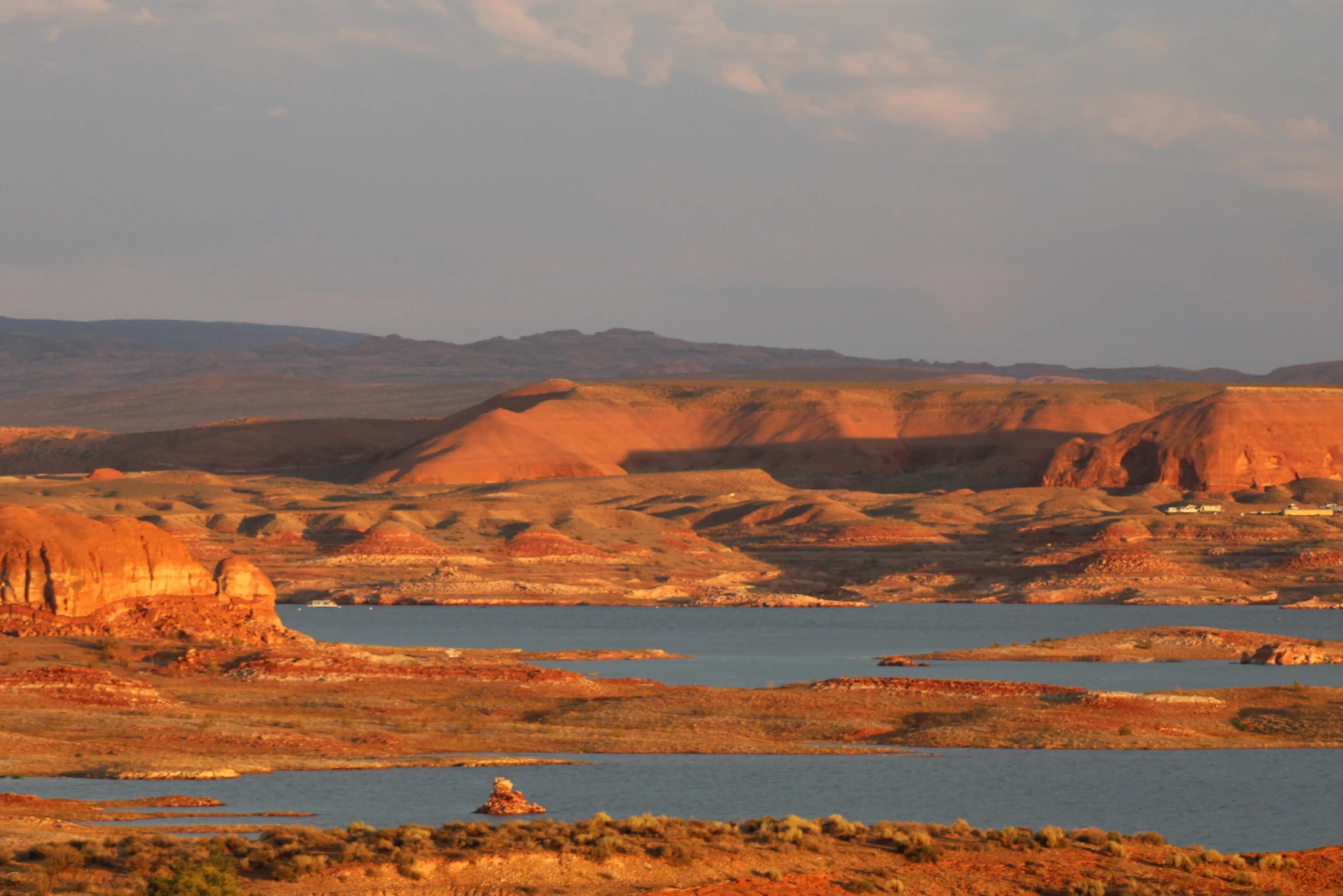
The sun sets on Lake Powell near Bullfrog Marina in Utah on July 15, 2024. The Colorado River’s reservoirs have shrunk to record lows in recent years, and negotiators are tasked with decreasing demand on the shrinking river. Those negotiators say an upcoming Trump presidency is likely to alter the course of current talks. Photo credit: Alex Hager/KUNC

Click the link to read the article on the KUNC website (Alex Hager):

November 7, 2024

The people who will determine the future of the Colorado River said they do not anticipate major changes to their negotiation process as a result of former president Donald Trump’s return to the White House.

Multiple officials from states that use the Colorado River pointed to historical precedent and said that similar negotiations in the past were largely unaffected by turnover in presidential administrations. Historically, state leaders have written the particulars of river management rules, and the federal Bureau of Reclamation implements the states’ ideas.

“I think if you’re using history as your guide, the election probably doesn’t mean a whole lot,” said John Entsminger, Nevada’s top water negotiator. “We have seen both Democratic and Republican administrations over the last two and a half decades have pretty consistent Colorado River policy.”

The Colorado River is used by 40 million people from Wyoming to Mexico. Climate change is shrinking its supplies, and policymakers are trying to agree on ways to rein in demand. They are under pressure to come up with a new set of rules for sharing its water by 2026 when the current guidelines expire.

Those policymakers – a group of seven appointed officials from each of the states that use the Colorado River – are split into two factions. Those two groups released competing proposals for how to manage the river after 2026, and they do not appear close to an agreement.

Brenda Burman, who was appointed by then-President Donald Trump to run the Bureau of Reclamation, speaks at a conference in Las Vegas in December 2019. Western water leaders say previous administration changes have done little to alter the course of Colorado River negotiations. Photo credit: Luke Runyon/KUNC

The Biden Administration had urged those states to coalesce around one proposal before the presidential election to help ensure it could go through the necessary paperwork and be implemented smoothly, but state leaders failed to do that.

On the campaign trail, Trump suggested major shakeups to the federal government, suggesting that he would gut or dissolve some federal agencies entirely. Entsminger said he does not think those efforts will extend to the federal agencies that help manage water in the West.

“I expect there to be a Department of the Interior,” he said. “I expect there to be a Bureau of Reclamation because someone has to actually operate the dams on the Colorado River.”

However, the Trump Administration may not be in a hurry to appoint new heads of those agencies. Entsminger pointed to past administrations that have prioritized other agencies, and Interior Department leaders haven’t been appointed until eight or nine months after inauguration day.

“The basin states can’t afford to sit around and wait to hear who that’s going to be,” Entsminger said. “It’s incumbent upon the basin states to keep working towards a solution in the interim, until we know who the new administration’s representatives are going to be.”

“New plot using the nClimGrid data, which is a better source than PRISM for long-term trends. Of course, the combined reservoir contents increase from last year, but the increase is less than 2011 and looks puny compared to the ‘hole’ in the reservoirs. The blue Loess lines subtly change. Last year those lines ended pointing downwards. This year they end flat-ish. 2023 temps were still above the 20th century average, although close. Another interesting aspect is that the 20C Mean and 21C Mean lines on the individual plots really don’t change much. Finally, the 2023 Natural Flows are almost exactly equal to 2019. (17.678 maf vs 17.672 maf). For all the hoopla about how this was record-setting year, the fact is that this year was significantly less than 2011 (20.159 maf) and no different than 2019” — Brad Udall

Scientists and policymakers broadly agree that climate change is driving the two-decade megadrought that is shrinking the Colorado River, but Trump has denied that climate change even exists. His administration appears poised to expand fossil fuel extraction, which would accelerate climate change. Western water leaders don’t expect those attitudes to get in the way of finding ways to rein in water demand.

“I don’t think that the debate over climate change is going to change the view of the federal administration about the need to deal with a smaller river, or how we’re going to get there,” said Tom Buschatzke, Arizona’s top water negotiator. “I just don’t see it happening.”

Even if Colorado River management at the federal level is stable, discord between the states could make things tricky. Currently, the Upper Basin states of Colorado, Utah, Wyoming and New Mexico are in disagreement with their Lower Basin neighbors – California, Arizona and Nevada. The two camps have a rivalry going back more than a century, and it still divides them today.
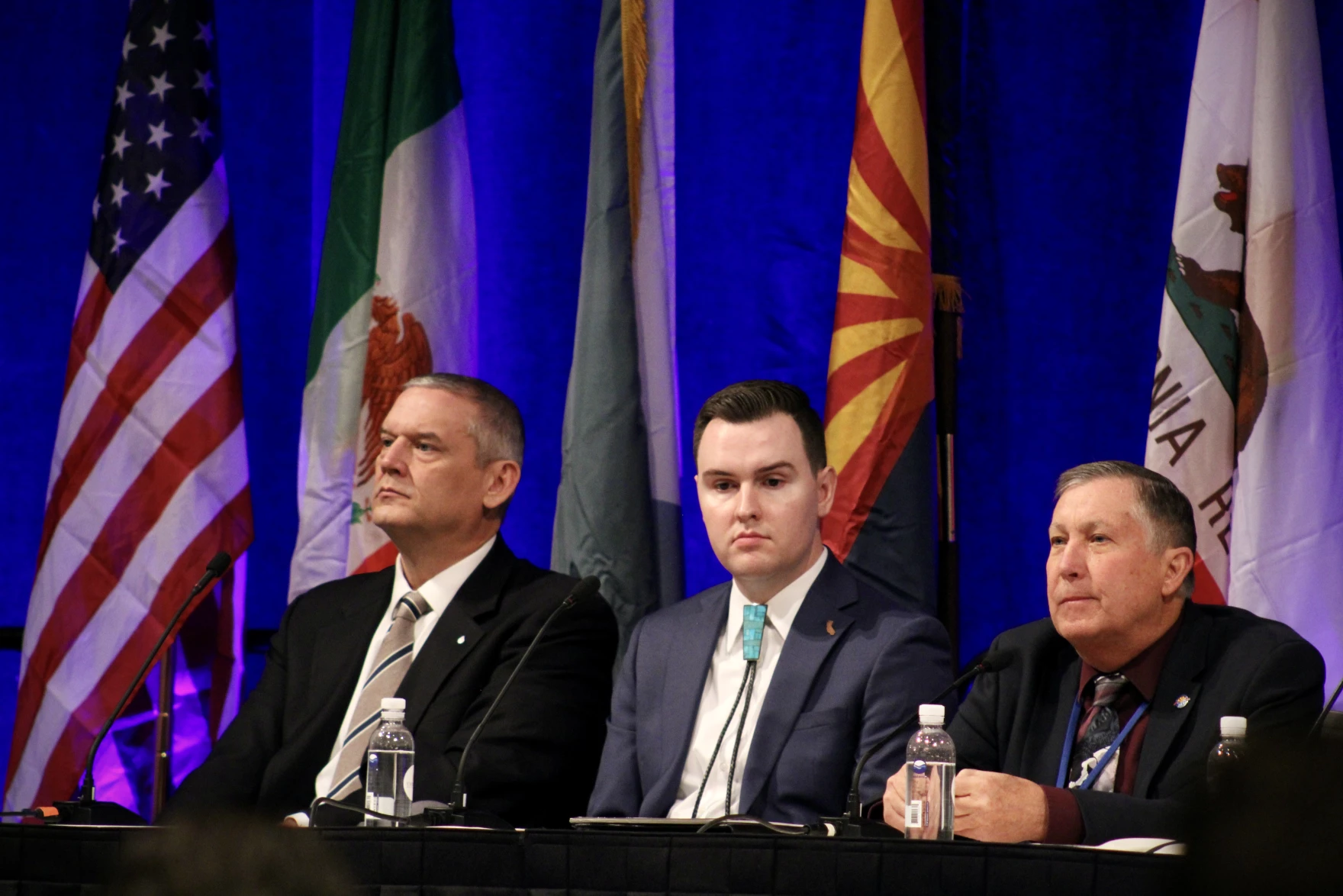
John Entsminger (left), JB Hamby, and Tom Buschatzke sit on a panel at the Colorado River Water Users Association annual meeting in Las Vegas on Dec. 14, 2023. The three men are top negotiators for the Colorado River’s lower basin states of Nevada, California and Arizona. They say they will press forward with river management talks even as the presidential administration changes. Photo credit: Alex Hager/KUNC

Elizabeth Koebele, who researches water policy at the University of Nevada, Reno, said that creates a risky level of instability.

“I worry that when our house isn’t in order inside the [Colorado River] basin,” she said, “Then these bigger, national level, ‘big-P Political’ changes are more likely to impact policy making, or more likely to add more stress to policy making.”

Koebele said federal leaders have often helped spur action and agreement among states by giving them “ultimatums” and deadlines to submit water management plans. The federal water officials appointed by Trump, she said, will face a tall order if they want to do that this time around.

“The stakes are probably higher than ever,” Koebele said, “And the Upper Basin and Lower Basin are facing major conflicts about who’s responsible for doing something about this. So I’m maybe not as optimistic as the state [negotiators] are.”

State water negotiators in both basins said they plan to keep pressing forward, and seemed optimistic about agreement, even amid shifting politics at the national level.

“We’re committed to coming up with a solution,” said Gene Shawcroft, Utah’s top negotiator. “This is a seven state solution, not an administration solution, if you will. And so there’s no waffling in our commitment to come up with a solution.”

Shawcroft said he believes any plan agreed upon by all seven states would be accepted by a future Trump administration.

This story is part of ongoing coverage of the Colorado River, produced by KUNC and supported by the Walton Family Foundation. KUNC is solely responsible for its editorial coverage.

Map credit: AGU

Upper #ColoradoRiver Basin MOU lays groundwork for saved-water accounting — Heather Sackett (@AspenJournalism) #COriver #aridification

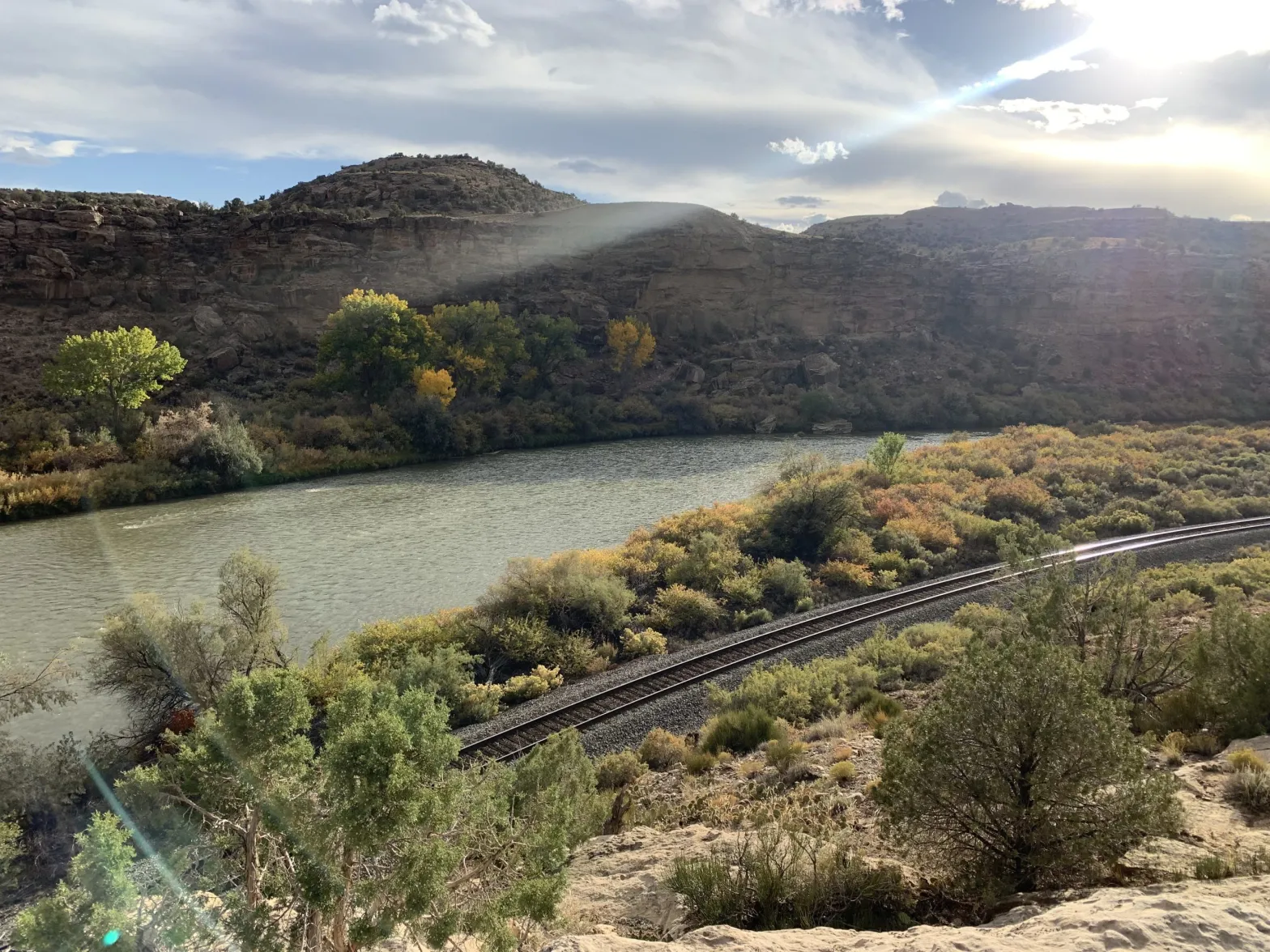
The Gunnison River just south of Grand Junction. Heather Sackett/Aspen Journalism Credit: Heather Sackett/Aspen Journalism

Click the link to read the article on the Aspen Journalism website (Heather Sackett):

The Upper Basin continues to take baby steps toward a formal conserved consumptive program. On Oct. 28, the Upper Colorado River Commission signed a memorandum of understanding with the U.S. Bureau of Reclamation establishing a provisional accounting for water saved through approved Upper Basin conservation projects. The Upper Basin states — Colorado, New Mexico, Utah and Wyoming — want to “get credit” for water they save through programs like System Conservation and potentially others, which they call “qualifying activities.” That water, thus accounted for, could be stored in Upper Basin reservoirs and tapped in the event of a future compact call or other circumstances where it would be needed.

But the MOU is still a dry run until a formal program comes about either in whatever post-2026 reservoir operation framework is adopted or with the establishment of a demand management program. 

“The important thing to keep in mind is this provisional accounting exercise is not an operational exercise,” said UCRC attorney Nathan Bracken. “It’s a paper exercise and as a result it will not change the operations of any reservoirs in the upper division states, nor will it provide actual credit itself.”

ten tribes
Graphic via Holly McClelland/High Country News.

Community Agriculture Alliance: Natural curtailment in the #ColoradoRiver Basin

“New plot using the nClimGrid data, which is a better source than PRISM for long-term trends. Of course, the combined reservoir contents increase from last year, but the increase is less than 2011 and looks puny compared to the ‘hole’ in the reservoirs. The blue Loess lines subtly change. Last year those lines ended pointing downwards. This year they end flat-ish. 2023 temps were still above the 20th century average, although close. Another interesting aspect is that the 20C Mean and 21C Mean lines on the individual plots really don’t change much. Finally, the 2023 Natural Flows are almost exactly equal to 2019. (17.678 maf vs 17.672 maf). For all the hoopla about how this was record-setting year, the fact is that this year was significantly less than 2011 (20.159 maf) and no different than 2019” — Brad Udall

From email from the Community Agriculture Alliance (Sally Cariiveau):

November 5, 2024

The Colorado River Basin is in the midst of a 23-year drought. Reduced precipitation, mostly in the form of snow in the western mountains, has caused water administrators at the federal, state and local level to seek ways to cut back usage. But many of us in the high country do not need water managers to tell us to reduce usage. Mother nature kindly, or unkindly, does that for us.

With limited storage at higher elevations, snowpack is the source for virtually all water on the West Slope. As the Basin experiences a steady decline in precipitation, West Slope water users, especially irrigators, find that in many years, they are subject to “natural curtailment.” Less snowpack means less water.

Snowpack is a shared resource in the Mountain West. The water from snowmelt that feeds the West Slope also feeds the Colorado River. The Colorado serves Lake Powell and then Lake Mead, and ultimately consumers in the Lower Basin (Arizona, California and Nevada).

With minor exceptions, all Colorado River water used in those Lower Basin states is stored in the Powell/Mead reservoir system, which insulates them from the near-term impact of reduced hydrology upriver from Powell. This system has led to a common belief that the Upper Basin states (Colorado, New Mexico, Utah and Wyoming) can mitigate drought-induced problems in the Lower Basin simply by sending more water downstream.

Unfortunately, data indicates that during times of hydrological shortfall, the Upper Basin is already naturally experiencing reductions. Recent history provides a high-level example. In the five years from 2016 to 2020, usage averaged 4.6 million acre-feet in the Upper Basin. In 2021, a low-precipitation year, that figure fell to 3.5 MAF, clearly demonstrating the natural curtailment effect.

During the 2016 to 2020 period, Lower Basin usage averaged 10.7 MAF, an amount which actually climbed to over 11.0 MAF in 2021. As a benchmark, the 1922 Colorado River Compact optimistically allocates 7.5 MAF to each basin.

Yampa River Basin via Wikimedia.

In dry years, natural curtailment impacts nearly everyone on the West Slope. Ranchers on tributary creeks often have to choose which headgates and ditches to operate. Even irrigators on the mainstem of the Elk and Yampa have years when, in late summer, they are required to use far less than their adjudicated rights.

Fishing, rafting/tubing and other recreational uses on the Yampa are often restricted, while water districts experience cutbacks during late-season low flows.

Meanwhile, solutions to Colorado River shortages have been elusive, and discussions difficult to facilitate. Politics and public messaging have played a major role; Lower Basin organizations have used every major media outlet to build public sympathy for their argument that they should not be the only ones to “sacrifice.”

Natural curtailment in the Upper Basin has been, until very recently, far outside of public perception. But it exists, and water users and organizations of the Lower Basin must acknowledge and understand it as a key component of future operating agreements.

We in the Upper Basin need to make natural curtailment a part of our story. Raising public awareness of this elemental fact can help us to defend our rights in the Colorado River.

Map credit: AGU

Ute Mountain Ute Tribe receives funding to plan water pipeline from #Cortez — The #Durango Herald

Manual Heart. Photo credit: Ute Mountain Ute Tribe

Click the link to read the article on The Durango Herald website (Maria Tedesco). Here’s an excerpt:

The Ute Mountain Ute Tribe received $7.5 million for a new design of a pipeline that delivers drinking water to Towaoc. The funding for the design is the first step toward the pipeline’s replacement. The funding is focused on 18 miles of the 22-mile pipeline, which delivers water from the McPhee Reservoir before it is treated in Cortez and piped to Towaoc…This funding for the pipeline comes from an Inflation Reduction Act program. The funding is under IRA Section 50231, based on the Tribal Domestic Water Supply Program. Administered by the Bureau of Reclamation, the funding supports the planning and construction of domestic water infrastructure projects…

[Manuel] Heart said the soil was not tested before the part of the pipeline was originally installed, which has caused maintenance issues…Heart said the water leaks have cost between $80,000 and $300,000 to fix depending on where the water break is.