
EVs near 28% of all sales in #Colorado: Big bag of incentives puts state slightly ahead of schedule in pursuit of goal of its 2030 goal of 940,000 EVs as some efforts moves to fleets — Allen Best (@BigPivots) #ActOnClimate

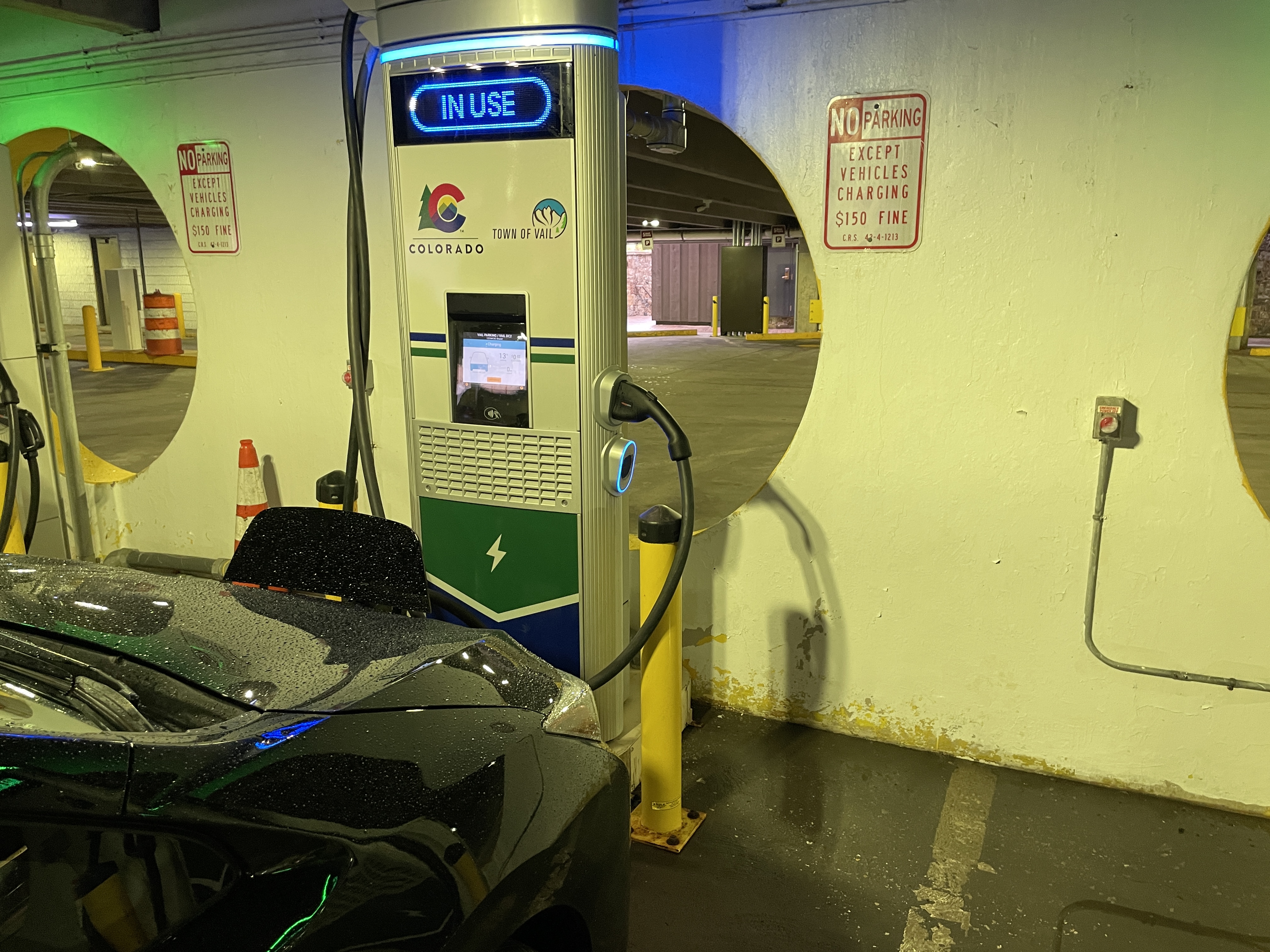
Coyote Gulch’s Leaf charging at the City of Vail Lionshead parking structure May 24, 2023.

Click the link to read the article on the Big Pivots website (Allen Best):

November 1, 2024

Electric vehicles and plug-in hybrids constituted 27.8% of all new car sales in Colorado during this year’s third quarter, according to sales figures compiled by the Colorado Automobile Dealers Association.

That puts Colorado second in the nation in proportion of sales, behind only California.

It also puts Colorado slightly ahead of the trajectory it identified as being necessary to have 940,000 EVs or hybrids on its roads by 2030. It had 151,000 as of October. It needs 157,000 by year’s end to stay on its pace, and Mike Salisbury, the Colorado Energy Office’s director of transportation, said the state will likely exceed that target by several thousand.

Clearly, the combination of tax credits offered by Colorado and the federal government have put wind into the sales of EVs and hybrids. New incentives that went into effect in January were particularly important in understanding Colorado’s climbing sales.

This latest milestone can be viewed against the backdrop of stories earlier this year by various national media about sluggish EV sales.

The flip side of that story of slowing sales is that lower-priced models are just now starting to arrive in significant numbers. Tesla, still the dominant brand, is getting more competition.

Notable is the expansion of General Motors in the market. As the New York Times noted this week, GM long had the Bolt compact, but it now has nine electric models that appeal to a wide range of consumers. And more are on the way, including a battery-powered version of its popular Cadillac Escalade SUV.

Bonnie Trowbridge, the executive director of Drive Clean Colorado, has been assisting in electrification of fleets. It’s easier, she explains, to make the argument for one fleet operator of 100 vehicles than 100 individual car owners. As such, electrifying fleets will have a much larger carbon impact.

Amazon has been electrifying its delivery vehicles. And Drive Clean Colorado has received an EPA grant to support the replacement of 21 old diesel trucks used for food delivery to restaurants with electric delivery vehicles. Of those, 15 will be the longer trucks and the remaining six the shorter snub-nosed trucks at the back doors of restaurants.

Colorado, the state government, also has been pushing ahead with EVs in its fleets, and some municipalities are doing the same.
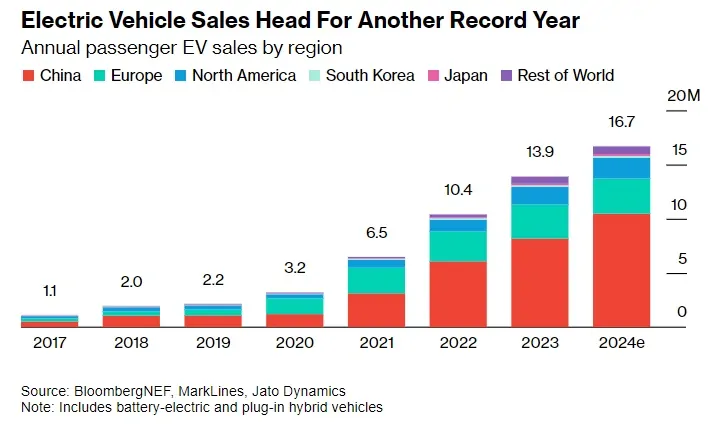
What may be more surprising is how laggard even California and Colorado are in comparison with the EV adoption in China and other countries.

EVs in the United States altogether constitute about 11% of all new-car sales. The world average is about 25%. In China, EVs are on track to be 45% of all new car sales this year, according to Marc Peterson, a retired executive with General Electric who spoke recently at a Monday Zoom session organized by Phil Nelson.

That same point was made by Bloomberg Finance in a chart reproduced here.

“The Chinese market is driving the world automotive market,” said Peterson, who is the co-coordinator in Utah for Citizens Climate Lobby.

Peterson reported that EVs now cost less in every U.S. state except West Virginia and Maine. In Utah, where he lives, the average cost of ownership of an EV across five years saves its owner $7,113.

Trowbridge, at Drive Clean Colorado, points out that China and some European countries have reached an inflection point in their adoption of EVs. Instead of driving the adoption with incentives, some places are using regulation to preclude use of internal-combustion engine vehicles in highly polluted places such as cities.

Could she imagine that happening in Colorado?

Trowbridge paused before answering.
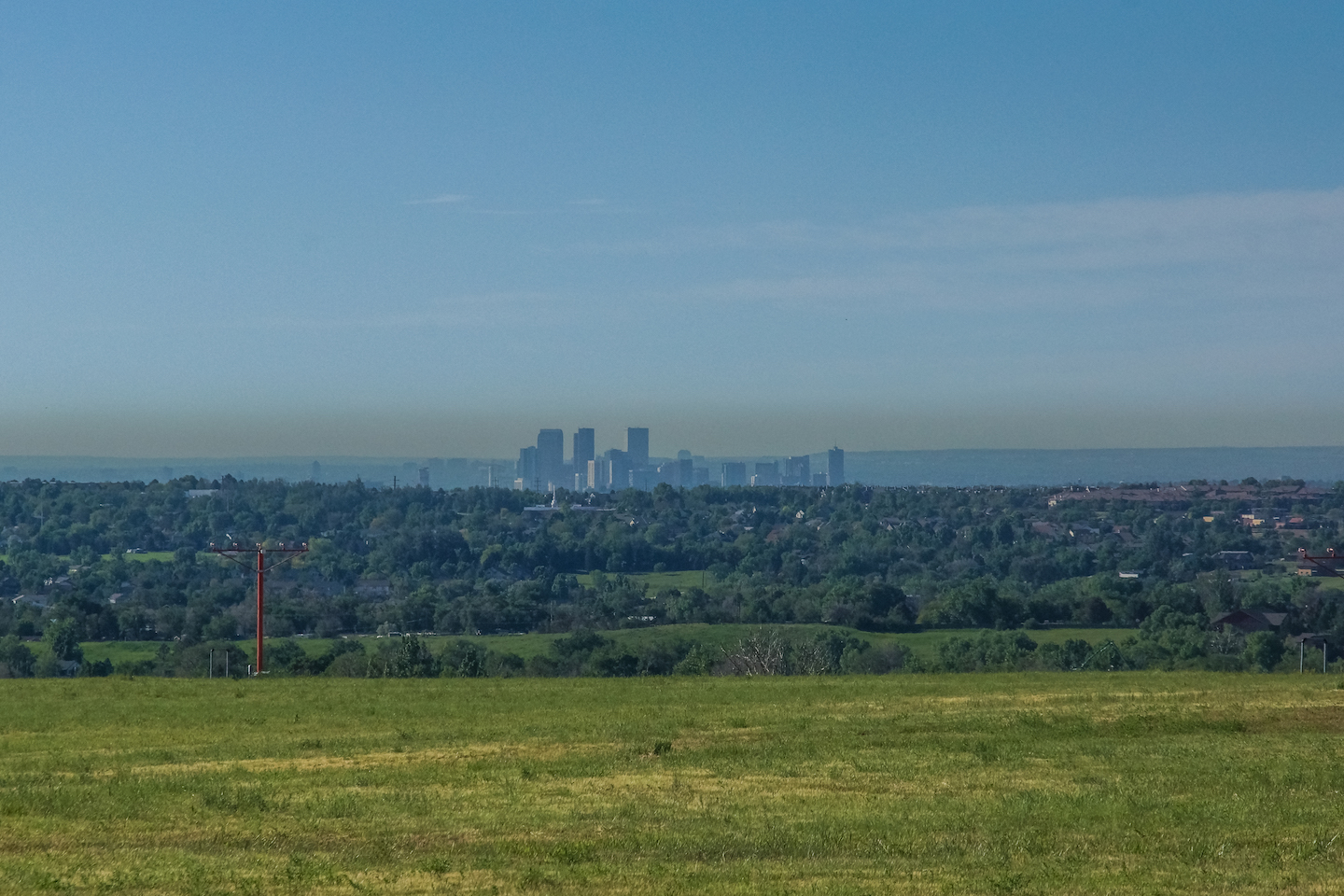
A layer of smog covers the skyline of Denver. (Courtesy of EcoFlight)

“We haven’t reached any of our attainment goals for NOX (nitrous oxide) and other pollutants, so we are going to have to contend with the federal government pretty soon. It’s really unhealthy for Coloradans, and a lot of that centers on transportation,” she said.

“I don’t know that it would be necessary for passenger vehicles, but perhaps for trucks and other fleet-type vehicles,” she added, referring to potential regulations in the near future.

Extended Shoshone hydro plant outages add urgency to water rights campaign: Outage protocol not as reliable as water rights permanency — Heather Sackett (@AspenJournalsim) #ColoradoRiver #COriver #aridification

The twin turbines of Xcel Energy’s Shoshone hydroelectric power plant in Glenwood Canyon can generate 15 megawatts. The plant was down for about a year and a half, according to the Colorado Division of Water Resources. Credit: Heather Sackett/Aspen Journalism

Click the link to read the article on the Aspen Journalism website (Heather Sackett):

October 31, 2024

The Shoshone Hydropower Plant in Glenwood Canyon was not operating for nearly all of 2023 and more than half of 2024, adding urgency to a campaign seeking to secure the plant’s water rights for the Western Slope.

According to records from the Colorado Division of Water Resources, the Shoshone Hydropower Plant was not operating from Feb. 28, 2023 until Aug. 8, 2024. According to Michelle Aguayo, a spokesperson from Xcel Energy, the company that owns the plant, there was a rockfall which forced an outage as well as maintenance which impacted operations during that time period.

The Grizzly Creek Fire burning along the Colorado River on August 14, 2020. By White River National ForestU.S. Forest Service – Public Domain

In 2024 the plant has been down for 221 days; in 2023 for 307 days; in 2022 for 91 days and in 2021 for 143 days. Water Resources Division 5 Engineer James Heath said he began tracking Shoshone outages in 2021 when they began to happen more frequently, starting with the post-Grizzly Creek fire mudslides in Glenwood Canyon.

“It was all these extended outages and just being able to have some sort of record of what was going on,” Heath said. “I kept getting questions from the parties on how many days we were operating ShOP and what the priorities were on those different days.”

The recent extended outages of the plant increase the urgency of the effort by the Colorado River Water Conservation District to acquire Shoshone’s water rights, which are some of the oldest and most powerful non-consumptive rights on the main stem of the Colorado River. If the plant were to shut down permanently, it would threaten the Western Slope’s water supply. The water rights could be at risk of being abandoned or acquired by a Front Range entity.

At a tour of the Shoshone plant in October, hosted by the Water for Colorado Coalition, River District Director of Strategic Partnerships Amy Moyer explained why the Shoshone water rights are important for improving water security and climate resilience on the Western Slope.

“As we’re sitting here in the iconic Glenwood Canyon. … It is a beautiful place, but we have an active highway, a railroad, a hydro power plant, all nestled in this tiny canyon that has experienced its fair share of natural hazards and risks over the years,” Moyer said. “When we’re looking at the level of risk, that is why we are looking for permanent protections for these water rights, and why we have a willing partner in Xcel Energy realizing that they had an incredible asset that was meaningful to Colorado’s Western Slope and the Colorado River itself.”

Water runs down a spillway at the Shoshone hydro plant in Glenwood Canyon. Rockfalls, fires and mudslides in recent years have caused frequent shutdowns of plant operations. Credit: Heather Sackett/Aspen Journalism

According to the terms of ShOP, when it is on during the summer, the plant can call 1,250 cfs. In the wintertime, that number falls to 900 cfs. The agreement is in place for 40 years (with 32 remaining), a relatively short period in water planning, after which it could be renegotiated. And ShOP doesn’t have the stronger, more permanent backing of a water court decree.

“ShOP came about as a band aid to kind of maintain the river flow and the river regime when the plant was out,” said Brendon Langenhuizen, River District director of technical advocacy. “ShOP wasn’t meant to be for year after year after year of the plant being down.”

The Shoshone hydro plant in Glenwood Canyon. The River District has made a deal with Xcel Energy to buy the water rights associated with the plant to keep water flowing on the Western Slope. Credit: Heather Sackett/Aspen Journalism

The River District’s campaign to acquire the Shoshone water rights has been gaining momentum over the last year, with about $55 million in committed funding so far from entities across the Western Slope, the River District and the state of Colorado. The River District plans to apply for $40 million in funding from the U.S. Bureau Reclamation’s B2E funding. This money from the Inflation Reduction Act is earmarked for environmental drought mitigation.

The River District’s plan is to add an instream flow use to the water rights in addition to their current use for hydropower. That requires working with the Colorado Water Conservation Board, which is the only entity in the state allowed to hold instream flow rights which preserve the environment, as well as getting a new water court decree to allow the change in use.

That way, when the Shoshone plant is offline, the instream flow right would be activated to continue pulling water downstream, making ShOP obsolete and solidifying a critical water right for the Western Slope.

Xcel would lease the water right for hydropower from the River District for as long as the plant is in operation.

“New plot using the nClimGrid data, which is a better source than PRISM for long-term trends. Of course, the combined reservoir contents increase from last year, but the increase is less than 2011 and looks puny compared to the ‘hole’ in the reservoirs. The blue Loess lines subtly change. Last year those lines ended pointing downwards. This year they end flat-ish. 2023 temps were still above the 20th century average, although close. Another interesting aspect is that the 20C Mean and 21C Mean lines on the individual plots really don’t change much. Finally, the 2023 Natural Flows are almost exactly equal to 2019. (17.678 maf vs 17.672 maf). For all the hoopla about how this was record-setting year, the fact is that this year was significantly less than 2011 (20.159 maf) and no different than 2019” — Brad Udall

“Colorado’s Western Slope is truly at an epicenter of increased temperatures and decreased streamflows that are exacerbating temperature issues, creating water quality issues,” Moyer said. “So it’s imperative that we look for these legacy level, permanent solutions to build resiliency in our basin.”

Map credit: AGU