


Click the link to read the release on the Reclamation website:
November 21, 2024
The Bureau of Reclamation has selected 36 projects to receive a total of $3.3 million in federal funding to enhance water efficiency across the Western United States. The funding, provided through the Small-Scale Water Efficiency Projects program, will support initiatives such as the installation of flow measurement or automation systems, canal lining to reduce seepage, and other similar projects that aim to improve water management on a smaller scale.
“As stewards of vital water resources, it is our responsibility to ensure that every drop is used efficiently,” said Bureau of Reclamation Chief Engineer David Raff. “These investments, while focused on smaller-scale projects, have a lasting impact on our ability to conserve water, protect ecosystems, and support the communities that depend on these critical resources.”
The Bureau of Reclamation is now accepting applications for the next Small-Scale Water Efficiency Projects program funding opportunity, with a deadline of January 14, 2025.
For more information on how to apply for funding, visit grants.gov. To learn more about the program and find details about projects in your area, visit the program’s website.
The projects selected are:
Arizona:
- Coldwater Canyon Water Company, Upgrade Manual Read Meters to Advanced Meter Reading Technology: Reclamation Funding: $91,786
- Global Water Resources, Turf Removal Incentive Program for Residential and Non-Residential Customers: Reclamation Funding: $50,000
- Joshua Valley Utility Company, Phase III: Upgrade 400 Meters to Advanced Reading Technology: Reclamation Funding: $100,000
- Sonora Environmental Research Institute, Inc, High-Efficiency Clothes Washer Replacement Program for Low-Income Households: Reclamation Funding: $47,500
California:
- City of Hercules, Enhancing Park Irrigation Efficiency with Cloud-Based Controllers: Reclamation Funding: $100,000
- Cucamonga Valley Water District, Water Savvy Parkway Transformation Program: Reclamation Funding: $100,000
- Desert Water Agency, Grass Removal Program: Reclamation Funding: $100,000
- Fresno Irrigation District, Meter Installation Program: Reclamation Funding: $100,000
- Jackson Valley Irrigation District, Propeller Meter Upgrades: Reclamation Funding: $100,000
- Pajaro Valley Water Management Agency, Remote Data Acquisition for High Production Groundwater Wells: Reclamation Funding: $97,878
- San Lorenzo Valley Water District, AMI Water Meter Replacement Project: Reclamation Funding: $100,000
- Upper San Gabriel Valley Municipal Water District, Water Use Efficiency Plant Voucher Project: Reclamation Funding: $100,000
Colorado:
- Community Agriculture Alliance Inc, Automate Headgates on the Bear River: Reclamation Funding: $100,000
- Town of Fraser, 2026 Water Meter Modernization and Replacement Project: Reclamation Funding: $100,000
- Town of Simla, Municipal Water Meter Upgrade for Water Efficiency: Reclamation Funding: $100,000
Idaho:
- A&B Irrigation District, Water Accounting Software Implementation and Project Upgrade: Reclamation Funding: $47,500
- Boise Project Board of Control, Automation of the Brooks Lateral: Reclamation Funding: $24,967
- Fremont Madison Irrigation District, Fremont-Madison Irrigation District Automation and SCADA Project Phase 4: Reclamation Funding: $100,000
- Jefferson Irrigation Company, Flow Measurement of Irrigation Canal Turnouts for Jefferson Irrigation Company, LTD: Reclamation Funding: $99,715
- Long Island Irrigation Company, Main Diversion Replacement: Reclamation Funding: $100,000
- Upper Wood River Water Users Association, Inc, Bypass Canal Lining Project: Reclamation Funding: $100,000
North Dakota:
- Agassiz Water Users District, Agassiz Water Users District 2024 Remote Read Water Meter Project: Reclamation Funding: $100,000
- City of Bottineau, City of Bottineau, Advanced Metering Infrastructure Project – Phase I: Reclamation Funding: $100,000
- City of Mandan, Mandan Advanced Metering Infrastructure System Update Project: Reclamation Funding: $100,000
- City of Watford City, Watford City Advanced Metering Infrastructure Project – Phase II: Reclamation Funding: $100,000
- Southeast Water Users District, Southeast Water Users District: Advanced Metering Infrastructure Improvements Phase II Project: Reclamation Funding: $100,000
Nevada:
- City of Boulder City, Boulder City Water Meter Upgrades: Reclamation Funding: $98,613
Oregon:
- Colton Water District, Automated Meter Reading: Reclamation Funding: $100,000
- Ochoco Irrigation District, Inc, J1 Lateral Pipe and Metering Project: Reclamation Funding: $36,574
South Dakota:
- Belle Fourche Irrigation District, Anderson Lateral Pipeline: Reclamation Funding: $83,406
Utah:
- Circleville Irrigation Company, Dalton Ditch Water Conservation Project – Phase 3: Reclamation Funding: $100,000
- Clinton City, Clinton City AMI Project Phase I: Reclamation Funding: $100,000
- Draper Irrigation Company, Culinary Smart-Metering Project: Reclamation Funding: $100,000
- Jensen Water Improvement District, Residential Meter Replacement and Upgrade Project: Reclamation Funding: $100,000
- Powder Mountain Water and Sewer Improvement District, System-Wide Radio Read Meter Project: Reclamation Funding: $100,000
Washington:
- Clallam County PUD No. 1, Small-Scale Advanced Metering Infrastructure Project: Reclamation Funding: $100,000
Reclamation provides cost share funding the Small-Scale Water Efficiency Projects to irrigation and water districts, Tribes, states and other entities with water or power delivery authority for small water efficiency improvements, prioritizing projects that have been identified through previous planning efforts.
Small-Scale Water Efficiency Projects are part of the WaterSMART Program. It aims to improve water conservation and sustainability, helping water resource managers make sound decisions about water use. The WaterSMART Program identifies strategies to ensure this generation, and future ones, will have enough clean water for drinking, economic activities, recreation and ecosystem health. To learn more, please visit www.usbr.gov/watersmart.

Click the link to read the article on the Water Education Colorado website (Jerd Smith):
November 21, 2024
Arapahoe County has enough water to meet its needs through 2050, according to a new study, but major steps will need to be taken to reduce future demand and protect the county’s groundwater supplies.
Arapahoe County Commissioner Jeff Baker, in a statement, said the study is a cautionary tale, showing that while existing supplies generate 141,000 acre-feet of water each year, future growth could strain those supplies.
“If they want to build, they need to make sure there is enough water to provide adequate water resources to people. This is not a green light to develop,” Baker said.
Arapahoe County is home to 656,000 people, who use 83,400 acre-feet of water a year. By 2050, those numbers are expected to soar, with population topping 900,000 and water demand increasing to as much as 116,000 acre-feet a year, according to the new report.

As with other counties, Arapahoe County does not deliver water, relying instead on 12 separate water districts and agencies to supply its communities, according to Anders Nelson, a spokesman for the county. Some of its supplies come from renewable surface water — primarily runoff from mountain snowpack — while the more rural parts of the county rely on groundwater.
The study outlines several steps that should be taken to protect the fast-growing community southeast of Denver from future water shortages. The county will require developers to document adequate water for new construction projects; implement county-wide water-efficient landscaping rules, and encourage regional partnerships and water sharing agreements.
More by Jerd SmithJerd Smith is editor of Fresh Water News. She can be reached at 720-398-6474, via email at jerd@wateredco.org or @jerd_smith.

Click the link to read the article on the AZCentral.com website (Arlyssa D. Becenti). Here’s an excerpt:
November 21, 2024
Hopi Chairman Timothy L. Nuvangyaoma breathed a sigh of relief on Tuesday as Arizona Gov. Katie Hobbs signed the Northeastern Arizona Indian Water Rights Settlement Act, a significant step that sends the measure on to Congress. It’s poised to become the largest Indian water rights settlement in history…
“This is a historic moment for the state of Arizona, tribal nations, and all parties to these agreements. They create a consequential and lasting impact by securing a sustainable water supply for tens of thousands of Arizonans and helping local economies thrive,” Hobbs said. “I’m proud to be a part of this solution that many Arizona families have fought to get for generations. It’s a testament to their strength and determination, as well as my commitment to collaborate with Arizona’s tribal nations and protect water supplies for all Arizonans.”

The settlement act resolves long-standing tribal water rights claims to the Colorado River, the Little Colorado River and groundwater sources in northeastern Arizona. The water infrastructure funded by the settlement will address the critical need for safe and reliable water supplies for members of three tribes — Navajo, Hopi and San Juan Southern Paiute — ensuring access to clean running water, a necessity all Arizonans deserve…Congress must ratify the settlement before it adjourns at the end of the year. If the measure fails to pass, supporters will have to reintroduce it when the new Congress convenes in January.

Click the link to read the article on the Alamosa Citizen website:
November 21, 2024
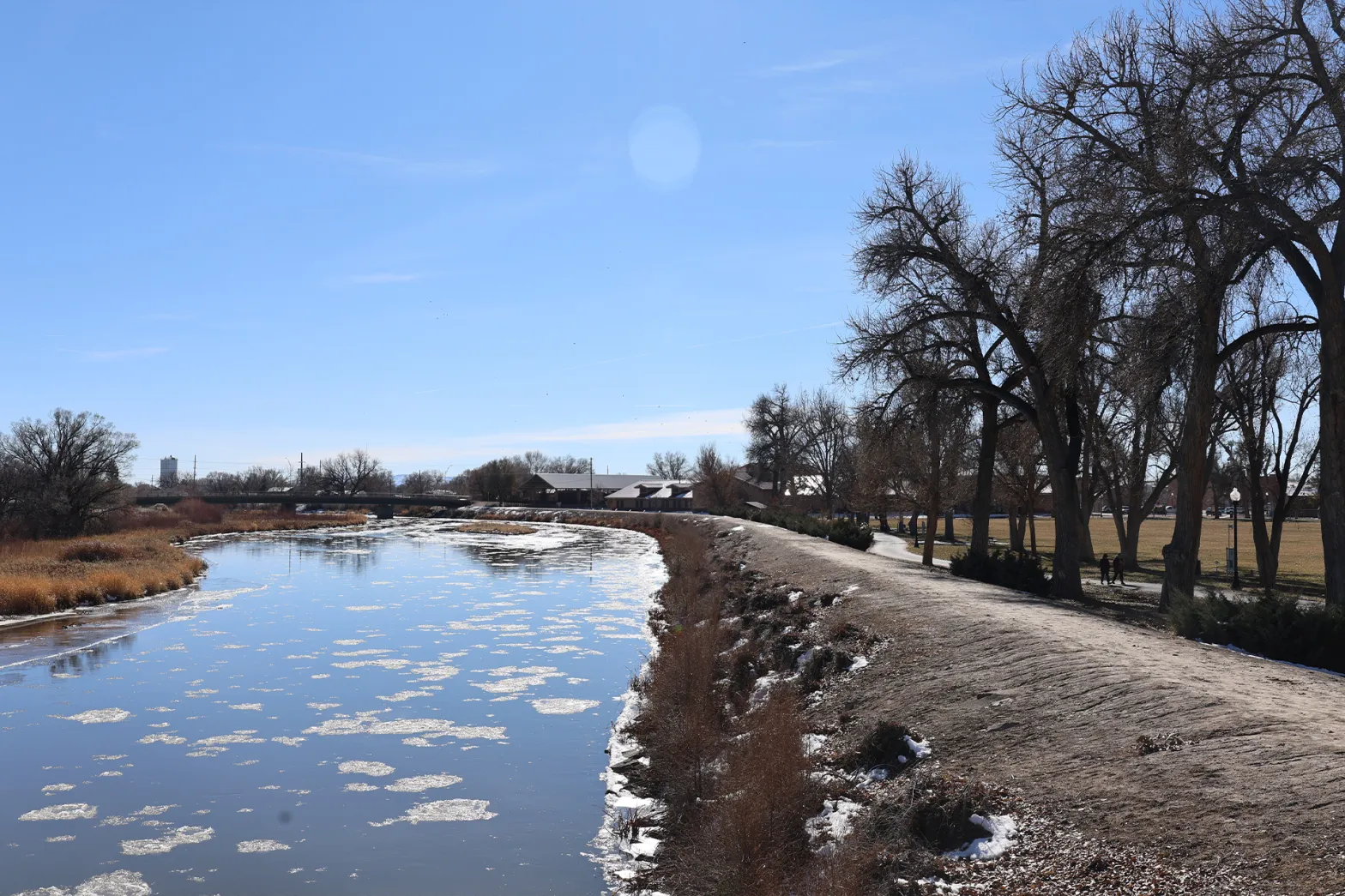
Alamosa is continuing to piece together its Rio Grande recreation puzzle. With support from the city of Alamosa to pull back the levee to make way for a beach, the Alamosa Riverfront Project is taking a different shape. Support from the city will aid in helping bring the project to completion.
During a city council meeting earlier in November, councilors recognized that the project aids in the city’s “Activating the Rio Grande Corridor,” a top priority for the Parks and Recreation Department.
As the river’s oxbow loops lazily trickle ever southward to the Gulf of Mexico, deciphering how to ensure people can access the river, how the river can maintain its natural biodiversity, and how to prevent thousands from losing their homes in a “100-year” flood make it a daunting and sharp puzzle.

The Alamosa Riverfront Project is looking to expand recreation access and improve river restoration from the State Avenue Bridge, upstream of Alamosa’s Cole Park, to the West Side Ditch, downstream of Cole Park. It’s a multi-million dollar project that, so far, has received overwhelming support from the community, according to project planners and members of the community who showed up at a series of summer community meetings.
You may be able to take the town from the river, but the river will continue to flow through town.
The project is looking to connect people back to the Rio Grande, not through adrenaline-pumping white water, but instead by leveraging its natural geographic limitations.
Brian Puccerella, San Luis Valley Great Outdoor’s outdoor recreation manager, has been involved in this project since about 2016. That’s when the conversation about expanding access to paddlers, maybe adding a play wave, and just expanding recreation generally started making the rounds.
The conversation was about “what was possible in our stretch of river in town,” Puccerella said. “We didn’t know the answer to that.”
An engineering study was funded in 2017 to look at what was possible.
“The conclusion,” he laughed, “was not much. It’s pretty flat and we don’t have a lot of flow. That doesn’t mean there isn’t going to be recreational improvement.”
The study equates Alamosa’s stretch of low-flowing river, less than one mile per foot downhill through town, to a “skinny lake.”
Puccerella explained that Alamosa’s portion of the river doesn’t have the flows or drops to ever get whitewater, even in a good year. A lot of the water that flows from the mountains into the river is diverted to different systems throughout the San Luis Valley. By the time the river reaches Alamosa, its flows are quite slow.
What we do have, he said, is flatwater.
That’s not a negative, though. “It creates opportunity for family-friendly recreation.”
Construction is still a ways out. Alamosans can expect construction to begin sometime around fall 2026. A lot of money still needs to be raised, and a lot can happen between now and then. What planners won’t have to worry about is the Army Corps of Engineers’ levee recertification.

BEACHFRONT PROPERTY
When construction is finished, the western levee, the side of the river adjacent to Cole Park, will be pulled back and a highly accessible riverfront beach will be added. Right now there’s a fairly steep, unfriendly drop to the water. In the future, there will be easy access for everyone.
The Rio Grande Headwaters Restoration Project is heading up the funding and providing the support to engineers throughout the project’s timeframe. During the summer, the group held two community feedback meetings to both inform and learn. From those meetings, project planners were able to adjust the plans.
Final plans will be revealed to the public in early 2025. These preliminary renderings can give us a hint, however.
“We’re doing this because this is what the community wanted,” said Cassandra McCuen, program manager for the Rio Grande Headwaters Restoration Project. She called the project “amazing and transformative.”
McCuen and Puccerella joined Outdoor Citizen podcast host Marty Jones to talk more about the project and provide updates. You can listen to that episode here, or wherever you get your podcasts.
From those community meetings, project planners were able to incorporate community feedback. Two of the most important pieces of feedback for engineers and designers: ensuring as much of the project is ADA accessible as possible, and making sure the river and beachfront are safe.
Access from Cole Park will be a priority, as it will serve as a kind of hub. The project calls for a few more boat ramps, adding to the two Alamosa currently has. These boat ramps won’t be for motorboats, but personal watercraft such as paddle boards, tubes, kayaks, and canoes.
Increasing recreational potential increases recreational safety. Currently, Puccerella and McCuen said, floating south of Cole Park isn’t advised. The West Side Ditch Diversion and the railroad bridge are a bit of a snag of willows, rusty metal, and splintered wood.
INSIDE THE LEVEE
“Inside the levee it’s more complicated,” McCuen said.
When it comes to changing the levee or potentially changing how water flows through town, you answer to the Army Corps of Engineers.
The Corps is responsible for ensuring that levees don’t fail during a proverbial “hundred-year flood.” Alamosa has a history of regular and devastating flooding. The levee system protects Alamosa proper and East Alamosa. Without a certified levee system, property owners are required to pay for flood insurance.
The recertification process is still many years out. The riverfront project is just a few years out. McCuen said the city has been an amazing partner in supporting the project.
With that in mind, project planners were able to meet with the Army Corps of Engineers and provide them with a full rundown of the project, plus the support of the city of Alamosa, and their proposal to pull the levee back.
McCuen said it was a real point of concern, because the project planners were unsure of how the Corps would react to the project’s proposal of pulling the levee back and the inner-levee restoration work.
McCuen said they were finally able to meet with the Army Corps in August. During that meeting, the Corps told the project planners they would be willing to work with them, “as long as you do not impact the flows through Alamosa negatively.”
Pulling the levee back to make way for a beach won’t impact flows in a noticeable way.
“Our project has worked seamlessly with the work that’s gone into levee recertification,” she said.

FISH PASSAGE
People are not only getting an upgrade, but so are the wildlife. This project is unique and special to Alamosa through both its recreation and restoration efforts. McCuen said the attempt is to improve the natural condition of the Rio Grande through town alongside increasing its recreational value. From the planning phase onward, restoration has been at the forefront of the project.
In-town restoration work can be complicated due to the levee recertification, but also due to the geographical limitations Puccerella mentioned. The river is extremely confined, McCuen explained.
Part of that confinement is because the Rio Grande is a very developed river. For example, diverting the Rio Grande’s flow before it reaches Alamosa creates that low flow prime for paddling and floating, but it also makes the water warm.
Warm water is bad for the Rio Grande’s fish. “Super-duper low flows make the area hot,” McCuen said. So one of the major aspects of the restoration portion is creating a safe, cool fish passage.
“We want fish to be able to flow upstream and downstream.”
The fish passage would simply be deeper channels that fish would use as aquatic highways. Also needed are fish refuges, or backwater habitats that exist along the river to serve as places where native fish can take refuge from non-native carp and pike.
Restoring the Rio Grande will take time and effort, but connecting the people back to the river is a start.
“We really wanted to create a project that spoke to the culture of Alamosa, spoke to the community, is something the community wanted, and I think we’re gonna get there because people took time out of their day to be involved in all this,” McCuen said.