Aerial image of entrenched meanders of the San Juan River within Goosenecks State Park. Located in San Juan County, southeastern Utah (U.S.). Credits Constructed from county topographic map DRG mosaic for San Juan County from USDA/NRCS – National Cartography & Geospatial Center using Global Mapper 12.0 and Adobe Illustrator. Latitude 33° 31′ 49.52″ N., Longitude 111° 37′ 48.02″ W. USDA/FSA, Public domain, via Wikimedia Commons
From email from Reclamation (Western Colorado Area Office):
Reclamation will be fulfilling a request to release the second block of the Jicarilla Apache Nation (JAN) subcontracted water that has been leased to the New Mexico Interstate Stream Commission (NMISC) and The Nature Conservancy (TNC) for calendar year 2024.
The subcontracted water released from the Navajo Unit will augment the current release of 350 cfs as requested by the NMISC and TNC. The table below shows the release schedule. Any changes to this schedule will be sent out in subsequent notices. The total volume of JAN subcontracted water for this release is 10,000 acre-feet over our current release.
Following this operation, the release will return to 350 cfs, or whatever is required to maintain the target baseflow through the endangered fish critical habitat reach of the San Juan River (Farmington to Lake Powell). The San Juan River Basin Recovery Implementation Program recommends a target base flow of between 500 cfs and 1,000 cfs through the critical habitat area. The target base flow is calculated as the weekly average of gaged flows throughout the critical habitat area from Farmington to Lake Powell.
This scheduled release change is subject to changes in river flows and weather conditions. If you have any questions, please contact Susan Behery (sbehery@usbr.gov or 970-385-6560), or visit Reclamation’s Navajo Dam website at https://www.usbr.gov/uc/water/crsp/cs/nvd.html
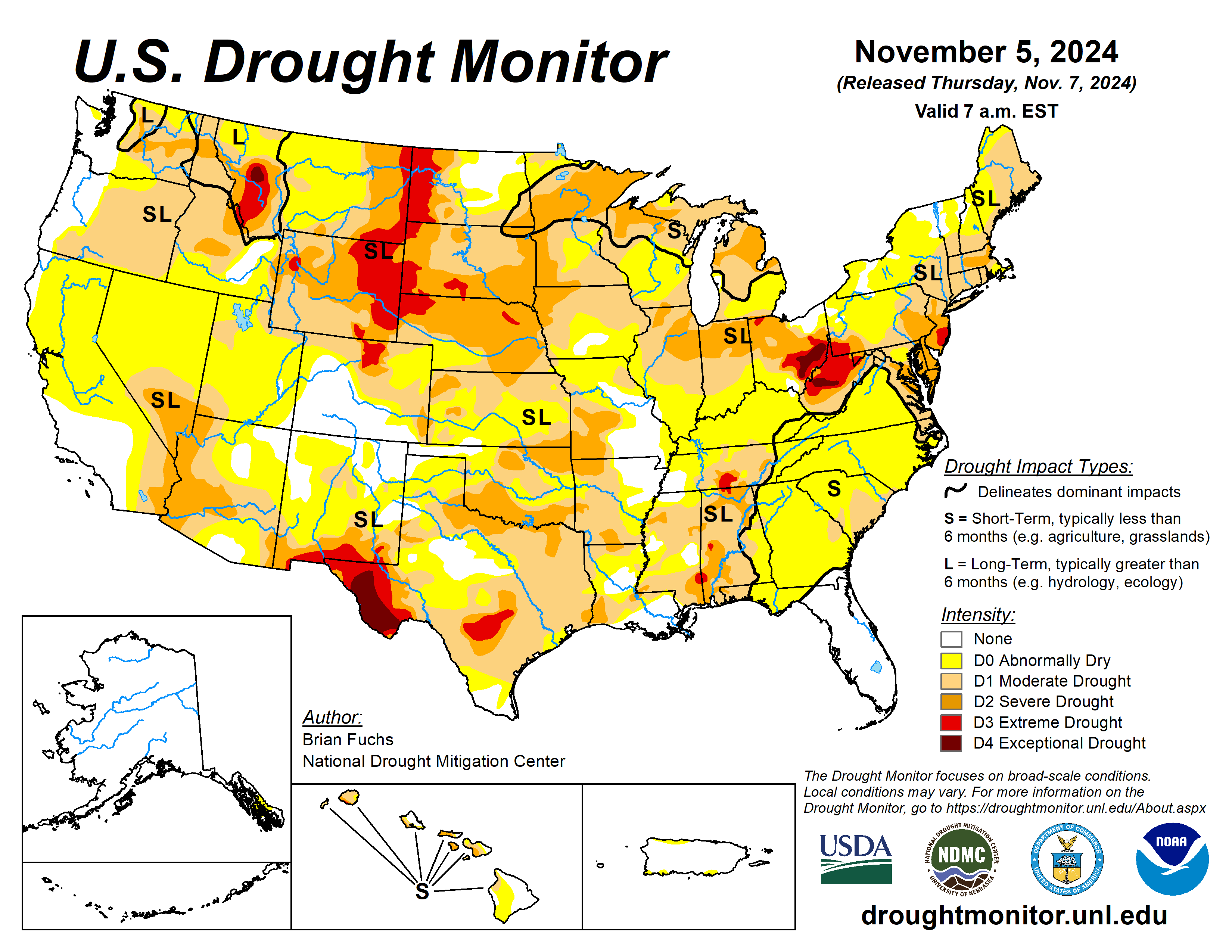
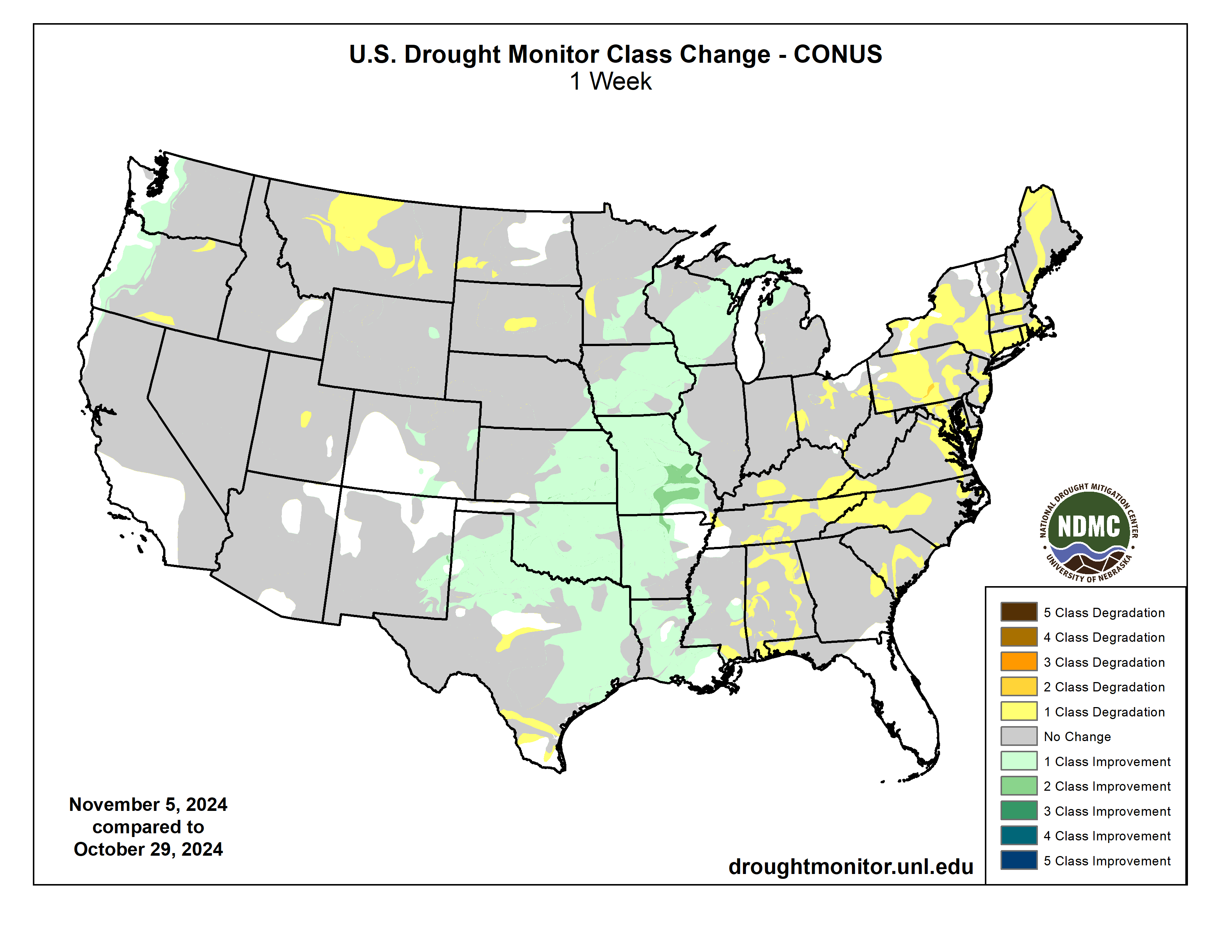
Over the last week, weather systems tracked over the southern Plains and into the Midwest, bringing much-needed precipitation. Some areas of Arkansas and Missouri reported over 10 inches of rain for the week. The active pattern also continued over the Pacific Northwest, with the coastal areas and inland recording 2-4 inches of rain that helped to alleviate dryness. Temperatures over the West were below-normal for the week, by as much as 6-9 degrees in parts of Nevada, Utah and Arizona. The rest of the country had warmer-than-normal temperatures, especially in Texas and into Louisiana, Mississippi, Arkansas and Alabama, where they were 9-12 degrees above normal. Many areas that received rain during the period had these rains come on the cusp of record-setting dryness in October, but many records were still set for areas that didn’t receive rain at the end of October and early November…
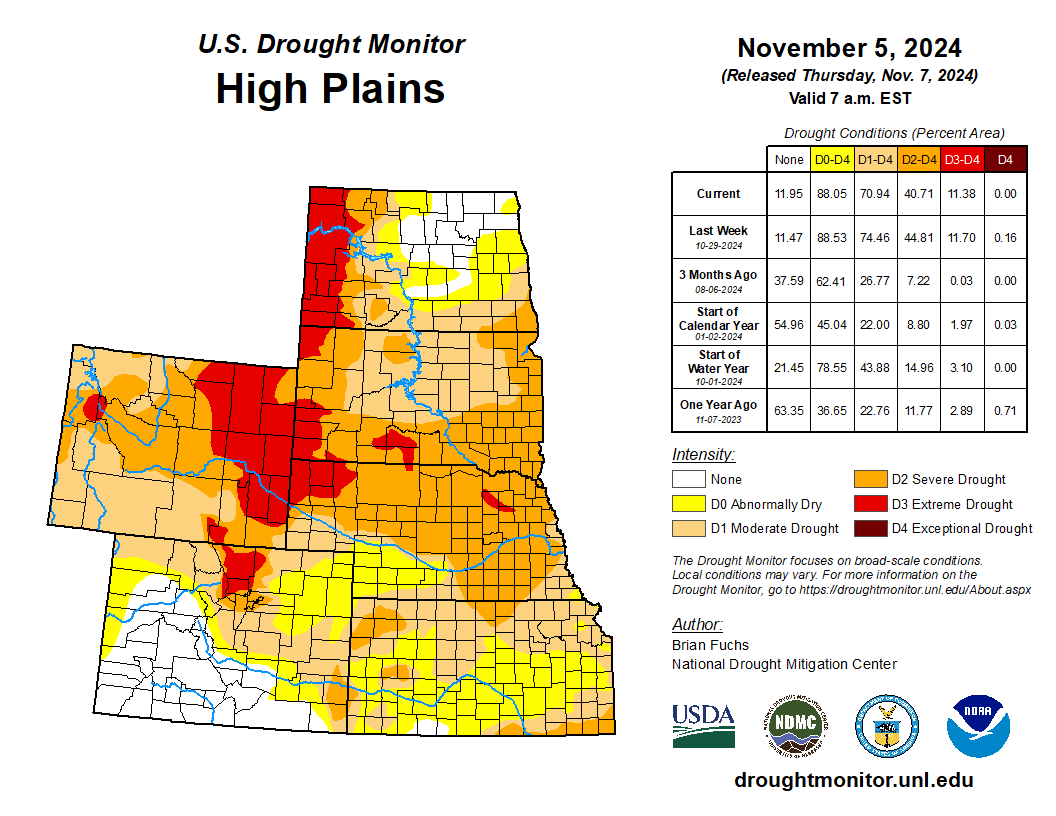
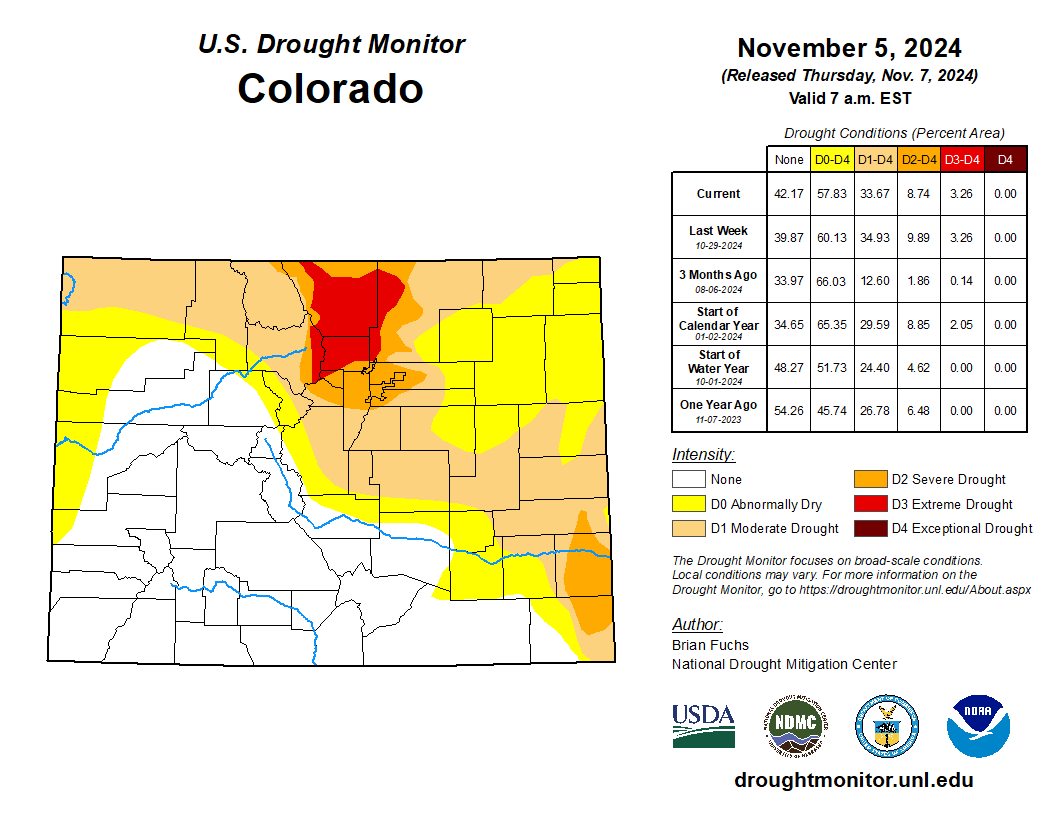
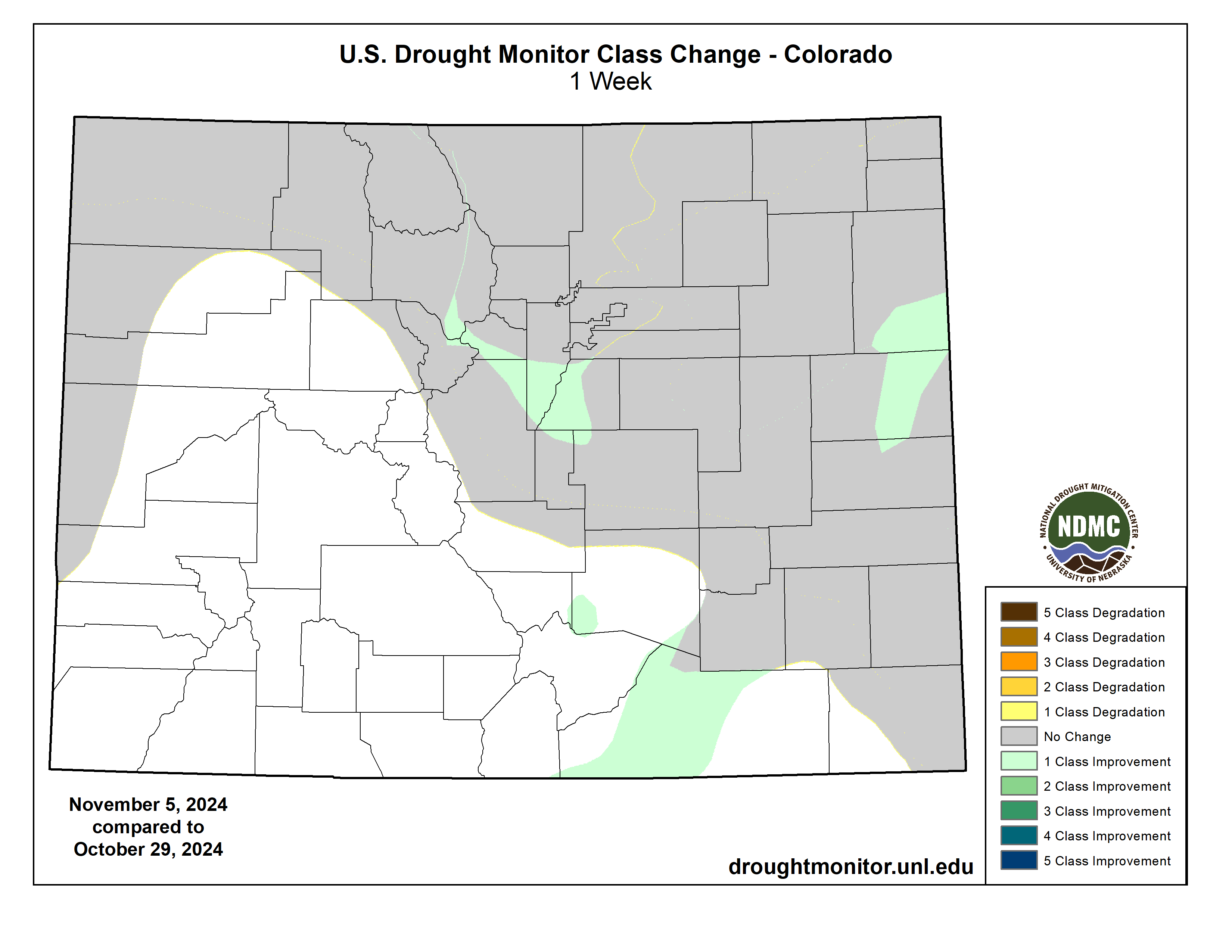
Significant rains fell over much of Kansas, into southeast Nebraska and southeast Colorado. Rain and snow fell from portions of eastern Colorado into Wyoming and into the Dakotas too, reversing the trend of very dry conditions. Not all areas were as fortunate, with northeast Colorado, western Nebraska, eastern and southwest South Dakota and northwest North Dakota remaining dry this week. The region was split, with temperatures in the western areas 3-6 degrees below normal, and temperatures 9-12 degrees above normal in much of eastern Nebraska and eastern Kansas. Much of eastern Kansas saw a full category of improvement this week, with extreme drought being removed from the southeast. Severe drought was removed from far southeast Nebraska. In western North Dakota and in eastern Montana, severe and extreme drought expanded slightly. Some improvements were made to abnormally dry conditions over central to southern Colorado and to moderate drought over northeast Colorado. Moderate drought expanded across central South Dakota this week…
Colorado Drought Monitor one week change map ending November 5, 2024.
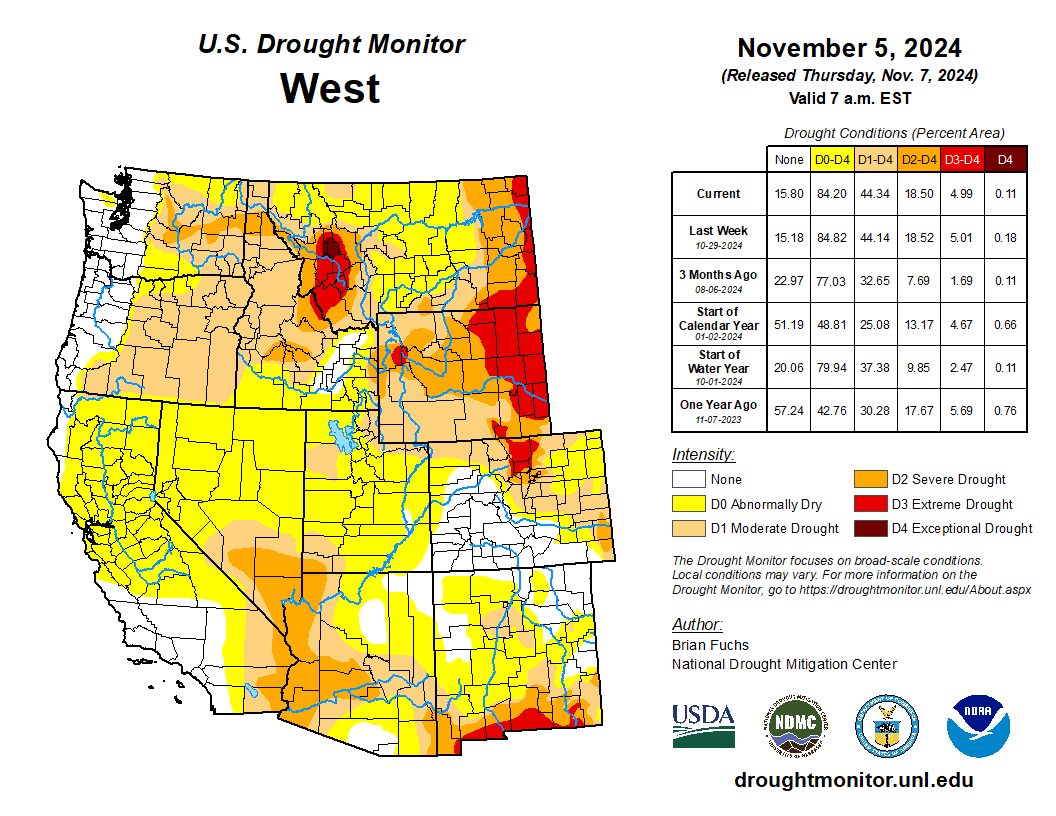
Precipitation was scattered over much of the West, with the greatest rain over the Pacific Northwest, where 200% of normal rain was recorded for the week in much of Oregon and Washington. Cooler-than-normal temperatures dominated the region with many areas of Nevada, Utah, and Arizona and into western Wyoming 6-9 degrees below normal for the week. Dryness continued to dominate much of Montana with abnormally dry conditions expanding to fill the rest of the state and moderate and severe drought expanding in the west. Abnormally dry conditions spread to the rest of central Utah while moderate drought and abnormally dry conditions improved over much of western Oregon and Washington. Some improvements were made over eastern New Mexico this week as a result of the continued wetter conditions…
Temperatures were 12-15 degrees above normal over much of the South, with areas of the Texas Panhandle into Oklahoma 6-9 degrees above normal. Much of Oklahoma and north Texas and Arkansas received significant precipitation, with widespread reports of 800% of normal rain for the week. The dryness continued over much of Tennessee and into northern Mississippi as the active rain patterns brought some rains, but not the significant and widespread rains that were more common in the West. A full category improvement was made over much of Oklahoma and northern Texas and western Arkansas, with extreme drought removed from the region. Extreme drought emerged in southeast Mississippi. Severe drought improved in Louisiana with moderate drought and abnormally dry conditions also improving in southern Louisiana.
Looking Ahead
Over the next 5-7 days, it is anticipated that the wet pattern will continue over much of the southern Plains and into the South, Southeast, and Midwest. The active pattern along the coastal areas of the Pacific Northwest will also continue. Greatest precipitation is anticipated over the southern Plains, western Tennessee, western Kentucky, northern Mississippi, southern Georgia, western South Carolina and the Pacific Northwest coast, where 3 or more inches of rain is anticipated. Much of the West will remain dry. Temperatures will remain cooler than normal over much of the West with departures of 10-12 degrees below normal over northern New Mexico and southern Colorado. Much of the eastern half of the country will be warmer than normal, while areas of the Midwest and South are anticipated to be 10-12 degrees below normal for the week. Hurricane Rafael has formed in the Gulf of Mexico and is projected to track westward. It may not make landfall until the middle of next week but could impact the dryness over the South and southern Plains depending on its path.
The 6-10 day outlooks show that the probability of above-normal temperatures will be greatest over the eastern half of the United States, especially over the Midwest and into the Southeast. Chances of cooler-than-normal temperatures are greatest over the West, in particular over California and Nevada. Most of the country has a good chance of recording above-normal precipitation during the period, especially over the Pacific Northwest.
US Drought Monitor one week change map ending November 5, 2024.
Just for grins here’s a slideshow of early November US Drought Monitor maps for the past few years.
This photo shows the newly-installed headgate stem wall at the Sheriff Reservoir dam in Routt County. The town is moving forward with repairs to the dam’s spillway after the Colorado Division of Water Resources placed restrictions on the 68-year-old structure in 2021.
Town of Oak Creek/Courtesy photo
On Tuesday, Oct. 15, the Colorado River District Board of Directors unanimously approved $366,655 in funding from the Community Funding Partnership program to support two critical water infrastructure and restoration projects. The Sheriff Reservoir Dam Rehabilitation Project and the Gunnison River Basin Drought Resiliency and Restoration Project aim to increase water security for agriculture, protect local drinking water supplies, and enhance environmental health on Colorado’s western slope. Including these recent approvals, the Community Funding Partnership has awarded a total of $3.3 million to 26 West Slope water projects in 2024.
“These projects are a perfect example of our mission in action—protecting critical drinking water supplies while also improving infrastructure and supporting productive agriculture,” said Melissa Wills, Community Funding Partnership program manager at the Colorado River District. “By investing in these efforts, we are also leveraging significant federal and state funds and delivering long-term benefits to communities throughout the region.”
The Sheriff Reservoir Dam Rehabilitation Construction Project, spanning Routt and Rio Blanco counties, aims to restore the dam’s safety and functionality, protect downstream communities, secure water supplies for the Town of Oak [Creek], and improve flows in both Trout Creek and Oak Creek. Additionally, the Gunnison River Basin Drought Resiliency and Restoration Project will enhance irrigation efficiency and restore riparian habitats along Kiser, Tomichi, and Cochetopa creeks. Led by Trout Unlimited, this effort will work to reconnect floodplains, reduce streambank erosion, lower water temperatures, and boost late-season stream flows in Delta, Gunnison, and Saguache Counties.
Since its establishment in 2021, the Colorado River District’s Community Funding Partnership has funded over 125 projects and leveraged more than $95 million in federal funding to benefit local communities across the West Slope. The program, supported by voters through ballot measure 7A in November 2020, focuses on five key areas: productive agriculture, infrastructure, healthy rivers, watershed health and water quality, and conservation and efficiency. By serving as a catalyst for securing matching funds from state, federal, and private sources, the program continues to play a vital role in advancing multi-purpose water projects in the region.
The two projects approved by the board on October 15th are listed below. Detailed project descriptions and staff recommendations are available in the public meeting packet HERE.
Sheriff Reservoir Dam Rehabilitation Construction Project
Applicant: Town of Oak Creek
Total Approved: up to $232,155.00
Location: Routt and Rio Blanco Counties
Gunnison River Basin Drought Resiliency and Restoration Project
Applicant: Trout Unlimited
Total Approved: $134,500
Location: Gunnison, Delta, and Saguache Counties
For more information on the Colorado River District and the Community Funding Partnership program, visit coloradoriverdistrict.org.