State of #Wyoming orders demolition of LaPrele dam to avoid ‘catastrophic failure’: Structure that serves 100 irrigators will cost more than $118 million to replace. State will rush to demolish current structure before spring #runoff season — Dustin Bleizeffer (@WyoFile)

The Wyoming Water Development Commission organized a tour of the LaPrele dam Aug. 12, 2021. Constructed in 1909, the dam is now slated for emergency demolition. (Dustin Bleizeffer/WyoFile)

Click the link to read the article on the WyoFile website (Dustin Bleizeffer):

November 7, 2024

It is no longer safe to hold any amount of water behind the LaPrele dam, and the long deteriorating 115-year-old concrete structure located 20 miles west of Douglas must be demolished as soon as possible to avoid a “catastrophic failure,” according to state officials.

State Engineer Brandon Gebhart issued a “breach order” earlier this month, noting the recent discovery of several new cracks compounding other structural problems identified years ago.

“This dam has significant structural deficiencies and has exceeded its useful life,” Gebhart said in a prepared statement. 

In 2021, the Wyoming Water Development Office estimated that, at full storage, a catastrophic failure would send a torrent of water and debris through the Ayres Natural Bridge Park just two miles below the dam, overwhelm several roadway bridges and flood areas of Douglas along the North Platte River.

Fortunately, the state and local irrigation district had already taken measures to avoid such a scenario by draining the LaPrele reservoir earlier this fall.
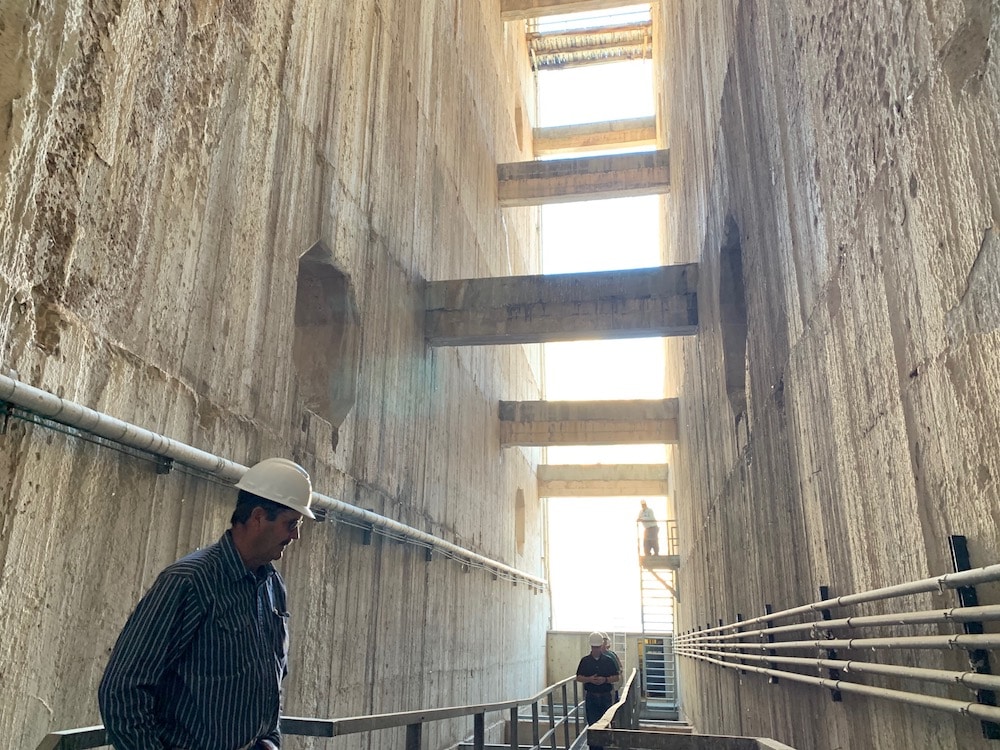
The Ambursen-style LaPrele dam consists of a series of concrete walls — or “fins” — to support an angled, flat slab on the reservoir side. The design is prone to catastrophic failure, according to engineers. (Dustin Bleizeffer/WyoFile)

“I want to commend the State Engineer and his staff for recognizing the significant risks of a potential dam failure and proactively addressing them before a disaster occurred,” Gov. Mark Gordon said in a prepared statement. “This decision was not made lightly, and we recognize the impact this will have on those who rely on that water for irrigation.”

Now that authorities have mitigated an immediate catastrophic failure of the LaPrele dam, the state is racing against the clock to demolish the structure before April when spring runoff begins.

“These [structural] threats need to be mitigated before the spring runoff, when flows are expected to exceed the dam’s ability to pass inflows,” Gebhart said.

Runoff is also a potential concern this winter, state officials added, noting there’s always a possibility for unseasonable flows that might exceed the dam’s ability to allow water to freely pass through the outlet, which has a maximum output of up to 300 cubic feet per second.

Local and state officials, in consultation with engineering firms, came to terms with the pending demise of the LaPrele dam several years ago and initiated planning for how to eventually replace it. Cost estimates reach above $118 million. In addition to a $30 million appropriation from the Legislature, the state has secured $32 million via the federal Infrastructure Investment and Jobs Act and hopes to secure the rest of the necessary funds from the same federal program.
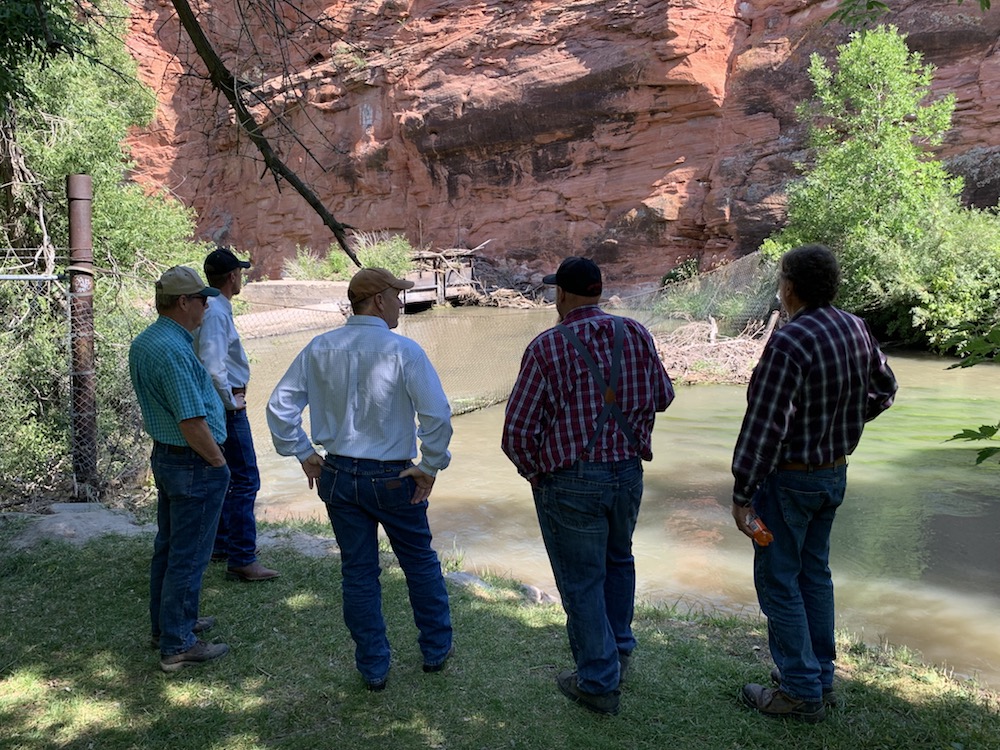
Members of the Wyoming Water Commission and a member of the LaPrele Irrigation District examine a diversion in LaPrele Creek in August 2021. (Dustin Bleizeffer/WyoFile)

“There will be uncertainty on costs until the design is complete and a price can be agreed upon through a construction contract,” Wyoming Water Development Office Director Jason Mead told WyoFile. “However, with the inflation seen over the last several years, it is expected additional funds may be needed to complete the project and everyone is working to identify potential sources for that funding.”

After demolition work is completed, construction on a replacement dam may begin in 2026 with a completion date of 2029, according to Mead. The dam served about 100 irrigators along LaPrele Creek, which flows out of the Laramie Range into the North Platte River.

LaPrele’s history of problems

The dam, standing 130 feet high and stretching 325 feet over LaPrele Creek, serves late-season water to irrigators between the dam and the nearby North Platte River, according to the state. The Ambursen-style dam consists of a series of concrete buttresses — or “fins” — supporting an angled, flat slab on the reservoir side, and is anchored into a fractured Madison limestone formation on both sides.

In 2016, a boulder fell from the west wall on the dam’s downstream side, barely missing the structure. The discovery of the boulder’s near-miss led to investigations that revealed several migrating cracks in the dam, spawning further engineering investigations and a determination a few years later that the dam’s days were numbered.

The dam’s structural integrity, in fact, has been in question for decades.
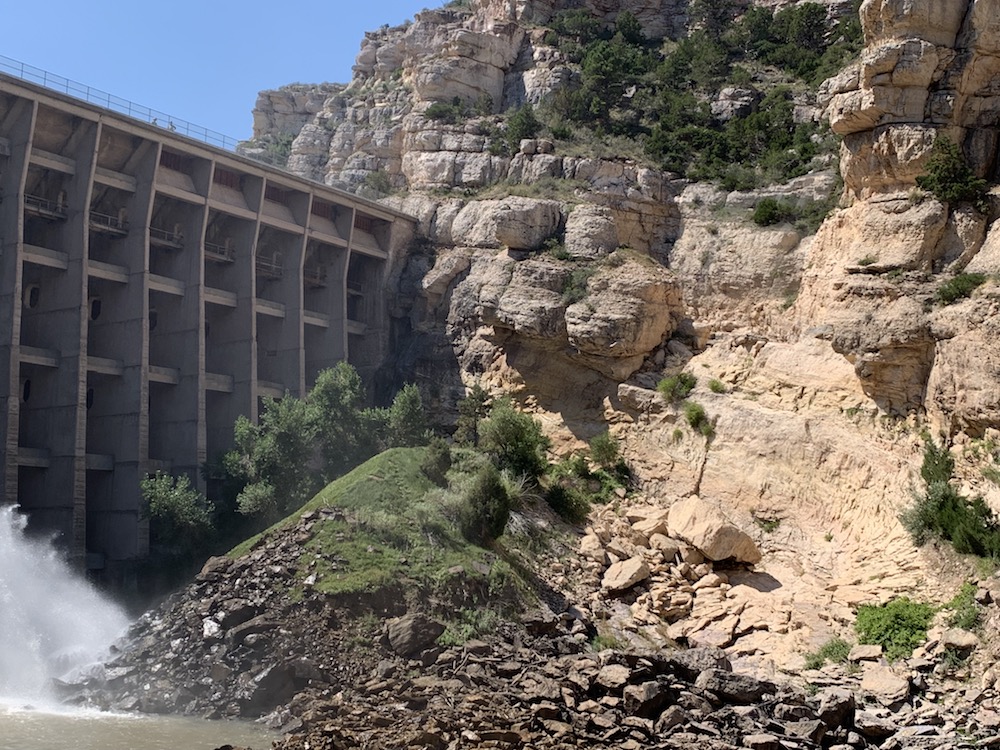
A boulder in the limestone wall behind the LaPrele dam fell in 2016. (Dustin Bleizeffer/WyoFile)

Talk of LaPrele reaching the end of its useful life emerged in the 1970s due to leaks and the problematic nature of the Ambursen-buttress design. But the Panhandle Eastern Pipeline Co., eager at the time to access water for its coal-gasification ambitions, struck a deal with irrigators to repair the structure in return for a share of water.

The company paid to grout cracks and add new layers of concrete. Panhandle Eastern Pipeline’s coal-gasification plans never came to fruition, but the company’s patching efforts restored confidence in the dam — for a while. 

Challenges ahead

Irrigators reliant on the LaPrele dam have seen dwindling late-season water deliveries — by about half — since 2019, when the state ordered the reservoir be maintained at lower levels to avoid stress on the structure. Now those ranching operations rely completely on what Mother Nature delivers, without the benefit of measured releases for late-season crops or a functional dam to help avoid potential flooding.

“The farms and ranches will see significant production losses until the new dam is constructed,” LaPrele Irrigation District Secretary Anna McClure said. “Streambank integrity and infrastructure on the LaPrele Creek will be affected by the uncontrolled flow of water.”

State officials are assessing the flood risk, but so far there’s no particular mitigation plan. 

“There are areas downstream of LaPrele Dam that could be impacted by uncontrolled spring flows, including Ayres Natural Bridge,” Gebhart said.

Ayres Natural Bridge over LaPrele Creek, Wyoming. By Haberstr – Own work, CC0, https://commons.wikimedia.org/w/index.php?curid=7499088

Trump Wins, Planet Loses — Grist #ActOnClimate

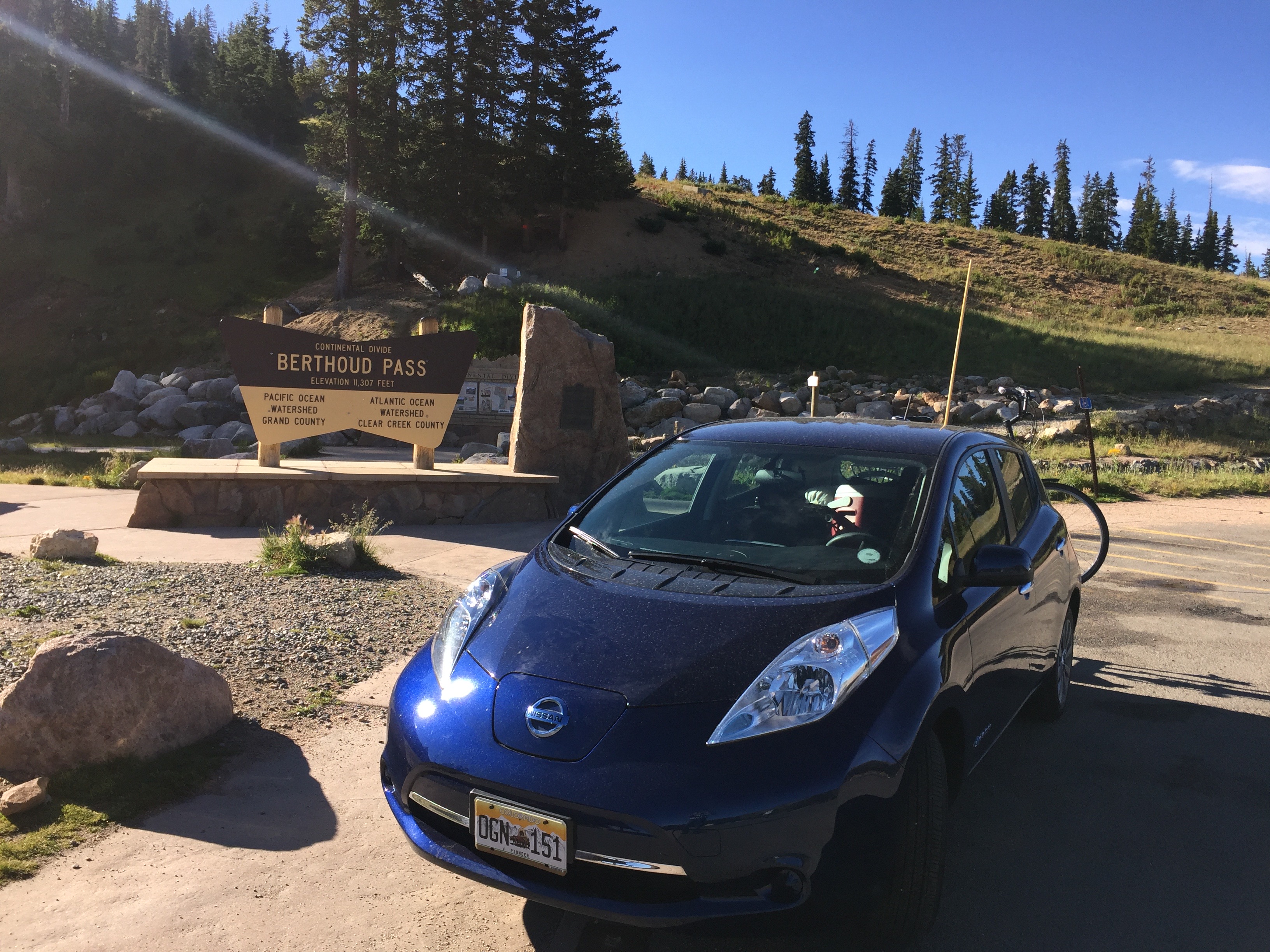
Leaf, Berthoud Pass Summit, August 21, 2017.

Click the link to read the article on the Grist website (Tik Root):

November 6, 2024

Donald J. Trump will once again be president of the United States. 

The Associated Press called the race for Trump early Wednesday morning, ending one of the costliest and most turbulent campaign cycles in the nation’s history. The results promise to upend U.S. climate policy: In addition to returning a climate denier to the White House, voters also gave Republicans control of the Senate, laying the groundwork for attacks on everything from electric vehicles to clean energy funding and bolstering support for the fossil fuel industry.

“We have more liquid gold than any country in the world,” Trump said during his victory speech, referring to domestic oil and gas potential. The CEO of the American Petroleum Institute issued a statement saying that “energy was on the ballot, and voters sent a clear signal that they want choices, not mandates.”

The election results rattled climate policy experts and environmental advocates. The president-elect has called climate change “a hoax” and during his most recent campaign vowed to expand fossil fuel production, roll back environmental regulations, and eliminate federal support for clean energy. He has also said he would scuttle the Inflation Reduction Act, or IRA, which is the largest investment in climate action in U.S. history and a landmark legislative win for the Biden administration. Such steps would add billions of tons of additional greenhouse gases to the atmosphere and hasten the looming impacts of climate change.

“This is a dark day,” Ben Jealous, the executive director of the Sierra Club, said in a statement. “Donald Trump was a disaster for climate progress during his first term, and everything he’s said and done since suggests he’s eager to do even more damage this time.”

During his first stint in office, Trump withdrew from the Paris Agreement, the 2015 international climate accord that guides the actions of more than 195 countries; rolled back 100-plus environmental rules; and opened the Arctic National Wildlife Refuge to drilling. While President Joe Biden reversed many of those actions and made fighting climate change a centerpiece of his presidency, Trump has pledged to undo those efforts during his second term, with potentially enormous implications — climate analysts at Carbon Brief predicted that another four years of Trump would lead to the nation emitting an additional 4 billion metric tons of carbon dioxide than it would under his opponent. That’s on par with the combined annual emissions of the European Union and Japan. 

One of President-elect Trump’s primary targets will be rolling back the IRA, which is poised to direct more than a trillion dollars into climate-friendly initiatives. Two years into that decade-long effort, money is flowing into myriad initiatives, ranging from building out the nation’s electric vehicle charging network to helping people go solar and weatherize their homes. In 2023 alone, some 3.4 million Americans claimed more $8 billion in tax credits the law provides for home energy improvements. But Trump could stymie, freeze, or even eliminate much of the law. 

“We will rescind all unspent funds,” Trump assured the audience in a September speech at the Economic Club of New York. Last month, he said it would be “an honor” to “immediately terminate” a law he called the “Green New Scam.” 

Such a move would, however, require congressional support. While many House races remain too close to call, Republicans have taken control of the Senate. That said, any attempt to roll back the IRA may prove unpopular, because as much as $165 billion in the funding it provides is flowing to Republican districts

Still, Trump can take unilateral steps to slow spending, and use federal regulatory powers to further hamper the rollout process. As Axios noted, “If Trump wants to shut off the IRA spigot, he’ll likely find ways to do it.” Looking beyond that seminal climate law, Trump has plenty of other levers he can also pull that will adversely affect the environment  — efforts that will be easier with a conservative Supreme Court that has already undermined federal climate action. 

Trump has also thrown his support behind expanded fossil fuel production. He has long pushed for the country to “drill, baby, drill” and, in April, offered industry executives tax and regulatory favors in exchange for $1 billion in campaign support. Though that astronomical sum never materialized, The New York Times found that oil and gas interests donated an estimated $75 million to Trump’s campaign, the Republican National Committee, and affiliated committees. Fossil fuels were already booming under Biden, with domestic oil production higher than ever before, and Vice President Kamala Harris said she would continue producing them if she won. But Trump could give the industry a considerable boost by, for instance, reopening more of the Arctic to drilling

Still, Trump can take unilateral steps to slow spending, and use federal regulatory powers to further hamper the rollout process. As Axios noted, “If Trump wants to shut off the IRA spigot, he’ll likely find ways to do it.” Looking beyond that seminal climate law, Trump has plenty of other levers he can also pull that will adversely affect the environment  — efforts that will be easier with a conservative Supreme Court that has already undermined federal climate action. 

Trump has also thrown his support behind expanded fossil fuel production. He has long pushed for the country to “drill, baby, drill” and, in April, offered industry executives tax and regulatory favors in exchange for $1 billion in campaign support. Though that astronomical sum never materialized, The New York Times found that oil and gas interests donated an estimated $75 million to Trump’s campaign, the Republican National Committee, and affiliated committees. Fossil fuels were already booming under Biden, with domestic oil production higher than ever before, and Vice President Kamala Harris said she would continue producing them if she won. But Trump could give the industry a considerable boost by, for instance, reopening more of the Arctic to drilling

Any climate chaos that Trump sows is sure to extend beyond the United States. The president-elect could attempt to once again abandon the Paris Agreement, undermining global efforts to address the crisis. His threat to use tariffs to protect U.S. companies and restore American manufacturing could upend energy markets. The vast majority of solar panels and electric vehicle batteries, for example, are made overseas and the prices of those imports, as well as other clean-energy technology, could soar. U.S. liquefied natural gas producers worry that retaliatory tariffs could hamper their business

The Trump administration could also take quieter steps to shape climate policy, from further divorcing federal research functions from their rulemaking capacities to guiding how the Centers for Disease Control and Prevention studies and responds to health concerns. 

Any climate chaos that Trump sows is sure to extend beyond the United States. The president-elect could attempt to once again abandon the Paris Agreement, undermining global efforts to address the crisis. His threat to use tariffs to protect U.S. companies and restore American manufacturing could upend energy markets. The vast majority of solar panels and electric vehicle batteries, for example, are made overseas and the prices of those imports, as well as other clean-energy technology, could soar. U.S. liquefied natural gas producers worry that retaliatory tariffs could hamper their business

The Trump administration could also take quieter steps to shape climate policy, from further divorcing federal research functions from their rulemaking capacities to guiding how the Centers for Disease Control and Prevention studies and responds to health concerns. 

Trump is all but sure to wreak havoc on federal agencies central to understanding, and combating, climate change. During his first term, his administration gutted funding for research, appointed climate skeptics and industry insiders, and eliminated several scientific advisory committees. It also censored scientific data on government websites and tried to undermine the findings of the National Climate Assessment, the government’s scientific report on the risks and impacts of climate change to the country. Project 2025, the sweeping blueprint developed by conservative groups and former Trump administration officials, advances a similar strategy, deprioritizing climate science and perhaps restructuring or eliminating federal agencies that advance it.

“The nation and world can expect the incoming Trump administration to take a wrecking ball to global climate diplomacy,” Rachel Cleetus, the policy director and lead economist for the Climate and Energy Program at the Union for Concerned Scientists, said in a statement. “The science on climate change is unforgiving, with every year of delay locking in more costs and more irreversible changes, and everyday people paying the steepest price.”

The president-elect’s supporters seem eager to begin their work. 

Mandy Gunasekara, a former chief of staff of the Environmental Protection Agency during Trump’s first term, told CNN before the election that this second administration would be far more prepared to enact its agenda, and would act quickly. One likely early target will be Biden-era tailpipe emissions rules that Trump has derided as an electric vehicle “mandate.”  

During his first term, Trump similarly tried to weaken Obama-era emissions regulations. But the auto industry made the point moot when it sidestepped the federal government and made a deal with states directly, a move that’s indicative of the approach that environmentalists might take during his second term. Even before the election, climate advocates had begun preparing for the possibility of a second Trump presidency and the nation’s abandoning the global diplomatic stage on this issue. Bloomberg reported that officials and former diplomats have been convening secret conversations, crisis simulations, and “political war-gaming” aimed at maximizing climate progress under Trump — an effort that will surely start when COP29 kicks off next week in Baku, Azerbaijan.

“The result from this election will be seen as a major blow to global climate action,” Christiana Figueres, the United Nations climate chief from 2010 to 2016, said in a statement. “[But] there is an antidote to doom and despair. It’s action on the ground, and it’s happening in all corners of the Earth.”

New Research Finds Rising Heat Driving Western U.S. Droughts: Higher temperatures can cause droughts even with normal precipitation — NOAA #drought

Click the link to read the news on the NOAA website:

November 8, 2024

Higher temperatures caused by anthropogenic climate change made an ordinary drought into an exceptional drought that parched the American West from 2020-2022, according to a new study
 by scientists from the University of California, Los Angeles (UCLA), NOAA’s National Integrated Drought Information System (NIDIS), and the Cooperative Institute for Research in Environmental Sciences.

The scientists found that evaporative demand, or the thirst of the atmosphere, has played a bigger role than reduced precipitation in droughts since 2000. During the 2020–2022 drought, evaporation accounted for 61% of the drought’s severity, while reduced precipitation only accounted for only 39%. 

“Research has already shown that warmer temperatures contribute to drought, but this is, to our knowledge, the first study that actually shows that moisture loss due to demand is greater than the moisture loss due to lack of rainfall,” said Rong Fu, a UCLA professor of atmospheric and oceanic sciences and the corresponding author of the study, which was published in the journal Science Advances.

They predict that droughts will last longer, cover wider areas, and become more severe as the climate warms.

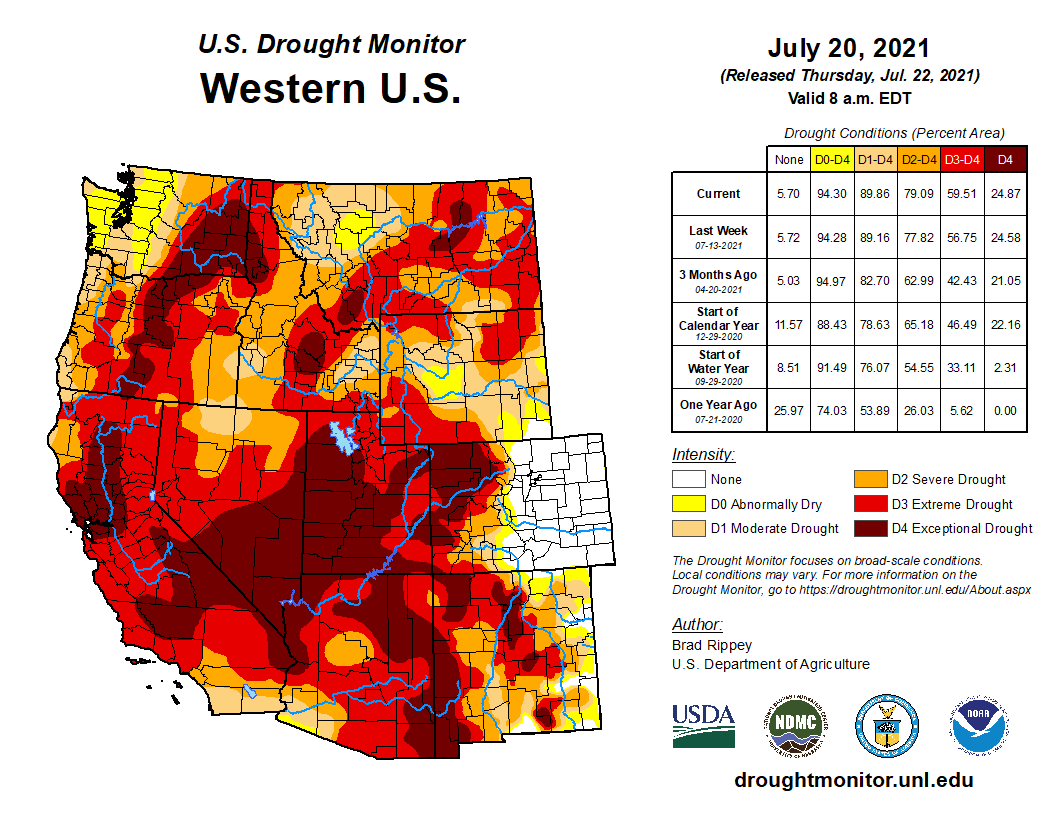
The U.S. Drought Monitor depicted the extent of the severe drought affecting the western U.S. on July 20, 2021. New research finds that increasing temperatures will make droughts like this more frequent. Credit: National Drought Mitigation Center.

Historically, drought in the West has been caused by lack of precipitation, while evaporative demand played a smaller role. Climate change caused primarily by burning fossil fuels has resulted in higher average temperatures that complicate this picture. Now, droughts induced by natural fluctuations in rainfall still exist, but there’s more heat to suck moisture from bodies of water, plants, and soil. 

“For generations, drought has been associated with drier than normal weather,” said Veva Deheza, Director of NOAA’s National Integrated Drought Information System and study co-author. “This study further confirms we’ve entered a new paradigm where rising temperatures are leading to intense droughts with precipitation as a secondary factor.”

A warmer atmosphere can hold more water vapor before the air mass becomes saturated, and precipitation can form. This creates a cycle in which the warmer the planet gets, the more water can evaporate from the landscape and remain stored in the atmosphere longer before it returns to earth as rain or snow. Droughts can form even if precipitation patterns remain within a normal range as higher temperatures and evaporation remove water from soils. They can last longer, cover wider areas, and be even drier with every little bit that the planet warms.

To tease out the effects of higher temperatures on drought, the researchers have separated “natural” droughts due to changing weather patterns from droughts due to human-caused climate change in the observational data over a 70-year period. Previous studies have used climate models forced by increasing greenhouse gases to conclude that rising temperatures contribute to drought. But without observational data about real weather patterns, they could not pinpoint the role played by evaporative demand due to naturally varying weather patterns. 

When these natural weather patterns were included, the researchers were shocked to find that climate change accounts for 80% of the increase in evaporative demand since 2000. During the drought periods, that figure increased to more than 90%, making it the single biggest driver of increasing drought severity and expansion of drought area since 2000. 

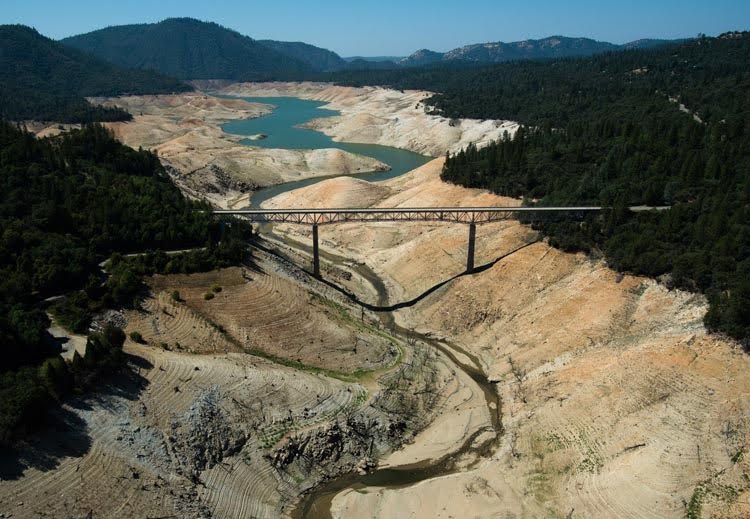
This photo shows California’s largest reservoir, Lake Oroville, nearly dry on August 19, 2014. Credit: California Department of Water Resources.

Compared to the period 1948–1999, the average drought area increased 17% over the western United States from 2000–2022 due to an increase in evaporative demand.  The new analysis showed that since 2000, in 66% of the historical and emerging drought-prone regions, high evaporative demand alone could cause drought, meaning drought can occur even without precipitation deficit. Before 2000, that was only true for 26% of the area.

“During the drought of 2020–2022, moisture demand really spiked,” Fu said. “Though the drought began through a natural reduction in precipitation, I would say its severity was increased from the equivalent of ‘moderate’ to ‘exceptional’ on the drought severity scale due to climate change.”

The U.S. Drought Monitor classifies Moderate Drought (D1 on a scale of D0–D4) as falling in the top 10%–20%of historic droughts, while ‘Exceptional’ Droughts (D4) fall in the top 2%. Further climate model simulations corroborated these findings and projected that fossil fuel pollution will turn droughts like the 2020–2022 from exceedingly rare events that once happened only every 1,000 years to events that happen every 60 years by the mid-21st century, and every six years by the late 21st century.

“Even if precipitation looks normal, we can still have drought because moisture demand has increased so much, and there simply isn’t enough water to keep up with that increased demand,” said Fu. “This is not something you could build bigger reservoirs or something to prevent because when the atmosphere warms, it will just suck up more moisture everywhere. The only way to prevent this is to stop temperature increase, which means we have to stop emitting greenhouse gases.” 

The study was supported by NOAA’s National Integrated Drought Information System and the Climate Program Office, as well as the National Science Foundation. Learn more about NIDIS-supported research.