#Drought news November 21, 2024: In the areas of heaviest precipitation (1.5 to approaching 3.0 inches), improvement was introduced. This included significant parts of #Kansas, S.E. #Colorado, E. sections of #Nebraska

Click on a thumbnail graphic to view a gallery of drought data from the US Drought Monitor website.

Click the link to go to the US Drought Monitor website. Here’s an excerpt:

This Week’s Drought Summary

The trend of the past few weeks toward generally increased precipitation across the Contiguous 48 states continued this week, with several sizeable swaths of heavy precipitation recorded, and broad coverage of near or above normal amounts. The heaviest amounts fell from the Cascades westward to the Pacific Ocean, in addition to southwestern Oregon and northwestern California. Amounts exceeded 3 inches through almost this entire region, with amounts of 5 inches to locally 1 foot observed in portions of the Cascades and immediate Pacific Coastline, especially where orographically enhanced. Several other large areas recorded at least an inch and locally up to 5 inches, including most of the northern Intermountain West, a swath from the southern High Plains through the central Great Plains and the middle and upper Mississippi Valley, much of the lower Mississippi Valley, the lower Ohio and Tennessee Valleys, the upper Southeast, much of the Virginia Tidewater and eastern North Carolina, and parts of the southern and central Appalachians. Numerous locations in the Lower Mississippi Valley and northwestern Alabama reported 3 to 5 inches of rain, as did a swath in north-central Kentucky and isolated spots in western Tennessee, northwestern Texas, eastern Oklahoma, southwestern Kansas, and western Iowa. The broad coverage of moderate to heavy precipitation prompted sizeable areas of improvement in this week’s Drought Monitor. The pattern of increased precipitation has yet to materialize in the Northeast, however, where record and near-record low precipitation amounts have been observed over the past few months, and continued dryness last week allowed conditions to continue to deteriorate. Little or no precipitation was also recorded across the southern reaches of South Carolina and Georgia, the Florida Peninsula, southern Texas, most of the central and northern Plains, and the southwestern quarter of the country, with patches of deterioration noted in these areas as well this week…

High Plains

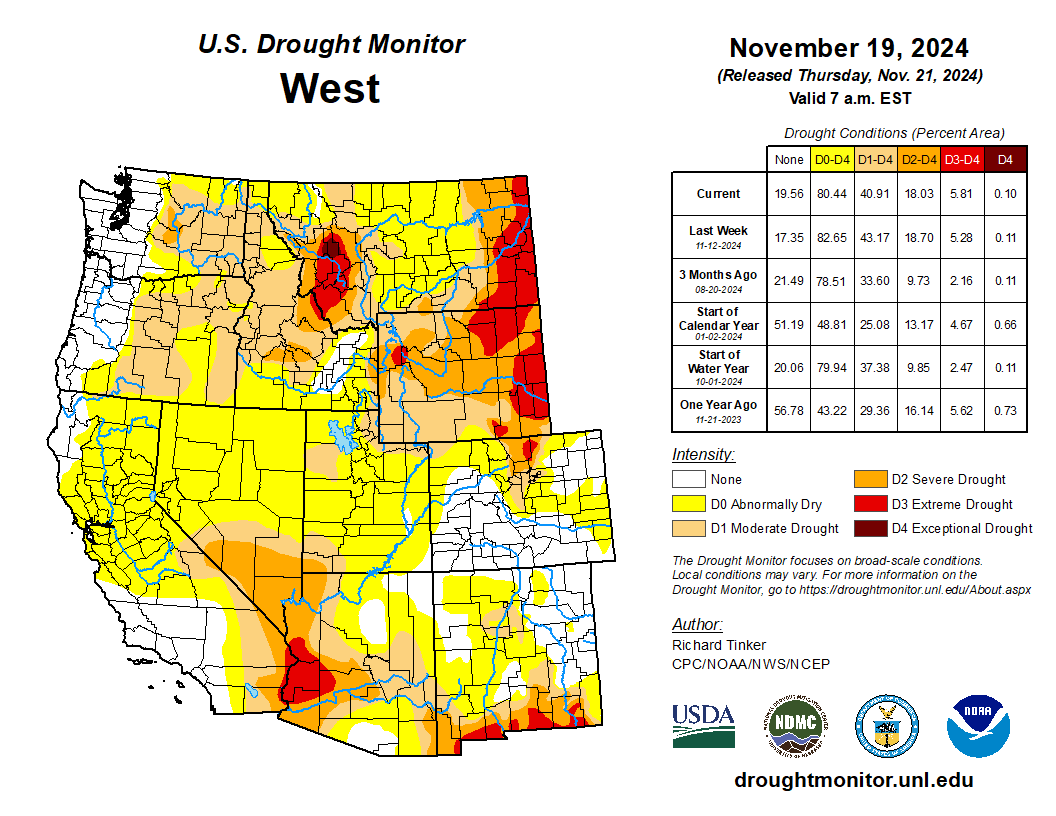
Moderate to heavy precipitation was widespread across the southern and eastern reaches of the High Plains Region, and moderate amounts were observed in some of the higher elevations of Wyoming and central Colorado, and over northern North Dakota. Elsewhere, only a few tenths of an inch, at most, was measured. In the areas of heaviest precipitation (1.5 to approaching 3.0 inches), improvement was introduced. This included significant parts of Kansas, southeastern Colorado, eastern sections of Nebraska and South Dakota, and a relatively small area in southeastern North Dakota. The remainder of the region, under a regime of light to moderate precipitation at best, dryness and drought assessments were unchanged…
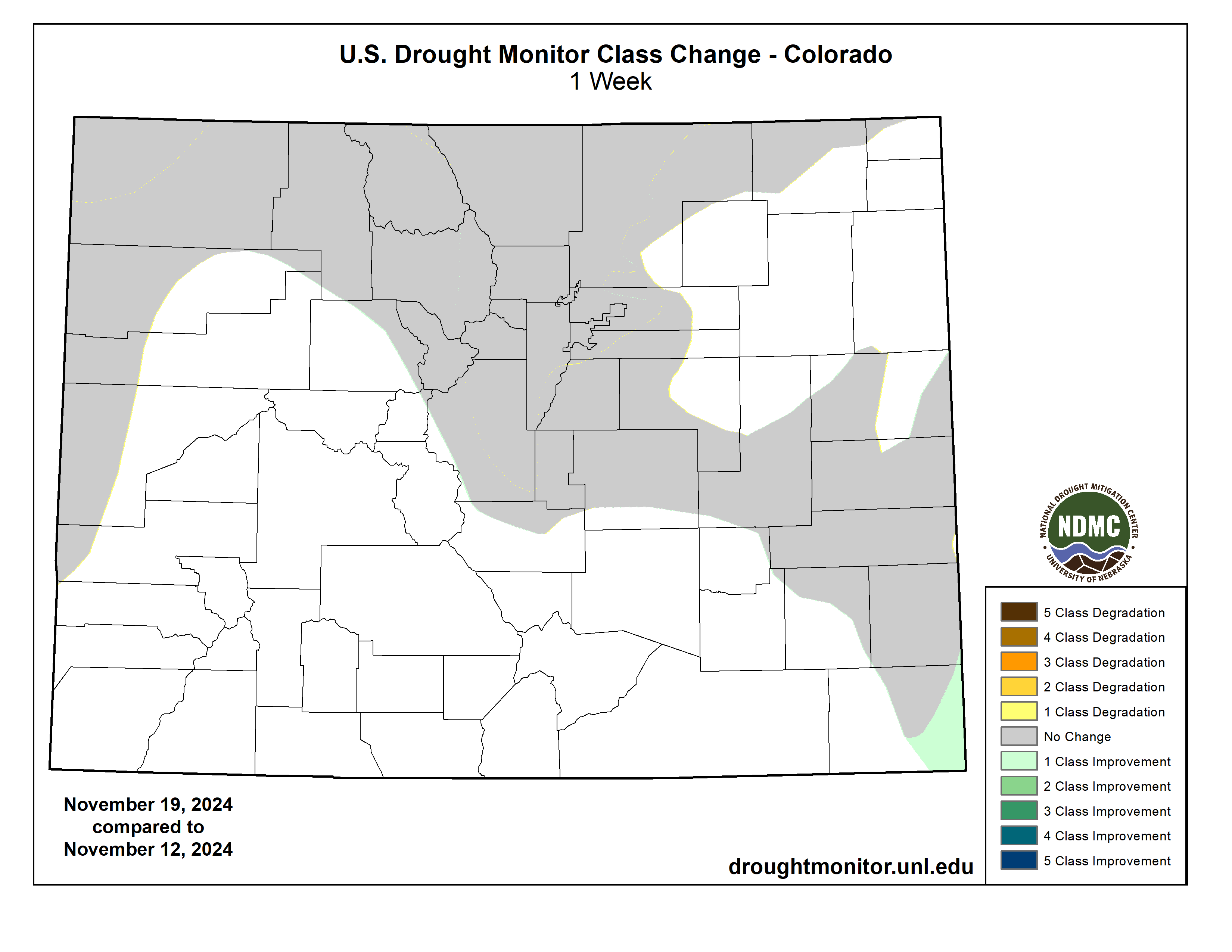
Colorado Drought Monitor one week change map ending November 19, 2024.

West

Heavy to excessive precipitation in northwestern California and the Northwest from the Cascades to the Pacific Coast induced widespread 1-category improvement in these areas. Totals exceeding 3 inches were almost ubiquitous, and amounts of 5 to locally 12 inches were common in the Cascades and near the immediate coast. This amounted to peeling back D0 and D1 to the west. In Oregon, streamflows have finally begun to respond to the increased precipitation. Other areas of improvement were introduced where there was spottier moderate to heavy rain in parts of eastern Oregon, northern Idaho, and westernmost Montana. Moderate to heavy precipitation (locally up to 3 inches) also doused southeastern New Mexico adjacent to the heavy rains in western Texas, with similar 1-category improvements introduced in areas with over 1.5 inches of precipitation. Elsewhere, only scattered light precipitation was reported, and dryness and drought were primarily unchanged. Some deterioration was noted in west-central Montana (to D1) while a significant swath of eastern Montana slid into extreme drought (D3)…

South

Like the Southeastern Region, the South Region experienced highly variable rainfall this past week, although more areas experienced significant rainfall and improved conditions than dryness and deterioration. The latter was confined to central and southern Texas where little or no rain fell, expanding D0 through much of Deep South Texas and prompting the introduction of D1 in a patch near the lower Rio Grande River. Farther north, moderate to heavy precipitation prevailed, especially across western Teas, much of Oklahoma, portions of Louisiana, Mississippi, and western Tennessee. A large part of these areas saw a 1-category improvement, nearly eliminating severe drought (D2) in western Arkansas, eastern Oklahoma, and adjacent Texas, and also decreasing D1 coverage substantially across the northern and eastern tiers of the Region…

Looking Ahead

During the next five days (November 21-25), moderate to heavy precipitation is expected in the western and northeastern quarters of the contiguous states, and along the immediate Canadian border. Lesser amounts, if any, are expected in and around the Plains and along most of the southern tier. The greatest amounts are forecast across northern California and the Sierra Nevada, where totals exceeding 5 inches are expected to be widespread, with the potential for as much as 15 inches at isolated spots in the higher elevations. Generally 1.5 to 3.0 inches are expected in the West from the Cascades to the Pacific Coast and in portions of the northern Intermountain West. Similar amounts are also forecast for most of New York State, northeastern Pennsylvania, and to a lesser extent New England, the Great Lakes, and southwestern California. Between 0.75 and 1.5 inches should fall in the remainder of the Northwest, the higher elevations of the central Rockies, southwestern California, much of the Great Lakes, Pennsylvania, Maryland and Delaware, and the rest of New England. In contrast, little or no precipitation is expected in the Plains from the central Dakotas southward, and along the southern tier of the country from southeastern California eastward through Georgia and most of the Carolinas. Very warm weather is expected in central and southern Texas, with temperatures expected to average 10 to 13 deg. F above normal. A larger area from eastern Arizona through the Lower Mississippi Valley is forecast to average 5 to 10 deg. F above normal. Meanwhile, unusually low temperatures averaging 10 to 17 deg. F below normal are anticipated from the central and western Dakotas through most of Montana. Temperatures may average up to 10 deg. F above normal from the Upper Mississippi Valley and central Plains westward through the Great Basin and northern Intermountain West. Near or slightly above normal temperatures are expected elsewhere.

The Climate Prediction Center’s 6-10 day outlook (valid November 26-30) favors above-normal precipitation in a swath from the Southwest and the Great Basin eastward through most of the Plains, and from Mississippi Valley eastward to the Atlantic Coast. Only the Northeast, Florida Peninsula, central and southern Texas, the Great Lakes, and the Far West are outside the area where above-normal precipitation is expected. Odds exceed 50 percent over the east-central Rockies and adjacent High Plains. Unusually dry weather is more likely in western Texas, the Northwest, parts of the Intermountain West, plus central and northern portions of the Rockies and Plains. Subnormal precipitation is also more likely across Hawaii, especially the northwestern islands. Meanwhile, the southern tier of the country from the Plains to the Atlantic Coast is expected to average warmer than normal, with odds topping 50 percent along and near the Gulf of Mexico Coast. Hawaii is also expected to average warmer than normal, especially the central and northwestern islands. Cold weather is favored across central and northern portions of the Rockies, Plains, and Mississippi Valley, plus some adjacent areas. Chances for significantly subnormal temperatures are 70 to 80+ percent from Montana east of the Rockies and most of the Dakotas.

US Drought Monitor one week change map ending November 19, 2024.

Biden-Harris Administration Puts #ColoradoRiver on Path to Success #COriver #aridification

Colorado River. Photo credit: Department of Interior

Click the link to read the release on the Department of Interior website:

November 20, 2024

Investments from President Biden’s Investing in America agenda have staved off crisis in the Colorado River Basin

Alternatives released today lay out necessary steps towards consensus agreement for post-2026 operations

Since Day One of the Biden-Harris administration, the Department of the Interior has led critical discussions over how to bring the Colorado River back from the brink of crisis in the face of a 24-year drought. Having achieved overwhelming success in 2023 on interim operation plans to guide operations through 2026 with a historic consensus agreement, and following more than a year of collaboration with the states and Tribes who call the Colorado River Basin home, the Biden-Harris administration today released the next step in a responsible path to guide post-2026 operations for the Colorado River.  

Today, the Department released five proposed alternatives that will be analyzed as part of the Post-2026 Operations for the Colorado River. These alternatives represent a wide range of actions that respond to a broad spectrum of hydrology for the Colorado River Basin and reflect elements from proposals submitted by Basin states, Tribes, cooperating agencies and non-governmental organizations, as well as ongoing conversations and collaborations with all Basin stakeholders. As Basin partners continue to work towards a consensus agreement, the range of alternatives provides the framework for a realistic and fair path to meet the goals and needs of the communities and users that rely on this important and diminishing water source. This range includes a ā€œBasin Hybrid Alternative,ā€ that is designed to reflect components from the proposals and concepts submitted by the Upper Division States, Lower Division States, and Tribal Nations to present elements that could provide a basis for coordinated operations and may facilitate greater agreement across the Basin. All five alternatives will be formally analyzed to ensure the long-term stability of the Colorado River Basin for all of the communities and habitats that rely on it.

ā€œWith historic investments from President Biden’s Investing in America agenda, the Department of the Interior has successfully fostered an unprecedented level of collaboration and partnerships with Colorado River Basin states and Tribes,ā€ said Acting Deputy Secretary Laura Daniel-Davis. ā€œWe continue to support and encourage all partners as they work toward another consensus agreement that will both protect the long-term stability of the Colorado River Basin and meet the needs of all communities. The alternatives we have put forth today establish a robust and fair framework for a Basin-wide agreement. As this process moves forward, the Biden-Harris administration has laid the foundation to ensure that these future guidelines and strategies can withstand any uncertainty ahead, and ultimately provide greater stability to the 40 million water users and the public throughout the Colorado River Basin.ā€ 

ā€œIn the face of a climate change-fueled megadrought, communities and ecosystems in the Colorado River Basin need both near-term and long-term solutions to ensure the stability of this precious resource for generations to come,ā€ said John Podesta, Senior Advisor to the President for International Climate Policy. ā€œOver the past four years, thanks to the resources from President Biden’s Investing in America agenda and our Administration’s efforts to work with states and Tribes, the future of the Colorado River Basin is much brighter. The alternatives released today will help support ongoing efforts for all Basin partners to reach consensus on a sustainable path forward that will help ensure that Colorado River Basin communities are healthy and thriving, now and into the future.ā€ 

ā€œAs the West continues to face drought conditions, now is the time for more investment, innovation and collaboration for urgent and essential progress across the Colorado River Basin. The river is one of our nation’s most invaluable natural resources – providing clean water, hydropower and habitat for more than 40 million people, 30 Tribal Nations, and a wide diversity of species. When the Basin was on the brink of collapse, the Biden-Harris administration helped bring it back – thanks to historic investments from President Biden’s Investing in America agenda,ā€ said White House National Climate Advisor Ali Zaidi. ā€œThose efforts helped stabilize the Colorado River for the short-term – but now, we owe it to future generations to find long-term solutions that ensure the river’s continued stability. Harnessing the best-available science, the Administration today continues to lead the Basin to stability by offering a framework that will build a more sustainable and equitable future for communities across the West. We continue to encourage all Basin partners to find a consensus agreement that meets the needs of all the river’s users.ā€ 

Over the last three years, the Biden-Harris administration has led a comprehensive effort to make Western communities more resilient to climate change and address the ongoing megadrought across the region by harnessing the full resources of President Biden’s historic Investing in America agenda. As climate change has accelerated over the past two decades, the Colorado River Basin experienced the driest period in the region in over one thousand years. Together, the Inflation Reduction Act and Bipartisan Infrastructure Law provide the largest investment in climate resilience in our nation’s history, including $15.4 billion for western water across federal agencies to enhance the West’s resilience to drought and deliver unprecedented resources to protect the Colorado River System for all whose lives and livelihoods depend on it. This includes $5.35 billion for over 577 projects in the Colorado River Basin states alone.  

In June 2023, the Department initiated the formal process to develop future operating guidelines and strategies to protect the stability and sustainability of the Colorado River for future generations. The release of the proposed alternatives sets the basin on a course that allows for timely development of final operating guidelines. This is a step that must be taken by August 2026 to inform future operations – the existing guidelines expire in December 2026. Today’s announcement comes as Bureau of Reclamation Commissioner Camille Calimlim Touton convenes the ninth Federal–Tribal–State forum, an unprecedented working group created under Secretary Haaland’s leadership to bring the seven Basin states and 30 Tribes together to regularly discuss the shape and substance of post-2026 operations. 

ā€œWe have worked tirelessly over the past several years to bring Colorado River Basin stakeholders together for a transparent and inclusive post-2026 process that has fostered collaboration and compromise. Importantly, we have also put Tribal governments at the table for the first time in history,ā€ said Commissioner Touton. ā€œToday, we show our collective work. These alternatives represent a responsible range from which to build the best and most robust path forward for the Basin. I have confidence in our partners and the Reclamation team in continuing this work to meet the needs of the river for the future.ā€

Addressing the Short-Term Crisis 

The lifeblood of the American West, the Colorado River Basin provides water for more than 40 million people and fuels hydropower resources in seven U.S. states. It is a crucial resource for 30 Tribal Nations and two states in Mexico, and it supports 5.5 million acres of agriculture and agricultural communities across the West, in addition to important ecosystems and endangered species. In 2021, historic drought along the river brought the communities it serves to a near crisis. This megadrought diminished the river’s largest reservoirs — Lake Mead and Lake Powell — to critically low elevations. Ravaged by the climate crisis, extreme drought, and unsustainable water use, this vital artery was drained to perilous lows, jeopardizing agriculture, urban areas, and ecosystems. 

To provide decisive intervention and bold action, the Biden-Harris administration launched an all-of-government approach to address the short-term risk and set the stage for the development of long-term solutions to help avoid a similar crisis in the future. By collaborating with states, Tribes, federal partners and interested stakeholders – the Department paired innovative investments through President Biden’s Investing in America agenda with operational strategies to address water shortages and promote sustainable management. The consensus agreement for near-term operations, announced in 2023, stabilized the system in the short-term, as the Department embarked on the broader effort to address long-term conservation needs. Today, Lake Mead is replenished, up nearly 20 feet from two years ago, and Lake Powell has rebounded 50 feet. The lower Basin states and the Country of Mexico are on track to save 1.6 million acre-feet by the end of 2024, an unprecedented level of conservation for the Colorado River Basin.  

President Biden’s Investing in America Agenda 

President Biden’s Investing in America agenda represents the largest investment in climate resilience in the nation’s history and is providing much-needed resources to enhance Western communities’ resilience to drought and climate change. Reclamation is leveraging nearly $13 billion in critical investments across the west through the Bipartisan Infrastructure Law and Inflation Reduction Act.  

These funds have helped the federal government secure a series of historic water conservation agreements across the Basin states, while investing in state-of-the-art upgrades to the West’s aging water infrastructure, including innovative projects that support water distribution structureswater storage capacityadvanced metering infrastructure, canal liningfarm efficiency improvementsrecycling and desalinating water, and more. These investments have been essential in reducing water demand through voluntary water conservation incentives, while also investing in infrastructure upgrades and long-term strategies to maximize water resources. 

Charting a Path Forward 

The post-2026 process is a multi-year effort to identify a range of alternatives and ultimately determine operations for Lake Powell and Lake Mead and other water management actions in a future of persistent drought and increasing climate variability. These operations will be critical in defining water allocations for cities and agriculture, guiding future management, and guarding against the need for the kind of short-term fix the Biden-Harris administration successfully negotiated and completed earlier this year. 

Guided by the lessons learned and best practices developed through the Department’s short-term effort and using the best-available science, Reclamation analyzed how future operational guidelines and strategies can be sufficiently robust and adaptive to withstand a broad range of hydrological conditions and ultimately provide greater stability to water users and the public throughout the Colorado River Basin. 

In addition to public comment, virtual seminars, frequent meetings with the Basin states and the Federal-Tribal-State forum, Reclamation has conducted 30 nation-to-nation consultations and held 40 Tribal Information Exchanges to ensure ongoing dialogue and information sharing. To date, Department staff have visited and met with each Basin state Governor or designee and have visited more than half of the 30 Colorado River Tribes on their own land – a demonstration of the Administration’s commitment to meaningful nation-to-nation engagement. 

Reclamation will now analyze these alternatives to develop a draft Environmental Impact Statement (EIS). Once published, the draft EIS will include a public comment period. This puts Reclamation on a path to publish a final EIS, which would then be followed by a Record of Decision in 2026. 

While the post-2026 process will determine domestic operations, the Biden-Harris administration has collaborated with the Country of Mexico in recognition of their equities in the Basin. The International Boundary and Water Commission will continue to facilitate consultations between the United States and Mexico on Binational Cooperative Processes under the 1944 Water Treaty. 

Detailed Colorado River Basin map via the U.S. Bureau of Reclamation.

Click the link to read the “Post-2026 Colorado River Reservoir Operational Strategies for Lake Powell and Lake Mead: Narrative of National Environmental Policy Act Alternatives

Approach to Alternative Development

  • Features of all action alternatives will ensure a broad range of alternatives for analysis. Reclamation’s goal for the post-2026 process is to allow for the adoption of specific guidelines for the coordinated reservoir management of Lake Powell and Lake Mead through their full operating range and to provide for the sustainable management of the Colorado River system and its resources under a wide range of potential future system and hydrologic conditions.
  • An operating plan must be in place by August 2026. We are sharing the five alternatives now as a voluntary step in the National Environmental Policy Act (NEPA) process to enhance transparency and create a framework for a realistic and fair path for Colorado River Basin states, Tribes, and non-governmental organizations to continue to work toward a consensus agreement that protects the stability and sustainability of the Colorado River System into the future.
  • Releasing the alternatives in advance of publishing the draft Environmental Impact Statement (DEIS) affords the public and affected water users more information about the process and provides greater opportunities for collaboration, to ensure that we have a plan in place before the current guidelines expire.

Concepts Common to All Alternatives

  • All alternatives will undergo a detailed analysis of impacts on the natural and human environment as necessary to develop a Draft EIS. The analysis will also compare the performance of alternatives over a common set of key hydrologic metrics including reservoir elevations, water use and reductions, and deviations from Glen Canyon objective releases, pursuant to the Long Range Operating Criteria (LROC).
  • Releases from Lake Powell may be less than the specified release below elevation 3,490 ft due to Glen Canyon Dam infrastructure limitations.
  • Additional Lower Basin shortages (and potential additional reductions in water deliveries to Mexico) may be necessary under future hydrologic scenarios where Lake Mead reaches dead pool.
  • As in the 2001 and 2007 Guidelines, the Secretary retains all applicable authority to respond to exigent and emergency conditions.
  • The determination of deliveries to Mexico is not a part of the proposed federal action. Any such determination would be made in accordance with the 1944 Treaty. Nevertheless, modeling assumptions with respect to the distribution of shortages for the Lower Division States include operationally aligned water delivery reductions to Mexico in order to analyze potential impacts to hydrologic and other environmental resources. Shortage amounts described are amounts of total shortage, including Mexico. Modeling assumptions that identify water deliveries to Mexico pursuant to the 1944 Treaty with Mexico would be developed after all necessary and appropriate discussions have been completed with the United States International Boundary and Water Commission in consultation with the Department of State.

Description of Alternatives
No Action

  • The No Action does not meet the purpose of and need for the federal action, but it is included as a requirement of NEPA.
  • Operations would revert to annual determinations announced through the Annual Operating Plan (AOP) process.
  • Lake Powell release would be 8.23 maf unless a higher release is required for equalization or a lower release results from Glen Canyon Dam infrastructure limitations.
  • Shortages to the Lower Basin would be based on priority and reach a maximum of 600 kaf.
  • This would not represent a continuation of current operations but is generally based on the preexisting operating guidance that was in place before the adoption of the 2007 Interim Guidelines Record of Decision (ROD), and thus includes no specific activities above Lake Powell beyond existing authorities (e.g., to make emergency releases from Colorado River Storage Project (CRSP) Initial Units to protect infrastructure at Glen Canyon Dam).
  • Existing Intentionally Created Surplus (ICS) would be delivered in accordance with existing agreements, but there would be no new delivery and storage mechanisms.

Alternative 1: Federal Authorities

  • This alternative is designed to achieve robust protection of critical infrastructure within the Department and Reclamation’s current statutory authorities and absent new stakeholder agreements.
  • Lake Powell releases would be determined based on Lake Powell elevations, unless equalization releases are required. Lake Powell releases would range from 9.5 to 5.0 maf. Releases could be less than 5.0 maf, and Lake Powell elevations could be increased by CRSP Initial Units, to protect infrastructure at Glen Canyon Dam.
  • Lower Basin shortages of up to 3.5 maf would be distributed consistent with the priority system and would be triggered based on combined storage in Lake Powell and Lake Mead.
  • Existing ICS (Intentionally Created Surplus) would be delivered in accordance with existing agreements, but there would be no new delivery and storage mechanisms.
  • There would be explicit accounting of unused/undeveloped quantified Tribal water

Alternative 2: Federal Authorities Hybrid

  • This alternative is designed based on proposals and concepts from Tribal Nations, federal agencies, and other stakeholders to achieve robust protection of critical infrastructure while benefiting key resources (e.g., natural, hydropower and recreation) through a new approach to distributing storage between Lake Powell and Lake Mead that enhances the reservoirs’ ability to support the Basin.
  • Lake Powell releases would be determined based on a combination of Lake Powell and Lake Mead elevations, 10-year running-average hydrology, and Lower Basin deliveries. Lake Powell elevations could be increased by releases from CRSP Initial Units to protect infrastructure at Glen Canyon Dam.
  • This alternative would include new delivery and storage mechanisms for Lake Powell and Lake Mead with federal and non-federal storage pools and maximum flexibilities for all users. The operations incorporate Basin-wide shared contributions to the sustainability of the system, including Upper Basin conservation that would be stored in Lake Powell and Lower Basin shortages starting at 1.5 maf, which exceeds average annual evaporative and system losses at and below Lake Mead, and reaching a maximum of 3.5 maf.
  • Shortages would be triggered based on combined storage in Lake Powell and Lake Mead and distributed pro-rata.
  • There would be explicit accounting of unused/undeveloped quantified Tribal water.
  • Some elements of this alternative would require additional federal statutory authorities and stakeholder agreements.

Alternative 3: Cooperative Conservation

  • This alternative is informed by a proposal submitted by a consortium of conservation organizations with the goal of stabilizing system storage, integrating stewardship and mitigation strategies of Lakes Powell and Mead, maintaining opportunities for binational cooperative measures, incentivizing water conservation, and designing flexible water management strategies.
  • Lake Powell releases would range from 11.0 maf to 5.0 maf and would be determined by total Upper Basin system storage and recent hydrology. Releases would switch to ā€œrun-of-riverā€ when Lake Powell is at 3,510 ft or lower. The operations incorporate Basin-wide shared contributions to sustain system integrity, including up to 4.0 maf of shortages in the Lower Basin triggered by combined seven-reservoir storage and recent hydrology, and voluntary water contributions from both basins.
  • Some elements of this alternative would require additional federal authorities and stakeholder agreements.

Alternative 4: Basin Hybrid

  • This alternative is designed to reflect components from the proposals and concepts submitted by the Upper Division States, Lower Division States, and Tribal Nations to present elements that could provide a basis for coordinated operations and may facilitate greater agreement across the Basin.
  • Lake Powell releases would be determined primarily based on Lake Powell elevation with consideration in some scenarios of Lake Mead elevation. Releases would range from 12.0 to 5.0 maf. Lake Powell elevations could be increased by releases from CRSP Initial Units to protect infrastructure at Glen Canyon Dam.
  • This alternative would include new delivery and storage mechanisms for Lake Powell and Lake Mead, including incentivizing conservation and managing/offsetting reductions, to afford the Tribal and non-Tribal entities the same ability to use these mechanisms. The operations incorporate Basin-wide shared contributions, including Upper Basin conservation that would be stored in Lake Powell and up to 2.1 maf of Lower Basin shortages triggered by combined seven reservoir storage.
  • This alternative would analyze shortage distribution using two approaches: priority and pro-rata, both of which would be analyzed with and without shortages to Tribes.
  • There would be explicit accounting of unused/undeveloped quantified Tribal water.
  • Some elements of this alternative would require additional federal authorities and stakeholder
    agreements.
Colorado River “Beginnings”. Photo: Brent Gardner-Smith/Aspen Journalism

White House urges #ColoradoRiver states to pick up the pace of negotiations — Alex Hager (KUNC) #COriver #aridification

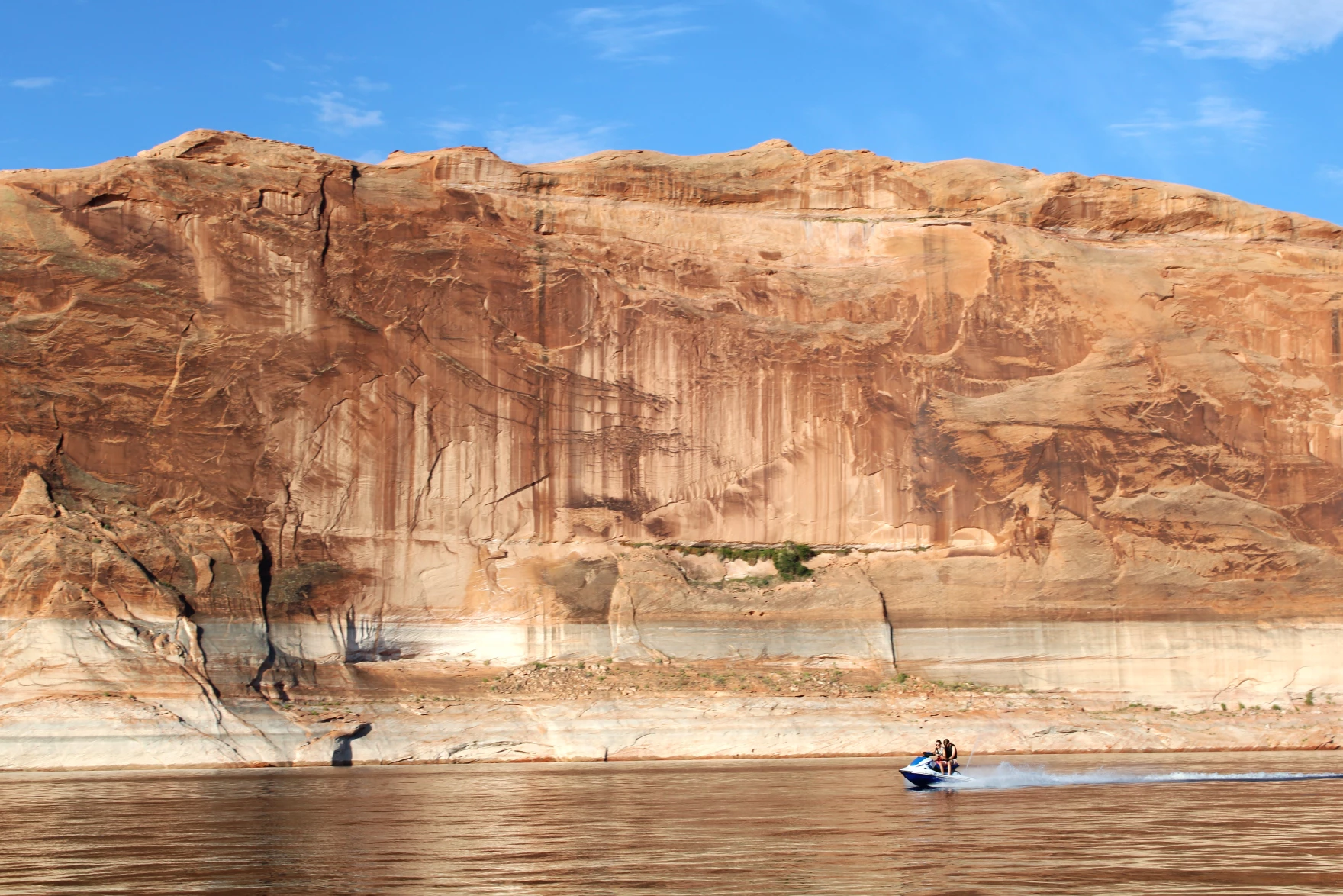
A personal watercraft speeds across Lake Powell on July 16, 2024. The fate of the nation’s second-largest reservoir hangs in the balance as states that use the Colorado River remains stuck in a standoff about how to manage it in the future. Photo credit: Alex Hager/KUNC

Click the link to read the article on the KUNC website (Alex Hager):

Federal water officials released a set of possible plans for managing the shrinking Colorado River in the future. They urged state negotiators to agree on a single plan, since the states are deeply divided about how to share the pain of cutbacks during dry times.

ā€œWe can either remain stuck at an impasse, or secure a future for future generations that promises the stability and sustainability of one of our greatest natural resources,ā€ said Ali Zaidi, White House climate advisor.

The current rules for sharing Colorado River water expire in 2026, and the seven states that use it are on the hook to come up with a replacement before then. They’re split into two camps, and each submitted a separate proposal to the federal government in March. State negotiators say they want a collaborative solution, but they don’t appear any closer to agreement than they did in March and have publicly dug in their heels about their ideological differences.

In a call with reporters on Wednesday, multiple federal officials encouraged states to pick up the pace in those negotiations.

ā€œTo get to the other side here,ā€ Zaidi said, ā€œthere’s going to be a requirement, an imperative on all of us, to find the common ground to move the process forward with urgency.ā€

Although federal agencies operate the dams and reservoirs that hold Colorado River water, they have historically implemented management plans drawn up by states.

But today, in an apparent attempt to nudge the states towards agreement, the Interior Department released four ā€œalternativesā€ – each a different proposal for managing the river – and none of them are exactly in line with either of the competing state proposals.

ā€œNow really is the time for the basin states and tribes to redouble their work toward a consensus alternative,ā€ said Laura Daniel Davis, the acting deputy secretary of the interior. ā€œThe alternatives we’re announcing today show that path and I urge them to do so.ā€

The alternatives released by Interior are relatively light on details, but seem to include input from some of the 30 native tribes which use the river, and environmental groups which campaigned for more protections for wildlife and their habitats.

Kyle Roerink, director of the nonprofit Great Basin Water Network, said the alternatives don’t give any serious clues about a final plan for managing the river, but rather attempt to push forward the conversation among the states.

ā€œIt’s hard to make a broad and sweeping statement about it,ā€ he said. ā€œWe’re waiting for the big picture. We’ve been thirsting for it for well over a year, but we’re dealing with a recipe that only lists a few of the ingredients and we can only make assumptions.ā€

By releasing alternatives, the Biden administration may be attempting to influence negotiations ahead of its departure from the White House. It’s unclear exactly how Donald Trump’s upcoming return to the presidency could shape talks about the Colorado River, but state leaders said they don’t expect the change to disrupt their process.

This story is part of ongoing coverage of the Colorado River, produced by KUNC in Colorado and supported by the Walton Family Foundation. KUNC is solely responsible for its editorial coverage.

4 takeaways from the 2024 Water in the West Symposium — CSU Spur

More than 150 people attended the Water in the West Symposium at the CSU Spur campus in Denver on Nov. 14. (Photo: Kevin Samuelson, CSU System)

Click the link to read the article on the Colorado State University website (Allison Sylte):

November 18, 2024

We can all agree that we literally can’t survive without water. The real controversy arises from how we should manage this precious resource. 

Ultimately, it comes down to working together. That’s why the theme of the 2024 Water in the West Symposium was ā€œBuilding Bridges: Collaborative Water Action.ā€ The Nov. 14 event at the Colorado State University Spur campus in Denver brought together more than 150 stakeholders representing everything from the state and federal government to academia and tribal nations. 

ā€œWe often overlook acres of common ground to focus on less significant differences,ā€ CSU Chancellor Tony Frank said in his opening remarks. ā€œI think with water and in conversations like this one … offer us a path toward unity.ā€ 

And during a day filled with panels discussing diverse topics, ranging from agriculture to state water planning and finance, one common theme rang through: progress through collaboration isn’t always easy, but it is possible. 

Here are some of the key takeaways.

Teams should create spaces for listening and dissent 

Keynote speaker Michaela Kerrissey, an assistant professor of management at the T.H. Chan School of Public Health, focuses much of her research on helping teams solve difficult problems. 

ā€œPart of it is about not getting stuck in the problem but figuring out what the solution is,ā€ Kerrissey said. 

Finding solutions to problems is a good common goal, and having this sense of purpose is a good anchor to a strong team, Kerrissey said. Another key? Creating a space where everyone feels empowered to speak up – including those who might disagree with the overall consensus. 

ā€œThe idea behind this is that likely in all of our organizations and all of our teams, great ideas get left behind because the culture doesn’t come with a space to come forward, be heard, and be taken seriously,ā€ she said.

Kerrissey was the first speaker of the day. Martin Carcasson, the founder and director of the CSU Center for Public Deliberation, was the last, and he too focused his remarks on how allowing for disagreement can ultimately lead to better results. 

ā€œFor divergent thinking, we need to get beyond the usual suspects and status quo and hear all the voices,ā€ he said. 

That’s easier said than done. And in an at-times polarized world, his hope is that we create more spaces that allow this to happen. 

ā€œWe have so many organizations that are designed to divide us, we need organizations that are designed to bring us together,ā€ Carcasson said. 

Solving grand problems requires empathy 

Meagan Schipanski, an associate professor in the Department of Soil and Crop Sciences at CSU, said science is really good at defining problems. Solving them requires more of a human touch. 

ā€œAs a biophysical scientist, I’ve become increasingly convinced that we need to lead with the humans, the stories, the contexts in all these situations,ā€ she said. 

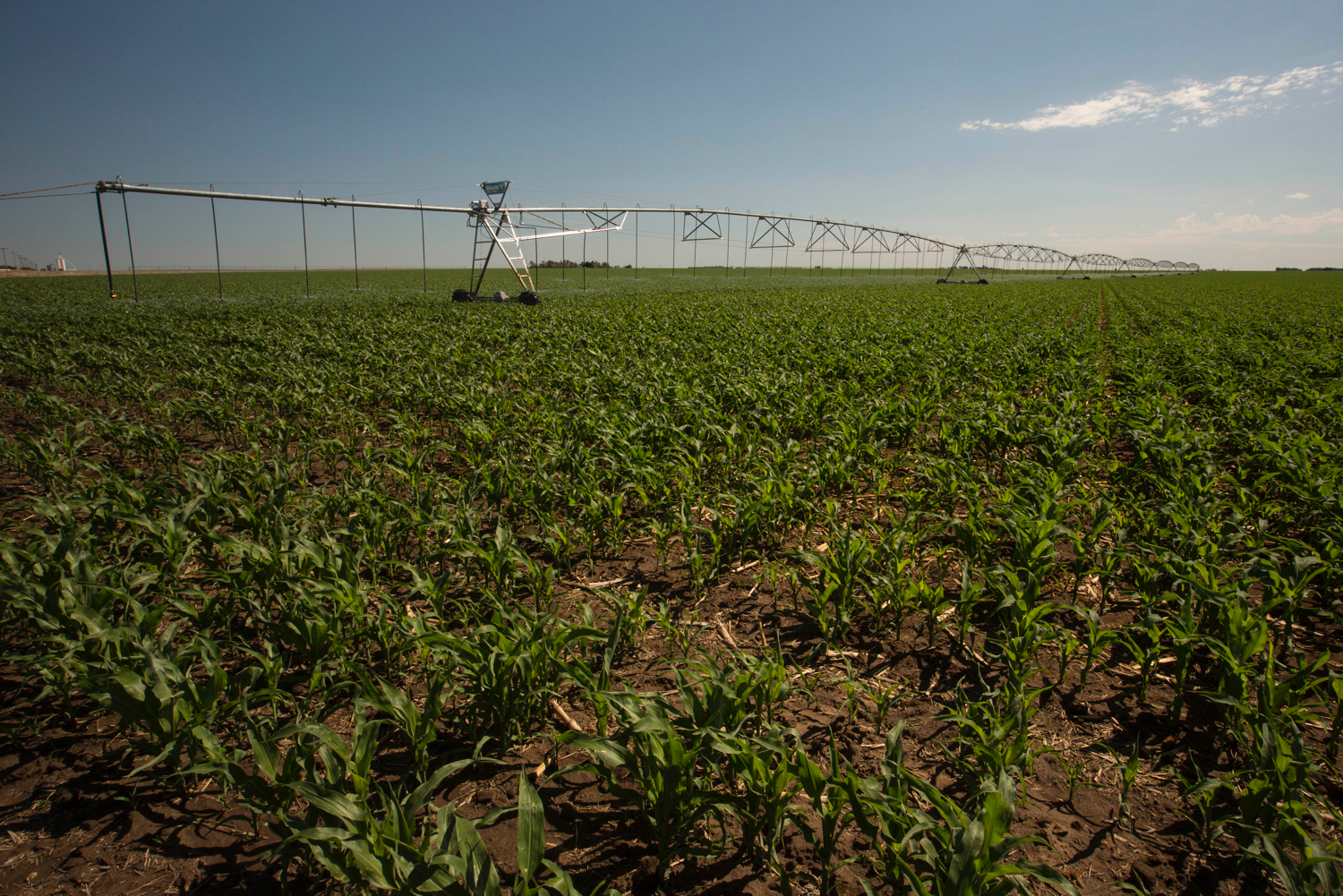
Center pivot sprinklers in the Arikaree River basin to irrigate corn. Each sprinkler is supplied by deep wells drilled into the High Plains (Ogallala) aquifer.

She pointed to her efforts to engage with stakeholders working to preserve the Ogallala Aquifer, and the varying motivations and struggles of everyone involved. 

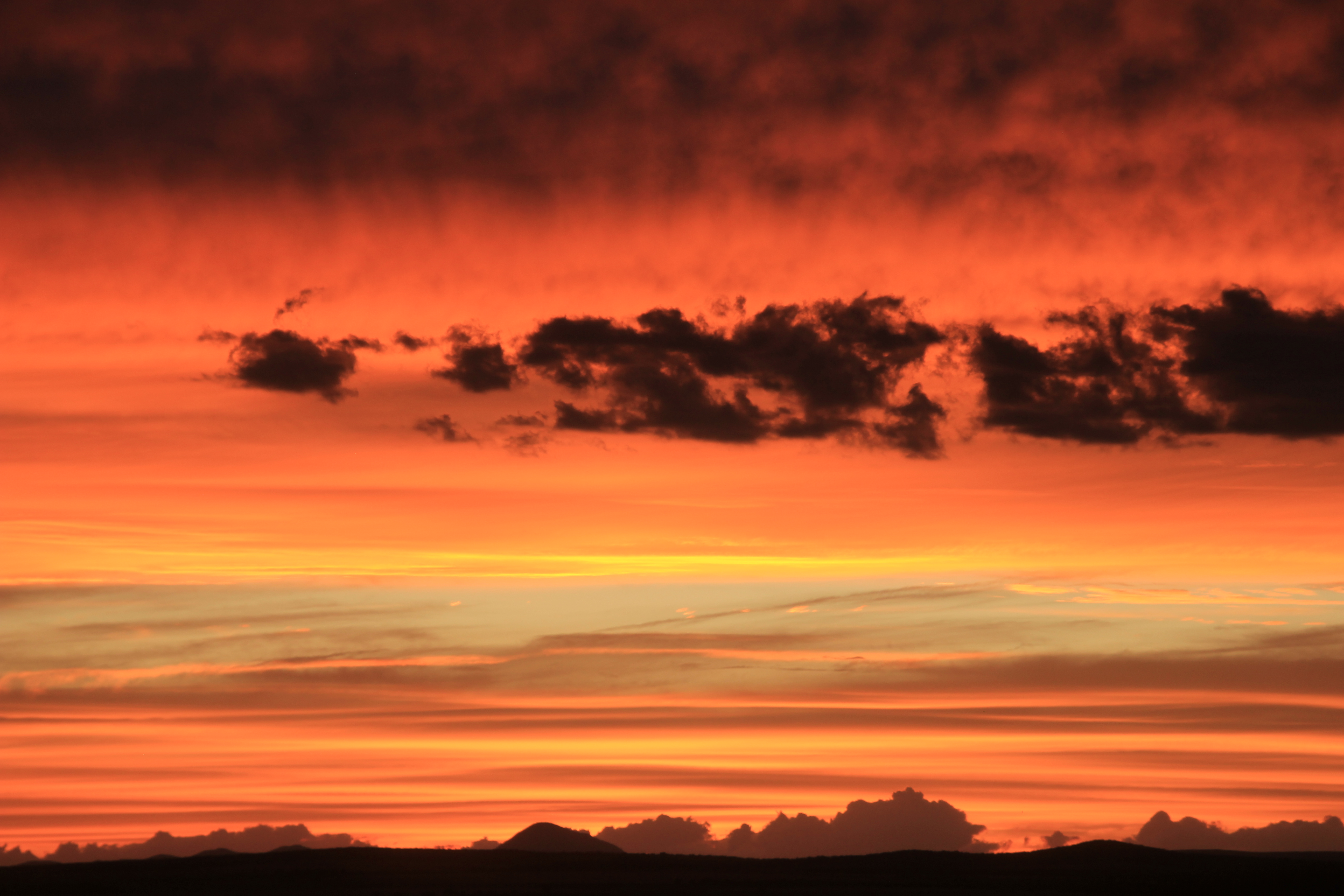
Sunset September 10, 2024 in the San Luis Valley. Photo credit: Alamosa Citizen

Heather Dutton, the district manager for the San Luis Valley Water Conservation District, shared similar lessons from her efforts engaging with farmers and ranchers. 

ā€œWe realized the environmental community and farmers have a lot in common – we rely on the river as one of the key economic drivers of our region, we rely on it for happiness,ā€ she said. ā€œThe thread of realizing we all have so much in common has enabled us to have robust and collaborative projects to think about all the different uses and benefits.ā€

South of Hesperus August 2019 Sleeping Ute Mountain in the distance. Photo credit: Allen Best/The Mountain Town News

Manuel Heart, the chairman of the Ute Mountain Ute tribe in southwestern Colorado, also shared the importance of getting to know the people involved in different sides of a problem. 

ā€œI’m hoping to bring education to each of you, education about who we are as a native people, as a Ute Mountain tribe, and to have the respect to be able to speak freely and bring the challenges we face, and also gain trust and partnership,ā€ he said. ā€œYou have to feel those feelings of not just one ethnic group, but other ethnic groups. 

ā€œYou need that empathy to feel what is going on.ā€ 

Building strong relationships requires trust and a common goal 

Nobody will be able to solve the water crisis alone. That’s why the Water in the West Symposium featured panelists representing everything from state-level water conservation groups to NGOs to private companies. 

All of them shared stories about how they’ve worked together to solve problems in their region, and a common thread from all of these successes? Trust. 

Autumn view of the wetlands and cottonwood groves in the Yampa River basin at Carpenter Ranch, located west of Steamboat Springs, Colorado. Photo courtesy of The Nature Conservancy

ā€œI think that uncertainty leads to misinformation, and all the sudden it’s us against them, and you have disagreements between downstream water users versus upstream ones, and everything in between,ā€ said John Ford, the water projects manager for agriculture at the Nature Conservancy Arizona. ā€œWhen you can get people together and be really clear, you can mitigate some of the risk and distrust. That’s when collaborations happen.ā€ 

Russ Sands, the section chief for water supply planning at the Colorado Water Conservation Board, said it’s clear that something needs to be done – it’s just a matter of rallying people around that common goal.

West Fork Fire June 20, 2013 photo the Pike Hot Shots Wildfire Today

ā€œWe know water has a massive impact on the hazards in this state … the cycle of drought, more things catching on fire … it has devastating consequences, and that really stacks up on our impact and need for action,ā€ he said. ā€œWe need to move to a place where we’re talking and need to take care of each other and work together.ā€ 

Jocelyn Hittle at CSU Spur Water in the West November 2024. Photo credit: CSU Spur

There’s a lot of room for hope 

Working together isn’t always easy, but it is possible – and that lesson applies to so much more than water. 

ā€œWe really liked the idea of bringing people together to talk about collaboration, to showcase what’s happening on the ground,ā€ said Jocelyn Hittle, the associate vice president for CSU Spur. ā€œDeliberation is what makes our American democracy experiment very strong, and very alive, and very dynamic.ā€ 

Carcasson, who speaks to groups across Northern Colorado about how to have collaborative conversations, said he was encouraged by hearing panels throughout the day and realizing that there was already a strong dialogue surrounding Water in the West. 

ā€œIt’s really heartening to see,ā€ he said.