
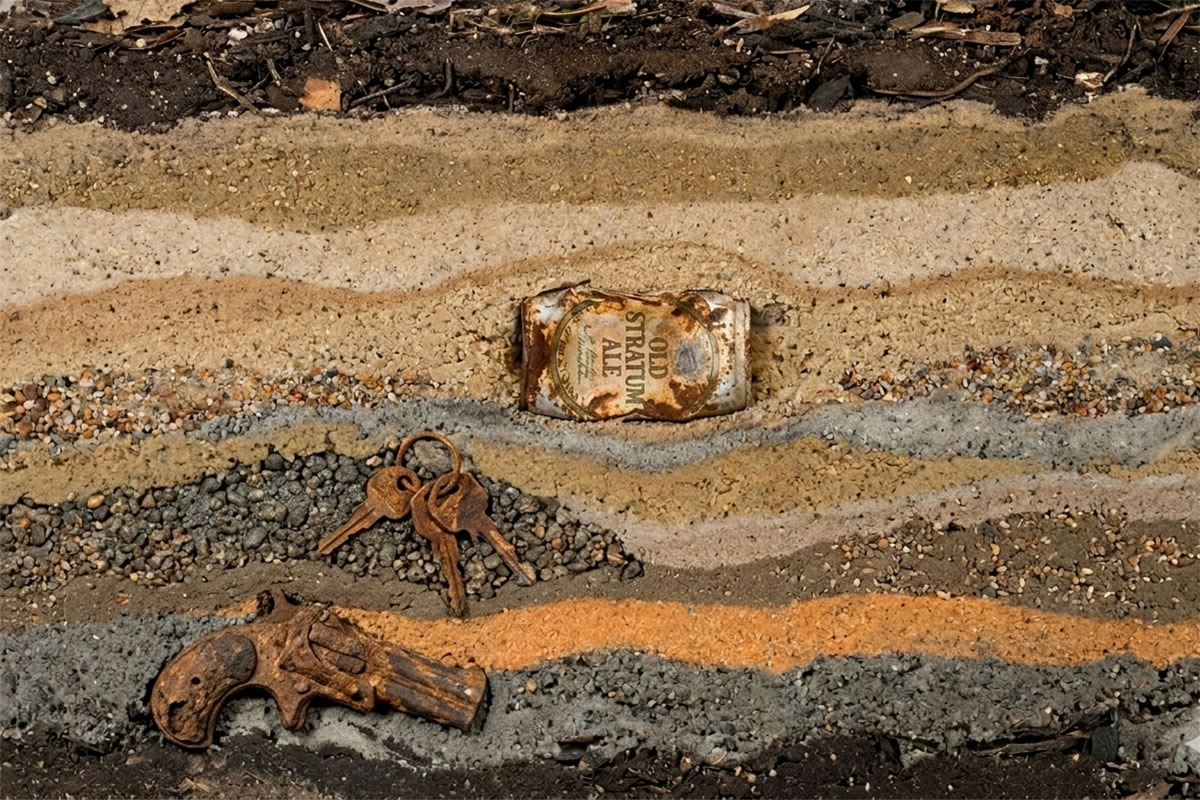
by Robert Marcos, photojournalist
If Lake Powell ever dries up completely scientists excavating the exposed reservoir floor will uncover a massive, human-made geological record known as anthropogenic stratigraphy. This towering wall of trapped sediment, which already reaches up to 150 feet thick in some areas, acts like an open book detailing the history of Lake Powell. Researchers will find a distinct, repeating pattern of cyclic sand-mud interbeds that chronicle the reservoir’s seasonal fluctuations and regional hydroclimate. The thick layers of coarse sand will mark rapid, powerful depositional events fueled by annual spring snowmelt and dramatic upstream floods. Conversely, the alternating bands of thinly laminated, fine-grained lacustrine mud will reveal prolonged periods of high water levels when the reservoir was full and the currents slowed, allowing the finest suspended particles to settle to the canyon floor.1
Beneath this structural rhythm, a geochemical analysis will expose a darker record of the West’s industrial and agricultural history. Because the dam permanently trapped Colorado River sediments that once flowed naturally to the sea, the dry lakebed will serve as a containment sink for concentrated toxins and heavy metals. Geologists and environmental scientists will encounter dense pockets of arsenic, lead, selenium, boron, and mercury swept down from upstream agricultural runoff and legacy mining districts. Most notably, the layers will hold chemical fingerprints from historical events like the 2015 Gold King mine spill and the submerged yellowcake uranium mill tailings pile near Hite. As water levels vanish, these hazardous materials will remain bound to the platy clay aggregates and iron oxide coatings of the sediment, posing a significant risk of toxic dust storms if re-mobilized by the wind.2
Finally, the deepest trenching will reveal a stark ecological and physical boundary line: the pre-dam canyon floor. At the very base of the mud, scientists will strike an erosional surface composed of native boulders, coarse river gravels, and heavily weathered sandstone that directly predates 1963. Preserved just above this bedrock, researchers will find an anaerobic time capsule of organic debris. This includes preserved strands of invasive tamarisk and Russian thistle, ancient cottonwood fragments, and dense layers of decaying organic matter that once starved the deep reservoir of oxygen. By using advanced tools like X-ray diffraction, environmental DNA (eDNA), and scanning electron microscopy, scientists will be able to reconstruct the precise timeline of how human engineering completely transformed, and ultimately choked, a vibrant desert river ecosystem.3