David Nickum: ‘This is a huge missed opportunity’

A picture named greenbackvscorivercutthroat.jpg

Update: Here’s the release from Trout Unlimited (Randy Scholfield):

A settlement to one of Colorado’s longest-running water disputes – and the opportunity to launch the largest native trout restoration in Colorado’s history – was dealt a blow by the Forest Service’s refusal to accept a collaborative arrangement for funding the project.

Colorado Trout Unlimited (CTU) and the Water Supply and Storage Company (WSSC) last year agreed to settle a long-standing dispute regarding how best to address environmental impacts of the Long Draw Reservoir in the Cache la Poudre headwaters. But the Forest Service on Sept. 3 rejected the cost-sharing arrangement at the heart of the proposal.

The parties based the proposal on a Forest Service concept for restoring native greenback cutthroat trout in 40 miles of the Cache la Poudre headwaters, but they developed a collaborative framework for doing so under which WSSC would provide seed money for the program while CTU and the State of Colorado would leverage that contribution through public and private grants and in-kind contributions. The Forest Service supported the greenback restoration alternative, but rejected the collaborative approach and instead placed full responsibility for the program on WSSC.

“The good news is that the Forest Service, WSSC, and CTU all agreed that restoring native trout in the Poudre headwaters is the right approach to mitigating Long Draw’s impacts,” said David Nickum, Executive Director of CTU. “The bad news is that the Forest Service rejected a carefully crafted proposal that had allowed stakeholders to find common ground after more than 10 years of legal battles. This is a huge missed opportunity.”

Under the proposed collaborative effort, WSSC would take responsibility for reclaiming and restoring native cutthroat trout in Long Draw Reservoir and its tributaries – establishing a large and stable recovery population. WSSC, CTU, and state agencies including the Division of Wildlife and Colorado Water Conservation Board would then leverage that contribution to extend restoration into multiple adjacent drainages that could ultimately create a “metapopulation” – a network of native fish populations across a larger watershed that is more resilient and sustainable than small isolated populations. The effort would be the largest native trout restoration project in Colorado’s history and would represent a major step toward recovery and de-listing of greenbacks under the Endangered Species Act.

“We worked diligently to develop the Forest Service’s concept into a balanced, win-win proposal,” said Dennis Harmon, General Manager of WSSC. “We are disappointed and frustrated that the Forest Service has missed this opportunity to resolve the dispute and has instead adopted a decision that will extend the controversy over Long Draw as well as its economic and environmental costs. We simply do not feel that the cost to the company (estimated by the Forest Service at more than $800,000 and maybe much more) to renew a permit for 53 acres around the perimeter of Long Draw Reservoir is appropriate or fair to the Company and its shareholders.”

The Forest Service has an administrative appeal process by which parties can seek reconsideration of agency decisions. Despite the setback posed by the current decision, CTU and WSSC hope to work with the agency through its appeal process to advance a collaborative approach, avert further legal battles, and bring this long conflict to a positive close for the Poudre River and the fish and farmers that rely upon it.

From the Fly Rod and Reel weblog (David Nickum/Dennis Harmon):

“The good news is that the Forest Service, WSSC, and CTU all agreed that restoring native trout in the Poudre headwaters is the right approach to mitigating Long Draw’s impacts,” said David Nickum, Executive Director of CTU. “The bad news is that the Forest Service rejected a carefully crafted proposal that had allowed stakeholders to find common ground after more than 10 years of legal battles. This is a huge missed opportunity.”

Under the proposed collaborative effort, WSSC would take responsibility for reclaiming and restoring native cutthroat trout in Long Draw Reservoir and its tributaries – establishing a large and stable recovery population. WSSC, CTU, and state agencies including the Division of Wildlife and Colorado Water Conservation Board would then leverage that contribution to extend restoration into multiple adjacent drainages that could ultimately create a “metapopulation” – a network of native fish populations across a larger watershed that is more resilient and sustainable than small isolated populations. The effort would be the largest native trout restoration project in Colorado’s history and would represent a major step toward recovery and de-listing of greenbacks under the Endangered Species Act.

“We worked diligently to develop the Forest Service’s concept into a balanced, win-win proposal,” said Dennis Harmon, General Manager of WSSC. “We are disappointed and frustrated that the Forest Service has missed this opportunity to resolve the dispute and has instead adopted a decision that will extend the controversy over Long Draw as well as its economic and environmental costs. We simply do not feel that the cost to the company (estimated by the Forest Service at more than $800,000 and maybe much more) to renew a permit for 53 acres around the perimeter of Long Draw Reservoir is appropriate or fair to the Company and its shareholders.”

Here’s the USFS record of decision for the project.
More Cache la Poudre watershed coverage here and here.

Montezuma County: Tamarisk forum recap

A picture named tamariskleafbeetle.jpg

From the Cortez Journal (Kimberly Benedict):

The evening forum, held at the Calvin Denton Room at Empire Electric, was presented by the Dolores Conservation District in partnership with Colorado State University Extension. “Our main focus is to hear from everybody what you want to be doing with tamarisk in the county,” said Steve Miles, of the Dolores Conservation District. “We really want to hear input as to what you want to see the conservation district do.”[…]

Miles, Clark Tate, with the Tamarisk Coalition, and Dan Bean, of the U.S. Department of Agriculture, gave brief presentations on the progress of tamarisk eradication in the west, focusing on the use of tamarisk beetle biocontrol. First released in 2001 in experimental sites, tamarisk beetles are now widespread throughout Colorado and Utah. The small beetles are native to China and Kazakhstan and were part of a $1 million USDA project aimed at finding a biocontrol agent for tamarisk. “The tamarisk biocontrol project started in the ’70s with a look at tamarisk and the problems and potential for developing agents for control,” Bean said. “At the time their was a belief you could not control trees and shrubs with an insect so they shelved it. In the late ’80s they reconsidered.”

Tamarisk beetles do not kill plants directly, they consume the foliage resulting in stressed plants that have difficulty greening after a few seasons, according to Tate. The beetles have left a wake of dead tamarisk in their path in Nevada, resulting in a 75 percent mortality rate. “We are seeing a lot of stressed out tamarisk,” Tate said. “It is hard to tell if they are actually dead, but just looking at them, they are very, very stressed. It is time to start thinking about the void that is going to be created.”

More tamarisk control coverage here and here.

Montezuma County: Tamarisk control update

A picture named tamariskleafbeetlesatwork

From the Cortez Journal (Melinda Green):

The beetle is working in McElmo Canyon, stripping the leaves from tamarisks, then flying away to another stand of tamarisks. The beetles may return when the tamarisk grows more leaves, until in three to four years, the tree dies, Miles said. That gives time to revegetate with more desirable plants.

However, in June, the U.S. Department of Agriculture ended its program of releasing the beetles in 13 states, including Colorado. The move came after the Center for Biological Diversity and the Maricopa Audubon Society sued, saying that release of the beetle in southern Utah in 2006 had destroyed tamarisk trees containing endangered southwestern willow flycatcher nests. When tamarisks crowded out the native willow preferred by the flycatcher, the bird moved to tamarisk trees, Miles said. He believes a better strategy would be to reintroduce the willow in areas where the beetles have killed the tamarisk. The beetles already released continue to thrive and help with tamarisk control, he said.

With an estimated 9,000 acres of tamarisk in Montezuma County in 2005, organizers have been successful in slowing its progress, Miles says. “We’ve definitely made progress (controlling the tamarisk locally),” he said. “You don’t see much around McPhee Lake. We treated (chemically) 200 acres in 2005 above McPhee. We’re helping keep tamarisk out of 50,000 to 60,000 acres of agricultural land in the county, spread through irrigation water. The Conservation District, National Resource Conservation Service, private agencies, and state agencies spent half a million dollars here in the last seven years.”

Work was also done on the upper reaches of McElmo Creek and the Hawkins Preserve. In addition, Miles said the Mancos Conservation District and the Ute Mountain Ute Tribe have been working to control tamarisk on the Mancos River.

“We’re working on revegetation projects with landowners to find the best way to get appropriate plants back in,” he said. “Most of the time there’s enough native seed source to come back in. Nature abhors a vacuum, so if we take out one noxious weed, we don’t want another noxious one to come in.”

More tamarisk control coverage here and here.

Jackson County: New Zealand mud snails found in South Delaney Butte Reservoir

A picture named newzealandmudsnail

From the Summit County Voice (Bob Berwyn):

Wildlife experts discovered the mudsnails during a shoreline survey at the end of July. This is the fourth location where the invasive freshwater mollusks have been detected in Colorado.
“The New Zealand mudsnail competes with our native invertebrate species,” said Elizabeth Brown, the division’s invasive species coordinator. “So far, we haven’t seen huge impacts to our fisheries. But New Zealand mudsnails have the potential to seriously disrupt the aquatic communities that are the foundation of the food web. If mudsnails become numerous enough, they can reduce the availability of nutrients to their point where it harms fish populations.”

Native to New Zealand, New Zealand mudsnails were first detected in the United States in 1987 in Idaho’s Snake River. Since then, the species has spread rapidly throughout the West, infesting waters in Arizona, California, Colorado, Idaho, Montana, Nevada, Oregon, Utah, Washington, Wyoming and British Columbia.

State wildlife officials first discovered New Zealand mudsnails in South Boulder Creek in 2004. Subsequently, the DOW has confirmed infestations in the South Platte River between Eleven Mile and Spinney Mountain reservoirs and in the Green River near the Colorado/Utah border…

A major reason for DOW’s concern is the snail’s astounding reproductive capacity. New Zealand mudsnails reproduce asexually and the release of one snail can create a population with a density of between 100,000 to 700,000 snails per square meter. New Zealand mudsnails have no natural predators in outside their native range. Scientists have not yet found a way to contain or eliminate mudsnail infestations.
“Our primary goal at this point is to keep them from spreading, and for that we need anglers and boaters to take common-sense steps to prevent the transport of mudsnails to other locations,” said Brown.

The primary vector for spreading New Zealand mudsnails is human-assisted transport overland, on waders, fishing gear and boats. Unlike zebra and quagga mussels, New Zealand mudsnails cannot attach to hard surfaces. Instead, they “hitchhike” or hide in mud or plant materials embedded on dirty boats and fishing equipment. The mudsnails–only 1/8 inch in length when fully mature–can live out of water for days in mud or other moist environments…

For more information about New Zealand mudsnails and how to prevent their spread, please visit this link.

More invasive species coverage here.

Purgatoire River: Cleanup efforts, restoration and invasive plant control

A picture named purgatoireriver

From The Trinidad Times (Randy Woock):

The project’s origins stretch back to about five years ago with the Trinidad Community Foundation (TCF) and has grown since to include a multitude of active and supporting partners such as Trout Unlimited, The Nature Conservancy, the Spanish Peaks-Purgatoire River Conservation District, the Colorado Division of Wildlife, the City of Trinidad, the Tamarisk Coalition, private landowners and host of other agencies and groups. “We were talking about how the Purgatoire River, from the dam all the way through the town, was a very under-utilized resource. When the (TCF) got together, one of the tenants of their reason for being was recreation within the area,” TCF and Purgatoire Anglers chapter of Trout Unlimited member Howard Lackey said. “I took the project with the river as kind of our banner project for recreation.”

The focus on the Purgatoire River commenced with the regular cleanups that are still ongoing through the efforts of a small army of volunteers, including local Comcast employees. “This year, I think we had 232 volunteers,” Lackey said. “Part of what the neglect of the river corridor was, was that a lot of invasive species were allowed to take hold. Russian olive is a very prolific and water-thirsty plant, so it has a tendency to concentrate along wet areas and streams banks. It chokes out the native flora, which was willow, cottonwoods, all that kind of stuff that was here 200 years ago before the Russian olive.”[…]

“It’s not so much that the Purgatoire has been abused, it’s just been ignored,” Lackey said. “We’ve had a lot of people that have kicked in, and then The Nature Conservancy started with it, and the Purgatoire River Conservancy District…got interested in the process to clean up the river, and it helps the delivery of water to their irrigators.”[…]

The second phase of the current project would begin with the repair of the river area from damage caused by illegal ATV traffic, trash and illegal dumping. Examples of the latter two problems are easily seen by even a casual stroll through much of Trinidad‘s river area. “We’d like to bring it back to a natural state that would allow for nature trails on the north side that would include not only the hiking, but also possibly areas where we could define and meet the natural flora and natural wildlife,” Lackey said. “The part of the trail system, called the Boulevard Edition, which is west of I-25…that’s a part of the river that’s been extremely abused; just out of control four-wheel usage that’s torn up the landscape. At our cleanup this year we took two-and-a-half 40 yard rolloff (dumpsters) of crap out of there.”

Plans then call for developing the river to include a fishery, making the stretch around and through Trinidad conducive to recreational fishing. “That’s where the Trout Unlimited comes in,” Lackey said. “The Trout Unlimited group have engaged a stream engineer that is taking a look at the flows of the Purgatoire between low and high to decide how we can design the stream to make it conducive to a trout fishery.”

Lackey described the goal of a successful design as creating “a streambed within a streambed. We have to design for two different flows: one which is a very low flow—anywhere from three (cubic feet per second – cfs) to 10 cfs — then a very high flow up to 400 cfs to 500 cfs,” Lackey said. “We kind of are envisioning a channel following the natural flow of the water, and enhancing it with rock structures, bank structures, things that will have a conducive environment for trout during low water segments, and then once the water (level) comes up, it will go outside those banks and increase more areas for the fish to inhabit.”

During the summer months, plans call for cooperation with the Colorado Department of Wildlife to utilize parts of the river for a stocking program. “That will give access to kids and older adults to deal with the fish within the city limits,” Lackey said. “The state usually stocks rainbow (trout), but we’d like to have a reproducing population of brown trout, eventually. Of course, that will take some time.”

Trout Unlimited hopes to develop fisheries in the river from east Trinidad up to the base of the Culebra Range, through the Purgatoire River’s south, middle and north forks and “anything in between. It’s a large area that’s basically been undeveloped for years and years. The south fork is turning into a pretty decent fishery through the efforts of the Department of Wildlife in the designation Bosque del Oso Wildlife Area,” Lackey said.

More Purgatoire River watershed coverage here and here.

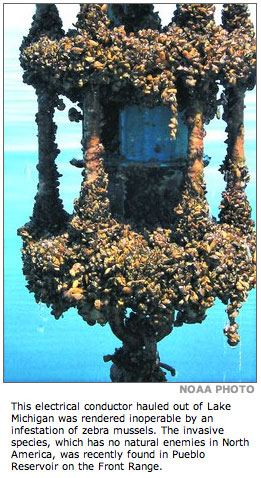
Denver Federal Center based Reclamation team is researching poison, blasts of ultra-violet light, shock waves and the introduction of a mussel-destroying predatory sunfish as possible methods for the control of invasive mussels

A picture named zebramusselinfestation

From The Denver Post (Bruce Finley):

The researchers testing these tactics say some seem to work and, if proved, could save tens of millions of dollars by protecting western hydropower and water delivery facilities against the proliferating Eurasian quagga and zebra mussels. “Once the mussels are there, this would help control them,” said U.S. Bureau of Reclamation mussel program coordinator Leonard Willett, who this week was supervising tests at dams along the lower Colorado River.

Lab tests of the poison are “very promising,” he said. It contains Pseudomonas fluorescens — derived from a bacterium that destroys mussels but apparently not fish. The Environmental Protection Agency has been asked to issue an emergency permit allowing open-water tests…

One tactic involves installing underwater UV-ray devices on pipelines. Mussels inside pipes respond to sudden, intense ultraviolet light by closing up, rendering them unable to attach. Testing of underwater cylinders that emit pulses of energy and discourage mussels from attaching is underway at Colorado’s Leadville Fish Hatchery. Teflon-like coatings also are being tested. And, while quagga and zebra mussels have no natural predator in the United States, researchers are exploring the possibility that a type of sunfish, if introduced, could devour mussels…

This year, the mussels’ spread in Colorado has indeed slowed. A suspected colonization of Blue Mesa Reservoir, west of Gunnison, was not confirmed. Mussels in Pueblo Reservoir and others appear to be somewhat contained, perhaps due to periodic colder temperatures that inhibit breeding, Hosler said. “In Colorado, for right now,” she said, “it looks like we’re winning.”

More Pseudomonas fluorescens coverage here. More invasive species coverage here.

Summit County: Update on county efforts to thwart invasive species

A picture named zebraquaggamussels

From the Summit Daily News (Julie Sutor):

Aquatic nuisance species like zebra mussels, quagga mussels, New Zealand mudsnails and rusty crayfish have thus far not been detected in Summit County’s waters. But they’re practically banging on our door. Populations of the invasive mussels are already established in Pueblo Reservoir and in multiple reservoirs in Grand County. Stopping them from crossing the county border depends on the vigilance of boaters, anglers and others who enjoy the water…

According to [Elizabeth Brown, state invasive species coordinator for the Colorado Division of Wildlife], people can get confused or intimidated by the topic of invasive species, but halting their spread is actually quite simple. “It’s very easy for an everyday person who knows nothing about natural resources biology to stop invasive species just by making sure their boat or ATV doesn’t have any biological material on it. Whether on land or water, it’s the same message: Keep your stuff clean, take nothing with you, and leave nothing behind,” Brown said.

Taking nothing with you includes not picking up plants or animals from one body of water and move them to another. For that matter, don’t take water from one place and move it to another — some species are so small at juvenile stages of development that they’re invisible to the naked eye. And if you’ve become tired of tending your household aquarium, never release species into local habitats…

Both [zebra and quagga] mussels are small barnacle-like mollusks with dark and light stripes. They smother aquatic organisms, such as crayfish and native clams and outcompete for food and aquatic habitat. They damage equipment by attaching to boat motors or hard surfaces and clog water treatment facilities. Once they’re in the water, there’s no way to control them, so prevention is the best — and only — cure. Each female mussel produces about one million eggs a year. From the time the mussels enter a water body, they can completely cover its bottom and begin creeping up the shoreline within a matter of five years…

The rusty crayfish, native to the American Midwest, is Colorado’s newest invasive aquatic species. It was originally spread by anglers who used it as bait. The crustacean has been discovered in the headwaters of Colorado’s Yampa River. “They don’t create the high-dollar cost for water supplies like zebra mussels do, but from an ecological standpoint, they’re pretty horrendous. They have strong impacts to the food web and native fishes,” Brown said.

The Eurasian watermilfoil, a submerged aquatic plant, also appeared recently in the Centennial State. It forms extensive, thick, dense mats that clog water bodies, disrupting fisheries, fostering mosquitos and impairing drinking water.

The New Zealand mudsnail was first detected in Colorado rivers and streams in 2004. The mudsnail invades new habitat when it becomes attached to fishing gear, boats, trailers, fish or bait, and then it comes off in the next stream or river. Mudsnails consume aquatic vegetation, upsetting the balance of the aquatic environment.

More invasive species coverage here.

Invasive mussel prevention procedures update

A picture named zebramusselinfestation

From the Crested Butte News (Seth Mensing):

The threat of invasive zebra and quagga mussels isn’t gone from Western Slope watersheds, even though none have been found in the region this year. And local agencies like the Colorado Division of Wildlife and National Park Service are continuing work this summer to keep the mussels at bay. Gunnison County’s Blue Mesa Reservoir, Colorado’s largest body of water, is ground zero for the DOW’s containment effort. Superintendent Rudd says, “We’re doing a grid sampling across the lake twice a month. That takes us a couple of weeks to get to all of those spots. And we’ll be continuing with double time sampling. As of now we’re still mussel free and this is good news.”

Motor boaters on the lake this summer can expect an inspection before entering the water and after taking their boats out. To speed the process Blue Mesa has installed a second large decontamination station for big boats, or those that need a thorough cleaning. “It seems that people are being pretty responsive to our asking folks to dry and clean their boats when they come to the launch sites,” DOW spokesman Joe Lewandowski says. “I think that’s a big part of the reason we haven’t had [any new populations of mussels] in Colorado this year.”

From the Canyon Courier:

Beginning July 1, all boats launched in Evergreen Lake must be inspected for zebra or quagga mussels, which are tiny freshwater mollusks that arrived from the Black and Caspian seas on ships traveling internationally. All boats and floatable devices, including canoes, kayaks and belly boats, are subject to inspection. A boater pass costs $4 a day or $30 for the season. The inspections are free but mandatory, and are available during business hours seven days a week, as part of a statewide mandatory testing program now in effect.

More invasive species coverage here and here.

Invasive mussel boat inspection update

A picture named zebramusselinfestation

From the Associated Press via The Durango Herald:

In Southwest Colorado, all boats launched from trailers will be inspected at the following reservoirs: Vallecito Reservoir in La Plata County; Navajo Reservoir in Archuleta County; McPhee Reservoir and Jackson Gulch Reservoir at Mancos State Par in Montezuma County; Taylor Reservoir and Blue Mesa Reservoir in Gunnison County and Sanchez Reservoir in Costilla County. Sanchez Reservoir also is closed from 8 p.m. to 6 a.m. Boats can be launched only at the boat ramp. The reservoir will be closed to boating completely for the winter starting in October. Boats must be inspected every time they enter the water. Depending on the reservoir, inspections will be conducted by personnel from the Colorado Division of Wildlife, Colorado State Parks or the National Park Service. The DOW has coordinated inspection training with the other agencies…

Inspection times vary from reservoir to reservoir but generally inspectors will be at boat ramps from 6 a.m. to 8 p.m. every day until October. For a list of all the mandatory inspection sites and schedules in Colorado, or for more information aquatic nuisance species and the boat inspection program, visit http://wildlife.state.co.us/Fishing/MandatoryBoatInspections.htm.

More invasive species coverage here and here.

Tamarisk control: Tamarisk leaf beetle release in Grand Junction

A picture named tamariskleafbeetle

From The Grand Junction Daily Sentinel:

The city of Grand Junction removed tamarisk and fostered four acres of wetland more than a year ago along the river near Riverside and Redlands parkways. The new wetland area was created after seven-tenths of an acre of wetland was eliminated along Patterson Road between 24 1/2 and 25 1/2 roads during the Ranchmen’s Ditch project. The project involved installing pipes that would guide rain water from storms on the Bookcliffs to the Colorado River without causing flooding along the way. Within months, the tamarisk in the new wetland area was back. The city considered spraying a herbicide to kill the new growth, City Project Engineer Dave Donohue said. “We concluded if we did that, we’d have so much herbicide on new wetlands plants and water, it would be a disaster,” Donohue said.

So, Donohue pursued a different tamarisk-killer: the tamarisk beetle. Palisade Insectary Director Dan Bean released 7,000 tamarisk beetles at the site two weeks ago and another 1,000 Wednesday. Eggs and larvae already are appearing this week, showing the beetles are spreading into their new habitat and leaving offspring behind. The beetles regulate their numbers based on available food, Bean said, so he doesn’t expect them to overpopulate the area. Bean said the beetles aren’t likely to enter homes, and they don’t eat anything but tamarisk.

The insectary is one of a few in the country and the only one in Colorado, Bean said. It’s run by the Colorado Department of Agriculture and was placed in Palisade in the 1940s to provide predatory wasps to eat oriental fruit moths, which were destroying peach crops. The insectary continues to collect insects from inside and sometimes outside the state to help farmers, ranchers and gardeners fight pests across Colorado. The tamarisk beetles released along the Colorado River were collected in De Beque Canyon.

More tamarisk control coverage here and here.

Tamarisk control: Tamarisk consumptive use is on a par with native cottonwoods and willows

A picture named goatmunchingtamarisk

From The Durango Herald (Dale Rodebaugh):

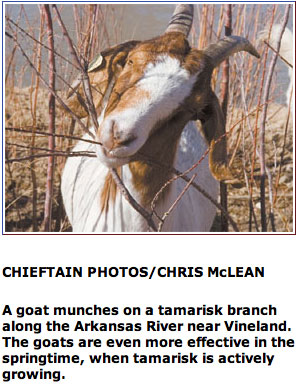
…decades and millions of dollars of eradication projects later, a report released April 28 says that conventional wisdom had it all wrong. Tamarisk was getting a bad rap – it doesn’t use any more water than the native species it crowds out – cottonwood and willows. The report, done jointly by the U.S. Geological Survey, the Forest Service and the Bureau of Reclamation, contains no new research. Rather, it’s a review and compilation of research dating back half a century. “The report is a review of the science starting in the 1960s,” said David Merritt, a riparian plant ecologist with the Forest Service in Fort Collins. The review found the premise that tamarisk was a water hog just didn’t wash, Merritt said.

Eradication efforts worked from the assumption that if tamarisk were removed there would be more water for other users, including plant species, wildlife, livestock and humans. “They weren’t able to quantify any real water savings by removing tamarisk,” Merritt said. “In certain cases, apparent (water) increases disappeared when vegetation came back…

There is relatively little tamarisk around Durango but it flourishes along the banks of the Animas, La Plata and San Juan rivers at the New Mexico line, La Plata County Weed Manager Rod Cook said. In Montezuma County where tamarisk is more abundant, a leaf beetle is munching tamarisk to death. The beetle is believed to have migrated to Montezuma County from Utah or from a beetle release four years ago on the Dolores River. Merritt said tamarisk peters out at around 7,000 feet elevation. Durango is at 6,512 feet elevation.

More tamarisk control coverage here and here.

Lower Arkansas Valley Water Conservancy District board meeting recap

A picture named arkansasriverbasin.jpg

From The Pueblo Chieftain (Chris Woodka):

The Arkansas River basin has the highest number of acres infested with tamarisk in Colorado, and much of it is in the upland areas, Edelmann said. “The [recent U.S. Geological Survey scientific assessment] doesn’t mean there weren’t water savings from tamarisk removal, just that they couldn’t be detected,” Edelmann said. “That’s not to say there could be some savings in the upland areas of the Arkansas River basin.”

Tamarisk consumptive use was reported as high as 9 feet per year in studies from the 1940s-70s, but the scientific methods did not take into account weather factors. Newer studies show the probable consumptive use is closer to 3-4 feet per year…

There could be a savings to the river by increasing the amount of water available to the Arkansas River, but any measurement would have to look at all components of the water budget — the water table, canal leakage and weather factors. “The river is a drain, so you should be able to see a net difference,” Edelmann said. “A lot of variables come into play.” So far, there have not been comprehensive studies showing the water-saving benefits of tamarisk removal in the Arkansas River basin. There is some anecdotal evidence,” Edelmann said. “The wetlands returned at Bent’s Fort when the tamarisk was cleared.” There are other benefits, such as improved flood protection in the river channel and improved wildlife habitat, Edelmann said.

More tamarisk control coverage here and here.

Watercraft inspections to prevent the spread of invasive aquatic species now mandatory in Colorado

A picture named zebramusselinfestation.jpg

Click here for the mandatory boat inspection page at the Colorado Department of Wildlife. Thanks to The Grand Junction Daily Sentinel for the heads up.

More invasive species coverage here and here.

Pourdre Learning Center’s ‘Caring for the Watershed’ contest recap

A picture named cachelapoudre.jpg

From The Greeley Tribune (Dan England):

Tori Billings and Michael Masi recently won the first Caring for the Watershed contest hosted by the Poudre Learning Center, and their classmates Ailie Young, Megan Skees and Colin Jorgensen took second. The contest charged high school students to come up with a workable idea to help protect our watershed. This was not a competition that encouraged dreams, said Ray Tschillard, executive director of the Poudre Learning Center. One idea was to level Greeley and replace it with grass seed. Sure, that would be great for the watershed, but it’s not very practical Others simply encouraged recycling. Recycling is also a good thing for the watershed, but it’s not exactly original.

The Poudre Learning Center and Agrium, a company that produces fertilizers and other agricultural products, wanted feasible, original ideas because they wanted to see those ideas come to life once the students won their competitions. Agrium, in fact, gave out cash prizes for the winners with no strings attached. But the company also will match up to $1,000 in donations to get the ideas accomplished. Agrium also offers up the services of its own workers to help the students…

Billings and Masi, who won the competition for their plan to raise awareness about the proper disposal of pharmaceuticals, need to raise about $400. Young, Skees and Jorgensen need about half that. Agrium’s matching donation will take care of the rest.

Billings and Masi thought of the idea after a couple of news reports surfaced about the issue. Those medicines, they learned, were getting into the water supply, possibly harming those who get their drinking water from the rivers and streams that are polluted (and that would include just about everyone). They thought it fit perfectly with their lifetime goals as well as goals to care for the watershed. Billings wants to be an environmental engineer, and Masi wants to be a doctor. They hope to create flyers that will inform those who get their medications of the proper ways to dispose of them. They thought handing out the flyers with every prescription would help, but working through the national chains’ red tape is challenging, they said. “Now we are thinking we could get doctors to hand them a flyer along with the prescription,” Masi said. “They have to give you something anyway.”

Young, Skees and Jorgensen, who took second for raising awareness about aerated water fixtures, wanted something simple to save water and yet something that would be significant. “We wanted something that people could do without making a huge conscious decision to do it,” Jorgensen said. “They don’t even have to pick up the trash or something. Once they install it, it’s over, and they’re already saving water.” The city, in fact, already has free aerated water supplies available, so the students just want to create postcards informing the public of that. The postcards can be sent out with water bills…

Regardless of the results, Tschillard was encouraged by the number of students who learned about how a watershed works — and how to care for one. “Some students didn’t know what a watershed was,” Tschillard said, “and that mirrors our society. We don’t think like a watershed. We need to start thinking that way.”

More education coverage here.

Aspinall Unit: Blue Mesa Reservoir open for the season

A picture named curecantibluemesa.jpg

From The Grand Junction Daily Sentinel (Dave Buchanan):

Blue Mesa Reservoir is now mostly ice free and the Lake Fork and Elk Creek boat ramps are open. The National Park Service will have inspection stations at the ramps from 6:30 a.m. to 4 p.m. daily through April 30. Beginning May 1, hours will extend to 6 a.m. until 8:30 p.m. The Iola boat ramp will open May 1, 6 a.m. until 8:30 p.m daily. Curecanti National Recreation Area Superintendent Connie Rudd announced the Ponderosa boat ramp will open under limited hours after June 18. Boaters should be aware that the only decontamination station open through May 20 will be at Elk Creek. That station opens May 1. Boats that are cleaned, drained and dry, with plugs pulled, move through inspection more rapidly.

More Aspinall Unit coverage here.

Yampa River: Rusty crayfish invade headwaters

A picture named rustycrayfish.jpg

From the Summit Daily News (Julie Sutor):

[Colorado Division of Wildlife] officials have identified rusty crayfish (Orconectes rusticus) in the headwaters of the Yampa River, prompting an immediate closure to the take of live crayfish from the waters in the Yampa River basin. Crayfish, also known as “crawdads,” are a popular bait and food item. It is not uncommon to find people collecting the animals from Colorado waters. Rusty crayfish are an aggressive species native to the Ohio River basin in the upper Midwest, but human activity has moved them throughout the northeast and into southern Canada. The discovery of rusty crayfish in the Yampa basin is a first in Colorado. Because of their large size and aggressive nature, rusty crayfish can impact fish populations by consuming small fish and fish eggs. The species can also negatively impact fish and spread unwanted aquatic plants by aggressively harvesting underwater plant beds. “They’re not selective in their feeding, so they’ll eat whatever fish eggs are there and whatever plants are there,” said Elizabeth Brown, Division of Wildlife aquatic nuisance species coordinator. “Any native species is at risk for food-web disruption from these critters.”

More invasive species coverage here.

Ridgway State Park open for boating

A picture named ridgwayreservoir.jpg

From The Grand Junction Daily Press (Dave Buchanan):

To prevent the spread of aquatic nuisance species, all trailered vessels entering and leaving the park are required to be inspected. The inspection station is open from 8 a.m. through 4:30 p.m. seven days a week through May 3. After then to May 15, hours will be 8 a.m. until 6 p.m. After May 15, the summer inspection hours will go into effect: 7 a.m. to 8 p.m. Sunday through Thursday and 7 a.m. to 10 p.m. on Fridays and Saturdays through Labor Day.

More Uncompahgre River watershed coverage here.

Carter Lake and Horsetooth Reservoir are open to boating

A picture named carterlake.jpg

From the Loveland Reporter-Herald (Pamela Dickman):

Larimer County has hired and trained about 34 inspectors who, on days when weather won’t prevent boating, will be at the docks 6 a.m. to 10 p.m. every day. The inspectors give each boat a careful once over before it is allowed to launch to make sure no nuisance mussels are attached…

Last summer, the county started inspections on every boat going into its reservoirs. Inspectors checked 56,000 boats and found [invasive] mussels attached to three before they hit the waters at Horsetooth Reservoir. This will be the third year for inspections at Boyd Lake State Park. During that time, no invasive mussels have been found on boats.

More invasive species coverage here and here.

Arkansas River Watershed Tamarisk Workshop recap

A picture named goatmunchingtamarisk.jpg

From The Pueblo Chieftain (Chris Woodka):

The workshop attracted 86 participants from all parts of the valley as part of the Arkansas River Invasive Plants Plan, an effort launched in 2007 by the Southeastern district and 30 partners to aid in restoring land taken over by tamarisk…

While the strategies vary in different parts of the basin, the basic lessons are the same:
Most have stopped talking about eradication and are looking at knocking back infested areas to the point where natural vegetation will have a change.
– Many partners are needed in projects, as well as the cooperation of landowners. Not all landowners want to remove tamarisk and may even value their presence as windbreaks.
– One swipe at the problem may get rid of 90 percent of the invasive trees, but follow-up efforts are needed. Complete restoration can depend on how well native vegetation takes hold.M.

“Complete eradication is pretty much impossible,” said Mike Eichenberry of the U.S. Forest Service, which has been eliminating between 500-800 acres of tamarisk each year since 2004 on the Comanche grasslands…

In North La Junta, a flood control district is using a different method for a different purpose, said Mike Taylor of the Natural Resources Conservation Service. Tamarisk and willows have constricted the channel of the Arkansas River and reduced its ability to protect North La Junta from floods. The river has filled with about 15 feet of sediment since the 1965 flood, and the goal is to widen the channel to 300 feet. That should accommodate a 25- to 50-foot flood and avoid a repeat of flooding in 1999. The district, NRCS and other partners are using a root rake — large teeth attached to the blade of a bulldozer — to dig out tamarisks to a depth of two feet. “Once you get at them deep enough, they will not regenerate,” Taylor said. The willows are tougher, and like tamarisk hold soil in banks against erosion. Taylor laughed that it was the first time in his career that he’d been involved with a project trying to encourage erosion, saying a small flood would help scour the river. And while the area at first looks like a “moonscape,” native plants come back, and local residents are enjoying the effect. “Each spring we’re seeing people picnicking and enjoying the river. They say they haven’t seen the river in years,” Taylor said…

Killing tamarisk by any means will take years, but they most likely won’t come back as strong, said Anna Sher, a revegetation expert from the University of Denver and Denver Botanical Gardens. “Managing for native species will result in less tamarisk cover,” Sher said.

More tamarisk control coverage here and here.

Colorado State Parks boating and invasive mussel inspection information

A picture named zebramusselinfestation.jpg

From The Denver Post:

Current boat inspection hours for other eastern Colorado reservoirs administered by Colorado State Parks are:

Cherry Creek Reservoir: Through April, the east ramp will be open daily from 6 a.m. to 6 p.m. Both ramps will be open Friday through Sunday. Full operation resumes May 1.
Barr Lake: Through April, 7 a.m. to 5 p.m. Friday through Saturday. Drop boxes for pre-inspection seals are available at the ramp and may be used at other times. Boat motors cannot exceed 10 horsepower.
Boyd Lake: Through April, 6 a.m. to 6 p.m. daily, main ramp only. Pre-inspection seal drop boxes available at the ramp at other times.
Jackson Lake: 9 a.m. to 5 p.m., Monday through Friday; 8 a.m. to 6 p.m., Saturday and Sunday. Pre-inspection seals may be used at other times.
North Sterling Reservoir: Opens to boating April 15.
Lake Pueblo: Through April 14, 5 a.m. to 6 p.m. No loading or unloading of boats permitted after hours.
Trinidad Lake: Beginning April 1, 8 a.m. to 4 p.m. Monday through Friday; 7 a.m. to 7 p.m. Saturday and Sunday.
John Martin Reservoir: 8 a.m. to 4 p.m., Thursday through Tuesday; 9 a.m. to 4 p.m. Wednesday.
Lathrop State Park: Both lakes closed to trailered boats until the water level in Martin Reservoir returns to its normal level.

More coverage from Chris Woodka writing for The Pueblo Chieftain. From the article:

“Based on what we’ve seen in other parts of the country, it can take anywhere from three to five years after initial introduction, before adult populations boom and mussels start colonizing on infrastructure or before shells are found along shorelines,” said Jerry Neal, spokesman for the DOW.

First found in Lake Pueblo in late 2007, signs of invasive mussels popped up at six other reservoirs in the state in 2008. It appeared the zebra and the closely related quagga mussels would follow the pattern of rapid spread seen in other states. In response, the state launched an aggressive boat inspection and decontamination program, along with boater education and risk assessment programs that were meant to slow down that spread. In 2009, the only state-wide evidence of invasive mussels was found at Lake Pueblo, despite more than 400,000 boat inspections, 3,300 decontamination procedures and research at 100 lakes or reservoirs. Even at Pueblo, only the larvae, called veligers, were found last year. No live mussels have yet been found within the state, although 19 boats with attached mussels were intercepted coming into the state last year…

Weather could have played a part in the failure to detect mussels at higher elevation lakes after positive results in 2008, Neal said. “In reservoirs above 7,000 feet, cooler water temperatures may cause a considerable fluctuation in the number of veligers produced from year to year,” Neal said. “We had an unusually cool, wet spring and summer in 2009 which may have resulted in a much shorter breeding season for the mussels and fewer veligers.”[…]

OTHER PESTS

Zebra and quagga mussels can clog pipelines, ruin beaches and deplete nutrients in lakes, but are not the only aquatic pests that concern Colorado Division of Wildlife officials. Among the others:

RUSTY CRAYFISH

Native to the Ohio River basin, the crayfish are more aggressive than native species, colonize and can diminish the native fish population. They were found for the first time last year on the Yampa River near Steamboat Springs.

NEW ZEALAND MUD SNAILS

The tiny snails can reach concentrations of 500,000 per square yard and out-compete native food sources for fish. They have been found at one site on the Green River and two sites in the South Platte basin and monitored since 2004.

EURASIAN MILFOIL

An aquatic weed, it takes over lakes under certain conditions, choking out most other forms of life. So far, the state has confirmed 15 exotic milfoil sites, five native (northern milfoil) and two hybrid sites. A management program began in 2005.

PURPLE LOOSESTRIFE

A weed that grows in marshy areas or wetlands, it crowds out native or beneficial plants. It is controlled to protect waterfowl habitat and maintain flows. In Colorado, 29 cities and counties participate in a management program started in the South Platte basin in 1993.

More invasive species coverage here and here.

Southwestern Colorado Water Conservation District Annual Seminar ‘Common Causes’ April 2

A picture named rioblanco.jpg

From the Pagosa Sun:

This year’s theme is “Common Causes,” and there will be a lineup of notable speakers who will address how water districts and various organizations work together to address common concerns.

In addition to [photographer John Fielder], one of the ranchers interviewed in Fielder’s recent book, “Colorado Ranges,” T. Wright Dickinson, will speak. Other speakers include Dave Grey; David Brown and Josh Linard from the United States Geological Survey; Doug Kemper, executive director of Colorado Water Congress, and Kent Singer, executive director of Colorado Rural Electric Association; and a panel that will talk about water quality work being done.

The registration is $30 for advance registration and $32 at the door, per person. This fee includes morning and afternoon snacks and a buffet lunch. Registration on April 2 begins at 8 a.m., the seminar begins at 8:30 a.m., and the seminar will wrap up at approximately 4 p.m.

It is recommended that advance reservations be made by contacting Jane Maxson at 247-1302.

More San Juan Basin coverage here.

Ruedi Reservoir: The Ruedi Water and Power Authority announce boating season inspections

A picture named zebraquaggamussels.jpg

From The Aspen Times (Janet Urquhart):

Ruedi Reservoir boaters will face mandatory inspections for invasive mussels every weekend this summer under a beefed-up effort spearheaded by the Ruedi Water and Power Authority. Last summer, the Colorado Division of Wildlife arranged for a roving inspection unit to set up occasionally at the Ruedi boat ramp. This year, the DOW is focusing its efforts on heavily used Front Range reservoirs, leaving Ruedi out of the loop, according to Mark Fuller, RWAPA director. “Nobody else seems to want to deal with it, frankly,” he said…

The inspection station will operate Friday through Sunday, from the Memorial Day to Labor Day weekends. The authority will contract with a private concessionaire, California-based Rocky Mountain Recreation, to run the operation. The outfit conducted boat inspections at Twin Lakes Reservoir last year and comes highly recommended by the DOW, according to Fuller…

The hope is to expand the program in future years, but this summer, boaters will be on the honor system to make sure they’re complying with state regulations aimed at halting the spread of mussels when the inspection station isn’t running, Fuller said. “It’s kind of a cross-your-fingers deal,” he said.

Ruedi is currently considered mussel-free, according to Fuller. In a survey of Colorado reservoirs by the DOW and Bureau of Reclamation, it ranked low on the list of vulnerable bodies of water, he said. “Ruedi was close to the bottom of those rankings, partly because it’s a high-altitude, cold-water reservoir, and partly because it’s remote,” Fuller said…

Go to the DOW website — http://wildlife.state.co.us/Fishing/MandatoryBoatInspections.htm — for details on boat regulations regarding mussel inspections and decontamination.

More invasive species coverage here and here.

Arkansas Valley: Tamarisk control workshop March 30

A picture named tamarisk.jpg

From The Pueblo Chieftain:

The Southeastern Colorado Water Conservancy District, Colorado State Forest Service, and the Natural Resource Conservation Service are sponsoring a technical workshop on tamarisk control and restoration methodology. The workshop will be 8 a.m. to 4:30 p.m. March 30 at the Southeastern district office, 31717 United Ave…

There is no cost to attend the workshop and lunch will be provided. Contact Jean Van Pelt, jean@secwcd.com or 719-948-2023.

More tamarisk control coverage here and here.

Shelley Simmons receives Tamarisk Coalition’s First President’s Award

A picture named tamarisk.jpg

From the La Junta Tribune Democrat:

The Tamarisk Coalition’ First President’s Award is given in memory of Pete Larson, the Tamarisk Coalition’s first president to honor his dedication to restoring natural resources through the application of science, education, and volunteerism. The individual selected for this award has demonstrated the same level of commitment on their project through their volunteer efforts, incorporation of education and use of science in their work or through their project. On Jan. 13, Shelly Simmons (formerly VanLandingham) with the Colorado State Forest Service – La Junta office was nominated and received this distinguished award at the Tamarisk Symposium in Grand Junction. Attached is a photo of Shelly Simmons receiving the award from the Tamarisk Coalition President, Dr. Anna Sher.

In the award nomination form, her nominator described Simmons’ contribution, saying, “Shelly Simmons has spearheaded the tamarisk control and restoration efforts for over seven years in Southeast Colorado within the Arkansas River Basin. Shelly was an integral part of the development of the Arkansas River Watershed Invasive Plants Plan. She chaired the education (and) outreach committee, assisting with the development of the educational http://www.arkwipp.org Web site and the brochure.

More tamarisk control coverage here and here.

Colorado State University: 2010 Tamarisk Symposium January 12-13

A picture named goatmunchingtamarisk.jpg

Here’s the link to the webpage with all the dope on the symposium:

The 2010 Tamarisk Symposium will be held at Two Rivers Convention Center, 159 Main Street, Grand Junction, CO. The committee has finalized the agenda and the schedule is now available. If you would like to be considered, please contact Meredith B. Swett via email mswett@tamariskcoalition.org.

More tamarisk control coverage here and here.

Boulder: City Council discusses Boulder Reservoir water quality

A picture named boulderreservoir.jpg

From the Boulder Daily Camera (Erica Meltzer):

In a discussion of a new master plan for the Boulder Reservoir, council members expressed concern about maintaining water quality and preventing invasive species from entering the reservoir. Several council members asked what the city could do to pressure the managers of Six Mile Reservoir, which feeds into the Boulder Reservoir, to maintain water-quality standards similar to Boulder’s. The answer was not much, except exert regional pressure.

More water pollution coverage here.

U.S. Bureau of Reclamation manual for fighting invasive species

A picture named quaggamussels.jpg

From email from Reclamation (Peter Soeth):

Reclamation Develops Equipment Inspection and Cleaning Manual to Prevent Spread of Invasive Species

The Bureau of Reclamation has developed and released an Equipment Inspection and Cleaning Manual to help prevent the spread of invasive species through contaminated equipment use. This manual provides recommendations for inspection and cleaning of vehicles and equipment as a prevention tool to limit the spread of invasive species.

“This manual will help equipment operators gain a better understanding of how invasive plants and animals are spread by contaminated equipment into new locations,” said Reclamation Invasive Species Program Coordinator and co-author Joe DiVittorio. “This manual has broad applications for many organizations and agencies.”

The manual is organized to present equipment inspection techniques, equipment cleaning methods, and finally the identification of invasive biology and habitats of some of the common invasive species that are of potentially high consequence to Reclamation. Examples include quagga and zebra mussels, purple loosestrife, giant salvinia, eurasian watermilfoil, and hydrilla. These and many other invasive species can be inadvertently introduced into new sites on contaminated equipment.

Not all types of equipment are described in the manual, but a process is presented to guide field personnel through general inspection and cleaning decisions for any equipment type.

This manual was developed with the assistance of the U.S. Army Corps of Engineers.

To obtain a copy of the manual, please visit www.usbr.gov/pps.

Media Contact: Peter Soeth, psoeth@usbr.gov, 303-445-3615

More invasive species coverage here.

Hoover Dam: Quaggas in the pipes

A picture named hooverdamaerial.jpg

From The New York Times (Scott Streater):

The organisms, which grow to about [20 millimetres], are clogging water lines that are used to cool the 17 massive hydropower turbines at Hoover Dam and have already forced dam operators to temporarily shut down the power plant that supplies electricity to 1.6 million people in southern Nevada, Arizona and California.

The mussels have caused similar problems at the downstream Davis Dam in Lake Mohave and Parker Dam in Lake Havasu, both of which provide electricity for thousands of people in Arizona and California. The mussels have also threatened to clog water intake lines in Lake Mead operated by the Southern Nevada Water System that supply water to more than 2 million people in the Las Vegas area.

“We’re very concerned,” said Fred Nibling, a Reclamation biologist in Denver who is helping lead agency efforts to combat the mussel invasion…

So the bureau has applied to U.S. EPA for an exemption waiver that would allow it to use an experimental pesticide that contains the freshwater bacteria Pseudomonas fluorescens, which in laboratory tests has shown great promise to kill quagga mussels, and their invasive cousins zebra mussels, without harming other organisms.

More invasive species coverage here.

Colorado River District grant program

A picture named coloradoriverbasincgs.jpg

From email from the Colorado River District (Martha Moore):

Beginning December 1, 2009, the Colorado River District will be accepting grant applications for projects that protect, enhance or develop water resources in their 15-county area within the Colorado River Basin; this includes all tributary watershed areas in Colorado, except the San Juan River basin.

Water resource projects eligible for grant funding should meet one or more of the following objectives:

Development of a new water supply;
Improvement of an existing system;
Improvement of instream water quality;
Increased water use efficiency;
Sediment reduction;
Implementation of watershed management actions; and/or
Tamarisk control

Past successful projects have included the construction of new storage, the enlargement of existing facilities, the rehabilitation of non-functioning or restricted structures, both small and large-scale water efficiency measures, tamarisk removal and other watershed actions. In addition, proposals that enable water to be supplied to areas previously short are eligible and encouraged. Projects that utilize pre-1922 water rights will be given ranking priority.

Eligible applicants can receive up to a maximum of $150,000 (or 25% of the total project cost whichever is less) for their water supply projects. The total grant pool for 2010 is $250,000. The application deadline is Jan. 29, 2010.

More Colorado River Basin coverage here.

The Uncompahgre Watershed Planning Partnership to host workshop focusing on reclamation activities and abandoned mine lands issues in the upper Uncompahgre Watershed December 11

A picture named uncompahgrewatershed.jpg

Here’s the release from the UWPP via the Delta County Independent:

The Uncompahgre Watershed Planning Partnership will be hosting a day long workshop focusing on reclamation activities and abandoned mine lands issues in the upper Uncompahgre Watershed. The program, titled: “Examining Abandoned Mine Lands in the Uncompahgre Watershed” will be held on Friday, Dec. 11, from 9:30-3:30 at the Ouray Community Center.

According to the workshop’s organizer, Andrew Madison, this event will bring together representatives from state, local and federal agencies, as well as local organizations and industry representatives to discuss how different agencies are handling AML issues as well as future strategies for remediating and safeguarding abandoned mine sites. The workshop will involve short presentations as well as a roundtable discussion focusing on data sharing and prioritizing abandoned mine sites for future reclamation. Participants will include the U.S. Forest Service, Bureau of Land Management, Division of Reclamation and Mining Safety, Trust for Land Restoration, Trout Unlimited, the Red Mountain Project and many others.

Abandoned mines can pose many hazards both to people and environment through un-safe mine openings and structures as well as soils and surface water contamination from acid mine drainage and abandoned mine waste. However these sites are an important part of the culture and heritage of Ouray County and provide a unique glimpse into the past for tourists and younger generations. Through proper management, reclamation and safeguarding, the hazards of these sites can be remediated while preserving cultural aspects.

The Uncompahgre Watershed Planning Partnership is a volunteer group seeking to involve citizens and organizations in the Uncompahgre Watershed. Its mission is to protect and restore water quality in the Uncompahgre River through coordinated community and agency efforts.

For more information about “Examining Abandoned Mine Lands in the Uncompahgre Watershed” contact Andrew Madison at 413-297-7232 or Ridgway.vista@gmail.com

More Uncompahgre River watershed coverage here and here.

Colorado State Parks to close most reservoirs to boating this winter to aid in the fight against invasive mussels

A picture named zebramusselinfestation.jpg

From the Northern Colorado Business Report:

Parks that have already closed ramps include: Barr Lake, Bonny Lake, Crawford, Elkhead Reservoir, Harvey Gap, Highline Lake, Lathrop, Mancos, John Martin Reservoir, North Sterling, Paonia, Pearl Lake, Ridgway, Rifle Gap, San Luis, Stagecoach, Sweitzer and Vega. Steamboat Lake State Park closed its ramps Friday. State parks with ramps closing Dec. 1 include Boyd Lake, Chatfield, Cherry Creek, Eleven Mile, Jackson Lake, Navajo, Spinney Mountain and Trinidad Lake. However, those ramps could close earlier if the lakes freeze.

More invasive species coverage here and here.

Aspinall Unit: Invasive mussels inspections regime changed for winter operations

A picture named curecantibluemesa.jpg

From the Montrose Daily Press:

Stevens Creek boat ramp will remain closed to vessel launching and retrieval. Elk Creek and Lake Fork boat ramp hours are 7 a.m. through 5 p.m. Inspections continue at the Elk Creek Marina, rather than at the campground entrance. Vessels that have been slipped or on the water for more than 24 hours must go through a high-risk inspection and possible decontamination, which will take longer than a standard inspection. No motorized or trailered vessel launching or retrieval is allowed outside of the Elk Creek and Lake Fork boat ramps. Only hand-launched water craft may launch outside of these locations and their trailers may not enter the water. Boat decontamination is no longer available at Lake Fork, due to nighttime temperatures that are below freezing, and the potential for water lines and portable decontamination units to freeze. Boats needing decontamination will be sent to Elk Creek. Boaters can prevent the need for decontamination by keeping craft clean, drained and dried of any standing water upon arrival at Blue Mesa Reservoir. Cooler temperatures and reduced staff means decontamination might not be immediately available to vessels with attached adult mussels. Such vessels may be denied access to the lake until they are decontaminated elsewhere. The reservoir and inspection stations remain open until the water at Elk Creek and Lake Fork boat ramps freezes. Hours will again be reduced in late November or early December.

More invasive species coverage here and here.

Arkansas Valley: Tamarisk control update

A picture named tamarisk.jpg

From The Pueblo Chieftain (Chris Woodka):

The Arkansas Valley has taken aim at the invasive trees and gotten rid of 9,000 acres of the pests in the last four years. It’s estimated that 67,000 acres along the Arkansas River and its tributaries are infested with tamarisk. “Since 2006, we’ve spent more than $1 million in controlling invasive species,” said Mary Miller, of the Natural Resources Conservation Service, the federal agency that has coordinated programs. “The majority of the money has been spent on the ground for the treatment of tamarisk.” Last year, the NRCS, more than two dozen government agencies and 40 landowners spent a combined $248,000 to treat 2,400 acres in Fremont, Pueblo, El Paso, Huerfano, Las Animas, Otero, Bent and Prowers counties.

The programs mostly involved destroying tamarisk, with some areas being restored as well. Mechanical, chemical and biological methods were used, Miller said. The largest areas were controlled with aerial spraying. Mechanical means, either by hand or with machines, are more time-consuming and costly, but more effective in some areas. Biological control usually means releasing beetles that eat tamarisk, and only tamarisk.

More tamarisk coverage here and here.

Arkansas Valley tamarisk control update

A picture named greenmountainreservoir.jpg

From the Ag Journal (Susan Pieper):

Several partners including NRCS (Natural Resources Conservation Service), Colorado Division of Wildlife (CDOW), Colorado Legends and Legacies and Mile High Youth Corps, Colorado State Conservation Board, Colorado State Forest Service, Colorado State University, Colorado Water Conservation Board (CWCB), Fremont County Weed Manager J.R. Phillips and his department, Fremont County Weed Control Department (FCWD); Rocky Mountain Bird Observatory (RMBO), Sangre de Cristo and Southeast Colorado Resource Conservation and Development Councils, U.S. Fish and Wildlife Service Partners for Wildlife Program, Upper Arkansas Cooperative Weed Management Area (UACWM), several conservation districts including Fremont, Turkey Creek, South Pueblo County, El Paso, Central Colorado, Northeast Prowers, Bent County, West Otero Timpas, Custer County-Divide, Upper Huerfano and Spanish Peaks Purgatoire River Conservation Districts plus several individual landowners have undertaken a massive effort to remove tamarisk along the Arkansas River and its tributaries and have provided financial and in-kind support for all the projects being undertaken in the various counties and individual conservation districts.

Also providing the same type of support for the projects are the county commissioners in each of the counties along this stretch of the Arkansas River, Colorado State Land Board, Southeast Colorado Water Conservancy District, Holly Flood District and Tri-State Generation and Transmission.

Generally, water issues can divide communities, but the eradication of this scourge has united producers and governmental agencies across property lines, county lines and even the state line.

Although the Arkansas River banks are the primary target for tamarisk removal, the plan can not be successful within only those boundaries. The Arkansas River, just like any large body of running water, is fed by tributaries and with plants that can produce up to 50,000 seeds annually, controlling the spread of tamarisk on the creeks and arroyos upstream will support the efforts along the river.

In Colorado, approximately 1,414 acres along the Arkansas River in Prowers County have been targeted for eradication with the boards of directors of several conservation districts accepting bids and choosing the applicator to assist them with controlling and eventually ridding the river of this alien species. The same is true for areas up the river where approximately 850 acres were treated, also.

<p.In the lower regions of the Arkansas River, such as in Prowers County and across the state line into Kansas, herbicide application of the plants from the air was chosen.

In Fremont and Custer counties, the targeted areas were tributary streams.

More Arkansas River Basin coverage here.

Larimer County: Invasive mussels update

A picture named quaggamussels.jpg

Larimer County inspections have led to the decontamination of 54 boats. Three of the boats had mussels attached. Here’s a report from Pamela Dickman writing for the Loveland Reporter Herald. From the article:

Larimer County started the inspections in mid-April with a $300,000 grant from the Colorado Division of Wildlife. Inspectors, on duty seven days a week, checked 55,571 boats through Wednesday. Of those, they believed 109 were high-risk because they had been on infested waters, seemed overly dirty or had water or plants onboard. Half of those, 54, were decontaminated because inspectors believed, after a closer look, that they were more risky…

“It’s a long, tedious process,” said Dan Rieves, visitor services manager for the Larimer County Department of Natural Resources. “The cure is exposure to hot water under pressure. They power-wash the boat, for lack of better terminology.”[…]

Now that the busiest boating season is over, inspectors will be at Carter and Horsetooth only on weekends during October. That means boaters can hit the water only on Fridays, Saturdays and Sundays after their vessels have been inspected. At Boyd Lake State Park, inspectors will be on duty from 7 a.m. to 6 p.m. every day through October, and from 7 a.m. to 5:30 p.m. daily in November, according to the park’s Web site.

More invasive mussels coverage here and here.

Arkansas River Basin Water Forum: Invasive mussels update

A picture named arkansasriverbasin.jpg

From The Pueblo Chieftain (Chris Woodka):

“We’ve not seen the adults [quaggas/zebra mussels], just the veligers (larvae),” said Elizabeth Brown, invasive species coordinator for the Colorado Division of Wildlife. “We’re on the cutting edge of doing the testing to find them.” Brown spoke this week at the Arkansas River Basin Water Forum, held at Colorado State Univer- sity-Pueblo. Last year, evidence of mussels was found in seven Colorado reservoirs and lakes after they were first detected in Lake Pueblo in January 2008. A total of 102 bodies of water were tested, which means that boat inspection programs or closures of some lakes were successful in stopping mussels from spreading further than they have, Brown said. “The mussels move from body to body of water primarily by boats,” she said…

Brown speculated that more adults have not been found because the zebra and quagga mussels are mainly populating the sediments at the bottom of lakes…

At Pueblo, there were 67 plankton tows, mostly performed by a team led by Colorado State University biology professor Scott Herrmann. The samples were tested at the university, by the Bureau of Reclamation and by the Division of Wildlife. Wildlife found that 70.8 percent of the samples tested positive, with anywhere from one to 76 veligers found in each of the positive samples. The DNA of the veligers was tested as well, showing that both zebra and quagga mussels have breeding population in the lake.

Reclamation last year completed a risk assessment of Lake Pueblo, finding that because of fluctuations in water, dissolved oxygen levels do not favor large outbreaks of mussels. Water providers are wary, however. The Pueblo Board of Water Works is making $1 million in upgrades to its intake system because of the threat.

More invasive species coverage here and here.

Dolores River: Tamarisk grants available

A picture named snaggletoothrdoloresriver.jpg

From the Targeted News Service:

The U.S. Interior Department’s Bureau of Land Management has modified its announcement of a cooperative agreement opportunity to conduct habitat restoration by removing invasive weeds in Colorado’s Dolores River Watershed. The funding announcement was modified Sept. 14 to reflect a change in the category of funding activity, expected number of awards and the contact details. This funding is available under the American Recovery and Investment Act of 2009…

The funding opportunity number is RECOVERY-ACT-BLM-CO-RFA09-1471. It was posted Sept. 14 with an application closing date of Sept. 15.

More Dolores River coverage here and here.

Blue Mesa Reservoir: Fall schedule for invasive mussel inspections

A picture named zebramusselinfestation.jpg

From the Delta County Independent:

Elk Creek and Lake Fork boat ramp hours will be 7 a.m. through 7 p.m. beginning Sept. 8. Both entrance and exit inspections at Elk Creek will be done at the Elk Creek Marina, rather than the campground entrance. Vessels that have been slipped or on the water for more than 24 hours must go through a high risk inspection and possibly decontamination. No motorized or trailered vessel launching or retrieval is allowed outside of Elk Creek and Lake Fork boat ramps, only hand launched watercraft may launch outside of these locations and their trailers may not enter the water…

Due to nighttime temperatures below freezing and the potential for water lines and portable decontamination units to freeze, boat decontamination may not be available at Lake Fork. Boats requiring decontamination will be sent to Elk Creek. The best way to assure that your boat does not require decontamination is for it to be clean, drained and dried of any standing water upon arrival at Blue Mesa Reservoir. Due to freezing fall temperatures and the likelihood that our large decontamination unit will have to close, the proper decontamination may not be available to vessels coming in with attached adult mussels. Those vessels may be denied access to the lake until they obtain decontamination at another facility.

More invasive species coverage here and here.

Prowers County tamarisk efforts

A picture named tamarisk.jpg

Prowers County is taking to the air to fight tamarisk, according to a report in The Lamar Ledger (Aaron Burnett). From the article:

[Prowers County Commissioner Henry Schnabel] said the county has concentrated its efforts in the area from Holly to the state line in hopes of clearing out the river channel and lessening the possibility that high water levels could result in flooding in and around Holly. “With the different entities coming together in a cooperative effort, it just shows what can be done when you have that cooperation among all the people to really get out there and get something done,” said Schnabel.

The area being sprayed through the project include sections along the Arkansas River as well as upland tributaries and runoffs. “We feel that if can control those tamarisk in those upland situations and get them killed, they shouldn’t be coming back,” said Michael Daskam, NRCS agent in the Holly office. Daskam said the water saved by removing tamarack and revegetating with native plant species is approximately 70,000 acre feet a year in the river. “That’s like John Martin (Reservoir) in a good year, and that’s the net savings each year.” Daskam said there are several benefits to removing tamarisk from the area. “There’s these water conservation benefits that we talked about, there’s flood hazard mitigation benefits, there’s wildlife benefits as well because tamarack don’t provide much of any kind of habitat for our native species. If we can get the native species to come back, then we’ll have a lot more valuable wildlife habitat.”

Following the completion of aerial spraying, ground spraying will be conducted in areas too tight for aerial spraying. It takes three years from the time of the chemical application for the tamarisk to be completely killed, at which point it can then be manually removed.

More tamarisk control coverage here and here.

Tamarisk control in Montezuma County

A picture named tamariskleafbeetle.jpg

Here’s an update about Tamarisk control in Montezuma County, from Kristen Plank writing for the Cortez Journal. From the article:

For the past two weeks, the tamarisk leaf beetle has been chowing down on the area’s tamarisk, cropping up in sporadic locations from McElmo Canyon clear across the county…

Killing off an entire tamarisk typically takes a few seasons of defoliation, and beetles often will leave some of the leaves intact on each plant. “We really don’t know how long it will take for all of a tamarisk to be gone, but it’s not realistic to think that beetles are going to get it all,” Kolegas said. “Beetles only eat as much as they can. They want to sustain their population.” Which is why other efforts to rid the area of the water-loving weed, like native revegetation, will still occur. But most of the local tamarisk eradication efforts will be drastically reduced, Downs said. “We’re putting tamarisk removal on hold for now,” she said. “We’re going to finish the projects we’ve already started, and we’re going to continue heavily with revegetation efforts. “We want to get willows and cottonwoods and box elders in the area before the tamarisk is completely dead.”

How the bugs came into the county is unknown, but tamarisk beetles were released in Moab, Utah, and other parts of Colorado, Downs said. Reasons for not releasing the insect prior to now was due mostly to federal concerns for the southwest willow flycatcher, an endangered bird. The flycatcher, which used to nest in willows along riverbanks, now nests in tamarisk.

For residents interested in learning more about the tamarisk leaf beetle’s progress, the district will hold a public information meeting in conjunction with the Tamarisk Coalition at 6 p.m. Oct. 12 in Empire Electric’s Calvin Denton room, 801 N. Broadway, Cortez. The leaf beetle will go dormant in early October, but residents wishing to report a known population or to ask questions can call D-TAG and the Dolores Soil Conservation District at 565-9045.

More Tamarisk coverage here.

Tamarisk: Delta County tamarisk leaf beetle release update

A picture named tamariskleafbeetle.jpg

From Painted Sky Resource Conservation & Development via the Delta County Independent:

This summer Painted Sky Resource Conservation & Development staff has released tamarisk beetles at five sites in the North Fork Valley and Delta area to battle tamarisk, an invasive shrub from Eurasia. The beetle populations appear healthy and are reproducing well, according to monitoring observations conducted in mid-August.

The release sites, all on private property, range from Bell Creek and Back River Road between Paonia and Hotchkiss on the east to G Road and the Gunnison River northwest of Delta. Properties at the end of Horn Road near Austin and the Gunnison River and Highway 65 and the Gunnison River also received beetles. The fifth site, Confluence Park in Delta, is on public land. The average number of beetles released at each site is about 6,000.

Beetles are the last stage of the life cycle. After hatching from eggs, larvae go through three stages from tiny worms to larger worms or larvae. You can easily identify the third and final stage larvae by a “green racing stripe” on each side of its body. Beetles released earlier this summer have produced the next generation, which are in the third larval stage now. It’s the larvae, not the adult beetles that do the most damage to the plant. Like teenagers with insatiable appetites, they eat 24 hours per day, seven days per week.

The beetles may cause browning of tamarisk by next summer, but it will take up to five years for them to kill the tamarisk.

As the beetle populations grow and exhaust their food supply at the release sites, they’ll fly up and down the river drainage in search of fresh tamarisk to eat. Eventually, they’ll distribute themselves throughout the area. Flying from tamarisk to tamarisk shrub, beetles have moved up the Dolores River from near Moab, Utah, to just south of Gateway without ever hitching a ride with humans.

Painted Sky plans more releases in the area in 2010, including the Surface Creek area, Smith’s Fork and along the Uncompahgre River in Delta. Landowners with tamarisk can ask to be put on a waiting list to receive beetles. Tamarisk or salt cedar has spread too successfully in the West over the past century. It out-competes native plants and trees, such as cottonwoods, creating a monoculture. A landscape dominated by only one plant hurts wildlife diversity.

More tamarisk coverage here and here.

Prowers County is taking the fight to tamarisk

A picture named tamarisk.jpg

From The Pueblo Chieftain (Chris Woodka):

Bids for aerial spraying of 1,500 acres of tamarisk between Holly and the Kansas border came in at half the cost that was expected. “It gives us great encouragement that something can be done,” County Commissioner Henry Schnabel said. “It’s left us scrambling to find more acres.” Schnabel was addressing the Lower Arkansas Valley Water Conservancy Board, which earlier had contributed $10,000 to the project. The county, working with several other agencies that have put about $260,000 toward the project, was expecting to pay $160 per acre for the spraying. Instead, the bids were opened Monday and Tri-Rotor Helicopter Spraying of Ulysses, Kan., bid just $85.49 an acre for the service. The company guaranteed an 85-percent kill rate and can tailor the spraying to avoid cottonwoods along the river, Schnabel said. “The spraying is critical on that reach, because the tamarisk is so tall that Holly would flood if there were another 1965-type flood,” Schnabel said.

Across the state line, Kansas also is killing tamarisks as part of the effort.

More tamarisk control coverage here and here.

USDA halts tamarisk leaf beetle releases in eight western states

A picture named tamariskleafbeetle.jpg

From The Durango Telegraph:

A decades-old effort to bring a natural tamarisk predator into the region has started to yield strong results. Tamarisk stands along the Dolores, Colorado and San Juan rivers have taken hard hits in recent years thanks largely to the release of the beetles.

In 2004, beetles were transported to Moab and the Horsethief bench outside of Fruita. Not only have those local transplants thrived at the expense of tamarisk, they have started to spread through the region and chewed through many of the invasive trees in their wake. The beetles have spread up the Dolores drainage, along the Mancos River and could already be eating salt cedar in the Animas River drainage. The State of Colorado also recently got on the beetle bandwagon and sowed the bugs along the Arkansas River

However, U.S. Department of Agriculture officials recently revoked Colorado’s permits to move the beetles across state borders. The USDA also banned any release of the beetles in eight other Western states.

The orders were the result of a lawsuit filed by the Center for Biological Diversity and the Maricopa Audubon Society. The suit charged that the tamarisk leaf beetle is contributing to the decline of the endangered southwestern willow flycatcher.

Flycatchers nest in the invasive tamarisk because the species of native riparian trees in which they previously nested have been replaced by tamarisk and are no longer available. The Endangered Species Act requires that federal agencies not harm endangered species or their habitat and that they consult with the U.S. Fish and Wildlife Service to formulate plans to avoid such harm.

Following the moratorium, the Center for Biological Diversity and Maricopa Audubon Society killed their legal challenge. “We are relieved that the program has decided to obey the law and will now consult with the Fish and Wildlife Service to prevent any further jeopardy to a federally protected species. Our case will now be dismissed,” said attorney Matt Kenna of the Durango-based Western Environmental Law Center.

More invasive species coverage here and here.

Arkansas Valley: Officials plan to unleash an additional 100,000 or so tamarisk leaf beetles

A picture named tamariskleafbeetle.jpg

From The Denver Post (Bruce Finley):

Colorado agriculture officials are widening their battle against the West’s most voracious invasive weed, tamarisk, by deploying a controversial leaf-eating Chinese beetle east of the Continental Divide. State teams have planted 100,000 of the yellow- striped Diorhabda beetles along banks of the Arkansas River. They plan to release another 100,000 along the river this week, placing them on tamarisk, a water-sucking weed that chokes off native life such as cottonwoods and willows. “We want them to feed like crazy,” said Dan Bean, director of biological pest control for the Colorado Department of Agriculture…

But there are concerns. The Diorhabdas may threaten an endangered bird, the southwestern willow flycatcher, which uses tamarisk in New Mexico and Arizona for nesting. The federal government recently was forced by a lawsuit to suspend its releases of Diorhabda beetles in eight Western states — where tamarisk has gobbled more than 1.5 million riparian acres. Yet Colorado biologists contend the beetle is relatively benign and are pressing ahead — determined to suppress tamarisk with fight-the-enemy-with-its-enemy tactics that so far have proved successful…

“We very much recognize that biological controls are an important aspect” of suppressing invasives, said Chris Diogini, acting executive director of the National Invasive Species Council. Co-chaired by Interior Secretary Ken Salazar, the council is charged with coordinating federal, state and local responses to biological invaders — and refereeing disputes. Federal researchers now track some 50,000 exotic species, which unlike chemical pollutants that can be banned and eventually break down, can cause ever- growing problems. But one major challenge “is making sure you don’t get rid of one invasive species only to see it replaced by another,” Diogini said…

This was the first year the state had enough beetles to attack tamarisk along the Arkansas River, Bean said. The first 400 beetles, delivered from northwestern China, have multiplied to more than 50 million, he said. Most live wild along rivers and have the ability to move up to 20 miles a day on their own — into neighboring states. Should this beetle work on tamarisk, others could be tried on such invasive species as Russian knapweed, Oriental fruit moths and alfalfa weevils.

More tamarisk control coverage here and here.

Mesa County: Tamarisk leaf beetle release

A picture named tamariskleafbeetle.jpg

From the Longmont Times Call:

Beetles that eat trees are the good guys in the fight to save water and native plants in western Colorado. With the help of volunteers, Mesa County has released 2,500 beetles on an island in the Colorado River in Grand Junction. Their job is to eat the leaves of the tamarisk, a nonnative tree that can consume 200 gallons of water a day.

More coverage from the Grand Junction Daily Sentinel (Le Roy Standish):

“This is the first ever” release of beetles by the county’s division of pest management, Sirota said early Wednesday. She and several volunteers from the Tamarisk Coalition took the beetles, 2,500 of them supplied by the Palisade Insectary, and released them on South Watson Island, at the end of Seventh Street in the Colorado River. “You just kind of shake them out on the tamarisk,” she said.

More Coyote Gulch invasive species coverage here.

Range restoration use of herbicides questioned economically, environmentally

A picture named leafyspurge.jpg

Coyote Gulch readers are an interesting lot. Greg sends this link to an article about the perils of using herbicides in rangeland restoration, from Don Comis writing for the USDA. From the article:

Cattle grazing can help native forbs thrive because cattle prefer grasses over forbs, and cattle trample soil, loosening soil for seeds that the animals inadvertently plant when seeds are caught in their hooves or fur. That said, when herbicide wasn’t used, most native forbs did as well with or without cattle grazing.

Herbicide caused the native plants Missouri goldenrod and yarrow to become rarer over the 16-year study period. Barring herbicides, these two species proved capable of co-existing indefinitely with the exotics.

Four native perennials became rarer in sprayed plots, but only when grazing was excluded: velvety goldenrod, white prairie aster, vetch, and prairie sagewort. Herbicide spraying caused no long-term harm to four other native perennials. Rockjasmine and other plants belonging to the Androsace spp. group were not affected by the herbicide even initially.

That says a lot for the argument against tampering with the land — it’s damn hard to put things back. Another point to consider: There was only one application. What happens to the natives and spurge with multiple applications?

In other cattle business news the National Cattlemen’s Beef Association has come out against S. 787 the Clean Water Restoration Act of 2009. Here’s a release from the organization via the Oregon Natural Resource Report:

Under the Act, family ranchers and farmers may be required to obtain permits from the EPA or Corps before conducting common, everyday operations, like watering their cattle or farming their land. The federal government is already struggling to handle a backlog of 15,000 to 20,000 existing section 404 permit requests. According to the U.S. Supreme Court, the average applicant for an individual Clean Water Act permit spends 788 days and $271,596 in complying with the current process, and the average applicant for a nationwide permit currently spends 313 days and $28,915 – not counting the substantial costs of mitigation or design changes (Rapanos, 447 U.S. at 719, plurality opinion). Considering U.S. farmers and ranchers own and manage approximately 666.4 million acres of the 1.938 billion acres of the contiguous U.S. land mass, the massive new permitting requirements under this Act would be an unmanageable burden for the government, and could literally bring farming operations to a standstill.

Chilton shared from personal experience about a time his family ranch had to apply for a 404 permit to construct a road across a dry wash on their private property. The regulatory approval process took over a year and cost his family nearly $40,000.

“As a rancher, I wholeheartedly understand the critical importance of a clean water supply; it’s necessary for the health of my animals and my land,” said Chilton. “Federal agencies have ample authority under existing law to protect water quality, and it’s essential that the partnership between the federal and state levels of government be maintained so states can continue to have the essential flexibility to do their own land and water use planning.”

More Coyote Gulch restoration coverage here and here.

Arkansas Valley: Tamarisk control

A picture named tamariskleafbeetle.jpg

Officials are getting ready to release tamarisk leaf beetles in several areas in the Arkansas River Valley next week with hope that the critters will establish well and control tamarisk. Here’s a report from Chris Woodka writing for The Pueblo Chieftain. From the article:

The beetle Ñ technically, diorhabda carinulata Ñ was released in Utah several years ago and migrated into Colorado. It is thriving in every river basin on the Western Slope, but has been slow to take hold in the Arkansas Valley, which is the most heavily infected region of the state when it comes to the invasive trees. This week, thousands of beetles were harvested along the Dolores River in the Southwest corner of the state for release next week on Fountain Creek and other tributaries, and at Boone, Fowler, Rocky Ford, Two Buttes, Granada and Holly.

Bean and his staff will also be checking up on beetles that have established themselves on Beaver Creek in Fremont County. There is also a small population established below Pueblo Dam as the result of another strain of beetles from western China tested by the Bureau of Reclamation several years ago. “There are already major efforts to remove tamarisk in the Arkansas Valley, and the beetles are a supplement to those other efforts,” Bean said. Some theories speculated that the beetles, from Kazakhstan, would have trouble thriving at lower latitudes. Kazakhstan lies entirely above the 40th parallel, while Colorado is further south, resulting in fewer hours of daylight during the summer months. Still, in the Dolores basin, there are millions of beetles that have knocked back thousands of acres of tamarisk. The beetles have also decimated tamarisk in the Colorado, Green and Yampa basins, Bean said…

One of the reasons for next week’s releases will be to track how well the beetles can establish themselves in the Arkansas River basin…

The beetles will eat the leaves – and more importantly the flowers which contain seeds – of the older tamarisk as well. This makes them an effective biocontrol for the trees, but not a way to eliminate tamarisk altogether, Bean said. “In the long run, if they’re established in the basin, we’ll have a background population that will keep tamarisk under control,” Bean said.

More coverage from the Ag Journal (David Vickers):

[Dr. Dan Bean, the state’s top expert in using insects to control invasive plant species like tamarisk] manages the Colorado State Department of Agriculture’s Plant Industry Division Insectary at Palisade. He spent three days, July 7-9, working along the Apishipa and Purgatoire rivers in Las Animas County to release beetles that will devour tamarisk, also known as salt cedar. Patty Knupp, a private land and wildlife biologist, said 1,000 beetles were released July 7 in two locations along Chacuco Creek, a tributary of the Purgatoire River. On July 8, four more releases of beetles were conducted along the Purgatoire River and two releases were made on the Apishipa River. Then, on July 9, the tamarisk eating beetles were released on the main stem of the Arkansas River near Fowler…

Ants and Asian ladybugs are natural predators of tamarisk beetles and can be particularly tough on a population.
“We’ve found that the beetles don’t do especially well below the 38th parallel,” she noted. “The number of daylight hours have an impact on whether they flourish.” But there have been some fairly significant success stories, especially with aerial application of herbicide. Since 2005, more than 2,000 acres along the Apishipa River drainage have been sprayed.

More Coyote Gulch coverage here and here.

Colorado Weed Awareness Week July 12-18

A picture named goatmunchingtamarisk.jpg

From the Craig Daily Press:

Gov. Bill Ritter declared this week as Colorado Weed Awareness Week in an effort to raise awareness about the issue. “Noxious weeds threaten the integrity of Colorado’s lands,” said Kelly Uhing, Colorado state weed coordinator. “Together, we can effectively and appropriately control weed infestations and minimize the threat weeds pose to agriculture, Colorado’s natural heritage and our quality of life.”

There are 71 weeds on Colorado’s noxious weed list. The most aggressive and widespread weeds are Canada thistle, field bindweed, leafy spurge, Russian knapweed and yellow toadflax…

To protect Colorado’s lands, the Colorado Department of Agriculture has helped communities form partnerships and coordinate weed management activities. Uhing also has distributed $350,000 in grants each year to assist counties, municipalities and others in their weed management efforts. Moffat County recently received a grant to pay for 85 percent of the cost to hire a two-man crew to eradicate yellow starthistle, a weed that is particularly poisonous to horses. For more information on CDA’s noxious weed management program, including photos and lists of noxious weeds, visit http://www.colorado.gov/ag/csd.

More Coyote Gulch coverage here.

Summit County: Invasive species — tamarisk

A picture named tamarisk.jpg

From the Vail Daily (Bob Berwyn):

Tamarisk, also known as salt cedar, was found a couple of years ago growing in a rock wall in Frisco. The plants were likely brought in during construction, said Lisa Taylor, director of Summit’s weed control program. The invasive plant has infested many areas in the lower Colorado River Basin, drinking millions of gallons of water that could otherwise be used for irrigation, municipalities or environmental purposes. A second tamarisk sprout was located near Silverthorne, Taylor said. The plant is difficult to eradicate when established, requiring heavy duty applications of herbicides and even burning. Taylor said the Summit County specimens are gone. It’s not clear how easily the plants spread in the higher-elevation cool climates, but Taylor doesn’t think tamarisk will be a major problem here. Keeping Summit County free of tamarisk is a high priority because of its impact on water resources.

Taylor said a couple of other non-native plants have made a spotty appearance in Summit County, including absinthe wormwood and sulphur cinquefoil, the latter in the Heaton Bay campground.

More Coyote Gulch coverage here and here.

Arkansas Valley: Tamarisk leaf beetle release today

A picture named tamariskleafbeetle.jpg

From The Pueblo Chieftain (Peter Roper):

Pueblo city officials and Colorado State University scientists are unleashing an insect war against the tamarisk trees that are flourishing along the Arkansas River, Fountain Creek and Lake Minnequa. Anthony Norton, an entomologist at the Fort Collins campus, will release about 7,000 Asian beetles Friday morning near the confluence of the Arkansas River and Fountain Creek and a similar number of beetles at Lake Minnequa later in the day.

I hope the critters are hungry, reproduce like crazy and kill off a bunch of the invasive species.

More Coyote Gulch coverage here and here.