More than a year after a landmark $100 million environmental settlement designed to improve the Poudre River was OK’d, little progress has been made to put the agreement into action.
The settlement, signed last February, came after Save The Poudre sued to stop the $2.7 billion Northern Integrated Supply Project (NISP). The deal was crafted to allow NISP to move forward while paying to improve the Poudre and protect it from any harm the project could cause.
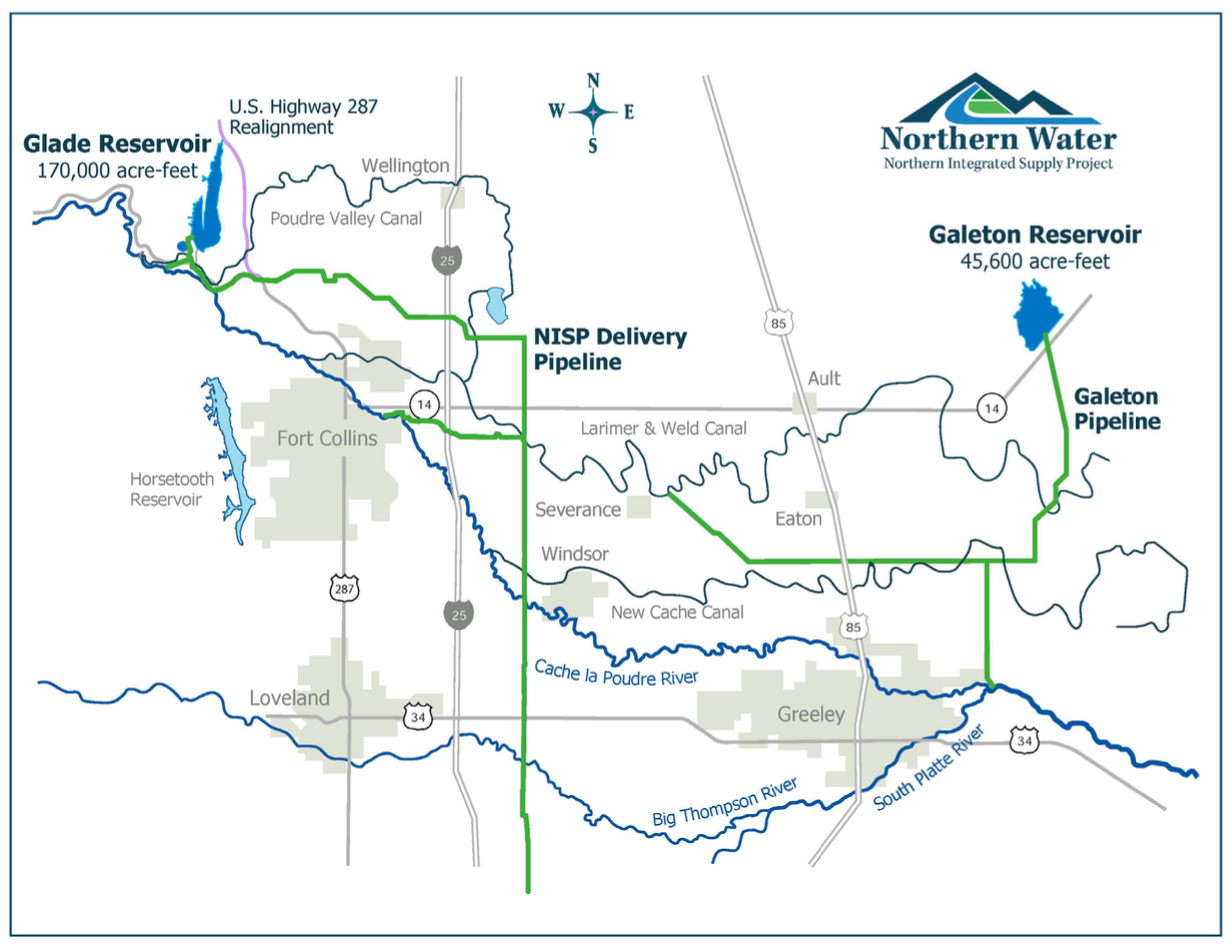
The Northern Integrated Supply Project, currently estimated at $2 billion, would create two new reservoirs and a system of pipelines to capture more drinking water for 15 community water suppliers. An environmental group is now suing the Army Corps of Engineers over a key permit for Northern Water’s proposal. (Save the Poudre lawsuit, from Northern Water project pages)
NISP is designed to serve roughly one dozen fast-growing cities along the Northern Front Range and will include two reservoirs and a pipeline.
The Community Foundation of Northern Colorado is leading the effort to implement the settlement, which includes projects that will make the river healthier for fish and aquatic habitat, improve water flows and water quality, and increase recreational opportunities.
The foundation is overseeing a six-member committee that began meeting last August. The committee will decide how to implement the ambitious environmental projects outlined in the settlement.
“We are taking time to be intentional,” said Jodie Riesenberger, the foundation’s vice president for community impact.
But work has also been slow because key payments from NISP participants to the foundation are tied to benchmarks in building the massive reservoir and pipeline system. The committee received its first $5 million payment last year when the settlement was signed and is supposed to get its next $5 million payment when construction begins, something that could have happened later this year but has since been delayed. The full $100 million is to be paid out over a 20-year period, Riesenberger said.
Since the settlement was approved, though, the project’s largest customer, the Fort Collins-Loveland Water District, has dropped out of NISP. A handful of other cities, including Evans, have also dropped out, citing concerns about soaring design and construction costs, as well as the cost of the environmental settlement.
In response, Northern Water, which is overseeing project construction, temporarily halted design work as it re-examined NISP’s size.
Now, construction isn’t likely to begin until 2027 or later, according to Northern Water spokesman Jeff Stahla.
“We did slow things down,” Stahla said, “but there is still a chance we can start in mid-2027.”
Save The Poudre River President Gary Wockner said the delays aren’t surprising.
The committee has “been moving slow because there is a lot to learn. If you want to fix problems on the river, you have to understand the river and know what the problems are,” he said.
Since the river committee began meeting in August, Riesenberger said work has focused on analyzing what the issues are and trying to figure out how and whether to spend the money they have on hand now.
The delays “don’t impact what we’re doing yet, but it could if it drags on longer. The dream is that these dollars could do transformational things for the river,” Riesenberger said.
After Coloradan U.S. House Reps. Lauren Boebert and Jeff Hurd saw their Finish the Arkansas Valley Conduit Act approved unanimously by Congress in December, they were stunned when President Donald Trump — once a proponent of the project — vetoed it…After the rejection of the legislation sponsored by Boebert, the former 3rd Congressional District representative and co-sponsored by Hurd, the district’s current representative, they sought a rare move for Congressional Republicans in the Trump era: a veto override that could have defied the president. A vote on the veto override was held in the House on Thursday, needing two-thirds of voters to vote “yes” to pass. It ultimately failed with 249 “yes” votes and 176 “no” votes, with one “present” vote, around 8% short of the threshold for passage. All 213 Democrats voted to back the override, while 36 Republicans backed the override but 176 did not. Five Republicans did not vote…
Boebert’s bill, H.R. 131, would have provided communities in the region more time and flexibility to repay the federal government by extending repayment periods and lowering interest rates. In his veto decision, Trump cited financial concerns, but on the House floor, both Boebert and Hurd emphasized that the bill would not expand the project, authorize new construction or increase federal share. Per Boebert, the U.S. Bureau of Reclamation found that Arkansas Valley drinking water has such high levels of radium, uranium and other pollutant contamination that people in the area could see the cost of drinking water triple without this legislation.
“Contrary to what the veto message states, my bill does not authorize any additional federal funding. It simply modifies the repayment terms for small rural communities in my district so they’re able to afford their 35% cost share of the project that they are statutorily obligated to repay,” Boebert said…
Hurd said that rural Colorado and rural America voted “overwhelmingly” for Trump because they didn’t want to be forgotten by the government, adding, “They expected Washington to keep its word, not abandon them midway.” He also expressed concern about the precedent a failed veto override would set, not just for the rest of Trump’s term but moving forward on Capitol Hill. This was a similar, though less alarmingly phrased, point as Neguse earlier stating, “No state is safe from political retaliation.”
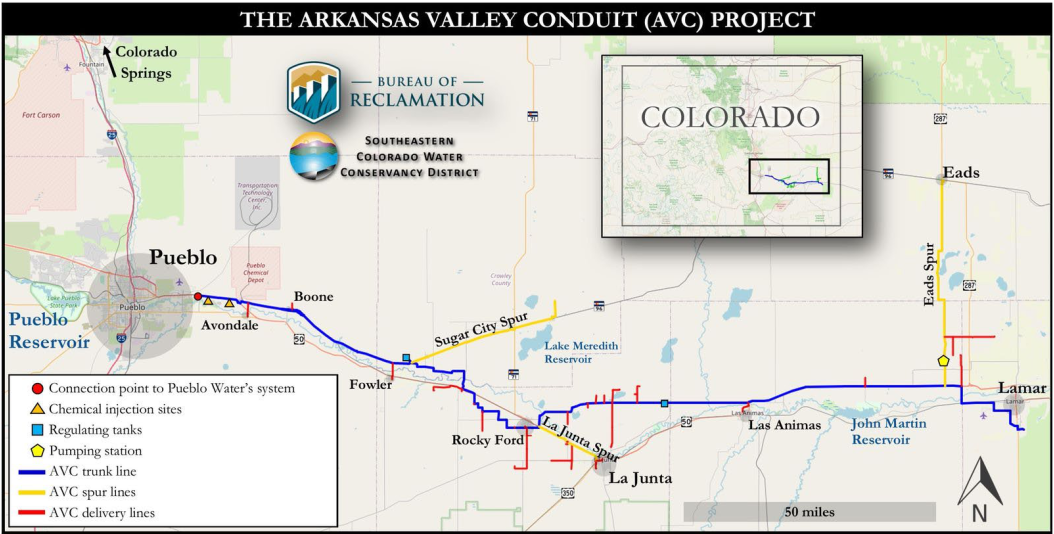
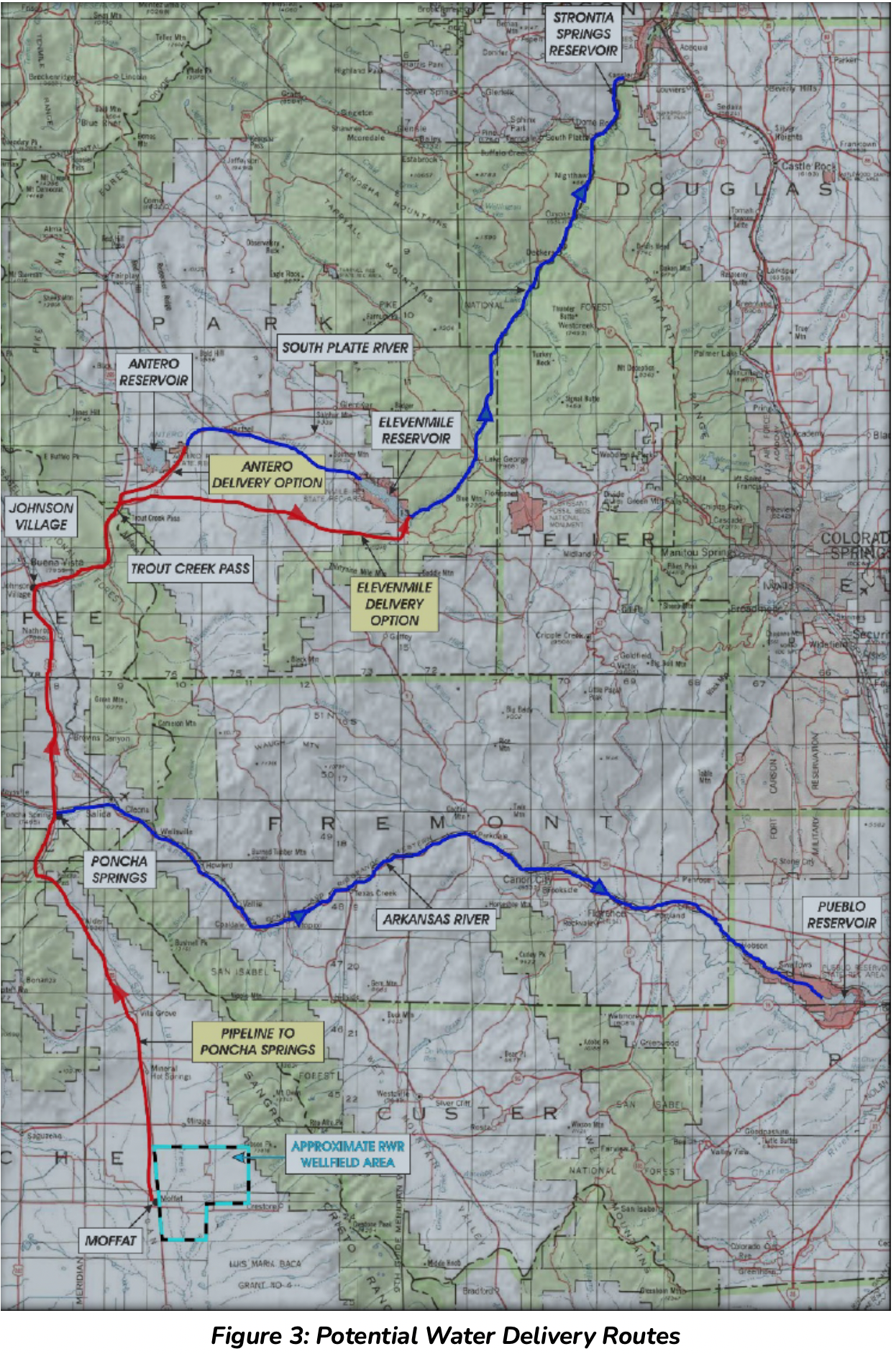
Arkansas Valley Conduit map via the Southeastern Colorado Water Conservancy District (Chris Woodka) June 2021.
Arkansas Valley Conduit map via the Southeastern Colorado Water Conservancy District (Chris Woodka) June 2021.
Click the link to read the article on The Denver Post website (Kevin Freking and Nick Coltrain ). Here’s an excerpt:
January 8, 2026
Rep. Lauren Boebert, who sponsored bill, pushed president in November to release Jeffrey Epstein files
The U.S. House refused Thursday to override President Donald Trump’s vetoes of two low-profile bills — including one that would help pay for a water pipeline in Colorado — as Republicans stuck with the president despite their prior support for the measures. Congress can override a veto with support from two-thirds of the members of the House and the Senate. The threshold is rarely reached. In this case, Republicans opted to avoid a fight in an election year over bills with little national significance, with most GOP members voting to sustain the vetoes. The two vetoes were the first of Trump’s second term. One bill was designed to help local communities finance the construction of a pipeline to provide water to tens of thousands in southeastern Colorado. The other designated a site in Everglades National Park as a part of the Miccosukee Indian Reservation…
On the Colorado bill, 35 Republicans sided with Democrats in voting for an override — with all members of the state’s delegation from both parties supporting an override. On the Florida bill, only 24 Republicans voted for the override. The White House did not issue any veto threats prior to passage of the bills, so Trump’s scathing comments in his recent veto message came as a surprise to sponsors of the legislation. Ultimately, his vetoes had the effect of punishing backers who had opposed the president’s positions on other issues. The water pipeline bill came from Republican Rep. Lauren Boebert of Colorado, a longtime Trump ally who broke with the president in November to release files on convicted sex offender Jeffrey Epstein. The bill to give the Miccosukee Tribe of Indians more control of some of its tribal lands would have benefited one of the groups that sued the administration over an immigration detention center known as “Alligator Alcatraz.”
Arkansas Valley Conduit map via the Southeastern Colorado Water Conservancy District (Chris Woodka) June 2021.
Click the link to read the article on The Denver Post website (Nick Coltrain). Here’s an excerpt:
December 31, 2025
House Resolution 131, sponsored by U.S. Rep. Lauren Boebert and U.S. Sen. Michael Bennet, both of Colorado, sought to jumpstart a project that has languished since 1962. The bill, one of two vetoed by Trump on Tuesday, would extend the repayment period for the project and lower the interest rate. It passed both chambers of Congress by voice vote earlier this year…Trump, who has recently lashed out at Colorado for a slew of grievances, cited the project’s $1.3 billion price tag and said it was supposed to be paid for by local municipalities — not the federal government — in his veto statement…
9News first reported the veto. In a statement to the news station, Boebert said, “If this administration wants to make its legacy blocking projects that deliver water to rural Americans, that’s on them.” She also told the network that she hopes “this veto has nothing to do with political retaliation for calling out corruption and demanding accountability. Americans deserve leadership that puts people over politics.”
Boebert, a Republican representing Colorado’s 4th Congressional District and a longtime ally of the president, recently broke with him by voting to mandate the release of the so-called Epstein files, a trove of documents about the notorious sex criminal with longtime ties to Trump. Trump has also singled out Colorado for retribution over the state’s imprisonment of former Mesa County Clerk Tina Peters.
Chris Woodka, senior policy and issues manager at the Southeastern Colorado Water Conservancy District, which is overseeing the project, said his team is working with Colorado’s congressional delegation on next steps.
Utah’s high court has backed that state engineer’s decision to reject a proposal to pipe water from the Green River to Colorado’s Front Range. The project’s proponent is viewing the ruling as only a temporary setback.
“Look, the court gave us a C-minus on a couple homework issues. We’ll resolve it and get our thesis straightened up and get on down the road,” Aaron Million, founder, CEO and chair of Water Horse Resources, LLC., said Friday in an interview…
In 2018, Water Horse filed a water export application with the Utah state engineer. Million wants to divert 55,000 acre-feet a year of water from two points on the Green River south of Flaming Gorge Reservoir in Daggett County in northeastern Utah…In 2020, Utah State Engineer Teresa Wilhelmsen rejected Million’s latest proposal, in part citing uncertainty over whether it would count against Colorado’s allocation of Colorado River water or Utah’s under a 1948 compact between Upper Colorado River states. Million says it would count against Colorado’s because that’s where the water would be used. A lower court had upheld Wilhelmsen’s findings. The state’s Supreme Court ruled in part that before the state engineer can grant Water Horse an export appropriation, the company must show the appropriation will be beneficially used in Colorado. Million indicated in comments to the Sentinel on Friday that meeting the beneficial use requirement won’t be a problem. He said the court in its ruling was helpful in showing that the state’s water export statute has a low bar for exports to be allowed. In upholding the Utah state engineer’s determination, both the lower court and Utah Supreme Court noted that Water Horse hasn’t filed any application in Colorado for approval of its water appropriation or project and hasn’t asked the state of Colorado or Upper Colorado River Commission to have the appropriation counted against Colorado’s Upper Colorado River Compact allocation…Water Horse had argued that the Upper Colorado River Compact required the Utah state engineer to approve its application even as the state export statute required it to be rejected, and that the compact pre-empts the state law. But the state Supreme Court disagreed that they were in conflict. Million voiced confidence that Water Horse will be starting construction on the project “in the near term” and the ruling won’t affect that.
A detail of a map produced by Water Horse Resources, and published by the state of Utah, showing two pipelines from the Green River, one above Flaming Gorge Reservoir and one below, plus a connecting pipeline between the two. The map is on a Utah state website with a note saying it was “left at hearing” on Nov. 11, 2018.
The Utah Supreme Court ruled on a controversial pipeline project in Eastern Utah last Friday. In January 2018, Water Horse Resources, LLC proposed a pipeline project that would send 55,000 acre-feet of water every year from the Green River to the state of Colorado. However, on Nov. 7, 2020, the Utah State Engineer rejected the application…The proposal sought to pipe water to be used for “beneficial use in Colorado.” However, a district court found Water Horse failed to establish evidence that the water can be put to beneficial use in Colorado. The pipeline would extend through Wyoming before dropping into an undecided location in Colorado.
Proposed pipeline by Water Horse would bring water from Utah to Colorado. (Courtesy//Utah Supreme Court)
Colorado officials declined to sign onto the project citing the lack of clear authority to administer the diversion of water into the state. Water Horse appealed the district court’s decision, leading to a years-long legal battle. On Friday, Oct. 17, 2025, the Utah Supreme Court reaffirmed the initial decision of the state engineer to reject the project…The Supreme Court ruling is not the end for the project. According to the court’s opinion, a renewed application could be submitted and potentially approved by the state engineer.
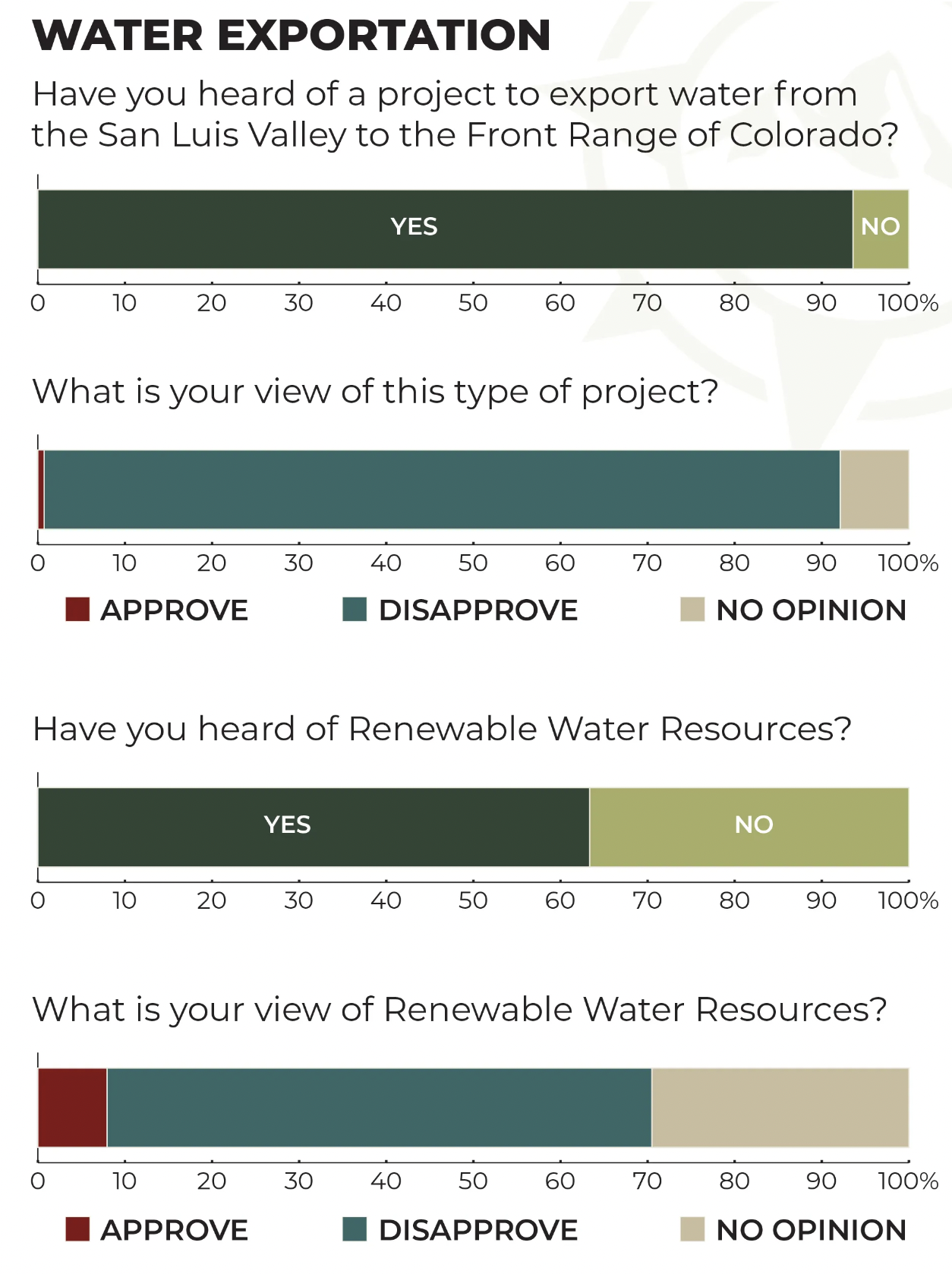
The next time a water exportation project is pitched to move water from the San Luis Valley – and there will be a next time – the speculator will learn the value of that water to the six-county region measures into the billions of dollars.
A new report by American Rivers and senior economist Claire Sheridan of One Water Econ captures for the first time the economic value of the water that runs through the San Luis Valley. It was a study prompted in 2022 by the threat of water exportation from the Upper Rio Grande Basin by Renewable Water Resources.
As part of its proposal to export and sell 20,000 acre-feet of water every year from the Valley, RWR offered to establish a $50 million community fund that it argued would fairly compensate the Valley for its water. The study, “The Economic Value of Water Resources in Colorado’s San Luis Valley,” pegs fair compensation of the RWR proposal at around $1.3 billion per year. (More on that figure below)
“It’s a really complex question to answer. What is the value of water in the San Luis Valley?” said Heather Dutton, manager of the San Luis Valley Water Conservancy District. “The value of water in the San Luis Valley is so much greater than a one-time payment of $50 million.”
Dutton, Sheridan from One Water Econ, and American Rivers’ Emily Wolf presented the findings of the report at the annual Rio Grande State of the Basin Symposium held March 29 at Adams State.
The study goes beyond putting a dollar value to water for the Valley’s agricultural purposes. It also examines the value of water as it relates to the Valley’s outdoor recreation industry and wildlife and natural habitat surroundings.
Boat ramp on the Rio Grande. Credit: The City of Alamosa
And it looks at “water-dependent” industries that are key to the Valley’s economy and their reliance on water for their customers and sanitation services. Those “water-dependent” industries like San Luis Valley Regional Medical Center and Adams State University account for approximately 21 percent of total direct economic output and 23 percent of employment in the Valley, according to the study.
“Capturing the value of water as it is used in homes, businesses, and for environmental purposes can add important information to conversations about the future of the Valley and its water resources,” noted the study’s authors.
The study puts into perspective how valuable water in the Upper Rio Grande Basin is when you apply it to the Valley’s economy and livelihood. According to the report, the San Luis Valley economy generates $4.5 billion in total annual economic output, largely driven by hospitals, electric power companies, insurance, crop farming and cattle ranching. Alamosa and Rio Grande Counties account for 60 percent of the population and 67 percent of total economic output in the region.
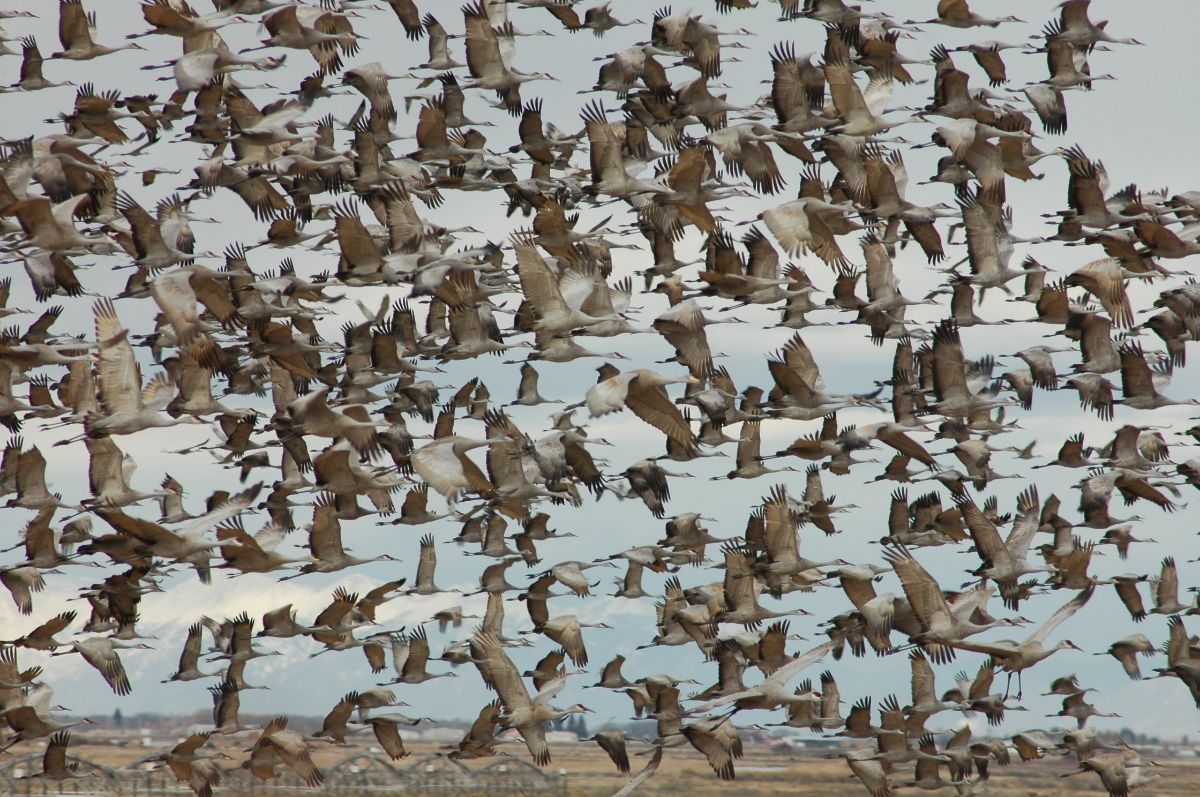
Sandhill Cranes
Other insights from the report:
Agriculture in the San Luis Valley, including cattle ranching, generates 10 percent of all output in the region (although this varies significantly by county) and makes up 39 percent of Colorado’s total agricultural output.
Agriculture is the single largest private employer in the SLV, and irrigated agriculture employs 8 percent of the total workforce (an estimated 2,322 jobs per year). Approximately 64 percent of these jobs are in the category of all other crop farming (which represents alfalfa and grass hay) and 34 percent are in vegetable farming (mostly potatoes).
The agriculture, forestry, fishing, and hunting sector generate over 4,000 jobs each year. This sector also leads in economic output, generating $566 million annually.
The value of clean drinking water in the San Luis Valley is estimated to be over $3,600,000 per day.
The analysis also found that water-related habitat in the Valley is valued at more than $49 million annually and the annual Crane Festival generates $4 million in direct revenue from visitor spending.
“It’s just apparent that just as water flows through this community, so do the dollars that are generated from that water,” said economist Claire Sheridan.
Sheridan did the math for the audience at the Rio Grande Symposium in explaining how far under value RWR’s $50 million community fund pitch was when considering the value of water to residents of the Valley.
She used a model FEMA goes by in its emergency management work that factors in two components in creating a value for water to a community: One component is a willingness to pay for clean and safe drinking water. “If you go to your tap and turn on your water, what are you willing to pay to make sure that you can drink that water? What is that worth to you?” The other component is “avoided replacement cost” that factors in costs if a resident has to go buy water.
For the San Luis Valley and its estimated population of 46,600, those two components combined come out to about $77.23 per person, per day, said Sheridan. When you apply $77.23 to the Valley’s population, the value for clean drinking water in the San Luis Valley is about $3.6 million per day or $1.3 billion annually.
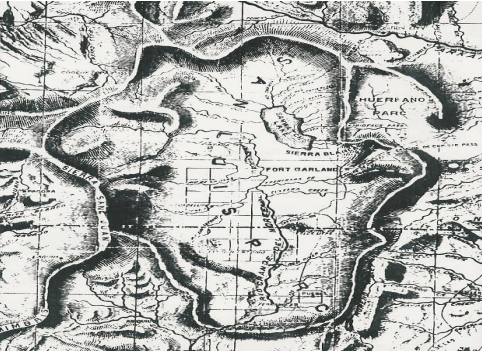
1869 Map of San Luis Parc of Colorado and Northern New Mexico. “Sawatch Lake” at the east of the San Luis Valley is in the closed basin. The Blanca Wetlands are at the south end of the lake.
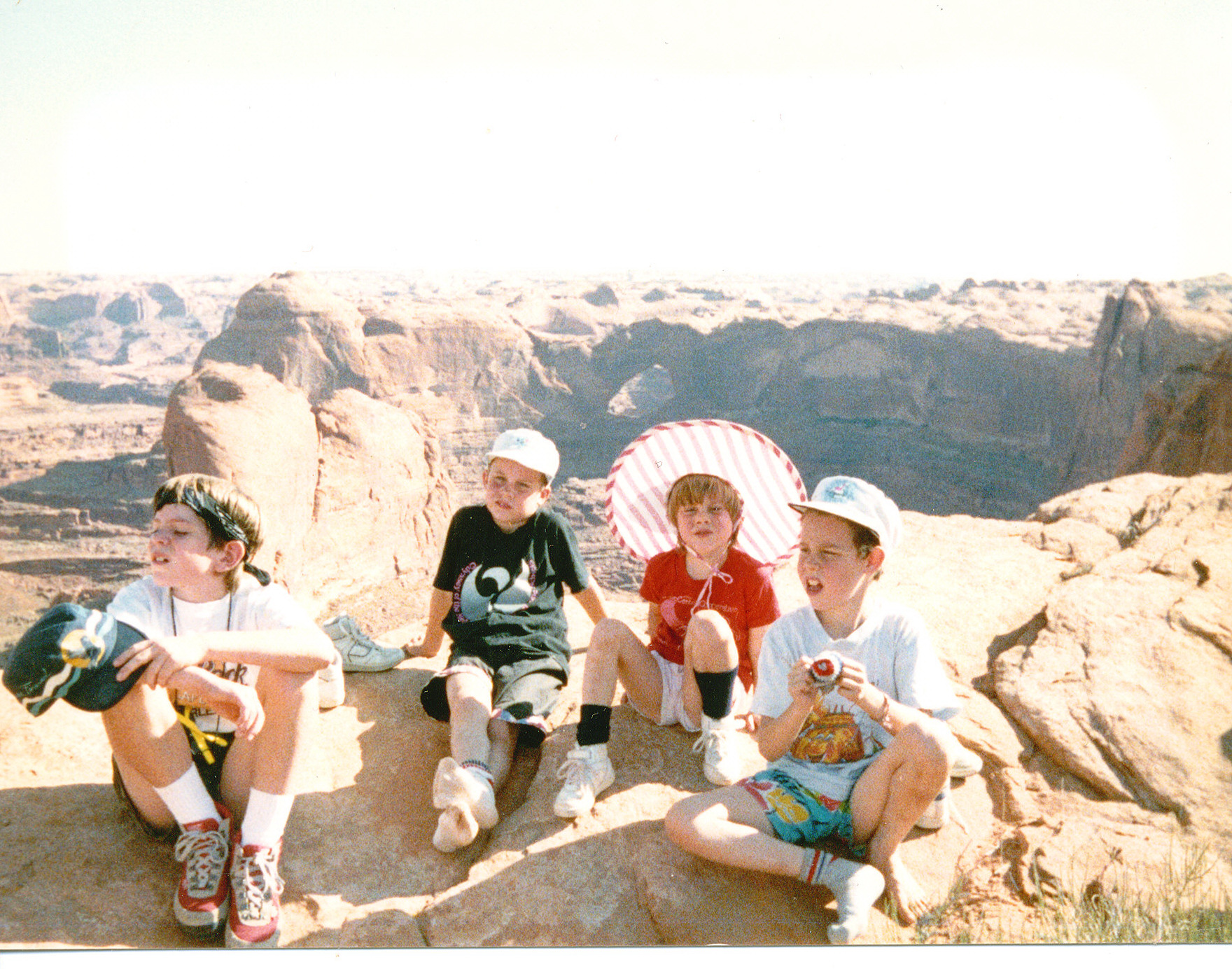
My friend Joe’s son and the Orr kids at the top of the Crack in the Wall trail to Coyote Gulch with Stevens Arch in the Background. Photo credit: Joe Ruffert
Kevin Fedarko was the keynote speaker at the symposium and he is as inspirational a speaker as you could ask for. It doesn’t hurt that the landscape that he spoke about is the Grand Canyon. He urged the attendees to, “Take your children out into these landscapes so that they can learn to love them.” He is advocating for the protection of the Grand Canyon in particular but really he is advocating for the protection all public lands.
Kevin Fedarko and Coyote Gulch at the Rio Grande State of the Basin Symposium hosted by the Salazar Rio Grande del Norte Center at Adams State University in Alamosa March 29, 2024.
What an inspirational talk from Kevin. I know what he is saying when he speaks about the time after dinner on the trail where the sunset lights up the canyon in different hues and where, he and Pete McBride, his partner on the Grand Canyon through hike, could hear the Colorado River hundreds of feet below them, continuing its work cutting and molding the rocks, because the silence in that landscape is so complete. He and I share the allure of the Colorado Plateau. Kevin was introduced to it through Collin Flectcher’s book The Man Who Walked Through Time, after he received a dog-eared copy from his father. They lived in Pittsburgh in a landscape that was industrialized but the book enabled Kevin to imagine places that were unspoiled.
My introduction to the Colorado Plateau came from an article in Outside magazine that included a panoramic photo of the Escalante River taken from the ledges above the river. Readers in the know can put 2 and 2 together from the name of this blog — Coyote Gulch — my homage to the canyons tributary to Glen Canyon and Lake Foul.
Stevens Arch viewed from Coyote Gulch. Photo via Joe Ruffert
Kevin’s keynote came at the end of the day on March 29th after a jam-packed schedule.
Early in the day Ken Salazar spoke about the future of the San Luis Valley saying, “Where is the sustainability of the valley going to come from.” Without agriculture this place would wither and die.” He is right, American Rivers and other organizations introduced a paper, The Economic Value of Water Resources in the San Luis Valley which was a response to yet another plan to export water out of the valley to the Front Range. (Currently on hold as Renewable Water Resources does not have a willing buyer. Thank you Colorado water law.)
Claire Sheridan informed attendees that their report sought to quantify all the economic benefits from each drop of water in the valley. “When you buy a bottle of water you know exactly what it costs. But what is the value of having the Sandhill cranes come here every year?”
Sandhill Cranes Dancing. Photo by: Arrow Myers courtesy Monte Vista Crane Festival
Russ Schumacher detailed the current state of the climate (snowpack at 63%) and folks from the Division of Water Resources expounded on the current state of aquifer recovery and obligations under the Rio Grande Compact.
The session about the Colorado Airborne Snow Measurement Program was fascinating. Nathan Coombs talked about the combination of SNOTEL, manual snow courses, Lidar, radar, and machine learning used to articulate a more complete picture of snowpack. “You can’t have enough tools in your toolbox,” he said.
Coombs detailed the difficulty of meeting the obligations under the Rio Grande Compact with insufficient knowledge of snowpack and therefore runoff volumes. Inaccurate information can lead to operational decisions that overestimate those volumes and then require severe curtailments in July and August just when farmers are finishing their crops. “When you make an error the correction is what kills you,” he said.
If you are going to learn about agriculture in the valley it is informative to understand the advances in soil health knowledge and the current state of adoption. That was the theme of the session “Building Healthy Soils”. John Rizza’s enthusiasm for the subject was obvious and had me thinking about what I can do for my city landscape.
Amber Pacheco described how the Rio Grande Basin Roundtable and other organizations reach out to as many folks in the valley as possible. Inclusivity is the engine driving collaboration.
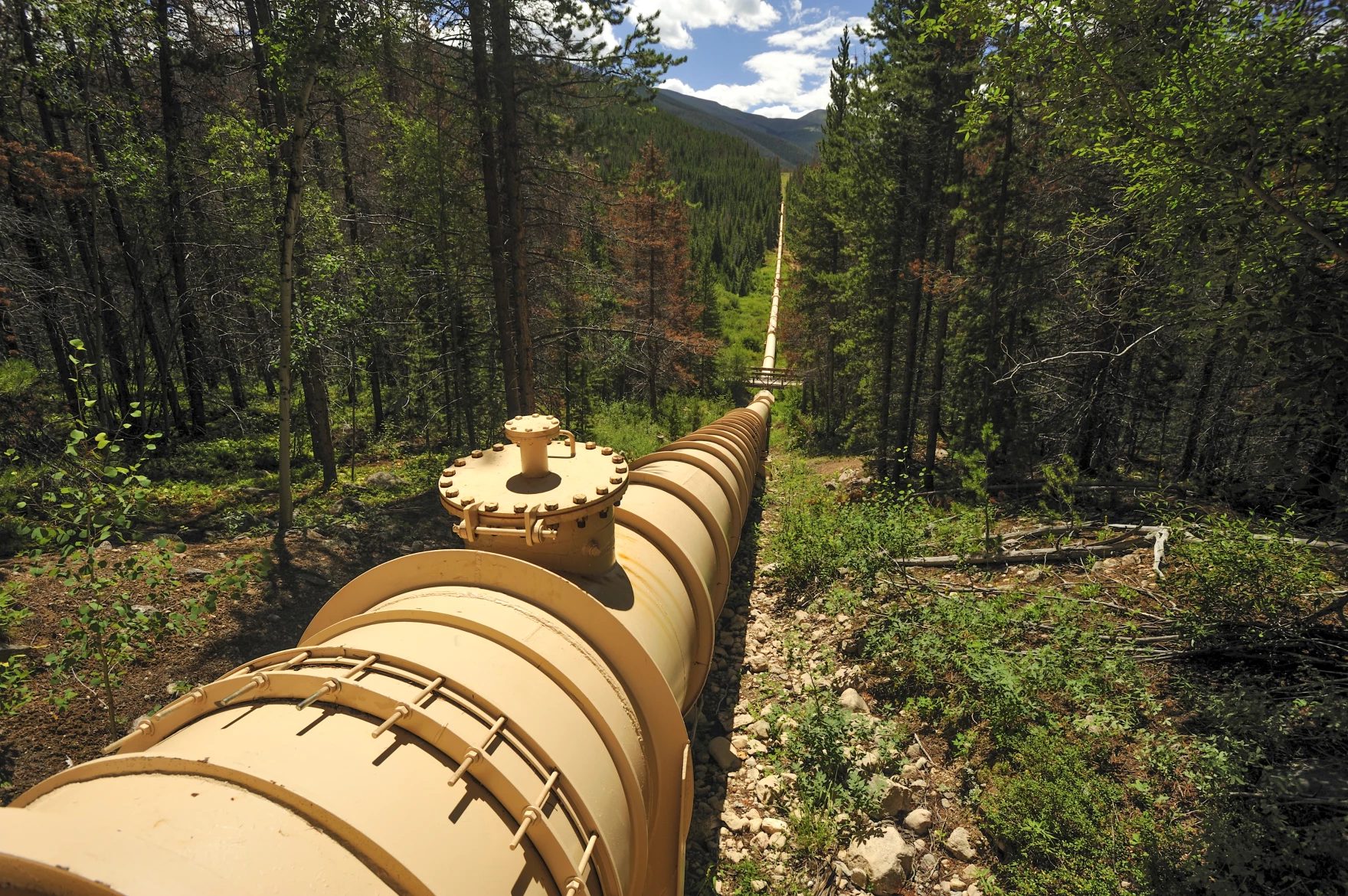
A complex system of pipes, tunnels and canals carries water around the Western U.S., like this one in Colorado’s Fraser Valley. However, policy experts say a cross-country pipeline wouldn’t make sense for political, financial and engineering reasons. Ted Wood/The Water Desk
Click the link to read the article on the KUNC website (Alex Hager):
September 30, 2024
This story is part of a series on water myths and misconceptions in the West, produced by KUNC, The Colorado Sun, Aspen Journalism, Fresh Water News and The Water Desk at the University of Colorado Boulder. KUNC’s coverage of the Colorado River is supported by the Walton Family Foundation.
The Colorado River is a lifeline for about 40 million people across the Southwest. It supplies major cities like Los Angeles, Phoenix, and Denver and a multibillion-dollar agriculture industry that puts food on tables across the nation. But it doesn’t have enough water to meet current demands.
Policymakers are struggling to rein in demand on the river, which has been shrinking at the hands of climate change. The region needs to fix that gap between supply and demand, and there’s no obvious way to do it quickly.
But one tantalizingly simple solution keeps coming up. The West doesn’t have enough water, but the East has it in abundance. So, why don’t we just fix the Colorado River crisis by piping in water from the East?
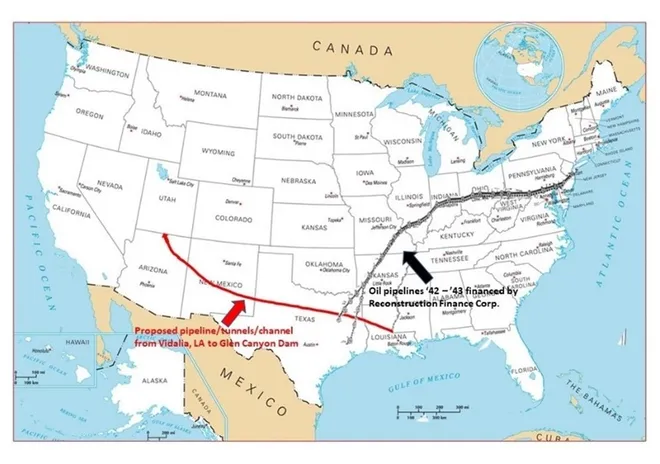
This proposed pipeline divert water from the Atchafalaya River in Louisiana through Louisiana, Texas, New Mexico, Arizona and up to the Glen Canyon Dam. Credit: Don Siefkes
The answer is complicated, but experts say it boils down to this: It doesn’t make sense to build a giant East-to-West water pipeline anytime soon for three reasons — politics, engineering, and money.
Political headwinds
If the West’s leaders wanted to take some water from the East, who would they even ask? Right now, there’s no national water agency that could oversee that kind of deal.
“I would argue that there aren’t many entities with the authority across the country to do this,” said Beaux Jones, president and CEO of The Water Institute in New Orleans. “I don’t know that the regulatory framework currently exists.”
Water is often managed using a messy patchwork of different government agencies and laws. The Colorado River is managed through a fragile web of agreements between cities, states, farm districts, native tribes and the federal government. Even though they’re all pulling from the same water supply, there’s no central Colorado River government agency.
A similarly complex system applies to many watersheds in the East. Even if a single city or state in the Western U.S. seriously wanted to build a pipeline from the East, it’s not even clear who they’d meet with to ask for water from a different area. And there’s no single federal agency that could sign off on such a deal and make sure it doesn’t harm people or the environment.
Colorado Water Conservation Board Executive Director and commissioner to the Upper Colorado River Commission Becky Mitchell, center, speaks on a panel with representatives of each of the seven basin states at the annual Colorado River Water Users Association conference in Las Vegas Thursday, December 15, 2022. The UCRC released additional details of a water conservation program this week.
CREDIT: HEATHER SACKETT/ASPEN JOURNALISM
Any serious effort to pull new water in from the East to the Southwest would likely touch some part of the Mississippi River basin. It’s a sprawling network of smaller rivers that covers 31 different states, from Montana to Pennsylvania.
It’s a busy river with a lot of uses. And while its shortages aren’t as severe as dry times in the West, the Mississippi River basin goes through its own droughts. So even if, someday, the governments of the East and West set up a formal way to negotiate a water transfer, the cities, farms, boaters and wildlife advocates to the east might not be willing to share.
“The very nature of there being sufficient availability of water in the Mississippi River Basin to, in a large scale way, export that water,” Jones said. “I think there are many people on the ground within the Mississippi River basin that would fundamentally disagree with that.”
Engineering limits
There are countless examples of large pipelines and canals moving liquids around the U.S. at this very moment. The longest existing today is the Colonial Pipeline, which carries gasoline from Houston to northern New Jersey through 5,500 miles of pipe.
So if we have the engineering capacity to do that, could we build similar infrastructure for water? In theory, yes. But it would have to be much larger than existing pipes for oil and gas.
“It takes so much more water to supply a city than it takes gasoline,” said John Fleck, a water policy professor at the University of New Mexico. “So the size of the pipe or the canal has to be a lot bigger, has to be much wider, has to cover a lot more ground.”
Because that pipeline or canal would be so big, it is more likely to ruffle some feathers along the way. Fleck suggested that landowners in its path, including local governments, could push back on a giant new piece of infrastructure running through their properties and mire any pipeline project in regulatory red tape.
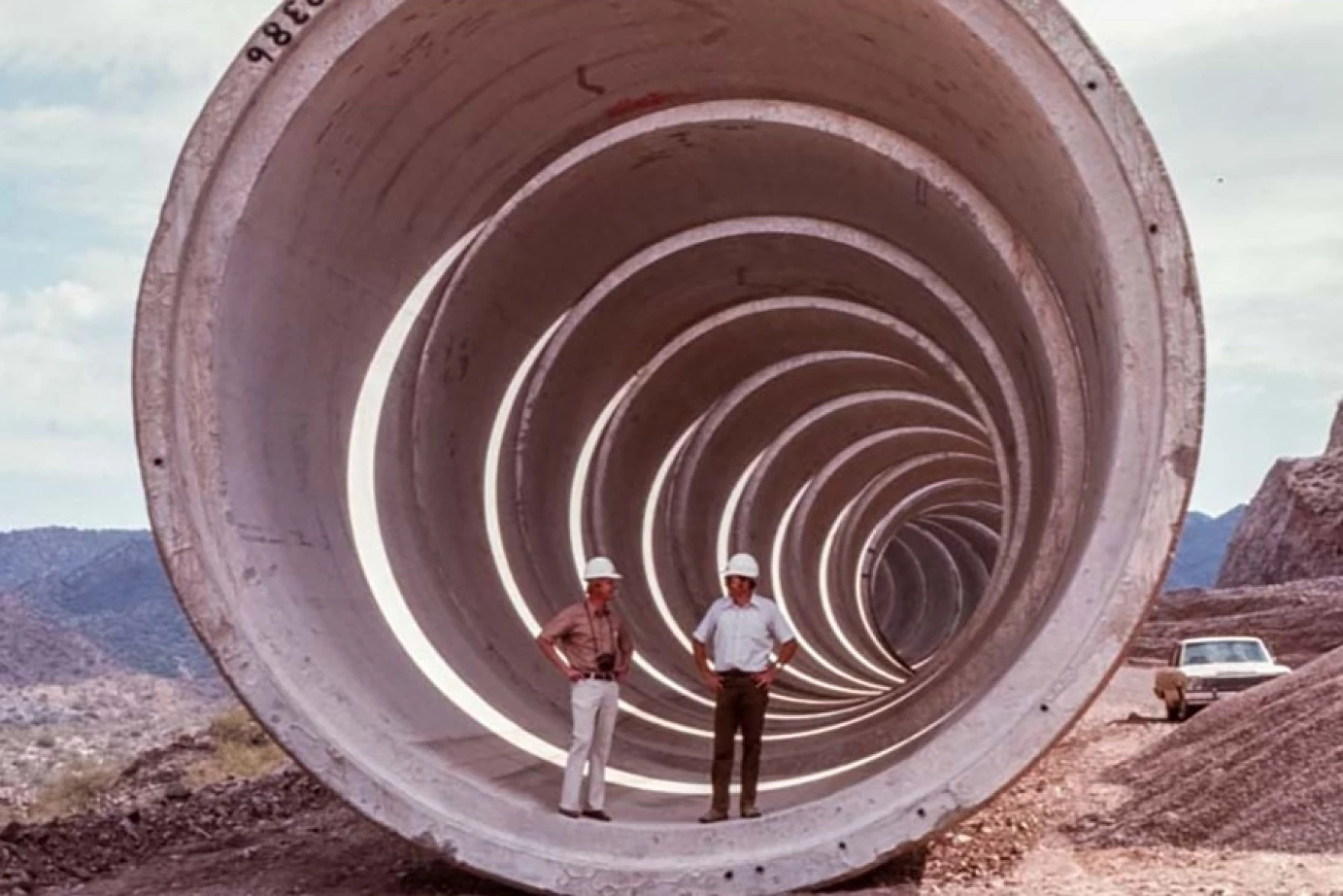
Phoenix, Los Angeles, Denver and Salt Lake City wouldn’t look like they do today without giant water-moving systems, like this pipe that is part of the Central Arizona Project. Experts say all of the feasible water pipelines have already been built, and a system to carry water in from the East is too difficult to be worth building. Photo credit: Central Arizona Project
All that said, a pipeline is still physically possible. There is perhaps no better argument for an East-West water transfer than the fact that the Western U.S. is already crisscrossed by multiple huge pipes and canals that carry water across long distances.
The West as we know it today wouldn’t exist without that kind of infrastructure. Much of Colorado’s population only has water due to a series of underground tunnels that bring water across the Rocky Mountains. Phoenix and Tucson have been able to welcome new residents in the middle of the desert with the help of a 336-mile canal that carries water from the Colorado River. Los Angeles, Albuquerque and Salt Lake City would not be the cities they are today without similarly ambitious water delivery systems built decades ago.
The existence of those water-moving projects isn’t proof that we should build a new, even bigger water pipeline from the East, Fleck said. In fact, he pointed to those systems as proof that we shouldn’t.
“All the feasible ones have largely been done, and the ones that are left are the ones that weren’t done because they just turned out not to be feasible,” he said.
Money problems
Even in a world where the West’s leaders could find a willing water seller, get the right permits and put shovels in dirt, experts say an East-to-West water pipeline would simply be too expensive.
Any solution to the Colorado River crisis will require massive amounts of public spending. The federal government alone has thrown billions of dollars at the problem in just the past few years. But water economists and other policy experts say a cross-country pipeline isn’t the most efficient use of taxpayer dollars.
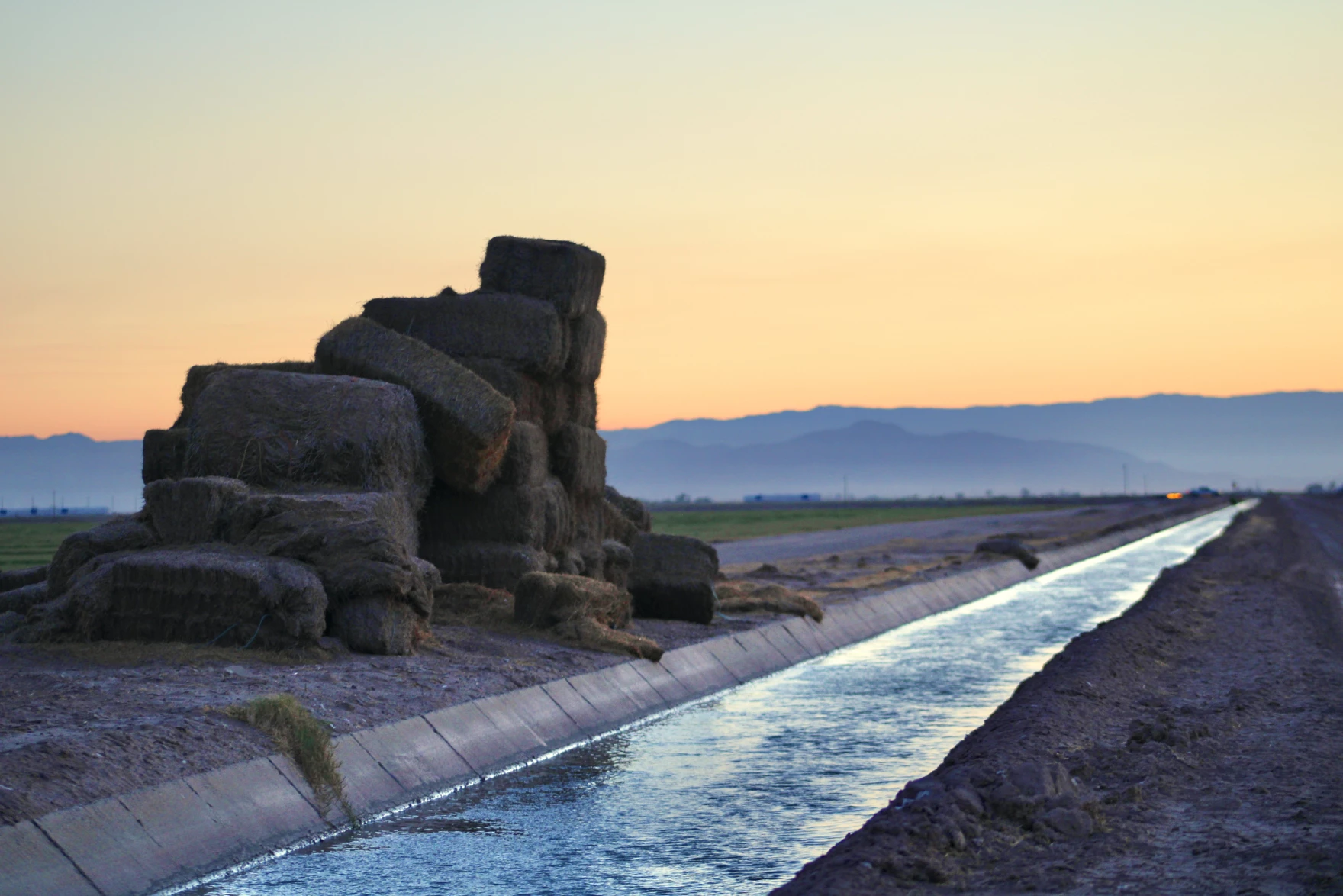
Stacks of hay bales sit beside an irrigation canal in California’s Imperial Valley on June 20, 2023. Experts say there are more cost-effective ways to fix the Colorado River crisis than building a cross-country canal, like paying farmers to pause growing thirsty crops such as alfalfa. Alex Hager/KUNC
Kathleen Ferris, former director of the Arizona Department of Water resources, pointed to two ongoing efforts that might be a more cost-effective way to help correct the region’s supply-demand imbalance. One involves paying farmers to pause growing on their fields, freeing up water to bolster the region’s beleaguered reservoirs. Another uses expensive, high-tech filtration systems to turn wastewater directly back into drinking water.
“Sometimes I feel like people don’t want to do the heavy lifting,” said Ferris, who is now a water policy researcher at Arizona State University. “Instead, they want to just find the next water supply and be done with it and have somebody else pay for it.”
Ultimately, she said, those kinds of programs already have momentum and cost less money than an East-to-West water pipeline.
“Why don’t we do the things that we know are possible and that are within our jurisdiction first,” Ferris said, “Before we go looking for some kind of a grand proposal that we don’t have any reason to believe at the moment could succeed.”
Pipe dreams becoming reality
Piping in water from outside of the Colorado River basin, for all of its challenges, is a tempting enough idea that the federal government has given it a serious look.
In 2012, a Bureau of Reclamation report analyzed ways to bring new water into the Colorado River Basin, including importing piped water from adjacent states.
The study concluded that strategy was not worth the money and effort.
“It just isn’t the time yet,” said Terry Fulp, a retired Reclamation official who helped write the study. “We felt that there were other things we could be doing in the basin, particularly in the Lower Basin, that would relieve the pressure.”
This map from the Bureau of Reclamation’s 2012 “Colorado River Basin Water Supply and Demand Study” shows places where water could theoretically be imported. One of the report’s authors said now “isn’t the time” to pipe water in from the East. Credit: U.S. Bureau of Reclamation
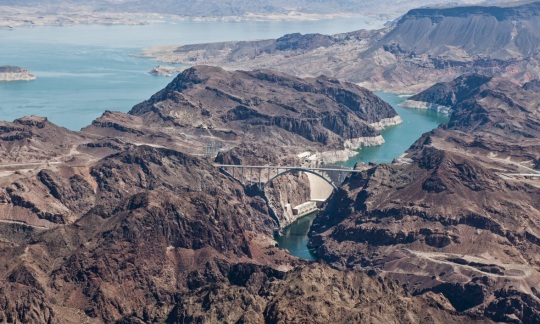
Fulp said the study was a worthwhile endeavor, and that the idea of importing water from the East might make sense down the road. The scale of the challenge posed by the Colorado River crisis, he said, will take some big thinking, “on the order of the thinking when we built the Hoover Dam.”
“It’s one of those possible solutions that should always stay, if not forefront on the table, somewhere on the table, so that you don’t lose sight of it,” Fulp said.
Despite the fact that many Colorado River experts have cast doubt on the feasibility of a cross-country water pipeline, even some sitting state officials say it deserves more research. Chuck Podolak, director of the Water Infrastructure Finance Authority of Arizona said the idea deserves “serious attention.”
“We understand that every option is hard, every option is expensive, every option has political hurdles, every option is a daunting engineering task,” he said. “Right now, we’re in a let’s-look-at-everything mode with eyes wide open.”
Arizona and other states around the region, with their eyes on continued growth, are already looking at ways to stretch out the water they already have using technology. Terry Fulp said those efforts may need to expend past the spendy and ambitious engineering projects that are already helping facilitate that growth.
“It’ll be the time someday, if we want the Southwest to continue to grow the way it’s been growing,” he said. “There’s only so much water in the basin.”
Click the link to read the article on the Colorado Newsline website (Lia Chien):
May 31, 2024
The U.S. Department of the Interior and Bureau of Reclamation will send $242 million to five projects in Western states to improve water storage and clean drinking water supply, the bureau said Thursday.
The money, part of the president’s domestic infrastructure and manufacturing agenda and funded through the 2021 bipartisan infrastructure law, is expected to develop 1.6 million acre-feet of water storage, supporting 6.4 million people per year. Projects in Colorado, Arizona, Washington state and California will receive funding.
The Arkansas Valley Conduit, a major pipeline project in Colorado that has stalled for decades, is set to receive $90 million. Once completed, it will bring clean water to 50,000 people in 39 communities across the southeastern portion of the state, according to a release from the Bureau of Reclamation.
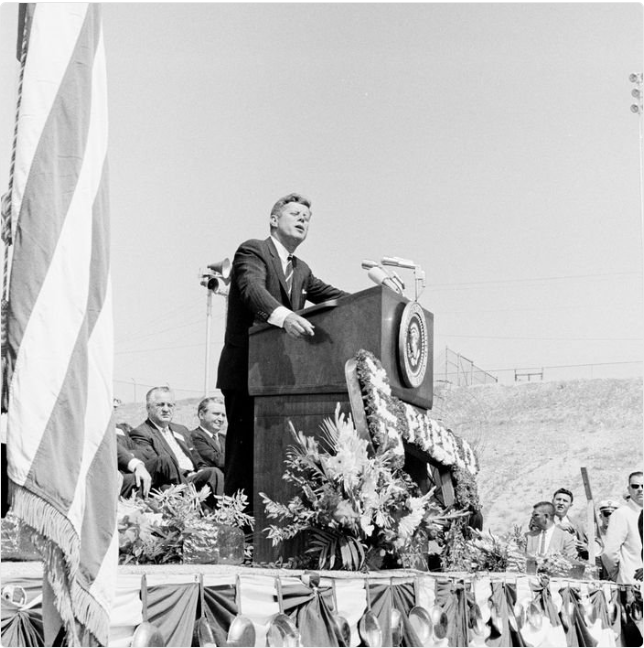
John F. Kennedy at Commemoration of Fryingpan Arkansas Project in Pueblo, circa 1962.
Finishing the project has been a long time coming. President John F. Kennedy signed a law in 1962 to authorize construction of the pipeline, but work on the project has stalled over the past six decades due to lack of funding.
This year’s spending comes after almost $250 million in previous appropriations from the infrastructure law and other laws. The project overall is estimated to cost over $600 million, according to Colorado Public Radio.
Sen. John Hickenlooper, a Democrat from Colorado, said he is excited to see the project move along.
Arkansas Valley Conduit map via the Southeastern Colorado Water Conservancy District (Chris Woodka) June 2021.
“We broke ground on the Arkansas Valley Conduit to finally deliver clean drinking water to Southeast Colorado. Now, more Bipartisan Infrastructure Law investments like this one will speed up the timeline,” Hickenlooper said in a written statement Friday.
Washington state Cle Elum Pool Raise Project will receive $1 million to increase water capacity an additional 14,600 acre-feet. Cle Elum Lake is on the Cle Elum River, a tributary of the Yakima River that provides essential, high quality drinking water to the city of Cle Elum.
A feasibility study to address water storage solutions in Arizona’s Horseshoe and Bartlett reservoirs is also receiving $8.5 million. The reservoirs provide drinking water to the greater Phoenix area. Over many years, sediment build-up in the Horseshoe Reservoir has reduced water storage capacity.
Climate change affects water supply
Investments in conservation projects like these will also help provide water storage and safe drinking water as Western states feel the effects of climate change, like drought, more frequently, according to the Center for Climate and Energy Solutions, a research and advocacy group.
Rep. Raúl Grijalva, a Democrat from Arizona and the ranking member of the House Natural Resources Committee, said water infrastructure projects like these are critical as the West faces climate change.
Grijalva credited the bipartisan infrastructure law and Democrats’ 2022 energy, taxes and health policy law known as the Inflation Reduction Act with helping to boost federal spending on Western water projects.
“The more than $15 billion for western water projects and programs that Democrats passed in the Inflation Reduction Act and the Infrastructure Law is a gamechanger in our fight to secure clean drinking water, build our resilience to climate change, and restore critical rivers and watersheds,” said Grijalva in a statement.
Grijalva added that more investments are needed, especially to protect the most vulnerable populations from the effects of water shortages.
“While these investments will deliver much-needed relief to communities in Arizona and all over the West, much more must be done, especially for those underserved and Indigenous communities that are being disproportionately impacted by the climate crisis and are too often left behind,” he said.
Southwestern states, including Arizona, are expected to face more intense droughts as climate change intensifies, according to the Center for Climate and Energy Solutions. In the summer of 2021, drought conditions across the West were at their highest levels since 2000, according to the Bureau of Reclamation. Drought conditions worsened in 2022.
Washington state officials declared a drought emergency this April as they expect high temperatures and water shortages this summer.
A gas exploration company with Florida ties is pursuing plans to pull groundwater out of existing coalbed methane wells in southern Wyoming, then pipe it into the lower reaches of the water-stressed Colorado River Basin.
The project was formally initiated in December, when the State Engineer’s Office received 21 groundwater test well applications from Mark Dolar of Dolar Energy, LLC. The test wells are all located on Bureau of Land Management property south of Rawlins in the Atlantic Rim gas field.
Two test well applications have since been rescinded by Dolar to comply with the state of Wyoming’s sage grouse and big game migration policies, according to an email from State Engineer Brandon Gebhart.
A project review letter from the Wyoming Game and Fish Department summarizes what the project proponent seeks to do with the water.
“If the water is of sufficient quality, the applicant hopes to transport groundwater to Colorado via a pipeline,” states a letter signed by Habitat Protection Supervisor Will Schultz.
But Sen. Larry Hicks (R-Baggs), who’s on staff with the Little Snake River Conservation District, has met with Dolar and believes that’s one of several uses of the water being considered if the plans move forward. Exchanges within Wyoming, he said, could also be an outcome.
“The simple fact is the market’s much more lucrative now than it was 20 years ago,” Hicks told WyoFile. “He doesn’t have to send it to Colorado.”
Sen. Larry Hicks (R-Baggs) during the Wyoming Legislature’s 2024 budget session. (Mike Koshmrl/WyoFile)
Hicks used that rough historic benchmark because there have been repeated efforts since Atlantic Rim field drilling started in the mid-2000s to make use of the water surfaced during gas production. Currently, he said, the produced water is injected back into the ground — which takes energy and money — and it doesn’t make sense given the currently dismal economics of natural gas.
“The water is probably, at this point in time, as valuable or more valuable than the natural gas,” Hicks said. “It’s just a matter of figuring out how you utilize that water, and whether there’s a sufficient enough quantity to justify a lot of expenditures.”
Energy companies in the past ultimately determined that using Atlantic Rim formation water didn’t pencil out, even though it’s considered pretty high quality. And they’ve tried, even building out infrastructure.
A historic endeavor
Steve Degenfelder, then a land manager for Atlantic Rim driller Double Eagle Petroleum, recalled that his former employer secured permits to surface discharge a limited volume of untreated water via a pipeline and separately desalinate other volumes. Neither worked out long-term.
“We did discharge some into Muddy Creek, but very little,” Degenfelder said. “We just got a lot of resistance from the environmental community and BLM.
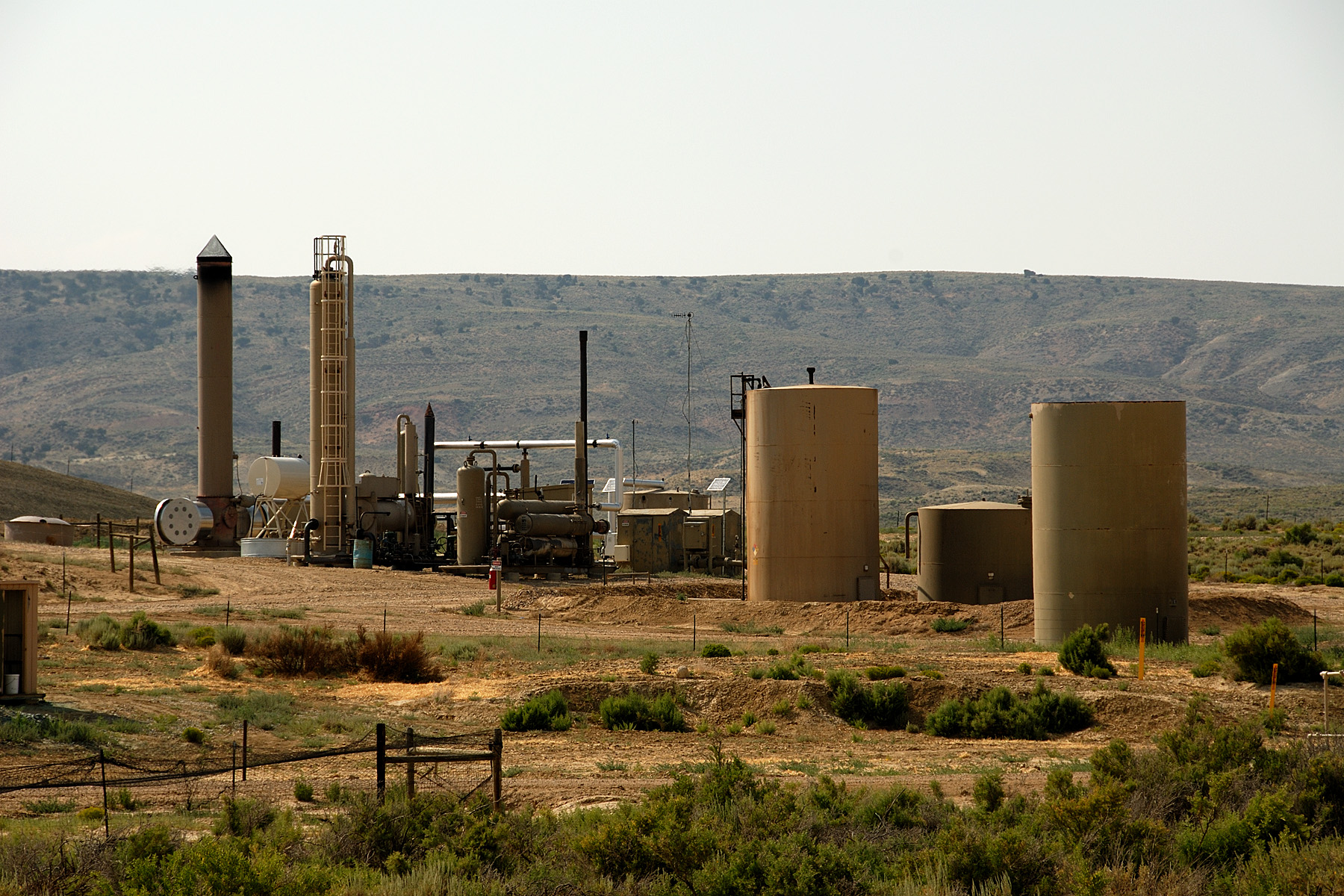
Gas drilling infrastructure in the Atlantic Rim field in 2015. (Ken Driese)
Groundwater in the Atlantic Rim area is both abundant and filled by snowmelt coming off the west slope of the Sierra Madre Range, Degenfelder said. During the heyday of the Atlantic Rim field’s development, the two largest drilling companies were producing roughly 100,000 barrels of byproduct water daily — the equivalent of a small stream that flows continuously carrying nearly 7 cubic feet per second. Oftentimes water encountered during the drilling process has a lot of organic matter like oil, but in this region, it’s pretty pristine, he said.
“There’s a great deal of water to be had and it’s class three water [in Wyoming regulation],” Degenfelder said, “so it’s very good for livestock and wildlife to consume.”
But it’s also too salty for the most likely use: irrigation. The Wyoming Department of Environmental Quality has standards, and the Atlantic Rim water generally doesn’t cut it.
“The sodium is too high,” Hicks said. “[DEQ] was concerned that when you irrigate with high-sodium water, you poison the soil. It turns white.”
White crusts of natural salts along a tributary to Muddy Creek. (Carleton Bern/U.S. Geological Survey)
Already, there are issues with too much salt in Atlantic Rim waterways, and disturbing the soil in the region through industrial activity might have increased salinity levels at times. Salt concentrations in the main drainage in the area — Muddy Creek — increased by between 33% and 71% in the years 2009-2012 compared to 2005-2008, according to a 2015 U.S. Geological Survey study. But the sharp uptick in salinity also doesn’t perfectly align with the height of the drilling boom, the Earth Island Journal reported at the time.
It’s unclear how Dolar Energy would deal with water that’s too salty for irrigation.
Hicks’ understanding is that Dolar Energy seeks to “cherry pick” the highest-quality water from the test wells and potentially market that only.
What’s the plan this time?
Mark Dolar did not respond to multiple WyoFile requests for an interview. His company’s website includes little information, though it does feature a short podcast that describes his interest in natural gas resources in the Atlantic Rim field. A map included on the website shows that he’s also done business in the Pinedale area, three parts of Utah plus Colorado’s Piceance Basin.
Dolar’s bid to put Wyoming water in a pipeline and send it to Colorado has been attempted before on a much larger scale.
Conceptual route for the Flaming Gorge Pipeline — Graphic via Earth Justice
More than a decade ago Fort Collins, Colorado resident Aaron Million pushed a failed proposal to tap Flaming Gorge Reservoir and pipe the water across southern Wyoming and the Continental Divide to the Colorado Front Range. Although it’s been shot down repeatedly, a fourth iteration of the project was still on the table as of 2022, and the dream of the largest privately funded water project in the history of the West is still not dead, according to a recent feature story in the progressive magazine Mother Jones.
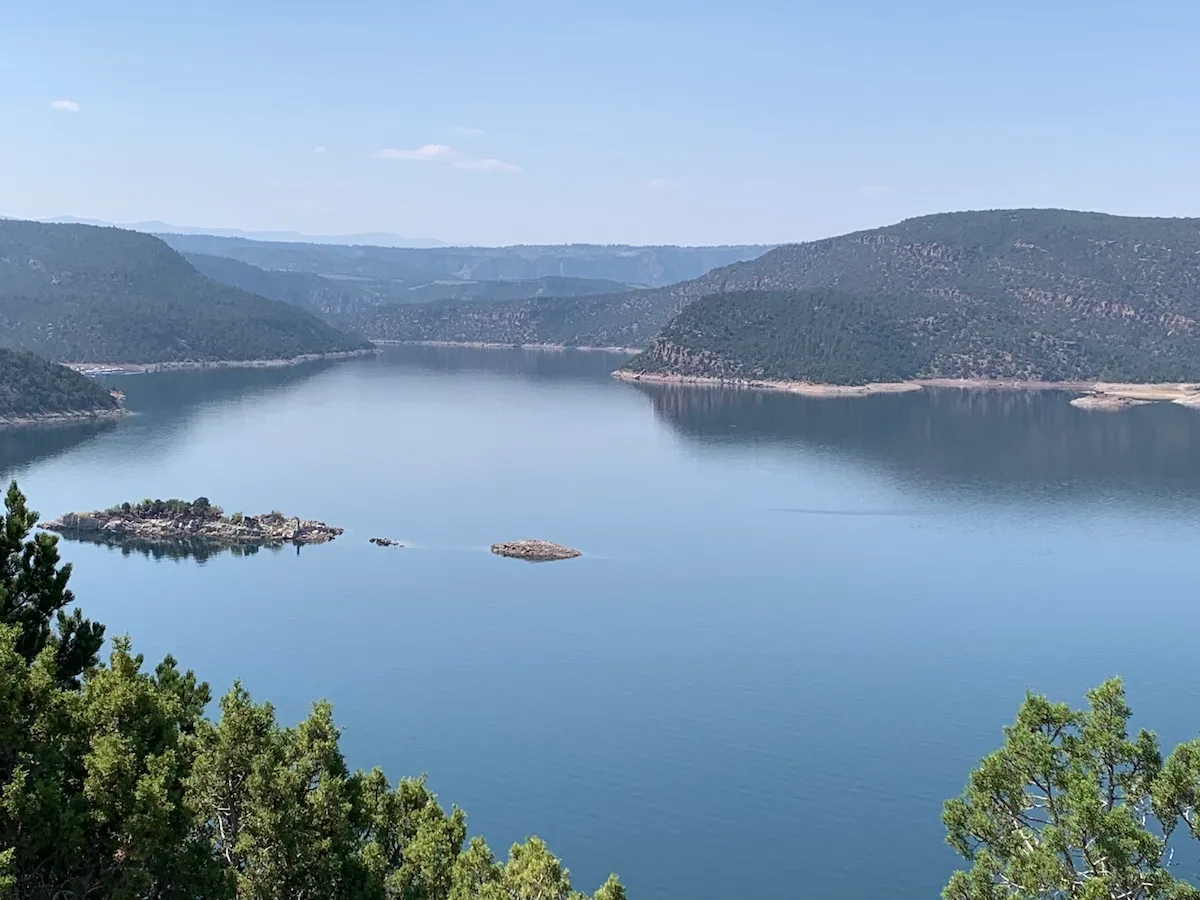
Flaming Gorge Reservoir on the Utah side near the dam in September 2021. (Dustin Bleizeffer/WyoFile)
Degenfelder has met Dolar before but was unaware of his recent proposal. “I wonder what those guys can sell Wyoming water to Colorado for?” he asked.
The Atlantic Rim and Muddy Creek drain into the Little Snake River Basin, a tributary of the Green River that’s part of the overallocated Colorado River Basin. Amid long-term drought, it’s an era of depleted reservoirs and cuts to water allocations in the region — which may be mandatory in Wyoming’s portion of the basin by 2025.
Given the shortages, Hicks’ sense is that the value of water in the Colorado River Basin has increased “astronomically” and that there’d be a market for the Atlantic Rim water. Still, he said, there are many factors that could prevent the plan from coming to fruition, one of them being the economics of tapping less than two dozen abandoned wells.
“Is there enough water there of sufficient quality that it doesn’t have to be treated?” Hicks asked.
Hurdles and hurdles
Hicks sees another hurdle: It’s unclear whether water taken out of Atlantic Rim-area aquifers and surface discharged is subject to interstate water agreements.
“If he produces all of that [water] and they say, ‘That’s connected to the surface water,’ Wyoming’s only entitled to 14% of that under the Upper Colorado River Compact,” the state senator said.
Groundwater is subject to the Colorado River Compact “to the extent it is Colorado River System water as that term is used in the compact,” Gebhart, the state engineer, explained in an email.
“However, the seven states which are subject to the compact have never mutually determined to what extent groundwater constitutes Colorado River System water,” Gebhart wrote. “The ability to use groundwater within Wyoming is only subject to our individual state laws.”
Gas drilling infrastructure in the Atlantic Rim field in 2015. (Ken Driese)
Constitutionally, the groundwater is owned by the state of Wyoming. If Dolar Energy proceeds with its plans, the company intends to file applications for the “points of use” of the Atlantic Rim groundwater, Gebhart said.
Permitting for activities and disturbances to federal land is another potential obstacle.
The State Engineer’s Office sent Dolar Energy’s 21 groundwater test well applications to the Bureau of Land Management on Feb. 15, according to the state engineer. At that time, the state office shared concerns about who would be responsible for the currently plugged and abandoned coalbed methane wells if they weren’t going to be used after being reentered.
The BLM’s Wyoming office hasn’t taken any action because Dolar Energy hasn’t submitted anything, said Brad Purdy, deputy state director for communications. All of the leases for the old wells have been terminated, he said.
“If the company is interested in doing commercial H2O wells off of those CBM wells, we have to get some applications,” Purdy said. “We don’t have any right-of-way applications, we have no [applications to drill] to reenter a plugged well. The proponent has a lot of stuff they need to submit before we can run NEPA and even begin to analyze this.”
Wildlife managers’ concerns are another potential impediment to Dolar Energy’s plans.
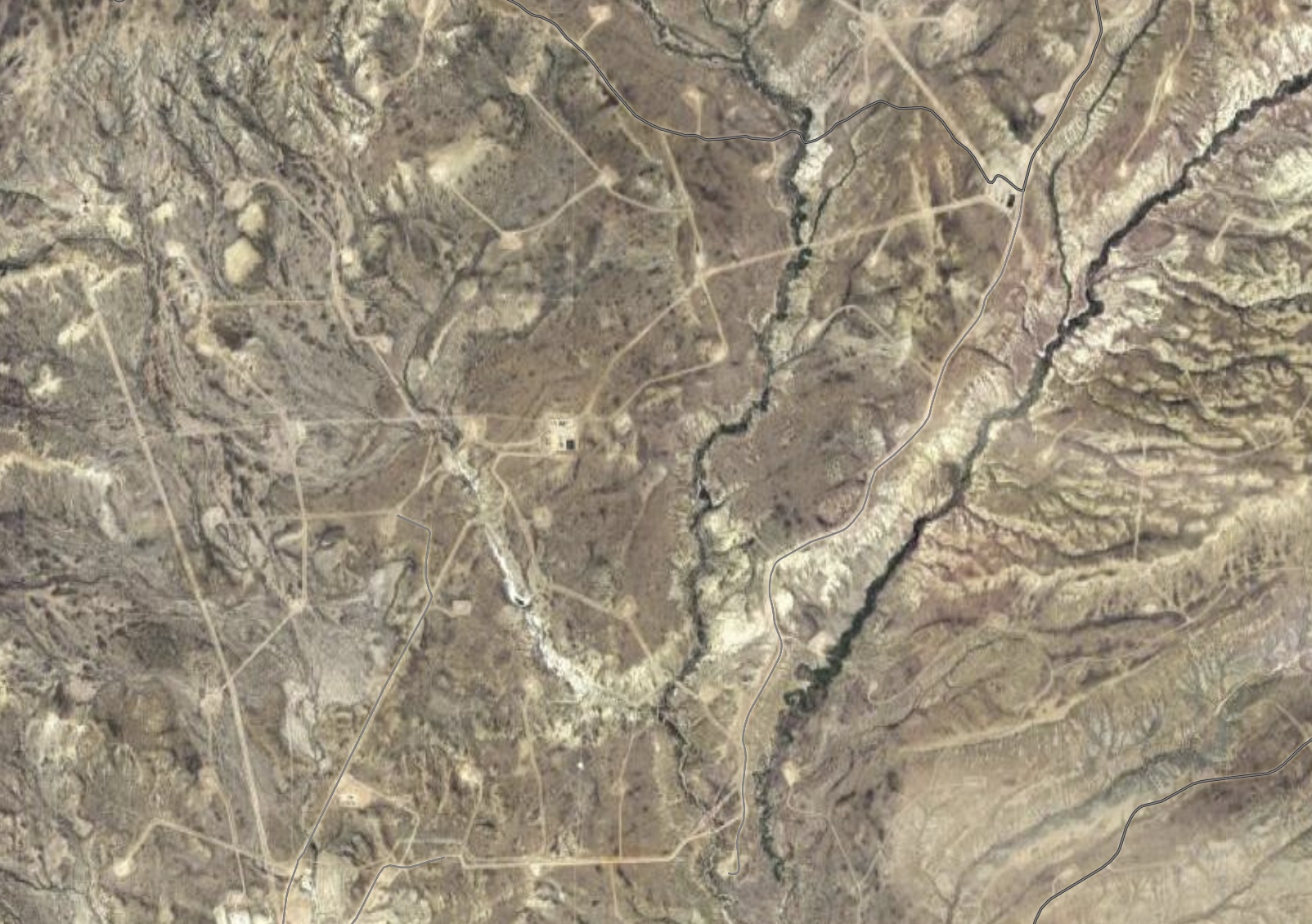
Coalbed methane gas pads litter the Atlantic Rim field in the Muddy Creek drainage in south-central Wyoming. (Google Maps screenshot)
The Wyoming Game and Fish Department’s review letter shows that 19 of the 21 applied-for test wells (two were later rescinded) are located within the designated Baggs Mule Deer Migration Corridor. Of those, six wells are located on ground that’s both “stopover” and “high use” habitat. One well each fell solely within high use and stopover areas, while the remainder would be located within “low” or “medium” use areas.
“The proposed well sites were recently plugged and the pads reclaimed,” Game and Fish’s letter states. “We are concerned that disturbance at these well sites, specifically within the high use area and stopovers within high use areas, will impede or reverse the reclamation process while also negatively impacting migrating mule deer.”
“Lastly, it should also be noted that a water pipeline in the Baggs area will likely traverse sensitive and vital wildlife habitats, much like these exploratory wells,” the letter noted.
Workers for Pate Construction Company install 30-inch PVC pipe on Colorado Highway 96 as part of the Arkansas Valley Conduit Project. Photo credit: Southeastern Colorado Water Conservancy District
Here’s the release from the Southeastern Colorado Water Conservancy District (Chris Woodka):
May 30, 2024
The Arkansas Valley Conduit received another $90 million in federal funding as construction continues on the drinking water line that will serve 39 water systems east of Pueblo.
“This is great news for the AVC and the people of Southeastern Colorado. Funding at this level is needed to keep the AVC moving forward, and we really appreciate the hard work that our congressional delegation and Reclamation officials at all levels have put into the AVC project,” said Bill
Long, President of the Southeastern Colorado Water Conservancy District. “The Southeastern District is looking forward to the day when we can fulfill the promise to bring clean drinking water to the people of the Lower Arkansas Valley.”
The Department of Interior announced the funding from the Bipartisan Infrastructure Law, along with other Western water projects. The AVC received the largest amount of BIL funding for any of the projects included in this year’s funding.
Arkansas Valley Conduit map via the Southeastern Colorado Water Conservancy District (Chris Woodka) June 2021.
The AVC is being built by the U.S. Bureau of Reclamation and the Southeastern Colorado Water Conservancy District. The 130-mile pipeline will serve 50,000 people when completed. To date, federal appropriations total more than $321 million, with state loans and grants of up to $120 million pledged. Local governments have contributed about $10 million, including American Rescue Plan Act funds.
Construction began on the AVC in 2023, with Reclamation constructing the Trunk Line from its connection with the Pueblo Water system at 36th Lane and U.S. Highway 50. So far, three federal contracts totaling almost $100 million have been issued for the AVC to date. In addition, $22 million has been paid to Pueblo Water for conveyance, treatment and transmission of AVC water from Pueblo Reservoir.
The District, through its Water Activity Enterprise, has built delivery lines to Avondale and Boone,using $1.2 million contributed by the Pueblo County Commissioners through American Rescue Plan Act (ARPA) funding.
Pueblo Dam. Photo courtesy of Colorado Parks and Wildlife
Map of the Colorado River drainage basin, created using USGS data. By Shannon1 Creative Commons Attribution-Share Alike 4.0
Click the link to read the article on the Associated Press website (Susan Montoya Bryan). Here’s an excerpt:
May 23, 2024
The Navajo Nation Council has signed off on a proposed settlement that would ensure water rights for its tribe and two others in the drought-stricken Southwest — a deal that could become the most expensive enacted by Congress. The Navajo Nation has one of the largest single outstanding claims in the Colorado River basin. Delegates acknowledged the gravity of their vote Thursday and stood to applause after casting a unanimous vote. Many noted that the effort to secure water deliveries for tribal communities has spanned generations…
The San Juan Southern Paiute Tribal Council also voted to approve the settlement Thursday, while the Hopi tribe approved it earlier this week. Congress will have the final say. For Hopi, the settlement is a path to ensuring a reliable water supply and infrastructure for the health, well-being and economic prosperity of the tribe for generations to come, Hopi said in a statement late Thursday…
Congress has enacted nearly three dozen tribal water rights settlements across the U.S. over the last four decades and federal negotiation teams are working on another 22 agreements involving dozens of tribes. In this case, the Navajo, Hopi and San Juan Southern Paiute tribes are seeking more than $5 billion as part of their settlement…About $1.75 billion of that would fund a pipeline from Lake Powell, one of the two largest reservoirs in the Colorado River system, on the Arizona-Utah border. The settlement would require the U.S. Bureau of Reclamation to complete the project by the end of 2040. From there, water would be delivered to dozens of tribal communities in remote areas.
Click the link to read the article on The Denver Post website (John Aguilar). Here’s an excerpt:
May 9, 2023
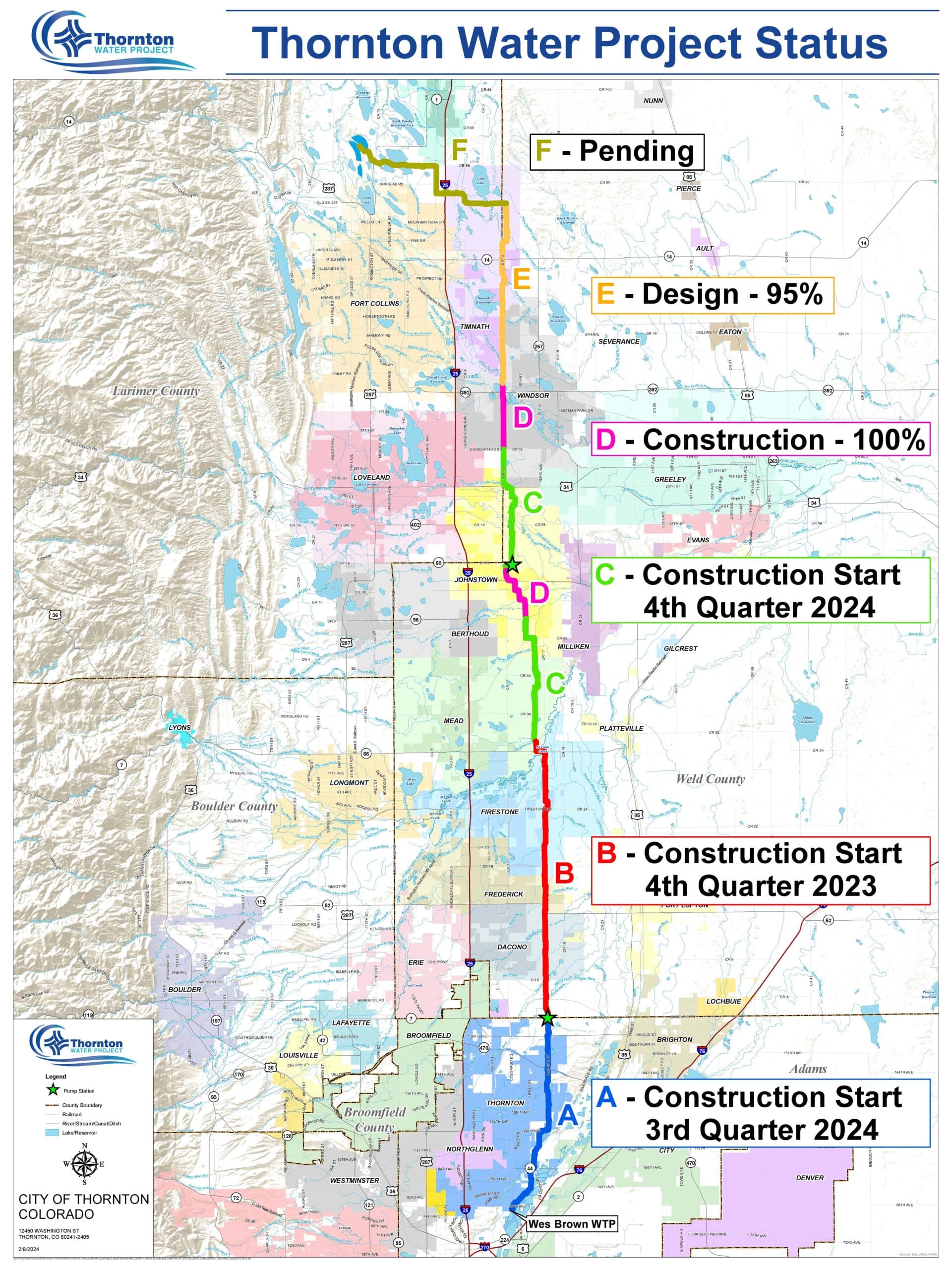
Thornton will be able to build a critical segment of a 70-mile pipe to bring water from the Cache la Poudre River to the fast-growing suburb north of Denver, after elected leaders in Larimer County unanimously — if begrudgingly — approved a permit for the northern segment of the pipe on Wednesday night…But a procession of county residents has spoken out against the proposed project at a series of public hearings held over the past couple of weeks, insisting that Thornton simply could allow its shares in the Poudre River — equaling 14,700 acre-feet a year — to flow through Fort Collins before taking the water out for municipal use. Doing so, they say, would increase flows and improve the river’s health. But just hours before Wednesday’s meeting, one of the opposition groups to the project — No Pipe Dream — said it sensed momentum had turned the city’s way, issuing a public statement that said “we’ll skip the torture of tonight’s hearing on our ‘good neighbor’ Thornton’s plans to win the water tap lottery and appease hungry developers.”
[…]
Before casting her yes vote Wednesday, Larimer County Commissioner Kristin Stephens said she wished Thornton would send its water down the Poudre “because that’s what the community wants.”
[…]
“We can’t do that,” she said, referring to a 2022 Court of Appeals decision that ruled that Larimer County cannot force Thornton to use the river as a conveyance…
The fight over Thornton’s water pipe has been going on for years, and a denial of a permit for the project by Larimer County’s commissioners more than five years ago set off a flurry of unsuccessful court challenges that ultimately prompted the city this year to resubmit its application — this time with a different route and 17 fewer miles of pipe within the county’s boundaries. The city also relocated a pump house from the original plan to a site that is not near any houses, and it agreed to 83 county land use conditions to move the project forward.
Click the link to read “Larimer County commissioners approve city of Thornton’s water pipeline application” on the Fort Collins Coloradoan website (Rebecca Powell). Here’s an excerpt:
May 9, 2024
Commissioners Kristin Stephens, Jody Shadduck-McNally and John Kefalas all said they believed the permit application, now with 83 conditions, met the criteria set by the county’s 1041 regulations that govern the permit process…[John Kefalas] said while advocates have suggested that Thornton’s 2023 application is no different than the one submitted a few years ago, “I must respectfully disagree, as the pipeline proposal and process have been different.”
[…]
Kefalas said the county legal counsel’s “prudent” interpretation of a 2002 Colorado Court of Appeals ruling, which sided with commissioners in their decision to reject but also said the county couldn’t require the water to be run through the Poudre, indicates what could be decided if the matter returns to the courts…
Thornton representatives have said that the water they are conveying is already being taken out of the river at a diversion point to the Larimer County canal. No additional diversions will be made after the project is complete, they’ve said. Shadduck-McNally said she looked thoroughly and critically at the 3,000-page application to make sure it complied with the criteria and believes the county’s higher standards did lead to a stronger application from Thornton.
“This is the system that we have in Colorado — the Colorado water system and the Colorado water court system — and I wish it was different, but it’s the system that I can’t change today. Water court and water decrees are serious business.”
Monday’s hearing started with a presentation from county staff, during which the Larimer County Planning Commission recommended approval of the project if proposed conditions were met. Thornton then gave another presentation to talk about how the city’s new application is different from the previous one. After that, the session was open to public comment, which will continue at the next hearing…
Planning Commission recommends approval
“With the proposed conditions of approval in place, this application meets the review criteria for a water transmission pipeline,” [John] Barnett said. “… Therefore, the development service team recommends approval of the Thornton water project.”
[…]
The public hearing session will resume at 6 p.m. May 6 via Zoom and in person in the First-Floor Hearing Room of the Larimer County Administrative Services Building, 200 W. Oak St. in Fort Collins. For more details on how to sign up for public comment and the 1041 regulations, visit www.larimer.gov/planning/1041-regulations. You can also track the progress on the permit and access related documents on this county portal.
Missouri lawmakers say water has almost always been plentiful in their state, giving no reason to think twice about a concept known as riparian rights — the idea that, if you own the land, you have broad freedoms to use its water. But that could change under a bill advancing quickly in a state legislature that is normally sharply divided. The measure would largely forbid the export of water across state lines without a permit, even though there is no evidence that is happening on any large scale.
Just the specter of water scarcity is inspiring bipartisan support. Besides persistent drought in parts of the state and plummeting Mississippi River levels in recent months and years, lawmakers are wary of the West, and the chance that thirsty communities facing dwindling water supplies will look east for lakes and rivers to tap…
“They’re not being real responsible,” state Rep. Jamie Burger (R), one of the bill’s lead sponsors, said of states like California and Arizona. “We feel like we need to be responsible in Missouri and protect what we have.”
If passed, the new limits would be the latest domino to fall as climate change makes droughts more frequent and intense across huge swaths of the United States, and threatens to exhaust water supplies in some parts of the West within the foreseeable future. States including Oklahoma, Iowa and Nebraska already have similar safeguards on water exports in place, while a compact among Great Lakes states has largely banned exports beyond the limits of their watershed since 2008.
Arkansas Valley Conduit map via the Southeastern Colorado Water Conservancy District (Chris Woodka) June 2021.
Click the link to read the release on the Reclamation website (Anna Perea and Darryl Asher):
Feb 29, 2024
LOVELAND, Colo. — The Bureau of Reclamation has awarded a contract for the construction of water treatment and connection facilities for the Arkansas Valley Conduit Project to Thalle Construction for $28,710,676. This contract, partially funded by President Biden’s Bipartisan Infrastructure Law, funds construction of a backflow preventor connecting the main trunkline to Pueblo Water’s system, and a treatment facility to address specific water treatment needs for the Project.
The backflow preventer will be constructed at 36th Lane and U.S. Highway 50, east of Pueblo. The treatment facility will be located along the AVC pipeline route about 4 miles east of 36th Lane. The treatment process will prepare the water for conveyance through the trunkline to Project communities and ensure compatibility of the water with the AVC participants’ water systems.
“We’re extremely pleased to be able to move forward with multiple features of the Arkansas Valley Conduit,” said Jeff Rieker, Eastern Colorado Area Office Manager. “The momentum of making this connection to the eastern end of Pueblo’s water system while downstream pipes are being placed and additional designs are being developed really speaks to the collaborative efforts of all those involved.”
A 2022 three-party contract between Reclamation, Southeastern Colorado Water Conservancy District Board and the Pueblo Board of Water Works (Pueblo Water), eliminates the need for over 24 miles of pipeline by utilizing Pueblo Water’s existing infrastructure. The water will be either Fryingpan-Arkansas Project water or from participants’ water portfolios, not from Pueblo Water’s resources.
“This is another important step forward for the Arkansas Valley Conduit, and vital to begin providing high-quality drinking water to the people of the Lower Arkansas Valley. The Southeastern District has tremendous appreciation for the work that Reclamation and our congressional delegation have done to keep this project moving forward,” said Bill Long, President, Southeastern Colorado Water Conservancy District.
In addition to the contract for these facilities, in January, Reclamation awarded a $4.6 million contract to Central Geotechnical Services, LLC to locate and complete subsurface utility engineering surveys for underground utilities along a 34-mile stretch of the Arkansas Valley Conduit. Colorado legislation, SB 18-167, enacted in 2018, set new standards for entities conducting underground excavation.
Arkansas River Basin via The Encyclopedia of Earth
State Engineer Kevin Rein is retiring at year’s end and agreed to join The Valley Pod podcast for an interview with host Chris Lopez before he departs. We’re calling it an exit interview.
In it, Rein talks about the importance of bringing sustainability to the unconfined aquifer of the Rio Grande Basin, how the economic future of the San Luis Valley and its agricultural industry is at stake without a sustainable aquifer system, the unique nature of the Rio Grande compared to the Colorado River Basin and others, and the urgency of achieving sustainability in the face of prolonged drought and climate change.
“I wish there was enough water for everybody, but we developed agricultural and municipal uses in a state that is largely a desert and it often has an abundance for a couple months out of the year,” Rein said. “I think it’s good for us to at least feel comfortable that we have that structure in place. But the other thing we need to know, as I alluded to, is that that structure is going to cause us to make difficult decisions, especially as we see climate change, the effects of climate change reducing our water supply, and we see our demands grow.”
Here’s an edited version of the conversation. The full Valley Pod episode is here.
ALAMOSA CITIZEN: Thank you again for giving us some of your time as you exit. And again, congratulations on your retirement. Is the stress of the job starting to subside?
KEVIN REIN: No. The stress, if we can call it that, is not subsiding at all. This trepidation that I face with the idea of retirement and ending a job that I really love doing, weighs pretty heavily on me and wanting to get in every last bit of good work I can do. That’s weighing on me. Yes. Yeah, it’s very important for me to try to finish this. We’re doing as much as I can.
Rio Grande and Pecos River basins. Map credit: By Kmusser – Own work, Elevation data from SRTM, drainage basin from GTOPO [1], U.S. stream from the National Atlas [2], all other features from Vector Map., CC BY-SA 3.0, https://commons.wikimedia.org/w/index.php?curid=11218868
AC: We want to start with some local issues with you of the Rio Grande Basin and then stretch more into the role of the state engineer for Colorado, if you don’t mind. First, can you sum up the importance of the upcoming year 2024 and the influence upcoming water court trials will have on the Rio Grande Basin? And we’re thinking specifically of the water trial around Subdistrict 1 Plan of Water Management, the alternative plan for operating in that particular subdistrict with the Sustainable Water Augmentation Group court filing, and then the idea of the U.S. Supreme Court weighing in on a new settlement between Texas, New Mexico and Colorado when it comes to the Rio Grande Compact. 2024 seems like a significant year in water court.
REIN: It’s going to be very significant that affects the people in the Valley to greater or lesser degrees depending on those three items that you just mentioned. And so that is critical. And Chris, I’ll apologize to you and the listeners that I’m going to be very cautious about my comments on these because of the legal implications and the fact that it’s really active litigation in three areas and regarding the lawsuit on the Rio Grande Compact with Texas and New Mexico. And then as you mentioned the United States, I will probably not say much at all about that because the facts are there and I don’t want to step in front of our good legal staff and say something that is not quite true to the case in terms of the legal implications of what’s going on. But when it comes to SWAG and that case and the groundwater management plan containing the plan of water management for Subdistrict 1, those are very important issues. And I will admit that I’m going to be a little guarded in my comments about those two because pardon me, as you know, the SWAG case was dismissed, but they have re-filed and we may see that play out in a similar fashion. And without saying too much about that and the groundwater management plan for the subdistrict, from my perspective as a state engineer, there’s one critical aspect of that for both cases and that is the sustainability of the unconfined aquifer. As we know, that’s a difficult component of groundwater management in the Valley because we have a statutorily required sustainability objective. And that has found its way into the rules and into the groundwater management plan for the subdistrict. And I’ll speak to the existing groundwater management plan that’s in place right now that has a deadline of 2031 to meet the objectives, the sustainability objectives, that that very plan sets out. As we all know, and I’ve been on record through letters and public comments, that it’s going to be very difficult to meet that sustainability objective under that existing plan of water management. And I know that the subdistrict has worked hard toward an alternative in this current plan that I approved and is before the court and the way that plays out is going to be so important to the irrigators in the Valley under the rules under their annual replacement plans. And I look forward to seeing the resolution of that. Obviously I won’t be the state engineer at the time and I’m not certain to what extent I personally will stay involved in that, but it is critical to get resolution on that for the irrigators. And since we are under active litigation, if I can use that term for the groundwater management plan component of the plan of water management, I’ll stop right there, but I will mention that as we know, the SWAG applicants have also attempted to address sustainability, at least in their previous application they did. That was dismissed. And for this upcoming application, I’ll admit that I have not reviewed that in detail yet, but that will be also very important to properly review and respond to sustainability objectives in the upcoming SWAG case.
AC:Why is it important for the water court to be dealing with these particular issues now? Can you address the importance of the court doing its work in 2024 and what’s the best scenario in terms of how the court adjudicates these trials or deals with these cases?
REIN: The importance of the water court’s involvement now is because the issue is important now in 2024. The reason it’s important right now is because we’re currently working under the 2031 deadline, and that seems, it doesn’t just seem it is seven years away, it seems like a lot of time, but as we know, we’re under sustained drought in the valley and obviously the economic future is at stake. We can’t just shut down production. So we need to find that way to address sustainability now. And as I said, we’re under sustained drought. There’s no confidence I think from anyone in saying that that will turn around and end. You have to assume a difficult case scenario. And with that seven years is not a lot of time to make up the perhaps 1 million acre-foot gain that would be necessary to get to the sustainability standard. Therefore it is timely.
AC: Do you think groundwater users as a whole in Division Three are making good or reasonable enough progress in solving our water security challenges and what stands out for you there?
REIN: Yeah, so a broader water groundwater availability use challenges, and I need to break away from this sustainability discussion for a minute and just talk about the efforts of all the water users through seven subdistricts under the rules in the Rio Grande Basin. And as we know, the rules that became final in 2019 and are now completely applicable do hold the water users to a high standard. It’s a standard that we have statewide. It’s a standard that came out of our 1969 water right Determination and Administration Act that we need to administer groundwater in conjunction with surface water in the prior appropriation system. That’s what came upon the water users in the Rio Grande gradually over the last 10 to 15 years, but again, in 2019 and certainly a couple years later, finally hit them. And what they have done is developed very comprehensive, very complex annual replacement plans that allow them to pump and comply with the law. What is compliance with the law? Basically it means replacing depletions to the stream system in time, location and amount to prevent injury to senior surplus water rights, and obviously the stay of compliance with a compact. And let me just say quickly, we have a unique situation in Division Three, the Rio Grande Basin, that instead of replacing depletions, they can enter into forbearance agreements to just compensate financially for that. But that’s what they have done to respond to this groundwater challenge is they have developed these annual replacement plans, they have gotten their sources of replacement water, they operate according to the Rio Grande decision support system to ensure that their depletions are properly recognized at the time, location, and the amount so that they can be replaced. I think it’s very gratifying. I wish I could take more credit, but I think it’s very gratifying that the water users, excuse me of the basin, have responded as they’ve needed to, but responded in such a complete and detailed and verifiable way. And I really can’t say that without also addressing the division of water resources staff in our Alamosa office, Craig Cotton and his highly competent staff, they’ve just put in countless hours to analyze and verify and approve these annual replacement plans. Without those, the wells just simply are not pumping.
AC: I want to ask you one more question about 2024 and the Rio Grande Compact because there’s a lot of people scratching their heads around the federal government’s opposition to the negotiated agreement between Texas, New Mexico and Colorado is also a party, too. And I just wonder if you’ve figured out the federal government’s motivation in that case?
REIN: Chris, that’s a very good question and if you don’t mind, I’d like to just not answer that because of the legal implications and I leave those questions to our attorney general staff.
AC: No, I appreciate that. One of the issues or one of the programs right now is the Groundwater Compact Compliance Fund and the $60 million that was put into that fund through Senate Bill 28. What should be the overall outcome of that $60 million for both the Rio Grande Basin, the Republican River Basin as it’s spent? What’s the expectation and what is the advantage gained by spending that money on those two basins?
REIN:The ultimate outcome for both basins is similar but distinct and the mechanism by which those outcomes are realized is also pretty similar. But let me just start with the end game. The outcome for the Republican River Basin, first of all, is to assist in the retirement of irrigated acres to comply with a 2016 resolution entered into by the states of Kansas, Nebraska, and Colorado. And it’s tempting to get into great detail, but just let me say at a high level that part of compact compliance in the Republican River Basin is operating a compact compliance pipeline to deliver water at the state line to make up for overuse of Colorado’s allocation in the Republican River Basin. That works well except for a detail that not all the water is delivered exactly where it should be. And to deal with that, the three states entered into a resolution that among other things, allows a consideration that Colorado is meeting the compact. If Colorado retires 25,000 acres, this began in 2016, by the year initially 2027 but now 2029, with that background, how to retire 25,000 acres, it’s very difficult because people own land, they have water rights, they want to continue irrigating. So it’s through funding. The funding is difficult, you’re assessing fees, you are asking people to help fund this out of their economic development. Senate Bill 28 for the Republican (River Basin) then brought that $30 million in to help fund the irrigated acres, the reduction of irrigated acres, and it’s just purely economic incentive. People want to do the right thing, but it’s very helpful to have that economic incentive. So thank you for letting me go into some detail, but that is the outcome. The desirable outcome is to stay in compact compliance by tying that 25,000 acres in the south port and it’s working well. We’ve met an intermediate goal for the Rio Grande. It is a similar situation as you know, with great interest toward meeting sustainability obligations in the unconfined aquifer, but in general throughout the basin, reducing groundwater usage. And then to do that, and let me just go back specifically to our sustainability discussion in the unconfined aquifer. Subdistrict 1, reduce those irrigated acres. Their current plant of water management has a goal of reducing 40,000 irrigated acres. Reduce that and then you’re going to reduce groundwater consumption. That helps the water balance so that the aquifer can begin to, and they can meet their sustainability obligation. But we have to say that it’s not limited to Subdistrict 1 or the unconfined if we are reducing groundwater usage throughout the basin. The endgame again is to meet the sustainability obligations and also it makes it easier to comply with a compact if we do that, but reduce the pumping from the aquifers and reduce that groundwater usage.
AC: Does it look to you now that that money, all $60 million, $30 million for each basin will get appropriated at this point? Does it look like the conservation districts have put in place enough of the programs for that money to get spent?
REIN: I believe first of all on the Republican (River Basin) that since they had a structure in place and were already retiring acres in the south, just not at the pace they wanted, that with that structure in place, they are on a good pace to use that funding. For the Rio Grande, they did not have as much of a structure in place and have developed that. But with that development, I believe they have the interest, the applications, I can’t quantify that or go into detail on that, but they certainly will have the interest. And I believe that I would have to really check in with some of the district and subdistrict folks to see what their projection is. But certainly the need is there and the funding is there. So we would hope those come together to see the effective use of all that funding to accomplish the goals.
AC: When you think of the work that’s been done and being done both on the Rio Grande Basin and then Colorado River Basin, what lessons, if any, can be learned from those efforts as we work to bring sustainability to our water resource, our water supply? What are the lessons or what is the work that stands out for you now.
Map credit: AGU
REIN:My role as state engineer, I like to keep my eyes on a few different things just to ensure balance. And we need to look in both the Rio Grande Basin and the Colorado River Basin, first and foremost at the importance of agriculture and how important that is in the Rio Grande Basin. It’s the culture, it’s the economy, it’s a way of life. That’s what sustains that basin. And that’s also true in the Colorado River Basin, but in different ways for the Rio Grande. We just need to balance that attention to the importance of agriculture, to compliance with the law, balance those and balance the importance of agriculture with a compact. And that’s why we have to make these difficult decisions to reduce irrigated acreage because with drought and with demands, the water is just not there. We can’t achieve a water balance. And so that’s how we do that. And I can’t therefore go to the Rio Grande Basin and encourage as much beneficial use as they can possibly accomplish because that would run counter to this effort to comply with the Arps and to achieve sustainability in a slightly different way. I have to deliver a message to the Colorado River Basin that says, yes, our balance is important to the way we regard agriculture and it’s important. And my message to them is, if you have water available and you have a beneficial use and you have the right to water as your water administrator, I’m going to tell you to divert it. I don’t have a basis to tell you to try to conserve, to try to curtail because this is important. I deliver a message of beneficial use on the Colorado River Basin. Now that’s within their water right. And within our system of prior appropriation and in consideration of the fact that in the Colorado River Basin, those tributaries in Colorado and the other three upper basin states, we use less than our allocation under the compact. But there’s no basis to tell people as the state engineer, I want you to conserve. That might be a message from someone else, but not from me. And that’s the message I have to deliver there. But at the same time, we need to be mindful of what other obligations could be put on Colorado in the future. And perhaps you or others who’ve heard me talk about that in the Colorado River Basin right now, we are well in compliance with a compact 75 million acre-feet over every running 10 years. Well in compliance. I spoke to the task force about it just a couple days ago, and we have to be mindful of that number. And if we ever do drop below that number as four upper basin states, the next question is ‘Did we cause it?’ Which really goes to the language of the compact. So it’s very complex and it’s inquiry based. I can’t really project in the near future that we would be out of compliance with a compact. So that’s that different message. But still responsible water usage is the same.
AC: I want to switch to another general topic here, and that’s water for the state of Colorado and the Front Range communities as a whole. In your judgment, have Front Range communities secured enough water for their future or what has to happen for the Front Range to be able to maintain any of its population growth?
REIN: I’m going to give you some quick background as far as our role, and then I’ll be giving you a couple of thoughts on your question. But first of all, it’s good to understand that the role of the Division Water Resources from a statutory standpoint is somewhat limited. And certainly when there’s a development in an unincorporated area, we have a statutory responsibility to provide an opinion to the county, whether the water supply for that developing area is adequate and can be delivered without causing injury. So we do that and that really helps the developments incorporated areas take the steps to ensure that they don’t overextend themselves so that they don’t develop land that has no reliable water supply. When we look at the big municipal and quasi-municipal water providers along the Front Range, it’s a different approach because we don’t have that role or that authority to review their portfolio, review their developments, and ensure that they have enough water. And my observation, even though it’s not a statutory obligation, is that their approach is to develop their water supplies, look closely at their developments, and then they have their role, to things like water and restrictions or other steps. They might take incentives for turf removal, conservation measures, funding conservation measures, or encouraging conservation measures. And that’s how they, and by they I mean greater minds than mine, run municipal water systems. That’s how they keep that balance and ensure that they’re able to provide the water they need to, for their communities in the future.
AC: We’re used to associating you with the enforcement of groundwater rules in the San Luis Valley and Rio Grande Basin. But in reality, that’s just a portion of what the state engineer’s responsible for. Explain the larger role and where the majority of the focus is in the state engineers position.
REIN:The state engineer’s role is just so interesting, and I can’t help but go back about 140 years to 1881 when the position of the state hydraulic engineer was created. And that was created largely to major stream flows so that we could implement these tenets of our prior appropriation system and know the stakes of our 10 newly appointed water commissioners, how to administer water rights that called for the state hydraulic engineer. And over time some of those responsibilities developed to approving bridge design and highway design and reviewing county surveys. But it has both narrowed and expanded in the last 140 years and actually, beginning a hundred or more years ago, to administering these water rights in prior appropriations statewide and supporting our local staff that does that. And of course our dam safety and our water information program. But to answer your question more directly, it is that oversight and support of on-the-ground, bread-and-butter water administration. We have a hundred, 120 water commissioners on the ground that do this work and do it well. What do we need to do to support them? That’s often engineering and technical support. And that comes to a large degree through our involvement in water court, ensuring that we have decrees that are administrable that can be implemented through proper accounting. And then one other facet of that that is very significant, Chris, that I’d like to highlight is what I call or what are known as administrative approvals. And those administrative approvals substitute water supply plans or in the case of the Valley, annual replacement plans, or in the case of the Arkansas, replacement plans. And these are plans that allow water users to use water out of priority, which otherwise would just be disallowed, and recognize their efforts to quantify their impacts to the stream and mitigate those impacts usually through replacement water. This is a significant matter, particularly in the South Platte, the Arkansas and the Rio Grande Basin, and it’s much of what we talked about earlier.It is recognition that groundwater, our formal recognition in 1969, groundwater impacts surface water diversions and we need to account for that in prior appropriation. So since we talked about that in depth before, I will say that much of our staff is actively reviewing the engineering and the administration and the legal aspects of these plans to use groundwater out of priority with replacement to the stream to keep the stream and therefore the other water users whole.
AC: What should the general public know about water as a resource when you think of the years ahead?
REIN: First, I would say that we’re very fortunate in Colorado that we started 150, 160 years ago with a structure in the system called prior appropriation that although it can be very rigid and very harsh, gives us structure and order in what we do so that people have a reasonable ability to project how their water supply may or may not be affected by future conditions and how it might be administered. That structure is so important. I wish there was enough water for everybody, but we developed agricultural and municipal uses in a state that is largely a desert and it often has an abundance for a couple months out of the year. I think it’s good for us to at least feel comfortable that we have that structure in place. But the other thing we need to know, as I alluded to, is that that structure is going to cause us to make difficult decisions, especially as we see climate change, the effects of climate change, reducing our water supply, and we see our demands grow.Those two curves have unfortunately crossed and when they cross, we call it over-appropriation. So we’ve got to implement that. But I think people should also know that Coloradans are smart, they’re creative, they’re solution-oriented. So a lot of these areas where we do see that crossing of those curves, that conflict of the water balance between demand and supply, we’re trying to solve that in ways that address people’s needs. And that may be, or it is so well articulated in our Colorado water plan, but it also is what you see daily on the ground as people maybe seek new initiatives to the general assembly on ways to do things or just creative ways to share water with each other all within the legal structure of our prior appropriation system. Of course. And that’s what I see for the future of Colorado water. We’ve got a difficult balance to achieve, but people are being creative within the system to achieve it.
Water sustains the San Luis Valley’s working farms and ranches and is vital to the environment, economy and livelihoods, but we face many critical issues and uncertainties for our future water supply. (Photo by Rio de la Vista.)
AC: What is the effect of these drought periods and the warming temperatures that we definitely are feeling in the San Luis Valley and across Colorado?
REIN:Let me be very specific and then work my way out to a more geographically diverse answer to that. But let’s go back to the unconfined aquifer again. Why are we struggling? The fact is that with the prolonged at this point, 20-plus year drought, oh, we’ve had a couple of good years, but the trend is, it’s a 20-year drought that reduced inflows into the unconfined aquifer. There are sources that recharge either through import or through natural inflow. These sources recharge the unconfined aquifer and provide water for the wells to pump, plain and simple. When that inflow is reduced, there’s less water to pump. And that’s also made more difficult by the fact that under these drought conditions, higher temperatures, drier climate, then those crops are going to demand more water. So we get hit twice by that climate impact, and that’s just the unconfined aquifer. If we look at the Rio Grande Basin in general and the reduced snowpack and the San Juans and the Sangres, then we’re going to see less water in the rivers available for diversion. And of course, the compact is somewhat complex in the way that flows are indexed within the state and result in the need to deliver a certain amount to the state line. That’s of course more difficult because of the prolonged drought and the climate change. That’s the impact in the Rio Grande statewide, because we are this headwater state, because we rely so heavily on snowpack that occurs in our central mountains and flows out of the state, then that reduced snowpack is a big part of what’s going to impact us and we’ll get less runoff typically. And that reduced runoff also may occur later, earlier in the season, more likely earlier, and that changes the dynamics. But then the crops are going to demand irrigation at different timing. And again, like I said, for the Rio Grande, the crops have a higher demand if we have a hot or drier climate, so we get hit twice. Again, all in all, it’s that reduced supply generally from snow, excuse me, generally from snowpack that’s going to impact our water users. Now you’ve noticed my focus is really on agriculture because as most Coloradoans know around 85 percent of our diversions go toward agriculture. Now consumption is always a different, more complex matter, but at least 85 percent or so of our diversions go toward agriculture. The municipal supplies are being managed, but that’s where we see the big impact, our lion’s share of diversions.
AC: What is the most worrisome aspect you see when it comes to water as a natural resource?
REIN: I would say that the most worrisome aspect is, again, watching your irrigators. Let me say our irrigators in the Valley. I’ve spent enough time and I seem to know those folks and have a high regard for them. So hopefully they’ll let me say our irrigators in the Valley and the impacts it has on them as they try to deal with this reduced water supply. It’s happening in the Republican River Basin, it’s happening on the South Platte, all of our irrigators in their diversions in the Colorado River Basin. And when I say that, I mean all the tributaries from the YM of the white, the Colorado main stem, the Gunison, the San Juan Animas, La Plata, Dolores, all those areas on the west slope that contribute to the Colorado River. Their irrigation diversions are incredibly important to them. They’re necessary. It’s part of the economy on the west slope. So I spent a lot of time thinking about their need for solutions and strategies and initiatives. That’s an answer to your question of what is worrisome to me. But again, I need to go back to what I said earlier, it’s worrisome but then I also watch creative people with creative solutions. So maybe that takes away some of my worry.
AC: Are there improvements that have to happen so Colorado and the Division of Water Resources get a better at reading snowpack levels with what we’re seeing in the changes of the environment? Because you hear different things about the snowpack itself and is it really as strong as it appears?
REIN:I think that Colorado can benefit from more measurement. I won’t say that Colorado has to get better because Colorado does so many things so well, but I’ll be geographically specific and address the Rio Grande Basin. Due to the nature of the compact and the way Craig Cotton has to administer the compact, I know that he is uniquely interested in good snowpack data because he needs literally to forecast amounts of water so that he knows how much will need to be delivered to the state line on a year-to-year, sorry, maybe I should say on a month-to-month basis. And in order for him to do that, he is actively curtailing water rights again, just to ensure that he comes close to hitting that target and that target is so dynamic based on the types of flows that are occurring. So he has that unique interest in being able to see what’s up in the mountains early on and what could occur as runoff around the state in general, we do have an interest in that. It helps our water users, our municipalities, our producers, forecast what they’re going to see and maybe they can make their own economic decisions too. More data is always good, so I won’t deny that, but I’ll fall short of saying Colorado needs to do better.
AC: Fair enough. Again, we really appreciate all the time you’ve given us. Let me ask you, what’s the advice you leave for your successor when dealing with the Rio Grande Basin and Colorado River issues moving forward?
REIN:My advice for my successor in the Rio Grande and the Colorado River Basin probably applies statewide, but you are right on target that those are two very sensitive areas. And my advice is we really need to give our water users the assurance that the structure I described – prior appropriation, water court decrees – are in place and they’re there for a reason. They’re there for us to abide by them, but we also need to keep one eye on solutions that are based on flexibility, technical innovation that you described, new ways of looking at old problems and being very thoughtful and deliberative about those potential solutions. Can we, under our very rigid system, entertain those solutions? And of course, the answer should be yes, but it requires a character that is willing to say, let me look at that. Let me consider, even though I have concerns right now, let me consider whether there are ways that we can make that work and not injure other water users and not step outside of our very important legal tenants that we have to follow.
AC: What’s next for you?
REIN:Oh boy. I am so looking forward to doing more things with my wife, who, of course, she’s my bride all that time and love in my life, and I have kids and a grandson. And so to have so much of my time opened up to do that is important. Will I step away from water? That would be very hard to do. Do I have a specific plan? No, but I do intend to, either as an observer or something beyond a passive participant, I plan to stay mentally engaged in water.
“I can’t downplay the frequency of the ‘bad water years’ and the fact that persistent drought has impacted both surface water users and groundwater users; that impact is felt across the Basin.” – Kevin Rein, director of the Colorado Division of Water Resources. Photo credit: Alamosa CitizenKevin Rein, Colorado state water engineer, explains why Colorado needs stepped-up measuring of water diversions in the North Park and other rivers in Northwest Colorado while Erin Light, Division 6 engineer, looks on during a meeting in Walden on Oct. 22, 2021. Credit: Allen BestThe Colorado Water Conservation Board is hoping the nine basin roundtables adopt their code of conduct. From left, back row: Steve Anderson, Dan Gibbs, Kevin Rein, Jim Yahn, Heather Dutton, Russell George, Curran Trick, Greg Felt; front row: Jessica Brody, Gail Schwartz, Celene Hawkins, Jaclyn Brown, Becky Mitchell.
CREDIT: HEATHER SACKETT/ASPEN JOURNALISMKevin Rein. Photo credit: Aspen Journalism
Romancing the River – I am aware, as you are probably aware, that when I title these posts ‘Romancing the River,’ I am talking about the life work of the kinds of people who do not usually think of themselves as ‘romantics,’ or of their water-related work as ‘romancing the river.’
Engineers, lawyers, politicians, managers, career bureaucrats, scientists – they all see themselves as rational beings just doing what must be done to rationalize a random force of nature, to put the river to beneficial use feeding, watering, powering and even entertaining us. That’s‘romancing the river’? It’s almost an insult to call these serious public servantsromantics, a term which resonates with most people today as not really very serious, just ‘love stories’ – so unserious it’s hardly worth them answering me when I call them romantics (which they don’t); easier for them to just dismiss me as some kind of nut (which they might).
“New plot using the nClimGrid data, which is a better source than PRISM for long-term trends. Of course, the combined reservoir contents increase from last year, but the increase is less than 2011 and looks puny compared to the ‘hole’ in the reservoirs. The blue Loess lines subtly change. Last year those lines ended pointing downwards. This year they end flat-ish. 2023 temps were still above the 20th century average, although close. Another interesting aspect is that the 20C Mean and 21C Mean lines on the individual plots really don’t change much. Finally, the 2023 Natural Flows are almost exactly equal to 2019. (17.678 maf vs 17.672 maf). For all the hoopla about how this was record-setting year, the fact is that this year was significantly less than 2011 (20.159 maf) and no different than 2019” — Brad Udall
So let me try again to explain myself – and why I believe it is neither criticism nor praise to suggest that the army of engineers, lawyers, politicians, career bureaucrats, scientists who have remade the Colorado River have been ‘romancing the river.’ It is a perspective to get up on the table and think about, as we find ourselves at a kind of still point: trying to figure out how to go forward from a century of river development that has ended uncomfortably close to a systemic collapse. It is hard to see 2022-23 as anything other than that, and we’ve only been temporarily reprieved with a wet winter and Biden’s infrastructure bucks giving us time to figure out how to do better for the future.
A stopover during Powell’s second expedition down the Colorado River. Note Powell’s chair at top center boat. Image: USGS
My thinking on this started with the book, mentioned here in posts more than a year ago, by Frederick Dellenbaugh, who came right out and said it in his title: The Romance of the Colorado River. Dellenbaugh, remember, first encountered the Colorado River as seventeen-year-old, in a boat with Major John Wesley Powell, on the scientist’s second trip down the canyons of the river in 1871-2.
Major Powell was better prepared and more experienced on that second trip, and actually able to accomplish some scientific work rather than just trying to survive. But for young Dellenbaugh, it was a big eye-opening experience – life-shaping, really: he spent the rest of his life exploring other unknown parts of the still-wild West, and collecting the stories of other adventurers.
He published The Romance of the Colorado River in 1902, thirty years after his formative trip with Powell – and the year the federal Reclamation Service was created as a branch of the U.S. Geological Survey, within 20 years the organization orchestrating the river’s development.
Dellenbaugh pulled no punches in describing his sense of the river and the challenge it represented. After noting in his introduction that ‘in every country, the great rivers have presented attractive pathways for interior exploration—gateways for settlement,’ serving as ‘friends and allies’ – he launches into his impression of the Colorado River:
THE GRAND CANON,
LOOKING EAST FROM TO-RO-WEAP
From “Exploration of the Colorado River of the West and Its Tributaries” By J. W . Powell, 1875
‘By contrast, it is all the more remarkable to meet with one great river which is none of these helpful things, but which, on the contrary, is a veritable dragon, loud in its dangerous lair, defiant, fierce, opposing utility everywhere, refusing absolutely to be bridled by Commerce, perpetuating a wilderness, prohibiting mankind’s encroachments, and in its immediate tide presenting a formidable host of snarling waters whose angry roar, reverberating wildly league after league between giant rock-walls carved through the bowels of the earth, heralds the impossibility of human conquest and smothers hope.’
There’s Dellenbaugh’s ‘romance of the river’ – an adventure story of rising to meet a challenge, a call to action to overcome obstacles. A veritable dragon refusing to be bridled? Impossible? Prohibiting encroachment? Smothering hope? We would see about that!
And while it’s not a conventional love story, passion is involved, the kind that can turn on a dime between love and hate. We loved the presence of water in a dry land – but the water was fickle at best, destructive at worst. Every farmer trying to irrigate from its two-month flood that turned into a trickle when they most needed it knew that love-hate relationship; it became the century-long (thus far) story of a strong and ornery people testing some new-found technological strength through picking a fight with a strong and ornery protagonist: we would teach the river to stand in and push rather than cutting and running.
Dellenbaugh was not the only one turning it into a romantic adventure. When the Colorado River Compact had been hammered out in 1922, the Commission Chair and Commerce Secretary Herbert Hoover announced that ‘the foundation has been laid for a great American conquest.’ In a 1946 report cataloging all the possible developments for the Colorado river’s upper tributaries, the Bureau of Reclamation carried forward Dellenbaugh’s assessment in its subtitle: ‘A Natural Menace Becomes a National Resource.’ These were the official public perceptions guiding our relationship with the Colorado River.
For three-quarters of the century that followed publication of Dellenbaugh’s Romance, America embraced that romantic challenge, answering the call to conquest, taking on those obstacles, not just individually but as a national project, a big last step in the ‘Winning of the West.’ And fueled by the power unleashed by buried carbon fuels, we were ready for the fight; it was the Early Anthropocene, and it was our planet to reform.
Graphic via Holly McClelland/High Country News.
Remarkable things were done to the river as a result. The ‘veritable dragon’ has been broken and bridled for commerce and ‘utility everywhere.’ Its breaking and taming for commerce and utility is so massive that it practically requires the satellite view to take it in – the vast new ‘desert delta’ where the waters of the former desert river are spread from Phoenix and Tucson on the east, around through large squared-off green agricultural developments spotted with towns and cities, through the Imperial and Coachella valleys to Los Angeles and San Diego on the west…. And that’s just downriver; upriver are the tunnels through the mountains, taking water from the headwaters into the Platte, Arkansas, Rio Grande Basins, and into the Great Basin itself – how long will it be before Anthropocene math calculates that there might be enough water left in the Green River to move some through the Central Utah Project workings to help recharge the Not-So-Great Salt Lake?
For me, the ‘utility’ that cements the idea that this has been a big romantic adventure is the way we have kept significant reaches of river ‘wild’ enough for industries replicating Dellenbaugh’s formative adventure. Slipping onto the tongue and into the thrashing maw of Lava Falls, it is still easy to imagine a ‘veritable dragon,’ and millions of people from all over the planet come out of the Grand Canyon having relived Dellenbaugh’s romantic adventure.
But at the same time…. We also have to face some things that are less to be celebrated. Which brings me to Mary Austin again, another writer of the southwestern deserts mentioned here before, and her skeptical observation on Arizona’s ‘fabled Hassayampa,’ an intermittent tributary of the Gila River west of Phoenix, ‘of whose waters, if any drink, they can no more see fact as naked fact, but all radiant with the color of romance.’ Phoenicians have been drinking from the Hassayampa for a century now, wrapped up in the romance of the happy golden years in green and sunny places – and the underlying standard American romance of great wealth to be harvested fulfilling such romantic dreams.
But the ‘naked facts’ don’t go away just because we don’t want to see them, and there’s a kind of cosmic irony in the fact that, right where the Hassayampa flows into the Gila (when it’s actually flowing), two big developments, Buckeye and Teravalis, have been shut down at least temporarily on further development because they can’t present evidence of a hundred-year water supply. (See this post last spring.)
The mayor of Buckeye, Eric Orsborn, who also owns a construction business, is not discouraged by this. ‘My view is that we’re still full steam ahead,’ he said in an article in The Guardian. ‘We don’t have to have all that water solved today…. What we need to figure out is what’s that next crazy idea out there’ for bringing in a new water supply. An idea under consideration currently is a desalinization plant down in Mexico on the Gulf of California, and a pipeline to bring the desalted water a couple hundred miles uphill to central Arizona. Crazy, and very expensive – but we’ve been saying in Colorado for decades now, as though it were a mother truth, ‘Water flows uphill toward money.’
But other naked facts have also been dimming the radiance of the Anthropocene conquest of the Colorado River. Water users have been coping for half a century with water quality issues stemming from using water over and over to irrigate alkaline soils. We also didn’t really know – and some states continue to refuse to acknowledge – how much water would be lost to evaporation from big reservoirs, hundreds of miles of open and unlined canals, and flood or furrow irrigation on subtropical desert lands. About a sixth of the river is vaporized annually.
The basic explanation for why CO2 and other greenhouse gases warm the planet is so simple and has been known science for more than a century. Our atmosphere is transparent to visible light — the rainbow of colors from red to violet that make up natural sunlight. When the sun shines, its light passes right through the atmosphere to warm the Earth.
The warm Earth then radiates some of its energy back upward in the form of infrared radiation — the “color” of light that lies just beyond red that our eyes can’t see (unless we’re wearing infrared-sensitive night-vision goggles). If all of that infrared radiation escaped back into space, the Earth would be frozen solid. However, naturally occurring greenhouse gas molecules, including not just CO2 but also methane and water vapor, intercept some of it — re-emitting the infrared radiation in all directions, including back to Earth. That keeps us warm.
When we add extra greenhouse gases to the atmosphere, though, we increase the atmosphere’s heat-trapping capacity. Less heat escapes to space, more returns to Earth, and the planet warms.
But the biggest, most unforeseen collateral fact diminishing our conquest of the river is the turbulence we’ve wrought in the climate – increasingly an unignorable ‘naked fact.’ All the heavy technology and concrete we’ve invested in controlling the river, as well as all the technology of daily living that depends on burning carbon fuels, not to mention the methane from livestock and human waste – all our gaseous carbon emissions have increased the heat-holding capacity of the atmosphere, which in turn increases the heat energy driving our weather systems. We’ve seen this just this past year: how that changing balance can result in ‘atmospheric rivers’ of vapor forming over the ocean and dumping huge snowpacks when it condenses over the mountains – but then being back on the ‘abnormally dry’ edge of drought within a few months of the day-to-day water-sucking aridification that is the shape of the future.
So we Anthropocenes have conquered the river, bridled the dragon – but as we saw in the previous post here, we lost a full third of the river as the collateral consequences, unforeseen or just ignored, of the conquest. And all responsible prognosticators project that we will lose maybe another sixth of the river by mid-century to our drying out of the planet.
There are a number of ways to look at this. One would be to say, like Eric Orsborn, okay, there have been setbacks, but we can’t stop now; we need to finish the job. And he is far from the only Phoenician saying that. The state has a governor now and a Water Resources Department who know when it’s time to call a halt, but the state also has a Water Infrastructure Finance Authority charged with creating new water supplies for the state. The Mexican desal plant and megamile pipeline is just one idea in WIFA’s portfolio of possibilities; the old unkillable idea of bringing water over from the Missouri or Mississippi Rivers is still on their list.
‘Those are big, audacious ideas, but I don’t think any are off the table,’ WIFA director Chuck Podolak told The Guardian. ‘We’re going to seek the wild ideas and fund the good ones.’ The romance of conquest throbs on; Hoover Dam was a wild idea a century ago, so why stop now?
A water policy analyst at Arizona State University, Kathryn Sorensen, toldThe Guardian that ‘the degree of [Buckeye’s] success will depend on the degree to which people are willing to pay for those more expensive solutions. But it’s absolutely feasible. We pave over rivers, we build sea walls, we drain swamps, we destroy wetlands, we import water supplies where they never would have otherwise gone. Humans always do outlandish things, it’s what we do.”
There is diminishing enthusiasm today, however, for the romance of conquest; dwellers in the megacities are increasingly reluctant to embrace higher water bills in order to finance more growth, more people, more traffic, longer lines everywhere – San Diego is an example today. The same is true for urban/suburban water conservation; there is a romantic appeal to helping one’s city by conserving in an emergency situation, a drought period or a maintenance shutdown; but conservation-in-perpetuity just to make more water available for growth lacks that romantic appeal.
For many of us, the ‘romance of the river’ has probably shifted 180 degrees over the past half century to a belated appreciation for the ‘natural river’: the Colorado River that once flowed to the ocean in a two-month flood and watered a beautiful wild delta, the river that would flow through a resurrected Glen Canyon if the dam were taken down, et cetera. This eco-rec perspective nurtures the belief that the world would be a better place if we would ‘just stop digging’ and leave it to nature to heal itself from our efforts. This idea has the ‘radiant color of romance’ for many of us, but it also has its underlying naked facts – not least of which are nature’s extreme remedies for a swarming species overpopulating its resource base.
I tend to think, myself, that, yes, we can’t stop now with our tinkering and meddling; we are all too deeply into this love-hate relationship with nature. Just as we will continue to thwart nature with vaccines against its leveling pandemics, we will continue to try to keep passable water in the pipes and faucets, on the fields, and in the recreational reaches for an ever-growing population because that is who we are; it’s what we do.
For many of us, the ‘romance of the river’ has probably shifted 180 degrees over the past half century to a belated appreciation for the ‘natural river’: the Colorado River that once flowed to the ocean in a two-month flood and watered a beautiful wild delta, the river that would flow through a resurrected Glen Canyon if the dam were taken down, et cetera. This eco-rec perspective nurtures the belief that the world would be a better place if we would ‘just stop digging’ and leave it to nature to heal itself from our efforts. This idea has the ‘radiant color of romance’ for many of us, but it also has its underlying naked facts – not least of which are nature’s extreme remedies for a swarming species overpopulating its resource base.
I tend to think, myself, that, yes, we can’t stop now with our tinkering and meddling; we are all too deeply into this love-hate relationship with nature. Just as we will continue to thwart nature with vaccines against its leveling pandemics, we will continue to try to keep passable water in the pipes and faucets, on the fields, and in the recreational reaches for an ever-growing population because that is who we are; it’s what we do.
The city says the new application is unique because Thornton asked community members about what was most important when it comes to site selection and used that information to determine the preferred route…The application is not yet available from the Larimer County Planning Division, but the city of Thornton has posted some information and a map of the preferred route on a project website. The city also sent the Coloradoan its executive summary for the application…
Thornton says the new proposed route through the county is about 10 miles long, 16 miles shorter than what was first proposed in 2018. A pump station would be moved two miles north of where it was proposed to land owned by Water Supply and Storage Company…The new proposed placement affects 20 outside property owners, according to Thornton, whereas the last project crossed 40 properties, according to Todd Barnes, communications director for Thornton…The plan incorporates other changes the city proposed after commissioners told the city to go back to the drawing board in late 2018, like locating the pipeline along County Road 56 instead of through Douglas Road and aligning part of it with the proposed pipeline for the Northern Integrated Supply Project, a separate water project…Thornton says the new application provides precise locations for the pipeline and its parts so residents “can have a clear understanding of potential impacts from the project.”
[…]
In the new application, Thornton contends any concerns about how the project affects river levels is an issue outside of the county’s authority and is under the jurisdiction of a water court. The city also asserts that because of the court ruling, Larimer County may not consider Thornton’s potential use of eminent domain and “may not require (or criticize Thornton for not including) inclusion of concept of putting water ‘down the river.’ “
Months of discussion on who will help decide the future of water supply in Douglas County have come to an end now that county leaders have chosen 11 members of a new volunteer board…The forming of the new volunteer board — the Douglas County Water Commission — comes against the backdrop of a controversial proposal to pump about 22,000 acre-feet of water per year to Douglas County from the San Luis Valley in the southern part of the state…Last year, county leaders Abe Laydon and Thomas joined together in deciding not to move forward with that project, while elected leader George Teal has continued to support it. [Sean] Tonner, one of the principals of Renewable Water Resources, attracted news media attention for throwing his hat in the ring to serve on the water commission…The water commission is expected to help create a plan regarding water supply and conservation, among other aspects of water in the county. It’ll consist of unpaid volunteers, according to the county…The main members of the water commission, named on Nov. 6, include the following.
Representing District I, or northeast Douglas County:
• James Eklund, who had worked on the state’s water plan, according to county staff.(Removing the requirement for being a landowner or a resident of Douglas County allowed for choosing Eklund, who told county leaders he is “in the city and county of Denver.”)
• Jack Hilbert, formerly one of Douglas County’s elected leaders.
• Donald Langley, who serves on the Parker Water board.
Representing District II, including central and south Douglas County:
• Clark Hammelman, a former Castle Rock town councilmember.
• James Maras, a Perry Park Water and Sanitation District board member.
• Roger Hudson, a Castle Pines city councilmember.
Representing District III, or northwest Douglas County:
• Frank Johns, who said he has worked on various water plans for communities over the years. Johns serves on the board of the Centennial Water and Sanitation District, which serves Highlands Ranch.
• Evan Ela, a longtime water attorney.
• Harold Smethills, a member of the Dominion Water and Sanitation District board and a developer of the Sterling Ranch area in northwest Douglas County.
Appointees “at large,” meaning from the county as a whole, include Tonner and Tricia Bernhardt, who has a bachelor’s degree in agricultural economics from Colorado State University and a master’s degree in environmental policy and management from the University of Denver, according to a LinkedIn page.
Potential Water Delivery Routes. Since this water will be exported from the San Luis Valley, the water will be fully reusable. In addition to being a renewable water supply, this is an important component of the RWR water supply and delivery plan. Reuse allows first-use water to be used to extinction, which means that this water, after first use, can be reused multiple times. Graphic credit: Renewable Water Resources
One of the large bodies of water in Douglas County, the Rueter-Hess Reservoir is a drinking-water storage facility owned and operated by the Parker Water and Sanitation District, the entity that provides drinking water to much of Parker and some nearby areas. Photo credit: Parker Water & Sanitation
More than 50 people applied to serve on the Douglas County Water Commission, a new entity that is expected to help shape the future of water supply in a continually growing county. After county leaders narrowed the pool of applicants down to 12 whom they wanted to bring in for interviews, the applicants fielded questions, including ones about their connections and any conflicts of interest they might carry. The water commission is expected to help create a plan regarding water supply and conservation, among other aspects of water in the county. It’ll consist of unpaid volunteers, according to the county’s elected leaders.
The forming of the new body comes against the backdrop of a controversial proposal to pump about 22,000 acre-feet of water per year to Douglas County from the San Luis Valley, a region of Southern Colorado. Renewable Water Resources is the private company that proposed the project. Last year, county leaders Laydon and Lora Thomas joined together in deciding not to move forward with that project, while county leader George Teal has continued to support it.
Potential Water Delivery Routes. Since this water will be exported from the San Luis Valley, the water will be fully reusable. In addition to being a renewable water supply, this is an important component of the RWR water supply and delivery plan. Reuse allows first-use water to be used to extinction, which means that this water, after first use, can be reused multiple times. Graphic credit: Renewable Water Resources
In response to claims by principals of Renewable Water Resources, officials this week with the Colorado Division of Water Resources reiterated that the Upper Rio Grande Basin is over-appropriated and has no surface or groundwater available for a new appropriation.
The reply from state water officials came in response to questions from Alamosa Citizen after the Douglas County Future Fund made a series of claims in a recent newsletter it publishes to influence decision-makers in Douglas County.
RWR principals, who include former Colorado Gov. Bill Owens and political strategist Sean Tonner, have been working to convince Douglas County commissioners that there is water available in Rio Grande Basin that Douglas County could own and pump into the Front Range bedroom community.
The search for a future water source by suburban communities like Douglas County is one of the pitched battles of the climate-influenced 21st century. The storyline goes like this: Sprawling suburban communities that blew up during the 1980s and ’90s and first decades of the 21st century are on the hunt for new water sources as periods of extreme drought and intensified changes to surface temperatures reduce the availability of water as a natural resource.
The agricultural corridors of America, meanwhile, are working to reduce their own consumption of water through technological advances and through reducing the amount of acreage used to grow crops.
Potential Water Delivery Routes. Since this water will be exported from the San Luis Valley, the water will be fully reusable. In addition to being a renewable water supply, this is an important component of the RWR water supply and delivery plan. Reuse allows first-use water to be used to extinction, which means that this water, after first use, can be reused multiple times. Graphic credit: Renewable Water Resources
It’s a classic new battle: population centers vs. rural regions, and there is no clearer example of the conflict than Renewable Water Resources and its efforts to export 22,000 acre-feet of water from the Upper Rio Grande Basin to Colorado’s Front Range on a perpetual basis.
“The San Luis Valley has 1.02 billion acres of unused water, because it sits over the second-largest aquifer in the United States,” is one of the claims RWR made in a Douglas County Future Fund newsletter in September.
Another claim it made as fact: “The RWR project proposes to use 22,000 acre-feet. This water would come from the confined aquifer in the San Luis Valley, which is fully renewable within five days of runoff from the San Luis Valley mountain ranges.”
Neither is the case and both claims fly in the face of state groundwater rules governing irrigators’ use of water in the Valley. The lack of recharge and dropping levels of the confined and unconfined aquifers of the Rio Grande Basin have pushed state water engineers to develop specific groundwater usage rules in an effort to restore the aquifers and save the Rio Grande Basin. Each irrigation season, the state curtails water usage along the Rio Grande Basin, which impacts farming and ranching production in the Valley as Colorado works to control the water availability and meet its own obligations to New Mexico and Texas under the Rio Grande Compact.
“At this time the Division of Water Resources is not going to comment on the specific details included in the newsletter produced by the Douglas County Future Fund. However, due to the over-appropriated nature of our water system, there is no surface or groundwater available for a new appropriation in Water Division 3, the Rio Grande Basin in Colorado,” said state water Division 3 Engineer Craig Cotten.
Douglas County recently created a 12-member water commission to advise it on water issues. The new committee includes Tonner, who uses the Douglas County Future Fund newsletter to make the case for Renewable Water Resources’ water exportation proposal.
The Douglas County water commission members include:
District 1 Merlin Klotz, James Myers, Donald Lagley
District 2 Clark Hammelman, James Maras, Roger Hudson
District 3 Frank Johns, Evan Ela, Kurt Walker, Harold Smethillis
At-large Seats Sean Tonner, Tricia Bernhard
Water managers on the Rio Grande Basin continue to monitor the efforts in Douglas County. The county government in Douglas County is not set up to be a water provider and is dealing with its own conflicts.
The Douglas County commissioners have been advised by attorneys that the Renewable Water Resource concept is littered with problems and would have difficulty gaining traction in state district water court.
Any effort to export water from the San Luis Valley would get tied up for years in state water court. The six counties in the San Luis Valley also recently banded together to create local planning rules that local officials believe would block a water exportation plan from moving forward.
Potential Water Delivery Routes. Since this water will be exported from the San Luis Valley, the water will be fully reusable. In addition to being a renewable water supply, this is an important component of the RWR water supply and delivery plan. Reuse allows first-use water to be used to extinction, which means that this water, after first use, can be reused multiple times. Graphic credit: Renewable Water Resources
Click the link to read the article on the Colorado Politics website (Marianne Goodland). Here’s an excerpt:
A Douglas County commissioner recommended individuals who contributed to his campaign to sit on a new water commission that would be tasked with ensuring sufficient future water supply for the county. The individuals included two principals of a water development firm that has been trying to get buy-in for a proposal to pipe water from the San Luis Valley into Douglas County, a move that has been met with stiff opposition from governments in the valley.
Douglas County commissioners, from left: George Teal, Lora Thomas and Abe Laydon. Courtesy Douglas County
Douglas County’s commissioners met earlier this week to begin deciding who they would put on the new 11-member water commission, which will include three representatives of each district and two at-large members. The nominees were among those who submitted applications for the water commission, a list that has been kept confidential.
During Monday’s discussion, Commissioner George Teal announced his eight picks for members: Three for his district, three for another district, plus two at-large members. Five of his picks have made substantial contributions to his political campaigns, including two principals from Renewable Water Resources, the firm that pitched moving water from San Luis Valley’s groundwater to Douglas County…On Aug. 13, 2021, Renewable Water Resources principals, their spouses and friends contributed to pay down Teal’s 2020 campaign debt. The contributions totaled $16,000. Among the funders were Tonner and John Kim, both RWR principals, and Craig Broughton, an associate of Tonner’s. All three are on Teal’s list for the water commission. He also named Castle Pines City Councilman Roger Hudson, who is deputy chief of staff for the House Minority caucus at the state Capitol and who also made several contributions to Teal’s campaign for the 2020 election. Teal also recommended Harold Smethills, who doesn’t live in Douglas County but owns property in Sterling Ranch. Smethills has also contributed to Teal’s campaign. In a previous discussion, Teal had proposed allowing people who don’t live in the county but own property there to apply for the water commission.
Arkansas Valley Conduit map via the Southeastern Colorado Water Conservancy District (Chris Woodka) June 2021.
Click the link to read the article on the Reclamation website (Anna Perea and Darryl Asher):
President Biden’s Bipartisan Infrastructure Law supporting major water infrastructure project to provide clean, reliable drinking water to 39 communities in southeastern Colorado
Sep 15, 2023
LOVELAND, Colo. – The Bureau of Reclamation has awarded a contract for the second segment of trunkline of the Arkansas Valley Conduit to Pate Construction Co., Inc. for $27,216,950.00. This contract, partially funded by President Biden’s Bipartisan Infrastructure Law, funds construction of Boone Reach 2, which includes a 5.4 mile stretch of water pipeline and 7.4 miles of fiber conduit. Construction will follow Colorado State Highway 96 from North Avondale to Boone, Colorado.
President Biden’s Investing in America agenda represents the largest investment in climate resilience in the nation’s history and is providing much-needed resources to enhance Western communities’ resilience to drought and climate change. Through the Bipartisan Infrastructure Law, Reclamation is investing a total of $8.3 billion over five years for water infrastructure projects, including water purification and reuse, water storage and conveyance, desalination and dam safety. An overall $160 million has been allocated so far from the Law to complete the Arkansas Valley Conduit project.
This is a major infrastructure project that, upon completion, will provide reliable municipal and industrial water to 39 communities in southeastern Colorado. The pipeline will bring water from Pueblo Reservoir to Bent, Crowley, Kiowa, Otero, Prowers, and Pueblo counties. It is projected to serve up to 50,000 people in the future; equivalent to 7,500 acre-feet of water per year.
“We’re looking forward to this next project milestone,” said Jeff Rieker, Eastern Colorado area manager. “Today’s contract award allows the project to maintain the momentum we’ve built over the past year and helps us achieve the ultimate goal of bringing clean and reliable water supplies to the people of southeastern Colorado.”
“The Arkansas Valley Conduit is vitally important to the people of the Lower Arkansas Valley, so it is very rewarding to see the Bureau of Reclamation moving ahead,” said Bill Long, president of the Southeastern Colorado Water Conservancy District, local sponsors of the Arkansas Valley Conduit. “The Southeastern District also is working to complete this project as quickly as possible to provide a better quality of water for the people of the valley.”
Work on the first segment of trunk line began in spring of 2023 with completion anticipated in 2024. Reclamation expects work on the second segment, Boone Reach 2, to begin in late 2023 with completion slated for late summer 2025.
As the Arkansas Valley Conduit project moves forward, under existing agreements, Reclamation plans to construct the trunkline, water tanks, and related components, while the Southeastern Colorado Water Conservancy District coordinates with communities to fund and build the project’s water delivery pipelines. Eventually, the Arkansas Valley Conduit will connect 39 water systems along the 103-mile route to Lamar, Colorado.
The project will use Pueblo Water’s existing infrastructure to treat and deliver Arkansas Valley Conduit water from Pueblo Reservoir to a connection point east of the city of Pueblo along U.S. Highway 50. The project will use water from either the Fryingpan-Arkansas Project or from a participant’s water portfolio, but not from Pueblo Water’s resources.
Congress authorized Arkansas Valley Conduit in the original Fryingpan-Arkansas Project legislation in 1962 (Public Law 87-590). This project does not increase Fryingpan-Arkansas Project water diversions from the western slope of Colorado; rather, it is intended to improve drinking water quality.
Currently, many people in the areas that will be served by the Arkansas Valley Conduit rely on groundwater supplies that contain naturally occurring radionuclides, such as radium and uranium, or use shallow wells that contain harmful microorganisms and pollutants. Alternatives for these communities consist of expensive options such as reverse-osmosis, ion exchange, filtration, and bottled water.
If you have questions or need more information, please contact Anna Perea, public affairs specialist at the Bureau of Reclamation’s Eastern Colorado Area Office, at (970) 290-1185 or aperea@usbr.gov. If you are deaf, hard of hearing or have a speech disability, please dial 7-1-1 to access telecommunications relay services.
Pueblo Dam. Photo courtesy of Colorado Parks and Wildlife
Arkansas Valley Conduit “A Path Forward” November 22, 2019 via Southeastern.
From email from Southeastern (Chris Woodka):
The Arkansas Valley Conduit (AVC) has received an additional $100 million in federal funding, the Department of Interior announced Thursday.
“We are exceedingly excited about today’s announcement,” said Jim Broderick, Executive Director of the Southeastern Colorado Water Conservancy District. “This funding will help us to continue to accelerate the construction of the Arkansas Valley Conduit in order to provide a clean, reliable drinking water supply to the people of the Lower Arkansas Valley.”
The AVC is being constructed by the Bureau of Reclamation and the Southeastern District’s Water Activity Enterprise are building the AVC, which will deliver water to 50,000 in 39 communities east of Pueblo. Reclamation has started construction on the trunk line of the AVC, while Southeastern awarded its first contract for Avondale and Boone delivery lines last week.
The most recent funding brings the total federal funding for AVC to $221 million since 2020, on top of about $30 million previously spent.
The state of Colorado has pledged $120 million toward the AVC, Southeastern has contributed $4.8 million and counties and participants have contributed or pledged $3 million in American Rescue Program Act (ARPA) funds, and participants have contributed about $2 million.
Roughly 1,000 linear feet of 30-inch diameter HDPE pipe has been welded for the Arkansas Valley Conduit trunk line. It will be placed in a trench 9 feet deep, which is being excavated by heavy equipment on Thursday, July 27, 2023. (Photo by Southeastern Colorado Water Conservancy District.)
WASHINGTON – The Department of the Interior today [July 27 2023] announced a $152 million investment from President Biden’s Bipartisan Infrastructure Law that will bring clean, reliable drinking water to communities across the West through six water storage and conveyance projects. The projects in California, Colorado and Washington are expected to develop at least 1.7 million acre-feet of additional water storage capacity, enough water to support 6.8 million people for a year. The funding will also invest in a feasibility study that could advance water storage capacity once completed.
President Biden’s Investing in America agenda represents the largest investment in climate resilience in the nation’s history and is providing much-needed resources to enhance Western communities’ resilience to drought and climate change, including protecting the short- and long-term sustainability of the Colorado River System. Through the Bipartisan Infrastructure Law, Reclamation is investing a total of $8.3 billion over five years for water infrastructure projects, including water purification and reuse, water storage and conveyance, desalination and dam safety. The Inflation Reduction Act is investing an additional $4.6 billion to address the historic drought.
“In the wake of severe drought across the West, the Department is putting funding from President Biden’s Investing in America agenda to work to provide clean, reliable drinking water to families, farmers and Tribes throughout the West,” said Secretary Deb Haaland. “Through the investments we’re announcing today, we will expedite essential water storage projects and provide increased water security to Western communities.”
“Water is essential to every community – for feeding families, growing crops, powering agricultural businesses and sustaining wildlife,” said Bureau of Reclamation Commissioner Camille Calimlim Touton. “Our investment in these projects will increase water storage capacity and lay conveyance pipeline to deliver reliable and safe drinking water and build resiliency for communities most impacted by drought.”
The selected projects from today’s announcement are:
California:
B.F. Sisk Dam Raise and Reservoir Expansion Project: $10 million to the San Luis and Delta- Mendota Authority, to pursue the B.F. Sisk Dam Raise and Reservoir Expansion Project. The project is associated with the B.F. Sisk Safety of Dams Modification Project. Once completed, the project will develop approximately 130,000 acre-feet of additional storage.
North of Delta Off Stream Storage (Sites Reservoir Project): $30 million to pursue off stream storage capable for up to 1.5 million acre-feet of water in the Sacramento River system located in the Coast range mountains west of Maxwell, California. The reservoir would utilize new and existing facilities to move water in and out of the reservoir, with ultimate release to the Sacramento River system via existing canals, a new pipeline near Dunnigan, and the Colusa Basin Drain.
Los Vaqueros Reservoir Expansion Phase II: $10 million to efficiently integrate approximately 115,000 acre-feet of additional water storage through new conveyance facilities with existing facilities. This will allow Delta water supplies to be safely diverted, stored and delivered to beneficiaries.
Colorado
• Arkansas Valley Conduit: $100 million to continue construction of a safe, long-term water supply to an estimated 50,000 people in 39 rural communities along the Arkansas River. Once completed, the project will replace current groundwater sources contaminated with radionuclides and help communities comply with Environmental Protection Act drinking water regulations for more than 103 miles of pipelines designed to deliver up to 7,500 acre-feet of water per year from Pueblo Reservoir.
Washington
• Upper Yakima System Storage Feasibility Study: $1 million to begin a feasibility study to identify and assess storage alternatives within the Kittitas Irrigation District area. The district could
utilize conserved water or water diverted for storage as part of total water supply available for tangible improvements in meeting instream flow objectives, tributary supplementation efforts, aquatic habitat improvements, and support the delisting of steelhead and bull trout populations to meet the goals of the Yakima Basin Integrated Plan.
• Cle Elum Pool Raise Project: $1 million to continue to increase the reservoir’s capacity to an additional 14,600 acre-feet to be managed for instream flows for fish. Additional funds for shoreline protection will provide mitigation for the pool raise.
Today’s investments build on $210 million in funding announced last year from the Bipartisan Infrastructure Law for water storage and conveyance projects.
The Rio Grande Water Conservation District is moving forward on two major fronts: It’s ready to open the application window for Upper Rio Grande irrigators to apply for some of the $30 million set aside under state legislation, SB 22-028, to permanently retire irrigated acres in the San Luis Valley. The money sits in the Groundwater Compact Compliance and Sustainability Fund, and Valley farmers can submit applications beginning Thursday to access it. The RGWCD is also moving to implement its Fourth Amended Plan of Water Management for its Subdistrict 1. The board of the Rio Grande Water Conservation District is accepting public comments on the amended plan, with a public hearing slated for July 14. Both the Groundwater Compact Compliance Fund and the Fourth Amended Plan of Water Management are key to the Valley’s efforts to restore and bring sustainability to the Rio Grande Basin.
Potential Water Delivery Routes. Since this water will be exported from the San Luis Valley, the water will be fully reusable. In addition to being a renewable water supply, this is an important component of the RWR water supply and delivery plan. Reuse allows first-use water to be used to extinction, which means that this water, after first use, can be reused multiple times. Graphic credit: Renewable Water Resources
2. Douglas County plans for water commission
Up north, Douglas County commissioners this week will continue their discussions around establishing a Douglas County Water Commission to assist in the broader effort to bring more water into the sprawling Front Range county. Douglas County has been reaching out to water providers and residents to pitch the idea and plans this week to continue those conversations around initially establishing a Technical Advisory Committee. In the background of it all is Douglas County’s interest in Renewable Water Resources and the Rio Grande Basin as a source of water. We’ll keep tracking to see where it all goes.
Graphic credit: Alamosa Citizen
3. The Valley’s water checkmate
The various county commissions in the San Luis Valley have been working to put in place their own checkmate when it comes to pumping water out of the Upper Rio Grande Basin like the RWR proposal to Douglas County. We first told you about it back in January, and now Alamosa County last week adopted the “Intergovernmental Agreement to Protect Water Resources” and the Valley’s other county and municipal governments are expected to become signatories to the agreement as well. The agreement establishes the San Luis Valley Joint Planning Area to protect surface water and groundwater resources. The essence of the agreement is that anyone looking to transfer water out of the San Luis Valley would have to apply for a 1041 permit from each of the county and municipal governments and get sign off from all local governments to move a project forward. “This might be our best opportunity to stop water exportation,” Saguache County Commissioner Tom McCracken, who chairs the San Luis Valley Regional Council of Governments board, said at the time of our first article. “I’m feeling really excited about it.”
Rio Grande and Pecos River basins. Map credit: By Kmusser – Own work, Elevation data from SRTM, drainage basin from GTOPO [1], U.S. stream from the National Atlas [2], all other features from Vector Map., CC BY-SA 3.0, https://commons.wikimedia.org/w/index.php?curid=11218868
Potential Water Delivery Routes. Since this water will be exported from the San Luis Valley, the water will be fully reusable. In addition to being a renewable water supply, this is an important component of the RWR water supply and delivery plan. Reuse allows first-use water to be used to extinction, which means that this water, after first use, can be reused multiple times. Graphic credit: Renewable Water Resources
Click the link to read the article on The Buzz website (Floyd Ciruli):
Whether it’s Colorado River water to the Platte for the Front Range or the San Luis Valley aquifer to the Denver suburbs, the quest to move water from the source to the population in Colorado never ends.
Jerd Smith in Fresh Water News (6-7-23) describes the latest effort.
“Real estate developers interested in exporting water they own from San Luis Valley to fast-growing, water-short Douglas County have contributed thousands of dollars to candidates for the Parker Water & Sanitation District board, one of the largest water providers in the county.
“Such large contributions are unusual in low-profile water district board elections, where candidates often provide their own funding for their campaigns of a few hundred dollars, rather than thousands, according to Redd, Manager of Parker Water. “That’s a lot of money for a water board race,” Redd said.”
Renewable Water Resources, the investor group, continues to search for a local government to help on costs, but I said:
“Floyd Ciruli, a pollster and veteran observer of Colorado politics who has done extensive work in the past for Douglas County water providers, said the RWR initiative faces an uphill battle.
“‘They have resistance at both ends.’ Ciruli said, referring to opposition in the San Luis Valley and in the metro area. ‘It’s interesting that [RWR] is contributing to these boards. It’s a real long shot.'”
Real estate developers interested in exporting water they own from the San Luis Valley to fast-growing, water-short Douglas County have contributed thousands of dollars to candidates for the Parker Water & Sanitation District Board, one of the largest water providers in the county.
Last month, Robert Kennah won a seat on the Parker water board and had received two donations from partners in Renewable Water Resources, a real estate development group whose principals include former Colorado Governor Bill Owens. The contributions were made by RWR principals John Kim and Hugh Bernardi, according to filings at the Colorado Secretary of State’s office.
A second RWR-backed candidate, Kory Nelson, also received $10,000 in donations from RWR, but did not win a seat on the Parker water board. Nelson is contesting the results of the election. If Nelson had won, RWR would have ties to three members of the five-member board, according to Parker Water and Sanitation District Manager Ron Redd.
Parker board member Brooke Booth is related by marriage to RWR principal Sean Tonner, Redd said.
Big money
Neither Booth, Kennah nor RWR responded to a request for comment. Nelson could not be reached for comment.
Such large contributions are unusual in low-profile water district board elections, where candidates often provide their own funding for their campaigns of a few hundred dollars, rather than thousands, according to Redd.
“That’s a lot of money for a water board race,” Redd said.
The donations come after Douglas County Commissioners last year declined to invest in RWR’s controversial $400 million San Luis Valley pipeline proposal using COVID-19 relief funding. Douglas County Commissioners Lora Thomas and Abe Laydon voted against the funding, while Commissioner George Teal supported the proposal.
San Luis Valley Groundwater
Among other objections, the county said that RWR’s claim that there was enough water in the San Luis Valley’s aquifers to support the export plan, was incorrect, based on hydrologic models presented over the course of several public work sessions.
The county’s attorneys also said the proposal did not comply with the Colorado Water Plan, which favors projects that don’t dry up productive farmland and which have local support.
Opposition to the proposal in the San Luis Valley is widespread. The Rio Grande Water Conservation District in Alamosa argues that no water should be taken from the San Luis Valley because it is already facing major water shortages due to the ongoing drought and over-pumping of its aquifers by growers. The valley faces a looming well shutdown if it can’t reduce its water use enough to bring its fragile water system back into balance.
Out of compliance
That lack of compliance means that Douglas County would likely not win any potential state funding for the export proposal.
Last year, after the county rejected the San Luis Valley proposal, RWR said it would continue to work with Douglas County to see if its objections could be overcome. It has also maintained that the agricultural water it owns in the San Luis Valley would be pulled from a portion of the valley’s aquifer system that is renewable, minimizing any damage that might occur from the project, and that even though farmlands would be dried up when the water is exported, the valley’s water situation would benefit from a reduction in agricultural water use.
RWR’s water rights, however, have not yet been converted to municipal use, as is required under Colorado law. That process could take years to complete and would likely be fiercely contested by farm interests in the San Luis Valley, as well as other opponents.
Still RWR continues to deepen its ties to Douglas County water districts. RWR principal John Kim, one of the contributors to the Parker water board elections, won a seat last year on the Roxborough Water and Sanitation District Board, according to the district’s website. Kim lives in that district. He declined a request for comment.
Douglas County government does not deliver water to its residents, but relies on more than a dozen individual communities and water districts to provide that service. Fast-growing towns and water districts early on simply drilled wells into aquifers, but the aquifers have been declining and water districts have been forced to implement aggressive water conservation programs, water reuse programs, and use of local surface supplies to meet their needs.
Lawn sizes in Castle Rock are sharply limited to save water, with some homeowners opting to use artificial turf for convenience and to help keep water bills low. Oct. 21, 2020. Credit: Jerd Smith, Fresh Water News
No support
Two of the largest water providers in Douglas County, Parker Water and Sanitation District and Castle Rock Water, have said they would not support the RWR proposal because they had already spent millions of dollars developing new, more sustainable, politically acceptable projects. Those projects include a South Platte River pipeline that is being developed in partnership with farmers in the northeastern corner of the state.
A host of politicians across the political spectrum came out against the RWR proposal as well, including Gov. Jared Polis and Rep. Lauren Boebert, who represents the San Luis Valley.
Still, Douglas County’s Teal, who has also received funding from RWR principals, said he believes the RWR water could have a role to play in helping ensure the county has enough water to grow over the next 50 years.
“I don’t know [if we have enough water,]” Teal said. “That is part of what makes me wonder if we do have enough. Water projects take time. There is no snapping your fingers and then delivering 10,000 acre-feet of water.”
But Douglas County Commissioner Lora Thomas says the county’s water providers are well prepared for the future and there is no need to spend money on a project that has little public support and which may never come to fruition.
“We are secure without it,” Thomas said. “But I think that RWR is doing everything it can to get Douglas County to buy into their scheme.”
Long shot?
Floyd Ciruli, a pollster and veteran observer of Colorado politics who has done extensive work in the past for Douglas County water providers, said the RWR initiative faces an uphill battle.
“They have resistance at both ends,” Ciruli said, referring to opposition in the San Luis Valley and in the metro area. “It’s interesting that [RWR] is contributing to these boards. It’s is a real long shot.”
Parker Water and Sanitation District says it plans to continue its development of the South Platte pipeline project in northeastern Colorado and to craft deals with farmers so that agricultural water won’t be removed from farmlands, helping preserve the rural economy there. Most of Parker’s water rights have already been approved for municipal use, according to Redd.
“We’re concerned because Parker water has no interest in the RWR project and we basically stated that a year ago when Douglas County was looking at their project. It has no clear path to being done. It’s years if not decades before they could even get started,” Redd said.
“We have a clear path. We already have the water. I am not sure what the intent was to try and get people on our board. It is just concerning.”
Jerd Smith is editor of Fresh Water News. She can be reached at 720-398-6474, via email at jerd@wateredco.org or @jerd_smith.
Potential Water Delivery Routes. Since this water will be exported from the San Luis Valley, the water will be fully reusable. In addition to being a renewable water supply, this is an important component of the RWR water supply and delivery plan. Reuse allows first-use water to be used to extinction, which means that this water, after first use, can be reused multiple times. Graphic credit: Renewable Water Resources
Dawn Buehler, chairwoman of the Kansas Water Authority, presides over a meeting Wednesday in Colby. The authority voted to adopt language saying Kansas should not deplete the Ogallala Aquifer. (Allison Kite/Kansas Reflector)
COLBY [December 15, 2022] — Kansas should scrap its de facto policy of draining the Ogallala Aquifer, a state board decided Wednesday.
Instead, the board said, the Kansas government should take steps to stop the decline of the aquifer and save it for future generations.
“It has taken decades for this to be said formally in writing by an official state body,” said Connie Owen, director of the Kansas Water Office. “… This is nothing less than historic.”
Saving the water source that supports Western Kansas’ economy and communities may seem like an obvious stance to take, but for about 70 years, the state’s policies and management decisions have reflected the idea that eventually, the Ogallala would dry up, said Earl Lewis, Kansas’ chief engineer.
The Kansas Water Authority, which is made up of agricultural and industrial water users and utilities, wants to chart a new course. It voted almost unanimously Wednesday to recommend that the state scrap the policy of “planned depletion.”
“It’s time to deal with this while we still have some choices,” said John Bailey, a member of the Kansas Water Authority from Pittsburg. “If we don’t, we’re going to find ourselves in a very bad situation.”
Ogallala Aquifer. Credit: Big Pivots
The Ogallala Aquifer, one of the world’s largest underground sources of fresh water, stretches across parts of eight states from South Dakota to Texas. After World War II farmers started pumping water from it to irrigate crops in arid western Kansas, establishing the region as a booming farming economy. For decades, the water was used with little thought of ensuring enough remained for future generations.
Draining the aquifer would fundamentally change life in western Kansas. Farm properties would lose their value if there’s no water to grow a crop. Families could lose their livelihoods and communities could disappear.
But while it’s widely accepted that the Ogallala is essential to western Kansas, Kansas Water Authority chairwoman Dawn Buehler said many farmers have been waiting on the government to tell them it’s time to do something.
“We’ve heard that over and over from people — that, ‘Well, you know, we’re not at a dangerous zone yet because they’ll let us know when it’s time,’ ” Buehler said.
She continued: “I think the importance of today was saying, ‘It’s time.’ ”
Kansas Geological Survey at the University of Kansas is embarking on a two-year study of playas that hold water during wet periods in Scott County and elsewhere to better understand their role in recharge of the underground Ogallala aquifer. (Bill Johnson/Kansas Geological Survey)
A vote to change course
The Kansas Water Authority, which meets roughly every two months in different locations around the state, voted Wednesday to place language in the body’s annual report to the governor and legislature saying the “policy of planned depletion of the Ogallala Aquifer is no longer in the best interest of the state of Kansas.”
The report will also recommend the state create a formal process to establish goals and actions to “halt the decline of the Ogallala Aquifer while promoting flexible and innovative management within a timeframe that achieves agricultural productivity, thriving economies and vibrant communities — now and for future generations of Kansans.”
It had wide support among the authority members.
“My opinion of this is that it should have been done 15 years ago or 20,” said Lynn Goossen, a farmer from Colby who serves on the Kansas Water Authority and the board of the groundwater management district in northwest Kansas.
Goossen said there are parts of Kansas where the aquifer still has abundant water left but that people are “sticking their heads in the sand” rather than saving it.
Kansas Aqueduct route via Circle of Blue
Some water users have pursued a longshot idea to draw water from the Missouri River via an aqueduct to southwest Kansas. They trucked 6,000 gallons of water from northeast Kansas across the state as a “proof of concept.”
The goal to “halt” the decline of the aquifer gave pause to one member of the authority who asked that the statement instead say officials should “address” the decline of the aquifer.
Randy Hayzlett, a farmer and rancher from Lakin who serves on the authority, was the lone vote against the language, though the subsequent vote to send the full annual report to policymakers was unanimous.
Hayzlett said he couldn’t support establishing the goal without details about what it would mean to “halt” the decline of the aquifer.
“That’s a pretty strong word, and it’s going to affect a lot of people,” he said.
Hayzlett said he wanted to do everything possible to remedy the decline of the Ogallala but didn’t want to throw a word out there without a plan to achieve it.
“Is it going to halt declining the aquifer? Is it going to halt the economy of western Kansas?” he said. “Just what’s it going to put a cap on and then how are we going to get there?”
Lewis said Kansas has talked about the issue of the Ogallala Aquifer for 50 years. If authority members wait for a plan, he said, they’ll get bogged down in the details.
“What you’re doing is really setting a course,” Lewis said. “You’re saying, ‘I want to go in that direction. … I don’t know how I’m going to get there and it’s going to take a lot of us working together to get there.’ ”
The outflow of the Bousted Tunnel just above Turquoise Reservoir near Leadville. The tunnel moves water from tributaries of the Roaring Fork and Fryingpan rivers under the Continental Divide for use by Front Range cities, and Pitkin County officials have concerns that more water will someday be sent through it.
Major water infrastructure project funded by the Bipartisan Infrastructure Law to provide clean, reliable drinking water to 50,000 Coloradans once completed
PUEBLO, Colo. – The Bureau of Reclamation today broke ground on the Boone Reach trunk line of the Arkansas Valley Conduit (AVC), a major infrastructure project under President Biden’s Investing in America agenda that will bring clean, reliable drinking water to 39 communities in southeastern Colorado.
Deputy Assistant Secretary for Water and Science Gary Gold and Reclamation Commissioner Camille Calimlim Touton joined local and Federal leaders at the groundbreaking ceremony where they highlighted the $60 million investment provided through President Biden’s Bipartisan Infrastructure Law for the project. When completed, the project’s 230 miles of pipeline will deliver as much as 7,500 acre-feet of water annually from Pueblo to Lamar, where water providers in Bent, Crowley, Kiowa, Otero, Prowers and Pueblo counties will serve a projected future population of 50,000.
“The results of the historic investment from the Bipartisan Infrastructure Law are evident here today as we see this project moving forward,” said Deputy Assistant Secretary for Water and Science Gary Gold. “This project will bring a long-term, clean water supply to so many communities in southeastern Colorado.”
“Through the President’s Investing in America agenda, Reclamation is now well positioned to help advance these important water projects that have been paused for decades,” said Bureau of Reclamation Commissioner Camille Calimlim Touton. “Our investment in this project, dedicated by President Kennedy more than 60 years ago, will provide the path forward for safe drinking water to so many residents of this area.”
“This long-awaited project is a vital step forward for the Arkansas Valley and shows what can be accomplished through a strong coalition of federal, state, and local partnerships,” said Jeff Rieker, Eastern Colorado Area Manager.
“Generations of people of the Lower Arkansas Valley have waited for the AVC for more than 60 years, and now with construction starting, we are seeing the realization of that dream,” said Bill Long, President of the Southeastern Colorado Water Conservancy District. “This is the culmination of years of determination on the part of Reclamation, the District and the AVC participants to get this job done.”
“This is a truly monumental achievement and marks the culmination of decades of hard work, dedication, and collaboration by those who have devoted their lives to the business of water,” said Seth Clayton, executive director of Pueblo Water. “Pueblo Water is proud to be an integral participant in this important time in history.”
The Arkansas Valley Conduit was part of the 1962 Fryingpan-Arkansas Project Act, and its construction represents the completion of the project. Once complete the project will replace current groundwater sources contaminated with radionuclides and help communities comply with Environmental Protection Act drinking water regulations. The connection point for AVC is at the east end of Pueblo Water’s system, at 36th Lane and U.S. Highway 50, and follows the Arkansas River corridor from Pueblo to Lamar, with spurs to Eads and Crowley County. Reclamation is building the trunk line, while the Southeastern District will build the spur and delivery lines. Estimated total cost is about $600 million.
The Bipartisan Infrastructure Law allocates $8.3 billion for Bureau of Reclamation water infrastructure projects over five years to advance drought resilience and expand access to clean water for families, farmers, and wildlife. The investment will repair aging water delivery systems, secure dams, and complete rural water projects, and protect aquatic ecosystems. The funding for this project is part of the $1.05 billion in Water Storage, Groundwater Storage and Conveyance Projects provided by the Law.
Michael Bennet, Colorado Senator; Bill Long, Southeastern Colorado Water Conservancy District; Camille Calimlim Touton, Reclamation Commissioner; Rebecca Mitchell, Director Colorado Water Conservation Board stand with pipe for the construction of the Arkansas Valley Conduit. Photo credit: Reclamation
Click the link to read “Arkansas Valley Conduit project breaks ground” on The Pueblo Chieftain website (JamesBartolo/USA Today). Here’s an excerpt:
Advocates of the Arkansas Valley Conduit celebrated the groundbreaking of the conduit’s Boone Reach 1 trunk line, which will connect Pueblo’s water system to Boone, on Friday, April 28, at Martin Marietta Rich Sand & Gravel east of Pueblo. The trunk line is the first 6-mile piece of the conduit’s planned 230mile project stretching from Pueblo to Lamar and Eads. Once completed, the conduit will send up to 7,500 acrefeet of Pueblo Reservoir water to about 50,000 southeastern Colorado residents. WCA Construction LLC., a Towaoc, Colorado-based company owned by the Ute Tribe, was awarded a $42.9 million contract from the U.S. Bureau of Reclamation in September 2022 to complete construction of the Boone Reach 1 trunk line.
Communities benefitting from the conduit include communities in eastern Pueblo, Crowley, Otero, Bent, Kiowa and Prowers counties. Drinking water in many of these communities currently contains contaminants like radionuclides and selenium, according to Bill Long, board president of the Southeastern Colorado Water Conservancy District…
Estimates for the total cost of the project are between $600 and $700 million, Long said. Project leaders hope to receive upward of $500 million more from the federal government. After receiving $60 million from the Bipartisan Infrastructure Package, the Arkansas Valley Conduit continues to be a competitive project in the fight for future federal funding, according to U.S. Bureau of Reclamation Commissioner Camile Touton.
Arkansas Valley Conduit map via the Southeastern Colorado Water Conservancy District (Chris Woodka) June 2021.
Click the link to read the article on the Alamosa Citizen website (Chris Lopez):
SOMETIMES playing defense can be your most effective offense.
Anticipating another eventual push to export water from the San Luis Valley aquifers and the headwaters of the Upper Rio Grande, officials in each of the six counties are drafting an intergovernmental agreement and specific planning regulations they hope will legally block any water exportation project.
Through an intergovernmental agreement, the counties would look to establish a “Joint Planning Area” to protect the Valley’s water resources and then adopt specific 1041 planning regulations that address protecting the Valley’s water resources from exportation.
“This might be our best opportunity to stop water exportation,” said Saguache County Commissioner Tom McCracken, who chairs the San Luis Valley Regional Council of Governments board. “I’m feeling really excited about it.”
It’s through the San Luis Valley Regional Council of Governments that county officials and city officials have been meeting to draft the intergovernmental agreement and eventually establish 1041 regulations specifically around water exportation proposals. Any proposal that would aim to take water out of the Valley, such as the Renewable Water Resources plan, would have to satisfy all the regulations in applying for the required county permits.
The city of Alamosa and the city of Monte Vista are expressing interest in being part of the water resources intergovernmental agreement as well.
In a speech last April where he addressed the RWR plan, Colorado Attorney General Phil Weiser encouraged the use of 1041 regulations so that communities have a “seat at the table in shaping the water projects that impact them.”
“Broadly speaking, a local government can use its 1041 powers to limit the negative impacts associated with the development of certain ‘areas’ or ‘activities of state interest.’ Such areas or activities might be related to everything from water infrastructure to buy-and-dry projects. Overall, these powers are intended to allow local governments to protect our lands, their value, and their use,” Weiser said.
CONVERSATIONS among county commissioners began in earnest early last summer following interest by Douglas County in the Renewable Water Resources proposal to pump 20,000 acre-feet every year out of the Valley to the Front Range bedroom community.
A visit by Douglas County Commissioner Abe Laydon last year to talk to RWR supporters in the San Luis Valley heightened concerns among county commissioners. Following Laydon’s visit, local county commissioners began conversations on how to counter both Douglas County’s interest and the ongoing efforts by Renewable Water Resources to export water from the Valley.
“I do still see a need and I feel good about the movement that’s been made,” said Alamosa County Commissioner Vern Heersink, who has been involved in the discussions from the beginning.
“I didn’t think we would have this much of a voice,” Heersink said, “and so it’s exciting to be working together with the other counties on a common goal.”
As headwater counties in the Upper Rio Grande Basin, there’s strength in numbers when it comes to battling water projects with smaller counties banding together to counter efforts by a large suburban county like Douglas County.
The Northwest Colorado Council of Governments offers a template to the approach in how that region battled the Two Forks project in the 1990s.
“The only way a region like the San Luis Valley can be successful and have a real say in the water world is if it bands together,” said attorney Barbara Green. Her law firm, Sullivan Green Seavy, is advising the San Luis Valley Regional Council of Governments in the drafting of the intergovernmental agreement. The agreement itself has no regulatory effect but simply forms the “Joint Planning Area,” Green explained to commissioners at a meeting last week in Alamosa.
It’s the 1041 regulations that provide the teeth.
THE strategy could also provide a checkmate to Douglas County’s own interest to get into the business of being a water provider, which it currently is not.
At a recent Douglas County Commissioner work session, Laydon raised the idea of creating a volunteer water commission, similar to a county planning commission, to help Douglas County plan forward on securing water for its future needs.
“We know that the state does not have a concrete water plan. I think that’s to come,” Laydon said. “In the west and certainly in Douglas County we know that water is a top priority issue, a scarce resource that we need to have some long-range, thoughtful planning around.
“I think we’re overdue in Douglas County to really activate a water commission and have a comprehensive plan much like we do in transportation and our comprehensive master plan in land use.”
Bill Owens, former Republican governor of Colorado and RWR pitchman, has been courting Douglas County to buy into Renewable Water Resources. Attorneys hired by Douglas County have outlined the significant legal and logistical hurdles to the RWR proposal.
Having each of the San Luis Valley’s six counties adopt specific planning regulations around water exportation and enter into intergovernmental agreements adds another layer of local regulation around water projects.
The effort is not so Valley counties can meddle in each other’s business, said Heersink, but a specific response to any plans for water exportation.
“We want to prevent a diversion that takes the water out of the Valley,” he said.
Potential Water Delivery Routes. Since this water will be exported from the San Luis Valley, the water will be fully reusable. In addition to being a renewable water supply, this is an important component of the RWR water supply and delivery plan. Reuse allows first-use water to be used to extinction, which means that this water, after first use, can be reused multiple times. Graphic credit: Renewable Water Resources
Today [January 23, 2023], Colorado U.S. Senators Michael Bennet and John Hickenlooper urged the Bureau of Reclamation (BOR) to consider allocating additional funding from the recent omnibus funding bill for Fiscal Year 2023 (FY23) or the Bipartisan Infrastructure Law (BIL) for the Arkansas Valley Conduit (AVC).
The AVC is a planned 130-mile water-delivery system from the Pueblo Reservoir to communities in Bent, Crowley, Kiowa, Otero, Prowers, and Pueblo counties. The Conduit is the final phase of the Fryingpan-Arkansas Project, which Congress authorized in 1962.
“[T]he Conduit has been one of Colorado’s top priorities for nearly six decades,” wrote the senators. “Continuing to invest in this project will allow the project’s stakeholders to plan for more effective construction and delivery of clean drinking water throughout Southeast Colorado.”
In the letter, the senators highlight the $60 million allocated for the construction of the AVC from the BIL last fall, and ask BOR to allocate additional funds, which could be immediately applied to help advance different components of the AVC.
“For years, this project languished due to insufficient funding and a prohibitive cost-share agreement,” continued the senators. “Congressional appropriations over the past decade coupled with BOR’s recent $60 million award will finally enable the construction of this long-promised project. More investment, from the FY23 omnibus or future BIL awards, would accelerate the construction timeline and improve planning efficiency.”
Bennet and Hickenlooper have consistently advocated for increased funding for the AVC. The FY23 omnibus spending bill, which was signed into law in December, included $10.1 million for the Conduit after Bennet and Hickenlooper urged the Senate Appropriations Committee to continue to fund the project last May. In October, the senators visited Pueblo to celebrate the announcement of $60 million in BIL funds for the Conduit. The senators and U.S. Representative Ken Buck (R-Colo.) urged the OMB and BOR in July to allocate these funds. In March, Bennet and Hickenlooper secured $12 million for the Conduit from the FY22 omnibus bill. Prior to FY22, Bennet helped secure more than $70 million for the AVC. Bennet and Hickenlooper will continue working in Washington to ensure Colorado has the resources needed to complete this vital project for the region.
In 2009, Congress passed legislation Bennet worked on with former U.S. Senator Mark Udall (D-Colo.) to authorize a federal cost share for the construction of the Arkansas Valley Conduit. In 2013, Bennet and his colleagues sent a letter to the BOR to quickly approve the Conduit’s Environmental Impact Study (EIS) in order to expedite the project’s pre-construction process. In 2014, following Bennet and Udall’s efforts to urge the BOR to quickly approve the Conduit’s EIS, the Record of Decision was signed in February. Bennet joined the groundbreaking for the project in October 2020.
The text of the letter is available HERE and below.
The outfall of the Bousted Tunnel, which delivers water from the Roaring Fork and Fryingpan rivers to the East Slope.
Click the link to read the article on the Ark Valley Voice website (Jan Wondra). Here’s an excerpt:
The Bureau of Reclamation (BoR) announced on Monday that it will direct $60 million in federal funding from the Infrastructure Investment and Jobs Act (IIJA) towards advancing the construction of the Arkansas Valley Conduit (AVC), a 130-mile pipeline project from Pueblo Reservoir east to Eads, Colorado that will deliver safe, clean drinking water to 50,000 people in 40 communities. The Colorado Water Conservation Board (CWCB) has supported this project with $100 million in grants and loans. The Arkansas Valley Conduit project is the final element of the larger Fryingpan-Arkansas Project, which Congress authorized in 1962. The project has literally been decades in the making.
“The SECWCD is thrilled with the announcement by the Bureau of Reclamation that $60 million from the bipartisan Infrastructure Investment and Jobs Act has been allocated for construction of the Arkansas Valley Conduit. This follows on the heels of the award of the first construction contract for the Boone reach,” said Southeastern Colorado Water Conservancy District Senior Policy and Issues Manager Chris Woodka.
“This commitment from BoR is a clear indication of their intent to move this project forward to completion, and to direct resources to it so that clean drinking water will be delivered sooner than originally planned,” he added. “We thank each and every one of you for your patience, and your ongoing support.”
The 5.5 mile Boustead Tunnel transports water from the Fryingpan River drainage into the Arkansas by way of Turquoise Lake (pictured here).
Today [October 17, 2022], Colorado U.S. Senators Michael Bennet and John Hickenlooper welcomed an announcement from the Bureau of Reclamation (BOR) of the distribution of $60 million in funds from the Bipartisan Infrastructure Law to support the completion of the Arkansas Valley Conduit (AVC), providing Coloradans with a secure and safe supply of water. In July, the senators and U.S. Colorado Representative Ken Buck urged the Office of Management and Budget (OMB) and BOR to allocate funds from the infrastructure law for the AVC. The Weeminuche Construction Authority, an enterprise of the Ute Mountain Ute Tribe, has been awarded the contract for this phase of construction of the AVC.
“Sixty years ago, President Kennedy came to Pueblo and promised to build the Arkansas Valley Conduit to deliver clean drinking water to families in Southeastern Colorado. Since I’ve been in the Senate, I’ve fought to ensure the federal government keeps its word to Colorado and finishes this vital infrastructure project,” said Bennet. “One of the first bills I passed helped to jumpstart and fund construction on the Arkansas Valley Conduit, and with this announcement, we’ve delivered more than $140 million to help complete construction and deliver on this decades-old promise.”
“Thanks to the Bipartisan Infrastructure Act, long-stalled projects like the Ark Valley Conduit are moving forward. Today, we’re bringing this 60 year project over the finish line,” said Hickenlooper.
Arkansas Valley Conduit map via the Southeastern Colorado Water Conservancy District (Chris Woodka) June 2021.
The AVC is a planned 130-mile water-delivery system from the Pueblo Dam to communities throughout the Arkansas River Valley in Southeast Colorado. This funding will expedite the construction timeline for the Conduit and allow for federal drinking water standards to be met more quickly. The Conduit is the final phase of the Fryingpan-Arkansas Project, which Congress authorized in 1962.
Bennet and Hickenlooper have consistently advocated for increased funding for the AVC. In May, the senators sent a letter to the Appropriations Committee to include funding for the AVC in the FY23 spending bill. In March, Bennet and Hickenlooper helped secure $12 million for the Conduit from the FY22 omnibus bill. Bennet and Hickenlooper will continue working in Washington to ensure communities have the resources needed to complete this vital project for the region.
“We have been working hard to move this project from planning to construction. This announcement follows the first construction contract award, and is a clear indication that the District and Reclamation will continue to partner in this long-time effort to bring clean drinking water to the Lower Arkansas Valley. Our Senators were key to obtaining more than $8 billion for the Bureau in the IIJA, and our delegation’s long-standing bipartisan support along with support from the State of Colorado have put the conduit on Reclamation’s front line for construction,” said Southeastern Colorado Water Conservancy District board president Bill Long.
“The Ute Mountain Ute Tribe and its construction enterprise are honored to be a partner in delivering safe drinking water to the Lower Arkansas Valley. Like other projects Weeminuche Construction Authority has been a part of, the Arkansas Valley Conduit has been a long time coming, but will provide enormous benefit. The infrastructure dollars for the Bureau of Reclamation, making this possible, are a credit to Senator Bennet’s efforts to build support for Western water infrastructure,” said Michael Preston, Board President, Weenuch-u’ Development Corporation of the Ute Mountain Ute Tribe.
“As a regional leader in water issues in southern Colorado, Pueblo Water is proud to help push the Arkansas Valley Conduit forward. Our strong relationship with the Southeastern Colorado Water Conservancy District, the Bureau of Reclamation, and other partners helped make it possible for this project to come to fruition. Through this partnership, communities in Southeastern Colorado will have access to clean water faster than thought possible,” said Seth Clayton, Executive Director of Pueblo Water.
Background:
Prior to this announcement, Bennet has helped secure over $80 million for the AVC.
In 2009, Congress passed legislation written by Bennet and former U.S. Senator Mark Udall (D-Colo.) to authorize a federal cost share and the construction of the Arkansas Valley Conduit. Bennet then worked to secure $5 million in federal funding for the project.
In 2013, Bennet and his colleagues sent a letter to the BOR to quickly approve the Conduit’s Environmental Impact Study (EIS) in order to expedite the project’s completion. In 2014, following Bennet and Udall’s efforts to urge the BOR to quickly approve the Conduit’s EIS, the Record of Decision was signed in February. After President Obama’s budget included an insufficient level of funding for the project, Bennet led a bipartisan letter urging the administration and the House and Senate Appropriations Committees to allow the Conduit’s construction to move ahead as planned. Bennet successfully urged the Department of Interior to designate $2 million in reprogrammed funding from FY14 for the Conduit. Bennet secured language in the FY15 Senate Energy and Water Development Appropriations Act that sent a clear signal to the BOR that the Conduit should be a priority project.
In 2016, Bennet secured $2 million from the BOR’s reprogrammed funding for FY16, after the project had initially received only $500,000. Bennet then secured $3 million for the AVC as part of the FY17 spending bill. Bennet secured $3 million for the Conduit for FY18.
In April 2019, Bennet and former U.S. Senator Cory Gardner (R-Colo.) wrote to then-Senate Appropriations Committee Chairman Lamar Alexander (R-Tenn.) and Ranking Member Feinstein, urging them to provide funding for the Conduit. Bennet, Gardner, former U.S. Congressman Scott Tipton (R-Colo.), and Buck wrote to the Department of the Interior urging the Department to support the project. Bennet secured approximately $10 million each year for the Conduit in the FY19 and FY20 spending bills. In 2020, Bennet welcomed $28 million from the BOR to begin construction on the AVC to help bring clean drinking water to Colorado communities. He secured $11 million for the AVC in FY21. He joined the ground breaking in October 2020.
Arkansas River Basin via The Encyclopedia of Earth
“Swamp Cedars” (Juniperus scopulorum) and associated pond, wetland and meadow in Spring Valley, White Pine County, Nevada. Photograph by Dennis Ghiglieri from NV.gov
A proposal to pump groundwater from rural Nevada to Las Vegas is dead, bringing relief to a coalition of odd bedfellows who fought it for more than 30 years. But concerns linger that the pipeline may one day return.
For more than 30 years, Southern Nevada water officials had a simple plan to fuel the valley’s explosive growth: pump groundwater from rural valleys in eastern Nevada to Las Vegas. The water would make a 300-mile trip from arid basins in rural Nevada through a pipeline to Las Vegas. But for three decades, a group of odd bedfellows that included rural ranchers, environmentalists, Native American tribes and even the Church of Jesus Christ of Latter-day Saints fought the project at every turn — before a judge finally dealt it a fatal blow in March 2020.
To its opponents, the pipeline was a looming threat that would have devastated ranching communities, high desert ecosystems, Native American sacred sites and more. But for Southern Nevada, the pipeline was a key backup plan should Lake Mead ever start to dry up — something once talked about as only a remote possibility decades down the line, but which now stands as a reality staring the Southwest square in the face. Conditions along the Colorado River have deteriorated far more rapidly than predicted, with eroding hydrology, climate change and chronic overuse all taking a toll during a two-decades-long drought…
The outlook was clear to [Pat] Mulroy in the early days of the drought, though. The water levels at Lake Mead and Lake Powell started what would be their two-decades long fall in the early 2000s, and Mulroy knew that climate change would progressively worsen that decline as the years went on. The authority at one point applied for the rights to pump as much as 180,000 acre-feet of water per year from those valleys to Las Vegas — what would have been a significant addition to Nevada’s annual 300,000 acre-foot allocation from the Colorado River. Mulroy said the project to pump billions of gallons of water from the eastern edge of the state to its most populated urban hub was planned “for conditions like they exist today.”
Map of Nevada’s major rivers and streams via Geology.com.
Potential Water Delivery Routes. Since this water will be exported from the San Luis Valley, the water will be fully reusable. In addition to being a renewable water supply, this is an important component of the RWR water supply and delivery plan. Reuse allows first-use water to be used to extinction, which means that this water, after first use, can be reused multiple times. Graphic credit: Renewable Water Resources
THE water attorney Douglas County hired to advise it on the proposed San Luis Valley water exportation project by former Colorado Gov. Bill Owens and his Renewable Water Resources group said “many hurdles” remain and that his legal concerns are unchanged.
Stephen Leonhardt, Douglas County’s lead water attorney consultant, made his concerns known in a Sept. 13 closed-door meeting with the three Douglas County commissioners. An executive summary of that meeting was made available to Alamosa Citizen on Friday following a Colorado Open Records request.
Leonhardt, engineer Bruce Lytle and water attorney Glenn Porzak – all Douglas County consultants – met with John Kim of Renewable Water Resources on July 26, according to the memo, as a follow up to an outline of issues and concerns Leonhardt earlier presented to Douglas County following a “deep dive” into the RWR proposal.
“While it was a good meeting, the discussion did not alter my initial analysis and conclusions and there remain many hurdles to a successful project, which are not resolved at this time,” Leonhardt wrote in a Sept. 28 executive summary released to The Citizen. “The legal concerns with the project remain unchanged.”
Douglas County Commissioner Lora Thomas has been pushing her fellow commissioners, Abe Laydon and George Teal, to release more details from their executive session meetings with Leonhardt. She said Friday on Twitter, “I remain OPPOSED for @douglascounty continuing to spend time and resources on taking water from the San Luis Valley when none of the water providers in Dougco are interested in participation with the concept.”
Laydon is facing re-election against challenger Kari Solberg in November. For Douglas County to continue showing interest in the Owens-led plan, RWR needs Laydon to earn a second term in the commissioners’ chambers.
But even then, the RWR water exportation concept faces major barriers, not the least of which is complying with state groundwater pumping rules that govern water in the San Luis Valley and the confined and unconfined aquifers of the Upper Rio Grande Basin.
State Sen. Cleave Simpson of Alamosa is already gearing up to knock back any legislative push Renewable Water Resources attempts to make in an effort to amend state rules governing groundwater pumping. He said RWR has lobbyists in place, and he expects the group to begin a lobbying process.
“I’ve always said they’ll be at the legislature at some point, going, ‘This is so important to the state we shouldn’t have to follow the same rules and regs,’” Simpson said.
He said he’s heard recently that RWR might approach the legislature with this plan in the 2023 session, which would align with RWR telling Leonhardt that it was developing a “legislative strategy” when he first outlined the problems.
“Why would they do that? They have zero chance of being successful, but that’s why they’ve hired lobbyists,” Simpson said.
“They don’t need a lobbyist if they’re just going to follow the rules as written,” Simpson said, alluding to RWR’s own statements in its proposal.
Heather Dutton, manager of the San Luis Valley Water Conservancy District, said, “The last line of the memo says it all. The Douglas County Commissioners should take the extensive review provided by their independent water counsel to heart and move on from RWR. The legal issues with RWR’s proposal are insurmountable. In my opinion, any continued discussions or study of the RWR proposal is simply a waste of taxpayer dollars.”
The plan Douglas County has been reviewing would pump 22,000-acre feet a year from the northern end of the Valley in Saguache County and Subdistrict 4 of the Rio Grande Water Conservation District.
One monumental task RWR faces is getting a state water court-approved augmentation plan in place that would demonstrate to the court that RWR has a portfolio of replacement water on the injured streams under a worst-case scenario.
Leonhardt has raised the required augmentation plan as a major barrier. “In the San Luis Valley, an augmentation plan for wells must not only prevent injury to water rights on the stream system, but must also maintain the sustainability of both the Confined Aquifer and the Unconfined Aquifer,” he wrote in his bulleted May memorandum to Douglas County Commissioners.
“This requires, at a minimum, providing one-for-one replacement for all water pumped, either by retiring historical well pumping or by recharging the aquifer.”
The City of Thornton will not appeal Colorado’s Court of Appeals’ decision denying their permit to construct a water pipeline in Weld County, the city said on Oct. 6.
“After thorough consideration of its options, the City of Thornton has decided against filing a petition with the Colorado Supreme Court in its lawsuit against Larimer County,” the city announced in a statement.
The statement said the decision is about time. The time waiting for a potential Supreme Court decision is better spent working with Larimer County and its community…
Weld County landowners were influential opponents of Thornton when the city went through the permit application process. In 2019, the Weld County Planning Commission recommended approval of the project, but protests from landowners caused the planning commission to reverse its recommendation in 2020. Residents’ complaints were also cited by commissioners as a reason for denying the permit at a hearing on May 5, 2021.
Thornton Water Project route map via ThorntonWaterProject.com
Click the link to read “Thornton will not appeal its case against Larimer County over pipeline to Colorado Supreme Court” on the Fort Collins Coloradoan website (Bethany Osborn). Here’s an excerpt:
The announcement comes over a month after the state Court of Appeals upheld a decision from 8th Judicial District Judge Stephen Jouard, who ruled that Larimer County was within its right to deny the permit, though there were some exceptions. Larimer County commissioners originally denied Thornton a 1041 permit to construct 12 miles of a pipeline through unincorporated parts of the county in 2018 and again in 2019. Larimer County commissioners said both times that Thornton’s proposed project failed to meet several criteria required under 1041 permit and would significantly impact residents who lived along the proposed construction route. Commissioners said the city of Thornton failed to explore other options like running the water through the Poudre River, but both the district and appeals court said commissioners did not have the right to deny the permit for that reason alone…
Larimer County has been a major roadblock for the city’s plans to transport water from several farms in Larimer and Weld counties the city purchased over 30 years ago. Thornton hopes to be able to use the water to accommodate its growing population by 2025. The denial from county commissioners doesn’t appear to be halting progress on the project. According to the project website, 7 miles of the pipeline have already been installed.
Thornton officials said in the press release their preferred outcome is “an agreed upon solution between Thornton and Larimer County.” And “finding solutions to the benefit of the Coloradans living in both communities.”
Potential Water Delivery Routes. Since this water will be exported from the San Luis Valley, the water will be fully reusable. In addition to being a renewable water supply, this is an important component of the RWR water supply and delivery plan. Reuse allows first-use water to be used to extinction, which means that this water, after first use, can be reused multiple times. Graphic credit: Renewable Water Resources
Douglas County plans to release an executive summary of its most recent closed-door water briefing from attorney Steve Leonhardt, who met Sept. 13 with the county commissioners to update them on his latest talks with Renewable Water Resources.
Leonhardt told Douglas County officials that he wasn’t comfortable releasing his full notes from the meeting he held with Douglas County Commissioners and county administrators. Douglas County Commissioner Lora Thomas continues to push for full transparency and release of all the information from Leonhardt’s most recent discussions with RWR.
On Tuesday [September 27, 2022] during a county commissioner work session, Douglas County Commissioner Abe Laydon, who chairs the three-member board, said it would be appropriate for Douglas County to provide an executive summary of the Sept. 13 executive session given the ongoing public interest in the RWR discussions.
Douglas County Attorney Lance Ingalls told the commissioners he would work on an executive summary for review and in essence it would say, “Mr. Leonhardt’s conclusion is that the issues remain. That they have some ideas how to address them, they have some ideas of what’s bigger than others, but the bottom line of his followup with RWR is that issues remain. They still need to be resolved.”
Ingalls is stepping down from his position on Oct. 3. Douglas County said it has a national search underway for his replacement. He’s been overseeing the work of Leonhardt and other water attorneys Douglas County has hired to advise it in its talks with Renewable Water Resources.
Douglas County remains interested in the idea of moving water from the Upper Rio Grande Basin’s confined aquifer in the San Luis Valley for residential use in Douglas County, and has Leonhardt working with RWR to resolve a host of issues that Leonhardt previously identified as problematic for Douglas County. Here’s his two-part memorandum to the Douglas County commissioners back in May when he told Douglas County that there are too many holes in the RWR plan for Douglas County to make an investment.
Commissioner Thomas has called for a full public briefing of the Sept. 13 meeting, but Christopher Pratt, formerly the assistant county attorney and now acting county attorney with Ingalls pending departure, said Leonhardt is opposed to releasing full notes.
“He felt very strongly that he does not want that released,” Pratt told the county commissioners. “Those were his notes from the meeting. It’s not really something he generated for public dissemination.”
As Ingalls later stated to the commissioners, Leonhardt has been working to address the issues at a high level on behalf of Douglas County and that he still sees major problems for Douglas County to get involved with the RWR plan. How those are being addressed will remain between Douglas County and its attorneys for now.
“We’re talking about spending a significant amount of taxpayer money and I think the taxpayers have a right to know what’s going on,” Thomas said.
Four months after announcing they wouldn’t use federal COVID-19 funds on the proposal from Renewable Water Resources, or RWR, the commissioners heard a legal update on the project from the county’s outside counsel, Steve Leonhardt, Sept. 13. Leonhardt, who recently met with RWR, provided advice and a piece of “work product” for commissioners to review…
In May, Laydon made the decisive vote not to use a portion of the county’s $68 million in American Rescue Plan Act money on the proposal. However, he said he was still interested in continuing to look at the project. Since then, the county has continued to pay Leonhardt to talk with RWR…
Commissioner George Teal, a longtime supporter of the plan, said during the Sept. 13 meeting that Leonhardt’s advice reflects the current legal and political setting and that things could change in the decades it would take for the project to come to fruition…
Opponents of the plan have come from across the political spectrum, including Rep. Lauren Boebert, Gov. Jared Polis, Sen. Cleave Simpson, R-Alamosa and both U.S. senators.
Supermoon over the San Luis Valley August 11, 2022. Photo credit: Chris Lopez/Alamosa Citizen
Speaking of the November election, Douglas County Commissioner Abe Laydon is up for re-election in a race against Democratic challenger Kari Solberg. Should he win – and expectations are that he will in a county that trends toward local Republicans – expect Douglas County to make another full-court press on a deal with Renewable Water Resources. A renewed push, despite clear public opposition including from Douglas County residents, relies on Laydon being re-elected to the three-member board of commissioners, since it is a split public body with Commissioner Lora Thomas staunchly opposed to the idea of exporting water from the San Luis Valley and Commissioner George Teal a key ally of RWR. Laydon needs to win re-election for RWR to move forward. Upcoming campaign finance reports will show how big a bet RWR’s Bill Owens, Sean Tonner and other water exportation enthusiasts have placed behind him.
Part II
You’ll recall Douglas County decided not to use its federal COVID relief money to invest in RWR, but rather told its staff and water attorneys it has hired to negotiate and to continue working with RWR on the proposal. The deal was never dead – Douglas County simply took it off its public agenda while staff and attorneys worked on the plan with RWR’s Bill Owens and Sean Tonner. Earlier this month, on Sept. 13, Steve Leonhardt, the lead water attorney hired by Douglas County, met in executive session with the three commissioners to update them on his ongoing talks with Owens and RWR. Once November passes, and should Laydon win, expect Douglas County to again make its case for why its way of life in the suburbs of metro-Denver is more critical to the future of Colorado than the agriculture and environmental assets of the San Luis Valley and the health of the Upper Rio Grande Basin.
Hmmm. I found a recent letter to Midwesterners published rather insulting. I think the West needs to solve its own problems without making problems for other regions at a huge cost. Who is going to pay for the water transfer anyway? Certainly, Midwesterners don’t want to. A few suggestions for Western states:
Stop building golf courses that use tons of water and get rid of most of them.
Stop planting grass and plants that don’t belong in a desert and watering them day and night to grow
Replace water parks with something that fits into a desert area
Stop developers from building more homes and promising 100 years of water usage. Obviously, you are running out much sooner. City planners are not doing a good job about growth and water management in a region that was way overbuilt 20 years ago.
Reduce the asphalt and concrete poured to make roads and parking lots. No trees or greenery certainly doesn’t keep things cooler.
The Second Los Angeles Aqueduct Cascades, located in Sylmar, just east of the I-5 Freeway near Newhall Pass, in the San Gabriel Mountains foothills of the northeastern San Fernando Valley. The Cascades are the terminus of the Los Angeles Aqueduct, which brings water 338 miles (544 km) from the Owens Valley to Los Angeles. Construction of the aqueduct began in 1908 and completed in 1913. The cascades are a Los Angeles Historic-Cultural Monument (HCM #742), a California Historical Landmark (#653), and a Historic Civil Engineering Landmark. By Los Angeles (talk · contribs) – Own work, CC BY-SA 3.0, https://commons.wikimedia.org/w/index.php?curid=4882240
As the region’s climate becomes drier, more pipelines are being proposed despite the economic and climate risks.
Pipelines that are advancing the fastest are rural and tribal projects backed by federal funding.
The proposals echo a century of large-scale water engineering that ushered in the modern era in the American West.
Across the country’s western drylands, a motley group of actors is responding to the region’s intensifying water crisis by reviving a well-worn but risky tactic: building water pipelines to tap remote groundwater basins and reservoirs to feed fast-growing metropolitan areas, or to supply rural towns that lack a reliable source.
Government agencies, wildcat entrepreneurs, and city utilities are among those vying to pump and pipe water across vast distances — potentially at great economic and environmental cost. Even as critics question the suitability of the water transfers in a new climate era, supporters in California, Colorado, New Mexico, Utah, the federal government, Indian tribes, and other states are prepared to spend billions on water-supply pipelines.
Lake Powell Pipeline map via the Washington County Water Conservancy District, October 25, 2020.
The pipelines range in length from several dozen miles to several hundred and the largest are intended to transport tens of millions of gallons per day. Among these is the 140-mile Lake Powell Pipeline, a roughly $2 billion project that aims to deliver 86,000 acre-feet (28 billion gallons) each year to Washington County, in Utah’s southwest corner.
Not all the projects are cut from the same cloth. Because of the daunting expense, lengthy permitting process, and legal battles, projects with federal backing have a leg up. The infrastructure bill signed by President Joe Biden last November includes $1 billion for rural water supply projects in the western states. Many of these projects, including one in progress in eastern New Mexico, were authorized more than a decade ago.
The infrastructure bill also includes $2.5 billion for tribal water rights settlements, which typically include a water-supply component. The Navajo-Gallup water pipeline, now under construction in northwest New Mexico to supply the Navajo Nation, Jicarilla Apache Tribe, and the city of Gallup, is part of the San Juan River water rights settlement.
Owens Valley
The current batch of pipeline proposals traces its lineage to a century of engineering and building mammoth water supply projects that ushered in the modern era of the American West. State and federal canals snake the length of California. Los Angeles bullied its way into the Owens Valley in the 1910s, eventually siphoning the valley’s water through an aqueduct. A few years later, San Francisco reached into Hetch Hetchy Valley for a reservoir and pipeline. The Central Arizona Project, which broke ground in the 1970s, was built to lift 1.5 million acre-feet of water — almost 500 billion gallons a year — more than a half mile in elevation along its 336-mile course to supply Phoenix and Tucson. In Colorado, at least 11 major projects pierce the Rockies, transferring water to the high-growth Front Range. States west of the 100th meridian would not have been able to attract millions of residents or develop their commercial and agricultural sectors without these water projects.
As the region’s climate becomes drier, more diversions are being proposed despite the economic and climate risks. Large-scale engineering retains its appeal and pipeline options are doggedly pursued by state and local agencies, and a band of self-styled water entrepreneurs.
Potential Water Delivery Routes. Since this water will be exported from the San Luis Valley, the water will be fully reusable. In addition to being a renewable water supply, this is an important component of the RWR water supply and delivery plan. Reuse allows first-use water to be used to extinction, which means that this water, after first use, can be reused multiple times. Graphic credit: Renewable Water Resources
Renewable Resources, a firm backed by former Colorado Gov. Bill Owens, wants to pump groundwater from the San Luis Valley to Front Range cities that are mushrooming with new subdivisions. A competing outfit, Water Horse Resources, is led by Aaron Million, who has dreamed for more than a decade of piping more Colorado River water to the Front Range. The potential water source for Water Horse is some 500 miles away: Flaming Gorge Reservoir, which straddles Wyoming and Utah. Another Front Range project in the Fort Collins area envisions a pair of new reservoirs and an 80-mile pipe network that extends to 15 communities. Called the Northern Integrated Supply Project, it is still waiting on an key federal permit.
In New Mexico, meanwhile, supporters of the Agustin Plains scheme wish to export 54,000 acre-feet of groundwater per year from a high desert basin to communities along the Rio Grande, some 60 miles to the east. The state engineer rejected the permit in 2018, but the applicant is appealing.
Southwest Utah is another epicenter of contested water diversions. The most recent came to light in April, when Escalante Valley Partners filed an application with the state Division of Water Rights for more than 50,000 acre-feet of groundwater per year for export. The water, more than 44 million gallons a day, would come from 115 wells drilled between 1,000 and 5,000 feet deep in Beryl-Enterprise, a basin where the state has restricted use of shallow groundwater due to over-extraction.
In the same area, the Central Iron County Water Conservancy District is championing the $260 million Pine Valley Water Supply project, currently being reviewed by the Bureau of Land Management for a right-of-way permit. If approved, the district would construct 66 miles of pipeline to access groundwater in neighboring Beaver County.
The most expensive water project in southwest Utah is a proposed 140-mile pipeline to Lake Powell. Critics contend that Lake Powell and the Colorado River that flows into it cannot handle any more diversions. The Bureau of Reclamation, which manages Powell and is reviewing the pipeline application, is already taking emergency action to augment the shrinking reservoir, holding back more water than usual and releasing extra supplies from reservoirs higher in the watershed.
Zach Renstrom is the general manager of the Washington County Water Conservancy District, the pipeline project’s chief beneficiary. The basic logic of today’s water manager is not so different from an investment adviser: manage risk through a portfolio of investments. Critics assert that Washington County residents, though use has declined from its very high early 2000s peak, still consume more water than almost any community in the U.S. and that water conservation practices should be sufficient. But Renstrom defends the need for another water source — even a very expensive one, with an overall price tag of about $2 billion — because Washington County’s single source right now is the Virgin River.
“Especially as someone who looks at climate change very seriously and believes in climate change and knows we need to account for that, to make sure the next generation has the tools that it needs to deal with those issues, I think we need to build these large water infrastructure projects,” Renstrom told Circle of Blue.
Utah officials are also pursuing a project in the state’s northern reaches to send water from the Bear River, the main tributary of the shrinking Great Salt Lake, to communities some 90 miles distant along the Wasatch Front. The state does not anticipate needing the project for several decades.
Those projects are miniscule compared to calls to divert eastern rivers like the Mississippi. An undertaking like that — which has legal, technical, environmental, and economic hurdles so enormous as to be implausible today, water experts say — echo even more grandiose and farfetched schemes that were proposed in the 1960s: engineering fantasies like the North American Water and Power Alliance, a continental-scale replumbing of North America’s watersheds, which never advanced much farther than the Parsons Company’s drafting board.
Few of these projects have secured all required permits and fewer still have broken ground. But it is often the case that designs that look appealing in sketches fold when they collide with real world obstacles.
One of the biggest obstacles is supply, says Denise Fort, a professor emerita at the University of New Mexico. Do these areas hold enough water to support more diversions?
Nearly a decade ago, Fort co-authored a report with the Natural Resources Defense Council on the proliferation of pipeline proposals in the western states. In reviewing that report today, Fort told Circle of Blue that the findings still hold true.
“Many of the pipeline projects under consideration today are dramatically different from those constructed in the past, in terms of sustainability of water supplies, available alternatives, costs, environmental impacts and energy use,” the report concluded. “The communities and agencies that are considering these projects would be well served by a careful analysis of the implications of these important choices.”
Construction of the Monument Valley waterline extension, which was funded by The Indian Health Service and the U.S. Department of Housing and Urban Development. The pipeline provided 128 homes with water. Another water project, the Western Navajo Pipeline, has been on hold for at least 10 years. Photo credit: U.S. Environmental Protection Agency
Fort said that, in many cases, pursuit of these pipelines is an attempt to continue a water-consuming lifestyle in a region that can no longer support the burden of that demand. Scientists expect the flow of the Colorado River to decline by 9 percent with each degree Celsius that the planet warms.
“We know what the future is, it’s coming,” Fort said. “And so we can’t continue to act as though it’s just a cyclical thing, and the water will reappear. We know that it will not.”
Fort believes that instead of sticking more straws into a shrinking pool, municipalities should seriously consider reallocating water from agriculture, which uses the lion’s share of the region’s supply. Instead of growing alfalfa for export, that water could be directed to cities. This approach is not without controversy and requires careful crafting — rural communities, in some cases, have resisted “buy and dry,” preferring leases that do not permanently sever water from land.
But such a move is what El Paso is banking on. The largest city in West Texas has spent $220 million since 2016 to purchase 70,000 acres of ranch land about 90 miles east, in Dell City. Crucially, the land comes with water rights. Today, El Paso leases the land for farming. But in several decades the city plans to pipe the water beneath those fields to its residents.
At the foundation of these debates about pipelines are competing views of the American West.
One school of thought is that water follows growth. “I think it’s much cheaper to take the water to the people than move people to the water. You disrupt a lot less lives that way,” Todd Adams, deputy director of the Utah Department of Natural Resources, told the Utah Water Summit last October.
Great Basin wetland. Photo credit: The Great Basin Water Network
The other view is one of conservation and restraint, championed by people like Kyle Roerink, the executive director of the Great Basin Water Network, a group that advocates against transferring water out of its natural basin.
“There is a suburban Manifest Destiny mindset throughout the region that I think is antithetical as it relates to the amount of resources that are available,” Roerink told Circle of Blue.
Looking at the history of pipeline projects and water transfers in the West, Roerink worries about unintended financial and environmental consequences if the current contenders move ahead. In the arid Great Basin, which covers much of Nevada and Utah, he is particularly attuned to dry soils if groundwater-dependent basins are depleted. It’s not an unheard of risk. To offset environmental damage in the Owens Valley from its aqueduct, the Los Angeles Department of Water and Power has spent $2.5 billion in ratepayer funds to suppress dust storms.
Many of the biggest projects were built in an era of minimal environmental review and major government subsidy. Those conditions have changed, one of many reasons why mega-projects like diverting the Mississippi River westward are implausible, even fanciful.
Of the pipeline projects currently under construction, most are not fanciful. Most are like the Eastern New Mexico Rural Water System — smaller in scale and federally supported.
Congress authorized the 140-mile project in 2009 and is contributing 75 percent of the cost. The rest is coming from local partners, which include four communities in Curry and Roosevelt counties.
The project received $177.4 million from the federal government this year and $30 million from the state government. If funding in future years comes in as expected, construction should be completed in six to eight years, Orlando Ortega, the administrator of the Eastern New Mexico Water Utility Authority, told Circle of Blue.
Ogallala Aquifer. Credit: Big Pivots
The project is a federal priority because the partner communities are all served by groundwater from the depleting Ogallala aquifer. At some point, the water will run out. The pipeline is designed to bring surface water from the state-owned Ute Lake.
Like all western water supply projects, there are questions about the long-term availability of Ute Lake as the region dries.
“We are very sensitive to drought conditions, and would certainly be cutting back on our reservation, if needed,” Ortega said.
Brett Walton
Brett writes about agriculture, energy, infrastructure, and the politics and economics of water in the United States. He also writes the Federal Water Tap, Circle of Blue’s weekly digest of U.S. government water news. He is the winner of two Society of Environmental Journalists reporting awards, one of the top honors in American environmental journalism: first place for explanatory reporting for a series on septic system pollution in the United States(2016) and third place for beat reporting in a small market (2014). He received the Sierra Club’s Distinguished Service Award in 2018. Brett lives in Seattle, where he hikes the mountains and bakes pies.
Denver Botanic Gardens was live-Tweeting from the summit yesterday. Here’s their Twitter feed. (They did not use the hash tag #shed22.)
Here’s the link to the #shed22 Twitter stream. I am always blown away at the insight and awareness displayed by others around me at theses events.
Denver Botanic Gardens is a great venue for the summit. If you need to get up and walk around to clear your mind you can take in the sights of the gardens.
THE IRS. Head lice. Bill Cosby. Nickleback. Congress.
Every member of this unlikely group has one thing in common: Each is more popular than the Renewable Water Resources plan to pump water from the San Luis Valley to the Front Range of Colorado.
According to the Alamosa Citizen survey of voter attitudes in the San Luis Valley, the RWR plan is supported by less than 1 percent of local voters. It is opposed by 91 percent. Eight percent said they had no opinion of the water export project proposed by former Gov. Bill Owens and several other leaders of his administration.
Widespread opposition to RWR was one of the major findings on natural resource issues to come from the random survey, which was directed by the Alamosa Citizen and financed, in part, by the Rio Grande Water Conservation District.
The survey also yielded many other strong local opinions on the health of the Rio Grande (pessimistic), climate change (it’s hurting the river), and the impact of drought on local farms and businesses (not good.) More on those issues below.
Still, it’s hard to find anything in modern American life liked less than RWR’s approval rating of 0.7 percent. Among the things with better approval ratings among voters than the RWR project: head lice, colonoscopies, used car salesmen, and dental root canal procedures, according to one national poll.
Anchovies on pizza, as well as turnips and brussel sprouts for dinner, get higher ratings than RWR. Disgraced comedian Bill Cosby is 20 times more popular in the U.S. than RWR is in the San Luis Valley. The Internal Revenue Service, Immigration and Customs Enforcement, and Congress all get higher marks, according to another poll.
RWR backers said their own polling showed better numbers, but they declined to release the poll.
“From day one to today, our team has never wavered in visiting the San Luis Valley, meeting with individuals and educating them about what we aim to do,” said Renewable Water Resources spokeswoman Monica McCafferty in a statement. “We are naturally suspect of this survey (Alamosa Citizen) that is likely agenda-driven. We stand by our proposal, which took years to craft and presents numerous advantages for the San Luis Valley.”
The Alamosa Citizen conducted a 48-question survey which included questions on water and environmental issues. The survey was mailed to a random sampling of registered voters in each of the six counties of the San Luis Valley and was conducted by Nebraska-based rural survey specialist Craig Schroeder, who has surveyed attitudes of more than 60,000 people in 47 states over the past 20 years.
RWR proposes to pump out 22,000 acre-feet of water per year from a deep aquifer in the San Luis Valley while buying and retiring 31,000 acre feet of water currently used in the Valley for irrigated agriculture. As a result, RWR says a “surplus of 9,000 acre-feet will go back into the San Luis Valley’s shallow section of the aquifer.”
Local water officials have disputed RWR’s ability to export supplies from the Valley without harming existing farmers, wildlife, and the Great Sand Dunes National Park. The region faces increasing water restrictions after two decades of drought.
RWR had been wooing suburban Douglas County as a destination for the water, but the Alamosa Citizen reported last month that county commissioners there backed away from the proposal after their attorney highlighted several legal and engineering hurdles.
The company told Douglas County it is pursuing a “legislative strategy” for some of those issues.
“People here have been hearing about these water export proposals for 60 years now, and we’re just tired of it,” said state Sen. Cleave Simpson, who also serves as general manager of the Rio Grande Water Conservation District. “When it happened in other places, the outcome of selling your water rights for export has not turned out well for the community.”
HE Alamosa Citizen survey showed citizen awareness of the water project is extremely high. Nearly 94 percent of respondents said they had heard of a project to export water from the San Luis Valley to the Front Range of Colorado.
About two-thirds of respondents said they had heard specifically of Renewable Water Resources.
Of the residents who were familiar with RWR, 63 percent said they disapproved of the company. Eight percent approved. The remainder said they had no opinion about the company.
“Leave our water here,” one survey respondent wrote. “If Denver can’t handle their needs, then they need to control growth.”
“Exporting SLV water will devastate the valley – farming, wildlife, and habitat,” wrote another.
“Water export to Douglas County would be an economic death sentence for the San Luis Valley and the communities it sustains,” said another respondent.
The Alamosa Citizen survey showed the RWR plan comes at a tough time for water users in the San Luis Valley.
When asked whether the Rio Grande aquifer had enough water to share with growing areas of Colorado that need more water, Valley residents responded with a resounding no – 89 percent disagreed.
Eight of every 10 survey respondents agreed that the Rio Grande is “diminishing from severe drought.” By a 48 to 35 percent margin, Valley residents disagreed with this statement: “The Rio Grande is a healthy river.”
Two-thirds of Valley residents agreed that climate change is negatively affecting the Rio Grande. Only 14 percent agreed that the Rio Grande can “withstand climate change.”
In some ways, this means the San Luis Valley is more concerned about climate change than other regions, especially rural areas where voters have been more skeptical about the issue. The most recent national poll by Gallup on environmental issues found that 59 percent of Americans believe that the effects of climate change have already begun to happen.
The Valley’s belief in climate change is unusual especially when politics are considered. Nationally, only 11 percent of Republicans say they believe climate change will pose a serious threat in their own lifetimes. But in the San Luis Valley, most survey respondents say the threat is already here.
Only one in 10 local respondents agree that the Valley has enough water to meet local needs for the next 30 years. Nearly 85 percent of respondents say the Valley will face cutbacks in irrigation water in the next five years.
“Farmers are out of time to self-regulate,” wrote one respondent. “The state should start imposing harsh restrictions now instead of kicking the can down the road.”
“The San Luis Valley has become a desert because of climate change and the farmers / ranchers who have drained the aquifer by installing sprinkler systems,” wrote another respondent.
“Farmers don’t need bossy legislators telling them how to use their water,” wrote another. “Most farmers are already on the brink of fiscal disaster. They need help, not more laws curtailing their use of water.”
Almost every resident said there was a chance they would be personally impacted by drought.
About seven of 10 Valley residents agreed with this statement: “We need to act now to reduce water use to continue to grow the San Luis Valley’s economy in the future.”
Only 8 percent disagreed with this statement: “Rising temperatures will impact the San Luis Valley’s future water needs.”
“Climate change is bigger than we are,” wrote one respondent.
Sunrise March 16, 2022 San Luis Valley with Mount Blanca in the distance. Photo credit: Chris Lopez/Alamosa Citizen
Click the link to read the article on the Monte Vista Journal website (Priscilla Waggoner). Here’s a excerpt:
Two memos the commissioners received addressed Laydon’s hesitation in making a decision. The memos, both generated by Stephen Leonhardt — Douglas County’s legal counsel who attended the public meetings, including the one held April 23 — presented a 26-point list of significant obstacles the county would have to overcome if deciding to vote for the export, not the least of which involved the need to “develop a legislative strategy” to change state law and “numerous hurdles to obtain federal, state and county permits for the project”, including obtaining approval from the Secretary of the Department of Interior.
As the memo explains, that may be problematic in relation to the Wirth Amendment, which specifically applies, at the federal level, to conditions that must be met for any project to export water from the San Luis Valley. The memo also suggests that that will be a solo effort, stating, “The RWR project is not consistent with the Colorado Water Plan so it likely will not qualify for any state assistance in meeting permit requirements.”
Many of the points also validated concerns raised numerous times by opponents throughout the meetings, such as “RWR has not yet developed an augmentation plan in sufficient detail”, “there is no unappropriated water available in the confined aquifer for RWR’s proposed pumping” and RWR is presenting an inaccurate picture of how much water is available.
Potential Water Delivery Routes. Since this water will be exported from the San Luis Valley, the water will be fully reusable. In addition to being a renewable water supply, this is an important component of the RWR water supply and delivery plan. Reuse allows first-use water to be used to extinction, which means that this water, after first use, can be reused multiple times. Graphic credit: Renewable Water Resources
THE Renewable Water Resources proposal runs counter to the Colorado Water Plan, would likely trigger a federal review under the Wirth Amendment for the harm it could do to the Great Sand Dunes National Park and Baca National Wildlife Refuge, and doesn’t have a developed augmentation plan to meet the required one-for-one replacement within the same Response Area to get the plan through state water court.
Those are some of the findings Attorney Steve Leonhardt laid out in confidential memorandums released Tuesday by Douglas County. The problems Leonhardt sees with the proposal convinced Commissioner Abe Laydon to not support RWR’s request for investment by using federal American Rescue Plan Act money.
However, Laydon and Commissioner George Teal remained open to Renewable Water Resources coming back to them if they can solve the concerns spelled out by Leonhardt, who Douglas County hired on contract to review the RWR plan. Commissioner Lora Thomas, who’s been opposed to RWR, said she did not want Douglas County to spend any more of its time and tax dollars on the RWR plan.
“This is good news for the San Luis Valley and it speaks to the hundreds and perhaps thousands of people who spoke out against this unviable proposal,” state Sen. Cleave Simpson, general manager of the Rio Grande Water Conservation District, said in a released statement.
The problems detailed by Leonhardt are many, particularly as the water exportation proposal relates to the required augmentation plan and the need for Renewable Water Resources to solve that problem by changing existing state rules that govern groundwater pumping in the Valley.
RWR told Douglas County it’s developing a “legislative strategy” to address the requirement.
“In the San Luis Valley, an augmentation plan for wells must not only prevent injury to water rights on the stream system, but must also maintain the sustainability of both the Confined Aquifer and the Unconfined Aquifer,” Leonhardt said in a bulleted memorandum.
“This requires, at a minimum, providing one-for-one replacement for all water pumped, either by retiring historical well pumping or by recharging the aquifer.”
The attorney said not only does the RWR proposal lack a developed augmentation plan but that it cannot meet the state rule that requires “one-for-one replacement within the same ResponseArea.”
“RWR cannot meet this requirement, even if it were to acquire and retire all wells within its Response Area. Therefore, RWR’s plan cannot succeed without an amendment to this rule. RWR is developing a legislative strategy to address this issue.”
Leonhardt’s memo concluded that “the two reasonable options would be to (1) reject the proposal; or (2) continue discussions with RWR (and perhaps other interested parties in Douglas County and/or the San Luis Valley) to see if agreement can be reached on an acceptable proposal.”
Laydon and Teal chose option 2. Thomas wanted Douglas County to walk away altogether.
“Douglas County welcomes ongoing discussions with RWR, should they be able to provide new information or otherwise overcome these hurdles,” said a statement released by Douglas County.
Simpson, during a recent taping of The Valley Pod, told Alamosa Citizen that changing the rules and regulations governing groundwater pumping in the Valley would be a difficult challenge.
“To change the rules and regs, they’d have to go to court as well,” Simpson said. “They would be seeking authorization to change the rules that we all live by. Those are confined aquifer new-use rules and rules and regulations for groundwater withdrawals that everybody else here lives with.
“I’ve highlighted this from the very beginning, that’s a pretty tough hill for them to climb. The money behind this though, I suspect if Douglas County wants to participate in this we’ll see them in court.”
Construction workers build a single family home in Castle Rock. The community needs new surface water supplies to reduce its reliance on non-renewable groundwater. Credit: Jerd Smith
Douglas County officials said Tuesday they would not use their COVID-relief funding to help finance a controversial $400 million-plus proposal to export farm water from the San Luis Valley to their fast-growing, water-short region.
In a statement the commissioners said the federal rules would not allow the funds to be spent to help finance early work on the proposed project, and that it faced too many legal hurdles to justify the time and money the county would need to devote to it.
The county made public Tuesday two extensive legal memos, based on its outside attorneys’ review of engineering, and legal and regulatory requirements the project would have to adhere to in order to proceed. The memos formed the basis for the county’s rejection of the funding request.
“The Board of Douglas County Commissioners has made the decision, based on objective legal recommendations from outside counsel, that American Rescue Plan Act (ARPA) funds are inapplicable to the RWR proposal and that RWR has significant additional hurdles to overcome in order to demonstrate not only a ‘do no harm’ approach, but also a ‘win-win’ for Douglas County and the San Luis Valley,” the board said.
The proposal comes from Renewable Water Resources (RWR), a well-connected Denver development firm that includes former Colorado Gov. Bill Owens.
Among other things, the memos said that RWR’s claim that there was enough water in the valley’s aquifers to support the export plan, was incorrect, based on hydrologic models presented over the course of several public work sessions.
The county’s attorneys also said the proposal did not comply with the Colorado Water Plan, which outlines how the state will meet future water needs. That lack of compliance means that Douglas County would likely not win any potential state funding for the export proposal.
County Commissioner Lora Thomas came out against the idea early, with Commissioner Abe Layden joining her this week in voting against the proposal. Commissioner George Teal voted for the proposal.
“I am ecstatic that I got a second vote to stop it,” Thomas said. “The hurdles are too steep for us to get over. I don’t see a future for it.”
RWR declined an interview request regarding the decision, but in a statement it said it planned to continue working with the county to see if the legal concerns raised could be resolved.
“Our team is eager to address the county’s remaining questions as raised in the legal analysis. We are confident in our ability to mitigate any areas of concern,” it said.
Opposition to the proposal sprang up quickly last December after RWR submitted its $10 million funding request to the commissioners.
Critics, including the Rio Grande Water Conservation District in Alamosa, argued that no water should be taken from the San Luis Valley because it is already facing major water shortages due to the ongoing drought and over-pumping of its aquifers by growers. The valley faces a looming well-shutdown if it can’t reduce its water use enough to bring its fragile water system back into balance.
RWR said its plan to shut down agricultural wells could help the valley, but many disagreed.
State Sen. Cleave Simpson, who also manages the Rio Grande Water Conservation District, said in a statement that he was pleased with Douglas County’s decision. “This is good news for the San Luis Valley and it speaks to the hundreds and perhaps thousands of people who spoke out against this unviable proposal.”
Environmental groups also came out in opposition, as have numerous elected leaders including Democrats Gov. Jared Polis, Attorney General Phil Weiser, U.S. Sens. John Hickenlooper and Michael Bennet, as well as Republican U.S. Rep. Lauren Boebert, who represents the valley.
Douglas County does not deliver water to its residents, but relies on more than a dozen individual communities and water districts to provide that service. And they are all facing the need to develop new water supplies.
But two of the largest providers, Parker Water & Sanitation District and Castle Rock Water, have said they would not support the RWR proposal because they had already spent millions of dollars developing new, more sustainable, politically acceptable projects. Those projects include a South Platte River pipeline that is being developed in partnership with farmers in the northeastern corner of the state.
What comes next for RWR’s proposal isn’t clear yet. RWR spokeswoman Monica McCafferty said the firm’s attorneys were still reviewing the legal memos the county released Tuesday.
RWR has said previously that it might ask lawmakers to change state water laws to remove some of the legal barriers to its proposal.
Jerd Smith is editor of Fresh Water News. She can be reached at 720-398-6474, via email at jerd@wateredco.org or @jerd_smith.
A powerful sprinkler capable of pumping more than 2,500 gallons of water per minute irrigates a farm field in the San Luis Valley June 6, 2019. Credit: Jerd Smith via Water Education Colorado
Click the link to read “Douglas County commissioners reject using federal money for water project, will continue talks” on the Colorado Politics website (Marianne Goodland). Here’s an excerpt:
At the heart of Tuesday’s decision: Two memos from water attorneys regarding the project that has been kept under wraps since mid-March. Commissioners authorized their release to the public Tuesday.
The first memo, dated March 23, is from attorneys Stephen Leonhardt and April Hendricks of the firm Burns, Figa & Will. Its executive summary said there is “no unappropriated water” available in the confined aquifer, the source for the RWR project. In addition, RWR has not come up with an augmentation plan in sufficient detail to demonstrate that its plan will meet the requirements of the state water rules and avoid injury to other water rights, the memo added. The RWR project “is not consistent” with the state’s water plan, so no state dollars would likely be available for it; and that Douglas County will face numerous hurdles to obtain federal, state and county permits for the project after a decree from state water court is entered. “RWR does not intend to obtain permits before going to Water Court, and RWR’s current proposal calls for Douglas County to bear all responsibility for obtaining the required permits for this project. Obtaining the required federal, state, and county permits likely will take several years, at a substantial financial cost to Douglas County, with a risk that one or more permits will be denied.”
The May 2 memo notes that Leonhardt and Douglas County attorney Lance Ingalls attended a meeting with RWR’s attorneys at Brownstein Hyatt Farber Shreck as well as RWR principal John Kim on April 1…
The May 2 memo is divided into several sections, including water availability, sale of water rights, water supply impacts, sustainability of the closed aquifer, and dry-up of irrigated agricultural lands. Among the findings:
Questions on whether ARPA money could be used for the project
Recognition that an RWR-supported community fund would not mitigate economic losses from the dry-up of irrigated lands and impacts on related businesses
Opposition from the Rio Grande Water Conservation District, which is managed by state Sen. Cleave Simpson, R-Alamosa, a major opponent of the projects
Difficulty in rehabilitating the land once the water is removed
The closed aquifer cannot sustain any new pumping, and that a buyer of water rights could only use those rights for their originally decreed purposes, meaning RWR would have to go to water court to change those uses from agricultural to municipal, which could mean a lengthy court battle
Both Laydon and Teal directed the commission’s staff to continue working on a deal with RWR that does not use ARPA money.
Potential Water Delivery Routes. Since this water will be exported from the San Luis Valley, the water will be fully reusable. In addition to being a renewable water supply, this is an important component of the RWR water supply and delivery plan. Reuse allows first-use water to be used to extinction, which means that this water, after first use, can be reused multiple times. Graphic credit: Renewable Water Resources
The Douglas County commissioners have decided not to use American Rescue Plan Act dollars on a controversial water supply project but may consider it again in the future. Commissioner Abe Laydon, the decisive vote on the issue, announced his vote during a May 24 work session…
Laydon said his decision was because the county’s outside legal counsel concluded that the project was not eligible for ARPA funds and recommended the county not participate…
One issue outlined in the memo is that Renewable Water Resources has not formed an augmentation plan — as would be required by law — showing how they will avoid injury to other water rights through their project. Commissioner Lora Thomas has been against the proposal since it was brought before the county and said she is not in support of continuing any conversations with RWR or paying for outside legal counsel to continue assessing it.
DOUGLAS County will release a redacted version of an attorney memorandum at the same time it gives its decision on whether to move ahead with a proposal by Renewable Water Resources to transport water from San Luis Valley aquifers to the affluent metro-Denver suburb.
The three county commissioners met for over an hour in a closed-to-the-public executive session Thursday to discuss which portions of water attorney Steve Leonhardt’s analysis and recommendations on the RWR plan would be redacted.
“We will release our decision alongside this redacted memorandum,” said Commissioner Abe Laydon, chair of the board. A disappointed Commissioner Lora Thomas said she was under the impression a redacted version would be released as early as Thursday but now the release will occur at a future board work session.
SLV WATER: Find more coverage of the RWR plan and other Valley water issues HERE
Laydon said a “large majority” of the information contained in Leonhardt’s memorandum to the commissioners would be made public. Redacted would be any information privileged to Renewable Water Resources or any information that would harm Douglas County in any future water discussions. Personal information of individuals Laydon and Leonhardt said they met privately with in the San Luis Valley would also be redacted.
Meanwhile, the SLV Ecosystem Council submitted 255 signatures to the Douglas County commissioners in opposition to the water exportation plan. In the letter, SLV Ecosystem Council Director Chris Canaly slammed the commissioners for canceling a public meeting in the San Luis Valley and for their treatment of water and environmental experts who took time to educate the commissioners on the Valley’s dire water situation.
“… SLV representatives compiled critical research and presented significant facts and valuable findings that embody generations of historical water knowledge of the Rio Grande basin. Your reaction to this good faith effort has been complete dismissal, even disdain.”
Douglas County Commissioner Abe Laydon, right, with attorney Steve Leonhardt, who Douglas County has hired to help it work through RWR’s water exportation proposal. Photo credit: Alamosa Citizen
RIO Grande County Commissioner John Noffsker made Douglas County Commissioner Abe Laydon a counter-offer to the Renewable Water Resources exportation proposal: Douglas County gives the San Luis Valley its annual sales tax collections from Park Meadows Mall in exchange for some water.
Noffsker’s point? That the Valley has no more right to sales tax dollars collected by Douglas County than Douglas County has to water in the San Luis Valley aquifers.
Pleasantries were exchanged Saturday [April 23, 2022] between Laydon and a few mostly elected officials during a two-hour exchange at Nino’s Restaurant in Monte Vista. The conversation didn’t reveal anything new or anything Laydon and Douglas County haven’t heard over the past four months as Douglas County weighs whether to invest in the Renewable Water Resources water exportation plan.
“You’re the tip of the spear on this one,” Noffsker said in making Laydon aware that people watching Douglas County’s deliberations know Laydon holds the deciding vote on the three-member commission, with Commissioner Lora Thomas dead set against RWR and Commissioner George Teal in support.
“Once you start putting a straw in this body of water, there’s no end game,” Noffsker said.
“You’re basically saying to us, much as what happened to the Native Americans, that you have something we want and we can do more with it than you can, and that is wrong,” said Noffsker. “It’s morally wrong. When we have to sit here and defend how we use our water, we shouldn’t have to do that. This water belongs to the Valley. It should not be taken out of here to benefit somebody else.”
The meeting at Nino’s with Noffsker and other local elected officials was Laydon’s second of the day. Earlier Laydon and Special Counsel Steve Leonhardt met privately with farmers who Laydon said expressed a variety of concerns, from lack of knowing what’s going on in the subdistrict formations of the Rio Grande Water Conservation District to concerns about their small operations and whether small farms would survive the period of persistent drought and climate change.
With the local elected officials, which included Monte Vista Mayor Dale Becker and Alamosa Mayor Ty Coleman and Commissioner Lori Laske, Laydon raised the idea of a community fund that Renewable Water Resources has touted as part of its proposal. The Douglas County commissioner was told the community fund was a slap in the face to residents of the San Luis Valley.
“It’s not about money, it’s about keeping the (water) resource here,” said Alamosa City Councilman Mike Carson. Carson works at the Rio Grande Water Conservation District and is coordinating the Protect San Luis Valley campaign fighting the RWR exportation proposal.
Karla Shriver, president of the Rio Grande Water Conservation Subdistrict 2 board, said additional financial relief for Valley farmers is on the way through legislation currently moving through the state legislature. A bill sponsored by state Sen. Cleave Simpson would create a new compact compliance fund and would have around $30 million of American Rescue Plan Act money awarded to Colorado in it to help farmers in the San Luis Valley meet groundwater compliance targets set by the state. Read more about the legislation HERE.
Renewable Water Resources has voiced opposition to the legislation. It sees the bill as a government bailout for San Luis Valley farmers at a time when RWR is asking for money from Douglas County and dangling those tax dollars in front of Valley farmers to buy them out.
San Luis garden. Photo credit: The Alamosa Citizen
Noffsker said the RWR proposal is only about making a return on investment, while the Valley fights for its economic livelihood.
“I don’t mean any urban/rural fights,” said Noffsker. “But what’s happening is an urban area that apparently wants to grow more, wants to take from us to do it. If we do something like this, we are being dictated to by the Front Range on what our lives are going to be. That is not correct.”
Laydon, as he’s said in other meetings, told the group that Douglas County only wants to partner with communities that welcome Douglas County and that want to partner with it. He didn’t find that broad support on his weekend trip to the San Luis Valley, and he hasn’t heard any outpouring of support in the months he and his colleagues have been studying the Renewable Water Resources exportation plan.
Unless, of course, Douglas County wants to give up its retail sales tax revenues. Sacrificing a golf course or two might help as well.