EPA: Sediment a “long term” concern in Colorado mine spill’s wake — The Denver Post

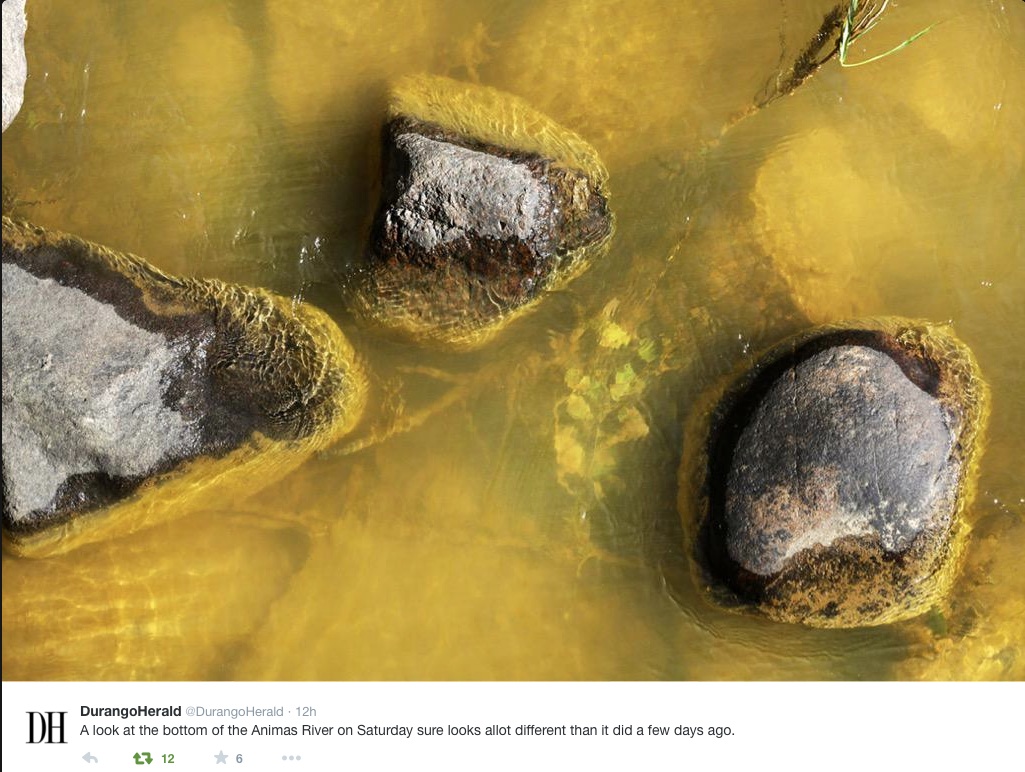
Bottom of Animas River at Durango August 8, 2015 via Twitter and The Durango Herald

From The Denver Post (Jesse Paul):

Environmental officials said Thursday their long-term concern after the 3 million-gallon Gold King Mine spill centers around the metallic sediment left in its wake.

Specifically, the Environmental Protection Agency says it is worried about the “effect of metals deposited in sediments in the entire watershed and their release during high-water events and from long periods of recreational use.”

The EPA mentioned the concerns as part of a data release accompanying 77 pages of documents chronicling the minutes and hours before and after the agency-triggered spill…

Experts say metals lining the riverbed could continue to cause long-term effects for agriculture, aquatic life and other life-forms along the Animas River.

The EPA specifically has been studying concentrations of arsenic, cadmium, lead and mercury in surface water.

The acidic heavy metals that flooded into Cement Creek in Silverton and the Animas River through La Plata County after the spill initially broke state water quality limits.

The new data comes after the EPA on Wednesday released an internal review of the events leading up the Gold King spill showing crews underestimated waste pressure behind the mine’s collapsed opening.

The report called the underestimation of the pressure the most significant factor leading to the spill.

According to the report, had crews drilled into the mine’s collapsed opening, as they had done at a nearby site, they “may have been able to discover the pressurized conditions that turned out to cause the blowout.”

The real culprit in the #AnimasRiver spill — CNN

Colorado abandoned mines via The Denver Post

From CNN (Lauren Pagel):

If there is anything I have learned from the past 15 years of working on this issue, it’s that absent strong regulations and better-designed mines, mining companies will continue to pollute with impunity.

Earthworks estimates that there are over 500,000 abandoned and inactive hardrock mines strewn across the country, with a hefty price tag attached to their clean up — $50 billion, according to an EPA estimate.

Western communities face significant burdens associated with these old mines — ranging from a disaster from a failed cleanup like the one that occurred last week, to more persistent water pollution issues, and the ever-present danger of improperly secured underground mines that pose a serious threat to public safety. At least 40% of the streams feeding the headwaters of Western watersheds are polluted from mining. That’s because many mines — like Gold King — have significant acid mine drainage problems, which can persist for thousands of years if left untreated.

Unfortunately, in the 25 years since Earthworks first published our report on the legacy of abandoned mines, not much has changed. The reason for the lack of action is the antiquated law, 143 years old and counting, that still governs hardrock mining on public lands throughout the West.

President Ulysses S. Grant signed the 1872 Mining Law to help settle the West. And even though the West has surely been settled, this law is still on the books — unchanged. It allows corporations, foreign and domestic, to take public minerals, owned by us, the taxpayers, for free. It contains no environmental provisions, requires no cleanup after mining is over, and unlike the law governing coal mining, does not require hardrock mining companies to pay a fee to clean up the legacy of pollution.

This archaic law is why funds to clean up mines like Gold King remain limited, despite the magnitude of the problem, putting safe drinking water and our healthy environment at risk. A steady stream of long-term funding for hardrock mine cleanup, similar to the coal industry’s abandoned mine fee, is essential to dealing with the scope of the problems we face from mine pollution.

#AnimasRiver: Mine pollution and kicking the environmental can down the river — Mountain Town News

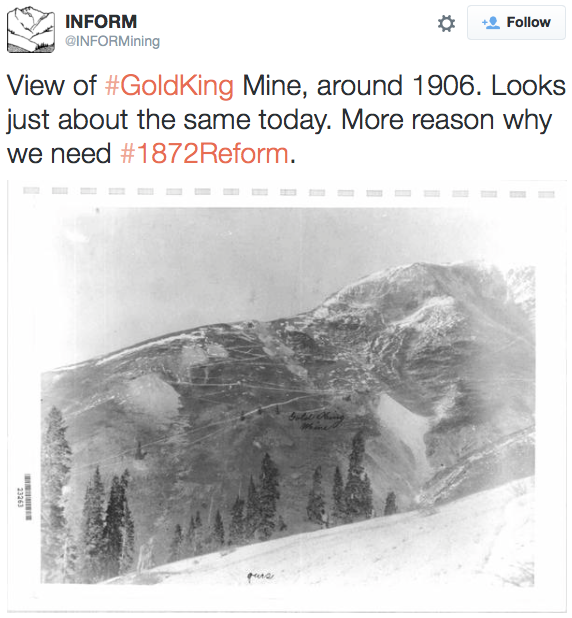
goldkingmine1906viainformtwitter

From The Mountain Town News (Allen Best):

Mustard-colored water in the Animas River of southwestern Colorado illustrates more than anything else the long gestation time of many environmental disasters.

The surge was unleashed last week by a contractor working for the Environmental Protection Agency who unwittingly breached a dike, allowing contaminated water backed up in the Gold King Mine to flood into Cement Creek, a tributary of the Animas. The images from the river downstream in Durango were appalling.

The makings for the disaster, however, began almost 130 years ago. Located seven miles north of Silverton at an elevation of 11,400 feet, the Gold King was among several big mines and mills clustered around a company town called Gladstone. The Gold King had a brief but productive life. The mine was staked in 1886 and the vein that made it a bonanza was identified in 1896. Until mine portals were shuttered in 1922, it produced $8 million in ore. That was more than a tenth of all production in San Juan County, according to “The Rainbow Route,” a railroad and mining history.

If a bonanza to owners, the mine was deadly to workers. Six people died of carbon dioxide drawn into the mine by a fire at the nearby boarding house. Another five people died in an avalanche, reports Scott Fetchenhier, an amateur historian and San Juan County commissioner.

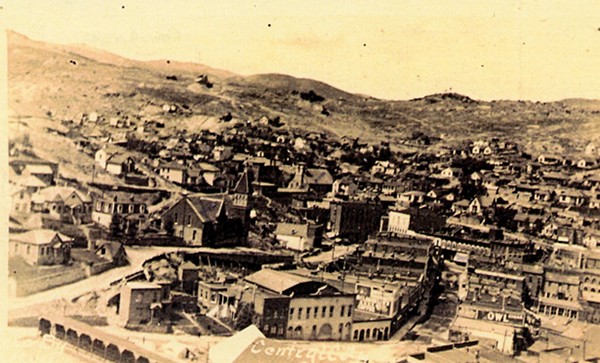
Central City back in the day

Mining can be hazardous to people living downstream, too. In the 1930s, farmers along Clear Creek, northwest of Denver, complained bitterly of their irrigation water being sullied by gold miners upstream at Central City and Blackhawk, to the detriment of their crops.

Eagle Mine
Eagle Mine

Even after state and federal laws were enacted, seeking to curb pollution, we’ve continued to cut corners. When mining ended in 1979 after a century at the Eagle Mine, located a few miles from Vail, Colo., a giant mess remained. Pollution made people uncertain whether they should eat fish caught in the Eagle River.

That question was soon answered. The settlement between the mining company and Colorado regulators assumed that sealing the mine would prevent water from flowing into the rivers. The experts were wrong. By early 1990, the Eagle River looked like Kool-Aid. The fish vanished. Belatedly, the EPA was called in and, after $100 million, the pollution has largely been cleaned up. However, heavy metals must continue to be removed from water in the mine before it gets into the river. The last time I checked, in the 1990s, the plant cost $1 million a year to operate. This will continue in perpetuity.

Summitville Mine superfund site

That cost near Vail is being borne privately, by a corporate conglomerate. Not so the $155 million cleanup at Summitville, an open-pit mine in southern Colorado where cyanide was used to extract gold from low-grade ore. After the mess became public, Galactic Resources filed for bankruptcy in 1992.

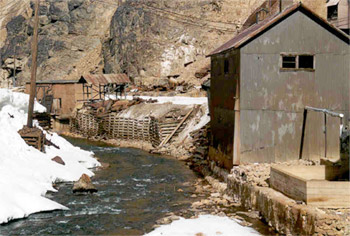
Bonita Mine acid mine drainage

Mines from around Silverton had been causing trouble long before this spill. The Silverton Standard & Miner had reported that water quality has worsened 2005. Four of five trout species in one area had vanished.

Since 1995, the non-profit Animas River Stakeholders Group has been working to address these legacy problems. It has been thwarted by absence of federal Good Samaritan legislation. Independent groups can’t afford to touch problems like the Gold King because, in case of accident, they “own the damages,” in the words of Ken Neubecker, of American Rivers, a conservation group. He explains that environmental communities worry that Good Samaritan legislation will allow big mining corporations to skip out on their responsibilities, such as occurred at Summitville.

The larger lesson derived from this giant mess in Silverton and Durango is that mining just doesn’t belong in headwaters areas, says Matt Rice, director of the Colorado River Basin program for American Rivers. He cites a copper-mining proposal for the Smith River in Montana. “Eventually, inevitably, the (contaminated) water will make it back to the river, whether it’s by catastrophic accident or a natural event,” he says.

I take a bigger view yet. Don’t blame the miners of 100 years ago. I have friends whose parents and grandparents worked at these mines near Silverton and Vail. They led hard lives.

But today we know better. We also know better than to pollute the atmosphere with reckless abandon, creating a bigger, denser greenhouse around the planet. Yet we keep doing it. People want 100 percent certainty. People complain about the costs. Right now, I’m wondering which would have cost more on the Animas River, prevention or cleanup.

From the Associated Press (Matthew Brown And P. Solomon Banda) via The Denver Post:

The spill of toxic wastewater from an abandoned gold mine high in Colorado’s San Juan Mountains caused untold millions in economic disruptions and damages in three states — to rafting companies, Native American farmers unable to irrigate, municipal water systems and possibly water well owners. And largely because the federal government inadvertently triggered the release, it has vowed to pay the bill.

That bill could be years in the making. Attorneys general from Colorado, New Mexico and Utah vowed to ensure citizens and towns are compensated for immediate and long-term damages from the spill. But Colorado’s attorney general, Cynthia Coffman, acknowledged it could be years before the full impact is known.

“We have to be vigilant as attorneys general, as the lawyers for the state, as protectors of the environment, to be sure that the assurances that we received today from the Environmental Protection Agency are the same in two years, in five years, even 10 years when we discover what the damage to the environment actually is,” Coffman said Wednesday after she and her counterparts gathered in Durango.

EPA administrator Gina McCarthy said her agency took full responsibility for the spill, which was unleashed Aug. 5 when an EPA-supervised crew accidentally unleashed the torrent of wastewater from the Gold King mine. The plume of heavy metals, including arsenic and lead, flowed into southwest Colorado’s Animas River and into the San Juan River in New Mexico.

McCarthy also said she had ordered agency personnel across the country to cease field investigation work on abandoned mines while the spill was investigated. EPA officials said they were seeking details on what the stop-work order means.

The Gold King spill was proving devastating to the Navajo Nation, which recently negotiated a settlement giving it rights to water from the San Juan River. The tribe plans to build a $20 million water treatment plant in northwestern New Mexico to take in the extra volume of water granted by the settlement and provide a clean drinking source to more of the 16,000 families on the reservation who still haul water to their homes.

Heavy metals already were present in the tribe’s underground aquifers, and “now those same things are dumped in the river,” complained Rex Kontz, deputy general manager for the Navajo Tribal Utility Authority. He said meeting EPA standards for clean drinking water could double the plant’s cost and require millions more in operating costs each year…

Current Colorado law requires a mining company to post a bond to cover the eventual cost of cleanup before a permit is issued to start operations, said Tony Waldron, supervisor of mine programs for the state Division of Reclamation, Mining and Safety. If the company fails to clean up the site when the mine closes, the state uses the bond to hire a contractor to do the work.

In most cases, the bonds have been sufficient to cover the cost of cleanup when mine operators don’t finish, Waldron said. The state has a fund it can use to make up the difference.

But the Gold King Mine isn’t covered because it was abandoned in 1923, before the law was in effect. In the absence of an owner, the federal government was working with local residents and the state to do limited mitigation work in the area around the Gold King mine — one of a cluster of old and polluted mines perched more than 11,000 feet high — when the spill occurred.

Cleanup costs alone can be staggering — and continuous.

Colorado tightened its bond requirements in the 1990s after the operator of the Summitville gold mine in southern Colorado, Summitville Consolidated Mining Co., declared bankruptcy and couldn’t complete a cleanup. Summitville became a federal Superfund site, with the EPA in charge.

The cleanup is ongoing because contaminated water continues to drain from the mine. The total cost to date is more than $100 million, according to the U.S. Geological Service.

Authorities said Wednesday that the waste from the Gold King spill will continue to be dangerous when contaminated sediment gets stirred up from the river bottom.

“There will be a source of these contaminants in the rivers for a long time,” said hydrologist Tom Myers, who runs a Nevada-based consulting business. “Every time there’s a high flow, it will stir it up and it will be moving those contaminants downstream.”

EPA spill liaison Nat Miullo suggested the danger from the spill had diminished with the dissipation of the initial burst of tainted water. Any future spike in contaminant levels caused by stirring up sediments would be “much, much smaller in scale,” he said.

But environmental regulators in downstream New Mexico warned that it was crucial to determine where the contamination settles.

“Those are some of the longer-term issues that affect humans as well as wildlife,” New Mexico Environment Secretary Ryan Flynn said.

From The Denver Post (Jesse Paul):

Seven days after her agency’s massive mine wastewater spill into a major southwest watershed, the head of the Environmental Protection Agency said water quality in the Animas River through La Plata County has “returned to pre-event conditions.”

Administrator Gina McCarthy, in a boots-on-the-ground appearance Wednesday in Durango that’s expected to continue Thursday in Farmington, N.M., called the Aug. 5 incident “heartbreaking” and said the EPA “couldn’t be more sorry.”

“Right now, rest assured, we will learn lessons from this, and we will move those lessons forward in the work moving ahead,” she said of the spill of 3 million gallons at the Gold King Mine near Silverton.

In a 15-minute news conference, McCarthy said cleanup operations at similar mines throughout the country have been “put on hold” until the EPA determines how the Gold King accident happened. Speaking outside a command center, McCarthy said the EPA plans to solicit an independent investigation of the calamity.

Not satisfied

Some Durango residents are angered that McCarthy is neither planning a trip to the Gold King Mine nor holding a public meeting. EPA officials and McCarthy said the mine — roughly a 55-mile trip, some of it over unpaved road — was too far to visit.

“As you know, it is a significant distance away, but I did visit the river. I took a look at it myself to get a sense of the river,” McCarthy said. “And I think the good news is it seems to be restoring itself, but we have continued work to do and EPA is here.”

Her appearance came after Colorado’s senators and the congressman representing Durango-area residents urged her to visit the impacted areas.

“The most important thing for me, for this trip, was to come to the unified command center,” she said, citing a necessity to meet with local and state officials to ensure that their needs are being fulfilled.

“That is my first order of business,” she added…

Just before McCarthy addressed the media Wednesday afternoon, members of the Colorado and New Mexico congressional delegations released a letter they sent to President Barack Obama requesting federal resources. In the letter, the group also said the federal government should explore creating a water-treatment plant in the Upper Animas River to remove heavy metals from the watershed at its source.

While the EPA says it’s treating contaminated water still flowing from the Gold King Mine, three adjacent mines continue to release more than 540 gallons per minute of waste laced with heavy metals.

Looking ahead

Asked about what politicians across the Southwest have complained was a slow response by the EPA to notify the public of the spill, McCarthy said, “We will address those issues as we look at the investigation. … .

“The most important thing is we are moving forward. We are fully ramped up. We have data coming in. We can assess that data.”

Wednesday afternoon, the Colorado Department of Public Health and Environment informed the city of Durango that “drinking water treatment facilities can begin to use the Animas River to collect and treat water for customers.”

The Animas River in La Plata County, including Durango, remains closed by authorities. The county sheriff’s office has not said when it will reopen the water. Meanwhile, local businesses that rely on the Animas’ flow remain shuttered.

EPA officials Wednesday said the plume of contaminants is approaching Lake Powell in Utah and that apparatus are in place there to conduct testing.

“We are already there,” McCarthy said.

Utah Gov. Gary Herbert on Wednesday declared a state of emergency, saying his state has mobilized resources.

A spokeswoman for the San Juan Basin Health Department on Wednesday said results of water testing on private wells in the area have not been returned but are expected “very soon.” A county spokeswoman says the EPA is paying for the tests.

The department earlier this week said a call center set up to answer questions and take requests for well testing was “overwhelmed.” Samples have been sent to labs in Denver and Georgia.

Restoration: There’s been a lot of progress on the Alamosa river, late season flows deal in the works

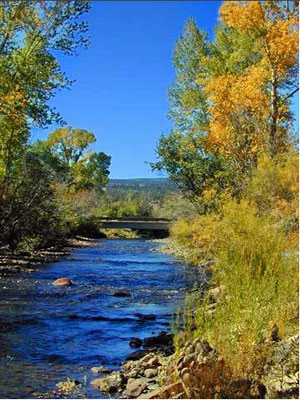
alamosariver

From The Pueblo Chieftain (Matt Hildner):

A river once left for dead by mine-polluted runoff in the southwestern corner of the San Luis Valley is coming back to life.

The Alamosa River, which once included a 17-mile dead-zone thanks to the Summitville gold mine, has seen the return of fish and a local group is seeking to keep it that way by adding to the river’s flows.

“We still have a ways to go but we’ve done a lot,” said Cindy Medina, head of the Alamosa Riverkeepers.

The group is close to finalizing a pair of in-stream water rights in court that could add as much as 550 acre-feet per year to the river below Terrace Reservoir where it runs to the valley floor.

That amount, which translates to roughly 180 million gallons, would be stored in the reservoir and released during times of the year when flows are low to nonexistent.

Last week, the Colorado Water Trust honored Medina for her work on the Alamosa with the David Getches Flowing Waters Award.

Key to the in-stream flows, which also would boost groundwater levels in the area, was the cooperation of the Terrace Irrigation Co., which has made storage space available in the reservoir.

Medina also credited landowners along the river like Joe McCann and Rod Reinhart.

“Both of them have been instrumental in this project,” she said. Reinhart, who grows alfalfa and barley north of Capulin, said he came to understand the importance of riparian habitat and how the in-stream flows could help.

But the importance of how they might help the aquifer also was important given the looming groundwater regulations that might face the valley.

“I think that is huge,” he said. “That’s a big help.”

The need for the restoration on the river and part of the means to do so, stem from the legacy of the Summitville gold mine, which sits at an elevation of 11,500 feet on a tributary.

Summitville Mine superfund site

In 1986, the Summitville Consolidated Mining Company began operation of an open-pit mine on 1,200 acres and used a cyanide formula to extract gold from ore.

A faulty liner meant to contain the cyanide and a company-installed water treatment plant that was far too small ensured high levels of pollutants migrated downstream.

By 1990, fish were gone from the reservoir and the stretch of river above it.

After six years of operation, the company declared bankruptcy and abandoned the site, forcing the Environmental Protection Agency to take over emergency management of the property.

The mine was designated a Superfund site in 1994.

Prosecution of the mining company led to a $28.5 million settlement, $5 million of which was set aside for restoration work in the watershed.

The work of the riverkeepers to increase stream flows is one of the legacies of that funding.

Water quality on the river improved after the Superfund designation, enough so that state wildlife officials began stocking trout in the reservoir in 2007.

In 2011, a permanent treatment plant was built with $19.2 million in federal stimulus funding.

“That improved the water quality significantly,” Medina said.

One year later, the Colorado Department of Public Health and Environment lifted restrictions on the consumption of trout in Terrace Reservoir.

Medina is among those who have eaten trout from the reservoir.

“They’ve come out fine,” she said.

But the riverkeepers hope to add more water to the river, by buying water rights from others.

Their goal is to reach 2,000 acre-feet of in-stream flows.

“We’re always looking for more water for the river,” she said.

More restoration/reclamation coverage here.

Comments on new Cotter Mill plan due August 1

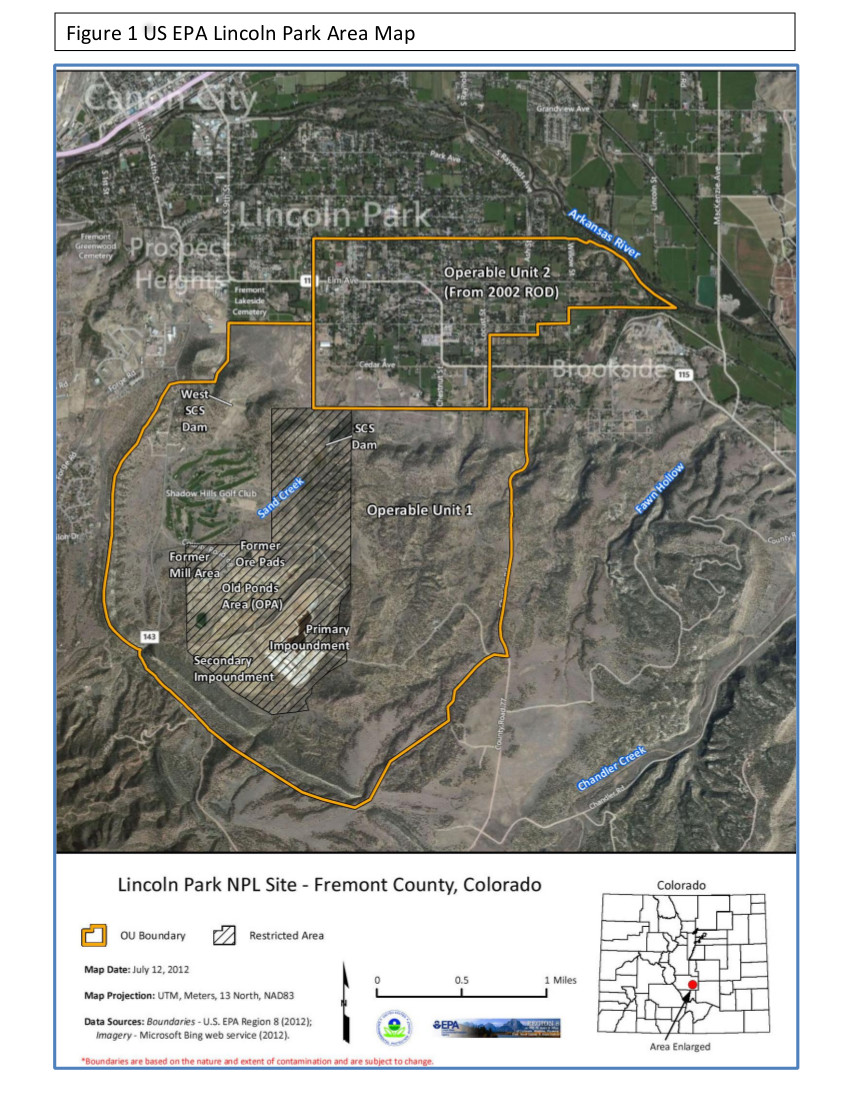
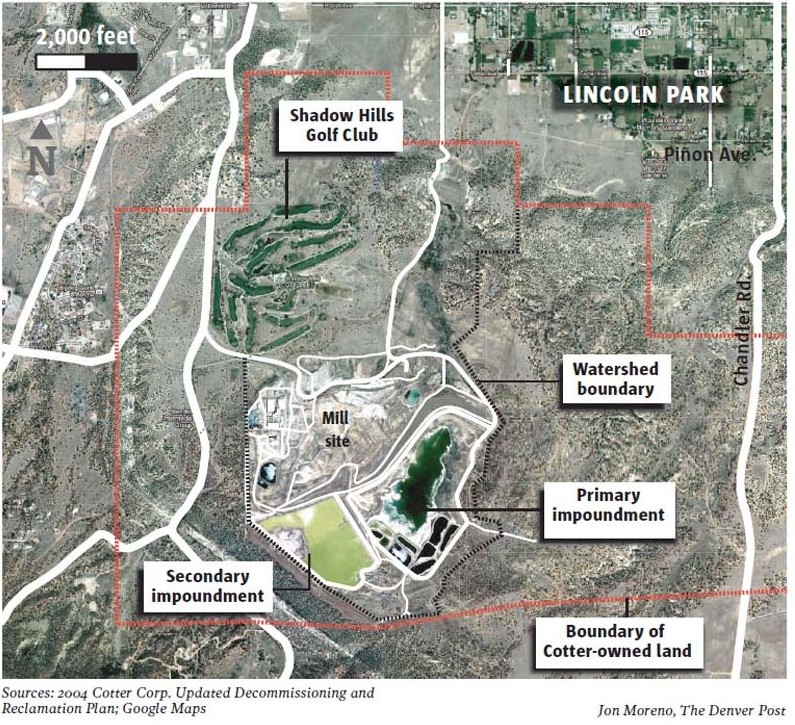
Lincoln Park/Cotter Mill superfund site via the Environmental Protection Agency

From The Pueblo Chieftain (Tracy Harmon):

State and federal health officials are inviting the public to submit informal preliminary comments on the Cotter Corp. Uranium Mill’s Draft Quality Management Plan.

The 53-page plan outlines quality assurance, training, implementation of work, record keeping, response and corrective action protocols for the now-defunct mill as it moves toward decommissioning. The mill has been an EPA Superfund site since 1984 due to the seeping of uranium and molybdenum contamination into groundwater and soil which was caused by the use of unlined tailings ponds.

The draft plan can be viewed on the state’s Cotter website at http://recycle4colorado.ipower.com/Cotter/docspubreview.htm.

Comments can be sent to state health department project manager Jennifer Opila at Jennifer.opila@state.co.us. Deadline is Aug. 1.

More Lincoln Park/Cotter Mill superfund site coverage here.

California Gulch superfund site now 70% delisted

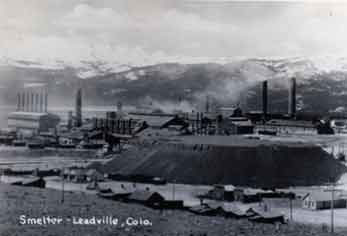
California Gulch back in the day

From the Leadville Herald Democrat (Marcia Martinek):

The EPA came to town on Thursday, Dec. 18, and it was a much-more cordial gathering than back in the 1980s when Leadville was first named a Superfund site. The occasion was to recognize the removal of Upper California Gulch, the Asarco Smelter/Colorado Zinc-Lead Mill site and the Apache Tailings from the Superfund National Priorities List. All are part of the California Gulch Superfund site.

The delisting of these areas, Operable Units 4, 5 and 7, from the Superfund list is said to be a major milestone in addressing mining contamination at the site.

Lake County Commissioner Mike Bordogna provided a timeline of the activity in California Gulch stretching from the time when gold was discovered in California Gulch in 1859 through 1983 when California Gulch was placed on the EPA’s National Priorities List to the current day and the most recent delistings.

EPA Regional Administrator Shaun McGrath said that of the 18 square miles that initially made up the Superfund site, seven of the 12 operable units have now been delisted, accounting for 70 percent of the area. He added that 90 percent of the construction work is now complete.

McGrath also used the occasion to present the Lake County Commissioners with an Environmental Achievement Award for Excellence in Site Reuse. Cited were three reuse projects within Lake County: the Mineral Belt Trail, the Lake County Community Park and soccer fields, and the restoration of the Upper Arkansas River, which recently received the Colorado Parks and Wildlife’s Gold Medal Designation for trout fishing.

Martha Rudolph, director of Environmental Programs, Colorado Department of Public Health and Environment, looked back to the “thorny days” of the Superfund site, saying “California Gulch was a challenge from the beginning,” so much so that no cleanup took place at the site for the first ten years.
Despite the adversity, she noted, “Everyone always had the same goal.”

Thirty years later relationships among the entities have improved. And today the Arkansas River has gone from an eyesore to a true gem, Rudolph said.
Along with the Lake County award, numerous people were recognized for their work over the years with the EPA.

History of California Gulch

Commissioner Mike Bordogna traced the history of California Gulch through the years at the delisting celebration held Dec. 18.

1859 – Gold discovered at mouth of California Gulch

1893 – Silver market crash

1983 – National Priorities List listing

1991 – Leadville Mine Drainage Treatment Plant began operations

1992 – Yak Treatment Plant began operations

1994 – Site divided into 12 operable units

1995 – Construction of the Mineral Belt Train began

2000 – Mineral Belt Trail completed

2001 – OU10 (Oregon Gulch) deleted from NPL

2002 – OU2 (Malta Gulch) deleted from the NPL

2005 – Remedy construction at OU11 (Arkansas River floodplain) began

2008 – Upper Arkansas River ranked most popular Colorado fishery

$20.5 million natural-resource damages settlement reached

2010 – OU11 (Arkansas River Floodplain) remedial work completed

OU8 (Lower California Gulch) deleted from the NPL:

2011 – OU9 (residential areas) deleted from the NPL

2014 – Gold Medal Trout Waters designation awarded

Lake County received Brownfields grant

OU4 (Upper California Gulch) deleted from the NPL

OU5 (ASARCO Smelter/Colorado Zinc-Lead Mill Site) deleted from the NPL

OU6 (Apache Tailings) deleted from the NPL

More California Gulch coverage here and here.

Former Cotter Mill employees to get compensation for job-related illnesses

Lincoln Park/Cotter Mill Site via The Denver Post

From The Colorado Springs Gazette (Tom Roeder):

Benefits for workers sickened by Cañon City’s atomic legacy will be outlined at a federal Department of Labor town hall Wednesday morning.

The department oversees a program designed to compensate nuclear workers for cancer and other maladies associated with mining, hauling and processing uranium. Over the years, dozens of workers at Cañon City’s Cotter Mill have claimed their illnesses were caused by exposure to uranium and other toxic substances.

Now, the federal government wants to make sure sick workers get paid.

“The goal of the meeting is to make current and former nuclear weapons workers living in Colorado aware of the program and to assist them in finding information to determine eligibility for available compensation and medical benefits,” the Labor Department said in a news release.

Miners hit massive uranium deposits along the Front Range in the 1950s and the mill in Cañon City was built to process it into “yellow cake” – uranium oxide – which can be refined into fuel for reactors and weapons parts.

Processing uranium, though, left the mill in Cañon City marred by toxic leach fields and tailing ponds that were later deemed to be a federal Superfund cleanup site.

The leaching left water contaminated with heavy metals and solvents in unlined storage ponds that continue to drive worries over groundwater contamination.

The site, under supervision from the Colorado Department of Health and Environment, has been at the center of a controversy over how to clean up the damage.

A settlement agreement reached over the summer says Cotter will pay for continued cleanup under state supervision.

Taking care of workers falls under the Labor Department, which has administered health care and compensation for nuclear workers since Congress in 1990 approved the Radiation Exposure Act.

The act offers lump-sum payments and health care coverage for those sickened by radiation work that fell under the federal Department of Energy.

In recent years, Labor Department experts have held regular meetings in Cañon City to advise workers on the payments.

More nuclear coverage here.

EPA Announces Partial Deletion of California Gulch Superfund Site from National Priorities List

From The Targeted News Service (Joann Vista) via 4-Traders.com:

The Environmental Protection Agency has issued a final rule announcing the deletion of the Operable Unit 4, Upper California Gulch; Operable Unit 5, ASARCO Smelters/Slag/Mill Sites; and Operable Unit 7, Apache Tailing Impoundment, of the California Gulch Superfund Site located in Lake County, Colorado, from the National Priorities List (NPL). This final rule is effective on Oct. 24…

This partial deletion pertains to the Operable Unit 4, Upper California Gulch (media of concern–waste rock and fluvial tailing piles); Operable Unit 5, ASARCO Smelters/Slag/Mill Sites (media of concern–slag and soil); and Operable Unit 7, Apache Tailing Impoundment (media of concern–tailing and soil), of the California Gulch Superfund Site (Site). Operable Unit 2, Malta Gulch; Operable Unit 8, Lower California Gulch; Operable Unit 9, Residential Populated Areas; and Operable Unit 10, Oregon Gulch were partially deleted by previous rules. Operable Unit 1, the Yak Tunnel/Water Treatment Plant; Operable Unit 3, the Denver & Rio Grande Western Railroad Company Slag Piles/Railroad Easement/Railroad Yard; Operable Unit 6, Starr Ditch/Penrose Dump/Stray Horse Gulch/Evans Gulch; Operable Unit 11, the Arkansas River Floodplain; and Operable Unit 12 (OU12), Site-wide Water Quality will remain on the NPL and is/are not being considered for deletion as part of this action. The EPA and the State of Colorado, through the Colorado Department of Public Health and the Environment, have determined that all appropriate response actions under CERCLA, other than operation, maintenance, and five-year reviews, have been completed. However, the deletion of these parcels does not preclude future actions under Superfund.”

For more information, contact Linda Kiefer, Remedial Project Manager, EPA, Region 8, 1595 Wynkoop Street, Denver, Colorado; 303/312-6689, kiefer.linda@epa.gov.

More California Gulch coverage here and here.

Final Cotter report released — The Pueblo Chieftain

From The Pueblo Chieftain (Tracy Harmon):

Federal public health representatives who studied health concerns for Lincoln Park Superfund site residents living near the Cotter Uranium Mill issued a final report last week. The 260-page report includes comments made by citizens following its initial 2010 release. Many of the comments from citizens indicated the report was confusing, so o’cials with the Agency on Toxic Substances and Disease Registry attempted to clarify some of the confusion.

The Cotter Uranium Mill processed yellowcake uranium from 1958 to 1987 before going into sporadic operations. The mill has not processed uranium since 2006 and Cotter officials, along with state and federal health officials, are working toward a full cleanup of the site which has been on the Environmental Protection Agency’s Superfund list since 1984.

The health report concludes that drinking water for many years from a private well that contains elevated levels of molybdenum and uranium could harm people’s health. Although nearly all residents who have contaminated wells have been hooked up to the city water supply, some still use the wells to irrigate.

During 2008 testing, one of the seven wells exceeded the drinking water standard for molybdenum. The owner of that well declined to be connected to the municipal water system, according to the report.

“The groundwater remains contaminated and the contaminant plume can migrate to previously uncontaminated wells. Therefore, a future potential pathway also exists for other private wells until the contamination is cleaned up and no one is drinking contaminated well water,” according to the report.

The State Engineer’s Office is required to tell all well applicants who want to drill for water that there is potential contamination.

The report also concludes that accidentally ingesting or touching soil or sediment in the Lincoln Park community will not harm people’s health.

“However, there is not enough information for the agency to determine if exposures to lead will harm people’s health in residential communities immediately northwest of the Cotter Mill,” the report indicates.

Although soil north and west of the Cotter Mill is contaminated with high levels of lead, there were no elevated levels of lead in the blood of children and residents tested.

The report also concludes that a person eating an average amount of homegrown fruits and vegetables defined as approximately 1cups per day will not experience harmful health effects. However, people who eat a lot of fruits and vegetables, defined as approximately 5 cups per day from their Lincoln Park gardens over a long period of years, may be at risk from exposure to arsenic.

The agency, “was unable to determine the source of the arsenic found in the fruits and vegetables; it could originate from natural sources. The agency recommends that residents who have gardens wash their homegrown produce thoroughly before eating it,” according to the report.

Finally, the agency’s report concludes that, “Air emissions of particle bound radionuclides have not resulted in exposures to the public at levels known to cause adverse health outcomes. Outdoor radon concentrations will not harm people’s health.”

“With the exception of thorium-230 levels observed in 1981 and 1982 that were associated with excavation of contaminated tailings, every radionuclide monitored has been more than a factor of 10 below annual dosebased health limits to the public. The excavation releases appear to have only exposed onsite workers, but that exposure still was below occupational limits at that time,” according to the report.

To view the final report, go to http://recycle4colorado.ipower.com/Cotter/Lincoln%20Park/140922lincolnparkpublichealthassessment.pdf.

From the Colorado Independent (Bob Berwyn):

When rainstorms sent a surge of muddy debris down Sand Creek late this summer, people living near the defunct Cotter Uranium Mill were thinking, “Here we go again!”

A big 1965 flood washed radioactive sludge toward the nearby Lincoln Park neighborhood, a foothill community near Cañon City where residents have horses and apples trees in their backyards. The plume of poisoned water spread underground. Fifty years later, there are still three wells in Lincoln Park where the uranium concentrations are above state standards set to protect human health.

This year’s late summer rainstorms gummed up critical pumps and pipes, part of a system built to prevent radioactive waste from escaping the polluted 2,600-acre Cotter property, which has been designated as a high priority federal Superfund cleanup site for the past quarter century.

The fact that a series of checks on dams and underground barriers showed they apparently worked the way they’re supposed to during the recent floods is small comfort to some Lincoln Park residents who worry about continued health risks and complain that state and federal regulators are still dragging their feet on the long-mandated cleanup.

“I realize the surface water is getting captured pretty well, but we’ve asked for better monitoring of groundwater, and we’ve been refused over and over again,” said Lincoln Park resident Sharyn Cunningham.

“We’ve asked them to do scientific studies to show there is no underground movement of water and they’ve refused numerous times,” she added, noting that uranium levels in the groundwater on the Cotter property are “horrendously high.”

In the wake of the most recent flooding, concerned locals say Cotter and the government officials tasked with overseeing the cleanup seemed to be defying a new state law that sets deadlines for inspections and reporting.

Kindergarten Rules

Cunningham and other residents want the U.S. Environmental Protection Agency and the Colorado Department of Public Health and Environment to lean on the Cotter Corporation harder to accelerate the cleanup effort. The company is a Denver-based subsidiary of General Atomics, a corporation with lucrative federal nuclear contracts. Cotter owns or controls 15 uranium and vanadium mines in southwest Colorado with an estimated 100 million pounds of ore. Watchdogs say the company has plenty of money to pay for a cleanup, and that big corporations — especially ones with government contracts — ought to play by the same simple kindergarten rules that apply to the rest of us.

“You make a mess, you clean it up,” said Travis Stills, an environmental attorney representing Colorado Citizens Against Toxic Waste. At the Cotter site — which is so close to Cañon City and upstream from the Arkansas River — the best option would be to dig up most of the toxic radioactive waste and move it to a geologically stable and remote site where it would pose the least threat to people and the environment, watchdogs say.

The mill started producing uranium oxide, or yellowcake in 1958 as part of the Cold War nuclear arms buildup. The concentrated uranium powder is the raw material for fissionable nuclear fuel. According to Cunningham, who curates an extensive library of documents related to the site, some of the waste came from the Manhattan Project, America’s WWII atom bomb effort.

Up until 1980, Cotter dumped radioactive waste into unlined ponds. It wasn’t until 1988, 30 years after Cotter started operation, that the state required the company to build a groundwater barrier to trap tainted water and pump it back up into evaporation ponds on its property.

Along with uranium, toxic materials at the Cotter site include radium, polonium, thorium and heavy metals like mercury, molybdenum, thorium and radioactive lead. Intermittently, Cotter processed those materials with other toxic chemicals, including nitric acid and hydrochloric acid — all combining into a poisonous brew. Many of the pollutants are known to have human health impacts, including an increased cancer risk.

“It makes fracking fluid look good enough to drink,” Stills said.

In 2010, monitoring revealed a potential new threat — volatile organic compounds had started showing up in the site’s groundwater. Specifically, testing detected Trichloroethylene, a known cancer-causing chemical used mainly as an industrial solvent, suggesting the chemical may have been introduced to the water as Cotter dismantled some of the old facilities on the site.

An updated federal health assessment completed earlier this month details potential health risks linked with exposure to the toxic materials stored at Cotter. The report was published by the U.S. Department of Health and Human Services, and includes a detailed timeline of the decades-long, on-and-off efforts to decontaminate property.

The Colorado Department of Public Health and Environment defends its work overseeing the cleanup, including diligent groundwater monitoring that shows the plume of contaminated groundwater beneath Lincoln Park has shrunk in recent years.

“We take our mission to protect public health and environment seriously,” said Warren Smith, the state’s liaison at the Cotter site. Smith said two inspections, on Aug. 25 and Sept. 23, showed no sign that contaminated water leaked off the property. Aside from the pumpback failure, he said the rest of the site’s containment system, including key dams, worked as intended during the recent floods.

“Cotter is required to report these incidents and they have been.”

Smith said there are three wells in Lincoln Park where the uranium concentration is above the state standard of 30 micrograms per liter. The concentrations in these wells are less than 40 micrograms per liter.

Snail-Paced Cleanup

Environmental concerns about the Cotter Mill are nothing new. The state started demanding a cleanup way back in 1983 by filing a complaint under the Superfund law, formally called the Comprehensive Environmental Response, Compensation, and Liability Act of 1980.

The Cotter Corporation challenged the move in court, setting the tone for decades of mistrust. Years of missteps and withheld information has done nothing to convince residents that the company is meeting its cleanup obligation, Stills said. This year’s breakdown of the pumpback system is just the latest in a long list of snafus at the mill site, including previous pipe failures 2010, 2012 and 2013.

“The same people have been making the same mistakes for decades,” said Stills, noting that the string of contaminated waste releases shows that state and federal oversight have been lax at best. As he sees it, Cotter has been gaming the system for 30 years, and that state health officials have played along.

“To me, it suggests consistent contempt by CDPHE staff for the community perspective,” Stills said.
The biggest concern is that the mill’s entire aging containment system could be vulnerable to catastrophic failure that could put thousands of people at risk. The site is about 1.5 miles north of Cañon City. The closest neighbor is a quarter-mile away. About 6,000 people live within about a two-mile radius of the mill, and about 20,000 people live within five miles.

About Time?

In July, Cotter Corporation, the Colorado Department of Public Health and the Environment and EPA signed a deal that spells out Cotter’s legal obligation to start working on a final cleanup plan. The agreement is a required step in the federal Superfund process. The public can comment on the proposed agreement until October 27 at Regulations.gov or in writing to by contacting EPA Enforcement Specialist Virginia Phillips.

“EPA is aware of recent incidents involving the pumpback system at the Cotter facility, including incidents related to flooding events and an occurrence of pipe damage which has since been repaired,” said Rich Mylott, a spokesman for the EPA, which will work with the CDPHE to investigate the pumpback system breakdown.

Cunningham and other residents are skeptical that the Cotter Corporation will do a thorough cleanup unless state and federal officials keep a close, diligent watch.

“The community doesn’t trust Cotter and CDPHE to do these things in private,” she said. “Two years ago, they promised us a roadmap toward cleanup, and we haven’t put one foot on that road yet.”

The Superfund cleanup deal may also have some loopholes.

Watchdogs want the state and feds to investigate what other companies besides Cotter may have contributed to contamination at the mine. That would help identify all the toxic materials at the site. They also want Cotter and government regulators to gather more detailed information on groundwater movement, including a tracer study, which involves adding a chemical marker to the water upstream, then monitoring when and where it appears downstream — a common way of tracking pollutants.

The EPA and the CDPHE are now on the same page on the Cotter cleanup so Cunningham is more hopeful that there will, someday, be a final resolution, said Cunningham, who lives less than a mile from the contaminated site.

Until then, she plans to keep watching the agencies closely. History has shown, she said, that somebody needs to keep watch and keep pressing for completion of the cleanup in the face of Cotter’s continued resistance and delays. Both Stills and Cunningham said they think the company has too much sway with regulators, who seem to be more responsive Cotter than to residents living near its mill’s mess.

“You just get up every day and do what you can,” Cunningham said. “This is a terribly contaminated site, and somebody has to make sure the authorities in charge are doing the right thing and are not just being influenced by Cotter.”

More Lincoln Park/Cotter Mill superfund site coverage here and here.

Public comment period open for Cotter Mill license

Lincoln Park/Cotter Mill superfund site via the Environmental Protection Agency

From The Pueblo Chieftain (Tracy Harmon):

Public comment is being accepted on the process of licensing the Cotter Corp. Uranium Mill until decommissioning is complete. A total of six new documents are available for comment until Sept. 16. The documents outline the radioactive materials license changes that Cotter officials will operate under while cleaning up the mill site.

The mill has not processed uranium since 2006 and Cotter officials, along with state and federal health officials, are working toward a full cleanup of the site which has been on the Environmental Protection Agency’s Superfund list since 1984. Although the state will not terminate the license until all decommissioning, remediation and reclamation activities are complete, provisions in the license need to change.

The site can no longer be used to produce yellowcake from uranium and only the Zirconium ore that already is on site will be allowed there. The cleanup of the site will address an impoundment that has been used to store tailings and the recently torn down mill buildings. Cotter officials have agreed to set aside a financial assurance of $17,837,983 to cover the cost of decommissioning activities. In addition, a longterm care fund will cover post-license termination activities. The $250,000 fund was created in 1978 and has grown to $1,018,243 through interest payments.

The documents pertaining to the license changes and a map of the Cotter Mill site can be viewed at http://recycle4colorado.ipower.com/Cotter/2014/14cotterdocs.htm. Comments should be sent to Warren Smith, community involvement manager for the state health department via email at warren.smith@state.co.us or mailed to Smith at Colorado Department of Public Health, 4300 Cherry Creek Drive South, Denver, CO 80246-1530.

More Lincoln Park/Cotter Mill superfund site coverage here and here.

The Resurrection Mining Co. files change of use on Twin Lakes shares to augment depletions at the Yak Tunnel treatment plant

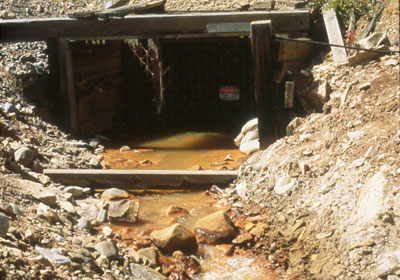
Yak Tunnel via the EPA

From The Leadville Herald (Danny Ramey):

The Resurrection Mining Company has filed for approval of an augmentation plan that would allow it to use water shares to replace water depleted from the Yak Tunnel and water treatment plant. Under the plan, the company would use shares it owns in Twin Lakes Reservoir to replace water depleted by its operations in California Gulch. Resurrection filed an application for approval of the augmentation plan with Division 2 of the Colorado Water Court on May 20.

Resurrection currently owns 22 shares of water in Twin Lakes. Twelve of those shares are included on a provisional basis, meaning Resurrection can remove those shares from the plan or use it for purposes other than what it was originally approved for.

In its plan, Resurrection estimates that depletions from its plant range from 3 to 7.7 acre feet of depletions a year. The plan seeks to augment five structures owned by Resurrection. Of those structures, only two cause water depletion, according to the plan. Water depletes from the Yak Surge Pond and the Yak Treatment Plant via evaporation, and some also leaves the treatment plant through the disposal of residuals used in water treatment. The water shares from Twin Lakes would be delivered to the intersection of Lake Creek and the Arkansas River under the plan.

ASARCO and Resurrection have been using water from Twin Lakes to replace depletion from their operations at the Yak since 1989. However, they have been doing so under substitute water supply plans, which expired June 14, 2014. Resurrection’s application would provide for a permanent water replacement plan. The application also asks the division to renew the substitute water supply plan.

Resurrection and ASARCO entered into a joint agreement to develop mine sites in the Leadville area in 1965. The Yak Treatment Tunnel was originally under title to ASARCO. However, when ASARCO went bankrupt, Resurrection assumed the title.

More Arkansas River Basin coverage here.

Clear Creek Courant series [Part 1] about the past, present and future of Clear Creek

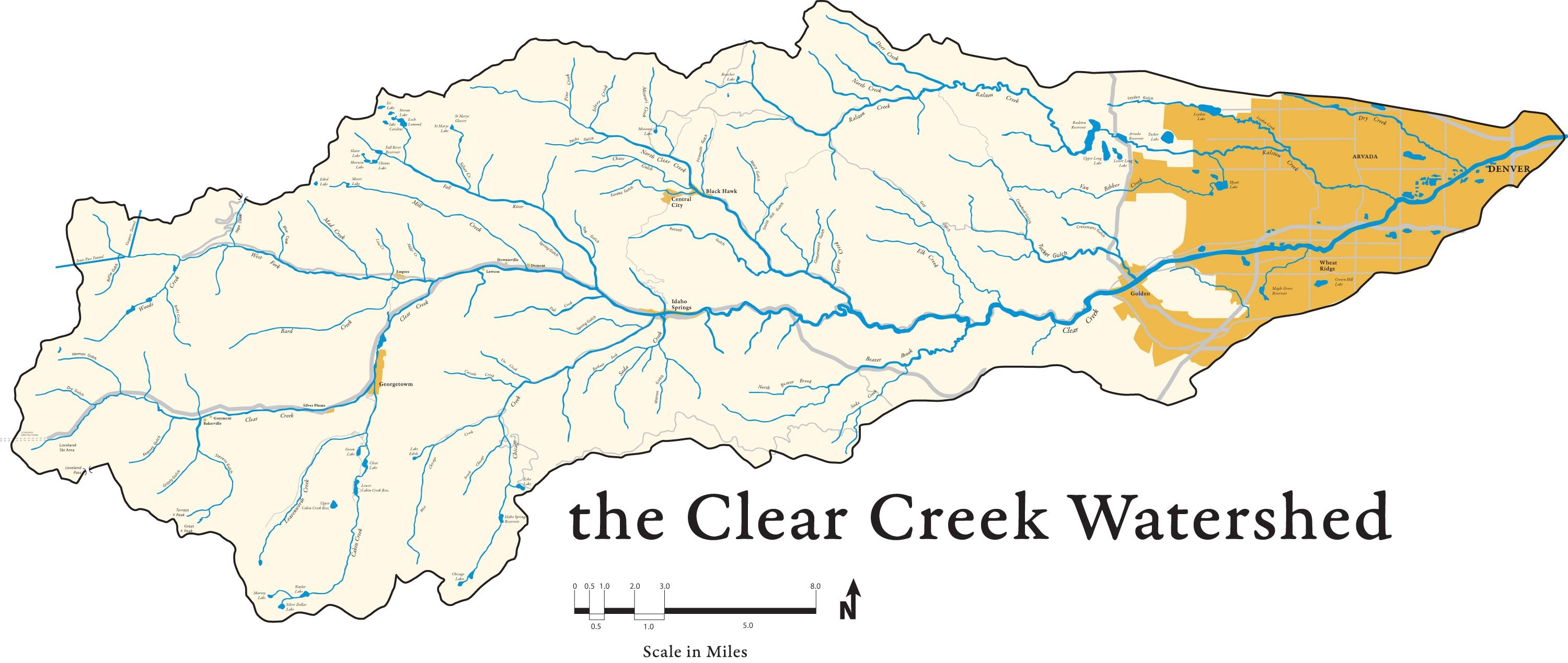
Graphic via the Clear Creek Watershed Foundation

Check out Ian Neligh’s retrospective about Clear Creek and the heydays of mining and logging (The Clear Creek Courant). Click through and read the whole thing. Here’s an excerpt:

Editor’s note:This is the first installment of a three-part series examining the past, present and future of Clear Creek…

Gold

There’s a monument in Idaho Springs hidden away in the parking lot of the former middle school. The giant boulder pays tribute to George Jackson, an adventurer and fortune hunter, who discovered gold in Clear Creek 155 years ago.

According to Don Allan, vice president of the Idaho Springs Historical Society, Jackson’s curiosity to follow the creek west into the mountains with only a couple of dogs by his side led to the country’s second largest gold rush.

Like a row of dominoes, Jackson’s discovery led to an onslaught of pioneers and ultimately in 1876 to the formation of a state.

“(Jackson) decided to go over and take a look down at the crick, and his curiosity brought him here to the confluence of Chicago Creek and Clear Creek,” Allan said. “When I talk with people about our community and how we got here, it was because of one man’s very good curiosity and a piece of gold.”

Jackson discovered gold in January, and by June, more than 400 people had settled in the area.

Natural hot springs drew more people into the area. Allan said in the Idaho Springs museum’s photography collection, there’s a photo of more than 50 employees standing in front of the hot springs.

“Once the stream was panned out, they panned all the gold out of the crick. Then they had to dig and make mining mills,” Allan said. “And this crick was integral to the milling of all the gold and silver in this area.”

The creek was used to support the mining industry such as the Mixel Dam in Idaho Springs, which was formed to help power mining mills and to create electricity. In 1864, silver was discovered to be the main mining mineral in Georgetown, and by 1877, the railroad reached Idaho Springs.

According to “A History of Clear Creek County,” the area at one point had 48 different towns with names such as Red Elephant, Freeland and Hill City. It is estimated that several thousand mines crisscrossed the mountains around Clear Creek as people sought their fortunes first along its banks and then in its mountains.

Those unlucky in gold sometimes found their way into the county’s second largest industry: logging. Early photos of the surrounding hillsides show them stripped of trees. But in time, the mining and logging industry waned, the frenzy slowed and the towns disappeared until there were only four municipalities left: Idaho Springs, Georgetown, Empire and Silver Plume. By World War II, the county’s mining industry has come almost to a complete halt.

But the stream once called Cannonball Creek, Vasquez Fork and lastly Clear Creek remained.

More Clear Creek watershed coverage here.

The Resurrection Mining Co. files change of use on Twin Lakes shares to augment depletions at the Yak Tunnel treatment plant

Yak Tunnel via the EPA

From The Pueblo Chieftain (Chris Woodka):

The Resurrection Mining Co. has filed its plan in water court to permanently replace flows to the Arkansas River water from its Yak Tunnel reclamation plant.

According to a court filing in May, the company plans to dedicate 10 shares of Twin Lakes water to flow down Lake Creek to replace the water it is capturing and cleaning at the Yak Tunnel plant and surge pond about 1 mile southeast of Leadville.

The water court application formalizes an arrangement that has been in place since Resurrection took over operation of the Yak Tunnel from ASARCO after a bankruptcy filing in 2005.

ASARCO began operating the Yak Tunnel plant in 1989 following federal court decisions that required mining companies to intercept and treat drainage from mine tunnels. Twin Lakes shares were leased until the company bought its own shares in 1994.

Depletions amounted to 3-7.7 acre-feet (1 million- 2.5 million gallons) annually from 2006-13. Replacement for those flows were replaced under a substitute water supply plan, an agreement administered by the state Division of Water Resources.

The tunnel, like others in the area, originally was drilled to dewater mines and increase productivity. However, the drainage includes heavy metals that diminish water quality and endanger wildlife. The surge pond captures water that escapes from tunnels and allows the water treatment plan The court filing assures that an operating plan is in place, regardless of how much water is needed in any given year to replace depletion.

More water pollution coverage here.

Denver Water recycled water for the Rocky Mountain Arsenal? CDPHE says not so fast.

Rocky Mountain Arsenal -- 1947
Rocky Mountain Arsenal — 1947

From The Denver Post (Bruce Finley):

Even with Colorado’s push to rely more on recycled water, the Rocky Mountain Arsenal National Wildlife Refuge will spend another summer using millions of gallons of Denver’s drinking water to fill lakes and irrigate fields after a recent decision by state health officials.

Federal wildlife biologists calculate they’re drawing more than 82 million gallons of Denver drinking water a year to fill three once-toxic lakes at the refuge, formerly a nerve gas and pesticides plant that became an environmental disaster.

“This refuge needs water, and using recycled water to fulfill a portion of our needs is a wise choice for the future,” refuge manager Dave Lucas said. Denver recycled water “meets our needs and allows millions and millions of gallons of drinking water to be put to better use by Denver residents.”

But the Colorado Department of Public Health and Environment last week reaffirmed its position that the refuge must go through a process of proving why it should be allowed to use water that is not as clean and submit to an Environmental Protection Agency review.

A $2.1 billion cleanup of toxic pollution included restoration of the lakes for catch-and-release fishing and to store water, which wildlife managers use to irrigate the 27-square-mile refuge — habitat for bison and other species.

Until the drought of 2002, High Line Canal agricultural water trickled into the lakes. Groundwater pumping added more water. CDPHE at some point — it was not clear when — reclassified the lakes as water supplies, and refuge managers made a deal with Denver to use drinking water, which started in 2008.

Then, in 2009, CDPHE reclassified the lakes as water bodies, meaning “an important social or economic development” reason for allowing lesser-quality water must be demonstrated. State officials, on an emergency basis in May 2013, agreed to remove the water supply classification on the refuge lakes but still require the proof of a public purpose before water quality can be reduced.

Frustrated refuge managers, backed by Denver Water and the Denver Museum of Nature & Science, have been pressing to use recycled water and putting in the plumbing to do so.

Denver Water has spent more than $197 million installing a citywide 80-mile network of pipelines that distribute partially treated recycled water to parks, golf courses and the Denver Zoo. The museum uses recycled water in its new heating and cooling system.

All sides agree that using more recycled water is a priority.

But CDPHE Water Quality Control commissioners on May 13 voted 5-4 to reject a request to reconsider — so the refuge must go through a “necessity of degradation demonstration” review to be able to use recycled water.

“We want to support use of recycled water. But we cannot do it by bending the rules,” CDPHE water quality standards chief Sarah Johnson said. “The best solution is for them to complete the necessity of degradation determination. It isn’t a heavy lift. We have promised to help.”

U.S. Fish and Wildlife Service managers of the refuge say the analysis for the review would not cost much but would require spending $10,000 to $15,000 a year more for water monitoring. They said new analysis would have to be done every three to five years, tied to permitting, creating uncertainty because state officials could ask for operational and infrastructure changes during reviews.

Lucas said even if they were to have something to present by the June commissioners’ meeting, it would be October at the earliest for the water switch if everything was approved.

Denver Water officials have been working aggressively since 2004 to increase use of recycled water, saving 7,000 acre-feet of drinking water a year, utility recycled water director Jenny Murray said.

Switching to recycled water at the refuge is the correct solution, Murray said. “It’s the right use because we are trying to preserve drinking water supplies for a growing population in a water-scarce region. Using drinking water for uses that do not require drinking water is wasteful.”

Denver Water attorneys in a May 6 letter to CDPHE argue that state lawmakers have ordered efforts to “encourage the reuse of reclaimed domestic wastewater.” Denver Water contends CDPHE decisions undermine state policy, waste public resources and defy common sense by imposing a needless bureaucratic burden.

One of Denver’s new recycled water pipelines runs by the Denver Museum of Nature & Science to the refuge. A steady, year-round flow of recycled water in that pipeline is required to ensure sufficient flow to run the museum’s innovative new geothermal heating and cooling system, which was funded by a federal grant to boost energy efficiency.

“When we designed our system three to four years ago, both Denver Water and the refuge folks felt that obtaining a permit to discharge recycled water into the lakes at the refuge would not be a problem,” said Dave Noel, museum vice president for facilities, capital projects and sustainability.

CDPHE’s stance “has got all of us scratching our heads,” Noel said.

Museum officials sent a May 8 letter to CDPHE arguing that “the loss of 17,000 acres of thriving wildlife and fish habitat due to lack of water would be a severe blow to the state and the Front Range, and simply does not make sense when a logical solution seems readily available.”

At the refuge, future water needs are projected as high as 456 million gallons a year. Beyond Denver Water, wildlife managers rely heavily on pumping water from underground aquifers into the Mary, Ladora and Lower Derby lakes — pumping they are trying to reduce by using more recycled water, which is cheaper than drinking water. They calculate the federal water bill could be cut by $30,000 a year.

A thriving bison herd is growing, with 11 calves born this spring, pushing the population to 81. An adult bison can eat around 50 pounds of grass a day. A team of biologists recently had to reduce the herd to prevent exhaustion of the short-grass prairie. Plans call for expanding bison habitat to allow a herd of 209 bison, which would roam up to the road to Denver International Airport, where a visitor viewing station is envisioned. Not having reliable recycled water will limit the bison herd and lead to decreased numbers of waterfowl, fish and grassland birds, Lucas said.

“We’re probably not going to irrigate this summer, which is bad for habitat restoration,” he said, “or we will have to drain down the lakes to irrigate.”

Lucas remains puzzled by the entire process.

“We’re talking about the same recycled water used everywhere. But somehow the refuge is different? Lots of smart people are looking at this, and no one can figure it out,” he said. “We engaged in this year-long process with hopes of fixing their error — the water supply change. Why would we want to engage in another unknown and uncertain process that will last months, if not years?”

More South Platte River Basin coverage here.

ASARCO hopes to tap into Union Pacific for some dough for Vasquez Blvd. & I-70 superfund site

unionpacificunit4065

From The Denver Post (Kirk Mitchell):

Asarco wants the Union Pacific Railroad Co. to pay for part of the cleanup of a Superfund site where arsenic leached into Denver groundwater from rail tracks.

A lawsuit before the 10th U.S. Circuit Court of Appeals says Union Pacific should reimburse Asarco for some of the $1.5 million environmental cleanup of 4 square miles near Vasquez Boulevard and Interstate 70 known as the Vasquez site, where gold, zinc, lead and other metals were smelted.

Asarco, a Phoenix-based mining and refinery company, has paid a total of $1.8 billion at 20 Superfund sites around the country, including the much larger Globeville site in north Denver.

In its lawsuit, Asarco claims that Union Pacific used mine tailings in rail beds traversing the Vasquez site. The tailings used to support the rail lines leached into surface and groundwater, resulting in elevated levels of arsenic and lead, the lawsuit says.

But Union Pacific met all of its financial obligations related to the Vasquez site in a court-approved June 2009 settlement between the railroad, the government and Asarco, said attorney Carolyn McIntosh, who represents the railroad.

“It was a full resolution,” McIntosh told a panel of three circuit court judges in Denver on Wednesday morning.

Pepsi-Cola Metropolitan Bottling Co., a New Jersey company that owns some of the property on the Vasquez site, also is named as a defendant in the lawsuit, which was filed in December 2012.

Asarco attorney Gregory Evans said the Vasquez site is just one of many around the country that Union Pacific polluted. He estimated that cleanup costs for all the sites would be in the hundreds of millions of dollars. “Union Pacific has negatively impacted human health and the environment through its use and abandonment of mining waste along (railroad tracks),” Evans said Wednesday.

Federal District Magistrate Judge Michael Watanabe previously has ruled that Asarco failed to file its lawsuit within the statute of limitations.

Asarco attorney Duncan Getchell said Watanabe erred because the effective date of the settlement involving Union Pacific and Pepsi-Cola is Dec. 9, 2012, when Asarco’s bankruptcy was finalized.

More water pollution coverage here.

2014 Colorado legislation: Cañon City residents are cautiously optimistic for results from SB14-192

Lincoln Park/Cotter Mill superfund site via The Denver Post

From The Pueblo Chieftain (Tracy Harmon):

Residents here are thankful for bipartisan legislation passed [by the Senate] Wednesday that will help clean up groundwater contamination by Cotter Corp.’s uranium mill. The legislation will ensure that uranium mills clean up ongoing contamination of residents’ groundwater as expeditiously as possible, with the best available technology. The legislation will help give direction to the state health department as it oversees the cleanup, according to Chris Arend of Conservation Colorado.

Residents of the Lincoln Park neighborhood just north of the Cotter Uranium Mill site have been hooked up to city water so they can avoid using wells that have been contaminated by uranium and molybdenum which seeped from the mill site.

The neighborhood and Cotter mill have been part of a Superfund cleanup site since 1984.

“For my Lincoln Park neighbors, forsaking our historic use of our water wells was never an option. We knew we needed to keep fighting for full and active cleanup of our wells, not only to restore our current rights but for future residents,” said Sharyn Cunningham, a Lincoln Park resident who is co-chair of Colorado Citizens Against Toxic Waste.

“After 30 years of contamination and indifference, the residents of Lincoln Park saw significant movement in their campaign for the Cotter Corp. to finally clean up its mess,” said Pete Maysmith of Conservation Colorado. “No community should have to endure the long-term exposure to uranium and other contamination as the community of Canon City has.”

Cotter officials, along with state and federal health officials, are overseeing decommissioning and full cleanup now that the mill is closed.

More 2014 Colorado legislation coverage here. More nuclear coverage here.

2014 Colorado legislation: SB14-192 passes the Senate #COleg

Lincoln Park/Cotter Mill Site via The Denver Post

From the Cañon City Daily Record (Christy Steadman):

The Colorado Senate passed Senate Bill 192 on Tuesday, which concerns uranium licensing and groundwater protection, but causes conflict between Cotter Corp. Uranium Mill and Lincoln Park residents.

In a press release issued by Conservation Colorado representative Chris Arend, residents of Lincoln Park “expressed support for (the) bipartisan legislation … that will help rectify 30 years of groundwater contamination by Cotter Corp.”

“The passage of SB 192 today will help restore our use and rights to our wells and begin to rectify the damage the Cotter Corporation has caused in our community,” Sharyn Cunningham, Lincoln Park resident said in the release.

John Hamrick, facility manager at Cotter Corp., said they have been in negotiations with the Environmental Protection Agency and the Colorado Department of Public Health and Environment to abide by the federal rules regarding “what is the best way” concerning clean-up. He said that is “now in jeopardy” because of SB 192, and a year-and-a-half of progress in the negotiation process will have to be discarded, and they will now have “to go back to zero.”

“(Additionally), the State of Colorado is federally preempted from passing a law that requires the EPA to select a specific clean-up remedy,” Hamrick said.

In the release, Lincoln Park resident Pete Maysmith said SB 192 “will help clean-up residents’ groundwater and restore the historic use of their water wells.”

“No community should have to endure the long-term exposure to uranium and other contamination as the community of Cañon City has at the hands of the Cotter Corp.,” Maysmith said.

Here’s a release from Conservation Colorado:

Impacted residents and members of the Colorado conservation community expressed support for bipartisan legislation passed today that will help rectify 30 years of groundwater contamination by Cotter Corporation in Canon City, Colorado. Residents of the Lincoln Park neighborhood in Canon City had been told that the best way to deal with Cotter’s pollution was for the community to abandon use of their wells.

“For my Lincoln Park neighbors forsaking our historic use of our water wells was never an option. We knew we needed to keep fighting for full and active clean up of our wells not only to restore our current rights but for future residents,” said Sharyn Cunningham, Lincoln Park resident. “The passage of SB 192 today will help restore our use and rights to our wells and begin to rectify the damage the Cotter Corporation has caused in our community.”

“Today after 30 years of contamination and indifference, the residents of Lincoln Park saw significant movement in their campaign for the Cotter Corporation to finally clean up its mess in Cañon City,” said Pete Maysmith. “No community should have to endure the long term exposure to uranium and other contamination as the community of Cañon City has at the hands of the Cotter Corporation. The legislation passed today will help clean up residents’ groundwater and restore the historic use of their water wells.”

Although pleased that contaminated water would be cleaned-up, supporters expressed concern that the Colorado Senate stripped out licensing requirements that would protect against future contamination.

“We are disappointed in Colorado Senate amendments to remove important protections for experimental uranium milling proposed for our community,” said Cathe Meyrick, resident of the Tallahassee Area in Fremont County. “The legislation would have clarified that licensing is required before the industry deploys experimental uranium recovery techniques with potentially grave impacts on our groundwater. Regardless of this setback, we will rely on a committed community and look for other mechanisms to protect our groundwater.”
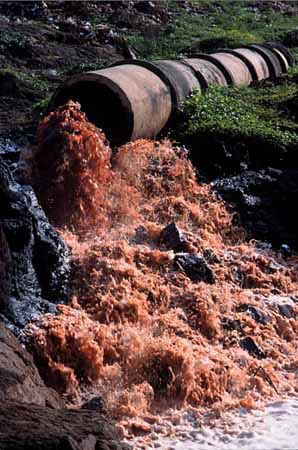
The proposed new technologies involve extraction through the creation of an underground uranium slurry (i.e., underground borehole mining) and concentration through physical, rather than chemical means (i.e., ablation). These new uranium recovery methods are being proposed for uranium deposits in Fremont County (Tallahassee Area/Arkansas River) and in Weld County (Centennial Project and Keota).

Both Conservation Colorado and impacted landowners in Fremont and Weld County will work to reinstate the provisions as the bill moves forward.

More nuclear coverage here.

The Animas River Stakeholders Group, et al., offer $45,000 prize in search for solutions to pollution

Bonita Mine acid mine drainage

From The Durango Herald (Chase Olivarius-Mcallister):

Last week, the regular meeting of the Animas River Stakeholders Group took on the feeling of a jolly, if intellectually fraught, Nobel Prize committee debate.

Scientists, government employees and mining officials huddled around a long table in the cold basement of the Miners Union Hospital grading innovative, sometimes preposterous proposals for addressing metal removal from mine drainage.

The ideas came from InnoCentive, a Boston firm that has hundreds of thousands of individual problem-solvers eager to take on challenges in chemistry, food production, business, engineering, information technology and the life sciences.

As part of the competition, the stakeholders described the environmental calamity in the Upper Animas Basin and offered $45,000 to the top problem-solver. (They raised the prize money from 12 organizations, including the International Network for Acid Prevention, Freeport-McMorRan Copper and Gold, Sunnyside Gold Corp., National Mining Corp., Goldcorp, New Mexico Coal and Trout Unlimited.)

As water quality in the Animas River has deteriorated over the last seven years, there has been insufficient money to build and operate a limestone water-treatment plant, which would cost $12 million to $17 million to build and $1 million to operate annually. Stakeholders are hoping that one brilliant solution could at least bring down the sticker price of river cleanup. (In the absence of an answer, the town is re-evaluating whether it should seek Superfund status.)

InnoCentive’s problem-solvers submitted online more than 50 proposals, with some more far-fetched than others, involving everything from absorption through plants, salting out metals, magnets, artificial river settling, cement, yeast, eggshell lime, plasma, brown coal, algae and Voraxial filtration…

As the stakeholders moved through the ideas, poring over a spreadsheet that had different stakeholders’ assessments of the schemes, expert opinion diverged many times.

While Kirsten Brown of the Colorado Division of Mining and Safety and Steve Fearn, mining specialist and co-coordinator of the stakeholders’ group, liked one proposal that involved removing heavy metals with magnets, Peter Butler thought “scaling and clogging would be an issue.”

Butler, co-coordinator of the stakeholders’ group, was more supportive of another proposal, artificial river settling, writing, “Could be an effective alternative to settling ponds. Separates metals somewhat.”[…]

They hope to choose the winner by May. When the winning idea might be implemented is unknown.

Confluence of Cement Creek and the Animas River via the USGS

Meanwhile there was a meeting Wednesday in Silverton to discuss potential Superfund designation to bring in federal dough and expertise. Here’s a prequel from Chase Olivarius-Mcallister writing for The Durango Herald. Here’s an excerpt:

For years, the Environmental Protection Agency has tried to designate parts of Silverton a Superfund site. Yet for years, many locals have considered the word “Superfund” dirtier than Cement Creek…

A series of abandoned mines in the Upper Animas Basin has been spewing toxic metals into the local water system for more than 20 years. Scientists say it’s the largest untreated mine drainage in the state, and problematic concentrations of zinc, copper, cadmium, iron, lead, manganese and aluminum are choking off the Upper Animas River’s ecosystem.

La Plata County Commissioner Gwen Lachelt said Silverton’s environmental calamity is “huge, affecting so many jurisdictions and communities. But it has felt like we were sort of at a stalemate.”

Lachelt said San Juan County commissioners now are leading the issue, not ignoring it.

“The La Plata County commissioners stand by the San Juan County commissioners in seeking out all of this information and seeking a rapid solution to this long-lingering problem,” she said. “I don’t think there’s one single reason it’s taken so long, and we’re certainly not there yet. But I think we’re seeing a lot of folks come together and realize we really don’t want to lose any more species of fish. We can’t afford to, and we have to act.”

‘Objections worn thin’

Since last summer, political pressure to find a solution in Silverton has escalated.

Rob Robinson, who used to represent the Bureau of Land Management within the Animas River Stakeholders Group, sent a letter and petition with 15 signatures in December to the EPA and the Colorado Department of Health and Environment urging a Superfund listing in Silverton. Robinson said for years he had kept faith that the Animas River Stakeholders Group’s collaborative process would work.

“I was a member of (the stakeholders) for many years and believed strongly in what they were doing: community-based, watershed-based cleanup. I guess it’s not gone so well,” he said. “In fact, it’s really disastrous when you compare the situation with what’s happened at other Superfund sites.”

Steve Gunderson, director of Colorado’s Water Quality Control Division, said he was “appalled” by what he saw when he toured the Red and Bonita Mine in 2012.

“This site, even though it’s complicated and remote, is in an incredibly beautiful part of the state. It may take a Superfund designation to bring the resources to bear,” he said.

But Gunderson said he doubts the EPA will “move forward with a Superfund designation unless there’s support with the local government because Superfund can be fairly controversial, and the first reaction is often angst about what the economic ramifications might be.”

Many Silverton residents interviewed by The Durango Herald last summer feared a Superfund designation would stymie tourism and soil the prospect of mining’s return.

“Superfund isn’t the answer,” said Steve Fearn, a co-coordinator of the Animas River Stakeholders Group and a town resident. “I want to see Silverton become a successful, vibrant community again. Right now, it isn’t, and mining is the one thing we have.”

But Robinson said such objections had worn thin.

“God, they’re the same positions they took 25 years ago! I think ‘Gee-whiz, it’s like a broken record, going on and on,’” Robinson said. “People like Steve Fearn argue a Superfund site will discourage mining investment. But the pollution is discouraging people from mining.

“What Steve Fearn says is immaterial. What’s important is that the Clean Water Act promises to clean up the nation’s water, making it all swimmable, fishable. That’s the goal, and the people administering … Superfund aren’t doing their job,” he said. “That’s the problem.”[…]

In the absence of a Superfund designation, for years, the stakeholders group has tried to work collaboratively with the EPA and Sunnyside Gold Corp. to improve water quality in the Animas River.

However, water quality recently has gotten much worse in the river.

Between 2005 and 2010, three out of four of the fish species that lived in the Upper Animas beneath Silverton died. According to studies by the U.S. Geological Survey, the volume of insects and the number of bug species have plummeted. And since 2006, USGS scientists have found that the water flowing under Bakers Bridge – then downstream, into Durango – carries concentrations of zinc that are toxic to animal life.

The technology to clean the dirty water exists: a limestone water treatment plant. But the stakeholders group has no money to pay for it, and the EPA estimates it would cost between $12 million and $17 million to build and $1 million a year to run – in perpetuity.

Sunnyside Gold Corp., the last mining company to operate in Silverton, denies all liability for cleaning up the worsened metal pollution. It has offered $6.5 million in return for being released from all liability. Kinross Gold Corp., an international mining conglomerate, bought Sunnyside in 2003. The company generated nearly $1 billion in revenue in 2013, according to its fourth-quarter report…

On Monday, within hours of commissioners announcing that most of their Wednesday meeting would be dedicated to discussing Superfund with the EPA, Larry Perino, Sunnyside’s representative in the stakeholders group, sent co-coordinators Fearn, Bill Simon and Peter Butler a letter proposing the company’s “game plan” for cleaning up the Animas River.

The plan centers on all parties continuing to work through the stakeholders group, bulkheading the Red and Bonita Mine and using the money Sunnyside already has promised – with compound interest. The plan does not include pursuing Superfund listing…

More Animas River watershed coverage here and here.

Cotter and the CPDHE are still trying to work out a de-commissioning agreement for the Lincoln Park/Cotter Mill superfund site

Lincoln Park/Cotter Mill Site via The Denver Post

From The Denver Post (Bruce Finley):

A broken pipe at Cotter Corp.’s dismantled mill in central Colorado spewed 20,000 gallons of uranium-laced waste — just as Cotter is negotiating with state and federal authorities to end one of the nation’s longest-running Superfund cleanups.

Colorado Department of Public Health and Environment officials said last weekend’s spill stayed on Cotter property.

In addition, uranium and molybdenum contamination, apparently from other sources on the Cotter property, has spiked at a monitoring well in adjacent Cañon City. A Feb. 20 report by Cotter’s consultant said groundwater uranium levels at the well in the Lincoln Park neighborhood “were the highest recorded for this location,” slightly exceeding the health standard of 30 parts per billion. State health data show uranium levels are consistently above health limits at other wells throughout the neighborhood but haven’t recently spiked.

“This isn’t acceptable,” Fremont County Commissioner Tim Payne said of the spill – the fourth since 2010. “(CDPHE officials) told us it is staying on Cotter’s property. But 20,000 gallons? You have to worry about that getting into groundwater.”
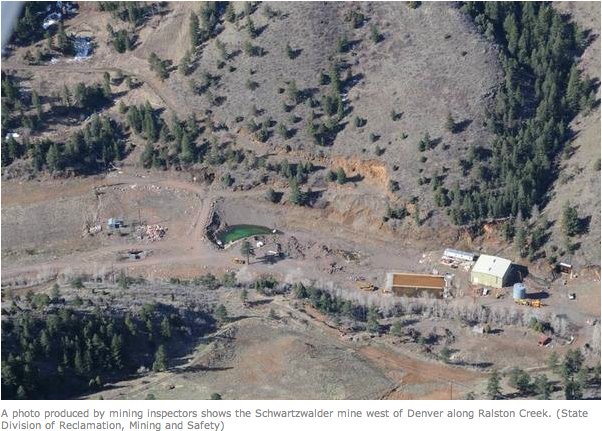
Environmental Protection Agency and CDPHE officials are negotiating an agreement with Cotter to guide cleanup, data-gathering, remediation and what to do with 15 million tons of radioactive uranium tailings. Options range from removal — Cotter estimates that cost at more than $895 million — or burial in existing or new impoundment ponds.

Gov. John Hickenlooper intervened last year to hear residents’ concerns and try to speed final cleanup.

Cotter vice president John Hamrick said the agreement will lay out timetables for the company to propose options with cost estimates.

The spill happened when a coupler sleeve split on a 6-inch plastic pipe, part of a 30-year-old system that was pumping back toxic groundwater from a 300-foot barrier at the low end of Cotter’s 2,538-acre property, Hamrick said.

Lab analysis provided by Cotter showed the spilled waste contained uranium about 94 times higher than the health standard, and molybdenum at 3,740 ppb, well above the 100-ppb standard for that metal, said Jennifer Opila, leader of the state’s radioactive materials unit.

She said Cotter’s system for pumping back toxic groundwater is designed so that groundwater does not leave the site, preventing any risk to the public.

In November, Cotter reported a spill of 4,000 to 9,000 gallons. That was five times more than the amount spilled in November 2012. Another spill happened in 2010.

At the neighborhood in Cañon City, the spike in uranium contamination probably reflects slow migration of toxic material from Cold War-era unlined waste ponds finally reaching the front of an underground plume, Hamrick said.

“It is a blip. It does not appear to be an upward trend. If it was, we would be looking at it,” Hamrick said. “We will be working with state and EPA experts to look at the whole groundwater monitoring and remediation system.”

An EPA spokeswoman agreed the spike does not appear to be part of an upward trend, based on monitoring at other wells, but she said the agency does take any elevated uranium levels seriously.

The Cotter mill, now owned by defense contractor General Atomics, opened in 1958, processing uranium for nuclear weapons and fuel. Cotter discharged liquid waste, including radioactive material and heavy metals, into 11 unlined ponds until 1978. The ponds were replaced in 1982 with two lined waste ponds. Well tests in Cañon City found contamination, and in 1984, federal authorities declared a Superfund environmental disaster.

Colorado officials let Cotter keep operating until 2011, and mill workers periodically processed ore until 2006.

A community group, Colorado Citizens Against Toxic Waste, has been pressing for details and expressing concerns about the Cotter site. Energy Minerals Law Center attorney Travis Stills, representing residents, said the data show “the likely expansion of the uranium plume, following the path of a more mobile molybdenum plume” into Cañon City toward the Arkansas River.

The residents deserve independent fact-gathering and a proper cleanup, Stills said.

“There’s an official, decades-old indifference to groundwater protection and cleanup of groundwater contamination at the Cotter site — even though sustainable and clean groundwater for drinking, orchards, gardens and livestock remains important to present and future Lincoln Park residents,” he said. “This community is profoundly committed to reclaiming and protecting its groundwater.

More Lincoln Park/Cotter Mill superfund coverage here.

Lincoln Park/Cotter Mill: New spill contained onsite

Lincoln Park/Cotter Mill superfund site via The Denver Post

From The Pueblo Chieftain (Tracy Harmon):

For the second time in five months, Cotter Corp. Uranium Mill officials have discovered a leak of contaminated water, but both spills reportedly were contained on-site. On Monday, Cotter personnel reported to Colorado Department of Public Health officials a release of greater than 500 gallons of water from the barrier system pump-back pipeline. The water spilled was contaminated groundwater recovered by the barrier system and being pumped back to the facility.

The spill was discovered at 8 a.m. Monday and mill personnel were last on-site at approximately 4:30 p.m. Friday. The spill did not result in contaminated materials leaving the Cotter property. More information will be provided as the investigation continues, according to Deb Shaw, health department program assistant. A similar spill occurred in November when between 4,000 and 9,000 gallons of contaminated water seeped from the same pipeline.

Contaminated water usually is pumped, along with groundwater, to an on-site evaporation pond to prevent further contamination in Lincoln Park, which has been a part of a Superfund cleanup site since 1988. The now-defunct mill is in the process of decommissioning and has not been used to process uranium since 2006.

From The Pueblo Chieftain (Tracy Harmon):

More details have emerged in connection with a Cotter Corp. Uranium Mill leak of contaminated water which occurred over the weekend south of town. State health officials reported Tuesday that about 20,000 gallons of the contaminated water leaked from the pump-back system pipeline.

“Analytical results show that the water contained 2,840 micrograms per liter of uranium and 3,740 micrograms per liter of molybdenum. For comparison, the groundwater standard in Colorado for uranium is 30 micrograms per liter and for molybdenum is 100 micrograms per liter,” said Deb Shaw, program assistant for the state health department.

At those concentrations of contamination the spill is not reportable to the National Response Center because the quantity is below 10.3 million gallons, Shaw said.

The contamination did not seep off of Cotter property.

More Lincoln Park/Cotter Mill superfund site coverage here and here.

Lincoln Park/Cotter Mill superfund site: 9,000 gallon spill contained on mill property

Lincoln Park/Cotter Mill site via The Denver Post

From The Pueblo Chieftain (Tracy Harmon):

Cotter Corp. Uranium Mill officials on Tuesday discovered contaminated water escaped a pump-back system at the mill site but the spill has been contained to the mill property. According to Warren Smith, community involvement manager for the state health department, the release of contaminated water was limited to between 4,000 and 9,000 gallons. The leak occurred at the junction of two pipe sections near the Soil Conservation Service pump back site, which is designed to prevent contaminated surface water from seeping into the neighboring Lincoln Park neighborhood.

“The soil in the area of the release is saturated. It will be allowed to dry so the pipe can be excavated and repaired,” Smith said.

Water samples were analyzed and based on concentration levels present, the maximum estimated release of uranium is limited to 1.1 ounces and the estimated molybdenum release is 2.6 ounces.

Contaminated water usually is pumped, along with groundwater, to an onsite evaporation pond to prevent further contamination in Lincoln Park, which has been a part of a Superfund cleanup site since 1988. The now-defunct mill is in the process of decommissioning and has not been used to process uranium since 2006.

From the Colorado Independent (Shelby Kinney-Lang):

Cotter Corporation informed the health department of the leaking pipes on Tuesday in a “verbal report” delivered over the phone. No health department personnel have inspected the spill site, as yet, and no formal report has yet been filed. Cotter said it will let the contaminated ground dry before excavating and repairing the pipe…

“We’ve got a company looking to walk away from a problem without actually cleaning it up,” said Travis E. Stills, an energy and conservation lawyer who has been working with community groups in Cañon City since the mid-2000s. Stills represents Colorado Citizens Against Toxic Waste on several ongoing state open records suits that seek information that passed between Cotter, the state health department and the Environmental Protection Agency concerning the uranium mill and the Lincoln Park Superfund Site, but which health department withheld from public review.

Uranium is extraordinarily toxic. The health department reports that if the pipe did in fact leak 9,000 gallons, the concentration in the water of uranium would be 834 micrograms per liter and the concentration of molybdenum, also a toxic chemical, would be 2,018 micrograms per liter. For perspective, the EPA places the health safety level of uranium at 30 micrograms per liter…

“They got a hole in the pipe and it leaked back into the ground,” he said.

Warren Smith, community involvement manager in the Hazardous Materials and Waste Management Division of the department, insisted there was no danger to public health.

“There is no public health risk here, because there is no exposure to the public,” Smith said. “Health risk depends on two factors: the release and exposure. If there’s no receptor to be exposed to it, where’s the risk?”

Smith said that the health department performs regular inspections of the Cotter site. The most recent was a September inspection. Because the pipe was buried, Smith said it would be a stretch to “characterize it as an [inspection] oversight.”

Smith said it would be a serious lapse if Cotter had failed to report the spill. Inspections don’t occur often enough for the state to have happened upon the spill any time soon.

More Lincoln Park/Cotter Mill superfund site coverage here and here.

Lincoln Park/Cotter Mill superfund cleanup: Cotter wants to reduce the frequency of groundwater monitoring

Lincoln Park/Cotter Mill Site via The Denver Post

From The Pueblo Chieftain (Tracy Harmon):

Public comment is being sought on a Cotter Corp. uranium mill proposal seeking to reduce the frequency of groundwater monitoring on 11 new wells. The state health department has preliminarily approved the request and will take public input before making a final decision. Cotter Corp. Mill Manager John Hamrick indicated more than a year’s worth of sampling has been amassed on 11 new wells, which were dug in late 2011 to help establish the extent of groundwater contamination.

“Once we’ve established 12 months of measurements, we generally move to quarterly sampling as we do with all the other wells,” Hamrick explained.

The mill and a portion of the neighboring Lincoln Park community have been an EPA Superfund site since 1988 due to uranium and molybdenum contamination in groundwater and soils. Groundwater is not used by residents in the contaminated area of Lincoln Park as they all have been connected to the city water supply.

Hamrick said the average uranium value for each of the new monitoring wells is below the Colorado Groundwater Quality Standard. Only three wells have exceeded the standard for uranium — one six times, another twice and the third just once.

The average molybdenum concentration for most of the new wells also was below the state standard and only three wells have exceeded that standard out of 115 samples.

The state health department reviewed the request as did the Cotter Community Advisory Group. Regulators feel, “Significant baseline data” has been collected to allow for quarterly monitoring instead of monthly, said Jennifer Opila, unit leader for the state heath department’s radioactive materials division.

Public comment will be accepted Monday through Sept. 13. Comments can be sent to Warren Smith, community involvement manager, via email at warren.smith@state.co.us or by calling 303-692-3373.

More Lincoln Park/Cotter Mill coverage here and here.

Lincoln Park/Cotter Mill: Cleanup awaiting state go ahead

cottergroundwatercontaminationlocation.jpg

From The Pueblo Chieftain (Tracy Harmon):

State health officials have preliminarily ordered Cotter Corp. Mill officials not to do any cleanup work pending future decommissioning and reclamation guidelines. Cotter Corp. Uranium Mill Manager John Hamrick had requested permission to excavate the ore pad area after uranium ore was removed and shipped to the White Mesa Mill in Blanding, Utah.

The state health department’s Jennifer Opila, unit leader, said although an earlier work pause has been lifted, Cotter will not be authorized to proceed with, “New decommissioning or reclamation activities.” She said the decision to deny the request was made after health officials and the Community Advisory Group discussed the issue. The public is invited to comment on the state’s preliminary decision.

Comment will be accepted Monday through Sept. 20. The public also can comment during the same time frame on completion reports for Lincoln Park water wells.

More Lincoln Park/Cotter Mill coverage here and here.

Lincoln Park/Cotter Mill: Public comments sought on proposal to reduce the frequency of groundwater monitoring

cottergroundwatercontaminationlocation.jpg

From The Pueblo Chieftain (Tracy Harmon):

Public comment is being sought on a Cotter Corp. uranium mill proposal seeking to reduce the frequency of groundwater monitoring on 11 new wells. The state health department has preliminarily approved the request and will take public input before making a final decision. Cotter Corp. Mill Manager John Hamrick indicated more than a year’s worth of sampling has been amassed on 11 new wells, which were dug in late 2011 to help establish the extent of groundwater contamination.

“Once we’ve established 12 months of measurements, we generally move to quarterly sampling as we do with all the other wells,” Hamrick explained.

The mill and a portion of the neighboring Lincoln Park community have been an EPA Superfund site since 1988 due to uranium and molybdenum contamination in groundwater and soils. Groundwater is not used by residents in the contaminated area of Lincoln Park as they all have been connected to the city water supply.

Hamrick said the average uranium value for each of the new monitoring wells is below the Colorado Groundwater Quality Standard. Only three wells have exceeded the standard for uranium — one six times, another twice and the third just once. The average molybdenum concentration for most of the new wells also was below the state standard and only three wells have exceeded that standard out of 115 samples.

The state health department reviewed the request as did the Cotter Community Advisory Group. Regulators feel, “Significant baseline data” has been collected to allow for quarterly monitoring instead of monthly, said Jennifer Opila, unit leader for the state heath department’s radioactive materials division.

Public comment will be accepted Monday through Sept. 13. Comments can be sent to Warren Smith, community involvement manager, via email at warren.smith@state.co.us or by calling 303-692-3373.

More nuclear coverage here and here.

‘…the mountain opens like a wound, oozing a sticky, white, webbed lattice over red ground’ — The Durango Herald

bonitamineacidminedrainageanimasriverstakeholdersgroup.jpg

Here’s Part I of The Durango Herald’s series on cleaning up Cement Creek written by (Chase Olivarius-Mcallister). Click here for the photo gallery. Here’s an excerpt:

At Red and Bonita Mine, the mountain opens like a wound, oozing a sticky, white, webbed lattice over red ground. There, especially after heavy rains, toxic amounts of metal gush out from within the mountain and bleed into Cement Creek. Peter Butler, co-coordinator of the Animas River Stakeholders Group and chairman of the Colorado Water Quality Control Commission, said Cement Creek is one of the largest untreated mine drainages in the state of Colorado…

Like all great earthly calamities, the environmental problem posed by Cement Creek – daunting, scientific and indifferent to protest – becomes human – legal, social, financial and technological – as soon as the focus moves to solutions. In this three-day series, The Durango Herald explores what has been done about this environmental hazard, possible ways forward, and what cleaning up Cement Creek might mean to Silverton, town motto: “The mining town that never quit.”[…]

For much of the 1990s, scientists took heart that the metals flowing into the Animas from Cement Creek were diluted by the time the water reached Bakers Bridge, a swimming hole for daredevils about 15 miles upriver of Durango. But between 2005 and 2010, 3 out of 4 of the fish species that lived in the Upper Animas River beneath Silverton died. According to studies by the USGS, both the volume of insects and the number of bug species have plummeted. And starting in 2006, the level of pollution has overwhelmed even the old bellwether at Bakers Bridge: USGS scientists now find the water that flows under Bakers Bridge carries concentrations of zinc that are toxic to animal life.

Bill Simon, co-coordinator of the Animas River Stakeholders Group, said cleaning up the environmental damage wrought by mining remains the unfinished business of previous centuries. “Getting anyone to pay is notoriously difficult,” he said. He noted that without robust regulation, it was common practice from the 1870s on for mining companies to take what they could and then go broke, abscond or incestuously merge with other mining entities, leaving the future to foot the bill…

What keeps them working together? Simon, a longtime coordinator of the stakeholders group, said, “There is this overwhelming feeling: Let’s spend the money on the ground rather than in litigation.”[…]

For a while, it appeared that the stakeholders’ collaborative effort to clean up Cement Creek was working: After Sunnyside Gold Corp. stoppered American Tunnel with the first of three massive concrete bulkheads in 1996, declining water flow from the site meant less metal pollution in Cement Creek. But Butler said that in 2004, the bulkheads stopped functioning like a cork in a wine bottle. Instead, they started working like a plug in a bathtub: Water, prevented from exiting the mountain through American Tunnel, rose up within the mountain until it reached other drainage points, namely, the Red and Bonita, Gold King and Mogul mines. Since then, Butler said, data shows that most metal concentrations in Cement Creek have “easily doubled” their pre-bulkhead amounts. He said as a result, the recent environmental damage done to the Animas has far outpaced gains made in other stakeholders group cleanup efforts, like the remediation of Mineral Creek, another Animas River tributary…

Though federal budget cuts have seriously diminished the EPA and gutted its Superfund monies, the EPA says the mine drainage in Silverton has gotten so bad it may yet pursue a Superfund listing. And without federal intervention, even stalwarts of the Animas River Stakeholders Group say it’s not clear there will ever be enough money to clean up Cement Creek.

Here’s Part II. Here’s an excerpt:

According to Bill Simon, a co-coordinator of the Animas River Stakeholders Group, an organization that has tried since 1994 to ensure the Animas River’s water quality, the science behind the cleanup is comparatively simple: A limestone water-treatment plant would do the trick. The catch with this technology, he said, is that it’s expensive. The U.S. Environmental Protection Agency estimates it would cost between $12 million to $17 million to build and $1 million a year to run – in perpetuity.

Sunnyside Gold Corp. was the last mining company to operate in Silverton. Bought in 2003 by Kinross Gold Corp., an international mining conglomerate that generated billions in revenue last year, Sunnyside denies all liability for cleaning up Cement Creek. Sunnyside officials argue the state released it from liability in an agreement that partly depended on its building the American Tunnel bulkheads. These are the same bulkheads that, according to government scientists, are causing unprecedented amounts of metal to leak from mines higher up the mountain and flow into Cement Creek. The toxic cargo in turn flows into the Animas River.

Larry Perino, Sunnyside’s representative in Silverton, said the company has offered the EPA a $6.5 million settlement – an offer the EPA is mulling. In return for the money, Perino said Sunnyside is merely asking the EPA to reiterate that it is not liable for all damage going forward…

If Sunnyside wants the EPA to release it from liability, at $6.5 million the EPA probably isn’t biting.

“$6.5 million is a starting point,” said Mike Holmes, the EPA’s Denver-based remedial project manager for Region 8, which includes Silverton. The EPA could turn to the Superfund, a designation that gives the agency broad powers to clean up sites contaminated with hazardous substances and force responsible parties to pay for the cleanup.

Perino said Sunnyside vehemently opposes Cement Creek becoming a Superfund site, noting the people of Silverton oppose it, and that the designation likely would undermine Silverton’s economy and Sunnyside’s collaborative work with the Animas River Stakeholders.

Peggy Linn, the EPA’s Region 8 community involvement coordinator, said if Silverton would support the EPA designating upper Cement Creek a Superfund site, making it easier for Colorado Gov. John Hickenlooper to sign off on the designation, the agency might have a limestone water-treatment plant up and running within five years…

And using about $8 million from government grants and in-kind donations, the group has managed significant environmental progress, including the cleanup of Mineral Creek. It has also lobbied U.S. Sen. Mark Udall and U.S. Rep. Scott Tipton to push Congress for good Samaritan legislation. This would protect “vigilante” environmentalists from taking on liability for the sites they try to reclaim.

During Animas River Stakeholders meetings, there is a lot more talk about exciting emerging technologies that might address the mine drainage into Cement Creek cheaply than there is hot talk about holding Sunnyside’s feet to the fire.

An exception is Todd Hennis, owner of the Gold King Mine, who places the blame on Sunnyside and who is frustrated by others’ complacency on the subject. Metals draining out of Gold King Mine have increased tremendously since Sunnyside placed bulkheads into the American Tunnel. During a recent stakeholders meeting in Silverton Town Hall, Hennis lambasted the environmental record of Kinross Gold Corp., the mining conglomerate that owns Sunnyside. He said the only solution was for Sunnyside to remove the bulkheads from American Tunnel and pay for Cement Creek’s cleanup…

Asked how personal tensions with Hennis were affecting the Animas River Stakeholders, co-coordinator Simon acknowledged, “we’ve all had our problems with Todd.” He said he did not like discussing it. “I think when Todd enters it, the conversation becomes kind of cheap and trite. We’ve all committed our lives to this thing.”

More Animas River watershed coverage here and here.

Lincoln Park/Cotter Mill superfund site: Baby steps towards decommissioning

cottermillcontaminationconcerndenverpost10232011.jpg

From the Cañon City Daily Record (Rachel Alexander):

The pause is officially being lifted.

Monica Sheets, of the Colorado Department of Public Health and Environment, told the Lincoln Park/Cotter Community Advisory Group on Thursday that the lifting of the pause does not mean the work will resume immediately, but that the department will start getting plans and documents consistent with the roadmap for decommissioning the Cotter site.

The original letter setting the pause, issued in March 2012, said the CAG would be reformed and the roadmap would be formulated during the time off of operations.

“I was under the impression that since those two things were done, we could lift the pause,” Sheets said.

Sheets said she will send a letter to Cotter informing them that the pause was lifted and what the process will be moving forward.

“I would just hope that that letter would be very specific,” said CAG member and Colorado Citizens Against ToxicWaste co-president Sharyn Cunningham.

More nuclear coverage here and here.

Eagle River Watershed Council Waterwise Thursday May 16: Are you wiser than a sixth grader?

eaglemineredcliffeeagleriverwatershedcouncil.jpg

From email from the Eagle River Watershed Council:

Join us for a special Water Wise “Thursday” brought to you by the 6th Graders of Homestake Peak School of Expeditionary Learning. After an in-depth, multiple month study, these students are ready to teach you “the what, the so what, and the now what?” of the Eagle Mine Superfund Site.

The event will take place Thursday, May 16th at 5:30 at the Walking Mountains Science Center. The students will begin with a living history museum where you can chat with figures of the past and then, they take you in depth into the history, science and future of the Eagle River. Beverages and appetizers will be provided.

More Eagle River Watershed coverage here and here.

Citizens Lincoln Park/Cotter Mill Citizen Advisory Group gets update on de-commissioning roadmap

cottermillcontaminationconcerndenverpost10232011

From the Cañon City Daily Record (Rachel Alexander):

The road map integrates the paths of the various authorities that cover different parts of the site, said Jennifer Opila, radioactive materials unit leader with the Colorado Department of Public Health and Environment. The documents cover the requirements for 1988 Consent Decree/Remedial Action Plan (CD/RAP), Cotter’s operating license and the Comprehensive Environment Response, Compensation and Liability Act (CERCLA or Superfund).

The document originally was published in July 2012, prior to the “pause” that is in effect at the site. CDPHE and the Environmental Protection Agency accepted public comments on the document at that time and released the current version at the end of March.

“This is the road map in its final stage at this time,” Opila said. “For now, we are not planning on taking formal comments on this version of the road map.”

However, she said the document is fluid and subject to change as the process moves forward, so the agencies will be accepting informal comments over time.

More Lincoln Park/Cotter Mill superfund site coverage here and here.

Lincoln Park/Cotter Mill superfund de-commissioning could take 10-15 years

cottermillcontaminationconcerndenverpost10232011

From The Pueblo Chieftain (Tracy Harmon):

Members of a Community Advisory Group took their first look at a road map defining the course of action for decommissioning of the Cotter Corp. Uranium Mill Thursday. The now defunct mill and a portion of the neighboring Lincoln Park community have been a Superfund site since 1988 due to uranium and molybdenum contamination in groundwater and soils.

Jennifer Opila, a state health department radioactive materials unit leader, told the group that the road map will likely be updated and changed as the decommissioning goes forward. Basically it outlines what cleanup has been done and what plans are already in place. “We will need to update the plans to make sure they meet the needs as we go forward and the community will be involved,” Opila said. “Some information has been developed but in almost every case, we think more info needs to be gathered as we develop a remedial investigation.”

The very next step is uncertain, she said. “We are in new territory with a new team for both the state and the EPA so a lot of things we still are trying to figure out,” Opila said. “We might start with Operable Unit 1 (the Lincoln Park community) or what makes sense — maybe it is the mill site itself or all the units at the same time.” As the cleanup plan progresses, “We will start to compare potential different remedies to see if each meets all the nine criteria and is protective of human health and environment,” said Peggy Linn, EPA community involvement coordinator. “I hate to say it but we might look at the cost a little bit. We will discuss the findings all along the way with the group,” Linn said.

Once a proposed remedy or cleanup plan is selected, the public will again have a chance to comment. A remedial design will be followed by the remedial action plan during which, “We start actually building it,” Linn said. Even after the cleanup is complete, health authorities will continue five-year reviews to, “Check to see that everything is working,” Linn said. Decommissioning could take 10 to 15 years.

More Lincoln Park/Cotter Mill superfund site coverage here and here.

Lincoln Park/Cotter Mill superfund site update: De-commissioning plan winding its way to the EPA

lincolnparksuperfund.jpg

From The Pueblo Chieftain (Tracy Harmon):

A road map defining the course of action for cleanup and decommissioning of the Cotter Corp. Uranium Mill has been finalized. The plan has been prepared by state and federal health authorities after public input. It will be discussed during the Community Advisory Group meeting from 2 to 5 p.m. April 18 at the Fremont County administration building, Sixth and Macon streets, Room 207.

The mill and a portion of the neighboring Lincoln Park community have been a Superfund site since 1988 because uranium and molybdenum contamination seeped into groundwater and soils.

After state and federal health officials conduct a review of documentation, the site characterization will be the first step in the decommissioning process, which could take 10 to 15 years to complete. Public comment will be accepted at each stage of the process.

The site characterization will detail any problem areas and also will include a final public health assessment for Lincoln Park.

Final studies will be amassed in a remedial investigation report that will outline prior cleanup and current cleanup work.

From the remedial investigation report, a proposed cleanup remedy will be outlined and health officials also will screen possible alternative actions. Among decisions that will be made along the way will be whether to seal the primary lined impoundment — which already contains tailings and demolished buildings — or move all the waste to an offsite repository.

A final remedy will be selected followed by an EPA Superfund Record of Decision.

The final cleanup then will take place.

More nuclear coverage here and here.

Lincoln Park/Cotter Mill: Judge Robert Hyatt rules against Colorado Citizens Against Toxic Waste

cottercontamination

From The Pueblo Chieftain (Tracy Harmon):

A Denver District Court judge ruled Tuesday that the state health department did not abuse its discretion when setting a financial security for the clean up of the Cotter Corp. uranium mill here.

The suit, filed in 2010 on behalf of the Colorado Citizens Against Toxic Waste, disputed the amount of the total financial security set by state health officials alleging that it was set at $20.2 million when estimated costs for cleanup and decommissioning exceed $43.7 million.

The suit was seeking an order to require Cotter to post $54.3 million in financial warranty costs for the entire facility and direct the state health department to recalculate estimates of the total costs.

However, Judge Robert Hyatt ruled that he is, “Convinced that state health officials and Cotter engaged in a thorough analysis of the financial requirements for decommissioning of the mill and the decision to approve the final numbers was not arbitrary or capricious, an abuse of the agency’s discretion, unsupported by the evidence, or contrary to the law.” He entered a judgment in favor of Steve Tarlton and his employers.

Hyatt wrote in his 27page ruling that the “exhaustive process” led to his review of more than 3,000 pages of documents.

“We’re pleased the judge reached the conclusion that the department acted entirely properly,” said John Hamrick, Cotter Mill manager.

“It appears the judge has accepted the health department’s representation the state will work to fix all the problems we’ve identified,” said Sharyn Cunningham, co-chair of the citizen group. “He’s gonna let the process move forward and not going to interfere.”

Cunningham said some good things have come from the suit.

“The EPA is taking a more serious role, we have a new community advisory group, there have been health department personnel changes and the Governor’s office has pledged to maintain oversight on how the cleanup progresses. We are going to watch to make sure we see the plans brought to the community for input,” Cunningham said.

More Lincoln Park/Cotter Mill superfund site coverage here and here.

Lincoln Park/Cotter Mill superfund site update: Community Advisory Group has first meeting, 15-20 year decommissioning planned

cottermillcontaminationconcerndenverpost10232011

From The Pueblo Chieftain (Tracy Harmon):

A Community Advisory Group met for the first time Thursday, kicking off what will be a 15- to 20year process to decommission the Cotter Corp. Uranium Mill south of town.

The Cotter Uranium Mill opened in 1958, became a part of a Superfund cleanup site in 1984 and ceased processing uranium for yellowcake in 2006. Cotter officials plan to close the mill forever and have already torn down most of the buildings on site.

At the meeting Thursday, the 14-member advisory group was introduced to entirely new teams of U.S. Environmental Protection Agency and state health department officials who will help guide the clean up of the site.
“The community advisory group input is always useful to the EPA,” said Martin Hestmark of the EPA. “We are going to listen to you,” said Mario Robles, a project manager for the EPA.

Among members of the new group are Jackie Mewes, a Canon City resident who worked 26 years at the Rocky Flats Nuclear Weapons plant during production and closure. “There is a broken infrastructure here because I see that things are not followed up on for sometimes two to three years. The process and regulations need to be up to date and the EPA needs to provide facilitation,” Mewes said.

Joe McMahon will serve as group facilitator on behalf of the EPA. He told the group members, “You all have other hats but in these meetings you are representing the community.”

“Am I missing something or why don’t we have a member from Cotter?” asked group member Marvin Eller. “They can’t be all bad.” McMahon told Eller that the group probably will get input from Cotter officials but that likely will come through the state health department and not through an actual representative sitting on the board. The group will advise state and federal health officials on proposals but it will be up to those agencies to make final decisions on the cleanup process. Chris Urbina, health department executive director, told the group that a road map on how the cleanup will proceed should be ready within a month, giving the group time to organize. At that point, a year-long pause in work will come to an end and cleaning up the mill site will begin, he said.

From The Pueblo Chieftain (Tracy Harmon):

A new Community Advisory Group is ready to get to work and should give direction to cleanup efforts at the Cotter Uranium Mill.

After a nearly yearlong pause to form the group and establish a road map for the complicated decommissioning process, work can begin. The 15member group will meet with state and federal officials at 6 p.m. Thursday at City Hall, 128 Main St.

The group is made up of Colorado Citizens Against Toxic Waste members, City Councilwoman Pat Freda, Fremont County Commissioner Tim Payne, former Fremont County Commissioner Mike Stiehl and several other interested community members.

The group’s members will decide protocols for moving forward and will hear an update on the Cotter Mill site from state health department officials

From The Pueblo Chieftain (Tracy Harmon):

The Cotter Uranium Mill site is mostly a naked landscape these days. For the first time since it opened in 1958, no native Colorado ores are on the site.

“It is a historic milestone; the last pile of ore was moved last week,” said John Hamrick, mill manager. “We tore down the whole mill without any injuries and the only buildings left are the office, change house, maintenance shop and analytical lab.”

All the other mill buildings have been chopped, placed around the edges of the primary impoundment — at least 10 feet from a plastic liner to prevent punctures — and buried in dirt, Hamrick said. Even the boilers have been disposed of after they were filled with a cement slurry.

The mill continues to employ 29 workers, who are busy with environmental monitoring work and the massive report writing that must be done. They measure 100-plus water wells, surface water and air monitors. Hamrick said when the primary and secondary impoundment are capped for good, they will be completely dry repositories that are supposed to last 1,000 years. “We will have to make sure the cover material is impervious enough that if the plastic liner ever goes away, any release would be very slow,” Hamrick said…

believes the tailings and chopped-up buildings should stay where they are and not moved off site as part of decommissioning.

“There is no credible pathway where contamination can get out of the site into the community.

And out of 45 mills in the country, Cotter is one of the very few that has the plastic liner under the impoundment ponds,” Hamrick said.

“Before we have our license terminated there cannot be any remedial activities left and all the remedies that will be implemented have to be shown to be protective of human health and environment,” Hamrick said.

“Before we have our license terminated there cannot be any remedial activities left and all the remedies that will be implemented have to be shown to be protective of human health and environment,” Hamrick said.

From the Cañon City Daily Record (Rachel Alexander):

According to an analysis submitted to the Colorado Department of Public Health and Environment in November, removing tailings from the Cotter Corp., Uranium Mill site south of Cañon City would be prohibitive due to both cost and danger to workers, the public and the environment. Cotter submitted the analysis to CDPHE at the department’s request, said Cotter Vice President of Milling John Hamrick. It is part of the process of updating plans to decommission to the site. According to the analysis, there is an estimated 10,061,000 cubic yards of material in the company’s Main Impoundment, weighing about 15,292,720 tons…

Cotter used the example of the Moab, Utah, Uranium Mill Tailings Remediation Project to make its estimates. “That’s the only yardstick we have,” Hamrick said.

Using that standard, they estimate it would take 5.4 years to move the materials from the Cotter facility and would require 455 trucks or one 114-car freight train every day, five days a week to complete the project. The document estimates the cost of moving the tailings no more than 30 miles would be at least $895 million. The cost estimate was made understanding that no site has been considered or researched…

Gary Baughman, director of the Hazardous Materials and Waste Management Division of CDPHE, said leaving the impoundments in place and sealing the ponds for permanent storage are provisions contained within Cotter’s radioactive materials license.

More nuclear coverage here and here.

The Willow Creek Restoration Committee is celebrating their 15 year anniversary

commodorewasterockcreede.jpg

From The Mineral County Miner (Guinevere Nelson):

The Creede Mining District had many waste rock piles, seeps, mine adits and mill tailings when the United States Environmental Protection Agency (USEPA) and the Colorado Department of Health and Environment (CDPHE) performed their preliminary assessment of Willow Creek in 1994. The findings prompted further inspection of Willow Creek’s water and were summarized into a report in 1997.

This report provided the basis for listing the Creede Mining District on the National Priorities List under the federal Comprehensive Environmental Response, Com-pensation and Liability Act (CERCLA), commonly known as the Superfund Act.

The Superfund Listing encompassed the entire Creede Mining District, including both branches of Willow Creek. The consequences of Superfund designation on Creede’s tourist based economy were unknown, but a few concerned citizens were not interested in finding out.

Steve Russell from the USDA Natural Resources Conservation Service (NRCS) and Mark Haugen of the Rio Grande Soil Conservation Service and with the support of the City of Creede, held a meeting and informed attendees about the proposed listing.

A year later, the Willow Creek Reclamation Committee was taking action to address the issues causing poor water quality in Willow Creek without EPA intervention. The Creede Mining District was not listed as a Superfund Site and the Willow Creek Reclamation Committee went to work.

To complete their work, the WCRC defined six core goals to guide their efforts: 1) Protect the Rio Grande from future fish kills associated with nonpoint source releases during unusual hydrologic events. 2) Improve the visual and aesthetic aspects of the Willow Creek watershed and its historical mining district. 3) Implement appropriate and cost-effective flood control and stabilization measures for nonpoint sources. 4) Protect and preserve historic structures. 5) Reclaim the Willow Creek floodplain below Creede to improve the physical, chemical, biological and aesthetic qualities of the creek as an integral part of the local community. 6) Continue to improve water quality and physical habitat quality in the Willow Creek watershed as part of a long-term watershed management program.

From its inception, the Willow Creek Project has had a firm commitment to find innovative, non-regulatory approaches to improve the water quality in Willow Creek and to protect the gold medal fishery in the Rio Grande River downstream – a premier fly-fishing stream. Local residents were ready and eager to apply best management practices (BMP’s) to reduce the metals in the stream so that water quality standards could be achieved, only to find out that the information and data on the sources and loadings of the metals were incomplete. The WCRC received CDPHE funding and spent from 1999-2003 sampling surface water, groundwater, waste rock piles, mine pools, macroinvertebrates and fish to fill in the information gaps.

More restoration/reclamation coverage here.

Cañon City: Cotter Corp, Inc. gets Colorado’s blessing to decommission their mill site at Lincoln Park

cottercontamination.jpg

From the Cañon City Daily Record (Rachel Alexander):

Cotter applied for termination of its operating license in January 2012 after announcing it did not intend to resume uranium milling operations at the site. Therefore, the license was amended to delete references to operations and to shift existing requirements from operations to decommissioning and reclamation.

“Amending Cotter’s license coordinates regulatory activities and the facility decommissioning and closure process,” said Gary Baughman, Hazardous Materials and Waste Management Division director. “The state, EPA and Cotter will now focus on the planning and work that needs to be done to successfully terminate the license, close out the Consent Decree from 1988 and remove the site from the National Priorities List.”

Because Cotter is no longer authorized to operate the mill, the license was amended to delete references to operations and to shift existing requirements from operations to decommissioning and reclamation.

More Lincoln Park/Cotter Mill coverage here and here.

Cañon City: Cotter Corp, Inc. gets Colorado’s blessing to decommission their mill site at Lincoln Park

cottermillcontaminationconcerndenverpost10232011.jpg

From The Pueblo Chieftain (Tracy Harmon):

otter Corp. has the green light to decommission its uranium mill. “The Colorado Department of Public Health has issued an amended radioactive materials license to Cotter to reflect current activities,” said Jeannie Natterman, public information specialist. “It is a housekeeping measure since they are not processing ore anymore. “Now it is a decommissioning and reclamation license,” she said.

Cotter officials will continue to address radon releases from the impoundments, daily perimeter inspections as well as groundwater testing. In addition, Cotter workers are finishing the demolition of old buildings, which are being placed into the primary impoundment, Natterman said. “Amending Cotter’s license coordinates regulatory activities with the decommissioning and closure process,” explained Gary Baughman, hazardous materials division director.

State, federal and Cotter officials now will focus on the planning and work that needs to be done to successfully terminate the license and remove the site from the federal Superfund list. The mill and a portion of the neighboring Lincoln Park community have been a Superfund site since 1988. A steering committee also is revamping the Community Advisory Group, whose 12 to 15 members will review cleanup studies and proposed methods of cleanup to the regulatory agencies.

More Lincoln Park/Cotter Mill superfund coverage here and here.

Lincoln Park/Cotter Mill superfund site update: Change in state molybdenum standards slated for February 2013

cottermillcontaminationconcerndenverpost10232011.jpg

From the Cañon City Daily Record (Rachel Alexander):

In February 2013, the size and shape of the molybdenum plume in Lincoln Park ground water will shrink because of changes in state standards.
Previously, the Colorado Water Quality Control Commission had set the standard at 35 micrograms of molybdenum per liter of water. Effective Feb. 1, 2013, that will change to 210 micrograms per liter of water. The federal Nuclear Regulatory Commission’s enforcement level is 100 micrograms per liter of water.

In addition to Colorado Standard, the Cotter Mill, which is the original source of the Lincoln Park plume, also must comply with NRC standard. The levels must be at least as restrictive as the state standards. Because the NRC level is now more restrictive than the state standards the Hazardous Materials and Waste Management Division of the Colorado Department of Public Health and the Environment will require Cotter to meet the 100 micrograms per liter of water level.

From The Pueblo Chieftain (Tracy Harmon):

A new cleanup standard for molybdenum levels in groundwater has drastically reduced the size of a cleanup area contaminated by the Cotter Corp. Uranium Mill.

The mill and a portion of the neighboring Lincoln Park community became a part of a federal Environmental Protection Agency Superfund cleanup site in 1984 after molybdenum and uranium contamination seeped from unlined tailings ponds into the groundwater.

As of Feb. 1, the state Water Quality Control Commission standard for cleanup of molybdenum in water will be 210 micrograms per liter, up from the previous standard of 35 micrograms per liter, according to a fact sheet issued by state health officials Tuesday.

Despite the change, Cotter will be required to clean up groundwater at any reading above 100 micrograms per liter because that standard is required by the Nuclear Regulatory Commission. A map included with the fact sheet shows two small plumes targeted for cleanup.

“This means that 16 wells previously included in the more conservative standard are now outside the plume boundary. Only six wells are inside the Lincoln Park plume,” according to the fact sheet.
“I object to this change in the moly standard for groundwater as I believe from studies I’ve read that it will have an adverse impact on health (of people) through bones, gout and arthritis when drinking well water at this level,” said Sharyn Cunningham, co­chair of Colorado Citizens Against Toxic Waste. “This will allow Cotter to avoid protective cleanup.”

The fact sheet indicates the most common negative health effect from consuming too much molybdenum for a long period of time is gout.

Wells that are located within the contamination area are not being used for human consumption. Instead residents have been hooked up to the city water supply.

“Groundwater contaminate levels in most areas have been decreasing even though there is no active groundwater cleanup action in place in the area,” according to the fact sheet.

More nuclear coverage here and here.

Cement Creek restoration update: Treatment plant = $6.5 million, Annual expenses = $910,000

cementcreekanimasrivermixingzoneusgs.jpg

From The Durango Herald (Mark Esper):

Sunnyside Gold Corp. last October offered to contribute up to $6.5 million to address water-quality issues in Cement Creek and the Animas River, including up to $5 million to operate “a cost-effective” treatment plant to process tainted water spewing from the mine portals above Silverton. But that $5 million for operations would keep the plant running only for about five years, according to the report by MWH Global, of Boise, Idaho.

However, Larry Perino, reclamation manager for Sunnyside Gold Corp., said the report “does not suggest that other less-expensive methodologies may not be feasible.” Perino said the purpose of the MWH Global report was not to suggest the ultimate determination of what may be the best alternative. “Rather, it is the goal of the report to set forth feasible alternatives against which other methodologies or alternatives may be measured.”[…]

The MWH Global report looked at five alternatives, with construction costs estimated at between $4.5 million and $6.5 million, and operating costs pegged at between $876,000 and $1.4 million.

MWH Global said that two of the alternatives stood out as “superior to the others” on a “nonfinancial screening criteria.” But it said one of those two alternatives has lower operating costs and thus “is financially superior.” The project is seen as a possible solution to heavy metals loading in Cement Creek from acidic mine drainage.

The problem is considered so serious that the Environmental Protection Agency found the site eligible for Superfund listing last year. But lacking community support, the EPA backed off its proposed listing in April and agreed to proceed with a collaborative process with the Animas River Stakeholders Group.

The four mine portals that are the focus of attention are the Mogul, Red & Bonita, Gold King No. 7 and the American Tunnel.

More water pollution coverage here.

Celebrate the 40th Anniversary of the Clean Water Act EPA style

effluent.jpg

Here’s a list of things you can do to celebrate from the Environmental Protection Agency. Here’s an excerpt:

Volunteer in your community

Find a watershed or wellhead protection organization in your community and volunteer to help. If there are no active groups, consider starting one. Use EPA’s Adopt Your Watershed to locate groups in your community, or visit the Watershed Information Network’s How to Start a Watershed Team.

EPA’s adopt your watershed
How to start a watershed team

More EPA coverage here.

CDPHE and Cotter Corp agree on a plan to end the Schwartzwalder Mine’s pollution of Ralston Creek with uranium — pumping and treating groundwater

schwartzwalderminedivisionofreclamationminingandsafety.jpg

The two parties have agreed on the geology and now believe they can pump enough water to lower the levels of water in the main shaft 150 feet below the Ralston Creek alluvium. The same approach being used at California Gulch; the perpetual pumping and treating of groundwater. Proof that the energy costs for uranium extraction sometimes never end. Here’s a report from Bruce Finley writing for The Denver Post. Here’s an excerpt:

The latest test data show that highly toxic water in the Schwartzwalder mine’s main shaft seeps underground into Ralston Creek, which flows to Ralston Reservoir.

A settlement deal requires Cotter to pump and treat millions of gallons of water and lower the level to 150 feet below the top of that 2,000-foot-deep shaft. This is intended to prevent uranium — in concentrations up to 1,000 times the health standard — from contaminating water supplies.

Cotter also must provide $3.5 million in financial assurance money to ensure cleanup of the mine west of Denver is done and pay a civil penalty of $55,000. Another $39,000 in penalties is to be waived.

The deal, approved by state regulators, ends Cotter’s lawsuits challenging state orders to clean up the mine and the creek. A state judge ruled in favor of regulators and Cotter appealed the decision.

More nuclear coverage here and here.

Lincoln Park/Cotter Mill update: Concerned citizens balk at Cotter rep on steering committee related to decommissioning

lincolnparksuperfund.jpg

From The Pueblo Chieftain (Tracy Harmon):

Citizens objections to Cotter Corp. having a representative on a steering committee nominating members for a new Community Advisory Group have made health officials want to rethink the idea.

State and federal health officials hosted a public meeting to get input on reforming the Community Advisory Group that will be the community voice for weighing in on the decommissioning plans for the Cotter Corp. Uranium Mill. Because the mill’s Manager John Hamrick was listed as a steering committee member, citizens raised questions about whether that would be ethical because Cotter is the responsible party for the clean up.

“This is a trust issue,” Paul Carestia of Canon City told health officials.

Although EPA Regional Superfund Remedial Program Director Bill Murray said that health officials felt it was appropriate to have a Cotter representative, Dr. Chris Urbina, state health department executive director, said he would like more time to think about the steering committee makeup.

More nuclear coverage here and here.

Cañon City: Hearing for de-commissioning of Cotter Mill is Thursday

cottercontamination.jpg

From The Pueblo Chieftain (Tracy Harmon):

State and federal health officials will host a public meeting this week to work toward putting together a community advisory group to help guide the Cotter Corporation Uranium Mill’s decommissioning process. The meeting, at 6 p.m. Thursday at Canon City’s City Hall, 128 Main St., will be hosted by Environmental Protection Agency and Colorado Department of Public Health officials…

The decommissioning process is expected to take 10 to 15 years and will be guided by both the state health department and the EPA.

More Lincoln Park/Cotter Mill superfund site coverage here and here.

John Hamrick (Cotter Corp) to Florence City Council ‘We do take our environmental responsibilities pretty seriously’

cottermillcontaminationconcerndenverpost10232011.jpg

From the Cañon City Daily Record (Charlotte Burrous):

“We’ve made a lot of progress on the environmental cleanup that we’re doing out there,” he said. “We still have a ways to go. We do take our environmental responsibilities pretty seriously.

One of the things Cotter has provided is a hook up to the Cañon City water system to anyone in Lincoln Park, who was qualified and had a well out here, he said.

“The historic operation did release radioactive materials and other metals into the environment,” Hamrick said. “The ground water in Lincoln Park does not meet standards yet, but we do meet standards for release of contaminated materials.”

“One of the things that’s been suggested is off-site disposal of the tailings or otherwise picking up all the tailings and material and taking it elsewhere,” Hamrick said. “Right now, we’ve got more than 90 percent of our contaminants already stabilized. Excavating those materials, whether by truck or by train results in exposure to workers, the environment and the public. That doesn’t have to happen under the plans. Cotter owes the state another look at what off-site disposal would mean. We will be submitting that to the Department of Health for their review and approval. All told, we have about 10 million cubic yards or 15 million tons that will be contained in the impoundments.”

More nuclear coverage here and here.

Colorado Water 2012: It’s the twentieth anniversary of the Summitville Mine disaster

summitvillemine.jpg

Here’s the latest installment of the Valley Courier’s Colorado Water 2012 series written by Cindy Medina with Alamosa Riverkeeper. Click through and read the whole thing, here’s an excerpt:

In 1992, U.S. Environmental Protection Agency (EPA) emergency response unit found a mountain decimated with a massive open scar, pools of murky green water, and snake-like black pipes lying throughout the site. In contrast, the untouched snow-capped San Juan Mountains surrounded the catastrophe. Later, downstream fishermen and farmers reported fish, victims of the cyanide spill at the mine site, floating in the Alamosa River and in their private reservoirs. How would the governmental agencies and the local residents respond to such an environmental catastrophe with a remediation cost that eventually would exceed $220 million?

The degree of environmental irresponsibility displayed by a Canadian mining company was counterbalanced by the degree of commitment and dedication by local residents, federal and state agencies to this environmental tragedy. In 2002, a settlement was reached with Robert Friedland for $28.5 million, with $5 million exclusively designated for the use “to restore, replace, or acquire the equivalent of” the injured natural resources. This natural resource damage settlement looks small compared to Friedland’s current status of a billionaire who works out of Vancouver, Singapore, and Magnolia as reported by author Walter Isaacson.

But the settlement proved significant to agencies and organizations for its leverage potency for additional monies for projects designed to restore the watershed.

More Summitville Superfund site coverage here and here.

Cañon City: Lincoln Park/Cotter Mill superfund site ‘path forward’ public meeting Thursday

cottercontamination.jpg

From the Cañon City Daily Record (Rachel Alexander):

The community has an opportunity to meet and discuss the proposed path forward for Cotter Corp., at a public meeting from 6 to 8 p.m. Thursday at the Abbey. The Colorado Department of Public Health and Environment, U.S. Environmental Protection Agency and Cotter have been working to develop a road map for laying out the most comprehensive and efficient path forward for completing the remediation of the Cotter site…

A public comment period will be open until Aug. 19. The draft document will be available on the CDPHE website, http://www.cdphe.state.co.us/hm/cotter/index.htm, Monday.

More Lincoln Park/Cotter Mill superfund site coverage here and here.

San Juan Mountains: Acid rock drainage predated mining activity by millennia, mining made it worse

acidminedrainageuniversityofcolorado.jpg

From The Telluride Watch (Peter Shelton):

The report, titled “Natural Acid Rock Drainage Associated with Hydrothermally Altered Terrane in Colorado,” was recently given an award by the Geological Society of America as the best environmental publication of 2011. The report identifies a number of high-country streams in Colorado, including Red Mountain Creek, where surface water is acidic and has high concentrations of metals upstream of historic mining.

“Of course, the mining made it much, much worse,” commented Don Paulson, a former chemistry professor who is now curator of the Ouray County Historical Museum. Paulson has followed efforts to identify sources of stream pollution and the remedial measures undertaken to improve water quality in the Uncompahgre River and its tributaries.

There was a big push to clean up the water affected by mine waste (and the role it plays in the inability of high country waterways to support aquatic life) in the 1980s. At that time the Colorado Department of Health (now Colorado Department of Public Health and Environment) first sued under the Superfund Act, then negotiated with Idarado Mining and its parent company, Newmont Mining, substantial cleanups on both the Telluride and Ouray sides of the mountain. The Telluride side saw improvements to the water quality of the Upper San Miguel River. But the acid pH and the levels of zinc and other minerals in Red Mountain Creek has not changed significantly despite Idarado’s remediation in the area of the Treasury Tunnel.

More water pollution coverage here.

Restoration: Gilman mine mitigation helps clean up the Eagle River

eagleriverbasin.jpg

From the Summit Daily News (Randy Wyrick):

After many years of Eagle Mine cleanup — cleanup of contaminants such as arsenic, cadmium, copper, lead and zinc — the river is pretty healthy, [Melissa MacDonald] said.

“It’s pretty good. It meets the existing standard for the river,” said MacDonald, executive director of the Eagle River Watershed Council. “We’d like a little higher standard, but currently they’re doing a good job.”

“They” are CBS, the media company, formerly Viacom. They acquired the Eagle Mine in the mid-1980s as part of some other deal. What they acquired was a Superfund site, designating the Eagle Mine as one of the nation’s most polluted places.

More Eagle River watershed coverage here and here.

Lincoln Park/Cotter Mill superfund site: The EPA, et al., are hoping to chart out a new project roadmap

cottercontamination.jpg

From The Denver Post (Bruce Finley):

Wrangling over cleanup of radioactive waste at one of Colorado’s worst environmental disasters grew so irksome this past spring that Gov. John Hickenlooper, the Environmental Protection Agency, Cotter Corp. and Cañon City residents have declared a timeout. The official purpose is to reset the whole process for dealing with Cotter’s former uranium mill near the Arkansas River. The EPA deployed a private facilitator to create a new “road map” for finally completing a Superfund cleanup started in 1984. But the “pause” in cleanup actions, which otherwise were supposed to be done in March, is failing to quell conflict.

Cañon City residents point to recent data — collected by Cotter and accepted by state regulators — that show uranium contamination in groundwater exceeding health standards. “My well has been contaminated for decades, and they have no plans to actively clean up the groundwater, which could be done,” said Sharyn Cunningham, 65, who runs Colorado Citizens Against Toxic Waste and whose family previously produced alfalfa on irrigated land.

And accusations fly alleging that decisions may already have been made to bury waste permanently in an impoundment pond at the mill site, rather than considering its removal. The citizens group contends that the impoundment is leaking. Cotter’s top official said in a recent interview that the company favors burying waste in the impoundment, capping it with clay and turning over the site to the federal government…

The “pause” declared by Hickenlooper “was needed so we could provide a clear road map for how all of the actions taking place as part of the cleanup fit together,” spokesman Eric Brown wrote in an e-mailed response to queries.
This was done partly “so the community would not worry that important cleanup work was being done without their input.”

Some monitoring and cleanup activites continue.

“Once we have a road map, we will lift the pause and the community will have a better sense for how each cleanup document and proposal fits with the larger cleanup efforts under all laws and programs,” Brown wrote.
Eventually, the CDPHE and Cotter will conduct an analysis of alternatives, including costs and environmental aspects of moving waste to off-site disposal locations, he said.

More Lincoln Park/Cotter Mill superfund site coverage here and here.

Cotter closing their mill near Cañon City depends on state and federal coordination of superfund designation, radioactive materials license and the court consent decree

cottermillcontaminationconcerndenverpost10232011

From the Cañon City Daily Record (Rachel Alexander):

There must be a termination of the radioactive materials license, the court must close out the consent decree for the remedial action plan and the site must be deleted from the National Priorities — Superfund — List…

[Steve Tarlton, radiation program manager of the hazardous materials and waste management division of CDPHE] said there are four general things that need to be taken care of: the facility; the impoundments; the contaminated soil and the contaminated water…

The department is developing a “roadmap” of what the termination process with look like beginning with a determination of what is known and where the holes are. Tarlton said that characterization would become a public document. The next step will be to define possible remedies and their feasibility, with additional public comment. Then comes the choice of remedies, which includes more public input. Finally, the chosen remedies will be implemented…

The cleanup process for the Superfund site will include the groundwater contamination in the Lincoln Park neighborhood. Tarlton said the contamination in the groundwater there includes molybdenum and uranium, “not in very high levels but above drinking water standards.”[…]

Once the work is done, the impoundment sites will be turned over to the Department of Energy for long-term care.

More Lincoln Park/Cotter Mill coverage here and here.

Cotter Mill history: The mill first processed uranium for the U.S. nuclear weapons program

cottermillcontaminationconcerndenverpost10232011

Here’s the first part of a new series, a look back at the history of the Cotter Mill near Cañon City now that the mill is being decommissioned, from Rachel Alexander writing for the Cañon City Daily Record. From the article:

Construction on the Cotter uranium mill south of Cañon City began in April 1958. By the end of that year, the mill had processed 7,700 tons of uranium ore. Now the company is moving into the process of terminating its radioactive materials license and getting off of the National Priority List.

“There were a lot of thorium deposits in this area,” said Cotter’s Vice President of Milling John Hamrick of the choice of the location. At the time, in the early days of the nuclear industry, it was unclear whether the standard fuel would be uranium or thorium based.

Early on, the mill processed uranium ore into yellowcake — U3O8 — for the federal government. “The mills in that era were operated by the Atomic Energy Commission for weapons,” Cain said…

In the late 1970s and early 1980s, it was discovered that ground water supplies in the Lincoln Park neighborhood had been contaminated by the operations at the mill. The water was discovered to be contaminated with uranium and molybdenum from the mill along Sand Creek and affecting the private wells in the area. Overexposure to either element could cause heavy metal poisoning. The site and the Lincoln Park neighborhood was added to the National Priorities — or Superfund — List in 1984.

More nuclear coverage here.

Cañon City: The CDPHE extends the public comment period for the shut down of the Cotter Mill

cottermillcontaminationconcerndenverpost10232011

From The Pueblo Chieftain:

The deadline has been extended from Friday to March 2 for comment on a new evaporation pond design, an on-site soil excavation and groundwater characterization plan and soil remediation criteria. In addition, public comment can be provided on a new document, dealing with a groundwater remediation water management analysis, which will be posted Friday at http://www.cdphe. state.co.us/hm/cotter/index.htm.

Comments should be submitted to Steve Tarlton, radiation program manager, Colorado Department of Public Health, 4300 Cherry Creek Drive South, Denver, CO 80246 or via email to steve.tarlton@state.co.us.

More nuclear coverage here and here.