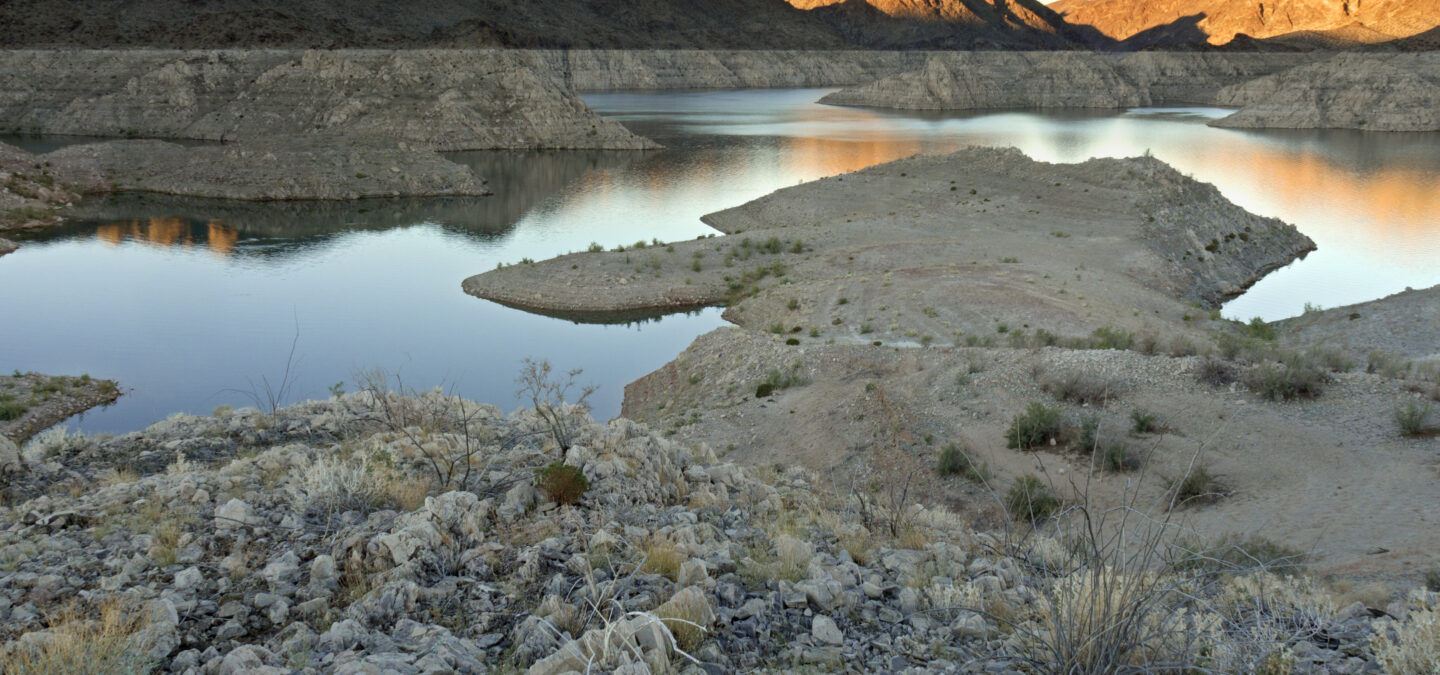
Colorado reaches agreement on Chatfield Reservoir environmental water plan — @WaterEdCO #SouthPlatteRiver

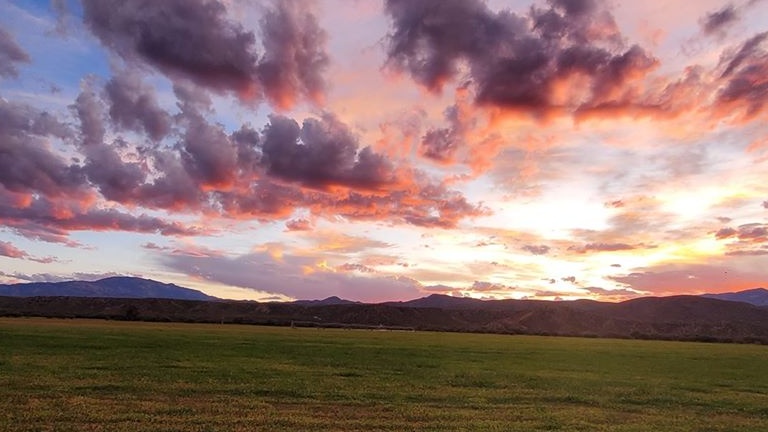
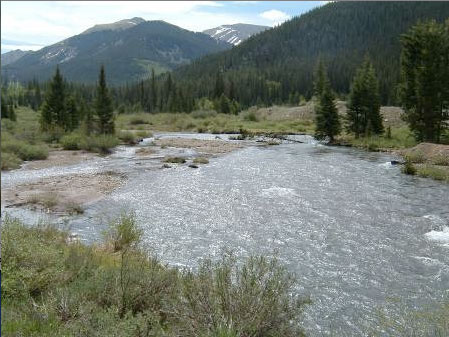
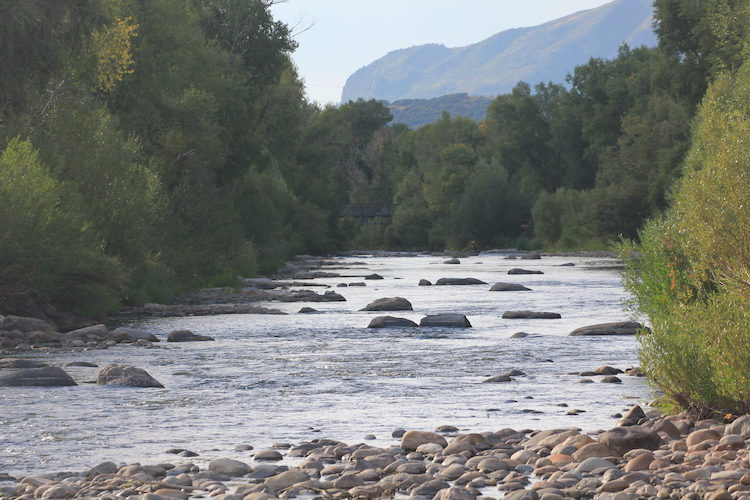
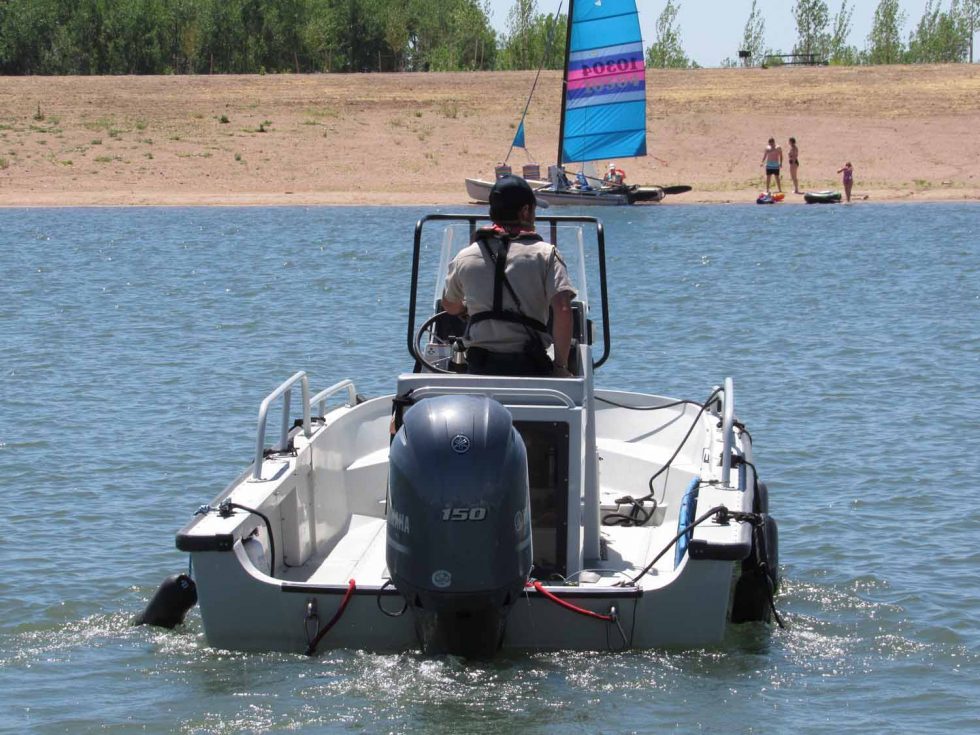
A Colorado Parks and Wildlife officer heads out on patrol at Chatfield Reservoir. A $171 million redesign at the popular lake is now complete, providing more water storage for Front Range cities and farmers. Last week the Colorado Water Conservation Board approved a settlement that will pave the way for an environmental water plan to help offset the impacts of the new storage. Credit: Jerd Smith

From Water Education Colorado (Jerd Smith):

Colorado water officials have reached an agreement removing one of the last barriers to a new environmental water program in Chatfield Reservoir.

The agreement settles a dispute among water agencies about who could use storage space in a special environmental pool in the reservoir.

The agreement is one of the final steps in the re-operation of the recreational site just southwest of Denver and comes after years of permitting disputes and lawsuits.

The federally owned reservoir was built in 1967 and was initially designed for flood protection in years when the South Platte River surged beyond its banks.

But as drought and climate change, as well as population growth, increased pressure on urban and agricultural water supplies on the Front Range, federal, state and local agencies began working to convert a portion of Chatfield’s flood storage to municipal and agricultural water storage. The reallocated storage space totals 20,600 acre-feet, of which 2,100 acre-feet is designated as the environmental pool.

The new storage will give south Denver metro area cities such as Highlands Ranch more protection against drought and diminishing groundwater supplies, and will give farmers on the Eastern Plains the ability to use stored water to irrigate crops late in the season when flows in the South Platte River run low. Water from the environmental pool will be used for releases to boost streamflows downstream, improving water quality and providing other environmental and recreational benefits. Downstream irrigators will also benefit from those releases.

The physical work on the re-operation was completed last year after the project won federal approval and a major lawsuit against it failed.

The latest legal dispute stems from a disagreement between Centennial Water and Sanitation District, which serves Highlands Ranch, and the Greeley-based Central Colorado Conservancy District, over whose water rights could be used to fill the environmental storage space and whose space would be filled first.

Centennial’s and Central’s boards must still approve the settlement, according to Lauren Ris, deputy director of the Colorado Water Conservation Board, which negotiated the deal. [Ris also serves on the Board of Trustees for Water Education Colorado, which sponsors Fresh Water News.]

“There was a disagreement among the parties about which water rights could be used,” Ris said, with ultimately the Colorado Water Conservation Board giving up some of its storage space to settle the dispute between the water agencies.

Central officials could not be reached for comment.

Centennial Water Resources Manager Rick McLoud said his agency had spent millions of dollars and more than 20 years to ensure that the new Chatfield plan would serve Highlands Ranch well, and that its ability to store water there would not get bumped too far down the priority list.

“We spent 27 years working to get it and more than $55 million. We did not want to lose out,” McLoud said.

Environmentalists, including the Denver Chapter of the Audubon Society, had long battled the re-operation of the reservoir because it inundated the existing shoreline and resulted in a loss of bird habitat, among other issues.

New habitat has been set aside farther downstream for birds and other species, and water from the environmental pool will help maintain streamflows and habitat as it is released.

Abby Burk, an Audubon Society official, said her group is still deeply worried about the loss of habitat.

But she said the fierce drought and ongoing shortages of water for environmental purposes make the Chatfield habitat water critically important.

“Chatfield was a hard go. We lost some strong riparian areas for birds,” Burk said. “But anytime we can have environmental benefits, particularly in a challenging drought year, we have to go for it.”

Jerd Smith is editor of Fresh Water News. She can be reached at 720-398-6474, via email at jerd@wateredco.org or @jerd_smith.
Saturday’s flash flooding crippled #GrandLake’s hydro power, washed ash into lake — Sky-Hi Daily News #ColoradoRiver #COriver #aridification

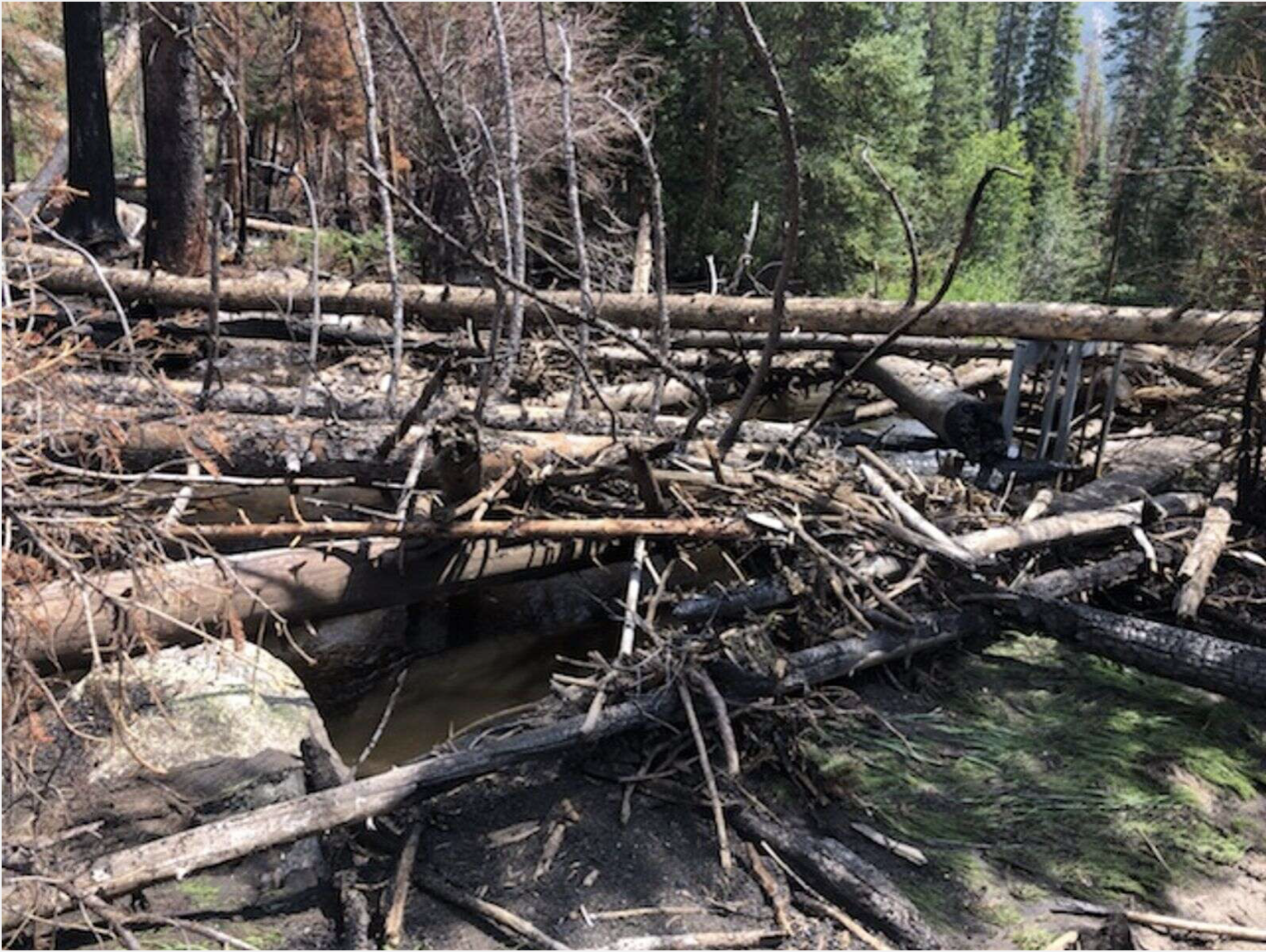
The head gate to Grand Lake’s hydro power plant is blocked by trees washed up during Saturday’s flash flooding. You can see the head gate on the right side of the picture. Photo credit: Town of Grand Lake

Here’s the release from Grand County via The Sky-Hi Daily News:

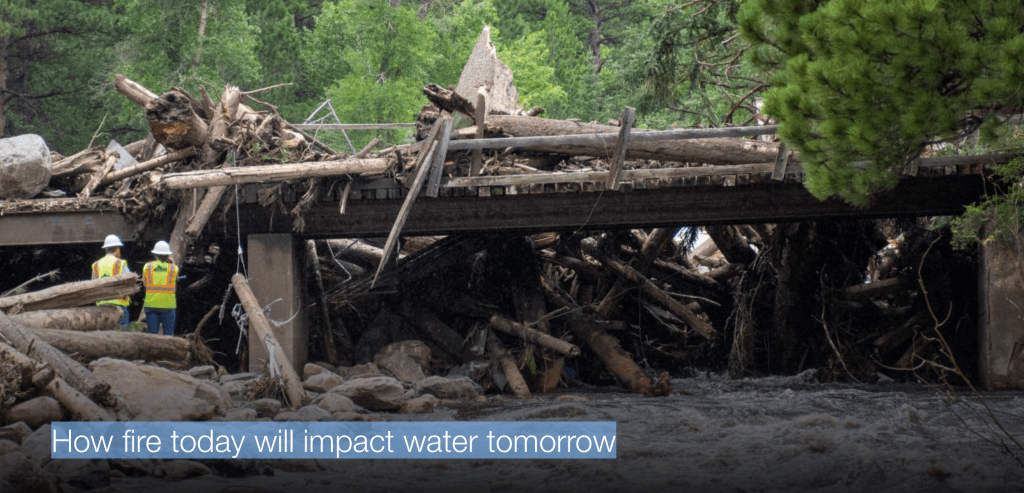
Flash flooding on Tonahutu Creek piled up enough trees, mud and debris Saturday night to shut down Grand Lake’s hydro plant.

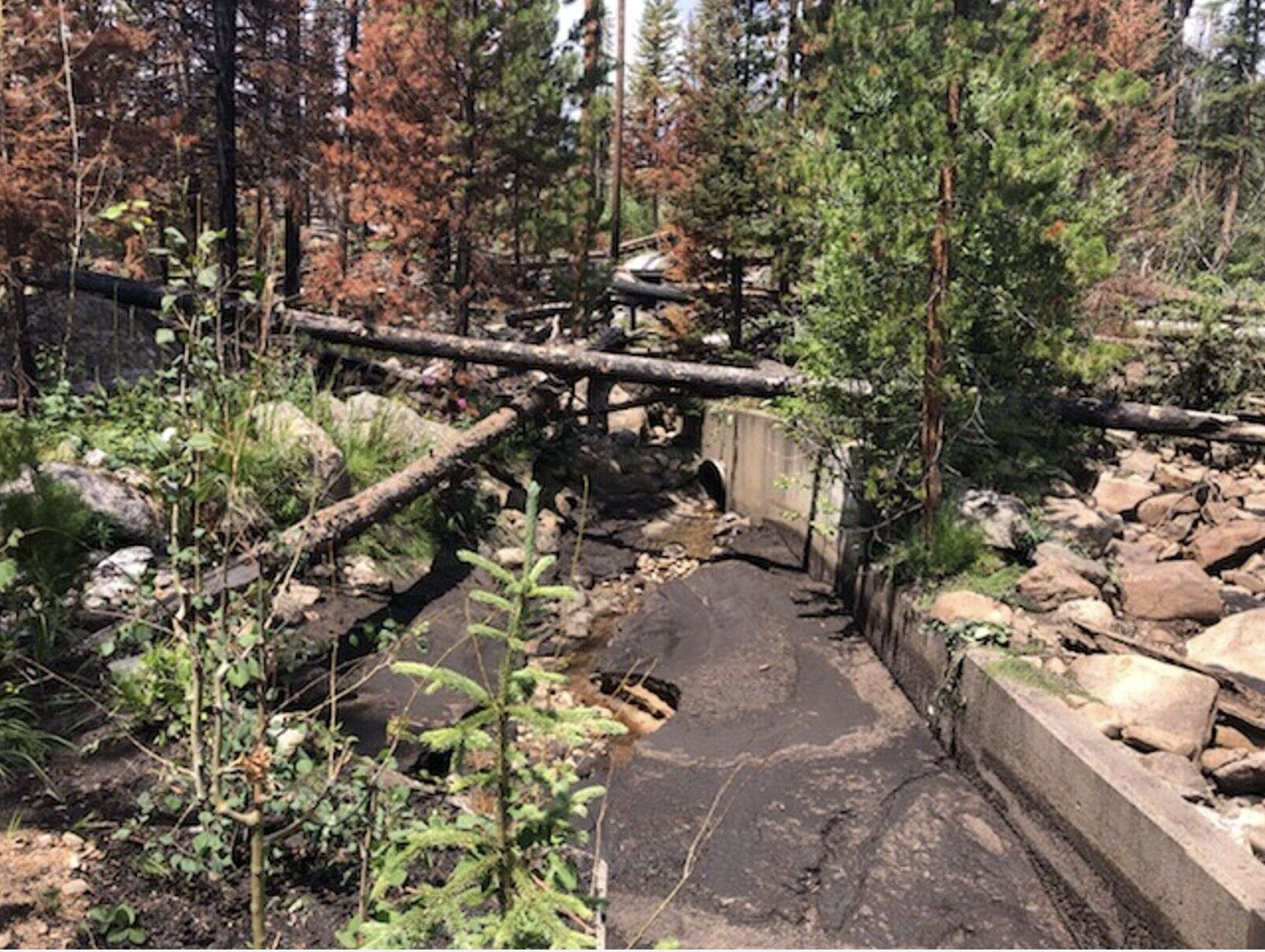
Town Manager John Crone estimated Monday that there are about 50 large downed trees piled up at the plant’s head gate while ash and mud filled the ditch leading to another gate.

Grand Lake owns water rights on the creek and uses them to generate power for the town’s wells. The wells on which the town relies for water are fine and operating on other power sources with the hydro power stalled.

Because the creek is on national park land, Crone said the town is working with the National Parks Service to clear the debris.

“It has to happen soon,” Crone said. “We have to get the trees cleared and the water flowing.”

Crone said the floodwater also carried ash into Grand Lake and that some ash washed up onto the beach.

Ash fills the ditch before water flows through the second head gate to Grand Lake’s hydro power plant.
Courtesy Grand Lake via The Sky-Hi Daily News

Other damage from mudslides has occurred along Colorado Highway 125 in Grand County and Interstate 70 at Glenwood Canyon, both where major wildfires burned last year.

Flash flooding has been a persistent threat in Grand County, which saw two large wildfires last year and has seen repeated mudslides and flash floods in the burn scars.

Flash flooding can occur with relatively little rainfall in burn areas and often inundates small creeks and streams, gulches, roads, and poor drainage and low-lying areas.

Almost two of every three flash flood deaths occurr in vehicles. Drivers should not attempt to cross flowing streams and never drive through flooded roadways.

According to the National Weather Service, as little as a foot of swift water can float most cars, and two feet of fast-moving water can sweep away many vehicles, including SUVs and trucks.

#EagleRiver water levels rise above average flow — The Vail Daily #monsoon2021 #ColoradoRiver #COriver #aridification

From The Vail Daily (Ali Longwell):

Streamflows on the local Eagle River have certainly seen a spike the past few days thanks to the recent rain.

According to the Eagle River Water and Sanitation District, the Eagle River is experiencing flows 170% higher than normal near Minturn and 144% higher than normal in Avon. This is quite the difference from just four days ago, July 29, when the river level was 49% of the average streamflow for this time of year in Avon.

According to Diane Johnson, the communications and public affairs manager for the Eagle River Water and Sanitation District, there have only been seven days since April 1 where the river levels have exceeded the average…

It’s too early to tell whether this will have any impact on drought conditions. While Holly Loff, executive director of the Eagle River Watershed Council, is hopeful this unusual spike in streamflow will have a positive impact, she expects, as we return to hotter and dryer temperatures, “it’s not going to have a huge impact.”

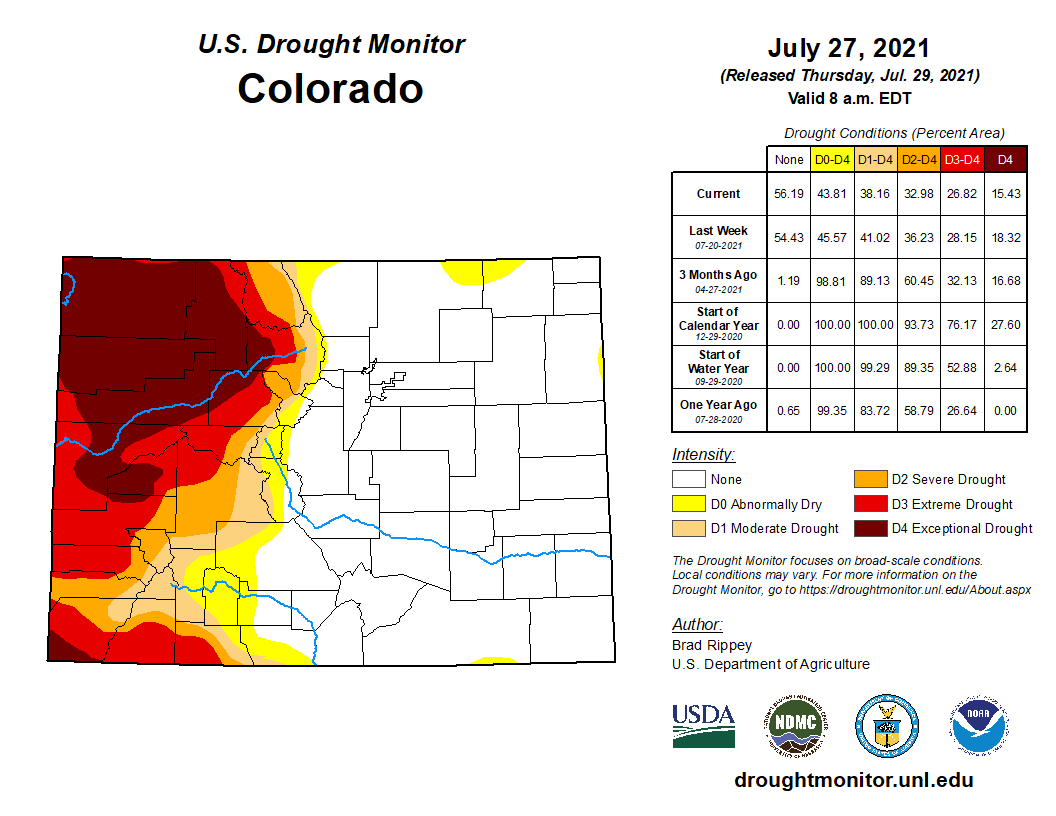
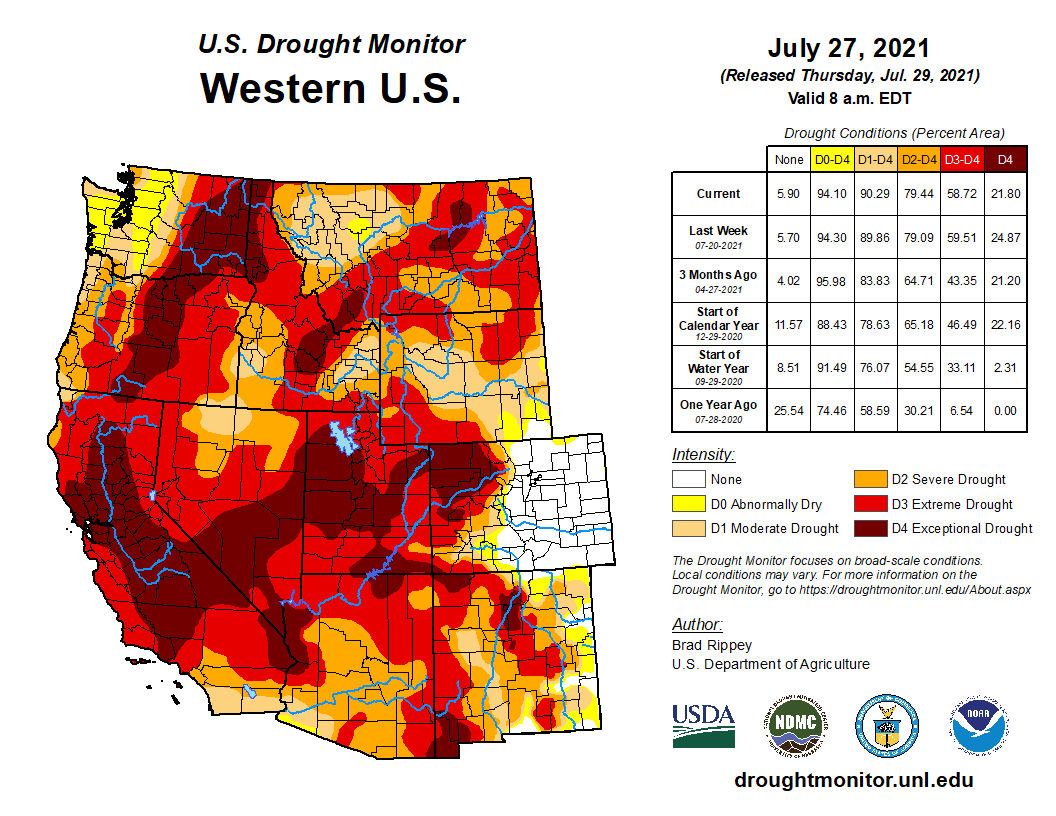
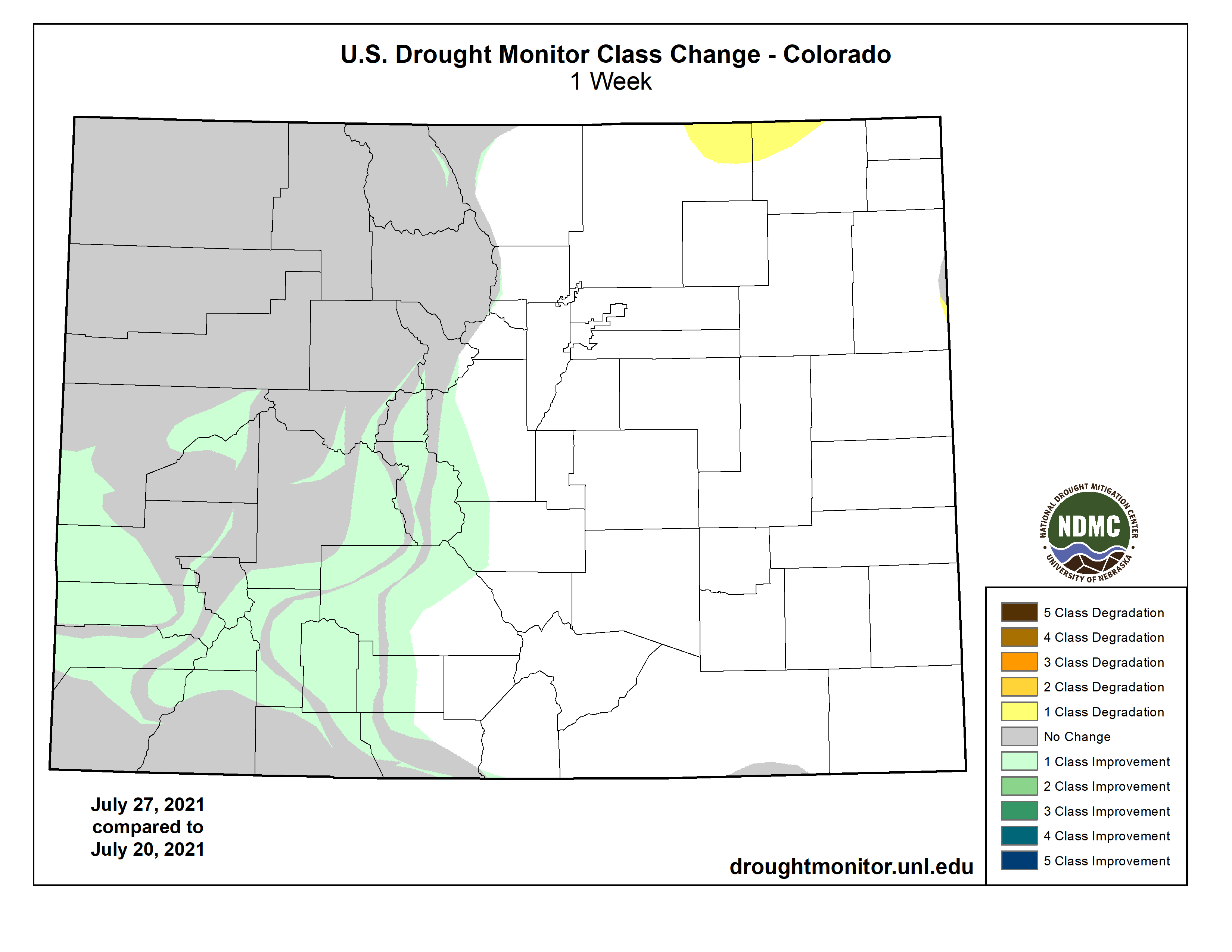
Colorado Drought Monitor map July 27, 2021.

The area’s soil has seen the greatest impact of the drought conditions and with the fast and quick monsoon rains, the soil doesn’t get the chance to absorb the moisture and recover from the drought conditions.

Chaffee County commissioners approve permit for water bottle company to draw from wells connected to #ArkansasRiver — 9News.com

Ruby Mountain Springs site. Photo credit: Nestle Waters North America

From 9News.com (Zack Newman):

The Chaffee County Board of Commissioners voted Tuesday to approve the conditions under which a water bottling company could continue to pull water from a spring connected to the Arkansas River.

They are allowed to do so through the water right they bought back in 2010, but the county gives the green light if it finds the company follows all of the rules.

The 1041 permit process outlines specific conditions that BlueTriton has to meet in order to pull water out of Chaffee County. BlueTriton, previously known as Nestle, owns two wells. State water records obtained by 9Wants to Know show the company can pull up to 196 acre-feet of water each year…

[Della] Malone said regardless of the amount of water BlueTriton will take, Colorado is at the point where as much water as possible needs to stay in the river to keep fish, and the birds that feed on them, alive…

For the most part, BlueTriton has been a good steward of the water. The county hired W.W. Wheeler and Associates to conduct an updated analysis in 2020 and said the company is not using as much water as it could be.

Gary B. Thompson, an engineer for the water engineering firm W.W. Wheeler and Associates, found the utilization of the wells was not causing problems…

Jennifer Davis, Chaffee County attorney, said in an email that Monroe’s report led to increased wetlands monitoring in the 2009 contract. Any 2021 contract would have similar measures that would allow the county to cancel the contract if there was evidence that the wetlands were being stressed.

“It is important to note that during the recent hearings, evidence was presented that the applicant has substantially complied with those plans over the past 10 years,” Davis wrote. “…If [BlueTriton Brands] fails to comply with the plans, the permit can be suspended or terminated.”

In 2020, Wheeler found the nearby wetlands are healthy and the permit has “adequate” monitoring protocols.

The well permits allow for a maximum of 196 acre-feet per year. On average, the Wheeler report found the wells pulled in 111.7 acre-feet on average. The well had not been tapped for more than 100 acre-feet per year since 2014, according to the report. Any water taken for the water bottling operation is replaced with water from the nearby Turquoise Reservoir and Clear Creek Reservoir…

How much water goes to water bottles?

Kevin Rein, a state engineer and the director of the Colorado Division of Water Resources, said water bottling facilities use a small portion of the state’s water. He wrote in an email that one fairly standard-sized Colorado bottled water company found it was responsible for 0.0006% of the state’s annual water use.

For context – 85.2% of the state’s water goes to agriculture each year and 6.6% are used by cities and commercially according to data from the Colorado Division of Water Resources…

Other requirements of the permit

Other requirements of the contract have mostly been met. Davis said in an email BlueTriton did not finalize a conservation easement, but that commissioners did not penalize the company because deadlines were not clearly explained in the permit.

According to a letter from the Colorado Department of Natural Resources, Nestle did not begin discussions about donating land for an easement until 2019, 10 years after the original 1041 permit was issued by the Chaffee County Commissioners…

BlueTriton will pay $1.2 million across 10 years to various causes like water sustainability, forest health and affordable housing. It will pay $430k in just the first year, then $92,500 each year afterward.

Nestle sold its North American water brands to BlueTriton for $4.3 billion dollars.

Arkansas River Basin — Graphic via the Colorado Geological Survey

Commentary: The link between extreme mudslides and #ClimateChange — #Colorado Newsline

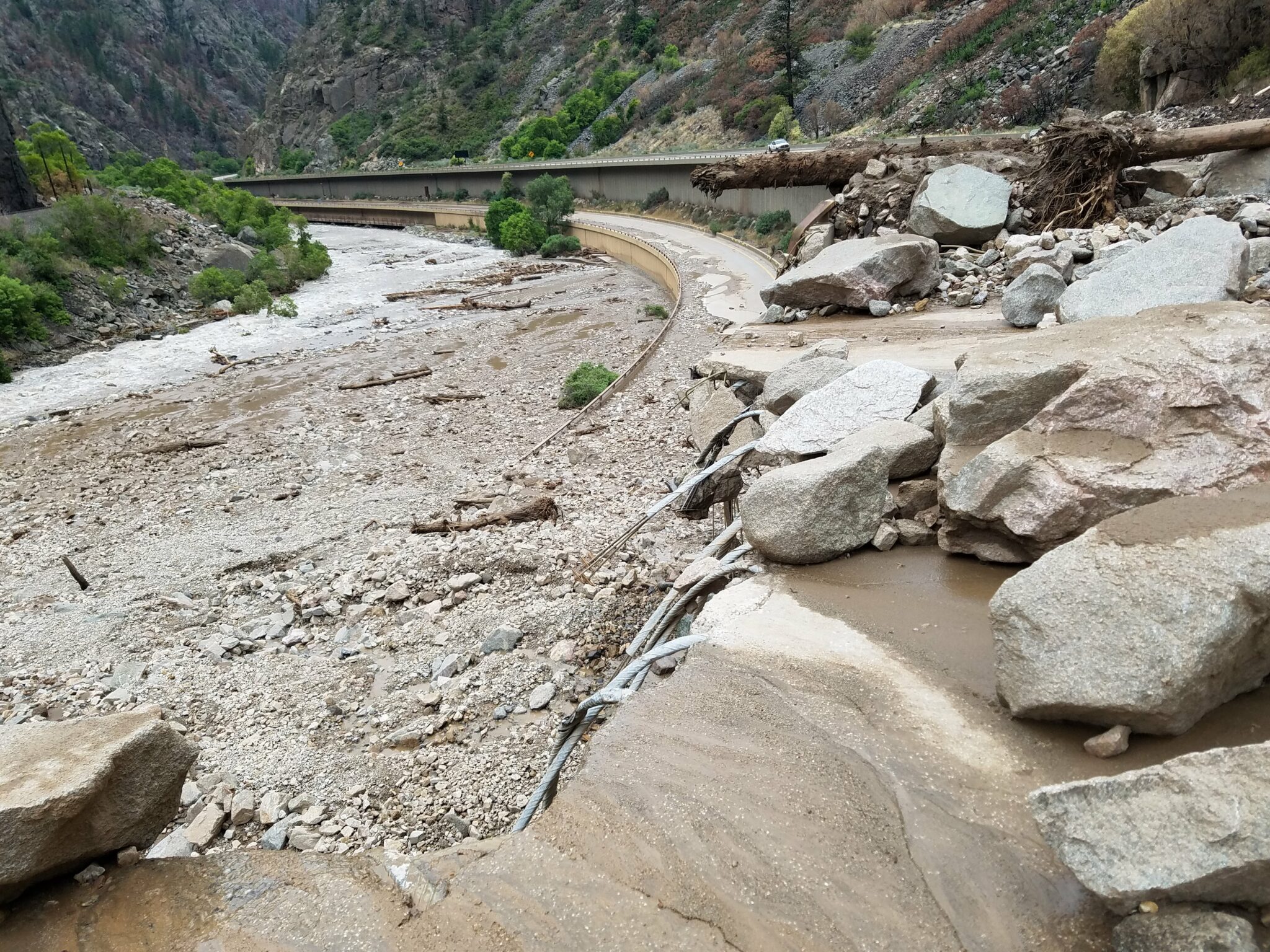
A photo of August 2021 mudslide damage to Interstate 70 released by the Colorado Department of Transportation. (CDOT) via Colorado Newsline

Without a doubt, one of the largest threats to American infrastructure is climate change.

This was illustrated yet again as upwards of 10 landslides ravaged sections of Colorado’s Interstate 70 corridor, closing the Glenwood Canyon portion of the highway indefinitely. This came after weeks of intermittent slides that have exhausted personnel and had a chilling effect on local economies.

Yet despite the impacts, few have sought to elaborate on the relationship between extreme debris flows and the burning of fossil fuels.

This is a grave oversight.

Dismissing the role of climate change in infrastructure resiliency fails to appreciate the inherent relationship between infrastructure and environment. As global temperatures rise, so, too, will the number of extreme events. This places existing structures and byways in new dangers, ranging from some damage to full destruction.

GET THE MORNING HEADLINES DELIVERED TO YOUR INBOX

In the case of mudslides, as wildfires burn bigger and hotter due to rising temperatures and severe drought, ground vegetation of the forest floor is burned off at alarming rates. This creates a layer of dusty ash over bare, scorched soil, resulting in a decreased ability of the soil to absorb water.

While healthy forest floors can hold several inches of water per hour, high or moderately burned areas might only hold one-third of an inch. This results in top layers that can be easily washed away, at least until enough ground vegetation is reestablished — roughly the first year or two post-burn. Meanwhile, even small amounts of rainfall can result in dangerous runoffs, posing great risks to structures and byways located in slide paths. Combined with more intense rainfall — also due to climate change — landslides may occur more frequently and over larger areas with greater force and debris.

This dynamic is consistent with recent events on I-70. Based on post-fire assessments conducted by the Burned Area Emergency Response team, the Grizzly Creek Fire — which was fueled by especially hot and dry conditions last year — burned areas surrounding the canyon. Soil testing revealed that 55% of this area had incurred moderate to high soil burns, leaving the region with unusually high risks of extreme runoffs. Only 12% of the 32,370 acres were estimated to be unburned.

Certainly, mudslides are possible in any canyon so steep — and it’s happened before. However, the size and severity of this particular burn created enhanced risks for severe infrastructure damage. Accordingly, at the recommendation of BAER, mitigation efforts were made.

Shortly after the fire, one large, natural berm was created to protect the most critical infrastructure in the canyon — a mostly hidden command center in the heart of Glenwood Canyon that serves to monitor the interstate. As predicted, less than a year later, some 100,000 cubic yards of debris was diverted with that very berm. John Lorme, the Colorado Department of Transportation director of maintenance and operations, hailed the effort as saving the state millions of dollars and extensive closed highway time — a testament to the role of climate research in protecting infrastructure.

There are, however, limits to our current preventative measures — as evidenced by the current debris damage. During a 47-minute press conference with CDOT, Region 3 director Mike Goolsby acknowledged the lack of radar technology and understanding in predicting slides with enough time to close or protect the highway.

According to the U.S. Geological Survey — the only science agency to exist within the U.S. Department of Interior — much additional research funding and efforts regarding landslides are needed as climate change intensifies. Especially relevant are the needs to better understand debris flow mechanisms, forecasting and mitigation strategies, all efforts that would help safeguard core infrastructure.

One Colorado-based hydrologic engineer, Kelsey McDonough, agrees, adding that some in the private sector may also have access to better, more localized technology. “This could be really useful in a state like Colorado where local knowledge can be utilized to build better regional monitoring and modeling systems than are currently available at the national scale,” she says.

Certainly, Colorado has a number of cutting-edge national laboratories and private companies that may be inclined to help find solutions with the right incentives. Securing these funds is just one of many roles local representatives can play in helping the state navigate the new challenges.

Still, perhaps the most important thing we must do is disentangle the notion that discussions of human-driven climate change during extreme events are signals of political interference. They are not. Climate change is well established in scientific literature, as is its impact to structural integrity. Addressing the role of reducing fossil fuels in related press conferences and articles is therefore necessary to serve the long-term goal of infrastructure stability.

SUPPORT NEWS YOU TRUST.

Colorado Newsline is part of States Newsroom, a network of news bureaus supported by grants and a coalition of donors as a 501c(3) public charity. Colorado Newsline maintains editorial independence. Contact Editor Quentin Young for questions: info@coloradonewsline.com. Follow Colorado Newsline on Facebook and Twitter.

Here’s a short video (~4 minutes) from CDOT to give you an overview of the slide area.

Stronger #Colorado #monsoon2021 season, wildfires brew up a perfect storm for devastation — The #FortCollins Coloradoan

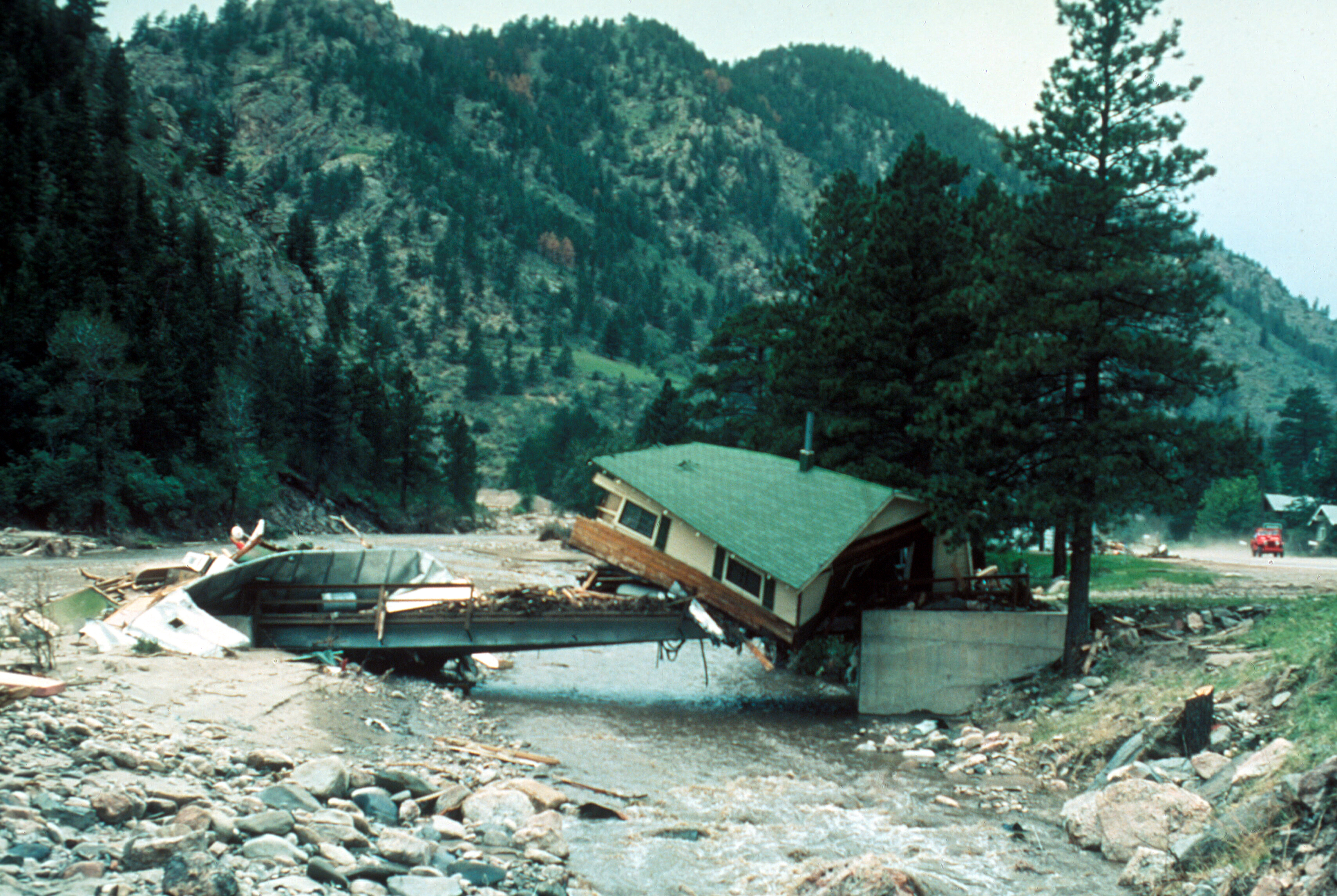
Big Thompson Flood, Colorado. Cabin lodged on a private bridge just below Drake, looking upstream. Photo by W. R. Hansen, August 13, 1976. Photo via the USGS.

From The Fort Collins Coloradoan (Miles Blumhardt):

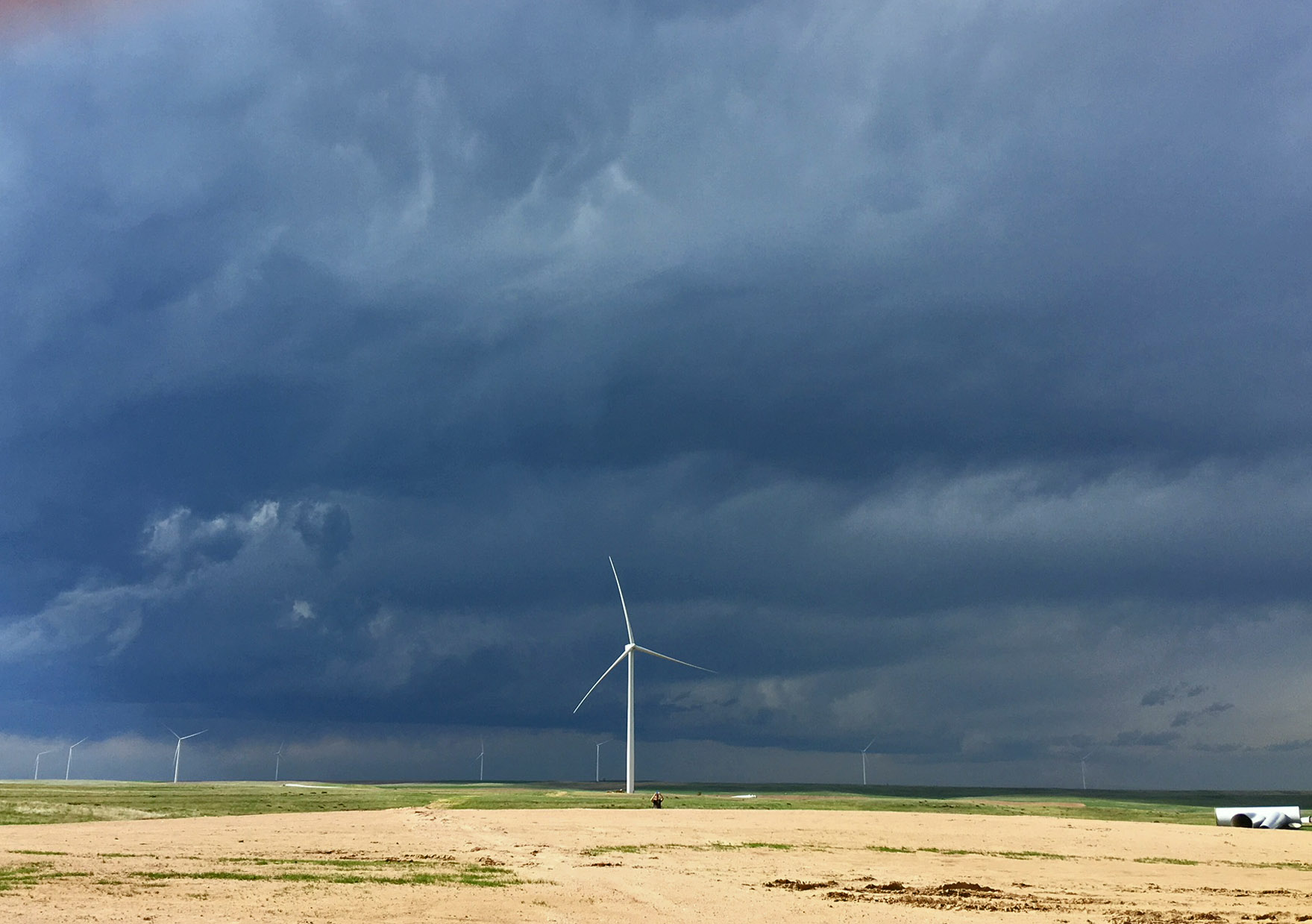
For the past month, Coloradans have been inundated with flash flood watches and warnings and a weather event — called a monsoon…

Neither flash floods nor the annual monsoon season have grabbed Colorado headlines the past several years because neither had much impact on the state.

That changed this year.

“This year is more normal of what we would expect from monsoon season compared to the past couple of years,” said Jennifer Stark, a meteorologist who manages the National Weather Service office in Boulder. “We are seeing bigger impacts, and people are really beginning to take notice because it is impacting their ability to recreate and move across the state and affecting homes.”

A series of events that has led to devastation started last year when the state experienced its worst wildfire season in its recorded 145-year history…

This summer, those burn scars, largely left denuded, have been continually saturated with abundant monsoonal moisture, resulting in large debris slides.

Those slides have continually closed Interstate 70 in Glenwood Canyon, which remains closed Monday due to what the Colorado Department of Transportation has called “extreme damage” to the major transportation corridor. It also resulted in the deaths of three people with a fourth still missing and six residences destroyed in the Poudre Canyon…

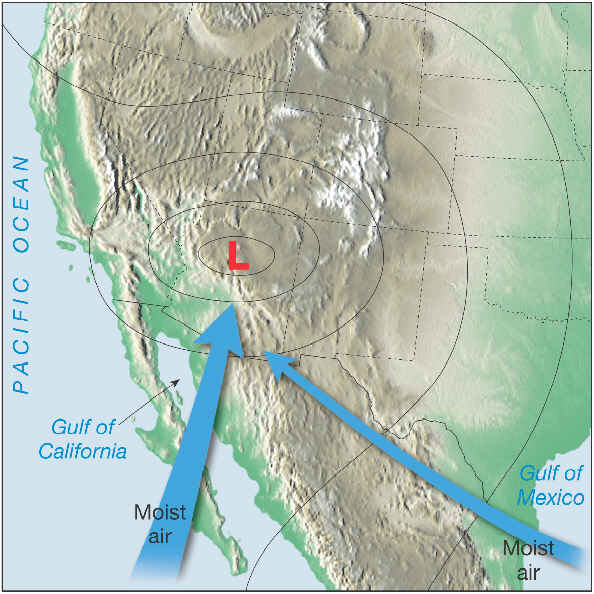
The Colorado Climate Center said the monsoon pattern is created by abundant moisture that builds in the atmosphere from the Gulf of Mexico and Pacific Ocean.

A shift in wind pattern results from a high pressure system with clockwise flow over the Rocky Mountains and low pressure near the Gulf of Mexico with a counterclockwise flow that settles over the region and squeezes moisture northward into the atmosphere.

In Colorado, the moisture is more prevalent on the Western Slope but can spill over the Continental Divide, which is happening this year.

This creates persistent afternoon thunderstorms that park over areas that can produce large amounts of rain, sometimes in a short period of time…

When that happens on burn scars, soil that repels water is washed down canyons, gullies and ravines that act as funnels of accumulating water. As it gains momentum, the slide brings with it large boulders and burned trees.

Stark said many of the state’s most devastating floods have taken place during the monsoon season, including the 1976 Big Thompson flood and 1997 Spring Creek flood in Fort Collins, both of which occurred in late July.

How years of fighting every wildfire helped fuel the Western megafires of today — The Conversation


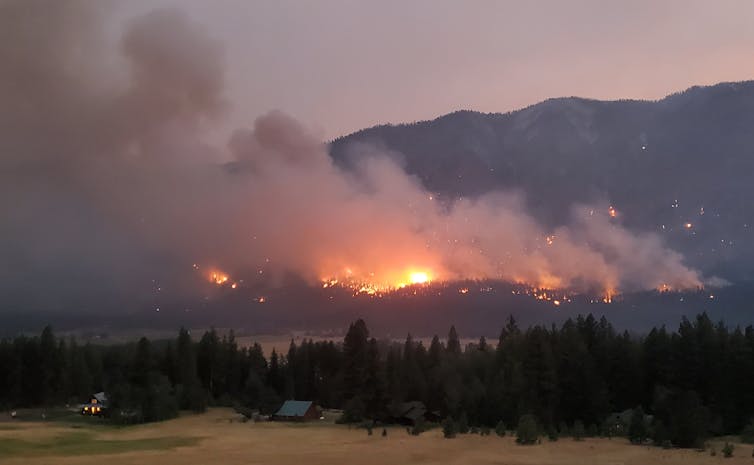
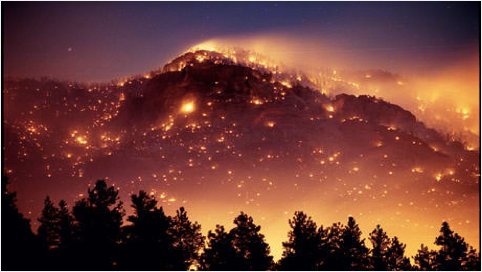
The Cedar Creek Fire burns in Washington’s Methow Valley in late July 2021.
Jessica Kelley

Susan J. Prichard, University of Washington; Keala Hagmann, University of Washington, and Paul Hessburg, United States Forest Service

After so many smoke-filled summers and record-setting burns, residents of Western North America are no strangers to wildfires. Still, many questions are circulating about why forest fires are becoming larger and more severe – and what can be done about it.

Is climate change fueling these fires? Does the long history of fighting every fire play a role? Should we leave more fires to burn? What can be done about Western forests’ vulnerability to wildfires and climate change?

We invited 40 fire and forest ecologists living across the Western U.S. and Canada to examine the latest research and answer these questions in a set of studies published Aug. 2, 2021. Collectively, we are deeply concerned about the future of Western forests and communities under climate change.

So, why are wildfires getting worse?

Climate change is a big part of it. Summer wildfire seasons are already 40 to 80 days longer on average than they were 30 years ago. Annual droughts are more pronounced, making it easier for fuels to dry out and fires to ignite and spread. Extreme weather events, marked by dry fuels, lightning storms and strong winds, are also increasingly common and provide essential ingredients for rapid fire growth, as witnessed by the Bootleg Fire burning in Oregon and record-setting fires in California and Colorado in 2020.

Ironically, a chronic lack of fire in Western landscapes also contributes to increased fire severity and vulnerability to wildfires. It allows dry brush and live and dead trees to build up, and with more people living in wildland areas to spark blazes, pressure to fight every forest fire has increased the risk of extreme fire.

The problem with fighting every wildfire

Historically, fire was a regular visitor to most Western forests, except moist locations like those along the Pacific Northwest coast and in British Columbia. Frequent or periodic fires from Indigenous burning and lightning strikes created patchworks of grasslands, shrublands and regenerating forests of all ages.

Past fires influence the way subsequent fires burn and what they leave behind. For example, Indigenous burning practices not only enhance cultural resources and wildlife habitat but also reduce the amount and connectedness of fuels that drive large, severe wildfires. Similarly, patchy burns from lightning ignitions create forest landscapes that are less likely to burn all at once.

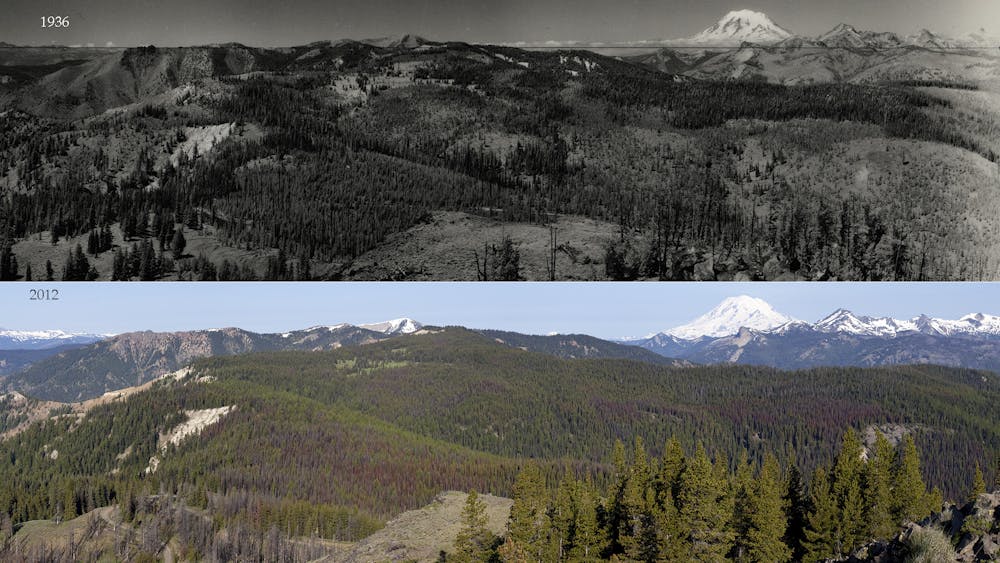
Two photos of the same forest landscape, the older photo showing more open area in the forest.
Photos of Bethel Ridge, a moist mixed conifer forest in eastern Washington, show the difference in patchiness in 1936 compared with 2012.
National Archives (1936); John Marshall Photography (2012)

The U.S. and Canada effectively suppress all but 2%-3% of wildfire starts. However, this small percentage of fires burn at the height of each fire season, when dry conditions and extreme fire weather thwart even the most aggressive attempts to suppress them.

Unintentionally, by focusing on short-term risks of wildfires, the U.S. is predisposing forests to burn under the very worst conditions. Active fire suppression contributes to what is often referred to as the wildland fire paradox – the more we prevent fires in the short term, the worse wildfires become when they return.

In one of the new studies, Paul Hessburg and co-authors explain how fire managers can mitigate the severity of future fires by managing fire-excluded forests to foster resilience to wildfires and drought. Management approaches include thinning dense forests, reducing fuels through prescribed burning and managing wildfires to restore more typical patterns of forests, meadows, shrublands and woodlands.

In a second paper, Keala Hagmann and her co-authors describe how more than a century of fire exclusion and past forest management practices have jeopardized forest biodiversity and social and ecological values, including culturally important resources, the quantity and quality of water, stability of carbon stores, recreation and air quality.

For example, fire exclusion has compromised aspen stands – biodiversity hot spots for everything from bears to butterflies. Increased forest cover diverts water from downslope meadows, allowing conifer forests to further encroach on aspen habitat.

A path forward

Amid the daunting reality of climate change and severe wildfires, there is a path forward for Western forests.

In a third article, Susan Prichard and her co-authors examine which adaptive forest management approaches have worked to increase resilience to wildfires and climate change. There is strong scientific evidence that fuel reduction treatments – including forest thinning, prescribed burning, Indigenous cultural burning and managed wildfires – are effective approaches for mitigating future fire impacts to Western forests. However, land managers can’t expect these treatments to work if they are applied to only a small fraction of Western forest landscapes.

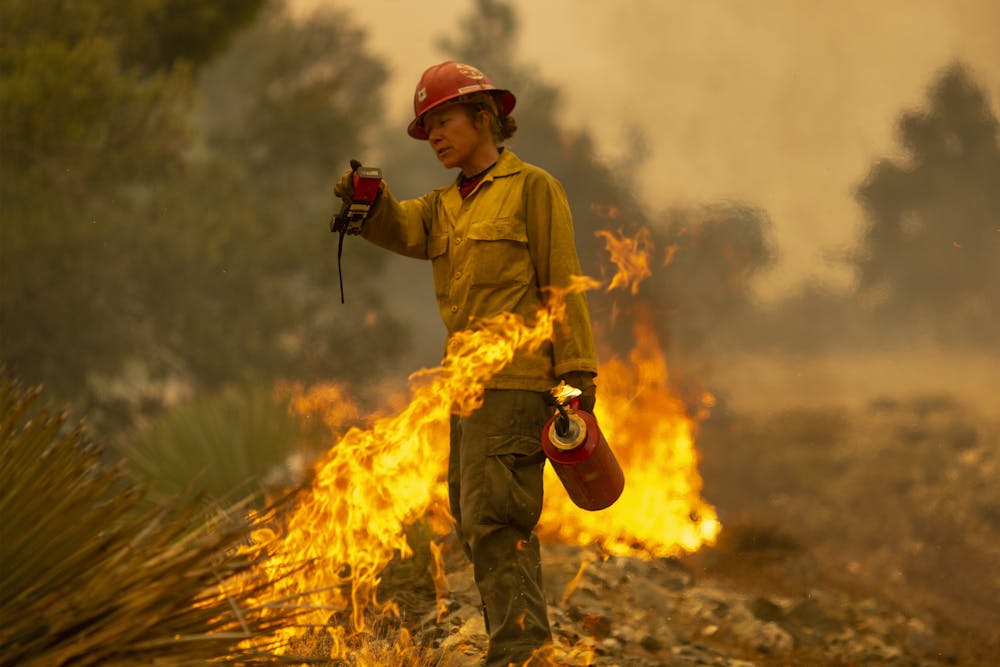
A female firefighter holds a walkie-talkie and drip torch with a thin line of flames behind her.
Mormon Lake Hotshots firefighter Sara Sweeney uses a drip torch in a controlled burn that removes fuel from a wildfire’s path in 2020.
David McNew/Getty Images

When combined, forest thinning and prescribed burning in dry ponderosa pine and in dry and moist mixed-conifer forests have been shown to be highly effective at reducing the fire damage to forests. However, this type of treatment is not appropriate for all forest types. Fire managers in some wilderness areas and national parks have allowed fires started by lightning to burn in some wind and weather conditions. Over the past 40-plus years, these wildfires have been allowed to burn and reburn landscapes, generally limiting the size and severity of subsequent wildfires.

Given the immense diversity of Western forests, there is no one-size-fits-all solution. However, in forests that historically supported more frequent fire, revitalizing and continuing cultural burning practices, prescribed burning, and forest thinning combined with prescribed burning can reduce overcrowding and the potential for severe fires. Thinning and prescribed burning aren’t appropriate or feasible everywhere. In reality, only a portion of landscapes can be treated this way. Allowing wildfires to burn in more areas under moderate weather conditions is also part of the solution.

Promoting resilient Western forests will require that our society builds a new relationship with fire by creating fire-adapted communities and looking for opportunities to restore fire to Western forest landscapes.

Paul Hessburg explains how fire suppression efforts allowed forests to overgrow and become fire hazards.

In this era of warmer, drier summers and longer fire seasons, there are no fire- or smoke-free solutions. The current approach to fire management poses unnecessarily high stakes for Western forests. There is no doubt that the future of Western forests is a fiery one. How we choose to live with fire is still up to us.

[Over 100,000 readers rely on The Conversation’s newsletter to understand the world. Sign up today.]The Conversation

Susan J. Prichard, Research Scientist of Forest Ecology, University of Washington; Keala Hagmann, Affiliate Assistant Professor, University of Washington, and Paul Hessburg, Research Ecologist, United States Forest Service

This article is republished from The Conversation under a Creative Commons license. Read the original article.

A gleaming gift to the great outdoors — News on Tap

From Denver Water (Todd Hartman):

Denver Water conveying stunningly scenic parcels to Forest Service as part of Gross Reservoir Expansion Project.

It’s been getting crowded on the trails, open spaces and forests along the Front Range, especially since COVID-19 sent lock-down weary residents bursting into the backcountry in an eager search for safe, socially distanced outdoor recreation.

That newfound enthusiasm for backcountry adventure isn’t expected to fade any time soon.

But now, thanks to an agreement between the U.S. Forest Service and Denver Water, explorers will have just a sliver of additional elbow room.

Open meadows and mixed forest are common among the parcels Denver Water is conveying to the U.S. Forest Service. Photo credit: Denver Water.

Denver Water is in the process of conveying 539 acres of wetlands, meadows and forests in Gilpin County to the Forest Service to be managed for public use.

The remote acreage, near the east portal of the Moffat Tunnel, protects ecologically precious lands near two wildly popular wilderness areas (Indian Peaks and James Peak) and the Arapaho and Roosevelt national forests. The land also complements a larger landscape protection effort in the region assembled by The Conservation Fund.

“Denver Water is thrilled to be a part of this landscape preservation effort,” said Jim Lochhead, the utility’s CEO/Manager. “This region near these precious wilderness areas is an environmental gem and one much loved by Coloradans, especially many within our service area.

“Ensuring its permanent protection is an outcome we are proud to be a part of, and we appreciate our partnership with the Forest Service and the Conservation Fund in putting this all together,” he said.

Denver Water agreed to provide the land for its ecological value and public use as part of a sweeping agreement with the Forest Service to offset environmental impacts associated with the expansion of Gross Reservoir to the east of the area.

It’s one of several steps Denver Water has already taken to complete so-called “mitigation” projects years ahead of the expansion work.

Seasonal creeks like this one funnel spring runoff into established waterways and lend the landscape a lush character. Photo credit: Denver Water.

The lands being conveyed are part of what’s known as the Toll Property, the name derived from a ranching family that owned the land for 120 years.

Denver Water’s contribution, scattered across 11 parcels, is part of a much larger agreement, according to reporting in the Boulder Daily Camera. A much larger area of 3,334 acres remains in the Toll family’s private ownership, but with a perpetual conservation easement to prevent development.

An additional 823 acres also were acquired by the Forest Service.

The entire land protection project creates a significant buffer, separating the adjacent James Peak Wilderness to the west from rural development and urban areas to the east, as described in a summary by The Conservation Fund.

These parcels in the Mammoth Gulch area look southwest toward the Continental Divide. Photo credit: Denver Water.

It also helps protect a four-mile stretch of the upper portion of South Boulder Creek, a key part of Denver Water’s supply.

The landscape is familiar not only to backpackers. Train aficionados know the area as part of the route taken by Amtrak’s California Zephyr, between Denver and San Francisco.

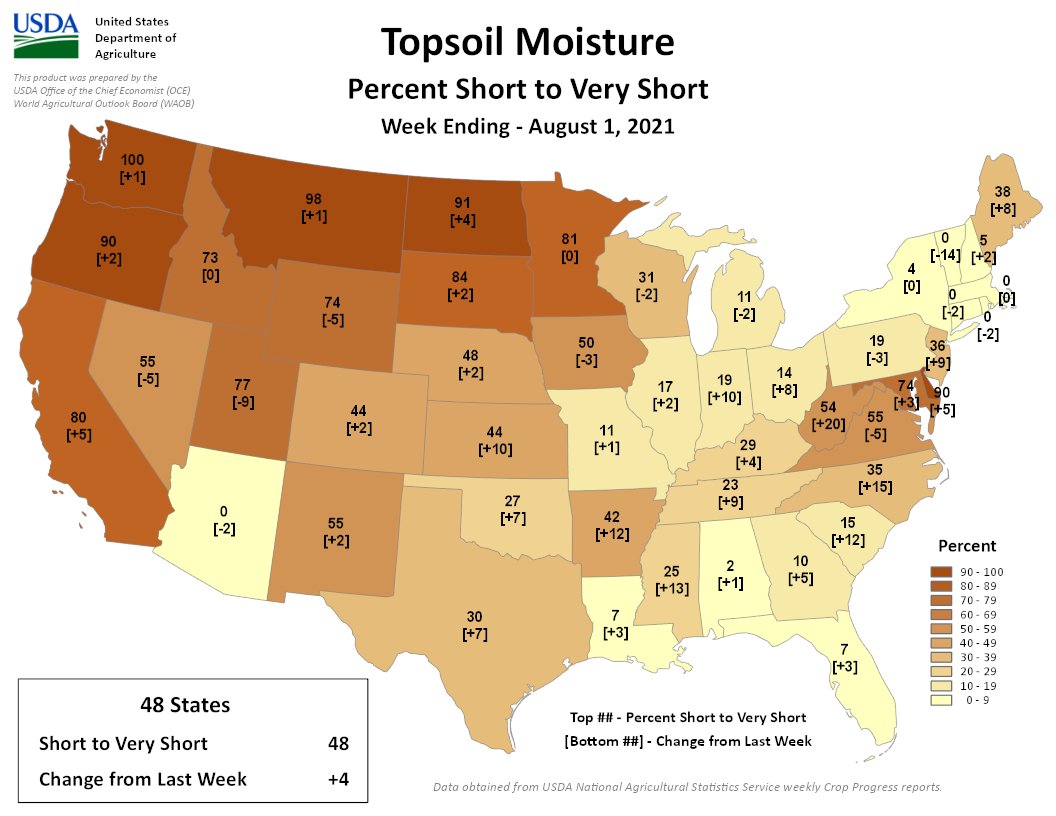
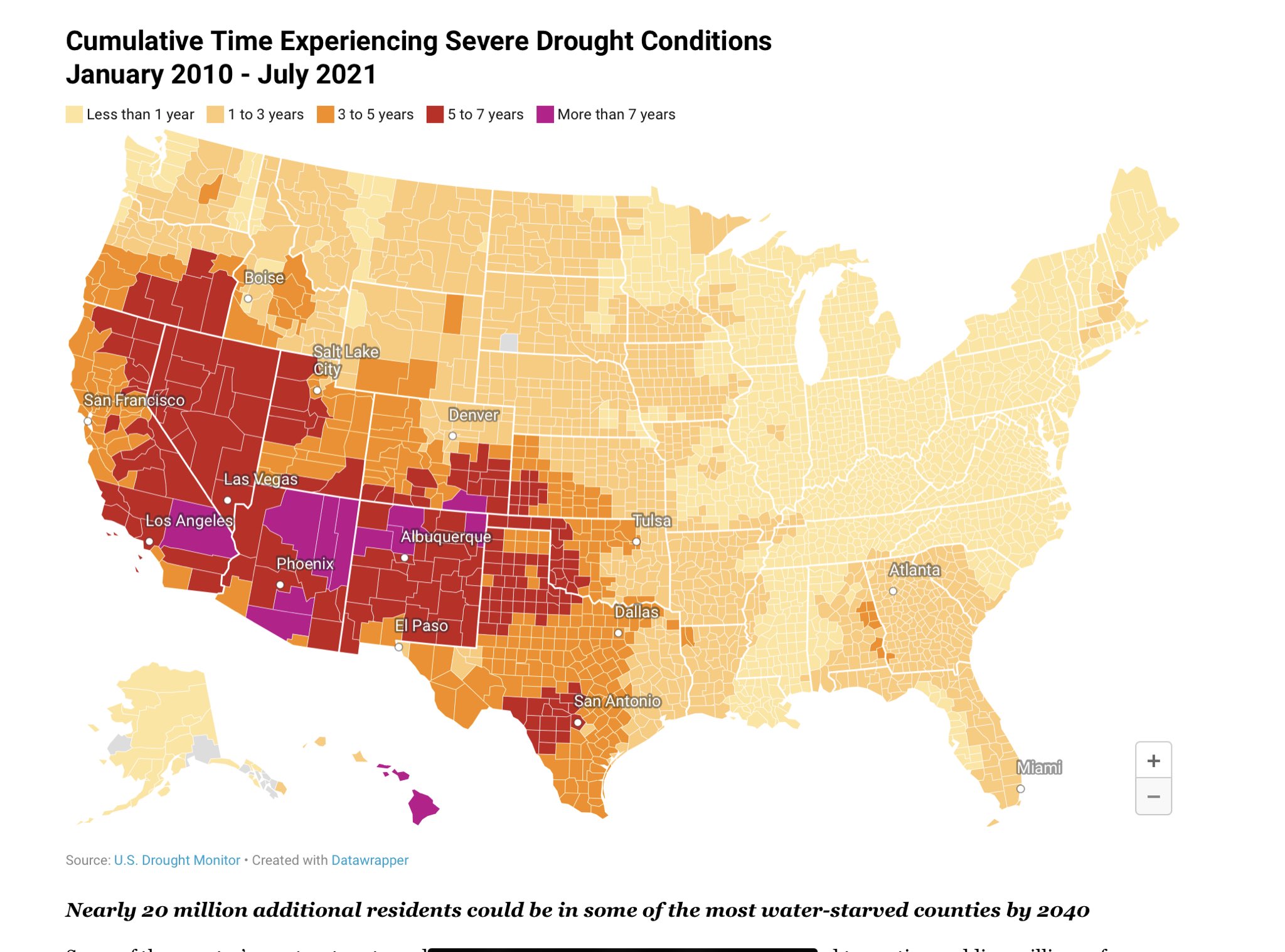
This Week’s Topsoil Moisture Short to Very Short by @usda_oce #drought

The situation in the Northwest across to the Northern Plains is frankly, bleak. 100% in WA, 98% in MT, 91% in ND, 90% in OR. The surrounding states aren’t much better.

Two Years After Declaring #ClimateEmergency, Scientists Say It’s Even Worse — #Wyoming Public Radio #ActOnClimate #KeepItInTheGround

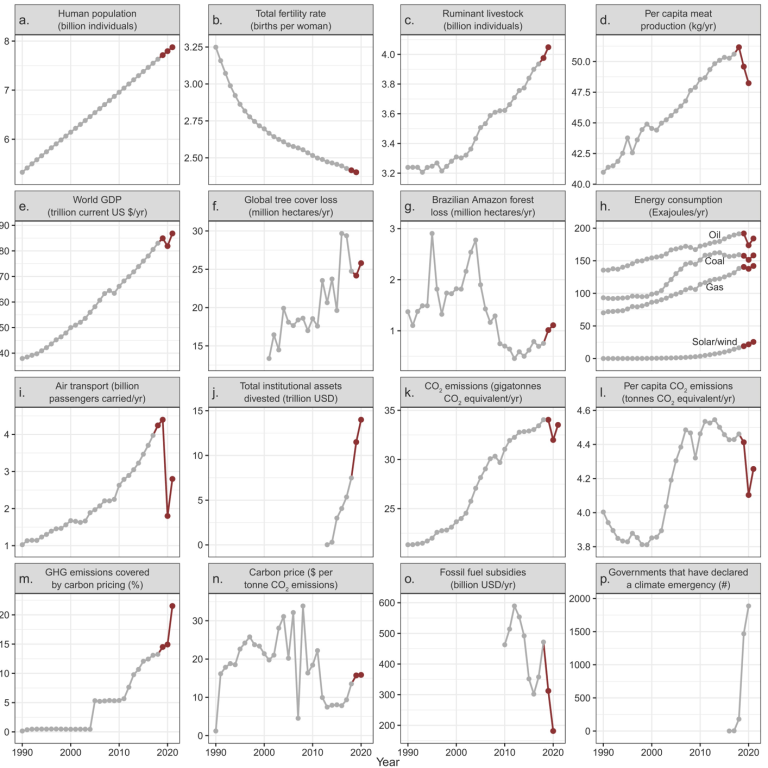
Time series of climate-related global human activities. In panels (a), (d), (e), (i), and (m), the most recent data point(s) are a projection or preliminary estimate (see the supplemental material); in panel (f), tree cover loss does not account for forest gain and includes loss due to any cause. With the exception of panel (p), data obtained since the publication of Ripple and colleagues (2020) are shown in red. In panel (h), hydroelectricity and nuclear energy are shown in figure S1. Sources and additional details about each variable are provided in the supplemental material. Complete time series are shown in supplemental figure S2.

From Wyoming Public Radio (Maggie Mullen):

Two years ago, more than 11,000 scientists from 153 countries declared a climate emergency. They did so in a report that said scientists have “a moral obligation to clearly warn humanity of any catastrophic threat and to ‘tell it like it is.'”

Now, they say things look even worse.

On Wednesday, an updated version of the report was published in the journal BioScience, and included an additional 2,800 scientists’ signatures.

The study evaluated 31 variables, like ocean changes and energy use. It found that over half are at new all-time record lows or highs.

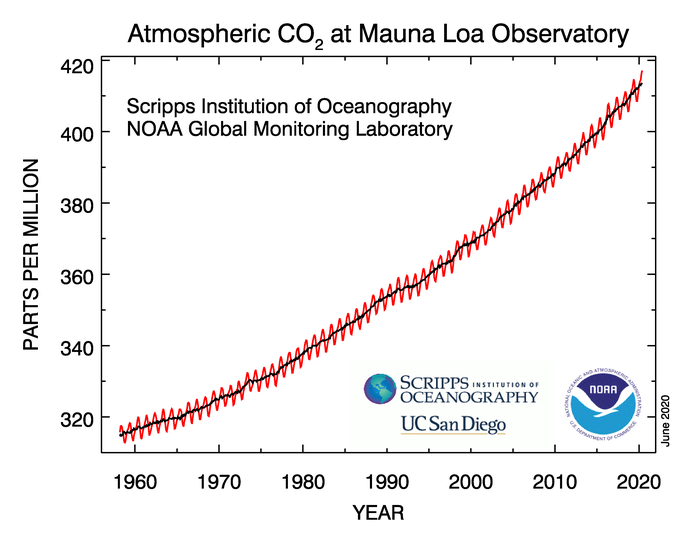
For example, in April 2021, carbon dioxide concentration reached 416 parts per million—the highest monthly global average concentration ever recorded. Glaciers are losing 31% more snow and ice per year than they did just 15 years ago, a rate that is much faster than previously believed.

And for the first time, the world’s ruminant livestock (cattle, sheep, and goats) passed four billion, which represents much more mass than all humans and wild mammals combined.

The findings were shocking to lead author William Ripple of Oregon State University…

With so many variables moving in the wrong direction, the paper calls for big, transformative changes. That includes eliminating fossil fuels and switching to mostly plant-based diets.

The group plans to update its findings on a regular basis.

This story was produced by the Mountain West News Bureau, a collaboration between Wyoming Public Media, Nevada Public Radio, Boise State Public Radio in Idaho, KUNR in Nevada, the O’Connor Center for the Rocky Mountain West in Montana, KUNC in Colorado, KUNM in New Mexico, with support from affiliate stations across the region. Funding for the Mountain West News Bureau is provided in part by the Corporation for Public Broadcasting.

#LittleColoradoRiver Dam Developer Surrenders Two of Three Dam Proposals — The #GrandCanyon Trust #ColoradoRiver #COriver #aridification

Carbonate blue water near Salt Trail campground on the Little Colorado river. Photo credit: Adam Haydock via the Grand Canyon Trust

From The Grand Canyon Trust (Amanda Podmore):

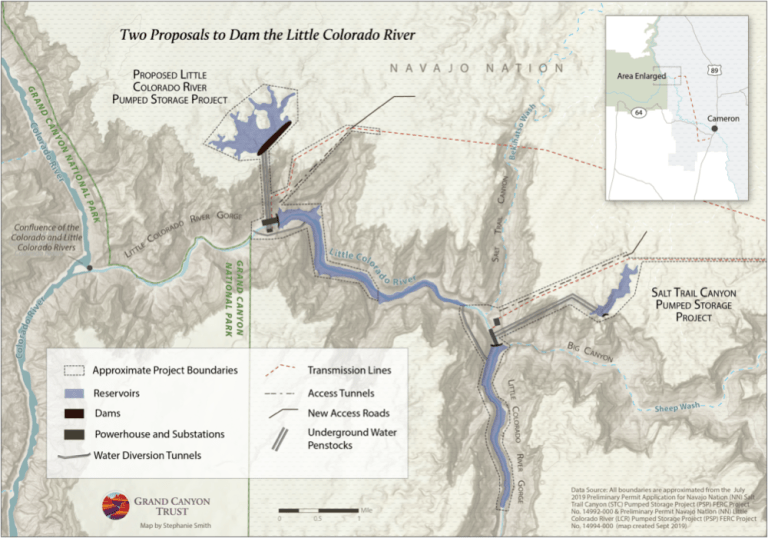
Good news! After two years of tireless advocacy led by the Navajo Nation, Hopi Tribe, and Hualapai Tribe, a would-be hydroelectric dam developer has requested the cancellation of two preliminary permits for dams on the lower Little Colorado River above the confluence with the Colorado River inside the Grand Canyon.

Pumped Hydro Storage LLC sent two letters to the Federal Energy Regulatory Commission (FERC) requesting the permits for its Little Colorado River and Salt Trail Canyon proposals be surrendered, citing strong opposition from the Navajo Nation, environmentalists, and others, as well as investment risks. This news comes two years after the developer first proposed the projects on Navajo Nation land in a region of deep cultural importance to many tribes.

Developer failed to work with tribes

Despite community opposition to the two dam proposals and interventions and objections from the Navajo Nation, the Hopi Tribe, and the Hualapai Tribe, Native organizations like Save the Confluence, and conservation organizations including the Grand Canyon Trust, FERC awarded preliminary permits for both the Little Colorado River and Salt Trail Canyon dam proposals. The developer was not required to get consent from the Navajo Nation or even consult with tribes, underscoring deep flaws in the permitting process. The company’s decision to surrender the permits for these two projects is a testament to the hard work of tribes, community organizers, and concerned citizens like you who took action and submitted comments. Thank you.

A river too fragile for dams

Had these hydroelectric dam proposals moved forward, the consequences on this arid landscape would have been severe. The lower Little Colorado River flows perennially into the Colorado River in the Grand Canyon, and its warm turquoise-blue waters shelter the endangered humpback chub when it is spawning.

The lower Little Colorado River is a spiritual place best left untouched by development, as grassroots community members and tribes have requested. It is home to the Hopi place of emergence along with innumerable other cultural sites. Upstream dams could alter this place of reverence and beauty.

Two down, one more dam to go

Map credit: The Grand Canyon Trust

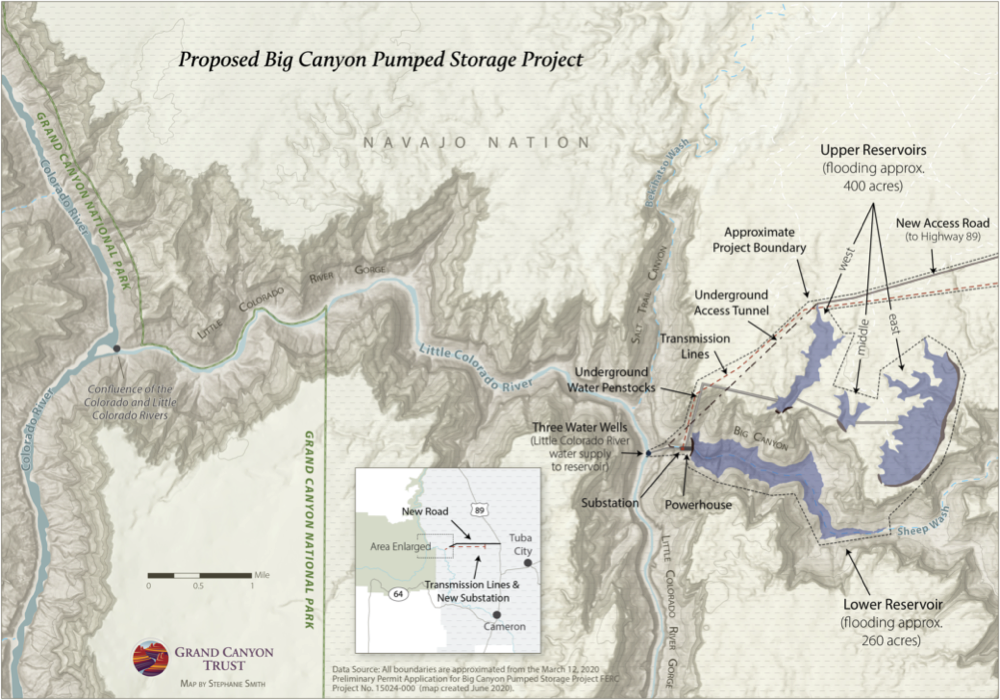
Unfortunately, the developer’s request to surrender these two permits is a reminder of the work ahead. The developer is still waiting to hear back on a preliminary permit for the Big Canyon dam proposal on a tributary to the Little Colorado River. The Big Canyon dam remains the developer’s priority — and our biggest concern. The Big Canyon dam proposal, which is also on Navajo Nation land and opposed by many tribes, would require pumping groundwater and likely alter the blue waters of the Little Colorado River.

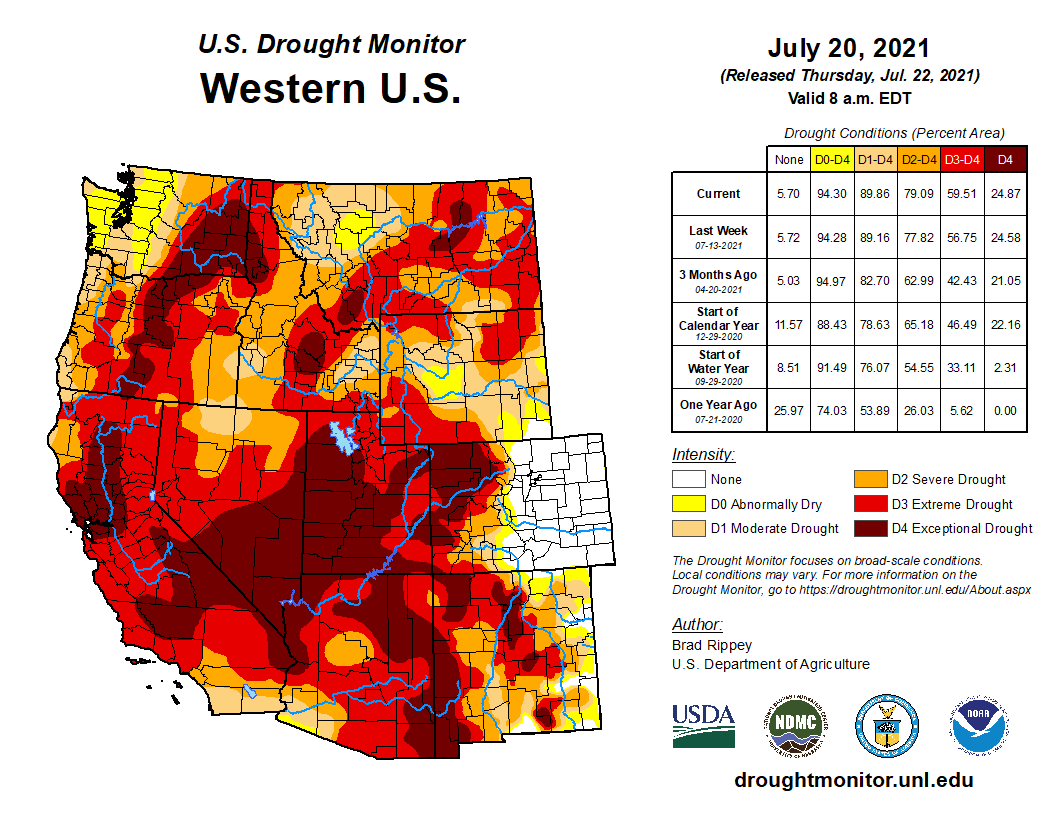
West Drought Monitor map July 27, 2021.

Drought underlines the imprudence of the Big Canyon dam

The developer is proposing to pump about 44,000 acre feet (about 14.3 billion gallons) of groundwater, plus an additional 10,000 to 15,000 acre feet (3.2 to 4.8 billion gallons) per year to make up for water lost to evaporation in order to fill the Big Canyon dam in an arid landscape already facing extreme drought and water restrictions. Currently, there are potable water restrictions across the Navajo Nation. It is alarming that the developer is continuing to push a proposal to pump additional groundwater to power this project in order to produce electricity for distant city centers in the middle of this drought.

It is unknown when FERC will make a decision on the Big Canyon dam proposal’s preliminary permit application, which, if granted, would initiate a 3-year period for a feasibility study. What we do know is we will continue to stand with local communities and fight this unwanted and inappropriate proposal tooth and nail. If you haven’t already, please sign the petition to Keep the Canyon Grand and join our action alert network. We’ll let you know when there’s an opportunity to speak up.

#Monsoon2021 season brings the rainiest July in 10 years — Summit Daily

The time between rainfalls has become longer and the rains occurred more erratically in the Southwest during the last 50 years.. Photo credit: The Mountain Town News/Allen Best

From The Summit Daily (Taylor Sienkiewicz):

Drought conditions improve across the state but not erased west of the Continental Divide

Summit County is experiencing both a monsoon and a lingering drought.

How does that work? To put it simply, a drought takes a long time to release its grip. Whether the downpours will lift the area out of drought conditions or not, the precipitation is welcome relief, according to National Weather Service meteorologist Greg Hanson.

“We are in a monsoon pattern right now, and so that means we’re getting … a plume of moisture that comes up from the tropics, from the Gulf of Mexico and the Gulf of California,” Hanson said. “It’s not the individual storms; it’s the weather pattern that brings the storms to the area.”

The Dillon weather station recorded 3.76 inches of rain in July, which is more than double the month’s 1.87-inch average. On Saturday morning, July 31, the weather station recorded 1.13 inches of rain for the previous 24 hours, which is the most in a single 24-hour period so far this summer. According to National Weather Service records, it has been the rainiest July since 2011.

While an extra inch or two might not sound like much, Hanson said it makes a difference in the High Country…

Colorado Drought Monitor one month change map ending July 27, 2021.

Hanson said there have been some drought improvements in western Colorado, and areas east of the Continental Divide are in “great shape.” He said the wet spring and snowy March erased the drought in the east. In western Colorado, where conditions have been more severe, the precipitation has helped but has not gotten rid of the drought.

Colorado Drought Monitor map July 27, 2021.

Summit County’s drought conditions have not changed since the beginning of June, according to weekly updates from the U.S. Drought Monitor. The county currently ranges from no drought in the east to severe-to-extreme drought in the northwest.

North American Monsoon graphic via Hunter College.

From The Pueblo Chieftain (Heather Willard):

Pueblo has received enough rain since January that records will still show Pueblo as receiving above-average rainfall for the year — even if not another drop of rain falls until December…

According to the National Weather Service’s data, Pueblo has received 12.91 inches of rain since Jan. 2021, which is 0.89 inches more than the annual average. This is a marked difference from 2020, when the area only received 5.33 inches during the whole year.

Community Funding Partnership Awards Nearly $500,000 To West Slope #Water Projects — #Colorado River District

ommunity Funding Partnership projects like the Artificial Intelligence for Sustainable Water, Nutrient, & Salinity Management Project in Mesa County will support the advancement of precision agriculture as we move forward into a hotter, drier climate on the West Slope. Photo via the Colorado River District

Here’s the release from the Colorado River District:

Five grant awards to benefit agricultural, municipal, and recreational water users across Western Colorado

From enclosing irrigation canals to precision agriculture research; from creating reliable water storage to building redundancy in municipal water sources, the Colorado River District’s Community Funding Partnership is directly helping Western Colorado water users.

At its most recent Board meeting on July 21, the Colorado River District awarded a total of $494,350 to five projects across the West Slope. Since the beginning of 2021, a total of approximately $1.9 million has been awarded to thirteen different water projects, all of which benefit multiple stakeholders.

“In the midst of exceptional drought on the West Slope and increasing pressures on our rivers, our Community Funding Partnership continues to demonstrate the need for water funding to ensure our communities thrive into a hotter, drier future,” said the Colorado River District’s Director of Strategic Partnerships, Amy Moyer. “Developing solutions across a diverse geographic area and across diverse water uses is key. These projects advance multiple benefits to support our farmers and ranchers, recreators, and economies on the West Slope.”

Funded Projects:

Cedar Mesa Ditch Piping Project – Cedar Mesa Ditch Company
Delta County
$45,000 in funds awarded

Just outside of Cedaredge, this project will pipe 3.5 miles of the lower Cedar Mesa Ditch that passes through Mancos Shale to avoid losing a significant amount of water to seepage. By preventing this water loss, particularly in drought years, the ditch users will face fewer cutbacks in the production of hay and fewer declines in the quality and quantity of crops such as fruit, hemp, vegetables, and greenhouse flowers. It will also improve water quality by eliminating salt and selenium returns to the Gunnison River and the broader Colorado River Basin.

Lake Irwin Valve and Piping Project Design and Engineering – Town of Crested Butte
Gunnison County 
$42,000 in funds awarded  

This project will fund the necessary geotechnical and structural investigations required to better understand the infrastructure of a crucial source of water for the Town of Crested Butte. From this information, an engineered design will be developed to replace the valve structure, valve, and pipeline which conveys water from Lake Irwin. In addition, the project will conduct a condition assessment of the upstream portion of the tunnel which was originally installed in 1877 and is assumed to be timber set construction. Failure of this inlet tunnel would restrict the drinking water for the town and result in costly emergency repairs.

Artificial Intelligence for Sustainable Water, Nutrient, & Salinity Management in the Western U.S. – Colorado State University
Mesa County
$50,000 in funds awarded

This project will construct and equip the Western Colorado Research Center at Grand Valley (WCRC-GV) with an overhead traveling sprinkler system on a 12.5-acre field to support research on digital and precision agriculture. A significant body of research into precision agriculture supports the improvement of crop yields, efficient irrigation, and reduced fertilizer use. This infrastructure addition will support emerging technologies and ensure cutting-edge research has a grounded presence in the Colorado River Basin for our communities to test and learn from.

GH Lateral Enhancement Project – Uncompahgre Valley Water Users Association
Delta County  
$57,350 in funds awarded  

The GH Lateral Enhancement Project includes the construction of a 70 acre-foot in-system, regulating reservoir to provide a more reliable water supply to farms served by the northern portion of the Uncompahgre Project. This funding will support the land acquisition for the reservoir and a permanent easement for the GH Lateral Pipeline, leveraging approximately $14 million in federal funding. This area experiences high diurnal fluctuations, and the regulating reservoir will allow for water storage during peaks and the subsequent release during low flows. The project will allow water managers to optimize water diversions from the Uncompahgre River and minimize spills from the project.

Roaring Fork Pump Station Pipeline Connection Project – City of Glenwood Springs
Garfield County  
$300,000 in funds awarded  

The project consists of the construction of a raw water transmission line from the City of Glenwood Springs’ existing Roaring Fork Pump Station to the Red Mountain Water Treatment Plant. Constructing a new pipeline connection will expand the City’s water supply capabilities, creating redundancy within the water system. This redundancy will not only mitigate drought and wildfire hazards, but will also mitigate increased hazards for sediment, debris flow, and rockfall issues within the No Name and Grizzly Creek watersheds caused by the August 2020 Grizzly Creek Fire.

Resources

More information about the Colorado River District’s Community Funding Program is available by clicking here.

To review the Colorado River District’s Board Documents related to the program, visit http://www.coloradoriverdistrict.org/quarterly-board-meetings.

Report: Anthropogenic forcing and response yield observed positive trend in Earth’s energy imbalance — Nature Communications #ActOnClimate #KeepItInTheGround

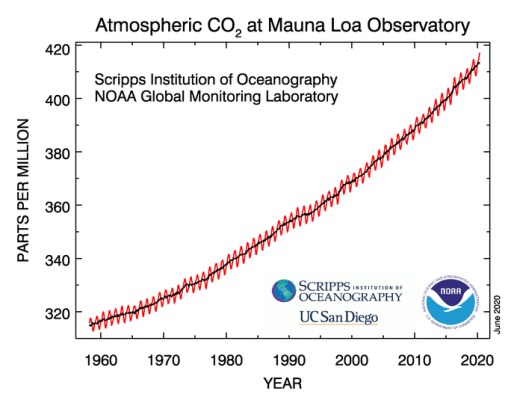
The carbon dioxide data on Mauna Loa constitute the longest record of direct measurements of carbon dioxide in the atmosphere. C. David Keeling of the Scripps Institution of Oceanography began measurements in 1958 at the NOAA weather station. NOAA started its own CO2 measurements in May of 1974, and they have run in parallel with those made by Scripps since then. Credit: NOAA and Scripps Institution of Oceanography.

Click here to access the report. Here’s the abstract:

Abstract

The observed trend in Earth’s energy imbalance (TEEI), a measure of the acceleration of heat uptake by the planet, is a fundamental indicator of perturbations to climate. Satellite observations (2001–2020) reveal a significant positive globally-averaged TEEI of 0.38 ± 0.24 Wm−2decade−1, but the contributing drivers have yet to be understood. Using climate model simulations, we show that it is exceptionally unlikely (<1% probability) that this trend can be explained by internal variability. Instead, TEEI is achieved only upon accounting for the increase in anthropogenic radiative forcing and the associated climate response. TEEI is driven by a large decrease in reflected solar radiation and a small increase in emitted infrared radiation. This is because recent changes in forcing and feedbacks are additive in the solar spectrum, while being nearly offset by each other in the infrared. We conclude that the satellite record provides clear evidence of a human-influenced climate system.

The carbon dioxide data on Mauna Loa constitute the longest record of direct measurements of carbon dioxide in the atmosphere. C. David Keeling of the Scripps Institution of Oceanography began measurements in 1958 at the NOAA weather station. NOAA started its own CO2 measurements in May of 1974, and they have run in parallel with those made by Scripps since then. Credit: NOAA and Scripps Institution of Oceanography.

#Drought Resilience Requires a Holistic Approach — The American Farm Bureau #ColoradoRiver #COriver #aridification

Arizona landscape. Credit: Stefanie Smallhouse

From The American Farm Bureau (Stefanie Smallhouse):

My husband and I took over operating the family ranch in 2000 after the sudden passing of his father; I remember it was an especially dry year. In the desert that is not much in the way of news, but more of a tendency. Even so, we were forced to liquidate two-thirds of our cattle herd because we did not have the necessary infrastructure to manage what became a longer-term situation.

We now know that what started in 2000 and continues today is considered a megadrought with no end in sight, one of the driest periods in the Colorado River Basin in 1,200 years according to tree-ring data. Feeding hay, hauling water and a poor calf crop combined with low prices will put a rancher out of business quickly in the arid Southwest. A few dry years sprinkled within a decade are expected and recoverable, but 20-plus years of well below-average precipitation creates long-term consequences that accumulate over time and exacerbate existing resource concerns.

Just two examples: Our overgrown forests are tinderboxes, and our water projects are aging and inadequate.

According to the National Interagency Fire Center, the number of acres burned in 12 western states has more than doubled from 4.2 million acres in 2002 to 9.4 million acres in 2020. A diminished timber industry, a litigious environment and a drier climate have created the perfect scenario for catastrophic fires.

The Colorado River system, which was allocated to seven Western states a century ago, provides drinking water to more than 40 million people and irrigates 5.5 million acres of farmland. Next month, the Bureau of Reclamation will release its 24-Month Study which is certain to trigger a Tier 1 shortage. This will be the first shortage call on the river in its history of managed allocation, and Arizona farmers, many of whom are growing hay for parched ranchers, will be the first to lose their water.

A similar situation is playing out all over the West. Farm fields across the region are being fallowed to meet in-stream flow requirements for endangered species while tribal settlements have created a complex matrix of legal restrictions that have further tightened water availability during times of shortage. Water infrastructure projects are not only critical for access to water, but they also provide critical energy production. An ongoing effort in Idaho threatens to deconstruct dams along the Lower Snake River and a privately held water project in California is scheduled for disassembly due to environmental-related litigation.

It is encouraging that the Biden administration recently created an Interagency Working Group to address the ongoing drought and its impacts, while the Senate continues work on an infrastructure package. However, it is not only critical that Western water infrastructure is included in this package, but that drought preparedness take a holistic approach. Overly burdensome regulations which inhibit progress, as well as ongoing efforts to undermine our current water projects, should be closely examined. In addition, valuable conservation and risk management programs may need enhancement to better offset prolonged periods of drought, as the way we manage our forests is fundamental in augmenting water supplies.

Despite the ongoing drought, we have managed to build back our herd through long-term planning, risk management and infrastructure investment. Although grit will get you through the dry spells, resilience will ensure a brighter and hopefully wetter future.

Stefanie Smallhouse is president of Arizona Farm Bureau.

#SnakeRiver #Water District to hold public meeting August 4, 2021 on water plans — The Summit Daily

Snake River

From The Summit Daily (Lindsey Toomer):

The Snake River Water District will hold a public meeting at 6:30 p.m. Wednesday, Aug. 4, at its office at 0050 Oro Grande Drive in Keystone.

A presentation will be given on the recently completed water system master plan and upcoming rate changes at the meeting.

Based on the master plan, the district will need to invest about $38.5 million over the next 10 years to address aging infrastructure, potential trouble areas of the system, capacity and distribution. Its next step is determining how to fund these upgrades through federal and state grants and loans.

How Locals Are Banding Together To Protect the #YampaRiver — 5280 Magazine #GreenRiver #ColoradoRiver #COriver #aridification

Yampa River. Photo credit: Allen Best/The Mountain Town News

From 5280 Magazine (Nicholas Hunt):

Powered by a $2 million endowment, the Yampa River Fund is building a more resilient waterway.

…folks whose lives are tied to one of the [Colorado River Basin’s] tributaries in northwestern Colorado aren’t standing by idly. In September 2019, more than 20 regional partners from throughout the Yampa River Valley, including recreation-focused businesses, farmers, nonprofits, and municipalities, joined forces to create the Yampa River Fund. Powered by a nearly $4 million endowment, the fund is doing what individual actors cannot: financing environmental restoration projects, agricultural infrastructure improvements, and releases from nearby reservoirs to ensure farmers, recreationists, and wildlife all have enough water to thrive.

None of this will reverse climate change, but the healthier the Yampa is, the better it will be at weathering a hotter, drier world. This understanding is what brought so many diverse—and sometimes seemingly contradictory—interests together. “We focus on creating win-win-win solutions,” says Nancy Smith, Colorado River Program conservation director at the Nature Conservancy, one of the fund’s founding entities. Smith emphasizes that third “win” because consensus is key: “The working group that created the fund took the time to build trust with one another so that everyone in that valley who depends on the river felt like they had a place at the table.”

Using the proceeds from its endowment, the fund has awarded $400,000 in grants over the past two years. Here’s how it breaks down.

The Lefevre family prepares to put their rafts in at Pebble Beach for a float down the Yampa River to Loudy Simpson Park on June 6, 2021. From left, Marcie Lefevre, Nathan Lefevre, Travis Lefevre and Sue Eschen.
CREDIT: HEATHER SACKETT/ASPEN JOURNALISM

Bank Stabilization
Grant Recipient: Moffat County
Value: $44,821
Moffat County used a grant to bolster the riverbank at Loudy Simpson Park, which was eroding, in part, due to the growing number of people using the steep shoreline to access the river. A new boat ramp built to handle the crowds will limit future erosion (and open six additional miles of river to boaters by creating a new downstream takeout), and an ADA-compliant ramp helps wheelchair users easily access the water.

River Restoration
Grant Recipients: Trout Unlimited and the Yampa Valley Stream Improvement Charitable Trust
Value: $79,387
The fund has awarded three grants to rehabilitate sections of the Yampa and its tributaries. The work includes improving fish habitat and riparian zones (the border between the water and the land) and stabilizing shorelines to stop the tributaries from carving away at productive farmland.

Water Releases
Grant Recipient: Colorado Water Trust
Value: $135,585
To combat rising water temperatures and decreasing water levels—both of which harm wildlife, including four species of endangered fish—the fund pays for strategic releases of cold water from nearby reservoirs. The releases also increase water security for local farmers and help keep the river open for recreationists, who pump tourism dollars into the region.

MAYBELL DIVERSION Located on the lower Yampa River, a tributary to the Colorado River, the Maybell diversion provides water for 18 agricultural producers in northwest Colorado. © The Nature Conservancy

Irrigation Improvements
Grant Recipient: The Nature Conservancy
Value: $31,680
This outlay pays for the permits needed to rebuild the125-year-old Maybell Ditch headgate, which diverts water from the Yampa into an irrigation canal. The new headgate will be more efficient, meaning more water for farmers and wildlife, and safer for boaters, who often avoid this section of river, in part because of the dangerous hydraulics created by the structure’s weir dam. The new, fish-friendly design will also ease passage for endangered species, like the razorback sucker.

Artificial Whitewater
Grant Recipient: The city of Craig
Value: $18,000
Craig received a grant to help pay for a whitewater park to diversify its tourism economy. A new diversion dam will also sustain the city’s water supply and allow fish to move up and down the river to spawn, feed, and escape to deeper water when river levels drop.

Tree Planting
Grant Recipient: Yampa Valley Sustainability Council
Value: $45,706
Volunteers with the Yampa Valley Sustainability Council’s ReTree program have been planting cottonwoods, alders, and willows along the Yampa for more than a decade. In 2020, the council used a grant to procure an irrigation system to increase the saplings’ survival rates, and this year it received another disbursement to cover 2022’s expenses, such as site preparation. One of the main goals is to create more shade to help mitigate rising water temperatures.

Greenway Master Plan
Grant Recipient: The town of Oak Creek
Value: $44,821
Oak Creek obtained funds to aid the design of a new greenway along a portion of its neglected namesake waterway. Construction will improve access and include rehabbing the creek’s banks, vegetation, and wildlife habitat. A healthy riparian zone can help regulate water levels by soaking up runoff and slowly releasing it into the creek.

#ClimateCrisis has cost #Colorado billions – now it wants oil firms to pick up the bill — The Guardian #ActOnClimate #KeepItInTheGround

Four Mile Canyon Fire September 6, 2010

From The Guardian (Chris McGreal):

Gold Hill has received a state grant to thin out the forest around the town in the hope of slowing if not stopping future fires. But that is a fraction of the cost that the surrounding county says it will take to deal with the impact of global heating.

Boulder county estimates it will cost taxpayers $100m over the next three decades just to adapt transport and drainage systems to the climate crisis, and reduce the risk from wildfires.

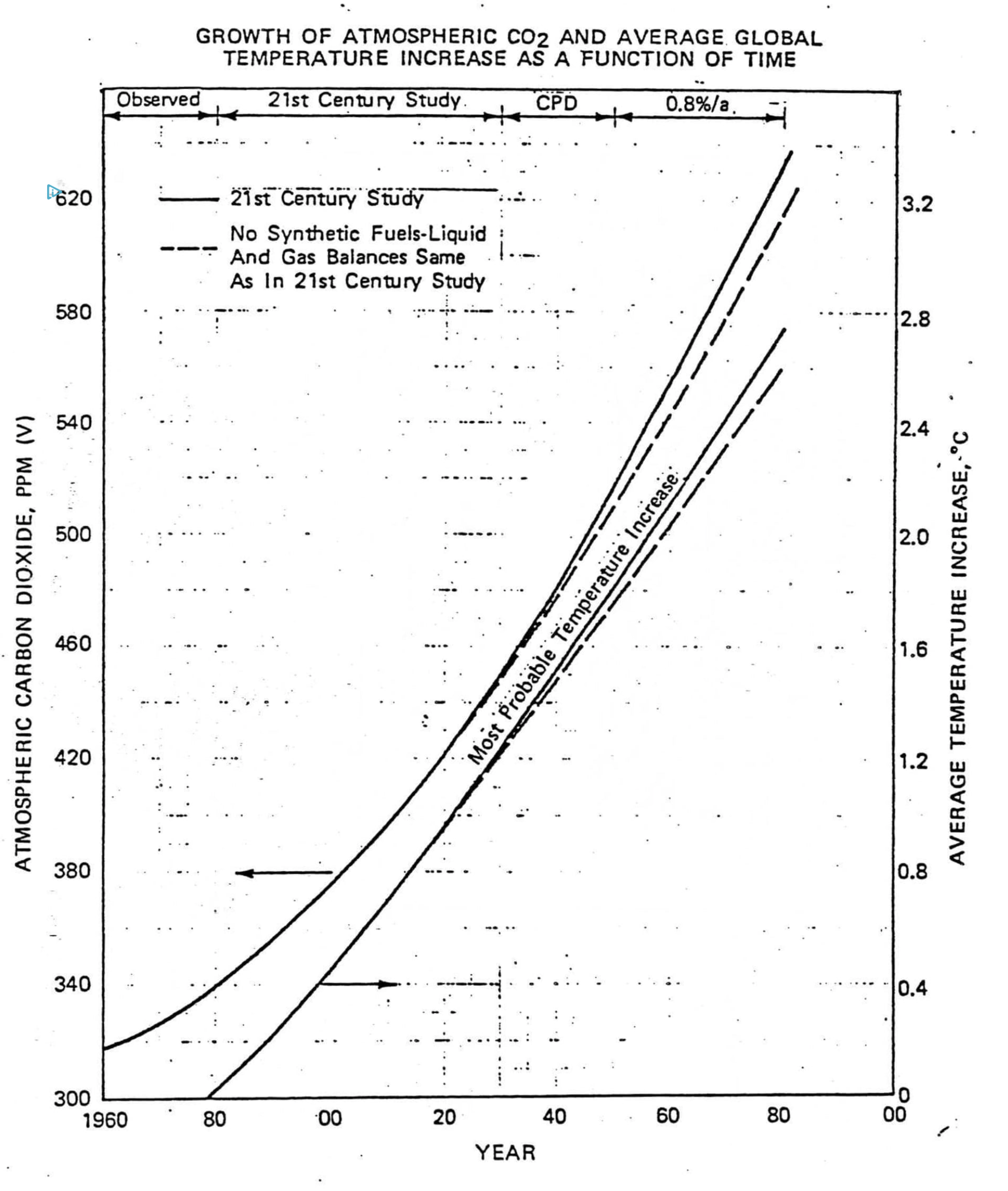
Exxon’s private prediction of the future growth of carbon dioxide levels (left axis) and global temperature relative to 1982 (right axis). Elsewhere in its report, Exxon noted that the most widely accepted science at the time indicated that doubling carbon dioxide levels would cause a global warming of 3°C. Illustration: 1982 Exxon internal briefing document

The county government says the bill should be paid by those who drove the crisis – the oil companies that spent decades covering up and misrepresenting the warnings from climate scientists. It is suing the US’s largest oil firm, ExxonMobil, and Suncor, a Canadian company with its US headquarters in Colorado, to require that they “use their vast profits to pay their fair share of what it will cost a community to deal with the problem the companies created”.

Boulder county, alongside similar lawsuits by the city of Boulder and San Miguel county in the south-west of the state, accuse the companies of deceptive trade practices and consumer fraud because their own scientists warned them of the dangers of burning of fossil fuels but the firms suppressed evidence of a growing climate crisis. The lawsuits also claim that as the climate emergency escalated, companies funded front groups to question the science in order to keep selling oil.

“It is far more difficult to change it now than it would have been if the companies had been honest about what they knew 30 or 50 years ago,” said Marco Simons, general counsel for Earth Rights International, which is handling the lawsuit for the county. “That is probably the biggest tragedy here. Communities in this country and around the world were essentially robbed of their options.”

Boulder county’s lawsuit contends that annual temperatures in Colorado will rise between 3.5F and 6.5F by 2050 and imperil the state’s economy, including farming and the ski industry.

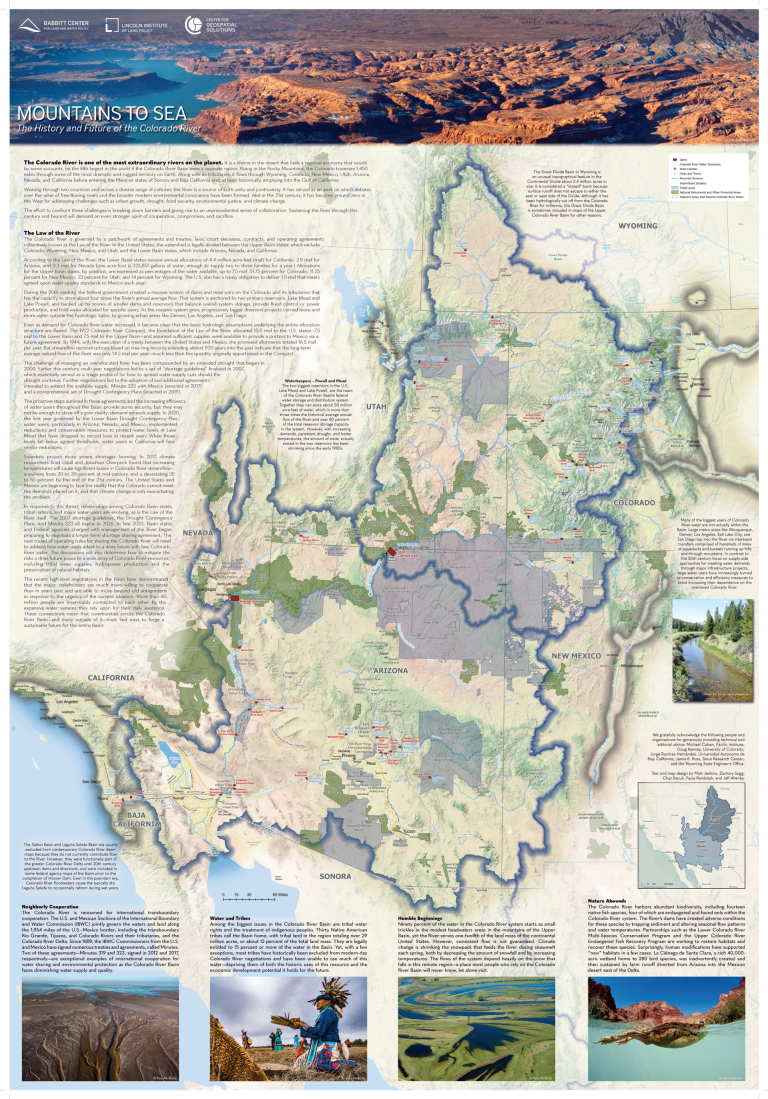
Colorado River Basin map via the Babbit Center for Land and Water Policy/Lincoln Institute of Land Policy

Extremes of weather are already melting the mountain snowpack, causing increased evaporation and a shortfall in the amount of water flowing down the region’s most important river, the Colorado, which supplies drinking water to the state’s largest cities and irrigation all the way to California and Arizona…

Exxon and Suncor are alarmed at the prospect of the cases being heard by local jurors with first-hand experience of the impact of global heating in Boulder. The companies are pressing to move the trials out of state courts and into a federal system where laws on deceptive marketing and consumer fraud do not apply.

“Their strategy is to say that these cases need to be in federal court because federal jurisdiction applies. Then they will turn around and argue that federal law provides no remedy,” said Simons. “It is all about a route to dismissing these cases.”

The outlines of the oil industry’s defence have emerged in newspaper columns pushing back against any parallels with big tobacco and claiming it is the end user, ordinary Americans, that causes pollution…

Max Boykoff, a professor in the environmental studies department at the University of Colorado Boulder, acknowledged the problem, alongside the popularity of high fuel consumption vehicles. But he said that should not be used by the oil companies to absolve themselves of responsibility for a crisis they have played a leading part in creating.

“These lawsuits are one of the tools to hold both these companies accountable,” he said.

Department of Natural Resources Seeking Applications for #Colorado Forest Health Council

Here’s the release from the Colorado Department of Natural Resources (Chris Arend):

The Colorado Department of Natural Resources is seeking applicants to serve on the Colorado Forest Health Council (Council), a volunteer stakeholder body whose role is to provide a collaborative forum to advise the Governor, through the Executive Director of the Department of Natural Resources, and the Colorado General Assembly, on issues, opportunities, and threats to Colorado’s forests.

“Colorado’s forests face unique challenges including climate change, year-round wildfire risk, and population growth. The reconstituted Council, now at the Department of Natural Resources and with increased diverse membership, will have the opportunity to help shape our State’s forest management and wildfire risk management policies and priorities for the future. I encourage interested Coloradans to apply,” said Dan Gibbs, Executive Director, Colorado Department of Natural Resources.

(Photo: Colorado State Forest Service)

The Council was reconstituted during the Colorado 2021 Legislative Session through SB21-237, and will consist of 26 members, including two state legislators, 18 seats from all corners of Colorado appointed by Governor Polis, along with other agency representatives.

Applications are due August 16, with the Governor’s seat selections due September 2. The Council will meet multiple times per year for half- or full-day meetings with virtual attendance options, with meeting frequency and schedule confirmed by the new council. Applicants should anticipate at least 5 hours of Council-related business per month.

Please note that the council may still be listed under its old name, the “Forest Health Advisory Council,” but will be updated shortly to its new name, the “Colorado Forest Health Council”. Applications submitted under the council’s old name will still be fully considered.

Environmental releases from Stagecoach aimed at boosting flows, cooling temperatures in #YampaRiver — Steamboat Pilot & Today #GreenRiver #ColoradoRiver #COriver #aridification

Coyote Gulch along the Yampa River Core Trail July 21, 2021.

From The Steamboat Pilot & Today (Dylan Anderson):

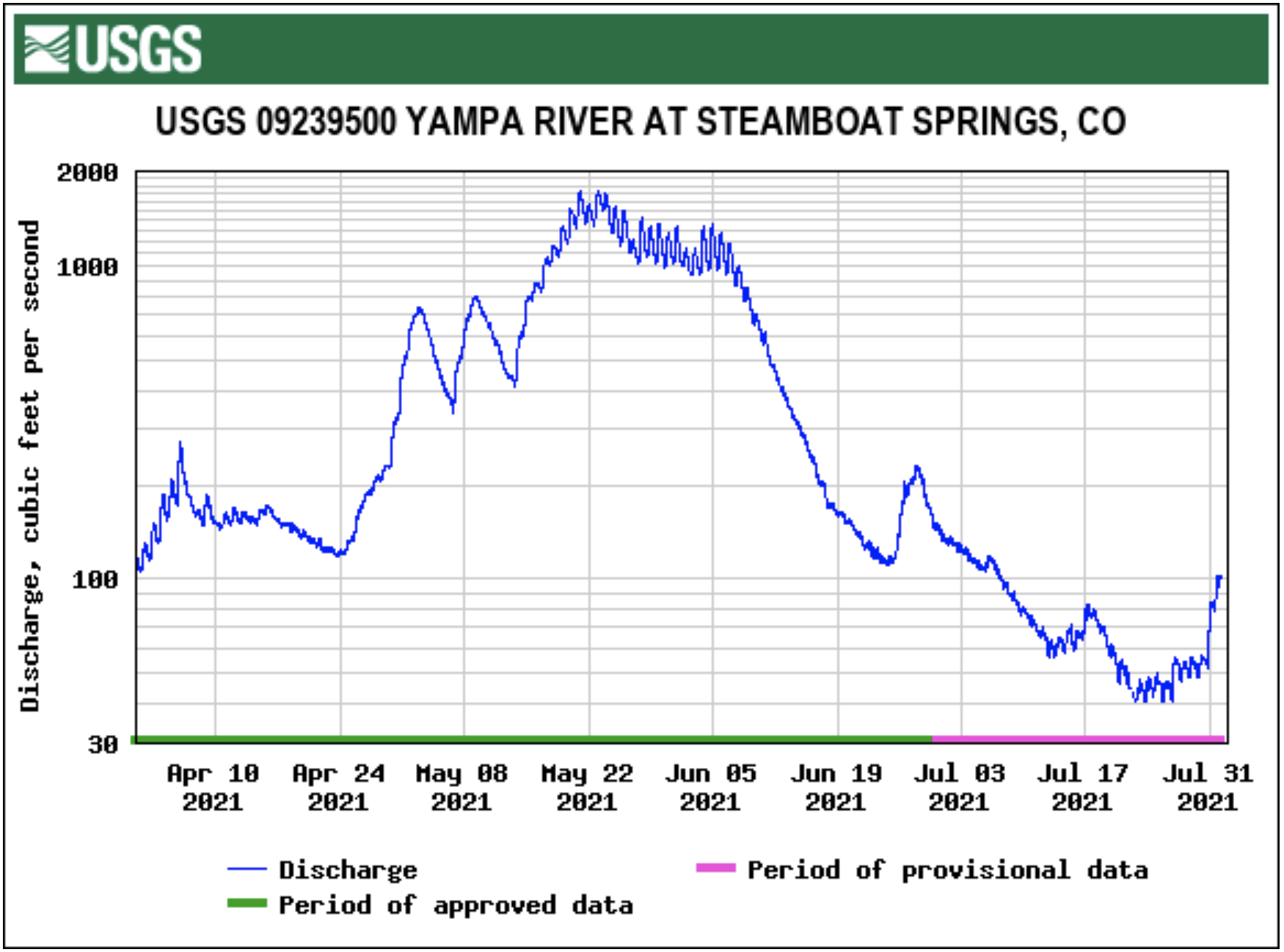
Flows in the Yampa River dropped to near 40 cubic feet per second on Sunday afternoon — just a quarter of the amount of water flowing the same day last year.

The water’s temperature eclipsed 80 degrees last Thursday and has often been well over 75 degrees in the past week — the temperature that closed the river to recreation earlier this month.

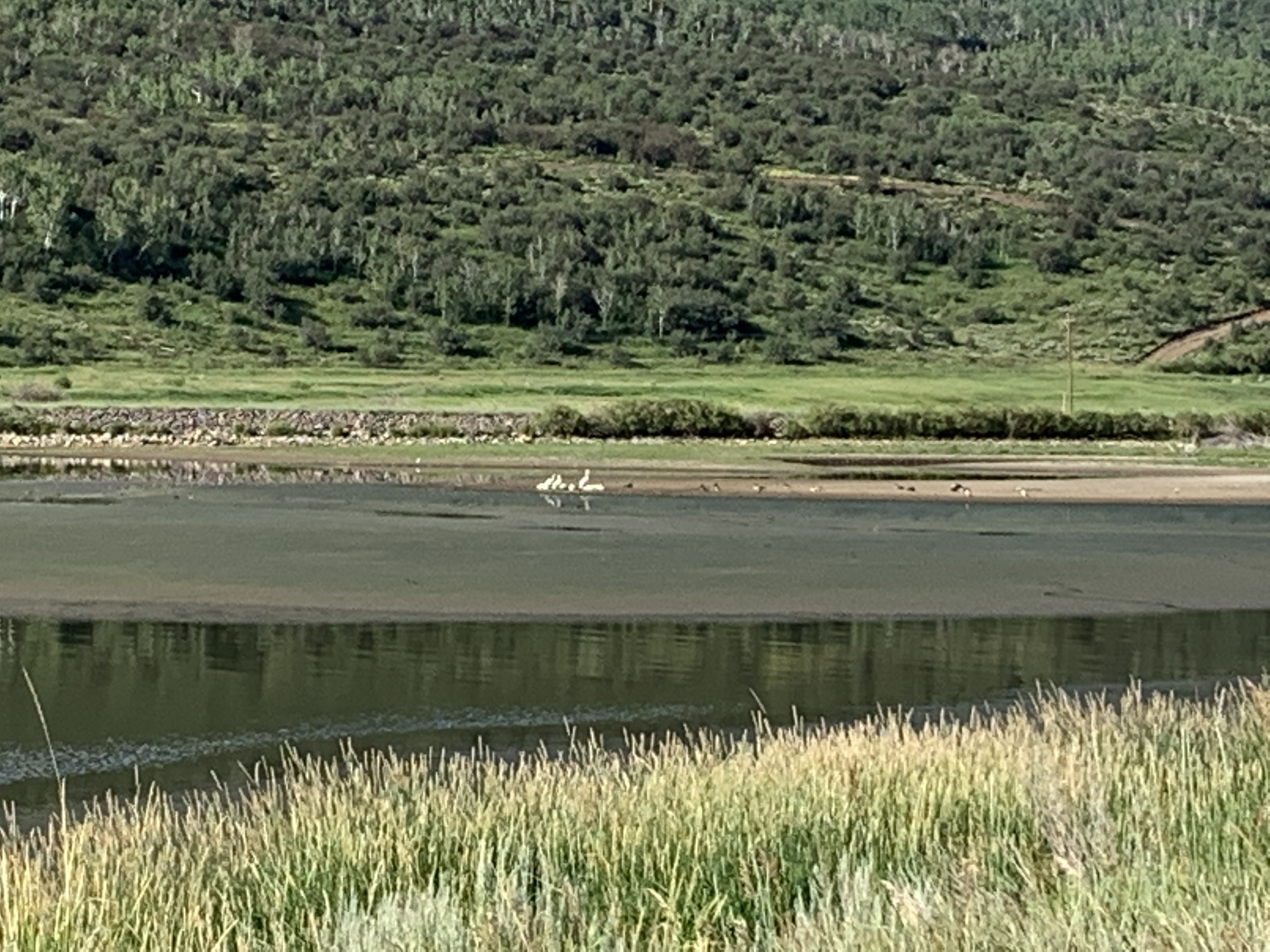
Pelicans hanging out at the inlet to Stagecoach Reservoir July 22, 2021.

But at 8:45 a.m. Monday morning [July 26, 2021], the outlet valve at Stagecoach Reservoir was opened a little bit further and 20 cfs more of water was flowing into the river.

This will bring the outward flow from Stagecoach up to about 40 cfs with the goal of boosting water levels and decreasing temperature in the Yampa as it flows through Steamboat Springs.

“I think (the strategic releases) are very effective at protecting the health of the river,” said Andy Rossi, general manager of the Upper Yampa Water Conservancy District, which owns and operates Stagecoach.

The releases hope to buoy flows in the Yampa and protect its aquatic species, as Northwest Colorado is entrenched in the worst level of drought recorded by the U.S. Drought Monitor and several stretches of the river have been closed to recreation, including one of the most popular stretches to fish in the state…

While the release will help increase flows and sustain the health of the river, Rossi said it likely wouldn’t have enough of an effect on its own to open the river back up for commercial outfitters and anglers.

The release was purchased by the Colorado Water Trust, which finalized a contract to purchase 1,000 acre-feet of water with an option for another 1,000 acre-feet with the conservancy district earlier this month.

This amounts to 40 acre-feet of additional water released into the river each day, with the first 1,000 acre-feet lasting until about the third week in August, Rossi said. The district and trust will meet weekly about the releases, and Rossi said he expected to know when and how much of the other 1,000 acre-feet of water would be released before then.

When that 2,000 acre-feet of water has been used up, the city of Steamboat Springs plans to coordinate with community partners to release additional water and maintain the health of the river.

The water trust raised over $100,000 to support releases this year from both Stagecoach and Elkhead Reservoir further downstream. More than 90% of that money came from the Yampa River Fund, which is a collaboration with more than 20 community partners, including outdoor recreation businesses, the city of Steamboat, the Yampa Valley Community Foundation and Routt and Moffatt counties, among others…

The trust opted to release the water now because of how hot the water in the river got last week and how low flows had dwindled. It will likely take at least a day to see the impacts of the release, as it will take time for the water to flow from Stagecoach, which includes going through Lake Catamount.

The trust has spent nearly a half-million dollars since 2012 on 12,000 acre-feet of water releases from Stagecoach. The first 1,000 acre-feet of water from the most recent release will cost $45,560.

This water will be shepherded by the Division of Water Resources locally, ensuring that another water user does not remove the release from the river until at least the Steamboat wastewater treatment plant to the west of town.

The Upper Yampa Water Conservancy District has already released about 1,600 acre-feet of water this year for environmental purposes when water was only coming into the reservoir at a trickle…

Starting Aug. 1, the reservoir is required to release at least 20 cfs to satisfy permits for hydropower production, though it has been releasing about that much for most of the year.

The release requires navigating some legal hoops, as the current laws were not designed for purchases of water that are meant to stay in the river. This requires the trust to partner with an entity like Steamboat, which is justifying the release as water temperature mitigation.

#Colorado’s #Monsoon2021 Season Is Struggling To Bring Relief To Rivers, Ranchers And Wildfires As The #Climate Warms — Colorado Public Radio #ActOnClimate

Last nights storm (July 30, 2021) was epic — Ranger Tiffany (@RangerTMcCauley) via her Twitter feed.

From Colorado Public Radio (Michael Elizabeth Sakas):

The North American monsoon has returned to Colorado, and the rain has brought some much-needed relief to some of the driest parts of the state — after multiple back-to-back years of almost no summer rain…

The seasonal moisture from the tropics creates afternoon cloud cover that protects his drought-stricken creeks from baking in the sun. The rain helps lower the risk for wildfires.

The timing of the monsoon is vital to Colorado’s ecosystem, which evolved on its schedule. Science suggests that climate change is making these rains less helpful.

Colorado’s Western Slope has been labeled a climate hot spot, where average temperatures are increasing faster than the global average. A climate change-fueled megadrought has plagued the state and parts of the West for 20 years…

[Bill] Trampe said hotter days and four years of almost no monsoon rain turned into “horribly dry” conditions during the summer of 2020. Many ranchers in Gunnison couldn’t grow enough hay to feed their cattle, which meant they had to buy it — a pricey added expense, he said.

Trampe was worried the land was too dry to feed the number of cattle in his herd, so he was forced to slaughter more animals in the fall than he planned. He also sold cattle over the winter, something he doesn’t usually do. Trampe said he was fearful 2021 would be another dry year…

While Trampe can grow hay on his private land using irrigated water from the Gunnison River, his cattle graze on federal land. Trampe said the federal rangeland is running out of water. “These rains are super important,” he said.

Monsoon rains are getting less reliable and less effective. Recent research from the Desert Research Institute in Nevada has found that less rain is making it into rivers as the climate warms.

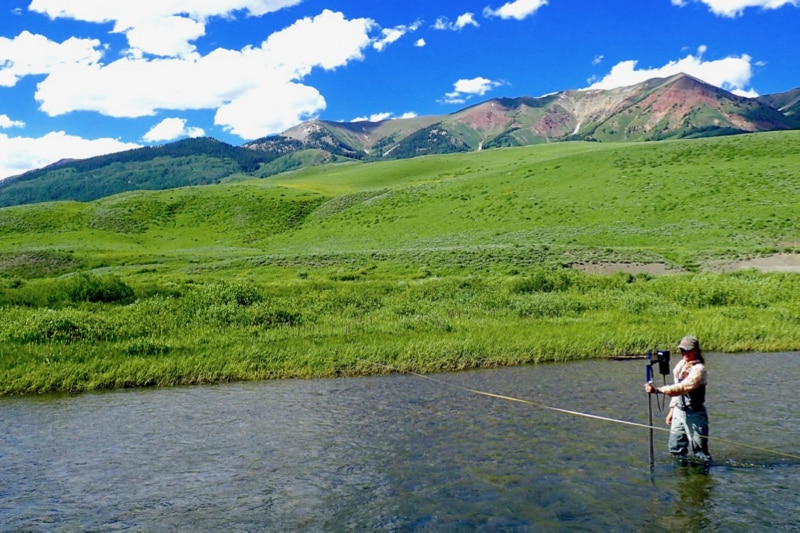
Desert Research Institute scientist Rosemary Carroll measures stream discharge in the East River, Colorado. Credit: Kenneth H. Williams via the Desert Research Institute

This deficiency starts with snowpack, which collects in the mountains during the winter, said Rosemary Carroll, an associate professor of hydrology and the lead author of the study. If a big snowpack lasts into the summer, the soil can stay moist if temperatures are cooler.

Those conditions would mean rainfall would more likely reach a stream. If the snowpack is low, temperatures are higher and the soil is dry, less monsoon rain makes it into the stream, Carroll said. With climate change, an average water year can look more like a moderate drought.

Carroll stood on the edge of a high dirt road in Gothic, Colo., overlooking a winding tributary that eventually feeds water to the Colorado River, which supplies 40 million people in the Southwest. The nation’s two largest reservoirs are on this river — Powell and Mead. Those levels are dwindling to record lows, and climate change means less water is making it into the system.

Carroll is worried about where things are headed.

“It would be hard not to be,” she said. “With decreasing snowpack, warmer temperatures and now the volatility of the monsoon itself, this is just not great news for everybody.”

Next, the team explored the ability of these summer rains to produce streamflow during cool years with high snow accumulation, and during warm years with less snow accumulation. During cool years with more snow, soil moisture levels were higher going into summer, and greater streamflow was generated by the monsoon rains. During warmer years with low snowpack, dry soils absorbed much of the monsoonal rains, and less runoff made it to the streams.

“You can think of the soil zone as a sponge that needs to fill up before it can allow water to move through it,” Carroll said. “So, if it’s already depleted because you had low snowpack, the monsoon then has to fill it back up, and that decreases the amount of water you actually get in the river.”

As the climate warms, snowpack in the Rocky Mountains and other mountain systems is expected to decline, leading to reduced streamflow. Rising temperatures also lead to increased soil evaporation and increased water use by plants. According to the results of Carroll’s study, these changes will reduce the ability of water from the monsoon to make it to the river as streamflow.

“Our results indicate that as we move toward a climate that is warmer and our snowpack decreases, the ability of monsoon rain to buffer these losses in streamflow is also going to go down,” Carroll said. “So, the monsoon is not some silver bullet that is going to help mitigate those changes.”

Research from the University of Arizona finds dry periods are lasting longer across the West as the climate changes. When rain does fall, it often comes in fewer and larger storms, which hurts grasses with shallow roots that need a steady supply of moisture.

Even if the total amount of rainfall is the same during a growing season, it’s not as helpful if it comes in the form of occasional large rainstorms, said Joel Biederman, a research hydrologist with the U.S. Department of Agriculture who co-authored the paper.

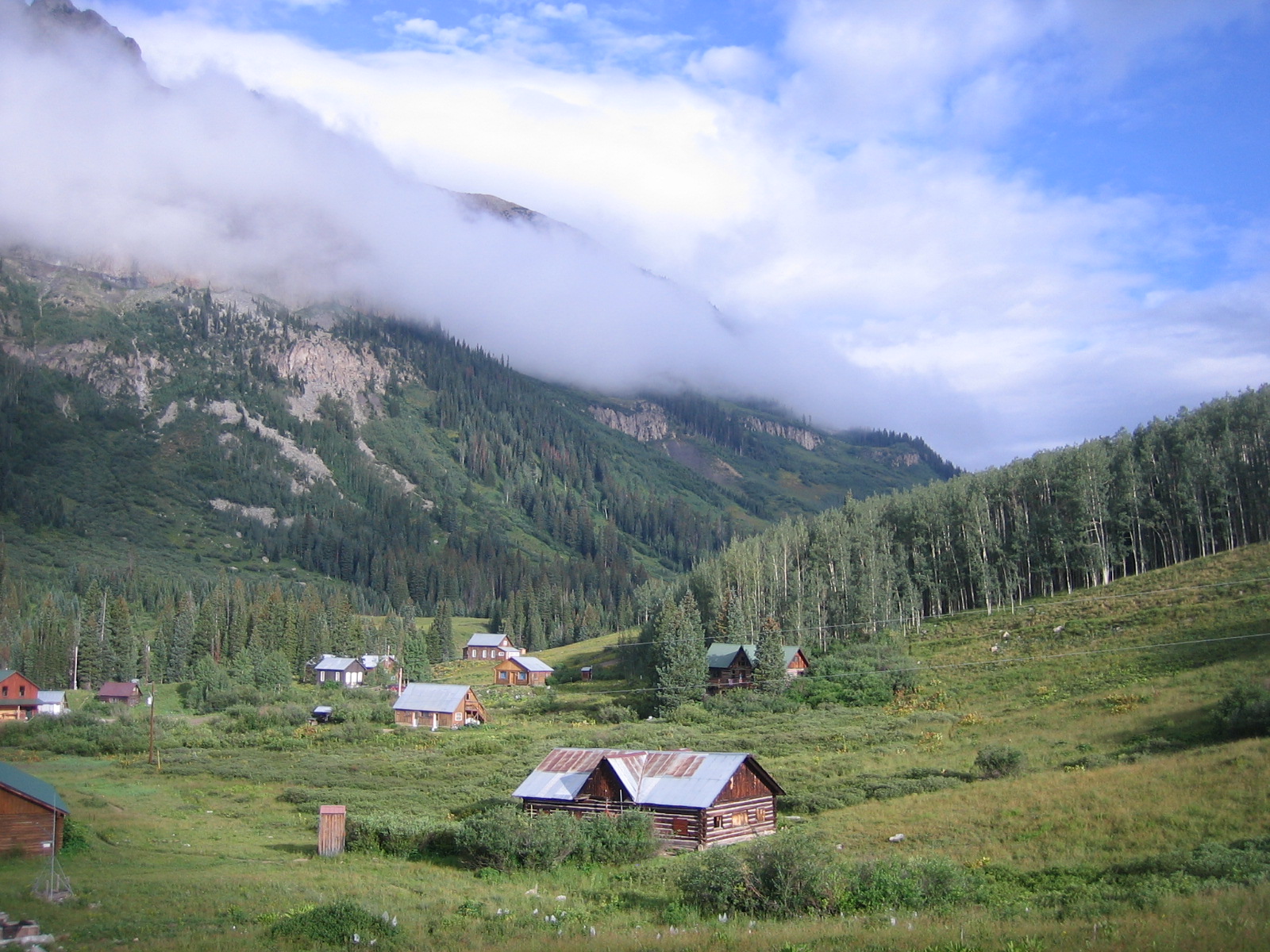
Gothic mountain shrouded in clouds behind several cabins in the Rocky Mountain Biological Laboratory in Gothic, Colorado, USA. By Charlie DeTar – Own workby uploader, CC BY-SA 3.0, https://commons.wikimedia.org/w/index.php?curid=4795644

Without consistent rain, dry plants become fuel for wildfires.

Separate research from the University of Arizona suggests that wildfires are harder to rein in without monsoon rains, which effectively end the fire season after July. Tree ring studies in neighboring states like Arizona and New Mexico link years that have weak monsoons to widespread fires in mountainous areas.

Photos Capture New Flows in #ColoradoRiver Delta — Audubon #COriver #aridification

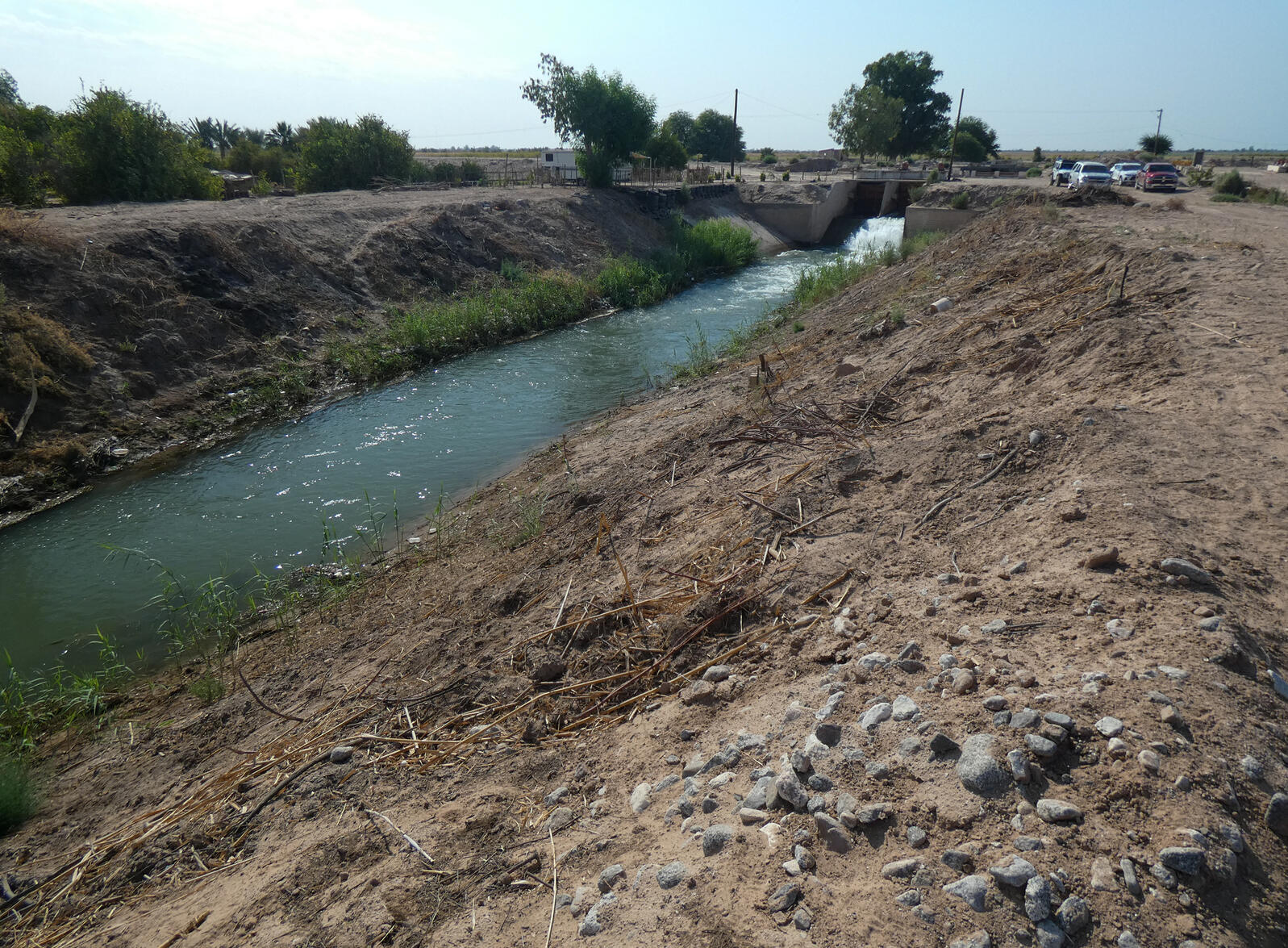
Colorado River water diverted at the border into Mexicali Valley irrigation canals is being returned to the river, starting on May 1, 2021, via a spillway about 35 miles downstream, bypassing the driest part of the channel (where water infiltrates quickly into the sand). Photo: Jennifer Pitt/Audubon

From Audubon (Jennifer Pitt):

Water delivered through the desiccated channel will benefit the environment.

I had the great fortune to take my first, post-pandemic trip to Mexico to see the river flowing in the Colorado River Delta (click HERE for background). For 164 days the United States and Mexico are cooperating under the terms of Minute 323 to deliver environmental water. The flow rates and locations for water delivery are intended to optimize benefits for the delta ecosystem, and over time monitoring reports will tell that story. For now, I can share what I saw:

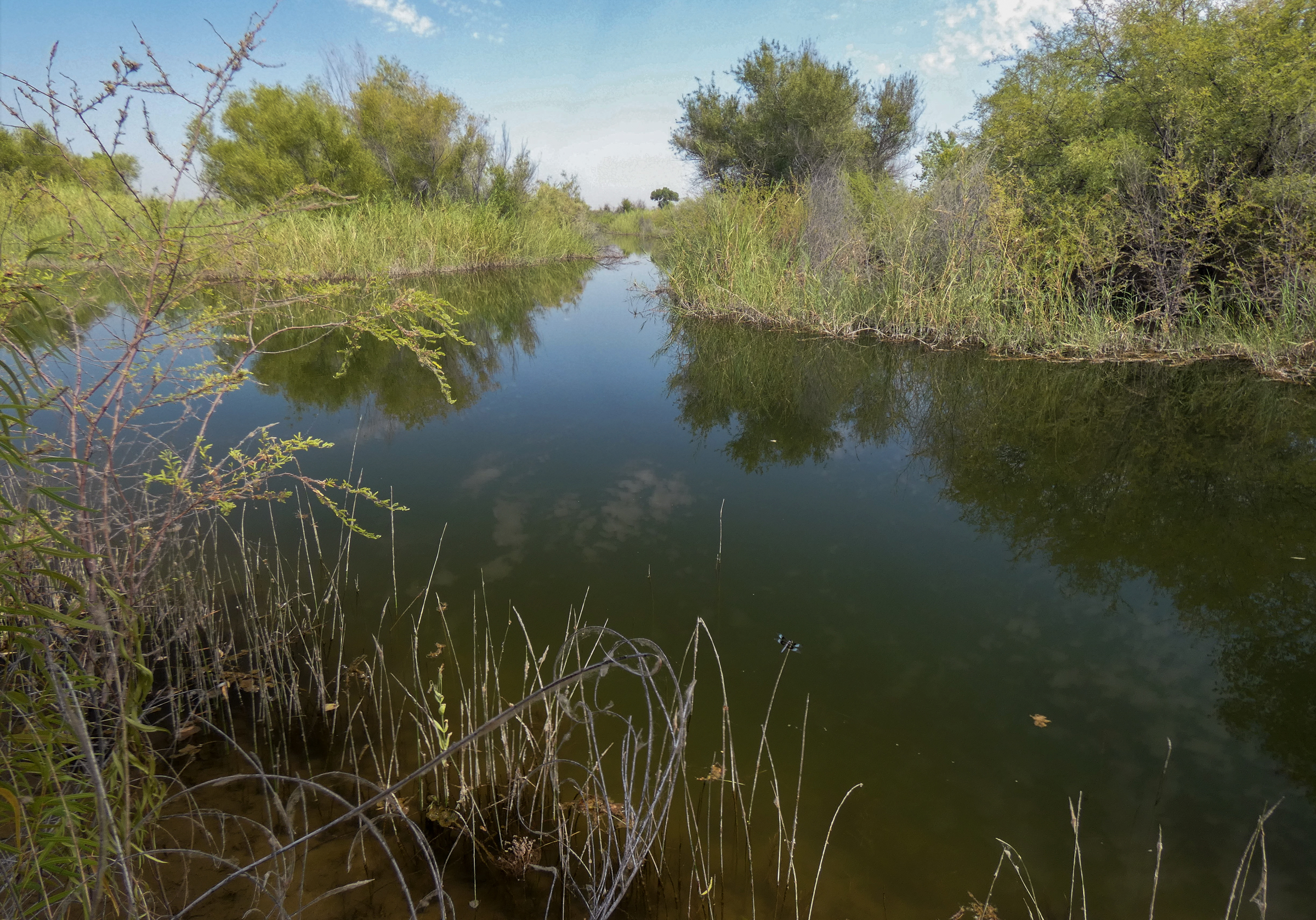
The river is flowing! Observers have not yet confirmed that the freshwater has met the sea, but they think it may with the next high tide. Photo: Jennifer Pitt/Audubon
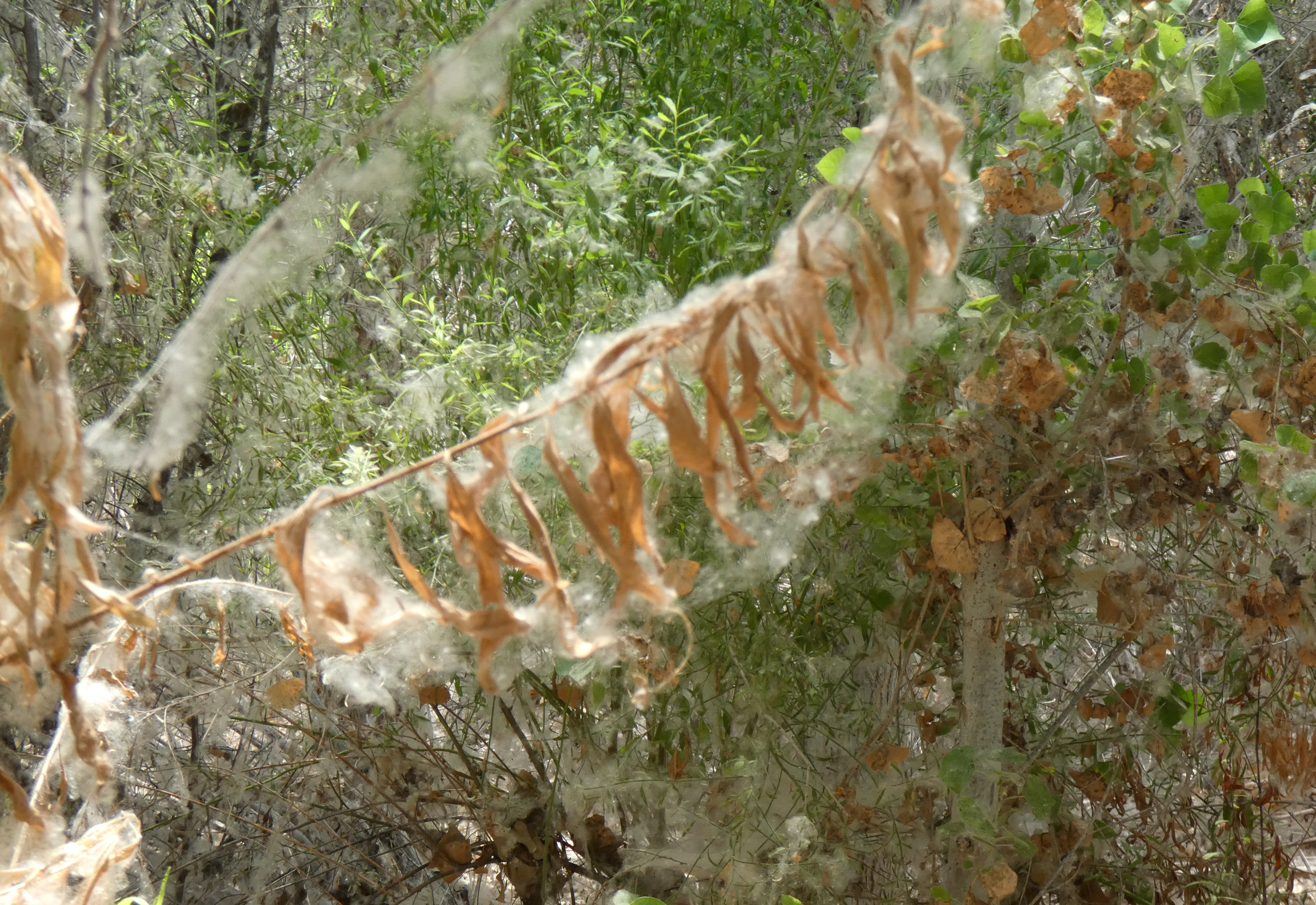
Environmental water delivery is timed during the late spring and summer to help native trees germinate. The cottonwood seeds were evident. Photo: Jennifer Pitt/Audubon
It’s hot in the delta (122F/47C the day of my visit). My Mexican friends say the wildlife is loving the water. Photo: Jennifer Pitt/Audubon
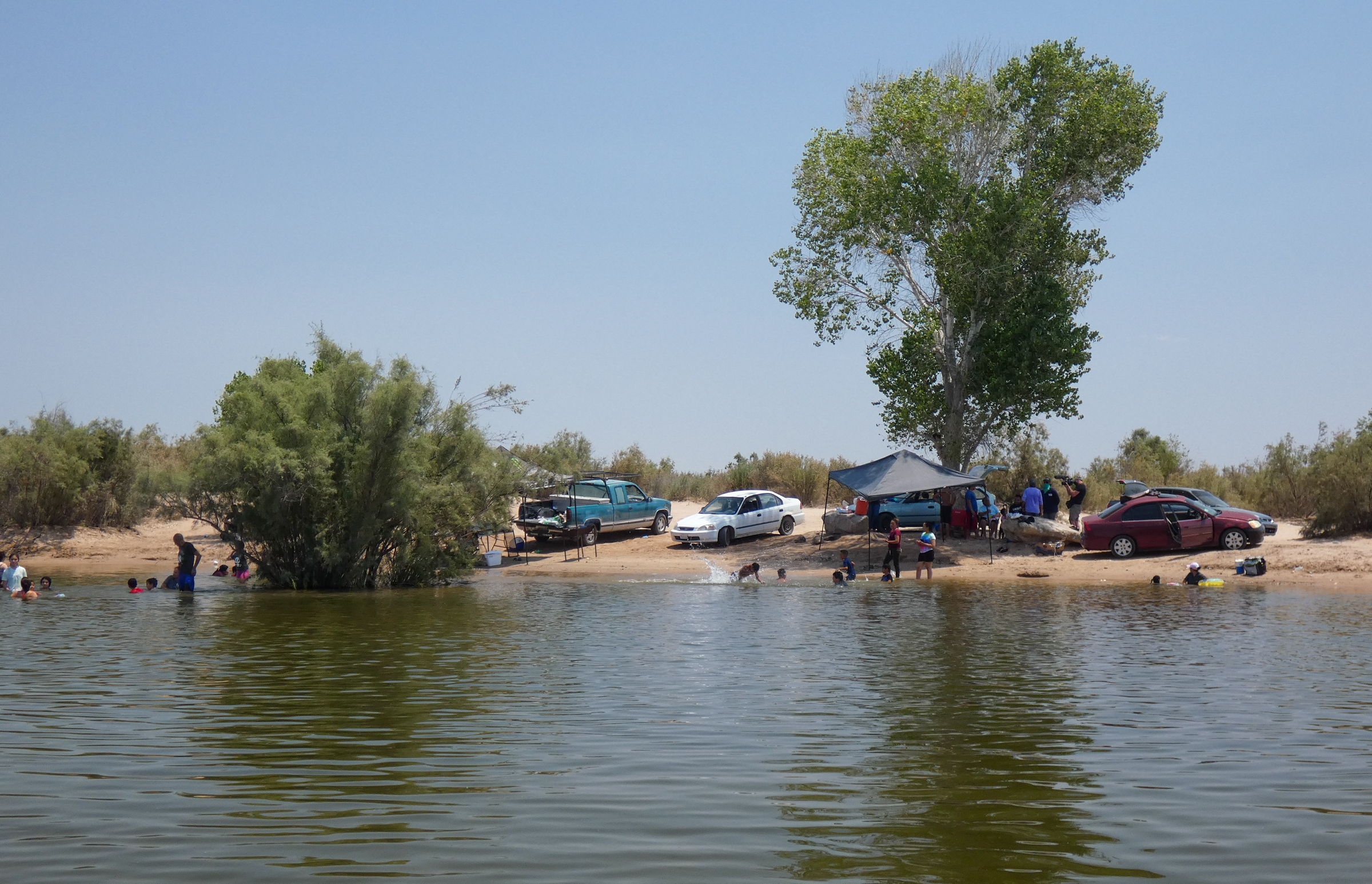
People love the river too! Photo: Jennifer Pitt/Audubon

#ColoradoRiver Water flows across U.S.-Mexico border through historic cooperation — @Audubon #COriver #aridification

Ridgway’s Rail in the Ciénega de Santa Clara, Colorado River Delta, Mexico. Photo: Claudio-Contreras Koob via Audubon

From Audubon (Jennifer Pitt):

On May 1, 2021, water began flowing into the arid Colorado River Delta as part of a program of scheduled deliveries to restore this region, sanctioned under a bi-national agreement between the U.S. and Mexican governments for advancing sustainable management of the Colorado River. The water deliveries are part of an ongoing plan of vital and historic importance implemented through the U.S. and Mexican sections of the International Boundary and Water Commission and supported by an alliance of conservation organizations from the United States and Mexico.

“Our collaborative efforts have been a paradigm shift in the way water is managed,” said Jennifer Pitt, Colorado River Program Director, National Audubon Society. “We are showing how we can share water, conserve water, and invest in new water projects and the health of the river itself. This demonstrated commitment to improving water supply for nature and people is a shining example of what two nations can achieve when we work together.”

The releases of water designed to mimic the river’s natural spring flows began on Saturday, May 1 and will extend through early October, delivering a total of 35,000 acre-feet (43 mcm) of water downstream into the long-depleted Colorado River Delta in a managed program designed to maximize the water’s impact. The water releases are planned to reach their highest flow rate in early June and have been specifically designed to amplify the environmental and recreational benefits for the central delta. The water flows will continue for a total of twenty-three weeks, bring much needed support for wildlife habitat, while also being able to be enjoyed by local communities.

“This is an exciting time for both countries,” said Carlos de la Parra, Academic in border studies specializing in water issues, and a member of the Minute 323 monitoring group. “By allocating resources to improve water delivery infrastructure, Mexico and the U.S. are helping Mexicali Valley farmers increase their profits and resilience to the impacts of climate change.”

An important part of Minute 323 implementation and monitoring is being conducted by members of Raise the River – a coalition of conservation non-governmental organizations (NGOs) working to bring water and life back to the Colorado River Delta. Participating organizations include the National Audubon Society, The Nature Conservancy, Pronatura Noroeste, The Redford Center, Restauremos el Colorado, and Sonoran Institute.

“We have worked hand-in-hand with our partners over the years to achieve the best results possible for the delta,” said Francisco Zamora, Director General of Sonoran Institute Mexico. “Working together to monitor prior water flows and determine their impacts on the delta, our observations have informed this current effort to stimulate healthy ecosystems in the Colorado River delta.”

Water will be delivered to the river corridor in the delta via irrigation canals in the Mexicali Valley that distribute Colorado River water to Mexicali’s farmers. The Colorado River’s water is diverted into this canal system just south of the United States – Mexico border. Once there, it will flow down the canals to specific locations where the Raise the River coalition partners have built highly successful restoration sites, and where this programmed release of water can benefit those habitats and the wildlife that use them.

“These water releases are a vital part of supporting our ongoing restoration efforts,” said Gaby Coloca, Coordinator, Water and Wetlands Program, Pronatura Noroeste, a Mexico-based non-profit conservation organization which manages several of the restoration sites. “Based on our prior work and the careful monitoring of its impact, we now know that relatively small amounts of water can make a big difference in the health of the delta region.”

These water releases are just one component of a multi-faceted policy agreement formally known as Minute 323 – an historic bi-national agreement negotiated between the U.S. and Mexico in September 2017 that defines how the two countries share Colorado River water through 2026 amidst growing pressures on water resources. This agreement is a part of a larger Colorado River policy framework that more broadly provides multiple benefits for water users on both sides of the border including sharing surpluses in times of plenty and reductions in times of drought, providing incentives for leaving water in storage, and conserving water through joint investments in projects from water users in both countries.

The water flows are an important element of Minute 323, which allocates water for the restoration and conservation of riparian habitat, and which extends the international cooperative management standard established by Minute 319 (in effect from 2012 – 2017). These restored sites are providing proven benefits to wildlife species and communities along the Colorado River in both countries and in the Colorado River Delta region in Mexico.

This 164-day program of scheduled water releases is part of a broader commitment under Minute 323 to provide water to support key restoration sites in the river’s riparian corridor through 2026. The United States and Mexico will provide 2/3 of the total water committed (140,000 acre-feet or 173 mcm over 9 years) and the Raise the River coalition of NGOs will provide 1/3 of the water (a total of 70,000 acre-feet or 86 mcm, over 9 years).

“Previous monitoring of environmental flows from Minute 319 have shown us how to obtain the greatest benefits from the smallest amounts of water delivered into restoration sites.,” said Eloise Kendy, Ph.D., Senior Freshwater Scientist, The Nature Conservancy. “It has been – and will continue to be — very helpful for both governments to obtain information that becomes increasingly relevant as we face droughts with more frequency, not only in the Colorado River basin but also in other watersheds.”

By raising awareness, funding and, ultimately, the water level of the river, Raise the River’s goal is to restore native habitat that reconnects the river with the Gulf of California and to establish a framework for the long-term dedication of water to the restoration of the Colorado River Delta.

“Through these cooperative efforts, we are rewriting history by increasing the resilience of the Mexicali Valley, reestablishing ecosystems and returning some of the river’s natural amenities to local communities which have been deprived of a healthy environment,” says Pitt. “Since the initial releases of water for the environment in 2014, we are demonstrating the long-term benefits of binational cooperation not only for the environment, but for all water users in the region. Our work in the Colorado River Delta is becoming a model for long-term water-sharing agreements across borders.”

[…]

Background Information on Raise the River, including the binational agreements pertaining to the Colorado River and reported results achieved to date from managed restoration projects…

Raise the River is a unique partnership of six United States and Mexico non-governmental organizations working to revive the Colorado River Delta through activities that support environmental restoration for the benefit of the people and the enhancement of wildlife in the Delta. Members include: The Nature Conservancy, National Audubon Society, Pronatura Noroeste, the Redford Center, Restauremos El Colorado, and the Sonoran Institute. The coalition has worked with policymakers, water agencies and governmental representatives from the U.S. and Mexico since 2012 to cooperatively create historic change for the Colorado River Delta.

To learn more about Raise the River, visit http://www.raisetheriver.org.

Good luck @LukeRunyon we hope to see you back on the #water beat soon

Luke Runyon and Coyote Gulch getting set for the Twitter fest at the Colorado River District seminar September 15, 2017.

Luke Runyon KUNC is moving on in his career. I will miss his enthusiasm and rigor but most of all his story-telling ability. Let’s hope that he finds his way back to the Colorado water beat in the future.

He posted one last story from the bottom of the Colorado River, “Even In An Epically Dry Year, Water Flows Into Parched Colorado River Delta.” Click through and read the whole article. Here’s an excerpt:

It’s an attempt to reconnect portions of the river left dry from decades of overuse, and it’s happening in one of the driest years the basin has ever seen…

There’s no good substitute word for what the Colorado River delta is now. The Gulf of California’s tides still reach up into the Sonoran Desert. But there’s no river water. Dams along the Colorado River’s length in the U.S. and Mexico draw its water away to serve farms and cities throughout the region. Rather than emptying into the ocean, its water grows citrus in Arizona and greens up lawns in Los Angeles.

The delta’s exposed salt flats aren’t a wasteland. As Rivas explained, if you look close enough, you’ll see the animals and plants able to make a home: jumping spiders, tiny turquoise fiddler crabs, hardy species of saltgrass.

“These are harsh conditions here,” [Tomás] Rivas said. That day, it reached 120 degrees…

Rivas’ group, along with other Mexican and American environmental groups, are working to bring water back into this part of the estuary and study what happens…

Additional water releases into the delta began May 1 and will extend to October, with peaking flows in early summer. The water volume won’t be enough to fully revive the tidal bore, but Rivas said it can help restore riverine habitat.

Colorado River water diverted at the border into Mexicali Valley irrigation canals is being returned to the river, starting on May 1, 2021, via a spillway about 35 miles downstream, bypassing the driest part of the channel (where water infiltrates quickly into the sand). Photo: Jennifer Pitt/Audubon

‘A little bit of repair”

This spring and summer, portions of the Colorado River delta flowed again. But unlike 2014’s pulse flow, where the dam at the U.S.-Mexico border sent a huge volume all at once, this year’s releases of water are targeted to restoration sites…

“For Mexico, living with a dead river has been, I’ll say, sort of a wound,” said Jennifer Pitt, director of the National Audubon Society’s Colorado River program…

The Colorado River is grabbing national headlines this summer as water shortages become more urgent. Hot and dry conditions are coming home to roost in its reservoirs, dropping the two biggest — Lakes Mead and Powell — to record lows. Even in a dry year like this one, Pitt said both the U.S. and Mexico have agreed to set aside water for the environment.

“If we don’t figure out at this moment how to support the river itself and all of nature that it supports, I fear that we lose them permanently. So I think at this time it is more important than ever,” she said.

That idea of carving out water supplies just for the river itself remains controversial. Some skeptical city leaders and farmers in Mexico have said any water spilling into the ocean is wasted, said Carlos de la Parra, a professor at El Colegio de la Frontera Norte, who’s acted as an adviser to the International Boundary Water Commission…

The flows happening this year were part of an update to the 1944 treaty that the U.S. and Mexico use to govern their shares of the Colorado River. Over the last 21 years of ongoing hot and dry conditions, de la Parra said the two countries have transitioned from a relationship held at arm’s length to one of mutual respect. That led to a commitment from the U.S. to fund irrigation efficiency projects in Mexico, with some of the conserved water from those upgrades being set aside for environmental flows…

Martha Gomez-Sapiens, a monitoring team member and postdoctoral research associate in the UA Department of Geosciences, stands on a riverbank next to willows and cottonwoods that germinated as a result of the pulse flow. (Photo: Karl W. Flessa/UA Department of Geosciences)

But [Rocio Torres] Torres said the flows happening this year wouldn’t have occurred without the pulse flow seven years ago. The event galvanized communities in the region, she said. It built a base of support from water officials in both countries who agreed to set aside a small amount of water to benefit the plants and animals deprived for so long.

“I think that’s the way human beings, we learn,” she said. “We messed things up. We realized we shouldn’t have done that,” and bringing it back happens little by little.

#Monsoon2021: So Far, It’s Been Wet, Wild And A Valuable Part Of Arizona’s Moisture Mix — #Arizona Department of Water Resources #ColoradoRiver #COriver #aridification

Photo credit: Arizona Department of Natural Resources

From the Arizona Department of Natural Resources

Even before the substantial torrents of summer rains over the past week or so finally paused, water and weather experts were acting to contain the public’s excitement about the impact of the monsoon on the Southwest’s long-running drought.

The rainfall is great, they noted. Rainfall in an arid place is almost always a welcome event. But truth be told, summer storms just aren’t drought-killers. Fending off drought – especially the kind of long-running drought the Southwest has experienced — takes deep winter snowpack in the region’s mountainous watersheds. After more than two decades of dry conditions, it would take several consecutive years of deep snowpack to release from drought’s grip.

“It’s helpful, but it also doesn’t solve the problem,” observed ADWR’s Chief Hydrologist Jeff Inwood earlier this week.

So, are we to conclude that summer rainstorms have no meaningful effect on drought conditions? Absolutely not!

Graphic credit: Arizona Department of Natural Resources

The near historic lack of monsoon moisture in 2020 contributed substantially to the extraordinarily low rate of runoff into the Colorado River system this spring. A lack of spring rain helped dry out soils to such an extent that those thirsty soils soaked up far more watershed runoff than normal this spring.

As a result, Rocky Mountain region snowpack from the 2020-2021 snow-season peaked at 89 percent of seasonal median. Contrary to the expectation that relatively higher precipitation would result in a larger runoff volume, unregulated inflow into Lake Powell gauged at an utterly abysmal 54 percent of average. The 30-year (1981-2010) average for unregulated inflow into Lake Powell is 10.83 million acre-feet. The forecasted unregulated inflow for Water Year 2021 (Oct. 1, 2020 – Sept. 30, 2021), as of July, according to data from the Bureau of Reclamation, stands at just 3.248 million acre-feet, which is 30 percent of the normal.

A healthy summer rainy season helps mitigate that soil absorption.

Monsoon rain can help rehydrate our soils, which helps get snowmelt runoff into the reservoirs. Also, some portion infiltrates into the ground and replenishes the aquifers. Not a lot, to be sure, but some.

“By soaking the soils with these monsoon rains, it will help additional moisture and rains runoff into streams and ultimately into reservoirs,” added Inwood.

In the meanwhile, it doesn’t hurt to revel in the healthy moisture delivery dropped off in recent days by Mother Nature.

Monsoon 2021 rainfall measured at Tucson International Airport set one of several records set this season with 5.88 inches of rain through July 25.

At Phoenix Sky Harbor International Airport, meanwhile, National Weather Service officials reported 1.67 inches for the month as of July 25, making 2021 the wettest July since 2013 and the 17th wettest on record. Overall the Phoenix Rainfall Index for July 2021 (that is, the average of all the official rain gauges throughout the Valley), stood at 2.66 inches, making July 2021 the wettest month overall in the Valley since October 2018.

Want more Happy Weather Talk? Through July 26, total monsoon rainfall at Sky Harbor was 1.84 inches, which exceeds the combined total rainfall for the 2019 and 2020 monsoon seasons (1.66 inches).

Cumululative time spent in severe #drought conditions in US (January 2010 through July 2021) — @Bewickwren #aridification

Cumululative time spent in severe #drought conditions in US. ⁦Data via The National Drought Mitigation Center at the University of Nebraska-Lincoln.

Critical measures of global heating reaching tipping point, study finds — The Guardian #ActOnClimate

Photo credit: NRCS

From The Guardian (Katharine Gammon):

Carbon emissions, ocean acidification, Amazon clearing all hurtling toward new records

A new study tracking the planet’s vital signs has found that many of the key indicators of the global climate crisis are getting worse and either approaching, or exceeding, key tipping points as the earth heats up.

Overall, the study found some 16 out of 31 tracked planetary vital signs, including greenhouse gas concentrations, ocean heat content and ice mass, set worrying new records.

“There is growing evidence we are getting close to or have already gone beyond tipping points associated with important parts of the Earth system,” said William Ripple, an ecologist at Oregon State University who co-authored the new research, in a statement.

“The updated planetary vital signs we present largely reflect the consequences of unrelenting business as usual,” said Ripple, adding that “a major lesson from Covid-19 is that even colossally decreased transportation and consumption are not nearly enough and that, instead, transformational system changes are required.”

While the pandemic shut down economies and shifted the way people think about work, school and travel, it did little to reduce the overall global carbon emissions. Fossil fuel use dipped slightly in 2020, but the authors of a report published in the journal BioScience say that carbon dioxide, methane and nitrous oxide “have all set new year-to-date records for atmospheric concentrations in both 2020 and 2021”.

In April 2021, carbon dioxide concentration reached 416 parts per million, the highest monthly global average concentration ever recorded. The five hottest years on record have all occurred since 2015, and 2020 was the second hottest year in history.

The carbon dioxide data on Mauna Loa constitute the longest record of direct measurements of carbon dioxide in the atmosphere. C. David Keeling of the Scripps Institution of Oceanography began measurements in 1958 at the NOAA weather station. NOAA started its own CO2 measurements in May of 1974, and they have run in parallel with those made by Scripps since then. Credit: NOAA and Scripps Institution of Oceanography.

The study also found that ruminant livestock, a significant source of planet-warming gases, now number more than 4 billion, and their total mass is more than that of all humans and wild animals combined. The rate of forest loss in the Brazilian Amazon increased in both 2019 and 2020, reaching a 12-year high of 1.11 million hectares deforested in 2020.

Ocean acidification is near an all-time record, and when combined with warmer ocean temperatures, it threatens the coral reefs that more than half a billion people depend on for food, tourism dollars and storm surge protection.

However, there were a few bright spots in the study, including fossil fuel subsidies reaching a record low and fossil fuel divestment reaching a record high.

In order to change the course of the climate emergency, the authors write that profound alterations need to happen. They say the world needs to develop a global price for carbon that is linked to a socially just fund to finance climate mitigation and adaptation policies in the developing world.

The authors also highlight the need for a phase-out and eventual ban of fossil fuels, and the development of global strategic climate reserves to protect and restore natural carbon sinks and biodiversity. Climate education should also be part of school curricula around the globe, they say.

How natural infrastructure reduces flooding — Environmental Defense Fund #ActOnClimate

Green Mountain Reservoir about 17 billion gallons below normal — The Summit Daily #BlueRiver #ColoradoRiver #COriver #aridification

Green Mountain Reservoir. Photo credit: Colorado Parks & Wildlife

From The Summit Daily (Taylor Sienkiewicz):

Downstream call placed on the reservoir for irrigation water rights

Green Mountain Reservoir, one of the biggest reservoirs in Summit County, located in Summit County, is low this summer, but it’s not as low as in previous drought years.

The reservoir is currently storing about 101,000 acre-feet of water — 32.9 billion gallons — James Heath, division engineer for the Colorado Division of Water Resources, said in an email. He noted that the reservoir is typically nearly full around this time of year. A full Green Mountain Reservoir is about 154,000 acre-feet of water, or approximately 50 billion gallons.

However, Heath said in previous drought years like 2002 and 2012, there was less water stored in the reservoir than there is this year.

Heath explained that the runoff from the Blue River this year was not enough to fill both Dillon Reservoir, which is upstream, and Green Mountain Reservoir, which is downstream…

Releases from Green Mountain Reservoir make their way to the Colorado River to appease those downstream with senior water rights. Heath said these releases replace upstream depletions from West Slope diversions and the Colorado Big Thompson project, which delivers the approximate volume of Dillon Reservoir to the South Platte Basin.

Heath noted that there has been a call for irrigation water rights downstream in the Grand Valley, which means senior water users have requested to restrict the use of water among junior water users because there is not enough water in the system to allow all water diversions. This requires Green Mountain Reservoir to stop storing, pass inflows and make releases.

While calls on Green Mountain Reservoir can restrict use for junior water users, there is a group of western Colorado water users that have historically benefited from releases out of Green Mountain Reservoir, called historic user pool beneficiaries, that are allowed to continue to divert after a call is placed on the river.

Since July 10, the reservoir water level has dropped about 7,000 acre-feet, or 2.2 billion gallons, according to the Colorado Division of Water Resources website. For most of July, Green Mountain Reservoir’s discharge to the Blue River was below the historic average.

#ColoradoSprings Parks & Recreation shows measures taken to conserve #water, reduce usage costs — KRDO

Cottonwood Creek in Colorado Springs. Photo credit: Water Education Colorado

From KRDO (Scott Harrison):

With a limited budget, growing needs, drought and an ever-present demand for water, the city’s Department of Parks, Recreation and Cultural Services is taking steps to reduce its “water footprint.”

In recent years, the department has replaced some Kentucky bluegrass with native grasses in parks and on medians; native grasses are more drought-resistant and need less water.

Replacing grass with artificial turf on heavily-used athletic fields is another strategy being used, as well as xeriscaping (natural landscaping) and other landscaping to replace grass in some areas.

Parks & Rec also is investing more in technology to water grass more efficiently by monitoring water usage and reducing waste.

The department spent $515,000 in 2019 and 2020 on replacing irrigation systems, and expects to spend $150,000 this year; but nearly two-thirds of its present systems are 30 years old or more and replacing those outdated systems will cost an estimated $6.7 million — a process that will take 60 years with current funding levels.

That situation is partly why the department will ask voters in November to approve a slight sales tax increase to pay for a backlog of maintenance and other needs.

Parks & Rec also plans to build or upgrade parks that incorporate some or all of these amenities. Examples are the newer Venezia Park on the city’s northeast side, and the current renovation of Panorama Park on the southeast side.

The city budgeted around $4.7 million for parks watering in 2020 and used 98% of that amount, although some areas needed more than the amount of water allocated; this year’s usage is expected to fall below the budgeted amount of $4.4 million because of wetter weather…

How fire today will impact water tomorrow — CU Boulder Today

The aftermath of July 2021 floods in Poudre Canyon, west of Fort Collins. (Credit: Colorado Parks and Wildlife)

From CU Boulder Today (Kelsey Simpkins):

In 2020, Colorado battled the four largest wildfires in its history, leaving residents anxious for another intense wildfire season this year.

But last week, fires weren’t the issue—it was their aftermath. When heavy rains fell over the burn scar from the 2020 Cameron Peak fire, they triggered flash flooding and mudslides northwest of Fort Collins which destroyed homes, killed at least three people and damaged major roads. Flooding along the 2020 Grizzly Creek and East Troublesome burn scars also unleashed mudslides across Interstate 70 through Glenwood Canyon and in Grand County just west of Rocky Mountain National Park.

These tragic events make it clear that the effects of wildfire don’t end when the flames go out. There can be environmental consequences for years to come—and keeping an eye on water is key.

CU Boulder Today spoke with Professor Fernando Rosario-Ortiz, an environmental chemistry expert who studies how wildfires impact water quality; and Assistant Professor and CIRES Fellow Ben Livneh, a hydrologist who studies how climate change affects water supplies and how fires and rain influence landslide risk, about how fire may shape the future of water in the West.

Fernando Rosario-Ortiz, professor of civil, environmental and architectural engineering, is an expert in environmental chemistry who has been studying the natural processes that impact water quality since his arrival at CU Boulder in 2008, and how wildfires impact water quality since the High Park fire in Fort Collins in 2012. (Credit: CU Boulder)

What happens to water in lakes, rivers and streams after a nearby wildfire?

Rosario-Ortiz: When you have open flames, a lot of gaseous reactions and solid phase reactions, it results in the transformation of chemicals and alterations to the soil, and we observe the effects once we look at the water quality. For example, we observe the enhancement in the concentration of nutrients in water, which is not necessarily a bad thing, but it can cause subsequent issues in the reservoirs like algae blooms. There can also be a mobilization of metals and enhanced concentration and activity of what we call organic carbon as well as turbidity, which can then impact water treatment production and formation of disinfection byproducts.

How do city water suppliers and treatment plants deal with these impacts?

Rosario-Ortiz: Ideally, you want to have a secondary water source. In Fort Collins, back in 2012 after the High Park fire, the river was impacted but the reservoir was not impacted. So they could draw from the reservoir and wait for the worst to pass.

If you don’t have that option, some of the challenges after wildfire and rain events include increased sediment mobilization, which is very challenging for water treatment operations. Those are short-term effects that might give you a headache, but they can also become long-term challenges. Never mind the fact that you may have issues with infrastructure.

Ben Livneh, assistant professor in civil, environmental and architectural engineering and a fellow at the Cooperative Institute for Research in Environmental Sciences (CIRES), is a physical hydrologist who researches how climate change and landscape changes can affect where and how much water is available in an area—and when. His work also examines how fires and rain can influence landslide risk. (Credit: CU Boulder)

How can wildfire affect water quantity and timing in a landscape?

Livneh: In the western U.S. we really rely on water that flows in rivers and streams, and that fills the reservoirs for our supply. So when we think about even small changes to the amount of water that comes off of the hill slope, or across the landscape, that can have a big impact on the total availability of water.

One of the most notable things that happens in a fire is that the texture of the soil changes. Initially, less rain will soak into the soil, and more rain will become surface runoff. There’s a lot of reason to think that you will get more total water—but it’ll be much more “flashy” when it comes.

On one hand, that can be good if you have a reservoir to collect it. But we’ve heard of water utilities actually turning off their intakes after a fire if the quality of the water is too low. And that’s tricky, because often drought is involved in some fashion. So there’s often this competing need for more water, and yet the quality is low.

What are the factors that affect the likelihood of floods or mudslides after wildfire?

Livneh: When water carries enough stuff with it, we call it a debris flow, which is a type of landslide. The bigger and bigger it gets, the more impactful it is. We have research funded by NASA where we looked at 5,000 landslide sites around the world. We found that sites that had a fire in the past three years required less precipitation to cause a landslide.

But there’s also a lot of local variability that really matters. Moderately steep, heavily vegetated areas, types of soils—especially sandier soils—increase risk. Also we now have a lot of people who have built structures on steep slopes in these areas, so there’s a human element there, too. And the time of the year that it happens can matter. A fire right before your rainy season is an important factor.

What does this all mean for the future of Colorado and the western U.S.?

Rosario-Ortiz: When homes burn, you’re not just combusting houses, you’re combusting everything inside those homes. You might now be combusting electric vehicles, for example, with a large battery.

Then what are some of the other potential concerns with exposure to air? Water? That’s going to be something that we will need to explore further over the next few years.

Livneh: Some estimates say the amount of forest area being burned each year in the western U.S. has doubled in the last 25 years. And it really poses risks to communities, especially in the wildland-urban interface (WUI). Managing it is largely a kind of a policy problem, but in the next 10 years or so we’re going to continue to have these big fires.

First and foremost, people need to be paying attention to these flood watches and to local guidance on evacuation. The most important thing is saving lives.

What can we do to prepare for the future?

Rosario-Ortiz: Utilities might have to be thinking about potential upgrades in facilities. That means we may have to also consider financing of these projects and how to improve overall resiliency.

Livneh: One of the most robust features of climate change is warming, right? As rain becomes more prevalent, we’re just going to have to continue expanding our portfolio of things we do to keep up. The more open-minded we can be about managing for these things is important. I’m kind of an optimist. As humans, we’ve overcome so many technical challenges; it’s not going to be something we can’t solve our way out of.

#Wyoming looks to store, divert more #water as #LakePowell dries up — Wyofile.com #GreenRiver #ColoradoRiver #COriver #aridification

Lake Powell is seen in a November 2019 aerial photo from the nonprofit EcoFlight. Keeping enough water in the reservoir to support downstream users in Arizona, Nevada and California is complicated by climate change, as well as projections that the upper basin states of Colorado, Utah, Wyoming and New Mexico will use as much as 40% more water than current demand. A recent white paper from a lineup of river experts calls those use projections into question.
CREDIT: ECOFLIGHT via Aspen Journalism

From Wyofile.com (Angus M. Thuermer Jr.):

As Lake Powell dropped to its lowest-ever level [July 23, 2021] — a decline that has forced dam tenders to unexpectedly release 125,000 acre-feet of water from Flaming Gorge Reservoir — Wyoming stood behind five projects that could divert tens of thousands more acre-feet from waterways in the troubled Colorado River Basin.

Powell’s surface elevation dipped to 3,555.09, lower by 12 hundredths of an inch than the previous post-completion nadir of April 8, 2005. The new benchmark is “probably worth noting,” Wayne Pullan, the U.S. Bureau of Reclamation’s Region 7 director, said in a press call [July 27, 2021].

“The fact that we’ve reached this new record underscores the difficult situation that we’re in,” he said…

Friday’s mark amounts to a 150-foot drop in the storied Utah-Arizona reservoir over 24 years, a decline that’s spurred action to preserve irrigation flows, millions of dollars in hydropower revenue and myriad necessities for 40 million people in the West.

As the BOR began its “emergency” release of 125,000 acre-feet from Flaming Gorge Reservoir on July 15, a coalition of downstream water users called for a moratorium on new dams and pipelines…

In an era of drought, aridification and climate change, new water projects will be closely scrutinized, Pullan said…

Meantime Gov. Mark Gordon announced he will appoint a drought working group to ensure “local perspectives on issues that impact our water users and the State” are heard when planning for a crisis that “may last for years.”

Wyoming will not be deterred from its water development goals that would store, divert or otherwise use another 115,000 acre-feet in the upper reaches of the 246,000-square-mile Colorado River system, top officials told WyoFile.

“A pure, strict moratorium flies in the face of rights held by all seven [Colorado River Compact] states,” said Pat Tyrrell, Wyoming’s member on the Upper Colorado River Commission. “I would have a hard time recommending that Wyoming get itself in that position.”

The Bureau of Reclamation has a limited say in what Wyoming can do with its water and development, state Senior Assistant Attorney General Chris Brown said.

“They certainly don’t get to say ‘no,’” he said. “They certainly don’t have that authority in Wyoming to decide how Wyoming wants to develop its water.”

Invitation to propose ideas for natural resource restoration projects related to 2015 #GoldKingMine release — #NewMexico Office of the Natural Resources Trustee #AnimasRiver #SanJuanRiver

This image was taken during the peak outflow from the Gold King Mine spill at 10:57 a.m. Aug. 5, 2015. The waste-rock dump can be seen eroding on the right. Federal investigators placed blame for the blowout squarely on engineering errors made by the Environmental Protection Agency’s-contracted company in a 132-page report released Thursday [October 22, 2015]

Here’s the release from the New Mexico Office of the Natural Resources Trustee (Elysia Bunten):

The New Mexico Office of the Natural Resources Trustee (ONRT) is in the preliminary stages of soliciting ideas for projects that will restore natural resources in New Mexico injured by the 2015 Gold King Mine release.

We welcome stakeholder engagement in our process and invite you, as a stakeholder who was affected by the contamination, to participate in this process. Please see the attached letter containing details about ONRT’s funding, process, upcoming information session, and timetable.

Project Solictation Letter to GKM Release Stakeholders 7.15.21

Prior to mining, snowmelt and rain seep into natural cracks and fractures, eventually emerging as a freshwater spring (usually). Graphic credit: Jonathan Thompson

Two Wins for Rivers in a Dry Year — @AudubonRockies #WhiteRiver #GreenRiver #ColoradoRiver #COriver #aridification

Colorado River headwaters near Kremmling, Colorado. Photo: Abby Burk via Audubon Rockies

From Audubon Rockies (Abby Burk):

Audubon secures protections for Colorado rivers.

As a result of Audubon’s engagement, leveraged with our partners, Big Beaver Creek and White River will quickly receive needed water and all of Colorado’s rivers will retain their water quality protections. All thanks to you! In this drought-stricken year, these victories are true causes for celebration. Read on to learn what your actions accomplished for rivers and the birds and communities that depend upon them.

Water Quality Antidegradation

Birds and people rely on clean water from healthy rivers. High-quality water in our rivers, streams, and wetlands is critical to the long-term health of our ecosystems, wildlife, communities, and economies across Colorado, from urban neighborhoods to headwater streams.

In late spring of 2021, we called upon our Colorado network to sign a petition to stop a proposed rule change by the Water Quality Control Commission (Commission) that would have allowed more pollution in Colorado’s rivers and streams. Because of the impact this potential rule change would have had on rivers, birds, and disadvantaged communities, we needed your engagement like never before. And you responded.

Audubon Rockies broke all our previous engagement records by collecting 2,735 unique signatures and combined with our coalition to total more than 4,700 signatures! During the June hearing, the Commission received unprecedented levels of public comments. Sixty people signed up to speak. Many impassioned public speakers showed up to oppose the proposed rule changes and to support their “home waters.” All but one of the comments opposed rule changes due to potential impacts on Black, Indigenous, and other communities of color; recreation in urban streams; and the right to clean water.

The Commission listened to you and delayed making any decision to amend the antidegradation rule until 2031. Current water quality protections will stay in place for at least the next 10 years!

We still have work to do with the Commission to ensure our rivers and streams are protected from harmful rule changes that could increase pollution. We must also resist industry’s pressure to establish a stakeholder process in which only their high-paid lawyers and consultants have the means to participate.

With advocates like you, we know we can continue to make progress. Healthy flowing rivers support our environment and all water uses and users.

Instream Flows on Big Beaver Creek and White River

After a multi-year, multi-stakeholder effort to expand Colorado’s existing program to loan water to the environment, an instream flow bill (HB20-1157) was signed into law by Colorado Governor Polis in March of 2020. Audubon’s network submitted 1,463 action alerts to state legislators to support this bill, which ultimately benefits our environment, wildlife, and local economies.

HB20-1157 expanded the Colorado Water Conservation Board’s short-term water loan program to benefit the environment. The bill provides a 100 percent voluntary, flexible, and expedited or longer-term option for water users to divert less or no water during dry years, allowing for more water to stay in a river. The statute’s “emergency” or expedited option is in motion for the first time!

On July 21, 2021, the Colorado Water Conservation Board voted unanimously to approve an expedited temporary instream flow lease to support 43 stream miles of benefits to Big Beaver Creek and White River in Rio Blanco County. In this extreme drought year, water is needed in these waterways quickly. Due to your engagement and support, a quick and responsive option to support environmental stream flows is a reality.

Colorado thrives when our rivers do. The decisions we make about water and river health impact all of Colorado—birds and people alike. Audubon’s legacy is built on science, education, advocacy, and on-the-ground conservation. We bring all of this together through you: our network. This combination of expertise and engagement makes Audubon an effective force for bird and freshwater habitat conservation. Thank you for standing with us.

#Drought news (July 29, 2021): A robust Southwestern #monsoon2021 circulation delivered drought-easing rainfall but sparked localized flash flooding across large sections of the Four Corners States

Click on a thumbnail graphic to view a gallery of drought data from the US Drought Monitor.

Click here to go to the US Drought Monitor website. Here’s an excerpt:

This Week’s Drought Summary

A robust Southwestern monsoon circulation delivered drought-easing rainfall but sparked localized flash flooding across large sections of the Four Corners States, as well as the southern Great Basin, but critically dry conditions persisted across northern California and the Northwest. In the driest areas, wildfires—some sparked by lightning—dotted the landscape, with containment of some blazes hampered by high temperatures, low humidity levels, erratic winds, and abundant fuels. Farther east, another round of blistering heat across the northern Plains further stressed rangeland, pastures, and a variety of summer crops. The central and southern Plains also experienced some hot weather, although agricultural impacts were tempered by mostly adequate soil moisture reserves. Meanwhile, mostly dry weather covered the Midwest, continuing a trend that had developed in mid-July. Short-term dryness was not yet a concern in the previously well-watered lower Midwest. However, reproductive corn and soybeans in drier areas of the upper Midwest were subjected to increasing levels of stress, especially as temperatures began to rise. Elsewhere, Southeastern rain—which maintained abundant moisture reserves for pastures and summer crops—primarily fell from the Mississippi Delta to the southern Atlantic Coast…

High Plains

Drought’s footprint remained rather limited across Kansas, eastern Colorado, and southern Nebraska. Farther north and west, however, worsening drought impacts were observed across much of Wyoming and the Dakotas. According to the U.S. Department of Agriculture, topsoil moisture on July 25 was rated 87% very short to short in North Dakota, along with 82% in South Dakota and 79% in Wyoming. Rangeland and pastures were rated at least 60% very poor to poor in Wyoming and the Dakotas, led by North Dakota at 85%. On July 25, North Dakota was the national leader in oats rated very poor to poor (56%), along with soybeans (41%) and corn (39%). South Dakota led the nation, among major production states, in sorghum rated very poor to poor (31%). Nationally, the U.S. spring wheat crop was rated just 9% good to excellent and 66% very poor to poor on July 25, the lowest overall condition at this time of year since July 25, 1988, when the crop was categorized as 4% good to excellent and 72% very poor to poor. Harvest was underway for drought-ravaged crops on the High Plains; 3% of the spring wheat had been cut by July 25. Periodic extreme heat on the northern Plains has greatly aggravated drought impacts. During the most recent heat wave, high temperatures in South Dakota on July 27 soared to 108°F in Pierre and 107°F in Rapid City. In the latter location, that represented the highest temperature since August 29, 2012…

Colorado Drought Monitor one week change map ending July 27, 2021.

West

Further expansion of moderate to exceptional drought (D1 to D4) was introduced in parts of California and the Northwest, as agricultural, wildfire, and water-supply impacts continued to mount. Oregon’s third-largest wildfire in modern history, the Bootleg Fire, has burned more than 410,000 acres of timber and brush, but was more than 50% contained. California’s largest active blaze, the Dixie Fire, has scorched nearly 220,000 acres only about 15 miles northeast of the town of Paradise, which was devastated by the Camp Fire in 2018. Washington continued to lead the country in several drought-related agricultural categories, according to the U.S. Department of Agriculture, including topsoil moisture rated very short to short (99% on July 25), as well as very poor to poor ratings for rangeland and pastures (97%) and spring wheat (88%). In addition to Washington, at least two-thirds of the rangeland and pastures were rated very poor to poor on July 25 in Montana (91%), Arizona (82%), Oregon (80%), and Utah (69%). Montana rivaled Washington for agricultural drought severity, with topsoil moisture rated 97% very short to short and a nation-leading 70% of its barley rated very poor to poor. Farther south, however, an active monsoon circulation delivered drought relief in the form of diurnal showers and thunderstorms, some heavy. Up to one category of improvement was introduced in parts of Arizona, New Mexico, southwestern Colorado, and southern sections of Utah and Nevada. In Arizona, Tucson received more rain in 6 days (4.20 inches fell from July 20-25) than during all of 2020, when annual precipitation of 4.17 inches was the lowest on record. Despite the positive effect of monsoonal showers on surface conditions (e.g. improved vegetation health, topsoil moisture, and streamflow), serious long-term, underlying drought persisted, with obvious impacts on groundwater and reservoirs. The surface elevation of Lake Mead, on the Colorado River behind Hoover Dam, fell to a new record low—1,067.59 feet above sea level—on July 23. In Utah, the surface elevation of the Great Salt Lake fell below 4,191.4 feet in late July, breaking the previous record low set in 1963…

South

Arkansas, Louisiana, and Mississippi remained free of dryness and drought, while only small patches of abnormal dryness (D0) and moderate drought (D1) were noted in Oklahoma, Texas, and Tennessee. Most Southern crops continued to fare well amid plentiful rainfall and relatively mild temperatures. On July 25, three-quarters (75%) of the nation’s peanuts were rated in good to excellent condition, according to the U.S. Department of Agriculture, along with 73% of the rice and 61% of the cotton…

Looking Ahead

Cooler air will overspread the northern Plains and upper Midwest, though many drought-affected areas will remain in need of moisture. Large sections of the central and southern Plains will also remain mostly dry, accompanied by some of the hottest weather of the summer. Farther east, periodic showers and thunderstorms will affect the Great Lakes and Northeastern States. Meanwhile, hot, humid weather will linger into the weekend across the South, where an approaching cold front will generate showers and thunderstorms. Elsewhere, the Southwestern monsoon circulation will remain active, with beneficial showers dampening interior sections of the western United States as far north as Wyoming and southern Idaho.

The NWS 6- to 10-day outlook for August 3 – 7 calls for the likelihood of above-normal temperatures in Alaska, southern Florida and from the Pacific Coast to the northern Plains and upper Midwest, while cooler-than-normal conditions will cover much of the southeastern half of the country. Meanwhile, near- or below-normal rainfall across most of the United States should contrast with wetter-than-normal weather in a few areas, including western Alaska, the southern Atlantic region, the southern Plains, and the Northwest.

US Drought Monitor one week change map ending July 27, 2021

#Wellington water issues frustrate residents; town asks for patience — The #FortCollins Coloradoan

From The Fort Collins Coloradoan (Pat Ferrier):

Wellington faces a Catch-22, caught between its desire for growth and the water issues that threaten to slow it to a crawl.

The town of about 12,000 has plenty of water — the lifeblood of any community — to serve thousands of new homes. But the cost of water is rising rapidly and the town currently lacks the capacity to store it, treat it or flush it. Both its water and wastewater treatment plants are overextended.

Expansions are underway but still three years away from completion.

It’s not a new problem for Wellington, which earlier this year raised water rates to pay for an expansion of its water and wastewater treatment plants, imposed water restrictions and limited new residential building permits to about 100 per year until the expansions are complete.

The very measures it’s taking to create that infrastructure have raised water rates to the highest in Northern Colorado, which could, in turn, adversely affect growth as builders consider their options.

It’s a fragile balance that’s frustrating residents who are now paying about double what they were two years ago and has the town asking for patience.

Residential water and sewer taps, the largest slice of new development impact fees collected when a building permit is issued, went from $5,500 to $7,500 for a typical home tap and sewer taps increased from $7,500 to $9,700.

Those fees, which also pay for things like parks, streets, water and sewer lines, are typically passed on to the homebuyer or business, which is one reason the cost of homes is going up in Wellington…

Continuing to increase impact fees while at the same time limiting the number of residential permits to stay within treatment capacities “could reach a point where developers or buildings are unwilling to build in Wellington,” the town wrote on its website, “and could result in a slowdown or stop to new development, shifting the cost of paying for improvements onto existing residents…

When treatment plant expansions are done in 2024, they will be able to support Wellington’s expected growth for about 20 years, when the population is expected to double to about 24,000, Town Administrator Patti Garcia said.

Plant expansions won’t bring rate relief, however, she said. Base water rates were raised $31 — to $66 a month — in January to pay the debt service on the water treatment plant. To get the loan, the town had to prove it could pay it back, Garcia said…

For comparison, Fort Collins’ base water rate is $18.30 with a charge of $2.83 per 1,000 gallons of water up to 7,000 gallons. Like Wellington, it has tiered rates that go up the more water used. The charge for water over 13,000 gallons is $3.75 per 1,000 gallons.

That means a Wellington resident using the average 7,000 gallons per month would pay $97.92 per month compared to $38.11 for the same amount of water through Fort Collins Utilities…

It won’t help rates, but finishing the treatment plant expansions should ease water restrictions and lift the moratorium on building permits…

Wellington is served by the North Poudre Irrigation Co., whose share costs have risen 40% since 2018, when the town wrote in its resolution to increase rates. That resolution passed in August 2020. NPIC water currently sells for $200,000 or more per share.

In response to past increases and hedging its bets against future increases, Wellington increased its raw water rates from $19,285.50 to $67,586 for 0.58 acre feet of water — the amount of water it requires for every developed dwelling unit.

“Once we have capacity in the water treatment plant we will be fine,” Garcia said. “We have plenty of water, the issue is having the capacity to provide it, store it, use it and flush it. We’re looking forward to what 2024 can bring.”

R.I.P. Dusty Hill: “Just let me know if you wanna go to that home out on the range”

Dusty Hill performing in 2015. By Ralph Arvesen – https://www.flickr.com/photos/rarvesen/16351401235/, CC BY 2.0, https://commons.wikimedia.org/w/index.php?curid=38505960

From The New York Times (Clay Risen):

Dusty Hill, the quiet, bearded bass player who made up one third of ZZ Top, among the best-selling rock bands of the 1980s, has died at his home in Houston. He was 72.

His bandmates Frank Beard and Billy Gibbons announced the death on Wednesday through Facebook and Instagram. They did not provide a cause or say when he died.

Starting in the early 1970s, ZZ Top racked up dozens of hit records and packed hundreds of arenas a year with their powerful blend of boogie, Southern rock and blues. But the band really took off in the 1980s, when Mr. Gibbons, the lead singer and guitarist, and Mr. Hill grew their signature 20-inch beards and the band released a series of albums that added New Wave synthesizers — often played by Mr. Hill — to their hard-driving guitars, producing MTV-friendly hits like “Legs” and “Sharp-Dressed Man.”

The band paired their grungy sound and innuendo-filled lyrics with a knowing, sometimes comic stage act — Mr. Hill and Mr. Gibbons, in matching sunglasses and Stetson hats, would swing their hips in unison, spinning their instruments on mounts attached to their belts. (Despite his name, Mr. Beard, the drummer, sports just a mustache.) Their stage sets might include crushed cars and even livestock.

Though in public Mr. Hill and Mr. Gibbons were often mistaken as twins, their musical styles differed — Mr. Gibbons a showy virtuoso, Mr. Hill a grinding, precise musical mechanic.

Mr. Hill rarely gave interviews, preferring to let Mr. Gibbons speak for the band. And he gladly accepted his supporting role for his bandmate’s masterful lead guitar playing.

“Sometimes you don’t even notice the bass,” he said in a 2016 interview. “I hate that in a way, but I love that in a way. That’s a compliment. That means you’ve filled in everything and it’s right for the song, and you’re not standing out where you don’t need to be.”

Joseph Michael Hill was born in Dallas on May 19, 1949. He started his musical career singing and playing cello, but he switched instruments at 13, when his brother, Rocky, who played guitar, said his band needed a bassist. One day Dusty came home to find a bass on his bed; that night, he joined Rocky onstage at a Dallas beer joint.

“I started playing that night by putting my finger on the fret, and when the time came to change, my brother would hit me on the shoulder,” he said in a 2012 interview.

In 1969, Dusty was living in Houston and working with the blues singer Lightnin’ Hopkins when Mr. Beard, a friend from high school, suggested that he audition for an open spot in a trio, called ZZ Top, recently founded by Mr. Gibbons. They played their first show together in February 1970.

The band’s humor was evident from the start: They named their first album “ZZ Top’s First Album.” Real success came in 1973 with their third release, “Tres Hombres,” which cracked the Billboard top 10. That same year they opened for the Rolling Stones in Hawaii.

Many of their early songs leaned heavily on sexual innuendo, though sometimes they set the innuendo aside completely. “La Grange,” their big hit on “Tres Hombres,” was about a bordello.

In 1976, after a string of hit albums and nearly seven years of constant touring, the band took a three-year hiatus. Mr. Hill returned to Dallas, where he worked at the airport and tried to avoid being identified by fans.

“I had a short beard, regular length, and if you take off the hat and shades and wear work clothes and put ‘Joe’ on my work shirt, people are not expecting to see you,” he said in a 2019 interview. “Now, a couple of times, a couple of people did ask me, and I just lied, and I said: ‘No! Do you think I’d be sitting here?’”

The band reunited in 1979 to release “Degüello,” their first album to go platinum, and the first time Mr. Gibbons and Mr. Hill grew out their beards. It was also the first sign that they were going beyond their Texas roots by adding a New Wave flavor to their sound, with Mr. Hill also playing keyboard.

They achieved superstar status in 1983 with “Eliminator,” which included hit singles like “Legs,” “Sharp Dressed Man” and “Give Me All Your Lovin.’” It sold 10 million copies and stayed on the Billboard charts for 183 weeks…

The band’s success continued through the 1980s, and while later albums — in which they returned to their Texan blues roots — didn’t climb the charts, the trio still packed stadiums. And despite their raunchy stylings, they began to draw grudging respect from critics, who often singled out Mr. Hill’s subtly masterful bass playing.

“My sound is big, heavy and a bit distorted because it has to overlap the guitar,” he said in a 2000 interview. “Someone once asked me to describe my tone, and I said it was like farting in a trash can. What I meant is it’s raw, but you’ve got to have the tone in there.”

[…]

Mr. Hill married his longtime girlfriend, Charleen McCrory, an actress, in 2002. He also had a daughter. Information on survivors was not immediately available.

Snow can disappear straight into the atmosphere in hot, dry weather — The Conversation


In high alpine terrain, sun and dry air can turn snow straight into water vapor.
Jeffrey Pang/WikimediaCommons, CC BY

Steven R. Fassnacht, Colorado State University

Creeks, rivers and lakes that are fed by melting snow across the U.S. West are already running low as of mid-July 2021, much to the worry of farmers, biologists and snow hydrologists like me. This is not surprising in California, where snow levels over the previous winter were well below normal. But it is also true across Colorado and the Rocky Mountains, which in general received a normal amount of snow. You’d think if there was normal amount of snow you’d have plenty of water downstream, right?

Over a century ago, snow scientist James Church at the University of Nevada, Reno, began examining how the amount of snow on mountains related to the amount of water in rivers fed by the melting snow. But as hydrologists have learned over the many decades since, the correlations between snows and river flows are not perfect. Surprisingly, there is a lot researchers don’t know about how the snowpack is connected to rivers.

Of course, a dry winter will result in meager flows in spring and summer. But there are other reasons snow from the mountains won’t reach a river below. One growing area of research is exploring how droughts can lead to chronically dry soil that sucks up more water than normal. This water also refills the groundwater below.

But another less studied way moisture can be lost is by evaporating straight into the atmosphere. Just as the amount of snow varies each year, so too does the loss of water to the air. Under the right conditions, more snow can disappear into the air than melts into rivers. But how snowfall and loss of moisture into the air itself relate to water levels in rivers and lakes is an important and not well understood part of the water cycle, particularly in drought years.

Under most conditions, frozen carbon dioxide, otherwise known as dry ice, doesn’t melt, but jumps straight from a solid to a gas when it is warmed up.

Losing moisture to the air

There are two ways moisture can be lost to the atmosphere before it reaches a creek or river.

The first is through evaporation. When water absorbs enough energy from the Sun, the water molecules will change into a gas called water vapor. This floating water vapor is then stored in the air. Most of this evaporation happens from the surface of lakes, from water in the soil or as snow melts and the water flows over rocks or other surfaces.

Another way moisture can be lost to the atmosphere is one you might be less familiar with: sublimation. Sublimation is when a solid turns directly into a gas – think of dry ice. The same can happen to water when snow or ice turns directly into water vapor. When the air is colder than freezing, sublimation happens when molecules of ice and snow absorb so much energy that they skip the liquid form and jump straight to a gas.

A number of atmospheric conditions can lead to increased evaporation and sublimation and eventually, less water making it to creeks and streams. Dry air can absorb more moisture than moist air and pull more moisture from the ground into the atmosphere. High winds can also blow moisture into the air and away from the area where it initially fell. And finally, the warmer air is and more Sun that shines, the more energy is available for snow or water to change to vapor. When you get combinations of these factors – like warm, dry winds in the Rockies called Chinook winds – evaporation and sublimation can happen quite fast. On a dry, windy day, up to around two inches of snow can sublimate into the atmosphere. That translates to about one swimming pool of water for each football field-sized area of snow.

A small green metal tower and green wooden box in a snowy mountain forest.
Snow survey sites, like the one seen here in Montana, can help scientists measure snowpack, but most sublimation happens above the treeline, a zone for which there is little data.
USDA NRCS Montana/WikimediaCommons

Sublimation is mysterious

It is relatively easy to measure how much water is flowing through a river or in a lake. And using satellites and snow surveys, hydrologists can get decent estimates of how much snow is on a mountain range. Measuring evaporation, and especially sublimation, is much harder to do.

Today researchers usually estimate sublimation indirectly using physics equations and wind and weather models. But there are lots of uncertainties and unknowns in these calculations. Additionally, researchers know that the most moisture loss from sublimation occurs in alpine terrain above the treeline – but snow scientists rarely measure snow depths there. This further adds to the uncertainty around sublimation because if you don’t know how much moisture a system started out with, it is hard to know how much was lost.

Finally, weather and snowpack depths vary a lot from year to year. All of this makes measuring the amount of snow that falls and then is lost to the atmosphere incredibly difficult.

When scientists have been able to measure and estimate sublimation, they have measured moisture losses that range from a few percent to more than half of the total snowfall, depending on the climate and where you are. And even in one spot, sublimation can vary a lot year to year depending on snow and weather.

When moisture is lost into the atmosphere, it will fall to the surface as rain or snow eventually. But that could be on the other side of the Earth and is not helpful to drought-stricken areas.

Important knowledge

It is hard to say how important loss of moisture to the atmosphere is to the total water cycle in any given mountain range. Automated snow monitoring systems – especially at high elevations above the treeline – can help researchers better understand what is happening to the snow and the conditions that cause losses to the atmosphere.

The amount of water in rivers – and when that water appears – influences agriculture, ecosystems and how people live. When there is a water shortage, problems occur. With climate change leading to more droughts and variable weather, filling a knowledge gap of the water cycle like the one around sublimation is important.The Conversation

Steven R. Fassnacht, Professor of Snow Hydrology, Colorado State University

This article is republished from The Conversation under a Creative Commons license. Read the original article.

#Boulder County places Gross Reservoir Expansion proposal on hold

Gross Dam enlargement concept graphic via Denver Water

Here’s the release from Boulder County:

Public hearings set for August and September are canceled

Last September (2020), Denver Water submitted an Areas and Activities of State Interest (1041) application to Boulder County Community Planning & Permitting (CPP) for its Gross Reservoir Expansion project.

Since that time, CPP requested additional information from Denver Water. On June 29, 2021, the CPP Director acknowledged Denver Water’s intent to not provide additional requested information, and determined the 1041 review will move to public hearings.

Denver Water filed a lawsuit against the county in July 2021. The lawsuit alleges that the county does not have the authority to regulate the project because the project requires a permit from the Federal Energy Regulatory Commission. Because of the lawsuit, on July 26, Denver Water’s attorney requested that the CPP Director place the 1041 application on hold, and CPP Director Dale Case granted the request the next day, July 27.

Consequently, public hearings that were set for August and September have been canceled.

“It makes sense to have the court resolve the legal issues about whether Boulder County can proceed before conducting hearings on the 1041 review,” said Case. “We have already devoted significant time and resources to processing Denver Water’s application, and it would take even more county resources to proceed with public hearings.”

The Areas and Activities of State Interest (1041) application for the expansion of Gross Reservoir is a request to store an additional 77,000 acre-feet total of water, which includes increasing the dam height by approximately 131 feet, the dam length by approximately 790 feet, and the spillway elevation by approximately 126 feet; quarry operations to obtain aggregate needed for construction; construction of a temporary concrete batch/production plant and an aggregate processing plant; permanent road improvements to Gross Dam Road from State Highway 72 to Gross Reservoir; temporary road improvements to FS359 (Winiger Ridge Road) and FS97 (Lazy Z Road); and the relocation of the Miramonte Multi-Use Trail.

View the application materials on the Docket SI-20-0003: Gross Reservoir & Dam Expansion webpage.

‘Water Is Smelly’: Drinking Water Has #Johnstown Residents Concerned About Safety — CBS 4 #Denver

Lonetree Reservoir near Loveland, Colorado | Photo credit photokayaker via Flickr.

From CBS 4 Denver (Conor McCue):

At Hays Market, gallon jugs of drinking water have been flying off the shelves for the better part of two weeks. According to grocery manager Daniel Gehring, the store has gone from ordering several cases of water to palates of it, and not because of the hot weather.

“The town’s water is smelly, funny and has a dirt taste to it, so people are buying the heck out of the gallon water,” Gehring said.

For the grocery store, the business is a plus, but around town, folks like David Salls are concerned. He’s recently turned to filtering all of the water anyone in the family drinks, including his dogs…

Town manager Matt LeCerf says the odor is harmless, and the result of chemical compounds created by algae blooms in the Lone Tree Reservoir, the city’s main water source.

Normally, the water travels into town via a pipeline and drainage ditch, but this year the drainage ditch is not being used because of the nearby Cameron Peak and East Troublesome Fire burn scars…

According to LeCerf, the ditch into town naturally aerates and filters the water more than the pipeline.

“We’re basically in a position where we have to run our water through the reservoirs where we do have that standing water that’s causing some of the taste and odor issues,” LeCerf said.

After hearing similar concerns in the past, the town approved a new $2 million granular activated carbon system earlier this year, which LeCerf said is 90% effective in removing the taste and odor. Construction has been underway for more than two months, and the system is expected to be online Wednesday…

The carbon filtration system isn’t the only improvement in the works for Johnstown. According to LeCerf, the town is also upgrading its water treatment plant and putting special buoys in the reservoir that use ultrasonic wavelengths to help mitigate algae growth.

Wildfires Are A Threat To #SteamboatSprings’ Water Supply. Here’s How The City Is Getting Ready — #Colorado Public Radio #YampaRiver

Steamboat Spring’s Fish Creek Falls, photographed the week of June 10, 2019 cascades 280 feet. Colorado’s rivers are running high after an epic winter and wet spring. Photo credit: Amanda Miller via Metropolitan State University at Denver

From Colorado Public Radio (Sam Brasch):

At the moment, Frank Alfone, manager of the Mount Werner Water and Sanitation District, thinks he supplies Steamboat Springs with some of the best water in Colorado.

The popular ski town relies on Fish Creek for about 93 percent of its normal supply. The postcard Rocky Mountain stream starts as snowmelt before collecting into a narrow canyon, where hikers flock to watch it roar over a 280-foot waterfall.

The water is placid and clear by the time it arrives at the district’s main treatment plant above the city, but Alfone expects that will change sometime soon. After months of drought, Colorado’s two largest active wildfires are burning near Steamboat Springs.

If a future blaze hits the Fish Creek watershed, the charred landscape could erode anytime it rains, possibly turning the city’s primary water source into a turbid soup of ash and debris. The sediment could fill reservoirs, trigger algal blooms or poison water quality with heavy metals…

The Mount Werner Water District and the City of Steamboat Springs are trying to get ahead of similar challenges. Their joint wildfire protection plan, published in 2019, details projects to guard against wildfire in Fish Creek and protect water resources if necessary. It’s the sort of effort experts say other communities should undertake, especially since forests supply 80 percent of U.S. water resources…

Preventing a fire until you can’t

A map helped kickstart Steamboat Springs’ planning effort.

The Colorado State Forest Service updates a detailed look at fire risk across the state every five years. Kelly Romero-Heaney, who managed water resources for Steamboat Springs until earlier this year before leaving for the state, said it was impossible to miss Fish Creek as an area of concern.

“It lit up bright red on the map,” Romero-Heaney said.

The 26-square-mile drainage basin looks like a misshapen funnel from above. Two high-elevation reservoirs collect snowmelt and channel water into tributaries that feed Fish Creek. A narrow canyon carries the water until it reaches Steamboat Springs and meets the Yampa River.

The protection plan, funded with a $50,000 grant from the Colorado Water Conservation Board, modeled the most likely ignition sources for a fire within the watershed. It quickly zeroed in on the Sanctuary Neighborhood, a high-end development north of downtown Steamboat. If a fire started there, it could quickly rocket up the canyon and affect larger parts of the watershed.

The finding helped spur residents to take action…

Carolina Manriquez, a forester with the Colorado State Forest Service in Steamboat Springs who advised the fire protection plan, said those preventative efforts only go so far in areas strained by drought and growing numbers of residents.

“The bottom line is there’s not a lot we can do to minimize the fire risk,” Manriquez said…

Always have a backup

Alfone said fire risk is one reason the Mount Werner Water District developed a backup supply.

In 2018, Mount Werner expanded a second water treatment plant fed by wells along the Yampa River. If the district ever lost access to Fish Creek, he said it would likely have to restrict outdoor water use but could continue to supply indoor water from the auxiliary plant.

The City of Steamboat Springs also owns additional water rights along the Elk River. In the long-term, he said the city could develop the resource into an additional backup…

Over the next two decades, Alfone said the water district also hopes to upgrade its primary treatment plant along Fish Creek to handle water tainted by wildfire runoff. A new intake could help filter out ash and debris and a redesigned filtration system might also improve taste and toxin issues after the smoke clears from the water basin. Each project is outlined in the fire protection plan.

Alfone said the district would likely pay for the improvements through loans, water customer rate hikes or trying to win federal grants.

He is optimistic about the last option. President Biden recently doubled the size of a Federal Emergency Management Agency program to help communities prepare for extreme weather events. The water district likely qualifies after Routt County included the project in its overall disaster-planning efforts.

#CastleRock, #Parker #water sources in good shape — The Castle Rock News Press

Castle Rock and Pikes Peak. Photo credit VisitCastleRock.org

From The Castle Rock News Press (Thelma Grimes):

While Douglas County remains under a drought watch, water officials in Parker and Castle Rock are optimistic about water supplies as the state heads into the hottest part of summer.

Castle Rock Water Director Mark Marlowe said this is the first summer the town is using the reusable water supply. In 2006, the town invested $208 million to build the reusable water facility. Water started pumping into residents’ homes early this year.

Because of the renewable water source, Marlowe said as the high-use water months continue, Plum Creek resources are “holding up well.”

“We have been able to utilize renewable water because the creek is running well,” he said. “Reusable water tends to be more drought resistant, and it does not depend on rainfall. It is water we have already used that will be put back into the system. It is a reliable source, especially during a drought.”

[…]

Ron Redd, district manager for Parker Water & Sanitation District, said water supplies are holding up well, and residents have not even met peak demand as expected this year.

Thanks to a wet spring, Redd said, customers in Parker and Castle Pines have used a lot less water in June and early July this year compared to the same time last year.

With 2020 being so dry, Redd said residents were using about 28 million gallons of water per day. This year, the average use is half that at 14 million gallons.

Denver Basin Aquifer System graphic credit USGS.

Extreme heat, dry summers main cause of tree death in #Colorado’s subalpine forests — CU Boulder Today #ClimateChange #ActOnClimate

Meadows, forests and mountain ridges create the high alpine landscapes of Niwot Ridge in the Rocky Mountains, 25 miles northwest of Boulder. Forty percent of the City of Boulder’s water is sourced from the Green Lakes Valley within Niwot Ridge. (Credit: William Bowman)

From CU Boulder Today (Kelsey Simpkins):

Even in the absence of bark beetle outbreaks and wildfire, trees in Colorado subalpine forests are dying at increasing rates from warmer and drier summer conditions, found recent CU Boulder research.

The study, published in February in the Journal of Ecology, also found that this trend is increasing. In fact, tree mortality in subalpine Colorado forests not affected by fire or bark beetle outbreaks in the last decade has more than tripled since the 1980s.

“We have bark beetle outbreaks and wildfires that cause very obvious mortality of trees in Colorado. But we’re showing that even in the areas that people go hiking in and where the forest looks healthy, mortality is increasing due to heat and dry conditions alone,” said Robert Andrus, lead author of the study and postdoctoral researcher at Washington State University. “It’s an early warning sign of climate change.”

Dead trees in subalpine Colorado forest on Niwot Ridge, west of Boulder. (Credit: Robert Andrus)

These deaths are not only affecting larger trees, thus reducing forests’ carbon storage, but hotter and drier conditions are making it difficult for new trees to take root across the southern Rockies in Colorado, southern Wyoming and northern parts of New Mexico.

It’s well known that rising temperatures and increasing drought are causing tree deaths in forests around the globe. But here in Colorado, researchers found that heat and drought alone are responsible for over 70% of tree deaths in the 13 areas of subalpine forest they measured over the past 37 years. That’s compared with about 23% of tree deaths due to bark beetles and about 5% due to wind damage.

“It was really surprising to see how strong the relationship is between climate and tree mortality, to see that there was a very obvious effect of recent warmer and drier conditions on our subalpine forests,” said Andrus, who conducted this research while completing his graduate degree in physical geography at CU Boulder. “The rate of increasing mortality is alarming.”

With temperatures in Colorado having risen by about 2 degrees Fahrenheit since the 1980s and increasing more quickly at higher elevations, estimates of another possible 2.5 or more degrees of warming in the next few decades due to climate change indicate that the rate of tree deaths will only increase.

A tagged subalpine fir tree, one of more than 5,000 marked trees monitored as part of this 37-year-long study in the Colorado subalpine forest on Niwot Ridge, west of Boulder. (Credit: Robert Andrus)

Seeing the forest for the trees
Subalpine forests cover over 10,000 square miles in Colorado and are best known by those who ski or recreate in the mountains. Subalpine fir and Engelmann spruce dominate the area above the Peak to Peak Highway in the Front Range, and if you go over any mountain pass in Colorado, you’re going into the subalpine zone, according to Andrus.

Previous research at CU Boulder has shown how wildfire, beetle kill and the two combined can affect the mortality and health of Rocky Mountain subalpine forests. This new research isolated the effects of those two common stressors from those of heat and moisture to find out how much of an effect climate change is having on these tree populations.

“As trees die in increasing numbers due to fire, bark beetles and drought, the warmer and drier climate is making it much less likely that new tree seedlings can establish and replace the dead adult trees,” said Tom Veblen, co-author of the study and professor emeritus of geography.

Launched by Veblen when he arrived on campus in 1982, this is the longest running study of tree mortality in Colorado with measurements made frequently enough to identify the factors causing tree death. Every three years since, graduate students, postdoctoral researchers and undergraduate field assistants have diligently returned to the more than 5,000 marked trees on Niwot Ridge just west of Boulder. In these 13 subalpine forest plots, they recorded that more trees died during summers with higher maximum temperatures and greater moisture deficits.

They found that tree mortality increased from .26% per year during 1982 to 1993, to .82% per year during 2008 to 2019—more than tripling within 40 years.

“It is really challenging because it’s not very visually obvious to the casual observer,” said Andrus. “But the thing to keep in mind is that while warmer, drier conditions are also causing more fire and bark beetle outbreaks, these slow and gradual changes are also important.”

Additional authors on this publication include Rachel Chai of the Veblen Lab at CU Boulder; Brian Harvey, previously a postdoctoral researcher in geography at CU Boulder and now an assistant professor at the University of Washington; and Kyle Rodman, previously a graduate student in the Veblen Lab at CU Boulder and now a postdoctoral researcher at the University of Wisconsin Madison.

Reach B Construction Commencing — The Swan River Restoration Project Blog

From The Swan River Restoration Project Blog:

Today is a big day! As of July 26th, 2021 our partners at Ecological Resource Consultants and Tezak Heavy Equipment will be mobilizing crews and setting the stage for channel construction and Rock Island Road bridge installation. The pull off at the intersection of Tiger Road and Rock Island Road will be used by crews to stage equipment and will be closed to overflow parking from the Tiger Trailhead through the end of the construction season. Rock Island Road will remain open to the public throughout the construction phase, including during bridge installation.

This seasons work will include final grading, channel construction, bank stabilization, bridge installation, and initial revegetation of the site. When completed, 4,800′ of new channel, 13 acres of riparian habitat, and 5 acres of upland habitat will be created on Reach B. The new channel will include 20 riffle-glide-pool sequences that mimic the natural morphology of reference streams in similar elevations and habitats. These sequences will provide natural aquatic habitat and will be paired with large woody debris and boulder installation to further diversify the available habitat along this stretch of stream. New bank stabilization techniques that utilize logs and root wads will also be installed on this stretch to serve as fish refuges. By taking into consideration lessons learned on Reach A, we have made these improvements to the Reach B design and will continue to utilize the most current restoration techniques.

Last week, Summit TV was on site to shoot some aerial photography prior to the beginning of construction (see the photos below). Colorado Parks and Wildlife also toured the Reach A site recently to see an example of successful stream restoration and the following establishment of brook trout and sculpin populations. We hope that this project can continue to serve as a model for stream restoration, both here in Colorado and around the country.

Keep following the blog to see progress photos throughout the construction season and the transformation of the site.

Two of America’s largest reservoirs reach record lows amid lasting drought — The New York Times #ColoradoRiver #COriver #aridification

West Drought Monitor map July 20, 2021.

From The New York Times (John Schwartz):

The water level in Lake Powell has dropped to the lowest level since the U.S. government started filling the enormous reservoir on the Colorado River in the 1960s — another sign of the ravages of the Western drought.

On Monday, the pool elevation in Lake Powell, which stretches from Utah into Arizona, had dropped to 3,554 feet. (On Tuesday, it stood at 3,555 feet.) The water level has plunged as the American West experiences what scientists are calling a “megadrought.”

Too little water is coming into the lake, and too much is being sent downriver to maintain levels in Lake Mead, which is also at historically low levels…

The Hoover Dam Arizona power plant turbines.

The dams that hold back the water on the lakes produce hydropower for many Western states, and electric production from the Hoover Dam at Lake Mead has dropped by about 25 percent during the drought…

Last month, the federal Bureau of Reclamation released a 24-month study showing that the amount of water flowing into Lake Powell had dropped sharply in the previous six months, and issued a prediction of a 79 percent chance that Lake Powell would fall below 3,525 feet “sometime in the next year,” which could lead to stricter water restrictions…

Brad Udall, a senior climate scientist at Colorado State University, was more blunt: “I’m struggling to come up with words to describe what we’re seeing here,” he said.

The effects of climate change and water use management have led to “off the charts” water depletion, he said, comparing the water restriction measures that are currently in place to a parachute. “I worry that the parachute is not big enough,” he said, “and that we didn’t deploy it soon enough.”

Brad Udall: Here’s the latest version of my 4-Panel plot thru Water Year (Oct-Sep) of 2019 of the #coriver big reservoirs, natural flows, precipitation, and temperature. Data goes back or 1906 (or 1935 for reservoirs.) This updates previous work with @GreatLakesPeck

Great Salt Lake Reaches New Historic Low — USGS

USGS hydrologic technician Travis Gibson confirms Great Salt Lake water levels at the SaltAire gauge.
(Credit: Andrew Freel, USGS. Public domain.)

Here’s the release from the USGS (Jennifer LaVista):

The southern portion of the Great Salt Lake is at a new historic low, with average daily water levels dropping about an inch below the previous record set in 1963, according to U.S. Geological Survey information collected at the SaltAir gauge location.

“Based on current trends and historical data, the USGS anticipates water levels may decline an additional foot over the next several months,” said USGS Utah Water Science Center data chief Ryan Rowland. “This information is critical in helping resource managers make informed decisions on Great Salt Lake resources. You can’t manage what you don’t measure.”

Wind events can cause temporary changes in lake levels. Therefore, the USGS emphasizes that average daily values provide the most representative measurement. The USGS maintains a record of Great Salt Lake elevations dating back to 1847.

“While the Great Salt Lake has been gradually declining for some time, current drought conditions have accelerated its fall to this new historic low,” said Utah Department of Natural Resources executive director Brian Steed. “We must find ways to balance Utah’s growth with maintaining a healthy lake. Ecological, environmental and economical balance can be found by working together as elected leaders, agencies, industry, stakeholders and citizens working together.”

Streamflow levels across the state are also being impacted by extreme drought conditions. Currently, 63% (77/122) of streamgages with at least 20 years of record are reporting below-normal flows.

Current extreme drought conditions, water levels, weather and flood forecasts are available via the USGS National Water Dashboard on your computer, smartphone or other mobile device. This tool provides critical information to decision-makers, emergency managers and the public during flood and drought events, informing decisions that can help protect lives and property.

A sailboat is removed from the Great Salt Lake Marina due to low lake levels. (Credit: Andrew Freel, USGS. Public domain.)

#LakePowell — Nation’s Second-Largest Reservoir — Hits Record Low — KUNC #ColoradoRiver #COriver #aridification

Lake Powell is shown here, in its reach between where the Escalante and San Juan rivers enter the reservoir, in an October 2018 aerial photo from the nonprofit environmental group EcoFlight. Colorado water managers are considering the implications of a program known as demand management that would pay irrigators on a temporary and voluntary basis to take less water from streams in order to boost water levels in Lake Powell, as an insurance policy against compact curtailment.
CREDIT: ECOFLIGHT

From KUNC (Luke Runyon):

The nation’s second-largest reservoir, Lake Powell, is now at its lowest point since it filled in the 1960s.

The massive reservoir on the Colorado River hit a new historic low on July 24, dropping below 3,555.1 feet in elevation. The previous low was set in 2005. The last time the reservoir was this low was in 1969, when it first filled. It’s currently at 33% of its capacity.

The popular southwestern recreation hotspot on the Arizona-Utah border, which plays host to houseboats, kayaks and speedboats, has fluctuated over the past 21 years due to low river flows exacerbated by warming temperatures. About 4.4 million people visited Lake Powell in 2019, and spent $427 million in nearby communities, according to the National Park Service.

Lake Powell is now at its lowest point since it first filled in the late 1960s. Credit: U.S. Bureau Of Reclamation

Demand across the seven U.S. states and two Mexican states that rely on the river hasn’t declined fast enough to match the reduced supply, said Brad Udall, a climate scientist at Colorado State University…

Forecasts for Lake Powell’s inflows from the Colorado River grew increasingly pessimistic during spring and early summer this year. Flows from April to July are projected to be 25% of the long term average, placing 2021 into the top three driest on record for the watershed.

“The hard lesson we’re learning about climate change is that it’s not a gradual, slow descent to a new state of affairs,” Udall said…

Emergency water releases from smaller reservoirs upstream of Powell will take place over the next six months. They’re meant to maintain hydropower production at Powell’s Glen Canyon Dam.

“I’m very alarmed,” said Tanya Trujillo, assistant secretary for water and science at the U.S. Interior Department. “It’s not only focused on hydropower concerns, we’re concerned operationally in general. We’re acting in coordination with the states about these decisions.”

Lake Mead, the nation’s largest reservoir, also on the Colorado River, is at a record low. Both Powell and Mead are projected to decline further this year…

The river’s current managing guidelines are set to expire in 2026. An update to those guidelines passed in 2019 included a potential demand management program in the river’s Upper Basin states of Colorado, Wyoming, Utah and New Mexico. In its conceptual form, the program would pay water users to voluntarily forgo water deliveries in exchange for payment. The saved water could be banked in Lake Powell to buffer against a potential Colorado River Compact call from downstream states.

None of the Upper Basin states has committed to fully implementing a plan to rein in demands on the river’s water in order to fill Lake Powell with conserved water. The plan remains in an investigatory phase.

Brad Udall: Here’s the latest version of my 4-Panel plot thru Water Year (Oct-Sep) of 2019 of the #coriver big reservoirs, natural flows, precipitation, and temperature. Data goes back or 1906 (or 1935 for reservoirs.) This updates previous work with @GreatLakesPeck

Does nature have a legal right to exist? #Colorado mountain town says yes — The #Denver Post #RightsOfNature

Boulder Creek/St. Vrain River watershed. Map credit: Keep It Clean Partnership

From The Denver Post (Bruce Finley):

Leaders of the Colorado mountain town Nederland just gave their surrounding 448-square-mile watershed “fundamental and inalienable rights,” like those conferred on people and corporations — bolstering a movement that has gained traction amid concerns nature is suffering.

The Nederland resolution, which passed 5-1 on July 6, also directs town trustees to appoint guardians who can speak for nature in local decision-making the way court-appointed guardians speak for children, dementia-stricken elders and pop star Britney Spears.

Under current U.S. law, forests, mountains and rivers lack legal rights, let alone standing to be represented in court.

Proponents contend subjugating nature as a commodity, used to satisfy human demands, is leading to disaster as the climate warms and they’re pressing for a new paradigm. But federal and state law can preempt local measures, and property rights groups are girding against what they see as an environmentalist grab for moral high ground.

For now, the focus of the nonbinding resolution in Nederland (population 1,600) is simply to spur deeper conversations about effects of population growth and development — and avoid litigation. Upcoming tests include new construction in the Caribou Ridge subdivision on moose and elk habitat, and a proposed new reservoir along Boulder Creek.

Alan Apt. Photo credit: Town of Nederland

“This may become a national movement. We’re at a very early stage, just getting off the ground with this,” said Nederland trustee Alan Apt, a retired publisher and former Fort Collins councilman who led the local effort. “Human needs are important, and we want to make sure we meet the needs of our human population. But we also need to think about the air, water, wildlife, trees – everything that constitutes nature. It’s a survival issue.”

[…]

Multiplying measures

At a time when studies warn of open space disappearing across the United States at the rate of a football field every 30 seconds, elected leaders in recent years have passed rights of nature ordinances in Santa Monica, Calif.; Toledo, Ohio; Grant Township and Tamaqua, Pa.; Mora County, New Mexico; and Orange County, Fla.

The concept has been circulating for decades after emerging a half-century ago in a law professor’s article. The U.S. Supreme Court in 1972 recognized possible rights of nature in a case addressing a proposed ski resort development in a federal forest, with Justice William Douglas declaring in a dissent that “public concern for protecting nature’s ecological equilibrium … should lead to the conferring of standing upon environment objects to sue for their own preservation.”

The United Nations Convention on Biological Diversity, an international treaty, urges leaders worldwide “to consider and recognize when appropriate the rights of nature.” The Yurok tribe in California in 2019 gave rights to the Klamath River, and the Nez Perce did so with the Snake River last year. Nature’s rights are enshrined in Ecuador’s constitution, and Bangladesh in 2019 gave rivers the same legal rights as humans.

Crestone in 2018 became Colorado’s first town to pass general rights of nature legislation, part of a push for official certification as a dark skies community that controls light pollution.

Nederland is the first municipality in the Rocky Mountain West to pass a measure specifically designating a watershed, reflecting water’s essential ecological role and recent river-protection court wins in Colombia and New Zealand based on inherent rights of nature.

Organizations leading the movement — the nonprofit Save the Colorado River in Colorado and California-based Earth Law — say legal rights for nature to exist, flourish and be restored will guide local government decisions, from proposals to build new houses and roads to routing of new pipelines to siphoning of water that humans demand…

Colorado voters’ track record on environment-oriented ballot measures, most recently ordering state officials to reintroduce wolves, has opened this as a possibility for establishing legal rights of nature.

“Young people here in Denver and across the state are talking about it,” GreenLatinos and Sunrise Movement leader Ean Tafoya said. “If corporations have personhood rights, why shouldn’t the natural world?”

Opinion: Will the #Drought Contingency Plan be enough to save #LakeMead? Maybe – for now — AZCentral.com #ColoradoRiver #COriver #aridification #DCP

The rising sun illuminates the desert landscape near Channel Island at the head of Virgin Canyon in Lake Mead in the Lake Mead National Recreation Area on the Arizona-Nevada border (Photo from Arizona). Photo by Colleen Miniuk-Sperry via American Rivers

Here’s a guest column from Bruce Babbit that’s running on AZCentral.com:

It’s too soon to tinker with key parts of the Colorado River Compact. For now, our best bet may be to temporarily extend the Drought Contingency Plan.

Lake Mead is disappearing. It has already fallen more than 146 feet since 2000.

Last week the Bureau of Reclamation forecast that it will likely drop another 42 feet in the next five years, drawing the lake surface down to a level barely sufficient to generate power and release water for downstream water users in California and Arizona.

To manage this decline and stabilize the lake is not rocket science. Cities and farms are simply taking more water out of Lake Mead than is coming in from the Colorado River. The lake is like a bank account: on average, you can only take out as much as is being deposited by the Colorado River.

We’ll need all of DCP’s cuts to stabilize Lake Mead

When the current drought began in 2000, the three Lower Basin states that take water from the lake (Arizona, California and Nevada) suddenly awakened to the problem. After several years of difficult negotiations, they agreed on a Drought Contingency Plan (DCP) that, with previously agreed cuts, would bring the lake into balance.

Hoping the drought would lift before too long, the DCP negotiators agreed to spread the cuts over coming years in response to changing lake levels. However, as the drought continues and intensifies, the Drought Contingency Plan is looking more like a Drought Certainty Plan.

It now appears that the full schedule of DCP reductions will be needed to bring the lake into balance at approximately 1,025 feet of elevation. The next reduction begins in 2022, a further cut is likely in 2023 with even deeper remaining cuts likely to occur by 2026, the year in which the current DCP will expire.

By that time the states that share the Colorado River must reach a new agreement. Their first task will be to decide whether still more reductions beyond the present DCP will be necessary in a new “DCP Plus.” It will be a close call, for the existing DCP schedule may be enough to bring the lake into balance, albeit at a very low level.

The negotiators will then face a newly emerging problem – the threat that the Colorado River might run so low, there will not be enough inflow to stabilize the lake, even with the full agenda of DCP reductions.

It works if we keep getting the minimum flow

So far Arizona and the Lower Basin states have managed through the drought by counting on a steady average minimum of at least 7.5 million acre feet of new water released annually from upstream reservoirs into Lake Mead. This minimum flow “guarantee” is contained in Article III(d) of the Colorado River Compact, the basic law governing the river.

This combination of a guaranteed minimum inflow from upstream reservoirs, paired with scheduled DCP reductions, makes it possible to plan with some confidence for Central Arizona Project (CAP) deliveries.

The Central Arizona Project aqueduct will not run dry and disappear alongside the ancient Hohokam canals. It will continue to deliver water up from the river to the Phoenix and Tucson areas.x

As long as the scheduled DCP cuts are carried out, and as long as the minimum anticipated inflow guaranteed by Article III(d) remains in place, the CAP should deliver into the future an average of about 40% less than the delivery forecast in 2020.

As its shoreline shrinks, Lake Mead will be a smaller lake, but it should hold steady at a level sufficient to generate power and deliver water through its outlets. And it will remain a beautiful and inviting National Recreation Area.

A warming climate could upend the law of the river

However, there is an elephant in the room. It is called human caused global warming.

As the climate continues to warm, rising temperatures cause more of the runoff from rain and melting snow to both evaporate and soak into drying soils before reaching the Colorado River.

Scientists predict that as the climate continues to warm, river flows could continue to decline by as much as 20% to 30% by 2050.

If these predictions hold, there will come a point at which the guaranteed Article III(d) flows into Lake Mead could so severely limit water use in the Upper Basin states of Colorado, Utah, New Mexico and Wyoming that the entire law of the river, including the Colorado River Compact, will be up for discussion and reconsideration.

We have not reached that point.

More studies are necessary and the predictive power of science is still evolving. The natural drought cycle that exists apart from global warming may lift. The Upper Basin states have yet to curtail any of their water uses in order to send flows to the Lower Basin.

For now, it might be smart to extend DCP

It is, therefore, too soon to be tinkering with Article III(d) or other provisions of the Colorado River Compact.

From the vantage point of today, the best alternative for a new agreement in 2026 will be to extend the existing DCP for another 10 years.

The negotiators will surely need to make adjustments to the amount and timing of DCP reductions. And there is certainly some flexibility to simultaneously adjust the amount and timing of the Upper Basin’s releases to the Lower Basin.

The Colorado River is a magnificent and wildly unpredictable resource. Managing it will always require our ongoing vigilance and commitment to working together to create fair and equitable outcomes.

Bruce Babbitt is is a former Arizona governor and former U.S. Secretary of the Interior. Reach him at brucebabbitt2000@yahoo.com.

The Pagosa Area Water & Sanitation District Water district implements #drought restrictions — The #PagosaSprings Sun #SanJuanRiver #ColoradoRiver #COriver #aridification

From The Pagosa Springs Sun (Clayton Chaney):

At a special meeting on Monday, July 19, the Pagosa Area Water and Sanitation District (PAWSD) Board of Directors voted unanimously to enter into Stage 1 drought restrictions in compliance with its 2020 Drought Management Plan.

At the special meeting, District Manager Justin Ramsey explained that the primary factor behind deciding when to enter into the restrictions is the San Juan River flow rate.

“We’re not seeing an average flow anywhere near median, so that’s where we’re at,” Ramsey stated.

He explained that it is not likely that the river will rise enough in the next month or two to where it would no longer meet the Stage 1 restriction requirement.

Ramsey explained that with en- tering into the Stage 1 restrictions, there is still no requirement as to which days residents are allowed to water lawns.

However, he mentioned that PAWSD is still asking people to voluntarily irrigate on an odd/even schedule where those with even-numbered addresses irrigating only on even-numbered days and odd-numbered addresses irrigating only on odd-numbered days.

Ramsey explained that one requirement with the Stage 1 restrictions is that residents must irrigate after 6 p.m. and before 9 a.m.

Board member Glenn Walsh noted that this is the first time the district has been through this process under the 2020 Drought Management Plan…

Colorado Drought Monitor map July 20, 2021.

Drought report
The National Integrated Drought Information System (NIDIS) was updated on July 13, showing that 100 percent of Archuleta County is in a moderate drought and more than half of the county is in severe drought.

The NIDIS website notes that under a moderate drought stage, dry-land crops may suffer, rangeland growth is stunted, very little hay is available and risk of wildfires may increase.

The NIDIS website also notes that 71.17 percent of the county is in a severe drought stage.

According to the NIDIS, under a severe drought stage, fire season is extended.

Additionally, the NIDIS website notes that 51.04 percent of the county is in an extreme drought, mostly in the western portion of the county…

River report
According to the U.S. Geological Survey (USGS), the San Juan River was flowing at a rate of 81.7 cfs in Pagosa Springs as of 6 p.m. on Tuesday, July 20.

Based on 85 years of water records at this site, the average flow rate for this date is 263 cfs.

The highest recorded rate for this date was in 1941 at 1,470 cfs. The lowest recorded rate was 15.4 cfs, recorded in 2002.

As of 6 p.m. on Tuesday, July 20, the Piedra River near Arboles was flowing at a rate of 66.2 cfs. This is an increase from a July 14 reading of 62.3 cfs.

Based on 58 years of water records at this site, the average flow rate for this date is 232 cfs.

The highest recorded rate for this date was 1,350 cfs in 1986. The lowest recorded rate was 10.3 cfs in 2002.