
Click here to read the discussion. Here’s the synopsis:
ENSO Alert System Status: La Niña Advisory
Synopsis: La Niña conditions are present, with a transition to ENSO-neutral favored during January-March 2017.
La Niña conditions persisted during November, with negative sea surface temperature (SST) anomalies present across most of the central and eastern equatorial Pacific. The Niño indices remained negative during November, except for the Niño1+2 index which reflected near-average SSTs in the extreme eastern Pacific late in the month. Also, the upper-ocean heat content remained below average in association with cooler temperatures at depth, although this cooling lessened somewhat during the month. Atmospheric convection remained suppressed over the central tropical Pacific and enhanced over part of Indonesia. The low-level easterly winds remained enhanced in the west-central tropical Pacific, and upper-level westerly winds persisted across the tropical Pacific. However, these signals were masked at times by intra-seasonal activity. Overall, the ocean and atmosphere system during November reflected a continuation of weak La Niña conditions.
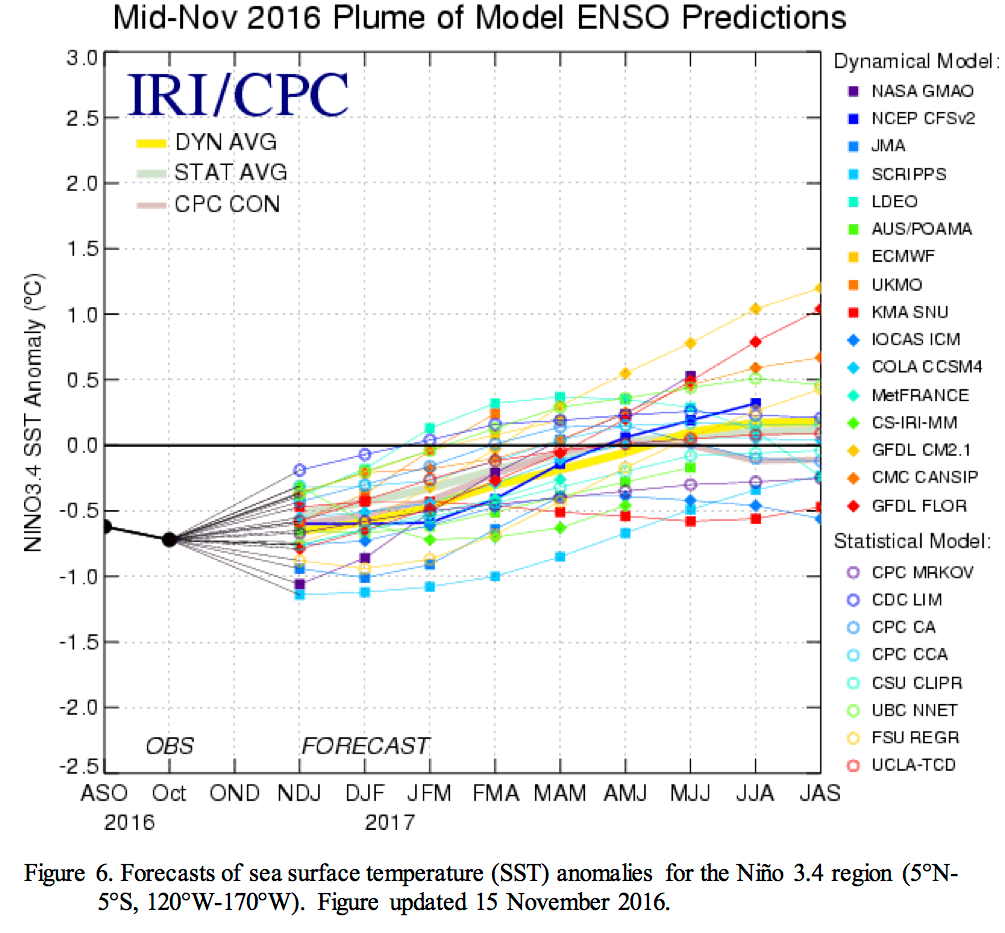
The multi-model averages favor La Niña (3-month average Niño-3.4 index ≤ -0.5°C) to continue through December – February (DJF) 2016-17. Given the current conditions and the model forecasts, the forecaster consensus also favors the continuation of weak La Niña conditions through DJF 2016-17.
In summary,LaNiñaconditionsarepresent,withatransitiontoENSO-neutralfavoredduring January – March 2017 (click CPC/IRI consensus forecast for the chance of each outcome for each 3- month period).
La Niña is anticipated to affect temperature and precipitation across the United States during the upcoming months (NOAA’s 3-month seasonal outlook will be updated on Thursday December 15th). The current seasonal outlook for DJF 2016-17 favors above-average temperatures and below-median precipitation across much of the southern tier of the U.S., and below-average temperatures and above- median precipitation in portions of the northern tier of the U.S.