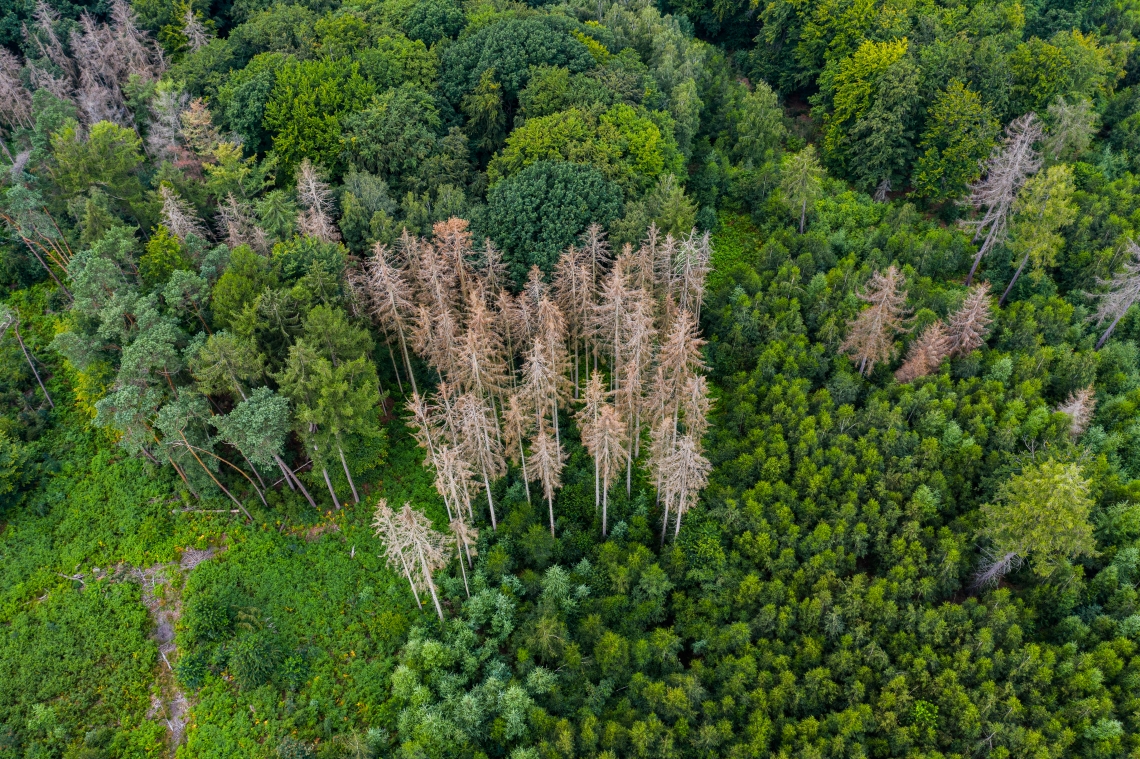
#Drought – More Than Temperature – Governs Diversity of Life on #Earth — University of #Arizona

Dying trees. Photo credit: University of Arizona

Here’s the release from the University of Arizona (Mikayla Mace Kelley):

Scientists have long believed that temperature – especially freezing cold – limits diversity of plant species as they proliferate out from the tropics and adapt to colder regions nearer the poles. The idea that temperature alone is behind the pattern of decreasing diversity is dubbed the tropical conservatism hypothesis.

A new University of Arizona-led study, to be published this week in Proceedings of the National Academies of Sciences, uses big data to reveal further nuance in the pattern of plant diversity and explain why some regions are more species rich than others.

The research team – led by Brian Enquist, a professor in the UArizona Department of Ecology and Evolutionary Biology – found that drought and seasonal fluctuations in rainfall are larger drivers of evolutionary diversity than warm temperatures.

To understand evolutionary diversity, it helps to imagine a family reunion where each person represents a different species. You can have the same number of people in a room, but you would have more evolutionary diversity if those people were cousins many times removed rather than siblings and first cousins.

The researchers created maps of evolutionary diversity across North, Central and South America, as well as maps of the different biomes that are home to specific temperature and precipitation patterns.

Their findings provide evidence supporting a more nuanced view of the tropical conservatism hypothesis.

If the hypothesis were taken at face value, then deserts of the American Southwest would be more evolutionarily diverse than the forests of the American Northeast, simply because the desert is warmer. But this is not the case. The desert is warm like the tropics, but dry. The Northeast is wet like the tropics, but cold. Yet, the Northeast has more evolutionary diversity, therefore indicating that drought has a stronger influence on plant diversity than temperature.

“If the tropical conservatism hypothesis were right, then natively, with climate change, you would think if cold regions warm up to tropical levels, maybe that’s going to be a good thing for biodiversity there,” Enquist said. “But that’s not the case. In fact, our droughts are going to become much more prevalent, and that will drive local extinctions not just in the wet tropics but in many rainy regions outside of the tropics as well.”

“The morphological and physiological attributes that allow species to thrive in arid environments have evolved in very few groups of plants. This indicates that, over evolutionary timescales, the adaptive challenge of extreme conditions is more challenging in arid environments than in freezing temperatures,” said lead study author Danilo Neves, a former UArizona postdoctoral fellow who worked under Enquist on the paper and is now an assistant professor in the Institute of Biological Sciences at the Federal University of Minas Gerais in Brazil.

The deserts of the American Southwest perfectly illustrate the surprising principles highlighted in their paper, the researchers said.

“Deserts of the American Southwest have more plant species compared to the wet forests of the American Northeast, but those desert species are from very few groups of plants. They are clustered on the tree of life, with little evolutionary diversity,” said Neves.

Although the researchers focused on plants, their findings can be applied to animals as well, as plants are the foundation of the ecosystem, Neves said.

The researchers were surprised by their results. The tropical conservatism hypothesis has been around for a long time, and the team was simply hoping to assess it with a much larger dataset than ever before. Instead, the team found that drought, which was neglected in previous studies, is perhaps more important than temperature in shaping biodiversity patterns at continental, and likely global, scales.

“We only found this pattern because we leveraged this massive dataset compiled by professor Enquist and colleagues,” Neves said.

“We were dealing with hundreds of millions of observations,” Enquist said. “It’s the largest botanical biodiversity dataset ever collected. We thought, this is great to assess the strength of the hypothesis and map it out across the Americas. However, to our surprise, we weren’t finding the expected strength of the tropical conservatism hypothesis, which emerged only after we incorporated seasonality of rainfall and drought and mapped it out.”

Next, the team wants to assess how current and future increases in temperature and drought will influence global patterns of biodiversity.

“Our results indicate that climate change will not only drive changes in global patterns of species distributions due to increasing temperature, but more importantly due to the increasing impacts of more extreme drought,” Enquist said. “If droughts and extreme temperatures become more prevalent under the worst-case climate change scenarios, our findings indicate that biodiversity may be more impacted than we thought, as only a limited subset of species on Earth have the ability to cope with the adaptive challenge of these extreme temperature and drought conditions.”

Wildfires in the #West are inevitable, but this strategy can help control them — National Geographic #ActOnClimate

Here’s a long-read from Alejandra Borunda that’s running in National Geographic. Click through for the photographs and to read the whole article. Here’s an excerpt:

Overgrown forests and climate change are making record-breaking wildfires commonplace, but land managers can “treat” forests to change their behavior during burns.

California’s Caldor Fire ripped its way across the Tahoe Basin this week, forcing thousands to evacuate, burning homes and communities in its path, and staining Lake Tahoe’s iconic blue waters with falling ash.

The fire, like many others burning across the U.S. West this year, spread rapidly in part because it’s burning intensely, propelled by hot, dry, windy weather conditions and forests overpacked with trees—food for hungry fire.

But it has also run up against some areas that have been “treated” to reduce their fire risk, patches of forest—some big, some not so big—that have been trimmed in the past, either by hand with chainsaws and masticators or with carefully managed prescribed fire. These treatments are intended to make forests healthier and more resilient to all kinds of pressures, including fire.

In the fires burning across California this year, and in other major recent fires, experts say these treatments may have done their job—which is not to stop the fires but to lower their intensity enough that they can be controlled.

The treatments serve many purposes, but one crucial role is that “they’re meant to give firefighters an opportunity to defend life and property,” says Kelly Martin, the former chief of fire for Yosemite National Park. “Now what we’re seeing is, we have several hundred-thousand-acre fires bearing down on these communities—for what it’s worth, they’ve done their job.”

The megafire era

Fires in the West are getting bigger and more intense. 2020 saw the country’s first “gigafire,” a burn that spanned more than a million acres, much of which burned at high severity—the kind of fire that generally causes great harm to homes and ecosystems alike.

The reasons for these changes are many. Crucially, the weather conditions that spur fast-spreading and intensely burning wildfires are becoming more common as climate change heats up and dries out many parts of the West. The fire season overall is lengthening, starting earlier in summer and stretching later into fall, so long that it’s essentially fire season year-round, a captain in California’s firefighting service has said. Dry air is becoming even drier; summer rainfall is sparser; nights are staying warmer, keeping fires active through times that used to provide a window in which to fight them; and the winds that fan the flames are as strong as ever during summer and fall, the riskiest times in much of the region.

At the same time, the West is facing a “fuels” overload. The region’s landscapes used to burn frequently; estimates suggest at least four million acres of California used to burn annually from a combination of fires set intentionally by Native Americans and natural lightning ignitions. Native American fire practitioners say that many areas burned every few years or sometimes even more often. In the northern Sierra Nevada, where the Caldor and Dixie Fires burn now, lower elevation forests probably burned every five to 30 years or so. But from the early 1900s until the late 1970s, federal policy dictated that any and all fires should be suppressed thoroughly and quickly; the “10 a.m. rule”—that any new fire needed to be out by 10 the following day—guided the U.S. Forest Service until 1978…

“The average fuel load right now is probably something like 50 tons per acre. Under the old fire regime,” when Native people managed the land, “it was probably more like 7 tons per acre—an order of magnitude less than what it is now across large areas,” says Rob York, a forestry expert with the University of California, Berkeley.

Such fuel loads change the way fire behaves. Super-charged burns that get up into tree crowns can not only damage the trees but also help kick off embers that can fly miles ahead of the fire front, starting new blazes and driving quick expansion…

Fuels treatments aren’t a panacea. Super hot fires or wind-driven spread can overwhelm even a treated area. But treatments—either mechanical thinning or prescribed fire, or ideally a combination—can help drop flame lengths and the “fireline intensity,” measures of how intensely a fire burns. In turn, that can help slow the pace of fire spread.

While we can’t change the weather patterns or climate pressures, York says, at least not in the short term, we can control the fuels. It’s possible to thin out the region’s overloaded landscapes, using chainsaws, masticators, and other tools to thin trees and lower-level brush, and setting carefully managed, low-intensity “good fire.” Research suggests that in overgrown areas, using both strategies may improve outcomes.

#ClimateChange is destabilizing the #ColoradoRiver Basin. Where do we go from here? — Environmental Defense Fund #COriver #aridification

From the Environmental Defense Fund (Christopher Kuzdas):

In June, a portion of my neighborhood in Flagstaff, Arizona, was put on pre-evacuation notice due to a nearby wildfire. A few weeks later, storms dumped heavy rains over a burn scar from a 2019 fire that caused destructive floods through parts of town. So far, this summer has been our third-wettest monsoon season on record, a complete contrast from our two driest monsoon seasons on record in 2019 and 2020.

These extremes are just a few local examples of the havoc that climate change is causing around the world. Here in the West, we are now in uncharted territory with the first-ever shortage declaration on the Colorado River.

What the shortage declaration means

The U.S. Bureau of Reclamation recently confirmed the Colorado River will be operated under never-before-used shortage rules, called a “tier 1” shortage, starting in 2022.

Under the rules defined by the 2019 Drought Contingency Plan (DCP), other agreements and the river’s operating guidelines, Arizona will absorb the brunt of this shortage. About one-third less water will flow through the Central Arizona Project canal to the Phoenix and Tucson areas, primarily impacting farmers. Nevada and Mexico will also see mandatory but smaller water cuts.

Though overused and overallocated, the Colorado River still provides water for 40 million people in the United States, Mexico and 30 Native American tribes. Water use across the Colorado River Basin has been unsustainable for years, and it was set up to be that way, going back to the 1922 Colorado River Compact that divided up the river. But climate change is now magnifying and accelerating problems in the basin. Photo credit: The Environmental Defense Fund

Even more concerning are water supply projections for 2023 and beyond.

Bureau of Reclamation projections forecast Lake Mead could fall close to a threshold where there are no rules outlining additional water cuts to avoid a crash to dead pool — when no water can flow out of Hoover Dam. This risk of an acceleration in plummeting water levels — which also jeopardizes water levels in Lake Powell — has prompted basin state representatives to initiate meetings to discuss additional actions that might be needed if water levels in Lake Mead fall below 1,020 feet.

It will get hotter and drier

This unprecedented situation offers a glimpse into our future. Warming scenarios from the latest IPCC report suggest that we could exceed 2 degrees Celsius of warming around midcentury, with more than 5 degrees by the end of the century, in the absence of action to curb carbon emissions.

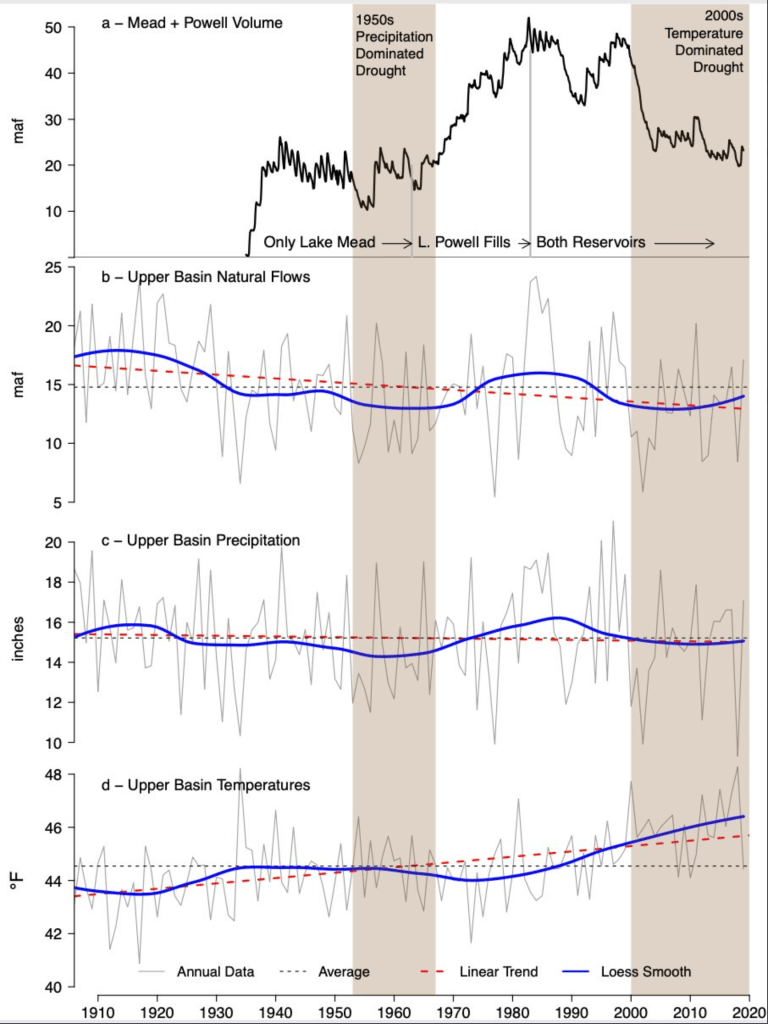
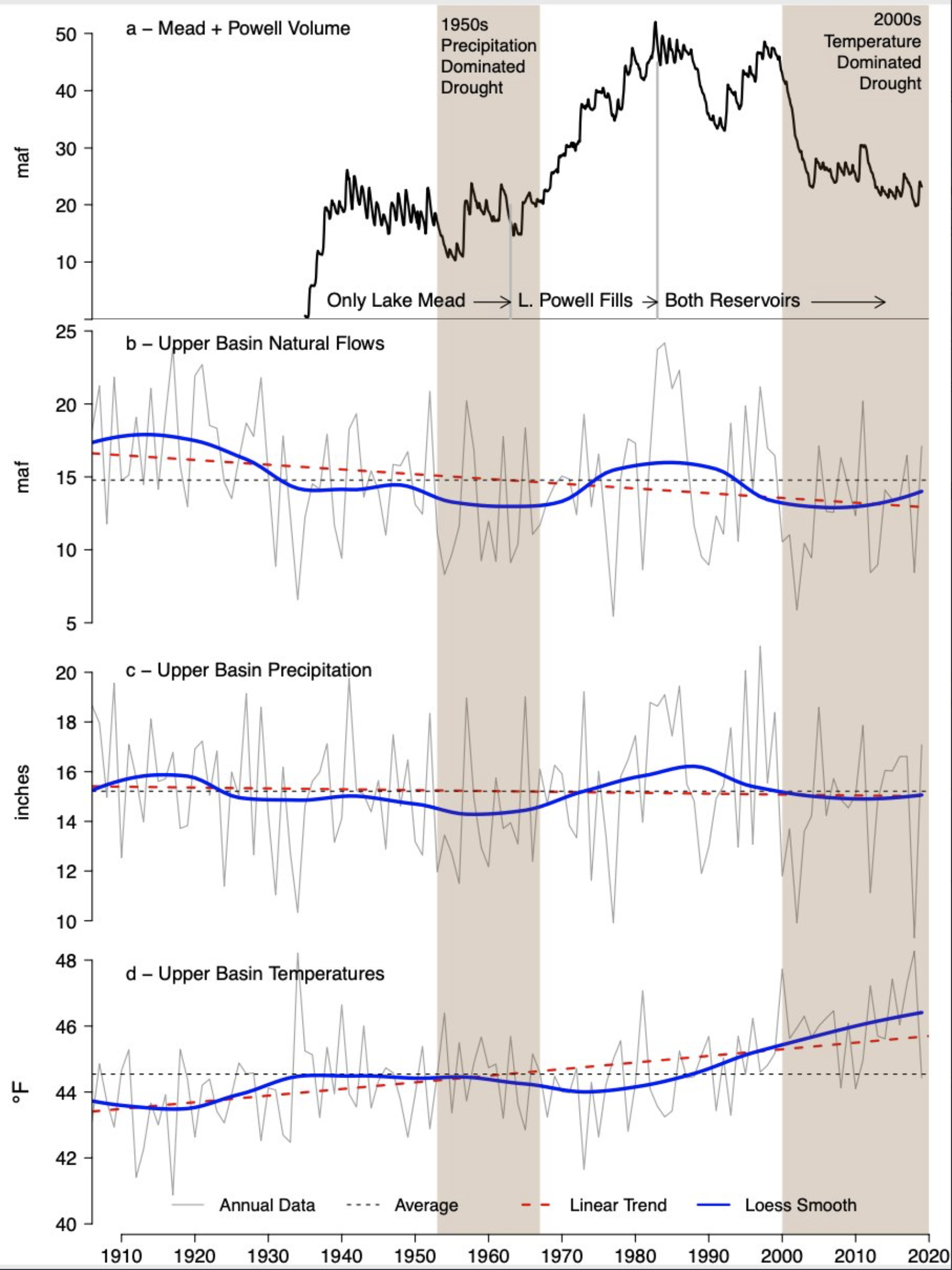
Brad Udall: Here’s the latest version of my 4-Panel plot thru Water Year (Oct-Sep) of 2019 of the #coriver big reservoirs, natural flows, precipitation, and temperature. Data goes back or 1906 (or 1935 for reservoirs.) This updates previous work with @GreatLakesPeck

Why does this matter for the Colorado River? Colorado River flows are highly sensitive to warming, and aridification caused by climate change is already reducing the water flowing in the river. With each additional 1 degree Celsius (1.8 degrees Fahrenheit) of warming, the Colorado River’s average flow drops by 9.3%, according to the U.S. Geological Survey. Colorado River flows could be up to one-third less than the current average within a generation, unless meaningful and immediate reductions in carbon emissions are achieved.

The outlook for the Colorado River is overwhelming. But what our future looks like is still our choice. We can, and should, choose to pursue a just transition to a basin with significantly less water. While in no way comprehensive, below are four ways to get started on that path.

1. Reconcile water demand with our climate reality.

Reconciling demands with our climate reality, at the very least, will involve updating river operating rules, scaling up conservation programs and shifting away from outdated expansionism.

The rules that determine how we balance supply and demand, and the underlying rights and agreements that collectively determine who gets how much water and when, will play a major role in how we transition to a basin with less water.

River operating rules have become more flexible to some extent as they evolved through new agreements like the DCP. However, current river operating rules still don’t account for the full suite of climate change impacts, especially those impacts under more dire climate scenarios. While river operating rules are already a focus of discussion, updating them will require thoughtful leadership, as well as attention to climate and other social and environmental considerations.

Scaling up conservation programs such as system conservation in the Lower Basin and demand management in the Upper Basin will also play an important role. If not for water conserved in Lake Mead, a “tier 1” shortage would have occurred years ago. Our challenge moving forward will be expanding the scale and impact of these programs, and in the Upper Basin, moving much faster to do so.

To fully reconcile demands with our climate reality, we must also finally shift away from legacy expansionism and boosterism that still show up through unnecessary project proposals like the Lake Powell Pipeline. We can do more with less.

Lake Mead water levels have dropped to a record low. Overall water use must also go down, and it must go down significantly to meet our climate reality. Photo: Chris Richards/Flickr (CC BY-NC-ND 2.0) via Audubon

2. Address long-standing inequities.

Long-standing inequities should be addressed to ensure water security for all. Two of the many considerations are inclusive decision-making and fully recognizing tribal water rights.

Inclusive and transparent processes to make decisions are essential to developing solutions that account for multiple values and goals. In the past, decision-making was often exclusive and responded primarily to a narrow set of private interests. That is changing.

From the 2018 Tribal Water Study, this graphic shows the location of the 29 federally-recognized tribes in the Colorado River Basin. Map credit: USBR

For example, Arizona’s DCP process included some tribes and conservation groups, and the process would not have been successful without the leadership of the Gila River Indian Community and the Colorado River Indian Tribes. More diversity at the table enables more creativity and better solutions.

Although the Colorado River Basin’s 30 sovereign Native American tribes have unique rights and claims to a significant portion of the Colorado River’s flow, not all are using their water for several reasons. Those reasons include aging or inadequate infrastructure; limited funding; and significant legal, policy and administrative barriers.

Overcoming such barriers to accessing Colorado River water and confirming and fulfilling tribal water rights will be critical for many tribes to achieve goals such as meeting basic water needs and securing livelihoods. Addressing those barriers is a step toward dealing with long-standing inequity and should be a priority for policymakers.

3. Take a whole-portfolio approach.

A whole-portfolio approach includes new watershed-focused actions to support communities in adapting to and mitigating the steadily compounding risks and extremes of climate change. The recently published Ten Strategies for Climate Resilience report describes a suite of local and watershed-scale projects to do just that, including forest health and restoration, naturally distributed storage, regenerative agriculture and new crop markets.

A whole-portfolio approach also necessitates adequate management and planning for our other water supplies. However, that’s not fully possible across a large part of the basin without changes in state-level water law and policy. For example, Arizona, which makes up almost half the landmass of the Colorado River Basin, already depends on groundwater for 40% of its annual water supply and will only become increasingly dependent on groundwater as Colorado River flows shrink. Arizona does not manage groundwater across most of the state, and local rural communities have little to no power to do so.

Changing this free-for-all approach to groundwater in rural Arizona is critical if we hope to have a water-secure future for all people in the basin.

4. Lead on climate.

More warming means less water in the Colorado River Basin. How much water dries up depends on how fast we can get off fossil fuels. Across the basin, and globally, freshwater agendas must start including actions to stop heating the planet. Climate leadership is water leadership.

The road ahead is difficult. But what our shared future looks like in the Colorado River Basin is our own choice. Let’s choose to collectively pursue a just transition to a basin with less water.

August was hot and dry for eastern #Colorado and #drought is knocking at our door — KOAA

From KOAA (Alex O’Brien):

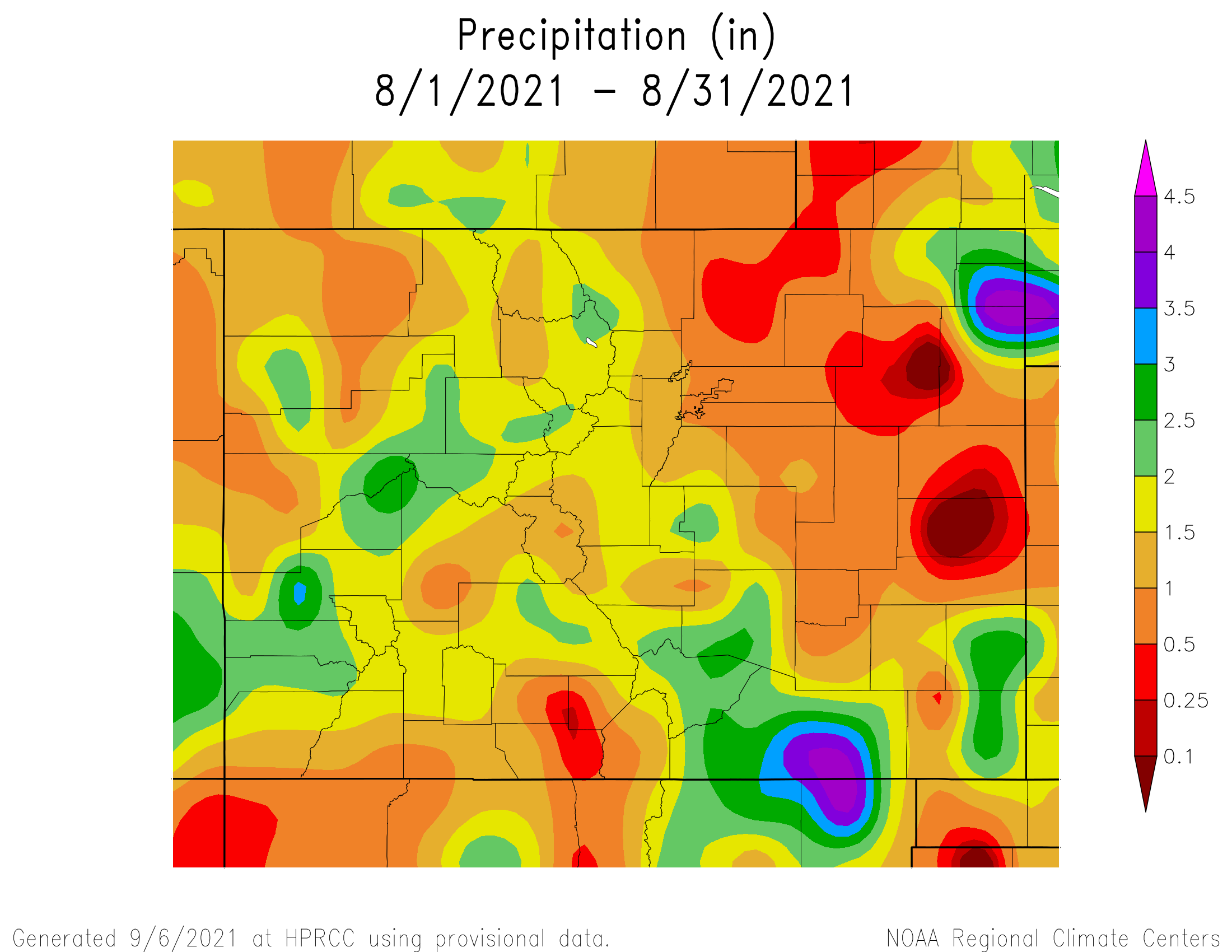
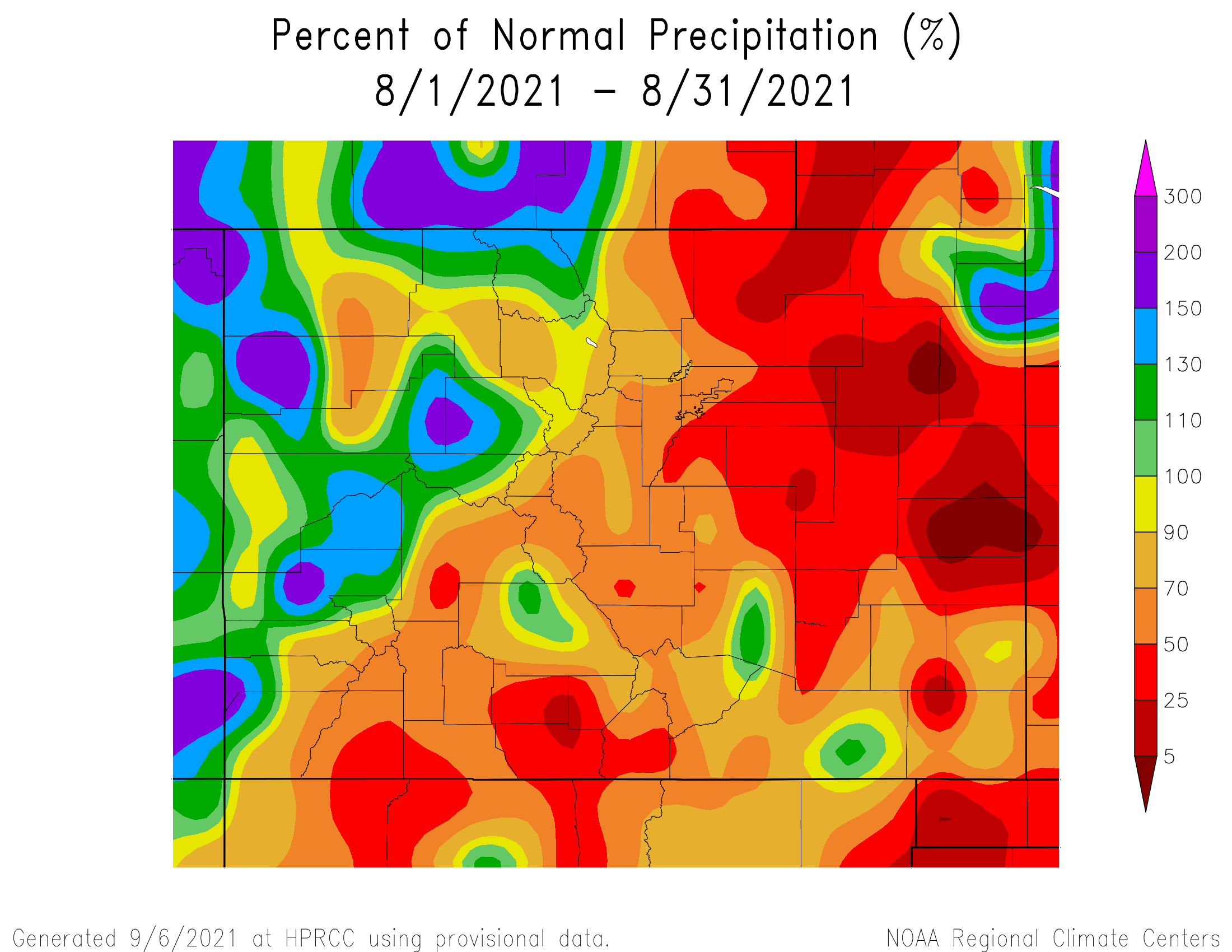
For Colorado Springs, August is making weather headlines as the 4th driest and 2nd warmest on record for the city. The average temperature was 74° which ties 2nd place for warmest with 2020. The record-holder is 2011 at an average temperature of 74.1°.

Colorado Springs saw a measly 0.20″ of rain in August, making for the 4th driest on record. August is typically the second wettest month for the city at an average of 2.96″.

In Pueblo, the stats aren’t as dramatic with August being the 15th warmest on record at 76.4°. Pueblo received 1.23″ of rain which is 0.88″ below average.

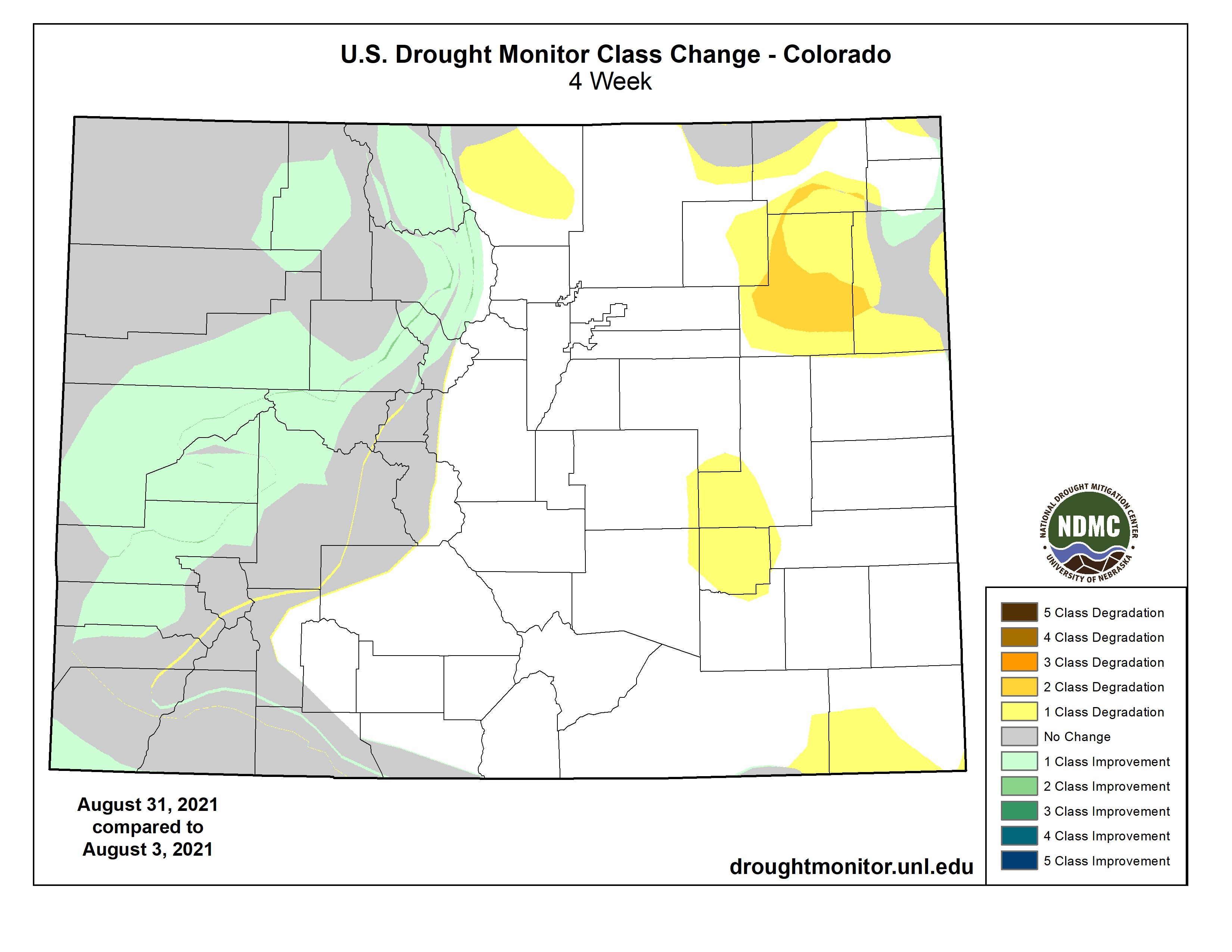
Statewide, eastern Colorado was hot and dry this month and western Colorado was wet and cool.

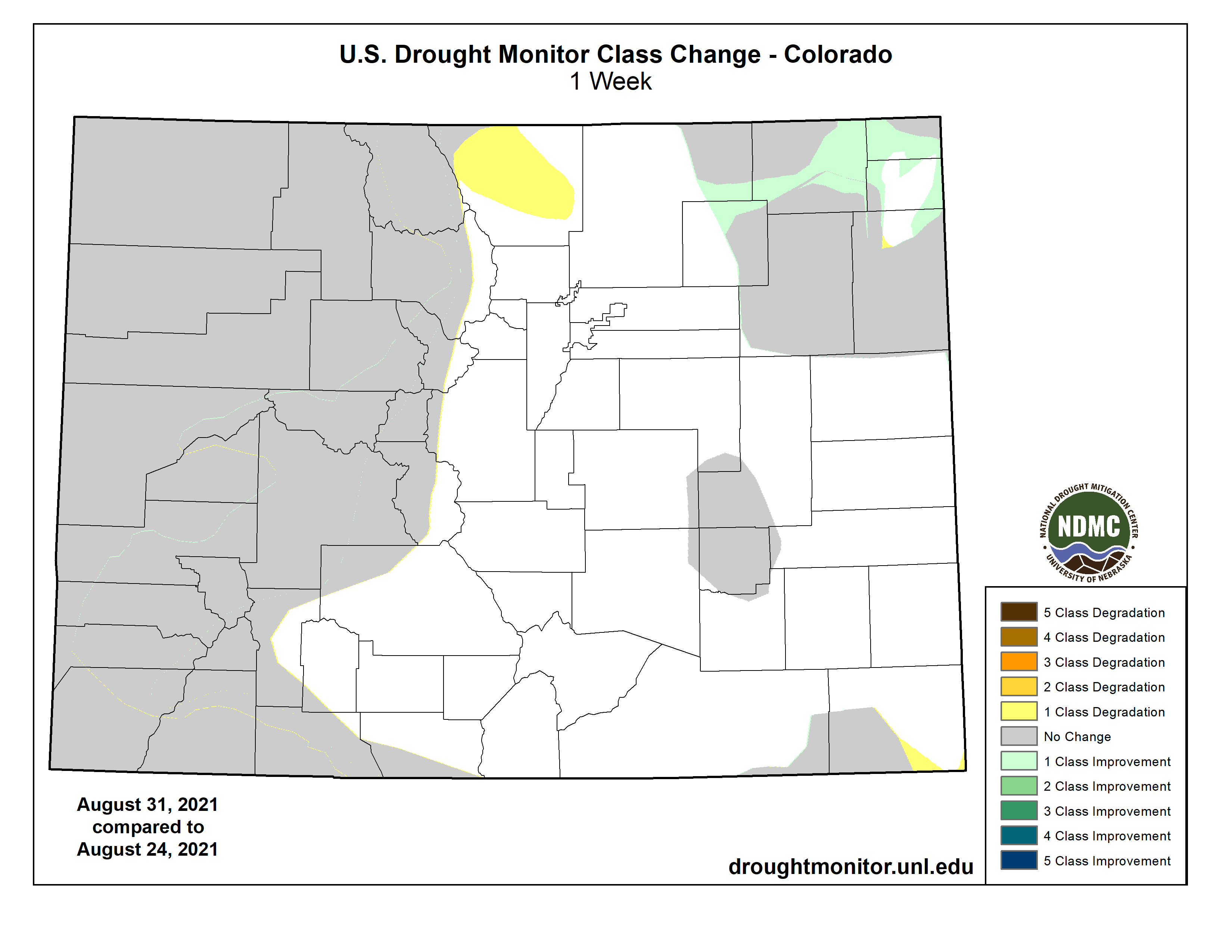
These patterns had an influence on drought, with improvement seen in the west and worsening in the east.

Colorado Drought Monitor one month change map ending August 31, 2021.

But as a whole, Colorado Springs is running near average for the 2021 water year thus far, after running on a surplus from spring and early summer.

As aquifers drain, El Paso County is hoping a nearly endless loop of water can fight future shortages — The #Colorado Sun

Fountain Creek through Colorado Springs.

From The Colorado Sun (Michael Booth):

Could a $134 million pipeline recycling suburban water help wean communities off depleted aquifer sources? The latest complex solution for the arid, fast-growing West…

For the H20 molecules lying thousands of feet underground in the Denver Basin aquifer, trapped by millions of years of geologic shifts, there would be a long journey ahead.

Should they get sucked up a well owned by a northern El Paso County water agency, the water drops may first be sprinkled on a lawn in, say, the Woodmoor district east of Monument. From there, the water would sink back underground and flow downhill toward Monument Creek. On into Fountain Creek, and south toward the Arkansas River.

Then the drops would ripple past Colorado Springs, which is desperate to entrap more water of its own for future growth, and is pushing for unloved dams 100 miles away to bring more Western Slope water over the Continental Divide.

On the water would glide past Security, Widefield and other communities, which are struggling to secure clean water supplies of their own in the wake of contamination from polyfluoroalkyl substances (PFAS) running off firefighting foam used for decades at a local military base.

Still going, the hardworking aquifer water then would pass farmland that will eventually be dried up by Woodmoor and other northern suburbs buying agriculture water for their own growth. At the town of Fountain, the water would pass a town that has slowed new homebuilding because it doesn’t have enough future supply for new water taps.

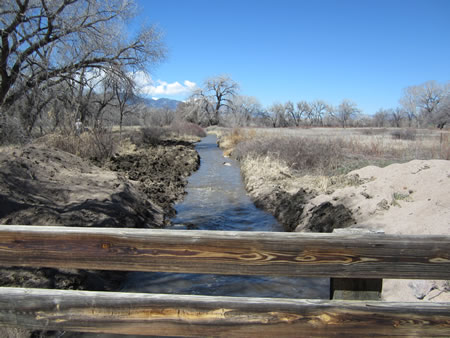
Chilcott Ditch looking towards headgate. Photo credit: Chilcott Ditch Company

And then those precious H20 molecules would hit a curve of Fountain Creek where the Chilcott Ditch headgate looms like an ominous fork in the road of life: If Woodmoor and its allies get their way, the molecules they pulled from the timeless aquifer will get diverted here and sent into a $130 million-plus pipeline, to be shipped back north to the top of El Paso County. The journey for those molecules would begin all over again, in a project appropriately dubbed The Loop, until — in the official water rights phrase — the original aquifer water has been “used to extinction.”

But that only happens if El Paso County and local water agencies convince the keepers of the federal American Rescue Plan that the stimulus funds can be used for water projects like the Loop, and not just highways.

Can this tortured trip for the ancient, sandstone-filtered water really be the best solution to Colorado’s relentlessly expanding water demands?

“There’s something in it for everybody,” said Jessie Shaffer, Woodmoor Water and Sanitation District manager and a key proponent of the Loop…

Backers of the Loop idea say it would solve many problems at once.

It would reduce unsustainable withdrawals from the Denver Basin aquifers, with local water providers already on notice they need to find alternative sources. The pipeline would allow the homes in subdivisions north and east of Colorado Springs to use southern water rights they’ve already purchased but can’t access. And it would promote water recycling, considered a key to Colorado’s water use future, by allowing those northern areas to reuse aquifer water after it’s run off into Fountain Creek and shipped north again by the Loop.

From a purely practical standpoint, drilling new wells into the aquifer is getting so expensive that the suburban districts think twice even when they own the rights. As the aquifer sinks from overuse, drilling prices soar.

Williams mentioned a northern exurban community that spent more than a million dollars on a well to water its new golf course…

A map being shown around El Paso County by suburban water agencies traces the path of the Loop, a complex $134 million pipeline and pumping project that would allow northern and eastern communities in the county to reuse aquifer water returning to Fountain Creek, and pipe along water rights they have bought up on the southern side of the county. (Provided by Woodmoor Water and Sanitation District)

El Paso County grew by more than 17%, and more than 100,000 people, between 2010 and 2020. As developers work to build out planned communities in areas like Flying Horse or Banning Lewis Ranch, the county’s population is projected to expand by hundreds of thousands more in the coming decades.

State water engineers who control withdrawals from aquifers have allowed cities and other water buyers to take out water at a rate protecting a 100-year life for the underground pools. Alarmed at the drops in the Denver Basin pools, El Paso County changed the local standard to preserve 300 years of life for the aquifers. That was another push to local water providers to find other sources.

The Loop pipeline, Shaffer said, is a key to shifting “off of a finite and exhaustible water supply onto a long term, renewable and sustainable water supply.”

[…]

That’s where the American Rescue Plan, signed by President Biden in March, comes into the picture. State and local agencies will battle over the $1.9 trillion stimulus funding for years to come, but Colorado water officials are hopeful some grants can be used for drinking water supply projects. There also may be far more stimulus and infrastructure funding to come, in a building package awaiting final U.S. House approval and a greatly expanded recovery budget that may pass under reconciliation.

Denver Basin Aquifer System graphic credit USGS.

Drake Power Plant shutdown marks latest step in #Colorado’s shift off #FossilFuels — The #Denver Post #ActOnClimate #KeepItInTheGround

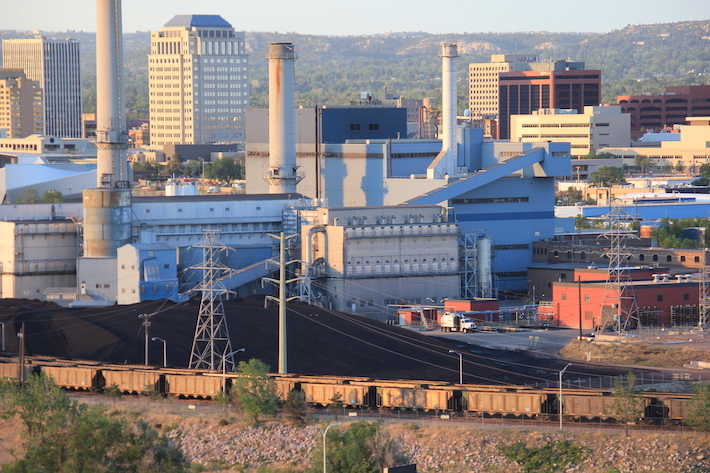
Martin Drake Coal Plant Colorado Springs. The coal plant in downtown Colorado Springs will be closed by 2023 and 7 gas-fired generators moved in to generate power until 2030. Photo credit: Allen Best/The Mountain Town News

From The Denver Post (Bruce Finley):

Eighteen coal-fired power plants down. Another dozen to go as Colorado shifts its electricity supply system off fossil fuels.

The latest shutdown at the massive Martin Drake Power Plant in downtown Colorado Springs last week brings the share of electricity generated by burning coal statewide to less than 36%, federal Energy Information Administration data shows. That’s down from 68% a decade ago, though Colorado still lags behind the national 19% share. The state’s remaining coal plants are scheduled to close by 2040.

“If we can do this in the heart of the West, in a state that used to be one of the most reliant on coal generation, states across the nation can do it too,” Colorado Energy Office director Will Toor said.

A growing reliance on solar and wind energy alternatives “can be leveraged,” Toor said, for electric vehicles and electric-powered heating of buildings.

Air along Colorado’s Front Range no longer will be infused with the pollution that for nearly 100 years has risen from Drake’s towering chimneys. This means 201 tons a year less sulfur dioxide, 25 tons less lung-clogging particulates, 257 tons less carbon monoxide, and 1,007 tons less nitrogen oxides that lead to ozone smog, according to data from state air quality control officials.

Drake emitted more than 1.3 million tons a year of pollutants overall, including carbon dioxide and smaller amounts of benzene, hydrogen chloride, sulfuric acid and chloroform, state data shows.

Shifting beyond coal “will help improve air quality nearby and across the state,” Colorado Department of Public Health and the Environment director Jill Hunsaker Ryan said.

Drake for decades has loomed as one of the nation’s last urban industrial coal plants. City-run utility crews relied on coal, burning up to 3,000 tons a day, to handle up to a third of local electricity demands. For now, utility workers are focusing on a delicate transition. They’ll supply electricity temporarily using portable natural gas generators, along with coal-fired power from the Ray Nixon power plant southeast of the city. The coal unit there isn’t scheduled to close until 2029…

America The Beautiful Park, photo by James Van Hoy via The City of Colorado Springs

Dismantling Drake will open about 50 acres along Fountain Creek in the heart of Colorado Springs, where leaders have created the America the Beautiful Park, a new soccer stadium and the Olympics Museum just north of the plant.

Future uses of that site depend on cleanup, followed by land and creek habitat restoration. When the chimneys come down, contractors will inject bleach 18 inches deep in the ground, and soil will be imported to the site, Colorado Springs Utilities chief executive Aram Benyamin said.

The U.S. Environmental Protection Agency, state health officials and community groups for years have pressed Colorado Springs leaders to cut pollution from Drake, particularly the sulfur dioxide. But government agencies never ordered a shutdown. In the end cost as well as the environment played a role, as city council members last year voted to close Drake ahead of their previously scheduled deadline of 2035.

Water expert found his roots in #water scarcity — The #GrandJunction Daily Sentinel

Max Schmidt, general manager of the Orchard Mesa Irrigation District in Palisade. (Photo by Osha Gray Davidson)

From The Grand Junction Daily Sentinel (Sam Klomhaus):

[Max] Schmidt, 72, has managed the Orchard Mesa Irrigation District since 2009. Before that, he spent almost 20 years with the Natural Resource Conservation Service designing irrigation systems. And, before that, he was a produce farmer in West Texas.

In Texas, Schmidt cultivated cabbage, carrots, watermelon, broccoli, spinach, sweet corn, cantaloupe and peppers.

When he was 40, Schmidt realized he was working 18 hours a day, seven days a week, and he wanted to watch his three children grow up, so he packed up and headed to the Grand Valley. He loves it here, and so do his kids…

Schmidt says he thoroughly enjoyed farming when he did it, and he misses it sometimes, but “I like watching other people farm.”

Agriculture is very important to Schmidt, and it’s clear that’s one of the things he likes best about his job and living in Western Colorado…

Working in water means Schmidt understands the complicated subject of water rights better than most.

“Colorado’s water history is really interesting,” he said. Some of the buildings he manages are 110 years old…

Orchard Mesa Irrigation District power plant near Palisade. Water from Colorado’s snowpack is distributed across the region through a complex network of dams, pipelines and irrigation canals. Photo credit: Orchard Mesa Irrigation District

The Orchard Mesa irrigation District and Grand Valley Water Users Association are looking to build a new hydro plant adjacent to the current one in Orchard Mesa, to the tune of about $10 million.

Schmidt said he plans to retire after the new plant is completed. After that, he wants to travel. He said he’s going to start with all the national parks, and maybe ride some trains around.

Our new age of fire — Writers on the Range #ActOnClimate

From Writers on the Range (Steve Pyne):

Fire in the West is expected, and not so long ago, it seemed something the West experienced more than anywhere else. Nationally, big fires were treated as another freak of regional violence, like a grizzly bear attack, or another California quirk like Esalen and avocados.

Now wildland fires flare up everywhere. There are fires in Algeria and Turkey, Amazonia and Indonesia, and France, Canada and Australia. Last year even Greenland burned.

Fire seasons have lengthened, fires have gotten meaner and bigger; fires have begun not just gorging on logging slash and prowling the mountainous backcountry, but also burning right into and across towns. Three years ago in northern California, the Camp fire broke out along the Feather River and, burning southwest, incinerated the town of Paradise. This summer’s Dixie fire, starting 20 miles north in the same drainage, is burning in the opposite direction, after taking out the historic town of Greenville. The fires have us coming and going, and now Lake Tahoe is under the gun.

The causes have been analyzed and reanalyzed, like placer miners washing and rewashing tailings. Likewise, the solutions have been reworked and polished until they have become clichés, ready to spill into the culture wars.

The news media have fire season branded into their almanac of annual events. Scientific disciplines are publishing reports and data sets at an exponential rate. So far as understanding the fire scene, we’ve hit field capacity. What more can we say?

Fires rage across continents, sparking panic and discord among the public, scientists, and media alike.
(Photo Credit: Michael Held via Unsplash)

One trend is to go small and find meaning in the personal. But there is also an argument to go big and frame the story at a planetary scale that can shuffle all the survival memoirs, smoke palls that travel across the continent, melting ice packs, lost and disappearing species and sprawling frontiers of flame, in much the way we organize the swarm of starlight in a night sky into constellations.

I’m a fire guy. I take fire not just as a random happening, but as an emergent property that’s intrinsic to life on Earth.

So I expect fires. All those savanna fires in Africa, the land-clearing fires in Brazil and Sumatra, the boreal blowouts in Siberia and British Columbia, the megafires in the Pacific Northwest — all the flames we see.

But then there are fires that should be present and aren’t — the fires that once renewed and stabilized most of the land all over our planet. These are the fires that humanity, with its species monopoly on combustion, deliberately set to make living landscapes into what the ancients termed “a second nature.”

But it was not enough. We wanted yet more power without the constraints of living landscapes that restricted what and when we could burn. We turned to fossil fuels to burn through day and night, winter and summer, drought and deluge. With our unbounded firepower we remade second nature into “a third nature,” one organized around industrial combustion.

Humans and fire have coexisted for years. But reorganizing our society around constant combustion may burn it to the ground.
(Photo Credit: Issy Bailey, @bailey_i, via Unsplash)

Our fires in living landscapes and those made with fossil fuels have been reshaping the Earth. The result is too much bad fire and too little good, and way too much combustion overall.

Add up all those varieties of burning, and we seem to be creating the fire equivalent of an Ice Age, with continental shifts in geography, radical changes in climate, rising sea level, a mass extinction, and a planet whose air, water, soil and life are being refashioned at a breakneck pace.

It’s said that every model fails but some are useful. The same holds true for metaphors. What the concept of a planetary Fire Age — a Pyrocene — gives us, is a sense of the scale of our fire-powered impact. It suggests how the parts might interact and who is responsible. It allows us to reimagine the issues and perhaps stand outside our entrenched perspectives.

Steve Pyne via Writers on the Range

What we have made — if with unintended consequences — we can unmake, though we should expect more unknown consequences.

We have a lot of fire in our future, and a lot to learn about living with it.

Steve Pyne is a contributor to Writers on the Range, writersontherange.org, a nonprofit dedicated to spurring lively conversation about the West. He is the author of The Pyrocene. How We Created an Age of Fire, and What Happens Next.

Happy Labor Day

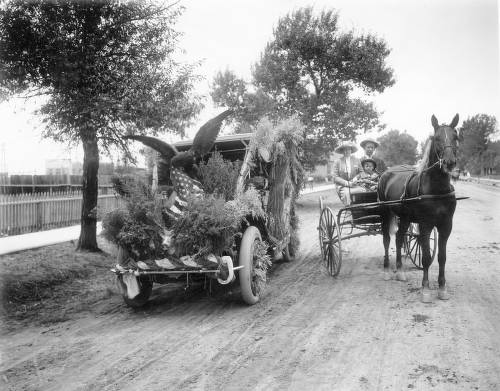
A man, woman and young boy sit in a horse-drawn buggy next to a decorated truck ready for a Labor Day celebration in Alamosa (Alamosa County), Colorado. They wear suits and hats; the young boy has a ribbon sash criss-crossed over his suit that has a small American flag attached to it. The truck is decorated with sheaves of wheat and plants. In the rear is a taxidermic eagle, with an American flag in its beak, and a stuffed mule deer head.
Date
[between 1900 and 1915]. Photo credit: Denver Public Library

How much #snowpack in the #ColoradoRiver Basin comes from atmospheric rivers? — NOAA #COriver #aridification

From NOAA:

Atmospheric rivers, commonly defined as long, narrow corridors in the atmosphere, much like rivers in the sky, transport moisture from the tropics. These “rivers” can produce large amounts of snow accumulation when they make landfall during the cold season. With over half of the streamflow in the Colorado River originating from water released by snow melt, it’s important to understand how atmospheric rivers can affect snowpack in the region.

In a new Geophysical Research Letter article, authors Mu Xiao, and Dennis P. Lettenmaier, identify the atmospheric rivers in the Upper Colorado River basin during a 65-year-long historical record and evaluate their contribution to mountain snowpack. It was found that almost one-third of the snowpack in the basin is attributed to atmospheric river induced snowfall. The primary origin of these atmospheric rivers are from the southwest, however, the pathways do not affect the amount of snow they yield.

“Given that over 70% of the Colorado River’s natural flow originates from snowmelt, it is of great importance to understand the characteristics of snow in the basin. In this study, we determine that on average atmospheric rivers contribute to nearly 30% of the basin’s total snow accumulation, which can yield over 20% of annual streamflow. We also find that atmospheric river related snow is highly important to the region during warm winters,” said author Mu Xiao.

This study was partially funded by the MAPP program.

Read the full paper here.

#ColoradoRiver Working Group Kickoff Meeting Set for September 7, 2021 in Rock Springs — #Wyoming Governor Gordon #GreenRiver #COriver #aridification

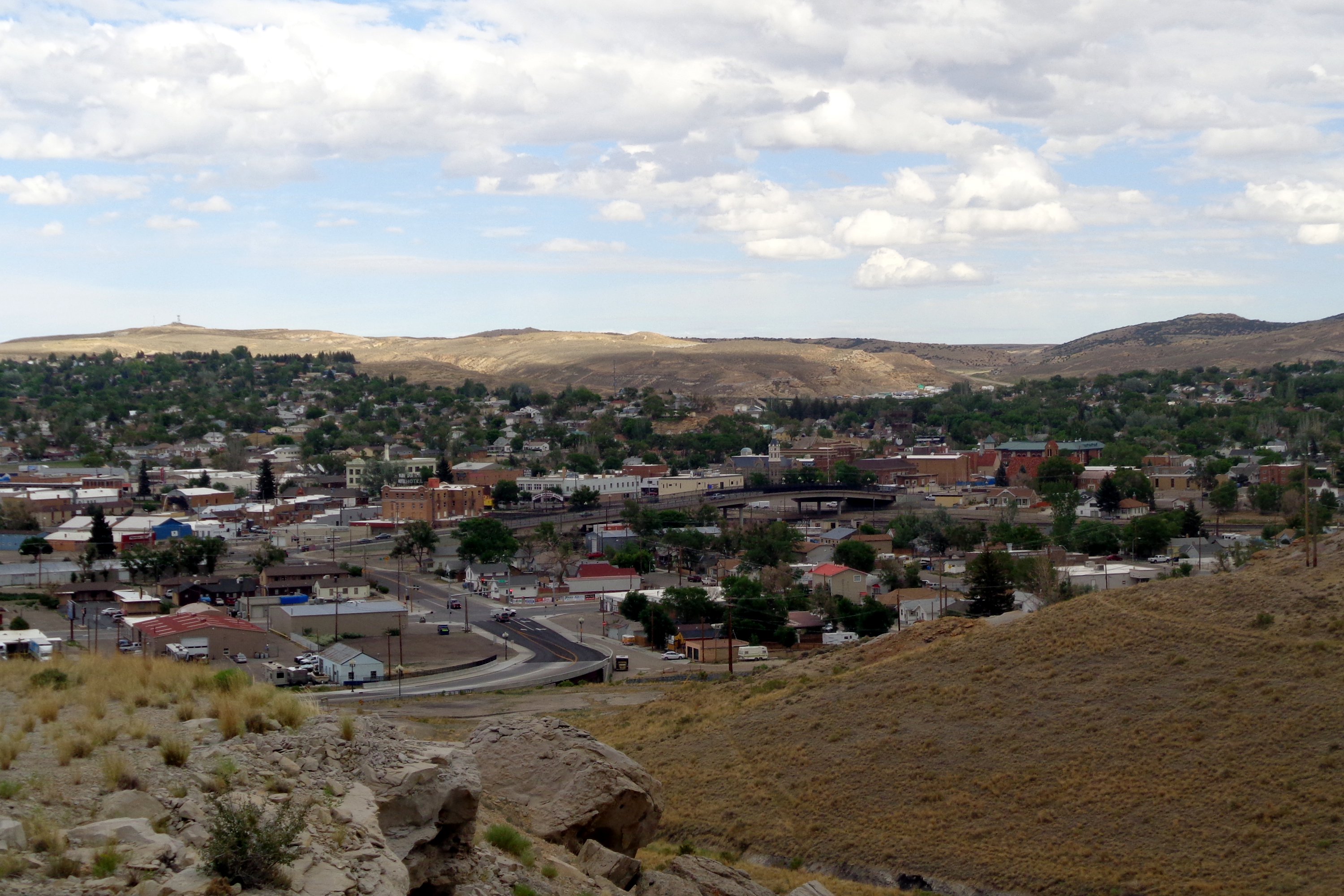
Panorama of downtown Rock Springs, looking southeast from grant Street. By Vasiliymeshko – Own work, CC BY-SA 4.0, https://commons.wikimedia.org/w/index.php?curid=108016208

Here’s the release from Governor Gordon’s office:

Governor Mark Gordon’s Colorado River Working Group will hold its first meeting from 9 am to noon on Sept. 7 in Rock Springs. The group will discuss important Colorado River matters and monitor potential impacts to Wyoming. The kickoff meeting will be open to the public and led by the Wyoming State Engineer’s Office.

The formation of the Working Group comes in response to continuing drought conditions in the Colorado, Green and Little Snake River basins and associated issues concerning Colorado River Basin management. The Governor’s charge to the Working Group is to discuss and share Colorado River information with interested stakeholders in the Green and Little Snake River Basins. It is a continuation of a coordinated and proactive outreach effort that has been underway in Wyoming since 2019.

This group is made up of representatives of key water use sectors in the Green and Little Snake River Basins. Working Group members are:

Municipal interests

  • Ben Bracken — Green River/Rock Springs/Sweetwater Joint Powers Board (retired)
  • Brad Brooks — Cheyenne Board of Public Utilities
  • Agriculture interests

  • Chad Espenscheid
  • Legislative interests

  • Senator Larry Hicks — Senate District 11
  • Representative Albert Sommers — House District 20
  • Environmental interests

  • Jen Lamb — The Nature Conservancy
  • Industrial interests

  • Aaron Reichel — Genesis-Alkali
  • Ron Wild — PacifiCorp
  • The September 7th meeting will be held at Western Wyoming Community College in Business Office Room #3650 A&B in Rock Springs. More information, including background materials and future meeting agendas, will be posted on the Colorado River Working Group web page on the Wyoming State Engineer’s website: https://seo.wyo.gov/interstate-streams/wyoming-colorado-river-working-group.

    Electric costs in #Colorado set to surge as #LakePowell struggles to produce hydropower — @WaterEdCO #ColoradoRiver #COriver #aridification

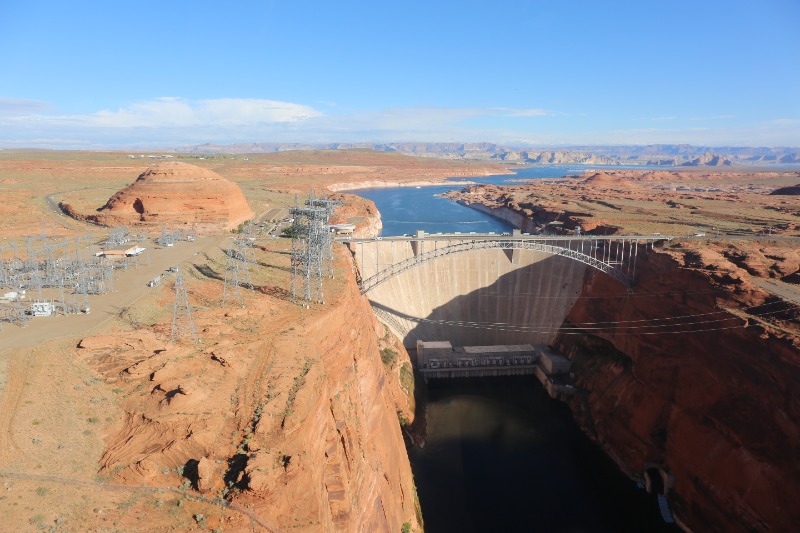
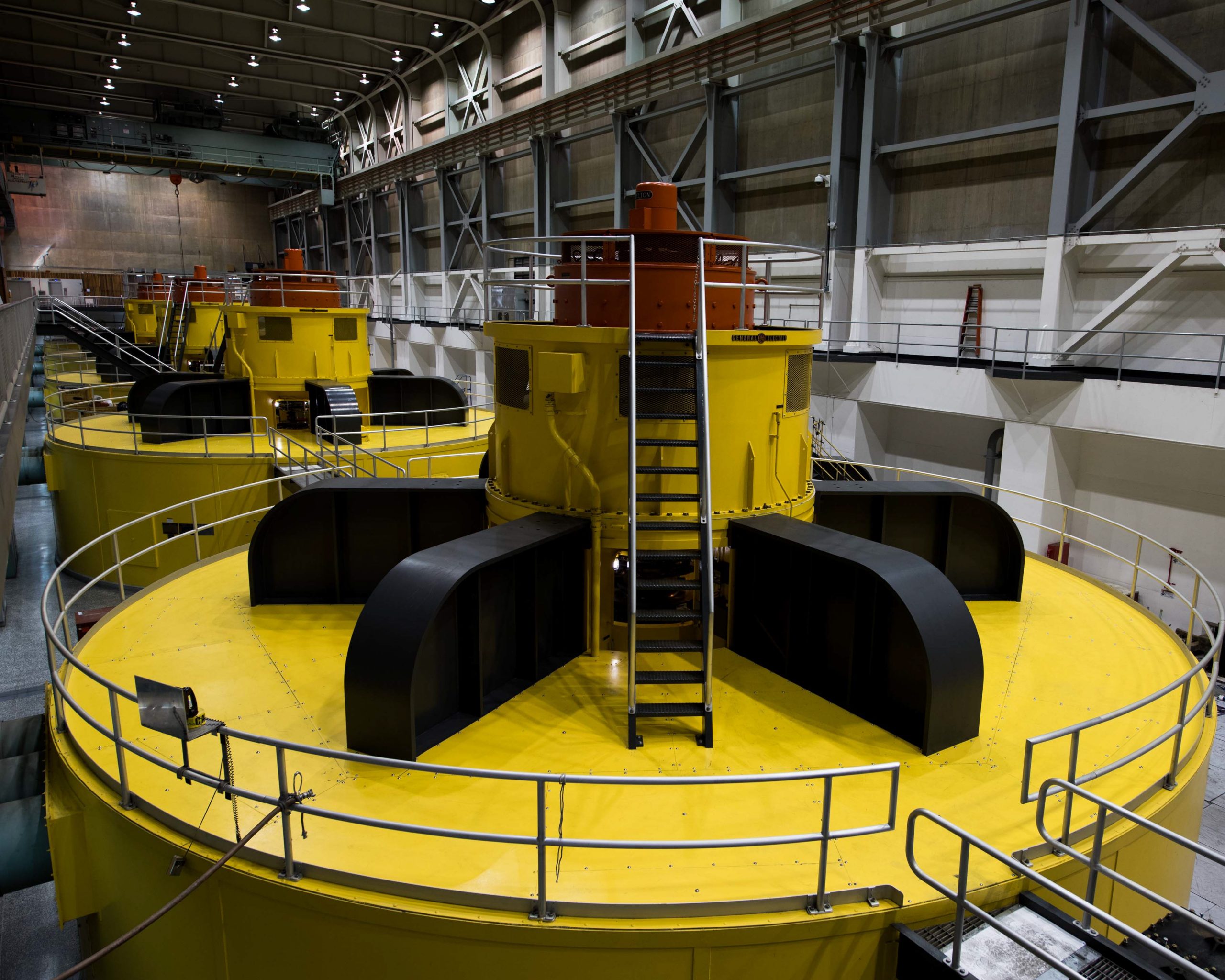
    Lake Powell’s Glen Canyon Dam is used to produce hydropower that is delivered over a 17,000-mile transmission grid, reaching six states and 5 million people. Photo courtesy Western Area Power Administration.

    From Water Education Colorado (Jerd Smith):

    The federal agency that distributes electricity from hydropower plants in the Upper Colorado River Basin will ask its customers, including more than 50 here in Colorado, to help offset rising costs linked to Lake Powell’s inability to produce as much power due to drought.

    The Western Area Power Administration (WAPA), which distributes Lake Powell’s electricity, is gathering public comments and asking its customers how best to cope with long-term drought conditions that have pushed Powell and other reservoirs to historically low levels.

    As flows in the Colorado River have declined due to climate change and a 20-year megadrought, there is less water in its storage reservoirs and, therefore, less pressure to power the turbines, causing them to generate less electricity.

    WAPA has had to nearly double the amount of extra power it has had to buy this year to ensure it can meet its contract obligations to its customers.

    “It’s all bad news, but it isn’t necessarily unexpected,” said WAPA spokesperson Lisa Meiman.

    WAPA power is among the most sought-after in Western states because it is sold at cost and because it is a renewable power resource, something highly valued in places such as Colorado, where utilities are working to reduce their reliance on fossil fuels.

    WAPA often buys extra power if for some reason its customers’ electricity needs don’t match up with its hydropower production on a given day. It delivers power over a 17,000-mile transmission grid to six states and 5 million people.

    But as flows in the Colorado River have shrunk, those purchases have become larger and more frequent.

    Last year it bought an extra 413,000 megawatts of power. This year it has already purchased 833,000 megawatts of additional power, according to Meiman, and the agency expects that number to grow this year and likely again next year as the drought continues with no relief in sight.

    These turbines at Lake Powell’s Glen Canyon Dam are at risk of becoming inoperable should levels at Powell fall below what’s known as minimum power pool due to declining flows in the Colorado River. Photo courtesy U.S. Bureau of Reclamation.

    This year, because of the power demands of the West’s growing population and the need for air conditioning to combat ultra-high temperatures, power costs are already soaring.

    Last year WAPA paid $25 per megawatt for its replacement power, Meiman said. This year it is paying $33 per megawatt, a 30% jump.

    In Colorado, WAPA sells power to some of the state’s largest electric utilities, such as Tri-State Generation and Transmission, as well as cities, small towns and rural electric co-ops.

    “We’re watching the situation closely,” said Natalie Eckhart, a spokesperson for Colorado Springs Utilities, which is a WAPA electric customer and which also draws a significant portion of its water from the Colorado River system.

    “The bottom line is we care about this on all fronts,” Eckhart said.

    Few expected power generation at Lake Powell to decline so quickly. The Colorado River Basin serves seven U.S. states and 30 Native American Tribes. For months, the U.S. Bureau of Reclamation and the Upper Colorado River Basin states of Colorado, New Mexico, Utah and Wyoming have been nervously watching what’s known as the minimum power pool level at Powell, the lowest elevation at which power can be produced, which is 3,490 feet. If the reservoir drops lower than that, all hydropower production will stop.

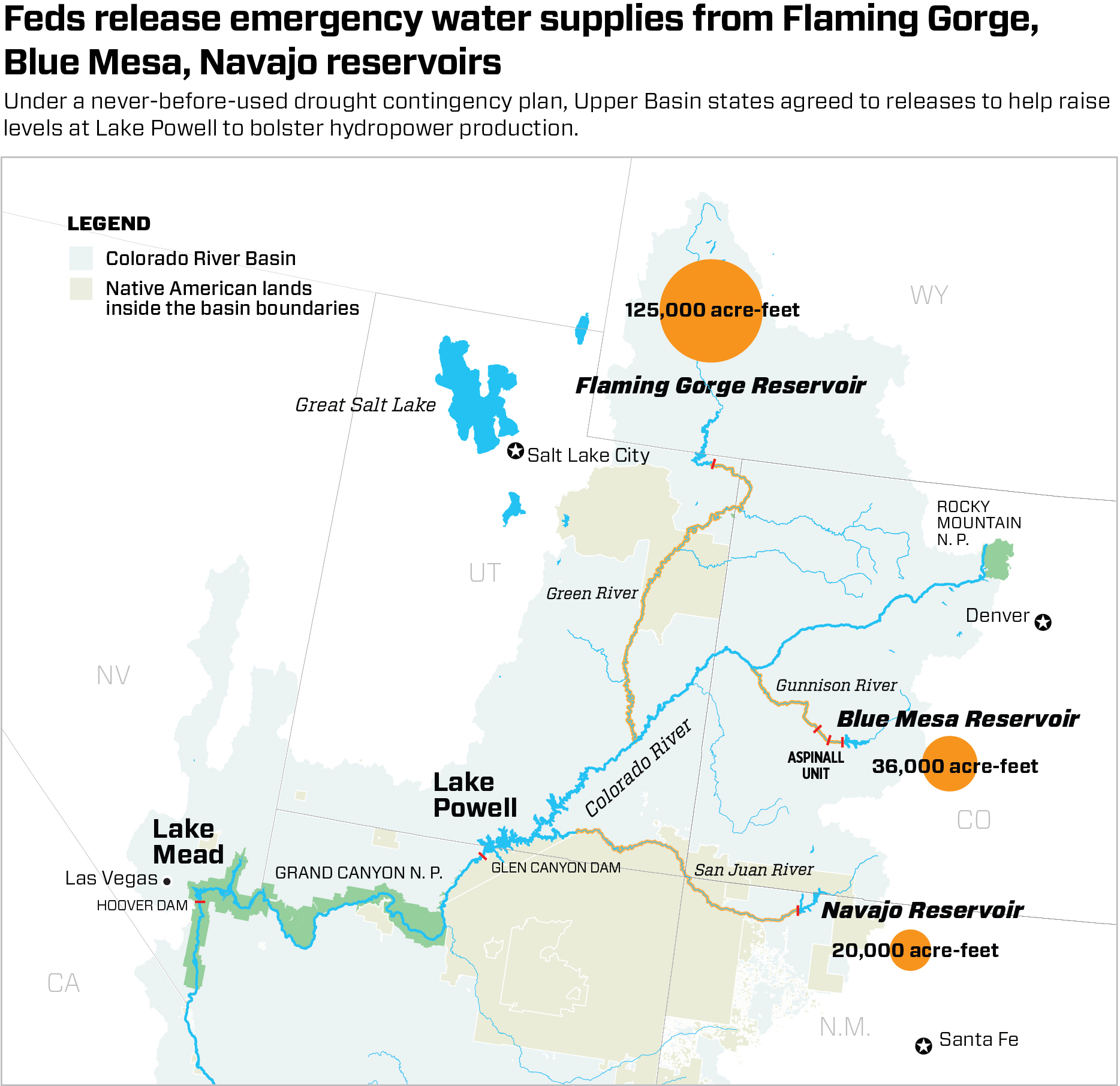
    In July, as water levels at Powell continued to plummet, the U.S. Bureau of Reclamation, as part of the Upper Basin’s Drought Contingency Plan, began emergency releases of water from Utah’s Flaming Gorge, Colorado’s Blue Mesa, and New Mexico’s Navajo reservoirs to boost levels and protect Powell’s hydropower production.

    And while those releases are expected to help keep the turbines functioning, the releases won’t be enough to restore them to full production, leaving WAPA little choice but to look at restructuring the way it sells power and to raise its prices.

    WAPA is forecasting a 35% increase in its costs, but is working to minimize the impact on utilities that purchase its power and anticipates a 12% to 14% rate increase as early as December. Some utilities are preparing to buy power elsewhere, when possible, to reduce their costs.

    Holy Cross Energy, a rural electric co-op based in Glenwood Springs that is also a WAPA customer, has spent years converting its power portfolio from fossil fuels to renewable energy sources including wind, solar and biomass, as well as hydropower.

    While WAPA electricity comprises just 3% of its power portfolio, Holy Cross CEO Bryan Hannegan is worried that this renewable, low-cost power source is in jeopardy if flows from the Colorado River into Lake Powell continue to decline, as they are projected to do.

    “It’s one of the cleanest and lowest-cost sources of power for a whole range of utilities,” Hannegan said. “It’s been a bedrock on which we built the West. For it not to be available … it’s a big deal.”

    Jerd Smith is editor of Fresh Water News. She can be reached at 720-398-6474, via email at jerd@wateredco.org or @jerd_smith.

    #ColoradoRiver Forecasts Not a ‘Crystal Ball’: Computer models inform key decisions in the Colorado River basin. But they cannot predict the future — Circle of Blue #COriver #aridification

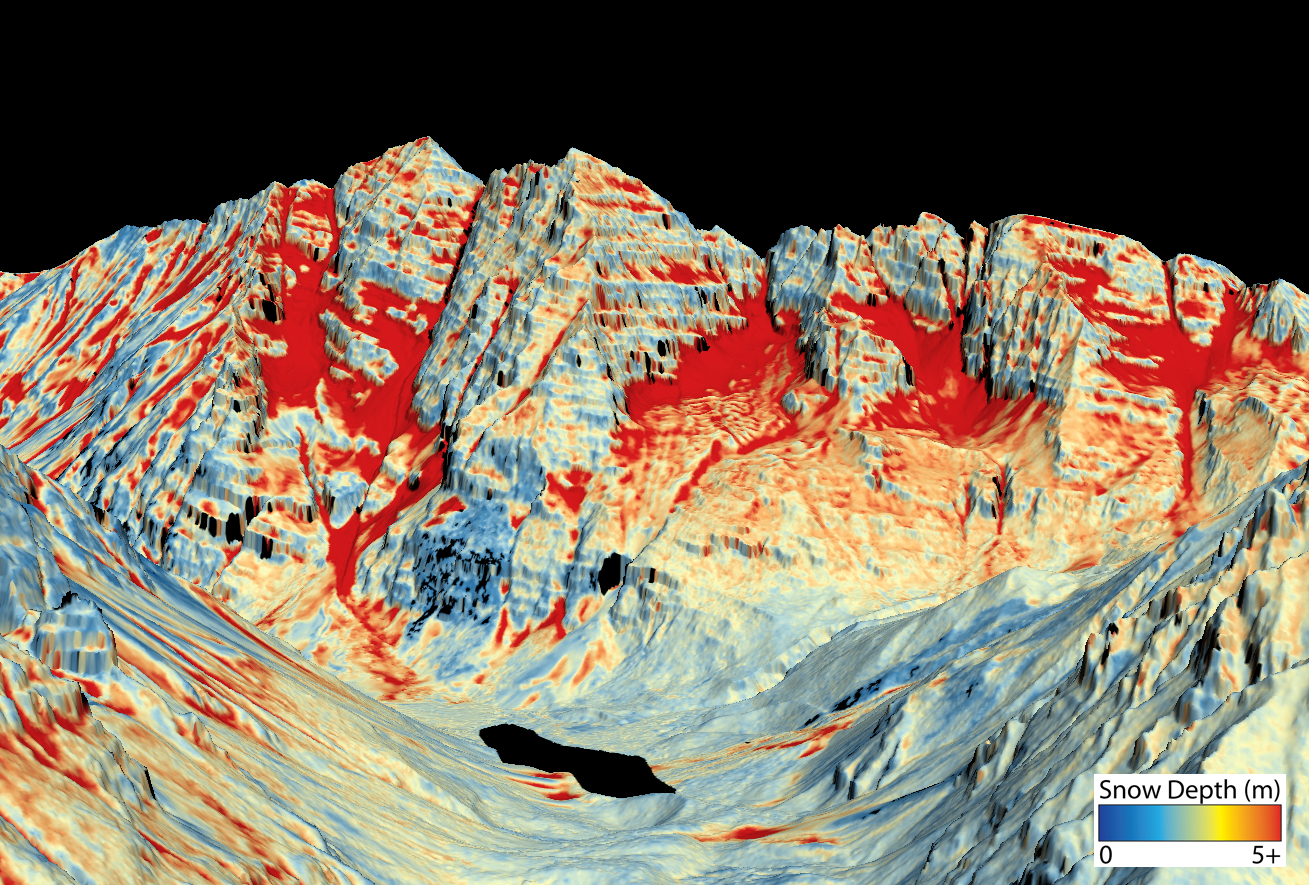
    This map shows the snowpack depth of the Maroon Bells in spring 2019. The map was created with information from NASA’s Airborne Snow Observatory, which will help water managers make more accurate streamflow predictions. Jeffrey Deems/ASO, National Snow and Ice Data Center

    From Circle of Blue (Brett Walton):

    Every month the Bureau of Reclamation attempts to peer two years into the future of the Colorado River and its reservoirs.

    Reclamation’s 24-month study is a staple forecasting product for the federal agency that manages a chain of dams in the watershed, including those that control lakes Mead and Powell, the country’s largest reservoirs — and currently two of its most consequential. The reservoirs are a key source of drinking water for about 40 million people, plus they store water that irrigates millions of acres of farmland and generates electricity for the Southwest. The reservoirs are also alarmingly dehydrated right now — about one-third full, the lowest since they were first filled. The entire basin is on alert.

    The 24-month study, in the simplest terms, projects water levels for the next two years at 12 federal reservoirs in the Colorado River basin. Produced monthly, it’s one of several forecasting products that give water managers a sense of possible futures. It is also the foundation of essential water management decisions in the basin. Reclamation’s other forecasts, updated less frequently, look at mid-term (five years out) and long-term (multiple decades) scenarios.

    Typically nested in wonkish obscurity, the 24-month study acquired newfound public prominence in recent weeks. The August results are the most important of all the months because they determine how much water will be released in the following year from Mead and Powell. Because Mead is so low, the August results triggered the first-ever Tier 1 shortage on the lower Colorado River, a declaration that means mandatory cuts in water deliveries in 2022 to Arizona, Nevada, and Mexico. Because Powell is so low, dam managers will release a comparative trickle of water next year, so little that Mead is likely to plunge even lower.

    More eyes than usual on a technical product that was designed to guide reservoir operations means more potential for misinterpretation, especially by people unfamiliar with the study and its assumptions. Carly Jerla, Reclamation’s senior water resources program manager, said that the study has its defined uses but also its limits.

    “It’s important to understand that we’re not saying that this is what we think is going to happen this year,” Jerla told Circle of Blue about the reservoir levels outlined in the 24-month study. “We’re not saying, ‘Plan for this and only this because we have crystal ball knowledge of what is going to happen.’”

    Reclamation’s models, in fact, are not a crystal ball. Critics say that they are not pessimistic enough about the potential for extremely dry years. But as the Colorado River basin dries due to a warming planet, Jerla and others are actively considering how best to convey to the public and water managers alike the looming risks to water supplies and to prepare people, at least mentally, for the possibility that reality could turn out much worse than the forecast had projected…

    Accurate mid-term weather forecasts, those that extend out a couple weeks and up to a year, are notoriously difficult to achieve, said Jeff Lukas, an independent climate researcher in Colorado who has worked in the basin for 20 years. It’s especially true in the mountainous terrain of Colorado and Wyoming, where the Colorado River and its main tributaries have their headwaters. Well-known seasonal patterns like the cyclical warming of the eastern Pacific during El Nino years can indicate wetter or drier, but without substantial precision.

    Because the future is hazy, the models instead rely on the recent past as a guide, Lukas said. “We’re basically saying in the absence of real prognostic information, we’ll substitute history.”

    Here’s how that works. The 24-month study process begins with the Colorado Basin River Forecast Center, a team of scientists operating within the National Oceanic and Atmospheric Administration. Their task is to assess what the rivers might do.

    The River Forecast Center starts with current land and water conditions: soil moisture, snowpack, stream flow. From that baseline hydrologists feed their model, one by one, with historical weather observations from the years 1981 to 2015. In effect, it’s as if the temperature and precipitation from each year were repeated in today’s world. That produces 35 possible hydrological futures, each representing the past laid on top of the present.

    The Bureau of Reclamation team takes those hydrological futures and uses them in its model of the Colorado River system. The aim of this system model, which includes water inflows and water uses, is to simulate reservoir levels as well as hydropower generation. Fed by the output from the hydrological model, the system model also produces future scenarios, called runs.

    The middle result — the most probable — is the one that is presented in the main 24-month study report. It’s the result that determines how Mead and Powell will be operated. It’s called the most probable because it’s in the middle, if each of the runs was ordered from wettest to driest. It means that historically half the time it was wetter than the middle result and half the time it was drier.

    There are drawbacks to this approach. The runs are not assessed as to how likely they are to occur, which means that a repetition of each of the past years is considered equally likely. The problem: there are more wet years in the 1981 to 2015 period than dry ones. (Runoff in 1983, for instance, was so extremely high that it almost broke Glen Canyon Dam.) Because of this imbalance, the middle result is arguably skewed toward wetter conditions, Lukas said.

    Jerla said there is no scientifically valid way to privilege the likelihood of one outcome over another.

    An update of the River Forecast Center’s data sets will soon help reduce the skew. Cody Moser, a senior hydrologist at the Center, told Circle of Blue that data from the years 2016 through 2020 will be added this fall. Instead of 35 historical hydrologies fed through the models, there will be 40. Adding the drier recent years will push the most probable outcome to a drier result, with reservoir projections in the 24-month study likely pushed downward at the same time…

    The 24-month study is most associated with the most probable scenario. But recently Reclamation has expanded its offerings to include two other reservoir scenarios, now produced monthly: the minimum probable and the maximum probable. The minimum probable is the tenth percentile, meaning the third or fourth driest of those 35 historical hydrologies. The maximum probable is the ninetieth percentile, or the third or fourth wettest historical hydrology.

    For the minimum probable, the tenth percentile of flows is used in the first year of the 24-month study, but the second year of the study is calculated with the twenty-fifth percentile, under the assumption that consecutive extremely bad years would not happen.

    If you look only at the most probable result, you’re not seeing how bad things might plausibly get. Lake Mead today, when it is one-third full, sits at elevation 1,068 feet. The most probable elevation for July 2023 is 1,037 feet, when Mead would be 26 percent full. The minimum probable elevation for that date is 1,027 feet, when the gasping reservoir would be 23 percent full.

    That’s a significant difference in elevation, and if the drier scenario came about it would change basin operations. But even the minimum probable has a flaw. It is not as pessimistic as it could — or maybe should — be.

    “The minimum probable does not represent a worst-case scenario,” Jerla said. “If you wanted to be the ultimate pessimist, which I think probably makes sense given where the system is, things could be worse than what is provided in that minimum probable because it is only the tenth percentile.”

    In other words, the minimum probable is not the minimum possible. There have been years in the last two decades with worse river flow conditions than what is represented by the minimum probable. Things could be drier still.

    As Jerla puts it regarding the minimum and maximum probable: “There is an area above and below those that have futures that folks should be aware of.”

    […]

    Reclamation already runs its five-year projections with what it calls “stress test” hydrology. This scenario is a replication of the years 1988 to 2019, and represents hotter and drier conditions that have settled over the basin. Udall and others argue that Reclamation should consider running its models with an even more stressful test: the years 2000 to 2004, the last time that Lake Powell almost crashed.

    Brad Udall: Here’s the latest version of my 4-Panel plot thru Water Year (Oct-Sep) of 2019 of the #coriver big reservoirs, natural flows, precipitation, and temperature. Data goes back or 1906 (or 1935 for reservoirs.) This updates previous work with @GreatLakesPeck

    “That five-year period is really unique,” Udall explained. Annual runoff averaged 9.4 million acre-feet, a fraction of what coursed through the river throughout the last century. The average annual runoff in the years for the stress test hydrology is about 13.3 million acre-feet. That makes the first years of this century unique, Udall said. And frightening. “There’s nothing like it in the 20th century. It’s stunning how bad a period it is, and we could be in the middle of that right now.”

    […]

    The next update of the five-year projections will come out in early September. Five years is a tricky time frame to analyze, Jerla said. It’s far enough in the future that current conditions lose their predictive power. But it’s close enough to be relevant for farmers, city utilities, and marina operators — all of whom need to plan for near-term water supply. Jerla and her colleagues are trying to thread that needle, thinking hard about how to “provide the public with a good understanding of future outcomes and future risks without confusing the heck out of them.”

    Blue Mesa Reservoir releases to prop up #LakePowell impacting recreation — @AspenJournlism

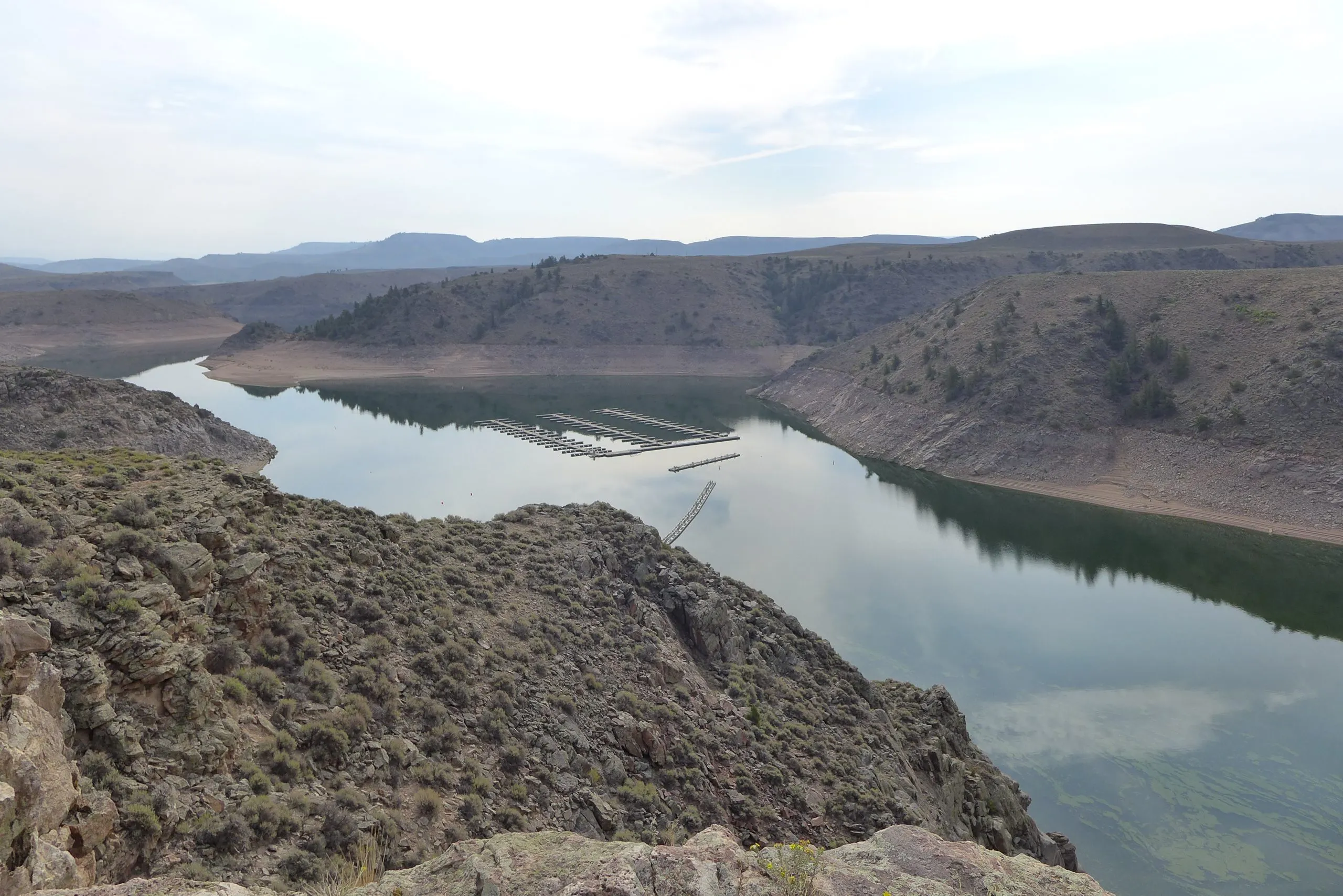
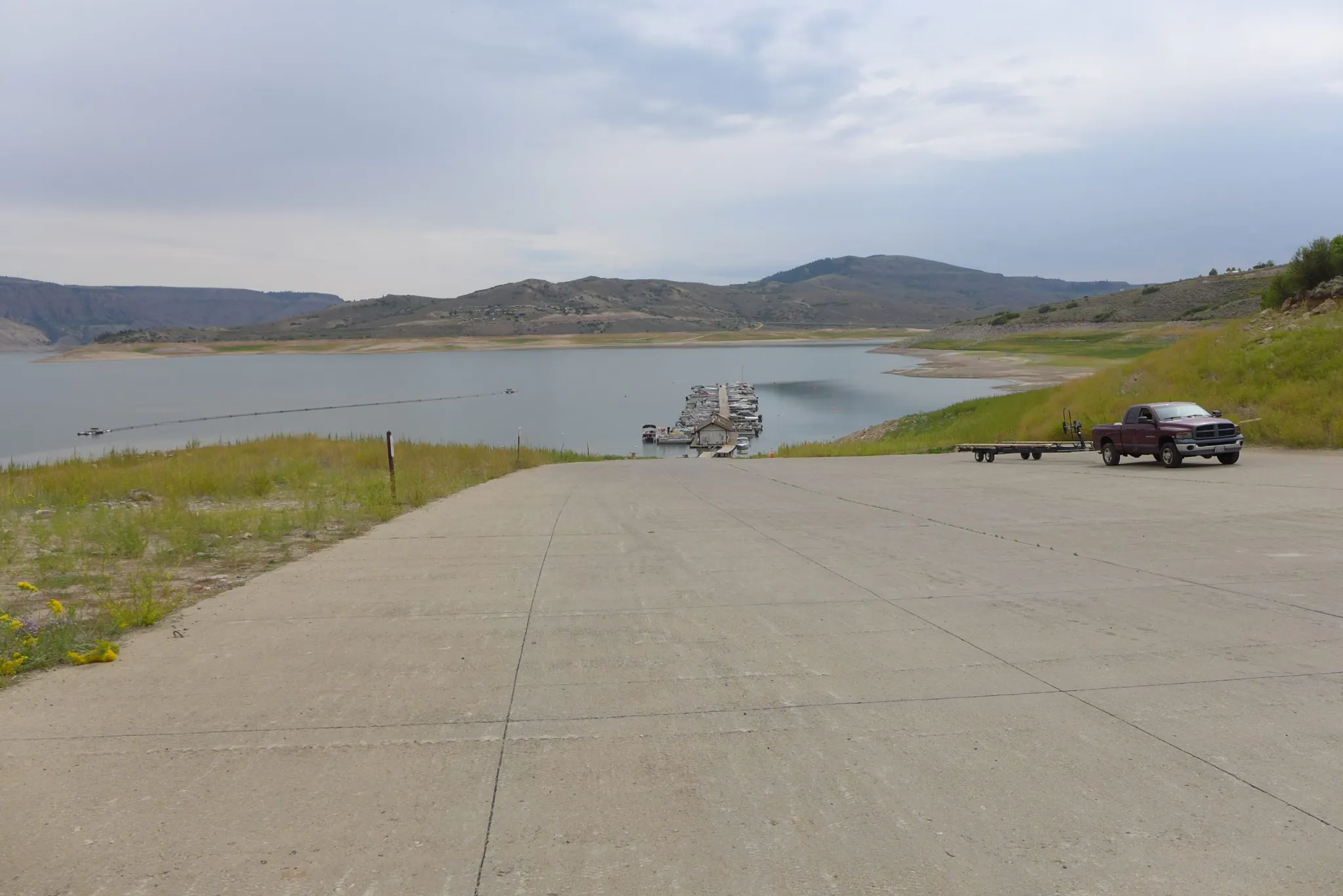
    The boat ramp at Elk Creek Marina had to be temporarily closed so the docks could be moved out into deeper water. Colorado water managers are not happy that emergency releases from Blue Mesa Reservoir are impacting late summer lake recreation.
    CREDIT: HEATHER SACKETT/ASPEN JOURNALISM

    From Aspen Journalism (Heather Sackett):

    In an effort to prop up water levels at the declining Lake Powell, federal water managers are negatively impacting recreation on Colorado’s biggest man-made lake.

    That’s the message from Colorado water managers and marina operators at Blue Mesa Reservoir in Gunnison County. On Aug. 1, the Bureau of Reclamation, which operates the reservoir, began emergency releases. By the time the releases are finished the first week of October, Blue Mesa is projected to fall to its second-lowest level ever, just 215,000 acre-feet, or 22.8% of its 941,000-acre-foot capacity.

    As of Sept. 1, the reservoir was 37% full, which is about 68 feet down from a full reservoir, and a ring of muddy shoreline was growing. Parking lots and boat slips sat empty, and Pappy’s Restaurant was closed for the season. The dwindling water levels are first impacting Iola, the easternmost of Blue Mesa’s three basins. Iola is where the Gunnison River now cuts through a field of mud.

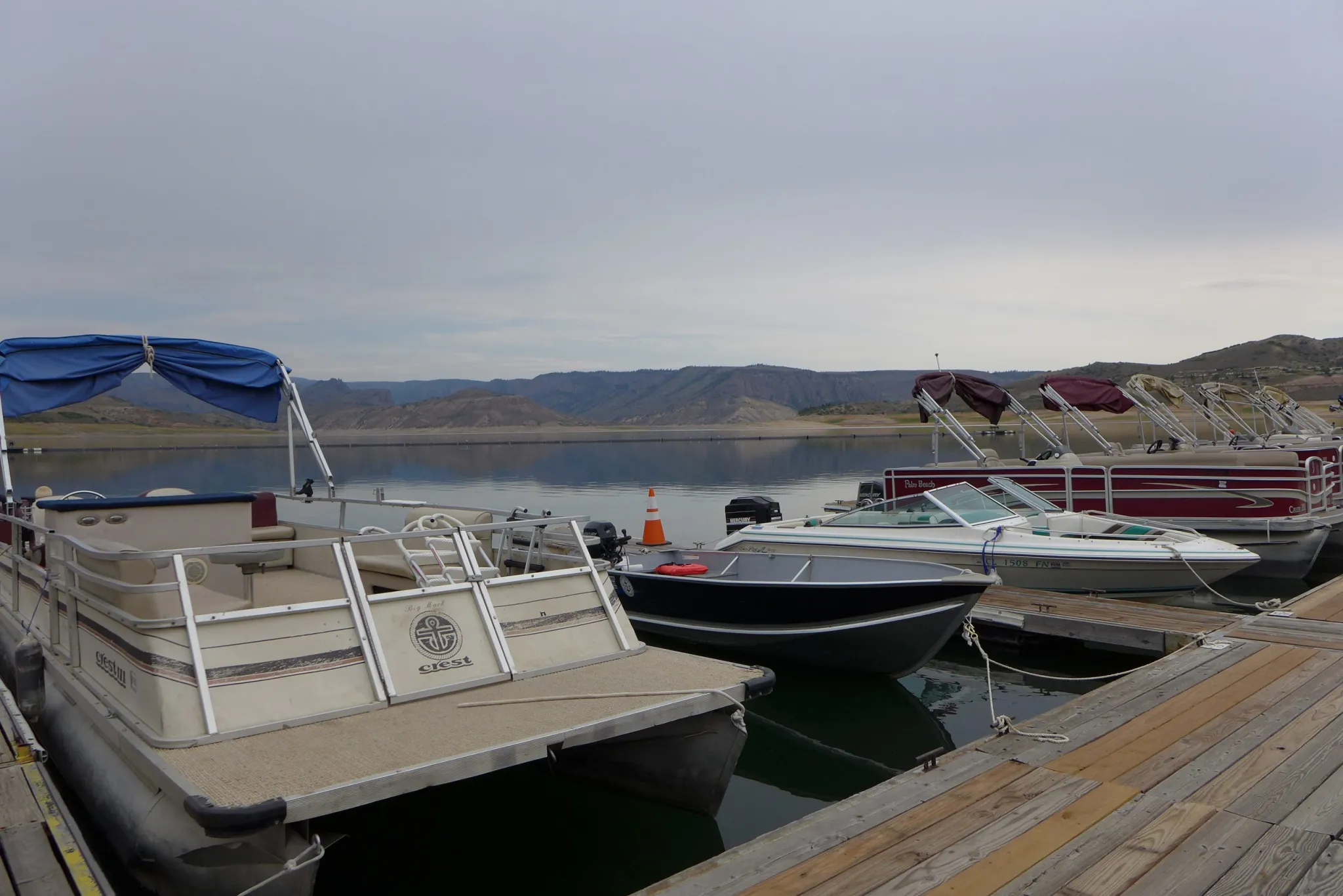
    Eric Loken, who operates the reservoir’s two marinas (Elk Creek and Lake Fork), said he was given only nine days’ notice to empty Elk Creek Marina’s 180 slips. The dock system’s anchors, which are not built for low water, had to be moved deeper. He said about 25 people lost their jobs six weeks earlier than normal and the marinas lost about 25% of its revenue for the year.

    “There are tons of people who would like to be out here boating and are very disappointed,” Loken said. “Normally on Labor Day weekend, you can barely find a place to park. So it’s definitely been a big hit to us as a business for sure.”

    The Elk Creek Marina and restaurant are closed for the season, although the boat ramp is still open and is expected to be accessible through the end of the month. The Lake Fork Marina is open through Labor Day, but the boat ramp has closed for the season. The Iola boat ramp is restricted to small boats only and is scheduled to close after Labor Day.

    “We are just trying to make it through the holiday weekend and then we will be shutting up this marina too,” Loken said.

    The Bureau announced July 16 that it would begin emergency releases through early October from three Upper Basin reservoirs: 20,000 acre-feet from Navajo, on the San Juan River; 125,000 acre-feet from Flaming Gorge, on the Green River; and 36,000 acre-feet from Blue Mesa, on the Gunnison River. The goal of the releases is to prop up water levels at Lake Powell to preserve the ability to make hydropower at Glen Canyon Dam. The 181,000 acre-feet from the three upstream reservoirs is expected to boost levels at Powell by about 3 feet.

    The three reservoirs are part of the Colorado River Storage Project, and their primary purpose is to control the flows of the Colorado River; flatwater recreation has always been incidental. But the releases at Blue Mesa illustrate the risks of building an outdoor-recreation economy around a highly engineered river system that is now beginning to falter amid a climate change-fueled drought.

    The boat ramp at the Lake Fork Marina closed for the season on Sept. 2 due to declining reservoir levels. The Bureau of Reclamation is making emergency releases out of Blue Mesa Reservoir to prop up levels in Lake Powell and preserve the ability to make hydropower.
    CREDIT: HEATHER SACKETT/ASPEN JOURNALISM

    Timing concerns

    Although the secretary of the Interior can authorize emergency releases without coordination from the states or local entities, Loken, along with some Colorado water managers, is not happy about the timing or the lack of notice from the bureau. Under normal drought-response operations, the federal government would consult with state and local water managers before making releases.

    “We had very little time to handle this decision that was made that none of us have any power over,” Loken said.

    John McClow, general counsel for the Upper Gunnison Water Conservancy District, said Colorado should make noise and complain about what he called a clumsy execution of the releases. McClow has also served on the Colorado Water Conservation Board and is an alternate commissioner on the Upper Colorado River Commission.

    “There’s no reason they couldn’t have waited another couple weeks or another month to release that water from Blue Mesa to get it to Lake Powell,” McClow said. “It goes back to consultation and timing. Had they even asked, it would have been easy to say, ‘Hey, can you wait so you don’t kill our business?’”

    Last month at Colorado Water Congress’ summer conference — a gathering of water managers, researchers and legislators in Steamboat Springs — Rebecca Mitchell, CWCB’s executive director and the state’s representative to the UCRC, told the audience that the impacts of ending the boating season early at Blue Mesa trickle down to all Coloradoans.

    “That means dollars in Colorado. That is who we are in Colorado,” she said. “It’s definitely had an impact in that local community when we talk about the recreation. That is heavy.”

    Mitchell said water managers in the Upper Basin states (Colorado, Utah, New Mexico and Utah) will be carefully monitoring the impacts of the reservoir releases and figuring out how to quantify those impacts, which she called devastating. The states will work with the bureau to develop a plan for how to send water to Lake Powell in future years, taking into consideration the timing, magnitude and duration of the releases, she said.

    “Where can the states and the bureau make the best decisions to lessen the impacts?” she said.

    The National Park Service operates the Curecanti National Recreation area, including the campsites, picnic areas, visitors centers and boat ramps that run the 20-mile length of the reservoir. According to numbers provided by the Park Service, Curecanti gets nearly a million visitors a year. The reservoir is popular among anglers for its trout and Kokanee salmon fishing. Blue Mesa is one of three reservoirs — along with the much smaller Morrow Point and Crystal reservoirs — on the Gunnison River, collectively known as the Aspinall Unit.

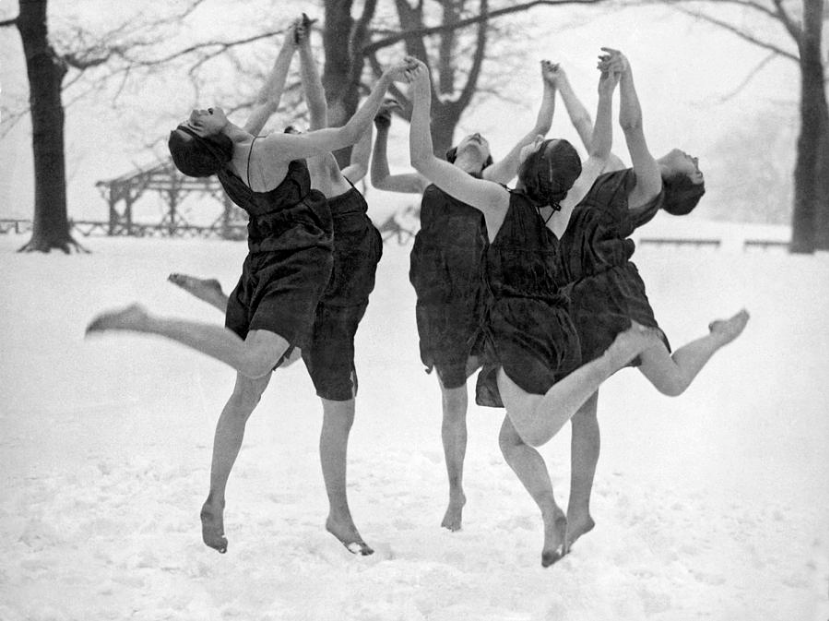
    Barefoot Dance In The Snow New York, New York March 8, 1916. Girls of the Marion Morgan School of Dance in Los Angeles perform barefoot in the snow in Central Park. Underwood Archives by Underwood Archives

    Gunnison Country Chamber of Commerce Director Celeste Helminski said her organization is planning an event later this month: the world’s largest snow dance. A big winter would help refill Blue Mesa.

    “The water definitely has me concerned for the future,” she said. “We see a lot of summer recreationists who come and spend the whole summer at several of the campgrounds. It’s just going to take a lot to replace that water. It’s going to take awhile to get back to levels of what recreationists come for.”

    Bureau spokesperson Justyn Liff could not provide any insight into how the timing decision for the releases was made, but pointed out that although lake recreation was impacted, downstream rafting and fishing in the canyon are getting a boost from the roughly 300 cubic-feet-per-second extra water that the releases provide. The Gunnison River below the Gunnison Tunnel diversion, which takes a large portion of the river’s outflow from the Aspinall Unit for delivery to downstream irrigators, was running around 600 cfs the first few days of September, according to USGS stream gauge data. This is a critical data point for boaters running the Black Canyon or Gunnison Gorge sections of the river, which are below the stream gauge. At 600 cfs, the river is flowing 11% above the median for this time of year.

    “If we had waited six weeks, that would have been six weeks less of commercial rafting/guided fishing on the Gunnison River downstream from Aspinall,” Liff said.

    Some boats were still in the water the first week of September at the Lake Fork Marina. Across Blue Mesa Reservoir, the Elk Creek Marina’s boat slips were emptied early because of declining water levels in the reservoir.
    CREDIT: HEATHER SACKETT/ASPEN JOURNALISM

    Hydropower production

    Although the local impacts to recreation are acute, the impacts of not being able to make hydropower at Lake Powell would probably be much worse. The dams of the CRSP are known as “cash register” dams. The power they produce is used to repay the costs of building the project, maintain operations and provide power to millions of people.

    The Western Area Power Administration distributes Lake Powell’s electricity, including to some power providers in Colorado. According to Water Education Colorado, electric costs will surge as Glen Canyon Dam struggles to produce hydropower because of declining water levels.

    The bureau’s target elevation for Lake Powell is 3,525 feet, in order to provide a buffer that protects hydropower generation; if levels fall below 3,490, all power production would stop. Lake Powell is currently about 31% full, at 3,549 feet, which is the lowest surface level since the reservoir began filling in the 1960s and ‘70s. According to projections released by the bureau in July, Lake Powell has a 79% chance of falling below the 3,525 threshold in the next year. The emergency releases are intended to address this.

    “A loss of power generation is a pretty significant issue compared to a few months of boating on Blue Mesa,” McClow said. “Locally, yes, it hurts, but in the big picture, I don’t know if you can make a fair comparison.”

    As water levels at Blue Mesa continue to fall, Loken worries that this may be just the beginning of an era of empty reservoirs.

    “(The releases) don’t solve the long-term problem,” Loken said. “We are just going to end up with an empty Lake Powell and a bunch of empty reservoirs upstream. I think the powers that be really need to put pencil to paper and figure this out.”

    Aspen Journalism covers water and rivers in collaboration with The Aspen Times. For more, go to http://www.aspenjournalism.org.

    Stage 1 #drought restrictions still in effect — The #PagosaSprings Sun #SanJuanRiver #ColoradoRiver #COriver

    From The Pagosa Springs Sun (Clayton Chaney):

    According to a press release from the Pagosa Area Water and Sanitation District (PAWSD) Manager Justin Ramsey, the district remains in a Stage 1 drought per its drought management plan.

    This marks the sixth week in a row that the district has been in a Stage 1 drought. The PAWSD board initially approved entering the stage on July 19.

    Ramsey notes that the primary driver of this drought stage is the San Juan River flow in conjunction with the U.S. Drought Monitor, which indicates our area is in a severe to moderate drought…

    Colorado Drought Monitor map August 31, 2021.

    Drought report

    The National Integrated Drought Information System (NIDIS) was updated on Aug. 24, re- porting the same numbers for the second consecutive week.

    The NIDIS website indicates 94.84 percent of Archuleta County is abnormally dry and 67.46 per- cent of the county is in a moderate drought.

    The NIDIS website also notes that 41.2 percent of the county is in a severe drought stage.

    Additionally, the NIDIS website notes that 9.12 percent of the county remains in an extreme drought, mostly in the southwestern portion of the county.

    The NIDIS website notes that under an extreme drought stage, large fires may develop and pasture conditions worsen.

    No portion of the county is in an exceptional drought.

    For more information and maps, visit: https://www.drought.gov/states/Colorado/county/Archuleta.

    River report

    According to the U.S. Geological Survey (USGS), the San Juan River was flowing at a rate of 39.7 cfs in Pagosa Springs as of 2 p.m. on Wednesday, Sept. 1.

    Based on 85 years of water records at this site, the average flow rate for this date is 154 cfs.

    The highest recorded rate for this date was in 2008 at 1,290 cfs. The lowest recorded rate was 8.66 cfs, recorded in 2002.

    As of 2 p.m. on Wednesday, Sept. 1, the Piedra River near Arboles was flowing at a rate of 31.5 cfs.

    Based on 50 years of water records at this site, the average flow rate for this date is 191 cfs.

    The highest recorded rate for this date was 1,210 cfs in 2008. The lowest recorded rate was 5.42 cfs in 2002.

    Fund to protect #YampaRiver exceeds endowment goal 2 years ahead of schedule — Steamboat Pilot & Today

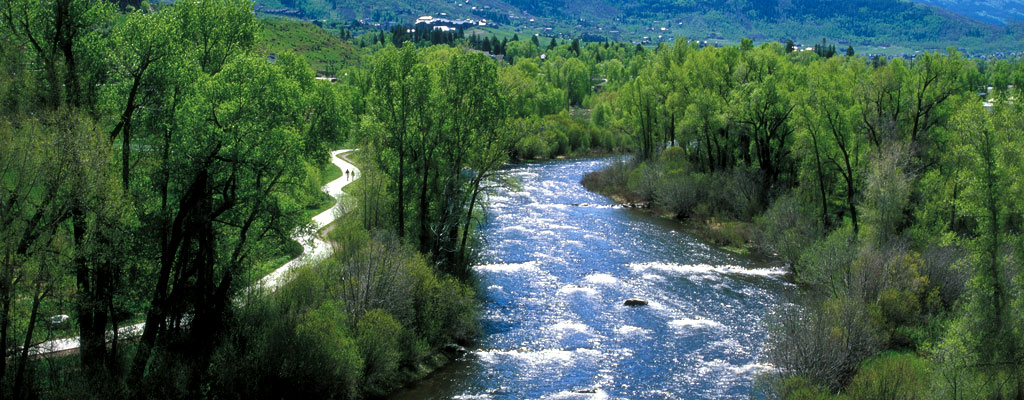
    The Yampa River Core Trail runs right through downtown Steamboat. Photo credit City of Steamboat Springs.

    From The Steamboat Pilot & Today (Bryce Martin):

    The fund set up to help protect the Yampa River has exceeded its endowment goal two years ahead of expectations, fund managers announced Wednesday.

    Annual grants are awarded through the fund, which launched in 2019, for projects aimed at protecting the Yampa River, especially considering the hotter, drier climate and lower river flows. The fund’s total is now estimated to be $5.3 million by 2023, surpassing the original goal of $4.75 million.

    The fund held its first grant cycle in February 2020. Over the past three years, more than 100 donors have contributed to the fund, including an anonymous donor who gave $1 million this summer. The fund has so far awarded $400,000 in grants to projects throughout the Yampa Valley, which have supported water releases during times of low flows, environmental restoration projects and agricultural infrastructure improvements…

    A partnership of 21 public, private and nonprofit entities representing the entire Yampa River Basin collaborated to create the board that governs the Yampa River Fund.

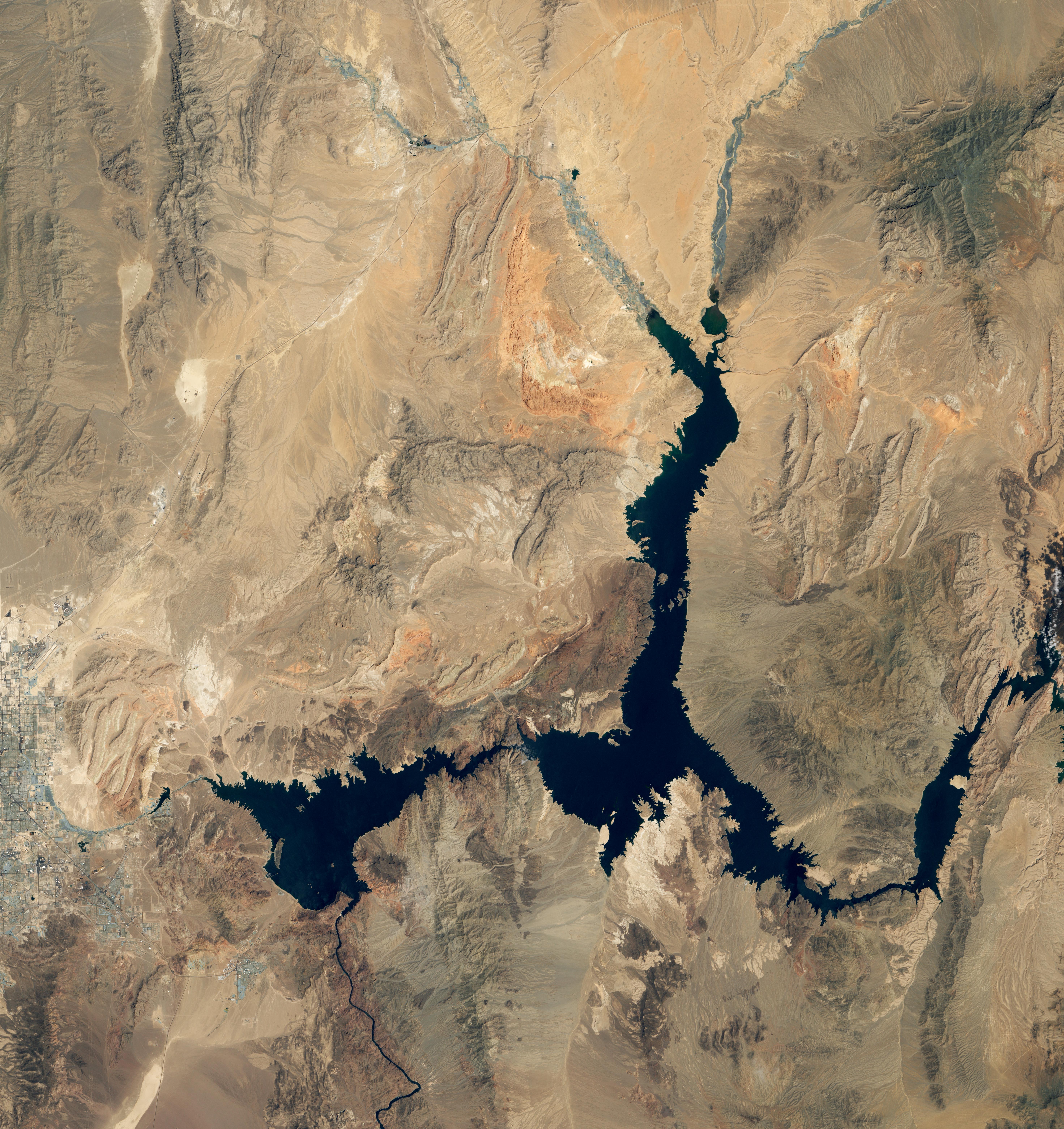
    #LakeMead August 7, 2000 v. August 9, 2021 #ColoradoRiver #COriver #aridification

    Lake Mead August 7, 2000. Photo credit: NASA
    Lake Mead August 9, 2021. Photo credit: NASA

    #Coal is fading in northwest #Colorado. The region is betting its economic future on another natural resource — The #Colorado Sun #YampaRiver #GreenRiver #ColoradoRiver #COriver

    The entrance to the popular Gates of Lodore stretch on the Green River. Photo credit: Brent Gardner-Smith/Aspen Journalism

    From The Colorado Sun (Jason Blevins):

    As coal mining fades, a diverse coalition of Moffat County residents and leaders is planning for the next chapter with a focus on protecting resources while managing recreation and tourism.

    How can northwest Colorado entice and manage visitors, protect natural landscapes like the Green River’s stunning Gates of Lodore and prop up an economy girding for the looming departure of coal mining?

    “As our coal leaves, what do we have left?” asks Jennifer Holloway, the executive director of the chamber of commerce in the town of Craig, where she grew up. “We have an amazing experience that can change lives. How can we share that, but also protect it?”

    Three years ago, Moffat County “had some challenges with our identity,” Holloway says, describing how her father, when she was little, walked away from the family farm to work in the better-paying coal mines. “Not everyone had a coal job, but we focused on coal and neglected other things.”

    Those other things — like tourism, agriculture and outdoor recreation — are no longer being neglected. It’s been a year since Tri-State Generation and Transmission and Xcel Energy announced they would be closing their coal-fired electrical plants and nearby coal mines starting in 2028. The closures will cost northwest Colorado as many as 800 jobs.

    A community-based transition plan focuses on growing the region’s tourism and recreational amenities while protecting agricultural heritage and natural resources. The communities of Moffat County, downstream from the bustling resort of Steamboat Springs, are essentially a blank slate. They are taking cues from other Western Slope communities, hoping to glean lessons on what works and what does not. And the wheels are turning.

    “Our community is on the cusp of doing great things, transformational things,” Holloway says.

    Craig has applied for a $1.8 million federal grant for the roughly $2.7 million Yampa River Corridor Project, which hopes to revamp boat ramps and add a whitewater park as part of an effort to bolster the region’s appeal with river runners and paddlers. An additional phase of the plan would build a trail connecting Craig to the Yampa River…

    First in line for state’s new rural assistance program

    Nathan Fey, the head of Colorado’s Outdoor Recreation Industry Office has joined the Office of Economic Development and International Trade in recruiting students from the University of Colorado to map recreational assets in Moffat County as well as business infrastructure.

    That case study will inform a larger project that will include local residents in shaping how northwest Colorado is presented to both visitors and outdoor recreation businesses. That larger project is part of Colorado’s new Rural Technical Assistance Program, or RTAP, which offers rural communities technical education that deploys online tools to help community leaders identify needs and build a plan for future growth. The second phase of the rural program involves technical assistance for planning and finally the state will help the community implement its strategic plan.

    Moffat County is among the first communities to go through the new Rural Technical Assistance Program.

    Say, for example, a snowmobile business or manufacturer approaches the state with an idea about relocating to Colorado. Fey can suggest Craig and Moffat County, offering maps of snow trail systems where the company can test designs as well as insights into supply chain management, broadband and commercial space. And residents in the community would already have expressed interest in welcoming that kind of business.

    As he gazes up at massive sandstone cliffs above the Green River near its confluence with the Yampa River, [Andrew Grossman] riffs on what a shifting valuation for tourism economies might look like. Is it attracting wealthier visitors who leave more money in the community? But what if those high-rollers arrive on a private jet and emit that much more carbon than a less affluent visitor? One thing that is going away: the former yardstick for measuring success that was based solely on numbers of visitors.

    “Maybe it’s time we apply a triple bottom line that considers resident sentiments, carbon footprints and economic benefit?” Grossmann says. “We have to reshift our value proposition.”

    Yampa River Basin via Wikimedia.

    EPA Announces First Validated Laboratory Method to Test for #PFAS in #Wastewater, Surface #Water, #Groundwater, Soils

    PFAS contamination in the U.S. via ewg.org. [Click the map to go to the website.]

    Here’s the release from the Environmental Protection Agency:

    Today, the U.S. Environmental Protection Agency (EPA), in collaboration with the U.S. Department of Defense (DoD), published a draft of the first EPA-validated laboratory analytical method to test for per- and polyfluoroalkyl substances (PFAS) in eight different environmental media, including wastewater, surface water, groundwater, and soils. This method provides certainty and consistency and advances PFAS monitoring that is essential to protecting public health.

    “This new testing method advances the science and our understanding of PFAS in the environment, so we can better protect people from exposure,” said EPA Administrator Michael S. Regan. “This illustrates the progress we can make when working with federal partners in an all of government approach. I want to thank the Department of Defense for its leadership on this issue and for working with us to achieve this important milestone.”

    A partnership between EPA and the Department of Defense’s Strategic Environmental Research and Development Program has produced draft Method 1633, a single-laboratory validated method to test for 40 PFAS compounds in wastewater, surface water, groundwater, soil, biosolids, sediment, landfill leachate, and fish tissue. Until now, regulated entities and environmental laboratories relied upon modified EPA methods or in-house laboratory standard operating procedures to analyze PFAS in these settings. With the support of the agency’s Council on PFAS, EPA and DoD will continue to collaborate to complete a multi-laboratory validation study of the method in 2022.

    “This is one of many examples of strong EPA – DoD Collaboration on issues of national importance. Currently the Department is working with EPA, other federal agencies, academic institutions, and industry on over 130 PFAS-related research efforts, and we expect further progress in the future,” said Deputy Assistant Secretary of Defense for Environment and Energy Resilience Richard Kidd.

    This draft method can be used in various applications, including National Pollutant Discharge Elimination System (NPDES) permits. The method will support NPDES implementation by providing a consistent PFAS method that has been tested in a wide variety of wastewaters and contains all the required quality control procedures for a Clean Water Act (CWA) method. While the method is not nationally required for CWA compliance monitoring until EPA has promulgated it through rulemaking, it is recommended now for use in individual permits.

    Draft Method 1633 complements existing validated methods to test for PFAS in drinking water and non-potable water.

    For more information on CWA Analytical Methods for PFAS, visit:
    https://www.epa.gov/cwa-methods/cwa-analytical-methods-and-polyfluorinated-alkyl-substances-pfas.

    For Frequent Questions about PFAS Methods for NPDES Permits, visit:
    https://www.epa.gov/cwa-methods/frequent-questions-about-pfas-methods-npdes-permits.

    Background:

    Draft Method 1633 complements existing Safe Drinking Water Act methods to test for 29 PFAS compounds in drinking water and a Resource Conservation and Recovery Act method for 24 PFAS compounds in non-potable water.

    EPA publishes laboratory analytical methods (test procedures) that are used by industries, municipalities, researchers, regulatory authorities and other stakeholders to analyze the chemical, physical, and biological components of wastewater and other environmental samples. EPA regularly publishes methods for CWA compliance monitoring on its CWA Methods website. Doing so does not impose any national requirements to use the method. Only after EPA promulgates a CWA analytical method through rulemaking (at 40 CFR Part 136) does it become nationally required for use in NPDES permit applications and permits.

    The work the agency is doing to provide new laboratory analytical methods reflects the work that the EPA Council on PFAS is undertaking to support federal, state, local, and Tribal efforts to protect all communities from the harmful impacts of PFAS contamination.

    #Drought-Hit Blue Mesa Reservoir Losing 8 Feet Of Water To Save #LakePowell. A Western Slope Marina Feels The Pain — #Colorado Public Radio #GunnisonRiver #ColoradoRiver #COriver #aridification

    A longer walk from the dock to the water is in store for boaters at the Elk Creek marina, Blue Mesa Reservoir. Blue Mesa is being drawn down to feed critically low Lake Powell, as continued dry weather and rising demand deplete the Colorado River.
    (Courtesy photo/National Park Service) August 2021 via the Montrose Daily Press

    From Colorado Public Radio (Michael Elizabeth Sakas):

    Climate change is drying up Colorado’s water supply

    Climate change is leading to less snowpack, and warmer temperatures mean less water is making it into the Colorado River. Blue Mesa is Colorado’s largest reservoir, and it hit its second-lowest level on record for the end of August.

    Parks service officials issued the order because Elk Creek’s floating dock and marina are likely to hit the lake’s bottom. Eric Loken, the head of operations at the marina his family has managed for more than 30 years, said the early closure is cutting six weeks out of his five-month season…

    A 20-year, climate change-fueled megadrought has dealt a double blow to Blue Mesa this summer. The dry conditions have led to lower levels directly, but the lake is also hurting from drought problems in other states.

    For the first time, the federal government is taking emergency action by taking water from Blue Mesa to help out another reservoir — Lake Powell on the Utah-Arizona border. Loken said the withdrawals hurt more given Blue Mesa’s low water levels…

    The states that share Colorado River water agreed to this plan in 2019. Low levels in Lake Powell would trigger an emergency release from three reservoirs upstream…

    The water taken from Blue Mesa is being used to make sure hydroelectric power turbines at Lake Powell can keep spinning and generating electricity for millions of people in the West, including customers in Colorado.

    John McClow, a lawyer for the Upper Gunnison River Conservancy District, said this scenario is what Blue Mesa and the other reservoirs were built for in the 1960s — drought emergencies, not recreation. It’s a bank of water that states can tap when they need to…

    Although the water in Blue Mesa has always been earmarked for Lake Powell if Colorado needed help meeting its legal obligation to send more flow to downstream states, McClow said the timing of the release was unnecessarily disruptive. He wishes the U.S. Bureau of Reclamation would have waited to take the water until October when lake tourism starts slowing down.

    Erik Knight, a Bureau of Reclamation hydrologist, said that while the timing of the water releases might have hurt the lake, it improved rafting and fishing downstream of Blue Mesa, including parts of the Gunnison River that were so low that commercial rafting was likely to have been canceled.

    #Denver streams are glorified fountains, supplied mostly by your sprinkler heads — The #Colorado Sun

    Lakewood Gulch. Photo credit: Muller Engineering

    From The Colorado Sun (Michael Booth):

    Toss a Frisbee too far at the disc golf course in west Denver and you’ll hit water burbling at the bottom of Lakewood Gulch.

    Your errant Frisbee shouldn’t be underwater. Not this time of year. The other stream that runs into the confluence that makes up the disc golf park has a more historically accurate name: Dry Gulch.

    A new study from Colorado State University researchers shows that about 80% of the water running through Denver’s inviting stream parks late in the summer flows there from lawns drenched in Denver tap water and leaks from the agency’s intricate system, not from snow runoff or foothills rain.

    By history, geology and hydrology, these greenbelts should be bone dry. It’s only the return flow from all your lawn watering that makes a Denver stream anything other than a dry gulch for much of the year, according to the study. Watering to excess — meaning the grass doesn’t need all of it or the sprinklers are hitting concrete instead of green space — makes up most of that 80%. Leaking pipes and system flushes flowing down into stream beds make up the rest.

    “It was surprisingly high,” said lead researcher Aditi Bhaskar, assistant professor at CSU’s Department of Civil and Environmental Engineering. Water engineers know tap water flows have an influence on urban streams, but Bhaskar had not expected them to make up effectively the entire creek.

    A new Conservation Corps for the #climate: What it means to contribute to the future of a place — @HighCountryNews #ActOnClimate

    Image credit: Sally Deng/High Country News

    From High Country News [August 27, 2021] (Surya Milner):

    Wearing leather gloves caked dry with mud, I grasped a pickax and began to hack. Beyond the occasional ring of metal striking mineral, there was no sound where I stood, on a rough-hewn alpine trail in Montana’s Absaroka-Beartooth Wilderness, under the breezeless blue of a summer sky. I paused, taking in my broken, unfinished line of dirt, then watched the rest of my crew move upward under spruce trees, away from the objects of our recent lunchtime adoration: wild raspberries, peanut butter and jelly, coveted 10-minute naps. By day’s end, we’d be spent, having cut a dozen yards of trail with miles more to go.

    At 18, I had come to these mountains in response to the Montana Conservation Corps’ call to “find your place.” With family scattered across a 2,000-some-mile swath of the U.S. and the West Indian state of Maharashtra, I approached the corps hoping to anchor myself in this particular area. I wanted a visceral connection to these gentle, sloping foothills and granite peaks, which I would wrangle, in my mind, into some idea of home.

    But “home” is a fickle concept, swiftly muddled when projected onto an actual, climate change-addled landscape. One week, my crew cleared underbrush to lessen the impact of future forest fires, working from a basecamp of a half-burnt forest floor encircled by fallen, scorched logs. It reminded me that no matter what sliver of the Earth I call home, an unstable climate suspends any illusion of continuity in that place.

    The Montana Conservation Corps is a reincarnation of Franklin Delano Roosevelt’s Civilian Conservation Corps. In late July, Congress convened a subcommittee on another potential reinvention of the CCC: the Climate Conservation Corps. Nestled within President Joe Biden’s January executive order on the climate crisis and his American Jobs Plan in March, the corps would expand a number of existing AmeriCorps programs, including Montana’s, to create a hybrid program focused on conservation and climate change mitigation.

    By creating jobs in clean energy and climate resiliency, the new CCC would revive the old CCC’s multibillion-dollar public relief program, formed during the Great Depression in 1933. In its early iterations, the CCC plucked young poor men from Eastern cities and shipped them to the forests of the West. Many had never swung an ax. The program sprang from the economic desperation that plagued countless American families at the time; participants earned $30 per month and were required to mail $25 home to their families, many of whom subsisted on government relief.

    FDR’s immediate goal was to get 250,000 men to camps across the United States within four months. This was a task of war-sized proportions. “Never in peacetime had such a mass of men been recruited,” wrote CCC alum Robert Egan, in a 1983 article titled “Remembering the CCC: City Boys in the Woods.” The specter of war, and the American investment in war, appear throughout the archival materials that document the CCC’s nine-year existence. “CCC soldiers,” or the “forest army,” as enrollees were called, fought wildfires, planted trees and built trails, bridges and campground structures.

    In many ways, the CCC of the 1930s set out to rescue what the U.S. then deemed two of its most precious resources: land and young men. As the Great Depression hollowed out the economy, there were fears that the latter had become listless and disaffected. When the program died, it was because resources were diverted to a new battlefront: World War II.

    While the original CCC was lauded, receiving broad bipartisan support in Congress, it served an exclusive group of Americans: Most enrollees were young and white, and the relatively few Black and Indigenous corps members — and the veterans and women — were segregated from their fellows. The camps were separate and not equal: The corps proposed monthly wages of $5 per month in the women’s camps, compared to the men’s $30. Still, some non-citizens enrolled, and some camps celebrated “I Am An American Day” to honor newly naturalized citizens. In 1942, as the program came to a close, the government retooled abandoned CCC camps across the West, from Idaho to Montana, into Japanese American internment camps.

    The CCC was born out of, and conformed to, the structural inequities inherent in the federal government at the time. These structures still persist, albeit often in more subtle ways — today, national parks see mostly white visitors, for example, and environmental groups still have a diversity problem — and they will inevitably inform the CCC’s next iteration. Perhaps to remedy this, in July, dozens of lawmakers sent a letter to congressional leaders supporting a new CCC that prioritizes investment in “environmental justice communities.” The authors don’t define this term but instead point to collaboration with tribal members, immigrants, refugees, people granted asylum, veterans, out-of-school or out-of-work youth and the formerly incarcerated.

    It remains to be seen whether focusing on “environmental justice communities” will result in a more diverse and equitable corps, or if the term is an incoherent label that few claim as their own. Whatever the case, it’s possible to design a new CCC that attracts a multiracial workforce, one that’s generously compensated — not by a volunteer’s sense of pride, certificates or other intangible promises. Corps members willing to brave the intensifying climate crisis could do so because they care about softening its blows and because it’s a solid job.

    During my time with the Montana Conservation Corps, I earned just $270 in four weeks; I was pursuing the program’s promise that I’d find my place rather than a paycheck. On some of those long summer afternoons with my crew, several miles up a winding, unfinished trail, I considered whether my actions — me and my ax, working in the wilderness — were in fact about me finding my place. Up there, thousands of feet above sea level, I found a series of fleeting and tangible sensations: sinking my knees into tawny, fragrant soil; arching my neck toward wildflowers; swatting horseflies with more vigor than I swung my tools.

    I don’t recall a summer spent building a relationship with the land. I remember arguments about the merits of Lana Del Rey’s woozy ballads, which dominated the airwaves that summer, and conversations with my nonbinary, polyamorous crew leader about the mechanics of open relationships and the subtle misogyny of calling women “chicks.” The landscape’s sweeping vistas were merely a backdrop to these scenes. In the end, I didn’t find my place. But what I did find was enough: the seed of a realization that not having a romantic attachment to this stretch of land could coexist, beautifully, with a real resolve to care for it.

    Late one afternoon, my crew and I traversed the ground we’d broken over the past few days. Within 10 minutes, we’d reached the end of our fresh-cut trail and stepped onto the section others had carved in previous years. I grasped, then, the size of our enterprise, decades in the making, and the work it would require in the years to come. This changing landscape wasn’t my home, but what we did here — the trail-building, the brush-clearing, the learned resolve — might ensure some semblance of one for others, in a future world. As I fell into step with my crew, my eyes traced the trail, its crooks and contours, on the long walk down.

    Surya Milner is a former editorial intern at High Country News. She is currently based in Bozeman, Montana.

    A nursery manager plants a whitebark pine at Glacier National Park in Montana in September 2019, part of an effort to restore vegetation following a wildfire. Photo credit: Chip Somodevilla/Getty Images via Pew Research

    #Drought forces North American ranchers to sell off their future — Reuters #ActOnClimate

    Cattle have their evening meal in the San Luis Valley. Credit: Jerd Smith

    From Reuters (Rod Nickel and Tom Polansek):

    …liquidations of breeding stock are expected to limit cattle production in the coming years, tightening North America’s beef supply and driving up consumer prices, according to two dozen ranchers and cattle experts.

    North American Drought Monitor map July 31, 2021.

    The drought spanning much of western North America – from western Canada to California and Mexico – has cooked pastures and hay crops that fatten cattle. The ranchers’ plight is one impact of many from the punishing drought, which has also damaged wheat across North Dakota and cherries in Washington state, weakened bee colonies, and forced California to shut a major hydroelectric plant. In British Columbia, an entire town burned, while California is expected to see a record number of acres go up in flames this year. read more

    Climate scientists say global warming makes extreme heat and drought occur more frequently, but some ranchers interviewed by Reuters dispute the link to climate change. They view the current drought as an unremarkable shift in the weather from which the industry will recover. read more

    Adding to ranchers’ problems, prices of feed alternatives such as corn, soy and wheat are the highest in years. There is so little feed available that Manitoba farmers have bought 280 tons of hay from as far away as Prince Edward Island, some 3,400 kms (2,000 miles) to the east.

    In a normal year, 10% to 12% of breeding stock in western Canada, the country’s top beef-producing region, are culled due to age or other routine reasons, and farmers replace most of it, said Brian Perillat, senior analyst at CanFax.

    This year, ranchers are likely to cull 20% to 30%, reducing the size of herds, according to industry group Alberta Beef Producers. That would be an unprecedented reduction of the breeding stock, based on records going back to 1970, Perillat said…

    In the United States, the world’s third-biggest beef exporter, analysts expect a smaller impact because the herd is more spread out. Still, a third of U.S. cattle are in drought areas, according to the U.S. Drought Monitor, and producers are making the painful decision to send animals to slaughter early…

    FEWER COWS, HIGHER BEEF PRICES

    Sending female cows to slaughter in 2021, instead of keeping them for breeding, will reduce market-ready cattle inventories in 2023, economists say. The animals have long gestation periods and take time to fatten after birth.

    “When we liquidate cow herds, these supply impacts last years,” said Mike von Massow, associate professor of food, agricultural and resource economics at University of Guelph, Ontario. “You have this hangover.”

    Tyson Foods (TSN.N), the biggest U.S. meat company by sales, said in a recent earnings call it expects operating margins for its booming beef business to decline next year amid herd liquidation, though results should still be strong…

    Consumers will also feel the pinch, analysts said. The USDA in August trimmed its estimates for U.S. beef production this year and next as ranchers are raising animals to lighter weights.

    After a 2014 drought, beef prices in Canada rose about 25% over the following year, and stayed elevated for at least two years, von Massow said, citing Statistics Canada data. Beef prices are likely to increase as early as this fall, reflecting the higher prices to feed cattle, he said.

    In Mexico, the northern state of Chihuahua has gone from around 1.2 million breeding cows in 2019, to about 700,000 because of drought, said Fernando Cadena, head of Mexican ranching company Carnes Ribe based in Ciudad de Chihuahua, just south of Texas.

    Cadena said other major northern Mexican ranching states like Sonora, Coahuila, Nuevo Leon and Durango, saw similar rates of drought-induced slaughter, in addition to cows that died on parched land due to lack of food or water.

    The hardest hit ranchers in northern Mexico will likely need two to four years to recover herd levels, he said.

    Fewer cows in Mexico could impact the U.S. beef supply, as more than a million cows are imported across the southern border each year…

    Ponds that used to provide drinking water for cattle are dried up in parts of California, said Tony Toso, 58, who raises cows and calves in the foothills of the Sierra Nevada mountains.

    Opinion: Put the cost of oil and gas clean-up back where it belongs — #Colorado Newsline #ActOnClimate #KeepItInTheGround

    If there’s one thing most Coloradans can agree on, it’s that our communities and public lands need to be protected. Laws and regulations are there to make that happen, but there are instances where the federal government could be doing more.

    One example: The federal oil and gas program has been failing Coloradans, undermining our communities, and harming our public lands. Fortunately, there are aspects of the program our leaders in Congress can fix right now.

    GET THE MORNING HEADLINES DELIVERED TO YOUR INBOX

    To start, they can address the growing number of orphaned oil and gas wells on our public lands that will cost taxpayers millions, if not billions, to clean up. Putting these costs back where they belong — on the oil and gas companies who made the mess — is something Congress can do today by strengthening the financial assurance requirements for drilling on public lands.

    They can also update the more than 60-year-old rates oil and gas companies are required to pay when they lease public lands, which have cost all of us billions in lost revenues over the last decade. Updating these requirements will finally hold irresponsible oil and gas companies accountable. Instead of Coloradans paying to cap orphaned wells, we can invest that money in schools, health care, and other priorities.

    According to the Government Accountability Office, as many as 99% of the bonds posted by oil and gas companies are inadequate, leaving taxpayers with billions of dollars in potential clean-up costs when companies go bankrupt due to the highly volatile oil market.

    It’s not right that oil and gas companies get to extract resources from publicly owned lands, profit on them for years, then leave behind toxic wells that we, the owners of the lands, must pay to clean up. By a conservative estimate, there are more than 600 wells on federal public lands in Colorado that are at risk of being orphaned. We shouldn’t be left with that tab.

    According to the Government Accountability Office, as many as 99% of the bonds posted by oil and gas companies are inadequate, leaving taxpayers with billions of dollars in potential clean-up costs.

    Colorado is working to fix this problem at the state level but needs the federal government to do its part and adopt solutions. Luckily, Colorado Sens. Michael Bennet and John Hickenlooper are two of the champions in Congress working on a fix.

    Bennet recently introduced a bill, co-sponsored by Hickenlooper, that would require oil and gas companies to actually set aside enough money to clean up wells before they start drilling. Bennet’s bill would also provide federal funding to address wells that are already orphaned.

    Congress has a great opportunity to step up and get common-sense reforms like these done, and it’s critically important they do so now. The Department of the Interior recently announced that it will resume oil and gas leasing on federal public lands. If the government continues to let oil and gas companies off the hook, nothing will prevent this problem from getting much worse. It’s not enough to just provide funding to clean up wells, as the bipartisan infrastructure deal did. Congress must also modernize bonding rates, as outlined in Bennet’s bill, so that Coloradans aren’t using our valuable public dollars to pay for a mess we didn’t create.

    Coloradans and our neighbors across the West deserve federal leasing policies that serve our best interests, not those of irresponsible actors in the oil and gas industry. These federal oil and gas leasing program reforms should be a priority for Congress and the White House, and we’re all counting on Bennet and Hickenlooper to make it happen.

    SUPPORT NEWS YOU TRUST.

    Colorado Newsline is part of States Newsroom, a network of news bureaus supported by grants and a coalition of donors as a 501c(3) public charity. Colorado Newsline maintains editorial independence. Contact Editor Quentin Young for questions: info@coloradonewsline.com. Follow Colorado Newsline on Facebook and Twitter.

    A New Name for an Ancient River — @Northern_Water #ColoradoRiver #COriver

    A image shows a guest column by Rep. Edward Taylor that appeared from the Steamboat Pilot in 1921. Graphic credit: Northern Water

    From the Northern Water Archives:

    Happy anniversary, Colorado River. It was 100 years ago this summer that President Warren G. Harding signed a bill that renamed the “Grand River” to the “Colorado River.”

    Before 1921, the stretch of river between its headwaters and its confluence with the Green River in Utah had been called the Grand River. Because of that prior designation, geographic locations such as Grand Lake, Grand County and Grand Junction received their names.

    Through the work of Rep. Ed Taylor, legislation was passed at the federal level and in Colorado, Utah and Wyoming. In an April 6, 1921, opinion piece published in the Steamboat Springs Pilot, Taylor wrote about the reasons behind his effort and how he overcame initial skepticism from the business community in Grand Junction. He noted that while the Green River might be longer, the Grand River contributed much more water to the main stem.

    Taylor’s hard work led to passage of the act changing the river’s name, and President Harding’s signature made it official.

    Grand River Ditch July 2016. Photo credit Greg Hobbs.

    Colorado River District Annual #Water Seminar: Wake-up call on the #ColoradoRiver, October 1, 2021

    Click here for all the inside skinny and to register:

    AT THE END OF A UNIQUE WATER YEAR, COMES A UNIQUE WATER SEMINAR.

    Water year 2021 was a wake-up call for water users across the Western Slope of Colorado. Extreme or exceptional drought conditions persisted for months as dry soils and historic high temperatures lowered streamflow. Agricultural users faced impossible choices while local municipalities dealt with aging water infrastructure in the wake of devastating wildfires. Downstream, Lake Powell dominated national headlines with plummeting levels, and the Drought Contingency Plan played a role years earlier than most expected.

    Yet many of the stories which came out of this incredibly difficult year were ones of innovative solutions and never-before-seen partnerships. Collaborative projects upgraded irrigation infrastructure, increased streamflow, and even delisted 66 river miles from the Impaired Waters list.

    Setting historic precedents in hydrology, 2021 also did much to highlight the ability of water users to reach across their differences in order to build a future for West Slope water together.

    Wake-up Call on the Colorado River is a seminar which will face the harsh economic and environmental realities of this past year, along with a study of practical solutions and future collaboration.

    Register Here.

    Masks required indoors for all in-person attendees at Colorado Mesa University.

    Colorado River “Beginnings”. Photo: Brent Gardner-Smith/Aspen Journalism

    New Report on Interstate Water Compact Lessons for #Colorado — Colorado Mesa University

    From Colorado Mesa University (Kelsey Coleman):

    Hannah Holm, the director of the Hutchins Water Center at Colorado Mesa University co-wrote a Colorado River study in collaboration with Kelsea MacIlroy and The Nature Conservancy

    As a headwaters state, Colorado has many interstate compacts that set rules for how the state must share the rivers that originate within its borders with downstream states. On several of these rivers, water users have had to modify their water use to meet compact requirements. That day may be coming for the Colorado River. A new report explores what Colorado River water users can learn from experiences with compact administration on other rivers.

    The new report, “Lessons Learned from Colorado Experiences with Interstate Compact Administration,” utilizes interviews with water users and experts who experienced compact compliance measures in the Arkansas, Rio Grande and Republican River Basins to distill lessons that may be useful for Colorado Basin water users.

    Interviewees warned against relying on courts to rule in Colorado’s favor in compact cases or on optimistic estimates of water availability. They also described how communities have developed their own, proactive measures to promote compact compliance and address other water supply challenges in ways that have fewer negative impacts than externally imposed mandates. Necessary conditions for doing so include an ability to work well together, precise water-use measurement and initiating action well in advance of a court order. On a more technical front, interviewees emphasized how accurate measurement of all water use was necessary for enhanced water management, as well as making the Colorado’s case for its own water use in discussions with other states.

    This study was conducted by Kelsea MacIlroy, co-written by Hannah Holm and funded by The Nature Conservancy. MacIlroy is a PhD candidate in sociology from Colorado State University and the principal of MacIlroy Research and Consulting, LLC. Hannah Holm directs the Hutchins Water Center at Colorado Mesa University.

    The report was presented at the Colorado Water Congress Summer Conference in Steamboat Springs on August 24, 2021, and will be presented at the September Colorado Water Conservation Board meeting.

    “Across Colorado and the West, communities are experiencing greater frequency and extent of drought leading to increased variability in streamflows. As water managers grapple with the consequences of changing water supplies, there is great value in looking toward neighboring communities for lessons learned,” Heather Dutton, manager of the San Luis Valley Water Conservation District and the Rio Grande Basin’s representative to the Colorado Water Conservation Board said. “The report detailing “Lessons Learned from Colorado Experiences with Interstate Compact Administration” relies on voices of water users and administrators to detail personal and regional experiences including what has gone well and where they would do things differently if given the chance. While the focus of the report is on compact administration, the lessons learned touch on broader water management topics and highlight how communities are better off when stakeholders are working toward a common goal. Therefore, I feel this report is a must read for all Coloradoans that care about our collective water future.”

    Alex Funk, agriculture and rural resiliency policy specialist for the Interstate, Federal, and Water Information Section at the Colorado Water Conservation Board also commented on the recent report.

    “The stories shared in this report highlight the value of proactive dialogue and actions on water management challenges ranging from climate change to compact compliance.,” Funk said. “Collaborative, proactive actions and solutions give local communities and water users more agency and opportunities to adapt to changing conditions in ways that provide long-term benefits for all water users.”

    Ralph Parshall squats next to the flume he designed at the Bellevue Hydrology Lab using water from the Cache la Poudre River. 1946. Photo Credit: Water Resource Archive, Colorado State University, via Legacy Water News.

    On the question of water measurement, John McClow, general counsel for the Upper Gunnison River Water Conservancy District said, “A valuable takeaway from the report is recognizing the importance of accurate measurement. That is a good lesson for Colorado River water users as the State Engineer commences measurement rule making.”

    The full report can be found at coloradomesa.edu/water-center/compact-stories.

    US winter wheat seeding begins with outlook mixed — World-Grain.com

    From World-Grain.com (Jay Sjerven):

    Colorado farmers have begun to seed the 2022 hard red winter wheat crop, according to the US Department of Agriculture’s field office in the state. Colorado producers often are the first to begin planting hard winter wheat. The USDA said in its weekly Crop Progress report issued Aug. 30 that the Colorado crop was 12% planted by Aug. 29 compared with 3% a week earlier and 1% as the recent five-year average for the date. No other state reported progress in winter wheat planting by that date, but this was expected to change very soon…

    Colorado soil moisture conditions this year were much better than a year ago but compared unfavorably with the recent five-year averages for the date. Topsoil moisture was 45% adequate, 40% short and 15% very short as of Aug. 29. That compared with 18% adequate, 36% short and 46% very short a year ago. The recent five-year average Colorado topsoil moisture for the date was 2% surplus, 57% adequate, 27% short and 14% very short.

    Subsoil moisture as of Aug. 29 was 45% adequate, 36% short and 19% very short. A year earlier, subsoil moisture was 18% adequate, 39% short and 43% very short. The recent five-year average subsoil moisture was 2% surplus, 60% adequate, 25% short and 13% very short.

    Winter wheat seeding in Kansas was expected to begin in mid-September. Conditions there were favorable with only 15% of winter wheat expected to be planted in areas experiencing drought (2% severe and 13% moderate), according to the USDA’s analysis of the Aug. 24 US Drought Monitor. There currently were no drought concerns for Texas and Oklahoma. Farther north, though, conditions were much drier. Forty-four percent of Nebraska wheat cropland was in drought (18% severe and 26% moderate). Drought gripped 99% of South Dakota winter wheat cropland (23% extreme, 59% severe and 17% moderate), and all Montana winter wheat cropland (3% exceptional, 33% extreme, 57% severe and 6% moderate).

    How #Arctic #warming can trigger cold waves in North America – a new study makes the connection — The Conversation


    Temperatures in normally warm Texas plunged into the teens in February 2021, knocking out power for a population unaccustomed to cold, with deadly consequences.
    Thomas Shea / AFP via Getty Images

    Mathew Barlow, University of Massachusetts Lowell and Judah Cohen, Massachusetts Institute of Technology (MIT)

    In February 2021, in the midst of rapidly warming global temperatures, an exceptionally severe cold wave hit large parts of North America, from Canada to Northern Mexico. It left 10 million people without power. The impact was particularly severe in Texas, which alone had more than 125 deaths associated with the event.

    In the U.S., it was the coldest February in more than 30 years. The cold wave became the nation’s costliest winter storm on record.

    The freezing temperatures were associated with a dip southward in the jet stream, a band of strong winds about eight miles above Earth’s surface associated with the boundary between colder and warmer air.

    The jet stream flows from west to east, but that’s not the only direction in which atmospheric waves can move – they can also move up and down over large distances, and that can link the weather and climate in one region, like the Arctic, with regions elsewhere, like Texas.

    Images of the globe centered on North America shows a large cold blob over much of the continent.
    Surface temperatures on Feb. 15, 2021, at 6 a.m. in Texas. The black lines show the jet stream, and the white line indicates the extent of freezing temperatures.
    Mathew Barlow/University of Massachusetts Lowell, CC BY-ND

    When you throw a rock in a pond, you see ripples – waves – expand away from the initial disturbance. While ripples on a pond are a different type of wave than dips in the jet stream, both types of waves can transmit the effects of a disturbance to faraway areas.

    Water ripples in response to a disturbance.
    Forance/Shutterstock.

    In this case, the atmospheric waves transmitted the influence of climate change in the Arctic to parts of North America and Asia.

    In a study released Sept. 2, 2021, in the journal Science, we show how that happened and how, counter to what one might expect, events like the February cold wave can actually become more likely with global warming.

    What happens in the Arctic doesn’t stay there

    The Arctic is warming more rapidly than any other region, at a rate more than twice the global average.

    This is causing large changes in the region’s climate, including melting sea ice and, in the late fall, increasing snow cover over Siberia.

    Ice and snow provide an insulating layer and are highly reflective, so their changes strongly alter the amount of energy and moisture moving between the surface of the Earth and the atmosphere. The atmosphere is sensitive to changes in energy and moisture, so substantial changes provide a “kick” to the atmosphere that results in upward moving waves rippling away from the area.

    These waves move upward into the stratosphere and disrupt the stratospheric polar vortex, another band of fast winds that circles closer around the pole in the middle stratosphere, around 18 miles up. In response, the vortex weakens and stretches.

    Two circulation patterns of the stratospheric polar vortex: strong (left) and stretched (right). Blue curves indicate approximate edge of the vortex; shown at about 9.3 miles, or 15 kilometers, above the surface.
    Mathew Barlow, University of Massachusetts Lowell

    Not only can the stratospheric vortex be changed by the waves, but the vortex can also change how the waves move, because the waves are influenced by the wind and temperature fields they move through, and the vortex helps determine those winds and temperatures. What differentiates a vortex stretching event from larger vortex disruptions is that upward-moving waves are reflected back down to the surface, where they can influence lower-altitude weather patterns.

    A schematic shows wave activity reflecting off the stretched stratospheric polar vortex.
    Mathew Barlow, University of Massachusetts Lowell

    As these downward moving waves collect at lower altitudes over North America, they create a southward dip in the jet stream, bringing cold air farther south than usual. So, the upward and downward movement of atmospheric waves over long distances – like ripples moving across a pond – can link the Arctic to other regions.

    Testing cause and effect

    We took two different approaches to identifying and examining these relationships.

    First, we used a machine learning, a technique in which a computer essentially trained itself to group similar events from the historical data. We then analyzed the stretched vortex events to show that, for those cases, there was a typical sequence of events: first surface temperature changes in the Arctic, then changes in the stratospheric polar vortex, followed by cold waves in North America and Asia – with vertically moving waves providing the connections over the span of a few months. The identified surface temperature changes in the Arctic are similar to those associated with the melting sea ice and increasing Siberian snow cover of Arctic climate change.

    We then used a computer model of the atmosphere to evaluate cause and effect and directly test how the atmosphere responds to those Arctic changes. We found that the model reproduced the observed sequence of events.

    The machine learning analysis of observations and the computer modeling experiments provide two independent lines of evidence supporting a pathway of influence – from Arctic climate change at the surface up to changes in the stratospheric winds, and finally back down to cold waves in North America and parts of Asia.

    Three globes show the timeline of changes through the year.
    A timeline shows the pathway from Arctic climate change to cold temperatures in North America. Red and blue in the third panel indicate differences from average conditions.
    Mathew Barlow/University of Massachusetts Lowell, CC BY-ND

    Implications of these results

    Our research reinforces two crucial lessons of climate change: First, the change doesn’t have to occur in your backyard to have a big effect on you. Second, the unexpected consequences can be quite severe.

    In this case, large changes in the Arctic are not just a local concern – they also have wide-ranging impacts across North America and parts of Asia. And those impacts are not always what people are expecting. The results highlight another reason to rapidly reduce the greenhouse gas emissions that are driving global warming and at the same time the need to develop better strategies for managing extreme weather events, both hot and cold.

    [Get our best science, health and technology stories. Sign up for The Conversation’s science newsletter.]The Conversation

    Mathew Barlow, Professor of Climate Science, University of Massachusetts Lowell and Judah Cohen, Climate scientist, Massachusetts Institute of Technology (MIT)

    This article is republished from The Conversation under a Creative Commons license. Read the original article.

    Regional Agencies Closely Monitor Water Quality in C-BT Reservoirs — @Northern_Water #ColoradoRiver #COriver #aridification

    Willow Creek Reservoir algae bloom August 2021. Photo credit: Northern Water

    From Northern Water:

    Northern Water, the U.S. Forest Service, the U.S. Bureau of Reclamation, Grand County and additional regional health, water and recreation officials are closely monitoring a potentially harmful algal bloom that developed at Willow Creek Reservoir in July, a component of the Colorado-Big Thompson Project in Grand County.

    In late July, monitoring teams found the presence of blue-green algae (cyanobacteria), which can sometimes produce toxins (cyanotoxins) that can be harmful to humans and animals. With this discovery, the U.S. Forest Service’s Arapaho National Forest placed restrictions on water contact recreation and posted signs informing the public of the issue.

    Recent tests indicate the concentration of cyanotoxins in the two samples collected to be nearly negligible. However, because of evidence of algae in other parts of the reservoir where sampling has not occurred the reservoir remains under the existing restrictions for contact recreation.

    Willow Creek Reservoir is part of the collections system for the Colorado-Big Thompson Project, which gathers water in the headwaters of the Colorado River for delivery to cities, farms and industries in northeast Colorado.

    In the East Troublesome Fire of 2020, as much as 90 percent of the watershed that feeds into the reservoir sustained damage. This summer, the arrival of monsoonal moisture has increased the delivery of nutrients from the burn scar to the reservoir, and made these nutrients available to support increased growth of all kinds of algae. However, the vast majority of algae species are not harmful. Water recreation enthusiasts can learn more by viewing the Colorado Parks and Wildlife video and visiting the Colorado Department of Public Health and Environment links available from Grand County.

    Water from Willow Creek Reservoir is pumped intermittently into Lake Granby to make room in Willow Creek Reservoir should future flooding occur. However, with a maximum capacity of 10,600 acre-feet, Willow Creek Reservoir is dwarfed by the 540,000 acre-foot Lake Granby, meaning the overall impact to the region’s water supply is negligible. In addition, water quality testing equipment installed in the aftermath of the East Troublesome Fire will be able to monitor key water quality metrics in the Colorado-Big Thompson Project. A monitoring program has been implemented to watch for algae blooms and potential toxins in the Three Lakes, as well as in Willow Creek Reservoir. Agencies will continue to review data and monitor the issue until the bloom disappears.

    For information about water recreation opportunities on the Arapaho National Forest, visit http://www.fs.usda.gov/arp.

    A joint press release among Northern Water, U.S. Forest Service, U.S. Bureau of Reclamation and Grand County.

    #ClimateChange is an infrastructure problem – map of electric vehicle chargers shows one reason why — The Conversation


    While a gas station might be 72 miles away, an EV charger may be much farther.
    Pgiam via Getty Images

    Paul N. Edwards, Stanford University

    Most of America’s 107,000 gas stations can fill several cars every five or 10 minutes at multiple pumps. Not so for electric vehicle chargers – at least not yet. Today the U.S. has around 43,000 public EV charging stations, with about 106,000 outlets. Each outlet can charge only one vehicle at a time, and even fast-charging outlets take an hour to provide 180-240 miles’ worth of charge; most take much longer.

    The existing network is acceptable for many purposes. But chargers are very unevenly distributed; almost a third of all outlets are in California. This makes EVs problematic for long trips, like the 550 miles of sparsely populated desert highway between Reno and Salt Lake City. “Range anxiety” about longer trips is one reason electric vehicles still make up fewer than 1% of U.S. passenger cars and trucks.

    This uneven, limited charging infrastructure is one major roadblock to rapid electrification of the U.S. vehicle fleet, considered crucial to reducing the greenhouse gas emissions driving climate change.

    It’s also a clear example of how climate change is an infrastructure problem – my specialty as a historian of climate science at Stanford University and editor of the book series “Infrastructures.”


    The Conversation, CC BY-ND

    Over many decades, the U.S. has built systems of transportation, heating, cooling, manufacturing and agriculture that rely primarily on fossil fuels. The greenhouse gas emissions those fossil fuels release when burned have raised global temperature by about 1.1°C (2°F), with serious consequences for human lives and livelihoods, as the recent report from the U.N. Intergovernmental Panel on Climate Change demonstrates.

    The new assessment, like its predecessor Special Report on Global Warming of 1.5°C, shows that minimizing future climate change and its most damaging impacts will require transitioning quickly away from fossil fuels and moving instead to renewable, sustainable energy sources such as wind, solar and tidal power.

    That means reimagining how people use energy: how they travel, what and where they build, how they manufacture goods and how they grow food.

    Gas stations were transport infrastructure, too

    Gas-powered vehicles with internal combustion engines have completely dominated American road transportation for 120 years. That’s a long time for path dependence to set in, as America built out a nationwide system to support vehicles powered by fossil fuels.

    Gas stations are only the endpoints of that enormous system, which also comprises oil wells, pipelines, tankers, refineries and tank trucks – an energy production and distribution infrastructure in its own right that also supplies manufacturing, agriculture, heating oil, shipping, air travel and electric power generation.

    Without it, your average gas-powered sedan wouldn’t make it from Reno to Salt Lake City either.

    Lines of cars wait for gas pumps at a busy station.
    Gas-powered vehicles have dominated U.S. road transportation for 120 years and have a web of infrastructure supporting them.
    Jim Watson/AFP via Getty Images

    Fossil fuel combustion in the transport sector is now America’s largest single source of the greenhouse gas emissions causing climate change. Converting to electric vehicles could reduce those emissions quite a bit. A recent life cycle study found that in the U.S., a 2021 battery EV – charged from today’s power grid – creates only about one-third as much greenhouse gas emissions as a similar 2021 gasoline-powered car. Those emissions will fall even further as more electricity comes from renewable sources.

    Despite higher upfront costs, today’s EVs are actually less expensive than gas-powered cars due to their greater energy efficiency and many fewer moving parts. An EV owner can expect to save US$6,000-$10,000 over the car’s lifetime versus a comparable conventional car. Large companies including UPS, FedEx, Amazon and Walmart are already switching to electric delivery vehicles to save money on fuel and maintenance.

    All this will be good news for the climate – but only if the electricity to power EVs comes from low-carbon sources such as solar, tidal, geothermal and wind. (Nuclear is also low-carbon, but expensive and politically problematic.) Since our current power grid relies on fossil fuels for about 60% of its generating capacity, that’s a tall order.

    To achieve maximal climate benefits, the electric grid won’t just have to supply all the cars that once used fossil fuels. Simultaneously, it will also need to meet rising demand from other fossil fuel switchovers, such as electric water heaters, heat pumps and stoves to replace the millions of similar appliances currently fueled by fossil natural gas.

    The infrastructure bill

    The 2020 Net-Zero America study from Princeton University estimates that engineering, building and supplying a low-carbon grid that could displace most fossil fuel uses would require an investment of around $600 billion by 2030.

    The infrastructure bill now being debated in Congress was originally designed to get partway to that goal. It initially included $157 billion for EVs and $82 billion for power grid upgrades. In addition, $363 billion in clean energy tax credits would have supported low-carbon electric power sources, along with energy storage to provide backup power during periods of high demand or reduced output from renewables. During negotiations, however, the Senate dropped the clean energy credits altogether and slashed EV funding by over 90%.

    Of the $15 billion that remains for electric vehicles, $2.5 billion would purchase electric school buses, while a proposed EV charging network of some 500,000 stations would get $7.5 billion – about half the amount needed, according to Energy Secretary Jennifer Granholm.

    As for the power grid, the infrastructure bill does include about $27 billion in direct funding and loans to improve grid reliability and climate resilience. It would also create a Grid Development Authority under the U.S. Department of Energy, charged with developing a national grid capable of moving renewable energy throughout the country.

    The infrastructure bill may be further modified by the House before it reaches President Joe Biden’s desk, but many of the elements that were dropped have been added to another bill that’s headed for the House: the $3.5 trillion budget plan.

    As agreed to by Senate Democrats, that plan incorporates many of the Biden administration’s climate proposals, including tax credits for solar, wind and electric vehicles; a carbon tax on imports; and requirements for utilities to increase the amount of renewables in their energy mix. Senators can approve the budget by simple majority vote during “reconciliation,” though by then it will almost certainly have been trimmed again.

    [Over 100,000 readers rely on The Conversation’s newsletter to understand the world. Sign up today.]

    Overall, the bipartisan infrastructure bill looks like a small but genuine down payment on a more climate-friendly transport sector and electric power grid, all of which will take years to build out.

    But to claim global leadership in avoiding the worst potential effects of climate change, the U.S. will need at least the much larger commitment promised in the Democrats’ budget plan.

    Like an electric car, that commitment will seem expensive upfront. But as the recent IPCC report reminds us, over the long term, the potential savings from avoided climate risks like droughts, floods, wildfires, deadly heat waves and sea level rise would be far, far larger.The Conversation

    Paul N. Edwards, William J. Perry Fellow in International Security, Center for International Security and Cooperation, Stanford University

    This article is republished from The Conversation under a Creative Commons license. Read the original article.

    #Drought news (September 2, 2021): ~90% of the #West region (including #Colorado and #WY) is categorized as ‘in drought’ on the map with 54% in Extreme Drought (D3) or Exceptional Drought (D4)

    Click on a thumbnail graphic to view a gallery of drought data from the US Drought Monitor.

    Click here to go to the US Drought Monitor website. Here’s an excerpt:

    This Week’s Drought Summary

    This U.S. Drought Monitor (USDM) week saw widespread improvements across areas of the Midwest and eastern portions of the Central and Northern Plains states in response to beneficial rainfall. Rainfall accumulation in these areas ranged from 2 to 12+ inches leading to one-category improvements across areas of the Dakotas, Nebraska, Kansas, Iowa, Minnesota, and Wisconsin. In the South, Hurricane Ida made landfall along the Gulf Coast of Louisiana on Sunday as a Category 4 hurricane with maximum sustained winds of 150 mph. The hurricane caused extensive infrastructure damage including widespread power outages in Louisiana and Mississippi, impacting more than 1 million homes and businesses as well as stranding residents amongst the floodwaters. In the West, dry conditions persisted across most of the region with approximately 90% of the region currently categorized as “in drought”. In California, two major wildfires (Dixie and Caldor fires) continued to intensify and expand due to the dry and windy conditions. In El Dorado County, California, the Caldor Fire continued to rapidly spread this week leading to the evacuation of residents in communities on the southern end of the Lake Tahoe Basin—including the City of South Lake Tahoe. In addition to impacting fire conditions, the on-going drought in California continues to strain the state’s water resources. This is reflected in the reservoir levels of California’s two largest reservoirs, Lake Shasta and Lake Oroville, which are currently at 43% and 34% of historical averages, respectively. In the Southwest, Lake Powell is currently 31% full and Lake Mead is 35% full. The total Lower Colorado system is at 40% full, according to the U.S. Bureau of Reclamation, compared to 50% full at the same time last year…

    High Plains

    On this week’s map, areas of the region—including eastern portions of the Dakotas, Nebraska, and Kansas—saw widespread improvements in drought-stricken areas experiencing Exceptional Drought (D4), Extreme Drought (D3), Severe Drought (D2), and Moderate Drought (D1). The improvements were made in response to heavy rainfall during the past week (ranging from 2 to 5 inches) and minor improvements to soil moisture levels in some areas. Conversely, western portions of the Dakotas have continued to experience rainfall and soil moisture deficits which have severely impacted crops as well as pasture and rangeland conditions. According to the latest (August 29) USDA North Dakota Crop Progress and Condition report, pasture and range conditions across the state were rated 61% very poor and 24% poor, while stock water supplies were rated 58% very short and 31% short. According to the most recent (August 29) USDA South Dakota Crop Progress and Condition report, pasture and range conditions across the state were rated 48% very poor and 36% poor, while corn condition was rated 16% very poor and 29% poor. In terms of NOAA NCEI’s climatological rankings, North Dakota observed its 11th driest (-3.11-inch anomaly) May-July period as well as its 3rd driest (-7.40-inch anomaly) August-July period on record. Similarly, South Dakota had its driest (-3.17-inch anomaly) May-July on record as well as its 7th driest (-5.45-inch anomaly) August-July period on record…

    Colorado Drought Monitor one week change map ending August 31, 2021.

    West

    Currently, ~90% of the West region (including Colorado and Wyoming) is categorized as “in drought” on the map with 54% in Extreme Drought (D3) or Exceptional Drought (D4). On this week’s map, some improvements were made in New Mexico and Utah in response to the cumulative impact of this summer’s active monsoon and its associated short-term improvements to vegetative health, soil moisture, and streamflow activity. Elsewhere, degradations were made on the map in the eastern plains of Montana, southeastern Wyoming, southern Idaho, and central Oregon. In Northern California, dry and windy conditions led to further expansion and intensification of the Dixie and Caldor fires during the past week. According to CalFire, the Dixie Fire is now the second largest wildfire in California history, while Caldor Fire is now the 15th largest. According to the National Interagency Coordination Center’s Incident Management Situation Report (Sept 1), the Dixie Fire had burned 819,956 acres (49% contained) and the Caldor Fire totals 199,632 acres (18% contained). During the past week, the Caldor Fire spread rapidly eastward up the Highway 50 corridor and into the Lake Tahoe Basin, leading to evacuation of the largest town in the basin—South Lake Tahoe. Looking at reservoir conditions across the region, statewide reservoir storage levels (August 1) were below normal across all the western states with the exception of Montana and Washington. In California, the state’s two largest reservoirs, Lake Shasta and Lake Oroville, were at 43% and 34% of historical averages on August 31, respectively. In the Colorado River Basin, Lake Mead is currently 35% full and Lake Powell is at 31% full (August 31). On a positive note, this summer’s monsoonal rains have led to some modest reservoir inflows in the Salt and Verde River system reservoirs in Arizona where the total reservoir system was at 71% full (85% full one year ago) as of August 31. For the week, rainfall activity (accumulations generally <2 inches) across the region was restricted to isolated areas of Arizona and New Mexico as well as central and eastern Montana. Average temperatures during the past week were slightly above normal (1 to 8 deg F degrees) across the southern half of the region, while cooler-than-normal temperatures were observed in northern portions ranging from 1 to 8 deg F below normal. According to NOAA NCEI, Arizona experienced its 2nd wettest July on record as well as its 3rd wettest May-July period on record...

    South

    On Sunday, Hurricane Ida made landfall along the Louisiana coast as a Category 4 hurricane with maximum sustained wind of 150 mph. Hurricane Ida was the second most intense hurricane to impact the state of Louisiana, causing major widespread damage to infrastructure across the southeastern part of the state. Rainfall accumulations in the direct path of Ida ranged from 2 to 15+ inches with the heaviest accumulations observed along the coastal areas of southeastern Louisiana and Mississippi. On this week’s map, drought-related conditions deteriorated in north-central as well as in the Oklahoma Panhandle where short-term dryness (past 30-day period) and reports of poor crop conditions led to the introduction of an area of Moderate Drought (D1). In the Texas Panhandle, precipitation deficits during the past 30- to-90-day period led to expansion of areas of Abnormally Dry (D0), while conditions improved to the south in the Big Bend region where precipitation has been above normal during the past month. According to NOAA NCEI, the May-July 2021 period was the 4th wettest on record in the South Climate Region and the 3rd and 5th wettest May-July period statewide for Texas and Louisiana, respectively…

    Looking Ahead

    The NWS WPC 7-Day Quantitative Precipitation Forecast (QPF) calls for moderate-to-heavy liquid accumulations ranging from 2 to 4+ inches across areas of the Northern and Central Plains as well as along the western portion of the Midwest. In the Northeast, heavy rainfall accumulations (2 to 7 inches) are expected in an area extending from Pennsylvania to Maine, with the highest rainfall totals expected in eastern Pennsylvania and coastal areas of New England. In the Southeast and the South, light rainfall accumulations (generally <1 inch) are expected with the exception of central Gulf Coast of Florida where moderate-to-heavy accumulations (2 to 5 inches) are forecasted. In the West, monsoonal showers are expected across isolated areas of the Four Corners states with the heaviest accumulations expected in southern New Mexico, while the remainder of the West is forecasted to experience dry conditions. The CPC 6-10-day Outlooks calls for a moderate-to-high probability of above-normal temperatures across the western half of the conterminous United States as well as along coastal areas of the Eastern Seaboard. Elsewhere, there is a moderate probability of below-normal temperatures across the Midwest, Mid-Atlantic, and northern portions of the South. In terms of precipitation, there is a low-to-moderate probability of above-normal precipitation across portions of California, Nevada, Arizona, and Utah as well as across areas of the Upper Midwest and the Northeast. In contrast, below-normal precipitation is expected across the Pacific Northwest, and areas east of the Continental Divide extending across the Plains states to the Southeastern U.S.

    US Drought Monitor one week change map ending August 31, 2021.

    #HurricaneIda turned into a monster thanks to a giant warm patch in the Gulf of Mexico – here’s what happened — The Conversation #ActOnClimate #KeepItInTheGround


    A computer animation reflects the temperature change as eddies spin off from the Loop Current and Gulf Stream along the U.S. Coast.

    Nick Shay, University of Miami

    As Hurricane Ida headed into the Gulf of Mexico, a team of scientists was closely watching a giant, slowly swirling pool of warm water directly ahead in its path.

    That warm pool, an eddy, was a warning sign. It was around 125 miles (200 kilometers) across. And it was about to give Ida the power boost that in the span of less than 24 hours would turn it from a weak hurricane into the dangerous Category 4 storm that slammed into Louisiana just outside New Orleans on Aug. 29, 2021.

    Nick Shay, an oceanographer at the University of Miami’s Rosenstiel School of Marine and Atmospheric Science, was one of those scientists. He explains how these eddies, part of what’s known as the Loop Current, help storms rapidly intensify into monster hurricanes.

    How do these eddies form?

    The Loop Current is a key component of a large gyre, or circular current, rotating clockwise in the North Atlantic Ocean. Its strength is related to the flow of warm water from the tropics and Caribbean Sea into the Gulf of Mexico and out again through the Florida Straits, between Florida and Cuba. From there, it forms the core of the Gulf Stream, which flows northward along the Eastern Seaboard.

    In the Gulf, this current can start to shed large warm eddies when it gets north of about the latitude of Fort Myers, Florida. At any given time, there can be as many as three warm eddies in the Gulf, slowly moving westward. When these eddies form during hurricane season, their heat can spell disaster for coastal communities around the Gulf.

    A computer model shows the current and eddies.
    The Loop Current runs from the tropics through the Caribbean and into the Gulf of Mexico, then joins the Gulf Stream moving up the East Coast.
    NASA/Goddard Space Flight Center Scientific Visualization Studio

    Subtropical water has a different temperature and salinity than Gulf common water, so its eddies are easy to identify. They have warm water at the surface and temperatures of 78 degrees Fahrenheit (26 C) or more in water layers extending about 400 or 500 feet deep (about 120 to 150 meters). Since the strong salinity difference inhibits mixing and cooling of these layers, the warm eddies retain a considerable amount of heat.

    When heat at the ocean surface is over about 78 F (26 C), hurricanes can form and intensify. The eddy that Ida passed over had surface temperatures over 86 F (30 C).

    How did you know this eddy was going to be a problem?

    We monitor ocean heat content from space each day and keep an eye on the ocean dynamics, especially during the summer months. Keep in mind that warm eddies in the wintertime can also energize atmospheric frontal systems, such as the “storm of the century” that caused snowstorms across the Deep South in 1993.

    To gauge the risk this heat pool posed for Hurricane Ida, we flew aircraft over the eddy and dropped measuring devices, including what are known as expendables. An expendable parachutes down to the surface and releases a probe that descends about 1,300 to 5,000 feet (400 to 1,500 meters) below the surface. It then sends back data about the temperature and salinity.

    This eddy had heat down to about 480 feet (around 150 meters) below the surface. Even if the storm’s wind caused some mixing with cooler water at the surface, that deeper water wasn’t going to mix all the way down. The eddy was going to stay warm and continue to provide heat and moisture.

    That meant Ida was about to get an enormous supply of fuel.

    Map of surface temperatures.
    Ida’s route to Louisiana passed through very warm water. The scale, in meters, shows the maximum depth at which temperatures were 78 degrees Fahrenheit (26 C) or greater.
    University of Miami, CC BY-ND

    When warm water extends deep like that, we start to see the atmospheric pressure drop. The moisture transfers, or latent heat, from the ocean to atmosphere are sustained over the warm eddies since the eddies are not significantly cooling. As this release of latent heat continues, the central pressures continue to decrease. Eventually the surface winds will feel the larger horizontal pressure changes across the storm and begin to speed up.

    That’s what we saw the day before Hurricane Ida made landfall. The storm was beginning to sense that really warm water in the eddy. As the pressure keeps going down, storms get stronger and more well defined.

    When I went to bed at midnight that night, the wind speeds were about 105 miles per hour. When I woke up a few hours later and checked the National Hurricane Center’s update, it was 145 miles per hour, and Ida had become a major hurricane.

    How hurricanes draw fuel from water water. Credit: NOAA

    Is rapid intensification a new development?

    We’ve known about this effect on hurricanes for years, but it’s taken quite a while for meteorologists to pay more attention to the upper ocean heat content and its impact on the rapid intensification of hurricanes.

    In 1995, Hurricane Opal was a minimal tropical storm meandering in the Gulf. Unknown to forecasters at the time, a big warm eddy was in the center of the Gulf, moving about as fast as Miami traffic in rush hour, with warm water down to about 150 meters. All the meteorologists saw in the satellite data was the surface temperature, so when Opal rapidly intensified on its way to eventually hitting the Florida Panhandle, it caught a lot of people by surprise.

    Today, meteorologists keep a closer eye on where the pools of heat are. Not every storm has all the right conditions. Too much wind shear can tear apart a storm, but when the atmospheric conditions and ocean temperatures are extremely favorable, you can get this big change.

    Hurricanes Katrina and Rita, both in 2005, had pretty much the same signature as Ida. They went over a warm eddy that was just getting ready to be shed form the Loop Current.

    Hurricane Michael in 2018 didn’t go over an eddy, but it went over the eddy’s filament – like a tail – as it was separating from the Loop Current. Each of these storms intensified quickly before hitting land.

    Of course, these warm eddies are most common right during hurricane season. You’ll occasionally see this happen along the Atlantic Coast, too, but the Gulf of Mexico and the Northwest Caribbean are more contained, so when a storm intensifies there, someone is going to get hit. When it intensifies close to the coast, like Ida did, it can be disastrous for coastal inhabitants.

    A man walks through the debris of an office with the roof torn off.
    Hurricane Ida hit the coast with 150 mph winds that tore roofs off homes and buildings. Its storm surge caused widespread flooding outside the region’s levee system.
    AP Photo/David J. Phillip

    What does climate change have to do with it?

    We know global warming is occurring, and we know that surface temperatures are warming in the Gulf of Mexico and elsewhere. When it comes to rapid intensification, however, my view is that a lot of these thermodynamics are local. How great a role global warming plays remains unclear.

    This is an area of fertile research. We have been monitoring the Gulf’s ocean heat content for more than two decades. By comparing the temperature measurements we took during Ida and other hurricanes with satellite and other atmospheric data, scientists can better understand the role the oceans play in the rapid intensification of storms.

    Once we have these profiles, scientists can fine-tune the computer model simulations used in forecasts to provide more detailed and accurate warnings in the futures.

    [Over 100,000 readers rely on The Conversation’s newsletter. Sign up today.]The Conversation

    Nick Shay, Professor of Oceanography, University of Miami

    This article is republished from The Conversation under a Creative Commons license. Read the original article.

    The surprising places #pfas are being found — #Water & Wastes Digest

    Arctic Ocean. Photo credit: The European Commission

    From Water & Wastes Digest (Ryan Moore):

    A recent study assessed 29 PFAS coming into and out of the Arctic Ocean.

    In the last five years, the environmental problem known as PFAS has become mainstream public knowledge and a growing public concern. Aided by popular movies, books, and environmental advocates, including dozens of recently-formed citizen action groups, many have now heard of PFAS — shorthand for per- and polyfluoroalkyl substances — and are familiar with one or more potential health consequences from prolonged exposure to these chemicals — e.g., cancer, immune system malfunctions, hypertension, thyroid and kidney disease.

    When introduced to the marketplace in the early 1950’s due to features like oil and water repellency, flame retardancy, and general indestructibility, PFAS have been used in industrial and product manufacturing for at least eight decades. Their seemingly ubiquitous usage in a wide range of consumer products and frequent daily contact with these “forever chemicals” is assured for most people. For instance, PFAS is found in:

    • Carpets and upholstery (including child car seats!);
    • Cosmetic and personal hygiene products such as dental floss and makeup;
    • Food wrappers and carry-out containers;
    • Water resistant shoes and clothing;
    • and Cookware.

    While exposure to PFAS in these everyday items is becoming increasingly well known, new information continues to surface pointing to some of the more surprising places PFAS can be found, from the far away to the very local.

    PFAS in the Remote Arctic

    A recent study assessed 29 PFAS coming into and out of the Arctic Ocean. The study identified the widespread distribution of 11 PFAS, including PFOA, which has mostly been phased out of the industry, and a newer replacement PFAS: HFPO-Dimer Acid (sold under the trade name Gen-X). Higher levels of PFAS were detected in the water exiting the Arctic Ocean compared with the water entering the Arctic from the North Atlantic, suggesting that more of these compounds arose from atmospheric sources than from ocean circulation. PFAS has also been shown to bioaccumulate in the Arctic marine ecosystem, including in seals, waterfowl and even the brain tissue of polar bears.

    PFAS in Fracking Chemicals

    Many are not looking for another reason to disfavor the practice of using hydraulic fracturing (i.e., fracking) to extract oil and gas from the ground. And by now, many more communities are becoming less enamored with the thought that PFAS has been so widely used in so many products and processes for so long. But the idea of using PFAS chemicals for fracking represents a severe double negative. And yet, a recent report, Fracking with “Forever Chemicals,” published by the Physicians for Social Responsibility, suggests that the practice of using certain PFAS in the fracking chemical mixture has been going on for the past decade. Despite environmental concerns posited by the EPA, the use of “trade-secret non-ionic fluorosurfactants” was approved by the agency and has been applied at more than 1,200 wells in six states.

    PFAS in The Vegetable Drawer?

    Dietary intake is a major potential exposure pathway for PFAS that continues to be assessed. A 2018 study by the U.S. Food and Drug Administration (FDA) sampled foods, including lettuce, cabbage, corn and tomatoes, from areas of the country with known PFAS contamination. Of the 20 samples, 16 were found to contain PFAS. Produce using irrigation water or soil contaminated with PFAS readily uptake the chemicals, with contaminant transfer influenced by concentrations and mixtures of PFAS, plant species, soil organic carbon and other factors. Thus, dietary exposure to PFAS is very likely when contaminated irrigation water is used, pointing to the need for further studies, testing and eventually the establishment of PFAS limits for irrigation water.

    PFAS in Blood

    According to the U.S. Center for Disease Control (CDC) data, PFAS is found in almost all Americans’ blood, regardless of age, race, or gender. And although the CDC states, “Human health effects from PFCs at low environmental doses or at bio-monitored levels from low environmental exposures are unknown,” the fact that the average total PFAS in blood serum currently exceeds 5,000 parts per trillion (ppt) should make one pause. Trends over time indicate these levels are slowly decreasing as PFAS materials are gradually phased out of manufacturing. Nevertheless, there is much work to be done to identify and remove the PFAS sources contributing to all the various source of PFAS in our blood…

    PFAS in Drinking Water

    After nearly 80 years of manufacturing, uncontrolled releases, and disposal practices, it should not be too surprising that PFAS is found in drinking water. It is, however, the vast extent of these impacts that is both surprising and unsettling. According to recent estimates by the Environmental Working Group, more than 200 million Americans may be exposed to PFAS simply by drinking a glass of water. And to date, more than 2,200 public water supplies have been identified with PFAS contaminants. From the lens of human health and risk assessment, much of the nation’s drinking water is now considered a source of PFAS exposure.

    Groundwater supplies approximately 40% of U.S. drinking water. The risk of PFAS groundwater contamination is most significant where it is encountered at shallow depths and where there are PFAS sources nearby (e.g. a fire training area at a military base). It is impossible to know, as we are only beginning to comprehend, how many PFAS-contaminated groundwater sites exist, but there are undoubtedly many thousands. Fortunately, a field-proven method is available and being used now to effectively address PFAS contamination in groundwater near these source areas and cut off these contaminants from potential human and environmental exposure.

    Colloidal Activated Carbon Barriers for PFAS Removal

    This PFAS treatment approach uses a colloidal form of activated carbon applied in situ – i.e. directly into the groundwater. The colloidal activated carbon (CAC) treatment works by intercepting contaminants that move naturally through established groundwater pathways. To accomplish this, CAC is injected along a line of delivery points into the affected aquifer zone to form a permeable reactive barrier (PRB). As groundwater migrates across the PRB, PFAS sorbs onto the carbon, removing it from the water. With PFAS removed from the water, the exposure pathway is eliminated and so is the risk.

    Schematic of an in situ CAC PRB preventing migration of PFAS to sensitive receptors. Graphic via Water & Wastes Digest

    Material scientists developed CAC to overcome the challenge of evenly dispersing a solid injected material (i.e., activated carbon) through aquifer soils. Activated carbon particles are ground to 1 to 2 microns — the size of a red blood cell — and treated with a proprietary and drinking water-safe, anti-clumping agent that allows the CAC to permeate through and then adhere to the surface of individual soil grains.

    Micro-scale image showing CAC coating individual sand grains. Credit: Water & Wastes Digest

    In situ CAC treatments have been used to capture and treat groundwater contaminants since 2014 and applied at numerous PFAS-contaminated groundwater sites. Over one hundred PFAS projects have been implemented or are in the planning stages. The longest-running application has reduced PFAS for five years, with the treatment expected to be maintained 50 years based on independent, peer-reviewed modeling estimates.9 The approach is substantially more cost effective and technically feasible compared to any other treatment alternative. Performance-based warranty options are available from the manufacturer that can be tailored to a project’s needs.

    PFAS contamination in the U.S. via ewg.org. [Click the map to go to the website.]

    Driest August ever: Lack of monsoon season causes more concern for upper Rio Grande basin — The #Alamosa Citizen #RioGrandeRiver

    From The Alamosa Citizen:

    ALAMOSA just experienced its driest August ever, .01 inches of precipitation. The year also has seen Alamosa tie or break 12 high temperature records, according to the National Weather Service in Pueblo.

    Don’t let the raindrops in the forecast fool you, either. What little precipitation falls now won’t change the trends of a warmer San Luis Valley and the challenges the change in climate is bringing to the Valley’s surface water and groundwater management practices. The average temperature this year to date is running 3.1f above the long term average for the January-to-July period.

    Why it matters

    “The concern for me is, we’re in months like August when we expect to get some of the monsoonal moisture,” said Heather Dutton, manager of the San Luis Valley Water Conservancy District, “and when we don’t, we go into the winter time dry. Even if we get above average precipitation in the winter months we can’t expect average stream flows in the spring because the moisture has to go back into wetting the landscape that was dried out this summer.”

    If you’re looking for a silver lining, 2021 isn’t as warm as 2020. But then again, the January to July period of 2020 was also the 9th warmest of the past 73 years for maximum temperatures, according to NWS data.

    Alamosa Record Temps 2021

    Aug. 28 Temp 87, tied the record set in 2017

    July 10 Temp 94, old record of 92 set in 2020 and 1992

    July 9 Temp 92, tied the record set in 2003

    July 8 Temp 91, tied the record set in 1989

    June 17 Temp 92, old record of 89 set in 2012

    June 16 Temp 94, old record of 87 set in 1950.

    June 15 Temp 90, tied the record set in 1946 and 2000

    June 14 Temp 91, old record of 88 set in 1952 and 2004

    June 13 Temp 90. old record of 88 set in 1946

    June 12 Temp 89, old record of 88 set in 1946

    April 4 Temp 72, old record 71 set in 1943

    April 3 Temp 72, old record 70 set in 1954

    *National Weather Service data

    Spanish Peaks Habitat Improvements — @COParksWildlife

    From: Colorado Parks and Wildlife

    Protecting and improving habitat for wildlife is at the core of Colorado Parks and Wildlife’s mission. This video provides an intimate look at a recent habitat and forest-restoration project at the Spanish Peaks Wildlife Area near Trinidad, Colorado.

    To learn more about this habitat and forest-restoration project, please visit https://coloradooutdoorsmag.com/2021/09/01/spanish-peaks-habitat-improvements/

    Video produced by Jerry Neal/CPW.

    #SteamboatSprings new #water resources manager excited to take on challenging, crucial role — The Steamboat Pilot & Today

    Julie Baxter. Photo credit: The City of Steamboat Springs

    From The Steamboat Pilot & Today (Alison Berg):

    Julie Baxter, a senior planner with the city of Steamboat Springs, has accepted a new position just across the way from the planning department.

    Baxter has been tapped as the new water resources manager following Kelly Romero-Heaney’s departure from the role.

    “I wanted to get back into the water world, into water resources, planning for climate change, drought and wildfires and those types of issues,” Baxter said. “Those are the things that I’m more passionate about.”

    Before joining the city as a senior planner, Baxter worked for the Federal Emergency Management Agency based in Denver, managing six states in the Rocky Mountain region.

    While in that position, Baxter worked on long-range planning to help communities reduce their risk of wildfires, earthquakes and other disasters in the region. After the 2013 floods that devastated Colorado’s Front Range, leaving nine dead and $4 billion in damages, Baxter worked closely with state and municipal governments in long-term flood recovery.

    “Climate change and those impacts with drought and wildfires are really pushing us into more uncharted territory in the water resources management,” Baxter said, who noted the city has been doing long-range planning for those issues over the past few years.

    The main job of the city’s water resources manager is to manage the city’s water rights portfolio and protect the city’s stretch of the Yampa River, which fuels several aspects of Routt County’s economy, including, tourism, recreation and agriculture.

    Yampa River at the mouth of Cross Mountain Canyon July 24, 2021.

    This week’s topsoil moisture short/very short by @usda_oce

    It’s been a tough weather week but here’s a bit of good news. Big improvements for drought-stricken ND, SD, MN, and IA after much rain. More coming too.

    The Northwest and CA still look rough, especially WA.

    Photograph of Hoover (Boulder) Dam construction, August 31, 1933 — UNLV

    Looking upstream at the Boulder Dam (now called Hoover Dam) under construction. “Boulder Dam, looking upstream August 31, 1933 2345” is written at the bottom of the photo. Via UNLV

    Sweetwater Lake is now permanently protected, thanks to its new owner, the White River National Forest — The #Colorado Sun

    From The Colorado Sun (Olivia Prentzel):

    The lake and the 488 acres around it, adjacent to the Flat Tops Wilderness, will now be protected from residential developers and saved for public access.

    Historic Sweetwater Lake, above the Colorado River in Garfield County, just got new owners — and they’re here to protect it.

    The White River National Forest completed its acquisition Tuesday [August 31, 2021] of the lake and the 488 acres surrounding it adjacent to the Flat Tops Wilderness, marking a victory in conservationists’ efforts to protect the pristine oasis from residential developers and save the area for the public to fish, boat, swim and camp.

    The deal will protect wildlife habitat and create new recreational access, a spokesman for the White River National Forest said in a news release. The Conservation Fund bought the lake and surrounding land last year to stop potential development while the Forest Service waited for funding from the federal Land and Water Conservation Fund to make a purchase…

    While the land is largely open to the public, some ranch buildings and cabins will be off-limits until the Forest Service completes its evaluation and long-term management plan for the area, Fitzwilliams said.

    Tuesday’s acquisition was years in the making. Two years ago, the Conservation Fund and the Eagle Valley Land Trust linked up in an effort to buy the property from a Denver investment group and deed it to the White River National Forest, which has long pined for the Sweetwater Lake Ranch…

    Last summer, the land trust organized a fundraising campaign to raise $3.5 million to bolster the Land and Water Conservation Fund application — which asked for $8.5 million in funding.

    The White River National Forest’s request for funding to permanently protect Sweetwater Lake was granted in November 2020.

    #Hayden officials keep careful watch on water level, algae impact this summer — The Steamboat Pilot & Today #YampaRiver #GreenRiver #ColoradoRiver #COriver #aridification

    Jefferson Avenue (U.S. Route 40) in Hayden. By Jeffrey Beall – Own work, CC BY 3.0, https://commons.wikimedia.org/w/index.php?curid=32346845

    From The Steamboat Pilot & Today (Suzie Romig):

    With lower, warmer water levels in the Yampa River during this extreme drought year, town of Hayden employees are carefully watching operations at the water plant this summer to continue to alleviate taste or odor issues for the town’s 1,100 water taps…

    [Bryan] Richards said the usual time of heightened summer concern for low water levels and thus increased algae is lasting longer this year, starting about one month earlier than usual in early July rather than the normal early August. Water levels have dropped at the intake on the Yampa River at the water plant north of town, and water temperatures at the intake have increased by 3 to 5 degrees above normal, rising as high as 75 degrees. Lower, slower, warmer water leads to more algae production…

    Fortunately, major improvements to the Hayden water treatment plant during the past three years are working to help mitigate the algae increases, said Town Manager Mathew Mendisco. He said the town spent a total of $2.3 million in water system and plant upgrades with half of the funding coming from the Colorado Department of Local Affairs and other funding from a citizen-approved bond measure. The plant was first built in 1978…

    Town of Hayden water users have been under outdoor water restrictions this summer that mimic city of Steamboat Springs restrictions and resulted in a 3% decrease in overall water use compared to the past three years, even though the watering season started earlier this dry year, Richards said. Hayden water users will need to continue water conservation efforts when the town’s 1 million gallon water tank on hospital hill goes offline for a planned refurbishment starting with the tank drained by the end of August through project completion Oct. 20, Richards said.

    Mendisco said the town secured $989,000 in low-interest financing to upgrade the tank through a state revolving loan fund managed by the Colorado Water Resources and Power Development Authority. The town qualified for a 1.5% interest rate based on its status as a “disadvantaged community” dealing with the impacts of the transition from coal.

    The town has a 500,000-gallon water tank near Yampa Valley Regional Airport, so officials do not anticipate impacts to water customers when the larger water tank is off line.

    #ColoradoSprings voters to decide whether to dedicate $20M for #wildfire mitigation — The Colorado Springs Gazette Cheyenne Edition

    Black Forest Fire June 2013 via CBS Denver

    From The Colorado Springs Gazette Cheyenne Edition (Mary Shinn):

    Colorado Springs residents will decide in November whether to allow the city to keep up to $20 million in tax revenue to create a wildfire mitigation fund.

    The Colorado Springs City Council voted unanimously to place on the ballot a question asking voters to retain the money and spend no more than 5% of the funding annually. The city needs voter approval to keep the funds because they are in excess of the Taxpayer Bill of Rights cap, a limit on how much tax revenues can grow each year.

    Any additional funding over $20 million will be refunded to voters through their city utility bills, Mayor John Suthers said.

    Colorado Springs Fire Chief Randy Royal said the new funds would help protect the 35,000 homes in the wildland urban interface, where homes are adjacent to wooded areas where fire danger is highest…

    The city could use the funds to pay crews to do direct fire mitigation such as trimming back trees, shrubs and other vegetation. It could also use the funds for evacuation planning and community wildfire education.

    Waldo Canyon Fire. Photo credit The Pueblo chieftain.

    Mitigation could help prevent the level of catastrophe the city saw during the Waldo Canyon and Black Forest fires, Councilman Richard Skorman said…

    The ballot question does not list all the ways the money could be used to mitigate fire to ensure the city can use the money as it’s needed, Suthers said. He expects the money to be used throughout the community, including areas such as Palmer Park and Corral Bluffs Open Space on the east side. The money can also be used outside the city’s boundaries if necessary.

    If the question passes, the city expects to invest the money and use interest from the funds for mitigation and a portion of the main funds, he said.

    The city could also replenish the fund with future TABOR retention questions, he added.

    Skorman said he didn’t want to see the 5% limit on spending placed in the ballot question in case the city had an important opportunity for wildfire mitigation funding come up.

    However, Suthers supported the limit to help show the community the money wouldn’t be spent all at once. The council as a whole supported the limitation as well in its vote.

    USBR awards $5.5 million to 82 water improvement projects in 16 western states

    The Cimarron River, a tributary of the Gunnison River as seen flowing in late summer. Colorado River Storage Project

    Here’s the release from the Bureau of Reclamation (Peter Soeth):

    The Bureau of Reclamation selected 82 projects to share $5.5 million in WaterSMART Small Scale Water Efficiency Grants. These grants will help local communities make water efficiency improvements such as installing flow measurement, automating a water delivery system, or lining a canal section to reduce seepage.

    “Through a relatively small investment, Reclamation can support western communities with grant funding to improve water conservation and reliability,” said Chief Engineer David Raff. “These small, community-driven projects help improve water resiliency in these communities as they seek to meet future water needs.”

    The program supports the Biden-Harris administration’s Executive Order on Tackling the Climate Crisis at Home and Abroad as it increases a community’s resilience to the impacts of climate change.

    Selected projects range from $7,000 to the maximum of $75,000. The City of Fountain in Colorado is receiving $7,053 to upgrade 210 sprinkler heads at Fountain Mesa Park with more efficient ones. The City of Long Beach is receiving $75,000 to replace 50,000 square feet of turf with drought-tolerant landscaping. All projects selected must provide at least a 50% cost-share.

    To view a list of all the projects selected today or learn more about the program, please visit https://www.usbr.gov/watersmart/swep.

    For more than 100 years, Reclamation and its partners have developed sustainable water and power future for the West. This program is part of the Department of the Interior’s WaterSMART Program, which focuses on improving water conservation and reliability while helping water resource managers make sound decisions about water use. To find out more information about Reclamation’s WaterSMART program, visit https://www.usbr.gov/watersmart.