
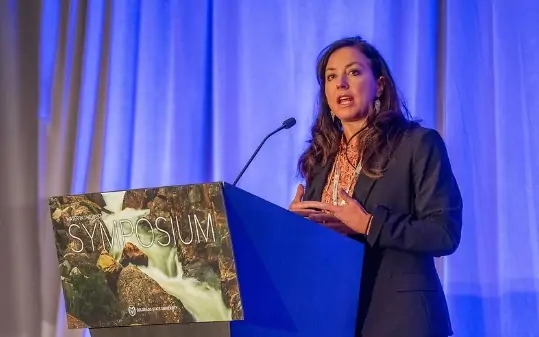
A freight train of thoughts about the #ColoradoRiver: Becky Mitchell, Colorado’s chief negotiator on the Colorado River, demands the lower-basin states take meaningful action on correcting the ‘structural deficit’ — Allen Best (@BigPivots) #cwcac2024 #COriver #aridification

Becky Mitchell. Photo credit: Allen Best/Big Pivots

Click the link to read the article on the Big Pivots website (Allen Best):

February 2, 2024

Becky Mitchell speaks crisply and with a bass-drum firmness. Her speeches are like freight trains, orderly processions full of weight, one thought pounding after another.

Her full-time job since July 2023, as Colorado’s lead negotiator in Colorado River matters, gives her weighty material that matches her rhetorical style. Before that, she informally held the same role as the director of the Colorado Water Conservation Board.

The Colorado River has been riven with rising drama in the last 20 years. The seven basin states – but particularly Arizona and California – have reluctantly, slowly conceded reforms necessary to the occasion. The federal government, the referee for the river and operator of the two giant dams, Hoover and Glen Canyon, was slow to force the hard decisions.

“It is time for a fundamental change in how we manage the Colorado River,” she told members of the Colorado Water Congress at the group’s annual conference on Jan. 30. “It’s time to adapt to the river that we have, not the river we dream of.”

“We have some difficult roads ahead of us as we work to find a sustainable solution for the basin,” she said in wrapping up her 15-minute speech. “What we must do would’ve been easier 10 years ago. It would’ve been easier 5 years ago. Tomorrow will be difficult, but we must have the courage to try.”

Following is a lightly abridged version of the speech:

Change is coming. I can’t emphasize enough how much the post-2026 negotiations matter whether you are in the upper basin, lower basin, Mexico, or a member of one of the 30 tribal nations. We all deserve a future with certainty and security in our water supply without that being jeopardized by constant crisis management. We also all deserve a future where we can live within the means of the river and without the risk of overuse or misuse driving us into crisis.
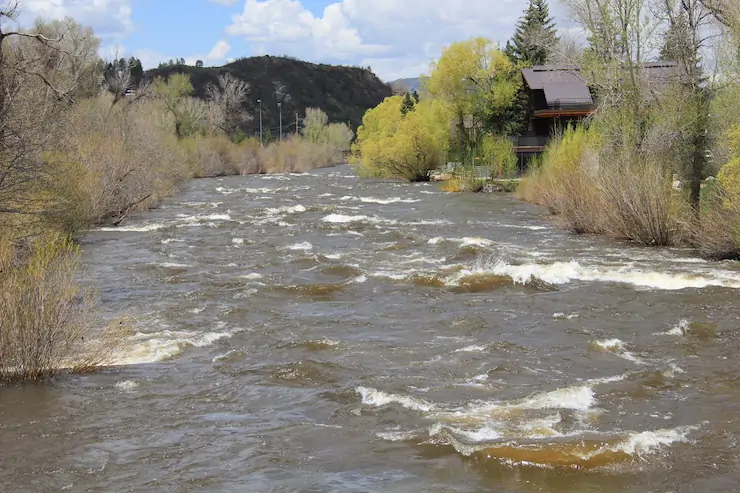
The Yampa River carried a robust runoff flow from winter snows through Steamboat Springs in May 2023, helping pull back the two giant reservoirs of the Colorado River from the brink of disaster. Top, Becky Mitchell addresses the Colorado River Water Users Association in December 2021. Photos/Allen Best

For the past two decades, the upper basin has been caught between the impacts of climate change and lower-basin overuse. I acknowledge that the lower basin does not like the term overuse. My intent is not to offend, but rather to be clear and honest about uses that exceed what the compact and hydrology can allow whatever it is called. We cannot and will not agree to guidelines that perpetuate management of our water resources that do not acknowledge what Mother Nature is providing. The basin cannot continue to use water at a rate that is unsustainable. Those who are fearful of change or who benefit from status quo will find fault in the plain facts that I share with you here today. You will find fault in the tone with which I share them.

The good news is that change is coming. The upper division states have said for years, decades now, the lower basin needs to take responsibility for the role in emptying the reservoirs. But let me be clear why this change is needed. Dry hydrology and overuse have drained the reservoirs. Future guidelines must recognize the reality of the Colorado River Basin hydrology.

Our lower basin neighbors have recently recognized that they must address the overuse. The next step for them is to explain how will they make this commitment a reality. We look forward to seeing those details.

We will continue to do everything we can to get to a seven state solution that protects Colorado and the upper basin, but we also need to be prepared for other scenarios. The upper division states have presented a concept to the lower basin states that outlines mechanisms for living within the means of the river while rebuilding and maintaining Powell and Mead and operating within the law of the river.

(Our concept) is essentially a water budget that honors the law and Mother Nature. The Colorado River Compact is our foundation. Solutions need to respect the law of the river and recognize the reality of hydrology across the entire basin. Those solutions must also be real and verifiable. Aspirational goals do not provide the clarity that is required to provide predictability across the basin.

We cannot and will not agree to balancing like the ’07 guidelines, a concept that was used to justify sending water downstream. The water should be used to rebuild storage. We’re focused on fair, legal and sustainable outcomes for the entire basin. Out of respect for the sovereignty of those lower basin states and the role of the Secretary of the Interior as the water master in the lower basin states, we have not weighed in on how they should apportion the reductions amongst themselves. That is for the lower basin (states) to work out.

We have heard our downstream neighbors say, if we figure out the structural deficit, will you meet us in the middle on climate change? That’s one heck of a hypothetical. If the lower basin overuse is addressed, we’d be looking at a very different situation than what we see today. In fact, if the lower basin had accounted for evaporation and transit losses through the ’07 guidelines, the reservoirs would likely be healthy now.

We are the ones who’ve been doing the work on climate change. We absolutely have been doing our part. What I’ve heard from across Colorado is we are willing to help. We are willing to be a part of the solution, but we cannot solve a problem alone.

We (already) take involuntary and uncompensated reductions when Mother Nature doesn’t provide water. Users in the upper basin have taken an average of 1.3 million acre-feet in shortages annually over the last several years. We make do with less in our communities, our workforce, our economies, and our food production. The lower basin must recognize and acknowledge the annual shortages that occur in the upper division states and then acknowledge — thank you — that the operation of the reservoirs must absolutely respond to hydrology. In addition, we must also acknowledge that the upper basin has not developed into our 7.5 million acre-foot apportionment and that undeveloped tribal water rights are flowing downstream.
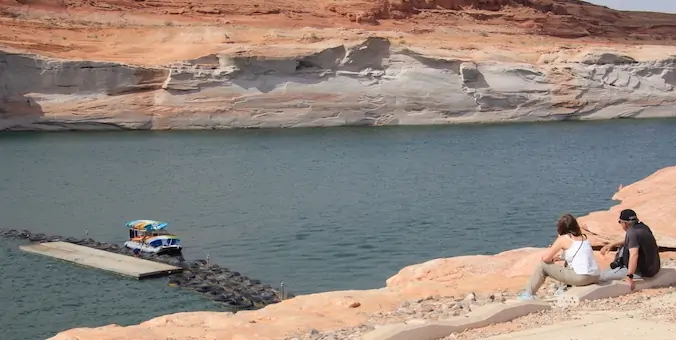
In May 2022, this boat ramp at Lake Powell was useful as a place to sit but had no value for launching boats. Photo/Allen Best

Overuse must end, and the compact must remain our foundation. It will not be easy. As we move into a future that is more responsive to hydrology, I acknowledge that we all must acknowledge there will be hardship and pain, while also acknowledging that this hardship and pain has existed in the upper basin for decades. Because we haven’t been shielded from climate change impacts, the upper basin states are uniquely positioned to assist our downstream neighbors in learning how to live with less.

We are collaborating in unprecedented ways in the upper basin, and this time we’re doing it at a bigger table. I’m very proud that we are working with the upper basin tribal nations in recognition of their historical ownership and their undeveloped federally reserved water rights. This collaboration has made very clear to me that is unacceptable for the upper division states to accept any limitations on future uses when upper basin tribes have limited access to clean water, agricultural production, and economic vitality.

I remember the speech I gave in the summer of 2022. The reservoirs were crashing. The federal government had laid out an ultimatum: Figure out how to conserve 2 to 4 million acre feet or we’ll figure it out for you. The lower basin was unwilling and unable to reach an agreement about cuts to their uses. I remember many long meetings and long hours that my team and I put into discussions with our fellow upper division states. We worked out the five-point plan. This was a turning point for Colorado. The decision was a difficult one for me. It was not fun.

By implementing this plan, we have positioned ourselves as leaders in the basin, the ones willing to come to the table to do our part. Colorado cannot and will not accept status quo. We cannot or will not be bullied into a future that drains the reservoirs for continued unsustainable use.

For example, we pushed the Bureau of Reclamation to modify how the upper basin is represented in Colorado River Basin modeling. Our advocacy means that today the updated models better reflect the reality in the upper basin, a reality that will be represented in the post 2026 tools. Reclamation models now show what shortages look like here.

This team has also worked to make Colorado more resilient. Over the past year, the CWCB has spearheaded a turf removal program to make our municipalities more resilient for future water shortages.

Division of water resources has continued to strictly administer water rights, including painful cuts to water use to respond to Mother Nature.

My fellow commissioners and the upper Colorado River Commissioners revamped the 2024 System Conservation Pilot Program, or SCPP, to allow water users to voluntarily forego their water uses in exchange for compensation, thereby helping to put water in the river to mitigate drought in the upper division states.
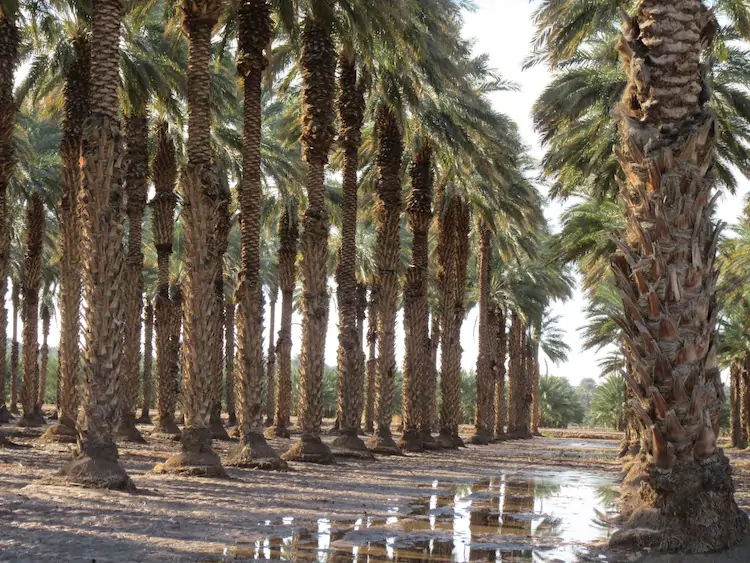
California’s Imperial Valley has a year-round growing season and uses Colorado River water for palm trees and almost every crop imaginable . February 2017 photo/Allen Best

The drought task force critically examined the Colorado River issues and not only applauded the good work of the state, but recommended additional resources to augment our existing work.

The river team is also working to transition our guiding principles from paper to practice. You are all familiar with the irrefutable truths. It’s one thing to say these are our principles. It’s another thing to then apply them to the basin-states negotiations. That is a difficult task. I’ve seen some of these principles gain traction throughout the entire Colorado River basin. Federal government has acknowledged the need for managing the reservoirs sustainably. The lower basin has acknowledged the need to address their overuse. The environmental community recognizes that healthy storage at our nation’s two largest reservoirs must be the first step in protecting Colorado’s rive and the, Colorado River’s ecosystems. Gradually, I’m hearing interest from DC to the Imperial Valley, recognizing that the status quo does not work anymore.

It is time for a fundamental change in how we manage the Colorado River. We must all live within the means of the river if we hope to sustain it. I want Lake Powell and Lake Mead to serve the purposes they were designed to serve. To provide for sustainable development of our compact apportionments in the Colorado River Basin and to provide water security in dry years. A sustainable system means we have to rebuild storage in Lake Powell and Lake Mead and protect upstream storage for releases only in the most dire circumstances. This means that the worldview around water must change, particularly in the lower basin. We must manage demand to rebuild the storage that provides certainty of supply. In all years, we all must adapt to the available water supply.

We have an opportunity now to collaboratively determine how to adapt to the river that we have, not the river we dream of. The lower basin states have said many good things that signal that they are open to collaboration.

We believe them when they say they will own the structural deficit, when they say they will live within the means of the river, when they say they will support the tribes and that they support the environment. I take them at their word. We assume that they are serious about these commitments, and we expect open and transparent accounting of all lower basin uses of main stem tributaries so that we can trust but verify their actions. We hope that the lower basin will come around to support the framework for management of Lake Powell and Lake Mead that is sustainable for the 40 million people who rely on the Colorado River.

What we must do would’ve been easier 10 years ago. It would’ve been easier five years ago. Tomorrow will be difficult, but we must have the courage to try.

Colorado River Basin Plumbing. Credit: Lester Doré/Mary Moran via Dustin Mulvaney and Twitter

SCOTUS sets March 20 date to hear #Texas vs #NewMexico oral arguments on #RioGrande — Source NM

The Rio Grande flows near Albuquerque as the sun rises over the Sandia Mountains. (Photo by Diana Cervantes for Source NM)

Click the link to read the article on the Source NM website (Danielle Prokop):

The nation’s highest court will hear federal objections to a deal between Texas and New Mexico in their dispute over Rio Grande water in oral arguments scheduled for a midweek date on March 20.

The U.S. Supreme Court agreed to take up the case last week, as the lawsuit crawls into a decade since its filing.

Justices will evaluate arguments from the federal government taking exception to a compromise planagreed to by Texas, New Mexico and Colorado to settle the case. The three states are parties in the lawsuit and agreed to the compromise in January 2023. [ed. emphasis mine]

The New Mexico Office of the State Engineer said there would be no need to adjust its budget request before the New Mexico State Legislature because of the oral arguments in D.C. State Engineer Mike Hamman said in a written statement that the office is looking forward to the oral argument in March.

“We are confident that the Supreme Court will accept the states’ proposed settlement, which will allow us to move forward towards securing a stable water future for all users in the lower Rio Grande,” said Hamman.

Budget asks

Also on Monday morning, the New Mexico House of Representatives released its state budget proposal for the next fiscal year. In the proposed budget, the House Appropriations and Finance committee extended $2 million given last year to the New Mexico Department of Justice for Rio Grande litigation and notes another $6.4 million on interstate water litigation will carry forward from last year. 

In the Office of the State Engineer, $8.9 million is set aside for litigation and adjudication of water rights within streams around the state and underground basins. 

Separately, the agency will transfer $2.5 million to the litigation and adjudication programs of the state engineer. While not all adjudication and litigation is specific to the supreme court’s Rio Grande case, that in all, totals to nearly $20 million between both agencies. 

How we got here

Formally called Original No. 141 Texas v. New Mexico and Colorado, the case has cost taxpayers tens of millions of dollars.

The 2014 filing by the state of Texas centers on allegations that New Mexico groundwater pumping downstream of Elephant Butte Reservoir took Rio Grande water  allocated to Texas.

Texas said New Mexico’s pumping violated the 1938 Rio Grande Compact, a legal agreement between Colorado, New Mexico and Texas to split the river’s water.

While 80% of the river’s water is used for agriculture, it’s a major source of drinking water for cities such as El Paso and Albuquerque, and for wildlife. Las Cruces sits below Elephant Butte Reservoir and receives all its drinking water from groundwater.

In 2018, the U.S. Supreme Court allowed the federal government to intervene in the case. Attorneys for federal agencies said New Mexico groundwater pumping threatened federal abilities to deliver water to tribes, regional irrigation districts and Mexico under a federal treaty.

The case pressed on to trial in 2021 and was split into two parts. A six-week virtual portion of the trialwas held in the fall, and a second in-person technical portion was pushed back after months of negotiations by parties took up much of 2022.

Just before the trial was set to resume, the three states announced an agreement which would resolve issues between Texas and New Mexico. It includes measuring water deliveries at the state line, new conditions for over- and under-deliveries of Rio Grande water and incorporating drought baselines and groundwater pumping into the formulas for how much water is available.  

Attorneys for the federal government objected, arguing that the agreement was made without their consent.

U.S. 8th Circuit Judge Michael Melloy recommended last year that the Supreme Court accept the deal over objections from the federal government, calling it “fair and reasonable” in his 123-page report. He said disputes over federal operations in Southern New Mexico could be resolved in other courts.

In December, the federal government submitted a filing objecting to Melloy’s recommendation. In the filing, attorneys said the settlement “imposes obligations on the United States without its consent.” Attorneys further argued that the deal should be thrown out because it is “contrary to the Compact”.

 It’s expected that only attorneys for the states and the federal government will have time to speak during oral arguments before the Supreme Court in March. If that happens, groups unable to present arguments would include farming associations, irrigation districts, the city of Las Cruces and New Mexico State University, which appear as amici curae or “friends of the court.”

Opinions from the Supreme Court are typically issued by late June, occasionally early July, during their session.

Map of the Rio Grande watershed. Graphic credit: WikiMedia

A Future With Certainty: #ColoradoRiver Commissioner Rebecca Mitchell Speaks on Tough Road Ahead for Post-2026 Negotiations — #Colorado Department of Natural Resources #cwcac2024 #COriver #aridification

“New plot using the nClimGrid data, which is a better source than PRISM for long-term trends. Of course, the combined reservoir contents increase from last year, but the increase is less than 2011 and looks puny compared to the ‘hole’ in the reservoirs. The blue Loess lines subtly change. Last year those lines ended pointing downwards. This year they end flat-ish. 2023 temps were still above the 20th century average, although close. Another interesting aspect is that the 20C Mean and 21C Mean lines on the individual plots really don’t change much. Finally, the 2023 Natural Flows are almost exactly equal to 2019. (17.678 maf vs 17.672 maf). For all the hoopla about how this was record-setting year, the fact is that this year was significantly less than 2011 (20.159 maf) and no different than 2019” — Brad Udall

From email from the Colorado Department of Natural Resources (Michael Elizabeth Sakas):

February 1, 2024

Rebecca Mitchell, Colorado’s Upper Colorado River Commissioner, spoke to a sold-out crowd at the Colorado Water Congress’s Annual Convention in Aurora, CO this week. She shared an update on the state’s negotiation positioning, and the reality of difficult roads ahead, as the states and Tribal Nations work to find sustainable solutions for 40 million people who rely on the Colorado River in the arid southwest.

“Change is coming to the Colorado River and because it is, I can’t emphasize enough how much the Post-2026 negotiations matter,” Commissioner Mitchell said in her speech. “Whether you are in the Upper Basin, Lower Basin, Mexico, or a member of one of the 30 Tribal Nations, we all deserve a future with certainty and security in our water supply, without that being jeopardized by constant crisis management.”

The current guidelines, called the ‘07 Guidelines, manage Lake Powell and Lake Mead. These expire in 2026, and the states that share the river are in the process of negotiating new guidelines for how Lake Powell and Lake Mead will operate post-2026. Powell and Mead hit their lowest levels on record in recent years, partly because states in the Lower Basin continue to use more water than what flows into these reservoirs. Commissioner Mitchell said that the ‘07 Guidelines cannot simply be extended.

“I want to recognize that the Lower Basin does not like the term overuse. My intent is not to offend, but rather to be clear and honest about uses that exceed what the Compact and hydrology can allow,” Commissioner Mitchell said. “Whatever you call it, we cannot– and will not– agree to guidelines that perpetuate management of our water resources that do not acknowledge what Mother Nature is providing. The Basin cannot continue to use water at a rate that is unsustainable.”

“History shows that collaborative efforts by the Basin States can provide superior solutions. We will continue to do everything we can to get to a seven-state solution that protects Colorado and the Upper Basin. But we also need to be prepared for other scenarios,” Commissioner Mitchell said.

“Our Colorado River team is a force. I cannot thank the Colorado Water Conservation Board, the Division of Water Resources, and the Attorney General’s teams enough. Also, I greatly appreciate the support of  Governor Polis, who has been engaged and helpful as we enter these critical negotiations,” Commissioner Mitchell said. “Together, we have shown the federal government and the Lower Basin that Colorado cannot and will not accept the status quo or be bullied into a future that drains the reservoirs for continued, unsustainable use in the Lower Basin.”

Map credit: AGU

Click the link to read Commissioner Mitchell’s full speech from the 2024 Colorado Water Congress Annual Convention on the Colorado Department of Natural Resources website:

Rebecca Mitchell, Colorado’s Upper Colorado River Commissioner 
Colorado Water Congress Annual Convention Speech
Jan. 31, 2024

Change is coming – and because it is, I can’t emphasize enough how much the Post-2026 negotiations matter.

Whether you are in the Upper Basin, Lower Basin, Mexico, or a member of one of the 30 Tribal Nations, we all deserve a future with certainty and security in our water supply without that being jeopardized by constant crisis management. We all deserve a future where we can live within the means of the river, without the risk of overuse or misuse driving us into crisis.

For the past two decades, the Upper Basin has been caught between the impacts of climate change and Lower Basin overuse, along with the increasing risk that our thirsty neighbors will look upstream for more water.

The structural deficit refers to the consumption by Lower Basin states of more water than enters Lake Mead each year. The deficit, which includes losses from evaporation, is estimated at 1.2 million acre-feet a year. (Image: Central Arizona Project circa 2019)

I want to recognize that the Lower Basin does not like the term overuse. My intent is not to offend, but rather to be clear and honest about uses that exceed what the Compact and hydrology can allow. Whatever you call it, we cannot – and will not – agree to guidelines that perpetuate management of our water resources that do not acknowledge what Mother Nature can provide.

The Basin cannot continue to use water at a rate that is unsustainable.

Those who are fearful of change, or who benefit from the status quo, will find fault with the plain facts I share here with you and will find fault with the tone in which I share them, as an excuse for their inaction. We must move forward together to face the future with honesty and courage. You, Colorado, and all people in the Basin deserve nothing less than honesty and courage.

The good news? Change is coming. The Upper Division States have said for decades that the Lower Basin needs to take responsibility for its role in emptying the reservoirs.

Let’s be clear about why this change is needed. The ‘07 Guidelines cannot be extended. Under the ‘07 Guidelines, dry hydrology and overuse by the Lower Basin have drained the reservoirs. Future guidelines must recognize the reality of Colorado River Basin hydrology.

Our Lower Basin neighbors recognize that they must address their overuse, what they call the “structural deficit.” I applaud that first step of acknowledging their responsibility. The next step is for them to explain how they will make this commitment a reality that we can rely on. We look forward to seeing those details.

The history of the Basin shows that collaborative efforts by the Basin States can provide superior solutions. We will continue to do everything we can to get to a seven-state solution that protects Colorado and the Upper Basin.

But we also need to be prepared for other scenarios.

The Upper Division States have presented a concept to the Lower Basin States that outlines mechanisms for living within the means of the river while rebuilding and maintaining Powell and Mead, and operating within the Law of the River – essentially a water budget that honors the law and Mother Nature.

The Colorado River Compact is our foundation. Solutions need to respect the Law of the River and recognize the reality of the hydrology of the Colorado River Basin. Solutions must also be real and verifiable. Aspirational goals do not provide the clarity that is required to provide predictability to the Basin.

We cannot and will not agree to continue  “balancing” under the ‘07 Guidelines, a concept used to justify sending water downstream to fuel Lower Basin overuse. That water should be used to rebuild storage.

We’re focused on fair, legal, and sustainable outcomes for the entire Basin.

Out of respect for the sovereignty of the Lower Basin States, and the role of the Secretary of the Interior as Water Master of the Lower Basin, we have not weighed in on how they should apportion reductions among themselves. That is for the Lower Basin to work out. We’ve rolled up our sleeves in a good-faith effort to balance the demands with supplies, and the need to have water available in dry years to keep the system from crashing.

We have heard our downstream neighbors say, “If we figure out the structural deficit, will you meet us in the middle on climate change?”

First off – that’s one heck of a hypothetical. If Lower Basin overuse is addressed, we would be looking at a very different situation than what we see today. In fact, if the Lower Basin had accounted for evaporation and transit losses throughout the ‘07 Guidelines, the reservoirs would likely be healthy.

But at this time, we’re the only ones who’ve been doing anything about climate change. We’ve shown that we are willing to do our part, that we have been doing our part. I have heard across Colorado that we’re willing to help – but we cannot solve the problem alone.

We take involuntary and uncompensated reductions when Mother Nature does not provide. Water users in the Upper Basin have taken an average of 1.3 million acre-feet in shortages annually over the last several years. In other words, we have used 1.3 million acre-feet less than what we may have used if our water users’ demands were fulfilled.
 
When we make do with less water, we also make do with less in our communities, our workforce, our economies, and our food production. The Lower Basin must recognize and acknowledge the annual shortages that occur in the Upper Division States, and then acknowledge that the operation of reservoirs must respond to hydrology.

In addition, we must acknowledge that the Upper Basin has not developed into our 7.5 million acre-foot apportionment and that undeveloped Tribal water rights are flowing downstream.

Regardless of what the future agreement looks like, the sideboards are set: we can no longer operate without regard for Mother Nature, overuse must end, and the Compact must remain our foundation.

It won’t be easy. As we move to a future that is more responsive to hydrology, I acknowledge that there will be hardship and pain in the Lower Basin – while also acknowledging that this hardship and pain has existed in the Upper Basin for decades, because we haven’t been shielded from climate change impacts.

The Upper Basin is uniquely positioned to assist our downstream neighbors in learning to live with less.

Seventy-five years ago, my predecessor agreed to the 1948 Upper Colorado River Compact, which established the Upper Colorado River Commission (UCRC) as a forum for “interstate comity.” That sentiment has never been truer in the Upper Basin than today. The Upper Division States are strongly united, and we’re stronger because of the common interests shared across Colorado, New Mexico, Utah, and Wyoming.

Native America in the Colorado River Basin. Credit: USBR

We are collaborating in unprecedented ways in the Upper Basin, and this time we’re doing it at a bigger table. I’m very proud that we are working with the Upper Basin Tribal Nations in recognition of their historical ownership and their undeveloped federally reserved water rights. This collaboration has made it very clear to me that it is unacceptable for the Upper Division States to accept any limitations on future uses when the Upper Basin Tribes have limited access to clean water, agricultural production, and economic vitality.

What we can do and what we will do is operate responsibly, and initiate programs and policies that promote sustainable uses across the Upper Basin.

I would like to take a moment to reflect on how far we have come as a state, and as the Upper Basin, over the last couple of years. I remember the speech I gave to you all in the summer of 2022. The reservoirs were crashing. The federal government had laid out an ultimatum: “Figure out how to conserve 2 to 4 million acre-feet, or we’ll figure it out for you.” The Lower Basin was unwilling and unable to reach an agreement about cuts to their uses.

When it became clear that a Basin agreement was impossible, I remember the many long meetings and long hours that my team and I put into discussions with our fellow Upper Division States. And we worked our way to the Five Point Plan.

That Five Point Plan was a turning point for Colorado. You all know that decision was a difficult one for me. But by implementing this plan, we positioned ourselves as leaders in the Basin as the ones willing to come to the table to do our part.

A few short months later, the General Assembly passed a bill that funded the creation of several new full-time employees. If you’ve ever worked in state government, you’ll know that getting one new employee is a massive success – imagine then how significant it is to secure nearly 20 positions dedicated to Colorado River issues.

Our Colorado River team is a force. I cannot thank the Colorado Water Conservation Board, the Division of Water Resources, and the Attorney General’s teams enough. Together, we have shown the federal government and the Lower Basin that Colorado cannot and will not accept the status quo or be bullied into a future that drains the reservoirs for continued, unsustainable use in the Lower Basin.

For example, we pushed the Bureau of Reclamation to modify how the Upper Basin is represented in Colorado River Basin modeling. Our advocacy means that today, the updated models better reflect the reality in the Upper Basin — a reality that will be represented in post-2026 tools. Reclamation models now show what shortages look like here. The models also show how shortage cuts into our water needs.

This team has also worked to make Colorado more resilient. Over the past year, the CWCB has spearheaded a turf removal program to make our municipalities more resilient to future water shortages; DWR strictly administered water rights – including painful cuts to water use – to respond to Mother Nature; Me and my fellow Upper Colorado River Commissioners revamped the 2024 System Conservation Pilot Program – or SCPP – to allow water users to voluntarily forgo their water uses in exchange for compensation, thereby helping to put water in the river to mitigate drought in the Upper Division States; and the Drought Task Force critically examined Colorado River issues, and not only applauded the good work of the state, but recommended additional resources to augment our existing work.

The Colorado River team is also working to transition our guiding principles from paper to practice. You are all familiar with the irrefutable truths. It’s one thing to say, “These are our principles.” It’s another thing to then apply them in Basin State negotiations.

I’ve seen some of the principles gain traction throughout the entire Colorado River Basin.  The federal government has acknowledged the need for managing the reservoirs sustainably. The Lower Basin has acknowledged the need to address their overuse. The environmental community recognizes that healthy storage at our nation’s two largest reservoirs must be the first step in protecting the Colorado River’s ecosystems.

Gradually, I’m hearing diverse interests, from D.C. to the Imperial Valley, recognize that the status quo doesn’t work anymore, that it is time for a fundamental change in how we manage the Colorado River, and that we must all live within the means of the River if we hope to sustain it.

I want Lake Powell and Lake Mead to serve the purposes they were designed to serve: to provide for sustainable development of our compact apportionments in the Colorado River Basin, and to provide water security in dry years.

A sustainable system means we have to rebuild storage in Lake Powell and Lake Mead, and protect upstream storage for releases only in the most dire circumstances. This means that the worldview around water must change – particularly in the Lower Basin. We must manage demand to rebuild the storage that provides certainty of supply in all years. We all must adapt to the available water supply.

We hope our Lower Basin partners will meet us in this moment. We have an opportunity to collaboratively determine how to adapt to the river that we have, not the river that we dream of.

The Lower Basin states have said some good things that signal they are open to collaboration. We believe them when they say that they will “own the structural deficit,” when they say they will “live within the means of the River,” that they “support the Tribes,” and that they “support the environment.”

I take them at their word. We assume they are serious about these commitments, and we expect open and transparent accounting of all Lower Basin uses– mainstem and tributaries– so that we can trust but verify their actions.

We hope that the Lower Basin will come around to support a sustainable framework for the management of Lake Powell and Lake Mead for the 40 million people who rely on the Colorado River. We are bound together by this River, by the Compact we signed 100 years ago, and by our shared interest in a vibrant American southwest.

Utilizing unprecedented federal funds, I believe that we can reach an agreement that protects all who rely on this critical resource – and we should do this post haste: 40 million people are counting on us.

I want to acknowledge my counterparts in both the Upper and Lower Basins, along with the leadership of the Bureau of Reclamation, and the fact that we have some difficult roads ahead of us as we work to find a sustainable solution for the Basin.  What we must do would have been easier ten years or even five years ago. Tomorrow will be difficult, but we must have the courage to try.

The history of the Basin shows that collaborative efforts by the Basin States can provide superior solutions. We all know we must prepare for other scenarios. But for now, I promise you that we are focused on finding that collaborative solution.

My request is that Colorado stay unified at this critical time in the negotiations. I commit to making space and time to have the difficult discussions we need to have within Colorado about these important issues. But the most important task – right now – is to find success in the negotiations with the other Basin States.

Success depends on all of us staying together with a common goal of protecting the resources of Colorado for all who depend upon them – including the Tribal Nations, agricultural users, cities, and the environment.

Thank you.

Colorado River “Beginnings”. Photo: Brent Gardner-Smith/Aspen Journalism