Here’s how much #LakePowell is expected to rise this year — KSL.com #ColoradoRiver #COriver #aridification

Enigmatic artwork with Glen Canyon Dam in the background. Jonathan P. Thompson photo.

Click the link to read the article on the KSL.com website (Carter Williams, KSL.com). Here’s an excerpt:

March 20, 2024

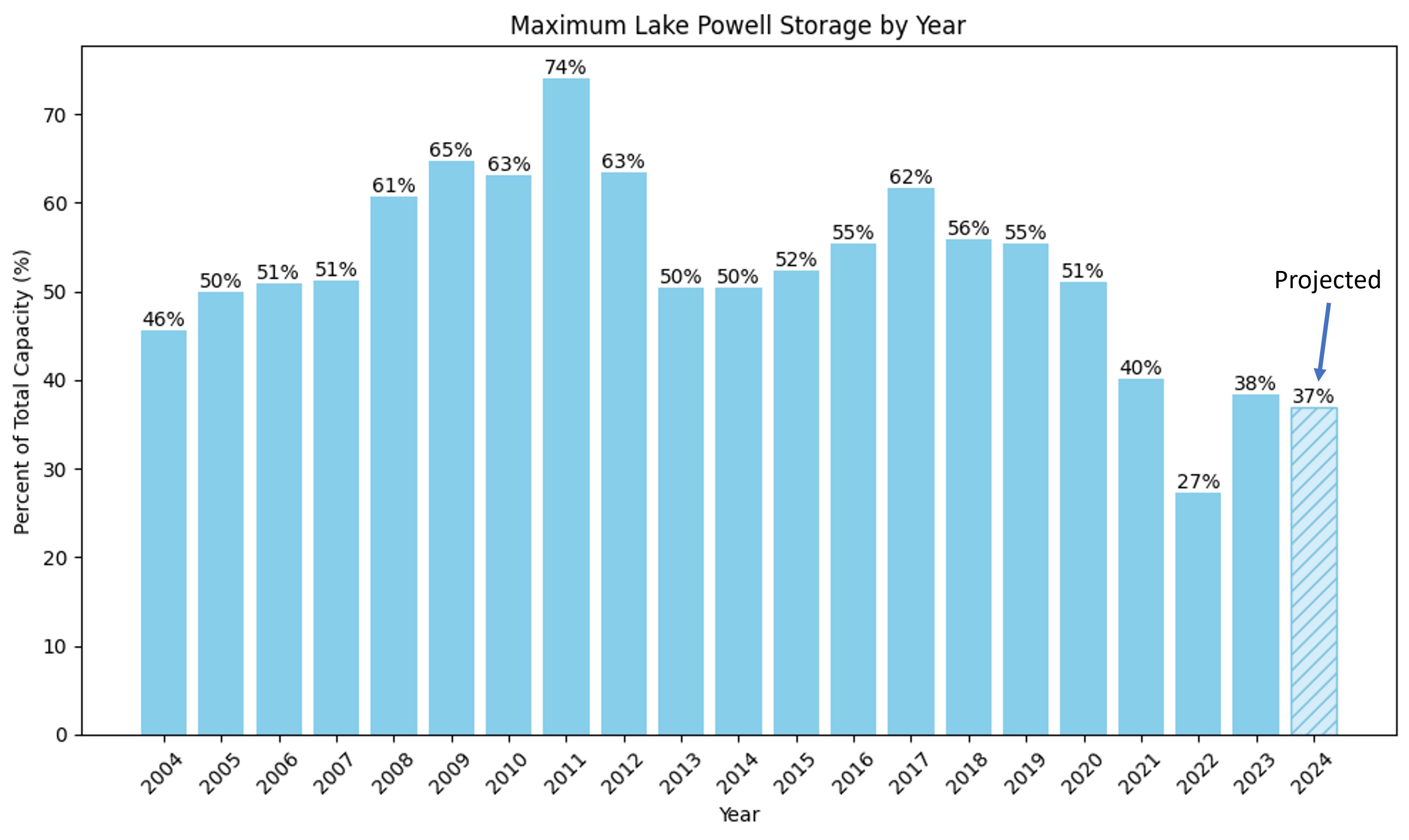
Lake Powell is projected to receive about 5.4 million acre-feet of water based on conditions this winter, National Weather Service’s Colorado Basin River Forecast Center officials said on Friday. That would hoist the reservoir from 32% to 37% capacity after the snowmelt process wraps up in the early summer. The reservoir gained about 65 feet in water levels last spring, jumping from 21% to 38% capacity followingĀ last year’s record snowpack. If this year’s projections come to fruition, it would also be close to the reservoir peak in 2021. It would also be much lower than the 2010s average peak…

Graphic credit: Colorado Basin River Forecast Center

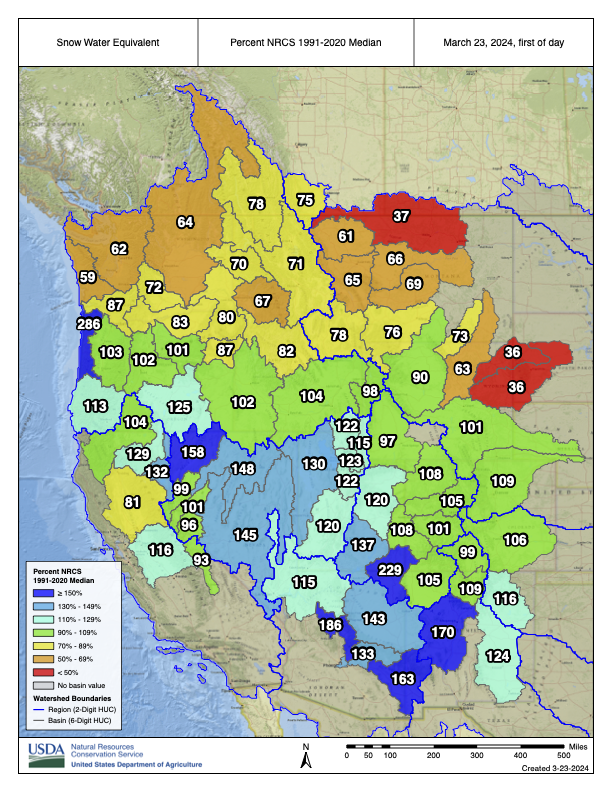
The center’s projections are based on a possible inflow of 85% of normal. Snowpack levels are generally between 85% and 130% of normal across the Upper Colorado River Basin region, and 120% and 125% across the Great Basin, Colorado Basin River Forecast Center officials wrote in a water supply report Tuesday. Officials clarified on social media the lower inflows are tied to drier conditions within the Green River and San Juan river basins, which flow into the Colorado River upstream of Lake Powell. They also said inflows were nearly twice the normal last year, which is why the reservoir gained so much in a short period.

Westwide SNOTEL basin-filled map March 23, 2024 via the NRCS.

Future of #LakeMead still unclear as negotiations flare — The Las Vegas Review-Journal #ColoradoRiver #COriver #aridification

Credit: Upper Colorado River Commisstion

Click the link to read the article on The Las Vegas Review-Journal website (Alan Halaly). Here’s an excerpt:

March 19, 2024

Colorado’s chief river negotiator doesn’t find the other side’s proposal for basinwide water cuts after 2026 plausible, she told reporters Tuesday. When it comes to updating how water from the Colorado River is allocated, the Upper Basin states — Colorado, New Mexico, Utah and Wyoming — have been wrapped in a divisive battleĀ with the Lower Basin, which is composed of Nevada, California and Arizona. Both parties agree that the ā€œstructural deficit,ā€ meaning the 1.5 million acre-feet of water lost to evaporation and transport, should translate to cuts made by the Lower Basin states. However, a main point of contention lies in whether Upper Basin states also must bear the brunt of cuts past the structural deficit.

States such as Colorado are at the mercy of snowpack and climate change to determine water availability, said Becky Mitchell, Colorado state’s Colorado River commissioner. That’s a far cry from a state like California, she said, which enjoys more certainty thanks to Lake Powell and Lake Mead, the two largest reservoirs in the country. Upper Basin states have estimated they suffer a 1.2 million acre-foot water shortage, on average, because of water loss to climate change.

ā€œIn short, our water users do not have security or certainty in their water supply because they absolutely have to live with what Mother Nature provides every year,ā€ Mitchell said. ā€œIn contrast, we have Lower Basin contractors who’ve been provided a high level of certainty in water deliveries and, in turn, have drawn down Lake Mead.ā€

[…]

There are other nuances that differentiate the two proposals, such as how much water to release from Lake Powell that will trickle into Lake Mead, which supplies about 90 percent of Southern Nevada’s water…Mitchell’s group wants to base each year’s outflow on Lake Powell’s levels on Oct. 1 of each year, while Lower Basin states hope to base that on the contents of more than just one reservoir.

Nevada’s chief negotiator and Southern Nevada Water Authority General Manager John Entsminger told the Las Vegas Review-Journal on Tuesday that the Lower Basin states are analyzing the Upper Basin proposal in more detail.

In #Denver, e-bike vouchers run out as fast as Taylor Swift tickets: The city estimates that its wildly popular subsidies are helping to eliminate 170,000 vehicle miles traveled per week — Grist #ActOnClimate

Electric bike sales are booming. In the United States, retailers more than doubled their sales in 2020 and demand has only increased. Globally, we’re expected to reach 40 million e-bikes sold in the year 2023. It’s easy to see why. On the spectrum of transportation options, e-bikes have some clear benefits: They use a great deal less energy (and therefore cost less) than a personal car. They save a lot of effort (and are therefore more convenient) than a regular bike. And depending on your route, they can even be the fastest way to arrive at your destination. It’s easy to find testimonials from people on the internet who have swapped a car for an electric bicycle. In fact, we produced a video about this very topic with Grist reporter Eve Andrews a few years ago. These anecdotes often come from people living in dense cities, where trip distances tend to be shorter. But what about folks who live in suburban or rural towns — are e-bikes still a good deal? As part of our video series Crunch the Numbers, we decided to look into how much carbon and cash the average American household could save if they swapped out their vehicle for an e-bike. Spreadsheet with calculator and sources: https://docs.google.com/spreadsheets/…

Click the link to read the article on the Grist website (Gabriela Aoun Angueira):

March 22, 2024

At 11 a.m. on the last Wednesday of February [2024], Denver opened the first application window of the year for itsĀ e-bike rebate program, which offers residents upfront rebates of $300 to $1,400 for a battery-powered bicycle. Within three minutes, all of the vouchers for low and moderate income applicants had been claimed. By 11:08 a.m., the rebates for everyone else were gone too, and the portal closed.Ā 

Even in its third year, Denver’s ambitious campaign to get residents to swap some of their driving for riding remains as popular as ever. ā€œIt’s exciting that people are really interested in this technology,ā€ Mike Salisbury, the city’s transportation energy lead, told Grist. ā€œEvery trip we can convert to an e-bike will be a big climate win.ā€

Transportation is among the biggest sources, if not the biggest source, of a city’s carbon emissions. To cut that footprint, officials often turn to costly, intensive transit projects and building out electric vehicle infrastructure. Denver is doing those things, but also propping up smaller forms of mobility. It spent more than $7.5 million in just two years on e-bike vouchers, supporting the purchase of nearly 8,000 of the battery-powered bicycles, which can zip along at up to 28 mph, power up hills, and carry passengers or cargo. 

ā€œWe’re just very bullish on e-bikes,ā€ said Salisbury. ā€œThey have this huge potential to replace vehicle trips.ā€

The vouchers are saving some 170,000 miles in car trips per week and around 3,300 metric tons of greenhouse gas emissions annually, according to the city. Its Office of Climate Action, Sustainability, and Resiliency calls it ā€œone of the most effective climate strategies that the city and county of Denver has deployed to date.ā€ 

There are about 160 of these incentive programs across the U.S. and Canada, and while Denver wasn’t the first to implement one, the size and success of its undertaking has attracted the attention of other governments and utilities. Congress is taking note as well: California Representative Jimmy Panetta reintroduced the federal Electric Bicycle Incentive Kickstart for the Environment Act, or E-BIKE Act, which would offer a 30 percent federal tax credit for e-bike purchases, last year. 

Funded through a voter-approved $40 million Climate Protection Fund, which directs a portion of the city’s sales tax toward decarbonization initiatives, the program offers income-based rebates that can be redeemed at designated bike shops. [ed. emphasis mine] Providing the discount at the register helps those who might otherwise be unable to afford the upfront cost, which typically begins around $1,200 and can reach several thousand dollars. 

Residents making less than 60 percent of the area median income of around $52,000 can get $1,200 for a standard e-bike and $1,400 for a cargo model (useful for carrying gear, making deliveries, or hauling kids). Moderate-income recipients receive between $700 or $900, and everyone else can get $300 or $500. Online applications open several times each year and vouchers are offered on a first-come, first-served basis. 

The goal is to reduce emissions from the transportation sector, Denver’s second-largest contributor of greenhouse gases, by targeting short vehicle trips. According to Salisbury, 44 percent of residents’ trips are under 5 miles and most are under 10, feasible distances to travel on an e-bike.

ā€œE-bikes aren’t going to replace every single trip for every single person,ā€ he said. ā€œBut there’s this huge potential to replace, especially in an urban environment, shorter distance trips that someone is making by themselves. Or they can use an e-cargo bike to take their kids to school.ā€

That’s one of the many ways Jeff Gonzales, a marketing professional and father living near the University of Denver, uses the power-assisted bike that he bought two years ago with the help of a voucher. 

At the time, Gonzales drove a customized Toyota Tacoma pickup. ā€œIt was awesome, but it was a gas guzzler,ā€ he told Grist. Gas was so expensive that he and his wife were trying to minimize their driving as much as possible. But their two toddlers were getting too heavy to tow with the family’s bike trailer, affectionately called ā€œthe chariot.ā€ When an employee at his local bike shop mentioned the rebates for power-assisted bicycles, he decided to take one for a test ride. 

ā€œI was like, ā€˜This is pretty cool,’ and then I asked them, ā€˜Can I hook the chariot behind it?’ They said ā€˜Absolutely.ā€™ā€ Gonzales sold his truck, applied for a voucher, and bought the bike. He began riding it to the grocery store, taking the kids to school, and even making the 24-mile round-trip commute to his office twice a week. 

ā€œThat first summer we had it, I think there were times that we didn’t get in the car for about two weeks at a time,ā€ he said. 

After selling his pickup truck, Jeff Gonzales began using an e-bike to take his kids to school and commute to work. Courtesy of the City of Denver / Jeff Gonzales

In a 2023 survey of voucher recipients, 43 percent of respondents cited commuting as their primary reason for getting an e-bike, and 84 percent said the machines replaced at least one vehicle trip per week. The city estimates that recipients are eliminating a weekly average of 21 miles in their cars. 

Commuting on two wheels often allows riders to avoid traffic or take more direct routes than those offered by public transit. ā€œPeople are sharing feedback with us on how it’s enabled them to get to their job much faster, easier, at a much lower cost, without having to make two or three transit transfers to get to a place,ā€ said Salisbury. 

Gonzales said he often finds biking to work quicker, but even when the ride doesn’t save time, it’s more enjoyable. ā€œIt sucks to sit in traffic,ā€ he said. ā€œI’d rather be moving on a bike, and if I get tired, I can increase the power level, but I’m still moving.ā€

The clean energy nonprofit Rocky Mountain Institute, or RMI, found that if the country’s 10 most populous cities shifted a quarter of all short vehicle trips to e-bike rides, they could save 4.2 million barrels of oil and 1.8 million metric tons of CO2 in one year. That’s the equivalent of taking four natural gas plants offline. As an added bonus, those riders also would save a combined total of $91 million per month in avoided fuel and vehicle maintenance costs, according to RMI. 

But a recent study from Valdosta State University and Portland State University questions the cost effectiveness of achieving greenhouse gas emissions this way. ā€œEven when e-bike incentive programs are designed cost-effectively,ā€ the authors concluded, ā€œthe costs per ton of CO2 reduced still far exceed those of alternatives or reasonable social costs of GHG emissions.ā€ A rebate program can still be beneficial, the study concludes, but may need to be justified through its additional benefits, like promoting exercise and relieving traffic congestion.

Salisbury said the report’s critique overlooks how cities must tackle emissions in multiple ways. ā€œThere are lots of other things the city is working on, like building bus rapid transit and other infrastructure, but those take a long time,ā€ he said. ā€œIf we want to see reductions as soon as possible, we need to look at programs that can contribute to that right away.ā€

Aspinall Unit operations update: 550 cfs through the Gunnison Tunnel

Grand opening of the Gunnison Tunnel in Colorado 1909. Photo credit USBR.

From email from Reclamation (Erik Knight):

Gunnison Tunnel diversions will be increasing by 150 cfs on Monday, March 25. This will increase the total diversion from 400 cfs to 550 cfs. For this change in diversion, releases from the Aspinall Unit will remain constant at 1150 cfs. This will result in a drop in river flows of about 150 cfs downstream of the Tunnel

Flows in the lower Gunnison River are currently above the baseflow target of 1050 cfs. River flows are expected to remain above the baseflow target after this increase in Tunnel diversions.

Pursuant to the Aspinall Unit Operations Record of Decision (ROD), the baseflow target in the lower Gunnison River, as measured at the Whitewater gage, will be 1050 cfs for March through May.

Currently, Gunnison Tunnel diversions are 400 cfs and flows in the Gunnison River through the Black Canyon are around 670 cfs. After this release change Gunnison Tunnel diversions will be 550 cfs and flows in the Gunnison River through the Black Canyon will be near 520 cfs. Current flow information is obtained from provisional data that may undergo revision subsequent to review.

This scheduled release change is subject to changes in river flows and weather conditions. For questions or concerns regarding these operations contact:

Erik Knight at (970) 248-0629, e-mail eknight@usbr.gov

Acequia Assistance Project Members Attend 12th Annual Congreso de Acequias — Getches-Wilkinson Center

Click the link to read the article on the Getches-Wilkinson Center website (Megan Mooney & Hannah Loiselle):

March 19, 2024

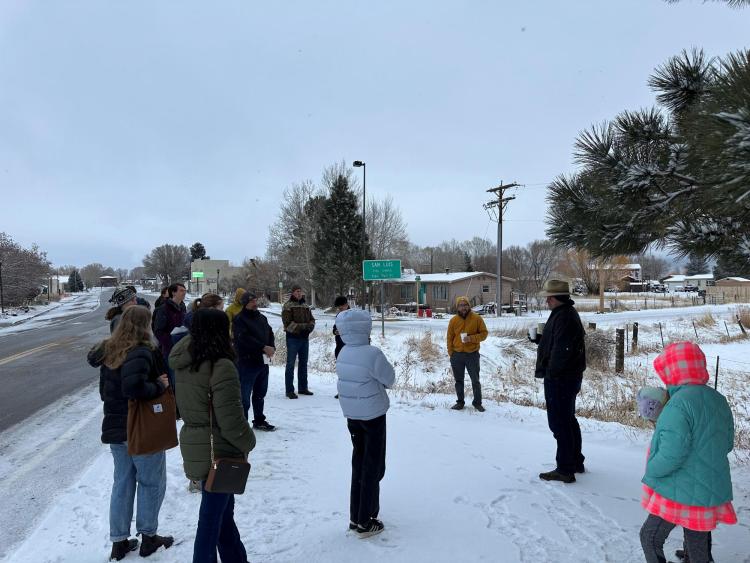
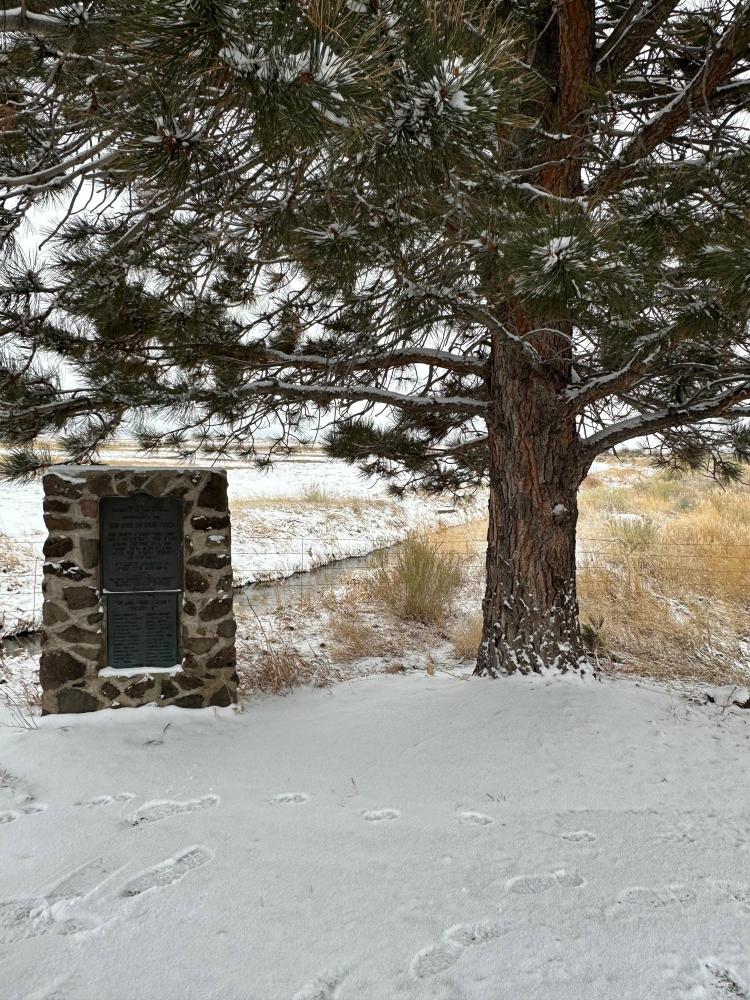
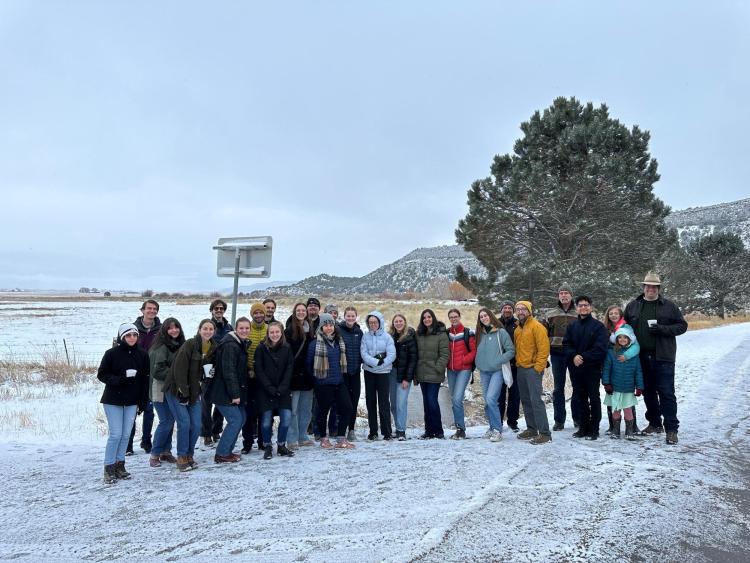
Members of the Acequia Assistance Project, in conjunction with the Getches-Wilkinson Center and the Colorado Law School, made their way down to San Luis, CO earlier this month to attend the 12th annual Congreso de Acequias. There, Project members took a walking tour of San Luis, visited the People’s Ditch which holds the oldest water right in Colorado, met with clients, participated in community workshops, and dined at local favorite Mrs. Rios. This visit gave students the opportunity to better understand the San Luis community, the land that their work is influencing, and gain a deeper understanding of the importance of the acequia system within Colorado’s water laws.Ā 

Congreso is a full-day conference that centers local voices, issues, and plans for the future. The event began with bendición de las aguas– the blessing of the water– where water from each acequia in attendance was combined and blessed. At the first workshop of the day, titled ā€œRebuilding a Robust Local Food System,ā€ Colorado Open Lands and the Acequia Association brought together voices from around the Valley to discuss food sovereignty and how the community can work together to keep locally grown produce in the Valley, rather than export it, to address the lack of local access to healthy food. Representatives joined from the San Luis People’s Market, the San Luis Valley Food Coalition, local farms, and other organizations from around the Valley. In the second workshop of the day, ā€œRangeland and Grassland Drought Resilience,ā€ Annie Overlin from CSU Extension discussed how farmers and ranchers can maintain their crops and cattle during drought years by creating action plans in advance. To wrap up the morning programming, the Acequia Association presented awards to elementary-aged art contest winners, who created pieces exhibiting their relationship to water growing up in the Valley, and one 13-year-old community member shared the story of how he learned the importance of water during his childhood in San Luis.

Selection of the 2015 native heirloom maize harvest of the seed library of The Acequia Institute in Viejo San Acacio, CO Photo by Devon G. PeƱa
San Luis garden, 2021. Photo credit: The Alamosa Citizen

Lunch consisted entirely of locally-sourced food and featured a performance from local singer, Lara Manzanares, who performed a series of songs which spoke to the experiences growing up in rural areas and her perspective on the land surrounding her. In the afternoon, Colorado Law’s student attorneys, Masters of the Environment (MENV) students, and Project Director MacGregor presented updates about current student projects to inform the community of legislative updates impacting the San Luis Valley, outcomes from ongoing research projects, and new opportunities to seek support from the project. To wrap up the day’s workshops, there was an in-depth presentation on current funding opportunities for acequias and farmers.

The final event was a discussion and film screening about the Cielo Vista Ranch dispute, which has been ongoing since the early 1980s. Many community members in San Luis have historic land rights to graze livestock, collect timber for firewood, and hunt on the land currently owned by the Cielo Vista Ranch. Texas billionaire William Harrison bought the mountain in 2017 and has continued to build an 8 to 10-foot tall animal fence that interferes with easement owners’ rights to the land, exacerbating the decades-long issue. Documentary producer, Juan Salazar, attended Congreso and introduced his film, titled La Tierra, which details the history of advocacy in the San Luis community and discusses the significance of community organizing and resistance. Community members, including activist Shirley Romero-Otero, led a discussion about the dispute following the documentary, which allowed students to gain a more well-rounded understanding of how the issue has been impacting the valley for generations.

Colorado Law student attorneys and MENV students attended Congreso along with Getches-Wilkinson Center’s Acequia Assistance Project Director Gregor MacGregor and supervising attorneys Bill Caile, Megan Christensen, Enrique Romero, Andrew Teegarden, and Aaron Villapondo. The Acequia Assistance Project has provided pro bono legal services to clients in the San Luis Valley since the Project’s founding in 2012, and this year is no different. The project currently has 18 open cases, providing a variety of services to clients in the San Luis Valley including legal and policy research related to the region’s water rights, drafting acequia bylaws and amendments, conducting community title searches, facilitating water right applications, completing Acequia Handbook updates, and providing application assistance to farmers seeking federal Regional Conservation Partnership Program (RCPP) funding. Throughout the day, Acequia Assistance Project members conducted client intake meetings, worked with farmers one-on-one to discuss upcoming funding opportunities, and collected comments to improve the community’s Acequia Handbook.

The Acequia Assistance Project is grateful for the opportunity to work with the San Luis community, learn alongside its members, and provide pro bono legal support to benefit community members. We cannot wait to return to Congreso in future years.

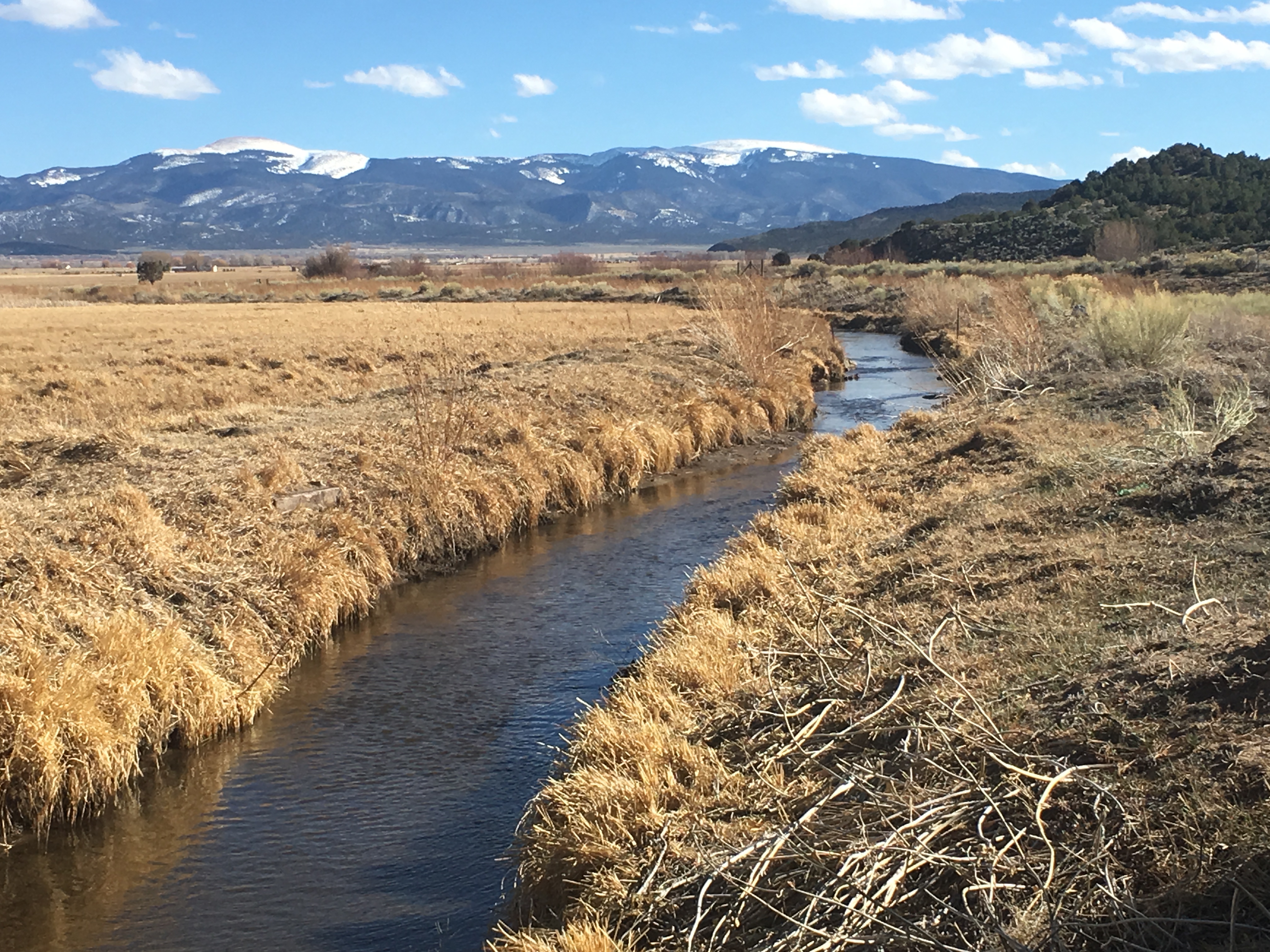
San Luis People’s Ditch March 17, 2018. Photo credit: Greg Hobbs