#OgallalaAquifer Summit 2024: Tackling Tough Water Issues — AgWeb.com

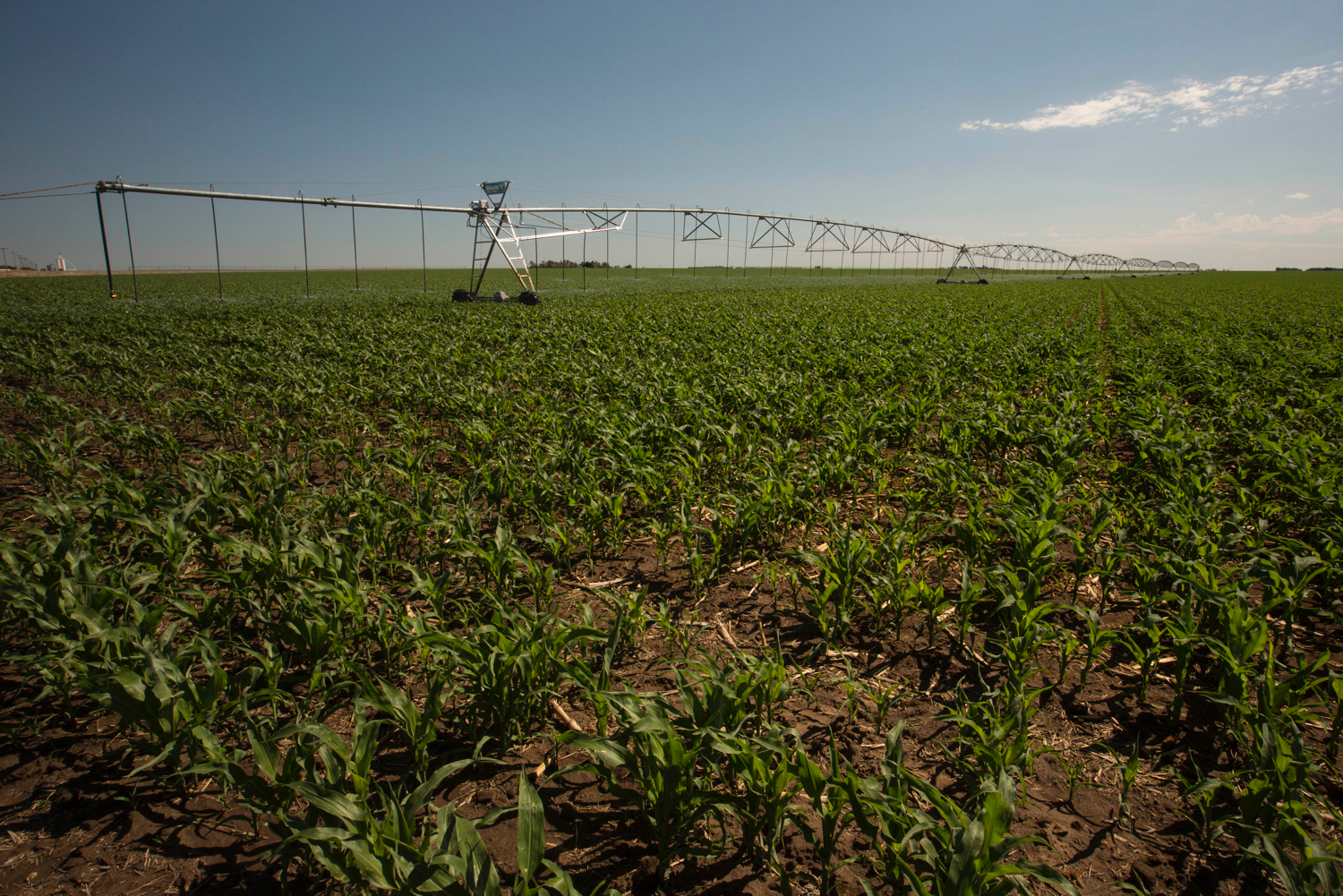
Center pivot sprinklers in the Arikaree River basin to irrigate corn. Each sprinkler is supplied by deep wells drilled into the High Plains (Ogallala) aquifer.

Click the link to read the article on the AgWeb.com website (Greg Henderson). Here’s an excerpt:

March 19, 2024

Seeking collaboration on solutions to conserve and extend the lifespan of vital water resources in the High Plains, the third Ogallala Aquifer Summit brought politicians and stakeholders from across the region this week to Liberal, Kansas.  Calling the Ogallala Aquifer “critical to the viability” of agriculture and maintaining historic economic growth, Kansas Governor Laura Kelly delivered the summit’s opening remarks by praising attendees for their work to address “one of the region’s most pressing issues.”

“Having a clean, stable water supply is critical to maintaining our way of life in all communities across Kansas, rural and urban alike,” Kelly said. “It’s critical to maintaining Kansas as we know it and love it.”

[…]

The impact from the Ogallala Aquifer is massive, with estimates that 95% of groundwater pumped from the aquifer each year is for irrigated agriculture, though it also supports livestock, businesses and municipal needs. The aquifer supports approximately $3.5 billion in crop production in Kansas. Throughout the summit attendees were reminded depletion of the aquifer is not a problem to be solved; it is a situation to be managed. Speakers emphasized that the region’s water resources would need constant management, technical innovation, financial and economic support and infrastructure changes…Economic analyses suggest that depletion of the aquifer could result in a $56 million annual loss for Texas and a $33 million loss for Kansas agriculture by 2050…

Ogallala Aquifer groundwater withdrawal rates (fresh water, all sources) by county in 2000. Source: National Atlas. By Kbh3rd – Own work, CC BY-SA 3.0, https://commons.wikimedia.org/w/index.php?curid=6079001

While crop irrigation accounts for a majority of the water use, the aquifer also supplies water for the region’s large livestock feeding operations. Those businesses are working to conserve water, too, says Joel Jarnagin, Cobalt Cattle Co. Thirty years ago Jarnagin estimates feedyards used “15 or 16 gallons of water,” per head per day. Cobalt Cattle Co., which operates six feedyards with a one-time capacity of 300,000 head, has averaged “10.5 to 11.7 gallons” water use per head, per day over the past four years.

Kansas Aqueduct route via Circle of Blue

The Community Collaborative Rain, Hail, and Snow Network “Precipitation Absurdity” Recruiting Drive — #Colorado Climate Center blog @ColoradoClimate

Up close shot of CoCoRaHS rain guage. Photo by Kristy Johnson. As seen at cocorahs.org.

Click the link to read the post on the Colorado Climate Center blog (Peter Goble):

March 26, 2024

It’s March, and we all know what that means. It’s time for everyone’s favorite tournament; March Ma… Well, let’s just say any time of year is a great time to avoid copyright infringement.

We all know about the NCAA’s 64 team, single elimination basketball tournament: March Madness. I want to talk about another tournament that happens this time of year: The CoCoRaHS Precipitation Absurdity tournament!

Let’s start with the basics: CoCo-what-now? CoCoRaHS is the shorthand we use to describe the “Community Collaborative Rain, Hail, and Snow Network.” It is a network made up of over 20,000community science volunteers across the United States, Canada, Puerto Rico, The Bahamas, and most recently, Guam. Each volunteer gives a few minutes of their time, and the cost of a CoCoRaHS-standard manual rain gauge, to submit precipitation measurements from their own backyard. These precipitation measurements are cataloged, and submitted via website or mobile app, and used to make beautiful maps of precipitation, hail, and snowfall across the country. For many observers, this practice becomes as integral a part of the morning routine as the first cup of coffee.

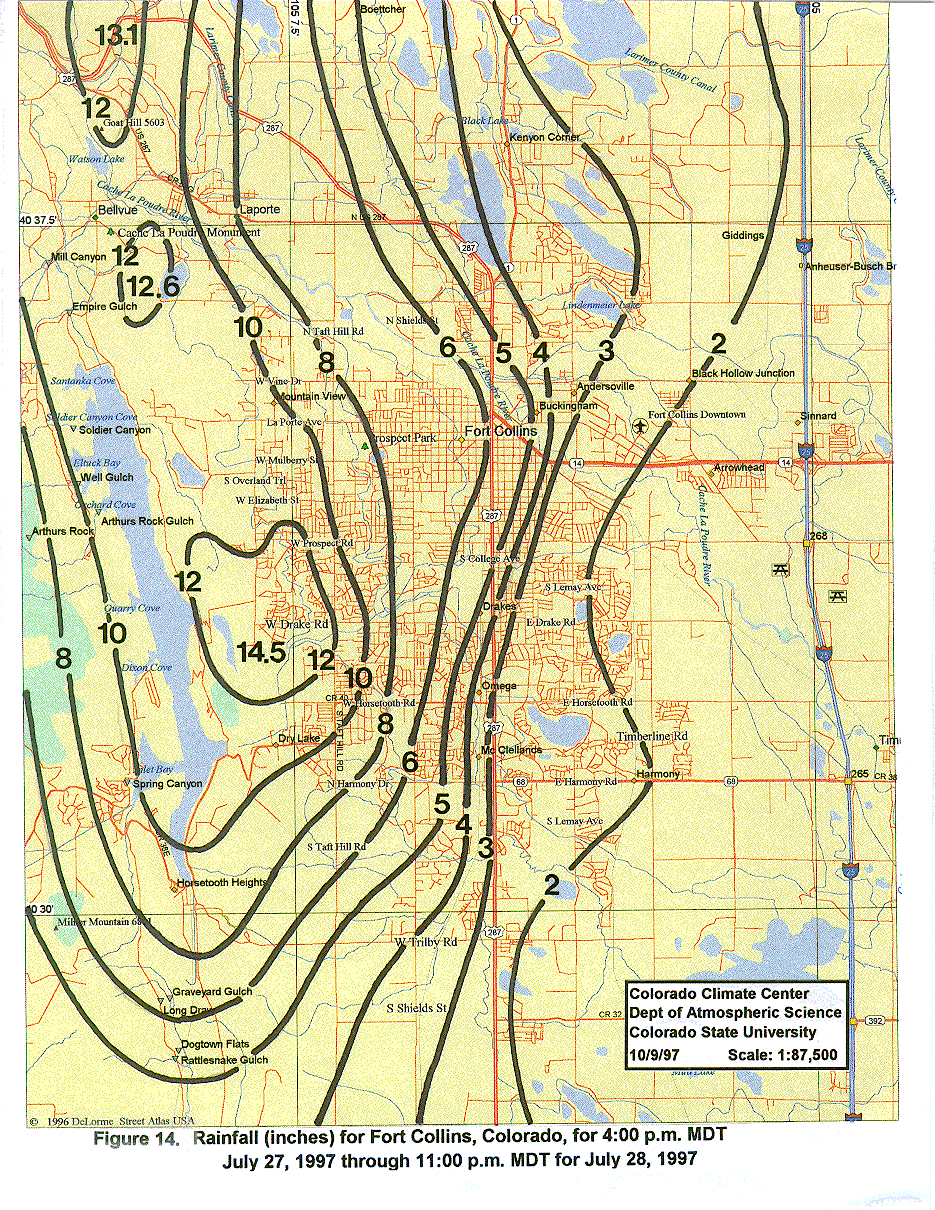
Why bother with these precipitation observations? Precipitation does not fall the same on all. Have you ever driven across town through a torrential downpour only to find the weather has been quiet at your house? These local variations in precipitation matter. CoCoRaHS was founded in response to the 1997 Fort Collins Flood. On the evening of July 28th, 1997, the east side of Fort Collins received 2-4” of precipitation; a vigorous thunderstorm to be sure, but part of western Fort Collins received 14.5”. This flood was not well warned and tragically killed five people.

Fort Collins Flood rainfall totals. Source: https://climate.colostate.edu/rain.html

The National Weather Service (NWS) has become the biggest power user of CoCoRaHS data. The measurements CoCoRaHS volunteers collect help the NWS validate forecasts, and in many cases, are used to either issue or confirm weather watches and warnings. The NWS is not the only beneficiary of these data. CoCoRaHS data are used by climate researchers, drought scientists, insurance adjusters, urban planners, emergency managers, and many more. All this to say, the simple act of measuring and reporting rain, hail, and snow may seem small or insignificant; but it is a community-strengthening endeavor.

The growth of this network over the years, and now decades, is amazing. CoCoRaHS started right here in Colorado (Fort Collins). The then Assistant State Climatologist, Nolan Doesken, assembled a team of high school interns to get a website up and running, and began recruiting rain gauge volunteers across the city. He never dreamed this project would go so far. Word of this program spread and eventually it became statewide. From there it spread to Nebraska, Wyoming, and New Mexico. By 2009 CoCoRaHS was in all 50 states. It has now expanded to two more US territories and Guam. Now over 20,000 strong, we are united under the common cause of better understanding weather and climate across the nation and beyond.

Now back to the tournament: If you’re somebody who enjoys the weather, is curious about how your location does for moisture, or just wants to help, I encourage you to sign up or learn more. There is no time like the present. CoCoRaHS has an annual competition between states to sign up the most volunteers (both in sheer numbers and per capita) every March. We used to call it “March Ma…” but now we call it “Precipitation Absurdity.” The winners get to hoist the “CoCoRaHS Cup” and carry bragging rights for the next year. Minnesota is running away with the contest this year for the fourth year in a row. I guess it’s true that Minnesotans do like to talk about the weather. Colorado is currently just shy of the top ten. We have a couple days left, and it’s not too late to make a play for a higher spot in the rankings. Please do consider signing up, or sharing the benefits with somebody you know.

Spring is always a fun time to be a CoCoRaHS volunteer in Colorado. We know almost anything can happen around here in spring: thunderstorms, hail, blizzards, or a nice, cold, soaking rainfall. CoCoRaHS volunteers have helped to catalog a record wet February day, a rogue snowband over Greeley, a large Denver area snowstorm with some “absurd” totals in the mountains, and a hail event-turned snow event. We are never quite sure what will happen next, but we do know it will keep us on our toes.

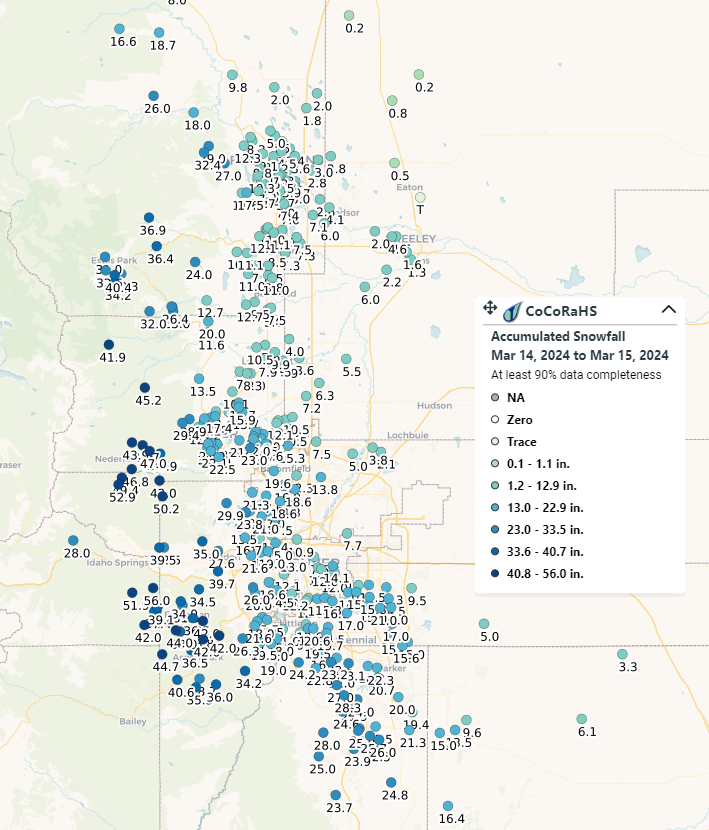
Snowfall totals in north-central Colorado: March 14 – 15, 2024. Credit: CoCoRaHS

CoCoRaHS is a fun and engaging way to learn more about your weather, help scientists and practitioners, and strengthen your community. We sincerely hope you will consider helping in this “Precipitation Absurdity” challenge and join us or tell others about us this week.

Upper #ColoradoRiver Basin States Approve the Implementation of the 2024 System Conservation Pilot Program — Upper Colorado River Commission #COriver #aridification

“New plot using the nClimGrid data, which is a better source than PRISM for long-term trends. Of course, the combined reservoir contents increase from last year, but the increase is less than 2011 and looks puny compared to the ‘hole’ in the reservoirs. The blue Loess lines subtly change. Last year those lines ended pointing downwards. This year they end flat-ish. 2023 temps were still above the 20th century average, although close. Another interesting aspect is that the 20C Mean and 21C Mean lines on the individual plots really don’t change much. Finally, the 2023 Natural Flows are almost exactly equal to 2019. (17.678 maf vs 17.672 maf). For all the hoopla about how this was record-setting year, the fact is that this year was significantly less than 2011 (20.159 maf) and no different than 2019” — Brad Udall

Click the link to read the release on the Upper Colorado River Commission website:

On March 4, 2024, the Upper Division States of Colorado, New Mexico, Utah and Wyoming acting through the Upper Colorado River Commission (UCRC) directed implementation of the 2024 System Conservation Pilot Program (SCPP). The 2024 program focuses on projects that support: innovations in water conservation, local drought resiliency and better understanding related to a potential Demand Management program. The 2024 SCPP was developed based on input from water users, water management organizations, and previous SCPP participants. The Commission recommended 115 projects move forward for implementation. These projects will conserve approximately 70,000 acre-feet of Colorado River water across the four Upper Division States, and include participation from Tribal, agricultural, industrial and municipal water users. The SCPP program is funded by the Inflation Reduction Act and is a unique collaboration between the Bureau of Reclamation, the four Upper Division States acting through the UCRC, Upper Basin Tribes, water users, and other stakeholders. The conservation projects are expected to be implemented beginning in April 2024.

Anne Castle – “The SCPP is a tremendous example of federal – state – tribe – water user collaboration resulting in partnerships and water conservation that improve the Colorado River system. This program represents one of the tools in the Upper Basin toolbox that can be used to contribute to a more sustainable river system. Many thanks to the Reclamation, UCRC, Tribes, water users, and State staff for the ongoing efforts that allow us to take this important step together.”

Rebecca Mitchell – “System conservation is challenging, but we have learned a lot and have used our experiences to build a better program this year. Water users in Colorado are using the SCPP to explore and develop innovative ways to prepare for a drier future. I am hopeful that the lessons learned this year will provide new tools that will support Colorado water users in the future.”

Estevan Lopez – “The water conservation actions being implemented in the Upper Division States are significant, especially in light of the uncertainty our water users face every year due to hydrologic shortages. The partnerships and tools being developed through the SCPP will help us manage Colorado River operations as climate change impacts our future water supplies. Some SCPP projects will provide a unique opportunity to explore the feasibility of a potential Demand Manage program. ”

Gene Shawcroft – “Utah water users have stepped up once again in 2024 to support the Colorado River system through robust participation in the System Conservation Pilot Program (SCPP). Through this year’s SCPP projects, the Colorado River Authority of Utah looks forward to learning more about demand management feasibility and innovative water conservation strategies in our state. I am grateful to the UCRC staff and consultants, Authority staff and the Utah Division of Water Rights staff for standing-up this important effort.”

Brandon Gebhart –“Many Wyoming water users are developing new approaches and tools to sustain their operations in the face of a future with additional water supply uncertainty. They recognize SCPP as a tool to provide resources and information to help build innovative and creative solutions to adapt to that uncertain future. I applaud the work and collaboration between Wyoming water users and stakeholders, Wyoming SEO staff, Reclamation, and UCRC staff to improve the program for 2024.”

#Colorado joins multi-state coalition to defend EPA #methane rule — Colorado Politics #ActOnClimate #KeepItInTheGround

Interested in methane and other greenhouse gas emissions near you? Check out http://climatetrace.org, which allows you to see emissions from oil and gas fields, large individual facilities, and more. You can also break it down by industry.

Click the link to read the article on the Colorado Politics website (Scott Weiser). Here’s an excerpt:

Battle lines have been drawn in a fight between oil-producing red states and environmentally-driven blue states over a new regulation by the Environmental Protection Agency…Led by the attorneys general of Texas and Oklahoma, 26 states are suing the EPA over a final rule published March 8 that, in part, sets new regulations for existing methane infrastructure. Twenty other states, including Colorado and the District of Columbia, filed a motion to intervene in the case in support of the new federal regulation Tuesday…

Colorado Attorney General Phil Weiser said the new rule must be defended in a Monday news release announcing the state’s intervention in the Texas case.

“These protections must remain in place at the federal level for effective oversight of methane emissions from surrounding states; that’s why we are committed to defending the federal methane rule,” Weiser said in the release…

The new rule from the EPA regulates methane emissions from both new sources and existing infrastructure, something the EPA has never done before. This raises the question of whether the EPA has legal authority to expand its statutory mandate without asking Congress for permission. The “major questions” doctrine states that federal agencies must have explicit permission to newly regulate politically and economically significant issues, rather than assuming they have unbridled regulatory authority.

After lagging earlier this winter, #Colorado’s #snowpack recently measured 109% of the 30-year norm, setting up the potential for another summer with healthy #water supplies — Western Governors’ Association

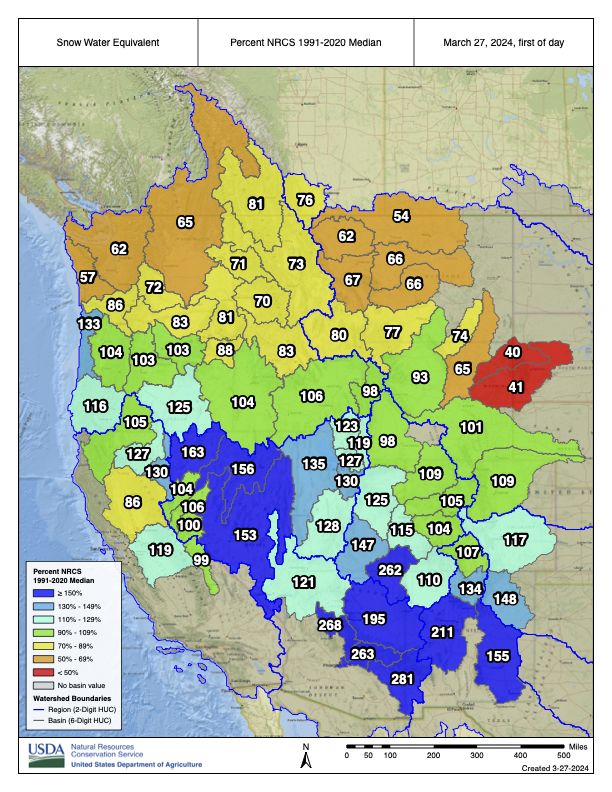
Westwide SNOTEL basin-filled map March 27, 2024 via the NRCS.

Click the link to read the article on the Western Governors’ Association website:

March 21, 2024

Thanks to a snowy February and some heavy early spring storms, much of the west’s snowpack has surpassed the historical averages.

After lagging earlier this winter, Colorado’s mountain snowpack recently measured 109% of the 30-year norm, setting up the potential for another summer with healthy water supplies.

“We’re sitting pretty right now,” National Weather Service meteorologist Caitlyn Mensch said. “We’re above 100% everywhere, which is positive to see as we head into spring.”

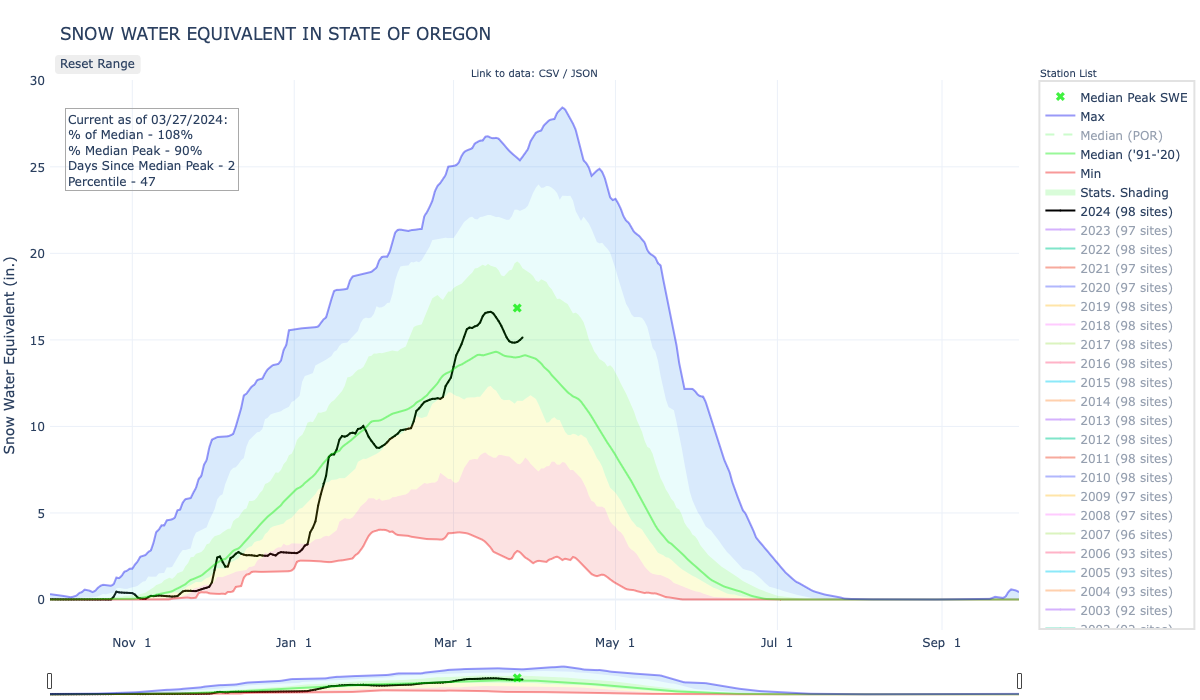
The latest storm also boosted Oregon’s snowpack to 109% of normal and continued to decrease drought levels to the lowest they’ve been since 2019.

In particular, Mt. Hood, Oregon picked up about 6-8 feet of new snow between February 26 and March 4. In that window, many areas saw massive increases in snowpack levels, going from 70-89% of their normal snowpack to over 100%. 

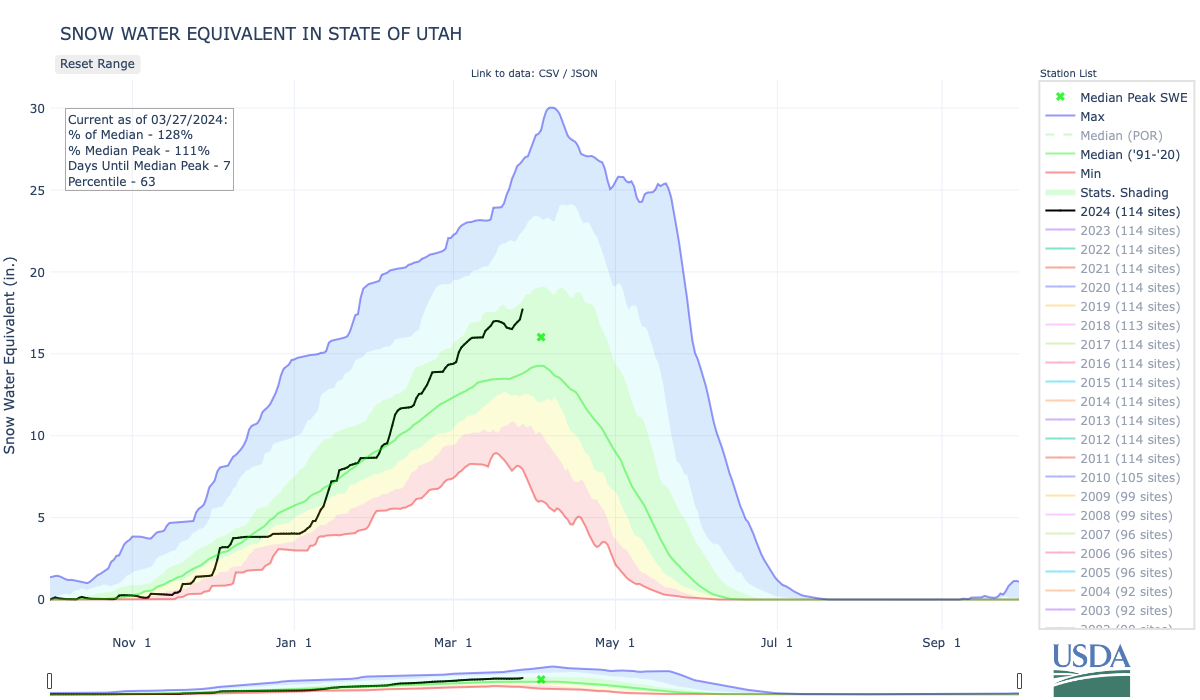
Utah’s snowpack is also looking quite good with the statewide snowpack currently at 124% of the 30-year median, according to the Utah Snow Survey, which is celebrating its 100th anniversary tracking snowpack in the state.

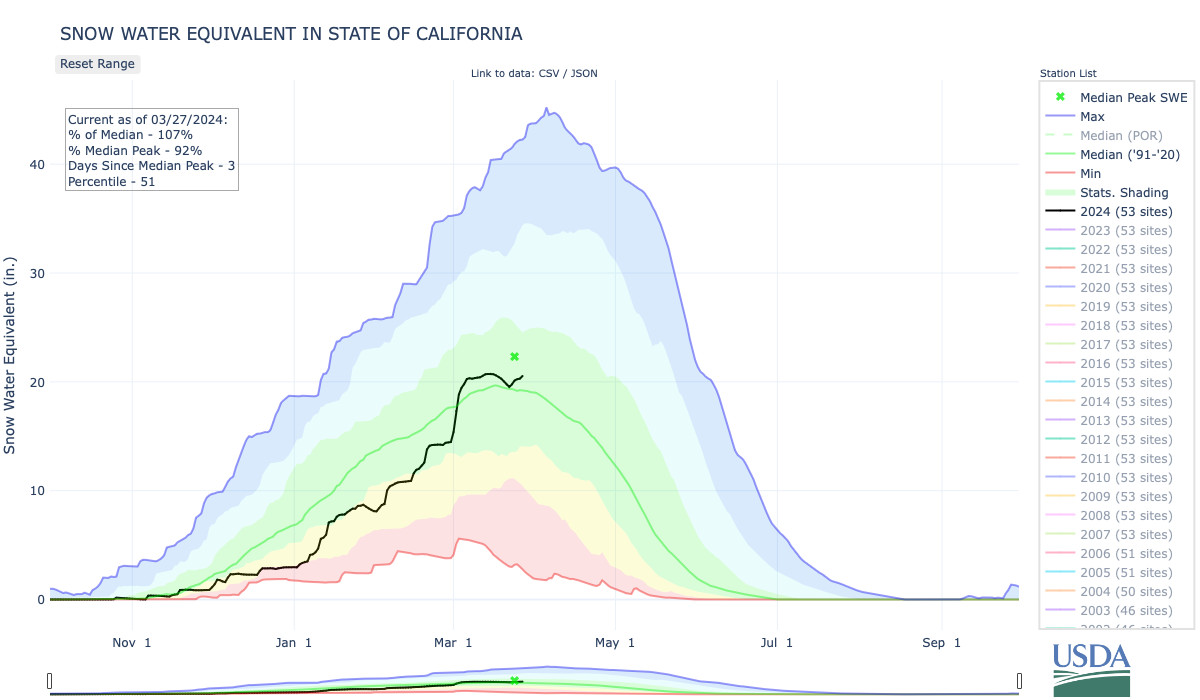
The California snowpack is in a similarly positive position, having surpassed the historical average for this time of year. Meteorologists expect that a storm forecast for this weekend could deepen it even more, with the peak coming in mid-April before melting intensifies. 

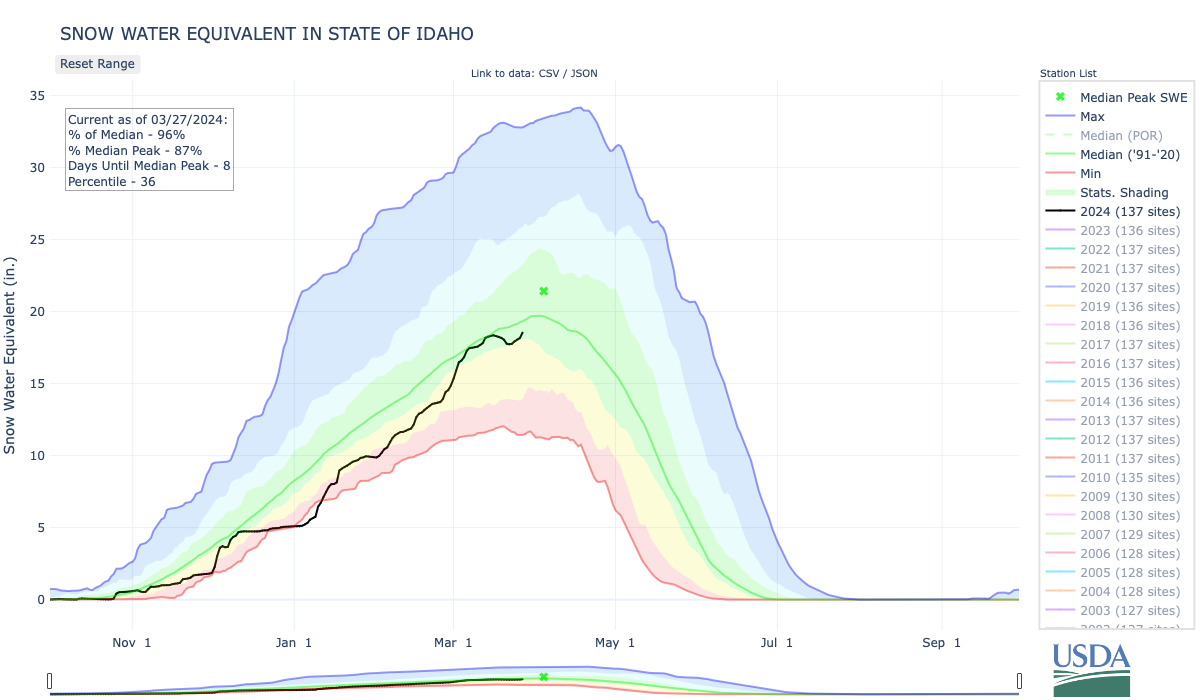
While snowpack in Idaho’s northern areas remains below 30-year medians partly because of the dominant El Nino weather pattern that pushes Pacific storms south, a wet February and early March have boosted snowpacks in much of southern Idaho to near-normal and above-normal levels.

“Despite the varying snowpack levels in the state this winter, a lot of the reservoir storage looks good across the state,”  said Andrew Paxton of the NRCS Idaho Snow Survey staff.

Water volume in the Upper Snake reservoir system is about 120% of the long-term median, said Jeremy Dalling, water operations civil engineer with the U.S. Bureau of Reclamation Upper Snake Field Office. Natural flows are good.

Even Montana, which has experienced an extremely dry winter, got some relief from the early spring storms. The Gallatin basin recorded precipitation levels 113% of normal, the Madison basin saw levels 147% of normal, and the Upper Yellowstone saw levels 120% of normal for the month.

The #Colorado Water Conservation Board Launches 2024 Program to Transform Colorado’s Turf Landscape

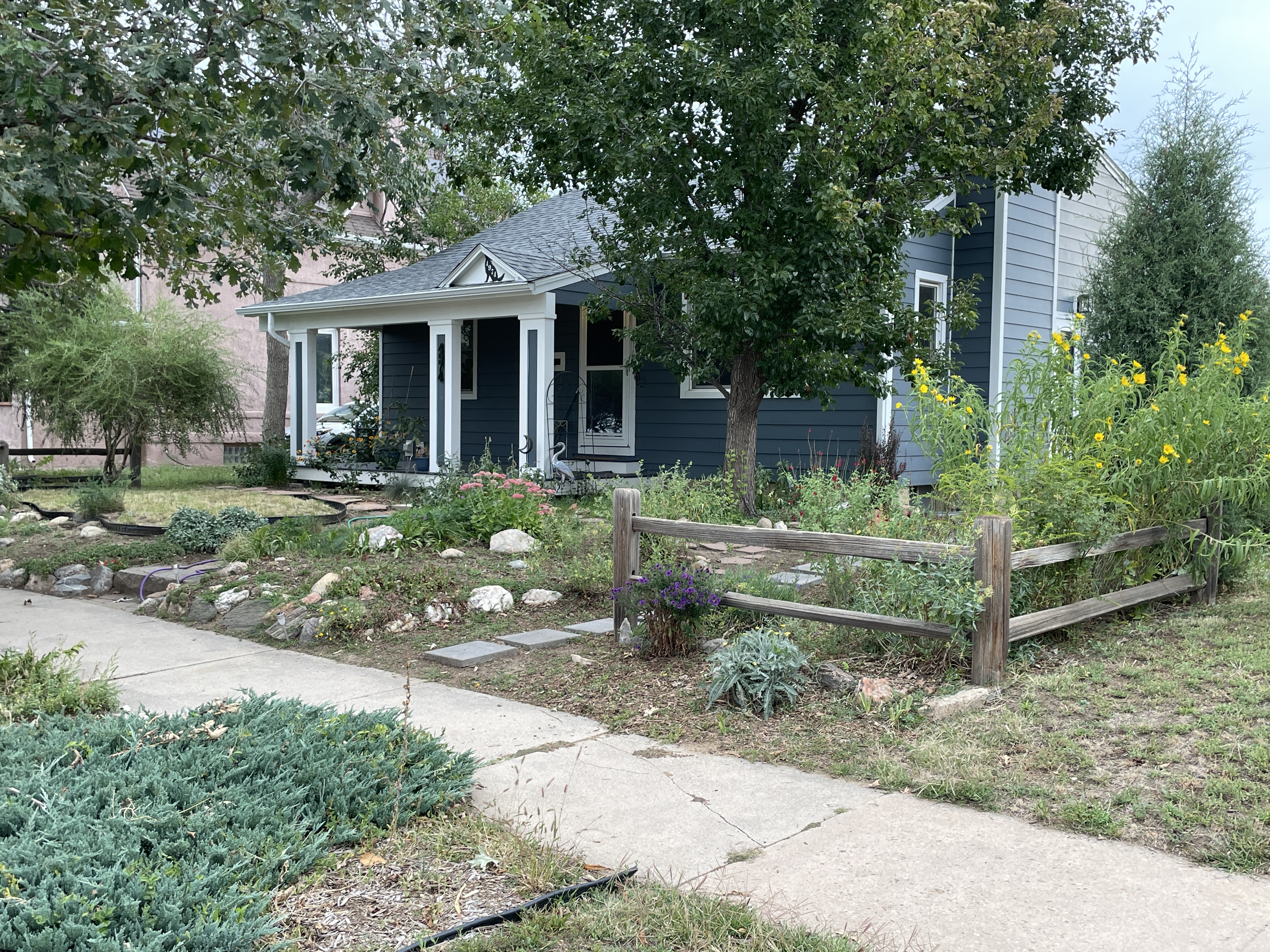
Mrs. Gulch’s landscape September 14, 2023.

Click the link to read the article on Governor Polis’ website:

March 26, 2024

Today, Governor Polis and the Colorado Water Conservation Board (CWCB) announced the launch of the second year of Transformative Landscape Change (TLC) Challenge program, which challenges local communities to reimagine their public spaces and embrace waterwise landscaping. The effort, a partnership with the nonprofit Resource Central, is designed to convert water-intensive landscapes into climate-appropriate, low-water-use, and attractive spaces.

“Protecting our precious water resources is critical to ensuring a strong future for Colorado and our economic industries like agriculture and outdoor recreation. This challenge will help innovate, conserve water in our communities, and promote stewardship around the state,”said Governor Jared Polis.

“Water conservation continues to be an important and comparatively cost-effective tool for increasing state and local water security and resilience,” says Russ Sands, CWCB Water Supply Planning Section Chief. “The TLC Challenge will help communities replace up to 2,500 square feet of nonfunctional turf with the types of low-water landscape plants that better serve our communities in hopes that it can inspire larger turf replacement efforts.”

The CWCB and Resource Central worked on an earlier TLC Challenge with three communities across Colorado in 2023 to transform public spaces and inspire communities to install low-water plants instead of high-water-use turf. This round will expand the TLC Challenge and increase the number of projects accepted to increase the impact. Eligible entities include local governments and municipal water providers. The funding is not available to residential or commercial property owners.

The effort complements CWCB’s 2023 Turf Replacement Program efforts, which provided funding to 50 eligible entities in Colorado to reduce nonfunctional turf and increase sustainable landscapes.

Eyes across the state are on sustainable landscape development efforts like this. Governor Polis signed Senate Bill 24-005 on Friday, March 15, which limits the installation of nonfunctional turf on commercial, industrial, and institutional properties, state facilities, and spaces, including medians and parking lots.

“But the hard work of removing nonfunctional turf where it’s already been installed also needs to continue,” says Sands.

“Replacing turf with waterwise landscapes helps cities conserve water supplies, meet the vision of the Colorado Water Plan, and maximize the ecosystem benefits of our landscapes,” said Lauren Ris, CWCB Director.

The Colorado Water Plan projects up to 740,000 acre-feet of future municipal water needs per year.

“To reduce our water demands, Colorado needs a suite of conservation tools, including water conservation programs and water pricing structures that help shape what our cities look like and how we develop,” says CWCB expert Jenna Battson. “Having land use codes and ordinances that align with these efforts is critical because the last thing we want is for codes to reinforce installing the same types of high-water vegetation that we are paying to remove.”

Converting water-intensive landscapes to waterwise spaces allows everyone to be part of the solution. CWCB and Resource Central are working together through the TLC Challenge to help inspire responsible landscape development and increase engagement with water-saving practices.

Interested in applying for the TLC Challenge?

  • The competitive application window is open now and will close on June 1, 2024. Awardees will be evaluated based on the merits of their application. After selected recipients are notified, they will work with Resource Central to implement projects in the late summer of 2024 or early spring of 2025.
  • Eligible entities include local governments and municipal water providers. The funding is not available to residential or commercial property owners. Resource Central will work with the selected applicants to design the new space, remove and compost the turf, and provide customized Garden In A Box plants as well as irrigation and maintenance planning for the new landscape.
  • Applications that demonstrate potential water savings, public benefits that include equity, and educational components will be more competitive. By prioritizing project proposals that demonstrate strong community engagement strategies, well-defined goals, and measurable outcomes, CWCB and Resource Central can ensure the biggest impact with the funding. Communities without an existing turf replacement program will be prioritized to help increase local examples of landscape transformations; however, all eligible applicants are encouraged to apply.