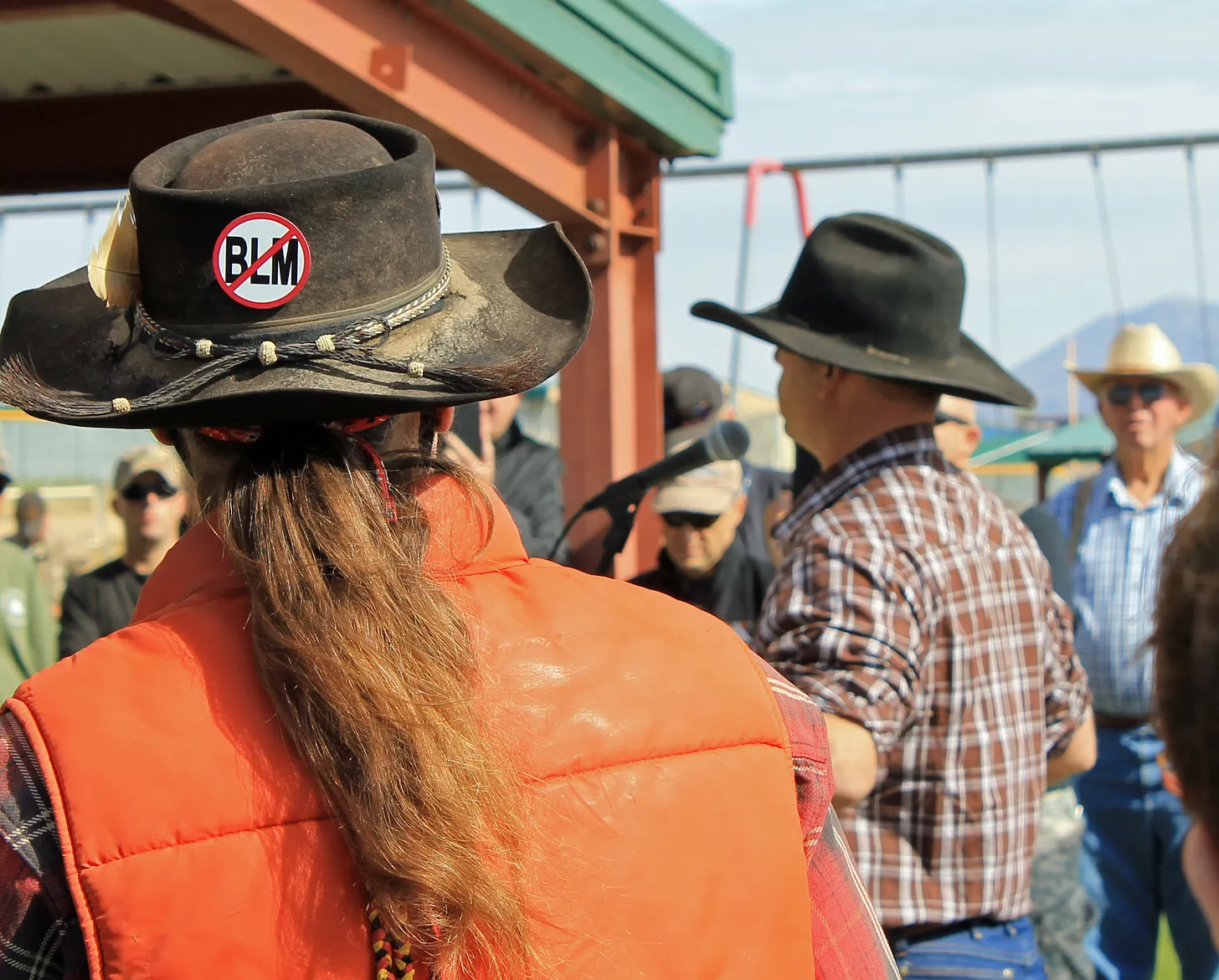
An anti-BLM sticker (referring, presumably, to the federal land agency, not the Black Lives Matter movement) at another Phil Lyman rally against “federal overreach” and motorized travel closures in southeastern Utah back in 2014. Photo credit: Jonathan P. Thompson/The Land Desk
INANE ACT: Utah State Rep. and gubernatorial candidate Phil Lyman and Lynn Jackson, a candidate for Lyman’s seat in the legislature, turn a protest of the proposed closure of Arch Canyon to motorized vehicles and ban on target shooting within Bear’s Ears National Monument into a grievance and victimhood campaign rally and a lot of whining about “federal overreach.”
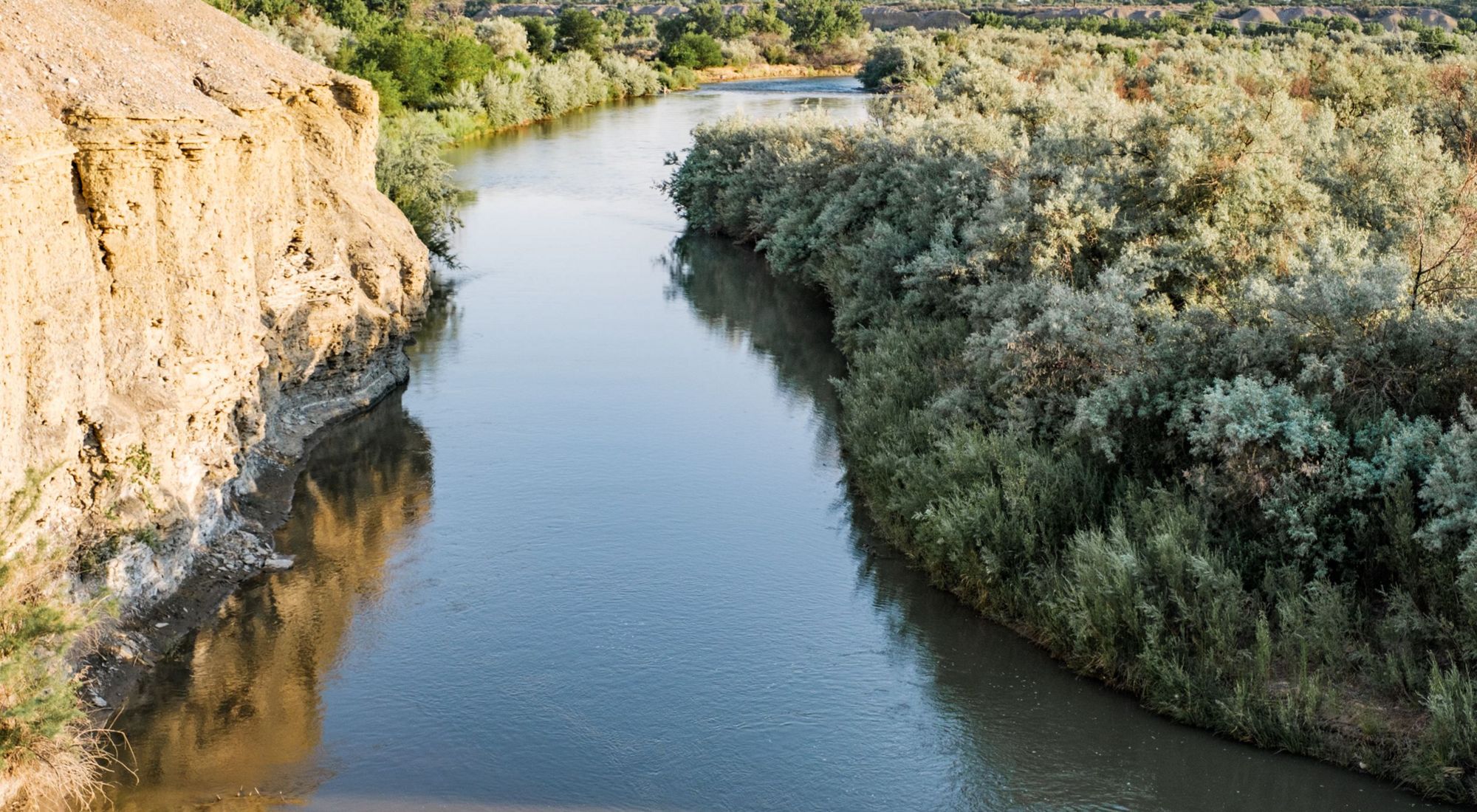
CONTEXT: Bears Ears National Monument is rightly named after the two Wingate-sandstone capped buttes that rise up from the middle of the 1.3-million-acre swath of public land in southeastern Utah. Yet if I were to pick a heart of the monument, I’d be more likely to lean toward Arch Canyon, which starts on Elk Ridge near the buttes and slices a deep, 12-mile-long gorge through Cedar Mesa before joining up with Comb Wash under a grove of tall cottonwoods. My family and I used to camp under those trees when I was a kid, and we’d hike up the canyon, following the perennial stream that was alive with flannelmouth suckers, tadpoles, and water striders, gazing up at cliff dwellings nestled in tiny alcoves high up on the sheer, desert varnish-streaked cliffs.
Back then cattle were allowed to graze in the canyon, trampling the stream banks and taking refuge in — and pooping on — an Ancestral Puebloan site near the canyon’s mouth. Thankfully, a hard fought legal battle eventually got the cattle removed from Arch Canyon and a few other nearby canyons. But there is also a road up the canyon bottom, and on those long-ago hikes we’d occasionally encounter a jeep or Land Cruiser. The road remains, allowing OHVs to roar eight miles up the canyon, crossing the creek multiple times in the process.
The draft Bears Ears National Monument management plan proposes closing Arch Canyon to motorized vehicles to protect the riparian corridor and the natural and cultural sites there, and because it just makes sense to do so. It’s the only significant motorized closure under the plan’s preferred alternative, meaning about 800,000 acres would remain open to motorized travel on designated routes. The plan would also ban target shooting throughout the monument. There would be almost no changes to the existing grazing regime.
Basically, land managers and the Bears Ears Commission are looking to close an eight-mile dead-end road to protect a spectacular canyon, one of the area’s only perennial streams, and imperiled native fish, while leaving hundreds of miles of other roads and trails open to OHVs. And they want to nix recreational shooting to prevent people from shooting up landforms and petroglyphs — hunting will still be allowed.
Not only is this Trump-esque rhetoric dangerous, but it’s also inaccurate. It willfully ignores the fact that the proposed management plan is itself a deep compromise, leaving out many of the protections Indigenous and environmental advocates want. In fact, the preferred alternative is remarkably unrestrictive and, some would say, miserably fails in its mission to protect this special landscape.
But admitting that land managers are far from overlords, and instead are bending over backwards to appease even the uncompromising likes of Lyman and Jackson, wouldn’t fit with Lyman’s preferred narrative of grievance and victimhood. Nor would it rile up his similarly minded base. And in the end this new breed of Republicans is far more interested in riling than in governing; in inciting anger and obstruction rather than in seeking solutions.
Could global heating actually increase precipitation in the Colorado River Basin? Perhaps, according to a new study out of the University of Colorado, and a forecasted uptick in snow and rain should partially offset the effects of warming temperatures on river flows. The researchers say that’s because “precipitation has, and will likely continue to be, the main driver of the river flow at Lee Ferry.”
“We find it is more likely than not that Lee Ferry flows will be greater during 2026-2050 than since 2000 as a consequence of a more favorable precipitation cycle,” said Martin Hoerling, the paper’s lead author, in a press release. “This will compensate the negative effects of more warming in the near term.”
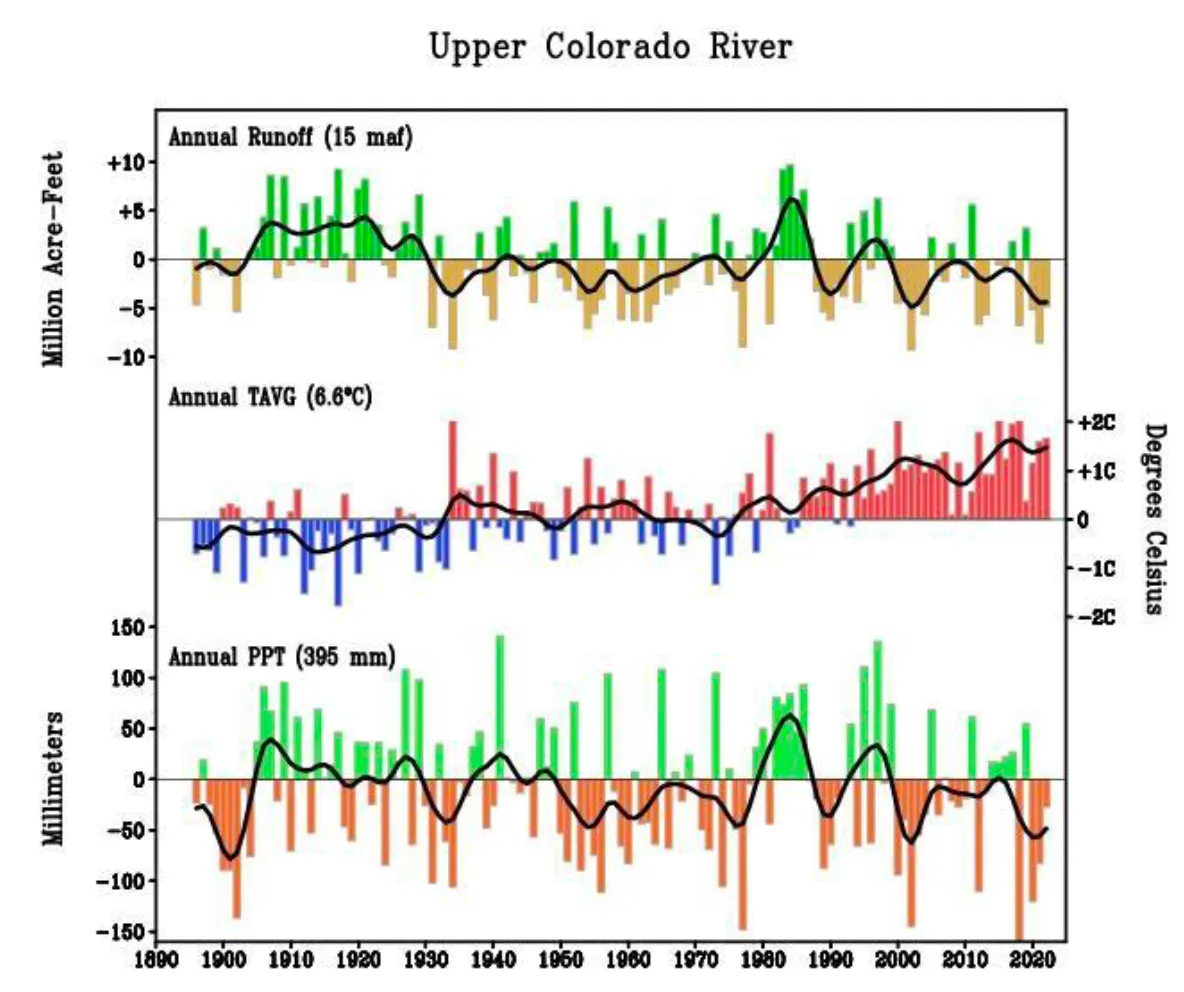
The 1896–2022 departure time series of water-year Lee Ferry flow (top, maf), and Upper Colorado River Basin averaged temperature (middle, °C) and precipitation (bottom, mm). Departures are relative to the entire period mean (values indicated in the upper left).
This relatively rosy finding is based on a suite of climate models, including ones from the International Panel on Climate Change, that forecast a 70% chance of increased precipitation in the Upper Colorado Basin in coming decades. But water managers probably shouldn’t abandon efforts to cut consumption on the River just yet: 70% isn’t exactly a sure thing; the researchers acknowledge that there’s also a chance that precipitation could stay as miserably low as it has been for the past two decades, or even decline.
And Brad Udall, a CU climate scientist who was not involved in the study, told KUNC’s Alex Hager that he has a bit of “unease” regarding the projections, adding that modeling future precipitation is filled with uncertainty. Temperature modeling, meanwhile, uses different methods and is therefore more reliable: It’s going to keep getting warmer.
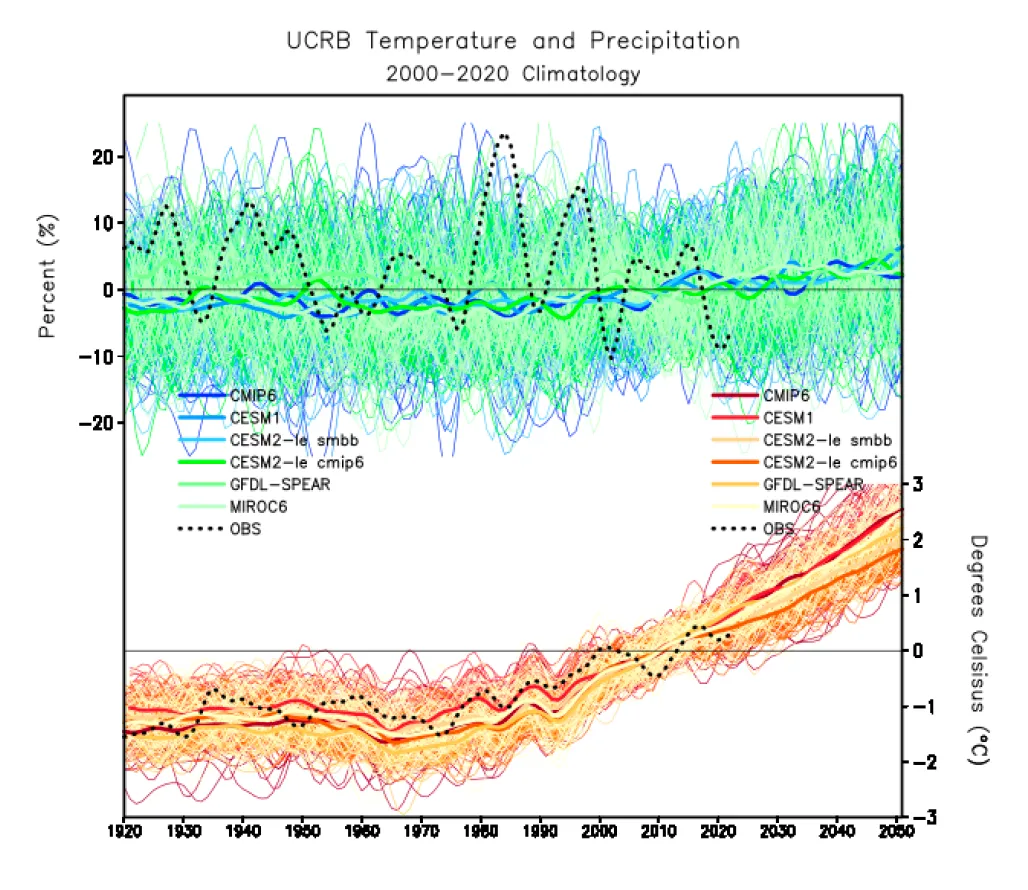
Time series of 1920–2050 Upper Colorado River Basin precipitation departures (%, top) and surface temperature departures (°C, bottom). Shown in the lighter curves are the individual member simulations of the 38 CMIP6 model simulations, and the 220 members from the 5 different large ensemble simulations. Departures are relative to a 2000–2020 reference. Observed departures for 1920–2020 are shown in dotted black curve. All curves smoothed with a 9-point running-mean.
And those higher temperatures can erase some of the gains from higher precipitation levels, as this winter and spring demonstrated. Even though there was a normal amount of snowfall in many places, this spring’s runoff is expected to be below normal thanks to a rapid snowmelt.
As the forecast weather warms up again and tributary flows are forecast to increase, the Bureau of Reclamation has scheduled a decrease in the release from Navajo Dam from 500 cubic feet per second (cfs) back down to 350 cfs for Monday, May 13th, at 4:00 AM.
Releases are made for the authorized purposes of the Navajo Unit, and to attempt to maintain a target base flow through the endangered fish critical habitat reach of the San Juan River (Farmington to Lake Powell). The San Juan River Basin Recovery Implementation Program recommends a target base flow of between 500 cfs and 1,000 cfs through the critical habitat area. The target base flow is calculated as the weekly average of gaged flows throughout the critical habitat area from Farmington to Lake Powell.
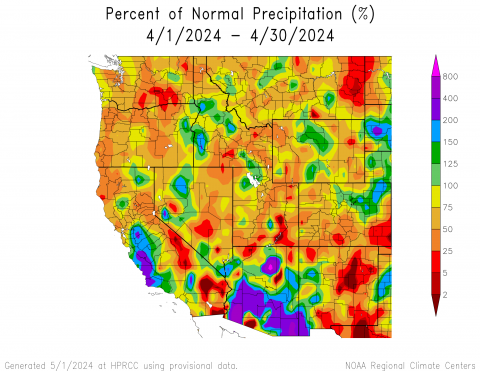
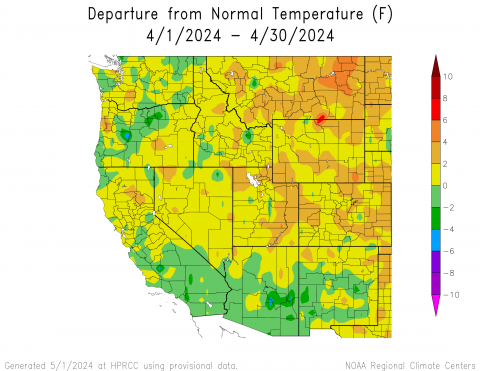
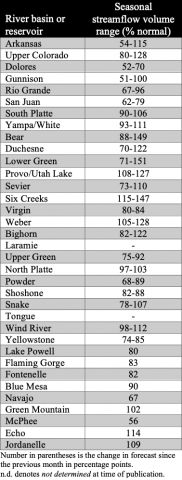
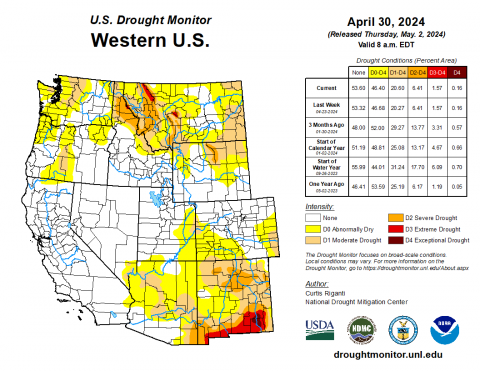
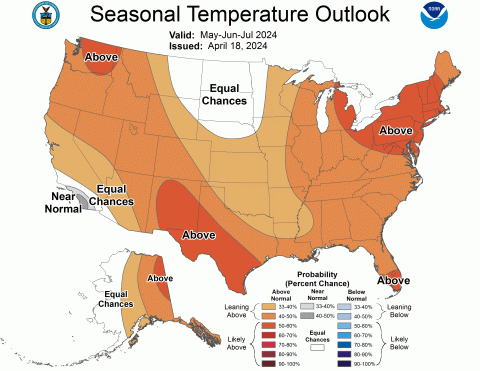
The region experienced generally below normal precipitation and above normal temperatures in April. May 1st snow-water equivalent (SWE) was near-normal in Colorado (92%) and Utah (103%) and slightly below normal in Wyoming (88%). Seasonal streamflow volume forecasts are mostly below to near-normal in the region with above normal forecasts in northern Utah. Regional drought conditions improved and cover 10% of the region. El Niño conditions are transitioning to neutral-ENSO conditions and there is an 83% chance of neutral-ENSO conditions for May-July. The NOAA seasonal temperature outlook for May-July suggests an increased probability of above normal temperatures for the majority of the region.
April precipitation was generally below normal across the region with large swathes of above normal precipitation in northern Utah around the Great Salt Lake, north and south-central Wyoming, and from the Front Range to northeastern Colorado. Areas of less than 25% of normal precipitation occurred in southeastern Utah and southeastern Colorado with small pockets of less than 2% of normal precipitation in Emery and Wayne Counties in Utah as well as the northern Lake Powell region, and Baca and Prowers Counties in Colorado. Small pockets of more than 150% of normal precipitation occurred west of the Great Salt Lake and in Wayne County in Utah, east of the Denver Metro in Adams and Elbert Counties in Colorado, and in Sweetwater County in Wyoming. A large area of more than 150% of normal precipitation occurred in northeastern Colorado. Large areas of much-above (top 10%) and small areas of much-below (bottom 10%) normal precipitation for the month of April were observed in Colorado.
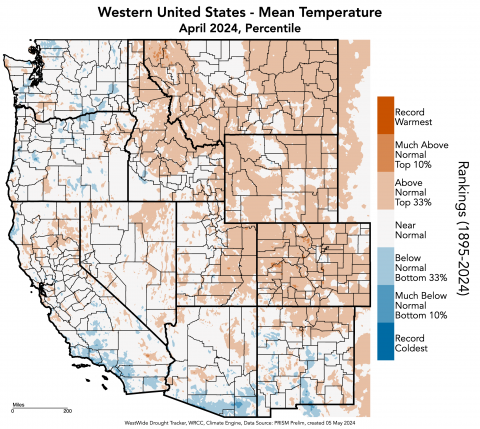
Regional temperatures were slightly above (0 – 2°F) to above (2 – 4°F) normal in April. Small pockets of slightly below (-2 – 0°F) normal temperatures occurred mostly in central Utah and southern Colorado. Small pockets of above (4 – 6°F) normal temperatures occurred in Laramie and Sheridan Counties in Wyoming, with a pocket of 6 – 8°F above normal temperatures in Sheridan County. Small areas of much-above (top 10%) normal temperatures for the month of April were observed in Colorado.
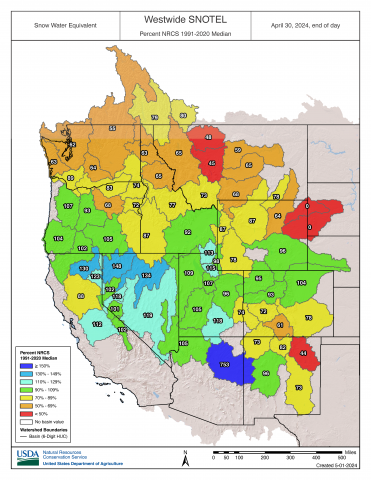
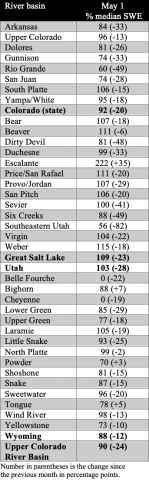
Regional snowpack ranged from much-below (<50%) normal conditions in northeastern Wyoming to above (110-129%) normal conditions in northern and southern Utah. Below normal conditions occurred in northern and western Wyoming and southern Colorado. Near-normal conditions occurred throughout most of Utah, southeastern Wyoming, and northern Colorado. As of May 1st, statewide percent median snow-water equivalent (SWE) was 92% in Colorado, 103% in Utah, and 88% in Wyoming. The Escalante Basin in Utah had the highest percent median SWE at 222% by end of day on April 30. The basins with the lowest percent median SWE were the Belle Fourche and Cheyenne Basins at 0% since they melted out. Peak SWE was observed on April 9 for Colorado (16.7 in), April 2 for Utah (18.8 in), and April 11 for Wyoming (16.2 in).
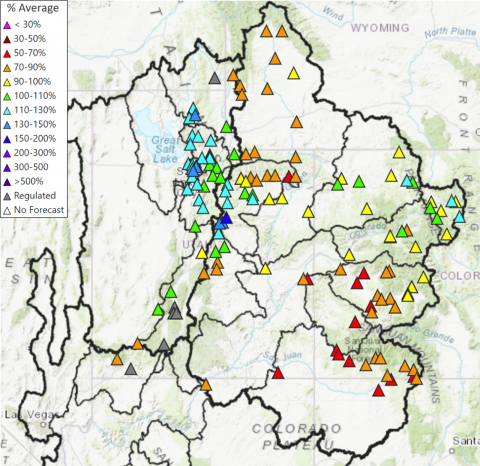
Regional April-July streamflow volume forecasts are mostly below (70-89%) normal to near-normal, with forecasts of 50-69% of normal streamflow in northeastern Wyoming including the Powder and Cheyenne Basins, according to the NRCS, and at many sites in southwestern Colorado including the San Juan, Gunnison, and Upper Colorado-Dolores Basins, according to the CBRFC. There are above (110-129%) normal streamflow forecasts for the basins surrounding the Great Salt Lake, with CBRFC sites forecasting 130-150% of normal streamflow in the Lower Bear, Weber, and Jordan Basins, as well as one site in the Lower Green Basin with a forecast of 150-200% of normal streamflow. The forecast for the inflow to Lake Powell is 80% of average, which is down 9% from the April 1st forecast.
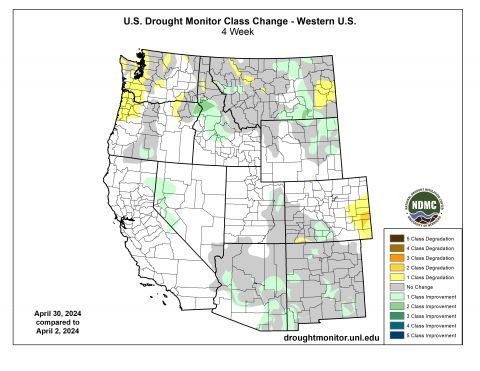
Regional drought conditions improved in April and now cover 10% of the region, a 2% decrease in drought coverage since the end of March. Severe (D2) drought improved in northeastern Wyoming and moderate (D1) drought improved in south-central Colorado, while D1 drought developed in southeastern Colorado.
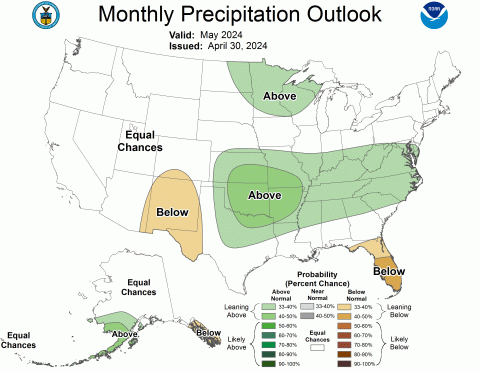
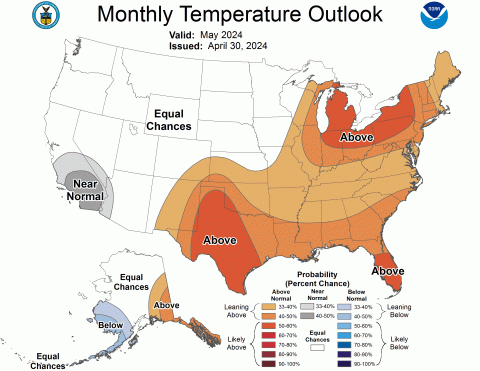
As of mid-April, El Niño conditions are transitioning to neutral-ENSO (El Niño Southern Oscillation) conditions in the Pacific Ocean. There is an 83% chance of neutral-ENSO conditions by May and a 49% chance of La Niña conditions developing by July. The NOAA precipitation and temperature outlooks for May suggest an increased probability of below (33-40%) normal precipitation for southern Colorado and above (33-40%) normal temperatures for southeastern Colorado. The NOAA seasonal precipitation and temperature outlooks for May-July suggest an increased probability of below normal precipitation for southeastern Utah and a majority of western and southern Colorado, and above normal temperatures for almost the entirety of the region with 40-50% above normal conditions for all of Utah, western and southern Wyoming, and western, central, and southern Colorado.
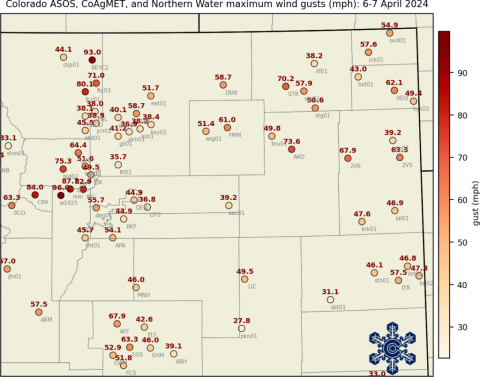
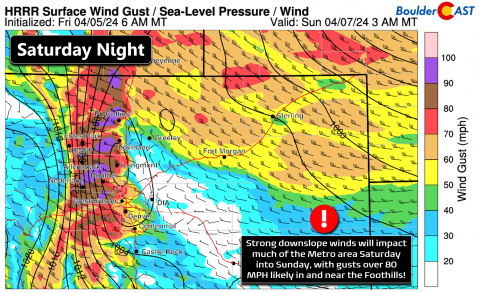
Significant April weather event: Northern Colorado windstorm. An exceptionally strong storm moved through northern Colorado from April 6-7. During this period, strong and destructive winds affected the mountains, foothills, and northeastern plains. Wind speeds in the Front Range mountains and near the foothills peaked between 70 to 95 mph, with the highest recorded gust reaching 97 mph at the NCAR Mesa Lab in Boulder and a close second of 96 mph in Coal Creek Canyon in Jefferson County. Across the northeastern plains, the most intense winds occurred along and north of a line extending from Denver to Fort Morgan to Akron, with wind gusts of 60 to 80 mph. Numerous instances of downed trees, power poles, and minor damage were reported in areas with the strongest winds. Xcel Energy said over 155,000 customers experienced power outages at the height of the storm from a combination of proactive public safety shutoffs and power outages caused by damage from the high winds, with most of these occurring in and around the Denver Metro.
Here are the locations that saw the highest wind gusts from April 6-7, according to NWS:
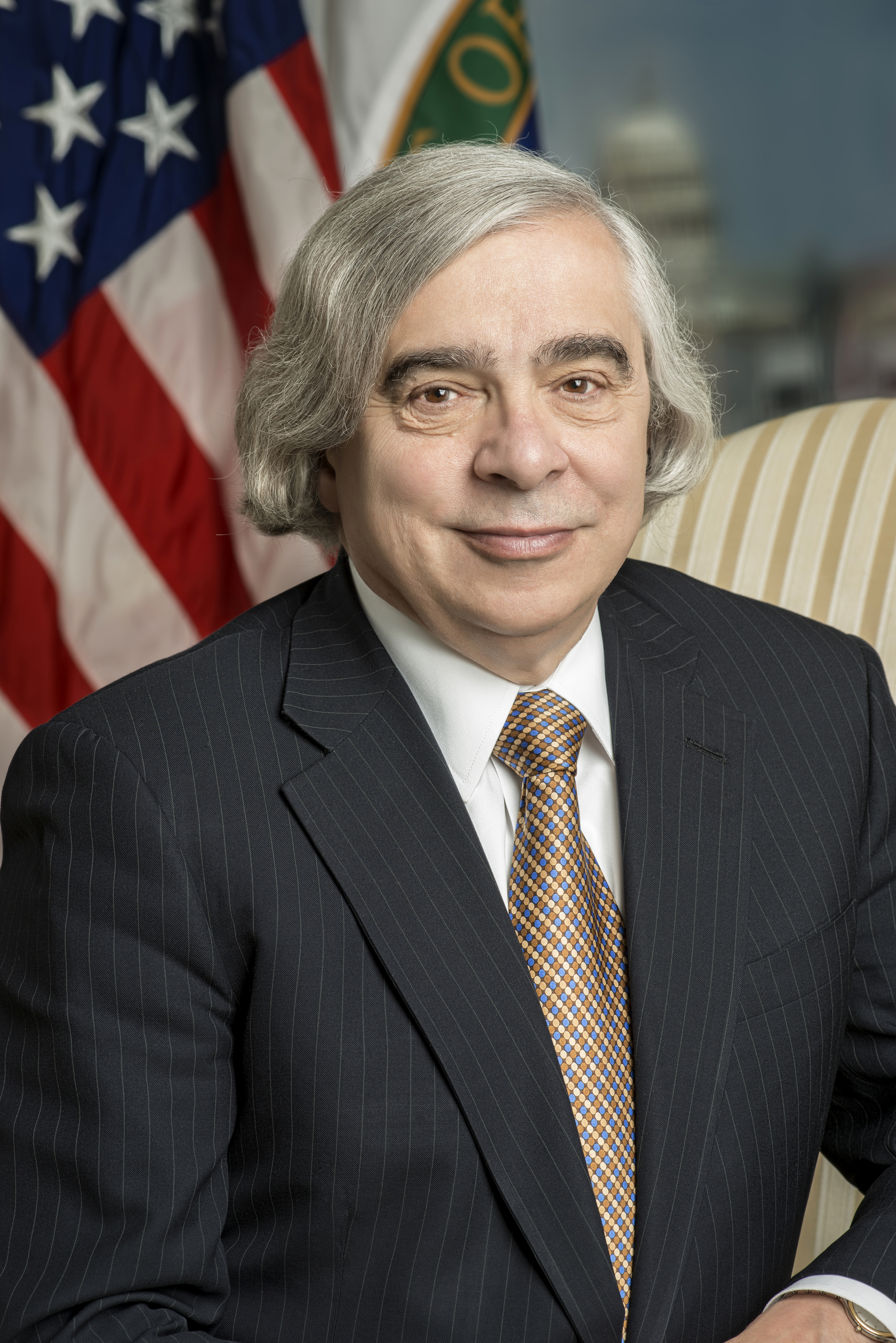
Official photograph of [former] United States Secretary of Energy Ernest Moniz. By Department of Energy – Office of the Secretary of the Department of Energy, Public Domain, https://commons.wikimedia.org/w/index.php?curid=26224045
With a pair of fossil-fuel friendly senators at his side, former U.S. Energy Secretary Ernest Moniz on Tuesday released a favorable report on U.S. natural gas and liquified natural gas (LNG), funded by the natural gas industry.
The report, “The Future of Natural Gas in a Low-Carbon World,” was written by the EFI Foundation, a nonprofit Moniz founded, and released at the U.S. Capitol. The report examined the role of natural gas in advancing energy security, energy equity and environmental sustainability in the United States, Europe and Asia.
The EFI report comes at a pivotal moment for the U.S natural gas and LNG export industry. The Biden Administration paused the approval of new LNG export capacity in January while the Energy Department considers the climate and financial impacts to U.S. gas consumers of additional LNG exports. The document seeks to broaden the discussion on U.S. LNG exports.
“The study, as you’ll be hearing, examines the role of natural gas in addressing what is sometimes referred to as the ‘energy trilemma’: energy security, energy equity and environmental sustainability,” said Moniz, president of the EFI Foundation and chair of the advisory committee that oversaw the report. “Unfortunately, too often, the discussion around those three priorities tends to devolve into stovepipes, as opposed to recognizing that progress on all of them requires treating it as one conversation.”
One of the report’s specific recommendations was to include an “energy security determination” in evaluating future permits for additional U.S. LNG export capacity.
Sen. Joe Manchin (D-W.V.), the largest recipient of oil and gas money in Congress, and Sen. Lisa Murkowski (R-Alaska), representing a state that derives a significant share of its revenue from oil and gas, joined Moniz as “keynote” speakers at the event.
Murkowski spoke of the need for an “all of the above” energy policy, which was the U.S. energy policy during the Obama administration when Moniz was Secretary of Energy.
Manchin called for lifting the pause on approvals for new LNG export capacity.
The report referred repeatedly to the “essential” role of natural gas.
The same day as the report’s release, Democrats in Congress released a report of their own, the culmination of a three-year investigation, concluding the oil and gas industry has misled Americans for decades about climate change.
“The fossil fuel industry engaged in an elaborate campaign of deception and doublespeak … as well as disinformation about the climate safety of natural gas and its role as a bridge fuel to a fossil-free future,” the Democrats’ report concluded.
Sen. Sheldon Whitehouse (D-R.I.), who released the report as chairman of the Senate Budget Committee, said the oil and gas industry seeks academic partnerships to legitimize its reports.
“Documents explicitly discuss leveraging ‘third party endorsements’ and partnerships with academic institutions to bolster Big Oil’s disinformation campaign,” Whitehouse said in a written statement to Inside Climate News.
Referring explicitly to the new Moniz report on natural gas, Whitehouse said “this report is yet another example of the industry deceiving the public about the compatibility of continued—or even expanded—production of natural gas with the scientific emission reduction targets we must achieve in order to meet the goals of the Paris Agreement and avoid the very worst effects of climate change.”
A spokeswoman for Democrats on the House Committee on Oversight and Accountability added that industry’s disinformation campaign “continues to this day, including, as [Moniz’s] recent report shows, their portrayal of natural gas as a green and climate friendly fuel even though they have failed to address methane emissions associated with natural gas. We know that Big Oil is intent on entrenching natural gas into both the U.S. and global energy economies for the foreseeable future by any means necessary.”
Some climate researchers echoed her conclusion that the new report may be a continuation of industry-funded misinformation.
“My concern is that Moniz is—and perhaps has been since his time in the administration—an advocate for polluters over people and the planet,” said Michael Mann, an earth and environmental science professor at the University of Pennsylvania and the director of the Penn Center for Science, Sustainability and the Media.
“It strains credulity to believe this is a coincidence,” Mann said of the report’s favorable view of natural gas, given its gas-industry funding. “Unfortunately, the old adage ‘follow the money’ seems quite relevant here.”
In addition to his role at EFI, Moniz is an emeritus professor at the Massachusetts Institute of Technology and a “special advisor” to MIT president Sally Kornbluth.
The EFI Foundation declined to respond publicly to criticisms of the report, and MIT did not respond to a request for comment.
The United States is the world’s largest exporter of LNG. Additional projects already approved by the Energy Department and not subject to the ongoing pause would triple existing U.S. export capacity.
The pause followed the pre-release of a study that is still undergoing peer review by Robert Howarth, a professor at Cornell University. Howarth’s study concluded the climate impact of LNG fuel is worse than burning coal.
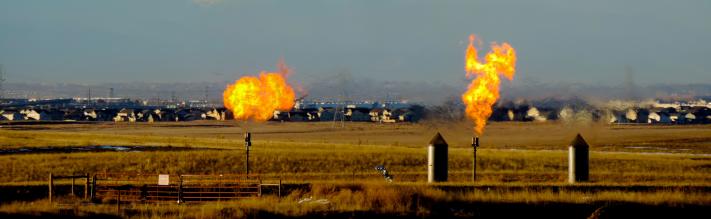
Natural gas flares near a community in Colorado. Colorado health officials and some legislators agree that better monitoring is necessary. Photo credit the Environmental Defense Fund.
When burned, natural gas emits roughly half as much carbon dioxide as coal. However, methane, the primary component of natural gas, is a highly potent greenhouse gas, more than 80 times more effective at warming the planet than carbon dioxide over a 20-year period. If even a small amount of methane is leaked, vented, or otherwise emitted into the atmosphere before the gas is burned—as it commonly is—the climate impact of natural gas can be worse than that of other fossil fuels.
Whitehouse challenged the energy security claims in the Moniz report.
“There is no energy security for American families and businesses when the price of energy is determined by geopolitical events outside our control and by an industry that frequently engages in cartel-pricing,” he said. “True energy security will be achieved when we fully transition to renewable energy sources, the ‘fuels’ for which—wind, sunlight, flowing water, the earth’s heat—are free and not controlled by any one country or cartel.”
Nonetheless, the European Commission’s executive vice president for the European Green Deal, Maroš Šefčovič, whose responsibilities include leading the European Commission’s work on becoming climate-neutral by 2050, praised the Moniz report in a video address shown at the release event.
“Natural gas has a role to play as a transitional fuel, something reflected in the COP28 conclusions,” Šefčovič said, referring to the 2023 U.N. climate conference in Dubai. “It will help ensure our energy security and energy equity as our economies decarbonize.”
“So with Europe, having taken decisive action to reach net zero by 2050 including by accelerating the clean energy transition, we also recognize the importance of natural gas, notably in the medium term, and LNG in particular will continue to represent a significant source of gas for the EU,” Šefčovič added.
Funders or “sponsors” of the report, which was not peer-reviewed, included Chesapeake Energy, one of the largest independent gas producers in the U.S, and U.S. LNG export companies Venture Global LNG and Tellurian. The American Petroleum Institute and three other gas industry organizations or industry PR groups also provided funding.
Additional money came from the Cynthia and George Mitchell Foundation, named after the late George P. Mitchell, who is often referred to as the “father of fracking” for his role in developing the drilling technology known as hydraulic fracturing. The Institute of Energy Economics, a think tank in Japan, the world’s largest importer of LNG, also provided support.
The report states that the “EFI Foundation maintains editorial independence from its public and private sponsors.” However, more than half of the report’s “advisory committee” was comprised of individuals representing the report’s funders.
“EFI’s report reinforces more than a decade’s worth of independent and government-led research that has consistently shown the long-term role of natural gas in the global energy mix and its ability to accelerate global climate progress while strengthening global energy security,” API spokesperson Scott Lauermann said.
Joseph Romm, a researcher also at the Penn Center for Science, Sustainability and the Media, said the report’s “energy trilemma” framing that looks at energy security, equity and environmental sustainability downplays the importance of climate change.
“Climate is the overriding issue,” Romm said. “Not that the others aren’t important, but if you don’t do climate, the others don’t matter.”
Six years later, there is even less room for new fossil fuel developments, Romm said.
The EFI report states that carbon capture, utilization and storage (CCUS) is an effective option for reducing CO2 emissions across the natural gas supply chain, even though to date such technology has never been successfully deployed at a commercial level. As the report notes, “there is no natural gas-fired power plant with CCUS in operation worldwide as of July 2023.”
The Inflation Reduction Act and Bipartisan Infrastructure Law have provided tax incentives and billions of dollars for large-scale carbon sequestration projects.
“You shouldn’t go around telling people that, ‘Oh, you’re going to solve whatever your natural gas problem is with carbon capture, utilization and storage’ when there isn’t a single one in operation,” Romm said. “One has to distinguish between reality and wishful thinking.” [ed. emphasis mine]
The Moniz report also says that LNG shippers have started to offer their customers “carbon-neutral LNG cargo,” in which emissions from LNG production are offset through the purchasing of carbon credits.
Carbon offsets have come under increasing scrutiny in recent years as offset projects have failed to live up to their emission reduction claims. Even if the projects offset the emissions of LNG production, there would still be significant emissions when the fuel is burned.
The report acknowledges the climate impact of methane emissions associated with natural gas and says “methane emissions reductions are also critical.” The report also notes that “the carbon footprint of natural gas, while lower than some alternatives, must be dramatically reduced further” and “overcoming these challenges will ultimately determine whether natural gas is indeed a transitional fuel or an integral part of the long-term global energy mix.”
In releasing the report, Moniz said the gas industry “can do a lot more in terms of having the pause be a pause by taking care of some of the homework that needs to be done,” such as on methane emissions reductions.
However, the report focuses less on methane emissions and more on the carbon dioxide emissions reductions that can be achieved by switching from coal to gas.
Interested in methane and other greenhouse gas emissions near you? Check out http://climatetrace.org, which allows you to see emissions from oil and gas fields, large individual facilities, and more. You can also break it down by industry.
Whitehouse said the focus on carbon dioxide emissions over methane emissions is misleading, intentional and not new.
“Internal documents obtained in our recent investigation demonstrate that fossil fuel companies knew methane leaks made natural gas just as harmful to the climate as coal but sought to discredit the scientific evidence and paint natural gas as a clean fuel and a crucial part of the energy mix,” Whitehouse said.
One such document obtained through the Congressional investigation was an August 2016 email from Amory Lovins, the cofounder and, at the time, chief scientist for the Rocky Mountain Institute, a clean energy and sustainability research organization now known as RMI. The email was addressed to Rex Tillerson, then the chief executive of ExxonMobil.
Tillerson had just been appointed the chair of the National Petroleum Council, a federal advisory committee to the Secretary of Energy, a position then held by Moniz.
Lovins, who served as an environmental representative on the council, warned Tillerson of increasing methane emissions monitoring by “citizen activists.” He urged Tillerson, the country’s leading oil and gas executive, and his industry to “get ahead of that emerging movement” and “fix the leaks” before the “sloppy operators further damage the good firms’ reputation.”
Another record obtained through the Congressional investigation is a document from Chevron marked “classified,” which includes a presentation Lovins gave to the oil and gas company’s board of directors at a meeting in Pebble Beach, California, in 2018.
In the presentation, Lovins notes that the “#1 threat to gas” is “methane ‘slip,’” or emissions. Lovins added that “2.3% of US gas output is now lost” as emissions, making gas “little/no” better for the climate than burning coal. Lovins added that LNG is “worse” for the climate than coal.
LNG has higher greenhouse gas emissions than natural gas due to the energy it takes to liquify and then regasify natural gas, not counting the additional methane emissions that occur during the transport of LNG in ships.
“RMI experts routinely share their independent analysis and research with a variety of stakeholders, and in this case, we presented our understanding of the climate risks of methane to the oil and gas industry, in the hopes that the facts would lead to solutions,”Lovins said in an email. “The facts presented then and subsequent research from RMI and peers have confirmed that leaks of methane, the main ingredient in natural gas, even at small amounts, make it as bad as or worse than coal for the climate and not necessarily the cleaner alternative it was once thought to be.”
Peer-reviewed studies published since 2018 suggest the climate impact of natural gas is worse than previously thought. A study published last month in Nature found that 2.95 percent of U.S. gas output is emitted rather than the 2.3 percent figure Lovins used in 2018. For the Permian Basin of Texas and New Mexico, where much of the natural gas that is exported from the U.S. as LNG originates, emissions are far higher—9.6 percent—according to the Nature study.
Other factors, such as the use of a 20-year rather than 100-year timeframe for measuring the climate impact of methane, can result in an even smaller leak rate, making natural gas worse than coal. A study published last year in Environmental Research Letters by RMI researchers found a “methane leakage rate as low as 0.2 percent brings a gas system’s climate risk on par with coal.”
For Howarth, the Cornell professor, recent events elicit a sense of déjà vu. In 2011, Howarth published one of the first studies suggesting the climate impact of natural gas may be worse than coal.
The same year, Moniz, then the director of the MIT Energy Initiative, was co-chair of a non-peer-reviewed Energy Initiative report funded largely by industry, “The Future of Natural Gas,” a title nearly identical to the EFI report Moniz and colleagues published this week.
The 2011 report led by Moniz downplayed Howarth’s findings and called for federal policies that “encourage the development of a [global liquid natural gas] market.”
“It feels familiar,” Howarth said of the new “Future of Natural Gas” report. “Shale gas is clearly as bad or worse than coal, no matter what industry funded people want to spin.”
“And even if I were wrong,” Howarth added, “It’s just not the time to be promoting any fossil fuels.”
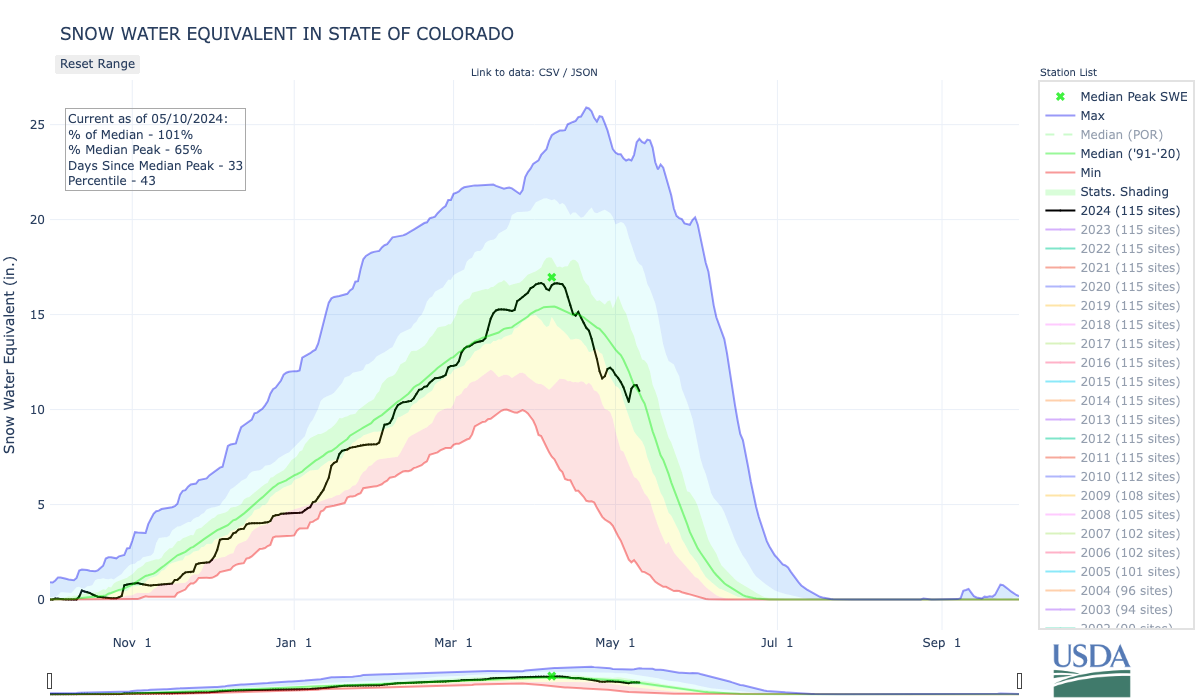
Statewide, Colorado is at around 90% of its median snowpack, as of May 3, with some variation across basins.
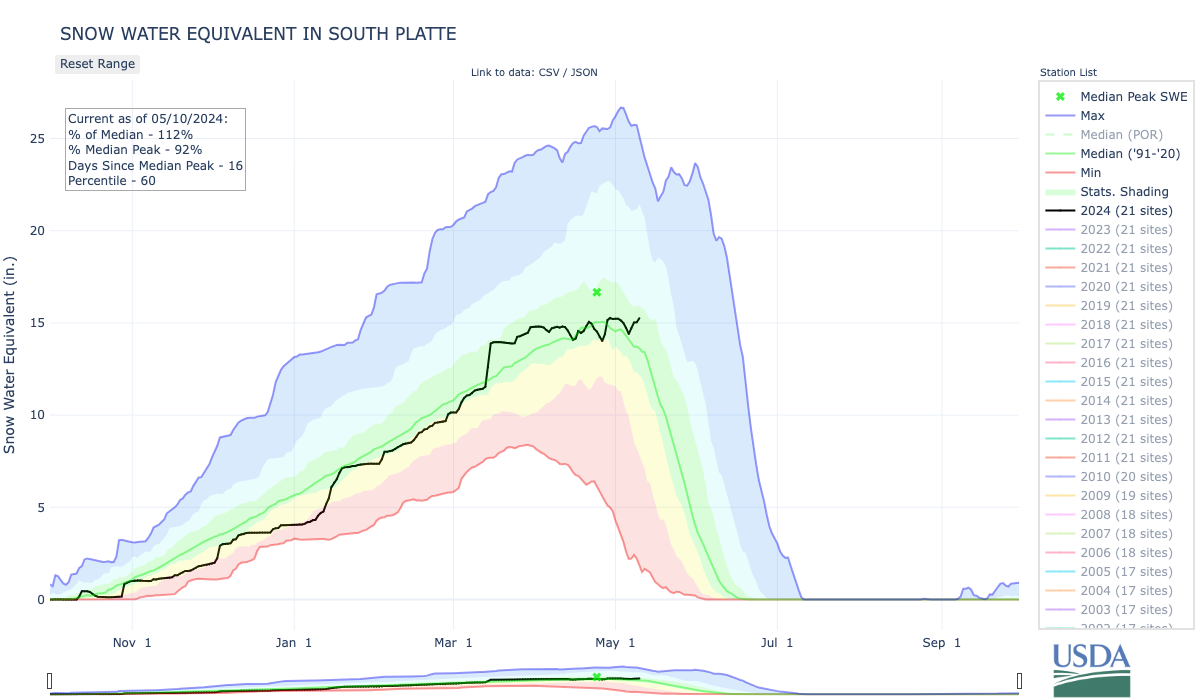
The South Platte, which covers Fort Collins, is at 103% of its median snowpack this season, according to USDA data. Two notable bumps on this year’s snowpack came from the heavy storms in January and March, which dumped feet of snow across the state…
According to CSU’s climate report, “Colorado’s snowpack serves as a huge seasonal reservoir that stores about 15 million acre-feet of water on average at the spring peak and then makes that water available later in the year when water demands for agricultural uses and outdoor watering are higher.”
Studies have shown that SWE has decreased in most places across the state, “though the percentage declines in SWE in Colorado were generally smaller than in most other regions of the West due to Colorado’s relatively high elevations and colder winter climate,” the report says.
The report which covers microplastics and nanoplastics states “a myriad of environmental exposure pathways to humans including ingestion, inhalation, and bodily absorption, are likely to exist.” It adds there is growing evidence that bioaccumulation of microplastics in tissues and organs of humans can potentially lead to nutritional and reproductive effects.
Current science gaps are mentioned. The report says that “understanding if or when environmental exposures pose a health risk is complicated by the diversity of microplastic sizes, morphologies, polymer types, and chemicals added during manufacturing or sorbed from the environment; ongoing challenges in analytical methods used to detect, quantify, and characterize microplastics and associated chemicals in our ecosystems; and the fact that ecotoxicological studies regarding microplastics are still in their infancy.”
It also adds that a better understanding of the sources, pathways, fate, and biological effects of microplastics has become a priority of the federal government as well as some state governments.
Water enters an irrigation canal on the Gila River Indian Reservation on May 7, 2021. The Gila River Indian Community is one of 19 tribes to co-sign a letter to the federal government asking for tribes’ priorities to be protected in the next round of rules for managing the Colorado River. Photo by Ted Wood/Water Desk
Click the link to read the article on the KUNC website (Alex Hager):
May 2, 2024
This story is part of ongoing coverage of the Colorado River, produced by KUNC in Colorado and supported by the Walton Family Foundation. KUNC is solely responsible for its editorial coverage.
Tribes that use the Colorado River want a say in negotiations that will reshape how the river’s water is shared. Eighteen of those tribes signed on to a letter sent to the Bureau of Reclamation, the federal agency that will finalize new rules for managing the river after 2026, when the current guidelines expire.
In the memo, tribal leaders urge the federal government to protect their access to water and uphold long-standing legal responsibilities.
The letter comes as other groups have also been sending the feds their ideas for managing a river that supplies 40 million people across the Southwest but is shrinking due to climate change. Reclamation is considering input from different Colorado River users, including competing proposals from two camps within the seven states that use its water.
The river’s Upper Basin states of Colorado, Utah, Wyoming and New Mexico banded together to send a proposal, and the Lower Basin states – California, Arizona and Nevada – did the same. A coalition of environmental nonprofits sent their own, and a group of high-profile water researchers published another.
The tribes’ letter aims to make sure that Indigenous people, who used the Colorado River before white settlers ever occupied the Western U.S., are not left behind as Reclamation considers those proposals.
“If you are not at the table, you are on the menu,” Jay Weiner, a water lawyer for the Quechan Indian Tribe, said.
Weiner, who helped craft the letter, said it aims to answer the complicated question: What do tribes want?
Each tribe in the Colorado River basin is unique and has interests that make it hard to land on one clear answer to that question, Weiner said, but this memo aims to coalesce a “critical mass” of tribes around broader ideas that are important to tribes.
“This is very much part of the effort of trying to be at the table and engaged so that there are meaningful opportunities for input, for engagement, for dialogue and, frankly, for fighting, when it comes to it,” Weiner said.
Three key principles
In the memo, the co-signing tribes address three main principles.
First, they ask the government to uphold its “trust responsibility” to the tribes.
This goes back to the very foundation of laws that guide relationships between the United States and tribes. When the federal government took property and assets from tribes, it also created a special designation for the tribes, calling them “domestic dependent nations.”
That designation also comes with the “responsibility to do right by those tribes forever,” explained Jenny Dumas, legal counsel on water for the Jicarilla Apache Nation and another architect of the tribal principles letter.
“The tribes gave up a lot of things when they entered into treaties with the federal government,” she said, “But what they did not give up was their right to a sufficient supply of water to provide for their people forever and ever in perpetuity.”
The letter urges federal water managers to fulfill that responsibility by rejecting any new water rules that would encroach on the government’s obligation to make sure tribes have access to water, and to adequately compensate any tribes that are forced to take water cuts in times of shortage.
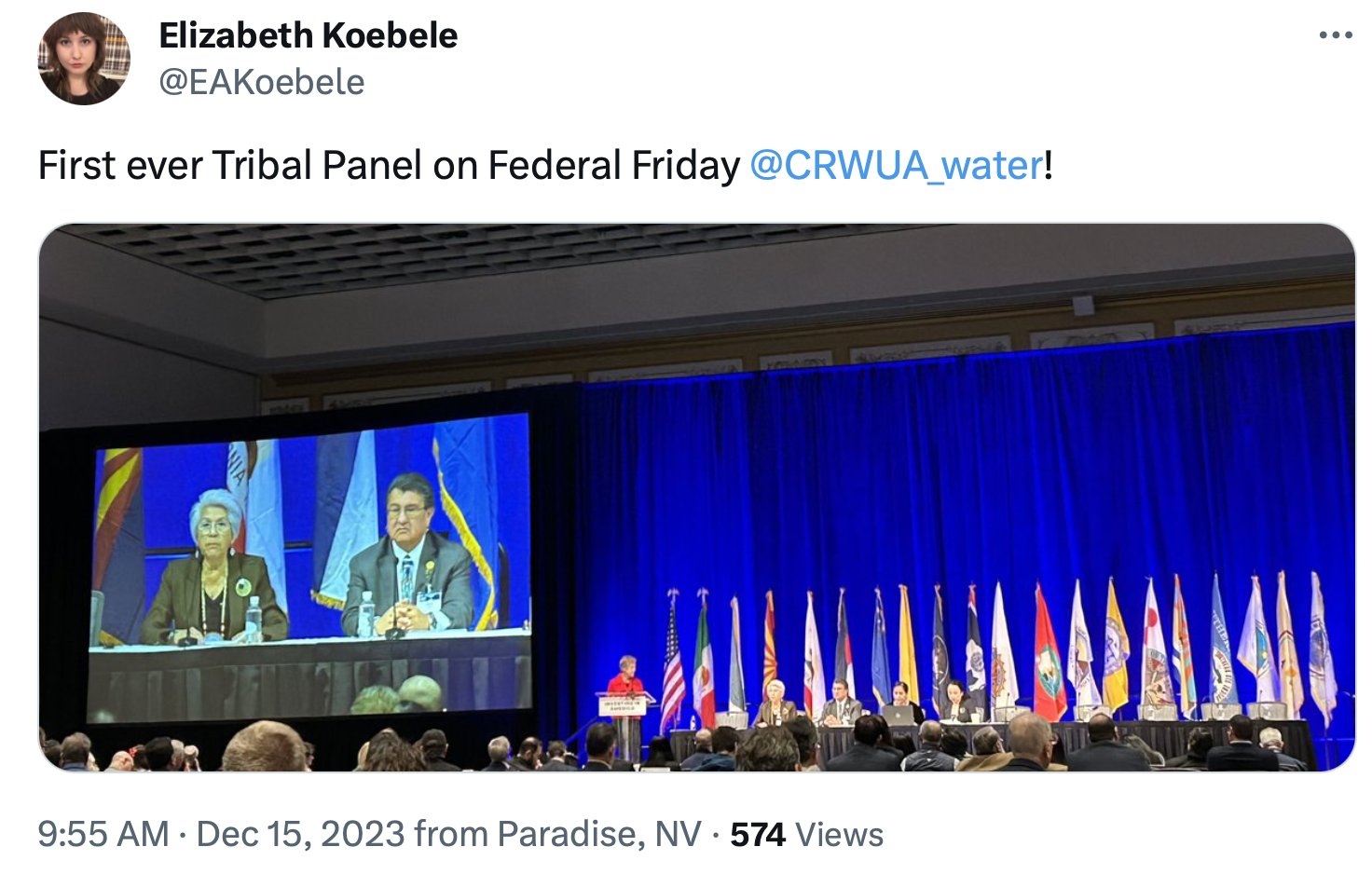
First ever tribal panel federal Friday Colorado River Water Users Association December 15, 2023. Photo credit: Elizabeth Loebele
The letter also asks the feds for better ways to financially benefit off of the water they own.
Tribes hold rights to about a quarter of the river’s flow, but many lack the funding and infrastructure to use their full allocations and instead leave it in the river. The letter lays out a few specific ways the U.S. government could help change that.
One of those ways is to “maximize” tribes’ ability to participate in conservation programs. Armed with a $4 billion pool of money from the Inflation Reduction Act, the federal government has been funding programs to pay water users – often farmers and ranchers – to pause water use and leave some extra water in reservoirs. Some tribes are already receiving conservation payouts, but the letter advocates to expand tribal participation.
In addition, the memo asks feds to make it easier for tribes to market or lease their water rights to water users that reside outside of tribal land. That could open the door to new revenue streams, participation in conservation programs or the construction of new water infrastructure.
Finally, the letter asks the U.S. government to establish a permanent, formalized way for tribes to participate in talks about water use during ongoing negotiations and any other time Colorado River policy is discussed in the future.
Tribes have long been pushing for better representation in negotiations about the Colorado River. Indigenous people were excluded from talks that set the foundation for how water is shared in the Southwest over a century ago, and tribes say they’re still being left out now.
In the letter to Reclamation, tribal leaders wrote that river negotiations in 2007 had a “lack of formal tribal inclusion,” and reminded federal water managers that in 2023, federal officials made it a stated goal to enhance engagement and inclusion of tribes going forward.
The tribes are asking for something specific. Certain steps in negotiations about Colorado River water trigger the federal government to talk to states that use its water. The tribes want to make sure they are also consulted any time that trigger is hit.
Ultimately, the letter’s authors say tribes—and the legal infrastructure that governs tribal water use—are unique in a way that has to be considered when drawing up new rules that could have a big impact on the cities and farms of the Southwest.
“Tribal water rights are different,” Dumas said. “They’re not the same as non-Indian water rights. And for that reason, they deserve different protections and special treatment. And that’s what we’re asking for in this letter.”
‘Tribes have survived a whole lot worse’
While exclusion of tribes has been an undercurrent of Colorado River negotiations for at least a century, tribal leaders say times are changing.
Jason Hauter, legal counsel on water issues for the Gila River Indian Community who helped craft the letter, said the U.S. government faces “billions of dollars of potential liability” without the buy-in of Gila River and other tribes and that having unwilling water users could slow down the authorization and implementation of new water rules.
“Tribes are a key stakeholder,” said Hauter, who is a member of the Gila River Indian Community. “The days of being able to politically roll tribes and them not being sophisticated enough to put up strong challenges to federal rulemaking are over.”
Even after the letter’s submission, the number of tribes adding their support has grown. An early version of the memo was co-signed by 16 tribes. That number now stands at nineteen.
One of the late additions was the Gila River Indian Community, which holds lands in the Phoenix area. The tribe has been among the most prominent in Colorado River negotiations, and has become a high-profile partner to Arizona and the federal government in recent conservation programs.
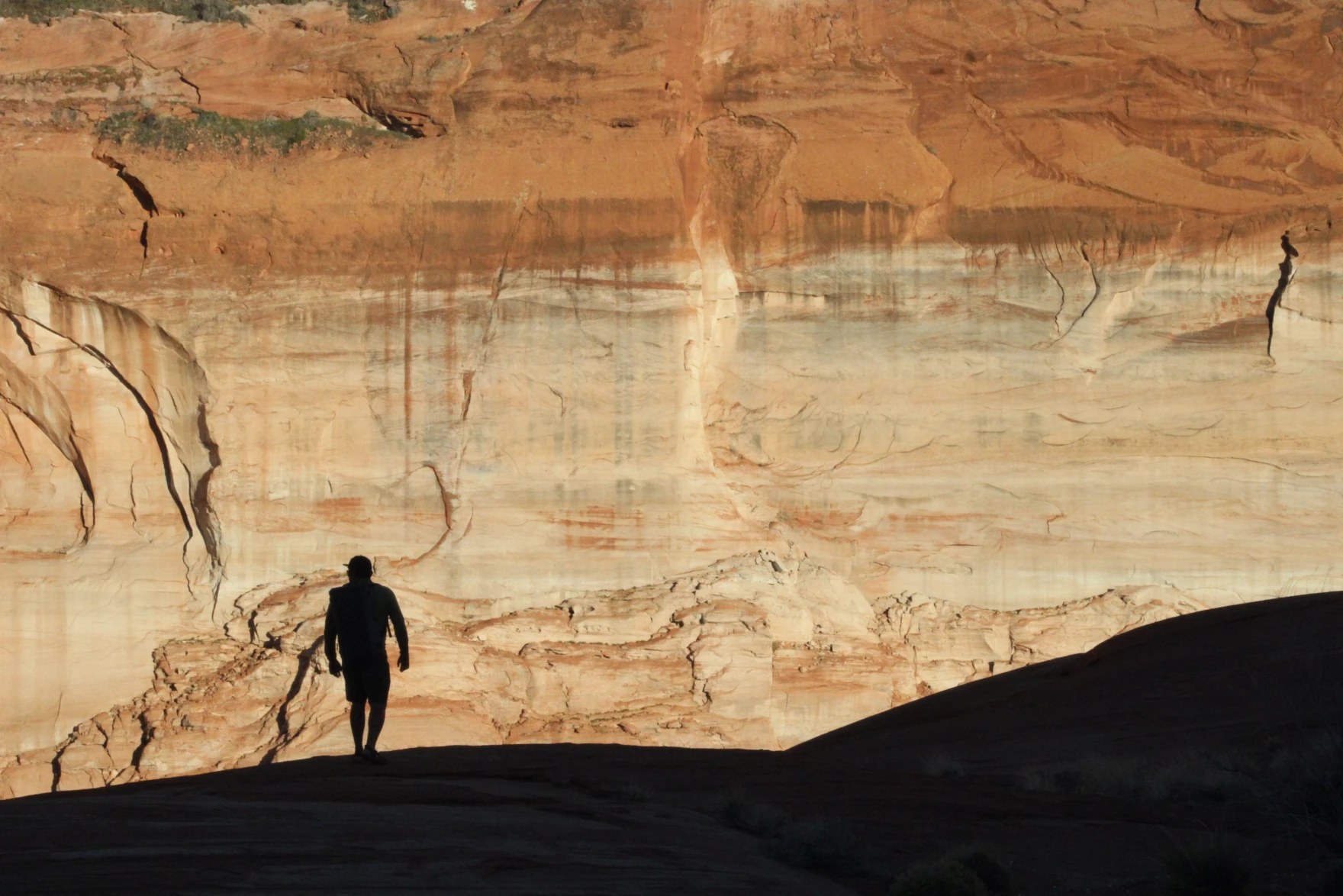
Len Necefer, a member of the Navajo Nation, walks through Glen Canyon on April 10, 2023. This area used to be entirely submerged by Lake Powell. Management of the nation’s second-largest reservoir is a major focus of efforts to re-negotiate Colorado River management. The Navajo Nation is not among the tribes that signed a recent letter to the Bureau of Reclamation. Photo credit: Alex Hager/KUNC
In March, Gila River’s governor, Stephen Roe Lewis, announced the tribe did not support the Lower Basin proposal that Arizona signed on to, and that it planned to file its own. Instead, the community joined as a co-signer of the tribal principles letter in late April.
Indigenous leaders are quick to point out that each tribe is unique, and common ground can be hard to find amid the geographical, political and financial differences between them. This letter, however, is designed to focus on ideas so broad that they can find consensus among nearly two-thirds of all tribes that use Colorado River water.
“The goal should be having a stable system, not necessarily picking winners and losers,” Hauter said. “There’s a lot of posturing between the Upper and Lower Basin, and without really focusing on the ultimate goal: How do we make a better system? Given what the basin is facing, a recognition that there has to be shared pain among the basin states and among tribes. Finding ways to do that in a fair way, in a way that can make sense, that’s the challenge we all face.”
Conversations about Colorado River management have, for the past couple years, largely focused on the re-negotiation deadline in 2026. While it has been framed as a momentous juncture in the timeline of Western water management, tribes and their representatives say they’re focused on a longer view.
Jay Weiner, water lawyer for the Quechan Indian Tribe, said even if climate change makes the Southwest unpalatable for white people and other settlers, tribes plan to stay in their historic homelands.
“None of these things are single, one-off immutable events,” he said, “Because tribes have survived a whole lot worse than anything we’re gonna see coming out of post-2026 guidelines.”
Native America in the Colorado River Basin. Credit: USBR