The federal government expects Lake Powell to rise, despite one Utah lawmaker’s claim that levels are ‘intentionally’ being kept low
Utah’s reservoirs are still at what the state calls “impressive” levels, with most hovering around 90% capacity — by comparison, statewide levels were a little over half full this time last year.
But Lake Powell, the country’s second-largest reservoir, is an outlier. According to the U.S. Bureau of Reclamation, it’s currently at about 35% capacity.
During a Legislative Water Development Commission meeting in Salt Lake City last week, director of the Utah Division of Water Resources Candice Hasenyager gave lawmakers an update on the state’s water outlook.
“Our reservoirs are about full, we’re at about 90% of our statewide average,” she said. But, she noted Lake Powell as a glaring exception.
“That’s still definitely a concern that we have,” Hasenyager told lawmakers.
In a statement, the U.S. Bureau of Reclamation said Lake Powell should not be compared to other reservoirs in the state because of its size and the various policies that dictate its levels.
“Lake Powell is substantially larger, with a live capacity of nearly 25 million acre-feet,” a spokesperson for the bureau said. “This capacity is more than eight times the capacity of Strawberry Reservoir.”
Those levels are often out of the state’s control, and are in part due to the complexity of the Colorado River Basin and the system that allocates water to seven states and Mexico, called the Colorado River Compact.
Through the compact, the bureau “has modified the operating guidelines for Glen Canyon and Hoover dams through 2026, to protect these facilities and lake levels if poor hydrologic conditions persist,” the spokesperson said.
Despite Lake Powell appearing to be far behind Utah’s other reservoirs in terms of capacity, the bureau noted that the situation is much better than last year — currently, it sits at about 24 feet higher than last May, and officials say levels will continue to rise, expected to hit about 41% capacity in June. After that, the bureau said it will decline until spring runoff in 2025.
Still, the state’s lack of control over Lake Powell drew some disapproval from outgoing Rep. Phil Lyman, R-Blanding, who is currently running for governor. Lyman, a fierce critic of the federal government’s presence in Utah, lamented the levels being “set by the Secretary of the Interior.”
“Are we working with the Secretary of the Interior, are we working with the federal government to keep that at a viable level?” Lyman asked. “What we’ve really seen is intentional, keeping that below a viable recreation level and I hope the legislature can influence that decision in the future.”
In response to Lyman’s comments, the Bureau of Reclamation pointed to the bevy of compacts, federal laws, court decisions, contracts and regulatory guidelines that control flows in the Colorado River and levels at Lake Powell.
“Reclamation has a long-standing history of working with all stakeholders in the basin on cooperative agreements that help define operational actions at critical times and to protect the levels at Lake Powell and sustain and protect the Colorado River Basin,” the bureau said.
When asked about Lyman’s comments, Utah Gov. Spencer Cox responded, “I have no idea what he’s talking about.”
“People can make up stuff all they want. Nobody is deliberately keeping the water levels low at Lake Powell,” the governor said during his monthly PBS news conference on Thursday, calling his gubernatorial opponent’s claim “bonkers.”
Cox pointed to ongoing negotiations among water managers from Colorado River basin states who are working on a new management plan ahead of 2026, when the current guidelines expire.
Cox told reporters the state has been releasing its own water from Flaming Gorge Reservoir to ensure the Glen Canyon Dam at Lake Powell can continue generating power. Some of that water was released to Lake Mead, he said — now, the state is hoping to get that water back.
“There are big discussions about where that water goes and where our portions of the water go. We’ve had huge releases from upstream reservoirs that have gone into Lake Powell,” Cox said. “That’s mostly our water. …These are very, very complex negotiations that are going back and forth, and part of the negotiations and what we’re doing right now is making sure we can restore the water that we released.”
‘Exactly what we need’
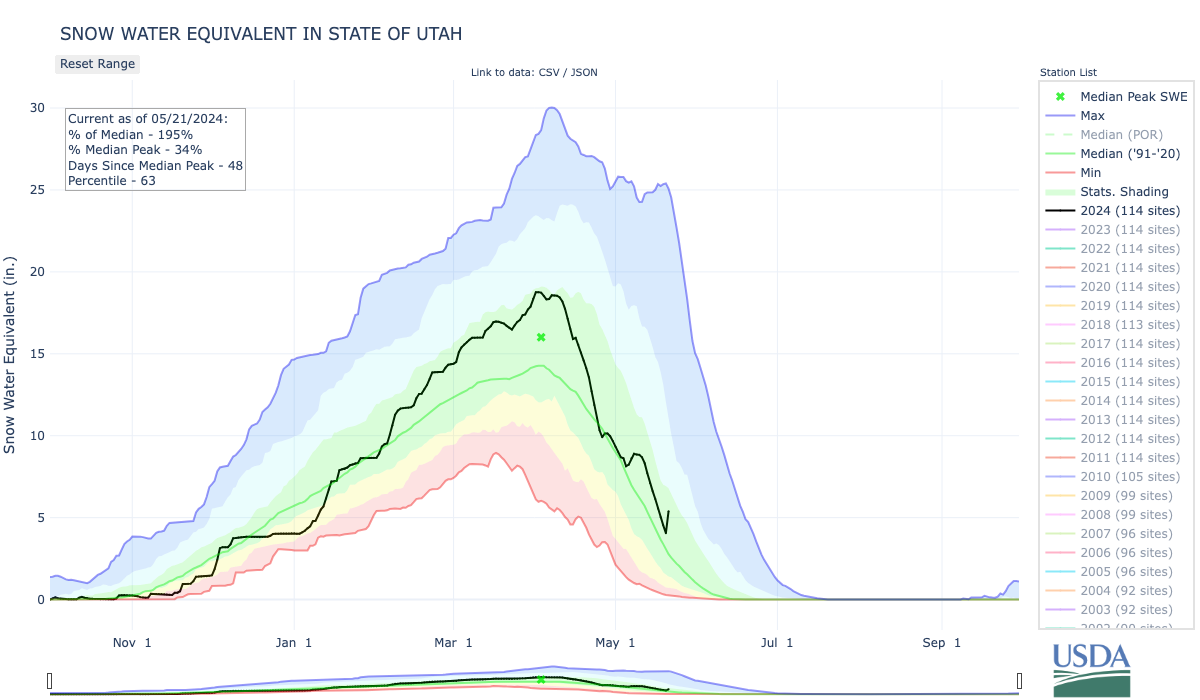
On Thursday, the Division of Water Resources said over half of the snow from this winter has melted, with recent weather patterns resulting in “optimal spring runoff.”
“A slow warmup is exactly what we need to have a safe and effective spring runoff,” Hasenyager said in a statement. “We still have a good amount of snow in the mountains, so we are hoping for a gradual snow melt.”
Here are some key takeaways from the state:
As of May 1, Utah’s major watersheds are at or above about 90% of normal precipitation, with northern Utah’s basins doing exceptionally well.
The state’s streams are flowing at about 89% of normal, which the division called a “widespread positive trend.”
The Great Salt Lake has risen about three feet since October. According to state data, the south arm of the lake is at above 4,195 feet, about three feet away from the bottom of the spectrum of what’s considered a healthy level, 4,198 feet.
It’s filling up. Already nine ballot measures have been approved for Colorado voters to decide in the Nov. 5 general election. Two of the measures are citizen initiatives – one requiring the state to seek voter approval to retain property tax revenue projected to increase more than 4 percent over the prior year; another asking voters to signal the right to an abortion, including allowing for health insurance coverage for public employees.
The other seven measures were sent to the ballot by the Colorado Legislature. Those include:
A proposed amendment to the Colorado Constitution that removes the provision that states, “Only a union of one man and one woman shall be valid or recognized as a marriage in the state.”
A ballot measure that would collect an 11 percent retail sales tax from firearms dealers, manufacturers, and ammunition vendors. The collected revenue would fund the Firearms and Ammunition Excise Tax Cash Fund that would support programs for crime victims, education, and mental and behavioral health for children and veterans.
A legislative-approved ballot measure that asks voters to allow the state to retain tax revenue collected above $29 million annually from sports betting. The money kept by the state would be used to pay for projects in the Colorado Water Plan.
In an episode of The Valley Pod, Colorado State Sen. Cleave Simpson and State Rep. Matthew Martinez talked about their support for the state legislature’s referred-measure to amend the Colorado Constitution on the definition of marriage. If adopted the amendment essentially would remove the ban on a same-sex marriage in the Colorado Constitution.
“Nobody here (in Colorado) has been denied a marriage license for same-sex marriage because of the direction from the U.S. Supreme Court. This just affirms and puts us in that position,” said Simpson. “And I have any number of same-sex marriage friends and acquaintances, and I just think out of respect to them, and this should be something that the people of Colorado should decide. It doesn’t have huge financial implications. It doesn’t have huge personal implications other than folks, I know that this impacts them. And I think this is something that the voters should be able to decide.”
“I think it’s pretty straightforward. And we’ve had this control through the legislature, the ability to have same-sex marriage for some time,” said Martinez. “This just really aligns what we’re already doing, both with the state and with the federal level.”
Simpson also weighed in on allowing Colorado to keep gambling revenue that exceeds $29 million in any given year. Currently revenue above $29 million that’s collected goes back to the casinos that generated the revenue.
In addition to the measures already on the ballot, there are 25 others with petitions out collecting voter signatures to try to qualify. Here’s a look at what’s qualified so far:
Other proposed amendments to the Colorado Constitution referred by the Colorado Legislature
Colorado Independent Judicial Discipline Adjudicative Board Amendment – Amendment to the Colorado Constitution concerning judicial discipline and establishing an independent judicial discipline adjudicative board, setting standards for judicial review of a discipline case, and clarifying when discipline proceedings become public.
Initiative No. 50 Voter approval to retain additional property tax revenue – Proposal “conditionally decreases property tax revenue in years when statewide property tax revenue is projected to grow more than 4 percent over the prior year, unless voters approve a ballot measure allowing for the additional revenue to be retained.” The initiative is sponsored by Advance Colorado Institute, a conservative think tank.
Initiative No. 89 Right to Abortion – Proposals reads, “The right to an abortion is hereby recognized. Government shall not deny, impede, or discriminate against the exercise of that right, including prohibiting health insurance coverage for abortion.” Initiative submitted by Dusti Gurule of the Colorado Organization for Latina Opportunity and Reproductive Rights; and Dani Newsum, director of strategic partnerships at Cobalt, reproductive advocates.
Kathleen Tsosie remembers seeing her dad come home every evening with his clothes covered in dirt. As a little girl, she never questioned why, and she was often more excited to see if he had any leftover food in his lunchbox.
“We used to go through his lunch and eat whatever he didn’t eat,” Tsosie said, recalling when she was around 4 years old. “And he always had cold water that came back from the mountain.”
Tsosie’s father, grandfather, and uncles all worked as uranium miners on the Navajo Nation near Cove, Arizona, from the 1940s to the 1960s. The dirt Tsosie’s father was caked in when he arrived home came from the mines, and the cold water he brought back was from the nearby springs.
In the late 1960s, Tsosie said her grandfather started getting sick. She remembers herding sheep with him and how he would often rest under a tree, asking her to push on his chest because it hurt.
Tsosie said she was about 7 years old when her uncles took her grandfather to the hospital. At the time, she didn’t know why he was sick, but later on, she learned he had cancer. Her grandfather died in October 1967.
Over a decade later, Tsosie’s father also started getting sick. She remembers when he came to visit her in Wyoming; she was rubbing his shoulders when she felt a lump. She told him to get it checked out because he complained about how painful it was.
Her father was diagnosed with cancer in 1984 and went through treatments, but died in April 1985.
“When my dad passed away, everybody knew it was from the mine,” Tsosie said. He was just the latest on a long list of Navajo men from her community who worked in the uranium mines and ended up getting sick and passing away.
She recalls how her father used to tell her that, one day, it may happen to him, but she did not want to believe him. Her dad worked in the uranium mines for over 20 years.
The sickness did not stop there. In February of 2007, Tsosie was diagnosed with breast cancer, and she would spend years in treatment and eventually go into remission in December 2007.
But, this year, Tsosie got the news in February that her cancer has returned, and she is now taking the steps toward getting treatment.
Tsosie’s family history with uranium mining and growing up in an area downwind from nuclear testing sites is similar to many Navajo families in Arizona, Utah and New Mexico. Her family is among the thousands potentially impacted by radiation from nuclear weapon testing, according to National Cancer Institute research.
Because of that history, Tsosie became an advocate for issues related to downwinders and uranium mine workers from the Navajo Nation, including the continuation of the Radiation Exposure Compensation Act.
The Radiation Exposure Compensation Act, or RECA, provides a program that compensates individuals who become ill because of exposure to radiation from the United States’ development and testing of nuclear weapons.
RECA was initially set to expire in 2022, but President Joe Biden signed a measure extending the program for two more years. Now, it’s set to expire in less than a month.
Tsosie first heard of the program in the 1990s after her mother applied for it because her father was a uranium mine worker. She remembers the day her mother got a compensation check for $100,000 and handed it to her.
“She gave it to me, and she said, ‘This is from your dad,’” Tsosie said, adding that her mother didn’t go into many details at the time, only saying that families with loved ones who died of cancer were getting checks.
Tsosie said she was upset about the check because her father had died, and $100,000 was nothing in comparison.
“I was really mad, and that’s just how the federal government thinks of us as Navajo people,” she explained.
The second time she worked with RECA was for her own case. After her cancer treatments concluded in December 2007, she took some time to heal before determining in March 2008 whether she qualified for RECA. She did qualify and received compensation.
Since RECA was passed in 1990, more than 55,000 claims have been filed. Of those, more than 41,000 claims, or about 75%, have been approved — and roughly $2.6 billion had been paid out as of the end of 2022.
Claims for “downwinders” yield $50,000. For uranium mines and mill workers providing ore to construct nuclear weapons, claimants typically receive $100,000.
Proving that exposure to nuclear waste and radiation causes cancers and other diseases is difficult. However, the federal program doesn’t require claimants to prove causation: They only have to show that they or a relative had a qualifying disease after working or living in certain locations during specific time frames.
In July 2023, the U.S. Senate voted to expand and extend the RECA program, and it was attached as an amendment to the National Defense Authorization Act, which funds the Department of Defense.
It could have extended health care coverage and compensation to more uranium industry workers and “downwinders” exposed to radiation in several new regions — Colorado, Missouri, New Mexico, Idaho, Montana, and Guam — and expanded coverage to new parts of Arizona, Nevada and Utah.
The defense spending bill for 2024 was signed into law on Dec. 22 by Biden, but the RECA expansion was cut from the final bill before it landed on his desk.
When she heard that the Radiation Exposure Compensation Act amendments failed to pass, Tsosie said it really impacted her, and she cried because so many people deserve that funding.
“I know what it feels like. I know what it feels like to suffer,” she said.
The sunset of the Radiation Exposure Compensation Act is approaching fast, and leaders from the Navajo Nation are urging Congress to act on the expansion bill that has been waiting for the U.S. House of Representatives to take it up for more than two months.
“Time is running out,” Justin Ahasteen, the executive director of the Navajo Nation Washington Office, said in a press release.
“Every day without these amendments means another day without justice for our people,” he added. “We urge Congress to stand on the right side of history and pass these crucial amendments.”
The bill passed through the U.S. Senate with a bipartisan 69-30 vote on March 7. But since being sent to the House on March 11, the bill hasn’t moved.
The RECA expansion bill would include more communities downwind of nuclear test sites in the United States and Guam. It would extend eligibility for uranium workers to include those who worked after 1971. Communities harmed by radioactive waste from the tests could apply for the program, and expansion would also boost compensation payments to account for inflation.
“The Navajo Nation calls for immediate passage of S. 3853,” Ahasteen said in a press release. “This is to ensure that justice is no longer delayed for the Navajo people and other affected communities.”
Ahasteen told the Arizona Mirror in an interview that congressional leaders holding the bill back due to the program’s expense is not a good enough reason not to pass it.
“They keep referencing the cost and saying it’s too expensive,” he said. But, he explained, the RECA expansion is only a sliver of U.S. spending on foreign aid or nuclear development.
And it shouldn’t even be a matter of cost, Ahasteen said, because people have given their lives and their health in the interest of national security.
“The bill has been paid with the lives and the health of the American workers who were exposed unjustly to radiation because the federal government kept it from them and they lied about the dangers,” he said.
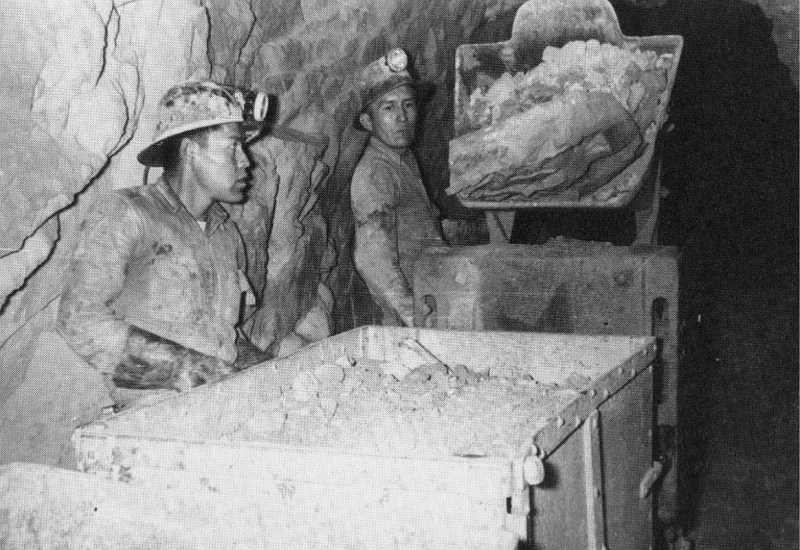
Navajo uranium miners at the Rico Mine in 1953. (Source: The Navajo Uranium Miner Oral History and Photography Project at the Center for Southwest Research, University Libraries, University of New Mexico)
From 1945 to 1992, the U.S. conducted a total of 1,030 nuclear tests, according to the Arms Control Association.
Many were conducted at the Nevada Test Site, with 928 nuclear tests conducted at the site between 1951 and 1992, according to the Nevada National Security Site. About 100 of those were atmospheric tests, and the rest were underground detonations.
According to the United Nations Scientific Committee on the Effects of Atomic Radiation, atmospheric tests involved unrestrained releases of radioactive materials directly into the environment, causing the largest collective dose of radiation thus far from man-made radiation sources.
Between the 1940s and 1990s, thousands of uranium mines operated in the United States, according to the United States Environmental Protection Agency. Most operated in Colorado, Utah, Wyoming, New Mexico and Arizona, typically on federal and tribal lands.
The number of mining locations associated with uranium is around 15,000, according to the EPA, and of those, more than 4,000 have documented uranium production.
Navajo Nation leaders advocated and worked with officials in Washington, D.C., for decades to get the amendments added to the RECA that would benefit more Navajo people who have been impacted by uranium mining, as well as radiation exposure.
Their efforts continue with the current expansion bill: Navajo Nation President Buu Nygren, Navajo Nation Council Speaker Crystalyne Curley and the Navajo Nation Washington Office team have been working on an advocacy push this week with congressional leaders.
“Our people have borne the cost of America’s nuclear program in their health and well-being,” Nygren said in a written statement. “The amendments we advocate for today are not merely legislative changes; they are affirmations of justice and a commitment to heal the wounds of the past.”
On May 14, Nygren and Curley met with former Navajo uranium miners and members of Congress to urge passage of the amendments before RECA expires in a few weeks.
“As the Navajo Nation, we feel that that’s the best fit for us, especially for our miners,” Curley told the Mirror about her support of the expansion bill.
Curley said she’s spent her time in Washington educating congressional leaders about the Navajo Nation and the impact uranium mining has had on their people.
“A lot of our Navajo fathers, grandparents, and uncles went into these mines without any protection,” she said. “And now, many decades later, we’re dealing with the health effects.”
The legacy of uranium mining has impacted the Navajo Nation for decades, from abandoned mines to contaminated waste disposal.
From 1944 to 1986, nearly 30 million tons of uranium ore were extracted from Navajo lands, according to the EPA, and hundreds of Navajo people worked in the mines, often living and raising families in close proximity to the mines and mills.
Ahasteen said those numbers show exactly how large the uranium operations were on the Navajo Nation and the impact it would have on the Navajo people.
“There are photos on record to show Navajo people being exploited, not given any proper protective equipment, but (the federal government) knew about the dangers of radiation since the ’40s,” Ahasteen said. “They were given a shovel and a hard hat, and they were told: Go to work. You’ll earn lots of money. You’ll have a nice life, and we did that, but it didn’t work so well for us.”
Although the mines are no longer operational across the Navajo Nation, contamination continues, including 523 abandoned uranium mines in addition to homes and water sources with heightened levels of radiation.
The health risks associated with this contamination include the possibility of lung cancer from inhaling radioactive particles, as well as bone cancer and impaired kidney function resulting from exposure to radionuclides in drinking water.
“We want to remind all of the members of Congress that it was because of the Navajo Nation that we are where we are today,” Ahasteen said. “It is because of the uranium workers (that) the United States is the nuclear power that it is today.”
Ahasteen said the Navajo people have demonstrated their patriotism for the U.S. time and time again, but the country continues not to recognize that.
“That’s really what’s appalling,” he added.
As of December 2022, the U.S. Department of Justice stated that 7,704 claims from tribal citizens representing 24 tribal nations had been filed with the RECA program, 5,310 had been granted and more than $362.5 million had been awarded.
Navajo people make up 86% of the claimants, according to the DOJ, and they have received awards totaling more than $297 million.
RECA’s downwind affected area covers land within multiple federally recognized tribal nations, including the Navajo, Hopi and White Mountain Apache.
Ahasteen provided RECA claim numbers for Arizona as of April 2023. A total of 15,603 RECA claims had been submitted in Arizona, 3,052 of which came from the Navajo Nation.
“That accounts for about 20% of all claims in Arizona,” he said.
In New Mexico, he said that there were a total of 7,300 claims, and 2,900 were Navajo.
“That means 40% of all of New Mexico claims are Navajo,” Ahasteen said. “Combined between Arizona and New Mexico, Navajo makes up about a fourth of all RECA claims.”
Ahasteen said it is disappointing that the program is approaching expiration and that the expansion bill still hasn’t moved in the House.
“We are hopeful that when it is brought to the House floor for a vote, Congress will speak, and they will move forward with the amendments because it’s the right thing to do,” he added.
Arizona Mirror is part of States Newsroom, a nonprofit news network supported by grants and a coalition of donors as a 501c(3) public charity. Arizona Mirror maintains editorial independence. Contact Editor Jim Small for questions: info@azmirror.com. Follow Arizona Mirror on Facebook and Twitter.
Kindra Arnesen is a 46-year-old commercial fishing boat operator who has spent most of her life among the pelicans and bayous of southern Louisiana, near the juncture where the 2,350-mile-long Mississippi River ends at the Gulf of Mexico.
Clark Porter is a 62-year-old farmer who lives in north-central Iowa where he spends part of his day working as an environmental specialist for the state and the other part raising corn and soybeans on hundreds of acres that his family has owned for over a century.
Though they’ve never met, and live 1,100 miles apart, Arnesen and Porter share a troubling kinship – both of their communities are tied to a deepening water pollution crisis that is fouling the environment and putting public health in peril across multiple US states.
Gulf hypoxic dead zone
Arnesen’s home lies near an oxygen-depleted expanse of the northern Gulf known as the “dead zone,” where dying algae blooms triggered by contaminants flowing out of the Mississippi River choke off oxygen, suffocating shrimp and other marine life.
Porter’s farm is positioned at the center of the Upper Mississippi River Basin where streams and other surface waters saturated with farm wastes flood into the big river, and contaminated groundwater permeates drinking water wells. Cancer incidence in Iowa is among the nation’s highest, and is rising.
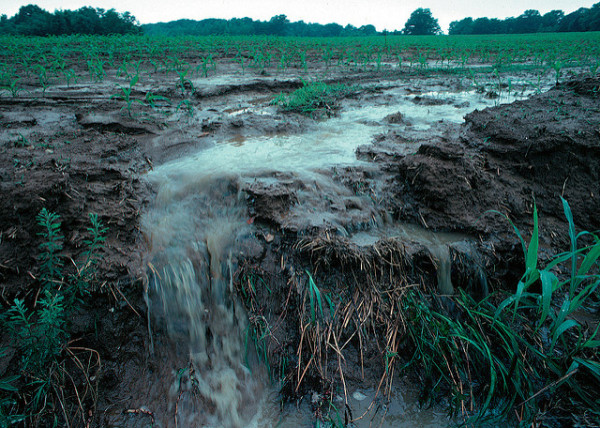
Unprotected farm fields yield topsoil as well as farm fertilizers and other potential pollutants when heavy rains occur.
The culprit at the center of it all is a colossal tide of fertilizer and animal manure that runs off fields in Iowa and other farm states to find its way into the Mississippi River. The same agricultural pollution problems are plaguing other iconic US waterways, including Chesapeake Bay and Lake Erie.
US farmers use more fertilizer and spread more manure than in most other countries, accounting for roughly 10 percent of global fertilizer use, behind China and India. But while the nutrients contained in animal manure and fertilizer are known to nourish crop growth, the resulting nitrogen and phosphorous that end up in waterways are known to create severe health problems for people.
A grand government plan to address the problem has cost taxpayers billions of dollars with minimal results so far, and nowhere is the problem more pronounced than in the Mississippi River Basin.
The reasons for the persistent pollution problem are multi-fold, including strong industry opposition to regulations to control the farm contaminants, and a perverse system in which some government programs incentivize farming practices that add to the pollution even as other government programs try to induce farmers to reduce the pollution.
“You’re talking about systemic dysfunction,” said Matt Liebman, professor emeritus of agronomy and sustainable agriculture at Iowa State University.
(The MARB has some of the most productive farming regions in the world and contains parts of 31 states. Source: Paper No. JAWR-20-0047-P of the Journal of the American Water Resources Association.)
An “extraordinary task”
The US Environmental Protection Agency (E.P.A) has called nutrient pollution “the single greatest challenge to our nation’s water quality,” and acknowledges that much of the nutrient pollution flowing into the northern Gulf originates on agricultural land. For nearly 30 years the agency has led a task force that includes tribal leaders and officials from 12 states working together to try to impede fertilizer and manure from running off cropland at the center of the country.
The task force has set a goal of reducing the five-year average extent of the hypoxic zone in the Gulf to less than 2,000 square miles by 2035. To meet that goal, the task force has been trying to cut total nitrogen and phosphorous loads in the water 20 percent by 2025 and 48 percent by 2035.
Key to the effort are a suite of voluntary conservation practices promoted by the US Department of Agriculture (U.S.D.A.) aimed at reducing the pollution, including idling land, not tilling before planting, using cover crops to protect the soil, and building retention ponds and wetlands to collect and absorb nitrogen. Farmers are also encouraged to plant nitrogen-absorbing vegetation in buffer strips along streams. The U.S.D.A. said in 2015 that the conservation programs were making headway, but in 2022 reported that efforts to reduce flows of nitrogen and phosphorus off farmland were showing negligible results.
The E.P.A. did not respond to a request for an interview. The U.S.D.A. said in an email message that In separate reports in 2017 and 2022 agency researchers “documented some promising trends nationally for reducing nutrient losses, such as increases in cover crop use, increased use of advanced technologies such as use of enhanced efficiency fertilizers and use of variable rate fertilizer application technologies, and a slight increase in soil testing. However, the key finding was that there was a national decline in nutrient management over a decade resulting in an increased loss of subsurface nitrogen and soluble phosphorus loss.”
The US has spent more than $30 billion since 1997 on efforts to clean up the Mississippi Basin, but in a 2023 progress report to Congress the E.P.A. said much more work is needed. Reducing nutrient loads is “an extraordinary task,” the E.P.A. report states. “Attempts to intercept, treat, or otherwise address nutrients after they are mobilized on the landscape are complex, difficult, and often costly.”
Last summer, the oxygen-depleted Gulf “hypoxic” zone measured roughly 3,000 square miles, which was smaller than in previous years. But experts said that was mostly due to a deep drought in the Midwest that reduced the river’s flow into the Gulf. In 2021, after a wet spring and summer, the Gulf’s hypoxic zone was close to 6,000 square miles.
And despite government efforts, nutrient loads to the Gulf in 2020 tallied roughly 3.7 billion pounds of nitrogen and 452 million pounds of phosphorous from what the government calls the Mississippi/Atchafalaya River Basin (MARB), the task force said in its report. That was up from total MARB nutrient loads to the Gulf in 2017, which were approximately 3.3 billion pounds of nitrogen and 314 million pounds of phosphorus, according to the 2019 task force progress report.
“More nitrogen is coming off the fields,” said R. Eugene Turner, professor emeritus of oceanography and coastal sciences at Louisiana State University and an expert on the Gulf hypoxic zone. “On average the load and the concentrations of nitrogen in the river are not coming down.”
The primary cause is more nitrogen pouring off the land from the big upper Mississippi River Basin farm states. From 2010 to 2022 the average annual amount of nitrogen leaving farmland in Iowa was 666 million pounds. That was 14 percent more nitrogen than from 1980-1996, according to state data.
In Minnesota, state authorities found nitrogen in major rivers, including the Mississippi increased from 21 percent to 55 percent over the past 20 years, according to a summary report in 2020.
Silvia Secchi, a professor and natural resource economist at the University of Iowa, agreed. Government agencies “tell you they are spending all this money, therefore they must be doing something right. But if you look at water quality data, at what’s really happening, it’s getting worse, not better.
“We have a tremendous amount of nutrients that pollute all the waters here, and end up killing fish and damaging the environment downstream,” Secchi said.
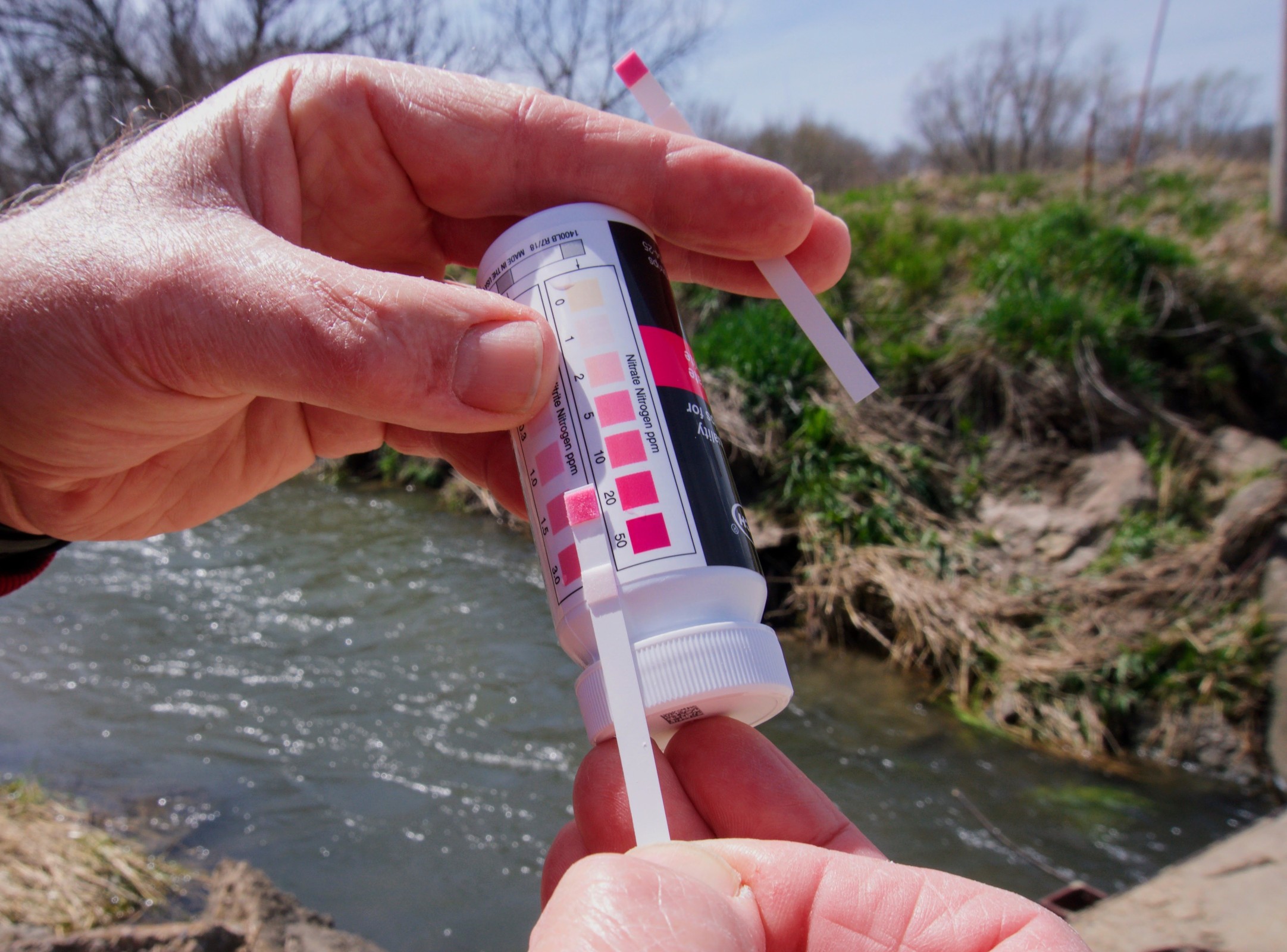
Jerry Stoefen, a farmer from New Liberty, Iowa concerned about nutrient pollution reads results of a nitrate test strip that shows nitrate concentrations in Rock Creek behind his house at 20 parts per million, or 20 times natural background levels. Nitrate, a toxic pollutant, forms when nitrogen mixes with oxygen. Photo credit: Circle of Blue
“Like a jigsaw puzzle”
There’s a reason federal and state agencies count so heavily on conservation practices to cure nutrient pollution. In field trials conducted by agricultural universities, and where farmers apply them over a period of years, they really work. The use of cover crops, which are planted not to be harvested but to provide a protective layer over soil, have been found to significantly reduce nutrient runoff. Planting vegetation in drainage ditches, installing sediment retention ponds, and building wetlands are also known to be effective.
Two of the largest conservation programs are the Conservation Stewardship Program (CSP) and the Environmental Quality Incentives Program (EQIP), both administered by the US Department of Agriculture (U.S.D.A).
Last year, the U.S.D.A. spent $400 million in CSP and EQIP payments in the six biggest Mississippi River Basin farm states – Illinois, Indiana, Iowa, Minnesota, Missouri, and Wisconsin. It’s a portion of the roughly $2 billion that the federal and state governments annually spend on conservation programs in the Mississippi Basin, according to Michael Happ, a researcher at the Minneapolis-based Institute of Agriculture and Trade Policy
But farmers in those six states – the basin’s largest source of nitrogen – applied CSP and EQIP practices to fewer than 3 million acres, according to federal data. That’s less than 3 percent of the 119 million acres of cropland in those states.
Sociologists who study why producers aren’t flocking to be paid to improve soil, conserve water, reduce runoff, and lower expenses, say the biggest impediments are the substantial changes required in how they farm. And their fear of losing productivity and revenue.
As a specialist with the Iowa Department of Agriculture who counsels farmers on best management practices, Porter explains it this way: “It’s perceived risk. Fear and worry about the effects on their drainage and their bottom line, and on yields. It’s a different system of farming than the one they’re using.”
Porter says his Iowa farm is an example of how effective changing farm practices can be in improving water quality. He started planting cover crops in 2011 on 550 acres to reduce erosion, build soil health, and keep excess nitrogen fertilizer in the ground. He constructed buffer zones in low-lying areas to prevent nitrogen from draining into streams. He retired 13 acres and raised a fertilizer-free meadow. The cost has been paid by state and federal grants.
As his diligence and techniques took hold over a decade, the farm’s soil fertility improved and the amount of fertilizer he spread diminished, as did the level of toxic nutrients leaving his land. Samples of water draining from his farm showed nitrogen concentrations of 1 to 2 parts per million, equivalent to natural background levels.
“It’s a little like a jigsaw puzzle,” said Porter. “It’s a systemic solution with multiple layers of best management practices that you fit together based on your topography, your soil types. It’s all available. It can work.”
Porter is trying to convince other farmers in his state to follow in his footsteps. “I’m getting yields that I’m happy with. I’m not spending as much money on the front end,” he said. “I feel better about the effects on my neighbors and people downstream.”
Nancy Rabalais, a marine ecologist at Louisiana State University, has led voyages to document the expanse of the Gulf hypoxic “dead” zone, since 1985. (Photo courtesy of Nancy Rabalais)
“Not like it is now”
One big reason many farmers have not been eager to embrace changes that lead to cleaner water is simply because they have not had to.
The federal Clean Water Act enacted in 1972 provided the E.P.A and states powerful authority to limit chemicals and contaminants from being discharged into US waterways through a “point source”, defined as pipes and manmade ditches. The law does not consider flows from irrigated croplands or stormwater discharges as point sources.
At the time in the early 1970s, the implications of waiving oversight of farm pollution was not thoroughly evaluated. US agriculture largely consisted of smaller, lower-polluting, mixed crop and livestock farms that grazed animals in manure-absorbing pastures.
But carving farms out of the Clean Water Act’s reach has since proved to be a significant factor in worsening water quality. Had the farm sector been held accountable for its waste, it would have been compelled to keep fertilizer and manure spread on fields out of surface and groundwater. That, in turn, would have kept farms operating at a scale that brought environmental costs in line with revenue.
Another barrier to any meaningful reduction in nutrient pollution is the action by Congress to incentivize farmers to plant corn, a crop that when conventionally grown requires large amounts of nitrogen fertilizer. US farmers grow more corn each year than they can sell, driven by government incentives – a practice that enriches companies selling corn seed and the chemicals used to grow corn – but results in range of harmful environmental injuries, including fouling waterways.
“The scale of the problem dwarfs the level of response, unless you change the design of the dominant crop and livestock production systems,” said ISU’s Liebman.
When it was first identified in the 1950s, what scientists now call the Northern Gulf Hypoxia Zone was seen as a small biological curiosity. But in the 1980s, as researchers gained greater understanding of the peril to marine life, they started mapping the size of the toxic zone, documenting its ominous growth. Congress passed the Harmful Algal Bloom and Hypoxia Research and Control Act in 1998 to address pollution in US coastal waters by pinpointing sources of nutrient contamination and their environmental consequences, and working to slash the pollution.
Now, more than two decades later, the money and time seems largely wasted, at least to Arnesen, who sees the deadly toll the toxic tide takes on marine life in her work operating a fishing boat.
“I started fishing offshore in the Northern Gulf of Mexico 25 years ago,” she said in an interview. “We caught everything. Not like it is now. Algae blooms cause massive fish kills. We’re seeing it all over the northern Gulf. It’s affecting the overall ecology of the system. It also affects me as a human being. We consume water out of the river. I try not to think about it. It scares me.”
This report was originally published by The New Lede and is part of an ongoing series looking at how agricultural policies are affecting human and environmental health.
Created by Imgur user Fejetlenfej , a geographer and GIS analyst with a ‘lifelong passion for beautiful maps,’ it highlights the massive expanse of river basins across the country – in particular, those which feed the Mississippi River, in pink.
A wetland along Castle Creek. Photo credit: Brent Gardner-Smith/Aspen Journalism
Click the link to read the article on The Denver Post website (Elise Schmelzer). Here’s an excerpt:
May 18, 2024
Nine major bills aim to reduce water use in cities, replace nixed federal protections of wetlands and minimize the amount of toxic “forever chemicals” leaching into water supplies. Gov. Jared Polis already has signed four of the bills into law, while four more await his signature and one will go to voters…But momentum must continue if Colorado is to avoid looming water shortages, lawmakers and advocates said. Critical conversations about paying farmers and others to use less water and making sure that conserved water is used thoughtfully must turn into policy, they said…
The biggest achievement this year, lawmakers and advocates said, was the passage of House Bill 1379, which fills a gap in wetlands and stream protection created by a U.S. Supreme Court decision last year…Among other water-related bills passed this session were two focused on quality: Senate Bill 81, which has been signed into law, bans the sale of some consumer products with intentionally added PFAS chemicals — like cookware and ski wax — beginning in 2026 and another class of products in 2028, in part to reduce how much of the chemicals reach waterways. And Senate Bill 37 (not yet signed into law) orders a study of ways to use “green infrastructure” to improve water quality…Voters will be asked in November to decide a ballot measure referred by House Bill 1436 allowing the state to keep more sports betting tax revenue for state water projects. The measure would remove the cap on the amount of money that goes for those projects…
Several other bills are targeted at conservation in various ways:
Senate Bill 197 (not yet signed into law), would implement recommendations from the Colorado River Drought Task Force convened last year. That includes making it easier for tribal nations to apply for state water grants and allowing people who hold agricultural water rights to loan them to the state water conservation board to boost flows.
House Bill 1362 (signed into law), allows the installation of graywater systems in new construction statewide. Graywater systems collect water after its first use and reuse it for a variety of purposes, like flushing toilets or watering plants.
House Bill 1435 (not yet signed), would allocate $56 million to water projects through state agencies, including water supply forecasting and turf replacement. The bill also includes $20 million for the purchase of the Shoshone power plant water rights.