
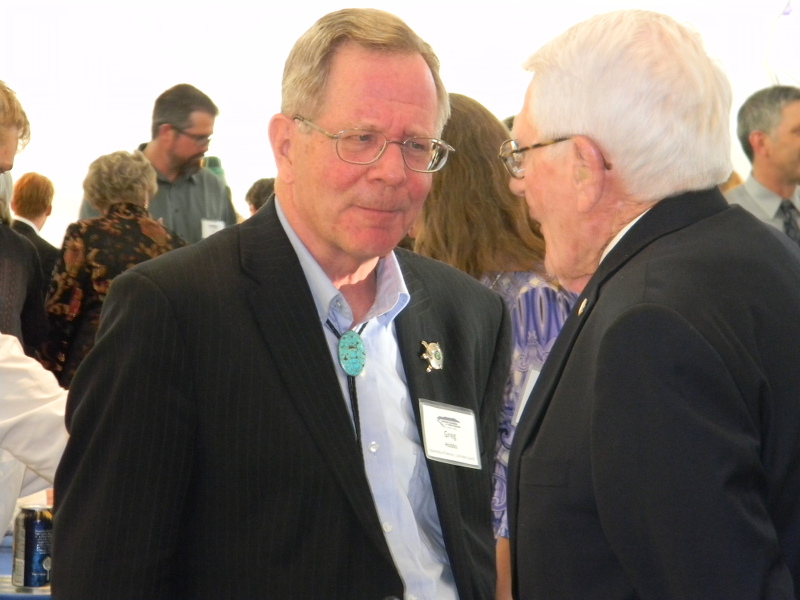
Colorado Supreme Court Justice Gregory J. Hobbs Retires

Greg Hobbs and Ken Wright

I wrote this on the occasion of Greg Hobbs’ retirement from the Colorado Supreme Court and ran across it yesterday on the Colorado Central website (August 1, 2015):

Greg Hobbs is calling it quits after 19 years as the Colorado Supreme Court’s “water expert.”

Early in his career he clerked for the 10th Circuit, worked with David Robbins at the EPA, and worked at the Colorado Attorney General’s office. AG duties included the natural resources area – water quality, water rights and air quality issues. He represented the Northern Colorado Water Conservancy district before forming his own firm, his last stop on the way to the Court.

He told the Colorado Statesman that he always had his eye on the Supreme Court. While serving at the 10th circuit, Judge William Doyle told encouraged him to set his sites on the Supreme Court, saying “They do everything over there.”

When he appointed Hobbs to the court, Governor Roy Romer told him to “get a real tie,” according to the Statesman. A bolo tie, as Hobbs usually wears, didn’t seem to qualify.

The justice is hardworking outside his court duties. He is often asked to speak at conventions and meetings around the state. He is deeply driven to learn about others and to share his knowledge of law and history.

A few years ago, over in Breckenridge, the Summit Daily News reported that Hobbs said, “The water ditch is the basis of civilization.”

His passion is to explain current opportunities and problems within a historical context. He describes himself as a “failed PhD,” having dropped out of a PhD Latin American History program at Columbia University.

One opinion in particular illustrates the importance of history to Hobbs:
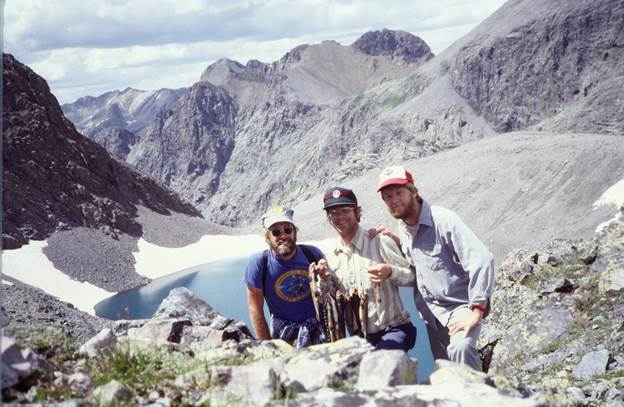
Will Hobbs, Greg Hobbs, Dan Hobbs, and a string of fish for dinner, Mary Alice Lake, Weminuche Wilderness, 1986 via Greg Hobbs

The University of Denver Water Law Review honored Justice Hobbs at their annual shindig. Former Justice Mike Bender told attendees about a case where a man had been arrested after police entered and searched his zippered tent in a campground.

In his opinion, Hobbs detailed the history of Coloradans that lived in tents. The plains Indians and their teepees, the miners camps dotted all over the mineral belt and elsewhere, and more than a few homesteaders, also. He said that in Colorado, there is an expectation of privacy when you close up your tent dwelling, and that it is no different from the expectation for a more permanent structure.

The police violated the man’s Fourth Amendment rights by not obtaining a search warrant, he said.

The justice credits luck for his interest in water law. He got in on the ground floor of the environmental movement during the early days of the Clean Water Act and the Clean Air Act.

He has a deep and abiding respect for Colorado water law.

During his time on the court, there were two interesting cases dealing with the “speculation doctrine” – that is, a water diverter must put the water to beneficial use, not hold on to it and auction it to the highest bidder.

Pagosa Springs Water and Sanitation District was told it was not allowed a 100-year planning horizon. High Plains A&M was denied a change of use – agricultural to municipal and industrial – for lower Arkansas Basin water on the High Line Canal, because they didn’t have any firm customers for the water they were changing.

The Court recognized the Legislature’s legal ability to create whitewater parks as a beneficial use.

Perhaps one of the most remarkable insights that Justice Hobbs realized pertains to environmental flows within Colorado water law:

When Amy Beatie, director of the Colorado Water Trust, was clerking for the justice, she told him that her primary interest was working for the environment. He advised her to go into private practice, learn about the workings of water law, the mechanics and hydrology of diversions, and the art of finding common ground at water court. Then, he said, have faith that there will be a way to work for the environment within the water rights system.

Ms. Beatie paid attention.

Her organization just secured an instream flow right for the Colorado Water Conservation Board on a tributary of the Gunnison River, the Little Cimmaron River. The trust purchased shares of the McKinley ditch and assigned them to the CWCB – the only entity under state law that can hold rights for instream flows.

The water rights are senior and near the confluence with the Gunnison. Therefore, in times of low flows they are capable of calling out diversions above them. Water bypasses the McKinley headgate and stays in the stream for the fish and other critters. Further development of junior water rights won’t affect the arrangement, since the instream flow will always be in line ahead of newer ones.

This agreement and decree were a big deal since they were the first of their kind, with a willing seller, an organization dedicated to finding deals that benefit instream flows, an entity that can legally hold those rights, and an active water rights market.

At this summer’s Martz Conference hosted by the CU law school, Justice Hobbs spoke about Colorado’s water market. Many groups and individuals decry the current state of water in the western U.S. Brad Udall, for example, told attendees at last fall’s Colorado River District Annual Symposium, that we are living with 19th-century laws, 20th-century infrastructure and 21st-century problems.

Hobbs reminded attendees at Martz 2015 that Colorado has the most active water market in the U.S. and it evolved under those 19th-century laws. Colorado water law is there to protect all appropriators and works very well, albeit slowly. Things move along more quickly as case law grows.

The basis of Colorado water law is the “doctrine of prior appropriation,” which is really a doctrine of scarcity, as just about anyone can administer a stream with average or above average flows. The art comes when there are low flows, so the state engineer has the priority system in his toolbox for those dry times.

Greg has become a friend to me over the years and I already miss him on the court.

He assures me that he will keep writing and speaking. After all, he asserts, “Coloradans love a good story.”

You tell a good story, Greg.

John Orr covers Colorado water issues at Coyote Gulch: www.coyotegulch.net

Published in 2015 August
Conservation Works — and Science Just Proved It: But at the same time, it doesn’t take much to do tremendous damage to endangered species — The Revelator

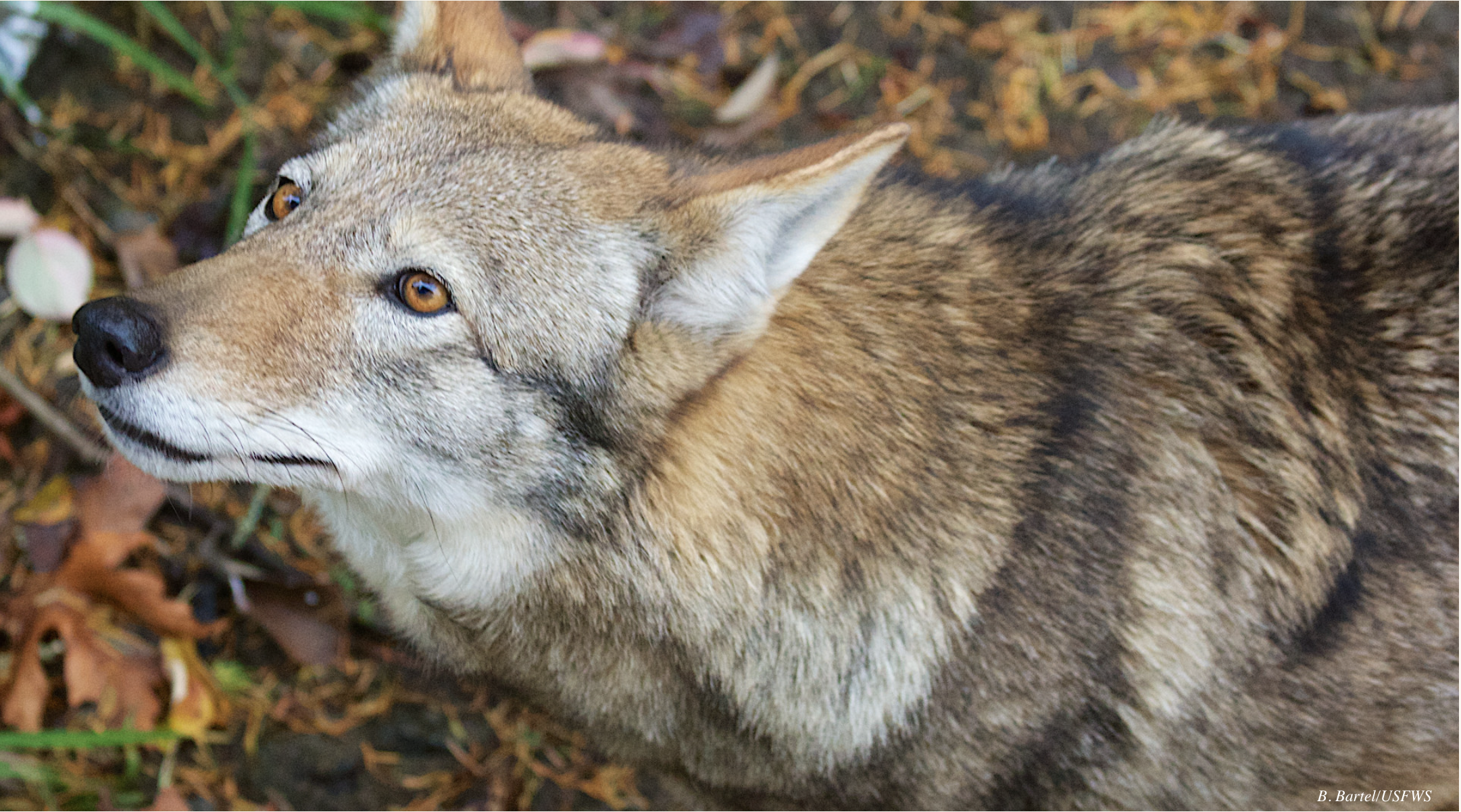
Red wolf (Canis rufus). Photo credit: USFWS

Click the link to read the article on The Revelator website (John R. Platt):

May 13, 2024

Science just proved it: Conservation efforts around the world are working.

According to a study published April 26 in the journal Science, human efforts to help endangered and at-risk species have proven overwhelmingly successful at improving their status.

The researchers — 33 authors from universities and conservation groups — examined 186 studies that measured the effectiveness of conservation efforts over time. The meta-study put the results clearly:

Interestingly, the study found that more recent conservation projects were the most likely to have gone well. We’ve learned a lot over the past few decades, which means we’re doing better all the time.

Toward that point, the paper found that even conservation efforts that don’t work can provide critical information to help future programs, as two of the study authors wrote for The Conversation: “For example, in India, removing an invasive algae simply caused it to spread elsewhere. Conservationists can now try a different strategy that may be more successful.”

And here’s the even bigger takeaway: The benefits aren’t just for the species that are direct targets of conservation efforts. “One of the most interesting findings was that even when a conservation intervention didn’t work for the species that is was intended, other species unintentionally benefited,” lead author Penny Langhammer, executive vice president of the conservation group Re:wild, told BBC News. That often happens when conservationists mitigate a threat in order to help one species but help other nearby plants or animals in the process.

Of course, we could be doing even better: Even though we know conservation works, there’s just nowhere nearly enough funding to help every species in need. As the authors wrote in The Conversation:

The paper itself lists dozens of great conservation examples, but you can find even more in recent news:

  • Critically endangered red wolves (Canis rufus) have enjoyed a much-needed baby boom, with eight new cubs born to a pack in North Carolina last month. Red wolves only have one breeding male left in the wild, so these cubs represent the future of the species. (The proud papa came from a conservation breeding center in Washington state after the previous male was killed by a car — further proof that these wolves wouldn’t continue to exist without dedicated humans looking out for their future.)
  • Devil’s Hole pupfish (Cyprinodon diabolis) are also having a helluva good time and have reached their highest spring population level in 25 years. At just 191 tiny fish, they’re not exactly populous, but this is a huge boost from 2013, when the species’ spring population plummeted to a low of just 35. This sets them up for a good breeding season ahead, when their population (which fluctuates according to the time of year) could hit 500 or more.
  • Meanwhile giant ground pangolins (Smutsia gigantea) have returned to Kenya for the first time in more than half a century. Conservationists put the current population at just 30-80 animals, but it’s a start, and it’s all due to the nonprofit Project Pangolin’s work to remove electric fences and other threats that prevented the return of these heavily poached animals.
  • Similarly, spotted hyenas (Crocuta crocuta) have taken up residence in Gabon for the first time since 1949. A few individuals had briefly wandered into the country over the past few decades, but none of these important predators had stuck around. Now a new study reveals that some of them have finally decided to call their former country home once again — a call for scientists to understand how they did it so others can follow.
  • Also in Gabon, a new study shows that forests certified by the Forest Stewardship Council in that country and the Republic of Congo now enjoy greater abundances of large mammals such as elephants and gorillas, as well as other critically endangered species.
  • Asian elephants living in recently protected habitats in Cambodia appear to have increased in number and now travel in groups of up to 20 or 30, compared to groups of 3-5 just a few years ago.
  • In the UK 150 harvest mice (Micromys minutus) have been reintroduced into a nature reserve near London, the first time they’ve lived in the area since 1979. Conservationists have protected meadows and created wildlife corridors to make the wooded reserve more hospitable to the rewilded mice.

That just scratches the surface, but it proves a point: Humans pushed most of these species toward extinction, but we can also lift them back, given enough time, effort and funding.

Counterpoint

Of course, not everything goes well for imperiled wildlife.

As Mongabay reports, a single gang of poachers may have killed at least 10% of the entire Javan rhino species (Rhinoceros sondaicus) since 2019. A 2021 camera-trap survey put the Javan rhino population at 34 confirmed individuals, although a government report earlier that year estimated the number at 76. Either count was bad enough, and now this gang is suspected to have killed at least seven of the rhinos, according to government officials, pushing the species ever closer to extinction.

This brutal news hit the environmental media like a lead balloon. Other than Mongabay, no media outlets covered the story in English in the week that followed, according to freelance journalist Jeremy Hance broke the news and later wrote on social media, “How can we do anything about the mass extinction crisis if the news refuses to cover it?”

This story — and the journalistic apathy around it — cuts deep. I’ve long been vocal in my criticism that environmental journalism doesn’t do enough to cover wildlife issues and the extinction crisis. Climate change — as critical as it is — has sucked much of the air from the room and left little space for covering other topics.

Part of the challenge is that bad news about endangered species and wildlife is often so heart-wrenching. Stories like poachers killing Javan rhinos embody the cruelest aspects of human character and social conditions. Faced with painful facts and few actionable solutions, many readers tune it out and turn the page.

But we can’t turn a blind eye to the multiple crises around the world. The media needs to cover them, and people who care need to read and share them along with the good-news stories — to help inspire further action and fight the overwhelming ennui that can settle on us in the face of destruction.

If the bad news makes you angry, use that anger. And look to the success stories to keep you going and build on what’s already been done.

2024 #COleg: How #Colorado’s 2024 legislative session will impact the environment — Colorado Newsline

Bicycling the Colorado National Monument, Grand Valley in the distance via Colorado.com

Click the link to read the article on the Colorado Newsline website (Chase Woodruff):

May 13, 2024

Despite bipartisan agreement on a handful of key reforms, Colorado’s 2024 legislative session highlighted the deep divides and entrenched interests that define some of the state’s thorniest and longest-running environmental challenges.

Colorado Democrats and environmental groups began the year with an ambitious plan to crack down on ozone pollution from the oil and gas industry. It was the most significant new attempt to regulate drilling since a sweeping health and safety overhaul passed by Democrats in 2019, and the opposition it drew from deep-pocketed industry groups was similarly intense.

In an eleventh-hour deal brokered by Gov. Jared Polis, proponents abruptly changed course, agreeing to drop most of the proposed regulations in favor of a new fee on oil and gas production to fund public transit and conservation projects. Other bills approved by lawmakers this session, which ended Wednesday [May 8, 2024], aim to establish or expand protections for disproportionately impacted communities, drinking water supplies and wild streams and wetlands.

“The 2024 legislative session was a win for the climate, for Colorado consumers, and for equity,” Elise Jones, executive director of the Southwest Energy Efficiency Project, said in a statement. “In particular,  lawmakers approved unprecedented funding for bus and rail service across the state, and adopted a package of climate-friendly land use bills to enable more affordable and abundant housing opportunities in Colorado’s cities along transit lines, while reducing transportation pollution and traffic congestion.”

Separately from the package of ozone reforms, lawmakers for the first time considered a bill that sought to put an end date on oil and gas extraction in Colorado as part of the state’s efforts to address climate change. Similar plans to phase out drilling are underway in states like California and in countries around the world, but Colorado’s Senate Bill 24-159 likely never stood a chance; facing a veto threat from Polis, a Democrat, and lacking support from key Democratic lawmakers, it died in its first committee hearing in March.

Air and water quality

Senate Bill 24-229Ozone mitigation measures

One of two bills introduced late in the 2024 session as part of the compromise on oil and gas issues, SB-229 will make a relatively minor set of reforms to the way state agencies issue permits and enforce regulations on oil and gas operations. It will give Colorado’s Energy and Carbon Management Commission more explicit power to penalize operators and address the problem of orphaned wells, and codify a mandate on oil and gas producers to reduce emissions of so-called ozone precursors, which Polis first issued in an executive order last year.

The bill has not yet been signed by the governor.

Senate Bill 24-230Oil and gas production fees

Beginning in July 2025, this bill will levy new fees on oil and gas production in Colorado. The per-unit fees will be adjusted quarterly based on benchmark prices, but will roughly equate to a surcharge of about 0.5% per barrel of crude oil, and will raise between $100 million and $175 million in a typical year. The revenue will fund projects to offset the impacts of oil and gas pollution, with 80% allocated to public transit projects and the remainder used by Colorado Parks and Wildlife for land acquisition and habitat projects.

SB-230’s fees will substantially increase the share of oil and gas production revenue collected by the state, while doing little to offset its exceptionally low rates of conventional taxes on the industry, a Newsline analysis found.

The bill has not yet been signed by the governor.

House Bill 24-1338Cumulative impacts and environmental justice

Sponsored by Democratic state Reps. Manny Rutinel of Commerce City and Elizabeth Velasco of Glenwood Springs, HB-1338 directs the Colorado Department of Public Health and Environment to carry out the recommendations of the state’s Environmental Justice Action Task Force. Those measures include increased oversight of the state’s only petroleum refinery, the Suncor facility in Commerce City, and the creation of a “rapid response” inspection team to act quickly to address air quality complaints.

The bill has not yet been signed by the governor.

House Bill 24-1379Regulate dredge and fill activities in state waters

Sponsored by Democratic House Speaker Julie McCluskie of Dillon and Republican state Sen. Barbara Kirkmeyer of Weld County, HB-1379 reestablishes protections for certain streams and wetlands following a 2023 Supreme Court decision that excluded them from the federal Clean Water Act. The bill creates a new CDPHE permitting program to regulate dredge and fill activities that impact those waters, with a variety of exemptions, including for many agricultural operations.

The bill has not yet been signed by the governor.

Senate Bill 24-197Water conservation measures 

Another bipartisan water bill, SB-197 would implement several conservation proposals endorsed by last year’s Colorado River Drought Task Force, including the expansion of a program for the temporary loaning of water rights to the Colorado Water Conservation Board to protect the environment.

The bill has not yet been signed by the governor.

Senate Bill 24-81Perfluoroalkyl and polyfluoroalkyl chemicals

SB-81 expands the state’s ban on products containing cancer-causing PFAS, so-called “forever chemicals,” to include new categories of items like nonstick cookware, ski wax and artificial turf.

It was signed into law by Polis on May 1.

Land use and transportation

For the second legislative session in a row, climate and environmental advocates lined up in support of a push to steer Colorado land-use policy towards more abundant, higher-density housing development. Proponents say the reforms are a critical step towards meeting the state’s clean transportation and energy goals, but they’ve run into stiff opposition from local governments and homeowners who object to the state interfering in local zoning and development policies.

Following the defeat of a sweeping package of land-use reforms in the 2023 legislative session, sponsors revived several of its components in piecemeal fashion this year.

House Bill 24-1313Transit-oriented communities

The most ambitious of 2024’s housing bills, HB-1313 sets goals for Colorado’s most populous cities to increase housing density in areas nearest to public transit stations. It establishes a $35 million fund to support infrastructure in communities that meet the goals, but a controversial provision that would’ve withheld state highway funding from local governments that failed to comply was stripped from the bill prior to its passage by the Senate.

The bill was signed into law by Polis on Monday.

House Bill 24-1152Accessory dwelling units

Accessory dwelling units, sometimes called “granny flats,” are housing units built on a property with an existing single-family home. HB-1152 would legalize the construction of ADUs across virtually all residential areas in Colorado’s most populous cities and suburbs, prohibiting local governments from restricting their construction on any land zoned for single-family residential development.

The bill was signed into law by Polis on Monday.

House Bill 24-1007Prohibit residential occupancy limits

HB-1007 bars local governments from regulating the number of unrelated people who can live together in a housing unit, except for standards enforced based on building or fire codes. Low occupancy limits in cities like Boulder — which prohibited more than three unrelated people from living together until last year, when it raised the limit to five — have been a flashpoint in local battles over housing affordability.

The bill was signed into law by Polis on April 15.

House Bill 24-1304Minimum parking requirements

HB-1304 would prohibit local governments from enacting minimum parking requirements for new housing developments in areas nearest to transit service. Critics of such ordinances say they inflate the cost of constructing new housing units while exacerbating traffic congestion and vehicle pollution.

Polis signed the bill into law on May 10.

Senate Bill 24-184Support surface transportation infrastructure development

As the state ramps up efforts to win federal funding for a new passenger rail system along the Front Range, SB-184 would create a new revenue stream for rail infrastructure spending by levying a new fee of up to $3 per day on rental cars. Transportation officials said the $58 million raised annually by the new fee will help the state “compete effectively” for federal passenger rail grants.

The bill has not yet been signed by the governor.