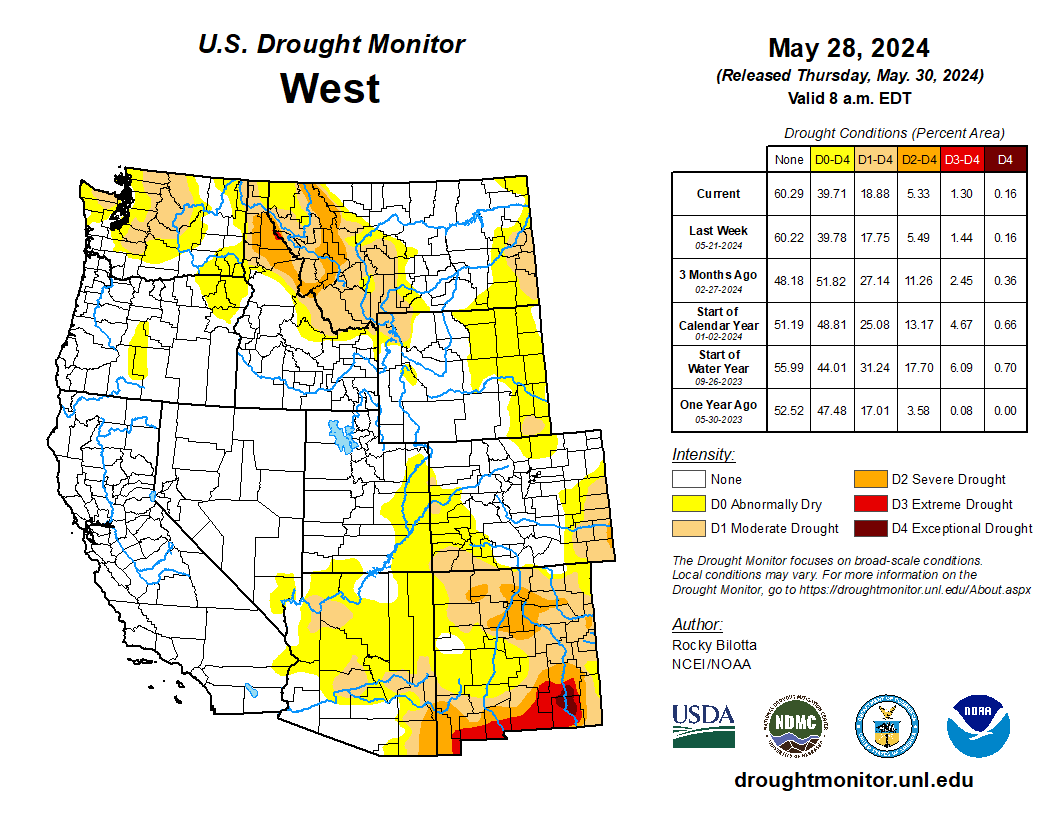
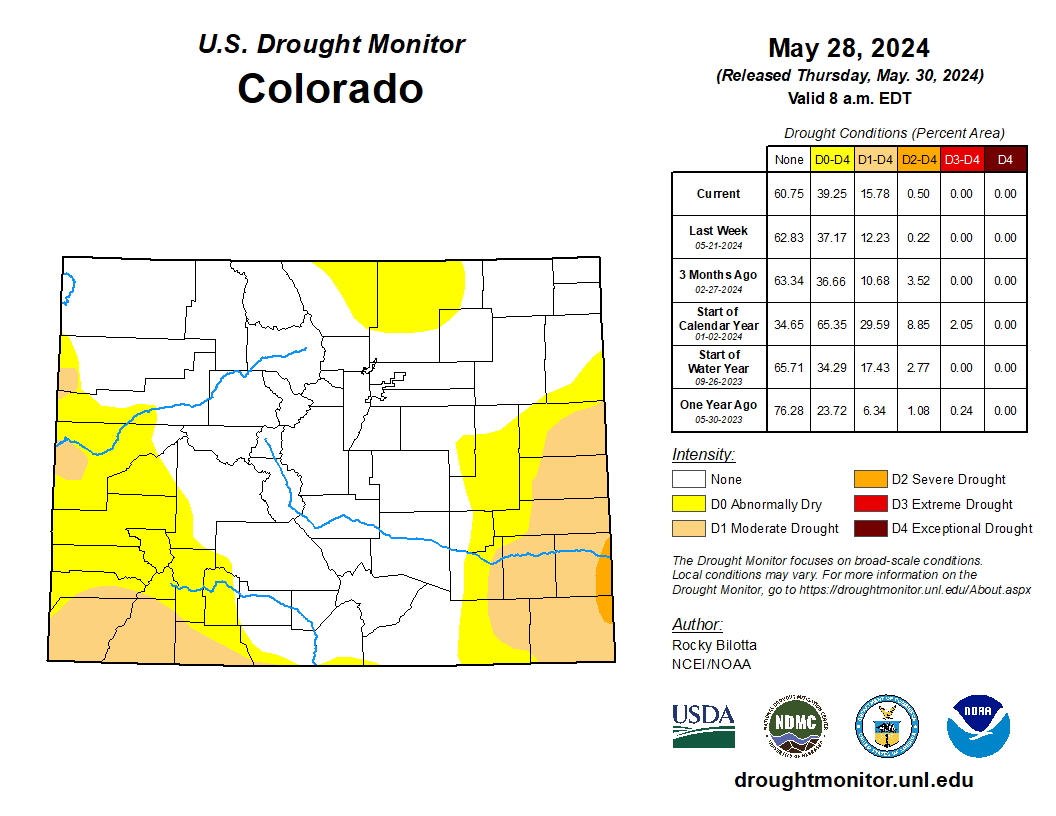
#Drought news May 30, 2024: Deteriorating conditions shown in short-term SPI/SPEI, streamflow, soil moisture and snow water equivalent (SWE) data justified degradations in #Colorado and eastern portions of #Nebraska and #Kansas.

Click on a thumbnail graphic to view a gallery of drought data from the US Drought Monitor website.
Click the link to go to the US Drought Monitor website. Here’s an excerpt:

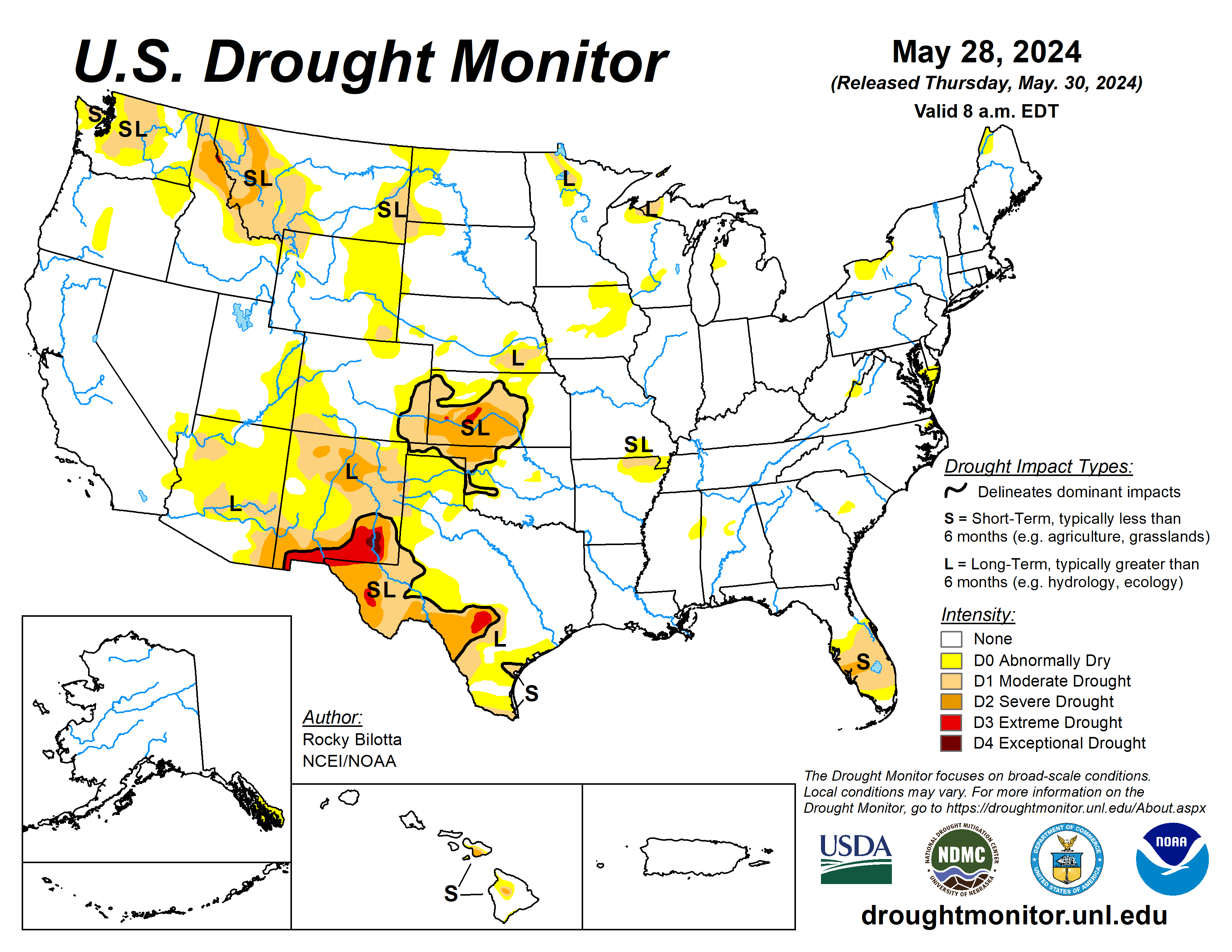
This Week’s Drought Summary

A front over the Northwest to the Great Basin brought rain and higher-elevation snow to parts of the region, as well as rain and extreme weather to most of the Plains and Lower Mississippi Valley as the front advanced eastward. An additional front from southern Plains to the Great Lakes brought severe weather and thunderstorms from Texas to New York. Meanwhile, a sub-tropical upper-level high over Mexico brought record- to near-record warmth to portions of Texas. Temperatures were above normal across the eastern contiguous U.S., by as much as 10+ degrees F above average from parts of the eastern Great Lakes to the Northeast and in parts of Texas. Precipitation was below normal across much of the southern contiguous U.S. and the Northeast, as well as portions of the Northwest and parts along the East Coast. The most widespread improvements were made to portions of the Midwest and in eastern parts of the High Plains and South, as well as Montana and Hawaii, where above-normal precipitation was observed this past week. Dry conditions continued across the western portions of the Southern region, southern High Plains and Southeast, with degradations occurring in parts of the western Plains and Florida Peninsula. Drought and abnormal dryness also expanded or intensified in portions of the northern Rockies and Pacific Northwest. In Alaska, heavy rainfall resulted in the removal of abnormal dryness from the central interior this week…

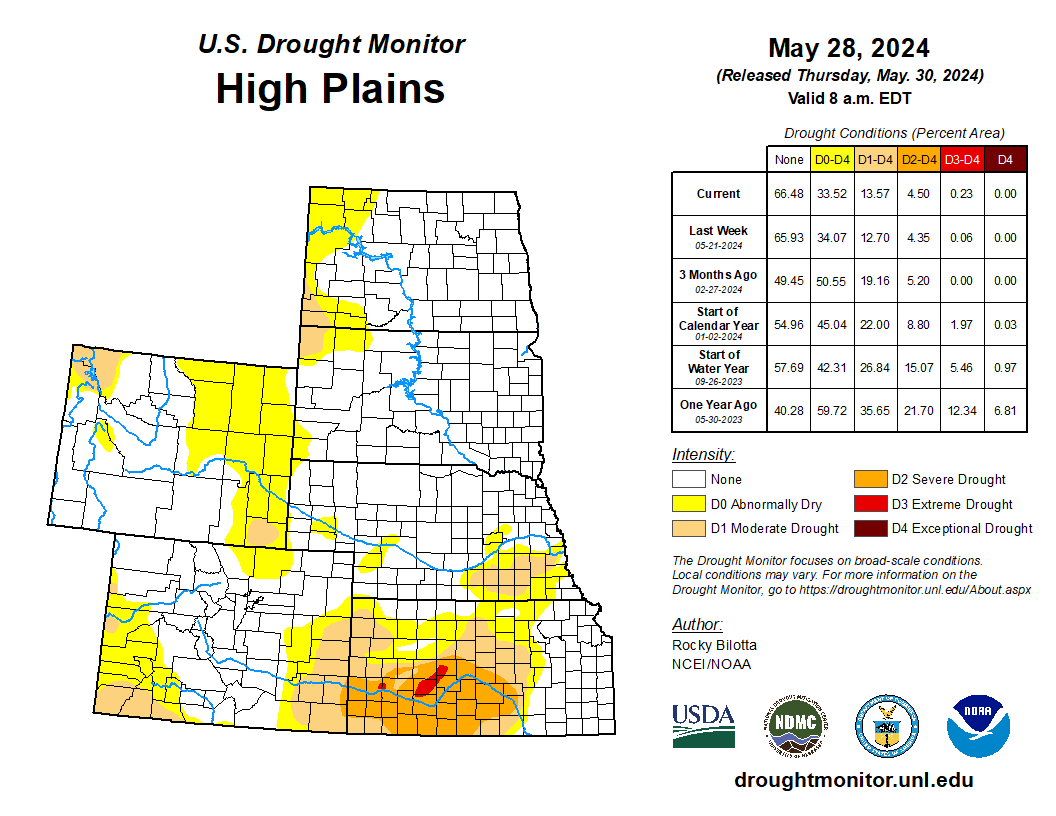
High Plains

Precipitation fell across much of the region this week, which was enough to prevent further degradation but not enough to warrant large improvements. The heaviest rainfall amounts fell across much of North Dakota and along eastern portions of the region, where rainfall totals were up to 600% of normal and ranged between 1 to 4 inches this week. Severe drought (D2) was improved in south-central Kansas, while improvements to moderate drought (D1) and abnormal dryness (D0) were made in northern Kansas and southeast Nebraska. Abnormal dryness was also removed from northern Wyoming and northeast North Dakota due to heavy precipitation and improvement shown in soil moisture and short-term SPI/SPEI indicators this week. Conversely, dry conditions persisted in eastern portions of the High Plains this week. Deteriorating conditions shown in short-term SPI/SPEI, streamflow, soil moisture and snow water equivalent (SWE) data justified degradations in Colorado and eastern portions of Nebraska and Kansas. Extreme drought (D3) and severe drought were expanded in eastern Kansas, while moderate drought was introduced into southeast Wyoming where precipitation amounts were 50% of normal over the past month. Abnormal dryness was expanded in parts of Colorado, eastern Wyoming and western Nebraska this week…

Colorado Drought Monitor one week change map ending May 28, 2024.

West

Much of the West remained as status quo this week, while temperatures were below normal (2 to 10 degrees F below normal) across most of the region. Precipitation fell across northern portions of the West, with the heaviest amounts falling over parts of western Washington and Montana. Above-normal precipitation (up to 3 inches), along with cooler temperatures (up to 10 degrees F below normal), resulted in improvements to extreme drought (D3), severe drought (D2), moderate drought (D1) and abnormal dryness (D0) across parts of Montana. Parts of Southwest Montana missed out on some of the beneficial rains resulting in the expansion of moderate drought in the area. Conditions remained dry in the interior parts of Washington, resulting in expansion of moderate drought and abnormal dryness based on short-term SPI/SPEI data, as well as low soil moisture and streamflow…

South

Dry conditions continued across the western portions of the South this week, while heavy precipitation fell across eastern portions of the region. Most of Arkansas and Tennessee, as well as eastern parts of Oklahoma and Texas, received between 1 to 6 inches of rainfall (200% to 800% above normal) this week, resulting in the improvement of moderate drought (D1) and abnormal dryness (D0) in Arkansas while D0 was removed from most of Tennessee. Conversely, conditions continued to deteriorate in parts of eastern Oklahoma, Texas and Mississippi, where precipitation totals were 1 to 4 inches below normal this month. Severe drought (D2) and moderate drought were expanded in parts of eastern Oklahoma, while moderate drought was introduced in southern Texas. Abnormal dryness was also expanded into parts of northern and southern Texas and small portions of eastern Mississippi. Temperatures were 2 to 8 degrees F above normal across much of the region this week, while parts of southern Texas observed temperatures between 8 to 10 degrees F above normal. The expansion and intensification of drought categories were based on short-term SPI/SPEI, reservoir levels, streamflow and soil moisture data…

Looking Ahead

During the next five days (May 28–June 1, 2024), moisture convergence along a frontal boundary and east of a dryline across Texas and Oklahoma will likely generate scattered to numerous showers and thunderstorms, with the potential for episodes of locally heavy rainfall early to mid-week. The threat of heavy rainfall will be highest in Texas Tuesday into Wednesday as an upper level shortwave moves over the southern Plains, where the potential exists for storms with rainfall rates approaching 2 inches per hour. The coverage of showers and storms will likely expand north across the central and northern Plains later in the week as an organized frontal system moves into the central U.S. from the Rockies. Locally heavy rainfall will be possible across portions of the Rockies going into late Friday and early Saturday as the cold front intercepts an increasingly humid airmass. In terms of temperatures, the Gulf Coast region will continue to remain hot and humid on Tuesday before some limited relief arrives by midweek as a cold front drops southward. However, the heat and humidity will likely continue across Deep South Texas and South Florida with highs running up to 10 degree above average, and heat indices in the 100-110 degree range, especially for southern Texas. Some triple digit heat is also likely for the lower elevations of the Desert Southwest, but very low humidity here will help keep heat indices in check.

The Climate Prediction Center’s 6-10 day outlook (valid June 2–6, 2024) favors above-normal precipitation along much of the West Coast, from the southern Plains to the East Coast, and across much of Alaska, with below-normal precipitation across most of the interior West and Hawaii. Increased probabilities for above-normal temperatures are forecast for Hawaii and much of the contiguous U.S., while below-normal temperatures are likely across the state of Alaska and in parts of Georgia and South Carolina.

US Drought Monitor one week change map ending May 28, 2024.

Fast-growing northern #Colorado wins $250 million in loans for new dam, regional water project — Jerd Smith (Fresh Water News)

The Chimney Hollow Reservoir under construction in Colorado’s Larimer County, July 8, 2022. Credit: Jerd Smith, Fresh Water News

Click the link to read the article on the Water Education Colorado website (Jerd Smith):

May 23, 2024

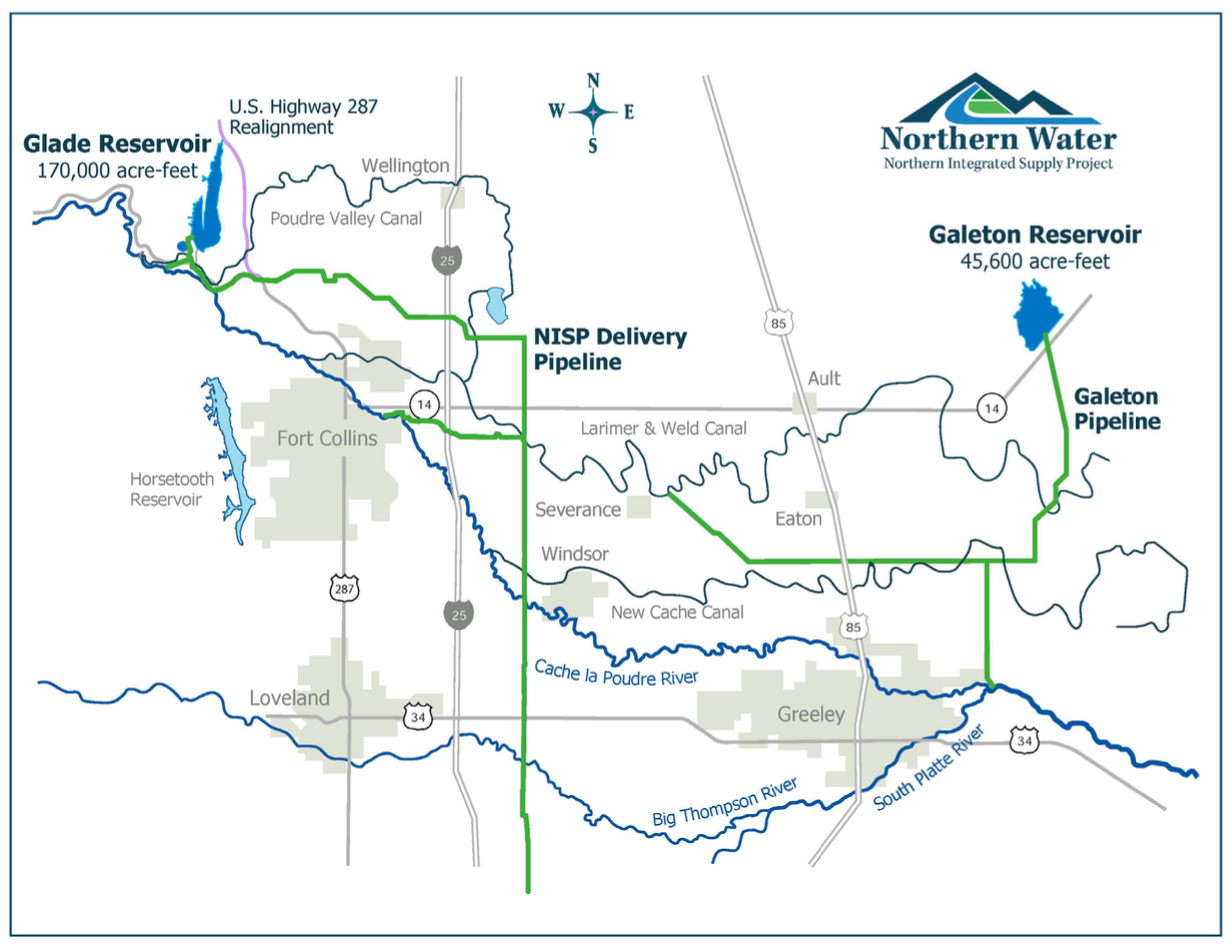
Fast-growing northern Colorado won approval for two major water loans from the state this month that will help finance a new dam outside Loveland and a major regional water project northwest of Fort Collins.

Vetted by the Colorado Water Conservation Board and approved by a bipartisan group of lawmakers May 1, the $155 million for Chimney Hollow Reservoir and the $100 million for the Northern Integrated Supply Project, or NISP, are among the largest financing packages the state has approved in recent years, according to the board.

ā€œIs it a lot, yes,ā€ said Jeff Stahla, a spokesperson for Northern Water, the agency that is sponsoring the projects for a group of cities that includes Loveland, Broomfield, Erie, and Greeley. 

ā€œWe know that these were big asks, and we are grateful for the support. We also recognize that these projects are going to benefit hundreds of thousands of people in the fastest-growing part of the state right now,ā€ Stahla said.

The full costs of the water projects, $561 million for Chimney Hollow and roughly $2 billion for NISP, are being financed by water users, as well as the state, Stahla said.

The Northern Integrated Supply Project, currently estimated at $2 billion, would create two new reservoirs and a system of pipelines to capture more drinking water for 15 community water suppliers. An environmental group is now suing the Army Corps of Engineers over a key permit for Northern Water’s proposal. (Save the Poudre lawsuit, from Northern Water project pages)

The loans come as forecasts show the state’s streams shrinking as much as 30% due to the warming climate while the area’s population continues to grow.

Kirk Russell, the board’s finance section chief, said the two loans combined make up 20% of the agency’s $1.1 billion revolving loan fund. The program operates by providing cash to borrowers below market rates. The interest that is generated, in turn, helps finance loans for new borrowers as these are repaid.

The mega loans mean the state will have somewhat less to lend next year, Russell said, for the state’s 2025 fiscal year, which begins July 1.

ā€œI estimate we will have about $50 million to $60 million in loan funds available next fiscal year. That’s about our average annual total [in available loan funds] for the last few years,ā€ Russell said via email.

The loan program is funded with cash generated by interest and loan payments, as well as federal mineral lease payments and severance taxes collected from oil and gas production, Russell said.

Among its other major loans in recent years is the Arkansas Valley Conduit in southeastern Colorado, which received a $90 million loan, and Aurora’s Prairie Waters Project, which received a $60 million loan, according to Russell.

Rep. Karen McCormick, D-Longmont, said she and her fellow lawmakers are pleased the state has been able to provide the financial help. McCormick was one of the bipartisan group of lawmakers who sponsored House Bill 1435, the legislation authorizing the loans.

ā€œThese projects are super important, especially to my area of Colorado,ā€ McCormick said. ā€œTo have these new reservoirs completed is critical. A lot of different water providers are depending on this.ā€

The projects are not without controversy, however. Federal permitting for both began 20 years ago, according to Stahla, and each has been delayed numerous times after environmentalists sued over concerns about the impact on the drought-strapped Colorado River, the supply that will eventually fill Chimney Hollow, and the equally stressed Cache la Poudre River, whose flows will be used by NISP.

In fact, the Chimney Hollow loan grew from its original $90 million to $155 million in part due to the cost of litigation and increases in construction costs, Stahla said.

Though Chimney Hollow is under construction, NISP continues to face delays due partially to a lawsuit by Save the Poudre against the federal agencies that approved the deal. It was filed in January.

And it will also have to eventually win an OK from the City of Fort Collins, which has historically opposed the project. Mayor Jeni Arndt declined to comment on the state funding, but said the project would still have to undergo review by the city.

How quickly that might occur isn’t clear…

More by Jerd SmithJerd Smith is editor of Fresh Water News. She can be reached at 720-398-6474, via email at jerd@wateredco.org or @jerd_smith.

Bridging Water Rights and River Restoration — Dick Wolfe (#Colorado Water Trust)

Tomichi Creek/Pioneer Ditch headgate. Photo credit: Colorado Water Trust

Click the link to read the article on the Colorado Water Trust website (Dick Wolfe):

May 22, 2024

Bridging Water Rights and River Restoration:
My Path with the Colorado Water Trust

As the former State Engineer of Colorado, I have dedicated my career to understanding and managing our state’s most precious resource: water. Throughout my tenure, the challenges posed by water management in the arid West have only grown, exacerbated by increasing demand and the effects of climate change. It’s a complex puzzle, especially within the framework of Colorado’s prior appropriation system, often summarized by the old maxim, ā€œfirst in time, first in right.ā€ I grew up understanding the challenges of this doctrine being raised on an irrigated farm that continues today as I share this passion of farming with my children and grandchildren. However, my involvement with the Colorado Water Trust has reinforced my belief that there are innovative solutions to restore water to our streams and rivers while continuing to meet our traditional water needs, despite these challenges.

The prior appropriation system, which governs water rights in Colorado, was developed during a time of rapid expansion and development in the West. It was designed to encourage the settlement and economic development of arid lands by granting water rights to those who first diverted water from streams for beneficial use. While this system has been instrumental in the development of agriculture and industry, it has also led to situations where environmental needs, such as maintaining streamflow for ecosystem health, were often overlooked.

Recognizing this gap, I became a member of the Colorado Water Trust, a nonprofit organization dedicated to restoring flows to Colorado’s rivers in need. The Water Trust works within the existing legal framework to develop voluntary, market-based projects to secure water for environmental needs. This approach not only respects the rights of existing water users but also highlights the potential for collaboration and innovation in water management.

One of the primary reasons I joined the Water Trust was to help foster these collaborative efforts. By working with water rights holders, local communities, government agencies, and other stakeholders, the Water Trust develops solutions that benefit both people and the environment. These solutions often involve water leasing, water rights donations, or infrastructure improvements that free up water to be returned to the rivers without harming the original users’ needs. The Cache la Poudre River-Poudre Flows Project symbolizes an innovative solution involving collaboration among many stakeholders.

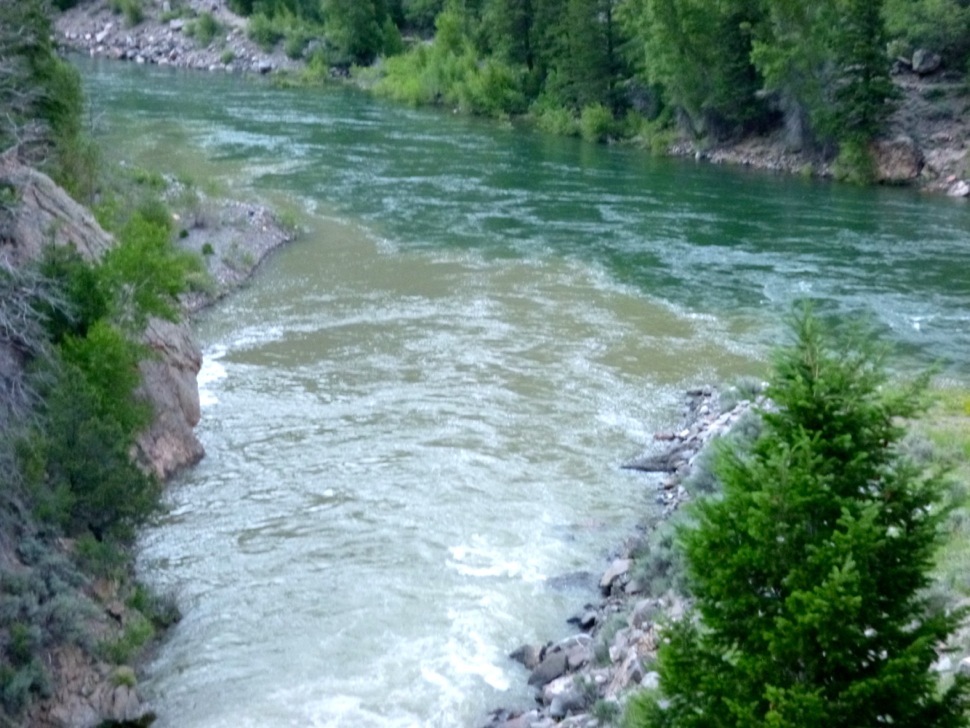
Confluence of the Cimmaron and Gunnison rivers. Photo: Brent Gardner-Smith/Aspen Journalism

Additionally, Colorado Water Trust has facilitated projects where agricultural water users temporarily lease part of their water rights to enhance streamflows during critical times of the year. These arrangements provide farmers and ranchers with additional income while ensuring that streams receive much-needed water during drought periods or when fish and wildlife are most vulnerable. Two projects that exemplify this approach are the Little Cimmaron River-McKinley Ditch Project and the Slater Creek ProjectThese projects not only demonstrate that environmental restoration and agricultural prosperity can go hand in hand, but also serve as proof of concept that flexible water management can work under prior appropriation.

Dick Wolfe Board Member, Colorado Water Trust M.S., P.E. Retired Colorado State Engineer, Senior Advisor LRE Water. Photo credit: Colorado Water Trust

Moreover, my involvement with Colorado Water Trust has been a deeply rewarding part of my post-official career because it aligns with my longstanding commitment to finding balanced solutions to water management challenges. It allows me to continue my work in a meaningful way, contributing to the sustainability of our water resources and the health of our river ecosystems.

In conclusion, my decision to join the Colorado Water Trust was driven by a commitment to stewardship and a belief in the power of cooperation. Despite the constraints of the prior appropriation system, I am optimistic about our ability to find creative and sustainable solutions to water management. The success of the Colorado Water Trust shows that it is possible to restore flows to our rivers and streams, ensuring that they continue to thrive for future generations. Through continued collaboration and innovative thinking, we can protect and enhance Colorado’s waterways, preserving our natural heritage while meeting the needs of all water users.

To’Hajiilee water line groundbreaking: ā€œan impossible projectā€ — John Fleck (InkStain.net)

An impossibility. Photo credit: John Fleck/InkStain.net

Click the link to read the article on the InkStain.net website (John Fleck):

May 15, 2024

With the obligatory shovels in pre-softened dirt, a group of political leaders from the Navajo Nation, New Mexico state and local government, and water agencies this morning (Wed. 5/15/2024) formally inaugurated a new pipeline being built to connect the Navajo community of To’Hajiilee to the 3.5 million gallon reservoir in the picture – clean, piped water to a community that now has one working well and water so bad no one drinks it.

One of the oldtimers who’d been working on it for more than two decades walked up to me and said, ā€œThis is an impossible project.ā€

What he meant was that the project had overcome seemingly insurmountable hurdles in the interactions between a welter of government agencies with overlapping jurisdictions and sometimes incompatible responsibilities.

I went to the event wearing two hats – as a member of the Albuquerque Bernalillo County Water Utility Authority’s Technical Customer Advisory Committee, and on behalf of the Utton Center, which has a long history of working on Native American water stuff. (I was literally wearing my ABCWUA gimme cap, I don’t have an Utton one.)

To’Hajiilee, 35-ish miles west of Albuquerque, has six water wells. Five have already failed. The sixth is regularly off line. When it’s down, they have to shut down school and the clinic. When it’s working, the water is awful.

The vision statement from the Universal Access to Clean Water For Tribal Communities project is simple: ā€œEvery Native American has the right to clean, safe, affordable water in the home ensuring a minimum quality of life.ā€

In this 1999 book Development as Freedom, the Nobel laureate economist and moral philosopher Amartya Sen explains freedoms as ā€œthe capabilities that a person has, that is, the substantive freedoms he or she enjoys to lead the kind of life he or she has reason to value.ā€

ā€œRightsā€ are tricky political terrain, because they’re often framed in negative terms – the absence of coercion or interference from others, particularly the state. But Sen’s making an affirmative argument here. It is not enough for the collective to simply get out of the individual’s way. The collective has an affirmative moral obligation to create the conditions under which the individual can flourish – to pursue that which they ā€œhave reason to value,ā€ to repeat Sen. That’s sorta what my friends at the Universal Access project are saying with their vision statement.

At the urging of a colleague, I’ve been reading Sen lately in an effort to make sense of the moral underpinnings of the collective choices we face as we cope with the reality of less water. (For those familiar with Sen, know that I am not reading the mathy parts – they’re impenetrable!)

THE PLUMBING – PHYSICAL AND FINANCIAL

The Albuquerque Bernalillo County Water Utility’s 7W reservoir, the tan thing in the picture, sits on high ground midway between Albuquerque and To’Hajiilee, a perfect water source for the community. In eighteen months under the current construction schedule, we’ll have a 7 mile pipe from here to there.

If the tally in my notes is correct (don’t hold me to this, I’m not a real journalist any more), it’s a ~$20 million project, with a mix of federal, state, and Navajo Nation funding.

The actual water in the pipes is the result of a fascinating agreement between the Navajo Nation and the Jicarilla Apache Nation in norther New Mexico. The Navajo Nation will lease Jicarailla water, which will be wheeled down the San Juan River, into the Rio Grande, and then diverted by the Albuquerque Bernalillo County Water Utility Authority, treated, and pumped up to 7W.

THE STRUGGLES TO GET THIS DONE

Former Bernalillo County Commissioner Debbie O’Malley, speaking at the groundbreaking, told the story of the bare-knuckle politics it took to overcome the intransigence of a landowner that stood in the way of the project – Western Albuquerque Land Holdings. And for sure, O’Malley and the group she worked with deserve a ton of credit for the use of their knuckles at a critical point in the struggle to get the pipeline built.

But more important is the community of To’Hajiilee itself, people like Mark Begay, my colleague on the Albuquerque water utility’s Technical Customer Advisory Committee. For decades, Begay and the other leaders in To’Hajiilee acted on behalf of their community to pursue ā€œthat which they had reason to valueā€ – water!

This is about the community’s own collective agency, ā€œthe result of collective processes and collective actions in which people’s interactions shape their common destiny.ā€ (Oscar Garza-VĆ”zquez)

It was a joy to share the celebration of their success. I’ll be back in 18 months when they open the taps.

End of Season Wrap-Up – Holding on to What We’ve Got: Opportunities to rebuild basin-wide reservoir storage have been rare in the 21stĀ century — Jack Schmidt (Center for #ColoradoRiver Studies) #COriver #aridification

Click the link to read the article on the Utah State University website (Jack Schmidt):

May 22, 2024

On April 3 2024, the snow accumulation season in the Colorado River watershed ended and the snow water equivalent of the snowpack of the Upper Basin peaked. Two weeks later on April 17, the watershed’s reservoirs1 dipped to their lowest level of the year. Now runoff is underway, and the watershed’s reservoirs are beginning to refill. This is a good time to assess how well water managers did during the past nine months to retain the bounty of 2023’s excellent runoff season, an essential part of rebuilding reservoir storage and regaining basin-wide water supply security. 

The good news is that water managers did quite well, and reservoirs lost only 26% of the total amount accumulated during the 2023 runoff season. This was the smallest loss of any year in the last decade. Most of the decrease in storage that followed last year’s snowmelt inflow occurred in Upper Basin reservoirs, and Lake Mead and Lake Powell lost only 5% of the storage that accumulated in those two reservoirs. It is imperative that water managers continue to work to reduce consumptive uses, reduce losses, and retain the bounty of the few unusually wet years of the 21st century, as they did following the 2023 snowmelt.

Opportunities to rebuild basin-wide reservoir storage have been rare in the 21st century, and there have been many years in which there is significant risk of basin-wide reservoir storage depletion. Hydrologic and reservoir storage data between 2014 and 2023 indicate that annual snowmelt-derived gains in reservoir storage exceeded losses when natural flow at Lees Ferry exceeded 13.7 million acre feet per year (af/yr). Annual flows less than this amount occurred in 16 years of the 21st century. Opportunities to significantly rebuild basin-wide reservoir storage existed when natural flow exceeded 15.8 million af/yr, which only occurred six times in the 21st century. Development of a sustainable policy for managing Colorado River reservoir storage must focus on reducing consumptive uses and losses in both wet and dry years.

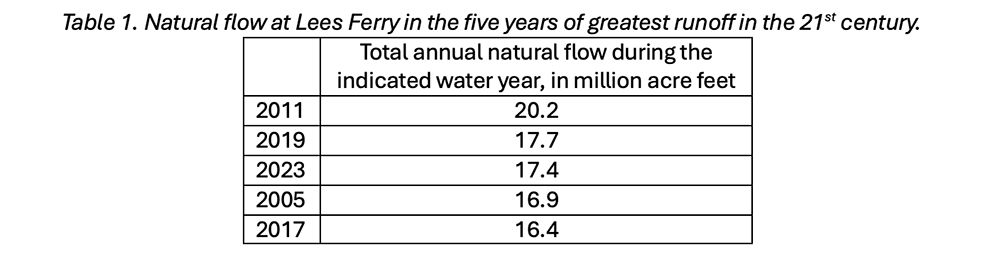
To recap, the natural flow of the Colorado River at Lees Ferry in 2023 was the third highest of the 21st century and was exceeded only in 2011 and 2019 (Table 1). Unregulated inflow to Lake Powell in Water Year (WY) 2023 was ~13.4 million af2.

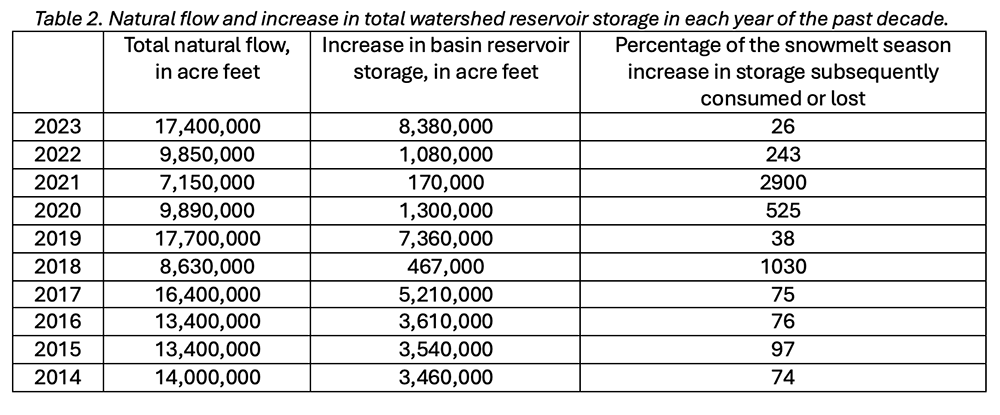
In response to this large runoff, the basin’s reservoirs recovered a significant amount of storage. The watershed’s reservoirs reached their maximum in mid-July (13 July 2023) when total storage was 29.7 million af. The increase in basin storage between mid-April and mid-July was 8.38 million af and was the largest single-year increase in storage in the last decade, and approximately 1 million af more than the increase in storage that had resulted from the inflows of 2019 (Table 2).

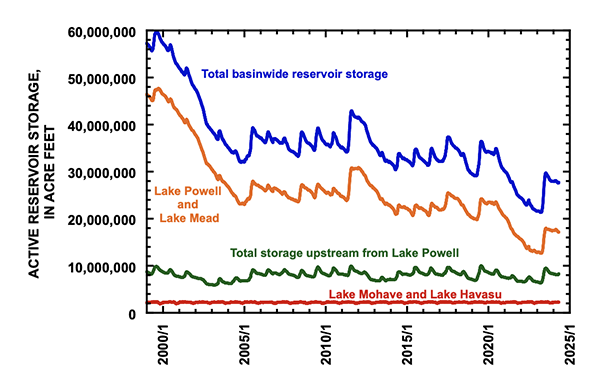
However, the runoff in 2023 did not eliminate critically low reservoir storage conditions. The increased reservoir storage that peaked in mid-July 2023 recovered storage to the amount it had been in mid-February 2021 in the early stages of the 2020-2022 water crisis (Fig. 1). Based on average annual water consumption3Ā 2023’s runoff would need to be repeated five more times to refill the reservoir system. Good runoff years rarely occur consecutively. The projected unregulated inflow to Lake Powell in 2024 is estimated to be only 81% of average.

Figure 1. Graph showing reservoir storage in the Colorado River basin between 1 January 1999 and 1 May 2024. Note that at the peak of storage in mid-July 2023, the total stored water supply was the same as it had been in mid-February 2021. Credit: Jack Schmidt/Center for Colorado River Studies

When we entered mid-summer 2023, I expressed concern about water managers’ ability to conserve the benefit of 2023’s runoff season, because we had not done so in previous years of good runoff. In those years, the benefit of reservoir storage recovery was not retained for more than two years (see blog post from October 2023). The benefit of 2011, the largest runoff of the 21st century, had been completely consumed in 19 months, and the benefit of large runoff in 2019 had been consumed in 24 months. I suggested that public understanding about the status of reservoir storage and the need to conserve the bounty of good years would be improved if water managers regularly reported how much of the previous year’s inflow benefit was retained. Such a metric could highlight success in rebuilding water storage or could be used to sound a warning of the need for additional conservation. 

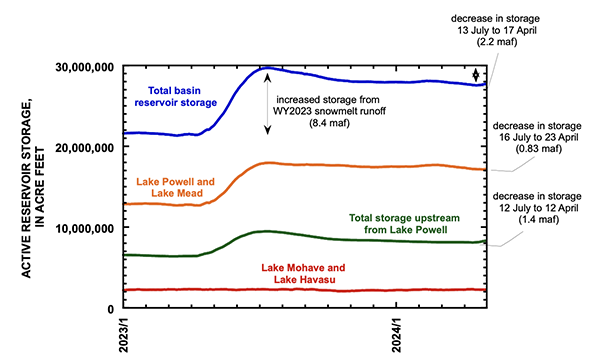
Throughout winter and early spring 2023 and 2024, I reported on the status of reservoir storage and showed that water managers were successfully conserving reservoir storage. Between mid-July (13 July 2023) and mid-April (17 April 2024), total basin-wide reservoir storage lost only 2.2 million af (Fig. 2) which was 26% of the total ā€œgainsā€ of the 2023 snowmelt season. Most of this decrease in storage occurred upstream from Lake Powell, where reservoirs lost 1.4 million af. In contrast, storage in the Lake Powell-Lake Mead reservoir system decreased by only 0.83 million af.

Figure 2. Graph showing reservoir storage in the Colorado River basin between 1 January 2023 and 1 May 2024. Credit: Jack Schmidt/Center for Colorado River Studies

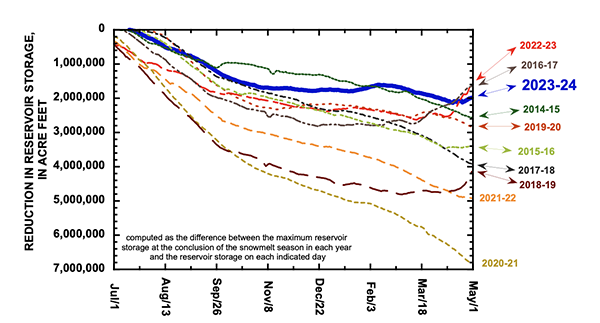
The percentage of the accumulated snowmelt in 2023 that was consumed or otherwise lost from reservoirs in the subsequent months was less than in any other year of the past decadeĀ and was less than following the 2019 runoff season and significantly less than the years between 2014 and 2017 when runoff was moderately good (Table 2). I compared the rate and magnitude of decrease of reservoir storage in 2023-2024 with similar data for the previous nine years. The results are presented in a complicated Figure 3. Each line on this graph is the loss in storage in each year, plotted as the cumulative decrease in storage from the peak that had occurred in early summer. Lines that plot higher on this graph reflect smaller decreases in basin storage. The decrease in storage was notably large after the 2020 snowmelt season; total basin storage was nearly 7 million af less in spring 2021 than it had been in summer 2020. There were also large reductions after the snowmelt inflows of 2018 and 2021. In contrast, the reduction in storage after the 2023 runoff season (the thick blue line) was smaller than in the other years; this pattern is reflected by the thick blue line that plots higher on Figure 3 than in most other years.

Figure 3. Graph showing the decrease in reservoir storage during late summer, fall, winter, and early spring following each year’s snowmelt season. Credit: Jack Schmidt/Center for Colorado River Studies

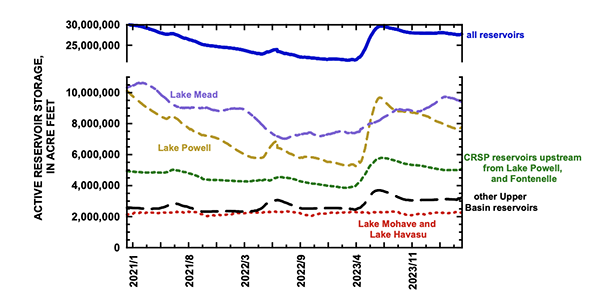
Although the combined storage contents of Lake Mead and Lake Powell reflect the balance (or imbalance) between basin water supply and consumptive use, the trajectories of individual reservoirs also result from reservoir operational rules specific to each facility. Lake Powell reached its peak storage of the year in early July (8 July 2023; 9.67 million af) and subsequently lost 2 million af by mid-April, because water was transferred downstream (Fig. 4). Storage began to accumulate again in Lake Powell in mid-April (18 April 2024). In contrast, storage in Lake Mead steadily increased between August 2022 and early March (4 March 2024), gaining 2.7 million af of storage. Lake Mead has been losing storage since early March.

Figure 4. Graph showing the distribution of reservoir storage in different parts of the Colorado River basin between 1 January 2021 and 1 May 2024. Credit: Jack Schmidt/Center for Colorado River Studies

The trajectory of storage in Upper Basin reservoirs differed between those facilities authorized or linked to the Colorado River Storage Project (CRSP)4 in contrast to other facilities (Fig. 4). Peak storage upstream from Lake Powell peaked in early (facilities unrelated to the CRSP peaked on 5 July 2023 at 3.69 million af ) to mid-July (CRSP related facilities peaked on 15 July 2023 at 5.79 million af). Storage in facilities unrelated to the CRSP was quickly reduced to approximately 3 million af by mid-September, and storage was maintained at that quantity until the beginning of the 2024 snowmelt season. In contrast, storage in CRSP related facilities progressively lost storage of approximately 0.8 million af until mid-February 2024 when storage stabilized at approximately 5 million af. The longer period of declining storage in CRSP-related facilities was caused by policies related to transferring water to Lake Powell.

Insights about the Future

The data and analyses presented above provide insight about the likely trajectory of future Colorado Basin reservoir storage if no changes are made in policies concerning consumptive use and reservoir operations. During the past decade, the increase in basin-wide reservoir storage is well predicted by a power function based on the natural flow at Lees Ferry5 (Fig. 5).

Figure 5. Graph showing the relationship between annual natural flow at Lees Ferry and increase to basin-wide total storage during the snowmelt inflow season between 2014 and 2023. Credit: Jack Schmidt/Center for Colorado River Studies

The proportion of snowmelt-derived gain in storage subsequently lost during the following nine months is well predicted as an inverse power function6Ā of the increase in storage. The greater the increase in storage, the smaller the proportion of that increase subsequently lost. In years when there is little increase in storage, basin-wide consumptive uses and losses far exceeded the annual increase in storage (Fig. 6). Such was the case in 2018 and between 2020 and 2022.

Figure 6. Graph showing the proportion of the annual accumulated reservoir storage consumed or lost during the following nine months prior to the beginning of the next runoff season. Credit: Jack Schmidt/Center for Colorado River Studies

These correlations indicate that annual consumption and losses in excess of annual storage gains occurred when gains were less than approximately 3.2 million af. Between 2014 and 2023, storage gains were less than this amount when natural flows were less than approximately 13.7 million af, which occurred in 16 years of the Millennium Drought. Significant retention of reservoir storage, defined as retention of at least 50% of the annual accumulation, occurred when storage increased by at least 5.7 million af. Such an increase of storage only occurred when natural runoff exceeded 15.8 million af (Fig. 5), which only occurred six times between 2000 and 2023.

Take-Home Messages

The essential purpose of negotiating new reservoir operational guidelines for the Colorado River basin is to maintain sufficient reservoir storage to provide a reliable and secure water supply. At the beginning of the 2024 snowmelt season, basin-wide reservoir storage is comparable to what it was in late spring 2021, demonstrating that the Millennium Drought water crisis persists. The opportunity for significant retention of the benefits of significant increases in reservoir storage exist when natural flow exceeds approximately 15.8 million af, a situation that has rarely occurred since 2000. When natural flow is less than approximately 13.7 million af, there is significant risk of depletion of basin-wide storage. Development of a sustainable policy for managing Colorado River reservoir storage must focus on reducing consumptive uses and losses in both wet and dry years.