Rock cracked Cotter pipeline; contaminants contained at mill site — The Pueblo Chieftain

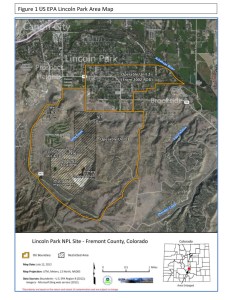
Lincoln Park/Cotter Mill superfund site via the Environmental Protection Agency

From The Pueblo Chieftain (Tracy Harmon):

Cotter Corp. Uranium mill officials say a leak that dumped about 7,200 gallons of contaminated water on the mill property was caused by a rock that punctured a hole in a feeder line.

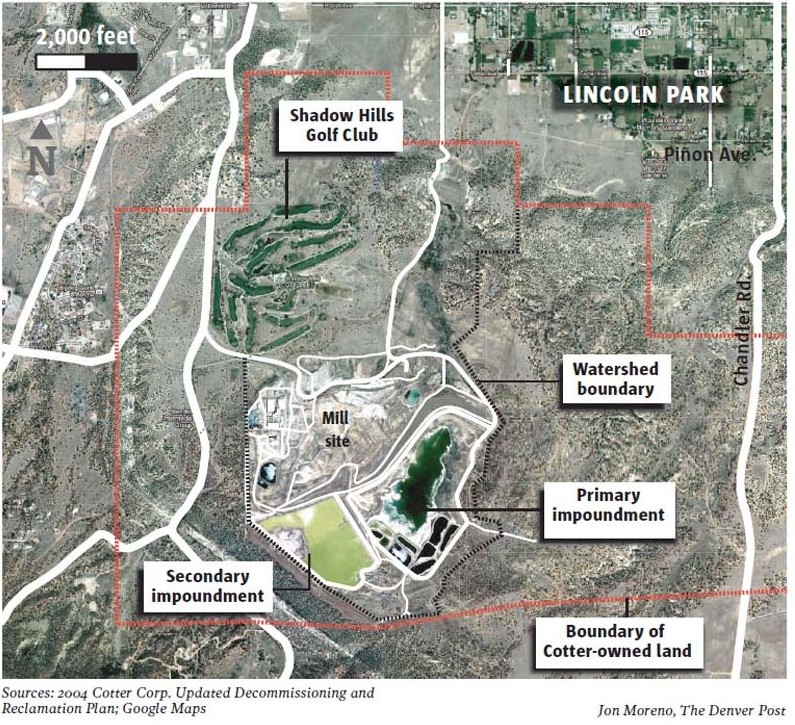
The feeder line connects to the main pumpback pipeline above a Soil Conservation Service dam that helps prevent rainwater runoff from leaving the mill site. The pipeline carries contaminated water that seeps past the earthen dam and returns it to an impoundment.

“When Cotter personnel excavated the area of the leak, a large rock was discovered above the feeder line. The rock had punctured the pipe, causing the leak,” said Stephen Cohen, Cotter Mill manager.

“Because the puncture and associated crack were small, only a relatively minor percentage of the total actually leaked. Most of the flow continued into the pumpback pipeline,” he explained.

Cotter maintains a pressure monitoring system on the pumpback pipeline that deactivates pumps in the event of a sudden, large pressure drop. However, the feeder is isolated from the main pressure monitoring system, Cohen said. The leak could have occurred on Saturday and continued for 48 hours until workers discovered it on Monday.

It is believed that none of the contaminated water seeped off the mill site, according to Warren Smith, a state health department spokesman.

Cotter officials are replacing the broken section of pipe and the feeder line should be reactivated today, Cohen said. The main pumpback system continues to operate, Smith said.

Because leaks formed in the main pipeline on two separate occasions late last year, Cotter and state health officials are working to finalize a proposal to build a new pipeline.

“Cotter’s original plan does not include replacing any feeder lines. Because this line has broken, however, company (officials) plan to replace this entire section of feeder line when they replace the main pipeline,” Smith said.

Federal and state health officials also are working with Cotter representatives to come up with a plan to clean up and decommission the now-defunct uranium mill site.

#ColoradoRiver: Appeals court backs nuke plant water supply from Green River — The Grand Junction Daily Sentinel #COriver

Green River Basin
Green River Basin

From The Grand Junction Daily Sentinel (Dennis Webb):

Opponents of a proposed nuclear power plant near Green River, Utah, are considering whether to appeal to the state’s high court after the state Court of Appeals upheld a district judge’s ruling approving the plant’s water supply.

A three-judge panel ruled last week in favor of Blue Castle Holdings, the project developer, and two water districts that are seeking changes to existing water rights so Blue Castle can withdraw 53,600 acre-feet a year from the Green River for cooling and steam production at the proposed plant.

The conservation group HEAL Utah challenged the state water engineer’s approval of the proposal, but that approval has now been upheld twice in court.

“In sum, HEAL Utah has not shown that the district court erred in concluding the change applications were filed in good faith and are not speculative or for monopoly of the water,” the appeals court ruled.

HEAL Utah’s challenge had been based partly on concerns about environmental impacts to the watershed, including to endangered fish.

Blue Castle CEO Aaron Tilton said in a news release, “We recognize our responsibility for strong environmental stewardship throughout the lifetime of the project, which includes working diligently to assure protection of the Green River environment and endangered species. Our project has been scrutinized at many levels, including the state engineer, the district court and now the appeals court. We have fully complied and satisfied all the requirements of the law. We can assure the public the high level of scrutiny that has been applied to the process is welcomed.”

Matt Pacenza, HEAL Utah’s executive director, said Monday that despite the setback, “we don’t think the project is moving forward in any legitimately or significant way.”

He said Blue Castle hasn’t attracted interest from utilities for the power it would supply, nor, as far as HEAL Utah can tell, from investors. He said the company hadn’t met with the federal Nuclear Regulatory Commission since 2011…

The appeals court said in its written ruling, “Despite the relatively early stage of the Project, the Applicants offered considerable evidence that the Project is feasible, including a detailed business plan, purchase contracts for land, lease agreements for the Districts’ water rights, and evidence that shows it has had discussions with eighteen utilities expressing an interest in the plant’s power.”

It added that while the project “is a risky venture” and hasn’t yet been licensed through the NRC, “the Applicants presented evidence that the Project is both physically and economically feasible.”

Blue Castle says it has begun the contractor selection process for some $8 billion worth of construction work with an expected start date of 2020.

It projects that construction would require some 2,500 workers over some six or seven years, and the plant would employ about 1,000 people permanently. The 2,200-megawatt plant would increase Utah electricity generation by about 30 percent, the company says.

Has the Lincoln Park/Cotter Mill groundwater reached Pueblo Reservoir?

Lincoln Park/Cotter Mill superfund site via the Environmental Protection Agency

From The Pueblo Chieftain (Anthony A. Mestas and Tracy Harmon):

Pueblo County Commissioner Liane “Buffie” McFadyen is calling for sediment testing along the Arkansas River and at the bottom of Lake Pueblo to see if there is possible contamination from the now-closed Cotter Corp. Uranium Mill in Fremont County.

McFadyen said Tuesday during a press conference that she is concerned about the impact the possible “growing uranium and molybdenum plumes could have on Pueblo County.”

However, state health officials say the concerns are unfounded. But McFadyen remains concerned.

“This has been going on for 40 years and we can see that the situation is not getting any better and it’s time for us downstream from Canon City to take a stand,” McFadyen said, referring to the ongoing battle over the Cotter Mill cleanup.

Jeri Fry, director of the Colorado Citizens Against Toxic Waste Inc., shared the history of the Cotter controversy and presented maps from a 1987-89 study sowing ground uranium and molybdenum plumes that stretch from the Cotter Superfund site toward the Arkansas River.

“It’s likely that the molybdenum and the uranium plumes have grown since then. We just want answers,” McFadyen said. “And if the Arkansas isn’t contaminated, then that’s a very positive finding . . . We don’t find what we don’t look for.”

However, the concerns are unfounded, according to Colorado Department of Public Health Public Information Officer Warren Smith and Cotter Corp. Mill Manager Steve Cohen. They agree that Arkansas River water is not impacted by contamination from the Cotter mill.

“The Arkansas River is sampled routinely and the results have been showing that the river water quality has not been impacted,” Smith said.

“We constantly collect samples and data every quarter and there is no evidence that Cotter has impacted the Arkansas River.”

Both state and federal health officials study the data and “nobody has ever found anything to suggest that,” said Cohen.

“I am personally disgusted that the Pueblo County commissioners would have a meeting about this and not invite us to speak on the topic,” Cohen said.

And Jennifer Opila, Colorado Department of Public Health site director, said:

“I understand that the sediment has not been sampled (since 2004), but without impact on the water quality, there is no information that would lead us to believe the sediment would be contaminated. There is no contamination of the Arkansas River near the Cotter site, so Pueblo Reservoir would not be impacted.”

“This issue and all other potential issues will be looked at as part of the remedial investigation as we work toward final cleanup,” she said.

McFadyen said she is aware of water testing, but is calling for sediment testing and if it is positive, “Cotter should pay to treat it.”

McFadyen said in 1986, the USGS suggested on behalf of the federal government that sediment and not only the water be tested in the Pueblo reservoir.

“With the plume growing toward the Arkansas River, it’s time. It’s time to take action,” McFadyen said.

She said the possible contamination also could affect Colorado Springs because of the Southern Delivery System, which pipes water from Lake Pueblo up to that community.

State health officials overseeing the Cotter Corp. mill have not felt the study of Minnequa and Pueblo reservoir water quality pertinent since 2004.

“A 2004 review of water quality of the (Minnequa and Pueblo) reservoirs as well as the Arkansas River and associated drainages concluded that they are not impacted by the mill contaminants,” Smith said.

Part of the reason that the downstream reservoirs have not been tested since 2004 is due to the absence of high levels of radium-226, thoium-230, molybdenum and nickel in bodies of water much closer to the mill.

“Sediment sampling in Sand Creek (just north of the mill site), the Arkansas River and the Fremont Ditch indicate that constituents of concern are similar to (natural) background data. These locations are closer to the mill than the Pueblo reservoir and the Minnequa Reservoir,” the state health review concluded.

While the legacy contamination is still present in Lincoln Park groundwater plume (though declining), remedial measures have been effective in preventing public exposure to the Lincoln Park plume. A 2008 water use survey concluded that only one Lincoln Park water well exceeded a drinking water standard for contamination.

The Agency for Toxic Substances and Disease Registry draft public health assessment in 2010, conducted at the request of Colorado Citizen’s Against Toxic Waste, found that Cotter contamination did not present a current threat to human health or the environment, according to state health documentation.

“We need to understand all of the materials and how they are moving through the groundwater and how after these 30-40 years they have reached the river and if they are moving on downstream,” Fry said.

“That is a terrible trick to play on our neighbors. When you see a barn burning, do you go tell the authorities or do you just turn your head? And I am telling the authorities. Let’s all band together and get this tested.”

More From KOAA.com (Lena Howland):

“This site is leaking into the neighboring community and it has contaminated the wells and it is a slow moving problem and because of that, people aren’t aware of it,” Fry said.

Fry is calling for more testing of water near the site and they’re looking for help from the community.

“Until we know where it is, we can’t realistically, effectively clean it up,” she said.

She fears the waste may have spread downstream through the Arkansas River and to the Pueblo Reservoir, which has caught the attention of Pueblo County Commissioner Buffie McFadyen.

“I do believe it’s time for Pueblo to get involved and work with the citizens of Fremont County to not only demand a remediation plan that’s realistic to cleanup the site, but also to demand testing along the Arkansas in the sediment and in Pueblo Reservoir,” she said.

McFadyen, now also demanding more testing of the sediment specifically.

And the possibility of tainted water is unsettling to some locals in Pueblo.

“This water comes from the same area, I imagine it passes through, so it’s picking up stuff definitely,” Patricia Hitchcock, a Pueblo resident said.

While others say, this isn’t anything to worry about just yet.

“I think there’s always a little bit of concern about stuff in the water, it wouldn’t keep me out unless it was really serious, but a little bit of concern. In 10 years, I haven’t gotten sick once from the water,” Daniel Rottinghaus, a Pueblo kayaker said.

Cotter officials tell News5 these claims of contamination in the Arkansas River are simply not true and that they routinely test the water and sediment.

From the Colorado Springs Independent (Pam Zubeck):

Tuesday morning, Colorado Citizens Against Toxic Waste gave a presentation to commissioners about their suspicions that the toxic substances have leaked into Pueblo Reservoir.

Why should we in Colorado Springs care? Because one source of water for Colorado Springs and Fountain is the Pueblo Reservoir, via the Fountain Valley Authority line and the Southern Delivery System pipeline.

Commissioner Liane “Buffie” McFadyen is, Pueblo County Commissioner is overseeing efforts to learn more about the situation.

Here’s a community newsletter about the issue.

And here’s a presentation made today by the citizen group.

Public meeting scheduled for citizen input on uranium extraction technology in Tallahassee area W. of Cañon City

uraniumdrilling

From The Pueblo Chieftain (Tracy Harmon):

State health officials will host a public meeting for input on ablation technology that Black Range Minerals proposes to use to extract uranium in the Tallahassee area west of Canon City.

The meeting is scheduled from 6 to 8 p.m. May 31 at Quality Inns and Suites, 3075 E. U.S. 50. The Colorado Department of Public Health is working to make a determination on how to regulate use of the new technology to manage risks to the public and the environment.

Australia-based Black Range Minerals initially started exploring for uranium in the Taylor Ranch area west of Canon City in 2008 and got approval from the Fremont County commission in 2010 to expand exploration on an additional 2,220 acre site.

Black Range proposes to use ablation — dubbed “uranium fracking” — which involves drilling a hole up to 24 inches in diameter into a uranium deposit, lowering a rotating nozzle into the ground, blasting a high-pressure water jet stream into the rock in order to fracture it and develop an underground cavern before pumping a uranium-bearing slurry back to the surface for processing.

Health officials also will take public comment through July 8 via email to Jennifer.opila@state.co.us.

Business voices come out in support of Clean Power Plan — GreenBiz #keepitintheground

Solar panels, such these at the Garfield County Airport near Rifle, Colo., need virtually no water, once they are manufactured. Photo/Allen Best

From GreenBiz (Barbara Grady):

Tech titans Apple, Google, Microsoft and Amazon as well as global brand companies Ikea, Mars, Adobe and Blue Shield Blue Cross Massachusetts told a U.S. court Friday that they need the federal Clean Power Plan for economic reasons.

In two separate Amici Curiae briefs filed in U.S. Circuit Court supporting the EPA’s plan for reducing carbon emissions from the nation’s power plants by 32 percent, the corporate giants said without a “national carbon mitigation plan,” they face “undesirable business risk,” energy price volatility and higher costs.

With these arguments, the businesses seem to have flipped prospects for the Obama administration’s centerpiece climate change policy, which only a month ago looked dim after the U.S. Supreme Court ruled to delay its enforcement.

Since the eight companies collectively employ about 1 million people, account for nearly $2 trillion in market capitalization and are major energy consumers — the tech companies alone use 10 million megawatt hours of electricity a year — they have clout.

Their briefs refute some claims made by 27 states that are plaintiffs in the State of West Virginia, et al vs. U.S. Environmental Protection Agency case challenging the Clean Power Plan as an overreach of federal authority by the EPA in a way that would harm jobs and raise electricity prices.

Among the companies’ most interesting refutations? Their expansion plans depend partly on how they can procure low-carbon electricity.

Lincoln Park/Cotter Mill update: Replacement pipeline in the works

Lincoln Park/Cotter Mill superfund site via the Environmental Protection Agency

From The Pueblo Chieftain:

After two recent breaks in the Cotter Corp. Uranium Mill’s pumpback pipeline which returns contaminated water to an impoundment, officials on Friday outlined a plan to replace 3,500 feet of the pipeline.

Cotter officials reported two leaks occurring at the end of November and in early December in a pipeline that captures contaminated water that seeps past an earthen dam on Cotter Corp. Uranium Mill. It appears that both times the leaks were contained to Cotter property, according to Warren Smith of the Colorado Department of Public Health.

The now-defunct mill is undergoing the decommissioning process as health officials decide how best to safely retire the site. The pipeline proposal can be seen at http://recycle4colorado.ipower.com/Cotter/docspubreview.htm.

The importance of designing industrial locations for spill containment, they will happen

Lincoln Park/Cotter Mill superfund site via the Environmental Protection Agency

From The Canon City Daily Record (Sarah Rose):

The Cotter Corp. reported a water spill at their site [November 26, 2015] to the Colorado Department of Public Health and Environment, the CDPHE said.

“(Cotter) discovered a spill of approximately 1,800 gallons of water at the pumpback line immediately upstream of the SCS dam on Cotter property,” a CDPHE email states. “They believe that the spill occurred overnight or early that morning. All water was drained back to the sump and no standing water was left on the ground. The leak has been repaired and the pumps have been turned back on.”

The CDPHE stated this incident is currently under investigation, but they believe water did not go beyond the property.

“A multi-part containment system keeps surface water and groundwater on Cotter property from entering Lincoln Park,” the email stated. “System features include a compacted clay barrier extending to non-porous shale on the upstream side of the Soil Conservation Service Dam, a water collection pipe and three pumps. An underground cutoff wall downstream adds another layer of protection.”

Meanwhile there was another spill yesterday, December 3, 2015. Here’s a report from Sarah Rose writing for The Canon City Daily Record. Here’s an excerpt:

Thursday morning Cotter employees discovered that the pumping system shut down, CDPHE said.

“Cotter personnel then inspected the SCS pumpback line and found the location of the break,” a CDPHE email stated. “Based on the amount of time between the morning inspection and observing the 10 a.m. shutdown, Cotter estimates that approximately 500 gallons of water leaked from the pipe line. Leaked water flowed approximately 20 feet, ponded in a slight depression and infiltrated into the soil. It appears that the water stayed on Cotter property.”

“This well-reasoned decision prevents Colorado from becoming a laboratory for untested uranium technologies” — Jeff Parsons

From The Pueblo Chieftain (Tracy Harmon):

A company’s application to conduct exploratory borehole drilling for uranium in the Tallahassee neighborhood west of Canon City has been denied.

The Mined Land Reclamation Board on Oct. 28 denied the application from Black Range Minerals that would have allowed development of an underground borehole extraction experiment in the Tallahassee Creek area. As presented, the application would have proceeded under the minimal requirements of a prospecting permit.

Objections to the proposal were filed by opponents including Tallahassee Area Community, Inc., Coloradoans Against Resource Destruction and the Information Network for Responsible Mining.

“Under Colorado law, the difference between prospecting activities versus mining activities equates to a big difference in how carefully regulators review the permit and how well water quality will be monitored and protected,” said attorney Jeff Parsons, who represented the opponents and Tallahassee resident Kay Hawklee in the proceedings. “This well-reasoned decision prevents Colorado from becoming a laboratory for untested uranium technologies that haven’t yet proven they can be utilized without polluting the watershed.”

Australia-based Black Range Minerals initially started exploring for uranium in the Taylor Ranch area west of Canon City in 2008 and got approval from the Fremont County Commission in 2010 to expand exploration on an additional 2,220 acres of property known as the Hansen Deposit, which is believed to be the largest uranium deposit in the district.

Black Range proposed to the state to use underground borehole mining, dubbed uranium fracking. The process involves drilling a hole up to 24 inches in diameter into a uranium deposit, lowering a rotating nozzle into the ground, blasting a highpressure water jet stream into the rock in order to fracture it and develop an underground cavern before pumping a uranium-bearing slurry back to the surface for processing.

Black Range’s proposal submitted to the state anticipated the development of the underground borehole passing through an unconfined drinking water aquifer in the Tallahassee Creek basin, but omitted a complete water-quality monitoring plan, Parsons said.

“The proposal that Black Range Minerals submitted was so minimalist that the company didn’t even identify the location of the main borehole or the detailed water-monitoring regime normally required for mining activities,” he said.

“This was an attempt by Black Range Minerals to get its mining operation going on the quick,” said Cathe Meyrick, president of Tallahassee Area Community group. “If we’re going to have an uranium mine next door, we expect the state to require a thorough review, including a comprehensive water monitoring plan and have enough protections in place to ensure that our drinking water isn’t contaminated.”

uraniumdrilling

Lincoln Park/Cotter Mill superfund site update: Comments sought for decommission plan

From The Pueblo Chieftain:

Public comment is being sought on a Quality Assurance Project Plan designed to help health officials oversee decommissioning of the Cotter Corp. Uranium Mill.

The plan establishes the requirements for environmental data collection. It can be viewed at recycle4colorado.ipower.com/Cotter/docspubreview.htm

State health officials will be accepting informal public comments until Nov. 13. Submit comments to Jennifer Opila at jennifer.opila@state.co.us.

Comments on new Cotter Mill plan due August 1

Lincoln Park/Cotter Mill superfund site via the Environmental Protection Agency

From The Pueblo Chieftain (Tracy Harmon):

State and federal health officials are inviting the public to submit informal preliminary comments on the Cotter Corp. Uranium Mill’s Draft Quality Management Plan.

The 53-page plan outlines quality assurance, training, implementation of work, record keeping, response and corrective action protocols for the now-defunct mill as it moves toward decommissioning. The mill has been an EPA Superfund site since 1984 due to the seeping of uranium and molybdenum contamination into groundwater and soil which was caused by the use of unlined tailings ponds.

The draft plan can be viewed on the state’s Cotter website at http://recycle4colorado.ipower.com/Cotter/docspubreview.htm.

Comments can be sent to state health department project manager Jennifer Opila at Jennifer.opila@state.co.us. Deadline is Aug. 1.

More Lincoln Park/Cotter Mill superfund site coverage here.

Former Cotter Mill employees to get compensation for job-related illnesses

Lincoln Park/Cotter Mill Site via The Denver Post

From The Colorado Springs Gazette (Tom Roeder):

Benefits for workers sickened by Cañon City’s atomic legacy will be outlined at a federal Department of Labor town hall Wednesday morning.

The department oversees a program designed to compensate nuclear workers for cancer and other maladies associated with mining, hauling and processing uranium. Over the years, dozens of workers at Cañon City’s Cotter Mill have claimed their illnesses were caused by exposure to uranium and other toxic substances.

Now, the federal government wants to make sure sick workers get paid.

“The goal of the meeting is to make current and former nuclear weapons workers living in Colorado aware of the program and to assist them in finding information to determine eligibility for available compensation and medical benefits,” the Labor Department said in a news release.

Miners hit massive uranium deposits along the Front Range in the 1950s and the mill in Cañon City was built to process it into “yellow cake” – uranium oxide – which can be refined into fuel for reactors and weapons parts.

Processing uranium, though, left the mill in Cañon City marred by toxic leach fields and tailing ponds that were later deemed to be a federal Superfund cleanup site.

The leaching left water contaminated with heavy metals and solvents in unlined storage ponds that continue to drive worries over groundwater contamination.

The site, under supervision from the Colorado Department of Health and Environment, has been at the center of a controversy over how to clean up the damage.

A settlement agreement reached over the summer says Cotter will pay for continued cleanup under state supervision.

Taking care of workers falls under the Labor Department, which has administered health care and compensation for nuclear workers since Congress in 1990 approved the Radiation Exposure Act.

The act offers lump-sum payments and health care coverage for those sickened by radiation work that fell under the federal Department of Energy.

In recent years, Labor Department experts have held regular meetings in Cañon City to advise workers on the payments.

More nuclear coverage here.

Moab tailings cleanup update: Around half the pile has been moved #ColoradoRiver

From The Grand Junction Daily Sentinel (Gary Harmon):

Nearly half of what had been a 16 million-ton pile of uranium mill tailings sitting on the north side of the Colorado River near Moab, Utah, is gone, having been hauled some 30 miles to the north, well away from the river. About 7.2 million tons of tailings that date to Cold War efforts to refine uranium were taken to Crescent Junction to be buried in a disposal cell below the Book Cliffs (spelled with two words in Utah).

“It’s amazing to think about where we were 10 years ago,” when planning for the cleanup got underway, said Don Metzler, federal project director for the cleanup.

“I drove by there the other day and, boy, it’s really noticeable,” Moab Mayor Dave Sakrison said of the shrinking mill-tailings pile.

“The townspeople are really happy about seeing that pile go away.”

Moab residents have long wanted the pile removed, and their hopes were echoed by downstream states that depend on the Colorado for water.

The tailings are shipped by rail from the site to Crescent Junction, where they’re removed for burial in the cell. Estimates about the magnitude of such projects frequently run low, but so far the original estimate of 16 million tons has proven pretty accurate, Metzler said.

“In the end, it might be a little larger,” but the disposal cell should be easily able to contain the tailings, Metzler said.

So far, progress on the pile has been on budget and on time, Metzler said, noting that there were no lost-time accidents or injuries on the project in the fiscal year ended Sept. 30.

The Department of Energy is requesting $35.8 million for the project in 2015 and the estimated total cost is in a range of $928 million to $936 million.

The project employs 136 people, 30 of them Mesa County residents.

Cleanup is to be complete by 2025.

Officials in Moab and Grand County are now looking ahead to what will come next on the 480-acre site. About 130 acres were covered by the pile.

Ideas include additional parking for Arches National Park, a consolidated federal office structure, a park and bike trails, or an outdoor amphitheater, Sakrison said.

Whatever goes on the site, said Sakrison, “It’s not going to be industrial.”

More nuclear coverage here.

Final Cotter report released — The Pueblo Chieftain

From The Pueblo Chieftain (Tracy Harmon):

Federal public health representatives who studied health concerns for Lincoln Park Superfund site residents living near the Cotter Uranium Mill issued a final report last week. The 260-page report includes comments made by citizens following its initial 2010 release. Many of the comments from citizens indicated the report was confusing, so o’cials with the Agency on Toxic Substances and Disease Registry attempted to clarify some of the confusion.

The Cotter Uranium Mill processed yellowcake uranium from 1958 to 1987 before going into sporadic operations. The mill has not processed uranium since 2006 and Cotter officials, along with state and federal health officials, are working toward a full cleanup of the site which has been on the Environmental Protection Agency’s Superfund list since 1984.

The health report concludes that drinking water for many years from a private well that contains elevated levels of molybdenum and uranium could harm people’s health. Although nearly all residents who have contaminated wells have been hooked up to the city water supply, some still use the wells to irrigate.

During 2008 testing, one of the seven wells exceeded the drinking water standard for molybdenum. The owner of that well declined to be connected to the municipal water system, according to the report.

“The groundwater remains contaminated and the contaminant plume can migrate to previously uncontaminated wells. Therefore, a future potential pathway also exists for other private wells until the contamination is cleaned up and no one is drinking contaminated well water,” according to the report.

The State Engineer’s Office is required to tell all well applicants who want to drill for water that there is potential contamination.

The report also concludes that accidentally ingesting or touching soil or sediment in the Lincoln Park community will not harm people’s health.

“However, there is not enough information for the agency to determine if exposures to lead will harm people’s health in residential communities immediately northwest of the Cotter Mill,” the report indicates.

Although soil north and west of the Cotter Mill is contaminated with high levels of lead, there were no elevated levels of lead in the blood of children and residents tested.

The report also concludes that a person eating an average amount of homegrown fruits and vegetables defined as approximately 1cups per day will not experience harmful health effects. However, people who eat a lot of fruits and vegetables, defined as approximately 5 cups per day from their Lincoln Park gardens over a long period of years, may be at risk from exposure to arsenic.

The agency, “was unable to determine the source of the arsenic found in the fruits and vegetables; it could originate from natural sources. The agency recommends that residents who have gardens wash their homegrown produce thoroughly before eating it,” according to the report.

Finally, the agency’s report concludes that, “Air emissions of particle bound radionuclides have not resulted in exposures to the public at levels known to cause adverse health outcomes. Outdoor radon concentrations will not harm people’s health.”

“With the exception of thorium-230 levels observed in 1981 and 1982 that were associated with excavation of contaminated tailings, every radionuclide monitored has been more than a factor of 10 below annual dosebased health limits to the public. The excavation releases appear to have only exposed onsite workers, but that exposure still was below occupational limits at that time,” according to the report.

To view the final report, go to http://recycle4colorado.ipower.com/Cotter/Lincoln%20Park/140922lincolnparkpublichealthassessment.pdf.

From the Colorado Independent (Bob Berwyn):

When rainstorms sent a surge of muddy debris down Sand Creek late this summer, people living near the defunct Cotter Uranium Mill were thinking, “Here we go again!”

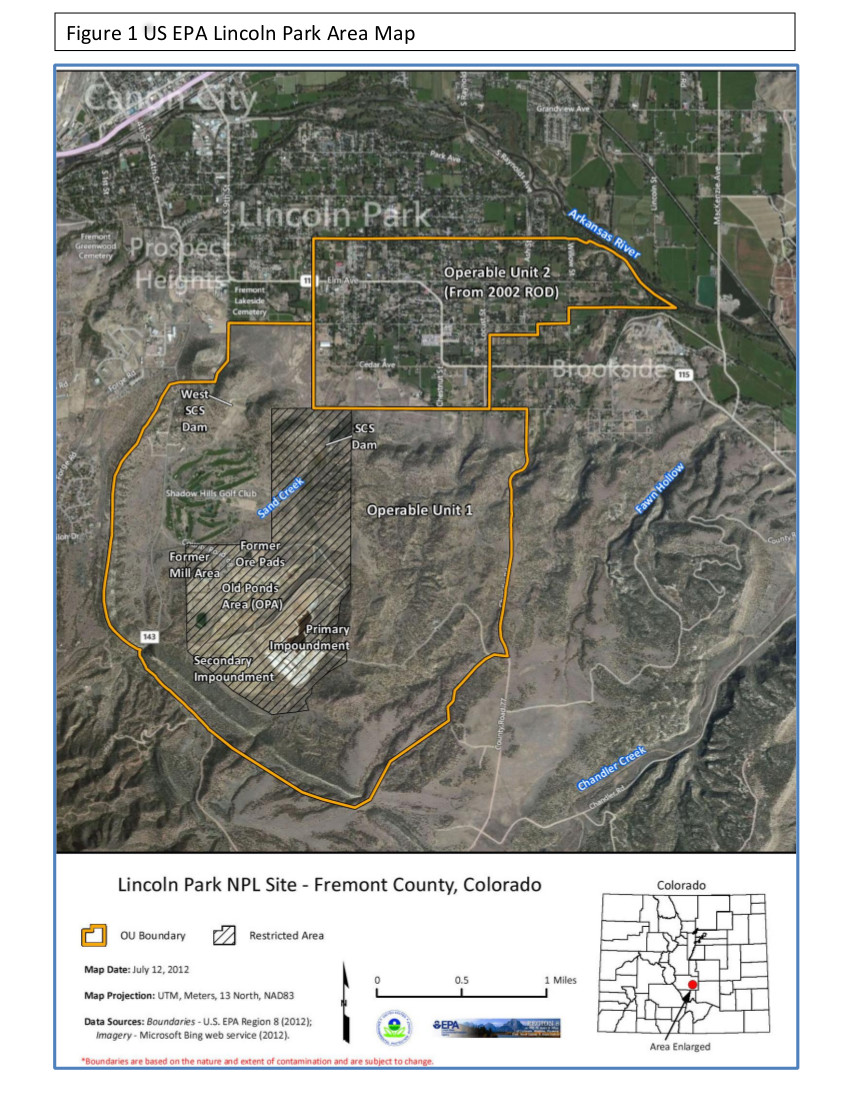
A big 1965 flood washed radioactive sludge toward the nearby Lincoln Park neighborhood, a foothill community near Cañon City where residents have horses and apples trees in their backyards. The plume of poisoned water spread underground. Fifty years later, there are still three wells in Lincoln Park where the uranium concentrations are above state standards set to protect human health.

This year’s late summer rainstorms gummed up critical pumps and pipes, part of a system built to prevent radioactive waste from escaping the polluted 2,600-acre Cotter property, which has been designated as a high priority federal Superfund cleanup site for the past quarter century.

The fact that a series of checks on dams and underground barriers showed they apparently worked the way they’re supposed to during the recent floods is small comfort to some Lincoln Park residents who worry about continued health risks and complain that state and federal regulators are still dragging their feet on the long-mandated cleanup.

“I realize the surface water is getting captured pretty well, but we’ve asked for better monitoring of groundwater, and we’ve been refused over and over again,” said Lincoln Park resident Sharyn Cunningham.

“We’ve asked them to do scientific studies to show there is no underground movement of water and they’ve refused numerous times,” she added, noting that uranium levels in the groundwater on the Cotter property are “horrendously high.”

In the wake of the most recent flooding, concerned locals say Cotter and the government officials tasked with overseeing the cleanup seemed to be defying a new state law that sets deadlines for inspections and reporting.

Kindergarten Rules

Cunningham and other residents want the U.S. Environmental Protection Agency and the Colorado Department of Public Health and Environment to lean on the Cotter Corporation harder to accelerate the cleanup effort. The company is a Denver-based subsidiary of General Atomics, a corporation with lucrative federal nuclear contracts. Cotter owns or controls 15 uranium and vanadium mines in southwest Colorado with an estimated 100 million pounds of ore. Watchdogs say the company has plenty of money to pay for a cleanup, and that big corporations — especially ones with government contracts — ought to play by the same simple kindergarten rules that apply to the rest of us.

“You make a mess, you clean it up,” said Travis Stills, an environmental attorney representing Colorado Citizens Against Toxic Waste. At the Cotter site — which is so close to Cañon City and upstream from the Arkansas River — the best option would be to dig up most of the toxic radioactive waste and move it to a geologically stable and remote site where it would pose the least threat to people and the environment, watchdogs say.

The mill started producing uranium oxide, or yellowcake in 1958 as part of the Cold War nuclear arms buildup. The concentrated uranium powder is the raw material for fissionable nuclear fuel. According to Cunningham, who curates an extensive library of documents related to the site, some of the waste came from the Manhattan Project, America’s WWII atom bomb effort.

Up until 1980, Cotter dumped radioactive waste into unlined ponds. It wasn’t until 1988, 30 years after Cotter started operation, that the state required the company to build a groundwater barrier to trap tainted water and pump it back up into evaporation ponds on its property.

Along with uranium, toxic materials at the Cotter site include radium, polonium, thorium and heavy metals like mercury, molybdenum, thorium and radioactive lead. Intermittently, Cotter processed those materials with other toxic chemicals, including nitric acid and hydrochloric acid — all combining into a poisonous brew. Many of the pollutants are known to have human health impacts, including an increased cancer risk.

“It makes fracking fluid look good enough to drink,” Stills said.

In 2010, monitoring revealed a potential new threat — volatile organic compounds had started showing up in the site’s groundwater. Specifically, testing detected Trichloroethylene, a known cancer-causing chemical used mainly as an industrial solvent, suggesting the chemical may have been introduced to the water as Cotter dismantled some of the old facilities on the site.

An updated federal health assessment completed earlier this month details potential health risks linked with exposure to the toxic materials stored at Cotter. The report was published by the U.S. Department of Health and Human Services, and includes a detailed timeline of the decades-long, on-and-off efforts to decontaminate property.

The Colorado Department of Public Health and Environment defends its work overseeing the cleanup, including diligent groundwater monitoring that shows the plume of contaminated groundwater beneath Lincoln Park has shrunk in recent years.

“We take our mission to protect public health and environment seriously,” said Warren Smith, the state’s liaison at the Cotter site. Smith said two inspections, on Aug. 25 and Sept. 23, showed no sign that contaminated water leaked off the property. Aside from the pumpback failure, he said the rest of the site’s containment system, including key dams, worked as intended during the recent floods.

“Cotter is required to report these incidents and they have been.”

Smith said there are three wells in Lincoln Park where the uranium concentration is above the state standard of 30 micrograms per liter. The concentrations in these wells are less than 40 micrograms per liter.

Snail-Paced Cleanup

Environmental concerns about the Cotter Mill are nothing new. The state started demanding a cleanup way back in 1983 by filing a complaint under the Superfund law, formally called the Comprehensive Environmental Response, Compensation, and Liability Act of 1980.

The Cotter Corporation challenged the move in court, setting the tone for decades of mistrust. Years of missteps and withheld information has done nothing to convince residents that the company is meeting its cleanup obligation, Stills said. This year’s breakdown of the pumpback system is just the latest in a long list of snafus at the mill site, including previous pipe failures 2010, 2012 and 2013.

“The same people have been making the same mistakes for decades,” said Stills, noting that the string of contaminated waste releases shows that state and federal oversight have been lax at best. As he sees it, Cotter has been gaming the system for 30 years, and that state health officials have played along.

“To me, it suggests consistent contempt by CDPHE staff for the community perspective,” Stills said.
The biggest concern is that the mill’s entire aging containment system could be vulnerable to catastrophic failure that could put thousands of people at risk. The site is about 1.5 miles north of Cañon City. The closest neighbor is a quarter-mile away. About 6,000 people live within about a two-mile radius of the mill, and about 20,000 people live within five miles.

About Time?

In July, Cotter Corporation, the Colorado Department of Public Health and the Environment and EPA signed a deal that spells out Cotter’s legal obligation to start working on a final cleanup plan. The agreement is a required step in the federal Superfund process. The public can comment on the proposed agreement until October 27 at Regulations.gov or in writing to by contacting EPA Enforcement Specialist Virginia Phillips.

“EPA is aware of recent incidents involving the pumpback system at the Cotter facility, including incidents related to flooding events and an occurrence of pipe damage which has since been repaired,” said Rich Mylott, a spokesman for the EPA, which will work with the CDPHE to investigate the pumpback system breakdown.

Cunningham and other residents are skeptical that the Cotter Corporation will do a thorough cleanup unless state and federal officials keep a close, diligent watch.

“The community doesn’t trust Cotter and CDPHE to do these things in private,” she said. “Two years ago, they promised us a roadmap toward cleanup, and we haven’t put one foot on that road yet.”

The Superfund cleanup deal may also have some loopholes.

Watchdogs want the state and feds to investigate what other companies besides Cotter may have contributed to contamination at the mine. That would help identify all the toxic materials at the site. They also want Cotter and government regulators to gather more detailed information on groundwater movement, including a tracer study, which involves adding a chemical marker to the water upstream, then monitoring when and where it appears downstream — a common way of tracking pollutants.

The EPA and the CDPHE are now on the same page on the Cotter cleanup so Cunningham is more hopeful that there will, someday, be a final resolution, said Cunningham, who lives less than a mile from the contaminated site.

Until then, she plans to keep watching the agencies closely. History has shown, she said, that somebody needs to keep watch and keep pressing for completion of the cleanup in the face of Cotter’s continued resistance and delays. Both Stills and Cunningham said they think the company has too much sway with regulators, who seem to be more responsive Cotter than to residents living near its mill’s mess.

“You just get up every day and do what you can,” Cunningham said. “This is a terribly contaminated site, and somebody has to make sure the authorities in charge are doing the right thing and are not just being influenced by Cotter.”

More Lincoln Park/Cotter Mill superfund site coverage here and here.

Denver District Court Throws Out License to Build Piñon Ridge Uranium Mill—Again — @sheepmtn

Here’s the release from the Sheep Mountain Alliance (Hillary Cooper):

A Denver district judge has ruled against the license issued by the state of Colorado to Energy Fuels to construct and operate a uranium mill in Paradox Valley in western Montrose County for the second time.

In a court ruling issued Wednesday, September 3, 2014, District Judge Robert McGahey found that the hearing process for the mill, ordered by a previous judge who invalidated the license in June of 2012, did not comply with the 2012 order. In today’s order, Judge McGahey ruled that a hearing officer must review the record established at the November 2012 hearing and make an “initial decision as to whether Energy Fuels application has met all criteria under state law.” Sheep Mountain Alliance and Rocky Mountain Wild retained technical experts who presented solid evidence at the hearing to prove that Energy Fuels’ application was based on false information and that the environmental review was incomplete.

“This process has been mishandled by the state agency from the start and the district court has agreed again,” stated Hilary Cooper, executive eirector of Sheep Mountain Alliance. “If the state chooses to continue this process, it will be taking action on a 2009 application for a project that will most likely never be built.”

Sheep Mountain Alliance, a grassroots conservation group based in Telluride, Colorado, has led the effort with Rocky Mountain Wild to stop the Piñon Ridge uranium mill based on significant environmental impacts to the surrounding region. SMA filed a lawsuit against the state of Colorado in February 2011 after the first radioactive materials license was issued to Energy Fuels. The Piñon Ridge mill would have been the first conventional uranium processing mill approved in the U.S. since 1980. The judge agreed with SMA’s challenge and ordered an independent hearing officer to conduct a hearing in November 2012. The hearing officer did not take action on issues raised during the hearing. Instead, the hearing officer sent the file to the state with simple direction to proceed with the license consideration. The state then issued a second license to Energy Fuels in April 2013. SMA and RMW again challenged the decision, and today’s ruling found that the hearing officer “failed to make a conclusion as to whether Energy Fuels application met all criteria for issuance of a license pursuant”.

In the meantime, Energy Fuels acquired the existing White Mesa uranium mill in Blanding, Utah, and admitted that they did not intend to build the Piñon Ridge mill because of unfavorable economic conditions and the redundancy of two mills in close proximity. In addition, Energy Fuels has entered into a contract to sell the Piñon Ridge mill property and other assets to George Glasier, the original founder of Energy Fuels, who is backed by Baobab Asset Management, Inc.

“The application lacks sufficient analysis of impacts to wildlife and the environment,” states Matt Sandler, staff attorney with Rocky Mountain Wild. “This decision is a win for the wildlife and the natural resources of this region. Our hope is that this remand will finally highlight the deficient environmental analysis included in the application.”

“The state has a clear choice to deny the Energy Fuels application and require a future developer to reapply with an updated application, which must address the conditions on the ground at that time,” states Cooper. “It’s time to release the communities of southwest Colorado from the false hope embellished by this industry for too long.”

More nuclear coverage here.

Lincoln Park/Cotter Mill de-commissioning comment period extended

From The Pueblo Chieftain:

The U.S. Environmental Protection Agency and state health officials have extended public comment periods on Cotter Corp. Uranium Mill decommissioning documents. Public comments are due by Oct. 27. All documents and addresses for comments to be submitted can be found on the state’s website at http://recycle4colorado.ipower.com/Cotter/docspubcomment.htm.

Public comment period open for Cotter Mill license

Lincoln Park/Cotter Mill superfund site via the Environmental Protection Agency

From The Pueblo Chieftain (Tracy Harmon):

Public comment is being accepted on the process of licensing the Cotter Corp. Uranium Mill until decommissioning is complete. A total of six new documents are available for comment until Sept. 16. The documents outline the radioactive materials license changes that Cotter officials will operate under while cleaning up the mill site.

The mill has not processed uranium since 2006 and Cotter officials, along with state and federal health officials, are working toward a full cleanup of the site which has been on the Environmental Protection Agency’s Superfund list since 1984. Although the state will not terminate the license until all decommissioning, remediation and reclamation activities are complete, provisions in the license need to change.

The site can no longer be used to produce yellowcake from uranium and only the Zirconium ore that already is on site will be allowed there. The cleanup of the site will address an impoundment that has been used to store tailings and the recently torn down mill buildings. Cotter officials have agreed to set aside a financial assurance of $17,837,983 to cover the cost of decommissioning activities. In addition, a longterm care fund will cover post-license termination activities. The $250,000 fund was created in 1978 and has grown to $1,018,243 through interest payments.

The documents pertaining to the license changes and a map of the Cotter Mill site can be viewed at http://recycle4colorado.ipower.com/Cotter/2014/14cotterdocs.htm. Comments should be sent to Warren Smith, community involvement manager for the state health department via email at warren.smith@state.co.us or mailed to Smith at Colorado Department of Public Health, 4300 Cherry Creek Drive South, Denver, CO 80246-1530.

More Lincoln Park/Cotter Mill superfund site coverage here and here.

Water Lines: Colorado needs a better water plan — Jim Pokrandt #ColoradoRiver #COWaterPlan


From the Glenwood Springs Post Independent (Jim Pokrandt):

It’s almost time for football training camps, so here’s a gridiron analogy for Colorado River water policy watchers: Western Colorado is defending two end zones. One is the Colorado River. The other is agriculture. The West Slope team has to make a big defensive play. If water planning errs on the side of overdeveloping the Colorado River, the river loses, the West Slope economy loses and West Slope agriculture could be on the way out.

This is how the Colorado River Basin Roundtable is viewing its contribution to the Colorado Water Plan ordered up by Gov. John Hickenlooper. A draft plan will be submitted this December and a final plan in December 2015. The Roundtable is assessing local water supply needs and environmental concerns for inclusion into the plan and there is plenty of work to consider in the region. But the big play may very well be the keeping of powerful forces from scoring on our two goal lines.

Here’s why: Colorado’s population is slated to double by 2050. Most of it will be on the Front Range, but our region is growing too. Mother Nature is not making any new water. We still depend on the same hydrological cycle that goes back to Day 1. So where is the “new” water going to come from? Right now, there seems to be two top targets, the Colorado River and agriculture (where 85 percent of state water use lies in irrigated fields). Colorado needs a better plan.

The Colorado Basin Roundtable represents Mesa, Garfield, Summit, Eagle, Grand and Pitkin counties. This region already sends between 450,000 and 600,000 acre feet of water annually across the Continental Divide through transmountain diversions (TMDs) to support the Front Range and the Arkansas River Basin.

That water is 100 percent gone. There are no return flows, such as there are with West Slope water users. On top of that, this region could see another 140,000 acre feet go east. A number of Roundtable constituents have long-standing or prospective agreements with Front Range interests wrapped around smaller TMDs. Existing infrastructure can still take some more water. That’s the scorecard right now. We assert another big TMD threatens streamflows and thus the recreational and agricultural economies that define Western Colorado, not to mention the environment.

In the bigger picture, the Colorado River Compact of 1922 requires Colorado to bypass about 70 percent of the river system to the state line to comply with legal limits on depletions so six other states can have their legal share of the water. Failure to do so, by overdeveloping the river, threatens compact curtailments and chaos nobody wants to see. For one thing, that kind of bad water planning could result in a rush to buy or condemn West Slope agricultural water rights.

The Roundtable has heard these concerns loudly and clearly from its own members across the six counties as well as from citizens who have given voice to our section of the water plan, known as the Basin Implementation Plan (BIP). A draft of the BIP can be viewed and comments offered by going online to http://coloradobip.sgm‐inc.com/. It is under the “Resources” tab.

Jim Pokrandt is Colorado Basin Roundtable Chair.

More Colorado Water Plan coverage here.

Energy Fuels sells the Piñon Ridge uranium plant site

Piñon Ridge uranium plant site

From the Denver Business Journal (Caitlin Hendee):

Energy Fuels, which previously had plans to build the nation’s first new uranium mill in 30 years, sold its Piñon Ridge license and several other assets in Western Colorado.

The Toronto, Canada-based company (TSE: EFR) that has an office in Lakewood bought a large quantity of land in the western part of the state almost five years ago.
Colorado in May gave the mill the required “radioactive materials handling” license, but company spokesperson Curtis Moore told the DBJ that Energy Fuels wouldn’t begin construction until “market conditions warrant.”

The company would also need an “air permit” from the Colorado Department of Public Health and Environment (CDPHE) to begin the $150 million project.

The mill has been an area of hot debate for environmental activists, who in March sued the U.S. Forest Service to stop the government from allowing the mill to be built near the Grand Canyon in Arizona.

Energy Fuels instead diverted plans to build it in Montrose County.

But the company said it has entered into agreements to sell the license and the Piñon Ridge mill to a private investor group managed by Baobab Asset Management LLC and George Glasier.

Glasier served as president from 2006 until March of 2010.

The company said the sale also includes mining assets — such as the Sunday Complex, the Willhunt project, the Sage Mine, the Van 4 mine, the Farmer Girl project, the Dunn project and the San Rafael project — all located along the Colorado-Utah border.

More nuclear coverage here and here.

Piñon Ridge Uranium Mill and Assets Set to Be Sold for $2 Million

More nuclear coverage here.

By watershed, the greatest density of uranium mines is in SW Colorado — Bob Berwyn

More nuclear coverage here.

2014 Colorado Legislation: SB14-192 is on its way to Governor Hickenlooper’s desk

Lincoln/Cotter Mill Park superfund site

From the Cañon City Daily Record (Christy Steadman):

“The passage of the Uranium Groundwater Protection bill today will help restore our use and rights to our wells,” Sharyn Cunningham, Lincoln Park resident, said.

John Hamrick, facility manager at Cotter Corp., said SB 192 ceases “a year-and-a-half of progress in the negotiation process” with the Environmental Protection Agency and the Colorado Department of Public Health and Environment to abide by the federal rules regarding “what is the best way” concerning clean-up. He said the negotiations were a measure to clean up what would eventually “go away” naturally.

Pete Maysmith, executive director of Conservation Colorado, said the area’s community members and activists “deserve a hearty congratulations for turning their passion into a legislative victory.”

“No community should have to endure the long-term exposure to uranium and other contamination as the community of Cañon City has at the hands of the Cotter Corp.,” he said.

Hamrick said he wanted to remind people that “to the best of Cotter’s knowledge, nobody is drinking ground water (contaminated) above any health limits or ground water protection standards.”[…]

Another issue with SB 192, said Hamrick, is the requirement to use the most expedited and best available technology for the clean-up. He said there will be only one technology that could reach both those requirements, and as of yet, nobody knows what it is nor an idea of its cost.

“Water quality is improving in Lincoln Park naturally,” Hamrick said. “(SB 192) adds a lot of unknown costs without a lot of public benefits.”

More nuclear coverage here.

2014 Colorado legislation: Cañon City residents are cautiously optimistic for results from SB14-192

Lincoln Park/Cotter Mill superfund site via The Denver Post

From The Pueblo Chieftain (Tracy Harmon):

Residents here are thankful for bipartisan legislation passed [by the Senate] Wednesday that will help clean up groundwater contamination by Cotter Corp.’s uranium mill. The legislation will ensure that uranium mills clean up ongoing contamination of residents’ groundwater as expeditiously as possible, with the best available technology. The legislation will help give direction to the state health department as it oversees the cleanup, according to Chris Arend of Conservation Colorado.

Residents of the Lincoln Park neighborhood just north of the Cotter Uranium Mill site have been hooked up to city water so they can avoid using wells that have been contaminated by uranium and molybdenum which seeped from the mill site.

The neighborhood and Cotter mill have been part of a Superfund cleanup site since 1984.

“For my Lincoln Park neighbors, forsaking our historic use of our water wells was never an option. We knew we needed to keep fighting for full and active cleanup of our wells, not only to restore our current rights but for future residents,” said Sharyn Cunningham, a Lincoln Park resident who is co-chair of Colorado Citizens Against Toxic Waste.

“After 30 years of contamination and indifference, the residents of Lincoln Park saw significant movement in their campaign for the Cotter Corp. to finally clean up its mess,” said Pete Maysmith of Conservation Colorado. “No community should have to endure the long-term exposure to uranium and other contamination as the community of Canon City has.”

Cotter officials, along with state and federal health officials, are overseeing decommissioning and full cleanup now that the mill is closed.

More 2014 Colorado legislation coverage here. More nuclear coverage here.

2014 Colorado legislation: SB14-192 passes the Senate #COleg

Lincoln Park/Cotter Mill Site via The Denver Post

From the Cañon City Daily Record (Christy Steadman):

The Colorado Senate passed Senate Bill 192 on Tuesday, which concerns uranium licensing and groundwater protection, but causes conflict between Cotter Corp. Uranium Mill and Lincoln Park residents.

In a press release issued by Conservation Colorado representative Chris Arend, residents of Lincoln Park “expressed support for (the) bipartisan legislation … that will help rectify 30 years of groundwater contamination by Cotter Corp.”

“The passage of SB 192 today will help restore our use and rights to our wells and begin to rectify the damage the Cotter Corporation has caused in our community,” Sharyn Cunningham, Lincoln Park resident said in the release.

John Hamrick, facility manager at Cotter Corp., said they have been in negotiations with the Environmental Protection Agency and the Colorado Department of Public Health and Environment to abide by the federal rules regarding “what is the best way” concerning clean-up. He said that is “now in jeopardy” because of SB 192, and a year-and-a-half of progress in the negotiation process will have to be discarded, and they will now have “to go back to zero.”

“(Additionally), the State of Colorado is federally preempted from passing a law that requires the EPA to select a specific clean-up remedy,” Hamrick said.

In the release, Lincoln Park resident Pete Maysmith said SB 192 “will help clean-up residents’ groundwater and restore the historic use of their water wells.”

“No community should have to endure the long-term exposure to uranium and other contamination as the community of Cañon City has at the hands of the Cotter Corp.,” Maysmith said.

Here’s a release from Conservation Colorado:

Impacted residents and members of the Colorado conservation community expressed support for bipartisan legislation passed today that will help rectify 30 years of groundwater contamination by Cotter Corporation in Canon City, Colorado. Residents of the Lincoln Park neighborhood in Canon City had been told that the best way to deal with Cotter’s pollution was for the community to abandon use of their wells.

“For my Lincoln Park neighbors forsaking our historic use of our water wells was never an option. We knew we needed to keep fighting for full and active clean up of our wells not only to restore our current rights but for future residents,” said Sharyn Cunningham, Lincoln Park resident. “The passage of SB 192 today will help restore our use and rights to our wells and begin to rectify the damage the Cotter Corporation has caused in our community.”

“Today after 30 years of contamination and indifference, the residents of Lincoln Park saw significant movement in their campaign for the Cotter Corporation to finally clean up its mess in Cañon City,” said Pete Maysmith. “No community should have to endure the long term exposure to uranium and other contamination as the community of Cañon City has at the hands of the Cotter Corporation. The legislation passed today will help clean up residents’ groundwater and restore the historic use of their water wells.”

Although pleased that contaminated water would be cleaned-up, supporters expressed concern that the Colorado Senate stripped out licensing requirements that would protect against future contamination.

“We are disappointed in Colorado Senate amendments to remove important protections for experimental uranium milling proposed for our community,” said Cathe Meyrick, resident of the Tallahassee Area in Fremont County. “The legislation would have clarified that licensing is required before the industry deploys experimental uranium recovery techniques with potentially grave impacts on our groundwater. Regardless of this setback, we will rely on a committed community and look for other mechanisms to protect our groundwater.”

The proposed new technologies involve extraction through the creation of an underground uranium slurry (i.e., underground borehole mining) and concentration through physical, rather than chemical means (i.e., ablation). These new uranium recovery methods are being proposed for uranium deposits in Fremont County (Tallahassee Area/Arkansas River) and in Weld County (Centennial Project and Keota).

Both Conservation Colorado and impacted landowners in Fremont and Weld County will work to reinstate the provisions as the bill moves forward.

More nuclear coverage here.

Moab tailings cleanup reaches 5-year mark — Deseret News #ColoradoRiver

moabtailingscleanupsite

From the Deseret News (Amy Joi O’Donoghue):

This week marked the five year anniversary of when the U.S. Department of Energy began the $1 billion cleanup of the 16 million tons of tailings left over a legacy of uranium mining at the now defunct Atlas Mill.

The 130-acre site was leaching uranium and hazardous chemicals into the Colorado River, spurring contamination concerns for 30 million downstream users.

In 2009, an infusion of $108 million in federal stimulus money fast-tracked the project, accelerating the removal of the tailings to a disposal site 30 miles away at Crescent Junction.

“It is slowly getting there,” said project manager Don Metzler. “It is on track and we feel good about that.”

Metzler, whose supervision of the Moab Uranium Mill Tailings Remedial Action garnered national recognition in 2011, said the massive cleanup effort is now 42 percent complete.

“We have moved 6.7 million tons of the 16 million tons,” he said. “We still have a lot to go.”

The tailings are scooped and loaded into the beds of huge dump trucks and then poured into rail cars. A train leaves the site once a day, four days a week, traveling north to a specially-engineered disposal site at Crescent Junction.

Metzler said the annual funding of $35 million received a boost to $38 million, and the additional money will be used to further cover a section of the disposal cell.

“We do this in sequential steps. We are not going to wait until the entire project is over before we cover,” he said.

Clay and rock material has been put on 40 acres and another 10 acres or so will also receive a protective fill.

Metzler is also in the process of implementing a flood control plan.

With spring runoff in full swing, the Colorado River has risen 2 feet in the past few weeks, Metzler said, and it expected to crest its banks in another 30 to 40 days.

Protective berms have been engineered to keep the river water away from the radioactive dirt, he added, and the project will be doing community outreach to keep residents informed of flood threats.

More nuclear coverage here and here.

2014 Colorado Legislation: SB14-192 would further regulate mining for radioactive materials #COleg

uranium

From The Grand Junction Daily Sentinel (Charles Ashby):

Democrats in the Colorado Senate are considering a bill to place more controls over uranium mining that opponents say are duplicative and unnecessary. The measure, SB192, would require uranium and thorium mines to get a radioactive materials license from the Colorado Department of Public Health and Environment, and meet certain criteria for keeping contaminated materials out of the state’s groundwater supplies.

But opponents say federal and state regulations over such things are already stringent, and the proposed changes are being pushed by anti-nuclear energy advocates who want to stop all uranium mining.

Harold Roberts, chief operating officer of Lakewood-based Energy Fuels, the company that has been working to open the Pinon Ridge Mill in western Montrose County for the past three years, told the Senate Health & Human Services Committee that the measure is fraught with problems. He told the panel, which approved the bill Thursday on a 4-3 party-line vote, the measure only increases red tape, would spark more litigation and would have no impact on protecting public health or the environment.

“My point is, we’re highly regulated and I don’t see that SB192 would do anything to improve those regulations,” he told the seven-member panel.

Much of the testimony for the measure stemmed from residents who live near the Cotter Uranium Mill near Canon City, a uranium processing mill that was declared a U.S. Environmental Protection Agency Superfund clean-up site in 1984.

Opponents to the measure said that much has changed since then, and state and federal regulations today are far more stringent to prevent such a thing from happening elsewhere. Roberts said his proposed mill has spent more than a $1 million over the past three years in extra groundwater investigations and facility upgrades at the request of state regulators.

Last year, the company received a radioactive-materials handling permit from the state, but it is waiting to build the $150 million mill located near Naturita until the price of yellowcake, a uranium concentrate powder, increases. Currently, those prices are at a fraction of what they were before the recession began in 2008.

The bill heads to the full Senate for more debate.

More 2014 Colorado legislation here.

Cotter and the CPDHE are still trying to work out a de-commissioning agreement for the Lincoln Park/Cotter Mill superfund site

Lincoln Park/Cotter Mill Site via The Denver Post

From The Denver Post (Bruce Finley):

A broken pipe at Cotter Corp.’s dismantled mill in central Colorado spewed 20,000 gallons of uranium-laced waste — just as Cotter is negotiating with state and federal authorities to end one of the nation’s longest-running Superfund cleanups.

Colorado Department of Public Health and Environment officials said last weekend’s spill stayed on Cotter property.

In addition, uranium and molybdenum contamination, apparently from other sources on the Cotter property, has spiked at a monitoring well in adjacent Cañon City. A Feb. 20 report by Cotter’s consultant said groundwater uranium levels at the well in the Lincoln Park neighborhood “were the highest recorded for this location,” slightly exceeding the health standard of 30 parts per billion. State health data show uranium levels are consistently above health limits at other wells throughout the neighborhood but haven’t recently spiked.

“This isn’t acceptable,” Fremont County Commissioner Tim Payne said of the spill – the fourth since 2010. “(CDPHE officials) told us it is staying on Cotter’s property. But 20,000 gallons? You have to worry about that getting into groundwater.”

Environmental Protection Agency and CDPHE officials are negotiating an agreement with Cotter to guide cleanup, data-gathering, remediation and what to do with 15 million tons of radioactive uranium tailings. Options range from removal — Cotter estimates that cost at more than $895 million — or burial in existing or new impoundment ponds.

Gov. John Hickenlooper intervened last year to hear residents’ concerns and try to speed final cleanup.

Cotter vice president John Hamrick said the agreement will lay out timetables for the company to propose options with cost estimates.

The spill happened when a coupler sleeve split on a 6-inch plastic pipe, part of a 30-year-old system that was pumping back toxic groundwater from a 300-foot barrier at the low end of Cotter’s 2,538-acre property, Hamrick said.

Lab analysis provided by Cotter showed the spilled waste contained uranium about 94 times higher than the health standard, and molybdenum at 3,740 ppb, well above the 100-ppb standard for that metal, said Jennifer Opila, leader of the state’s radioactive materials unit.

She said Cotter’s system for pumping back toxic groundwater is designed so that groundwater does not leave the site, preventing any risk to the public.

In November, Cotter reported a spill of 4,000 to 9,000 gallons. That was five times more than the amount spilled in November 2012. Another spill happened in 2010.

At the neighborhood in Cañon City, the spike in uranium contamination probably reflects slow migration of toxic material from Cold War-era unlined waste ponds finally reaching the front of an underground plume, Hamrick said.

“It is a blip. It does not appear to be an upward trend. If it was, we would be looking at it,” Hamrick said. “We will be working with state and EPA experts to look at the whole groundwater monitoring and remediation system.”

An EPA spokeswoman agreed the spike does not appear to be part of an upward trend, based on monitoring at other wells, but she said the agency does take any elevated uranium levels seriously.

The Cotter mill, now owned by defense contractor General Atomics, opened in 1958, processing uranium for nuclear weapons and fuel. Cotter discharged liquid waste, including radioactive material and heavy metals, into 11 unlined ponds until 1978. The ponds were replaced in 1982 with two lined waste ponds. Well tests in Cañon City found contamination, and in 1984, federal authorities declared a Superfund environmental disaster.

Colorado officials let Cotter keep operating until 2011, and mill workers periodically processed ore until 2006.

A community group, Colorado Citizens Against Toxic Waste, has been pressing for details and expressing concerns about the Cotter site. Energy Minerals Law Center attorney Travis Stills, representing residents, said the data show “the likely expansion of the uranium plume, following the path of a more mobile molybdenum plume” into Cañon City toward the Arkansas River.

The residents deserve independent fact-gathering and a proper cleanup, Stills said.

“There’s an official, decades-old indifference to groundwater protection and cleanup of groundwater contamination at the Cotter site — even though sustainable and clean groundwater for drinking, orchards, gardens and livestock remains important to present and future Lincoln Park residents,” he said. “This community is profoundly committed to reclaiming and protecting its groundwater.

More Lincoln Park/Cotter Mill superfund coverage here.

Lincoln Park/Cotter Mill: New spill contained onsite

Lincoln Park/Cotter Mill superfund site via The Denver Post

From The Pueblo Chieftain (Tracy Harmon):

For the second time in five months, Cotter Corp. Uranium Mill officials have discovered a leak of contaminated water, but both spills reportedly were contained on-site. On Monday, Cotter personnel reported to Colorado Department of Public Health officials a release of greater than 500 gallons of water from the barrier system pump-back pipeline. The water spilled was contaminated groundwater recovered by the barrier system and being pumped back to the facility.

The spill was discovered at 8 a.m. Monday and mill personnel were last on-site at approximately 4:30 p.m. Friday. The spill did not result in contaminated materials leaving the Cotter property. More information will be provided as the investigation continues, according to Deb Shaw, health department program assistant. A similar spill occurred in November when between 4,000 and 9,000 gallons of contaminated water seeped from the same pipeline.

Contaminated water usually is pumped, along with groundwater, to an on-site evaporation pond to prevent further contamination in Lincoln Park, which has been a part of a Superfund cleanup site since 1988. The now-defunct mill is in the process of decommissioning and has not been used to process uranium since 2006.

From The Pueblo Chieftain (Tracy Harmon):

More details have emerged in connection with a Cotter Corp. Uranium Mill leak of contaminated water which occurred over the weekend south of town. State health officials reported Tuesday that about 20,000 gallons of the contaminated water leaked from the pump-back system pipeline.

“Analytical results show that the water contained 2,840 micrograms per liter of uranium and 3,740 micrograms per liter of molybdenum. For comparison, the groundwater standard in Colorado for uranium is 30 micrograms per liter and for molybdenum is 100 micrograms per liter,” said Deb Shaw, program assistant for the state health department.

At those concentrations of contamination the spill is not reportable to the National Response Center because the quantity is below 10.3 million gallons, Shaw said.

The contamination did not seep off of Cotter property.

More Lincoln Park/Cotter Mill superfund site coverage here and here.

Lincoln Park/Cotter Mill superfund site: November 5 spill caused by pipeline joint failure

Lincoln Park/Cotter Mill Site via The Denver Post

From the Cañon City Daily Record (Christy Steadman):

Jennifer Opila, Radioactive Materials Unit Leader for the CDPHE, explained how the 1988 pumpback system at Cotter functions. Opila said the cause of the Nov. 5 spill was that a joint in the pipeline of the pumpback system broke. She described it as a “catastrophic break,” meaning it was not a “slow and seeping” spill.

Opila said employees found “water coming out of the ground” just north of well No. 333 and “that’s how they knew the pipe had ruptured.”

According to Cotter’s Environmental Coordinator/Radiation Safety Officer Jim Cain, the spill was measured within a 12-hour window and based on inspection times and flow, an estimated 4,000 to 9,000 gallons of water was spilled. A water sample was collected and the analysis reported that .03 pounds of uranium and .15 pounds of molybdenum was found, according to Cain.

Cotter made the required oral report of the spill and provided a requested written report, Opila said, and the pipe was repaired and operable by the next day.

The pipeline is three feet underground and consists of 3,856 linear feet of six-inch schedule 90 PVC pipe and 3,053 linear feet of four-inch schedule 90 PVC pipe.

Vice President of Cotter Mill Operations John Hamrick said there have been three leaks “in three different years, all for different reasons.”

More Lincoln Park/Cotter Mill superfund site coverage here and here.

Lincoln Park/Cotter Mill superfund site: 9,000 gallon spill contained on mill property

Lincoln Park/Cotter Mill site via The Denver Post

From The Pueblo Chieftain (Tracy Harmon):

Cotter Corp. Uranium Mill officials on Tuesday discovered contaminated water escaped a pump-back system at the mill site but the spill has been contained to the mill property. According to Warren Smith, community involvement manager for the state health department, the release of contaminated water was limited to between 4,000 and 9,000 gallons. The leak occurred at the junction of two pipe sections near the Soil Conservation Service pump back site, which is designed to prevent contaminated surface water from seeping into the neighboring Lincoln Park neighborhood.

“The soil in the area of the release is saturated. It will be allowed to dry so the pipe can be excavated and repaired,” Smith said.

Water samples were analyzed and based on concentration levels present, the maximum estimated release of uranium is limited to 1.1 ounces and the estimated molybdenum release is 2.6 ounces.

Contaminated water usually is pumped, along with groundwater, to an onsite evaporation pond to prevent further contamination in Lincoln Park, which has been a part of a Superfund cleanup site since 1988. The now-defunct mill is in the process of decommissioning and has not been used to process uranium since 2006.

From the Colorado Independent (Shelby Kinney-Lang):

Cotter Corporation informed the health department of the leaking pipes on Tuesday in a “verbal report” delivered over the phone. No health department personnel have inspected the spill site, as yet, and no formal report has yet been filed. Cotter said it will let the contaminated ground dry before excavating and repairing the pipe…

“We’ve got a company looking to walk away from a problem without actually cleaning it up,” said Travis E. Stills, an energy and conservation lawyer who has been working with community groups in Cañon City since the mid-2000s. Stills represents Colorado Citizens Against Toxic Waste on several ongoing state open records suits that seek information that passed between Cotter, the state health department and the Environmental Protection Agency concerning the uranium mill and the Lincoln Park Superfund Site, but which health department withheld from public review.

Uranium is extraordinarily toxic. The health department reports that if the pipe did in fact leak 9,000 gallons, the concentration in the water of uranium would be 834 micrograms per liter and the concentration of molybdenum, also a toxic chemical, would be 2,018 micrograms per liter. For perspective, the EPA places the health safety level of uranium at 30 micrograms per liter…

“They got a hole in the pipe and it leaked back into the ground,” he said.

Warren Smith, community involvement manager in the Hazardous Materials and Waste Management Division of the department, insisted there was no danger to public health.

“There is no public health risk here, because there is no exposure to the public,” Smith said. “Health risk depends on two factors: the release and exposure. If there’s no receptor to be exposed to it, where’s the risk?”

Smith said that the health department performs regular inspections of the Cotter site. The most recent was a September inspection. Because the pipe was buried, Smith said it would be a stretch to “characterize it as an [inspection] oversight.”

Smith said it would be a serious lapse if Cotter had failed to report the spill. Inspections don’t occur often enough for the state to have happened upon the spill any time soon.

More Lincoln Park/Cotter Mill superfund site coverage here and here.

Lincoln Park/Cotter Mill superfund cleanup: Cotter wants to reduce the frequency of groundwater monitoring

Lincoln Park/Cotter Mill Site via The Denver Post

From The Pueblo Chieftain (Tracy Harmon):

Public comment is being sought on a Cotter Corp. uranium mill proposal seeking to reduce the frequency of groundwater monitoring on 11 new wells. The state health department has preliminarily approved the request and will take public input before making a final decision. Cotter Corp. Mill Manager John Hamrick indicated more than a year’s worth of sampling has been amassed on 11 new wells, which were dug in late 2011 to help establish the extent of groundwater contamination.

“Once we’ve established 12 months of measurements, we generally move to quarterly sampling as we do with all the other wells,” Hamrick explained.

The mill and a portion of the neighboring Lincoln Park community have been an EPA Superfund site since 1988 due to uranium and molybdenum contamination in groundwater and soils. Groundwater is not used by residents in the contaminated area of Lincoln Park as they all have been connected to the city water supply.

Hamrick said the average uranium value for each of the new monitoring wells is below the Colorado Groundwater Quality Standard. Only three wells have exceeded the standard for uranium — one six times, another twice and the third just once.

The average molybdenum concentration for most of the new wells also was below the state standard and only three wells have exceeded that standard out of 115 samples.

The state health department reviewed the request as did the Cotter Community Advisory Group. Regulators feel, “Significant baseline data” has been collected to allow for quarterly monitoring instead of monthly, said Jennifer Opila, unit leader for the state heath department’s radioactive materials division.

Public comment will be accepted Monday through Sept. 13. Comments can be sent to Warren Smith, community involvement manager, via email at warren.smith@state.co.us or by calling 303-692-3373.

More Lincoln Park/Cotter Mill coverage here and here.

Green River Basin: Utah may get its first nuke electrical generation plant if the water is there #ColoradoRiver

Desert landscape NW of Green River, Utah -- Photo via Heal Utah
Desert landscape NW of Green River, Utah — Photo via Heal Utah

From the Deseret News (Amy Joi O’Donoghue):

The fate of a proposed nuclear power plant — the first in Utah — turns on the ebb and flow of the Green River, where proponents of the project want to divert water to cool the plant’s nuclear reactors.

For five days in a small courtroom in Price last week, Judge George Harmond — who once served on the Utah Board of Water Resources — listened to reasons why the decision to grant that water for the plant was within the law or, alternately, why it contravened the statute governing water allocations.

Ultimately, whatever the 7th District judge decides — he took the case under advisement and will issue a decision within 60 days — the loser in this contest is destined to appeal.

I wonder what is different in the new designs that makes them require less water than Fukushima Daiichi did. It seems to me that it requires unlimited volumes of water when you are fighting for control of a fission reaction. That sort of supply is not apparent in the landscape near the reactor site.

More nuclear coverage here and here.

Energy Fuels plans to permit the proposed Piñon Ridge uranium mill and then shelve the project for better times

paradoxvalley

From The Grand Junction Daily Sentinel (Gary Harmon):

Montrose County officials took heart in Energy Fuels Inc.‘s plans to proceed with permitting its proposed Naturita mill, which it acknowledged to investors won’t go forward until the market improves. “There was no way at the current market price that they could possibly consider” building the $150 million mill, Dianna Reams of Naturita said. “It would be foolhardy at best.”

Energy Fuels leaders told investors last week that construction of the mill would depend on an increase in the price of uranium oxide, currently languishing at $34 a pound. “We are continuing to move the Piñon Ridge Mill forward in permitting,” Energy Fuels spokesman Curtis Moore said. “However, we do not intend to build it until market conditions warrant, and the price of uranium recovers.”

The question on prices “is ‘when,’ not ‘if,’ ” Moore said.

The Telluride-based Sheep Mountain Alliance, which has opposed Energy Fuels in court, said it’s clear that Energy Fuels has no intention of building the mill. “It is time for elected officials and community leaders to work towards real and achievable economic opportunities for the West End communities,” Sheep Mountain Alliance Director Hilary Cooper said. “These could include the development of clean, renewable energy, small-scale agriculture and cultural and recreational opportunities which would all provide long-term growth benefits.”

Energy Fuels has been telling county officials for the last six months that building the mill was untenable at current prices. “It’s all economics,” White said, noting that the price of uranium still could rise. “What we have to remember is that the U.S. does import 94 percent of the uranium it uses” and a breakdown in the foreign supply could force prices back up, White said.

Global uranium prices have been hit with the double-whammy of the rise of natural gas and the 2011 earthquake and tsunami that caused a meltdown at the Fukushima Daiichi nuclear plant.

Montrose County is considering helping to fund an economic development office for what is known as the West End of the county, including the towns of Naturita, Norwood and Nucla, White said. West End residents are familiar with the market constraints on Energy Fuels, White said. “Mining has been a part of their heritage for 100 years and so they know the ups and downs of the mining industry,” White said.

Energy Fuels has submitted construction plans for the mill, which would occupy an 800-acre site near Naturita, said Reams, whose family is involved in construction and mining. “It does clear way for construction as soon as they are ready to go.”

More nuclear coverage here and here.

Energy Fuels plans to permit the proposed Piñon Ridge uranium mill and then shelve the project for better times

nukeplantcattenomfrance

From The Durango Herald (Joe Hanel):

Energy Fuels Resources Inc. will keep holding its license to build the Piñon Ridge uranium mill in the Paradox Valley of Montrose County, but it has no plans to act on the license, said President and CEO Stephen Antony.

“We intend to keep that license in a current, valid form, but not move on construction of the mill until market conditions support it,” Antony said.

The statement is old news to uranium experts, but it comes as a surprise to some Coloradans.

The company’s Piñon Ridge website says, “Energy Fuels anticipates starting construction in late 2012 or 2013.” And its plan on file with the Colorado Department of Public Health and Environment calls for the mill west of Naturita to be operational by early 2017, with construction beginning in 2015.

Warren Smith, a community involvement manager for the state health department, said Energy Fuels has not contacted his department with any plans to deviate from the schedule it has submitted. The license is valid for five years.

But uranium market analysts have known since Energy Fuels bought the White Mesa uranium mill in Utah that the company has put Piñon Ridge on the back burner. In fact, the company said so itself in a little-noticed statement in December 2012. It came in an annual report filed with financial regulators in Canada, where Energy Fuels is incorporated.

“With the recent acquisition by the Company of the White Mesa Mill, the Company no longer needs to construct the Piñon Ridge Mill in order to meet its planned production for the foreseeable future. Therefore, the Company does not intend to proceed with construction of the mill at this time,” the report said.

More nuclear coverage here and here.

The proposed Piñon Ridge uranium mill could be online in 2017

doloresrivercanyon.jpg

From the Cortez Journal (Jim Mimiaga):

The Pinon Ridge Mill has cleared several major permit hurdles and survived court challenges from environmental groups. Its proposed location is in Paradox Valley between Naturita and Bedrock off Colorado Highway 90…

Energy Fuels Resources Corp., a Canadian-based company with a main office in Littleton, Colo., has been working towards building the $150 million plant for the last six years. EF also owns the White Mesa Mill, south of Blanding, Utah, which is currently the only operating uranium mill in the country.

The new Pinon Ridge mill would process uranium ore using an acid leach process to produce yellowcake, a concentrated uranium product that is fabricated into fuel rods for nuclear reactors. The mill is expected to process 500 tons a day of uranium ore from re-opened mines on the Colorado Plateau, Uravan Mineral Belt, and Arizona Strip.

The Environmental Protection Agency has granted EF a permit for the construction of tailings impoundment and evaporation ponds. A radioactive materials license was approved by the Colorado Department of Public Health and Environment in April for the project…

The company still needs a construction permit from CDPHE before the project can break ground. Pending approval of permits, construction of the mill could be completed by early 2017. Public comments on the construction permit will be accepted. For more information go to http://www.colorado.gov/cs/Satellite/CDPHE-Main/CBON/1251583470000

More Piñon Ridge uranium mill coverage here and here.

Developers opt out of water rights application for the proposed Piñon Ridge Mill

doloresrivercanyon.jpg

From The Grand Junction Daily Sentinel (Gary Harmon):

Opponents of a proposed uranium mill near Naturita crowed Friday that a judge dismissed the mill’s water-right claim, but the mill’s backers noted that it was they who sought the dismissal.

The Sheep Mountain Alliance fired off a news release after Water Judge Steven Patrick dismissed Energy Fuel’s Inc.‘s petition for rights on the San Miguel River.

Patrick dismissed the case, but he did so in a way that permits Energy Fuels to reapply for the water right if necessary. The environmental organization had sought to prevent the company from refiling for the water.

The company failure to pursue the water rights “clearly indicates the lack of intent to follow through on the construction of the uranium mill.” Hilary Cooper, executive director of the alliance, said in the statement.

“We decided that we did not need this water at this time,” Curtis Moore, Energy Fuels director of investor relations and public relations, wrote in an email. “Keep in mind that we have wells and a water right in the Dolores River basin that should meet most (or all) of our water needs.”

More nuclear coverage here and here.

Lincoln Park/Cotter Mill: Cleanup awaiting state go ahead

cottergroundwatercontaminationlocation.jpg

From The Pueblo Chieftain (Tracy Harmon):

State health officials have preliminarily ordered Cotter Corp. Mill officials not to do any cleanup work pending future decommissioning and reclamation guidelines. Cotter Corp. Uranium Mill Manager John Hamrick had requested permission to excavate the ore pad area after uranium ore was removed and shipped to the White Mesa Mill in Blanding, Utah.

The state health department’s Jennifer Opila, unit leader, said although an earlier work pause has been lifted, Cotter will not be authorized to proceed with, “New decommissioning or reclamation activities.” She said the decision to deny the request was made after health officials and the Community Advisory Group discussed the issue. The public is invited to comment on the state’s preliminary decision.

Comment will be accepted Monday through Sept. 20. The public also can comment during the same time frame on completion reports for Lincoln Park water wells.

More Lincoln Park/Cotter Mill coverage here and here.

Lincoln Park/Cotter Mill: Public comments sought on proposal to reduce the frequency of groundwater monitoring

cottergroundwatercontaminationlocation.jpg

From The Pueblo Chieftain (Tracy Harmon):

Public comment is being sought on a Cotter Corp. uranium mill proposal seeking to reduce the frequency of groundwater monitoring on 11 new wells. The state health department has preliminarily approved the request and will take public input before making a final decision. Cotter Corp. Mill Manager John Hamrick indicated more than a year’s worth of sampling has been amassed on 11 new wells, which were dug in late 2011 to help establish the extent of groundwater contamination.

“Once we’ve established 12 months of measurements, we generally move to quarterly sampling as we do with all the other wells,” Hamrick explained.

The mill and a portion of the neighboring Lincoln Park community have been an EPA Superfund site since 1988 due to uranium and molybdenum contamination in groundwater and soils. Groundwater is not used by residents in the contaminated area of Lincoln Park as they all have been connected to the city water supply.

Hamrick said the average uranium value for each of the new monitoring wells is below the Colorado Groundwater Quality Standard. Only three wells have exceeded the standard for uranium — one six times, another twice and the third just once. The average molybdenum concentration for most of the new wells also was below the state standard and only three wells have exceeded that standard out of 115 samples.

The state health department reviewed the request as did the Cotter Community Advisory Group. Regulators feel, “Significant baseline data” has been collected to allow for quarterly monitoring instead of monthly, said Jennifer Opila, unit leader for the state heath department’s radioactive materials division.

Public comment will be accepted Monday through Sept. 13. Comments can be sent to Warren Smith, community involvement manager, via email at warren.smith@state.co.us or by calling 303-692-3373.

More nuclear coverage here and here.

Comment period for the proposed Piñon Ridge uranium mill open until September 13, public hearing August 13

conventionaluraniummill.jpg

From The Watch (Gus Jarvis):

A public comment period is open until Sept. 13 on a proposal to build a uranium mill in the West End of Montrose County, with a public hearing set for Aug. 13, from 6-9 p.m., at the Nucla Moose Lodge.

Energy Fuels, Inc., the Canadian mining company proposing to build the first uranium processing mill in the U.S. in 30 years, submitted its construction plan and decommissioning funding plan for the proposed Pinon Ridge mill to the Colorado Department of Public Health and Environment in May. The two plans are in accordance with the Radioactive Materials License Energy Fuels received in April.

If it is approved and built, Energy Fuels plans to operate the uranium/vanadium mill at a rate of 500 tons per day. Energy Fuels’ Construction Plan for the mill is a detailed outline for building and operating the mill facility, administration building, ore stockpile pads, tailings cells, evaporation ponds and surface water control features.

According to the construction plan, Energy Fuels plans to begin State Hwy. 90-access construction in the third quarter of 2015, with the mill’s detailed engineering completed by the first quarter of 2016. The company hopes to begin construction on the mill in early 2016. Mechanical completion of the mill and its commissioning is expected early 2017. During the main period of the mill’s construction, it is expected that approximately 200 people will be employed on the project.

Energy Fuels’ Decommissioning Funding Plan contains the cost estimate for decommissioning the mill, a description of the timing and method for assuring decommissioning funds and a certification by Energy Fuels that funding for decommissioning will be provided in the amount declared in its materials license.

This plan also provides a cost estimate for the long-term care fund and proposes a time of payment based on the import of uranium ore to the project site.

Both plans are available at http://colorado.gov/CDPHE. Hard copies can be viewed at the Nucla Public Library and at the Montrose County Planning and Development office.

From the Associated Press via the The Denver Post:

The Colorado health department is accepting public input on a Toronto-based energy company’s plan to build what would be the first new uranium mill in the United States in more than 30 years.
Representatives with Energy Fuels Resources Corp. said Friday the company has filed documents with the Colorado Department of Public Health and Environment outlining a construction plan for the Pinon Ridge mill on 880 acres in western Colorado’s Montrose County. The company wants to transform uranium ore into uranium oxide, which would then be sent out of state to be turned into fuel for nuclear reactors.

The mill is expected to process 500 tons a day of uranium and vanadium, which is used in steel alloys and high-tech batteries.

Energy Fuels also has submitted a plan to fund maintenance and surveillance of the site after it is decommissioned and turned over to the state or the Department of Energy. The company was granted a radioactive materials license for the proposed mill in April.

Project leaders hope to begin construction of the mill at the beginning of 2016, to begin stockpiling ore later that year and to begin processing it in 2017.

Energy Fuels, which announced plans for the mill in 2007, will primarily process ore from mines in Gateway, Colo., and La Sal, Utah, according to CDPHE documents.

Colorado originally authorized the mill in 2011, but the decision prompted appeals from a handful of activist groups. A Denver judge eventually invalidated that license after finding that the state did not hold formal public hearings. Following new hearings, the license was granted anew this year.

Colorado’s public health department has scheduled a meeting in Nucla on Aug. 13 to gather comment on the plans for construction and funding for decommissioning. It will accept input by email, mail or fax until Sept. 13.

More Piñon Ridge uranium mill coverage here and here.

Moab uranium mill tailings cleanup includes 200 million gallons of groundwater #ColoradoRiver

moabtailingscleanupsite.jpg

From The Grand Junction Daily Sentinel (Gary Harmon):

The cleanup of a uranium mill-tailings pile along the Colorado River in Utah has removed 200 million gallons of contaminated groundwater as well, officials said. In removing about one-third of the 16 million-ton pile, the Moab, Utah, uranium mill tailings removal project also extracted the contaminated groundwater. The groundwater contained more than 785,000 pounds of ammonia and 3,900 pounds of uranium.

The project in 2003 installed a collection system aimed at removing water from the pile using eight extraction wells. The extracted groundwater is pumped to a lined four-acre pond on top of the tailings pile and sent to forced-air evaporators. The extraction system “efficiently and cost-effectively protects the river, which is a drinking-water source for millions of downstream users,” Donald Metzler, federal project director, said. “We intercepted it before it got to the river.”

The uranium is stored in the bottom of the evaporation pond, where it will remain unless he can find a market for it, Metzler said. If he can’t, it eventually will be buried in the disposal cell, Metzler said.

More than 38 percent of the tailings pile, which was left over from the Cold War, has been taken by rail to a disposal site below the Book Cliffs near Crescent Junction, 30 miles north of the river.

Removal of the entire pile and the contaminated groundwater is expected to be complete in 12 years.

High concentrations of ammonia can harm endangered fish in the Colorado River.

Project officials estimate that removal of the contaminated water from the 130-acre site has cost less than 10 cents per gallon of water removed.

More nuclear coverage here and here.

Lincoln Park/Cotter Mill superfund site: Baby steps towards decommissioning

cottermillcontaminationconcerndenverpost10232011.jpg

From the Cañon City Daily Record (Rachel Alexander):

The pause is officially being lifted.

Monica Sheets, of the Colorado Department of Public Health and Environment, told the Lincoln Park/Cotter Community Advisory Group on Thursday that the lifting of the pause does not mean the work will resume immediately, but that the department will start getting plans and documents consistent with the roadmap for decommissioning the Cotter site.

The original letter setting the pause, issued in March 2012, said the CAG would be reformed and the roadmap would be formulated during the time off of operations.

“I was under the impression that since those two things were done, we could lift the pause,” Sheets said.

Sheets said she will send a letter to Cotter informing them that the pause was lifted and what the process will be moving forward.

“I would just hope that that letter would be very specific,” said CAG member and Colorado Citizens Against ToxicWaste co-president Sharyn Cunningham.

More nuclear coverage here and here.

Moab tailings clean up tallies 6 million tons #ColoradoRiver

moabcoloradoriverspanishval

From The Grand Junction Daily Sentinel (Gary Harmon):

The cleanup of the mill-tailings pile in Moab, Utah, is on schedule, having hit the 6-million ton mark this week. That leaves 10 million tons still to be hauled 30 miles north to Crescent Junction from the Cold War-era tailings pile on the opposite side of the Colorado River from Moab.

“We just keep clicking away, slowly but surely,” said Don Metzler, director of the cleanup for the U.S. Department of Energy. Metzler had predicted the cleanup would hit the 6-million-ton milestone on Monday.

The cleanup, which began in 2009, is expected to be complete by 2025. The tailings are the remainder of the uranium milling process and contain low levels of radiation. They are shipped by rail from Moab in lined containers and deposited in a disposal cell designed to blend in with the Book Cliffs behind them.

More nuclear coverage here and here.

Colorado State Representative Don Coram plans to shutter and restore four uranium mines

usdroughtmonitor06042013

From The Durango Herald (Joe Hanel):

The action follows several years of legal pressure by activists on the state and federal government to shut down the old uranium mines that dot the landscape of San Miguel and Montrose counties.A 2008 state law required all uranium mines to meet a higher level of regulatory scrutiny. State mining regulators are now demanding that all mine operators either submit a detailed environmental-protection plan or shut down their mines and reclaim the land.“Economically, it seemed to be more feasible to me to do a reclamation plan. It was strictly a matter of economics,” said Coram, a Montrose Republican whose district includes Montezuma County. Coram’s company, Gold Eagle Mining Inc., bought the mines in 1998. Three are close to the Dolores River at Slick Rock. The fourth overlooks the Paradox Valley in Montrose County. They have been out of operation almost constantly since the early 1980s. The state has given him until May 2014 to finish reclamation of the sites.

But even as they enter the cleanup stage, the mines remain as controversial as ever. A mining watchdog group called Information Network for Responsible Mining, or INFORM, has been hounding Coram and other mine operators, and the group submitted a harsh objection to Coram’s request earlier this year for an extension of his permit to leave the mines idle.“We will not mince words in criticizing the condition of the Slick Rock mines: They are dangerous to public health, to the Dolores River, to wildlife, and to the ecosystem they actively pollute. These mines represent egregious examples of neglect and mismanagement and have been allowed, for many years, to erode their toxic and radioactive contaminants directly into the Dolores,” INFORM’s objection stated.Coram sharply disputes the charges…

Tony Waldron of the Division of Reclamation, Mining and Safety said Coram’s mines are not polluting the Dolores River…

Radiometric readings near the mines show nothing above the natural background levels of radiation.However, stormwater does run off some of the mining waste piles, Waldron said. As part of the reclamation work, Gold Eagle will have to flatten the piles to reduce the risk of tainted water spilling off the site.Other reclamation work includes closing portals, replanting vegetation and removing old buildings.

More nuclear coverage here and here.

Colorado Mining Agency Orders Clean-Up of Four West Slope Uranium Mines

uranium

Click here to read the letter from the Colorado Mining Agency to Gold Eagle Mining, Inc.

From the Summit County Citizens Voice (Bob Berwyn):

A mining company with a long history on noncompliance with reclamation requirements has been ordered to clean up four semi-abandoned uranium mines in southwest Colorado.

An attempt by Gold Eagle Mining Inc, to delay closure of the mines for another five years was successfully challenged by a watchdog group. The mines, have been idle for three decades, despite a state law that requires uranium mines to be reclaimed and closed a maximum of 10 years after mining ceases.

Three of the mines are located in Slick Rock, directly adjacent to the Dolores River. A fourth mine is located on the slopes above the picturesque Paradox Valley. Multiple documents relating to the mines, including copies of inspection reports and warning letters from the state, are posted here.

More nuclear coverage here and here.

Lincoln Park/Cotter Mill superfund site update: The road map for decommissioning is moving along

cottermillcontaminationconcerndenverpost10232011

From the Cañon City Daily Record:

The Cotter/Lincoln Park Community Advisory Group monthly meeting was May 16 at the Fremont County Administration Building. CAG members were told about the agency’s idea of ending “The Pause” at the Cotter Superfund Site. Members present were in agreement with this decision.

Four other major aspects regarding the cleanup process also were talked about but not fully detailed in newspaper coverage. The CAG Outreach Committee would like the community to be aware of everything the CAG is doing.

The first major topic discussed implementation of a Road Map between Cotter, CDPHE, EPA and the CAG. This will expedite all information shared and decisions made in a timely manner and allow input into the various documents received by all parties, including the general public. This will allow everyone to know what is happening in a timely manner and to see exactly where everything is at relative to the Superfund Site.

More Lincoln Park/Cotter Mill coverage here and here.

Fremont County: Tallahassee Area residents are now 1,000 strong in opposition to Black Range’s uranium operation

uraniumdrilling.jpg

From The Mountain Mail (Joe Stone):

When residents in the Tallahassee Creek drainage northeast of Cotopaxi learned about potential uranium mining in the area, they organized to oppose it. More than 1,000 property owners now make up the Tallahassee Area Community group, including more than 500 year-round and seasonal residents, said Cathe Meyrick, TAC president.

As previously reported in The Mountain Mail, Black Range Minerals Colorado plans to use a borehole mining process to extract uranium ore at the Hansen deposit, located within the South T Bar Ranch development along Tallahassee Creek. If the mining operation proceeds, 44 local property owners will become the first people in the world to live within 500 feet of active uranium mining, according to the TAC website.

Background

The history of uranium mining in western Fremont County dates to the 1954 discovery of uranium ore deposits.
Following the discovery, relatively small mining operations created 16 open pit mines in the Tallahassee Creek area. All of the mines were eventually abandoned but not restored to original conditions because of the absence of environmental and mining regulations.

In the 1970s, Cyprus Mines Corp. acquired the Taylor Ranch mineral and water rights. In 1981, after drilling thousands of exploratory wells, Cyprus received permits to mine uranium ore at the Hansen deposit and operate a nearby uranium mill. The project never advanced beyond the permitting stage because uranium prices collapsed in the wake of the Three Mile Island incident.

With the ensuing cancellation of nuclear power plant construction projects, demand for uranium remained low for decades, as did uranium prices.

While uranium prices remained too low to support local mining operations, Fremont County commissioners knew about the presence of uranium ore and failed to designate the area as a Mineral Resource Area. In 1974, HB 74-1041 amended the Colorado Land Use Act, encouraging counties to make such designations in order to prevent incompatible land uses, thereby preserving the ability to develop mineral resources.

Lee Alter, chairman of the TAC Government Affairs Committee, said the 1976 Comprehensive Plan for Fremont County recommended that county commissioners establish a more definitive zoning plan. Alter also cited a 1980 Fremont County Land Use Plan that makes similar recommendations in order to “avoid incompatible land uses.” But the designation never happened, and the county approved the subdivision of ranch land into large rural residential parcels, benefiting local developers and contractors. Alter said the 1990 Fremont County Master Plan designated the preferred nonagricultural land use in the area as residential.

The current version of the Fremont County Master Plan, adopted in 2002 and available on the county website, states, “The primary nonagricultural land use (in the Mountain District of Fremont County) will be residential” (page 97). The master plan also states, “Long-term industrial operations will not be encouraged in the (Mountain) District. … Industrial development should be discouraged along … Fremont County Road 2 (Tallahasee Road)” (page 98), which provides the only access to the area.

Given these master plan statements and a general lack of disclosure by local developers and real estate agents, Meyrick said residents who bought land and built homes in the area had no idea their investments could be threatened by uranium mining.

However, increasing use of nuclear fuel to generate electricity in recent years, particularly in Asia, has investment firms like JPMorgan forecasting uranium prices of $80 a pound by 2014.

Projections like these prompted Black Range Minerals’ interest in mining the Hansen deposit, and the company acquired the privately held mineral rights to 13,500 acres along Tallahassee Creek. Alter said local residents began seeing lights and hearing machinery on Taylor Ranch in 2007 and learned that Black Range was conducting unpermitted drilling for test wells. He said Black Range eventually obtained a permit but not until after drilling 70 test wells. By then, Meyrick said, it was too late to obtain baseline water samples, making it impossible for residents to prove whether or not contaminants in their well water resulted from Black Range exploratory drilling.

The lack of oversight and accountability demonstrated by the unpermitted wells prompted local residents to organize, Meyrick said. Land-use issues Local residents cite several issues they believe should prevent Black Range from mining the Tallahassee-area uranium, beginning with incompatible land uses.

Alter said the market value of undeveloped ranchland in the early 1980s, including land with known uranium resources, was less than $200 per acre. Unimproved, subdivided ranch parcels sold since the mid ’80s for $1,000-4,000 per acre and more, Alter said. “Many of the residences and small hobby ranches that have been constructed over the past 25 years are valued at $500,000 or more.”

Alter also pointed to the recently constructed Benedictine Fellowship of St. Laurence Retreat. Permitted by the county in 2008, the retreat sits on the banks of Tallahassee Creek approximately 2 miles downstream from the Hansen deposit. Alter said the current assessed valuation from local residential parcels is approximately $40 million, resulting in annual property-tax revenue to the county of more than $250,000.

Given the degree of residential development in the Tallahassee Creek area and the value of that development to the local economy, Alter said he believes uranium mining “would clearly be incompatible with the current rural residential and recreational land use.” Alter also said, “The county tax base and the local economy would suffer” as a result of uranium mining. “In addition, the stigma associated with this ‘dirty’ industrial activity would significantly impact tourism and recreation – a major economic driver of this scenic county.”

But more importantly than the economics, Alter said, human-health and environmental risks associated with uranium mining make it incompatible with current residential land use. Citing Fremont County land-use authority – established by the state Legislature and confirmed by the 2009 Colorado Supreme Court decision – he called on county commissioners to “disallow uranium mining and ore processing in Tallahassee.”

Water issues

Members of TAC also cite water as a source of concern stemming from proposed mining activities. Residents of the Tallahassee Creek area rely entirely upon aquifers for drinking and household water. Tests show the uranium content in some local wells has increased since Black Range began exploratory drilling, Meyrick said, and water from some wells exceeds drinking water standards by large margins.

Water availability in the area highlights another facet of the water issue. Black Range ended up purchasing water from Cañon City for exploratory drilling after the state engineer’s office denied the company’s substitute water supply plan (SWSP) in 2012. The ruling states, “Due primarily to the lack of replacement water to accomplish the applicant’s proposal, the plan will not … prevent injury to other water rights.”

Alter noted that the mining processes proposed by Black Range – underground borehole mining and ablation ore-concentration technologies – would require much more water than exploratory drilling.

One point of interest cited in the state’s denial of the SWSP involves North Spring Ditch water rights:

“The North Spring Ditch water rights were changed in 1980, rendering any irrigation use since that date unusable for calculating historic consumptive use for a subsequent change of use.” Court documents show that the 1980 change of use involved the transfer of irrigation water rights from Taylor Ranch to Cyprus Mine, which changed the use of that water to mining. Alter said Cyprus Mines sold those water rights back to the Taylors in 1993, and in 2012 the Taylors filed a case in Division 2 Water Court, to “confirm” their rights.

Alter said TAC members believe the Taylors filed the case to determine how much water they can sell to Black Range Minerals for proposed mining operations, prompting TAC to enter the case as an objector.

Given: (1) the significance of historical consumptive use in determining the amount of water Black Range could acquire and
(2) the SWSP ruling rendering “irrigation use since (1980) unusable for calculating historic consumptive use,” Alter said he believes Black Range has insufficient water for mining for underground borehole mining.

He cited estimates that the mining process could require as much as 50,000 gallons of water per hour.

Technology questions

The third area of concern voiced by TAC members encompasses the relatively new mining processes that Black Range proposes to use. Underground borehole mining uses a high-pressure water jet to break apart ore and bring it to the surface in a slurry.

Alter expressed concern about the elevated levels of oxygen present in pressurized water. The increased oxygen levels, he contends, will create chemical reactions that increase the likelihood of uranium and heavy metals contaminating well water and other natural resources. “This water and the recovered water in the slurry,” Alter said, “will contain oxidized, solubilized uranium, other radioactive constituents and heavy metals that otherwise would remain underground and insoluble.”

Alter said he also objects to the ablation process that Black Range proposes to use to concentrate mined ore. The process employs two jets of ore slurry fired directly at one another from opposing sides of the ablation machine. The impact when the slurry jets meet would dislodge uranium ore from the sandstone to which it is attached. Black Range contends that this process is a component of mining, but TAC members believe it is a uranium processing activity that requires additional permitting.

Members of TAC also question whether or not the remaining water and sandstone could be returned to the subsurface, as proposed by Black Range, without contaminating the aquifers that supply local wells.

More nuclear coverage here and here.

Colorado River Basin: Moab tailings cleanup tally = 6 million tons so far #ColoradoRiver

moabtailingscleanupsite.jpg

From The Grand Junction Daily Sentinel (Gary Harmon):

The cleanup of 16 million tons of uranium mill tailings on the Colorado River near Moab is approaching the 6-million-ton mark. Officials are pegging that milestone to occur about June 17, said Don Metzler, who manages the project for the U.S. Department of Energy.

Work on the cleanup of the Cold War-era pile on the west bank of the Colorado River north of Moab resumed this spring after a three-month curtailment tied to the lack of federal funding, during which 27 people were laid off. All returned to their jobs, Metzler said.

Project managers used the downtime to improve the containers that are filled at the pile and taken by rail 30 miles north to Crescent Junction, where the tailings are being deposited in a cell at the base of the Bookcliffs. Employees who remained on the job installed permanent rubberized liners in the containers, a job that required 65 steps per container, Metzler said. The linings cost $1.5 million, but they’ll easily last for the life of the project, Metzler said, eliminating expenditures of $400,000 a year for temporary liners that fell short of expectations. Tailings would frequently stick to the containers and would still be in the containers on the return trip from Crescent Junction and “I’d have to pay to ship it the second time,” Metzler said. Now the project has “zero carryback,” Metzler said. “It’s actually going to save a lot of money over the life of the project. This one was just so perfect in every regard.”

Tailing shipments began in 2009 and the cleanup is scheduled to be complete by 2025. The disposal cell is designed to blend in with the surrounding sandstone. “We think that when it’s all done it’s going to blend in so well that you’re not going to notice anything,” Metzler said.

More Moab uranium tailings coverage here and here.

Lincoln Park/Cotter Mill update: Cotter officials want to resume decommissioning the site

cottercontamination.jpg

From The Pueblo Chieftain (Tracy Harmon):

Cotter Corp. Uranium Mill officials want to get back to work at the now-defunct mill site and have asked the state health department to allow it. The mill site and a portion of the neighboring Lincoln Park community have been an EPA Superfund site since 1988 due to uranium and molybdenum contamination in groundwater and soils. Mill Manager John Hamrick said most work at the mill has been paused by the state health department to allow for decommissioning planning. “In recent meetings with the state and U.S. Environmental Protection Agency, Cotter has been directed not to conduct any activities that could be considered clean-up,” Hamrick wrote in a letter to the state Monday.

Hamrick said Cotter was able to remove ore from a storage pad at the mill and ship it to the White Mesa Mill in Blanding, Utah. Now he would like the staff to excavate the ore pad area to remove uranium contamination and place fill material over the dried-out primary impoundment to reduce radon emissions. “Short-term (radon) control measures currently in place are adequate. However, the long-term presence of these materials is not in keeping with standards,” Hamrick wrote.

Hamrick said he believes the pad clean-up falls under “any steps necessary to control contamination or provide worker and public health protection.” But he pointed out that Cotter is in the midst of “regulatory uncertainty” as work is paused.

More Lincoln Park/Cotter Mill superfund site coverage here and here.

The proposed Piñon Ridge uranium mill will be the first new plant in US in 30 years

paradoxvalley.jpg

From The Grand Junction Daily Sentinel (Gary Harmon):

With a major regulatory hurdle out of its way — again — Energy Fuels Resources Corp. is now looking to the uranium market for the signal to move ahead with construction of a mill. The Colorado Department of Public Health and Environment reissued the radioactive-materials license Thursday after officials culled though six days’ worth of testimony, much of it under oath, taken in Nucla late last year.

The license comes, however, as uranium prices have tumbled to lows not seen since the 2011 Fukushima disaster, acknowledged Curtis Moore, director of communications and legal affairs for Energy Fuels. The $150 million project will go forward “when market conditions and our production requirements warrant it,” Moore said. The company remains bullish on the long-term prospects of the mill, Moore said, noting that the same number of reactors, if not more, are being planned now as before Fukushima.

The decision sparked a rebuke from the Sheep Mountain Alliance, which filed suit originally to have the license revoked, contending among other things that the state agency failed to conduct appropriate public hearings and that the weight of evidence showed the mill as an environmental threat. “We are extremely disappointed that the state opted to ignore the scientific and technical evidence against the mill,” Director Hilary Cooper said in an email. “And further we are shocked that the state, through this decision, is strongly encouraging Energy Fuels to build a radioactive waste dump on the Dolores River.”

By green-lighting the mill at a time when uranium prices are low, state officials “are operating well outside the mission of public health and safety,” Cooper said.

The mill, which would be built near Naturita, “is not on the Dolores River,” Montrose County Commissioner David White said. “It’s seven miles from the river and sitting on thousands and thousands of feet of collapsed salt dome and rock” that no leak from the mill would be able to permeate and travel through to the river. Montrose County supported the mill and issued a conditional-use permit for the project. Residents of the Nucla-Naturita-Norwood area are “excited, to say the least,” said White, whose commissioner district includes the three communities. “They’ve needed a good shot of optimism for a long time.”

In the decision, the Health Department noted at one point that radiation, while dangerous, is “what sustains life on Earth and is probably responsible for the evolution of life on the planet.”

Despite boom-and-bust economic cycles, facilities such as uranium mills tend to hold some level of employment, the department noted. It concluded, “The failure of the project is a risk that is borne primarily by Energy Fuels Resources Corp. and the potential benefits of the project appear to outweigh the costs across all segments of the larger community.”

If built, the mill would be the first uranium mill to be constructed in the United States in three decades. The last mill, White Mesa in Blanding, Utah, is owned by Energy Fuels, which obtained it in a merger with Denison Mines Corp. last year.

From The Grand Junction Daily Sentinel (Gary Harmon):

Energy Fuels Inc. is fulfilling contracts for uranium at well above the current spot price, but it’s waiting with the rest of the industry to see that price nearly double before investing in new projects. “Right now, we’re trying to hunker down a little bit and watch our pennies,” Curtis Moore, director of communications and legal affairs for Energy Fuels, said Wednesday.

Energy Fuels is fulfilling contracts with utilities for about $56 a pound, well over the current spot price of $40.90 a pound, according to U3O8.com. “We’re pretty well shielded from spot prices” with the company’s contracts, Moore told the Grand Junction Area Chamber of Commerce energy briefing.

While the company is pursuing construction of the Pinyon Ridge uranium mill near Naturita, the price of uranium will likely have to clear the $70-per-pound threshold before construction begins, Moore said. That’s also the marker for reopening the eight mines the company owns on the Colorado Plateau, he said. That could take some time. “We see spot prices in the high 40s by the end of the year,” Moore said.

Once demand for uranium heats up, Energy Fuels will need the Pinyon Ridge mill when the company’s White Mesa mill in Blanding, Utah, can no longer keep up with demand, he said.

A decision is due this week from the Colorado Department of Public Health and Environment on Energy Fuels’ application for a radioactive materials-handling permit for Pinyon Ridge. A Denver district judge had invalidated the permit and ordered the Department of Public Health and Environment to reconsider it after seeking public comment and a recommendation from an administrative law judge. Energy Fuels is anticipating additional legal opposition to the Pinyon Ridge mill, Moore said.

It will cost about $150 million to construct the mill, he said.

Energy Fuels, which now bills itself as “America’s leading producer of conventional uranium,” now supplies about 1 million pounds of uranium oxide per year to utilities, or about a quarter of the 4 million pounds of domestic uranium used in the nation. In all, the United States uses about 50 million pounds of uranium per year to generate 20 percent of its electricity.

More Piñon Ridge uranium mill coverage here and here.

The proposed Piñon Ridge uranium mill gets state license #ColoradoRiver

pinonridgesite.jpg

Here’s the release from the Colorado Department of Public Health and Environment:

The Colorado Department of Public Health and Environment Radiation Program today announced Energy Fuels Resources Corp. has met all the regulatory requirements for a radioactive materials license for the Piñon Ridge Uranium Mill in western Montrose County, Colo. State law requires the department to approve applications when such requirements are met.

The license was required before Energy Fuels could construct its planned 500-tons-per day uranium/vanadium mill approximately 12 miles west of Naturita, Colo., in the Paradox Valley.

The mill will process uranium ore from mines in the region to produce uranium oxide, which requires additional processing outside Colorado to become fuel for nuclear reactors. The mill also will recover vanadium, a metal used in steel alloys and high-tech batteries.

The license imposes a number of conditions on Energy Fuels involving construction of the mill; the receipt, possession, use and transfer of radioactive materials; and procedures to minimize risks to property and public health and safety, and to prevent loss or theft of radioactive material. Notably, the license requires an enhanced groundwater monitoring plan, subject to annual review.

A separate settlement agreement between Telluride and San Miguel County with Energy Fuels sets up additional protections related to the transportation of radioactive materials, blowing dust and water quality monitoring. In addition to the approximately $13 million financial surety established by the state, this agreement increases Energy Fuels’ total surety to an amount not less than $15 million.

Dr. Chris Urbina, executive director and chief medical officer of the department, said, “With the approval of the license, our work is not done. We will continue to work with the community members and officials to keep them informed of progress.”

During construction and operation of the Piñon Ridge facility, the department’s oversight will continue, including regular inspections and an annual review of the financial assurance. The department expects to have at least one staff member whose primary assignment will include monitoring and inspections of the facility.

Ron Henderson, chairman of the Montrose Board of County Commissioners said, “An exhaustive process has been followed and validated with the approval of this license.”
Montrose Commissioner David White said, “This validates the science behind the application, design and potential construction of the mill. It is a state-of-the-art facility and will benefit the citizens of Montrose County, the state of Colorado and the United States for decades to come.”

The license application was submitted by Energy Fuels on Nov. 18, 2009, and has undergone a thorough technical and regulatory review. Prior to its approval of the license, the department and the applicant conducted eight public meetings in 2010 in Nucla, Naturita, Paradox, Montrose, Telluride and Ophir. And in November 2012, the department held a six-day hearing in Nucla to allow cross-examination of witnesses and to solicit additional public comment. All of the information was thoroughly reviewed by the state’s Radiation Program prior to the decision to grant the license.

The administrative record includes comprehensive reports and comments by engineers, scientists, environmental and business groups, government officials from western Colorado counties and towns, and regulators. Anyone interested can view the department’s Decision Analysis and Environmental Impact Analysis, which includes a copy of the license and the department’s responses to public comments.

Dr. Urbina said, “From the beginning, we have listened carefully to the public and worked with Energy Fuels to minimize risks to public health and the environment. Today’s engineering standards – and strict environmental regulations – far exceed those in place when the last such mill was constructed more than 25 years ago. We are confident these standards and regulations will ensure the safe construction and operation of the facility.”

From the Associated Press (Alexandra Tilsley) The Denver Post:

The Colorado Department of Public Health and Environment issued Toronto-based Energy Fuels a radioactive materials license, clearing the way for the creation of the Pinon Ridge Mill in western Colorado’s Montrose County…

That doesn’t mean construction is imminent. Energy Fuels spokesman Curtis Moore said the company is waiting for the price of uranium to rise. Currently, Moore said, uranium is priced at about $40 per pound, down from about $72 per pound before the disaster at Japan’s Fukushima Plant in 2011. The spot price of uranium was more than $135 a pound when Energy Fuels announced plans for the mill in 2007…

Energy Fuels also plans to open or reopen a number of Colorado mines, Moore said. Those mines are all small—perhaps a few hundred acres in size—and are mostly in areas that have been mined previously. “These are historic mines, historic mining districts. These are not pristine wilderness districts,” Moore said…

Warren Smith, community involvement manager for the Hazardous Materials and Waste Management Division of CDPHE, said importing radioactive waste is not allowed under the license. He notes that waste produced by the mill will be stored in underground cells designed to last at least 200 years. The license carries a number of other environmental safeguards, including requirements that Energy Fuels monitor groundwater for contamination and install fences and wires to keep wildlife away from areas that might have radiation…

Montrose County Commission David White said that most area residents seem assured that the plan is environmentally sound and are excited about the economic possibilities. Once constructed, the mill is expected to create at least 85 jobs, with up to 400 jobs generated by opening additional mines and increasing economic activity, according to Moore.

More Piñon Ridge uranium mill coverage here and here.