Toxic ‘Forever Chemicals’ in Drinking Water Leave Military Families Reeling — The New York Times #PFAS

Photo via USAF Air Combat Command

From The New York Times (Julie Turkewitz):

When Army Staff Sgt. Samuel Fortune returned from Iraq, his body battered by war, he assumed he’d be safe.

Then the people around him began to get sick. His neighbors, all living near five military bases, complained of tumors, thyroid problems and debilitating fatigue. Soon, the Colorado health department announced an unusually high number of kidney cancers in the region. Then Mr. Fortune’s wife fell ill.

The military, it turned out, had been leaching toxic chemicals into the water for decades.

Mr. Fortune felt “stabbed in the back,” he said. “We give our lives and our bodies for our country, and our government does not live up to their end of the deal.”

That was 2016. Since then, the Defense Department has admitted that it allowed a firefighting foam to slip into at least 55 drinking water systems at military bases around the globe, sometimes for generations. This exposed tens of thousands of Americans, possibly many more, to per-and polyfluoroalkyl substances, a group of man-made chemicals known as PFAS that have been linked to cancers, immune suppression and other serious health problems.

Though the presence of the chemicals has been known for years, an announcement last week from the Environmental Protection Agency for the first time promised regulatory action, a significant acknowledgment of the startling scope of the problem that drew outrage from veterans and others living in contaminated communities.

Acting administrator Andrew Wheeler said that the agency would begin the process of potentially limiting the presence of two of the compounds in drinking water, calling this a “pivotal moment in the history of the agency.”

The admission drew some praise, but many said that it was not enough and that millions of people would keep ingesting the substances while a regulatory process plods along. “It should have been called an inaction plan,” said Judith Enck, a former E.P.A. regional administrator appointed by President Barack Obama.

While the military has used the chemicals extensively, it is far from the only entity to do so, and in recent years, companies like DuPont have come under fire for leaching PFAS into water systems.

All told, 10 million people could be drinking water laced with high levels of PFAS, according to Patrick Breysse, a top official at the federal Centers for Disease Control. Mr. Breysse has called the presence of the chemicals “one of the most seminal public health challenges” of the coming decades.

The residents of Fountain, a mountain-flanked suburb of Colorado Springs, were told of the contamination by local officials who had been required by the E.P.A. to test the water for the substances, a step toward possible regulation. Soon dozens of communities from New York to Washington State discovered their drinking water was also polluted with PFAS.

Many people began demanding that state and military officials test their blood for the chemicals, hoping to learn the extent of their presence in their bodies.

The military has started an expensive cleanup effort that has involved shifting entire municipalities to new water sources and assessing toxic plumes that continue to spread for miles.

Maureen Sullivan, the military’s deputy assistant secretary for environment, said the government had moved “aggressively” to tackle the problem, assessing cleanup duties and looking for alternatives to the firefighting foam, a version of which the military still uses.

“I’m proud of what the Department of Defense has done in the past two-plus years,” she said.

But frustration persists. The military never alerted all of the people who drank polluted water, meaning some are still in the dark. When asked how many people were affected by contamination, Ms. Sullivan said she “couldn’t hazard a guess.”

@EPA to limit manmade chemicals in drinking water #PFAS

Widefield aquifer via the Colorado Water Institute.

From Reuters:

The U.S. Environmental Protection Agency will announce on Thursdays limits on how much toxic chemicals from cookware and carpeting are allowed in drinking water.

The agency will announce a plan to control a group of chemicals known as PFAS that are linked to cancer, liver and thyroid damage, and other health and fetal effects. The substances, which include PFOA and PFOS, are found in non-stick cookware, stain-resistant carpeting and other manmade materials.

Acting administrator Andrew Wheeler will make the announcement at 9 a.m. EST (1400 GMT)…

An EPA statement about Thursday’s announcement did not mention a specific level for the substances.

ABC News Live interviewed Wheeler on Wednesday and reported that drinking water systems around the country will be tested for the chemicals at lower levels than an earlier round of testing in 2012.

Photo via USAF Air Combat Command

This announcement will be good (but too late) news for the folks in this article by Faith Miller that’s running in the Colorado Springs Independent:

For Steve Patterson, any decision the Environmental Protection Agency makes around whether to regulate toxic PFASs (per- and polyfluoroalkyl substances) in drinking water is too little, too late.

That’s apparent when he counts off the family members who he believes have already fallen victim to the Air Force firefighting foam that leached into drinking water sources in Fountain, Security-Widefield and the Stratmoor neighborhood of southeast Colorado Springs for decades.

At least 10 of Patterson’s family members and in-laws, including his father, sister, uncle, cousin and niece, have died from different kinds of cancer. A dozen or so more family members are battling cancer. And recently, his 14-year-old grandson required a kidney transplant.

Not all of these people are related by blood, so it’s unlikely that the high occurrence of disease, predominantly kidney- and colon-related, is purely genetic. But Patterson’s family members share at least one deadly risk factor: They all spent years in an area contaminated by chemicals which, according to a recent report in Politico, the EPA doesn’t plan to limit in drinking water.

“We have a huge family, and it’s 
only the ones out here [in Stratmoor, Fountain, Security-Widefield],” Patterson says. “Now the ones that live in town, they’re not having that problem. And so that’s how I know it has to be connected.”

[…]

Evidence that drinking water in the Fountain and Security-Widefield areas was contaminated with the toxic chemicals began to emerge in 2015, and the affected water districts changed sources or added treatment systems to filter out the chemicals. The EPA issued a drinking water advisory limit of 70 parts per trillion (ppt) for PFASs in May 2016.

But prior to those changes, some groundwater wells in the area had tested at PFAS levels several times that limit. And some of the approximately 65,000 residents had, like Patterson’s family, been exposed to the chemicals for many years.

Patterson’s skeptical that the government will do anything to help longtime residents who’ve suffered still-unknown consequences from the PFAS chemicals that leached into their drinking water.

“It’s not that we’re looking for money. We’re looking for like, who’s going to take care of me?” Patterson says. “I mean, what is it in my system … what is the government going to do to fix it and help us?”

In December, initial results from a study by the Colorado School of Public Health and Colorado School of Mines showed that Security-Widefield and Fountain residents who had lived in the area for at least three years before 2015 had higher-than-normal levels of three PFAS chemicals in their blood.

Study participants had blood levels of one toxic compound, PFHxS, that were about 10 times as high as U.S. population reference levels. They had about twice as much PFOS, another chemical in the PFAS group, as the general population. Previous studies have linked this chemical to thyroid hormone effects in humans.

And levels of the chemical PFOA — which human studies have linked to cancer — were 40 to 70 percent higher than U.S. reference levels.

As public awareness of widespread PFAS contamination grew (the Air Force has identified approximately 200 sites in the U.S. where the firefighting foam may have been released), anger spread among residents, who called for the Air Force to pay to fix the damage. The EPA drew ire, too, when Politico reported in May 2018 that it had sought to cover up a study by the Centers for Disease Control and Prevention that indicated safe levels of PFAS could be as low as 12 ppt.

@WestGov urge @POTUS to reject changes to state authority in Section 401 of Clean Water Act

Colorado River headwaters tributary in Rocky Mountain National Park photo via Greg Hobbs.

Here’s the release from the Western Governors Association:

Western Governors request President Trump “reject any changes to agency rules, guidance, or policy that may diminish” states’ authorities to protect water quality within their boundaries.

“Western Governors are aware of reports that the White House is considering issuance of an executive order to address energy infrastructure development that may include provisions affecting the implementation of the state water quality certification program under Section 401 of the federal Clean Water Act (CWA),” states the Jan. 31, 2019 letter signed by WGA Chair Hawaii Gov. David Ige and WGA Vice Chair North Dakota Gov. Doug Burgum.

“We urge you to direct federal agencies to reject any changes to agency rules, guidance, or policy that may diminish, impair, or subordinate states’ well-established sovereign and statutory authorities to protect water quality within their boundaries,” the letter asserts.

The Governors also request that “any executive order (or corresponding federal action) aimed at improving or streamlining the state water quality certification program under CWA Section 401 should be informed by early, meaningful, substantive, and ongoing consultation with state officials.”

Read, download the letter.

@SenCoryGardner supports @EPA’s decision not to regulate PFAS, “I think it’s very important that we get as much information as we can and then act appropriately”

Widefield aquifer via the Colorado Water Institute.

From Politico (Annie Snider and Anthony Adragna):

[Gardner] told POLITICO he expected there would be a federal role in regulating the chemicals, but he wanted to see the results of a health study included in the fiscal 2018 National Defense Authorization Act.

“I think it’s very important that we get as much information as we can and then act appropriately,” he said.

@HollomanAFB: @USAF report details #PFAS contamination orders of magnitude above @EPA recommendations — @NMreport

Here’s a report from Laura Paskus writing for the New Mexico Political Report. Here’s an excerpt:

The groundwater below Holloman Air Force Base near Alamogordo tested positive for hazardous chemicals—and the contamination levels are more than 18,000 times higher than what the federal government says is safe.

A November 2018 site inspection report provided to the New Mexico Environment Department (NMED), and obtained by NM Political Report this week, details the contamination. Currently, the state is trying to understand the extent of the problem and what might be done.

According to the report, in 2016, the U.S. Air Force identified 31 potential release sites at Holloman. Two years later, in 2018, contractors tested five areas to determine if PFAS were present in soil, sediment, ground or surface water. PFAS, or per- and polyfluoroalkyl substances, are a class of human-made chemicals, and include perfluorooctanoic acid (PFOA) and perfluorooctane sulfonate (PFOS).

Photo via USAF Air Combat Command

New rules limiting clean water protections ignore stream science — @HighCountryNews

Here’s an interview with Dr. Ellen Wohl from Emily Benson and The High Country News:

What happens to part of a river network affects all of it.

On Dec. 11, the Trump administration announced plans to cut back the number of wetlands and creeks protected under the Clean Water Act, which regulates water pollution in the U.S. The new rules would leave about half the nation’s wetlands and all of its ephemeral streams — those waterways, common in the West, that flow only after rainfall or snowmelt — without federal safeguards.

The proposed guidelines, which will almost certainly face years of lawsuits, are a stark departure from how previous administrations have interpreted the act — and a sharp divergence from research on how to protect clean water. The Environmental Protection Agency and the Army Corps of Engineers argued that the new rules were informed by science. But the agencies did not conduct a new scientific assessment of which waterways the Clean Water Act should cover; instead, they relied on a comprehensive report prepared by the EPA in 2015. That report, on how streams and wetlands are connected to downstream waters, highlights the importance of the very waterways the new guidelines would leave unprotected.

High Country News recently caught up with Ellen Wohl, a river researcher and professor at Colorado State University who served on the scientific review committee for the 2015 EPA report, to find out how scientists view the new guidelines.

High Country News: Does this proposed rule match what researchers know is important for protecting clean water?

Ellen Wohl: Absolutely not. It’s diametrically opposed to how the scientific community understands rivers as ecosystems, and river function.

Most of us, when we think about rivers, we think of the type of river that we would fish or boat on, or really big rivers; we don’t think of the river that we could jump across. But if you spread your hand and you look at it, and you say, ‘I don’t care about the little stuff, so I’m going to cut off the first two joints of every finger,’ and you’ve got a palm and some stubs left, your hand’s not going to be very functional.

Wohl said that when scientists study streams, they don’t just consider the main channel; they think of “the entire river network.”

It’s the same thing with a river network. Those small streams, which constitute 70 to 80 percent of the total channel length in any river network, are critical to the functioning of the whole system. Any spot on a particular river is connected to what’s underneath the ground, it’s connected to what’s on the adjacent hill slopes, it’s connected to what’s up- and downstream.

HCN: Can you give me an example?

EW: Nitrate pollution is a big, big issue around the world, including much of the Western U.S. One effect of having too much is the big dead zones … off the near-shore area of most major rivers. We have reduced the ability of rivers to process that nitrate, to take it up biologically and keep it from just flowing downstream.

A lot of that nitrate uptake occurs in the little rivers. Rivers can take up nitrate if they are physically complex, (if they have) secondary channels, abandoned channels, a floodplain, floodplain wetlands. So if you bury them, if you pave them, if you channelize them, if you dewater them — if you do all the things that you cannot do as much if they’re protected under the Clean Water Act — you lose all that.

HCN: The new rule would strip protections from wetlands that don’t have a surface connection to a protected river or lake — that are only connected via groundwater, for example. Does it make sense to treat wetlands that have a surface connection differently than ones that don’t?

EW: Scientifically, no. They’re disconnected in the ways we can see on the surface, but there are subsurface connections. They don’t sit there in isolation like some special creation; they are integral to the functioning of the whole watershed and the river network. Those disconnected surface wetlands are vital ecologically for a wide variety of organisms, from migratory birds to the communities that live (there) year-round, and they are not disconnected in the ways that matter.

HCN: Is there a specific place or landscape you could point to where these little streams and subsurface connections are particularly important?

EW: Pawnee National Grasslands. It’s what all of eastern Colorado would look like without irrigation: It’s shortgrass prairie, bunchgrasses, small sagebrush, prickly pear cacti. Many of the channels are intermittent (streams with sections that are sometimes dry), so they’ll have what the biologists call refuge pools, places that retain water throughout the year.

The plains fish … are mostly small-bodied fish. They’re “super fish” in that they can survive things that kill a lot of other fish: very high water temperatures, low dissolved oxygen. They’re tough, but they can’t survive desiccation. So, if you lose protection for some of these small channels, the refuge pools will dry up — and that will be the end of these species.

HCN: Do you see any reason for hope?

EW: I’d like to get people to think about rivers in a broader sense, of not just the pretty streams that we do whitewater rafting and trout fishing on, but as the whole river network. They are an integrated ecosystem, and they’re important. Is there reason for hope? I see evidence that people are starting to think that way more.

HCN: Like what?

EW: The regional example I’ve used is the Pacific Northwest. They have a very different attitude toward rivers than anywhere else in the U.S., and I think it’s because of the focus on salmon. They get it — a salmon can’t survive without a watershed. It needs to migrate upstream, it needs spawning habitat, it needs rearing habitat. They’ve made the connection between a particular fish that everybody is excited about and the whole watershed.

Even though there are these national rules, and even if they go into effect, there are things you can do locally to protect your local river. If people feel strongly about this, I would encourage them to become active in, or form, local watershed groups. Then you get the immediate benefits of a clean, healthy river. So adopt a river, and care for it.

This interview has been edited for clarity and length.

Emily Benson is an assistant editor at High Country News, covering Alaska, the Pacific Northwest and the Northern Rockies. Email her at emilyb@hcn.org or submit a letter to the editor.

Lower Ark board meeting recap

Fountain Creek photo via the Fountain Creek Watershed Flood Control and Greenway District

From The La Junta Tribune-Democrat (Bette McFarren):

Peter Nichols, an attorney for the Lower Arkansas Valley Water Conservancy District, at the agency’s meeting Wednesday, updated the board on the long-standing controversy with Colorado Springs concerning water quality in Fountain Creek…

A lawsuit filed by the Environmental Protection Agency in November 2017 alleges the City of Colorado Springs’ stormwater system degraded the creek on its way to Pueblo and, eventually, the Arkansas River. The Pueblo Board of County Commissioners and the LAVWCD were permitted to intervene in the case, on the side of the environmental agency.

On Nov. 9, Senior Judge Richard P. Matsch ruled that Colorado Springs violated its permit that regulates stormwater discharges into Fountain Creek.

Following Matsch’s decision, the parties asked the judge to put the litigation on hold for three months, to see if they could agree how to remedy the city’s violations. That request was granted.

The post-trial settlement conferences were scheduled for Dec. 6, 2018; Jan. 10 (which was cancelled because of the federal government shutdown); Feb. 7, March 7, April 11 and May 9.

Fountain Creek lawsuit negotiations update

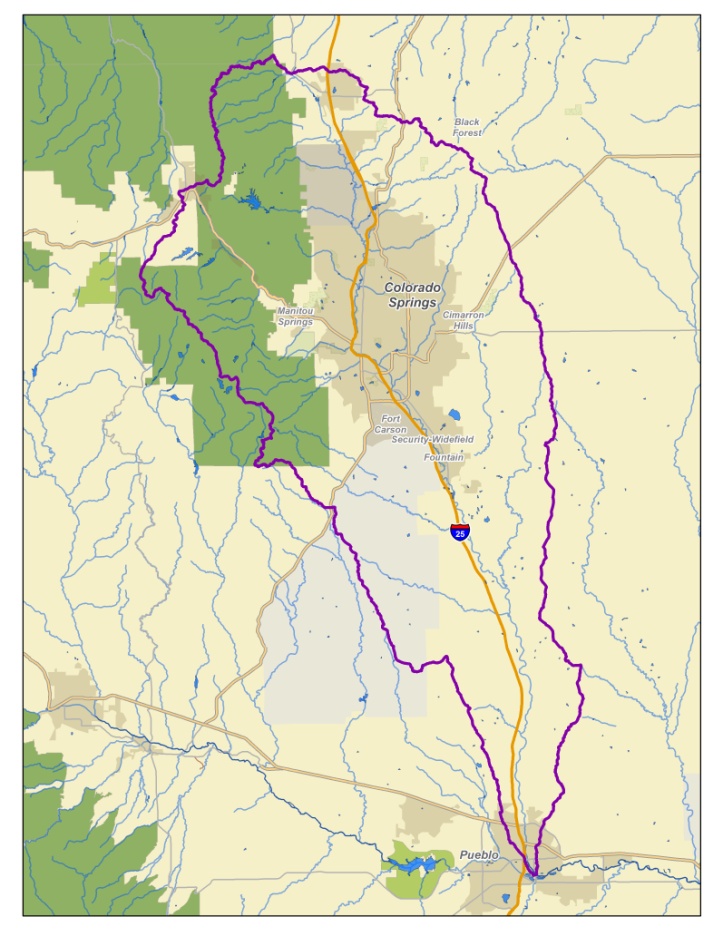
The Fountain Creek Watershed is located along the central front range of Colorado. It is a 927-square mile watershed that drains south into the Arkansas River at Pueblo. The watershed is bordered by the Palmer Divide to the north, Pikes Peak to the west, and a minor divide 20 miles east of Colorado Springs. Map via the Fountain Creek Watershed Flood Control and Greenway District.

From The Pueblo Chieftain (Robert Boczkiewicz):

Negotiations are underway between Pueblo County, a water conservancy district and environmental protection agencies on one side, and Colorado Springs on the other side, to resolve disputes of many years regarding that city’s defiling of Fountain Creek.

The Pueblo Chieftain has obtained court documents stating that the parties in a two-year-old lawsuit are trying to reach an agreement to settle it, instead of pursuing it further in the U.S. District Court for Colorado.

Both sides have met three times in recent weeks “to discuss potential resolution of the (lawsuit) without further litigation,” states a court document filed last week at the court in Denver. It was filed by Pueblo County commissioners, the Lower Arkansas Water Conservancy District, the U.S. Environmental Protection Agency and the state Department of Public Health and Environment.

Those four entities sued Colorado Springs in 2016, claiming the city violated clean water laws by discharging excessive stormwater and pollutants into the creek, which flows through Pueblo County into the Arkansas River at Pueblo.

After a trial, the judge overseeing the case decided on Nov. 9 in favor of the four entities that sued. Senior Judge Richard P. Matsch ruled Colorado Springs violated its permit that regulates stormwater discharges into Fountain Creek.

The four entities in the court fight with Colorado Springs state in the new court document that the discussions so far “were productive.” They and the city asked the judge to put litigation on hold for three months, to see if they can agree how to remedy the city’s violations.

Matsch on Thursday granted the request.

@EPA #WOTUS regs expected this week — H2O Radio @H2OTracker

Colorado River headwaters tributary in Rocky Mountain National Park photo via Greg Hobbs.

Here’s a roundup of water news from H2O Radio. Click through to listen to the whole podcast, “This week in water.” Here’s an excerpt from the transcript:

WOTUS Roll Back in Offing

And speaking of those strategies, it’s expected that this coming week the Trump administration will propose severe restrictions on which bodies of water are covered under the Clean Water Act and regulated by the EPA. The Intercept reports that the proposed definition of waters of the U.S., also called WOTUS, will eliminate protection for streams and wetlands that are not physically connected to larger waterways. One estimate shows that at least 60—and up to 90 percent of streams and wetlands would no longer be covered.

While the policy has not yet been released, leaked information says that streams which are wet only after rain events would be excluded and only wetlands that are adjacent and physically connected to other larger waters would be protected. Jane Goodman of the Cuyahoga River Restoration organization said that by lifting the protections for certain waterways, the administration was disregarding the science that shows their interconnectedness. She said, “It’s like keeping protections for your kitchen sink and for the sewer in the street but taking them away from all the plumbing in between.”

#AnimasRiver: No immediate long-term effects from #GoldKingMine spill according to @EPA

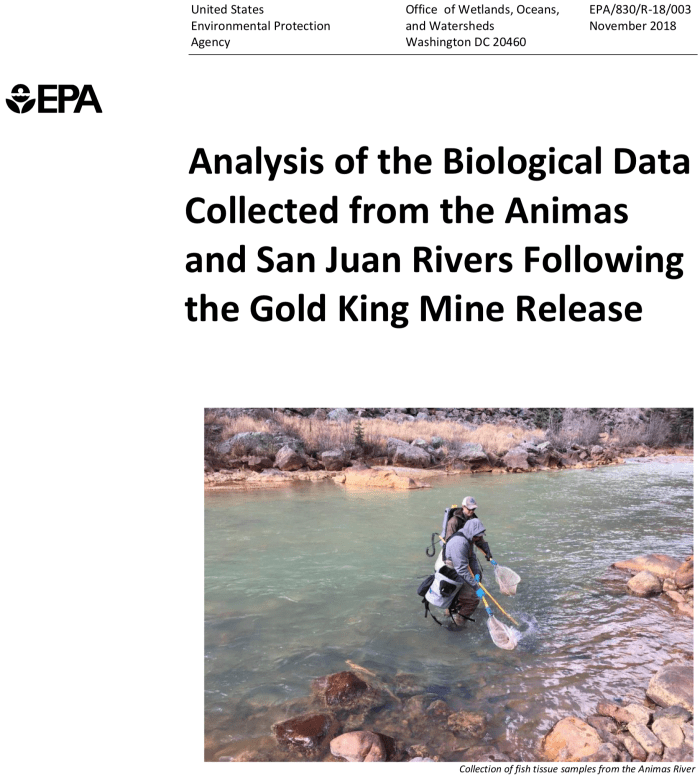
Click here to read the report. Here’s the executive summary:

Executive Summary

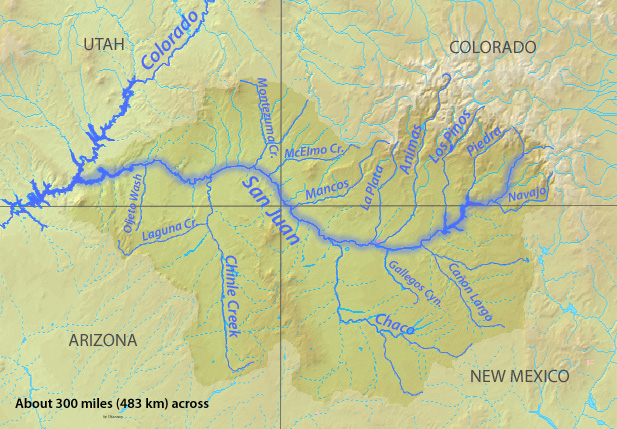
In response to the Gold King Mine (GKM) release on August 5, 2015, EPA mobilized field crews to sample water, sediment, and biological data from river segments impacted by the plume. Rivers downstream of the GKM release included the Animas River near Silverton, CO to its confluence with the San Juan River in Farmington NM, and the San Juan River from the Animas confluence to Lake Powell in Utah. A detailed examination of the water chemistry and sediment data collected from the Animas and San Juan rivers is presented in the EPA ORD report Analysis of the Transport and Fate of Metals Released from the Gold King Mine in the Animas and San Juan Rivers (EPA/600/R-16/296).
In this report, EPA presents its analysis of available biological data collected from the Animas and San Juan rivers to assess how the aquatic life responded to the GKM release. Biological communities provide a measure of water quality and aquatic habitat quality by responding to extreme events, such as the GKM release, and integrating stressors over time. Data gathered for this analysis include the EPA near-term (post-GKM release fall 2015) and long-term (fall 2016) biological monitoring of 30 locations, as well as biological data collected by federal, state, and tribal partners. The sampling and analysis approach was designed to evaluate potential changes in the species compositions, population abundance, and the concentration of metals in the tissue by comparing the post-GKM release data to the pre- release conditions.

Cement Creek aerial photo — Jonathan Thompson via Twitter

The upper Animas River immediately below the confluence with Cement Creek experienced the highest metal concentrations, the greatest number of water quality standards excursions, and the greatest deposition of GKM sediment, during and immediately following the GKM release. A significant increase in copper and decreases in manganese concentration were observed in benthic macroinvertebrate tissue in the near-term 2015 samples. Although these conditions existed, the pre- and post-GKM release analyses did not reveal any clear changes in the aquatic community. The lack of a biological response is largely because the aquatic life in this section of the river has been impacted for decades by legacy contamination from historic mine ore processing and ongoing acid mine drainage contamination. The sensitive macroinvertebrate and fish species that would be expected to respond to the GKM release were already extirpated from the upper reaches of the Animas River.

In the middle Animas River, we also did not observe a clear loss of, or change in the more sensitive macroinvertebrate and fish taxa that start to appear as one moves away from the concentrated historic mining operations in the headwaters. Our review of the Animas River adult fish population data collected by Colorado Parks and Wildlife near Durango agrees with existing state analyses, reports, and press releases that concluded fish were not exposed to acutely toxic concentrations in 2015. Naturally reproducing fish species (suckers and sculpin) and trout fry continue to be found in the Animas River at pre-release abundance levels weeks after and a year following the GKM release, however small bluehead suckers less than <200 mm were not observed in the 2016 data. The lack of a substantial biological response in this section of the river can be attributed to dilution of the plume, the dominant form of the metals was particulate rather than dissolved, and exposure duration was short, which resulted in fewer excursions of water quality standards.

Our analysis of fish tissue data collected by New Mexico Department of Game and Fish showed that many metals were significantly elevated in bluehead sucker and flannelmouth sucker liver and speckled dace muscle tissue samples collected in weeks after the GKM release in the lower Animas River. The degree of metal accumulation in liver differed by species, sampling location, and among the metals, with aluminum, cadmium, lead and manganese exhibiting the greatest concentrations. Cadmium and mercury in liver tissue and selenium in muscle were greater in the San Juan than in the Animas. When fish were sampled the following spring and fall in 2016, the concentration of metals in muscle/filet samples were similar to pre- release concentrations and were low throughout both rivers. For the most part, the elevated liver concentrations in 2015 did not translate to elevated muscle concentrations. Metal concentrations in muscle tissue never triggered human health consumption advisories. There were no fish population data available from this section of the Animas River to help us understand if the metal concentrations in fish tissue were sufficiently high to adversely affect the fish populations.

By the time the GKM plume reached its confluence with the San Juan River, total metal concentrations had declined by three orders of magnitude from what they were when the plume entered the Animas because of the combined effects of the dilution, chemical reactions, and deposition. The excursions of aquatic life water quality criteria in the San Juan were limited to metals that are also naturally high in the sediment and water.

The U.S. Fish and Wildlife Service fish population data for the San Juan River show that fish abundance in 2015 and 2016 was generally within pre-release levels. The exception to this was the abundance of bluehead sucker, flannelmouth sucker, and speckled dace in the middle reaches of the San Juan River. These species had historically low abundance in this area in both 2015 and 2016. The razorback sucker, Colorado pikeminnow and channel catfish, however, had high abundance in 2015 and 2016, which are potential predator/competitor species. We cannot conclude that changes in the physical (i.e., release from the Navajo dam resulting in a short duration of increased flow) and chemical conditions in the San Juan River during and after the plume contributed to changes in species abundance as, the aquatic life water quality criteria excursions were limited and the flow increase was similar to a moderate-sized storm event. It is as plausible that a combination of ecological (increase of predator/competitor species) and physical interactions, and/or fisheries management actions (stocking of razorback and pikeminnow), contributed to the observed changes.

With respect to metals accumulated in biota one-year post-GKM release, metal concentrations measured in benthic macroinvertebrate tissue and fish tissue generally track the gradient of concentrations measured in sediment and water through the watershed. The highest metal concentrations in tissue were typically observed in the upper Animas and the lowest concentrations were observed in the San Juan. Localized high metal concentrations were observed in the post-release tissue data; however, the location at which the high concentrations were observed was not consistent among years highlighting the high intra- and inter- site variability in tissue concentrations. In fall 2016, many metals were elevated in benthic macroinvertebrate tissue when compared to the pre-release concentration; however, the high concentrations were also observed in the upstream and tributary samples suggesting that something other than the GKM release contributed to the concentration change. Likely explanations include differences in sample collection methodologies between years and taxonomic differences between sampling locations. A comparison of pre- and post-GKM fish muscle data among data provider showed similar concentrations that did not exceed human health consumption screening advisory levels.

The EPA 2016 sampling was the first effort to obtain biological data that covered the entire Animas and San Juan rivers in a single sampling event with consistent sampling methods. Our ability to conduct a watershed-scale analysis of data collected by all partners was limited by the different sampling and analytical methods and revealed the need for a consistent sampling approach. This was especially true for studies focusing on bioaccumulation of metals. Future watershed-scale monitoring efforts should include the development of consistent sampling methods when an objective is to compare results to data collected from other areas of the watershed.

From The Durango Herald (Jonathan Romeo):

The EPA last week released a “Biological Response Report” that shows the agency’s analysis of the Gold King Mine spill…

Based on data from before and after the spill, the EPA “concluded there was no measurable changes to fish populations and bottom-dwelling organisms” after the Gold King Mine blowout.

The EPA said aquatic life in the river near Silverton had already been killed off from decades of legacy contamination from historic mine ore processing and ongoing acid mine drainage contamination.

In Durango, where aquatic life does exist, populations were not affected because the spill had been diluted, the metals were not toxic and the time of exposure was relatively short, the EPA said.

The EPA said that while some fish accumulated metals after the mine release, water quality returned to normal when samples were taken the next spring.

The study highlights what many researchers in the watershed have known for some time: The Gold King Mine spill’s tangible effect on the environment has been relatively small.

Just days after the Aug. 5, 2015, spill, Colorado Parks and Wildlife placed more than 100 hatchery fish along the Animas River. None of the fish died.

In August, San Juan Basin Public Health released the results of a three-year water-quality study, also finding the Gold King Mine spill had no lasting impacts.

Mountain Studies Institute, which has extensively monitored the river since the spill, has long maintained aquatic life had not been seriously affected. Recently, the group released a study that showed the 416 Fire runoff was by far more impactful.

This image was taken during the peak outflow from the Gold King Mine spill at 10:57 a.m. Aug. 5. The waste-rock dump can be seen eroding on the right. Federal investigators placed blame for the blowout squarely on engineering errors made by the Environmental Protection Agency’s-contracted company in a 132-page report released Thursday [October 22, 2015]

@EPA asks courts to toss #NavajoNation’s lawsuit over #GoldKingMine spill — The Durango Herald #AnimasRiver

San Juan River Basin. Graphic credit Wikipedia.

From The Durango Herald (Jonathan Romeo):

The U.S. Department of Justice, on behalf of the Environmental Protection Agency, has asked that a federal court dismiss a lawsuit filed by members of the Navajo Nation seeking repayment of damages associated with the 2015 Gold King Mine spill…

While the EPA initially encouraged people and businesses to file claims for financial losses, the agency backtracked in January 2017, saying it was legally protected from any damages associated from the spill.

The states of New Mexico and Utah, as well as the Navajo Nation, filed lawsuits seeking compensation. New Mexico is seeking $130 million, Utah is seeking $1.9 billion, and the Navajo Nation is seeking $130 million.

Over the summer, the EPA, through the Department of Justice, filed similar requests to dismiss the claims, arguing the agency is protected from litigation under federal law.

The motion filed Thursday argues the same point in seeking to dismiss a lawsuit that represents about 300 individual members of the Navajo Nation who claim a cumulative of $75 million in damages…

The Department of Justice’s motion argues the EPA is protected under the Federal Tort Claims Act, which gives federal agencies a “discretionary function exemption.”

The EPA was acting according to the Comprehensive Environmental Response Compensation and Liability Act by evaluating the mine for remediation and preventing environmental pollution of the Animas River watershed when the inadvertent release occurred, the motion states.

The motion states that so far, the EPA has spent $29 million on past and continuing efforts to address mine pollution in the Animas River watershed, including building a temporary water treatment plant and designating the area as a Superfund site.

The stage was set for a blowout at the Gold King Mine years before the EPA became involved in the situation.

With the plugging of the American Tunnel, many researchers and experts of the mine district around Silverton believe the waters of the Sunnyside Mine pool backed up, causing the Gold King Mine to discharge mine wastewater…

The lawsuit on behalf of Navajo members says the spill, which carried arsenic and lead, prevented them from using water for their crops and care for their animals, as well as personal use…

Ferlic said a hearing Monday will brings together her clients, the states of Utah and New Mexico, as well as the Navajo Nation, to set a date to discuss the motions to dismiss.

#AnimasRiver: Which was worse for water quality: #GoldKingMine spill or #416Fire floods? — The Durango Herald

From The Durango Herald (Jonathan Romeo):

Study compared metal loading in both events; results surprised researchers

A new report shows that runoff from the 416 Fire burn scar this summer dumped higher concentrations of potentially toxic metals into the Animas River than the Gold King Mine spill three years ago…

It has been a rough couple of years for the Animas River.

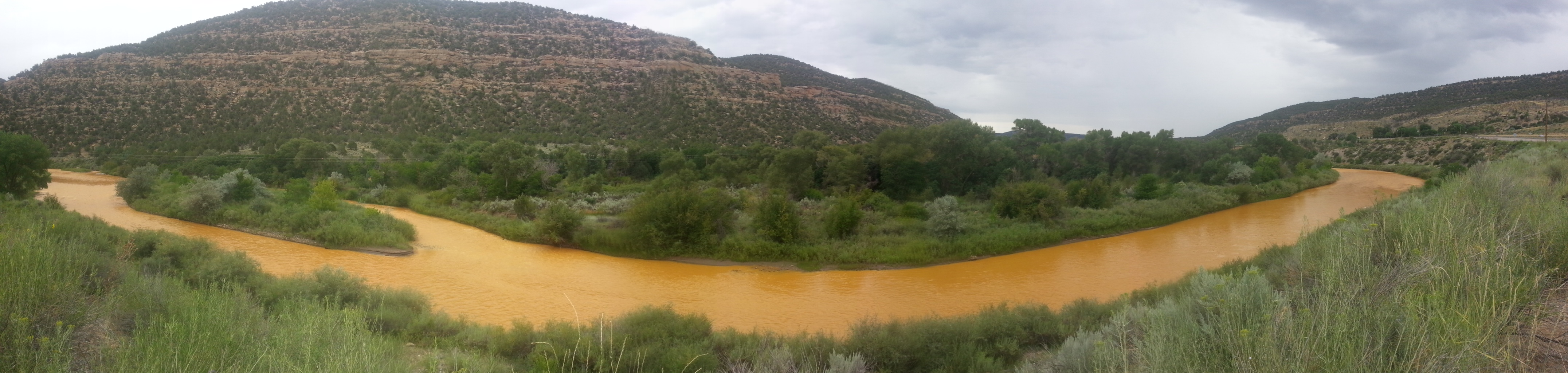
In August 2015, the Environmental Protection Agency accidentally caused the Gold King Mine, near Silverton, to blow out, sending 3 million gallons of toxic waste down the Animas River, turning it orange.

Then, this July, heavy rain fell over the 416 Fire burn scar in the Hermosa Creek drainage, just north of Durango, and sent a torrent of black mud, rocks and other debris down the Animas River.

After both events, Mountain Studies Institute, an environmental research and education nonprofit, extensively monitored and researched the impacts on aquatic life and water quality in the Animas River.

Though only a few months removed from the July floods, the preliminary data show the impacts of the Gold King Mine spill pale in comparison to the mudslides and debris flows from the 416 Fire burn scar.

Peter Butler with the Animas River Stakeholders Group said that point was made clear when the 416 Fire runoff caused nearly all the fish in the Animas River to die.

By comparison, there has never been any evidence that the tainted Gold King Mine water caused any die-off of aquatic life.

Roberts’ study backs this with data.

The study took samples at the height of the 416 Fire debris flows on July 17 and July 24 on the Animas River, near Rotary Park, and compared it to samples taken during the mine spill as it passed through the same spot Aug. 6 to Aug. 9, 2015.

@EPA awards over $575k in wetlands grants in #Colorado to bolster wetland assessments and the development of water quality tools and data

Here’s the release from the Environmental Protection Agency (Lisa McClain-Vanderpool):

Colorado Natural Heritage Society and Colorado State University-Natural Heritage Program will provide invaluable resources to Roaring Fork and Aurora watershed stakeholders

EPA has awarded $575,333 in wetlands grants to two programs in Colorado to survey, assess, map and provide technological tools such as smart phone applications.

“The data these projects generate are important to understanding, protecting and restoring wetlands in the state of Colorado,” said Darcy O’Connor, Assistant Regional Administrator of the Office of Water Protection. “Supporting decision making with solid scientific data is the wise approach to wetlands protection.”

Colorado Natural Heritage Society was awarded $221,250 to survey and assess critical wetlands in the Roaring Fork watershed in western Colorado. This project proposes to conduct a prioritized survey and assessment for critical wetlands within the Roaring Fork Watershed. The primary goal is to provide stakeholders, including private landowners with scientifically valid data on the condition, rarity, location, acres, and types of wetlands within the watershed.

Colorado State University’s Colorado Natural Heritage Program (CNHP) was awarded $221,250 for the 5th phase of CNHP’s wetlands database including vegetation classification, floristic quality assessment, a wetland restoration database and updates to the Colorado Wetlands Mobile App. The CNHP will revise Colorado’s wetland and riparian vegetation classification and floristic quality assessment, and create a Colorado wetland and stream restoration database.

The CNHP was also awarded $132,833 to assess critical urban wetlands in the city of Aurora, Colorado. CNHP will update the National Wetland Inventory mapping and conduct field-based wetland assessments in the greater Aurora area. Water quality data will also be collected at these sites. The goal is to create useful products for local land managers, land owners and community members.

EPA has awarded over $2.5 million in wetlands grant funding for 11 projects across EPA’s mountains and plains region of the West (Region 8). Healthy wetlands perform important ecological functions, such as feeding downstream waters, trapping floodwaters, recharging groundwater supplies, removing pollution, and providing habitat for fish and wildlife.

Wetlands Program Development Grants assist state, tribal, local government agencies, and interstate/intertribal entities in building programs that protect, manage, and restore wetlands and aquatic resources. States, tribes, and local wetlands programs are encouraged to develop wetlands program plans, which help create a roadmap for building capacity and achieving long-term environmental goals.

For more program information visit: https://www.epa.gov/wetlands/wetland-program-development-grants

@EPA plans to release PFAS management plan by the end of the year

Widefield aquifer via the Colorado Water Institute.

From The Nashua Telegraph (Ken Liebeskind):

After completing its final PFAS Community Engagement event in Leavenworth, Kansas, on Sept. 5, the EPA plans to prepare its PFAS management plan and release it by the end of the year.

The first community engagement event was in Exeter in June, with follow-ups in Horsham, Pennsylvania, Colorado Springs, Colorado, Fayetteville, North Carolina and an event for tribal representatives in Spokane, Washington.

The EPA said, “The Community Engagement events and the input the agency has received from the docket for public comments have been incredibly informative and will be used, along with perspectives from the National Leadership Summit to develop a PFAS management plan for release later this year.

[…]

While the EPA says one of its actions will be to evaluate the need for a MCL for PFAS that may change its current level of 70 parts per trillion that is a health advisory…

Many environmental groups are calling for lower levels that have already been established by other states.

#AnimasRiver: The @EPA releases results of three year water quality study #GoldKingMine

A “get well soon” balloon floats in the contaminated waters of the Animas River flowing through Durango on Monday afternoon August 10, 2015 — photo The Durango Herald, Shane Benjamin

From The Durango Herald (Jonathan Romeo):

The study looked at 200 river-water samples and almost 200 sediment samples, as well as more than 100 private wells from Durango to Silverton, testing for 13 different heavy metals and other possible contaminants, the health department said.

Some findings, according to San Juan Basin Public Health:

Water quality, except in Cement Creek, is better than the minimum standards set to protect aquatic life and human uses.

Additional sampling performed as part of this study revealed that natural variability in river flows produces occasional “spikes” in certain metals that may have been missed in less-frequent sampling.

Sediment in the Animas River, including beach sediment at six popular Durango recreation sites, poses no risk to human health if common-sense precautions are followed.

About one-quarter of Animas Valley drinking water wells had naturally-occurring bacteria present, and all wells should receive filtration or treatment.

About 5 percent of Animas Valley wells had more serious contamination from heavy metals, nitrates or other forms of bacteria. Heavy metal contamination in these wells arises from the natural geology of the Animas Valley aquifer.

#AnimasRiver: “We’ve got years’ worth of investigations to do” — Rebecca Thomas #GoldKingMine @EPA

On April 7, 2016, the Environmental Protection Agency proposed adding the “Bonita Peak Mining District” to the National Priorities List, making it eligible for Superfund. Forty-eight mine portals and tailings piles are “under consideration” to be included. The Gold King Mine will almost certainly be on the final list, as will the nearby American Tunnel. The Mayflower Mill #4 tailings repository, just outside Silverton, is another likely candidate, given that it appears to be leaching large quantities of metals into the Animas River. What Superfund will entail for the area beyond that, and when the actual cleanup will begin, remains unclear.
Eric Baker

From The Durango Herald (Jonathan Romeo):

Project to clean nearly 30 mines in 5 years has drawn criticism

The Environmental Protection Agency will not release public comments before it makes a final decision on a proposed plan to clean up 26 mine sites over the next five years in the Superfund area near Silverton.

In June, the EPA released the proposed plan, which identified quick action projects the agency wants to take while it comes up with a long-term plan for improving water quality in the upper Animas River. The proposed plan is expected to cost about $10 million.

“We’ve got years’ worth of investigations to do,” Rebecca Thomas, the EPA’s project manager, said in a previous interview. “These early actions are not intended to be a final remedy. They’re no-brainer activities to help get the water clean and reduce the amount of loading.”

The release of the plan kicked off a 30-day public comment period, which was extended another month in response to requests by the public. The comment period ended Wednesday.

When The Durango Herald asked EPA officials to review public comments, spokeswoman Cynthia Peterson said the public comments and the EPA’s response won’t be made available for review until the EPA makes a final decision.

“All significant comments, and EPA’s responses to those comments, will be compiled in a responsiveness summary. The responsiveness summary will be included in the final decision document – the Interim Record of Decision. The Interim Record of Decision will be published once the agency has had a chance to review and consider all comments received.”

Withholding of public feedback and the agency’s replies until after a final decision is made is in contrast with other comment periods the EPA has held. In 2015, for example, comments were posted in real time for the listing of the Superfund site.

“In some instances, such as federal rule-makings, comments can be made available in real time,” Peterson wrote. “However, significant comments on a site-specific Record of Decision are released in a responsiveness summary with the decision document.”

This image was taken during the peak outflow from the Gold King Mine spill at 10:57 a.m. Aug. 5. The waste-rock dump can be seen eroding on the right. Federal investigators placed blame for the blowout squarely on engineering errors made by the Environmental Protection Agency’s-contracted company in a 132-page report released Thursday [October 22, 2015]

From The Durango Herald (Jonathan Romeo):

Despite ash flows and mine waste, the river is resilient

It’s been a rough couple of years for the Animas River.

This weekend marks three years since the river, which runs through the heart of Durango, endured a massive mine waste spill from a blowout at the Gold King Mine. The waterway turned an electric orange and gained international attention.

The Aug. 5, 2015, spill brought to the forefront the longstanding issue of toxic metals leeching into the Animas River from legacy mining in its headwaters around Silverton.

This year has been an especially vicious dagger into the Animas.

A winter that never showed up in the San Juan Mountains resulted in one of the lowest snowpack years in recorded history. Then, through spring and early summer, extreme drought tightened its stranglehold on Southwest Colorado.

The Animas River saw its third lowest peak flow in more than 100 years of recorded history, and one of its earliest, hitting a high of about 1,000 cubic feet per second in May. Typically, the river peaks at about 4,700 cfs in early June.

Fish and other aquatic life were already stressed from low flows and high water temperatures when ash runoff from the 416 Fire burn scar came tumbling down north of Durango.

The dark-chocolate colored waters suffocated fish, which desperately washed ashore seeking oxygen. Though an official population survey won’t be conducted until this fall, it’s estimated thousands of fish died.

A raw sewage spill last week at Santa Rita Park was an extra twist of the dagger.

A river without fish
For some perspective, it’s likely aquatic life is either all but gone or dramatically depleted through the entire 126-mile stretch of the river from the headwaters in Silverton, down through Durango to the Animas’ confluence with the San Juan River in Farmington.

In recent years, the river from Silverton to Bakers Bridge (about 15 miles north of Durango) has been basically considered a dead zone because of toxic metal-loading from leeching mines.

The ash flows during the month of July killed most of the fish in the river through Durango. Even the most tolerant species – carp – was found dead along the river’s banks.

Fish in this stretch of the Animas River have been unable to reproduce because of a combination of factors, such as high water temperature and mining pollution. The fish that do live in the river are stocked by Colorado Fish and Wildlife.

The Southern Ute Indian Tribe declined to comment about how fish are doing in the Animas through tribal lands. Attempts to reach a biologist with New Mexico Fish and Game were unsuccessful. The Animas, however, has all but dried up before it reaches the San Juan River.

“It’d be unusual if everything was dead, but it’s probably to the point where it’s virtually that way,” said Jim White, an aquatic biologist for Colorado Parks and Wildlife.

But despite the onslaught of doom and gloom, there is reason to be optimistic: Rivers are resilient, and steps are finally being taken to make significant strides in the cleanup of the Animas River.

Improving water, habitat
After the Gold King Mine spill, for instance, the Environmental Protection Agency (which triggered the blowout while working at the inactive mine) declared a long-awaited Superfund listing, which will clean up nearly 50 mining sites around the Animas River headwaters.

Already, a temporary water-treatment plant built in 2015 has shown improvement in water quality downstream, said EPA spokeswoman Cynthia Peterson, though it’s too soon to know its effect on aquatic life…

While ash flows have decimated fish populations, research has shown aquatic species rebound quickly after wildfires, said Scott Roberts, an aquatic biologist for Mountain Studies Institute.

Navajo farmers and ranchers file civil suit against @EPA and 8 private entities over #GoldKingMine spill #AnimasRiver

The orange plume flows through the Animas across the Colorado/New Mexico state line the afternoon of Aug. 7, 2015. (Photo by Melissa May, San Juan Soil and Conservation District)

From The Farmington Daily Times (Noel Lyn Smith):

The civil complaint states that plaintiffs in New Mexico, Utah, Arizona and Colorado were forced to stop using water from the San Juan River for crop irrigation, livestock watering and household purposes due to contamination from mine waste released on Aug. 5, 2015.

Group members claim crop harvests were lost due to the lack of irrigation and that livestock were unable to graze or drink water from the river. In addition, several ranchers sold livestock at a reduced price due to a decline in the animals’ quality.

The 114-page complaint was filed Aug. 3 in U.S. District Court of New Mexico. It seeks approximately $75 million in damages.

Along with the federal agency, the complaint lists as defendants Environmental Restoration LLC, Kinross Gold Corp., Kinross Gold USA Inc., Sunnyside Gold Corp., Gold King Mines Corp., Weston Solutions Inc., Salem Minerals Inc. and San Juan Corp., which the document describes as either EPA contractors or mine owners…

Kate Ferlic, lead attorney for the plaintiffs, said in a press release today that farmers and ranchers used various resources to try to save their crops and livestock, but to no avail.

“They trucked in water, they hand-carried gallons of water down long dirt roads, some even tried to use their tap water. The spill was a very real crisis for the Navajo people,” Ferlic said.

She added that while each of the 295 plaintiffs filed administrative claims with the EPA, the agency still has not acted on those requests…

Navajo Nation President Russell Begaye and tribal council Speaker LoRenzo Bates weighed in on the litigation in the press release.

Begaye said the spill was a disaster for the tribe and tribal members.

“The San Juan River has enormous cultural and spiritual significance for our nation in addition to its practical and economic importance. It is our lifeblood. Most of the farmers and ranchers have lived and farmed on these lands for generations,” the president said.

Bates said the spill resulted in farmers being unable to irrigate crops, causing a loss of the harvest, which is the sole source of income for many people.

While some farmers could save their crops by using other sources of water, a stigma developed about water contamination and crops grown in the area, resulting in people not purchasing produce from farmers, he added.

“Our people endured clear and significant losses, and I look forward to the court doing them justice by ordering the EPA and the other responsible parties to pay up for those losses,” Bates said.

@EPA PFAS “community engagement” hearing recap

Widefield aquifer via the Colorado Water Institute.

From TheDenverChannel.com (Lance Hernandez):

Residents who live in Fountain Valley southeast of Colorado Springs are asking the Environmental Protection Agency to regulate the perflourinated compounds which have contaminated their drinking water supplies.

The requests came during a two day “community engagement” event sponsored by the EPA.

“I think this is a big deal,” said Fran Silva-Blayney of the Sierra Club’s Fountain Creek Water Sentinels. “It’s a big deal in terms of bringing public awareness to the issue and in terms of the EPA recognizing that we need to take regulatory action.”

Silva-Blayney said the community wants the EPA to set “maximum contaminant levels.”

[…]

The contamination in the public water supplies of Fountain, Security and Widefield came from firefighting foam, which was used for decades at Peterson Air Force Base.

Health Impact

Several residents and former residents raised questions about the health impact of long-term exposure.

“My father died of kidney cancer last year,” said Mark Favors, a member of the Fountain Valley Clean Water Coalition.

Favors told Denver7 that he was born and raised in the valley, and then moved to New York eight years ago.

“My cousin was here yesterday,” he said. “His grandson, at 14 years of age, had to have a kidney replaced, a transplant last year.”

“We would really like to know, do we have hereditary cancers, or do we have environmental cancers?” said Liz Rosenbaum, who founded the Fountain Valley Clean Water Coalition.

“Summit was amazing”

Rosenbaum said she is encouraged by what’s going on.

“The community wants to be more actively involved,” she said, adding that it’s a way to stay informed.

“When you’re scared, you get angry,” she said, “and if you know what’s going on, you can develop solutions and ideas.”

State health officials say they don’t know yet how widespread the contamination problem is in Colorado.

So far, contamination has been found during tests of public wells in the Fountain Valley, Commerce City and at a fire station on Sugar Loaf Mountain in Boulder County.

“We’re in the initial stages of identifying potential sources in the state,” said Kristy Richardson, an environmental toxicologist with the Colorado Department of Public Health and Environment. “We’re looking at all those sources that have been used in industry and manufacturing.”

Advisory limit

The EPA’s advisory limit for Perfluorooctanesulfonic acids (PFOs) and PFAS is 70 parts per trillion.

Residents who attended the EPA’s meetings would like to make it a regulatory standard and much tougher than 70 ppt.

“We have a health advisory for two substances, in a family of 3,000… so we don’t know if we’re removing all of them,” Richardson said. “Residents are very concerned about getting them out (of the water) and making sure they’re not exposed to them anymore.”

From KRCC.org (Jake Brownell):

The Colorado Springs meeting was the third of four community forums scheduled across the country this summer, each hosted by the EPA, to collect feedback from people on the ground dealing with PFAS contamination.

“Understanding and addressing emerging contaminants such as PFAS is difficult, but critically important,” explained Doug Benevento, administrator of EPA Region 8, which includes Colorado and other western states. “The experiences and perspectives shared by state and local officials as well as community groups today, in addition to the numerous members of the public, will be invaluable as EPA develops a plan to manage PFAS.”

PFAS contamination is a growing concern among public health and water management professionals nationwide, with at least 40 states experiencing some form of contamination, according to the Environmental Working Group. The EPA says it has identified the issue as a high priority, and is in the process of developing new rules to regulate contamination levels in drinking water…

“We need regulatory infrastructure in order to, number one, compel investigation and clean up, but also to promote a more consistent approach to addressing PFAS nationwide,” Tracie White of the Colorado Department of Public Health and Environment told EPA officials Wednesday.

Her concern was echoed by members of the public and by those responsible for managing affected drinking water systems, who urged the EPA to establish a legally-binding Maximum Contaminant Level, or MCL, for the chemicals.

“Health advisories have the same connotations and effect as maximum contaminant levels, but none of the support that an MCL provides,” said Brandon Bernard, water manager for Widefield Water and Sanitation.

For their part, EPA officials didn’t say whether an MCL would be forthcoming, but said the agency is looking at a range of options to regulate the chemicals, including listing them as “Hazardous Substances” under the Comprehensive Environmental Response, Compensation, and Liability Act, otherwise known as Superfund. Jennifer McLain, deputy director of the agency’s Office of Groundwater and Drinking Water, said she couldn’t give a timeline for any future regulatory decisions, but stressed that the agency is “moving as quickly as possible.”

Over the course of the two day forum, residents of Security, Widefield, and Fountain also shared their experiences with contamination in the area. Liz Rosenbaum, who has lived in Security and Widefield for 15 years, spoke on behalf of the grassroots group, Fountain Valley Clean Water Coalition…

Many community members also said that they feel they’ve been left out of important discussions about the future of their drinking water, and haven’t been treated as stakeholders in the process.

Still, Rosenbaum said the community forum was a good first step, and that she was encouraged by the dialogue that took place. Going forward, she said she hopes the conversation can continue, so that the “community feels more connected in decision making processes” as the EPA and other agencies work to address the issue of PFAS contamination here in El Paso County and nationwide.

From The Colorado Springs Gazette (Jakob Rodgers):

Over and over, residents and clean water advocates implored the Environmental Protection Agency on Tuesday evening to set enforceable drinking water standards for the toxic chemicals contaminating their water — and at tighter levels than the agency currently deems acceptable.

Their pleas came during the EPA’s third stop in a nationwide tour meant to help its leaders create a management plan for the toxic chemicals, called perfluorinated compounds. It marked the first opportunity in more than two years for people affected by the toxic chemicals to sound off to the EPA on the contamination of their drinking water.

Many argued that the EPA’s response was past due.

His voice cracking, Mark Favors, 49, listed several family members who drank the water most of their lives and have since died, many from kidney cancer. He read the obituary of one, Shelton Lee King, a retired master sergeant who served in Vietnam and died in 2012 of kidney cancer…

The EPA’s current process for regulating chemicals does not call for instituting any new drinking water standards for perfluorinated compounds until 2021.

Jennifer McLain, the agency’s deputy director in charge of groundwater and drinking water, said the agency is trying to accelerate that process, though she gave no timeline for when that might happen.

“We are working as quickly as we can,” McLain said.

So far, the EPA has only committed to evaluate the need for an enforceable drinking water standard for the two best-known types of perfluorinated compounds: perfluorooctane sulfonate, or PFOS, and perfluorooctanoic acid, or PFOA.

The EPA also is seeking to propose that those two chemicals be classified as “hazardous substances,” easing the process for seeking Superfund cleanup funding. And it is seeking to develop groundwater cleanup recommendations for both chemicals.

In addition, the agency is working to set toxicity levels for two other types of perfluorinated compounds. Neither was included in a different agency’s recent list of possibly dangerous chemicals.

The EPA’s management plan is due out by the end of the year.

From Colorado Public Radio (Anne Marie Awad):

Water managers for the El Paso County communities of Security, Widefield, Stratmore Hills, and Fountain have been working to rid their drinking water systems of Perfluorinated Chemicals since 2016. The contamination, discovered that year, traces back to firefighting foam used at nearby Peterson Air Force Base.
“Fifty years from now, 100 years from now, the Widefield Aquifer will still be contaminated if we don’t figure out a way to clean it,” said Fran Silva-Blayney, chair of the Sierra Club Fountain Creek Water Sentinels. “Is remediation even possible?”

Silva-Blayney was one of a handful of community stakeholders invited to speak at a listening session organized by the Environmental Protection Agency. Her comments and others carried the same message: the EPA isn’t doing enough.

“We are past the point of evaluating, proposing and recommending,” Silva-Balyney said. “People’s lives have been compromised. It’s time to regulate, enforce and remediate.”

In a statement, EPA Regional Administrator Doug Benevento said the community listening session would “inform our path forward in addressing PFAS in communities here in Colorado Springs and across the country.” Regulations are under consideration that would create an enforceable drinking water standard for two of the most common PFCs — mainly PFOS and PFOA.

Right now, EPA has an advisory in place, which isn’t enforceable. Water districts in the area have chosen, voluntarily, to make sure drinking water has no more than 70 parts per trillion of the chemicals. The agency could also classify certain PFCs as hazardous, and they’re developing groundwater cleanup recommendations if contamination is found.

@EPA seeks to dismiss #GoldKingMine lawsuits — @HighCountryNews #AnimasRiver

Cement Creek photo via the @USGS Twitter feed

From The High Country News (Jodi Peterson):

BACKSTORY

On Aug. 5, 2015, Environmental Protection Agency workers at the long-abandoned Gold King Mine near Silverton, Colorado, accidentally released 3 million gallons of acidic water. The orange plume, laden with iron, zinc, cadmium and arsenic, flowed into the Animas River, then on into New Mexico and Utah (“Silverton’s Gold King Reckoning,” HCN, 5/2/16). Those two states and the Navajo Nation filed lawsuits seeking to recoup millions of dollars in cleanup costs from the EPA.

Cement Creek aerial photo — Jonathan Thompson via Twitter

FOLLOWUP

In late July, the EPA filed a motion to dismiss the combined lawsuits. The agency says that court intervention is unnecessary because it’s already working on cleaning up the mess — the Gold King and 47 other mine sites got Superfund status in 2016. The EPA ran out of room for storing the sludge waste from water treatment, and in mid-June, workers began moving it to a controversial new site northeast of Silverton. Critics say that location endangers fish, and in early July, a sludge truck crashed, spilling 9 cubic yards into a creek. The EPA is still working on a long-term cleanup plan for the Superfund sites in the Upper Animas watershed.

This Is What @POTUS’s Fuel Economy Rollback Means for the #Climate #ActOnClimate #KeepItInTheGround

Rush hour on Interstate 25 near Alameda. Screen shot The Denver Post March 9, 2017.

From Earther (Brian Kahn):

The plan calls for 2020 fuel-efficiency standards to be frozen in place through 2026 while sorting out what a new rule could look like, as well as ending California’s ability to set its own, more stringent standards. The end result will be a huge uptick in carbon emissions.

The Obama rules were made in 2012 after consultation with the auto industry and would have increased car fuel-efficiency standards to 54.5 miles per gallon by model year 2026. The new proposal—announced by the Environmental Protection Agency and the Department of Transportation—would freeze efficiency standards at 43.7 mpg through model year 2026.

California has the ability to set even stricter standards for auto emissions, thanks to a waiver the EPA granted the state in 2013. There are a dozen other states that follow those standards as well. Revoking that waiver, despite the EPA commitment to “cooperative federalism,” is an, uh, odd move.

Robbie Orvis, an analyst with policy research group Energy Innovation, told Earther that revoking California’s waiver is “not in the spirit of the Clean Air Act, and the way it’s been implemented in the past.”

On an existential front, the new rule proposal will commit a hell of a lot more carbon to the atmosphere. The Union of Concerned Scientists estimates that it will result in an extra 130 million metric tons of carbon dioxide going into the atmosphere in 2030. That’s the equivalent of adding 30 coal-fired power plants to the grid.

Because people are likely to hang onto their cars for many years, the impacts would continue to play out beyond 2030. An analysis by Energy Innovation found that by 2035, U.S. transportation emissions will be 11 percent higher than they would be if the Obama-era standards and California’s waiver were kept in place.

The move will also put the U.S. behind the curve globally. While our weirdo climate-denying president obviously doesn’t care about the atmosphere or having a habitable planet, other countries do. And they’ve responded by putting in place stringent fuel efficiency standards, including many based on those in California.

The rollback ensures that the U.S. will be spinning its wheels on climate while the rest of the world forges ahead. That could have very real impacts on the fate of U.S. automakers viability and profits as they produce a wider range of cars. It could also inspire countries to be less ambitious.

“The top vehicle standards in the rest of the world are in line with existing standards,” Orvis said, referring to the Obama-era standards. “Undoing this will make U.S. automakers less competitive with automakers in other markets who are moving ahead making more efficient vehicles. It’s moving us in the wrong direction and making us less competitive with the rest of the world.”

@EPA To Hold PFAS Community Engagement in Colorado Springs

Photo via USAF Air Combat Command

Here’s the release from the Environmental Protection Agency:

Starting on Tuesday, August 7, 2018, the U.S. Environmental Protection Agency (EPA) will hold the third PFAS community engagement event in Colorado Springs, Colorado. This two-day public event allows EPA to hear directly from Colorado communities, Mountain West states, and local and tribal partners about their experiences with PFAS.
WHAT: Colorado Springs PFAS Community Engagement

WHEN: Tuesday, August 7, 2018: Listening Session
4:00 PM MST — 10:00 PM (MST)
Wednesday, August 8, 2018: Working Session
9:45 AM — 12:00 PM (MST)
WHERE: Hotel Eleganté Conference & Event Center
2886 S. Circle Dr.
Colorado Springs, CO 80906

The Colorado community engagement event will consist of two sessions — a public listening session and PFAS working session — to hear from the public; provide tools to assist states, tribes, and local communities in addressing challenges with PFAS in the environment; and understand ways EPA can best support the work that’s being done at the state, local, and tribal level.

Both days are open to the public and press. If you are interested in attending the event, please register here: https://www.epa.gov/pfas/forms/pfas-community-engagement-colorado-springs-co. Those interested in speaking should also select the option to speak while registering.

Background

PFAS is a group of man-made chemicals that have been widely used in everyday products since the 1940s. But PFAS compounds also can enter the environment, raising concerns about the potential environmental and health risks.

Addressing PFAS is a national priority. At the National Leadership Summit in Washington, D.C. in May, EPA announced the following four-step action plan:

  • EPA will initiate steps to evaluate the need for a maximum contaminant level (MCL) for PFOA and PFOS. We will convene our federal partners and examine everything we know about PFOA and PFOS in drinking water.
  • EPA is beginning the necessary steps to propose designating PFOA and PFOS as “hazardous substances” through one of the available statutory mechanisms, including potentially CERCLA Section 102.
  • EPA is currently developing groundwater cleanup recommendations for PFOA and PFOS at contaminated sites and will complete this task by fall of this year.
  • EPA is taking action in close collaboration with our federal and state partners to develop toxicity values for GenX and PFBS by this summer.
  • EPA has conducted similar engagements with communities impacted by PFAS in New Hampshire and Pennsylvania, and will be headed to North Carolina next month. These events are critical to understand ways the Agency can best support the work that’s being done at the state, local, and tribal levels. Using information from the National Leadership Summit, community engagement events, and public input provided by the docket, EPA plans to develop a PFAS Management Plan for release later this year.
    To learn more about PFAS, please visit: http://www.epa.gov/pfas

    South Adams County Water and Sanitation shuts down 3 wells citing PFC pollution

    Typical water well

    From 9News.com (Allison Sylte):

    A news release about the contamination was distributed on Friday morning. This comes after the South Adams County Water and Sanitation District found perfluorinated compounds (commonly known as PFCs) in water samples from certain shallow groundwater wells. These chemicals are known to pose significant health risks if people are exposed to them – especially expectant mothers and young children.

    Now, the Environmental Protection Agency, Colorado Department of Public Health and the Environment, and the Tri-County Health Department are working to find the source of the contamination.

    However, health officials say the water distributed to the 50,000 customers in the South Adams County Water and Sanitation District is safe after three wells with the highest concentration of the PFC chemicals were shut down earlier this month. This means the district is taking 40 percent of its water supply from Denver rather than the usual 20 percent.

    The concern now, according to South Adams County Water and Sanitation District Water Systems Manager Kipp Scott, are private wells and the people who use them – which is what prompted the advisory to the public in the first place.

    “When we find something that is of a concern like this, we notify the health department,” Scott said. “The concern is, we are treating for that chemical here and removing it to levels below the health advisory, but the concern is with other people that maybe using wells that are not on our system and supplied water by our district.

    Scott said some wells tested positive for PFCs in May. When that happened, they tested the treatment process – and results took five weeks to come back. Next came contact with the health department.

    Brian Hlavacek, the director of environmental health at the Tri-County Health Department, issued a statement to 9NEWS that said:

    “Tri-County Health Department is working closely with EPA, CDPHE and SACWSD to identify the extent and source of contamination. TCHD is working to identify private drinking water wells in the initial area of investigation in order to sample for PFC’s. Sampling could begin as early as next week as we identify any wells. Residents who receive their water from a private drinking water well, are near this area, and are concerned about PFC levels can call Tri-County Health Department at 303-288-6816 or email questions to ehwater@tchd.org.”

    Summitville Mine Superfund Site update: #Colorado to take over project for $2 million a year

    Summitville Mine superfund site

    From The Denver Post (Bruce Finley):

    After 27 years of EPA control, Colorado is preparing to take over the full financial burden — a forever bill for $2 million a year — of a high-mountain cyanide gold mine that became one of the West’s worst environmental disasters.

    The re-shaping of ravaged alpine tundra at the Summitville Mine through a $250 million federal Superfund cleanup stands out because scores of other toxic mines in Colorado still are contaminating headwaters of western rivers each day.

    But this fix requires constant work. Colorado must pay the $2 million, a bill that the EPA has been handling, starting in 2021 for cleaning a fluctuating flow of up to 2,100 gallons a minute of toxic water that drains down a once-pristine mountainside.

    The Colorado Department of Public Health and Environment will use the money to run a silver-domed $18 million industrial water treatment plant built at 11,500 feet elevation in a wild and spectacular valley, surrounded by snow-splotched jagged peaks.

    The plant houses huge stainless-steel vats of burbling brown sludge. Toxic metals are chemically coaxed and filtered out. Plant operators haul 4.1 million pounds a year of concentrated waste back up South Mountain (elevation 12,550 feet) in trucks for burial. This muck contains more than 690,000 pounds of cadmium, lead, copper, aluminum, iron, manganese and zinc. It is toxic metal that otherwise would flow down and degrade the Wightman Fork of the Alamosa River.

    Colorado also must oversee the artificial covering and drainage ditches across 1,100 acres of tundra scarred by open-pit mining. Mountainsides ripped and slashed to remove gold and silver have been re-contoured by contractors using bulldozers, and re-planted with native vegetation — the engineering equivalent of plastic surgery to make the place look as good as possible…

    The hand-off of responsibility for Summitville from the EPA to CDPHE in 2021 will mark a turning point in dealing with a severely damaged landscape using the nation’s Superfund system for handling disasters.

    This project was set in motion before Congress in 1995 killed automatic funding for Superfund cleanups.

    Complete restoration to a pre-existent state is considered impossible and the government aimed at best-possible repairs.

    “That was what the EPA and the state worked to do: bring it back to a sustainable protected state. Once there is mining in an area, it has long-term impact,” said Fran Costanzi, an EPA official who managed the Summitville cleanup for four years. “We worked to bring water quality back and also the vegetation into a long-term stable state.”

    An EPA spokesman issued a statement placing Summitville “among the more illustrious, or perhaps infamous, examples of the environmental damage a large mining operation can cause when resources for safely managing contamination sources disappear. The EPA’s initial response was an emergency situation in which the site was literally abandoned by the operator — in winter-time conditions — with a cyanide heap leach pad eroding into a headwaters stream.

    “After years of work and investment, we’ve essentially reclaimed a watershed in one of the most beautiful parts of the state. Protecting those gains will continue to require our attention.”

    Alamosa River. Photo credit: Wenck

    The cleanup improved water quality to where fish can live in Terrace Reservoir, about five miles below the mine, and in the Alamosa River.

    CDPHE officials now are required to monitor conditions.

    The financial burden falls to Colorado because the Superfund process shifts responsibility to states after initial federal remediation. Colorado lawmakers have arranged to pay about $2 million a year by tapping revenue derived from fees paid at municipal and other landfills around the state…

    At Summitville, Rio Grande County eventually will own the 1,100-acre site. State and county officials have been setting up placards conveying the history of mining in the area with an emphasis on environmental damage and evolving efforts to repair harm.

    Feds eye changes to a bedrock environmental law — @HighCountryNews

    Nixon Rock, in the Gunnison Gorge. Photo: Brent Gardner-Smith/Aspen Journalism

    From The High Country News (Carl Segerstrom):

    A clash over the National Environmental Policy Act follows familiar fault lines.

    A linchpin environmental law is now being scrutinized by the Trump administration and could be targeted for reforms. The National Environmental Policy Act, commonly referred to as NEPA, dictates the environmental planning process for federal agencies. Any changes to the NEPA process could have far-reaching impacts on the vast public lands and infrastructure of the West.

    The NEPA reform push broadly traces political dividing lines, as pro-business and anti-regulation Republicans, who want to see NEPA reworked, square off with environmental groups and conservation-minded Democrats hoping to preserve the law and implementation process. Caught between the vocal factions of each party are state governments and federal land managers arguing for a middle ground of limited reform.

    An August 2017 executive order, aimed at cutting environmental regulations and speeding up infrastructure projects, key goals of the Trump administration, prompted the ongoing review. The review looks at changing the implementing procedures for environmental reviews and offers some examples of what could be altered, including: limiting the time frame for environmental reviews, changing how agencies consider state and tribal input, and reducing the need to explore project alternatives.

    When federal agencies consider timber sales, build bridges, renew licenses on dams, pave highways, permit nuclear facilities or make any decision that will impact the local environment, they trigger the NEPA process. Contractors working on federal projects often commission and pay for NEPA reviews. The NEPA review process has three tiers that determine how rigorous an environmental review must be. The Categorical Exclusion designation exempts actions from environmental review if they are deemed to have no “significant effect on the human environment.” The next tier is Environmental Assessment, which compels agencies to prepare a formal review of potential impacts and decide whether the action has no significant impact or requires an Environmental Impact Statement. The Environmental Impact Statement is the most thorough review process and requires multiple drafts, a public comment period and that agencies explore alternatives to proposed projects.

    Heading the push for NEPA reform is Rep. Rob Bishop, R-Utah, who has had the law in his sights for the last decade. During a committee meeting on NEPA, Bishop, the chair of the House Committee on Natural Resources, complained the law has been warped by lawsuits and court interpretations and become “a weapon for litigants to force delays and denials on all sorts of activities.” Bishop, who has been a vocal proponent of loosening federal regulations on oil and gas companies and the transfer of federal lands to state control, said, “Environmental reviews should inform government of the actions they need to take, not paralyze it.”

    Conservation groups are digging in order to preserve NEPA and asking for an extended public commenting period on the current review. The “Protect NEPA Campaign,” which is a coalition of environmental, labor and civil rights group, such as the Sierra Club and Natural Resources Defense Council has called the Trump administration’s review an unprecedented attack on the law. More than 350 environmental organizations signed a letter to the Council on Environmental Quality, asking for an extension of the public comment period from 30 to 90 days. Raul Garcia, the senior legislative counsel for the environmental law group Earthjustice, said the month-long commenting process “is the latest in a long line of this administration’s efforts to silence public opinion and hinder democracy.”

    The Western Governors’ Association recently called for changes to the NEPA process that would give more influence to state governments. In a policy resolution, the association, which represents Western state executives, asked that federal agencies adopt more consistent NEPA planning processes and better engage with state and local governments. The group of Western lawmakers also asked that state environmental impact studies carry more weight in federal decision-making.

    Land management professionals say parts of the NEPA process could be reformed, but caution against sweeping changes to the law. Mike Ferguson, a retired Bureau Land Management land planner, first worked on NEPA implementation with the BLM in the 1970’s and has seen the implementation of the law become more convoluted over time. He says tightening the time frame for NEPA actions, clarifying the role of public comments, and investing in training and agency personnel could improve the process.

    Getting back to the basic language and intent of the law should be the goal of any NEPA reforms, says Ferguson. “A tug-of-war obliterates what NEPA was designed for in the first place, and I don’t care whether that’s from the left or the right,” he says. “Opening it up on either side will lead to a downward spiral that will dilute its effectiveness in the long-run.”

    The commenting period for NEPA reform is slated to be open through July 20, and a comment form can be accessed via the Council on Environmental Quality’s website. To date, the majority of the comments so far have either urged the council to keep NEPA intact or asked for an extended commenting period.

    Carl Segerstrom is an editorial fellow at High Country News. This article was published online on July 6, 2018.

    #AnimasRiver: Truck hauling sludge from the Cement Creek water treatment plant crashes and spills into Cement Creek

    From The Associated Press via The Colorado Springs Gazette:

    The driver wasn’t severely injured, but about 9 cubic yards of waste sludge spilled into the creek.

    The sludge is a byproduct of a U.S. Environmental Protection Agency treatment plant that is cleaning up water draining from the inactive Gold King mine. The EPA has said the sludge is not hazardous.

    Authorities say it doesn’t appear the truck spilled any fuel.

    Colorado’s North Clear Creek & Tuthill

    For 150 years, the North Clear Creek in Black Hawk, Colorado has been contaminated from historic mining. A new water treatment plant that came online in 2017 is removing 350lbs of heavy metals every day from the stream with the hopes of reestablishing a brown trout population. The facility uses Tuthill’s Blower Packages to aerate the water to remove the heavy metals more easily. Learn more about Tuthill’s products here: https://www.tuthillvacuumblower.com/i&#8230;

    The facility was built and run by the Colorado Department of Public Health and Environment and the Environmental Protection Agency. The Colorado Department of Transportation was integral to this project.

    Courts deal blow to @EPA over #CleanAirAct #ActOnClimate

    From The Hill (Miranda Green):

    Two separate courts ruled this week that the Environmental Protection Agency (EPA) must enforce regulations that restrict states from emitting pollution that could cross borders into neighboring states.

    U.S. district courts in Maryland and New York both ruled separately that EPA was derelict in its duty by not enforcing states to comply with the “Good Neighbor provision” under the Clean Air Act meant to address smog pollution.

    The New York court found that EPA failed to meet an August 2017 deadline that would begin the process of enforcing the law throughout states. The court’s judge ruled that EPA must take necessary steps to limit the smog that blows into New York and Connecticut from five surrounding states: Illinois, Pennsylvania, West Virginia, Michigan and Virginia.

    The court set a Dec. 8 deadline for compliance.

    In Maryland, a similar verdict found that EPA must take a final action by Sept 15.

    “The court notes that it does not grant the above extension lightly,” Maryland’s district court wrote in its verdict. “On the contrary, the court is troubled by EPA’s apparent unwillingness or inability to comply with its mandatory statuary duties within the timeline set by Congress.”

    An EPA spokesperson said said the agency plans to propose a new action that will address the good neighbor policies in CAA by the end of the month.

    “As we have already publicly announced, we intend to propose – by the end of June – and finalize – by December – an action that will address any remaining good neighbor obligations related to the 2008 ozone standard for these and other states,” the EPA said in a statement.

    CU Denver to begin testing blood of residents exposed in Widefield Aquifer PFCs pollution

    Widefield aquifer via the Colorado Water Institute.

    From The Denver Post (Bruce Finley):

    …this week, a University of Colorado Denver public-health study funded by the National Institutes of Health will begin testing the blood of 200 residents, The Denver Post has learned.

    No government agency has systematically investigated health impacts of the contamination. This area of southern El Paso County is among the most populated of more than 70 places where PFCs detected at levels up to hundreds of times higher than an EPA health advisory limit are spreading from military bases that used firefighting foam containing the chemicals.

    Municipal firetrucks also carry the foam and PFCs are used in consumer products, including fast-food wrappers. They have emerged as one family in a widening array of synthetic chemicals detected in water that cannot be removed easily due to molecular structures…

    Neither the Colorado Department of Public Health and the Environment nor the EPA has been monitoring PFC levels in the Fountain Creek watershed. Tests done more than a year ago showed contamination at levels far above the EPA health advisory limit.

    CDPHE officials last week welcomed the EPA visit and said they’re pushing the Air Force to move faster into a planned 2019 “remedial investigation” phase that would include tracking the spread of PFCs in groundwater beyond the military base and airport.

    The CU public health study will focus on people exposed to PFCs between 2012 and 2016, study leader John Adgate said. “We recruited more than 200 people from Security/Widefield/Fountain who will be coming to our temporary clinic for the blood draws.”

    Air Force civil engineers last week provided their latest data to The Post from an “expanded site investigation” on Peterson Air Force Base and the adjacent Colorado Springs airport. They’ll drill 21 new wells to measure PFC contamination of groundwater.

    The testing found PFCs at levels exceeding the EPA health limit contaminating 42 municipal water supply wells, which were shut down, with seven now back in use after the installation of treatment systems. (Fountain and Security stopped using wells for water supply, shifting to water diverted from the Arkansas River. Widefield bought and installed new water-cleaning systems to filter out contamination.)

    Air Force officials said they have found 37 private wells with water containing elevated PFCs…

    Meanwhile, Colorado Springs attorney Mike McDivitt, with colleagues in Denver and New York, has filed a second massive lawsuit in federal court, seeking funds from PFC manufacturers for medical monitoring. A federal judge is expected Aug. 2 to rule on whether an earlier lawsuit can proceed as a class action.

    @EPA finds place near Silverton to store #GoldKingMine sludge #AnimasRiver

    The EPA’s wastewater treatment plant near Silverton, Colorado, on Thursday, Oct. 16, 2015 — photo via Grace Hood Colorado Public Radio

    From The Durango Herald (Jonathan Romeo):

    EPA officials announced last week that the agency has entered an agreement with a property owner who owns the Kittimac Tailings, a historic mine waste pile about six miles northeast of Silverton along County Road 2.

    The EPA built a $1.5 million temporary water treatment plant north of Silverton in October, three months after the agency triggered the Gold King Mine blowout, which sent a torrent of mine waste down the Animas and San Juan rivers.

    Since, the water-treatment plant has been treating and removing potentially toxic metals out of water that continues to discharge from the Gold King Mine. In April, the EPA said the mine was still leaking 450 gallons a minute.

    The water treatment plant adds lime to the mine wastewater to raise the pH of the water so that dissolved metals become solid and can settle in settling ponds – a highly effective process.

    The process, however, generates a lot of sludge. EPA has said an estimated 4,600 cubic yards of sludge is generated a year.

    The agency had been storing this sludge waste product – which is considered non-hazardous – at the site of the water treatment plant in an area known as Gladstone, about six miles north of Silverton along County Road 110.

    The EPA announced this spring, however, room was running out at Gladstone for the sludge…

    Scott Fetchenheir, a San Juan County commissioner and former miner, said Wednesday local residents are pleased to learn the EPA found a better solution to the sludge waste issue.

    “I think it’s a good idea,” he said. “But it’s almost like this big experiment.”

    The EPA has said it will mix the Gold King Mine sludge with mine tailings located at Kittimac.

    The EPA believes this will reduce high water content of the sludge, and will allow more efficient management, while at the same time immobilize heavy metals found in the tailings pile…

    The EPA said it is conducting a bench-scale testing of the sludge and tailings mixture to ensure the maximum reduction of metals leaching from the tailings. The agency plans to conduct a pilot test of this transfer process for one week in mid-June.

    The Kittimac tailings pile for years has been used illegally by dirt bikers and ATVers who have disregarded “no trespassing” signs to ride on the mine waste that looks like a pile of sand. Now that the EPA is using the site, access will be more guarded, Tookey said…

    While the short-term problem of where to put the sludge is temporarily solved, Fetchenheir said there remains the larger, more complicated matter at hand: what to do for long-term treatment of the mines draining into Cement Creek, a tributary of the Animas River considered the worst polluter in the headwaters.

    While lime treatment plants are effective, they are also expensive to operate ($1 million a year) and have to be run in perpetuity. The EPA has yet to release its plan for long-term treatment options.

    “It’s hugely open-ended,” Fetchenheir said. “The true hope is some new technology arrives that removes metals without generating a huge amount of sludge. But I haven’t seen anything like it.”

    For now, the EPA said it will transfer the sludge via truck using the County Road 110 bypass. The agency said it hopes to reduce negative impacts, such as noise and dust suppression.

    After the pilot test in June, the EPA will resume transferring the sludge to the Kittimac tailings after the tourist season, around early fall, for a duration of about five weeks.

    @EPA assures partners will take part in lawsuit settlement talks — The #ColoradoSprings Independent

    Fountain Creek photo via the Fountain Creek Watershed Flood Control and Greenway District

    From The Colorado Springs Independent (Pam Zubeck):

    The latest chapter is a March 25 letter obtained by the Indy from the DOJ to the state Health Department and Colorado Attorney General’s Office. In it, DOJ Acting Assistant Attorney General Jeffrey Wood says the federal government will “welcome and anticipate the full involvement of the State and intervenors in any such discussions with the City.”

    That contrasts with the EPA’s unilateral action to reopen settlement negotiations with the city recently — without consulting other plaintiffs — after a year-long settlement discussion failed last year. The lawsuit is set for trial in August.

    #ColoradoSprings and @EPA negotiating stormwater lawsuit, other plaintiffs left out and state attorney fired — Colorado Springs Independent

    Fountain Creek erosion via The Pueblo Chieftain

    From the Colorado Springs Independent (Pam Zubeck):

    The renewed negotiations come as U.S. District Judge Richard Matsch scheduled an August trial in the lawsuit on May 22, the day after the state’s lead attorney in the case was reportedly fired for a reason the Colorado Attorney General’s Office won’t discuss.

    That lead attorney, Margaret “Meg” Parish, first assistant attorney general in the Natural Resources & Environment Section, wrote at least two scathing letters to the EPA and the Department of Justice (DOJ) in recent months, calling the EPA’s action “shocking and extraordinary” and expressing “deep concern and disappointment” that the agency unilaterally reopened settlement talks without consulting co-plaintiffs. Besides the Colorado Department of Public Health and Environment (CDPHE), those include Pueblo County and the Lower Arkansas Valley Water Conservancy District.

    The move was particularly alarming, she noted, because the state and EPA signed an agreement not to communicate with the city without the presence of the other.

    Some who couldn’t comment on the record due to confidentiality rules labeled the latest moves “pure politics” in an era when the EPA’s reputation is pivoting from protecting the environment to serving polluters…

    EPA’s reopening of negotiations has sown suspicion among co-plaintiffs who already distrust the city due to sewage discharges, raging stormwater flows and sediment in Fountain Creek that befoul the creek, threaten levees and block irrigation headgates interfering with raising crops.

    The possibility of a settlement was suggested to voters last fall when Mayor John Suthers campaigned for passage of stormwater fees, saying their adoption would help the city end the lawsuit, filed by the EPA and CDPHE in November 2016 after the city flunked compliance inspections in 2013 and 2015 for its MS4 permit (Municipal Separate Storm Sewer System). The lawsuit alleges ongoing violations of the Clean Water Act, saying the city failed to force developers to install proper storm drainage infrastructure, gave waivers to others and didn’t adequately inspect and monitor its waterways. The city spent only $1.6 million a year on those tasks from 2011 to 2014, a pittance considering the city’s drainage needs are estimated at $1 billion.

    Approved by voters in November, the fees go into effect July 1 and replace general fund money used to satisfy an April 2016 deal the city made with Pueblo County to spend $460 million over 20 years on stormwater. The agreement grew from Pueblo County’s demands after the city adopted stormwater fees in 2007 and abolished them in 2009 and came as the city activated its $825-million water pipeline from Pueblo Reservoir.

    Native Waters at Risk: Learning to Listen

    On April 7, 2016, the Environmental Protection Agency proposed adding the “Bonita Peak Mining District” to the National Priorities List, making it eligible for Superfund. Forty-eight mine portals and tailings piles are “under consideration” to be included. The Gold King Mine will almost certainly be on the final list, as will the nearby American Tunnel. The Mayflower Mill #4 tailings repository, just outside Silverton, is another likely candidate, given that it appears to be leaching large quantities of metals into the Animas River. What Superfund will entail for the area beyond that, and when the actual cleanup will begin, remains unclear.
    Eric Baker

    From Stanford University: Water in the West (Sibyl Diver):

    In 2015, 3 million gallons of drainage water came rushing out of the Gold King Mine near Silverton, Colorado, spewing 190 tons of heavy metals and other contaminants into a tributary of the Animas River, which flows into the San Juan River. The U.S. Environmental Protection Agency (EPA), which had been doing some excavation of the passage leading into the mine during an investigation at the site, had triggered pressurized water stored behind a plug at the mine portal. The damage was significant, taking a heavy toll on one community in particular: the Navajo Nation.

    “When the spill occurred, it was economically devastating to the region, which is the bread basket of the Navajo Nation,” said Karletta Chief, Assistant Professor of Soil, Water, and Environmental Sciences at the University of Arizona. “It also had a traumatic impact on people. They view the river as the male deity of the Navajo homeland. Seeing it turn yellow really devastated the people.”

    Indigenous Knowledge and Water Science

    Chief, a hydrologist and a member of the Navajo Nation herself, has spent her career integrating rigorous scientific study with Indigenous knowledge to address urgent water quality problems. Raised in a remote community of Black Mesa, Arizona, where she often served as a translator for her family, Chief went on to receive undergraduate and master’s degrees from Stanford and a PhD from the University of Arizona. Her work on the Navajo Nation on water issues has earned her a place in Stanford’s Multicultural Alumni Hall of Fame.

    “I grew up in a tribal community where we were taught to just listen to elders,” says Chief. “When I came to Stanford I had to unlearn that. You were expected to debate your issue, and we are trained to do that as western scientists. You want to interject. A lot of times this is for good reason. Scientists are curious and interested. But it’s important to sit back and just listen.”

    Working closely with Navajo Nation community members, Chief focuses on spill response, water quality testing, and supporting local decision-making on key water resource issues.

    Water quality is an important issue for the Navajo people, yet access to clean water is a real challenge. More than 8,000 homes on the Navajo reservation do not have access to potable water. Navajo people on the reservation travel an average of 24 miles each way to haul their drinking water. Groundwater contamination and depletion on native lands from mining activities is also a serious concern.

    After the Gold King Mine spill, many local Navajo farmers either couldn’t irrigate their fields due to the closure of irrigation intakes or chose not to for fear of contamination. As a result, crop yields were seriously impacted. As many as 2,000 Navajo farmers and ranchers are estimated to have been affected by the spill. Chief, who has been an active force in understanding the Gold King Mine disaster and its impacts, developed a study with tribal members on short-term exposure to mining contaminants.

    Typical environmental assessment methodologies do not adequately account for the social and cultural impacts of mining nor integrate Indigenous ways of knowing. “The elders gave us guidance and asked us to incorporate the fundamental Diné (Navajo) philosophy of hózhó,” Chief explains. Sa’ah Naaghái Bik’eh Hózhóón has to do with harmony, restoration, and healing, as well as following the Navajo approach to problem solving.

    “I don’t think the EPA considered traditional knowledge in their approach,” says Chief. “In ours, we did this through listening sessions and allowing people to talk and write down their experiences. We had the help of the traditional cultural experts and elders that were involved when we were writing the proposal. This is important because it raises the need to have more accurate ways to do these risk assessments, particularly with Indigenous communities where they use rivers in many more ways than recreation. They revere the river in spiritual ways.”

    Community-engaged research also requires communicating scientific findings back to communities in a language and format that is accessible. “When we reported back, we needed the help of cultural experts to make sure that we were doing that effectively,” says Chief. The goal for this work is to support tribal members in using research to make their own assessments, draw their own conclusions, and determine how to heal their community and environment. “Not everyone has gone back to farming,” explains Chief. “But [the research] has definitely helped in answering some questions.”

    Communicating the details of spill response to non-English speakers was a challenge. When the Navajo language lacked a word to describe a water contaminant like manganese, Chief and her team worked with traditional knowledge holders and medicine people to name the element. The community outreach “really helped in terms of people understanding what we’re doing and the results that we share; coming back to restoring harmony and healing for the people as a result of this traumatic event,” explained Chief.

    To share their results, Chief’s team participated in teach-ins organized by community environmental organizations. They broadcasted their findings over radio forums in Navajo language and presented at various chapter meetings, representing different parts of Navajo Nation.

    More recently, Chief has co-organized a conference on Indigenous perspectives on water, with community leaders taking a prominent role. Chief has also developed short 1-2 minute videos that can be streamed in the waiting rooms of hospitals. “When you’re engaging tribes, not everybody is the same. There are different sectors of the tribal community that need to be considered,” says Chief. “It is not always the young people. There are health experts and elders. It is not always the tribal leaders.”

    “I am still learning about how to report back to the community,” Chief explains. “There is such a large number of people in different sectors of the Navajo population, so it is a really daunting task to reach out to everybody.”

    Responding to the Gold King Mine Spill

    Chief is continuing her community-based research with tribal partners. This includes the Navajo Gold King Mine Exposure Project, a household-level biomonitoring initiative to investigate biological accumulation of toxins in community members over time. Initial findings have shown no significant evidence of long-term health impacts from the spill, although the research team did find slightly elevated arsenic levels for Navajo people compared to the general U.S. population. It remains to be seen what these results will look like as time goes on.

    Recent investigation by the EPA has also detected elevated lead levels at sites near the mine up to 100 times higher than the danger level for wildlife. There are approximately 5,105 abandoned mines in Colorado, 3,989 in New Mexico, 10,697 in Utah, and 24,183 in Arizona.

    “It’s a sleeping giant, and a wake-up call for everybody to act quickly on stabilizing the area and reducing risk in the future,” cautions Chief. “There are thousands of abandoned mines in the region and the risk of a spill like this is really high.”

    In 2016, about one year after the Gold King Mine disaster, the EPA added the Bonita Peak Mining District as a Superfund site. The district is made up of 48 mining-related sites including Gold King.

    Although the EPA has declared Superfund cleanups a priority the Gold King Mine cleanup remains lingering in the study stages. Meanwhile, the legal fight for fair compensation for the Navajo Nation continues. A ruling in the United States District Court for the District of New Mexico against Environmental Restoration, LLC. (the contract company that excavated the mine and caused the spill) upheld the Nation’s claims of negligence and also upheld their right to seek punitive damages. All of which harkens back to the importance of Chief’s meaningful engagement with Indigenous knowledge in her research. The issue in seeking damages for the Navajo is keeping accurate records and receipts, which may not fully reflect their losses in terms of the cultural importance of the river and surrounding lands.

    Chief’s next project supported by a million dollar grant through the National Science Foundation (NSF) Research Traineeship program is to develop a new training program at the University of Arizona. The program, which is currently accepting applications for graduate students, will include learning the fundamentals of energy and water efficiency and a project-based class working with Indigenous communities. The emphasis is on interdisciplinary thinking to encourage “a holistic view of problem solving that is needed to bring water to Native American communities,” says Chief.

    One of the principles that the program will cover is the importance of understanding the diversity of Native American tribes. “Across hundreds of tribal communities, they are diverse in many ways,” Chief explains. “Within a tribal community, there are many more ways that the tribal community is diverse. It’s not one size fits fit all. So, when scientists are working with tribal communities it’s important to remember that. We need to make sure that we do not apply other tribal experiences to the tribes we’re working with,” says Chief. “More and more it is really about listening, and especially working with grassroots organizations that are the movers and shakers.”

    Fountain Creek: Lower Ark and other agencies wonder if the @EPA will stay the course on lawsuit v. #ColoradoSprings

    The Fountain Creek Watershed is located along the central front range of Colorado. It is a 927-square mile watershed that drains south into the Arkansas River at Pueblo. The watershed is bordered by the Palmer Divide to the north, Pikes Peak to the west, and a minor divide 20 miles east of Colorado Springs. Map via the Fountain Creek Watershed Flood Control and Greenway District.

    From The Colorado Springs Independent (Pam Zubeck):

    …in November 2016, the EPA and Colorado Department of Public Health and Environment sued, alleging violations of the Clean Water Act and the city’s Municipal Separate Storm Sewer System (MS4) permit to discharge into creeks, streams and rivers. As a federal judge looks to set a trial date this summer, the state and lawsuit intervenors, Pueblo County and the Rocky Ford-based Lower Arkansas Valley Water Conservancy District, urge the EPA in a March 26 letter to “re-commit” to the case, suggesting a dismissal or settlement might be in the works.

    That would be a mistake, says Lower Ark executive director Jay Winner, because the city has broken promises in the past involving stormwater. “I started this in 2005 and we’ve had three or four deals, and something always goes south,” he says. “We’ve got to make sure we have good clean water, not just for now but for the future.”

    The city’s struggle to fund stormwater dates to two failed ballot measures in 2001, and City Council’s adoption of fees in 2007 only to rescind them in 2009. In April 2016, the matter became a sticking point as the city prepared to activate the Southern Delivery System, a $825 million, 50-mile water pipeline from Pueblo Reservoir. Having issued a construction permit for it, Pueblo County demanded the city fix its storm system to relieve Fountain Creek flooding, or face revocation. In response, Mayor John Suthers and Council pledged $460 million over 20 years for city drainage work.

    In November 2017, Suthers and Council proposed shifting that cost from the city’s general fund to fees. Voters approved, and the city begins collections in July. (See sidebar.)

    By all indications, the city is working to comply with its MS4 permit. Its March 30 annual report for 2017 says the city:

  • Increased the number of drainage structures it maintained, from 53 in 2016 to 70, and for the first time, city workers walked every foot of the city’s 270 miles of creeks and channels to assess needs.
  • Boosted by 56 percent its reviews of drainage reports and construction and grading plans — to 1,590 last year. The city also rolled out new grading, erosion and sediment control permitting programs.
  • Launched Stormwater University, which instructs developers, engineers and consultants, as well as citizens, on MS4 mandates.
  • More than doubled the number of cleanup events along city waterways in 2017, to 88 from 37 in 2016, increasing public participation by 54 percent, to 6,014 people. Those volunteers removed 18 tons of trash. “We now have the capacity and people in place to run the programs,” says Jerry Cordova, who oversees the volunteer “trash mob” events, “so we can develop them and continue to grow.”
  • Beefed up development inspections, a key EPA lawsuit criticism. While no monetary penalties were imposed, the city stepped up enforcement, issuing 47 compliance actions last year compared to only 16 in 2016.
  • Inspections are more robust, says stormwater manager Rich Mulledy, because the city has more inspectors focused on drainage issues alone. “If you do a lot more inspections,” he says, “you’re going to catch more.” And the city did. It issued six stop-work orders last year, compared to only two in 2016, and 41 letters of noncompliance, the step that precedes a stop-work order — triple the 14 issued in 2016.

    Pockets of noncompliance, such as Wolf Ranch in the northeast, which gave rise to 23 percent of last year’s enforcement actions, stem from multiple adjacent job sites, Mulledy says. “We have a lot of different home builders and different contractors, and they’re all trying to play in the same sandbox, and they step on each other’s toes. You might have 100 pieces of equipment being used by 20 to 30 different companies.”

    Mulledy also warns against thinking that no monetary fines means no penalties. “Stop-work — that’s a very serious thing. That is a big deal,” he says. “They can’t work till it’s fixed.” Which is why stop-work orders span only a day or so, he says.

    The industry is aware of the heightened scrutiny, says Kevin Walker, spokesperson for the Housing & Building Association of Colorado Springs. That’s why the HBA instituted “Wet Wednesdays,” a series of tutorials about drainage rules for builders and developers.

    But it’s worth noting that builders applaud the Trump administration’s efforts to roll back clean-water and stormwater-runoff regulations. The HBA even funded EPA director Scott Pruitt’s “luxury hotel stay” at The Broadmoor in October 2017, according to Politico, which quoted HBA CEO Renee Zentz as saying it was “our chance to make sure the concerns of our industry are being listened to.”

    It’s not publicly known if the EPA’s lawsuit was discussed during Pruitt’s visit, but there’s been no filing that hints a negotiated settlement is imminent. Still, the March 26 letter from the state, Pueblo County and the Lower Ark says they “are now seriously concerned about whether the EPA continues to share our commitment to working together to protect Fountain Creek…”

    The CDPHE tells the Indy in an email the letter’s intent was to “reiterate the importance … of remedying the ongoing discharge of pollutants” into the Arkansas River watershed.

    But Lower Ark’s Jay Winner is more pointed: “I think there is a genuine distrust that the EPA may try to cut a deal,” he says. “We’re hoping that doesn’t happen. We’ve got to live with Fountain Creek for a very, very long time. Colorado Springs is doing a great job. Mayor Suthers is doing a great job. But we had a mayor before him [Steve Bach] that wasn’t doing a good job, and I don’t know if the mayor after John Suthers is going to do a good job.”

    More coverage of the Colorado Springs stormwater enterprise from Pam Zubeck writing for the Colorado Springs Independent:

    Starting July 2, billings for the city’s Stormwater Enterprise will be mailed to all Colorado Springs residents and property owners.

    The charges were authorized by voters last November under a 20-year plan that would raise roughly $20 million a year. The fee revenue will free up general fund money Mayor John Suthers and City Council had previously committed to its 20-year, $460-million deal with Pueblo County for projects to reduce erosion and flooding along Fountain Creek and other waterways. That general fund money, in turn, will be used for other purposes, such as hiring more cops.

    Since the November vote, the city has been working to set up billing procedures. Residential billings, including those for apartment dwellers, will be made by Colorado Springs Utilities, with one exception. Multi-family buildings that don’t have individual apartment water meters will be handled under nonresidential rates.

    City CFO Charae McDaniel says water service connections will trigger the stormwater fee for residential properties. Residential fee payers who don’t pay the $5 charge on their utility bills will be subject to disconnect under standard Utilities policies, which require payment within 14 days of the billing date. Utilities spokesman Steve Berry wouldn’t say how long Utilities provides service for overdue accounts, but it assesses a $20 fee for disconnection. Reconnection costs $30 during normal business hours and $40 after hours.

    If a residential customer refuses to pay the $5 fee, it rolls onto the next bill. If left unpaid for a period of time, accumulated fees could exceed the usage billings for water, sewer, electric and gas.

    “That couldn’t continue in perpetuity,” Berry says. “They [customers] will then eventually go into arrears, and they would be eligible for disconnection. There’s a point it becomes untenable for the customer, and they would be held responsible, just as in nonpayment of any service we offer.” But, Berry notes, Utilities gives customers “plenty of opportunity” to pay bills prior to disconnection.

    Nonresidential property owners of developed tracts up to 5 acres will be billed $30 per acre per month; if the land isn’t developed at all, no fee will be assessed. Owners of properties larger than 5 acres will be assessed $30 per acre per month on only those portions that are developed. Portions of those properties that remain in a natural state won’t be assessed a fee. Undeveloped land won’t pay any fee.

    There are currently 1,005 parcels that are over 5 acres that will be charged a fee, city spokesperson Jamie Fabos says. McDaniel says when properties are developed, based on monthly reports from the El Paso County Assessor’s Office, they’ll be added to the stormwater fee rolls.

    But Assessor Steve Schleiker says he changes a tract’s status only once a year, on Jan. 1, for tax purposes, and doesn’t generate a monthly report regarding development status; rather, those reports merely describe changes to property ownership.

    Asked about that, Fabos says, “Although we will be receiving monthly updates from the assessor’s office that show current ownership, acreage, and use, each property will be determined as developed or undeveloped by aerial investigation and through additional GIS technologies.” She adds that updates to parcel status will be made every six months — meaning new, nonresidential construction might not be assessed the fees until six months after they’re built.

    Nonresidential customers — which includes businesses, industry, churches, nonprofits and governments, including the city — won’t face disconnection of utility bills, because the city, not Utilities, will collect the fees. Nor will they be assessed late fees.

    “We will be going through collection processes if they become delinquent on the nonresidential side,” McDaniel says, meaning a collection agency could be used. If the fees become 150 days past due, she says, “We will process a lien on the property and record that with El Paso County to be added to property taxes.” That procedure carries a cost of 10 percent of the bill.

    Last fall, City Council President Richard Skorman said nonresidential billing information should be made public. Now, McDaniel says the City Attorney’s Office has said stormwater fees fall under the Colorado Open Records Act’s exemption for utility bills, so they’ll be kept confidential.

    That means citizens, or the media, can’t check how much various tracts are being assessed in stormwater fees.

    “It’s an issue I’d like to bring up,” Skorman says, “because I did make that promise, and I didn’t check with lawyers at the time, and I said, of course we would reveal it.”

    One possible alternative, he says, would be for Council to direct an appointed stormwater fee advisory committee to analyze and monitor fees assessed to assure they’re applied fairly. “That’s something that we definitely want to put in place,” he says.

    Moving forward, the fees can be raised by Council action, but only to satisfy a court order, comply with federal or state laws or permits, or fund the agreement with Pueblo County.

    #Colorado Water Quality Control Division sets PFOA and PFOS standards

    Widefield aquifer via the Colorado Water Institute.

    From The Colorado Springs Independent (Pam Zubeck):

    The Water Quality Control Commission imposed standards for PFOS and PFOA, two types of perfluorinated chemicals (PFCs), the contaminants found in ground water as a result of Peterson Air Force Base using firefighting foam for years. The chemicals leached into the underground water supply, befouling wells and wreaking havoc on supplies in the Fountain Valley.

    The standard adopted by the commission is 70 parts per trillion for PFOS and PFOA, which was proposed by the Colorado Department of Public Health and Environment’s Hazardous Materials and Waste Water Management Division.

    “This will give regulators the authority they need to hold polluters accountable for cleaning up to that level,” the coalition said in a release. “It will also give them a much needed tool to better monitor discharge into the aquifer and prevent further … contamination of our drinking water.”

    The coalition also noted that it argued successfully against Colorado Springs Utilities’ bid to exclude its solids handling facility from the protected site. Biosolids have been identified as a possible source of PFOS contamination and Utilities’ facility lies within the alluvial aquifer targeted for protection.

    Down ‘The River Of Lost Souls’ With Jonathan Thompson — Colorado Public Radio

    From Colorado Public Radio (Nathan Heffel). Click through to listen to the interview:

    A new book puts the Gold King Mine spill within the long history of mining and pollution in Southwest Colorado.

    Jonathan Thompson will be at the Book Bar tonight. I wonder if Denver is a bit of a shock to his system even though he’s a sixth-generation Coloradan?

    I am so happy to finally get to finally meet Jonathan. His new book, River of Lost Souls, is an important read. Understanding the industrialization of our state over the years will help us chart a less destructive course.

    I loved the passages where Jonathan reminisces about spending time around the Four Corners and in the San Juans. He transports you to those times in your life spent next to the river or exploring what sights the land has to offer. He connects you to the Four Corners in a way that only a son of the San Juans could.

    Cement Creek aerial photo — Jonathan Thompson via Twitter

    Community groups help ease the anxiety of a superfund listing

    One of the many smelters that once operated in the Pueblo area. Photo credit: Environmental Protection Agency

    From The Durango Herald (Jonathan Romeo):

    The Colorado Smelter processed silver and lead for 25 years before it closed in 1908, leaving behind a toxic footprint that spilled out into the surrounding neighborhoods of Pueblo in southeastern Colorado.

    However, it wasn’t until more than a century later that an inspection found lead and arsenic levels posed a risk to residents. An early study area included more than 1,900 potentially affected homes.

    The need for a cleanup project was clear, but the community of Pueblo was torn.

    Some residents were truly worried about the health effects from lead and arsenic poisoning, while others felt the problem was overblown and a major cleanup project would further strain the community’s struggling economy.

    With seemingly no other options, it became apparent the only true path to cleaning up this legacy of pollution was through the Environmental Protection Agency’s hazardous cleanup project – Superfund.

    One of the community’s demands from the outset was to have a seat at the table with the EPA and other partners at key moments of decision-making, so the community could guide that process from its perspective.

    The people of Pueblo accomplished that by creating, through the EPA’s process, a Community Advisory Group made up of a variety of interested people, residents, landlords, environmental groups and locally elected officials.

    ‘A need to get diverse interests together’

    The situation in Pueblo is eerily similar to Silverton’s and its connection to hard-rock mining, which defined the community a century ago but ultimately left behind a complicated mess.

    The small mountain town north of Durango, with a population of about 600, largely opposed a Superfund listing for two decades, fearing it would deter future mining in the region and adversely affect tourism.

    However, the path toward a Superfund designation became inevitable after the August 2015 Gold King Mine spill, when an EPA-caused mine blowout released a torrent of waste into the Animas and San Juan rivers, turning them orange.

    One of the major selling points in getting Silverton’s support for the Superfund listing was a promise from the EPA that the community, filled with old miners with extensive institutional knowledge, would have a seat at the table.

    Scott Fetchenheir, a geologist, former miner and San Juan County commissioner, said that since the Bonita Peak Mining District Superfund was declared in fall 2016, the EPA has made good on this promise…

    How CAGs work
    For a CAG to be formed, a community simply needs to let EPA employees know they are interested in creating a group.

    Then, it’s really up to the residents to decide how many people are in the group (the average CAG has about 15 people) and how often they want to meet.

    “It’s community driven, and EPA wouldn’t want to influence how a CAG might organize or represent itself,” said Cynthia Peterson, an EPA spokeswoman who works with the Superfund site near Silverton.

    Kristi Celico, an organizer and facilitator for CAGs throughout the country, says the groups are usually effective in walking the line of the variety of demands coming from a community.

    “It helps put all those people in a room to help bridge those interests,” she said. “It’s a slow, painful process, but I’ve set up hundreds of (CAGs), and nine out of 10 times, it has a huge impact over time.”

    Federal judge consolidates #GoldKingMine lawsuits

    This image was taken during the peak outflow from the Gold King Mine spill at 10:57 a.m. Aug. 5. The waste-rock dump can be seen eroding on the right. Federal investigators placed blame for the blowout squarely on engineering errors made by the Environmental Protection Agency’s-contracted company in a 132-page report released Thursday [October 22, 2015]

    From The Albuquerque Journal (Maggie Shepard):

    A federal judge has centralized four of the lawsuits stemming from the Gold King Mine spill for hearing before a federal court in Albuquerque against the wishes of the state of New Mexico and the Navajo Nation.

    Three of the suits were already seated in New Mexico, including those brought by New Mexico, residents of New Mexico and the Navajo Nation. The fourth suit was brought by the state of Utah, which hoped to delay a decision on running all of the lawsuits through the same federal judge.

    The New Mexico residents, part of the McDaniel lawsuit, told the U.S. Judicial Panel on Multidistrict Litigation they supported the centralization, according to the panels order issued Wednesday.

    “Given the apparent complexity of the factual issues, as well as the potential for significant tag-along activity” centralization is warranted, federal Judge Sarah Vance, chair of the panel, wrote in the order.

    The lawsuits target Environmental Restoration LLC, the company working on contract with the Environmental Protection Agency at the Gold King Mine near Silverton, Colo., in 2015 when the mine’s containment system burst and flooded the Animas River with more than 3 million gallons of toxic wastewater, including more than 500 tons of heavy metals.

    The company sought to have all of the lawsuits streamlined through one jurisdiction.

    But New Mexico and the Navajo Nation had hoped “informal coordination and cooperation” would suffice to keep the lawsuits moving…

    The order says the four lawsuits will be heard before Chief Judge William P. Johnson’s federal court in Albuquerque in order to streamline the lawsuits by avoiding “duplicative, complex discovery” and “eliminate the potential for inconsistent ruling on sovereign immunity, government-contractor immunity, and other issues.”

    Colorado’s legislature has approved legal action against the company and federal government, but an official lawsuit has not been filed.

    Scott Pruitt’s @EPA drags its feet on controlling pollution — @HighCountryNews

    Smog blankets Salt Lake City. Photo credit Wikimedia Commons.

    From The High Country News (Maya L. Kapoor):

    In Utah, the Wasatch Range forms a bowl holding Salt Lake City and the surrounding communities, where the majority of Utahns live. Each winter, a warm temperature layer known as an inversion seals the bowl shut, trapping in dangerous levels of air pollution. The gas that comes from smoke stacks and tailpipes reacts with sunlight, forming ground-level ozone, also called smog, which has long been known to cause childhood asthma and premature deaths. Some tree species also struggle to survive when smog levels get too high, says Seth Johnson, a staff attorney with the environmental advocacy nonprofit Earthjustice. “They don’t grow as well as they did. Some of them will have their leaves blacken, which is a blight.” Other Western cities such as Los Angeles and Denver, as well as more rural areas, also struggle with smog problems.

    In 2015, the Environmental Protection Agency set tighter restrictions on the levels of smog allowed in the country, which should have gone into effect by the fall of 2017. But the EPA, under the Trump administration, has delayed implementing them. That has become a common strategy at Scott Pruitt’s EPA: When it comes to enacting new environmental regulations, the agency stalls.

    “It can be sort of easy and misleading to look at these delays as bureaucratic fighting,” Johnson says. “But these matter, because these are protections that in many cases are years overdue, and they’re protections for real human beings.” Earthjustice, along with several other nonprofit organizations and states, has sued the EPA over its ozone rule delays.

    The Trump administration’s push to roll back regulations is no secret: During a press conference at the end of 2017, President Donald Trump stood before columns of white printer paper stacked taller than his six-foot frame bound together by red tape. He cut the tape with golden scissors and promised to reduce the country’s regulations to “less than 1960s levels.” Most of the country’s environmental regulations didn’t exist prior to 1960, including limits on lead in drinking water and paint, benzene in gasoline, and asbestos in school buildings.

    Environmental Protection Agency administrator Scott Pruitt, who repeatedly sued the agency as attorney general of Oklahoma, shares his boss’s antipathy to the agency he now runs. In March of 2017, Pruitt announced that he’d asked Samantha K. Dravis to be the EPA’s regulatory reform officer, a newly created position tasked with reducing regulations. A conservative lawyer who previously worked with Pruitt in Oklahoma, Dravis once wrote an op-ed calling the Clean Power Plan a “case study in executive power unleashed and unhinged.”

    Unlike outright repeals of regulations, delays can be hard to track. The EPA’s history of delayed enactment of regulations is not new, but public health and environmental organizations and states worry that the Trump administration has slowed down an already lengthy process. According to Scientific American, in Trump’s first six months in office, his administration delayed implementing 39 federal regulations and put eight others under review. Almost a third of the rules delayed or under review were under the EPA’s jurisdiction.

    In the case of the ozone rule, the agency first delayed the rule by a year, pushing a deadline for identifying all the areas in the country that did not meet the new ozone standard into 2018, saying it lacked information. When environmental organizations including Earthjustice, public health organizations, and states sued, the EPA dropped its extension, but still missed the deadline for designating the smoggiest communities. According to E & E News, since November 2017, the EPA has designated most of the U.S. as within the new smog standards, but has yet to identify areas that likely don’t meet the new standard. That identification is the first legal step in creating a cleanup plan.

    The plaintiffs sued again. “It’s one thing to say, ‘Great, we have a standard,’” Johnson says. “It’s another thing to make that real — to reduce harmful emissions so air is clean.”

    Not everyone wants the ozone rule updated: In 2015, coal company Murray Energy challenged the rule, arguing that the updated ozone rule was unfeasible, claiming it required some areas — especially in the West — to decrease smog levels below naturally occurring ambient levels, and that the updated science on the human health effects of ozone was incorrect. “We have the law, science, economics, cold hard energy facts and the Constitution on our side,” CEO Robert E. Murray said in a press release.

    With the support of industry, the EPA has also delayed implementing the Clean Power Plan, which would regulate carbon dioxide emissions from power plants, by a year. Much of that time was spent collecting additional public comments on the plan, adding an extra step to the lengthy process.

    Strategic procrastination affects Western waters as well. In February, the EPA put off enforcing the 2015 Clean Water Rule, also called Waters of the United States, until 2020. The rule clarifies which smaller water systems, such as wetlands or seasonal creeks, the Clean Water Act protects. These small water systems provide drinking water to more than 22 million Westerners. But farmers, developers and some states have resisted this expansion of the Clean Water Act, saying that the new rules infringe on private property rights and don’t allow for local variability. The EPA now plans to rewrite the rule before the deadline for enforcement sets in.

    But the EPA’s delays may be losing their power, at least in front of judges. Environmental groups have successfully turned to the courts for intervention. This past July, a federal court ruled that the EPA must enforce a rule meant to curtail methane — a potent greenhouse gas — from leaking from new and modified oil and gas operations. The EPA had attempted to postpone the methane rule repeatedly.

    And in March 2018, a U.S. district judge in California ruled that the EPA must finish measuring smog throughout the country by mid-July. The EPA had moved to further delay designating the San Antonio area, which is expected to be out of compliance with the new ozone standard, until mid-August. The ruling is a mixed success for plaintiffs: States had hoped that all designations would be made within a week of the court’s ruling. And the designations would not go into effect immediately. Instead, the EPA can wait two months between announcing an area’s smog pollution and taking action.

    But the EPA has also turned to the courts for help in delaying regulations’ implementation. For example, in 2017, a federal court agreed to put litigation regarding the Clean Power Plan on hold, as the EPA considers how it wants to revise the plan. That stay that has been extended twice. In the meantime, no one can sue the EPA over the Clean Power Plan and pressure the agency to act.

    Maya L. Kapoor is an associate editor for High Country News.

    @EPA orders Sunnyside Gold Corporation to conduct groundwater investigation at Bonita Peak Mining District Superfund site

    On April 7, 2016, the Environmental Protection Agency proposed adding the “Bonita Peak Mining District” to the National Priorities List, making it eligible for Superfund. Forty-eight mine portals and tailings piles are “under consideration” to be included. The Gold King Mine will almost certainly be on the final list, as will the nearby American Tunnel. The Mayflower Mill #4 tailings repository, just outside Silverton, is another likely candidate, given that it appears to be leaching large quantities of metals into the Animas River. What Superfund will entail for the area beyond that, and when the actual cleanup will begin, remains unclear.
    Eric Baker

    Here’s the release from the Environmental Protection Agency (Andrew Mutter/Libby Faulk):

    The U.S. Environmental Protection Agency (EPA) today issued a unilateral administrative order to Sunnyside Gold Corporation to conduct groundwater investigation activities at the Bonita Peak Mining District Superfund Site (BPMD) in San Juan County, Colo. Sunnyside Gold is a current owner and past operator of the Sunnyside Mine in the BPMD.

    “EPA remains committed to advancing the investigation and cleanup of historic mining impacts in the Bonita Peak Mining District,” said EPA Regional Administrator Doug Benevento. “The assessment of groundwater in the area is a fundamental step in identifying effective cleanup options for the site and improving water quality in the upper Animas River watershed.”

    EPA issued the order to Sunnyside Gold Corporation to conduct a remedial investigation of the Bonita Peak Groundwater System, designated as Operable Unit 3, within the larger BPMD. EPA is ordering the company to complete this work so the agency can identify surface water impacts from the groundwater system, assess the condition of existing bulkheads associated with the groundwater system, determine the hydrological interconnection of the various underground mine workings, and evaluate potential cleanup options at this portion of the site.

    It is anticipated that the RI will be conducted as an iterative fashion using adaptive management principles to identify opportunities for early or interim response actions as information and data is developed during the RI.

    EPA’s order requires this work to begin in 2018, with some identified items being completed by the end of the year. The company has an opportunity to request a conference with the EPA to discuss the order before it becomes effective.

    Additional background:

    The BPMD became a Superfund site on Sept. 9, 2016, when it was added to the National Priorities List. The site consists of historic and ongoing releases from mining operations in three drainages: Mineral Creek, Cement Creek and Upper Animas, which converge into the Animas River near Silverton, Colorado. The site includes 35 mines, seven tunnels, four tailings impoundments and two study areas where additional information is needed to evaluate environmental and human health concerns.

    On Dec. 8, 2017, EPA Administrator Scott Pruitt named the BPMD to a list of 21 Superfund sites across the nation which are receiving his immediate and intense attention.

    For more information, please visit: http://epa.gov/superfund/bonita-peak.

    From The Denver Post (Bruce Finley):

    Figuring out where contaminated water flows through a maze of mining tunnels and natural cracks has emerged as a primary challenge for moving forward in one of the most ambitious toxic mining clean ups attempted in the West.

    Sunnyside’s properties are included in the 48-site Bonita Peak Mining District cleanup launched in 2016 after the Gold King Mine spill that was accidentally triggered on Aug. 5, 2015 by EPA contractors investigating a collapsed portal…

    Local officials have raised concerns that EPA officials are studying the problem to death without getting the actual clean up done.

    The EPA on Thursday issued “a unilateral order” to Sunnyside, owned by Canada-based Kinross Corp., “to begin investigation of the Bonita Peak groundwater system,” said Rebecca Thomas, the Superfund project manager.

    “We need to understand how water moves through the mining system — not only the man-made structures, the adits and stopes, but also how it moves through natural faults and fissures,” she said. “This is so we can understand how best to improve water quality in the tributaries of the Animas River.”

    Sunnyside Gold Corp. will review the order, reclamation operations director Kevin Roach said.

    “Sunnyside is not the cause of water quality issues in the Animas River and its activities in the area, including spending $30 million on reclamation over the past 30 years, have resulted in less metals in the Animas basin than would have otherwise been the case,” Roach said. “We are hoping that our remaining assets can be efficiently utilized in timely, proven and effective solutions to improve water quality rather than pointless studies or litigation.”

    Colorado Legacy Land taking over at Lincoln Park/Cotter Mill

    From The Canon City Daily Record (Sarah Rose):

    The Cotter Corp. owned the non-operating uranium mill property south of Cañon City for decades before it was sold Friday to Colorado Legacy Land. The [Ralston Creek near Golden] Schwartzwalder Mine also was sold to the company.

    Colorado’s State Radiation Program, which is part of Colorado’s Department of Public Health and Environment, is an agency that reviewed and approved the Radioactive Materials License transfer.

    “… The review evaluated Colorado Legacy Land’s decommissioning funding plan and technical qualifications for site remediation, reclamation and closure, as well as routine site maintenance, radiation safety, and occupational and environmental monitoring,” stated a press release from the CDPHE. “The review determined that Colorado Legacy Land and the proposed key personnel are technically qualified to manage the Cotter mill site closure and the radioactive materials license.”

    Colorado Legacy Land is a partnership between Colorado Legacy Land Stewardship and Alexco Environmental Group. Colorado Legacy Land was set up to clean the Lincoln Park Superfund Site and the Schwartzwalder Mine, said Eric Williams, president of Colorado Legacy Land Stewardship.

    “Alexco Environmental Group is very good at cleaning up contaminated properties around the country but particularly good with mining companies in Colorado,” Williams said, adding that Alexco helped to clean up the Gold King Mine site, which caused the Animas River to be contaminated with mining waste in 2015. “Colorado Legacy Land is a public benefit corporation. Part of our mission is to clean up contaminated properties, as well as putting those back into some productive use, typically going toward eco-friendly uses, like renewable energy or open space recreation, those kinds of things. The directors of Colorado Legacy Land have close to 100 years of experience in dealing with environmental cleanup sites and putting properties back into productive use.”

    Colorado Legacy Land first expressed interest in the Lincoln Park Superfund site about a year ago.

    “The process in purchasing it took a long time,” Williams said. “This was a very complex transaction because of the regulatory side of things.”

    Williams said Colorado Legacy Land will “start immediately” on the cleanup process.

    “We are already very much up to speed with the environmental conditions,” Williams said. “Our focus in the immediate short-term is to work with the Community Advisory Board and the regulators to continue the process of planning and the cleanup of the properties.”

    Steve Cohen, who was Cotter’s mill manager for the Lincoln Park site, will continue to be the mill manager under the new management.

    Cohen said many employees who worked for Cotter will stay at the mill. Cohen said there were some layoffs at the property but didn’t specify how many.

    The CAG invites the public to attend its monthly meeting, where members and representatives of agencies overseeing the cleanup, discuss what’s occurring at the Lincoln Park Superfund site. The next meeting will be from 1 to 4 p.m. Thursday at the Fremont County Administration Building, 615 Macon Ave. Meetings are scheduled every third Thursday of the month.

    #AnimasRiver: U.S. Court of Appeals D.C. Circuit says @EPA followed the rules for Bonita Peak Mining District Superfund designation

    From The Durango Herald (Jonathan Romeo):

    Judges say EPA followed rules when including mining sites in cleanup area

    The U.S. Court of Appeals D.C. Circuit issued the decision Tuesday to deny Sunnyside’s petition, which was filed by the mining company – a “potentially responsible party” in the Superfund cleanup – in December 2016.

    Sunnyside had argued that of the 48 mining sites in the upper Animas River watershed the EPA included in the “Bonita Peak Mining District Superfund” site, 29 had not been properly evaluated and should be removed.

    Sunnyside owns two of the 29 sites mentioned, including the Sunnyside Mine and the Mayflower tailings.

    “We have no objections to there being a Superfund listing,” Sunnyside spokesman Larry Perino previously said. “The petition is only challenging the unlawful listing of sites that were not assessed at all under the EPA’s own Hazard Ranking System.”

    Perino did not immediately respond to requests for comment Tuesday afternoon.

    However, the U.S. Court of Appeals D.C. Circuit decision says the EPA did act lawfully and within its own protocols in the Superfund process.

    In determining whether the mining district around Silverton qualified for a Superfund listing, the EPA scored 19 pollution sources under the agency’s Hazard Ranking System.

    Each of the sources received a high enough score that indicated pollution was bad enough to be eligible for a Superfund listing. As a result, EPA proposed the entire mining district, scored and unscored sources, should be listed.

    The Bonita Peak Mining District Superfund site was declared in September 2016.

    Months later, Sunnyside argued the EPA was wrong to create a Superfund site that had unscored sources, claiming the EPA must score each contributing source of contamination before adding it to the broader Bonita Peak site.

    But the court said text of the HRS process “alone is enough to refute this assertion,” which says a Superfund “may include multiple sources and may include the area between sources.”

    “The BPMD is a site (comprised) of the 19 scored sources and the areas ‘between’ them, as the HRS explicitly permits,” the court said. “Sunnyside’s mine falls into the category of an ‘area between sources’ and therefore did not need to be scored.”

    The court said: “Sunnyside’s real concern became apparent at oral argument. It claims its mine has been fully remediated and had no part in the present pollution of the site, but it may nevertheless be required to pay for some or all of the cleanup.”

    Sunnyside Gold is considered the largest “potentially responsible party” in the district – a term the EPA uses for entities it considers financially on the hook for cleanup.

    The Water Values Podcast: Wetlands Mitigation Banking with Jud Hill

    Click here to listen to the podcast:

    The Water Values Podcast veteran Jud Hill returns to discuss wetlands mitigation banking. Jud, an experienced water investor, now turns his attention to bringing scale, expertise and capital to the wetlands mitigation space. Jud gives a soup to nuts discussion of how wetlands mitigation banking works, what the drivers are, how he marshals expertise, capital and the need for mitigation to deliver efficient wetlands mitigation banking projects.

    In this session, you’ll learn about:

  • When wetlands mitigation is required under Section 404 of the Clean Water Act
  • Why wetlands are important
  • How wetlands protect infrastructure
  • How wetlands nurture economic development
  • History of wetlands mitigation
  • The role of the US Army Corps of Engineers
  • How Ecological Service Partners (ESP) leverages scale for efficient wetlands projects
  • How ESP uses beneficial dredge to create functional wetlands
  • How the wetlands credit market functions
  • What the macro drivers for wetlands mitigation are (you’ll be surprised, I guarantee it!)
  • #AnimasRiver: Federal Judge denies contractor’s motion in #GoldKingMine spill

    The orange plume flows through the Animas across the Colorado/New Mexico state line the afternoon of Aug. 7, 2015. (Photo by Melissa May, San Juan Soil and Conservation District)

    From The Farmington Daily Times (Noel Lyn Smith):

    A federal judge in Albuquerque ruled Monday that certain claims can proceed in consolidated civil lawsuits filed against a contractor for the August 2015 Gold King Mine spill.

    U.S. District Judge M. Christina Armijo dismissed part of a motion filed by Environmental Restoration LLC, one of the companies contracted by the U.S. Environmental Protection Agency to conduct environmental remediation at the mine.

    The St. Louis-based company was among those named in separate lawsuits filed in 2016 by the state of New Mexico and the Navajo Nation.

    The state and the tribe claim environmental and economic damages have occurred due to the EPA and its contractors releasing more than three million gallons of acid mine drainage and 880,000 pounds of heavy metals into the Animas River watershed as the result of a breach at the mine.

    The state and the tribe are seeking compensation for the claims filed under the Comprehensive Environmental Response, Compensation and Liability Act, or CERCLA.

    Environmental Restoration sought to dismiss the complaints and argued it was not liable for damages because it was not an operator, arranger or transporter as defined under CERCLA.

    Armijo ruled Environmental Restoration cannot be released from the lawsuit, and the state and the tribe’s claims can proceed.

    She also denied the company’s motion to strike the tribe’s request for punitive damages…

    New Mexico Attorney General Hector Balderas and New Mexico Environment Department Secretary Butch Tongate issued a joint statement on Wednesday regarding the court decision.

    “We are pleased that our lawsuit against EPA’s contractor, Environmental Restoration LLC, will proceed and we look forward to continuing to work alongside the Navajo Nation to recoup the damages done to our environment, cultural sites and our economy,” the statement said.

    The tribe called the decision “victorious” in its press release on Wednesday.

    Administration Sued for Suspension of Clean Water Rule #WOTUS

    Colorado River headwaters tributary in Rocky Mountain National Park photo via Greg Hobbs.

    From Ecowatch (Lorraine Chow):

    Last week, the U.S. Environmental Protection Agency (EPA) put a two-year suspension on the rule, also known as Waters of the United States (WOTUS), which protects large water bodies like lakes and rivers but also listed smaller waterways such as streams, ponds and wetlands for federal protection.

    The decision to withdraw and replace WOTUS was advocated by industry groups like the American Farm Bureau Federation and the American Petroleum Institute, as well as Republican politicians and farmers, ranchers and real estate developers who viewed the rule as an infringement on property rights.

    WOTUS was supposed to take effect in the coming weeks after the Supreme Court decided last month that cases regarding the matter should be heard by district courts. However, EPA administrator Scott Pruitt’s action halted the rule from implementation to come up with a more industry-friendly alternative.

    But environmentalists say the suspension will allow uncontrolled pollution and destruction of our nation’s rivers, streams, lakes and wetlands.

    New York Attorney General Eric Schneiderman is leading a coalition of 11 Democratic attorneys general from California, Connecticut, Maryland, Massachusetts, New Jersey, Oregon, Rhode Island, Vermont, Washington and the District of Columbia to block the move.

    @EPA is considering deploying robotic explorers to ascertain conditions in troublesome mines

    Explorer: This robot may have made a momentous discovery in a 2,000-year-old tunnel in Mexico. Photo credit: DailyMail.com.

    From the Associated Press (Dan Elliott) via The Detroit News:

    the EPA is considering using robots and other sophisticated technology to help prevent these types of “blowouts” or clean them up if they happen. But first the agency has to find out what’s inside the mines, some of which date to Colorado’s gold rush in the 1860s.

    Wastewater containing toxic heavy metals has been spewing from hundreds of inactive mines nationwide for decades, the product of complicated and sometimes poorly understood subterranean flows.

    Mining creates tainted water in steps: Blasting out tunnels and processing ore exposes long-buried, sulfur-bearing rocks to oxygen. The sulfur and oxygen mix with natural underground water flows to create sulfuric acid. The acidic water then leaches heavy metals out of the rocks.

    To manage and treat the wastewater, the EPA needs a clear idea of what’s inside the mines, some of which penetrate thousands of feet into the mountains. But many old mines are poorly documented.

    Investigating with robots would be cheaper, faster and safer than humans.

    “You can send a robot into an area that doesn’t have good air quality. You can send a robot into an area that doesn’t have much space,” said Rebecca Thomas, project manager for the EPA’s newly created Gold King Superfund site, officially known as the Bonita Peak Mining District.

    Instruments on the robots could map the mines and analyze pollutants in the water.

    They would look more like golf carts than the personable robots from “Star Wars” movies. Hao Zhang, an assistant professor of computer science at the Colorado School of Mines, envisions a battery-powered robot about 5 feet long with wheels or tracks to get through collapsing, rubble-strewn tunnels.

    Zhang and a team of students demonstrated a smaller robot in a mine west of Denver recently. It purred smoothly along flat tunnel floors but toppled over trying to negotiate a cluttered passage…

    A commercial robot modified to explore abandoned mines – including those swamped with acidic wastewater – could cost about $90,000 and take three to four years to develop, Zhang said.

    Significant obstacles remain, including finding a way to operate remotely while deep inside a mine, beyond the reach of radio signals. One option is dropping signal-relay devices along the way so the robot stays in touch with operators. Another is designing an autonomous robot that could find its own way.

    Researchers also are developing sophisticated computerized maps showing mines in three dimensions. The maps illustrate where the shafts intersect with natural faults and provide clues about how water courses through the mountains.

    “It really helps us understand where we have certainty and where we have a lot of uncertainty about what we think’s happening in the subsurface,” said Ian Bowen, an EPA hydrologist. “So it’s a wonderful, wonderful tool.”

    The EPA also plans to drill into mines from the surface and lower instruments into the bore holes, measuring the depth, pressure and direction of underground water currents.

    Tracing the currents is a challenge because they flow through multiple mines and surface debris. Many tunnels and faults are connected, so blocking one might send water out another.

    “You put your finger in the dike here, where’s the water going to come out?” Thomas said.

    Once the EPA finishes investigating, it will look at technologies for cleansing the wastewater.

    Options range from traditional lime neutralization – which causes the heavy metals dissolved in the water to form particles and drop out – to more unusual techniques that involve introducing microbes.

    The choice has consequences for taxpayers. If no company is found financially responsible, the EPA pays the bill for about 10 years and then turns it over to the state. Colorado currently pays about $1 million a year to operate a treatment plant at one Superfund mine. By 2028, it will pay about $5.7 million annually to operate plants at three mines, not including anything at the Bonita Peak site.

    The EPA views the Colorado project as a chance for the government and entrepreneurs to take risks and try technology that might be useful elsewhere.

    But the agency – already dealing with a distrustful public and critical politicians after triggering the Gold King spill – said any technology deployed in Colorado will be tested first, and the public will have a chance to comment before decisions are made.

    On April 7, 2016, the Environmental Protection Agency proposed adding the “Bonita Peak Mining District” to the National Priorities List, making it eligible for Superfund. Forty-eight mine portals and tailings piles are “under consideration” to be included. The Gold King Mine will almost certainly be on the final list, as will the nearby American Tunnel. The Mayflower Mill #4 tailings repository, just outside Silverton, is another likely candidate, given that it appears to be leaching large quantities of metals into the Animas River. What Superfund will entail for the area beyond that, and when the actual cleanup will begin, remains unclear.
    Eric Baker

    The Eagle Mine Superfund Site is on the @EPA list for cleanup and redevelopment

    Eagle Mine

    From RealVail:

    Today (Wednesday, Jan. 17), the U.S. Environmental Protection Agency (EPA) identified the Eagle Mine Superfund site in Eagle County, Colo. as among 31 current and former National Superfund Priorities List (NPL) sites with the greatest expected redevelopment and commercial potential.

    “EPA is more than a collaborative partner to remediate the nation’s most contaminated sites, we’re also working to successfully integrate Superfund sites back into communities across the country,” said EPA Administrator Scott Pruitt. “Today’s redevelopment list incorporates Superfund sites ready to become catalysts for economic growth and revitalization.”

    EPA’s redevelopment focus list includes a portion of the Eagle Mine Superfund site that has been identified for potential residential development. EPA and the Colorado Department of Public Health and Environment are currently working with a development company, Battle North, LLC, to complete environmental investigation and cleanup actions necessary to allow for future residential use. In 2017, EPA selected a remedy for this area to achieve the additional cleanup of surface soils to levels that would allow for future residential development. These actions will include the excavation, containment and disposal of soils at a solid waste facility, the installation of a soil exposure barrier, and the implementation of institutional controls.

    The 235-acre Eagle Mine Superfund site is located one mile from the town of Minturn and 75 miles west of Denver and is bordered by the White River National Forest. The Eagle River runs through the site. Gold, silver, copper and zinc mining and production took place on the site at various times between the 1880s and 1984 leaving high levels of metals in soils, surface water and groundwater. EPA placed the site on the NPL in 1986. To date, cleanup has included the removal of contaminated soils and sediments, containment of mine seepage and runoff, monitoring of surface water, groundwater, pool water and stream water, and land use controls. These actions have achieved significant water quality improvements in the Eagle River, an important recreational asset and a now-thriving trout fishery.

    “The Eagle Mine site offers a great example of how EPA is working with local interests to secure the productive reuse of Superfund sites,” said EPA Regional Administrator Doug Benevento. “Over the past decades, cleanup actions taken at the Eagle Mine site have addressed soil, groundwater, and mine waste contamination and significantly improved water quality in the Eagle River. Our recent efforts with the Colorado Department of Public Health and Environment and Battle North build upon that progress with new remedies for soil contamination that will make portions of the Eagle Mine site ready for residential use.”

    Superfund redevelopment has helped countless communities reclaim and reuse thousands of acres of formerly contaminated land. Superfund sites on the list have significant redevelopment potential based on previous outside interest, access to transportation corridors, land values, and other critical development drivers.

    #AnimasRiver: #GoldKingMine spill claims drop to $420 million

    Animas River through Durango August 9, 2015, after the Gold King Mine spill. Photo credit Grace Hood

    From The Luxora Leader:

    Farmers, business owners, residents and others initially said they suffered a staggering $1.2 billion in lost income, property damage and personal injuries from the 2015 spill at the Gold King Mine, which tainted rivers in Colorado, New Mexico and Utah.

    But the total now appears to be about $420 million. A single law firm that originally filed claims totaling $900 million for a handful of New Mexico property owners told the AP it had lowered their claims to $120 million.

    It‘s still uncertain whether the White House and Congress — both now controlled by the GOP — are willing to pay for any of the economic losses, even though Republicans were among the most vocal in demanding the EPA make good on the harm.

    Under former President Barack Obama, a Democrat, the EPA said it was prohibited by law from doing so.

    Now that they‘re in charge, Republicans have vowed to slash spending on the environment, leaving the prospects for compensation in doubt.

    Book review: “River of Lost Souls: The Science, Politics, and Greed Behind the #GoldKingMine Disaster” — Jonathan Thompson

    From Publisher Weekly:

    Mixing reportage, historical inquiry, and personal narrative, environmental journalist Thompson uses the Gold King Mine disaster as the starting point of an investigation into the environmental history of Colorado’s Animas River Valley, stretching back to the beginning of European colonization. In 2015, three million gallons of bright-orange, heavy-metal-tainted water spewed out in a matter of minutes from the defunct Gold King Mine near Silverton, Colo. Though the immediate danger of the toxins passed relatively quickly, it irreparably altered the relationships that the local Diné (Navajo) had with their land. “Our history is a history of pollution,” Thompson writes, detailing the damages caused by even the most primitive forms of mining in a seemingly endless war between mining companies and the humans and wildlife that depend on the water systems near mining sites. Thompson, a southwestern Colorado native, knowledgeably and sensitively addresses ethical questions at the heart of his inquiry, including what it would mean to restore the water system to its precolonial state. He also effortlessly explains the technical elements of this story, such as the complex chemistry of the environmental effects of mining. This is a vivid historical account of the Animas region, and Thompson shines in giving a sense of what it means to love a place that’s been designated a “sacrifice zone.”

    Cement Creek aerial photo — Jonathan Thompson via Twitter

    Click here to order the book from the Tattered Cover Book Store:

    Award-winning investigative environmental journalist Jonathan P. Thompson digs into the science, politics, and greed behind the 2015 Gold King Mine disaster, and unearths a litany of impacts wrought by a century and a half of mining, energy development, and fracking in southwestern Colorado. Amid these harsh realities, Thompson explores how a new generation is setting out to make amends.

    As shocking and heartbreaking as the Gold King spill and its aftermath may be, it’s merely the tip of the proverbial iceberg. The disaster itself was the climax of the long and troubled story of the Gold King mine, staked by a Swedish immigrant back in 1887. And it was only the most visible manifestation of a slow-moving, multi-faceted environmental catastrophe that had been unfolding here long before the events of August 5, 2015.

    Jonathan Thompson is a native Westerner with deep roots in southwestern Colorado. He has been an environmental journalist focusing on the American West since he signed on as reporter and photographer at the Silverton Standard & the Miner newspaper in 1996. He has worked and written for High Country News for over a decade, serving as editor-in-chief from 2007 to 2010. He was a Ted Scripps fellow in environmental journalism at the University of Colorado in Boulder, and in 2016 he was awarded the Society of Environmental Journalists’ Outstanding Beat Reporting, Small Market. He currently lives in Bulgaria with his wife Wendy and daughters Lydia and Elena.

    This image was taken during the peak outflow from the Gold King Mine spill at 10:57 a.m. Aug. 5. The waste-rock dump can be seen eroding on the right. Federal investigators placed blame for the blowout squarely on engineering errors made by the Environmental Protection Agency’s-contracted company in a 132-page report released Thursday [October 22, 2015]

    Dolores River cleanup near Rico update

    St Louis Tunnel Ponds June 29, 2010 – view south towards Rico. Photo via the EPA.

    From The Denver Post (Bruce Finley):

    This re-engineering along headwaters of the Dolores River requires replanting wetlands with native grasses and laying in soil to mimic natural processes — an innovative approach that may be deployed more widely across the water-challenged West, where tens of thousands of toxic mines foul rivers and streams. So far, the experiment is working, removing fish-killing zinc, manganese linked to birth deformities and cancer-causing cadmium from muck flowing from the Argentine Mine complex uphill from Rico.

    “Mining is what brought communities to life at the turn of the 19th century, but now residents and visitors would like to see these scars restored as much as possible — especially focusing on water cleanup,” San Miguel County commissioner Hilary Cooper said from her perch in Telluride, 22 miles north of the mess. “For many of these areas, human intervention is required to initiate the cleanup. But planning, which ultimately allows native vegetation, restored natural floodplains and the engineering skills of beavers to assist with the cleanup is generally preferred when possible. In the end, we will find it is more effective.”

    […]

    Wildlife, including river otters, may be reviving in Rico because multiple factors favor environmental recovery.

    First, federal agencies enforced laws. The Environmental Protection Agency in 2011 issued an emergency order compelling action to stop contamination of Dolores headwaters after state regulators and mine owners failed to get a grip. Then, EPA officials swiftly identified and enlisted a private company legally responsible for the mess — something agency officials haven’t done at other sites, including the Gold King Superfund district, where a potentially responsible corporation is fighting the EPA in court.

    And the company, Atlantic Richfield — now owned by global energy giant BP — resolutely embarked on a cleanup, investing tens of millions of dollars. This compares with less than $5 million that the EPA has mustered for cleanup of the 48-site Gold King district above Silverton. For another Superfund disaster that the EPA declared in 2008 in Creede, federal funds have been so scarce that cleanup has barely begun.

    In 2012, Atlantic Richfield contractors at Rico faced rising water inside mine tunnels that threatened a ruinous blowout. The St. Louis Tunnel, within a few hundred yards of the Dolores River, had collapsed and was oozing as much as 1,300 gallons a minute of toxic muck. A lime water treatment plant installed to neutralize sulfuric acid in the flow, churning out thousands of cubic yards a year of waste solids, wasn’t working. (The acid, private contractors later determined, is mostly neutralized by natural calcium deposits inside the tunnel before the muck flows out.) Cleanup crews also had to deal with eroding, unlined tailings ponds where rain and melting snow leached toxic metals into the river…

    The innovative cleanup by Atlantic Richfield modernizes the standard approach of installing water treatment plants in the high country along with bulkhead plugs to try to control leaks. Contractors scooped out and lined the old ponds, planted grasses interspersed with stones and put in a sediment mix of manure, hay, alfalfa and woodchips — all aimed at filtering out toxic metals…

    This massive experiment now covers 55 acres, closed inside fences and berms, below the newly dammed St. Louis Tunnel. The toxic muck still flows at rates fluctuating from 700 to more than 1,000 gallons a minute but now is channeled through three black tubes that carry the muck through the engineered ponds and wetlands.

    In one pond, the toxic mine water seeps down vertically 2.5 feet through sediment, where chemical reactions help break out the manganese, zinc and cadmium. Native sedge and rush grasses are starting to grow atop that sediment layer. In other ponds, water is pushed through wetlands created using stones and grasses that grow naturally in the San Juan Mountain to filter out and chemically extract toxic metals.

    Once contractors figure out which method or combination works best, they say they’ll seek EPA approval and then fully install engineered wetlands, eventually removing fences and roads.

    Dolores River watershed

    @EPA: Bonita Peak Mining District among Superfund sites targeted for intense and immediate attention. (Hope for funding.)

    On April 7, 2016, the Environmental Protection Agency proposed adding the “Bonita Peak Mining District” to the National Priorities List, making it eligible for Superfund. Forty-eight mine portals and tailings piles are “under consideration” to be included. The Gold King Mine will almost certainly be on the final list, as will the nearby American Tunnel. The Mayflower Mill #4 tailings repository, just outside Silverton, is another likely candidate, given that it appears to be leaching large quantities of metals into the Animas River. What Superfund will entail for the area beyond that, and when the actual cleanup will begin, remains unclear.
    Eric Baker

    Here’s the release from the Environmental Protection Agency (Andrew Mutter/Lisa McClain-Vanderpool):

    EPA announces elevation of 21 sites nationwide

    Today, the U.S. Environmental Protection Agency released the list of Superfund sites that Administrator Pruitt has targeted for immediate and intense attention. The 21 sites on the list – from across the United States – are in direct response to the Superfund Task Force Recommendations, issued this summer, calling for this list.

    “By elevating these sites we are sending a message that EPA is, in fact, restoring its Superfund program to its rightful place at the center of the Agency’s mission,” said EPA Administrator Scott Pruitt. “Getting toxic land sites cleaned up and revitalized is of the utmost importance to the communities across the country that are affected by these sites. I have charged the Superfund Task Force staff to immediately and intently develop plans for each of these sites to ensure they are thoughtfully addressed with urgency. By getting these sites cleaned up, EPA will continue to focus on ways we can directly improve public health and the environment for people across America.”

    In Colorado, the Bonita Peak Mining District (BPMD) site is on the Administrator’s Superfund list for emphasis. EPA is currently working with the State of Colorado as well as its federal partners, the U.S. Forest Service and the Bureau of Land Management, to develop a Five-Year Plan that outlines cleanup activities and remediation objectives for the site. EPA is working closely with the local government and community stakeholders to ensure the interests of the community are met.

    “We are heavily invested in achieving tangible water quality improvements in the Upper Animas watershed,” said EPA Regional Administrator Doug Benevento. “EPA has a unique responsibility at this site and by placing it on this list we are recognizing that responsibility and ensuring the community that it is going to be a priority.”

    While long-term planning continues, EPA is using an adaptive management approach at the site that supports early actions to improve water quality, stabilize mine features and address priority areas that pose a risk to human health. Through his hands-on engagement at the BPMD site, Administrator Pruitt will advance progress on site cleanup without expending additional taxpayer dollars.

    “Today’s announcement to include the Bonita Peak Mining District site to the EPA’s Superfund “Emphasis List” is an important step forward,” said Governor John Hickenlooper. “We visited the site with EPA Administrator Pruitt in August and are encouraged by his follow through with resources and support to the agency’s cleanup efforts. This is in addition to other national priority list sites like the Colorado Smelter site in Pueblo, where important EPA cleanup actions also are underway. We look forward to working closely with the EPA, our communities and our Congressional delegation to remediate these sites.”

    “Secretary Pruitt assured me when I met with him before his confirmation and when we visited the site in August that the EPA would make the right decision for the people of Southwest Colorado, and I appreciate his agency following through on their promise,” said Senator Cory Gardner. “The Gold King mine spill has had a significant impact on our state and there will continue to be a lot of work done by our elected officials and community. This latest commitment to the Bonita Peak Mining District along with continued attention to Colorado Smelter cleanup actions in Pueblo are important steps in the progress that needs to be made by the EPA at both locations.”

    “We applaud the EPA’s decision to prioritize the Bonita Peak Mining District site, and we encourage them to keep working with state officials to secure funding for a local community liaison based in Silverton to improve coordination for the BPMD site among local, state, and federal governments,” said Senator Michael Bennet. “The administration and Congress should also work together to ensure all Superfund sites, including important clean-up efforts underway in Pueblo, have the resources and support they need.”

    The Bonita Peak Mining District (BPMD) became a Superfund site on Sept. 9, 2016, when it was added to the National Priorities List. The site consists of historic and ongoing releases from mining operations in three drainages: Mineral Creek, Cement Creek and Upper Animas, which converge into the Animas River near Silverton, Colorado. The site includes 35 mines, seven tunnels, four tailings impoundments and two study areas where additional information is needed to evaluate environmental concerns.

    In developing this initial list, EPA considered sites that can benefit from Administrator Pruitt’s direct engagement and have identifiable actions to protect human health and the environment. These are sites requiring timely resolution of specific issues to expedite cleanup and redevelopment efforts. The list is designed to spur action at sites where opportunities exist to act quickly and comprehensively. The Administrator will receive regular updates on each of these sites.

    The list is intended to be dynamic. Sites will move on and off the list as appropriate. At times, there may be more or fewer sites based on where the Administrator’s attention and focus is most needed. There is no commitment of additional funding associated with a site’s inclusion on the list.

    EPA remains dedicated to addressing risks at all Superfund sites, not just those on the list. The Task Force Recommendations are aimed at expediting cleanup at all Superfund sites and Administrator Pruitt has set the expectation that there will be a renewed focus on accelerating work and progress at all Superfund sites across the country.

    The Task Force, whose work is ongoing, has five overarching goals:

  • Expediting cleanup and remediation;
  • Reinvigorating cleanup and reuse efforts by potentially responsible parties;
  • Encouraging private investment to facilitate cleanup and reuse;
  • Promoting redevelopment and community revitalization; and
  • Engaging with partners and stakeholders.
  • The Task Force will provide the public with regular updates as it makes progress on the Administrator’s Emphasis list and other Task Force activities.
    The list of sites can be found here: https://www.epa.gov/superfund/superfund-sites-targeted-immediate-intense-action.

    From The Durango Herald (Mary Shinn):

    Many local and national officials saw the listing as the agency fulfilling commitments it made after the EPA in June 2015 released acid mine drainage into the Animas River watershed.

    “That is exactly what was promised to us when we signed up for the National Priority List,” San Juan County Commissioner Pete McKay said of the recent announcement.

    Sens. Cory Gardner, R-Colorado, and Michael Bennet, D-Colorado, and Gov. John Hickenlooper also supported the announcement.

    While the list is expected to be dynamic, Benevento said the announcement signified a long-term commitment to the area.

    Inclusion on the list is not a commitment of additional funding, according to a news release. But it does place an obligation on the regional administrator to make sure the project manager has the resources that she needs, Benevento said.

    The EPA is working with Colorado, the U.S. Forest Service and the Bureau of Land Management to develop a five-year plan for the Bonita Peak area that outlines cleanup activities and remediation objectives, the release said.

    The site includes 35 mines, seven tunnels, four tailings impoundments and two study areas where additional information is needed to evaluate environmental concerns.

    Project Manager Rebecca Thomas expects human health and aquatic risk assessments to be finished in the spring and some cleanup work to start in the summer.

    San Juan County commissioners McCay and Scott Fetchenhier also said some sites could be cleaned up in the short-term.

    “There are a couple sites with tailings that could be cleaned up pretty quickly,” Fetchenhier said.

    McCay said understanding the flows of polluted water in the Gladstone area and how best to mitigate those is an immediate priority.

    From The Washington Post (Brady Dennis):

    The push is part of Administrator Scott Pruitt’s promise to prioritize the decades-old cleanup program, even as the Trump administration shrinks the size and reach of the EPA. The 21 sites highlighted by the agency span the country, from a former tannery site in New Hampshire to a contaminated landfill from the World War II-era Manhattan Project in St. Louis to an abandoned copper mine in Nevada…

    David Konisky, a political scientist at Indiana University’s School of Public and Environmental Affairs, questioned how EPA put together the list of sites it released Friday.

    “I do find the rationale for inclusion on the list to be strange,” Konisky, who has written extensively about the Superfund program, said in an email. “The EPA selected sites based on the ability of the Administrator to help achieve an upcoming milestone or site-specific action. This strikes me as mostly about creating a credit-claiming opportunity for Pruitt, rather than prioritizing additional resources to sites where communities face the most significant health risks.”

    There are more than 1,300 Superfund sites nationwide, some of which have lingered for years on the EPA’s “national priorities list.” While Pruitt has repeatedly spoken about his focus on the program, calling it “vital” and a “cornerstone” of the EPA’s mission, critics have noted that the Trump administration has proposed slashing the Superfund budget by 30 percent. They also worry that a single-minded focus on speeding up the process at particular sites could result in inadequate cleanups…

    “It’s happy talk,” Nancy Loeb, director of the Environmental Advocacy Center at Northwestern University’s Pritzker School of Law, told The Washington Post in the summer, noting how funding for the program has shrunk over time. “We have Superfund sites, but we don’t have a super fund.”

    Cement Creek aerial photo — Jonathan Thompson via Twitter