Click the link to read the article on the KVNF website (Brody Wilson):
April 29, 2025
The Colorado River is the lifeblood of the American Southwest. Forty million people depend on it — not just here in Colorado, but in cities like Phoenix, Las Vegas, and Los Angeles.
Here on the Western Slope, we don’t always feel directly connected to the Colorado River. After all, we live in the Gunnison Basin — a different watershed, right?
Not quite. The Gunnison River contributes about 17% of the Colorado River’s total annual flow. So any decision made about the Colorado River’s future directly affects us — how much water we can use, when, and for what purpose. For decades, the river has been in a slow-moving crisis. Climate change, explosive population growth, and overallocation have pushed the system to the brink. In 2022, the river’s two main reservoirs — Lake Powell and Lake Mead — reached such low levels that hydropower turbines at Glen Canyon Dam were nearly shut down and dam operators were near “dead-pool” where water would no longer be able to pass through the dam. But today, nearly three years later, the system isn’t bouncing back. Andy Mueller, General Manager of the Colorado River District, has a blunt message: the Colorado River is carrying less water than it used to, and if we don’t change course, the future of agriculture, recreation, and the our way of life across the Western Slope could be at risk.
“The average temperature in March has gone up 4.2 degrees Fahrenheit,” Mueller told the crowd in Ridgway. “And for every 1 degree of warming, streamflow drops by 3 to 5 percent. We’re looking at a 20% decline right here in the Uncompahgre Valley over the last 125 years.”
These trends are part of a long-term warming and drying pattern. Less snow is falling, and what does fall melts earlier. That means less water reaches our rivers — and more of it is lost to evaporation or absorbed by plants growing in longer, hotter seasons.
In 1922, Federal and State representatives met for the Colorado River Compact Commission in Santa Fe, New Mexico. Among the attendees were Arthur P. Davis, Director of Reclamation Service, and Herbert Hoover, who at the time, was the Secretary of Commerce. Photo taken November 24, 1922. USBR photo.
To understand what’s happening now, you have to go back to 1922. That’s when the seven states in the Colorado River Basin signed a compact to divide the river’s water. Colorado, New Mexico, Utah, and Wyoming became the “Upper Basin.” California, Arizona, and Nevada formed the “Lower Basin.” Each side was promised 7.5 million acre-feet of water per year. But there was a problem: the river wasn’t carrying that much water — and certainly doesn’t now. For decades, this over-allocation was masked by big reservoirs like Lake Powell and Lake Mead. But as the drought continues, those buffers have disappeared. In 2007, the states and federal government adopted a temporary fix: interim guidelines to manage the system during dry years. Those guidelines are set to expire in 2026. New rules must be negotiated now — and the clock is ticking.
“There’s a lot of confusion out there,” Mueller said. “People talk about renegotiating the Compact — but that’s not what’s happening. The Compact isn’t being touched. What’s being negotiated are the guidelines for how Powell and Mead are operated — especially in times of shortage.”
The fickle “children of the Pacific Ocean,” El Niño and La Niña, have again dealt the Gunnison River Basin a bad hand. A weak La Niña winter sent the storm-bearing jet streams over the northwestern United States and southern Canada, leaving the Southwest, and southern half of Colorado, relatively dry for 2025, according to Bob Hurford, Colorado’s Division 4 (Gunnison Basin) Engineer. Hurford visited Gunnison on April 17 for an annual “State of the River” program, along with Andy Mueller, general manager of the Colorado River Water Conservation District, known as the “River District,” the program’s sponsor. Sonja Chavez, manager of the Upper Gunnison River Water Conservancy District, and Jesse Kruthaupt, Gunnison agent for Trout Unlimited’s Colorado Restoration Program spoke on the state of the Upper Gunnison River.
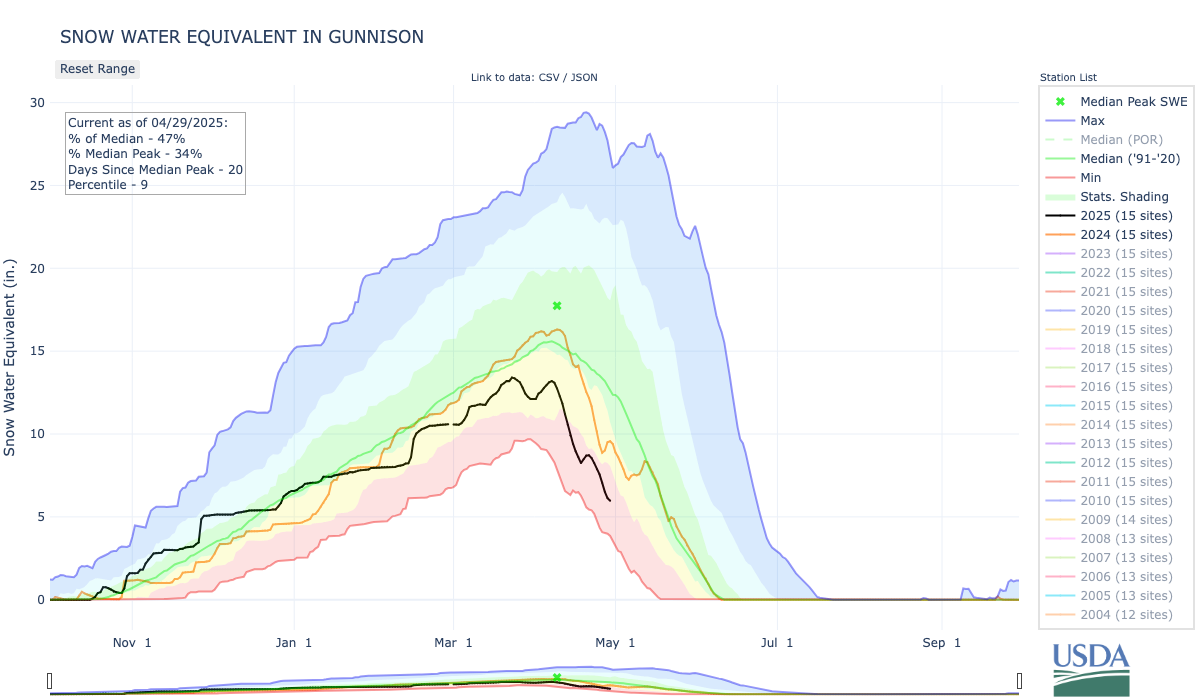
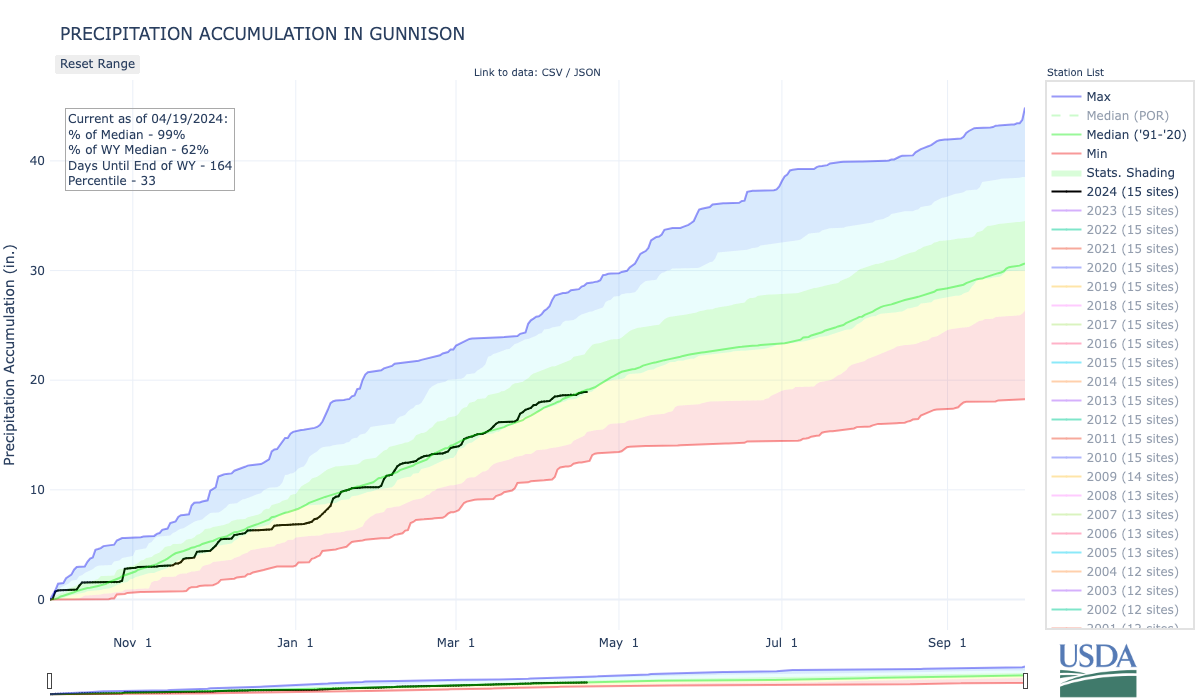
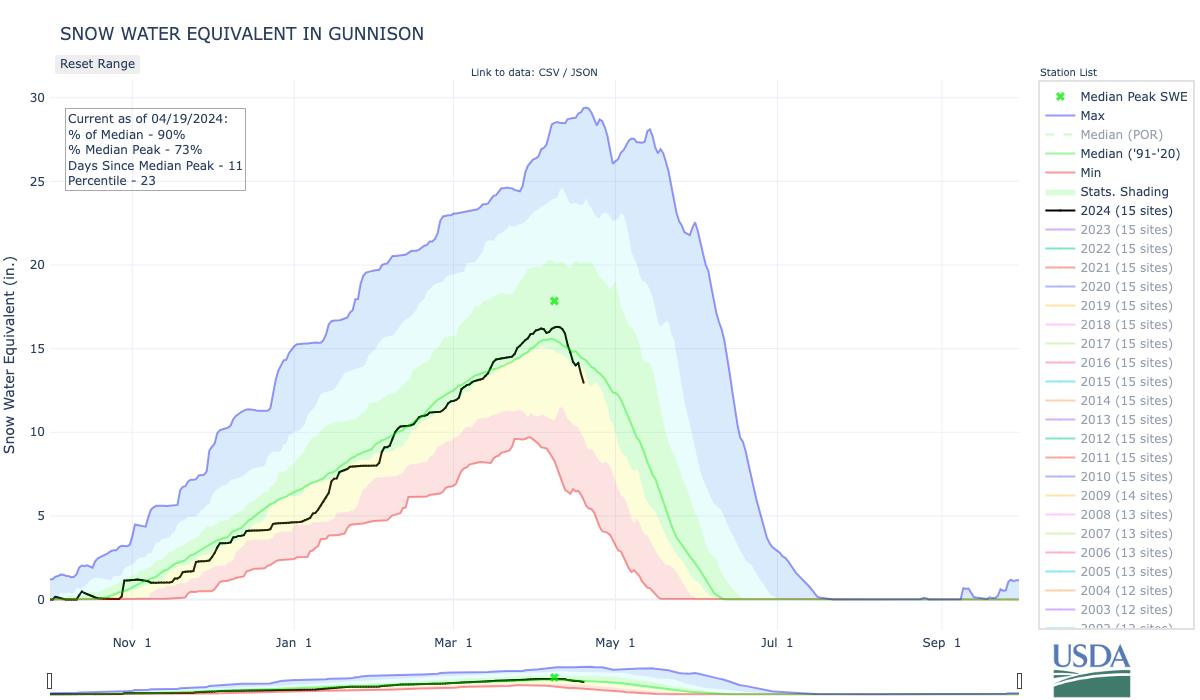
Hurford led with a discussion of what is unfolding locally in water year 2025 (Oct. 1, 2024 through Sept. 30, 2025). The Upper Gunnison Basin’s April 1 snowpack (usually at or near the maximum depth for the winter) contains only 59% of the 30-year average water content. It is projected at this point to yield through July about 540,000 acre-feet of runoff or less for the river — probably not enough to fill Blue Mesa Reservoir after downstream water rights are filled. An acre-foot of water is the amount it would take to cover the playing area of a football field to the depth of one foot. As the changing climate warms the planet, March is becoming the “new April.” This year’s snowpack peaked in mid-March. With the big melt usually beginning sooner nowadays, spring-like weather is causing trees and other plants to also begin “drinking” sooner…Increasing evaporation and plant transpiration also come with the changing climate. According to Mueller, for every additional degree Fahrenheit in the ambient temperatures, another 3-5% of water on the surface and in plants disappears as water vapor. These are changes to be anticipated for as long as we continue to warm the planet’s climate. Hurford concluded his presentation with a chart indicating that the decade beginning with 2020 is on track at this point to be the driest decade on record, including the droughts of the 1930s and 2000s.
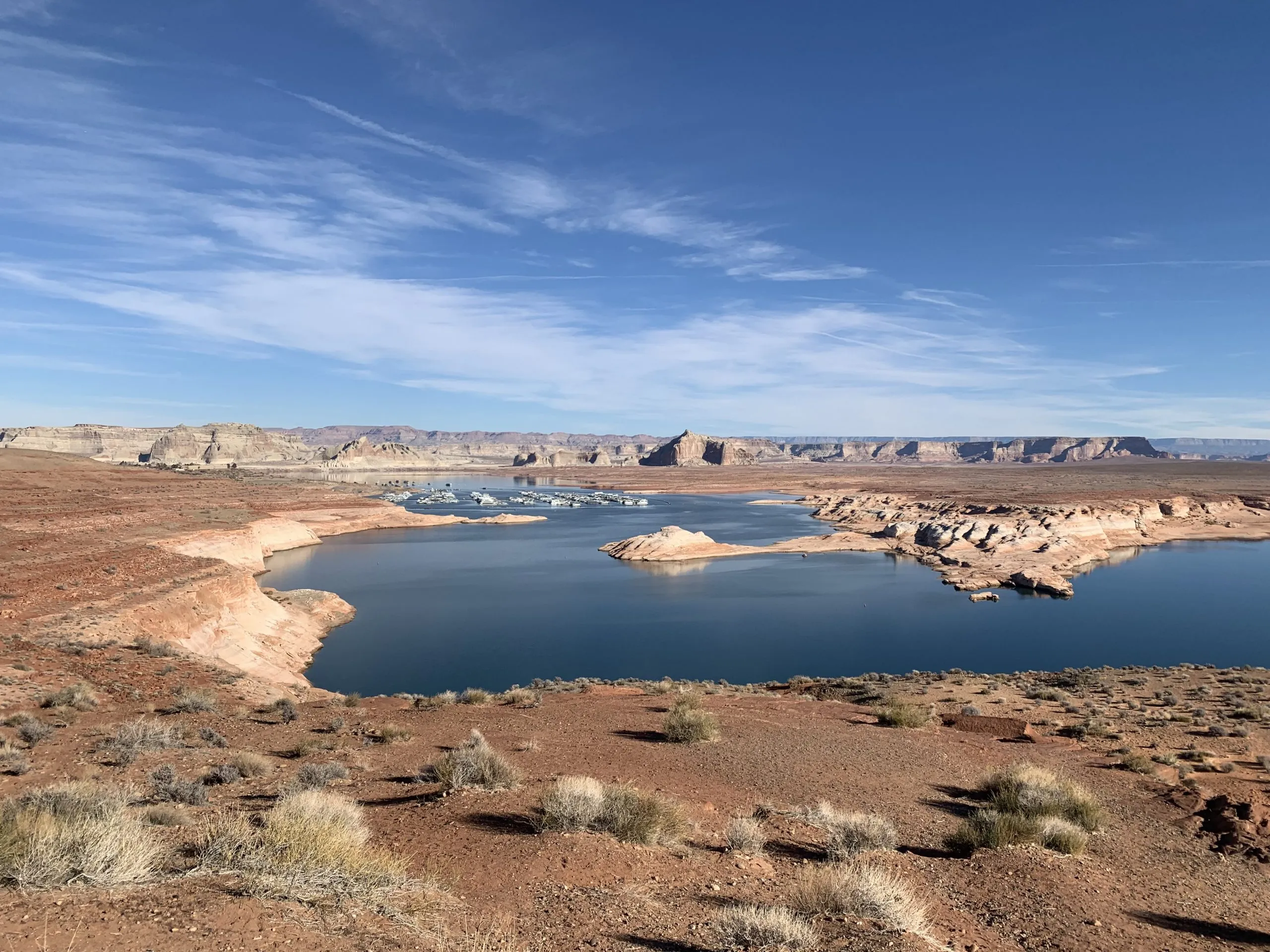
Lake Powell at Wahweap Marina as seen in December 2021. Dwindling streamflows and falling reservoir levels have made it more likely that what some experts call a Colorado River Compact “tripwire” will be hit in 2027. Credit: Heather Sackett/Aspen Journalism
When Colorado convened a working group on water speculation, its members shared stories of times in which they’d seen or thought they might have seen investment water speculation occurring — when water rights are purchased with a primary purpose of profiting from the future sale or lease of that water as demand drives up its price. On the list was the notion that buyers with no real interest in agriculture would buy agricultural land and water rights with the primary intention of enrolling in a program that pays water rights holders not to use that water.
The concern, essentially, was that programs that compensate farmers for fallowing fields like the Upper Colorado River Basin’s System Conservation Pilot Program, and nonprofits that fundraise to keep water in streams weren’t sufficiently guarded against abuse, particularly when it comes to an increasingly constrained Colorado River system.
“The impacts of drought and the risks that drought causes in the Colorado River Basin, just by way of example, attract money to the concept that money can be made from taking water out of production — conservation,” says Peter Fleming, general counsel for the Colorado River District.
“Where do you draw the line in that?” Fleming asks. “Which one is a good, socially recognized benefit that the state as a whole should support versus which one is bad because it encourages speculation in water resources, and it makes things more difficult for others, and it has adverse secondary impacts in the local economies when you take water out of production?”
A few guardrails exist to make real conservation efforts — those that serve the common good — clear. But questions remain on whether those protections can really stop investment water speculation before speculation occurs.
Little Cimarron Ranch, where a first-of-its-kind agreement allows water rights to go to irrigation in the spring and summer, and to instream flows to support river health in the summer and fall. Photo courtesy of Mirr Ranch Group
Streamflows for the Public Good
In 1973, Colorado lawmakers legally recognized instream flows, in which water is allocated to the river to maintain flows and habitat as a “beneficial use” in parallel with industries, cities and agriculture. That 1973 legislation tried to prevent speculators from prospectively appropriating instream flows and locking up the state’s water by taking measures like limiting who can operate instream flows to a single state agency, the Colorado Water Conservation Board.
“There is government oversight for specifically this reason — to prevent speculation,” says Josh Boissevain, staff attorney with the Colorado Water Trust, a nonprofit that works to secure water for streams. “Instream flow is a decreed use, so using that water for instream flow is not speculation at all, even though it’s left in the river.”
When water rights owners work with the water trust to use their water to restore flows, it takes a lot of paperwork and a close look at the web of other users affected. The process can be tedious and time-consuming, and the profits marginal.
“Nobody is doing that for the money,” Boissevain says. “They do it because they care.”
Some loopholes have been closed. For example, a 1994 change to Colorado’s water law prevents conditional water rights holders, who hold onto water rights for unbuilt projects or potential future uses, from transferring those rights to instream flows. That law blocks speculators from selling conditional water rights to the CWCB for a profit.
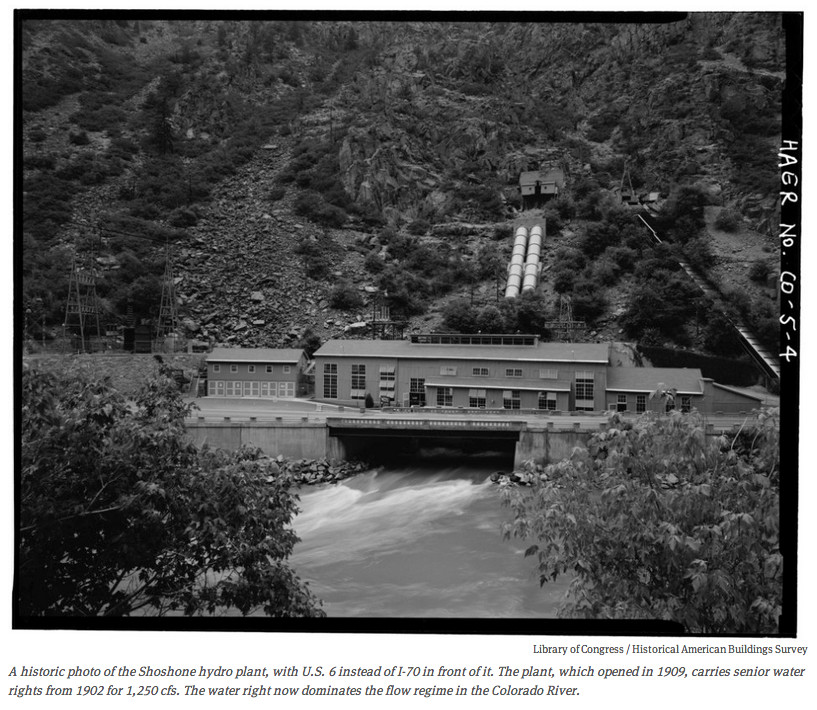
Shoshone Hydroelectric Plant back in the days before I-70 via Aspen Journalism
Having a perfected water right — one that is fully established and has been put to beneficial use — converted to instream flows is fine, Fleming says. The Colorado River District participates in those programs and is working to buy a water right currently used to generate 15 megawatts at Xcel Energy’s aging Shoshone hydroelectric power plant. The River District aims to convert that hydropower right to an instream flow right to ensure that this water continues to flow from the headwaters down through boating hotspots in Glenwood Canyon, regardless of the 115-year-old power plant’s future.
But Fleming, who worked on a 2021 report that reviewed Colorado’s legal sideboards on speculation, remains concerned that the lines are not clearly enough drawn between those recognizable benefits to the state and local economies, and the place where speculators could start counting on those efforts and “conserving” to make a profit. At a certain scale, the effects of taking water off farm fields could ripple out beyond bare fields to farm supply stores and gas stations, as well as the local job market in rural communities.
Perhaps the most frightening possibility that could result from profiteering is that water rights bought and steered from use in Colorado will somehow be sold to thirsty fields or towns in Arizona or Nevada. But even if both buyer and seller are willing, specific language in interstate compacts and existing law complicates the likelihood of selling water from one state to a buyer in a different state.
Meanwhile, conservation groups are also concerned about speculators cornering them out of the increasingly expensive water rights market, Boissevain says. To adapt to the current water market, the Colorado Water Trust is exploring a new acquisition model with Qualified Ventures, a consulting company based in Washington, D.C. Through this new approach, the water trust would buy land with water rights through financing from lenders. A conservation easement would protect the land as agricultural, and the tax rebate from that status would partially repay the loan. The water trust would reassess how to profitably farm that land while sharing the water rights between agriculture and environmental flows. Then the land could be sold, potentially at a reduced price, perhaps to a first-generation farmer.
“It’s another way to keep ag in production and keep water on the land,” Boissevain says. “It’s another step up in the competition against people that might try and buy [irrigated farms] for speculation or maybe even development.”
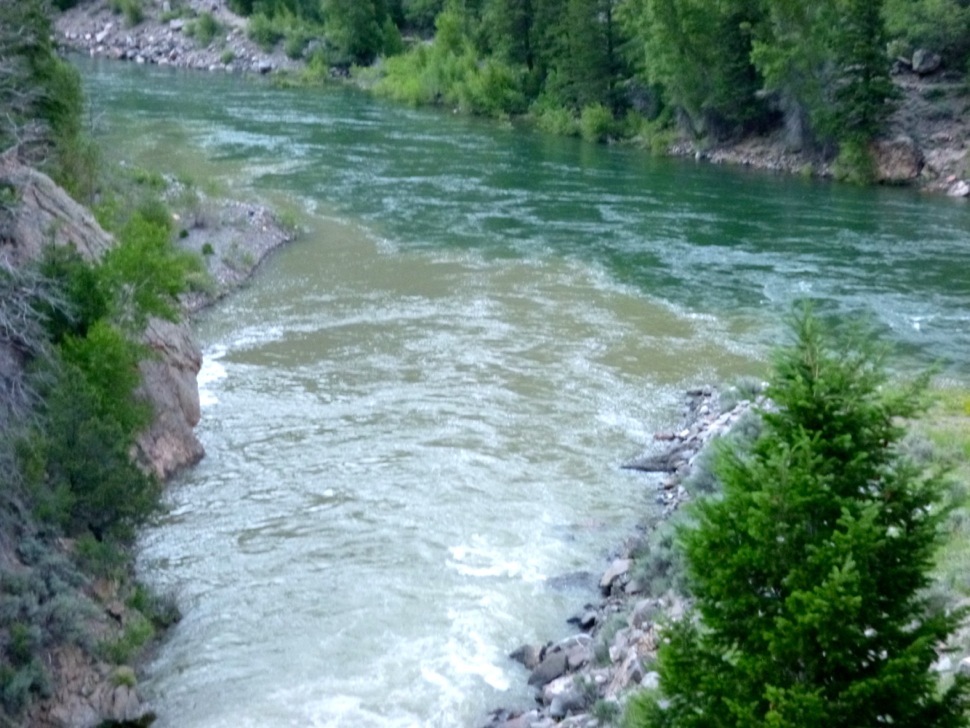
Confluence of the Cimmaron and Gunnison rivers. Photo: Brent Gardner-Smith/Aspen Journalism
The results might resemble a project on the Little Cimmaron River near Gunnison, where the Colorado Water Trust purchased 5.8 cubic feet per second of flow in the McKinley Ditch to return water to a river that was nearly dry in late summer months. The water trust partnered with a land trust to buy the water rights and land, put a conservation easement on the land, then sell the land and water rights to a private landowner. In a first-of-its-kind agreement, the water rights can go to irrigation in the spring and summer, and to the CWCB for instream flow in the late summer and fall when the river needs it most. In a very dry year, all of the water can be left in the stream protected, and in a wet year, all of it can be diverted for agriculture.
This map shows the 15-mile reach of the Colorado River near Grand Junction, home to four species of endangered fish. Map credit: CWCB
Environmental groups contend that for the environment to thrive, the entire river system needs this kind of adaptability, particularly as Colorado River Basin states renegotiate operations for Lake Powell and Lake Mead ahead of the current guidelines’ expiration in 2026.
“We want to see better, more realistic management of the Colorado River that accounts for climate change and … drastic shifts in hydrology,” says Matt Rice, Southwest regional director with American Rivers. “It’s all about creating, from our perspective, more flexibility in the system to avoid emergency action after emergency action because we’re collectively afraid to make hard decisions when we need to.”
With an eye on the prospect of a compact call or other crisis, WaterCard, a Colorado-based company, aims to leverage private market dynamics to promote water conservation in the Colorado River system. It also provides an avenue for companies and individuals to offset their water footprint.
It works like this: A person can buy a WaterCard, which gives them conservation credits linked to a quantifiable amount of water conserved on a Colorado farm or ranch. It’s like an offset. The WaterCard buyer also receives an NFT digital token as proof of purchase.
In the field, WaterCard funds are used to compensate farmers and ranchers who sign up for the program and voluntarily reduce water usage by fallowing fields for a season, decreasing irrigation, or transitioning to drought-resistant crops.
To demonstrate the concept, WaterCard founder James Eklund, who is also a working water attorney and rancher, is fallowing 66 acres of grass-alfalfa hay at his family ranch in western Colorado’s Plateau Valley. Introducing a market-based mechanism for water conservation in a headwaters state does not equate to speculation, Eklund says, because buyers are only purchasing credits tied to conserved water, not the underlying water rights themselves.
“This approach aligns fully with the anti-speculation doctrine, which I strongly support. That doctrine prohibits buying a water right, leaving it unused, and flipping it for profit — that’s speculation,” he says.
WaterCard’s model is designed to work within the Upper Colorado River Commission’s System Conservation Pilot Program (SCPP) and, Eklund hopes, eventually within a demand management framework. SCPP was designed to explore solutions to low flows in the Upper Colorado River Basin by granting funding to irrigators who voluntarily apply to conserve water for the season. If a demand management program is developed, conserved water could serve as a “savings account” in Lake Powell, helping Colorado meet future obligations to send water to downstream states under the Colorado River Compact.
By piggybacking off of the SCPP, WaterCard benefits from the SCPP’s efforts to verify conservation efforts. Therefore, producers enrolled in WaterCard must also have a project enrolled in the SCPP. WaterCard will simply boost the amount of funding those irrigators receive for conservation efforts, making SCPP participation more appealing. As of early 2025, however, it’s unclear whether the SCPP will continue. Eklund argues that this model allows private entities and individuals to play a meaningful role in preventing water crises, one $3.50 WaterCard — representing 500 gallons of water saved — at a time.
Farmers and ranchers who participate can diversify revenue sources while continuing to farm and ranch. Eklund contends that current SCPP payments are insufficient and rejects the notion that fair compensation would cause agricultural producers to abandon their livelihoods.
“That idea is insulting,” he says. However, if farmers and ranchers can derive a higher dollar value for conserved water through a market-based system, he says, that’s not speculation, that’s “market-based capitalism.”
Independent journalist Elizabeth Miller has written about environmental issues around the American West for publications including The Washington Post, Scientific American, Outside, Backpacker and The Drake.
Map of the Colorado River drainage basin, created using USGS data. By Shannon1 Creative Commons Attribution-Share Alike 4.0
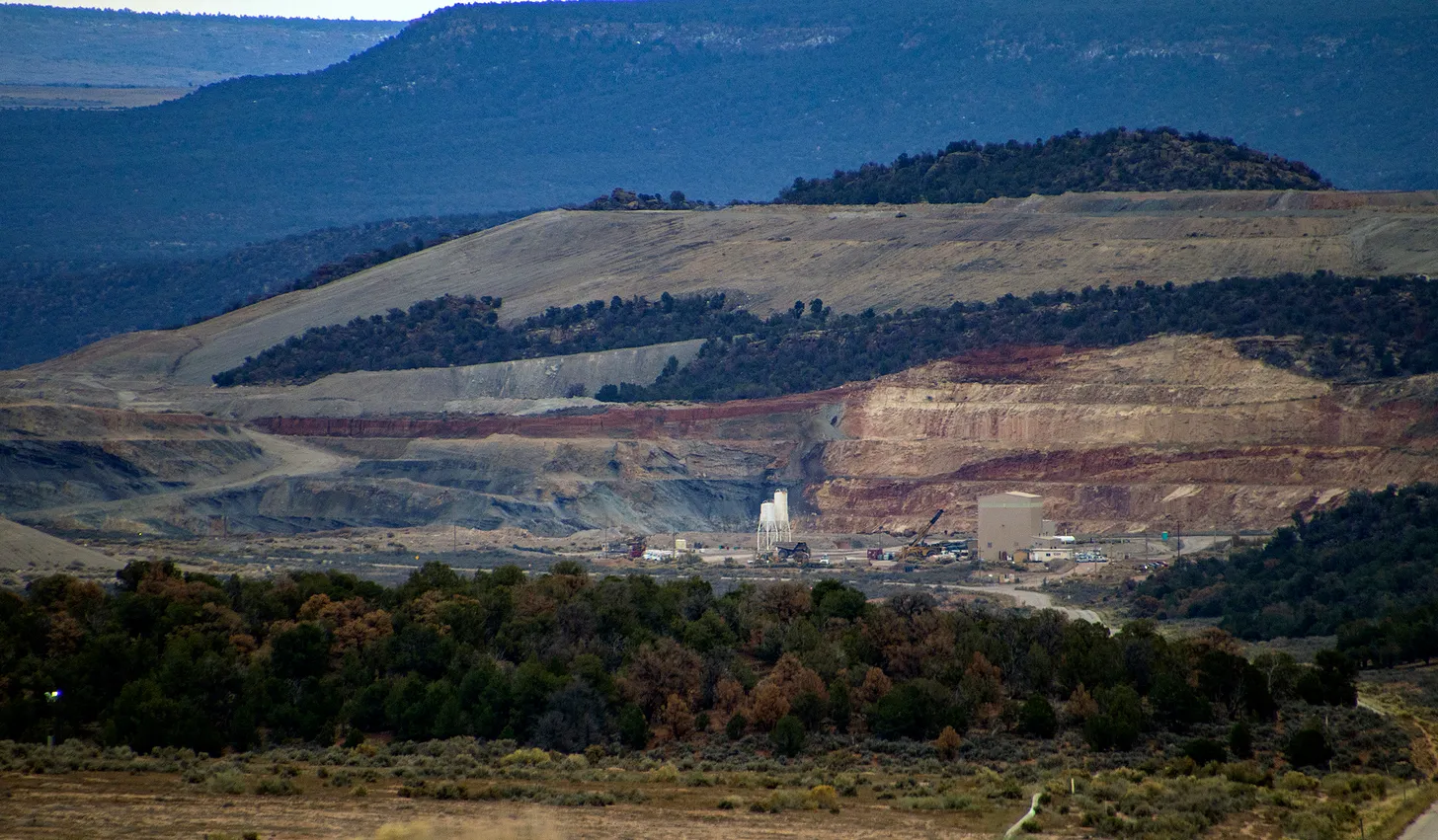
The Lisbon Valley copper mine in southeastern Utah is looking to expand, and now the Trump administration has moved to expedite its permits. Jonathan P. Thompson photo.
A little while back I wrote about Trump’s executive order aimed at making it easier to mine on federal lands. Now it’s becoming a little clearer how that might play out on the ground. The U.S. Permitting Council last week released a list of the first wave of mining projects the administration plans to fast track through the permitting process.
The projects include a few that the Land Desk has covered or mentioned in the past, such as:
The announcement promised there are “many more projects on the way” to the expedited list, though it does not elaborate on what fast-tracking might look like, exactly. The council says it will publish permitting timetables for the projects by May 2. Stay tuned to the Land Desk for updates.
😀 Good News Corner 😎
Prizes, folks. There are prizes for the winners of the Land Desk’s Predict the (spring) Peak Super Contest! Why super? Because it’s not just for one stream, but for five. And that means there could be five winners, and each gets to choose one of these prizes from our merch selection.
Is that enticing, or what? But there is a bit of a catch: Only paid Land Desk subscribers will be eligible to enter the contest, meaning only they can win the prizes. But don’t fear: Sign up now and get 20% off the regular annual subscription price, and get the privilege of entering the Predict the Peak contest.
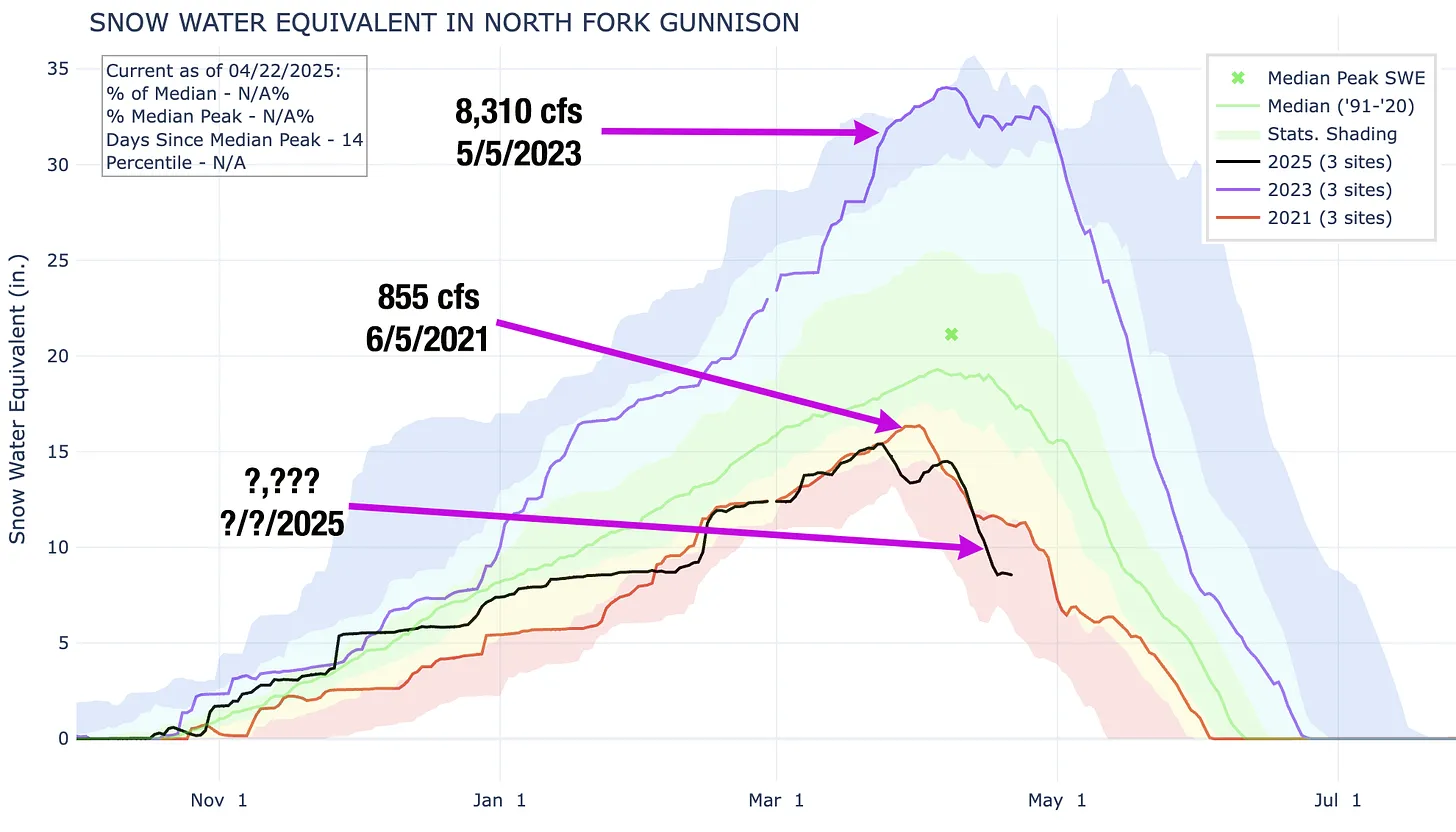
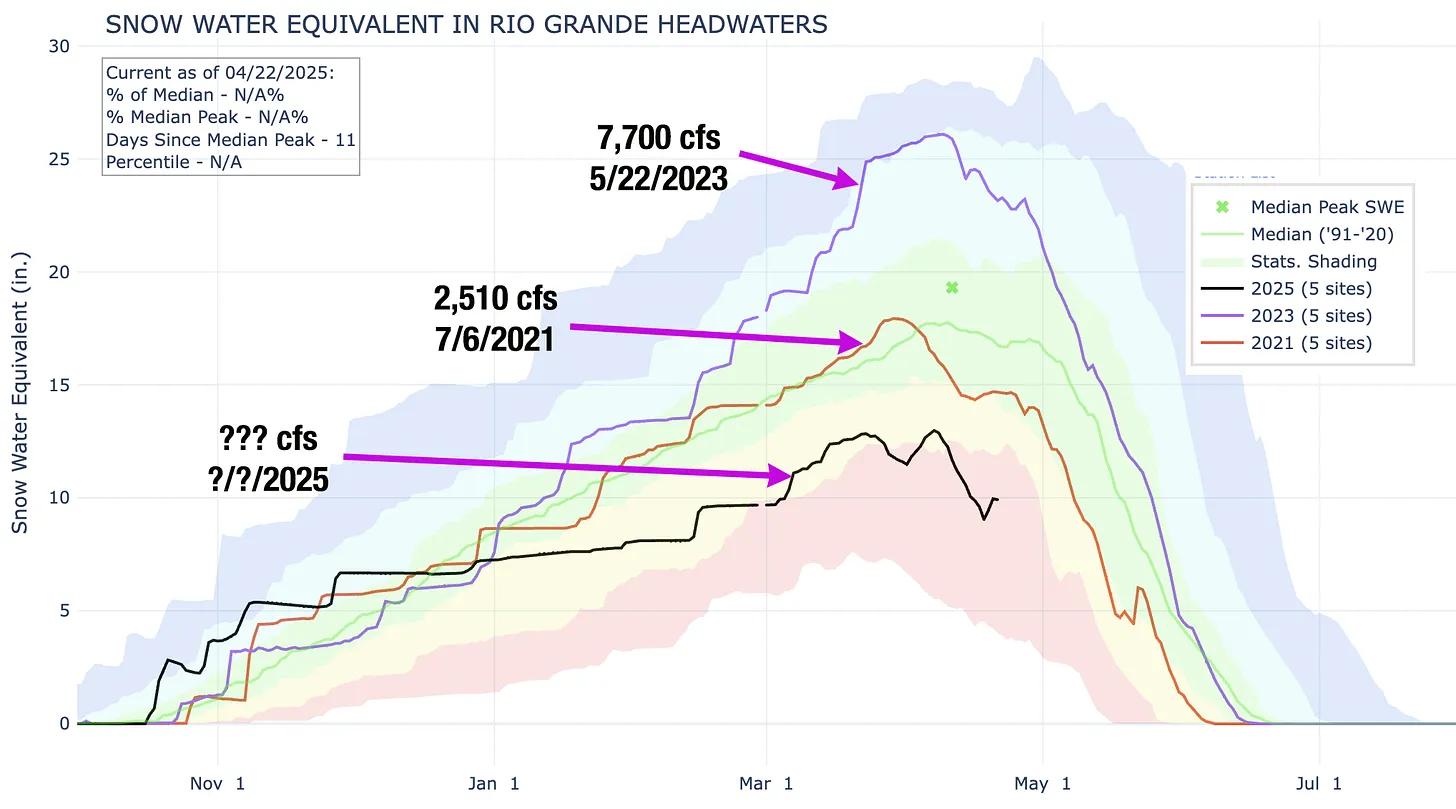
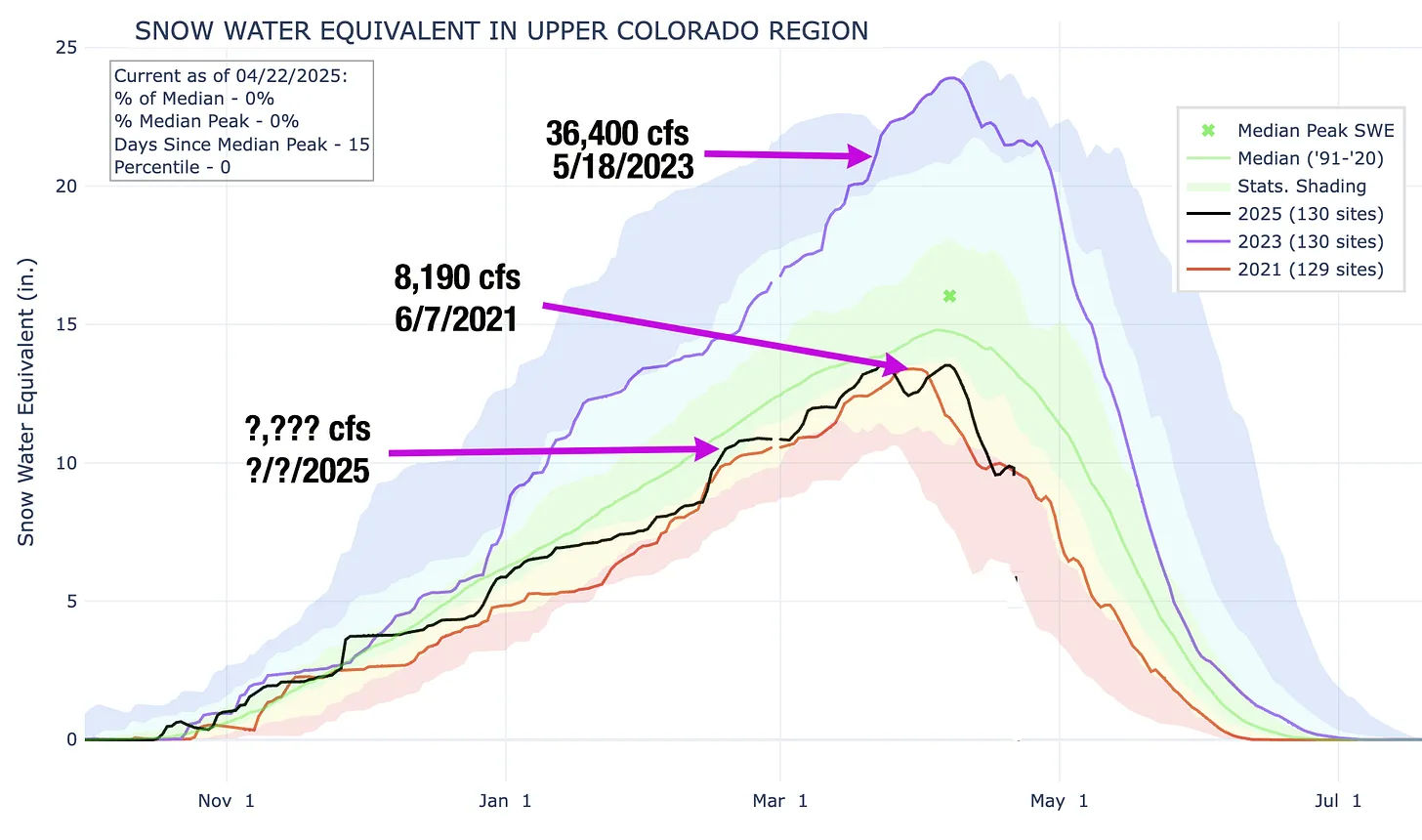
The idea is to accurately predict the spring runoff peak streamflow (in cubic feet per second) and the date of the peak for any or all of these five stream gages:
So an entry for the Animas might look like this: Animas River, May 17, 2,950 cubic-feet per-second. The winning entry would be the closest streamflow reading to the actual peak, with the date being a tie-breaker if needed. So if someone gets the cfs right, but the date wrong, they would beat out someone with the right date but wrong flow.
Entries will only be eligible if they are entered into the comment section below this post. Don’t email me your entries! They won’t count! (If you are a paid subscriber but are having problems commenting, let me know at landdesk@substack.com). And they must be entered before Friday, May 16, to be eligible. Winners will be determined after spring runoff has peaked on all of the rivers, which will likely be in late June or early July (or perhaps earlier if spring remains warm).
I’ve prepared the following graphs to help you out. They show this year’s April 22 snowpack level, along with the snowpack curve and peak flows and dates for 2021 and 2023. Good luck!
Streamflow readings are for the Animas River gage in Durango. Source: NRCS, USGS.
Streamflow readings are for the North Fork gage in Lazear. Source: NRCS, USGS.
Streamflow readings are for the Rio Grande gage at Otowi Bridge. Source: NRCS, USGS.
Streamflow readings are for the San Miguel River gage at Uravan. Source: NRCS, USGS.
Streamflow readings are for the Colorado River gage at the Utah-Colorado state line. Source: NRCS, USGS.
Streamflow readings are for the Colorado River gage at the Utah-Colorado state line. Source: NRCS, USGS.
In the past an inland sea covered the area of the North Fork of the Gunnison River. Screenshot from The Creation of the Night Owl Forest
A heartwarming story about a love of place and mimicking natural processes to create new life on a small uplands farm outside Paonia, Colorado. Using agroforestry, hugelkultur, and careful observation this short film shows how one woman’s inspiration becomes the Night Owl Food Forest. Thanks to LOR Foundation for making this film possible.
From email from the Upper Gunnison Water Conservancy District (Sue Uerling):
The Colorado River District and the Upper Gunnison River Water Conservancy District are sponsoring the State of the Upper Gunnison River dinner and presentation. This event will be held on April 17, 2025, beginning at 6:00 p.m. at the Fred Field Center. The Colorado River District requires that you pre-register for the event using this link https://form.jotform.com/250417068418154. Hope to see you there.
Releases from the Aspinall Unit will be increased from 1200 cfs to 1500 cfs Monday, April 14th. Releases are being increased to coincide with increasing diversions at the Gunnison Tunnel.
Flows in the lower Gunnison River are currently above the baseflow target of 1050 cfs. After this release change river flows are expected to remain above the baseflow target for the foreseeable future.
Pursuant to the Aspinall Unit Operations Record of Decision (ROD), the baseflow target in the lower Gunnison River, as measured at the Whitewater gage, is 1050 cfs for April through May.
Currently, Gunnison Tunnel diversions are 620 cfs and flows in the Gunnison River through the Black Canyon are around 590 cfs. After this release change Gunnison Tunnel diversions will be around 1050 cfs and flows in the Gunnison River through the Black Canyon will be around 450 cfs. Current flow information is obtained from provisional data that may undergo revision subsequent to review.
This scheduled release change is subject to changes in river flows and weather conditions. For questions or concerns regarding these operations contact:
Milkweed, sweet peas, and a plethora of other flora billow from Farmer’s Ditch in the North Fork Valley of western Colorado. Jonathan P. Thompson photo.
“I was standing there looking at a trickle running down a very large ditch thinking, ‘Man, it’s going to be hard to irrigate with that,’” said Jesse Kruthaupt of Trout Unlimited. “It was the summer of 2012, and I was visiting with a ranch manager about options to improve his irrigation system and water delivery, while also improving flows in Ohio Creek. As many remember, the snowpack that winter was pretty lean, and by the middle of June, there wasn’t much water left in many streams or ditches in western Colorado.”
It is situations like the one above that are at the core of the Upper Gunnison River Water Conservancy District’s grant program. Since 2009, the program has provided funds to address many of the issues facing basin water users, including drought resiliency. The district’s board of directors initiated the program in 2009 with a budget of $100,000. That year, only two grant applications were awarded for a total of $45,000. Since it was brand new and many of our constituents didn’t have a good grasp of what the program was all about, we were pretty excited to see the two applications then and happy to fund a pond lining project and ditch rehabilitation project. Since then, thanks to the success of many projects we have funded, the great outreach efforts of Jesse Kruthaupt and other consultants and the district’s education efforts, triple the amount of funding is available. The grant program continues to be hugely supportive of a variety of water projects. I am pleased to see that a number of projects have been dipping into available technology to achieve the best possible results and better water management. The number of applications and the requested funding amounts have grown steadily over the past 15 years. In 2025, we received 14 applications with a whopping $470,420 in requests, and $1.94 million in total project costs (applicants are required to contribute matching funds).
Last week, one of the Land Desk’s more conservative readers cancelled his paid subscription. He wrote that he appreciated my passion for public lands, but was no longer interested in reading what he called a “tirade against Trump.”
This type of thing happens all the time in this business, and, unlike Elon Musk, I’m not looking for your pity. But I was a bit saddened, given that this person had been a paid subscriber since the Land Desk was launched, and because I really do appreciate having readers and commenters from across the political spectrum.
Besides, while I’m prone to a rant now and then, I do think “tirade” is taking it a little too far. Anyway, my point in telling y’all this is to let you know that writing about Trump’s shenanigans every dispatch is just about the last thing I want to be doing with my time. I’d much rather be delving into old maps, getting into the nuances of Western water, exploring the history of floods and droughts and wildfires, taking contrarian views on the housing crisis, or dissecting the contradictions of oil and gas markets. And I will continue to do all of that.
At the same time, it’s impossible for me to ignore the barrage of destruction, corruption, chaos, authoritarianism, and incompetence emanating from the White House. My passion for public lands — and for justice, truth, reason, morality, decency, intelligence, and kindness — demands that I document these egregious acts, and do my part to resist them, even if it is just by informing my readership about what’s happening.
I am not impartial, not by any means. I am partial to the planet and its survival, toward my fellow human beings, toward peace and justice and compassion and truth. [ed. emphasis mine] I am not, however, partisan: I will scrutinize Democrats and Republicans equally, fact-check the left and the right, and give credit where credit is due — even to Donald Trump.
***
Hopi tribal members cross Havasu Creek. Photo credit: From the Earth Studio
And on that note: The Trump administration appears to have unfrozen nearly $4.2 million in federal funding to help the Hopi Tribe build a solar-powered microgrid to run two remote wells and associated infrastructure that will provide water to Upper and Lower Moenkopi. The funding was approved by the Biden Energy Department, Trump froze it as part of a larger stop on Infrastructure and Inflation Reduction law money, but now it has been released. So good on you, Donny!
Though it may be inadvertent, Trump’s economic policies may ultimately benefit the environment in some ways. The haphazard, on-again, off-again tariffs, for example, along with the gutting of the federal government’s workforce, have sent the stock market into a tailspin. Meanwhile, the tariffs — along with reciprocal tariffs levied by the U.S.’s trading partners — will increase prices on most consumer goods. People will buy less, travel less, which will mean less pollution and environmental impacts.
***
And yet more kudos for Trump! Seriously. Despite all of his bluster, Trump has managed to really piss off oil and gas executives — the same ones that were throwing money at his campaign just a few months ago — and possibly dampen drilling on public lands.
See, the thing about tariffs is that they very well may raise the price you pay for gasoline (depending on where your local refinery gets its crude oil), but the economy-dampening part of tariffs actually brings down the price of oil, while also raising the cost of steel pipes and other supplies. That’s no bueno for petroleum companies, whose profit margins are directly proportional to the price of crude.
Many of these folks won’t criticize Trump in public, given his vindictive and authoritarian leanings, but give them the cover of anonymity, as a Dallas Federal Reserve survey did, and they go off on the White House’s herky-jerky non-policies. Here’s a sampling:
There was only one mention of regulations getting in the way of the oil business, and that wasn’t federal rules, but state ones:
Well, there you have it, folks.
***
Oh, and these oil companies might also be angry that the MAGAs are all buying Teslas — or at least pretending to — in order to “own the libs.” Which is pretty funny, given the amount of gibberish Trump devoted to dissing electric vehicles during his campaign rallies. Tesla also stands to benefit the most from Trump’s tariffs, another dig at the internal combustion fans.
***
Maybe the national parks will be a bit less crowded this summer, as well, as international travel ebbs.
Anyone who’s traveled the Western national park service knows that they are popular with overseas visitors. On a single grocery run at the Page, Arizona, Safeway recently, I heard no fewer than three different languages spoken, in addition to Navajo and English, and that was in the off-season. In 2018 (the last year that data is available), more than 14 million international travelers visited U.S. national parks and monuments. About 14% of the Grand Canyon National Parks’ visitors were from overseas, with about 6% of Zion’s visitation from overseas.
Tourism Economics is predicting that international travel to the U.S. will be down significantly this year, thanks not only to the administration’s hostile economic moves, but also “polarizing Trump administration policies and rhetoric.” Also, there’s that thing where travelers have been detained at the border, even thrown in jail, simply for trying to get a visa. This decline undoubtedly will impact Western U.S. tourism and national park and monument visitation numbers. Not good for the tourism economy, but it might give the parks a much needed rest.
🥵 Aridification Watch 🐫
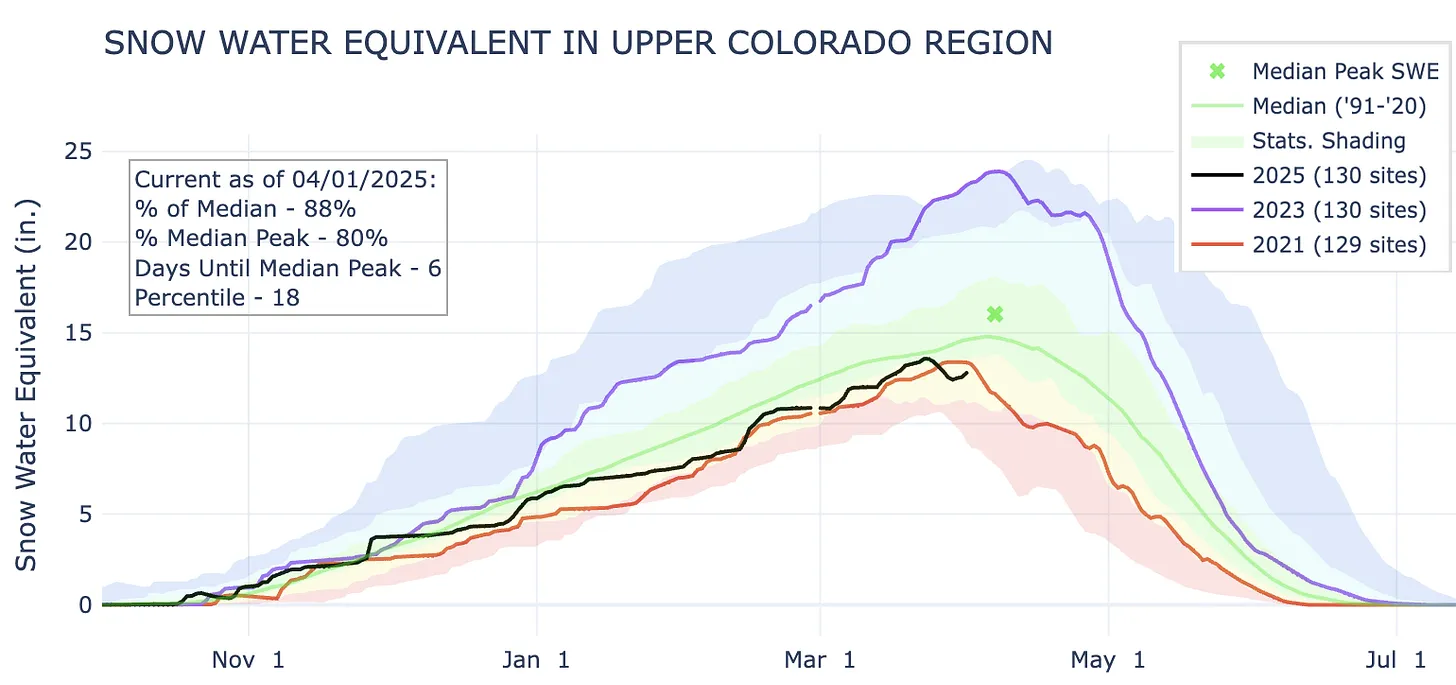
It’s first-of-the-month snowpack update time again, and this will likely be the last of the season barring some freak climatic shift over the next several weeks. Snowpack levels typically peak in mid-elevation areas in mid- to late-March, and in the high country in mid- to late-April, meaning we are now headed into spring runoff season.
Generally speaking, it’s looking like runoff will be average to paltry, depending on which side of the snow-divide your watershed falls. It is a very jagged line, by the way, with places in the west and north having average to above average snowpack, while the southern-Interior West generally had a super dry winter. But even within those areas there are sort of outliers: The Grand Traverse ski race between Aspen and Crested Butte was canceled due to lack of snow for the first time in its 26-year history.
And there’s big variations over short distances. Red Mountain Pass is still just below median, for example, while the southern San Juan Mountains, just a few dozen miles away, are experiencing a severely dry winter.
Before I get to the graphics, however, a quick note. The snowpack and precipitation plots I run here come from the USDA’s Natural Resources Conservation Service. It’s just one of the valuable services they provide. I haven’t found any stats on whether DOGE has gone after NRCS’s staff, yet. But the DOGE website says it has or will cancel the leases for the following NRCS offices. Whether they and their staffs will simply go away, be absorbed into another facility, or what, isn’t disclosed.
Natural Resource Conservation Service offices slated for lease cancellations: Missoula, Montana; Wasilla and Fairbanks, Alaska; Logan, Utah; Gallup and Raton, New Mexico; Yuma, Arizona; Dayton, Puyallup, and Renton, Washington; Portland, Oregon; and Woodland, Yreka, Salinas, Oxnard, and Blythe, California.
Hopefully the staff of these offices and services they provide will endure.
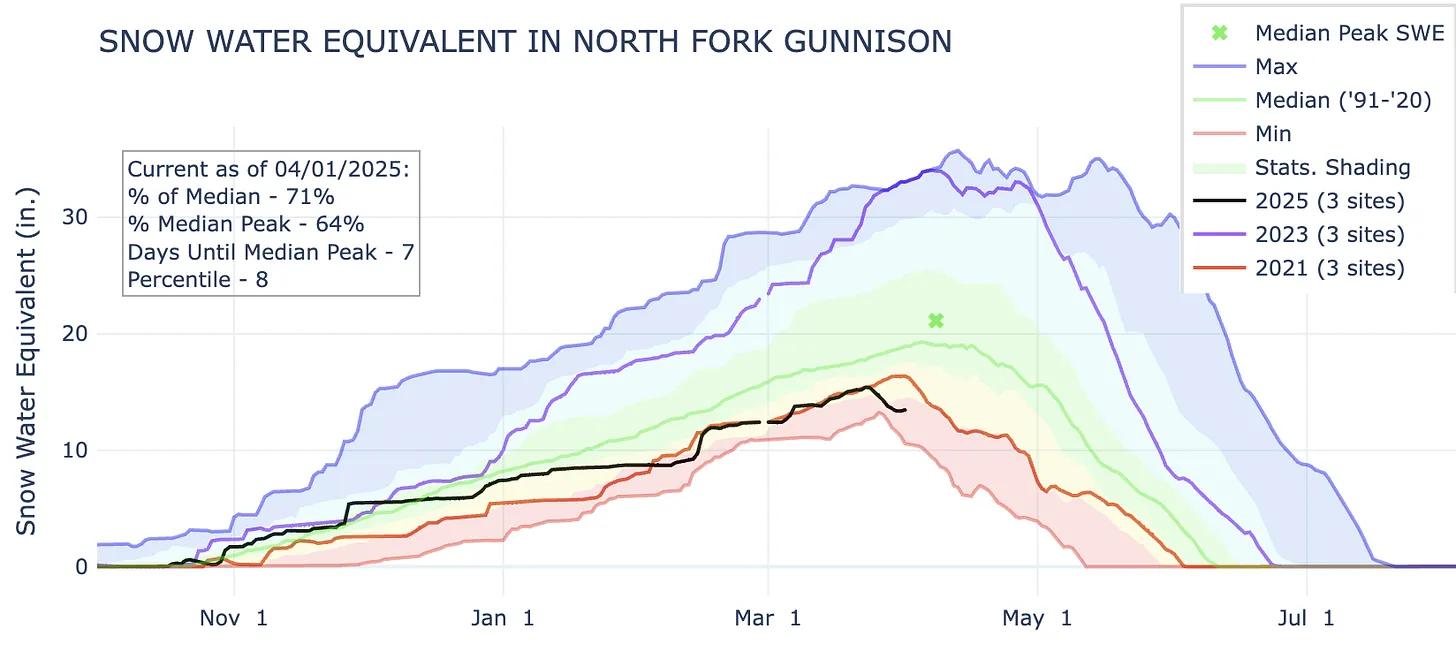
Now to the snowpack plots. I included the plots for 2021 and 2023 because those were the most recent big and crappy years for snowpack.
The watersheds that feed Lake Powell are not in terrible shape, sitting at 88% of the median just six days before the typical peak. However, levels are lower than they were in 2021 at this time, and 2021 was not a good year for the Colorado River. Source: NRCS.
The North Fork of the Gunnison has followed a snow accumulation pattern similar to the Upper Colorado River’s.
Red Mountain Pass is one of the few bright spots in the Four Corners region. Snow levels have tracked right around normal for most of the winter. Though it’s now down to 90% of median, there are potentially still over three weeks left in the snow accumulation season, meaning an above-average season is still possible; snow is forecast for much of this week there.
This SNOTEL site, in the San Francisco Peaks north of Flagstaff, is the comeback story of the year, rebounding from ultra-dry to average over the course of several weeks. It’s one of the only sites in Arizona that received measurable snow accumulation this season.
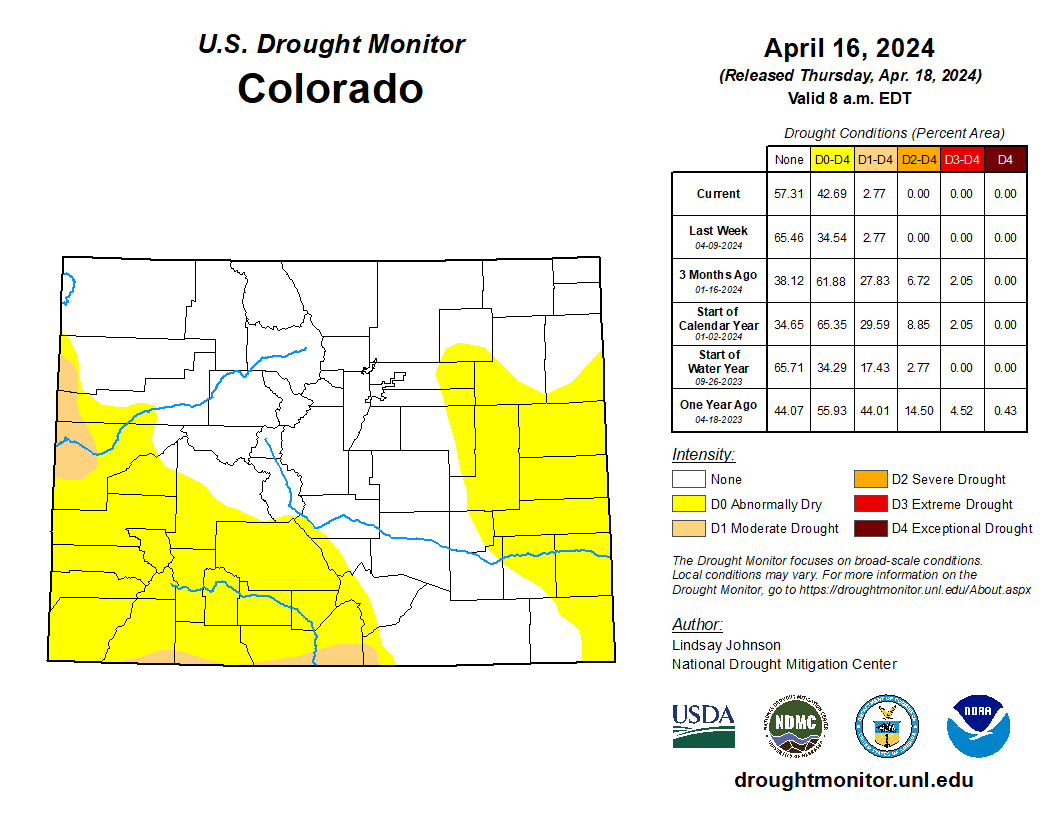
The drought has spread and intensified over the last year.
And it doesn’t look like it will get better anytime soon …
Grand opening of the Gunnison Tunnel in Colorado 1909. Photo credit USBR.
From email from Reclamation (Erik Knight):
March 17, 2025
Releases from the Aspinall Unit will be increased from 700 cfs to 1200 cfs Tuesday, March 18th. Releases are being increased to coincide with the start of diversions at the Gunnison Tunnel.
Flows in the lower Gunnison River are currently above the baseflow target of 1050 cfs. After this release change river flows are expected to remain above the baseflow target for the foreseeable future.
Pursuant to the Aspinall Unit Operations Record of Decision (ROD), the baseflow target in the lower Gunnison River, as measured at the Whitewater gage, is 1050 cfs for March through May.
Currently, Gunnison Tunnel diversions are 0 cfs and flows in the Gunnison River through the Black Canyon are around 650 cfs. After this release change Gunnison Tunnel diversions will be 450 cfs and flows in the Gunnison River through the Black Canyon will be around 700 cfs. Current flow information is obtained from provisional data that may undergo revision subsequent to review.
This scheduled release change is subject to changes in river flows and weather conditions. For questions or concerns regarding these operations contact:
The Colorado River District’s State of the River meetings are a spring tradition in Western Colorado, bringing communities together to discuss the most pressing water issues facing our region. These free public events provide valuable insights into river forecasts, local water projects, and key challenges impacting West Slope water users.
Eleven meetings are planned across the Western Slope; see the list below. These events offer an opportunity to hear directly from water experts and better understand the factors shaping the future of our rivers. A complimentary light dinner will be provided, and all events include a Q&A session to address your questions and concerns.
While each program is tailored to reflect local water priorities, key topics at all events will include:
River flow forecasts
Updates on the Colorado River system
Local water projects and priorities
Current challenges facing Western Colorado water users
Shoshone Water Rights Preservation Project updates
If there are specific local issues or projects you would like to see highlighted, please include that information in your registration.
Registration is required, but attendance and dinner are free. We encourage all community members—whether deeply involved in water issues or just beginning to engage—to join us and participate in this important conversation.
Secure your spot today and be part of shaping the future of water in Western Colorado.
Click each event below to register!
Agendas will be posted for each meeting once they are finalized.
February snowstorms brought some relief to parched landscapes in the Colorado River Basin, but the river’s reservoirs are less than half full heading into a spring runoff season that is expected to be lower than normal, according to a briefing this week at the Upper Colorado River Commission.
The dry conditions underline water concerns in the drought-strapped river basin and come as high-stakes negotiations over new, post-2026 operating rules continue. If similar conditions occurred under any of the options for the new operating rules, it would mean deep cuts for Lower Basin states, which include Arizona, California and Nevada, officials said during the commission’s meeting Feb. 18.
It was a “stark” report, said Rebecca Mitchell, Colorado’s representative on the commission and the state’s lead negotiator on Colorado River issues.
“We have to acknowledge that cuts [in water use] are probable, possible and likely,” she said. “I want to reiterate: We are committed to working with the Lower Basin states toward that seven-state consensus.”
The Colorado River’s system of reservoirs store water to ensure critical supplies reach 40 million people across seven states, 30 tribal nations, and parts of Mexico.
As of Monday, the water stored in all of the basin’s reservoirs was 42% of the total capacity, according to a presentation during the commission meeting when the latest reservoir conditions were discussed.
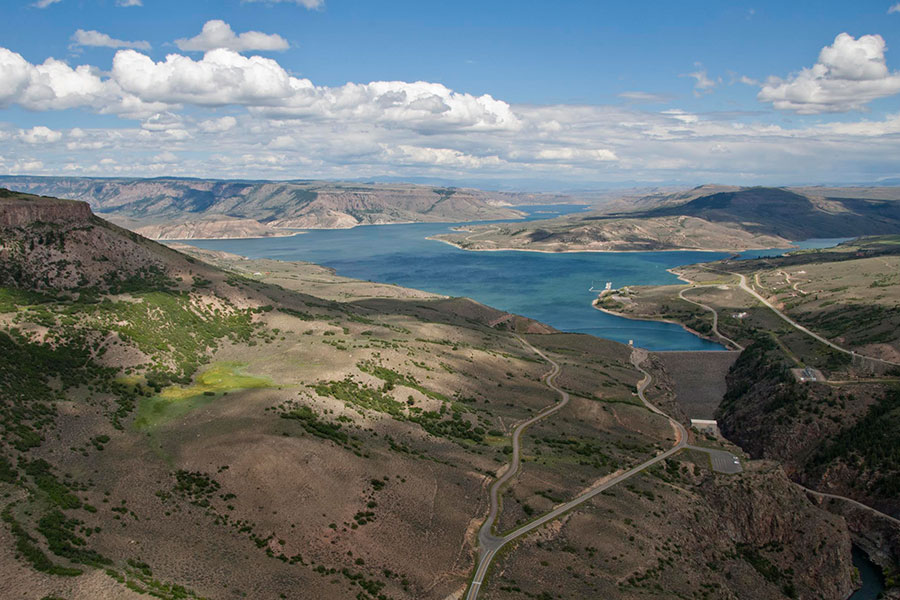
Lake Powell, an immense reservoir on the Utah-Arizona border, was 35% full. And Blue Mesa, a federal reservoir and the largest reservoir in Colorado, was 62% full.
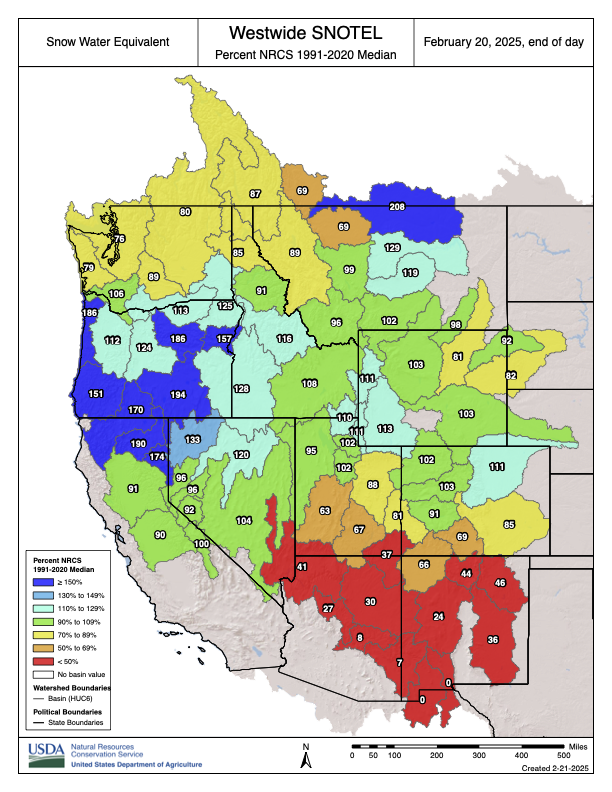
Westwide SNOTEL basin-filled map February 20, 2025 via the NRCS.
The reservoir levels will rise once the mountain snowpack melts in the spring. But the spring runoff forecast is low for all of the federal reservoirs in the Upper Basin, which includes Colorado, New Mexico, Utah and Wyoming. The runoff into Lake Powell is forecast to be 67% of average for April through July.
These conditions can change as more snow falls on the region, but the two-week outlook shows a return to dry conditions, according to the commission presentation.
In Colorado, the February snowstorms also helped boost the snowpack to 94% of the 30-year norm. The state’s snowpack typically peaks in early April.
“The snow brought us some positivity. I still like to remind folks, when we see Lake Powell at 35% full, that means it’s 65% empty,” Mitchell said. “That’s troubling.”
If any of those alternatives governed water in the basin right now, then the three Lower Basin states would need to cut their use by 1.8 million to 2.8 million acre-feet based on the conditions in February, said Chuck Cullom, the commission’s executive director. In the worst possible scenarios, the cuts would deepen to between 2.1 million and 3.2 million acre-feet.
How such cuts would play out among the four Upper Basin states, like Colorado, is less clear. Some options include cutting use by 200,000 acre-feet.
Each of the basins has the legal right to use about 7.5 million acre-feet of water per year. One acre-foot roughly equals the annual water use of two to three homes.
The post-2026 operating plans are not final, and negotiators from the seven basin states are still at odds over how cuts should be made in the river’s worst years.
Graphic credit: The Colorado River water crisis its origin and future Jock Schmidt, Eric Kuhn, Charles Yackulic.
Lower Basin officials have said everyone needs to cut back in dry years, and voluntary conservation does not provide enough certainty.
Upper Basin officials say their states should not have to make mandatory water cuts but could do voluntary conservation. The Lower Basin is using more than its legal share and should cut its water use first, Upper Basin officials have said.
“The opportunities for conservation and other activities in the Upper Basin is limited by water supply,” Cullom said. “You can’t conserve water that isn’t available.”
“Everyone is suffering”
Upper Basin water users already experience water shortages every year — and this must be acknowledged in how the river is managed in the future, officials said during this week’s meeting.
According to the commission’s analysis, water users in the Upper Basin end up using about 1.3 million acre-feet less than their full supply each year, based on data from 1991 to 2023.
The full supply is the maximum amount of water used. Across all four states, this maximum use typically totals about 5.18 million acre-feet per year. The commission says shortages happen when water users must use less than their normal maximum supply.
The Upper Basin hasn’t developed its full 7.5 million-acre–foot share because of the uncertain water supply, officials said.
Scott Hummer, former water commissioner for District 58 in the Yampa River basin, checks out a recently installed Parshall flume on an irrigation ditch in this August 2020 photo. Compliance with measuring device requirements has been moving more slowly than state engineers would like. CREDIT: HEATHER SACKETT/ASPEN JOURNALISM
To cut water use, ditch riders tell water users to shut their headgates, which control how much water runs from one river, stream or ditch to another. Farmers get two cuttings of hay instead of three, which reduces their profits. Ranchers, facing higher hay prices or hay production challenges, might end up raising smaller cattle herds, impacting beef and dairy production, officials said.
The impacts keep going from there: People hire fewer ranch hands. Cities tighten their summer watering restrictions. Local recreation economies take a hit — as do ecosystems that are overstressed by higher temperatures and drought.
Tensions rise between community members who need water for different reasons and are trying to share an uncertain supply, said Commissioner Brandon Gebhart of Wyoming.
“And trying to do that without completely destroying one or the other,” he said. “Oftentimes, this means that everyone is suffering.”
Well, with the fate of constitution democracy in the courts where we know the mills grind slowly (as opposed to the grinders who break things quickly); and with the money frozen for farmers doing well by doing good in water conservation; and neither white smoke nor black smoke arising from the chimneys of the enclaves trying to envision the next decade or so for the Colorado River – I’ll take a break from my wonkish efforts to think outside the box, to remember a friend and mentor, and friend of the River, who thought outside the box often in the last half of the 20th century.
The cantankerous Colorado River water community recently lost a valued member, L. Richard Bratton, a water attorney in the Upper Gunnison River Basin from 1958 till his death January 28.
Dick Bratton’s scope of influence went beyond the Upper Gunnison mountain valleys, however; he was a creative thinker who never met anyone he could not talk to – or listen to, or work with. A born “connector,” he became an active player in events on the cusp of major changes in the development of water in the entire Upper Basin of the Colorado River.
Born in 1932 and raised in Salida, Dick Bratton came to Gunnison to attend Western State College, then went to the University of Colorado Law School. While at school in Gunnison, he had met Ed Dutcher, a somewhat legendary West Slope water attorney. Shortly after Bratton completed law school, Dutcher invited him to join his firm in 1958.
Aspinall Unit dams
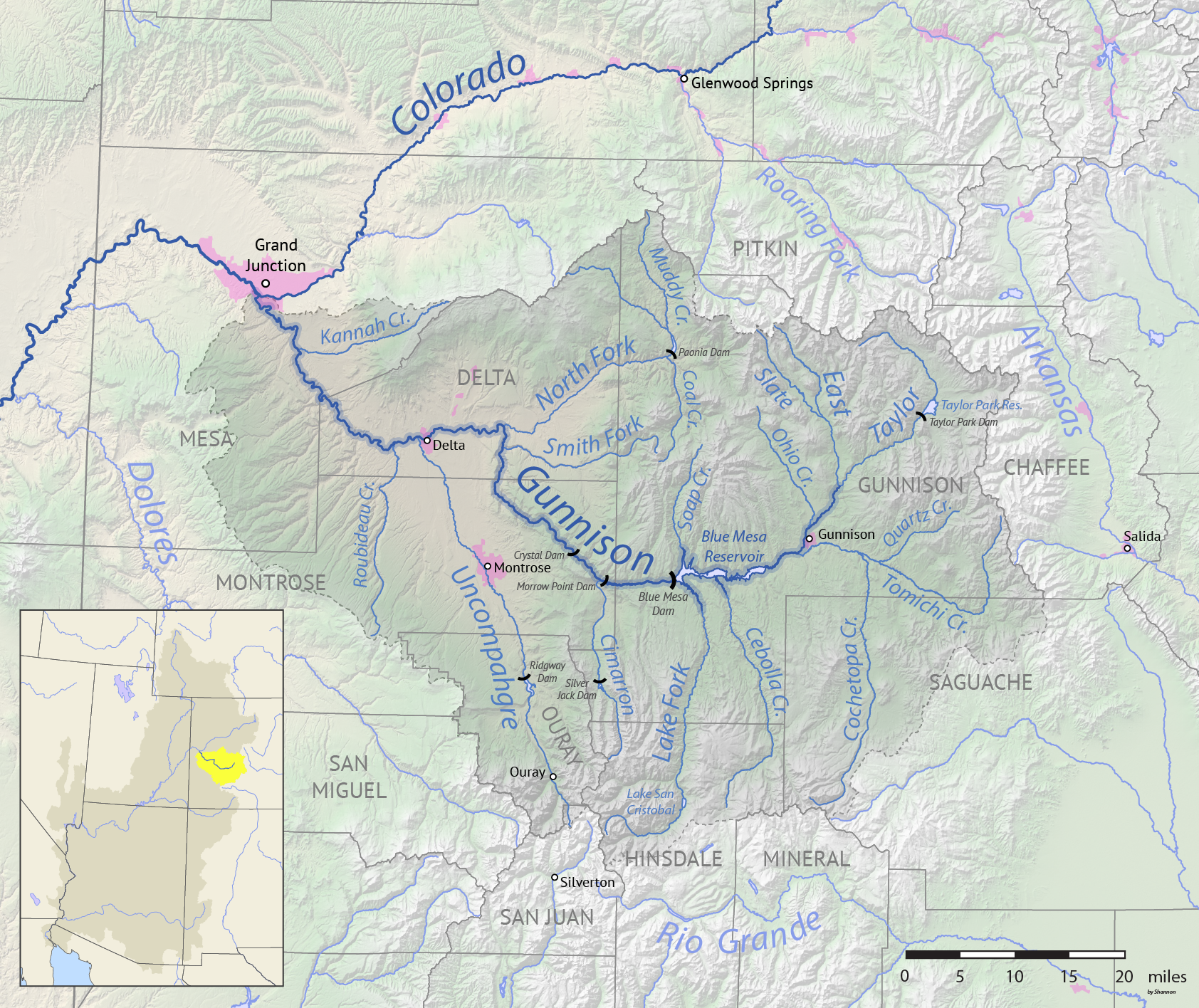
Bratton joined Dutcher’s firm that year – and in 1959, the Colorado River Storage Project (CRSP) came to the Upper Gunnison River Valley in a big way, with Congressional approval of funding for CRSP’s Curencanti Project (Blue Mesa, Morrow Point and Crystal Dams, now renamed the Wayne Aspinall Unit), and he found himself plunged into all of the ongoing and emerging challenges faced by small communities with agrarian roots in an urbanizing and industrializing world.
The first challenge was Theodore Roosevelt’s conservation vision. The “Father of American Conservation” had a different view of conservation than most of us have today; to him and his philosopher sidekick Gifford Pinchot, conservation meant first the orderly development of resources otherwise wasted – like the Colorado River pouring itself into the sea in a two-month uncontrolled and mostly unused flood of snowmelt. And when it came to what should be developed and by and for whom, their rule was “the greatest good for the greatest number,” with “for the longest time” sometimes remembered, sometimes not.
In the Upper Gunnison, the Bureau of Reclamation had chosen the Curecanti Reservoir site not to benefit the small ranches and farms of the Upper Gunnison valleys, in accord with their original Rooseveltian mission. It was chosen because it was a great site for a major reservoir in a regional water development for four states that were paranoid over their obligation to make sure a set amount of water passed on to the three more populous states below the Colorado River canyons. The greatest good for the greatest number.
The Curecanti Reservoir as originally proposed, however, would have backed 2.5 million acre-feet (maf) of water almost up to the city limits of Gunnison, with the shallow end exposing major mudflats every summer as the reservoir was drawn down, and the prevailing westerlies would have turned Gunnison into a dust bowl. Bratton’s partner and mentor Ed Dutcher had invested much of his career into opposing this local sacrifice for the greatest good for the greatest number – not just standard NIMBYism; the community was fighting for its life, and also for the life of two small towns that would be inundated along with 30 miles of legendary fishing stream, 23 small river resorts, and 6,000 acres of ranchland.
After much noisy negotiation with the Bureau of Reclamation for Dutcher and his “Committee of 39,” the Bureau dropped the reservoir size to just under one million acre-feet, saving Gunnison from the dust inundation, but still losing the two smaller towns and their economic activities – and the great fishing.
Being sensitive to the cost the project was imposing on the ranchers and farmers that the Bureau was actually created to serve, however, an “Upper Gunnison River Project” with seveeral small reservoirs was included as a future participating project in the CRSP Act, to be paid for partially by the revenues from the hydroelectric plant on the three largest CRSP dams: Glen Canyon, Flaming Gorge and the Curecanti Unit.
So one of Bratton’s first jobs in Gunnison was helping talk the people of the valley into taxing themselves a little to create an Upper Gunnison River Water Conservancy District under state law, both to help the Bureau lobby for project funding in Washington, and to nudge and harass the Bureau into getting project planning and execution done. Creating the Conservancy was accomplished in an election in 1959, a busy year for Dutcher and Bratton.
In 1961 Dutcher was appointed to a judgeship, and Bratton took over the law firm. That same year, the Bureau opened an office in Gunnison, and began the preliminary work for the Curecanti Project – clearing the land of trees, relocating roads, and buying out all of the human occupants, an unpleasant and depressing process in the valley. The “greatest good for the greatest number” rule, applied in many areas other than conservation, has nothing in the formula for the “lesser numbers” – probably one source of our current urban-rural troubles.
As construction proceeded on the Curecanti dams, though, a “big pivot” in the way the entire nation perceived the American West was becoming unignorable. The Bureau of Reclamation had depended on the willingness of the American people to continue investing in the “reclaiming” of arid lands to create more of the iconic “family farms” and to otherwise further the development of raw resources to feed the people and industries of an increasingly urbanized and industrialized economy. But the increasingly urbanized, industrialized – and after the Second War, increasingly mobilized – American people were enjoying a rising standard of living that included more time for recreation – paid vacations! – and “their” western public lands were increasingly perceived not as a resource hinterland, but as a vacation paradise, to be kept as pure and pristine as possible with millions of people trampling through.
On Bratton’s home front, the Crested Butte Ski Resort also opened in 1961 upvalley, forcing the beginning of a transition in the Upper Gunnison’s self-perception as part of the mining, farming and ranching “working west,” as opposed to a service sector serving visitors to the great western playground. “Conservation” was swinging from the Rooseveltian orderly development of otherwise “wasted” resources toward conservation as careful guarding of the West’s resources, including preservation of its residual wild magnificence, Wallace Stegner’s “society to match its scenery.”
Bratton himself was the son of a “working west” family, with a couple generations before him in Colorado engaged in mining and mining-related economic activities. But like the political creator of the Colorado River Storage Project, West Slope Congressman Wayne Aspinall, Bratton could see where things were going, and worked to make the transition at home as non-disruptive as possible for the “Old West” yielding to the “New West.” (Aspinall’s CRSP Act included provisions for recreational facilities around the major dam sites – but also provisions for a number of “Old West” valley-scale projects that could not meet cost-benefit analyses on their own without assistance from hydropower revenues.)
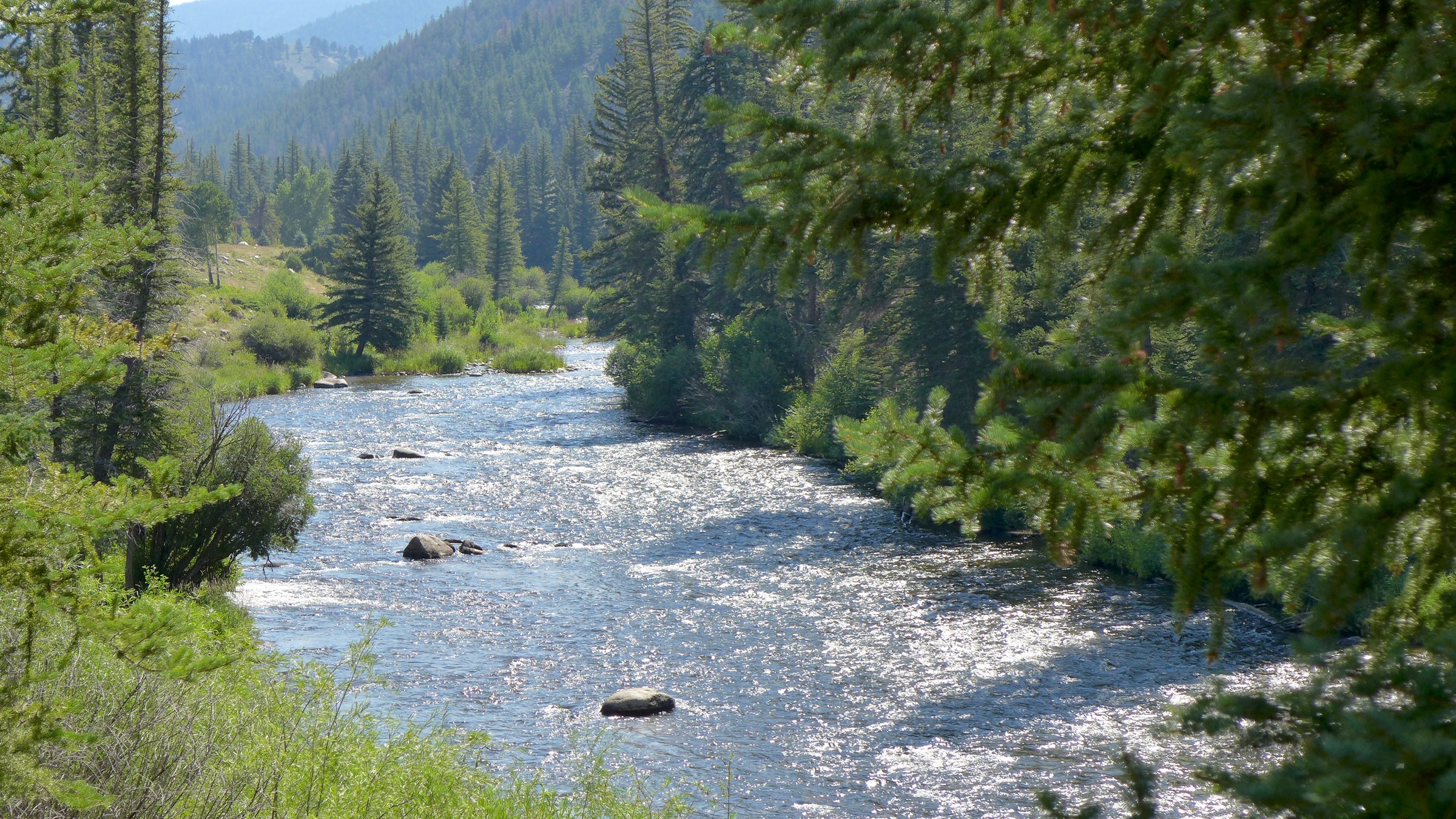
The Taylor River, jewel of the Gunnison River basin. Photo: Brent Gardner-Smith/Aspen Journalism
The creative quality of Bratton’s work in that transition is probably best shown in the story of the resurrection of the Taylor River. The Taylor River collected runoff from some of the highest and snowiest peaks of the Continental Divide and came down to the Gunnison River through 25 miles of canyons – a beautiful mountain river with a reputation among “anglers” (don’t even say “bait”) as a world-class fishery, even in the early 20th century.
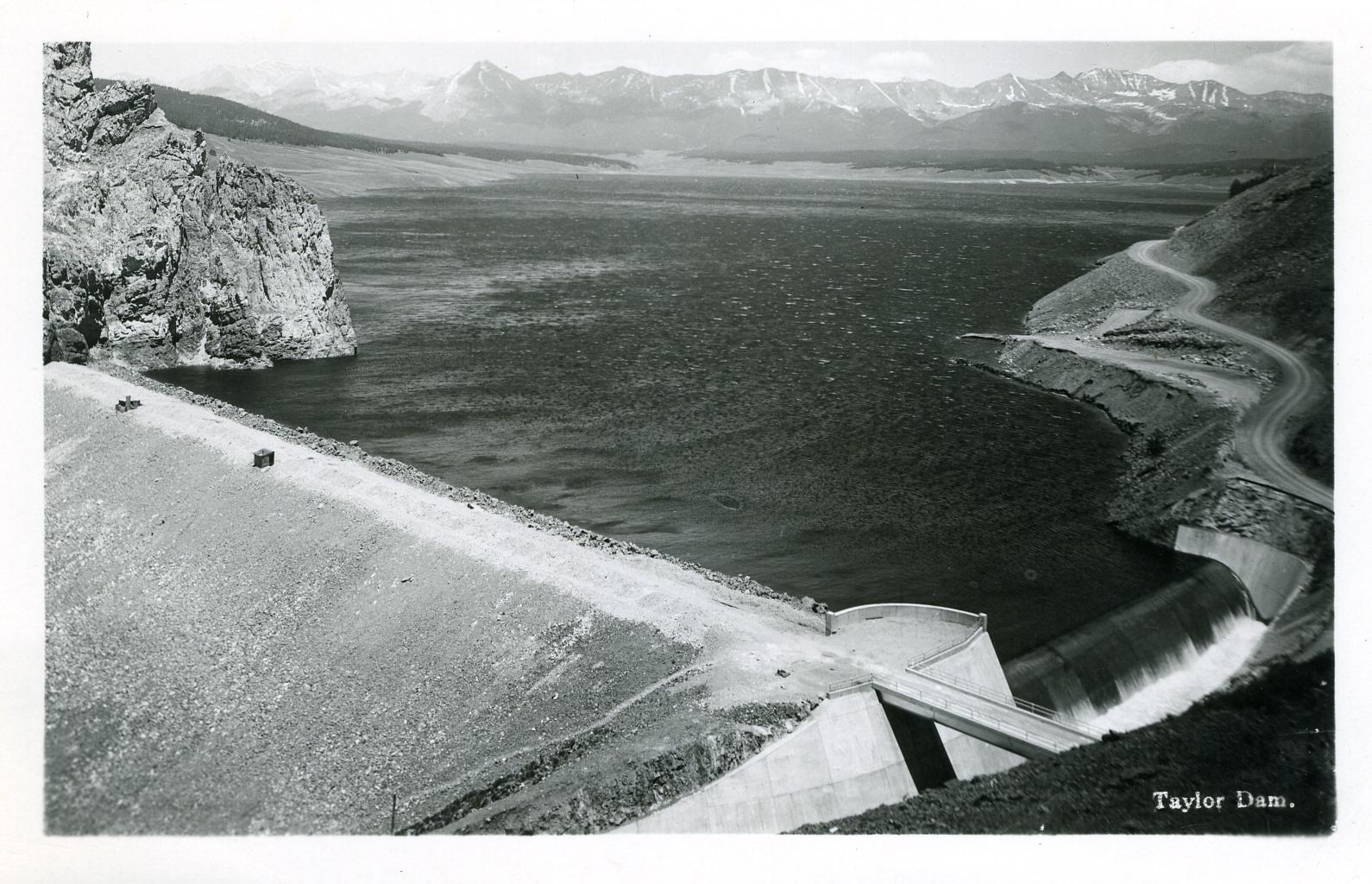
But in the 1930s, the Bureau put a dam at the head of the canyons to store late-season water for farmers in the Uncompaghre River valley, more than a hundred miles downriver at the receiving end of the Gunnison Tunnel, the Bureau’s first big transbasin water project. That project to make life better for distant farmers effectively killed the Taylor and its aquatic life as a river, reversing its natural wet and dry cycles and turning it into an irrigation canal that ran at the will of the Bureau. This was a great loss to the people of the Upper Gunnison, who knew that the best time for fishing was after work anyway. The loss of the Taylor was their first lesson in what the greater good for a greater number meant for the lesser number.
And the Curecanti Project was their second lesson, inundating another twenty-some miles of world-class fishery, along with two small towns and a fishing-resort community that made decent livings from the river. But the Upper Gunnison farmers and ranchers held out hope that, once the Curecanti Unit was in place to play its role in the larger world of Colorado River Basin policy and politics, the Bureau would at least fulfill its promise and begin work on the Upper Gunnison River Project to give them a little help with late-season water.
But just in the decade-and-a-half from the difficult passage of the CRSP Act in 1956 to the completion of the Curecanti Project, public support for expensive irrigation projects to develop western lands basically dried up, replaced by active opposition to anything disturbing the natural beauty and magnificence of The West. It became obvious to the Upper Gunnison Conservancy board and Bratton – attorney on retainer to the board for its first 40 years – that there would be no federal funds for an Upper Gunnison River Project.
But Bratton – a convener and collaborator who managed to maintain good working relationships even with opponents – started to play on the Bureau’s guilt at not being able to fulfill their promise to the people of the Upper Gunnison. He found a willing collaborator in Bob Jennings, a Bureau manager in the West Slope office. Together, they devised a plan whereby the Bureau would let the Uncompaghre Valley Water Users Association store their Taylor Reservoir water in the Blue Mesa Reservoir – at least a day closer to where the water would be used. Then the water could be moved from the Taylor Reservoir down to Blue Mesa from in a schedule more in tune with the natural flow of a river. Maybe the Bureau could not create small upstream reservoirs for the “Old West” agrarian economy, but it could facilitate the resurrection of a beautiful river for the “New West” economy taking shape (and Old West workers who liked to fish).
This was accomplished with a 1975 agreement among the Uncompahgre Valley farmers, the Colorado River Water Conservation District, the Upper Gunnison River Water Conservancy, and the Bureau. The Bureau would manage the “new” river, but with input from the other three parties – input that begins each spring with a meeting of an Upper Gunnison River “Local Users Group”: representatives from Taylor River irrigators, whitewater recreation businesses, Taylor Reservoir flatwater businesses, anglers, and riparian residents. This group sits down with projections for the summer runoff, and compile suggestions for the Bureau on the operation of the Taylor River that will meet all their needs more or less (and being sure to get the Uncompahgre farmers’ water down to Blue Mesa storage in a timely way). The Bureau and other parties can override their recommendations, but seldom need to. And the Taylor is a beautiful mountain river again – “unnatural” only in being democratically operated by all of its Old West and New West users.
Bratton did not stop there. He led the Upper Gunnison River Water Conservancy District through the process of filing for rights on a secondfill of the Taylor Reservoir. Taylor Park above the reservoir gathers on average half again the 110,000 af needed for the Uncompahgre users first fill. Any water collected in a second fill would be left in the river, for wildlife and other environmental benefits downriver – a right consistent with Colorado’s 1973 instream flow law, to sustain the aquatic and riparian environment “to a reasonable degree.” This water right, inconceivable before the 1970s and NEPA awarenesss, was granted in 1990 – just in time to help thwart a proposal for a transmountain diversion to the Front Range from the adjacent Union Park.
Even then, Bratton was not yet done playing on Bureau guilt for imposing the Curecanti Unit on the Upper Gunnison with no compensatory project for the local water users – even though the Upper Gunnison community generates a lot of economic activity from the Curecanti National Recreation Area around Blue Mesa Reservoir. Early in the 21st century, Bratton wanted to develop some ranchland he owned adjacent to the City of Gunnison, with a tributary of the Gunnison River running through it. This development was not received by local residents with any great enthusiasm.
But Bratton remembered a ‘handshake agreement’ with the Bureau from the Curecanti construction era, that the Bureau would replace the great sport fishery the reservoir would inundate with some good public access fishing streams elsewhere in the basin. So rather than developing a standard golf-course-rimmed-with-expensive-homes development, Bratton reminded the Bureau of its promise, and sold it the stream corridor through his land for public access, to be managed by Colorado Parks and Wildlife.
Bratton was also deeply committed to his alma mater, Western State College (now Western Colorado University). In 1975 – obviously a busy year in his life – he orchestrated the creation of the Western State College Foundation, with bequests from former Colorado Governor Dan Thornton and his wife Jessie, valley ranchers; the Foundation continues as an important support for program development at the University.
The following year, 1976, he collaborated with Western history professor Duane Vandenbusche on a water education course. The next year, 1977, that evolved into the “Western Water Workshop,” to which Bratton invited an incredible lineup of speakers, including – in the same room – longtime West Slope Congressman Wayne Aspinall, Denver Water’s longtime chief counsel and bitter West Slope adversary Glenn Saunders, Assistant Bureau of Reclamation Director Cliff Barrett, former Governor John Vanderhoof, and a number of other luminaries of the “water buffalo era.” Your author was privileged to sneak into those summer sessions – one of the most memorable of which was Bureau man Cliff Barrett trying to suss out the implications of President Carter’s recently released “hit list,” a list of water projects, including a number of CRSP projects, that did not meet a new cost-benefit analysis – essentially the official end of the era of federally-funded western water development.
The Western Water Workshop continued for forty years; a place where East Slope and West Slope, Old West and New West participants could gather for a couple days of off-the-record escape from the physical and cultural heat of the cities in the summer. I sserved as director of the Workshop for six year after the turn of the century until I retired from Western, and I found Dick Bratton to still be a great resource and idea person. At that time he had been appointed by President G. W. Bush to be the federal representative on the Upper Colorado River Commission. He once took pains to save my Water Workshop job when I had inadvertently offended one of the old “water buffalo” with a couple invitees to a session; Bratton reminded his old friend that the Workshop promised “the presentation of all reasonable points of view.”
The reader may feel this article is more a history lesson than the remembrance of a man. (A full obituary can be found in the Feburary 6 Gunnison Country Times – www.gunnisontimes.com) But it is my feeling that some people cannot be understood outside of the history they are part of, and Dick Bratton was such a person. Like his friend Wayne Aspinall, he tried to help Colorado’s West Slope (and the larger intermountain West) negotiate the difficult, inevitable, and ongoing transition from the “Old West working economy” to the “New West amenity economy.” His heart may have been more with the former, but he became at home with the latter because, basically, he was at home in the world, whatever it was, and enjoying working with whomever he encountered there. And he was a fisherman as well as the son of a miner.
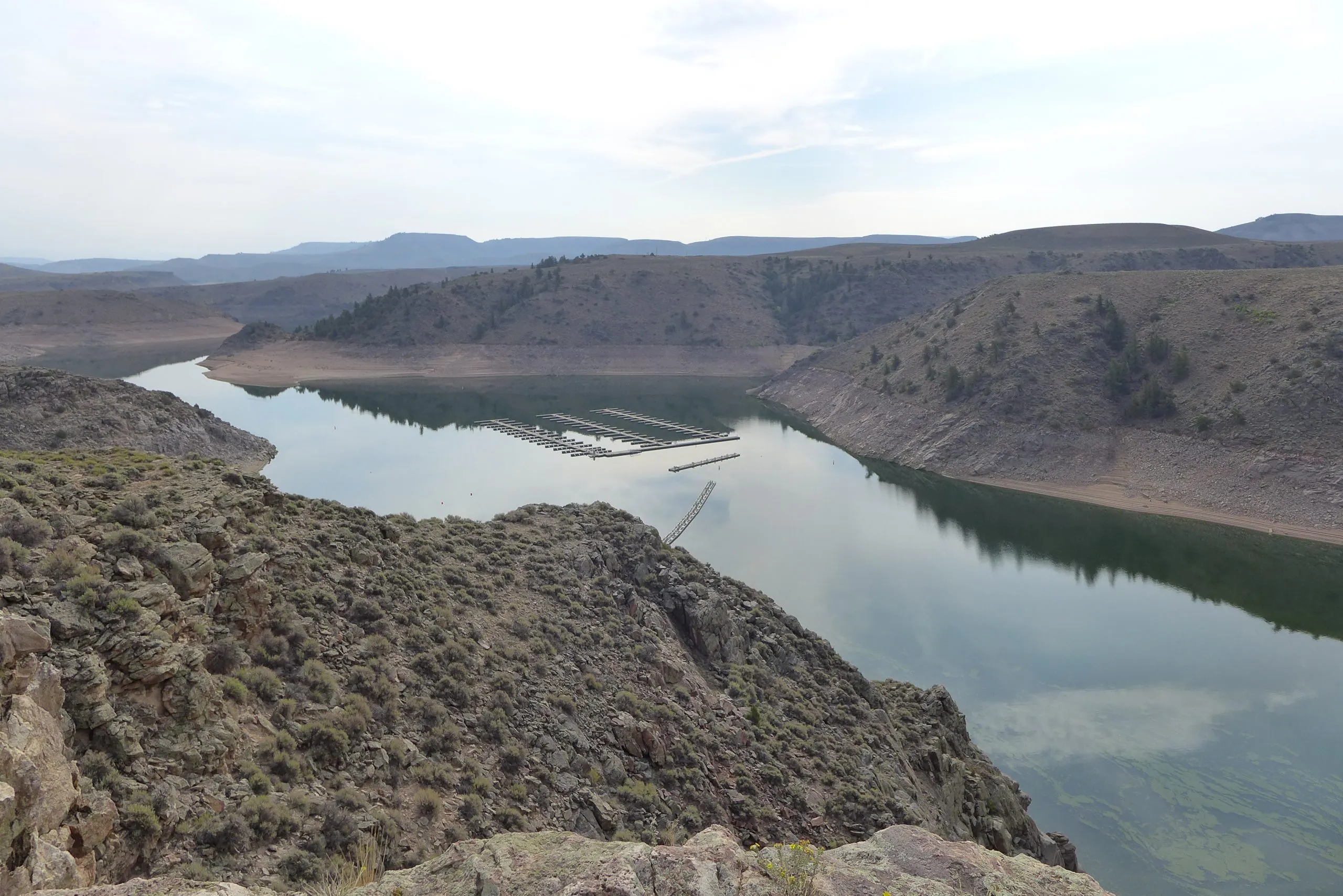
Elk Creek Marina at Blue Mesa Reservoir on the Gunnison River was temporarily closed so the docks could be moved out into deeper water in 2021 after federal officials made emergency releases from the reservoir to prop up a declining Lake Powell. Upper Colorado River Basin officials are requesting monthly drought-monitoring meetings with the U.S. Bureau of Reclamation in hopes of avoiding future last-minute emergency releases. Credit: Heather Sackett/Aspen Journalism
Water managers are preparing for another potentially lackluster runoff this year in the Colorado River Basin.
At a meeting Tuesday, water managers from the Upper Colorado River Commission agreed to write a letter to the U.S. Bureau of Reclamation asking for a monthly meeting to monitor drought conditions. Officials from the four Upper Basin states (Colorado, New Mexico, Utah and Wyoming) are hoping to avoid a repeat of 2021 when emergency reservoir releases caught them off guard.
“We want to be as prepared as possible since hydrology has flipped pretty quickly in previous years,” said UCRC Executive Director Chuck Cullom. “We think it’s prudent to collectively review the forecast and the water supply so that we aren’t caught in the situation we were in in 2021.”
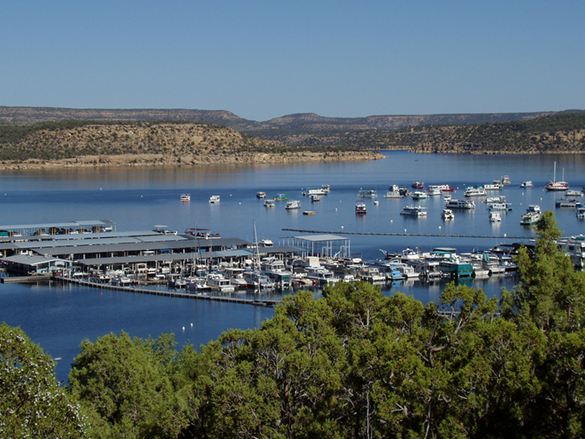
Pine River Marina at Navajo Reservoir. Photo credit: Reclamation
From July through October of that year, Reclamation made emergency releases from three Upper Basin reservoirs: 20,000 acre-feet from Navajo, on the San Juan River; 125,000 acre-feet from Flaming Gorge, on the Green River; and 36,000 acre-feet from Blue Mesa, on the Gunnison River. The goal was to boost water levels at Lake Powell, which had fallen to a critical elevation, and ensure that Glen Canyon Dam could still produce hydroelectric power.
View below Flaming Gorge Dam from the Green River, eastern Utah. Photo credit: USGS
Guidelines for Upper Basin reservoir releases are laid out in the Drought Response Operations Agreement, which was signed in 2019 by the Upper Basin states and the federal government. The three reservoirs are part of the Colorado River Storage Project, and the federal government can authorize emergency releases from them without permission from the states or local entities.
But Colorado water managers were not happy about the timing or lack of notice from the bureau when the emergency releases happened in 2021. Drawing down Blue Mesa, Colorado’s largest reservoir, during the height of the summer boating season forced marinas to close early for the year and was a blow to the state’s outdoor recreation economy.
“It’s February, and we are seeing hydrology that could potentially impact reservoir operations,” Cullom said. “Let’s plan for it rather than reacting over a weeklong period. We’re trying to preempt some of the concerns and criticisms of reservoir operations in 2021.”
Water year 2021 was historically bad, with an Upper Basin snowpack that was near normal at 93% of average but translated to only 36% of average runoff into Lake Powell, the second-worst runoff on record. One of the culprits was exceptionally thirsty soils, which soaked up snowmelt before runoff made it to streams, due to 2020’s hot and dry summer and fall.
Credit: Laurine Lassalle/Aspen Journalism
Officials said current conditions could be setting the basin up for another year like 2021. Alex Pivarnik, a supervisor with the bureau’s Upper Colorado Operations Office, presented the latest data to commissioners Tuesday.
“Coming into the winter, soil-moisture conditions were pretty much dry throughout most of the basin,” Pivarnik said. “And January was a really bad month for us in the basin. … Coming into February, it was kind of a make-or-break for us.”
February’s “most probable” modeling projection for spring runoff into Lake Powell is 67% of average. The February forecast for total Powell inflow for water year 2025 is 71% of average.
Those numbers, taking into account snowpack conditions up until Feb. 5, were down from January’s most probable runoff forecast, which put Lake Powell’s spring inflow at 81% of average and total Powell inflow for water year 2025 at 82% of average.
After a storm cycle that brought snow to mountain ranges throughout the Upper Basin over Presidents Day weekend, snowpack for the Upper Basin stood at 94% of median as of Wednesday. In 2021, Upper Basin-wide snowpack on Feb. 19 was 89%.
“While the snow brought us some positivity, I still like to remind folks when we see Lake Powell at 35% full, that means it’s 65% empty and that’s troubling,” said Becky Mitchell, Colorado’s representative to the UCRC. “I want to note that we’ve been slightly optimistic because of the snow, but it still does not look as good as we’d like.”
Mitchell acted as chair of Tuesday’s UCRC meeting after former chair and federal representative Anne Castle was asked to resign by Trump administration officials last month. A new federal representative to the UCRC has not yet been appointed.
Snowpack for the Upper Colorado River Basin, water years 2021 vs. 2025
This chart shows how much snowpack has been measured at various SNOTEL stations located in the Upper Colorado River Basin.
Snowpack for the Upper Colorado River Basin, water years 2021 vs. 2025 This chart shows how much snowpack has been measured at various SNOTEL stations located in the Upper Colorado River Basin. Chart: Laurine Lassalle – Aspen JournalismSource: SNOTEL Get the dataCreated with Datawrapper
This is a critical time for Colorado River management as the Upper Basin states are in talks with the Lower Basin states (California, Arizona, Nevada) about how the nation’s two largest reservoirs, Lake Powell and Lake Mead, will be operated and cuts will be shared after 2026 when the current guidelines expire. Overuse, drought and climate change have driven reservoir levels to their lowest points ever in recent years.
Cullom gave an overview of the timeline needed to implement a new plan for post-2026 operations. The seven basin states need to reach agreement on a plan by early summer; the bureau would issue a final environmental impact statement by the spring of 2026 and a record of decision by August 2026. New guidelines would take effect in water year 2027, which begins Oct. 1, 2026.
Negotiations with the Lower Basin states, which ground to a halt at the end of 2024, have resumed, and Upper Basin commissioners said they are hopeful that they will reach a consensus. Failure to do so would mean river management decisions would be imposed by the federal government, which is something that state representatives want to avoid.
“A consensus is the best option out there for everyone, and I’m hopeful that we’ll get there,” Mitchell said, adding that “the highest level of certainty that we will have as seven basin states is if we can determine our own future. … I want to reiterate that we are committed to work with the Lower Basin states toward that seven-state consensus.”
Udall/Overpeck 4-panel Figure Colorado River temperature/precipitation/natural flows with trend. Lake Mead and Lake Powell storage. Updated through Water Year 2024. Credit: Brad Udall
Feb. 10, 2025- A newly announced conservation easement will protect more than 7,400 acres in the North Fork Valley from development.
Landowner Peter Slaugh worked with the Colorado West Land Trust to permanently protect Scenic Mesa Ranch, which is south of Hotchkiss and near the confluence of the North Fork of the Gunnison River and the mainstem of the Gunnison River.
“Thanks to the commitment of landowner Peter Slaugh, this remarkable landscape will remain protected forever — ensuring its rich wildlife habitat, agricultural legacy, and scenic beauty continue to benefit the community for generations to come,” the land trust said in a news release.
The ranch includes miles along the two rivers, borders the Gunnison Gorge National Conservation Area and helps connect lower-elevation public land with the West Elk wilderness.
“The property’s scale, high-quality habitat, and strategic location make this an incredibly important conservation achievement,” Rob Bleiberg, executive director of the land trust, said in the release. “We are grateful to partner with Peter Slaugh to protect this incredibly important piece of Western Colorado’s wildlife and agricultural heritage.”
The mesa and the ranch’s riparian areas and canyons are home to wildlife such as eagles, river otters, elk, mule deer, bighorn sheep, mountain lions and black bears. Scenic Mesa also supports livestock grazing, irrigated hay production and dryland pastures, and the conservation easement permanently secures senior water rights, ensuring the land’s continued agricultural productivity and preservation of open space, the land trust said.
Slaugh said in the release, “We live in a dry climate where water is key to promoting healthy habitats. We feel honored to act as stewards of this ranch with a rich history. While raising cattle, we are equally committed to managing the health and survival of wildlife and their habitats. It’s important to us that this land remains a wildlife preserve and avoids development.”
Slaugh and the land trust plan to partner on restoration projects to improve aquatic and upland habitats, including river restoration work with the Western Colorado Conservation Corps.
According to the land trust, the conservation easement preserves the beauty of a mesa visible from Colorado Highway 92 and surrounding public roads. The land also is adjacent to more than 13,000 acres of conserved land and near public lands, further enhancing its value as an ecological asset.
The nonprofit Colorado West Land Trust, based in Grand Junction, has conserved more than 144,000 acres in Delta, Gunnison, Mesa, Montrose, Ouray and San Miguel counties.
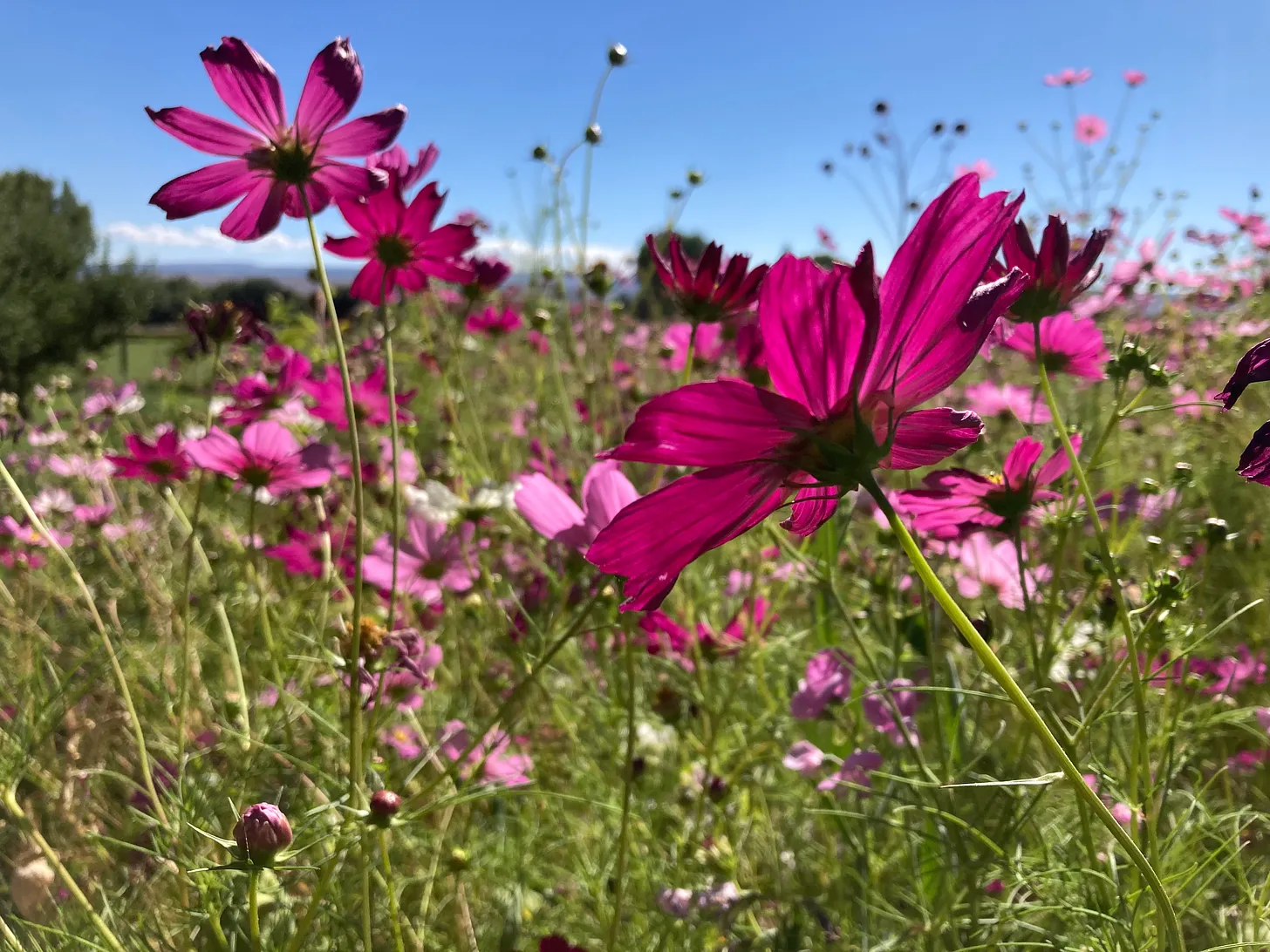
Cosmos in full-summertime bloom in the North Fork Valley in October 2024. Jonathan P. Thompson photo.
GLENWOOD SPRINGS, Colorado — The Colorado River District’s Board of Directors held its first quarterly meeting of the year on Jan. 21-22 and approved $480,000 in Community Funding Partnership grants to support water projects across the Western Slope. A highlight in this round of funding is a $300,000 grant to the Colorado Mesa University’s Ruth Powell Hutchins Water Center to support the Center’s growth over the next three years, including hiring an executive director and establishing a long-term growth strategy for the organization. The River District funding award will be matched by $ 300,000 from Colorado Mesa University.
The grant and partnership with CMU will strengthen the Water Center’s ability to serve as a West Slope hub for water policy and academic education, fostering leadership and innovation in water resource management. The funding will also support strategic planning and program expansion, positioning the West Slope as a central source of research, collaboration, and leadership in Colorado’s River.
“Supporting the CMU Water Center is an investment in the expertise and leadership needed to secure Western Colorado’s water future,” said Colorado River District General Manager Andy Mueller. “CMU has long been a trusted leader in West Slope education and data-informed research. This partnership empowers local knowledge and innovation and will create future generations of water leaders in the Colorado River.”
“At CMU, we take pride in being a voice for Western Colorado, and we see the Water Center as central to that mission,” said Colorado Mesa University President John Marshall. “With this investment from the Colorado River District—matched by CMU—we are establishing a strong, foundational hub for water research and policy rooted in Western Slope expertise, helping students and professionals drive solutions for our region’s water future.”
In addition to the CMU Water Center grant, the Board approved $180,000 in Community Funding Partnership grants for critical water projects across the Western Slope. An $80,000 grant will support the Terror Ditch Pipeline Project in Delta County, piping just over a mile of ditches to reduce water loss and mitigate infrastructure collapse risks, benefiting over 500 acres of agricultural land in the Gunnison Basin. Another $100,000 grant will fund the Upper Yampa Watershed and Stagecoach Reservoir Water Quality Model Project in Routt County, which will develop decision-making tools to address harmful algal blooms and improve water quality in the Upper Yampa River Basin.
The Community Funding Partnership, launched in 2021, is designed to support the development of multi-benefit water projects across Western Colorado. To date, the program has funded over 130 projects and leveraged nearly $100 million in funding for projects that benefit agriculture, infrastructure, healthy rivers, watershed health and water quality, and conservation and efficiency.
For more information on the Colorado River District’s Community Funding Partnership and how to apply for future funding opportunities, visit www.ColoradoRiverDistrict.org.
Change is the only constant, all around us at all times. In our natural, human, and political systems, the pace of change feels particularly intense right now. How will we participate in this change, appropriate to its scope and scale, to shape or be shaped by it?
For the past several years, the Colorado Farm & Food Alliance has focused on three broad “avenues” (or approaches) for local solutions regarding rural climate action. In each of these, the new federal administration and shift in Congress could impede or derail progress already made and potentially into the future.
Avenues for climate action that the CO Farm & Food Alliance has focused on are (1) meeting landscape-level conservation goals to secure water supplies and boost ecological and climate resilience; (2) producing more locally generated and community-centered clean energy; and (3) helping small-acreage agricultural producers benefit from and support the shift to more regenerative practices that increase climate mitigation and adaptation, and boost farm health.
In 2025, we expect ongoing attempts to rollback current environmental and conservation policy – based on stated intent from the new administration and Congress, along with early action and leadership changes in agencies and on committees – with a hard shift away from natural resource protection, environmental justice, and climate action.
The CO Farm & Food Alliance is troubled by this change in federal direction. We will work with partners to defend the progress made and seek opportunities to continue that progress.
With our model of local action and community-rooted solutions, the CO Farm & Food Alliance will work to prevent harm and continue to advance on all of these fronts in partnership with national and local allies.
meeting landscape-level conservation goals to secure our water supplies, wildlife, and quality of place
The Colorado Farm & Food Alliance began with the premise that healthy lands and clean water protect Colorado farms, food, and drink. At the time of our founding, we sought to unify as a local voice for farm and food leaders who supported the protection of the public lands and water source areas surrounding the North Fork Valley.
As our focus broadened to include food security and climate change, among other issues, we also recognized that land use, specifically the conservation and restoration of natural places and systems is a powerful way to help address climate anomalies.
The Colorado Farm & Food Alliance remains committed to working with our partners to secure and maintain protection for critical public and watershed lands in western Colorado. Protecting cherished places such as the Thompson Divide and Clear Fork area, the North Fork Valley, and Dolores Canyons enjoys broad public appeal.
Conservation also helps address the biodiversity crisis and makes watersheds and Colorado farms more resilient to drought. These iconic landscapes are foundational to the character of this place and its residents. They protect our water supplies, essential wildlife habitats, and popular hunting and recreation areas. This means we will join with others to defend public lands and conservation policies from rollbacks and other emerging threats in Washington. However, there will also be opportunities to champion the importance of public lands to Colorado and highlight their values.
producing more locally produced and community-centered clean energy
Rural communities’ powering of farms, businesses, and homes—and the growth of renewable energy projects in rural areas—can significantly improve people’s lives and livelihoods. However, rollbacks to clean energy, environmental justice, and other climate programs could set western Colorado back and be a “gut punch” we do not need.
The Colorado Farm & Food Alliance supports deploying more community-based renewable energy for farms and rural communities. We will closely monitor how Washington’s changes might impact local communities’ ability to develop their own home-grown power solutions.
For transitioning coal and power-plant communities, like the North Fork and other places in Colorado, environmental justice means supporting local solutions for front-line communities. This is recognized in climate funding laws passed during the last Congress, which directly benefit places like Craig, Naturita, and Pueblo, as well as communities in Delta County. However, a recent January 2025 White House Executive Order seeks to defund many of these programs.
Despite this, we will continue working with partners to help advance innovative community-based clean energy projects – like the Thistle Whistle Community Solar project. We will advocate for the preservation of funding that allows coal-mining and power-plant communities – whether rural or urban, red or blue – to envision and implement their own home-grown energy solutions.
The North Fork River valley. Photo credit: Colorado Farm & Food Alliance
supporting small-acreage agricultural producers in benefiting from a shift to more regenerative practices
The Farm Bill, which is central to agriculture in the United States, was recently extended for a third time. This has made a normally five-year bill into an eight-and-counting ordeal. It is not certain that it will be settled this year, but it will have a far-reaching impact when it is.
That’s because the Farm Bill touches many things, from nutrition to farming to clean energy. Even with an uncertain passage, the debate over this bill will continue in committees in both the House and the Senate, now under narrow Republican control.
The Farm Bill is one place rural renewables get funded, through the Rural Energy for America Program (REAP). This is another place where cuts might come to clean energy under a new Congress and priority shifts in the administration.
Clean energy is just one small part of the Farm Bill. Several vital programs funded by this legislation could be at risk of cuts or elimination. These include nutrition programs such as SNAP (“food stamps”) and Doubleup Foodbucks. This program, which could be targeted, addresses hunger in our communities and supports local farmers by increasing SNAP benefits at local farmers’ markets.
Farm and ranch conservation funding is another area likely to see proposed Farm Bill cuts. This includes helping small-acreage farmers implement more regenerative and climate-adapted practices. Programs that support small-acreage farmers are essential for conservation. In the U.S., the number of farmers is decreasing, but the average size of farms is increasing. Many small farms will be converted to other uses and will not stay in agriculture if farming becomes nonviable.
The loss of a farm is personally devastating and sends ripples through the local economy. It also limits the type and scope of nature-based climate solutions that can be implemented. In important headwaters and agricultural areas, like the Gunnison River basin, ensuring the viability of agriculture–which smaller and mid-sized farms and ranches dominate–and protecting our farm economies are critical strategies to support rural, farm-based climate action.
Conservation funding and nutrition programs that allow farmers to provide food directly into local markets are key tools that improve farm outputs, provide income, boost resilience, and address food insecurity in western Colorado.
The Colorado Farm & Food Alliance is sharing and we will continue to develop new and additional resources to help farmers and others navigate policy and program changes at the USDA and other agencies. We will also highlight growers and ranchers practicing techniques that make their farms and pastures more resilient, productive, and sustainable. Showcasing our successes and our shared work will be important in the years ahead.
A North Fork Orchard. Photo credit: Colorado Farm & Food Alliance
The Future is here: We are it.
Despite all these changes and challenges coming our way, we can find security in our community and shared endeavors. We can create something new, sustainable, and fair that emerges right here.
But first, we must persist. This means securing and defending what we have and value most. It means standing up for the vulnerable and those people and places that are targets of attack.
Still, that cannot be all we do. We should neither feel defeated nor content to just wait for a different time. We should imagine new ways to connect with each other now, to celebrate what we cherish and to replicate and share out what we do well.
The future is up to us, but we are mighty together. Now we must become the change we seek.
Colorado Farm & Food Alliance leads effort to advance in Department of Energy Community Power Accelerator Prize
HOTCHKISS, CO (January 27, 2025) — The U.S. The Department of Energy (DOE) announced this month that a North Fork Valley solar partnership is one of four teams to win a national $200,000 Community Power Accelerator Prize. The North Fork based team now advances to the third and final round, and a $150,000 prize, in this community solar competition sponsored by the DOE National Solar Energy Technologies Office.
The Colorado Farm and Food Alliance-led team seeks to advance several community-based solar projects that prioritize agriculture, community benefit and renewable energy generation. The Accelerator Prize award will be used for engineering and other studies at Thistle Whistle Community Solar project near Hotchkiss and to study the feasibility of a second installation at a former coal mine site near Paonia. Both locations are in Delta County, Colorado.
Partners in developing these projects include Colorado Farm & Food Alliance, Thistle Whistle Community Solar, Mirasol Agrivoltaics and Switchback Restoration, along with community leaders. The award will help to advance at least two community solar projects, starting with a small agrivoltaic array at Thistle Whistle Farm near Hotchkiss. This innovative project will pair agricultural production with solar energy and provide clean power to local farms and residents through the Delta Montrose Electric Association (DMEA) grid.
“I am eager to see this project completed, to benefit my farm and to help provide energy cost savings to other local farms and households,” said Mark Waltermire, owner of Thistle Whistle Farm. “The Community Power prize has been vital in helping to keep this project moving forward.” Now completing pre-development, the Thistle Whistle Community Solar project will:
Generate clean, renewable energy for local communities
Preserve agricultural land through dual-use farming practices
Increase energy equity through community-solar, returning cost savings to system subscribers
Create new economic opportunities for local farmers
Support local food systems while advancing clean energy goals
Document best practices for agrivoltaic system design and lessons learned for community solar
Monitor wildlife corridors and habitat enhancement
Research water conservation benefits in dual-use systems
The second project is in early pre-development, but will help support mine-site remediation and climate harm reduction at a former coal mine as well as provide an additional community-solar benefit. “This recognition from the Department of Energy validates our vision for community-based rural renewables that support both our agricultural heritage and greater energy equity,” said Pete Kolbenschlag, with the Colorado Farm and Food Alliance and prize team captain. “These projects demonstrate how rural communities can lead the way in innovative clean energy solutions that preserve farmland, benefit residents and integrate with local livelihoods.” The North Fork Valley team is still participating in this national competition. In the third, and final, round teams must demonstrate that they have secured the funding necessary to develop their community solar projects. As part of the Phase 3 competition, the project team will be able to present their vision at the Community Power PitchFest event at the DOE Headquarters in Washington, D.C. on March 6,
The Community Power Accelerator Prize is part of the American Made Challenge program, with funding coming from the Bipartisan Infrastructure Law passed by Congress in 2021. As part of its mission, the Colorado Farm and Food Alliance provides a platform for rural leadership to develop and implement local solutions that model climate action and strengthen farm and food system resilience. It is the named partner of the Community Power Accelerator Prize.
Mirasol Agrivoltaics is a recently established Colorado nonprofit with a mission to educate about and to help develop community solar projects in the North Fork Valley. With this award it will be able to fill a new and needed leadership role in supporting clean energy, cost savings, and community-based solutions through the Thistle Whistle Community Solar and future projects.
Learning and demonstration gardens at Arbol Farm, Paonia, CO. Photo credit: Colorado Farm and Food Alliance
Crystal Dam, part of the Colorado River Storage Project, Aspinall Unit. Credit Reclamation.
From email from Reclamtion (Erik Knight):
This meeting will be held at the Western Colorado Area Office in Grand Junction, CO. There will also be an option for virtual attendance via Microsoft Teams. A link to the Teams meeting is below.
The meeting agenda will include updates on current snowpack, forecasts for spring runoff conditions and spring peak operations, the weather outlook, and planned operations for the remainder of the year.
Handouts of the presentations will be emailed prior to the meeting.
Click the link to read the article on The Montrose Press website (Katharynn Heidelberg). Here’s an excerpt:
December 7, 2024
Hydropower infrastructure at Blue Mesa Reservoir will see some urgent updates, with the help of money coming through the Interior Department’s Aging Infrastructure Account. The account received more than $3 billion through the Bipartisan Infrastructure Law. As part of an $849 million disbursement announced by the Interior on Dec. 3, more than $32.03 million will go to replace butterfly valves at the Blue Mesa power plant and to refurbish two ring follower gates at the dam there. This funding will pay for planning, final design and implementation.
“The infrastructure at Blue Mesa dates to the facility’s original construction, with most installations made in 1963,” a Bureau of Reclamation official said via email, in response to questions. “Given a typical service life of 50 years, much of the equipment has exceeded this threshold and requires either refurbishment or replacement. Currently, funding is allocated to priority projects that address these urgent needs.”
The government further is providing $1.3 million to pave the public access road to the power plant and $650,000 to replace the electrical “bus” that transmits power from generator to transformer at the plant…According to Bureau of Reclamation information, Blue Mesa’s power plant is composed of two 30,000-kilowatt generators, driven by 41.55-horsepower turbines; each turbine operates at a maximum head of 360 feet. The plant’s generating capacity is 86,000 kilowatts…The Department of the Interior in its announcement said the money is an investment through President Joe Biden’s Investing in America agenda, and aimed at revitalizing aging water delivery systems. The funding is gong to 77 projects overall, in several Western states, including 14 in the Colorado River Basin, totaling $118.3 million.
Across Colorado, this December has been much warmer than average, a bookend to what will end up as one of the warmest years on record statewide. Except there’s one spot where December hasn’t been warm at all — very much the opposite.
On any climate map of Colorado for December 2024, Gunnison sticks out like a sore thumb. For example, here are the high temperatures from CoAgMET on Friday, December 20. Really warm for late December, including some record highs along the Front Range. But then there’s Gunnison with a high of just 22°F.
And here’s the departure from the average temperature for December through the 21st. Most of the state is 3-9°F warmer than average…and then there’s the bulls-eye of purple around Gunnison. For the week of December 15-21 it’s even more stark: almost the entire state in a deep red of warmth, with Gunnison again in a cold purple. Typically when we see maps like these, we get suspicious about problems with the data or a faulty thermometer, but this isn’t an error. Gunnison has truly been an anomaly in the state’s weather and climate this month.
Departure from normal temperature: December 1-21. Credit: High Plains Regional Climate Center
Departure from normal temperature December 15-21. Credit: High Plains Regional Climate Center
Here are a few more remarkable stats. From December 1-20, the climate station outside Gunnison has been 13 degrees colder than average. The highest temperature reported so far in December has been 26°F; there’s never before been a December without a high above freezing. (The average high at Gunnison this time of year is in the upper 20s.) And there were 15 straight nights with low temperatures below -10°F, including record lows of -26 on November 30 and -23 on December 1.
Two key factors are causing the remarkable cold, compared to the warmth the rest of the state has seen in December. The first is geography. Gunnison sits in a valley, surrounded by mountains on all sides. Northeast of town, the Taylor and East Rivers come together to form the Gunnison River, and the confluence with Tomichi Creek is just to the west. Cold air is known to pool in high mountain valleys like this, and the cold can be very persistent.
MODIS satellite image on December 20, 2024, showing the snow cover in the Gunnison Valley. From MODIS Today at the University of Wisconsin
If there’s a bunch of snow on the ground, these valley cold pools can become especially stubborn, and that’s exactly what’s happened this month. The storm just before Thanksgiving dropped over a foot of snow in the valley, and over 2 feet in the nearby mountains, among the highest totals from this storm. And even though the larger-scale air masses have been warm through December, the snow has remained in the valley (clearly visible in the satellite image above) and the air hasn’t warmed up. When there’s deep snow cover, it reflects sunlight and keeps the days cool, and also favors cold nights by insulating the air from the warmer land underneath. This creates a feedback loop where it stays cold, which means the snow doesn’t melt, which means it stays cold.
What’s especially unusual is that this has all happened without getting additional snowfall: Gunnison has reported only 0.5″ of snow in December. The mountain snowpack has flatlined through December, and up the hill at Crested Butte they’ve even had several days above freezing. But it’s still snowy and cold in the Gunnison Valley, and will stay that way for the foreseeable future. What looks more likely is that the rest of the state will start to cool down to something resembling winter in early January, so Gunnison won’t look like such an outlier.
Over 300 people attended Montrose County’s 6th Annual West Slope Water Summit…Water is a big part of the Western Slope’s identity. Montrose County held a water summit and invited everyone to drop by and hear speakers like Andy Mueller of the Colorado River District speak on the issues.
“We really want to make sure they understand where the situation is with the Colorado River, the things we have to do,” said Sue Hansen, Montrose County Commissioner of District 2.
Rest assured, our state representatives in Denver are looking to keep water on the Western Slope, on the Western Slope. “We are the biggest water rights holder, and we need to make sure that we can protect that as we go forward. Downstream is continuing to want more and more and more. There is no way any of us can continue to supply them with what they think they want,” commented Catlin.
From email from the Gunnison Basin Roudtable (Savannah Nelson):
October 29, 2024
As residents of the Gunnison River Basin, we are privileged to live alongside one of Colorado’s most remarkable natural treasures. The Gunnison River is more than just a waterway—it’s a vital part of our history, our environment, and our daily lives.
The Gunnison River was named after U.S. Army officer and explorer John W. Gunnison, who surveyed the area in the mid-19th century. However, long before Gunnison’s expedition, Indigenous peoples, including the Ute tribes, called this area home. They relied on the river as a source of food, water, and transportation, establishing deep connections with the land and its resources.
The East River Valley, northwest of the historic town of Gothic, home to the Rocky Mountain Biological Laboratory. The mountain with the pointed peak in the distance is Mount Crested Butte. Photo credit: Mark Stone/University of Washington
Our river begins at the confluence of the East River and Taylor River near Almont and flows for about 180 miles until it merges with the Colorado River in Grand Junction. Other tributaries include the North Fork, the Uncompahgre, Cimarron, and Lake Fork. Along its course, the Gunnison carves through some of the most dramatic landscapes in the state, including the striking Black Canyon of the Gunnison—its sheer cliffs dropping over 2,000 feet.
Recreation opportunities are a major piece of local life and tourism; fishing, rafting, swimming, kayaking, and boating are part of the culture surrounding the water.
The Gunnison River is also a lifeline for our local ecosystem. Its waters support a variety of fish species, such as brown and rainbow trout, which are great for anglers, but also contribute to the rich biodiversity of our area.
Sweet corn near Olathe, CO photo via Mark Skalny, The Nature Conservancy.
In addition to the fact that all of us rely on the Gunnison river and its tributaries for drinking water, they play a crucial role in the diverse agricultural activities of the basin. The agricultural uses vary and include a range of cattle and crops, including fruit production and Olathe sweet corn.
Our river is many things: a heritage that we share and a resource we must protect for future generations. To learn more about water and ways to get involved, head to gunnisonriverbasin.org.
On Wednesday and Thursday, October 30 and 31, diversions to the Gunnison Tunnel will be ramped down for the season. Releases from the Aspinall Unit will be adjusted in coordination with the ramp down schedule for Gunnison Tunnel diversions in order to keep Gunnison River flows near the current level of 370 cfs. There could be fluctuations in the river throughout these days until the Gunnison Tunnel is completely shut down.
On Wednesday, October 30, releases from the Aspinall Unit and Gunnison Tunnel diversions will be reduced by 300 cfs. On Thursday, October 31, releases from the Aspinall Unit and Gunnison Tunnel diversions will be reduced by 650 cfs and Tunnel diversions will be ended until next year.
Flows in the lower Gunnison River are currently above the baseflow target of 1050 cfs. River flows are expected to stay above the baseflow target for the foreseeable future.
Pursuant to the Aspinall Unit Operations Record of Decision (ROD), the baseflow target in the lower Gunnison River, as measured at the Whitewater gage, is 1050 cfs for October through December.
Currently, diversions into the Gunnison Tunnel are around 980 cfs and flows in the Gunnison River through the Black Canyon are around 370 cfs. After the shutdown of the Gunnison Tunnel, flows in the Gunnison River through the Black Canyon will still be near 370 cfs. Current flow information is obtained from provisional data that may undergo revision subsequent to review.
This scheduled release change is subject to changes in river flows and weather conditions. For questions or concerns regarding these operations contact Erik Knight at (970) 248-0629 or e-mail at eknight@usbr.gov
The importance of the Colorado River cannot be overstated for the American West. The river and its tributaries serve more than 40 million people by providing drinking and municipal water. The water from the river basin irrigates more than 5 million acres of land, which produces around 15% of the nation’s crops. The dams in the basin generate 4,200 megawatts of hydro-power. Overall, the river system sustains over 16 million jobs, contributes $1.4 trillion per year to the economy, and supports terrestrial and aquatic ecosystems (USBR, 2012.)
West Drought Monitor map October 8, 2024.
However, the current drought that has lingered for decades now poses a significant threat to everything that depends on the mighty Colorado River. The river basin lies in the region which is infamous for its natural variability. Over the course of history, the region has had cycles of dry and wet periods, which may also make the present drought look like a natural phenomenon alone. However, a study conducted in 2021 showed that around 19% of the current drought conditions can be attributed to human-induced climate change. Not only that, but the conditions are worse than they have been in at least 1200 years.
Since 90% of the streamflow in the Colorado River originates in the upper part of the basin,several studies over the years have focused on watershed modeling in that region many studies have investigated historical flows, while others have included baseflow – the steady release of groundwater that seeps into a stream or river. Some have gone further to use historical streamflow and baseflow to predict future conditions in the river basin using various climate models. However, almost all studies have either used pre-development scenarios – conditions when there was little to no water infrastructure such as dams, canals, levees, etc., management, and regulations – or have used oversimplified models that ignore the complexities of groundwater movement, storage, and interactions with the surface water.
The Colorado River Basin is one of the most highly regulated and over-allocated river systems in the world. As a result, basing studies on pre-development scenarios seems to be of little practical importance in this day of rapidly changing climate. Moreover, the importance of groundwater and its interactions with surface water cannot be ignored, as more than half of the streamflow in the basin is contributed by baseflow.
Colorado transmountain diversions via the State Engineer’s office
The river basin also has trans-basin or trans-mountain diversions. These diversions bring water from the western slope of the Rocky Mountains, which are in the Colorado River Basin, to the eastern slope of the Rockies outside of the basin. These diversions have also been ignored in previous models.
Map credit: AGU
Therefore, my team, which includes my Ph.D. advisor at CSU, Associate Professor Ryan Bailey, and two scientists from the Agricultural Research Service, is working to address this knowledge gap by incorporating key hydrological processes that were overlooked in previous research studies. We are using a physically based and spatially distributed model to build and quantify historical streamflows and groundwater levels in the Upper Colorado River Basin for the post-development scenario. A physically based model simulates how water moves through the environment, using real-world processes, instead of relying on statistical patterns. A spatially distributed model, on the other hand, takes into account differences in the landscape and natural features across different areas. In our model, we have included reservoirs, canals, irrigation schedules, floodplains, trans-basin diversions, and tile drainage – an agricultural drainage system that removes excess subsurface water from irrigated fields. The model also simulates groundwater fluxes such as groundwater recharge, canal seepage, tile drainage flow, saturation excess flow, lake and reservoir seepage and evaporation, and groundwater-floodplain exchanges, which can be used to identify spatio-temporal patterns in the river basin.
Once we simulate the historical hydrology and fluxes, we plan to run what-if scenarios, hypothetical situations to help us analyze different options, for several water management, land use change, and climate change scenarios. This will allow us to come up with best management practices to address water issues and manage water resources more effectively and efficiently.
Historic photo of the Lee’s Ferry gage on the Colorado River. Photo credit: USGS
In the final phase of the study, we use what-if scenarios to assess the political and socio-economic aspects of the model. This includes, crop budgets, agricultural productivity in monetary terms, possibility and probability of Denver getting shut out from trans-mountain diversions in case of a drought, economic implications of sustainable groundwater use, the amount of water flowing at Lee’s Ferry in Arizona – the dividing point of the upper and lower basins, and so on.
The findings of this study can influence how water managers, government agencies, farmers, and other stakeholders approach water use and management for higher revenues and sustainability. Ecologists can gain insights into future streamflows and their potential impacts on aquatic ecosystems. Additionally, it will provide the scientific community with a solid foundation and valuable catalyst for future research. In the long run, these findings can help shape water policy, advancing the goal of achieving integrated regional water management.
M. Raffae
The fate of the Colorado River Basin does not only depend on the climate and its variability, but also on the policies we create that define how we store, move, use, and manage our water. To come up with policies that help us sustain the economy, environment, and society, it is imperative that we conduct a comprehensive hydrological modeling study for the post-development scenario that shows us both our best- and worst-case scenarios for the future to better prepare for it. This study is an ambitious attempt to do so.
About the author: M. Raffae is a Ph.D. student in the Department of Civil and Environmental Engineering at Colorado State University (CSU) funded by the Fulbright Foreign Student scholarship program. He is also a fellow in the NSF Research Traineeship (NRT) Program InTERFEWS at CSU.
Taylor Park Dam. Photo credit: Allen Best/Big Pivots
Click the link to read the article on the Big Pivots website (Allen Best):
September 25, 2024
When work was completed on Colorado’s Taylor Park Dam in 1937, at least some thought existed that it would eventually be modified to produce electricity.
In 2024, it is finally happening. The first commercial power production has or will very soon happen in the first days of autumn.
The new 500-kilowatt hydroelectric turbine and generator installed in the dam will operate at or near full capacity 24/7/365. It is projected to produce an average 3.8 million kilowatt-hours annually. That compares to a 2.5-megawatt fixed-til solar array.
The electricity will get used by Gunnison County Electric Association. Mike McBride, the manager, says the electricity delivered will immediately save the cooperative money compared to the power delivered by Tri-State Generation and Transmission.
Under its contract with Tri-State, Gunnison County Electric can generate up to 5% of its own power. This hydroelectric facility will get it to 3%. The association is working to gain the other 2% from local solar array developments, one near Crested Butte and the other near Gunnison.
The Taylor River originates on the west side of Cottonwood Pass in the Sawatch Range. The road across the pass connects Buena Vista and Crested Butte and Gunnison. After being impounded by the dam that creates Taylor Park Reservoir, the river descends to meet the East River, which originates near Crested Butte. Together they become the Gunnison River.
Grand opening of the Gunnison Tunnel in Colorado 1909. Photo credit USBR.
The 206-foot-high earthen dam is owned by the U.S. Bureau of Reclamation but operated by the Uncompahgre Valley Water Users Association, which delivers water to the Montrose and Delta area via [the Gunnison Tunnel].
In 2020, that water association joined with the Gunnison County Electric Association to form a legal entity to finance the $3.6 million project.
George Sibley, a historian of all things water in the Gunnison Basin (and beyond), said the dam was originally intended for storing water for July through September.
In the 1970s that changed in a collaboration of the Bureau, the Uncompahgre water district, and Upper Gunnison Regional Water Conservation District. That collaboration allowed them to store water from Taylor in Blue Mesa Reservoir. This allowed water to be released continuously through the year.
“That year-round flow potential made it more possible to think of the Taylor Dam as a possible year-round power source,” he says.
But the coal-burning units at Craig were delivering plenty of cheap power. Only in the last couple of decades have the electrical cooperative started getting pressure from some members and “other cultural entities” to reduce emissions associated with their electricity, he says.
A study was commissioned in 2009 and wrapped up in March 2010. Beyond were more complications — but now success.
Local electric cooperative Gunnison County Electric Association (GCEA) has a new way of generating energy for the Gunnison Valley with the recent completion of its Taylor River Hydropower construction project. GCEA and the Uncompahgre Valley Water Users Association (UVWUA) commemorated the completion of the plant’s construction phase last week with a ribbon cutting ceremony, and plan to begin commercial power production around September 20. The $3.6 million project located at the Taylor Park Dam is a partnership between GCEA and the UVWUA. The new 500-kilowatt (kW) hydroelectric turbine and generator at the site will operate at or near full capacity 24 hours a day, year round, to produce an average of 3.8 million kilowatt-hours (kWh) annually. That amount of generation compares to some 2,500 kW (2.5 megawatt) fixed tilt-solar arrays and, according to GCEA strategy execution specialist Matt Feier, will provide clean electricity to approximately 500 local homes and businesses in Gunnison County…Construction on the project began in May 2023, but the hydroelectric vision has been in the works far longer…
GCEA provides the electric infrastructure and UVWUA manages the water flowing through the dam. The plant connects to the existing dam penstock and GCEA’s single-phase distribution line. Feier explained the process: “The new facility draws approximately 65 cubic feet per second of water out of the eastern penstock within the existing valve house. This water is piped to our Frances turbine within the newly constructed metal building at the base of the dam. The turbine spins, which in turn spins the generator and generates an electric current. This energy flows into GCEA’s existing distribution system and down to GCEA’s Alkali substation (located near Jack’s Cabin Cutoff) where it is distributed within GCEA’s service territory. After turning the turbine, the water flows back into the same spilling basin as the Taylor Dam’s main outflow,” he said. “This hydro generator will be a ‘run of the river’ facility and will not affect river flows within the Taylor River.” Feier said the Taylor River Hydro project is a welcome addition to GCEA’s current clean energy portfolio, and it will bump up GCEA’s local renewable energy generation. “This new hydroelectric facility will get us to approximately 3% local generation and we are working to gain the other 2%+ from local solar array developments,” he said.
The Taylor River, jewel of the Gunnison River basin. Photo: Brent Gardner-Smith/Aspen Journalism
The U.S. Forest Service has finalized a land exchange with Mt. Emmons Mining Company located in Gunnison and Saguache counties.
Under the agreement, finalized on Aug. 29, the Forest Service exchanged 539 acres of federal land located adjacent to the Keystone Mine for 625 acres of land owned by Mt. Emmons Mining Company located within the Grand Mesa, Uncompahgre and Gunnison National Forests and Rio Grande National Forest.
Iron Fen. Photo credit from report “A Preliminary Evaluation of Seasonal Water Levels Necessary to Sustain Mount Emmons Fen: Grand Mesa, Uncompahgre and Gunnison National Forests,” David J. Cooper, Ph.D, December 2003.
The land exchange allows the Forest Service to improve wildlife habitat and recreation opportunities by reducing private inholdings and creating more contiguous public land. The parcels acquired by the Forest Service include riparian and wet meadow habitats, which are vital to various bird and aquatic species.
Additional benefits of the land exchange include an established Conservation Easement and Mineral Extinguishment Agreement, prohibiting mining and allowing for non-motorized recreation in the future. It allows Mt. Emmons Mining Company to address mining remediation efforts, including water quality and facilitated the transfer of ownership and administration of the Kebler Winter Trailhead to Gunnison County.
“We are pleased to see this momentous exchange finalized,” said Dayle Funka, Gunnison district ranger. “This project was truly a collaborative effort with local non-profits, private landowners and local and federal governments working to benefit future generations. We encountered obstacles throughout the process but found ways to move forward in the spirit of collaboration. As a result of many people’s dedication and perseverance, this land exchange will enhance public access and enable future non-motorized recreational opportunities. I commend the Mt. Emmons Mining Company for their commitment to mining remediation efforts and water quality, while honoring the values of the community.”
An Apology: Our service that sends these posts hs malfunctioned; this one sat in limbo for the past two weeks. I hope we have things back to where we can again get it to you every 3-4 weeks. – George
In the last post here, with the Colorado River’s Upper and Lower Basins in stalemate over how to distribute the suffering after the 2026 expiration of the Interim Guidelines, I suggested we use the time to do what we’ve all been saying we need to do, but find it hard to do: ‘think outside the box.’ The ‘box’ in this case being the Colorado River Compact. We can go back to Monday-morning-quarterbacking the rivermeisters as they try to figure out how to drag the Compact, its misbegotten two-basin division and its Marley’s-chain Law of the River into the 21st century. But for the moment – let’s just indulge in imagining river scenarios that might actually reflect Colorado River realities in the 21st century.
In the last post (click if you need a review) I sketched out the nature of the ‘desert river,’ which is what the Colorado River is. Rivers flowing through deserts only exist at all because of mountains or other highlands that force air moving through (as in ‘prevailing westerlies’) to rise, cool, and condense whatever water vapor it is carrying into precipitation, rain or snow, that falls on the mountains and eventually flows downhill because that’s what liquid water does, eventually coalescing into a river. In this case, it flows out into deserts which by definition are arid regions with a paucity of precipitation and a powerful propensity for turning liquid water back into vapor. Once the desert river is in its desert, it begins to disappear because it gets so little recharge from precipitation beyond its mountain origins, and gives up its water to riparian life, to evaporation, to groundwater. We can say with some accuracy that it is the nature of a desert river to gradually disappear into its deserts – as liquid water, anyway.
The Colorado River is a true desert river; the mountains and highland plateaus surrounding the natural basin produce 85-90 percent of the river’s total water supply, according to the Western Water Assessment study of the ‘state of the river science.’ Now it almost entirely disappears in the deserts of the Southwest – the high ‘cold deserts’ of the Colorado Plateau and Southern Rockies piedmont, and the subtropical Sonora and Mojave Deserts below the plateau canyons. This is mostly due to human uses now; we remember with nostalgia that the Colorado River flowed naturally into the Gulf of California, but that was mostly during its snowmelt flood season; by late fall and through the winter there were probably many years when it did not make it through the delta jungle to the Gulf at all.
The Compact experience should make us all leery of dividing a river into basins. But the way a desert river works suggests a natural division into two parts – as opposed to a two-basin political division, using state boundaries that have no relevance to down-on-the-ground geography. The natural division is a water-production region, in the highlands where the majority of the precipitation falls and the river forms its tributaries; and a water-consumption region, in the deserts where that produced water gradually disappears – especially now that humans are spreading it much farther than nature ever intended.
Colorado River “Beginnings”. Photo: Brent Gardner-Smith/Aspen Journalism
Today, we’ll go to the headwaters, to explore the river’s ‘water-production’ region. The major water-production region for the Colorado River lies almost entirely above the 8,000-foot elevation, mostly on the west slopes of the Southern Rockies in Colorado and Wyoming, but also water from the Wind Rivers in Wyoming, and the east slopes of the Wasatch Range in Utah, and the high plateaus and mountains of eastern Arizona and western New Mexico that give Arizona the Gila River.
The Western Water Assessment graphic below basically shows the water-production region for the Colorado River (whose natural basin is the black line). ‘April 1 SWE’ is the ‘snow water equivalent on April 1,’ the amount of water in the snowpack that constitutes the majority of the river’s water. Late March to early April is generally presumed to be the time of the highest snowpack in the mountains and other highlands surrounding the upper reaches of the River, so a map of the ‘April 1 SWE’ is a passable map of the river’s water-production area. The blue areas (inside the black line) are less than 15 percent of the 245,000 square-mile River Basin, and as you can see, it is not a contiguous area – just the places that rise high enough to make the moving air give up to the highlands its moisture as rain or snow. Water management decisions throughout the Basin begin to be made on the basis of the April 1 SWE. (The gray lines, by the way, are watershed boundaries for different tributaries and divisions of the river, not the waterways themselves.)
You’ll note that the adjacent averaged annual ‘Runoff’ map indicates that considerably less water flows out of the water-production region than the ‘April 1 SWE’ map shows. Scientists have found that the amount of water that actually makes it into the Colorado River is only a fraction of the water that falls in the river’s water-production region. The Western Water Assessment’s study of the ‘State of the Science’ on Colorado River climate and hydrology claims that on average around 170 million acre-feetof water falls on the Colorado River Basin annually, with the largest portion of that falling on the highlands of the water-production area – yet the river carries on average less than a tenth of that precipitation. What happens to the rest of it?
The short answer there is, the sun is what happens to it: the sun gives, and the sun takes away. The sun distills pure water vapor from the oceans, and the winds (also created by the sun) carry that vapor over the land areas, where begins the ‘dance’ I described in the last post, as water vapor gets pushed up against mountain slopes and condensed to precipitation which falls on the mountains as rain or snow – where the sun and winds quickly go to work on trying to transform it back to vapor.
This begins even in the depths of winter, in sub-freezing weather: the sun beating down on a ‘solid’ snowpack releases enough heat energy to turn the snow crystals directly to water vapor, without going through the liquid state – a process called sublimation. Sublimation happens when a snowpack is directly exposed to the sun; it also happens when the wind blows the snow around breaking down the ice crystals; and it happens when coniferous tree branches intercept and hold the falling snow or rain, which is vaporized off the branches by the sun. On a day of brilliant sun, fairly common in the water-production region, you can actually see ‘steam’ – water vapor – rising where snow sits on an exposed darker surface – rocks or branches. And all of this in temperatures below freezing.
The East River Valley, northwest of the historic town of Gothic, home to the Rocky Mountain Biological Laboratory. The mountain with the pointed peak in the distance is Mount Crested Butte. Photo credit: Mark Stone/University of Washington
A major study of the water-production area is underway in the Upper East River valley near Crested Butte, as part of a U.S. Energy Department ‘bedrock to upper atmosphere’ study of water and energy; it includes what is probably the most intensive study of sublimation ever assembled. The science team is mainly working on sun and wind sublimation in open areas; early results suggest that around 10 percent of a winter snowpack disappears through that form of sublimation. Losses from branch interception might be as large as that or larger. Guesstimates over the years suggest that as much as a third of the precipitation that falls might disappear through sublimation of ‘solid’ snow to water vapor through the course of a winter.
The snowpack is only ‘safe’ from sublimation where it gets some protection from the sun and wind. Snow that makes it down to the ground in forested areas – not intercepted by branches – is sheltered somewhat from the sun and wind. ‘Aspect’ (location on the mountain) is also important: snow on the north and east slopes of mountains may never see the direct sun all winter, although it will feel the wind.
Eventually winter turns to not-winter, and the accumulated snowpack begins to melt as the air generally warms (with sublimation also ratcheting up with heat). One of three things will happen to the resulting ‘snow water.’ Where slopes are steep or rocky or both, a lot of the water melting out will become runoff – water running off under the affluence of gravity: trickles run together and find their way into the stream flowing out of the watershed, streams meeting other streams in ever larger watersheds until rivers flow out of the mountains into the water-consumption region where they are quickly put to work by farmers and ranchers.
Back up to the melting edge, however – if it can, the water melting out of snow will not run off but will sink into the ground, the preferred alternative for the ‘life project’ on the planet (but not always for the human users). How much water runs off, and how much sinks in, depends on how fast the snow melts and how steep or rocky the slope.
The water that sinks in – groundwater – passes first into a soil area laced and spaced by the roots of all the plant life living on the surface, from little tundra miniatures to great trees. This is variously called the ‘vadose zone,’ the interflow, or most plainly, the unsaturated zone. The roots in the unsaturated zone will take up a lot of that water for their plants to use: some of it will go into the plant’s structure and systems, but most of it – as much as 95 percent of it – will be transpired by the plant: emitted into the atmosphere as water vapor, a kind of air-conditioning system that increases with higher temperatures.
For big old spruces in the subalpine forest, transpiration might be around 80 gallons a day on average (more on a warmer day); for lodgepole pine, maybe 40 gallons a day. That might not sound like lot, a mere 0.0002 of an acre-foot. But next time in the mountains, look at a forested slope across a valley, and try to estimate the number of trees there to the nearest thousand….
In addition, any time the flowing or standing water is exposed to the sun, the sun takes a cut through straight evaporation. Evaporation also increases with temperature. One of the East River project researchers, Dr. Rosemary Carroll, claims in a research paper that, in a typically dense montane forest, the total evapotranspiration (evaporation plus transpiration) can add up to equal the precipitation that fell on the forest.
So it becomes clear that the water produced in its mountains for the Colorado River is a ‘net’ figure – precipitation minus natural depletion from a) a winter of sublimation every day the sun shines, b) evaporation of water melted from snow when exposed to the sun, and c) transpiration by the forests of the water making its way underground.
But we have to then add back in the groundwater that makes its way down through the unsaturated zone to a saturated zone below most of the thirsty roots. The top of the saturated zone is called the water table, which rises and falls with the amount of water saoking into the ground. Water in both the unsaturated and saturated zones filters its way downslope pulled by gravity and pushed by more water coming in above.
Eventually it will makes its way to the bottom of the watershed where the stream flows; there, if the water table is higher than the stream level, the groundwater will feed into the stream. Scientists have figured out how to tell from a sample of stream water how much of it is runoff, and how much has come through the groundwater route; over a good water year with healthy water tables, the ratio of groundwater to runoff will be about 50-50, with runoff being greater during the spring flood season and groundwater dominating the fall and winter flows.
Carroll notes in the same paper that the journey of groundwater to the stream might be very leisurely; while some of it might make its way through the cobble found in many mountain valleys in a matter of days, water that sinks into cracks and interstices in more solid rock might not show up in the stream for a century – or never, unless someone drills into the rock and installs a pump.
In the final tally, about one-fifth of the precipitation that falls in the high headwaters emerges as water for the river. Another portion of it is in ‘longterm storage’ as groundwater in aquifers. But the rest, probably more than half of it, has gone back to the vaporous state of water. The sun giveth, and the sun taketh away.
The ‘Headwaters Challenge’ ought to be obvious. We can’t do a lot about what happens up in the alpine tundra – but are there management strategies for the forests we could employ that might cut down on the amount of water we lose to the sun there, increasing the net water production even a little to compensate for what we are losing to the warming climate? That’s the romantic exploration I’m on these days, reading a lot of scientific papers I only partially understand. I may or may not be ready to say anything about this in the next post – but I wanted to get the challenge in front of those who read this, to ask if any of you have any ideas….
Meanwhile – the apparent preference of the sun for water in the vaporous state should probably make us a little nervous. Obviously, the warmer it gets, the more water gets sublimated, evaporated and transpired – and we seem to be doing all we can to make the world warmer. Not a good survival strategy for species dependent on liquid water, even though we are convinced we cannot survive without the things whose byproducts make the world warmer…. That’s a bigger challenge facing us all.
A double rainbow arches over the Painted Wall in Black Canyon at Gunnison National Park.
Photo Credit: Dave Showalter
From email from Reclamation (Erik Knight):
Releases from the Aspinall Unit will be decreased from 1500 cfs to 1450 cfs in the afternoon of Monday, August 26th. Releases are being decreased as flows on the lower Gunnison River are well above the baseflow target of 1050 cfs.
Flows in the lower Gunnison River are currently above the baseflow target of 1050 cfs. River flows are expected to remain above the baseflow target for the foreseeable future.
Pursuant to the Aspinall Unit Operations Record of Decision (ROD), the baseflow target in the lower Gunnison River, as measured at the Whitewater gage, is 1050 cfs for August through December.
Currently, Gunnison Tunnel diversions are 1050 cfs and flows in the Gunnison River through the Black Canyon are around 450 cfs. After this release change Gunnison Tunnel diversions will still be 1050 cfs and flows in the Gunnison River through the Black Canyon will be around 400 cfs. Current flow information is obtained from provisional data that may undergo revision subsequent to review.
Releases from the Aspinall Unit will be decreased from 1550 cfs to 1500 cfs on Wednesday, August 21st. Releases are being decreased as flows on the lower Gunnison River are well above the baseflow target of 1050 cfs. Another reduction in the release at Crystal is expected to occur next week if river levels remain above the target.
Flows in the lower Gunnison River are currently above the baseflow target of 1050 cfs. River flows are expected to remain above the baseflow target for the foreseeable future.
Pursuant to the Aspinall Unit Operations Record of Decision (ROD), the baseflow target in the lower Gunnison River, as measured at the Whitewater gage, is 1050 cfs for August through December.
Currently, Gunnison Tunnel diversions are 1050 cfs and flows in the Gunnison River through the Black Canyon are around 500 cfs. After this release change Gunnison Tunnel diversions will still be 1050 cfs and flows in the Gunnison River through the Black Canyon will be around 450 cfs. Current flow information is obtained from provisional data that may undergo revision subsequent to review.
This scheduled release change is subject to changes in river flows and weather conditions. For questions or concerns regarding these operations contact:
Black Canyon July 2020. Photo credit: Cari Bischoff
From email from Reclamation (Erik Knight):
Releases from the Aspinall Unit will be decreased from 1650 cfs to 1550 cfs on Tuesday, August 20th. Releases are being decreased as flows on the lower Gunnison River are well above the baseflow target of 1050 cfs. Further reductions in the release at Crystal may occur soon if river levels remain well above the target.
Flows in the lower Gunnison River are currently above the baseflow target of 1050 cfs. River flows are expected to remain above the baseflow target for the foreseeable future.
Pursuant to the Aspinall Unit Operations Record of Decision (ROD), the baseflow target in the lower Gunnison River, as measured at the Whitewater gage, is 1050 cfs for August through December.
Currently, Gunnison Tunnel diversions are 1050 cfs and flows in the Gunnison River through the Black Canyon are around 600 cfs. After this release change Gunnison Tunnel diversions will still be 1050 cfs and flows in the Gunnison River through the Black Canyon will be around 500 cfs. Current flow information is obtained from provisional data that may undergo revision subsequent to review.
This scheduled release change is subject to changes in river flows and weather conditions. For questions or concerns regarding these operations contact:
Colorado River in Grand Junction. Photo credit: Allen Best
From email from Reclamation (Erik Knight):
The next coordination meeting for the operation of the Aspinall Unit is scheduled for Thursday, August 15th 2024, at 1:00 pm.
This meeting will be held at the Western Colorado Area Office in Grand Junction, CO. There will also be an option for virtual attendance via Microsoft Teams. A link to the Teams meeting is below.
The meeting agenda will include a review of the spring runoff conditions and the forecasting , a summary of reservoir conditions and river flows since April including the spring peak operation, the weather outlook, and planned operations for the remainder of the year.
Handouts of the presentations will be emailed prior to the meeting.
Releases from the Aspinall Unit will be decreased from 2100 cfs to 1650 cfs by Thursday, August 1st. Releases are being decreased as the baseflow target for the lower Gunnison River will change to 1050 cfs on August 1st.
Flows in the lower Gunnison River are currently above the baseflow target of 1500 cfs. River flows are expected to remain above the new baseflow target with this release reduction.
Pursuant to the Aspinall Unit Operations Record of Decision (ROD), the baseflow target in the lower Gunnison River, as measured at the Whitewater gage, is 1050 cfs for August through December.
Currently, Gunnison Tunnel diversions are 1050 cfs and flows in the Gunnison River through the Black Canyon are around 1050 cfs. After this release change Gunnison Tunnel diversions will still be 1050 cfs and flows in the Gunnison River through the Black Canyon will be around 600 cfs. Current flow information is obtained from provisional data that may undergo revision subsequent to review.
“New plot using the nClimGrid data, which is a better source than PRISM for long-term trends. Of course, the combined reservoir contents increase from last year, but the increase is less than 2011 and looks puny compared to the ‘hole’ in the reservoirs. The blue Loess lines subtly change. Last year those lines ended pointing downwards. This year they end flat-ish. 2023 temps were still above the 20th century average, although close. Another interesting aspect is that the 20C Mean and 21C Mean lines on the individual plots really don’t change much. Finally, the 2023 Natural Flows are almost exactly equal to 2019. (17.678 maf vs 17.672 maf). For all the hoopla about how this was record-setting year, the fact is that this year was significantly less than 2011 (20.159 maf) and no different than 2019” — Brad Udall
In 2022, Lake Powell was at its lowest since it was originally filled in the 1960s. [Amy] Haas noted an ongoing concern that there is currently no mechanism to ensure the conserved water from the upper basin states is flowing down to Lake Powell and staying there.
The relationship between the upper and lower basin states is not always pleasant, but [Gene] Shawcroft noted that recently, agreements and understandings have been made between the entities…In their post-2026 operations proposal, the lower basin states said they would cut water use by 1.5 million acre-feet per year as long as Lake Powell and Lake Mead’s combined storage remains at a certain level. Shawcroft added that the question now is, at what point, do these cuts in water use begin?
“The upper division states feel very strongly that we need to improve our storage (and) that we need additional storage. And so our concept would be that we would have that one-and-a-half reduction occur at an elevation that was higher than what they would propose. Their position, or their thought process is, if there’s water in the system, we ought to put it to use,” he said.
Haas added, “The lower basin is proposing actions based on total system contents as they define it, which includes not only Lake Powell and Lake Mead but also the upstream initial units, right? So this would be Flaming Gorge, the Aspinall unit in Colorado and Navajo.”
A double rainbow arches over the Painted Wall in Black Canyon at Gunnison National Park.
Photo Credit: Dave Showalter
From email from Reclamation (Erik Knight):
Releases from the Aspinall Unit will be increased from 1900 cfs to 2200 cfs by Friday, July 12th. Releases are being increased in response to declining river flows on the lower Gunnison River.
Flows in the lower Gunnison River are currently below the baseflow target of 1500 cfs. River flows are expected to remain low into next week.
Pursuant to the Aspinall Unit Operations Record of Decision (ROD), the baseflow target in the lower Gunnison River, as measured at the Whitewater gage, is 1500 cfs for July and then drops to 1050 cfs in August.
Currently, Gunnison Tunnel diversions are 1050 cfs and flows in the Gunnison River through the Black Canyon are around 950 cfs. After this release change Gunnison Tunnel diversions will still be 1050 cfs and flows in the Gunnison River through the Black Canyon will be nearing 1200 cfs. Current flow information is obtained from provisional data that may undergo revision subsequent to review.
Morrow Point Dam, on the Gunnison River, Aspinall Unit. Photo: Brent Gardner-Smith/Aspen Journalism
From email from Reclamation (Erik Knight):
Releases from the Aspinall Unit will be increased from 1600 cfs to 1900 cfs between Wednesday, July 10th and Thursday, July 11th. Releases are being increased in response to declining river flows on the lower Gunnison River.
Flows in the lower Gunnison River have been dropping quickly towards the baseflow target of 1500 cfs. River flows are expected to continue to decline over the next couple weeks.
Pursuant to the Aspinall Unit Operations Record of Decision (ROD), the baseflow target in the lower Gunnison River, as measured at the Whitewater gage, is 1500 cfs for July and then drops to 1050 cfs in August.
Currently, Gunnison Tunnel diversions are 1050 cfs and flows in the Gunnison River through the Black Canyon are around 600 cfs. After this release change Gunnison Tunnel diversions will still be 1050 cfs and flows in the Gunnison River through the Black Canyon will be near 900 cfs. Current flow information is obtained from provisional data that may undergo revision subsequent to review.
The next Aspinall Operations meeting is officially scheduled for Thursday, August 15th. We have moved from the August 22nd date due to the conflict with Water Congress. Start time will be the usual 1:00pm
The meeting will be held at the Western Colorado Area Office in Grand Junction. Due to the ongoing repairs of the US50 bridge over Blue Mesa Reservoir we have decided not to hold the meeting at the desired location of the Elk Creek Visitor Center at Blue Mesa Reservoir.
The Board of Directors of the Upper Gunnison River Water Conservancy District (UGRWCD) will conduct its annual meeting on Monday, June 24, 2024 at 4:00 PM at the UGRWCD Offices, 210 W. Spencer Ave., Suite A, Gunnison, CO 81230 and via Zoom video/teleconferencing.
As winter transitions to spring in the high country, the Upper Gunnison Basin might be heading into a warm and dry spell and holds at about average for the year on snowpack. A three-month forecast is predicting spring might be (mostly) here to stay, with warmer and drier weather to come. Spring runoff may be kicking into high gear in the next few weeks as the layers of dust within the snowpack from two recent wind events could lead to a faster melt off period as well…According to Upper Gunnison River Water Conservancy District (UGRWCD) senior program manager Beverly Richards, soil saturation and weather could make a difference for spring runoff season.
“The soil moisture at this time is a little dryer than this time last year so the combination may have an effect on runoff amounts and timing,” she said.
Drought conditions around the basin range from absent to moderate. As of April 2, 53% of Gunnison County was experiencing no drought conditions, and 47% of the county was experiencing abnormally dry to moderate drought conditions. In the 129-year record, this winter (January to February) was the 56th wettest year and February was the 64th driest, Richards said…
As of April 8, precipitation has ranged from 50% to 150% of normal in the county over the past 30 days, and a small portion in the southeastern corner of the county measured up to 200% of normal during the same period.
According to the National Resources Conservation Service (NRCS) the Upper Gunnison Basin snow water equivalent (SWE) as of April 7 has been measured as 116% of normal overall. Specific locations measured as follows: 125% of normal at the Upper Taylor River location; 122% of normal at the Butte location; 107% of normal at Schofield; 126% of normal at Park Cone; 127% of normal at Porphyry Creek; and 92% of normal at Slumgullion.
Aspinall Unit dams
Blue Mesa Reservoir is projected to fill to about 85% this spring. Reservoir storage for the entire Gunnison Basin is at 63% of average, and 65% for the Upper Gunnison Basin. The Bureau of Reclamation (BOR) has projected that Blue Mesa will fill to 85% in 2024. The National Park Service reported that Elk Creek boat ramp at Blue Mesa opened on April 11, and the reservoir was at 7,485 feet elevation as of April 10. This is about 34 feet (10 meters) below full pool at 7,519 feet (2291 meters). The BOR has reported that among reservoirs in the Upper Colorado River Basin, the Flaming Gorge is 86% full; Fontenelle is 33% full; Morrow Point is 94% full, Blue Mesa is 66% full, Navajo is 65% full, Lake Powell is 33% full and total storage across the basin is at 63%.
Colorado River Basin Plumbing. Credit: Lester Doré/Mary Moran via Dustin Mulvaney and Twitter
The next coordination meeting for the operation of the Aspinall Unit is scheduled for Thursday, April 18th 2024, at 1:00 pm.
This meeting will be held at the Western Colorado Area Office in Grand Junction, CO. There will also be an option for virtual attendance via Microsoft Teams. A link to the Teams meeting is below.
The meeting agenda will include a review of operations and hydrology since January, current soil and snowpack conditions, a discussion of hydrologic runoff forecasts, the weather outlook, and planned operations for this water year.
Handouts of the presentations will be emailed prior to the meeting.
Beaver dam analog on the Smith Fork of the Gunnison River. Screenshot from Tales on the Smith Fork — Colorado Farm & Food
Tales on th Smith Fork tells the story of a project to rehabilitate a riparian area along a stream at a ranch in western Colorado using low-tech process-based restoration and the installation of beaver dam analogs. Produced by the Colorado Farm & Food Alliance and filmmaker David Jacobson, this film was made possible with a grant from the LOR Foundation: “We work with people in rural places to improve quality of life.” Thank you Rancho Largo, David and the LOR Foundation for making this work possible.
Grand opening of the Gunnison Tunnel in Colorado 1909. Photo credit USBR.
From email from Reclamation (Erik Knight):
Gunnison Tunnel diversions will be increasing by 150 cfs on Monday, March 25. This will increase the total diversion from 400 cfs to 550 cfs. For this change in diversion, releases from the Aspinall Unit will remain constant at 1150 cfs. This will result in a drop in river flows of about 150 cfs downstream of the Tunnel
Flows in the lower Gunnison River are currently above the baseflow target of 1050 cfs. River flows are expected to remain above the baseflow target after this increase in Tunnel diversions.
Pursuant to the Aspinall Unit Operations Record of Decision (ROD), the baseflow target in the lower Gunnison River, as measured at the Whitewater gage, will be 1050 cfs for March through May.
Currently, Gunnison Tunnel diversions are 400 cfs and flows in the Gunnison River through the Black Canyon are around 670 cfs. After this release change Gunnison Tunnel diversions will be 550 cfs and flows in the Gunnison River through the Black Canyon will be near 520 cfs. Current flow information is obtained from provisional data that may undergo revision subsequent to review.
This scheduled release change is subject to changes in river flows and weather conditions. For questions or concerns regarding these operations contact:
Although the Upper Gunnison has proven the value of ASO flights, the agency — as well as many other water districts in Colorado — cannot pay for the costly technology alone. This year, the district created an Upper Gunnison Basin ASO funding partnership, a growing collective of local agencies that will divide the cost of running flights.
“For the Western Slope, it’s incredibly important to be able to predict annual hydrology so that we can live within our means on the river,” said District General Manager Sonja Chavez.
The annual cost of conducting snow surveys for the East and the Taylor River watersheds exceeds $300,000. These basins, which encompass roughly 570 square miles, are prioritized because they typically hold the most snow and generate the largest amount of water in the spring…After a $50,000 investment from the water district, the Gunnison County Electric Association, the Lawrence Berkeley National Laboratory, the Upper Colorado River Commission and the Colorado Water Conservation Board (CWCB) helped cover the rest. Chavez said she plans to expand the partnership next winter.
You might call it the great economic riddle of our time: It sustains human life, lubricates the entire economy and has no known substitute, yet a month’s supply can be delivered to your home for less than the cost of cable TV or cell phone service. It belongs to the public but the right to use it is bought and sold, and changing that use requires a pricey court approval process. It supports kayakers and anglers, trout and sparrows, and all the ecosystems in between, yet those benefits are rarely reflected in its cost. It is cheap, and yet it is priceless. What is it?
If you’re reading [Headwaters] magazine, you already know that the answer is water, and you already know that water is invaluable. What you may not know is that water’s price, according to many economists, comes nowhere near to reflecting its true value, and that blunt economic fact has consequences for the long-term sustainability of both our water resources and our water systems.
Aligning water’s price with its value is much harder than it seems. That’s because water is traded and regulated in ways that reflect its unique and irreplaceable role in our economy. Depending on who you ask, water is a private commodity or a public good, an economic input or a human right.
These varying roles affect the accuracy of water prices, and the freedom—or lack thereof—of water markets. Some examples: In Colorado, many water utilities are prevented by their charters from charging more than they need to cover their costs. This keeps water rates affordable but also prevents providers from charging customers for the current market value of their water, also called the “scarcity value,” to encourage conservation. Legal restrictions on water transfers—in place to protect other water users—make those transfers complicated and expensive, slowing the flow of water from farms to cities and helping to preserve the gap between agricultural and municipal water prices. At the same time, many non-market costs of water transfers or appropriations—“externalities” like the open space, wildlife habitat and fishing grounds lost when farmers sell their water rights to a city or a new water right is appropriated, further depleting a stream—are not typically paid for by the buyer or the seller.
Ignoring the full cost of water—and the non-market values that water provides—saves money in the short term by keeping water rates low. In the long run, however, it could prove both financially and culturally expensive. Over time, wasteful use may hasten the need for costly new water projects, and public benefits like wildlife habitat and open space are less likely to be preserved if they aren’t factored into the price of water transfers. Given the stakes, how can we value water more accurately, while preserving the legal framework that protects water users and the environment?
Supply and demand, within limits
When utilities, ditch companies and irrigation districts buy water rights to serve their populations, the price of those rights is determined in part by the basic interplay of supply—what the water costs to deliver—and demand—what it’s worth to buyers. Brett Bovee, intermountain regional director for the consulting firm WestWater Research of Fort Collins, helps clients value water rights for purchase or sale. He considers factors like a water right’s source, location, current use, historical buyers and sellers, ease of storage, and seniority, since older rights are more dependably fulfilled than those appropriated more recently.
Bovee might compare a water right to a handful of others with similar characteristics to arrive at a reasonable price, or, if the water is agricultural, he might use a technique called the income approach, calculating the yields that a farmer could get irrigating with the water compared to dryland farming yields. (A slight variation is comparing the sale price of dry farm ground to that of irrigated land nearby, then using the difference to infer a water right’s value). A final technique, the replacement cost approach, involves calculating the cost of the next-most expensive water supply option and then advising clients to pay just less than that.
“Usually the replacement cost sets the ceiling, the income approach sets the floor, and the market price is somewhere between those two,” Bovee says. “The willing seller must make more off a water transaction than he would in farming, and the willing buyer is only going to buy water if it is cheaper than alternative sources.”
Brett Bovee. Photo credit: Westwater Research
Yet the economic playing field is not completely level where water is concerned, as evidenced by the vast and enduring price differences between agricultural and municipal water. As University of Arizona law professor Robert Glennon and his co-authors point out in the 2014 paper “Shopping for Water: How the Market Can Mitigate Water Shortages in the American West,” agricultural users in many parts of the West may pay just a few cents for a thousand gallons of water, while urban users pay $1 to $3 for the same amount. That’s partly because, in a strictly financial sense, urban users can earn more money with the water they consume: If you ignore the vital non-market values of agriculture like open space, wildlife habitat and food security, urban activities like manufacturing frequently generate more money per acre-foot of water than farming does. Used to grow lettuce in Yuma, Arizona, Glennon writes, an acre-foot of water might generate $6,000. Used to make microchips in California’s Silicon Valley, it would generate $13 million.
The price disparity between agricultural and municipal water is further explained by higher treatment and conveyance costs for urban water, from the chemicals that disinfect drinking water to the pumps that keep it pressurized and ready to flow from the tap. “If farmers needed really clean, pressurized water at their farm headgate on demand, the price between agricultural and municipal water may not be all that different,” Bovee says.
Grand River Ditch July 2016. Photo credit Greg Hobbs.
Agricultural water users who inherit their land also benefit from the investments their ancestors made in ditch and reservoir systems originally constructed to put the water to beneficial use. Today, they pay only the water assessments necessary to maintain or improve these systems or to make the occasional legal filings. When they sell their shares in their infrastructure or water rights, they earn the appreciated value of both, which can be substantial in areas like Colorado’s Front Range where a booming residential real estate market has kept water demand high.
First water through the Adams Tunnel. Photo credit Northern Water.
Finally, federally funded irrigation projects provided a subsidy to early agricultural water users: Many of the West’s large water diversions were paid for with federal dollars between the 1930s and the 1970s. Although those federal outlays were partly recouped through a combination of cost sharing from local governments and revenues from projects’ hydroelectric features, the federal government never required full reimbursement from water users. Examples include the Colorado-Big Thompson Project, authorized by Congress during the Great Depression to provide a supplementary source of water to farmers and cities in northern Colorado, as well as earlier Western Slope projects like the Uncompahgre Project and the Grand Valley Project. “Recipients of irrigation water from federal projects will have repaid, on average, about U.S. $0.10 on each dollar of construction cost,” writes University of California, Berkeley economist W.M. Hanemann In his 2005 paper “The Economic Conception of Water.” Today, federal funds are largely unavailable to help finance water supply infrastructure.
Although they remain much higher than agricultural water prices, municipal water rates are hardly exempt from market manipulation, and for good reasons. Because water is widely considered a basic necessity for human life and economic activity, many Colorado utilities are public entities whose rates are regulated by local governments or appointed boards, and even the rates of private, investor-owned utilities are limited by the Colorado Public Utility Commission. Many municipal utilities set their rates through “cost-of-service” pricing, which doesn’t account for the value of water itself but factors in only what it costs to run the utility—energy, water treatment chemicals, office staff—plus maintain financial reserves, make debt service payments, and repair aging pipes, tanks, reservoirs and other infrastructure. A growing number of utilities also employ “increasing block rate” pricing to keep everyday water use affordable while penalizing higher water users to encourage conservation. Yet their rates include little or no charge for water’s replacement cost or “scarcity value:” what it would cost to obtain their water on the open market today, or what they could earn by selling their water and using the proceeds to pay off debt or meet other obligations.
“For a farmer to keep a tractor, they have to be earning more by keeping it than they could make by selling it,” says Chris Goemans, an associate professor of economics at Colorado State University (CSU) who specializes in water issues. “For water rights portfolios, there is no charge to households to reflect the fact that the water could go somewhere else and earn more money for the utility.”
Failing to account for this opportunity cost encourages customers to use their water for purposes worth less to them than the cost of bringing that water to the tap, whether that’s watering the lawn or filling the swimming pool. That’s highly inefficient from an economist’s point of view. “You don’t want people using water that costs $10 per gallon to produce on applications for which they place a value of a dollar or two,” says Chuck Howe, a professor emeritus of economics at the University of Colorado, Boulder. “If the price to the consumer doesn’t cover all the costs of production, then individual customers will apply water to uses that are, at the margin, worth less than the costs imposed on society.”
Boulder’s Avery Brewing Company is one among 230-plus Colorado craft and micro breweries that have combined water with barley, hops and other specialty ingredients to establish a nationally recognized market for beer enthusiasts. Photo courtesy of Avery Brewing Company
Artificially cheap water saves customers money today, but in the long run will prove expensive as utilities are forced to meet growing demands by acquiring expensive new water rights or building new infrastructure. In a 2013 analysis, city staff in Westminster, Colorado, calculated that water rates would be 135 percent higher and water tap fees 99 percent higher if per-capita water demand in the city had not fallen by 21 percent since 1980. That declining consumption—driven by a combination of utility-sponsored conservation programs, conservation-oriented increasing block rate water pricing and stricter national plumbing codes—saved the city over $5.9 million on water and wastewater treatment, new water rights, and loan interest payments, which would have been passed along to residents in the form of higher rates and tap fees. Even though water rates have risen in Westminster since 1980, in part to compensate for declines in per-capita consumption, they have risen much less than they would have if per-capita consumption had stayed flat as the population grew.
Howe believes that charging customers for the scarcity value of their water could have a similarly virtuous effect on consumption—and thus on water rates—over the long haul. In an unpublished paper co-written with water attorney Peter Nichols of the Boulder firm Berg Hill Greenleaf Ruscitti LLP, Howe argues that utilities could encourage conservation by charging customers more for each 1,000 gallons of water they use, then refunding any resulting profits by reducing the fixed monthly service charges that appear on monthly water bills. By increasing the price of each 1,000 gallons of water by just $1.50, Howe and Nichols surmise, the City of Boulder could earn $20 million per year, a sum equivalent to 5 percent of its $400 million water rights portfolio. This would encourage conservation without harming ratepayers’ overall bottom lines, since higher volumetric usage fees would be offset by reductions in fixed service charges.
Love thy neighbor: Legal restrictions on water transfers
Despite the limits on what municipal utilities can charge, the gap between urban and agricultural water prices persists. That’s partly because significant legal barriers discourage those who get their water cheaply—farmers—from selling it to the cities who will pay dearly for it. Those barriers serve noble goals: Because water, unlike other commodities like land or electricity, is often used several times in succession within the same river basin, many users depend on the reliable timing and amount of return flows from their neighbors upstream. To protect those flows, legal restrictions, such as the “no harm to juniors” rule, prevent anyone who moves their water or changes its use from impacting other water users. Colorado water courts employ several other principles in regulating water trades: The beneficial use requirement is intended to discourage waste and requires water to be put to beneficial uses approved by the legislature or the courts or else abandoned, and the anti-speculation doctrine mandates that anyone changing their water use show precisely its new use, location and amount, to prevent speculators from buying water and simply holding it, unused, until prices rise.
Water courts also limit the salable portion of a water right to its “historical consumptive use,” the average amount actually absorbed by crops, retained by people and lawns, or used up by industrial processes over the water right’s history. This prevents farmers from harming other water users by selling water they no longer have to divert as a result of improving their irrigation efficiency, provided they leave irrigated acreage and consumptive use unchanged. Before the efficiency improvements, the unused portion of the water diverted and applied had served other users in the form of return flows, so Colorado law protects those historical return flows for appropriation by other users after efficiency improvements are made.
On July 7, 2020, we closed our headgate that takes water from the Little Cimarron for irrigation. The water in the above photo will now bypass our headgate and return to the river. Photo via the Colorado Water Trust.
Taken together, these restrictions discourage water from simply flowing to the highest bidder. They make the process of transferring water rights time consuming and expensive, since detailed engineering studies and costly legal filings are necessary to prevent other water users from being injured without compensation. And yet, examples abound of Colorado water law flexing to accommodate changing state priorities. The nonprofit Colorado Water Trust and the Colorado Water Conservation Board (CWCB)—the only entity in the state that can hold an instream flow water right—are now seeking water court approval for the state’s first permanent “split-season” water right on the Little Cimarron River in Gunnison County. The right, acquired by the Colorado Water Trust, will permit the same water to be used for agricultural irrigation in the early summer and then for instream flows that benefit fish in the fall. Another example: Under a state law passed in 2013, farmers and municipal water providers can now enter into so-called “interruptible supply agreements” three out of every 10 years without the approval of a water court. In this arrangement, farmers fallow some of their land or reduce irrigation and then, with the blessing of the State Engineer, convey the freed-up water to cities in exchange for short-term lease payments. One such arrangement, the Arkansas Valley Super Ditch, is partway through a three-year pilot project that began in spring 2015 when irrigators on the Catlin Canal east of Pueblo leased 500 acre-feet of water to the cities of Fowler, Fountain and Security.
“It went so smoothly the first year that I don’t think we want to mess it up by changing anything,” says John Schweizer, president of the Lower Arkansas Valley Super Ditch Company and the Catlin Canal Company. Because agricultural commodity prices were low in 2015, Schweizer says, the farmers who participated earned at least twice as much fallowing land and leasing water as they would have growing corn, wheat or alfalfa on the same acreage. And they still kept at least 70 percent of their water rights in agricultural production, as required by law. Even though there are two years left in the pilot project, Schweizer says, “The City of Fountain is already talking about coming back and negotiating a longer term lease, which could mean bringing more farmers into the program.”
Ideally, these alternative transfer methods (ATMs) could give cities reliable sources of water in dry years without requiring the “buy and dry” of agricultural lands. Yet short-term leases are a relatively new concept, and because urban water providers must plan for a reliable, long-term supply they often prefer to purchase agricultural water outright. Some urban utilities then lease the water back to farmers until they need it, giving them flexibility in deciding when to begin the sometimes long and arduous process of filing for a change of use in water court.
“If you are a water [utility] manager, when you provide a water tap to a developer you are promising them water. Short-term leases are just not reliable enough right now to fulfill that promise,” says Goemans, at least not for a city’s entire water supply.
Still, reducing regulatory barriers to water leasing is likely to make it more common over time. In the South Platte River Basin, where the Colorado-Big Thompson (C-BT) Project diverts water from the upper Colorado River, owners of contracts for C-BT water are only required to obtain the blessing of the Northern Colorado Water Conservancy District board, rather than a water court, before selling or leasing their water interests, and a robust leasing market has materialized there.
According to a 2016 WestWater Research report, leases have accounted for about 80 percent of all water trades in the South Platte Basin in recent years, and most transactions have involved farmers leasing their water to cities. The value of this streamlined process is also reflected in the sale price of C-BT units—unlike a lease, a sale gives a buyer rights to the unit in perpetuity. In 2015, C-BT units changed hands 67 times and fetched an average sale price of $36,300 per acre-foot—by the second quarter of 2016 the price was above $40,000. Meanwhile area ditch shares, whose transfer requires water court approval, were traded just 23 times for an average price of $13,800 per acre-foot.
Pricing the priceless: The non-market value of water
The market for C-BT units is a compelling example of what freer water trading might look like, yet several factors make it unlikely that such a market could be replicated across Colorado. Under a 1938 contract between Northern Water and the U.S. Bureau of Reclamation, all contracts for C-BT water must be exercised within the boundaries of Northern Water’s service area. Units of C-BT water can only be used once before being allowed to flow down the lower South Platte River between Greeley and the Nebraska border, for the benefit of irrigators there. And yet, irrigators on the lower river have no legal right to claim injury if the lease or sale of C-BT units affects the return flows they rely on, since the prior appropriation doctrine—including the no-harm-to-juniors rule—applies only to native flows within a river basin, not to transbasin diversion water. This minimizes objections when C-BT units are leased or sold.
Colorado-Big Thompson Project Map via Northern Water
Leaving aside these complicated machinations, there is a simpler reason why most of Colorado’s water sales and leases are still regulated by water courts: Legal safeguards like the no-harm-to-juniors rule play an important role in limiting harm to third parties or the environment when water is moved. They also highlight water’s role as both a private good and a public resource with important environmental and cultural values.
Economists have devised a suite of techniques to translate those “non-market” values into financial terms so that they can be factored into cost-benefit analyses of water projects. Perhaps the most prominent technique is “contingent valuation,” where economists survey water users to gauge their financial willingness to pay for environmental benefits or willingness to accept environmental harms.
Big Wood Falls photo via American Whitewater (2011)
People value water’s role in the environment for a wide variety of reasons: “Use value” reflects the benefit of using a waterway for kayaking, rafting or swimming; “existence value” measures the well-being gained from simply knowing that a river exists; and “bequest value” shows the worth of knowing that an environmental good will be preserved and passed down to future generations. There is also “intrinsic value”—the notion that other water-dependent species should be allowed to exist regardless of their value to humans.
Because some of these values have an emotional component, it can be tough to give them the same weight as purely financial considerations, and many cost-benefit analyses reflect this problem. In 2011, for instance, the Colorado Department of Public Health and the Environment was considering additional limits on releases of phosphorous and nitrogen from wastewater treatment plants to comply with enforcement of the federal Clean Water Act by the Environmental Protection Agency. A state-commissioned study by the consulting firm CDM Smith weighed the costs of those new regulations—new equipment and more intensive wastewater treatment and monitoring—against benefits like reduced spending on drinking water treatment, better-tasting and better-looking drinking water, improved ecological function in rivers and streams, and increased recreation. The study found that the regulations would yield just $0.79 worth of benefits for every $1.00 spent to implement them. Yet it relied on rough estimates—derived from previous economic studies—of the financial value that people place on environmental benefits. And it did not weigh qualitative benefits like existence and bequest value, despite the fact that these values often account for half of people’s willingness to pay for environmental benefits, according to CSU environmental economics professor John Loomis.
Colorado transmountain diversions via the State Engineer’s office
Those same omissions have characterized, and potentially marred, other studies. A 2009 study by the Front Range Water Council, a group of Front Range water providers that has advocated for new transbasin diversions from Colorado’s Western Slope, found that the Front Range withdraws 19.4 percent of the state’s water but generates 80 to 86 percent of the state’s economic activity, while western Colorado withdraws 41 percent of the state’s water but comprises just 10 percent of the state’s economy. By that logic, the Front Range produces about $132,268 in economic output per acre-foot of water used, compared to just $7,200 per acre-foot on the Western Slope. Yet those figures fail to account for the economic costs that diverting water to the Front Range imposes on the Western Slope, along with the financial benefits of things like tourism and recreation, which rely on keeping western Colorado water in the stream. The Northwest Colorado Council of Governments (NWCCOG), a coalition of Western Slope municipal governments whose members generally oppose new transbasin diversions, attempted to address these omissions with its own 2012 study: “Water and its Relationship to the Economies of the Headwaters Counties.”
“We have struggled to convey how important having water in the river is to the economy in the headwaters region, especially in the summer,” says Torie Jarvis, co-director of the Water Quality and Quantity Committee at NWCCOG. “That study was meant to point out that there were values that studies like the Front Range Water Council’s were not accounting for.”
Fraser River at gage below Winter Park ski area. Photo credit: Colorado Water Trust
Some of these values, and the economic implications of protecting them, are relatively easy to quantify: The town of Winter Park, for instance, is forced to treat its wastewater to a higher standard because 65 percent of the Fraser River that once flowed through town is diverted to the Front Range, making wastewater more difficult to dilute. “We have seen an impact on the cost of wastewater treatment year-round due to the lack of dilution flows,” says Bruce Hutchins, manager of the Grand County Water and Sanitation District 1. Faced with ongoing transbasin diversions, Winter Park town leaders have also opted to curtail the town’s development to keep at least 10 cubic feet per second of water in the Fraser River at all times. That has clear economic consequences: At buildout, the town could accommodate about 9,300 single-family housing units if officials were willing to dry up the river to provide them with water. Instead, the town has capped the number of water taps it will dispense to allow for just 8,300 single-family units in order to maintain river flows.
Colorado fly fishing, whitewater and other water-related recreational pursuits contribute significantly to Colorado’s $34.5 billion recreational economy. Photo courtesy of the Winter Park Convention and Visitors Bureau
“It’s a bit backwards from the way that other communities have done it,” says Winter Park community development director James Shockey. “We’ve put the river first, and then looked at how much we can develop from there.”
Other values compromised by transbasin diversions, like the potential effect of changes in water use on tourism, require non-market valuation in order to be expressed financially. In a March 2003 study, CSU economists Adam Orens and Andrew Seidl surveyed winter tourists in the towns of Gunnison and Crested Butte to see how changes in the area’s open space ranch landscape would affect their decision to vacation there. More than half of those surveyed said they would reconsider vacationing in the area if just 25 percent of the existing ranchland were converted to second homes or other uses. If all of the ranchland were converted, the researchers concluded that tourism in the area could drop by as much as 40 percent.
Contingent valuation surveys have also shed light on the value of water left in rivers for recreation, wildlife habitat and scenic views, which sometimes exceeds the economic benefit of diverting that same water to farms or cities. In a 2008 study, CSU Economist John Loomis surveyed a random sampling of Fort Collins residents and found that they were willing to pay an average of $352 per year to keep peak spring and summer flows in the Cache La Poudre River rather than letting agricultural and municipal users deplete them. “It appears the value of these instream flows to Fort Collins residents is of the same magnitude as the market value of the water in alternative uses,” like irrigation and municipal use, Loomis concluded. In Colorado today, there are two legal mechanisms that Fort Collins residents could use to keep that water in the stream, and both involve the prior appropriation system. In theory, they could convince local or state government to acquire a water right on the Poudre from a willing farmer or utility, then convert it to an instream flow right (held by the CWCB) or a recreational in-channel diversion right (held by a local government) to keep its recreational and wildlife benefits intact. Such benefits are protected in some states by the public trust doctrine, a legal concept which holds that certain resources should be held in trust by the government for public benefit. Yet that concept holds no legal sway in Colorado.
“We are not a public trust doctrine state,” says retired Colorado Supreme Court Justice Greg Hobbs. “We are a prior appropriation state with a market. The Constitution provides that the water is owned by the public and is dedicated to the use of the people of the state subject to appropriation. Therefore, the public values protected by the constitution consist of the beneficial uses made by water rights owners.”
The graphic shows the existing dam and water level and how high the new dam will rise above the current water level. Image credit: Denver Water.
Wading through no man’s land: Accounting for social costs
There are some good examples of water users paying for the public and private costs of their diversions. Under a 2012 pact called the Colorado River Cooperative Agreement between Denver Water and 17 Western Slope entities, the Front Range utility won support for its efforts to enlarge Gross Reservoir north of Boulder in exchange for helping to fund dozens of river improvements on the Western Slope. Among them: channel maintenance and habitat improvements on the Fraser River, a catchment basin that reduces sediment in the Fraser and cuts water treatment costs for Winter Park, and a whitewater park in the Colorado River at the mouth of Gore Canyon near Kremmling.
Yet some observers argue that there should be a more formalized way to charge for the public costs of diverting water. Aside from mitigation requirements imposed on water projects by state and federal environmental laws, the existing legal mechanisms for protecting public values—instream flow rights and recreational in-channel diversion (RICD) rights—were introduced into Colorado water law relatively recently. (The legislature authorized the first instream flows in 1973 and RICDs in 2001.) That means that many instream flow rights have junior priorities and cannot be exercised when more senior rights are diverting, which can render them ineffective during dry parts of the year. As an added way to safeguard water-related public goods, the CSU economist Chris Goemans floats the idea of a public fund—perhaps financed by a tax on the buy and dry of agricultural lands—dedicated to preserving water-related public goods like open space and wildlife habitat.
“There are social values of water use that are not factored into the transaction when a farmer sells their water to a city,” says Bovee. “A farmer cannot charge a developer twice as much simply because his water is irrigating nice open land that will dry up once the water is gone. The developer will not pay extra to compensate for the loss of that public good.”
In extreme cases, in the absence of state intervention, the social costs of water diversions can undercut the economy of an entire region. A well-known example of this is southeastern Colorado’s Crowley County, where droves of farmers sold their water rights to the growing cities of Aurora, Colorado Springs and Pueblo between the 1960s and the 1980s, then took the profits, packed up and moved away. Because few of the proceeds from those water sales were reinvested in the community and the region lacked an alternative economy to fall back on, widespread unemployment ensued that persists to this day.
Photo of Crowley County by Jennifer Goodland
“If you looked at this transaction from a statewide perspective, it was a net benefit,” Bovee points out. “The revenue from moving that water to the Denver Metro area was greater than the lost income from farming in the county. But there was a spatial problem—Crowley County did not have a second and third economy to rely upon, so it was economically devastating, and there was huge poverty and social fallout. Open markets see nothing wrong with that transaction. But the state has to look out for the health of its rural populations and mitigate the downside in some way.”
A second atmospheric river of moisture in a matter of days is further bolstering Colorado snowpack levels that have continued to lag a bit behind normal…An initial atmospheric river storm system that wound down over the weekend dumped as much as three feet of snow in parts of the mountains, with the Colorado Avalanche Information Center saying the Ruby and Ragged ranges west of Crested Butte and south of Marble were particularly hard-hit. The Mesa Lakes area on Grand Mesa got about 15 inches of snow in that storm and Park Reservoir saw about a foot of snow fall, while another measuring site on Grand Mesa got only about 4 inches, said Dennis Phillips, a meteorologist for the National Weather Service in Grand Junction. The second atmospheric river that arrived this week is expected to be a stronger system, he said…
The federal Natural Resources Conservation Service on Tuesday said that statewide snowpack in Colorado stood at 93% of normal for Feb. 6. It has seen little growth since the middle of last month or so, after increasingly sharply from below 70% of normal at the start of January.
Snowpack in the Colorado headwaters basin on Tuesday stood at 96% of normal for Feb. 6. The Yampa-White-Little Snake basins were at 95% of normal, as was the Gunnison River Basin, and the Arkansas River Basin was at 91%.
Southwest Colorado is drier, with the combined San Miguel-Dolores-Animas-San Juan basins at 84% of normal and Upper Rio Grande River Basin at 80%. On Grand Mesa, snowpack levels at NRCS sites Tuesday ranged from 93% at Mesa Lakes to 74% at Overland Reservoir. Mountain snowpack is relied upon to bolster streamflows, reservoirs and agricultural and municipal supplies when that snow melts and runs off.
Colorado Drought Monitor map February 6, 2024.
Most of Southwest Colorado is in varying levels of drought, with moderate drought stretching into western and southern Mesa County, according to the U.S. Drought Monitor.