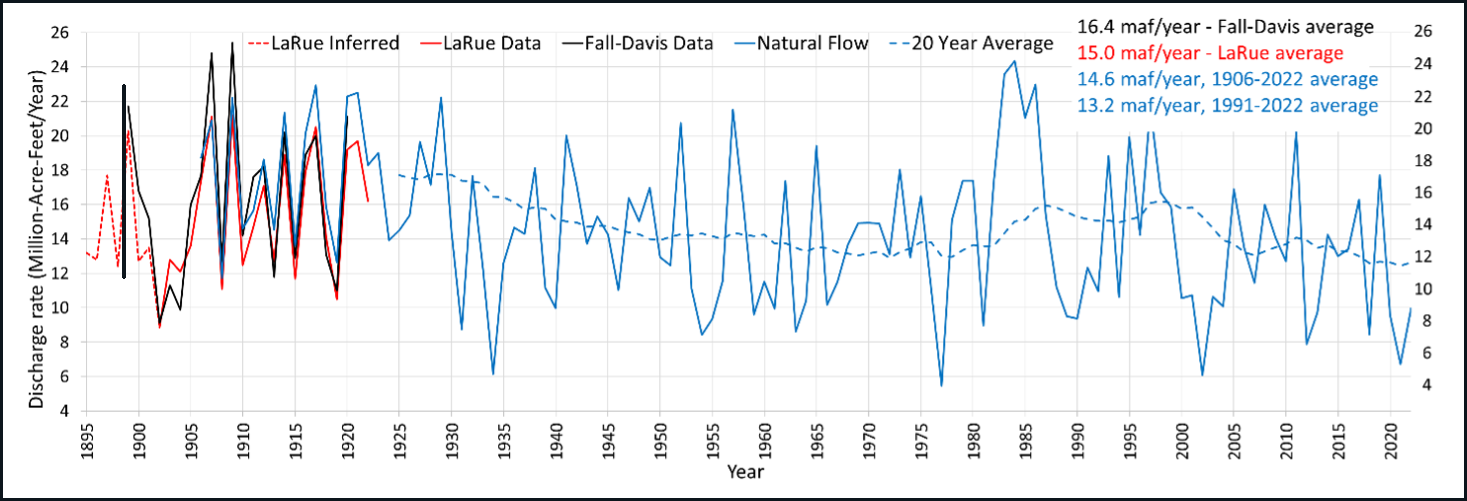
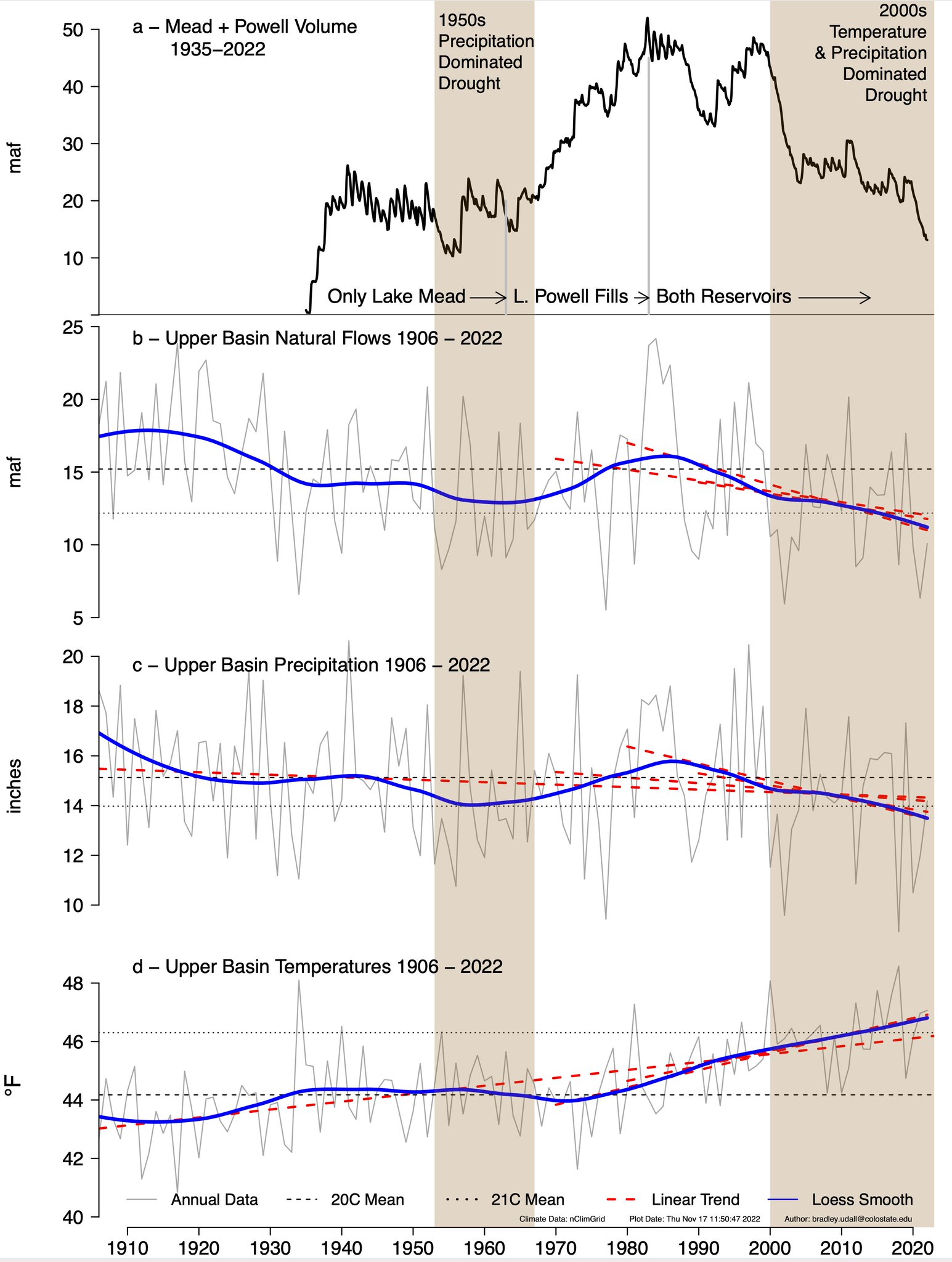
“New plot using the nClimGrid data, which is a better source than PRISM for long-term trends. Of course, the combined reservoir contents increase from last year, but the increase is less than 2011 and looks puny compared to the ‘hole’ in the reservoirs. The blue Loess lines subtly change. Last year those lines ended pointing downwards. This year they end flat-ish. 2023 temps were still above the 20th century average, although close. Another interesting aspect is that the 20C Mean and 21C Mean lines on the individual plots really don’t change much. Finally, the 2023 Natural Flows are almost exactly equal to 2019. (17.678 maf vs 17.672 maf). For all the hoopla about how this was record-setting year, the fact is that this year was significantly less than 2011 (20.159 maf) and no different than 2019” — Brad Udall
A plan from water officials in Arizona, Nevada and California to cut back on the amount of water those states use from the Colorado River in exchange for money with hopes of saving 3 million acre-feet of water over three years is meeting conservation goals, a top water official said Wednesday. The 2023 agreement has already seen 1.7 million acres of improvement less than one year into the effort, Bureau of Reclamation Commissioner Camille Touton said. She says she believes the states are on pace to reach their original goal.
“There is proof here that we can take on these hard moments, but we have to do it together,” said Touton, who spoke during a summit hosted by U.S. Rep. Susie Lee, D-Nev., at Springs Preserve. “We’ve been able to stabilize the system in the short term, and now we are focused on what this river looks like for the future.”
[…]
The $1.2 billion plan in 2023 called for half of the cuts to be made by the end of 2024 — a benchmark that has already been hit. The agreement runs through 2026, when the 100-year legal document about how Colorado River water is shared will expire, and negotiations could bring deeper cuts in water usage based on climate modeling and future warming in the West.
“We really were on the brink of catastrophe in this basin if we got another dry year,” said Colby Pellegrino, Southern Nevada Water Authority’s deputy general manager of resources, of the Colorado River prior to the agreement. “Mother Nature was kind to us, and Congress was very kind to us. And those two things together are what enabled us to get there voluntarily.”
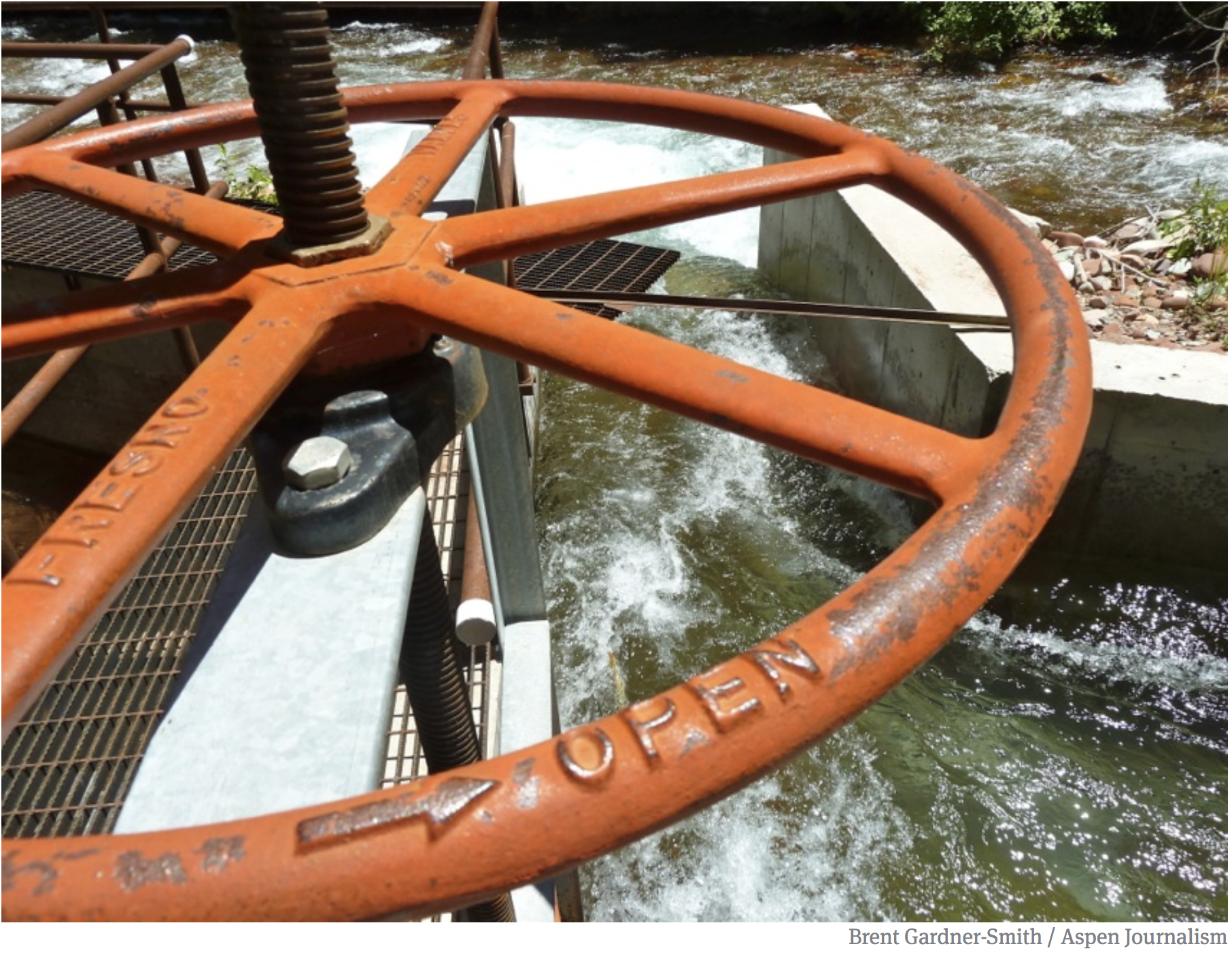
Colorado River “Beginnings”. Photo: Brent Gardner-Smith/Aspen Journalism
Click the link to read the article on the InkStain website (Kathryn Sorensen, Sarah Porter and John Fleck):
August 16, 2024
Colorado River Basin governance is increasingly struggling with a deep question in water management: When we reduce our use of water, who gets the savings?
If I install more efficient irrigation equipment, should I get credit for the saved water to expand my acreage, or save the water in an upstream reservoir as a hedge against next year’s drought? If I tear out lawns, can I use the saved water to help build the next subdivision, or save the water in an upstream reservoir as a hedge against that next year of drought?
Or should the savings contribute, not to my own resilience and well-being, but to the resilience and the well-being of the system as a whole by simply reducing overall water use?
In a deeply insightful 2013 book, British scholar Bruce Lankford bestowed the unfortunately wonky name of “the paracommons” to this question, and it dogs water policy management around the world.
This issue has been lurking in Colorado River management for a long time. Should we create legal structures that allow users to bank the savings for their own use later? Or should the reductions benefit the health of the system as a whole? There are advantages and disadvantages to both approaches, and we need to design new rules for managing the Colorado River with our eyes open on this question.
Assigned Water
In a new paper, we explore the implications of the two paths for the management of a post-2026 Colorado River.
One is to incentivize conservation by giving water users the chance to bank saved water for later use. Known most commonly as Intentionally Created Surplus (ICS), and more broadly in a series of increasingly creative implementations as “Assigned Water,” this creates short term savings.
The other involves permanent reductions – “System Water.” Water use is reduced for the benefit of the Colorado River as a whole.
In more than a decade of experimentation with these policy tools, we have seen the results. Investment in Assigned Water, attractive to water managers because of the allure of getting their water back, has crowded out investment in the more durable System Water reductions that will be needed to bring the Colorado River into balance.
As we develop new operating rules for the river, we need to be mindful of the differences involved.
Assigned Water does not solve the problem of overallocation because when it is deployed we are borrowing against our own bank. Enduring solutions on the river can only be found by addressing overallocation.
Assigned Water creates critically important operational flexibility; it allows its owner to either forgo water deliveries in one year—or pay someone else to—and take delivery of that water during another potentially desperate time.
Assigned Water is generally insulated from shortage, forfeiture and abandonment.
Protection from shortage and forfeiture has value; Assigned Water creates individual resiliencefor its owner. Because of this, the availability of Assigned Water appears to crowd out investment in collective resilience in the form of System Water.
In conversations about post-2026 operations negotiators are contemplating extending, enlarging and/or enhancing Assigned Water and/or creating an operationally neutral form called Top Water. In any form, Assigned Water lives outside of the existing priority system. In this regard, the conversation involves the reallocation of water in Lakes Powell and Mead.
Critics of the West’s priority system of water delivery can rejoice—nearly 40% of the water in Mead in 2023 was Assigned Water, meaning that Assigned Water is replacing priority to a significant degree. But is the priority system like capitalism in that it has its warts but the alternatives are far worse? As the expansion of the rights of municipal water providers, irrigation districts, foreign nations and tribes to own even more and different kinds of Assigned Water is contemplated for a post-2026 world, consideration should also be given to how these changes may also inure to the benefit of environmental non-governmental organizations, hedge funds and water speculators. Those who share John Wesley Powell’s fears will understand the implications because the expansion of Assigned Water in Lakes Powell and Mead may bring about the ultimate divorce of priority-based water rights from arid lands in the Colorado River Basin.
There are important elements of transparency and fairness at play. The large, powerful players on the River received Assigned Water through negotiations not available to others—meaning, there was no open bidding process or invitation to smaller entities to acquire this valuable water. Apparently, there still isn’t. Thought ought to be given to those other stakeholders—smaller cities, farmers, tribes and others—who have made investments and built economies based on the priority system. Imagine a restaurant that operates on a first-come-first-serve basis and a hungry patron who waits patiently in line for the doors to open only to be told that the rules changed while he was waiting and all of the reservations have been claimed through a process from which he was excluded.
It is helpful to continue to deploy a tool as flexible and alluring as Assigned Water, particularly in the form of operationally neutral Top Storage, so there’s no need to throw the baby out with the bath water. A reasonable path forward may be to allow the creation of Top Storage with appropriate guardrails while including a 50% cut for System Water. Post 2026, Assigned Water will be so valuable that entities likely will be willing to take a big haircut to get it, and such a required contribution solves the problem of developing enduring funding for System Water to a significant degree. Maybe ultimately environmental non-governmental organizations, hedge funds and water speculators get a piece, but if so, it will be at the price of protecting and respecting the priority system upon which so many depend.
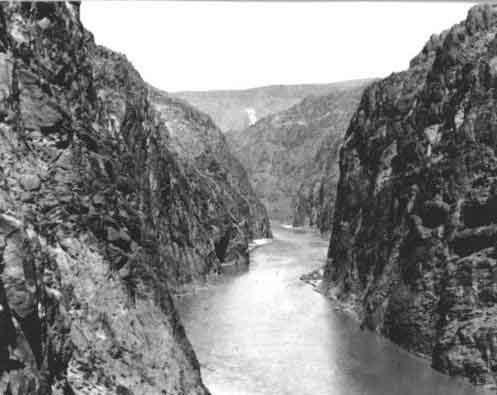
Black Canyon July 2020. Photo credit: Cari Bischoff
From email from Reclamation (Erik Knight):
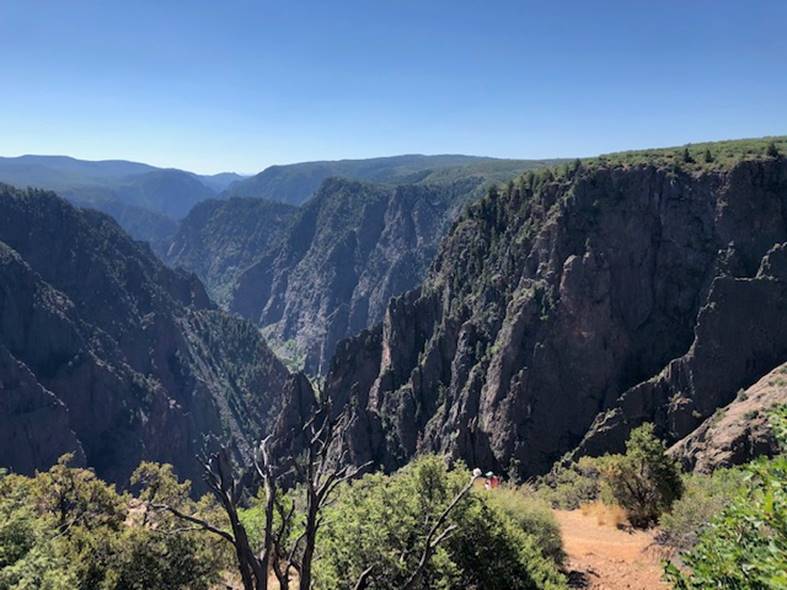
Releases from the Aspinall Unit will be decreased from 1650 cfs to 1550 cfs on Tuesday, August 20th. Releases are being decreased as flows on the lower Gunnison River are well above the baseflow target of 1050 cfs. Further reductions in the release at Crystal may occur soon if river levels remain well above the target.
Flows in the lower Gunnison River are currently above the baseflow target of 1050 cfs. River flows are expected to remain above the baseflow target for the foreseeable future.
Pursuant to the Aspinall Unit Operations Record of Decision (ROD), the baseflow target in the lower Gunnison River, as measured at the Whitewater gage, is 1050 cfs for August through December.
Currently, Gunnison Tunnel diversions are 1050 cfs and flows in the Gunnison River through the Black Canyon are around 600 cfs. After this release change Gunnison Tunnel diversions will still be 1050 cfs and flows in the Gunnison River through the Black Canyon will be around 500 cfs. Current flow information is obtained from provisional data that may undergo revision subsequent to review.
This scheduled release change is subject to changes in river flows and weather conditions. For questions or concerns regarding these operations contact:
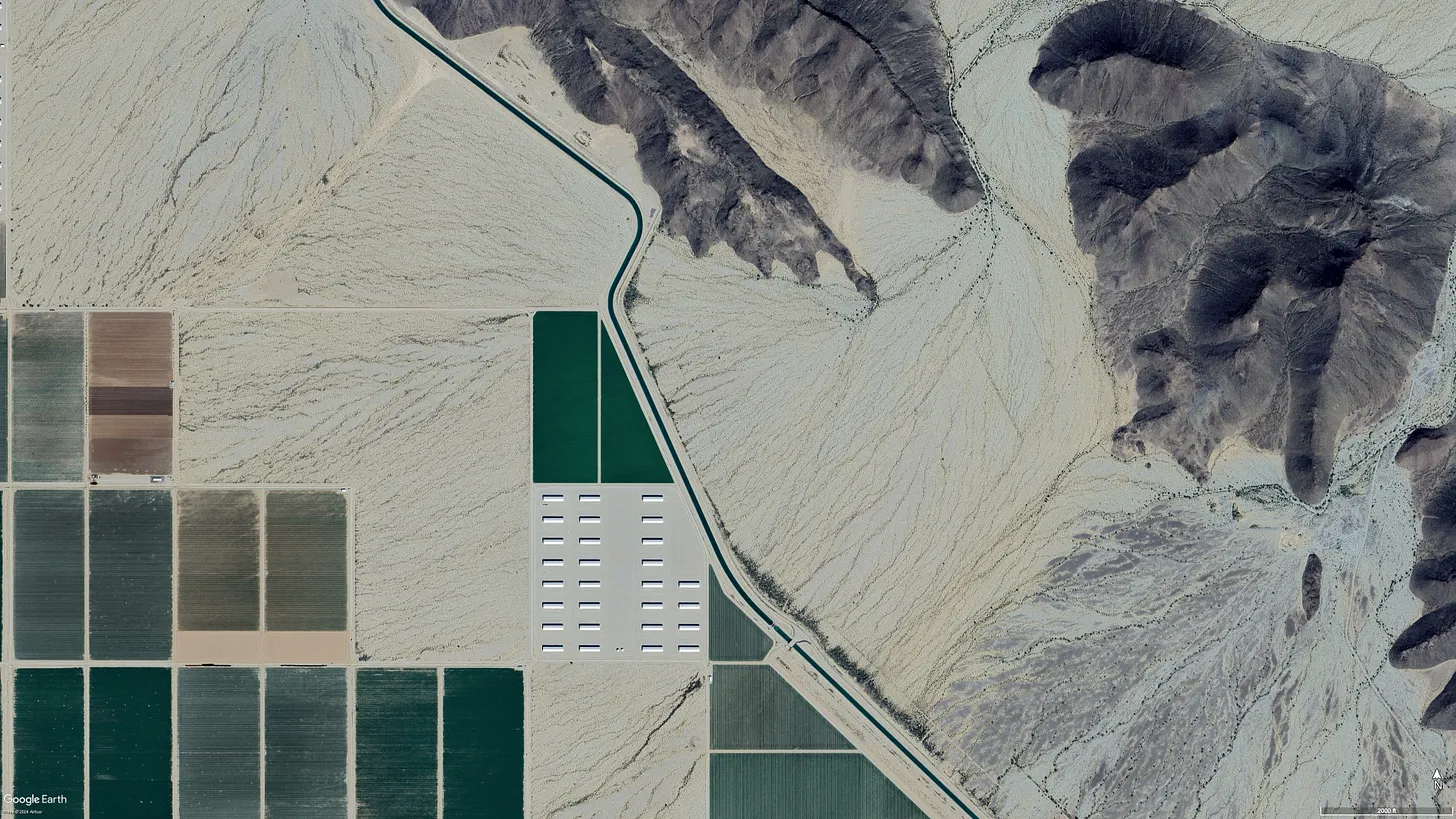
The Central Arizona Project canal passes alfalfa fields and feedlots in La Paz County, Arizona. The fields are irrigated with pumped groundwater, not CAP water. Source: Google Earth.
Imagine that you’ve set off for a hike in the desert of western Arizona, hoping to get up high so you can get a view of the juxtaposition of alfalfa fields against the sere, rocky earth. But you somehow get disoriented, the sun reaches its apex and beats down on you, the temperature climbing into the triple digits. The ground temperature becomes so hot you can feel it through the soles of your Hoka running shoes. Your water bottle is empty. Feeling certain you are going to die you pick a direction and stagger in as straight a line as you can manage, rasping for help. And then, just when you’re about to curl up under a rock and surrender, you see, coming straight out of a hillside, a virtual river. It must be a mirage, you think, or a hallucination, you run toward it, climb the fence, and dive into the cool, deep water.
This is not a fantasy scenario. There is, in fact, a place in the western Arizona desert where a lost traveler could stumble upon a giant canal emerging from the earth.
The Central Arizona Project’s Mark Wilmer pumping plant at Lake Havasu. The 14 plants on the CAP system push water across more than 300 miles with a vertical gain of 3,000 feet. Moving water requires enormous amounts of power, making the CAP the state’s largest single electricity user, with annual power bills totaling $60 million to $80 million. Source: Google Earth.
Central Arizona Project canal daylighting at the Buckskin Mountain Tunnel. Source: Google Earth
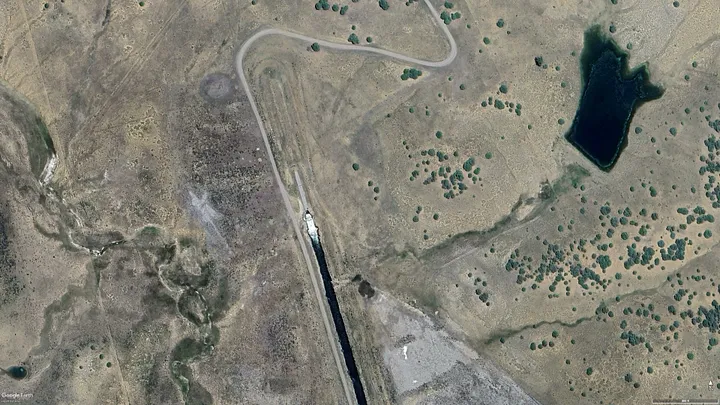
The outlet of the San Juan Chama Project runs into Willow Creek west of Los Ojos before running into Heron Lake. Source: Google Earth
The Rio Blanco intake for the San Juan-Chama Project, which takes water from three upper San Juan River tributaries and ships it across the Continental Divide to the Chama River watershed and, ultimately, the Rio Grande. Source: Google Earth
It’s just one of the crazy plumbing projects along the Colorado River and its tributaries. And they can look pretty weird when you stumble upon them in remote places. That’s what happened to me the other day — virtually. I was using Google Earth to chart the 1776 Escalante-Dominguez expedition’s path when, near Chama, I came across a large volume of water emanating from an arid meadow. After some thought I realized it was the outlet for the San Juan-Chama Project that diverts about 90,000 acre-feet of water annually from three tributaries of the San Juan River, sends it through the Continental Divide via a tunnel, and delivers it to Willow Creek and Heron Reservoir. From there it can be released into the Chama River, which runs into the Rio Grande, which is used by Albuquerque and Santa Fe to supplement groundwater and the shrinking Rio Grande.
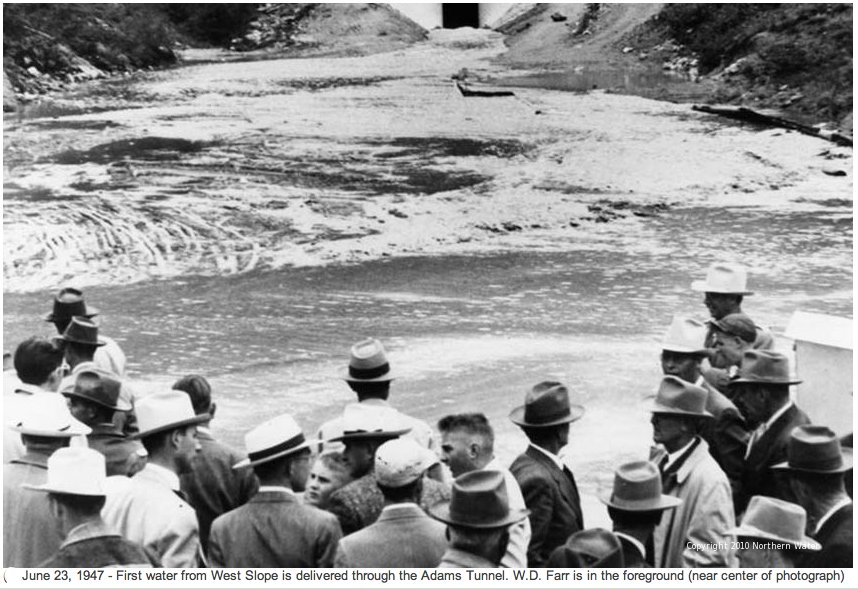
The Big Thompson Project sucks water out of the Colorado River near its headwaters and siphons it through the mountains via the Alva Adams Tunnel. The water feeds reservoirs that feed Front Range cities and is used to generate hydropower. Adams tunnel inlet at Grand Lake. Source: Google Earth
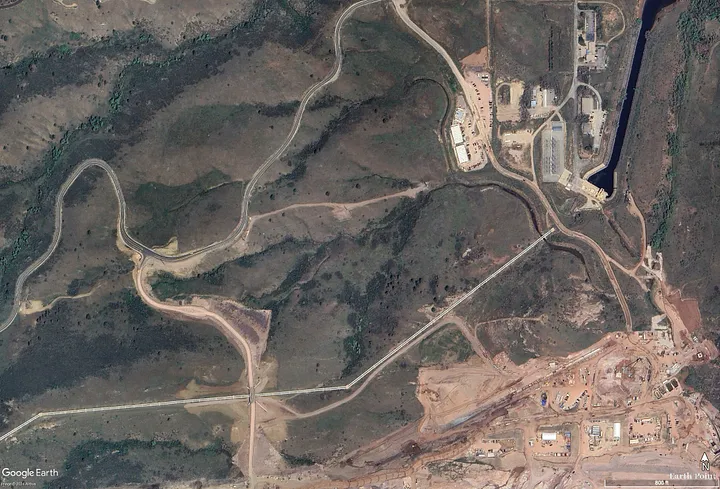
The Big Thompson Project sucks water out of the Colorado River near its headwaters and siphons it through the mountains via the Alva Adams Tunnel. The water feeds reservoirs that feed Front Range cities and is used to generate hydropower. Penstocks and powerplant at Flatiron reservoir on the right. Source: Google Earth
These things aren’t only unsettling in a visual way, but in a conceptual way as well. One would expect cities and agricultural zones to rise up around where the water is and to grow according to how much water is locally available. Instead, cities rise up in places of limited water and grow as if there were no limits, importing water (and power and other resources) from far away.
The Julian Hinds pumping station, near Desert Center, California, lifts water from the Colorado River Aqueduct 441 feet as it makes its way toward Los Angeles. Source: Google Earth
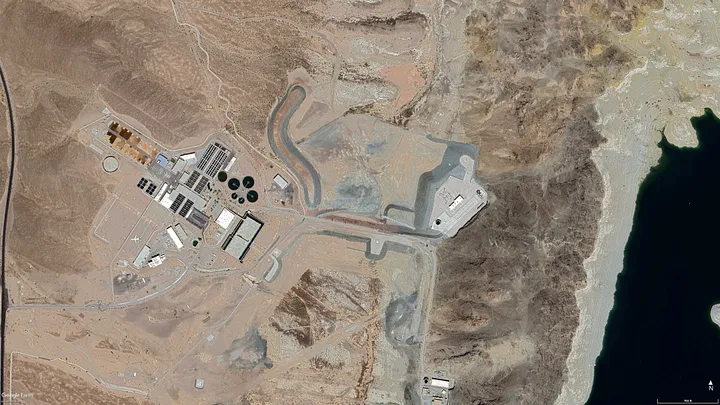
The Southern Nevada Water Authority was forced to build a third water intake from Lake Mead that was able to draw water as the reservoir continued to shrink. The pumping plant is pictured. Source: Google Earth
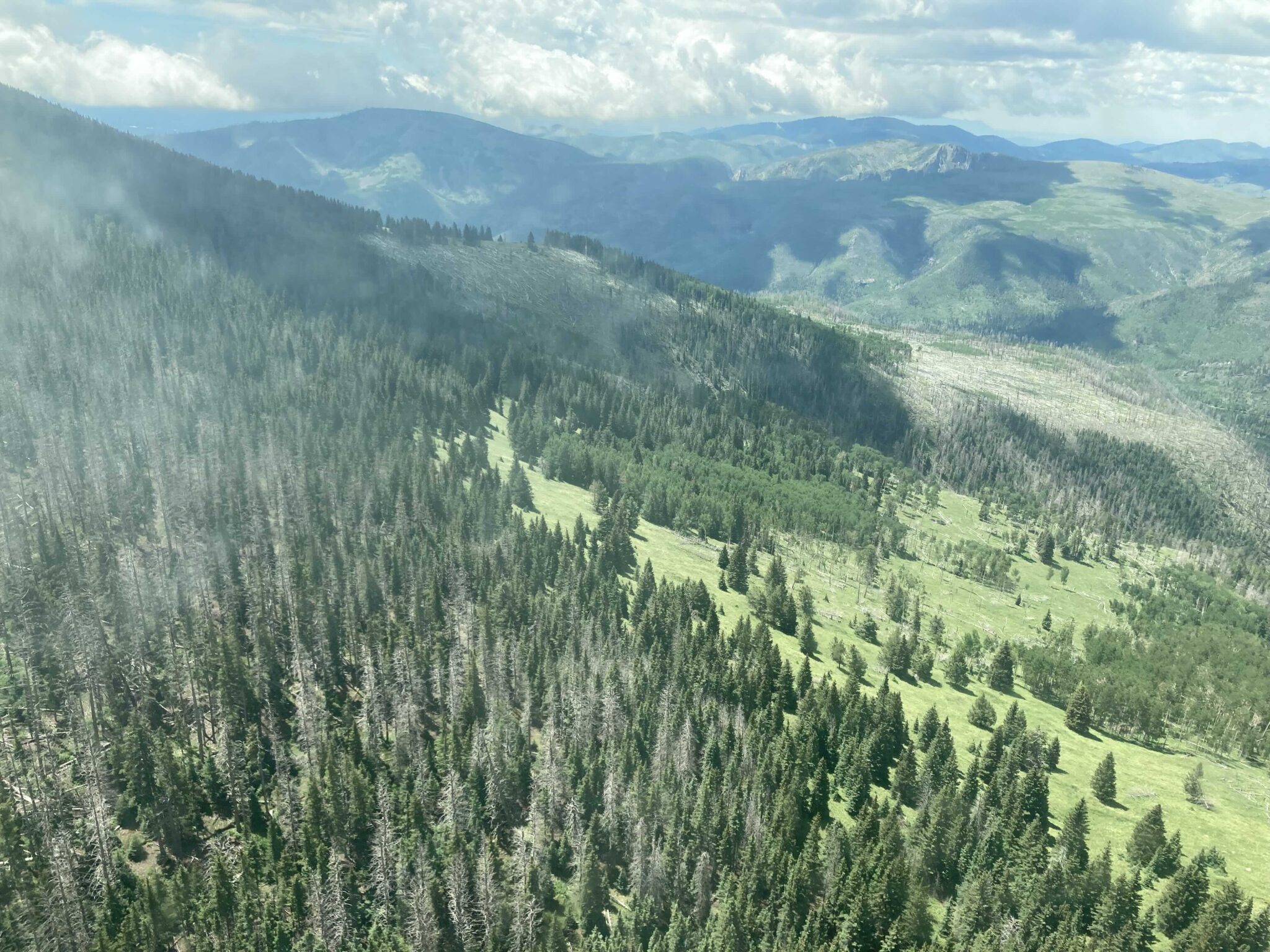
An aerial view of the Jemez Watershed on June 28, 2024. (Photo by Danielle Prokop / Source NM)
Click the link to read the article on the SourceNM.com website (Danielle Prokop):
July 29, 2024
If approved, the settlements would bring in more than $3.7 billion in federal funds and end decades of water rights litigation
The Navajo Nation president and leaders from Acoma, Ohkay Owingeh and Zuni Pueblos joined tribal leadership from across the nation on Capitol Hill, offering testimony about the benefits of $3.7 billion federal dollars in six proposed water rights settlements across New Mexico.
The deals would settle tribes and Pueblos’ water rights in four New Mexico rivers: the Rio San José, the Rio Jemez, Rio Chama and the Zuni River.
Another bill would also correct technical errors in two previously ratified water rights settlements: Taos Pueblo and the Aamodt settlement Pueblos of Nambé, Pojoaque, Tesuque and San Ildefonso. Finally, a sixth bill would add time and money for the Navajo-Gallup water project to construct drinking water services.
New Mexico representatives presented a record six settlements for Pueblos and tribes at a subcommittee hearing Tuesday, the first step in getting needed Congressional approval to end decades of litigation. Companion proposals from the Senate were heard Friday in the Senate Indian Affairs Committee. Mescalero Apache Tribe President Thora Padilla was introduced to senators with support for the settlements.
As climate change reshapes the Southwest into something hotter and drier, with more strain on its water resources, approaching water collaboratively means communities have a chance to stay, and tribes can exercise their sovereignty.
In front of House members on Tuesday, Ohkay Owingeh Gov. Larry Phillips Jr. said the settlement of the Ohkay Owingeh’s rights on the Rio Chama will offer a means of long-awaited restoration.
“The U.S. bulldozed our river, it destroyed our rivers and bosque,” he said. “This needs to be fixed, the settlement gives us the tools to do that.”
Rep. Teresa Leger Fernández (D-N.M.) said tribes and Pueblos gave up certain acreage that they are entitled to, and worked out drought-sharing agreements to benefit everybody in the region.
Leger Fernández sponsored five of the bills, and Rep. Gabe Vazquez (D-N.M.) sponsored a sixth that was heard on Tuesday.
Additionally, she said the funds will enable more infrastructure, bosque restoration and ensuring water rights protections for neighboring acequias.
Acoma Pueblo Gov. Randall Vicente told the committee that making concessions in the settlement was crucial to preserving water for future generations.
“It is better to have adequate wet water, than paper rights without a water supply,” he said.
Even if the Pueblo enforced having the oldest water right, Vicente said the Rio San José’s system is so damaged, it would take decades for water to reach Acoma.
The settlements can help redress the federal government’s injustices towards Ohkay Owingeh Pueblo, Phillips said. He pointed to the U.S. Army Corps of Engineers and U.S. Bureau of Reclamation’s channelizing of the Rio Chama and the building of Abiquiu Reservoir in the 1950s, which moved water away from the Pueblo.
“Both of these actions resulted in depriving us of our bosque and waters necessary for a proper river,” he said. “We entered into the settlement in order to protect, preserve our water resources and the bosque.”
The loss of water not only impacts the health of Pueblo communities, Phillips said, but it splits people from their lands and means the loss of sacred bodies of water and ceremonies to celebrate them.
Water offers a lifeline to traditional ways and offers prosperity, said Zuni Pueblo Gov. Arden Kucate.
Zuni Pueblo will work to build new drinking water treatment systems and restore waffle garden irrigation practices, a technique used for generations until the turn of the 19th century, when settlers diverted water and clearcut the Zuni River watersheds.
“It will usher in, what I sincerely believe, will be a new chapter for our tribe, allowing us to protect and sustainably develop our limited water resources, to restore traditional agriculture and facilitate much-needed economic development,” Kucate said about the settlement.
Navajo Nation President Buu Nygren also spoke, celebrating water rights settlements with both New Mexico and Arizona.
Some of the settlement agreements are already two years old.The administration supports all of the New Mexico settlements, said Bryan Newland (Ojibwe), the assistant secretary for Indian Affairs at the U.S. Department of the Interior.
“Any delay in bringing clean, drinkable water to communities is going to harm the people who live in those communities,” Newland said. “We also know from our experience that these settlements only get more expensive, and implementation only gets more expensive the longer we wait.”
Tribal water rights are not entirely settled in New Mexico, most notably on the Rio Grande, where a federal assessment team started addressing water claims issues in 2022. Leger Fernández said she hopes the six water rights settlements in other watersheds will provide a model for collaborative management of water rights on New Mexico’s largest river.
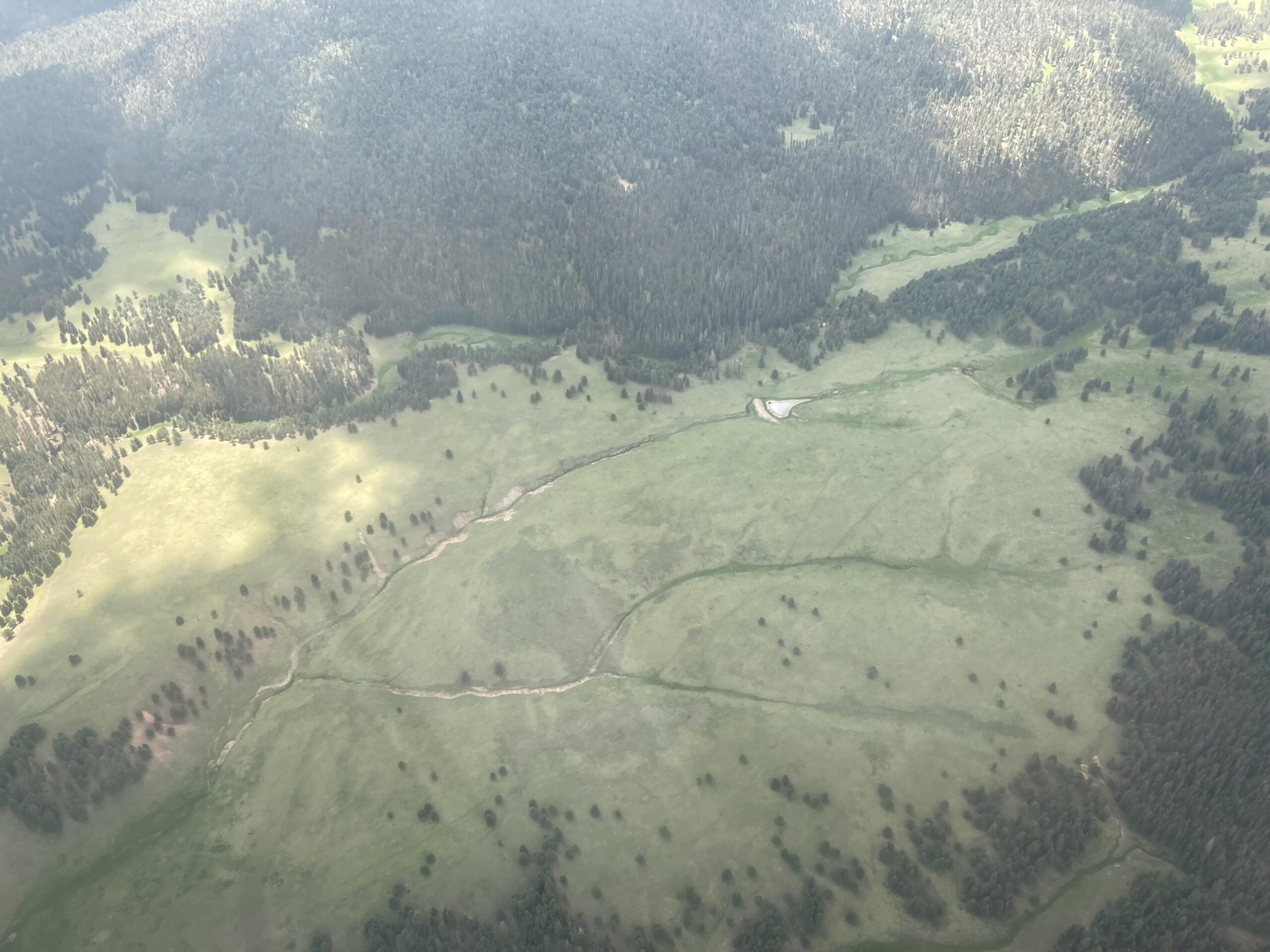
An aerial view of the Jemez Watershed on June 28, 2024. (Photo by Danielle Prokop / Source NM)
“These water rights settlements provide the framework for future water rights settlements, which include those involved in Rio Grande,” Leger Fernández said.
Leger Fernández said the moment was still momentous, even if it’s only the first step.
“There’s never been this many settlements at one time,” she said. “There has never been a hearing that was this big.”
What’s the process?
The House Committee on Natural Resources held a legislative hearing on 12 water rights settlements across the U.S. with a projected cost of $12 billion.
The hearing consisted of testimony from federal agencies and heads of tribal governments.
The settlements can now head into a process called mark-up and means they can be added to legislative packages moving forward. Both of New Mexico’s senators sponsored companionate bills.
It’s just the first step in the process, but Leger Fernández said she’s looking to face the biggest hurdle of cost head-on. She and members of the Department of the interior testified that continuing to fight court battles will cost the federal government more money, and that waiting isn’t an option.
“The longer we wait, the more expensive it will be,” she said.
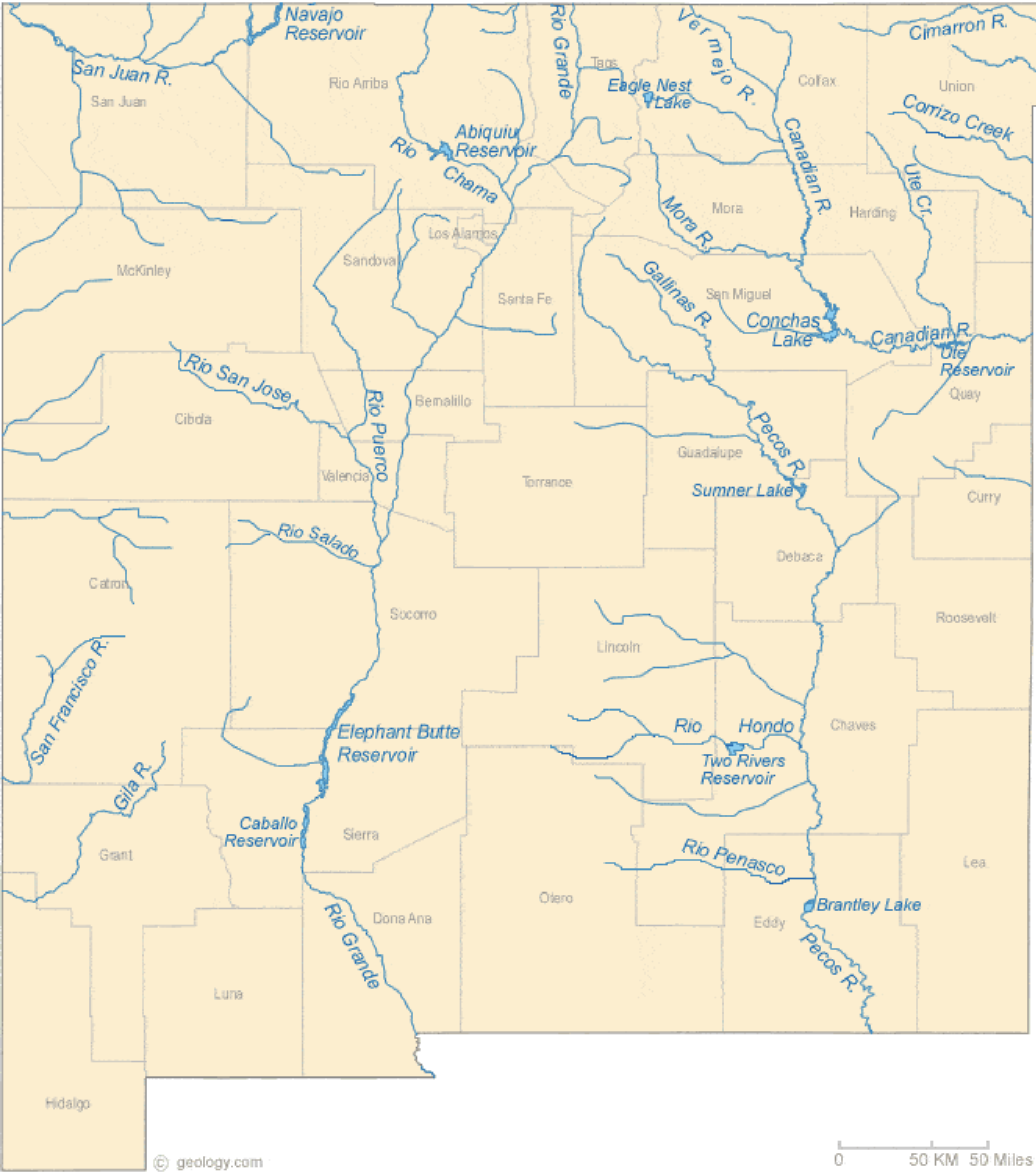
New Mexico Lakes, Rivers and Water Resources via Geology.com.
JB Hamby, Imperial Irrigation District’s vice chairman, walks near an irrigated field in the Imperial Valley on June 20, 2023. A new water conservation plan in the district will see more than half a billion dollars spent to incentivize farmers to use less. Photo credit: Alex Hager/KUNC
Click the link to read the article on the KUNC website (Alex Hager):
August 14, 2024
This story is part of ongoing coverage of the Colorado River, produced by KUNC and supported by the Walton Family Foundation. KUNC is solely responsible for its editorial coverage.
The Colorado River’s largest water user agreed to leave some of its supplies in Lake Mead in exchange for a massive federal payout. But environmental advocates say the plan was rushed and could harm wildlife habitat and air quality.
The Imperial Irrigation District, which supplies water to farms in the Southern California desert, stands to receive more than $500 million from the Inflation Reduction Act. The cutbacks, spread out over the next three years, are part of a plan to prop up Lake Mead. Mead is the nation’s largest reservoir and holds water for farms and major cities like Los Angeles, Phoenix and Las Vegas.
State and federal leaders are under pressure to cut back on water demand as climate change shrinks supplies. Imperial, which has a larger allocation of Colorado River water than any other farming district or city between Wyoming and Mexico, has ended up in the crosshairs as a result.
“IID has cleared enormous hurdles to make this deal happen,” JB Hamby, Imperial’s vice chairman, wrote in a press release. “There is no excuse for inaction anywhere along the river.”
In 2023, farmers in the Imperial Valley told KUNC that payments were the only way to get them to use less. That message has landed with policymakers too. The federal government set aside $4 Billion for Colorado River work, and a sizable portion of that has been directed specifically at programs that incentivize farmers to reduce their water use. Those programs have already spent big in the Imperial Valley and other faraway farm districts.
Sun bakes the Salton Sea on June 21, 2023. Environmental advocates worry that a new water-saving plan would result in the lake drying further, harming wildlife habitat and air quality by sending windblown dust toward nearby communities. Photo credit: Alex Hager/KUNC
But as money flows to the Imperial Valley, environmental and health advocates want to make sure there’s enough set aside to stave off negative impacts of bringing less water to the area.
Changes to Imperial Valley water use are virtually inseparable from changes to the Salton Sea.
It’s a giant lake on the Valley’s north end, and it’s mostly filled with runoff from nearby farm fields. As the valley’s farmers use less water, the Salton Sea will continue to dry up, reducing habitat for the flocks of migratory birds that stop there and producing dust storms that increase the risk of asthma and other respiratory diseases among the valley’s residents.
Nataly Escobedo Garcia, water policy coordinator at the Leadership Counsel for Justice & Accountability, co-signed a July letter asking the federal government to go further in protecting wildlife and air quality as it works on water cutbacks near the Salton Sea.
“We completely believe in conserving that water,” she said. “We want to make sure that we have a healthy system, because we also depend on the Colorado River water system. But given the amount of funding that’s available to do this conservation, we don’t see why some of that can’t go towards these direct impacts that communities are going to feel.”
Some critics of the conservation plan’s rollout said the process was rushed, and didn’t allow enough time for public comment on its impacts to the environment. The conservation agreement was inked about five hours after the federal government released its Environmental Assessment.
“You had ample time to do a full environmental impact report, which our community deserves,” Eric Reyes, executive director of local nonprofit Los Amigos de la Comunidad, said at the Imperial Irrigation District board meeting on Tuesday.
“My disappointment overflows,” he said. “The public needs to be informed, we need to be engaged, and this is not the way to do it, at the last second.”
In response to a flash drought that has developed throughout the northern Front Range, the Board of Directors of the Northern Colorado Water Conservancy District has increased the quota allocation of the Colorado-Big Thompson Project by 10 percentage points.
In a unanimous vote, the Board on August 14, 2024, increased the quota from 70 percent to 80 percent, meaning an approximate 31,000 acre-feet of water will be made available to allottees of the Project.
According to the U.S. Drought Monitor, a large area of eastern Boulder and Larimer counties have entered severe drought status in July, and an area of drier conditions in the Longmont-Boulder area has worsened into extreme drought conditions, putting at risk the ability of farmers to finish production of their crops for 2024.
Water storage levels in the Project are adequate to meet the additional quota declaration.
Northern Water’s Board typically sets an initial quota in November and a supplemental quota in April, but there have been occasions in which additional quota has been allocated, including in 2020 and 2022. In April, the Board set the quota at 70 percent, which allowed project allottees to access seven-tenths of an acre-foot for each allotment contract unit they own.
The Imperial Irrigation District in California, which uses more Colorado River water than any other district in the West, finalized an agreement on Monday to leave up to 700,000 acre-feet of water in Lake Mead through 2026.
As part of the landmark conservation agreement with the U.S. Bureau of Reclamation, the district will receive federal funding for conservation programs from 2024 through 2026 to conserve up to 300,000 acre-feet a year of water that will remain in Lake Mead to aid the drought-stricken Colorado River.
Funding will be used to pay agricultural water users to implement field-level conservation measures, and short-term pauses of water-intensive crops like established Alfalfa, Bermuda grass, and Klein grass crops.
The agreement approved on Monday by the Imperial Irrigation District Board of Directors is the largest conservation agreement in terms of volume anywhere in the Colorado River Basin, according to the district. The Imperial Irrigation District, serves a large portion of the Coachella Valley in the Colorado Desert region of Southern California.
As of August, Lake Mead is at 33% of capacity, meaning even the latest conservation efforts in California are unlikely to halt emergency water cuts this summer. In 2021 and 2022, Lake Powell and Lake Mead — the two largest reservoirs in the nation — both fell below critical thresholds, triggering emergency cuts and federal action to protect the lakes.
Rebecca Mitchell, John Entsminger, Estevan Lopez, Gene Shawcroft, JB Hamby, Tom Buschatzke at the Getches-Wilkinson Center/Water and Tribes Initiative Conference June 6, 2024. Photo credit: Rebecca Mitchell
JB Hamby, the Vice Chairman of the Imperial Irrigation District and the Colorado River Commissioner for California, said the Imperial Irrigation District’s “efforts provide an example for other states and regions to follow as we plan for a drier future in the Colorado River basin.”
“IID has cleared enormous hurdles to make this deal happen — there is no excuse for inaction anywhere along the river,” he continued.
The new agreement builds on the 100,000 acre-feet of water the Imperial Irrigation District agreed to conserve in Lake Mead last year, a total of about 800,000 acre-feet of conservation through 2026.
Under additional water transfer agreements, the Imperial Irrigation District plans to conserve about 24% of their annual water entitlement for the next three years, or about 500,000 acre feet a year of water.
The district’s aggressive conservation efforts are part of the Lower Basin Plan between Arizona, California, and Nevada to conserve 3 million acre-feet of water by 2026 to protect the Colorado River system from extended drought.
In total, the agreement adds up to over half of California’s commitment to conserve up to 1.6 million acre-feet of water, a total approved by the Bureau of Reclamation for the final Supplemental Environmental Impact Statement for Near-term Colorado River Operations drafted last year.
In 2022, Congress passed the Inflation Reduction Act to provide $4 billion in funding to the Bureau of Reclamation to mitigate drought in the western United States, prioritizing the Colorado River Basin.
“The decisive action taken by our Board today demonstrates how the District and our water users work together to make meaningful contributions to the Colorado River,” said Gina Dockstader, Imperial Irrigation District Director. “We value the collaborative relationship with the Bureau of Reclamation that has allowed us to craft an agreement we can all support and make a difference.”
Salton Sea with the Imperial Valley in the foreground. Ted Wood/The Water Desk
Click the link to read the release on the Imperial Irrigation District website:
August 12, 2024
Today,the Imperial Irrigation District Board of Directors approved a landmark conservation agreement with the federal government to leave up to 700,000 acre-feet of water in Lake Mead through 2026.
The Board’s approval of the System Conservation Implementation Agreement (SCIA) with the U.S. Bureau of Reclamation will provide funding for the implementation of conservation programs from 2024 through 2026 to conserve up to 300,000 acre-feet a year of water that will remain in Lake Mead to aid the drought-stricken Colorado River.
The conservation programs authorized under the SCIA include expanding IID’s existing On-Farm Efficiency Conservation Program (OFECP) and a new Deficit Irrigation Program (DIP). The OFECP incentivizes agricultural water users to implement field-level conservation measures while the DIP would fund short-term idling of established Alfalfa, Bermuda grass, and Klein grass crops. These water conservation measures will unlock the balance of nearly $250 million in federal funding for Salton Sea restoration efforts, authorized in a 2022 historic agreement to accelerate the construction of thousands of acres of dust suppression and aquatic habitat projects.
“The decisive action taken by our Board today demonstrates how the District and our water users work together to make meaningful contributions to the Colorado River and the Salton Sea,” said Gina Dockstader, IID Director and Salton Sea Authority President. “We value the collaborative relationship with the Bureau of Reclamation that has allowed us to craft an agreement we can all support and make a difference.”
“IID’s efforts provide an example for other states and regions to follow as we plan for a drier future in the Colorado River basin,” stated JB Hamby, IID Vice Chairman and Colorado River Commissioner for California. “IID has cleared enormous hurdles to make this deal happen — there is no excuse for inaction anywhere along the river.”
A Collaborative Effort with Far-Reaching Impact
Advocated by the seven Colorado River Basin States, Congress in August 2022 authorized the Inflation Reduction Act to provide $4 billion in funding to the Bureau of Reclamation to mitigate drought in the western United States, prioritizing the Colorado River Basin. In October 2022, the Bureau of Reclamation established the Lower Colorado River Basin System Conservation and Efficiency Program for water delivery contractors, entitlement holders, and tribes.
The program provides funding for near-term water conservation, through 2026, to generate conserved water that remains in the Colorado River system. The agreement approved today by IID is the largest volumetric SCIA anywhere in the Colorado River Basin, and when combined with IID’s 2023 SCIA, will create in excess of 800,000 acre-feet of conservation.
The 2024 – 2026 SCIA will fund the development of significant volumes of conserved water over the next three years that, when combined with IID’s existing 2003 Quantification Settlement Agreementlarge-scale conservation and transfer programs, will total up to 750,000 acre-feet of conservation each year, or about 24 percent of IID’s annual Colorado River entitlement. The federal funding for this conservation is commensurate with IID’s San Diego County Water Authority water transfer program.
About IID and Farming in Imperial Valley:
IID has conserved over 7.7 million acre-feet of water since 2003, with 1.5 million generated through the On-Farm Efficiency Conservation Program since 2013.
Last year, IID conserved 106,111 AF of System Conservation Water that was left in Lake Mead under a 2023 SCIA.
In 2023, IID generated over 500,000 AF of conservation with 215,382 AF created by IID growers participating in the On-Farm Efficiency Conservation Program.
Imperial Valley farmers and IID continue to ramp up water conservation efforts annually, utilizing advanced irrigation technologies and sustainable farming practices, including the installation and use of sprinklers, drip systems, field reconfiguration and precision land-leveling, tailwater return systems, and other field-level conservation measures.
Imperial Valley remains one of California’s and the Colorado River Basin’s top agricultural producers, with one in every six jobs directly related to agriculture, the backbone of the local economy.
“New plot using the nClimGrid data, which is a better source than PRISM for long-term trends. Of course, the combined reservoir contents increase from last year, but the increase is less than 2011 and looks puny compared to the ‘hole’ in the reservoirs. The blue Loess lines subtly change. Last year those lines ended pointing downwards. This year they end flat-ish. 2023 temps were still above the 20th century average, although close. Another interesting aspect is that the 20C Mean and 21C Mean lines on the individual plots really don’t change much. Finally, the 2023 Natural Flows are almost exactly equal to 2019. (17.678 maf vs 17.672 maf). For all the hoopla about how this was record-setting year, the fact is that this year was significantly less than 2011 (20.159 maf) and no different than 2019” — Brad Udall
From satellite view, the land north of the Arkansas River is a seemingly random checkerboard of vital green and desperate brown, quickly fading from a few thriving farm acres to the broad, water-drained desolation of northern Crowley County.
From the cab of Matt Heimerich’s pickup, each alternating square of emerald corn or desiccated knapweed is a decision by a distant big city — to either share Colorado resources responsibly or toss rural Arkansas River counties to the fate of the hot summer winds.
That square was reseeded with native grass after Aurora bought the water in the 1970s, Heimerich says. That plot, Colorado Springs dried up and it’s all weeds. That farm, Aurora wants to dry it up soon, but the water court referee wants a better reseeding plan.
Heimerich’s family is one of the few farmers remaining in the 790 square miles of Crowley County after city water buy-ups shrank the county’s irrigated acres from more than 50,000 in the 1970s to just a few thousand this year. He jumps down from the pickup to clear invasive kochia weeds from a pipe opening gushing cool canal water down a 1,500-foot corn row.
Straight line diagram of the Lower Arkansas Valley ditches via Headwaters Magazine
Two miles away is downtown Olney Springs, population 310. Crowley County as a whole has only 5,600 residents, and more than a third of those are inmates at two prisons. The only retail operation left in Olney Springs is a soda vending machine against the wall of town hall.
As Heimerich clears his irrigation pipe, he pauses to jab a thumb over his shoulder 150 miles to the north at Aurora, where the population increased by more than 100,000 over 20 years. “When you build a new development, at the end of the day, you’re drying up a farm,” Heimerich said. “Where else is it going to come from?”
“Crowley is just the worst example of what can happen when nobody cares, and nobody pays attention,” he said. The tiny community serves as an enduring reminder of the cultural and economic ruin that occurs when big cities in Colorado and elsewhere purchase farms, dry up the land and move the water to urban areas. It gave rise to the term “buy and dry,” a practice now widely condemned.
The practice was supposed to end in the Lower Arkansas Valley in 2003 with a hard-fought federal court battle and settlement. Since then, state lawmakers and top water and farm agencies have changed laws and spent millions of dollars testing new protective methods for sharing water temporarily between rural and urban areas. They have also spent heavily to improve water quality for thousands of people living near the river who still don’t have clean water to drink.
The big cities insist they have learned their lessons from the Crowley County disaster.
“The results of what happened in Crowley County are unacceptable and widely recognized as a travesty,” said Colorado Springs Utilities spokesperson Jennifer Jordan. “We’ve taken those lessons to heart.”
Arkansas River Basin — Graphic via the Colorado Geological Survey
But outraged Lower Arkansas growers and water districts say new efforts to protect their farm water aren’t working. At the same time, the big cities say new laws making it easier to share farm water don’t provide enough reliable water to grow their communities.
The cities also say big changes in the future water picture, climate-driven reductions in stream flows and threats to their Colorado River supplies leave them little choice but to draw more farm water.
This year they did that, inking deals in the Lower Arkansas worth more than $100 million to buy and lease land and water, raising alarms among local growers and generating big questions about whether the state is doing enough to protect rural farm communities and the water that keeps them going.
Buy and dry light
The cities say a lot has changed in the past 20 years and that these new deals represent innovations in water sharing. But critics in the Lower Arkansas Valley say these same deals signal that no one is doing enough to prevent “buy and dry” or the latest tool in the water acquisition quiver, “lease and dry,” in which water is pulled from farmland periodically.
Aurora, for instance, spent $80 million in April to buy nearly 5,000 acres of farms in Otero County and the more than 6,500 acre-feet of water associated with that land. An acre-foot equals nearly 326,000 gallons of water, enough to irrigate half an acre of corn, or supply at least two urban homes for one year.
Aurora plans to use the water itself in three out of 10 years, leaving it on the farms the rest of the time. Some 4,000 acres of land will be dried up intermittently when Aurora is using the water, according to Karl Nyquist, a developer and grower who negotiated the deal with Aurora and who is operating the farms for Aurora under the lease agreement.
Colorado Springs has a different arrangement just downriver in Bent County, where it will permanently purchase up to 15,000 acre-feet of water from local farmers. Colorado Springs will also help pay local farmers to install modern center pivot irrigation systems that use less water, allowing the city to keep the saved water for its use.
In Crowley County. Photo: Brent Gardner-Smith/Aspen Journalism
In this deal, Colorado Springs and the farmers will be responsible for revegetating any dried-up land. It will use the water in five out of 10 years, and it has agreed to make a one-time, upfront payment of $2.5 million to Bent County plus payments each year based on how much water is taken off the fields. The money is in addition to payments to farmers.
“We wanted to make sure Bent County was kept whole,” said Scott Lorenz, a senior water projects manager with Colorado Springs Utilities.
Bessemer Ditch circa 1890 via WaterArchives.org
And in Pueblo County, perhaps the least controversial of the three deals, Pueblo Water agreed to purchase nearly one-third of the shares in the local historic Bessemer Ditch system for $56.2 million. Pueblo continues to lease the water back to the farmers for now. At the same time, the Palmer Land Conservancy has developed a sophisticated new framework that measures farm productivity on land watered by the Bessemer Ditch and will eventually help direct water to the most productive farms as Pueblo takes its water. The hope is that the new system will increase overall farm productivity on the ditch system and help make up for anything lost when the less productive lands are dried up, according to Dillon O’Hare, Palmer’s senior conservation manager.
Palmer is also working to analyze the impact of the deals on water quality downstream and how to prevent further damage, O’Hare said.
Irrigated farmland is evaporating
The three projects come as new data shows Colorado’s irrigated farmlands are shrinking. Since 1997, the state has lost 32% of these lands, with areas in the Lower Arkansas Valley seeing losses higher than that, according to an analysis of federal agricultural data by Fresh Water News.
Crowley County has lost 90% of its irrigated lands in that period. Pueblo has lost 60.2%, and Bent and Otero have lost 37.6% and 35.2%, respectively.
State agriculture and water officials are worried about the decline, but say they have few tools to prevent it because farmers are free to sell their water rights to whomever they want.
“Am I concerned? Definitely,” said Robert Sakata, a long-time vegetable grower near Brighton, and former member of the Colorado Water Conservation Board who now serves as the director of water policy for the Colorado Department of Agriculture. “We all talk about water being a limited resource, but prime farmland is also limited and it’s important to take that into consideration.”
Not all these losses are due to big city water prospecting. Climate change, market challenges and legal obligations to deliver water to downstream states are also fallowing Colorado farmlands.
Everyone is sympathetic. No one is in charge.
Still, more than 20 years after the intergovernmental peace accords, it wasn’t supposed to be this way.
The Lower Arkansas Valley region is part of the sprawling Arkansas River Basin. The river has its headwaters near Leadville and flows through Buena Vista, Salida, Cañon City, into Pueblo Reservoir and on over the state line east of Lamar.
Its counties were once a sweet spot in the basin’s agriculture economy. The river fed a bountiful chain of tomato, sugar beet and onion fields, as well as acres of luscious Rocky Ford melons, and chiles, corn and alfalfa.
Cities say these latest deals, which they call “water sharing” agreements, will bolster the agricultural economies and keep remaining water on farm fields forever. But the term “sharing” doesn’t sit well with some local farmers and water officials who have a deep distrust of the cities they blame for the region’s decline.
“I call it a charade,” said Mike Bartolo, a retired Colorado State University Extension research scientist who farms in Otero County near Rocky Ford. “You dry up an acre, you’re drying up land that was formerly irrigated. That’s buy and dry.”
While the state’s highly touted Water Plan cheers for the concept of cities helping rural areas thrive after water losses, there is no mechanism or state law or bureaucracy to watchdog new sales.
After the 2003 agreement in the Lower Arkansas Valley, state and local water leaders began testing new ways for cities and farmers to temporarily share water, something that had been almost impossible under older water law.
But Aurora and Colorado Springs say the early experimental programs didn’t provide enough water at reasonable prices to fulfill their fast-growing community needs permanently.
Lorenz, the Colorado Springs Utilities manager, said the city does lease some water in the valley, but it hasn’t been enough to ensure the stability of its long-term water supply.
“The major concern is that we would lease from a particular farmer, and then a different city would come out and buy those water rights and the farmer wouldn’t lease to us anymore,” he said.
And in fact that is what just happened in April, when Aurora purchased the Otero County farms, which had formerly leased water to Colorado Springs.
Colorado Springs Utilities formally opposes the latest Aurora water deal, as do the Southeastern Colorado Water Conservancy District based in Pueblo, and the Lower Arkansas Valley Water Conservancy District in Rocky Ford.
But their anger has so far been expressed by passing resolutions, not filing lawsuits.
How Aurora Water and other cities have treated Arkansas River counties like Crowley after past buy-ups leaves nothing but suspicion about newly announced deals, local leaders say.
Though Aurora says it is not attempting any more permanent dry-ups of local land, “I don’t think any of us believe them,” said Heimerich, Crowley County’s representative on the Southeastern Conservancy board. Heimerich also is a member of the board of Water Education Colorado, which is a sponsor of Fresh Water News. “They’ll do whatever they need to do and apologize later.”
Thornton, Larimer and Weld counties conducted a similar debate publicly — from the 1990s to this year — as Thornton bought up 17,000 acres of northern Colorado farms and their water rights and began drying up the land. County commissioners and other local officials brought their legal weight and bully pulpits to bear in demanding extensive concessions from Thornton. The Adams County city has been reseeding dried up land with native grass and backfilling lost property taxes, but gets mixed reviews from locals.
The latest Lower Arkansas water deals are also pitting Colorado’s big cities directly against each other in conflicts not seen for decades. When the board of Colorado Springs Utilities passed a resolution earlier this year condemning Aurora’s Otero County deal, it was a direct shot from leadership of a city of nearly 500,000 — the Colorado Springs City Council is the utility board.
“The idea is that there’s Denver, there’s a Denver metro complex and they’re going to just do whatever they want to do and the rest of the state has to go along with it,” City Councilman Brian Risley said.
But Alex Davis, a top Aurora Water official, said Colorado Springs’ ire is unwarranted.
“Aurora has worked in close partnership with Colorado Springs for decades and that will continue,” she said. “This is a case where we disagree.”
Peter Nichols, general counsel for the Lower Arkansas Water Conservancy District in La Junta, said he is deeply concerned by what cities are proposing now.
“We thought we were through with all of this. We thought we had it under control,” he said of the Aurora and Colorado Springs purchases.
Nichols is among those who have spent much of the past 20 years creating a system, now known as the super ditch, that allows seven local irrigation companies to negotiate leases with cities.
A map of the Fry-Ark system. Aspen, and Hunter Creek, are shown in the lower left. Fryingpan-Arkansas Project western and upper eastern slope facilities.
Importantly, it also won the legal right to move leased water stored in Pueblo Reservoir out of the valley, via the federal Fryingpan-Arkansas Project and the Otero Pipeline, removing what had been a key barrier to leasing.
Nichols said local growers and water districts have worked hard to find ways to share water so that it doesn’t permanently leave the valley. That the cities are now jumping the line with these new deals isn’t OK with him.
A farmer’s — and a county’s — greatest asset
Colorado Springs and the other thirsty Front Range cities want farmers like the young Caleb Wertz to be the new face of urban water agreements. On a recent 95-degree summer afternoon, Wertz high-tailed it across Bent County driving an ambulance to take an injured neighbor to the hospital. He had planned to be on his farm, but that’s life in the Lower Arkansas Valley.
The population is shrinking, and everyone has too many jobs to count. The local farmer is also a first responder. Your primary care provider is a farmer’s wife.
Arriving back at the farm just after 5 p.m., Wertz talks about what is perhaps the most controversial decision he has ever made: Selling a portion of his agricultural water to fuel housing growth in Colorado Springs.
The deal will pay him enough so that he can install modern irrigation systems, drying up portions of the fields, known as corners, that won’t be reached by the new, center pivot sprinklers, and allow Colorado Springs to buy the saved water.
He is also planting cotton alongside his traditional corn, and he believes he is the first in the state to do so. A new modern variety is supposed to use half the water, just one acre-foot per acre, rather than the two acre-feet of water that older types, such as those grown in Arizona, use.
For Wertz, the agreement will give him enough money to keep farming and enough new technology to make his remaining agricultural water go farther. He will become a rarity in the area: A young farmer with enough land and water to continue the business his family started in 1919 and to expand it.
“The water purchase makes it a lot more doable because we can farm those acres so much more with pivots,” Wertz said. “That’s the case even though we’re drying up the corners. … That has a bad connotation to it. But Colorado Springs is reimbursing the farmers to turn those corners into pasture land or to revegetate. … Even if it is not producing corn, it’s not just becoming wasteland.”
But to some of his neighbors in the valley, Wertz has entered a hostile no-man’s land, facilitating yet another dry-up of farmland in a region that has already lost too much water and land to urban thirst.
“I know people don’t like it and people are entitled to their opinions, but a lot of those are the older generation who don’t like seeing it because of what happened years before I was even born,” said Wertz, who is 23. “I was glad to see the Springs come in and ask questions about working with us.
“We were quite leery at first. But they have proved it to us. It is extending the water use for them and us, and allowing my brother and I to start taking over some of these acres that haven’t been farmed for a while because there isn’t enough manpower.”
But can the land come back after fallowing?
Another worry for Lower Arkansas growers is whether new methods that allow cities to take the water off the fields for one or more years and then return it at a later time, do more harm than good. They’re not sure farmland in the region is resilient enough to bounce back from cycles of city-caused drought.
Perry Cabot, a research scientist and specialist in farming practices and farm economies, has spent years studying the issue. He says that there is hope for fallowing, after years of experiments and tests, but only with crops such as alfalfa and other grasses and sometimes corn.
“The programs we have done saw alfalfa return almost with a vengeance,” Cabot said. “Grass hay is the second-best candidate.”
Nyquist, the developer and grower who is leasing back and farming the land he recently sold to Aurora, agreed, saying fallowing programs do work, but they are not good for small growers who don’t have the cash to buy the necessary new equipment and nutrients that are needed to help fully restore the crops once water returns.
Still, Jack Goble, general manager of the Lower Arkansas Valley Water Conservancy District in Rocky Ford is wary of plans that take water from parts of farm fields over long periods of time.
“And I haven’t found a farmer yet that believes that that’s a viable farming situation, ” he said. “It’s tough to bring that land back.”
Dan Hobbs irrigating from the Bessemer Ditch. Credit: Greg Hobbs
For years, valley water hasn’t been drinkable
Anger aimed west and north from Lower Arkansas Valley towns extends to water quality issues, not just water volume.
For many decades, groundwater wells and the river have been contaminated by farm runoff, mining operations and some naturally occurring pollutants.
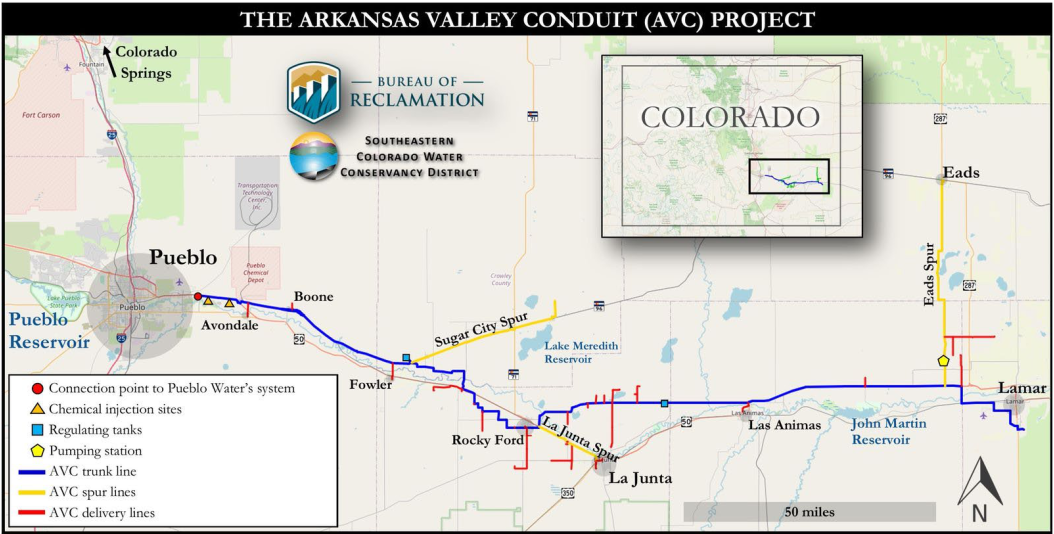
The same federal Fryingpan-Arkansas Project that in 1962 created Pueblo Reservoir was also supposed to solve the drinking water problem for 40 communities downriver by building the 130-mile Arkansas Valley Conduit to move clean water from Pueblo Reservoir. But it wasn’t until 2023 that final funding for the $610 million pipeline arrived.
Some downstream leaders are galled that Aurora can start taking more fresh water out of the Arkansas before serious pipeline construction has begun to serve the 50,000 people in long-suffering downstream towns.
“My whole life has been under drinking water restrictions, not being able to attain safe drinking water except to go buy it or to go through extraordinary measures to treat it,” said Dallas May, whose family ranches 15,000 acres north of Lamar. May also is on the Southeastern Colorado Water Conservancy District board.
The Colorado Department of Public Health and Environment’s Water Quality Division, which tests Lower Arkansas water a few times a year, classifies most of the river below Pueblo Reservoir as not supporting drinking water or “aquatic life use.” The classification calls the Lower Arkansas suitable for “warm-water aquatic life” and recreation.
The state did not respond to requests for more detailed assessments of Lower Arkansas water health. Asked if state efforts were improving water quality on the Arkansas, a spokesperson said in an email, “Trend studies require extensive data over a significant period of time. The water quality in watersheds is influenced by a wide variety of factors, including precipitation and weather trends that can highly influence the water quality from year to year.”
Some Lower Arkansas farmers and officials are tired of waiting. They see the problem getting worse as, for instance, Aurora takes more water out of Otero County, “What happens is all of the bad things are concentrated into what is left,” May said, “and that is a huge problem.”
Silence at the state level?
The Colorado Water Conservation Board spent years writing the statewide Water Plan, convening forums and task forces, and conducting listening sessions on the tensions between city water needs and the survival of agricultural communities. They say they are concerned about new city water buys, but add they have no authority to influence any deals because water rights are private property rights and can be bought and sold at will.
The board declined an interview request about Aurora’s water purchase or the broader water use questions.
“The Colorado Water Plan sets a vision for meeting the state’s future water needs and was broadly supported by local communities,” Russ Sands, the board’s water supply planning chief, said in email responses to questions. “But the decisions that happen in local communities regarding their water purchases and planning are largely outside of the state’s control. Accountability for staying true to the vision of the Water Plan is a collective responsibility.”
The loss of irrigated farmland isn’t expected to slow anytime soon as climate change dries up streams and population growth drives cities to buy more. The Colorado Water Plan’s forecast shows the population of the Arkansas River Basin, which includes Colorado Springs and Pueblo, surging more than 60% by 2050, increasing the pressure to tap farm water.
Sakata, the state water policy advisor, who farms near Brighton, said protecting the state’s irrigated farmland will take more work. “We can’t just say lease the water for three out of 10 years. We need to have agreements so that water sharing will be really available.”
As an onion grower, Sakata can’t do interruptible water supply agreements because he has long-standing yearly agreements with suppliers that require him to deliver vegetables. If he fallows his land for a year, the money he would likely be paid wouldn’t be enough to compensate him for the loss of onion sales and the need to support his employees during the break.
Farm research scientist Cabot would like to see the state begin buying irrigated farms, using conservation easements to protect them from development or purchase, and then leasing that land and its water to young growers.
What else state leaders can do to preserve what’s left of Colorado’s irrigated land isn’t clear yet, but Alan Ward, a Pueblo native who is also director of water resources for the Pueblo Water, said the state needs to reexamine its policies and goals.
“There is only so much water available, and I don’t think it’s realistic for the state to continue to think that we can control our urban areas and grow them fast without impacting agriculture.” Clarifying that he was speaking as a private individual, rather than a water official, he said, “I’d rather have the farms continue and not have the urban growth, but I am probably in the minority on that.”
Where does the battle flow next?
Water veterans such as Cabot said the state is likely doing everything it can right now to protect irrigated ag lands. But like Sakata, he says more work needs to be done to shore up farm markets and to create easier, more lucrative water sharing arrangements.
“I don’t want to oversimplify this,” Cabot said, “but the simplest way for cities to get this water is to go to farmers and say ‘How much did you make last year?’ and then offer them 10% more. … These are not just fields. They are farm enterprises.”
Kate Greenberg, Colorado’s agriculture commissioner, is overseeing multimillion-dollar efforts to protect farmlands by improving soil health, solving market challenges and making farm water use more efficient. She says the people of Colorado are on board with her agency’s efforts.
“We did a study last year that showed over 98% of Coloradans believe agriculture is an integral part of our state. If we’re taking water out of agriculture, where are we putting it to beneficial use?
“Are we conserving it to grow urban developments and do we want to see that over preserving agriculture and biodiversity. We need to answer that question as a state.”
Bartolo, the retired CSU researcher, hopes the answer comes soon, before any more of the valley water is siphoned off for urban use.
As news of the deals spreads, Bartolo’s sense of deja vu is growing and his fears for the future of the valley’s irrigated ag lands is growing too. No one knows yet what will happen when Aurora’s contract to use the Fryingpan-Ark to deliver water expires in 2047.
“Having lived through it in my lifetime, I have seen the drastic changes,” Bartolo said.
What worries him, and other growers too, is “what happens if they come back after 2047? What happens then?”
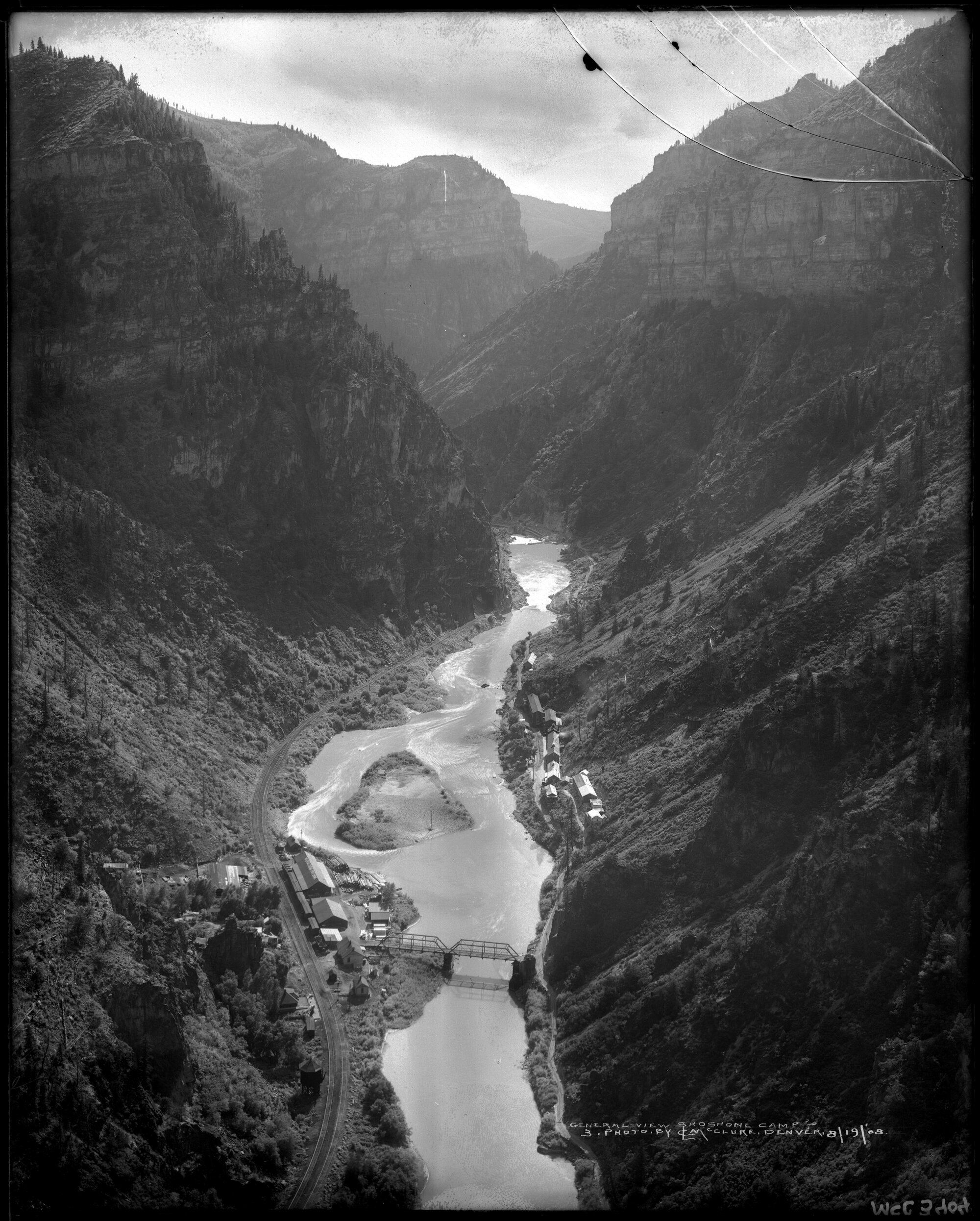
View of Shoshone Hydroelectric Plant construction in Glenwood Canyon (Garfield County) Colorado; shows the Colorado River, the dam, sheds, a footbridge, and the workmen’s camp. Creator: McClure, Louis Charles, 1867-1957. Credit: Denver Public Library Digital Collections
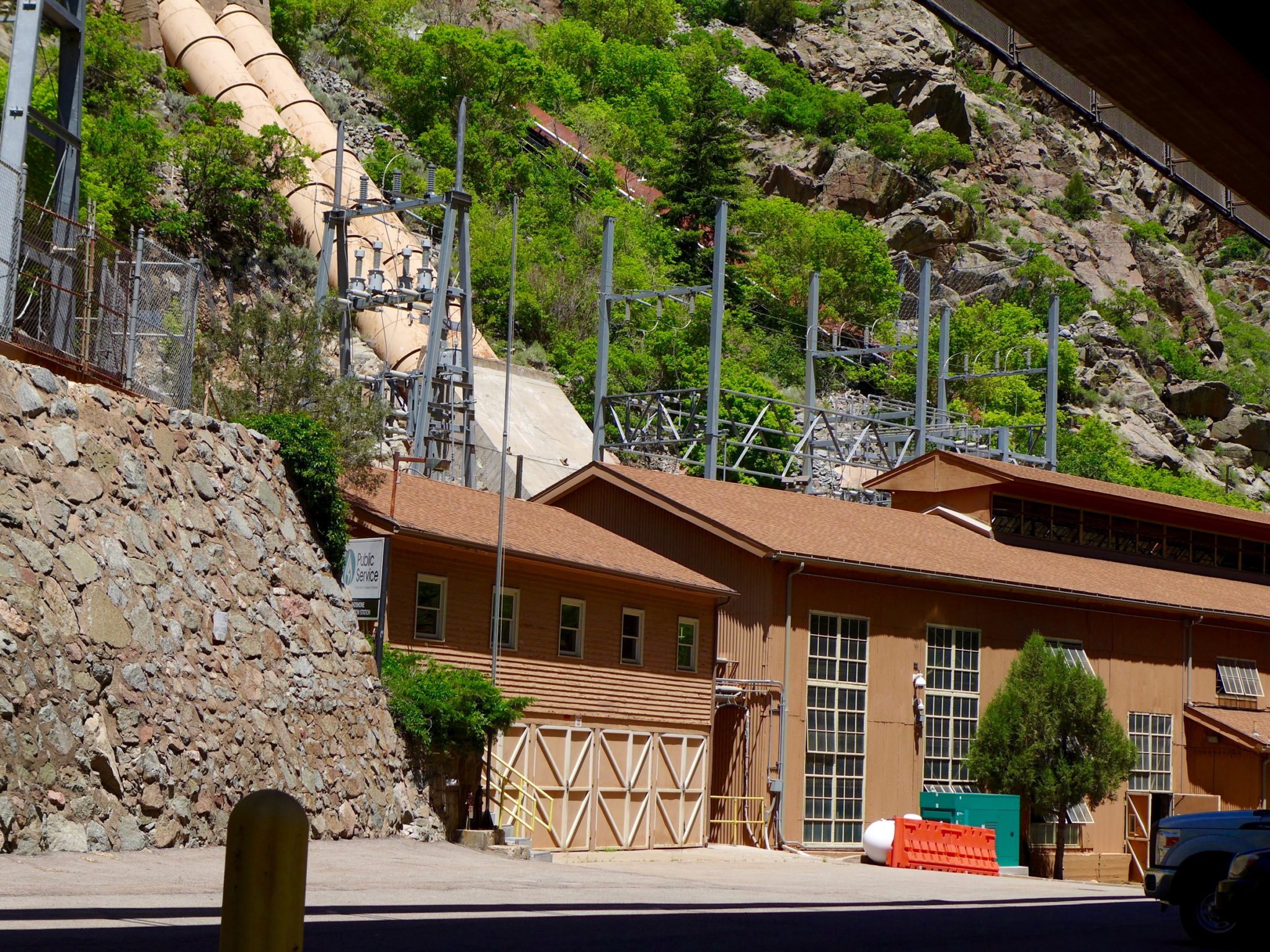
The San Miguel Board of County Commissioners (BOCC) voted on Wednesday, July 24, to sign onto the Western District (Colorado Counties) letter to preserve Shoshone water rights. The letter, addressed to Colorado Senators Michael Bennet and John Hickenlooper, is in support of the Colorado River Water Conservation District’s aim to acquire and permanently protect the Shoshone water rights. The Shoshone Power Plant, off Interstate 70 near Glenwood Springs, possesses the oldest senior water rights directly on the Colorado River in Colorado. The plant generates 15 megawatts of electricity. This flow from Shoshone is critical in helping avoid low water levels further down the river…
The Colorado River Water Conservation District has spent more than 20 years fighting to permanently preserve the Shoshone water flow along with a coalition of western Colorado governments and water entities.
At the end of 2023, the Colorado River Water Conservation District and Xcel Energy formalized an agreement for the district to buy water rights for the Shoshone Power Plant from Xcel if the group was able to secure $99 million in funding. The agreement is part of a decades-long effort to help establish stable water flows below the power plant and to the Utah border…With the agreement, Colorado River Water Conservation District will own the water rights and lease them back to Xcel to create hydroelectric power…Colorado River Water Conservation District is also working to ensure that Shoshone’s water stays in the river and is not diverted even when the power plant is not generating hydropower. The district is in negotiations with the Colorado Water Conservation Board. Even after reaching an agreement between the district, the board and Xcel Energy, the case will still have to go through court to legally update the water rights.
El Vado Dam and Reservoir back in the day. Photo credit: USBR
Click the link to read the article on the Grist website (Jake Bittle):
July 6, 2024
Mark Garcia can see that there’s no shortage of water in the Rio Grande this year. The river flows past his farm in central New Mexico, about 50 miles south of Albuquerque. The rush of springtime water is a welcome change after years of drought, but he knows the good times won’t last.
As the summer continues, the river will diminish, leaving Garcia with a strict ration. He’ll be allowed irrigation water for his 300 acres just once every 30 days, which is nowhere near enough to sustain his crop of oats and alfalfa.
For decades, Garcia and other farmers on the Rio Grande have relied on water released from a dam called El Vado, which collects billions of gallons of river water to store and eventually release to help farmers during times when the river runs dry. More significantly for most New Mexico residents, the dam system also allows the city of Albuquerque to import river water from long distances for household use.
New Mexico water projects map via Reclamation
But El Vado has been out of commission for the past three summers, its structure bulging and disfigured after decades in operation — and the government doesn’t have a plan to fix it.
“We need some sort of storage,” said Garcia. “If we don’t get a big monsoon this summer, if you don’t have a well, you won’t be able to water.”
The failure of the dam has shaken up the water supply for the entire region surrounding Albuquerque, forcing the city and many of the farmers nearby to rely on finite groundwater and threatening an endangered fish species along the river. It’s a surprising twist of fate for a region that in recent years emerged as a model for sustainablewater management in the West.
“Having El Vado out of the picture has been really tough,” said Paul Tashjian, the director of freshwater conservation at the Southwest regional office of the nonprofit National Audubon Society. “We’ve been really eking by every year the past few years.”
Surface water imports from the El Vado system have generally allowed public officials in Albuquerque to limit groundwater shortages. This echoes the strategies of other large Western cities such as Phoenix and Los Angeles, which have enabled population growth by tapping diverse sources of water for metropolitan regions and the farms that sit outside of them. The Biden administration is seeking to replicate this strategy in water-stressed rural areas across the region, doling out more than $8 billion in grants to support pipelines and reservoirs.
“New plot using the nClimGrid data, which is a better source than PRISM for long-term trends. Of course, the combined reservoir contents increase from last year, but the increase is less than 2011 and looks puny compared to the ‘hole’ in the reservoirs. The blue Loess lines subtly change. Last year those lines ended pointing downwards. This year they end flat-ish. 2023 temps were still above the 20th century average, although close. Another interesting aspect is that the 20C Mean and 21C Mean lines on the individual plots really don’t change much. Finally, the 2023 Natural Flows are almost exactly equal to 2019. (17.678 maf vs 17.672 maf). For all the hoopla about how this was record-setting year, the fact is that this year was significantly less than 2011 (20.159 maf) and no different than 2019” — Brad Udall
But the last decade has shown that this strategy isn’t foolproof — at least not while climate change fuels an ongoing megadrought across the West. Los Angeles has lost water from both the Colorado River and from a series of reservoirs in Northern California, and Phoenix has seen declines not only from the Colorado but also from the groundwater aquifers that fuel the state’s cotton and alfalfa farming. Now, as Albuquerque’s decrepit El Vado dam goes out of commission, the city is trying to balance multiple fragile resources.
El Vado is an odd dam: It’s one of only four in the United States that uses a steel faceplate to hold back water, rather than a mass of rock or concrete. The dam has been collecting irrigation water for Rio Grande farmers for close to a century, but decades of studies have shown that water is seeping through the faceplate and undermining the dam’s foundations. When engineers tried to use grout to fill in the cracks behind the faceplate, they accidentally caused the faceplate to bulge out of shape, threatening the stability of the entire structure. The Bureau of Reclamation, the federal agency that manages the dam, paused construction and is now back at the drawing board.
Without the ability to collect irrigation water for the farmers, the Bureau has had no choice but to let the Rio Grande’s natural flow move downstream to Albuquerque. There’s plenty of water in the spring, when snow melts off the mountains and rain rushes toward the ocean. But when the rains peter out by the start of the summer, the river’s flow reduces to a trickle.
“We run really fast and happy in the spring, and then you’re off pretty precipitously,” said Casey Ish, the conservation program supervisor at the Middle Rio Grande Conservancy District, the irrigation district that supplies water to farmers like Garcia. “It just creates a lot of stress on the system late in the summer.” The uncertainty about water rationing causes many farmers to forego planting crops they aren’t sure they’ll be able to see to maturity, Ish added.
Construction crews attempt to repair the El Vado dam along the Rio Grande in New Mexico. The federal government has been unable to find a way to stop seepage behind the steel faceplate dam. U.S. Bureau of Reclamation
The beleaguered dam also plays a critical role in providing water to the fast-growing Albuquerque metropolitan area, which is home to almost a million people. As the city grew over the past 100 years, it drained local groundwater, lowering aquifer levels by dozens of feet until the city got a reputation as “one of the biggest water-wasters in the West.” Cities across the region were mining their groundwater in the same way, but Albuquerque managed to turn its bad habits around. In 2008, it built a $160 million water treatment plant that allowed it to clean water from the distant Colorado River, giving officials a new water source to reduce their groundwater reliance.
The loss of El Vado is jeopardizing this achievement. In order for Colorado River water to reach the Albuquerque treatment plant, it needs to travel through the same set of canals and pipelines that deliver Rio Grande water to the city and farmers, “riding” with the Rio Grande water through the pipes. Without a steady flow of Rio Grande water out of El Vado, the Colorado River water can’t make it to the city. This means that in the summer months, when the Rio Grande dries out, Albuquerque now has to turn back to groundwater to supply its thirsty residential subdivisions.
This renewed reliance on groundwater has halted the recovery of local aquifers. The water level in these aquifers was rising from 2008 through 2020, but it slumped out around 2020 and hasn’t budged since.
“We have had to shut down our surface water plant the last three summers because of low flows in Albuquerque,” said Diane Agnew, a senior official at the Albuquerque Bernalillo County Water Utility Authority, which manages the region’s water. Agnew stresses that aquifer levels are only flattening out, not falling. Still, losing El Vado storage for the long run would be detrimental to the city’s overall water resilience.
“We have more than enough supply to meet demand, but it does change our equation,” she added.
The Bureau of Reclamation is looking for a way to fix the dam and restore Rio Grande water to Albuquerque, but right now its engineers are stumped. In a recent meeting with local farmers, a senior Reclamation official offered a frank assessment of the dam’s future.
“We were not able to find technical solutions to the challenges that we were seeing,” said Jennifer Faler, the Bureau’s Albuquerque area manager, in remarks at the meeting.
The next-best option is to find somewhere else to store water for farmers. There are other reservoirs along the Rio Grande, including one large dam owned by the Army Corps of Engineers, but repurposing them for irrigation water will involve a lengthy bureaucratic process.
A spokesperson for the Bureau of Reclamation told Grist that the agency “is working diligently with our partners to develop a plan and finalize agreements to help alleviate the lost storage capacity” and that it “may have the ability to safely store some water” for farms and cities next year.
In the meantime, farmers like Garcia are getting impatient. When a senior Bureau official broke the bad news at an irrigation district meeting last month, more than a dozen farmers who grow crops in the district stood up to express their frustration with the delays in the repair process, calling Reclamation’s announcement “frustrating” and “a shock.”
“If we don’t have any water for the long term, I have to let my employees go, and I guess start looking for ramen noodles someplace,” Garcia told Grist.
Even though there are only a handful of other steel faceplate dams like El Vado in the United States, more communities across the West are likely to experience similar infrastructure issues that affect their water supply, according to John Fleck, a professor of water policy at the University of New Mexico.
“We’ve optimized entire human and natural communities around the way this aging infrastructure allows us to manipulate the flow of rivers, and we’re likely to see more and more examples where infrastructure we’ve come to depend on no longer functions the way we planned or intended,” he said.
As the West gets drier and its dams and canals continue to age, more communities may find themselves forced to strike a balance between groundwater, which is easy to access but finite, and surface water, which is renewable but challenging to obtain. The loss of El Vado shows that neither one of these resources can be relied upon solely and consistently — and in an era of higher temperatures and aging infrastructure, even having both may not be enough.
The headwaters of the Rio Grande River in Colorado. Photo: Brent Gardner-Smith/Aspen Journalism
Ridgway’s Rail. Photo: Robert Groos/Audubon Photography Awards
Click the link to read the release on the Audubon website (Jennifer Pitt):
May 21, 2024
The Colorado River is flowing again in its delta. While this is welcome news for birds and people, the long-term progress to keep the Colorado River alive in Mexico with habitat restoration and water deliveries depends on high stakes negotiations currently underway.
For the third time since 2021, the United States and Mexico are collaborating to deliver water to improve conditions in the long-desiccated delta. Environmental water deliveries began mid-March and will continue into October, ensuring the river flows through the summer’s heat, making restored riverside forests and wetlands more hospitable to birds like Abert’s Towhees and Crissal Thrashers and other wildlife including beavers and lynxes. We know that birds rely on water in the Delta as they migrate to locations all over the United States.
Restoration in the Colorado River Delta is implemented by Raise the River, a coalition of NGOs including Audubon, in partnership with U.S. and Mexican federal agencies. Funds, water, and collaboration for this work were committed first in Minute 319 and again in Minute 323, the United States–Mexico treaty agreements that have been widely hailed for modernizing Colorado River management with a host of benefits to water users in both countries including rules for sharing water shortages, as well as work to use relatively small volumes of water to revive the delta for wildlife and people. The terms of Minute 323 sunset in 2026, but delta restoration efforts remain a work in progress.
The good news: the United States and Mexico are poised to negotiate a successor agreement to Minute 323 in parallel with new federal rulemaking in the United States for Colorado River management. Domestic Colorado River rules, like the binational agreements, have for decades been the result of consensus-based negotiations, in this setting between the seven Colorado River Basin States with concurrence of the U.S. Bureau of Reclamation. This domestic rulemaking also has a 2026 deadline.
The bad news: at the moment, the Colorado River Basin states appear to be nowhere near consensus, with disagreements about which states, and which water users, will cut back when there’s not enough to satisfy all. These are difficult and high stakes negotiations. Failure to reach agreement increases the risk of water supply crises and could even throw the dispute in front of the U.S. Supreme Court.
That brings me back to the Abert’s Towhees and Crissal Thrashers, the beavers and lynxes in the Delta. If the Colorado River Basin states fail to reach consensus, there’s considerable risk that the work of restoring the Colorado River in its delta comes to a halt. Delta restoration depends on binational consensus, and binational consensus depends on a U.S. domestic consensus. It’s an extraordinarily complex decision-making framework for governance of water supply for 40 million people. The failure to reach consensus may create problems for some people who use Colorado River water, but it is certain to create collateral damage in Colorado River ecosystems including the Delta.
Take an animated tour of the unique construction process.
Raising the height of a dam involves many steps, literally and figuratively.
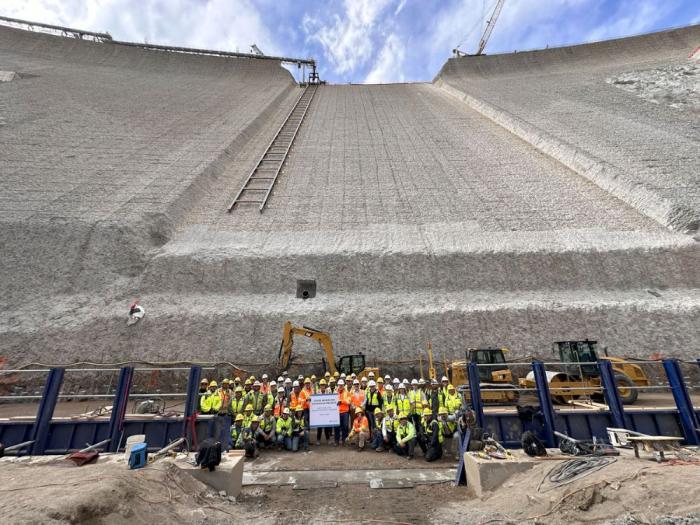
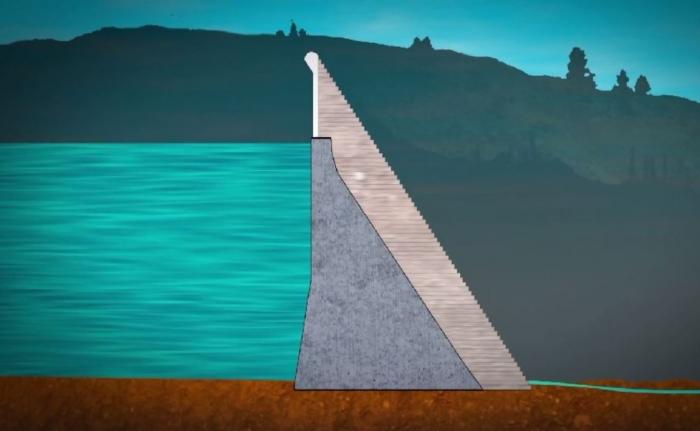
After two years of excavation and preparation work on the canyon around Gross Dam, workers in May began placing concrete, starting the three-year process of raising the height of the dam itself.
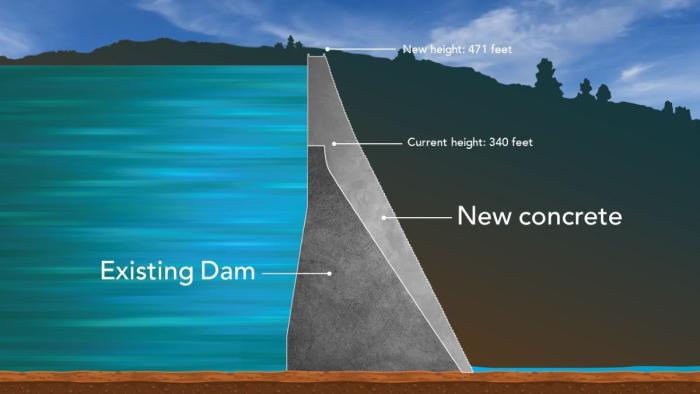
Denver Water is raising the height of Gross Dam by 131 feet as part of the Gross Reservoir Expansion Project. Once complete, the dam will be able to store nearly three times as much water in Gross Reservoir, which will add more resiliency and flexibility to Denver Water’s water storage system.
Workers from Denver Water and contractor Kiewit Barnard stand in front of Gross Dam in May to mark the start of the dam raise process. Photo credit: Denver Water.
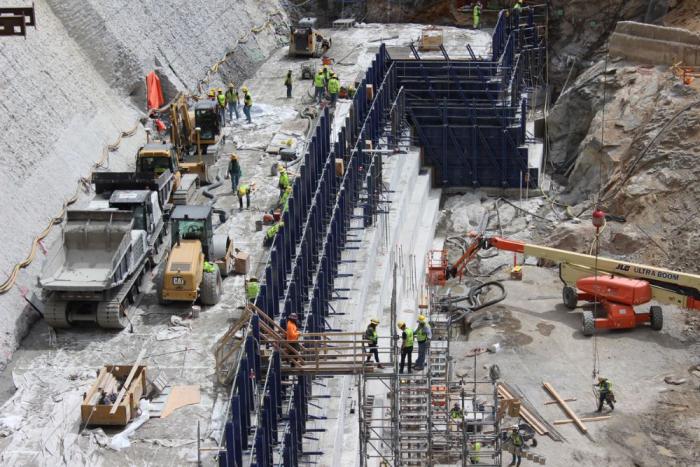
Raising the dam is being done by building 118 steps made of roller-compacted concrete. Each step will be 4 feet wide with a 2-foot setback. The existing dam is 340 feet tall. The completed dam will be 471 feet tall.
Check out this animated video to see how the process works.
This animation shows how Denver Water plans to raise the height of Gross Dam in Boulder County, Colorado, as part of the Gross Reservoir Expansion Project. #grossreservoir#civilengineering#howtoraiseadam
The construction site at the bottom of Gross Dam with equipment used to place concrete and build the new steps. Photo credit: Denver Water.
It will take roughly three years to complete all the steps, with a final completion date set for 2027.
The dam raise process begins at the bottom of the dam using roller-compacted concrete to build the new steps that will go up the face of the dam. Photo credit: Denver Water.
Planning and permitting for the Gross Reservoir Expansion Project began in 2002. Take a look at this video to learn about the process and major accomplishments.
Denver Water is raising the height of Gross Dam in Boulder County, Colorado as part of the Gross Reservoir Expansion Project. This video looks at the history of the project and the work being done to raise the dam.
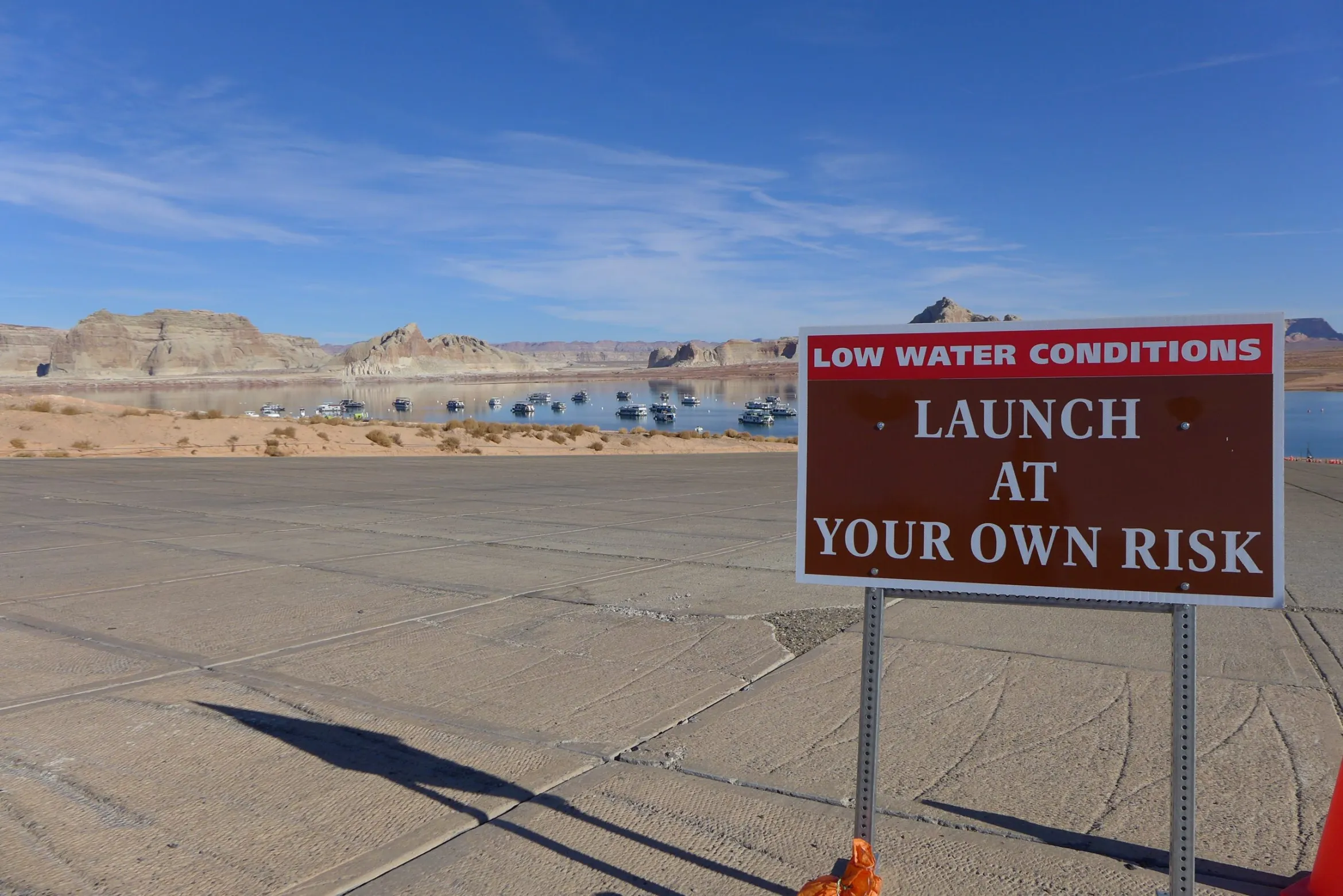
The main boat ramp at Wahweap Marina was unusable due to low water levels in Lake Powell in December 2021. Upper Colorado River Basin water managers took a step this week toward protecting water saved through conservation programs in Lake Powell. CREDIT: HEATHER SACKETT/ASPEN JOURNALISM
Water managers in the upper Colorado River basin took another step this week toward a more formal water conservation program that they say will benefit the upper basin states.
Representatives from Colorado, Utah, Wyoming and New Mexico unanimously passed a motion Wednesday at a meeting of the Upper Colorado River Commission to explore creating a way to track, measure and store conserved water in Lake Powell and other upper basin reservoirs.
The motion directed staff and state advisers to prepare a proposal that lays out criteria for conservation projects and creates a mechanism for generating credit for those projects. The deadline for the proposal is Aug. 12, and commissioners plan to consider it at a late-summer meeting.
With an infusion of federal dollars from the Inflation Reduction Act, the UCRC in 2023 rebooted the System Conservation Pilot Program, which pays water users — most of them in agriculture — to leave their fields dry for the season and let that water run downstream. Over two years, system conservation is projected to save about 101,000 acre-feet of water at a cost of about $45 million.
But how much of that water actually made it to Lake Powell is anyone’s guess. Despite one of the stated intentions of the program being to protect critical reservoir levels, SCPP has, so far, not tracked the conserved water, a process known as shepherding. The laws that govern water rights allow the next downstream users to simply take the water that an upstream user leaves in the river, potentially canceling out the attempt at conservation.
Some water managers and users have criticized SCPP for this lack of accounting, saying the water conserved by the upper basin is simply being sent downstream to be used by the lower basin. The UCRC’s motion Wednesday for a proposal is an attempt to remedy that.
“We have heard from water users and others across the Upper Basin that there is interest in ‘getting credit’ for conserved water — in other words, protecting this water in Lake Powell,” Amy Ostdiek, the Colorado Water Conservation Board’s Interstate, Federal & Water Information section chief said in a prepared statement. “What the commissioners directed staff to do was simply to explore opportunities to do so.”
This Parshall flume on Red Mountain measures the amount of water diverted by the Red Mountain Ditch. CREDIT: HEATHER SACKETT/ASPEN JOURNALISM
Tracking, measuring and storing the water saved by the upper basin states in Lake Powell is not a new idea. The concept was part of the 2019 Colorado River Drought Contingency Plan. The DCP created a special 500,000-acre-foot pool in Lake Powell for the upper basin to store water saved through a temporary, voluntary and compensated conservation program known as demand management. Demand management is conceptually the same as system conservation, with the main difference being that system conservation water simply becomes part of the Colorado River system with no certainty about where it ends up, while demand management water would be shepherded, measured and stored in Lake Powell for the benefit of the upper basin.
“We can do things like the System Conservation Program, and if we set up an account such that we can put that conserved water into a pool, that can then accrue over time,” New Mexico Commissioner Estevan Lopez said at Wednesday’s meeting. “That can be a very useful tool when things get really dry in the system. Overall, we can make that water available to continue operations with additional stability.”
The goals of demand management were to help boost water levels in Lake Powell, allow for continued hydropower production at Glen Canyon Dam and, perhaps most important, help the upper basin states meet their obligations to deliver a minimum amount of water to the lower basin states under the terms of the 1922 Colorado River Compact. As climate change continues to rob rivers of flows, it becomes more likely that the upper basin won’t be able to deliver the 7.5 million acre-feet annually that is the lower’s basin’s share of the Colorado River, even if upper basin use doesn’t increase.
The conserved water “could be for compact compliance, or it could be for simply greater storage volume in the upper basin reservoirs to provide resilience against future dry years,” said Anne Castle, federal appointee and chair of the UCRC. “It would be credited to the benefit of the upper basin, and that’s a little vague, but it’s because we haven’t designed that mechanism yet.” [ed. emphasis mine]
This field of alfalfa is grown near Carbondale. Upper Colorado River Basin water managers are continuing to make tweaks to a program that pays agricultural water users to conserve.CREDIT: HEATHER SACKETT/ASPEN JOURNALISM
In line with upper basin proposal
After two decades of drought, climate change and overuse, water levels in Lake Powell fell to their lowest point ever in 2022, threatening the ability to make hydropower at Glen Canyon Dam. Officials scrambled for solutions, with the UCRC putting forth a “5-Point Plan,” one arm of which was restarting SCPP, which was originally tried from 2015-18.
Upper basin officials have long maintained that the responsibility for a solution to the Colorado River crisis rests with the lower basin states: California, Arizona and Nevada. And they are still reluctant to say that Wednesday’s motion is a move toward a long-term conservation program for the upper basin.
“I wouldn’t say that we’re on the cusp of a permanent program, but rather that this is an evolving overall conservation effort that is incorporating what we’ve learned from the previous iterations,” Castle said.
The Upper Basin’s alternative, summed up. Source: Upper Colorado River Commission.
Wednesday’s motion was also the beginning of making good on a promise laid out in the upper basin’s alternative proposal for how the river and reservoirs should be operated in the future. The proposal says the four states will pursue “parallel activities” that include voluntary, temporary and compensated reductions in use, such as conservation programs that store water in Lake Powell.
“I think it’s important to acknowledge that this is in line with the parallel activities component of the upper division state’s alternative,” said Colorado Commissioner Becky Mitchell. “However, as I’ve always said, we cannot be doing conservation work to prop up overuse, and so I think this is in line with the commitments that we’ve made, but to remember that that was part of a larger package that requires responsible management.”
The authorization for system conservation runs out at the end of 2024, but earlier this month, U.S. senators from Colorado, Utah and Wyoming introduced a bill to extend the SCPP through 2026. UCRC commissioners would still have to approve continuing the program past this year.
The Los Angeles Department of Water and Power said it plans to export 4,500 acre-feet of water from the Mono Basin during the current runoff year, the same amount that was diverted the previous year, and enough to supply about 18,000 households for a year. Under the current rules, the city could take much more — up to 16,000 acre-feet this year. But environmental advocates had recently urged Mayor Karen Bass not to increase water diversions to help preserve recent gains and begin to boost the long-depleted lake toward healthier levels. They praised the decision by city leaders as an important step.
“It’s a historic decision in the history of Mono Lake,” said Mark Gold, director of water scarcity solutions for the Natural Resources Defense Council. “I think it’s the first major environmental accomplishment for water in the Bass administration.”
DWP officials detailed their expected water diversions from the region of the Eastern Sierra in an annual plan for the runoff year, which began in April. Environmentalists said it’s the first time in 30 years that city officials have announced plans to take less water than the maximum amount allowed under a 1994 decision by the State Water Resources Control Board. However, DWP said in the plan that it will review water conditions in November, and at that point could still decide to export additional water if deemed necessary, up to the limit of 16,000 acre-feet.
Mono Lake, located in the eastern foothills of the Sierra Nevada mountains, east of Yosemite National Park. Paoha Island in the middle of the lake. By Ron Reiring – Mono Lake, CAUploaded by X-Weinzar, CC BY 2.0, https://commons.wikimedia.org/w/index.php?curid=11269094
A Los Angeles Department of Water and Power diversion dam on Lee Vining Creek, one of places where the city blocks flows to Mono Lake and shunts water 300 miles south through an aqueduct. Credit: Bob BerwynA grove of tufa towers along the south shore of Mono Lake, California, where long-term drought, global warming and water diversions threaten an ancient ecosystem. Credit: Bob BerwynTufa columns, Mono Lake, Eastern Sierra, California. By Vezoy (talk · contribs) – Own work, CC BY-SA 3.0, https://commons.wikimedia.org/w/index.php?curid=30004462
The downstream face of Glen Canyon Dam, which forms Lake Powell, America’s second-largest water reservoir. Water is released from the reservoir through a hydropower generation system at the base of the dam. Photo by Brian Richter
As the drought-strapped Colorado River struggled to feed water into Lake Powell to keep its massive storage system and power turbines from crashing in 2021 and 2022, the U.S. Bureau of Reclamation, its operator, was scrambling to bring in extra water from Flaming Gorge and Blue Mesa reservoirs.
Since the return of healthier flows in 2023, water levels in Flaming Gorge and Blue Mesa have been restored, as required under a 2019 Colorado River Basin drought response plan.
But the subsequent shifting of water in 2023 to balance the contents of lakes Powell and Mead, required under a set of operating guidelines approved in 2007, resulted in an accidental release of 40,000 acre-feet of water that will not be restored to the Upper Basin because it is within the margin of error associated with such balancing releases, according to Alex Pivarnik, supervisory hydrologist with Reclamation’s Upper Colorado Basin Region.
“Under the 2007 Interim Guidelines, this was the first time Reclamation balanced the contents between lakes Powell and Mead in near real-time, working against quickly changing hydrology over the course of just a few months. Getting it within 0.5% is pretty remarkable, given the circumstances,” Pivarnik said via email, referring to the hundreds of thousands of acre-feet of water that was being moved at the time relative to the size of the mistake.
Though 40,000 acre-feet of water isn’t much on the massive Colorado River, it is enough to serve some 80,000 houses for one to two years, to irrigate 20,000 acres of corn on the Eastern Plains or to keep the taps flowing in the Grand Junction-area for two years.
“Some people might wonder what’s the harm,” said Mark Ritterbush, water services manager for Grand Junction. The city is one of three water providers in the Grand Valley, some of whom also rely on the Colorado River. “But does it matter? Absolutely. It is all one water.”
Map credit: AGU
The seven-state Colorado River Basin is divided into an upper and lower section, with the Upper Basin covering Colorado, New Mexico, Utah and Wyoming and the Lower Basin comprising Arizona, California and Nevada.
Flaming Gorge Reservoir July 2020. Photo credit: Utah DWR
Blue Mesa Reservoir. MichaelKirsh / CC BY-SA (https://creativecommons.org/licenses/by-sa/4.0)Navajo Dam. Photo credit: ReclamationThe Colorado River is impounded behind the Glen Canyon Dam in Lake powell. Photo credit: Dave Showalter
The Upper Basin is home to four major reservoirs. Flaming Gorge, on the Utah-Wyoming border, Colorado’s Blue Mesa, New Mexico’s Navajo, and Lake Powell. They serve as liquid bank accounts, ensuring the Upper Basin states can meet their legal obligations to deliver water to states in the Lower Basin, where Lake Mead serves a similar function.
Looking ahead, Upper Basin states say the way the reservoirs are managed during drought emergencies needs to change to protect against such mistakes and to better protect Upper Basin water supplies.
“Reclamation missed its operating target for releases by 40,000 acre-feet. Everyone should recognize that this is a shortcoming of the 2007 guidelines,” said Chuck Cullom, executive director of the Upper Colorado River Commission, which oversees the Colorado River for the Upper Basin states.
“It’s almost impossible to hit perfect. But this is a function of trying to balance contents [of Powell and Mead],” Cullom said.
Despite the drought response and a healthy water year in 2023, lakes Powell and Mead have returned to critical low levels, leaving the system vulnerable in ways similar to those that existed prior to the emergency loans from the Upper Basin states, according to the Colorado Water Conservation Board (CWCB), whose staff presented a memo on the topic at its May meeting. The CWCB is the state’s lead water planning agency.
As the giant river system continues to struggle to serve 40 million people, tribal communities, farmers and Mexico, tense negotiations to redo the 2007 operating guidelines, which expire in 2026, are underway.
“With regard to future reservoir operations in the post-2026 negotiations,” Cullom said, “I would say that the upper division states have learned a great deal from the operation of the [drought response plan], and in the event that the federal government wants to continue to have the flexibility to move the water from upper basin units to protect the operation of Lake Powell. … I would expect those lessons would be reflected [in the new operating guidelines].”
More by Jerd SmithJerd Smith is editor of Fresh Water News. She can be reached at 720-398-6474, via email at jerd@wateredco.org or @jerd_smith.
With the obligatory shovels in pre-softened dirt, a group of political leaders from the Navajo Nation, New Mexico state and local government, and water agencies this morning (Wed. 5/15/2024) formally inaugurated a new pipeline being built to connect the Navajo community of To’Hajiilee to the 3.5 million gallon reservoir in the picture – clean, piped water to a community that now has one working well and water so bad no one drinks it.
One of the oldtimers who’d been working on it for more than two decades walked up to me and said, “This is an impossible project.”
What he meant was that the project had overcome seemingly insurmountable hurdles in the interactions between a welter of government agencies with overlapping jurisdictions and sometimes incompatible responsibilities.
I went to the event wearing two hats – as a member of the Albuquerque Bernalillo County Water Utility Authority’s Technical Customer Advisory Committee, and on behalf of the Utton Center, which has a long history of working on Native American water stuff. (I was literally wearing my ABCWUA gimme cap, I don’t have an Utton one.)
To’Hajiilee, 35-ish miles west of Albuquerque, has six water wells. Five have already failed. The sixth is regularly off line. When it’s down, they have to shut down school and the clinic. When it’s working, the water is awful.
The vision statement from the Universal Access to Clean Water For Tribal Communities project is simple: “Every Native American has the right to clean, safe, affordable water in the home ensuring a minimum quality of life.”
In this 1999 book Development as Freedom, the Nobel laureate economist and moral philosopher Amartya Sen explains freedoms as “the capabilities that a person has, that is, the substantive freedoms he or she enjoys to lead the kind of life he or she has reason to value.”
“Rights” are tricky political terrain, because they’re often framed in negative terms – the absence of coercion or interference from others, particularly the state. But Sen’s making an affirmative argument here. It is not enough for the collective to simply get out of the individual’s way. The collective has an affirmative moral obligation to create the conditions under which the individual can flourish – to pursue that which they “have reason to value,” to repeat Sen. That’s sorta what my friends at the Universal Access project are saying with their vision statement.
At the urging of a colleague, I’ve been reading Sen lately in an effort to make sense of the moral underpinnings of the collective choices we face as we cope with the reality of less water. (For those familiar with Sen, know that I am not reading the mathy parts – they’re impenetrable!)
THE PLUMBING – PHYSICAL AND FINANCIAL
The Albuquerque Bernalillo County Water Utility’s 7W reservoir, the tan thing in the picture, sits on high ground midway between Albuquerque and To’Hajiilee, a perfect water source for the community. In eighteen months under the current construction schedule, we’ll have a 7 mile pipe from here to there.
If the tally in my notes is correct (don’t hold me to this, I’m not a real journalist any more), it’s a ~$20 million project, with a mix of federal, state, and Navajo Nation funding.
The actual water in the pipes is the result of a fascinating agreement between the Navajo Nation and the Jicarilla Apache Nation in norther New Mexico. The Navajo Nation will lease Jicarailla water, which will be wheeled down the San Juan River, into the Rio Grande, and then diverted by the Albuquerque Bernalillo County Water Utility Authority, treated, and pumped up to 7W.
THE STRUGGLES TO GET THIS DONE
Former Bernalillo County Commissioner Debbie O’Malley, speaking at the groundbreaking, told the story of the bare-knuckle politics it took to overcome the intransigence of a landowner that stood in the way of the project – Western Albuquerque Land Holdings. And for sure, O’Malley and the group she worked with deserve a ton of credit for the use of their knuckles at a critical point in the struggle to get the pipeline built.
But more important is the community of To’Hajiilee itself, people like Mark Begay, my colleague on the Albuquerque water utility’s Technical Customer Advisory Committee. For decades, Begay and the other leaders in To’Hajiilee acted on behalf of their community to pursue “that which they had reason to value” – water!
This is about the community’s own collective agency, “the result of collective processes and collective actions in which people’s interactions shape their common destiny.” (Oscar Garza-Vázquez)
It was a joy to share the celebration of their success. I’ll be back in 18 months when they open the taps.
The states are currently negotiating how the river and its reservoirs should be operated after current agreements expire in 2026.
This article is published through the Colorado River Collaborative, a solutions journalism initiative supported by the Janet Quinney Lawson Institute for Land, Water, and Air at Utah State University.
Another point of agreement between the basins: states should use actual hydrologic conditions to determine how to operate the country’s two largest reservoirs, Lake Powell and Lake Mead, instead of unreliable forecasts.
Water enters an irrigation canal on the Gila River Indian Reservation on May 7, 2021. The Gila River Indian Community is one of 19 tribes to co-sign a letter to the federal government asking for tribes’ priorities to be protected in the next round of rules for managing the Colorado River. Photo by Ted Wood/Water Desk
Click the link to read the article on the KUNC website (Alex Hager):
May 2, 2024
This story is part of ongoing coverage of the Colorado River, produced by KUNC in Colorado and supported by the Walton Family Foundation. KUNC is solely responsible for its editorial coverage.
Tribes that use the Colorado River want a say in negotiations that will reshape how the river’s water is shared. Eighteen of those tribes signed on to a letter sent to the Bureau of Reclamation, the federal agency that will finalize new rules for managing the river after 2026, when the current guidelines expire.
In the memo, tribal leaders urge the federal government to protect their access to water and uphold long-standing legal responsibilities.
The letter comes as other groups have also been sending the feds their ideas for managing a river that supplies 40 million people across the Southwest but is shrinking due to climate change. Reclamation is considering input from different Colorado River users, including competing proposals from two camps within the seven states that use its water.
The river’s Upper Basin states of Colorado, Utah, Wyoming and New Mexico banded together to send a proposal, and the Lower Basin states – California, Arizona and Nevada – did the same. A coalition of environmental nonprofits sent their own, and a group of high-profile water researchers published another.
The tribes’ letter aims to make sure that Indigenous people, who used the Colorado River before white settlers ever occupied the Western U.S., are not left behind as Reclamation considers those proposals.
“If you are not at the table, you are on the menu,” Jay Weiner, a water lawyer for the Quechan Indian Tribe, said.
Weiner, who helped craft the letter, said it aims to answer the complicated question: What do tribes want?
Each tribe in the Colorado River basin is unique and has interests that make it hard to land on one clear answer to that question, Weiner said, but this memo aims to coalesce a “critical mass” of tribes around broader ideas that are important to tribes.
“This is very much part of the effort of trying to be at the table and engaged so that there are meaningful opportunities for input, for engagement, for dialogue and, frankly, for fighting, when it comes to it,” Weiner said.
Three key principles
In the memo, the co-signing tribes address three main principles.
First, they ask the government to uphold its “trust responsibility” to the tribes.
This goes back to the very foundation of laws that guide relationships between the United States and tribes. When the federal government took property and assets from tribes, it also created a special designation for the tribes, calling them “domestic dependent nations.”
That designation also comes with the “responsibility to do right by those tribes forever,” explained Jenny Dumas, legal counsel on water for the Jicarilla Apache Nation and another architect of the tribal principles letter.
“The tribes gave up a lot of things when they entered into treaties with the federal government,” she said, “But what they did not give up was their right to a sufficient supply of water to provide for their people forever and ever in perpetuity.”
The letter urges federal water managers to fulfill that responsibility by rejecting any new water rules that would encroach on the government’s obligation to make sure tribes have access to water, and to adequately compensate any tribes that are forced to take water cuts in times of shortage.
First ever tribal panel federal Friday Colorado River Water Users Association December 15, 2023. Photo credit: Elizabeth Loebele
The letter also asks the feds for better ways to financially benefit off of the water they own.
Tribes hold rights to about a quarter of the river’s flow, but many lack the funding and infrastructure to use their full allocations and instead leave it in the river. The letter lays out a few specific ways the U.S. government could help change that.
One of those ways is to “maximize” tribes’ ability to participate in conservation programs. Armed with a $4 billion pool of money from the Inflation Reduction Act, the federal government has been funding programs to pay water users – often farmers and ranchers – to pause water use and leave some extra water in reservoirs. Some tribes are already receiving conservation payouts, but the letter advocates to expand tribal participation.
In addition, the memo asks feds to make it easier for tribes to market or lease their water rights to water users that reside outside of tribal land. That could open the door to new revenue streams, participation in conservation programs or the construction of new water infrastructure.
Finally, the letter asks the U.S. government to establish a permanent, formalized way for tribes to participate in talks about water use during ongoing negotiations and any other time Colorado River policy is discussed in the future.
Tribes have long been pushing for better representation in negotiations about the Colorado River. Indigenous people were excluded from talks that set the foundation for how water is shared in the Southwest over a century ago, and tribes say they’re still being left out now.
In the letter to Reclamation, tribal leaders wrote that river negotiations in 2007 had a “lack of formal tribal inclusion,” and reminded federal water managers that in 2023, federal officials made it a stated goal to enhance engagement and inclusion of tribes going forward.
The tribes are asking for something specific. Certain steps in negotiations about Colorado River water trigger the federal government to talk to states that use its water. The tribes want to make sure they are also consulted any time that trigger is hit.
Ultimately, the letter’s authors say tribes—and the legal infrastructure that governs tribal water use—are unique in a way that has to be considered when drawing up new rules that could have a big impact on the cities and farms of the Southwest.
“Tribal water rights are different,” Dumas said. “They’re not the same as non-Indian water rights. And for that reason, they deserve different protections and special treatment. And that’s what we’re asking for in this letter.”
‘Tribes have survived a whole lot worse’
While exclusion of tribes has been an undercurrent of Colorado River negotiations for at least a century, tribal leaders say times are changing.
Jason Hauter, legal counsel on water issues for the Gila River Indian Community who helped craft the letter, said the U.S. government faces “billions of dollars of potential liability” without the buy-in of Gila River and other tribes and that having unwilling water users could slow down the authorization and implementation of new water rules.
“Tribes are a key stakeholder,” said Hauter, who is a member of the Gila River Indian Community. “The days of being able to politically roll tribes and them not being sophisticated enough to put up strong challenges to federal rulemaking are over.”
Even after the letter’s submission, the number of tribes adding their support has grown. An early version of the memo was co-signed by 16 tribes. That number now stands at nineteen.
One of the late additions was the Gila River Indian Community, which holds lands in the Phoenix area. The tribe has been among the most prominent in Colorado River negotiations, and has become a high-profile partner to Arizona and the federal government in recent conservation programs.
Len Necefer, a member of the Navajo Nation, walks through Glen Canyon on April 10, 2023. This area used to be entirely submerged by Lake Powell. Management of the nation’s second-largest reservoir is a major focus of efforts to re-negotiate Colorado River management. The Navajo Nation is not among the tribes that signed a recent letter to the Bureau of Reclamation. Photo credit: Alex Hager/KUNC
In March, Gila River’s governor, Stephen Roe Lewis, announced the tribe did not support the Lower Basin proposal that Arizona signed on to, and that it planned to file its own. Instead, the community joined as a co-signer of the tribal principles letter in late April.
Indigenous leaders are quick to point out that each tribe is unique, and common ground can be hard to find amid the geographical, political and financial differences between them. This letter, however, is designed to focus on ideas so broad that they can find consensus among nearly two-thirds of all tribes that use Colorado River water.
“The goal should be having a stable system, not necessarily picking winners and losers,” Hauter said. “There’s a lot of posturing between the Upper and Lower Basin, and without really focusing on the ultimate goal: How do we make a better system? Given what the basin is facing, a recognition that there has to be shared pain among the basin states and among tribes. Finding ways to do that in a fair way, in a way that can make sense, that’s the challenge we all face.”
Conversations about Colorado River management have, for the past couple years, largely focused on the re-negotiation deadline in 2026. While it has been framed as a momentous juncture in the timeline of Western water management, tribes and their representatives say they’re focused on a longer view.
Jay Weiner, water lawyer for the Quechan Indian Tribe, said even if climate change makes the Southwest unpalatable for white people and other settlers, tribes plan to stay in their historic homelands.
“None of these things are single, one-off immutable events,” he said, “Because tribes have survived a whole lot worse than anything we’re gonna see coming out of post-2026 guidelines.”
Native America in the Colorado River Basin. Credit: USBR
Environmental groups and water experts say the U.S. Bureau of Reclamation should give nature a say in how it manages the Colorado River for years to come.
In March, seven states, including Colorado, released two competing proposals for how to manage two enormous reservoirs in the Colorado River Basin and make painful decisions about cutting back on water use once current operating rules expire in 2026.
But they’re not the only ones throwing out ideas: Water experts and environmental advocates have submitted two proposals of their own. They want to make sure endangered fish, Grand Canyon ecosystems, and more aren’t left out of the conversation.
The experts hope their proposals, which highlight changing climate data and environmentally focused reservoir releases, help inform the Bureau of Reclamation’s final report for how the river should be managed after 2026. A draft of that report is expected in December.
“If you don’t care about the environment, then the whole system crashes,” said John Berggren, a regional policy manager with Western Resource Advocates. “That’s not to say the environment takes priority over water supply and other issues, but rather they can be integrated.”
The current operating rules, established in 2007, focus on how water is stored in Lake Powell on the Utah-Arizona border, released to Lake Mead on the Nevada-Arizona border, and then released to millions of water users in the Lower Basin states of Arizona, California and Nevada.
Together, lakes Powell and Mead make up about 92% of storage capacity, about 58.48 million acre-feet, in the Colorado River Basin. Both are about one-third full.
One acre-foot roughly equals the annual water use of two to three households.
High-stakes negotiations stalled early this year with states at loggerheads over how to share water cuts. The four Upper Basin states — Colorado, New Mexico, Utah and Wyoming — only included cuts to the Lower Basin’s water use, although the states promised to pursue voluntary conservation programs. The three Lower Basin states called on all seven states to make cuts when the amount of available water falls below 38% of the total capacity in seven federal reservoirs.
Several tribal nations submitted their own proposal to advocate for tribal water rights in the federal process.
These proposals have the potential to impact water users across the basin, which provides water to 40 million people, more than 5 million acres of farmland, two states in Mexico, and cities including Los Angeles, Las Vegas, Phoenix and Denver.
One perspective all of the proposals have in common: The status quo operations aren’t going to work in the future.
“We need to use less water, and there’s going to be shortages for the Colorado River going forward,” Berggren said. “We wanted ours to focus more on how to integrate environmental considerations regardless of who’s taking shortages.”
Giving nature a seat at the table
Neither proposal from the basin states places a heavy emphasis on incorporating environmental concerns into how lakes Powell and Mead are managed, and there are plenty of environmental hotspots in the basin.
The Grand Canyon sits below Lake Powell, and its ecosystems and landscape can be helped or hurt by the reservoir’s releases. In 2011, water officials released an 11 million-acre-foot surge of water into the canyon — the right amount of water according to the current rules — that was too big and ended up eroding sandbars where people camp and view the national park. That sand is hard to replace since most of the Colorado River’s sediment is trapped in Lake Powell.
The Upper Colorado River Endangered Fish Recovery Program is trying to boost endangered fish populations in the face of growing numbers of predatory, invasive fish. The Salton Sea in California is shrinking, exposing dry shorelines with toxic dust particles to the wind. The once-vibrant ecosystem in the Colorado River Delta, where the river meets the Gulf of California, is now diminished.
With these areas in mind, one environmental proposal advocates for linking environmental priorities to how the reservoirs operate. It also suggests using updated climate data, in addition to reservoir storage, to determine releases from lakes Mead and Powell.
This proposal was put forward by Western Resource Advocates, Audubon, American Rivers, Environmental Defense Fund, The Nature Conservancy, Trout Unlimited and the Theodore Roosevelt Conservation Partnership.
Since 2007 under the current guidelines, when the water in lakes Mead and Powell dropped to pre-decided water levels, officials knew to release a predetermined amount of water.
Another environmental proposal suggests a more flexible approach: On an annual basis, the secretary of the Interior would decide how much water to release from Lake Powell based on the environmental, recreational, water supply and hydropower goals for that year — rather than using a fixed rule for years to come.
This adaptive-management proposal was submitted by well-recognized Colorado River experts Jack Schmidt, former chief of the federal Grand Canyon Monitoring and Research Center; Eric Kuhn, former Colorado River District general manager and author of “Science be Dammed”; and Kuhn’s co-author John Fleck, a journalist-turned academic at the Utton Transboundary Resources Center at the University of New Mexico School of Law.
“What I have learned in a 40-year career in the Grand Canyon is that scientific understanding evolves, changes and improves,” said Schmidt, currently the director of the Center for Colorado River Studies at Utah State University. “Going forward, we’re making a mistake to define hard and fast rules for what the releases from Lake Powell to Lake Mead would be.”
Big ideas and key questions
Environment and water experts say they are mainly trying to elevate their concerns and the role of nature in the federal process. When it comes to the nitty-gritty, however, each of the proposals raises some key questions for other Colorado water experts.
The joint environmental proposal, which Berggren helped with, identifies several environmental hotspots, like the Grand Canyon, Salton Sea and endangered fish programs, and proposes incorporating them into how lakes Mead and Powell are managed in the future.
For example, the post-2026 operating rules could include minimum flows from Powell into the Grand Canyon of 4.34 million acre-feet per year to ensure that ecosystems, from the lower canyon’s Sonoran Desert to the North Rim’s coniferous forest, stay healthy.
“You incorporate environmental considerations, and suddenly you have a more healthy, flowing Colorado River, which allows the basin states to have a more reliable water supply,” Berggren said.
But incorporating so many different environmental concerns in one document was a big “red flag” for Jennifer Gimbel, a senior water policy scholar at the Colorado Water Center and former deputy commissioner for the Bureau of Reclamation.
How officials manage each of these environments is tied to years of work by programs, rulemaking documents, legislation and more. Reservoir releases that aim to help the environment are often wrapped into established rules that govern how each reservoir operates.
“That is one scary document if we’re looking at how to manage everything on the river,” Gimbel said. “I’m not sure how practical they are with trying to move that forward.”
The environmental groups’ joint proposal also suggested that officials look at both total reservoir storage and updated climate data to guide operations at lakes Mead and Powell.
The climate data would come from a federal three-year climate model that factors in temperature, precipitation, snow and more to guide operations at lakes Mead and Powell. The total reservoir storage would be based on the amount of water stored in seven reservoirs, including federal reservoirs in the Upper Basin such as Flaming Gorge, Blue Mesa and Navajo reservoirs. That’s similar to the Lower Basin states’ proposal.
Considering both factors together would help avoid unreliable forecasting and adjust to changing conditions, according to the proposal. Upper Basin reservoirs would help with calculations but would not be used to move water from one reservoir to another, Berggren emphasized.
But including Upper Basin reservoirs in how lakes Mead and Powell operate is a flashpoint in the Colorado River negotiations.
Officials like Becky Mitchell, Colorado’s top Colorado River negotiator, have been fighting attempts to include these reservoirs in the operations for Lake Powell and Lake Mead. Flaming Gorge and Blue Mesa, Colorado’s largest reservoir, had to release water to boost Lake Powell’s historically low water levels in 2021, and then Flaming Gorge released more in 2022.
“These reservoirs are not intended to protect Lake Mead or provide for additional Lower Basin supply, but are for Upper Basin uses and environmental flows, among other purposes,” Mitchell said in a written statement, adding that her team was still analyzing the proposal. “They are also essential to the success of the recreational and tourist economies in the region.”
Considering both factors together would help avoid unreliable forecasting and adjust to changing conditions, according to the proposal. Upper Basin reservoirs would help with calculations but would not be used to move water from one reservoir to another, Berggren emphasized.
But including Upper Basin reservoirs in how lakes Mead and Powell operate is a flashpoint in the Colorado River negotiations.
Officials like Becky Mitchell, Colorado’s top Colorado River negotiator, have been fighting attempts to include these reservoirs in the operations for Lake Powell and Lake Mead. Flaming Gorge and Blue Mesa, Colorado’s largest reservoir, had to release water to boost Lake Powell’s historically low water levels in 2021, and then Flaming Gorge released more in 2022.
“These reservoirs are not intended to protect Lake Mead or provide for additional Lower Basin supply, but are for Upper Basin uses and environmental flows, among other purposes,” Mitchell said in a written statement, adding that her team was still analyzing the proposal. “They are also essential to the success of the recreational and tourist economies in the region.”
The three water experts’ proposal says the post-2026 rules should include instructions on how to reduce water use when available water is unusually low. But the rules should not include prescriptive annual releases from Lake Powell.
“Because the science on which those rules were developed is going to change in the next 20 years, and then you’re going to have to renegotiate the whole damn thing again,” Schmidt said.
Instead, the annual releases from Powell can fluctuate, as long as they comply with water law. For example, instead of releasing too much water from Powell because the rules say so — and harming the Grand Canyon’s landscape in the process — the Secretary of the Interior could have more flexibility to decide how much water to release.
Deciding releases annually, instead of setting up fixed rules, has caused other water officials to balk, according to Schmidt.
“I have already had behind-the-scenes, off-the-record conversations with some state people, and they basically said, ‘you’re out of your mind. We need certainty,’” he said.
But if water managers do not create rules that are flexible enough to adapt to changing conditions in the river basin, they will continue to run into problems, Schmidt said.
“How do you incorporate flexibility in a water supply negotiation that seeks certainty?” he said. “That is the fundamental problem.”
The next coordination meeting for the operation of the Aspinall Unit is scheduled for Thursday, April 18th 2024, at 1:00 pm.
This meeting will be held at the Western Colorado Area Office in Grand Junction, CO. There will also be an option for virtual attendance via Microsoft Teams. A link to the Teams meeting is below.
The meeting agenda will include a review of operations and hydrology since January, current soil and snowpack conditions, a discussion of hydrologic runoff forecasts, the weather outlook, and planned operations for this water year.
Handouts of the presentations will be emailed prior to the meeting.
A bird perches upon towering mud banks left behind by a shrinking Lake Powell on July 5, 2022. A new proposal for managing the Colorado River and its reservoirs encourages states to include environmental protections as they draw up water sharing plans. Photo credit: Alex Hager/KUNC
Click the link to read the article on the KUNC website (Alex Hager):
This story is part of ongoing coverage of the Colorado River, produced by KUNC and supported by the Walton Family Foundation. It was produced in partnership with The Water Desk, an independent initiative of the University of Colorado Boulder’s Center for Environmental Journalism.
April 1, 2024
A coalition of environmental groups is proposing a new set of rules for managing the Colorado River after 2026, when the current guidelines expire. Their proposal, which aims to weave environmental protections into river management policy, comes amid heated negotiations about how the shrinking river should be shared in the future.
In March, the seven states which use the river found themselves divided into two camps, each faction publishing its own proposal for managing water. The two groups have promised to work towards consensus and are aiming to agree on a singular plan before 2026. The authors of the new environmentally-focused proposal — a group of seven conservation nonprofits — say they don’t expect their own plan will be adopted in full, but hope to encourage state and federal water managers to consider plants, animals and ecosystems while drawing up their own Colorado River policies.
“If you integrate these ideas into those annual operations, you can have your water security — which the states want — but then you also get these environmental benefits that make sure that you do have a healthy flowing river that is the foundation for the entire system,” said John Berggren, a water policy expert at Western Resource Advocates, one of the conservation groups that co-signed the proposal.
All seven of the organizations that crafted the river management proposal receive funding from the Walton Family Foundation, which also supports KUNC’s Colorado River coverage.
“New plot using the nClimGrid data, which is a better source than PRISM for long-term trends. Of course, the combined reservoir contents increase from last year, but the increase is less than 2011 and looks puny compared to the ‘hole’ in the reservoirs. The blue Loess lines subtly change. Last year those lines ended pointing downwards. This year they end flat-ish. 2023 temps were still above the 20th century average, although close. Another interesting aspect is that the 20C Mean and 21C Mean lines on the individual plots really don’t change much. Finally, the 2023 Natural Flows are almost exactly equal to 2019. (17.678 maf vs 17.672 maf). For all the hoopla about how this was record-setting year, the fact is that this year was significantly less than 2011 (20.159 maf) and no different than 2019” — Brad Udall
Current negotiations about how to share the Colorado River are driven by one defining fact: The water supply for 40 million people across the Southwest is shrinking due to climate change. Talks about how to rein in demand accordingly have been contentious since states are reluctant to cut into water supply for the cities, farms and ranches within their borders.
Fish biologist Dale Ryden holds a razorback sucker on Jan. 26, 2024. The native fish species is one of many in the Colorado River protected by the Endangered Species Act. Photo credit: Alex Hager/KUNC
The “Cooperative Conservation Alternative,” as dubbed by the environmental proposal’s authors, offers a series of ideas on how to make sure decisions about the water supply for people and businesses don’t leave the environment behind.
The first idea outlined in the proposal is the implementation of a new way of measuring how much water is stored in reservoirs along the Colorado River, with water releases adjusted accordingly. Among other tweaks to measuring reservoir storage, the proposal suggests adjusting reservoir releases according to recent trends in climate conditions. For example, the new method would take into account snowmelt lost to dry, thirsty soilswhen determining release levels following particularly dry years.
The environmental groups also want to see fish habitats considered as a factor when determining how much water is released from major reservoirs. The proposal cites the health of aquatic ecosystems in the Grand Canyon, where native fish are threatened by predatory invasive species that have been able to travel downstream due to dropping water levels in Lake Powell – the nation’s second largest reservoir.
The proposal also suggests the creation of a “Conservation Reserve,” a program that would allow water users to store some of their supply in major reservoirs. That stored water would be used to help avoid low reservoir levels that could damage infrastructure– including hydropower generators – but would not be counted when determining how much water is released from major reservoirs in a given year. The “Conservation Reserve” would replace the existing “Intentionally Created Surplus” program.
The conservation groups say the ideas in their proposal are designed to benefit the environment, but shouldn’t be seen as objectionable by the water users along the Colorado River or the states which ultimately have the most say in the river’s fate.
“That water supply is available to all of us because of the function of the river as an ecosystem itself,” said Jennifer Pitt, Colorado River program director at the National Audubon Society. “If we ignore that entirely, and the system that sustains that functioning waterway erodes and breaks down, we may lose some of its ability to deliver us water in the first place.”
Pitt also said more robust ecosystem protections can occasionally help water users stay in legal compliance with environmental rules. There are 27 species covered by the Endangered Species Act in the lower Colorado River basin, and water users can face penalties if they’re unable to leave enough water in the river to maintain healthy habitatsfor those protected species.
A toad climbs a rock in a canyon near Lake Powell on July 6, 2022. The authors of a new proposal to protect ecosystems along the Colorado River said a healthy flowing river would benefit human water users as well as plants and animals. Photo credit: Alex Hager/KUNC
The environmental proposal joins prior suggestions from the Colorado River’s upper basin states of Colorado, Utah, Wyoming and New Mexico, and a competing proposal from the lower basin states of California, Arizona and Nevada.
Native America in the Colorado River Basin. Credit: USBR
A number of the 30 federally-recognized Native American tribes that use the Colorado River may also be working on water management proposals. The Gila River Indian Community in Arizona, which has positioned itself as a major tribal player in water management talks, said it did not support the lower basin states’ plan released in March and will soon release its own suggestions for managing the river.
A separate group of 16 tribes sent a letter to the Bureau of Reclamation – the federal agency that manages Western dams and reservoirs – outlining a series of “principles” the tribes want to see reflected in final Colorado River management plans.
While the current rules for sharing the river are set to expire in 2026, the Biden administration’s water officials want to arrive at a final set of replacement rules by the end of 2024 to avoid any complication that could come from a change in presidential administration after the November election.
Here’s the release from Southeastern Water (Chris Woodka):
Leann Noga, a longtime employee of the Southeastern Colorado Water Conservancy District, was appointed Executive Director of the District at a special Board of Directors meeting on March 8, 2024.
“Each and every one of us very much look forward to working with you, ” Board President Bill Long said. “I think we all have confidence in you and your ability to lead the Southeastern District. It’s a great day for the District.”
Long also thanked Jim Broderick, who is retiring, for his 22 years of service to the District as Executive Director. Mrs. Noga, 43, started working for the District in 2004, and most recently was the Director of Finance and Administrative Services.
“I want to be the spokesperson for the District and carry forward the Board’s message,” Mrs. Noga said following the appointment. “The Board is made up of water experts, and I will draw on that expertise. I will lead by example and manage with fairness and accountability.”
She briefly outlined her goals:
“At the top of the list of course is finishing the Arkansas Valley Conduit,” she said. “I also want to continue to develop relationships for the District, collaborate with others on water issues and protect the District and the value of its water.”
Mrs. Noga started in the District as an administrative support specialist but constantly continued to acquire the skills and education to advance within the organization. In 2013, she earned her Bachelor of Science degree in business administration from Colorado State University-Pueblo. In 2017, she earned a Master of Finance with a specialization in human resource management from Colorado State University.
At the same time, she and her husband Pat began raising a family. They have three children: Patrick, Mikey and Kayle. Pat attended the meeting in support of his wife on Friday. Mrs. Noga is also a member of the National Water Resources Association, Colorado River Water Users Association, Colorado Rural Water Association, Government Finance Officers Association, Colorado Water Congress, Water Education Colorado and Association for Records Management Association.
The Board’s decision was unanimous and came at the end of a search for a new Executive Director that began in December 2023. Several candidates were interviewed in February and Mrs. Noga was named the sole finalist by the Board at a February 21, 2024 meeting. Other Board members voiced strong support for Mrs. Noga.
“I think there is a real belief (in the Arkansas Basin) in your capacity to take on this leadership role and guide the next chapter of the District’s history,” said Board member Greg Felt, a Chaffee County Commissioner and Chairman of the Colorado Water Conservation Board. “There are a lot of people in this basin who are really proud of you, and I think there are lot of women who are exceptionally proud of you.”
Mrs. Noga pointed out after the meeting that the Board’s decision coincidentally occurred on International Women’s Day.
“It’s not lost on me than Leann literally started at the bottom and has worked herself to the top,” said Dallas May, a rancher who represents Prowers and Kiowa Counties. He is also chairman of the Colorado Parks and Wildlife Commission. “I think that’s so commendable that somebody could and would do that, and she’s done that at the same time as raising a family.”
“I think this decision is great for the District’s future,” said Alan Hamel, who represents Pueblo County on the Board. “You have a great staff. I’m sure with your leadership and the support of all 15 Board members, you’ll move the District forward. ”
The Southeastern District was formed in 1958 and includes parts of nine counties: Bent, Chaffee, Crowley, El Paso, Fremont, Kiowa, Otero, Prowers and Pueblo. The District is the state agency for the Fryingpan-Arkansas Project and administers the project in partnership with the U.S. Bureau of Reclamation. The two agencies are working together to build the Arkansas Valley Conduit.
Some of the District’s activities include allocation of Fry-Ark Project water, operation of the James W. Broderick Hydropower Plant at Pueblo Dam, an excess capacity storage contract for Pueblo Reservoir and the Upper Arkansas Voluntary Flow Management Program.
Arkansas Valley Conduit map via the Southeastern Colorado Water Conservancy District (Chris Woodka) June 2021.
Excavation and foundation preparation at Gross Dam wrapped up in April. The far side of the photo shows the new footprint of the dam. Photo credit: Denver Water.
“Over the past two years we’ve excavated 260,000 cubic yards of rock and placed 27,000 cubic yards of concrete to get the existing dam and the rock around it ready for expansion,” said Doug Raitt, Denver Water’s construction project manager for the Gross Reservoir Expansion Project.
The next phase of the multiyear project begins in May, when crews will begin the process of building 118 new concrete “steps” that will create the higher dam. Construction on the expansion project began in April 2022 and is scheduled to wrap up in 2027.
Roller-compacted concrete will be placed on top of the existing dam to raise it to a new height of 471 feet. A total of 118 new steps will make up the new dam. Image credit: Denver Water.
The steps will be made of roller-compacted concrete and around 800,000 cubic yards of concrete will be needed to build them.
So, to prepare for raising the dam, a team from Kiewit Barnard is building a sophisticated concrete batch plant near the top of the dam. At the plant, cement, fly ash, sand and aggregates will be mixed together to make the specific type of concrete mixture used to build the steps.
The batch plant will produce roller-compacted concrete on-site using rock quarried from around Gross Reservoir. Photo credit: Denver Water.
“Producing the roller-compacted concrete on-site really makes for an efficient process so we don’t have to haul it in from off-site,” Raitt said. “We’re also crushing rock that we quarried on-site as well.”
Learn more about the Gross Reservoir Expansion Project at grossreservoir.org.
Crews are also building an elaborate conveyor system that will carry the concrete from the batch plant to the dam.
Workers are building a conveyor system that will move concrete from the batch plant to the dam. Photo credit: Denver Water.
Once conveyed over the top of the dam, the concrete will slide to the bottom via a chute system, which also will be built this spring.
At the bottom of the dam, workers are creating a flat surface that will be the base for the new roller-compacted concrete steps.
Workers are building the base of the dam that will serve as a platform for the roller-compacted concrete steps. Photo credit: Denver Water.
“It’s an exciting time as we get ready for the actual dam raise phase of the project,” Raitt said. “Once the roller-compacted concrete process begins, it will take about three years to complete the expansion.”
Colorado transmountain diversions via the State Engineer’s office
Despite the Sturm und Drang of last week’s competing proposals to the federal government for managing drought and climate change on the Colorado River, there’s a lot to be hopeful about.
On their faces, the Upper Basin and Lower Basin proposals have a lot of “Water’s for fighting over after all!” vibe. But if you take them “seriously but not literally”, to borrow a meme from recent political rhetoric, it’s clear there is much to be hopeful about.
Here’s the part I do take both seriously and literally. New Mexico’s representative in all of this, my representative, Estevan Lopez, said this:
The key understanding the gap between the “Water is for fighting over!” rhetoric of last week and Estevan’s comment is to remember two interlocking things about the two basin submissions to the U.S. Bureau of Reclamation.
TELL US YOUR PLAN BEFORE YOU’VE HAD A CHANCE TO DEVELOP IT
The first piece to understand is that we are in the midst of intense, difficult, and importantly closed door negotiations among the Colorado River Basin states. The negotiations have a long way to go. Asking the states to freeze and make public a position now puts them in a difficult position!
The reason for the need to make preliminary proposals public now, a couple of years before we need to finalize action on this stuff, is legitimate. The whiz kids at Reclamation need time to do the “what if” modeling, a key step in the administrative process of development a National Environmental Policy Act review, the so-called “Environmental Impact Statement”, or EIS. This can’t wait for the states to work out a deal. That’s the reason for the March 2024 it’s-not-a-deadline “please send us your ideas” deadline from Reclamation.
Given the remaining uncertainty, the states faced a dilemma – submit something close to a “best and final offer,” the place you hope to end up? Or submit a “tough initial negotiating position” – essentially your starting point.
The Lower Basin, with a longer history of interstate wrestling with water use reductions going back to the 2001 Interim Surplus Guidelines, submitted something closer to the former, reflecting the Lower Basin’s willingness to support the first tranche of needed cuts, but suggesting the Upper Basin should share in the second tranche if drought and climate change require us to dig deeper.
The Upper Basin, using substantially less water and operating largely independently in terms of their use of Colorado River water, don’t have the same experience in intrabasin negotiation. The Upper Basin submitted something like the latter. Suggesting that the entire burden of cuts fall on the Lower Basin is obviously not where we’re doing to end up, but it preserves a tough negotiating position.
LET’S MODEL IT!
The second important thing to remember, and that should give us pause about getting too worked up about the specifics right now, is that the whole point of this exercise is to sketch out some options that can be modeled to help inform decisions. It’s impossible to look at these proposals right now – even if we wanted to treat them as real and serious plans – and say what effect they would have.
That’s the point, at its best, of the NEPA process. Its purpose is to inform decisions.
For example, I’ve stared hard at one of the key differences between the two proposals – using total storage in Mead and Powell as the benchmark for making decisions about how to make cuts, versus using a larger suite of reservoirs. Without doing the modeling, I’m not sure I understand their practical implications. Perhaps the states, with internal modeling capabilities, have already done this, but it’s not public, so let’s model it and talk about it publicly. That’s what NEPA is for!
MY UPPER BASIN SYMPATHIES
I must declare my allegiances here. As a resident of the Upper Basin, it has been frustrating over the last decade to watch as the Lower Basin sucked the reservoirs down, only tapping the brakes fitfully, and never quite hard enough until the last few years.
But it is from that vantage point that I’ve worked hard with Upper Basin colleagues in recent years to make clear to my fellow residents of Wyoming, Utah, Colorado, and New Mexico the realities underlying some of our shared groupthink, because (to push a poker analogy to the breaking point), some of the things we treat as high cards – “the Lower Basin is overusing its compact allocation,” and “we routinely take shortages in dry years” – may not be.
Because, ultimately, the best way to act on my allegiance to the Upper Basin is to funnel it through the allegiance we all should have to the Colorado River Basin as a whole.
The two groups of Colorado River watershed states — the Upper Basin and the Lower Basin — have each come up with a respective preliminary plan for how to deal with a shrinking supply of water in the river and its tributaries. And, surprise surprise, they don’t agree: They both want the other team to take a bigger hit.
Way back in early 1900s, the question facing these seven states was how to divide up the waters of the Colorado River, first between the two basins, then between the states within each basin. The 1922 Colorado River Compact answered that question. Sort of. The Compact is flawed in many ways, including that the folks who signed onto it thought there was a bunch more water than actually flowed in the river — even back then.
I like to run this one again from time to time, just to remind folks how much the population of the West has grown over the last century. This is what the signers of the Colorado River Compact were dealing with as far as water users go — compared to some 40 million users now. Source: USGS.
Now there’s even less water and higher consumption. If the river users don’t make some major cuts and soon, the reservoirs will dry up and leave the Southwest’s cities, towns, and farms to fight over the diminishing scraps.
“We can no longer accept the status quo of the Colorado River operations,” said Becky Mitchell, Colorado’s representative on the Upper Colorado River Commission, in a press release. “If we want to protect the system and ensure certainty for the 40 million people who rely on this water source, then we need to address the existing imbalance between supply and demand.”
Map of the Colorado River drainage basin, created using USGS data. By Shannon1 Creative Commons Attribution-Share Alike 4.0
So now the question facing the states is similar to the one they asked 102 years ago, but with a twist: How should those deep cuts be divided up now that global heating is depleting the river’s flow?
It’s a tough question with no easy answers. And it’s all made more difficult by a lack of clarity regarding the definition of terms in the original Compact such as “beneficial consumptive use” and “surplus,” and how to measure those things. Where does use of tributaries that run into the Colorado below Lee Ferry, such as the Gila River, the Little Colorado, and the Virgin River fit into all of this?
The “natural flow” is the estimated amount of water that would flow past Lee Ferry (below Glen Canyon Dam) if there were no upstream dams, diversions, or withdrawals. The Colorado River Compact was based on the assumption that about 16 million acre-feet flowed past Lee Ferry per year (which is not unreasonable given the abnormally high flows between 1906 and the late 1920s). In fact, the 1906-1923 median is about 14.5 MAF (with an average of about 14.7 MAF). And the 1991-2023 average is 13.2 MAF. Yikes! Source: Bureau of Reclamation.
Until those definitions are agreed upon, we won’t really know whether the Lower Basin is using the amount of water allocated to it in the Compact (8.5 million acre-feet), or significantly more than that (10.1 million acre-feet). Until we know what “surplus” means, we won’t know who is responsible for ensuring Mexico gets its allocated share. So far there is no agreement on those definitions. (For a detailed and intelligent take on this, please see Eric Kuhn’s and John Fleck’s piece on Fleck’s Inkstain blog).
The good news is that the current proposals aren’t final; there is still time for the basins to negotiate. And the two basins’ representatives are inching closer to accord, finding harmony where it previously eluded them. The two alternatives agree:
That consumption cuts should be triggered not by forecasted water levels in Lake Mead, but by current hydrologic conditions throughout the entire system. However, they differ on how to measure those conditions.
And that the Lower Basin should include evaporation and seepage — totaling an estimated 1.3 million acre-feet per year — in its consumptive use, as the Upper Basin has always done. They plan to offset this loss by cutting consumption by 1.5 million acre-feet per year.
Total losses (evaporation and riparian ET) from Reach 1 through Reach 5. Credit: USBR
The main sticking point comes when reservoirs shrink to critically low levels:
Under the Upper Basin’s plan, as storage levels drop, they would release progressively less water from Lake Powell. So if water storage is 81% to 100% full, then they’d release 8.1 to 9 MAF from Glen Canyon Dam, giving the Lower Basin their full allocation. But if storage is less than 20% full, it would release just 6 MAF per year, giving the Lower Basin 2.5 MAF less than their allocation that year — presumably forcing them to cut that same amount of consumption. Whether and how much consumption the Upper Basin would have to cut under this scenario would depend on how much water is actually in the river. It’s important to note that the Upper Basin does not and has never used its full allocation of 7.5 MAF per year.
Under the Lower Basin’s plan, when the system is between 38% and 70% full, the Lower Basin would cut its consumption by 1.5 MAF per year. When system water levels drop below that, then the Lower Basin would continue its 1.5 MAF per year cuts, and the two basins would share any cuts above that up to a maximum of 3.9 MAF per year. So under the maximum cuts, the Lower Basin would reduce usage by 2.7 MAF while the Upper Basin would cut use by 1.2 MAF.
The Upper Basin’s alternative, summed up. Source: Upper Colorado River Commission.
The Lower Basin’s proposed framework for reductions. The Lower Basin would make all of the cuts (1.5 MAF per year) down to 38%, after which the two basins would evenly split any reductions beyond 1.5 MAF. Source: Lower Basin states.
Both basins’ alternatives mention and acknowledge that many tribal nations’ water rights remain unfulfilled, and yet say little about how the situation might be rectified. And each Basin says its respective plan is the most sustainable, is most likely to keep Hoover and Glen Canyon dams from being compromised, and complies with the Law of the River — or the set of treaties, compacts, and court cases that govern how the river is used.
Yet the sustainability or health of the Colorado River as an entity — a breathing, flowing, living being — is barely mentioned. Little thought is given to the ecosystems, cultures, and creatures the river sustains. I realize that’s not the point of this exercise. And yet, ultimately, it will be the River itself that lays down the law, not century-old compacts or legal precedents or antiquated water rights. Perhaps we ought to pay it a little more respect.
Glen Canyon Dam impounds the Colorado River to create Lake Powell. In a proposal to the U.S. Bureau of Reclamation about reservoir operations, upper basin water managers say releases from Lake Powell should be based on how full the reservoir is on Oct. 1 each year. CREDIT: ALEXANDER HEILNER/THE WATER DESK, WITH AERIAL SUPPORT BY LIGHTHAWK
Click the link to read the article on the Aspen Journalism website (Heather Sackett):
March 6, 2024
In two separate proposals for how the nation’s two largest reservoirs should be managed, the upper and lower Colorado River basin states agree on a couple things, but can’t find common ground on whether the upper basin should take cuts when reservoir levels fall.
Proposals submitted to the U.S. Bureau of Reclamation by the upper basin states (Colorado, Utah, Wyoming and New Mexico) and the lower basin states (California, Arizona and Nevada) each say that the current guidelines’ method of basing operations on 24-month forecasts and setting shortages based on critical elevations of Lake Powell and Lake Mead should be tossed out in favor of using real-time water storage levels to determine releases and who takes how much in cuts. Both proposals say that the lower basin must cut its use by 1.5 million acre-feet in most years.
But the similarities stop there. Lower basin water managers say all seven states that use the Colorado River must share cuts broadly under the most critical system conditions, while upper basin officials maintain they do not have to cut their water use because they have never used the entire 7.5 million acre-foot apportionment given to them under the Colorado River Compact.
The separate proposals came after the seven basin state representatives could not reach a consensus after months of negotiations on how to operate the reservoirs after 2026. In recent months, water managers have focused on figuring out a new plan for reservoir management because the current guidelines from 2007 were only intended to last 20 years. In the context of a historic drought and climate change, the 2007 guidelines, along with the emergency Band-Aid that was 2019’s Drought Contingency Plan, have not been enough to keep reservoir levels from plummeting and bringing the system to the brink of collapse.
Total losses (evaporation and riparian ET) from Reach 1 through Reach 5. Credit: USBR
In its proposal, the lower basin has committed to doing something that the upper basin has long called for: owning the amount of water lost to evaporation and transit. A recent Reclamation study put evaporation and transit losses in the lower basin — which are currently unaccounted for on any balance sheets of supply and demand — at about 1.3 million acre-feet per year.
The lower basin’s proposal says it will cut its use by 1.5 million acre-feet when total system storage is between 38% and 69%. But if reservoir levels dip lower than 38% full, the lower basin wants additional cuts to be split evenly between the upper and lower basins, up to 3.9 million acre-feet. As of Tuesday, Lake Powell was nearly 34% full and Lake Mead was about 37% full.
“The Lower Basin Alternative creates resiliency and proposes climate change is a shared responsibility of all those that depend on the Colorado River,” JB Hamby, the Colorado River commissioner representing California, said in a prepared statement. “Each basin, state and sector must contribute to solving the challenges ahead. No one who benefits from the river can opt out of saving it.”
Upper basin water managers disagree, saying their water users are already being squeezed by climate change and are forced to take shortages in dry years because the water simply isn’t there. Upper basin officials have long maintained that most of the blame for the system crashing should be placed on lower basin overuse.
“I want to be very clear that the upper division states have always been in full compliance with the 1922 Colorado River Compact and, again, are currently using 3 [million] to 4 million acre-feet less than our compact apportionment,” Amy Ostdiek, Colorado Water Conservation Board section chief for interstate, federal and water information, said at a press conference explaining the upper division alternative. “There’s no mechanism to make mandatory water cuts in the upper basin beyond those that already occur each year.” [ed. emphasis mine]
From left, Colorado River negotiator for California JB Hamby, Arizona’s Tom Buschatzke and Colorado’s Becky Mitchell. A proposal from the lower basin states about reservoir operations says the upper basin should also take cuts to its water use if reservoir levels fall below 38% full. CREDIT: TOM YULSMAN/THE WATER DESK
Conservation promises
The upper basin’s proposal, however, says the four states will pursue “parallel activities”that include voluntary, temporary and compensated reductions in use, although the upper basin states do not offer a specific amount of water that they will conserve. This would be separate from the post-2026 guidelines process.
The upper basin has dabbled in recent years with two such conservation programs: demand management and system conservation. In 2019, the state of Colorado embarked on a multiyear feasibility study of a voluntary and temporary program — known as demand management — that would pay water users to cut back and bank the conserved water in Lake Powell. That program is currently shelved without having been implemented.
In 2023, the Upper Colorado River Commission restarted the System Conservation Program, which pays water users — nearly all of them in agriculture — to cut back. With this program, there is no guarantee the conserved water makes it to Lake Powell. The program saved about 38,000 acre-feet in 2023, at a cost of nearly $16 million. System Conservation will take place again this year.
The upper basin proposal, which officials say mitigates the risk of either reservoir reaching dead pool, bases both cuts to lower basin use and releases from Lake Powell on how full the reservoirs are on Oct. 1 of each year.
“We’re also looking to operate Lake Powell and Lake Mead based on observed conditions instead of unreliable forecasts,” Ostdiek said.
Under the upper basin’s proposal, if the two reservoirs combined are more than 90% full, no lower basin reductions will occur; if they are 70% to 90% full, lower basin cuts increase up to 1.5 million acre-feet; at 20% to 70% full, lower basin cuts remain static; and if the reservoirs are less than 20% full, lower basin cuts increase up to 2.4 million acre-feet a year, on top of the initial 1.5 million-acre-foot cuts. Under the upper basin proposal, those four states do not take any cuts, even as reservoir levels fall.
That is in contrast with the lower basin’s proposal which would require cuts beyond 1.5 million acre-feet to be split evenly between the upper and lower basins.
If Lake Powell is 81% to 100% full on Oct. 1, then releases would be between 8.1 million and 9 million acre-feet; at 20% to 80% full, releases would be between 6 million and 8.1 million acre-feet; and if the reservoir is less than 20% full, just 6 million acre-feet would be released.
The lower basin proposal for releases from Lake Powell is based on the total amount of water in the upper basin Colorado River Storage Project Act reservoirs: Flaming Gorge, Blue Mesa, Navajo and Lake Powell. If these upper basin reservoirs are more than 80% full, releases from Lake Powell would be between 8.5 and 11 million acre-feet; if reservoirs are between 30% and 80% full, releases would be between 7 and 8.5 million acre-feet; if reservoirs are between 20% and 30% full, releases would be between 6 and 7 million acre-feet and if storage is less than 20% full, 6 million acre-feet would be released.
Current reservoir operations are based on Reclamation’s “24-month Study,” a monthly forecast that predicts a range of probabilities for reservoir storage levels and “balancing tiers,” which lay out who takes what shortages if reservoirs fall below certain elevations.
The two proposals will be reviewed by Reclamation, the federal agency that manages many of the West’s dams and reservoirs, as part of the National Environmental Policy Act process for creating the new post-2026 guidelines for reservoir operations.
Although the upper and lower basins did not reach consensus before the March 11 deadline and instead submitted two different proposals, both sides say they are still open to continuing negotiations.
“Although our proposal can stand on its own, it was also designed to promote the development of a seven-state consensus alternative, which is a goal we all still seek to achieve,” Wyoming Commissioner Brandon Gebhart said in a prepared statement.
On Wednesday [February 28, 2024], 96 Colorado-Big Thompson water shares and 154 acres of farmland from the Carlson Family Trust were auctioned for $5,473,600 and $990,000, respectively. It was the second such water auction in February. Earlier this month, Carol Oswald Yoakum sold her 90 shares of Colorado-Big Thompson water for an average of $52,481 per share...In recent years, around 95% of Colorado-Big Thompson shares that were transferred went from farms to municipalities and water districts, a Coloradoan analysis found…
When Colorado-Big Thompson water changes hands, it is recorded in the Northern Water Board’s monthly meetings agenda. The Coloradoan manually compiled every document available online, with records going back to June 2019, to understand this trend. The analysis focused on the transfers where there was a change in contract class. This excludes transfers where water is kept in the same use, like when shares are passed down in a family farm. Different contract classes allow for different water uses…During the time period covered by the analysis, the Coloradoan found 237 transfers, which moved 4,396 shares. The 10 biggest receivers, which were all water districts or municipalities, accounted for nine out of every 10 shares. However, that doesn’t necessarily mean most water is being used by cities…
“When we look at the data of where water is delivered, we see that on average it’s a little more than 50% that goes to municipal use, but municipal ownership is about 75%,” said Jeff Stahla, spokesperson for Northern Water, referring to water use from the Colorado-Big Thompson Project…Christopher Goemans, an associate professor in the Department of Agricultural and Resource Economics at Colorado State University, said “we’ve seen this shift in the ownership of rights from agricultural to municipal uses. And yet the vast majority of the water is still diverted and used in agriculture.”
[…]
On the other hand, the cost of acquiring water is driven in large part by the market for water rights. Wednesday’s auction averaged around $57,000 per Colorado-Big Thompson water share — several orders of magnitude higher than it cost when the project began. In 1960, three years after the project first started delivering water to users, the cost per share was $1.50.
Colorado-Big Thompson Project map. Courtesy of Northern Water.
Colorado lawmakers OK’d a measure this week backing efforts to restore Grand Lake, the state’s deepest natural lake once known for its clear waters.
Advocates hope the resolution will help fuel statewide support for the complicated work involved in restoring the lake and give them leverage with the federal government to secure funding for a new fix.
The resolution is largely symbolic and doesn’t come with any money, but it adds to the growing coalition of water interests on the Western Slope and Front Range backing the effort.
After more than a year of work, Mike Cassio, president of the Three Lakes Watershed Association, said he is hopeful the resolution will create a new path forward after years of bureaucratic stalemate. The association advocates on behalf of Grand Lake, Shadow Mountain and Lake Granby.
“It’s been a long process, but this resolution puts the state legislators in support of what we are trying to do and we will be able to take that to our congressional representatives,” Cassio said.
The measure was carried by Sen. Dylan Roberts, a Democrat from Frisco, and House Speaker Julie McCluskie, a Democrat from Dillon.
“I’m really encouraged with all the work that has been done in the past few months and I think it will hopefully lead to more progress,” Roberts said.
Colorado-Big Thompson Project map. Courtesy of Northern Water.
Owned by the U.S. Bureau of Reclamation and operated by Northern Water, what’s known as the Colorado-Big Thompson Project gathers water from streams and rivers in Rocky Mountain National Park and Grand County, and stores it in Lake Granby and Shadow Mountain Reservoir. From there it is eventually moved into Grand Lake and delivered via the Adams Tunnel under the Continental Divide to Carter Lake and Horsetooth Reservoir, just west of Berthoud and Fort Collins, respectively.
On the Front Range, the water serves more than 1 million people and thousands of acres of irrigated farmlands. But during the pumping process on the Western Slope, algae and sediment are carried into Grand Lake, clouding its formerly clear waters and causing algae blooms and weed growth, and harming recreation.
Advocates have long been frustrated at the failure to find a permanent fix to the lake’s clarity issues, whether it’s through a major redesign of the giant federal system or operational changes.
The Bureau of Reclamation, Northern Water, Grand County and other agencies and local groups have been working since 2008 to find a way to keep the lake clearer, and Northern Water and others have experimented with different pumping patterns and other techniques to reduce disturbances to the lake’s waters.
Now an even broader coalition has come together, Cassio said, led by Grand County commissioners and Northern Water’s board of directors.
“Northern Water is fully committed to the continued and collaborative exploration of options to improve clarity in Grand Lake and water quality in the three lakes,” said Esther Vincent, Northern Water’s director of environmental services.
Last year, a technical working group reconvened, and is now studying new fixes that may be possible, including taking steps to reduce algae growth and introduce aeration in Shadow Mountain, a shallow artificial reservoir whose warm temperatures, weeds and sediment loads do the most damage to Grand Lake, Cassio said.
Though much more work lies ahead, the work at the legislature is critical, he said.
“This resolution is one piece of the puzzle,” Cassio said. “We’re at the finish line and everybody is coming together. It’s a wonderful thing.”
More by Jerd SmithJerd Smith is editor of Fresh Water News. She can be reached at 720-398-6474, via email at jerd@wateredco.org or @jerd_smith.
Sometimes all we can do is sit and watch and wonder. Credit: John Fleck/InkStain
Click the link to read the article on the InkStain website (John Fleck):
It is agonizing to watch this, but here we are.
With efforts by the Colorado River Basin states to craft an agreement to share the river’s water skidding, brakes screeching, toward a cliff, we appear on the brink of repeating the disastrous mistake the authors of the Colorado River Compact made a century ago: ignoring inconvenient truths about the risks we face, washing away genuine uncertainties with convenient talking points.
As Eric Kuhn carefully documented in a post here [February 22, 2024], there is once again a genuine risk that we will ignore inconvenient truths about a huge uncertainty in our understanding of how much water the river can offer us, and for whom. We are pretending that an uncertainty literally at the scale of millions of acre feet in how we measure and manage water does not exist.
Becky Mitchell. Photo credit: Allen Best/Big Pivots
A masterful Upper Colorado River Basin public relations blitz, led by the Colorado Water Conservation Board, would have us believe one set of numbers about the river’s future, a set of numbers that has given Upper Basin water users comfort that they can sit tight and blame others for the river’s woes.
But as Eric’s analysis showed, there are hidden assumptions behind the Upper Basin’s numbers – assumptions that hide a genuine and irreducible uncertainty. The uncertainty is irreducible because more than a century after the adoption of the Colorado River Compact, there is still no agreed upon definition of how to measure the use of water. As Eric wrote, these are questions “with enormous potential impacts on the allocation and distribution of the shrinking Colorado River – questions we have avoided dealing with by draining the Basin’s reservoirs. We no longer have that option.”
ARITHMETIC AND LAW
Eric is a master of the arcane and wonky details of the interface between Colorado River law and hydrology, and I commend you to his analysis – it rewards a careful read. But Eric once described my role in our collaboration as “dewonkifying”, so let me try to put this in simpler terms.
The 1922 Colorado River Compact based its allocations on “beneficial consumptive use”. But the phrase was never defined, and the definitions ended up bitterly contested in the decades that followed. It remains undefined to this day. Or rather, there are two competing definitions that yield very different results.
Each definition makes intuitive sense, and at first glance they look puzzlingly similar. But at the scale of the Colorado River Basin they yield very different results that have become a critical piece of the current basin management debate.
Method A is based on the collective amount of water communities take from the river, minus the amount they return – “diversions less return flows.”
Method Bis based on the ultimate impact of that use on the Colorado River downstream of the use – for the Upper Basin, for example, at Lee Ferry, or for Arizona at the confluence of the Gila and the Colorado near Yuma. This is the “stream depletion theory”.
Those might sound so similar that the differences are trivial. And at localized scales they are. But, as Eric explained in yesterday’s post, with a classically Eric Kuhn working out of the mathematical details (I love collaborating with this guy – he shows his work!) at the scale of the Lower Colorado River Basin the differences amount to nearly 2 million acre feet of water.
Under Method A, Lower Basin use is more than 10.1 million acre feet per year, well above its Colorado River Compact allocation of 8.5 million acre feet. This is the methodology the Colorado Water Conservation Board staff used in its now-famous PowerPoint slide purporting to demonstrate that the Lower Basin is using more than its legally allotted share of the Colorado.
But under Method B, Lower Basin use is some 8.3 million acre feet – less than its Compact allocation. Importantly, Method B is the method adopted by the Upper Basin Compact, and therefore the method used in the Upper Basin’s management of its share of the river.
LET’S BE HONEST ABOUT THE UNCERTAINTIES
To be clear, Eric and I are not arguing in favor of A or B. We are arguing, as we did in our book Science be Dammed(we spent chunks of three chapters on this question), that the lack of an agreement over the definition of “beneficial consumptive use” remains a genuine and important unresolved uncertainty in the Law of the River, and our discussions of the future management of the Colorado River need to acknowledge that uncertainty, not pretend that it does not exist.
This is what I, as a stakeholder whose community depends on the Colorado River, expect of those leading the interstate effort – public honesty about the genuine risks and uncertainties we face.
“New plot using the nClimGrid data, which is a better source than PRISM for long-term trends. Of course, the combined reservoir contents increase from last year, but the increase is less than 2011 and looks puny compared to the ‘hole’ in the reservoirs. The blue Loess lines subtly change. Last year those lines ended pointing downwards. This year they end flat-ish. 2023 temps were still above the 20th century average, although close. Another interesting aspect is that the 20C Mean and 21C Mean lines on the individual plots really don’t change much. Finally, the 2023 Natural Flows are almost exactly equal to 2019. (17.678 maf vs 17.672 maf). For all the hoopla about how this was record-setting year, the fact is that this year was significantly less than 2011 (20.159 maf) and no different than 2019” — Brad Udall
LONGMONT: It is 10:16 a.m. on Valentine’s Day. More than 100 people are gathered in a sprawling room at the Boulder County Fairgrounds. Pencils, notebooks, calculators, auction catalogs and heart-shaped chocolates lie on tables as buyers begin bidding for some of the most sought-after and pricey water in Colorado.
In less than an hour, they will have spent some $4.7 million to buy shares of water in the Colorado-Big Thompson (C-BT) Project, a federal water system whose construction began after the Dust Bowl, which now serves more than 1 million people on the northern Front Range and which helps irrigate thousands of acres of farmland in the South Platte River Basin. It is operated by Northern Water.
This liquid, in some ways, is the Saks Fifth Avenue of water — high quality, clean, neatly packaged and easily delivered within the boundaries of Northern Water’s eight-county district. Another major attraction is that transactions involving C-BT shares don’t have to be approved by Colorado’s water courts, as most water sales do.
Under the contract between Northern Water and the U.S. Bureau of Reclamation, transfers of C-BT Project shares are instead approved by the Northern Water Board of Directors.
Some 90 shares were for sale on that morning, a tiny fraction of the 310,000 shares that comprise the entire project, according to Jeff Stahla, a spokesman for Northern Water, which operates the system for the U.S. Bureau of Reclamation.
And the sales prices were low, averaging just over $52,000 per share, well below the $70,000-plus the water has fetched in recent years, Stahla said.
Jim Docheff is a retired dairyman from Weld County. He sits in the front row, in a Western red felt jacket and tan cowboy hat, one of his sons by his side.
Ultimately he will buy six shares of the water. “It’s all I could afford,” he said, smiling.
How much water is conveyed in a share of the Colorado-Big Thompson system varies from year to year and is tied to how much water the system gathers from the headwaters of the Colorado River and how much irrigators need, Stahla said. Each spring, Northern’s board decides how much water will be allotted to its shares, which are designed to supplement native supplies in the South Platte River Basin.
Some years, the board sets a quota as high as 100% per share, which is one-acre foot. The lowest it has set is 50%. In a dry year, the board might set the quota higher to help growers, and in a wet year, it may be lower because less water is needed.
An acre-foot of water equals about 326,000 gallons.
This purchase will add water security to Docheff’s dairy operations for years to come, he said, as his sons continue the work the family has been doing for 89 years.
But the deal must be approved by Northern Water, which will certify that the water will stay in its district, that it will be put to beneficial use, and that it will serve as a supplemental rather than a sole source of water, a requirement under its federal operating rules.
Docheff and others were surprised by the numbers. “Honestly, I thought the prices were low,” Docheff said.
In recent years, Colorado-Big Thompson shares have topped $70,000. And in fact, one share did sell for $79,200 on Valentine’s Day, but most sold for less, trading in the $50,000 to $72,600 range, according to Scott Shuman of Hall and Hall Auctions, which ran the morning’s proceedings.
And that was good news for farmers, who dominated the bidding. They were able to afford to buy shares in a system in which fast-growing cities from Broomfield north to the Wyoming state line once dominated the sales, often pricing farmers out.
“I think it actually speaks to the fact that there is a robust market for agriculture and you have producers who are looking to firm up their [water] portfolios,” Stahla said.
The lower prices may also be tied to a softening in the housing market in northern Colorado, Shuman said.
“We had an auction in 2019 and we had tons of cities participating,” Shuman said. But not this time around.
“In 2019 there were new subdivisions being built everywhere and we’re not seeing that kind of building now,” he said.
Throughout the proceedings, Carol Yoakum and her family, the sellers of the C-BT shares, sat at the back of the room, watching bid prices post on a huge screen behind the auctioneer.
“I think it went just fine,” she said, after the bidding closed. “I hope it makes everybody happy.”
More by Jerd SmithJerd Smith is editor of Fresh Water News. She can be reached at 720-398-6474, via email at jerd@wateredco.org or @jerd_smith.
Colorado-Big Thompson Project map. Courtesy of Northern Water.
The Shoshone hydropower plant in Glenwood Canyon has one of the oldest non-consumptive water rights on the main stem of the Colorado River and that right is in the process of being acquired by the Colorado River Water Conservation District. Pitkin County is exploring potential impacts the deal might create for the upper Roaring Fork River. CREDIT: BRENT GARDNER-SMITH/ASPEN JOURNALISM
An historic deal to put a senior water right in the hands of the Colorado River Water Conservation District has been celebrated as a victory for the Western Slope. But Pitkin County officials say there’s a chance it could harm the upper Roaring Fork River.
In December, the Glenwood Springs-based River District signed a deal with Xcel Energy to buy water rights associated with the Shoshone hydropower plant in Glenwood Canyon for $98.5 million. As some of the biggest and oldest non-consumptive water rights on the mainstem of the Colorado River, they ensure water keeps flowing west to the benefit of downstream users because the water runs through Shoshone’s power-generating turbines and then returns to the river.
Pitkin County’s concerns have to do with the complex interaction of the Shoshone water rights with another set of big downstream water rights known as Cameo, which are made up of Grand Valley irrigation water rights. These two senior water rights have the ability to command the flow of the Colorado River and force Front Range cities that send water from the Colorado’s headwaters across the Continental Divide to shut their diversions off.
Under Colorado’s cornerstone of water law, known as prior appropriation, oldest rights get first use of the water. When a senior water right isn’t receiving its full amount, it can place a “call.” When Shoshone, which dates to 1902, places a call, transmountain diverters like Denver Water and Northern Water have to shut off. When Cameo places a call, the Twin Lakes Reservoir and Canal Co., which takes water from the top of the Roaring Fork basin to Colorado Springs, Pueblo and Aurora, has to shut off because its 1930s water rights are junior to Cameo’s 1912 water rights.
About 600 cfs of water from the Roaring Fork River basin flowing out of the east end of the Twin Lakes Independence Pass Tunnel on June 7, 2017. Photo: Brent Gardner-Smith/Aspen Journalism
Pitkin County’s concern is that with Shoshone under new ownership — and the proposed addition of an instream flow use for the water along with hydropower — the call for the water through Glenwood Canyon could be on more often, which might delay or reduce the need for the Cameo call. Aspenites like to see the Cameo call come on because it forces the Twin Lakes diversion to shut off, which means more water flowing down the Roaring Fork, typically during a time of year in late summer and early fall when streamflows are running low and river health is suffering.
“The upper Roaring Fork lives and dies on the Cameo call because that’s what curtails Twin Lakes,” Pitkin County Attorney John Ely, who sits on the River District’s board, said in an interview with Aspen Journalism. “If the Cameo call is changed through administration of the river because there is a change in the flow going to satisfy Shoshone, then that could delay Cameo, which would prolong the operation at Twin Lakes and deplete the upper Fork.”
Pitkin County in November hired Golden-based engineering firm Martin and Wood Water Consultants to do a technical analysis and modeling of the Colorado and Roaring Fork rivers. They bill in monthly installments and have charged Pitkin County $6,600 so far, according to Ely; the firm is expected to produce a report after they finish studying the issue, although Ely did not say when that would be.
Graphic credit: Laurine Lassalle/Aspen Journalism
Health of Roaring Fork dependent on Cameo
The River District has said the goal of owning the Shoshone right is to preserve the status quo and keep water flowing west the same way it always has. Xcel representatives have said they intend to keep operating the plant for hydropower, but the facility is old, frequently offline for repairs and located in a treacherous area of Glenwood Canyon.
Ely isn’t so sure that nothing would change. If the Colorado Water Conservation Board (CWCB) was to place a Shoshone instream flow call, it could alter the way the system has historically operated, he said. The CWCB is the only entity allowed to hold an instream flow water right, which is intended to preserve the natural environment to a reasonable degree.
“If it wasn’t going to change the administration of the river, why would anyone pay $98 million for it? … The potential for injury (to the Roaring Fork) is most definitely there,” he said.
River District General Counsel Peter Fleming said the organization is working with Pitkin County to look into the issue.
“The question has arisen and we’re working in good faith with the county to identify and resolve any concerns,” he said. “We’re going to determine whether there is an actual issue that we can accommodate.”
The Cameo call comes on most years in late summer. But it occurs for more days in dry years than wet ones. According to a database maintained by the Colorado Division of Water Resources, in 2019 and 2023 — both years with above-average snowpack and runoff — the Cameo call was on for 22 and 24 days, respectively. In 2020 and 2021 — two back-to-back below-average years — Cameo called for 88 and 75 days, respectively.
The health of the upper Roaring Fork may be more dependent on the Cameo call in drought years.
Wendy Huber is board chair of Pitkin County Healthy Rivers, a taxpayer-funded organization focused on maintaining and improving water quality and quantity in the Roaring Fork watershed that doles out grants and advises the board of county commissioners. She said Healthy Rivers needs more information from engineers about the impacts from any changes to Shoshone on the Cameo call.
“The Cameo call may allow more water to remain in the Roaring Fork to satisfy the call,” Huber said. “We need to understand the potential impact on quantity of water in our Roaring Fork Valley rivers, especially the Roaring Fork and Crystal rivers.”
Ely said he is optimistic Pitkin County will reach a resolution with the River District, at which point the county would be in a position to support the Shoshone permanency campaign. The River District has committed $20 million from its own pocket, and so far has secured $20 million in funding from the CWCB and $2 million from Grand Valley domestic water provider Ute Water Conservancy District toward purchasing the Shoshone rights. It is in the process of seeking funding from other entities in its 15-county district.
“Water is just simply too scarce a resource to not be mindful that you must protect your interests,” Ely said. “We’re not looking to get in the way of Eagle and Garfield and Mesa counties protecting themselves, but we don’t want to sacrifice our river for them to be able to do so.”
You might call it the great economic riddle of our time: It sustains human life, lubricates the entire economy and has no known substitute, yet a month’s supply can be delivered to your home for less than the cost of cable TV or cell phone service. It belongs to the public but the right to use it is bought and sold, and changing that use requires a pricey court approval process. It supports kayakers and anglers, trout and sparrows, and all the ecosystems in between, yet those benefits are rarely reflected in its cost. It is cheap, and yet it is priceless. What is it?
If you’re reading [Headwaters] magazine, you already know that the answer is water, and you already know that water is invaluable. What you may not know is that water’s price, according to many economists, comes nowhere near to reflecting its true value, and that blunt economic fact has consequences for the long-term sustainability of both our water resources and our water systems.
Aligning water’s price with its value is much harder than it seems. That’s because water is traded and regulated in ways that reflect its unique and irreplaceable role in our economy. Depending on who you ask, water is a private commodity or a public good, an economic input or a human right.
These varying roles affect the accuracy of water prices, and the freedom—or lack thereof—of water markets. Some examples: In Colorado, many water utilities are prevented by their charters from charging more than they need to cover their costs. This keeps water rates affordable but also prevents providers from charging customers for the current market value of their water, also called the “scarcity value,” to encourage conservation. Legal restrictions on water transfers—in place to protect other water users—make those transfers complicated and expensive, slowing the flow of water from farms to cities and helping to preserve the gap between agricultural and municipal water prices. At the same time, many non-market costs of water transfers or appropriations—“externalities” like the open space, wildlife habitat and fishing grounds lost when farmers sell their water rights to a city or a new water right is appropriated, further depleting a stream—are not typically paid for by the buyer or the seller.
Ignoring the full cost of water—and the non-market values that water provides—saves money in the short term by keeping water rates low. In the long run, however, it could prove both financially and culturally expensive. Over time, wasteful use may hasten the need for costly new water projects, and public benefits like wildlife habitat and open space are less likely to be preserved if they aren’t factored into the price of water transfers. Given the stakes, how can we value water more accurately, while preserving the legal framework that protects water users and the environment?
Supply and demand, within limits
When utilities, ditch companies and irrigation districts buy water rights to serve their populations, the price of those rights is determined in part by the basic interplay of supply—what the water costs to deliver—and demand—what it’s worth to buyers. Brett Bovee, intermountain regional director for the consulting firm WestWater Research of Fort Collins, helps clients value water rights for purchase or sale. He considers factors like a water right’s source, location, current use, historical buyers and sellers, ease of storage, and seniority, since older rights are more dependably fulfilled than those appropriated more recently.
Bovee might compare a water right to a handful of others with similar characteristics to arrive at a reasonable price, or, if the water is agricultural, he might use a technique called the income approach, calculating the yields that a farmer could get irrigating with the water compared to dryland farming yields. (A slight variation is comparing the sale price of dry farm ground to that of irrigated land nearby, then using the difference to infer a water right’s value). A final technique, the replacement cost approach, involves calculating the cost of the next-most expensive water supply option and then advising clients to pay just less than that.
“Usually the replacement cost sets the ceiling, the income approach sets the floor, and the market price is somewhere between those two,” Bovee says. “The willing seller must make more off a water transaction than he would in farming, and the willing buyer is only going to buy water if it is cheaper than alternative sources.”
Brett Bovee. Photo credit: Westwater Research
Yet the economic playing field is not completely level where water is concerned, as evidenced by the vast and enduring price differences between agricultural and municipal water. As University of Arizona law professor Robert Glennon and his co-authors point out in the 2014 paper “Shopping for Water: How the Market Can Mitigate Water Shortages in the American West,” agricultural users in many parts of the West may pay just a few cents for a thousand gallons of water, while urban users pay $1 to $3 for the same amount. That’s partly because, in a strictly financial sense, urban users can earn more money with the water they consume: If you ignore the vital non-market values of agriculture like open space, wildlife habitat and food security, urban activities like manufacturing frequently generate more money per acre-foot of water than farming does. Used to grow lettuce in Yuma, Arizona, Glennon writes, an acre-foot of water might generate $6,000. Used to make microchips in California’s Silicon Valley, it would generate $13 million.
The price disparity between agricultural and municipal water is further explained by higher treatment and conveyance costs for urban water, from the chemicals that disinfect drinking water to the pumps that keep it pressurized and ready to flow from the tap. “If farmers needed really clean, pressurized water at their farm headgate on demand, the price between agricultural and municipal water may not be all that different,” Bovee says.
Grand River Ditch July 2016. Photo credit Greg Hobbs.
Agricultural water users who inherit their land also benefit from the investments their ancestors made in ditch and reservoir systems originally constructed to put the water to beneficial use. Today, they pay only the water assessments necessary to maintain or improve these systems or to make the occasional legal filings. When they sell their shares in their infrastructure or water rights, they earn the appreciated value of both, which can be substantial in areas like Colorado’s Front Range where a booming residential real estate market has kept water demand high.
First water through the Adams Tunnel. Photo credit Northern Water.
Finally, federally funded irrigation projects provided a subsidy to early agricultural water users: Many of the West’s large water diversions were paid for with federal dollars between the 1930s and the 1970s. Although those federal outlays were partly recouped through a combination of cost sharing from local governments and revenues from projects’ hydroelectric features, the federal government never required full reimbursement from water users. Examples include the Colorado-Big Thompson Project, authorized by Congress during the Great Depression to provide a supplementary source of water to farmers and cities in northern Colorado, as well as earlier Western Slope projects like the Uncompahgre Project and the Grand Valley Project. “Recipients of irrigation water from federal projects will have repaid, on average, about U.S. $0.10 on each dollar of construction cost,” writes University of California, Berkeley economist W.M. Hanemann In his 2005 paper “The Economic Conception of Water.” Today, federal funds are largely unavailable to help finance water supply infrastructure.
Although they remain much higher than agricultural water prices, municipal water rates are hardly exempt from market manipulation, and for good reasons. Because water is widely considered a basic necessity for human life and economic activity, many Colorado utilities are public entities whose rates are regulated by local governments or appointed boards, and even the rates of private, investor-owned utilities are limited by the Colorado Public Utility Commission. Many municipal utilities set their rates through “cost-of-service” pricing, which doesn’t account for the value of water itself but factors in only what it costs to run the utility—energy, water treatment chemicals, office staff—plus maintain financial reserves, make debt service payments, and repair aging pipes, tanks, reservoirs and other infrastructure. A growing number of utilities also employ “increasing block rate” pricing to keep everyday water use affordable while penalizing higher water users to encourage conservation. Yet their rates include little or no charge for water’s replacement cost or “scarcity value:” what it would cost to obtain their water on the open market today, or what they could earn by selling their water and using the proceeds to pay off debt or meet other obligations.
“For a farmer to keep a tractor, they have to be earning more by keeping it than they could make by selling it,” says Chris Goemans, an associate professor of economics at Colorado State University (CSU) who specializes in water issues. “For water rights portfolios, there is no charge to households to reflect the fact that the water could go somewhere else and earn more money for the utility.”
Failing to account for this opportunity cost encourages customers to use their water for purposes worth less to them than the cost of bringing that water to the tap, whether that’s watering the lawn or filling the swimming pool. That’s highly inefficient from an economist’s point of view. “You don’t want people using water that costs $10 per gallon to produce on applications for which they place a value of a dollar or two,” says Chuck Howe, a professor emeritus of economics at the University of Colorado, Boulder. “If the price to the consumer doesn’t cover all the costs of production, then individual customers will apply water to uses that are, at the margin, worth less than the costs imposed on society.”
Boulder’s Avery Brewing Company is one among 230-plus Colorado craft and micro breweries that have combined water with barley, hops and other specialty ingredients to establish a nationally recognized market for beer enthusiasts. Photo courtesy of Avery Brewing Company
Artificially cheap water saves customers money today, but in the long run will prove expensive as utilities are forced to meet growing demands by acquiring expensive new water rights or building new infrastructure. In a 2013 analysis, city staff in Westminster, Colorado, calculated that water rates would be 135 percent higher and water tap fees 99 percent higher if per-capita water demand in the city had not fallen by 21 percent since 1980. That declining consumption—driven by a combination of utility-sponsored conservation programs, conservation-oriented increasing block rate water pricing and stricter national plumbing codes—saved the city over $5.9 million on water and wastewater treatment, new water rights, and loan interest payments, which would have been passed along to residents in the form of higher rates and tap fees. Even though water rates have risen in Westminster since 1980, in part to compensate for declines in per-capita consumption, they have risen much less than they would have if per-capita consumption had stayed flat as the population grew.
Howe believes that charging customers for the scarcity value of their water could have a similarly virtuous effect on consumption—and thus on water rates—over the long haul. In an unpublished paper co-written with water attorney Peter Nichols of the Boulder firm Berg Hill Greenleaf Ruscitti LLP, Howe argues that utilities could encourage conservation by charging customers more for each 1,000 gallons of water they use, then refunding any resulting profits by reducing the fixed monthly service charges that appear on monthly water bills. By increasing the price of each 1,000 gallons of water by just $1.50, Howe and Nichols surmise, the City of Boulder could earn $20 million per year, a sum equivalent to 5 percent of its $400 million water rights portfolio. This would encourage conservation without harming ratepayers’ overall bottom lines, since higher volumetric usage fees would be offset by reductions in fixed service charges.
Love thy neighbor: Legal restrictions on water transfers
Despite the limits on what municipal utilities can charge, the gap between urban and agricultural water prices persists. That’s partly because significant legal barriers discourage those who get their water cheaply—farmers—from selling it to the cities who will pay dearly for it. Those barriers serve noble goals: Because water, unlike other commodities like land or electricity, is often used several times in succession within the same river basin, many users depend on the reliable timing and amount of return flows from their neighbors upstream. To protect those flows, legal restrictions, such as the “no harm to juniors” rule, prevent anyone who moves their water or changes its use from impacting other water users. Colorado water courts employ several other principles in regulating water trades: The beneficial use requirement is intended to discourage waste and requires water to be put to beneficial uses approved by the legislature or the courts or else abandoned, and the anti-speculation doctrine mandates that anyone changing their water use show precisely its new use, location and amount, to prevent speculators from buying water and simply holding it, unused, until prices rise.
Water courts also limit the salable portion of a water right to its “historical consumptive use,” the average amount actually absorbed by crops, retained by people and lawns, or used up by industrial processes over the water right’s history. This prevents farmers from harming other water users by selling water they no longer have to divert as a result of improving their irrigation efficiency, provided they leave irrigated acreage and consumptive use unchanged. Before the efficiency improvements, the unused portion of the water diverted and applied had served other users in the form of return flows, so Colorado law protects those historical return flows for appropriation by other users after efficiency improvements are made.
On July 7, 2020, we closed our headgate that takes water from the Little Cimarron for irrigation. The water in the above photo will now bypass our headgate and return to the river. Photo via the Colorado Water Trust.
Taken together, these restrictions discourage water from simply flowing to the highest bidder. They make the process of transferring water rights time consuming and expensive, since detailed engineering studies and costly legal filings are necessary to prevent other water users from being injured without compensation. And yet, examples abound of Colorado water law flexing to accommodate changing state priorities. The nonprofit Colorado Water Trust and the Colorado Water Conservation Board (CWCB)—the only entity in the state that can hold an instream flow water right—are now seeking water court approval for the state’s first permanent “split-season” water right on the Little Cimarron River in Gunnison County. The right, acquired by the Colorado Water Trust, will permit the same water to be used for agricultural irrigation in the early summer and then for instream flows that benefit fish in the fall. Another example: Under a state law passed in 2013, farmers and municipal water providers can now enter into so-called “interruptible supply agreements” three out of every 10 years without the approval of a water court. In this arrangement, farmers fallow some of their land or reduce irrigation and then, with the blessing of the State Engineer, convey the freed-up water to cities in exchange for short-term lease payments. One such arrangement, the Arkansas Valley Super Ditch, is partway through a three-year pilot project that began in spring 2015 when irrigators on the Catlin Canal east of Pueblo leased 500 acre-feet of water to the cities of Fowler, Fountain and Security.
“It went so smoothly the first year that I don’t think we want to mess it up by changing anything,” says John Schweizer, president of the Lower Arkansas Valley Super Ditch Company and the Catlin Canal Company. Because agricultural commodity prices were low in 2015, Schweizer says, the farmers who participated earned at least twice as much fallowing land and leasing water as they would have growing corn, wheat or alfalfa on the same acreage. And they still kept at least 70 percent of their water rights in agricultural production, as required by law. Even though there are two years left in the pilot project, Schweizer says, “The City of Fountain is already talking about coming back and negotiating a longer term lease, which could mean bringing more farmers into the program.”
Ideally, these alternative transfer methods (ATMs) could give cities reliable sources of water in dry years without requiring the “buy and dry” of agricultural lands. Yet short-term leases are a relatively new concept, and because urban water providers must plan for a reliable, long-term supply they often prefer to purchase agricultural water outright. Some urban utilities then lease the water back to farmers until they need it, giving them flexibility in deciding when to begin the sometimes long and arduous process of filing for a change of use in water court.
“If you are a water [utility] manager, when you provide a water tap to a developer you are promising them water. Short-term leases are just not reliable enough right now to fulfill that promise,” says Goemans, at least not for a city’s entire water supply.
Still, reducing regulatory barriers to water leasing is likely to make it more common over time. In the South Platte River Basin, where the Colorado-Big Thompson (C-BT) Project diverts water from the upper Colorado River, owners of contracts for C-BT water are only required to obtain the blessing of the Northern Colorado Water Conservancy District board, rather than a water court, before selling or leasing their water interests, and a robust leasing market has materialized there.
According to a 2016 WestWater Research report, leases have accounted for about 80 percent of all water trades in the South Platte Basin in recent years, and most transactions have involved farmers leasing their water to cities. The value of this streamlined process is also reflected in the sale price of C-BT units—unlike a lease, a sale gives a buyer rights to the unit in perpetuity. In 2015, C-BT units changed hands 67 times and fetched an average sale price of $36,300 per acre-foot—by the second quarter of 2016 the price was above $40,000. Meanwhile area ditch shares, whose transfer requires water court approval, were traded just 23 times for an average price of $13,800 per acre-foot.
Pricing the priceless: The non-market value of water
The market for C-BT units is a compelling example of what freer water trading might look like, yet several factors make it unlikely that such a market could be replicated across Colorado. Under a 1938 contract between Northern Water and the U.S. Bureau of Reclamation, all contracts for C-BT water must be exercised within the boundaries of Northern Water’s service area. Units of C-BT water can only be used once before being allowed to flow down the lower South Platte River between Greeley and the Nebraska border, for the benefit of irrigators there. And yet, irrigators on the lower river have no legal right to claim injury if the lease or sale of C-BT units affects the return flows they rely on, since the prior appropriation doctrine—including the no-harm-to-juniors rule—applies only to native flows within a river basin, not to transbasin diversion water. This minimizes objections when C-BT units are leased or sold.
Colorado-Big Thompson Project Map via Northern Water
Leaving aside these complicated machinations, there is a simpler reason why most of Colorado’s water sales and leases are still regulated by water courts: Legal safeguards like the no-harm-to-juniors rule play an important role in limiting harm to third parties or the environment when water is moved. They also highlight water’s role as both a private good and a public resource with important environmental and cultural values.
Economists have devised a suite of techniques to translate those “non-market” values into financial terms so that they can be factored into cost-benefit analyses of water projects. Perhaps the most prominent technique is “contingent valuation,” where economists survey water users to gauge their financial willingness to pay for environmental benefits or willingness to accept environmental harms.
Big Wood Falls photo via American Whitewater (2011)
People value water’s role in the environment for a wide variety of reasons: “Use value” reflects the benefit of using a waterway for kayaking, rafting or swimming; “existence value” measures the well-being gained from simply knowing that a river exists; and “bequest value” shows the worth of knowing that an environmental good will be preserved and passed down to future generations. There is also “intrinsic value”—the notion that other water-dependent species should be allowed to exist regardless of their value to humans.
Because some of these values have an emotional component, it can be tough to give them the same weight as purely financial considerations, and many cost-benefit analyses reflect this problem. In 2011, for instance, the Colorado Department of Public Health and the Environment was considering additional limits on releases of phosphorous and nitrogen from wastewater treatment plants to comply with enforcement of the federal Clean Water Act by the Environmental Protection Agency. A state-commissioned study by the consulting firm CDM Smith weighed the costs of those new regulations—new equipment and more intensive wastewater treatment and monitoring—against benefits like reduced spending on drinking water treatment, better-tasting and better-looking drinking water, improved ecological function in rivers and streams, and increased recreation. The study found that the regulations would yield just $0.79 worth of benefits for every $1.00 spent to implement them. Yet it relied on rough estimates—derived from previous economic studies—of the financial value that people place on environmental benefits. And it did not weigh qualitative benefits like existence and bequest value, despite the fact that these values often account for half of people’s willingness to pay for environmental benefits, according to CSU environmental economics professor John Loomis.
Colorado transmountain diversions via the State Engineer’s office
Those same omissions have characterized, and potentially marred, other studies. A 2009 study by the Front Range Water Council, a group of Front Range water providers that has advocated for new transbasin diversions from Colorado’s Western Slope, found that the Front Range withdraws 19.4 percent of the state’s water but generates 80 to 86 percent of the state’s economic activity, while western Colorado withdraws 41 percent of the state’s water but comprises just 10 percent of the state’s economy. By that logic, the Front Range produces about $132,268 in economic output per acre-foot of water used, compared to just $7,200 per acre-foot on the Western Slope. Yet those figures fail to account for the economic costs that diverting water to the Front Range imposes on the Western Slope, along with the financial benefits of things like tourism and recreation, which rely on keeping western Colorado water in the stream. The Northwest Colorado Council of Governments (NWCCOG), a coalition of Western Slope municipal governments whose members generally oppose new transbasin diversions, attempted to address these omissions with its own 2012 study: “Water and its Relationship to the Economies of the Headwaters Counties.”
“We have struggled to convey how important having water in the river is to the economy in the headwaters region, especially in the summer,” says Torie Jarvis, co-director of the Water Quality and Quantity Committee at NWCCOG. “That study was meant to point out that there were values that studies like the Front Range Water Council’s were not accounting for.”
Fraser River at gage below Winter Park ski area. Photo credit: Colorado Water Trust
Some of these values, and the economic implications of protecting them, are relatively easy to quantify: The town of Winter Park, for instance, is forced to treat its wastewater to a higher standard because 65 percent of the Fraser River that once flowed through town is diverted to the Front Range, making wastewater more difficult to dilute. “We have seen an impact on the cost of wastewater treatment year-round due to the lack of dilution flows,” says Bruce Hutchins, manager of the Grand County Water and Sanitation District 1. Faced with ongoing transbasin diversions, Winter Park town leaders have also opted to curtail the town’s development to keep at least 10 cubic feet per second of water in the Fraser River at all times. That has clear economic consequences: At buildout, the town could accommodate about 9,300 single-family housing units if officials were willing to dry up the river to provide them with water. Instead, the town has capped the number of water taps it will dispense to allow for just 8,300 single-family units in order to maintain river flows.
Colorado fly fishing, whitewater and other water-related recreational pursuits contribute significantly to Colorado’s $34.5 billion recreational economy. Photo courtesy of the Winter Park Convention and Visitors Bureau
“It’s a bit backwards from the way that other communities have done it,” says Winter Park community development director James Shockey. “We’ve put the river first, and then looked at how much we can develop from there.”
Other values compromised by transbasin diversions, like the potential effect of changes in water use on tourism, require non-market valuation in order to be expressed financially. In a March 2003 study, CSU economists Adam Orens and Andrew Seidl surveyed winter tourists in the towns of Gunnison and Crested Butte to see how changes in the area’s open space ranch landscape would affect their decision to vacation there. More than half of those surveyed said they would reconsider vacationing in the area if just 25 percent of the existing ranchland were converted to second homes or other uses. If all of the ranchland were converted, the researchers concluded that tourism in the area could drop by as much as 40 percent.
Contingent valuation surveys have also shed light on the value of water left in rivers for recreation, wildlife habitat and scenic views, which sometimes exceeds the economic benefit of diverting that same water to farms or cities. In a 2008 study, CSU Economist John Loomis surveyed a random sampling of Fort Collins residents and found that they were willing to pay an average of $352 per year to keep peak spring and summer flows in the Cache La Poudre River rather than letting agricultural and municipal users deplete them. “It appears the value of these instream flows to Fort Collins residents is of the same magnitude as the market value of the water in alternative uses,” like irrigation and municipal use, Loomis concluded. In Colorado today, there are two legal mechanisms that Fort Collins residents could use to keep that water in the stream, and both involve the prior appropriation system. In theory, they could convince local or state government to acquire a water right on the Poudre from a willing farmer or utility, then convert it to an instream flow right (held by the CWCB) or a recreational in-channel diversion right (held by a local government) to keep its recreational and wildlife benefits intact. Such benefits are protected in some states by the public trust doctrine, a legal concept which holds that certain resources should be held in trust by the government for public benefit. Yet that concept holds no legal sway in Colorado.
“We are not a public trust doctrine state,” says retired Colorado Supreme Court Justice Greg Hobbs. “We are a prior appropriation state with a market. The Constitution provides that the water is owned by the public and is dedicated to the use of the people of the state subject to appropriation. Therefore, the public values protected by the constitution consist of the beneficial uses made by water rights owners.”
The graphic shows the existing dam and water level and how high the new dam will rise above the current water level. Image credit: Denver Water.
Wading through no man’s land: Accounting for social costs
There are some good examples of water users paying for the public and private costs of their diversions. Under a 2012 pact called the Colorado River Cooperative Agreement between Denver Water and 17 Western Slope entities, the Front Range utility won support for its efforts to enlarge Gross Reservoir north of Boulder in exchange for helping to fund dozens of river improvements on the Western Slope. Among them: channel maintenance and habitat improvements on the Fraser River, a catchment basin that reduces sediment in the Fraser and cuts water treatment costs for Winter Park, and a whitewater park in the Colorado River at the mouth of Gore Canyon near Kremmling.
Yet some observers argue that there should be a more formalized way to charge for the public costs of diverting water. Aside from mitigation requirements imposed on water projects by state and federal environmental laws, the existing legal mechanisms for protecting public values—instream flow rights and recreational in-channel diversion (RICD) rights—were introduced into Colorado water law relatively recently. (The legislature authorized the first instream flows in 1973 and RICDs in 2001.) That means that many instream flow rights have junior priorities and cannot be exercised when more senior rights are diverting, which can render them ineffective during dry parts of the year. As an added way to safeguard water-related public goods, the CSU economist Chris Goemans floats the idea of a public fund—perhaps financed by a tax on the buy and dry of agricultural lands—dedicated to preserving water-related public goods like open space and wildlife habitat.
“There are social values of water use that are not factored into the transaction when a farmer sells their water to a city,” says Bovee. “A farmer cannot charge a developer twice as much simply because his water is irrigating nice open land that will dry up once the water is gone. The developer will not pay extra to compensate for the loss of that public good.”
In extreme cases, in the absence of state intervention, the social costs of water diversions can undercut the economy of an entire region. A well-known example of this is southeastern Colorado’s Crowley County, where droves of farmers sold their water rights to the growing cities of Aurora, Colorado Springs and Pueblo between the 1960s and the 1980s, then took the profits, packed up and moved away. Because few of the proceeds from those water sales were reinvested in the community and the region lacked an alternative economy to fall back on, widespread unemployment ensued that persists to this day.
Photo of Crowley County by Jennifer Goodland
“If you looked at this transaction from a statewide perspective, it was a net benefit,” Bovee points out. “The revenue from moving that water to the Denver Metro area was greater than the lost income from farming in the county. But there was a spatial problem—Crowley County did not have a second and third economy to rely upon, so it was economically devastating, and there was huge poverty and social fallout. Open markets see nothing wrong with that transaction. But the state has to look out for the health of its rural populations and mitigate the downside in some way.”
Changing Rio Grande flow at Otowi over time. Credit: John Fleck/InkStain
Click the link to read the article on the InkStain website (John Fleck):
February 2, 2024
I’ve been updating the crufty old code I use to generate graphs to help me (and colleagues) think about river flows.
This one’s a little busy, so maybe for specific nerd colleagues’ use, and not general consumption?
It’s based on a request from a friend who uses these, and asked for a visualization of the wet 1981-2000 period compared to the drier 21st century. This is an important comparison given that a whole bunch of New Mexicans (including me!) moved here in the wet 1980s and ’90s, which created a sense of what’s “normal.”
It’s important to note that this is not a measure of climate, at least not directly. This is a measure of how much actual water flows past the Otowi gage, which is a product of:
climate-driven hydrology adding water
trans-basin diversions adding water (“trans basin diversion” singular, I guess, the San-Juan Chama Project)
upstream water use subtracting water
reservoir management decisions moving water around in time (sometimes reducing the flow by storing, sometimes increasing it by releasing)
I get so much out of staring at these graphs. A few bits from this one, which I did a few evenings ago curled up with my laptop in my comfy chair:
Look at the curves around Nov. 1 – a drop as irrigation season ends, following by a rise as managers move compact compliance water down the river to Elephant Butte. Makes me curious about what they were doing back in the ’80s and ’90s in November.
This year’s winter base flow is low.
At some point soon I’ll get the updated code onto Github, but it’s not quite ready for sharing. (I’m rewriting it in Python, because learning is fun!)
Click the link to read the article on the InkStain website (John Fleck):
This was a big flow year on New Mexico’s Middle Rio Grande, but weird, in ways that highlight the challenges we face.
FLOW IN THE RIVER
Total flow into New Mexico’s Middle Rio Grande Valley (measured at Otowi) sits at 1.26 million acre feet with two more days’ flow to go, so round it off to 1.3maf.
Rio Grande flow at Otowi, with Brad Udall-style plots of 20th and 21st century means. Credit: John Fleck/InkStain
So a big year! Yay! Look at all that water in the picture above, a bank-full Rio Grande flowing past Rio Rancho, New Mexico, in December. And yet there I was in August watching dogs gamboling on the sand bed of a nearly dry Rio Grande. What’s up with that?
The answer involves the interaction between a climate change-driven megadrought, the use of the river by human communities, and the tangle of rules that govern management of the 21st century Rio Grande.
The short term tangle involves El Vado Dam, currently being renovated and therefore unusable for storage. That meant that by August the declining inflow of late summer with a lousy monsoon left the river nearly dry, regardless of the winter snowpack.
This problem, which will go on for several more years, means that irrigators will depend on run-of-the-river operations for late summer irrigation for a while yet. Given that irrigation water also supports environmental flows on its way to the irrigation diversions, this is also bad for things like the endangered Rio Grande silvery minnow and the river flowing through my city.
The longer term tangle involves competing community values among the various ways we use water, combined with a lack of tools to reduce that use.
Because, with climate change there is less water.
Albuquerque’s Rio Grande, drying September 3, 2023. Photo credit: John Fleck/InkStain
INKSTAIN IS READER SUPPORTED
Inkstain has been a Nazi-free zone for more than 20 years, mostly because it’s just my blog and I’m not a Nazi. (If you don’t know what I’m talking about, bless you. Google “Substack” and “Nazis”, it’s the latest digerati kerfuffle.)
But, like all your favorite Substackers, it is reader supported! Thanks as always to our readers. (And if you don’t know what Substackers are, again, bless you.)
THE TANGLE: MOVING WATER IN TIME
First let’s pin some data to our bulletin board:
Total storage on New Mexico’s Rio Grande and the Rio Chama, its main tributary. Credit: John Fleck/InkStain
There’s an old water management adage: Canals move water in space, reservoirs move water in time. We built them to store water in wet years, effectively moving it in time to dry years. So how much did we so move this year?
Inspired by Jack Schmidt’s monthly Colorado River posts, I spent my Saturday coffee wakeup this morning totaling up sorta year-end storage in the reservoirs I care about (from top to bottom Heron, El Vado, Abiquiu, Cochiti, Elephant Butte, and Caballo). It took longer than I expected because I was so distracted by all the amazing history embedded in this graph. 1986-87, yowza, what’s up with that?
Flow this year was ~440k acre feet above the 21st century average. Total end of year storage is up ~220k acre feet. There’s so much mixing of apples, oranges, durian, and pawpaw here that it’s not a straight up comparison, but it should give you a feel for the challenge: we only saved a part of the bonus water. We used a lot of it.
The Management Levers
Let’s imagine for a moment that we wanted to pull some water management levers to change that balance by reducing consumptive use (by “use” I mean evapotransporation, human and non-human) in the Middle Rio Grande Valley. We’ve basically got four different categories of use:
The cities, especially Albuquerque
The Middle Rio Grande Conservancy District, which manages irrigation water for some commercial farms and a lot of custom and culture/lifestyle stuff
Domestic wells
The river – evaporation and riparian consumption by our beloved bosque
Let’s take these in order of smallest to largest water use.
THE CITIES
We’ve already cranked down pretty hard on this lever. With a combination of water use reductions and a shift from groundwater pumping to imported Colorado River water, we’ve already cranked down extremely hard on this lever. This is the one area of the system that is already aggressively regulated.
If you want to crank down harder on this lever, the two points of entry in the legal/political/policy system are the Office of State Engineer/Interstate Stream Commission, which do the regulating, and the Albuquerque Bernalillo County Water Utility Authority Board, which is made up of elected city councilors and county commissioners.
THE DISTRICT
Consumptive use by the Conservancy District’s irrigators is several times larger than the cities. The District took voluntary action this year to reduce use, delaying the start of irrigation season and cutting diversions once they started by 20 percent to try to get more water to Elephant Butte Reservoir.
With federal money, the District paid folks irrigating a relatively small portion of the valley’s acreage to fallow this year, and the acreage is going up in 2024. But the numbers remain small relative to the size of the problem.
If you want to crank down harder on this lever, it’s not clear to me what the state’s legal authority might be. There may be some, but it’s not been tested. But the District is governed by an elected board. That’s a lever, though it’s worth pointing out that the board got a lot of crap this year from irrigators about they steps they did take. Incentives in all of this are weird, it’s tricky to figure out how to work this lever.
DOMESTIC WELLS
We don’t regulate these at all. We have no idea how much water they use, but it sure looks to use like there’s a lot. We don’t really even know how many there are, there seem to be a lot drilled illegally. (If you’re a UNM Water Resources Student, hit me up on this! We have some ideas for a really impactful masters degree research project.) We probably need to think about building a lever here, but we currently don’t have one. The state legislature might be a place to start? Maybe some un-exercised legal authority at the Office of State Engineer? (See NMAC 19.27.5.14, my day job, such as it is, is at a law school, though IANAL it sure looks like that could only apply to new wells, so horse out of barn etc.)
Birds and water at Bosque de Apache New Mexico November 9, 2022. Photo credit: Abby Burk
THE BOSQUE
The biggest water user, likely larger than irrigation, is the riparian corridor itself. It’s largely unnatural, vegetation exploiting a niche created when we built levees and constrained the river’s flow, but whatever. It feels like “nature”, and we love it. And even if we didn’t it’s not clear what a lever to reduce that use might look like.
VALUES
Each one of these uses is valued by some segment of our community, and we seem to lack the tools to reconcile these competing values, which is why I’m pretty excited about the 2023 Water Security Planning Act.
A NOTE ON SOURCES AND METHODS
The reservoir data is from the USBR’s reservoir data archive. The latest 2023 data is from Dec. 18, so I matched up this year’s with Dec. 18 in previous years. My quick sensitivity check led me to conclude “Meh, good enough for a blog post.” For the early years, the USBR just reports a single year-end number for El Vado. My quick sensitivity check led me to conclude “Meh, good enough for a blog post.”
It is, in fact, spelled “gage“, just ask Bob, he’ll tell you.
I currently have 26 browser tabs open, including one with an amazing list of obscure fruit, did you know that Mark Twain called cherimoya “the most delicious fruit known to men.”? I had a bunch more I wanted to say, but that’s enough, it’s time to hit “publish”. Thanks for reading.
Rio Grande and Pecos River basins. Map credit: By Kmusser – Own work, Elevation data from SRTM, drainage basin from GTOPO [1], U.S. stream from the National Atlas [2], all other features from Vector Map., CC BY-SA 3.0, https://commons.wikimedia.org/w/index.php?curid=11218868
The distinctive “bathtub ring” around Lake Mead is evident in this view overlooking Las Vegas Boat Harbor and Lake Mead Marina in August 2022. Credit: Christopher Clark/U.S. Bureau of Reclamation, CC BY-SA 2.0
The 1922 Colorado River Compact ignored available science and overallocated the river’s water, a decision whose effects reverberate today. Now there’s an opportunity to get things right.
On 24 November 1922, the Colorado River Commission officially allocated water rights to the seven U.S. states of the Colorado River Basin. The Colorado River Compact and subsequent agreements, collectively known as the Law of the River, eased years of dispute among these states, and they constitute a milestone in the history of the American West.
The 1922 compact provided regulatory certainty for water management. It called for water to be stored and released as needed (most notably with the construction of Hoover Dam), thus supporting a robust era of reservoir building. The reservoirs, in turn, unleashed huge potential for electric power generation and stimulated economic growth throughout the West.
The terms of the compact, however, were largely the product of development aspirations and political dealmaking, and they relied on optimistic estimations of the amount of water the river could supply that were not supported by existing surveys or science. One hundred years later, a lasting water shortage crisis has brought the governance structure outlined in the compact to its knees, and the effects reverberate far beyond the Colorado River Basin. The two largest reservoirs in the United States, Lake Mead and Lake Powell, have reached historic lows, threatening both the water supply and the hydropower generation capacity for tens of millions of users, as well as the nation’s food supply and flows critical to maintaining ecosystems.
This comparison of satellite images of the Glen Canyon–Lake Powell region on the Colorado River shows the dramatic change in water level between 1999 and 2021. Credit: Modified from NASA images
Municipalities are considering drastic water-saving measures. Farmers and ranchers, who as a group are by far the largest consumers of Colorado River water, face unprecedented challenges and uncertainty. So do the economies and environmental systems that depend on reliable stream discharge for aquatic life and recreation.
It is tempting to place responsibility for the water shortages on climate change, which has resulted in reduced precipitation across the basin, and on population growth that outpaced planners’ anticipation of water demands. Indeed, these are important exacerbating factors. A root cause of the dire situation today, however, lies in the commission’s choice to ignore the best available hydrologic science as it negotiated the original compact. As discussions over the availability of Colorado River water continue and a new compact is negotiated over the next few years, planners must not make this mistake again.
The Law of the River
Even before the Colorado River Compact was established, the vast American West was a bustling frontier for mineral exploration, agricultural development, and westward expansion. California already had been diverting water from the Colorado River to irrigate the fertile Imperial Valley since around 1901. Agriculture in sunny but dry southern Arizona was also booming. Other states envisioned securing more water for future irrigation of farmlands and for urban development.
Herbert Hoover presides over the signing of the Colorado River Compact in November 1922. Members of the Colorado River Commission stood together at the signing of the Colorado River Compact on November 24, 1922. The signing took place at the Palace of the Governors in Santa Fe, New Mexico, with Secretary of Commerce Herbert Hoover presiding (seated). (Courtesy U.S. Department of Interior, Bureau of Reclamation)
Members of the commission included eight men, one each representing the Colorado River Basin states—Arizona, California, Colorado, Nevada, New Mexico, Utah, and Wyoming—plus the commission’s chair, Secretary of Commerce Herbert Hoover, who later became president of the United States. All parties realized the paramount importance of agreeing on consistent apportionments of the river’s water to the states, which would provide needed certainty into the future [Kuhn and Fleck, 2019]. That meant estimating the magnitude of the river’s discharge.
The main elements of the compact included the following:
The Colorado River Basin was divided into the Upper and Lower basins at Lee Ferry, Ariz. The Upper Basin includes four states: Colorado, New Mexico, Utah, and Wyoming. The Lower Basin includes three: Arizona, California, and Nevada (Figure 1).
Consumptive water use was divided evenly between the Upper and Lower basins, with each allowed 7.5 million acre-feet (~9.2 billion cubic meters) per year. The Upper Basin states were obligated to “not cause the flow of the river at Lee Ferry to be depleted below an aggregate of 75,000,000 acre-feet for any period of ten consecutive years.”
The river’s average discharge at Lee Ferry was assumed to be 16.4 million acre-feet per year. Allocating a total of 15 million acre-feet per year would leave the remaining water for future development and for Mexico.
Fig. 1. The Colorado River Basin covers parts of seven U.S. states as well as part of Mexico. Credit: U.S. Geological Survey
The allocation of 7.5 million acre-feet per year of consumptive use for each basin was grounded neither in the best available hydrologic calculations nor in climate variability projections. Rather, it was a compromise Hoover proposed between two endmember figures [Kuhn and Fleck, 2019]. One end was 8.2 million acre-feet per year, half the assumed annual average discharge at Lee Ferry of 16.4 million acre-feet per year, which itself was derived from a report by the U.S. Reclamation Service (now the Bureau of Reclamation) [Fall and Davis, 1922]. The other end was 6.5 million acre-feet per year, a figure proposed and advocated by the Upper Basin commissioners that reflected a roughly 50-50 split of the river discharge at Yuma [Kuhn and Fleck, 2019].
In the decades following the 1922 compact, a plethora of acts, orders, and agreements were written and signed to fine-tune the compact’s provisions, to authorize construction of dams for water storage and power generation, to build water transfer infrastructures, and to resolve interstate and intrastate disputes. Particularly significant was the 1944 treaty between the United States and Mexico—still in effect today—that guaranteed 1.5 million acre-feet of Colorado River water annually for Mexico, bringing the total allocation to 16.5 million acre-feet per year.
September 21, 1923, 9:00 a.m. — Colorado River at Lees Ferry. From right bank on line with Klohr’s house and gage house. Old “Dugway” or inclined gage shows to left of gage house. Gage height 11.05′, discharge 27,000 cfs. Lens 16, time =1/25, camera supported. Photo by G.C. Stevens of the USGS.
Source: 1921-1937 Surface Water Records File, Colorado R. @ Lees Ferry, Laguna Niguel Federal Records Center, Accession No. 57-78-0006, Box 2 of 2 , Location No. MB053635.
How Much Water Was There?
In the early 1900s, there were only a few stream gauges in the United States measuring river discharge. The middle section of the Colorado River Basin was one of the most remote and inaccessible regions in the nation at the time. In particular, the canyon region from the mouth of Green River in Utah to the Grand Wash in Arizona, covering a water course of approximately 840 kilometers (520 miles), was accessible to wheeled vehicles at only three points [La Rue et al., 1925]. Because of the inaccessibility, no stream gauges were established there until about 1920. The gauge station at Lee Ferry was established only in summer 1921.
The estimate of Colorado River discharge at Lee Ferry adopted in the compact originated with stream discharge measurements at Laguna Diversion Dam (Figure 2) near Yuma in southern Arizona, a water course of approximately 1,002 kilometers (622 miles) downstream of Lee Ferry. Fall and Davis [1922] derived the value by subtracting the discharge from the Gila River, which enters the Colorado at Yuma, from the measured discharge at Laguna Dam. The commission simply assumed that the volume gained by the Colorado from tributaries between Lee Ferry and Laguna Dam was about the same as the volume lost to evaporation over that same stretch of river corridor (black curve in Figure 2).
Fig. 2. Colorado River discharge at Lee Ferry, Ariz., from 1895 to 2022. From 1895 to 1920, the data show the difference between La Rue et al. [1925] and Fall and Davis [1922] estimates (data are from La Rue et al. [1925, Table 3] and Fall and Davis [1922, Table 6]). The long-term data show the natural discharge and its 20-year running average from 1906 to 2022 (data from U.S. Bureau of Reclamation). Abbreviation maf = million acre-feet.
Even today, it is challenging to estimate water loss due to evaporation and plant transpiration over a vast area of dry land influenced by seasonal floods and varying vegetation covers. It’s clear that the commission’s assumption, and therefore the 16.4-million-acre-feet-per-year estimate, was informed by grossly optimistic considerations and ignored the more conservative science and more reliable hydrologic data available at the time.
A lower estimate of Colorado River discharge had emerged prior to the compact on the basis of a more rigorous scientific approach by U.S. Geological Survey (USGS) hydrologist Eugene Clyde La Rue [Kuhn and Fleck, 2019]. Between 1914 and 1924, La Rue traveled hundreds of miles of the Colorado River and its tributaries to survey dam sites and conduct river discharge measurements. He probably collected more firsthand hydrologic data than anyone and was considered the most knowledgeable Colorado River expert of his generation [Langbein, 1975].
U.S. Geological Survey hydrologist Eugene Clyde La Rue takes notes (top) while in camp on Diamond Creek, a tributary to the Colorado River in Arizona, in 1923. La Rue (bottom; standing in water) measures river discharge along Havasu Creek, another tributary in Arizona, also in 1923. Click image for larger version. Credit: Both: U.S. Geological Survey
La Rue calculated the average discharge at Lee Ferry between 1895 and 1920 to be 15.0 million acre-feet per year using records from stream gauges and tributary contributions upstream of Lee Ferry. Specifically, he used upstream gauges near Green River, Utah, on the Green River and near Fruita, Colo., on the Colorado River (Figure 1), combined with his records from several other tributaries, to estimate the discharge at Lee Ferry (red curve in Figure 2).
How significant is this difference? It represents nearly 10% of the river discharge assumed in 1922, and it is not far below the estimated reduction in demand needed to meet the current shortage. At a U.S. Senate committee hearing in 2022 examining short- and long-term solutions to extreme droughts in the western United States, Bureau of Reclamation commissioner Camille C. Touton testified, on the basis of a bureau analysis, that Colorado River Basin states would need to reduce consumption by 2–4 million acre-feet in 2023 to protect hydropower generation at Lake Mead and Lake Powell.
La Rue argued that decisionmakers should use longer-term averages in estimating river discharge. Prior to 1899, there were no stream discharge measurements in the Colorado River Basin. La Rue creatively used water level records from Great Salt Lake in Utah, calibrated against later records of river discharge and lake levels, to infer earlier annual Colorado River discharges back to 1895 [La Rue and Grover, 1916; La Rue et al., 1925] (dashed red curve in Figure 2). Decades later, La Rue’s inferred discharges for those early years were found to be consistent with discharge values estimated from tree ring studies [Meko et al., 2007]. The different approaches of La Rue and Fall and Davis led to a disparity in their discharge estimates of approximately 1.4 million acre-feet per year.
Ignoring Available Science
Data and science characterizing the Colorado were limited in the 1920s, but La Rue’s river discharge estimate was known ever since he first published it in a USGS report in 1916. Yet his work only hovered in the background of the commission’s negotiations. La Rue made a series of attempts to let the commission know that its perception of how much water was in the river was overly optimistic [Kuhn and Fleck, 2019]. In 1920, he tried but failed to facilitate a meeting between USGS and the Reclamation Service because of his concerns over the difference between his estimate, published in the 1916 USGS report, and Fall and Davis’s estimate, which first appeared in a preliminary Reclamation Service report in 1920.
As the preparation of the compact was gathering steam, La Rue took the unusual step of writing directly to Secretary Hoover. He received only a thank-you note in return. The commission refused to be distracted by any lower estimate of river discharge and forged ahead with the compact based on Fall and Davis’s estimate. The higher estimate, of course, meant more perceived water for everyone, which understandably would make negotiations easier. Whether the commission fully recognized the potential consequences of its inattention to and dismissal of La Rue’s lower estimate at the time is unclear.
Short-Term Measures
In 2007, the Colorado River Basin was experiencing the worst 8-year period of drought in more than a century of continuous recordkeeping. The U.S. Department of the Interior (DOI) issued interim guidelines to address issues related to Lower Basin water shortages and the management of the Lake Mead and Lake Powell reservoirs. These guidelines encouraged voluntary water conservation measures but did not attempt to reallocate water deliveries to compact states.
More than a decade later, as the drought continued, the combined storage in Lake Powell and Lake Mead reached its lowest volume since the 1960s. In 2019, the Bureau of Reclamation then established a Drought Contingency Plan, setting an example of collaboration across the Colorado River Basin. The plan required Upper and Lower basin states to work together to address the imminent water crisis and better manage the Colorado River system in the future.
The Lower Basin approach in the Drought Contingency Plan focused on reducing water demand to stabilize water levels in Lake Mead, while the Upper Basin approach focused similarly on maintaining water levels in Lake Powell. The plan also offered recommendations for voluntary water conservation programs to compensate farmers and other water users for reducing their water use without losing their water rights under the Prior Appropriation doctrine.
In May 2023, DOI announced a deal agreed upon by the three Lower Basin states to conserve at least 3 million acre-feet of water through 2026 to maintain reservoirs above critical levels. Of that amount, 2.3 million acre-feet will be compensated through funding from the Inflation Reduction Act to support water conservation efforts and enhancements to water system efficiency. The remaining conservation needed for sustainable operation will come from voluntary and uncompensated reductions by the Lower Basin states.
Bring Science—and All Parties—to the Table
The interim management guidelines established in 2007 are set to expire in 2026, the date set for review and reauthorization of the 1922 compact. Between now and 2026, there is a window of opportunity to rebalance the allocation and availability of water. It is time to confront the fact that the combination of natural flow and reservoir storage on the Colorado does not provide enough water to meet current demands, as La Rue recognized 100 years ago. It is time to bring science to the negotiating table.
There is no shortage of examples where science has successfully informed water management policy [Loucks, 2021]. Consider the collaboration between Canada and the United States to manage Lake Ontario and the St. Lawrence River. In response to changing needs of various sectors (e.g., recreation, commercial fishing) and natural hydrologic conditions, the International Lake Ontario–St. Lawrence River Board [2006] conducted a comprehensive multiyear study to guide revisions to the existing 50-year-old regulations on water levels and river flows for hydropower generation, river navigation, and flood controls.
The board engaged the public and experts, addressed issues pertinent to affected Indigenous communities as an integral part of the process, and applied state-of-the-art scientific knowledge to inform the discourse over new regulations.
For example, the 2006 study found that shoreline communities preferred lower lake levels, which minimize damages from flooding and erosion, whereas recreational users preferred higher levels. Meanwhile, scientific research considered in the study indicated that widely varying lake levels in the Great Lakes are favorable for healthier ecosystems [e.g., Wilcox et al., 2007]. Together the findings required the board to rethink the interests of shoreline communities and recreational users and of how to maintain reliable water intakes for hydropower. The board then devised regulation options that would benefit a greater number of interest groups than the current regulations did and minimize losses for any single group or geographical area. The study also developed adaptation alternatives to help manage climate change–driven uncertainties in future conditions.
There is no doubt that climate change, droughts, and population growth have exacerbated the Colorado River water shortage crisis. It is also obvious that the best available science was ignored 100 years ago and water from the Colorado River was overallocated. Negotiators today must learn from history and embrace state-of-the-art science to help reallocate the Colorado River sustainably.
Long-term up-to-date natural discharge data at Lee Ferry are available (Figure 2). As of 2022, the 20-year running average stands below 13 million acre-feet per year, a 20% reduction from what was assumed in the original compact. Further decreases are expected.
Milly and Dunne [2020], considering a moderate greenhouse gas emission scenario (i.e., Representative Concentration Pathway 4.5), predicted that average discharge from the Upper Colorado River Basin between 2016 and 2065 could be 5%–24% less than it was in 1903–2017. Miller et al. [2021] projected a 5% decrease at Lee Ferry for the period 2040–2069 relative to 1975–2005. Li and Quiring [2022] projected that discharge in the Upper Colorado River Basin will decrease 2.3%–21.0% due to climate and land use change from 2040 to 2069. The 16.4-million-acre-feet-per-year figure, an overestimate in 1922, is far from realistic today and in the foreseeable future.
In addition to considering the best available science, all stakeholders—notably including those left out of the 1922 compact—must have seats at the negotiating table. Twenty-nine Native American tribes in the Colorado River Basin were granted rights to water for their reservations by the United States Supreme Court in Winters v. United States (1908). And the 1922 compact states: “Nothing in this compact shall be construed as affecting the obligations of the United States of America to Indian tribes.” Yet the agreement made no explicit allocations because tribal representatives were not present during the negotiations, and no subsequent water deliveries were made because there was no infrastructure to convey water to tribal lands.
Formally incorporating tribal water rights is a necessity in the challenge of reallocating the Colorado River. A 2018 study conducted jointly by the Colorado River Basin Ten Tribes Partnership and the Bureau of Reclamation found that the 29 tribes have enforceable rights to as much as 2.8 million acre-feet of Colorado River water per year [U.S. Bureau of Reclamation, 2018], or more than 20% of the 13-million-acre-feet-per-year recent average flow.
Native America in the Colorado River Basin. Credit: USBR
Similarly, the treaty rights of Mexico to Colorado River water also must be included. These rights are mandated by a standing international agreement and are a model for needed bilateral collaboration on allocating the water of the Rio Grande River, which has tributary headwaters in Mexico and the United States.
Realistic Reallocation
Reducing long-term regional allocations will be unpopular, but it is a necessity that negotiators need to accept. The reduced allocations must be embedded in the new compact, and whether as percentages of the natural discharge or of specific volumes, they must be based on robust estimates grounded in the best hydrologic and climate science available.
The total allocation also must account for all stakeholders and reflect expected declines in discharge over the coming decades. Furthermore, decisions and agreements on reallocation should precede regional- and local-scale actions taken to reduce water use, such as conservation, land use changes, water reuse, and water transfers, so that these actions can be implemented according to revised allocations.
Existing tools used to confront the water crisis, which have been used mostly on a volunteer basis and/or on local scales, have achieved limited success, attesting to the difficulty of the choices ahead and to the need for broader, more enforceable regulations. Remembering E. C. La Rue’s science-based approach and thinking long term will bring much to current negotiations and help sensibly reenvision the Colorado River Compact.
Kuhn, E., and J. Fleck (2019), Science Be Dammed: How Ignoring Inconvenient Science Drained the Colorado River, 288 pp., Univ. of Ariz. Press, Tucson.
Langbein, W. B. (1975), L’Affaire LaRue, U.S. Geol. Surv. Water Resour. Div. Bull., April–June, 6–14.
La Rue, E. C., and N. C. Grover (1916), Colorado River and its utilization, U.S. Geol. Surv. Water Supply Pap., 395, 231 pp., https://doi.org/10.3133/wsp395.
La Rue, E. C., H. Work, and N. C. Grover (1925), Water power and flood control of Colorado River below Green River, Utah, U.S. Geol. Surv. Water Supply Pap., 556, 176 pp., https://doi.org/10.3133/wsp556.
Li, Z., and S. M. Quiring (2022), Projection of streamflow change using a time-varying Budyko framework in the contiguous United States, Water Resour. Res., 58(10), e2022WR033016, https://doi.org/10.1029/2022WR033016.
Meko, D. M., et al. (2007), Medieval drought in the upper Colorado River Basin, Geophys. Res. Lett., 34(10), L10705, https://doi.org/10.1029/2007GL029988.
Miller, O. L., et al. (2021), Changing climate drives future streamflow declines and challenges in meeting water demand across the southwestern United States, J. Hydrol. X, 11, 100074, https://doi.org/10.1016/j.hydroa.2021.100074.
Milly, P. C. D., and K. A. Dunne (2020), Colorado River flow dwindles as warming-driven loss of reflective snow energizes evaporation, Science, 367(6483), 1,252–1,255, https://doi.org/10.1126/science.aay9187.
Wilcox, D. A., et al. (2007), Lake-level variability and water availability in the Great Lakes, U.S. Geol. Surv. Circ., 1311, 25 pp., https://doi.org/10.3133/cir1311.
Author Information
Shemin Ge (shemin.ge@colorado.edu) and Joann Silverstein, University of Colorado Boulder; James Eklund, Sherman & Howard LLC, Denver; Patricia Limerick, University of Colorado Boulder; and David Stewart, Stewart Environmental Consulting Group, Fort Collins, Colo.
Citation: Ge, S., J. Silverstein, J. Eklund, P. Limerick, and D. Stewart (2023), Fixing the flawed Colorado River Compact, Eos, 104, https://doi.org/10.1029/2023EO230232. Published on 16 June 2023.
Colorado transmountain diversions via the State Engineer’s office
Click the link to read the article on the Aspen Daily News website (Austin Corona). Here’s an excerpt:
As competition grows for Colorado’s limited water resources, Front Range cities are disproportionately vulnerable to interstate water cuts on the beleaguered Colorado River, according to a recently updated study. The study found that 96% of Front Range water use from the Colorado River is subject to possible cuts under an interstate agreement. Updated this year by Hydros Consulting, the study was conducted on behalf of the Colorado River Water Conservation District. It is part of a seven-year effort to analyze the potential impacts of water cuts under the Colorado River Compact in Colorado…
While the vast majority of Front Range water use is theoretically subject to compact curtailment, only 30% of Western Slope water use — consumptive use, not diversions — shares the same vulnerability. In addition, the Front Range accounts for 48% of the state’s curtailable Colorado River water use, despite only making up 23% of the state’s overall use of the river. The majority of Front Range water rights on the Colorado River are vulnerable to curtailment because they are newer than the Colorado River Compact, which was signed in 1922. In Colorado water law, water rights receive priority during shortages according to their age, meaning the compact trumps any water rights newer than it…
The study found that under current hydrologic trends and reservoir operations, Colorado’s growing water demand is not likely to trigger this situation. [ed. emphasis mine] A sustained period of severe drought, however, could make it happen. In the last 20 years, the Colorado River’s average flow dropped to 11 million acre-feet for a period of seven years (the longer-term norm has been 13 million). Study facilitators say that if that seven-year stretch were to become the new normal, river flows would drop below the lower basin’s entitlement, even if Colorado’s water demand stays flat. If Colorado’s water demand follows future growth projections, it would likely speed up that process, potentially decreasing annual flows by an additional half-million acre-feet. Even without a natural drop in river flows, rising Colorado water demand could cause other interstate issues on the river outside of the Colorado River Compact. Under Colorado water demand projections for 2050, created by the Upper Colorado River Commission, the upper basin could fail to meet its obligation of sending an additional .75 million acre-feet downstream to Mexico.
“New plot using the nClimGrid data, which is a better source than PRISM for long-term trends. Of course, the combined reservoir contents increase from last year, but the increase is less than 2011 and looks puny compared to the ‘hole’ in the reservoirs. The blue Loess lines subtly change. Last year those lines ended pointing downwards. This year they end flat-ish. 2023 temps were still above the 20th century average, although close. Another interesting aspect is that the 20C Mean and 21C Mean lines on the individual plots really don’t change much. Finally, the 2023 Natural Flows are almost exactly equal to 2019. (17.678 maf vs 17.672 maf). For all the hoopla about how this was record-setting year, the fact is that this year was significantly less than 2011 (20.159 maf) and no different than 2019” — Brad Udall
State Engineer Kevin Rein is retiring at year’s end and agreed to join The Valley Pod podcast for an interview with host Chris Lopez before he departs. We’re calling it an exit interview.
In it, Rein talks about the importance of bringing sustainability to the unconfined aquifer of the Rio Grande Basin, how the economic future of the San Luis Valley and its agricultural industry is at stake without a sustainable aquifer system, the unique nature of the Rio Grande compared to the Colorado River Basin and others, and the urgency of achieving sustainability in the face of prolonged drought and climate change.
“I wish there was enough water for everybody, but we developed agricultural and municipal uses in a state that is largely a desert and it often has an abundance for a couple months out of the year,” Rein said. “I think it’s good for us to at least feel comfortable that we have that structure in place. But the other thing we need to know, as I alluded to, is that that structure is going to cause us to make difficult decisions, especially as we see climate change, the effects of climate change reducing our water supply, and we see our demands grow.”
Here’s an edited version of the conversation. The full Valley Pod episode is here.
ALAMOSA CITIZEN: Thank you again for giving us some of your time as you exit. And again, congratulations on your retirement. Is the stress of the job starting to subside?
KEVIN REIN: No. The stress, if we can call it that, is not subsiding at all. This trepidation that I face with the idea of retirement and ending a job that I really love doing, weighs pretty heavily on me and wanting to get in every last bit of good work I can do. That’s weighing on me. Yes. Yeah, it’s very important for me to try to finish this. We’re doing as much as I can.
Rio Grande and Pecos River basins. Map credit: By Kmusser – Own work, Elevation data from SRTM, drainage basin from GTOPO [1], U.S. stream from the National Atlas [2], all other features from Vector Map., CC BY-SA 3.0, https://commons.wikimedia.org/w/index.php?curid=11218868
AC: We want to start with some local issues with you of the Rio Grande Basin and then stretch more into the role of the state engineer for Colorado, if you don’t mind. First, can you sum up the importance of the upcoming year 2024 and the influence upcoming water court trials will have on the Rio Grande Basin? And we’re thinking specifically of the water trial around Subdistrict 1 Plan of Water Management, the alternative plan for operating in that particular subdistrict with the Sustainable Water Augmentation Group court filing, and then the idea of the U.S. Supreme Court weighing in on a new settlement between Texas, New Mexico and Colorado when it comes to the Rio Grande Compact. 2024 seems like a significant year in water court.
REIN: It’s going to be very significant that affects the people in the Valley to greater or lesser degrees depending on those three items that you just mentioned. And so that is critical. And Chris, I’ll apologize to you and the listeners that I’m going to be very cautious about my comments on these because of the legal implications and the fact that it’s really active litigation in three areas and regarding the lawsuit on the Rio Grande Compact with Texas and New Mexico. And then as you mentioned the United States, I will probably not say much at all about that because the facts are there and I don’t want to step in front of our good legal staff and say something that is not quite true to the case in terms of the legal implications of what’s going on. But when it comes to SWAG and that case and the groundwater management plan containing the plan of water management for Subdistrict 1, those are very important issues. And I will admit that I’m going to be a little guarded in my comments about those two because pardon me, as you know, the SWAG case was dismissed, but they have re-filed and we may see that play out in a similar fashion. And without saying too much about that and the groundwater management plan for the subdistrict, from my perspective as a state engineer, there’s one critical aspect of that for both cases and that is the sustainability of the unconfined aquifer. As we know, that’s a difficult component of groundwater management in the Valley because we have a statutorily required sustainability objective. And that has found its way into the rules and into the groundwater management plan for the subdistrict. And I’ll speak to the existing groundwater management plan that’s in place right now that has a deadline of 2031 to meet the objectives, the sustainability objectives, that that very plan sets out. As we all know, and I’ve been on record through letters and public comments, that it’s going to be very difficult to meet that sustainability objective under that existing plan of water management. And I know that the subdistrict has worked hard toward an alternative in this current plan that I approved and is before the court and the way that plays out is going to be so important to the irrigators in the Valley under the rules under their annual replacement plans. And I look forward to seeing the resolution of that. Obviously I won’t be the state engineer at the time and I’m not certain to what extent I personally will stay involved in that, but it is critical to get resolution on that for the irrigators. And since we are under active litigation, if I can use that term for the groundwater management plan component of the plan of water management, I’ll stop right there, but I will mention that as we know, the SWAG applicants have also attempted to address sustainability, at least in their previous application they did. That was dismissed. And for this upcoming application, I’ll admit that I have not reviewed that in detail yet, but that will be also very important to properly review and respond to sustainability objectives in the upcoming SWAG case.
AC:Why is it important for the water court to be dealing with these particular issues now? Can you address the importance of the court doing its work in 2024 and what’s the best scenario in terms of how the court adjudicates these trials or deals with these cases?
REIN: The importance of the water court’s involvement now is because the issue is important now in 2024. The reason it’s important right now is because we’re currently working under the 2031 deadline, and that seems, it doesn’t just seem it is seven years away, it seems like a lot of time, but as we know, we’re under sustained drought in the valley and obviously the economic future is at stake. We can’t just shut down production. So we need to find that way to address sustainability now. And as I said, we’re under sustained drought. There’s no confidence I think from anyone in saying that that will turn around and end. You have to assume a difficult case scenario. And with that seven years is not a lot of time to make up the perhaps 1 million acre-foot gain that would be necessary to get to the sustainability standard. Therefore it is timely.
AC: Do you think groundwater users as a whole in Division Three are making good or reasonable enough progress in solving our water security challenges and what stands out for you there?
REIN: Yeah, so a broader water groundwater availability use challenges, and I need to break away from this sustainability discussion for a minute and just talk about the efforts of all the water users through seven subdistricts under the rules in the Rio Grande Basin. And as we know, the rules that became final in 2019 and are now completely applicable do hold the water users to a high standard. It’s a standard that we have statewide. It’s a standard that came out of our 1969 water right Determination and Administration Act that we need to administer groundwater in conjunction with surface water in the prior appropriation system. That’s what came upon the water users in the Rio Grande gradually over the last 10 to 15 years, but again, in 2019 and certainly a couple years later, finally hit them. And what they have done is developed very comprehensive, very complex annual replacement plans that allow them to pump and comply with the law. What is compliance with the law? Basically it means replacing depletions to the stream system in time, location and amount to prevent injury to senior surplus water rights, and obviously the stay of compliance with a compact. And let me just say quickly, we have a unique situation in Division Three, the Rio Grande Basin, that instead of replacing depletions, they can enter into forbearance agreements to just compensate financially for that. But that’s what they have done to respond to this groundwater challenge is they have developed these annual replacement plans, they have gotten their sources of replacement water, they operate according to the Rio Grande decision support system to ensure that their depletions are properly recognized at the time, location, and the amount so that they can be replaced. I think it’s very gratifying. I wish I could take more credit, but I think it’s very gratifying that the water users, excuse me of the basin, have responded as they’ve needed to, but responded in such a complete and detailed and verifiable way. And I really can’t say that without also addressing the division of water resources staff in our Alamosa office, Craig Cotton and his highly competent staff, they’ve just put in countless hours to analyze and verify and approve these annual replacement plans. Without those, the wells just simply are not pumping.
AC: I want to ask you one more question about 2024 and the Rio Grande Compact because there’s a lot of people scratching their heads around the federal government’s opposition to the negotiated agreement between Texas, New Mexico and Colorado is also a party, too. And I just wonder if you’ve figured out the federal government’s motivation in that case?
REIN: Chris, that’s a very good question and if you don’t mind, I’d like to just not answer that because of the legal implications and I leave those questions to our attorney general staff.
AC: No, I appreciate that. One of the issues or one of the programs right now is the Groundwater Compact Compliance Fund and the $60 million that was put into that fund through Senate Bill 28. What should be the overall outcome of that $60 million for both the Rio Grande Basin, the Republican River Basin as it’s spent? What’s the expectation and what is the advantage gained by spending that money on those two basins?
REIN:The ultimate outcome for both basins is similar but distinct and the mechanism by which those outcomes are realized is also pretty similar. But let me just start with the end game. The outcome for the Republican River Basin, first of all, is to assist in the retirement of irrigated acres to comply with a 2016 resolution entered into by the states of Kansas, Nebraska, and Colorado. And it’s tempting to get into great detail, but just let me say at a high level that part of compact compliance in the Republican River Basin is operating a compact compliance pipeline to deliver water at the state line to make up for overuse of Colorado’s allocation in the Republican River Basin. That works well except for a detail that not all the water is delivered exactly where it should be. And to deal with that, the three states entered into a resolution that among other things, allows a consideration that Colorado is meeting the compact. If Colorado retires 25,000 acres, this began in 2016, by the year initially 2027 but now 2029, with that background, how to retire 25,000 acres, it’s very difficult because people own land, they have water rights, they want to continue irrigating. So it’s through funding. The funding is difficult, you’re assessing fees, you are asking people to help fund this out of their economic development. Senate Bill 28 for the Republican (River Basin) then brought that $30 million in to help fund the irrigated acres, the reduction of irrigated acres, and it’s just purely economic incentive. People want to do the right thing, but it’s very helpful to have that economic incentive. So thank you for letting me go into some detail, but that is the outcome. The desirable outcome is to stay in compact compliance by tying that 25,000 acres in the south port and it’s working well. We’ve met an intermediate goal for the Rio Grande. It is a similar situation as you know, with great interest toward meeting sustainability obligations in the unconfined aquifer, but in general throughout the basin, reducing groundwater usage. And then to do that, and let me just go back specifically to our sustainability discussion in the unconfined aquifer. Subdistrict 1, reduce those irrigated acres. Their current plant of water management has a goal of reducing 40,000 irrigated acres. Reduce that and then you’re going to reduce groundwater consumption. That helps the water balance so that the aquifer can begin to, and they can meet their sustainability obligation. But we have to say that it’s not limited to Subdistrict 1 or the unconfined if we are reducing groundwater usage throughout the basin. The endgame again is to meet the sustainability obligations and also it makes it easier to comply with a compact if we do that, but reduce the pumping from the aquifers and reduce that groundwater usage.
AC: Does it look to you now that that money, all $60 million, $30 million for each basin will get appropriated at this point? Does it look like the conservation districts have put in place enough of the programs for that money to get spent?
REIN: I believe first of all on the Republican (River Basin) that since they had a structure in place and were already retiring acres in the south, just not at the pace they wanted, that with that structure in place, they are on a good pace to use that funding. For the Rio Grande, they did not have as much of a structure in place and have developed that. But with that development, I believe they have the interest, the applications, I can’t quantify that or go into detail on that, but they certainly will have the interest. And I believe that I would have to really check in with some of the district and subdistrict folks to see what their projection is. But certainly the need is there and the funding is there. So we would hope those come together to see the effective use of all that funding to accomplish the goals.
AC: When you think of the work that’s been done and being done both on the Rio Grande Basin and then Colorado River Basin, what lessons, if any, can be learned from those efforts as we work to bring sustainability to our water resource, our water supply? What are the lessons or what is the work that stands out for you now.
Map credit: AGU
REIN:My role as state engineer, I like to keep my eyes on a few different things just to ensure balance. And we need to look in both the Rio Grande Basin and the Colorado River Basin, first and foremost at the importance of agriculture and how important that is in the Rio Grande Basin. It’s the culture, it’s the economy, it’s a way of life. That’s what sustains that basin. And that’s also true in the Colorado River Basin, but in different ways for the Rio Grande. We just need to balance that attention to the importance of agriculture, to compliance with the law, balance those and balance the importance of agriculture with a compact. And that’s why we have to make these difficult decisions to reduce irrigated acreage because with drought and with demands, the water is just not there. We can’t achieve a water balance. And so that’s how we do that. And I can’t therefore go to the Rio Grande Basin and encourage as much beneficial use as they can possibly accomplish because that would run counter to this effort to comply with the Arps and to achieve sustainability in a slightly different way. I have to deliver a message to the Colorado River Basin that says, yes, our balance is important to the way we regard agriculture and it’s important. And my message to them is, if you have water available and you have a beneficial use and you have the right to water as your water administrator, I’m going to tell you to divert it. I don’t have a basis to tell you to try to conserve, to try to curtail because this is important. I deliver a message of beneficial use on the Colorado River Basin. Now that’s within their water right. And within our system of prior appropriation and in consideration of the fact that in the Colorado River Basin, those tributaries in Colorado and the other three upper basin states, we use less than our allocation under the compact. But there’s no basis to tell people as the state engineer, I want you to conserve. That might be a message from someone else, but not from me. And that’s the message I have to deliver there. But at the same time, we need to be mindful of what other obligations could be put on Colorado in the future. And perhaps you or others who’ve heard me talk about that in the Colorado River Basin right now, we are well in compliance with a compact 75 million acre-feet over every running 10 years. Well in compliance. I spoke to the task force about it just a couple days ago, and we have to be mindful of that number. And if we ever do drop below that number as four upper basin states, the next question is ‘Did we cause it?’ Which really goes to the language of the compact. So it’s very complex and it’s inquiry based. I can’t really project in the near future that we would be out of compliance with a compact. So that’s that different message. But still responsible water usage is the same.
AC: I want to switch to another general topic here, and that’s water for the state of Colorado and the Front Range communities as a whole. In your judgment, have Front Range communities secured enough water for their future or what has to happen for the Front Range to be able to maintain any of its population growth?
REIN: I’m going to give you some quick background as far as our role, and then I’ll be giving you a couple of thoughts on your question. But first of all, it’s good to understand that the role of the Division Water Resources from a statutory standpoint is somewhat limited. And certainly when there’s a development in an unincorporated area, we have a statutory responsibility to provide an opinion to the county, whether the water supply for that developing area is adequate and can be delivered without causing injury. So we do that and that really helps the developments incorporated areas take the steps to ensure that they don’t overextend themselves so that they don’t develop land that has no reliable water supply. When we look at the big municipal and quasi-municipal water providers along the Front Range, it’s a different approach because we don’t have that role or that authority to review their portfolio, review their developments, and ensure that they have enough water. And my observation, even though it’s not a statutory obligation, is that their approach is to develop their water supplies, look closely at their developments, and then they have their role, to things like water and restrictions or other steps. They might take incentives for turf removal, conservation measures, funding conservation measures, or encouraging conservation measures. And that’s how they, and by they I mean greater minds than mine, run municipal water systems. That’s how they keep that balance and ensure that they’re able to provide the water they need to, for their communities in the future.
AC: We’re used to associating you with the enforcement of groundwater rules in the San Luis Valley and Rio Grande Basin. But in reality, that’s just a portion of what the state engineer’s responsible for. Explain the larger role and where the majority of the focus is in the state engineers position.
REIN:The state engineer’s role is just so interesting, and I can’t help but go back about 140 years to 1881 when the position of the state hydraulic engineer was created. And that was created largely to major stream flows so that we could implement these tenets of our prior appropriation system and know the stakes of our 10 newly appointed water commissioners, how to administer water rights that called for the state hydraulic engineer. And over time some of those responsibilities developed to approving bridge design and highway design and reviewing county surveys. But it has both narrowed and expanded in the last 140 years and actually, beginning a hundred or more years ago, to administering these water rights in prior appropriations statewide and supporting our local staff that does that. And of course our dam safety and our water information program. But to answer your question more directly, it is that oversight and support of on-the-ground, bread-and-butter water administration. We have a hundred, 120 water commissioners on the ground that do this work and do it well. What do we need to do to support them? That’s often engineering and technical support. And that comes to a large degree through our involvement in water court, ensuring that we have decrees that are administrable that can be implemented through proper accounting. And then one other facet of that that is very significant, Chris, that I’d like to highlight is what I call or what are known as administrative approvals. And those administrative approvals substitute water supply plans or in the case of the Valley, annual replacement plans, or in the case of the Arkansas, replacement plans. And these are plans that allow water users to use water out of priority, which otherwise would just be disallowed, and recognize their efforts to quantify their impacts to the stream and mitigate those impacts usually through replacement water. This is a significant matter, particularly in the South Platte, the Arkansas and the Rio Grande Basin, and it’s much of what we talked about earlier.It is recognition that groundwater, our formal recognition in 1969, groundwater impacts surface water diversions and we need to account for that in prior appropriation. So since we talked about that in depth before, I will say that much of our staff is actively reviewing the engineering and the administration and the legal aspects of these plans to use groundwater out of priority with replacement to the stream to keep the stream and therefore the other water users whole.
AC: What should the general public know about water as a resource when you think of the years ahead?
REIN: First, I would say that we’re very fortunate in Colorado that we started 150, 160 years ago with a structure in the system called prior appropriation that although it can be very rigid and very harsh, gives us structure and order in what we do so that people have a reasonable ability to project how their water supply may or may not be affected by future conditions and how it might be administered. That structure is so important. I wish there was enough water for everybody, but we developed agricultural and municipal uses in a state that is largely a desert and it often has an abundance for a couple months out of the year. I think it’s good for us to at least feel comfortable that we have that structure in place. But the other thing we need to know, as I alluded to, is that that structure is going to cause us to make difficult decisions, especially as we see climate change, the effects of climate change, reducing our water supply, and we see our demands grow.Those two curves have unfortunately crossed and when they cross, we call it over-appropriation. So we’ve got to implement that. But I think people should also know that Coloradans are smart, they’re creative, they’re solution-oriented. So a lot of these areas where we do see that crossing of those curves, that conflict of the water balance between demand and supply, we’re trying to solve that in ways that address people’s needs. And that may be, or it is so well articulated in our Colorado water plan, but it also is what you see daily on the ground as people maybe seek new initiatives to the general assembly on ways to do things or just creative ways to share water with each other all within the legal structure of our prior appropriation system. Of course. And that’s what I see for the future of Colorado water. We’ve got a difficult balance to achieve, but people are being creative within the system to achieve it.
Water sustains the San Luis Valley’s working farms and ranches and is vital to the environment, economy and livelihoods, but we face many critical issues and uncertainties for our future water supply. (Photo by Rio de la Vista.)
AC: What is the effect of these drought periods and the warming temperatures that we definitely are feeling in the San Luis Valley and across Colorado?
REIN:Let me be very specific and then work my way out to a more geographically diverse answer to that. But let’s go back to the unconfined aquifer again. Why are we struggling? The fact is that with the prolonged at this point, 20-plus year drought, oh, we’ve had a couple of good years, but the trend is, it’s a 20-year drought that reduced inflows into the unconfined aquifer. There are sources that recharge either through import or through natural inflow. These sources recharge the unconfined aquifer and provide water for the wells to pump, plain and simple. When that inflow is reduced, there’s less water to pump. And that’s also made more difficult by the fact that under these drought conditions, higher temperatures, drier climate, then those crops are going to demand more water. So we get hit twice by that climate impact, and that’s just the unconfined aquifer. If we look at the Rio Grande Basin in general and the reduced snowpack and the San Juans and the Sangres, then we’re going to see less water in the rivers available for diversion. And of course, the compact is somewhat complex in the way that flows are indexed within the state and result in the need to deliver a certain amount to the state line. That’s of course more difficult because of the prolonged drought and the climate change. That’s the impact in the Rio Grande statewide, because we are this headwater state, because we rely so heavily on snowpack that occurs in our central mountains and flows out of the state, then that reduced snowpack is a big part of what’s going to impact us and we’ll get less runoff typically. And that reduced runoff also may occur later, earlier in the season, more likely earlier, and that changes the dynamics. But then the crops are going to demand irrigation at different timing. And again, like I said, for the Rio Grande, the crops have a higher demand if we have a hot or drier climate, so we get hit twice. Again, all in all, it’s that reduced supply generally from snow, excuse me, generally from snowpack that’s going to impact our water users. Now you’ve noticed my focus is really on agriculture because as most Coloradoans know around 85 percent of our diversions go toward agriculture. Now consumption is always a different, more complex matter, but at least 85 percent or so of our diversions go toward agriculture. The municipal supplies are being managed, but that’s where we see the big impact, our lion’s share of diversions.
AC: What is the most worrisome aspect you see when it comes to water as a natural resource?
REIN: I would say that the most worrisome aspect is, again, watching your irrigators. Let me say our irrigators in the Valley. I’ve spent enough time and I seem to know those folks and have a high regard for them. So hopefully they’ll let me say our irrigators in the Valley and the impacts it has on them as they try to deal with this reduced water supply. It’s happening in the Republican River Basin, it’s happening on the South Platte, all of our irrigators in their diversions in the Colorado River Basin. And when I say that, I mean all the tributaries from the YM of the white, the Colorado main stem, the Gunison, the San Juan Animas, La Plata, Dolores, all those areas on the west slope that contribute to the Colorado River. Their irrigation diversions are incredibly important to them. They’re necessary. It’s part of the economy on the west slope. So I spent a lot of time thinking about their need for solutions and strategies and initiatives. That’s an answer to your question of what is worrisome to me. But again, I need to go back to what I said earlier, it’s worrisome but then I also watch creative people with creative solutions. So maybe that takes away some of my worry.
AC: Are there improvements that have to happen so Colorado and the Division of Water Resources get a better at reading snowpack levels with what we’re seeing in the changes of the environment? Because you hear different things about the snowpack itself and is it really as strong as it appears?
REIN:I think that Colorado can benefit from more measurement. I won’t say that Colorado has to get better because Colorado does so many things so well, but I’ll be geographically specific and address the Rio Grande Basin. Due to the nature of the compact and the way Craig Cotton has to administer the compact, I know that he is uniquely interested in good snowpack data because he needs literally to forecast amounts of water so that he knows how much will need to be delivered to the state line on a year-to-year, sorry, maybe I should say on a month-to-month basis. And in order for him to do that, he is actively curtailing water rights again, just to ensure that he comes close to hitting that target and that target is so dynamic based on the types of flows that are occurring. So he has that unique interest in being able to see what’s up in the mountains early on and what could occur as runoff around the state in general, we do have an interest in that. It helps our water users, our municipalities, our producers, forecast what they’re going to see and maybe they can make their own economic decisions too. More data is always good, so I won’t deny that, but I’ll fall short of saying Colorado needs to do better.
AC: Fair enough. Again, we really appreciate all the time you’ve given us. Let me ask you, what’s the advice you leave for your successor when dealing with the Rio Grande Basin and Colorado River issues moving forward?
REIN:My advice for my successor in the Rio Grande and the Colorado River Basin probably applies statewide, but you are right on target that those are two very sensitive areas. And my advice is we really need to give our water users the assurance that the structure I described – prior appropriation, water court decrees – are in place and they’re there for a reason. They’re there for us to abide by them, but we also need to keep one eye on solutions that are based on flexibility, technical innovation that you described, new ways of looking at old problems and being very thoughtful and deliberative about those potential solutions. Can we, under our very rigid system, entertain those solutions? And of course, the answer should be yes, but it requires a character that is willing to say, let me look at that. Let me consider, even though I have concerns right now, let me consider whether there are ways that we can make that work and not injure other water users and not step outside of our very important legal tenants that we have to follow.
AC: What’s next for you?
REIN:Oh boy. I am so looking forward to doing more things with my wife, who, of course, she’s my bride all that time and love in my life, and I have kids and a grandson. And so to have so much of my time opened up to do that is important. Will I step away from water? That would be very hard to do. Do I have a specific plan? No, but I do intend to, either as an observer or something beyond a passive participant, I plan to stay mentally engaged in water.
“I can’t downplay the frequency of the ‘bad water years’ and the fact that persistent drought has impacted both surface water users and groundwater users; that impact is felt across the Basin.” – Kevin Rein, director of the Colorado Division of Water Resources. Photo credit: Alamosa CitizenKevin Rein, Colorado state water engineer, explains why Colorado needs stepped-up measuring of water diversions in the North Park and other rivers in Northwest Colorado while Erin Light, Division 6 engineer, looks on during a meeting in Walden on Oct. 22, 2021. Credit: Allen BestThe Colorado Water Conservation Board is hoping the nine basin roundtables adopt their code of conduct. From left, back row: Steve Anderson, Dan Gibbs, Kevin Rein, Jim Yahn, Heather Dutton, Russell George, Curran Trick, Greg Felt; front row: Jessica Brody, Gail Schwartz, Celene Hawkins, Jaclyn Brown, Becky Mitchell.
CREDIT: HEATHER SACKETT/ASPEN JOURNALISMKevin Rein. Photo credit: Aspen Journalism
Romancing the River – I am aware, as you are probably aware, that when I title these posts ‘Romancing the River,’ I am talking about the life work of the kinds of people who do not usually think of themselves as ‘romantics,’ or of their water-related work as ‘romancing the river.’
Engineers, lawyers, politicians, managers, career bureaucrats, scientists – they all see themselves as rational beings just doing what must be done to rationalize a random force of nature, to put the river to beneficial use feeding, watering, powering and even entertaining us. That’s‘romancing the river’? It’s almost an insult to call these serious public servantsromantics, a term which resonates with most people today as not really very serious, just ‘love stories’ – so unserious it’s hardly worth them answering me when I call them romantics (which they don’t); easier for them to just dismiss me as some kind of nut (which they might).
“New plot using the nClimGrid data, which is a better source than PRISM for long-term trends. Of course, the combined reservoir contents increase from last year, but the increase is less than 2011 and looks puny compared to the ‘hole’ in the reservoirs. The blue Loess lines subtly change. Last year those lines ended pointing downwards. This year they end flat-ish. 2023 temps were still above the 20th century average, although close. Another interesting aspect is that the 20C Mean and 21C Mean lines on the individual plots really don’t change much. Finally, the 2023 Natural Flows are almost exactly equal to 2019. (17.678 maf vs 17.672 maf). For all the hoopla about how this was record-setting year, the fact is that this year was significantly less than 2011 (20.159 maf) and no different than 2019” — Brad Udall
So let me try again to explain myself – and why I believe it is neither criticism nor praise to suggest that the army of engineers, lawyers, politicians, career bureaucrats, scientists who have remade the Colorado River have been ‘romancing the river.’ It is a perspective to get up on the table and think about, as we find ourselves at a kind of still point: trying to figure out how to go forward from a century of river development that has ended uncomfortably close to a systemic collapse. It is hard to see 2022-23 as anything other than that, and we’ve only been temporarily reprieved with a wet winter and Biden’s infrastructure bucks giving us time to figure out how to do better for the future.
A stopover during Powell’s second expedition down the Colorado River. Note Powell’s chair at top center boat. Image: USGS
My thinking on this started with the book, mentioned here in posts more than a year ago, by Frederick Dellenbaugh, who came right out and said it in his title: The Romance of the Colorado River. Dellenbaugh, remember, first encountered the Colorado River as seventeen-year-old, in a boat with Major John Wesley Powell, on the scientist’s second trip down the canyons of the river in 1871-2.
Major Powell was better prepared and more experienced on that second trip, and actually able to accomplish some scientific work rather than just trying to survive. But for young Dellenbaugh, it was a big eye-opening experience – life-shaping, really: he spent the rest of his life exploring other unknown parts of the still-wild West, and collecting the stories of other adventurers.
He published The Romance of the Colorado River in 1902, thirty years after his formative trip with Powell – and the year the federal Reclamation Service was created as a branch of the U.S. Geological Survey, within 20 years the organization orchestrating the river’s development.
Dellenbaugh pulled no punches in describing his sense of the river and the challenge it represented. After noting in his introduction that ‘in every country, the great rivers have presented attractive pathways for interior exploration—gateways for settlement,’ serving as ‘friends and allies’ – he launches into his impression of the Colorado River:
THE GRAND CANON,
LOOKING EAST FROM TO-RO-WEAP
From “Exploration of the Colorado River of the West and Its Tributaries” By J. W . Powell, 1875
‘By contrast, it is all the more remarkable to meet with one great river which is none of these helpful things, but which, on the contrary, is a veritable dragon, loud in its dangerous lair, defiant, fierce, opposing utility everywhere, refusing absolutely to be bridled by Commerce, perpetuating a wilderness, prohibiting mankind’s encroachments, and in its immediate tide presenting a formidable host of snarling waters whose angry roar, reverberating wildly league after league between giant rock-walls carved through the bowels of the earth, heralds the impossibility of human conquest and smothers hope.’
There’s Dellenbaugh’s ‘romance of the river’ – an adventure story of rising to meet a challenge, a call to action to overcome obstacles. A veritable dragon refusing to be bridled? Impossible? Prohibiting encroachment? Smothering hope? We would see about that!
And while it’s not a conventional love story, passion is involved, the kind that can turn on a dime between love and hate. We loved the presence of water in a dry land – but the water was fickle at best, destructive at worst. Every farmer trying to irrigate from its two-month flood that turned into a trickle when they most needed it knew that love-hate relationship; it became the century-long (thus far) story of a strong and ornery people testing some new-found technological strength through picking a fight with a strong and ornery protagonist: we would teach the river to stand in and push rather than cutting and running.
Dellenbaugh was not the only one turning it into a romantic adventure. When the Colorado River Compact had been hammered out in 1922, the Commission Chair and Commerce Secretary Herbert Hoover announced that ‘the foundation has been laid for a great American conquest.’ In a 1946 report cataloging all the possible developments for the Colorado river’s upper tributaries, the Bureau of Reclamation carried forward Dellenbaugh’s assessment in its subtitle: ‘A Natural Menace Becomes a National Resource.’ These were the official public perceptions guiding our relationship with the Colorado River.
For three-quarters of the century that followed publication of Dellenbaugh’s Romance, America embraced that romantic challenge, answering the call to conquest, taking on those obstacles, not just individually but as a national project, a big last step in the ‘Winning of the West.’ And fueled by the power unleashed by buried carbon fuels, we were ready for the fight; it was the Early Anthropocene, and it was our planet to reform.
Graphic via Holly McClelland/High Country News.
Remarkable things were done to the river as a result. The ‘veritable dragon’ has been broken and bridled for commerce and ‘utility everywhere.’ Its breaking and taming for commerce and utility is so massive that it practically requires the satellite view to take it in – the vast new ‘desert delta’ where the waters of the former desert river are spread from Phoenix and Tucson on the east, around through large squared-off green agricultural developments spotted with towns and cities, through the Imperial and Coachella valleys to Los Angeles and San Diego on the west…. And that’s just downriver; upriver are the tunnels through the mountains, taking water from the headwaters into the Platte, Arkansas, Rio Grande Basins, and into the Great Basin itself – how long will it be before Anthropocene math calculates that there might be enough water left in the Green River to move some through the Central Utah Project workings to help recharge the Not-So-Great Salt Lake?
For me, the ‘utility’ that cements the idea that this has been a big romantic adventure is the way we have kept significant reaches of river ‘wild’ enough for industries replicating Dellenbaugh’s formative adventure. Slipping onto the tongue and into the thrashing maw of Lava Falls, it is still easy to imagine a ‘veritable dragon,’ and millions of people from all over the planet come out of the Grand Canyon having relived Dellenbaugh’s romantic adventure.
But at the same time…. We also have to face some things that are less to be celebrated. Which brings me to Mary Austin again, another writer of the southwestern deserts mentioned here before, and her skeptical observation on Arizona’s ‘fabled Hassayampa,’ an intermittent tributary of the Gila River west of Phoenix, ‘of whose waters, if any drink, they can no more see fact as naked fact, but all radiant with the color of romance.’ Phoenicians have been drinking from the Hassayampa for a century now, wrapped up in the romance of the happy golden years in green and sunny places – and the underlying standard American romance of great wealth to be harvested fulfilling such romantic dreams.
But the ‘naked facts’ don’t go away just because we don’t want to see them, and there’s a kind of cosmic irony in the fact that, right where the Hassayampa flows into the Gila (when it’s actually flowing), two big developments, Buckeye and Teravalis, have been shut down at least temporarily on further development because they can’t present evidence of a hundred-year water supply. (See this post last spring.)
The mayor of Buckeye, Eric Orsborn, who also owns a construction business, is not discouraged by this. ‘My view is that we’re still full steam ahead,’ he said in an article in The Guardian. ‘We don’t have to have all that water solved today…. What we need to figure out is what’s that next crazy idea out there’ for bringing in a new water supply. An idea under consideration currently is a desalinization plant down in Mexico on the Gulf of California, and a pipeline to bring the desalted water a couple hundred miles uphill to central Arizona. Crazy, and very expensive – but we’ve been saying in Colorado for decades now, as though it were a mother truth, ‘Water flows uphill toward money.’
But other naked facts have also been dimming the radiance of the Anthropocene conquest of the Colorado River. Water users have been coping for half a century with water quality issues stemming from using water over and over to irrigate alkaline soils. We also didn’t really know – and some states continue to refuse to acknowledge – how much water would be lost to evaporation from big reservoirs, hundreds of miles of open and unlined canals, and flood or furrow irrigation on subtropical desert lands. About a sixth of the river is vaporized annually.
The basic explanation for why CO2 and other greenhouse gases warm the planet is so simple and has been known science for more than a century. Our atmosphere is transparent to visible light — the rainbow of colors from red to violet that make up natural sunlight. When the sun shines, its light passes right through the atmosphere to warm the Earth.
The warm Earth then radiates some of its energy back upward in the form of infrared radiation — the “color” of light that lies just beyond red that our eyes can’t see (unless we’re wearing infrared-sensitive night-vision goggles). If all of that infrared radiation escaped back into space, the Earth would be frozen solid. However, naturally occurring greenhouse gas molecules, including not just CO2 but also methane and water vapor, intercept some of it — re-emitting the infrared radiation in all directions, including back to Earth. That keeps us warm.
When we add extra greenhouse gases to the atmosphere, though, we increase the atmosphere’s heat-trapping capacity. Less heat escapes to space, more returns to Earth, and the planet warms.
But the biggest, most unforeseen collateral fact diminishing our conquest of the river is the turbulence we’ve wrought in the climate – increasingly an unignorable ‘naked fact.’ All the heavy technology and concrete we’ve invested in controlling the river, as well as all the technology of daily living that depends on burning carbon fuels, not to mention the methane from livestock and human waste – all our gaseous carbon emissions have increased the heat-holding capacity of the atmosphere, which in turn increases the heat energy driving our weather systems. We’ve seen this just this past year: how that changing balance can result in ‘atmospheric rivers’ of vapor forming over the ocean and dumping huge snowpacks when it condenses over the mountains – but then being back on the ‘abnormally dry’ edge of drought within a few months of the day-to-day water-sucking aridification that is the shape of the future.
So we Anthropocenes have conquered the river, bridled the dragon – but as we saw in the previous post here, we lost a full third of the river as the collateral consequences, unforeseen or just ignored, of the conquest. And all responsible prognosticators project that we will lose maybe another sixth of the river by mid-century to our drying out of the planet.
There are a number of ways to look at this. One would be to say, like Eric Orsborn, okay, there have been setbacks, but we can’t stop now; we need to finish the job. And he is far from the only Phoenician saying that. The state has a governor now and a Water Resources Department who know when it’s time to call a halt, but the state also has a Water Infrastructure Finance Authority charged with creating new water supplies for the state. The Mexican desal plant and megamile pipeline is just one idea in WIFA’s portfolio of possibilities; the old unkillable idea of bringing water over from the Missouri or Mississippi Rivers is still on their list.
‘Those are big, audacious ideas, but I don’t think any are off the table,’ WIFA director Chuck Podolak told The Guardian. ‘We’re going to seek the wild ideas and fund the good ones.’ The romance of conquest throbs on; Hoover Dam was a wild idea a century ago, so why stop now?
A water policy analyst at Arizona State University, Kathryn Sorensen, toldThe Guardian that ‘the degree of [Buckeye’s] success will depend on the degree to which people are willing to pay for those more expensive solutions. But it’s absolutely feasible. We pave over rivers, we build sea walls, we drain swamps, we destroy wetlands, we import water supplies where they never would have otherwise gone. Humans always do outlandish things, it’s what we do.”
There is diminishing enthusiasm today, however, for the romance of conquest; dwellers in the megacities are increasingly reluctant to embrace higher water bills in order to finance more growth, more people, more traffic, longer lines everywhere – San Diego is an example today. The same is true for urban/suburban water conservation; there is a romantic appeal to helping one’s city by conserving in an emergency situation, a drought period or a maintenance shutdown; but conservation-in-perpetuity just to make more water available for growth lacks that romantic appeal.
For many of us, the ‘romance of the river’ has probably shifted 180 degrees over the past half century to a belated appreciation for the ‘natural river’: the Colorado River that once flowed to the ocean in a two-month flood and watered a beautiful wild delta, the river that would flow through a resurrected Glen Canyon if the dam were taken down, et cetera. This eco-rec perspective nurtures the belief that the world would be a better place if we would ‘just stop digging’ and leave it to nature to heal itself from our efforts. This idea has the ‘radiant color of romance’ for many of us, but it also has its underlying naked facts – not least of which are nature’s extreme remedies for a swarming species overpopulating its resource base.
I tend to think, myself, that, yes, we can’t stop now with our tinkering and meddling; we are all too deeply into this love-hate relationship with nature. Just as we will continue to thwart nature with vaccines against its leveling pandemics, we will continue to try to keep passable water in the pipes and faucets, on the fields, and in the recreational reaches for an ever-growing population because that is who we are; it’s what we do.
For many of us, the ‘romance of the river’ has probably shifted 180 degrees over the past half century to a belated appreciation for the ‘natural river’: the Colorado River that once flowed to the ocean in a two-month flood and watered a beautiful wild delta, the river that would flow through a resurrected Glen Canyon if the dam were taken down, et cetera. This eco-rec perspective nurtures the belief that the world would be a better place if we would ‘just stop digging’ and leave it to nature to heal itself from our efforts. This idea has the ‘radiant color of romance’ for many of us, but it also has its underlying naked facts – not least of which are nature’s extreme remedies for a swarming species overpopulating its resource base.
I tend to think, myself, that, yes, we can’t stop now with our tinkering and meddling; we are all too deeply into this love-hate relationship with nature. Just as we will continue to thwart nature with vaccines against its leveling pandemics, we will continue to try to keep passable water in the pipes and faucets, on the fields, and in the recreational reaches for an ever-growing population because that is who we are; it’s what we do.
November 7, 2023: In what’s been described as “the largest aquatic habitat connectivity project ever undertaken in state history,” crews successfully tested the new Colorado River Connectivity Channel (CRCC) at the end of October. The new channel around Windy Gap Reservoir hydrologically and ecologically now reconnects two segments of the Colorado River for the first time in approximately 40 years.
Northern Water staff were joined by Grand County officials, Windy Gap Project Participant Representatives, Colorado Parks and Wildlife representatives and others to watch the first flows go through the long-awaited channel. This new video captures the historic day and includes comments from the project participants and stakeholders who were present to witness the occasion.
While water is now running through the new channel, there is still construction work to be done. Crews will continue putting the finishing touches on the project’s new dam embankment, diversion structure and other elements before winter weather brings activity to a stop in the upcoming weeks. Construction is expected to resume
next spring and wrap up later in 2024. Vegetation establishment along the channel will continue into 2025 and 2026, before the area is anticipated to open for public recreation in 2027.
The new channel will enable fish and other wildlife to move freely upstream and downstream around what is now a smaller Windy Gap Reservoir. Meanwhile, the reservoir will continue providing a diversion point on the Colorado River for the Windy Gap Project during the high flows of spring and early summer.
The CRCC is part of a package of environmental measures, valued at $90 million, associated with construction of Chimney Hollow Reservoir, which is ultimately where Windy Gap Project water will be stored once reservoir construction is completed.
What a great learning experience yesterday in Greeley at the 2023 South Platte River Forum. The panels were all excellent as were the speakers (even the presentation by Brent Young about crop insurance 😊).
This photo shows an incredible view of Chimney Hollow Reservoir. The main dam is visible, as well as the saddle dam on the southern end. When complete, Chimney Hollow will store 90,000 acre-feet of water, compared to neighboring Carter Lake (112,230 acre-feet). 📷: Jason Simonis pic.twitter.com/6FjZ6RGgGq
One of the large bodies of water in Douglas County, the Rueter-Hess Reservoir is a drinking-water storage facility owned and operated by the Parker Water and Sanitation District, the entity that provides drinking water to much of Parker and some nearby areas. Photo credit: Parker Water & Sanitation
More than 50 people applied to serve on the Douglas County Water Commission, a new entity that is expected to help shape the future of water supply in a continually growing county. After county leaders narrowed the pool of applicants down to 12 whom they wanted to bring in for interviews, the applicants fielded questions, including ones about their connections and any conflicts of interest they might carry. The water commission is expected to help create a plan regarding water supply and conservation, among other aspects of water in the county. It’ll consist of unpaid volunteers, according to the county’s elected leaders.
The forming of the new body comes against the backdrop of a controversial proposal to pump about 22,000 acre-feet of water per year to Douglas County from the San Luis Valley, a region of Southern Colorado. Renewable Water Resources is the private company that proposed the project. Last year, county leaders Laydon and Lora Thomas joined together in deciding not to move forward with that project, while county leader George Teal has continued to support it.
Potential Water Delivery Routes. Since this water will be exported from the San Luis Valley, the water will be fully reusable. In addition to being a renewable water supply, this is an important component of the RWR water supply and delivery plan. Reuse allows first-use water to be used to extinction, which means that this water, after first use, can be reused multiple times. Graphic credit: Renewable Water Resources
Colorado River “Beginnings”. Photo: Brent Gardner-Smith/Aspen Journalism
Click the link to read the article on the InkStain website (John Fleck):
Editor’s note: Today (Oct. 11, 2023) is the 75th anniversary of the signing of the Upper Colorado River Basin Compact. The following is an excerpt from Revisiting the Upper Colorado River Basin Compact on its Diamond Anniversary, a forthcoming analysis by Eric Kuhn and John Fleck, co-authors of the book Science Be Dammed: How Ignoring Inconvenient Science Drained the Colorado River.
BY ERIC KUHN AND JOHN FLECK
The Upper Colorado River Basin Compact was signed by representatives from Arizona, Colorado, New Mexico, Utah, and Wyoming on October 11, 1948, after over two years of negotiations. It was an attempt to resolve the allocation of water among the five states, and for three quarters of a century it performed that task well.
But as we approach the middle of the third decade of the 21st century, the challenges of overallocation of Colorado River, over-appropriation of the water we have, and climate change reducing the river’s flows, the Upper Basin Compact and the extended body of rules in which it is embedded are showing their age.
At its simplest, the Upper Basin Compact divided the water use available from the 7.5 million acre-feet per year apportioned to the Upper Basin by the 1922 Colorado River Compact. The compact accomplished two major tasks:
It apportioned the consumptive use of water among the Upper Basin states using percentage allocations. Colorado received 51.75%, New Mexico 11.25%, Utah 23%, and Wyoming 14% of the water available for use in the Upper Basin. Arizona received a fixed 50,000 acre-feet per year.
It defined the obligations of the Upper Division states (Colorado, New Mexico, Utah, and Wyoming) to deliver water to the Lower Basin at Lee Ferry to satisfy the requirements of the Colorado River Compact.
In pursuing a new set of post-2026 Colorado River Operating rules, major water agencies and state leaders have insisted that the “Law of the River” – the suite of rules dating to the 1922 Colorado River Compact and including the Upper Basin Compact – should be a fundamental guiding principle of future river management. “The Post-2026 Operations should reside in a framework consistent with a reasonable interpretation of the Law of the River,” the Central Arizona Project wrote, to cite one example among many.[1] But a careful review of the history of the Upper Basin Compact shows how tenuous a foundation the Law of the River provides, and how uncertain any attempt at “reasonable interpretation” might be, because of fundamental uncertainties about what the Law actually says.
When the Upper Basin compact was signed there was agreement on the definition of the “what” to which the percentage allocations apply. Water use in the Upper Basin was limited by water availability after meeting the Colorado River Compact’s Lee Ferry delivery requirements. Today, because of the impacts of climate change on flows, there is no such agreement and there are claims that the intent of the compact was to provide an equal amount of water for use to each basin. This creates deep uncertainty in the actual volumes of water available to each state.
There is still no consensus on how to measure consumptive use basin-wide. The Upper and Lower Basins use different methods, and Lower Basin tributary use is neither well understood nor quantified. This makes managing the river system challenging.
The Upper Division States claim overuse by the Lower Basin based by using one measurement method, while using a different method for their own uses. There is valid dispute over these theories and methodologies.
Tribal water rights remain unresolved and limited in some cases by provisions aimed at preventing tribes from using their full legal entitlements.
Native America in the Colorado River Basin. Credit: USBR
In negotiating the Upper Basin Compact, the states made key decisions on critical compact issues that continue to echo through 21st century water management.
STREAM DEPLETION
Colorado River management has always suffered under controversy and ambiguity around the question of how to measure consumptive use. The Colorado River Compact did not include a definition of “beneficial consumptive use.” In the century since it was signed, two competing (and conflicting) methods have been used: diversions less return flow, and stream depletion. On some scales, they may look the same. But on large enough scales, they do not, in ways that have profound implications for 21st century river management decisions.
Under the stream depletion theory, each basin’s consumptive use is measured as the net reduction in natural flows caused by man-made activities. For example, the Upper Basin’s consumptive use would be calculated as the amount that upstream uses deplete the natural flow of the river at Lee Ferry.
During the Upper Basin Compact negotiations, Colorado and Arizona were the main proponents of this theory. It was ultimately adopted in Article VI of the Upper Basin compact as the method for measuring consumptive use.
But the stream depletion theory is not universally used in river management today. It is, for example, used to quantify reservoir evaporation in the Upper Basin, but not the Lower Basin. It is not used to measure Lower Basin mainstream uses, where the “diversions minus return flows” method is used instead. Uses on the Lower Basin tributaries, which are included in the compact definition of “Colorado River System” are currently not measured at all – using either theory.
ALLOCATING STATE WATER BY PERCENTAGES RATHER THAN ABSOLUTE AMOUNT
The Upper Basin Compact is frequently praised for state-by-state allocations based on percentages (except Arizona), rather than absolute numbers, thus avoiding the mistake in the Colorado River Compact that over-allocated the river’s water.
But modern policy discussions are unsettled on a central issue – percentage of what? On their own, the percentages are meaningless without reference to some sort of underlying total amount of water available to be shared among the states.
When negotiating the Upper Basin Compact, the states’ representatives were clear on what they intended as the basis for using the percentages. They intended to apply the percentages to the amount of water available for consumptive use in the Upper Basin after meeting what they viewed as their compact “delivery obligations” at Lee Ferry.
Updated Colorado River 4-Panel plot thru Water Year 2022 showing reservoirs, flows, temperatures and precipitation. All trends are in the wrong direction. Since original 2017 plot, conditions have deteriorated significantly. Brad Udall via Twitter: https://twitter.com/bradudall/status/1593316262041436160
Today, there is no such consensus. Climate change has altered the river’s hydrology, putting the burden of impacts on the Upper Basin. Its leaders have responded by arguing that the compact’s negotiator’s intention was to equally divide the water available to each basin for use. Since climate change is causing a decline in natural flows, whatever Lee Ferry obligations the Upper Division States have must now be adjusted to reflect the new hydrologic reality.
Resolving this issue requires either litigation, negotiated settlement, or collectively agreeing on a modified approach – one that appropriately factors in climate change and maintains the benefits of the 1948 flexible percentage allocations.
TRIBAL WATER
While large Native American water needs and legal entitlements were identified before the Upper Basin Compact was negotiated, Tribal communities were excluded from the negotiations. Instead, Indian water use, which the negotiators knew was legally perfected long before 1922, was lumped into state allocations, with each state being responsible for meeting tribal needs from its share of the water. This gamble set up a potential conflict between the apportionments made by the Upper Basin Compact and the protections provided Indian rights under the Colorado River Compact.
A decade after the compact was signed, this conflict became real. In response, Upper Basin leaders took steps to limit tribal water rights and prevent full use of tribal entitlements, by inserting provisions in project authorizing legislation. The implications today are a legacy of intentional discrimination against tribes, unresolved legal questions around tribal water rights, and provisions that treat Native Americans as second-class citizens.
[1] Brenda Burman letter to Bureau of Reclamation, Aug. 15, 2023. See also comments by the state of Wyoming, the Salt River Project, the state of Colorado and the Upper Colorado River Commission.
Denver Water CEO Jim Lochhead at the Hydro building on the new CSU Spur Campus at the National Western Stock Show complex in Denver in January. Courtesy: Denver Water
Veteran Colorado water attorney Jim Lochhead has been part of most of the history-making Colorado River deals crafted over the last 30 years including California’s landmark 2003 quantification settlement agreement, where the state famously agreed to cut back its overuse of the Colorado River. For decades, he advised state and local agencies on Colorado River issues. He also served as head of the Colorado Department of Natural Resources under Gov. Roy Romer from 1994 to 1998.
But in 2010 he moved into a decidedly different role: running Denver Water, a 1,200-employee agency that serves more than 1.5 million customers in the Denver metro area and which operates as an independent government agency.
Under his leadership, Denver Water launched a major capital investment program, which included a new, hyper-green operations complex. It built a new water treatment plant and battled on many fronts to launch a controversial expansion of Gross Reservoir. The agency also launched one of the largest lead pipe replacement programs in the country.
Lochhead, who announced he was leaving Denver Water in December, has a departure date of Aug. 7. Alan Salazar, chief of staff for the city of Denver, will take over as interim CEO for the next year, until a permanent hire is made.
But is Lochhead, 71, planning to retire? Not just yet. See what this high-profile water veteran has to say about the state of the Colorado River these days and what his future may hold.
The following interview has been edited for clarity and length.
Question: Why leave now, when issues on the Colorado River are just getting interesting?
Answer: I think as a CEO you need to realize what your shelf life is. I’ve accomplished what I was hired to do. When I came, Denver Water was right in the middle of negotiating the Colorado River Cooperative Agreement [a deal that resolved many, though not all, conflicts between West Slope Colorado River water users and those on the Front Range, including Denver.]
I was really brought in to move Denver Water forward in terms of being a trusted leader in the water industry and in serving customers, and to focus us on the sustainability of our water supply and the health of our watersheds. I’d like to leave Denver Water in a good place, and I feel like we’re in good a place.
Question: This summer critical negotiations begin on how to operate the Colorado River system and the two major reservoirs on the river, lakes Powell and Mead, in ways that stop overuse and allow the system to operate more efficiently. Have you heard any great ideas that you think would solve its problems?
From the 2018 Tribal Water Study, this graphic shows the location of the 29 federally-recognized tribes in the Colorado River Basin. Map credit: USBR
Answer: Unfortunately, no. What we need is a path forward that includes the tribes in the basin. We need a process that is not so onerous for participants so that we can collaborate and come to solutions. It’s going to require tremendous leadership.
Question: Lakes Powell and Mead operate under different agencies, in some cases use different calendars, and serve different regions. Some have suggested that the two lakes should be operated as one, to simplify management and improve operational efficiencies. Do you support this idea?
Answer: It’s worth exploring. We need to be looking at totally different ideas about how the system is managed.
Question: Others have suggested that any new reservoirs or dams should be stopped, that the seven-state Colorado River Basin should be closed to new water development. What are your thoughts on this?
Answer: I don’t even know how you would do that. There is no authority. In Colorado [and the other Upper Basin states of New Mexico, Utah and Wyoming] the prior appropriation system is self-limiting. [The system delivers water in times of scarcity based on which water right is the oldest. Any newly claimed water rights, in practicality, would never receive water.] All of our rivers are over-appropriated. If you are going to do something new you have to buy an existing water right. You would just be shifting use between sectors.
And in the Lower Basin [Arizona, California and Nevada] the amount of water that is taken is limited by contract and federal law to 4.4 million acre-feet in California, 2.8 million acre-feet in Arizona, 300,0000 in Nevada and 1.5 million acre-feet in Mexico. The big problem is that river [transit] losses and evaporation sit on top of all of that.
Question: Farms and ranches use as much as 80% of the water in the Colorado River Basin. What could be done to reduce agricultural water use while protecting the farm economies and food supplies?
Answer: The fundamental dilemma that we have is the conflict between the priority dates of long-established irrigation districts in the Lower Basin and the Upper Basin under the priority system, versus new development and growth that is occurring that is junior in priority.
If we strictly went by those priorities, you would literally be cutting off the Central Arizona Project, as well as Las Vegas, Denver and the Metropolitan Water District [of Southern California]. That’s just not going to happen. So how do we equitably manage through that dilemma, so that ag economies and the communities that have grown to depend on those priorities grow and can rely on that supply? And how do we have security of water for the 40 million people who live in this basin?
It is going to result in a shift of waters. The Lower Basin has asked for $1.2 billion to reduce demands. I don’t have a silver bullet, but to me that is the heart of the negotiation that is going to have to occur.
Question: A number of people have suggested that a new forum of some kind needs to be created to help solve the Colorado River’s problems now. You’ve said that you don’t plan to retire. If you were offered the opportunity to run that new entity, would you take it?
Answer: Going out to pasture is not my nature. I would have to think about it. I would love to stay involved.
Jerd Smith is editor of Fresh Water News. She can be reached at 720-398-6474, via email at jerd@wateredco.org or @jerd_smith.
Lake Nighthorse, near Durango, Colorado on May 26, 2023. Both of Colorado’s tribes, the Southern Ute Indian Tribe and the Ute Mountain Utes have water in Lake Nighthorse they haven’t been able to access. CREDIT: MITCH TOBIN/THE WATER DESK
Federal and state officials have promised more tribal inclusion on the next round of negotiating the operating guidelines for the Colorado River, but what exactly that will look like is still unclear.
On June 16, the Bureau of Reclamation released a notice of intent (NOI), which formally advanced the process for the development of new operating guidelines for the nation’s two largest reservoirs, Lake Powell and Lake Mead. In the document, Reclamation says that during the upcoming guidelines negotiations, it intends to develop an approach that facilitates and enhances tribal engagement and inclusivity. Officials say they will also prioritize regular, meaningful and robust consultation with tribal nations.
“Existing forums and groups will be continued and leveraged, such as the monthly Reclamation-hosted Tribal Information Exchanges,” the NOI reads. “Reclamation is also exploring options for increasing tribal involvement through the potential development of new groups and forums.”
Tribes have historically been largely excluded from policy talks and some have said they only learn about decisions made by the seven states and federal government after the fact.
U.S. Bureau of Reclamation Commissioner Camille Touton previewed the NOI the week before it was released, speaking at a law conference on natural resources at the University of Colorado Boulder.
“We are looking to stand up a forum in which we are engaging with tribal nations,” she said. “There will be a specific framework how we engage with the tribes.”
A Reclamation spokesperson said they don’t have any details to add at this time about what the framework will look like beyond Touton’s comments.
From the 2018 Tribal Water Study, this graphic shows the location of the 29 federally-recognized tribes in the Colorado River Basin. Map credit: USBR
The Colorado River basin’s 30 tribes have rights to use about 25% of the water, a percentage that is slowly increasing as river flows decline overall due to drought and climate change. And most of their rights are senior to nearly all other water users in the basin.
Although they were not included in the Colorado River Compact that divided the river, giving half of the flows to the upper basin and half to the lower basin, the 1908 Winters Doctrine reserved water rights for tribes. The doctrine established tribes’ water rights on the same date the federal government established their reservation, but not the amount of water to which they were entitled.
Tribes have had to quantify and settle their water rights within their states and tribal water comes out of each state’s allocation from the Colorado River. Unlike other water users, tribes don’t have to put the water to beneficial use to hang onto the rights for future development. That means there are unquantified water rights out there on paper that have never been used, although some tribes say they still fully intend to develop their water.
But in an already over-allocated system, any new water project that takes more from the Colorado River could be problematic. Tribes’ unused water has been propping up the system for years, and when finally put to beneficial use, it could exacerbate shortages for other water users.
“Water that is undeveloped tribal water rights is sitting in Powell and being used in some way, shape or form at some point,” said Becky Mitchell, commissioner to the Upper Colorado River Commission. “Somebody else is benefiting from it. Who benefits from continuing the way that we have, that’s the question we need to ask ourselves.”
Lake Nighthorse, near Durango, Colorado on May 26, 2023. Bureau of Reclamation officials have promised more tribal inclusion in the negotiation of the post-2026 reservoir operating guidelines. Mitch Tobin/The Water Desk
CREDIT: MITCH TOBIN/THE WATER DESK
Structural inclusion
The seven basin states — Colorado, Wyoming, Utah, New Mexico, California, Arizona and Nevada — negotiated the current interim guidelines for reservoir operations in 2007, and the guidelines are set to expire at the end of 2026. Developed in response to drought conditions in the first years of the century, the 2007 guidelines set shortage tiers based on reservoir levels and spelled out which states in the lower basin would take shortages and by how much their water deliveries would be cut in dry years.
Every component of the 2007 guidelines — and then some — is up for renegotiation as water managers figure out river management post-2026, said Anne Castle, a federal appointee and chair of the Upper Colorado River Commission. Castle is also on the leadership team for the Colorado River Basin Water & Tribes Initiative.
“There’s also discussion about broadening the scope of what will be considered in this set of guidelines,” she said. “That could include environmental benefit for the river. It could include development of undeveloped tribal rights. It could include a number of things that have not been previously part of the river operations plumbing discussion.”
One thing on which many agree is the need for tribes’ structural inclusion, meaning their seat at the table will be formally guaranteed and won’t be dependent on the promises of individual state or federal officials who could be replaced at the whims of a new administration. Tribal inclusion was a focus of the CU conference and included a panel discussion with representatives of 14 of the 30 tribes from across the basin.
“We really want tribes to be part of the negotiations and the discussions and the development of the post-2026 operational guidelines and we want this to be institutionalized as well,” Lorelei Cloud, vice chair of the Southern Ute Indian Tribe in southwestern Colorado, said as a panelist at the CU conference.
“Having a formal process is what’s needed,” said Cloud, a director on the Colorado Water Conservation Board, representing the San Miguel/Dolores/Animas and San Juan river basins. “It didn’t happen in 1922 or before, so we know it really needs to be in writing as we go forward.”
USBR Commissioner Touton giving a diplomatic speech at Getches-Wilkinson/Water and Tribes Initiative conference, outlining the ongoing federal spending and the upcoming SEIS revisions. One big upshot from her: There’s no reason to believe this winter wasn’t a “one-off.” Photo credit: Kyle Roerink via Twitter
How to do it
Each tribe is a sovereign government with their own unique water issues, which creates challenges when trying to include everyone.
“If you know one tribe, you know one tribe,” said Daryl Vigil, co-director of the Water & Tribes Initiative, water administrator for the Jicarilla Apache Nation and panel moderator at the CU conference. “To think there’s an Indian solution really dishonors that individuality and uniqueness of those tribes.”
In 2020, the Water & Tribes Initiative released a report called “Toward a Sense of the Basin: Designing a Collaborative Process to Develop the Next Set of Guidelines for the Colorado River System.” In it, the report’s writers set out potential options for tribal participation, including a Sovereign Review Team (SRT) and a Tribal Advisory Council (TAC). An SRT would consist of federal, state and tribal representatives; would treat tribes as equal players with the states and federal government; and would be an advisory group and the main forum to receive input from stakeholders and the public. A TAC would include representatives from each of the 30 tribes in the basin.
“One of the real issues is how do you choose tribal representatives that would represent more than their own tribe. That’s very problematic,” Castle said. “But at the same time, it’s recognized that having representatives of seven states and 30 tribes sitting in a room is a logistical problem and difficult to have meaningful discussions with that many people. There are logistical issues that need to be talked about further and worked out.”
Representatives from the upper basin states (Colorado, Wyoming, Utah and New Mexico) and upper basin tribes have been meeting over the past year, usually on tribal territory, partly in an effort to strengthen relationships between water managers. Vigil said that representatives from the group of 14 tribes, known as the basin tribal coalition, have also been meeting over the past year with the seven basin states to talk about collaboration. He said his hope is that tribes will also have to be signatories, along with the seven basin states and the federal government, on governing policy documents — such as the post-2026 guidelines — regarding river operations.
“Tribes understand that this is probably one of the most important components in terms of the forward movement of water policy in the basin: to have structural inclusion in the decision-making process,” he said.
Mitchell said tribal inclusion and engagement is a top priority for her going into the negotiations. Her commitment to the tribes includes communication, consultation and coordination on decision-making, she said.
“I view their involvement as critical and imperative to the success of the post-2026 reservoir operations negotiations,” Mitchell said. “It’s no secret when the compact was signed in 1922, no tribes were involved, consulted or even informed. I cannot alone correct that, but we can do better and we should do better, and we have a responsibility to do better.”
Colorado has two tribal nations, the Southern Ute Indian Tribe and the Ute Mountain Utes. They both settled their water rights with the state in 1986. But that doesn’t mean they can put their water to beneficial use. The Southern Ute Indian Tribe has about 38,000 acre-feet of stored water for municipal and industrial use in Lake Nighthorse, part of the Bureau of Reclamation’s Animas-La Plata project. But because of a lack of infrastructure and high operation and maintenance costs, they haven’t been able to access it.
“In a perfect world, I want to see the federal government fulfill its obligations to the tribal nations,” Mitchell said. “That includes its responsibility to consult with the tribes on a sovereign to sovereign basis and to support the tribes in accessing and utilizing their water resources.”
Our nonprofit, investigative newsroom is a civic benefit If we don’t write these stories, no one will. Ours is the kind of reporting that can make a real difference in our community, and this work is only possible through community support and philanthropic donations. Thanks for being a part of it. Will you donate today?
Native land loss 1776 to 1930. Credit: Alvin Chang/Ranjani Chakraborty
At 88 miles long, with a projected capacity of up to 350,000 barrels per day, eastern Utah’s Uinta Basin Railway would rank among the most ambitious efforts to haul crude oil by rail ever undertaken in the United States.
But it’s not the largest ever considered.
That label belongs to a proposed 580-mile, dual-track railroad to the northern coast of Alaska studied by the U.S. Department of Transportation in the early 1970s. The route would have hauled as much as 2 million barrels per day from the oil fields of Prudhoe Bay, but in the end it was ditched in favor of what was deemed a safer and more efficient method of transport: the Trans-Alaska Pipeline, which instead pumped the oil 800 miles to the port of Valdez, where it could be loaded into tanker ships.
It was a solution that came with its own set of risks, and in the years leading up to the pipeline’s completion, the federal government and the consortium of oil companies that built it made a series of assurances about the safeguards that would be in place. Experienced harbor pilots would guide vessels through the length of Prince William Sound. An upgraded navigation system would further reduce the chances of a ship veering off course. Tankers would be double-hulled to lower the risks of spills, and robust contingency plans would spell out effective containment measures in the event that disaster did strike.
In short, facing widespread environmental concerns, the backers of the project promised that everything would be fine. For nearly 12 years, it was.
A 1972 federal government study evaluated options for transporting crude oil from Alaska’s Prudhoe Bay. The Trans-Alaska Pipeline, which shipped oil to the port of Valdez in Prince William Sound, was selected over other options that included a 580-mile railroad extension from Fairbanks. (U.S. Department of the Interior)
Gradually, however, many of the promised safety measures went unfulfilled, ebbed away or fell victim to cost-cutting. Pilotage requirements were eased at oil companies’ request. The region’s navigation system was downgraded to save money. The Coast Guard dropped its double-hull mandate in the face of industry opposition, and contingency plans were drawn up based on unrealistic assumptions.
As the risks mounted, and minor incidents and near-misses added up, environmental advocates issued increasingly urgent warnings about the tanker traffic in Prince William Sound. Long before a tanker named the Exxon Valdez left the port late on March 23, 1989, locals knew “the Big One” was coming. On the very night that the tanker departed, in fact, marine biologist Riki Ott spoke at a public meeting of concerned Valdez residents to warn officials of the potential consequences.
“When, not if, ‘the Big One’ does occur, and much or all of the income from a fishing season is lost, compensation for processors, support industries and local communities will be difficult if not impossible to obtain,” Ott said in remarks made just hours before the Exxon Valdez ran aground in the early-morning darkness on March 24.
Of the dozens of Colorado communities lying along the “downline” route of the Uinta Basin Railway’s oil trains, fears of a potential “Big One” may be highest in Grand County, where the Colorado River and several of its fragile tributaries flow through the high alpine meadows of Middle Park. Just like Ott and other concerned Alaskans in the 1980s, residents here speak about what happens when, not if, a train derails. They’ve grown especially apprehensive following a derailment and chemical spill involving a Norfolk Southern train in East Palestine, Ohio, in February.
“The chances of derailment in Colorado along these windy canyons goes way up,” said Kirk Klancke, president of the Colorado River Headwaters Chapter of conservation group Trout Unlimited. “East Palestine, Ohio, didn’t give us any confidence, either.”
An oil spill here, not far from where the Colorado River’s headwaters flow from the western side of the Continental Divide in Rocky Mountain National Park, could immediately threaten water supplies in towns that rely on it as their one and only source. Farther along, where the railroad finally parts ways with the Colorado and turns south to follow the Fraser River’s course instead, a spill could pollute water on both sides of the divide, since much of the Fraser’s water is diverted through several tunnels under the mountains to thirsty cities on the populous Front Range.
“Damaging the environment for a long period of time — I think that would have an impact all the way down, since we’re the headwaters,” Klancke said. “Especially considering how hard it is to clean this up.”
In East Palestine and other towns nearby, residents are bracing themselves for regulatory and court proceedings that could take years to unfold, amid lingering uncertainty about exposure levels and the long-term health risks posed by hazards like the toxic vinyl chloride that was burned in the aftermath of the derailment.
An aerial view of the aftermath of the train derailment and chemical fire in East Palestine, Ohio, in February 2023. (National Transportation Safety Board)
Hilary Flint, a resident of nearby Enon Valley, Pennsylvania, said she and many others have experienced health symptoms like rashes, burning eyes and respiratory issues in the months following the accident. A cancer survivor, Flint said she plans to move out of her fourth-generation family home and relocate out of state after testing showed elevated levels of vinyl chloride and ethylhexyl acrylate, another hazardous chemical that was spilled as a result of the crash.
Along with other members of a group called the Unity Council for the East Palestine Train Derailment Community, Flint is organizing residents to make demands of Norfolk Southern and advocate for regulations to limit the risk of similar incidents occurring in the future.
“For the people that are in a town with train tracks going right through, now is the time to check and see: What training is your fire department doing?” she said. “What type of emergency response plan exists?”
“What happened in East Palestine can happen anywhere,” Flint added. “If we’re not holding these large companies accountable, this is going to keep happening in small communities, and everyone needs to be prepared for what that could look like.”
Magnified risks
After completing the last of the sharp curves that snake through Byers Canyon, eastbound trains on the Union Pacific railroad emerge directly into the town of Hot Sulphur Springs, passing between the Colorado River and the resort that has drawn visitors here for more than 150 years.
Soon, as many as five fully loaded, two-mile long crude oil trains per day could pass just a hundred feet from the naturally heated pools of mineral spring water at the Hot Sulphur Springs Resort and Spa. As they pass through town, trains block the only entrance to the resort, a dirt road that intersects with the tracks at a so-called grade crossing — one of many such crossings across rural Colorado that lack the gate arms and warning lights that are required in more highly-trafficked areas.
“There are locations all over the state that don’t have the emergency arms over the railroad tracks,” Craig Hurst, manager of the Colorado Department of Transportation’s Freight Mobility and Safety Branch, said in an interview.
“You still see far too many rail and truck events, where the truck is centered on a rail line, and a locomotive, obviously, couldn’t stop that quickly,” Hurst said. “You can’t see very far in some of these locations — you can do everything right and still be in a bad spot.”
Though they’re one of the most common causes of train accidents, collisions with cars and trucks at grade crossings are just one of many reasons trains in Colorado derail. More than 480 accidents on “mainline” rail segments across the state have been reported to the Federal Railroad Administration since 2000, with causes ranging from broken or worn-out tracks and defective equipment to rockslides, heavy snowfall and other “extreme environmental conditions,” including floods and high winds.
Railroad tracks along the Colorado River in Byers Canyon on June 11, 2023. (Chase Woodruff/Colorado Newsline)
Though railroads are tight-lipped about the freight that travels on their rails, estimates from federal regulators and summary data released by local officials suggest the Uinta Basin Railway could more than quadruple the amount of freight rail traffic through central Colorado, and dramatically increase the percentage of that traffic that is made up of hazardous materials.
“When you are significantly increasing rail traffic in one area, then whatever risks there may be — and there are always risks — those simply are magnified,” Eagle County Commissioner Matt Scherr said in an interview. Eagle County has joined five environmental groups in suing to overturn the railway’s approval.
In its environmental review of the project, the federal Surface Transportation Board analyzed “downline” impacts like the increased risk of train accidents in Colorado, including a spill of up to 30,000 gallons of crude oil roughly once every five years.
But the STB’s analysis stopped there. It didn’t examine in detail the risks that such a spill could pose to communities and ecosystems in the downline area — an omission that Eagle County’s lawsuit called “arbitrary and capricious.”
With the STB’s approval and the granting by the U.S. Forest Service of a 12-mile right-of-way permit through a protected area in Utah’s Ashley National Forest, President Joe Biden’s administration is poised to greenlight the Uinta Basin Railway over objections from Colorado officials. The project still needs to secure billions of dollars in financing before construction can begin; backers have announced plans to seek tax-exempt Private Activity Bonds that must be approved by the U.S. Department of Transportation, drawing further protests from the railway’s opponents.
From left, Glenwood Springs Mayor Jonathan Godes, state Sen. Dylan Roberts, U.S. Rep. Joe Neguse, U.S. Sen. Michael Bennet and Colorado House Speaker Julie McCluskie participate in a press conference near Interstate 70 at the confluence of Grizzly Creek and the Colorado River to voice opposition to the Uinta Basin Railway project, April 7, 2023. (Chase Woodruff/Colorado Newsline)
Even without the increased oil-train traffic, Middle Park is a region where water supplies are under threat.
In Hot Sulphur Springs, where 100% of the town’s water comes from the Colorado River, residents this spring were under the latest in a series of water conservation orders that the Public Works Department has implemented since the 2020 East Troublesome Fire. Spring runoff flowing over ash and silt in the fire’s burn scar has increased the turbidity of the water that Hot Sulphur Springs draws from the river, slowing down the rate at which it can treat drinking water.
Like most crude oils, the waxy crude produced in the Uinta Basin is a toxic cocktail of hydrocarbons and other chemicals, from heavy metals to volatile organic compounds like benzene.
When 60,000 gallons of oil were spilled into Canada’s North Saskatchewan River by a leaky pipeline in 2016, three cities that drew drinking water from the river were forced to shut down their intakes for nearly two months while authorities evaluated health risks and treatment options. A temporary 18-mile pipeline was laid to provide potable water to residents in the meantime. Similar precautions were being taken this week by communities who rely on the Yellowstone River in Montana, where a bridge collapse caused a hazmat spill from a train operated by Montana Rail Link.
The cost to clean up the Saskatchewan spill — a release of about two tanker cars’ worth of oil — totaled at least $107 million.
“If you lose your water supply,” Klancke said, “it’s going to cost these towns a lot of money to get it back.”
‘An absolute disaster’
Heading east into Granby, trains on the Union Pacific’s Central Corridor travel along the southern edge of the Windy Gap Reservoir, a potent symbol of Grand County’s vulnerable water supplies and the risks that its rivers face in a hotter, drier climate.
Disasters like the East Troublesome Fire — an unprecedented fast-moving blaze that scorched more than 150,000 acres in the headwaters region over a two-day period in late October — have laid bare the stakes of climate change. But even before the worsening risks of drought and aridification are taken into account, Grand County’s rivers and streams rank as some of the most endangered waterways in the country.
“We only have 40% of our native flows, because 60% gets diverted to Front Range cities,” Klancke said. For years, his Trout Unlimited chapter has lobbied for projects to restore the health of riparian ecosystems in the region, like a $27 million diversion channel that will allow fish to bypass the Windy Gap dam.
Located at the confluence of the Colorado and Fraser rivers, the Windy Gap Reservoir collects tens of thousands of acre-feet of water per year, which is pumped six miles north to Lake Granby and then under the Continental Divide to the watershed of the Big Thompson River. It’s part of an extensive system of reservoirs and conduits that make up the Colorado-Big Thompson Project, which supplies drinking and irrigation water to 1 million people in 33 Front Range municipalities.
It’s only one of several “transbasin” diversion projects that impact watersheds in Grand County. And the reduced flows that result from the diversions are a big reason why residents and county officials are especially worried about the consequences of an oil spill here.
“They say the solution to pollution is dilution — if you’re able to get more water to come through, eventually it will clean out,” said Rich Cimino, a Grand County commissioner. “But our rivers are shrunk. We’re spending millions of dollars over decades to narrow and deepen and shade our streams. A lot of repair work has to happen so that these streams can be healthy again, with less water.”
“If there was some kind of a spill, these little streams would just be obliterated,” Cimino added. “It would be an absolute disaster, even worse than if we didn’t have the water diversions.”
Residents here accept the inevitability of the transbasin diversions; 80% of Colorado’s precipitation falls on the western side of the Continental Divide, but 90% of its population lives on the eastern side. But the arrangement means that much of the responsibility for mitigating risks to Front Range water supplies falls on a county with only a fraction of the Interstate 25 corridor’s population and financial resources.
Granby, two miles east of the Windy Gap dam, is the largest of Grand County’s municipalities, with a whopping 2,079 residents.
“Small counties like us — we ourselves aren’t capable of cleaning up (an oil spill),” said Klancke. “Yet we’re going to be the first responders.”
Evacuees leave Granby as the East Troublesome Fire burns in the distance, Oct. 22, 2020. (Chase Woodruff/Colorado Newsline)
Grand County is hardly a hotbed of tree-hugging, anti-fossil-fuel sentiment. It’s a world away from the liberal jet-set enclaves of Vail and Aspen, and all three members of its Board of County Commissioners are Republicans.
But after hearing from concerned residents and groups like Trout Unlimited, commissioners wrote in a February letter to Colorado Gov. Jared Polis that the county would be “formally opposing” the Uinta Basin Railway unless a series of safeguards were put in place. The requested contingency measures included an emergency response plan approved by state wildlife officials and the hiring of an experienced cleanup contractor on retainer.
“Grand County is very concerned with the capacity and response times of the specialized emergency services capable of containing a crude oil spill,” commissioners wrote. “Should a spill occur in Grand County, it will have reverberating impacts across the entire state of Colorado.”
Anne Junod, a researcher with the Urban Institute who has studied the risks and community perceptions of oil trains, said in an interview that her research shows a unique set of concerns on the part of residents who live along rail corridors outside of major metropolitan areas.
“What you see is, the emergency and first responders tend to be a lot more volunteer-based — they just have fewer resources, less emergency responder capacity, smaller tax bases to invest in those types of things than your larger metros,” she said.
In recent decades, most major train disasters have occurred in rural areas like East Palestine, where, compared to densely-populated cities, there are far more miles of track and fewer people and resources to properly inspect and maintain them.
“It really is just a numbers game — there’s over 140,000 miles of track in the U.S., and well over 100,000 of those are going through rural and tribal areas,” Junod said.
“You have these larger inspection regions, where for the most part it’s impossible to adequately spend the time you need to make sure that tracks and infrastructure are adequate quality,” she added. “What we’ve been seeing over the last 15 to 20 years — a lot of the catastrophic derailments we’ve seen, (National Transportation Safety Board) findings have shown that oftentimes, it’s due to inspection issues that just weren’t caught.”
So far, Grand County hasn’t received any of the assurances it asked for. Though its opposition to the railway came too late for it to join other Colorado city and county governments in supporting Eagle County’s lawsuit in an amicus brief earlier this year, Cimino, for his part, wishes the county had understood the risks sooner.
“I’m confident we would have (joined), if we had known everything at the right time,” he said. “Just up and down, it’s only negatives to us, no positives to us.”
Long-term fallout
In the winter, trains bound for Denver climb a tree-lined ridge a few miles south of the town of Fraser, then emerge into a clearing where they can find themselves in a race with skiers just a hundred feet to their right, making their way down a beginner’s slope that runs in parallel with the railroad to the base of the Winter Park Resort.
It’s the only ski resort in America served directly by passenger rail — not an insignificant selling point, at a time of widespread angst about wintertime traffic congestion on the Interstate 70 corridor. Like so many other parts of Colorado’s railroading legacy, the “Ski Train” was pioneered by the Denver & Rio Grande Railway in 1940, Winter Park’s first year in operation, and although the service has lapsed several times since then, Amtrak has run its weekend Winter Park Express line during the ski season since 2017.
Grand County’s population can double during the busiest periods of the winter and summer tourist seasons, leaving it heavily dependent on the economic activity generated by skiing, rafting, fishing and other outdoor activities.
The Winter Park Resort is the only ski area in the U.S. directly served by passenger rail. (Chase Woodruff/Colorado Newsline)
Colorado has over 9,000 miles of fishable trout streams, but only 325 of them are deemed “Gold Medal” waters, a certification from Colorado Parks and Wildlife that a river segment can consistently produce quality stock. Forty of those miles lie within Grand County. Advocates like Klancke are proud of the hard-won designation for such a vulnerable area — and fearful that all of that progress could be suddenly undone by an oil spill.
“It means a lot of dollars on a state level. For us, it’s in the tens of millions, just in our small community,” Klancke said. “It’s a huge part of our economy, so that would be the main loss from a financial point.”
Such concerns are why, in addition to contingency plans and response equipment, Grand County asked for funds to be placed in an escrow account to cover the costs of a potential oil spill caused by a Uinta Basin train. The county’s request didn’t specify an amount, but noted that the cleanup of a 2010 oil spill in the Kalamazoo River ran to $1.2 billion.
“A bond in place to guarantee payment for loss, rather than years of being in court — in a small county, these are the ways we have to think,” Klancke said. “We don’t have the money to incur the loss of funds for a long period of time.”
It’s a lesson that opponents of the Uinta Basin Railway are drawing from countless oil spills and other disasters over the decades, from the Exxon Valdez to East Palestine. Often, the immediate ecological damage and emergency response only represent the start of a disaster that can take years to fully unfold.
In Grand County and elsewhere, the deepest fears about the railway concern the unknown — the uncertain future that would await communities along the Colorado River in the event of a catastrophe that, in the words of 10 local governments in their March legal brief supporting Eagle County’s lawsuit, “could ruin this unique region for decades.”
Anglers fish on the Colorado River near an idle Union Pacific freight train in western Grand County on June 12, 2023. (Chase Woodruff/Colorado Newsline)
For coastal communities in Alaska, some of the most devastating effects of the Exxon Valdez spill were those that accumulated gradually in the years afterwards, as the long-term harm to fisheries became clear, a court battle over damages dragged on for almost two decades, and individuals and families suffered from what psychologists call collective or disaster trauma.
Nearly five months after the East Palestine derailment, residents are steeling themselves for what could prove to be a similar experience in the months and years ahead. As is often the case, divisions within the community are forming as environmental mitigation, legal proceedings and public-relations efforts by Norfolk Southern get underway.
“A lot of the communities are split — half of the people are sick, they’re pissed off, they’re trying to fight,” Flint said. “The other half are really just kind of acting like nothing’s wrong. They’re like, ‘Well, the EPA has told us everything’s fine. Norfolk Southern is giving us a $25 million park now. That’s great.’”
Community members have asked Ohio state officials and Norfolk Southern to fund independent environmental monitoring and health testing for impacted residents, as well as to cover temporary relocation and cleanup costs for those who may be at risk of continued exposure.
“We’re almost at five months, and there are people that have never gotten to leave their home, and never had their homes professionally cleaned, that have just been exposed continually, and that’s unacceptable,” Flint said. “There’s so much incomplete information going around that it’s made it very difficult for people to understand what we’re really dealing with.”
Junod noted widespread concerns about railroad liability insurance following a 2013 explosion caused by an oil-train derailment in Lac-Mégantic, Canada. Insurers at the time offered liability coverage of up to $1.5 billion for the largest rail operators; Norfolk Southern has said it’s insured for losses of up to $1.1 billion in the wake of the East Palestine accident. But even in rural areas, damages can far exceed those amounts.
“East Palestine is the most recent, it is not unique. Most of these are happening in towns about that size or even smaller,” Junod said. “We have a market failure that cannot cover, I’m not even going to say a worst-case scenario, (just) a bad-case scenario. It just will not address the magnitude of the potential impact — economic loss, and then, of course, human loss.”
The ‘short line to Zion’
Eastbound trains approach the curve at the base of Winter Park slowly. Past the bunny slopes and the resort’s bare-bones Amtrak stop, they cross a short bridge over the Fraser River and an access road.
Then they disappear into darkness.
Railroad tycoon David Moffat didn’t live to see the completion — or even the beginning — of the 6.2-mile tunnel under the Continental Divide that bears his name. He died nearly penniless in New York in 1911, having exhausted his fortune trying and failing to end a half-century of frustration by building a direct transcontinental route over the Rocky Mountains west of Denver.
Incorporated in 1902, the Denver, Northwestern & Pacific Railway, better known as the “Moffat Road,” was the final attempt to realize what had become a lifelong fixation for Moffat, who had previously surveyed potential routes across the Divide as president of the Denver & Rio Grande in the 1880s.
In 1902, railroad tycoon David Moffat promised to end decades of frustration in Denver and build a direct route to Salt Lake City over the Rocky Mountains, but like others before it, the effort ended in failure. (Colorado State Library)
The Moffat Road achieved a partial victory in 1904, when it built what was to be a temporary line across Rollins Pass, at an elevation of nearly 12,000 feet. But tracks were subsequently laid only as far as the Yampa River Valley, never reaching Salt Lake City to complete the “short line to Zion” that Moffat had promised, and the high costs of building and maintaining the railroad in the near-constant blizzard conditions atop the mountains bankrupted the company before work on a long-planned tunnel could begin.
It took more than a decade of effort following Moffat’s death, and a large public subsidy raised by a new tax district, for crews to finally start digging. The Moffat Tunnel’s construction was among the largest and most dangerous infrastructure projects in Colorado history, costing an estimated $410 million in 2022 dollars and resulting in the deaths of 28 workers. Today, the tunnel is still owned by the state, and rented out to Union Pacific on a 99-year lease that expires in 2025.
Alongside the main tunnel, a service shaft used by workers during construction today serves a different purpose: transporting up to 100,000 acre-feet of water annually from the Colorado River Basin to the Front Range to be used by the Denver Water system.
Moffat Water Tunnel
On the Western Slope, it takes eastbound trains more than 150 miles to gradually climb from 5,200 feet in elevation near Rifle to the west entrance of the Moffat Tunnel at 9,200 feet. But after exiting the tunnel on the other side of the Divide, trains reverse that gain in a 4,000-foot descent that takes fewer than 50 miles as they charge down the steep eastern face of the Front Range into Denver.
The East Portal of the Moffat Tunnel near Tolland is pictured on June 26, 2023. (Chase Woodruff/Colorado Newsline)
Much of that descent comes in the narrow gorges of the South Boulder Creek watershed, alongside flows that in large part are diverted into the creek by the Moffat service tunnel.
“Gross Reservoir is mostly Fraser River water, with some South Boulder Creek water,” Klancke said. “So a spill there — Denver could lose a large percentage of their water supply to the north end.”
Denver Water, which serves more than 1.5 million people in the city and surrounding suburbs, oversees a large system with three water treatment plants and reservoirs in multiple watersheds, giving it “some flexibility to pull water from different sources” in the event of a major spill, a spokesperson wrote in an email. But Jim Lochhead, the utility’s CEO, wrote to U.S. Transportation Secretary Pete Buttigieg earlier this year about mitigating the risks posed by the Uinta Basin Railway.
“We joined nearby counties, organizations, elected officials and coalitions to request that more be done to protect Colorado’s water if the project is approved, including analysis of rail safety practices, an assessment of the health of railroad infrastructure through this corridor, and assistance to local authorities in preparing for — and responding to — a spill, including response plans for each county,” said Denver Water’s Jimmy Luthye.
Klancke and others in Trout Unlimited’s Headwaters chapter like to say they’re “not a fishing club,” but an environmental organization “with members who like to fish.” In such a fragile environment, near the very source of a river that so many people across Colorado and the West depend on, that attitude is born out of necessity. From Grand County, it’s not possible to travel any further upstream; damage done here, whether by a catastrophic oil spill or the mounting drought and wildfire risks posed by climate change, could very well be permanent.
“Our chapter, we live at ground zero,” Klancke said. “And we feel if we can’t save these rivers, then all the rest of the rivers in Colorado on the Western Slope are lost, too.”
Aurora water supply and collection system. Credit: Aurora Water
Click the link to read the article on the Aurora Sentinel website (Max Levy). Here’s an excerpt:
Aurora lawmakers on Wednesday voted to scale down restrictions on residents watering their lawns in response to rebounding water levels at the city’s reservoirs. The council voted in February to limit residents to two days of lawn watering per week rather than three, reflecting the fact that the city had less than 30 months’ worth of water stored between its reservoirs and the snowpack at the time. But with the ample rain that has fallen since then, and the decision of residents not to irrigate outdoor landscaping, Aurora Water on Wednesday asked the council’s permission to ease the restrictions…
Brown said the city’s reservoirs were about 85% full as of Wednesday. Though opponents of the restrictions questioned whether the policy had any impact, Brown said the actions of Aurora Water customers meant outdoor water use had been below average and said the majority of single-family homes complied with the rules…
Mayor Mike Coffman also brought up how nearly half of the city’s water goes to outdoor irrigation, and the city doesn’t get that water back. He argued that man-made climate change was a reality and that the city needed to deal with the related problem of water scarcity by conserving. The council voted unanimously to roll back the enhanced restrictions on lawn watering to allow watering as often as three times per week. Residents will still be limited to watering outside the hours of 10 a.m. to 6 p.m. until Sept. 30.