
From Steamboat Today (Tom Ross):
The Routt County Board of Commissioners agreed Dec. 6 to renew its $9,660 commitment in 2017 to the water quality monitoring that has been ongoing in the Upper Yampa River Basin since 2011, with the support of the U.S. Geological Survey and other local agencies…
Under the testing regimen, six different sites on the river are tested four times annually to establish the baseline for a healthy river.
In addition, Cowman said the Yampa has been found to have a temperature impairment, and consistent water quality testing over time will help the entities involved in the testing make the case that they’ve been responsive to that condition when the Colorado Water Quality Control Division next focuses on the Yampa.
Steamboat Today reported Dec. 7, 2015, that some high water temperature readings in the river west of Hayden have the potential to lead to a big shift in how a 57-mile stretch of the river is regulated by the state of Colorado.
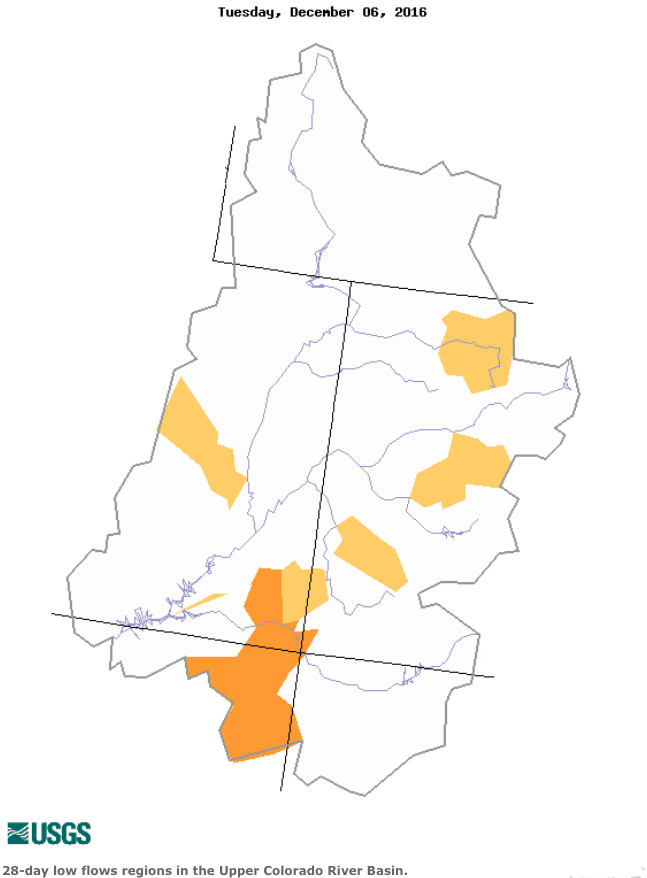
After a summer of sparse moisture in 2016, the Yampa, where it enters Stagecoach Reservoir, was flowing at 22 cubic feet per second on Sept. 23, representing an historic low, based on 27 years of record.
Managers of the Stagecoach and Catamount dams timed their seasonal draw-down of their reservoirs to benefit the Yampa downstream. And the city of Steamboat and the Colorado Water Trust both arranged to release stored water to boost the river’s flow by 10 cfs well into autumn.
The cost of the water testing in 2017 is up about 2 percent, with the USGS contributing $14,631, or 30 percent, of the total cost of $48,443. Joining the county in contributing 20 percent of the total are the city of Steamboat Springs and the Upper Yampa Water Conservancy District.
The Mount Werner Water and Sanitation District and Morrison Creek Water and Sanitation District are each contributing $2,415, or 5 percent, of the total.