
Click the link to access the report on the NIDIS website (Britt Parker; Joel Lisonbee, Elizabeth Ossowski ; Holly R. Prendeville; Dennis Todey). Here’s the executive summary:
Over the past few decades, significant advances have been made to improve the Nation’s capacity to proactively manage drought risk by providing those affected with the best available information and resources to diagnose and quantify—or assess—drought conditions. Drought assessments can be a snapshot of present drought severity and extent, an analysis over time of drought duration, a retrospective look at the underlying drivers of a drought, an analysis of the impacts of drought on people or systems, or any other attempt to understand the dynamics of a particular drought. These assessments have a vital role to play in supporting communities in preparing for, mitigating, and responding to drought.
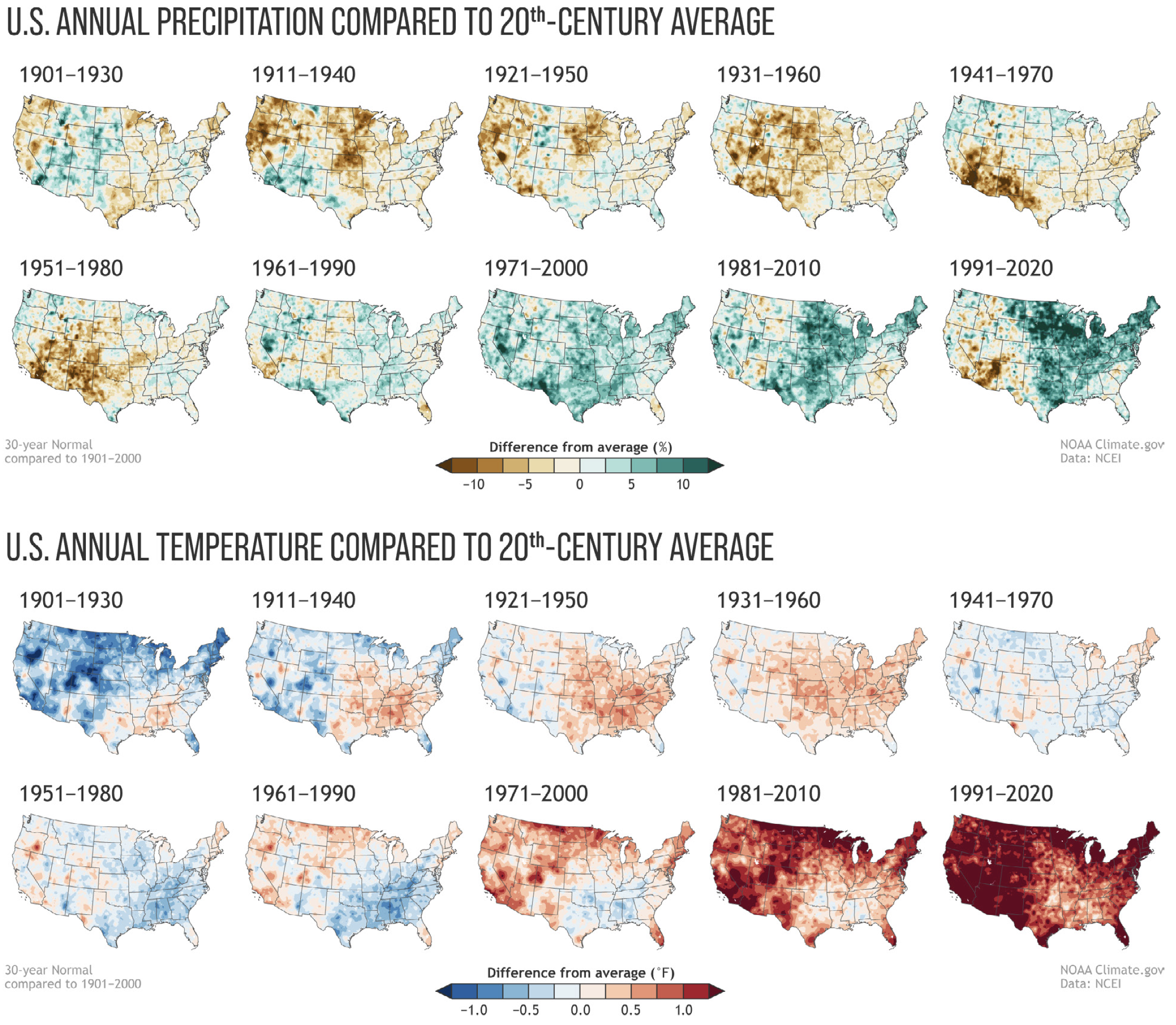
Improvements in data products, more accurate drought assessments, and investments in better coordination have served drought-prone communities well. Continuous integration of new needs and requirements from those communities is essential to maintaining the continuity of progress our country has already made. Today, the changing climate is causing the probability of extreme events to change, a phenomenon known statistically as non-sta-tionarity. In the future, the intensity, duration, and frequency of droughts may change. This poses new challenges that are being raised by scientists, decision-makers, and practitioners. These challenges include the difficulty to distinguish natural variability, meaning the naturally occurring oscillations in the climate system, from forced trends, or the seemingly permanent changes caused by anthropogenic climate change. This also includes the complexity of understanding drought within socio-economic considerations and resource constraints (e.g., funding, capacity) that might limit the ability to integrate the latest science into operational data products.
Around the country, those engaged in drought decision-making are considering a number of questions such as: Do current methods for assessing drought conditions consistently and deliberately consider non-stationarity? If not, could this result in a missed opportunity to promote drought planning and response strategies that build long-term community resilience and reduce risk? What research is needed to produce drought indicators that account for climate change? And what resources are available to support their development and integration into the current suite of indicators?
A technical meeting to discuss this issue was co-hosted by NOAA’s National Integrated Drought Information System (NIDIS) and USDA Climate Hubs on February 28–March 1, 2023, where scientists, decision-makers, and practitioners were asked to address an overarching question: “What approaches should be taken to better incorporate non-stationarity into drought assessment?” Answering this question thoroughly demands thoughtful consideration of (1) the phenomenon of drought itself; (2) the experience of drought and its impacts; (3) the purpose of assessment of drought and its impacts; and (4) the preparation for and response to drought and its impacts, including actions to reduce impacts as well as policies and adaptation. Of these considerations, the technical workshop focused largely on better understanding and assessing the phenomenon itself by breaking the topic down into four sub-topics: (1) considering climate variability and drought assessment; (2) understanding drought in an aridifying (drier-trending) climate; (3) discerning drought in a humidifying (wetter-trending) climate; and (4) defining drought in terms of risk and likelihood of event.

This report captures the ideas and feedback of more than 100 subject matter experts from over 44 institutions across the drought research and practitioner communities who participated in the meeting and reviewed this report. The two-day meeting identified priority actions and outstanding research questions that would continue to advance drought assessment in a changing climate. From the large volume of input received at the meeting, ideas were collated and refined; however, they were not distilled down to a few top priorities, nor were ideas further fleshed out to incorporate a prescriptive scale for implementation. Instead, this report captures the breadth of feedback from the meeting itself.
In total, the report highlights priority actions and research questions across the following fifteen focus areas to improve drought assessment by addressing gaps identified by the research and practitioner community. These fifteen focus areas are presented individually with the acknowledgement that if they are approached as siloes, progress will be curtailed. Many are cross-cutting, progress in one will accelerate progress in another, and it is key that the drought community approach these issues collaboratively. Finally, while the primary focus of the technical working meeting was on better understanding and assessing the phenomenon (of drought) itself, focus areas on related planning, governance, and communication considerations are also critically important and were captured.
- Learning with Indigenous Communities
- Benchmarking our Understanding and Assessment of Drought in a Changing Climate
- Ensuring Equity in Drought Monitoring and Assessment
- Evaluating Data Relevance, Fidelity, Integration, Metadata and New Technologies
- Determining the Physical Drivers of Drought and How They Are Changing
- Understanding Drivers of Aridification and Their Interactions with Drought
- Addressing Regional Differences in Non-stationarity
- Improving Drought Indicator Performance
- Using Precipitation Effectiveness More Broadly to Capture Rainfall Variability
- Quantifying Water Demand in a Changing Climate
- Evaluating Drought Impacts and How They Are Changing
- Assessing Drought in Terms of Risk
- Assessing Policy through the Lens of Non-stationarity
- Strengthening Planning, Management, and Adaptation
- Improving Communication and Collaborative Knowledge Exchange
Across this discussion of diverse and important focus areas, chronic issues emerged that plague our Nation’s efforts to adequately assess drought and its impacts, and these are exacerbated by climate change. These include gaps in drought monitoring and assessment that present equity issues and under-resourced observation and monitoring networks that require additional investment.
This report offers a rich collection of ideas for action and research that federal, tribal, state, local agencies and academic institutions can advance. Further prioritization and specification may be warranted to discern where limited resources might be most impactful, and this will be the focus of an accompanying synthesis paper for publication in 2024. Although the intent of the report is not to provide authoritative guidance or design specifications for specific research or programmatic endeavors, it is intended to illuminate current and future needs to best account for a changing climate in our drought assessment practices.