

Click the link to read the article on The Land Desk website (Jonathan P. Thompson):
The two groups of Colorado River watershed states — the Upper Basin and the Lower Basin — have each come up with a respective preliminary plan for how to deal with a shrinking supply of water in the river and its tributaries. And, surprise surprise, they don’t agree: They both want the other team to take a bigger hit.
Way back in early 1900s, the question facing these seven states was how to divide up the waters of the Colorado River, first between the two basins, then between the states within each basin. The 1922 Colorado River Compact answered that question. Sort of. The Compact is flawed in many ways, including that the folks who signed onto it thought there was a bunch more water than actually flowed in the river — even back then.

Now there’s even less water and higher consumption. If the river users don’t make some major cuts and soon, the reservoirs will dry up and leave the Southwest’s cities, towns, and farms to fight over the diminishing scraps.
“We can no longer accept the status quo of the Colorado River operations,” said Becky Mitchell, Colorado’s representative on the Upper Colorado River Commission, in a press release. “If we want to protect the system and ensure certainty for the 40 million people who rely on this water source, then we need to address the existing imbalance between supply and demand.”

So now the question facing the states is similar to the one they asked 102 years ago, but with a twist: How should those deep cuts be divided up now that global heating is depleting the river’s flow?
It’s a tough question with no easy answers. And it’s all made more difficult by a lack of clarity regarding the definition of terms in the original Compact such as “beneficial consumptive use” and “surplus,” and how to measure those things. Where does use of tributaries that run into the Colorado below Lee Ferry, such as the Gila River, the Little Colorado, and the Virgin River fit into all of this?

Until those definitions are agreed upon, we won’t really know whether the Lower Basin is using the amount of water allocated to it in the Compact (8.5 million acre-feet), or significantly more than that (10.1 million acre-feet). Until we know what “surplus” means, we won’t know who is responsible for ensuring Mexico gets its allocated share. So far there is no agreement on those definitions. (For a detailed and intelligent take on this, please see Eric Kuhn’s and John Fleck’s piece on Fleck’s Inkstain blog).
The good news is that the current proposals aren’t final; there is still time for the basins to negotiate. And the two basins’ representatives are inching closer to accord, finding harmony where it previously eluded them. The two alternatives agree:
- That consumption cuts should be triggered not by forecasted water levels in Lake Mead, but by current hydrologic conditions throughout the entire system. However, they differ on how to measure those conditions.
- And that the Lower Basin should include evaporation and seepage — totaling an estimated 1.3 million acre-feet per year — in its consumptive use, as the Upper Basin has always done. They plan to offset this loss by cutting consumption by 1.5 million acre-feet per year.

The main sticking point comes when reservoirs shrink to critically low levels:
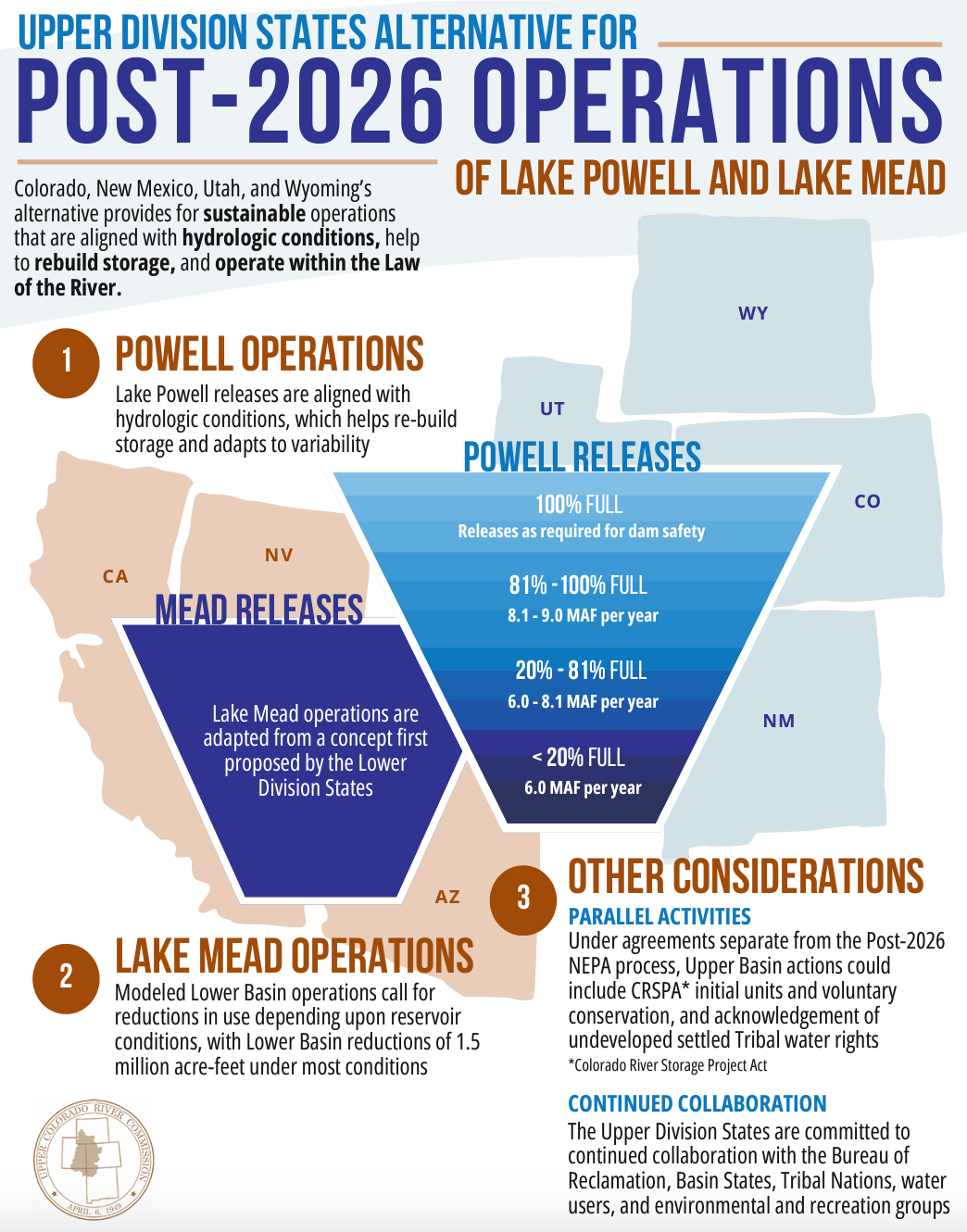
- Under the Upper Basin’s plan, as storage levels drop, they would release progressively less water from Lake Powell. So if water storage is 81% to 100% full, then they’d release 8.1 to 9 MAF from Glen Canyon Dam, giving the Lower Basin their full allocation. But if storage is less than 20% full, it would release just 6 MAF per year, giving the Lower Basin 2.5 MAF less than their allocation that year — presumably forcing them to cut that same amount of consumption. Whether and how much consumption the Upper Basin would have to cut under this scenario would depend on how much water is actually in the river. It’s important to note that the Upper Basin does not and has never used its full allocation of 7.5 MAF per year.
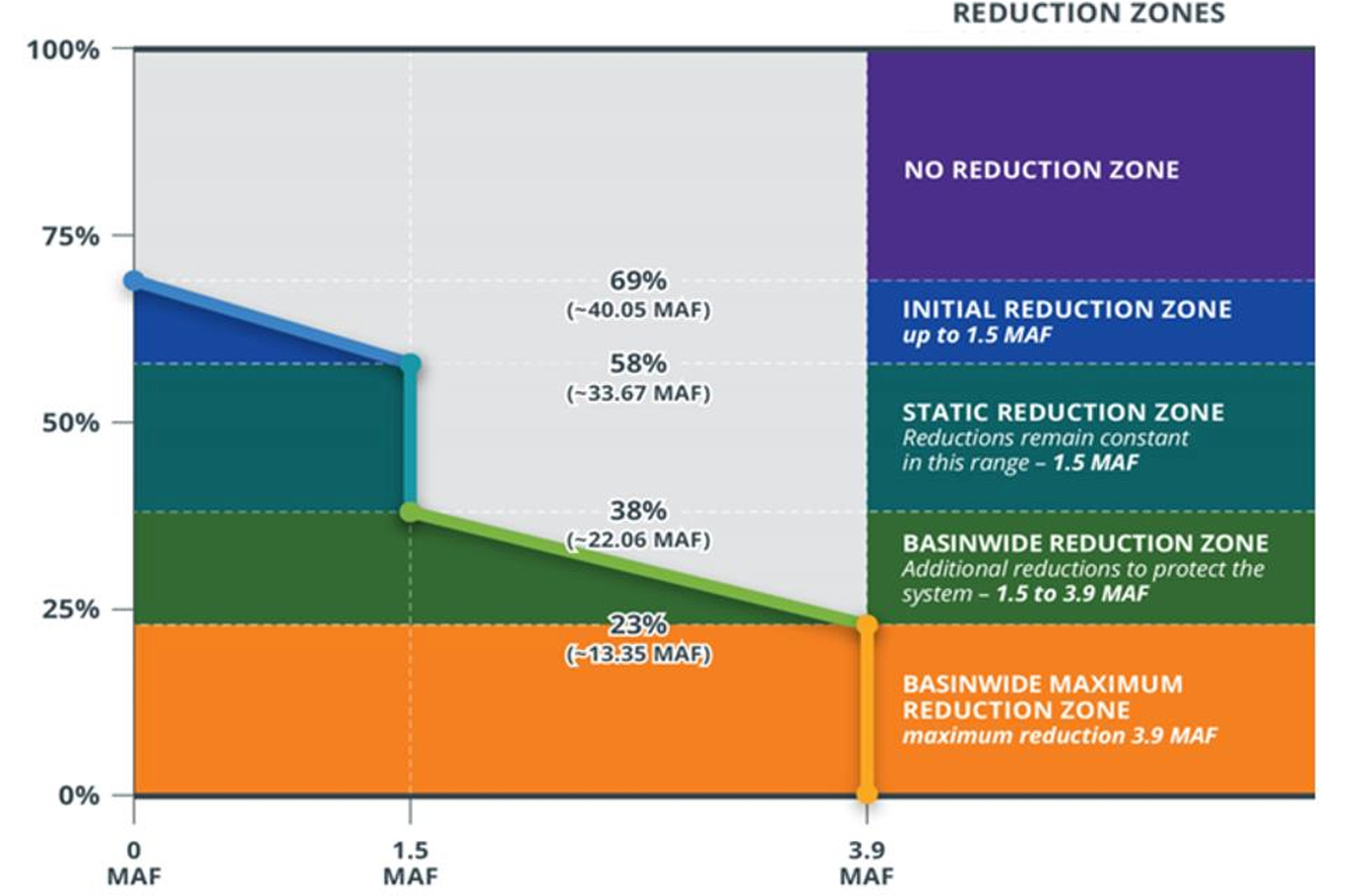
- Under the Lower Basin’s plan, when the system is between 38% and 70% full, the Lower Basin would cut its consumption by 1.5 MAF per year. When system water levels drop below that, then the Lower Basin would continue its 1.5 MAF per year cuts, and the two basins would share any cuts above that up to a maximum of 3.9 MAF per year. So under the maximum cuts, the Lower Basin would reduce usage by 2.7 MAF while the Upper Basin would cut use by 1.2 MAF.
Both basins’ alternatives mention and acknowledge that many tribal nations’ water rights remain unfulfilled, and yet say little about how the situation might be rectified. And each Basin says its respective plan is the most sustainable, is most likely to keep Hoover and Glen Canyon dams from being compromised, and complies with the Law of the River — or the set of treaties, compacts, and court cases that govern how the river is used.
Yet the sustainability or health of the Colorado River as an entity — a breathing, flowing, living being — is barely mentioned. Little thought is given to the ecosystems, cultures, and creatures the river sustains. I realize that’s not the point of this exercise. And yet, ultimately, it will be the River itself that lays down the law, not century-old compacts or legal precedents or antiquated water rights. Perhaps we ought to pay it a little more respect.
FURTHER READING:
- Ya gotta check out the Colorado River Science wiki. All kinds of good resources there.
- Ditto for On the Colorado, a clearinghouse for all kinds of information on the River.
- Aspen Journalism’s Heather Sackett did a thorough writeup of the two proposed alternatives.
- You want the wonky, nitty-gritty details on Western water? Then go to John Fleck’s Inkstain blog and spend some time.
- And finally, a Land Desk primer on the Colorado Compact. For paid subscribers only, I’m afraid:
The Colorado River Compact
JONATHAN P. THOMPSON March 8, 2024
Editor’s Note: This essay first appeared in the High Country News November 11, 2022.