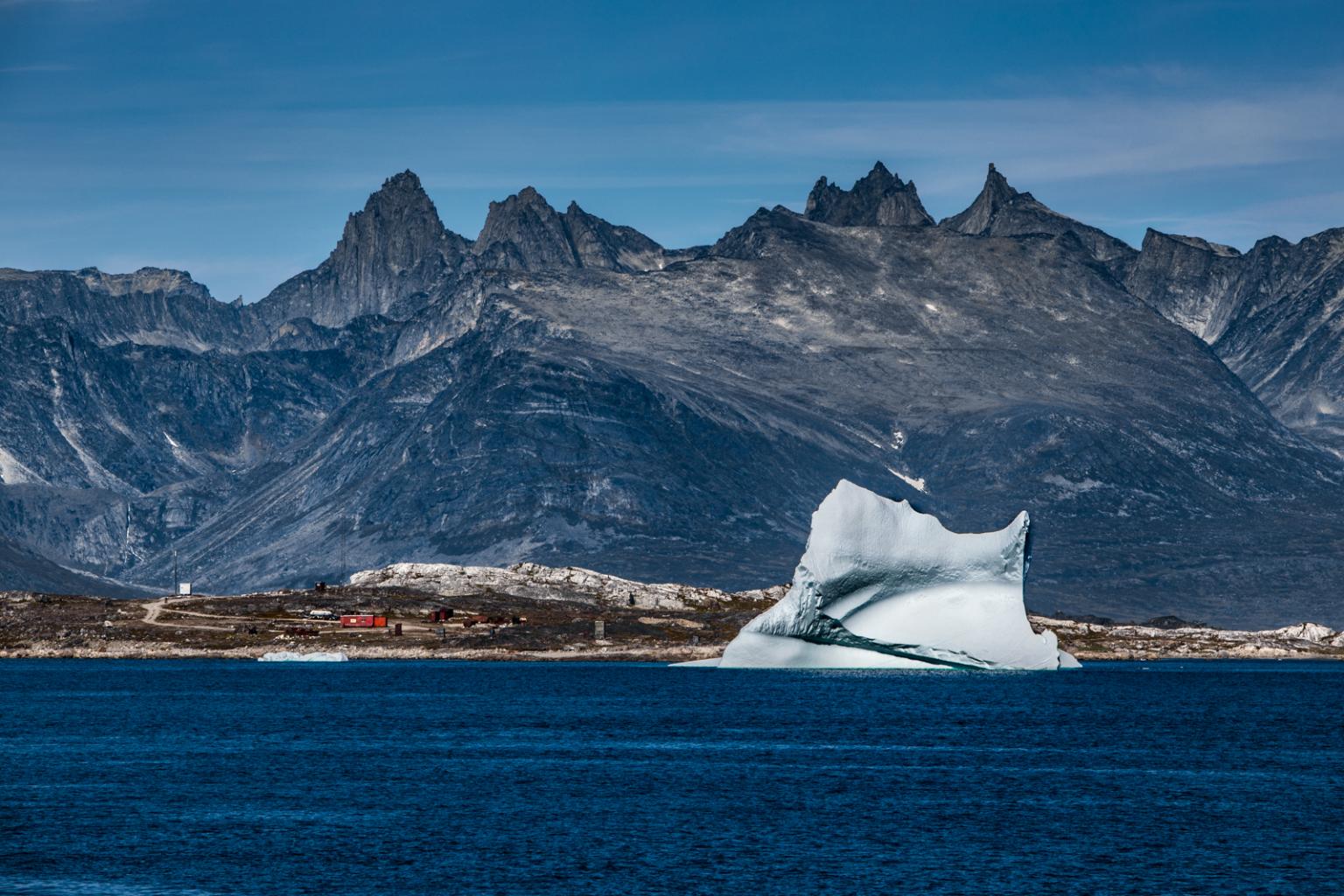
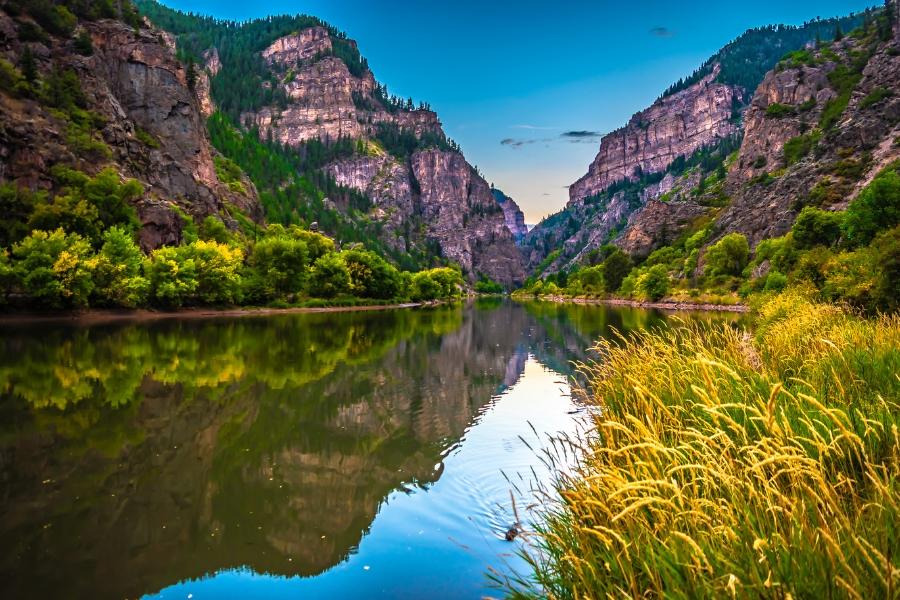
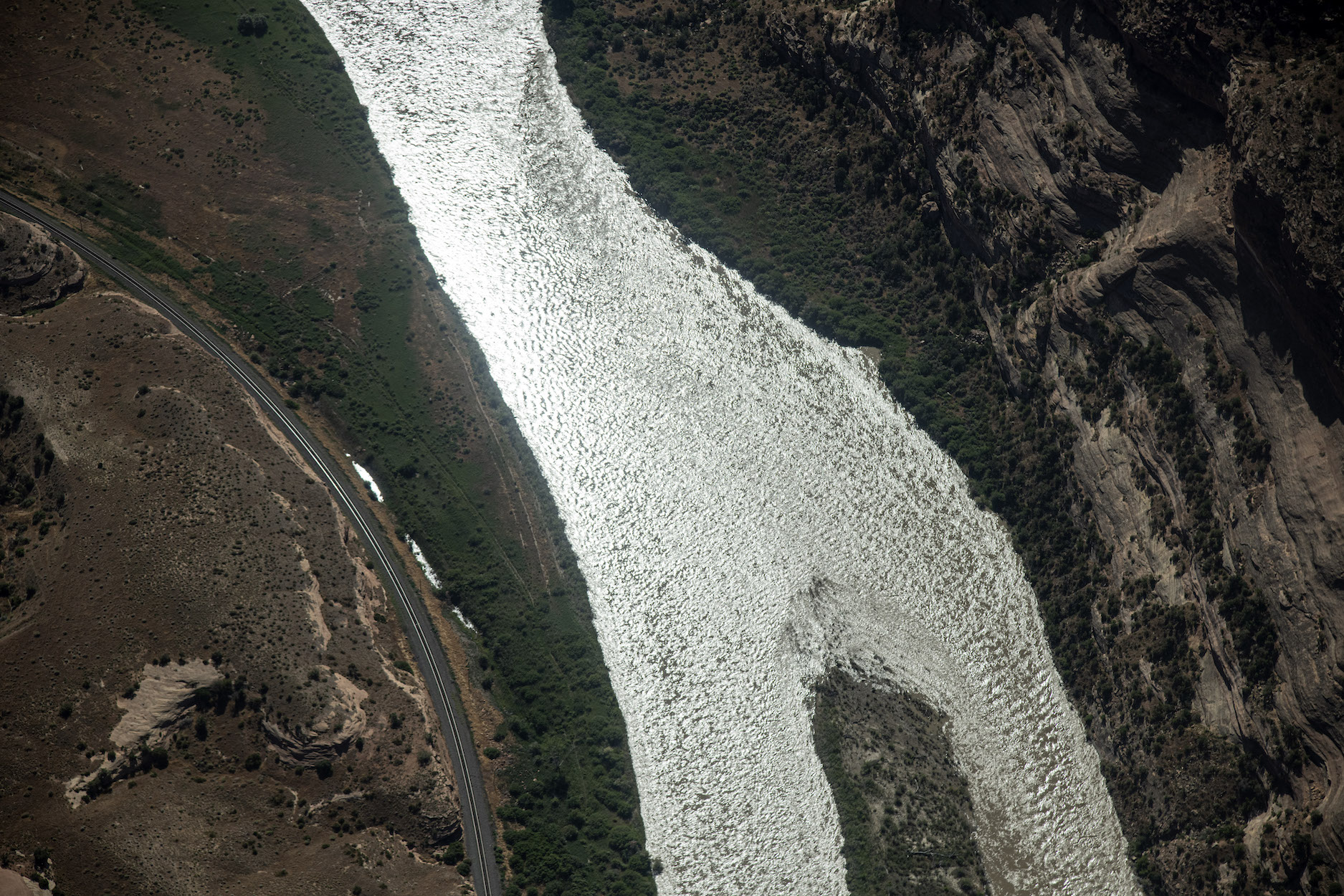
Black Canyon July 2020. Photo credit: Cari Bischoff
From email from Reclamation (Erik Knight):
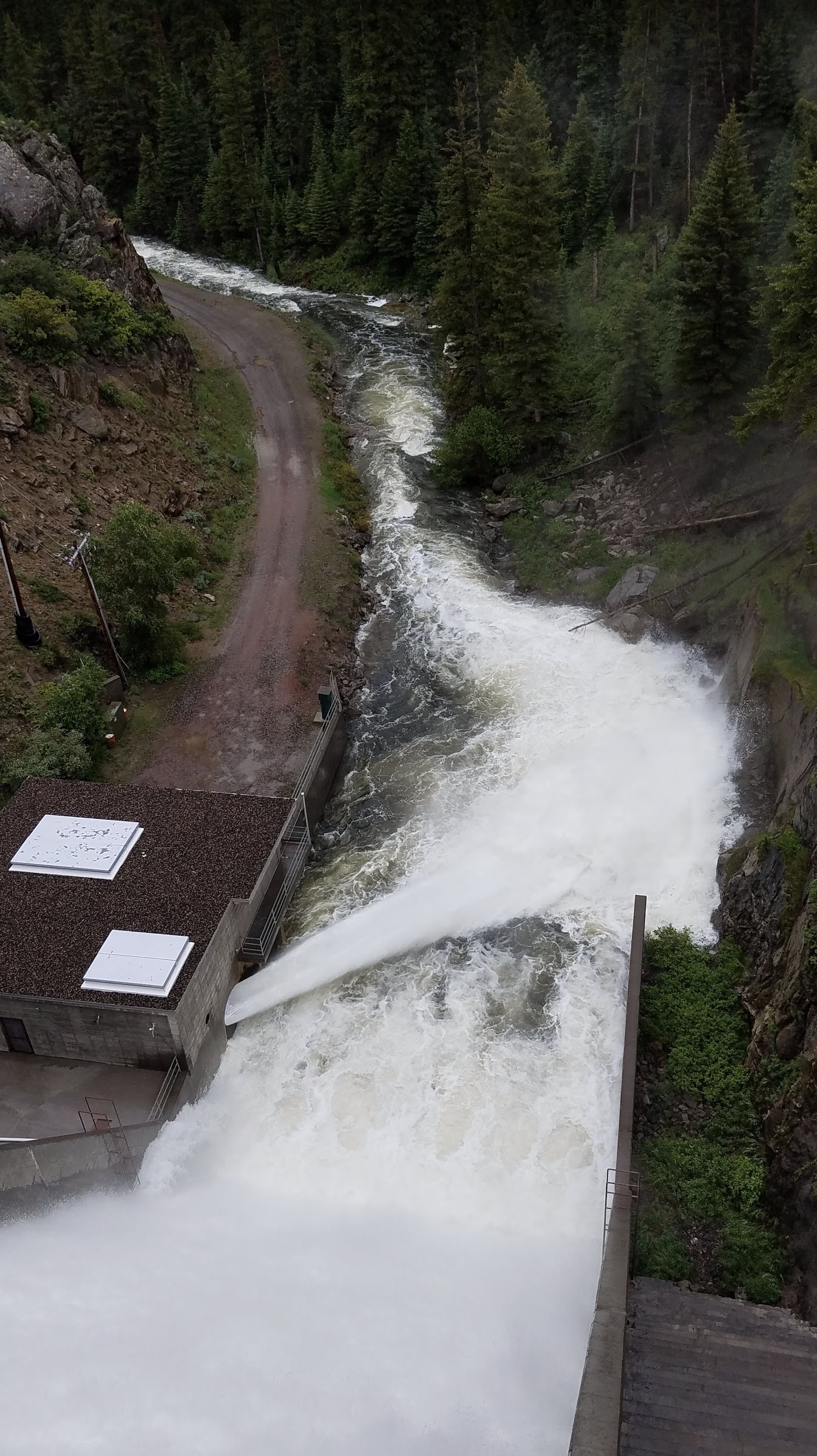
Releases from the Aspinall Unit will be decreased from 1650 cfs to 1550 cfs on Tuesday, August 20th. Releases are being decreased as flows on the lower Gunnison River are well above the baseflow target of 1050 cfs. Further reductions in the release at Crystal may occur soon if river levels remain well above the target.
Flows in the lower Gunnison River are currently above the baseflow target of 1050 cfs. River flows are expected to remain above the baseflow target for the foreseeable future.
Pursuant to the Aspinall Unit Operations Record of Decision (ROD), the baseflow target in the lower Gunnison River, as measured at the Whitewater gage, is 1050 cfs for August through December.
Currently, Gunnison Tunnel diversions are 1050 cfs and flows in the Gunnison River through the Black Canyon are around 600 cfs. After this release change Gunnison Tunnel diversions will still be 1050 cfs and flows in the Gunnison River through the Black Canyon will be around 500 cfs. Current flow information is obtained from provisional data that may undergo revision subsequent to review.
This scheduled release change is subject to changes in river flows and weather conditions. For questions or concerns regarding these operations contact:
The Central Arizona Project canal passes alfalfa fields and feedlots in La Paz County, Arizona. The fields are irrigated with pumped groundwater, not CAP water. Source: Google Earth.
Imagine that you’ve set off for a hike in the desert of western Arizona, hoping to get up high so you can get a view of the juxtaposition of alfalfa fields against the sere, rocky earth. But you somehow get disoriented, the sun reaches its apex and beats down on you, the temperature climbing into the triple digits. The ground temperature becomes so hot you can feel it through the soles of your Hoka running shoes. Your water bottle is empty. Feeling certain you are going to die you pick a direction and stagger in as straight a line as you can manage, rasping for help. And then, just when you’re about to curl up under a rock and surrender, you see, coming straight out of a hillside, a virtual river. It must be a mirage, you think, or a hallucination, you run toward it, climb the fence, and dive into the cool, deep water.
This is not a fantasy scenario. There is, in fact, a place in the western Arizona desert where a lost traveler could stumble upon a giant canal emerging from the earth.
The Central Arizona Project’s Mark Wilmer pumping plant at Lake Havasu. The 14 plants on the CAP system push water across more than 300 miles with a vertical gain of 3,000 feet. Moving water requires enormous amounts of power, making the CAP the state’s largest single electricity user, with annual power bills totaling $60 million to $80 million. Source: Google Earth.
Central Arizona Project canal daylighting at the Buckskin Mountain Tunnel. Source: Google Earth
The outlet of the San Juan Chama Project runs into Willow Creek west of Los Ojos before running into Heron Lake. Source: Google Earth
The Rio Blanco intake for the San Juan-Chama Project, which takes water from three upper San Juan River tributaries and ships it across the Continental Divide to the Chama River watershed and, ultimately, the Rio Grande. Source: Google Earth
It’s just one of the crazy plumbing projects along the Colorado River and its tributaries. And they can look pretty weird when you stumble upon them in remote places. That’s what happened to me the other day — virtually. I was using Google Earth to chart the 1776 Escalante-Dominguez expedition’s path when, near Chama, I came across a large volume of water emanating from an arid meadow. After some thought I realized it was the outlet for the San Juan-Chama Project that diverts about 90,000 acre-feet of water annually from three tributaries of the San Juan River, sends it through the Continental Divide via a tunnel, and delivers it to Willow Creek and Heron Reservoir. From there it can be released into the Chama River, which runs into the Rio Grande, which is used by Albuquerque and Santa Fe to supplement groundwater and the shrinking Rio Grande.
The Big Thompson Project sucks water out of the Colorado River near its headwaters and siphons it through the mountains via the Alva Adams Tunnel. The water feeds reservoirs that feed Front Range cities and is used to generate hydropower. Adams tunnel inlet at Grand Lake. Source: Google Earth
The Big Thompson Project sucks water out of the Colorado River near its headwaters and siphons it through the mountains via the Alva Adams Tunnel. The water feeds reservoirs that feed Front Range cities and is used to generate hydropower. Penstocks and powerplant at Flatiron reservoir on the right. Source: Google Earth
These things aren’t only unsettling in a visual way, but in a conceptual way as well. One would expect cities and agricultural zones to rise up around where the water is and to grow according to how much water is locally available. Instead, cities rise up in places of limited water and grow as if there were no limits, importing water (and power and other resources) from far away.
The Julian Hinds pumping station, near Desert Center, California, lifts water from the Colorado River Aqueduct 441 feet as it makes its way toward Los Angeles. Source: Google Earth
The Southern Nevada Water Authority was forced to build a third water intake from Lake Mead that was able to draw water as the reservoir continued to shrink. The pumping plant is pictured. Source: Google Earth
Three years ago, climate researchers shocked drought-weary Californians when they revealed that the American West was experiencing its driest 22-year period in 1,200 years, and that this severe megadrought was being intensified by global warming. Now, a UCLA climate scientist has reexamined the data and found that, even after two wet winters, the last 25 years are still likely the driest quarter-century since the year 800.
”The dryness still wins out over the wetness, big time,” said UCLA professor Park Williams.
The latest climate data show that the years since 2000 in western North America — from Montana to California to northern Mexico — have been slightly drier on average than a similar megadrought in the late 1500s. Williams shared his findings with the Los Angeles Times, providing an update to his widely cited 2022 study, which he co-authored with scientists at Columbia University’s Lamont-Doherty Earth Observatory. The new findings reveal that even the unusually wet conditions that drenched the West since the start of 2023 pale in comparison to the long stretch of mostly dry years over the previous 23 years. And that dryness hasn’t been driven by natural cycles alone. Williams and his colleagues have estimated that a significant portion of the drought’s severity — roughly 40% — is attributable to warming driven by the burning of fossil fuels and rising levels of greenhouse gases. The warming that has occurred in the region, an increase of more than 2.5 degrees Fahrenheit since recordkeeping began more than a century ago, has intensified the dry conditions, making the latest megadrought significantly more severe than it would be without climate change.
But are we still in a megadrought? How will we know when the megadrought is finally over? Williams said those questions will take some time to answer, and the conclusions will only become clear in hindsight.
“Based on the definition of megadrought that we’ve been using, which involves looking at the past 10 years to see if dry or wet conditions prevailed, we can only see the termination of a megadrought in hindsight,” Williams said. “If the next few years are on average wet, that will mark the end of the megadrought. If they’re dry, the megadrought will continue.”
Atmospheric carbon dioxide concentrations (CO2) in parts per million (ppm) for the past 800,000 years. On the geologic time scale, the increase to today’s levels (orange dashed line) looks virtually instantaneous. Graph by NOAA Climate.gov based on data from Lüthi et al., 2008, via the NOAA NCEI Paleoclimatology Program.
View of Shoshone Hydroelectric Plant construction in Glenwood Canyon (Garfield County) Colorado; shows the Colorado River, the dam, sheds, a footbridge, and the workmen’s camp. Creator: McClure, Louis Charles, 1867-1957. Credit: Denver Public Library Digital Collections
Western Colorado financial support for purchasing major Colorado River water rights is broadening beyond local governments and water entities thanks to commitments made in recent days by the boards of Colorado Mesa University and Grand Valley Power. CMU’s board on Friday unanimously agreed to commit up to $500,000 toward the effort to purchase the water rights for the Shoshone hydroelectric power plant in Glenwood Canyon for $99 million, and Grand Valley Power’s board recently pledged $100,000…
“We’ve been of course following like everyone else the importance of the Shoshone right and this regional community effort to try and protect western Colorado,” CMU President John Marshall said Friday in an interview. “It just seemed like the obvious thing for the regional comprehensive university here to be in that conversation.”
He said he’s pleased to see the CMU board take the initiative to contribute to the purchase. Thanks to state and CMU funds, the college this summer began a three-year project to upgrade its geothermal-geoexchange plant that it uses for heating and cooling on campus. Already the system saves CMU about $1.6 million a year, and the latest upgrade will result in an additional $260,000 a year in forgone energy costs, Marshall said. He said CMU’s intention is to contribute a total of up to $500,000 over two years resulting from those forgone energy costs to the water rights purchase. Marshall said he thinks every entity that is committing funds to the effort is doing it for the same reason, which is the long-term health of the river…
Grand Valley Power is a not-for-profit electric cooperative serving 19,000 meters in and around Mesa County. Reached for comment Friday afternoon on its $100,000 commitment, Grand Valley Power CEO Tom Walch said in a prepared statement, “Grand Valley Power serves a rural consumer base, a large segment of which relies on agriculture. GVP’s contribution will come from unclaimed patronage capital and won’t affect the electric cooperative’s rates. What the contribution will affect is the rights of our members to feel secure about the future of sustainable water on the Western Slope. Our board recognizes the immense value these water rights hold for our region.”
Jul 24, 2024 How have glaciers changed in the last 100 year? Thanks to the Glacier RePhoto project and many forward-looking photographers, we have this powerful collection of repeat photos to share. Why does it matter: Mountain glaciers are critical to the western United States and other mountainous regions around the world. They provide key water resources, habitat for wildlife and fish, and areas to explore, recreate in, and be inspired by. But they are rapidly receding around the world due to climate change. Places and glaciers included in this video: Cascades, Sierra Nevada, Rocky Mountains, Three Sisters, Glacier National Park, Mount Rainier National Park, Mount Baker, Mount Hood, Mount Adams, Grinnell Glacier, Coe Glacier, Blackfoot Glacier, Emmons Glacier, Collier Glacier, Boulder Glacier, Thunderbird Glacier, and more. To learn more about the Glacier RePhoto project and browse their map of repeat images, visit: https://www.hassanbasagic.com/project…
About me: I’m Scott Hotaling–an Assistant Professor at Utah State University in the Department of Watershed Sciences. My lab studies high mountain ecosystems and the impact climate change and loss of snow and ice is having on them. I created this YouTube channel to share our research and information about climate change with the rest of the world. Learn more about my lab: https://qcnr.usu.edu/research/ccml/ Interested in studying aquatic ecosystems for an undergraduate or graduate degree? Check out my department at Utah State University: https://qcnr.usu.edu/wats/
The Great Salt Lake released 4.1 million tons of carbon dioxide and other greenhouse gases in 2020, researchers found — more evidence that dried-out lakes are a significant source of emissions.
In a new study in the journal One Earth, the researchers [Melissa Cobo and Soren Brothers] calculated that 4.1 million tons of carbon dioxide and other greenhouse gases were released from the drying bed of the Great Salt Lake in 2020, the year Cobo and others collected the samples. This would amount to about a 7 percent increase in Utah’s human-caused emissions, the authors found. While other researchers have documented carbon emissions from dried-out lakes — including the Aral Sea in Central Asia — Brothers said that his study tried to calculate what part of the emissions from this major saline lake could be attributed to humans, as the Great Salt Lake has been drawn down for human use, a decline worsened by climate change and the West’s megadrought of the past two decades.
“This is the first time we’re saying, ‘This is something that’s on us,’” said Brothers, now a climate change curator with the Royal Ontario Museum…Lakes around the world normally store carbon. Plant and animal remains settle on the bottom over thousands of years as sediment, much of it in low-oxygen layers that degrade slowly. When lakes dry out, oxygen can penetrate deep into the sediment, waking up microorganisms that start to feast on the organic matter, releasing carbon dioxide, Marcé said…
Utah’s Great Salt Lake — the largest saline lake in the Western Hemisphere — has been a buffet for microorganisms in recent years. Lake levels fell to record lows two years ago. It rebounded some after the past two wet winters, but vast stretches of dry lake bed remain, and levels still lie below what state officials consider a healthy range. There are many dangers posed by its diminished state, including toxic dust, loss of habitat for birds, and impact on brine shrimp and other industries.
Sunset from the western shore of Antelope Island State Park, Great Salt Lake, Utah, United States.. Sunset viewed from White Rock Bay, on the western shore of Antelope Island. Carrington Island is visible in the distance. By Ccmdav – Own work, Public Domain, https://commons.wikimedia.org/w/index.php?curid=2032320
An aerial view of the Jemez Watershed on June 28, 2024. (Photo by Danielle Prokop / Source NM)
Click the link to read the article on the SourceNM.com website (Danielle Prokop):
July 29, 2024
If approved, the settlements would bring in more than $3.7 billion in federal funds and end decades of water rights litigation
The Navajo Nation president and leaders from Acoma, Ohkay Owingeh and Zuni Pueblos joined tribal leadership from across the nation on Capitol Hill, offering testimony about the benefits of $3.7 billion federal dollars in six proposed water rights settlements across New Mexico.
The deals would settle tribes and Pueblos’ water rights in four New Mexico rivers: the Rio San José, the Rio Jemez, Rio Chama and the Zuni River.
Another bill would also correct technical errors in two previously ratified water rights settlements: Taos Pueblo and the Aamodt settlement Pueblos of Nambé, Pojoaque, Tesuque and San Ildefonso. Finally, a sixth bill would add time and money for the Navajo-Gallup water project to construct drinking water services.
New Mexico representatives presented a record six settlements for Pueblos and tribes at a subcommittee hearing Tuesday, the first step in getting needed Congressional approval to end decades of litigation. Companion proposals from the Senate were heard Friday in the Senate Indian Affairs Committee. Mescalero Apache Tribe President Thora Padilla was introduced to senators with support for the settlements.
As climate change reshapes the Southwest into something hotter and drier, with more strain on its water resources, approaching water collaboratively means communities have a chance to stay, and tribes can exercise their sovereignty.
In front of House members on Tuesday, Ohkay Owingeh Gov. Larry Phillips Jr. said the settlement of the Ohkay Owingeh’s rights on the Rio Chama will offer a means of long-awaited restoration.
“The U.S. bulldozed our river, it destroyed our rivers and bosque,” he said. “This needs to be fixed, the settlement gives us the tools to do that.”
Rep. Teresa Leger Fernández (D-N.M.) said tribes and Pueblos gave up certain acreage that they are entitled to, and worked out drought-sharing agreements to benefit everybody in the region.
Leger Fernández sponsored five of the bills, and Rep. Gabe Vazquez (D-N.M.) sponsored a sixth that was heard on Tuesday.
Additionally, she said the funds will enable more infrastructure, bosque restoration and ensuring water rights protections for neighboring acequias.
Acoma Pueblo Gov. Randall Vicente told the committee that making concessions in the settlement was crucial to preserving water for future generations.
“It is better to have adequate wet water, than paper rights without a water supply,” he said.
Even if the Pueblo enforced having the oldest water right, Vicente said the Rio San José’s system is so damaged, it would take decades for water to reach Acoma.
The settlements can help redress the federal government’s injustices towards Ohkay Owingeh Pueblo, Phillips said. He pointed to the U.S. Army Corps of Engineers and U.S. Bureau of Reclamation’s channelizing of the Rio Chama and the building of Abiquiu Reservoir in the 1950s, which moved water away from the Pueblo.
“Both of these actions resulted in depriving us of our bosque and waters necessary for a proper river,” he said. “We entered into the settlement in order to protect, preserve our water resources and the bosque.”
The loss of water not only impacts the health of Pueblo communities, Phillips said, but it splits people from their lands and means the loss of sacred bodies of water and ceremonies to celebrate them.
Water offers a lifeline to traditional ways and offers prosperity, said Zuni Pueblo Gov. Arden Kucate.
Zuni Pueblo will work to build new drinking water treatment systems and restore waffle garden irrigation practices, a technique used for generations until the turn of the 19th century, when settlers diverted water and clearcut the Zuni River watersheds.
“It will usher in, what I sincerely believe, will be a new chapter for our tribe, allowing us to protect and sustainably develop our limited water resources, to restore traditional agriculture and facilitate much-needed economic development,” Kucate said about the settlement.
Navajo Nation President Buu Nygren also spoke, celebrating water rights settlements with both New Mexico and Arizona.
Some of the settlement agreements are already two years old.The administration supports all of the New Mexico settlements, said Bryan Newland (Ojibwe), the assistant secretary for Indian Affairs at the U.S. Department of the Interior.
“Any delay in bringing clean, drinkable water to communities is going to harm the people who live in those communities,” Newland said. “We also know from our experience that these settlements only get more expensive, and implementation only gets more expensive the longer we wait.”
Tribal water rights are not entirely settled in New Mexico, most notably on the Rio Grande, where a federal assessment team started addressing water claims issues in 2022. Leger Fernández said she hopes the six water rights settlements in other watersheds will provide a model for collaborative management of water rights on New Mexico’s largest river.
An aerial view of the Jemez Watershed on June 28, 2024. (Photo by Danielle Prokop / Source NM)
“These water rights settlements provide the framework for future water rights settlements, which include those involved in Rio Grande,” Leger Fernández said.
Leger Fernández said the moment was still momentous, even if it’s only the first step.
“There’s never been this many settlements at one time,” she said. “There has never been a hearing that was this big.”
What’s the process?
The House Committee on Natural Resources held a legislative hearing on 12 water rights settlements across the U.S. with a projected cost of $12 billion.
The hearing consisted of testimony from federal agencies and heads of tribal governments.
The settlements can now head into a process called mark-up and means they can be added to legislative packages moving forward. Both of New Mexico’s senators sponsored companionate bills.
It’s just the first step in the process, but Leger Fernández said she’s looking to face the biggest hurdle of cost head-on. She and members of the Department of the interior testified that continuing to fight court battles will cost the federal government more money, and that waiting isn’t an option.
“The longer we wait, the more expensive it will be,” she said.
New Mexico Lakes, Rivers and Water Resources via Geology.com.
Click here to access the report on the EPA website:
The fifth edition of Climate Change Indicators in the United States documents how climate change is impacting the United States today, the significance of these changes, and their possible consequences for people, the environment, and society.
Using EPA’s climate change indicators and relevant scientific literature, the report groups indicators into eight themes that help to show interconnections, cause-and-effect relationships, and how physical changes in the atmosphere affect people and the environment. Indicators related to human health and societal impacts of climate change cut across chapter themes and are integrated throughout the report. Each theme includes information on why the changes matter, as well as examples and discussion of the unequal impacts of climate change. The report also provides examples of what people and communities can do to address climate change, and what actions are already underway.
Coal fired plant near Hayden with the Yampa River 2015. Photo credit: Ken Nuebecker
Click the link to read the article on the Big Pivots website (Allen Best):
August 17, 2024
Will there be a water bonus as we close coal plants? In the short term, yes. It’s harder to say in the long term. Here’s why.
Use it or lose it. That’s a basic premise of Colorado water law. Those with water rights must put the water to beneficial use or risk losing the rights to somebody who can. It’s fundamentally anti-speculative. But Colorado legislators this year created a major exception for two electric utilities that draw water from the Yampa River for coal-burning power plants. They did so through Senate Bill 24-197, which Gov. Jared Polis signed into law in Steamboat Springs in late May.
The two utilities, Xcel Energy and Tri-State Generation and Transmission Association, plan to retire the five coal-burning units — two at Hayden and three at Craig — they operate in the Yampa River Basin by late 2028. These units represent Colorado’s largest concentration of coal plants, 1,874 megawatts of generating capacity altogether. That’s 40% of Colorado’s total coal-fired electrical generation. Together, they use some 19,000 acre-feet of water each year.
What will become of those water rights when the turbines cease to spin? And what will replace that power? The short answer is that the utilities don’t know. That’s the point of the legislation. It gives the utilities until 2050 to figure out their future.
While the legislation is unique to the Yampa Valley, questions of future water use echo across Colorado as its coal plants — two units at Pueblo, one near Colorado Springs, one north of Fort Collins, and one at Brush — all will close or be converted to natural gas by the end of 2030.
This story was originally published in the July 2024 issue of Headwaters Magazine. Photo above of the Hayden Generating Station and the Yampa River was taken by Ken Neubecker in spring 2015. All other photos by Allen Best unless otherwise noted.
Both Xcel and Tri-State expect that at least 70% of the electricity they deliver in 2030 will come from wind and solar. The final stretch to 100%? That’s the hard question facing utilities across Colorado — and the nation and world.
Natural gas is expected to play a continued role as backup to the intermittency of renewables. Moving completely beyond fossil fuels? No one technology or even a suite of technologies has yet emerged as cost-effective. At least some of the technologies that Xcel and Tri-State are looking at involve water.
Fossil fuel plants use less than 1% of all of Colorado’s water. Yet in a state with virtually no raw water resources left to develop, even relatively small uses have gained attention. Colorado’s power future will have implications for its communities and their water, but how exactly that will look remains unknown.
Emissions Goals
The year 2019 was pivotal in Colorado’s energy transition. State lawmakers adopted legislation that specified a 50% economy-wide reduction in greenhouse gas emissions by 2030 and 100% by 2050. A decade before, that bill would have been laughed out of the Colorado Capitol. Even in 2019, some thought it unrealistic. But proponents had the votes, and a governor who had run on a platform of renewable energy.
Something approaching consensus had been achieved regarding the risks posed by climate change. Costs of renewables had plummeted during the prior decade, 70% for wind and 89% for solar, according to the 2019 report by Lazard, a financial analyst. Utilities had learned how to integrate high levels of renewables into their power supplies without imperiling reliability. Lithium-ion batteries that can store up to four hours of energy were also dropping in price.
Colorado lawmakers have adopted dozens of laws since 2019 intended to dramatically reduce greenhouse gas emissions. Photo credit: Allen Best/Big Pivots
Tied at the legislative hip to the targets adopted in 2019 were mandates to Colorado’s two investor-owned electric utilities, Xcel Energy and Black Hills Energy. By 2030 they must reduce emissions by at least 80% compared to 2005 levels. Both aim to do even better.
Xcel, the largest electrical utility in Colorado, was already pivoting. In 2017, it received bids from wind and solar developers in response to an all-sources solicitation that caused jaws across the nation to drop. In December 2018 shortly after the election of Gov. Polis, Xcel officials gathered in Denver to boldly declare plans to reduce emissions by 80% by 2030. Platte River Power Authority, the provider for Fort Collins and three other cities in the northern Front Range, later that month adopted a highly conditioned 100% goal. In January 2020, Tri-State announced its plans to close coal plants and accelerate its shift to renewables — it plans to reduce emissions by 89% by 2030. In December 2021, Holy Cross Energy, the electrical cooperative serving the Vail and Aspen areas, adopted a 100% goal for 2030. It expects to get to 91% by 2025.
Colorado Springs Utilities burned the last coal at the Martin Drake power plant along Fountain Creek in August 2022. Photo credit: Allen Best/Big Pivots
Colorado’s emissions-reduction goals are economy wide, not just for power production. In practice, this means replacing technologies in transportation, buildings and other sectors that produce greenhouse gas emissions with low- or no-emissions energy sources. As coal plants have closed, transportation has become the highest-emitting sector. Colorado had 126,000 registered electric vehicles and hybrids as of June but hopes to have 940,000 registered by 2030. Buildings pose a greater challenge because most of us don’t replace houses the way we do cars or cell phones. Solutions vary, but many involve increased use of electricity instead of natural gas.
A final twist that has some bearing on water is Colorado’s goal of a “just transition.” House Bill 19-1314 declared that coal-sector workers and communities were not to be cast aside. Efforts would be made to keep them economically and culturally whole.
Possible Water Dividends
The Cherokee Generating Station north of downtown Denver is now a natural gas-fired power plant.
Where does this leave water? That’s unclear and, as the 2024 legislation regarding the Yampa Valley spelled out, it is likely to remain unclear for some time. The law prohibits the Division 6 water judge — for the Yampa, White and North Platte river basins — from considering the decrease in use or nonuse of a water right owned by an electric utility in the Yampa Valley.
In other words, they can sit on these water rights through 2050 while they try to figure what technologies will emerge as cost competitive. Xcel Energy and Tri-State will not lose their water rights simply because they’re not using them during this time as would, at least theoretically, be the case with other water users in Colorado.
Conversion of the Cherokee power plant north of downtown Denver from coal to natural gas provides one case study of how energy shifts can affect water resources. Xcel converted the plant to natural gas between 2010 and 2015. Its capacity is now 928 megawatts.
Richard Belt, a water resources consultant for Xcel, says that when Cherokee still burned coal, it used 7,000 to 8,000 acre-feet of water per year; since 2017, when natural gas replaced coal, it uses 3,000 to 3,500 acre-feet per year.
Does that saved water now flow downstream to farmers in northeastern Colorado?
“If the wind is really blowing, there could be some water heading downstream on certain days,” Belt answered. In other words, there’s so much renewable energy in the grid that production from the gas plant at times is not needed. A more concrete way to look at this conversion, Belt says, is to step back and look at Xcel’s water use more broadly across its system. It also has the Rocky Mountain Energy Center, a 685-megawatt combined-cycle natural gas plant along Interstate 76 near Keenesburg that it bought in 2009 and began operating in 2012. With the plant came a water contract from Aurora Water.
Xcel has been renegotiating that contract, which it projects will be effective in early 2025. The new contract will allow Xcel to take water saved at Cherokee and instead use it at the Rocky Mountain Energy Center. That will allow it to use 2,000 acre-feet less of the water it has been leasing from Aurora each year. Belt says it will save Xcel customers around $1 million a year in water costs.
“Another way to look at this dividend is that we’re going to hand [Aurora] two-thirds of this contract volume, around 2,000 acre-feet a year, and they can use that water within their system,” Belt explains.
Other coal-burning power plants have also closed in recent years, with water dividends of their own. One small coal plant in southwestern Colorado at Nucla, operated by Tri-State, was closed in 2019. In 2022, Xcel shut down one of its three coal units at the Comanche Generating Station in Pueblo.
Colorado Springs Utilities stopped burning coal at its Martin Drake coal-fired plant in 2021, which is located near the city’s center, and replaced it with natural gas. It used some 2,000 acre-feet of water per year in the early 2000s, and was down to only 14 acre-feet per year in 2023. Colorado Springs Utilities — a provider of both electricity and water — delivers 70,000 to 75,000 acre-feet of water annually to its customers. Whatever water savings were achieved in that transition will be folded into the broader operations. The city’s remaining coal plant, Ray Nixon, burns both coal and natural gas. The city delivers about 2,000 acre-feet per year to Nixon to augment groundwater use there.
The 280-megawatt Rawhide coal-fired power plant north of Fort Collins is to be shut down by 2030. Platte River Power Authority, which owns and operates the plant, had not yet chosen a replacement power source as of June 2024. Platte River delivers electricity to Estes Park, Fort Collins, Longmont and Loveland.
The Cherokee plant along the South Platte River north of downtown Denver uses significantly less water since tis conversion from coal to natural gas. Photo credit: Allen Best/Big Pivots
That leaves just the 505-megawatt Pawnee among Colorado’s existing coal plants. The plant near Brush is to be retrofitted to burn natural gas by 2026. The water dividend? Xcel is trying to keep its options open.
The one commonality among all the possible power-generating technologies that Xcel may use to achieve its goal of emissions-free energy by 2050 is that, with the exception of some battery technologies, they all require water, says Belt. And that, he says, means it would be unwise to relinquish water without first making decisions about the future.
That’s why this year’s bill was needed. Colorado’s two biggest electrical providers, Xcel and Tri-State, both with coal plants retiring in the Yampa Valley, have questions unanswered.
The Future of Energy
Strontia Springs Dam and Reservoir, located on the South Platte River within Waterton Canyon. It is ranked #32 out of 45 hydroelectric power plants in Colorado in terms of total annual net electricity generation. Photo by Milehightraveler/iStock
What comes next? Obviously, lots more wind and solar. Lots. The graph of projected solar power in Colorado through this decade looks like the Great Plains rising up to Longs Peak. Construction of Xcel’s Colorado Power Pathway, a 450-mile transmission line looping around the Eastern Plains, will expedite renewables coming online. Tri-State is also constructing new transmission lines in eastern Colorado. The plains landscape, San Luis Valley, and other locations could look very different by the end of the decade.
Very little water is needed for renewables, at least once the towers and panels are put into place.
You may well point out that the sun goes down, and the wind doesn’t always blow. Storage is one holy grail in this energy transition. Lithium-ion batteries can store energy for four hours. That works very effectively until it doesn’t. Needed are new cost-effective technologies or far more application of known technologies.
One possible storage method, called iron-rust, will likely be tested at Pueblo in 2025 by a collaboration between Xcel and Form Energy, a company that proclaims it will transform the grid. It could provide 100 hours of storage. Tri-State’s electric resource plan identifies the same technology.
Granby Dam was retrofitted at a cost of $5.1 million to produce hydroelectricity effective May 2016. It produces enough electricity for about 570 homes. Photo/Northern Water
Other potential storage technologies involve water. Pumped-storage hydropower is an old and proven technology. It requires vertical differences in elevation, and Colorado has that. In practice, finding the right spots for the two reservoirs, higher and lower, is difficult.
Xcel Energy’s Cabin Creek project between Georgetown and Guanella Pass began electrical production in 1967. In this closed-loop system, water from the higher reservoir is released through a three-quarter-mile tunnel to the second reservoir 1,192 feet lower in elevation. This generates a maximum 324 megawatts to help meet peak demands or to provide power when it’s dark or the wind stops blowing. When electricity is more freely available, the water can be pumped back to the higher reservoir. Very little water is lost.
Near Leadville, the U.S. Bureau of Reclamation has a pumped-storage hydropower project at Twin Lakes, the Mt. Elbert Power Plant, with a more modest elevation difference. The plant can generate up to 200 megawatts of electricity.
Graphic credit: Joan Carstensen
A private developer with something similar in mind has reported reaching agreements with private landowners along the Yampa River between Hayden and Craig. With private landowners, the approval process would be far easier than if this were located on federal lands. Cost is estimated at $1.5 billion.
Belt points out that the Federal Energy Regulatory Commission has streamlined the permitting process for pumped-storage hydro but that technology remains expensive and projects will take probably 10 to 12 years to develop if everything goes well.
“During that 10 to 12 years, does something new come along? And if you’re committed to pumped storage, then you can’t pivot to this new thing without a financial impact,” he says, explaining a hesitancy around pumped storage.
Green hydrogen is another leading candidate in the Yampa Valley and elsewhere. It uses electrolysis to separate the hydrogen and oxygen in water. Renewable energy can be used to fuel the electrolysis. That’s why it is called green hydrogen as distinct from blue hydrogen, which uses natural gas as a catalyst. A news story in 2023 called it a “distant proposition.” Costs remain high but are falling. Tax incentives seek to spur that innovation.
Gov. Polis’ administration remains optimistic about hydrogen. It participated in a proposal for federal funding that would have created underground hydrogen storage near Brush. That proposal was rejected, but Will Toor, the chief executive of the Colorado Energy Office, has made it clear that green hydrogen and other emerging technologies remain on the table. Xcel says the same thing. “It’s not something we are going to give up on quite yet,” says Belt. The water savings from the conversion of coal to natural gas could possibly play into those plans.
Gov. Jared Polis stopped by the Good Vibes River Gear in Craig in March 2020 prior to attending a just transition workshop. Photo credit: Allen Best/Big Pivots
Polis is bullish on geothermal, both kinds. The easier geothermal uses the relatively constant 55 degree temperatures found 8 to 10 feet below ground to heat and cool buildings. The Colorado Capitol has geothermal heating, but the most famous example is Colorado Mesa University, where geothermal heats and cools about 80% of the campus. This technology may come on strong in Colorado, especially in new construction.
Can heat found at greater depths, say 10,000 feet or from particularly hot spots near the surface, be mined to produce electricity? California generates 10.1% from enhanced geothermal, Nevada 5.1%, and Utah 1.5%. Colorado generates zero. At a June conference, Polis said he thought geothermal could produce 4% to even 8% of the state’s electricity by 2040. Geothermal for electric production would require modest water resources.
Nuclear? Those plants, like coal, require water. Many smart people believe it may be the only way that civilization can reduce emissions as rapidly as climate scientists say is necessary to avoid catastrophic repercussions. Others see it as a way to accomplish just transition as coal plants retire.
Costs of traditional nuclear remain daunting. Critics point to projects in other states. In Georgia, for example, a pair of reactors called Vogtle have been completed but seven years late and at a cost of $35 billion, more than double the project’s initially estimated $14 billion price tag. The two reactors have a combined generating capacity of 2,430 megawatts.
New reactor designs may lower costs. The Nuclear Regulatory Commission in 2023 certified design of a small-modular reactor by NuScale. It was heralded as a breakthrough, but NuScale cancelled a contract later that year for a plant in Idaho, citing escalating costs.
With a sodium fast reactor, integrated energy storage and flexible power production, the Natrium technology offers carbon-free energy at a competitive cost and is ready to integrate seamlessly into electric grids with high levels of renewables. Graphic credit: http://NatriumPower.com
Greater optimism has buoyed plans in Wyoming by the Bill Gates-backed TerraPower for a 345-megawatt nuclear plant near the site of a coal plant at Kemmerer. It has several innovations, including molten salt for energy storage and a design that allows more flexible generation, creating a better fit with renewables. Ground was broken in June for one building. An application for the design is pending with the U.S. Nuclear Regulatory Commission. Gates has invested $1 billion and expects to invest many billions more in what he estimates will be a $10 billion final cost. He also hopes to see about 100 similar plants and reduced costs. Other companies with still other designs and ideas say they can also reduce costs. All these lower-cost nuclear solutions exist in models, not on the ground. Uranium supply remains problematic, at least for now, but more difficult yet is the question of radioactive waste disposal.
Into The Future
The potential for nuclear is balled up in the issue of just transition. Legislators in 2019 said that coal communities would not be left on their own to figure out their futures. What this means in practice remains fuzzy.
Consider Pueblo. Xcel Energy on August 1 is scheduled to submit to the Colorado Public Utilities Commission what is being called the Pueblo Just Transition Electric Resource Plan. Through that plan, Xcel must determine to what extent it can, through new generating sources, leave Pueblo economically whole after it closes the coal plants. Existing jobs will be lost, although others in post-closure remediation of the site will be gained. What, then, constitutes a just transition for Pueblo?
What will Xcel propose in October for Pueblo as it makes plans for the retired of the last of the Comanche coal-burning units in 2030? Photo credit: Allen Best/Big Pivots
A task force assembled by Xcel Energy in January delivered its conclusions after nearly a year of study: “Of all of the technologies that we studied, only advanced nuclear generation will make Pueblo whole and also provide a path to prosperity,” concluded the task force. They advised that a natural gas plant with carbon capture would be a distinctly secondary choice.
What will happen with the water in Pueblo? Xcel Energy has a take-or-pay water contract with Pueblo Water for 12,783 acre-feet per year for the Comanche Generating Station. It must pay for the water even if it does not take it. Pueblo Water has a similar take-or-pay contract for 1,000 acre-feet annually for the 440-megawatt natural gas plant operated by Black Hills Energy near the Pueblo airport.
The draw of these water leases from the Arkansas River isn’t that notable, says Chris Woodka, president of the Pueblo Water board, even in what he describes as a “small year,” with low flows in the river. These water leases constitute some 5% or less of the river’s water, Woodka says. Xcel could tap that same lease for whatever it plans at Pueblo. And if it has no use? “We haven’t had many conversations around what we would do if that lease goes away, because it is so far out in the future.”
Xcel and Tri-State both own considerable water rights in the lower Arkansas Valley, near Las Animas and Lamar. Neither utility has shared plans for using the water, as the ideas of coal or nuclear power plants that initially inspired the water purchases never moved forward. Water in both cases has been leased since its acquisition to Arkansas Basin agricultural producers in order to maintain an ongoing beneficial use.
Yampa River. Photo credit: Yampa River Integrated Water Management Plan website
Why don’t Tri-State and Xcel lease their water in the Yampa River as they do in the Arkansas? Jackie Brown, the senior water and natural resources advisor for Tri-State, explains that there is no demand for additional agricultural water in the Yampa Basin. About 99% of all lands capable of supporting irrigated agriculture already get water. This is almost exclusively for animal forage. This is a valley of hay.
However, the Yampa River itself needs more water. The lower portion in recent years has routinely suffered from low flows during the rising heat of summer. Some summers, flows at Deerlodge, near the entrance to Dinosaur National Monument, have drooped to 20 cubic feet per second. Even in Steamboat, upstream from the power plants, fishing and other forms of recreation, such as tubing, have at times been restricted.
One question asked in drafting the legislation this year was whether to seek protection with a temporary instream flow right for some of the 45 cfs that Tri-State and Xcel together use at the plants at Craig and Hayden. The intent would have been to protect the delivery of some portion of that water to Dinosaur National Monument through 2050. That idea met resistance from stakeholders.
Instead, a do-nothing approach was adopted. Those framing the bill expect that most of the time, most of the water will flow downstream to Dinosaur anyway. In most years, no demands are placed on the river from November through the end of June. The challenge comes from July through October. The amount of water, used formerly by coal plants, that reaches Dinosaur will depend upon conditions at any particular time. Have the soils been drying out? Has the summer monsoon arrived?
The Yampa River at Deerlodge Park July 24, 2021 downstream from the confluence with the Little Snake River. There was a ditch running in Maybell above this location. Irrigated hay looked good. Dryland hay not so much.
“Even if you’re adding even half of that [45 cfs], it is a big deal,” says Brown. “If you can double the flow of a river when it’s in dire circumstances it’s a big deal.”
A study conducted by the Colorado River Water Conservation District several years ago examined how much water released from Elkhead Reservoir, located near Hayden, would reach Dinosaur. The result: 88% to 90% did.
Brown says river managers will be closely studying whether the extra water can assist with recovery of endangered fish species and other issues. “There’s a lot of learning to be done. My key takeaway is that that’s really going to contribute to the volume of knowledge that we have and the future management decisions that are made.”
A larger takeaway about this new law is that it gives Colorado’s two biggest electrical providers time. Xcel and Tri-State don’t know all the answers as we stretch to eradicate emissions from our energy by mid-century. Many balls are in the air, some interconnected, each representing a technology that may be useful or necessary to complement the enormous potential of wind and solar generation now being created. All of these new technologies will require water. Some water in the conversion from coal is being saved now, but it’s possible it will be needed in the future.
No wonder Xcel’s Belt says its “imprudent in a very water-constrained region to let go of a water asset that you may not get back, until you know how some of these balls are going to land.”
Receding waters at Lone Rock in Lake Powell illustrate the impacts of megadrought. Hydroelectric generation will be endangered if the lake continues to shrink. Credit: Colorado State University
Colorado River officials in four states, including Colorado, are negotiating a new agreement with the federal government to conserve water and get credit to protect against possible cutbacks in the future.
Water conservation is a big issue in the Colorado River Basin, where prolonged drought, a changing climate, and overuse have strained the water supply for 40 million people. Currently, water conserved on a farm simply reenters streams and can be used by anyone downstream. The negotiations aim to set up a program to track, count and store that water so it can benefit the four Upper Basin states — Colorado, New Mexico, Utah and Wyoming.
Coloradans have asked for a conservation credit program, and this is a way of addressing that feedback, said Commissioner Becky Mitchell, Colorado’s representative on the Upper Colorado River Commission.
“One of the things that I heard primarily was that we need to be getting credit for the work that we are doing, and we need to be getting credit for it now,” Mitchell said Monday during the commission’s meeting.
Farmers, ranchers and other water users are already being paid to cut back their use of Colorado River water. Last year, taxpayers paid farmers and ranchers $16 million to cut their water use through the System Conservation Pilot Program.
The program led to water savings, but it did not require tracking and storing the water. Theoretically, water conserved in the Upper Basin could simply flow downstream to be used on farms, ranches and cities in the Lower Basin, according to critics of the program.
After years of debating and studying possible water credit programs, the commission ramped up its efforts to set up a program in July.
The commission hasn’t explicitly defined how credits will be used yet beyond saying they will benefit Upper Basin states. One possible use is to save up the credits and use them to fulfill the Upper Basin’s interstate water sharing obligations if river conditions worsen drastically and trigger mandatory cuts in the Upper Basin.
Commissioners and officials from the U.S. Bureau of Reclamation, which manages the basin’s vital storage reservoirs, aim to draft a conservation-for-credit agreement by the end of September.
It will identify general criteria for projects that could potentially conserve water for credit, like where conservation is taking place, who can participate, how the program would be regulated and how they plan to calculate conserved water.
If the commissioners approve the draft agreement, they will also have the option to move forward with accepting project proposals. The goal is to have applications in by October and to launch conservation projects in 2025, said Chuck Cullom, the commission’s executive director.
Establishing a conservation-for-credit program won’t be simple.
Building a long-term program to track and store conserved water raises questions about equity, funding, economic impacts and whether the idea is feasible at all.
The devil is in the details, said Andy Mueller, general manager of the Colorado River Water Conservation District, a public water planning and policy agency that spans over half the Western Slope (which is part of the Colorado River Basin).
Andy Mueller, the general manager of the Colorado River District, speaking at the district’s annual seminar on the Colorado RIver, on Sept. 14, 2018 in Grand Junction. Muller expressed concerns about how the state of Colorado might deal with falling water levels in Lake Powell and Lake Mead. Photo credit: Brent Gardner-Smith/Aspen Journalism
He wants to make sure a future program will not disproportionately impact one region, like the Western Slope. Farmers and ranchers in western Colorado have made nearly all of the water cuts through the conservation pilot program, even though communities across the state use Colorado River water.
“It’s a complex accounting world, and it takes time,” he said Monday after tuning into the virtual commission meeting along with about 100 other participants. “We do think they’re moving in the right direction.”
The potential program also has to coordinate with a set of high-stakes negotiations among all seven Colorado River states to decide the rules for storing, releasing and cutting back on water in the river’s main reservoirs, like Lake Powell and Lake Mead. These new rules won’t go into effect until after 2026.
Any credits gained before the end of 2026 will be counted but won’t be able to be used by the Upper Basin until after that process is complete, Cullom said.
The Upper Basin promised to conserve water in a proposal outlining how the four states envision future Colorado River management. Setting up a new conservation program shows the entire basin that the Upper Basin is taking action to cut back on water use, the state commissioners said.
A view of the popular Pumphouse campground, boat put-in and the upper Colorado River. Photo credit: Brent Gardner-Smith/Aspen Journalism
Click the link to read the article on the Summit Daily website (Ryan Spencer). Here’s an excerpt:
August 14, 2024
Grand, Eagle, Garfield and Mesa counties as well as local governments and water entities in Colorado have also pledged funds towards the $99 million purchase of the Shoshone water rights
The Summit County Commissioners have committed $1 million to support the Colorado River District’s effort to purchase and permanently protect the water rights associated with the Shoshone Hydroelectric Power Plant. For decades, the Colorado River District has been in talks with Xcel Energy to buy the rights to water used for Xcel’s Shoshone Generating Station, a hydroelectric plant in Glenwood Canyon. Last winter, the river district reached a historic deal to purchase the water rights from the utility company for $99 million. To date, more than half of that money has been raised. The vote Tuesday, Aug. 13, by the Summit County Commissioners moves the water district a step closer to closing on water rights important to communities up and down the Colorado River.
Rafters lift their paddles in the air as they make their way through a series of rapids on the Blue River as the Gore Range rises above the scene. Performance Tours Rafting/Courtesy photo
The flows guaranteed by the Shoshone rights provide critical water supplies that drive the recreation economies including rafting, kayaking and fishing in Summit, Grand and Mesa counties, according to the river district. Colorado River District general manager Andy Mueller called the commitment from Summit County, “a powerful statement of solidarity and foresight.”
This map shows the 15-mile reach of the Colorado River near Grand Junction, home to four species of endangered fish. Map credit: CWCB
The river district says the flows also are critical to the habitat of four fish listed on the federal Endangered Species Act as well as water security and quality for Western Slope agriculture and drinking water supplies. Since the river district struck a deal to purchase the water rights from Xcel in December, more than 20 Western Slope water entities and local governments have contributed $15.25 million in local funding. That includes the $1 million from Summit County, $1 million pledged by Grand County, $1 million from Mesa County, $2 million from Eagle County and $3 million from Garfield County. The state government has contributed an additional $20 million, and the Colorado River District’s Community Funding program has also contributed $20 million, bringing the total funds secured to date to $55.25 million, according to the river district. The river district says it is now turning its sights to a federal funding opportunity to secure additional funds toward the $99 million required to purchase the water rights
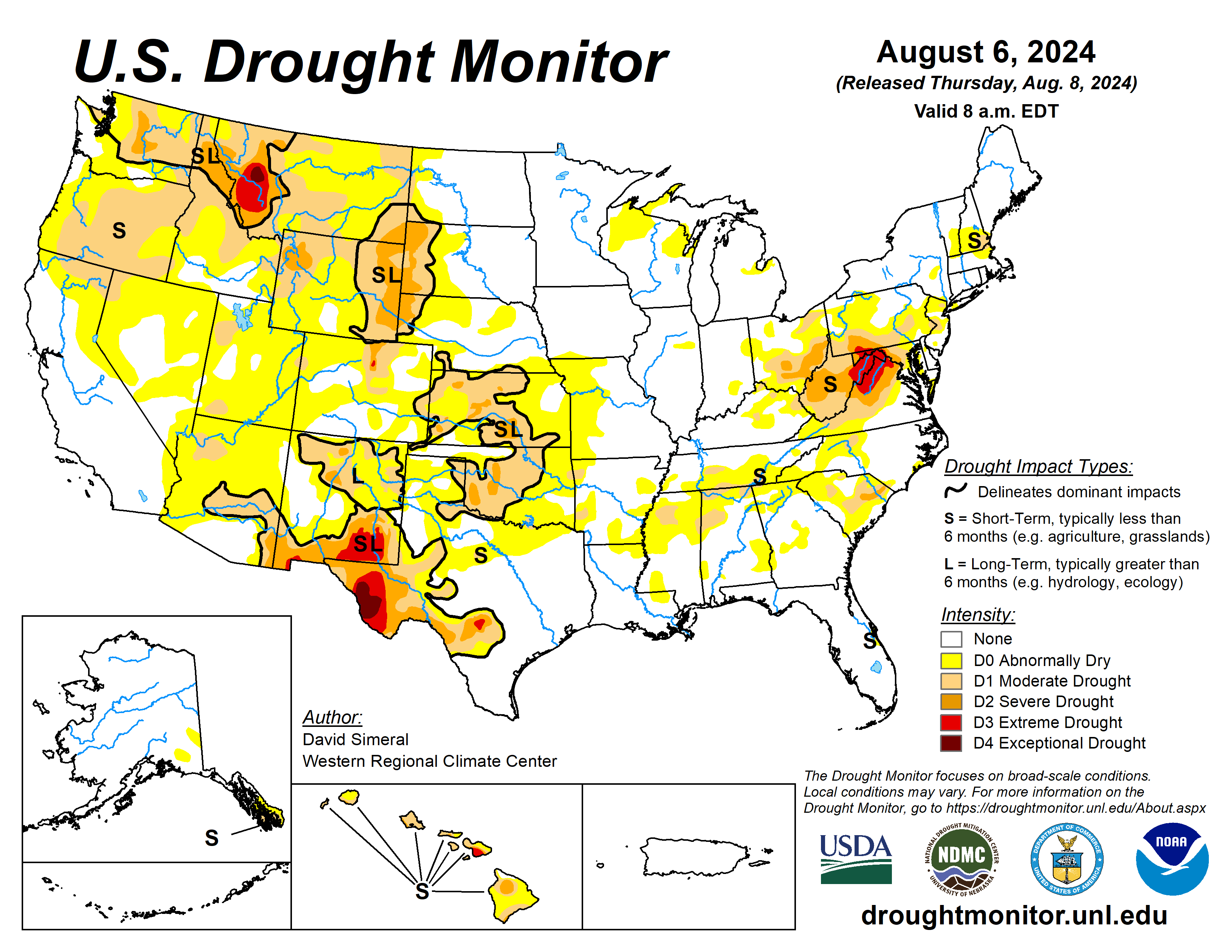
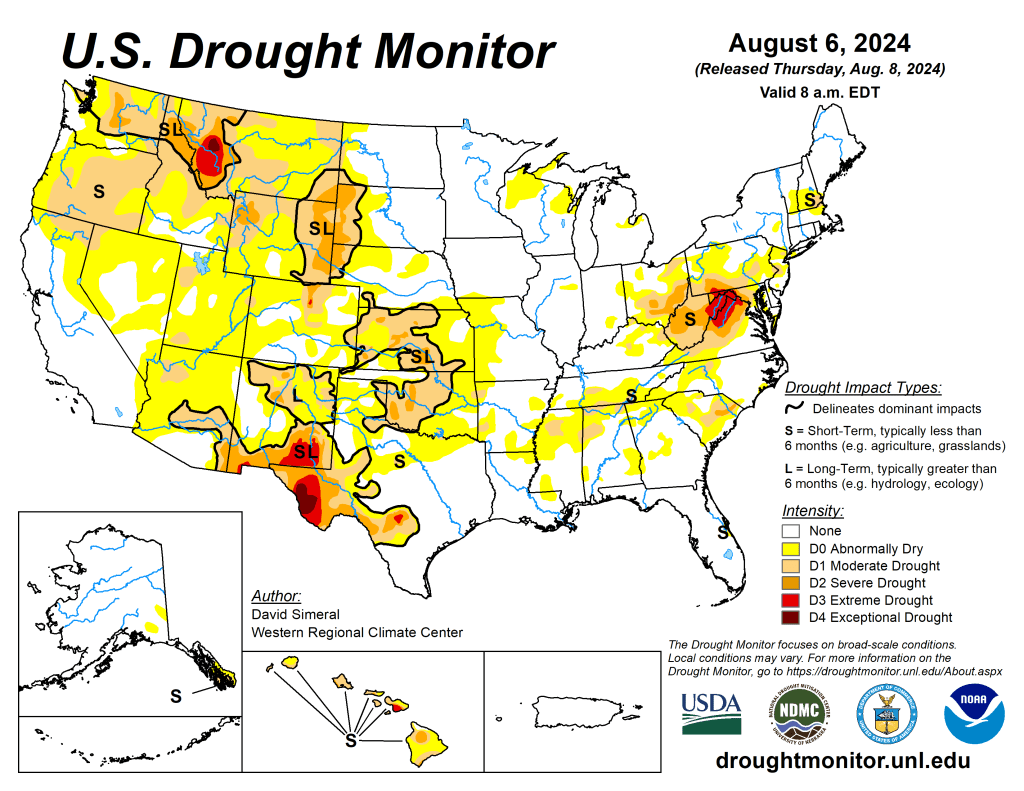
Widespread improvements to ongoing areas of abnormal dryness or drought continued across parts of the eastern United States this week as the remnants of Hurricane Debby moved up the Atlantic Coast. Locally over 10 inches of rain fell in parts of the eastern Carolinas, while widespread rain amounts of at least an inch or two (locally much higher) were common through the eastern Mid-Atlantic and Northeast states. In these areas of heavier rains, one- or two-category improvements to ongoing drought or abnormal dryness were widespread. In eastern portions of the Midwest and across much of the Southeast and south-central United States (except for Oklahoma and the Texas Panhandle), primarily dry weather prevailed, mostly leading to unchanged or worsening drought or abnormal dryness. Swaths of heavy rain fell in parts of northwest Missouri, Oklahoma, northeast New Mexico, Colorado, and southeast Wyoming, leading to localized improvements in drought or abnormal dryness in these areas. The central and north-central United States were mostly cooler than normal this week, especially from Kansas north into the Dakotas and Minnesota, where temperatures from 6 to 12 degrees below normal were widespread. Near- or warmer-than-normal temperatures were common in the West, with the warmest temperatures of 3 to 9 degrees above normal primarily occurring in California, Nevada, and Utah. The eastern United States saw a mix of above- and below-normal temperatures, though most places finished the week within 3 degrees of normal…
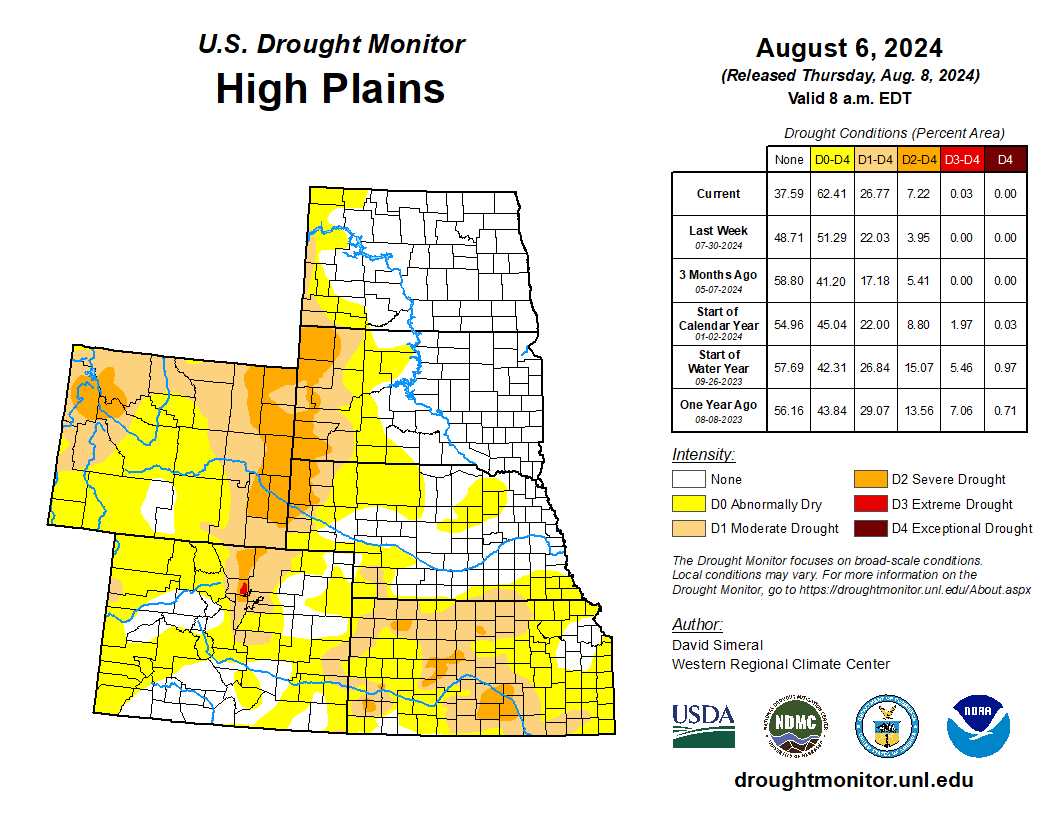
Mostly cooler-than-normal weather occurred this week across the High Plains states east of the Continental Divide. Temperatures from Kansas northward into the Dakotas ranged mostly from 6 to 12 degrees below normal. Precipitation amounts varied more widely; parts of southwest Nebraska, Kansas, Colorado, and southeast Wyoming saw heavier rains. This led to improvements in drought or dryness where precipitation deficits lessened. Other areas of central and eastern Nebraska, southeast and northeast Kansas, and western North Dakota were drier, leading to development or expansion of drought and abnormal dryness. Mostly dry weather also continued in western South Dakota where moderate and severe drought continued, and continued dry weather may lead to worsening conditions. Western Wyoming also saw expansions of drought conditions along the Idaho border amid continued dry short-term conditions…
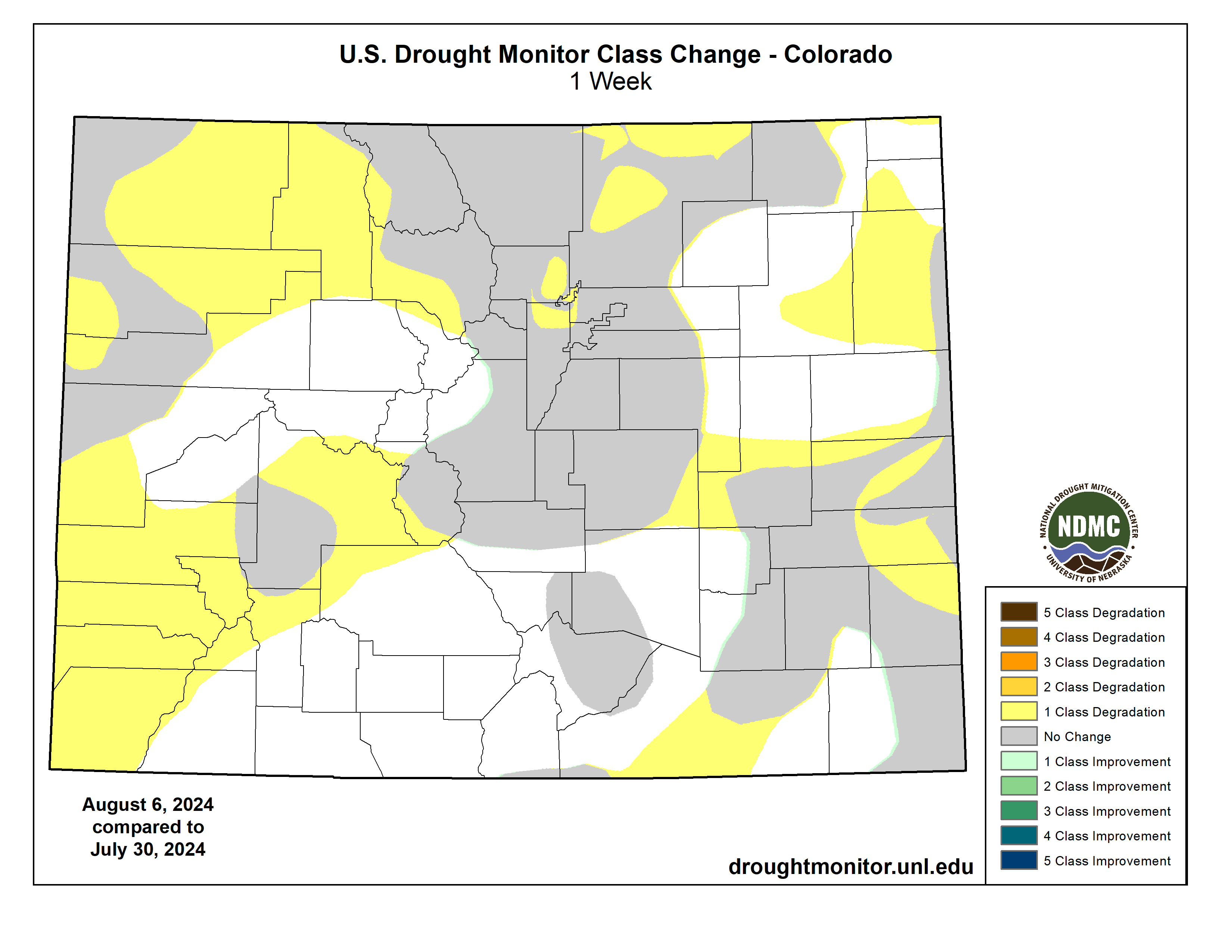
Colorado Drought Monitor one week change map ending August 13, 2024.
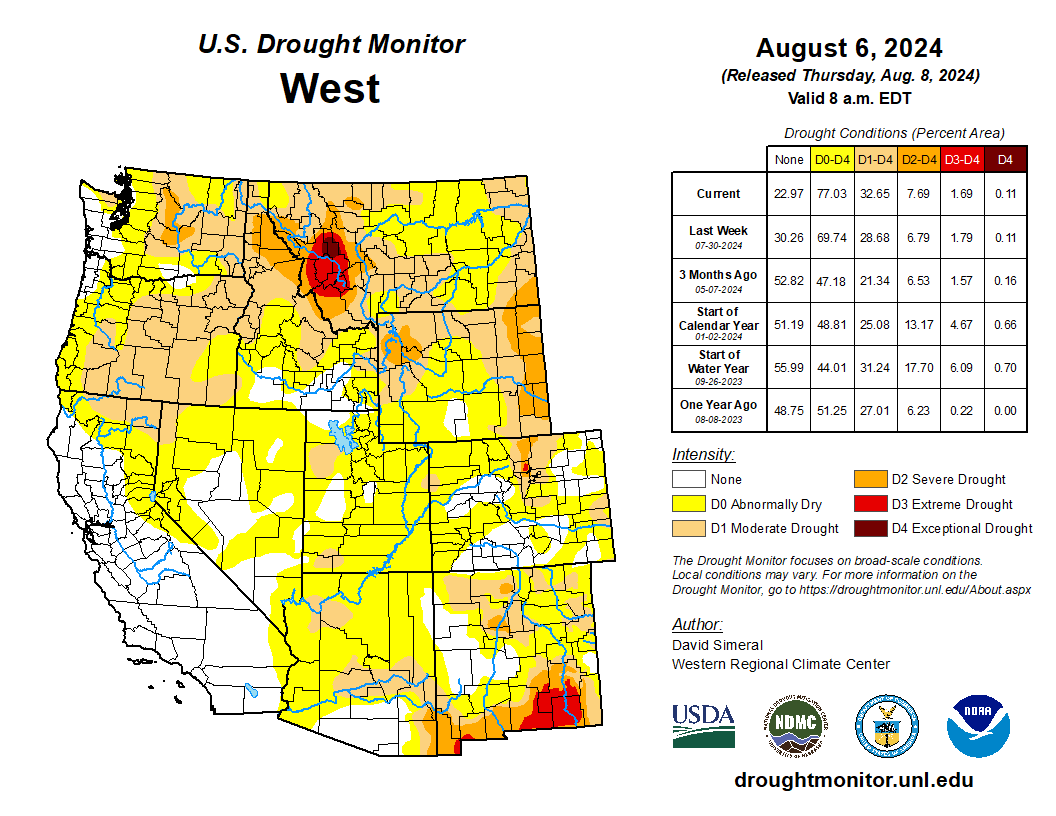
Mostly warmer-than-normal weather occurred this week across the West, especially in Utah, Nevada, and California—where temperatures were locally 3-9 degrees warmer than normal. West of Utah and Arizona, mostly dry weather occurred, while heavier rains fell in parts of northeast New Mexico and portions of Utah. The locally heavy rains in northeast New Mexico led to local improvements where precipitation deficits lessened in the short- and long-term. Recent rainfall led to local improvements to ongoing short-term moderate drought along the Utah-Colorado border. Elsewhere, scattered degradations occurred in the northern half of the West region. Northeast Montana saw expansion of moderate and severe drought due to short-term precipitation deficits and deficits in streamflow and soil moisture. A few degradations occurred across southern Idaho due to short-term dryness and streamflow deficits. Similar conditions in southeast Oregon and portions of Washington led to degrading conditions…
Except for the Texas Panhandle and Oklahoma, the South saw primarily dry weather this week. Soil moisture and streamflow dropped in parts of western Tennessee amid growing precipitation deficits, leading to expansion of abnormal dryness and short-term moderate drought there. Similar conditions in Mississippi, portions of Louisiana, and Arkansas led to moderate drought and abnormal dryness expansion. Farther west in Oklahoma, a couple heavy bands of rain fell across central and eastern parts of the state during nighttime thunderstorm complexes. This led to widespread improvements in ongoing drought. A two-category improvement occurred from southern Oklahoma City through Norman, where rainfall amounts of 6 or more inches were common. Heavier rains in the western Texas and Oklahoma Panhandles led to localized improvements where precipitation deficits lessened. Much of Oklahoma and Texas along and just south of the Red River saw short-term dryness intensify, leading to large-scale degradation in drought and abnormal dryness. Temperature anomalies across the region varied north to south. The northern half the region was mostly near normal or cooler than normal (locally 3 or more degrees below normal), while the southern half of the region ranged from near normal up to 3 or more degrees above normal…
Looking Ahead
Through August 19, the National Weather Service Weather Prediction Center is forecasting mostly drier weather in the West, aside from some monsoonal moisture in Utah and Arizona and precipitation in northwest parts of Montana and Washington. Heavier rainfall amounts, locally exceeding an inch, are possible primarily east of the Missouri River and along and north of the Ohio River, covering parts of the Midwest and Northeast.
Looking ahead to the period from August 20-24, the National Weather Service Climate Prediction Center’s forecast favors below-normal temperatures in the Great Lakes, parts of the Upper Midwest and Northeast. South and west of here, warmer-than-normal temperatures are favored, especially from Arizona and New Mexico through Texas and the Gulf Coast. A small area of below-normal temperatures is favored from northern California through the western halves of Washington and Oregon. Wetter-than-normal weather is slightly favored along the Atlantic Coast, the northwest Great Plains, and the central and northern Rocky Mountains, while higher confidence for wetter-than-normal weather exists from northwest California through northwest Oregon and most of Washington. Warmer-than-normal weather is favored in Hawaii, and above-normal precipitation is favored on the Big Island, while equal chances for above- or below-normal precipitation exist elsewhere in Hawaii. In Alaska, warmer-than-normal temperatures are favored in the southeast, while cooler-than-normal temperatures are more likely in central and western portions of the state. The forecast favors drier-than-normal weather in the southeast half of Alaska, while central and northwest Alaska are more likely to receive above-normal precipitation.
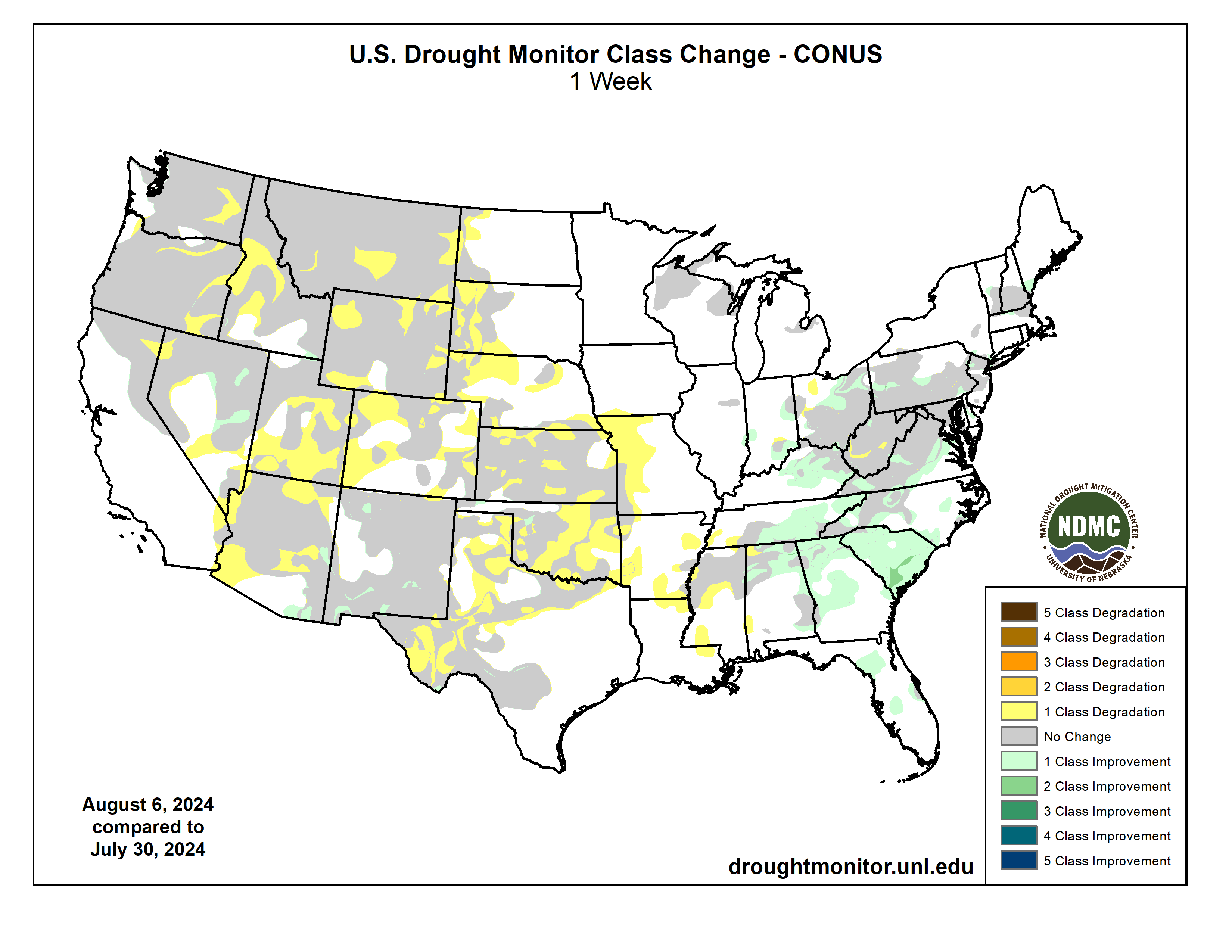
US Drought Monitor one week change map ending August 13, 2024.
37% of the Lower 48 is short/very short, 2% more than last week. Topsoils dried out in Nevada and from the Gulf to the Midwest. Driest soil conditions remain in New Mexico, West Virginia, and the Pacific Northwest.
JB Hamby, Imperial Irrigation District’s vice chairman, walks near an irrigated field in the Imperial Valley on June 20, 2023. A new water conservation plan in the district will see more than half a billion dollars spent to incentivize farmers to use less. Photo credit: Alex Hager/KUNC
Click the link to read the article on the KUNC website (Alex Hager):
August 14, 2024
This story is part of ongoing coverage of the Colorado River, produced by KUNC and supported by the Walton Family Foundation. KUNC is solely responsible for its editorial coverage.
The Colorado River’s largest water user agreed to leave some of its supplies in Lake Mead in exchange for a massive federal payout. But environmental advocates say the plan was rushed and could harm wildlife habitat and air quality.
The Imperial Irrigation District, which supplies water to farms in the Southern California desert, stands to receive more than $500 million from the Inflation Reduction Act. The cutbacks, spread out over the next three years, are part of a plan to prop up Lake Mead. Mead is the nation’s largest reservoir and holds water for farms and major cities like Los Angeles, Phoenix and Las Vegas.
State and federal leaders are under pressure to cut back on water demand as climate change shrinks supplies. Imperial, which has a larger allocation of Colorado River water than any other farming district or city between Wyoming and Mexico, has ended up in the crosshairs as a result.
“IID has cleared enormous hurdles to make this deal happen,” JB Hamby, Imperial’s vice chairman, wrote in a press release. “There is no excuse for inaction anywhere along the river.”
In 2023, farmers in the Imperial Valley told KUNC that payments were the only way to get them to use less. That message has landed with policymakers too. The federal government set aside $4 Billion for Colorado River work, and a sizable portion of that has been directed specifically at programs that incentivize farmers to reduce their water use. Those programs have already spent big in the Imperial Valley and other faraway farm districts.
Sun bakes the Salton Sea on June 21, 2023. Environmental advocates worry that a new water-saving plan would result in the lake drying further, harming wildlife habitat and air quality by sending windblown dust toward nearby communities. Photo credit: Alex Hager/KUNC
But as money flows to the Imperial Valley, environmental and health advocates want to make sure there’s enough set aside to stave off negative impacts of bringing less water to the area.
Changes to Imperial Valley water use are virtually inseparable from changes to the Salton Sea.
It’s a giant lake on the Valley’s north end, and it’s mostly filled with runoff from nearby farm fields. As the valley’s farmers use less water, the Salton Sea will continue to dry up, reducing habitat for the flocks of migratory birds that stop there and producing dust storms that increase the risk of asthma and other respiratory diseases among the valley’s residents.
Nataly Escobedo Garcia, water policy coordinator at the Leadership Counsel for Justice & Accountability, co-signed a July letter asking the federal government to go further in protecting wildlife and air quality as it works on water cutbacks near the Salton Sea.
“We completely believe in conserving that water,” she said. “We want to make sure that we have a healthy system, because we also depend on the Colorado River water system. But given the amount of funding that’s available to do this conservation, we don’t see why some of that can’t go towards these direct impacts that communities are going to feel.”
Some critics of the conservation plan’s rollout said the process was rushed, and didn’t allow enough time for public comment on its impacts to the environment. The conservation agreement was inked about five hours after the federal government released its Environmental Assessment.
“You had ample time to do a full environmental impact report, which our community deserves,” Eric Reyes, executive director of local nonprofit Los Amigos de la Comunidad, said at the Imperial Irrigation District board meeting on Tuesday.
“My disappointment overflows,” he said. “The public needs to be informed, we need to be engaged, and this is not the way to do it, at the last second.”
North American Indian regional losses 1850 thru 1890.
Today marks the anniversary of The American Indian Religious Freedom Act of 1978, which once again made it legal for Natives to practice our spiritual and cultural beliefs in the so called united states. They had been outlawed for 95 years by the Code of Indian Offences in 1883.
— Frances *Deadly SoverAuntie* Danger (@FrancesMFDanger) August 11, 2024
In response to a flash drought that has developed throughout the northern Front Range, the Board of Directors of the Northern Colorado Water Conservancy District has increased the quota allocation of the Colorado-Big Thompson Project by 10 percentage points.
In a unanimous vote, the Board on August 14, 2024, increased the quota from 70 percent to 80 percent, meaning an approximate 31,000 acre-feet of water will be made available to allottees of the Project.
According to the U.S. Drought Monitor, a large area of eastern Boulder and Larimer counties have entered severe drought status in July, and an area of drier conditions in the Longmont-Boulder area has worsened into extreme drought conditions, putting at risk the ability of farmers to finish production of their crops for 2024.
Water storage levels in the Project are adequate to meet the additional quota declaration.
Northern Water’s Board typically sets an initial quota in November and a supplemental quota in April, but there have been occasions in which additional quota has been allocated, including in 2020 and 2022. In April, the Board set the quota at 70 percent, which allowed project allottees to access seven-tenths of an acre-foot for each allotment contract unit they own.
The Imperial Irrigation District in California, which uses more Colorado River water than any other district in the West, finalized an agreement on Monday to leave up to 700,000 acre-feet of water in Lake Mead through 2026.
As part of the landmark conservation agreement with the U.S. Bureau of Reclamation, the district will receive federal funding for conservation programs from 2024 through 2026 to conserve up to 300,000 acre-feet a year of water that will remain in Lake Mead to aid the drought-stricken Colorado River.
Funding will be used to pay agricultural water users to implement field-level conservation measures, and short-term pauses of water-intensive crops like established Alfalfa, Bermuda grass, and Klein grass crops.
The agreement approved on Monday by the Imperial Irrigation District Board of Directors is the largest conservation agreement in terms of volume anywhere in the Colorado River Basin, according to the district. The Imperial Irrigation District, serves a large portion of the Coachella Valley in the Colorado Desert region of Southern California.
As of August, Lake Mead is at 33% of capacity, meaning even the latest conservation efforts in California are unlikely to halt emergency water cuts this summer. In 2021 and 2022, Lake Powell and Lake Mead — the two largest reservoirs in the nation — both fell below critical thresholds, triggering emergency cuts and federal action to protect the lakes.
Rebecca Mitchell, John Entsminger, Estevan Lopez, Gene Shawcroft, JB Hamby, Tom Buschatzke at the Getches-Wilkinson Center/Water and Tribes Initiative Conference June 6, 2024. Photo credit: Rebecca Mitchell
JB Hamby, the Vice Chairman of the Imperial Irrigation District and the Colorado River Commissioner for California, said the Imperial Irrigation District’s “efforts provide an example for other states and regions to follow as we plan for a drier future in the Colorado River basin.”
“IID has cleared enormous hurdles to make this deal happen — there is no excuse for inaction anywhere along the river,” he continued.
The new agreement builds on the 100,000 acre-feet of water the Imperial Irrigation District agreed to conserve in Lake Mead last year, a total of about 800,000 acre-feet of conservation through 2026.
Under additional water transfer agreements, the Imperial Irrigation District plans to conserve about 24% of their annual water entitlement for the next three years, or about 500,000 acre feet a year of water.
The district’s aggressive conservation efforts are part of the Lower Basin Plan between Arizona, California, and Nevada to conserve 3 million acre-feet of water by 2026 to protect the Colorado River system from extended drought.
In total, the agreement adds up to over half of California’s commitment to conserve up to 1.6 million acre-feet of water, a total approved by the Bureau of Reclamation for the final Supplemental Environmental Impact Statement for Near-term Colorado River Operations drafted last year.
In 2022, Congress passed the Inflation Reduction Act to provide $4 billion in funding to the Bureau of Reclamation to mitigate drought in the western United States, prioritizing the Colorado River Basin.
“The decisive action taken by our Board today demonstrates how the District and our water users work together to make meaningful contributions to the Colorado River,” said Gina Dockstader, Imperial Irrigation District Director. “We value the collaborative relationship with the Bureau of Reclamation that has allowed us to craft an agreement we can all support and make a difference.”
Salton Sea with the Imperial Valley in the foreground. Ted Wood/The Water Desk
Click the link to read the release on the Imperial Irrigation District website:
August 12, 2024
Today,the Imperial Irrigation District Board of Directors approved a landmark conservation agreement with the federal government to leave up to 700,000 acre-feet of water in Lake Mead through 2026.
The Board’s approval of the System Conservation Implementation Agreement (SCIA) with the U.S. Bureau of Reclamation will provide funding for the implementation of conservation programs from 2024 through 2026 to conserve up to 300,000 acre-feet a year of water that will remain in Lake Mead to aid the drought-stricken Colorado River.
The conservation programs authorized under the SCIA include expanding IID’s existing On-Farm Efficiency Conservation Program (OFECP) and a new Deficit Irrigation Program (DIP). The OFECP incentivizes agricultural water users to implement field-level conservation measures while the DIP would fund short-term idling of established Alfalfa, Bermuda grass, and Klein grass crops. These water conservation measures will unlock the balance of nearly $250 million in federal funding for Salton Sea restoration efforts, authorized in a 2022 historic agreement to accelerate the construction of thousands of acres of dust suppression and aquatic habitat projects.
“The decisive action taken by our Board today demonstrates how the District and our water users work together to make meaningful contributions to the Colorado River and the Salton Sea,” said Gina Dockstader, IID Director and Salton Sea Authority President. “We value the collaborative relationship with the Bureau of Reclamation that has allowed us to craft an agreement we can all support and make a difference.”
“IID’s efforts provide an example for other states and regions to follow as we plan for a drier future in the Colorado River basin,” stated JB Hamby, IID Vice Chairman and Colorado River Commissioner for California. “IID has cleared enormous hurdles to make this deal happen — there is no excuse for inaction anywhere along the river.”
A Collaborative Effort with Far-Reaching Impact
Advocated by the seven Colorado River Basin States, Congress in August 2022 authorized the Inflation Reduction Act to provide $4 billion in funding to the Bureau of Reclamation to mitigate drought in the western United States, prioritizing the Colorado River Basin. In October 2022, the Bureau of Reclamation established the Lower Colorado River Basin System Conservation and Efficiency Program for water delivery contractors, entitlement holders, and tribes.
The program provides funding for near-term water conservation, through 2026, to generate conserved water that remains in the Colorado River system. The agreement approved today by IID is the largest volumetric SCIA anywhere in the Colorado River Basin, and when combined with IID’s 2023 SCIA, will create in excess of 800,000 acre-feet of conservation.
The 2024 – 2026 SCIA will fund the development of significant volumes of conserved water over the next three years that, when combined with IID’s existing 2003 Quantification Settlement Agreementlarge-scale conservation and transfer programs, will total up to 750,000 acre-feet of conservation each year, or about 24 percent of IID’s annual Colorado River entitlement. The federal funding for this conservation is commensurate with IID’s San Diego County Water Authority water transfer program.
About IID and Farming in Imperial Valley:
IID has conserved over 7.7 million acre-feet of water since 2003, with 1.5 million generated through the On-Farm Efficiency Conservation Program since 2013.
Last year, IID conserved 106,111 AF of System Conservation Water that was left in Lake Mead under a 2023 SCIA.
In 2023, IID generated over 500,000 AF of conservation with 215,382 AF created by IID growers participating in the On-Farm Efficiency Conservation Program.
Imperial Valley farmers and IID continue to ramp up water conservation efforts annually, utilizing advanced irrigation technologies and sustainable farming practices, including the installation and use of sprinklers, drip systems, field reconfiguration and precision land-leveling, tailwater return systems, and other field-level conservation measures.
Imperial Valley remains one of California’s and the Colorado River Basin’s top agricultural producers, with one in every six jobs directly related to agriculture, the backbone of the local economy.
“New plot using the nClimGrid data, which is a better source than PRISM for long-term trends. Of course, the combined reservoir contents increase from last year, but the increase is less than 2011 and looks puny compared to the ‘hole’ in the reservoirs. The blue Loess lines subtly change. Last year those lines ended pointing downwards. This year they end flat-ish. 2023 temps were still above the 20th century average, although close. Another interesting aspect is that the 20C Mean and 21C Mean lines on the individual plots really don’t change much. Finally, the 2023 Natural Flows are almost exactly equal to 2019. (17.678 maf vs 17.672 maf). For all the hoopla about how this was record-setting year, the fact is that this year was significantly less than 2011 (20.159 maf) and no different than 2019” — Brad Udall
Proposed bypass channel for the Colorado River with Windy Gap Reservoir being taken offline, part of the agreements around Northern Water’s Windy Gap Firming project.
The finishing touches are just around the corner for the historic and broadly supported Colorado River Connectivity Channel (CRCC). After having been talked about for decades, the CRCC, which has aquatically reconnected two segments of the Colorado River around Windy Gap Reservoir for the time since the reservoir was built in the 1980s, is heading into its third and final construction season, with work expected to wrap up this fall. In this new 5-minute video, Northern Water and Colorado Parks and Wildlife officials discuss the ramping back up of construction, goals for the final construction season, and how fish have been successfully using the new channel since water first started flowing though it back in October.
The Department of the Interior today announced a nearly $105 million investment as part of the President’s Investing in America agenda for 67 water conservation and efficiency projects that will enhance drought resilience across the nation. The investment comes from the Bipartisan Infrastructure Law and annual appropriations.
President Biden’s Investing in America agenda represents the largest investment in climate resilience in the nation’s history and provides much-needed resources to enhance Western communities’ resilience to drought and the effects of climate change. Through the Bipartisan Infrastructure Law, the Bureau of Reclamation is investing a total of $8.3 billion over five years for water infrastructure projects, including rural water, water storage, conservation and conveyance, nature-based solutions, dam safety, water purification and reuse, and desalination. Since the President signed the Bipartisan Infrastructure Law in November 2021, Reclamation has announced $4.2 billion for 575 projects to date.
“Access to clean, reliable water is essential for feeding families, growing crops, sustaining wildlife, and powering agricultural businesses,” said Acting Deputy Secretary Laura Daniel-Davis. “Enabled by the President’s Investing in America agenda, the Biden-Harris administration is bringing historic resources to bear to ensure the stability and sustainability of the Colorado River Basin in the wake of severe drought and to safeguard communities across the West, by strengthening climate resilience and facilitating water conservation.”
“As we work to counter the impacts of drought and climate change, we must embrace opportunities to increase water and energy efficiency wherever possible,” said Reclamation Commissioner Camille Calimlim Touton. “The President’s Investing in America agenda provides the resources to expand these conservation efforts that include canal lining, meter installation, conservation incentives, and gate automation.”
Reclamation anticipates that the projects, located in Arizona, California, Colorado, Idaho, Kansas, Montana, Nebraska, Nevada, Texas, Utah and Wyoming, will save more than 111,000 acre-feet of water annually. That’s enough water to supply approximately 447,000 people for a year. This builds upon $140 million announced for water and energy efficiency projects last year. The complete list of projects can be found on Reclamation’s website.
PARKER, Arizona – South of Headgate Rock Dam, beyond riverbanks lined with willow and mesquite, the broad floodplain of the Colorado River spreads across emerald fields and sun-bleached earth.
The Colorado River has nourished these lands in present-day western Arizona for millennia, from the ancestral Mohave people who cultivated corn, squash, beans, and melons, to the contemporary farmers of the Colorado River Indian Tribes, or CRIT, whose reservation extends for 56 miles along its namesake river.
CRIT has rights to divert a large volume of Colorado River water – nearly 720,000 acre-feet in Arizona and California combined, which is more than twice Nevada’s allocation from the river. To this point, the water has remained within the bounds of the CRIT reservation. But soon, the water might flow to lands far beyond CRIT’s borders.
Due to an act of Congress signed into law in January 2023, CRIT now has the authority to lease or exchange its water for use elsewhere in Arizona. (The authority does not apply to water rights held by CRIT on the California portion of its reservation.) Agreements signed in April with the Arizona Department of Water Resources and the federal Bureau of Reclamation to fulfill administrative requirements in the legislation brought the tribes another step closer to greater control over their water.
What remains is the work of negotiation, both within CRIT and with potential leaseholders. CRIT leadership must decide what it wants in leasing deals – how much water to part with, to whom, for what price, and for how many years. And they will have to find a partner who agrees to those terms.
CRIT’s leasing authority opens a new chapter, not only for the tribes but for other water users in the state who might covet CRIT’s high-value, high-priority Colorado River water. Leasing this water would represent a financial windfall for CRIT’s more than 4,600 enrolled members. CRIT leadership has framed it as an economic and civic development opportunity. For those on the other side of the deal – be they environmental groups, farm districts, mining companies, or fast-growing cities in the center of the state – it is a rare chance for a relatively secure source of water in an arid region where most supplies are already claimed or running out. Homebuilders west of Phoenix, for instance, have recently seen their access to local groundwater restricted by state regulators.
For CRIT leaders, the new powers come at an auspicious time. They see their duty as stewards of the river intersecting with the mounting challenges of maintaining Arizona’s desert empire amid merciless heat and a drying climate.
“With the climate crisis and the drought going on at the present time, there’s going to be a major shortage of water,” Dwight Lomayesva, CRIT Tribal Council vice chairman, said at a conference in March. “But we would like to be part of the solution to the problem.”
A Valuable Asset
CRIT is a union of sorts. Four tribes with distinct histories live on the 278,000-acre reservation that spans Arizona and California. The Mohave, known for farming and beadwork, and the Chemehuevi, masterful basket weavers, were original inhabitants of the land. The Hopi and Navajo came later. The federal Bureau of Indian Affairs relocated members of the two northeastern Arizona tribes to the area after World War Two.
CRIT’s history and location translate into a strong water rights position. Like in most western states, water in Arizona is based on a priority system. “First in time, first in right,” as the saying goes. Junior users, who have a later priority date, are cut off first in times of shortage, while senior users like CRIT who have earlier claims can continue to divert.
CRIT’s reservation along the banks of the Colorado was established in 1865, making it one of the first in time in Arizona for water rights – and one of the last to lose access to water. Crucially, leased water retains its place in the priority system. That’s what makes it valuable, said Cynthia Campbell, the water resources management adviser for Phoenix. “That’s front of the line, basically.”
Not only does CRIT have secure water. The tribes also have a lot of it. Comparatively speaking, their water rights are massive. A display at the CRIT Museum makes the point visually. Tubes of foam insulation painted blue depict the volume of water held by tribes along the lower Colorado River. CRIT has the right to divert 662,402 acre-feet per year to its Arizona lands and 56,846 acre-feet to its much smaller landholdings across the river in California. The museum display reflects this bounty – the blue foam bar representing CRIT’s water towers over the others.
For now, CRIT is keeping its water leasing intentions close to the vest. Chairwoman Amelia Flores and Tribal Council members declined to be interviewed for this story.
John Bezdek, CRIT’s lawyer, said that Tribal Council had been focused on finalizing the state and federal agreements and is now turning its attention to how it might structure leases. “There’s a number of additional steps that need to be done in terms of developing a water code, developing provisions on how proposals will be evaluated, looking at those types of things,” Bezdek said. “And so that is all being done right now. We’re working on the next steps internally.”
Despite that public reticence, the contours of CRIT’s thinking have been previewed in other venues. Vice Chairman Dwight Lomayesva outlined his thoughts on the matter in a panel discussion earlier this year, when he participated in the Eccles Family Rural West Conference, held in Tempe, on March 27.
Lomayesva reiterated the cultural and spiritual significance of the Colorado River to his people. “We want to save the river,” he said. “We’re not just a benevolent nation trying to help other countries and tribes and water districts.”
CRIT has a history of working with state and federal agencies to protect the Colorado River. The tribes participated in a pilot farmland fallowing program from 2016 to2019, in which they saved 45,373 acre-feet for storage in Lake Mead. That deal was the precursor to a larger commitment in 2020, when the tribes pledged to fallow 10,000 acres of farmland and store 50,000 acre-feet of water per year in the basin’s largest reservoir. For the three-year effort, the tribe earned $38 million, from the state and the Environmental Defense Fund.
CRIT’s capacity to lease water is directly related to the farming operations that take place on the reservation. About 79,350 acres are farmed on its Arizona lands, mostly for alfalfa. Some of the land is farmed by a tribal enterprise, but many of the acres are leased by non-tribal members. A majority of the fields are flood irrigated, an inefficient method in which only half of the water is taken up by the crop. The rest eventually flows back to the river or evaporates.
This is important because CRIT can only lease water that it has put to consumptive use in at least three of the previous five years. The consumptive-use stipulation is part of the agreement signed with Arizona and Reclamation in April. CRIT diverts less Colorado River water than its allocation, so the agreement dictates that the tribes can’t part with unused water to which they have rights but bypasses their fields. In effect, it means that water conserved from farming is water that can be leased.
“That’s a very, very important component that we then have to factor into in terms of how we want to develop the program,” Bezdek said.
A huge impediment is CRIT’s obsolete means of moving water to its fields. The Bureau of Indian Affairs, a federal agency, owns and operates the Colorado River Irrigation Project, an irrigation system that is, by all accounts, deteriorating and badly needs repair. It was developed piecemeal starting in the 1870s and diverts water into the main line canal at Headrock Gate Dam. Two-thirds of the 232 miles of lateral canal are made of packed dirt, Lomayesva said. (All quotes from Lomayesva in this piece are from his comments at the March conference.)
Lomayesva said that one study pegged the cost of rehabilitating the system at $300 million – an amount of money that CRIT cannot afford. And even if it could, Lomayesva said that because the tribes do not own the water delivery infrastructure, they would hesitate to invest in it. But he said that leasing deals could provide the capital for farming on the reservation to become more efficient.
“We’re going to only market the water if we can use those funds to develop conservation systems – sprinklers instead of flood [irrigation], pipes instead of dirt ditches, recycle some of that water and reuse it again,” Lomayesva said. “That’s the only reason why we would market our water.”
Others have concluded that the outdated irrigation system is a hindrance. “The high cost to repair infrastructure, including lining canals, reconstructing gates and turnouts, and realigning reaches of the system, limit the Tribes’ ability to realize the full potential value of its water,” according to a 2018 Bureau of Reclamation study.
CRIT recently asked BIA to increase the amount it charges for irrigation water because the tribes believe that the system is underfunded and additional revenue could improve the irrigation infrastructure.
Tribal members voted on an ordinance in 2019 that endorsed leasing and set certain boundaries for its implementation. The ordinance, which passed with 63 percent of the vote, was the result of an attempt a year earlier to recall all nine council members over some residents’ objections to leasing. Two council members, including former chairman Dennis Patch, lost their seats.
Under the ordinance, Tribal Council intends that the same number of acres will be farmed after water is leased. “We are farmers,” Lomayesva said. “We are farmers first, and we will probably always be farmers. And we want to continue farming. But the savings from conservation efforts, we could make some of that water available.”
The way for that to happen is for farming on the reservation to become more efficient – and that means applying less water to the fields. It could happen through conservation. But what tribal leaders like Lomayesva really want is a better irrigation system.
“Water could be made available for conservation or off-reservation leasing, exchange or storage in accordance with the requirements of the federal legislation and agreements if deferred maintenance was addressed along with improvements to the irrigation project,” according to a statement from the tribal government.
From the 2018 Tribal Water Study, this graphic shows the location of the 29 federally-recognized tribes in the Colorado River Basin. Map credit: USBR
How much water might be available? In 2018, CRIT participated in a Bureau of Reclamation study to assess current and future tribal water use in the Colorado River basin. CRIT told Reclamation to assume that up to 150,000 acre-feet per year might be leased and moved off the reservation by 2060. CRIT used the same figure in a December 7, 2020, public meeting discussing the proposed legislation to authorize leasing. However, at the end of July the tribal government said in a statement, “No decisions have been made on a baseline amount of water to be available for leasing.”
What about the length of the leases? Many leases signed as part of a settlement extend for 99 or 100 years. CRIT’s authorizing legislation caps leases or exchange agreements at 100 years. But otherwise CRIT will be a free agent, able to negotiate its terms. Several water policy experts in Arizona interviewed for this story said they heard CRIT was considering a lease length of 25 years. The tribes, however, said in a statement that they have not decided any lease parameters.
The length is significant because of state water supply rules for municipalities. The Arizona Department of Water Resources requires proof of a 100-year supply. A shorter lease would not fully satisfy that requirement, but the water could be used in other ways, said Kathryn Sorensen, the former director of the Phoenix water department. It could be stored underground to offset groundwater pumping, or be paired with other water to fulfill the state’s 100-year directive. In the end, it will be a cost-benefit analysis for cities whether to lease CRIT water with a shorter term, she said.
“Each provider is going to have to weigh the length of the lease versus the priority and weigh the value,” said Sorensen, who is now with the Kyl Center for Water Policy at Arizona State University. “But, look, it’s the highest priority Colorado River water in the state. So it’s bound to be very valuable, even with a short [lease] term.”
Autonomy and Flexibility
Though it has liquid riches, this form of tribal wealth has been stuck in place. Tribes elsewhere in Arizona determined their rights to the Colorado, Gila, Salt, Verde and other rivers through negotiated settlements.
In these agreements, tribes generally ceded a portion of their historical rights in exchange for state and federal funding to build the infrastructure that would deliver water to their lands. A settlement currently before Congress – the Northeastern Arizona Indian Water Rights Settlement – is the largest yet, a $5 billion proposal to determine water rights and build water supply and energy generation systems for the Navajo Nation, Hopi Tribe, and San Juan Southern Paiute.
Those settlements typically include leasing provisions. Twenty-four tribes in the West and eight in Arizona currently have leasing authority. The Fort McDowell Indian Community’s settlement, approved by Congress in 1990, for instance, sends 4,300 acre-feet a year to Phoenix. The lease extends for 99 years. Other central Arizona cities, including Gilbert, Glendale, Mesa, and Scottsdale, lease Colorado River water from the tribes, as do mining companies and a housing developer.
CRIT, however, is an entirely different case study. The tribes did not receive their water through a settlement. Their rights were part of the U.S. Supreme Court decree in 1964 that resolved a Colorado River quarrel between Arizona and California and set water allocations in the lower basin. The decree granted CRIT a significant volume of Colorado River water but it did not confer the right to lease. Instead, CRIT had to seek the blessings of Congress to gain leasing authority.
CRIT is now celebrating that authority. In April, three weeks before the state and federal agreements were signed, the tribes held a Water Rights Day, a community festival “honoring our continued commitment to the living river.”
This story was produced by Circle of Blue, in partnership with The Water Desk at the University of Colorado Boulder’s Center for Environmental Journalism.
Native America in the Colorado River Basin. Credit: USBR
Moab tailings site with Spanish Valley to the south
Click the link to read the article on The Deseret News website (Amy Joi O’Donoghue). Here’s an excerpt:
August 6, 2024
Sixteen million tons of radioactive uranium tailings once sat near the banks of the Colorado River, putting the waterway in peril of contamination on the outskirts of Moab. Removal began in 2009 and was halted for a time due to lack of funding for the U.S. Department of Energy cleanup project, but work is continuing at a steady clip — with nearly 15 million tons shipped by rail to a disposal cell about 30 miles away at Crescent Junction. At this rate, the tailings removal may be completed by next year, but much work remains to be done afterward for full remediation of the area in which the uranium mill operated for nearly three decades…
Mary McGann, a Grand County commissioner who heads up the steering committee involved in the project, said she envisions something similar to Las Colonias Park in Grand Junction, Colorado. It, too, was a remediation site for tailings removal and it, too, is adjacent to the Colorado River…
Contamination from what the locals call “The Pile” has been a problem for the Colorado River in Grand County — before the establishment of the Moab Uranium Mill Tailings Remedial Action, or UMTRA, Project. But the project established groundwater wells to prevent the leaching and to serve other useful purposes.
During the reporting period, which ran in mid-July of 2023 to mid-July this year, officials noted there were over 1,036,719 tons of uranium mill tailings shipped by rail four times a week. To date, the project has shipped more than 14.8 million tons, or about 92% of the total estimated 16 million tons in the tailings pile to be moved. During that same reporting period, more than 151,162 tons of debris was placed in the disposal cell — also shipped by rail. That includes the successful removal of 14 autoclaves — each weighing 16,000 pounds, according to project spokeswoman Barbara Michel.
This tiny young zebra mussel larvae was found in water from the Colorado River near Grand Junction. Wildlife officials are doing more tests to find the source of the invasive mussels and stop them from establishing. Photo credit: Colorado Parks & Wildlife
Click the link to read the article on the KUNC website (Alex Hager):
August 5, 2024
This story is part of ongoing coverage of the Colorado River, produced by KUNC in Colorado and supported by the Walton Family Foundation. KUNC is solely responsible for its editorial coverage.
Water users in Western Colorado are awaiting results of ramped-up testing efforts to control invasive zebra mussels after they were found in the Colorado River and an irrigation canal near Grand Junction. The mussels spread quickly, and can cause wide-reaching harms such as damage to irrigation equipment and disruptions to river ecosystems for native fish.
Ongoing testing is aimed at finding the source of the young zebra mussel larvae and stopping them before they become fully established.
“It’s really kind of looking for a needle in a haystack,” said Rachel Gonzales, a spokeswoman for Colorado Parks and Wildlife.
Colorado Parks and Wildlife found young zebra mussel larvae during routine testing in early July. A few weeks later, more samples from two different locations in the Colorado River included those young mussels, called veligers. Another sample, taken from the Government Highline Canal also had a mussel veliger.
Zebra mussel infestation
State officials and local agricultural leaders have sounded an alarm about the mussels, which had never before been seen in that particular stretch of the Colorado River. Tina Bergonzini, Grand Valley Water Users Association General Manager, called the discovery “devastating.”
The mussels, which latch on to hard surfaces, can clog irrigation pipes and cut off farmers from their water supplies. That would cause harm for the area’s economy, much of which relies on irrigation.
“The Grand Valley is based on agriculture,” Bergonzini said. “A lot of it is vineyards and peach growers. So having zebra mussels get infested into the infrastructure of our commercial ag growers hits not only the agricultural industry, but also our tourism industry.”
Bergonzini’s agency, which provides irrigation water to more than 23,000 acres in Mesa County, is working with an environmental consultant to come up with a response plan. She said the consultant has learned from other mussel infestations in the region. Similar mussels are a persistent challenge for some water providers in the lower portion of the Colorado River Basin, such as the Central Arizona Project, which carries Colorado River water to the Phoenix area.
Cattle graze in the Grand Valley on Jan. 25, 2024. Zebra mussels could clog the valley’s irrigation pipes and cause trouble for the area’s agriculture-driven economy. Alex Hager/KUNC
“We are going to be quite aggressive with mitigating and managing moving forward to make sure that we don’t have the presence of adult mussels,” Bergonzini said.
Wildlife experts also worry about the impact of zebra mussels on the river food chain. They eat small aquatic prey like plankton, adding new competition for fish with similar diets.
Zebra mussels and a related species called the quagga mussel are widespread throughout the Great Lakes region and other areas east of the Colorado River basin. Native to Europe, they were likely introduced and spread throughout parts of the U.S. by boats. To stem further spread in the Southwest, wildlife agencies track boats to prevent cross-contamination and require boaters to clean, drain and dry their watercraft before putting them back in a new body of water.
Petersen Air Force Base. Photo credit: Peterson Air and Space Museum
Click the link to read the article on The Guardian website (Tom Perkins). Here’s an excerpt:
August 12, 2024
The US air force is refusing to comply with an order to clean drinking water it polluted in Tucson, Arizona, claiming federal regulators lack authority after the conservative-dominated US supreme court overturned the “Chevron doctrine”. Air force bases contaminated the water with toxic PFAS “forever chemicals” and other dangerous compounds. Though former US Environmental Protection Agency (EPA) officials and legal experts who reviewed the air force’s claim say the Chevron doctrine ruling probably would not apply to the order, the military’s claim that it would represents an early indication of how polluters will wield the controversial court decision to evade responsibility. It appears the air force is essentially attempting to expand the scope of the court’s ruling to thwart regulatory orders not covered by the decision, said Deborah Ann Sivas, director of the Stanford University Environmental Law Clinic…
The supreme court in late June overturned the 40-year-old Chevron doctrine, one of its most important precedents. The decision sharply cut regulators’ power by giving judges the final say in interpreting ambiguous areas of the law during rule-making. Judges previously gave deference to regulatory agency experts on such questions. The ruling is expected to have a profound impact on the EPA’s ability to protect the public from pollution, and the Tucson dispute highlights the high stakes in such scenarios – clean drinking water and the health of hundreds of thousands of people hangs in the balance…
Several air force bases are largely responsible for trichloroethylene (TCE) – volatile organic compounds – and PFAS contaminating drinking water sources in Tucson. A 10-sq-mile (26 sq km) area around the facilities and Tucson international airport were in the 1980s designated as a Superfund site, an action reserved for the nation’s most polluted areas. The EPA in late May issued an emergency order under the Safe Drinking Water Act requiring the air force to develop a plan within 60 days to address PFAS contamination in the drinking water.
Subscribe to The Y’all — a weekly dispatch about the people, places and policies defining Texas, produced by Texas Tribune journalists living in communities across the state.
EDINBURG — The Rio Grande is no longer a reliable source of water for South Texas.
That’s the sobering conclusion Rio Grande Valley officials are facing as water levels at the international reservoirs that feed into the river remain dangerously low — and a hurricane that could have quenched the area’s thirst turned away from the region as it neared the Texas coast.
Although a high number of storms are forecast this hurricane season, relief is far from guaranteed and as the drought drags on.
For now, the state’s most southern cities have enough drinking water for residents. However, the region’s agricultural roots created a system that could jeopardize that supply. Cities here are set up to depend on irrigation districts, which supply untreated waters to farmers, to deliver water that will eventually go to residents. This setup has meant that as river water for farmers has been cut off, the supply of municipal water faces an uncertain future.
This risk has prompted a growing interest among water districts, water corporations and public utilities that supply water to residents across the Valley to look elsewhere for their water needs. But for several small, rural communities that make up a large portion of the Valley, investing millions into upgrading their water treatment methods may still be out of reach.
A new water treatment facility for Edinburg will undoubtedly cost millions of dollars but Tom Reyna, assistant city manager, believes the high initial investment will be worth it in the long run.
“We see the future and we’ve got to find different water alternatives, sources,” Reyna said. “You know how they used to say water is gold? Now it’s platinum.”
For Edinburg, one of the fastest growing cities in the Valley, the need for water will only grow as their population does. While the city hasn’t faced a water supply issue yet, the ongoing water shortage in South Texas combined with the growing population has put local officials on alert for the future of their water supply.
The Falcon and Amistad International reservoirs feed water directly into the Rio Grande. And while water levels have been low, cities and public utilities have instituted water restrictions that limit when residents can use sprinkler systems and prohibits the washing of paved areas.
Cities have priority over agriculture when it comes to water in the reservoirs. Currently, the reservoirs have about 750,000 acre feet of which 225,000 acre feet are reserved for cities.
A former channel of the Rio Grande, or resaca, winds through agriculture fields near Los Fresnos, on Wednesday. The Rio Grande Valley is facing a drought, greatly affecting farmers in the region. Credit: Eddie Gaspar/The Texas Tribune
Of those 225,000 acre feet, each city or public utility or water supply corporation can purchase what are known as “water rights” which grants them permission from the state to use that water.
But without water for farming, more and more of the water that they own is being lost just in transporting the water to their facilities and that’s directly due to the loss of water for farmers.
This relationship with the agriculture industry arose because irrigation districts were created here first. Cities came after and because they used less water, they were set up to depend on irrigation districts.
Water meant for residential use rides atop irrigation water to water treatment plants. Without irrigation water, cities start to use water they already own to push the rest of their water from the river to a water treatment facility. It’s referred to as “push water.” Much of that water is lost for this purpose.
When water levels at the reservoirs got dangerously low in in the late 1990s, the average city would only get about 68% of the water it owns because the rest would be used as push water, according to Jim Darling, board member of the Rio Grande Regional Water Authority and chair of the local water planning group, a subset of the Texas Water Development Board.
The board is tasked with managing the state’s water supply.
Darling, a former McAllen mayor, has been trying to get cities to think of ways to increase their water supply.
As cities try to temper water demand by issuing restrictions on water usage, Darling said public utilities need to think about the drought not just from the standpoint of managing demand but also by increasing supply.
Jim Darling, chair of the Rio Grande Regional Water Planning Group and former McAllen mayor, points at rivers and tributaries shown on a map at the South McAllen Water Plant, in McAllen, on Monday. Credit: Eddie Gaspar/The Texas Tribune
Darling has been floating the idea of creating a water bank of push water so that water districts can get by without having to go through the process of obtaining approval from the state for more water.
These discussions have been ongoing with the watermaster from the Texas Commission on Environmental Quality, who ensures compliance with water rights. The talks are still preliminary, but a conversation with the watermaster’s office in early July revealed that three or four of the Valley’s 27 irrigation districts were out of water.
“Something needs to be done,” Darling said.
Edinburg’s proposed water plant is still in the early planning stages, but the goal is to stave off water woes by turning their attention to water sources underground.
Their plan is to dig up water from the underground aquifers as well as reuse wastewater. The two sources of water would be blended and treated through reverse osmosis.
Reserve osmosis consists of pushing water through membranes, large cylinders that filter the water. This is done several times until the water is pure and meets drinking water standards set by the Texas Commission on Environmental Quality.
This method isn’t new.
By implementing this practice, Edinburg is following in the footsteps of the North Alamo Water Supply Corporation, a utility that supplies water to eastern Hidalgo County, Willacy County, and northwestern Cameron County.
Filtered groundwater is desalinated through reverse osmosis at the Southmost Regional Water Authority brackish groundwater treatment facility in Brownsville on Monday. The facility treats water to distribute to its five partners, including the Brownsville Public Utilities Board, its main customer and is seeking funding to expand the facility in order to address the region’s drought and water shortage. Credit: Eddie Gaspar/The Texas Tribune
After the drought in 1998, North Alamo turned to reverse osmosis in the early 2000s.
Their facilities currently treat about 10 million gallons of water per day through reverse osmosis which represents one-third of all the water they treat. The rest is surface water from the river but they aim to switch that split, treating two-thirds through reverse osmosis and have a third of surface water.
“We’ve got that mindset that we have to get away from the river,” said Steven P. Sanchez, general manager of North Alamo. “We have to start going to reverse osmosis.”
Hidalgo County officials are trying to take a more “innovative” approach to the area’s water problems.
In April, county officials touted a proposed regional water supply project, dubbed the Delta Water Reclamation Project, that would capture and treat stormwater to be used as drinking water.
The project, expected to cost $60-70 million, started off as a project to mitigate flooding by drawing water away from a regional drainage system. But now, plans include a water plant that would take daily runoff and treat it through reverse osmosis.
“We are the first drainage district to do something like this and of course that’s an exciting thing for us, to be able to do something that’s so innovative and green,” said Hidalgo County Commissioner David Fuentes who sits on the drainage district board. “But it comes with a lot of obstacles and a lot of unknowns.”
One challenge will be financing the water plant. Drainage districts are limited on the bonds they can issue in exchange for a loan. Obtaining funds from the Texas Water Development Board would also be an uphill battle since a drainage district doesn’t fit the usual metrics that a water supply corporation does.
County leaders made the case for their project before a Texas Senate committee hearing in May on water and agriculture, requesting that legislative leaders direct the water development board to give a higher consideration to projects like theirs or to provide a grant program their project would qualify for.
The county drainage district already completed a pilot test of the project and those results are now under TCEQ for review. They expect TCEQ will give them the green light as well as instructions on how to design the plant and steps they need to take to ensure water quality.
Fuentes said they expect that review to be completed early in the legislative session, which would give them a better idea of what they need to ask legislators for.
If the project becomes a reality, the county would sell to water corporations like North Alamo.
Members of the public listen to Cameron County Judge Eddie Treviño Jr. as he begins to lead a water conservation meeting with various stakeholders across the Rio Grande Valley at the county courthouse on Tuesday in Brownsville. Credit: Eddie Gaspar/The Texas Tribune
In Cameron County, located on the east end of the Valley, the Brownsville Public Utilities Board was also motivated by drought conditions to reduce their dependence on the river. With help from their partners in the Southmost Regional Water Authority, the public utilities board spearheaded the construction of a desalination facility that also employs reverse osmosis.
Despite its growing popularity in the Valley, desalination has its drawbacks. The process has faced pushback from environmentalists over the disposal of the concentrated salts and because the process requires a lot of energy.
Southmost and North Alamo hold permits from TCEQ to discharge the concentrate, or reject water, into the Brownsville Ship Channel and a drainage ditch that flows to the Laguna Madre, respectively.
Representatives for both entities said the salinity of the concentrate is less than the salinity of the bodies of water that are receiving that discharge.
“All the aquatic life that’s there, the plant life and everything that feeds off that water is not being harmed at all,” Sanchez said. “We monitor that.”
Sanchez said other solutions would be drying beds, a process of evaporating the water into sludge, and injecting the water about 20,000 feet back into the ground.
North Alamo has also made improvements to their energy consumption. In May, the water corporation upgraded their 16-year-old water filtering equipment, reducing the amount of energy used to create the pressure to push the water through their filtration system.
Sanchez said reverse osmosis has also been more efficient for North Alamo.
North Alamo Water Supply Corporation General Manager Steven P. Sanchez at the NAWSC water treatment facility in Edinburg, on Tuesday. Credit: Eddie Gaspar/The Texas Tribune
Their surface water treatment plant treats about 2.7 million gallons of water daily while the reverse osmosis plant treats 3 million gallons. It’s also become cheaper in the last few years. Treatment of surface water costs them $1.21 per thousand gallons while reverse osmosis costs $0.65 per thousand gallons, according to Sanchez who said RO would still be cheaper even with depreciation.
This wasn’t always the case, he said, but the high cost of chemicals is driven up the cost in treating surface water. But where surface water treatment is cheaper is in the initial cost to establish it.
Sanchez estimated that the initial capital investment for reverse osmosis treatment capable of treating a million gallons per day would conservatively cost about $6-7 million while a surface treatment facility of the same capacity would cost $3-4 million.
Southmost’s plans to double their plant’s capacity would cost an estimated $213 million.
Reyna, the Edinburg assistant city manager, agreed that the initial investment would be the biggest cost for the city but believes it will end up paying for itself.
Not all cities have that as a viable option, though. That initial cost can be an insurmountable hurdle for smaller, rural communities that leaves them unable to invest in solutions. The state could possibly alleviate some of that cost.
During the last legislative session, lawmakers established the Texas Water Fund with a billion dollar investment that will go to a number of financial assistance programs at the Texas Water Development including one that has never had funding before called the Rural Water Assistance Fund.
This will be additional state funding to help rural communities with technical assistance on how to decide what kind of design and what kind of assistance is best for their community. This will help them navigate the process of applying for funding.
Rigoberto Ortañes looks at a rising pool of water, flooding the excavation site, as a crew works on upgrading pipes and valves at a North Alamo Water Supply Corporation water plant in Donna on Thursday. The utility company supplies water to eastern Hidalgo County, Willacy County, and northwestern Cameron County. Credit: Eddie Gaspar/The Texas Tribune
Plans for how the water development board will allocate funds to these new financial assistance programs will be released in late July.
Sarah Kirkle, the director of policy and legislative affairs at the Texas Water Conservation Association expects the state will provide interest rate reductions for loans that will be used on expensive projects.
However, the $1 billion allocated to the Texas Water Fund will not get very far.
“The needs for implementing this state water plan are something like $80 billion and those are outdated numbers that we’re looking to update in the new water planning cycle,” Kirkle said, adding that the plan doesn’t include the cost of wastewater or flood infrastructure.
She noted that the cost of water infrastructure is about two or three times what it was before the COVID-19 pandemic because of disruptions in the supply chain and additional federal requirements for federally-funded projects.
Many small communities also don’t have the resources to plan for their needs, Kirkle said, so many of them don’t participate in the water planning process, leaving no one to speak up for them.
“We really need to make sure that as we see additional water scarcity around the state, that our communities are engaged in planning for their needs and understand where they might have risks and where their water might not be reliable,” Kirkle said.
Reporting in the Rio Grande Valley is supported in part by the Methodist Healthcare Ministries of South Texas, Inc.
Big news: director and screenwriter Richard Linklater; NPR President and CEO Katherine Maher; U.S. Rep. Pete Aguilar, D-California; and Luci Baines Johnson will take the stage at The Texas Tribune Festival, Sept. 5–7 in downtown Austin. Buy tickets today!
The Texas Tribune is a member-supported, nonpartisan newsroom informing and engaging Texans on state politics and policy. Learn more at texastribune.org.
Click the link to read the release on the WMO website:
05 June 2024
There is an 80 percent likelihood that the annual average global temperature will temporarily exceed 1.5°C above pre-industrial levels for at least one of the next five years, according to a new report from the World Meteorological Organization (WMO). This is a stark warning that we are getting ever closer to the goals set in the Paris Agreement on climate change, which refers to long-term temperature increases over decades, not over one to five years.
The global mean near-surface temperature for each year between 2024 and 2028 is predicted to be between 1.1°C and 1.9°C higher than the 1850-1900 baseline, according to the WMO report. It says that it is likely (86%) that at least one of these years will set a new temperature record, beating 2023 which is currently the warmest year.
The chance (80%) of at least one of the next five years exceeding 1.5°C has risen steadily since 2015, when such a chance was close to zero. For the years between 2017 and 2021, there was a 20% chance of exceedance, and this increased to a 66% chance between 2023 and 2027.
The update is produced by the UK’s Met Office, which is the WMO Lead Centre for Annual to Decadal Climate Prediction. It provides a synthesis of predictions from WMO designated Global Producing Centres and other contributing centres.
“We are playing Russian roulette with our planet,” said Mr Guterres. “We need an exit ramp off the highway to climate hell. And the good news is that we have control of the wheel. The battle to limit temperature rise to 1.5 degrees will be won or lost in the 2020s – under the watch of leaders today.”
Mr Guterres also drew on supporting evidence from the European Union-funded Copernicus Climate Change Service implemented by the European Centre for Medium Range Weather Forecasts. This showed that each of the past 12 months has set a new global temperature record for the time of year.
Given these 12 monthly records, the global average temperature for the last 12 months (June 2023 – May 2024) is also the highest on record, at 1.63°C above the 1850–1900 pre-industrial average, according to the Copernicus Climate Change ERA5 dataset.
Ensemble mean forecast 2024-2028. Credit: WMO
“Behind these statistics lies the bleak reality that we are way off track to meet the goals set in the Paris Agreement,” said WMO Deputy Secretary-General Ko Barrett. “We must urgently do more to cut greenhouse gas emissions, or we will pay an increasingly heavy price in terms of trillions of dollars in economic costs, millions of lives affected by more extreme weather and extensive damage to the environment and biodiversity.”
“WMO is sounding the alarm that we will be exceeding the 1.5°C level on a temporary basis with increasing frequency. We have already temporarily surpassed this level for individual months – and indeed as averaged over the most recent 12-month period. However, it is important to stress that temporary breaches do not mean that the 1.5 °C goal is permanently lost because this refers to long-term warming over decades,” said Ko Barrett.
Under the Paris Agreement, countries agreed to keep long-term global average surface temperature well below 2°C above pre-industrial levels and pursue efforts to limit it to 1.5°C by the end of this century. The scientific community has repeatedly warned that warming of more than 1.5°C risks unleashing far more severe climate change impacts and extreme weather and every fraction of a degree of warming matters.
Even at current levels of global warming, there are already devastating climate impacts. These include more extreme heatwaves, extreme rainfall events and droughts; reductions in ice sheets, sea ice, and glaciers; accelerating sea level rise and ocean heating.
“We are living in unprecedented times, but we also have unprecedented skill in monitoring the climate and this can help inform our actions. This string of hottest months will be remembered as comparatively cold but if we manage to stabilise the concentrations of greenhouse gases in the atmosphere in the very near future we might be able to return to these “cold” temperatures by the end of the century,” said Carlo Buontempo, Director of Copernicus Climate Change Service.
The global average near-surface temperature in 2023 was 1.45 °Celsius (with a margin of uncertainty of ± 0.12 °C) above the pre-industrial baseline, according to the WMO State of the Global Climate 2023. It was by far the warmest year on record fuelled by long-term climate warming which combined with other factors, most notably a naturally occurring El Niño event, which is now waning.
Last year’s global temperature was boosted by a strong El Niño. A new WMO Update predicts the development of a La Niña and a return to cooler conditions in the tropical Pacific in the near-term, but the higher global temperatures in the next five years reflect the continued warming from greenhouse gases.
Other key messages:
Arctic warming over the next five extended winters (November to March), relative to the average of the 1991-2020 period, is predicted to be more than three times as large as the warming in global mean temperature.
Predictions of sea-ice for March 2024-2028 suggest further reductions in sea-ice concentration in the Barents Sea, Bering Sea, and Sea of Okhotsk.
A non-native smallmouth bass on the Green River, caught with a native bluehead sucker in its mouth. The biggest threat to native endangered fish are non-native predators, especially the smallmouth bass. Credit: USFWS.
Credit: USFWS
‘We’re reengineering the river in even crazier ways’
In an effort to prevent smallmouth bass — an invasive, voracious predator that feasts on native fish, including the threatened humpback chub — from establishing populations below Glen Canyon Dam, the U.S. Bureau of Reclamation in early July began releasing colder water from Lake Powell via the river outlet works (which are 100 feet lower in a cooler part of the water column) in addition to the hydropower penstocks. Known as the “Cool Mix Alternative,” Reclamation chose this option with the goal of keeping water temperatures below the dam under 15.5 degrees Celsius (60 degrees Fahrenheit), which is too cold for smallmouth bass to thrive.
But a report by a group of scientists at the Center for Colorado River Studies at Utah State University says that factors other than temperature should be taken into consideration when trying to manage the nonnative species. The Western Area Power Administration, which sells the hydropower generated by Glen Canyon Dam, funded the participation of two of the four scientists who authored the report.
The report says the nearest population center of humpback chub is 76 river miles downstream in Grand Canyon water that is too turbid for smallmouth bass to proliferate.
“We think the uncertainty in predictions about smallmouth bass establishment near the downstream humpback chub population centers and their impact on chub populations if smallmouth bass do become established is not adequately recognized,” the report reads.
The report urges water managers to not develop reservoir operation plans that are too prescriptive given the uncertainty about hydrology in the coming years.
“We think the various management actions being considered to control smallmouth bass recruitment are unlikely to be effective given the modest history of success of similar actions in the last two decades in the Colorado River ecosystem,” the report reads. “We recognize that our report differs from the dominant paradigm related to smallmouth bass in the Colorado River basin and that even suggesting this alternative paradigm will likely create disagreements among scientists and … stakeholders.”
This infographic shows how as Lake Powell water levels decline, warm water containing smallmouth bass gets closer to intakes delivering water through the Glen Canyon Dam to the Grand Canyon downstream. Credit: U.S. Geological Survey
Jack Schmidt, a Colorado River expert, professor and lead author on the report, said that it’s ironic that in order to preserve one of the last remaining native components of the river’s natural ecosystem (humpback chub), water managers are looking to increasingly unnatural actions on the already highly engineered river. Messing with nature only begets more messing.
“We’re making the river more unnatural, and we’re reengineering the river in even crazier ways to try to protect the remaining elements of the native ecosystem,” Schmidt said. “And although the intentions of that are incredibly well-meant, over the long run, that may not be possible. … At what point does making the river more unnatural just not make sense anymore?”
What is another way to ensure that releases out of Lake Powell’s hydropower penstocks are cold enough to prevent the establishment of smallmouth bass? Keep the reservoir more full. But with the effects of steady demand, drought and climate change, that’s easier said than done.
The back of Glen Canyon Dam circa 1964, not long after the reservoir had begun filling up. Here the water level is above dead pool, meaning water can be released via the river outlets, but it is below minimum power pool, so water cannot yet enter the penstocks to generate electricity. Bureau of Reclamation photo. Annotations: Jonathan P. Thompson
With the election season in full swing, you are likely hearing a lot about something called “Project 2025.” Project 2025, a document produced by the conservative think-tank, the Heritage Foundation with the support of 30 other leading conservative organizations, is a suggested blueprint for the next conservative President. Regardless of your politics, there are a number of recommendations that have a serious impact on the environment and rivers and clean water, specifically. On the positive side, there are multiple suggestions for infrastructure investment, which would likely be a good thing for rivers. Unfortunately, the vast majority of the changes the blueprint proposes would have a decidedly negative impact on rivers.
In addition to broad cuts within the Department of Agriculture, the Forest Service, and the Department of Energy, among other agencies, there are specific changes called out that will have significant repercussions for rivers.
1. Within the Environmental Protection Agency (EPA), it suggests eliminating the
Office of Environmental Justice and External Civil Rights
Office of Enforcement and Compliance Assistance
Office of Public Engagement of Environmental Affairs
The plan also recommends to “review grant programs to ensure that taxpayer funds go to organizations focused on tangible environmental improvements free from political affiliation.” Project 2025 also recommends a “day one executive order” to stop all grants to advocacy groups. And on water specifically, Project 2025 recommends codifying a “navigable water” clause to “respect private property rights
What this means for rivers: This means that federal funding currently going to conservation organizations, like American Rivers or those on the ground removing dams to restore rivers, could be held up or eliminated. Weakening federal safeguards for clean water means that it will be up to the states to decide, meaning access to clean water will be depend on the politics of one’s state, not necessarily what is needed for healthy communities or ecosystems. And because rivers don’t stop at state borders, pollution could increase everywhere. Many federal safeguards currently in place to protect rivers and clean water, especially in communities that have traditionally been under-served due to their race, cultural, or income makeup, will no longer be enforced.
2. Project 2025 suggests lifting the ban on fossil fuel extraction on federal lands, which would put countless miles of rivers and streams at risk.
What this means for rivers: Putting climate change concerns aside for the moment, with any new fossil fuel extraction, the risk of accidents, leaks, and spills goes up considerably. And as we have seen numerous times before, one accident can damage a river and clean water supplies for decades. Further, the headwaters of many rivers in the U.S. are found on national public land. More pollution, means more risk to the literal places where rivers are born, and that will have impacts to everyone who uses it as a water source.
3. Project 2025 calls for the dismantling of the National Oceanic and Atmospheric Administration (NOAA) by moving some responsibilities to other agencies and privatizing other duties. The National Marine Fisheries Service would be streamlined and some duties transferred to the Fish and Wildlife Service, and the “America the Beautiful” and “30×30” programs withdrawn.
What this means for rivers: The NOAA website says it best:
“From daily weather forecasts, severe storm warnings, and climate monitoring to fisheries management, coastal restoration and supporting marine commerce, NOAA’s products and services support economic vitality and affect more than one-third of America’s gross domestic product. NOAA’s dedicated scientists use cutting-edge research and high-tech instrumentation to provide citizens, planners, emergency managers and other decision makers with reliable information they need, when they need it.”
Without a central agency monitoring our climate and weather, and informing the many parts of our government that need that data, we run the risk of being unprepared for the next hurricane, storm, flood, or drought. We already know that climate change impacts every drop of water in our lives. Ignoring this fact threatens our safety and way of life on Earth.
Eastern North Carolina. after Hurricane Matthew | U.S. Army National Guard, Capt. Michael Wilber
4. With the Department of Energy (DOE), Project 2025 reinforces support for fossil fuels by encouraging more extraction and streamlining public safeguards.
What this means for rivers: We already know that a reliance on fossil fuels will continue to warm our world and intensify floods and droughts. With more drilling and fewer safeguards, threats to rivers and their wildlife and communities will increase.
5. The plan recommends moving the Federal Emergency Management Agency (FEMA) from the Department of Homeland Security (DHS) to the Department of Interior or Department of Transportation, and suggests phasing out programs like the National Flood Insurance Program (NFIP) to private insurance. Disaster preparedness grants would be changed to only go to states – NGOs, Tribal governments, and localities would need to go through State governments for funds.
What this means for rivers: As floods become more frequent and severe, FEMA and the resources it provides become more and more vital. Moving these critical emergency response tools away from an agency that already has the national infrastructure set up to respond when needed would be unnecessarily putting lives at risk. Eliminating federal support programs in favor of state or — even worse — private, control, assures the same vulnerable communities that historically have suffered the most will continue to be under-served, and will have a harder time recovering from the next disaster.
Interested in doing more for rivers? Download our election guide to better understand the threats rivers face in this election. Or join us right now in taking action for clean water by asking Congress to increase federal protections for all streams and wetlands. This is our chance to make a difference!
Colorado River water is the lifeblood of Mesa County and the western U.S. as a whole, and the protection of this resource is crucial for the future prosperity of our community. For this reason, Commissioners approved a letter to Senators Bennet and Hickenlooper in support of the Colorado River Water Conservation District’s (Colorado River District’s) effort to acquire and permanently protect the Shoshone water rights at their July 30 administrative public hearing. The letter is from the Western District of Colorado Counties, Inc. (CCI), which consists of 16 counties on the Western Slope, including Mesa County.
The Shoshone hydroelectric plant is owned by Xcel Energy and is located alongside the Colorado River in Glenwood Canyon. It produces 15 megawatts of electricity and holds some of the largest and most senior non-consumptive water rights on the river, dating back to 1902. An agreement to transfer ownership of these water rights was signed with Xcel Energy in December 2023 for $98.5 million, and the Colorado River District is currently in the process of securing funds for the transfer. Xcel will continue to own and operate the hydroelectric plant, but full ownership of the non-consumptive Shoshone water rights will transfer to the Colorado River District.
Non-consumptive water can be protected from diversion and allowed to continue flowing at a specific rate for a prescribed benefit, which is especially beneficial for water conservation purposes in drought situations and for ensuring flow rates are maintained to protect endangered species.
Administration and permanent protection of the Shoshone water rights by the Colorado River District will:
Maintain Colorado’s agricultural and recreational industries.
Maintain and improve water quality.
Ensure ample stream flow to maintain ecosystem benefits and support endangered fish species in the river.
This agreement is a critical first step toward permanent protection of the benefits provided by the Shoshone water rights. It is a significant step toward ensuring stable and sustainable water flow for our region’s agricultural, recreational, economic, and ecological needs.
To learn more about the Shoshone Water Right Preservation Coalition and Campaign, visit the website.
Click the link to read the article on the NOAA website:
Last month, areas of the U.S. sweltered through record heat and the impacts from raging wildfires, while others experienced the fury of Hurricane Beryl.
Also, through July, the U.S. has endured 19 separate billion-dollar weather and climate disasters — second only to 2023 for the highest amount for the first seven months of the year, according to experts from NOAA’s National Centers for Environmental Information.
Below are more takeaways from NOAA’s latest U.S. monthly climate report:
Climate by the numbers
July 2024
The average July temperature across the contiguous U.S. was 75.7 degrees F (2.1 degrees F above average), ranking as the 11th warmest in the 130-year record.
Temperatures were above average to record-warm across much of the contiguous U.S. California and New Hampshire had their warmest July on record, with 19 other states seeing their top-10 warmest July on record.
July precipitation across the U.S. was 3.04 inches – 0.26 of an inch above average – ranking in the wettest third of the historical record.
Precipitation was below average across much of the West, eastern parts of the Ohio Valley to the Mid-Atlantic, southern Florida and across portions of the Plains. West Virginia had its eighth-driest July on record. Conversely, precipitation was above average across much of the South, Southeast, Midwest, Great Lakes and northern New England. Illinois had its seventh wettest July, while North Carolina had its eighth wettest.
Year to date (YTD, January through July 2024)
The YTD average temperature for the contiguous U.S. was 54.4 degrees F (3.2 degrees F above average), ranking as the second-warmest YTD on record. Temperatures were above average across nearly all of the contiguous U.S., while record-warm temperatures were observed in parts of the Northeast, Great Lakes, southern Plains and Mid-Atlantic. New Hampshire and Vermont both saw their warmest January–July period. An additional 25 states had a top-five warmest year-to-date period. All states ranked in the warmest third of the historical record during this period.
The YTD precipitation total was 20.44 inches, 2.36 inches above average, which ranked 11th -wettest on record. Precipitation was above average across a large portion of the Upper Midwest, Northeast and Deep South, with Rhode Island, Minnesota and Wisconsin each ranking second wettest. Precipitation was below average across parts of the Northwest, northern Plains and west Texas during the January–July period.
A map of the U.S. plotted with 19 weather and climate disasters each costing $1 billion or more that occurred between January and July, 2024. (Image credit: NOAA NCEI)
These events resulted in at least 149 fatalities and caused more than $49.6 billion in damages (Consumer Price Index (CPI)-adjusted). Since 1980, when NOAA began tracking these events in the U.S., the nation has experienced 395 separate weather and climate disasters, where overall damages/costs reached or exceeded $1 billion (based on the CPI adjustment to 2024). The total cost of these 395 events exceeds $2.770 trillion.
Other notable highlights from this report
A map of the U.S. plotted with 19 weather and climate disasters each costing $1 billion or more that occurred between January and July, 2024. (Image credit: NOAA NCEI)
Beryl barrels into the record books: On July 1, Beryl became the earliest Category 5 hurricane and the second Category 5 on record during the month of July in the Atlantic Ocean.
Wildfires scorching the West: The Park Fire, which started July 24, is currently the fourth-largest wildfire in California history, burning more than 400,956 acres. The Thompson Fire caused more than 13,000 people to evacuate around Oroville, California, from July 2-3.
Bringing the heat: An early July heat wave broke records in the West: Palm Springs (124 degrees F on July 5); Las Vegas (120 degrees F on July 7); Redding, California (119 degrees F on July 6); Barstow, California (118 degrees F on July 7 and 8) and Palmdale, California (115 degrees F on July 6.)
The coal mining industry reacted with outrage when the Bureau of Land Management recently announced plans to stop issuing new coal leases on the eastern plains of Wyoming and Montana.
From its headquarters in Washington, D.C., the National Mining Association predicted “a severe economic blow to mining states and communities,” while the industry’s political allies likened the move to declaring “war” on coal communities.
The truth is that coal has been steadily falling from its past dominance as energy king for nearly two decades. Domestic coal consumption dropped to 512 million tons in 2022, down 55 percent since its 2007 peak.
With the downward trajectory expected to continue, the Biden administration’s decision to end coal leasing in the Powder River Basin—the nation’s largest coal-producing region—reflects clear market trends. And far from killing coal, the administration’s plan allows mining to continue as the market transitions.
Billions of tons of previously leased federal coal remain available for mining from 270 tracts across the nation, which combined cover an area larger than Rocky Mountain National Park. One Montana mine has enough coal to keep operating until 2060. Taken together, economic effects related to ending new coal leasing in the Powder River Basin may not be felt until the 2040s and beyond.
Coal companies are well aware that U.S. energy markets have rapidly changed, a fact they soberly tell investors: “Over the last few years, customers have shifted to long-term supply agreements with shorter durations, driven by the reduced utilization of (coal) plants and plant retirements, fluidity of natural gas pricing and the increased use of renewable energy sources,” Wyoming’s largest coal producer, Peabody Energy, disclosed in its 2023 financial filing.
Even with declining markets, the Biden administration did not come to the decision on its own. Arguing that BLM’s past reviews of coal’s contributions to climate change were inadequate, a coalition of environmental groups sued the government and won. That forced the agency to revisit whether more coal leasing was warranted.
“For decades, mining has affected public health, our local land, air, and water, and the global climate,” said Lynne Huskinson, a retired coal miner. She’s a member of the Powder River Basin Resource Council, a Wyoming landowners’ group that was among the plaintiffs.
Now, she said, “we look forward to BLM working with state and local partners to ensure a just economic transition for the Powder River Basin as we move toward a clean energy future.”
Huskinson lives in Gillette, Wyoming, where a dozen highly mechanized strip mines sprawl across the grasslands of the Powder River Basin. The Wyoming mines alone produce 40 percent of U.S. coal while employing less than 10 percent of the nation’s 44,000 coal workers.
The Basin’s mines have leased 8 billion tons of federal coal since the 1990s, a cheap and plentiful supply for the industry. The leasing process allows companies to nominate desired tracts, and then bid with little or no competition. Winning bidders often pay less than $1 a ton for coal, plus a nominal annual rent and a royalty after final sale.
There is little question that leasing helped launch and sustain the region’s energy boom. But in his 2022 decision, Judge Brian Morris of the Federal District Court of Montana cast his eye toward the future. Morris wrote that federal law required BLM to consider “long-term needs of future generations” that included “recreation, range, timber, minerals, watershed, wildlife and fish, and natural scenic, scientific, and historical values.”
The judge also gave the federal agency an out: “Coal mining represents a potentially allowable use of public lands, but BLM is not required to lease public lands.”
Morris’ words cleared the way for BLM to stop leasing, a decision that dovetails with a Colorado College poll that found most residents in eight Rocky Mountain states—including Wyoming and Montana—want Congress to prioritize conservation over energy development on public lands.
Peter Gartrell
The legal wrangling will likely continue, with the BLM reviewing protests from the coal industry and its political allies that lay the groundwork for more lawsuits. For now, though, it seems the Biden administration’s decision to keep coal in the ground not only follows the market and the law, but public opinion, too.
Peter Gartrell is a contributor to Writers on the Range, writersontherange.org, an independent nonprofit dedicated to spurring lively conversation about the West. He is a consultant in Washington, D.C., and covered coal leasing issues as a journalist and congressional staffer.
A truck-and-shovel crew removes overburden at the North Antelope Rochelle mine in Wyoming’s Powder River Basin in January 2020, as a coal shovel works below. (Alan Nash/WyoFile)
Colorado River in Grand Junction. Photo credit: Allen Best
From email from Reclamation (Erik Knight):
The next coordination meeting for the operation of the Aspinall Unit is scheduled for Thursday, August 15th 2024, at 1:00 pm.
This meeting will be held at the Western Colorado Area Office in Grand Junction, CO. There will also be an option for virtual attendance via Microsoft Teams. A link to the Teams meeting is below.
The meeting agenda will include a review of the spring runoff conditions and the forecasting , a summary of reservoir conditions and river flows since April including the spring peak operation, the weather outlook, and planned operations for the remainder of the year.
Handouts of the presentations will be emailed prior to the meeting.
Click the link to read the article on the InkStain website (John Fleck):
I’ve been
a) Playing with Datawrapper as a tool for displaying data here on Inkstain, and
b) Thinking about Albuquerque’s aquifer as bad summer river flows force us back onto groundwater
(City #2, in the North Valley, is one of a quartet of groundwater monitoring wells drilled in the late ’50s as Albuquerque’s population and groundwater pumping began to grow. I use it for big picture attention because it’s reasonably well placed to give a good rough picture of what’s going on, and has a nice long time horizon.)
update:
City Well #2
USGS Groundwater Monitoring Well 350824106375301, better known as Albuquerque’s “City Well #2”
Map: John Fleck, Utton Center, University of New Mexico School of LawSource: USGSCreated with Datawrapper
Remember, anyone from the Classes of 68/69/70 are invited to participate. Help us spread the word. Please post in the comments if you’re planning to attend.
Last night’s storm (July 30, 2021) was epic — Ranger Tiffany (@RangerTMcCauley) via her Twitter feed.
Click the link to read the article on the NOAA website:
August 8, 2024
Key Points:
The average temperature of the contiguous U.S. in July was 75.7°F, 2.1°F above average, ranking 11th warmest in the 130-year record.
The Park Fire is the fourth-largest wildfire in California history as of August 6; beginning on July 24, it burned approximately 401,000 acres and destroyed over 560 structures.
On July 15, a derecho that spawned 32 tornadoes broke the Chicago-area record for most tornadoes in a day.
On July 1, Beryl became the earliest Category 5 hurricane and the second Category 5 on record during the month of July in the Atlantic Ocean.
July temperatures were above average to record warm across much of the western and eastern contiguous U.S.: California and New Hampshire each had their warmest July on record with 19 additional states seeing their top 10 warmest July on record.
The Alaska statewide July temperature was 52.8°F, 0.1°F above the long-term average, ranking in the middle third of the 100-year period of record for the state. Near-average temperatures were observed throughout most of the state, with above-average temperatures observed across much of the Northeast Gulf, Aleutians and South Panhandle.
For the January–July period, the average contiguous U.S. temperature was 54.5°F, 3.2°F above average, ranking second warmest on record. Temperatures were above average across nearly all of the contiguous U.S., while record-warm temperatures were observed in parts of the Northeast, Great Lakes, southern Plains and Mid-Atlantic. New Hampshire and Vermont both saw their warmest January–July period on record. An additional 25 states had a top-five warmest year-to-date period. All states ranked in the warmest third of the historical record during this seven-month period.
The Alaska January–July temperature was 28.6°F, 2.8°F above the long-term average, ranking in the warmest third of the historical record for the state—much of the state was warmer than average while temperatures were near average across parts of the Panhandle.
Precipitation
July precipitation for the contiguous U.S. was 3.04 inches, 0.26 inch above average, ranking in the wettest third of the historical record. Precipitation was below average across much of the West and Rockies, eastern parts of the Ohio Valley to the Mid-Atlantic, southern Florida and across portions of the Plains. West Virginia had its eighth-driest July on record. Conversely, precipitation was above average across much of the South, Southeast, Midwest, Great Lakes and northern New England. Illinois had its seventh wettest July, while North Carolina had its eighth wettest.
Alaska’s average monthly precipitation ranked wettest in the historical record. Much of the state was wetter than average for the month of July, with the Central Interior having its wettest July on record and the North Slope, West Coast and Northeast Interior each experiencing their second wettest July.
The January–July precipitation total for the contiguous U.S. was 20.44 inches, 2.36 inches above average, ranking 11th wettest in the 130-year record. Precipitation was above average across a large portion of the Upper Midwest, Northeast and Deep South, with Rhode Island, Minnesota and Wisconsin each ranking second wettest. Conversely, precipitation was below average across parts of the Northwest, northern Plains and west Texas during the January–July period.
The January–July precipitation for Alaska ranked in the wettest third of the 100-year record, with below-average precipitation observed across parts of the Cook Inlet, Aleutians and South Panhandle regions, near-average precipitation in the Northeast, Central and Southeast Interior regions and above-average precipitation observed across the remaining climate divisions.
Billion-Dollar Disasters
Four new billion-dollar weather and climate disasters were confirmed in July 2024, including one severe weather event that impacted the southern U.S. in mid-May, New Mexico wildfires during June and July, one severe weather event that impacted the central and northeastern U.S. (June 24–26) and Hurricane Beryl (July 8–9).
There have been 19 confirmed weather and climate disaster events this year, which is second only to 2023 for the highest amount for the first seven months of the year, each with losses exceeding $1 billion. These disasters consisted of 15 severe storm events, one tropical cyclone event, one wildfire event and two winter storms. The total cost of these events exceeds $49.6 billion, and they have resulted in at least 149 fatalities.
The U.S. has sustained 395 separate weather and climate disasters since 1980 where overall damages/costs reached or exceeded $1 billion (including CPI adjustment to 2024). The total cost of these 395 events exceeds $2.770 trillion.
Other Notable Events
On July 2–3, the Thompson Fire caused over 13,000 people to evacuate around Oroville, California.
Hurricane Beryl made landfall near Matagorda, Texas on July 8, causing significant damage, numerous power outages and eight fatalities.
The Shreveport NWS issued 67 tornado warnings, the most in a single day on July 8 for this office, due to the remnants of Hurricane Beryl.
On July 17, Washington D.C. hit 101ºF, tying a record for the longest streak of temperatures above 100ºF with four consecutive days.
An early July heat wave brought all-time record-breaking temperatures to portions of the West during July:
Palm Springs, California: 124ºF on July 5
Las Vegas, Nevada: 120ºF on July 7
Redding, California: 119ºF on July 6
Barstow, California: 118ºF on July 7 and 8
Palmdale, California: 115ºF on July 6
US Drought Monitor map July 30, 2024.
Drought
According to the July 30 U.S. Drought Monitor report, about 20% of the contiguous U.S. was in drought, up a little over 1% from the end of June. Drought or abnormally dry conditions expanded or intensified this month across much of the West and Hawaii, and parts of the Central and Northern Plains, the Ohio Valley, the central Appalachians, Tennessee and the Northeast. Drought contracted or was reduced in intensity across much of the Southeast, western portions of the Ohio Valley and parts of Arkansas and Texas.
Monthly Outlook
Above-average temperatures are favored to impact areas across the western and southeastern portions of the U.S. in August, while below-average precipitation is likely to occur in the Northwest and south-central Plains. Drought is likely to persist in the Northwest, Central Plains and Hawaii. Visit the Climate Prediction Center’s Official 30-Day Forecasts and U.S. Monthly Drought Outlook website for more details.
Significant wildland fire potential for August is above normal across portions of the West, Southern Plains and Hawaii. For additional information on wildland fire potential, visit the National Interagency Fire Center’s One-Month Wildland Fire Outlook
From satellite view, the land north of the Arkansas River is a seemingly random checkerboard of vital green and desperate brown, quickly fading from a few thriving farm acres to the broad, water-drained desolation of northern Crowley County.
From the cab of Matt Heimerich’s pickup, each alternating square of emerald corn or desiccated knapweed is a decision by a distant big city — to either share Colorado resources responsibly or toss rural Arkansas River counties to the fate of the hot summer winds.
That square was reseeded with native grass after Aurora bought the water in the 1970s, Heimerich says. That plot, Colorado Springs dried up and it’s all weeds. That farm, Aurora wants to dry it up soon, but the water court referee wants a better reseeding plan.
Heimerich’s family is one of the few farmers remaining in the 790 square miles of Crowley County after city water buy-ups shrank the county’s irrigated acres from more than 50,000 in the 1970s to just a few thousand this year. He jumps down from the pickup to clear invasive kochia weeds from a pipe opening gushing cool canal water down a 1,500-foot corn row.
Straight line diagram of the Lower Arkansas Valley ditches via Headwaters Magazine
Two miles away is downtown Olney Springs, population 310. Crowley County as a whole has only 5,600 residents, and more than a third of those are inmates at two prisons. The only retail operation left in Olney Springs is a soda vending machine against the wall of town hall.
As Heimerich clears his irrigation pipe, he pauses to jab a thumb over his shoulder 150 miles to the north at Aurora, where the population increased by more than 100,000 over 20 years. “When you build a new development, at the end of the day, you’re drying up a farm,” Heimerich said. “Where else is it going to come from?”
“Crowley is just the worst example of what can happen when nobody cares, and nobody pays attention,” he said. The tiny community serves as an enduring reminder of the cultural and economic ruin that occurs when big cities in Colorado and elsewhere purchase farms, dry up the land and move the water to urban areas. It gave rise to the term “buy and dry,” a practice now widely condemned.
The practice was supposed to end in the Lower Arkansas Valley in 2003 with a hard-fought federal court battle and settlement. Since then, state lawmakers and top water and farm agencies have changed laws and spent millions of dollars testing new protective methods for sharing water temporarily between rural and urban areas. They have also spent heavily to improve water quality for thousands of people living near the river who still don’t have clean water to drink.
The big cities insist they have learned their lessons from the Crowley County disaster.
“The results of what happened in Crowley County are unacceptable and widely recognized as a travesty,” said Colorado Springs Utilities spokesperson Jennifer Jordan. “We’ve taken those lessons to heart.”
Arkansas River Basin — Graphic via the Colorado Geological Survey
But outraged Lower Arkansas growers and water districts say new efforts to protect their farm water aren’t working. At the same time, the big cities say new laws making it easier to share farm water don’t provide enough reliable water to grow their communities.
The cities also say big changes in the future water picture, climate-driven reductions in stream flows and threats to their Colorado River supplies leave them little choice but to draw more farm water.
This year they did that, inking deals in the Lower Arkansas worth more than $100 million to buy and lease land and water, raising alarms among local growers and generating big questions about whether the state is doing enough to protect rural farm communities and the water that keeps them going.
Buy and dry light
The cities say a lot has changed in the past 20 years and that these new deals represent innovations in water sharing. But critics in the Lower Arkansas Valley say these same deals signal that no one is doing enough to prevent “buy and dry” or the latest tool in the water acquisition quiver, “lease and dry,” in which water is pulled from farmland periodically.
Aurora, for instance, spent $80 million in April to buy nearly 5,000 acres of farms in Otero County and the more than 6,500 acre-feet of water associated with that land. An acre-foot equals nearly 326,000 gallons of water, enough to irrigate half an acre of corn, or supply at least two urban homes for one year.
Aurora plans to use the water itself in three out of 10 years, leaving it on the farms the rest of the time. Some 4,000 acres of land will be dried up intermittently when Aurora is using the water, according to Karl Nyquist, a developer and grower who negotiated the deal with Aurora and who is operating the farms for Aurora under the lease agreement.
Colorado Springs has a different arrangement just downriver in Bent County, where it will permanently purchase up to 15,000 acre-feet of water from local farmers. Colorado Springs will also help pay local farmers to install modern center pivot irrigation systems that use less water, allowing the city to keep the saved water for its use.
In Crowley County. Photo: Brent Gardner-Smith/Aspen Journalism
In this deal, Colorado Springs and the farmers will be responsible for revegetating any dried-up land. It will use the water in five out of 10 years, and it has agreed to make a one-time, upfront payment of $2.5 million to Bent County plus payments each year based on how much water is taken off the fields. The money is in addition to payments to farmers.
“We wanted to make sure Bent County was kept whole,” said Scott Lorenz, a senior water projects manager with Colorado Springs Utilities.
Bessemer Ditch circa 1890 via WaterArchives.org
And in Pueblo County, perhaps the least controversial of the three deals, Pueblo Water agreed to purchase nearly one-third of the shares in the local historic Bessemer Ditch system for $56.2 million. Pueblo continues to lease the water back to the farmers for now. At the same time, the Palmer Land Conservancy has developed a sophisticated new framework that measures farm productivity on land watered by the Bessemer Ditch and will eventually help direct water to the most productive farms as Pueblo takes its water. The hope is that the new system will increase overall farm productivity on the ditch system and help make up for anything lost when the less productive lands are dried up, according to Dillon O’Hare, Palmer’s senior conservation manager.
Palmer is also working to analyze the impact of the deals on water quality downstream and how to prevent further damage, O’Hare said.
Irrigated farmland is evaporating
The three projects come as new data shows Colorado’s irrigated farmlands are shrinking. Since 1997, the state has lost 32% of these lands, with areas in the Lower Arkansas Valley seeing losses higher than that, according to an analysis of federal agricultural data by Fresh Water News.
Crowley County has lost 90% of its irrigated lands in that period. Pueblo has lost 60.2%, and Bent and Otero have lost 37.6% and 35.2%, respectively.
State agriculture and water officials are worried about the decline, but say they have few tools to prevent it because farmers are free to sell their water rights to whomever they want.
“Am I concerned? Definitely,” said Robert Sakata, a long-time vegetable grower near Brighton, and former member of the Colorado Water Conservation Board who now serves as the director of water policy for the Colorado Department of Agriculture. “We all talk about water being a limited resource, but prime farmland is also limited and it’s important to take that into consideration.”
Not all these losses are due to big city water prospecting. Climate change, market challenges and legal obligations to deliver water to downstream states are also fallowing Colorado farmlands.
Everyone is sympathetic. No one is in charge.
Still, more than 20 years after the intergovernmental peace accords, it wasn’t supposed to be this way.
The Lower Arkansas Valley region is part of the sprawling Arkansas River Basin. The river has its headwaters near Leadville and flows through Buena Vista, Salida, Cañon City, into Pueblo Reservoir and on over the state line east of Lamar.
Its counties were once a sweet spot in the basin’s agriculture economy. The river fed a bountiful chain of tomato, sugar beet and onion fields, as well as acres of luscious Rocky Ford melons, and chiles, corn and alfalfa.
Cities say these latest deals, which they call “water sharing” agreements, will bolster the agricultural economies and keep remaining water on farm fields forever. But the term “sharing” doesn’t sit well with some local farmers and water officials who have a deep distrust of the cities they blame for the region’s decline.
“I call it a charade,” said Mike Bartolo, a retired Colorado State University Extension research scientist who farms in Otero County near Rocky Ford. “You dry up an acre, you’re drying up land that was formerly irrigated. That’s buy and dry.”
While the state’s highly touted Water Plan cheers for the concept of cities helping rural areas thrive after water losses, there is no mechanism or state law or bureaucracy to watchdog new sales.
After the 2003 agreement in the Lower Arkansas Valley, state and local water leaders began testing new ways for cities and farmers to temporarily share water, something that had been almost impossible under older water law.
But Aurora and Colorado Springs say the early experimental programs didn’t provide enough water at reasonable prices to fulfill their fast-growing community needs permanently.
Lorenz, the Colorado Springs Utilities manager, said the city does lease some water in the valley, but it hasn’t been enough to ensure the stability of its long-term water supply.
“The major concern is that we would lease from a particular farmer, and then a different city would come out and buy those water rights and the farmer wouldn’t lease to us anymore,” he said.
And in fact that is what just happened in April, when Aurora purchased the Otero County farms, which had formerly leased water to Colorado Springs.
Colorado Springs Utilities formally opposes the latest Aurora water deal, as do the Southeastern Colorado Water Conservancy District based in Pueblo, and the Lower Arkansas Valley Water Conservancy District in Rocky Ford.
But their anger has so far been expressed by passing resolutions, not filing lawsuits.
How Aurora Water and other cities have treated Arkansas River counties like Crowley after past buy-ups leaves nothing but suspicion about newly announced deals, local leaders say.
Though Aurora says it is not attempting any more permanent dry-ups of local land, “I don’t think any of us believe them,” said Heimerich, Crowley County’s representative on the Southeastern Conservancy board. Heimerich also is a member of the board of Water Education Colorado, which is a sponsor of Fresh Water News. “They’ll do whatever they need to do and apologize later.”
Thornton, Larimer and Weld counties conducted a similar debate publicly — from the 1990s to this year — as Thornton bought up 17,000 acres of northern Colorado farms and their water rights and began drying up the land. County commissioners and other local officials brought their legal weight and bully pulpits to bear in demanding extensive concessions from Thornton. The Adams County city has been reseeding dried up land with native grass and backfilling lost property taxes, but gets mixed reviews from locals.
The latest Lower Arkansas water deals are also pitting Colorado’s big cities directly against each other in conflicts not seen for decades. When the board of Colorado Springs Utilities passed a resolution earlier this year condemning Aurora’s Otero County deal, it was a direct shot from leadership of a city of nearly 500,000 — the Colorado Springs City Council is the utility board.
“The idea is that there’s Denver, there’s a Denver metro complex and they’re going to just do whatever they want to do and the rest of the state has to go along with it,” City Councilman Brian Risley said.
But Alex Davis, a top Aurora Water official, said Colorado Springs’ ire is unwarranted.
“Aurora has worked in close partnership with Colorado Springs for decades and that will continue,” she said. “This is a case where we disagree.”
Peter Nichols, general counsel for the Lower Arkansas Water Conservancy District in La Junta, said he is deeply concerned by what cities are proposing now.
“We thought we were through with all of this. We thought we had it under control,” he said of the Aurora and Colorado Springs purchases.
Nichols is among those who have spent much of the past 20 years creating a system, now known as the super ditch, that allows seven local irrigation companies to negotiate leases with cities.
A map of the Fry-Ark system. Aspen, and Hunter Creek, are shown in the lower left. Fryingpan-Arkansas Project western and upper eastern slope facilities.
Importantly, it also won the legal right to move leased water stored in Pueblo Reservoir out of the valley, via the federal Fryingpan-Arkansas Project and the Otero Pipeline, removing what had been a key barrier to leasing.
Nichols said local growers and water districts have worked hard to find ways to share water so that it doesn’t permanently leave the valley. That the cities are now jumping the line with these new deals isn’t OK with him.
A farmer’s — and a county’s — greatest asset
Colorado Springs and the other thirsty Front Range cities want farmers like the young Caleb Wertz to be the new face of urban water agreements. On a recent 95-degree summer afternoon, Wertz high-tailed it across Bent County driving an ambulance to take an injured neighbor to the hospital. He had planned to be on his farm, but that’s life in the Lower Arkansas Valley.
The population is shrinking, and everyone has too many jobs to count. The local farmer is also a first responder. Your primary care provider is a farmer’s wife.
Arriving back at the farm just after 5 p.m., Wertz talks about what is perhaps the most controversial decision he has ever made: Selling a portion of his agricultural water to fuel housing growth in Colorado Springs.
The deal will pay him enough so that he can install modern irrigation systems, drying up portions of the fields, known as corners, that won’t be reached by the new, center pivot sprinklers, and allow Colorado Springs to buy the saved water.
He is also planting cotton alongside his traditional corn, and he believes he is the first in the state to do so. A new modern variety is supposed to use half the water, just one acre-foot per acre, rather than the two acre-feet of water that older types, such as those grown in Arizona, use.
For Wertz, the agreement will give him enough money to keep farming and enough new technology to make his remaining agricultural water go farther. He will become a rarity in the area: A young farmer with enough land and water to continue the business his family started in 1919 and to expand it.
“The water purchase makes it a lot more doable because we can farm those acres so much more with pivots,” Wertz said. “That’s the case even though we’re drying up the corners. … That has a bad connotation to it. But Colorado Springs is reimbursing the farmers to turn those corners into pasture land or to revegetate. … Even if it is not producing corn, it’s not just becoming wasteland.”
But to some of his neighbors in the valley, Wertz has entered a hostile no-man’s land, facilitating yet another dry-up of farmland in a region that has already lost too much water and land to urban thirst.
“I know people don’t like it and people are entitled to their opinions, but a lot of those are the older generation who don’t like seeing it because of what happened years before I was even born,” said Wertz, who is 23. “I was glad to see the Springs come in and ask questions about working with us.
“We were quite leery at first. But they have proved it to us. It is extending the water use for them and us, and allowing my brother and I to start taking over some of these acres that haven’t been farmed for a while because there isn’t enough manpower.”
But can the land come back after fallowing?
Another worry for Lower Arkansas growers is whether new methods that allow cities to take the water off the fields for one or more years and then return it at a later time, do more harm than good. They’re not sure farmland in the region is resilient enough to bounce back from cycles of city-caused drought.
Perry Cabot, a research scientist and specialist in farming practices and farm economies, has spent years studying the issue. He says that there is hope for fallowing, after years of experiments and tests, but only with crops such as alfalfa and other grasses and sometimes corn.
“The programs we have done saw alfalfa return almost with a vengeance,” Cabot said. “Grass hay is the second-best candidate.”
Nyquist, the developer and grower who is leasing back and farming the land he recently sold to Aurora, agreed, saying fallowing programs do work, but they are not good for small growers who don’t have the cash to buy the necessary new equipment and nutrients that are needed to help fully restore the crops once water returns.
Still, Jack Goble, general manager of the Lower Arkansas Valley Water Conservancy District in Rocky Ford is wary of plans that take water from parts of farm fields over long periods of time.
“And I haven’t found a farmer yet that believes that that’s a viable farming situation, ” he said. “It’s tough to bring that land back.”
Dan Hobbs irrigating from the Bessemer Ditch. Credit: Greg Hobbs
For years, valley water hasn’t been drinkable
Anger aimed west and north from Lower Arkansas Valley towns extends to water quality issues, not just water volume.
For many decades, groundwater wells and the river have been contaminated by farm runoff, mining operations and some naturally occurring pollutants.
The same federal Fryingpan-Arkansas Project that in 1962 created Pueblo Reservoir was also supposed to solve the drinking water problem for 40 communities downriver by building the 130-mile Arkansas Valley Conduit to move clean water from Pueblo Reservoir. But it wasn’t until 2023 that final funding for the $610 million pipeline arrived.
Some downstream leaders are galled that Aurora can start taking more fresh water out of the Arkansas before serious pipeline construction has begun to serve the 50,000 people in long-suffering downstream towns.
“My whole life has been under drinking water restrictions, not being able to attain safe drinking water except to go buy it or to go through extraordinary measures to treat it,” said Dallas May, whose family ranches 15,000 acres north of Lamar. May also is on the Southeastern Colorado Water Conservancy District board.
The Colorado Department of Public Health and Environment’s Water Quality Division, which tests Lower Arkansas water a few times a year, classifies most of the river below Pueblo Reservoir as not supporting drinking water or “aquatic life use.” The classification calls the Lower Arkansas suitable for “warm-water aquatic life” and recreation.
The state did not respond to requests for more detailed assessments of Lower Arkansas water health. Asked if state efforts were improving water quality on the Arkansas, a spokesperson said in an email, “Trend studies require extensive data over a significant period of time. The water quality in watersheds is influenced by a wide variety of factors, including precipitation and weather trends that can highly influence the water quality from year to year.”
Some Lower Arkansas farmers and officials are tired of waiting. They see the problem getting worse as, for instance, Aurora takes more water out of Otero County, “What happens is all of the bad things are concentrated into what is left,” May said, “and that is a huge problem.”
Silence at the state level?
The Colorado Water Conservation Board spent years writing the statewide Water Plan, convening forums and task forces, and conducting listening sessions on the tensions between city water needs and the survival of agricultural communities. They say they are concerned about new city water buys, but add they have no authority to influence any deals because water rights are private property rights and can be bought and sold at will.
The board declined an interview request about Aurora’s water purchase or the broader water use questions.
“The Colorado Water Plan sets a vision for meeting the state’s future water needs and was broadly supported by local communities,” Russ Sands, the board’s water supply planning chief, said in email responses to questions. “But the decisions that happen in local communities regarding their water purchases and planning are largely outside of the state’s control. Accountability for staying true to the vision of the Water Plan is a collective responsibility.”
The loss of irrigated farmland isn’t expected to slow anytime soon as climate change dries up streams and population growth drives cities to buy more. The Colorado Water Plan’s forecast shows the population of the Arkansas River Basin, which includes Colorado Springs and Pueblo, surging more than 60% by 2050, increasing the pressure to tap farm water.
Sakata, the state water policy advisor, who farms near Brighton, said protecting the state’s irrigated farmland will take more work. “We can’t just say lease the water for three out of 10 years. We need to have agreements so that water sharing will be really available.”
As an onion grower, Sakata can’t do interruptible water supply agreements because he has long-standing yearly agreements with suppliers that require him to deliver vegetables. If he fallows his land for a year, the money he would likely be paid wouldn’t be enough to compensate him for the loss of onion sales and the need to support his employees during the break.
Farm research scientist Cabot would like to see the state begin buying irrigated farms, using conservation easements to protect them from development or purchase, and then leasing that land and its water to young growers.
What else state leaders can do to preserve what’s left of Colorado’s irrigated land isn’t clear yet, but Alan Ward, a Pueblo native who is also director of water resources for the Pueblo Water, said the state needs to reexamine its policies and goals.
“There is only so much water available, and I don’t think it’s realistic for the state to continue to think that we can control our urban areas and grow them fast without impacting agriculture.” Clarifying that he was speaking as a private individual, rather than a water official, he said, “I’d rather have the farms continue and not have the urban growth, but I am probably in the minority on that.”
Where does the battle flow next?
Water veterans such as Cabot said the state is likely doing everything it can right now to protect irrigated ag lands. But like Sakata, he says more work needs to be done to shore up farm markets and to create easier, more lucrative water sharing arrangements.
“I don’t want to oversimplify this,” Cabot said, “but the simplest way for cities to get this water is to go to farmers and say ‘How much did you make last year?’ and then offer them 10% more. … These are not just fields. They are farm enterprises.”
Kate Greenberg, Colorado’s agriculture commissioner, is overseeing multimillion-dollar efforts to protect farmlands by improving soil health, solving market challenges and making farm water use more efficient. She says the people of Colorado are on board with her agency’s efforts.
“We did a study last year that showed over 98% of Coloradans believe agriculture is an integral part of our state. If we’re taking water out of agriculture, where are we putting it to beneficial use?
“Are we conserving it to grow urban developments and do we want to see that over preserving agriculture and biodiversity. We need to answer that question as a state.”
Bartolo, the retired CSU researcher, hopes the answer comes soon, before any more of the valley water is siphoned off for urban use.
As news of the deals spreads, Bartolo’s sense of deja vu is growing and his fears for the future of the valley’s irrigated ag lands is growing too. No one knows yet what will happen when Aurora’s contract to use the Fryingpan-Ark to deliver water expires in 2047.
“Having lived through it in my lifetime, I have seen the drastic changes,” Bartolo said.
What worries him, and other growers too, is “what happens if they come back after 2047? What happens then?”
A look at Kamala Harris’ record on clean energy, climate diplomacy, and environmental justice in California, the Senate, and the White House
After weeks of intense media speculation and sustained pressure from Democratic lawmakers, major donors, and senior advisors, President Joe Biden has announced that he is bowing out of the presidential race. He is the first sitting president to step aside so close to Election Day. “I believe it is in the best interest of my party and the country for me to stand down and focus entirely on fulfilling my duties as president for the remainder of my term,” Biden said in a letter on Sunday.
He endorsed his vice president, Kamala Harris, to take his place. “Today I want to offer my full support and endorsement for Kamala to be the nominee of our party this year,” he said in another statement. Not long after, Harris announced via the Biden campaign that she intends to run for president. “I am honored to have the president’s endorsement and my intention is to earn and win this nomination,” she said.
During his term, President Biden managed to shepherd a surprising number of major policies into law with a razor-thin Democratic majority in the Senate. His crowning achievement is signing the Inflation Reduction Act, or IRA — the biggest climate spending law in U.S. history, with the potential to help reduce greenhouse gas emissions up to 42 percent below 2005 levels by 2030. While announcing his withdrawal, Biden called it “the most significant climate legislation in the history of the world.”
Despite his legislative successes, the 81-year-old Democrat couldn’t weather widespread blowback following a debate performance in June in which he appeared frail and struck many in his party as ill-equipped to lead the country for another four years. He will leave office with a portion of his proposed climate agenda unpassed and the U.S. still projected to miss his administration’s goal of reducing emissions at least 50 percent by 2030.
Former president Donald Trump has vowed to undo many of the policies Biden accomplished if he becomes president, including parts of the IRA. And scores of his key advisors and former members of his presidential administration contributed to a blueprint that advocates for scrapping the vast majority of the nation’s climate and environmental protections. Whichever Democrat runs against Trump has a weighty mandate: protect America’s already tenuous climate and environmental legacy from Republican attacks.
With Biden’s endorsement, Vice President Harris, a former U.S. senator from California, is the favored Democratic nominee, but that doesn’t mean she will automatically get the nomination. There are fewer than 30 days until the Democratic National Convention on August 19. The thousands of Democratic delegates who already cast their votes for Biden will either decide on a nominee before the convention, or hold an open convention to find their new candidate — something that hasn’t been done since 1968.
As vice president, Harris argued for the allocation of $20 billion for the EPA’s Greenhouse Gas Reduction Fund, aimed at aiding disadvantaged communities facing climate impacts. She also frequently promoted the IRA at events, touting the bill’s investments in clean energy jobs, including installation of energy-efficient lighting and replacing gas furnaces with electric heat pumps. She was the highest-ranking U.S. official to attend the international climate talks at COP28 in Dubai last year, where she announced a U.S. commitment to double energy efficiency and triple renewable energy capacity by 2030. At that same conference, Harris announced a $3 billion commitment to the Green Climate Fund to help developing nations adapt to climate challenges, although Politico reported that the sum was “subject to the availability of funds,” according to the Treasury Department.
“Vice President Harris has been integral to the Biden administration’s most important climate accomplishments and has a long track record as an impactful climate champion,” Evergreen Action, the climate-oriented political group, said in a statement.
As a presidential candidate in 2019, Harris proposed a $10 trillion climate plan to achieve carbon neutrality by 2045 on the campaign trail, including 100 percent carbon-neutral electricity by 2030. Under the plan, 50 percent of new vehicles sold would be zero-emission by 2030, and 100 percent of cars by 2035. But that proposal, like similarly ambitious climate change proposals released by other Democrats during that election cycle, was nothing more than a campaign wishlist. A better indicator of what her plans for climate change as president would look like — better, even, than her record as vice president, since much of her agenda was set by the Biden administration — could be buried in her record as San Francisco’s district attorney from 2004 to 2011 and as California’s attorney general from 2011 to 2017.
As district attorney, Harris created an environmental justice unit to address environmental crimes affecting San Francisco’s poorest residents and prosecuted several companies, including U-Haul, for violation of hazardous waste laws. Harris later touted her environmental justice unit as the first such unit in the country. An investigation found the unit only filed a handful of lawsuits, though, and none of them were against the city’s major industrial polluters.
As attorney general, Harris secured an $86 million settlement from Volkswagen for rigging its vehicles with emissions-cheating software and investigated Exxon Mobil over its climate change disclosures. She also filed a civil lawsuit against Phillips 66 and Conoco Phillips for environmental violations at gas stations, which eventually resulted in an $11.5 million settlement. And she conducted a criminal investigation of an oil company over a 2015 spill in Santa Barbara. The company was found guilty and convicted on nine criminal charges.
“We must do more,” Harris said late last year at the climate summit in Dubai. “Our action collectively, or worse, our inaction, will impact billions of people for decades to come.”
An aerial view of Assignation Ridge in the Thompson Divide area of Colorado. Project 2025 calls to restore mining claims and oil and gas leases in the Thompson Divide withdrawal area. (Courtesy of EcoFlight)
Written by former members of the Trump administration and other conservative leaders, Mandate for Leadership exhorts its readers to “go to work on Day One to deconstruct the Administrative state.” Among many other measures, it calls for radical reductions in the federal workforce and in federal environmental protections, and for advancing a “Trump-era Energy Dominance Agenda.”
The full text of Mandate for Leadership is below, preceded by an agency-by-agency overview of the proposals that could have the greatest impact on Western land, water and wildlife — as well as on Westerners themselves.
DEPARTMENT OF THE INTERIOR (p. 517)
The Project 2025 recommendations for the Department of the Interior were primarily authored by attorney William Perry Pendley, a vociferous opponent of protections for public lands and wildlife. As acting director of the Bureau of Land Management during the Trump administration, he transformed the agency into what one high-level employee described as a “a ghost ship,” in which “suspicion,” “fear” and “low morale” abounded.
Energy Policy
Pendley notes that the energy section was written “in its entirety” by Kathleen Sgamma of the Western Energy Alliance, an oil and gas industry group; Dan Kish of the Institute for Energy Research, a think tank long skeptical of human-caused climate change; and Katie Tubb of The Heritage Foundation. They recommend reviving the “Trump-era Energy Dominance Agenda” by:
reinstating a dozen industry-friendly orders issued by the Trump administration’s secretaries of the Interior (p. 522);
expanding oil and gas lease sales onshore and offshore (p. 522);
and weakening the National Environmental Policy Act, which requires environmental reviews of federally funded projects, by restoring Trump-era changes that set time limits for reviews, allowed agencies to skip some reviews altogether and eliminated any consideration of a project’s climate impacts (p. 533).
Land Conservation
The project aims to undo large landscape protections by:
The Cascade-Siskiyou National Monument was expanded via proclamation from President Obama in 2017, making the new monument approximately 112,000 acres. Bob Wick/Bureau of Land Management
Wildlife
Pendley expresses particular hostility toward the U.S. Fish and Wildlife Service, whose work he described as “the product of ‘species cartels’ afflicted with group-think, confirmation bias, and a common desire to preserve the prestige, power, and appropriations of the agency that pays or employs them.” He recommends:
delisting the grizzly bear in the Greater Yellowstone and Northern Continental Divide Ecosystems (p. 534);
ending the reintroduction of “experimental populations” outside a species’ historic range (p. 534);
abolishing the Biological Resources Division of the U.S. Geological Survey — which will be difficult to do, as it no longer exists as such and is now part of the National Park Service(p. 534);
The free-market advocate behind Project 2025’s section on the USDA has long railed against the subsidies and food stamp programs administered by the agency. As a fellow at The Heritage Foundation, Daren Bakst penned a lengthy report, Farms and Free Enterprise, that objects to many aspects of the farm bill, which funds annual food assistance and rural development programs. His vision, documented in the report, is present throughout Project 2025’s proposed agency overhaul.
Agency Organization
Project 2025 seeks to limit regulation in favor of market forces by:
reducing annual agency spending, including subsidy rates for crop insurance and additional programs that support farmers for lost crops (p. 296);
eliminating the Conservation Reserve Program, which pays farmers to enrich and protect parts of their land from agricultural production (p. 304);
removing climate change and equity from the agency’s mission (p. 290, 293);
and working with Congress to undo the federal labeling law, which requires consumer products to disclose where they were made and what they contain, as well as encouraging voluntary labeling (p. 307).
Forestry
The project will reduce forests on public lands by:
and rescinding the Biden administration’s Roadless Rule for the Tongass National Forest, which preserves 9.37 million acres of the world’s largest temperate rainforest and puts a cap on logging in the region (p. 531).
Logging within the Cougar Park timber sale in Kaibab National Forest in 2018. The timber project was part of an initiative intended to treat more than 2.4 million acres of ponderosa pine forest across northern Arizona. Dyan Bone/U.S. Forest Service
ENVIRONMENTAL PROTECTION AGENCY (p. 417)
Prior to serving as the EPA’s chief of staff during the Trump administration, Mandy Gunasekara was famous for handing Republican Sen. James Inhofe a snowball to disprove the existence of human-caused climate change. At the EPA, she played a key role in the United States’ withdrawal from the Paris Agreement and in the dismantling of the Obama-era Clean Power Plan. Gunasekara’s vision for the EPA is characterized by staff layoffs, office closures and the embrace of public comment over peer-reviewed science.
Agency Organization
The plan will diminish the agency’s scope of work by:
reducing full-time staff and cutting “low-value” programs (p. 422);
eliminating all research that is not explicitly authorized by Congress (p. 436);
restructuring scientific advisory boards and engaging the public in ongoing scrutiny of the agency’s science — potentially opening the door to a wave of pushback against the international consensus on climate change (p. 422, 436-438);
eliminating the use of catastrophic climate change scenarios in drafting regulation (p. 436);
relocating a restructured American Indian Office to the West (p. 440);
partially shifting personnel from headquarters to regional offices (p. 430);
and striking the regulations, including a program to reduce methane and VOC emissions, that enable the EPA to work with external groups to help enforce laws (p. 424).
Natural Resources
The project would jeopardize clean air and water by:
limiting California’s effort to reduce air pollution from vehicles by ensuring that its standards and those of other states avoid any reference to greenhouse gas emissions or climate change (p.426);
supporting the reform of the Endangered Species Act to ensure a full cost-benefit analysis during pesticide approval (p. 434-435);
repealing some regulations imposed by the Biden administration to limit hydrofluorocarbons, a particularly potent greenhouse gas (p. 425);
and undoing the expansion of the Good Neighbor Program, which requires states to reduce their nitrogen oxide emissions, beyond power plants to include industrial facilities like iron and steel mills (p. 424).
Earthjustice is suing Suncor on behalf of GreenLatinos, the Sierra Club and 350 Colorado
Commerce City has been pummeled so long by toxins spewed by local energy companies — including Suncor Energy — that some residents have almost grown used to the bad water and air that surround them every day, City Councilor Renee M. Chacon said this week. Chacon hopes a lawsuit filed in U.S. District Court this week will make Suncor answer for its environmental abuses. The suit asks a federal judge to force the Suncor refinery to comply with the Clean Air Act, mitigate and offset harm done to the public for violating the federal law and assess fines for each violation of the Clean Air Act up to $121,275 per day. The lawsuit lists 28 specific claims against Suncor and claims that “Suncor consistently and continuously violates the air pollution limits imposed by regulations and conditions of its air permits.” Chacon said in a news release that fines may not be a big enough punishment for Suncor.
“Commerce City has been the sacrifice zone for corporations like Suncor for so long, the abuse to my community has been normalized and even expected to happen for Colorado’s economy,” said Chacon, who is also a member of the activist group GreenLatinos. “No more normalizing this level of cumulative pollution for any community, Suncor should be prosecuted for more than just fines, especially in a state that has acknowledged environmental justice should be a human right to access clean air, land, water, and a better quality of life for all.”
The complaint claims that Suncor has repeatedly violated the Clean Air Act by failing to control hazardous emissions from its Commerce City refinery, resulting in long-lasting harm to surrounding communities in north Denver. Earthjustice filed the lawsuit on behalf of GreenLatinos, the Sierra Club, and 350 Colorado. Before filing the lawsuit, Earthjustice and its clients documented over 9,000 instances of Clean Air Act violations, according to the lawsuit. That includes exceeding federal limits of airborne particulate matter, toxic emissions like benzene and formaldehyde, and other dangerous pollutants.
This U.S. Drought Monitor (USDM) week saw widespread improvement in drought-related conditions on the map across areas of the Southeast, Mid-Atlantic, and in areas of the Midwest. Elsewhere, hot and dry conditions prevailed in areas of the West, Plains, and the South during the past 14-to-30-day period, leading to the expansion and intensification of drought on this week’s map with particular concern over the developing flash drought situation in areas of the Plains states. In the Southeast, Hurricane Debby (Category 1) made landfall Monday morning in Florida’s Big Bend region bringing a powerful storm surge, strong winds, torrential rains, and severe flooding to much of Florida’s Gulf Coast region from southwest Florida to the north-central region. Rainfall accumulations ranged from 2 to 20+ inches across affected areas with the heaviest accumulations logged in the greater Sarasota area. The impacts of Hurricane Debby, which weakened to a tropical storm shortly after making landfall, were also felt across the coastal zones and plains of Georgia and South Carolina with heavy rainfall (up to 15 inches according to radar estimates) and flooding. On the map, some drought-related improvements were made this week in the Carolinas in association with the remnant moisture from Hurricane Debby. However, it is noteworthy that this week’s drought depiction is representative of rainfall that fell until the data cutoff at 8 a.m. ET on Tuesday and additional improvements are expected on next week’s map. Elsewhere, light-to-moderate rainfall accumulations (2 to 4 inches) were observed across areas of the Northeast, Midwest, and in isolated areas of the Northern Plains. Out West, some monsoon-related storm activity was observed in isolated areas of the Four Corners states and Nevada as well as some light shower activity in areas of Idaho and Montana. In terms of reservoir storage in areas of the West, California’s reservoirs continue to be near or above historical averages for the date (August 6) with the state’s two largest reservoirs (Lake Shasta and Lake Oroville) at 111% and 116% of their averages, respectively. In the Southwest, Lake Powell is currently 39% full (64% of typical storage level for the date) and Lake Mead is 33% full (53% of average) with the total Lower Colorado system 44% full as of August 5 (compared to 44% full at the same time last year), according to the U.S. Bureau of Reclamation. In Arizona, the Salt River Project is reporting the Salt River system reservoirs 85% full, the Verde River system 64% full, and the total reservoir system 83% full (compared to 91% full a year ago). In New Mexico, the state’s largest reservoir along the Rio Grande is currently 11% full (25% of average). In the Pacific Northwest, Washington’s Franklin D. Roosevelt Lake is 93% full (121% of average for the date) and Idaho’s American Falls Reservoir on the Snake River is 50% full (84% of average)…
On this week’s map, all states within the High Plains region saw degradations in response to a combination of factors including below-normal precipitation (past 30-60-day period), above-normal temperatures (+4 to 10 degrees F during the past 14 days), high evaporative demand, and intensifying flash drought conditions in recent weeks. Moreover, within the past 30 days, numerous agricultural impacts have been reported by extension agents as well as by local farmers and ranchers to the National Drought Mitigation Center’s (NDMC) Condition Monitoring Observer Reports (CMOR) system. Impact reports include crop stress, critically low soil moisture, water hauling, and reduced forage, with the highest concentration of reports coming in from western portions of the Dakotas, western Nebraska, and eastern portions of Montana and Wyoming. According to the USDA (August 4), statewide topsoil moisture rated by percent short to very short is as follows: Kansas 55%, Nebraska 49%, South Dakota 32%, North Dakota 25%, Montana 68%, Wyoming 83%, and Colorado 58%….
Colorado Drought Monitor one week change map ending August 6, 2024.
Out West, the overall hot and dry pattern observed during the past 30-60-day period continued to desiccate many parts of the region leading to the addition of numerous areas of Abnormally Dry (D0) as well as expansion of areas of drought (primarily Moderate Drought D1) in the Pacific Northwest, California, Intermountain West, and the Southwest. Furthermore, the hot and dry weather continued to exacerbate fire conditions with numerous large fires burning across the region, including California’s Park Fire (northeast of Chico, CA), which has burned ~414,890 acres and was only 34% contained, according to the U.S. Forest Service on August 7. In terms of wildland fire potential for the remainder of August 2024, the National Interagency Fire Center’s Significant Wildland Fire Potential Outlook is forecasting above-normal fire potential across areas of Washington, Idaho, Montana, California, Nevada, and Utah. Looking at statewide reservoir storage (August 1), reservoir storage (as compared to the 1991-2020 median) is above normal in Arizona, Idaho, Nevada, Oregon, and Utah with below-normal levels in Colorado, Montana, New Mexico, Washington, and Wyoming, according to the National Resources Conservation Service…
Across the region, dry conditions prevailed this week as well as above-normal temperatures with the greatest anomalies (+4 to 8 degrees F) observed in the Texas Panhandle and Trans-Pecos regions as well as in areas of southeastern Oklahoma, and southern portions of Louisiana and Mississippi. On the map, deterioration occurred in northern and western portions of Texas, eastern Oklahoma, southern Arkansas, and Mississippi, while near- to above-normal precipitation during the past 30-day period led to widespread improvements across Tennessee. In Oklahoma, the rapidly declining soil moisture and escalating fire danger are heightening concerns about widespread flash drought, according to the Oklahoma Climatological Survey. In Texas, Water for Texas (August 7) is reporting statewide reservoirs currently at 76.7% full with numerous reservoirs in the eastern part of the state in good condition, while many reservoirs in the western half of the state are experiencing below-normal levels. In terms of topsoil conditions across the region, the USDA (week August 4) is reporting the statewide topsoil moisture rated by percent short to very short as follows: Tennessee 29%, Mississippi 39%, Arkansas 47%, Louisiana 22%, Oklahoma 59%, and Texas 67%…
Looking Ahead
The NWS Weather Prediction Center (WPC) 7-Day Quantitative Precipitation Forecast (QPF) calls for moderate-to-heavy rainfall accumulations ranging from 4 to 10 inches across areas of the Eastern Seaboard from Georgia to New England. Lesser accumulations, ranging from 1 to 2 inches, are expected across areas of the Four Corners states as well as in the Central Plains and southwestern portion of the Midwest. Elsewhere in the conterminous U.S., generally dry conditions are forecasted. The Climate Prediction Center (CPC) 6-10-day Outlook calls for a moderate-to-high probability of above-normal temperatures across much of the Four Corners States, much of the Plains states, the South, and Southeast. Conversely, below-normal temperatures are expected across much of California, eastern portions of the Midwest, and the Northeast. In terms of precipitation, there is a low-to-moderate probability of above-normal precipitation across the Pacific Northwest, Intermountain West, areas of the Desert Southwest, Central and Northern Plains, and in Alaska. Below-normal precipitation is expected across most of the South, Southeast, and western portions of the Great Basin.
US Drought Monitor one week change map ending August 6, 2024.
Just for grins here’s slideshow of early August US Drought Monitor maps for the past few years.
Click the link to access the article on the MDPI website (Spencer Blevins, Kristiana M. Hansen, Ginger B. Paige, Anne MacKinnon and Christopher T. Bastian). Here’s the abstract:
Water use efficiency measures are generally recommended to reduce water use. Yet, flood irrigation practices in high-elevation mountain valleys of the Colorado River Basin headwaters generate return flows, which support late-season streamflow and groundwater recharge. Return flows support the ecosystem and provide recreational benefits. This study provides a framework for quantifying how land-use changes and associated return flow patterns affect the economic value of water across uses in a hydrologically connected, shallow alluvial aquifer system. This study first investigates how return flow patterns could change under three alternatives to flood irrigation: an increased use of center pivots, increased residential development, and conversion to pasture. The brown trout was used as an indicator species to track eco-hydrology, return flow, and capacity for recreational activities under each alternative. Estimates from the non-market valuation literature coupled with predicted changes in brown trout productivity approximate associated changes to recreational angler value. Recreational angler values are highest under the flood irrigation alternative. The inclusion of recreational angler values with agricultural values alters the magnitude of returns but not the rankings. These results highlight the potential heterogeneity of conclusions to be drawn regarding water use efficiency, depending on the economic value of water in different uses and the degree of hydrologic connectivity. This study also highlights data gaps and modeling needs for conducting similar future analyses.
Proposed Uinta Basin rail project in #Utah could result in surge of hazardous shipments along Colorado River
Colorado’s attorney general recently left open the possibility he will take a formal role in a case before the U.S. Supreme Court to help block a proposal that would send a massive surge of oil trains along the Colorado River.
“The proposed plan to run two-mile-long trains filled with hundreds of thousands of barrels of waxy crude oil along the Colorado River daily poses an extreme risk to this critical water source and the communities, industries, and farmers that rely on it,” Weiser wrote in an email statement to Colorado Newsline. “This proposal was rightfully tossed out by an appellate court. I am presently considering all options to protect the Colorado River — that includes weighing in with the U.S. Supreme Court as it reviews the case.”
The U.S. Court of Appeals for the D.C. Circuit last year ruled the U.S. Surface Transportation Board, which is the primary federal regulatory agency overseeing U.S. rail projects, erred under the National Environmental Policy Act and ordered the agency to fix significant problems with the proposed 88-mile rail spur’s environmental impact statement.
The appeals court found the STB failed to properly weigh both the upstream and downstream impacts of oil production, including accident data, downline fire risks and the impact to endangered fish from predicted oil spills in the Colorado River.
The seven Utah counties surrounding the Uinta Basin oil fields, which formed the Seven County Infrastructure Coalition, petitioned the Supreme Court to hear the case in March. The Seven County Infrastructure Coalition v. Eagle County case will be heard during the high court’s next session, which begins in October.
Weiser — a former Supreme Court clerk to justices Byron White and Ruth Bader Ginsburg, former dean of the University of Colorado law school, and former U.S. Justice Department attorney in the anti-trust division — has been one of the top state officials critical of the Uinta Basin Railway project.
“I am disappointed the Supreme Court heard (the Uinta Basin) case. We won an important decision,” Weiser said in a phone interview last week. “I have been a vocal critic of the idea of taking what seems to me a high-risk move through a fragile ecosystem by allowing there to be the shipping of oil in railway cars that could lead to the sort of ecological harms we’ve seen happen elsewhere.”
Weiser points to the environmental devastation of Norfolk Southern railroad’s East Palestine, Ohio, chemical train derailment last year.
“It doesn’t take much for a single incident to create extraordinary and lasting damage, and that, too, is a good basis for prohibiting (the Uinta Basin) project for going forward, so we’ll continue to make that case,” Weiser said. “I worry that a Supreme Court that is not interested in protecting our land, air and water could be less sympathetic to this point. We did see that lack of sympathy in the case involving the Clean Water Act.”
Weiser said the only silver lining in that case was that conservative Justice Brett Kavanaugh sided with the liberal minority, joining Justices Sonia Sotomayor, Elena Kagan and Ketanji Brown Jackson in dissenting against the ruling.
“We were successful in that case with Justice Kavanaugh, but obviously we were still a vote short,” Weiser said. “I’m worried about all of our environmental statutes if the mindset is, ‘How do we gut any environmental protections?’ We as a society are going pay a price for that, whether that’s coming from the Supreme Court or a second Trump administration.”
From an antitrust standpoint, Weiser says consolidation in the railroad industry has opened up new risks of harm, because less competition leads companies to be less committed to reliable, safe service and adequate staffing. While federal legislation is stalled, Colorado lawmakers took up the issue last session and set up a new state rail safety office.
“Part of the challenge from a competition standpoint is the Surface Transportation Board I believe has had the sole authority to evaluate mergers in rail, and they’ve been willing to approve mergers in rail that really highly concentrated that industry,” Weiser said, specifically referring to the U.S. Justice Department objecting to the Union Pacific merger with Southern Pacific in 1996.
“I think the system of oversight that does not allow the Justice Department to stop anti-competitive mergers is problematic, and it’s problematic that the Surface Transportation Board took action in this case and did not take the Department of Justice competition concerns more seriously,” Weiser added. Now Union Pacific controls most east-west freight through Colorado and is currently negotiating with the state for a new lease at the state-owned Moffat Tunnel.
Eagle County officials have said they hope the state will take a more active role in the Uinta Basin Railway battle going forward, citing $450,000 in legal fees.
Democratic Colorado Gov. Jared Polis, in a rare statement on the Utah oil-train project, which has united the state’s Democratic lawmakers in opposition, said that if the Supreme Court greenlights the Uinta Basin Railway this fall, it will have “profound implications across the West.”
“It’s a legal case that we’re following, of course,” Polis said recently in Vail, as quoted in the Colorado Times Recorder. “We’re actively monitoring it. It would have a major impact on our state for sure, in terms of transportation. I don’t have any say over it. It’s not up to the governor. It’s a pending court case, so we’re aggressively monitoring it, and it would have profound implications across the West.”
It was nine years ago yesterday, while I was sitting in our Durango home, when a tweet from La Plata County popped up on my screen warning residents of an upstream spill of some sort. “I gotta see this,” I said to myself, running out to the old Silver Bullet and driving it to the 32nd Street Bridge. When I found the water to be its usual placid green, brimming with SUPers and boaters and scantily-clad tubers, I continued north into the broad, flat-bottomed Animas Valley, where the generous monsoon had left pastures green and cottonwoods lush.
I turned onto Trimble Lane, passed the golf course and rows of McMansions to a little turnout by the bridge and was transfixed by the river: Turbid, electric-orange water, utterly opaque, sprawled out between the sandy banks, as iron hydroxide particles thickened within the current like psychedelic smoke.
This image was taken during the peak outflow from the Gold King Mine spill at 10:57 a.m. Aug. 5, 2015. The waste-rock dump can be seen eroding on the right. Federal investigators placed blame for the blowout squarely on engineering errors made by the Environmental Protection Agency’s-contracted company in a 132-page report released Thursday [October 22, 2015]
The crazy color was the result, of course, of the Gold King Mine spill, when contractors for the EPA inadvertently breached an earthen plug in the portal of the Gold King Mine, releasing some 3 million gallons of TANG-hued, acidic, metal-tainted water into a tributary of the Animas River, turning the waterways various shades of yellow and orange for a good 100 miles downstream. The incident drew global attention, shut down the river, and affected recreation, commerce, and agriculture, as well as inflicting trauma on the collective psyches of the riverside communities — some of which still lingers today.
It really seemed, at the time, to be a turning point. After years of lurking under the public radar, abandoned mines and the ways they harm the environment, impair water quality, and sometimes harm human health were finally getting attention. There were congressional hearings on the problem, dozens of stories in the national media, and Gold King downstreamers demanded that the Upper Animas River watershed be declared a Superfund site in order to fix the problem, once and for all.
The “Bonita Peak Mining District” superfund site. Map via the Environmental Protection Agency
Nine years have passed, a Superfund site — the Bonita Peak Mining District — was established, numerous lawsuits have played out, and as much as $160 million has been spent responding to the initial disaster and on Superfund-related activities in the years since. And yet, no meaningful federal policy regarding abandoned mines has been passed by Congress or implemented by the White House. And while Gold King Mine discharges are being treated, keeping some harmful metals out of the streams, very little additional progress has been made on solving the larger problem of abandoned mines in the Upper Animas watershed and their effect on water quality.
It is all a bit discouraging, to say the least. Though none of it is all that surprising.
On the federal policy part, the Biden administration issued a report last summer calling for major reforms to the 1872 General Mining Law. The proposed changes would increase protections on mining claim/lease and permitting end, so as to avoid future Gold King events. And they would establish a reclamation fee and royalties on federal hardrock minerals to help fund a restoration industry tasked with cleaning up abandoned mines.
It all sounds great, but so far has yielded very little actual policy. Yes, the Biden administration increased mining claim fees from $165 to $200. And the Infrastructure Investment and Jobs Act and the Inflation Reduction Act did earmark billions of dollars for abandoned mine — and oil and gas well — cleanup. As for Congress, the closest they’ve gotten to a viable mining law reform bill is one clearing the way for corporations to use public lands as waste dumps.
The problem is that the mining industry wields a great deal of power, especially in Nevada, Arizona, and Utah. And that means that even Democratic, otherwise green-leaning politicians tend to bow down to industry (see Sens. Jacky Rosen and Catherine Cortez Masto, both of Nevada). The Biden administration, meanwhile, has developed a case of carbon tunnel vision, and is looking to streamline and encourage mining for so called “green metals” such as lithium, manganese, cobalt, and copper. And it has also signed on to efforts to bolster the domestic uranium mining industry to support a growing advanced nuclear reactor sector. Implementing the administration’s own recommended reforms could slow those efforts.
Prior to mining, snowmelt and rain seep into natural cracks and fractures, eventually emerging as a freshwater spring (usually). Graphic credit: Jonathan Thompson
As for a lack of progress in the Upper Animas? That’s a more complicated situation. In fact, it’s the complicated nature that makes it so challenging.
Superfund — or CERCLA — seems to work well as a blunt instrument for cleaning up old factories, waste dumps, or other contained industrial sites, and for holding the responsible parties to account. It has a good track record on some mining sites, as well, including several in the West. Even then, however, the cleanup can last for decades, and in the case of draining mines, may require water treatment in perpetuity.
But there’s nothing straightforward or simple about the environmental legacy of mining in the Upper Animas watershed and the 48 sites within the Bonita Peak Mining District Superfund site. The mountains’ innards resemble Swiss cheese, with miles and miles of drifts and shafts in addition to natural fractures and faults that blur hydrological understanding. Indeed, mysteries remain around the exact source and pathways of the water that blew out of the Gold King in 2015. (For what is likely the most exhaustive, and exhausting, chronological dive into the Gold King/Sunnyside/American Tunnel connections, check out this old Land Desk wonkfest. But remember, only paid subscribers have access to the archives!)
Further complicating issues is a fair amount of natural acidity and metal loading that can never be cleaned up, along with the still unanswered question of which stretches of stream may have been able to support fish before mining commenced, and which ones may feasibly be able to support fisheries in the future. In other words, what is the end goal of the project? What would “fixing” the problem, as downstreamers demanded in 2015, look like in terms of specific water quality improvements in specific stretches of streams? And are those desired fixes feasible? Nine years later and those questions linger.
The saddest part of it all, perhaps, is the fact that those questions were being asked and answered, and solutions were being implemented, prior to the Gold King spill. The Animas River Stakeholders Group moved maddeningly slow at times, but they were thorough, realistic in what could be achieved, and effective. They were also efficient: Since their funding was limited, they had to prioritize projects that would give them the biggest water quality bang for their buck. They were also somewhat limited in what they could do thanks to liability issues. While moving or capping a waste pile is fairly low risk, if a “good samaritan” like ARSG tries to fix a draining, abandoned mine, it could become responsible for future problems — like the Gold King blowout, for example. So, ARSG relied on industry partners for draining adits, or called in the EPA.
A lot of folks, myself included, hoped that the Superfund cleanup would incorporate ARSG as an active partner and build upon their efforts. Just imagine what the group, which was formed in 1994 and included a vast storehouse of water quality data and analysis and human expertise, could have done with EPA funding and liability protection? Instead, the EPA started virtually from scratch. The ARSG ultimately disbanded and was replaced by the citizens advisory group, or CAG. Former ARSG Coordinator Peter Butler was brought on as CAG’s chair.
I’d run into Butler on occasion while running or hiking the trails around Durango, and he always seemed a bit frustrated about the lack of progress at the Superfund site and the EPA’s lack of receptiveness to the advisory group’s advice and data collection.
Shortly after the Gold King spill, the EPA had spent many millions of dollars setting up a water treatment facility in the former mining town of Gladstone, at the mouth of the bulkheaded and defunct American Tunnel (which accessed the Sunnyside, the last operating mine in the region, which was shuttered in 1991). But it only treats drainage from the Gold King, letting acid mine drainage from other nearby adits flow unmitigated into Cement Creek, which ultimately joins up with the Animas River. Other than that, the EPA had done very little in the way of substantive remediation, and downstream water quality has remained poorer than it was in the early 2000s, when the Sunnyside’s treatment plant was still up and running. (It’s a very long story, but to sum it up: Legal issues, a lack of funding, and an eviction shut treatment down in 2004, causing water quality and downstream fish populations to deteriorate).
Still, I was a bit shocked when Butler announced his resignation from the CAG late last year, and sent a letter detailing his reasons for moving on. He cited the lack of CAG influence on decision-making, the high turnover among local EPA administrators, and the EPA’s failure to honor promises made to the local community prior to Superfund designation. And, he wrote:
(The EPA later responded, as reported by the Durango Herald’s Reuben M. Schafir)
It was damning criticism and the EPA lost an important advisor when Butler stepped down. And while the CAG continues its work with a capable group of local advisors, Butler’s exit also seemed to signal the end of the Animas River Stakeholders Group era, in which environmentalists, bureaucrats, scientists, and industry collaborated to find working solutions to complex problems.
It has taken me a while to write about this, in part because I do find it somewhat heartbreaking. It also worries me. Earlier this year Navajo Nation advocates and residents celebrated when the EPA finally designated the Lukachukai Mountains Mining District Superfund site after years of lobbying for it. They saw it as a guarantee that dozens of abandoned, Cold War-era uranium mines would finally be cleaned up and would stop oozing toxic material into the water and homes. And maybe it is, but how long will it take?
The sad reality is that no one — not the EPA, not the Stakeholders group, not industry — will ever totally fix the problem of polluting abandoned mines in the Upper Animas watershed. All they can really do is manage it and, in an ideal world, learn from the experience and develop better and more innovative ways to carry out that management. I suppose in EPA-time, nine years isn’t all that long. There’s still time to right the ship so that the project can benefit the water and the local community.
Last week’s $90 million settlement relating to the 2015 Gold King Mine Blowout that turned the Animas and San Juan Rivers TANG-orange for over 100 miles downstream did not bring an end to the legal saga that has dragged on for more than six years (lawsuits against the federal government are still pending). But when the agreement is finalized, Sunnyside Gold Corp—the owner of the nearby, now-shuttered Sunnyside Mine—will finally be free of the mess. Extricating themselves from any further liabilities has cost them about $67.6 million: $40.5 million to the feds; $6.1 million to the State of Colorado; $11 million to the State of New Mexico; and $10 million to the Navajo Nation, not to mention the tens of millions they’d already spent cleaning up a century’s worth of mining mess.
🥵 Aridification Watch 🐫
Glen Canyon Dam. Photo credit: Jonathan P. Thompson/The Land Desk
I’ve seen a bunch of headlines lately to the effect of: “Lake Powell water hits highest level in three years.” It’s accurate and it’s certainly good news for everyone who relies on water from the Colorado River, but it doesn’t really tell the whole story. Yes, deadpool has been delayed for another year or so, boaters have better access to the reservoir, hydropower output should be a bit better, and the ferry between Halls Crossing and Bullfrog Marinas is operating once again.
That said, the headline is a bit of a glass half-full sort of thing. Yet in this case, it wasn’t even half full, at its seasonal peak in early July it was only about 41% of capacity — or 59% empty for all the pessimists. Now water levels are dropping again and likely will continue to do so until next spring, as releases exceed inflows.
In some ways you could say that Lake Powell’s levels are a microcosm of the Southwest’s climate as a whole. We’ve had a few decent to downright-abundant water years, which have eased the drought in most places and helped reservoir levels recover. But the wet years have not ended the Southwest megadrought, now going on its 25th year, which is the most severe dry spell of the last 1,200 years, according to new research out of UCLA. Nor has the above-average snowpack brought Lakes Powell or Mead back to their 1980s glory days. It will take several more consecutive wet years to make that happen.
The increase may not be enough to quell concerns about future water supplies, but the ferry’s up and running again, which is a good sign. I’ve only taken it once: My dad and brother and I took the Lowrider, a 1967 Pontiac Catalina, across Lake Powell many years ago, before taking some hairball, oil-pan-busting Henry Mountain route for which the car was not appropriate. The ferry ride only lasts a few minutes, but it’s kind of cool, and it allows you to see a lot more country with less driving. It only runs when the water level is above 3,575 feet, though, which means you probably only have a month or two to try it out.
Figure 4. Graph showing the distribution of reservoir storage in different parts of the Colorado River basin between 1 January 2021 and 15 July 2024. Credit: Jack Schmidt/Center for Colorado River Studies
Yampa River downtown with low flows. Photo credit: Colorado Water Trust
From email from the Colorado Water Trust (Blake Mamich, Katie Weeman and Holly Kirkpatrick):
(August 2, 2024) – On July 29, Colorado Water Trust (the Water Trust) began boosting flows in the Upper Yampa River with the initial order of 1,000 acre-feet of water (326 million gallons) at a rate of up 10 cfs for instream flow use by the Colorado Water Conservation Board (CWCB). This weekend the flow rate of the releases will increase to up to 45 cfs. The Water Trust is able to release this water out of Stagecoach Reservoir thanks to a ten-year, Temporary Lease for Instream Flow Use Water Delivery Agreement (ISF Lease) with the CWCB and has the contractual opportunity to purchase up to 5,000 acre-feet of water in 2024 if and when the Upper Yampa River needs additional flow. This project, in partnership with the Upper Yampa Water Conservancy District (UYWCD), the CWCB, and the City of Steamboat Springs (City) aims to support a healthy Yampa River, the fish and wildlife that depend on it, as well as the municipal, industrial, agricultural, and recreational uses on the river.
Why this project is needed: Nearly every year, no matter the snowpack and monsoon conditions, the Upper Yampa River’s flows start to dip below healthy levels in the summer and/or fall. These low flows and high temperature conditions on the river create unhealthy environments for fish species and can force the City to institute recreational closures on the Upper Yampa which closes the river to all human interaction and harms local businesses conducting tubing and fly-fishing activities.
How the partnerships work: This is a truly collaborative cross-industry effort between local, state, and federal agencies. Since 2012, Colorado Water Trust has led the effort to contract for water out of Stagecoach Reservoir to purchase and lease water to restore the Upper Yampa if and when the river experienced low flows. Because stored water must be released for a beneficial use, the mechanisms for releasing water to protect the health of the river are complex. Throughout the years, this project has become increasingly collaborative, resulting in a flexible ten-year contract with UYWCD and culminating in the second execution and operation of a ten-year ISF Lease with the CWCB. In the summer and fall, Colorado Water Trust coordinates and leads weekly meetings to report on implementation, discuss input and observations, and address questions from the community. Attendees include representatives from the CWCB, the City, Colorado River Water Conservation District, Friends of the Yampa, Yampa River Fund, the Upper Colorado Endangered Fish Recovery Program, Routt County, UYWCD, and Tri-State Generation and Transmission and local business representatives. During the coordination meetings, attendees provide real-time and on-the-ground observations, critical standards and thresholds are discussed, and pivotal questions are raised and deliberated. Once it is determined that the Upper Yampa needs boosted flows, Colorado Water Trust goes to work in executing our existing ten-year water supply contract with UYWCD and fundraising for the cost of the water.
How the funding works: It is a different compilation every year, but in 2024 we have major support from the CWCB’s Instream Flow program, as well as support from the Yampa River Fund, an anonymous donor in Steamboat Springs, and the Colorado River Water Conservation District.
What’s the impact: Since 2012, Colorado Water Trust has restored nearly 21,000 acre-feet of water to the Upper Yampa (5.88 billion gallons). We anticipate 2024 may be our biggest year yet. We aim to purchase and release up to 5,000 (1.6 billion gallons) of water from Stagecoach Reservoir to the Upper Yampa when it needs boosted flows. This can lower temperatures and protect fish and can hold off recreational closures for the benefit of the local economies and people tied to the river.
Yampa River downtown. Photo credit: Colorado Water Trust
According to a report titled Evaluating the Economic Contribution of Boatable Opportunities on the Yampa River written by Hattie Johnson with American Whitewater and Rachel Bash with Lynker Technologies, “In the example shown here, the extra 30 days of flows over 85 cfs in Steamboat Springs provide the region with about $500,000 of economic contribution.” This is a conservative estimate for Colorado Water Trust’s 2022 purchases and releases on the Yampa River. It is based on reports from rafting and fishing participants and was intended to be a tool that could easily be updated when more data is collected.
How the Upper Yampa is fairing this year: After a relatively cool spring, hot temperatures and dry conditions are taking their toll. Stream temperatures are rising and flows are dropping quickly. This was not unexpected as mid to late July is often when the river starts to need added flows.
QUOTE FROM COLORADO WATER TRUST
”It’s becoming apparent that in almost any year, wet, dry or average, the Upper Yampa River can benefit from additional flow in the late summer and fall months. That’s why it was an easy decision to make this year an operational year for the Instream Flow Lease with the CWCB. This lease was signed in 2022 and the legislation hat allowed it was adopted in 2020, so it’s exciting to use this contemporary tool for streamflow restoration for the first time.” Blake Mamich, Colorado Water Trust.
QUOTE FROM UYWCD
“Recent years have proven that our river system is changing in response to new climate realities,” said Andy Rossi, General Manager for the Upper Yampa Water Conservancy District. “Our partnership with the Colorado Water Trust and the use of CWCB’s Instream Flow Lease will be critical to protecting our river ecosystems and the communities that depend on them for years to come.”
QUOTE FROM CWCB
“The Colorado Water Conservation Board is proud to support continued partnership with the Colorado Water Trust,” said Lauren Ris, CWCB Director. “This important Instream Flow agreement on the Upper Yampa means we are not only addressing immediate ecological needs but also investing in the long-term health and resilience of the river for future generations.”
Stagecoarch Reservoir outflow June 23, 2019. Photo credit: Scott Hummer
Amid all the angst and rhetoric, it is easy to miss the salient fact made clear by this graph: Lower Basin water users have reduced their take on the Colorado River substantially since the early 2000s.
Nevada’s use was the lowest since 1992.
Arizona’s use was the lowest since 1991.
Records that far back in time are tricky*, but California’s take on the river in 2023 was appears to have been the lowest since the late 1940s.
To be clear, the use in the late 1990s and early 2000s was unsustainably large. Praise is due for shrinking Lower Basin use, but the praise should be tempered by the fact that that they didn’t do it until the reservoirs had dropped to scary low levels.
But – crucially – everyone’s economy is doing fine. We’ve absorbed dramatic water use reductions without harming the basic structure and function of the Lower Colorado River Basin communities that depend on the river.
Upper Basin water use. Credit: John Fleck/InkStain
Upper Basin Data
Working with Upper Basin data is trickier*. There’s a new dataset from Reclamation that uses remote sensing to estimate consumptive use from 1971 to 2023. There’s been a good deal of back-and-forth among Colorado River data nerds because of some confusing aspects of the data, which we hope to sort out soon to enable a more useful analysis. But the top line numbers tell a different but also ultimately an optimistic story.
The curve appears (see data nerd confusion caveat above) to show an upward trend since the 1970s with a huge amount of interannual variability. So we haven’t hit the conservation brakes yet, at least at the basin scale. But it also is clear that the Upper Basin is using far less than the 7.5 million acre feet tagged for us in the 1922 Colorado River Compact.
We Can Do This
It is easy to get tangled these days in the anger and finger pointing about who should cut, and by how much, about who has already cut and how and why, about questions that are both technical but more importantly deeply emotional about equity and fairness. We need to remember and learn from our successes.
* A Note on Data
The Lower Basin data from 1964 to the present is contained in the decree accounting reports, prepared by the Bureau of Reclamation since the Supreme Court ruling in the Arizona v. California case back in the 1960s. Prior to that, I have stitched in a dataset created by the numbers wizards at the Metropolitan Water District of Southern California.
The Upper Basin data comes from the new Upper Basin Consumptive Uses and Losses reports published by the Bureau of Reclamation. The were originally published in May, then a revised set was published in June, I’m cautious in my analysis and citation because there are still some things I don’t understand about them.
Utah Gov. Spencer Cox has his issues with how the federal government manages its public lands in the state. But he thinks the Antiquities Act, which allows the president to designate national monuments without congressional approval, should remain.
That’s at odds with the conservative Project 2025 initiative, which calls for the repeal of the act, established in 1906 and used to safeguard some of America’s most iconic public lands.
“I don’t support a complete repeal,” Cox said Friday during the monthly PBS Utah press conference with the governor. “I think the Antiquities Act has value. The problem is the Antiquities Act has not been used the way it was intended to be used.”
Published by the Heritage Foundation, a conservative think tank, Project 2025 is a manifesto describing the various policies that a new Republican administration could enact. It touches on issues like immigration, defense, regulations, the environment and the economy.
Referring to Grand Staircase-Escalante, the manifesto decries “the designation of a vast national monument in Utah over the objections of Utah leaders — but with the support of the Hollywood elite.” It accuses the U.S. Department of Interior of abusing the Antiquities Act and recommends the second Trump administration, if elected, take “a fresh look at past monument decrees.”
Cox, while not advocating for a repeal, echoed some of the sentiments in Project 2025, telling reporters he takes issue with “large scale, million-acre deployments” — that includes national monuments like Bears Ears or Grand Staircase-Escalante.
“That’s just not what this was supposed to do,” he said.
Grand Staircase-Escalante was designated by President Clinton and Bears Ears was designated by President Obama. Both monuments were drastically reduced in size by President Trump, then reinstated by President Biden.
Utah promptly sued the federal government over Biden’s reversal. That case was dismissed in August 2023 by a U.S. District Judge and within days the state filed an appeal with the 10th Circuit Court of Appeals. Cox on Friday reiterated his belief that the case would end up before the U.S. Supreme Court.
“I feel very confident that the Supreme Court will look at this and say presidents have not followed the Antiquities Act the way it was intended to be followed,” Cox told reporters.
But Steve Bloch, legal director for the Southern Utah Wilderness Alliance, said the governor’s interpretation of the act doesn’t mesh with the last century of precedent.
Bloch pointed to national parks like the Grand Canyon, Grand Teton and four of Utah’s Big Five — Arches, Capitol Reef, Zion and Bryce Canyon national parks — which all started as national monuments, designated by a president who used the Antiquities Act. Since 1906, the act has been used over 300 times to set aside millions of acres of land, according to the National Park Service.
“Even without arguing explicitly for a repeal, his version of what the act would authorize a president to do is simply inconsistent with how the act has been used and how the act has been upheld by courts for more than 100 years,” Bloch said. “It’s simply rewriting history to say that Congress didn’t intend to authorize the president to protect large landscapes.”
Repealing the Antiquities Act would require an act of Congress and regardless of political affiliation, public lands, including national monuments in Utah, have broad support among voters in the West.
According to Colorado College’s annual Conservation in the West poll, 83% of respondents said they supported Biden’s “30×30” initiative, which includes a push to designate new national monuments and conserve more land.
About 84% of respondents said they support creating new national parks, monuments and wildlife refuges, and designating new tribal protected areas of historic significance.
Meanwhile, a 2023 poll from Deseret News found that 42% of Utah voters support keeping Bears Ears at its current size, compared to 26% who are opposed.
“The American public supports these types of designations — Utah is a great example. Four of our five national parks started off as monuments. Nobody thinks that was a bad idea,” said Bloch.
Currently two states — Wyoming and Alaska — have exemptions carved out in the Antiquities Act that requires Congress to approve any national monument designations. Cox would like to see something like that in Utah, which he called “the pincushion for Democrats.”
“Whenever they need an environmental win, they just approve another monument in Utah and I don’t think that was ever intended,” Cox said.
Although Project 2025 spells out an ambitious conservative policy agenda, Trump has recently tried to distance himself from it. Earlier this month, he took to Truth Social, claiming he knows “nothing about Project 2025.”
“I have no idea who is behind it. I disagree with some of the things they’re saying and some of the things they’re saying are absolutely ridiculous and abysmal. Anything they do, I wish them luck, but I have nothing to do with them,” Trump wrote.
Rep. Ken Ivory, R-West Jordan, is listed as one of Project 2025’s contributors. And Utah Republican Sen. Mike Lee is quoted on the 922-page initiative’s jacket, calling it a “blueprint” to “dismantle the administrative state and return power back to the states and the American people.”

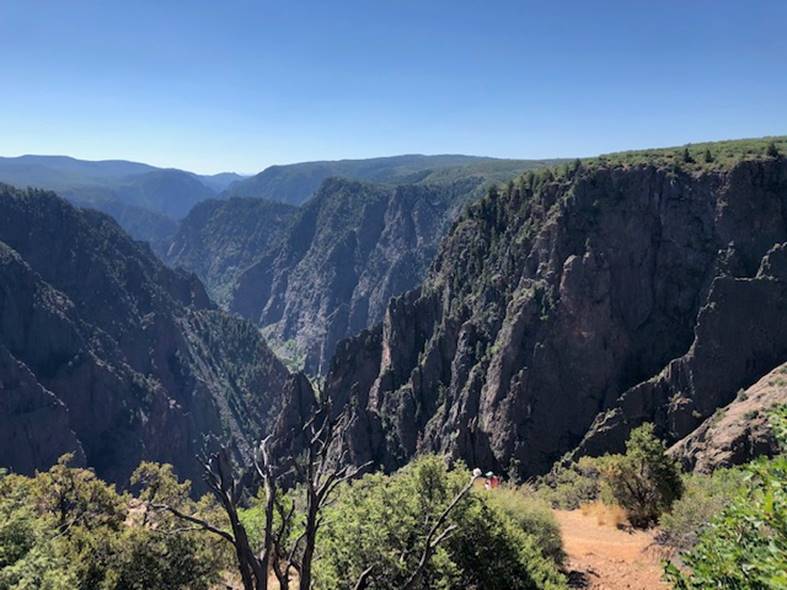
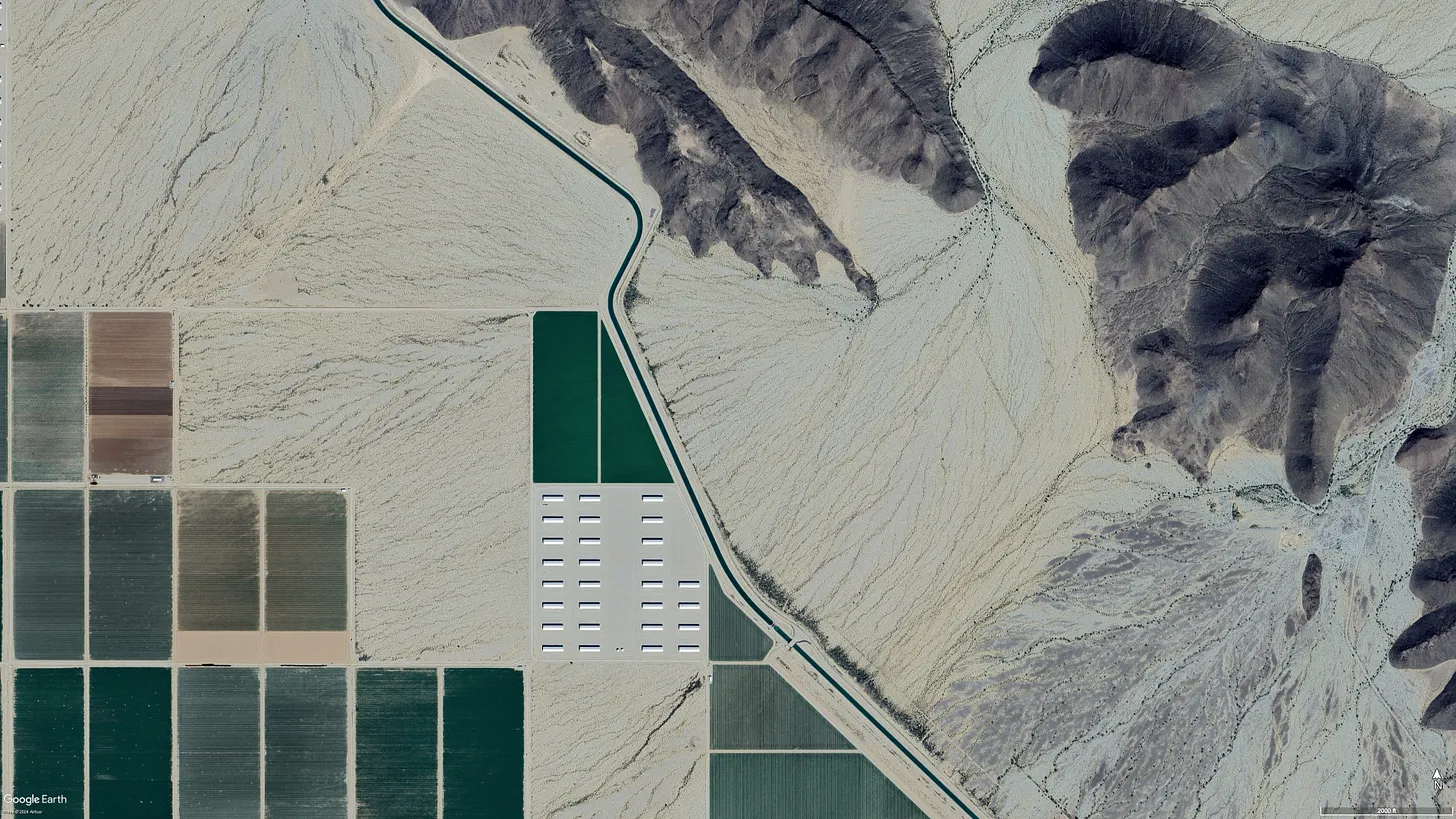


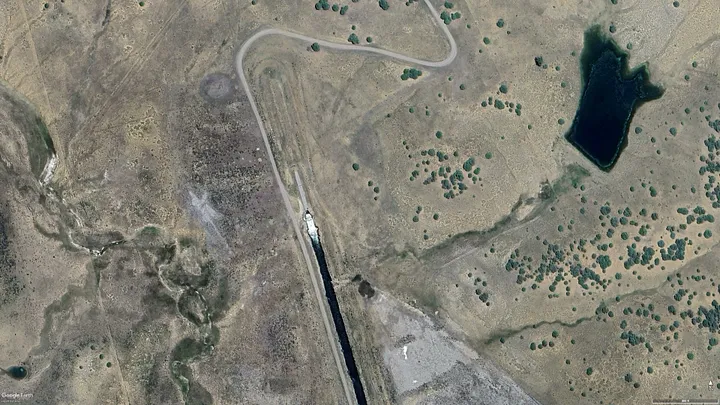

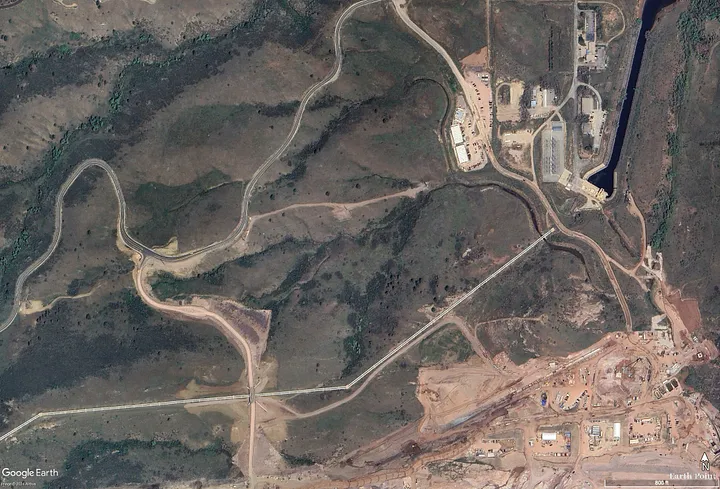

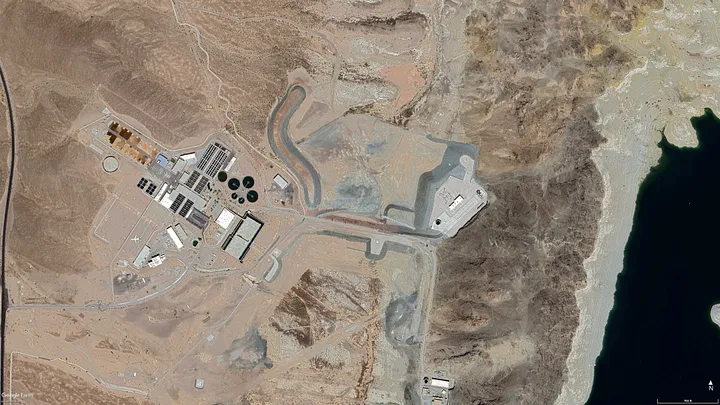

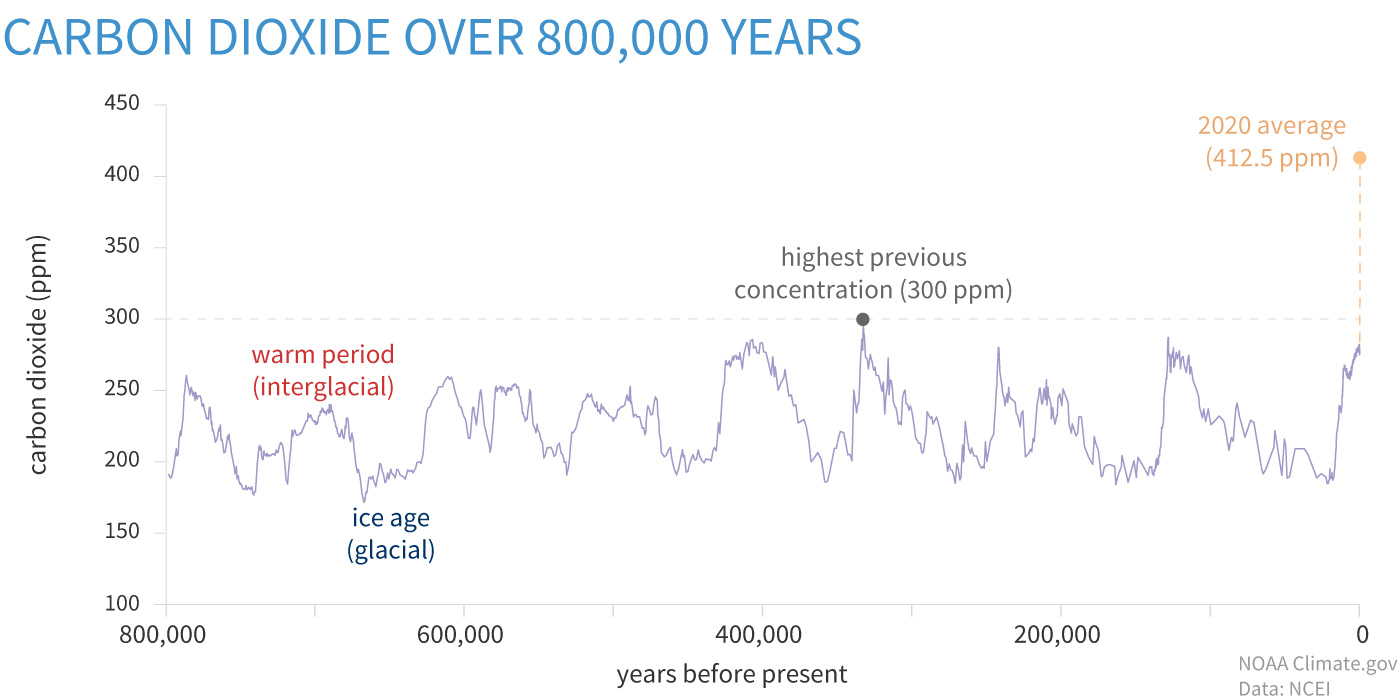
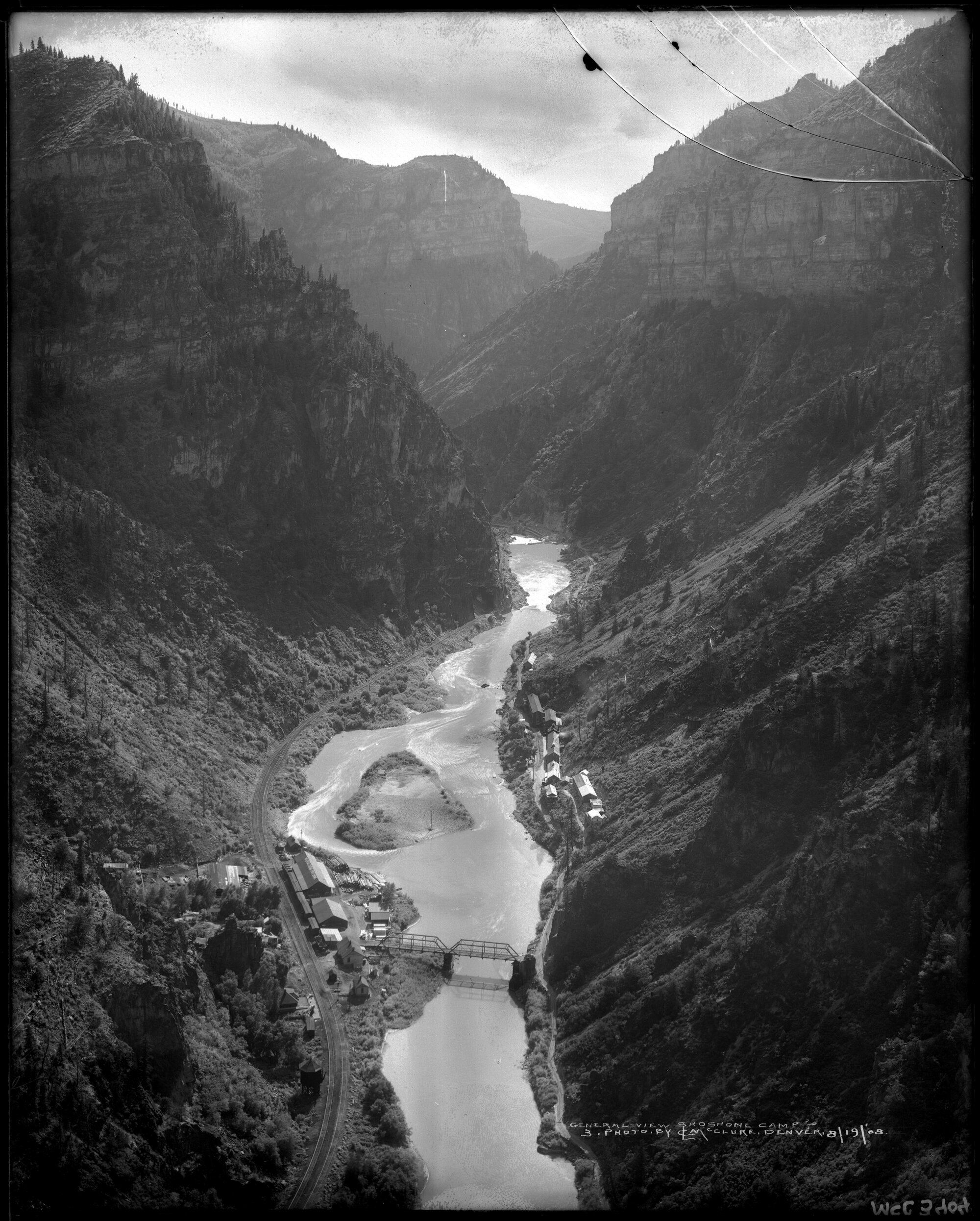


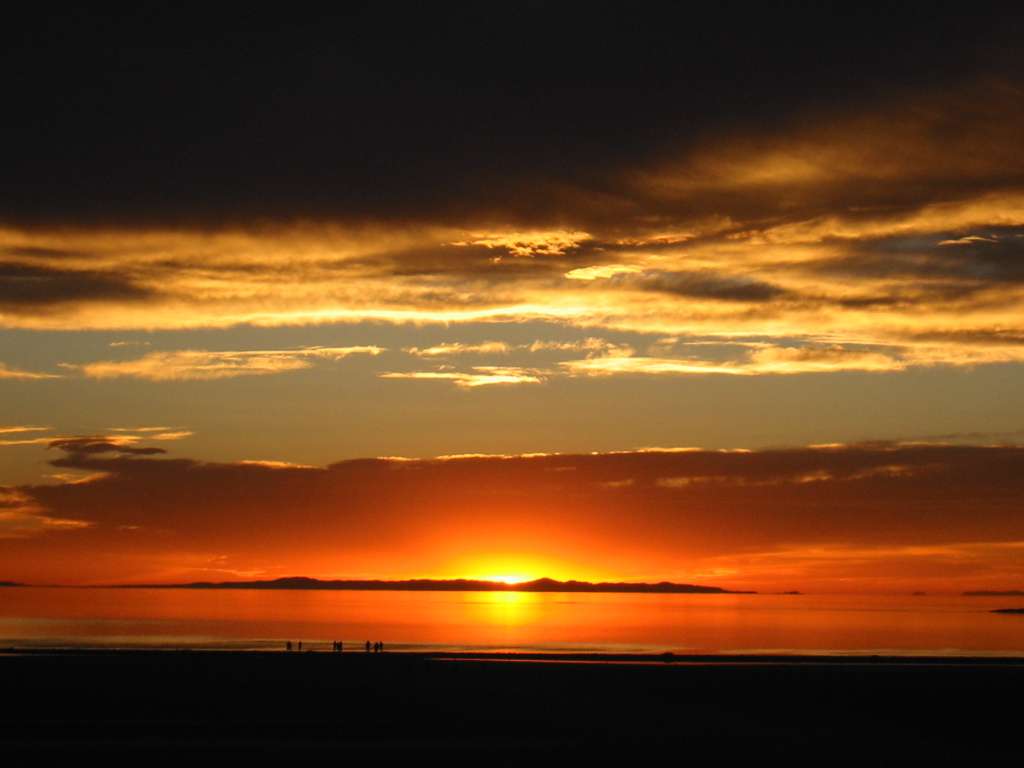
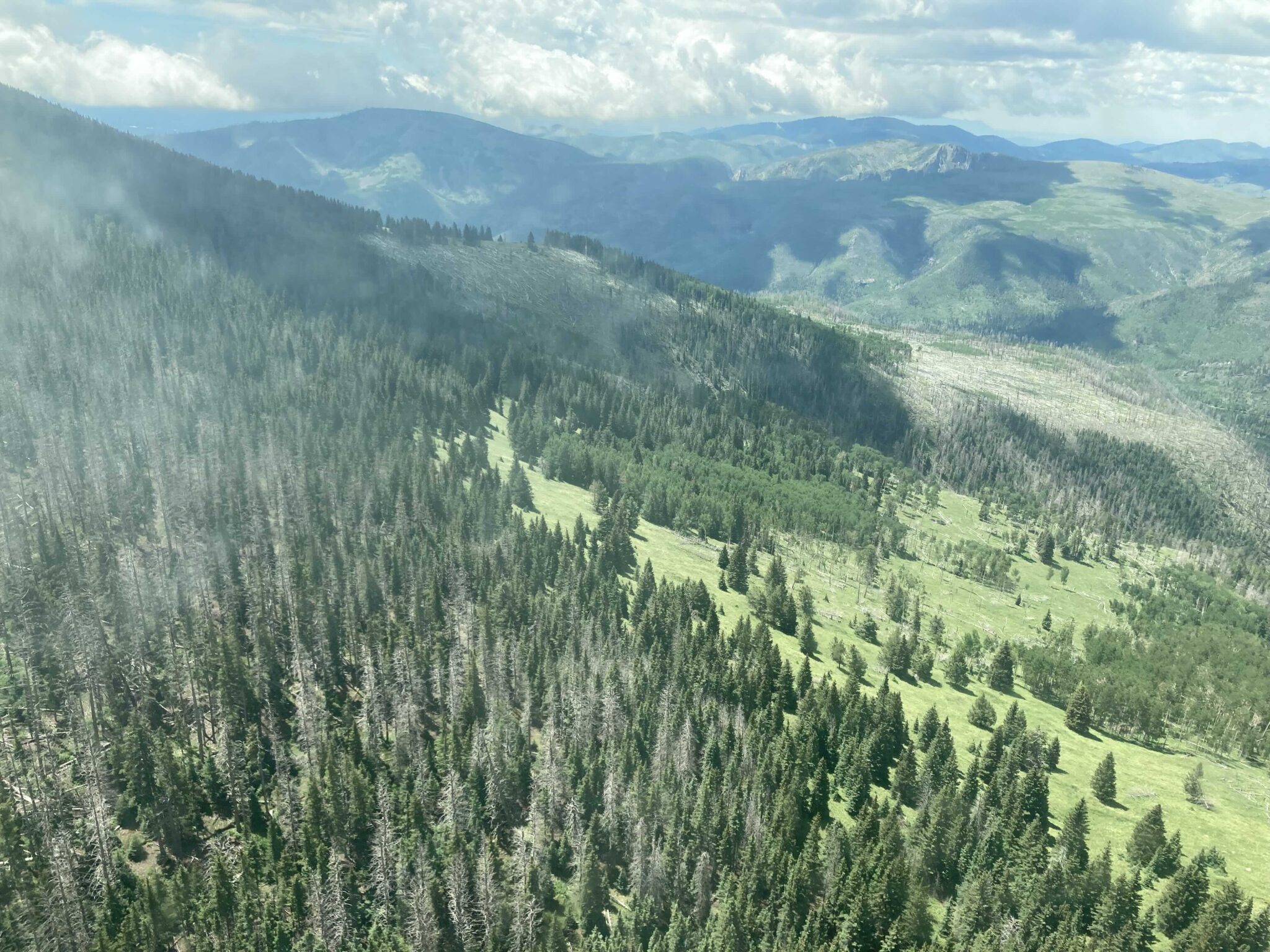
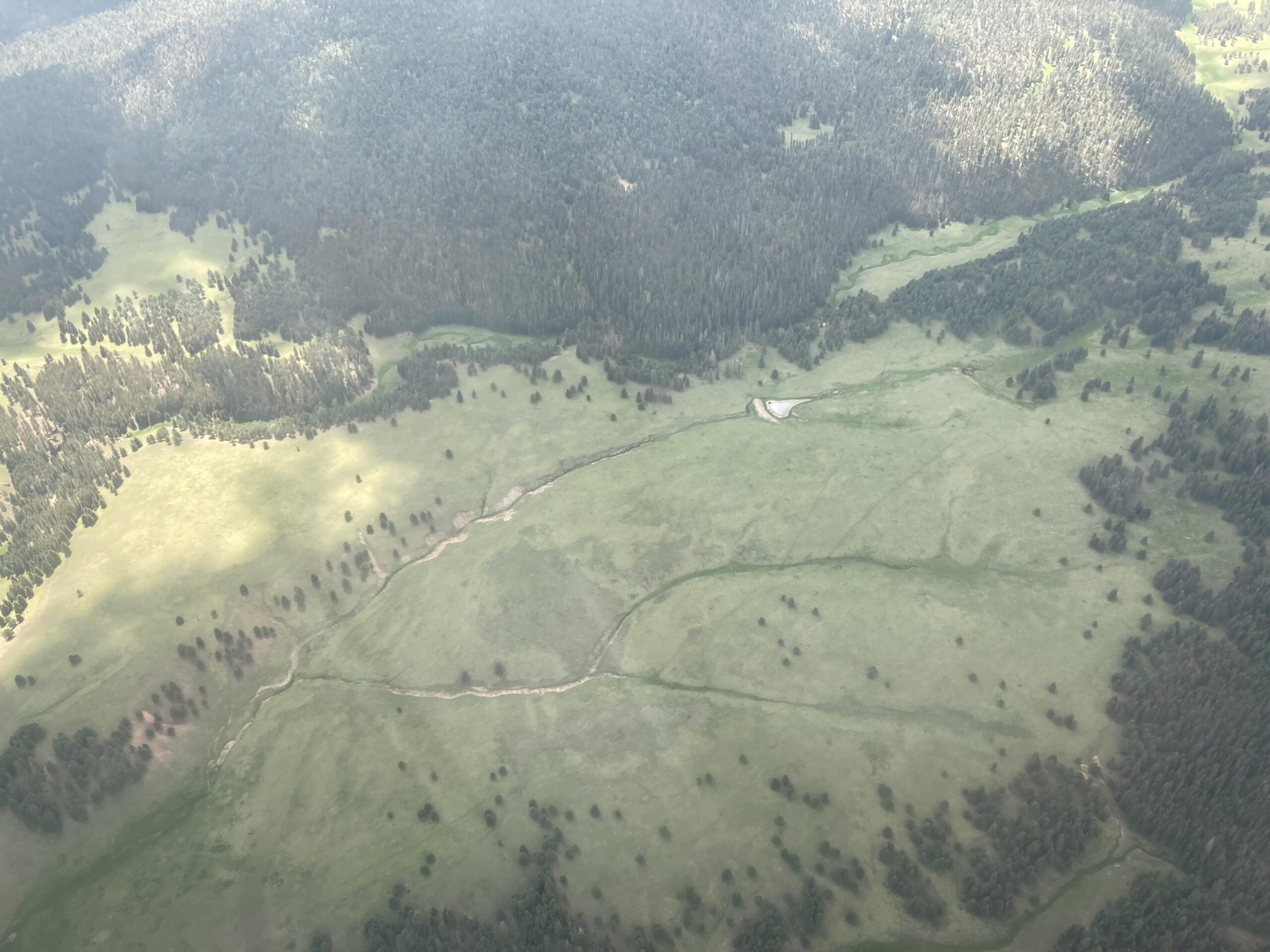
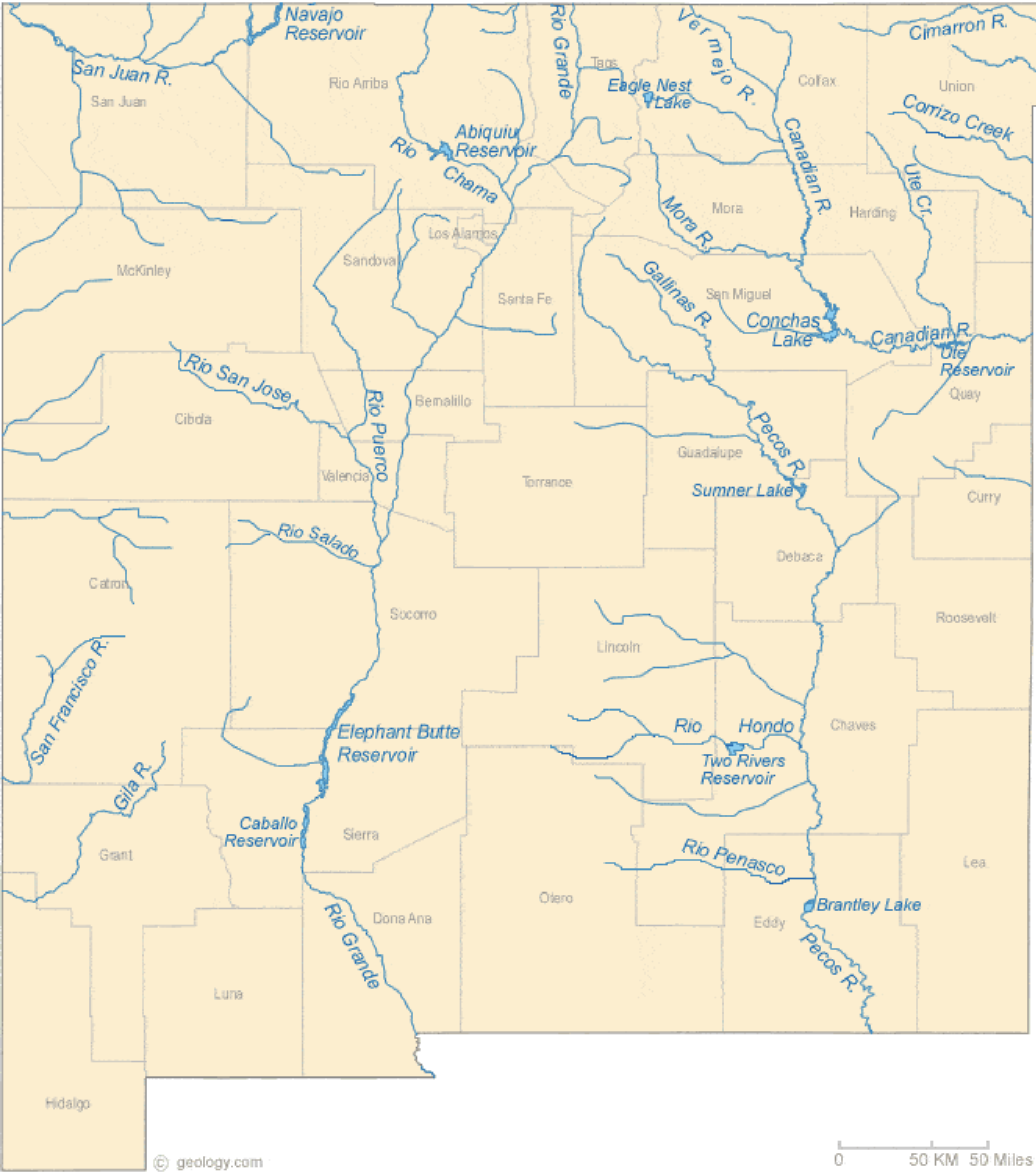


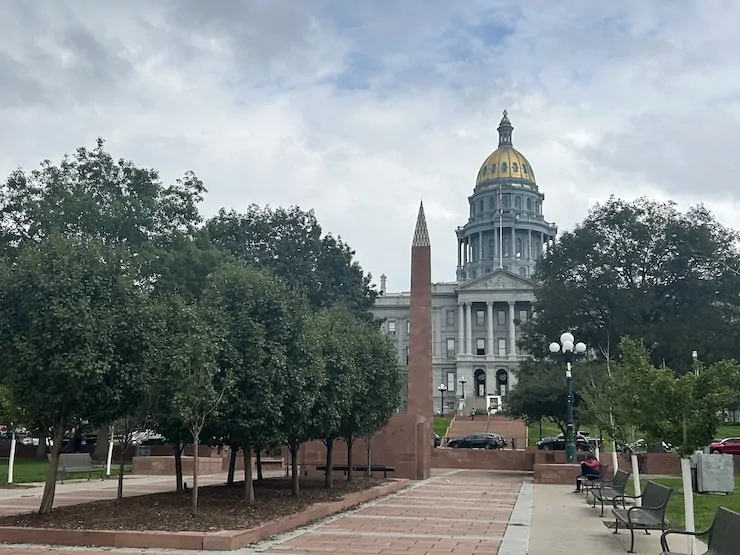
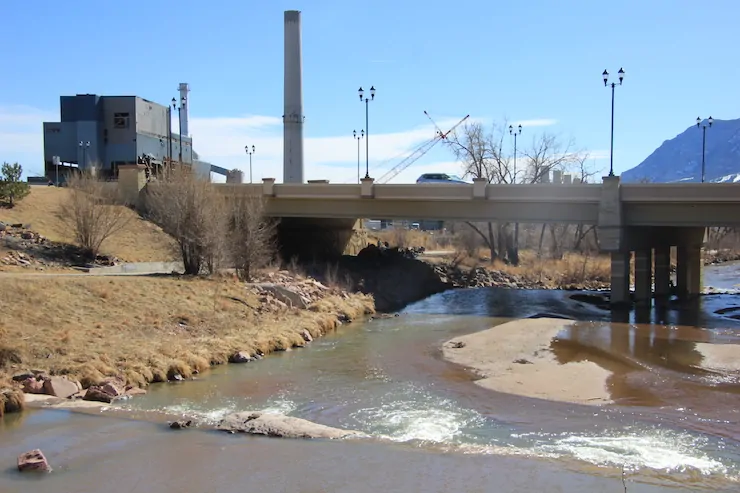
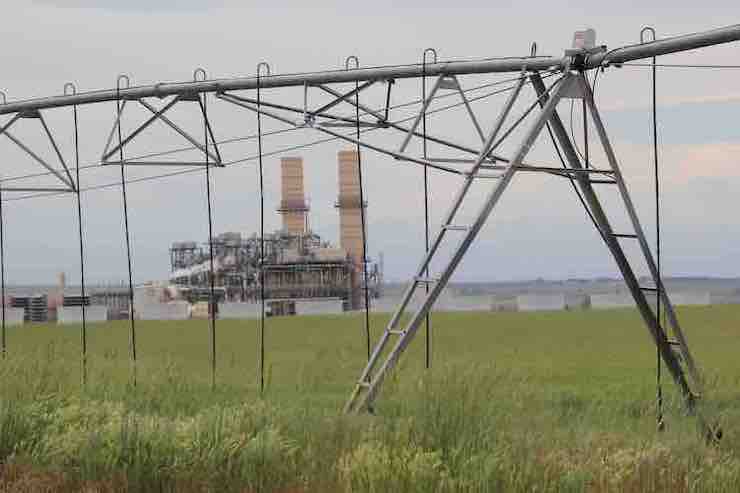





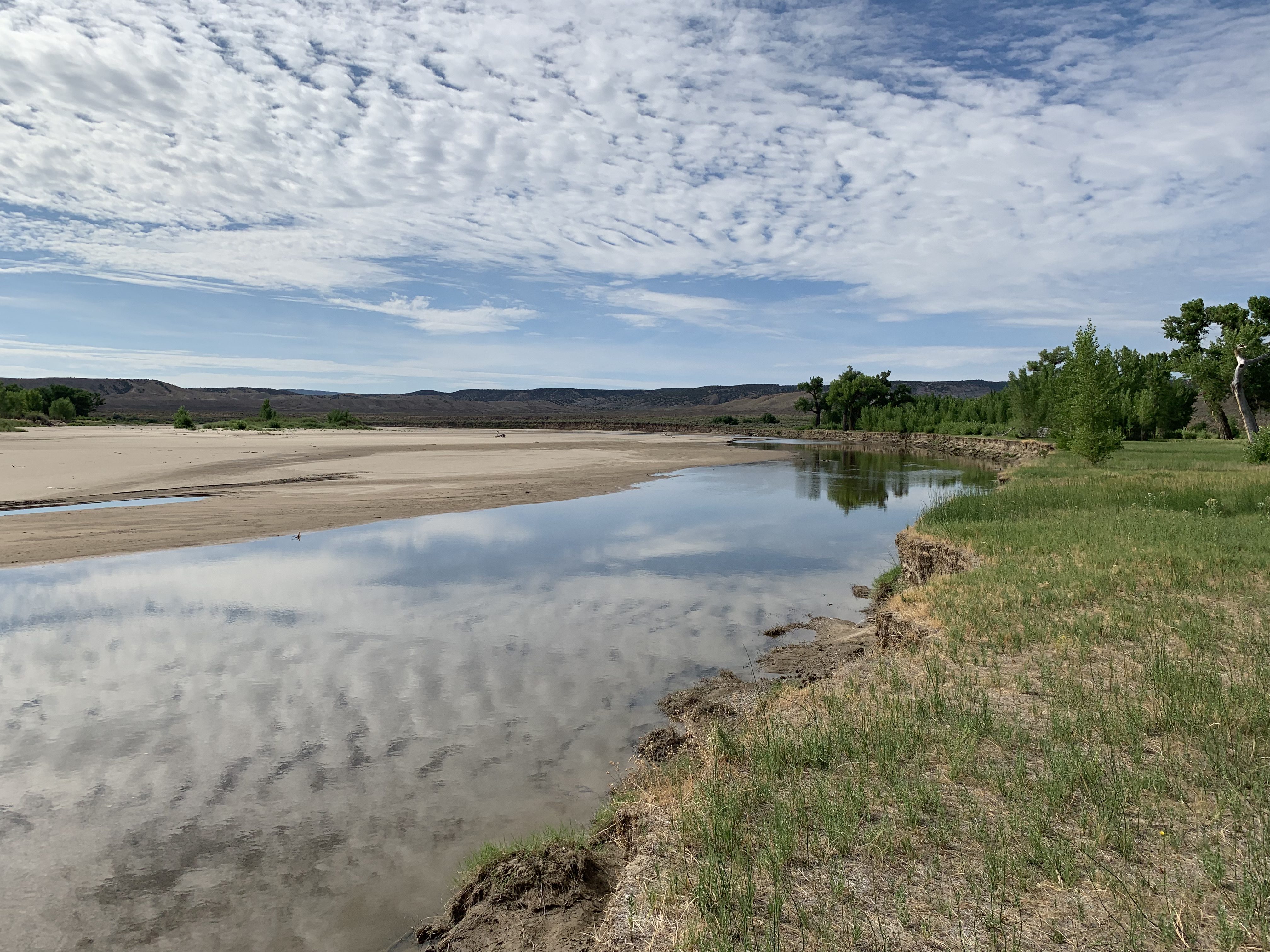


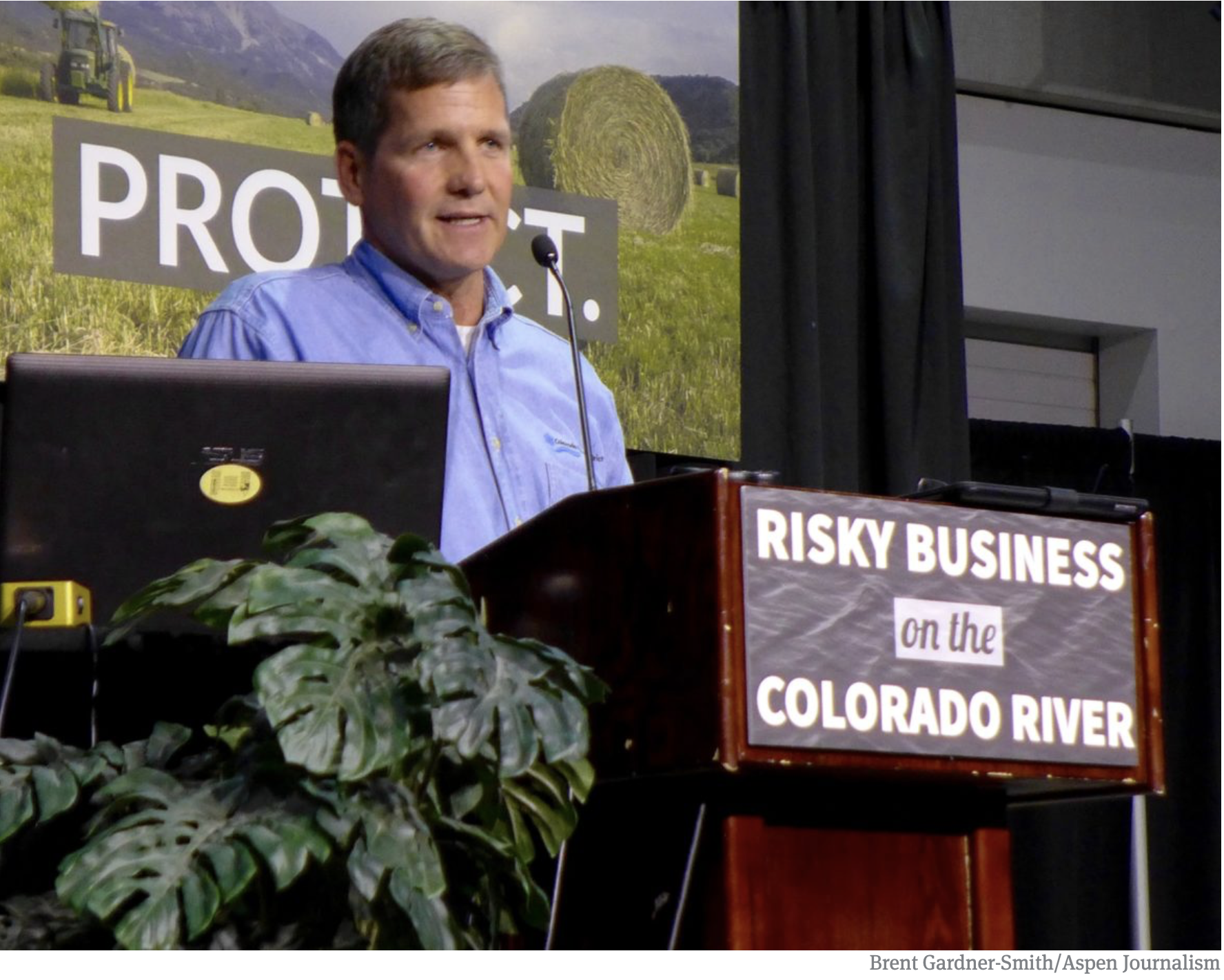

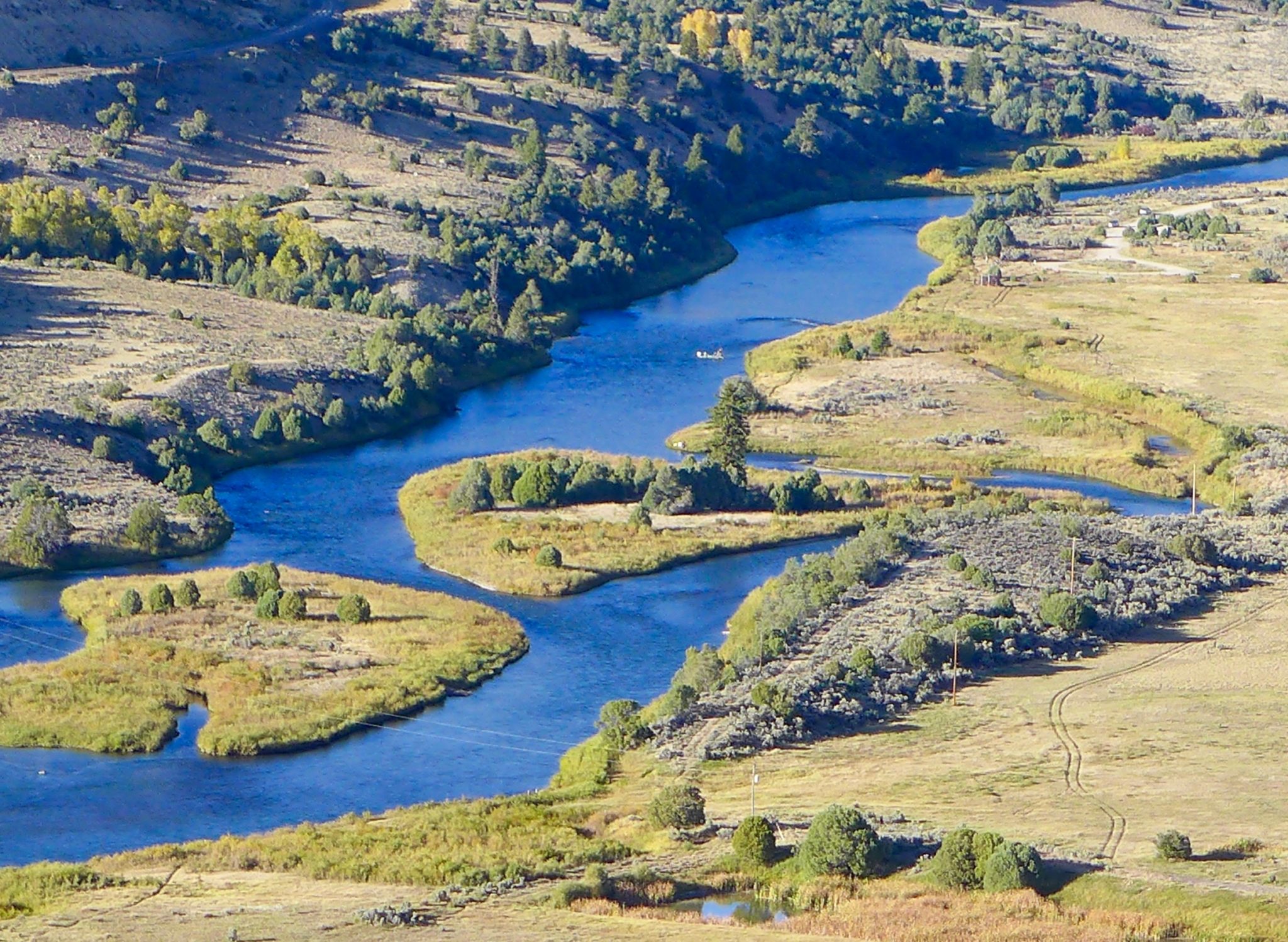
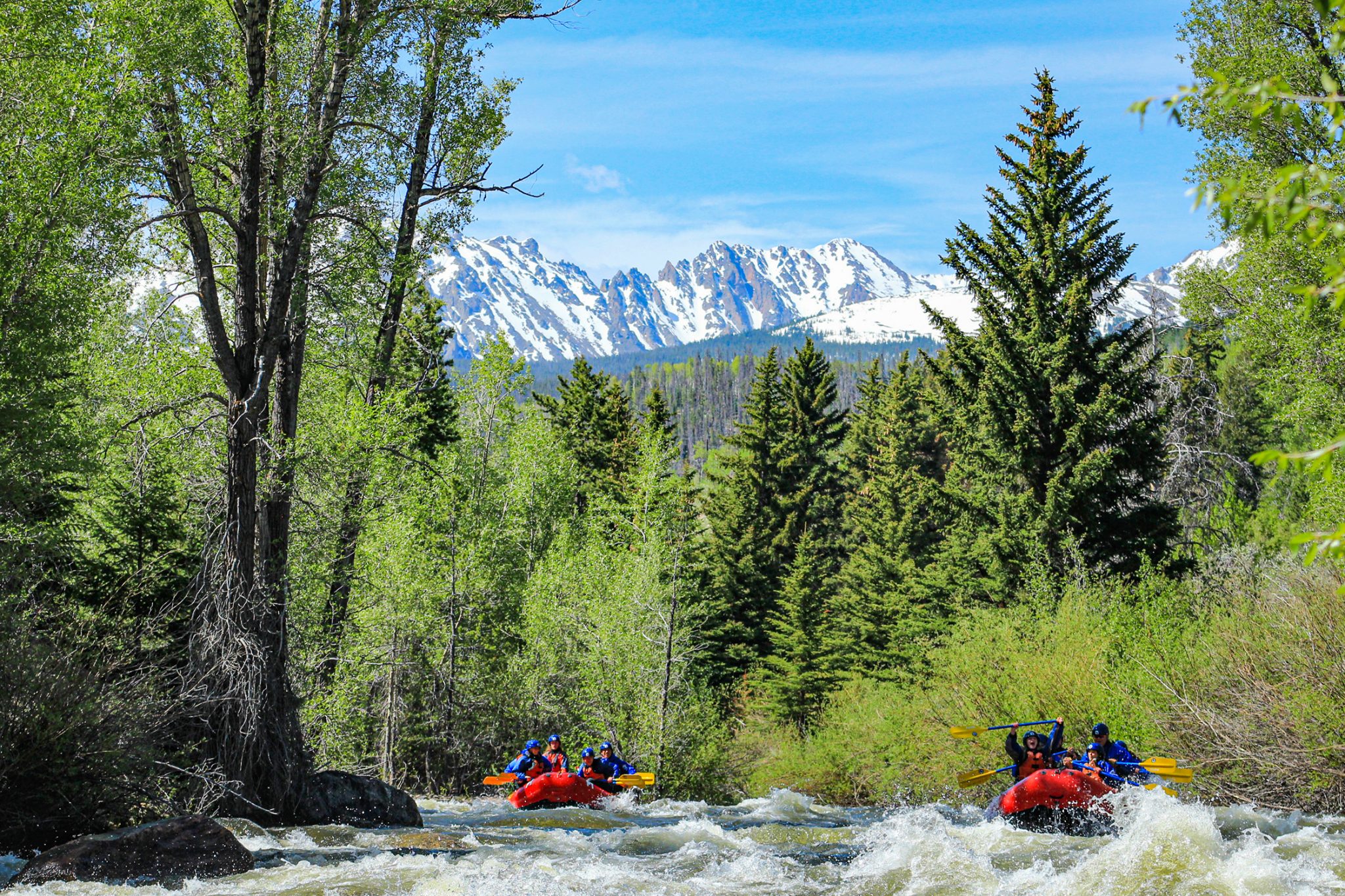

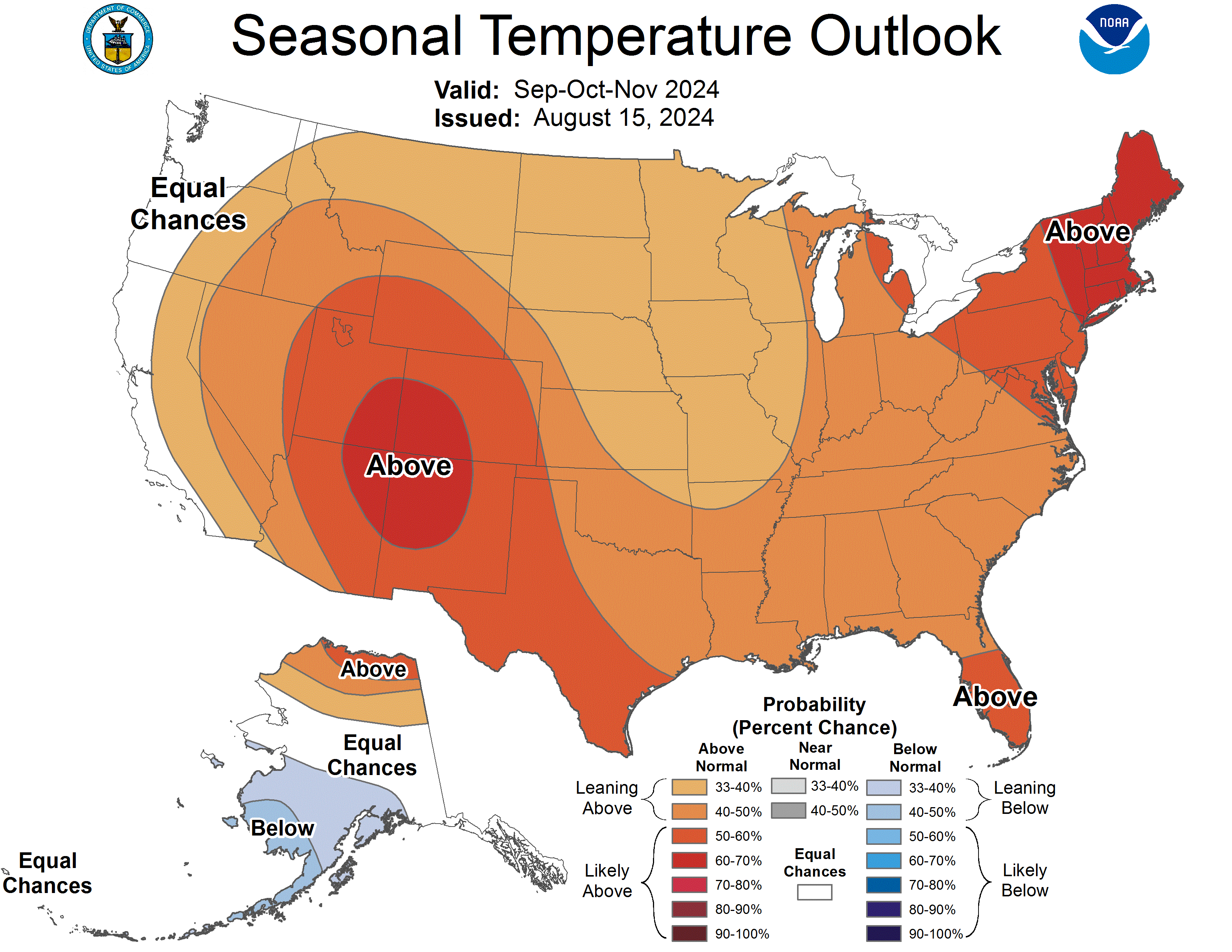
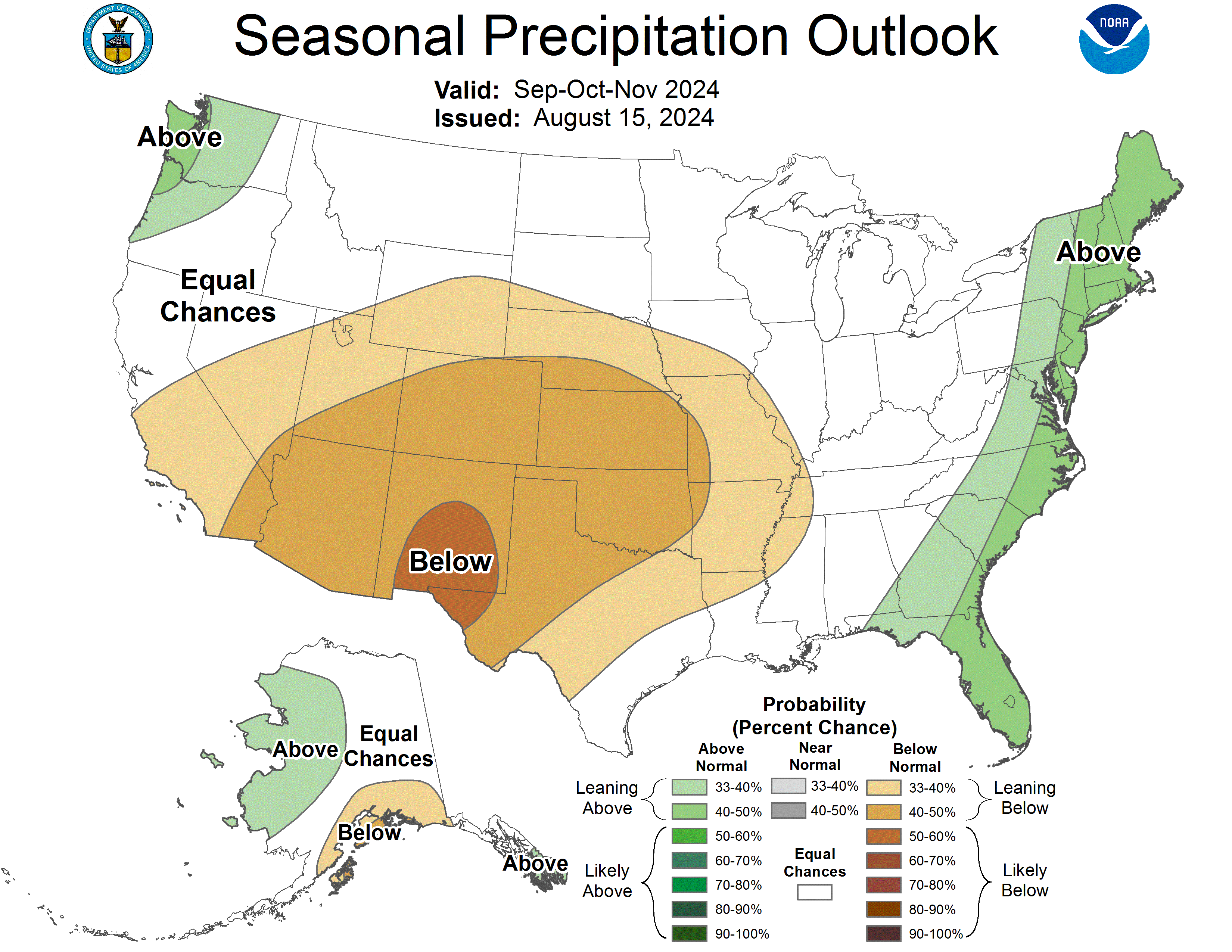
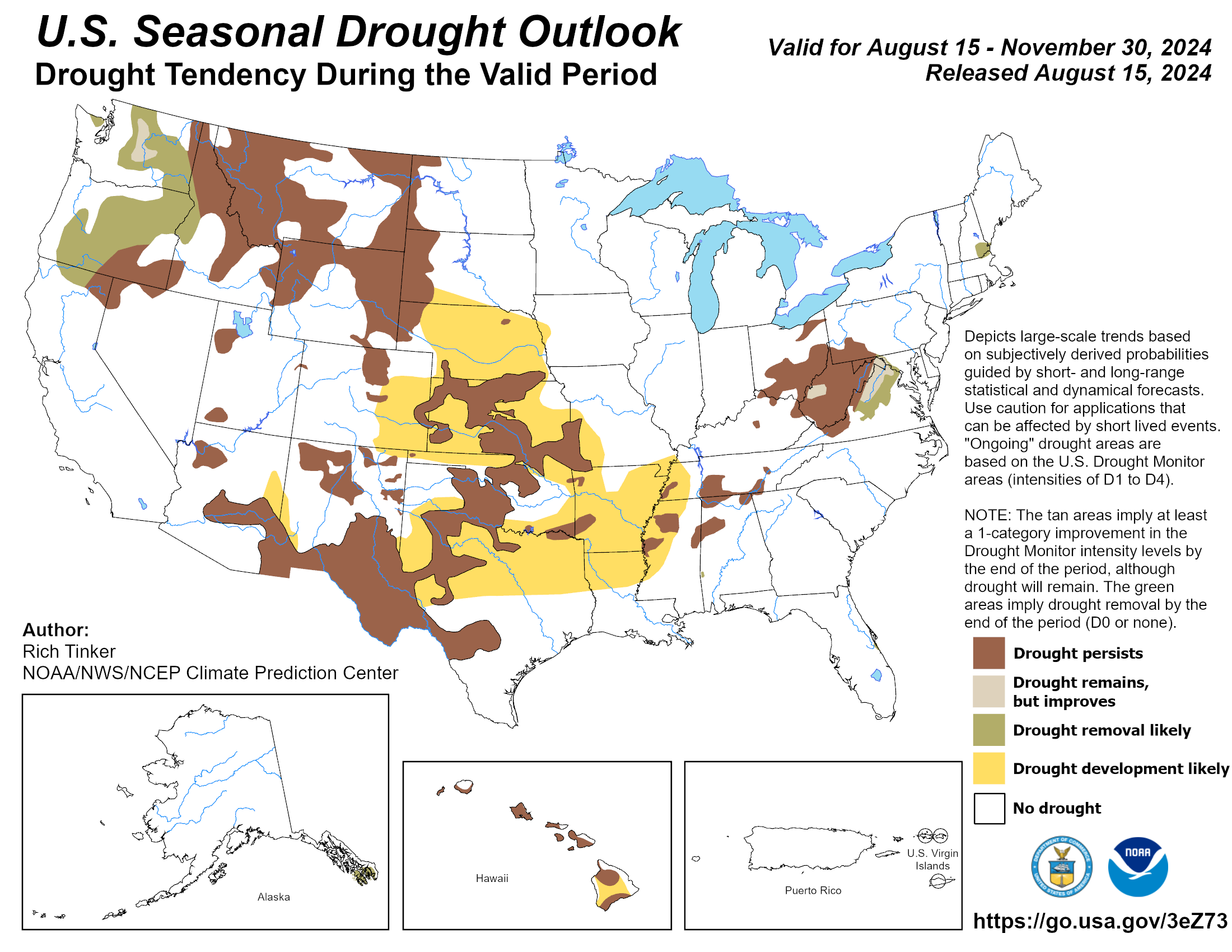
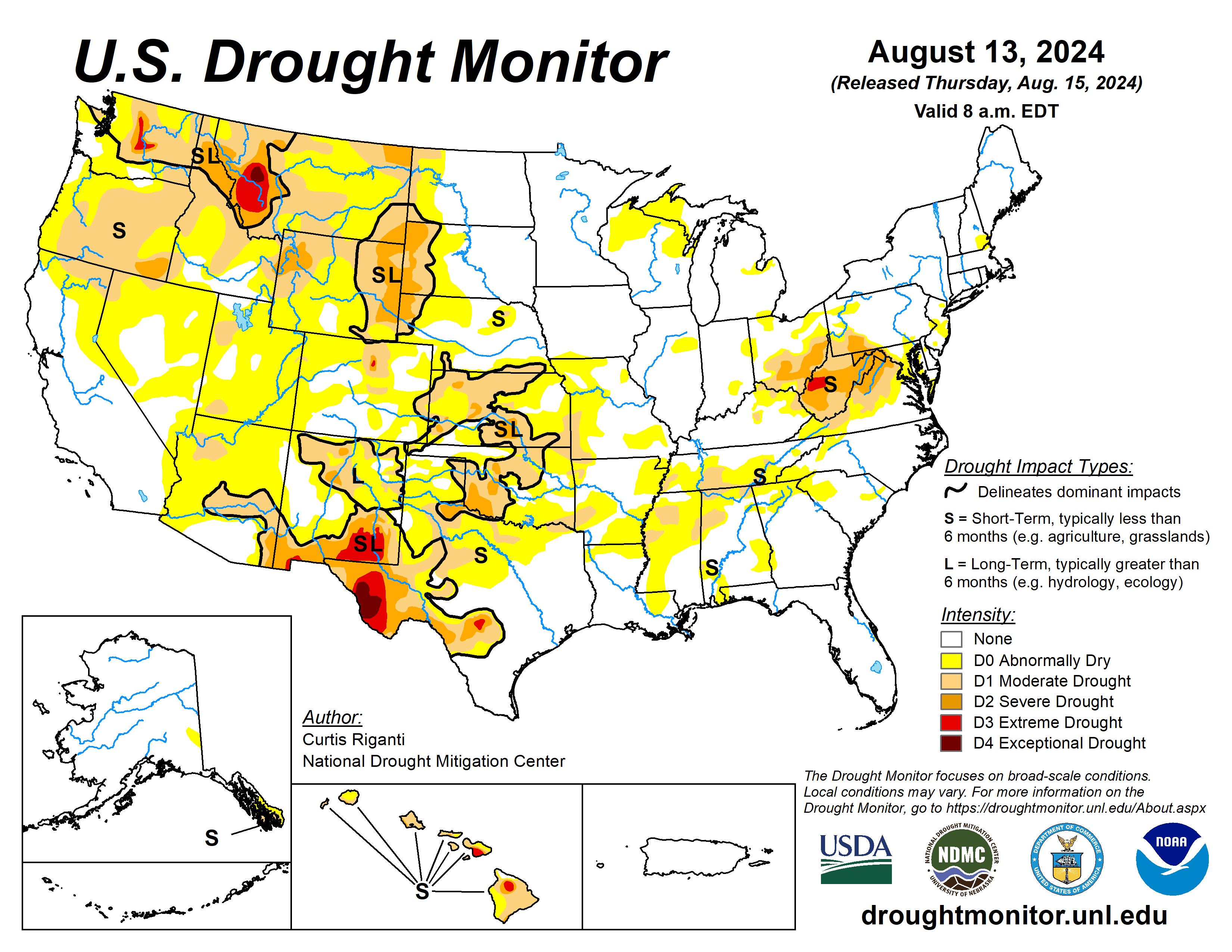

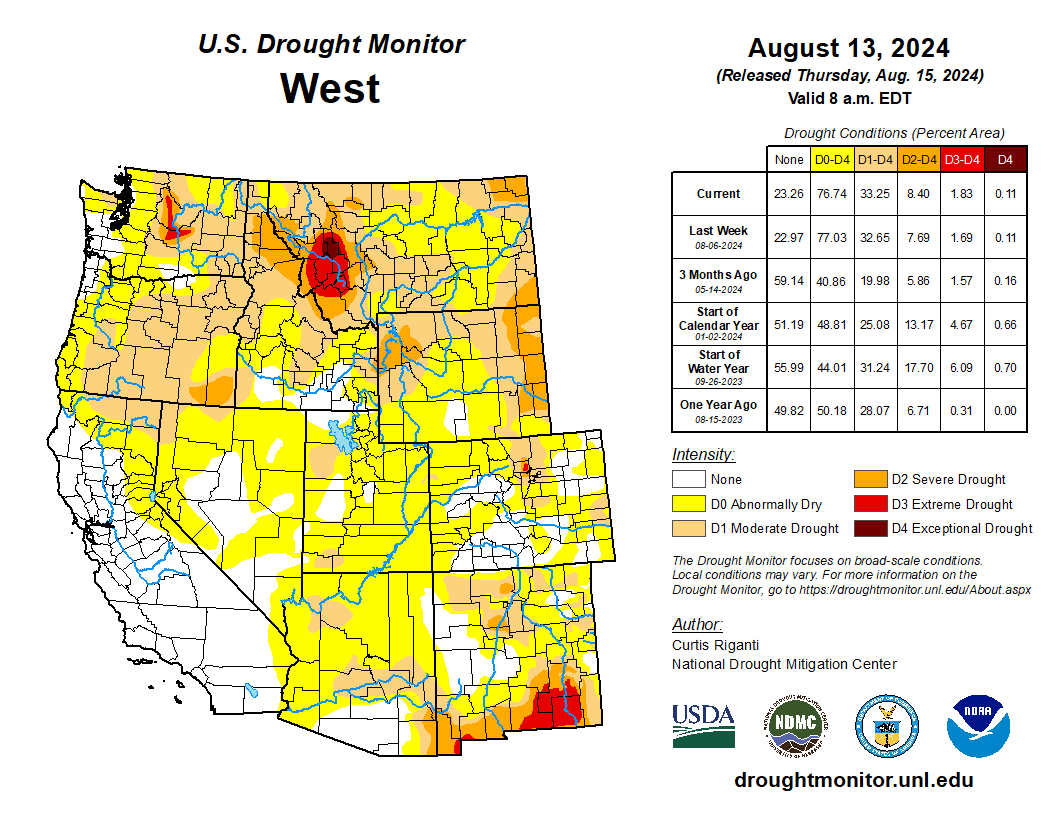
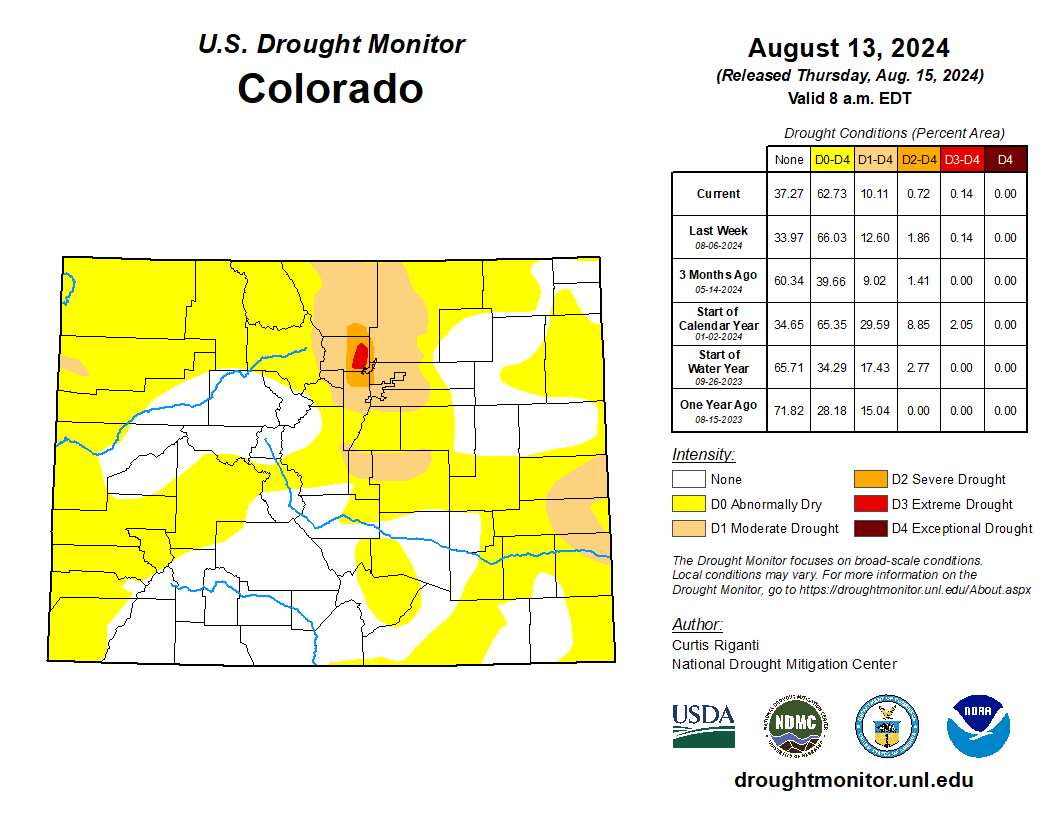
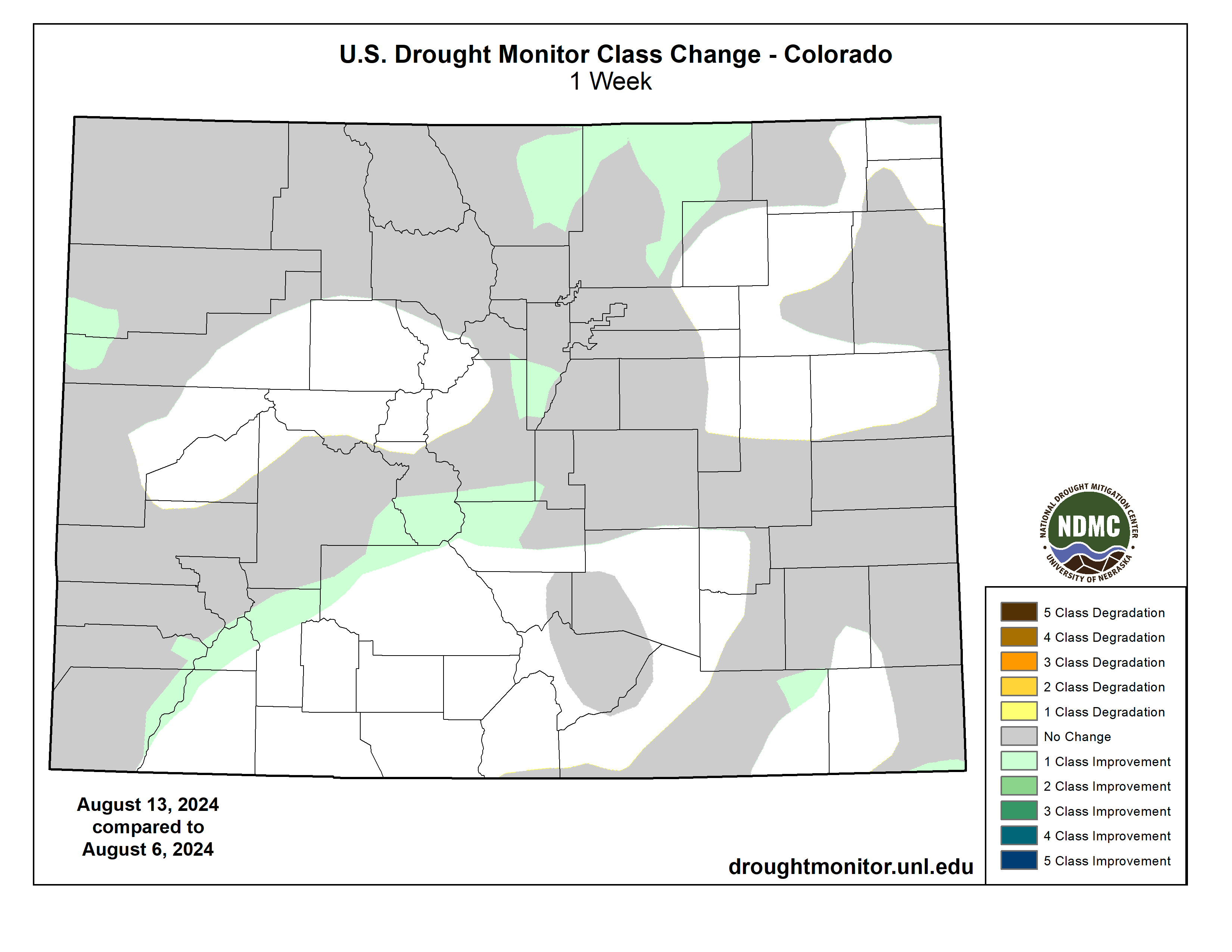
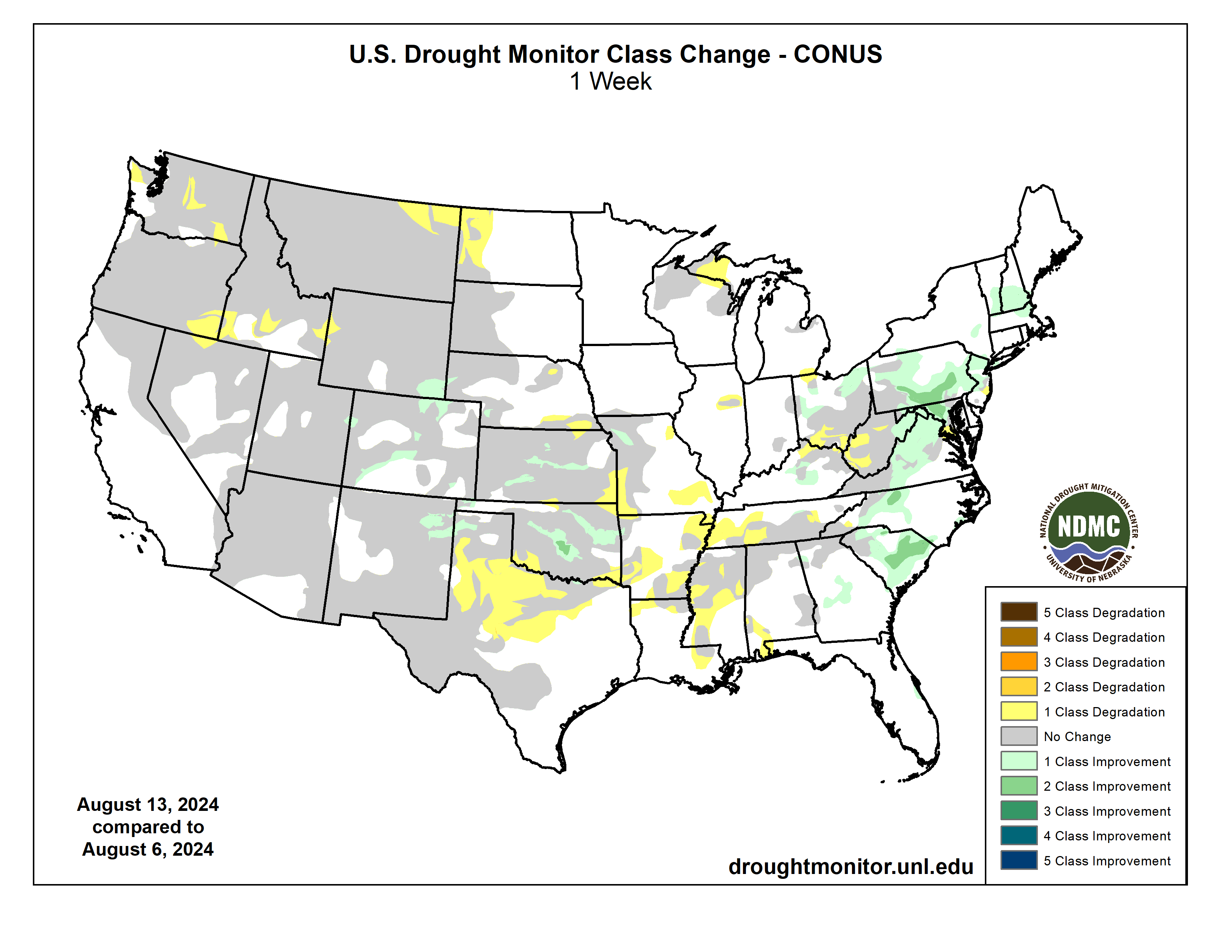
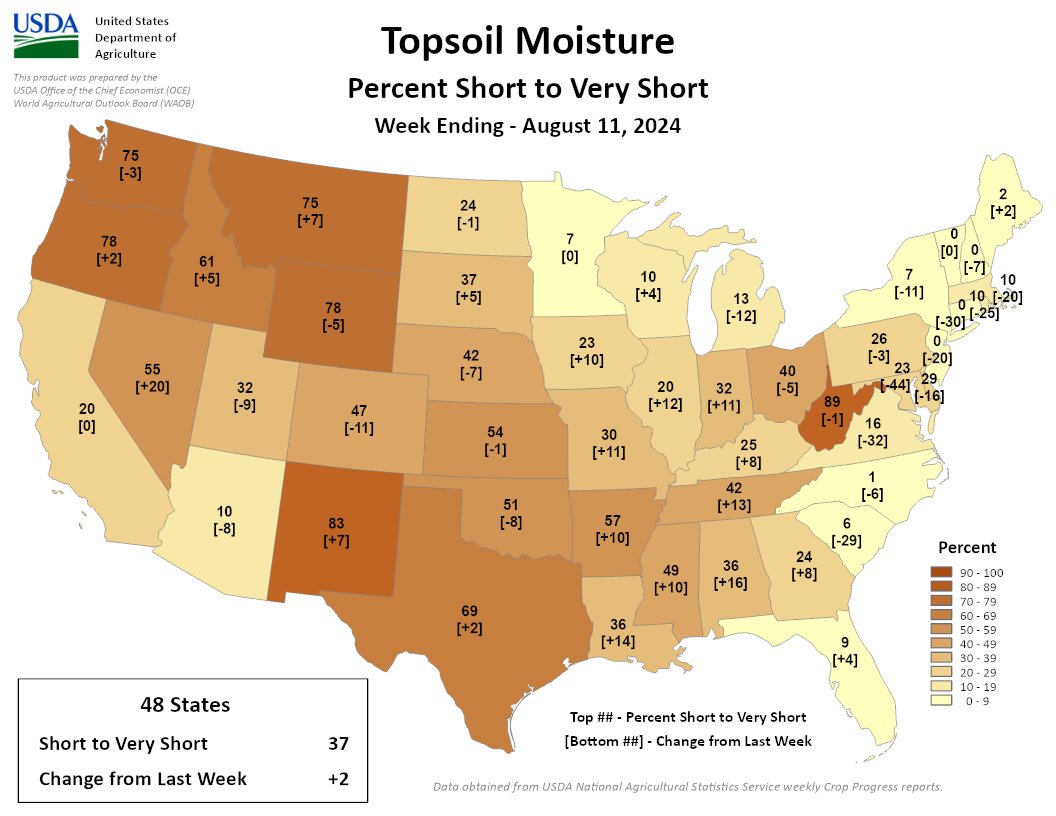

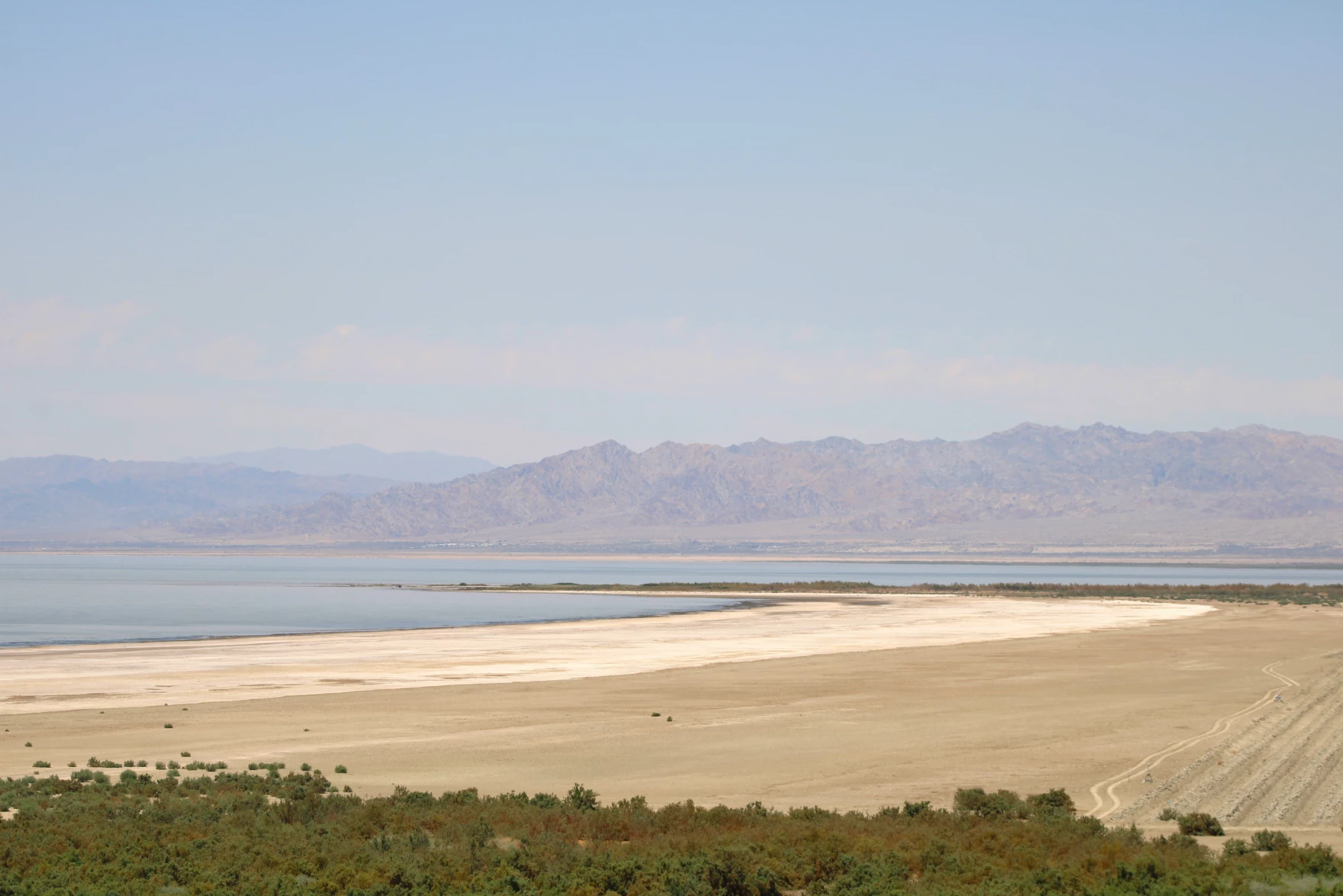


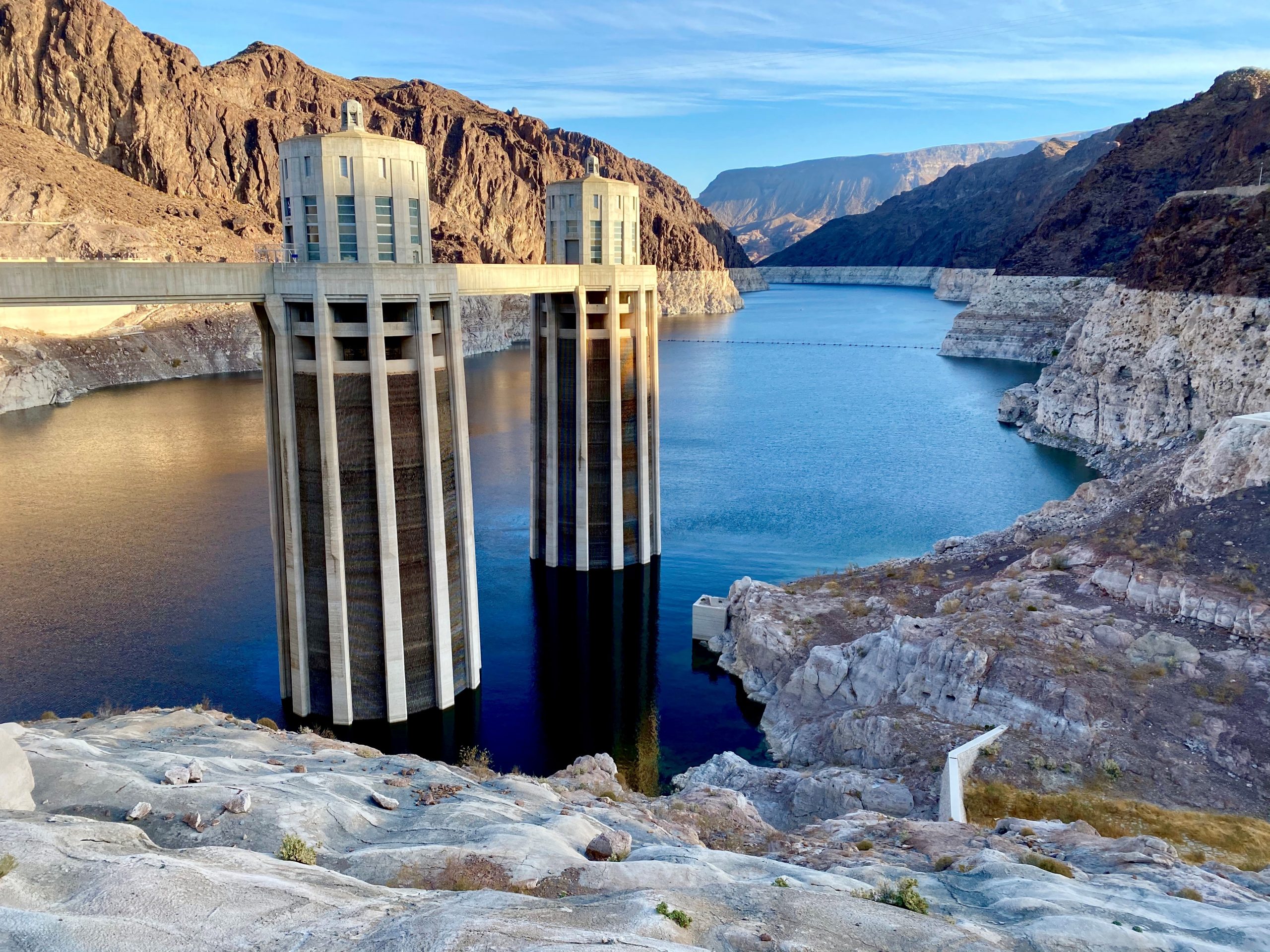


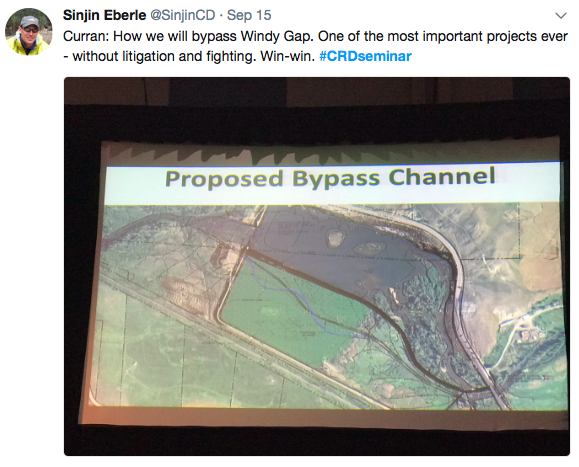
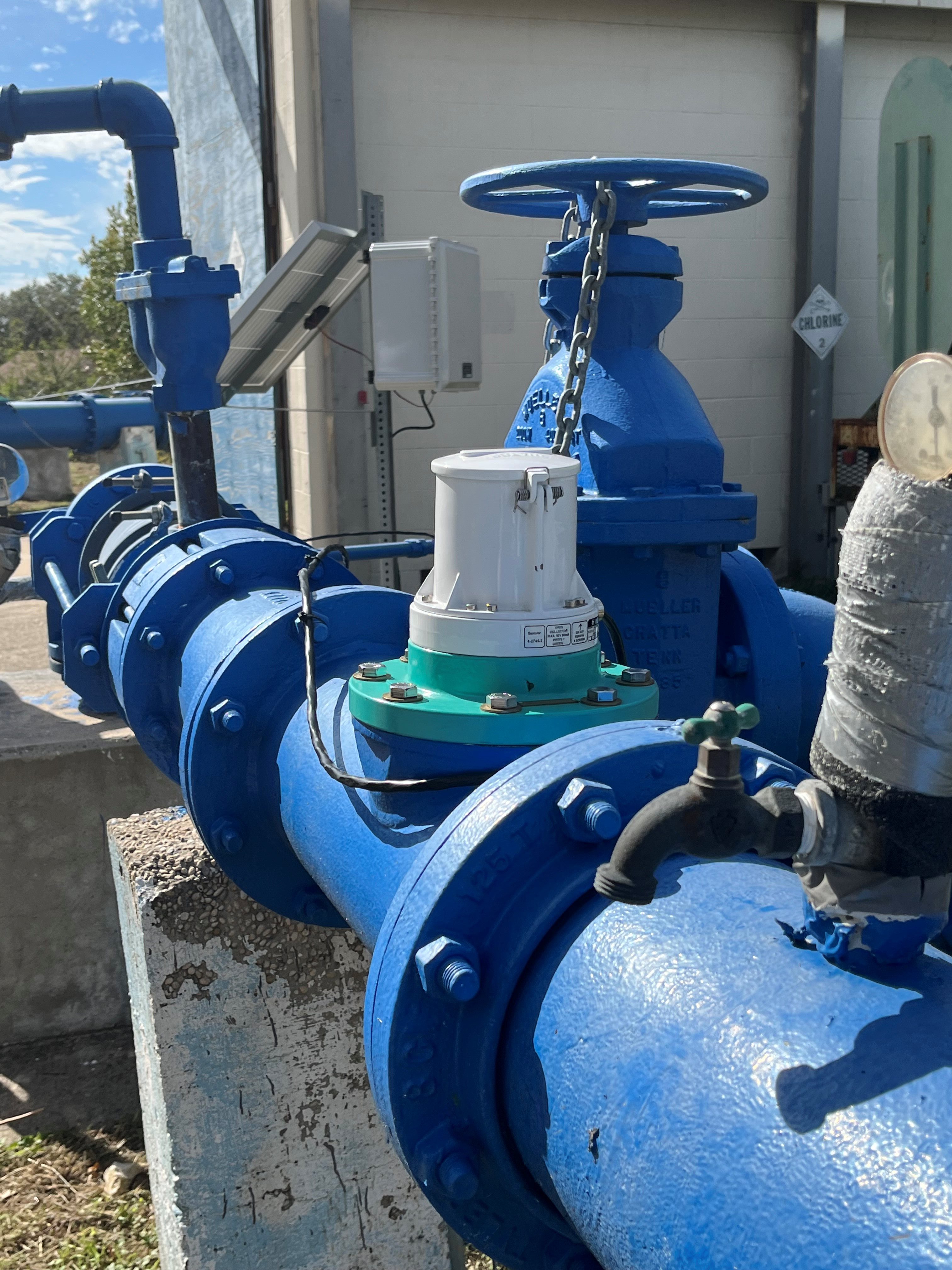

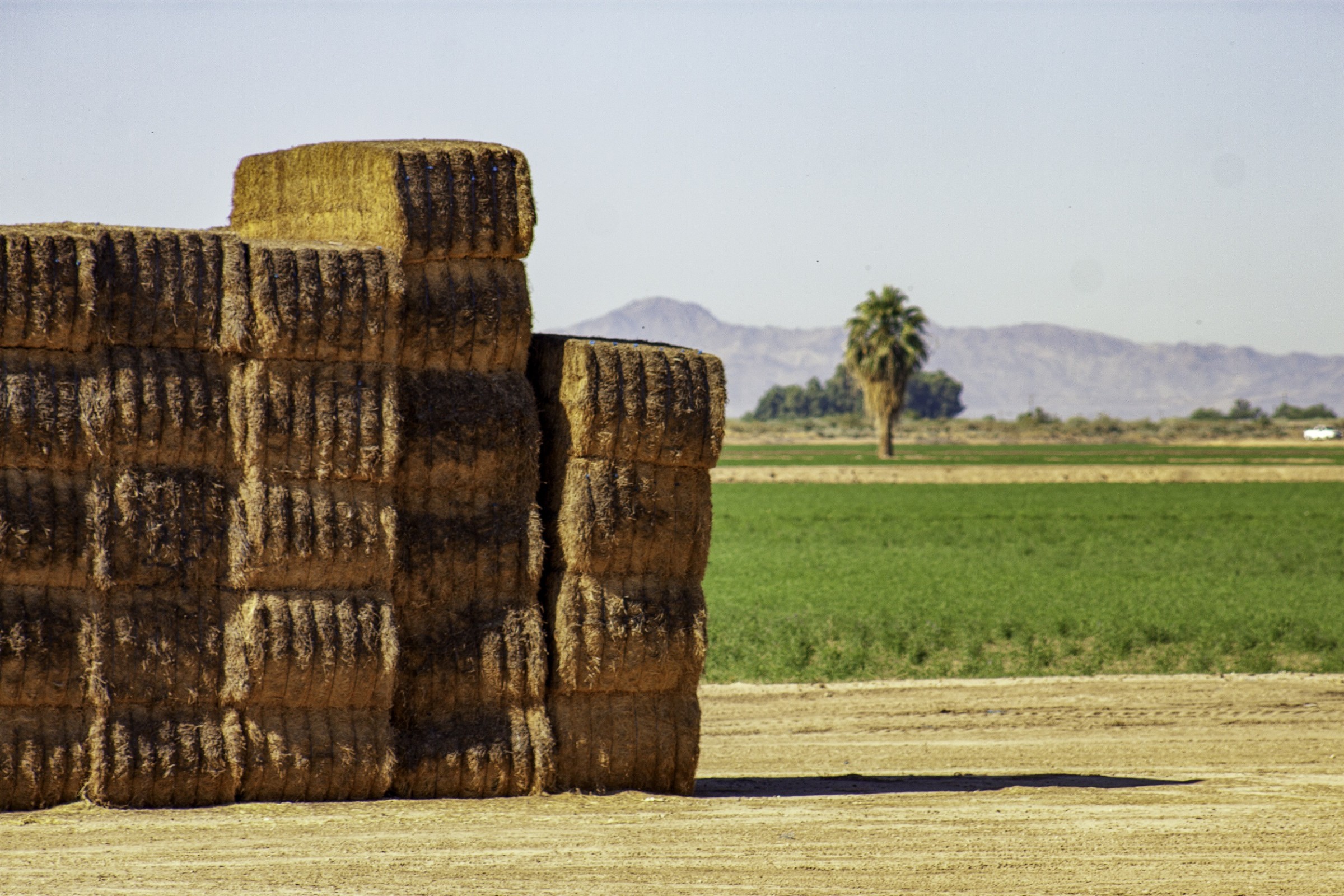
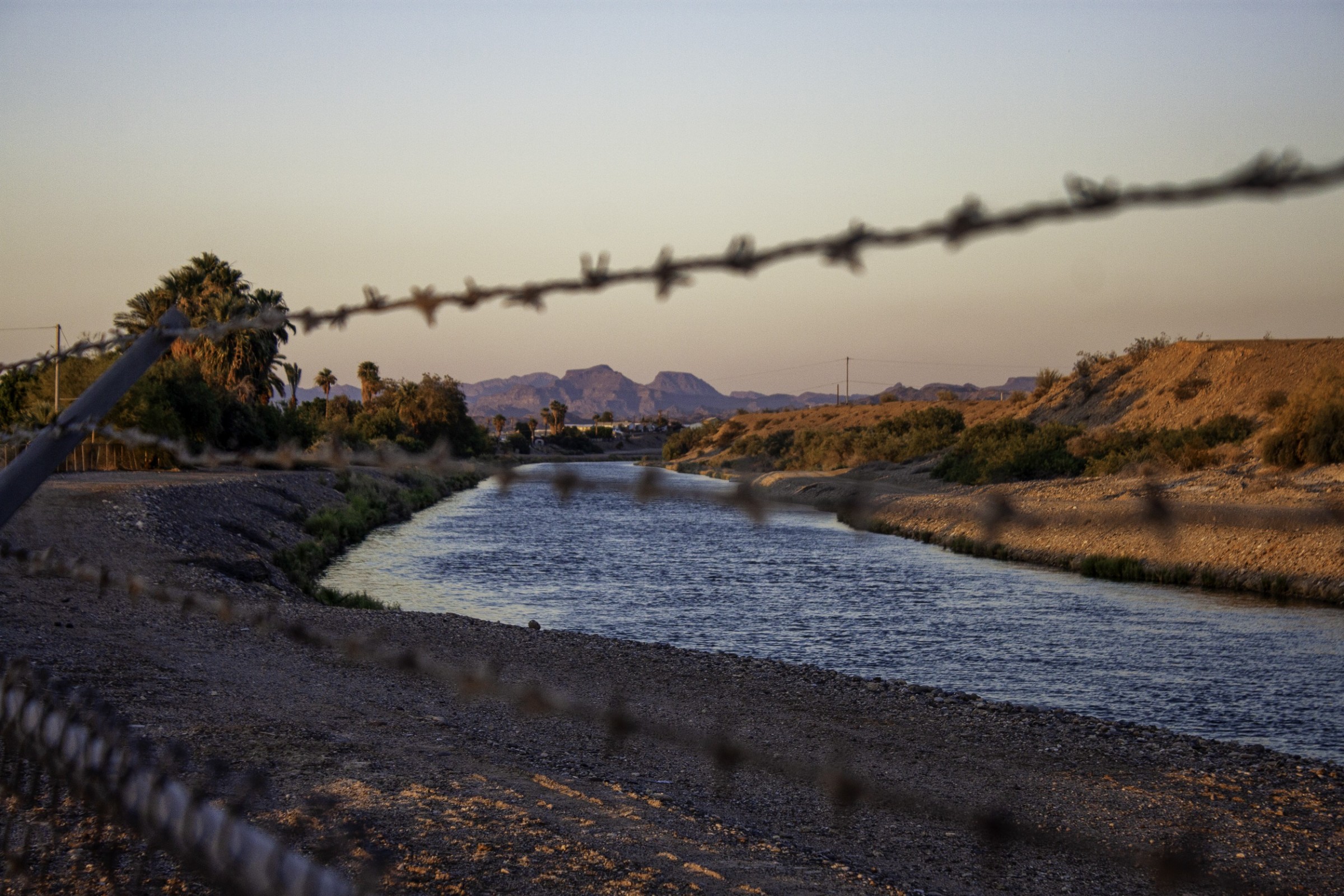

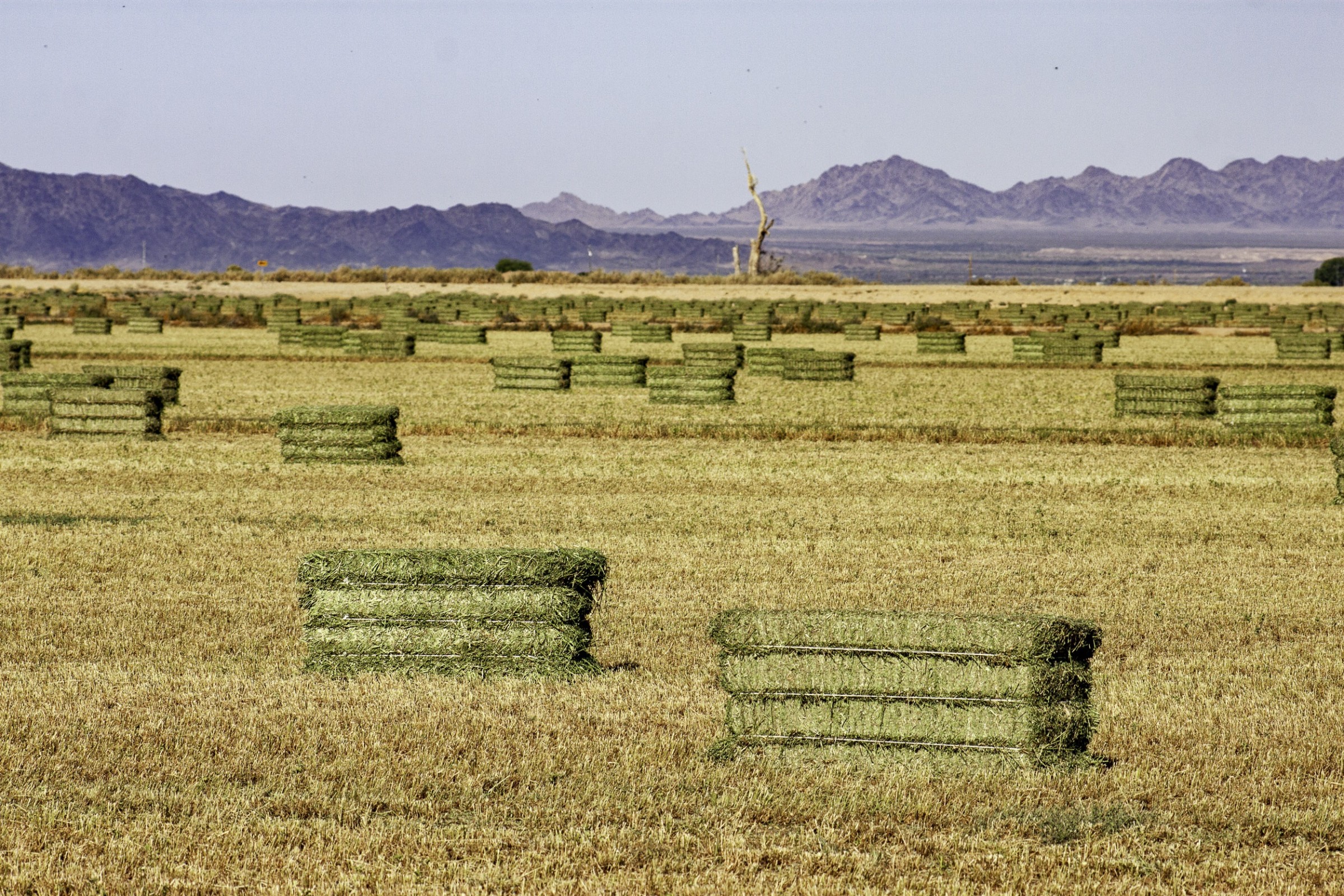
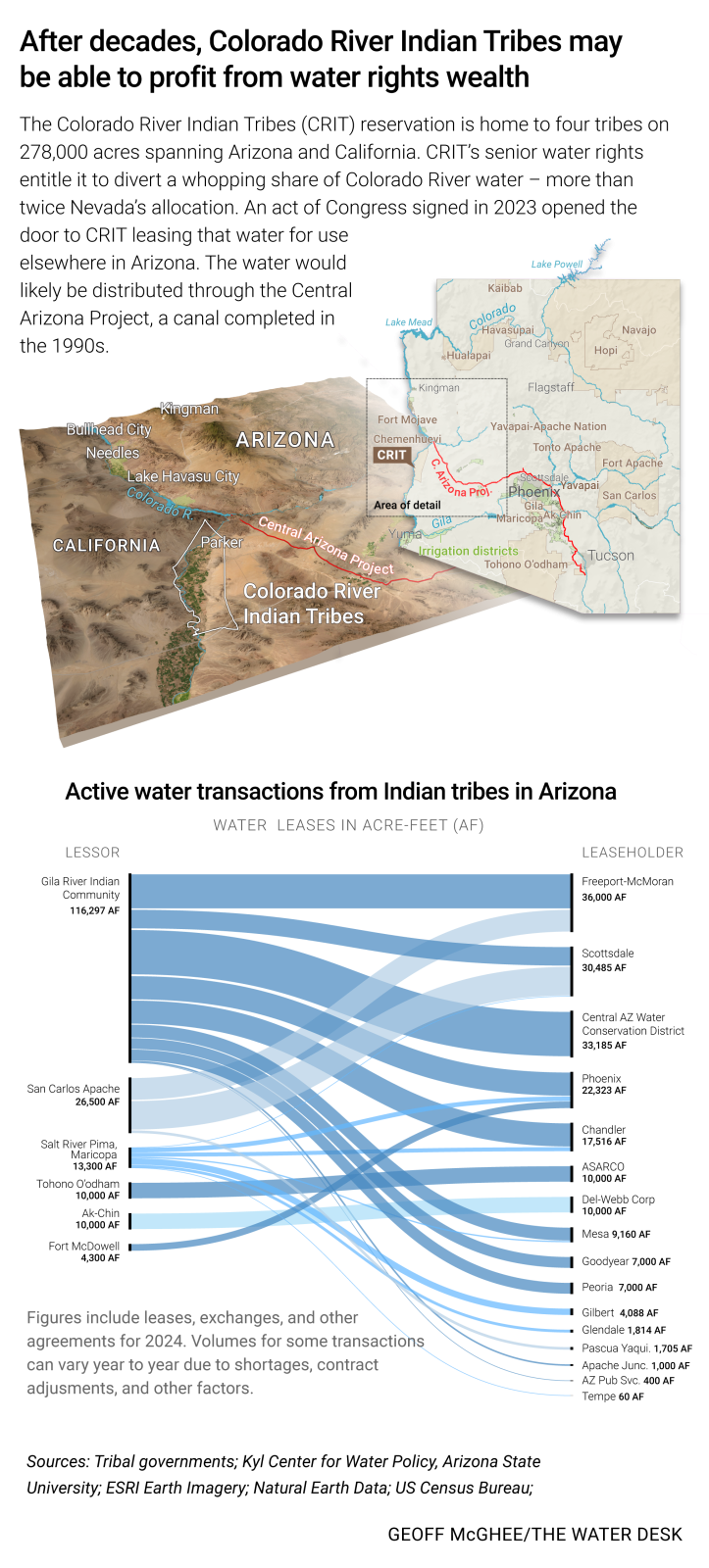


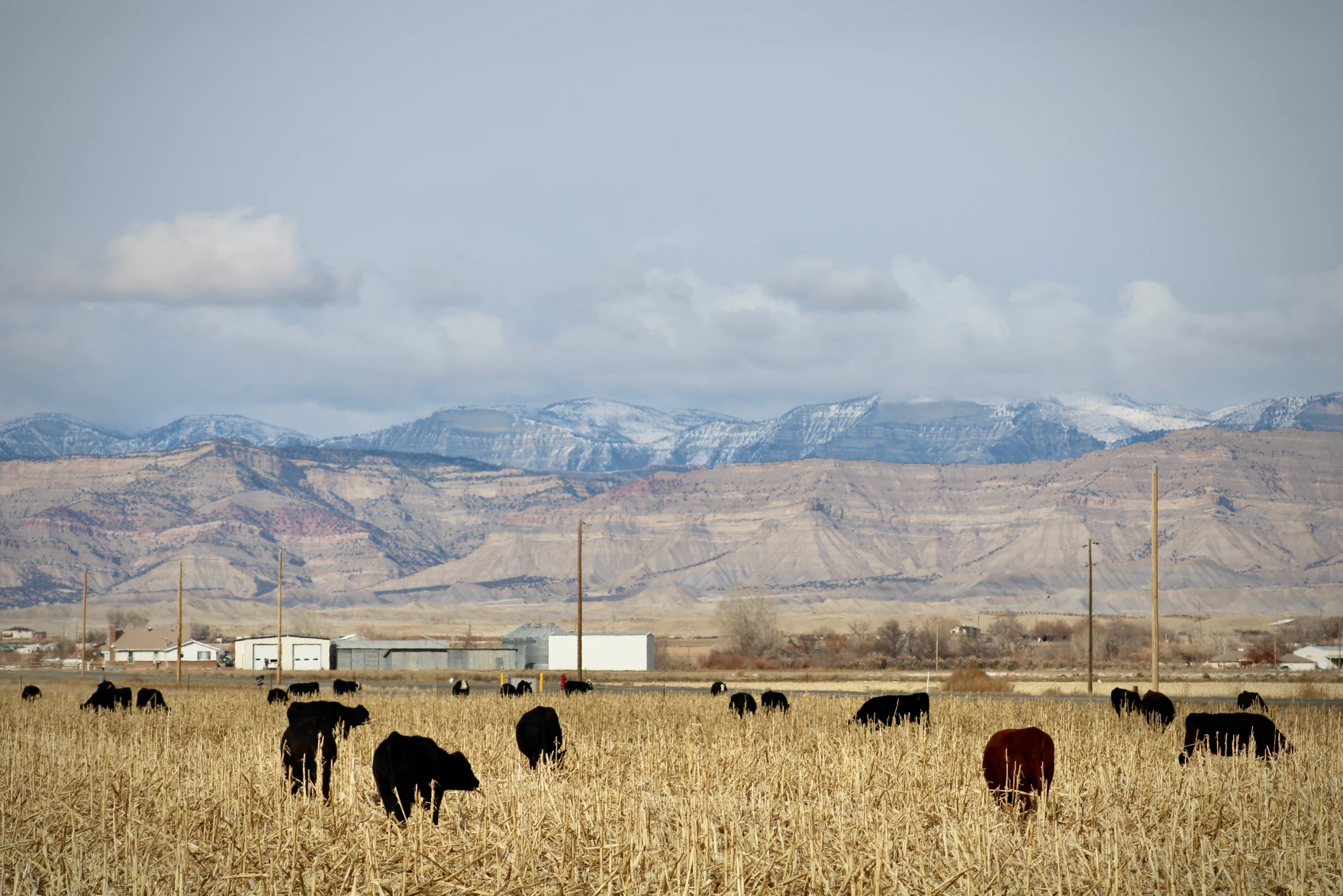


/https://static.texastribune.org/media/files/2858325190c1d789562f2c50d320432b/0717%20RGV%20Water%20-%20Fields%20EG%20%2003.jpg)
/https://static.texastribune.org/media/files/7cfa074c50de95165fe0592f18440fee/0715%20RGV%20Water%20-%20Darling%20EG%2006.jpg)
/https://static.texastribune.org/media/files/ae1fff168fa077164a53e5c72d0fcf0b/0715%20RGV%20Water%20-%20SWRA%20EG%2017.jpg)
/https://static.texastribune.org/media/files/574cb34b24dea723698b5c71fda7766a/0716%20RGV%20Water%20-%20Trevino%20EG%2004.jpg)
/https://static.texastribune.org/media/files/9b717668a41338190969078c76d8983d/Re-edit2%200716%20RGV%20Water%20-%20N%20Alamo%20EG%2011.jpg)
/https://static.texastribune.org/media/files/81b4b861f566647fc17183cd1f705458/0717%20RGV%20Water%20-%20NASWC%20EG%2041.jpg)