Upper #ColoradoRiver Basin MOU lays groundwork for saved-water accounting — Heather Sackett (@AspenJournalism) #COriver #aridification

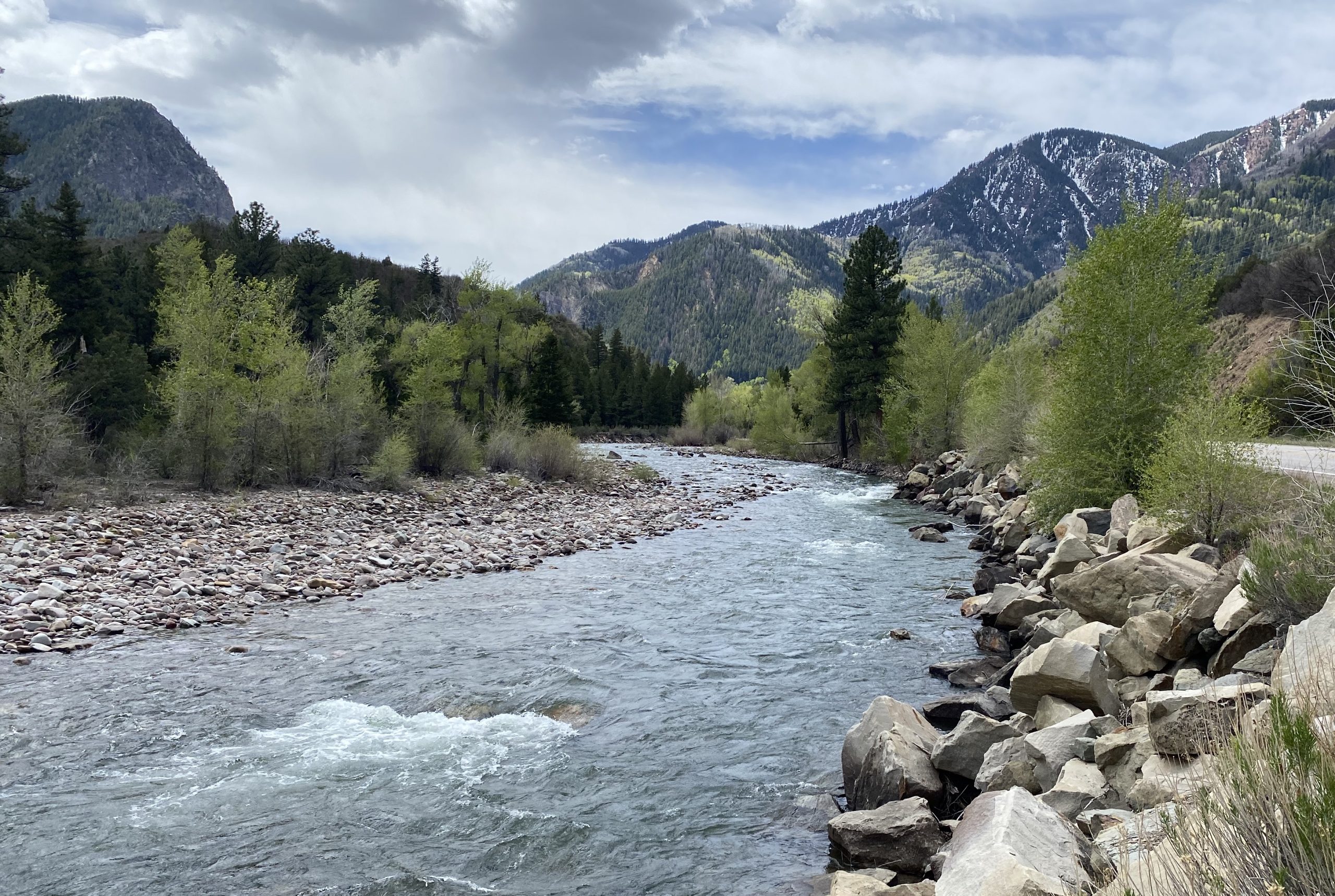
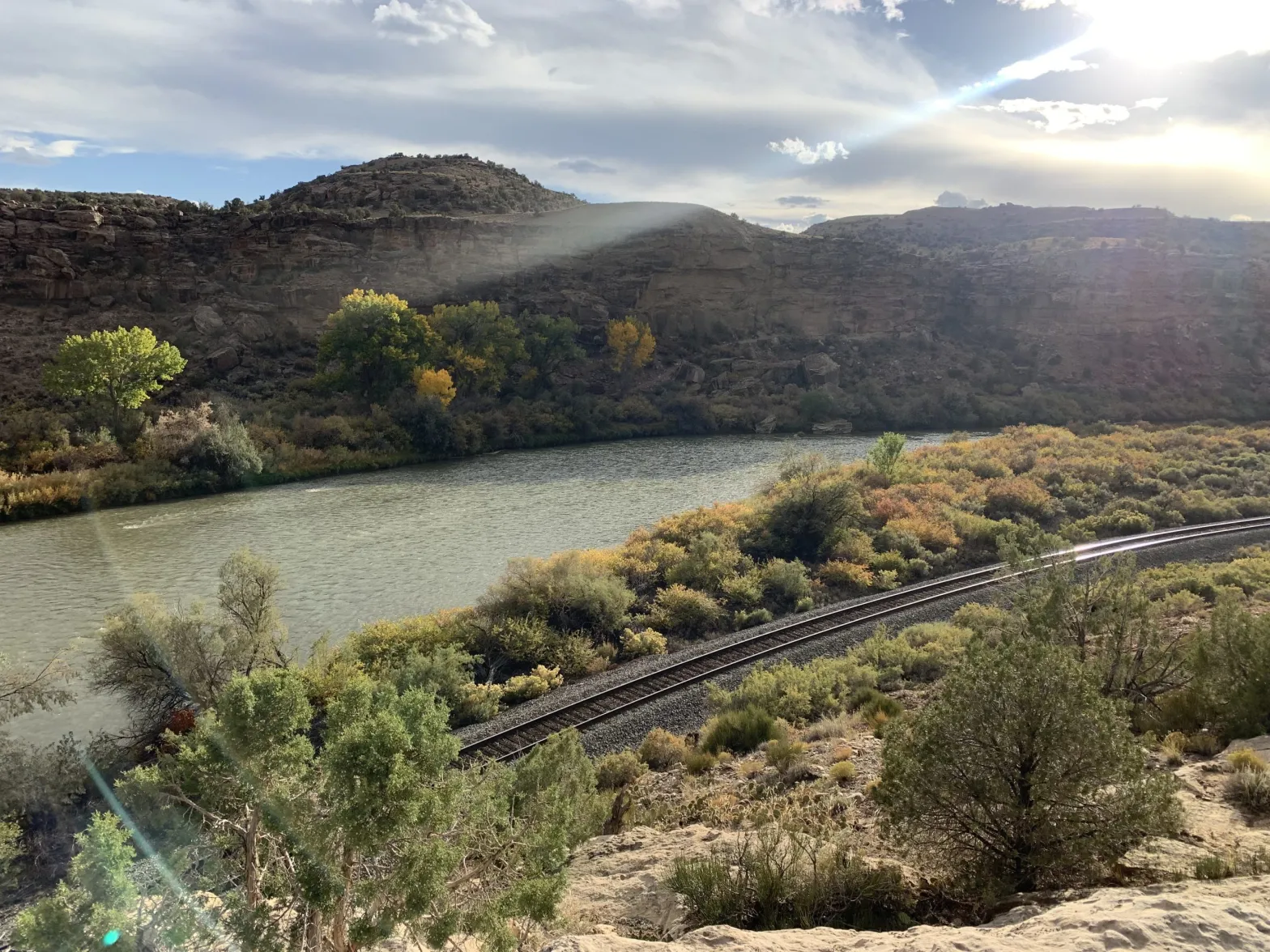
The Gunnison River just south of Grand Junction. Heather Sackett/Aspen Journalism Credit: Heather Sackett/Aspen Journalism

Click the link to read the article on the Aspen Journalism website (Heather Sackett):

The Upper Basin continues to take baby steps toward a formal conserved consumptive program. On Oct. 28, the Upper Colorado River Commission signed a memorandum of understanding with the U.S. Bureau of Reclamation establishing a provisional accounting for water saved through approved Upper Basin conservation projects. The Upper Basin states — Colorado, New Mexico, Utah and Wyoming — want to “get credit” for water they save through programs like System Conservation and potentially others, which they call “qualifying activities.” That water, thus accounted for, could be stored in Upper Basin reservoirs and tapped in the event of a future compact call or other circumstances where it would be needed.

But the MOU is still a dry run until a formal program comes about either in whatever post-2026 reservoir operation framework is adopted or with the establishment of a demand management program. 

“The important thing to keep in mind is this provisional accounting exercise is not an operational exercise,” said UCRC attorney Nathan Bracken. “It’s a paper exercise and as a result it will not change the operations of any reservoirs in the upper division states, nor will it provide actual credit itself.”

ten tribes
Graphic via Holly McClelland/High Country News.

Community Agriculture Alliance: Natural curtailment in the #ColoradoRiver Basin

“New plot using the nClimGrid data, which is a better source than PRISM for long-term trends. Of course, the combined reservoir contents increase from last year, but the increase is less than 2011 and looks puny compared to the ‘hole’ in the reservoirs. The blue Loess lines subtly change. Last year those lines ended pointing downwards. This year they end flat-ish. 2023 temps were still above the 20th century average, although close. Another interesting aspect is that the 20C Mean and 21C Mean lines on the individual plots really don’t change much. Finally, the 2023 Natural Flows are almost exactly equal to 2019. (17.678 maf vs 17.672 maf). For all the hoopla about how this was record-setting year, the fact is that this year was significantly less than 2011 (20.159 maf) and no different than 2019” — Brad Udall

From email from the Community Agriculture Alliance (Sally Cariiveau):

November 5, 2024

The Colorado River Basin is in the midst of a 23-year drought. Reduced precipitation, mostly in the form of snow in the western mountains, has caused water administrators at the federal, state and local level to seek ways to cut back usage. But many of us in the high country do not need water managers to tell us to reduce usage. Mother nature kindly, or unkindly, does that for us.

With limited storage at higher elevations, snowpack is the source for virtually all water on the West Slope. As the Basin experiences a steady decline in precipitation, West Slope water users, especially irrigators, find that in many years, they are subject to “natural curtailment.” Less snowpack means less water.

Snowpack is a shared resource in the Mountain West. The water from snowmelt that feeds the West Slope also feeds the Colorado River. The Colorado serves Lake Powell and then Lake Mead, and ultimately consumers in the Lower Basin (Arizona, California and Nevada).

With minor exceptions, all Colorado River water used in those Lower Basin states is stored in the Powell/Mead reservoir system, which insulates them from the near-term impact of reduced hydrology upriver from Powell. This system has led to a common belief that the Upper Basin states (Colorado, New Mexico, Utah and Wyoming) can mitigate drought-induced problems in the Lower Basin simply by sending more water downstream.

Unfortunately, data indicates that during times of hydrological shortfall, the Upper Basin is already naturally experiencing reductions. Recent history provides a high-level example. In the five years from 2016 to 2020, usage averaged 4.6 million acre-feet in the Upper Basin. In 2021, a low-precipitation year, that figure fell to 3.5 MAF, clearly demonstrating the natural curtailment effect.

During the 2016 to 2020 period, Lower Basin usage averaged 10.7 MAF, an amount which actually climbed to over 11.0 MAF in 2021. As a benchmark, the 1922 Colorado River Compact optimistically allocates 7.5 MAF to each basin.

Yampa River Basin via Wikimedia.

In dry years, natural curtailment impacts nearly everyone on the West Slope. Ranchers on tributary creeks often have to choose which headgates and ditches to operate. Even irrigators on the mainstem of the Elk and Yampa have years when, in late summer, they are required to use far less than their adjudicated rights.

Fishing, rafting/tubing and other recreational uses on the Yampa are often restricted, while water districts experience cutbacks during late-season low flows.

Meanwhile, solutions to Colorado River shortages have been elusive, and discussions difficult to facilitate. Politics and public messaging have played a major role; Lower Basin organizations have used every major media outlet to build public sympathy for their argument that they should not be the only ones to “sacrifice.”

Natural curtailment in the Upper Basin has been, until very recently, far outside of public perception. But it exists, and water users and organizations of the Lower Basin must acknowledge and understand it as a key component of future operating agreements.

We in the Upper Basin need to make natural curtailment a part of our story. Raising public awareness of this elemental fact can help us to defend our rights in the Colorado River.

Map credit: AGU

Ute Mountain Ute Tribe receives funding to plan water pipeline from #Cortez — The #Durango Herald

Manual Heart. Photo credit: Ute Mountain Ute Tribe

Click the link to read the article on The Durango Herald website (Maria Tedesco). Here’s an excerpt:

The Ute Mountain Ute Tribe received $7.5 million for a new design of a pipeline that delivers drinking water to Towaoc. The funding for the design is the first step toward the pipeline’s replacement. The funding is focused on 18 miles of the 22-mile pipeline, which delivers water from the McPhee Reservoir before it is treated in Cortez and piped to Towaoc…This funding for the pipeline comes from an Inflation Reduction Act program. The funding is under IRA Section 50231, based on the Tribal Domestic Water Supply Program. Administered by the Bureau of Reclamation, the funding supports the planning and construction of domestic water infrastructure projects…

[Manuel] Heart said the soil was not tested before the part of the pipeline was originally installed, which has caused maintenance issues…Heart said the water leaks have cost between $80,000 and $300,000 to fix depending on where the water break is.

#Aspen to impose stricter requirements for lead in drinking water — The Aspen Times

Aspen

Click the link to read the article on the Aspen Times website (Westley Crouch). Here’s an excerpt:

Aspen City Council unanimously passed a first reading of an ordinance aimed at updating the city’s water service line requirements. Called Ordinance 19, it sets out to be in compliance with new federal and state lead and copper regulations…The primary goal of the ordinance is to align Aspen’s water system with the U.S. Environmental Protection Agency’s Lead and Copper Rule Revisions and Lead and Copper Rule Improvements, which were finalized in December 2021…These rules, which Aspen utilities staff had to meet by Oct. 16, impose stricter requirements for lead in drinking water, including mandatory service line inventories and replacement plans for all public water systems. In that inventory, Aspen’s Water Department showed that 98% of the city’s 4,121 accounts are free of lead, with the majority of pipes being copper or plastic. 

2024 is on track to be hottest year on record as warming temporarily hits 1.5°C — World Meteorological Organization

Photo credit: World Meteorological Organization

Click the link to read the release on the WMO website:

November 11, 2024

Baku, Azerbaijan (WMO) – The year 2024 is on track to be the warmest year on record after an extended streak of exceptionally high monthly global mean temperatures, according to the World Meteorological Organization (WMO).

Key messages

  • Jan-Sept 2024 global average temperature 1.54 (±0.13) °C above pre-industrial level
  • Long-term warming measured over decades remains below 1.5°C
  • Past 10 years are warmest on record and ocean heat rises
  • Antarctic sea ice second lowest on record and glacier loss accelerates
  • Extreme weather and climate events lead to massive economic and human losses

The WMO State of the Climate 2024 Update once again issues a Red Alert at the sheer pace of climate change in a single generation, turbo-charged by ever-increasing greenhouse gas levels in the atmosphere. 2015-2024 will be the warmest ten years on record; the loss of ice from glaciers, sea-level rise and ocean heating are accelerating; and extreme weather is wreaking havoc on communities and economies across the world.

The January – September 2024 global mean surface air temperature was 1.54 °C (with a margin of uncertainty of ±0.13°C) above the pre-industrial average, boosted by a warming El Niño event, according to an analysis of six international datasets used by WMO.

“Climate catastrophe is hammering health, widening inequalities, harming sustainable development, and rocking the foundations of peace. The vulnerable are hardest hit,” said UN Secretary-General António Guterres.

The report was issued on the first day of the UN Climate Change Conference, COP29, in Baku, Azerbaijan. It highlights that the ambitions of the Paris Agreement are in great peril.

“As monthly and annual warming temporarily surpass 1.5°C, it is important to emphasize that this does NOT mean that we have failed to meet Paris Agreement goal to keep the long- term global average surface temperature increase to well below 2°C above pre-industrial levels and pursue efforts to limit the warming to 1.5°C,” said WMO Secretary-General Celeste Saulo.

“Recorded global temperature anomalies at daily, monthly and annual timescales are prone to large variations, partly because of natural phenomenon such as El Niño and La Niña. They should not be equated to the long-term temperature goal set in the Paris Agreement, which refers to global temperature levels sustained as an average over decades,” she said.

“However, it is essential to recognize that every fraction of a degree of warming matters. Whether it is at a level below or above 1.5°C of warming, every additional increment of global warming increases climate extremes, impacts and risks,” said Celeste Saulo.

“The record-breaking rainfall and flooding, rapidly intensifying tropical cyclones, deadly heat, relentless drought and raging wildfires that we have seen in different parts of the world this year are unfortunately our new reality and a foretaste of our future,” said Celeste Saulo. “We urgently need to reduce greenhouse gas emissions and strengthen our monitoring and understanding of our changing climate. We need to step up support for climate change adaptation through climate information services and Early Warnings for All,” she said.

Annual global mean temperature anomalies from January – September 2024 (relative to the 1850-1900 average) from six international datasets. Credit: WMO

Highlights

Temperature

The global mean temperature in 2024 is on track to outstrip the temperature even of 2023, the current warmest year. For 16 consecutive months (June 2023 to September 2024), the global mean temperature likely exceeded anything recorded before, and often by a wide margin, according to WMO’s consolidated analysis of the datasets.

One or more individual years exceeding 1.5°C does not necessarily mean that “pursuing efforts to limit the temperature increase to 1.5°C above pre-industrial levels” as stated in the Paris Agreement is out of reach. The exceedance of warming levels referred to in the Paris Agreement should be understood as an exceedance over an extended period, typically decades or longer, although the Agreement itself does not provide a specific definition.

As global warming continues, there is an urgent and unavoidable need for careful tracking, monitoring and communication with regard to where the warming is relative to the long-term temperature goal of the Paris Agreement, to help policymakers in their deliberations. To support this, WMO has established an international team of experts, and the initial indication is that long-term global warming is currently likely to be about 1.3°C compared to the 1850-1900 baseline.

Greenhouse Gases

Greenhouse Gases reached record observed levels in 2023. Real time data indicate that they continued to rise in 2024. The atmospheric concentration of carbon dioxide (CO2) has increased from around 278 ppm in 1750 to 420 ppm in 2023, an increase of 51%. This traps heat and causes temperatures to rise.

Ocean 

Ocean heat content in 2023 was the highest on record and preliminary data show 2024 has continued at comparable levels. Ocean warming rates show a particularly strong increase in the past two decades. From 2005 to 2023, the ocean absorbed on average approximately 3.1 million terawatt-hours (TWh) of heat each year. This is more than 18 times the world’s energy consumption in 2023.

About 90% of the energy that has accumulated in the Earth system is stored in the ocean and it is therefore expected that ocean warming will continue – a change that is irreversible on centennial to millennial timescales.

Sea level rise

Sea level rise is accelerating because of thermal expansion of warmer waters and melting glaciers and ice sheets. From 2014-2023, global mean sea level rose at a rate of 4.77 mm per year, more than double the rate between 1993 and 2002. The El Niño effect meant it grew even more rapidly in 2023.  Preliminary 2024 data shows that, with the decline of El Niño, it has fallen back to levels consistent with the rising trend from 2014 to 2022. 

Glacier loss

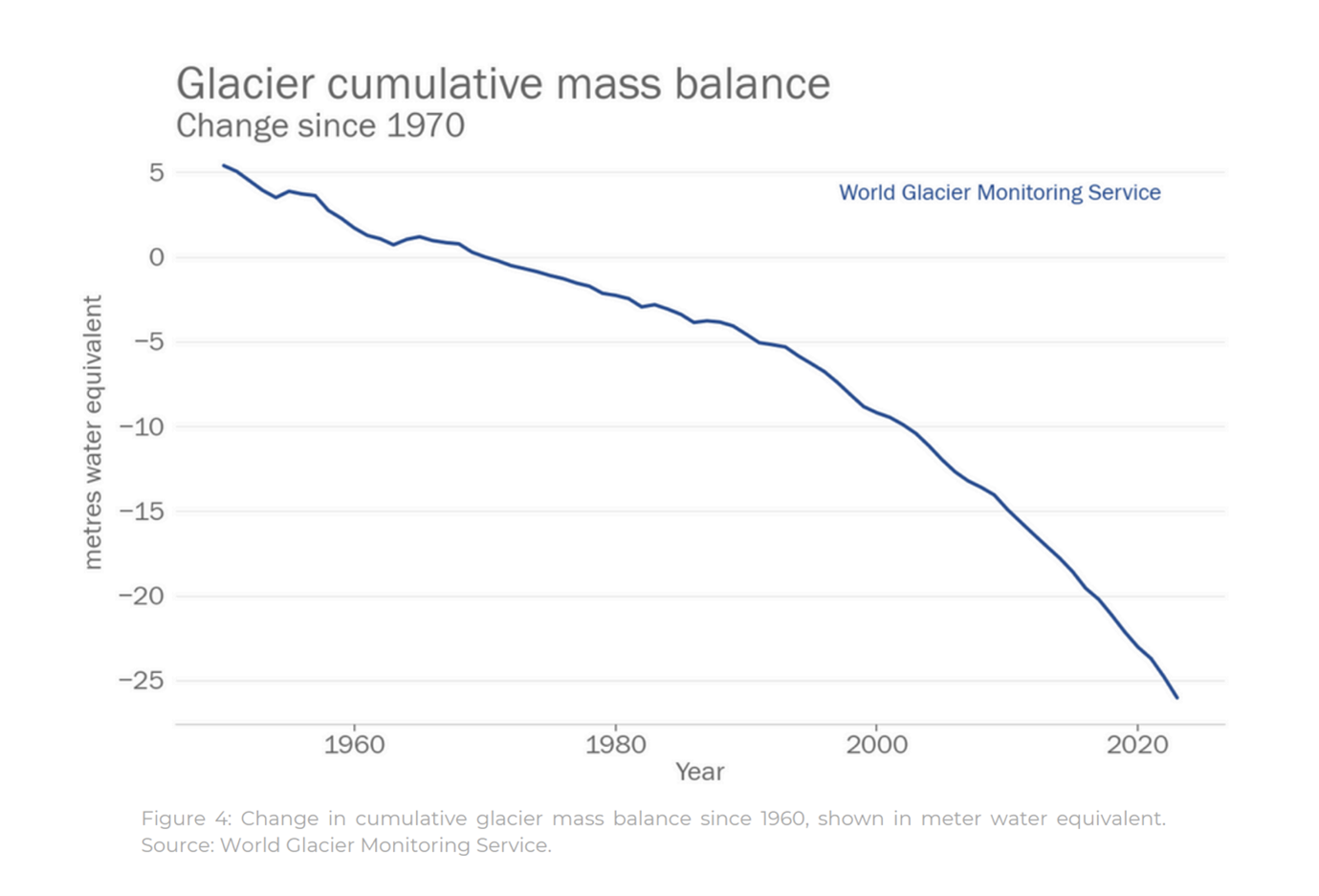
Glacier loss is worsening. In 2023, glaciers lost a record 1.2-meter water equivalent of ice – about five times the amount of water in the Dead Sea. It was the largest loss since measurements began in 1953 and was due to extreme melting in North America and Europe. In Switzerland, glaciers lost about 10% of their remaining volume in 2021/2022 and 2022/2023.

Credit: World Glacier Monitoring Service

Sea ice extent

Antarctic sea-ice extent – both the annual minimum in February and the maximum in September – was the second lowest in the satellite record (1979-2024) after 2023. Arctic sea-ice minimum extent after the summer melt was the seventh lowest in the satellite record and the maximum was just below the long-term average of 1991-2020.

Weather and climate extremes

Weather and climate extremes undermined sustainable development across the board, worsening food insecurity and exacerbating displacement and migration. Dangerous heat afflicted many millions of people throughout the world.  Heavy precipitation, floods and tropical cyclones led to massive loss of life and damage. Persistent drought in some regions was worsened by El Niño.

The section on climate impacts, provided by United Nations partners, will be expanded in the final report on the State of the Global Climate 2024, due to be published in March 2025.

Credit: GPCC

Climate services and early warnings

Climate services and early warnings have made progress in the past five years. There have been advances in Early Warnings for All (EW4All) to ensure that everyone is protected from hazardous weather, water, or climate events through life-saving early warning systems by the end of 2027. 108 countries report having a Multi-Hazard Early Warning System.

Understanding climate variability and change is crucial for optimizing renewable energy generation, ensuring energy system resilience, and analyzing energy demand patterns, especially for heating and cooling.

Trump 2.0: What to expect regarding public lands and the environment: Time to prepare for another four years of “drill, baby, drill” — Jonathan P. Thompson (LandDesk.org) #ActOnClimate

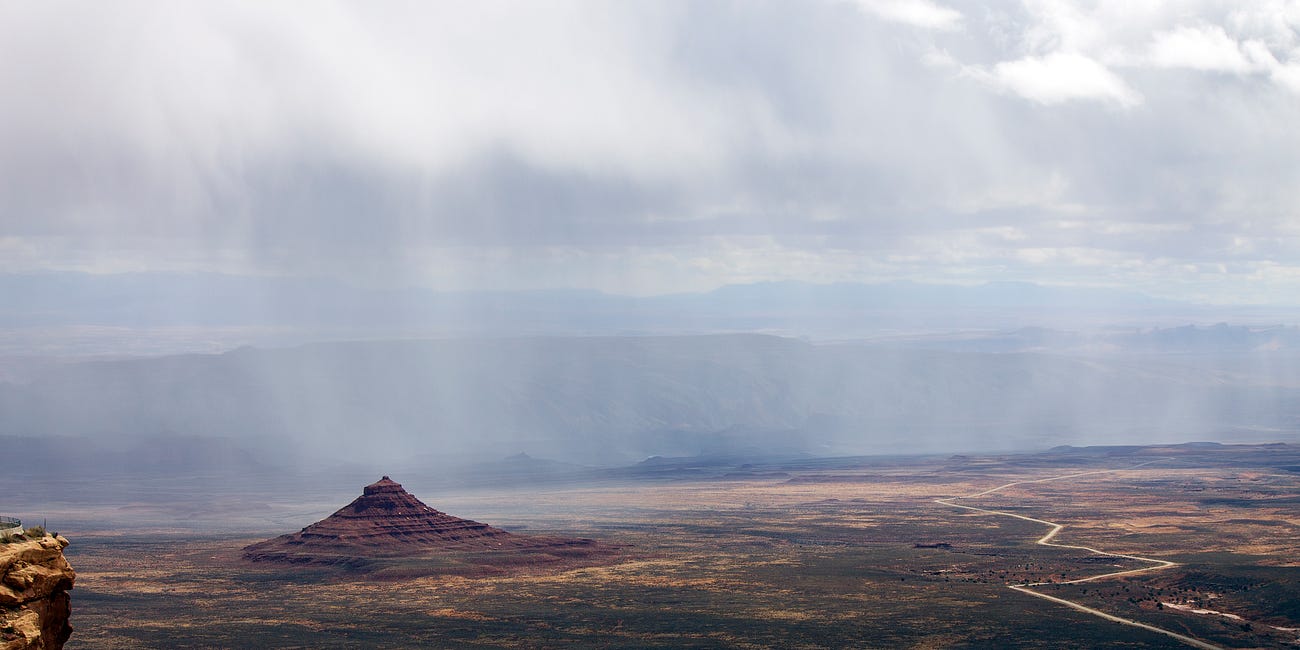
Just a nice picture of a spectacular place. Jonathan P. Thompson photo.

Click the link to read the article on The Land desk website (Jonathan P. Thompson):

November 8, 2024

On Nov. 5, more than 73 million Americans — or just over half of those who voted — chose to send Donald J. Trump to the White House for a second time. Trump garnered a smaller percentage of votes in my southwestern Colorado hometown. Still, four out of ten Durangatans opted for a candidate who stands diametrically opposed to the values I hold dear. And some of those folks are friends or people I admire. 

Surely many of them disapprove of Trump’s behavior and many of his policies, but voted for him anyway simply because he’s a Republican, because he’s not the status quo or Joe Biden or Kamala Harris or a Clinton, because they’re fed up with “wokeness,” because they believe he’ll lower the price of eggs and gasoline, or because he’s the only viable white male on the ballot. Others may have chosen him or not voted at all to protest Biden’s tacit support for the atrocities in Gaza, or his failure to end oil and gas drilling on federal land, or because they believe that Democrats and Republicans are all cut from the same power-hungry cloth. 

I suppose I should be reassured by this, and feel happy for these Trump voters since their side won — as if it were a football game and the Cowboys had crushed the Broncos. But this isn’t a sporting event. And as much as the media may treat elections as horse races, they are not. They have consequences, potentially huge ones, and regardless of why someone may have voted the way they did, the results are the same. This election was a referendum on civility and decency, on compassion and the rule of law, on human rights and equality; and all of those things lost. Corporate power, fear, vindictiveness, and the oligarchy won.

So no, it’s not going to be “okay.” And no, I’m not going to feel happy for folks who voted for Trump, because even though their “team” may have won, they will likely end up losers — unless they are oil companies or billionaires, that is. 

Beauty will persevere, regardless of who is in the White House. Jonathan P. Thompson photo.

When Trump was elected in 2016, it was a shock, of course, but also a bit of a mystery: No one knew what kind of president he’d be or what sort of policies he’d push. Now we have a far clearer sense of what the next four years might look like. 

I’m not convinced Trump will carry out all the threats he made on the campaign trail. Call me a pollyanna, but I doubt he’ll rule as an all-out fascist dictator, as some fear. He probably won’t try to prosecute Liz Cheney and Joe Biden, or sic the military on the “enemies within,” or overtly punish members of the media. His pledge to round up and deport 11 million human beings who came to the U.S. to escape persecution or pursue economic betterment will run up against reality: The nation can’t afford to live without immigrants, whether they are here legally or not. 

But judging from Trump’s platform, promises, and his first-term record, we do know he and his minions will set out to dismantle the administrative state, which is to say gut federal agencies, replace experienced staffers with Trump loyalists, and remove government protections on human health, the environment, and worker safety. Elon Musk, who bought himself a cabinet-level position in the administration, will do his damnedest to slash $2 trillion in government spending, which will include unraveling the already frail social safety net. 

While that image might appeal to those of you with an anarchist or libertarian bent, I can assure you these guys aren’t doing this in the name of Liberty or Freedom. The administrative state may be bloated, inefficient, sometimes ineffective, and often irritating, but its aim is to protect Americans and keep corporations in check. And when Trump and company look to destroy it, they are doing so to clear the way for the super-rich to become even wealthier, for the corporations to pull in more profit, and for Trump and his cronies to evade accountability for wrongdoings — all at the expense of you and me. A Trump administration will be a government by the narcissistic oligarchs, for the narcissistic oligarchs. 

Shiprock and a moody sky. Jonathan P. Thompson photo.

Meanwhile, the MAGA movement’s theocratic strain will decimate the liberties of women, people of color, and LGBTQ+ people. Conservative congress members will push for a federal abortion ban, and Trump may go along with it to pay back his christian-nationalist voters. Trump will give Netanyahu the green light to decimate Gaza and the people who live there, and will similarly step aside and let Putin have his way with Ukraine.

Then there’s the question of what another Trump administration will mean for public lands, the environment, energy development, and the West’s air and water. Again, we can determine a lot by what he did — or attempted to do — during his first administration, along with plans laid out in Trump’s own Agenda 47 and Project 2025. Trump tried to distance himself from the latter during the election, but it was crafted by dozens of his former staffers and associates and is generally seen as the playbook for a second Trump administration. Trump’s public lands agenda will become clearer as he starts to line up cabinet appointments in the coming months. But regardless, I fear our public lands and environment and climate — and by extension all of us humans — are going to suffer. [ed. And countless species will suffer]

First dusting of snow on the Abajos and a windmill. Jonathan P. Thompson photo.

The following is a list of potential Trump targets relating to public lands and the environment. It’s important to remember that a president doesn’t have the power to kill just any rule and regulation with the stroke of a pen, but that didn’t stop Trump from trying to do so during his first administration. 

  • Trump will work to implement his “drill baby drill” and “energy dominance” policies by opening up more public land to oil and gas leasing and removing regulations on public land drilling. He is likely to roll back Biden’s leasing reforms, which included higher royalty rates — to get a better deal for taxpayers — and stricter reclamation bond requirements to help ensure companies would clean up their messes. 
  • Biden banned new oil and gas leasing on lands around Chaco Culture National Historical Park and on the Thompson Divide in western Colorado. Trump and whomever he appoints as Interior secretary will almost certainly try to reverse these bans. In the short-term, lifting the ban wouldn’t be too harmful: There is little interest in drilling either of these places currently. But if oil and gas prices climb, all bets could be off for these special places. 
  • The Biden administration’s public lands rule, which aims to put conservation on a par with extractive uses, will probably go on the chopping block. If Trump doesn’t kill it, Congress will. 
  • After being closed to drilling for decades, in 2017 Congress and Trump mandated oil and gas leasing in the Arctic National Wildlife Refuge. The Biden administration revoked the leases, then issued a new environmental review, offering the bare minimum of acreage required by law. Expect Trump to significantly expand the acreage available for drilling. 
  • The first Trump administration revoked or attempted to revoke the Obama administration’s methane emissions regulations. They’ll probably try the same with Biden’s rules.
  • New EPA rules aimed at reducing coal plants’ greenhouse gas and mercury pollution are in Trump’s crosshairs. If they are revoked, it would allow the Colstrip power plant in Montana to continue spewing toxic and planet-warming emissions for years to come. 
  • Trump will end the Bureau of Land Management’s proposal to end new federal coal leasing in the Powder River Basin. The ban wouldn’t come into play until current leases are depleted decades from now. Chances are the market for coal will dry up before then, making both the leasing ban and the rollback fairly irrelevant. 
  • Trump dramatically shrunk Grand Staircase-Escalante and Bears Ears National Monuments during his first term, in part to curry favor with the late Sen. Orrin Hatch, the Utah Republican who held a lot of sway in Washington. Sen. Mike Lee, the Utah Republican and Trump acolyte, may push for a repeat. It would be even more consequential now: high uranium prices have unleashed a flurry of new mining claims and exploratory drilling on all sides of Bears Ears National Monument. 
  • Trump is likely to shrink or revoke the Baaj Nwaavjo I’tah Kukveni-Ancestral Footprints of the Grand Canyon National Monument, thereby re-opening more than a half-million acres of uranium-rich lands to new mining claims. The Avi Kwa Ame National Monument in Nevada seems to be safer, simply because the only corporations interested in developing the land are solar and wind companies — and Trump’s no fan of clean energy. 
  • Project 2025 calls for revoking the Antiquities Act, which has been used by presidents to protect natural and cultural sites as national monuments since 1906, with many going on to become national parks, the list includes: El Morro National Monument, Petrified Forest National Park, Muir Woods National Monument, Grand Canyon National Park … I could go on and on. 
  • You can forget about mining law reform under a Trump administration and GOP-controlled Senate. And global mining corporation Rio Tinto, which is behind the proposed Resolution copper mine at Oak Flat in Arizona, is already urging the incoming Trump administration to weaken environmental laws and expedite permitting for mines. 
  • Trump and the GOP dominated Congress will work to weaken the Endangered Species Act. 
  • The list, unfortunately, goes on …

During his first term, Trump’s mission was hampered by his own lack of preparation, his incompetence, and his chaotic approach. This time he and an army of professional ideologues are prepared to march into the White House with Project 2025 in hand to lay waste to government as we know it. And they will have the support of a GOP-dominated Congress and a conservative Supreme Court. 

It’s depressing and scary and discouraging. But it is not hopeless. The Biden administration prepared for this possibility by working to make regulations — and national monuments — more resilient to future challenges. Democratic leaders in Western states are already preparing to defend their environmental laws and climate programs against inevitable Trump administration attacks. And environmental groups such as the Center for Biological Diversity, Earthjustice, the Western Environmental Law Center, and many others are ready to challenge Trump at every turn. 

Meanwhile, the Land Desk vows to stay on top of it all, and keep its special community of readers informed. 

State of #Wyoming orders demolition of LaPrele dam to avoid ‘catastrophic failure’: Structure that serves 100 irrigators will cost more than $118 million to replace. State will rush to demolish current structure before spring #runoff season — Dustin Bleizeffer (@WyoFile)

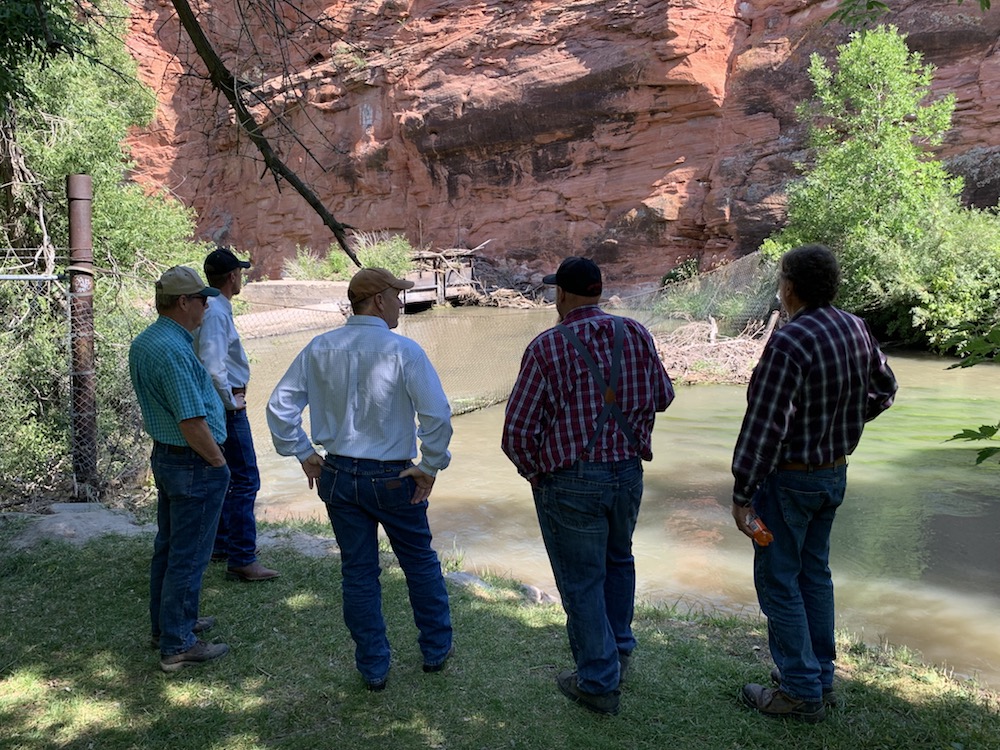
The Wyoming Water Development Commission organized a tour of the LaPrele dam Aug. 12, 2021. Constructed in 1909, the dam is now slated for emergency demolition. (Dustin Bleizeffer/WyoFile)

Click the link to read the article on the WyoFile website (Dustin Bleizeffer):

November 7, 2024

It is no longer safe to hold any amount of water behind the LaPrele dam, and the long deteriorating 115-year-old concrete structure located 20 miles west of Douglas must be demolished as soon as possible to avoid a “catastrophic failure,” according to state officials.

State Engineer Brandon Gebhart issued a “breach order” earlier this month, noting the recent discovery of several new cracks compounding other structural problems identified years ago.

“This dam has significant structural deficiencies and has exceeded its useful life,” Gebhart said in a prepared statement. 

In 2021, the Wyoming Water Development Office estimated that, at full storage, a catastrophic failure would send a torrent of water and debris through the Ayres Natural Bridge Park just two miles below the dam, overwhelm several roadway bridges and flood areas of Douglas along the North Platte River.

Fortunately, the state and local irrigation district had already taken measures to avoid such a scenario by draining the LaPrele reservoir earlier this fall.

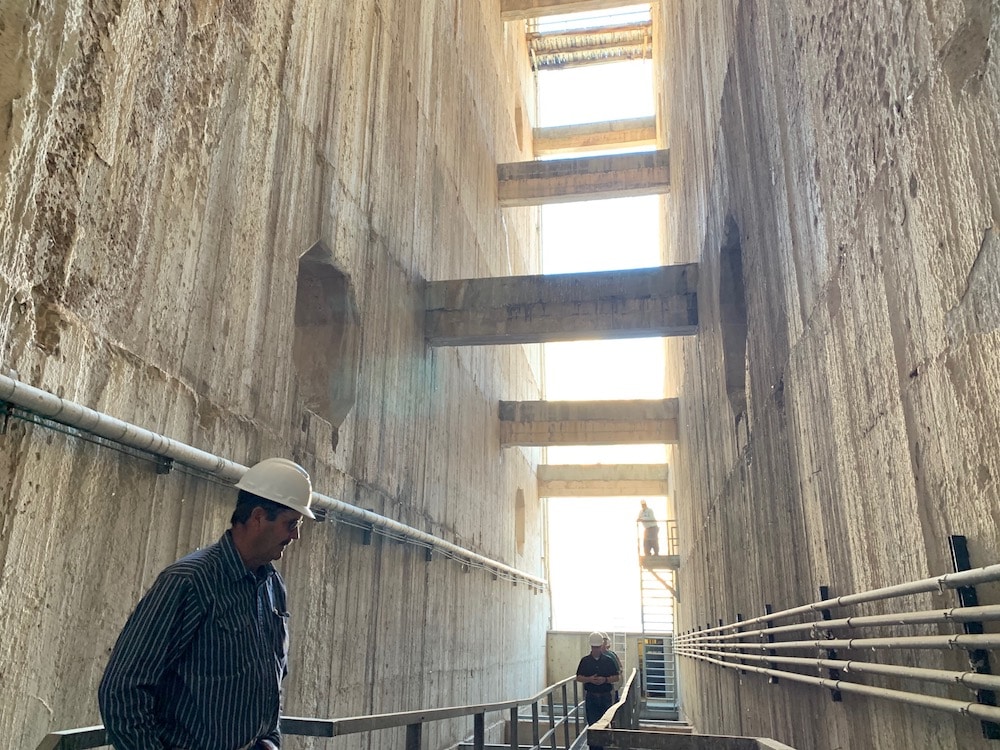
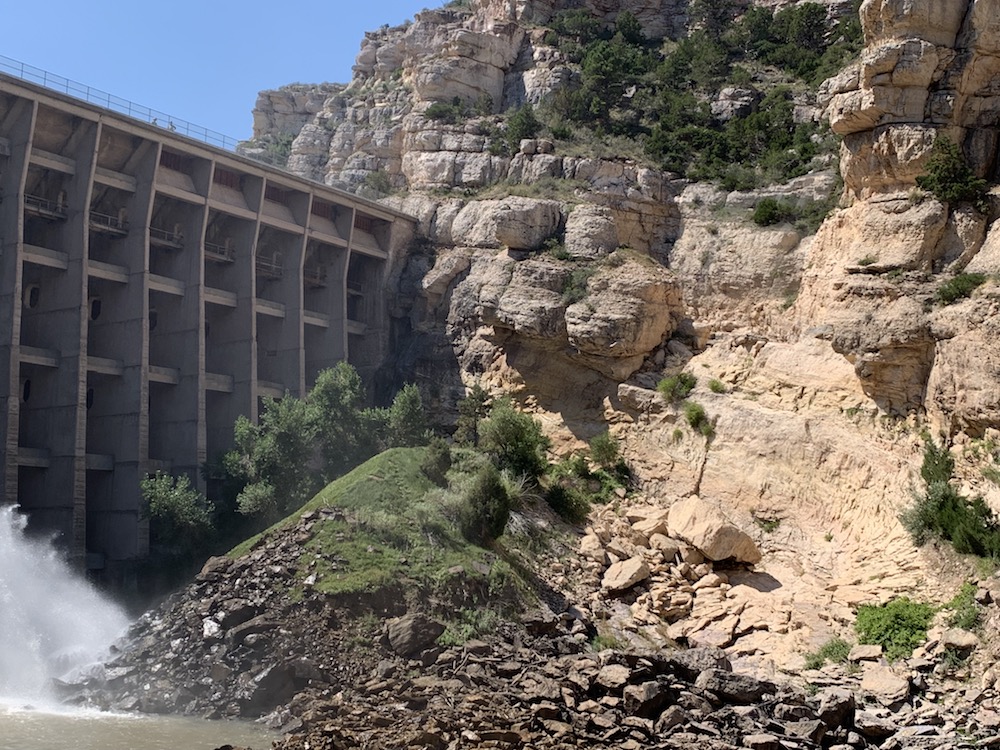
The Ambursen-style LaPrele dam consists of a series of concrete walls — or “fins” — to support an angled, flat slab on the reservoir side. The design is prone to catastrophic failure, according to engineers. (Dustin Bleizeffer/WyoFile)

“I want to commend the State Engineer and his staff for recognizing the significant risks of a potential dam failure and proactively addressing them before a disaster occurred,” Gov. Mark Gordon said in a prepared statement. “This decision was not made lightly, and we recognize the impact this will have on those who rely on that water for irrigation.”

Now that authorities have mitigated an immediate catastrophic failure of the LaPrele dam, the state is racing against the clock to demolish the structure before April when spring runoff begins.

“These [structural] threats need to be mitigated before the spring runoff, when flows are expected to exceed the dam’s ability to pass inflows,” Gebhart said.

Runoff is also a potential concern this winter, state officials added, noting there’s always a possibility for unseasonable flows that might exceed the dam’s ability to allow water to freely pass through the outlet, which has a maximum output of up to 300 cubic feet per second.

Local and state officials, in consultation with engineering firms, came to terms with the pending demise of the LaPrele dam several years ago and initiated planning for how to eventually replace it. Cost estimates reach above $118 million. In addition to a $30 million appropriation from the Legislature, the state has secured $32 million via the federal Infrastructure Investment and Jobs Act and hopes to secure the rest of the necessary funds from the same federal program.

Members of the Wyoming Water Commission and a member of the LaPrele Irrigation District examine a diversion in LaPrele Creek in August 2021. (Dustin Bleizeffer/WyoFile)

“There will be uncertainty on costs until the design is complete and a price can be agreed upon through a construction contract,” Wyoming Water Development Office Director Jason Mead told WyoFile. “However, with the inflation seen over the last several years, it is expected additional funds may be needed to complete the project and everyone is working to identify potential sources for that funding.”

After demolition work is completed, construction on a replacement dam may begin in 2026 with a completion date of 2029, according to Mead. The dam served about 100 irrigators along LaPrele Creek, which flows out of the Laramie Range into the North Platte River.

LaPrele’s history of problems

The dam, standing 130 feet high and stretching 325 feet over LaPrele Creek, serves late-season water to irrigators between the dam and the nearby North Platte River, according to the state. The Ambursen-style dam consists of a series of concrete buttresses — or “fins” — supporting an angled, flat slab on the reservoir side, and is anchored into a fractured Madison limestone formation on both sides.

In 2016, a boulder fell from the west wall on the dam’s downstream side, barely missing the structure. The discovery of the boulder’s near-miss led to investigations that revealed several migrating cracks in the dam, spawning further engineering investigations and a determination a few years later that the dam’s days were numbered.

The dam’s structural integrity, in fact, has been in question for decades.

A boulder in the limestone wall behind the LaPrele dam fell in 2016. (Dustin Bleizeffer/WyoFile)

Talk of LaPrele reaching the end of its useful life emerged in the 1970s due to leaks and the problematic nature of the Ambursen-buttress design. But the Panhandle Eastern Pipeline Co., eager at the time to access water for its coal-gasification ambitions, struck a deal with irrigators to repair the structure in return for a share of water.

The company paid to grout cracks and add new layers of concrete. Panhandle Eastern Pipeline’s coal-gasification plans never came to fruition, but the company’s patching efforts restored confidence in the dam — for a while. 

Challenges ahead

Irrigators reliant on the LaPrele dam have seen dwindling late-season water deliveries — by about half — since 2019, when the state ordered the reservoir be maintained at lower levels to avoid stress on the structure. Now those ranching operations rely completely on what Mother Nature delivers, without the benefit of measured releases for late-season crops or a functional dam to help avoid potential flooding.

“The farms and ranches will see significant production losses until the new dam is constructed,” LaPrele Irrigation District Secretary Anna McClure said. “Streambank integrity and infrastructure on the LaPrele Creek will be affected by the uncontrolled flow of water.”

State officials are assessing the flood risk, but so far there’s no particular mitigation plan. 

“There are areas downstream of LaPrele Dam that could be impacted by uncontrolled spring flows, including Ayres Natural Bridge,” Gebhart said.

Ayres Natural Bridge over LaPrele Creek, Wyoming. By Haberstr – Own work, CC0, https://commons.wikimedia.org/w/index.php?curid=7499088

Trump Wins, Planet Loses — Grist #ActOnClimate

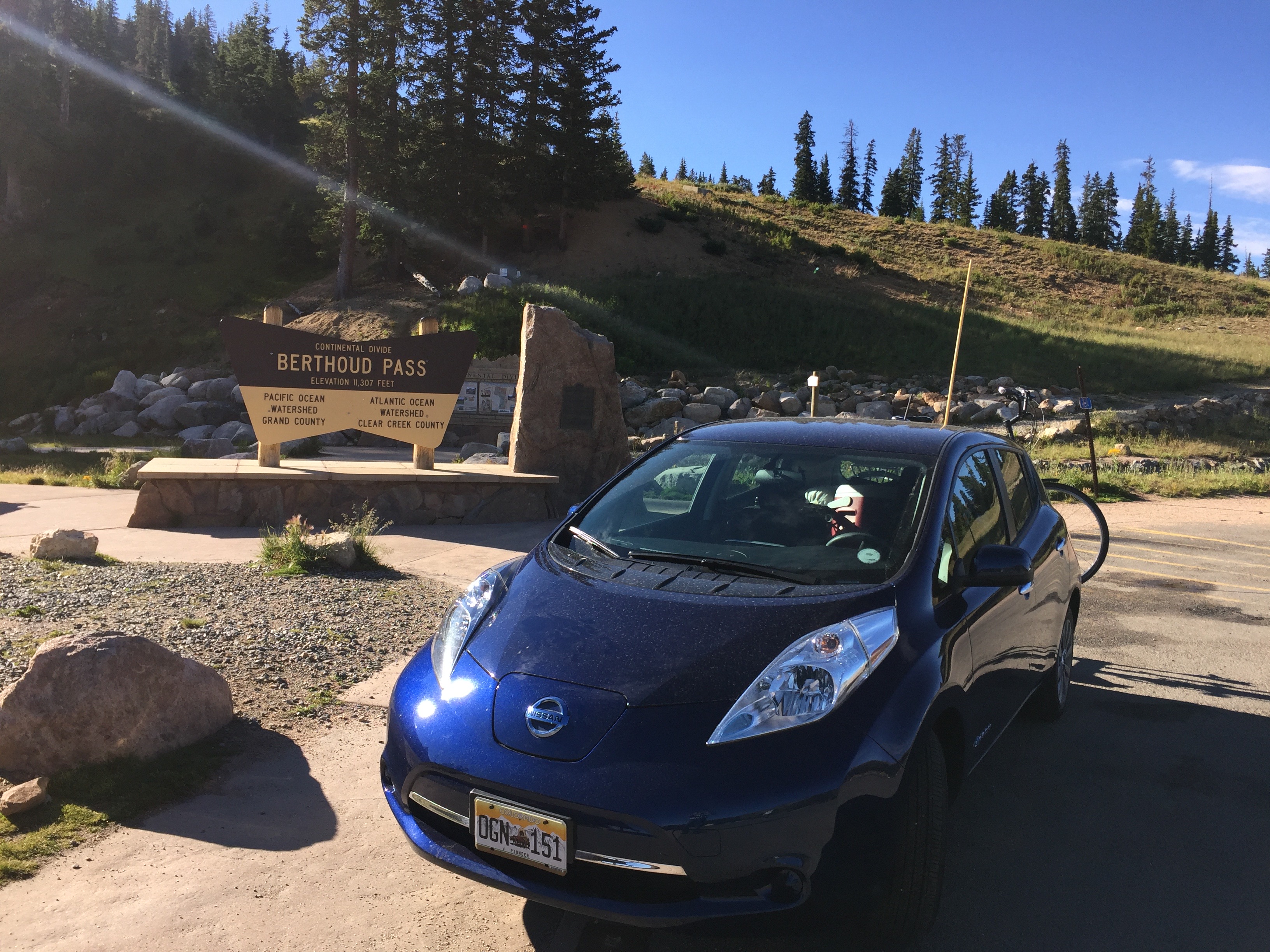
Leaf, Berthoud Pass Summit, August 21, 2017.

Click the link to read the article on the Grist website (Tik Root):

November 6, 2024

Donald J. Trump will once again be president of the United States. 

The Associated Press called the race for Trump early Wednesday morning, ending one of the costliest and most turbulent campaign cycles in the nation’s history. The results promise to upend U.S. climate policy: In addition to returning a climate denier to the White House, voters also gave Republicans control of the Senate, laying the groundwork for attacks on everything from electric vehicles to clean energy funding and bolstering support for the fossil fuel industry.

“We have more liquid gold than any country in the world,” Trump said during his victory speech, referring to domestic oil and gas potential. The CEO of the American Petroleum Institute issued a statement saying that “energy was on the ballot, and voters sent a clear signal that they want choices, not mandates.”

The election results rattled climate policy experts and environmental advocates. The president-elect has called climate change “a hoax” and during his most recent campaign vowed to expand fossil fuel production, roll back environmental regulations, and eliminate federal support for clean energy. He has also said he would scuttle the Inflation Reduction Act, or IRA, which is the largest investment in climate action in U.S. history and a landmark legislative win for the Biden administration. Such steps would add billions of tons of additional greenhouse gases to the atmosphere and hasten the looming impacts of climate change.

“This is a dark day,” Ben Jealous, the executive director of the Sierra Club, said in a statement. “Donald Trump was a disaster for climate progress during his first term, and everything he’s said and done since suggests he’s eager to do even more damage this time.”

During his first stint in office, Trump withdrew from the Paris Agreement, the 2015 international climate accord that guides the actions of more than 195 countries; rolled back 100-plus environmental rules; and opened the Arctic National Wildlife Refuge to drilling. While President Joe Biden reversed many of those actions and made fighting climate change a centerpiece of his presidency, Trump has pledged to undo those efforts during his second term, with potentially enormous implications — climate analysts at Carbon Brief predicted that another four years of Trump would lead to the nation emitting an additional 4 billion metric tons of carbon dioxide than it would under his opponent. That’s on par with the combined annual emissions of the European Union and Japan. 

One of President-elect Trump’s primary targets will be rolling back the IRA, which is poised to direct more than a trillion dollars into climate-friendly initiatives. Two years into that decade-long effort, money is flowing into myriad initiatives, ranging from building out the nation’s electric vehicle charging network to helping people go solar and weatherize their homes. In 2023 alone, some 3.4 million Americans claimed more $8 billion in tax credits the law provides for home energy improvements. But Trump could stymie, freeze, or even eliminate much of the law. 

“We will rescind all unspent funds,” Trump assured the audience in a September speech at the Economic Club of New York. Last month, he said it would be “an honor” to “immediately terminate” a law he called the “Green New Scam.” 

Such a move would, however, require congressional support. While many House races remain too close to call, Republicans have taken control of the Senate. That said, any attempt to roll back the IRA may prove unpopular, because as much as $165 billion in the funding it provides is flowing to Republican districts

Still, Trump can take unilateral steps to slow spending, and use federal regulatory powers to further hamper the rollout process. As Axios noted, “If Trump wants to shut off the IRA spigot, he’ll likely find ways to do it.” Looking beyond that seminal climate law, Trump has plenty of other levers he can also pull that will adversely affect the environment  — efforts that will be easier with a conservative Supreme Court that has already undermined federal climate action. 

Trump has also thrown his support behind expanded fossil fuel production. He has long pushed for the country to “drill, baby, drill” and, in April, offered industry executives tax and regulatory favors in exchange for $1 billion in campaign support. Though that astronomical sum never materialized, The New York Times found that oil and gas interests donated an estimated $75 million to Trump’s campaign, the Republican National Committee, and affiliated committees. Fossil fuels were already booming under Biden, with domestic oil production higher than ever before, and Vice President Kamala Harris said she would continue producing them if she won. But Trump could give the industry a considerable boost by, for instance, reopening more of the Arctic to drilling

Still, Trump can take unilateral steps to slow spending, and use federal regulatory powers to further hamper the rollout process. As Axios noted, “If Trump wants to shut off the IRA spigot, he’ll likely find ways to do it.” Looking beyond that seminal climate law, Trump has plenty of other levers he can also pull that will adversely affect the environment  — efforts that will be easier with a conservative Supreme Court that has already undermined federal climate action. 

Trump has also thrown his support behind expanded fossil fuel production. He has long pushed for the country to “drill, baby, drill” and, in April, offered industry executives tax and regulatory favors in exchange for $1 billion in campaign support. Though that astronomical sum never materialized, The New York Times found that oil and gas interests donated an estimated $75 million to Trump’s campaign, the Republican National Committee, and affiliated committees. Fossil fuels were already booming under Biden, with domestic oil production higher than ever before, and Vice President Kamala Harris said she would continue producing them if she won. But Trump could give the industry a considerable boost by, for instance, reopening more of the Arctic to drilling

Any climate chaos that Trump sows is sure to extend beyond the United States. The president-elect could attempt to once again abandon the Paris Agreement, undermining global efforts to address the crisis. His threat to use tariffs to protect U.S. companies and restore American manufacturing could upend energy markets. The vast majority of solar panels and electric vehicle batteries, for example, are made overseas and the prices of those imports, as well as other clean-energy technology, could soar. U.S. liquefied natural gas producers worry that retaliatory tariffs could hamper their business

The Trump administration could also take quieter steps to shape climate policy, from further divorcing federal research functions from their rulemaking capacities to guiding how the Centers for Disease Control and Prevention studies and responds to health concerns. 

Any climate chaos that Trump sows is sure to extend beyond the United States. The president-elect could attempt to once again abandon the Paris Agreement, undermining global efforts to address the crisis. His threat to use tariffs to protect U.S. companies and restore American manufacturing could upend energy markets. The vast majority of solar panels and electric vehicle batteries, for example, are made overseas and the prices of those imports, as well as other clean-energy technology, could soar. U.S. liquefied natural gas producers worry that retaliatory tariffs could hamper their business

The Trump administration could also take quieter steps to shape climate policy, from further divorcing federal research functions from their rulemaking capacities to guiding how the Centers for Disease Control and Prevention studies and responds to health concerns. 

Trump is all but sure to wreak havoc on federal agencies central to understanding, and combating, climate change. During his first term, his administration gutted funding for research, appointed climate skeptics and industry insiders, and eliminated several scientific advisory committees. It also censored scientific data on government websites and tried to undermine the findings of the National Climate Assessment, the government’s scientific report on the risks and impacts of climate change to the country. Project 2025, the sweeping blueprint developed by conservative groups and former Trump administration officials, advances a similar strategy, deprioritizing climate science and perhaps restructuring or eliminating federal agencies that advance it.

“The nation and world can expect the incoming Trump administration to take a wrecking ball to global climate diplomacy,” Rachel Cleetus, the policy director and lead economist for the Climate and Energy Program at the Union for Concerned Scientists, said in a statement. “The science on climate change is unforgiving, with every year of delay locking in more costs and more irreversible changes, and everyday people paying the steepest price.”

The president-elect’s supporters seem eager to begin their work. 

Mandy Gunasekara, a former chief of staff of the Environmental Protection Agency during Trump’s first term, told CNN before the election that this second administration would be far more prepared to enact its agenda, and would act quickly. One likely early target will be Biden-era tailpipe emissions rules that Trump has derided as an electric vehicle “mandate.”  

During his first term, Trump similarly tried to weaken Obama-era emissions regulations. But the auto industry made the point moot when it sidestepped the federal government and made a deal with states directly, a move that’s indicative of the approach that environmentalists might take during his second term. Even before the election, climate advocates had begun preparing for the possibility of a second Trump presidency and the nation’s abandoning the global diplomatic stage on this issue. Bloomberg reported that officials and former diplomats have been convening secret conversations, crisis simulations, and “political war-gaming” aimed at maximizing climate progress under Trump — an effort that will surely start when COP29 kicks off next week in Baku, Azerbaijan.

“The result from this election will be seen as a major blow to global climate action,” Christiana Figueres, the United Nations climate chief from 2010 to 2016, said in a statement. “[But] there is an antidote to doom and despair. It’s action on the ground, and it’s happening in all corners of the Earth.”

New Research Finds Rising Heat Driving Western U.S. Droughts: Higher temperatures can cause droughts even with normal precipitation — NOAA #drought

Click the link to read the news on the NOAA website:

November 8, 2024

Higher temperatures caused by anthropogenic climate change made an ordinary drought into an exceptional drought that parched the American West from 2020-2022, according to a new study
 by scientists from the University of California, Los Angeles (UCLA), NOAA’s National Integrated Drought Information System (NIDIS), and the Cooperative Institute for Research in Environmental Sciences.

The scientists found that evaporative demand, or the thirst of the atmosphere, has played a bigger role than reduced precipitation in droughts since 2000. During the 2020–2022 drought, evaporation accounted for 61% of the drought’s severity, while reduced precipitation only accounted for only 39%. 

“Research has already shown that warmer temperatures contribute to drought, but this is, to our knowledge, the first study that actually shows that moisture loss due to demand is greater than the moisture loss due to lack of rainfall,” said Rong Fu, a UCLA professor of atmospheric and oceanic sciences and the corresponding author of the study, which was published in the journal Science Advances.

They predict that droughts will last longer, cover wider areas, and become more severe as the climate warms.

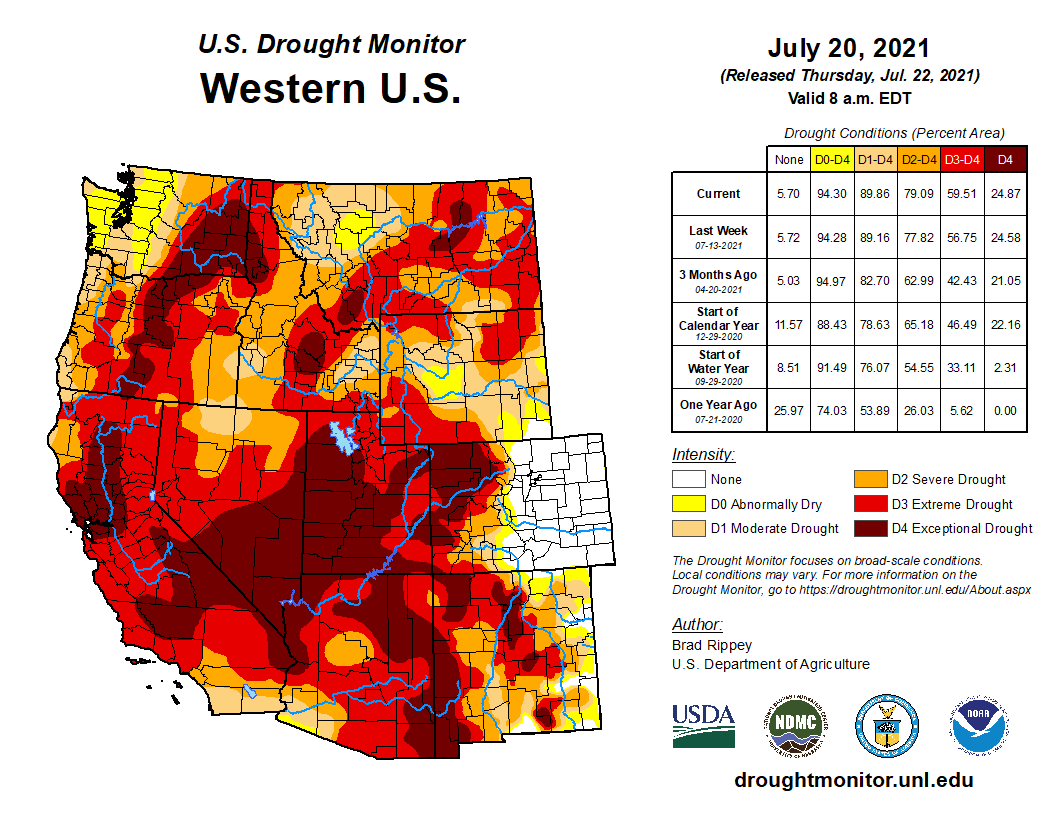
The U.S. Drought Monitor depicted the extent of the severe drought affecting the western U.S. on July 20, 2021. New research finds that increasing temperatures will make droughts like this more frequent. Credit: National Drought Mitigation Center.

Historically, drought in the West has been caused by lack of precipitation, while evaporative demand played a smaller role. Climate change caused primarily by burning fossil fuels has resulted in higher average temperatures that complicate this picture. Now, droughts induced by natural fluctuations in rainfall still exist, but there’s more heat to suck moisture from bodies of water, plants, and soil. 

“For generations, drought has been associated with drier than normal weather,” said Veva Deheza, Director of NOAA’s National Integrated Drought Information System and study co-author. “This study further confirms we’ve entered a new paradigm where rising temperatures are leading to intense droughts with precipitation as a secondary factor.”

A warmer atmosphere can hold more water vapor before the air mass becomes saturated, and precipitation can form. This creates a cycle in which the warmer the planet gets, the more water can evaporate from the landscape and remain stored in the atmosphere longer before it returns to earth as rain or snow. Droughts can form even if precipitation patterns remain within a normal range as higher temperatures and evaporation remove water from soils. They can last longer, cover wider areas, and be even drier with every little bit that the planet warms.

To tease out the effects of higher temperatures on drought, the researchers have separated “natural” droughts due to changing weather patterns from droughts due to human-caused climate change in the observational data over a 70-year period. Previous studies have used climate models forced by increasing greenhouse gases to conclude that rising temperatures contribute to drought. But without observational data about real weather patterns, they could not pinpoint the role played by evaporative demand due to naturally varying weather patterns. 

When these natural weather patterns were included, the researchers were shocked to find that climate change accounts for 80% of the increase in evaporative demand since 2000. During the drought periods, that figure increased to more than 90%, making it the single biggest driver of increasing drought severity and expansion of drought area since 2000. 

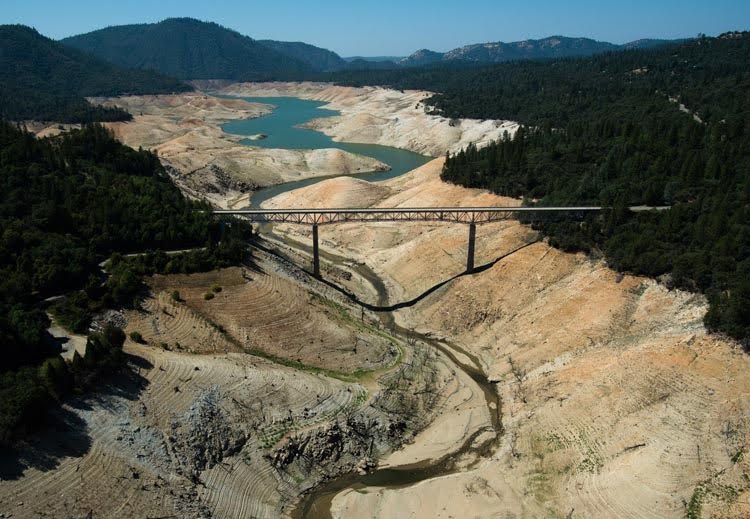
This photo shows California’s largest reservoir, Lake Oroville, nearly dry on August 19, 2014. Credit: California Department of Water Resources.

Compared to the period 1948–1999, the average drought area increased 17% over the western United States from 2000–2022 due to an increase in evaporative demand.  The new analysis showed that since 2000, in 66% of the historical and emerging drought-prone regions, high evaporative demand alone could cause drought, meaning drought can occur even without precipitation deficit. Before 2000, that was only true for 26% of the area.

“During the drought of 2020–2022, moisture demand really spiked,” Fu said. “Though the drought began through a natural reduction in precipitation, I would say its severity was increased from the equivalent of ‘moderate’ to ‘exceptional’ on the drought severity scale due to climate change.”

The U.S. Drought Monitor classifies Moderate Drought (D1 on a scale of D0–D4) as falling in the top 10%–20%of historic droughts, while ‘Exceptional’ Droughts (D4) fall in the top 2%. Further climate model simulations corroborated these findings and projected that fossil fuel pollution will turn droughts like the 2020–2022 from exceedingly rare events that once happened only every 1,000 years to events that happen every 60 years by the mid-21st century, and every six years by the late 21st century.

“Even if precipitation looks normal, we can still have drought because moisture demand has increased so much, and there simply isn’t enough water to keep up with that increased demand,” said Fu. “This is not something you could build bigger reservoirs or something to prevent because when the atmosphere warms, it will just suck up more moisture everywhere. The only way to prevent this is to stop temperature increase, which means we have to stop emitting greenhouse gases.” 

The study was supported by NOAA’s National Integrated Drought Information System and the Climate Program Office, as well as the National Science Foundation. Learn more about NIDIS-supported research.

The Colorado killer tornadoes of November 4, 1922 — Russ Schumacher #Colorado #Climate Center (@rschumacher.cloud)

A cafe along Colorado Street in Sugar City. By Jeffrey Beall – Own work, CC BY 4.0, https://commons.wikimedia.org/w/index.php?curid=59695205

Click the link to read the blog post on the Colorado Climate Center website (Russ Schumacher). Click the link to read Russ’ article:

November 5, 2024

A couple years ago, before we had a blog, I put together an analysis of a truly remarkable severe weather event from Colorado history on its 100th anniversary: the killer tornadoes of November 4, 1922.

There’s not much comparison for this storm: it was one of the deadliest tornado outbreaks in state history, and it happened in November (!) in the early morning (!!). I took a look back both at what happened, and tried to recreate what the storms might have looked like using a modern weather prediction model. I figured it was worth sharing the link here on the blog, in case it might be of interest on the 102nd anniversary: https://www.authorea.com/users/334136/articles/593038-the-colorado-killer-tornadoes-of-november-4-1922 . It’s an interesting and tragic piece of Colorado weather and climate history.

Article about the Mossman family that was killed by the tornado, from the Sugar City Gazette, November 10, 1922. Kindly provided by Annette Barber of the Crowley County Heritage Center.

Navajo Dam Release Change — November 6, 2024

Aerial image of entrenched meanders of the San Juan River within Goosenecks State Park. Located in San Juan County, southeastern Utah (U.S.). Credits Constructed from county topographic map DRG mosaic for San Juan County from USDA/NRCS – National Cartography & Geospatial Center using Global Mapper 12.0 and Adobe Illustrator. Latitude 33° 31′ 49.52″ N., Longitude 111° 37′ 48.02″ W. USDA/FSA, Public domain, via Wikimedia Commons

From email from Reclamation (Western Colorado Area Office):

Reclamation will be fulfilling a request to release the second block of the Jicarilla Apache Nation (JAN) subcontracted water that has been leased to the New Mexico Interstate Stream Commission (NMISC) and The Nature Conservancy (TNC) for calendar year 2024.

The subcontracted water released from the Navajo Unit will augment the current release of 350 cfs as requested by the NMISC and TNC. The table below shows the release schedule. Any changes to this schedule will be sent out in subsequent notices. The total volume of JAN subcontracted water for this release is 10,000 acre-feet over our current release.

Following this operation, the release will return to 350 cfs, or whatever is required to maintain the target baseflow through the endangered fish critical habitat reach of the San Juan River (Farmington to Lake Powell).  The San Juan River Basin Recovery Implementation Program recommends a target base flow of between 500 cfs and 1,000 cfs through the critical habitat area.  The target base flow is calculated as the weekly average of gaged flows throughout the critical habitat area from Farmington to Lake Powell. 

This scheduled release change is subject to changes in river flows and weather conditions.  If you have any questions, please contact Susan Behery (sbehery@usbr.gov or 970-385-6560), or visit Reclamation’s Navajo Dam website at https://www.usbr.gov/uc/water/crsp/cs/nvd.html

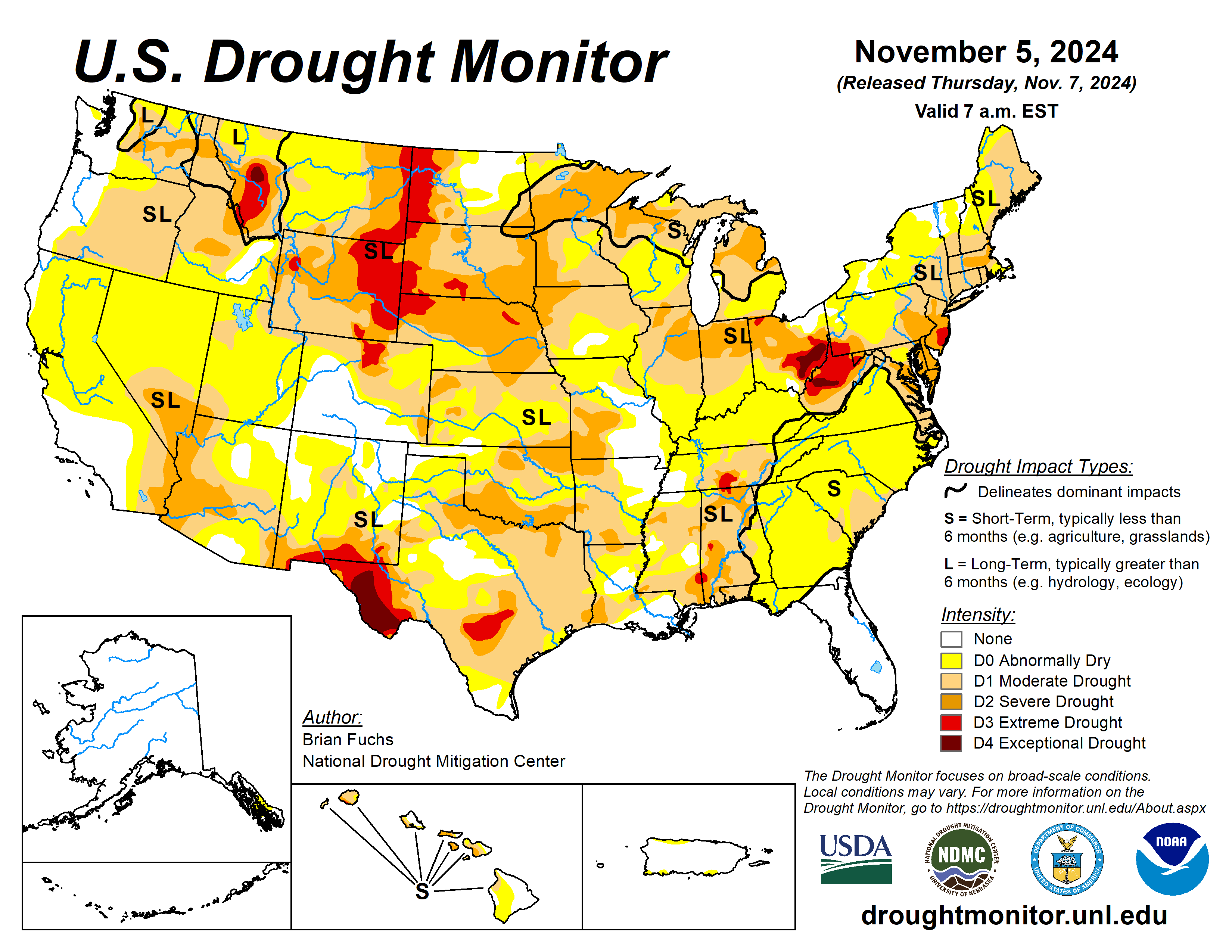
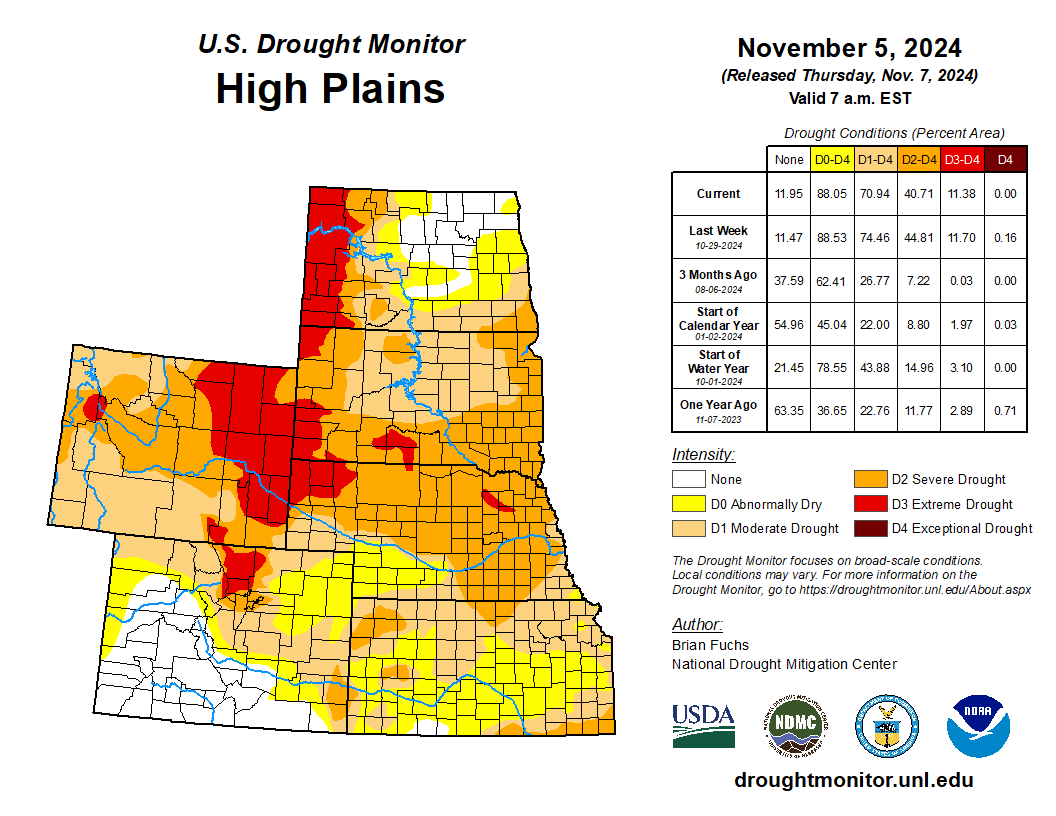
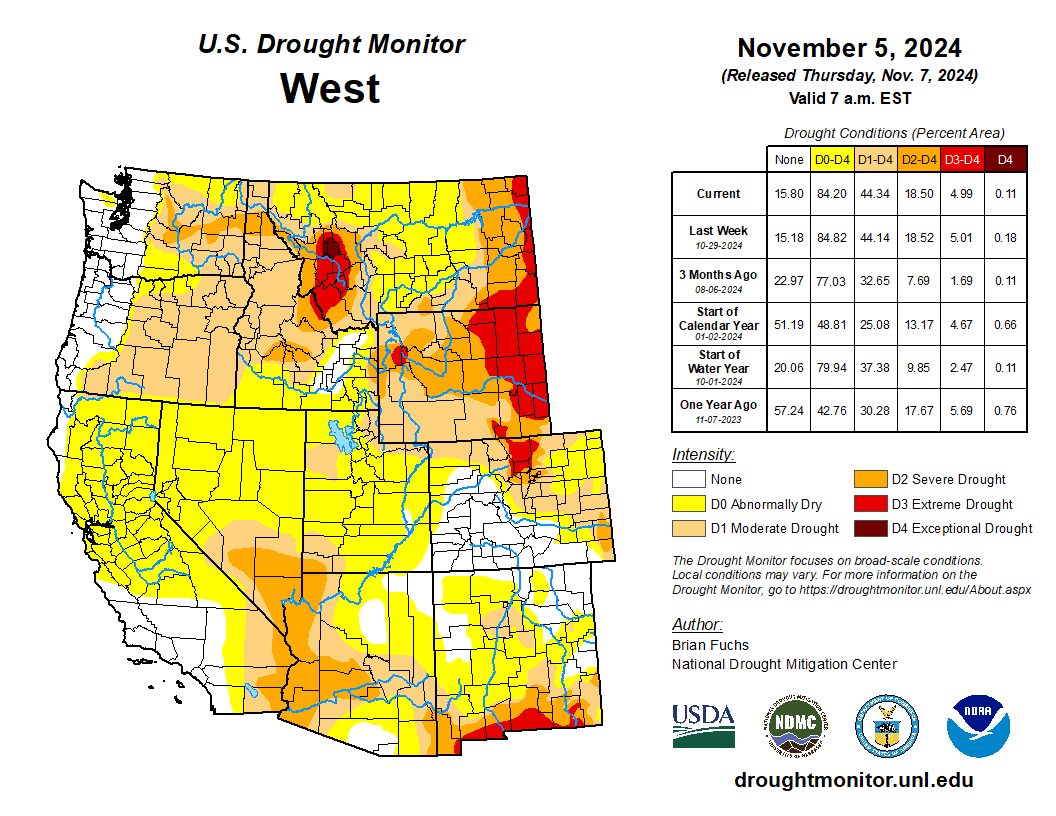
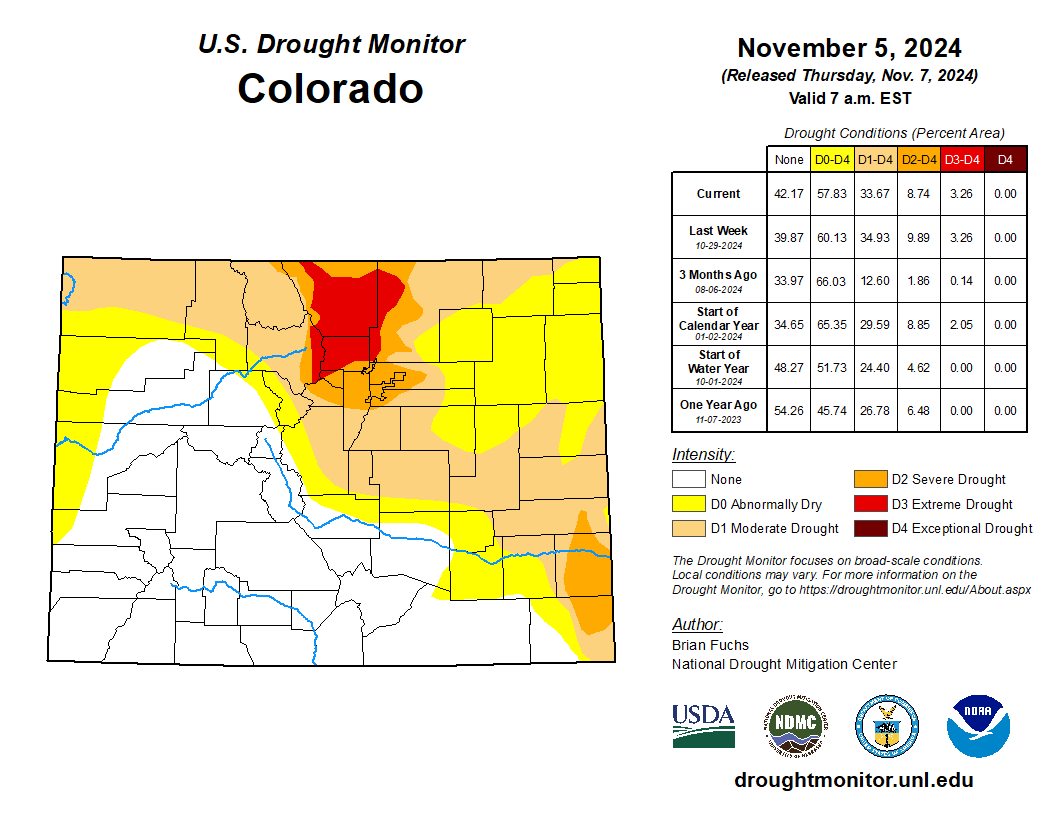
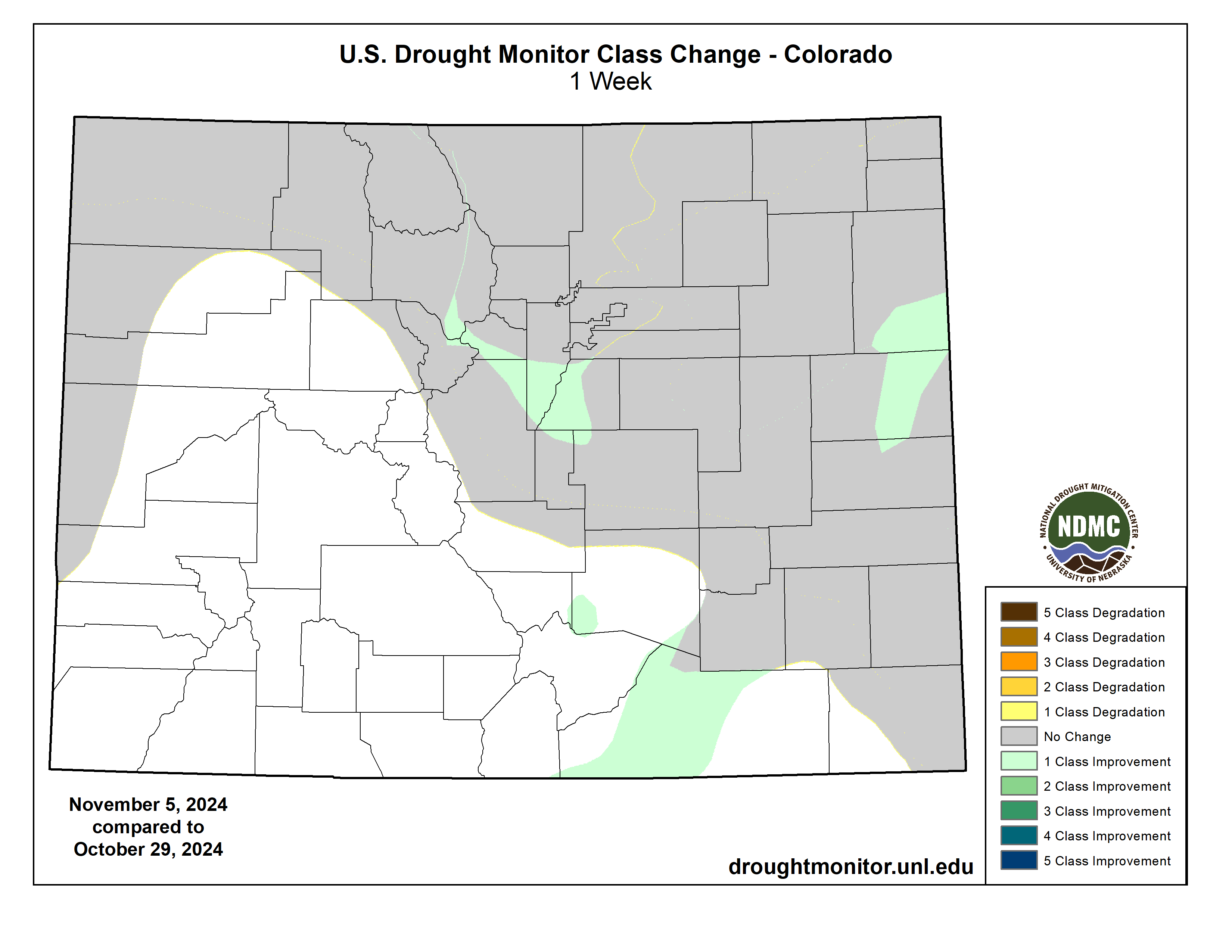
#Drought news November 7, 2024: Some improvements were made to abnormally dry conditions over central to southern #Colorado and to moderate drought over northeast Colorado.

Click on a thumbnail graphic to view a gallery of drought data from the US Drought Monitor website.

Click the link to go to the US Drought Monitor website. Here’s an excerpt:

This Week’s Drought Summary

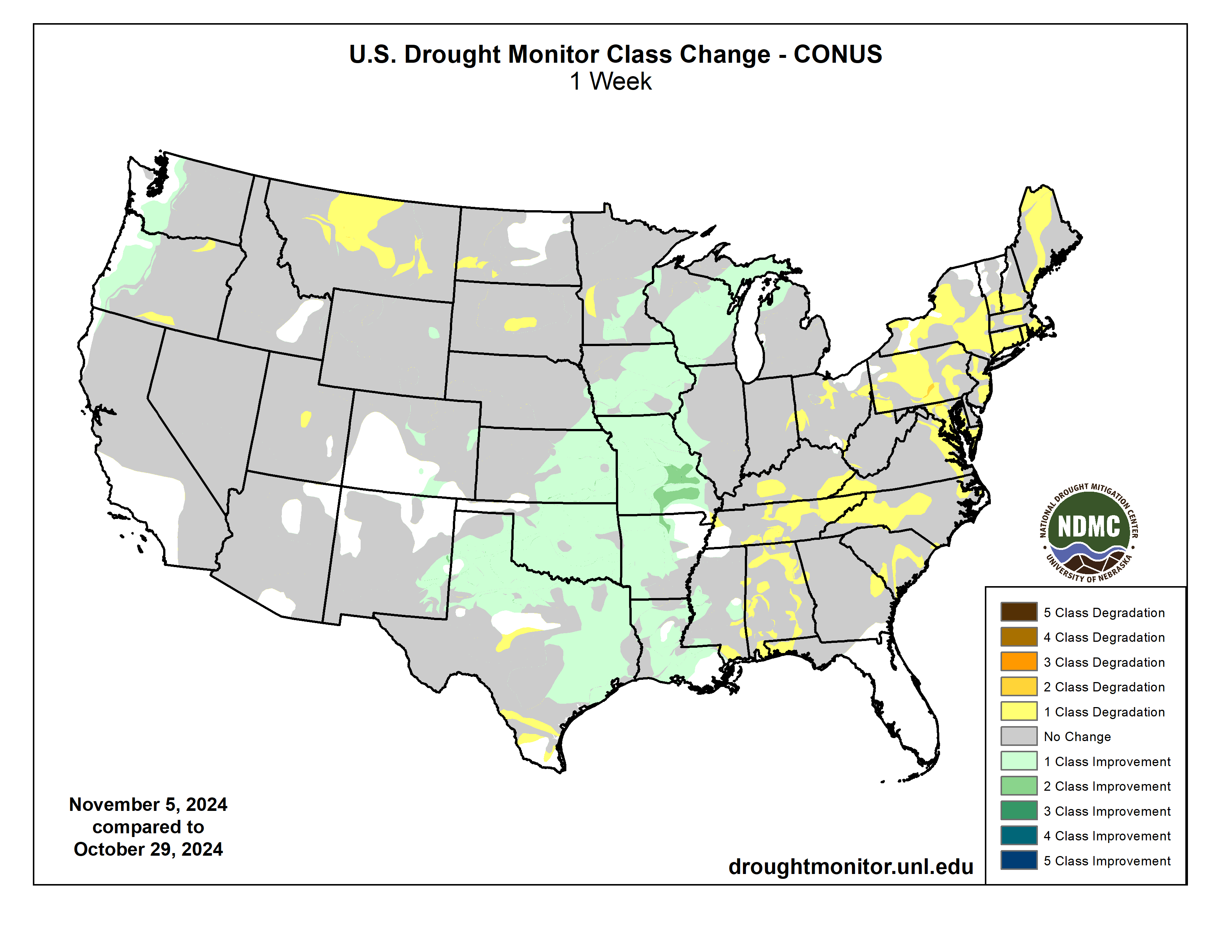
Over the last week, weather systems tracked over the southern Plains and into the Midwest, bringing much-needed precipitation. Some areas of Arkansas and Missouri reported over 10 inches of rain for the week. The active pattern also continued over the Pacific Northwest, with the coastal areas and inland recording 2-4 inches of rain that helped to alleviate dryness. Temperatures over the West were below-normal for the week, by as much as 6-9 degrees in parts of Nevada, Utah and Arizona. The rest of the country had warmer-than-normal temperatures, especially in Texas and into Louisiana, Mississippi, Arkansas and Alabama, where they were 9-12 degrees above normal. Many areas that received rain during the period had these rains come on the cusp of record-setting dryness in October, but many records were still set for areas that didn’t receive rain at the end of October and early November…

High Plains

Significant rains fell over much of Kansas, into southeast Nebraska and southeast Colorado. Rain and snow fell from portions of eastern Colorado into Wyoming and into the Dakotas too, reversing the trend of very dry conditions. Not all areas were as fortunate, with northeast Colorado, western Nebraska, eastern and southwest South Dakota and northwest North Dakota remaining dry this week. The region was split, with temperatures in the western areas 3-6 degrees below normal, and temperatures 9-12 degrees above normal in much of eastern Nebraska and eastern Kansas. Much of eastern Kansas saw a full category of improvement this week, with extreme drought being removed from the southeast. Severe drought was removed from far southeast Nebraska. In western North Dakota and in eastern Montana, severe and extreme drought expanded slightly. Some improvements were made to abnormally dry conditions over central to southern Colorado and to moderate drought over northeast Colorado. Moderate drought expanded across central South Dakota this week…

Colorado Drought Monitor one week change map ending November 5, 2024.

West

Precipitation was scattered over much of the West, with the greatest rain over the Pacific Northwest, where 200% of normal rain was recorded for the week in much of Oregon and Washington. Cooler-than-normal temperatures dominated the region with many areas of Nevada, Utah, and Arizona and into western Wyoming 6-9 degrees below normal for the week. Dryness continued to dominate much of Montana with abnormally dry conditions expanding to fill the rest of the state and moderate and severe drought expanding in the west. Abnormally dry conditions spread to the rest of central Utah while moderate drought and abnormally dry conditions improved over much of western Oregon and Washington. Some improvements were made over eastern New Mexico this week as a result of the continued wetter conditions…

South

Temperatures were 12-15 degrees above normal over much of the South, with areas of the Texas Panhandle into Oklahoma 6-9 degrees above normal. Much of Oklahoma and north Texas and Arkansas received significant precipitation, with widespread reports of 800% of normal rain for the week. The dryness continued over much of Tennessee and into northern Mississippi as the active rain patterns brought some rains, but not the significant and widespread rains that were more common in the West. A full category improvement was made over much of Oklahoma and northern Texas and western Arkansas, with extreme drought removed from the region. Extreme drought emerged in southeast Mississippi. Severe drought improved in Louisiana with moderate drought and abnormally dry conditions also improving in southern Louisiana.

Looking Ahead

Over the next 5-7 days, it is anticipated that the wet pattern will continue over much of the southern Plains and into the South, Southeast, and Midwest. The active pattern along the coastal areas of the Pacific Northwest will also continue. Greatest precipitation is anticipated over the southern Plains, western Tennessee, western Kentucky, northern Mississippi, southern Georgia, western South Carolina and the Pacific Northwest coast, where 3 or more inches of rain is anticipated. Much of the West will remain dry. Temperatures will remain cooler than normal over much of the West with departures of 10-12 degrees below normal over northern New Mexico and southern Colorado. Much of the eastern half of the country will be warmer than normal, while areas of the Midwest and South are anticipated to be 10-12 degrees below normal for the week. Hurricane Rafael has formed in the Gulf of Mexico and is projected to track westward. It may not make landfall until the middle of next week but could impact the dryness over the South and southern Plains depending on its path.

The 6-10 day outlooks show that the probability of above-normal temperatures will be greatest over the eastern half of the United States, especially over the Midwest and into the Southeast. Chances of cooler-than-normal temperatures are greatest over the West, in particular over California and Nevada. Most of the country has a good chance of recording above-normal precipitation during the period, especially over the Pacific Northwest.

US Drought Monitor one week change map ending November 5, 2024.

Just for grins here’s a slideshow of early November US Drought Monitor maps for the past few years.

#ColoradoRiver District Board Approves Over $360,000 in Funding for Water Infrastructure and Restoration Projects #COriver #aridification

This photo shows the newly-installed headgate stem wall at the Sheriff Reservoir dam in Routt County. The town is moving forward with repairs to the dam’s spillway after the Colorado Division of Water Resources placed restrictions on the 68-year-old structure in 2021. Town of Oak Creek/Courtesy photo

Click the link to read the release on the Colorado River District website (Lindsay DeFrates):

On Tuesday, Oct. 15, the Colorado River District Board of Directors unanimously approved $366,655 in funding from the Community Funding Partnership program to support two critical water infrastructure and restoration projects. The Sheriff Reservoir Dam Rehabilitation Project and the Gunnison River Basin Drought Resiliency and Restoration Project aim to increase water security for agriculture, protect local drinking water supplies, and enhance environmental health on Colorado’s western slope. Including these recent approvals, the Community Funding Partnership has awarded a total of $3.3 million to 26 West Slope water projects in 2024.

“These projects are a perfect example of our mission in action—protecting critical drinking water supplies while also improving infrastructure and supporting productive agriculture,” said Melissa Wills, Community Funding Partnership program manager at the Colorado River District. “By investing in these efforts, we are also leveraging significant federal and state funds and delivering long-term benefits to communities throughout the region.”

The Sheriff Reservoir Dam Rehabilitation Construction Project, spanning Routt and Rio Blanco counties, aims to restore the dam’s safety and functionality, protect downstream communities, secure water supplies for the Town of Oak [Creek], and improve flows in both Trout Creek and Oak Creek. Additionally, the Gunnison River Basin Drought Resiliency and Restoration Project will enhance irrigation efficiency and restore riparian habitats along Kiser, Tomichi, and Cochetopa creeks. Led by Trout Unlimited, this effort will work to reconnect floodplains, reduce streambank erosion, lower water temperatures, and boost late-season stream flows in Delta, Gunnison, and Saguache Counties.

Since its establishment in 2021, the Colorado River District’s Community Funding Partnership has funded over 125 projects and leveraged more than $95 million in federal funding to benefit local communities across the West Slope. The program, supported by voters through ballot measure 7A in November 2020, focuses on five key areas: productive agriculture, infrastructure, healthy rivers, watershed health and water quality, and conservation and efficiency. By serving as a catalyst for securing matching funds from state, federal, and private sources, the program continues to play a vital role in advancing multi-purpose water projects in the region.

The two projects approved by the board on October 15th are listed below. Detailed project descriptions and staff recommendations are available in the public meeting packet HERE.

Sheriff Reservoir Dam Rehabilitation Construction Project

  • Applicant: Town of Oak Creek
  • Total Approved: up to $232,155.00
  • Location: Routt and Rio Blanco Counties

Gunnison River Basin Drought Resiliency and Restoration Project

  • Applicant: Trout Unlimited
  • Total Approved: $134,500
  • Location: Gunnison, Delta, and Saguache Counties

For more information on the Colorado River District and the Community Funding Partnership program, visit coloradoriverdistrict.org.

“Ay Yai Yai!” — The species of #Earth that now face extinction thanks to the Electoral College

#Drought Expands Across the U.S. — NASA

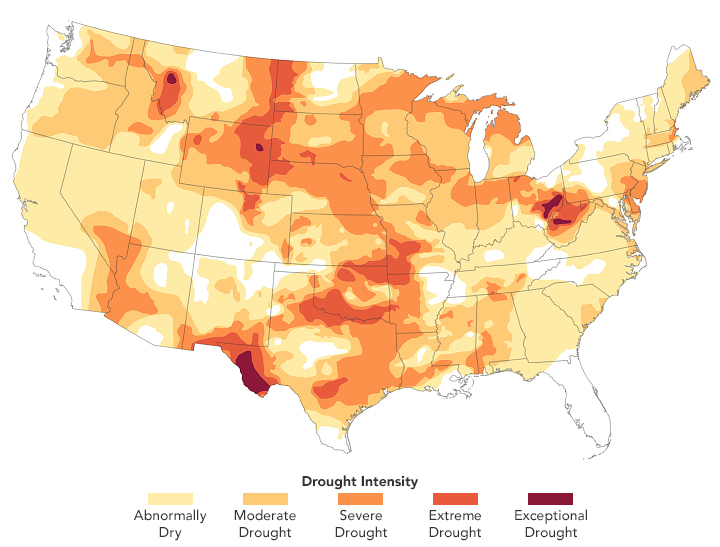
US drought October 29, 2024. Credit: NASA, data from the US Drought Monitor

Click the link to read the article on the NASA website (Emily Cassidy):

October 29, 2024

Unusually dry conditions gripped over half the contiguous United States in October 2024. On October 29, abnormal dryness and drought affected over 78 percent of the American population—the highest percentage in the U.S. Drought Monitor’s 25-year-long record.

Drier- and warmer-than-normal weather dominated the country during much of October, caused by a strong ridge of high pressure that lingered high in the atmosphere for weeks. According to the Southeast Regional Climate Center, 100 weather stations across the U.S. recorded no rain in October, including the cities of Philadelphia, Atlanta, Birmingham, Dallas, Las Vegas, and Sacramento. Over 70 weather stations recorded the driest October on record.

The map above shows conditions in the contiguous U.S. on October 29, 2024, as reported by the U.S. Drought Monitor, a partnership of the U.S. Department of Agriculture, NOAA, and the University of Nebraska-Lincoln. The map depicts drought intensity in progressive shades of yellow to red. It is based on an analysis of climate, soil, crop, and water condition measurements from more than 350 federal, state, and local observers around the country. NASA contributes several measurements and models that aid the drought monitoring effort.

Drought had expanded from covering just 12 percent of the country in June to 54 percent as of October 29. The rapid development created what NOAA describes as a “flash drought” in many parts of the country. Flash droughts are typically brought on by lower-than-normal rates of precipitation, accompanied by abnormally high temperatures, wind, or radiation.

“Although droughts usually develop slowly over the course of months and years, a flash drought rapidly intensifies over the course of a few weeks to a couple of months,” said Caily Schwartz, a scientist at the Global Water Security Center at the University of Alabama. Schwartz noted that in Nebraska, where the National Drought Mitigation Center is located, there has been little rain and higher-than-normal temperatures in October. Much of the state was in severe drought (represented as orange in the map) in late October.

Almost the entire country was warmer than normal the week of October 23-29, and drought was present in every state except Alaska and Kentucky. The High Plains and South were the warmest regions, with temperatures 10 to 12 degrees Fahrenheit (6 to 7 degrees Celsius) above normal.

Even in the Southeast where Hurricane Helene dropped significant precipitation in late September, many places dried out rapidly, with some recording zero precipitation since the hurricane.

“This fall has been a prime example of flash drought across parts of the U.S.,” said Jason Otkin, a meteorologist at the University of Wisconsin-Madison. “These events can take people by surprise because you can quickly go from being drought-free to having severe drought conditions.”

Otkin co-authored research published in Science that showed that droughts have intensified more rapidly since the 1950s due to human-caused climate change. According to the research team, flash droughts have become more common over much of the world, making drought monitoring and forecasting more difficult.

NASA Earth Observatory image by Michala Garrison, using data from the United States Drought Monitor at the University of Nebraska-Lincoln. Story by Emily Cassidy.

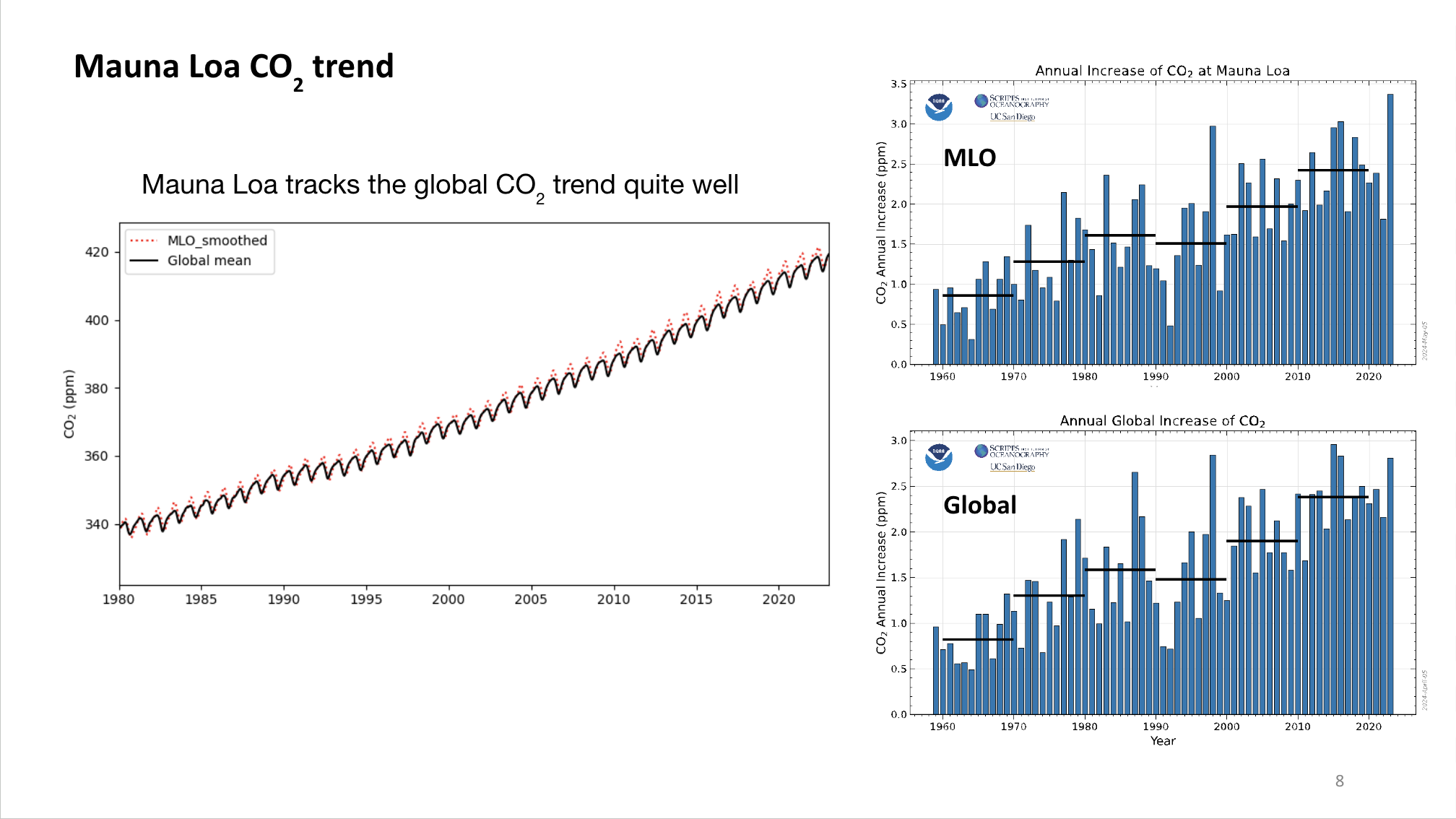
These graphs compare the rise of atmospheric carbon dioxide (CO2) in Mauna Loa and global records.The decadal average rate of increase of CO2 in the graphs on the right are depicted by the black, horizontal lines. (Image credit: NOAA Global Monitoring Laboratory)

Svalbard Global Seed Vault evokes epic imagery and controversy because of the symbolic value of seeds

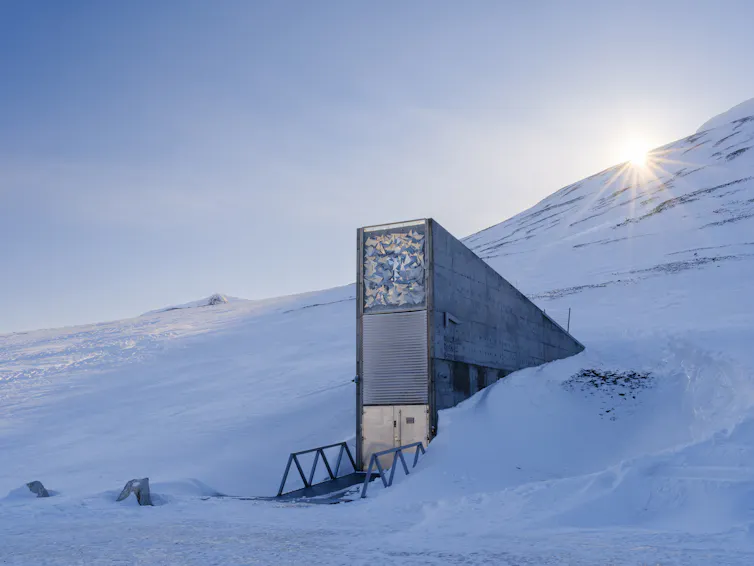
The entrance to the Svalbard Global Seed Vault. Martin Zwick/REDA&CO/Universal Images Group via Getty Images

Adriana Craciun, Boston University

Two-thirds of the world’s food comes today from just nine plants: sugar cane, maize (corn), rice, wheat, potatoes, soybeans, oil-palm fruit, sugar beet and cassava. In the past, farmers grew tens of thousands of crop varieties around the world. This biodiversity protected agriculture from crop losses caused by plant diseases and climate change.

Today, seed banks around the world are doing much of the work of saving crop varieties that could be essential resources under future growing conditions. The Svalbard Global Seed Vault in Norway supports them all. It is the world’s most famous backup site for seeds that are more precious than data.

Tens of thousands of new seeds from around the world arrived at the seed vault on Svalbard, a Norwegian archipelago in the Arctic Ocean, in mid-October 2024. This was one of the largest deposits in the vault’s 16-year history.

And on Oct. 31, crop scientists Cary Fowler and Geoffrey Hawtin, who played key roles in creating the Global Seed Vault, received the US$500,000 World Food Prize, which recognizes work that has helped increase the supply, quality or accessibility of food worldwide.

The Global Seed Vault has been politically controversial since it opened in 2008. It is the most visible site in a global agricultural research network associated with the United Nations and funders such as the World Bank.

These organizations supported the Green Revolution – a concerted effort to introduce high-yielding seeds to developing nations in the mid-20th century. This effort saved millions of people from starvation, but it shifted agriculture in a technology-intensive direction. The Global Seed Vault has become a lightning rod for critiques of that effort and its long-term impacts.

I have visited the vault and am completing a book about connections between scientific research on seeds and ideas about immortality over centuries. My research shows that the Global Seed Vault’s controversies are in part inspired by religious associations that predate it. But these cultural beliefs also remain essential for the vault’s support and influence and thus for its goal of protecting biodiversity. https://www.youtube.com/embed/luqHf5J-XLY?wmode=transparent&start=0 The Global Seed Vault gives scientists the tools they may need to breed crops that can cope with a changing climate.

Backup for a global network

Several hundred million seeds from thousands of species of agricultural plants live inside the Global Seed Vault. They come from 80 nations and are tucked away in special metallic pouches that keep them dry.

The vault is designed to prolong their dormancy at zero degrees Fahrenheit (-18 degrees Celsius) in three ice-covered caverns inside a sandstone mountain. The air is so cold inside that when I entered the vault, my eyelashes and the inside of my nose froze.

The Global Seed Vault is owned by Norway and run by the Nordic Genetic Resources Centre. It was created under a U.N. treaty governing over 1,700 seed banks, where seeds are stored away from farms, to serve as what the U.N. calls “the ultimate insurance policy for the world’s food supply.”

This network enables nations, nongovernmental organizations, scientists and farmers to save and exchange seeds for research, breeding and replanting. The vault is the backup collection for all of these seed banks, storing their duplicate seeds at no charge to them.

The seed vault’s cultural meaning

The vault’s Arctic location and striking appearance contribute to both its public appeal and its controversies.

Svalbard is often described as a remote, frozen wasteland. For conspiracy theorists, early visits to the Global Seed Vault by billionaires such as Bill Gates and George Soros, and representatives from Google and Monsanto, signaled that the vault had a secret purpose or benefited global elites.

In fact, however, the archipelago of Svalbard has daily flights to other Norwegian cities. Its cosmopolitan capital, Longyearbyen, is home to 2,700 people from 50 countries, drawn by ecotourism and scientific research – hardly a well-hidden site for covert activities.

The vault’s entrance features a striking installation by Norwegian artist Dyveke Sanne. An illuminated kaleidoscope of mirrors, this iconic artwork glows in the long Arctic night and draws many tourists.

Because of its mission to preserve seeds through potential disasters, media regularly describe the Global Seed Vault as the “doomsday vault,” or a “modern Noah’s Ark.” Singled out based on its location, appearance and associations with Biblical myths such as the Flood, the Garden of Eden and the apocalypse, the vault has acquired a public meaning unlike that of any other seed bank.

The politics of seed conservation

One consequence is that the vault often serves as a lightning rod for critics who view seed conservation as the latest stage in a long history of Europeans removing natural resources from developing nations. But these critiques don’t really reflect how the Global Seed Vault works.

The vault and its sister seed banks don’t diminish cultivation of seeds grown by farmers in fields. The two methods complement one another, and seed depositors retain ownership of their seeds.

Another misleading criticism argues that storing seeds at Svalbard prevents these plants from adapting to climate change and could render them useless in a warmer future. But storing seeds in a dormant state actually mirrors plants’ own survival strategy.

Dormancy is the mysterious plant behavior that “protects against an unpredictable future,” according to biologist Anthony Trewavas. Plants are experts in coping with climate unpredictability by essentially hibernating.

Seed dormancy allows plants to hedge their bets on the future; the Global Seed Vault extends this state for decades or longer. While varieties in the field may become extinct, their banked seeds live to fight another day.

Storing more than seeds

In 2017, a delegation of Quechua farmers from the Peruvian Andes traveled to Svalbard to deposit seeds of their sacred potato varieties in the vault. In songs and prayers, they said goodbye to the seeds as their “loved ones” and “endangered children.” “We’re not just leaving genes, but also a family,” one farmer told Svalbard officials.

The farmers said the vault would protect what they called their “Indigenous biocultural heritage” – an interweaving of scientific and cultural value, and of plants and people, that for the farmers evoked the sacred.

People from around the world have sought to attach their art to the Global Seed Vault for a similar reason. In 2018, the Svalbard Seed Cultures Ark began depositing artworks that attach stories to seeds in a nearby mine.

Pope Francis sent an envoy with a handmade copy of a book reflecting on the pope’s message of hope to the world during the COVID-19 pandemic. Japanese sculptor Mitsuaki Tanabe created a 9-meter-long steel grain of rice for the vault’s opening and was permitted to place a miniature version inside.

Seeds sleeping in Svalbard are far from their home soil, but each one is enveloped in an invisible web of the microbes and fungi that traveled with it. These microbiomes are still interacting with each seed in ways scientists are just beginning to understand.

I see the Global Seed Vault as a lively and fragile place, powered not by money or technology but by the strange power of seeds. The World Food Prize once again highlights their vital promise.

Adriana Craciun, Professor of English and Emma MacLachlan Metcalf Chair of Humanities, Boston University

This article is republished from The Conversation under a Creative Commons license. Read the original article.

EVs near 28% of all sales in #Colorado: Big bag of incentives puts state slightly ahead of schedule in pursuit of goal of its 2030 goal of 940,000 EVs as some efforts moves to fleets — Allen Best (@BigPivots) #ActOnClimate

Coyote Gulch’s Leaf charging at the City of Vail Lionshead parking structure May 24, 2023.

Click the link to read the article on the Big Pivots website (Allen Best):

November 1, 2024

Electric vehicles and plug-in hybrids constituted 27.8% of all new car sales in Colorado during this year’s third quarter, according to sales figures compiled by the Colorado Automobile Dealers Association.

That puts Colorado second in the nation in proportion of sales, behind only California.

It also puts Colorado slightly ahead of the trajectory it identified as being necessary to have 940,000 EVs or hybrids on its roads by 2030. It had 151,000 as of October. It needs 157,000 by year’s end to stay on its pace, and Mike Salisbury, the Colorado Energy Office’s director of transportation, said the state will likely exceed that target by several thousand.

Clearly, the combination of tax credits offered by Colorado and the federal government have put wind into the sales of EVs and hybrids. New incentives that went into effect in January were particularly important in understanding Colorado’s climbing sales.

This latest milestone can be viewed against the backdrop of stories earlier this year by various national media about sluggish EV sales.

The flip side of that story of slowing sales is that lower-priced models are just now starting to arrive in significant numbers. Tesla, still the dominant brand, is getting more competition.

Notable is the expansion of General Motors in the market. As the New York Times noted this week, GM long had the Bolt compact, but it now has nine electric models that appeal to a wide range of consumers. And more are on the way, including a battery-powered version of its popular Cadillac Escalade SUV.

Bonnie Trowbridge, the executive director of Drive Clean Colorado, has been assisting in electrification of fleets. It’s easier, she explains, to make the argument for one fleet operator of 100 vehicles than 100 individual car owners. As such, electrifying fleets will have a much larger carbon impact.

Amazon has been electrifying its delivery vehicles. And Drive Clean Colorado has received an EPA grant to support the replacement of 21 old diesel trucks used for food delivery to restaurants with electric delivery vehicles. Of those, 15 will be the longer trucks and the remaining six the shorter snub-nosed trucks at the back doors of restaurants.

Colorado, the state government, also has been pushing ahead with EVs in its fleets, and some municipalities are doing the same.

What may be more surprising is how laggard even California and Colorado are in comparison with the EV adoption in China and other countries.

EVs in the United States altogether constitute about 11% of all new-car sales. The world average is about 25%. In China, EVs are on track to be 45% of all new car sales this year, according to Marc Peterson, a retired executive with General Electric who spoke recently at a Monday Zoom session organized by Phil Nelson.

That same point was made by Bloomberg Finance in a chart reproduced here.

“The Chinese market is driving the world automotive market,” said Peterson, who is the co-coordinator in Utah for Citizens Climate Lobby.

Peterson reported that EVs now cost less in every U.S. state except West Virginia and Maine. In Utah, where he lives, the average cost of ownership of an EV across five years saves its owner $7,113.

Trowbridge, at Drive Clean Colorado, points out that China and some European countries have reached an inflection point in their adoption of EVs. Instead of driving the adoption with incentives, some places are using regulation to preclude use of internal-combustion engine vehicles in highly polluted places such as cities.

Could she imagine that happening in Colorado?

Trowbridge paused before answering.

A layer of smog covers the skyline of Denver. (Courtesy of EcoFlight)

“We haven’t reached any of our attainment goals for NOX (nitrous oxide) and other pollutants, so we are going to have to contend with the federal government pretty soon. It’s really unhealthy for Coloradans, and a lot of that centers on transportation,” she said.

“I don’t know that it would be necessary for passenger vehicles, but perhaps for trucks and other fleet-type vehicles,” she added, referring to potential regulations in the near future.

Extended Shoshone hydro plant outages add urgency to water rights campaign: Outage protocol not as reliable as water rights permanency — Heather Sackett (@AspenJournalsim) #ColoradoRiver #COriver #aridification

The twin turbines of Xcel Energy’s Shoshone hydroelectric power plant in Glenwood Canyon can generate 15 megawatts. The plant was down for about a year and a half, according to the Colorado Division of Water Resources. Credit: Heather Sackett/Aspen Journalism

Click the link to read the article on the Aspen Journalism website (Heather Sackett):

October 31, 2024

The Shoshone Hydropower Plant in Glenwood Canyon was not operating for nearly all of 2023 and more than half of 2024, adding urgency to a campaign seeking to secure the plant’s water rights for the Western Slope.

According to records from the Colorado Division of Water Resources, the Shoshone Hydropower Plant was not operating from Feb. 28, 2023 until Aug. 8, 2024. According to Michelle Aguayo, a spokesperson from Xcel Energy, the company that owns the plant, there was a rockfall which forced an outage as well as maintenance which impacted operations during that time period.

The Grizzly Creek Fire burning along the Colorado River on August 14, 2020. By White River National ForestU.S. Forest Service – Public Domain

In 2024 the plant has been down for 221 days; in 2023 for 307 days; in 2022 for 91 days and in 2021 for 143 days. Water Resources Division 5 Engineer James Heath said he began tracking Shoshone outages in 2021 when they began to happen more frequently, starting with the post-Grizzly Creek fire mudslides in Glenwood Canyon.

“It was all these extended outages and just being able to have some sort of record of what was going on,” Heath said. “I kept getting questions from the parties on how many days we were operating ShOP and what the priorities were on those different days.”

The recent extended outages of the plant increase the urgency of the effort by the Colorado River Water Conservation District to acquire Shoshone’s water rights, which are some of the oldest and most powerful non-consumptive rights on the main stem of the Colorado River. If the plant were to shut down permanently, it would threaten the Western Slope’s water supply. The water rights could be at risk of being abandoned or acquired by a Front Range entity.

At a tour of the Shoshone plant in October, hosted by the Water for Colorado Coalition, River District Director of Strategic Partnerships Amy Moyer explained why the Shoshone water rights are important for improving water security and climate resilience on the Western Slope.

“As we’re sitting here in the iconic Glenwood Canyon. … It is a beautiful place, but we have an active highway, a railroad, a hydro power plant, all nestled in this tiny canyon that has experienced its fair share of natural hazards and risks over the years,” Moyer said. “When we’re looking at the level of risk, that is why we are looking for permanent protections for these water rights, and why we have a willing partner in Xcel Energy realizing that they had an incredible asset that was meaningful to Colorado’s Western Slope and the Colorado River itself.”

Water runs down a spillway at the Shoshone hydro plant in Glenwood Canyon. Rockfalls, fires and mudslides in recent years have caused frequent shutdowns of plant operations. Credit: Heather Sackett/Aspen Journalism

According to the terms of ShOP, when it is on during the summer, the plant can call 1,250 cfs. In the wintertime, that number falls to 900 cfs. The agreement is in place for 40 years (with 32 remaining), a relatively short period in water planning, after which it could be renegotiated. And ShOP doesn’t have the stronger, more permanent backing of a water court decree.

“ShOP came about as a band aid to kind of maintain the river flow and the river regime when the plant was out,” said Brendon Langenhuizen, River District director of technical advocacy. “ShOP wasn’t meant to be for year after year after year of the plant being down.”

The Shoshone hydro plant in Glenwood Canyon. The River District has made a deal with Xcel Energy to buy the water rights associated with the plant to keep water flowing on the Western Slope. Credit: Heather Sackett/Aspen Journalism

The River District’s campaign to acquire the Shoshone water rights has been gaining momentum over the last year, with about $55 million in committed funding so far from entities across the Western Slope, the River District and the state of Colorado. The River District plans to apply for $40 million in funding from the U.S. Bureau Reclamation’s B2E funding. This money from the Inflation Reduction Act is earmarked for environmental drought mitigation.

The River District’s plan is to add an instream flow use to the water rights in addition to their current use for hydropower. That requires working with the Colorado Water Conservation Board, which is the only entity in the state allowed to hold instream flow rights which preserve the environment, as well as getting a new water court decree to allow the change in use.

That way, when the Shoshone plant is offline, the instream flow right would be activated to continue pulling water downstream, making ShOP obsolete and solidifying a critical water right for the Western Slope.

Xcel would lease the water right for hydropower from the River District for as long as the plant is in operation.

“New plot using the nClimGrid data, which is a better source than PRISM for long-term trends. Of course, the combined reservoir contents increase from last year, but the increase is less than 2011 and looks puny compared to the ‘hole’ in the reservoirs. The blue Loess lines subtly change. Last year those lines ended pointing downwards. This year they end flat-ish. 2023 temps were still above the 20th century average, although close. Another interesting aspect is that the 20C Mean and 21C Mean lines on the individual plots really don’t change much. Finally, the 2023 Natural Flows are almost exactly equal to 2019. (17.678 maf vs 17.672 maf). For all the hoopla about how this was record-setting year, the fact is that this year was significantly less than 2011 (20.159 maf) and no different than 2019” — Brad Udall

“Colorado’s Western Slope is truly at an epicenter of increased temperatures and decreased streamflows that are exacerbating temperature issues, creating water quality issues,” Moyer said. “So it’s imperative that we look for these legacy level, permanent solutions to build resiliency in our basin.”

Map credit: AGU

Southwest #Colorado tribes seek federal funds for Animas-La Plata water delivery — The #Durango Herald

Lake Nighthorse and Durango March 2016 photo via Greg Hobbs.

Click the link to read the article on The Durango Herald website (Maria Tedesco). Here’s an excerpt:

November 1, 2024

The Ute Mountain Ute Tribe has tried to obtain compensation for water rights from the Inflation Reduction Act, but the Bureau of Reclamation has not acted. U.S. Sens. John Hickenlooper and Michael Bennet, as well as Colorado Gov. Jared Polis, wrote a letter to the Bureau of Reclamation on Oct. 22 urging the bureau to work with the Ute Mountain Ute and Southern Ute tribes for alternative routes of funding, after they were not able to be compensated from the IRA.

“We strongly encourage you to explore other avenues for Colorado’s Tribal Nations to pursue funding related to drought response, recognizing that they are currently forgoing their water use not by choice, but resulting from a history of inequity reflected in their long-term lack of infrastructure,” the letter said.

Combined, the Ute Mountain Ute Tribe and Southern Ute Tribe hold about 33,000 acre-feet of water rights in Lake Nighthorse. Lawmakers provided funds only for the construction of the A-LP and not a delivery system in 2000. Without a pipeline out of Lake Nighthorse, water flows downstream. Since the tribes are not compensated for the water to which they are entitled, but do not use, lawmakers asked the Bureau of Reclamation to explore alternative routes of funding…Aside from receiving compensation for water rights, the Ute Mountain Ute Tribe also needs $500 million for a water delivery project for water from Lake Nighthorse, said Manuel Heart, chair of the Ute Mountain Ute Tribe.

Acidic mine drainage haunts Western rivers — David Marston (Writers on the Range)

Reid Christopher in font of textile bags, mining ruins in background, Gladstone Treatment Plant, San Miguel County, CO. Dave Marston

Click the link to read the article on the Writers on the Range website (David Marston):

October 28, 2024

It was the summer of 2015 when the Animas River in southern Colorado turned such a garish orange-gold that it made national news.

This image was taken during the peak outflow from the Gold King Mine spill at 10:57 a.m. Aug. 5, 2015. The waste-rock dump can be seen eroding on the right. Federal investigators placed blame for the blowout squarely on engineering errors made by the Environmental Protection Agency’s-contracted company in a 132-page report released Thursday [October 22, 2015]

The metallic color came from the Gold King Mine, near the town of Silverton in the San Juan Range. The abandoned mine had been plugged by an earthen and rock dam known as a bulkhead, behind which orange, highly acidic drainage water accumulated. But after a federal Environmental Protection Agency employee accidentally breached the plug during an unauthorized excavation, 3.5 million gallons of additional runoff rushed downstream.

The worker and the EPA came in for a slew of outrage and blame. Alarmed Tribal Nations and towns halted drinking water and irrigation operations; tourists fled the region during the height of tourist season.

The “Bonita Peak Mining District” superfund site. Map via the Environmental Protection Agency

But here’s the surprising opinion of Ty Churchwell, the mining coordinator for Trout Unlimited: “Looking back, this can be taken as a positive thing because of what happened afterward.” He sits on a community advisory group for the Bonita Peak Mining District, a Superfund site that contains the Gold King mine.

“We’ve got federal Superfund designation, and it’s the only tool at our disposal to fix this problem,” he said. The “problem” is unregulated hard-rock mining that began 160 years ago.

“I know this isn’t conventional wisdom,” Churchwell said, “but no fish were killed in Durango (30 miles downstream) because of the spill. It was ugly and shocking, but a lot of that orange was rust, and the acidic water was diluted by the time it hit Durango and downstream.”

Cement Creek aerial photo — Jonathan Thompson via Twitter

EPA’s website points out that over 5.4 million gallons of acid mine runoff enters the Animas River daily.

The way Churchwell tells it, water quality and numbers of fish had been declining in the Upper Animas River since the early 2000s. That’s when the last mining operation ended and closed its water treatment plant.

Six months after the news-making spill almost a decade ago, EPA geared up to make sure untreated mine waste would not head for the river again.

Reid Christopher, a 62-year-old former electrician and mountain guide, became the Gold King Mine’s restoration whiz, taking over an old wastewater treatment plant in the area in 2019. Now, he said, only treated water leaves the 11,439-foot elevation mine. 

This July, Christopher took me on a tour of the wastewater plant. In a nutshell, cleanup begins when the constantly flowing wastewater gets shuttled into settling ponds.

Christopher then pumps hydrated lime into the water, boosting its pH to 9.25. The high pH unlocks the heavy metals from suspension, and an added flocculant causes the heavy metals to clump together inside football field-sized textile filtration bags.

Clear—surprisingly clean—water streams from the bags into Cement Creek, Christopher said, and the process is so effective he said he’d like to treat the drainage from other major mineshafts in Bonita Peak.

Meanwhile, the Environmental Protection Agency remains gun-shy about talking to the press. It was deluged with bad publicity following the 2015 blowout, though as Churchwell points out, “it wasn’t the EPA that mined the San Juan Mountains and left their mess behind.”

Bonita Mine acid mine drainage. Photo via the Animas River Stakeholders Group.

The messes from abandoned mines, at Gold King and around the entire West, have never received much attention from Congress. Until the Biden administration passed the Inflation Reduction Act, the EPA depended on annual appropriations. That meant for almost four decades, the agency never got enough money to thoroughly clean up the heavy-metal mine waste flowing out of hard rock mines like Gold King.

And because the mess was buried deep in the mountains at elevations from 10,500 feet to over 12,500 feet, the agency couldn’t compete for federal dollars until it grabbed all the environmental disaster headlines of summer 2015.

Even now, said Churchill, and despite available funding, “The EPA has 48 mine-impacted locations in the Upper Animas River and only so many dollars to work with. They have to get the most bang for their buck.”

David Marston. Photo credit: Writers on the Range

Commercial use of metals in the sludge might possibly make some money for the EPA. The Colorado School of Mines has taken water samples to see what—if anything—can be retrieved from the mine waste.

But even if mine sludge is worthless, cleaning acidic water at the top of the watershed is worthwhile for every living thing downstream.  

For now, Christopher is always looking to hire locals for dirt work and hauling. He said the jobs could last a lifetime.

Dave Marston is publisher of Writers on the Range, Writersontherange.org, the independent nonprofit dedicated to spurring lively debate about Western issues. He lives in Durango.

Prior to mining, snowmelt and rain seep into natural cracks and fractures, eventually emerging as a freshwater spring (usually). Graphic credit: Jonathan Thompson

And what if Trump returns to the White House? — Allen Best (@BigPivots)

The White House and North Lawn during the Lincoln administration in the 1860s. Public Domain, Wikipedia

Click the link to read the article on the Big Pivots website (Allen Best):

October 31, 2024

Colorado aims to reduce its greenhouse gas emissions 50% by 2030 and achieve net-zero by 2050. Would a second Donald Trump presidency frustrate those ambitions?

Not entirely. The energy transition train has already left the station. Colorado has become a national leader in transforming our energy systems, beginning with how we produce electricity. No president can stop that. The economics of renewable energy are too compelling. Coal has become the high-priced fuel, and even natural gas is being crowded out to the margins.

Beyond 2028 coal will almost entirely be gone. Electricity in Colorado will be upwards of 70% emissions-free. Some utilities will aim higher. Holy Cross Energy already surpasses 80% and hopes to surpass 90% sometime next year.

The Inflation Reduction Act of 2022 has pledged more than $3 billion to Colorado electrical cooperatives to make the transition for their members in the state’s four corners More money is likely , and more is likely coming. The state’s 22 cooperatives together serve 20% of the state’s residents but about 70% of its geographic area.

In July, Colorado’s two senators were at the EPA headquarters near Denver’s Union Station to announce a $200 million grant for work in the nine-county Denver-Boulder metro area to begin retrofitting houses to use less natural gas. The state government got $129 million at the same time for various efforts to reduce methane and carbon dioxide emissions.

Might Trump try to kill this landmark law, the most important climate legislation yet enacted if he ends up in the White House? He’s “going to claw back every penny he can claw back from the Inflation Reduction Act,” U.S. Senator John Hickenlooper told me when I asked his view. “He thinks climate change is a hoax.”

Trump made that statement about a hoax when he was running for president in 2016. At times, he has softened his stance, but even recently he called climate change “one of the greatest scams of all times.” More clearly, he has promised to dismantle the EPA and roll back regulations. He has solicited $1 billion in financial contributions from the oil and gas industry.

Whether Trump could succeed in curbing the renewable energy outlays is another matter. Remember, he vowed to bring back coal. He declared he would kill Obamacare. He almost succeeded with the latter but he makes no mention of it now. It’s too popular in too many places, including red states. The Inflation Reduction Act might have the same trajectory. As in Colorado, much of the money awarded for the energy transition has been earmarked for red states.

Too, Trump would need Republican majorities in both the House and the Senate. That’s possible but unlikely.

Clearly, Colorado can go far on its own. It has among the nation’s best wind, solar, and hydroelectric resources. It has strong leadership and political cohesion. It has an educated workforce. It has innovators and entrepreneurs.

But Colorado can move even more rapidly and cost-effectively in this energy transition with aid and in concert with the federal government, says Tanuj Deora, a director of the state energy office in the Hickenlooper administration. That includes crafting trade policies that aid, not slow, the energy transition.

A major concern for the Colorado Solar and Storage Association is the cost of solar panels. The industry in Colorado is poised for a gigantic boom through the end of this decade as Xcel Energy, Tri-State Generation and Transmission Association, and other utilities prepare to close their coal plants.

Mike Kruger, the executive director, warns that tariffs that Trump has promised to impose on all Chinese imports will hammer the solar sector, which has 9,000 employees in Colorado. The United States does not have the domestic production capacity to meet domestic demand. The result will be huge price increases.

“You would see massive hemorrhaging of solar jobs and solar companies going bankrupt. A tariff that produces a 70% rate hike on imported panels will result in total costs on solar installations going up 25% or more. I don’t know of any product that goes up 25% in price or more without massive impacts.”

This has been the hottest year for the globe in recorded history. Colorado is far behind Phoenix, with its 113 consecutive days of 100-plus temperatures, but it’s warming rapidly. Grand Junction, for example, had an average temperature of more than 80 degrees this summer, an all-time high.

The full and necessary energy transition will happen. In question is whether it can occur as rapidly as climate scientists say it must. Colorado can provide a national example. It already has. But can move faster with teamwork.

Denver Water’s sustainability operations include generating energy from solar power panels installed on the roof of its Administration Building, parking garage and over its visitor’s parking lot at its Operations Complex near downtown. Photo credit: Denver Water.

October 2024 was one of the driest months in U.S. history (any month) — @Climatologist49

October 2024 was the 3rd driest October since 1895 according to (unofficial) Prism climate data. Extensive areas of record to near record dryness.

Despite warmer trends, #Colorado’s early-season snowpack is above normal: And more snow is headed for the High Country next week — Summit Daily #snowpack

Click on a thumbnail graphic to view a gallery of snowpack data from the NRCS.

Click the link to read the article on the Summit Daily website (Robert Tann). Here’s an excerpt:

Amid warmer-than-average fall temperatures, Colorado’s snowpack levels are pacing above normal…As of Friday, Nov. 1, the statewide snowpack was at 143% of the 30-year median, which is considered the historical normal, according to data from the Natural Resources Conservation Service…Recent storms have delivered cooler weather to mountain and Western Slope areas that, in some places, were around 15 degrees above normal during the first half of October, Aleksa said. The bulk of the snowfall has been concentrated in the San Juans region, which netted between 1 to 2 feet of fresh powder during the two most recent storms that hit in late October…Snowpack levels for river basins in that area sit well above 200% of normal, helping boost the state’s overall numbers. Yet in the eastern part of the state, persistent dry weather has stymied snowpack.  In the South Platte River Basin, which stretches along the Front Range from Fort Collins down to Castle Rock, snowpack stood at 43% of normal as of Friday. In the Arkansas River Basin, which spans the south central part of the state, levels stood at 84%…

“The benefit of the last (storm) systems is it helped bring our temperatures from well above normal down to near or even slightly below-normal,” [Matthew] Aleksa said. “Needless to say, late this weekend and into next week it does look like we’re going to see more mountain snow and cooler conditions … (and) these systems coming in help reinforce that cold air and keep these temperatures lower.” 

Groups continue working on #CrystalRiver protections: Three subcommittees exploring various methods; questions multiply on Wild & Scenic designation — Heather Sackett (@AspenJournalism)

Beaver Lake and the Crystal River in Marble seen from the air. Three subcommittees are continuing to work on exploring protections for the river. Credit: EcoFlight

Click the link to read the article on the Aspen Journalism website (Heather Sackett):

October 29, 2024

Three subcommittees exploring ways to protect the Crystal River met in Marble on Monday to share their status and findings after six months of work.

The Crystal River Collaborative Steering Committee split into three subcommittees in March, each focused on evaluating a different method of river protection: a peaking instream flow; an intergovernmental agreement; and a federal Wild & Scenic designation.

Some Crystal Valley residents, along with Pitkin County, have pushed for a Wild & Scenic designation for years as the best way to prevent future dams and diversions. Others, wary of any federal involvement, have balked at the idea, instead proposing different types of protections. But nearly everyone involved agrees that some type of protection is necessary to ensure that one of Colorado’s last free-flowing rivers stays that way.

A peaking instream-flow water right could protect about 25,000 acre-feet of river flows during peak runoff so that that water could not be claimed by a new transbasin diversion or dam project. Committee member Andrew Steininger said the group has hired environmental consultant Brad Johnson to study the issue and write a report on the feasibility of a peaking instream-flow water right on the Crystal. The water right is designed to protect special riparian ecosystems, including plants that need annual floodwaters to survive, and it’s not clear how it would be adapted to the Crystal.

“We are anxiously awaiting Brad’s work, and I think that will really help inform what an avenue might look like,” Steininger said.

Gunnison County Commissioner Liz Smith gave an update on the intergovernmental agreement committee, or IGA. An IGA would include representatives from Gunnison County, Pitkin County, Marble, Colorado River Water Conservation District and West Divide Water Conservancy District. The IGA would have two main goals: Signatories would agree to not support any new reservoir or impoundment of water on the main stem of the Crystal and would agree to oppose in water court any water rights application that would remove water from the Crystal River basin.

Steering committee members agreed that Smith will work on a draft IGA with the local governments, which will be reviewed by the steering committee before the governments sign it.

The view looking upstream on the Crystal River below Avalanche Creek. Pitkin County and others wants to designate this section of the Crystal as Wild & Scenic. CREDIT: CURTIS WACKERLE/ASPEN JOURNALISM

Wild & Scenic

Members of the subcommittee dedicated to exploring a Wild & Scenic designation said the process is a lot more complicated than they initially thought it would be. The group provided 13 pages of information with many links to additional resources. Every white paper that the group reads and every expert that they talk to generates new questions, said committee member Hattie Johnson.

“One takeaway from this process is that we don’t have a draft to share, we don’t have a formal recommendation,” said committee member Lea Linse. “There is a lot more to this act than a lot of us starting this process realized.”

The U.S. Forest Service first determined in the 1980s that the Crystal River was eligible for designation under the Wild & Scenic Rivers Act, which seeks to preserve rivers with outstandingly remarkable scenic, recreational, geologic, fish and wildlife, historic and cultural values in a free-flowing condition. There are three categories under a designation: wild, which are sections that are inaccessible by trail, with shorelines that are primitive; scenic, with shorelines that are largely undeveloped, but are accessible by roads in some places; and recreational, which are readily accessible by road or railroad and have development along the shoreline.

The Crystal could include all three types of designation: wild in the upper reaches of the river’s wilderness headwaters, scenic in the middle stretches and recreational from the town of Marble to the Sweet Jessup canal headgate.

Each river with a Wild & Scenic designation has unique legislation written for it that can be customized to address local stakeholders’ values and concerns.

The teeth of the designation comes from an outright prohibition on federal funding or licensing of any new Federal Energy Regulatory Commission-permitted dam, on the mainstem of the river or its tributaries. A designation would also require review of federally assisted water resource projects.

According to section 7 of the Wild & Scenic Rivers Act, a project requires review when it meets both of the following criteria: it is proposed in the bed or banks of a designated river and it is proposed by a federal agency or it requires some type of federal assistance such as a permit, license, grant or loan. Projects on the bed or banks of a tributary of a designated river stretch also trigger a review when they are proposed by a federal agency or if they require some type of federal assistance such as a permit, license, grant or loan; and are likely to affect a designated river.

Subcommittee members said better understanding how that would play out in the Crystal River basin will require more work.

“The process where the broad and easy questions to answer have been covered, and now we are starting to get into tricky territory where additional facilitated conversations would be important to this group,” said committee member and Pitkin County Commissioner Kelly McNicholas-Kury. “Section 7 is always the sticking point. It’s always the area of the law where the negotiation and the learning and the clear understanding needs to be very intentional.”

Crystal River Valley resident and Wild & Scenic proponent Bill Argeros speaks at a steering committee meeting Monday at the Marble firehouse. Argeros said it’s time for the subcommittee to start drafting a proposal for legislation. Credit: HEATHER SACKETT/Aspen Journalism

There was some disagreement among the group about how fast they should move forward with a draft proposal for Wild & Scenic legislation. Crystal Valley resident Bill Argeros, who favors Wild & Scenic, said the committee’s task was very clear. The group’s charter says they are charged with creating a draft Wild & Scenic legislative proposal and map that protects the community-held values on the Crystal River, while addressing local concerns.

“Draft a proposal — that’s what we need to do, and I think that’s what everybody here is waiting for,” he said. “We need to work on that really hard and as quickly as we can.”

But others cautioned that pushing too fast would be a mistake and that there’s still a lot to learn. Carbondale rancher Bill Fales is familiar with these sometimes-messy community processes; he helped advocate to protect public land from new oil and gas leases in the Thompson Divide. Earlier this year, the Biden administration announced the 20-year withdrawal of nearly 222,000 acres from oil and gas development. The effort eventually paid off, but it took decades of work by ranchers and environmentalists.

“Look at Thompson Divide,” Fales said. “Eight months is premature. Don’t expect to do something this consequential in one year.”

All three subcommittees will continue working, and another meeting of the larger steering committee is scheduled for April.

#BearsEars final management plan drops as lawsuit drags on — Jonathan P. Thompson (LandDesk.org)

The Bears Ears. Jonathan P. Thompson photo.

Click the link to read the article on The Land Desk website (Jonathan P. Thompson):

October 8, 2024

🌵 Public Lands 🌲

The BLM has released its final environmental review of the proposed Bears Ears National Monument management plan that will replace the existing, 2020 Trump-era plan. Like the draft plan, it places a strong emphasis on tribal co-management and incorporating traditional Indigenous knowledge into decision making, education, and interpretation. Tribal input will mostly come via the Bears Ears Commission, made up of representatives from each of the five tribal nations that initially proposed the national monument in 2015.

And, as with the draft plan, the preferred alternative is less restrictive than the preservation-focused one in most respects. Livestock grazing, for example, will continue on largely as it has in the past; firewood harvesting as well as gathering of ceremonial plants will be allowed; motorized travel will still be allowed on designated routes through much of the monument; and dispersed camping will continue, with some limits.  

The final plan drops even as the state of Utah and its co-plaintiffs press on with their lawsuit seeking to eviscerate or eliminate the national monument — and diminish the Antiquities Act as a whole. The plaintiffs assert that Congress intended the Antiquities Act to apply only to specific objects, not landscapes or the context in which those “objects” exist. The lawyers who devised this argument apparently have not seen the Grand Canyon, one of the first national monuments established under the Antiquities Act, which is clearly a landscape, not a discrete “object.” (I further refute their arguments here).

The landscape-scale designation allegedly imperils the plaintiffs — a rancher, a miner, an off-road lobbying group, and a Ute Mountain Ute tribal member — because the accompanying restrictions would “upend traditions and existing ways of life across the area” by making it impossible to continue ranching, mining, off-road riding, and harvesting ceremonial plants across all 1.36 million acres. 

In fact, the proposed management plan allows all of those activities to continue, thereby further weakening the plaintiffs’ already feeble argument. Even mining can occur on existing, active, valid claims, which I’ll get to in a moment. A judge tossed the lawsuit last August, and last week the plaintiffs gave it another try in a federal appeals court; a decision isn’t expected for months. 

So far, environmental groups have tentatively supported the plan. Meanwhile, the strongest opposition has come from the NSSF, or the Firearm Industry Trade Association, which balked at the decision to ban recreational shooting throughout the monument. More on that below.  

Here are some of the key provisions in the final plan that stood out (in no particular order):

  • The national monument will be divided into four zones: Front Country (21,407 acres along paved highways where visitor infrastructure would be concentrated); Passage (26,000 acres along other travel routes and throughways); Outback (542,361 acres that would “provide an unsupported backcountry experience” with dispersed camping), and Remote (775,000 acres for a “natural and undeveloped experience for non-motorized and non-mechanized recreation with an emphasis on protecting the most fragile and least-accessible areas…”) 
  • Dispersed camping would be allowed in much of the monument except around streams, developed recreation areas, and wherever else it’s necessary to protect the national monuments’ resources. Agencies and the Bears Ears Commission would work to determine which areas would allow dispersed camping and which would be limited to designated sites.  
  • Under the draft plan, no commercial filming would be allowed. In the final plan the agencies backed off on that and changed it to allow filming unless it “causes an appreciable disturbance to BENM resources or takes place in Tribal Nations’ sacred sites.” 
  • Pets would need to be leashed throughout the monument and would not be allowed in the Cedar Mesa Backpacking Sub-Area, Doll House, and potentially some other sites.
  • Climbing: Replacement of existing bolts/anchors/etc. would be allowed on existing routes as needed for safety and any new climbing or canyoneering routes that require fixed gear would need approval from agencies. 
  • Hunting would be allowed within the monument in accordance with state laws, but recreational shooting would be banned. This will protect the soundscape, make it safer for other visitors, and protect rock art panels and other cultural sites. As disturbing as it may be, many if not most petroglyph panels in the Bears Ears area have been marred by gunshots. This ban is aimed at providing a further level of protection. The NSSF, a firearm industry lobbying group, balked at the ban, claiming that it amounts to blocking access to federal land and is therefore illegal. This is simply false, obviously. Recreational shooters can access the monument; they just can’t shoot recreationally while they’re on it.
A petroglyph panel in Bears Ears National Monument irreparably damaged by recreational shooters. Jonathan P. Thompson photo.
  • While mechanical methods would be allowed for vegetation management, chaining would be banned.
  • Travel Management: Under the existing, Trump-era plan, about 436,000 acres of the national monument are closed to off-highway vehicles. The proposed plan would close 637,615 acres to OHVs. While it’s an increase, it still leaves about 727,000 acres open to OHV travel on thousands of miles of designated routes. That’s a heck of a lot of territory that remains open to the likes of the Blue Ribbon Coalition, one of the lawsuit plaintiffs. And while the draft plan would have banned all motorized travel in Arch Canyon, the final proposal backs off on that and would allow OHV travel along the sensitive canyon floor with a permit. The permit system has yet to be developed. 
  • Bicycles would be limited to routes where OHV use is allowed and to trails specifically designated for bikes.

Running cattle near Valley of the Gods in Bears Ears National Monument. Jonathan P. Thompson photo.
  • Livestock grazing will be prohibited on 162,217 acres, meaning that the remaining 1.2 million acres will be available to the likes of Zeb Dalton, a livestock operator, federal grazing allotment holder, and plaintiff in the state’s lawsuit seeking to revoke the monument. Dalton claims that if his efforts to rescind the monument designation were to fail, he’d be forced to go out of business due to the “tremendous regulatory burdens and compliance costs.” Yet Dalton provides no evidence that the monument’s establishment or restoration of the original boundaries has in any way increased these burdens, nor does the proposed management plan increase restrictions on grazing. And under the current regime, while there are nearly 60,000 permitted animal unit months, or AUMs, on the monument, only about 34,000 of those have been billed, meaning ranchers are only using about 58% of the available spaces for cattle — voluntarily, not because of any restrictions. The proposed plan would increase the number of available AUMs, potentially allowing even more cattle on the national monument.
    • There is one major change that could affect livestock operations: If a rancher were to voluntarily relinquish their federal grazing allotment within the national monument, that allotment would be retired permanently, meaning the BLM or USFS would not be able to lease it out to another operator. This may mean that grazing is phased out from the monument over the very long term. But it also opens the door for conservation groups to purchase grazing allotments from willing sellers so they can retire them. This can be very lucrative for the livestock operator who is looking to get out of the public lands grazing business. 
  • Another plaintiff in the lawsuit is Ute Mountain Ute tribal member Suzette Morris. According to the complaint, the national monument has restricted Morris’ ability to practice her traditions because she “depends on having ready access to these lands so that she can remove certain resources from them (e.g., cedar post, firewood, medicinal herbs).” Under the proposed management plan, Morris would continue to be able to harvest cedar posts, firewood, medicinal herbs, and other plants and trees for traditional or ceremonial purposes. Furthermore, the agencies would work with tribal nations to “provide for the monitoring, management, protection, and access to vegetation types import to Indigenous ceremonial or other traditional uses.”
A map showing some active mining claims within and adjacent to Bears Ears National Monument. The Kimmerle claims mentioned below are indicated by the A. A rundown on the other claims can be found here.

The national monument designation withdrew all 1.36 million acres from new mining claims and oil and gas leases. However, it does not block development of existing, active, valid mining claims and leases. The trick here is with the “valid” part. A mining claim can be active so long as the claimant keeps up on their yearly maintenance fees. The validity of a claim, on the other hand, depends on the discovery of a valuable mineral deposit there, which must be demonstrated. Active claims within the monument don’t go away, but they also can’t get an operation permit unless they are also valid claims. Kyle Kimmerle, yet another plaintiff in the lawsuit, claims that the estimated $100,000 cost of demonstrating validity is blocking him from mining his uranium claims in the White Canyon area — and earning $2 million to $3 million in profit. And thus, he has destroyed his own argument, for if he is so sure of that bonanza, then he should have no problem laying down $100,000 up front, since he would get a 2,000% to 3,000% return on his investment. Kimmerle holds hundreds of mining claims in southeastern Utah, most of them in uranium-rich areas such as the Lisbon Valley. And yet he chose one in a national monument to apply for an operating permit, shortly before joining up as a plaintiff in this lawsuit. Kinda makes you wonder about motives, doesn’t it?

I’ve barely scratched the surface of this document and the plan it lays out. I’d strongly encourage y’all to give it a gander yourself. It has interesting chapters on the tribal nations’ ties to the landscape, on the wildlife that lives there, and even on the economic effects of the plan. The planning process now enters its final phase and the agencies are expected to make a final decision and adopt the plan in coming months. Read it here.

Big win for Bears Ears, Grand Staircase-Escalante — Jonathan P. Thompson

·August 15, 2023

Big win for Bears Ears, Grand Staircase-Escalante

Sacred lands, public lands, tribal nations, and the Antiquities Act all scored a huge victory last week when a federal judge dismissed a lawsuit seeking to rescind President Biden’s 2021 restoration of Bears Ears and Grand Staircase-Escalante National Monuments.

Read full story


📸 Parting Shot 🎞️

Some very cool Puebloan architecture at Hovenweep National Monument. Jonathan P. Thompson photo.