#Drought news December 12, 2024: Most of the West finished this week either within 5 degrees of normal or 5-10 degrees warmer than normal

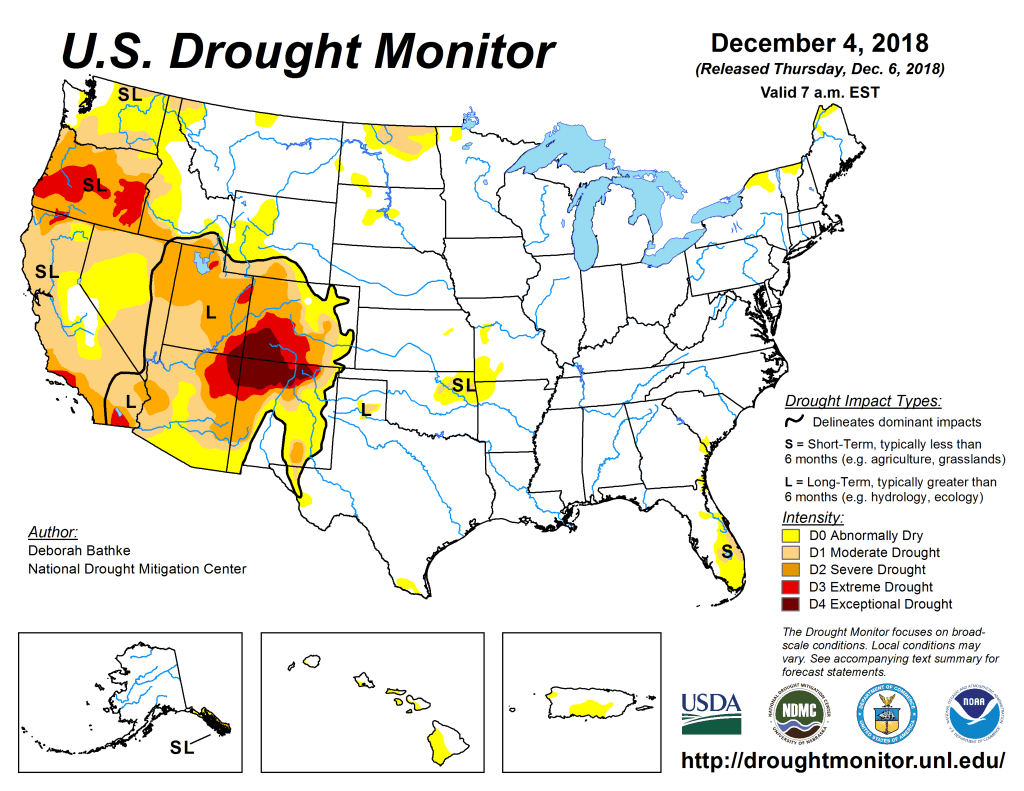
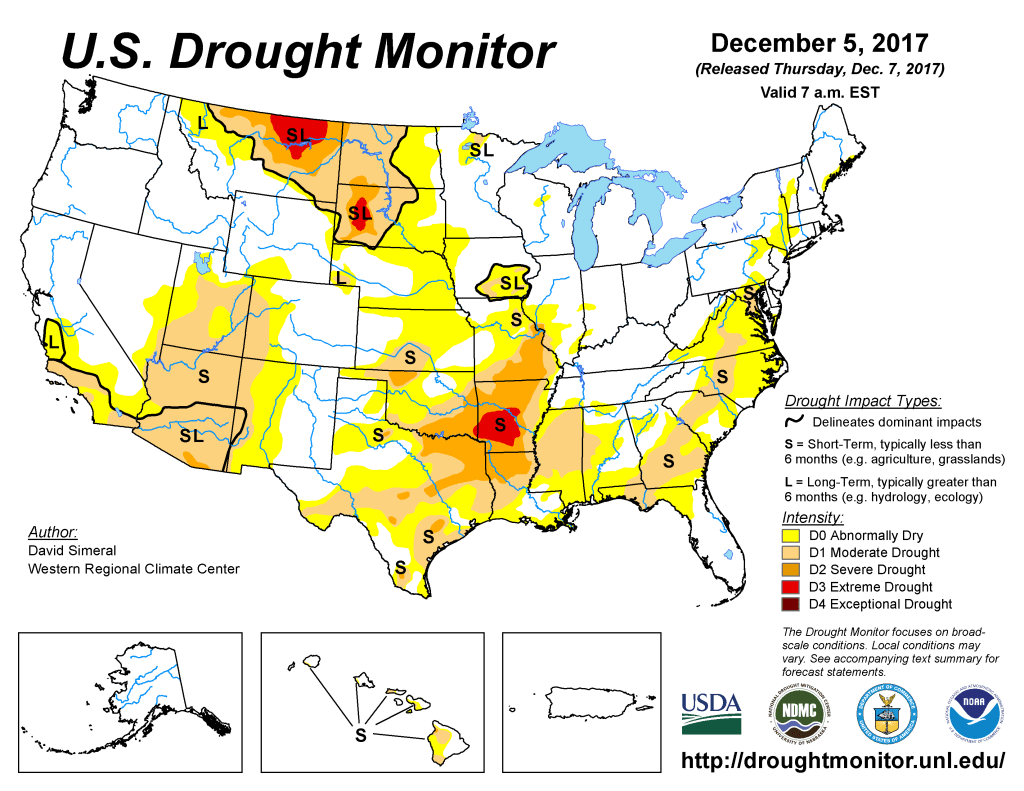
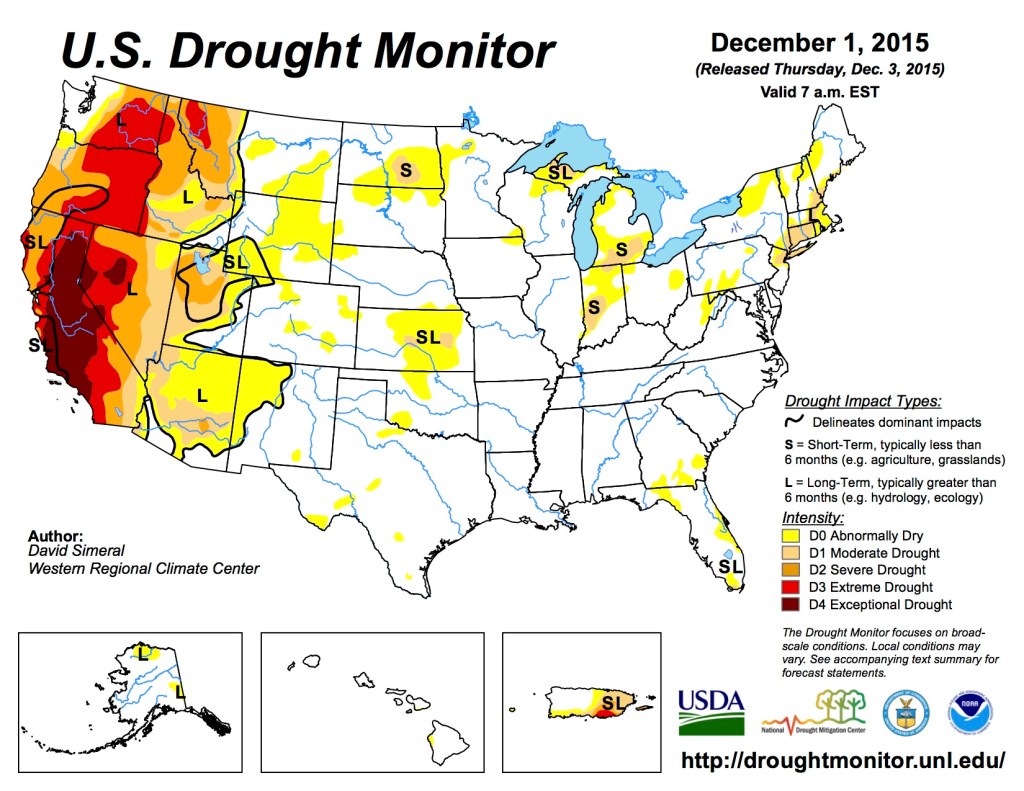
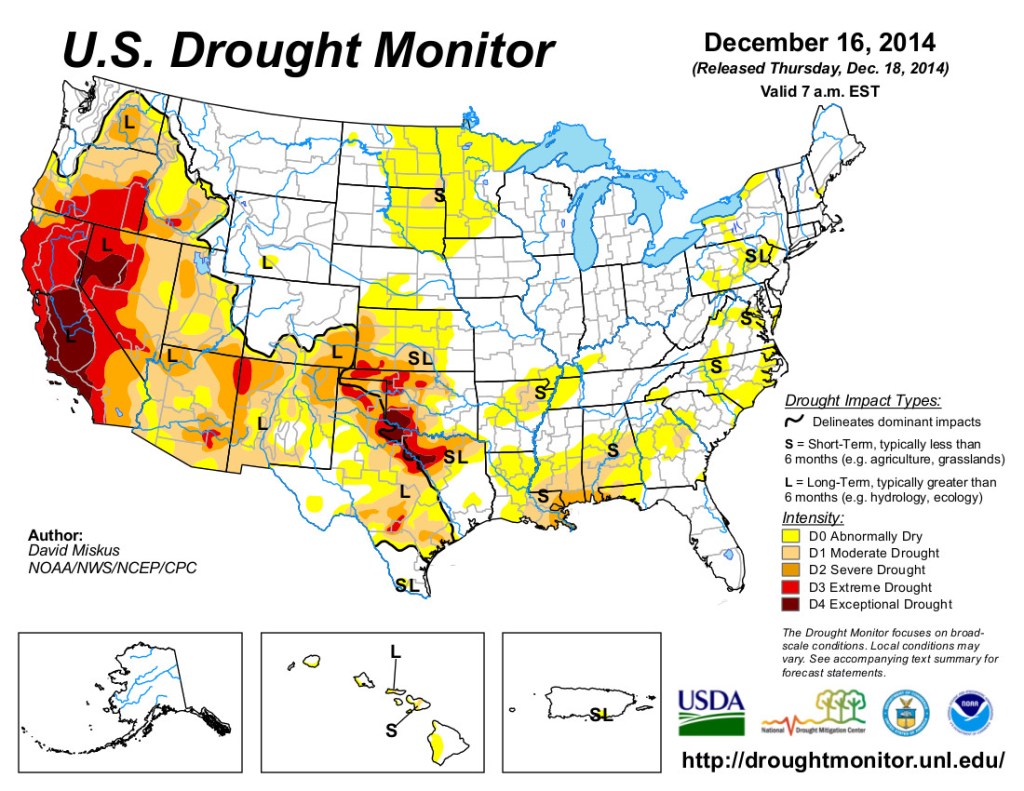
Click on a thumbnail graphic to view a gallery of drought data from the US Drought Monitor website.

Click the link to go to the US Drought Monitor website. Here’s an excerpt:

This Week’s Drought Summary

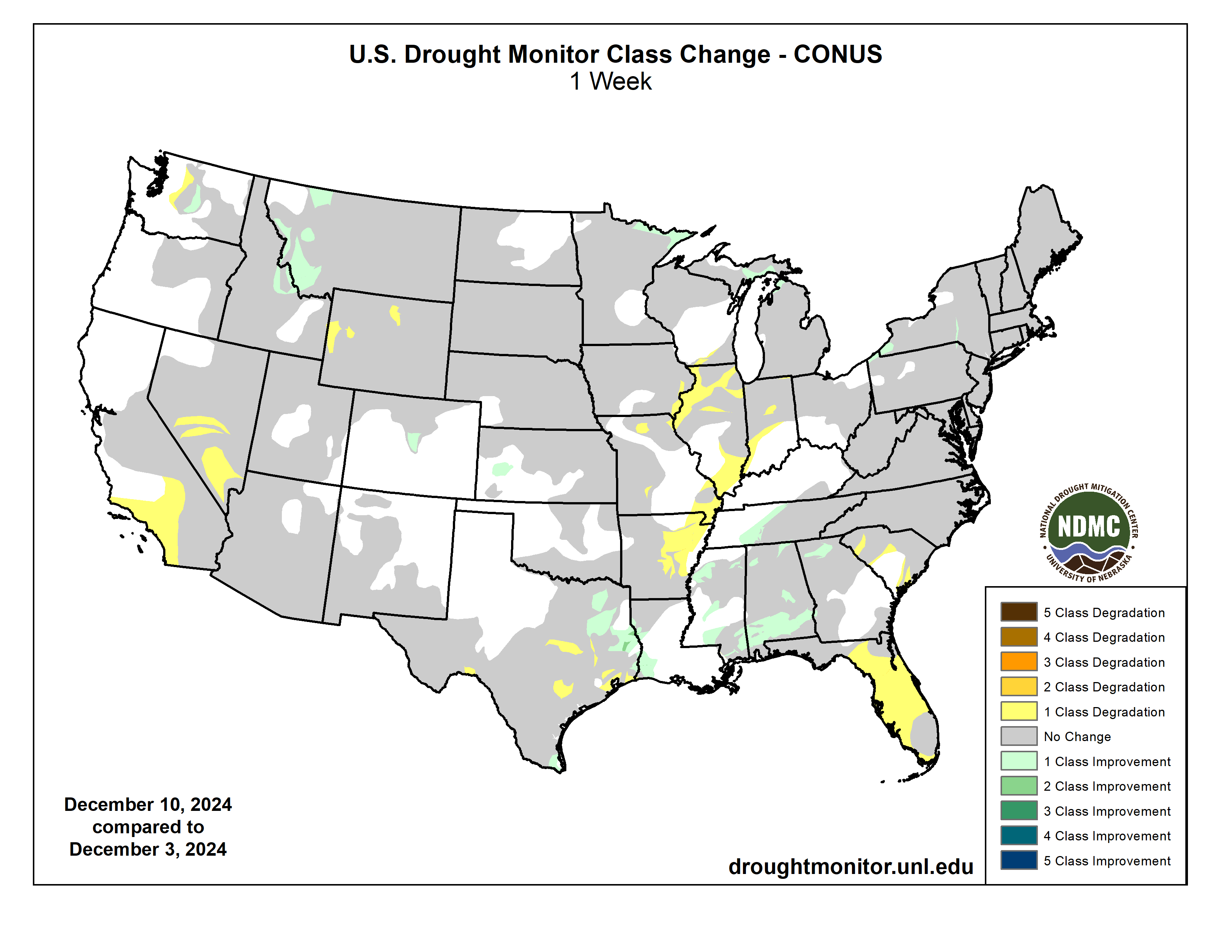
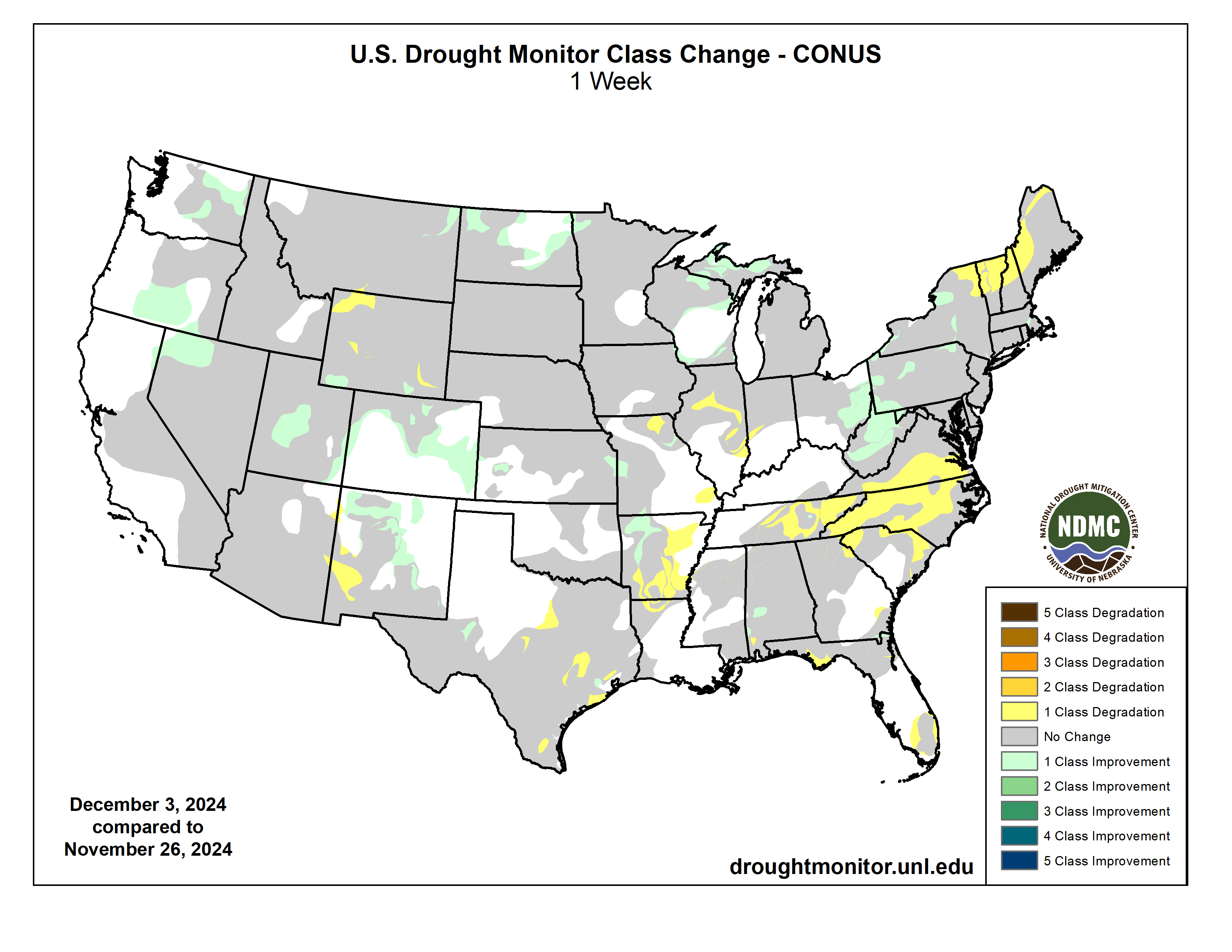
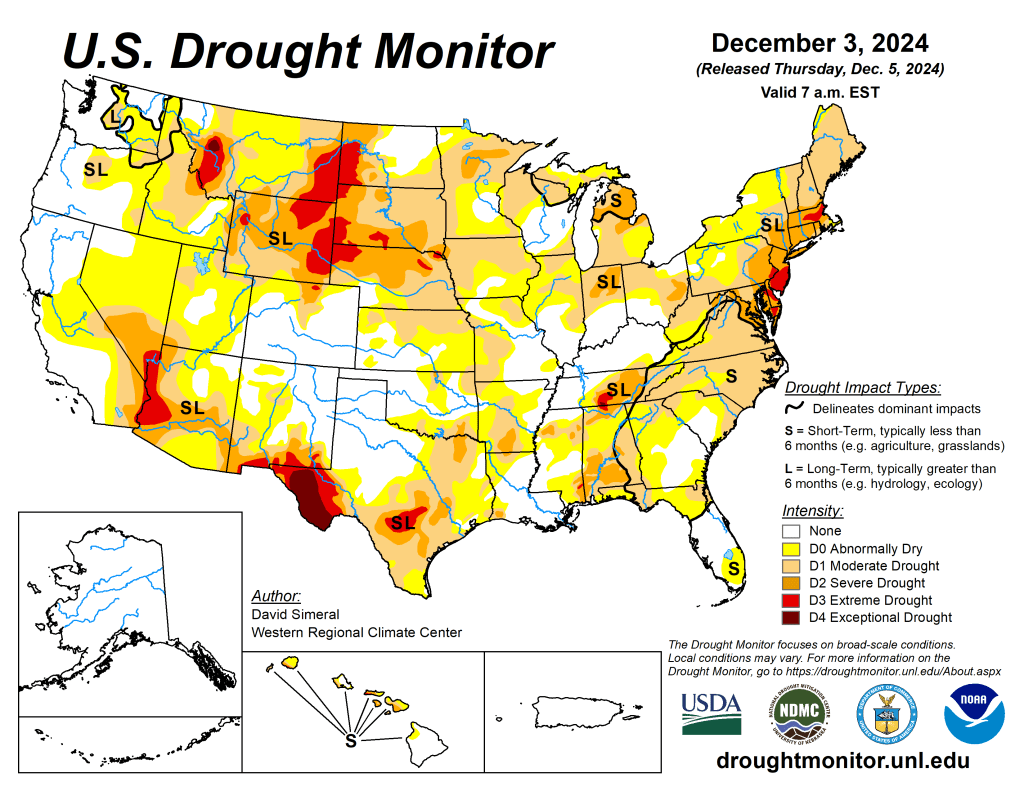
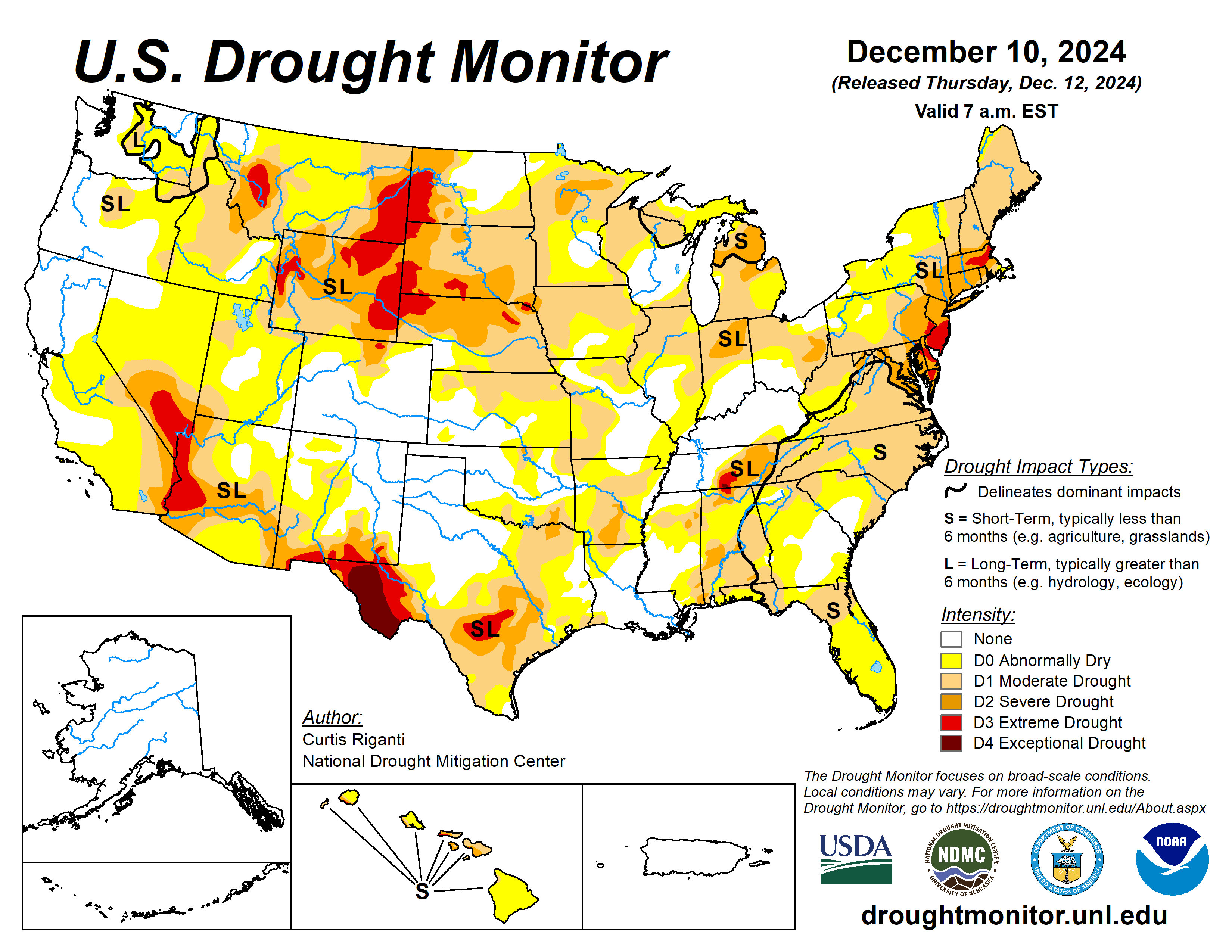
Rains, locally heavier, fell across roughly the east half of Texas this week, with heavier amounts (locally 4-7 inches) falling in parts of the central Gulf Coast region. Lighter precipitation amounts fell in parts of Mississippi, Alabama, Georgia and Tennessee, and in the Ohio River Valley. Snow, some of it lake effect, fell in parts of the Upper Great Lakes, and heavier lake effect snow fell downwind from Lakes Erie and Ontario. Most of the Great Plains and West was dry this week, except for high elevation areas of western Montana and northern Idaho and in western parts of Oregon and Washington. Degradations in drought conditions occurred in southern California and southern Nevada, parts of high elevation Wyoming, across portions of the Mississippi River Valley, in the Florida Peninsula and in parts of Texas. Generally drier weather in Hawaii led to widespread degradations as well, mostly on the windward sides of the islands. Improvements occurred in parts of east and deep south Texas, western Montana and central Washington, Mississippi, Alabama, Georgia and Tennessee, in the Upper Peninsula of Michigan and northeast Minnesota, and in Erie County, Pennsylvania and southwest and south-central New York…

High Plains

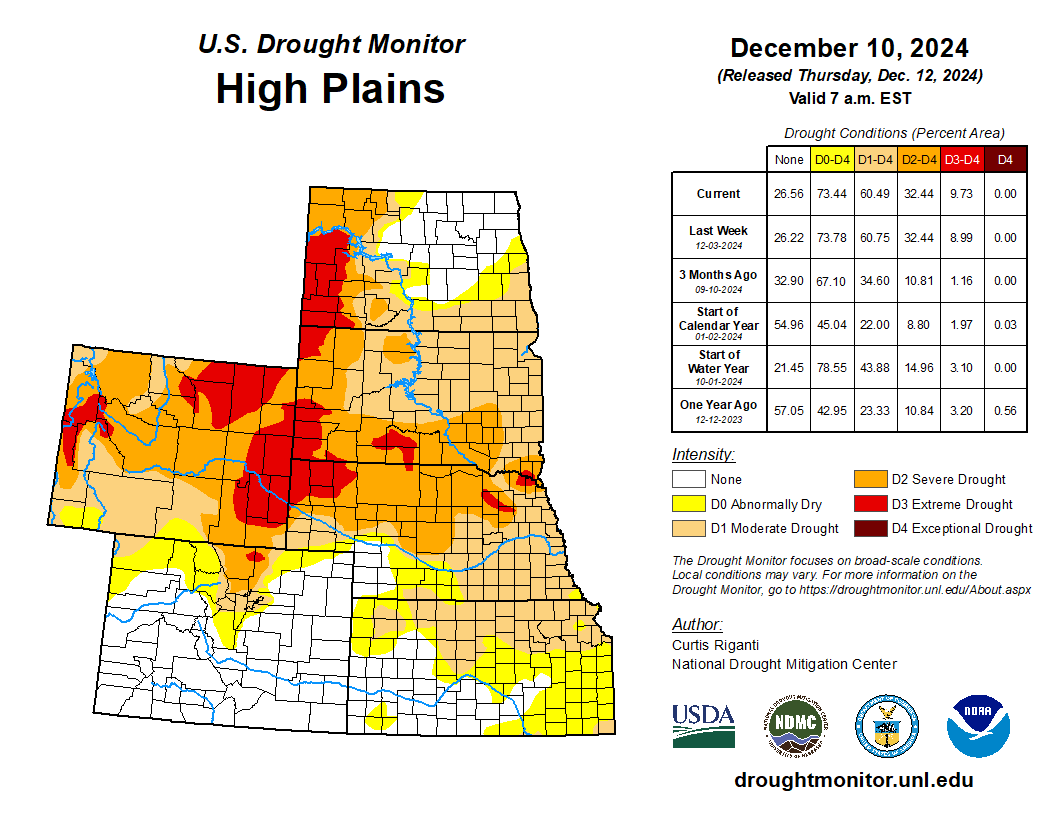
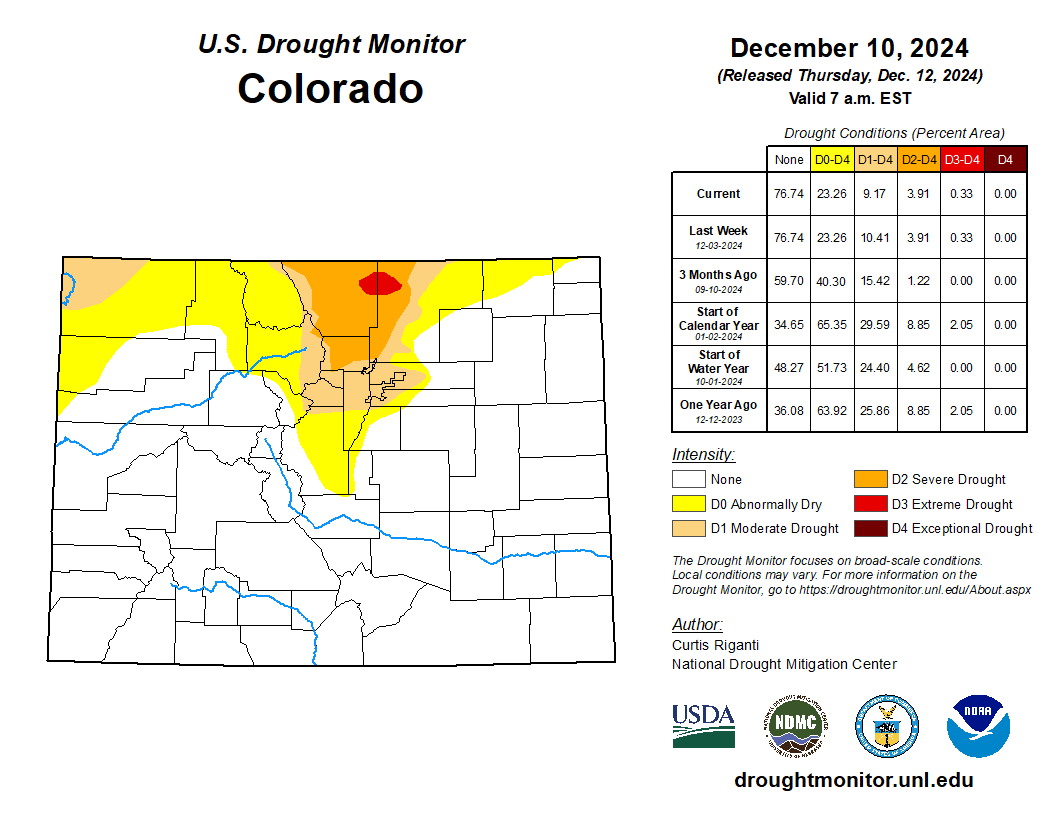
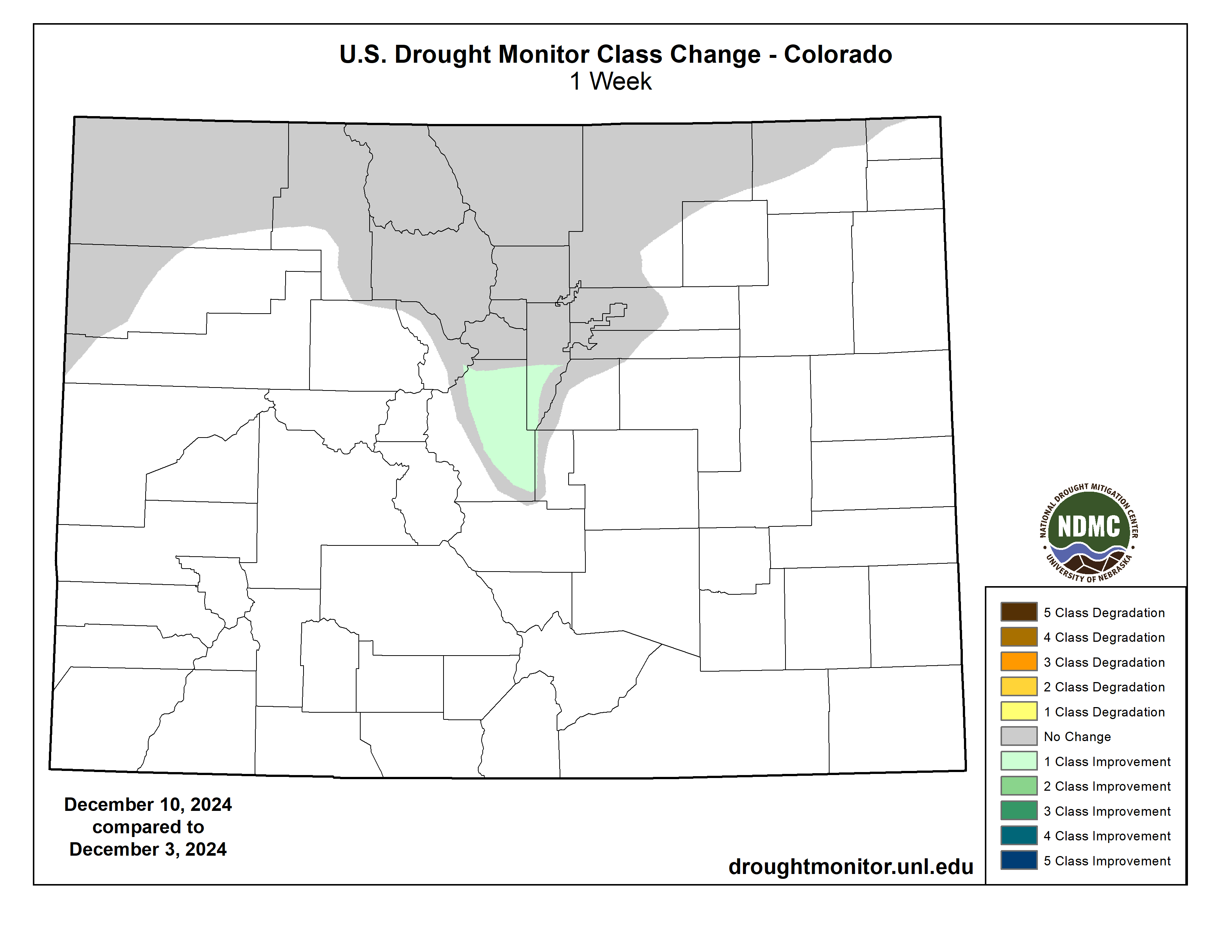
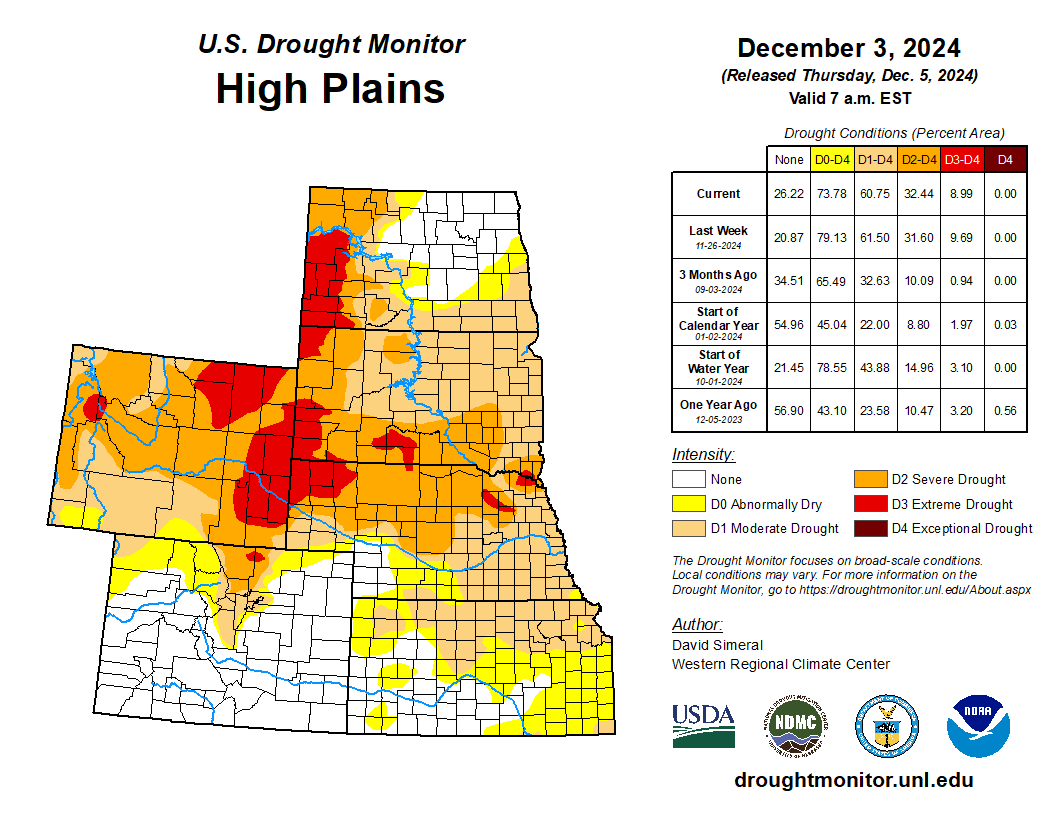
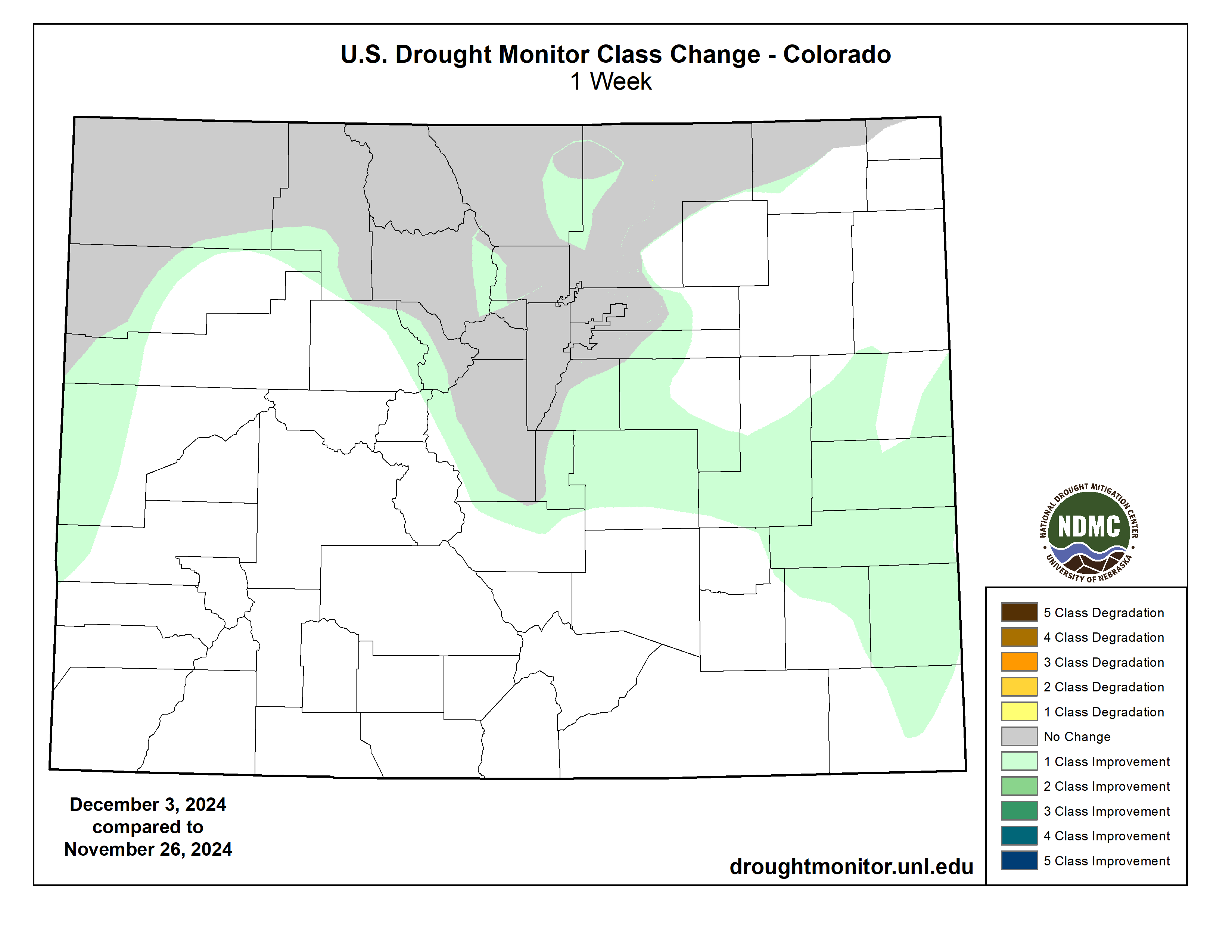
Except for parts of the Front Range of the Rocky Mountains in Colorado, weather across the High Plains region was mostly dry this week. Temperatures were primarily warmer than normal, ranging from 3-12 degrees above normal in most areas (with locally warmer readings). Drought and abnormal dryness coverage remained mostly unchanged. Moderate drought coverage was reduced southwest of the Denver area as precipitation deficits lessened there. Abnormal dryness was also removed from west-central Kansas after conditions were reassessed there following wetter-than-normal weather over the last couple of months. Well-below-normal early season snowpack and short- and long-term precipitation deficits led to expansion of extreme drought in parts of the Wyoming, Wind River and Bighorn mountain ranges in Wyoming. Water usage is currently restricted to essential use only, due to low well levels, in the communities of Auburn and Peru in southeast Nebraska, where moderate drought is ongoing…

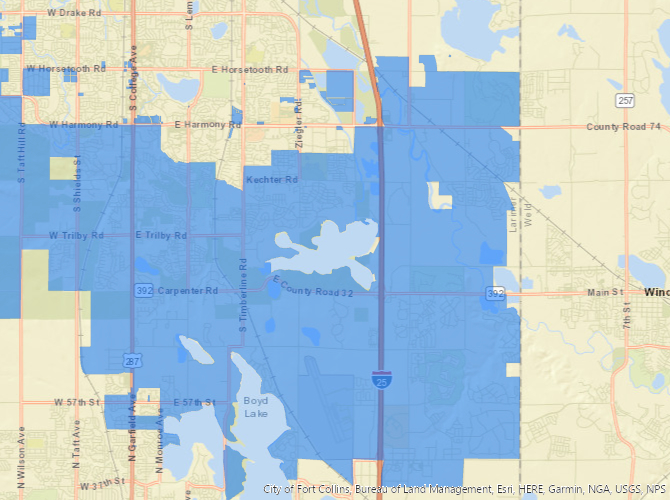
Colorado Drought Monitor one week change map ending December 10, 2024.

West

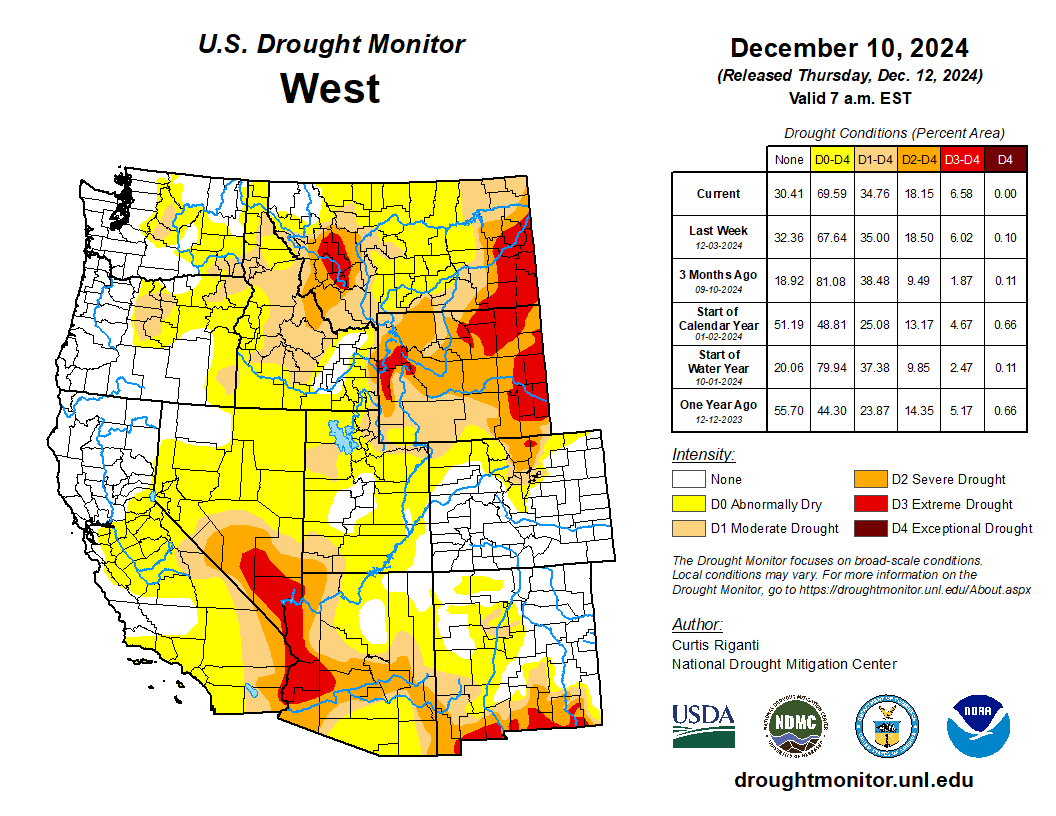
Primarily dry weather occurred in the West this week, except for western Washington, western Oregon, western Montana and northern Idaho. Most of the West finished this week either within 5 degrees of normal or 5-10 degrees warmer than normal. Central and eastern Montana saw widespread temperatures range from 10-15 degrees above normal. Widespread improvements to drought conditions occurred in western Montana and adjacent Idaho due to lessened short- and long-term precipitation deficits and increased soil moisture. In central Washington, small adjustments (both improvements and degradations) occurred in abnormal dryness and moderate drought areas where streamflow amounts and short- and long-term precipitation deficits changed. Short-term precipitation deficits continued to mount in southern and central Nevada and in southern California, leading to expansion of drought and abnormal dryness areas there…

South

Widespread rains fell across parts of the south this week, especially in eastern Texas, Louisiana, Mississippi and western Tennessee, while the rest of Texas, most of Arkansas, and Oklahoma remained mostly dry. Western Texas was mostly 3-9 degrees warmer than normal, while Mississippi was mostly near normal or 3-6 degrees below normal. In between these areas, temperature anomalies varied but were mostly within 3 degrees of normal. Due to lessened precipitation deficits and increased streamflow and soil moisture, drought areas were reduced in coverage in central Tennessee, parts of Mississippi, western Louisiana and parts of east Texas. Short-term precipitation and streamflow deficits continued to build in northeast Arkansas, leading to widespread expansion of abnormal dryness and moderate drought there. In parts of southeast and south-central Texas, conditions worsened where soil moisture and streamflow deficits grew amid growing precipitation deficits. In far southern Texas, heavy rains led to local improvements near the mouth of the Rio Grande. In Bexar County, Texas, certain types of fireworks were temporarily banned from sale or usage due to ongoing drought conditions, while lake and reservoir levels dropped to 20% capacity in the Corpus Christi area…

Looking Ahead

Through the evening of Monday, Dec. 16, the National Weather Service Weather Prediction Center is forecasting at least an inch of precipitation in the middle Mississippi River Valley, lower Ohio River Valley, western Tennessee, northwest Mississippi, eastern Texas, southeast Oklahoma, northern Louisiana and Arkansas. Precipitation of at least 1 inch is also forecast in parts of eastern New England and in a few areas downwind (east) of lakes Erie and Ontario. Heavy precipitation is also forecast in northern and northwest California and southwest Oregon, where locally up to or over 5 inches of precipitation is possible. At least 1.5 inches of precipitation is also forecast in many areas of western Washington and Oregon, while mostly lesser amounts are forecast in eastern Washington and Oregon and in parts of Idaho. The Southwest, western Great Plains, southeast Alabama, southern Georgia and the Florida Peninsula are forecast to remain mostly dry.

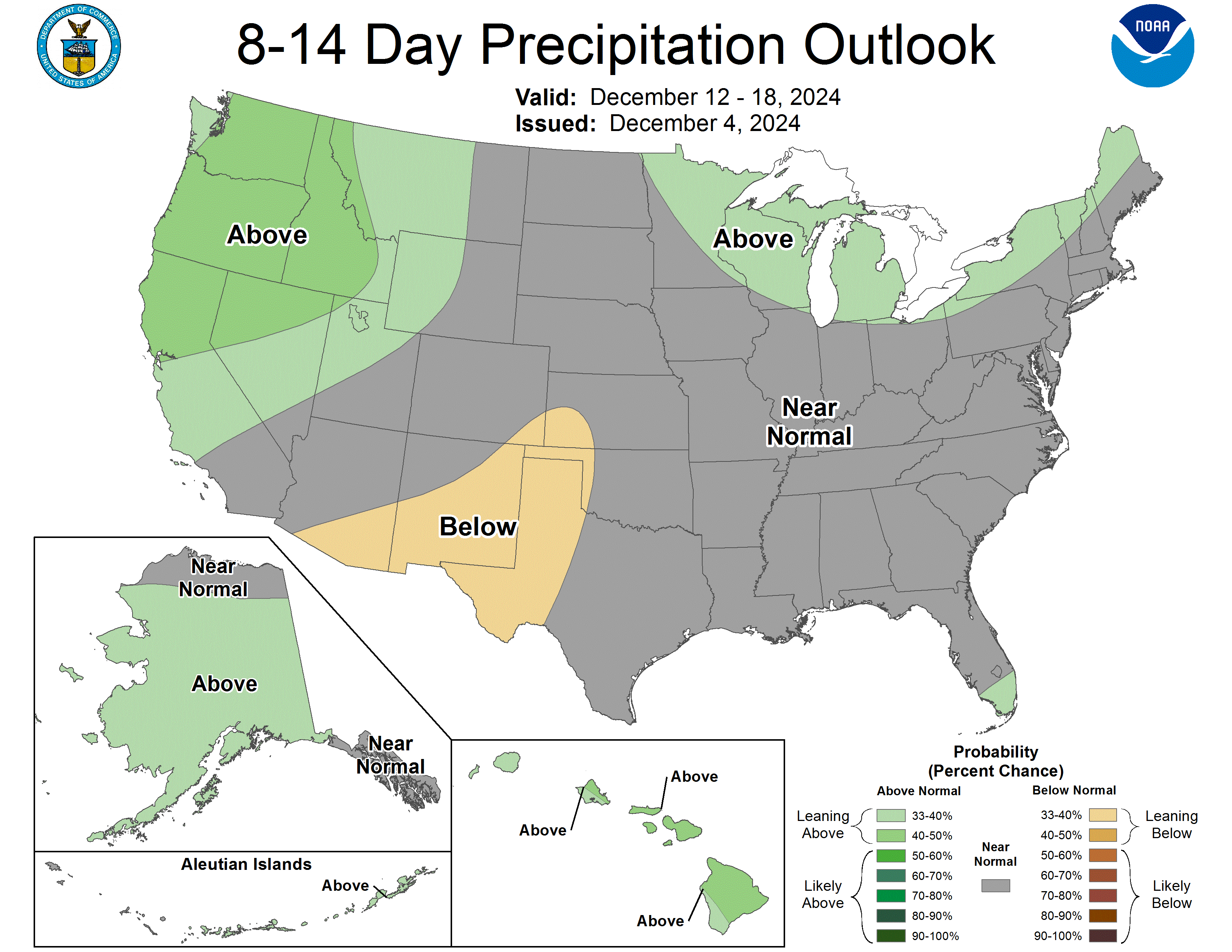
The National Weather Service Climate Prediction Center’s 6-10 day forecast, covering December 17-21, favors warmer-than-normal temperatures across almost the entire U.S., except for eastern Missouri, Illinois and parts of the Upper Midwest. Forecaster confidence is high for above-normal temperatures in the West, New England, southern Alaska and Hawaii. Precipitation amounts are likely to be below normal for this period across most of the central and northern Great Plains and the West, except for northwest Washington and Oregon, where above-normal precipitation is slightly favored. Above-normal precipitation is also favored in central and southern Texas, the Florida Peninsula, and the Atlantic Coast. Above-normal precipitation is also favored in southern Alaska, while drier-than-normal weather is favored in northern Alaska and in Hawaii.

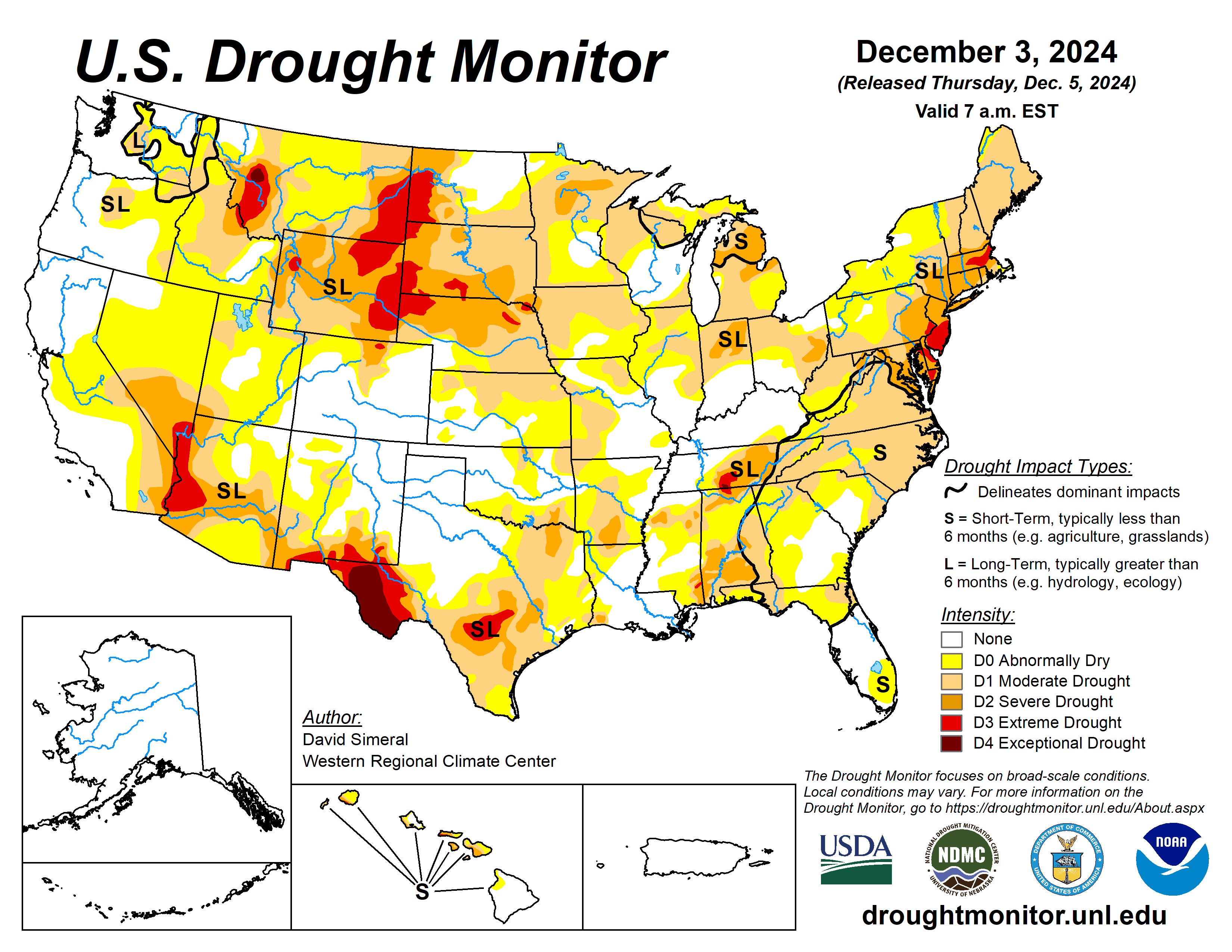
US Drought Monitor one week change map ending December 10, 2024.

Audubon Supports Northeastern #Arizona Indian Water Rights Settlement #ColoradoRiver #COriver #aridification

Golden Eagle. Photo: Daniel O’Donnell/Audubon Photography Awards

Click the link to read the article on the Audubon website (Jonathan Hayes and Haley Paul):

December 7, 2024

Congress can pass historic legislation to ensure three Tribes have the water they need to sustain their homelands

The Navajo Nation, the Hopi Tribe, the San Juan Southern Paiute Tribe, and other parties in Arizona have come to an historic agreement with the settlement now before Congress. The Northeastern Arizona Indian Water Rights Settlement Act of 2024—when passed by Congress and signed by the President—will ensure a reliable water supply for these Tribes in northeastern Arizona and the region.  

The agreement will do this in part by managing groundwater in the region, by settling long-running claims among in-state parties and the Tribes to the Little Colorado River, and by settling Tribal claims to water from the Colorado River.  

The settlement is the result of innovative and creative thinking among the Navajo Nation, the Hopi Tribe, the San Juan Southern Paiute, and other non-Tribal parties. The settlement provides flexibility for the Tribes to distribute water to their people. We note concerns raised by representatives of the states of Utah and Wyoming regarding the potential for this settlement to allow, within the state of Arizona, delivery of Colorado River water across the Upper Basin – Lower Basin divide. The Navajo Nation’s water management challenges are many; this geographic feature should not be one of them. Approving the settlement with this provision is crucially important to the Navajo Nation and should not be considered to set a precedent for other parties.  

The settlement not only replaces conflict over scarce water resources with cooperation, but it will also provide five billion dollars in funding to the Tribes so that they will be able to deliver safe and reliable drinking water to tens of thousands of people. This settlement is vital to the Navajo people because: 

  • Roughly a third of the Navajo Nation households lack running water. 
  • The average cost for Navajos to haul water to their homes, ranches, and sheep camps is $133 per thousand gallons, about 70 times more than the cost paid by other water users in Arizona. Without the settlement, thousands of Navajos will continue to haul water an average of more than 30 miles round trip to meet their daily water demands.  
  • The settlement provides certainty on the Colorado River to the benefit of all the 39 settling parties.  

It is long past due for these three Tribes to have the water they need to sustain their permanent homelands. Arizona, and the entire Colorado River Basin, will benefit from the certainty provided from this water settlement. 

Audubon’s focus on birds means we also prioritize the protection of the habitat they need. Riparian and riverside habitat is of outsized importance for birds and other wildlife. This habitat relies on healthy groundwater levels to sustain flowing rivers and streams and the rich plant life and wildlife they support. Groundwater sustains seeps and springs that provide not only water supplies to people, but also valuable habitat to birds and other wildlife. Likewise, the Colorado River and the Little Colorado River are lifelines in an arid environment. This settlement will help protect these precious water resources. 

In Navajo “Tó éí iiná até” means “with water, there is life.” At Audubon, we are guided by what birds tell us; and this is why much of our conservation work is targeted at finding win-win solutions for water for people and birds. We urge Congress to support the advancement of S. 4633/H.R. 8940 this session. This water rights settlement is crucial to ensuring the continued and the increased vitality of the Navajo Nation, the Navajo people, and all the Tribes and people in the Colorado River Basin who will benefit from this historic settlement. 

The Powell-Ingalls Special Commission meeting with Southern Paiutes. Photo credit: USGS

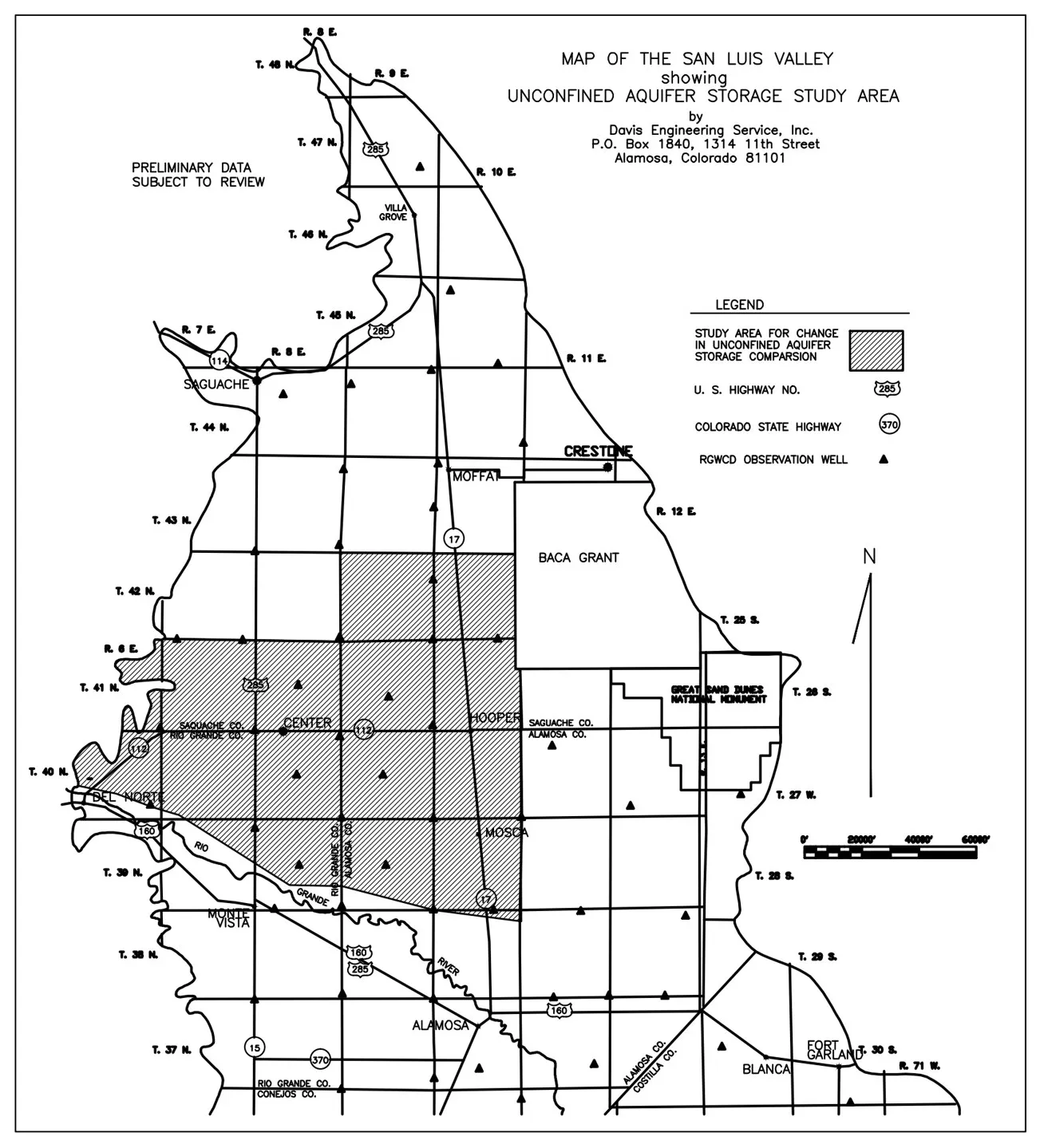
The complexities of a sustainable Subdistrict 1: Groundwater modeling expert discusses the nuances of one-for-one pumping and recovering groundwater levels — @AlamosaCitizen #RioGrande #SanLuisValley

Credit: Rio Grande Water Conservation District

Click the link to read the article on the Alamosa Citizen website:

December 8, 2024

Call it a meeting of the minds – Willem A. Schreüder, the CU computer scientist behind the groundwater modeling of the Upper Rio Grande Basin, and a group of San Luis Valley irrigators who are racing against time to reduce groundwater pumping in what state water engineers call “one of the most productive irrigated farming areas in the state.”

Schreüder spent more than an hour at a Dec. 4 meeting with farmers who form the governing board of Subdistrict 1 of the Rio Grande Water Conservation District. They wanted to know if the subdistrict’s upcoming Fourth Plan of Water Management, which calls for irrigators to limit their groundwater pumping to the amount of surface water that naturally flows in, is going to work. 

It’s called one-for-one pumping, and while the plan has been approved by the Subdistrict 1 board, the Rio Grande Water Conservation District board and the state engineer, it still needs sign off from the state water court, which likely won’t happen until 2026.

While all the Valley’s farmers face pressure to reduce groundwater pumping in the face of a changing climate, it’s the crop producers in Subdistrict 1 who are on the clock and under state orders to recover groundwater levels of the unconfined aquifer and maintain a sustainable irrigation water supply by 2031.

It’s Schreüder’s mathematics’ modeling that clues in the Colorado Division of Water Resources to the response the river system and aquifers are having through a steady reduction of groundwater pumping over the past two decades.

Schreüder’s expert witness testimony explaining the Rio Grande Decision Support System (RGDSS) model has been the subject of state water court proceedings and undoubtedly will be again in upcoming cases.

His session with Subdistrict 1 managers yielded a few insights, notably:

  • The recharge of streams should occur as close to the point of where the groundwater pumping occurred, a problem that has particularly come to light around Saguache Creek and the groundwater pumping that occurs in that area of the Valley.
  • The formation of the new Southern Colorado Water Conservancy District will complicate the RGDSS model in ways Schreüder still has to figure out.
  • As much as the RGDSS model can be useful in showing the response of the river to less groundwater pumping, there is always an imbalance even if irrigators are perfectly recharging the same amount as they’ve pumped out.

What follows is a partial, edited transcript of the conversation to get at some of the more pertinent questions. Jake Burris, president of the Subdistrict 1 board of managers, opened the discussion:

Burris: The first question I would throw at you is, the anchor of the amended plan, should we be successful, is that we would only pump imported water as it’s brought in. Live within our means, sort of speak. If that is the case, is it unreasonable to assume that we would not be generating any new depletions at that point?

Schreüder: New depletions anywhere, or a particular stream?

Burris: Anywhere, any stream.

Schreüder: So the short answer is ‘No’ in the sense that yes, we probably still will have the depletions, and what it comes down to is that the one-for-one plan essentially is one that deals with an average. So we’re looking at a districtwide or subdistrict-wide average balance, whereas when we talk about stream depletions, we’re talking about time, place, amount. And so it’s very easy to construct a hypothetical situation where if you look at where the pumping occurs and where the recharge occurs, that those recharges in pumping are not exactly coincident and as a result, the distance between where you recharge and where you are pumping basically directs depletions to a particular direction. And so what could very likely occur is that on one stream you actually have an accretion and on another stream you have depletion. So on average you tend to be sort of in balance with the surface network, but the people on the stream that is depleted, are not going to be happy. . .So unless the way that the one-for-one works is that the recharge occurs in exactly the place where the pumping occurs, you likely will have depletions to some streams.”

Burris: So it’s not just simply an issue from an administrative standpoint of us utilizing our recharge on an average. That’s irrelevant. It is a logistics and timing problem, regardless?

Schreüder: There’s both a temporal and spatial component to that. Think about for example, the depletions to the Rio Grande and I’m making up numbers here, but just to make the argument easier, let’s say 50 percent of your depletions occur in year one and then 30 percent in year two and 10 percent in years three and four. So it’s front-loaded as far as when the depletions occur, and you’re working on a five-year average and let’s say for those first five years, or first four of the five years, let’s say there’s negative 25,000 acre-feet of pumping to managed recharge. . .and then in the last year, year five, we basically have a 100,000 acre-feet of pumping in excess of recharge. So because half of that occurs in year one, and the offsets from two years and three years and four years and five years ago are lesser amounts, even though on the five-year average you are in balance, you could have a situation that on the Rio Grande in that first year after the big pumping you do not have an impact. So it’s both the temporal scale at which things happen, as well as the spatial scale. It’s also a reflection of where did that recharge occur and where did the pumping occur. If you average it out, they don’t fall right on top of each other.

Burris: The way the model then is I guess essentially looking at it for lack of a better way, but from a temporal and spatial standpoint, Sub 1’s aquifer itself is irrelevant. It’s not looking at it from a form of recharging an aquifer as a whole and recharging for all the wells as a conglomerate. It’s looking at the individual wells and the areas around each well?

Schreüder: As far as the model is concerned, yes.

Burris: I think that’s our big disconnect, or at least I should speak for myself there. The way Sub 1’s structured is with the way the aquifer system is and the way we treat the wells and recharges, it’s in totality. It’s as a conglomerate, and so you can’t take that perspective in any way to the model?

Schreüder: That’s right? And so there’s actually three parts to this. The first is as far as Subdistrict 1’s one-for-one is concerned, to a large part that’s going to address sustainability because what you put in and what you take out balances, that should be sustainable. So that’s the one part. The other part then, of course, is the groundwater modeling, which tries to figure out just exactly where the spring depletions occur. And then the third part to that is well, we need to calculate these response functions and the response function needs to capture the essential behavior of the model so that we have a simpler way of actually applying the inputs and predict what the depletions are. The problem that we are going to face in the future is that so far the response function approach has actually worked pretty well because what we found is that if you simply look at what the imbalance between pumping and recharge is in the ’90s and early 2000s, it did a pretty good job of predicting where the stream depletions would be if all you do is to calculate the net consumptive use and you run it through that function, and then you get the stream depletion prediction. But what if we go one-for-one and the next CU (consumptive use) is zero a lot of time, how are we going to figure out a response function that we can then use to predict what the stream depletion is? 

Burris: It is a possibility to reconsider conceptually how the model is I guess, the framework of the model? Or are we pretty much stuck with how the system is now, if that makes sense?

Schreüder: I think we are fairly confident in the framework of the model because it is able to reproduce what has happened historically pretty well. The question that we’re struggling with is ‘How do we ask the what-if question?’ Had there not been wells or had the wells only operated in a way where the pumping matched the recharge, what would the stream depletions have been? And that’s a little bit more tricky question that we need to answer now. In the past, because there was always an imbalance between pumping and recharge, it sort of worked out. But if we are actually finding that we are leaving the response function zeros a lot, and if the model does all of the superimposition of individual wells in terms of one answer, and then we average things and we run that sort of the response function, we don’t come up with that same answer, that’s the problem, right? That’s the definition of non-linear. Linear means if you have a function that translates an input to an output, all you have to do is average the inputs and the function will give you the same average on the outputs. Whereas in the non-linear system, if you run the individual items through the function and you then average the results, you don’t get the same answer. And that’s what we are struggling with. Will we be able to properly linearize that?

Burris: I’ll throw one more question at you and then I’ll let somebody else talk. What is the difference in impacts specifically, I’ll say, to Saguache Creek as far as the model sees them between unconfined wells and confined wells? Is the classification different in the model? Is the impact different, or are those treated the same sort of like we treat them the same in Sub 1?

Schreüder: They’re different in the sense that, because in the confined aquifer you typically have lower storage co-efficients, the columns of depression that accumulate for those tend to spread out wider and faster than they do in the unconfined aquifer. And so since the model basically just stacks all of those on top of each other and then calculates the total, it takes into consideration the fact that confined and unconfined wells behave differently. But as far as, can you tell me exactly how confined wells are, what the total is from confined wells and what’s the total from the unconfined wells? I’ve not tried to make that separation. We always just consider it in total because again, this is a non-linear system. So how you evaluate individual wells versus all of the wells in the subdistrict as a whole, if you add up all the individual wells, it doesn’t add up to the total for the subdistrict as a whole. So it’s a little difficult to make that clear distinction between the two.

Credit: Rio Grande Water Conservation District

The seventh iteration of the RGDSS model is being finalized by Schreüder, which led to this exchange with another of the Subdistrict 1 managers. The conversation also then delved into the new Southern Colorado Water Conservancy District.

Sub1 Board: When will we have, ‘This is the final seven version?’ Do we need to take action soon or can we wait a month or two for you to finalize it?

Schreüder: So I am hoping, we have a meeting on Dec. 17, I think is the date, and I’m hoping to finalize the model for that, or at least get people’s agreement that this is good enough that we should be moving on to the application of the model. So now we start asking the model questions, and it’ll probably be several months if not a year before we go from OK, we now have a model’ translating that into, do we ask the right question for each zone and then what are the response functions that are coming out of that? So it’s probably going to be at least a year before we have the answer that will apply for the next five or 10 years.

Sub 1 board member, on the Sustainable Water Augmentation Group known as SWAG: SWAG forming their own subdistrict and I guess trying to do it alone, how would you see that changing those fields and their new conservation district now outside of our subdistrict. Would that impact this data set?

Schreüder: Well, I guess to the extent that they do their own thing, they give us more site-specific information, we’ll try to incorporate that into the model. The difficult thing that we need to figure out is, ‘How do we deal with it separate from the rest of Sub 1?’ And that’s not going to be easy.

Sub 1 board member: Just clipping those wells out of our dataset, you’re saying it’s not just as straightforward as, ‘Hey, these ones are closer to Saguache and they’re no longer in the map.’ Does that help the math?

Schreüder: Well, and I mean that’s part of the problem, right, is it’s sort of obvious that yeah, those guys are probably having a bigger impact on Saguache Creek than the rest, but how do we actually run the model in such a way that we can actually quantify that? And that’s one of the problems that you have an nonlinear system, is if you start breaking it up into lots of little parts, the answer doesn’t sum up to the total and that becomes problematic in terms of how do you figure out what the total impact on the stream is and how to distribute that back to individual people? And it’s something that we’ve worked very hard to avoid, but they’re sort of forcing our hand and I don’t know exactly what the answers can be.

Sub 1 board member: You mentioned the substantial decrease in pumping over the last 10, 15 years in Subdistrict 1. Is there a scenario where if that were to continue or if wells were continuing to be retired in Sub 1, that that cone of depression would no longer reach Saguache Creek or we would no longer have applications in any scenario?

Schreüder: It’s that balance, right, between where the recharge occurs and where the pumping is. So if we basically do one-for-one and we can put the recharge exactly where we’ve pumped, then there should be no net cone of depression. And so that’s the problem, right? There’s always an imbalance, and so even if you are perfectly recharging the same amount as you are pumping, it’s always going to push the cone of depression in one direction.

Jake Burris: I once again will reiterate how appreciative I, and we are, that you’re willing to make the trip down here and talk to us. It was hugely helpful, at least for me, just the general perspective o,f it’s drastically different how we treat Sub 1 and administer it versus how the model sees it, I guess is how I’ll put it. But we do appreciate you taking the time.

Schreüder: Well, and again, let me just reiterate. The sustainability requirement, there’s the model’s predictions of impact, and then the response functions themselves, and the way that the response functions work right now, by definition, if you had no net CU (consumptive use), there would be no depletion. But that’s the existing response functions, and that’s one of the things that we need to figure out at the end of phase seven is, OK that particular model of response function is probably not going to work again. So what are we going to do to fix that?

San Luis Valley Groundwater

Seven states’ #ColoradoRiver negotiators, all at same conference, didn’t meet together: “Tensions are extremely high” — Elise Schmelzer (The #Denver Post) #CRWUA2024 #COriver #aridification

Las Vegas has reduced its water consumption even as its population has increased. (Source: Southern Nevada Water Authority)

Click the link to read the article on The Denver Post website (Elise Schmelzer). Here’s an excerpt:

December 6, 2024

Policymakers, academics, irrigators and water attorneys gathered in the Nevada desert this week to discuss the future of the highly contentious river that makes modern life possible for so many people across a vast swath of the American Southwest. The current guidelines that dictate how water is shared among the seven Colorado River basin states are set to expire at the end of 2026, and government leaders must create a new plan before then.

Udall/Overpeck 4-panel Figure Colorado River temperature/precipitation/natural flows with trend. Lake Mead and Lake Powell storage. Updated through Water Year 2024. Credit: Brad Udall

To do so, they must decide who will get less water — and when — as climate change shrinks the river’s flows.

“The tensions are extremely high this year,” said Tanya Trujillo, water policy advisor and deputy state engineer for New Mexico. “Of the 20 years I’ve been coming to this conference, this is the one with the least-good relations among the states.”

[…]

Carly Jerla speaking at the Colorado River Water User’s Association Conference December 5, 2024. Photo credit: USBR

The U.S. Bureau of Reclamation, which operates Lakes Mead and Powell, must create a new operating plan for the reservoirs before current guidelines expire at the end of 2026. The bureau is halfway through the process, said Carly Jerla, senior program manager at the agency. The bureau must complete environmental analyses of potential operating guidelines, take public comment and make a final decision by August 2026, she said.

“We need to be moving, as a basin, a lot faster in this second half than we did in our first half” of the process, Jerla said…

Upper Basin negotiators believe their basin should be exempt from mandatory water-use cuts imposed by the federal government because water use in the basin is already restricted by the amount of precipitation. While the Lower Basin can use water stored in Mead and Powell in dry years, Upper Basin states do not have large upstream reservoirs and must instead rely on snowpack and rainfall. Historically, the Upper Basin has never been able to use its full allocation of water, negotiators from the basin said. Water users in Colorado have their water cut off every year because there is not enough, Mitchell said. The Lower Basin must acknowledge those losses and recognize that the Upper Basin has been living with the impacts of climate change for years, she said.

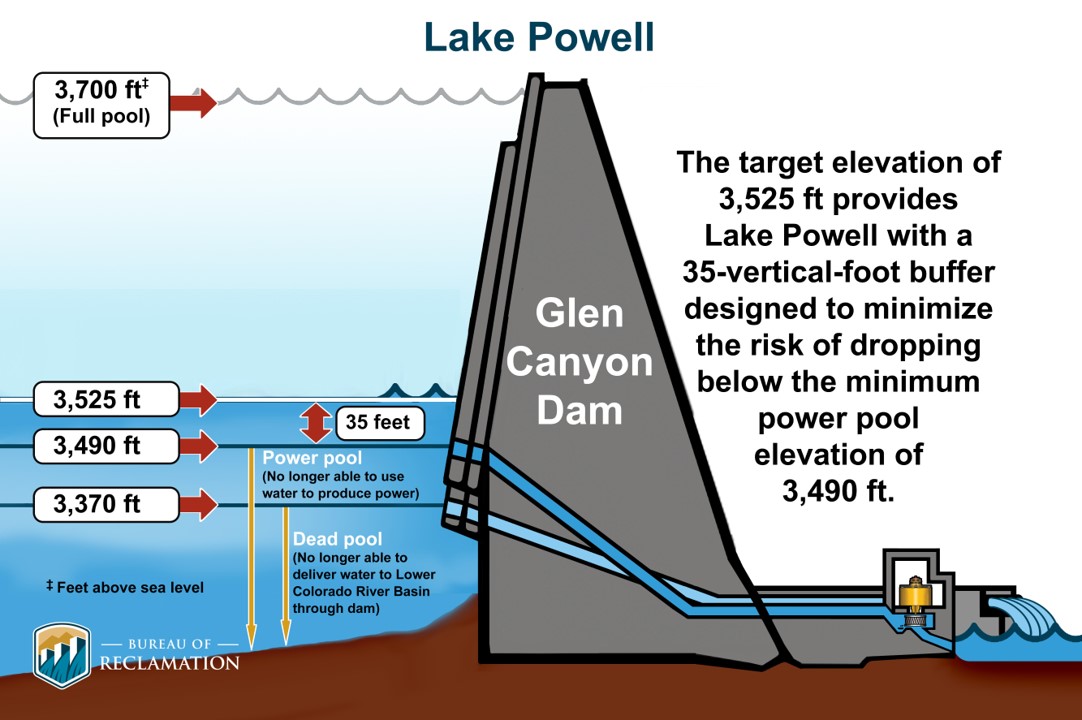
Lake Powell key elevations. Credit: Reclamation
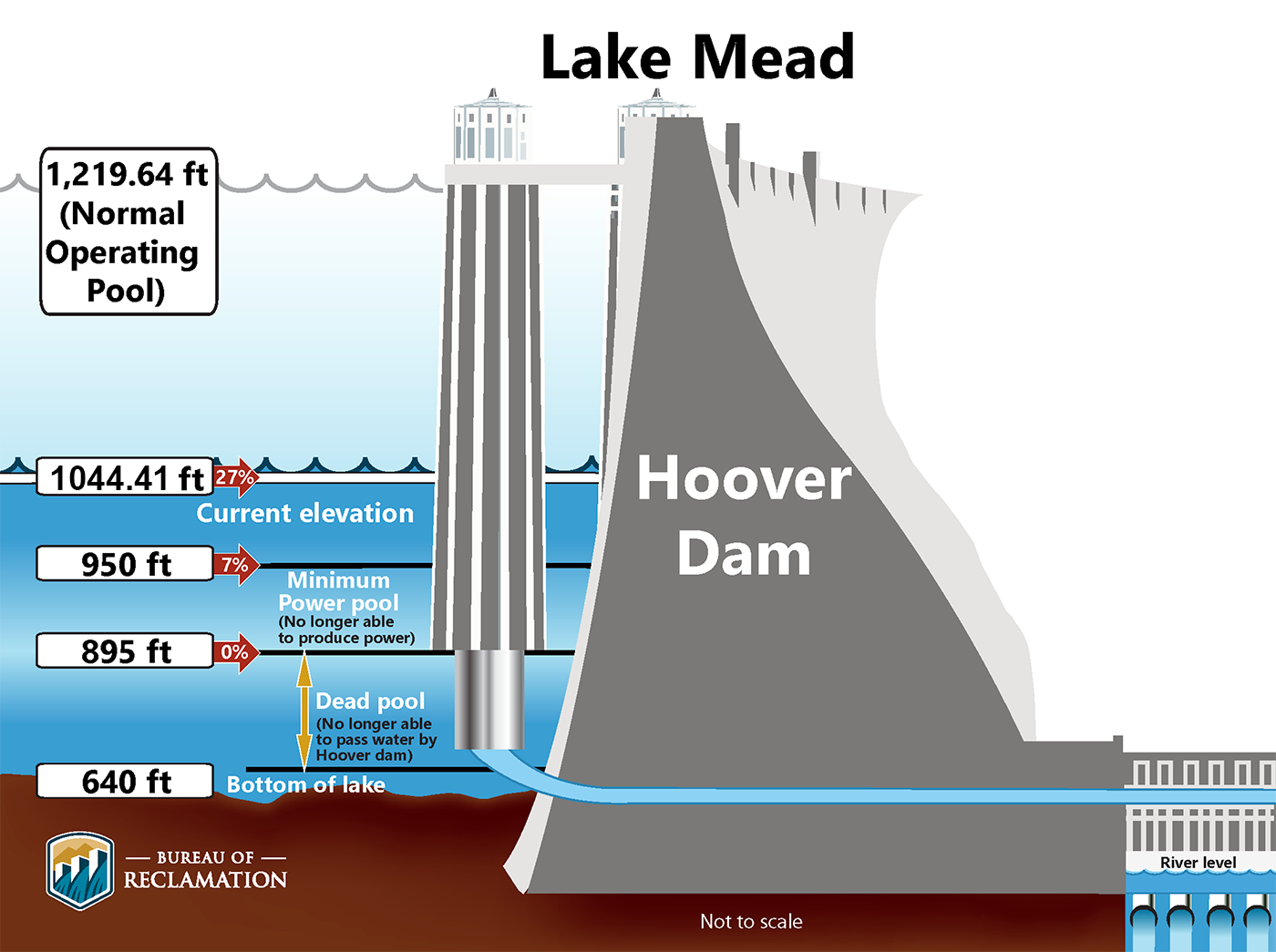
Lake Mead key elevations. Credit: USBR

Does our current approach to #ColoradoRiver accounting hide a looming problem? — John Fleck (InkStain.net) #COriver #aridification

NASA satellite images show water decline in Lake Mead from 2000, at left, to 2022, the largest reservoir in the United States. Credit: Colorado State University

Click the link to read the article on the InkStain website (John Fleck):

My colleagues with the Colorado River Research Group have a new policy brief out today taking another whack at the question of “assigned water” – water kinda sorta conserved, but left in storage so water agencies can pull it out again at some future date. Think “Intentionally Created Surplus” (ICS). At this point, nearly 40 percent of the water in Lake Mead is tagged as some agency’s private storage account, rather than being available for general system use.

This is the issue Arizona State’s Kathryn Sorensen (one of my CRRG colleagues) has been raising, and that Kathryn (with help from Sarah Porter and I) wrote about in October. The new CRRG paper argues that, as we move toward expanding the assigned water programs available to basin water users, we need to be mindful of the risks.

Map of the Colorado River drainage basin, created using USGS data. By Shannon1 Creative Commons Attribution-Share Alike 4.0

Deficit Spending — Jack Schmidt (Center for #ColoradoRiver Studies) #COriver #aridification

Click the link to read the article on the Center for Colorado River Studies website (Jack Schmidt):

December 3, 2024

Drawdown of the Colorado River’s reservoirs now slightly exceeds the amount of gain that occurred during the 2024 snowmelt season. For the next four months until snowmelt begins again, the basin’s reservoirs will be drawing from the excess accumulated in 2023, demonstrating the immense challenge in balancing water consumption with supply.

In Detail…

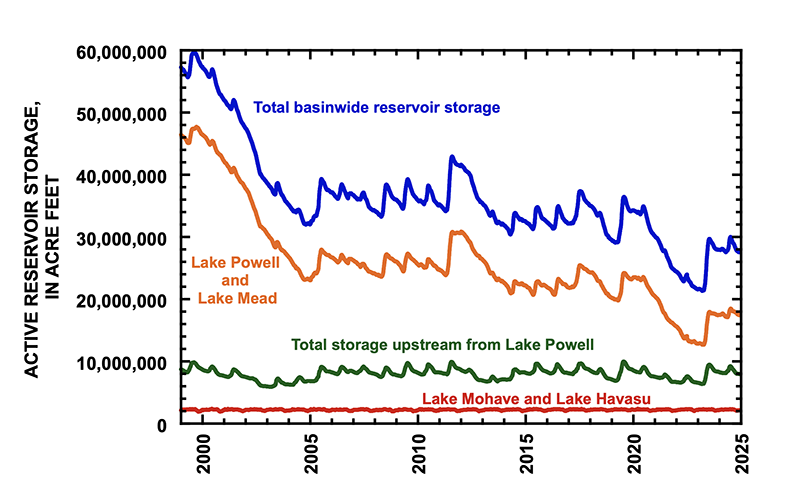
On 30 November 2024, total basin reservoir storage was 27.5 million af (acre feet)1, approximately two years’ supply at today’s rate of consumptive use and loss (Fig. 1). That amount is 43% of the maximum system contents of July 19832 and is the same amount as at the beginning of July 2021 when the basin’s water managers were beginning to get worried. Conditions are not quite as bleak as in summer 2021, because that year’s snowmelt season had already passed. Now, we can hope that the 2025 snowmelt season might be a good one. Nevertheless, reservoir storage is the bank account from which we draw to maintain the economy of the American Southwest and parts of northwestern Mexico. It would be preferable for there to be more water in that account.

Figure 1. Graph showing total storage in 46 reservoirs (blue line) in the Colorado River basin since 1 January 1999. Also shown are the total contents of Lake Mead and Lake Powell (orange line), total contents of Lake Mohave and Lake Havasu (red line), and 42 reservoirs upstream from Lake Powell (green line) which includes reservoirs managed by the federal and state governments, municipalities, and water districts. Credit: Jack Schmidt/Center for Colorado River Studies.

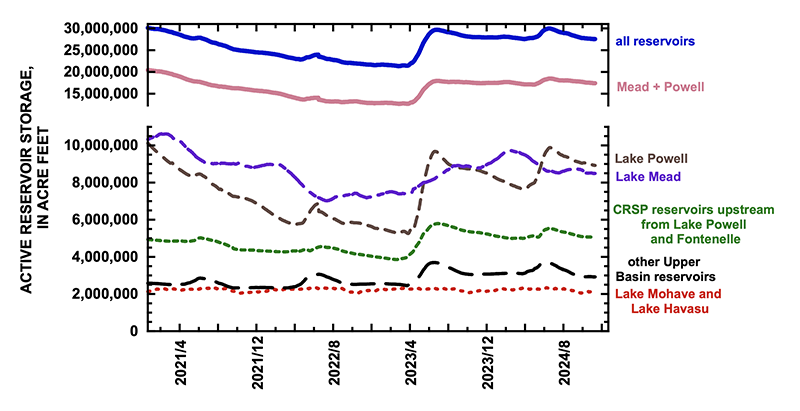
Approximately 63% of current total reservoir storage is in Lake Mead and Lake Powell. Presently, there is approximately 400,000 af more water in Lake Powell than in Lake Mead, but the contents of Lake Powell are slowly being depleted. The contents of Lake Mead held fairly constant during the past month. The contents of Lake Powell decreased by approximately 4300 af/day during November, but the contents of Lake Mead decreased by only 800 af/day (Fig. 2). Upstream from Lake Powell, Colorado River Storage Project (CRSP) initial unit reservoirs, as well as Fontenelle Reservoir, decreased by only 600 af/day in November, and other Upper Basin reservoirs lost even less (400 af/day).

Figure 2. Graph showing total basin reservoir storage (blue line), and storage in different parts of the Colorado River watershed between 1 January 2021 and 30 November 2024. Credit: Jack Schmidt/Center for Colorado River Studies

Basin reservoir storage must be increased to improve the security of our water supply. We need to increase the balance in our “bank account,” and the only way to do that is to spend less than the amount of our actual water “income.” Most of our income arrives during the snowmelt season of late spring and early summer. Mid- and late-summer, fall, winter, and early spring is the period when we spend the snowmelt-season income, although summer rains and groundwater inflow offset some of our uses.

Occasionally, we have an unusually snowy winter, and the basin’s reservoirs significantly refill. 2023 was one of those years. Reclamation estimates that the natural flow of the Upper Basin3 was 17.4 million af in 2023, the third largest of the 21st century (after 2011 and 2019), and total basin storage increased by 8.38 million af, only exceeded by the increase in storage in 20114. 2024 was a moderately snowy winter.

2024 was a different story, however. The NRCS estimated that the peak snow water content in 2024 was 14% greater than the 30-year average, but dry soils and other effects of a warming climate limited natural flows to between 11.9 and 12.1 million af, which is less than the average for the 21st century5. In 2024, the basin’s reservoirs increased in storage by 2.45 million af. The drawdown of the basin’s reservoirs as of 30 November was 2.46 million af, slightly more than the gain from snowmelt (Fig. 3). The contents of Lake Mead and Lake Powell increased by 1.39 million af in 2024, and the drawdown in those two reservoirs has been 1.07 million af this year. During the next four months, the basin will begin drawing from storage that accumulated in 2023.

Figure 3. Graph showing reservoir storage between 1 January 2023 and 30 November 2024, highlighting the amount of reservoir recovery during the past two snowmelt seasons and the amount of intervening reservoir drawdown. The drawdown of the basin’s reservoirs since July 2024 slightly exceeds the recovery that occurred due to snowmelt in 2024. Credit: Jack Schmidt/Center for Colorado River Studies

Drawdown of the basin’s reservoirs has been much greater in 2024 than in 2023. The amount of drawdown between early summer and today is slightly more than the median drawdown for the past 15 years6 and is 43% greater than the drawdown at this time last year (Table 1). The drawdown of Lake Mead and Lake Powell in 2024 is slightly less than the median for the past 15 years7 but is 98% greater than it was at this time last year.

The total reservoir drawdown between early summer and 30 November is now 14% greater than in all of last year, and drawdown in Mead and Powell also exceeds the total drawdown in those reservoirs last year (Table 2). We did well last year, but not so well this year. Credit: Jack Schmidt/Center for Colorado River Studies
Credit: Jack Schmidt/Center for Colorado River Studies

There are many details ignored in this overview. Reservoir drawdown in the Upper Basin is not only determined by consumptive use, but also by reservoir operating rules that require winter drawdown and by requirements to provide environmental flows. Water use in southern California is significantly affected by water supply available from northern California, the Owens River, and locally. Nevertheless, every drop of water released from upstream is used, lost, or stored in a downstream reservoir, and total basin storage is the only available supply to make up the shortfall between annual precipitation and annual use.

Conservation in the Lower Basin and in Mexico is reducing drawdown in Lake Mead, and the storage contents of Lake Mead are likely to increase during the next few months as water is delivered from upstream. Drawdown of the total contents of Lake Mead and Lake Powell is still 0.32 million af less than what accumulated there from the 2024 inflow season and a 2024 deficit might not occur is Lower Basin water use is drastically reduced or if Upper Basin reservoirs are emptied.

Efforts to date to reduce water consumption in the basin have been significant, and required a significant investment by the federal government. Despite those efforts, we have four months ahead of us before snowmelt in 2025 begins, and we are likely to begin deficit spending unless radical changes in use are immediately implemented. The challenge faced by the federal government, Mexico, the seven basin states, every tribe, and every water user is immense and is not solely restricted to negotiating the post-2026 agreements. We remain in a water crisis today, and the time to greatly reduce water consumption is right now in the present moment. [ed. emphasis mine]

  • [1] Basin reservoir storage is for 46 reservoirs reported by the Bureau of Reclamation in its Hydrodata base https://www.usbr.gov/uc/water/hydrodata/reservoir_data/site_map.html.
  • [2] There was 63.6 million af of storage in the basin on 15 July 1983. Some of this storage exceeded the generally accepted capacity of some reservoirs, notably Lake Powell.
  • [3] at Lees Ferry
  • [4] Basin reservoir storage increased by 8.78 million af in 2011.
  • [5] Natural flows for calendar year and water year 2024 were 12.1 and 11.9 million af, respectively, based on Reclamation’s 12 September 2024 estimate. The average natural flow at Lees Ferry between 2000 and 2024 was 12.4 million af/yr, based on Reclamation’s estimates.
  • [6] The median drawdown between the summer peak and 30 November during the past 15 years was 2.26 million af for the 46 reservoirs of the watershed.
  • [7] The median drawdown between the summer peak and 30 November during the past 15 years was 1.16 million af for the total contents of Lake Mead and Lake Powell.
  • [8]  Includes drawdown of Lake Mohave and Lake Havasu.
ten tribes
Graphic via Holly McClelland/High Country News.

How many species could go extinct from #ClimateChange? It depends on how hot it gets — National Public Radio #ActOnClimate

A kea about to land on a white vehicle, with wings outspread showing their orange underside. By klaasmerderivative work: CC BY-SA 2.0

Click the link to read the article on the National Public Radio website (Jonathan Lambert). Here’s an excerpt:

To consider how climate change could cause some extinctions, imagine a tiny mountain bird that eats the berries of a particular mountain tree. That tree can only grow at a specific elevation around the mountain, where it’s evolved over millennia to thrive in that microclimate. As global temperatures rise, both the tree and the bird will be forced to rise too, tracking their microclimate as it moves uphill. But they can only go so far.

“Eventually, they reach the peak, and then there’s nowhere else to go,” says Mark Urban, a biologist at the University of Connecticut.

Scientists call this mountain phenomenon the “escalator to extinction” and it’s just one way climate change is already squeezing plants and animals from their habitats. Researchers have conducted hundreds of studies projecting how different species might respond to different levels of climate change, finding varied results. In an analysis published Thursday in the journal Science, Urban sought to bring all those studies together…If countries meet the shared goal of limiting warming to 1.5 degrees Celsius, 1.8% of species will be at risk of extinction by the end of the century, Urban reports. But if global warming gets out of hand, warming four or five degrees Celsius, as many as 30% of species could be at risk…He points to confounding complexities in how species might respond to such climate extremes that scientists don’t yet know. More critters may simply not be able to cope, or ecosystems that lose species after species may collapse altogether. Additionally, many rare species are understudied, or not even discovered, and might be especially vulnerable in ways that don’t show up in this analysis…Different species face some different risks. Amphibians, including frogs and salamanders, are more vulnerable, Urban found, perhaps because their habitats are more sensitive to environmental changes. Species that live on islands, mountains and in freshwater could face more challenges, too. Targeted conservation efforts could help slow losses, Urban says, but they’re ultimately no substitute for reducing emissions.

Upper and lower basin states hit tough impasse at annual #ColoradoRiver conference — #Utah News Dispatch #CRWUA2024 #COriver #aridification

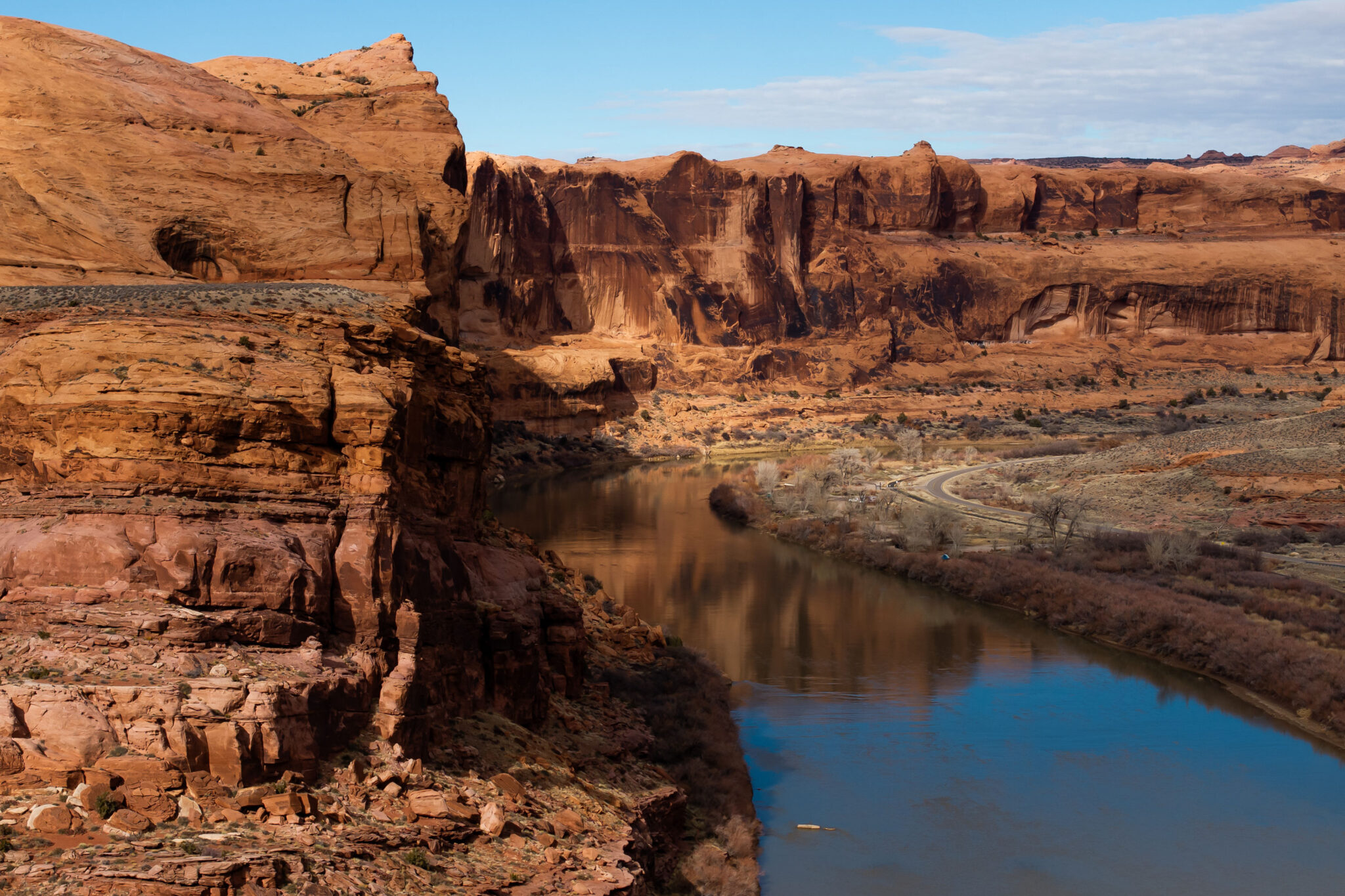
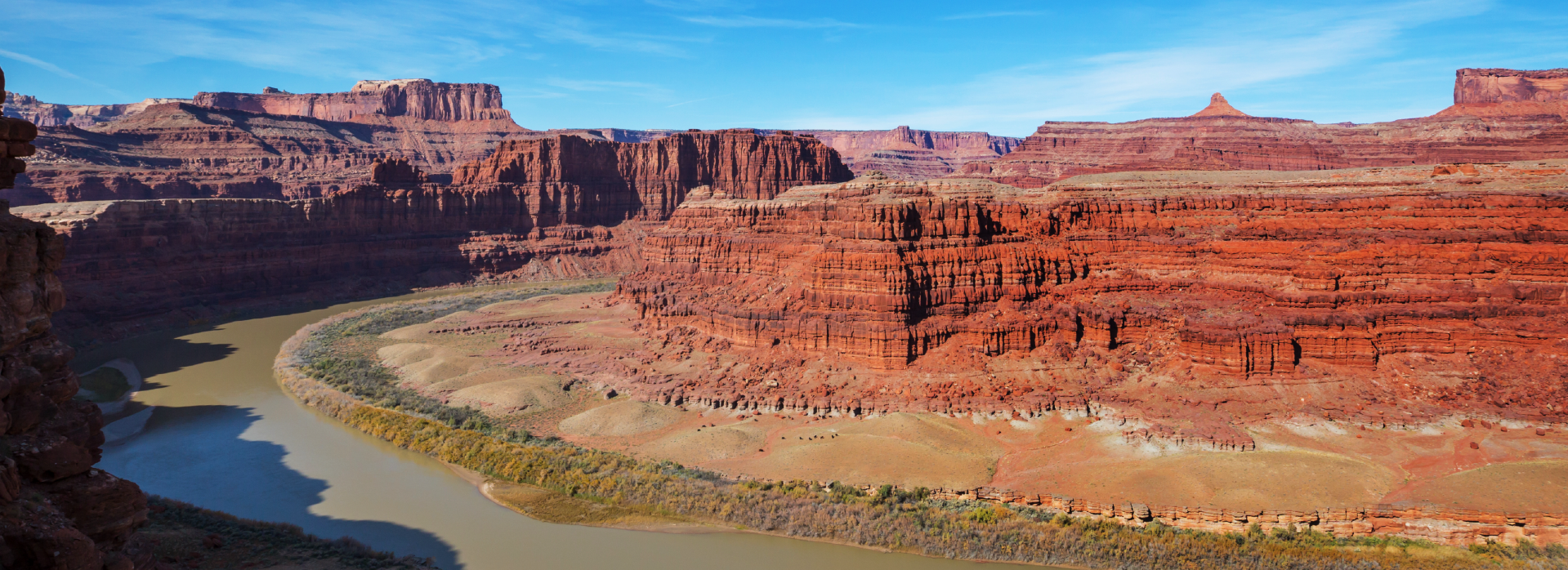
The Colorado River is pictured near Moab on Sunday, Feb. 18, 2024. (Photo by Spenser Heaps for Utah News Dispatch)

Click the link to read the article on the Utah News Dispatch website (Jennifer Solis):

December 8, 2024

Western states that rely on the Colorado River are in a heated deadlock over how to manage the troubled river, and are doubling down on their own regional plans, despite growing pressure from the federal government to reach a compromise.

Top water officials for the seven Colorado River Basin states — Arizona, California, Nevada, Colorado, New Mexico, Utah, and Wyoming — gathered for the Colorado River Water Users Association conference at the Paris Hotel and Casino in Las Vegas Thursday.

But for the first time in years, representatives from Lower Basin states — Nevada, Arizona, and California — and Upper Basin states — Colorado, New Mexico, Utah, and Wyoming — did not appear on a panel together or meet during the conference to negotiate the future of the Colorado River.

“It’s been customary that we get together beforehand,” said Colorado River Commissioner for Colorado, Becky Mitchell, during a news conference. “Unfortunately, we weren’t able to do that. I don’t think that means that we will never be able to do that again. It just means this time we weren’t.”

Map of the Colorado River drainage basin, created using USGS data. By Shannon1 Creative Commons Attribution-Share Alike 4.0

Nine months ago, the two basins submitted competing water management plans to the federal government after state negotiators could not reach a consensus on how to share the river’s dwindling water supply.

Since then, the basin states have not moved any closer to negotiating a compromise on how to equitably share and cut Colorado River water use once current management rules expire in 2026, leaving states up a creek without a paddle.

One of the biggest sticking points between the two basins is whether or not Upper Basin states should absorb mandatory water cuts during dry years, despite using significantly less than their 7.5 million acre-feet Colorado River allocation year-after-year.

Historically, Lower Basin states have used nearly all their 7.5 million acre-feet Colorado River allocation under the 1922 Colorado River Compact, compared to the 4.5 million acres-feet used by the Upper Basin states.

Lower Basin states argued all seven states should share water cuts during dry years under the new post-2026 guidelines. If they don’t, downstream states warned they could face water cuts they can’t feasibly absorb.

Those tensions were reflected Thursday when Lower Basin water managers told a ballroom full of water managers, researchers, agricultural producers and others from across the drought-stricken river that if their Upper Basin counterparts did not sign onto the Lower Basin plan and accept cuts, they would be at greater risk of triggering a “compact call,” which could force cuts on the Upper Basin.

Upper Basin states argue they don’t have the legal authority to significantly reduce flows to water users on their own under the 1922 Colorado River Compact, unlike Lower Basin states.

“They might have that authority if we make a compact call. So perhaps we’ll make that compact call, then they’ll have the authority to cut flows,” said Tom Buschatzke, Arizona’s top Colorado River negotiator. “Maybe that’s an easy path compared to going to their water users with some voluntary program or their legislatures to get authorities to do the things we have to do in the Lower Basin.”

In September, Buschatzke asked Arizona Gov. Katie Hobbs to set aside $1 million for litigation in the event states can’t reach a compromise and Arizona needs to take the issue to court.

“I have to do my due diligence for all potential outcomes,” said Buchatzke about his request.

Negotiators in both the Lower and Upper Basin states all acknowledged they have three options to decide how states will share the river’s waning water supply going forward: litigation, legislation or negotiation.

“When we put forward our Lower Basin alternative, we were looking to offer a compromise,” said JB Hamby, Colorado River Commissioner for California. “We want a seven state agreement. We don’t want to have to go litigate stuff and force these really difficult outcomes in the Upper Basin.”

Mitchell, the Colorado River Commissioner for Colorado, was critical of how the Lower Basin states have approached negotiations with the Upper Basin.

“I think going in, not willing to change your deal at all, is probably the first problem. You cannot say there’s a compromise, if we have to accept a deal in its entirety,” Mitchell said, adding that Upper Basin states are open to adjustments to their plan.

To spur a compromise, the federal government released an initial outline detailing four different river management options last month, including a hybrid management option that blends components from both basin state plans.

Representatives for both camps said they would need to see more details before throwing their weight behind any of the federal management proposals.

“They did provide a bit of additional information today as to some of the elements, but still not enough,” said Estevan Lopez, New Mexico’s representative on Colorado River matters, during a news conference Thursday.

Representatives for the U.S. Bureau of Reclamation said the agency intends to publish a more detailed analysis of the federal proposals by the end of the year. Maximum cuts could range from 2.1 million acre-feet to 4 million acre-feet, which could be divided based on who has the oldest rights, or distributed proportionally across all seven states.

Despite the lack of comradery among the Lower and Upper Basin states at the annual conference, both camps expressed optimism they could reach a compromise, eventually.

“I want everybody from the upper basin to hear from Nevada: We believe compromise is possible. We think it’s the first, second and third best option. But we need a dance partner, so let’s get back to the table and make this happen,” said John Entsminger, Nevada’s representative on river issues and general manager of the Southern Nevada Water Authority.

Mitchell said it was clear to her from panel presentations during the conference that all seven states want to reach a consensus plan on how to manage the future of the Colorado River.

“I think there’s still a possibility. I’m still hopeful. And I think if we want a seven state consensus, we’re going to have to have seven leaders come to the table,” Mitchell continued.

Brandon Gebhart, Wyoming’s state engineer and Colorado River negotiator, said he believes the seven Colorado River Basin states can come up with a better management plan than one imposed by the federal government, although “it won’t happen next week.”

Udall/Overpeck 4-panel Figure Colorado River temperature/precipitation/natural flows with trend. Lake Mead and Lake Powell storage. Updated through Water Year 2024. Credit: Brad Udall

“We really need to understand that the enemy we’re battling right now is not the Upper Basin, it’s not the Lower Basin. It’s hydrology,” Gebhart said.

Nevada Current is part of States Newsroom, a nonprofit news network supported by grants and a coalition of donors as a 501c(3) public charity. Nevada Current maintains editorial independence. Contact Editor Hugh Jackson for questions: info@nevadacurrent.com. Follow Nevada Current on Facebook and X.

Coyote Gulch’s excellent EV adventure: #Colorado, I’m coming home

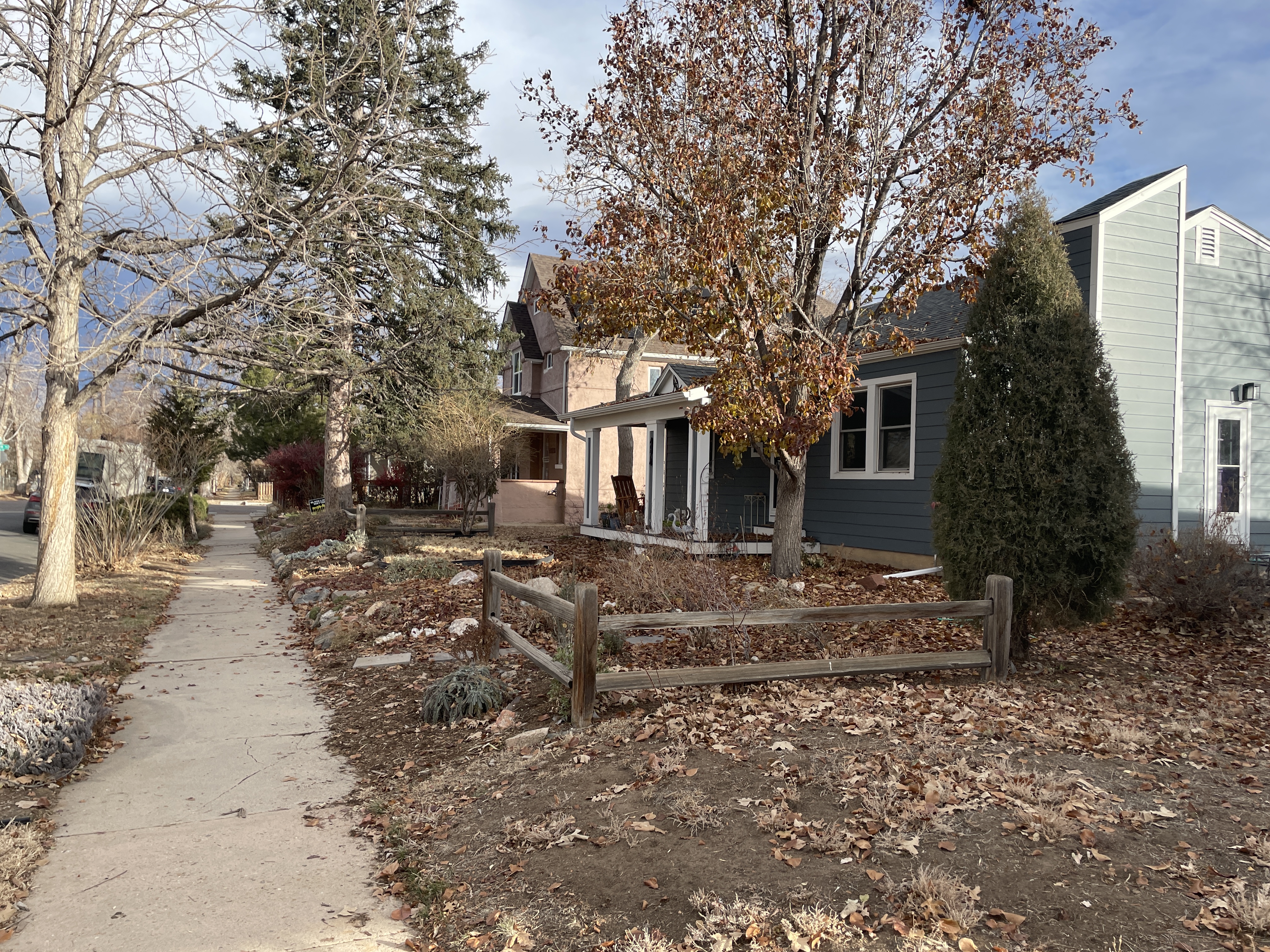
Mrs. Gulch’s landscape December 8, 2024.

The Great American meditation
Two hands on the wheels two eyes on the road
Truck-stop sunsets and filling stations
That′s what you see when you’re always on the go

But I′m headed home
Colorado, I’m headed home
Colorado, I′m headed home

— Excerpt from Daniel Rodriquez’s, “Colorado”

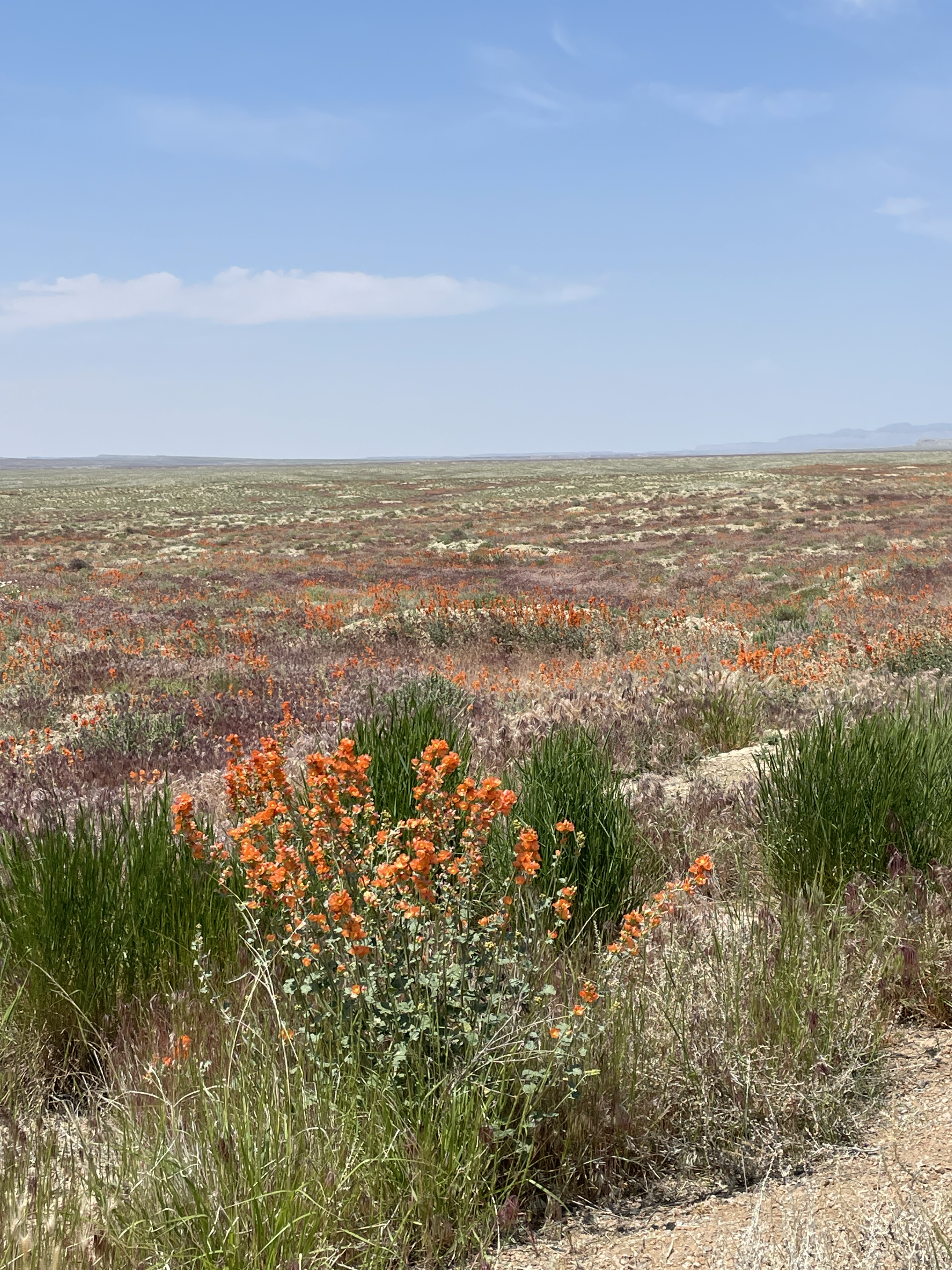
Superbloom along Utah-128 May 22, 2023. A species of globemallow (I think) in the foreground.

I have to respectfully disagree with Daniel over the notion that taking those long highway treks are a meditation. When I meditate I try to clear my mind and the highway does not fit that bill. I think of a thousand things and with a nod to Gurdeep Pandher of the Yukon I try to use the tools that keep the thoughts positive. Mrs. Gulch tops the list of course, but those great hikes, reminiscing about family, canyons, flowers, trees, mountains, the big rivers in the Midwest, the wild rivers in the West, all creep into my head. Of course there’s the road trips with Mrs. Gulch starting that first summer when we moved into my VW Bus and the last trip where we followed the Colorado River from Rocky Mountain National Park to Moab.

Anyway, I logged 3,239 Google miles on the journey and visited 9 states. Hellchild was along for the long leg of the trip so there is yet another family road trip to log into long-term memory and chat about.

I took the collection of essays “Water Bodies: Love Letters to the Most Abundant Substance on Earth” along and it is one of the most inspiring reads the I’ve known. Laura Paskus’ introduction drew me in and the other authors and poets left me wanting more at the end.

Gertie and Frank Turner on their wedding day.

One of the essays dealt with place and I believe Denver is that place for me. Four generations of my family have lived on the Northside since the end of the 19th Century. Gertie’s family gave up on dryland farming in Wyoming and Frank’s family moved down from Jamestown, likely with the collapse of the silver market beginning in 1893.

Frank told Gertie in 1906, “There’s been a terrible earthquake in San Francisco and they are paying top wages for workers. I will go out there and work and save for a year, and then we’ll be married.”

He returned in 1911 with no dough in his pockets. He did bring back his memories of hopping trains and the Northwest’s forests and rivers. They finally tied the knot.

#ColoradoRiver states bluster and bicker ahead of an uncertain future for the water supply — Alex Hager (KUNC.org) #CRWUA2024 #COriver #aridification

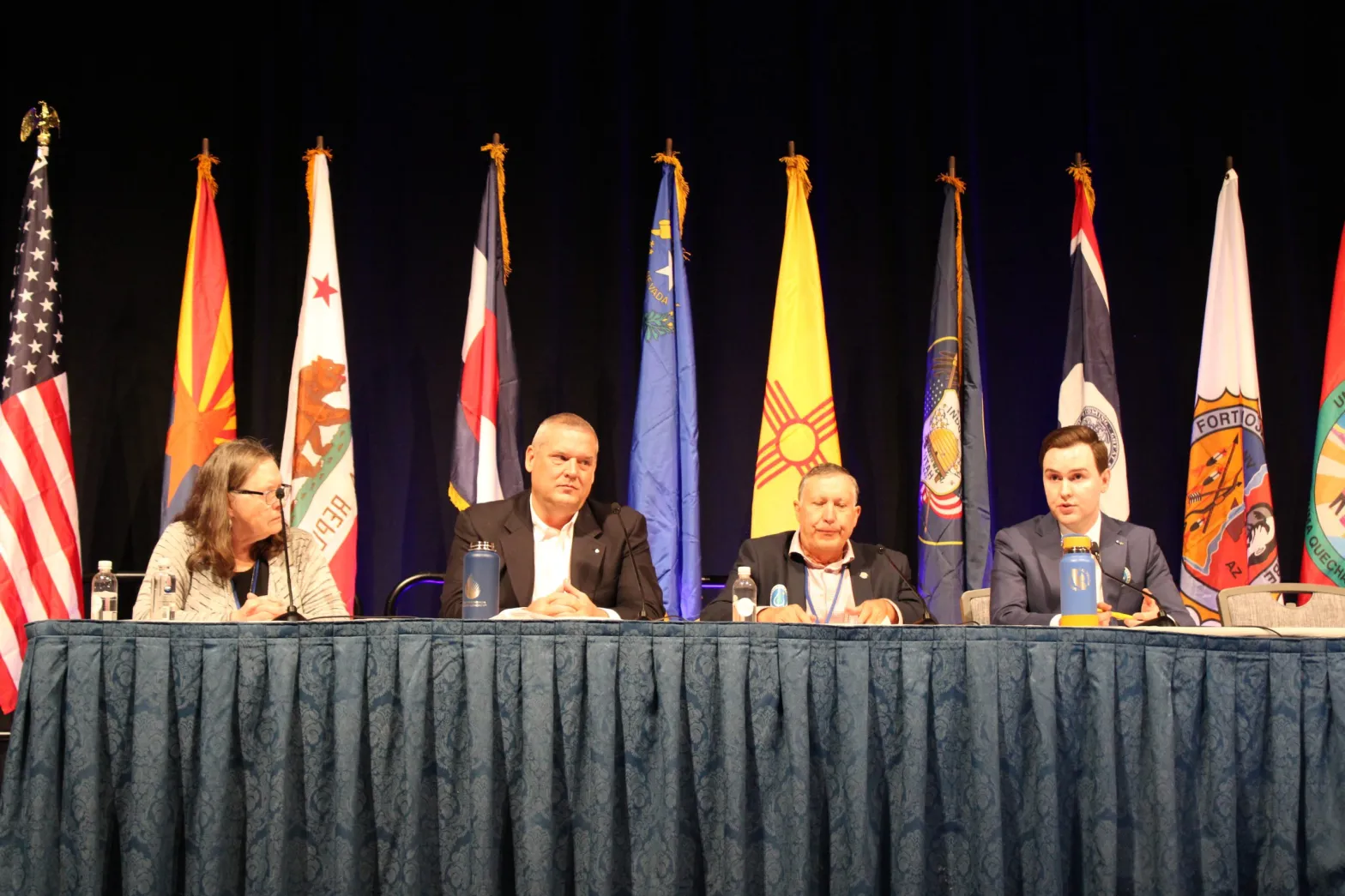
Water policymakers from (left to right) Utah, New Mexico, Colorado and Wyoming speak on a panel at the Colorado River Water Users Association conference in Las Vegas on December 5, 2024. State leaders are deeply divided on how to share the shrinking water supply, and made little progress to bridge that divide at the annual meetings. Photo credit: Alex Hager/KUNC

Click the link to read the article on the KUNC website (Alex Hager):

December 6, 2024

This story is part of ongoing coverage of the Colorado River, produced by KUNC in Colorado and supported by the Walton Family Foundation. KUNC is solely responsible for its editorial coverage.

States that use the Colorado River have spent the better part of 2024 deadlocked about how to share its shrinking water supplies, and annual water meetings in Las Vegas laid bare how far those states are from an agreement.

The seven states can’t agree on who should feel the pain of water cutbacks during dry times. The river is getting smaller due to climate change, and states need to come up with new rules to share its water.

Colorado, Utah, Wyoming and New Mexico make up the Upper Basin. California, Arizona and Nevada represent the Lower Basin. The current rules for sharing water expire in 2026, and each group has submitted a separate proposal for new guidelines after that point.

In Las Vegas, the Colorado River Water Users Association annual conference provided a rare peek behind the curtain of talks between those states. Surrounded by the golden wallpaper and shimmering chandeliers of the Paris Hotel, policymakers showed little progress towards an agreement but brought plenty of bluster.

In recent years, negotiators from all seven states have appeared on one panel together. This year, amid their public disagreement, they appeared on stage at separate times.

State leaders made subtle and not-so-subtle jabs at their counterparts, alleging an unwillingness to use less water. Between those jabs, though, they preached the value of collaboration.

“We have this conference so that we can try to pull together, not pull apart,” said Gene Shawcroft, Utah’s top Colorado River official.

Some of Shawcroft’s downstream neighbors also urged togetherness.

“I’m not looking for a fight,” said John Entsminger, Nevada’s delegate. “We need a dance partner, so let’s get back to the table and make this happen.”

Others were less gentle with their choice of words.

“All of the rhetoric, the saber-rattling and other distractions going on right now are [bullshit]” said Brandon Gebhardt, Wyoming’s top water negotiator. “It needs to stop.”

Despite all the calls for collaboration, state leaders didn’t use the Las Vegas conference to hold closed-door policy talks like they have in past years. Tom Buschatzke, Arizona’s water director, said the states don’t even have another meeting on the books.

“We are willing to meet with them,” he said. “We want that meeting to be something of substance.”

People mingle in the hallway of the Colorado River Water Users Association conference at the Paris Hotel in Las Vegas on December 5, 2024. The event brought together more than 1,500 water experts from across the Southwest. Photo credit: Alex Hager/KUNC

Looming large in the background of this week’s water talks is the unpredictability of the next presidential administration. Those water leaders said they do not expect Donald Trump’s return to the White House will shake up the Colorado River negotiation process, but some water users and onlookers say the next administration could impact the future of the river in other ways.

The past few years have seen an influx of federal spending that Nevada’s Entsminger called a “once-in-a-generation windfall.”

The Biden Administration’s Inflation Reduction Act set aside $4 billion for Colorado River work.

Michael Bennet, Colorado Senator; Bill Long, Southeastern Colorado Water Conservancy District; Camille Calimlim Touton, Reclamation Commissioner; Rebecca Mitchell, Director Colorado Water Conservation Board stand with pipe for the construction of the Arkansas Valley Conduit. Photo credit: Reclamation

Some presentations at the conference felt like a bittersweet sendoff for the administration and its willingness to spend. Water leaders from around the West eulogized the work of Camille Calimlim Touton, the outgoing head of the Bureau of Reclamation, the federal agency that operates Western reservoirs.

Money from the Inflation Reduction Act has been spread far and wide across the cities, farms and native tribes that use the river’s water. While some of it has been spent on physical infrastructure, like fixing old pipes and upgrading water treatment facilities, large portions of funding have been used to conserve water, particularly in the river’s Lower Basin.

Farm districtstribes and cities have taken federal cash in exchange for using less water and leaving it in Lake Mead, the nation’s largest reservoir.

“All these programs cost money, all this investment, all this infrastructure, costs money,” said Gina Dockstader, who sits on the board of directors for the Imperial Irrigation District in California. “Without these additional funds, these farmers can’t afford to put it in by themselves.”

While the exact details of President-elect Trump’s plans for federal spending are still coming together, he’s provided some indications that they will look different from the Biden administration’s.

Udall/Overpeck 4-panel Figure Colorado River temperature/precipitation/natural flows with trend. Lake Mead and Lake Powell storage. Updated through Water Year 2024. Credit: Brad Udall

Climate scientists are projecting a drier future for the Colorado River. Hannah Holm, a policy expert with the conservation group American Rivers, said the kind of water conservation programs that have been made possible by federal funding will only get more important.

“If that funding doesn’t materialize,” she said. “We just won’t be able to adapt as well to the conditions we already have, let alone the conditions that are coming our way.”

American Rivers receives funding from the Walton Family Foundation, which also supports KUNC’s Colorado River coverage.

The clock will keep ticking for states to find some common ground on the next set of rules. A snowy winter could help buy them a little bit more time and space for negotiations by raising reservoir levels with runoff in the spring, but even record-breaking snow totals would make a relatively small dent in the long-term supply-demand imbalance along the Colorado River.

Colorado River “Beginnings”. Photo: Brent Gardner-Smith/Aspen Journalism

Water managers deadlocked on #ColoradoRiver: Both Upper and Lower basin reps say their alternative is best — Heather Sackett (@AspenJournalism) #CRWUA2024 #COriver #aridification

Attendees of the Colorado River Water Users Association watch negotiators Estevan Lopez of New Mexico and Becky Mitchell of Colorado speak on a panel Thursday at the Paris Hotel and Casino. The Upper and Lower basin states are at an impasse about how cuts will be shared and reservoirs operated after 2026. CREDIT: LUKE RUNYON/THE WATER DESK

Click the link to read the article on the Aspen Journalism website (Heather Sackett):

December 5, 2024

At the largest annual gathering of the basin’s water managers on Thursday, speakers invoked Dr. Strangelove, the Hunger Games and Alice in Wonderland to convey the dire, darkly dystopian and illusory state of the negotiations for how the Colorado River will be shared in the future.

The seven representatives from the Upper Basin states (Colorado, New Mexico, Utah and Wyoming) and the Lower Basin states (California, Arizona and Nevada) are deadlocked in disagreement and for the first time in recent years did not appear on stage together at the Colorado River Water Users Association Conference at the Paris Hotel and Casino in Las Vegas. This year, representatives from the two basins had their own separate panels, underscoring their failure thus far to reach a consensus on how to share shortages and operate the nation’s two largest reservoirs, Lake Powell and Lake Mead, after 2026.

Each took the opportunity to double down and reiterate their differing positions laid out in competing proposals submitted to the U.S. Bureau of Reclamation in March. Lower Basin water managers say all seven states that use the Colorado River must share cuts under the driest conditions, while Upper Basin officials maintain they already take cuts in dry years because they are squeezed by climate change and shouldn’t have to share additional cuts because their states have never used the entire 7.5-million-acre-foot apportionment given to them by the Colorado River Compact.

“In the Upper Basin, it’s the Hunger Games,” said Colorado’s top negotiator Becky Mitchell. “We are hungry all the time. There is never enough.”

The two basins have not moved any closer to a consensus during their nine-month-long standoff. Mitchell said she had expected the seven state representatives to have their customary meeting before the conference started.

“I’ve been here since Monday thinking that we would be meeting all day Tuesday and that did not occur,” Mitchell told the Colorado delegation at a breakfast Thursday morning. “I am hopeful that we can still come together again to talk and work towards a mutually agreeable solution.”

Credit: USBR

The current river management guidelines were developed in response to drought conditions in the first years of the 20th century and set shortage tiers based on reservoir levels that spell out which states in the Lower Basin will take cuts as levels fall. But these guidelines did not go far enough to protect reservoir levels from drought and climate change, and in 2022 Lake Powell flirted with falling below a critical elevation to make hydropower.

Lake Mead key elevations. Credit: USBR

Perhaps to spur the basin states toward a solution, in November, Reclamation released an outline of five potential paths forward, including a “No Action” alternative, which is unlikely to be chosen. None of the management options adopted either the Upper or Lower basin proposals, but instead include a “basin hybrid” that is a mash up of elements from both.

Proposed coordinated reservoir operations for Lake Powell and Lake Mead from Carly Jerla at the Colorado River Water Users Association Conference December 5, 2024.

Carly Jerla, a senior program manager with Reclamation gave an overview of each of the options Thursday and said the agency intends to publish a report with more detail on the alternatives by the end of the year. Maximum cuts could range from 2.1 million acre-feet to 4 million acre-feet and could be shared based strictly on priority of who has the oldest rights or distributed proportionally across all seven states.

Upper Basin officials said in a prepared statement that they cannot speak directly to Reclamation’s potential alternatives and need more information before they can analyze them.

“The Upper Division States continue to stand firmly behind the concepts embodied in the Upper Division States’ Alternative, which performs best according to Reclamation’s own modeling and directly meets the purpose and need of the federal action,” the statement reads.

The negotiators from the Lower Colorado River Basin states speak on a panel Thursday at the Colorado River Water Users Association Conference in Las Vegas. From left, panel moderator Jennifer Gimbel, John Entsminger of Nevada, Tom Buschatzke of Arizona and JB Hamby of California. CREDIT: LUKE RUNYON/THE WATER DESK

Reclamation officially kicked off the post-2026 guidelines development process in June 2023 with a Notice of Intent. The current guidelines expire at the end of 2026 and new ones must be in place by August of that year, meaning water managers have just over a year and a half to complete the National Environmental Review Act process for implementing new management rules.

“We have a year and a half left to identify a preferred alternative, put out a draft EIS, put out a final EIS, develop the implementation and adopt a record of decision,” Jerla said. “So we need to be moving as a basin a lot faster in the second half than we did in our first half.”

On their panel, Lower Basin representatives gave an overview of their proposed alternative, plus their water conservation tallies over the past two decades, some of which was forced by the shortage agreements under the current guidelines.

“We’re asking the Upper Basin to come with us to help further protect the river, but only in those really hot, dry (years),” said Tom Buschatzke, Arizona’s top negotiator.

At this year’s conference, there was talk about the longtime elephant in the room, something Colorado River water managers have previously said they want to avoid at all costs: litigation over the Colorado River Compact. Upper Basin water managers believe that as long as they don’t use more than the 7.5 million acre-feet allocated to them, they will not be in violation of the compact. But Lower Basin officials believe that regardless of the Upper Basin’s use, the upstream states could be subject to a compact call if they don’t deliver 7.5 million acre-feet a year.

As river flows continue to decline due to climate change, the basin states could be inching closer to a compact call, which could force cuts on the Upper Basin.

Buschatzke addressed his September request of Arizona Gov. Katie Hobbs to set aside $1 million for litigation in case of a compact call.

“Compact compliance is out there, it is a potential issue,” Buschatzke said. “I have to do my due diligence for all potential outcomes.”

But the principals remained committed to finding agreement among the seven states. Top Nevada negotiator John Entsminger said he wants the Upper Basin states to know he’s not looking for a fight.

“I want everybody from the Upper Basin to hear from Nevada: We believe compromise is possible,” he said. “We think it’s the first, second and third best option. But we need a dance partner. So let’s get back to the table and make this happen.”

Map of the Colorado River drainage basin, created using USGS data. By Shannon1 Creative Commons Attribution-Share Alike 4.0

Water negotiators spar as time runs out to stabilize #ColoradoRiver — The Las Vegas Review-Journal #CRWUA2024 #COriver #aridification

Carly Jerla speaking at the Colorado River Water User’s Association Conference December 5, 2024. Photo credit: USBR

Click the link to read the article on the Las Vegas Review-Journal website (Alan Halaly). Here’s an excerpt:

December 5, 2024

At the second day of the Colorado River Water Users Association conference, the Bureau of Reclamation provided more details about its five proposed paths forward for post-2026 river operating guidelines. And both the Upper and Lower Basin states spoke openly about their frustrations in separate panels about talks that haven’t yielded compromises needed to sustain the system that provides water to more than 40 million people, including Las Vegas residents. Rather than considering the competing proposals set forth by the Lower and Upper basins this year, the bureau put together a “Basin Hybrid” plan that regulators feel is the beginning of a compromise. Some have suggested that the disagreement could result in a costly Supreme Court case against the federal government…

The fate of the Colorado River is something that would directly affect Southern Nevada, a region of the state that sources 90 percent of its water from Lake Mead. Scientists say the river has faced unprecedented shortages in the 2020s, with less water available for use than ever because of climate change and historic overuse. Thus, the need for sweeping changes to 2007 operating guidelines that will no longer apply in 2026.

The structural deficit refers to the consumption by Lower Basin states of more water than enters Lake Mead each year. The deficit, which includes losses from evaporation, is estimated at 1.2 million acre-feet a year. (Image: Central Arizona Project circa 2019)

Depending on how conversations proceed, the Lower Basin states of Nevada, California and Arizona could continue to bear the brunt of mandatory cuts to their allocations from the river. The Lower Basin has proposed basin-wide cuts should a shortage exceed 1.5 million acre-feet, the amount of water known as the “structural deficit” that the river loses to evaporation and transport…The Upper Basin states of Colorado, New Mexico, Utah and Wyoming have argued that declining snowpack and a lack of reservoir storage already set them back 1.2 million acre-feet. Northern states have floated putting more dams and reservoirs on the river that could, in total, store the equivalent of Nevada’s allotment from the river.

“We really need to understand that the enemy we’re battling right now is not the Upper Basin; it’s not the Lower Basin. It’s hydrology,” said Brandon Gebhart, Wyoming’s state engineer and Colorado River negotiator. “All of the rhetoric and other distractions going on right now are [bullshit]. It needs to stop.”

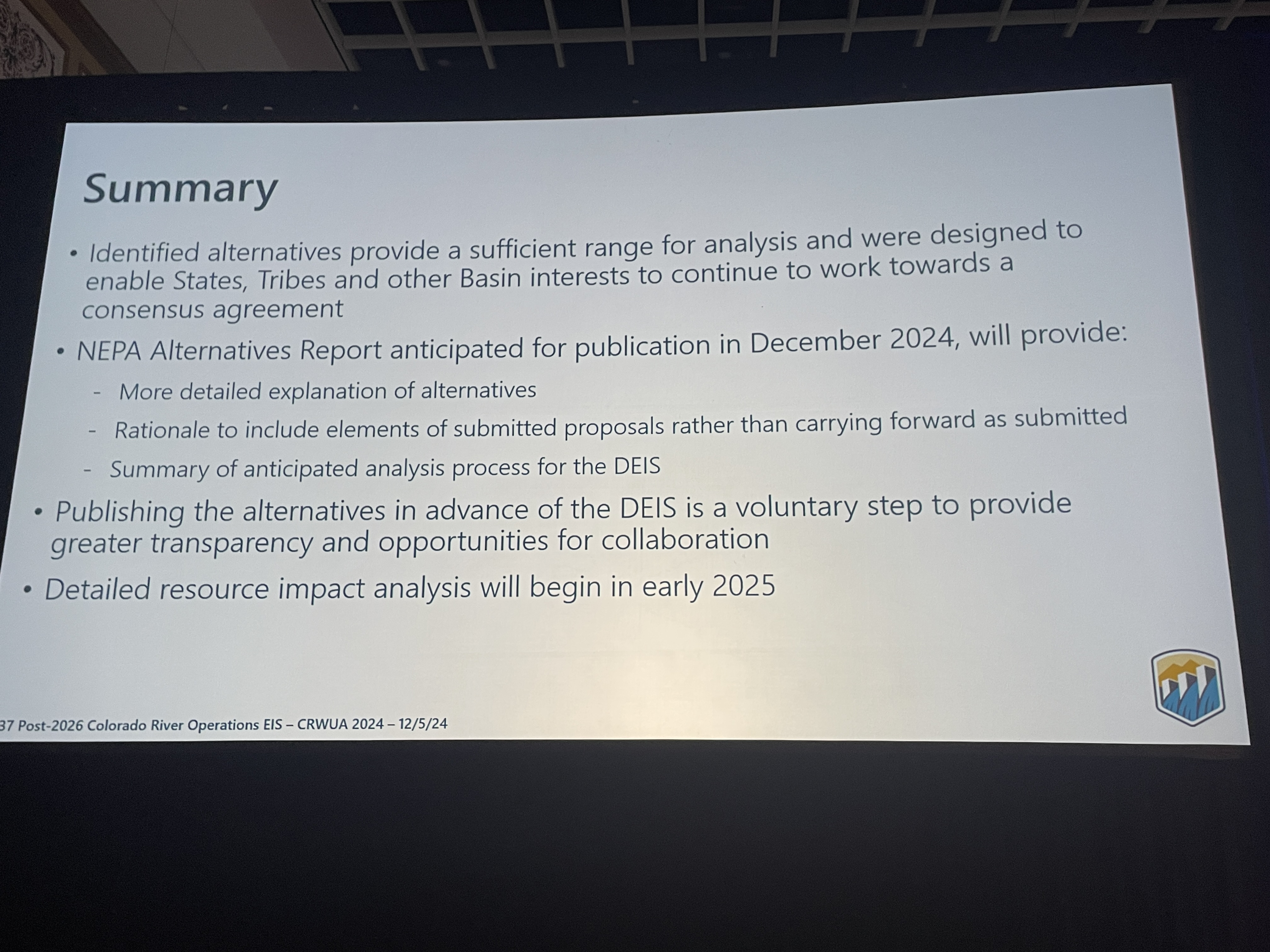
Carly Jerla’s summary slide at the Colorado Water User’s Association Conference December 5, 2024.

Experts urge caution in taking #ColoradoRiver negotiations to U.S. Supreme Court — The Las Vegas Review-Journal #COriver #aridification #CRWUA2024

Map credit: AGU

Click the link to read the article on the Las Vegas Review-Journal website (Alan Halaly). Here’s an excerpt:

December 5, 2024

Most who work on the Colorado River concur: A courtroom is the last place decisions about water should be made. But as total agreement between the Upper and Lower Basin seems more like a pipe dream with each passing month, a court battle has become a possibility while U.S. states, Native American tribes and Mexico chart a path forward as operating guidelines for the river expire in 2026. It would be an expensive, decadeslong legal fight against the Bureau of Reclamation’s decision that would likely make its way to the Supreme Court. At the annual Colorado River Water Users Association conference in Las Vegas on Wednesday, a panel of legal experts who have worked on interstate water cases spoke about the challenges such a case might bring. The bottom line: Engineers are far better equipped to solve water issues than judges, and all efforts should be made to keep post-2026 Colorado River negotiations out of the courtroom.

“The court has a limited understanding of technical water cases,” said Jeff Kightlinger, ex-general manager of the Metropolitan Water District of Southern California. “It has a very limited ability to draft nuanced, long-term solutions.”

[…]

“New plot using the nClimGrid data, which is a better source than PRISM for long-term trends. Of course, the combined reservoir contents increase from last year, but the increase is less than 2011 and looks puny compared to the ‘hole’ in the reservoirs. The blue Loess lines subtly change. Last year those lines ended pointing downwards. This year they end flat-ish. 2023 temps were still above the 20th century average, although close. Another interesting aspect is that the 20C Mean and 21C Mean lines on the individual plots really don’t change much. Finally, the 2023 Natural Flows are almost exactly equal to 2019. (17.678 maf vs 17.672 maf). For all the hoopla about how this was record-setting year, the fact is that this year was significantly less than 2011 (20.159 maf) and no different than 2019” — Brad Udall

The breakdown of talks between the Upper and Lower Basin states has centered on whether the Upper Basin states should be required to take cuts to their allocations from the river as climate change reduces water availability…Arizona’s [Tom Buschatzke], however, has publicly signaled that the state is eyeing $1 million in state funds to retain a lawyer if it becomes necessary. But that doesn’t mean leaders are satisfied with that option.

“I do not want litigation. There is uncertainty with litigation,” Arizona Department of Water Resources Director Tom Buschatzke said at a meeting earlier this year. “We see that in other basins, with judges running rivers. It’s not good for anybody.”

#Drought news December 5, 2024: (2-digit HUC) SWE levels (% of median) — #MissouriRiver 75%, Upper #ColoradoRiver 110%, Great Basin 111%, Lower Colorado 72%, #RioGrande 124%, and #ArkansasRiver-White-Red 149%

Click on a thumbnail graphic to view a gallery of drought data from the US Drought Monitor website.

Click the link to go to the US Drought Monitor website. Here’s an excerpt:

This Week’s Drought Summary

This U.S. Drought Monitor (USDM) week saw improvement in areas of the Northeast, Midwest, and the West. In the Northeast, very heavy snowfall accumulations (up to 5+ feet in some areas) were observed in downwind locations of Lake Ontario and Lake Erie in New York, and northwestern Pennsylvania. The highest totals were observed downwind of Lake Erie between Erie, Pennsylvania and Buffalo, New York. Further south, 2-to-8-inch accumulations were observed in areas of the Appalachian Mountains in West Virginia, leading to improvements on the map in drought-affected areas. In the Upper Midwest, heavy lake-effect snowfall impacted much of Upper Peninsula Michigan as well as areas downwind of Lake Michigan in Northern Michigan and southeastern Michigan. In other parts of the Midwest, light accumulations (1 to 4 inches) were logged in Minnesota, Missouri, Illinois, Indiana, and Ohio. In the Southeast and South, dry conditions prevailed across both regions except for light precipitation accumulations in isolated areas of Alabama, Georgia, Florida, South Carolina, and southeastern Texas. In Florida, short-term dryness led to additional expansion of areas of drought in the Panhandle region. Elsewhere in the Southeast, areas of drought expanded on the map in Virginia, North Carolina, and South Carolina in response to short-term dryness and declining streamflow levels. In the High Plains, dry conditions prevailed across much of the region; however, some light snowfall was observed in the eastern portion of the Dakotas. Out West, drier conditions prevailed this week across much of the region, although areas of northern Arizona, northern New Mexico, and Colorado experienced snow in the higher elevations. In terms of reservoir storage in areas of the West, California’s reservoirs continue to be at or above historical averages for the date (December 3) with the state’s two largest reservoirs, Lake Shasta and Lake Oroville, at 113% and 109% of their averages, respectively. In the Southwest, Lake Powell is currently 37% full (59% of typical storage level for the date) and Lake Mead is 33% full (53% of average), with the total Lower Colorado system 42% full as of December 2 (compared to 43% full at the same time last year), according to the U.S. Bureau of Reclamation…

High Plains

On this week’s map, only minor changes were made in the region, including in areas of North Dakota in response to recent snowfall events and above-normal precipitation during the past 30-day period. Some minor improvements were made also in west-central Kansas, where precipitation has been above normal during the past 30–60-day period. For the week, the region was generally dry except for some light snowfall across portions of the Dakotas. In terms of average temperatures for the week, cooler-than-normal temperatures (2 to 25 deg F below normal) prevailed, with frigid temperatures observed across North Dakota…

Colorado Drought Monitor one week change map ending December 3, 2024.

West

Out West, areas of the region received mountain snowfall during the past week, including the Southern Sierra Nevada, the eastern Great Basin, ranges of south-central Utah, and the Colorado Rockies. On the map, storm events during the past several weeks led to continued improvements in drought-affected areas of Washington, Oregon, California, Nevada, Utah, Colorado, and New Mexico, while some degradation occurred in isolated areas of Arizona, New Mexico, and Wyoming. Looking at the regional snowpack situation, the Natural Resources Conservation Service SNOTEL network is reporting (December 3) the following region-level (2-digit HUC) SWE levels (% of median): Pacific Northwest 126%, Missouri 75%, Upper Colorado 110%, Great Basin 111%, Lower Colorado 72%, Rio Grande 124%, Souris-Red-Rainy 94%, and Arkansas-White-Red 149%. In California, the California Department of Water Resources is reporting statewide snowpack at 157% of normal for the date (December 2). For the week, average temperatures were below normal across much of the northern tier of the region, with the greatest departures observed in northern Montana where temperatures ranged from 10 to 25 degrees below normal. In the Desert Southwest, areas of southern Arizona and New Mexico were 5 to 10 degrees above normal…

South

Across the region, generally dry conditions prevailed this week with the exception of light precipitation in isolated areas of Mississippi and Tennessee. On the map, some minor degradations were made in areas of Texas after another dry week, including in the southern North Central, northeastern Edwards Plateau, northeastern South Central, and along the Upper Coast. According to the latest USDA Texas Crop Progress Report (November 25), pasture and range conditions were rated at 62%, poor to very poor, with producers around the state continuing to use supplemental feed for livestock. Elsewhere, a mix of short- and long-term dryness led to further expansion and intensification of drought in the eastern half of Tennessee where numerous stream gauges are reporting flows in the 2nd to 9th percentile (far below normal) range. The USDA reports that producers in Tennessee are continuing to use supplemental feed and hauling water for livestock. In Arkansas, areas of drought were introduced in response to a combination of factors including short-term precipitation deficits, low streamflows, and declining soil moisture…

Looking Ahead

The NWS Weather Prediction Center 7-Day Quantitative Precipitation Forecast calls for moderate-to-heavy precipitation accumulations ranging from 2 to 4 inches (liquid) across areas of the Pacific Northwest, including the Olympic Mountains and Cascades of Washington. In the South, areas of eastern Texas, Louisiana, Mississippi, Alabama, western Georgia, and southern Tennessee are forecasted to receive accumulations ranging from 2 to 6+ inches. Elsewhere, light accumulations (<1 inch) are expected in areas of the Northern Rockies in the Panhandle of Idaho, northwestern Montana, and locations across the Upper Midwest and Northeast. The Climate Prediction Center (CPC) 6-10-day Outlook calls for a moderate-to-high probability of above-normal temperatures across much of the West, the Central and Northern Plains states, and the eastern third of the contiguous U.S. Meanwhile, near-normal temperatures are expected across much of the South and in the Four Corner states. In terms of precipitation, there is a low-to-moderate probability of above-normal precipitation across the eastern third of the contiguous U.S., eastern Texas, eastern portions of the Midwest, and areas along the entire greater U.S.-Canada border. Elsewhere, below-normal precipitation is expected across portions of the West including California, Nevada, Utah, Arizona, and New Mexico.

US Drought Monitor one week change map ending December 3, 2024.

Just for grins below is a slideshow of early December US Drought Monitor maps for the past few years.

400-year-old #NewMexico farm thrives after switch to organic, #solar — Public News Service #RioGrande

New Mexico’s Don Bustos has passed on his organic farming knowledge to more than 225 farmers around the state. (Photo courtesy FarmersMarketInstitute.org)

Click the link to read the article on the Public News Service website (Roz Brown). Here’s an excerpt:

December 2, 2024

A 4.5 acre farm surrounded by New Mexico’s Sangre de Cristo Mountains is where owner Don Bustos fuses centuries of tradition with modern advances to feed local communities.  The Santa Cruz Farm has been in the hands of Bustos’ family for more than 400 years. Working with experts at New Mexico State University, the owner said he gravitated to organic farming long before others adopted such practices.  The 68-year-old Bustos said he hasn’t used any major chemicals or pesticides in more than 20 years.

“We do 72 different varieties of produce 12 months a year using nothing but solar energy,” said Bustos. “I grow a lot of the traditional corn, the green chili. We still have our same seed, we still have our same corn seeds, the same melons – and then we got a lot into the specialty crops.”

Bustos said he believes much of his success is due to taking risks, leaning on scientific advances while also adhering to sacred family traditions and ancestral farming practices.  In addition to solar power, the farm relies on water from a New Mexico acequia – an ancient irrigation ditch – that flows north through the state.

In addition to farming his land, Bustos spent more than a decade working for the American Friends Service Committee – training other New Mexico farmers how to successfully grow organic produce in the middle of winter. Now, he’s well-known for squash, asparagus, leafy greens and other fresh foods.

Effort continues to win Wild and Scenic designation for #DeepCreek in Eagle County — The #Vail Daily

The bottom of Deep Creek is a unique area of Eagle County. A large group of stakeholders has been working for years to obtain federal Wild and Scenic Rivers designation for a roughly 15-mile stretch of the creek between Deep Lake and the Colorado River. Photo credit: BLM

Click the link to read the article on the Vail Daily website (Scott N. Miller). Here’s an excerpt:

November 29, 2024

Deep Creek is one of Eagle County’s most remarkable places. Years-long efforts continue to preserve that western Eagle County landscape. A 15-mile stretch of Deep Creek nearly a decade ago was found suitable for preservation under the 1968 Wild and Scenic Rivers Act. That act aims to preserve streams that are free-flowing and have “outstanding, remarkable values.” Part of the criteria also includes lack of dams or reservoirs along the stream. Deep Creek would seem to meet those criteria, especially given that it has unique geological features in its canyon and unique plant life in some stretches…

But like any federal status, there’s a long to-do list to accomplish, and designation takes an act of Congress. The Deep Creek designation also has a lot of interested parties. The creek is in two counties — Garfield and Eagle. The portion of the creek eligible for designation is all on federal land, but authority for that land is split between the Bureau of Land Management and the U.S. Forest Service. The creek also sits in two congressional districts, Colorado’s 2nd and 3rd. The 3rd will be represented in January by Grand Junction Republican Jeff Hurd. Boulder Democrat Joe Neguse represents the 2nd. Smith is the Bureau’s liaison to a large stakeholder group named Deep Creek Wild and Scenic Stakeholder Group, which began meeting in 2017. The Colorado River District is part of that group, in part because the district hopes to augment the creek’s flow in the spring runoff season…

While many of us see Deep Creek from the overlook along Coffee Pot Road on the way to Deep Lake, the headwaters of the creek, there are trails to the canyon’s bottom. Smith has hiked in and noted Deep Creek has “completely natural” hydrology, with a “globally rare ecosystem.” In addition, there are caves among the canyon walls and other features for those willing to put in the work.

The #Arizona Department of Water Resources Helps Finalize Two Historic Tribal Water Rights Settlement Agreements

Little Colorado River. Photo credit Arizona Department of Water Resources

Click the link to read the article on the ADWR website:

December 2, 2024

Governor Katie Hobbs on Nov. 19 officially concluded decades of negotiations and court battles over tribal water rights when she signed two settlements involving four Arizona Native American tribes.

Arizona Governor Katie Hobbs at signing ceremony November 19, 2024. Photo credit: ADWR

The Arizona Governor signed the Northeastern Arizona Indian Water Rights Settlement Agreement, which settled long-standing claims with the Navajo NationHopi Tribe, and the San Juan Southern Paiute Tribe. In addition, she signed the Yavapai-Apache Nation Water Rights Settlement Agreement with the Yavapai Apache Nation of north-central Arizona. 

Both agreements with the federally recognized tribes are now before Congress

“I want to thank Governor Hobbs for her leadership in helping us reach this historic agreement,” said President Buu Nygren of the Navajo Nation. 

“I also want to thank the team at the Arizona Department of Water Resources for all of their work,” President Nygren added. “With their help, I’m confident we can build a consensus with the seven Basin States to get this through Congress.”

Timothy L. Nuvangyaoma, Chairman of the Hopi Tribe, also acknowledged the governor’s achievement as well as the work of ADWR toward making it happen.

In a press statement, the Arizona Governor’s Office observed that “(f)or decades, generations of tribal members have fought to secure water supplies for their homelands and put an end to years of litigation. Through the extraordinary efforts of the tribes, northern Arizona communities, and the State, a resolution has been reached and an agreement brokered, providing water reliability for tribal and non-tribal parties alike.”

The Northeastern Arizona agreement settles outstanding tribal water rights claims to the Colorado River, the Little Colorado River, and groundwater sources in Northeastern Arizona. Water infrastructure funded through this settlement will help alleviate the lack of safe, reliable water supplies for members of all three Tribes, and help ensure the access to clean running water that all Arizonans deserve.  

C.C. Cragin Reservoir Photo credit: ADWR

Additionally, the Northeastern Arizona agreement ratifies a treaty that provides the San Juan Southern Paiute Tribe with 5,400 acres after sharing territory with the Navajo Nation for the last 160 years. 

Governor Hobbs also signed the agreement with the Yavapai Apache Nation, which secures safe and sustainable water supplies for the Nation, while also preserving and protecting the Verde River. It includes building a 60-mile water pipeline from C.C. Cragin Reservoir on the Mogollon Rim to deliver water to the Yavapai-Apache Nation, providing water certainty to the Nation and neighboring non-tribal communities.

Coyote Gulch’s excellent EV adventure: Las Vegas for #CRWUA2024

Hoover Dam from the U.S.-93 bridge over the Colorado River December 3, 2024.

Hellchild drove the final leg to Las Vegas yesterday and insisted on stopping to see the engineering marvel and river death infrastructure that is Hoover Dam. We got a quick glimpse of the Colorado River from U.S.- 93 along the way but the scenery was mostly desert mountains and desert landscape. We wondered what the area looked like before cattle and other human influences.

Discover Your Bluesky Digital Persona — BlueskyRoast.com

Below is my Bluesky digital person. You can find yours at BlueskyRoast.com.

#ArkansasRiver Compact Administration 2024 Annual Meeting / Final Notice & draft agendas

Arkansas River Basin via The Encyclopedia of Earth

From email from Kevin Salter:

Below is the final notice for the upcoming Arkansas River Compact Administration Annual and Committee Meetings to be held on December 12th and 13th.  Please note that the meeting dates and location were changed at the ARCA Annual Meeting held in December 2023.  Also attached are the draft agendas for the ARCA committee and Annual meetings.

The ARCA Committee and Annual meetings will be held at the Clarion Inn, 1911 E Kansas Ave, Garden City, KS 67846,

The 2024 Annual Meeting of the Arkansas River Compact Administration (ARCA) will be held on Friday, December 13, 2024, commencing at 9:00 am CST (8:00 am MST).  If necessary, the annual meeting may be recessed for lunch and reconvened for the completion of business in the afternoon.  The public is invited to attend the Annual Meeting.

The Engineering, Operations, and Administrative/Legal Committees of ARCA will meet on Thursday, December 12, 2024, starting at 2:00 pm CST (1:00 pm MST) and continuing to completion.  The public is invited to attend the Committee meetings.

Meetings of ARCA are operated in compliance with the federal Americans with Disabilities Act.  If you need a special accommodation as a result of a disability, please contact Stephanie Gonzales at (719) 688-0799 at least three days before the meeting.

The meeting announcement and draft agendas can be found on ARCA’s website under “Upcoming Meetings:”

Upcoming meetings URL

Once on the website, you may access the announcements, draft agendas, and meeting materials by using the beige links circled in red as shown in the picture below.

If you have any questions please feel free to contact Andrew or myself.

Kevin Salter

Division of Water Resources

Kansas Department of Agriculture

4532 W Jones Ave Suite B

Garden City,  KS  67846

    Kevin.Salter@ks.gov

    (620) 276 – 2901

Andrew Rickert

Program Manager

Interstate, Federal, and Water Information Section

P 303-866-3441 x 3249  |  M 720-651-1918

1313 Sherman St., Room 718, Denver, CO 80203

andrew.rickert@state.co.us | cwcb.colorado.gov 

Coyote Gulch’s excellent EV adventure: “Get your kicks, on Route 66”

Tower Building in Shamrock, Texas erected in the early 1930s on U.S. Route 66.

On the drive from Thanksgiving dinner to CRWUA with Hellchild I was able to trace some of the route of old U.S. 66. I’ve really enjoyed the drive from Missouri to Arizona so far and last night we feasted on some great Indian (East) food in Holbrook. Forested hills to more open country, then Cholla and Mesquite, the mesa country in New Mexico, beautiful desert landscapes W. of Albuquerque, the S. edge of the Colorado Plateau in the Ponderosa pine forest, and farms, ranches, and windmills galore all the way! We didn’t have a good map but we crossed the Arkansas, Pecos, Rio Grande, and Little Colorado rivers over the past couple of days. Las Vegas is the destination today.

Plaque on the Tower Building in Shamrock, Texas erected in the early 1930s on U.S. Route 66.

The Tesla Model Y has performed flawlessly and the charging is a breeze due to the integration with the onboard navigation.

Along route U.S. 66 in Tucumcari, New Mexico.

NAT KING COLE ROUTE 66

How much water do Colorado communities actually need? In one, surprisingly little — Jerd Smith (Fresh Water News)

Front yard in Douglas County’s Sterling Ranch are sparse on turf. Houses use well below the average volumes for Colorado. Photo/Allen Best

Click the link to read the article on the Water Education Colorado website (Jerd Smith):

November 25, 2024

Douglas County is adding new homes like crazy. Some of its towns plan to double in size in the next 30 years, but these new homes use shockingly little water, blowing up traditional water planning rules and raising questions about how much water Colorado communities need to grow.

Sterling Ranch, for instance, has more than 10 years of data showing that the master-planned community of 3,400 residences just off Interstate 25 near Littleton uses just 0.18 acre-foot of water for each single family home, about 30% less than most urban homes, where 0.25 to 0.50 acre-foot per home is the norm. An acre-foot equals 326,000 gallons.

The community conserves by requiring water-wise lawns, using super-efficient showers and toilets, and installing separate meters for indoor and outdoor use. It also uses recycled water for its parks.

In response, Douglas County has allowed Sterling Ranch to adopt much lower water standards for the thousands more new homes it plans to build. The community will hold 12,500 homes when it is fully built.

Since 2013, Douglas County commissioners have twice allowed the community to dedicate less water to new homes, agreeing to a reduced standard of 0.40 acre-feet, from 0.75 in 2013 and to 0.24 in 2021. Next month, Sterling Ranch and its water district, Dominion Water and Sanitation, will ask the county for the authority to set the standards in the future as it sees fit, without county review, something that incorporated cities, such as Parker and Castle Rock do now.

Lindsay Rogers, a municipal water conservation analyst with Western Resource Advocates, said the lowering of water demand standards is welcome news.

“The new standard is a good approach,” she said, and very different from traditional planning efforts in Colorado, where cities routinely ask for much more water than is actually needed, placing higher demands on rivers and underground supplies and raising the cost of water service, a major contributor to higher home prices.

“We want to see counties, cities, and water providers setting a water dedication that is as closely aligned as possible with the water use on site,” she said.

“Sterling Ranch is a great example who has done this well, and has proven savings, and should be rewarded for its efforts,” she said.

More and more homes

Like other arid Western states being blistered by drought, warming temperatures, and lower stream flows, Colorado’s water future is not assured. The Colorado Water Plan predicts that the state could need up to 740,000 acre-feet of new water supplies by 2050 under the most dire planning scenarios, where the climate warms intensely and growth surges.

Cities are looking to add tens of thousands of homes to put roofs over the heads of  new residents. Some estimates indicate as many as 325,000 new homes will be needed.

But if new homes can operate with 30% less water than they once did, would that lessen future shortages and provide the state some breathing room? Possibly.

But it’s not likely to do much, according to Kat Weismiller, acting head of the water supply planning section at the Colorado Water Conservation Board, because the scale of development is small.

“We look at a range of drivers, including social values, around water conservation and development to understand future water demands. While the new development at Sterling Ranch is innovative and sets an important example for how we can develop new communities in a water-efficient way, at this time, the scale of this type of development is fairly limited and it would be unlikely to meaningfully shift the way we forecast water needs at the state level or entirely close the gap,” she said.

Ultra-water-efficient homes

The trend toward ultra-water-efficient homes appears to be on an upward trajectory.

Another large Douglas County development under consideration, the Pine Canyon Ranch on Castle Rock’s border, asked for and has been given preliminary approval by the Douglas County Planning Commission to build 800 new homes and 1,000 townhomes and apartments with just 0.27 acre-feet of water per home.

Kurt Walker owns Pine Canyon Ranch. His family has been trying to annex into Castle Rock for 20 years. Tired of waiting for the city to act, the Walker family went to the county. Its plan calls for a sophisticated recycled water system and water-efficient homes.

The plan has drawn opposition from Castle Rock and others worried about the potential use of nonrenewable groundwater, and added traffic and congestion. If the land is annexed into Castle Rock — talks are underway again — the city would likely supply the water, bringing the ranch’s groundwater into its own water system, which uses a combination of surface water, recycled water and groundwater. Castle Rock requires new homes to come with 1.1 acre-feet of water.

Walker said he believes a deal will eventually be reached with Castle Rock. But he defends his family’s use of the nonrenewable groundwater it owns. In Colorado, landowners typically own rights to the water contained in the aquifers beneath their land.

“If I really wanted to maximize the amount of houses on my property, I would not have reduced the water standard to 0.27. … Our plan would leave about 50% of our groundwater rights in the ground, untouched,” Walker said. “If I was in this just to put as many houses on this property as I could, I would have taken everything out of the aquifer that I could. That could have added 600 or 700 houses onto what we proposed. But we didn’t do that.”

Water stored in Colorado’s Denver Basin aquifers, which extend from Greeley to Colorado Springs, and from Golden to the Eastern Plains near Limon, does not naturally recharge from rain and snow and is therefore carefully regulated. Courtesy U.S. Geological Survey.

A look into the past

There was plenty of that type of development in the 1970s as Douglas County began to boom. Developers tapped its groundwater repeatedly. The water was so pure, it needed little treatment. Other cities, such as Denver, brought water over mountains from miles away. But here, it could just be pulled up through a water well. This helped keep the cost of building homes low and lured developers who built Highlands Ranch, Parker and Castle Rock.

But those underground water supplies proved to be fragile. Some aquifers can be recharged from snowmelt and rain, but these, in the Denver Basin, are sealed in rock formations which recharge slowly. As pumping increased, the aquifers declined. Soon, wells began to fail and alarms began ringing.

The water picture today is much different. In 1985, state lawmakers forced well owners to limit their pumping by extracting just 1% of available water supplies each year, in the hope of extending the aquifers’ life for 100 years.

Now, though the Denver Basin aquifers continue to supply millions of gallons of water to Douglas County communities, the declines have slowed, and water districts and cities have moved to develop and use renewable surface supplies from rivers, and from recycled water plants.

And the county itself is much more concerned about future water supplies today. Though it does not own reservoirs and pipelines, it guides water use, as other counties do, by regulating how much water developers must bring to the table before they are approved to begin building.

This year it created its own Water Resources Commission and is creating a 25-year water plan. The county has been criticized for not creating a longer-term plan, say 100 or 300 years, as nearby counties have done. But County Commissioner George Teal said the 25-year plan is only a first-step.

“We plan on a 20-year horizon right now,” he said. “It doesn’t mean we won’t do a 100-year plan at some point.”

Some say it’s time to stop groundwater use entirely

Steve Boand, a former county commissioner and water consultant, has been monitoring the health of the county’s groundwater supplies for decades.

He supports lower water requirements for new homes, but he wants the county to go further and outlaw building solely with nonrenewable groundwater, something he acknowledges isn’t on the county’s political radar right now.

“It’s up to community planners to figure out what the right balance is — 0.5 is OK, if a house only needs 0.3, and 0.2 can be allocated to other uses, like park land,” Boand said. “We have to try these things to see if they will work.”

Western Resource Advocates’ Rogers says she’s encouraged by the data, at Sterling Ranch and elsewhere, that shows new homes can be built with much lower water profiles. That they are also likely to encourage more growth is real but less concerning, she said.

“It’s possible that these new standards will mean more homes,” she said. “But growth is happening, and it is going to continue whether it is in Douglas County or other places in Colorado. The fact that the growth is happening in places like Sterling Ranch, where they have all of these efficiencies in place, is a good thing.”

More by Jerd Smith

#NewMexico’s acequias outline 2025 legislative priorities: Community ditches need tens of millions in infrastructure funding, representatives say — SourceNM

A diversion on the Mimbres River in southern New Mexico in February 2023. (Photo by Megan Gleason / Source NM)

Click the link to read the article on the SourcNM website (Austin Fisher):

November 29, 2024

After unprecedented disasters, local governments in charge of centuries-old community ditches in New Mexico are asking state lawmakers for tens of millions of dollars more than usual to maintain and rebuild acequias.

The New Mexico Acequia Commission and the New Mexico Acequia Association outlined their joint legislative priorities for the upcoming session last week. 

There are more than 700 acequias across New Mexico, and these irrigation ditches support communities and families rooted in the practice. Some of the ditches are decades, if not hundreds of years old, and the practices are ancient – as Pueblo peoples used irrigation methods before Spanish colonization. Acequias are often loosely and locally governed, often by volunteers. 

But a rapidly changing climate making water more scarce and disasters like fires and flood increasingly devastating is putting the traditional practices at risk.

Lawmakers in 2003 empowered acequias to approve or deny water transfers without having to go through state officials first, and in 2019 set aside $2.5 million per year to build and maintain irrigation infrastructure.

However, that is not enough, acequia advocates say. According to a rough estimate, in the coming decades, acequias will need about $68 million to maintain or improve their irrigation infrastructure, said Paula Garcia, the executive director for the grassroots Acequia Association.

“We don’t have complete data on all the infrastructure needs across the state but with that snapshot, I’m confident the need is in the tens of millions every year,” she said.

There is no one state agency devoted to acequias, instead, there’s responsibility held across multiple state departments – including the New Mexico Office of the State Engineer or the New Department of Agriculture. 

Acequias will likely face challenges in getting the funding they need from the Legislature’s budget hawk, Sen. George Muñoz, who chairs the powerful Senate Finance Committee. In September, as state agencies were preparing their budget requests for next year, he called for “a disciplined approach” to spending public money.

Cost sharing for infrastructure, disaster assistance

The acequias are urging lawmakers to give $10 million to the Interstate Stream Commission to help pay for infrastructure repairs, which require local governments to pay a 25% cost-share, Garcia said. Acequias need the state to step in because they do not have the power to tax.

Acequias’ inability to pay for debris removal has become more urgent since 2022, and resulted in “astonishing” delays in rebuilding acequias destroyed by wildfires, Garcia said. She called for debris removal after flooding to be more institutionalized and not just a reaction to emergencies.

For example, Garcia’s own acequia in Mora County is in its third year without water and won’t be rebuilt until 2026.

“It seems like every time we have a disaster, we’re reinventing the wheel,” Garcia said. “It’s not good for our state.”

Paula Garcia, director of the New Mexico Acequia Association, drives through the Hermits Peak-Calf Canyon burn scar Sept. 13, 2022. (Photo by Patrick Lohmann / Source NM)

After the Hermits Peak-Calf Canyon fire, the state Department of Transportation quickly hired contractors to remove debris, Garcia. But the debris removal process is uncertain, she said, and not easy to stand up in real time when disaster strikes.

“Unless we figure this out as a state, there are going to be communities that are left behind because they can’t do that cost-share,” Garcia said.

Acequias are supporting the Interstate Stream Commission’s request to double the Acequia and Community Ditch Infrastructure Fund from $2.5 million per year to $5 million. The fund is used to pay for planning, designing and building irrigation systems or matching funds for other state and federal programs. 

The current $2.5 million alloted is only meeting about half of the requests coming through the program, Garcia said.

While there are state funds for tribal infrastructure and colonias, there is no comparable fund for acequias, said Rep. Susan Herrera (D-Embudo).

These water systems which allow small farming and ranching operations to exist almost entirely rely on volunteers, and they can’t be maintained or fixed using only one-time money, Herrera said. Those volunteers are also getting older and the number of people who can work on a ditch is getting smaller, she said.

“I’ve told my volunteers: if you want to shut down the state, everybody can go on strike in the north and not do water systems for a year. See what happens,” Herrera said.

Settling water rights disputes

The acequias are supporting the New Mexico Department of Agriculture’s request to increase its Acequia and Community Ditch Fund from about $830,000 per year to $1.5 million.

The fund is used to pay for attorneys and experts in determining who has the right to what water. There were a total of $1.3 million in requests for help in the previous fiscal year, according to the acequias’ presentation.

The acequias are also supporting the State Engineer’s $40 million request to help pay costs resulting from court settlements over water rights, which finalize the oldest water rights in the state held by the Pueblos and also acequias’ water rights, Garcia said.

Water rights agreements between sovereign nations and American governments must be approved by Congress.

Congress has approved final settlements in four separate cases involving Native nations in New Mexico, and there are still four where Congressional approval is pending but federal legislation has been introduced, according to the acequias’ presentation.


Other acequia priorities

  • Amend the Community Governance Attorney Act so the state Department of Justice and acequia-serving nonprofits can hire attorneys specializing in land grants, acequias and colonias.
  • Boost funding for community and youth education programming about acequias from $492,000 to $750,000, and codify it into state law.
  • Increase the Acequia Commission’s annual budget from $88,000 per year to $160,000, which would allow them to hire a full-time worker.
  • Set aside $500,000 for the State Auditor’s Office so they can hire accountants to help acequias audit their finances, rather than requiring the acequias to hire the accountants themselves.

Global Atlas Expands Reach of NOAA Microplastics Database

Virtually indestructible plastic on a black rock beach in Hawaii. Photo credit: Eric Johnson/NOAA

Click the link to read the release on the NOAA website:

November 19, 2024

Marine microplastics are an urgent issue. Much of the world population consumes seafood as a source of protein, and microplastics can threaten this sustainable food source. 

With further research, scientists can gauge how microplastics impact human health, fishing industries, and our marine ecosystems. 

Understanding the existing distributions and quantities of microplastics in the global ocean is a vital first step towards combating microplastic pollution. This requires scientists, researchers, and decision-makers to have access to large-scale, long-term comprehensive microplastics data.

Atlas of Ocean Microplastics

Debuting in 2024, the Atlas of Ocean Microplastics (AOMI) is a database of ocean surface microplastics data created by Japan’s Ministry of the Environment, AMOI is created in collaboration with researchers, research institutions, and governments around the world. Data from the NCEI Marine Microplastics Product are available through AMOI, which is in keeping with NCEI’s commitment to data findability, accessibility, interoperability, and reuse of digital assets (FAIR Principles). AOMI is also sharing microplastics data with NCEI’s Marine Microplastic database, making both databases more complete to best serve users. 

Since the data are from many different publicly-available sources, AOMI quality controls the data and adds a comparability grade to each data according to the Guidelines for Harmonizing Ocean Surface Microplastic Monitoring Methods. AOMI also visualizes where the data was collected and thus the distribution of ocean surface microplastics around the globe on an interactive map

AOMI is available to the public. Users can view and download all data for free, and filter the data according to their own purposes and uses. 

Marine Microplastics Unraveled

Microplastics, including those found in the marine environment, are pieces of plastic or fibers less than 5 mm—smaller than a sesame seed. Any plastic product, including single-use plastics like bottles and plastic bags, along with plastics in items like cosmetics, can eventually become marine pollution.

There are many different types of microplastics, including beads, fragments, pellets, film, foam, and fibers. 

Some microplastics are made to be small for a specific purpose. These primary microplastics can be plastic pellets that are melted and used to create larger plastic items, or the microbeads that may be found in personal care products, such as toothpaste, face washes, and cosmetics. 

Secondary microplastics come from larger pieces of plastics, such as beverage bottles, bags, and toys. Sun, heat, wind, and waves can cause these plastics to become brittle and break into smaller and smaller pieces that may never fully go away. Microplastics are also created when pieces of plastic break off during use. For example, particles of synthetic tires can break off during regular use and through wear and tear. 

Similarly, our clothing, furniture, and fishing nets and lines may produce plastic microfibers, another type of secondary microplastics. These fibers are extremely common on shorelines across the United States, and are made of synthetic materials, such as polyester or nylon. Through general wear or washing and drying, these tiny fibers break off and shed from larger items.

No matter where we live on the globe, we all have a role to play in taking action in reducing plastic waste through more responsible behaviors to help keep our environment clean. Products like the AOMI and the NCEI Marine Microplastics Product give everyone access to microplastic concentration data that can guide future work and help visualize our progress. 

Water rates are going up 30% for residents in #FortCollins-#Loveland Water District — The Fort Collins Coloradoan

Service area map via the Fort Collins-Loveland Water District.

Click the link to read the article on the Fort Collins Coloradoan website (Rebecca Powell). Here’s an excerpt:

November 26, 2024

Fort Collins, Loveland, Timnath and Windsor residents who get their water from the Fort Collins-Loveland Water District will see a 30% increase or more in rates for 2025…Residents who reach higher tiers of water use and homeowners association accounts that go over allotments will be hit even harder if they don’t find ways to reduce. But after hearing from representatives of HOAs, the Fort Collins-Loveland Water District board backed off charging “irrigation customers” five times as much when they go over their allotments, which were assigned at the time their accounts were created but haven’t been enforced. Instead, this segment of ratepayers, which includes commercial customers and parks, will pay twice as much as the normal rate for overages…The board approved the rate increases for 2025 on Nov. 19…

Base fees for residential, commercial and irrigation customers are increasing 30%. On top of that, rates per 1,000 gallons of water are increasing 30% across all tiers for residential customers. The 30% rate increases also apply to the three or four developments in what is known as “The City of Fort Collins service area as defined by IGA.”

[…]

The water district is also introducing a new fourth tier for residential customers. The cost of water will be five times higher than the next closest tier — for extremely high water use that exceeds 50,000 gallons per month…

  • Fees for single-family development taps will increase anywhere from 19% to 31%.
  • Fees for multifamily development taps will increase 15%.
  • Fees for commercial development taps will increase 33%.
  • Fees for new irrigation taps will increase 33%.