The health of our waters is the principal measure of how we live on the land — Luna Leopold
Rain Enhancement Technologies’ Upper Yampa Weather Enhancement Pilot Advances Toward Final Permit Approval After Colorado Public Hearing: Installation in Colorado’s Flat Tops targeted for November to enhance snowpack this
Our WETA (Weather Enhancement Technology Array) systems create negative ions using naturally occurring wind patterns. WETA uses a high voltage DC charge to create corona inception points releasing electrons that ionize passing air particles. These ionized particles are carried up to cloud layers at around 2,000 feet altitude. In the clouds, the charged particles help accelerate the collision and combination of water droplets, causing them to become heavy enough to fall as rain. Credit: Rain Enhancement Technologies
October 21, 2026 — Rain Enhancement Technologies Holdco, Inc. (NASDAQ: RAIN) (“RET” or the “Company”), a leading provider of ionization rain and snowfall generation technology, today announced that its weather enhancement pilot in Colorado’s Upper Yampa River Basin has completed the state’s required public hearing with no objections raised. The hearing, held October 14, 2026, by the Colorado Water Conservation Board (CWCB), is a key step in Colorado’s weather modification permitting process and moves the permit for the one-year pilot to final approval, with operations targeted to begin in November 2026.
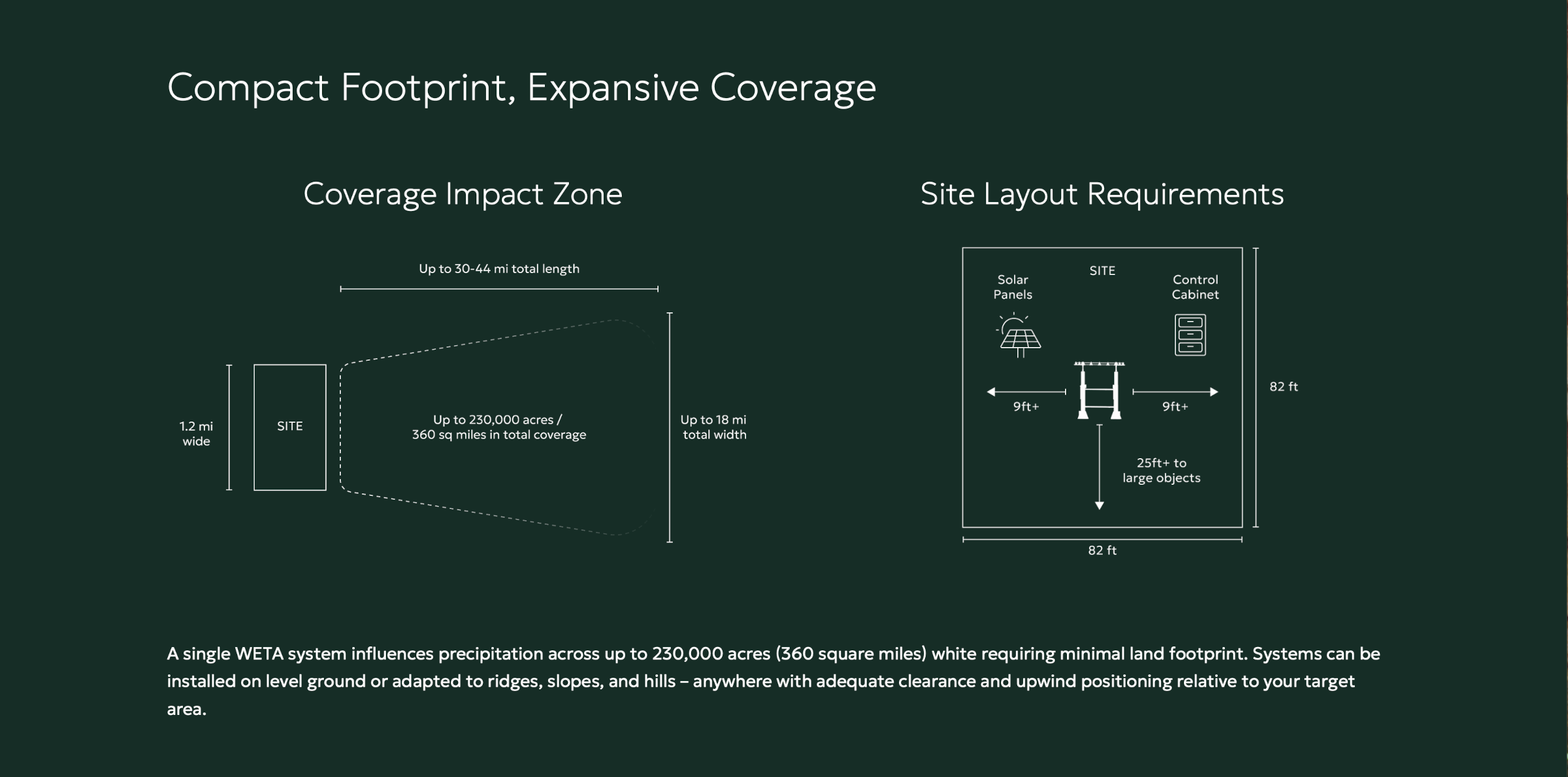
The pilot, first announced in July, will deploy the WETA (Weather Enhancement Technology Array), RET’s ground-based, solar-powered ionization system, in the Flat Tops area of Northwest Colorado. The WETA can operate year-round, enhancing snowpack in winter and rainfall from spring through fall. Under a statement of work between RET and the Upper Yampa Water Conservancy District, the CWCB is planning to fund the pilot, with the District serving as fiscal agent. The pilot targets the drainage basin of the Yamcolo Reservoir, one of the District’s primary water supply facilities, with an area of expected impact of up to 192,000 acres. The expanded target area reflects detailed modeling of the final installation site, which showed wider distribution than initially expected after the pilot was first announced.
At the hearing, the RET team, including CEO Randy Seidl, VP of Engineering Scott Morris and members of the Company’s meteorology and data science staff, walked state officials and local stakeholders through how the pilot meets the twelve criteria Colorado requires of weather modification permit applicants, from target area and operating methods to economic benefit, scientific feasibility, risks and safeguards, and environmental impact. The team also outlined the pilot’s operating safeguards, including automatic shutdown when wind speed or direction falls outside set parameters, suspension of operations during National Weather Service watches and warnings, and coordination with local land managers.
“A public hearing with no objections tells us that the people closest to this watershed, from water managers to land managers to local officials, understand what the WETA does and how carefully we operate it,” said Randy Seidl, CEO of Rain Enhancement Technologies. “We appreciate the support of the CWCB, the Upper Yampa Water Conservancy District, Colorado Parks and Wildlife and the Colorado River District in getting us here. With the permit moving forward, we’re preparing to install in November and look forward to giving Colorado independently validated results to evaluate.”
“Beyond the reservoirs downstream, this site gives us a chance to benefit the land right around it,” said Scott Morris, VP of Engineering at Rain Enhancement Technologies. “We’ll be operating to provide some enhancement to Lake Avery, which is right near the site, and we expect more rainfall and snowpack over the surrounding wilderness areas, which should benefit the forests and the wildlife there.”
“Public hearings are an important part of how Colorado permits weather modification programs, giving local communities and agencies a chance to review a proposed operation and raise any concerns before a permit is issued,” said Andrew Rickert, Program Manager for the CWCB’s Weather Modification Program. “The RET team laid out its responses to the state’s permit criteria clearly, and our next step is to finalize the permit so the pilot can begin, and the results can be evaluated.”
Performance will be measured with a network of instruments installed in and around the target area, including snow-melting tipping-bucket rain gauges and Doppler precipitation sensors, alongside existing SNOTEL (Snow Telemetry) and NOAA (National Oceanic and Atmospheric Administration) data. RET’s meteorology and data science team will compare precipitation in the target area against control areas using three independent statistical methods, the same peer-reviewed approach applied to the Company’s winter operations in Utah’s La Sal Mountains, where the WETA delivered a greater than 20% increase in snow water equivalent over the 2025-26 season. The District will receive regular operating reports, and the final seasonal report will be submitted for independent peer review.
Once permitted, the Upper Yampa pilot would become the ninth permitted weather modification program in Colorado and RET’s second in the state, joining its program in Weld County.
About Rain Enhancement Technologies, Inc.
Rain Enhancement Technologies was founded to provide the world with reliable access to water, one of life’s most important resources. To achieve this mission, RET develops, manufactures, and commercializes ionization precipitation generation technology that enhances rainfall and snowpack to address water scarcity challenges. The Company is also developing applications for fog mitigation to expand its weather modification capabilities. RET’s chemical-free, solar-powered technology seeks to transform water resource management for businesses, society, and the planet. To learn more, go to www.rainenhancement.com.
The Colorado Water Conservation Board’s Weather Modification Program issues permits and monitors weather modification activities across the state. This map shows the permitted projects in Colorado as of October 2025. Credit: Colorado Water Conservation Board
The one-year pilot, which is funded by a $100,000 grant from the Colorado Water Conservation Board to the Upper Yampa Water Conservancy District, plans to test a ground-based, solar-powered technology from Rain Enhancement Technologies…Standing at Yamcolo Reservoir just below the Yampa River’s headwaters in August, Andy Rossi, the Upper Yampa district’s general manager, described the technology as “brand new and experimental.”
[…]
Compared to “typical” cloud-seeding technology, which involves injecting tiny particles — most commonly silver iodide crystals — into clouds to enhance their precipitation potential, this ground-based technology uses ionization to target a similar effect. Rain Enhancement Technologies calls it the Weather Enhancement Technology Array. In an October interview, Rossi said the installation will be about 30 feet wide and 20 feet long and resembles a ranch gate, with a large frame and electrified coil. It relies entirely on solar power. According to the statement of work for the pilot, “each station releases electrically charged negative ions into naturally occurring wind flow feeding the cloud with the ‘fuel’ needed to cultivate precipitation.” These charges enter the cloud mass and enhance condensation, causing cloud droplets to “progressively grow” until they are large and heavy enough to fall as precipitation, it adds. Meteorologists and technicians with Rain Enhancement Technology will then track storms remotely, firing up the apparatus “when they see a storm track that is: one, headed in the right direction … and two, it has the right predicted moisture content there,” Rossi said. A test of the technology outside of Moab, Utah, reportedly led the snow-water equivalent to increase by over 20%. Andrew Rickert, Colorado’s weather modification program manager, said in April that more traditional cloud-seeding systems can increase a storm’s snowfall by roughly 8-12% when generators are turned on. The Upper Yampa installation will be located at Colorado Parks and Wildlife’s State Wildlife Area near Lake Avery, with the intent of increasing precipitation in a 200,000-acre area of the Flat Tops and into the basin.