Romancing the River: Learning to Live in the Anthropocene — George Sibley (SibleysRivers.com) #ActOnClimate

Image credit: Sibley’s Rivers

Click the link to read the article on the Sibley’s Rivers website (George Sibley):

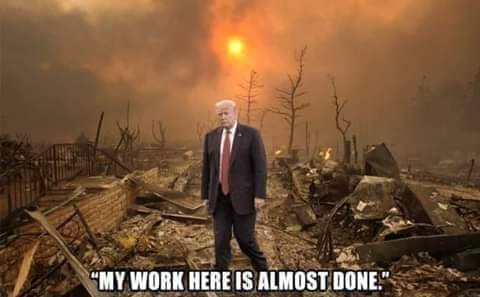
Fiddling while Rome burns – that’s what it felt like, thinking about the next blog post on the intricate subtleties of learning to live with the Colorado River, while all around us things we value are being broken by a PINO and his self-appointed unelected shotgun, claiming that a 1.5 percent voter ‘mandate’ gives them license to do any damn thing they want to us and to the institutions we have evolved over 250 years to try to govern ourselves.

PINO: President in Name Only, not just because he is not behaving the way presidential behavior is constitutionally defined, but mostly because the PINO himself is not satisfied with ‘president’; he has publicly stated his belief that ‘king’ would be a better name to call him, or whatever name would anoint him with the total authority he believes he warrants. Therefore, President in Name Only, until he can anoint himself with a name more fitting.

So anyway – Rome is burning. Or to abandon the metaphor for a little more accuracy – America is burning; the nation-state that we have evolved into a position of global leadership (even if we aren’t sure where we are leading to) is being broken up like old worn-out furniture and thrown on a burn-pile. America is burning, and for the most part most of us are just fiddling as it happens. Carrying on like it were just another day in our exceptionalist paradise because, well, what else are we going to do? When it comes down to it, the goal in the Preamble to the Constitution most of us most want is the one to ‘insure domestic Tranquility,’ and who wants to take on a handful of narcissistic egomaniacs throwing that Constitution on the bonfire of their vanities? It is as the poet Yeats said: ‘The best lack all conviction, while the worst / Are full of passionate intensity.’

Most of the politicians who call themselves ‘Democrats,’ and who might therefore be expected to try with similar vigor to stop this destruction of our imperfect but sincere effort at democracy, are lying low, saying let the ‘Repugnican’ wing of those who call themselves ‘Republicans’ dig themselves into a hole they eventually won’t be able to get out of. The problem there is that the hole they are digging was the foundation of our democracy, and we are kind of in the hole with them. And as with Humpty Dumpty, all the president’s horses and all the president’s men may not be able to put Trumpty-Mumpsy’s debris of democracy back together again – if we can even muster the will to try.

Our generally convictionless media have been snide about the Repugnicans in Congress being ‘cowed’ by the PINO, afraid to speak up. But I think the PINO is doing exactly what most of the Repugnican wing of the once-responsible Republican party want him to do, and would be doing themselves, were they not afraid of having to face their electorate about what it is doing to them. We had, and some of us even read, their “Project 2025’ plan for more than a year before the election, which lays out in considerable detail exactly what they planned to do if elected, and we elected them, and they are executing their plan with a passionate intensity.

The callous and casual cruelty of what the Repugnicans are doing under PINO’s flood-the-zone assault is astounding. They have summarily fired thousands of our fellow Americans for no reason other than the fact that they were working at jobs created by saner, more far-sighted and big-hearted Congresses back when we wanted our government to be a positive force in the nation and the world, as well as possessed of and by the biggest military hammer ever assembled to which every incipient conflict in the world looked like a nail. But in addition to that cruelty, the DOGEies have illegally frozen the funds already committed by Congress to fund those agencies and departments, which will cause considerable stress and even death in the nation and around the world.

The DOGEy chainsaw massacre seems to have focused on three areas. First, any agency or department that tries to help people who are not wealthy is on the sawbuck for cutting; this ranges from USAID which tries to help the truly poor of the world, to organizations like the Consumer Financial Protection Bureau that tries to prevent predatory organizations like banks and other more usurious organizations from taking advantage of U.S. citizens. The DOGEies have not yet set the chainsaw to Social Security and Medicare (although those remain long-term targets for the Repugnican element), but Medicaid will undoubtedly receive serious amputations soon if any semblance of the current Republican budget proposal gets passed. To fund tax cuts for the wealthy, even SNAP benefits will be cut – one area where Trump’s promise to reduce grocery costs could be actually be fulfilled, but, well, it’s the fraud, you know. And the Trump approach to ferreting out fraud in federal programs is to shoot first, then question the corpse.

The second area of DOGEy massacres is any federal entity charged with being a watchdog on the government itself. Federal inspectors general have been fired; the Department of Justice has been totally weaponized to support the PINO, including the office charged with investigating corruption in the government. This opens the gate for patronage at best – already evidenced by PINO’s staff and his strange selections of thoroughly unqualified cabinet members.

And a third area for cutting/freezing/killing is anything remaining that might make people appreciate their federal government. Staffs for both the National Park Service and the Forest Service that manages the National Forests have been severely cut after decades of small cuts. It is as if the Repugnicans want people to have unpleasant experiences visiting our national treasures – possibly preparatory for ‘privatizing’ them or just selling them off; their protection from exploratory drilling and oil-and-gas leasing will probably be eroded. The Environmental Protection Agency, which also has considerable popular support for improvements in local waterways and other areas where both beauty and public health have been served, now has a new mission, according to its new director: to make using your car and heating your house cheaper. Drill, baby, drill.

Beyond the DOGEy chainsaw massacres on we the people, there’s PINO actions on the international level, where he seems determined to alienate all of our longtime democratic friends, and court all of the growing number of autocratic or oligarchic nations. We laughed uneasily when he talked about ‘annexing’ Canada, Greenland, the Panama Canal; now we have stopped laughing because he won’t stop talking about it.

Summing it all up – the callous cruelty, the constant lying and false promises, the economic attacks on his own base, the insulting attacks on our longtime allies, the fawning behavior toward a longtime enemy, the midnight rages that he immortalizes on his ‘Truth Social’ site, the childish conviction that if we officially purge all mention of the climate crisis from any public discourse the crisis will no longer exist – all of these things make one wonder if we have not maybe elected a psychologically sick person to the presidency, a malignant narcissist slipping into dementia.

But then we remember that most of the substantive things he and his sidekick Elon are doing – excepting the more ‘personalized things like the childish language excision and the mad rants – is laid out in some detail in ‘Project 2025,’ authored by some of the people he has appointed to high places in governance.

The conspiracy theorist in my overactive brain sees the ‘Project 2025’ minions letting the PINO go until he has completely destroyed the existing government, then convening the cabinet to relieve him of his duties due to ‘illness’ and putting the vice-president in his seat. That would give us J.D. Vance who, to my mind, is a much more dangerous person than the PINO, who gets lost too easily in his own self-admiration and paranoia.

But all that I’ve said there sounds to me like just more fiddling while America burns. What am I doing about it; what am I going to do about it? For the moment, continue reading the news, calling my senators, and occasionally my representative (a Repugnican who I think would rather be a Republican). But it drives me back to what I wrote when I started posting these reflections. The subtitle for this blog is ‘Learning to Live in the Anthropocene.’ That is the long game here: adapting mentally and psychologically, then economically and politically, to the fact that we have – however inadvertently – become change agents at the planetary level.

This is not a small thing; it requires a paradigm shift to end all paradigm shifts, in the way we see ourselves in the world, and that kind of shift obviously does not happen overnight. In an earlier post here, I described Elizabeth Kubler-Ross’s five stages in the acceptance of death – but really the acceptance of anything that uproots our sense of who and what we are, and what we should do. Those five stages:

  • Denial:  This can’t be true; this can’t be happening here; if we ignore it, will it go away?
  • Anger:  This is not my fault; it is the fault of (Choose one or two: the immigrants, the Jews, the blacks, the whites, God, etc.). Get rid of them, and we’ll get rid of the problem.
  • Negotiation:  Maybe we tweak a few things that will enable us to adapt without changing everything.
  • Depression:  Damn. Nothing works to change the fact that the facts have changed. Our old world is dying. I want to go to sleep forever.
  • Acceptance:  Well. There’s nothing to do but to make do with what’s left – and what’s new where what was no longer is. Is something new possible? Lifeboat dialogue: ‘Pull for the horizon, boys. It’s better than nothing.’

And where are we now? We are so deep in denial about the changes we have inadvertently imposed on the planet, that we have elected a president who promised to make denial official policy – who has officially removed any mention of ‘climate crisis,’ ‘renewable energy’ and ‘green anything’ from any government communication.

There is anger too – the transition between denial and anger is a slow smoldering segue as denial is worn thin under abrasion from reality, and we begin to try to figure out who we can blame for the no-longer-ignorable reality. We get dangerous when we get angry.

And that’s where we are. President Biden had actually begun to try to move us on to the negotiation stage – how much of the world that we have and sort of love can we still have if we get more serious about a new infrastructure of energy and transportation…. But now we are back in the murky world of threadbare denial and enough anger to declare open war on anyone we can convince ourselves is part of our problems.

It’s still the West against itself — Stephen Trimble (WritersOnTheRange.org)

Click the link to read the article on the Writers on the Range website (Stephen Trimble):

March 17, 2025

Nearly 80 years ago, Bernard DeVoto, the Utah-born writer and historian, wrote an essay titled “The West Against Itself” for Harper’s Magazine.

DeVoto summed up the platform pressed by Western elected officials of his day in a memorable punchline: “Get out—and give us more money.” This “economic fantasy” is still with us, as DeVoto predicted, “yesterday, today, and forever.”

The new, fossil-fuel-friendly heads of federal land management agencies are serious about the “get out” part of that plea, firing thousands of their employees and closing dozens of offices across the West. Their list targets Fort Collins, Colorado; Flagstaff, Arizona; Moab and Salt Lake City, Utah; Lander, Wyoming; Boise, Idaho, and more. Local economies will lose millions they’ve depended on.

But Donald Trump and Elon Musk aren’t doing so well with the “give us more money” part. Voters who elected Trump may not get what they bargained for.

I have a home in southern Utah, in Torrey, gateway to Capitol Reef National Park. My neighbors in Wayne and Garfield counties, who gave well over 70 percent of their votes to Trump, often complain about federal overreach. They see conservation of national public lands as “locking up” land.

Yet Westerners love all that financial support coming in from the agencies they profess to hate. They rely on the federal government for so much more than they often acknowledge.

After a charming presentation about cowboy culture at Torrey’s nonprofit Entrada Institute recently, my wife asked a young rancher what his family did for health insurance.

“My wife works for the Forest Service,” he said. Indeed, government employees make up 23 percent of the workforce in Utah’s Garfield County and 25 percent in Wayne County. These salaries and the benefits that come with them are crucial to family stability.

A revealing interactive map in Grist magazine shows the reach of investment by the federal government through legislation passed by the Biden administration. I click on the town of Torrey and find tens of millions of federal dollars from the Inflation Reduction Act and bipartisan infrastructure law flowing into the county.

Think upgrades of rural airports, solar panels on small businesses, bridge replacements, removal of lead from drinking water—and on and on.

And then on February 14, the Department of the Interior announced the firings of more than 2,300 public servants at the Department of the Interior, including the Bureau of Land Management, National Park Service, and Geological Survey. With this “Valentine’s Day Massacre,” southern Utah communities will feel accelerating impacts — loss of income and benefits, more money going to unemployment payments, understaffed parks and monuments, irate visitors.

My inbox and social media feed are flooded with anecdotes about what these firings mean. One man grew up in a Park Service family and then worked as a park ranger himself for years. He transferred to the Forest Service recently, becoming a “probationary” employee only because he was new to his position. He lost his job and his career thanks to the Trump administration.

When rural Westerners say “get out” to the feds, I don’t think this is what they have in mind.

President Trump is also considering once more eviscerating national monument protection for Grand Staircase-Escalante and Bears Ears in southern Utah. These monuments have been good for local communities and economies.

The monuments haven’t locked up the land; ranchers still have their grazing permits. Pre-existing mining and drilling claims remain in force. And the conservation and tourism values of these designated preserves expand every year.

According to a recent Colorado College poll, 84 percent of Utahns support establishment of new national parks, national monuments, national wildlife refuges and tribal protected areas. Still, Utah’s governor, attorney general, and congressional delegation continue to waste millions on fruitless lawsuits attacking those same preserves.

Stephen Trimble: Photo credit: Writers on the Range

Westerners are evolving; politicians aren’t keeping up. And yet we keep re-electing these same officials. Maybe, just maybe, the Trumpian war on civil servants will force a reckoning. We’ll re-evaluate why we need a robust federal presence in the West.

And our war against ourselves will end.

Stephen Trimble is a contributor to Writers on the Range, writersontherange.org, an independent nonprofit dedicated to spurring lively conversation about the West. He worked for the National Park Service, BLM, and Forest Service in his twenties and has been a conservation advocate ever since.

This map shows land owned by different federal government agencies. By National Atlas of the United States – http://nationalatlas.gov/printable/fedlands.html, “All Federal and Indian Lands”, Public Domain, https://commons.wikimedia.org/w/index.php?curid=32180954

#Colorado West Slope Letdown: U.S. Representative Lauren Boebert left, MAGA stuck around — Jonathan P. Thompson (LandDesk.org)

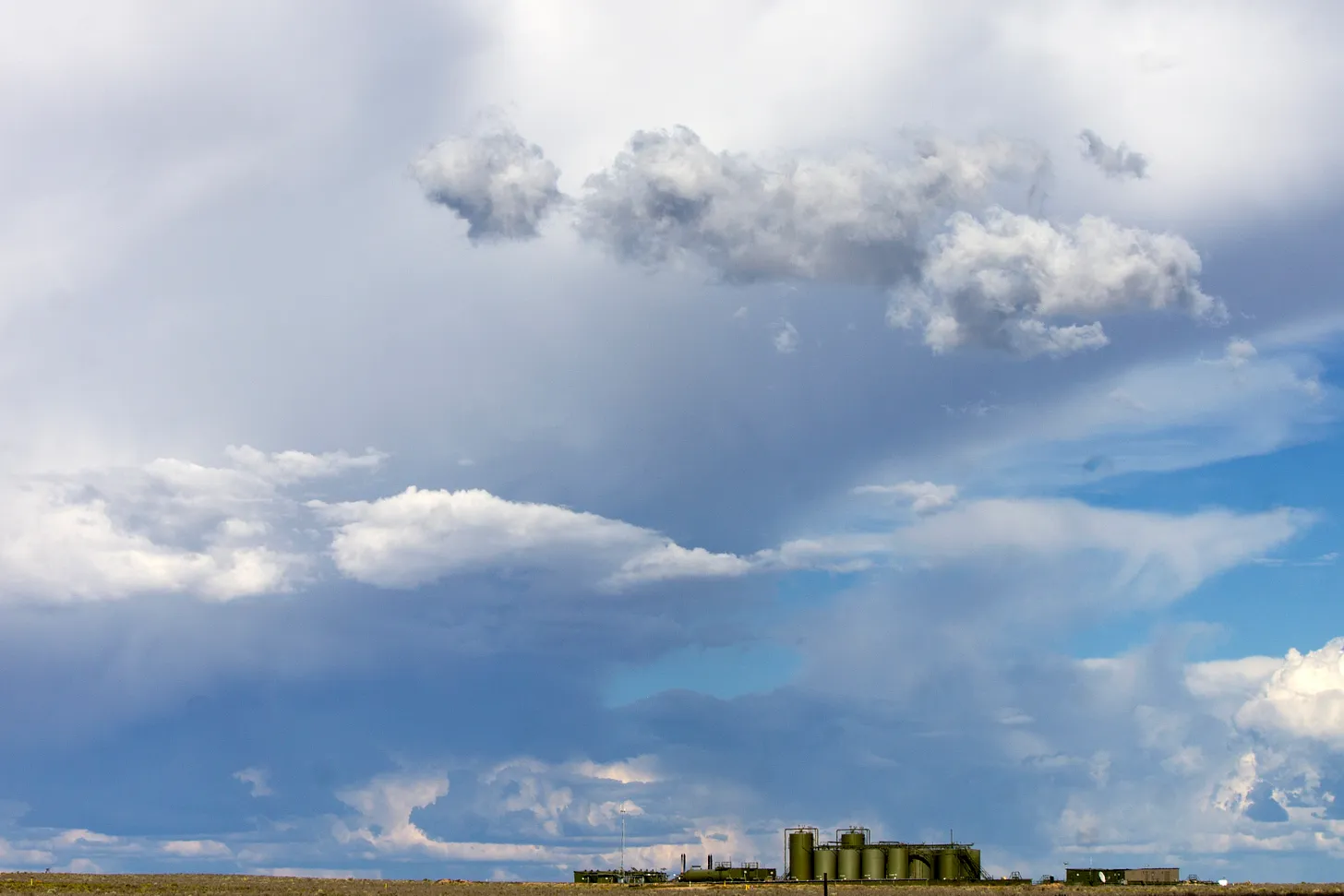
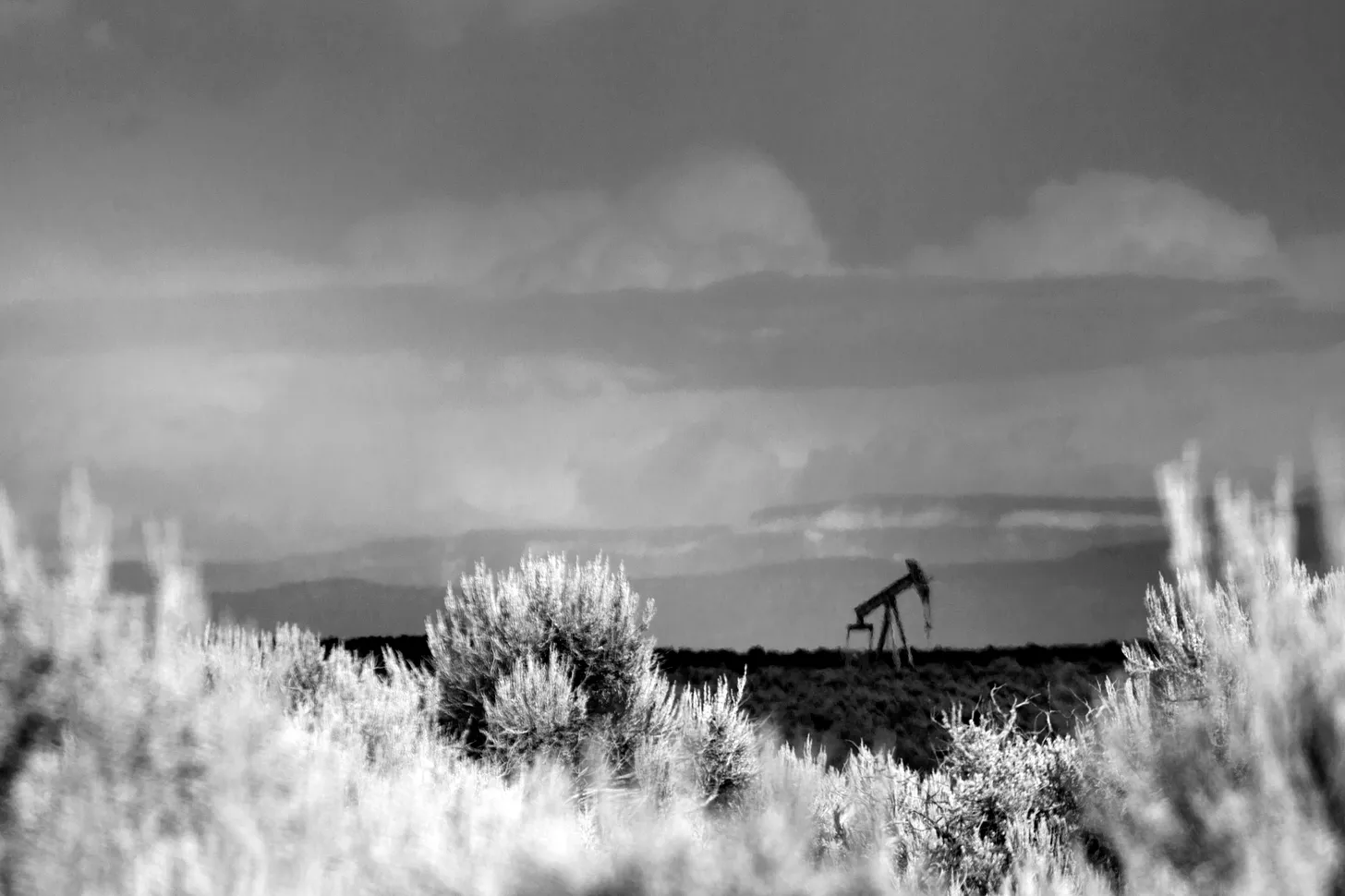
Sky with oil and gas infrastructure, Greater Chaco Region. Jonathan P. Thompson photo.

Click the link to read the article on The Land Desk website (Jonathan P. Thompson):

March 15, 2025

Data Dump: Setting baselines to monitor “energy dominance” under Trump

When Republican Jeff Hurd was elected to represent Colorado’s third congressional district, I believe I heard a bipartisan, collective sigh of relief. Democrats may have been sad that their candidate didn’t win, but at least the new guy wasn’t Lauren Boebert. And, many of us hoped, Hurd would represent a return of the independent and pragmatic Western politician of old to western and southern Colorado.

We were wrong.

So far, Hurd’s performance in office has pretty much followed Boebert’s lead, politically, albeit without the gun-slinging and other outrageous antics. When one of his aides showed up to meet with constituents in Dolores, she fled after seeing the size of the crowd assembled there. Hurd, himself, chickened out from attending a town hall in Grand Junction for similar reasons. Instead of apologizing for refusing to listen to the people he represents, he accused the crowd of being George Soros-funded activists — a false and worn-out, right-wing anti-semitic trope that really needs to be retired. In fact, the folks were his constituents, including members of Indivisible and the League of Women Voters. These weren’t exactly molotov cocktail hurling radicals.

And when CPR’s Ryan Warner asked him about the mass federal employee firings that have hit his district especially hard, Hurd gave mealy mouthed answers, saying efficiency is good, acknowledging he had no idea how many employees had lost their jobs, and lamenting the possibility that some good people may have been terminated, too, though it was also clear that he wasn’t going to do anything about it, especially if it meant questioning or, God forbid, standing up to Musk and Trump.

Hurd introduced a bill that would move the Bureau of Land Management headquarters to Grand Junction because it’s better to have management staff on the ground, yet he has not pushed back on DOGE’s plans to close federal offices throughout his district, including the Bureau of Reclamation and Army Corps of Engineers offices in Durango. He has teamed up with Boebert to criticize Colorado for importing “foreign wolves” into the state and has parroted MAGA’s anti-immigrant hysteria in regards to Denver’s tolerance.

Now Hurd has introduced the Productive Public Lands Act to “unlock resource development on some of our most productive lands.” It would toss Biden-era Bureau of Land Management resource management plans — which he claims “locked up access to viable lands” — and replace them with fossil fuel-friendly ones with the aim of putting “us on a path to energy dominance.” Talk about inefficient: Those RMPs took years to develop and are the result of extensive studies, public input, and compromise. Trashing them is a perfect example of government waste. [ed. emphasis mine]

Note to Rep. Hurd: Public lands are not locked up. Quite to the contrary. Unfortunately Hurd — like his predecessor — has chosen to let MAGA ideology and disinformation blind him to the facts. Still, I’ve got to try, so here I go again: The United States is producing more oil and gas — much of it from public lands — than it ever has before, and is the world’s leader in hydrocarbon production. Read that again. Then again. And keep doing so until it penetrates your thick skull so that you can stop wasting all of our time with your “war on energy” nonsense.

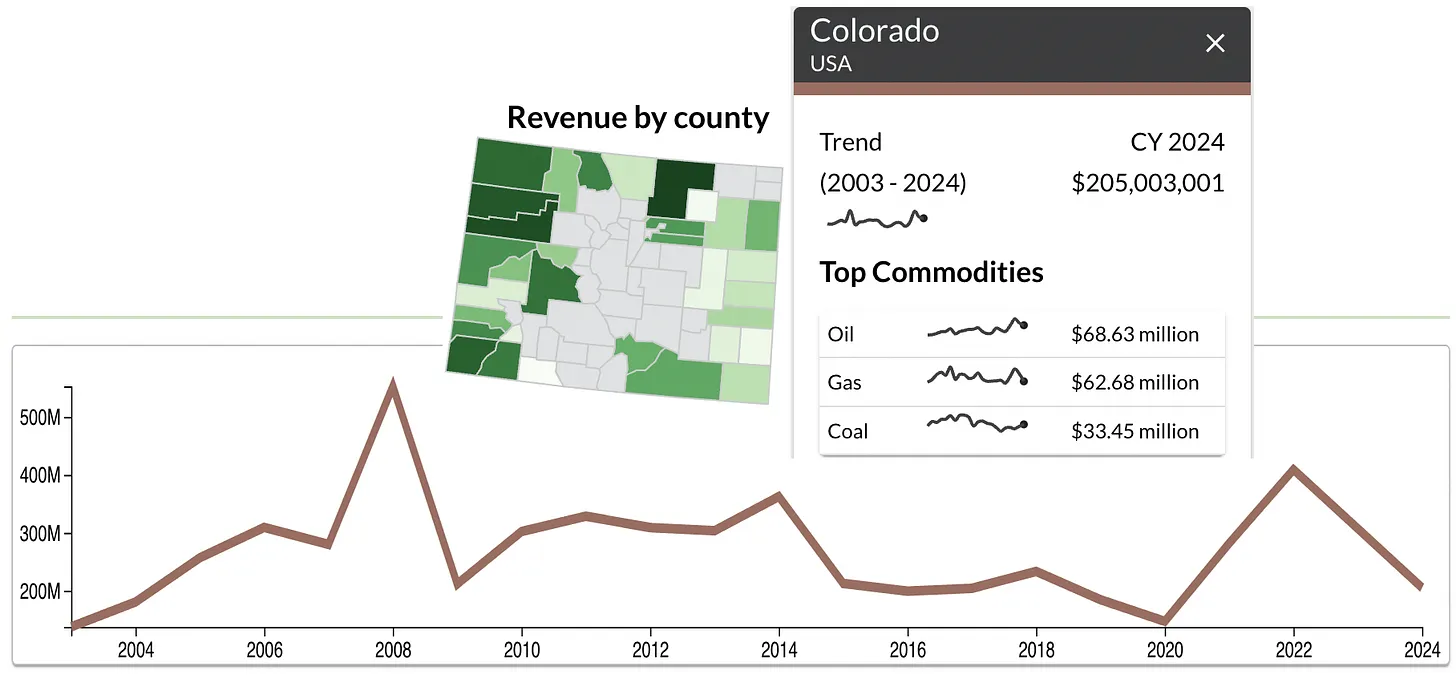
While drilling has shifted away from Colorado and is now centered on the Permian Basin, it has nothing to do with BLM regulations or resource management plans. It’s because western Colorado is rich in natural gas, not so much in oil, and there’s far less money in natural gas production than there is in crude oil. Nevertheless, oil, gas, coal, and carbon dioxide production from federal lands in Colorado (much of which are on the Western Slope) generated $205 million in revenue last year. Locked up? I don’t think so.

***

As long as I’m on the topic of “energy dominance,” I figured it would be a good time to set out some baseline data for tracking the progress of Trump’s “drill, baby, drill” agenda. As has been established, the Trumps and Hurds of the world believe that energy production from federal lands has been “locked up,” and that by “unleashing” it — i.e. rescinding environmental protections — the oil and gas industry will bring in a battalion of drill rigs, send oil and gas production through the roof, and bring down prices at the pump to make it cheaper to drive those gas-guzzling behemoths that now dominate the roadways.

It’s too early in Trump’s term to determine whether that’s actually happening or not, so let’s just check in on where we are and what has happened over the last four years. And we’ll keep updating these graphs periodically. Land Desk readers have seen some of these before. Sorry about that.

This one shows U.S. crude oil production. It was in steady decline until about 2009, kicking back up again just as Obama took office. Is that because Obama slashed regulations on drilling? No. It’s because that’s when horizontal drilling-multistage hydraulic fracturing, i.e. fracking, came into its own and oil prices increased. Production dipped at the end of Obama’s second term because OPEC decided to wage a price war on U.S. producers, glutting the market with crude in hopes of driving some U.S. companies out of business. And it dipped again at the end of Trump’s first term because of COVID. In December, while Biden was still in office, U.S. fields produced 418 million barrels of crude, an all-time record high. Source: Energy Information Administration.

Production goes up after drilling activity increases. Drilling activity generally responds to crude oil prices. When prices are high, it’s more profitable to develop new oil and gas wells, so the drilling rigs are dusted off and head out into the fields. When prices are low, they are folded up and hauled back to the storage yard.

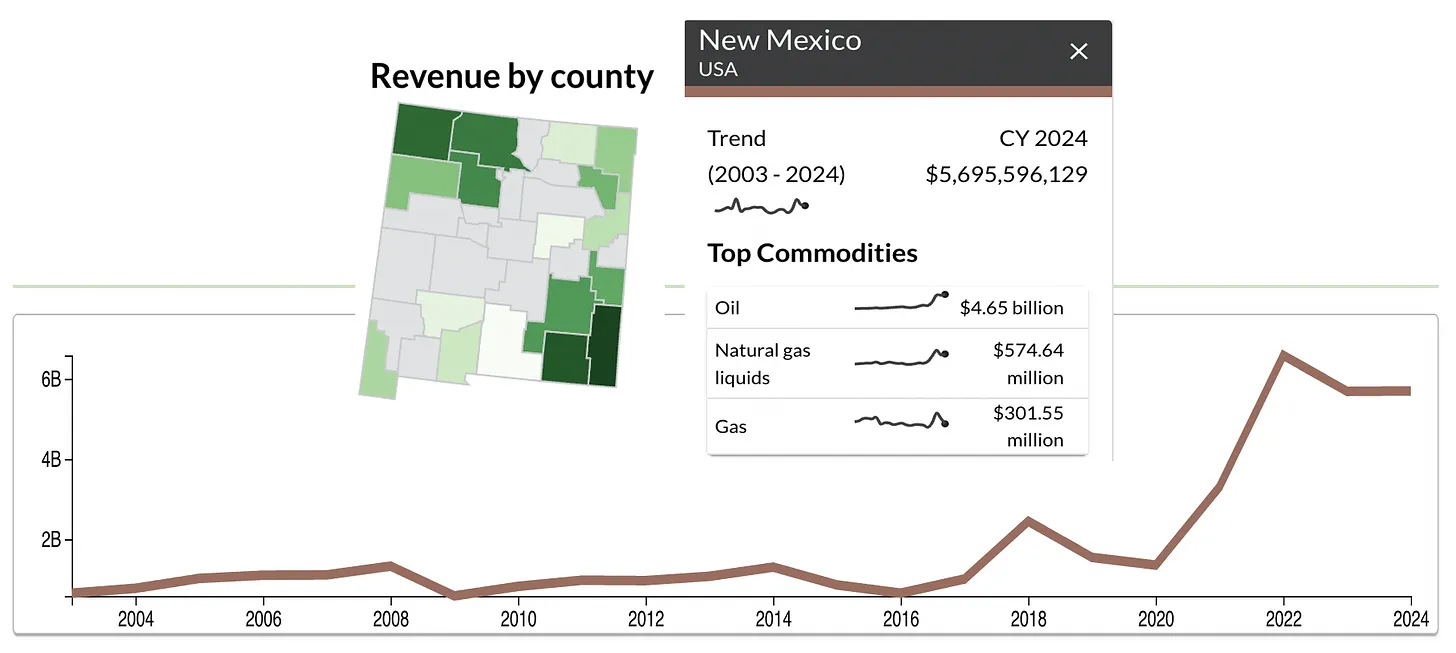
And lest you think that maybe all of that production is coming from private or state lands since, after all, the federal land has all been “locked up” by Biden’s purported war on energy, check out the revenues from federal land resource production for New Mexico and Colorado. Funny how they shot up right after Biden was elected, no?

Oil production from federal lands in New Mexico generated $4.65 billion last year, down slightly from 2022 but still significantly more than during any other time during the last two decades. Source: Office of Natural Resource Revenue.

Colorado’s energy industry has had a slightly rougher go of it, mainly because it specializes in natural gas, not crude oil, and methane prices have been low since the 2009 crash. Note to Jeff Hurd: Revenues were substantially higher under Biden than under Trump I. Just sayin’. Source: ONRR

The best way to get a feel for drilling activity is to check out the weekly rig count. So here it is. But a note to all you statisticians out there: The time intervals are uneven on this graph, in part due to my own laziness. But it still gives a fairly accurate picture of drilling activity over time, so it works.

This gives a good illustration of the level of drilling activity and where it’s taking place. This shows the OPEC price war dip in 2015 and 2016 and the COVID dip in 2020. Again, these are driven almost entirely by the price of crude oil, which is determined by the global market. North Dakota dominated for a while, but never recovered from the 2015 crash. Instead, activity moved to the Permian Basin in New Mexico and Texas. The rig count for Western states remained remarkably stable during the Biden administration. Source: Baker-Hughes.

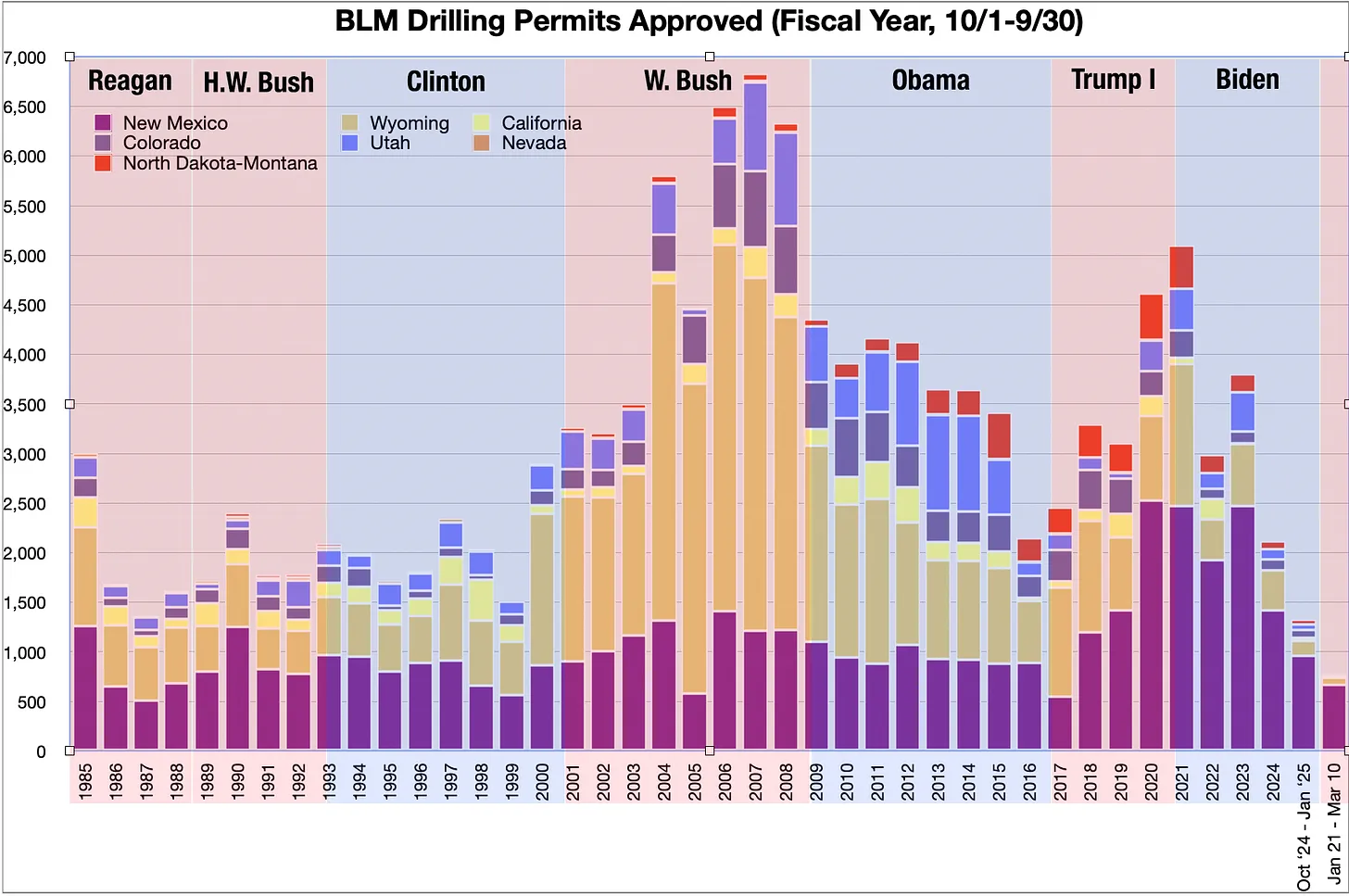
The thing about production and rig counts, though, is they don’t really reflect White House policy. So how about the number of drilling permits approved by the Bureau of Land Management?

On average, Biden’s BLM issued around the same number of drilling permits as Trump I. This may have something to do with policy, but it is also driven by how many firms apply for permits and how well-equipped and staffed the field offices are to process those applications. Note that during the last four months of Biden’s term, the BLM issued over 1,300 permits. So far, the Trump II administration has issued 774 permits in just over two months. Source: BLM.

Now that we have a snapshot of where we’ve been and where we are in terms of oil and gas development, we can track where we might be headed under Trump 2.0. My guess? We’re going to see all of the above indicators begin falling soon. Sure, rig counts are staying steady, meaning production will continue to rise for a few more months. But after that, lower oil prices are likely to kick in, dimming companies’ enthusiasm for drilling, which will hit the rig count first and then production.

Graphic credit: The Land Desk

Oil prices are dropping — they hit sub-$70/bbl this week for the first time since 2021 — because OPEC decided to start pumping more crude and because the economy is struggling, which will likely dampen demand. The economy is struggling because markets are reacting unfavorably to the chaos Trump, Musk, and company are wreaking from the White House. Turns out that tariffs, trade wars, and haphazard termination of critical federal employees is bad for the economy. Gasoline prices will likely fall, too, except in places that rely on Canadian crude, where they might increase. So there is that. Of course, if you lose all your money in the plummeting stock market, it won’t really matter much, I suppose.


Speaking of tariffs, remember when I wrote about Trump’s trade wars and predicted that American whiskey and bourbon makers would be casualties? Turns out I was right. Kentucky distillers, especially the small ones, are already feeling the pain, and even large ones are smarting from Canada’s retaliatory moves. I suppose Trump will claim the Canadians started the trade war, just as he’s ridiculously asserting Ukraine invaded Russia.

📸 Parting Shot 🎞️
St. Joseph’s Church, San Fidel, New Mexico. Jonathan P. Thompson photo.

Yampa Valley nonprofits face uncertainty amid federal policy shifts — Steamboat Pilot & Today

Yampa River near Deer Lodge Park. Photo credit: Allen Best/Big Pivots

Click the link to read the article on the Steamboat Pilot & Today website (Julia Coccaro). Here’s an excerpt:

March 13, 2025

In the Yampa Valley, a network of dozens of nonprofits provides essential services to the community. Recent federal policy changes, however, have introduced widespread uncertainty, ultimately threatening the stability and fate of many of these organizations. The Office of Management and Budget on Jan. 27 issued a memo following an executive order by the Trump administration announcing a federal freeze on hundreds of billions of dollars in grants and loans. The order was blocked by a federal judge the next day, and on Jan. 29 the memo was rescinded. But White House Press Secretary Karoline Leavitt stated that only the memo was rescinded, not the order, leading to mass confusion and anxiety regarding the fate of federal funding for thousands of programs nationwide.

The secret double life of America’s public lands: And why you should know about it if you drink water… —  John Zablocki (AmericanRivers.org)

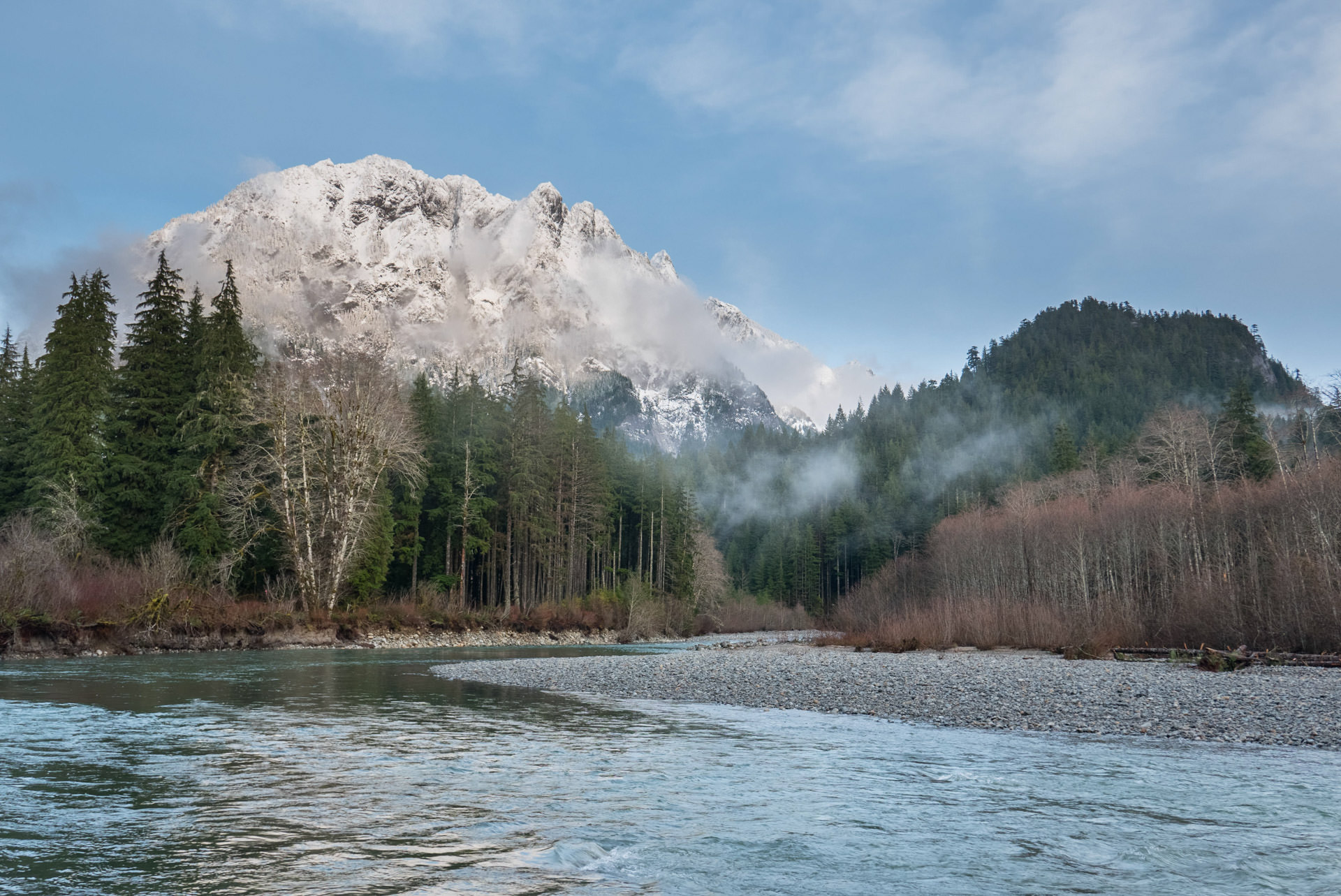
Middle Fork Snoqualmie River, Washington | Monty Vanderbilt Lightroom processing

Click the link to read the article on the American Rivers website (John Zablocki):

January 21, 2025

Public lands are the birthright of every American. One of the great privileges of living in this country is the ability to access hundreds of millions of acres to enjoy the great outdoors — all for free.

People care about and use public lands for many reasons. From hunters and anglers to miners and ranchers, hikers and mountain bikers—there is something for almost everyone on public lands.  But what if you live in a city and never set foot on public lands?  Why care about them then?

Not everyone hunts, fishes, mines, ranches, hikes, or bikes; but everyone, truly everyone, depends on clean water. The big secret about public lands is that they are arguably the country’s single biggest clean water provider. According to the US Forest Service, National Forests are the largest source of municipal water supply in the nation, serving over 60 million people in 3,400 communities across 33 states.  Many of the country’s largest urban areas, including Los Angeles, Portland, Denver, and Atlanta receive a significant portion of their water supply from national forests.

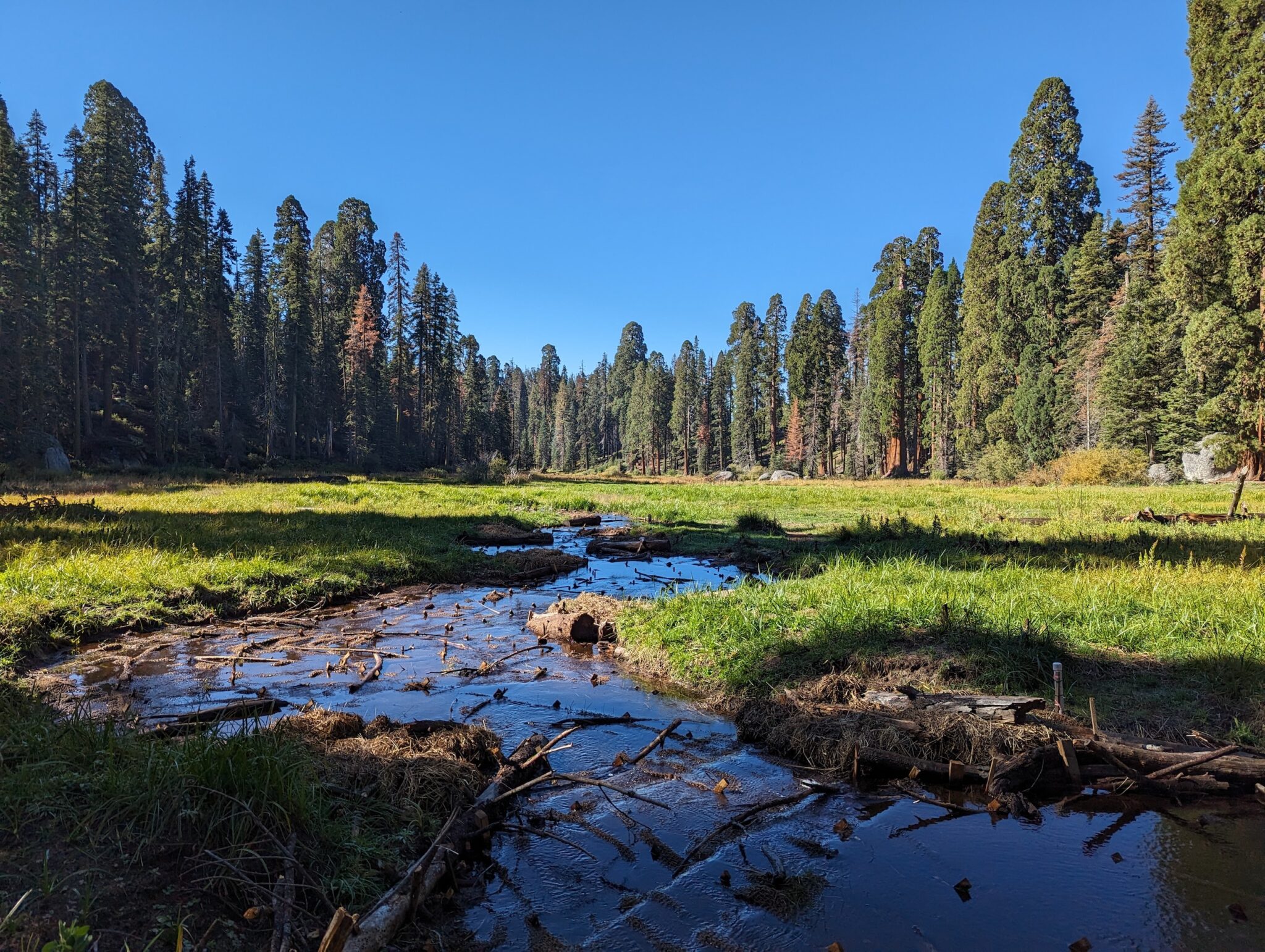
Log Meadow, California | Maiya Greenwood

Healthy forests and grasslands perform many of the functions of traditional water infrastructure. They store water, filter pollutants, and transport clean water to downstream communities. And they do it naturally — essentially for free.  When rivers are damaged from land uses on public lands, we all pay the price — literally; we all pay more in taxes and utility bills to clean up the water.

What happens on the public’s land also happens to the public’s water. The importance of managing public lands for the benefit of public water is so fundamental, it has been a pillar of public lands management agencies’ missions since their inception over a century ago. For example, The Organic Act of 1897[1] that created the US Forest Service stated:

When land is degraded due to mining, clear-cutting, overgrazing, and other uses, the negative effects are carried far, far downstream, all the way to your faucet. Poor land management practices also release sediments and contaminants into public water supplies. Such pollution has major consequences, from raising water treatment costs  to potentially causing serious public health crisis. 

Poor land management is the main driver of desertification — the phenomenon of lush riparian areas turning into barren plains. Desertification depletes the public’s supply of water, as well as the public’s supply of grass for livestock and big game that ranchers and hunters depend on.

Access to clean, reliable water is a need that cuts through all social and political divisions.  It is fundamental to life, literally. Land management that neglects watershed health amounts to peeing in the nation’s public pool — something I think we can all agree we don’t want to happen to our drinking water.


[1] For a good chronological summary of major FS law and policies since the Organic Act of 1897, see:
https://www.fs.usda.gov/Internet/FSE_DOCUMENTS/fseprd530507.pdf

A Sagebrush Rebel returns to Interior: Karen Budd-Falen has spent her career fighting the agency; Mining Monitor; “Avalanche” comes out from behind the paywall — Jonathan P. Thompson (LandDesk.org)

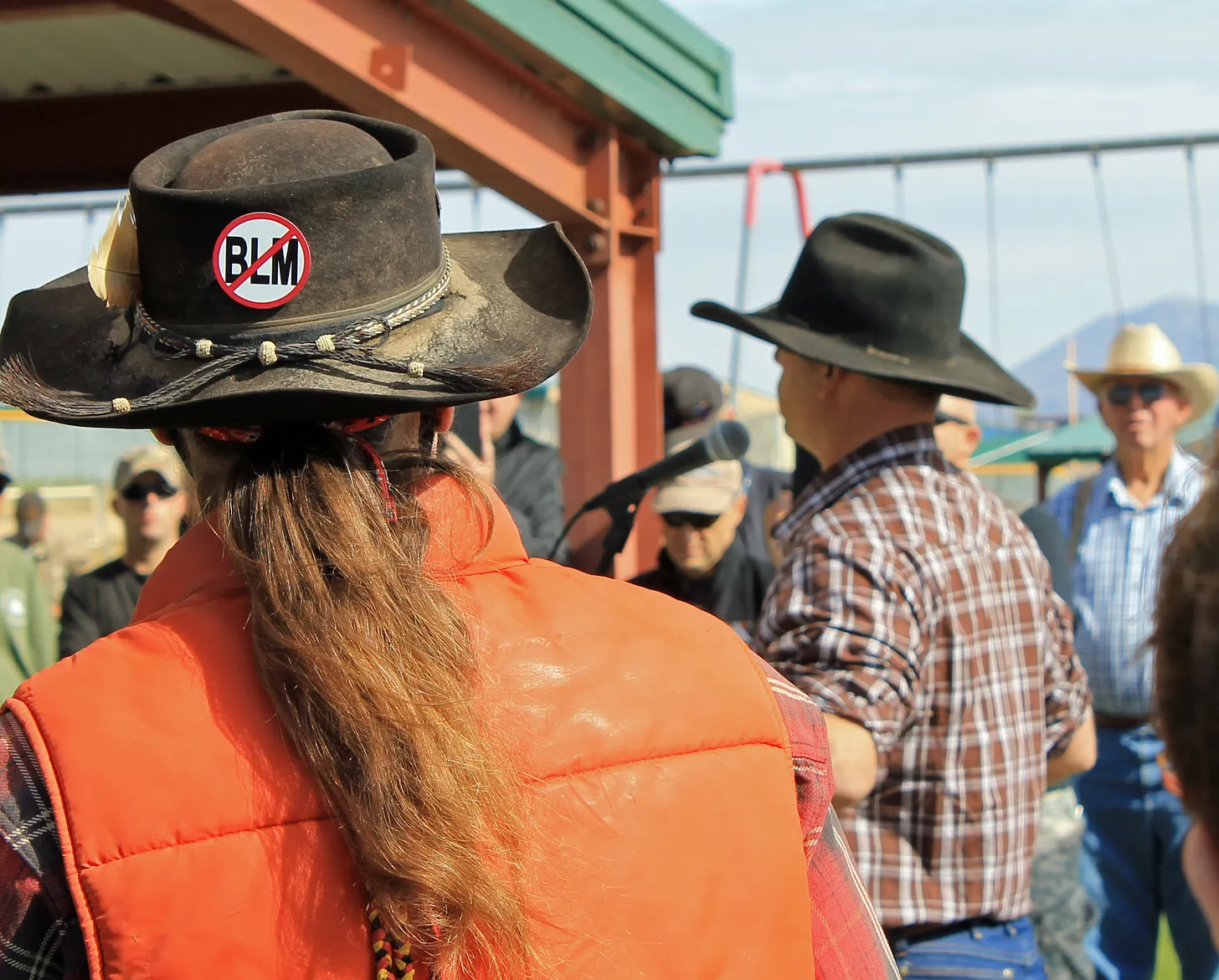
Ryan Bundy speaks at the 2014 Recapture rally to protest federal land management, which took place just days after armed insurrectionists threatened federal officers who had tried to detain Cliven Bundy’s cattle, which had long been grazing on public lands illegally. Karen Budd-Falen — reportedly appointed to be the number three at Interior — represented Bundy years before the standoff, but later condemned his response. Nevertheless, her writings and court cases provided an ideological underpinning for the Bundys and their fellow insurrectionists. Jonathan P. Thompson photo.

Click the link to read the article on The Land Desk website (Jonathan P. Thompson):

March 7, 2025

Interior Secretary Doug Burgum has given another indication of how he plans to oversee public lands with the reported appointment of Karen Budd-Falen, a Wyoming property rights lawyer and rancher, as associate deputy Interior secretary, the department’s third in command. This will be Budd-Falen’s third stint at Interior: She worked under James Watt, Ronald Reagan’s notorious Interior secretary, and served as deputy Interior solicitor for wildlife and parks under the first Trump administration. Budd-Falen revealed the appointment to Cowboy State Daily this week, though the administration has yet to announce it.

Budd-Falen has spent much of her five-decade-long career fighting against federal oversight and environmental protections — she has been called an “architect of the modern Sagebrush Rebellion” — and is a private property rights extremist (except when they get in the way of public lands grazing).

In 2011, Budd-Falen divulged her core philosophy — and her distorted view of the U.S. Constitution — in a keynote speech to a meeting of Oregon and California county sheriffs, many of who adhered to the “constitutional sheriff” creed. She told them that “the foundation for every single right in this country, our freedom of speech, our freedom to vote, our freedom to petition, is all based on the right of ownership of private property.”

While this is obviously a messed up interpretation, it is an honest reflection of her worldview, and she has often stuck with it even if it meant going after extractive interests. In the 1990s, for example, Budd-Falen represented the legendary, stalwart Republican-turned-anti-oil-and-gas activist Tweeti Blancett in her attempt to get the Bureau of Land Management to clean up the mess its industry-friendly ways had facilitated on and around her northwest New Mexico ranch. And Budd-Falen’s law firm often worked with landowners to get the best possible deal from energy companies that developed their property.

But more often than not, Budd-Falen’s vision of private property rights extends beyond a landowner’s property lines and onto the public lands and resources — at the expense of the land itself, the wildlife that live there, and the people who rely upon it for other uses.

In a telling article in the Idaho Law Review in 1993, Budd-Falen and her husband, Frank Falen, argued that grazing livestock on public lands was actually a “private property right” protected by the Constitution. If you were to extend this flawed logic to oil and gas and other energy leases and unpatented mining claims, then corporations and individuals would have private property rights on hundreds of millions of acres of public lands. This may sound alarmist, but the fact is, the federal land management agencies often adhere to this belief. Once an oil and gas lease is issued, for example, a BLM field office is unlikely to deny a drilling permit for the lease, since doing so would be violating the company’s private property rights. Who needs public land transfers when this sort of de facto privatization is commonplace?

Many of Budd-Falen’s cases relied on a similar argument: That private property rights can apply to public resources. She defended Andrew VanDenBerg, for example, who bulldozed a road across the Whitehead Gulch Wilderness Study Area in Colorado’s San Juan Mountains to access his mining claim — just one of many times she wielded RS-2477, the 160-year-old statute, to try to keep roads across public lands open to motorized travel and bulldozers. She represented big landowners who felt that they had the right to kill more big game — a public resource — than the law allowed, because they owned more acreage.

Budd-Falen was instrumental in crafting a slew of ordinances for Catron County, New Mexico, declaring county authority over federally managed lands and, specifically, grazing allotments. While the ordinances and resolutions focused on land use, they also contained language influenced by the teachings of W. Cleon Skousen, an extreme right-wing author, Mormon theologian, and founder of the National Center for Constitutional Studies, née the Freeman Institute, known for its bestselling pocket-size versions of the US Constitution.

The ordinances were “about the legal authority of county governments and the legal rights of local citizens as regards the use of federal and state lands.” They were intended to preserve the “customs and culture” of the rural West, which apparently included livestock operations, mining, logging, and riding motorized vehicles across public lands. And the Catron County commissioners were ready to turn to violence and even civil war to stop, in the words of the ordinance, “federal and state agents” that “threaten the life, liberty, and happiness of the people of Catron County … and present danger to the land and livelihood of every man, woman, and child.” The National Federal Lands Conference, a Utah-based organization launched in the late 1980s by Sagebrush Rebel Bert Smith, a contemporary and philosophical collaborator of Skousen’s, peddled similar ordinances to other counties around the West.

Budd-Falen has been especially antagonistic toward the Endangered Species Act, often representing clients hoping to reduce the law’s scope or to water down its enforcement or applicability. In 2013, for instance, she filed an amicus brief in support of People for the Ethical Treatment of Property Owners’ claim that the ESA should not apply to Utah prairie dogs because the species’ range was confined to one state. The property owners lost and the U.S. Supreme Court declined to hear the case.

Occasionally Budd-Falen has veered away from defending property rights, however, if it means keeping cows on public lands. After Bill Clinton designated Grand Staircase-Escalante National Monument in 1996, the Grand Canyon Trust bought out grazing allotments in the monument from willing sellers with the intention of retiring the permits for good. It was a win-win situation, one that allowed ranchers to bring in a pile of cash and maybe retire or move operations to a more cattle-appropriate area, and it protected sensitive areas from the ravages of grazing.

Nevertheless, Kane and Garfield County commissioners didn’t like the deal, mostly because they didn’t like the monument. So they sued to block the permit retirements, in an attempt to undercut the transactions, and Budd-Falen stepped in to represent them. She said she was trying to ensure the survival of the “cowboy’s Western way of life,” apparently even if it was against the cowboys’ own wishes. “I think it’s important to keep ranchers on the land,” she told the Deseret News. She definitely will not do anything to reform public lands grazing during her tenure, but then that’s no different from any other administration so far, Republican or Democrat.

In the early 1990s Budd-Falen represented a number of southern Nevada ranchers —including Cliven Bundy — in their beef with the feds over grazing in endangered desert tortoise habitat. Budd-Falen was quick to condemn the Bundys’ armed insurrection against the federal government when BLM rangers tried to remove their cows from public lands, where they had been grazing illegally for years. And she also spoke out against the Bundy-led armed takeover of the Malheur National Wildlife Refuge.

Still, one can’t deny that her work and words — often hostile and aimed at environmentalists and federal land agencies — provide an intellectual underpinning for the Bundy worldview. She is an alumni of the Mountain West Legal Foundation, the breeding ground for the Sagebrush Rebellion and Wise Use movement that helped launch the careers of Watt and Gale Norton, the Interior secretary under W. Bush. And in 2007 Budd-Falen told High Country News’s Ray Ring that her most important case was when she used RICO, and anti-racketeering law, to go after BLM agents who had cited her client for violating grazing regulations.

Her rhetoric outside the courtroom not only inflames, but also provides justification for those who may be inclined to take up arms against their purported oppressors. She has referred to federal land management agencies as “a dictatorship” wielding its “bureaucratic power … to take private property and private property rights.” She once made the spurious claim that “the federal government pays environmental groups to sue the federal government to stop your use of your property.”

Seems pretty crazy to put someone like that near the top of a federal land management agency, but then, that’s par for the course for Trump and company.

The tally at Interior now includes, in addition to Budd-Falen:

  • Interior Secretary Doug Burgum, who has close ties to oil tycoon Harold Hamm, and who suggested using “inhospitable or unoccupied” public lands to pay down the federal debt.
  • BLM director Kathleen Sgamma, an oil and gas industry lobbyist who has sued the agency she is now tapped to lead.
  • Deputy Interior Secretary Katharine McGregor, who served the same position during the final year of Trump’s first term, and was most recently the VP of Environmental Services at NextEra Energy in Florida.

⛏️Mining Monitor ⛏️

It appears that Trump’s executive orders are beginning to change the way regional public lands offices operate. Patrick Lohmann with Source NM reports, for example, that Cibola National Forest Service employees — at least the ones that weren’t fired by DOGE — were ordered to prioritize “mission critical” activities, including reviews of proposed uranium mines, to comply with Trump’s energy orders.

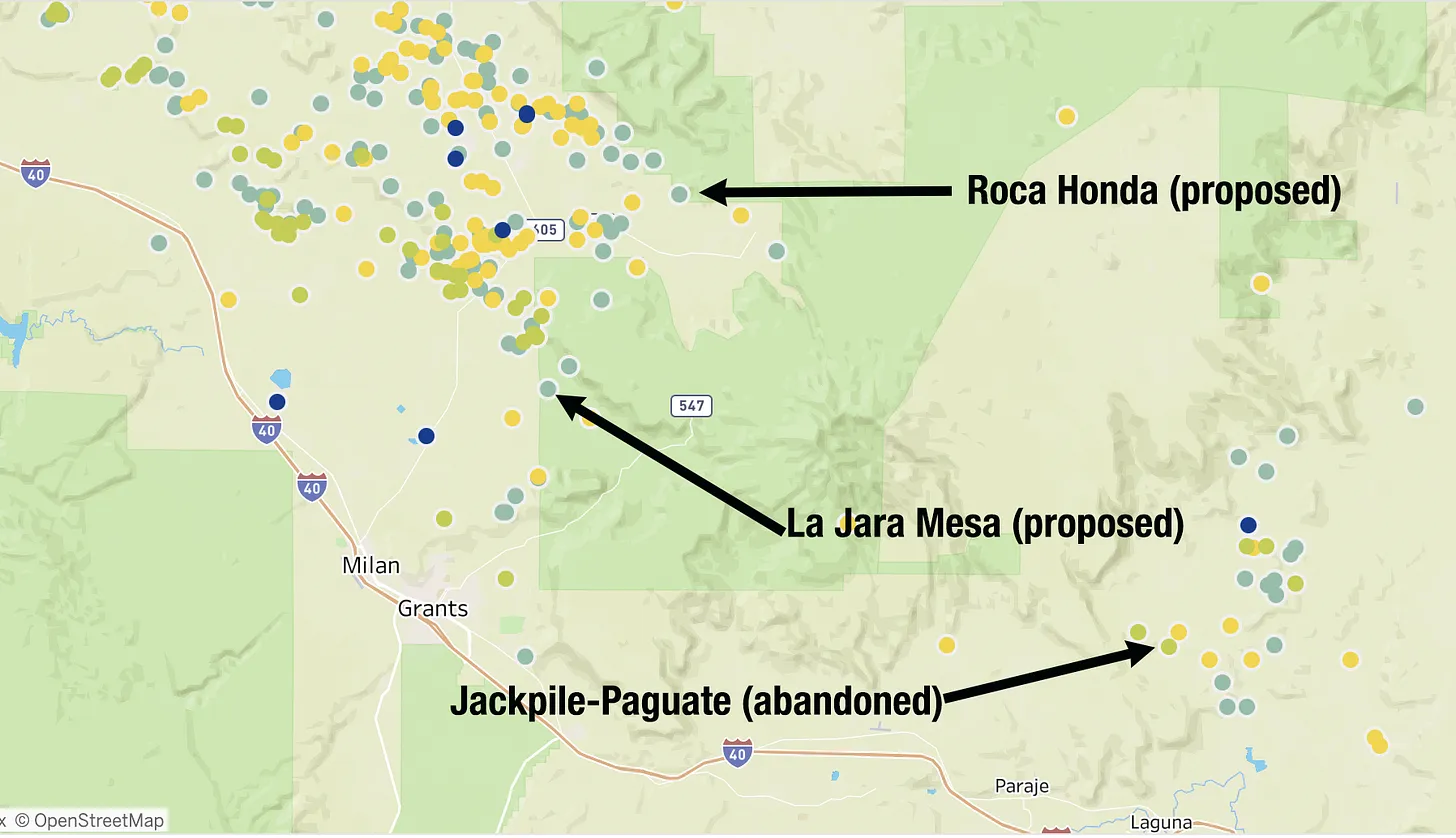
There are currently two proposed uranium mines on the forest, which includes Mount Taylor and surrounding areas near Grants, New Mexico. Energy Fuels — the owner of the Pinyon Plain uranium mine and the White Mesa uranium mill — is looking to develop the Roca Honda mine on about 183 acres. And Laramide Resources wants to build the La Jara Mesa mine. Both projects would be underground, not surface mines, and were originally proposed over a decade ago, but stalled out when uranium prices crashed. Now that prices have increased, the firms have expressed renewed interest.

The dots show abandoned uranium mining and milling sites.

The Grants and Mount Taylor area was ravaged by Cold War-era uranium mining and the wounds from the previous boom continue to fester. That include the remnants of Anaconda Minerals Company’s Jackpile-Paguate Mine on Laguna Pueblo land, which was once the world’s largest open-pit uranium mine, producing some 24 million tons of ore.

Miners were exposed to radioactive and toxic heavy metals daily, even spending their lunch breaks sitting on piles of uranium ore. Blasting sent tremors through the pueblo’s adobe homes, and a cloud of poisonous dust drifted into the village of Paguate, just 2,000 feet from the mine, coating fruit trees, gardens, corn, and meat that was set out to dry. A toxic plume continued to spread through groundwater aquifers, and the Rio Paguate, a Rio Grande tributary, remains contaminated more than a decade after the facility became a Superfund site, despite millions of dollars in cleanup work. Laguna residents and former mine workers still suffer lingering health problems — cancer, respiratory illnesses and kidney disease — from the mine and its pollution.

Now the feds are saying approving new uranium mines in the same area is “mission critical.”

***

In December, the Biden administration began the process of halting new mining claims and mineral leasing for the next 20 years on 165,000 acres in the upper Pecos River watershed west of Santa Fe, New Mexico. This included holding meetings to gather public input on the plan. But the BLM canceled the first such meeting, scheduled for late February, and has not announced a new date, sparking fears that the new administration may be withdrawing plans for a mineral withdrawal.

Rio Grande and Pecos River basins. Map credit: By Kmusser – Own work, Elevation data from SRTM, drainage basin from GTOPO [1], U.S. stream from the National Atlas [2], all other features from Vector Map., CC BY-SA 3.0, https://commons.wikimedia.org/w/index.php?curid=11218868

Included within the acreage are more than 200 active mining claims held by Comexico LLC, a subsidiary of Australia-based New World Resources. For the past several years, Comexico has been working its way through the permitting process to do exploratory drilling at what it calls its Tererro mining project. It has met with stiff resistance from locals and regional advocacy groups, partly because mining has a dark history in the Pecos River watershed. In 1991, a big spring runoff washed contaminated mine and mill waste from a long-defunct mine into the upper Pecos River, killing as many as 100,000 trout. That prompted a multi-year cleanup of various mining sites.

***

📸 Parting Shot 🎞️

And now for a special treat, or maybe torture, but either way it might help take your mind off the dismantling of Democracy for a few moments. It’s my blow-by-blow analysis of the 1978 movie Avalanche, starring Rock Hudson and Mia Farrow. Normally this would be behind a paywall, like all of the other Land Desk archives. But I’m opening up to everyone for a limited time only in honor of the snowslide-triggering storm that is pounding the San Juans as I write. Enjoy. And, while you’re at it, check out our interactive map of long-lost ski hills in southwest Colorado.

AVALANCHE: A blow-by-blow analysis of the 1978 disaster flick — Jonathan P. Thompson, February 9, 2022

I was drawn in by the close-up winter aerial shots of ridges and peaks of the San Juan Mountains—Look, there’s Vestal! I yelled to my non-existent viewing companions as Rock Hudson’s name flashed on the screen. And Arrow! And Mount Garfield! I kept watching the lost-to-obscurity 1978 disaster film,

Read full story

American Farmers Brace for Harm From President Trump’s Retaliatory Tariffs — The New York Times

(Gov. Polis in Phillips County touring Vision Angus family farm). Photo credit: Governor Polis’ office

Click the link to read the article on The New York Times website (Danielle Kaye). Here’s an excerpt:

March 4, 2025

Trade wars during President Trump’s first term slashed billions of dollars in U.S. agricultural exports. Farmers and trade groups expect an even bigger hit this time.

On Tuesday, China’s Ministry of Finance said it would add tariffs of as much as 15 percent on a wide range of agricultural imports from the United States, including chicken, wheat, corn and cotton. Beijing’s retaliation for escalating American tariffs on Chinese-made products also includes 10 percent tariffs on imports of sorghum, soybeans, pork, beef, aquatic products, fruits, vegetables and dairy products. Without specifying which products, Canada said on Tuesday that it would impose retaliatory tariffs of 25 percent on $20.5 billion worth of American goods, and Mexico promised to outline its response on Sunday. President Trump imposed 25 percent tariffs on products from both countries on Tuesday. Farms are a target because agricultural products account for a large portion of U.S. exports, said Lynn Kennedy, a professor of agricultural economics at Louisiana State University. Politics are probably a factor, too…As they did during the first Trump administration, the retaliatory tariffs could mean that American exports and prices paid for crops fall — as importers from China, Canada or Mexico look to Brazil or other large agricultural producers for alternatives…

China accounted for 14 percent — roughly $24.7 billion — of all agricultural goods exported from the United States in 2024, according to data from the Department of Agriculture. Mexico and Canada imported even more: about $30.3 billion worth of goods for Mexico and $28.4 billion for Canada. Mark Legan, a livestock and crop farmer in Putnam County, Ind., said Mexico was his top export market for pork and China his biggest for soybeans, which he sells to Cargill and Archer Daniels Midland plants in his area…When China started to buy more soybeans from Brazil during Mr. Trump’s first term, Mr. Legan’s income “significantly decreased,” he said. His pork exports to China also fell. This time, he’s again worried about the fallout — especially since Mexico is poised to retaliate, too.

“We are fighting an uphill battle against the tariffs, to get both soybeans and pork into those markets,” Mr. Legan said. “In agriculture, we deal with uncertainty all the time, whether it’s the weather or the health of our animals. But this adds another level of uncertainty that we’re trying to deal with the best we can.”

Interior Dept. may be withdrawing from the West, not moving to it: Will a DOGE plan to shutter federal offices affect the BLM’s potential HQ move? — Jonathan P. Thompson (LandDesk.org) #snowpack

Look at all of that snow … Psyche! This is just a wishful thinking shot, taken two years ago at the Durango Nordic Center. The center just closed for the season, citing a lack of snow. Jonathan P. Thompson photo.

Click the link to read the article on The Land Desk website (Jonathan P. Thompson):

March 4, 2025

Ever since Trump was elected, I’ve been anxiously waiting for the administration to announce that it would relocate the Bureau of Land Management’s headquarters to Grand Junction once again. After all, the chapter of Project 2025 penned by William Perry Pendley, Trump’s BLM acting director last time, advocates for the move. And so far, the administration has followed the far-right’s “playbook” to a T.

While Rep. Jeff Hurd, the Colorado Republican who represents most of western Colorado, has introduced legislation that would make the move, the administration has remained quiet on the issue. And last week, the Government Services Administration announced it planned to shutter about 2 million square feet of office space occupied by the Interior Department around the nation. (More details below).

This seems to throw a potential BLM move — which would require a new lease — into doubt.

I suppose a lot of you are sighing with relief at that news. Not me. I wasn’t going to rail against the move. In fact, though I know I’m at odds with a majority of my readers here, I was planning on arguing in favor of it — if done correctly.

This isn’t a new position for me: I did the same last time Trump was elected. And I stand by my previous position: If carried out in a thoughtful and well-intentioned manner, the benefits of basing the agency in the West offset the negatives, even in a place like Grand Junction. I’m not going to rehash all of my arguments, especially since they may be moot, but basically I argued:

  • The relocation would give local and regional advocacy groups who can’t afford to travel to D.C. more access to top agency officials;
  • It would allow agency leadership to live among the public lands they administer and to see, firsthand, the consequences of policies. It would make it more likely that they would, say, witness a wild horse and burro roundup; see the way a herd of cattle can decimate a swath of public land; see what a 200 MW solar installation looks like; or witness the impacts of oil and gas leases or land withdrawals;
  • It would bring up to 300 senior employees to Grand Junction, boosting the economy (and making it less reliant on extractive industries)
  • If you’re interested you can read the opinion piece here.

Admittedly, this stance came back and bit me in the butt last time I took it, when the transfer was badly, and intentionally, botched. Trump and his minions used the move as an underhanded way to eviscerate the agency and get rid of senior, knowledgeable staff. After promising to stock the Grand Junction office with about 300 senior employees, only about 30 ended up there. And the top brass weren’t even there full-time: They commuted back and forth to Washington, D.C.

Oh, and also, the agency ended up sharing an office building with Chevron, Laramie Resources, and the Colorado Oil & Gas Association, thereby realizing opponents’ worst fears: That basing the agency in western Colorado would give industry more access and influence over its senior staff. I also wrote about all of these failures here.

This time around, Trump doesn’t need to move BLM HQ to gut the agency or push out long-time staff, he’s got the oligarch-led DOGE to do that. Nor would the relocation open more access to the oil and gas industry, since they already have a direct portal via presumed BLM director Kathleen Sgamma, herself a petroleum lobbyist.

Instead of beefing up the federal presence in the West, however, the administration seems intent on withdrawing it. There’s all of the federal agency firings, of course, which are ongoing. And now the GSA terminating leases and, in an apparent spasm of spite, is also at least considering shutting down all or some of the electric vehicle chargers at federal facilities.

A sampling of offices that would close under the GSA’s plan:

  • National Parks Service offices or buildings in: Fairbanks, Alaska; Camp Verde, Flagstaff, and Phoenix, Arizona; Arcata and Ventura, California; Fort Collins, Colorado; Lapwai, Idaho; Mountainair and Grants, New Mexico; Salt Lake City, Moab, and Monticello, Utah; and Seattle, Washington.
  • Bureau of Indian Affairs offices or buildings in: Show Low, Fredonia, and Phoenix, Arizona; Redding, California; Towaoc, Colorado; Pablo and Poplar, Montana; Zuni, New Mexico; Elko, Nevada; and Toppenish, Washington.
  • U.S. Geological Survey offices or buildings in: Anchorage, Alaska; Boulder and Golden, Colorado; Bozeman, Montana; Klamath Falls and Corvallis, Oregon; Moab, Utah; Spokane, Washington; and Cheyenne, Wyoming.
  • U.S. Fish & Wildlife Service offices or buildings in: Tucson, Arizona; Arcata, California; Fort Collins, Littleton, and Grand Junction, Colorado; Bozeman and Great Falls, Montana; West Valley City, Utah; and Lander, Wyoming.
  • Bureau of Reclamation offices in: Durango, Colorado; Bend, Oregon; and Boise, Idaho.
  • Bureau of Minerals Management Service and Bureau of Trust Fund Administration offices in: Camarillo, California, and Farmington, New Mexico.
  • Bureau of Land Management offices in: Ukiah, California, and Baker City, Oregon.
  • The full list can be found here

As is often the case with the Trump administration, the plan appears to have been made in haste and without forethought, targeting facilities where the leases are up for renewal in coming months. It’s not clear what will happen to the employees that work in those spaces or whether the services they provide will continue or be terminated as well. But it will deliver another blow to the communities that will lose the offices, many of which have already seen federal employees get the axe.

***

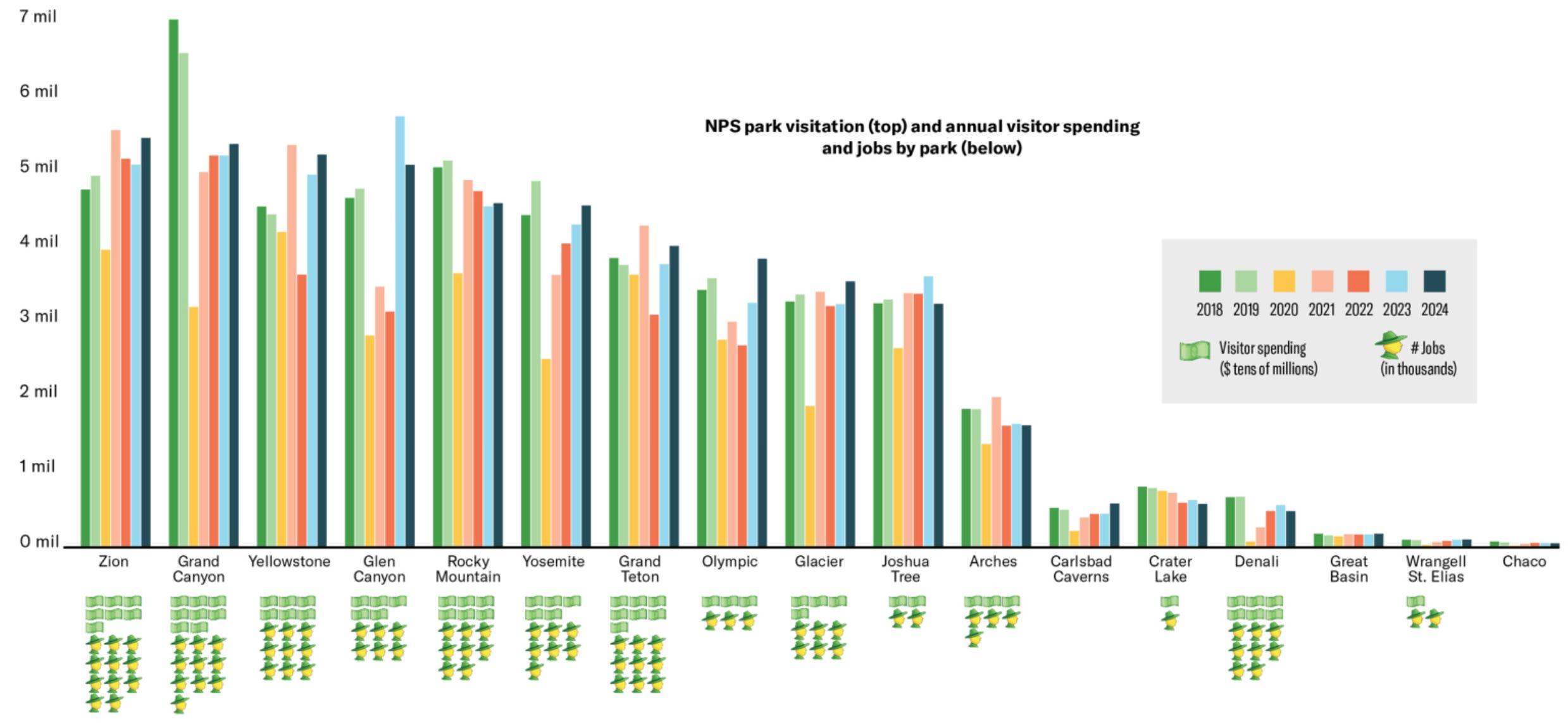
Speaking of the economic impacts of federal lands and agencies, I did a piece for High Country News on outdoor recreation, mostly on public lands, and how it affects local and state economies. I argue that Page, Arizona, has weathered the closure of Navajo Generating Station better than expected because it already had a recreation-based economy in place. It also has a bunch of graphs on national parks visitation, visitor spending, and so forth, put together by Hannah Agosta and Marissa Garcia. Read it here.

Source: High Country News.

***

After I finished the above piece, I came across a cool dashboard showing economic impacts of each national forest. Go here and type in your forest to see how it’s contributing.

***

A group of national park rangers are working to tally up all of the firings of their colleagues, park by park. You can check out their spreadsheet and see that Arches NP lost three employees, Carlsbad Caverns lost 14, Chaco lost one, Death Valley lost six, Grand Canyon lost 10, Joshua Tree lost six, Lake Mead 13, Zion lost 11, and the list goes on. It could be a rough summer in a lot of these places. 

***

🥵 Aridification Watch 🐫

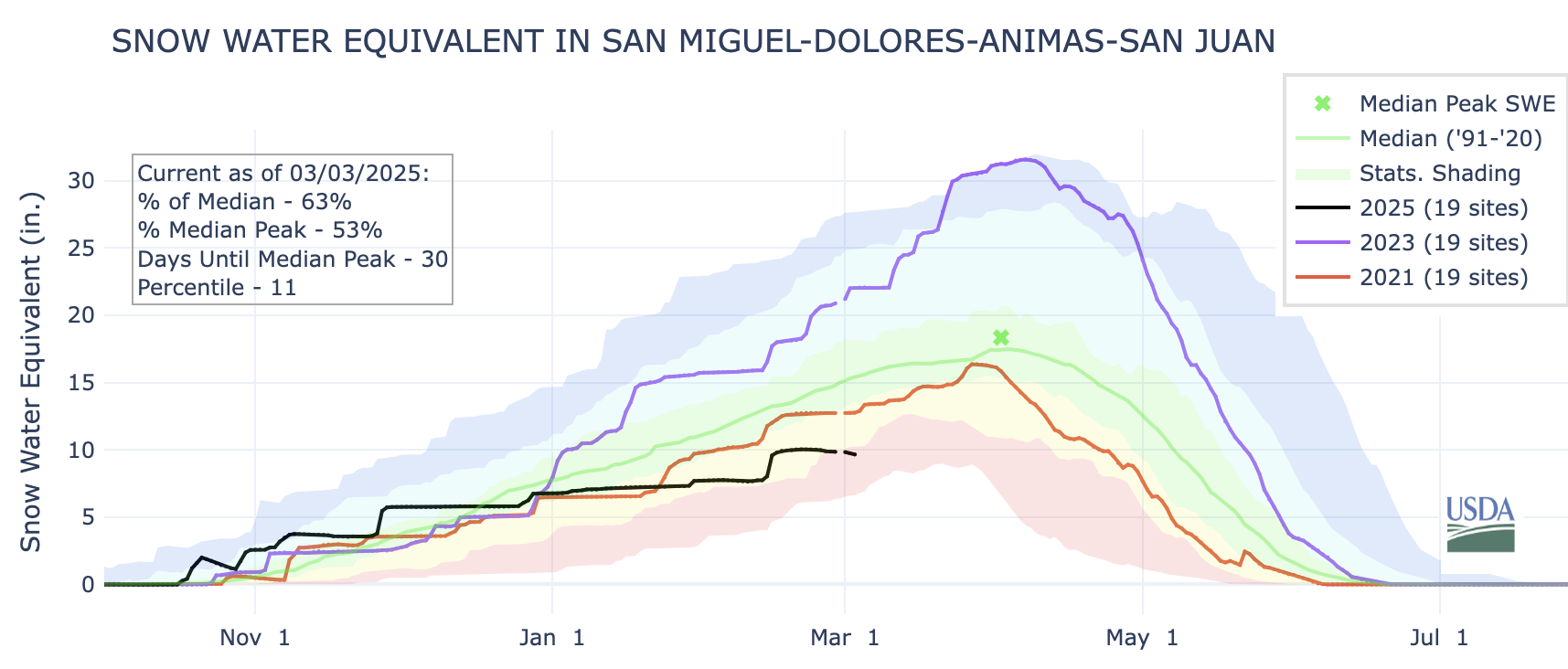
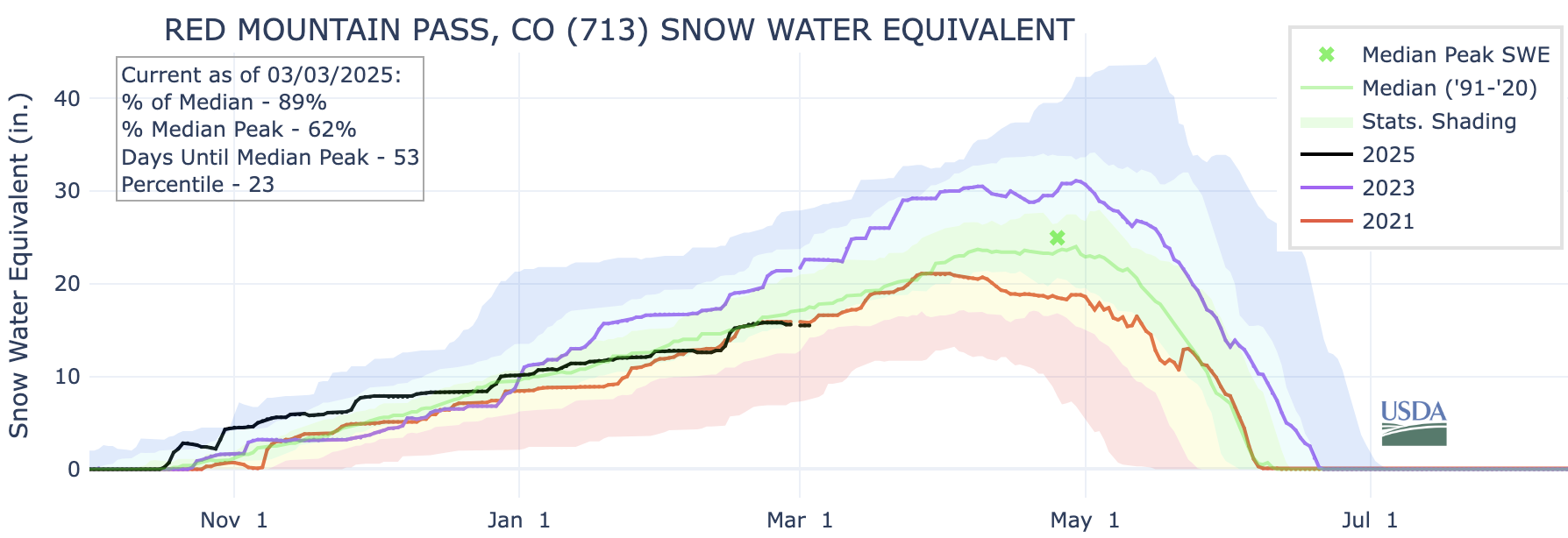
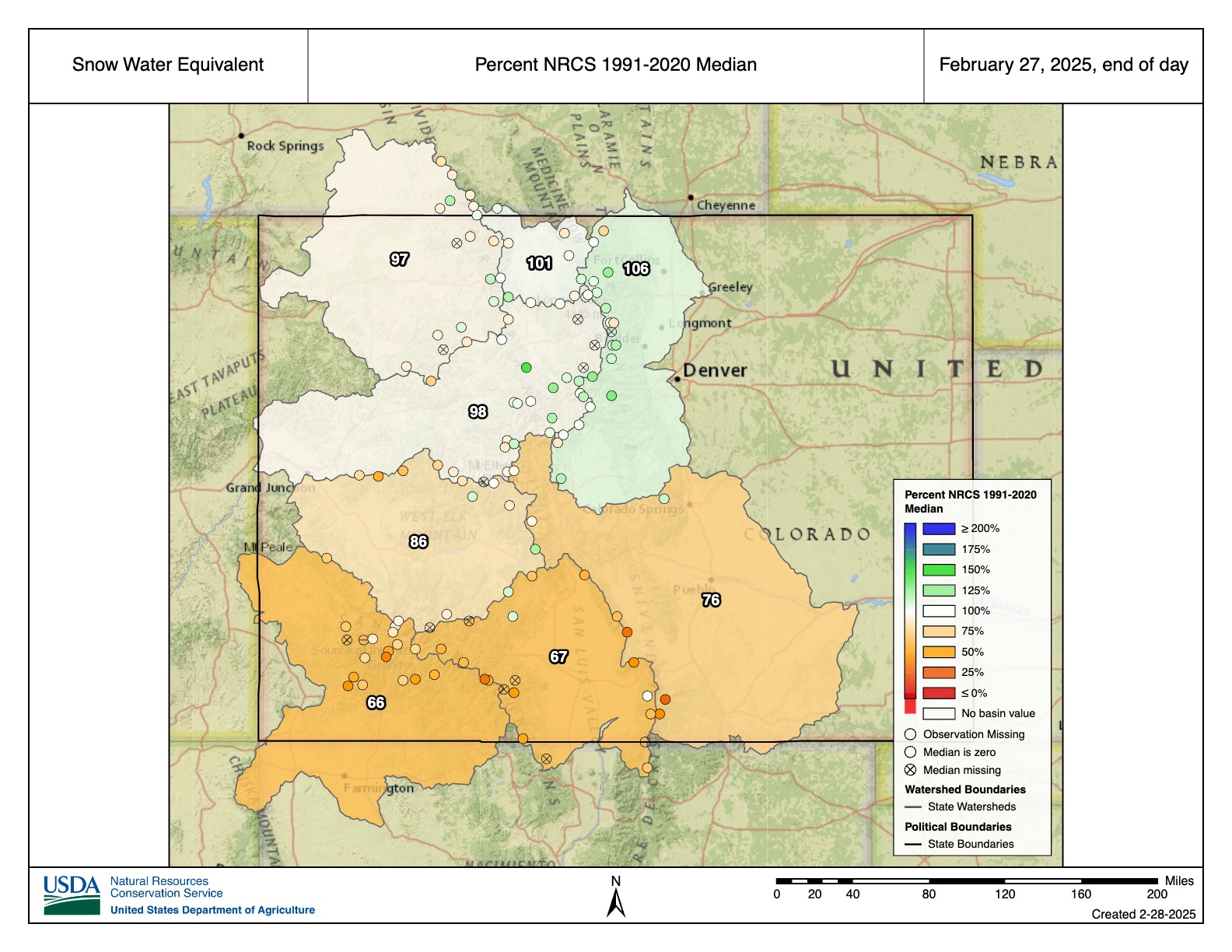
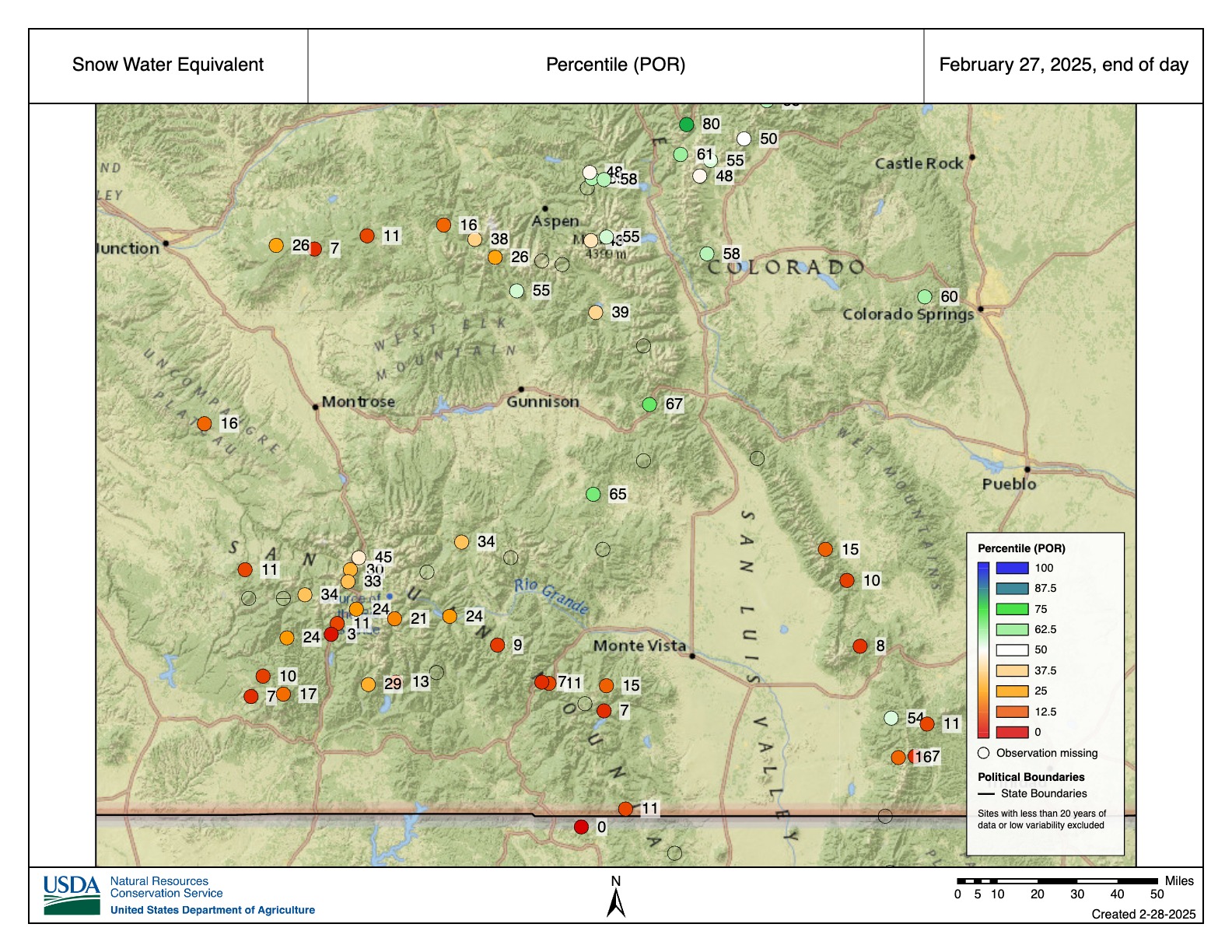
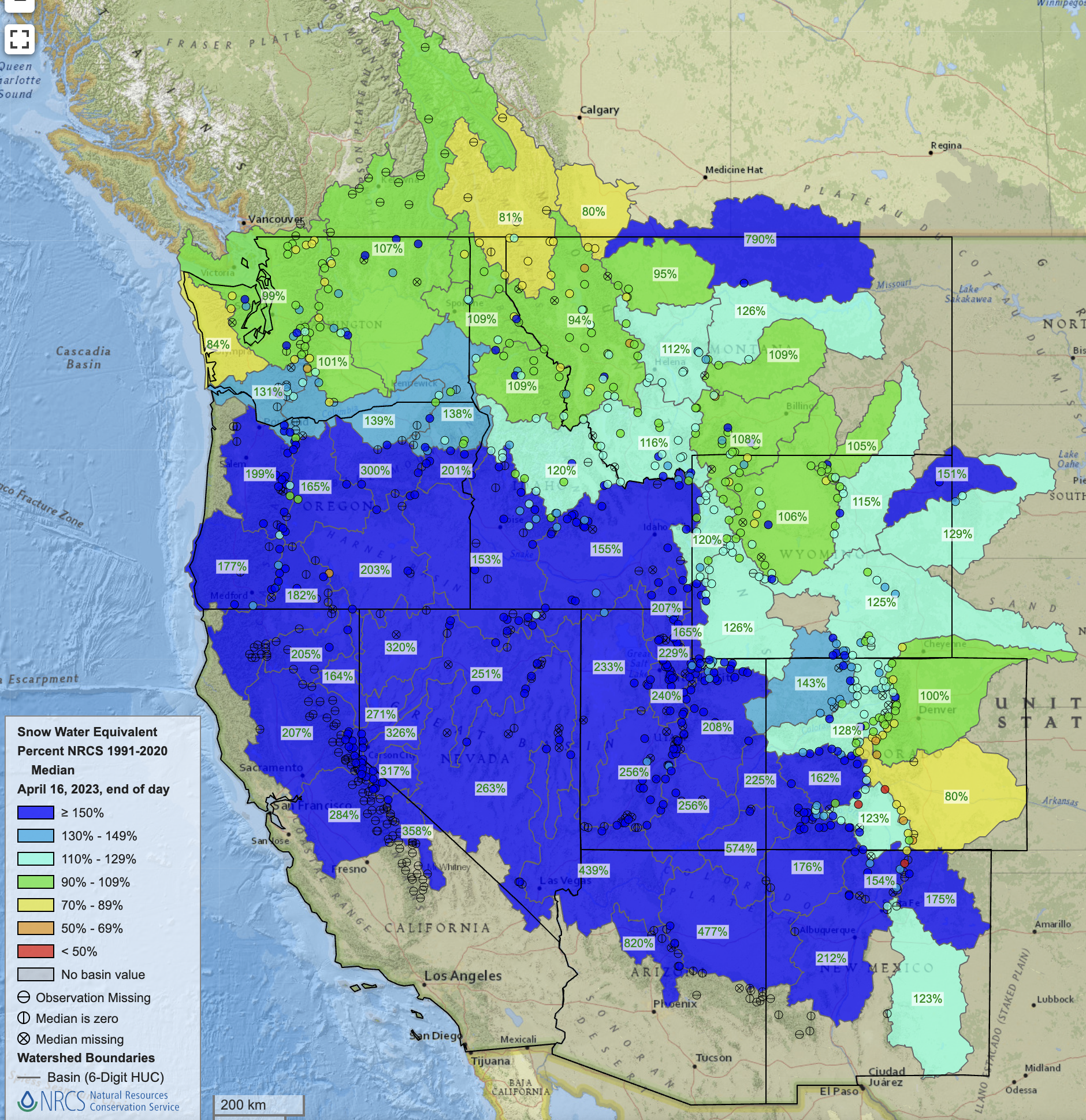
It’s the beginning of the month, and time for another episode of the snowpack update. And, once again, it’s a mixed bag, depending on where you are. In Colorado, the line seems to be drawn around McClure Pass: Areas north of that have an average to above average snowpack, while most places south of there are below normal. The situation is downright dire down in Arizona and much of New Mexico.

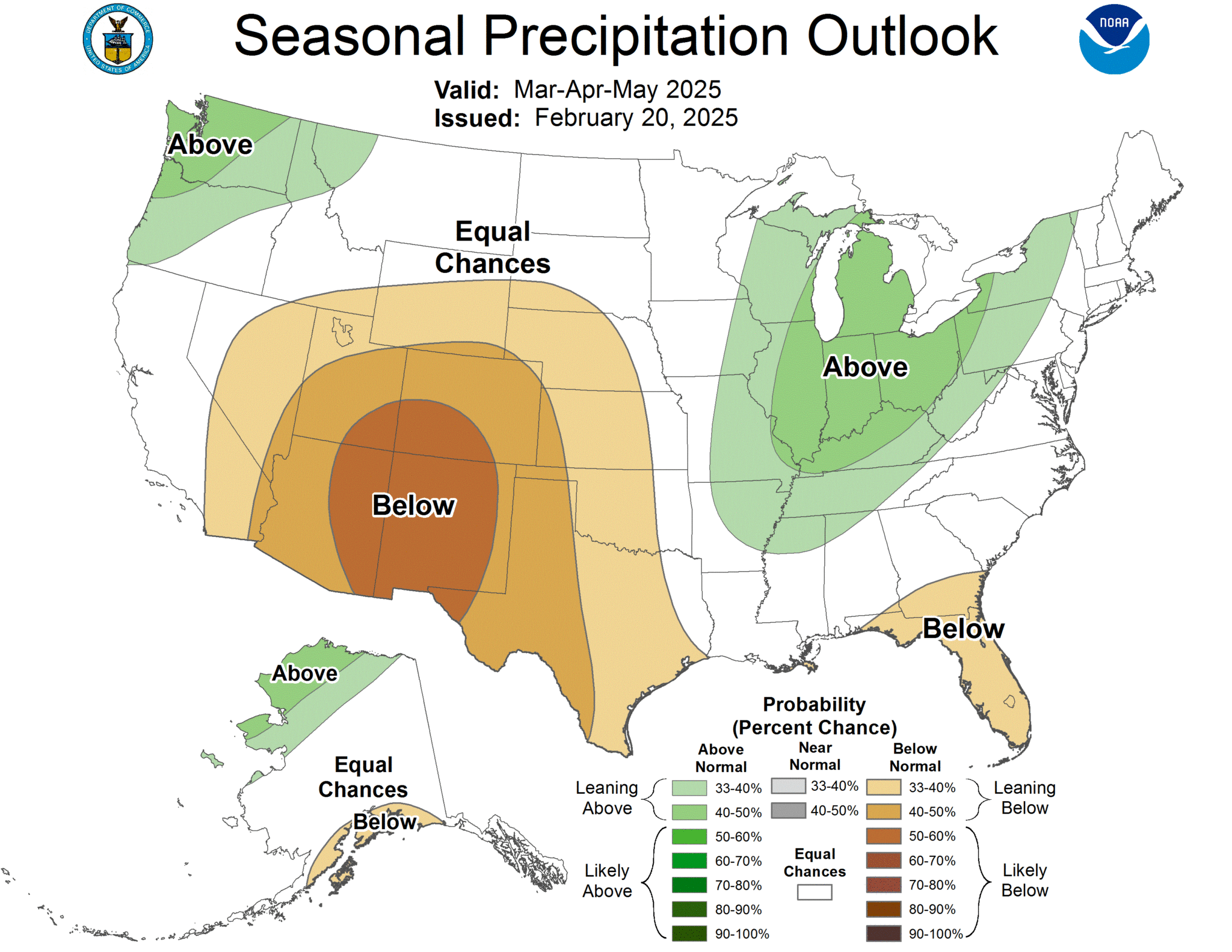
March is usually the snowiest month in most of the West’s mountains, and another storm is on its way. There’s even a chance for rain down in severely parched Phoenix and Tucson, though forecasts aren’t calling for more than a trace. In 2023 the snow was abundant for most of the winter, but really started coming down after March 10, turning a good year into a blockbuster.

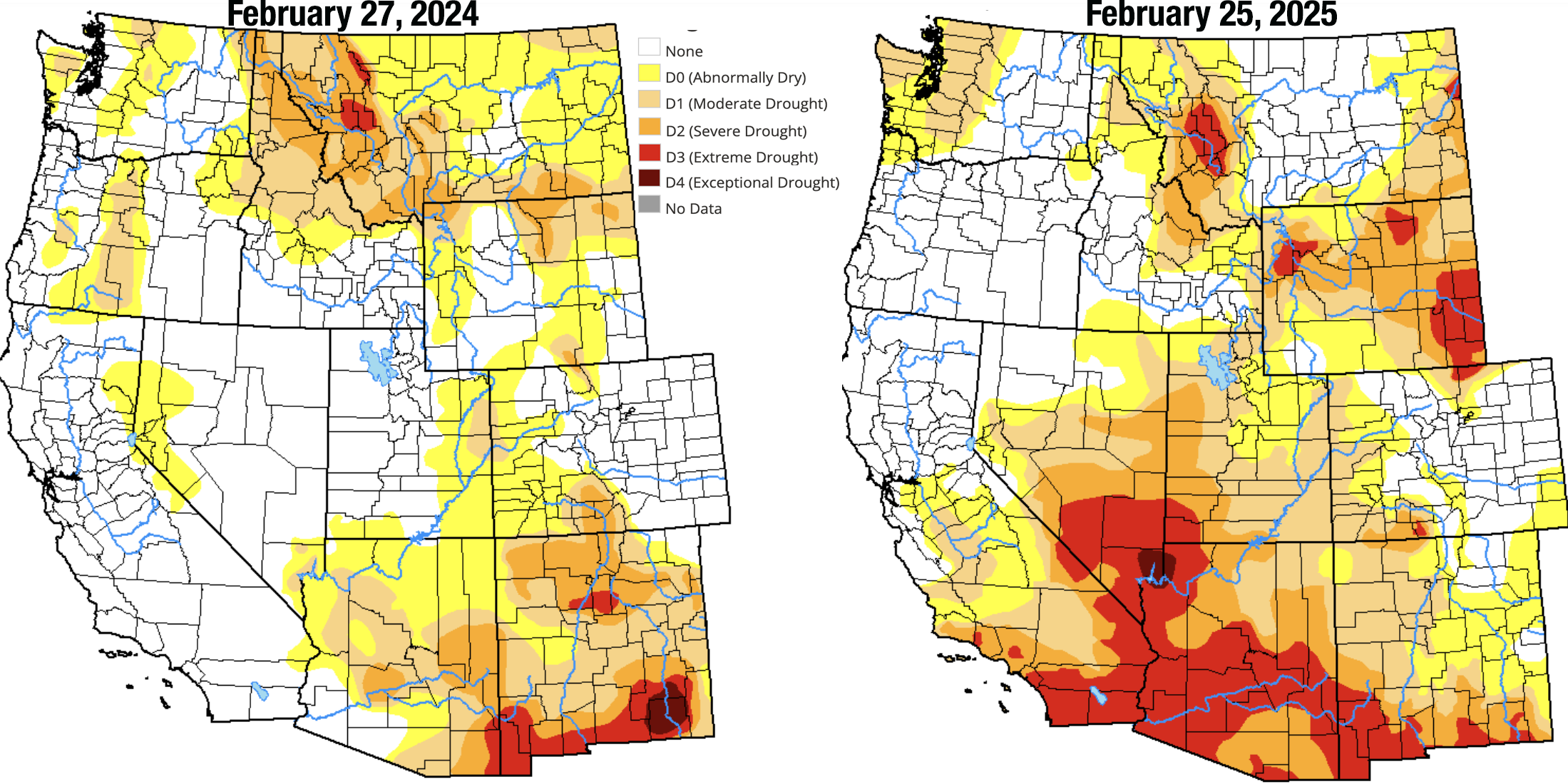
Still, the chances for a full snowpack recovery in the San Juan Mountains and southward are looking dimmer with each passing day. Spring snowfall is often accompanied by dust, which hastens melting. February was unusually warm, with monthly high-temperature records broken across the Southwest; a continuation of the trend would exacerbate drought in the lowlands and decimate the snowpack up high.

Grand Junction’s average maximum temperature in February was 55° F, nearly nine degrees warmer than the 1991-2020 normal. Phoenix recorded its hottest February on record, and the high reached 90° F on Feb. 24 (the earliest on record was on Feb. 17, 2016). Phoenix has received just .02” of precipitation since Aug. 22.

The watersheds feeding Lake Powell aren’t looking so hot, snowpack wise. In fact, they are on a par with 2021, the last really crappy year, when Lake Powell reached record low levels.
And the San Juan Mountains in southwestern Colorado are generally in poor shape. Folks hoping to run the Dolores can forget it. That said, notice how snowfall in 2023 — the big, big year for the region — really took off in mid-March.
Things are looking a bit better on the northern side of the San Juans — and they continue to improve as one continues to travel north.
And when you move southward, the snowpack deteriorates. Here’s Columbus Basin in the La Plata range. It’s only mildly better than 2021, which led to low spring runoff and a lot of irrigators going without water in their ditches.

Editorial: President Trump’s funding freeze puts Western states at risk of drying up — The Las Vegas Sun #ColoradoRiver #COriver #aridification

Map of the Colorado River drainage basin, created using USGS data. By Shannon1 Creative Commons Attribution-Share Alike 4.0

Click the link to read the editorial on the Las Vegas Sun website. Here’s an excerpt:

February 28, 2025

The Colorado River is drying up, and now, thanks to President Donald Trump’s unprecedented freeze on federal funding, efforts to save it are drying up too. On his first day back in office, Trump signed an executive order halting the disbursement of funds from the Inflation Reduction Act (IRA). Trump claimed the order was intended to attack far-left “Green New Deal” initiatives — an inexplicable claim given that almost no Green New Deal policies have ever been implemented at the federal level. In reality, the order gutted nearly all federal environmental initiatives and anything the president simply didn’t like or considered too “woke” — a term Trump has refused to define.

Among Trump’s victims was $4 billion earmarked to protect the flow of the Colorado River. Those funds were set aside to pay farmers to use less water, increase the efficiency of Western water usage and upgrade critical infrastructure and water capture technology. Now, with the West already parched by a historic megadrought, Trump’s freeze is making a dire situation even worse…The IRA funding was designed to prevent catastrophe. Much of the money was being used to pay farmers and Native American tribes to leave more water in the river, helping to stabilize reservoir levels while putting money in the pockets of rural Americans. In California’s Palo Verde Irrigation District alone, landowners received $40 million to cut back on water use. Without those funds, conservation efforts will grind to a halt. Farmers want to be part of the solution, but they can’t afford to reduce water use and thus reduce crop yield, or move to crops that aren’t as water intensive, without compensation. This freeze leaves them in limbo just as they plan for the next growing season.

The funding freeze also jeopardizes projects meant to support new water-sharing agreements. Arizona lawmakers spent the past 16 months securing $86 million in Bureau of Reclamation funding to build a recycled water plant in Tucson, Ariz., allowing the city to rely less on the Colorado River. But with federal funds in limbo, those plans, and others like them, may be dead in the water. According to Pima County Wastewater Reclamation, the Tucson project alone would have saved an estimated 56,000 acre-feet of Colorado River water over the next 10 years. That’s roughly equivalent to the combined annual water usage for 100,000 homes…Other projects that are now in jeopardy include local conservation projects designed to restore watershed habitat that helps store and filter water that flows to the river and to underground aquifers. These are projects that ensure clean and reliable long-term water supplies in the West…Here in Nevada, lawmakers have been working to retire overdrawn water rights, allowing groundwater to replenish — but those projects rely on federal funding. Similarly, in Arizona and California, farmers depend on federal funds to balance their water budgets. Without these programs, aquifers will continue to shrink, wells will go dry and agricultural output will decline even further. That means higher food prices nationwide and economic devastation for rural communities. If Trump refuses to be a president for all Americans, he should at least recognize that many of his own supporters are among those who stand to lose the most…

Beyond the immediate impact on water supplies, Trump’s funding freeze threatens delicate negotiations over the future of the Colorado River. The current Colorado River Compact expires in 2026. Seven states, 30 Native American tribes and representatives of both the U.S. and Mexican federal governments have spent years locked in tense negotiations over how to allocate the river’s dwindling supply.

President Trump’s administration pauses $50 million Biden-era investment in #GreatSaltLake — Kyle Dunphey (UtahNewsDispatch.com)

The shores of the Great Salt Lake near Syracuse are pictured on Tuesday, May 21, 2024. (Photo by Spenser Heaps for Utah News Dispatch)

Click the link to read the article on the Utah News Dispatch website (Kyle Dunphey):

February 27, 2025

In December, the U.S. Bureau of Reclamation announced the largest ever federal investment in the Great Salt Lake, awarding Utah $50 million to go toward habitat restoration and securing more water to flow to the lake. 

It was widely celebrated among Utah’s leaders. But state officials now say that funding has been paused. 

“We’re still working with our partners in the U.S. Bureau of Reclamation, and trying to figure things out from a federal level on what goes, what stops. Right now, as they figure that out, we’re on a temporary pause,” said Brian Steed, the state’s Great Salt Lake commissioner. 

Steed is confident that the state will see that money eventually — he doesn’t think the funding is in jeopardy. 

“This too shall pass and we’ll get the money out the door as soon as we can,” he said. 

When those funds will be unlocked is unclear. Officials with the U.S. Bureau of Reclamation declined to comment on Thursday.

When asked about the pause on Thursday, House Speaker Mike Schultz, R-Hooper, said the state will continue to make its case for why it needs the $50 million.

“I think they paused pretty much everything. So it wasn’t just specific to that,” he said. “I think that’s fair, right? … The new administration comes in, and pushes pause on it.”

The Trump administration has slashed budgets for a number of federal programs and agencies, while announcing widespread layoffs of federal workers. Whether the pause in that $50 million investment was part of a larger federal directive was not immediately clear on Thursday. 

The bureau manages federal water systems and infrastructure in the West, including the Colorado River, the Glen Canyon Dam and Flaming Gorge Reservoir. Trump has yet to announce his pick for commissioner. 

Utah Department of Natural Resources Director Joel Ferry (left) and U.S. Bureau of Reclamation Commissioner Camille Calimlim Touton (right) watch as Great Salt Lake Commissioner Brian Steed speaks to reporters about new federal funds coming to Utah to help the Great Salt Lake, at the Utah State Capitol Building on Monday, Dec. 2, 2024. (Kyle Dunphey/Utah News Dispatch)

The agency’s commissioner and Biden appointee Camille Calimlim Touton stood alongside Steed and other state officials on Dec. 2 to announce the $50 million package, which stems from the Inflation Reduction Act. The law passed along party lines in 2022 and included hundreds of billions of dollars for various reforms, program expansions, subsidies and more — Affordable Care Act subsidies, expanding the Internal Revenue Service, investments in green energy and drought infrastructure are included in the bill.

The state often gets help from federal agencies for conservation projects around the lake and its tributaries — but except for a $3 million investment from Reclamation and the U.S. Geological Survey in November, federal funds to help the Great Salt Lake are rare. 

The funding is intended to be split two ways. Most is intended for ecosystem restoration along the lake, helping agencies like the Utah Division of Water Resources, the Utah Division of Wildlife Resources, or the Utah Division of Forestry, Fire and State Lands fight invasive plants, and improve the wetlands and waterfowl management areas. 

The rest will be used to secure seasonal water rights leases from farmers, business and other water rights holders in the Great Salt Lake Basin.

“In truth, it’s given us some time to figure out how to best approach this,” Steed said about the pause. “We’ve put the time to good use.” 

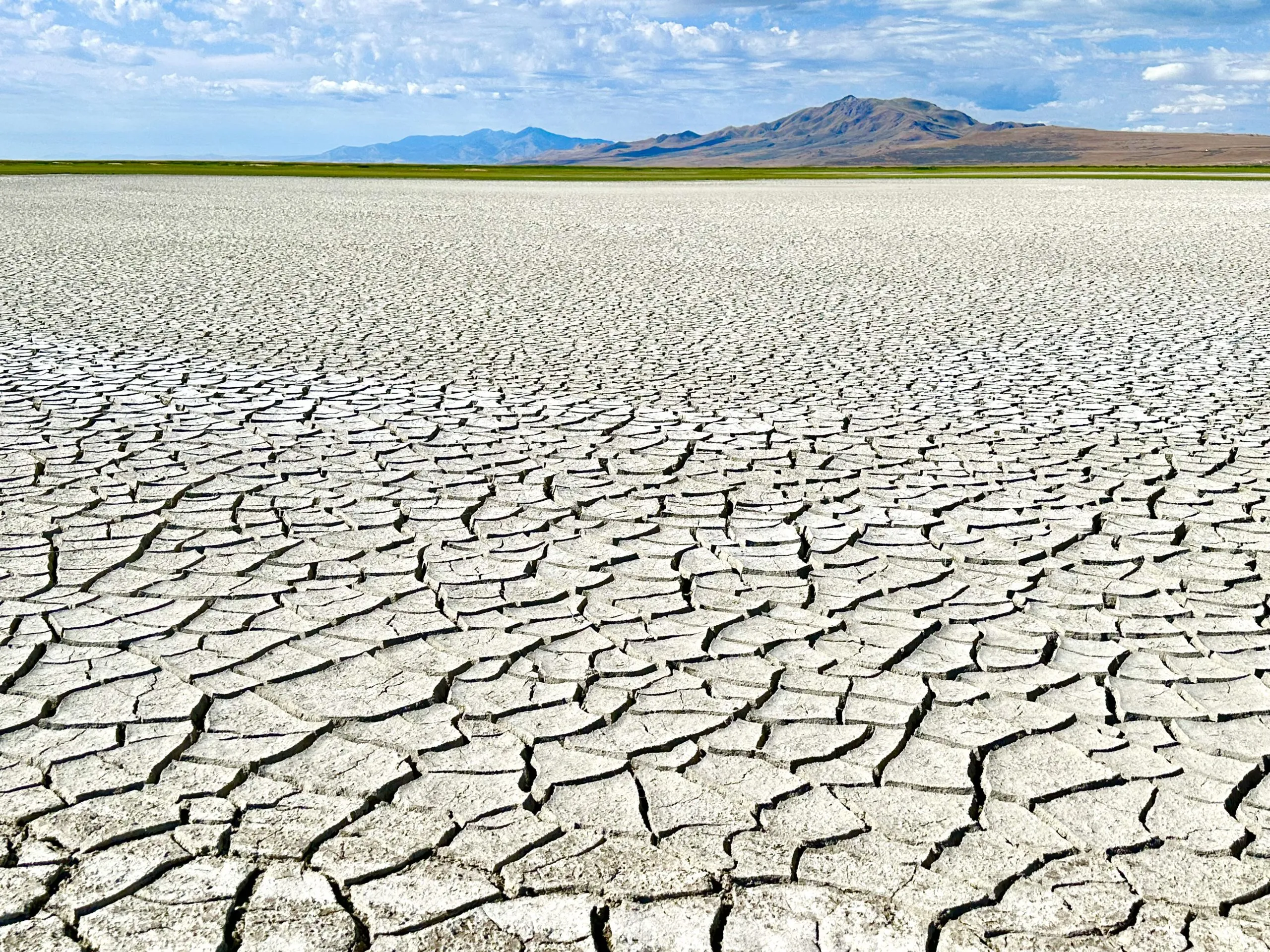
The Great Salt Lake hit a historic low in November 2022. It’s rebounded since then, with two above-average winters, but it’s still below what the state considers healthy. On Thursday, the south arm of the lake was at 4,193 feet, while the north arm was at about 4,192 feet. 

Exposed shoreline of the Great Salt Lake in Utah (USA). The lake’s level has dropped 14 feet (4.2 meters) over the past three decades, creating an enormous public health threat from windblown dust, placing global seafood production at risk, and disrupting a continental migratory flyway. Photo by Brian Richter

On DOGE and Keystone XL and lost jobs — Jonathan P. Thompson

Photo credit: Jonathan P. Thompson/The Land Desk

Click the link to read the article on The Land Desk website (Jonathan P. Thompson):

February 28, 2025

🤯 Crazytown Chronicle 🤡

The last thing I want to do is devote every dispatch to the madness and inanity flooding out of the White House. Seriously. Nevertheless, today I feel the need to devote some words to responding to Land Desk reader and frequent commenter Dennis Pierce’s comment on Tuesday’s dispatch, which read:

I’m glad Pierce brought that up, because I think it’s an important and valid point and one worthy of discussion — especially considering that Trump recently announced that he wants Keystone XL built “NOW!” Pierce’s comment was similar — though more accurate than — a post widely shared on Facebook that said:

I’ll get to the factual problems here in a minute, but first let’s just clarify what these folks are trying to say, which is a little bit of what-about-ism, but also: If you’re so worried about jobs, how could you celebrate the Keystone XL’s cancellation or, for that matter, the closure of a coal power plant or mine? After all, that hurts real people, too.

It’s a valid point.

But DOGE’s rampage is very, very different than Biden’s Keystone XL cancellation.

First off, Biden didn’t fire anyone. He cancelled a permit for the Keystone XL pipeline, which led the developer, TC Energy, to abandon the project and lay off about 1,000 temporary construction workers. While DOGE is slashing jobs as an end in itself, Biden cancelled the permit because:

  • When the Trump administration approved the permit in 2019, it was defying a court order to take a “hard look” at the pipeline and the effects of current oil prices (they were super low at that point), potential increases in greenhouse gas emissions (the oil carried by the pipeline would emit 178 million tons of carbon dioxide annually when burned), new data on oil spills (the XL’s sister pipeline, the Keystone, had already experienced nearly 1,500 spills during its first seven years of operation), and potential effects on cultural resources (the diluted bitumen carried by the pipe is harder to clean up than conventional crude).
  • The line would cross huge swaths of tribal and private lands. Many of those tribal nations and landowners didn’t want the line on their lands, and Indigenous advocates and the Rosebud Sioux Tribe and the Fort Belknap Indian Community had sued the administration to stop the line.
  • The line would have cut through sage grouse habitat and the 378 miles of new power lines needed to run pumping stations would have crossed whooping crane habitat, thereby imperiling the endangered birds.
  • The line was being built by a Canadian company to carry Canadian crude from the tar sands to U.S. refineries. That oil wasn’t needed — the market was glutted in early 2021 — and it would have competed against U.S. producers, damaging the oilfield-reliant economies in the Permian Basin and elsewhere.

Had TC Energy gone forward with the project, it would have created about 6,000 jobs over the three-year development phase. Those jobs, of course, never came to be. While that’s a lot, its nothing near the 14,000 that social media posters are throwing around. Nor is it even close to the job toll DOGE has racked up so far. The Keystone jobs were temporary; after the three years they would all go away, leaving just 20 to 35 permanent, full-time workers to operate the line. So comparing the Keystone cancellation to the current chainsaw-butchering of the federal workforce is way off.

But the larger point stands: When Biden cancelled Keystone XL, he also put a lot of folks out of well-paying jobs that, even though they were only temporary, could not easily be replaced. That hurt real people. And it was naive, even a bit callous, for Keystone XL opponents to suggest that the laid off workers could get jobs in the clean energy industry, or that fossil fuel workers in general could simply learn to code — as Biden said in 2019. A few years before, Hillary Clinton was skewered for telling an Ohio audience that “we’re going to put a lot of coal miners and coal companies out of business.”

It’s almost as bad as Musk. Right? Not quite. Clinton followed up that statement with this: “We’re going to make it clear that we don’t want to forget those people. Those people labored in those mines for generations, losing their health, often losing their lives to turn on our lights and power our factories. Now we’ve got to move away from coal and all the other fossil fuels, but I don’t want to move away from the people who did the best they could to produce the energy that we relied on.”

Policies aimed at reducing fossil fuel use and cutting climate-altering and human health-harming pollutants will and do have an economic impact. Closing a coal mine or power plant can be devastating, both economically and culturally, for the communities that rely on them, even if it does improve the lives of people who live nearby by cleaning up the air and water.

While some environmental groups and the politicians that support them don’t care about those job losses — their goal is to protect the environment, human costs be damned — these days most green groups not only care, but fight just as forcibly for a just transition as they have to make facilities clean up their acts. For example:

  • After the Mohave coal plant and its associated mine on Black Mesa shut down at the end of 2005, the Grand Canyon Trust helped spearhead the creation of a Just Transition Coalition that then pushed regulators to require Southern California Edison to invest revenues from the sale of sulfur credits into economic and clean energy development benefitting the Navajo Nation and Hopi Tribe. The plant had sullied the air for years, and the coal mine was rapidly depleting the Navajo aquifer by using huge volumes of water to slurry the coal across Arizona to the plant.
  • Tó Nizhóní Ání is leading the effort to push Arizona utilities to help fund a just transition for the communities most affected by the December 2019 closure of the Navajo Generating Station and the Kayenta coal mine on Black Mesa, as well as the imminent shutdown of the Four Corners power plant.
  • When Public Service Company of New Mexico announced it would shut down the San Juan Generating Station in 2022, environmental groups and Democratic state lawmakers passed the Energy Transition Act, which allows PNM to issue bonds to fund the power plant’s abandonment, which included about $40 million for local economic development and displaced worker assistance and another $30 million for coal mine reclamation, which kept some workers employed. The Act also required PNM to build some of the replacement power facilities in the same area. The San Juan solar installation employed hundreds of workers during its construction and helped replace property tax revenues for the Central Consolidated School District.

And while Biden may have been a little oblivious about the ease of switching careers, he not only showed empathy toward those who are losing their jobs in the energy transition (he never brandished a chainsaw or insulted the folks who lost their jobs), but also pushed through legislation — i.e. the Infrastructure and Jobs and the Inflation Reduction acts — which poured billions of dollars into clean energy development and manufacturing and abandoned mine and oil and gas well cleanup programs, creating hundreds of thousands of jobs in the process.

The new New Deal is a pretty good dealJonathan P. Thompson November 24, 2021 Read full story

That’s in contrast to the Trump administration, which is not only slashing jobs at a frenzied rate, but has also frozen and even tried to claw back funding from those job-creating laws, which is not only illegal, but also jeopardizes thousands of jobs in the private sector.

I suppose Trump believes that if he can convince some company to come back and build Keystone XL, perhaps by promising them a blank check to tear up the environment and private and tribal lands, then it will replace a fraction of those lost jobs. At least for a little while.

That may be a little more difficult than he thinks, however. The pipeline’s original developer is no longer interested in the project. And anyone else looking to build it would run up against another one of Trump’s harebrained policies. On the same day that he posted about reviving Keystone XL, Trump also announced that he was going ahead with tariffs against imports from Mexico and Canada, including on the oil that a future Keystone XL would carry. That diminishes if not destroys the economic case for anyone who might be considering building the pipeline. It’s typically oblivious behavior from the oligarchs running our country.

***

When reports started coming in that the Trump administration was unfreezing its hold on seasonal National Park Service employees or rehiring some federal workers it had fired only days earlier, I began to think — or at least hope — that the bloodshed was almost over. Mmmm … nope. Two days ago Russel Vought, the Director of the Office of Management and Budget, sent a memo to all federal agencies ordering them to “promptly undertake preparations to initiate large-scale reductions in force.”

Here’s the way he introduced the memo:

Which is a long way of saying that Russell Vought is an a&%hole. He’s also an architect of Project 2025. It’s funny, because I remember a few months ago when a certain commenter chiding me for predicting that Trump would follow Project 2025 if elected. Well, guess what: The Trump administration is following Project 2025 to the letter. That includes eviscerating public agencies, like the National Oceanic and Atmospheric Administration, where 800 employees were fired yesterday and more may lose their jobs today. This is bad. Very bad.

***

If you’re in the Durango area and you’d like to support public employees, you’ve got options! On March 3, at 3 p.m., there will be a peaceful demonstration to support public lands employees, many of whom were illegally fired under the Trump administration’s cuts to federal agencies, outside the San Juan National Forest Headquarters at 15 Burnett Ct in Durango. There will be concurrent events in Bayfield and Dolores (see flier below). Attendees are invited to bring thank-you cards and small gifts for remaining staff and participate in sign-waving to show solidarity. This event will support both the San Juan National Forest Headquarters and the local Bureau of Land Management (BLM) office, which have each lost employees in these cuts.

And beer! Ska Brewing in Durango is rolling out a special stout today to support forest service workers — or help them drown their sorrows (20% alcohol … holy cow). Check out the logo:

End-of-February #snowpack check-in: ok in the north, bleak in the south (plus, a message about our federal government partners) — Russ Schumacher (ClimateColorado.colostate.edu)

Click the link to read the article on the Colorado Climate Center website (Russ Schumacher):

February 28, 2025

By the time March rolls around, we have a lot of information about how the snowpack accumulation in Colorado’s mountains is going to turn out. For those familiar with statistics, the correlation between statewide snowpack on February 28 and the peak value (usually in early April) is 0.86. For the Upper Colorado River basin, the end-of-February correlation is even higher: about 0.91. This means that, even though March and April can still bring a lot of snow to the mountains, it’s difficult for the spring to turn the tide from a bad season to a good one, or vice versa.

And why do we care so much about snowpack? The water that serves tens of millions of people originates as snow in Colorado’s mountains. Thus, when we talk about “snowpack”, what we’re usually looking at is the “snow water equivalent” (SWE): how much water is stored in that snow, a large portion of which will run off into streams, rivers, and reservoirs in the spring and summer to be used by people, farms, and ecosystems.

Where does this winter’s snowpack stand at the end of February?

Looking at the current map that shows the percent of median SWE across Colorado, there’s a clear north-south divide. The mountains that will see their water run off into Colorado’s northern river basins like the Yampa, White, and North and South Platte, are looking pretty decent. They were sitting near to a little below average as of early February, but the huge storm cycle in the middle of the month has brought them to right around average, or even a bit above in the South Platte basin.

SNOTEL percent of median snow water equivalent as of the end of the day February 27, 2025. Obtained from the NRCS interactive map.

Farther south, it’s a very different story. Back in November, these areas had way above average snowpack from major early-season storms. But then the snow largely shut off through December and January. Although the San Juan and Sangre de Cristo mountains and the Grand Mesa did get a good shot of snow in mid-February, it wasn’t nearly as much as farther north. And the warm, dry pattern of the last week (at a time of year when we expect regular snowstorms) has left them well below normal. Snowpack in the combined San Miguel-Dolores-Animas-San Juan basin sits at just 66% of average, and the upper Rio Grande at 67% of average.
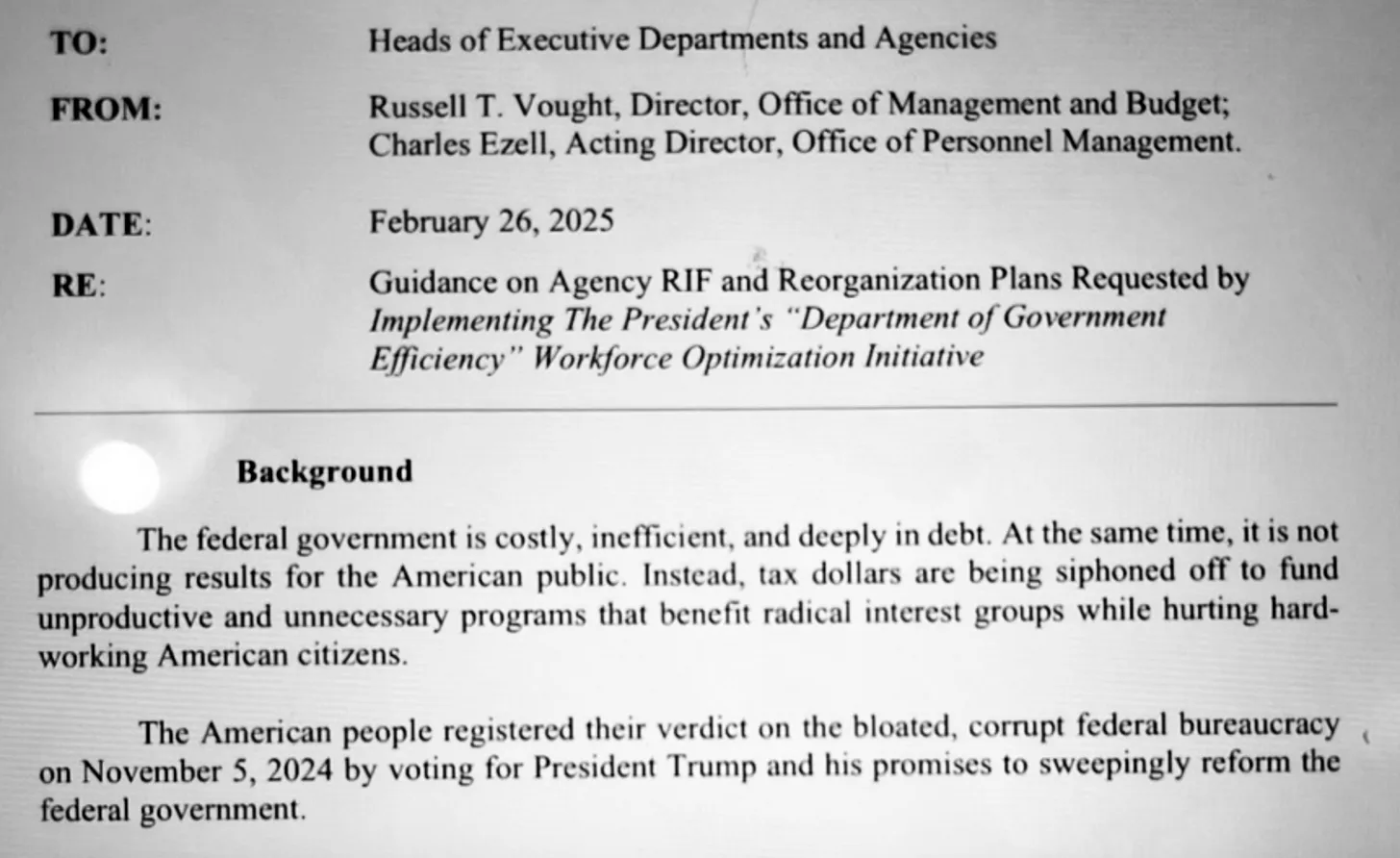
Zooming in on the southern mountains, and plotting the snowpack percentile over the period of record, we see some very low numbers, especially in the southern San Juans. (Here, if you see a value of 10, that means that 90% of years would have more SWE on this date.) For many stations in Colorado’s southern mountains, the snowpack is the lowest it’s been at this time of the winter since the brutal drought of 2018. (Other seasons that were even worse include 1990, 2002, and 2006.) This week’s US Drought Monitor now shows D3 (extreme drought) in parts of Conejos, Archuleta, and Rio Grande Counties. In contrast, conditions farther north look much better, especially around the ski areas in Pitkin, Eagle, and Summit Counties. The divide of snowier to the north and less-snowy to the south is what often happens in La Niña winters like this one.

Zoom-in on southwestern Colorado to show the period-of-record SWE percentile at SNOTEL stations as of February 27, 2025. A value of 10 means that 90% of years would have more SWE on this date; a value of 50 means this year is right in the middle of the historical distribution. From the NRCS interactive map.
Snow water equivalent in the combined San Miguel-Dolores-Animas-San Juan basins through February 27, 2025. The current year is shown in black, the average is in green, and 2018 shown in purple. Obtained from NRCS.

Consistent with the snowpack numbers, the outlook for spring and summer water supply looks decent for Colorado’s northern rivers, but pretty bleak for the southern streams, and for the Upper Colorado River basin as a whole. The Colorado Basin River Forecast Center’s mid-February outlook, which largely included the snowpack boost from the mid-month storm, shows near-average April through July streamflows in the Colorado River headwaters, but only 63% of average along the Dolores River, and 70% of average into Lake Powell. Assuming these outlooks end up being roughly correct, there will be a lot less water available in southwestern Colorado (and farther downstream) than in a typical year. CBRFC will host a webinar on March 7 to discuss their updated early-March forecast.

Mid-February 2025 water supply outlook from NOAA’s Colorado Basin River Forecast Center, showing the percent of average flows in various rivers across the basin. From https://www.cbrfc.noaa.gov/wsup/pub2/discussion/current.pdf

What comes next?

There are 5-8 weeks left in the typical mountain snow accumulation season, depending on exactly where you’re located. March doesn’t always have the consistent mountain snowfall that we expect in the heart of winter, but often delivers a big snowstorm or two. The last week of February has been extremely warm across Colorado, with little to no snowfall, and the first couple days of March will be more of the same. But then the pattern looks to shift to become more active. One storm is on the way for March 3-4, with the possibility of another behind it on March 6-7. But it looks like this may continue to amplify the north-south divide, as current forecasts show the most precipitation hitting the northern mountains and eastern plains, with not as much to the south.

(left) 7-day precipitation forecast from NOAA’s Weather Prediction Center, for the period from February 28 to March 6, 2025; (right) departure from average precipitation over this same period. Graphic from https://climate.colostate.edu/drought/#outlook

The outlook for March as a whole doesn’t show a very strong signal across Colorado, with only a slight tilt toward below-average precipitation across the southern part of the state. The outlook for the full spring season (March-April-May) shows increased odds of dry conditions across all of Colorado, with the highest chances of dry conditions in the southwest. Overall, in light of the current snowpack and the outlook, for northern Colorado there’s some reason for cautious optimism about the snow and water situation through the spring, but cause for real concern about worsening drought in the south and west.

Monthly precipitation outlook from the NOAA Climate Prediction Center for March 2025. From https://www.cpc.ncep.noaa.gov

A note about our federal government partners

If you’ve read this far, you’ve seen a lot of data, and hopefully recognized what it can tell us about the water and drought situation here in Colorado. Every bit of data in this blog post originated from the federal government, either from the Natural Resources Conservation Service (part of the Department of Agriculture), or from the National Oceanic and Atmospheric Administration (NOAA). This information is collected, maintained, and disseminated by dedicated public servants, and is always freely available to all. We work closely with the National Weather Service offices and other NOAA entities that serve Colorado, and their workforce is in the process of being devastated. Those fired include the bright minds of people just starting their careers, as well as experienced professionals who chose to serve the country. We couldn’t do what we do without our federal partners, we stand with them in these challenging times, and want to emphasize that investments in NOAA and other federal agencies support public safety, the economy, and US leadership in science.

Glen Canyon Dam Adaptive Management Work Group meeting canceled by President Trump’s administration — KNAU ColoradoRiver #COriver #aridification

A high desert thunderstorm lights up the sky behind Glen Canyon Dam — Photo USBR

Click the link to read the article on the KNAU website (Melissa Sevigny). Here’s an excerpt:

February 24, 2025

This week’s scheduled meeting of a group focused on the management of Glen Canyon Dam was canceled by the Trump administration. It’s one of many scientific conferences and federal meetings that have been canceled or indefinitely postponed. The U.S. Bureau of Reclamation says the meeting will be rescheduled to ensure new Department of the Interior and Reclamation leadership are “fully briefed” on the Glen Canyon Dam Adaptive Management Work Group. The group advises the Secretary of the Interior on how best to manage Glen Canyon Dam in keeping with the 1992 Grand Canyon Protection Act. Matt Rice of American Rivers says that involves balancing the needs of water and hydropower users with cultural, environmental, and recreational values.

“And this group is the forum to balance and make management decisions based on all those values, to protect those values. So massively important.”

[…]

The canceled meeting comes amid a funding freeze that has stalled Colorado River conservation projects and amid layoffs at the U.S. Geological Survey, National Park Service and other federal agencies.

As President Trump’s administration cuts funding, lays off USDA staff, #Colorado farmers and ranchers feel the hit — Colorado Public Radio

Photo credit: Jonathan P. Thompson/Land Desk

Click the link to read the article on the Colorado Public Radio website (Caitlyn Kim). Here’s an excerpt:

February 26, 2025

In rural Colorado, U.S. Department of Agriculture funding has long provided not only a safety net against disasters and shifting commodity prices but also the seed money for projects ranging from irrigation ditches to broadband expansion. President Donald Trump’s efforts to remake and slim down the federal government are putting that support in question.

“We lost an NRCS (Natural Resources Conservation Service) grant that totaled about $640,000 or $630,000,” said Michael Nolan, president of the Mancos Conservation District and a farmer himself. “We had spent down about 25 percent of that already implementing programs, paying staff time, and to have that rug just pulled out from underneath us means … potential furloughs, potential layoffs. It’s a big hit to our conservation district.”

Agriculture Secretary Brooke Rollins said last week the USDA will release about $20 million in Inflation Reduction Act funding that had been frozen, but the rest was still under review. And other grant funding is expected to be canceled…The Conservation District signed a contract with USDA in February 2024 to do conservation education. It involved listening sessions, equipment demonstrations, field trainings and agricultural education on issues from soil moisture to crop management.

“At the end of the day, we believe the funding was pulled because of two phrases in it. One was ‘equity’ and one was ‘underserved communities’,” Nolan said…

One Western Slope ag producer said right now there’s no certainty over what will or will not be funded…It’s not just individual producers that have been impacted by the USDA cuts. Six rural electric cooperatives in the state that received USDA grants funded through Biden’s signature climate and health bill have had their funding frozen, while the U.S. Forest Service, also under USDA, laid off more than 3,000 employees.

Mass firings cut the muscle not the fat — Riva Duncan (WritersOnTheRange.org)

Riva Duncan. Credit: Writers on the Range

Click the link to read the article on the Writers on the Range website (Riva Duncan):

February 24, 2025

The stories are heartbreaking. US Forest Service, National Park Service and other federal workers — some of them within weeks of ending probationary periods — fired. And not for cause; these workers were just starting out on dreamed-of careers or taking on new responsibilities in agencies where they’d already been for years.

The Trump administration’s vaunted effort to “trim the fat” from the federal government and curb “waste and fraud” reveal one terrible — but not surprising — fact: The cost-cutters have no idea how government works or who does what in the federal workforce. 

Probation doesn’t mean poor performers. It simply means that someone has only worked one or two years under authorities such as Veterans Recruitment Authority or Schedule A of a permanent job. Or it’s their first time in a supervisory position.

I worked for the Forest Service in forestry and then wildland fire for over 32 years before retiring in 2020. Because I’m now an advocate for firefighters, I’ve heard from many Forest Service workers who were suddenly fired by the Trump administration.  I’ll tell you about two of them.

When he was 18, Cyrus Issari was hired to work with the Idaho Conservation Corps, building trail in the Sawtooth Mountains. He’d “found his passion,” he said, getting jobs as a temporary employee for the Bureau of Land Management and then the Forest Service. He cleared hazard trees with a chainsaw, cleaned campgrounds and also donned the Smokey Bear costume for public events. Best of all, he started fighting wildfires.

In 2022, Issari secured a permanent position — what he called his “dream job”—with a wilderness trail crew on New Mexico’s Gila National Forest. A few weeks ago, his entire eight-person trail crew was fired. Issari had been making $18.96 an hour.

“The land and people will suffer from (this) if nothing is done,” Issari told me.

Liz Crandall was fired last week from her field ranger position in Central Oregon. She started as a volunteer on the Umpqua National Forest in Southwest Oregon in 2016, helping a botanist get rid of invasive weeds. 

The recreation shop scooped her up and put her to work doing sign maintenance, improving trails and cleaning campgrounds. Hired into a temporary recreation position in 2018, she also received wildland fire training and assisted on numerous wildfires.

She moved on to work for Oregon’s Willamette National Forest in recreation and then, in 2023, secured her permanent position as a field ranger on the Deschutes National Forest. 

“I have dedicated my career and life to the US Forest Service,” Crandall said.  Her performance evaluations were rated “excellent,” which is why she was outraged by the wording of her termination:

“The Agency finds, based on your performance, that you have not demonstrated that your further employment in the Agency would be in the public interest.”  Liz had been making $19.10 per hour.

There are common denominators in these stories, shared by the thousands (so far, 3,400 from the US Forest Service, 1,000 from the National Park Service, and 400 from the US Fish and Wildlife Service) of others who have been fired. 

These folks love our public lands and have trained to do a variety of needed jobs. They feel a calling to serve the American taxpayers and countless visitors. They seek jobs that always pay more in sunsets than money.

Make no mistake, these hard-working and dedicated people aren’t the fat, they are the muscle. 

These firings will have ripple effects. They are your neighbors who pay rent or take on mortgages. They shop in the local grocery stores and feed stores and coach basketball.

Many will have to move, and they will take their small, but meaningful, paychecks with them. They won’t be there to assist with search and rescue, to fight the wildfires that are becoming larger and more unpredictable, threatening the lives and livelihoods of countless Americans.  

What can we do to support them? Show up for rallies. Write, or better yet call, your elected officials and tell them what effect these firings will have on you, your family, your business, your community. Be kind to those who are still working. Some were forced to fire the very people who never should have been let go.

There’s a big void to fill, now, and everyone needs to pitch in.

Riva Duncan is a contributor to Writers on the Range, writersontherange.org, an independent nonprofit dedicated to spurring lively conversation about Western issues. She is vice president of Grassroots Wildland Firefighters, grassrootswildlandfirefighters.com, and also works as an international consultant in emergency management.

How two former U.S. representatives view today’s political milieu — Allen Best (BigPivots.com) #CWCAC2025

Former U.S. Rep. Ed Perlmutter, left, responds to a question from Dick Wadhams January 31, 2025. Photo credit: Allen Best/Big Pivots

Click the link to read the article on the Big Pivots website (Allen Best):

February 22, 2025

One Democrat, the other Republican, shared their views of the Trump presidency, Colorado’s political shift and other topics at the Colorado Water Congress

Lauren Boebert in 2020 was running a gun-themed restaurant in Rifle called Shooters Grill and Smokehouse. A political unknown, having never been elected to so much as a town board, she defeated Scott Tipton, the incumbent representing Colorado’s Third Congressional District in the Republican primary. She was 34 years old.

Her ascendancy shocked many. It had a precedent of sorts, as was noted during a panel discussion during the Colorado Water Congress annual conference in late January.

“She had a great political antenna, “said Dick Wadhams, a Republican political consultant who moderated the discussion with two former members of Congress. “She saw an opportunity to take out a respected incumbent, Scott Tipton. And nobody saw that coming.”

Wadhams noted that another member of Congress from the Western Slope had also been upset in a party primary. That was in 1972. Wayne Aspinall, a Democrat and a vital member of Congress in delivering federal dollars to build the massive water infrastructure of the Colorado River Basin in the 1960s, was ousted by Alan Merson of Breckenridge. Democrats in that district decided that Aspinall was too conservative — although it was a Republican Jim Johnson of Fort Collins, who went on to win the general election.

“You do have upheavals in the parties from time to time,” said Wadhams. “That year it was the Democratic Party. This year it’s the Republican.”

Amid his analysis, Wadhams was posing questions to two former members of the U.S. House of Representatives.

Ed Perlmutter, a Democrat, represented the metropolitan area’s western suburbs in Congress from 2003 to 2023. Ken Buck represented the Eastern Plains of Colorado and some fringes of the Front Range beginning in 2015. If very clearly conservative in his political views, he took positions apart from the Trump-dominated Republican majority and resigned in 2024. He was facing a primary election he likely would have lost but denied that that was the cause for his resignation.

Wadhams asked the former members of Congress what did they make of the new Trump presidency?

“When I watch the left react to Trump, it makes me smile, because Trump does so many things that are crazy that the things that are really damaging to the left get missed in all the other crazy stuff,” said Buck. That crazy, he suggested, was part of his strategy.

“If you just look at what he says, it’s going to drive people crazy. If you look at the point of what he’s saying and the strategy behind what he’s saying, you still may think it’s wrong, but at least it’s a little more understandable and people will calm down a little bit.”

He cited the flow of fentanyl into the United States from other countries, especially Mexico, as a problem that the Biden administration had not taken seriously enough.

Perlmutter agreed that Trump’s outrageous behavior was intended to move the conversation.

But if Republicans hold a trifecta in Washington D.C. with a president, plus majorities in both the Senate and House, it’s a very narrow majority in the House: three votes. To actually get a bill passed, such as for appropriations, will require some help from Democrats. And that help, said Buck, comes at a high price.

“They want their programs in Greece, and that’s when you start getting the Marjorie Taylor Greene and others who will say, ‘OK, we’re going to take this speaker out because he’s now working with Democrats.’ Well, you don’t’ have a choice. You can either shut down government or work with Democrats. And that’s the choice that (House Speaker Mike Johnson) has. So he will work with Democrats.”

At that point, added Buck, there will be three or four weeks while Republicans figure out a new speaker of the House. That job, he added, is the worst.

Perlmutter said Democrats will likely regain the majority in the House in the 2026 election, and it will then be the task of the speaker they elect to rein in the wishes of the more extreme elements of the party. Nancy Pelosi, he said, did a pretty good job of it.

In the meantime, the extreme voices can be shrill. Perlmutter cited the example of Boebert. “Her voice is going to be loud now. Whether that’s to get stuff done productively or not. That’s a whole other question. She has the capacity and the ability to do it, and on a one-on-one basis, she’s okay. But you know, she can be pretty out there when she wants to be.”

The two former congressmen agreed that Colorado’s members in Congress, both Democrats and Republicans, can come together on many issues that are, as Perlmutter put it, Colorado-centric type issues such as water, transportation, and energy.

“There are going to be the hot-button issues of immigration, some environmental issues, but generally our members are very close on those kinds of things,” said Perlmutter.

“You’re talking about eight people who see each other every day on the floor (of the House) and oftentimes sit together and have conversations,” said Buck. “I think that Colorado is really well represented on both sides of the aisle.”

Both men served in the Colorado Legislature before their election to the federal offices. Since 2019, Democrats have had majorities in both chambers at the Capitol. Colorado’s electorate has changed dramatically in the last seven or eight years, Wadhams observed. Voters are younger, more socially liberal – and more inclined to be unaffiliated. They’re very anti-Trump and favorable to Democrats but – maybe not always so. He cited Proposition HH, a property tax proposal heavily supported by Democrats and opposed by Republicans. It was defeated by a 20% margin.

Perlmutter also noted swings in Colorado’s electorate. He was the first Democrat elected to the Colorado Legislature from the Jefferson County communities of Lakewood, Wheat Ridge, Arvada. and Golden in 50 years. It now is overwhelmingly Democrat.

Colorado Republicans held sway in 1998, the year that Bill Owens was elected governor. He was the only Republican governor in Colorado in the last 50 years.

Today’s unaffiliated voters – 50% of the electorate – swing left, noted Perlmutter. Biden won Colorado by 23 % percentage points and Kamala Harris in 2024 by 12%.

“It’s still obviously pretty left, but if you’re an independent, if you’re unaffiliated, you can move pretty quickly,” Perlmutter said. He suggested fellow Democrats need to be careful to not get too far afield from the core concerns of the electorate.

Lawmakers get update on post-2026 #ColoradoRiver basin negotiations — Steamboat Pilot & Today #COriver #aridification

DALLE Image by Scott Harding American Whitewater

Click the link to read the article on the Steamboat Pilot & Today website (Ali Longwell). Here’s an excerpt:

February 20, 2025

The deadline for the U.S. Department of Interior to determine the post-2026 future of Lake Powell and Lake Mead — and the entire Colorado River basin — is now six months away. As precarious negotiations continue between the Upper and Lower Basin stakeholders, the new presidential administration has also cast concerns on the future of the critical water system.   

“Honestly, I’ve seen nothing out of the administration that suggests that they even know there is a Colorado River,” said Democratic Sen. Michael Bennet during a press call on Thursday, Feb. 13. “I had a daily conversation with somebody at least, probably three times a day, in my office with somebody on the Colorado River, and we’ve seen nothing so far.”

[…]

On Thursday, Feb. 20, Colorado water officials provided state lawmakers in the House Agriculture, Water and Natural Resources Committee with a high-level update on the negotiations, which will set the basin’s future operating regime…In November, the Bureau of Reclamation released a document with five management options for the river’s post-2026 future. [Becky] Mitchell said that the Upper Basin states submitted an alternative that offers a more sustainable supply-driven approach to management, rather than allowing downstream demand to dictate releases. These states have also agreed to consider conservation efforts and strategic releases, she said…While elements of the Upper Basin’s proposal — and what was proposed by Lower Basin states— have been incorporated into the Bureau of Reclamation’s alternatives, negotiations are attempting to strike a balance…

“I’m hopeful that the change in administration won’t cause a significant change in policy direction on Colorado River issues. It hasn’t in the past, and I’m hopeful that it won’t now,” [Anne] Castle said. “But I’m less optimistic about that than I was a month ago. I still think that’s the case, but now I’m not sure.” 

Map of the Colorado River drainage basin, created using USGS data. By Shannon1 Creative Commons Attribution-Share Alike 4.0

On the chaos emanating from Trumpville — Jonathan P. Thompson

Photo illustration/digital “painting” by Jonathan P. Thompson. No AIs were used to produce this image.

Click the link to read the article on the Land Desk website (Jonathan P. Thompson):

February 25, 2025

😵 Trump Ticker 😱

One of the things the Land Desk is trying to do in these troubled times is to try to separate the rhetoric from reality, or to weed through the hype and alarmism to determine how a Trump administration action will play out or already is playing out on the ground.

It’s not easy, in part because the administration keeps working at cross purposes, making it very unclear who’s running the show or even what is actually being done. Is Trump, who yearns for the golden age of 1870 to 1913, when the Robber Barons ruled the roost and tariffs were in place to protect their industries, in charge? Or is it his billionaire benefactor (and Robber Baron of the AI age), Elon Musk, who has boasted of taking a “chainsaw” to the bureaucracy, purportedly in the name of efficiency?

On the one hand you’ve got Musk taking his figurative chainsaw to federal agencies in a ham-handed way, as one Land Desk commenter charitably put it, slashing jobs thoughtlessly and without foresight. And on the other, you have Trump urging Musk to get “more aggressive” with his chainsaw even as the administration scrambles to retract Musk’s actions by rehiring at least some of the fired employees — thus offsetting the claimed spending cuts. It’s hard to tell whether this is the result of sheer incompetence, or some elaborate shell game intended to confuse and distract us from even more sinister actions.

Maybe the goal is simply to traumatize federal employees — as Project 2025 architect and Office of Management and Budget Director Russel Vought put it — and make them afraid to go to work. That way they won’t be able to protect Americans and their land, water, and air from corporations. I’m not making this up:

What is wrong with these people!?!

That motive jibes with Musk, Trump, and far-right pundits characterizing federal employees as freeloading, paper-shuffling bureaucrats — even calling them members of the “parasite class.” Which is wrong, inaccurate, and frankly a rather shitty way to talk about the folks who keep airplanes in the air, work to ensure our food and water is safe, enforce federal laws, and maintain the trails, clean the restrooms, and work to prevent catastrophic forest fires on the public lands that make America great. If MAGA actually believes their own rhetoric, then it is more proof that they have no idea what they’re talking about or doing.

One thing is clear: There’s nothing efficient about any of this. Musk and his minions are not only wasting tens of millions of dollars on this ketamine-fueled charade, but also the goal clearly is not to tackle waste, fraud, and abuse. If it were, he’d bring in a team of forensic accountants — not software coders — to meticulously comb through the books and make surgical, precise cuts if and where they were needed. If cost-saving was the goal, he would not have fired more than 6,000 IRS employees — including more than 100 in Ogden, Utah — who were hired to ensure that the wealthy pay their fair share of taxes — and therefore increase revenues and more than offset their salaries.

And, if it were sincere about its stated mission, instead of eviscerating federal agencies, the administration would give the folks on the ground more latitude in determining how to cut costs and better serve the public — even if it meant increasing the number of employees. After all, a stretched-thin workforce does not make for a well-oiled machine, and it may even work against Trump’s other objectives. While firing a bunch of Bureau of Land Management folks might make the agency less able to enforce regulations on oil and gas companies, it also slows down the drilling permitting process. That’s why the New Mexico Oil and Gas Association donated $800,000 to the state BLM office in 2014: It wanted to grease the wheels, of course, but also increase staffing to speed up permit processing for drilling the Greater Chaco Region.

If Musk and Trump knew what they were doing, they would realize in advance that axing the staffers that oversee the nation’s nuclear arsenal was a bad idea, that firing National Park Service employees and freezing seasonal hires would wreak havoc on the parks and their gateway communities, and that terminating more than 400 employees of the Bonneville Power Administration would imperil reliability on the Northwest’s grid.

In the last several days, some of those firings have been reversed — or at least Trump has indicated that he will reverse them. But again, it’s not clear which positions will be restored or why or even when. At BPA, for example, they only brought back 30 of the employees (which was apparently a struggle, since they had already been cut off from their federal email accounts). The National Park Service has indicated it may hire more seasonal employees this year than in the past — but there are no plans to restore the jobs of 1,000 permanent workers who were unceremoniously fired. This in an agency that has seen staffing numbers decrease even as visitation has soared.

The result of all of this back and forth? More confusion.

What is clear is that thousands of federal employees are out of jobs and the effects are bound to ripple across communities and economies, especially in rural Western areas where the federal government is one of the largest, most stable employers and the private sector isn’t large or robust enough to reabsorb those workers. Visitors to the parks will experience it as well: Traffic into Zion National Park has been backing up into Springdale thanks to understaffed entrance booths, and Saguaro National Park is closing its visitor center on Mondays due to staff shortages. This, surely, is merely the beginning of the fallout.

I’ll do my best to keep track of how it plays out, and if you see any of the impacts on public lands near you, please let me know!

This map shows land owned by different federal government agencies. By National Atlas of the United States – http://nationalatlas.gov/printable/fedlands.html, “All Federal and Indian Lands”, Public Domain, https://commons.wikimedia.org/w/index.php?curid=32180954

President Trump’s War on Water #Conservation — Brian Richter (SustainableWaters.org)

Click the link to read the article on the Sustainable Waters website (Brian Richter):

February 19, 2025

Donald Trump is throwing another toilet tantrum.

He’s insisting that the US Environmental Protection Agency weaken the water efficiency standard of its Water Sense label.

To claim that the elimination of water efficiency standards will “lower the cost of living” is a blatant falsehood.

The EPA had previously estimated that low-flush toilets enable American families to reduce their water use by 20-60% and save $110 per year on average and $2200 over the lifetime of a toilet (note that this web page has now been removed from EPA’s website).

The genesis of the Water Sense program was, interestingly, the National Energy Policy Act of 1992, passed under the administration of George HW Bush. The architects of this energy bill recognized that drinking water and wastewater plants are often the largest energy consumers within municipalities, typically accounting for 30–40% of total energy consumed. The Act thus set residential fixture and appliance standards that limit the volume of water used per flush or per minute for toilets, urinals, showerheads, and faucets. Most notably, it required that every toilet installed after 1994 use just 6 L (1.6 gallons) of water per flush, a 54% reduction from the pre-legislation norm of 13 L per flush (3.4 gallons). The associated reduction in energy resulting from use of low-flow plumbing fixtures has further reduced the cost of residential water bills.

US toilet manufacturers have thus been making low-flush toilets for more than 30 years.

The Water Sense label was created to push water conservation even further. It recognizes plumbing fixtures that are 20% more efficient than required under the energy act.

These federal initiatives have had a substantial influence on residential indoor water use in the US. The 1992 Act has been credited with saving an estimated seven billion gallons per day, equating to seven times the daily water use of New York City and 18% of total daily US public water-supply use. They are a major reason for the ‘decoupling’ of water use from population growth in the US; the graph below shows that as water-efficient plumbing fixtures began to become available in the 1980s, total water use in the US began to decrease for the first time. As cities began to encourage replacement of old water-guzzling toilets with new low-flush toilets by offering rebates on purchases of low-flush toilets, the decline in water use steepened further.

Why in the world would we want to take away the single-most important tool in the water conservation toolbox used by cities around the planet?

Source: USGS

Our manufacture of low-flush toilets and water-efficient dishwashers, washing machines, and other appliances is also important to our global trade economy. The US sold its low-flush toilets to 156 different countries last year. Similar to the sentiment of US farmers to “feed the world,” US manufacturers take pride in providing water-saving devices around the world. As Bill Darcy Jr., global president and CEO of the US National Kitchen and Bath Association has put it: “The commitment to water efficiency and hygiene is more crucial now than ever.” When Trump tried to weaken the efficiency standards in his first term, the International Association of Plumbing and Mechanical Officials offered a bunch of good reasons for not rolling back the standards.

Trump has falsely complained that low-flush toilets don’t work properly. “People are flushing toilets 10 times, 15 times as opposed to once.” His comment reminded me of a conversation I had with the president of American Standard, a leading US manufacturer of low-flush toilets in the US. He boasted that “Our toilets can flush a one-pound russet potato.” I will spare you the visual imagery of the YouTuber that easily flushed 56 chicken nuggets in his low-flush toilet.

New Poll Finds Broad Support for #Conservation and Action on #ClimateChange Across the West — Jake Bolster (InsideClimateNews.org)

People walk through the Red Cliffs National Conservation Area, designated during Obama administration, in Washington County, Utah. Credit: Bob Wick/BLM

Click the link to read the article on the Inside Climate News website (Jake Bolster):

February 19, 2025

Colorado College’s annual survey included residents of 8 Western states, the majority of whom identified as politically conservative or moderate.

As oil and gas production in the U.S. continues to reach record highs, the margin of Westerners who support public land conservation over increased oil and gas development also continues to climb. 

In a new “Conservation in the West Poll” released today by Colorado College, 72 percent of respondents from eight Western states said they would prefer their member of Congress to emphasize protecting clean air, water and wildlife habitat while boosting outdoor recreation over maximizing the amount of public land used for oil and gas drilling. 

The figure marks a two-percent increase from last year’s poll, and only 24 percent of those surveyed expressed interest in more oil and gas drilling and mining on public lands. The 48-point margin in favor of conservation is the highest in the poll’s fifteen-year history. 

“The consensus favoring public lands conservation remains consistent and strong in the West,” said Katrina Miller-Stevens, an associate professor at Colorado College and the former director of the State of the Rockies Project, which runs the annual polls, in a statement. “Westerners do not want to see a rollback of national monument protections and there is no mandate for oil and gas development. Voters from all political ideologies are united in support of public land conservation in the West.” 

Colorado College worked with Lori Weigel of New Bridge Strategy, a Republican pollster, and Dave Metz of Fairbank, Maslin, Maullin, Metz & Associates, a Democratic pollster, to survey 3,316 respondents, most of whom identified as politically conservative or independent. The poll, funded by the William and Flora Hewlett Foundation, included at least 400 voters each from Arizona, Colorado, Idaho, Nevada, New Mexico, Montana, Utah and Wyoming. Just under 40 percent of the survey-takers said they supported President Donald Trump’s “Make America Great Again” platform. 

The results come at a time when politicians in the nation’s capital and across the West are drumming up expansive, divisive plans for public lands. 

Last Friday, the Trump administration fired over 5,400 employees across the departments of the Interior and Agriculture, most of whom worked for the National Park Service and U.S. Forest Service. The date of the firings have led them to be called a “Valentine’s Day Massacre,” a reference to the murders in Chicago nearly a century ago by gangsters working for Al Capone. 

Since taking office, Trump has appointed people with close ties to the oil and gas industry to lead key federal agencies overseeing public lands. His secretary of the interior, Doug Burgum, who ordered last week’s Interior Department firings, was previously the governor of North Dakota, where he joined industry lawsuits to halt or overturn Biden-era regulations on oil and gas production. The Associated Press reported that he has relationships with several oil and gas executives and lobbyists.

Kathleen Sgamma, who, as Trump’s nominee to lead the Bureau of Land Management would be responsible for stewarding hundreds of millions of acres of public lands, has spent close to two decades lobbying for oil and gas companies across the West.

Lawmakers in Utah and Wyoming have demanded the federal government give control of public lands in their states, including areas protected by the National Park Service, the U.S. Fish and Wildlife Service, the Bureau of Land Management and the U.S. Forest Service, back to state legislatures. Neither initiative went very far—Utah’s was rejected by the courts and Wyoming’s failed to make it out of the state’s Senate after a series of dramatic revotes. 

“A lot of the actions that the Trump administration has taken or has proposed to take are pretty far out of step with what Westerners want to see in terms of our public lands,” said Rachael Hamby, policy director at the Center for Western Priorities. “Westerners care about public lands a lot and want to see them protected.”

No more than 40 percent of residents in any of the eight states offered approval for state-based land grabs, and an overwhelming majority of Westerners—87 percent—supported career officials at various federal departments making decisions regarding public lands; only nine percent wanted to see elected representatives appoint new officials “who come from other industries and may have different perspectives” on public land, water and wildlife decisions.

Nearly three-quarters of Westerners agreed with federal efforts to combat climate change, though state-by-state levels of approval varied widely. Of the respondents from New Mexico, which has voted for Democrats in all but one presidential election since 1992, 77 percent backed federal action to combat climate change; in Wyoming, the only state where a majority of respondents said they supported President Trump’s “Make America Great Again” agenda, 52 percent of those surveyed said they agreed with federal action on climate change.

Just under 90 percent of those surveyed expressed a desire to keep national monument designations implemented in the last decade in place. The new administration has begun to review those monument designations, and Trump shrunk some of them during his first term.

Other measures enjoying broad support across the West included giving private landowners the ability to conserve their land through conservation easements, using nature-based solutions to improve water quality and allowing the use of controlled burns to thin overgrown forests and lower the threats posed by wildfires.

As a new administration sets a different direction for public lands, Hamby warned that diverging from Westerners’ preferences would carry consequences. 

“If elected officials are straying too far from what their constituents want to see,” she said, “they’re going to have to answer to their voters.”

Water, water everywhere … ?: USGS water assessment, data center water use, and some good news — Jonathan P. Thompson (LandDesk.org)

Photo credit: Jonathan P. Thompson/Land Desk

Click the link to read the article on the Land Desk website (Jonathan P. Thompson):

January 28, 2025

In the closing days of the Biden administration, the U.S. Geologic Survey released its National Water Availability Assessment Report, which is a whopper of a study not only on how much water Americans use and for what, but also on the quality of that water and whether and by how much demand is exceeding supply.

Most of what it says won’t be too surprising to Land Desk readers. Demand exceeds supply in swaths of the Southwest, and climate change threatens to exacerbate the imbalance. Irrigated agriculture is by far the biggest water guzzler nationwide, with Western farms consuming more than those in any other region. Municipal water consumption is staying fairly flat, even as populations increase. Thermoelectric power plants withdraw massive amounts of water, but then return much of it to the water body, keeping consumptive use relatively low.

I’m not going to try to sum up the report for you, though. Rather, I’ll give you a few of the more interesting morsels of data and maps and charts from the assessment, in no particular order, and you can make of them what you will.

This little chart sums up most of the consumption part of the report. The most surprising thing to me about this was that, in the West, groundwater withdrawals in equal or exceed surface water withdrawals for irrigation and public supplies. That means that for every gallon sucked out of the Colorado River or its tributaries, there’s roughly another gallon being pumped up from wells — and in a lot of places, like parts of Arizona, groundwater use isn’t monitored or regulated. Note that these are withdrawals, not consumptive use (which is the difference between withdrawals and water that is returned to its source). Source: USGS
This is a more detailed breakdown of agricultural water use in the West. The top number in each area is millions of gallons per day; the bottom number is millions of cubic meters per month. Notice that about 60-70% of total withdrawals are counted as consumptive use, with the remainder being returned to the water system as runoff. Source: USGS
This is a good one because it clearly shows the effects of drought on water consumption, i.e. we tend to use more water when there’s less of it available.
In this assessment, the USGS looked at how much water is used for coal and uranium mining and hydraulic fracturing oil and gas wells. They found that in 2020, fracking used about 317 million gallons per day. Since then drilling has increased, especially in the arid Permian Basin, so those numbers have likely shot up as well.
This is a striking one from the climate change chapter, showing how the number of extreme and very extreme fires has grown over time.

This is just a small sampling of what’s in the assessment. If you want to read more, check it out here.


The USGS assessment doesn’t break out data centers’ water use, but I imagine if the agency survives the current administration intact, it may get there in a decade or so. The computer processing centers suck up massive amounts of electricity to process those Google searches, Facebook posts, Twitter rants, and, especially, AI queries — not to mention for “mining” cryptocurrency. Less known is that they also can use large quantities of water to keep the processors cool.

A new report out of the Berkeley Lab is mostly focused on quantifying current and forecasting future energy use by data centers. But it also talks water. And the numbers are alarming: In 2023, U.S. data centers directly1 consumed about 66 billion liters (or 17.4 billion gallons) of water. The report’s authors expect that figure to double — at least — by 2028.

Hyperscale data centers are the type that power AI. Source: 2024 United States Data Center Energy Usage Report, by Arman Shehabi et al, Lawrence Berkeley National Laboratory, December 2024.

That is a crap-ton of water, for sure, especially given the large number of data centers located in the Phoenix and Las Vegas areas, neither of which has a lot of liquid to spare. But some perspective is warranted here. As Len Necefer points out in an All At Once By Dr. Len dispatch warning against AI-alarmism, data centers still use a heck of a lot less water than, say, growing hay or fracking oil and gas wells.

66 billion liters is 53,507 acre-feet (sounds a lot less alarming, yeah?). For some context, alfalfa and other hay growing in the Great Salt Lake Basin alone consumes about 900,000 acre-feet per year, and hydraulic fracturing gulps up about 353,000 acre-feet (a little over Nevada’s total allotment of Colorado River water) annually.

I’m still frightened by the invasion of the data centers, however. In his last days in office, Biden signed an executive order opening up federal sites and public land to new AI data centers and accompanying “clean” energy installations (which includes nuclear and even natural gas and coal, so long as they capture carbon). And Trump is now encouraging data center developers — i.e. tech-broligarchs like Musk and Bezos — to burn coal to power their AI bots (and Trump and Melania both issued their own cryptocoins).


A Dog Day Diatribe on AI, cryptocurrency, energy consumption, and capitalism: https://www.landdesk.org/p/a-dog-day-diatribe-on-ai-cryptocurrency — Jonathan P. Thompson


🤯 Crazytown Chronicle 🤡

Look, I don’t like writing about Trump any more than you like reading about him. Believe me. But he is the president, and the things he does and says sometimes have consequences. He also just makes stuff up. Like this “Truth” Social post:

Whaaaaaaat!?! I guess all that water assessment stuff is irrelevant, now, eh? I mean, here we’ve all been fretting about the Colorado River, and little did we know that Trump could make it all irrelevant by sending the military in to turn some valve somewhere and deliver all the water from the Pacific Northwest directly to the fire hydrants of L.A.

The first person who sends me a genuine picture of the giant faucet and who can mark on a map where the military turned the water on and where the pipelines or canals that carry it go gets a free Land Desk t-shirt.

But, in all seriousness, as Dr. Genevieve Guenther pointed out on her BlueSky social media feed, it’s kind of scary what’s being implied here (aside from the pure fabrication): A president is suggesting sending the military into a blue state to force his policy preferences on them. Not good.

(On that note, we’re over at BlueSky, too: @landdesk.bsky.social)

😀 Good News Corner 😎

And, finally, even the commissioners of Garfield County — or at least two out of three of them — realized it was a really bad idea to rename the Burr Trail after Trump. After a heated public hearing, they voted not to name any road in the county after him, for now.

The Burr Trail as it approaches the western boundary of Capitol Reef National Park. Jonathan P. Thompson photo.

Money for the #ColoradoRiver faces an uncertain fate under Trump — Alex Hager (KUNC.org)

The Colorado River flows through the Shoshone diversion structure on Jan. 29, 2024. A group trying to purchase Shoshone’s water was set to receive $40 million from the federal government. Their efforts, along with dozens of other projects across the West, will have to wait. Photo credit: Alex Hager/KUNC

Click the link to read the article on the KUNC.org website (Alex Hager):

January 27, 2024

This story is part of ongoing coverage of the Colorado River, produced by KUNC and supported by the Walton Family Foundation.

Payments to help Western states respond to drought are on pause after an order from President Donald Trump. A pool of $388.3 million from the Inflation Reduction Act had already been allocated to fund water conservation projects by the Biden administration, and its future now hangs in the balance.

The Colorado River supplies water for about 40 million people from Wyoming to Mexico, but its stretched thin. Climate change is cutting into supplies, and the cities and farms that depend on it are struggling to cut back on demand. Federal funding has been a pivotal part of Western states’ response to that reality, with billions of dollars from the Biden administration helping pay for a wide variety of programs – incentivizing farmers to use less water on their crops, improving wildlife habitat and much more.

This latest tranche of money was originally destined for projects in Colorado, Utah, Wyoming, New Mexico, and four different Native American tribes. A specific list of projects the Biden Administration wanted to fund was released in the waning days of its time in the White House. Days later, shortly after his inauguration, President Trump signed an executive order calling for the government to “immediately pause disbursement of funds appropriated under the Inflation Reduction Act.”

Those awaiting the federal funds hope that the pause is only temporary.

Steve Wolff, general manager of the Southwestern Water Conservation District in Durango, Colorado, is awaiting news on the fate of $25.6 million originally designated for his group to improve habitats in wetlands and streams.

“I just hope that both Democrats and Republicans across the West recognize the importance of this funding and what it does for local communities,” Wolff said. “And that they will be able to push the right political buttons in D.C. to make this money get distributed as it was presented by the Bureau of Reclamation.”

Officials with the Bureau of Reclamation, the federal agency which manages dams and reservoirs across the West, did not respond to KUNC’s request for comment.

A moose walks alongside the Green River in Sublette County, Wyoming on March 27, 2024. A project to improve riparian habitat along the Green River is among those awaiting details on $388.3 million in federal grants. Photo credit: Alex Hager/KUNC

The list of projects awaiting funding is long. Colorado alone accounts for 16 different projects, all of which are awaiting at least half a million dollars. Money was also allocated to ten projects in Utah, five in Wyoming, two in New Mexico, six on tribal land and three that span state lines.

Utah’s Division of Wildlife Resources would receive up to $37.2 million for five different projects. A spokeswoman for that agency told KUNC that its experts “seem confident” that the projects will still be funded, and the agency understands the federal pause on Inflation Reduction Act funding to be more focused on energy-related programs.

Shoshone Hydroelectric Plant back in the days before I-70 via Aspen Journalism

The single largest grant in the funding pool is for the Shoshone Water Rights Preservation Project in Colorado. The Colorado River District is in the midst of a yearslong push to buy water currently used by a hydroelectric plant and make sure it keeps flowing to Western Colorado. The plan would quell long-held anxieties that a fast-growing city in the Denver area could buy the water instead. The agency has been slowly pooling money from local governments towards its $99 million goal, but this federal grant of up to $40 million represents the biggest chunk of money it would put toward the purchase.

Alex Funk, a water policy expert at the Theodore Roosevelt Conservation Partnership, said the government typically has a lengthy review process for grants like these, and the Biden Administration reviewed and announced them extraordinarily quickly.

“We’re certainly anticipating a thoughtful review of some of these awards,” Funk said. “But we’re hoping that that momentum continues.”

Some of Funk’s work receives funding from the Walton Family Foundation, which also supports KUNC’s Colorado River coverage.

While Trump’s team has given relatively few indications about how it will deal with Colorado River matters, Interior Secretary nominee Doug Burgum spoke about them briefly during a Senate confirmation hearing. Funk called those comments “largely encouraging,” especially when it comes to the tense negotiations about water sharing between states that use the Colorado River.

“[Burgum] certainly signaled that he wanted his agency to be supportive of ongoing dialog and collaboration to keep that process on track,” Funk said.

Shortly after Trump won the 2024 election, top water negotiators said they did not expect the new president to shake up their talks, and said federal water policymakers have typically been technocrats, shielded from partisan turnover in Washington, D.C.

In December, a number of water policy experts expressed concern about the future of federal funding after the Biden Administration supplied Colorado River users with a “once-in-a-generation windfall.”

How do President Trump’s Executive Orders Impact Your Clean Water? — Leda Hua (AmericanRivers.org)

Merrimack River, New Hampshire | Merrimack River Watershed Council

Click the link to read the article on the American Rivers website (Leda Hua):

January 22, 2025

Following his inauguration, President Trump issued a number of executive orders focused on climate and energy—actions that could have major impacts on the rivers and clean water that all Americans depend on. President Trump has said he wants our country to have “the cleanest water,” which is why we must prevent any actions that harm our rivers and drinking water sources.   

That’s why we need a responsible national energy strategy that is considerate of our water resources. Responsible energy development means meeting the needs of people without damaging the environment that our health and water wealth depend on.  

No matter who you are or where you live, we all need clean, safe, reliable drinking water. Most of our country’s water comes from rivers. Public opinion research shows that Republican, Democrat, and Independent voters of all ages and races overwhelmingly support protections for clean water.  Clean water is a basic need, a human right, and a nonpartisan issue we can all agree on. 

The details and implementation of these executive orders will matter as we pursue the dual goals of energy and water security. 

We cannot return to days where polluters were allowed to devastate rural and urban communities and their natural resources. But these executive orders eliminate efforts to safeguard communities from environmental harm, putting their drinking water at risk.  

In addition to protecting Americans from pollution, we also need to help families and businesses prepare for increasingly extreme weather. As Asheville, North Carolina and other communities in the Southeast continue to recover from Hurricane Helene, and thousands in Los Angeles are without homes following recent catastrophic fires, we should be bolstering policies to fight climate change and working to strengthen communities in the face of severe floods, droughts, and fires.  

Created by Imgur user Fejetlenfej , a geographer and GIS analyst with a ‘lifelong passion for beautiful maps.’ It highlights the massive expanse of river basins across the country – in particular, those which feed the Mississippi River, in pink.

#Colorado’s environmental efforts could be in grave peril: 2024 is likely to be hottest year on record. It’s no time for science deniers to be in charge of country’s future — Pete Kolbenschlag (Colorado Newsline) #ActOnClimate

An aerial view of Assignation Ridge in the Thompson Divide area of Colorado. (Courtesy of EcoFlight)

Click the link to read the commentary on the Colorado Newsline website (Pete Kolbenschlag):

December 31, 2024

Some people say that the movement toward renewable energy cannot be stopped by a single regressive administration. But Colorado could be badly harmed if its efforts to transition to clean energy are put on hold. Millions of dollars in investments for rural co-ops, community-based solar, and grid hardening could be in jeopardy, striking a heavy blow to our more resilient future. Worse still, that’s only one piece of what could be coming under a new federal regime.

Colorado’s public lands and water supplies are also in grave peril under the incoming Congress and president. This is despite decades of hard, locally-driven work to secure protections for vital headwaters, hunting lands, forests and habitat, many from a century-long history of extraction. And it’s regardless of rapid warming, persistent drought and an imperiled Colorado River system with no good solutions in sight.

Healthy natural systems guard against ecological collapse. But now various environmental tipping points, that moment in a system where it moves into a new norm and change becomes irreversible, appear at their most precarious moments. During 2024 humans pumped out more climate-choking pollution than ever before. That’s almost 10 years after the acclaimed Paris Agreement, which our president-elect and his cabinet have vowed to abandon.

Global warming presents a clear and present danger to all our livelihoods and well-being. And the United States is already the No. 1 oil and gas producer in the world and a top polluter behind only China. 2024 is likely to be the hottest year ever recorded. Without the sufficient response we careen toward calamity. To meet this moment, the incoming administration and Congress have pledged to pollute more and care less.

That is bad news not only for our lands and water supplies, but for the economic future, too. Our ledgers will already never be free of climate risk. Which is why the debate at the global climate summits is now about who ends up with the bill for loss and damages done and coming. That matters here, too: A recent study correlates rising insurance costs with climate vulnerability and puts much of Colorado in the dark red hazard zone.

In a state where housing is increasingly unaffordable, putting science deniers in charge of our future is just a bad idea. Moving federal agency offices or installing Colorado-based cabinet-members won’t matter if the new administration is just rearranging deck chairs to ensure its patrons have the best seats to watch this escalating disaster.

In fact, fossil fuel “dominance” could make a mess of Colorado, as it does most places it asserts itself. This puts at risk our lands and communities with oil trains, backdoor schemes to subsidize legacy polluters, policies that favor extraction over conservation, and more pipelines for more fracked gas exports. The alternative to slamming head on into a worst future is to stop the harm now and to make systems more resilient to coming disruptions. That means less fossil energy and more conservation of natural places. [ed. emphasis mine]

Milkweed, sweet peas, and a plethora of other flora billow from Farmer’s Ditch in the North Fork Valley of western Colorado. Jonathan P. Thompson photo.

Standing up for Colorado’s liveable future means fighting the expansion of fossil fuel infrastructure and defending places Coloradans have fought for decades to protect – such as Thompson Divide, the Dolores River canyons, or the forests and public lands surrounding critical watersheds and farmlands in places like the North Fork Valley.

That will best limit the extent of further harm and will better secure our natural capital as a hedge against future disruption. By investing in ecological systems through resilient watersheds and healthy lands we guard against uncertainty. By defending these cherished places, we will keep intact critical sources of sustenance and enjoyment for the future and return dividends to those who live, work, and visit here today.

The Dolores River, below Slickrock, and above Bedrock. The Dolores River Canyon is included in a proposed National Conservation Area. Photo: Brent Gardner-Smith/Aspen Journalism.

Tribes help boost #LakeMead water supply, hope for lame duck passage of $5B federal water act — #Utah News Dispatch #CRWUA2024 #ColoradoRiver #COriver #aridification

Ute Mountain Ute Chairman Manuel Heart, Navajo Nation President Buu Nygren, and Gov. Stephen Roe Lewis of the Gila River Indian Community during a “Soverign-to-Soverign Nation” panel at the Colorado River Water Users Association conference. (Photo: Jeniffer Solis/Nevada Current)

Click the link to read the article on the Utah News Dispatch website (Jennifer Solis):

December 14, 2024

Since 2021, a handful of Colorado River Basin tribes have significantly boosted water supply in Lake Mead through voluntary contributions, helping stabilize a crucial reservoir that 25 million people rely on.

The consequences of a two-decade drought in the west and a shrinking river have given tribes leverage in negotiations over how the river’s water is managed, and persuaded the federal government to pay tribes to conserve water while funding millions in additional infrastructure.

More conservation arrangements with tribes were reached last week, after tribes met with the Bureau of Reclamation during the annual Colorado River Water Users Association conference to extend water-saving agreements that will conserve another 43,000 acre feet of water in Lake Mead, or enough water to serve about 14,000 households for a year.

The San Carlos Apache Tribe in southeastern Arizona agreed to leave 30,000 acre feet in Lake Mead in exchange for $12 million from the federal government. The Fort Yuma Quechan Indian Tribe along the Arizona-California border also signed an agreement to conserve 13,000 acre feet of Lake Mead water for $5.2 million.

Those investments build on other historic water-saving agreements with Colorado River Basin tribes in recent years designed to boost water levels in Lake Mead.

Last year, the Gila River Indian Community in Arizona received $50 million from the Inflation Reduction Act in exchange for agreeing to leave 125,000 acre feet of water in Lake Mead, adding about two feet of water to the reservoir.  The Gila River Indian Community committed to similar water savings this year and in 2025 for an additional $100 million in funding, conserving enough water to supply half a million homes.

In September, the Gila River Indian Community also received $107 million from the Inflation Reduction Act for three separate water conservation infrastructure projects, after agreeing to leave an additional 73,000 acre-feet of water in Lake Mead over the next decade.

During the annual Colorado River Water Users Association conference last week, the Bureau of Reclamation also announced an agreement with the Colorado River Indian Tribes to fund a $5 million study on constructing a new reservoir that could save up to 35,000 acre feet for the tribe, and help them develop their water rights.

Additionally, the Bureau of Reclamation announced $21.5 million in funding from the Inflation Reduction Act last week to help the White Mountain Apache Tribe in Arizona plan and design a rural water delivery system.

The Biden administration committed more than $6 billion to support water infrastructure in Tribal communities between the Bipartisan Infrastructure Law and Inflation Reduction Act, but any future funding will likely depend on what President-elect Donald Trump chooses to do with unspent funds.

During the campaign Trump said he would claw back unspent IRA funding.

Looking to the lame duck

Tribal communities also hope Congress passes and the president signs into law substantial federal water project legislation before the new Congress is sworn in and Trump is inaugurated.

The $5 billion Northeastern Arizona Indian Water Rights Settlement Act that would secure water rights for the Navajo Nation, Hopi Tribe and San Juan Southern Paiute Tribe.

The federal legislation authorizes $5 billion to acquire, build, and maintain essential water development and delivery projects, including a $1.75 billion distribution pipeline. The three tribes would also be guaranteed access to over 56,000 acre-feet of Colorado River water and specific groundwater rights protections.

Navajo Nation President Buu Nygren emphasized the urgency of the Northeastern Arizona Indian Water Rights Settlement. Nygren said he hopes basin states will support and advocate for the settlement, which could boost its chances of passing before a new administration takes the White House next month.

However, some Colorado River Basin states have expressed concerns about the settlement and its impact on water use and future management, a fact Nygren acknowledged.

“I was hoping to come in today that we have some consensus, but there’s one underlying issue that we’re trying to resolve,” Nygren said.

Confluence of the Little Colorado River and Colorado River; Credit: EcoFlight

During a press event last week, New Mexico’s representative on Colorado River matters, Estevan Lopez, said the Upper Basin states are concerned the settlement would allow tribes to lease water from the Upper Basin to the Lower Basin.

“When you move water across the basin boundary, that has always required a seven state consensus,” Lopez said.

“We feel it’s imperative that we need to have an actual consensus among the states if that’s going to move forward,” Lopez said.

Lower Basin states — Nevada, Arizona, and California — and Upper Basin states — Colorado, New Mexico, Utah, and Wyoming — have been at odds for months over how to manage the river after current management rules expire in 2026.

Tribal leaders noted that water settlement bills have historically been passed during lame duck congressional sessions, meaning that if it does not pass now, the legislation will have to effectively restart the process anew in the next Congress.

Nygren said he is still hopeful Congress can pass the water settlement bill during the lame duck session, as either a stand-alone bill or as part of a larger package, and urged the seven basin states to support the settlement.

“We’ve got a Congress that’s willing, that’s excited. All we gotta do is come to consensus, and then we put it in Congress’s hands. It would be a great celebration to see President Biden sign off on that within the next couple of weeks,” Nygren said.

Gov. Stephen Roe Lewis of the Gila River Indian Community echoed Nygren’s optimism.

“I remain ever hopeful that we will be celebrating the first anniversary of the Northern Arizona settlement next year,” he said

Lewis added he is not pessimistic about the Trump administration if the settlement fails to come together before Biden steps down, noting that the Drought Contingency Plan in 2019, which stabilized the Colorado River through voluntary reductions and increased conservation, was authorized when Trump was president in 2019.

“I remain hopeful that [the Trump administration] will help us finish this journey that we’re on for those new guidelines. I’m also not worried about Congress stepping up and providing the new authority and funding that we may need to implement the kinds of ideas that we see are necessary,” Lewis said.

“All that is possible,” he said.

Map credit: AGU

Public lands are an asset — Pete Kolbenschlag (Colorado Farm & Food Alliance @ColoFarmFood)

Coyote Gulch and Mrs. Gulch after the climb out of Coyote Gulch at Jacob Hambiln Arch (2000).

From email from Pete Kolbenschlag:

The West’s public lands are an iconic and a cherished asset that belong to all Americans. They are also deeply rooted in the practicality of place, in the agricultural and hardscrabble ways of the West’s rural towns and far-flung communities. Public lands have been established over decades, and are still enduring now, as a public asset. 

Public lands are an especially American legacy, founded in an anti-nobility tradition as an investment in the nation and in our shared future. These lands are part of the character and history of those who live here, and few would easily give them up. Still, there is also another legacy that continues to this day that runs contrary to all that. Privatizing the public domain has been on the to-do list of robber-barons and others for over 100 years. 

Photo credit: Greg Hobbs

Public lands provide ecological services, like ensuring a good water supply, making our businesses, farms, communities and lives here possible. But few would say that the management of public lands has not been fraught with problems, resources often neglected, policy captured by industries and interests it is meant to regulate. 

Too often those with a narrow and self-interested agenda hide behind the well-founded misgivings people have about how public lands are managed. Most recently it is the State of Utah as stalking horse, advancing a court challenge that seeks to undermine the very foundations of America’s public lands. According to an alert from Backcountry Hunters & Anglers: “The catch is simply this: the transfer of public lands from federal to state governments is the pathway to streamlined privatization. Despite the State’s adamant claims that it intends to “keep public lands in public hands,” the reality of the matter is that the bar for sale is significantly lower under State control than it is under the current federal management system, which has proven to be very effective at retaining lands in the public domain.” 

Westerners who have been around awhile can often see these plays to take the public’s lands for what they are. Often wearing the familiar look of the rural West and pulling on a populist appeal, these ploys serve a specific and narrow set of interests. Many seasoned observers are not surprised to see these same deep-pocketed interests at it again, seeking to turn public lands to their own purposes. 

At the start of the 20th Century many large livestock operations, absentee speculators, and fly-by-night operators intent on exploiting the West’s resources wanted the public’s lands turned over to their purposes and to benefit their needs. And those with this agenda have made significant progress at various times, so we know what is at risk. We also know which interests stand to gain the most from taking America’s public assets away: it’s not the public. 

Oil and gas infrastructure is seen on the Roan Plateau in far western Colorado. (Courtesy of EcoFlight)

This time it’s dressed up in a novel legal argument engineered for the Supreme Court, which is a reason for real concern. But it’s not a new agenda. The motivations and monied-interests behind it are as old as the American West itself. When I first arrived in the West it was the “Wise Use Movement,” which was itself just the Sagebrush Rebellion repackaged. And while the agenda is not novel, the threat this time is significant. Many point to a Supreme Court that has recently favored corporate over community interests. Undemocratic forces that seek to monetize public resources for private gain have strong allies in powerful positions. 

Public land agencies evolved from the needs of a growing nation and from on-going conflicts. National Forests were reserved, in the case of the North Fork Valley, to protect downstream- from upstream-agriculture because the headwaters were being poorly managed and overgrazed by sheepherders, impacting fruitgrowers in Paonia. Western range wars were also a thing at the turn of the previous century, and western Colorado saw its share. Public lands management began, in part, to ensure a more equal footing for use of the public’s shared parks, open spaces, and wildlife lands. 

The Bureau of Land Management grew out of the grazing service, general land office and other Interior Department agencies. The land office had been administering the Homestead and similar acts, and when the “frontier was closed,” federal lands – which had been seized, secured and opened up with federal treasure (provided mostly by eastern taxpayers) – became a public asset to be managed for broader benefit. Grazing reform, mineral leasing laws, and other rudimentary land management practices were established to protect resources that the public relied on. 

Pete Kolbenschlag, founding Director at Colorado Farm & Food Alliance

Elections matter and America has again chosen its leaders. Now our water, natural resources, and the right to have a liveable climate could all be in the balance, again. Luckily an antidote to the misappropriation of public wealth is also part of the western body politic. In western Colorado we will have a new Congressman and our national public lands will be managed with a different agenda. 

Make sure that your government’s representatives and agencies, along with your family and friends, businesses you shop at and customers you serve, all know how important public lands are to you. These places are at the core of the West. Be ready to act. Speak up for your public lands now.  

Pete Kolbenschlag is a long-time public lands activist and currently the director of the Colorado Farm & Food Alliance based in Paonia, Colorado.

Water officials expect steady transition to President 47 for #ColoradoRiver negotiations — Fresh Water News #COriver #aridification

The Hoover Dam is a powerhouse! With an impressive output of about 3 billion kilowatt-hours of electricity annually, it provides enough energy to light up about 1 million households in Nevada, Arizona, and California, ensuring the lights stay on un the Southwest. Photo credit: USBR

Click the link to read the article on the Water Education Colorado website (Shannon Mullane):

November 14, 2024

Western states are mired in negotiations over future Colorado River cutbacks, but state officials agree on one point: A presidential changeover won’t derail the process.

Colorado River Basin officials have to stick to a tight, federally regulated timeline to replace water management rules that were created in 2007 and will expire in 2026. Negotiations over the new rules will overlap with leadership changes in Washington, D.C., when President-elect Donald Trump steps back into office. But new administrations have not disrupted basin negotiations in the past, and state officials don’t expect big issues this time around either.

“The deadline’s the deadline, regardless of who’s at Interior, who’s at Reclamation and frankly who’s representing the states,” said John Entsminger, Nevada’s top negotiator and general manager for the Southern Nevada Water Authority.

The 2007 rules were created in response to several years of drought — the beginning of a two-decade megadrought that elevated concerns about the future water supplies for 40 million people, including Coloradans from the Western Slope to the Front Range.

The Bureau of Reclamation is analyzing several alternatives for the new, post-2026 rules. Reclamation declined to comment on questions about the upcoming transition, saying it plans to keep working with basin stakeholders.

But replacing the 2007 guidelines comes with a strict timeline: Reclamation needs time to draft the new rules, hold public comment, handle revisions, comply with required waiting periods and more before 2026, said Anne Castle, who formerly oversaw water and science policy for the Department of the Interior.

“If you back up all those timelines, there’s not that much time left,” Castle, the federal representative on the Upper Colorado River Commission, said.

If the basin states want Reclamation to consider a seven-state agreement in its analysis, they have until spring 2025 to submit it, she said.

State negotiators, including Colorado River Commissioner Becky Mitchell of Colorado, said they are committed to continuing the negotiations. 

“I don’t think there’s any doubt that if we come up with something that we — the seven states — can live with, that it would be satisfactory to Reclamation,” said Gene Shawcroft, Utah’s top negotiator and chair of Colorado River Authority of Utah. “The onus is still on us as states to come up with a solution.”

But the talks are at an impasse, said JB Hamby, California’s top negotiator. In recent years, federal involvement has helped push the states to consensus, and that involvement is vital going forward, he said. 

However, over the next year, that federal involvement could be hampered by leadership transitions. Historically, presidents install new officials in top leadership positions, and it can take up to a year to install new leaders, like the Secretary of the Interior and Bureau of Reclamation commissioner.

“Whatever the background the next commissioner will have, no matter where in the West they may come from … it’s critical to have that direct federal involvement in that particular role as promptly as possible,” said Hamby, chairman and Colorado River commissioner for the Colorado River Board of California.

This isn’t the first time basin officials are debating weighty river issues during an administration change, several state negotiators said. Party politics don’t typically cause seismic shifts in Colorado River policy — the basin splits more along geographic lines or by type of water use.

For example, the transition from former President Barack Obama’s administration to the first Trump administration did not interrupt the basin’s negotiations over additional drought-response plans, which were finalized under Trump in 2019.

Tom Buschatske, who is the director of the Arizona Department of Water Resources and the state’s top negotiator, said he is not expecting delays this time either.

“I’m going to somewhat hang my hat on the fact that, over the last almost 25 years now, when you see past administrations change, we’ve not really seen that impacting the path forward, or the pinch points and deadlines, at least for the Colorado River,” Buschatzke said.

More by Shannon Mullane

How will a second Trump presidency shape the #ColoradoRiver? — Alex Hager (KUNC) #COriver #aridification

The sun sets on Lake Powell near Bullfrog Marina in Utah on July 15, 2024. The Colorado River’s reservoirs have shrunk to record lows in recent years, and negotiators are tasked with decreasing demand on the shrinking river. Those negotiators say an upcoming Trump presidency is likely to alter the course of current talks. Photo credit: Alex Hager/KUNC

Click the link to read the article on the KUNC website (Alex Hager):

November 7, 2024

The people who will determine the future of the Colorado River said they do not anticipate major changes to their negotiation process as a result of former president Donald Trump’s return to the White House.

Multiple officials from states that use the Colorado River pointed to historical precedent and said that similar negotiations in the past were largely unaffected by turnover in presidential administrations. Historically, state leaders have written the particulars of river management rules, and the federal Bureau of Reclamation implements the states’ ideas.

“I think if you’re using history as your guide, the election probably doesn’t mean a whole lot,” said John Entsminger, Nevada’s top water negotiator. “We have seen both Democratic and Republican administrations over the last two and a half decades have pretty consistent Colorado River policy.”

The Colorado River is used by 40 million people from Wyoming to Mexico. Climate change is shrinking its supplies, and policymakers are trying to agree on ways to rein in demand. They are under pressure to come up with a new set of rules for sharing its water by 2026 when the current guidelines expire.

Those policymakers – a group of seven appointed officials from each of the states that use the Colorado River – are split into two factions. Those two groups released competing proposals for how to manage the river after 2026, and they do not appear close to an agreement.

Brenda Burman, who was appointed by then-President Donald Trump to run the Bureau of Reclamation, speaks at a conference in Las Vegas in December 2019. Western water leaders say previous administration changes have done little to alter the course of Colorado River negotiations. Photo credit: Luke Runyon/KUNC

The Biden Administration had urged those states to coalesce around one proposal before the presidential election to help ensure it could go through the necessary paperwork and be implemented smoothly, but state leaders failed to do that.

On the campaign trail, Trump suggested major shakeups to the federal government, suggesting that he would gut or dissolve some federal agencies entirely. Entsminger said he does not think those efforts will extend to the federal agencies that help manage water in the West.

“I expect there to be a Department of the Interior,” he said. “I expect there to be a Bureau of Reclamation because someone has to actually operate the dams on the Colorado River.”

However, the Trump Administration may not be in a hurry to appoint new heads of those agencies. Entsminger pointed to past administrations that have prioritized other agencies, and Interior Department leaders haven’t been appointed until eight or nine months after inauguration day.

“The basin states can’t afford to sit around and wait to hear who that’s going to be,” Entsminger said. “It’s incumbent upon the basin states to keep working towards a solution in the interim, until we know who the new administration’s representatives are going to be.”

“New plot using the nClimGrid data, which is a better source than PRISM for long-term trends. Of course, the combined reservoir contents increase from last year, but the increase is less than 2011 and looks puny compared to the ‘hole’ in the reservoirs. The blue Loess lines subtly change. Last year those lines ended pointing downwards. This year they end flat-ish. 2023 temps were still above the 20th century average, although close. Another interesting aspect is that the 20C Mean and 21C Mean lines on the individual plots really don’t change much. Finally, the 2023 Natural Flows are almost exactly equal to 2019. (17.678 maf vs 17.672 maf). For all the hoopla about how this was record-setting year, the fact is that this year was significantly less than 2011 (20.159 maf) and no different than 2019” — Brad Udall

Scientists and policymakers broadly agree that climate change is driving the two-decade megadrought that is shrinking the Colorado River, but Trump has denied that climate change even exists. His administration appears poised to expand fossil fuel extraction, which would accelerate climate change. Western water leaders don’t expect those attitudes to get in the way of finding ways to rein in water demand.

“I don’t think that the debate over climate change is going to change the view of the federal administration about the need to deal with a smaller river, or how we’re going to get there,” said Tom Buschatzke, Arizona’s top water negotiator. “I just don’t see it happening.”

Even if Colorado River management at the federal level is stable, discord between the states could make things tricky. Currently, the Upper Basin states of Colorado, Utah, Wyoming and New Mexico are in disagreement with their Lower Basin neighbors – California, Arizona and Nevada. The two camps have a rivalry going back more than a century, and it still divides them today.

John Entsminger (left), JB Hamby, and Tom Buschatzke sit on a panel at the Colorado River Water Users Association annual meeting in Las Vegas on Dec. 14, 2023. The three men are top negotiators for the Colorado River’s lower basin states of Nevada, California and Arizona. They say they will press forward with river management talks even as the presidential administration changes. Photo credit: Alex Hager/KUNC

Elizabeth Koebele, who researches water policy at the University of Nevada, Reno, said that creates a risky level of instability.

“I worry that when our house isn’t in order inside the [Colorado River] basin,” she said, “Then these bigger, national level, ‘big-P Political’ changes are more likely to impact policy making, or more likely to add more stress to policy making.”

Koebele said federal leaders have often helped spur action and agreement among states by giving them “ultimatums” and deadlines to submit water management plans. The federal water officials appointed by Trump, she said, will face a tall order if they want to do that this time around.

“The stakes are probably higher than ever,” Koebele said, “And the Upper Basin and Lower Basin are facing major conflicts about who’s responsible for doing something about this. So I’m maybe not as optimistic as the state [negotiators] are.”

State water negotiators in both basins said they plan to keep pressing forward, and seemed optimistic about agreement, even amid shifting politics at the national level.

“We’re committed to coming up with a solution,” said Gene Shawcroft, Utah’s top negotiator. “This is a seven state solution, not an administration solution, if you will. And so there’s no waffling in our commitment to come up with a solution.”

Shawcroft said he believes any plan agreed upon by all seven states would be accepted by a future Trump administration.

This story is part of ongoing coverage of the Colorado River, produced by KUNC and supported by the Walton Family Foundation. KUNC is solely responsible for its editorial coverage.

Map credit: AGU

Trump 2.0: What to expect regarding public lands and the environment: Time to prepare for another four years of “drill, baby, drill” — Jonathan P. Thompson (LandDesk.org) #ActOnClimate

Just a nice picture of a spectacular place. Jonathan P. Thompson photo.

Click the link to read the article on The Land desk website (Jonathan P. Thompson):

November 8, 2024

On Nov. 5, more than 73 million Americans — or just over half of those who voted — chose to send Donald J. Trump to the White House for a second time. Trump garnered a smaller percentage of votes in my southwestern Colorado hometown. Still, four out of ten Durangatans opted for a candidate who stands diametrically opposed to the values I hold dear. And some of those folks are friends or people I admire. 

Surely many of them disapprove of Trump’s behavior and many of his policies, but voted for him anyway simply because he’s a Republican, because he’s not the status quo or Joe Biden or Kamala Harris or a Clinton, because they’re fed up with “wokeness,” because they believe he’ll lower the price of eggs and gasoline, or because he’s the only viable white male on the ballot. Others may have chosen him or not voted at all to protest Biden’s tacit support for the atrocities in Gaza, or his failure to end oil and gas drilling on federal land, or because they believe that Democrats and Republicans are all cut from the same power-hungry cloth. 

I suppose I should be reassured by this, and feel happy for these Trump voters since their side won — as if it were a football game and the Cowboys had crushed the Broncos. But this isn’t a sporting event. And as much as the media may treat elections as horse races, they are not. They have consequences, potentially huge ones, and regardless of why someone may have voted the way they did, the results are the same. This election was a referendum on civility and decency, on compassion and the rule of law, on human rights and equality; and all of those things lost. Corporate power, fear, vindictiveness, and the oligarchy won.

So no, it’s not going to be “okay.” And no, I’m not going to feel happy for folks who voted for Trump, because even though their “team” may have won, they will likely end up losers — unless they are oil companies or billionaires, that is. 

Beauty will persevere, regardless of who is in the White House. Jonathan P. Thompson photo.

When Trump was elected in 2016, it was a shock, of course, but also a bit of a mystery: No one knew what kind of president he’d be or what sort of policies he’d push. Now we have a far clearer sense of what the next four years might look like. 

I’m not convinced Trump will carry out all the threats he made on the campaign trail. Call me a pollyanna, but I doubt he’ll rule as an all-out fascist dictator, as some fear. He probably won’t try to prosecute Liz Cheney and Joe Biden, or sic the military on the “enemies within,” or overtly punish members of the media. His pledge to round up and deport 11 million human beings who came to the U.S. to escape persecution or pursue economic betterment will run up against reality: The nation can’t afford to live without immigrants, whether they are here legally or not. 

But judging from Trump’s platform, promises, and his first-term record, we do know he and his minions will set out to dismantle the administrative state, which is to say gut federal agencies, replace experienced staffers with Trump loyalists, and remove government protections on human health, the environment, and worker safety. Elon Musk, who bought himself a cabinet-level position in the administration, will do his damnedest to slash $2 trillion in government spending, which will include unraveling the already frail social safety net. 

While that image might appeal to those of you with an anarchist or libertarian bent, I can assure you these guys aren’t doing this in the name of Liberty or Freedom. The administrative state may be bloated, inefficient, sometimes ineffective, and often irritating, but its aim is to protect Americans and keep corporations in check. And when Trump and company look to destroy it, they are doing so to clear the way for the super-rich to become even wealthier, for the corporations to pull in more profit, and for Trump and his cronies to evade accountability for wrongdoings — all at the expense of you and me. A Trump administration will be a government by the narcissistic oligarchs, for the narcissistic oligarchs. 

Shiprock and a moody sky. Jonathan P. Thompson photo.

Meanwhile, the MAGA movement’s theocratic strain will decimate the liberties of women, people of color, and LGBTQ+ people. Conservative congress members will push for a federal abortion ban, and Trump may go along with it to pay back his christian-nationalist voters. Trump will give Netanyahu the green light to decimate Gaza and the people who live there, and will similarly step aside and let Putin have his way with Ukraine.

Then there’s the question of what another Trump administration will mean for public lands, the environment, energy development, and the West’s air and water. Again, we can determine a lot by what he did — or attempted to do — during his first administration, along with plans laid out in Trump’s own Agenda 47 and Project 2025. Trump tried to distance himself from the latter during the election, but it was crafted by dozens of his former staffers and associates and is generally seen as the playbook for a second Trump administration. Trump’s public lands agenda will become clearer as he starts to line up cabinet appointments in the coming months. But regardless, I fear our public lands and environment and climate — and by extension all of us humans — are going to suffer. [ed. And countless species will suffer]

First dusting of snow on the Abajos and a windmill. Jonathan P. Thompson photo.

The following is a list of potential Trump targets relating to public lands and the environment. It’s important to remember that a president doesn’t have the power to kill just any rule and regulation with the stroke of a pen, but that didn’t stop Trump from trying to do so during his first administration. 

  • Trump will work to implement his “drill baby drill” and “energy dominance” policies by opening up more public land to oil and gas leasing and removing regulations on public land drilling. He is likely to roll back Biden’s leasing reforms, which included higher royalty rates — to get a better deal for taxpayers — and stricter reclamation bond requirements to help ensure companies would clean up their messes. 
  • Biden banned new oil and gas leasing on lands around Chaco Culture National Historical Park and on the Thompson Divide in western Colorado. Trump and whomever he appoints as Interior secretary will almost certainly try to reverse these bans. In the short-term, lifting the ban wouldn’t be too harmful: There is little interest in drilling either of these places currently. But if oil and gas prices climb, all bets could be off for these special places. 
  • The Biden administration’s public lands rule, which aims to put conservation on a par with extractive uses, will probably go on the chopping block. If Trump doesn’t kill it, Congress will. 
  • After being closed to drilling for decades, in 2017 Congress and Trump mandated oil and gas leasing in the Arctic National Wildlife Refuge. The Biden administration revoked the leases, then issued a new environmental review, offering the bare minimum of acreage required by law. Expect Trump to significantly expand the acreage available for drilling. 
  • The first Trump administration revoked or attempted to revoke the Obama administration’s methane emissions regulations. They’ll probably try the same with Biden’s rules.
  • New EPA rules aimed at reducing coal plants’ greenhouse gas and mercury pollution are in Trump’s crosshairs. If they are revoked, it would allow the Colstrip power plant in Montana to continue spewing toxic and planet-warming emissions for years to come. 
  • Trump will end the Bureau of Land Management’s proposal to end new federal coal leasing in the Powder River Basin. The ban wouldn’t come into play until current leases are depleted decades from now. Chances are the market for coal will dry up before then, making both the leasing ban and the rollback fairly irrelevant. 
  • Trump dramatically shrunk Grand Staircase-Escalante and Bears Ears National Monuments during his first term, in part to curry favor with the late Sen. Orrin Hatch, the Utah Republican who held a lot of sway in Washington. Sen. Mike Lee, the Utah Republican and Trump acolyte, may push for a repeat. It would be even more consequential now: high uranium prices have unleashed a flurry of new mining claims and exploratory drilling on all sides of Bears Ears National Monument. 
  • Trump is likely to shrink or revoke the Baaj Nwaavjo I’tah Kukveni-Ancestral Footprints of the Grand Canyon National Monument, thereby re-opening more than a half-million acres of uranium-rich lands to new mining claims. The Avi Kwa Ame National Monument in Nevada seems to be safer, simply because the only corporations interested in developing the land are solar and wind companies — and Trump’s no fan of clean energy. 
  • Project 2025 calls for revoking the Antiquities Act, which has been used by presidents to protect natural and cultural sites as national monuments since 1906, with many going on to become national parks, the list includes: El Morro National Monument, Petrified Forest National Park, Muir Woods National Monument, Grand Canyon National Park … I could go on and on. 
  • You can forget about mining law reform under a Trump administration and GOP-controlled Senate. And global mining corporation Rio Tinto, which is behind the proposed Resolution copper mine at Oak Flat in Arizona, is already urging the incoming Trump administration to weaken environmental laws and expedite permitting for mines. 
  • Trump and the GOP dominated Congress will work to weaken the Endangered Species Act. 
  • The list, unfortunately, goes on …

During his first term, Trump’s mission was hampered by his own lack of preparation, his incompetence, and his chaotic approach. This time he and an army of professional ideologues are prepared to march into the White House with Project 2025 in hand to lay waste to government as we know it. And they will have the support of a GOP-dominated Congress and a conservative Supreme Court. 

It’s depressing and scary and discouraging. But it is not hopeless. The Biden administration prepared for this possibility by working to make regulations — and national monuments — more resilient to future challenges. Democratic leaders in Western states are already preparing to defend their environmental laws and climate programs against inevitable Trump administration attacks. And environmental groups such as the Center for Biological Diversity, Earthjustice, the Western Environmental Law Center, and many others are ready to challenge Trump at every turn. 

Meanwhile, the Land Desk vows to stay on top of it all, and keep its special community of readers informed. 

Trump Wins, Planet Loses — Grist #ActOnClimate

Leaf, Berthoud Pass Summit, August 21, 2017.

Click the link to read the article on the Grist website (Tik Root):

November 6, 2024

Donald J. Trump will once again be president of the United States. 

The Associated Press called the race for Trump early Wednesday morning, ending one of the costliest and most turbulent campaign cycles in the nation’s history. The results promise to upend U.S. climate policy: In addition to returning a climate denier to the White House, voters also gave Republicans control of the Senate, laying the groundwork for attacks on everything from electric vehicles to clean energy funding and bolstering support for the fossil fuel industry.

“We have more liquid gold than any country in the world,” Trump said during his victory speech, referring to domestic oil and gas potential. The CEO of the American Petroleum Institute issued a statement saying that “energy was on the ballot, and voters sent a clear signal that they want choices, not mandates.”

The election results rattled climate policy experts and environmental advocates. The president-elect has called climate change “a hoax” and during his most recent campaign vowed to expand fossil fuel production, roll back environmental regulations, and eliminate federal support for clean energy. He has also said he would scuttle the Inflation Reduction Act, or IRA, which is the largest investment in climate action in U.S. history and a landmark legislative win for the Biden administration. Such steps would add billions of tons of additional greenhouse gases to the atmosphere and hasten the looming impacts of climate change.

“This is a dark day,” Ben Jealous, the executive director of the Sierra Club, said in a statement. “Donald Trump was a disaster for climate progress during his first term, and everything he’s said and done since suggests he’s eager to do even more damage this time.”

During his first stint in office, Trump withdrew from the Paris Agreement, the 2015 international climate accord that guides the actions of more than 195 countries; rolled back 100-plus environmental rules; and opened the Arctic National Wildlife Refuge to drilling. While President Joe Biden reversed many of those actions and made fighting climate change a centerpiece of his presidency, Trump has pledged to undo those efforts during his second term, with potentially enormous implications — climate analysts at Carbon Brief predicted that another four years of Trump would lead to the nation emitting an additional 4 billion metric tons of carbon dioxide than it would under his opponent. That’s on par with the combined annual emissions of the European Union and Japan. 

One of President-elect Trump’s primary targets will be rolling back the IRA, which is poised to direct more than a trillion dollars into climate-friendly initiatives. Two years into that decade-long effort, money is flowing into myriad initiatives, ranging from building out the nation’s electric vehicle charging network to helping people go solar and weatherize their homes. In 2023 alone, some 3.4 million Americans claimed more $8 billion in tax credits the law provides for home energy improvements. But Trump could stymie, freeze, or even eliminate much of the law. 

“We will rescind all unspent funds,” Trump assured the audience in a September speech at the Economic Club of New York. Last month, he said it would be “an honor” to “immediately terminate” a law he called the “Green New Scam.” 

Such a move would, however, require congressional support. While many House races remain too close to call, Republicans have taken control of the Senate. That said, any attempt to roll back the IRA may prove unpopular, because as much as $165 billion in the funding it provides is flowing to Republican districts

Still, Trump can take unilateral steps to slow spending, and use federal regulatory powers to further hamper the rollout process. As Axios noted, “If Trump wants to shut off the IRA spigot, he’ll likely find ways to do it.” Looking beyond that seminal climate law, Trump has plenty of other levers he can also pull that will adversely affect the environment  — efforts that will be easier with a conservative Supreme Court that has already undermined federal climate action. 

Trump has also thrown his support behind expanded fossil fuel production. He has long pushed for the country to “drill, baby, drill” and, in April, offered industry executives tax and regulatory favors in exchange for $1 billion in campaign support. Though that astronomical sum never materialized, The New York Times found that oil and gas interests donated an estimated $75 million to Trump’s campaign, the Republican National Committee, and affiliated committees. Fossil fuels were already booming under Biden, with domestic oil production higher than ever before, and Vice President Kamala Harris said she would continue producing them if she won. But Trump could give the industry a considerable boost by, for instance, reopening more of the Arctic to drilling

Still, Trump can take unilateral steps to slow spending, and use federal regulatory powers to further hamper the rollout process. As Axios noted, “If Trump wants to shut off the IRA spigot, he’ll likely find ways to do it.” Looking beyond that seminal climate law, Trump has plenty of other levers he can also pull that will adversely affect the environment  — efforts that will be easier with a conservative Supreme Court that has already undermined federal climate action. 

Trump has also thrown his support behind expanded fossil fuel production. He has long pushed for the country to “drill, baby, drill” and, in April, offered industry executives tax and regulatory favors in exchange for $1 billion in campaign support. Though that astronomical sum never materialized, The New York Times found that oil and gas interests donated an estimated $75 million to Trump’s campaign, the Republican National Committee, and affiliated committees. Fossil fuels were already booming under Biden, with domestic oil production higher than ever before, and Vice President Kamala Harris said she would continue producing them if she won. But Trump could give the industry a considerable boost by, for instance, reopening more of the Arctic to drilling

Any climate chaos that Trump sows is sure to extend beyond the United States. The president-elect could attempt to once again abandon the Paris Agreement, undermining global efforts to address the crisis. His threat to use tariffs to protect U.S. companies and restore American manufacturing could upend energy markets. The vast majority of solar panels and electric vehicle batteries, for example, are made overseas and the prices of those imports, as well as other clean-energy technology, could soar. U.S. liquefied natural gas producers worry that retaliatory tariffs could hamper their business

The Trump administration could also take quieter steps to shape climate policy, from further divorcing federal research functions from their rulemaking capacities to guiding how the Centers for Disease Control and Prevention studies and responds to health concerns. 

Any climate chaos that Trump sows is sure to extend beyond the United States. The president-elect could attempt to once again abandon the Paris Agreement, undermining global efforts to address the crisis. His threat to use tariffs to protect U.S. companies and restore American manufacturing could upend energy markets. The vast majority of solar panels and electric vehicle batteries, for example, are made overseas and the prices of those imports, as well as other clean-energy technology, could soar. U.S. liquefied natural gas producers worry that retaliatory tariffs could hamper their business

The Trump administration could also take quieter steps to shape climate policy, from further divorcing federal research functions from their rulemaking capacities to guiding how the Centers for Disease Control and Prevention studies and responds to health concerns. 

Trump is all but sure to wreak havoc on federal agencies central to understanding, and combating, climate change. During his first term, his administration gutted funding for research, appointed climate skeptics and industry insiders, and eliminated several scientific advisory committees. It also censored scientific data on government websites and tried to undermine the findings of the National Climate Assessment, the government’s scientific report on the risks and impacts of climate change to the country. Project 2025, the sweeping blueprint developed by conservative groups and former Trump administration officials, advances a similar strategy, deprioritizing climate science and perhaps restructuring or eliminating federal agencies that advance it.

“The nation and world can expect the incoming Trump administration to take a wrecking ball to global climate diplomacy,” Rachel Cleetus, the policy director and lead economist for the Climate and Energy Program at the Union for Concerned Scientists, said in a statement. “The science on climate change is unforgiving, with every year of delay locking in more costs and more irreversible changes, and everyday people paying the steepest price.”

The president-elect’s supporters seem eager to begin their work. 

Mandy Gunasekara, a former chief of staff of the Environmental Protection Agency during Trump’s first term, told CNN before the election that this second administration would be far more prepared to enact its agenda, and would act quickly. One likely early target will be Biden-era tailpipe emissions rules that Trump has derided as an electric vehicle “mandate.”  

During his first term, Trump similarly tried to weaken Obama-era emissions regulations. But the auto industry made the point moot when it sidestepped the federal government and made a deal with states directly, a move that’s indicative of the approach that environmentalists might take during his second term. Even before the election, climate advocates had begun preparing for the possibility of a second Trump presidency and the nation’s abandoning the global diplomatic stage on this issue. Bloomberg reported that officials and former diplomats have been convening secret conversations, crisis simulations, and “political war-gaming” aimed at maximizing climate progress under Trump — an effort that will surely start when COP29 kicks off next week in Baku, Azerbaijan.

“The result from this election will be seen as a major blow to global climate action,” Christiana Figueres, the United Nations climate chief from 2010 to 2016, said in a statement. “[But] there is an antidote to doom and despair. It’s action on the ground, and it’s happening in all corners of the Earth.”

And what if Trump returns to the White House? — Allen Best (@BigPivots)

The White House and North Lawn during the Lincoln administration in the 1860s. Public Domain, Wikipedia

Click the link to read the article on the Big Pivots website (Allen Best):

October 31, 2024

Colorado aims to reduce its greenhouse gas emissions 50% by 2030 and achieve net-zero by 2050. Would a second Donald Trump presidency frustrate those ambitions?

Not entirely. The energy transition train has already left the station. Colorado has become a national leader in transforming our energy systems, beginning with how we produce electricity. No president can stop that. The economics of renewable energy are too compelling. Coal has become the high-priced fuel, and even natural gas is being crowded out to the margins.

Beyond 2028 coal will almost entirely be gone. Electricity in Colorado will be upwards of 70% emissions-free. Some utilities will aim higher. Holy Cross Energy already surpasses 80% and hopes to surpass 90% sometime next year.

The Inflation Reduction Act of 2022 has pledged more than $3 billion to Colorado electrical cooperatives to make the transition for their members in the state’s four corners More money is likely , and more is likely coming. The state’s 22 cooperatives together serve 20% of the state’s residents but about 70% of its geographic area.

In July, Colorado’s two senators were at the EPA headquarters near Denver’s Union Station to announce a $200 million grant for work in the nine-county Denver-Boulder metro area to begin retrofitting houses to use less natural gas. The state government got $129 million at the same time for various efforts to reduce methane and carbon dioxide emissions.

Might Trump try to kill this landmark law, the most important climate legislation yet enacted if he ends up in the White House? He’s “going to claw back every penny he can claw back from the Inflation Reduction Act,” U.S. Senator John Hickenlooper told me when I asked his view. “He thinks climate change is a hoax.”

Trump made that statement about a hoax when he was running for president in 2016. At times, he has softened his stance, but even recently he called climate change “one of the greatest scams of all times.” More clearly, he has promised to dismantle the EPA and roll back regulations. He has solicited $1 billion in financial contributions from the oil and gas industry.

Whether Trump could succeed in curbing the renewable energy outlays is another matter. Remember, he vowed to bring back coal. He declared he would kill Obamacare. He almost succeeded with the latter but he makes no mention of it now. It’s too popular in too many places, including red states. The Inflation Reduction Act might have the same trajectory. As in Colorado, much of the money awarded for the energy transition has been earmarked for red states.

Too, Trump would need Republican majorities in both the House and the Senate. That’s possible but unlikely.

Clearly, Colorado can go far on its own. It has among the nation’s best wind, solar, and hydroelectric resources. It has strong leadership and political cohesion. It has an educated workforce. It has innovators and entrepreneurs.

But Colorado can move even more rapidly and cost-effectively in this energy transition with aid and in concert with the federal government, says Tanuj Deora, a director of the state energy office in the Hickenlooper administration. That includes crafting trade policies that aid, not slow, the energy transition.

A major concern for the Colorado Solar and Storage Association is the cost of solar panels. The industry in Colorado is poised for a gigantic boom through the end of this decade as Xcel Energy, Tri-State Generation and Transmission Association, and other utilities prepare to close their coal plants.

Mike Kruger, the executive director, warns that tariffs that Trump has promised to impose on all Chinese imports will hammer the solar sector, which has 9,000 employees in Colorado. The United States does not have the domestic production capacity to meet domestic demand. The result will be huge price increases.

“You would see massive hemorrhaging of solar jobs and solar companies going bankrupt. A tariff that produces a 70% rate hike on imported panels will result in total costs on solar installations going up 25% or more. I don’t know of any product that goes up 25% in price or more without massive impacts.”

This has been the hottest year for the globe in recorded history. Colorado is far behind Phoenix, with its 113 consecutive days of 100-plus temperatures, but it’s warming rapidly. Grand Junction, for example, had an average temperature of more than 80 degrees this summer, an all-time high.

The full and necessary energy transition will happen. In question is whether it can occur as rapidly as climate scientists say it must. Colorado can provide a national example. It already has. But can move faster with teamwork.

Denver Water’s sustainability operations include generating energy from solar power panels installed on the roof of its Administration Building, parking garage and over its visitor’s parking lot at its Operations Complex near downtown. Photo credit: Denver Water.

Proposition JJ: Water project funding important for farmers and fish — The #GrandJunction Daily Sentinel #2024election

The Grand River Diversion Dam, also known as the “Roller Dam”, was built in 1913 to divert water from the Colorado River to the Government Highline Canal, which farmers use to irrigate their lands in the Grand Valley. Photo credit: Bethany Blitz/Aspen Journalism

Click the link to read the article on the Grand Junction Daily Sentinel website (Tina Bergonzoni and Jackie Fisher). Here’s an excerpt:

In 2019, Coloradans voted to direct tax dollars generated from sports betting to projects that create a more secure water future for the state. More than 90% of this revenue now goes to fund the Colorado Water Plan. But a state-imposed cap limits the amount of revenue that can be used for water projects. As a result, the program is oversubscribed — there are more critical water projects in need of support than current funding limits will allow. On the ballot this November, Prop JJ would rectify this problem by removing the current cap. Its passage would enable more revenue coming in from sports betting to go towards addressing the state’s water needs. This, coupled with increasing funding for drought resilience and other infrastructure needs from the federal government, can help us implement the long-term solutions necessary to manage a hotter and drier climate.

Recent efforts in the Grand Valley have shown the importance of investments in water projects for our community and our environment. The projects include building a new hydropower plant on the Orchard Mesa Irrigation District system, leasing water to help supply it and work underway to upgrade the iconic but aging Roller Dam in DeBeque Canyon. These infrastructure projects not only benefit farmers and generate clean energy, they also play a key role in delivering water to the 15-Mile Reach of the Colorado River between the major irrigation diversions and the confluence with the Gunnison River. Due to high demand, this stretch of the river can reach critically low levels. Increasing water flows in the reach supports critical habitat for native endangered fish and can also keep rafts from running aground on town floats when flows diminish after spring runoff. As managers of the Grand Valley Water Users Association (GVWUA), which runs the Roller Dam, and the Orchard Mesa Irrigation District (OMID), which works with GVWUA to run the power plant, we collaborate with numerous stakeholders and agencies. This includes working to enhance flows in the 15-Mile Reach to protect endangered species while fulfilling our responsibilities to deliver water to producers of hay, corn, wine grapes, produce and peaches.

Election Throws Uncertainty Onto Biden’s Signature #Climate Law — Inside Climate News

President Joe Biden signs H.R. 5376, the “Inflation Reduction Act of 2022”, Tuesday, August 16, 2022, in the State Dining Room of the White House. (Official White House Photo by Cameron Smith)

Click the link to read the article on the Inside Climate News website (Nicholas Kusnetz):

October 19, 2024

President Joe Biden’s signature climate change law passed Congress by the narrowest of margins, without a single Republican in favor. GOP leaders have attacked the bill and promised to repeal it.

Yet despite the law’s hyper-partisan creation story, the Inflation Reduction Act, or IRA, could prove difficult to roll back, whatever the outcome of next month’s election.

The IRA was the nation’s largest single investment in reducing climate-warming pollution, with an array of programs that are beginning to shower the economy with grants, loans and tax incentives. The total sum is expected to reach into the hundreds of billions of dollars over a decade, funding that will leverage much more in private investment. And by design, the money is flowing throughout the country, with most of it being spent in conservative-leaning states.

One report by E2, a pro-environment business group, identified at least 334 “clean energy and clean vehicle” projects announced since the law’s enactment, with the potential to create 110,000 jobs. Those projects were spread across 40 states, with nearly 60 percent in congressional districts represented by Republicans.

Another assessment, by the Rhodium Group, examined total “clean technologies and infrastructure” investment by businesses and consumers in the two years after the bill’s enactment, and found it had climbed to nearly $500 billion, a 71 percent increase from the two preceding years.

“This is a huge investment. We are really seeing its impacts,” said Jackie Wong, a senior advisor to the NRDC Action Fund, an environmental political advocacy group that has endorsed Kamala Harris. “This isn’t just about climate. This is also about public health and about jobs and about revitalizing American manufacturing.”

Trump and his advisers and spokespeople have said he would seek to roll back the law’s spending, a step Wong said “would be devastating for climate and economic health.”

And yet all the spending that has begun going out helps explain why there might not be much appetite in Congress for a wholesale repeal. In August, 18 House Republicans sent a letter to Speaker Mike Johnson urging caution in any efforts to reform or repeal the law, noting that its tax credits for clean energy “have spurred innovation, incentivized investment, and created good jobs in many parts of the country—including many districts represented by members of our conference.” 

The law’s design—which created, expanded or extended a wide array of tax credits for everything from wind and solar power generation to battery manufacturing, electric vehicles, clean hydrogen production and sustainable aviation fuel—has made it broadly popular among businesses big and small. Now that those credits are in place, industry leaders expect them to last, said Frank Maisano, a senior principal at Bracewell LLP, a law and lobbying firm that represents clients across the energy industry.

“They think this is not going away because of the good things it can do,” Maisano said. He added that the bill included policies that have generally drawn bipartisan support, and that while it may get tweaked, “I don’t think Congress is going to go back on these things that are happening in their districts.”

But if a full repeal is unlikely, many of the law’s supporters worry that a second Trump administration or a Republican-controlled Congress could use executive authority, hearings or oversight to constrain or reshape spending in ways that would undermine the law’s goals.

The tax credits, for example, require guidance issued by the Treasury Department to help define which projects are eligible. In the case of a clean hydrogen tax credit, a Trump administration could issue guidance that would skew the credit toward more polluting fossil fuel projects. For electric vehicles or wind and solar generation, new guidance could restrict how many vehicles or projects qualify for the credits or could simply cast uncertainty over the programs’ future, discouraging private investment.

Derek Sylvan, strategy director at the Institute for Policy Integrity at New York University, said the tax credits have the potential to drive tremendous emissions cuts with hundreds of billions of dollars in benefits. But many, like the hydrogen credit, have the potential to be skewed in favor of fossil fuels or other polluting technologies.

“That could be really huge,” Sylvan said. “You could imagine that for any particular tax credit, if that changes and suddenly a lot of funds are going to activities that have pretty limited or even negative climate benefits, that could certainly undermine the climate impacts of the IRA.”

A study published last year in Science estimated that the IRA is expected to slash the nation’s climate pollution 43 percent to 48 percent below 2005 levels by 2035, compared to an expected reduction of 27 percent to 35 percent without the legislation.

This graph shows the globally averaged monthly mean carbon dioxide abundance measured at the Global Monitoring Laboratory’s global network of air sampling sites since 1980. Data are still preliminary, pending recalibrations of reference gases and other quality control checks. Credit: NOAA GML

Many of the IRA’s programs came in the form of grants, loans or direct spending that has already been committed. One of the largest is the Greenhouse Gas Reduction Fund, a $27 billion “green bank” program. Most of that money was awarded in August to nonprofits, which will now be able to lend the funds directly to emissions-cutting projects or distribute them to a network of green banks around the country. Some of its programs are intended to benefit communities that have limited access to financing for things like rooftop solar or energy-efficiency retrofits.

Reed Hundt, chief executive of the Coalition for Green Capital, one of the recipients, said the fund differs from tax credits because his group can choose projects that will have outsized climate impacts. It is also looking to fund projects in rural and often conservative states that might be less likely to get commercial loans for renewable energy projects, Hundt said.

The Greenhouse Gas Reduction Fund money has been obligated, meaning it would take violating a contract to pull it back. But a hostile administration or Congress could use hearings, oversight or staff cuts to make it harder for the banks to spend the money, said Kyle Kammien, policy director of the Green For All program at Dream.org, an advocacy group focused on green jobs and criminal justice.

“In some ways it’s safe, but you could see how political levers could make it less effective or slow it down,” Kammien said.

For other programs, simply cutting staffing at agencies could make it harder to spend money that’s already been obligated.

Still, the architects of the IRA designed it with elections in mind, said Kate Gordon, a former senior adviser to U.S. Energy Secretary Jennifer Granholm and now chief executive of California Forward, an economic development nonprofit. The bill’s timelines, its broad distribution of funding across the economy and the country, were all meant to make it more popular and durable.

“It brings a lot more people and places into the conversation versus your typical government policy that says, ‘We are going to build a big thing,’” Gordon said. She told the story of a visit she made to a summit in Wyoming organized by the state’s governor and senators, neither of whom had voted for the IRA.

“They didn’t vote for it for political reasons, I’m sure, but they were 100 percent in in taking advantage of it,” Gordon said. She compared the IRA to President Barack Obama’s health care legislation, which was attacked for years but has remained in place.

“My gut is that there will be a lot of talk about repealing things,” she said, “and not a lot of action.”

The downballot issues driving the West’s 2024 elections: From #climate and public lands to shifting political allegiances, the region faces critical choices at the ballot box — Jonathan P. Thompson (@HighCountryNews)

Click the link to read the article on the High Country News website (Jonathan P. Thompson):

October 1, 2024

This November, most of the nation will be transfixed by the presidential contest between Vice President Kamala Harris and former President Donald Trump. But there’s also plenty to see downballot in the West.

SHIFTING AFFILIATIONS

Arizona has long been home to old-fashioned Barry Goldwater-style conservatives. But MAGA hijacked the state Republican Party, alienating its more moderate members. Republican John Giles, for example, the mayor of Mesa, endorsed Kamala Harris. The shift gives Rep. Ruben Gallego, a progressive-turned-moderate Democrat, an edge over election-denying Trump acolyte Kari Lake, R, in the race to replace Sen. Kyrsten Sinema, who veered from left to right politically before finally dropping her “D” in 2022. Democrats might even win control of the state Legislature for the first time in decades. 

• It’s a long shot, but Utah could get its first Democratic governor since 1985, largely because of GOP infighting. Incumbent Gov. Spencer Cox, a Republican who purports to champion civility, won his party’s primary by nearly 40,000 votes. But his MAGA opponent, Utah state Rep. Phil Lyman, challenged the results in court, and, when that failed, launched a write-in candidacy. Lyman — who has blasted Cox for being insufficiently right-wing — could draw enough Republican votes to give Utah House Minority Leader Brian King, a Mormon bishop, a fighting chance. And Cox’s flip-flopping on Trump might damage him: He refused to vote for him in 2016 and 2020 but recanted after the attempt on Trump’s life, saying that the former president was saved to unify the nation.

• In-migration and demographic shifts are nudging some red Western states toward purple and blue. But Wyoming’s incomers are turning that GOP stronghold an even deeper shade of MAGA-red. In the August Republican primaries, the “Freedom Caucus” continued to infiltrate the state Legislature. These new right-wing lawmakers gained notoriety for outright climate-change denial and for slamming Republican Gov. Mark Gordon for championing carbon capture to help preserve the state’s still-dominant but ailing coal industry, despite Gordon’s numerous lawsuits against the Biden administration over fossil fuel and public-land regulations. 

Outside cash is pouring into Montana, not only to buy real estate, but to purchase candidates and influence the race for a U.S. Senate seat, in which Democrat incumbent Sen. Jon Tester seeks to hold off Republican Tim Sheehy. Sheehy’s main benefactors are PACs bankrolled by Wall Street high rollers and the Koch brothers. Tester’s dough comes from Democratic Party-affiliated PACs, but he got a louder boost in August, when members of Pearl Jam played at his fundraiser in Missoula. Credit: High Country News

ENERGY AND CLIMATE AT THE POLLS

• Incumbent Democratic Rep. Mary Peltola is taking on Republicans Nick Begich and Trump-endorsed Lt. Gov. Nancy Dahlstrom to represent Alaska. But Big Oil is poised to win no matter what. Since becoming the first Alaska Native in Congress in 2022, Peltola has taken a pro-drilling stance at odds with President Joe Biden’s energy policies. She successfully pushed the administration to approve ConocoPhillips’ massive Willow drilling project, and the oil corporation and its employees gratefully donated $16,400 to her campaign and another $300,000 to the Center Forward Committee PAC, which in turn contributed the same amount. 

• Montana’s first congressional district will see a rematch between incumbent Rep. Ryan Zinke, a MAGA Republican and Trump’s former Interior secretary, and Democrat Monica Tranel, an attorney who has worked in the energy and utility sectors. The candidates diverge on almost every issue, but one of the biggest involves climate change and energy: It’s Zinke’s drill your way to “energy dominance” versus Tranel’s all-in on the renewable energy transition.

• In New Mexico, the nation’s second-largest oil-producing state, the race for the U.S. Senate pits the Democratic incumbent, clean energy booster Sen. Martin Heinrich, against Republican Nella Domenici, daughter of the late Sen. Pete Domenici, a decidedly old-school fossil fuel enthusiast. Heinrich supported tighter regulations on public-lands drilling and methane emissions, but he alienated some of his base with a bipartisan bill to streamline permitting for renewable energy and transmission projects while expediting oil and gas drilling and liquefied natural gas exports.

• In Utah, two climate champions — of different degrees — are vying to replace retiring Republican Sen. Mitt Romney. Republican Rep. John Curtis launched the Conservative Climate Caucus, acknowledges human-caused climate change, supports clean energy and was endorsed by environmental group EDF Action — yet received only a 6% score from the League of Conservation Voters (LCV), perhaps because he’s reluctant to regulate fossil fuels. He’s heavily favored to defeat Democrat Caroline Gleich, an environmental advocate and ski mountaineer, who’s been endorsed by the LCV and Protect Our Winters Action Fund.

• The clean energy transition goes head-to-head with the fossil-fuel status quo in Montana and Arizona in the battle for several seats on those states’ obscure but influential utility regulatory commissions.

• In Washington, fossil fuel fans sparked two initiatives aimed at stifling the energy transition. One would repeal the 2021 climate law and carbon auctions that have so far raised more than $2 billion to fund climate-related projects, while another bans local and state governments from restricting natural gas hookups or appliance sales. California is asking voters to approve a $10-billion bond to fund parks, environmental protection and water and energy projects, while two southern Oregon coastal counties will inquire whether voters support or oppose offshore wind development. 

A REFERENDUM ON WESTERN LANDS

• If you thought nuclear weapons testing and uranium mining ended when the Cold War did, think again: A slew of long-idled mines on the Colorado Plateau are slated to reopen. And now, Project 2025, the right wing’s “playbook” for a second Trump administration, looks to return nuclear weapons testing to Nevada — perhaps creating a whole new generation of “downwinders” sickened by exposure to nuclear fallout, even as U.S. House Republicans terminate RECA, the program that compensates them. 

• All this could play an indirect role in elections in downwinder states like Nevada, Utah, Idaho and Arizona. And it’s a major issue in Utah’s House District 69, home to dozens of mines and Energy Fuels’ White Mesa Mill, the nation’s only active uranium processing center, which processes ore from the corporation’s Pinyon Plain Mine near the Grand Canyon. Davina Smith — who favors tougher environmental and public lands protections — hopes to become the first Diné woman to serve in the Utah Legislature. Her opponent, Blanding Mayor Logan Monson, supports the industry. 

• Arizona’s 2nd Congressional District, home to 12 tribal nations and the Pinyon Plain Mine, may also feel some fallout from the nuclear renaissance. Former Navajo Nation President Jonathan Nez, a Democrat who has condemned the uranium industry’s lethal legacy, is challenging incumbent Republican Rep. Eli Crane to represent the district. 

• When incumbent Rep. Lauren Boebert, the gun-slinging MAGA Republican, abandoned the race for Colorado’s 3rd Congressional District late last year to run in a redder district, it turned one of the nation’s most closely watched races into a run-of-the-mill contest where it’s hard to distinguish between Democrat Adam Frisch and Republican Jeff Hurd, two moderates. Frisch, who narrowly lost to Boebert in 2022, is a self-proclaimed pragmatist who has taken progressive stances on abortion, social issues and labor but veers to the right on public lands. Like Hurd, he opposes national monument designation for the Lower Dolores River and claims Biden administration policies are hampering oil and gas drilling. And Frisch echoed Utah Republicans when he slammed the new public-lands rule, which puts conservation on a par with other uses, saying it would “seriously harm western Colorado’s economy and way of life.”

OTHER BALLOT INITIATIVES 

• Nevada, Montana, Colorado and Arizona all have ballot initiatives that would make abortion a constitutional right. Colorado’s would also repeal a constitutional provision banning the use of public funds for abortion.

• Coloradans will vote on whether to ban trophy hunting of mountain lions, bobcats and lynx. A separate initiative would levy an excise tax on firearm and ammunition sales to fund crime victim, education and mental health programs. 

• A ballot measure would give Oregon residents a “rebate,” or basic income, of $1,600 per year, and an Arizona initiative tackles homelessness by allowing property owners to apply for property tax refunds if local government doesn’t crack down on unhoused people via camping and panhandling rules. 

• A Wyoming ballot initiative creates a specific residential property tax category that opens the way to lowering property taxes for owner-occupied primary residences — and charging higher ones for unoccupied second or third homes.

SOURCES: OpenSecrets, Federal Election Commission, Ballotpedia, Grand Junction Daily Sentinel, Colorado Newsline, Arizona Agenda, Utah News Dispatch, KJZZ, Politico. Data for the charts was collected by Colorado College State of the Rockies Project 2024 from Arizona, Colorado, Idaho, Montana, Nevada, New Mexico, Utah and Wyoming.

Data visualization by Cindy Wehling/High Country News

This article appeared in the October 2024 print edition of the magazine with the headline “Downballot.”

Trump and Harris have clashing records on clean energy, but the clean power shift is too broad for any president to control

Intersect Power’s Oberon Solar + Storage Facility in Riverside, Calif. Michael Slider, U.S. Department of Energy/Flickr, CC BY-ND

Daniel Cohan, Rice University

Although Vice President Kamala Harris touts clean energy and Donald Trump makes misleading assertions and false claims about it, neither candidate has set forth a comprehensive energy plan. Even if they do, a gridlocked Congress would be unlikely to pass it.

Instead, the next president’s greatest influence on clean energy will come through their handling of legislation and regulations put in place since 2021 under the Biden-Harris administration. As an environmental engineer who studies energy and climate change, I expect that Harris, who has strongly supported these policies, would follow through on them, while Trump’s record as president suggests that he would try to roll them back. Trade policies toward China, the leading producer of clean energy technologies, will also be key. https://www.youtube.com/embed/hoycdE1G0C0?wmode=transparent&start=0 Donald Trump and Kamala Harris discuss clean energy policy during their presidential campaign debate on Sept. 10, 2024.

Legislation and regulations

Three bills passed by Congress under Biden and Harris – the Infrastructure Investment and Jobs Act, the Inflation Reduction Act and the CHIPS and Science Act – have transformed U.S. energy policy. The three bills allocated hundreds of billions of dollars for building infrastructure, providing incentives for clean energy manufacturing and purchases, and funding clean energy research.

None of these measures is likely to be completely overturned, since each funds numerous projects in red states. But implementation by the next administration will determine how effectively they stimulate clean energy growth.

For example, the Treasury and Energy departments will decide which projects can receive incentives and loans. Other agencies, such as the Advanced Research Projects Agency-Energy, known as ARPA-E, will allocate clean energy research funding.

The Environmental Protection Agency will also play a crucial role. Under the Biden-Harris administration, the EPA issued its most stringent regulations ever for controlling emissions from fossil fuel power plants and motor vehicles. Those rules could accelerate the transition to clean electricity and electric cars.

However, a Trump-led EPA could reverse course, much as it overturned Obama-era regulations designed to reduce carbon emissions from power plants in 2019 and weakened vehicle emissions rules in 2020. Trump also appointed three Supreme Court justices who voted to constrain EPA’s power to reduce emissions.

The role of market forces

Whatever policies the next president sets, domestic energy trends will depend largely on market forces. Both Trump and Biden oversaw a boom in domestic oil and gas production. At the same time, as the costs of wind turbines, solar panels and utility-scale batteries have plummeted, these technologies have dominated new electricity generating capacity.

Currently, the U.S. has a backlog of nearly 2,600 gigawatts of projects waiting to be added to the nation’s electricity grids. That’s roughly eight times the amount of wind and solar generating capacity on U.S. grids today.

However, Congress is deadlocked over competing proposals for streamlining permitting rules. State and local governments and regional grid operators also play key roles and are not easily swayed by federal action.

Still, the next president can influence policy through his or her selection of commissioners to the Federal Energy Regulatory Commission, which regulates interstate transmission of oil, gas and electricity. Presidents also can push Congress to pass permitting reforms.

Trade policy

As fast as U.S. clean energy manufacturing and deployments have grown under the Biden-Harris administration, that increase is dwarfed by China’s output. Chinese companies manufacture over three-quarters of the world’s solar cells and modules, more the half of the world’s wind turbines and three-quarters of the advanced batteries needed for electricity storage and electric cars. China also sells more electric cars than the rest of the world combined. https://www.youtube.com/embed/rkxMdmipYqM?wmode=transparent&start=0 China’s dominance in clean energy manufacturing poses challenges for nations wary of relying on Chinese components.

Like it or not, America’s ability to rapidly deploy clean energy and electric cars will require importing at least some materials from China. After falling behind for decades, there’s simply no way to scale up U.S. manufacturing fast enough to meet national climate goals. Even if solar panels, batteries or electric cars are assembled here, they’ll depend upon critical minerals that are mostly refined in China.

As president, Trump waged a trade war with China. He has vowed to extend existing tariffs to other products from China if he is elected to a second term.

Biden and Harris have also tried to tilt the playing field to favor U.S. companies. The administration is offering loans and incentives for domestic manufacturing, and has also imposed a 100% tariff on electric vehicles and a 50% tariff on solar cells from China.

Such policies may shelter domestic manufacturers for a while, but are unlikely to make them competitive on global markets that are pivoting to electric cars and solar energy.

U.S. standing under the 2015 Paris climate agreement, a legally binding treaty that sets targets for curbing climate change, will also be key. Countries around the world have pledged to shift to clean energy to reduce emissions. The European Union is enacting carbon border tariffs that will penalize imports from high-emitting producers.

If Trump were to withdraw the U.S. from the Paris Agreement again, as he did in 2017, and roll back emissions rules, U.S. manufacturers could face new hurdles in exporting their products overseas. For her part, Harris has supported the Paris accord and criticized Trump’s decision to withdraw the U.S. from it.

No reversing the revolution

Markets worldwide are rapidly transitioning to renewable energy and electric cars, which are becoming cheaper, cleaner and more appealing than their fossil-fueled alternatives. Popular subsidies for clean energy would be difficult to claw back. China’s dominance in clean energy technologies will not soon be shaken, whatever trade policies the next administration adopts.

Based on their records, Harris could be expected to build on the legislation and regulations passed under the current administration, while Trump would be likely to roll back some but not all of its advances. Neither candidate is proposing policies as transformative as the ones enacted in the past several years. Whoever is elected will govern within a clean energy landscape that has been reshaped by those policies, and by market forces that are beyond the control of any president.

Daniel Cohan, Professor of Civil and Environmental Engineering, Rice University

This article is republished from The Conversation under a Creative Commons license. Read the original article.

Trump’s giant faucet: And the tragic Myth of More — Jonathan P. Thompson (www.landdesk.org) #ColoradoRiver #COriver #aridification

Credit: The Land Desk

Click the link to read the article on The Land Desk website (Jonathan P. Thompson):

September 20, 2024

🤯 Annals of Inanity 🤡

Silly me. Silly, silly me. And that goes for all of those federal and state officials who have been wringing their hands and gnashing their teeth over the West’s water situation, trying to find some way to keep the region from drying up as the Colorado River shrinks. When all along, the answer was staring us all right in the face: We just had to turn on the big faucet. You know, the big one up there somewhere that collects all the water from the snowcaps that climate change is melting. I think?  

Former President Donald Trump unveiled this solution in an address in California. Seriously. You can watch it yourself on this YouTube clip Jeff Tiedrich put up on his newsletter:

And just in case the link doesn’t work or something, here’s the transcript (with punctuation added by me where it seemed to fit): 

I had to watch the clip several times, and search around for the context, to make sure I wasn’t missing a lead-in or punchline to the joke. I wasn’t. He was serious. 

As much as my snarky side would like to draw this whole thing out for humor’s sake, none of us have time for that. So I’m going to end the suspense: There is no faucet. There is no pipeline, canal, or other infrastructure in place that could move that water southward. And all that gibberish about the Department of Commerce, Gov. Newsom, and 30 gallons per day is nonsense. Maybe Trump believes in the Giant Faucet. Or maybe he just thinks the people listening to him are dumb enough to believe it and vote for him so that he can get someone to go up there and turn the big-as-a-wall faucet and turn California’s brittle forests into lush oases. 

There are those who will get mad because I’m being too partisan by beating up on Trump. Believe me, if a Democrat said something this silly I’d be even more scathing in my response. Others will say I should just laugh it off; you can’t take anything the guy says seriously. Which is true. And yet, if Trump is elected, he or someone he appoints will be in charge of big water-related decisions. What are they going to tell him when he orders them to turn on the Giant Faucet? 

As I Googled around on this one, it was interesting to see the lengths to which various water experts — especially those friendly ones from Canada — went to explain what Trump might have been talking about. Sure, there’s no faucet, but there have been proposals to ship water from the Columbia River southward — proposals that will never come to pass, because they would cost trillions of dollars and would involve a war with Canada. That’s probably what he was talking about. (It was called the North American Water and Power Alliance. Michelle Nijhuis wrote a fascinating history of the scheme in now-defunct Buzzfeed, which is preserved on the Wayback Machine). 

I doubt it. More likely, he was just pulling a random assemblage of concepts out of his a&%. Maybe it’s best to just laugh it off as the ravings of a lunatic in cognitive decline, like all the talk of sharks and batteries and Hannibal Lecter. Thing is, even if it is crazy, it does come from — and reinforce — a common misconception that we can build our way out of the water crisis. It is the tragic Myth of More: If we just add a few more dams, diversions, and canals; if we just shoot some more silver iodide into the clouds; if we could just find some great big person to turn that Giant Faucet, everything will be fine. 

Western water: Where values, math, and the “Law of the River” collide, Part I Jonathan P. Thompson Sep 12, 2024

***

Desalination is one of those infrastructure ideas that has long-been held up as an easy solution to the West’s water problems, but which has never caught on because of the crazy expense, energy-intensity, and the environmental impact of sucking water out of the ocean and disposing of the leftover brine. But Hannah Ritchie, at her Sustainability by the Numbers Substack, gives the technology another look. She finds that the technology has evolved, bringing energy use and operating costs down. A U.S. household would use less energy to desalinate all of its water than it does to heat the same water or to heat or cool the home. And it would end up costing the average American household about $154 per year. Not nothing, but not terrible, either. 

If all irrigation of alfalfa and hay was stopped, it would put more than 6 million acre-feet of water back into the Colorado River system. But it would also wreak havoc — and conflict with the law and values. Credit: Jonathan P. Thompson/The Land Desk

So can we solve the Colorado River shortage by desalinating seawater? Probably not. In theory, municipalities near the coasts could get most of their water from desalination. They could even pump and pipe that water further inland (which requires energy, and therefore increases cost). But relying on desalination for agricultural irrigation would be prohibitively expensive due to the huge volumes of water needed for crops. And, as you’ve read here before, agriculture takes up the lion’s share of the Colorado River.

***

📈 Data Dump 📊

I’ve had a lot of charts on here showing how many drilling permits the Biden administration has issued vs. other administrations. It’s more than some, less than some. But perhaps more important over the long-term is how much new land is leased to oil and gas companies. And by that measure, Biden is way ahead — or behind — of everyone else, depending on your point of view. He’s leased out a record-low amount of land. The totals aren’t yet in for fiscal year 2024 (which ends at the end of this month), but I’m fairly sure they’ll look more or less the same as 2022 and 2023.

📸 Parting Shot 🎞️

Always a good sign …

Photo credit: Jonathan P. Thompson/The Land Desk

On Trump’s dystopian Agenda 47, Freedom Cities — Jonathan P. Thompson (The Land Desk)

Even AI can’t capture the absurdity of Agenda 47’s “Freedom Cities.” Credi: Jonathan P. Thompson/The Land Desk

Click the link to read the article on The Land Desk website (Jonathan P. Thompson):

August 2, 2024

The News: Agenda 47 — the Trump campaign’s platform — promises to develop 10 “Freedom Cities” on “empty” public lands in the Western United States if he is elected president.

Context: After Trump lost the 2020 election, the ultra-right-wing Heritage Foundation, along with help from dozens of former Trump administration staffers, set about to create Project 2025, a “playbook” for Trump just in case he managed to win this November’s presidential election. 

Suffice it to say, Project 2025 is downright terrifying, as this excellent analysis by Michelle Nijhuis and Erin X. Wong reveals. In fact, it’s so weird — and so unpopular — that Trump has scrambled to distance himself from the whole endeavor, even claiming he doesn’t know anything about it or the people pushing it. That’s despite having praised the plan during a speech to the Heritage Foundation in 2022, despite the fact that many of the plan’s architects were in his administration, and despite the fact that his VP candidate J.D. Vance wrote the foreword to Heritage Foundation President Kevin Roberts’ new book. 

But it doesn’t really matter, because Trump has his own authoritarian plan. It’s called Agenda 47, and serves as a template for the only slightly less creepy sounding Republican Party Platform. Agenda 47 is a bit shorter and less detailed than the 900-page Project 2025, which maybe makes it slightly more palatable to certain voters, but is equally nuts and just as scary. It vows to protect freedom of speech and cut funding for any school that teaches “inappropriate racial, sexual, or political content.” If elected, Trump and company would also “deport pro-Hamas radicals and make our college campuses safe and patriotic again.” Nothing fascist about that! 

When it comes to public lands and the environment, Trump plans to do more of what he did last time he was in the White House — which is to say eviscerate environmental, health, safety, and worker protections in the name of “energy dominance” and corporate profit. The GOP platform also calls for using federal land for housing development. In theory this would bolster supplies of housing, thereby reducing prices and alleviating the housing crisis. The theory is deeply flawed, however, and though it may sound well-intentioned, ultimately it is just another ploy to privatize public land.

On this and other initiatives both Agenda 47 and the GOP platform (which are near-mirrors of each other) are scant on details. Hoping to learn more, I delved into Trump’s Agenda 47 archives and … holy crapoli! I had to wonder if Trump’s running for president or for the mayor of Crazytown — he’s the hands-down favorite for the latter.

Last March the Trump campaign unveiled its Agenda 47. Apparently it wanted to modernize the old “make America great again” slogan, so it went instead with:

Agenda47: A New Quantum Leap to Revolutionize the American Standard of Living.

Despite making no sense, you gotta give them credit for having a forward-looking slogan rather than the backward-looking one (which they have since reverted to, by the way). Indeed, it’s so forward-looking that they would “create a new American future.” Silly ol’ me thought that the future was always new on account of being, you know, the future and all.

And what will this new future look like? Freedom Cities!  

You’re probably thinking: Why the hell would anyone want to build ten new cities in the drought-stricken West when there’s not enough water to go around now? What’s the point anyway? To make a few real estate developers incredibly rich? To realize a megalomaniac demagogue’s dream of building new cities to match some bizarre ideological vision? Will Trump resurrect Albert Speer to design the new cities?

Apart from the big picture flaws, this whole thing is riddled with wrong from start to finish. Let’s break it down:

  • “… open up the American frontier.” Are you friggin’ kidding me? Is this from the Trump campaign or the Andrew Jackson’s Corpse campaign? Referring to the Western U.S. as the “frontier” was racist and ignorant in the 19th century. It was intended to portray the region — and the Indigenous people who live there — as a wild and savage place that needed to be tamed and/or killed by EuroAmerican invaders so they could steal the land and put it into the public domain so some dumbass could come along and build some Freedom Cities there a couple centuries later so they could create a new American future. Using the term now is still ignorant and racist and just downright stupid. 
  • “Hundreds of millions of these acres are empty.” Oh, really? Well, let’s see, the Bureau of Land Management oversees about 248 million acres and the Forest Service another 193 million acres. So, basically, Trump’s saying that at least half of America’s public lands are “empty.” This is age old code (also see “underutilized”) for describing landscapes that haven’t been industrialized, drilled, mined, grazed to death, or otherwise ruined. Of course, none of the public lands are actually empty, but I think y’all know that. 
  • Trump assures us these cities won’t be built on “national parks or other natural treasures.” Thing is, if Trump and his ilk get their way, there will be precious few natural parks or monuments or ‘natural treasures’ remaining. Certainly you remember how the Trump administration eviscerated Bears Ears and Grand Staircase-Escalante National Monuments. There’s zero reason to expect him not to do the same if he were elected again — only to a further degree.

If this whole Freedom Cities thing sounds like something a couple sixteen year olds would dream up while getting stoned while sitting on some desert butte (Free Doritos for everyone, brah!), then just read on. Trump would also “modernize transportation,” not by building trains and buses or even electric cars, but by bolstering efforts to develop “vertical-takeoff-and-landing vehicles for families and individuals.” And to help make these and all of America’s cities “beautiful,” they’ll build “towering monuments to our true American heroes.” Does anyone else catch a whiff of Nicolae Ceausescu or even Albert Speer while reading this?

So these brand new cities, built on public land, would be swarming with people-carrying quad-copters swerving to miss one another and the monumental statues of Donald Trump and Andrew Jackson and Tucker Carlson. And how will they people these cities after carrying out the “largest deportation in American history”? They’ll offer “‘Baby Bonuses’ for young parents to help launch a new baby boom.”

If that seems zany, now imagine having one of these metropolises plopped down smack dab in one of your favorite swaths of “empty” public lands. Eek! Sounds like fodder for a dystopian horror film, working title: Agenda 47.


⛏️Mining Monitor ⛏️

Sign in the Lisbon Valley of southeastern Utah. Jonathan P. Thompson photo.

When two trucks hauling uranium ore rumbled out of Energy Fuel’s Pinyon Plain Mine near the Grand Canyon Tuesday on their way to the White Mesa Mill in Utah, Navajo Nation President Buu Nygren sent law enforcement officers to stop them. The trucks managed to get off tribal land before the police could catch them, but the next shipments are likely to be stopped. It’s the latest episode in a long-simmering battle between the tribe and the uranium industry — and a test case for tribal sovereignty. 

Whether the U.S. uranium mining industry is experiencing a full-on renaissance or is merely having zombie-dream twitches isn’t yet clear. But the ore shipments represent the clearest sign of life, yet, since it is the first time freshly mined ore will be processed in years. Tribal nations, advocates, and lawmakers have pushed back against both the mine and the mill for years due to the potential for contaminating groundwater aquifers. 

In 2012, the Navajo Nation banned uranium shipments across tribal lands. But it is not clear whether it applies to the federal and state highways used by Energy Fuels’ trucks.

Energy Fuels had previously agreed to give the Navajo Nation and other stakeholders a two-week notice before shipping any ore; they actually didn’t notify anyone until after the trucks left the mine. Arizona Attorney General Kris Mayes got involved, and issued a statement reading: “Hauling radioactive materials through rural Arizona, including across the Navajo Nation, without providing notice or transparency and without providing an emergency plan is unacceptable.”

And now Arizona Gov. Katie Hobbs has helped broker a pause in shipments to give the Navajo Nation and Energy Fuels a chance to work things out. 

***

The Pinyon Plain Mine and White Mesa Mill get all of the attention, but the mining industry — uranium and otherwise — is also stirring elsewhere. Some quick hits:

  • Energy Fuels is also doing work at its Whirlwind Mine right on the Colorado-Utah border above Gateway and on its La Sal Complex, which sits less than a mile away from the community of the same name — and a school. Energy Fuels is also looking to develop the Roca Honda Project on Forest Service land near Mt. Taylor in New Mexico. 
  • Utah regulators have accepted Anfield Energy’s application to restart its Shootaring Canyon mill near Ticaboo, Utah, which means the state can now begin its review. Anfield hasn’t had as much luck with its operating plan for its Velvet-Wood Mine in the Lisbon Valley: The BLM’s Monticello Field Office deemed it incomplete, and wouldn’t even consider it until Anfield filled in numerous blanks. 
  • Egad! The BLM is actually raising mining claim maintenance fees. That’s the amount one has to pay when staking, or locating, a claim and once every year after that. It was $165. Next month it will shoot up to $200 per claim (plus a $25 processing fee and $49 location fee tacked onto the initial payment). That’s a whopping 20% increase, but still seems to be a pretty darned good bargain and is unlikely to dissuade speculators. 
  • The Energy Permitting Reform Act, a bill making its way through Congress, would codify mining companies’ ability to stake mining claims on public lands to use as waste dumps and for other ancillary purposes. It’s just one of the ways the legislation, which is being pushed as a way to speed up clean energy projects, would benefit the extractive and fossil fuel industries. Originally pushed by Sens. Joe Manchin and John Barrasso, some Democrats, including Sen. Martin Heinrich of New Mexico, have signed on in support. 
  • You can find most of these projects on the Land Desk Mining Monitor Map and the Land Desk’s Uranium Mining in the Four Corners Map.

5 things to know about Project 2025 and your clean water: In short, it is very bad for rivers — American Rivers

Photo credit: American Rivers

Click the link to read the article on the American River website (Eric Boucher):

August 7, 2024

With the election season in full swing, you are likely hearing a lot about something called “Project 2025.” Project 2025, a document produced by the conservative think-tank, the Heritage Foundation with the support of 30 other leading conservative organizations, is a suggested blueprint for the next conservative President. Regardless of your politics, there are a number of recommendations that have a serious impact on the environment and rivers and clean water, specifically. On the positive side, there are multiple suggestions for infrastructure investment, which would likely be a good thing for rivers. Unfortunately, the vast majority of the changes the blueprint proposes would have a decidedly negative impact on rivers.

In addition to broad cuts within the Department of Agriculture, the Forest Service, and the Department of Energy, among other agencies, there are specific changes called out that will have significant repercussions for rivers.

1. Within the Environmental Protection Agency (EPA), it suggests eliminating the

  • Office of Environmental Justice and External Civil Rights
  • Office of Enforcement and Compliance Assistance
  • Office of Public Engagement of Environmental Affairs

The plan also recommends to “review grant programs to ensure that taxpayer funds go to organizations focused on tangible environmental improvements free from political affiliation.” Project 2025 also recommends a “day one executive order” to stop all grants to advocacy groups. And on water specifically, Project 2025 recommends codifying a “navigable water” clause to “respect private property rights

What this means for rivers: This means that federal funding currently going to conservation organizations, like American Rivers or those on the ground removing dams to restore rivers, could be held up or eliminated. Weakening federal safeguards for clean water means that it will be up to the states to decide, meaning access to clean water will be depend on the politics of one’s state, not necessarily what is needed for healthy communities or ecosystems. And because rivers don’t stop at state borders, pollution could increase everywhere. Many federal safeguards currently in place to protect rivers and clean water, especially in communities that have traditionally been under-served due to their race, cultural, or income makeup, will no longer be enforced.

2. Project 2025 suggests lifting the ban on fossil fuel extraction on federal lands, which would put countless miles of rivers and streams at risk.

What this means for rivers: Putting climate change concerns aside for the moment, with any new fossil fuel extraction, the risk of accidents, leaks, and spills goes up considerably. And as we have seen numerous times before, one accident can damage a river and clean water supplies for decades. Further, the headwaters of many rivers in the U.S. are found on national public land. More pollution, means more risk to the literal places where rivers are born, and that will have impacts to everyone who uses it as a water source.

3. Project 2025 calls for the dismantling of the National Oceanic and Atmospheric Administration (NOAA) by moving some responsibilities to other agencies and privatizing other duties. The National Marine Fisheries Service would be streamlined and some duties transferred to the Fish and Wildlife Service, and the “America the Beautiful” and “30×30” programs withdrawn.

What this means for rivers: The NOAA website says it best:

“From daily weather forecasts, severe storm warnings, and climate monitoring to fisheries management, coastal restoration and supporting marine commerce, NOAA’s products and services support economic vitality and affect more than one-third of America’s gross domestic product. NOAA’s dedicated scientists use cutting-edge research and high-tech instrumentation to provide citizens, planners, emergency managers and other decision makers with reliable information they need, when they need it.”

Without a central agency monitoring our climate and weather, and informing the many parts of our government that need that data, we run the risk of being unprepared for the next hurricane, storm, flood, or drought. We already know that climate change impacts every drop of water in our lives. Ignoring this fact threatens our safety and way of life on Earth.

Eastern North Carolina. after Hurricane Matthew | U.S. Army National Guard, Capt. Michael Wilber

4. With the Department of Energy (DOE), Project 2025 reinforces support for fossil fuels by encouraging more extraction and streamlining public safeguards.

What this means for rivers: We already know that a reliance on fossil fuels will continue to warm our world and intensify floods and droughts. With more drilling and fewer safeguards, threats to rivers and their wildlife and communities will increase.

5. The plan recommends moving the Federal Emergency Management Agency (FEMA) from the Department of Homeland Security (DHS) to the Department of Interior or Department of Transportation, and suggests phasing out programs like the National Flood Insurance Program (NFIP) to private insurance. Disaster preparedness grants would be changed to only go to states – NGOs, Tribal governments, and localities would need to go through State governments for funds.

What this means for rivers: As floods become more frequent and severe, FEMA and the resources it provides become more and more vital. Moving these critical emergency response tools away from an agency that already has the national infrastructure set up to respond when needed would be unnecessarily putting lives at risk. Eliminating federal support programs in favor of state or — even worse — private, control, assures the same vulnerable communities that historically have suffered the most will continue to be under-served, and will have a harder time recovering from the next disaster.

Interested in doing more for rivers? Download our election guide to better understand the threats rivers face in this election. Or join us right now in taking action for clean water by asking Congress to increase federal protections for all streams and wetlands. This is our chance to make a difference!

What would a Harris presidency mean for the #climate? — Grist #ActOnClimate

Kamala Harris at Lake Mead October 18, 2021. Photo credit: U.S. Department of Interior

Click the link to read the article on the Grist website (Zoya Teirstein and Clayton Aldern):

July 21, 2024

A look at Kamala Harris’ record on clean energy, climate diplomacy, and environmental justice in California, the Senate, and the White House

After weeks of intense media speculation and sustained pressure from Democratic lawmakers, major donors, and senior advisors, President Joe Biden has announced that he is bowing out of the presidential race. He is the first sitting president to step aside so close to Election Day. “I believe it is in the best interest of my party and the country for me to stand down and focus entirely on fulfilling my duties as president for the remainder of my term,” Biden said in a letter on Sunday. 

He endorsed his vice president, Kamala Harris, to take his place. “Today I want to offer my full support and endorsement for Kamala to be the nominee of our party this year,” he said in another statement. Not long after, Harris announced via the Biden campaign that she intends to run for president. “I am honored to have the president’s endorsement and my intention is to earn and win this nomination,” she said.

During his term, President Biden managed to shepherd a surprising number of major policies into law with a razor-thin Democratic majority in the Senate. His crowning achievement is signing the Inflation Reduction Act, or IRA — the biggest climate spending law in U.S. history, with the potential to help reduce greenhouse gas emissions up to 42 percent below 2005 levels by 2030. While announcing his withdrawal, Biden called it “the most significant climate legislation in the history of the world.”

Despite his legislative successes, the 81-year-old Democrat couldn’t weather widespread blowback following a debate performance in June in which he appeared frail and struck many in his party as ill-equipped to lead the country for another four years. He will leave office with a portion of his proposed climate agenda unpassed and the U.S. still projected to miss his administration’s goal of reducing emissions at least 50 percent by 2030

Former president Donald Trump has vowed to undo many of the policies Biden accomplished if he becomes president, including parts of the IRA. And scores of his key advisors and former members of his presidential administration contributed to a blueprint that advocates for scrapping the vast majority of the nation’s climate and environmental protections. Whichever Democrat runs against Trump has a weighty mandate: protect America’s already tenuous climate and environmental legacy from Republican attacks.

With Biden’s endorsement, Vice President Harris, a former U.S. senator from California, is the favored Democratic nominee, but that doesn’t mean she will automatically get the nomination. There are fewer than 30 days until the Democratic National Convention on August 19. The thousands of Democratic delegates who already cast their votes for Biden will either decide on a nominee before the convention, or hold an open convention to find their new candidate — something that hasn’t been done since 1968

As vice president, Harris argued for the allocation of $20 billion for the EPA’s Greenhouse Gas Reduction Fund, aimed at aiding disadvantaged communities facing climate impacts. She also frequently promoted the IRA at events, touting the bill’s investments in clean energy jobs, including installation of energy-efficient lighting and replacing gas furnaces with electric heat pumps. She was the highest-ranking U.S. official to attend the international climate talks at COP28 in Dubai last year, where she announced a U.S. commitment to double energy efficiency and triple renewable energy capacity by 2030. At that same conference, Harris announced a $3 billion commitment to the Green Climate Fund to help developing nations adapt to climate challenges, although Politico reported that the sum was “subject to the availability of funds,” according to the Treasury Department. 

“Vice President Harris has been integral to the Biden administration’s most important climate accomplishments and has a long track record as an impactful climate champion,” Evergreen Action, the climate-oriented political group, said in a statement.

Harris caught some flak for using a potentially overstated “$1 trillion over 10 years” figure to describe the Biden administration’s climate investments. She got that sum from adding up all of the administration’s major investments over the past four years, some of which are only vaguely connected to climate change. 

As a presidential candidate in 2019, Harris proposed a $10 trillion climate plan to achieve carbon neutrality by 2045 on the campaign trail, including 100 percent carbon-neutral electricity by 2030. Under the plan, 50 percent of new vehicles sold would be zero-emission by 2030, and 100 percent of cars by 2035. But that proposal, like similarly ambitious climate change proposals released by other Democrats during that election cycle, was nothing more than a campaign wishlist. A better indicator of what her plans for climate change as president would look like — better, even, than her record as vice president, since much of her agenda was set by the Biden administration — could be buried in her record as San Francisco’s district attorney from 2004 to 2011 and as California’s attorney general from 2011 to 2017. 

As district attorney, Harris created an environmental justice unit to address environmental crimes affecting San Francisco’s poorest residents and prosecuted several companies, including U-Haul, for violation of hazardous waste laws. Harris later touted her environmental justice unit as the first such unit in the country. An investigation found the unit only filed a handful of lawsuits, though, and none of them were against the city’s major industrial polluters. 

As attorney general, Harris secured an $86 million settlement from Volkswagen for rigging its vehicles with emissions-cheating software and investigated Exxon Mobil over its climate change disclosures. She also filed a civil lawsuit against Phillips 66 and Conoco Phillips for environmental violations at gas stations, which eventually resulted in an $11.5 million settlement. And she conducted a criminal investigation of an oil company over a 2015 spill in Santa Barbara. The company was found guilty and convicted on nine criminal charges.

“We must do more,” Harris said late last year at the climate summit in Dubai. “Our action collectively, or worse, our inaction, will impact billions of people for decades to come.”

Project 2025’s extreme vision for the West: The demolition of public lands, water and wildlife protections are part of conservatives’ plan for a second Trump term — @HighCountryNews

An aerial view of Assignation Ridge in the Thompson Divide area of Colorado. Project 2025 calls to restore mining claims and oil and gas leases in the Thompson Divide withdrawal area. (Courtesy of EcoFlight)

Click the link to read the article on the HIgh Country News website (Michelle Nijhuis and Erin X. Wong:

If Donald Trump is re-elected president in November, a coalition of more than 50 right-wing organizations known as Project 2025 will be ready with a plug-and-play plan for him to follow, starting with a database of potential administration appointees carefully vetted by coalition members; an online “Presidential Administration Academy” run by coalition members to school new appointees; and a 920-page policy platform called Mandate for Leadership: The Conservative Promise.

Written by former members of the Trump administration and other conservative leaders, Mandate for Leadership exhorts its readers to “go to work on Day One to deconstruct the Administrative state.” Among many other measures, it calls for radical reductions in the federal workforce and in federal environmental protections, and for advancing a “Trump-era Energy Dominance Agenda.”

The full text of Mandate for Leadership is below, preceded by an agency-by-agency overview of the proposals that could have the greatest impact on Western land, water and wildlife — as well as on Westerners themselves.

DEPARTMENT OF THE INTERIOR (p. 517)

The Project 2025 recommendations for the Department of the Interior were primarily authored by attorney William Perry Pendley, a vociferous opponent of protections for public lands and wildlife. As acting director of the Bureau of Land Management during the Trump administration, he transformed the agency into what one high-level employee described as a “a ghost ship,” in which “suspicion,” “fear” and “low morale” abounded.

Energy Policy

Pendley notes that the energy section was written “in its entirety” by Kathleen Sgamma of the Western Energy Alliance, an oil and gas industry group; Dan Kish of the Institute for Energy Research, a think tank long skeptical of human-caused climate change; and Katie Tubb of The Heritage Foundation. They recommend reviving the “Trump-era Energy Dominance Agenda” by: 

  • reinstating a dozen industry-friendly orders issued by the Trump administration’s secretaries of the Interior (p. 522);
  • expanding oil and gas lease sales onshore and offshore (p. 522);
  • opening the large portions of Alaska, including the Alaska Coastal Plain and most of the National Petroleum Reserve, to oil and gas exploration and development (pp. 523, 524);
  • halting the ongoing review of the federal coal-leasing program and working “with the congressional delegations and governors of Wyoming and Montana to restart the program immediately” (p. 523);
  • restoring mining claims and oil and gas leases in the Thompson Divide of the White River National Forest in Colorado and the 10-mile buffer around Chaco Cultural Historic National Park in New Mexico. (p. 523);
  • and expanding the Willow Project, a ConocoPhillips oil-drilling operation on Alaska’s North Slope (p. 530).
William Perry Pendley. By Bureau of Land Management

Agency Operations

The project’s organizers plan to upend federal land-management agency operations by:

Land Conservation

The project aims to undo large landscape protections by:

The Cascade-Siskiyou National Monument was expanded via proclamation from President Obama in 2017, making the new monument approximately 112,000 acres. Bob Wick/Bureau of Land Management

Wildlife 

Pendley expresses particular hostility toward the U.S. Fish and Wildlife Service, whose work he described as “the product of ‘species cartels’ afflicted with group-think, confirmation bias, and a common desire to preserve the prestige, power, and appropriations of the agency that pays or employs them.” He recommends:

DEPARTMENT OF AGRICULTURE (p. 289)

The free-market advocate behind Project 2025’s section on the USDA has long railed against the subsidies and food stamp programs administered by the agency. As a fellow at The Heritage Foundation, Daren Bakst penned a lengthy report, Farms and Free Enterprise, that objects to many aspects of the farm bill, which funds annual food assistance and rural development programs. His vision, documented in the report, is present throughout Project 2025’s proposed agency overhaul.
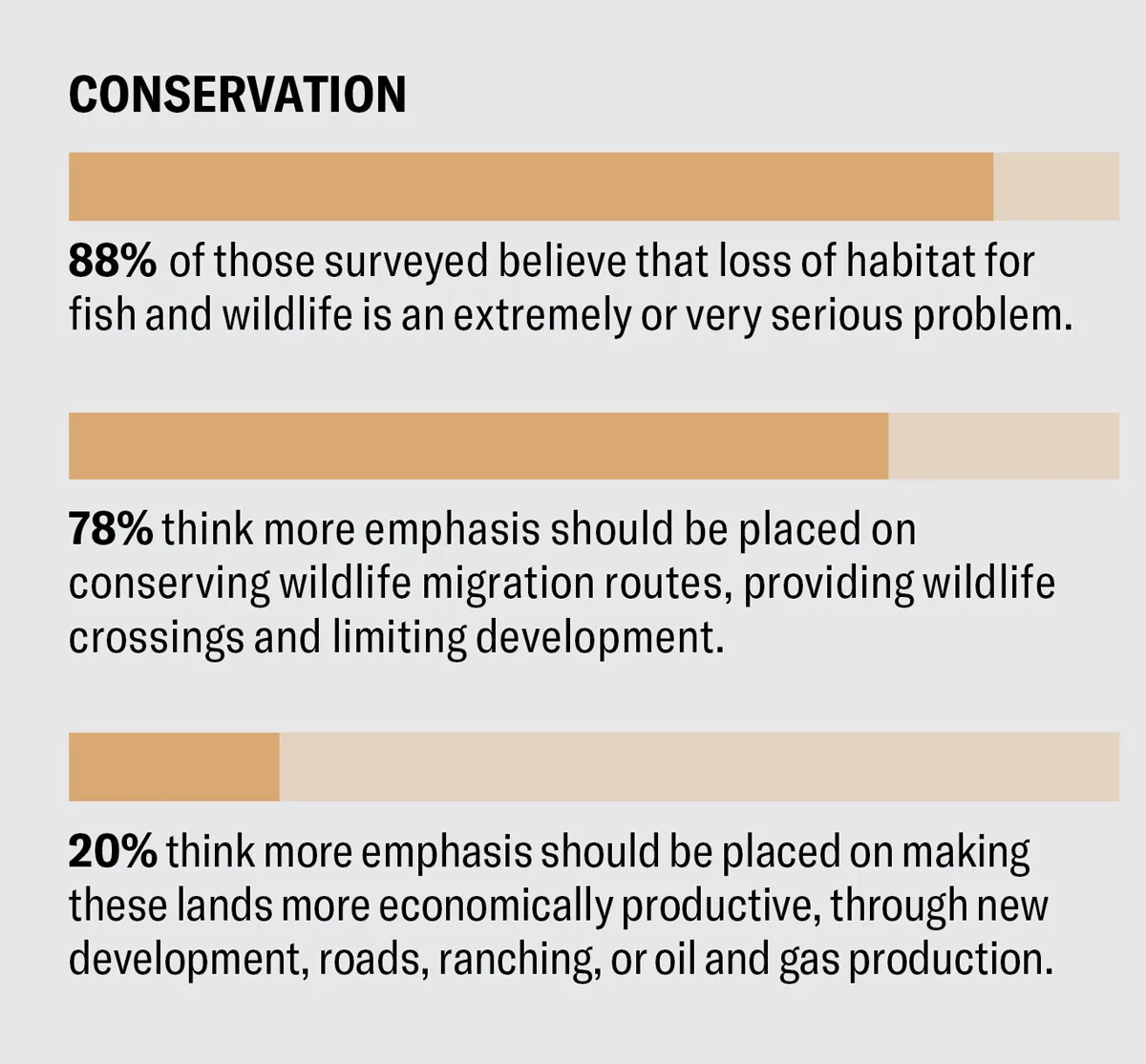
Agency Organization

Project 2025 seeks to limit regulation in favor of market forces by:

  • reducing annual agency spending, including subsidy rates for crop insurance and additional programs that support farmers for lost crops (p. 296); 
  • removing protections for wetlands and erodible land that farmers must comply with to participate in USDA programs (p. 304); 
  • eliminating the Conservation Reserve Program, which pays farmers to enrich and protect parts of their land from agricultural production (p. 304); 
  • removing climate change and equity from the agency’s mission (p. 290, 293); 
  • and working with Congress to undo the federal labeling law, which requires consumer products to disclose where they were made and what they contain, as well as encouraging voluntary labeling (p. 307). 

Forestry

The project will reduce forests on public lands by:

Logging within the Cougar Park timber sale in Kaibab National Forest in 2018. The timber project was part of an initiative intended to treat more than 2.4 million acres of ponderosa pine forest across northern Arizona. Dyan Bone/U.S. Forest Service

ENVIRONMENTAL PROTECTION AGENCY (p. 417) 

Prior to serving as the EPA’s chief of staff during the Trump administration, Mandy Gunasekara was famous for handing Republican Sen. James Inhofe a snowball to disprove the existence of human-caused climate change. At the EPA, she played a key role in the United States’ withdrawal from the Paris Agreement and in the dismantling of the Obama-era Clean Power Plan. Gunasekara’s vision for the EPA is characterized by staff layoffs, office closures and the embrace of public comment over peer-reviewed science. 

Agency Organization

The plan will diminish the agency’s scope of work by:

  • reducing full-time staff and cutting “low-value” programs (p. 422);
  • shuttering offices dedicated to environmental justice and civil rightsenforcement and complianceenvironmental educationchildren’s health and international and tribal affairs, and distributing their functions elsewhere (p. 421); 
  • eliminating all research that is not explicitly authorized by Congress (p. 436);
  • restructuring scientific advisory boards and engaging the public in ongoing scrutiny of the agency’s science — potentially opening the door to a wave of pushback against the international consensus on climate change (p. 422, 436-438);
  • eliminating the use of catastrophic climate change scenarios in drafting regulation (p. 436);
  • relocating a restructured American Indian Office to the West (p. 440);
  • partially shifting personnel from headquarters to regional offices (p. 430);
  • and striking the regulations, including a program to reduce methane and VOC emissions, that enable the EPA to work with external groups to help enforce laws (p. 424).

Natural Resources

The project would jeopardize clean air and water by:

  • limiting California’s effort to reduce air pollution from vehicles by ensuring that its standards and those of other states avoid any reference to greenhouse gas emissions or climate change (p.426);
  • supporting the reform of the Endangered Species Act to ensure a full cost-benefit analysis during pesticide approval (p. 434-435); 
  • repealing some regulations imposed by the Biden administration to limit hydrofluorocarbons, a particularly potent greenhouse gas (p. 425);
  • and undoing the expansion of the Good Neighbor Program, which requires states to reduce their nitrogen oxide emissions, beyond power plants to include industrial facilities like iron and steel mills (p. 424).

Full text of Project 2025 via Document Cloud

Supreme Court overturns Chevron v. NRDC — Western Resource Advocates

West Fork Fire June 20, 2013 photo the Pike Hot Shots Wildfire Today

From email from Western Resource Advocates (Erin Overturf):

June 28, 2024

STATEMENT FROM WESTERN RESOURCE ADVOCATES

This morning, the Supreme Court ruled to overturn Chevron v. NRDC, one of the most cited cases in American law.

This is just the latest in a series of SCOTUS decisions designed to undermine the effectiveness of federal administrative agencies like the Environmental Protection Agency. 

Today’s far-reaching ruling overturns a 40-year legal framework, marking the culmination of a decades-long effort to undermine federal agencies’ efforts to protect our health and our environment. Overturning Chevron v. NRDC will exacerbate existing dysfunction in federal policymaking, inviting litigation and making it increasingly challenging to secure public health and safety standards – including solutions addressing climate change – at the federal level.

Administrative agencies are the workhorses of our modern system of government. The issues confronting our day-to-day lives are too numerous and too nuanced for the three main branches of government to address alone, but agencies have the technical expertise and flexibility to fill in the gaps.
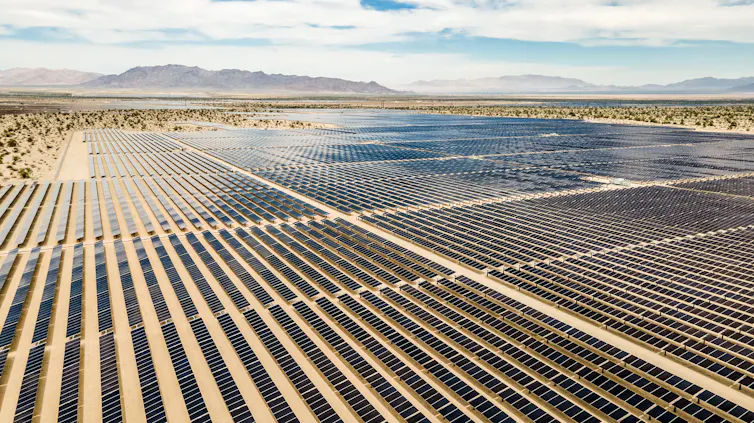
This decision will make it harder for federal agencies to take action to protect our health and our environment, allowing unelected federal judges with lifetime appointments to reject the policy judgements of agencies with more expertise and replace those agency judgments with their own policy preferences.
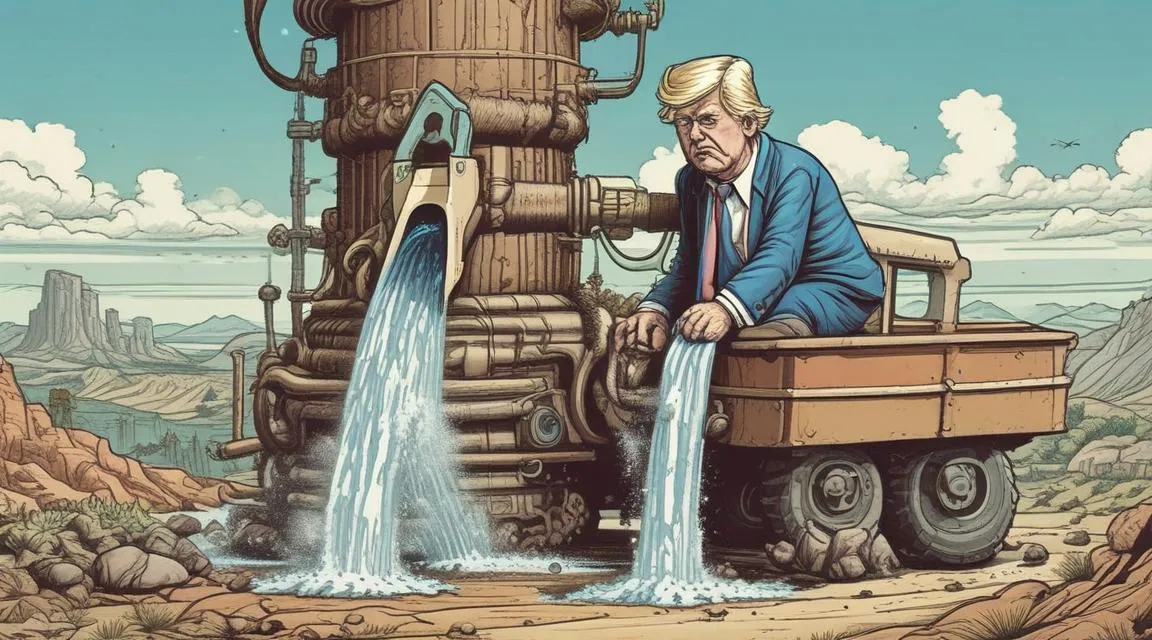
“This ruling makes the work we do before state utility regulators and legislatures all the more important. Given the challenging new landscape for federal agencies created by today’s decision, state-level policy on climate action and environmental protection is more critical than ever. The feds will not be able to solve this problem for us. It is time for leadership at the state level.” 

In light of this decision, advocacy within our states to protect our health, our environment, and our climate has never been more important. States can and should set their own standards to reduce pollution, conserve water, and protect wildlife.  

WRA is committed to continuing to leverage our expertise driving state-level policies that protect our health and fight climate change and its impacts in the Interior West. 

#Colorado tribes want to get into lucrative online sports betting. But a long-running dispute with the state is getting in the way — Fresh Water News

Colorado Columbine. Photo credit: Greg Hobbs

Click the link to read the article on the Water Education Colorado website (Jerd Smith):

Colorado tribes want to offer online sports betting. But their tax status, and other issues, has some people worried that allowing the Southern Ute and Ute Mountain tribes to offer remote wagering on professional sports might siphon valuable revenue away from Colorado water projects.

The Colorado Department of Revenue declined to comment on the specifics of the dispute, while tribal representatives say they are frustrated with the state’s refusal to allow them to offer it.

In November, a proposition referred to the ballot by lawmakers in House Bill 1436, will ask voters to allow the state to keep more of the revenue generated by sports gaming. Taxes collected on those bets, which were authorized in 2019, are projected to generate $34.2 million in tax revenue in the state’s next fiscal year, which begins July 1.

Under the current sports gaming law, the state cannot collect revenues in excess of $29 million. If voters approve the ballot measure, that cap would be removed, potentially generating millions of dollars more for water programs.

Colorado voters approved limited gaming in 1990 and the Ute Mountain Ute and Southern Ute tribes opened their own casinos soon after.

Remote sports betting is offered by casinos in Black Hawk, Central City and Cripple Creek, but the tribes have so far not been allowed to participate because of a failure to reach an agreement with the state on how it would operate, according to Peter Ortego, a lawyer representing the Ute Mountain Ute Tribe, in Towaoc. Ortego said the Ute Mountain Ute have not taken a position on the new ballot measure.

Representatives for the Southern Ute Tribe in Ignacio did not respond to a request for comment.

One of the issues is taxation. Because tribes are sovereign nations, they are exempt from paying state taxes. That tax-free status is problematic from the state’s perspective because if tribes allowed other commercial gaming companies to locate a remote sports betting kiosk on tribal land, it too would be exempt from taxation, shrinking the amount of money the state could collect for water programs including conservation, habitat restoration, stream protection and planning and storage, according to state Rep. Dylan Roberts, D-Frisco.

“When the legislature referred the sports betting initiative to voters in 2019, a key part was the state collecting tax on the revenues and dedicating 90% of that money to water projects,” Roberts said. “Now there is a concern that if the physical locations moved to tribal lands, we would lose most of the funding for water.”

The Colorado Gaming Association’s stance on the issue is not clear. The trade group did not respond to a request for comment.

Lawmakers are expected to take up the issue later this summer when a special interim committee on tribal affairs meets, Roberts said.

“I would be open to finding a middle ground. The complication is that tribal lands are not subject to state law, so lawmakers have very little ability to work in that space,” Roberts said.

Previous attempts to break the impasse have failed. The Ute Mountain Ute’s Ortego said it’s not clear when — or if — the dispute will be resolved.

“We want the opportunity to do what every other casino in the state is allowed to do,” Ortego said. “And we believe we have the right to do so.”

More by Jerd Smith

Jerd Smith is editor of Fresh Water News. She can be reached at 720-398-6474, via email at jerd@wateredco.org or @jerd_smith.

A flurry of public land protections: Biden’s rushing to get new rules in place, just in case … — Jonathan P. Thompson (LandDesk.org)

Beeweed and pumpjack. San Juan Basin, New Mexico. Jonathan P. Thompson photo.

Click the link to read the article on The Land Desk website (Jonathan P. Thompson):

The public lands beat has been rather busy, to put it mildly, as the Biden administration rushes to finalize rules, orders, and protections as soon as possible to make them less vulnerable to being rolled back if Biden were to lose in November to, ummm, a more hostile candidate. Maybe Biden’s also working to more clearly distinguish himself on environmental issues from Trump in advance of the election — as if the stark contrast isn’t abundantly clear already. 

So much has happened that I’ve fallen behind. So forget the pre-amble, let’s get to it:

In late March, the Bureau of Land Management finalized its methane waste prevention rule, which requires oil and gas operators on federal lands to find and repair leaks in their infrastructure and to phase out flaring and venting of methane — a.k.a. natural gas. The rules complement the EPA’s similar regulations finalized earlier this year. 

Methane is a potent greenhouse gas, having about 86 times the warming potential of carbon dioxide over the near-term (methane in the atmosphere breaks down into carbon dioxide and water over the long-term). While methane — which occurs alongside oil in underground reservoirs — can be captured and marketed as natural gas, oil drillers tend to vent or flare it and other associated gases, since it isn’t as profitable as oil. 

Flaring and venting of methane and other gases shot up after horizontal drilling-multistage hydraulic fracturing opened up vast new stores of oil. Source: Bureau of Land Management.

Between 2010 and 2020, after the “fracking”-enabled shale revolution got underway, oil and gas operations on federal and tribal land vented and flared an average of 44.2 billion cubic feet of methane annually. That’s as bad for the climate as burning around 9 million tons of coal. And since operators don’t pay royalties on gas they throw away,  that cost American taxpayers some $166 million in lost revenue over a decade. 

The rules look to rein that in by gradually decreasing the maximum amount of methane that can be flared or vented and charging royalties on the gases that are wasted. It is expected to slash greenhouse gas emissions and result in about $50 million annually in added royalty revenue. 

Methane Madness: Part IJonathan P. Thompson

***

A few days later, the administration finalized its ban on new oil and gas leases and mining claims on about 220,000 acres along Western Colorado’s Thompson Divide. The protections cover a stretch of high-country BLM and USFS land between Glenwood Springs, Crested Butte, and Somerset. It does not affect valid, existing leases or claims. 

In the early 2000s an eclectic group of environmentalists, ranchers, and recreational users banded together to protect the Divide from the growing threat of oil and gas development. Their efforts goaded the feds to halt new development and cancel existing leases on much of the acreage, long before this spring’s move. Meanwhile, a similar uprising in the Crested Butte area blocked a proposed molybdenum mine on Mt. Emmons, or the Red Lady. 

The administration’s withdrawal bolsters these efforts and blocks new development for the next 20 years. By then, one would hope, the administration’s demand-side efforts to reduce fossil fuel consumption — including encouraging clean energy development and pushing zero-emission cars — will have kicked in. 

***

And Biden and Interior Secretary Deb Haaland raised royalty rates and reclamation bonding amounts for oil and gas drilling on federal land. This one was a long-time coming. The previous 12.5% royalty rate has remained unchanged since Congress passed the Mineral Leasing Act in 1920. And oil and gas drillers have been getting away with posting bonds for all of their wells in a state that don’t get anywhere near covering the cost of cleaning up a single well. 

Environmentalists welcomed the reforms, but also criticized them for failing to address climate impacts of oil and gas development on public lands. Oh, and then there’s the thing about the faulty math: Mark Olalde and Nick Bowlin, for ProPublica and Capital & Main, found that even the new bonding amounts wouldn’t cover clean up. The problem? A BLM staffer miscalculated the cost to plug and reclaim a single well, and the inaccurate figure got incorporated into the analysis and final rule. Whoops. 

***

The administration blocked new oil and gas leases on 13 million acres of the National Petroleum Reserve-Alaska. That’s a huge amount of land and especially remarkable given that it’s in a petroleum reserve and it’s likely to result in some 50% less greenhouse gas emissions than Trump’s plan for the same area. Still, it may not be enough for the climate hawks who remain livid over the administration’s approval of a scaled-back, but still gargantuan, Willow (a.k.a. “carbon bomb”) drilling project in the reserve. Meanwhile, Biden’s Willow approval is not enough to soothe the anger of Alaska’s congressional delegation — including Democrat Rep. Mary Peltola — who blasted Biden for ignoring Alaska’s love for fossil fuels and called it an “illegal” move that dealt a “one-two punch” to the state’s economy. You just can’t win for losing, can you? 

*** 

Light and texture. Big Gypsum Valley, Colorado. Jonathan P. Thompson photo.

And last, but certainly not least: The Bureau of Land Management finalized its public lands rule, designed to put conservation on a par with oil and gas development, grazing, and other extractive uses.

The rule’s main provisions include: 

  • It directs the agency to prioritize landscape health in all decision making, which is what it’s already supposed to do when assessing grazing allotments. It hasn’t done a very good job at that, so far. 
  • It creates a mechanism for outside entities — states, tribes, or nonprofits — to lease public land for restoration projects — much as a rancher or oil and gas company might lease BLM land. 
  • It allows firms to lease land for mitigation work to offset impacts from development elsewhere. 
  • It clarifies the process for designating areas of critical environmental concern, or ACECs, where land managers can add extra regulations to protect cultural or natural resources. 
  • And it directs the agency to incorporate Indigenous knowledge into decision-making, particularly when considering ACECs. 

The rule is being hailed by conservationists as a “generation-defining shift” in public land management, and lambasted by Sagebrush Rebel-wannabes as a “misguided land grab meant to prevent oil and gas production … <and> … an attack on our ranchers and farmers that will end grazing on federal lands and will also prevent Coloradans from accessing their public lands.” (A gold star to whoever guesses which MAGA-loving congress member made the latter grossly misinformed quote!).

Honestly, I’m not sure either side’s hoohas are warranted. It’s hard to see how a couple new leasing categories will be generation defining, I kinda doubt the rules will affect oil and gas production, and I’m absolutely certain they won’t end grazing or otherwise block access to public lands. 

The rule doesn’t add any new restrictions or put any land off-limits to development. It doesn’t give greens the power to kick a legitimate drilling, mining or grazing operation off public land to do a restoration or mitigation project. The mitigation leases could actually facilitate energy development. As for grazing, the Biden administration has indicated it considers ranching to be a type of land conservation, a theory that is manifested in the BLM’s policy of veering away from public lands grazing reform. Grazing is allowed in most ACECs. And the agency just set the 2024 grazing fee at $1.35 per animal unit month, the minimum Congress allows. I think the cows and their ranchers will be just fine under this new rule.

It seems to me that this rule’s provisions are fairly open to interpretation. That means the actual implementation — and how it plays out on the ground — will depend largely on BLM state, regional, and field-office managers. And those local-level bureaucrats can be swayed by the prevailing attitudes of the communities where they live and work, and by pressure from local or state officials. 

In the end, the rule is essentially a reminder to the BLM that their job is not just to bend over for corporate and extractive interests, but to actually care for the land that belongs to all Americans. It is simply reinforcing the multiple-use charge Congress set forth when it passed the Federal Lands Policy and Management Act back in 1976. It’s not that big of a deal. But then again, FLPMA helped spark the Sagebrush Rebellion in the late 1970s. So who knows what this rule might inspire now…

📸 Parting Shot 🎞️

Eagles in a tree near Norwood, Colorado. Jonathan P. Thompson photo.

Thoughts on the Lower #ColoradoRiver Basin #Water Deal — Sibley’s Rivers #COriver #aridification

Click the link to read the article on the Sibley’s Rivers website (George Sibley):

A short post, to catch up on Colorado River current events. As you probably know, if you haven’t been living in a media-free cave, the three Colorado River states below the canyon region have proposed another alternative plan for saving the River’s reservoir system.

Their proposal, for answering the Interior Department’s call for cuts of at least two million acre-feet (maf) of water annually, is to cut three maf total over the next three years – and they want 1.2 billion dollars from the federal government to execute their plan.

Their plan is basically to pay farmers to voluntarily fallow some of their land. They say they will do half of the cuts – 1.5 maf – in 2024, the remainder over the following two years. Beyond that, there are no firm details at this writing as to how much of the cuts will come from each state, how much they will be paying farmers, et cetera.

Basically, what it looks like on the surface of it, is that the Lower Basin states have countered the Bureau’s four existing scenarios – two from the Bureau of Reclamation, one from California, and one from the other six River states – with an offer to do half of the minimumcuts the Bureau said we need, and they want a billion dollars to do it. What a deal.

If their plan to pay farmers to leave the water in the system sounds familiar, that may be because the four Upper Basin States tried a similar plan this year, the System Conservation Pilot Program, with a fund of $125 million from the ill-named Inflation Reduction Act. Upper Basin farmers did not rush to take up the offer. Only 88 submitted applications to participate, of which around 20 percent were rejected; the remainder will, if things work out as projected, save 39,000 acre-feet at a cost of $16 million. That is a very small piece of two million acre-feet.

The High Line Canal is an irrigation ditch built in the 1880s. Denver Water still uses the canal to deliver irrigation water to customers when conditions allow. Photo credit: Denver Water.

It has been said that farming – especially irrigated farming – is a calling, not an occupation. I have heard farmers and ranchers talk about ‘a working contract with the land,’ and in the Upper Basin at least there seems to be something almost offensive to many farmers about the idea of being paid to not farm some of their land. Ranchers in the Upper Gunnison say it takes up to five years to bring a hayfield back to full productivity after a year of no water (or very little). We’ll see, I guess, if Lower River farmers have the same basic feelings….

A further reason for the low turnout for the Upper Basin’s System Conservation Program might be that Upper Basin farmers believe – correctly enough – that the two million acre-foot ‘structural deficit’ is not their problem and they should not be expected to exercise themselves to help deal with it. A logical enough response when working with a Compact that, as one of the Compact commissioners said, is ‘almost making two rivers out of one in the Colorado River.’ The ‘Glen Canyon Wall’ near Lee Ferry eliminated that ‘almost.’ There has been no indication from the Lower River states that they would be merciful to the Upper River states, should the drought (not ‘caused’ by the Upper States) drive the available flow past Lee Ferry below the Compact allotment; so why should the Upper River states feel empathy for the Lower Basin states?

It was reported in the national media, by the way, that the Upper Basin states have ‘accepted’ the Lower Basin’s proposal. They have not, yet. The four Upper states merely said it was okay for the plan to be evaluated along with the other four proposals in the Bureau’s ‘Supplemental Environmental Impact Study.’

West snowpack basin-filled map April 16, 2023 via the NRCS.

All that noted – the Lower Basin proposal will probably be accepted for a variety of reasons. One reason is that the runoff from a good snowpack is probably going to give temporary relief on the reservoir levels; we should end the water year with both Powell and Mead Reservoirs higher than they were at the beginning of the year (water year is October to October), and that provides a little breathing room. (Keep in mind, though, that the Bureau first issued its major warning and challenge in 2022, saying that big reductions had to happen beginning in 2023. Now, nothing big will happen until 2024. Pray for snow next winter too.)

Another reason the proposal will probably be accepted is because if any of the other four proposals were to be chosen by the Bureau, one or more of the Lower Basin states would sue the government. There might be an element of desperation to both the gambit of promising to try to deliver only half of the requested cuts, and to the threat to sue if asked to deliver the whole 2 maf/year. The Bureau wants the Lower River region that serves a tenth of the national population and produces most of our winter fresh green stuff to cut their water use by almost one third – and do it next year. That’s a big request, maybe an unreasonable request.

Never mind that, had the Bureau and the seven Basin states been living in the real world, they would have taken care of the ‘structural deficit’ decades ago, with a gradual drop in Lower River use, reflecting the growth of use in the Upper River states that was eating into the so-called ‘surplus’ that the Lower Basin had grown to depend on take care of its system losses, and also its half of the allotment to Mexico.

And a final reason why their proposal will probably be accepted? 2024 is a presidential election year, with the current administration on the line, and both Arizona and Nevada are important swing states. ‘Nuff said.

It will come down to whether, next year, the three Lower River states can find enough farmers and cities willing to voluntarily give up a million and a half acre-feet of water next year. Tucson and the Gila River Indians have already made commitments. Meanwhile – pray for snow next winter.

Map credit: AGU