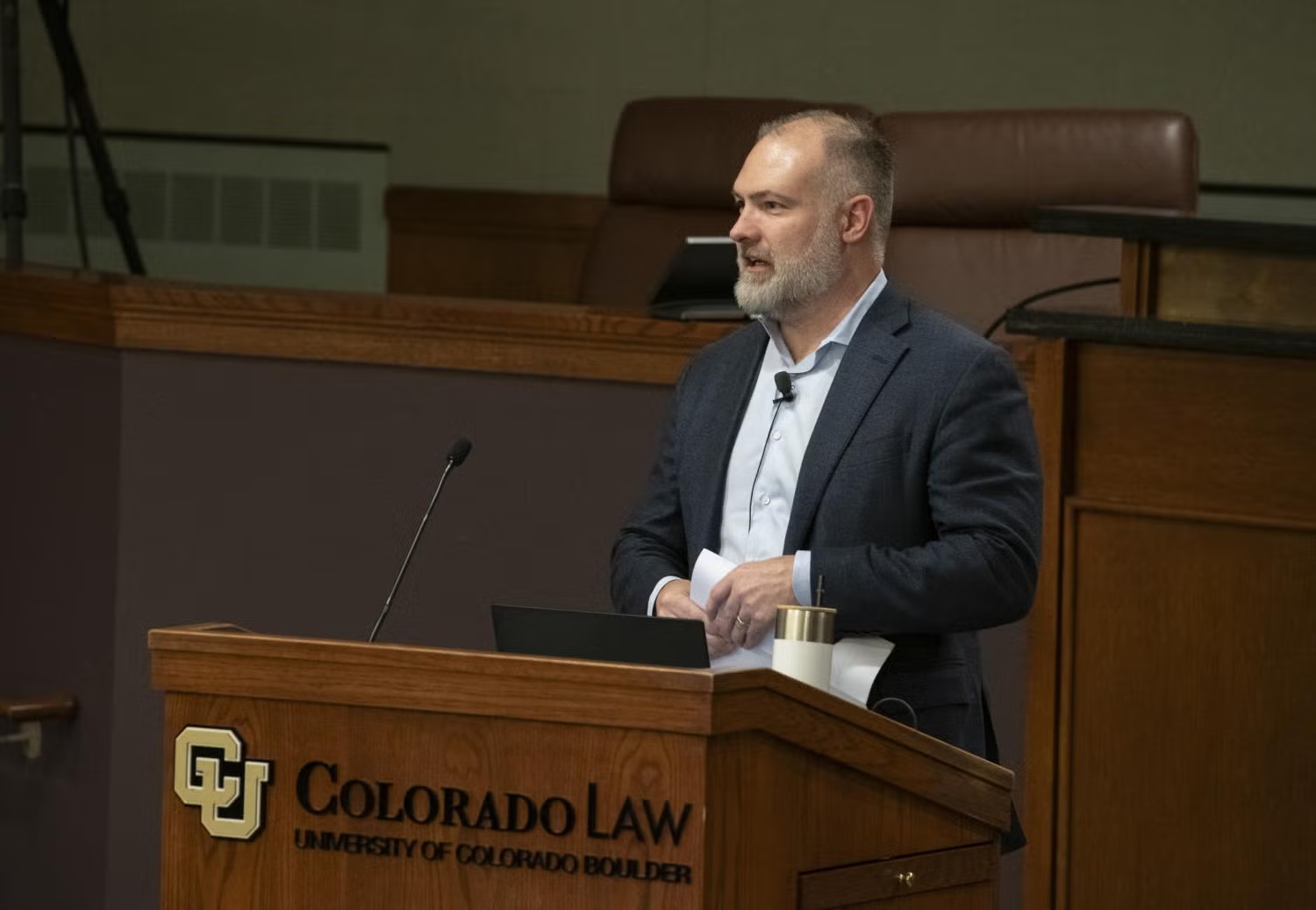
On May 29, the Supreme Court – minus Justice Neil Gorsuch, who recused himself – decided the case of Seven County Infrastructure Coalition v. Eagle County, #Colorado — Westword

A coal train travels along the Colorado River north of Gypsum in Eagle County on June 12, 2023. (Chase Woodruff/Colorado Newsline)

Click the link to read the article on the Westword website (J.B. Ruhl). Here’s an excerpt:

June 8, 2025

Getting federal approval for permits to build bridges, wind farms, highways and other major infrastructure projects has long been a complicated and time-consuming process. Despite growing calls from both parties for Congress and federal agencies to reform that process, there had been few significant revisions – until now. In one fell swoop, the U.S. Supreme Court has changed a big part of the game. Whether the effects are good or bad depends on the viewer’s perspective. Either way, there is a new interpretation in place for the law that is the centerpiece of the debate about permitting: the National Environmental Policy Act of 1969, known as NEPA…

Decades of litigation about the scope of indirect effects have widened the required evaluation. As I explain it to my students, that logical and legal progression is reminiscent of the popular children’s book If You Give a Mouse a Cookie, in which granting a request for a cookie triggers a seemingly endless series of further requests – for a glass of milk, a napkin and so on. For the highway example, the arguments went, even if the agency properly assessed the pollution from the cars, it also had to consider the new subdivisions, malls and jobs the new highway foreseeably could induce. The challenge for federal agencies was knowing how much of that potentially limitless series of indirect effects the courts would require them to evaluate.

The Uinta Basin is shown on this map, along with existing rail terminals in Carbon County, Utah, where limited amounts of the basin’s waxy crude is loaded into train cars. A proposal to create a direct rail link to the basin would provide shippers with enough transportation capacity to quadruple output.

“Turning hindsight into foresight: The #ColoradoRiver at a crossroads — Getches Wilkinson Center and the Water and Tribes Initiative Day 2 #COriver #aridification

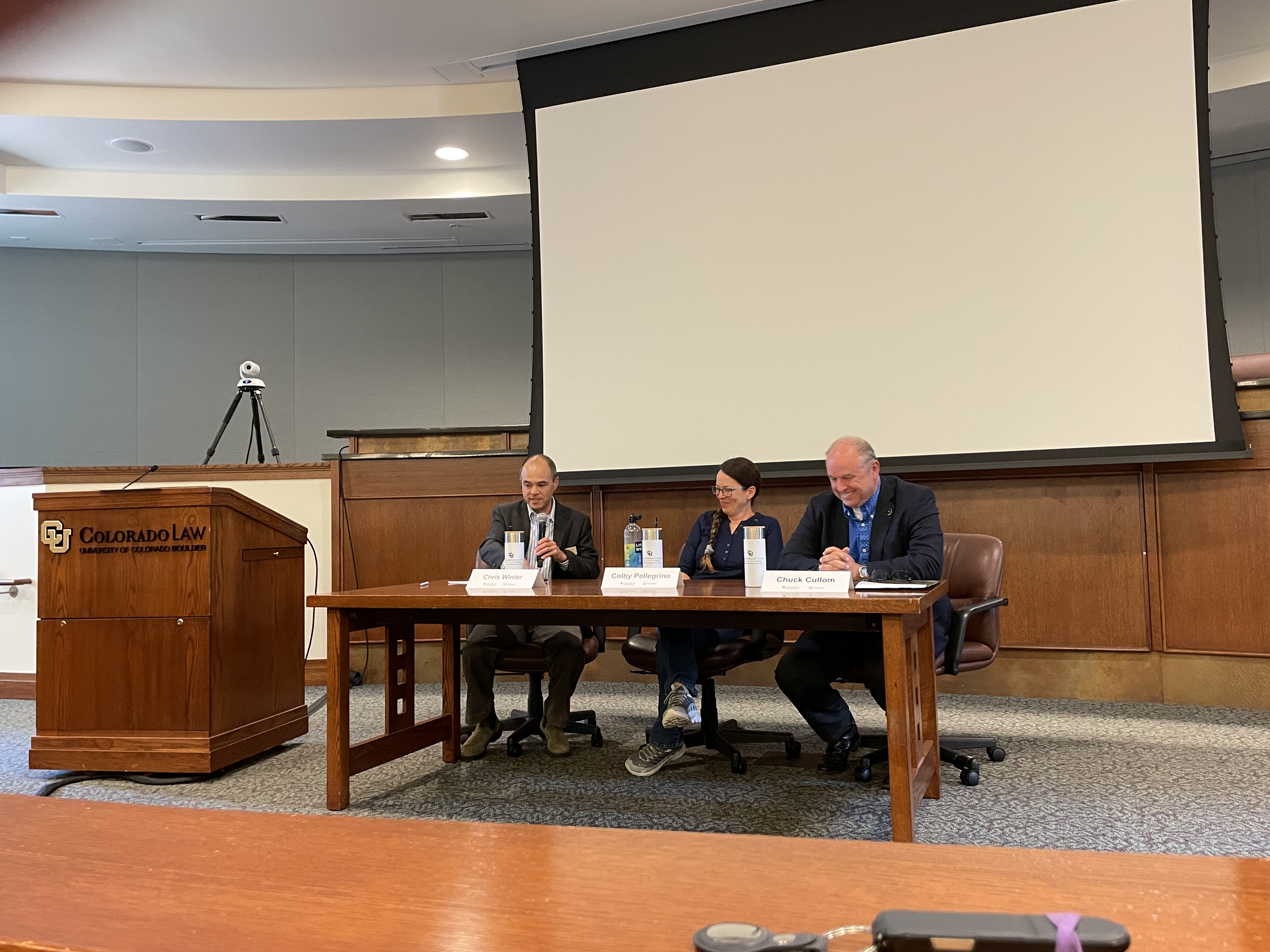
L. to R. Chris Winter, Colby Pelligrino, Chuck Cullom.

I was at the Getches-Wilkinson Center & Water and Tribes Initiative shindig this week live-posting on BlueSky (Click the “Latest” tab). The question of whether the negotiators from the seven states were being candid about their proceedings came up. Colby Pelligrino described her frustration with folks jumping all over every proposal as unfair or damaging to their rights. They can’t make any progress towards building a solution if every proposal is prevented from going forward. Chuck Cullom let everyone know that the data the negotiators are working with is available.

Also, Eric Kuhn, maintained that since the Colorado River Compact was written for a river that doesn’t exist any longer parts need to be reworked. He emphasized living with the river we have.

Not exactly in reverse, but…: #Colorado has been advancing rapidly toward its goals of having 940,000 EVs on the road. The budget bill passed by the House would put sales into a slower lane — Allen Best (BigPivots.com)

Click the link to read the article on the Big Pivots website (Allen Bestl):

June 4, 2025

Car buyers took the bait when Colorado dangled tax credits of $5,000 on top of federal tax credits of up to $7,500 for electric vehicles and plug-in hybrids. Sales took off. EVs alone constituted  24.7% .of all new car sales in the final months of 2025. T

Even in early 2025, when Colorado’s tax incentives ramped down to $3,500, EVs were still responsible for about 21.1% of all sales.

What if federal tax credits go away as proposed in the budget reconciliation bill now before the U.S. Senate?

Repeat, (Rapid Energy Policy Evaluation and Analysis Toolkit), a project housed within the University of Princeton, predicts 40% fewer sales nationally by 2024. Sales will still increase, just not as fast.

Travis Madsen, who oversees the transportation program for the Southwest Energy Efficiency Project, an advocacy group, said EV sales will continue to grow in Colorado. EVs save people money in lesser fuel and maintenance costs over the lifetime of a car.

Research by the Southwest Energy Efficiency Project found that drivers in Colorado and other Southwestern states can save on the order of $10,000 over 200,000 miles by choosing an electric sedan. For battery-electric pickups, the savings can exceed $30,000.

The front-end costs can be discouraging, though.

“We will have to develop new tools to help people understand that they can save money,” said Madsen. “We will still be making progress. It just won’t be as fast.”

Will Toor, who directs the Colorado Energy Office, described the bill’s effects more broadly if the Senate were to go along with what the House passed.

“They would be, I think, ceding the future of auto manufacturing to China and essentially knee-capping American auto manufacturers from their ability to compete into the future,” he said.

“We’d started to see a bit of manufacturing renaissance in this county for clean energy supported by the Inflation Reduction Act. If this moves forward, I think it will be really negative for that clean energy manufacturing across the nation.”

The net effect of the sweeping 1,000-page bill would be to “drive up the cost of electricity, drive up the cost of vehicles and essentially drive up the costs of all the things that Coloradans depend on in their daily lives,” he added.

New York Times columnist Thomas Friedman, a frequent visitor to Colorado over the years, made the same point several days later. In a column, “Trump’s Gilded Gut Instinct,” he wrote this:

“As I have been arguing since Trump came to office, his ridiculous right-wing woke obsession with destroying the U.S. electric vehicle industry that President Joe Biden was trying to build up undermines U.S. efforts to compete with China in electric batteries. Batteries are the new oil; they will power the new industrial ecosystem of A.I.-infused self-driving cars, robots, drones and clean tech.”

Friedman then introduced the thoughts of an economist, Noah Smith, who observed the consequences of the new budget bill in light of last weekend’s attack of Russian’s airplanes by Ukrainian drones. The essay is extended but entirely germane to U.S. defense but also EV adoption in Colorado.

Smith’s posting on Tuesday included this:

“Electric vehicles are crucial for battery manufacturing capacity, because in peacetime, they’re the main source of demand for batteries. Pump up the EV industry, and you pump up the battery industry too — just as the chart above shows Biden doing. Kill the EV industry and you kill the battery industry too, just as Republicans now want to do. Harming the solar industry will also harm the battery industry, because some types of batteries are used to store solar energy for when the sun isn’t shining.”

As for Colorado’s goal of having 940,000 EVs on its roads by 2030, it remains on track to get there. The incentives have jump-started sales. Another component was to ensure sufficient charging infrastructure exists.

This has several components.

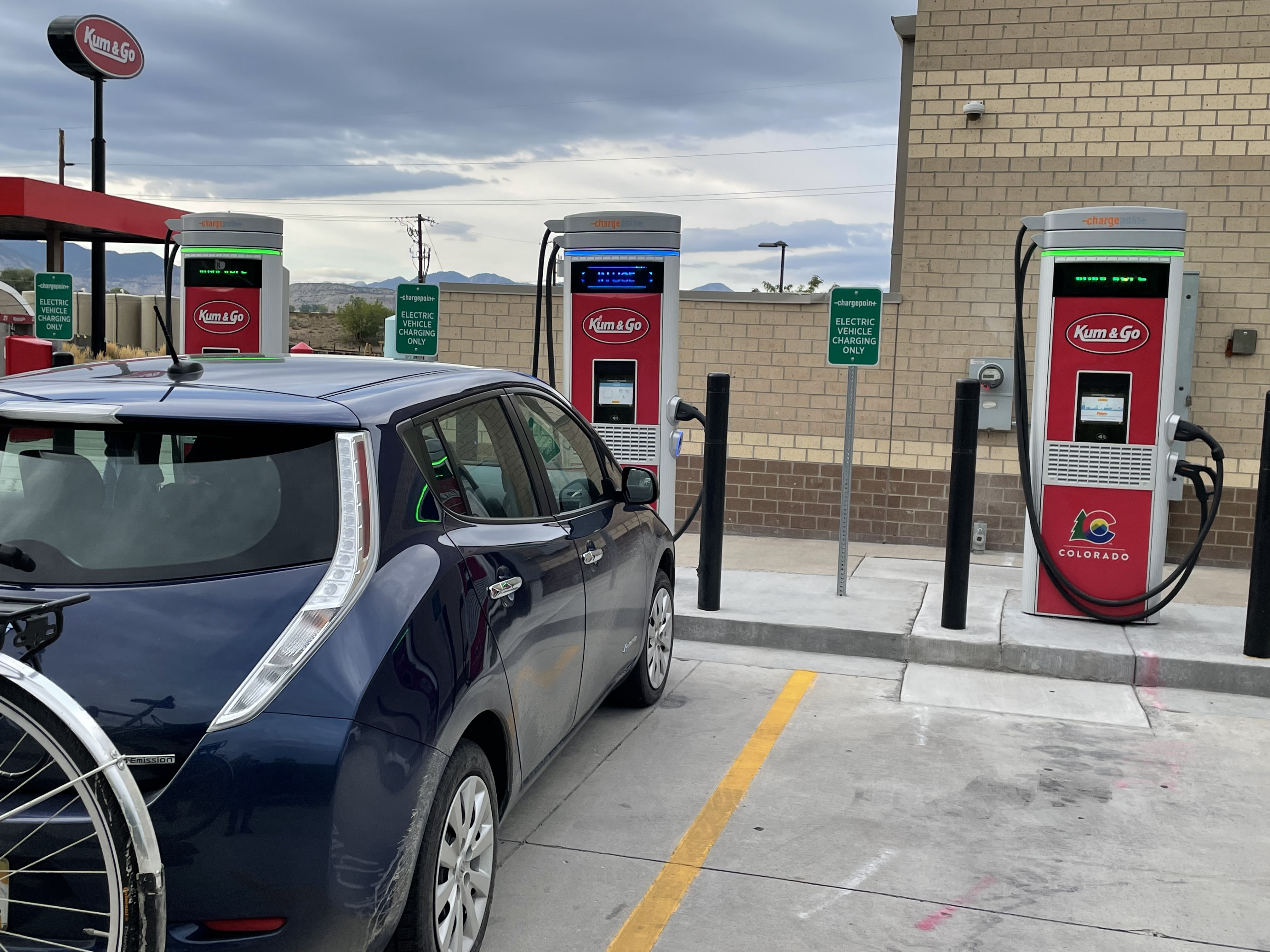
To assuage worries about running out of fuel without a way to quickly charge when traveling, Colorado set out to get high-speed charging stations around the state. Some of this has been done with federal aid.

Gaps remain in Colorado, though. Most every wide spot in the road has a gas station. Fast charging EV stations are not so omnipresent. Colorado has worked to provide that reliability.

Leaf charging in Rifle September 30, 2021. Colorado now has a more than 1,100 fast-charging and 4,400 level-two ports,

Colorado has been helped by but has not been solely dependent upon federal aid to seed the charging stations needed to make drivers comfortable when considering purchase of an EV. The state has investment programs, and utilities have invested, too.

“Unlike many other states, we haven’t been dependent just on federal investment,” said Toor.

The federal government has cut off funds for continued fast-charging through the National Electric Vehicle Infrastructure Fund. Colorado Attorney General Phil Weiser joined with California and other states in a lawsuit that seeks to force the Trump administration to thaw those funds.

“They are important, and we’ve been relying on them and we need to get access to them,” said Toor. “But there’s a lot of EV charging that’s been deployed and will continue to be deployed in the state.”

EV adoption in Colorado also depends upon having ample fast-charging stations in other states, too, said Toor. Coloradans don’t always stay in Colorado, so they want assurances of being able to charge when driving across the vast expanses of Wyoming and Montana, too.

Another difference is that you can fill up a car with gas before you finish washing your windows. With an EV it can take 10 or 20 minutes. Best to find a charger coupled with a coffee shop and plan your trips accordingly. You can get charged up with caffeine while your car gets charged with electricity.

In May, after the Legislature convened, Toor, who directs the Colorado Energy Office, set out from the Front Range in his Chevy Blazer EV for a backpacking trip in Canyonlands National Park. It worked well, he reported. The car has a listed range of 285 miles. He reports that in temperate weather, he can get 330 miles. “And I’m sort of the opposite of a lead-footed driver,” he explained.

The first stop was a fast-charging station coupled with a coffee shop in Fruita. In Utah, at Monticello, they had a similar pre-scheduled stop.

“We stopped a few times in nice places,” said Toor. “The only problem was I drank too much coffee. Couldn’t sleep that night.”

Coyote Gulch’s shiny new Leaf May 13, 2023

Gila River Tribes Intend to Float #Solar Panels on a Reservoir. Could the Technology Help the #ColoradoRiver? — Jake Bolster (InsideClimateNews.com) #COriver #aridification

The Gila River Indian Community in Arizona has lined 3,000 feet of their canals with solar panels. Credit: Jake Bolster/Inside Climate News

Click the link to read the article on the Inside Climate News website (Jake Bolster):

June 1, 2025

On its surface, floating solar appears to conserve water while generating carbon-free electricity. River managers are cautious, but some say the West can’t afford to wait.

GILA RIVER INDIAN RESERVATION, Ariz.—About 33 miles south of Phoenix, Interstate 10 bisects a line of solar panels traversing the desert like an iridescent snake. The solar farm’s shape follows the path of a canal, with panels serving as awnings to shade the gently flowing water from the unforgiving heat and wind of the Sonoran Desert.

The panels began generating power last November for the Akimel O’otham and Pee Posh tribes—known together as the Gila River Indian Community, or GRIC—on their reservation in south-central Arizona, and they are the first of their kind in the U.S. The community is studying the effects of these panels on the water in the canal, hopeful that they will protect a precious resource from the desert’s unflinching sun and wind. 

In September, GRIC is planning to break ground on another experimental effort to conserve water while generating electricity: floating solar. Between its canal canopies and the new project that would float photovoltaic panels on a reservoir it is building, GRIC hopes to one day power all of its canal and irrigation operations with solar electricity, transforming itself into one of the most innovative and closely-watched water users in the West in the process.

The community’s investments come at a critical time for the Colorado River, which supplies water to about 40 million people across seven Western states, Mexico and 30 tribes, including GRIC. Annual consumption from the river regularly exceeds its supply, and a decades-long drought, fueled in part by climate change, continues to leave water levels at Lake Powell and Lake Mead dangerously low. 

Covering water with solar panels is not a new idea. But for some it represents an elegant mitigation of water shortages in the West. Doing so could reduce evaporation, generate more carbon-free electricity and require dams to run less frequently to produce power. 

But, so far, the technology has not been included in the ongoing Colorado River negotiations between the Upper Basin states of Colorado, New Mexico, Utah and Wyoming, the Lower Basin states of Arizona, California and Nevada, tribes and Mexico. All are expected to eventually agree on cuts to the system’s water allocations to maintain the river’s ability to provide water and electricity for residents and farms, and keep its ecosystem alive.

“People in the U.S. don’t know about [floating solar] yet,” said Scott Young, a former policy analyst in the Nevada state legislature’s counsel bureau. “They’re not willing to look at it and try and factor it” into the negotiations.

Several Western water managers Inside Climate News contacted for this story said they were open to learning more about floating solar—Colorado has even studied the technology through pilot projects. But, outside of GRIC’s project, none knew of any plans to deploy floating solar anywhere in the basin. Some listed costly and unusual construction methods and potentially modest water savings as the primary obstacles to floating solar maturing in the U.S.

A Tantalizing Technology With Tradeoffs

A winery in Napa County, California, deployed the first floating solar panels in the U.S. on an irrigation pond in 2007. The country was still years away from passing federal legislation to combat the climate crisis, and the technology matured here haltingly. As recently as 2022, according to a Bloomberg analysis, most of the world’s 13 gigawatts of floating solar capacity had been built in Asia.

Unlike many Asian countries, the U.S. has an abundance of undeveloped land where solar could be constructed, said Prateek Joshi, a research engineer at the National Renewable Energy Laboratory (NREL) who has studied floating solar, among other forms of energy. “Even though [floating solar] may play a smaller role, I think it’s a critical role in just diversifying our energy mix and also reducing the burden of land use,” he said. 

This February, NREL published a study that found floating solar on the reservoirs behind federally owned dams could provide enough electricity to power 100 million U.S. homes annually, but only if all the developable space on each reservoir were used. 

Lake Powell could host almost 15 gigawatts of floating solar using about 23 percent of its surface area, and Lake Mead could generate over 17 gigawatts of power on 28 percent of its surface. Such large-scale development is “probably not going to be the case,” Joshi said, but even if a project used only a fraction of the developable area, “there’s a lot of power you could get from a relatively small percentage of these Colorado Basin reservoirs.”

The study did not measure how much water evaporation floating solar would prevent, but previous NREL research has shown that photovoltaic panels—sometimes called “floatovoltaics” when they are deployed on reservoirs—could also save water by changing the way hydropower is deployed

Some of a dam’s energy could come from solar panels floating on its reservoir to prevent water from being released solely to generate electricity. As late as December, when a typical Western dam would be running low, lakes with floating solar could still have enough water to produce hydropower, reducing reliance on more expensive backup energy from gas-fired power plants.

Joshi has spoken with developers and water managers about floating solar before, and said there is “an eagerness to get this [technology] going.” The technology, however, is not flawless.

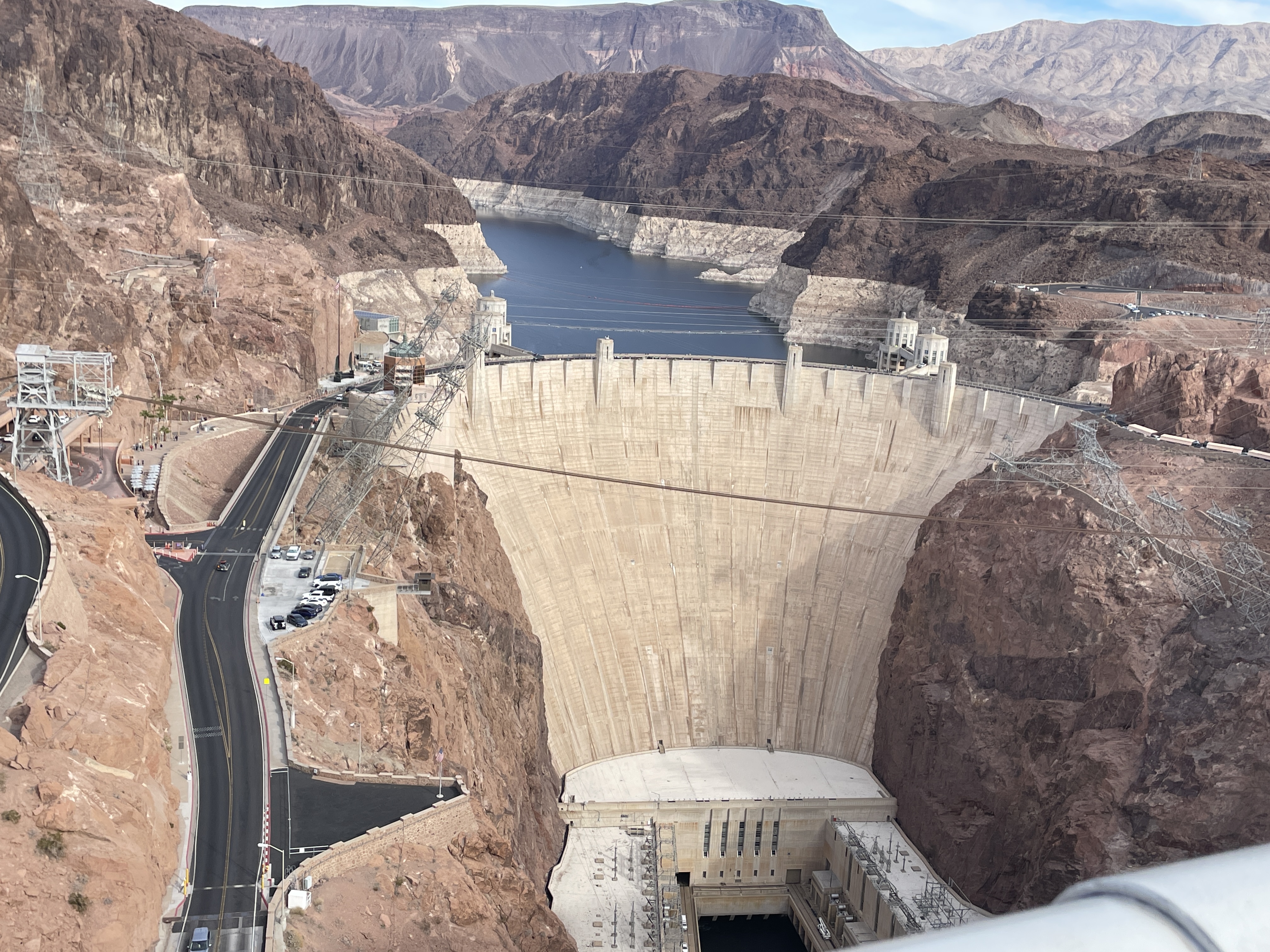
Hoover Dam with Lake Mead in the background December 3, 2024.
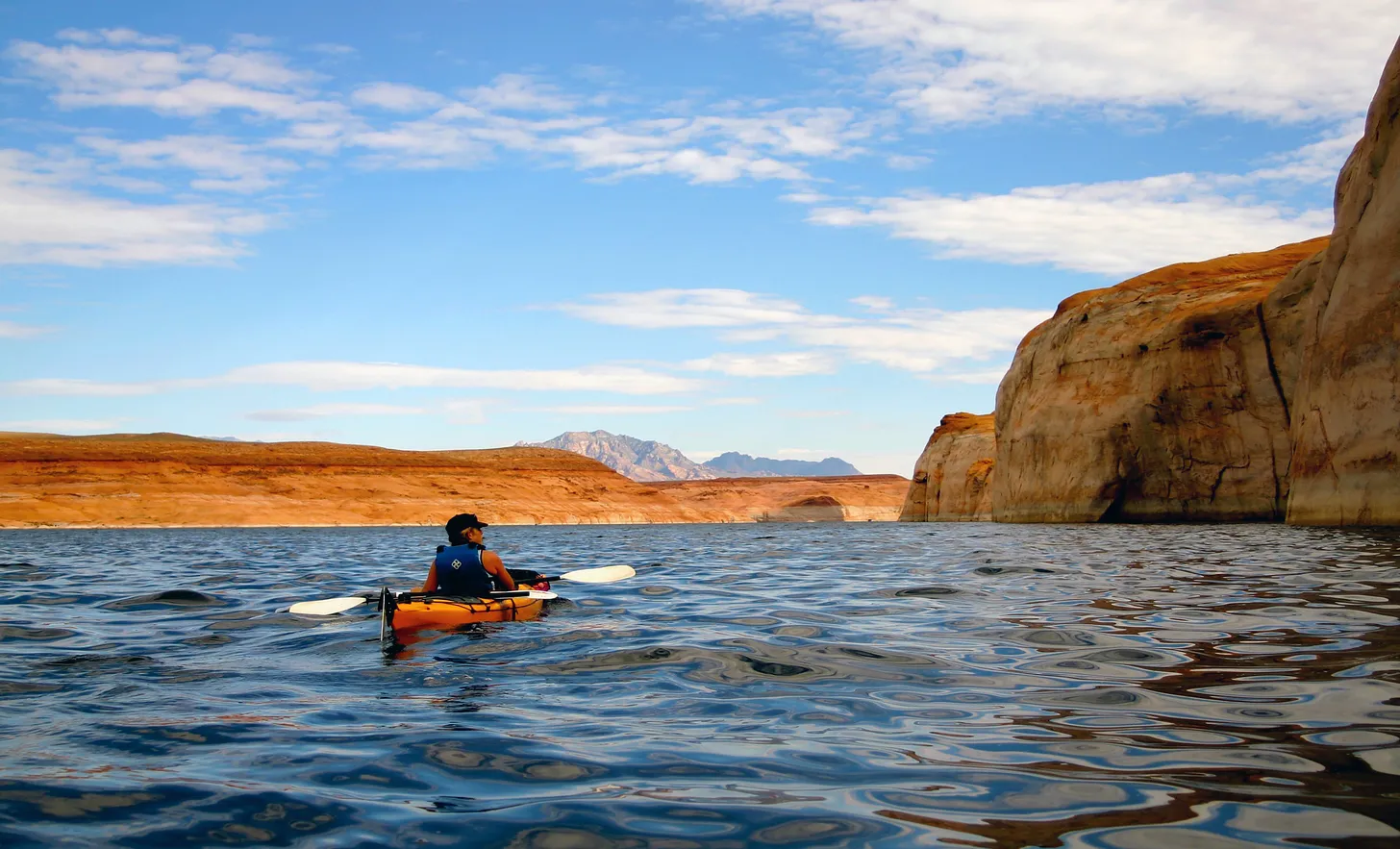
Paddling Powell. Photo by Jonathan P. Thompson.

Solar arrays can be around 20 percent more expensive to install on water than land, largely because of the added cost of buoys that keep the panels afloat, according to a 2021 NREL report. The water’s cooling effect can boost panel efficiency, but floating solar panels may produce slightly less energy than a similarly sized array on land because they can’t be tilted as directly toward the sun as land-based panels. 

And while the panels likely reduce water loss from reservoirs, they may also increase a water body’s emissions of greenhouse gases, which in turn warm the climate and increase evaporation. This January, researchers at Cornell University found that floating solar covering more than 70 percent of a pond’s surface area increased the water’s CO2 and methane emissions. These kinds of impacts “should be considered not only for the waterbody in which [floating solar] is deployed but also in the broader context of trade-offs of shifting energy production from land to water,” the study’s authors wrote.

“Any energy technology has its tradeoffs,” Joshi said, and in the case of floating solar, some of its benefits—reduced evaporation and land use—may not be easy to express in dollars and cents.

Silver Buckshot

There is perhaps no bigger champion for floating solar in the West than Scott Young. Before he retired in 2016, he spent much of his 18 years working for the Nevada Legislature researching the effects of proposed legislation, especially in the energy sector. 

On an overcast, blustery May day in southwest Wyoming near his home, Young said that in the past two years he has promoted the technology to Colorado River negotiators, members of Congress, environmental groups and other water managers from the seven basin states, all of whom he has implored to consider the virtues of floating solar arrays on Lake Powell and Lake Mead.

Young grew up in the San Francisco Bay area, about 40 miles, he estimated, from the pioneering floating solar panels in Napa. He stressed that he does not have any ties to industry; he is just a concerned Westerner who wants to diversify the region’s energy mix and save as much water as possible. 

But so far, when he has been able to get someone’s attention, Young said his pitch has been met with tepid interest. “Usually the response is: ‘Eh, that’s kind of interesting,’” said Young, dressed in a black jacket, a maroon button-down shirt and a matching ball cap that framed his round, open face. “But there’s no follow-up.” 

The Bureau of Reclamation “has not received any formal proposals for floating solar on its reservoirs,” said an agency spokesperson, who added that the bureau has been monitoring the technology. 

In a 2021 paper published with NREL, Reclamation estimated that floating solar on its reservoirs could generate approximately 1.5 terawatts of electricity, enough to power about 100 million homes. But, in addition to potentially interfering with recreation, aquatic life and water safety, floating solar’s effect on evaporation proved difficult to model broadly. 

So many environmental factors determine how water is lost or consumed in a reservoir—solar intensity, wind, humidity, lake circulation, water depth and temperature—that the study’s authors concluded Reclamation “should be wary of contractors’ claims of evaporation savings” without site-specific studies. Those same factors affect the panels’ efficiency, and in turn, how much hydropower would need to be generated from the reservoir they cover.

The report also showed the Colorado River was ripe with floating solar potential—more than any other basin in the West. That’s particularly true in the Upper Basin, where Young has been heartened by Colorado’s approach to the technology. 

In 2023, the state passed a law requiring several agencies to study the use of floating solar. Last December, the Colorado Water Conservation Board published its findings, and estimated that the state could save up to 407,000 acre feet of water by deploying floating solar on certain reservoirs. An acre foot covers one acre with a foot of water, or 325,851 gallons, just about three year’s worth of water for a family of four.

When Young saw the Colorado study quantifying savings from floating solar, he felt hopeful. “407,000 acre feet from one state,” he said. “I was hoping that would catch people’s attention.” 

Saving that much water would require using over 100,000 acres of surface water, said Cole Bedford, the Colorado Water Conservation Board’s chief operating officer, in an email. “On some of these reservoirs a [floating solar] system would diminish the recreational value such that it would not be appropriate,” he said. “On others, recreation, power generation, and water savings could be balanced.”

Colorado is not planning to develop another project in the wake of this study, and Bedford said that the technology is not a silver bullet solution for Colorado River negotiations. 

“While floating solar is one tool in the toolkit for water conservation, the only true solution to the challenges facing the Colorado River Basin is a shift to supply-driven, sustainable uses and operations,” he said.

Denver Water’s sustainability operations include generating energy from solar power panels installed on the roof of its Administration Building, parking garage and over its visitor’s parking lot at its Operations Complex near downtown. Photo credit: Denver Water.

Some of the West’s largest and driest cities, like Phoenix and Denver, ferry Colorado River water to residents hundreds of miles away from the basin using a web of infrastructure that must reliably operate in unforgiving terrain. Like their counterparts at the state level, water managers in these cities have heard floatovoltaics floated before, but they say the technology is currently too immature and costly to be deployed in the U.S.

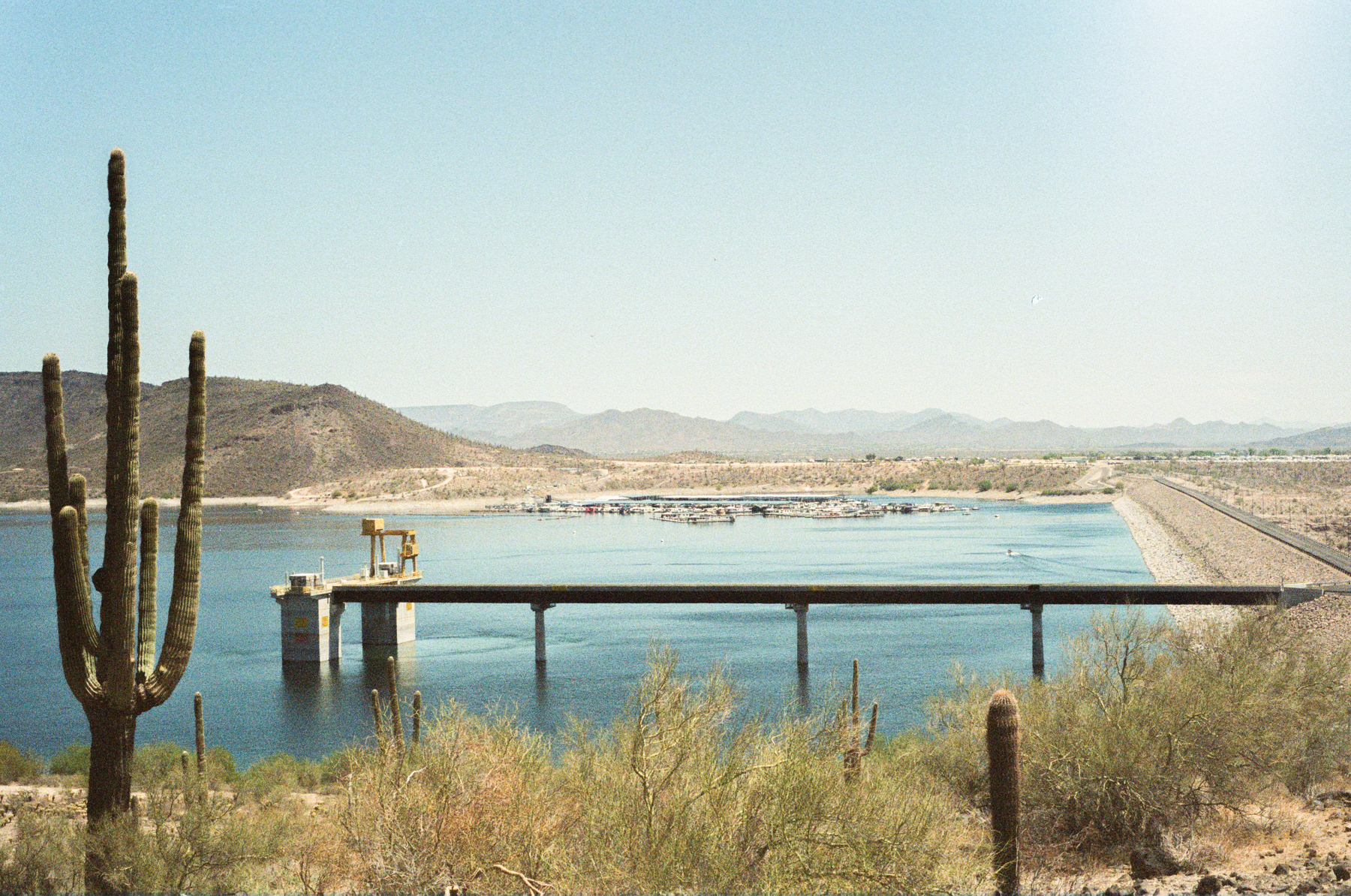
Lake Pleasant, which holds some of the Central Arizona Project’s Colorado River Water, is also a popular recreation space, complicating its floating solar potential. Credit: Jake Bolster/Inside Climate News

In Arizona, the Central Arizona Project (CAP) delivers much of the Colorado River water used by Phoenix, Tucson, tribes and other southern Arizona communities with a 336-mile canal running through the desert, and Lake Pleasant, the company’s 811,784-acre-foot reservoir.

Though CAP is following GRIC’s deployment of solar over canals, it has no immediate plans to build solar over its canal, or Lake Pleasant, according to Darrin Francom, CAP’s assistant general manager for operations, power, engineering and maintenance, in part because the city of Peoria technically owns the surface water.

Covering the whole canal with solar to save the 4,000 acre feet that evaporates from it could be prohibitively expensive for CAP. “The dollar cost per that acre foot [saved] is going to be in the tens of, you know, maybe even hundreds of thousands of dollars,” Francom said, mainly due to working with novel equipment and construction methods. “Ultimately,” he continued, “those costs are going to be borne by our ratepayers,” which gives CAP reason to pursue other lower-cost ways to save water, like conservation programs, or to seek new sources.

An intake tower moves water into and out of the dam at Lake Pleasant. Credit: Jake Bolster/Inside Climate News

The increased costs associated with building solar panels on water instead of on land has made such projects unpalatable to Denver Water, Colorado’s largest water utility, which moves water out of the Colorado River Basin and through the Rocky Mountains to customers on the Front Range. “Floating solar doesn’t pencil out for us for many reasons,” said Todd Hartman, a company spokesperson. “Were we to add more solar resources—which we are considering—we have abundant land-based options.”

GRIC spent about $5.6 million, financed with Inflation Reduction Act grants, to construct 3,000 feet of solar over a canal, according to David DeJong, project director for the community’s irrigation district.

Young is aware there is no single solution to the problems plaguing the Colorado River Basin, and he knows floating solar is not a perfect technology. Instead, he thinks of it as a “silver buckshot,” he said, borrowing a term from John Entsminger, general manager for the Southern Nevada Water Authority—a technology that can be deployed alongside a constellation of behavioral changes to help keep the Colorado River alive. 

Given the duration and intensity of the drought in the West and the growing demand for water and clean energy, Young believes the U.S. needs to act now to embed this technology into the fabric of Western water management going forward.

As drought in the West intensifies, “I think more lawmakers are going to look at this,” he said. “If you can save water in two ways—why not?” 

If all goes according to plan, GRIC’s West Side Reservoir will be finished and ready to store Colorado River water by the end of July. The community wants to cover just under 60 percent of the lake’s surface area with floating solar.

“Do we know for a fact that this is going to be 100 percent effective and foolproof? No,” said DeJong, GRIC’s project director for its irrigation district. “But we’re not going to know until we try.”

The Gila River Indian Community spent about $5.6 million, with the help of Inflation Reduction Act grants, to cover a canal with solar. Credit Jake Bolster/Inside Climate News

GRIC’s panels will have a few things going for them that projects on lakes Mead or Powell probably wouldn’t. West Side Reservoir will not be open to recreation, limiting the panels’ impacts on people. And the community already has the funds—Inflation Reduction Act grants and some of its own money—to pay for the project.

But GRIC’s solar ambitions may be threatened by the hostile posture toward solar and wind energy from the White House and congressional Republicans, and the project is vulnerable to an increasingly volatile economy. Since retaking office, President Donald Trump, aided by billionaire Elon Musk, has made deep cuts in renewable energy grants at the Environmental Protection Agency. It is unclear whether or to what extent the Bureau of Reclamation has slashed its grant programs. 

“Under President Donald J. Trump’s leadership, the Department is working to cut bureaucratic waste and ensure taxpayer dollars are spent efficiently,” said a spokesperson for the Department of the Interior, which oversees Reclamation. “This includes ensuring Bureau of Reclamation projects that use funds from the Infrastructure Investments and Jobs Act and the Inflation Reduction Act align with administration priorities. Projects are being individually assessed by period of performance, criticality, and other criteria. Projects have been approved for obligation under this process so that critical work can continue.”

And Trump’s tariffs could cause costs to balloon beyond the community’s budget, which could either reduce the size of the array or cause delays in soliciting proposals, DeJong said. 

While the community will study the panels over canals to understand the water’s effects on solar panel efficiency, it won’t do similar research on the panels on West Side Reservoir, though DeJong said they have been in touch with NREL about studying them. The enterprise will be part of the system that may one day offset all the electrical demand and carbon footprint of GRIC’s irrigation system.

“The community, they love these types of innovative projects. I love these innovative projects,” said GRIC Governor Stephen Roe Lewis, standing in front of the canals in April. Lewis had his dark hair pulled back in a long ponytail and wore a blue button down that matched the color of the sky.

“I know for a fact this is inspiring a whole new generation of water protectors—those that want to come back and they want to go into this cutting-edge technology,” he said. “I couldn’t be more proud of our team for getting this done.”

DeJong feels plenty of other water managers across the West could learn from what is happening at GRIC. In fact, the West Side Reservoir was intentionally constructed near Interstate 10 so that people driving by on the highway could one day see the floating solar the community intends to build there, DeJong said. 

“It could be a paradigm shift in the Western United States,” he said. “We recognize all of the projects we’re doing are pilot projects. None of them are large scale. But it’s the beginning.”

Map credit: AGU

Energy dominance harms our public lands — Barbara Vasquez (Writers on the Range)

Click the link to read the article on the Writers on the Range website (Barbara Vasquez):

May 26, 2025

I live in Jackson County, in northern Colorado, where hundreds of inactive and abandoned oil wells litter the landscape. Not only are they an ugly sight, they are also just a few of the estimated 2.6 million unplugged wells across the country that leak methane, benzene and other toxic substances. 

The reality is that long after I’m gone, most or all of those wells will remain unplugged. The companies and people who once owned them will have been allowed to walk away from their responsibility to clean up their mess.

Uncapped wells are what happens when the federal government enables the fossil-fuel industry to dominate energy policies, as is happening again now, both in the Interior Department and Congress. The policies emerging would allow companies, including many foreign ones, to profit from public lands and minerals that all Americans own. They would also leave taxpayers holding the bag for cleaning up leaking wells.

These abandoned wells already have consequences for wildlife, air, water and rural people. Kirk Panasuk, a rancher in Bainville, Montana, said: “I have personally experienced serious health scares after breathing toxic fumes from oil and gas wells near my property. And I’ve seen too many of my friends and neighbors in this part of the country have their water contaminated or their land destroyed by rushed and reckless industrial projects.”

Republicans and Democrats in previous administrations and Congresses took pains to reform this historically biased federal energy system because of the damage done to rural communities and American taxpayers. Now, the federal government is rolling back those reforms.

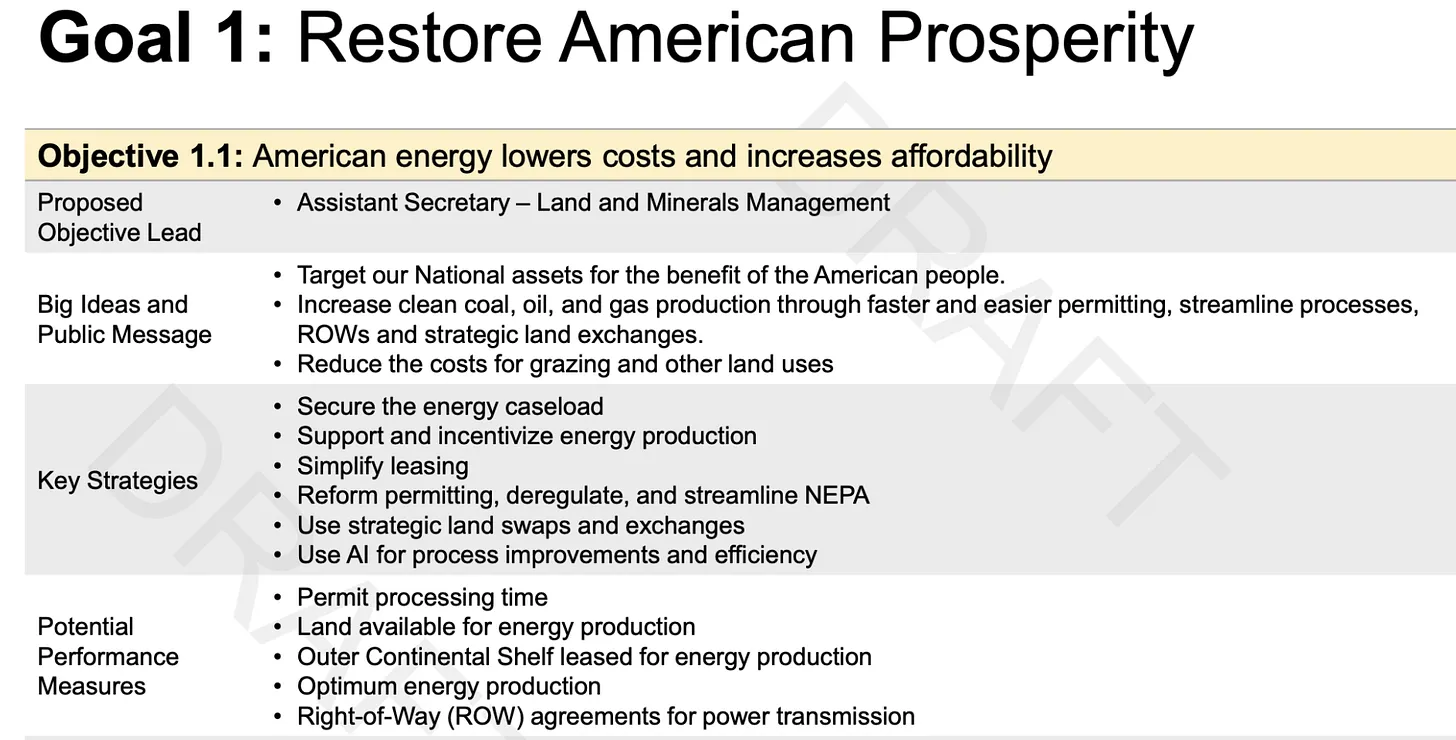
Recently, the Interior Department announced that “emergency permitting procedures” were necessary when carrying out NEPA, the National Environmental Policy Act. Timelines for environmental assessments for fossil-fuel projects were changed from one year to 14 days, without requiring a public comment period. The timeline for more complicated environmental impact statements was cut from two years to 28 days, with only a 10-day public comment period.

In May, the House Natural Resources Committee unveiled its piece of the House budget bill, which enables the federal government to expedite oil, gas, coal and mineral development. It gives Americans basically no say on whether those projects should move ahead, while keeping taxpayers from receiving a fair return on the development of publicly owned lands and minerals. 

The administration’s justification for expediting permits is that we face “a national energy emergency.” No such emergency exists. The United States is currently the world’s biggest exporter of liquified natural gas and is producing more oil than any other country on Earth.

Both the House bill—just passed and now before the Senate—and the Interior Department’s policies, ignore the long-standing mandate to manage public lands for multiple uses. Instead, the new policies:

  • Drastically reduce the public’s role in the permitting process.
  • Allow large corporations to pay to evade environmental and judicial review.
  • Exempt millions of acres of private lands with federal minerals and thousands of wells on these lands from federal permitting and mitigation requirements.

The House bill would also slash the royalty rate for oil and gas production from 16.67% to 12.5%, depriving state and local governments of funding they depend on for schools, roads and other essential services. An analysis by Resources for the Future found that the proposed lower royalty rates would result in a loss of nearly $5 billion in revenue over the next decade. 

The Interior Department’s emergency permitting procedures and the House bill are assaults the federal government has waged on public lands since January. The public has been shoved to the side as oil and gas drillers enjoy their energy dominance throughout our public lands.

Barbara Vasquez. Photo credit: CWCB

Now, it’s up to the Senate to strip out these gifts to the fossil fuel industry, and it’s up to us tell our elected Senate representatives that these policies ignore the wishes of Westerners. We have told pollsters innumerable times that we support conservation, not exploitation of public lands for private interests. What’s happening now is radically wrong.

Barbara Vasquez is a contributor to Writers on the Range, writersontherange.org, an independent nonprofit dedicated to spurring lively conversation about the West. A retired PhD biomedical researcher and semiconductor engineer, she is board chair of the Western Organization of Resource Councils and a board member of the Western Colorado Alliance.

President Trump’s administration wants to block states from trying to limit the “astounding” costs and impacts of #ClimateChange — RollingStone.com

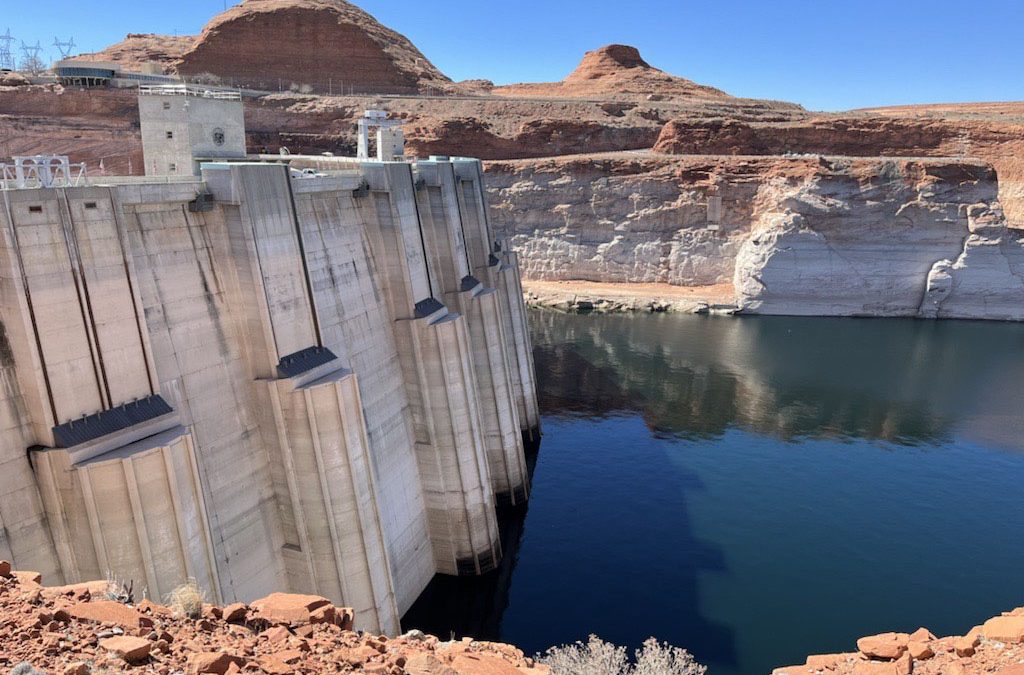
Glen Canyon Dam creates water storage on the Colorado River in Lake Powell, which is just 27% full. Credit: U.S. Bureau of Reclamation

Click the link to read the article on the Rolling Stone website (Thor Benson). Here’s an excerpt:

May 24, 2025

When President Donald Trump took office earlier this year, climate advocates were confident that while the federal government would certainly no longer be tackling the issue of climate change, states wouldhelp pick up some of the slack. There was a sense of hope in that — at least some of this vital work would continue. This prospect has recently been put into question, because the Trump administration is now trying to prevent states from doing much of anything to limit the impacts of climate change. 

The Department of Justice is currently suing the states of New York and Vermont to stop them from enforcing laws passed last year that would make fossil fuel companies liable for some of the costs of dealing with climate change. It is also suing Hawaii and Michigan over their climate-related lawsuits against fossil fuel companies. Finally, the Trump administration is working to end California’s stringent motor vehicle emissions standards and its cap-and-trade program. (Republicans in the Senate recently moved to end Califonria’s vehicle emission standards.)…The first set of lawsuits pertain to climate “superfund” laws. These are laws based on legislation passed in the 1980s that forced chemical and petroleum companies to pay for the cleanup of hazardous waste. In this scenario, the idea is to force fossil fuel companies to pay for the costs of the damaging effects of climate change. New York and Vermont passed climate superfund laws last year. Numerous states — from Maine to Tennessee — have expressed interest in passing laws like these in recent years…

“They’re going to try to impose some liability — some fees — on these companies as a way of forcing them to internalize the cost of past activities,” Rachel Rothschild, an assistant professor of law at the University of Michigan and an expert on superfunds, tells Rolling Stone. “The companies that would be deemed responsible parties under the bills are those companies that have produced, extracted or sold fossil fuel products above a certain threshold during the time period that the bills are going to impose this retroactive liability.”

[…]

Rothschild says it’s “pretty unprecedented” for the federal government to file lawsuits to block this kind of environmental legislation and that states have historically had the authority to address environmental issues that affect public health. These laws are only just starting to be implemented, so it’s also quite early to be filing lawsuits against them.

“This seems to be part of a larger effort to not only do nothing when it comes to climate change but to actively dismantle the climate science and climate accountability enterprise that is being built in response to the costs of climate change that are manifesting in everyone’s daily lives,” says Justin Mankin, a climate scientist at Dartmouth College. “These costs from climate change — we are just beginning to confront them, and they are astounding.”

Here’s Six Ways President Trump’s Budget Will Hurt Rural Americans — Michael Chameides (ColoradoTimesRecorder.com)

Vegetable harvest at an agravoltaic operation. Photo credit: Colorado Farm & Food Alliance

Click the link to read the article on the Colorado Times Recorder website (Michael Chameides):

May 23, 2025

Right now, Congress is working on a giant, fast-track bill that would make historic cuts to basic needs programs to finance another round of tax breaks for the wealthy and big corporations.

As the Communications and Policy Director for the Rural Democracy Initiative, I’ve been hearing from rural leaders across the country about the devastating impacts this bill would have.

The good news is it’s not too late. But there’s little time to spare.

This dangerous, unpopular bill would increase costs for rural working families by thousands of dollars per year, leaving millions hungry and without health care — all to provide tax breaks and handouts to the wealthy and special interests.

Here are just six of the worst provisions.

1. It guts rural healthcare.

The bill would drastically cut Medicaid and impose new barriers to care. It would take healthcare away from 13.8 million Americans and increase the cost for millions more. In some states, 50 percent of rural children get healthcare from Medicaid. Millions more rely on access to clinics and hospitals that would likely close because of these cuts.

2. It takes food off the tables of rural people.

The plan includes approximately $290-$319 billion in cuts to SNAP (the Supplemental Nutrition Assistance Program, formerly known as food stamps) even as the cost of groceries continues to escalate. More than 15 percent of families in small towns and rural areas rely on this support to feed their families.

3. It shifts costs to states and local governments.

State and local governments in rural areas depend more on federal funding from programs like SNAP and Medicaid than other states. Slashing federal funding to states would create new burdens for rural states that are already struggling to provide critical public services like health care, transportation, and emergency response services to local communities.

4. It takes away local control.

Landowners have fought to stop the use of eminent domain for carbon pipelines by passing bans and moratoria, as well as enacting county setbacks and safety requirements to protect their communities.

But this bill would overrule state and local laws and ordinances, override local voices, and deprive residents of a fair opportunity to evaluate the adverse impacts of pipelines. It also sets up a “pay to play” system under which companies can simply pay for pipeline, mining, and drilling permits — and avoid public comment and legal challenges.

5. It ends clean energy and infrastructure funding.

The bill would phase out existing tax credits for wind, solar, batteries, geothermal, clean energy, and advanced manufacturing. It would also take away $262 million in funding for energy efficiency and conservation grants as well as transportation infrastructure.

Ending these tax credits will increase household energy costs, which are already higher in many rural communities. These changes would also reduce new clean energy projects — and jeopardize billions in rural investments in clean energy manufacturing.

6. It gives handouts to agribusiness and mega farms.

Leaders in Congress are using the budget reconciliation process to give big farms a $50 billion windfall. Add the heightened pressures and instability caused by the Trump administration’s erratic trade policy and more family farmers would lose their farms — while Big Ag consolidates more of the market.

In short, this bill would make it harder for rural people to meet their basic needs — all so the wealthy and corporations can avoid paying their fair share of taxes like the rest of us do.

Lawmakers have already heard from the giant corporations who helped write the bill. Now, they need to hear from the rest of us. It’s up to us to alert our communities and tell our lawmakers: Don’t sell rural America out to big corporations and the wealthy.

Front Range cities step up opposition to $99M #ColoradoRiver water rights purchase — (Shannon Mullane) #COriver #aridification

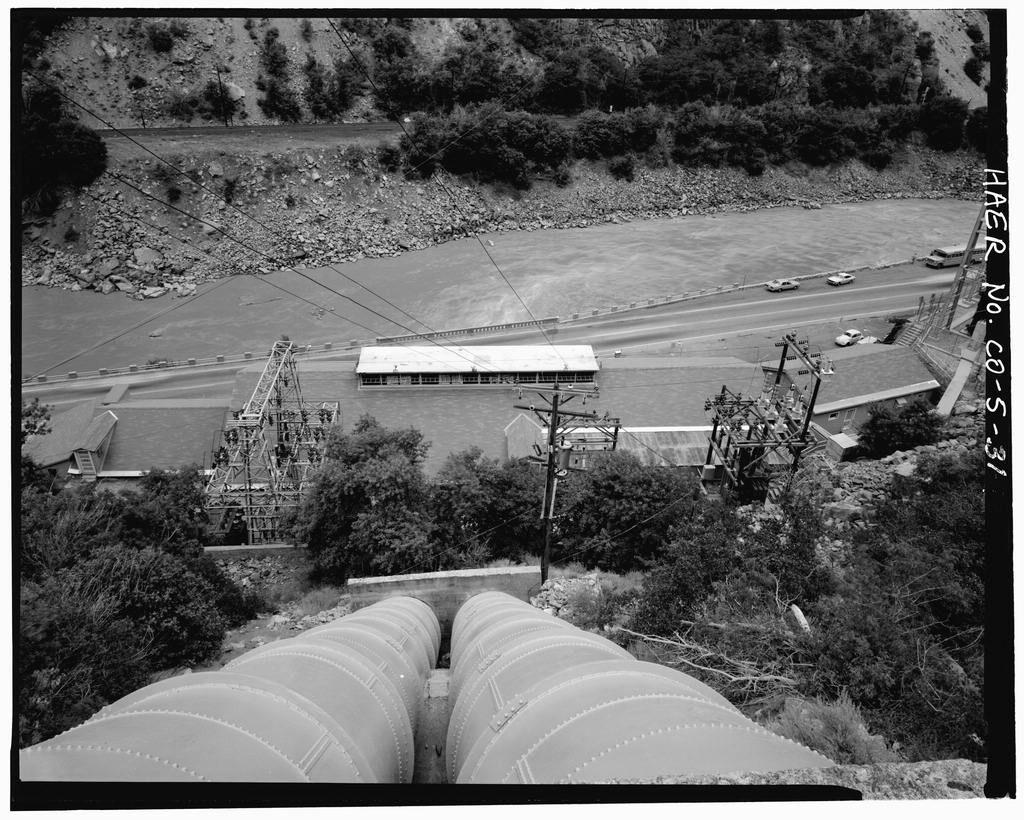
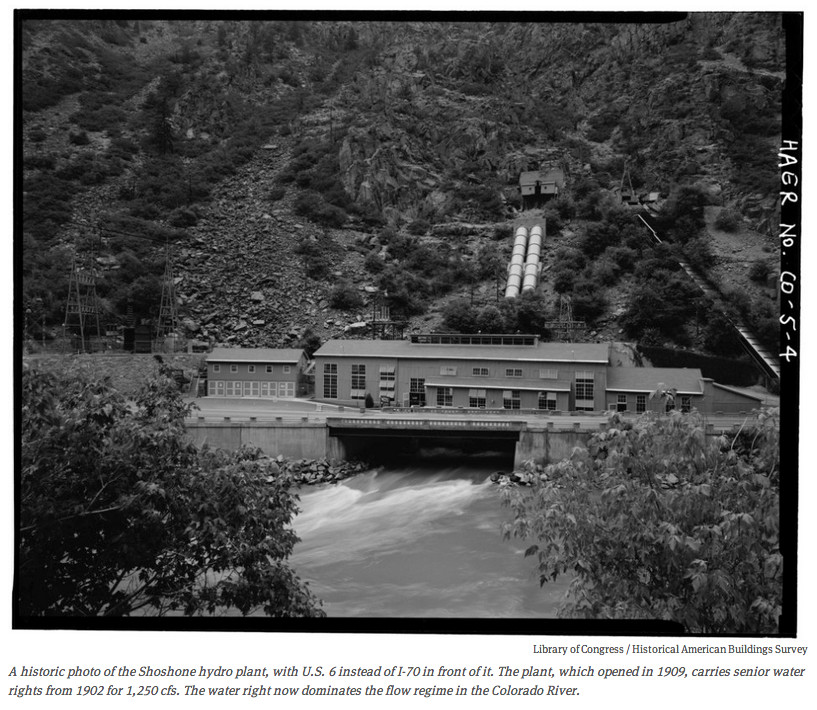
This historical photo shows the penstocks of the Shoshone power plant above the Colorado River. A coalition led by the Colorado River District is seeking to purchase the water rights associated with the plant. Credit: Library of Congress photo

Click the link to read the article on the Water Education Colorado website (Shannon Mullane):

May 22, 2025

Denver, Aurora, Colorado Springs and Northern Water voiced opposition Wednesday to the Western Slope’s proposal to spend $99 million to buy historic water rights on the Colorado River.

The Colorado River Water Conservation District has been working for years to buy the water rights tied to Shoshone Power Plant, a small, easy-to-miss hydropower plant off Interstate 70 east of Glenwood Springs. The highly coveted water rights are some of the  largest and oldest on the Colorado River in Colorado.

The Front Range providers are concerned that any change to the water rights could impact water supplies for millions of people in cities, farmers, industrial users and more. The Front Range providers publicly voiced their concerns, some for the first time, at a meeting of the Colorado Water Conservation Board, a state water policy agency.

The proposed purchase taps into a decades-old water conflict in Colorado: Most of the state’s water flows west of the Continental Divide; most of the population lives to the east; and water users are left to battle over how to share it.

“If this proposal were to go forward as presented in the application, it could harm our ability to provide water for essential use during severe or prolonged drought. I think it’s important for the board to understand that,” Jessica Brody, an attorney for Denver Water, told the 15-member board Wednesday. 

Denver Water, the oldest and largest water provider in Colorado, delivers water to 1.5 million residents in the Denver area.

The Colorado River District, which represents 15 Colorado counties west of the Continental Divide, wants to keep the status quo permanently to support river-dependent Western Slope economies without harming other water users, district officials said.

The overstressed and drought-plagued river is a vital water source for about 40 million people across the West and northern Mexico.

“That right is so important to keeping the Colorado River alive,” Andy Mueller, Colorado River District general manager, said during the meeting’s public comment period. “This is a right that will save this river from now into eternity … and that’s why this is so important.”

Over 70 people, nearly twice the usual audience, attended the four-hour Shoshone discussion Wednesday, which involved 561 pages of documents, over 20 speakers and a public comment period.

The Western Slope aims to make history

The water rights in question, owned by Public Service Company of Colorado, a subsidiary of Xcel, are some of the most powerful on the Colorado River in Colorado. 

Using the rights, the utility can take water out of the river, send it through hydropower turbines, and spit it back into the river about 2.4 miles downstream.

One right is old, dating back to 1905, which means it can cut off water to younger — or junior — upstream water users to ensure it gets its share of the river in times of shortage. Some of those junior water rights are owned by Denver Water, Aurora, Colorado Springs Utilities and Northern Water.

The rights are also tied to numerous, carefully negotiated agreements that dictate how water flows across both western and eastern Colorado. 

Bicycling the Colorado National Monument, Grand Valley in the distance via Colorado.com

Over time, Western Slope communities have come to rely on Shoshone’s rights to pull water to their area to benefit farmers, ranchers, river companies, communities and more. 

The Colorado River District wants to buy the rights to ensure that westward flow of water will continue even if Xcel shuts down Shoshone (which the utility has said, repeatedly, it has no plans to do). 

They’ve gathered millions of dollars from a broad coalition of communities, irrigators and other water users. The state of Colorado plans to give $20 million to help fund the effort. 

The federal government might give $40 million, but that funding was tied up in President Donald Trump’s policy to cut spending from big Biden-era spending packages. It was unclear Thursday if the awarded funds will come through, the district said.

Supporters sent over 50 letters to the Colorado Water Conservation Board before Wednesday’s meeting. 

“I wanted to just convey the excitement that the river district and our 30 partners have, here on the West Slope, to really do something that is available once in a generation,” Mueller said. 

The Front Range water providers all said they, too, wanted to maintain those status quo flows. They just don’t want to see any changes to the timing, amount or location of where they get their supplies.

Under the district’s proposal, the state would be able to use Shoshone’s senior water rights to keep water in the Colorado River for ecosystem health when the power plant isn’t in use. 

The Colorado Water Conservation Board is tasked with deciding whether it will accept the district’s proposal for an environmental use. The meeting Wednesday triggered a 120-day decision making process.

“Any change to the rights will have impacts both intended and unintended, and it is important for the board to understand those impacts to avoid harm to existing water users,” Brody said. 

The water provider plans to contest the Colorado River District’s plan within that 120-day period.

How much water is at stake?

The Front Range providers voiced another concern: The River District’s proposal could be inflating Shoshone’s past water use.

Water rights come with upper limits on how much water can be used. It’s a key part of how water is managed in Colorado: Setting a limit ensures one person isn’t using too much water to the detriment of other users.

For those who have a stake in Shoshone’s water rights — which includes much of Colorado — it’s a number to fight over.

The River District did an initial historical analysis, which calculated that Shoshone used 844,644 acre-feet on average per year between 1975 and 2003. One acre-foot of water supplies two to three households for a year.

Denver Water said the analysis ignored the last 20 years of Shoshone operations. Colorado Springs, Northern Water and Aurora questioned the district’s math. Northern was the first provider to do so publicly in August.

“We think the instream flow is expanded from its original historic use by up to 36%,” said Alex Davis, Aurora Water’s assistant general manager of water supply and demand.

She requested the board do its own study of Shoshone’s historical water use instead of accepting the River District’s analysis — which would mean the state agency would side with one side of the state, the Western Slope, against the other, Davis said.

The River District emphasized that its analysis was preliminary. The final analysis will be decided during a multiyear water court process, which is the next step if the state decides to accept the instream flow application.

Water court can be contentious and costly, Davis said. 

“This could be incredibly divisive if we have to battle it out in water court, and we don’t want to do that,” Davis said.

More by Shannon Mullane

Colorado transmountain diversions via the State Engineer’s office

Romancing the River: The Empire Strikes the Public Lands, Part 1 — George Sibley (SibleysRivers.com)

Click the link to read the article on the Sibley’s Rivers website (George Sibley):

May 20, 2025

We are an empire now, and when we act, we create our own reality…. And while you’re studying that reality—judiciously, as you will—we’ll act again, creating other new realities, which you can study too, and that’s how things will sort out.’

That is indeed the way things seem to be sorting out today, in imperial America, under the imperious Trump, breakers of things. ‘The administration’ breaks a law in the process of creating Trump’s still vaguely formulated imperial reality. Citizen groups bring suit against his action, and the action is studied by judges in the context of the Constitutional rule-of-law, part of our existing (recently existing?) triumvirate reality of legislate-execute-evaluate, checks-and-balances, et cetera.

The judges tell Trump that he is exceeding his Constitutional authority, and he must undo most of what he has done. But by then he has distracted us from that by breaking something else in his chainsaw massacre of 250 years of American evolution, another action the judges must study and pass judgment on, thanks to suits brought by groups faithful to Constitutional reality.

But Trump ignores all of their judgments by appealing them, as he continues to commit actions reshaping reality and warranting further judicial study. And the Constituttional reality we’ve taken for granted for 250 years suddenly begins to seem somewhat less real than it was back in good old 2024. When we should have known better – but those damn grocery prices, and Trump promised that on day one…. Well, fool us once, shame on the fool; fool us twice (or fifty or a hundred times), shame on us.

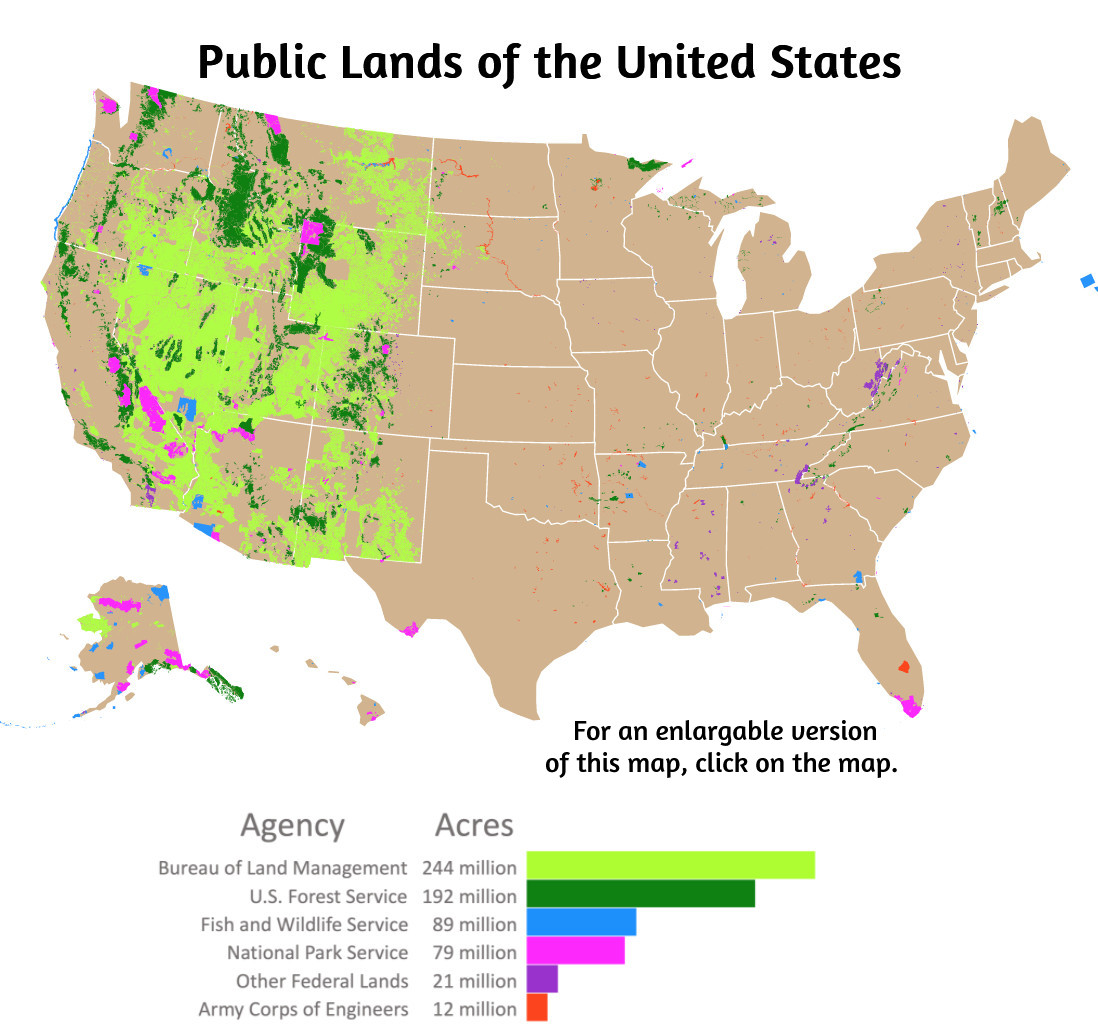
So on to damage control. Today I want to look at the unfolding situation with the nation’s public lands – always a sore spot with many true conservative Republicans from western states as well as Trump’s Repugnicans. The map below shows the situation – more than 630 million acres of public land, most of it by far in the West: small dots and patches of it east of the Great Plains, but vast swaths west of the plains. This land is our land, as the song says, but how the composite ‘we the people’ can or should relate to and live with this land has been an ongoing debate at all levels of governance for more than 250 years.

You’ll quickly note from the map above that public land is almost half of what we call the ‘Intermountain West’ – the region between (and including) the Rocky Mountains on the east and the Sierra-Cascade ranges on the West. The importance of these particular public lands and their resources extends well beyond their actual geography. Most all of the water for the Colorado River, for example, starts on public lands in the green areas (National Forest lands) in the states of Colorado, New Mexico, Utah and Wyoming, and nurtures the entire River Basin and some out-of-basin extensions all the way to southern California. Coal trains continue to rumble eastward from Wyoming, Utah and Colorado carrying low-sulphur coal to the remaining back-east coal-fired power plants – and the Trumpsters want to make coal great again (‘clean, coal’ of course). Trucks roll down from the public’s mountain forests carrying 150-year-old spruce logs like we will not see again for four or five generations, if then, destined for suburban housing – and the Trumptsters want to increase logging from those lands by 25 percent.

But what I want to focus on today is the yellow land on the map, the Bureau of Land Management (BLM) land that makes up around half of the Intermountain West, and a large portion of the Colorado River Basin, mostly below 8,000 feet elevation. The BLM is a bureaucracy in the Interior Department, I’ll remind you, charged with managing all of the public lands that have not yet been designated for more specific uses, like National Forests or National Parks.

This gets the BLM nicknamed the ‘Bureau of Leftover Management,’ but that misses the real picture. The BLM lands do include a lot of brown or just barren land that makes one think nature is still trying to figure out what to do with it. But the BLM lands also include a very diverse and often spectacularly beautiful array of ecological landscapes from which areas are regularly designated (and sometimes undesignated then redesignated) as National Monuments (28 of them now on former BLM land), Wilderness Areas (221), and more than 600 others areas designated as part of the National Conservation Lands, including National Scenic Rivers, National Scenic and Historic Trails, and,refuges for various threatened and endangered species. There are treasures yet to be discovered, and either used or protected from use, in the BLM lands.

Significant segments of this land made the news recently when my congressman, Jeff Hurd of Colorado’s Third District (the West Slope, headwaters of the Colorado River), introduced a bill for a ‘Productive Public Lands Act.’ Rep. Hurd, I will note, occasionally behaves more like a true Republican than a Repugnican. He was one of the few Republican congressmen brave enough to voice disapproval of Trump’s pardon of all the January Sixth rebels. Most recently, he was the only Republican to vote against the suspicious sale of some BLM lands in the vicinity of ‘growth hot spots’ in Nevada and Utah. He has shown some spine in not drinking all of the Trump koolaid.

But the ‘Productive Public Lands Act’ bill, and the language used to sell it, are pure Trumpish bullshit. I will let Congressman Hurd speak first for it: ‘This bill would force the Bureau of Land Management to reissue nine Biden-era Resource Management Plans (RMPs) which locked up access to viable lands throughout Colorado and the West. A reissuance of [the Trump-era] RMPs will put us on a path to energy dominance allowing for a more secure and prosperous United States.’

A colleague in the Western Republican Caucus, California Congressman Doug LaMalfa, chimes in: ‘The Biden Administration was hell-bent on locking up public lands, threatening the prosperity of rural economies across the country…. Fortunately, a new era has dawned, and we have the opportunity to reverse these lockups and reinstate the multiple-use mandate on America’s public lands.’

That’s raw meat to the Trump base, but it’s also disinformation of the sort that sounds good to the uncommitted but under-informed – and most of us are somewhat under-informed on the public lands. ‘Multiple use’ – who can object to that? Especially if Joe Biden was trying to ‘lock up’ the pubic lands and threatening our rural prosperity!

But as usual the barefoot lie has legs and runs off in all directions while the truth is still pulling on its support hose. The nine Resource Management Plans in question were not created by President Biden and his ‘deep state’ cronies in Washington; they were created in accord with the rule of law, in this case, the Federal Land Policy and Management Act. (FLMPA), passed in 1976 in a couple of remarkable decades of what might be called ‘eco-populism’: a nation of people deeply concerned about the growing impacts of a century of unbridled industrial capitalism supercharged by fossil-fuel technology – acid rain killing the forests, industrial pollution killing the rivers, out-of-sight-out-of-mind buried barrels of unidentified stuff killing people drinking from aquifers. The people elected Congresses in the 1960s and 70s that – imagine this! – actually addressed the people’s concerns with legislation that began to change the game; tempering the enthusiastic power to change the planet with a growing sense of responsibility for the changes being wrought, and their consequences.

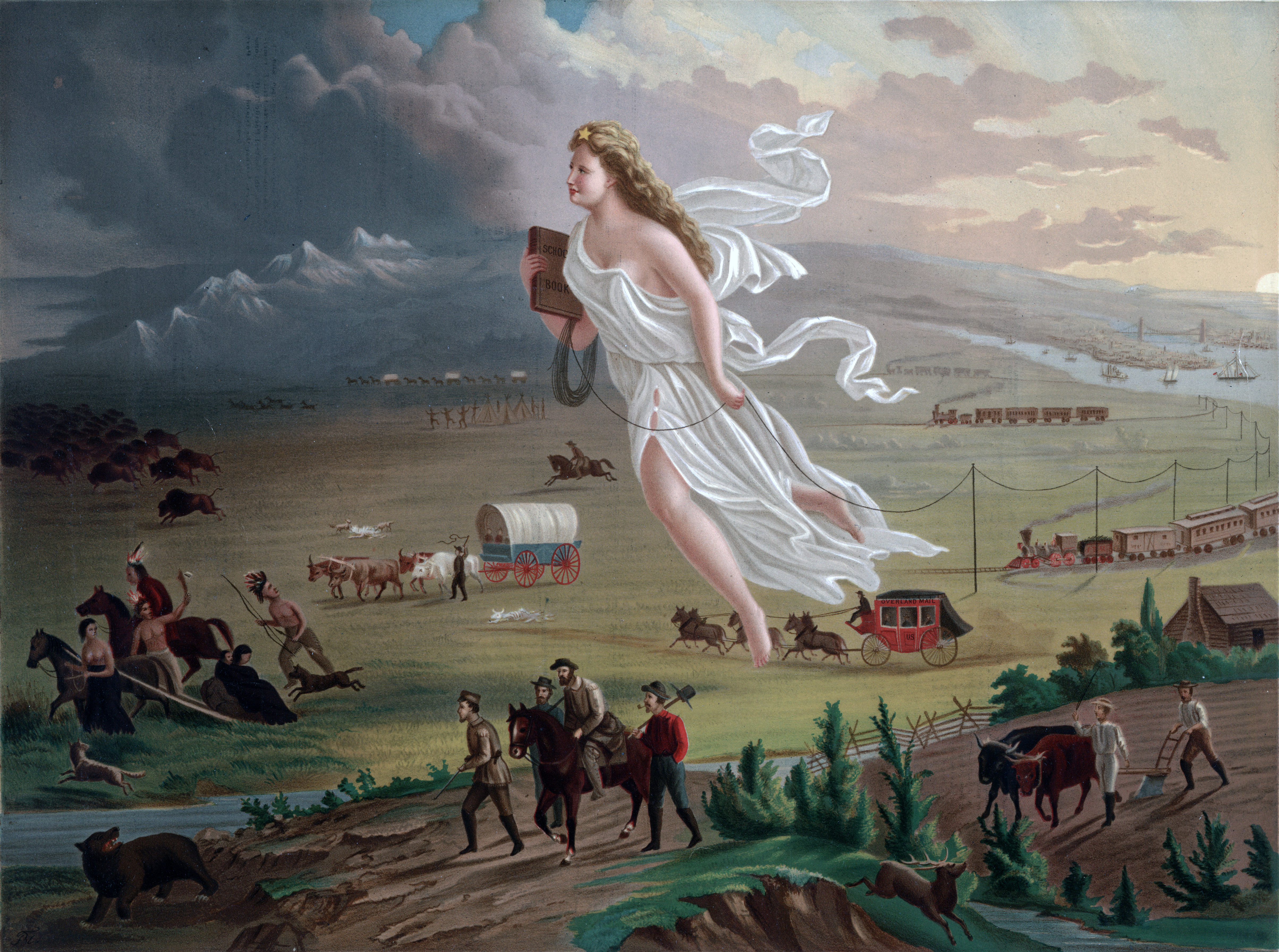
American Progress (1872) by John Gast is an allegorical representation of the modernization of the new west. Columbia, a personification of the United States, is shown leading civilization westward with the American settlers. She is shown bringing light from east to west, stringing telegraph wire, holding a book, and highlighting different stages of economic activity and evolving forms of transportation. By John Gast – This image is available from the United States Library of Congress’s Prints and Photographs division under the digital ID 09855.This tag does not indicate the copyright status of the attached work. A normal copyright tag is still required. See Commons:Licensing for more information., Public Domain, https://commons.wikimedia.org/w/index.php?curid=373152

Passage of the FLMPA in 1976 marked a major step in the evolution of public land management – which did not even exist overall until after World War II. From the 1780s until 1946, all of the new nation’s undesignated lands were under the U.S. General Land Office, which essentially had one purpose: to get as much of that land as possible into private hands as soon as possible, through vehicles like the 1864 Homestead Act, the 1872 General Mining Act, and others going back the 1787 Northwest Ordinance. The American expansionist vision was a land full of rugged American individuals, farming, mining, logging, stockgrowing, all with their own piece of land, and all living in modest decentralized self-sufficient communities that would be the safely dispersed foundation of American democracy.

But by 1900 we were beginning to take ever-larger segments of the public lands out of Land Office control, realizing that cheap land was often getting treated cheaply. Congress began setting aside National Parks and Monuments, beginning with Yellowstone in 1872. In the 1890s presidents began establishing ‘Forest Reserves’ to protect valuable forest land from ‘timber miners’; early in the 20th century these became National Forests, and were moved administratively to the Department of Agriculture, with rangers to protect them and set up grazing fees and timber sales.

Charging for uses on the unclaimed public lands that had basically been used free was not popular (still isn’t), but there was a grudging acknowledgment that management was probably necessary. This was affirmed in the 1930s when a group of Colorado ranchers worked with their congressman Edward Taylor to create the 1934 Taylor Grazing Act, and 80 million acres were withdrawn from General Land Office disposition to be managed by a new Grazing Service – with fees for users.

That paralleled another big cultural change happening in America through the first half of the 20th century: rural Americans were moving to the cities; around 1920 the growing urban population passed the declining rural population, and while the nation still paid lip service to the ‘family farm,’ there were few people going out to homestead on the public lands. Instead, an increasingly well-off and mobile urban ‘middle class,’ with two-week paid vacations, rediscovered the public lands as a resource for recreation, relaxation and renewal; they wanted the public lands to stay forever beautiful, spectacular, adventuresome – and accessible.

These two changes led to the Grazing Service and the General Land Office being quietly combined in 1946 into the Bureau of Land Management – with the Land Office gradually fading into irrelevance: the United States were no longer in the business of selling off national treasures cheap.

What we see in this evolution is a nation of people gradually waking up to the reality of needing to begin taking responsibility for the consequences of a century of enthusiastic exploitation. The final step came 30 years later with the Federal Land Management and Planning Act in 1976 noted earlier – following the foundational National Environmental Policy Act of 1970. NEPA mandated that any project involving federal funding would be preceded by a full environmental impact analysis: we will look before we leap. And if it involved public land, it would have to fit in with developed Resource Management Plans, and some larger projects would have to do their own RMP. This was tedious, difficult, often contentious work – but essential to serious democratic governance. Impatience with this hard work is the first seed of submission to tyranny.

The Resource Management Plans for public lands are all required to have two components. One is planning for multiple uses – all the uses practiced or potentially practiced on the land in question had to be fit into the overall purposes of each plan. The other requirement is public participation at every stage of the process, from all groups with a practical or potential use interest in that land.

‘Multiple use’ does not mean ‘everything going on everywhere’; it means determining how much of every use represented at the table can go on with reasonable accommodation to every other use, and where in the planning area it should happen. There are land and resource uses that are compatible with other uses, and there are uses destined to be the only thing happening in specific places. Mining/drilling, logging, and intensive farming are obviously single uses on any given piece of land, while grazing and hiking and some conservation uses can all go on in the same area, with reasonable accommodations to each other. And the ‘mandated’ public participation means that all would-be users will be heard from in the planning process – participate or shut up.

A Gunnison sage-grouse hen leads her chicks in the Gunnison basin during the summer of 2019. Some private landowners have undertaken habitat restoration projects on placed conservation easements on their property in an effort to protect the bird. Photo credit: Greg Petersen via Aspen Journalism

I can’t speak to all nine of the Resource Management Plans that Hurd and LaMalfa want to repeal, but I am quite familiar with one of them: ‘The Gunnison Sage-Grouse Record of Decision and Approved Resource Management Plan Amendment, dated October 2024.’ This is a RMP to try to save a species of Sage Grouse that has been listed as ‘Threatened’ by the U.S. Fish and Wildlife Service, under the Endangered Species Act. Without going into the multiple decades of detail, this plan was worked out among ranchers, outdoor recreational users (both motorized and unmotorized), fishermen, environmental organizations, scientists, local government representatives, state and federal agencies, industrial reps when relevant, and citizens just interested.

There are places in the basin where some of the single-use land users are indeed ‘locked out’ for restoration needs, but this is not ‘Joe Biden locking them out’; this is the people establishing priorities based on difficult efforts to balance economic and ecological needs, in places at least as dependent on recreational uses as extractive uses. Biden’s only relationship with the whole process was to give the rule of law (FLMPA/NEPA) his blessing, and the time and space it warrants to get it hashed out down on the ground where the problem shapes lives.

To hammer the point home, in case you don’t get it – This is not an absence of ‘multiple use planning’; it is a stellar example of it. The RMP has been worked out over the past two decades by multiple users of landscapes shared with a threatened species who are all willing to try to live with the plan – the kind of local governance that was once celebrated by ‘Main Street Republicans’ (as opposed to ‘Wall Street Republicans’). I expect the other eight plans have somewhat the same rooted authenticity.

So long as we have the legal mandate to do this, and the local patience and will to work it out in our down-on-the-ground reality, we have not yet fully succumbed to the imperial ‘created reality’ that Trump and our local Congressman want to impose on us.

The next logical step here is to ask whether the poor oppressed oil and gas industry, which the Repugnicans want to ‘liberate’ through the Productive Public Lands Bill, really needs liberating – which requires looking at what they can and cannot do now, and whose fault that is or isn’t. But I’ve taken so long here in providing some background for that discussion that it’s time to give you a breather. I’ll be back with the rest of the story in a couple weeks. Stay tuned.

Meanwhile, I’ll leave you with this irrelevant reflection on Trump’s rejection of the low-flow showerhead:

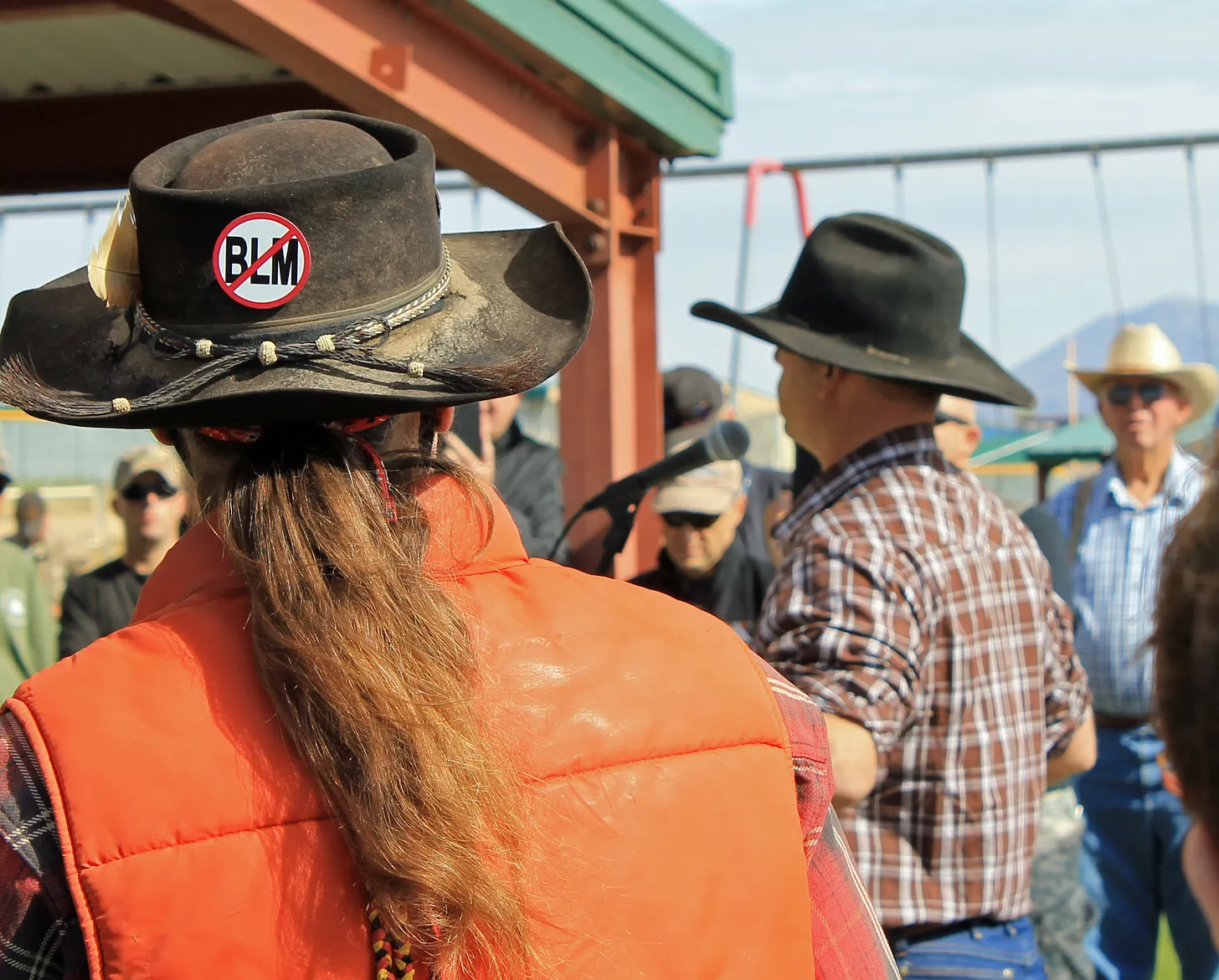
An anti-BLM sticker (referring, presumably, to the federal land agency, not the Black Lives Matter movement) at another Phil Lyman rally against “federal overreach” and motorized travel closures in southeastern Utah back in 2014. Photo credit: Jonathan P. Thompson/The Land Desk

When “disposing” of public land isn’t the end of the world — Jonathan P. Thompson (LandDesk.org)

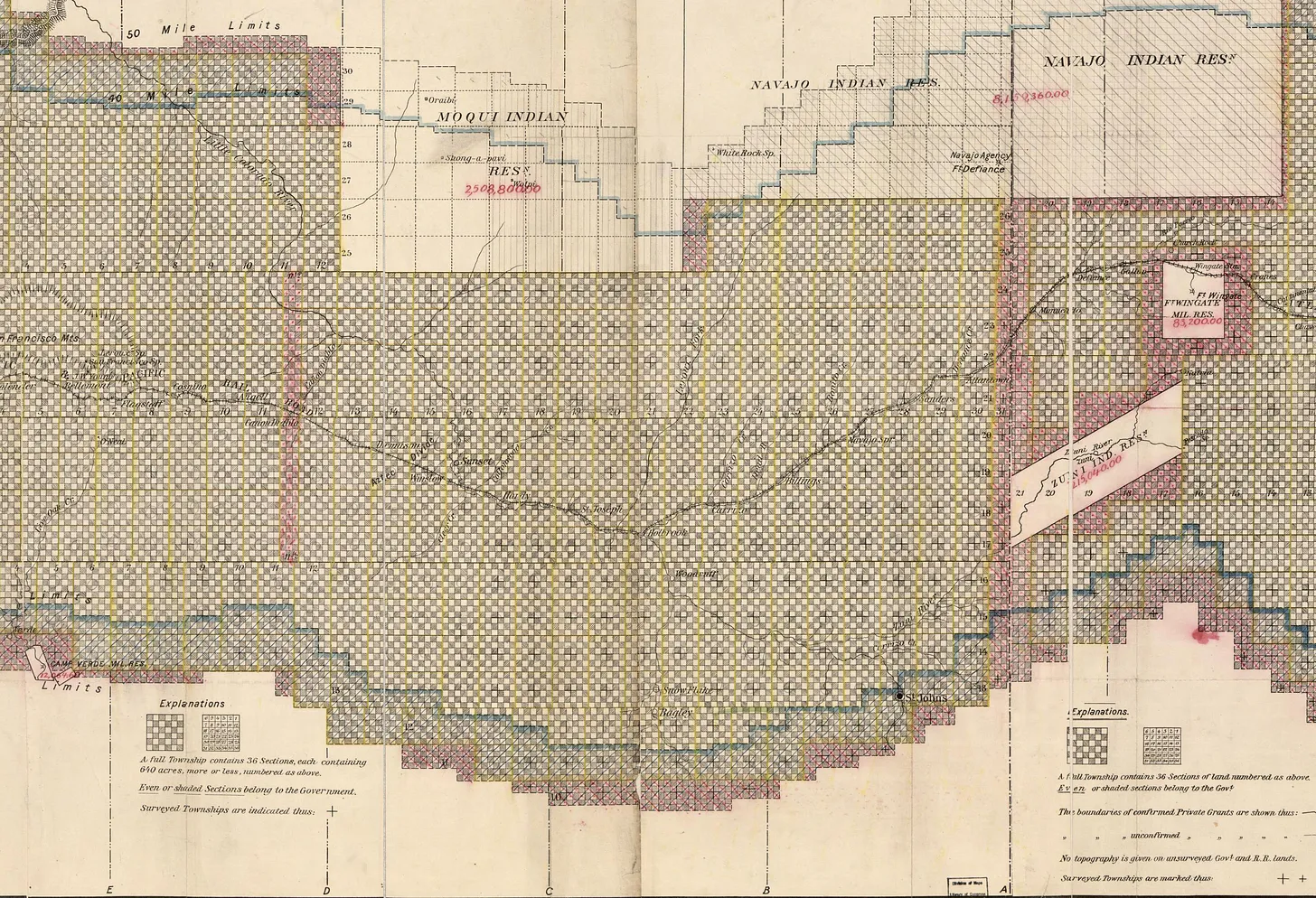
Detail from an 1883 map showing public land parcels granted to the Atlantic & Pacific RR.

Click the link to read the article on The Land Desk website (Jonathan P. Thompson):

🌵 Public Lands 🌲

May 16, 2025

The debate over selling off public land has become more serious, and consequential, than ever. While the urge to transfer public land out of the American public’s hands has flared up many times over the last century or so, never has the concept gained so much support among establishment politicians and pundits. Neither James Watt, the notoriously anti-conservationist Interior Secretary under Ronald Reagan, nor the fossil fuel-loving officials of the George W. Bush administration, nor even Trump I’s Interior Secretary, Ryan Zinke, called for wholesale public land transfers.

And yet, now we have not only Interior Secretary Doug Burgum advocating for selling land to states and real estate developers, but also members of Congress and even prominent newspaper columnists and editorial boards doing so. As this extremist threat becomes more real, public land lovers understandably react in extreme ways — including condemning every public land transfer, no matter how small.


Public land sell-off amendment is a test — Jonathan P. Thompson (The Land Desk)


I used to bristle at the mention of public land swaps, until the late Paul Beaber, a long-time US Forest Service surveyor, set me straight. He pointed out that not only does the current law allow federal land agencies to “dispose” of some parcels, but that in some cases exchanges and even sales can make sense and be beneficial to public land users. (And just to be clear, the current proposals by Republicans in Congress and the Trump administration do not make sense and will not benefit public land users).

The point was raised by Land Desk reader James Aldrich in response to last week’s piece on the public land sale amendment in Congress’ budget reconciliation bill. He wrote:

I have to take issue with James’ last sentence here: Saying that public land should be sold because it belongs to all of us is a logical fallacy, since once it is sold it will only belong to one of us! So that’s not the best justification for selling the land. However, he brings up some other good points.

First, there are hundreds if not thousands of this sort of parcel scattered around the West, these little squares of BLM islands in a sea of private land. The BLM is usually eager to get rid of those parcels, because they not only create a management headache, but also end up serving as something like exclusive parks for the private owner(s) that surround it. They are technically public, but practically private, since the public can’t access them without trespassing on private land.

And, as Luke Schafer put it in a response to Aldrich, the BLM does have a mechanism for “disposing” of those parcels.

I’ll get more into how that is typically done in a moment. But first, a bit of history to see how we ended up with these isolated squares of public land.

In 1785, the U.S. Congress of the Confederation passed the Land Ordinance, which in turn created the Public Land Survey System to be applied to the public domain west of the Appalachians (which, at the time, didn’t extend very far). The land was cordoned off into thirty-six-square-mile rectangular townships, which were then sliced into 640-acre sections — a big grid made up of thousands of squares — with zero consideration for topography, watersheds, cultural boundaries, eco-zones, or habitat.

This grid that overlays America is artifice, something seen only on maps, based on nothing real. Yet it has profoundly influenced the way Americans relate to the landscape and to one another, and is manifested physically on the American landscape in its state and county lines, its streets and avenues, its county roads and property lines, and in GPS coordinates. “The grid, not the eagle or the Stars and Stripes,” wrote John Brinckerhoff Jackson in his seminal A Sense of Place, A Sense of Time, “is our national symbol. It is imprinted in every child before birth.”

As the U.S. government continued to expand its empire westward, usually by stealing land from the Indigenous inhabitants, it added the land to the public domain and imposed the grid onto the landscape to create a system that allowed the government to dispose of — i.e. sell or give away — public land to settlers, would-be farmers, railroads, and miners in an orderly fashion.

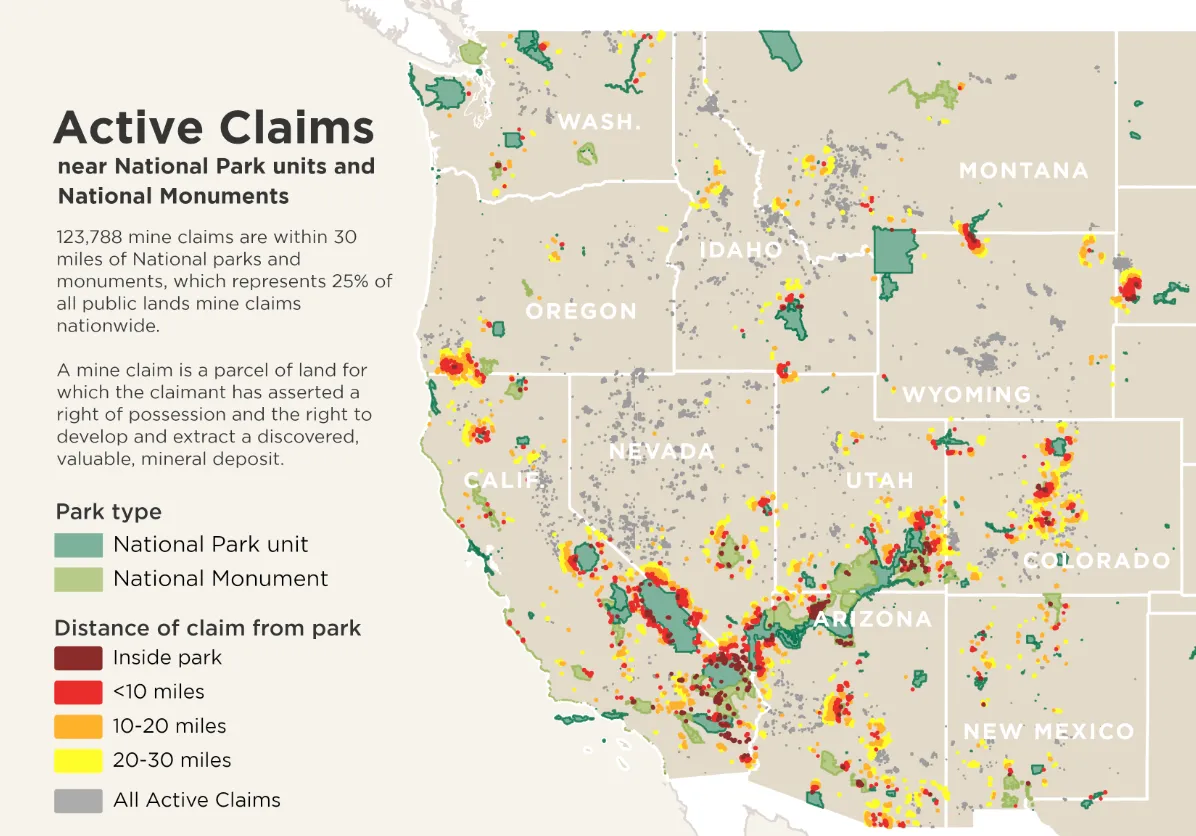
[⚠️ Suspicious Content] The 1862 Homestead Act was created with subsistence farming in mind and allowed a prospective farmer to stake out a 40- to 640-acre claim on the public domain1. But the claim’s boundaries weren’t determined by the topography or richness of the soil, but rather by the PLSS; every homestead was a perfect square that the claimant could work for five years, and then patent it, or take title to the land. The government also gave railways every other square-mile of land in rail corridors to incentivize the rail corporations and to draw more homesteaders, and it allowed mining claimants to patent their claims too.

Every square of the public domain that was not homesteaded, given to the railway, staked with a mining claim and patented, or put into a forest reserve or park remained in the public domain. And land that was homesteaded or otherwise claimed, but not patented, also reverted back to the public domain. The result are numerous, chaotic land-ownership called “checkerboards” due to the square shape of each parcel, or geometrically-correct, jurisdictionally nightmarish hodgepodges of federal, tribal, state, private, and Indian allotment land.

Congress passed the Federal Land Policy Management Act, or FLPMA, in 1976, which ended the mass disposal of public lands. The Homestead Act was repealed, mining claims can still be staked (very easily), but there is a moratorium on new patents, and no one is giving public land to railroads any more — although some folks sure would like to give it to real estate developers. Still, the BLM does leave the door open for some land transfers, mainly to address islands of public land within a sea of private holdings. The BLM’s website describes the process like this:

The agency also works to clean up the checkerboard via land swaps, in which an isolated federal parcel is exchanged for a private one surrounded by public land. While these can be win-win situations, they can also look a bit like blackmail or a hostage situation. In the 1990s and early 2000s, for example, a real estate developer named Tom Chapman made a habit of acquiring private inholdings — often in wilderness areas — and threatening to develop them if the BLM or Forest Service didn’t exchange the inholdings for much more valuable parcels in or near ski resorts and so forth. The agencies usually had little choice but to comply.

But in many cases, the swaps can be beneficial. In the San Juan Mountains, for example, huge mining companies like ASARCO ended up with big blocks of mining claims in the high country, surrounded by public lands. The companies could sell the claims to private individuals, who could then potentially build on them, creating a nightmare for county land-use planners. Or they could turn them over to the feds in exchange for isolated but more developable public parcels elsewhere, allowing the BLM or Forest Service to consolidate its alpine holdings, while also disposing of private-land-locked parcels elsewhere.

Don’t get the wrong idea: The BLM can’t just sell or swap chunks of land at their whim. To sell parcels like those James referred to, the BLM first would have to identify them as “disposable,” if you will, during the Resource Management Planning process for that particular field office. That is a long process that includes extensive environmental reviews and ample opportunity for public input. Large exchanges, meanwhile, are subject to their own environmental analyses and public comment.

By contrast, the ideologues in Congress now pushing for public land transfers are looking to sell off or give away about a half-million acres. A small portion of the parcels could be considered “scattered, isolated tracts” that are hard to manage. But others are quite large and, if transferred, would create private inholdings surrounded by public land. This would not only take valuable public land out of the public’s hands, but also would further complicate management.

So, yes, there are cases in which selling or swapping public land isn’t the end of the world. But the fact is, there are fewer and fewer instances in which that is the case. And selling or swapping public land without public involvement? That’s always wrong.

📸 Parting Shot 🎞️
Barrel cactus blooming in southeastern Utah. Jonathan P. Thompson photo.

1 The Homestead Act allowed for claims of up to 160 acres, which was deemed insufficient for arid lands in the West, so in 1877 the Desert Land Act allowed for claims up to 640 acres, and in 1909 the Enlarged Homestead Act made provisions for 320-acre claims.

San Carlos Apache Tribe asks a court to halt land deal for a copper mine at Oak Flat — AZCentral.com

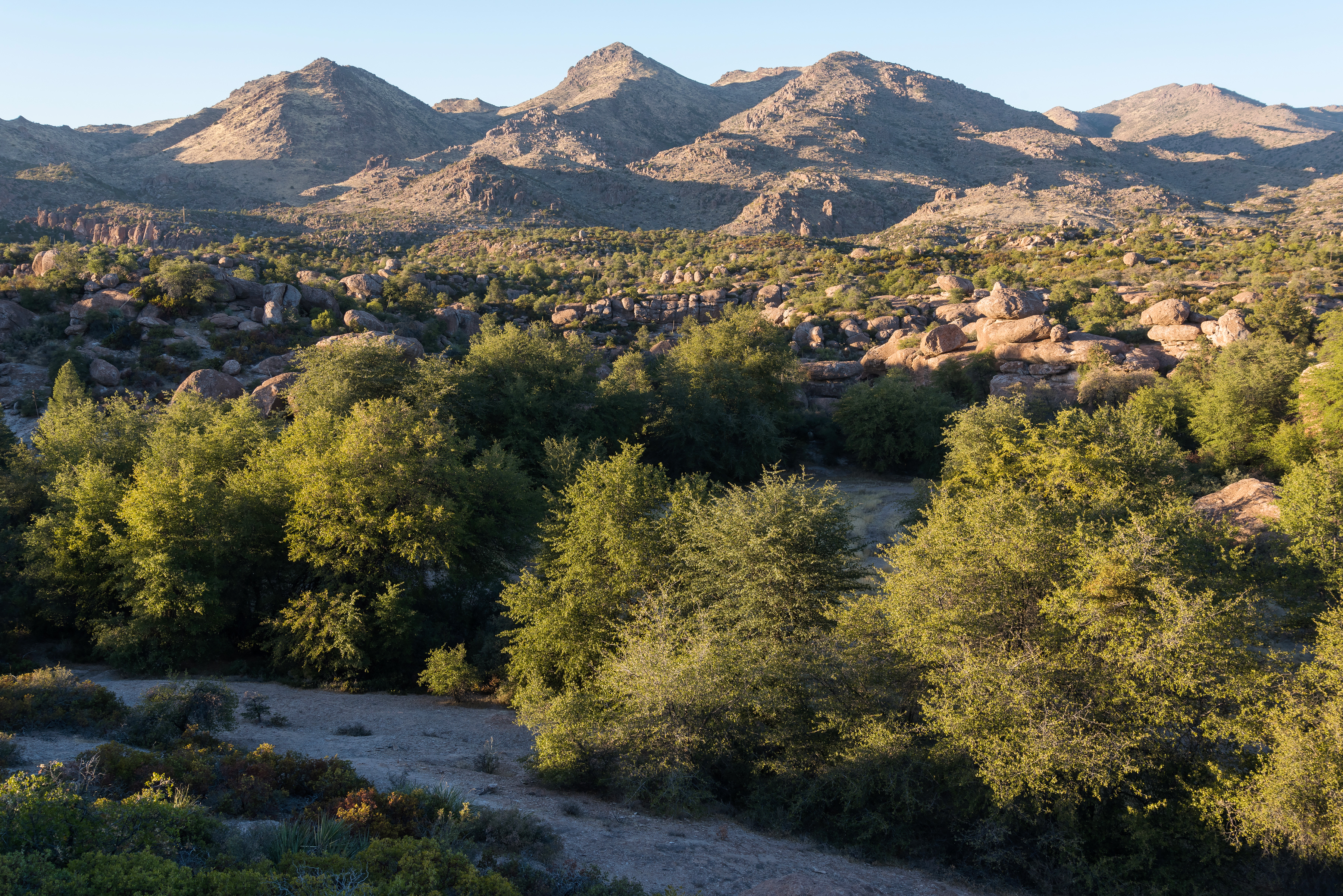
dOak Flat, Arizona features groves of Emory oak trees, canyons, and springs. This is sacred land for the San Carlos Apache tribe. Resolution Copper (Rio Tinto subsidiary) lobbied politicians to deliver this National Forest land to the company with the intent to build a destructive copper mine. By SinaguaWiki – Own work, CC BY-SA 4.0, https://commons.wikimedia.org/w/index.php?curid=98967960

Click the link to read the article on the AZCentral website (Debra Utacia Krol). Here’s an excerpt:

May 15, 2025

Key Points

  • The San Carlos Apache Tribe wants a federal court to delay a land swap that would allow construction of a copper mine at Oak Flat.
  • A federal judge ordered a halt to the deal last week after hearing arguments by the grass roots group Apache Stronghold.

The San Carlos Apache Tribe has asked a federal court to block the Trump administration from finalizing a land exchange at Oak Flat Campground, following on the heels of a successful bid by grassroots group Apache Stronghold. The tribe sued to stop the exchange in 2021 after the U.S. Forest Service issued its final environmental impact statement. That opened a 60-day window during which the government could have finalized a deal with copper mining corporation Resolution Copper to take ownership of the site and begin construction on a huge copper mine that would eventually obliterate Oak Flat. San Carlos asked the U.S. District Court on May 14 to stop any progress on a plan that would allow Resolution to take ownership of Oak Flat and begin extracting copper on land considered sacred to Apache and other Native peoples. The tribe wants the order to stand until its own litigation was concluded…

“The Trump Administration is once again planning to violate federal laws and illegally transfer Oak Flat to the two largest foreign mining companies in the world,” said San Carlos Apache Tribe Chairman Terry Rambler. “Oak Flat sits above one of the largest copper deposits in the world. Resolution Copper intends to export the copper while destroying Apache sacred lands that the federal government has a Trust responsibility to protect. We will not allow this to happen.”

U.S. District Judge Steven V. Logan has already ordered a halt to the land swap in an order May 9 that ordered the Forest Service to hold off on issuing the document until one day after the Supreme Court had either refused to take the case of after it had decided in the government’s favor…The struggle over a small plot of land in the mountains is also at the heart of an ongoing national debate about the conflict between First Amendment religious rights, public lands oversight and a 150-year-old mining law’s relevance in the 21st century. [ed. emphasis mine]

In this detailed computer animation, we take a look into the future of Oak Flat, meticulously illustrating the development of subsidence as a result of the block cave mining process over an extensive period of 40 to 50 years. Crafted with transparency and precision, this video is grounded in the findings of multiple technical studies, aiming to provide as realistic a projection as possible of the landscape changes that Oak Flat will undergo. Block cave mining, a method known for its efficiency and low cost, has significant impacts on the terrain above the extraction zone. Through state-of-the-art animation, viewers will gain an understanding of how and why these changes occur, presenting a clear picture of the subsidence process from start to finish. Join us as we explore the intricacies of block cave mining and its effects on Oak Flat, guided by the latest in animation technology and scientific research. Whether you’re a student, a professional in the field, or simply interested in the future of our landscapes, this video is an invaluable resource for grasping the challenges and considerations of modern mining practices. By offering a visual journey through time, we aim to foster a comprehensive understanding of the complexities involved in mining operations and their environmental impacts. Learn more at http://www.resolutioncopper.com

As time grows short for a #ColoradoRiver deal, President Trump is set to fill vacant water post — AZCentral.com #COriver #aridification

The Colorado River from the Navajo Bridge. Jonathan P. Thompson photo.

Click the link to read the article on the AZCentral.com website (Austin Corona). Here’s an excerpt:

May 15, 2025

Key Points

  • With no settlement yet on how to manage shortages on the Colorado River, the Trump administration is preparing to fill its last vacant Western water post, commissioner of the Bureau of Reclamation.
  • The seven states who draw water from the Colorado have struggled for years to agree on a plan to deal with shortfalls. The divisions remain among the states on the upper river and lower river.
  • Arizona’s top water negotiator says the Trump administration seems more willing to talk about different approaches to shortage sharing, but issues about who should take the largest cuts remain

The Trump administration is preparing to announce its pick to head the Bureau of Reclamation, a crucial position in deciding the future of the Colorado River, a White House spokesperson told The Arizona Republic. The move would effectively complete the new federal team overseeing strained negotiations over one of Arizona’s largest water sources. The new commissioner will take charge amid tense negotiations among the seven states that use the Colorado River, which has strained under multi-decade drought and high water demand…

Experts worry that this year’s poor river flows could trigger lawsuits over foundational river-management laws as soon as 2027. States only have months to reach a deal, and negotiators have not shown signs of progress.

Tom Buschatzke, director of the state Department of Water Resources and Arizona’s Colorado River negotiator, has said the Trump administration is already more “engaged in a much more meaningful way” on the Colorado River than former President Joe Biden’s team and has responded to some of Arizona’s long-unanswered requests in the negotiating process.  Trump officials could give Arizona and the other Lower Basin states of California and Nevada a new opportunity to convince federal regulators that those states should not have to take all the cuts on the river. Biden negotiators would not call for cuts in the Upper Basin, while Buschatzke said the new administration may be more open to finding a “collaborative” solution.  Even so, Upper Basin states — Colorado, Wyoming, Utah and New Mexico — have continued arguing that they cannot be forced to cut their water use if climate change and drought are the causes of low flows in the river, meaning any attempts to cut their use could lead to a lawsuit. A case could drag on for years, while water levels in the reservoirs continue to drop.

Map credit: AGU

Canyons of the Ancients celebrates 25 years — The #Durango Herald

Click the link to read the article on The Durango Herald website (Mark Pearson). Here’s an excerpt:

May 14, 2025

This year marks the 25th anniversary of the establishment of Canyons of the Ancients National Monument. Encompassing 178,000 acres of public land west of Cortez, the Monument was created on June 9, 2000 by President Bill Clinton using the authority of the Antiquities Act. Canyons of the Ancients was the brainchild of Interior Secretary Bruce Babbitt, who had great familiarity with the area owing to his Arizona roots. Canyons of the Ancients is widely renowned for what is often called the highest known density of archaeological sites in the United States, including more than 6,000 recorded sites and a total number of sites estimated as high as 30,000. As such, Canyons of the Ancients offers an unparalleled opportunity to observe, study and experience how cultures lived and adapted over time in the American Southwest.

As explorers and settlers colonized the western United States, the evidence of these ancestral cultures sparked enormous interest and curiosity. The famous western photographer, William Henry Jackson, recorded dramatic photographic images of prehistoric dwellings in the McElmo Valley in 1874. The General Land Office (the original precursor to the Bureau of Land Management) set aside Goodman Point in 1889 and made it off limits to homesteading for the protection of significant cultural resources. Eventually, in 1985, the BLM proposed protection for the larger landscape that today comprises Canyons of the Ancients, labeling it as an Area of Critical Environmental Concern. At the time, the BLM described the cultural resources as “individually and collectively unique and nationally important, representing a successful and challenging adaptation to marginal environments that lasted for 800 years.” A century’s worth of recognition and interest in preserving this cultural landscape set the stage for the presidential proclamation that established Canyons of the Ancients as a National Monument in 2000.

President Trump asks Congress to cut at the heart of the West: The White House wants to alter life for U.S. hunters, anglers, RVers, off-road-vehicle drivers, backpackers, birdwatchers and hikers — Christine Peterson (High Country News)

Click the link to read the article on the High Country News website (Christine Peterson):

May 12, 2025

The Ash Meadows National Wildlife Refuge in southwest Nevada harbors four endangered species, including the Amargosa pupfish, a tough little fish that has been around since the Pleistocene. The Wyoming toad, which makes its home in southeast Wyoming’s Mortenson Lake National Wildlife Refuge, is one of North America’s most endangered amphibians. And the Arctic National Wildlife Refuge protects one of the world’s largest onshore denning sites for polar bears.

All these bumpy, feathery, furry and increasingly rare species are part of the astonishing biodiversity in the United States that helps keep our planet alive and healthy. Now, every bit of that biodiversity — the fish and wildlife and the land and water that they all need to survive — face what conservation advocates call an existential crisis owing to draconian budget cuts proposed in the name of improving government efficiency. 

An employee descends stairs to Devils Hole, home of Devils Hole pupfish, in a remote unit of Death Valley National Park near Ash Meadows National Wildlife Refuge, Nevada. Luna Anna Archey/High Country News

President Donald Trump’s recently released federal budget asks Congress to slash more than $900 million from the National Park System, $564 million from the U.S. Geological Survey’s science and research programs and almost $200 million from the Bureau of Land Management, along with $170 million in U.S. Fish and Wildlife Service conservation grants. And while the president’s budget is far from final — Congress ultimately controls the power of the purse — advocates say the past 100 days of Trump’s presidency have shown that the current Republican-led Congress is either unable or unwilling to stand up for public lands and wildlife protections. In fact, a House committee voted shortly before midnight Tuesday to begin selling off hundreds of thousands of acres of public land in Utah and Nevada

If Trump’s current proposals become reality, advocates warn that the West as we know it will be permanently changed, home to neglected and shrinking public land with fewer national parks, diminished fish and wildlife, and increasingly out-of-control wildfires.

“This is short-term thinking at its absolute worst,” said Walt Gasson, a fourth-generation Wyoming hunter and outdoorsman. “We are standing by letting people make decisions for us that don’t reflect our own legacy, what we want to leave for our grandkids.”

“No more hiking, no more biking, no more grazing”

The proposed cuts to the National Park Service are some of the most alarming so far, and a shocking omen for anyone that goes outdoors.

Slashing $900 million from the agency budget is the equivalent of closing 350 national park sites, said Kristen Brengel, with the National Parks Conservation Association. And, in fact, Trump’s budget calls for “transferring smaller, lesser visited parks to state and tribal governments.”

The White House cannot unilaterally sell off parks, but it can cut staffing, and that is something that has Brengel seriously worried. This year alone, the Park Service has already lost at least 2,700 employees through buyouts and deferred resignations, and she expects more layoffs soon. 

“They will make it impossible to open the parks to the public,” she said. 

Interior Secretary Doug Burgum signed an executive order in early April saying that parks and historic sites would remain fully open, but Brengel noted that this contradicts the White House’s priorities, which include shuttering those sites and transferring control of them to the states. And while Burgum promised to fully staff parks for the coming summer, many remain critically short, some still lacking superintendents and maintenance chiefs.

The White House’s proposed cuts will hit more than the parks, though: They will impact all federally owned public lands, including wildlife refuges, said Christian Hunt of Defenders of Wildlife. A leaked Department of Interior strategic plan called for national monuments to be “correctly sized” and “heritage lands and sites returned to states.”

A ranger-led sunset walk at White Sands National Park, New Mexico, in 2019. This year, the Park Service has already lost at least 2,700 employees through buyouts and deferred resignations. Luna Anna Archey/High Country News

Meanwhile, the House Natural Resources Committee voted late Tuesday night to sell public land in Nevada and Utah, at the same time requiring massive increases in timber production and coal, oil and gas extraction while deeply cutting the royalty rates companies pay to lease public lands. Estimates vary but the total acreage includes several hundred thousand acres across the two states.

“In the dead of night, 26 members of Congress, with no debate or explanation, voted to sell off public land that belongs to all Americans,” wrote Aaron Weiss with the Center for Western Priorities. “Once these lands are gone, they’re gone forever — that means no more hiking, no more biking, no more grazing, no more habitat for wildlife.”

All the changes to public lands and public-land agencies come on top of deep cuts to scientific research. The president’s proposed budget would also likely cancel out all cooperative fish and wildlife units and focus instead on “achieving dominance” in energy and critical minerals. And some worry those cuts will come even before Congress considers the president’s recommendations; sources tell High Country News that 1,000 employees in the USGS Ecosystem Services will be laid off soon.

The scientists whose jobs are on the chopping block identify and map big game migrations and figure out the best locations for constructing the wildlife over- and underpasses that save countless human and animal lives. They monitor grizzly bear numbers and perform annual migratory bird counts to set hunting limits, said Ed Arnett, CEO of The Wildlife Society. They are critical to maintaining healthy fish and wildlife populations.

Part of a plan

To Land Tawney, all this is part of a plan to “dismantle, defund and divest” federal public lands. It’s why the president’s budget calls for consolidating all wildland firefighting operations under the Interior Department, he said, which is currently being managed by DOGE operative Tyler Hassen. 

“Chaotic is one word for this,” said Tawney, co-founder of American Hunters and Anglers, “but crisis is another.”

Regardless of political party, the general public does not, as a rule, support transferring national parks, historic sites or wildlife refuges to states or reducing permit oversight on oil, gas and mining development. But if public lands are mismanaged badly enough for long enough, Tawney said, selling them off may become inevitable.  And selling places like national wildlife refuges will mean no more homes for fragile — and not so fragile — fish and wildlife populations, including the Wyoming toad and Nevada pupfish.

While Tawney said this is one of the darker periods in U.S. history, he hopes that all the federal staff firings, cuts to scientific research and other efforts to devalue and sell public lands will finally galvanize anyone who cares about the outdoors and conservation. 

“I think we’re starting to coalesce around pushing back on these ill-fated ideas,” he said. “And collectively, not just the hunting and fishing community, but the entire outdoors community.”

Why protecting wildland is crucial to American freedom and identity

The Wet Beaver Wilderness in Coconino National Forest in Arizona is one of many designated wilderness areas in the U.S. Deborah Lee Soltesz

Leisl Carr Childers, Colorado State University and Michael Childers, Colorado State University

As summer approaches, millions of Americans begin planning or taking trips to state and national parks, seeking to explore the wide range of outdoor recreational opportunities across the nation. A lot of them will head toward the nation’s wilderness areas – 110 million acres, mostly in the West, that are protected by the strictest federal conservation rules.

When Congress passed the Wilderness Act in 1964, it described wilderness areas as places that evoked mystery and wonder, “where the earth and its community of life are untrammeled by man, where man himself is a visitor who does not remain.” These are wild landscapes that present nature in its rawest form.

The law requires the federal government to protect these areas “for the permanent good of the whole people.” Wilderness areas are found in national parks, conservation land overseen by the U.S. Bureau of Land Management, national forests and U.S. Fish and Wildlife refuges.

In early May 2025, the U.S. House of Representatives began to consider allowing the sale of federal lands in six counties in Nevada and Utah, five of which contain wilderness areas. Ostensibly, these sales are to promote affordable housing, but the reality is that the proposal, introduced by U.S. Rep. Mark Amodei, a Nevada Republican, is a departure from the standard process of federal land exchanges that accommodate development in some places but protect wilderness in others.

Regardless of whether Americans visit their public lands or know when they have crossed a wilderness boundary, as environmental historians we believe that everyone still benefits from the existence and protection of these precious places.

This belief is an idea eloquently articulated and popularized 65 years ago by the noted Western writer Wallace Stegner. His eloquence helped launch the modern environmental movement and gave power to the idea that the nation’s public lands are a fundamental part of the United States’ national identity and a cornerstone of American freedom. https://public.tableau.com/views/Wilderness_17462162884870/CombinedMap?:language=en-US&:sid=&:redirect=auth&:display_count=n&:origin=viz_share_link&:showVizHome=no&:embed=true

Humble origins

In 1958, Congress established the Outdoor Recreation Resources Review Commission to examine outdoor recreation in the U.S. in order to determine not only what Americans wanted from the outdoors, but to consider how those needs and desires might change decades into the future.

One of the commission’s members was David E. Pesonen, who worked at the Wildland Research Center at the University of California at Berkeley. He was asked to examine wilderness and its relationship to outdoor recreation. Pesonen later became a notable environmental lawyer and leader of the Sierra Club. But at the time, Pesonen had no idea what to say about wilderness.

However, he knew someone who did. Pesonen had been impressed by the wild landscapes of the American West in Stegner’s 1954 history “Beyond the Hundredth Meridian: John Wesley Powell and the Second Opening of the West.” So he wrote to Stegner, who at the time was at Stanford University, asking for help in articulating the wilderness idea.

Stegner’s response, which he said later was written in a single afternoon, was an off-the-cuff riff on why he cared about preserving wildlands. This letter became known as the Wilderness Letter and marked a turning point in American political and conservation history.

Pesonen shared the letter with the rest of the commission, which also shared it with newly installed Secretary of the Interior Stewart Udall. Udall found its prose to be so profound, he read it at the seventh Wilderness Conference in 1961 in San Francisco, a speech broadcast by KCBS, the local FM radio station. The Sierra Club published the letter in the record of the conference’s proceedings later that year.

But it was not until its publication in The Washington Post on June 17, 1962, that the letter reached a national audience and captured the imagination of generations of Americans.

A child, a woman and a man sit on rocks in front of a rugged rocky landscape.
Wallace Stegner, right, knew the power of American wilderness landscapes. In this photo, probably from the 1950s, he pauses with his son Page and wife, Mary, on a Yosemite National Park hiking trail. Multimedia Archives, Special Collections, J. Willard Marriott Library, University of Utah

An eloquent appeal

In the letter, Stegner connected the idea of wilderness to a fundamental part of American identity. He called wilderness “something that has helped form our character and that has certainly shaped our history as a people … the challenge against which our character as a people was formed … (and) the thing that has helped to make an American different from and, until we forget it in the roar of our industrial cities, more fortunate than other men.”

Without wild places, he argued, the U.S. would be just like every other overindustrialized place in the world.

In the letter, Stegner expressed little concern with how wilderness might support outdoor recreation on public lands. He didn’t care whether wilderness areas had once featured roads, trails, homesteads or even natural resource extraction. What he cared about was Americans’ freedom to protect and enjoy these places. Stegner recognized that the freedom to protect, to restrain ourselves from consuming, was just as important as the freedom to consume.

Perhaps most importantly, he wrote, wilderness was “an intangible and spiritual resource,” a place that gave the nation “our hope and our excitement,” landscapes that were “good for our spiritual health even if we never once in ten years set foot in it.”

Without it, Stegner lamented, “never again will Americans be free in their own country from the noise, the exhausts, the stinks of human and automotive waste.” To him, the nation’s natural cathedrals and the vaulted ceiling of the pure blue sky are Americans’ sacred spaces as much as the structures in which they worship on the weekends.

Stegner penned the letter during a national debate about the value of preserving wild places in the face of future development. “Something will have gone out of us as a people,” he wrote, “if we ever let the remaining wilderness be destroyed.” If not protected, Stegner believed these wildlands that had helped shape American identity would fall to what he viewed as the same exploitative forces of unrestrained capitalism that had industrialized the nation for the past century. Every generation since has an obligation to protect these wild places.

Stegner’s Wilderness Letter became a rallying cry to pass the Wilderness Act. The closing sentences of the letter are Stegner’s best: “We simply need that wild country available to us, even if we never do more than drive to its edge and look in. For it can be a means of reassuring ourselves of our sanity as creatures, a part of the geography of hope.”

This phrase, “the geography of hope,” is Stegner’s most famous line. It has become shorthand for what wilderness means: the wildlands that defined American character on the Western frontier, the wild spaces that Americans have had the freedom to protect, and the natural places that give Americans hope for the future of this planet.

A person with a backpack and hiking poles walks through an open landscape with mountains in the distance.
Death Valley National Park in California contains one of the largest protected wilderness areas in the United States. National Park Service/E. Letterman

America’s ‘best idea’

Stegner returned to themes outlined in the Wilderness Letter again two decades later in his essay “The Best Idea We Ever Had: An Overview,” published in Wilderness magazine in spring 1983.

Writing in response to the Reagan administration’s efforts to reduce protection of the National Park System, Stegner declared that the parks were “Absolutely American, absolutely democratic.” He said they reflect us as a nation, at our best rather than our worst, and without them, millions of Americans’ lives, his included, would have been poorer.

Public lands are more than just wilderness or national parks. They are places for work and play. They provide natural resources, wildlife habitat, clean air, clean water and recreational opportunities to small towns and sprawling metro areas alike. They are, as Stegner said, cures for cynicism and places of shared hope.

Stegner’s words still resonate as Americans head for their public lands and enjoy the beauty of the wild places protected by wilderness legislation this summer. With visitor numbers increasing annually and agency budgets at historic lows, we believe it is useful to remember how precious these places are for all Americans. And we agree with Stegner that wilderness, public lands writ large, are more valuable to Americans’ collective identity and expression of freedom than they are as real estate that can be sold or commodities that can be extracted.

Leisl Carr Childers, Associate Professor of History, Colorado State University and Michael Childers, Associate Professor of History, Colorado State University

This article is republished from The Conversation under a Creative Commons license. Read the original article.

The President Trump Budget Blues: The administration wants to destroy the nation’s safety net, transfer public lands, and hike spending on the military industrial complex — and Congress might just go for it — Jonathan P. Thompson (LandDesk.org)

Moonrise from Bryce Canyon National Park. Jonathan P. Thompson photo.

Click the link to read the article on The Land Desk website (Jonathan P. Thompson):

May 6, 2025

🤯 Trump Ticker 😱

The Trump administration has sent its proposed fiscal year 2026 budget to Congress, and holy cow is it a doozy.

It would slash billions upon billions of dollars from environmental protection, public land management, foreign aid, health programs, science and research, housing, and education — usually because some of the money goes to “woke” or “DEI” programs or somehow funds “radical leftist ideology.” Yet it would increase Department of Homeland Defense spending by a whopping $44 billion, shovel an additional $113 billion into the military industrial complex, i.e. the Department of Defense, and spend more money to return to the moon and to put an American on Mars (seems like the perfect mission for Elon and Donny).

If it were implemented as proposed, the budget would tear apart the nation’s social safety net, set back science years, destroy America’s global standing, erode education, eviscerate the federal workforce, rob communities and low-income households of vital funding, gut dozens of federal agencies, generally weaken regulatory oversight, and even transfer some national park units to states.

Of course, a presidential budget is merely a wish list, a starting point for negotiations with Congress, which ultimately must sign off on it. And as we all know, the Republican-led Congress is independent and courageous and willing to stand up to Trump and put the kibosh on cuts and spending that are bad for the country, right?

Oh, what’s that? They are now the sycophant party? Oh… oh dear. We are in real trouble, aren’t we?

Okay, in all seriousness, the cuts in this budget are so deep, and would gut programs so important to many Republican congress members’ constituents, that it’s hard to imagine that no one from the majority party would stand up and try at least to mitigate the madness. Then again, so far the House hasn’t lifted a finger to block the destructive and inefficient actions of DOGE or Trump’s misguided economy-wrecking trade wars. In just the latest action, the National Renewable Energy Laboratory in Golden, Colorado, fired 114 employees; thus far not a peep out of GOP Rep. Jeff Hurd.

And, even as we speak, House Republicans are pushing a budget reconciliation bill that’s every bit as loony as Trump’s budget (and is more or less modeled on Trump’s requests).

Of particular interest to the Land Desk and many of its readers will be the House Natural Resources Committee’s portion of the bill, which amounts to an oil and gas and mining corporation wish list. Among other things it would:

  • Require quarterly oil and gas lease sales (already happening) and reinstate non-competitive oil and gas lease bidding (by reversing a Biden-era ban);
  • Reduce oil and gas drilling royalty rates;
  • Reissue Trump I-era oil and gas leases in the Arctic National Wildlife Refuge and roll back Biden-era regulations on drilling in the National Petroleum Reserve-Alaska;
  • Require Interior to hold coal lease sales and rescind former coal leasing moratoria and reduce some coal royalty rates;
  • Allow mining and drilling companies to pay a fee to expedite environmental reviews for developments on federal lands;
  • Charge anyone protesting an oil and gas lease or permit at least $150;
  • Block the BLM from implementing Biden-era Resource Management Plans for the:
    • Rock Springs Field Office in southwestern Wyoming, including the Red Desert;
    • Buffalo Field Office in Wyoming, which covers parts of the Powder River Basin;
    • Miles City Field Office in Wyoming;
    • North Dakota office;
    • Colorado River Valley and Grand Junction Field Offices in Colorado.
  • Encourage more timber production from Forest Service and BLM lands.

The point being that so far, it seems that the House Republicans and the Trump administration are on the same page, at least when it comes to their priorities for public lands. So finding enough Republicans to stand up to Trump and tell him his budget proposals are wacky, at best, may be challenging. We’ll see.

Now for some of the data from Trump’s FY 2026 budget. I’m saving the public lands stuff for last, and will just give a summary of other departments just to give you a sense of what they’re trying to do. The – in front of the number is a cut; the + is for a spending increase.

STATE DEPT

  • – $3.2 billion from international disaster assistance and humanitarian aid
  • – $2.5 billion from State and USAID operations to ensure that “foreign aid spending is efficient and consistent with U.S. foreign policy under the America First agenda”
  • – $1.2 billion from International Narcotics Control and Law Enforcement
  • – $1.6 billion from peacekeeping missions
  • – $6.2 billion from global health programs and family planning
  • – $1.6 billion from the Food for Peace program

DEPT of EDUCATION

  • + $60 million for charter schools (to a total of $500 million)
  • – $4.5 billion from Title I and K-12 programs.
  • – $980 million from federal work study programs, saying it is a “handout to woke universities.” (I did work study in college, and it not only helped me pay tuition, but gave me valuable job skills.)
  • – $910 million from Supplemental Educational Opportunity grants because they have been “used to fund radical leftist ideology”
  • – $890 million from English language acquisition programs
  • – $64 million from Howard University
  • – $49 million from the Office for Civil Rights

HEALTH & HUMAN SERVICES

  • + $500 million to Make America Healthy Again initiative.
  • – $4 billion from the Low Income Home Energy Assistance Program, which helps folks pay their utility bills, saying it “is unnecessary because states have policies preventing utility disconnection for low-income households” and it “benefits states like New York and California.” They want to eliminate this program “and instead support low-income individuals through energy dominance.”
  • – $770 million from Community Services Block Grant because they are “laden with equity-building and green energy initiatives” including using funds “to combine clean energy with affordable housing.” God forbid.
  • – $315 million from preschool development grants (eliminates the program) because it has been used to “push DEI policies on to toddlers.”
  • – $1.7 billion from the Health Resources and Services Administration
  • – $3.6 billion from Centers for Disease Control and Prevention programs
  • – $18 billion from National Institute of Health.
  • – $1.1 billion from Substance Abuse and Mental Health Services Administration

ENVIRONMENTAL PROTECTION AGENCY

  • + $9 million for drinking water programs. Sounds great until you see what they cut.
  • + $27 million for tribes for drinking water and wastewater infrastructure. Ditto.
  • – $2.5 billion from Clean and Drinking Water State Revolving Loan Funds because “when it comes to water infrastructure, the States should be responsible for funding their own water infrastructure projects.”
  • – $1 billion fROM categorical grants
  • – $254 million for Hazardous Substance Superfund
  • – $235 million from Office of Research and Development because it includes “radical environmental justice work, woke climate research”
  • – $100 million from Environmental Justice
  • – $90 million from Diesel Emissions Reduction Act grants
  • – $100 million from the Atmospheric Protection Program

DEPARTMENT OF HOMELAND SECURITY

  • + $43.8 billion (total $175 billion) to “enable DHS to fully implement the President’s mass removal campaign, finish construction of the border wall … enhance secret service operations…”
  • – $646 million from Non-Disaster FEMA Grant Programs (falsely claiming that FEMA skipped over people who voted for Trump in the wake of Hurricane Helen. Oy.)
  • – $491 million for Cybersecurity and Infrastructure Security Agency
  • – $650 million for the Shelter and Services Program which “disburses grants used to facilitate mass illegal migration.”
  • – $247 million for TSA screening.

DEPARTMENT OF DEFENSE

  • + $113 billion

DEPARTMENT OF ENERGY

  • – $15.2 billion and canceling the Infrastructure Investment and Jobs Act funding, including “Green New Scam” funds committed to “build unreliable renewable energy, removing carbon dioxide from the air, and other costly technologies.”
  • – $2.6 billion from Energy Efficiency and Renewable Energy programs.
  • – $1.1 billion from the Office of Science
  • – $389 million from the Environmental Management program which performs activities at 14 active cleanup sites (including the Atlas uranium mill cleanup in Moab) and operates WIPP. It would maintains the Hanford site’s funding at 2025 levels, but reduces funding for cleanup at other sites.
  • – $260 million from Advanced Research Project Agency
  • – $408 million from the Office of Nuclear Energy
  • – $270 million from the Office of Fossil Energy

DEPARTMENT OF COMMERCE

  • – $624 from Economic Development Administration and Minority Business Development Agency because they are “subsidies for idealogues (sic) who prioritize ‘racial equity’ and the radicalized climate agenda.”
  • – $1.3 billion from NOAA operations, research and grants.
  • – $209 million from NOAAs procurement of weather satellites and infrastructure
  • – $325 million from the National Institutes of Standards and Technology because they fund awards for curricula that “advance a radical climate agenda”

HOUSING AND URBAN DEVELOPMENT

  • – $26.7 billion from the state rental assistance block grant
  • – $3.3 billion, by eliminating the Community Development Block Grant program
  • – $1.3 billion to eliminate the HOME Investment Partnership Program
  • – $479 million from the Native American programs for housing
  • $532 million from Homeless Assistance Program consolidations

DEPARTMENT OF INTERIOR

  • – $609 million from the Bureau of Reclamation and the Central Utah Project, including reducing or eliminating funding for habitat restoration.
  • – $900 million from the National Park Service, saying that NPS includes sites that are “not ‘National Parks’ in the traditionally understood sense.” (wtf is that supposed to mean?)
  • -$158 million from the NPS Historic Preservation Fund
  • – $73 million from NPS construction “This reduction complements the Administration’s goals of federalism and transferring smaller, lesser visited parks to state and tribal governments.”
  • – $617 million from BIA programs the support tribal self-governance and tribal communities. Also terminates the Indian Land Consolidation Program. Reduces funding for programs that directly fund tribal operations in order to focus on “core priorities” such as law enforcement. And yet … they are also cutting …
  • – $107 million fROM BIA Public Safety and Justice, which includes law enforcement.
  • – $187 million from Bureau of Indian Education Construction account
  • – $564 million from USGS surveys, investigations and research programs
  • – $198 million from BLM conservation programs (Falsely claims that Biden and Obama-era national monument designations put areas off-limits to recreation, grazing, and hunting.)
  • $170 million US FWS conservation grant programs

USDA

  • + $15 million for Food Safety Inspection Service
  • + $74 million to rental assistance grants
  • – $602 million from National Institute of Food and Agriculture
  • – $159 million from Agricultural Research Service
  • – $754 million from Natural Resource Conservation Service operations
  • – $16 million NRCS watershed programs
  • – $721 million from USDA rural development programs
  • – $358 million from Farm Service Agency
  • – $392 million from National Forest system management, by reducing salaries and expenses by $342 million, and cutting another $50 million by eliminating the collaborative forest landscape restoration program
  • – $391 million from Forest Service operations, including salaries and facility leases. And “increasing State authority over land management within their borders.” (Which sounds kinda like a land transfer to me).
  • – $425 million from the Commodity Supplemental Food Program

NASA

  • + $647 million for human space exploration
  • – $2.3 billion for space science

NATIONAL SCIENCE FOUNDATION

  • – $3.5 billion for general research and education
  • – $1.1 billion for NSF broadening participation programs

SMALL AGENCY ELIMINATIONS

  • – $3.6 billion


🗺️ Messing with Maps 🧭

This is Plate 16 from “A Notice of the Ancient Ruins in Arizona and Utah Lying about the Rio San Juan” by W.H. Jackson. It’s from the Bulletin of the Geological and Geographical Survey of the Territories, published in 1876.

Friday Fast Takes: Dust on snow, too many houses?, Trump ticker, more…: Dust is melting #ColoradoRiver snows — Jonathan P. Thompson (LandDesk.org) #COriver #aridification

Click the link to read the article on The Land Desk website (Jonathan P. Thompson):

May 2, 2025

🥵 Aridification Watch 🐫

A new study finds that airborne dust deposited on snow in the Upper Colorado River Basin speeds up spring snowmelt. Regular readers of the Land Desk won’t be surprised by this conclusion, as there are regular mentions here regarding the effects of dust-on-snow in the San Juan Mountains. This study, however, is the first to quantify the effects across the entire Colorado River Basin.

When dust, lifted up from the lowlands by spring winds, falls on mountain snow, it decreases the snow’s albedo — the measure of a surface’s reflectivity — causing the snow to melt faster. That adds another variable into the water forecasting mix, since about 85% of the Colorado’s flow comes from snowmelt.

Dust events have been occurring for thousands of years on the Colorado Plateau and in the San Juan Mountains, but picked up significantly following the white settler-colonist influx of the mid-1800s, and peaking in the first few decades of the twentieth century, when volumes of dust were five times higher than they were prior to colonization.

The new study, “Dust on Snow Radiative Forcing and Contribution to Melt in the Colorado River Basin,” by Patrick Naple, S. McKenzie Skiles, et al, used daily remotely sensed images (MODIS) from 2001 to 2023 to observe dust-on-snow impacts. Findings include:

  • The lowest dust-on-snow impacts occurred in the northern Uinta in Utah and the Wind River Range in Wyoming, while higher and more persistent effects were seen in the central and southern Rockies.
  • Dust impacts tend to be largest in the lower alpine elevations (8,000 – 10,000 feet).
  • The researchers observed greater dust effects in the first part of the observation period (2001 to 2014) and lesser after that, “producing a slight but statistically significant decreasing trend over the record.” And the patterns don’t necessarily align with drought intensity, “indicating that there is not a straightforward relationship between aridity and dust.”
  • The reason for the decreasing trend aren’t clear, but researchers hypothesize that it relates to a combination of increasing surface roughness (vegetation) and decreasing wind speeds related to climate variability.

The good news for the San Juans is that dust events have been relatively mild this spring, according to the Center for Snow and Avalanche Studies’ April 29 report, which has helped keep the meagre snowpack around a while longer. At least for now: A storm is forecast to move into the San Juans this weekend and early next week, likely bringing both dust and snow to the high country, which could throw off some of our Predict the Peak guesses, for sure.

***

Fire season has arrived in the Southwest. It feels early, but then, who the hell knows anymore? Maybe last year’s fire season is simply continuing on. The Stronghold Fire has scorched a little over 2,000 acres in the east edge of the Dragoon Mountains in southern Arizona, forcing evacuations in the rural sprawl. As of May 1, it was 62% contained and fire activity had ebbed. And the Otero Fire burned through 494 acres of the Rio Grande Bosque adjacent to Socorro, New Mexico.

The outlook is for a hot, dry, maybe smoky summer for a good swath of the West:


🏠 Random Real Estate Room 🤑

I stumbled upon an unexpected headline in the Las Vegas Review-Journal today: “Inventory flooding Las Vegas Valley’s home market with no buyers in sight: Zillow.” Say what? For I don’t know how long, we’ve been hearing that Las Vegas was suffering a severe housing shortage — i.e. demand was far outstripping supply — and that the only solution was to sacrifice surrounding public lands to housing developers.

Yet now Zillow is saying there are too many houses for sale? And what’s also interesting is that home prices continue to rise alongside inventory. That’s right: There are more homes available for sale, and yet the median sales price continues to increase, showing that the laws of supply and demand don’t always apply to housing (and showing that the push to bulldoze federal land for affordable housing is a sham).

I checked out Zillow for myself and found about 1,600 homes listed for less than $300,000 for sale in the greater Las Vegas area. I decided to look around the region a bit, too, and it actually seems like there are more sub-$300k homes/condos available now than during my previous scans over the past four years. Oh, and I found this tiny home in the sprawling metropolis of Ticaboo, Utah. A little overpriced, but the location? Heck yeah!


🤯 Trump Ticker 😱

Sigh. That guy is still president, and continues to do his darnedest to wreck everything that makes America great. Wes Siler’s Newsletter is reporting that the National Park Service plans to fire another 1,500 employees in coming days, bringing total Park Service staffing losses through resignations, firings, and layoffs to 5,000 under Trump. Meanwhile, year-to-date visitation at Zion National Park is at near-record levels. The combination of more visitors and fewer staff could get messy.

And all Interior Department employees (which includes the Park Service, BLM, and so forth), have been ordered to submit their resumes — i.e. reapply for their existing jobs — in preparation for significant job cuts and an expected complete overhaul of the department and its agencies.

Firing thousands of people from what seemed like secure jobs will not be good for the economy, which is already struggling mightily due to Trump’s policies. And on that note, if you’re interested in tariffs and how they might affect things, I’d urge you to read this smart take from Aaron Smith at his Ag Data News:


📈 Data Dump 📊

WildEarth Guardians just released their first quarter “Oil & Gas Waste Watch” report tallying up industry and regulatory failures in New Mexico. Findings include:

  • 307/330 The number of oil and gas facility incidents/spills reported during the first three months of the year in New Mexico.
  • 78,858 barrels Volume of liquid, including 22,927 barrels of wastewater in addition to crude oil, condensates, and other materials, spilled in those incidents. Some of the material was recovered.
  • 118 Number of spills involving crude oil or condensates.
  • 292/36 Number of spills in the Permian Basin/San Juan Basin, respectively.

📖 Reading Room 🧐

Shaun Griswold has a great essay about the Cybertruck in the latest High Country News and on the website. Here’s a little outtake, but do go read the whole thing. You won’t regret it.

📸 Parting Shot 🎞️

… a little reminder that I was knocking on Cybertrucks before it was cool!

The Silver Bullet goes head to head with a toaster … er, Cybertruck. Photo credit: Jonathan P. Thompson

U.S. Representative Jeff Hurd voices concern about Forest Service cuts — Elizabeth Stewart-Severy

U.S. Rep. Jeff Hurd, shown here at a meeting with Pitkin County commissioners in February, said he has been fielding concerns about public lands management from local officials across his district. Hurd joined all of Colorado’s Democratic representatives in Congress in sending a letter to U.S. Agriculture Secretary Brooke Rollins asking her to reinstate Forest Service workers who are qualified to respond to wildfires. Credit: Jason Charme/Aspen Daily News File Photo

Click the link to read the article on the Aspen Journalism website (Elizabeth Stewart-Severy):

May 1, 2025

Months after the U.S. Forest Service cut thousands of positions nationwide, including 16 workers on the White River National Forest, Colorado’s congressional delegation is concerned that many of those lost played a critical role in preventing and fighting wildfires. 

Rep. Jeff Hurd, a Republican from Grand Junction representing Colorado’s 3rd Congressional District, joined all of Colorado’s Democratic representatives in Congress in sending a letter dated April 29 to U.S. Agriculture Secretary Brooke Rollins asking her to reinstate Forest Service workers who are qualified to respond to wildfires. The three other Republicans representing Colorado congressional districts did not sign the letter.

The U.S. Department of Agriculture says wildland firefighting positions were exempt from hiring freezes and layoffs. Nonetheless, U.S. Sen. Michael Bennet, R-Colo., and the other signatories estimate that since January, the Forest Service has lost 3,000 staffers who hold the agency’s Incident Qualification Card, commonly called a red card.

“The layoff of red-card holding Forest Service employees has substantially weakened our nation’s firefighting workforce,” the letter reads. “Red-card-carrying Forest Service staff have the skills, training and qualifications to support wildfire response (and, indeed, fight wildfires), but hold other full-time jobs at the agency. Red-card holders are the backbone of federal firefighting efforts, proving critical support and added capacity when a wildfire breaks out.”

In addition to the layoffs that the Trump administration announced Feb. 14, there have been two opportunities for Forest Service employees to voluntarily leave the agency through the Deferred Resignation Program, in which participants resign and retain pay and benefits through Sept. 30. It’s not clear how many employees the White River National Forest has lost through this program, through other voluntary separation and through layoffs. Forest Service officials did not respond to a request for comment about this week’s letter or how many red-card carrying staff have been lost, and Aspen Journalism is awaiting reply on an inquiry through the Freedom of Information Act that was sent in early April concerning recent staffing, budgetary and communications changes.  

Local nonprofits, retired Forest Service employees — including former White River National Forest Supervisor Scott Fitzwilliams — and the general public have expressed a growing concern about how a deeply reduced workforce will be able to manage the busy summer season on the White River National Forest, which was already facing deep budget cuts.

Hurd has been meeting with county commissioners across his sprawling congressional district — which includes much of the Western Slope, as well as Pueblo and the San Luis Valley — and said he has heard concerns about public lands management. 

“We need more boots on the ground,” Hurd said in a phone interview Wednesday. “We need more individuals that are managing our forests, managing our public lands, reducing the fire load in our national forests, protecting watershed health, because, remember, forest health also means watershed health.” 

Hurd said he has spoken with those in leadership roles at the White River National Forest and understands that recent cuts were to those working in the field. 

“That’s something that we need to make sure we address as quickly as possible, particularly given the potential fire risk that we may have coming this summer,” he said.

The letter that Hurd signed is direct in its plea to Rollins and the USDA.

“The Forest Service is now entering peak fire season in a compromised position, placing an even greater fire danger on communities across Colorado,” it reads. “The loss of red-card holders threatens public safety, undercuts local economies and undermines years of local wildfire prevention efforts. We urge you to restore the Forest Service red-card holders without delay.”

Independence Pass Foundation Executive Director Karin Teague checks out the road and snow conditions on Highway 82 near the Lincoln Creek campground on April 25. Teague is spearheading efforts to protect the fragile high alpine ecosystems on Independence Pass as the White River National Forest faces budget cuts and staff shortages. Credit: Elizabeth Stewart-Severy/Aspen Journalism

Local organizations faced with picking up the slack, cleaning toilets

Amid the Trump administration’s layoffs, push to encourage resignations and talk of large-scale reorganization of the Forest Service, local organizations are deeply concerned about protecting the national forest and are working to avoid damage to the landscape. 

“We know for a fact that there will be highly reduced Forest Service staff on [Independence Pass],” said Karin Teague, executive director for the Independence Pass Foundation. 

Teague said the presence of Forest Service staffers in the field is critical — well before a wildfire incident occurs. 

“If this summer we end up having drought conditions and wildfire restrictions are put in place, it’s critical to have boots on the ground, making sure that people are obeying fire restrictions, that they’re putting out campfires completely,” Teague said. 

Teague and her summer field-ecology intern will increase their presence on the landscape this summer, she said, checking on campfires, educating the public and picking up garbage. 

“We’re determined to make sure the landscape and the health of every living thing up there doesn’t suffer as a result of these cuts to budget and staff,” Teague said. “It’s a big hole to fill, and it’s not something we can do endlessly.” 

Given the White River’s bare-bones budget, the Independence Pass Foundation will now foot a $18,000 to 20,000 bill for a contract to clean and stock toilets at the summit of Independence Pass, the Grottos day-use area and the Upper Lost Man trailhead. Such maintenance previously was overseen and funded by the Forest Service. Teague added that she is working with Aspen Chamber Resort Association and Pitkin County to help fund and support the contract.

“At the summit, you do not want to have restrooms closed,” Teague said. “Human waste and toilet paper on the tundra takes years to degrade, and there’s a reason restrooms were installed up there a couple decades ago. They’re a critical necessity.”

But the public will see a reduction in service; those toilets have been cleaned and stocked every day of the busy summer season. This year, the Independence Pass Foundation has stepped up to secure a contract with American Land and Leisure to clean and stock the bathrooms three days a week. Teague said volunteers will work to fill in the remaining four days a week. 

Hurd said he is in favor of working to identify areas across the government, including the federal land management agencies, that can work more efficiently. But he emphasized that those cuts should not affect people working on the ground to protect resources. 

“We’re doing everything we can to make sure that our public-lands agencies have the resources they need in the places that they need them and that when we’re making cuts, we’re making them in places that aren’t going to result in harm to our public forest, to our national forest and our public lands,” Hurd said. 

President Trump’s administration push to privatize US public lands: In its first 100 days, Trump 2.0 has waged war on the lands, waters, and wildlife we all own — Chris D’Angelo (Grist.org)

Click the link to read the article on the Grist website (Chris D’Angelo):

April 29, 2025

This story is part of a Grist package examining how President Trump’s first 100 days in office have reshaped climate and environmental policy in the U.S.

America’s federal public lands are truly unique, part of our birthright as citizens. No other country in the world has such a system. 

This map shows land owned by different federal government agencies. By National Atlas of the United States – http://nationalatlas.gov/printable/fedlands.html, “All Federal and Indian Lands”, Public Domain, https://commons.wikimedia.org/w/index.php?curid=32180954

More than 640 million acres, including national parks, forests, and wildlife refuges, as well as lands open to drilling, mining, logging, and a variety of other uses, are managed by the federal government — but owned collectively by all American citizens. Together, these parcels make up more than a quarter of all land in the nation. 

Congressman John Garamendi, a Democrat representing California, has called them “one of the greatest benefits of being an American.” 

Heart Attack on Oh Be Joyful Creek. The creek has become the most popular Class V creek run in all of Colorado. The sickening gradient slides down generally smooth flat slate resulting in surprisingly easy lines. Don’t take it too lightly though, the swims are few but there is potential for epic carnage. The creek has taken on the nickname “Oh Be Careful”. This run gets dramatically easier the more times you’ve run it. After the 2nd or 3rd time down most competent Class V boaters can bomb it in less than 10 minutes without breaking a sweat. Photo credit: American Whitewater

“Even if you don’t own a house or the latest computer on the market, you own Yosemite, Yellowstone, the Grand Canyon, Golden Gate National Recreation Area, and many other natural treasures,” he wrote in 2011.

Despite broad, bipartisan public support for protecting public lands, these shared landscapes have come under relentless attack during the first 100 days of President Donald Trump’s second term. The administration and its allies in Congress are working feverishly to tilt the scale away from natural resource protection and toward extraction, threatening a pillar of the nation’s identity and tradition of democratic governance. 

“There’s no larger concentration of unappropriated wealth on this globe than exists in this country on our public lands,” said Jesse Deubel, executive director of the New Mexico Wildlife Federation, a conservation nonprofit. “The fact that there are interests that would like to monetize that, they’d like to liquidate it and turn it into cash money, is no surprise.”

Landscape protections and bedrock conservation laws are on the chopping block, as Trump and his team look to boost and fast-track drilling, mining, and logging across the federal estate. The administration and the GOP-controlled Congress are eyeing selling off federal lands, both for housing development and to help offset Trump’s tax and spending cuts. And the newly formed Department of Government Efficiency, or DOGE, led by billionaire Elon Musk, is wreaking havoc within federal land management agencies, pushing out thousands of civil servants. That purge will leave America’s natural heritage more vulnerable to the myriad threats these lands already face, including growing visitor numbers, climate change, wildfires, and invasive species.

The Republican campaign to undermine land management agencies and wrest control of public lands from the federal government is nothing new, dating back to the Sagebrush Rebellion movement of the 1970s and ’80s, when support for privatizing or transferring federal lands to state control exploded across the West. But the speed and scope of the current attack, along with its disregard for the public’s support for safeguarding public lands, makes it more worrisome than previous iterations, several public land advocates and legal experts told Grist. 

This is “probably the most significant moment since the Reagan administration in terms of privatization,” said Steven Davis, a political science professor at Edgewood College and the author of the 2018 book In Defense of Public Lands: The Case Against Privatization and Transfer. President Ronald Reagan was a self-proclaimed sagebrush rebel. 

A ranger in Grand Teton National Park. (NPS/Bonney)

Deubel said the conservation community knew Trump’s return would trigger another drawn out fight for the future of public lands, but nothing could have prepared him for this level of chaos, particularly the effort to rid agencies of thousands of staffers.

The country is “in a much more pro-public lands position than we’ve been before,” Deubel said. “But I think we’re at greater risk than we’ve ever been before — not because the time is right in the eyes of the American people, but because we have an administration who could give two shits about what the American people want. That’s what’s got me scared.” 

The Interior Department and the White House did not respond to Grist’s requests for comment.


In an article posted to the White House website on Earth Day, the Trump administration touted several “key actions” it has taken on the environment, including “protecting public lands” by opening more acres to energy development, “protecting wildlife” by pausing wind energy projects, and safeguarding forests by expanding logging. The accomplishments list received widespread condemnation from environmental, climate, and public land advocacy groups. 

That same day, a leaked draft strategic plan revealed the Interior Department’s four-year vision for opening new federal lands to drilling and other extractive development, reducing the amount of federal land it manages by selling some for housing development and transferring other acres to state control, rolling back the boundaries of protected national monuments, and weakening bedrock environmental laws like the Endangered Species Act.

Oil and gas infrastructure is seen on the Roan Plateau in far western Colorado. (Courtesy of EcoFlight)

Meanwhile, Trump’s DOGE is in the process of cutting thousands of scientists and other staff from the various agencies that manage and protect public lands, including the National Park Service and the Bureau of Land Management, or BLM. Nearly every Republican senator went on the record this month in support of selling off federal lands to reduce the federal deficit, voting down a measure that would have blocked such sales. And Utah has promised to continue its legal fight aimed at stripping more than 18 million acres of BLM lands within the state’s border from the federal government. Utah’s lawsuit, which the Supreme Court declined to hear in January, had the support of numerous Republican-led states, including North Dakota while current Interior Secretary Doug Burgum was still governor. 

To advance its agenda, the Trump administration is citing a series of “emergencies” that close observers say are at best exaggerated, and at worst manufactured.  [ed. emphasis mine]

A purported “energy emergency,” which Trump declared in an executive order just hours after being inaugurated, has been the impetus for the administration attempting to throw long-standing federal permitting processes, public comment periods, and environmental safeguards to the wind. The action aims to boost fossil fuel extraction across federal lands and waters — despite domestic oil and gas production being at record highs — while simultaneously working to thwart renewable energy projects. Trump relied on that same “emergency” earlier this month when he ordered federal agencies to prop up America’s dwindling, polluting coal industry, which the president and his cabinet have insisted is “beautiful” and “clean.” In reality, coal is among the most polluting forms of energy.

“This whole idea of an emergency is ridiculous,” said Mark Squillace, a professor of natural resources law at the University of Colorado, Boulder. “And now this push to reinvigorate the coal industry seems absolutely crazy to me. Why would you try to reinvigorate a moribund industry that has been declining for the last decade or more? Makes no sense, it’s not going to happen.” 

Coal consumption in the U.S. has declined more than 50 percent since peaking in 2005, according to the U.S. Energy Information Administration, largely due to market forces, including the availability of cheaper natural gas and America’s growing renewable energy sector. Meanwhile, Trump’s tariff war threatens to undermine his own push to expand mining and fossil fuel drilling.

Okay, it isn’t the Powder River Basin, but it is a coal mine: The West Elk near Somerset, Colorado. Jonathan P. Thompson photo.

The threat of extreme wildfire — an actual crisis driven by a complex set of factors, including climate change, its role in intensifying droughts and pest outbreaks, and decades of fire suppression — is being cited to justify slashing environmental reviews to ramp up logging on public lands. Following up on a Trump executive order to increase domestic timber production, Secretary of Agriculture Brooke Rollins signed a memo declaring a forest health “emergency” that would open nearly 60 percent of national forest lands, more than 110 million acres, to aggressive logging. 

Then there’s America’s “housing affordability crisis,” which the Trump administration, dozens of Republicans, and even a handful of Democrats are pointing to in a growing push to open federal lands to housing development, either by selling land to private interests or transferring control to states. The Trump administration recently established a task force to identify what it calls “underutilized lands.” In an op-ed announcing that effort, Burgum and Scott Turner, secretary of Housing and Urban Development, wrote that “much of” the 500 million acres Interior oversees is “suitable for residential use.” Some of the most high-profile members of the anti-public lands movement, including William Perry Pendley, who served as acting director of the Bureau of Land Management during Trump’s first term, are championing the idea.

Without guardrails, critics argue the sale of public lands to build housing will lead to sprawl in remote, sensitive landscapes and do little, if anything, to address home affordability, as the issue is driven by several factors, including migration trends, stagnant wages, and higher construction costs. Notably, Trump’s tariff policies are expected to raise the average price of a new home by nearly $11,000

Chris Hill, CEO of the Conservation Lands Foundation, a Colorado-based nonprofit working to protect BLM-managed lands, said the lack of affordable housing is a serious issue, but “we shouldn’t be fooled that the idea to sell off public lands is a solution.” 

“The vast majority of public lands are just not suitable for any sort of housing development due to their remote locations, lack of access, and necessary infrastructure,” she said.

Corn Springs, Chuckwalla Mountains, California. President Trump rescinded the area’s monument status on March 15, 2025. By Michael Dorausch from Venice, USA – Corn Springs CA, CC BY-SA 2.0, https://commons.wikimedia.org/w/index.php?curid=41004589

David Hayes, who served as deputy Interior secretary during the administrations of Barack Obama and Bill Clinton and as a senior climate adviser to President Joe Biden, told Grist that Trump’s broad use of executive power sets the current privatization push apart from previous efforts. 

“Not only do you have the rhetoric and the intentionality around managing public lands in an aggressive way, but you have to couple that with what you’re seeing,” he said. “This administration is going farther than any other ever has to push the limits of executive power.” 

Aaron Weiss, deputy director of the Center for Western Priorities, a Colorado-based conservation group, said Trump and his team are doing everything they can to circumvent normal environmental rules and safeguards in order to advance their agenda, with no regard for the law or public opinion. 

“Everything is an imagined crisis,” Weiss said. 

Oil, gas, and coal jobs. Mining jobs. Timber jobs. Farming and ranching. Gas-powered cars and kitchen appliances. Even the water pressure in your shower. Ask the White House and the Republican Party and they’ll tell you Biden waged a war against all of it, and that voters gave Trump a mandate to reverse course.


During Trump’s first term in office, Interior Secretary Ryan Zinke repeatedly boasted that the administration’s conservation legacy would rival that of his personal hero and America’s conservationist president, Theodore Roosevelt — only to have the late president’s great-grandson, Theodore Roosevelt IV, and the conservation community bemoan his record at the helm of the massive federal agency. 

Like Zinke, Burgum invoked Roosevelt in pitching himself for the job.

Interior Secretary Doug Burgum tours a fracking site in Washington County, Pennsylvania on April 3, where he discussed President Trump’s recent executive orders to boost domestic fossil fuel production. Department of the Interior

“In our time, President Trump’s energy dominance can be America’s big stick that will be leveraged to achieve historic prosperity and world peace,” Burgum said during his confirmation hearing in January, referencing a 1900 letter in which the 26th president said to “speak softly and carry a big stick.”

The Senate confirmed him to the post in January on a bipartisan 79-18 vote. Some public land advocates initially viewed Burgum, now the chief steward of the federal lands, waters, and wildlife we all own, as a palatable nominee in a sea of problematic potential picks. A billionaire software entrepreneur and former North Dakota governor, Burgum has talked at length about his fondness for Roosevelt’s conservation legacy and the outdoors.

Whatever honeymoon there was didn’t last long. One hundred days in, Burgum and the rest of Trump’s team have taken not a stick, but a wrecking ball to America’s public lands, waters, and wildlife. Earlier this month, the new CEO of REI said the outdoor retailer made “a mistake” in endorsing Burgum for the job and that the administration’s actions on public lands “are completely at odds with the longstanding values of REI.”

At an April 9 all-hands meeting of Interior employees, Burgum showed off pictures of himself touring oil and gas facilities, celebrated “clean coal,” and condemned burdensome government regulation. Burgum has repeatedly described federal lands as “America’s balance sheet” — “assets” that he estimates could be worth $100 trillion but that he argues Americans are getting a “low return” on.

“On the world’s largest balance sheet last year, the revenue that we pulled in was about $18 billion,” he said at the staffwide meeting, referring to money the government brings from lease fees and royalties from grazing, drilling, and logging on federal lands, as well as national park entrance fees. “Eighteen billion might seem like a big number. It’s not a big number if we’re managing $100 trillion in assets.”

In May 2022, a couple paused at once had been the bottom of the boat put-in ramp in Antelope Canyon to look down on the receding waters of Lake Powell. The reservoir at that point was 22% full. Public lands are the foundation of a $1 trillion outdoor recreation economy in the U.S. Photo/Allen Best

In focusing solely on revenues generated from energy and other resource extraction, Burgum disregards that public lands are the foundation of a $1 trillion outdoor recreation economy, nevermind the numerous climate, environmental, cultural, and public health benefits.

Davis, the author of In Defense of Public Lands: The Case Against Privatization and Transfer, dismissed Burgum’s “balance sheet” argument as “shriveled” and “wrong.”

“You have to willfully be ignorant and ignore everything of value about those lands except their marketable commodity value to come up with that conclusion,” he said. When you add all their myriad values together, public lands “are the biggest bargain you can possibly imagine.” 

Davis likes to compare public lands to libraries, schools, or the Department of Defense. 

“There are certain things we as a society decide are important and we pay for it,” he said. “We call that public goods.”


The last time conservatives ventured down the public land privatization path, it didn’t go well. 

Shortly after Trump’s first inauguration in 2017, then-Congressman Jason Chaffetz, a Republican representing Utah, introduced legislation to sell off 3.3 million acres of public land in 10 Western states that he said had “been deemed to serve no purpose for taxpayers.”

Public backlash was fierce. Chaffetz pulled the bill just two weeks later, citing concerns from his constituents. The episode, while brief, largely forced the anti-federal land movement back into the shadows. The first Trump administration continued to weaken safeguards for 35 million acres of federal lands — more than any other administration in history — and offered up millions more for oil and gas development, but stopped short of trying sell off or transfer large areas of the public domain.

Theodore Roosevelt and John Muir at Glacier Point. By Underwood & Underwood – This image is available from the United States Library of Congress’s Prints and Photographs division under the digital ID cph.3g04698. See Commons:Licensing for more information., Public Domain, https://commons.wikimedia.org/w/index.php?curid=3517191

Yet as the last few months have shown, the anti-public lands movement is alive and well. 

Public land advocates are hopeful that the current push will flounder. They expect courts to strike down many of Trump’s environmental rollbacks, as they did during his first term. In recent weeks, crowds have rallied at numerous national parks and state capitol buildings to support keeping public lands in public hands. Democratic Senator Martin Heinrich of New Mexico, who voted to confirm Burgum to his post and serves as the ranking Democrat on the Senate Energy and Natural Resources Committee, has taken to social media to warn about the growing Republican effort to undermine, transfer, and sell off public lands.

“I continue to be encouraged that people are going to be loud. They already are,” said Deubel, the executive director of the New Mexico Wildlife Federation. “We’re mobilizing. We’ve got business and industries. We’ve got Republicans, we’ve got Democrats. We’ve got hunters and we’ve got non-hunters. We’ve got everybody speaking out about this.” 

In a time of extreme polarization on seemingly every issue, public lands enjoy broad bipartisan support. The 15th annual “Conservation in the West” poll found that 72 percent of voters in eight Western states support public lands conservation over increased energy development — the highest level of support in the poll’s history; 65 percent oppose giving states control over federal public lands, up from 56 percent in 2017; and 89 percent oppose shrinking or removing protections for national monuments, up from 80 percent in 2017. Even in Utah, where leaders have spent millions of taxpayer dollars promoting the state’s anti-federal lands lawsuit, support for protecting public lands remains high. 

“Even in all these made up crises, the American public doesn’t want this,” Hill said. “The American people want and love their public lands.” 

At his recent staffwide meeting, Burgum said Roosevelt’s legacy should guide Interior staff in the mission to manage and protect federal public lands. Those two things, management and protection, “must be held in balance,” Burgum stressed. 

Yet in social media posts and friendly interviews with conservative media, Burgum has left little doubt about where his priorities lie, repeatedly rolling out what Breitbart dubbed the “four babies” of Trump’s energy dominance agenda: “Drill, Baby, Drill! Map, Baby, Map! Mine, Baby, Mine! Build, Baby, Build!” 

“Protect, baby, protect,” “conserve, baby, conserve,” and “steward, baby, steward” have yet to make it into Burgum’s lexicon. 

Coyote Gulch attempting to hug a Sequoia near the General Sherman tree August 1, 2022. Photo credit: Mrs. Gulch

Interior eviscerates public land protections, fast-tracks mining, drilling: Plus: National monument shrinkage appears imminent — Jonathan P. Thompson (LandDesk.org)

An oil and gas drilling operation in the Chaco region checkerboard of northwestern New Mexico. Jonathan P. Thompson photo.

Click the link to read the article on The Land Desk website (Jonathan P. Thompson):

April 25, 2025

🤯 Trump Ticker 😱

For the past three months and change, the Trump administration, in a series of executive orders, has been working to dismantle the administrative state, or the framework of agencies, rules, and regulations designed to protect the nation and its citizens. For the most part, however, the Interior Department — the sprawling agency that oversees much of the nation’s public lands — has been relatively (and suspiciously) quiet, refraining from big actions beyond merely repeating some of Trump’s orders.

That has rapidly changed in recent days as Interior Secretary Doug Burgum — or perhaps Tyler Hassan, the DOGE minion Elon Musk appointed to reorganize Interior — set off a figurative bomb that could demolish protections for public lands.

The most alarming move, so far, is the department’s implementation of “emergency permitting procedures” for oil and gas, uranium, coal, biofuels, and critical mineral projects on federal lands. Under this order, the department will compress the entire environmental review for these projects down to 28 days or less — even for a full environmental impact statement.

“By reducing a multi-year permitting process down to just 28 days,” Burgum said in a press release, “the Department will lead with urgency, resolve, and a clear focus on strengthening the nation’s energy independence.”

If you’ve ever skimmed through an EIS, you know how insane this concept is.

The Bureau of Land Management will be packing the entire process mandated by the National Environmental Policy Act, Endangered Species Act, National Historic Preservation Act, and other rules and regulations into an impossibly short timeframe.

By impossibly short, I mean that it is virtually impossible to comply with these laws and requirements — which include tribal consultation, archaeological surveys and mitigation, environmental and endangered species reviews, socioeconomic impact analyses, and public comment periods — in four weeks or less. So by radically compressing the timeline, Burgum is essentially telling his staff to skirt the requirements, i.e. violate the law.

Burgum uses President Trump’s claim that the U.S. is experiencing an “energy emergency,” to justify the destructive rubber-stamping, and says fast-tracking project approvals is necessary to address that emergency.

I’ve said it many times, but I will say it again: There is no energy emergency. The U.S. is pumping more crude oil than ever before from the Permian Basin and other fields, it is the largest petroleum producer in the world, it is a net exporter of petroleum products, and liquefied natural gas exports are at an all-time high. The U.S. market is glutted with natural gas and the coal supply has been outpacing demand for nearly two decades. Lithium — for electric vehicle batteries and grid-scale energy storage — is so plentiful that prices have plummeted nearly 90% since 2022. Uranium shortage? Nope.

One could certainly argue that the power grid in the West is outdated, its operation balkanized, and that it is not up to the challenges posed by growing data center electricity demand. But aside from geothermal and hydropower (solar, wind, and transmission projects are not included), none of the categories of projects on the fast-track list would do anything to fix the grid. Even if they were, it would not justify truncating environmental reviews so severely — or at all.

Environmental reviews can take a maddeningly long time, especially for big projects. But the way to speed things up is not to throw the laws and protections in the the trash bin. That will only lead to lawsuits, which likely will delay the projects even more. The only way to truly streamline permitting, while still safeguarding human health and the environment, is to beef up staffing, resources, and expertise. And that’s exactly the opposite of what Trump and Musk and Burgum are doing.

Pages from the Interior Department’s 2026-2030 Strategic Plan Draft Framework acquired and published by Public Domain. Note that one objective is to “release federal holdings” for housing. And that in the top one they want to “reduce the costs for grazing” on public land (can it go any lower?), while in the bottom one they want to “increase revenues from grazing … .” Uh … okay?

But wait. It gets worse.

We might take some comfort in the fact that national monuments are off-limits to the extractive industries and Trump’s energy dominance agenda, right? Maybe not for long.

Earlier this week, the folks at Public Domain acquired a copy of the Interior Department’s 2026-2030 Strategic Plan Draft Framework. The plan aims to, among other things: “restore American prosperity,” “assess and right-size monuments,” and “return heritage lands and sites to the states.”

The Washington Post, however, is reporting that Burgum is not necessarily waiting until next year to “right-size,” or shrink, national monuments. From the Post:

If they go through with the shrinkage of any or all of these national monuments, it would open up additional lands to oil and gas leasing and new mining claims, which would then be subject to the fast-tracked permitting.

Baaj Nwaavjo I’tah Kukveni-Ancestral Footprints of the Grand Canyon is especially rich in high-grade uranium deposits, and the White Canyon area in Bears Ears might also be targeted for uranium if the monument were shrunk. Grand Staircase-Escalante includes a large coal deposit on the Kaipairowitz Plateau, but it’s exceedingly unlikely that anyone would be interested in mining it given the faulty economics of coal.

One thing you can be sure of is that none of this will go unchallenged. The tribal nations that proposed the designation of Bears Ears and other national monuments will sue to keep them intact, and advocacy groups and land and water protectors will support them and take the administration to court over its flouting of environmental laws.

A look across Glen Canyon National Recreation Area and into Bears Ears National Monument from the Little Rockies. Jonathan P. Thompson photo.

🌵 Public Lands 🌲

For many people, the mention of Glen Canyon National Recreation Area evokes images of Lake Powell and all that entails: boats plying the blue-sky-reflecting waters and the sandstone cliffs and formations that rise up from the murky depths. That makes sense, given that the national park unit was established because the reservoir was there in 1972.

Yet the reservoir makes up just 13% of the 1.25 million-acre recreation area. The remaining 87% contains some of the more remote and spectacular country in the lower 48, shares borders with a half-dozen other national parks and monuments, and makes up the core of the Moab to Mojave Conservation Corridor.

So, the manner in which the area is managed matters — a lot. And for five decades after the recreation area’s establishment, off-road vehicle travel went virtually unmanaged, allowing for a destructive free-for-all along shorelines and in remote parts of the recreation area. In 2018, the Park Service released a plan that more or less codified the pre-plan anarchy. Environmentalists sued and forced the Park Service back to the drawing board.

This January the Park Service finally issued an amended rule celebrated by conservationists for adding protections to some of GCNRA’s more sensitive areas from motorized vehicle travel (this does not affect boating, by the way). It bars OHV-riding yahoos from roaring around the lake’s shore unheeded, and restricts motorized travel in the Orange Cliffs area on the north end of the recreation area adjacent to the Maze in Canyonlands.

The off-road vehicle lobby, however, was unhappy with the added restrictions, and they took their victim-complex grievances to the Utah congressional delegation, all of whom appear to have a fetish for fossil-fueled combustion-engines. Now the plan and the recreation area are being put in jeopardy by — you guessed it — those same Utah politicians. Sens. John Curtis and Mike Lee, along with Rep. Celeste Maloy, are asking Congress to revoke the rule under the Congressional Review Act and to prohibit the Park Service from implementing similar protections in the future.

🗺️ Messing with Maps 🧭

The National Parks Conservation Association created a nifty map showing active mining claims and mines near national parks and national monuments. It gives a good sense of how vulnerable some areas might be to new mining claims and projects if the Trump administration goes ahead with shrinking the aforementioned national monuments. You can look at the interactive version here.

One note of caution: An active mining claim ≠ a valid mining claim. An active claim simply means it has been located and filed, and that the claimant has paid their annual maintenance fee. The validity of a claim, on the other hand, depends on the discovery of a valuable mineral deposit there, which must be demonstrated. Rights to mine are only attached to valid claims.


Parting Poem

Here’s another one from Richard Shelton’s Selected Poems, 1969-1981.

Opinion: Billions of dollars later, #Arizona is almost out of water, time and options: The #ColoradoRiver’s supply and demand problems are solvable, but the window to fix them before major calamity occurs is rapidly closing — AZCentral.com #COriver #aridification

The Colorado River near Black Canyon before Hoover Dam. Photo via InkStain.

Click the link to read the opinion column on the AZCentral.com website (Joanna Allhands). Here’s an excerpt:

April 24, 2025

  • The agreements propping up Lake Mead and Lake Powell expire in 2026, and negotiations for new agreements have stalled.
  • The Trump administration’s lack of clear direction and delay in appointing a Reclamation commissioner are exacerbating the crisis.
  • Arizona will face significant water cuts, potentially deeper than any previous shortages. It needs time to process them.

Many of us have seen this train wreck coming for years, the slow buildup of chronic overuse, coupled with a river that no longer produces as much water as it used to, that is draining Lake Mead and Lake Powell, the nation’s two largest water savings accounts. And if things don’t change soon, 40 million people who rely on this river are about to suddenly realize that decisionmakers squandered every dollar spent on buying time to fix this fundamental problem…The mismatch between supply and demand began emerging around 2000, and by 2007, the feds had created the first set of shortage guidelines, hoping those mandatory cuts would be enough to stave off crisis. But we now know that they weren’t nearly enough to reduce the drag on the lakes. Deeper cuts were made. Billions of dollars were set aside to pay people to temporarily not use water. And we’ve stabilized Lake Mead and Lake Powell, for now.

But those rules and agreements expire at the end of 2026…The Trump administration hasn’t said anything about those alternatives. And after dropping an executive order to nix a longstanding review process, it’s unclear how the feds will evaluate or collect public input, presuming that said alternatives are still on the table…It’s telling that while state negotiators continue to meet (and make no real progress), no one from the Bureau of Reclamation — the federal agency tasked with operating Lake Mead and Lake Powell — has attended those negotiation sessions since the Trump administration took office. In fact, Reclamation still doesn’t even have a commissioner. The administration has been dragging its feet on getting the leadership in place to finally break this logjam…Now is not the time to be hands-off. The Trump administration must prioritize naming a Reclamation director who can offer firm, clear and fair direction — and who isn’t afraid to bust a few heads if state negotiators refuse to budge.

Colorado River “Beginnings”. Photo: Brent Gardner-Smith/Aspen Journalism

‘Trainwreck’ of NOAA funding cuts could derail #Colorado research on wildfires, earthquakes and storms: President Trump’s administration budget cuts would hamstring institutes at CU, CSU — The #Denver Post

OAA scientist Chris Cox checks an Atmospheric Surface Flux Station, designed and built by PSL and CIRES to collect data that measures all aspects of the exchange of energy between land and atmosphere. By analyzing these measurements, researchers can gain insight into both local and regional weather and climate systems. This unit is sitting on top of two stacked picnic tables buried under the snow. Credit: Janet Intrieri, NOAA Physical Sciences Laboratory

Click the link to read the article on The Denver Post website (Elise Schmelzer). Here’s an excerpt:

April 25, 2025

Already, the two institutes — the Cooperative Institute for Research in Environmental Sciences at the University of Colorado Boulder and the Cooperative Institute for Research in the Atmosphere at Colorado State University — are preparing for potential layoffs should money held up in new federal approval processes not materialize in the coming weeks…Both institutes for decades have partnered with the federal National Oceanic and Atmospheric Administration, which provides the majority of the budget for both facilities. The federal agency’s weather prediction and air and ocean monitoring impact nearly every industry and provide critical severe weather tracking, including through the National Weather Service. Its work is advanced by research from a network of 16 cooperative institutes, like those in Fort Collins and Boulder.

memo by the White House Office of Management and Budget for the 2026 fiscal year — which begins Oct. 1 — proposes reducing funding for NOAA by 27%, effectively eliminating the agency’s research arm and ending support for the cooperative institutes. The budget reductions are part of a wide-ranging effort by the Trump administration to slash the size of government. Project 2025 — a conservative think tank’s outline for Trump’s second presidency — called for the dismantling of NOAA and for its functions to be privatized. The policy document identified the agency as “one of the main drivers of the climate change alarm industry and, as such, (it) is harmful to future U.S. prosperity.” The White House plan prompted three of Colorado’s Democratic congressional leaders — Rep. Joe Neguse and Sens. John Hickenlooper and Michael Bennet — on Wednesday to send a letter to Commerce Secretary Howard Lutnick to urge him not to cut cooperative institutes’ funding.

“CIs are home to experienced researchers and long-standing data collection programs with major impacts on human societies, (and) moreover they are instrumental in training future generations of workers who continue to contribute to societal needs,” the letter states. “It is our fear that if sweeping cuts are made, the damage will be irreversible. Even short-term interruptions in their research could threaten the safety and economies of the communities that CIs serve across the nation.”

Congress would have to approve the White House’s plan for the next fiscal year, but cooperative institute leaders also worry about more immediate funding problems. The memo directs NOAA to align its spending through fiscal year 2025 with the priorities in the document. The administration could strangle funding to the cooperative institutes even before the 2026 budget is set, said Waleed Abdalati, the director of CIRES at CU Boulder. Already, institutes are struggling to get money previously approved for research projects.

As President Trump pushes public land sales, advocates rally: Broad support for public lands in the West is forcing some Republicans to break with the White House — Zoë Rom (High Country News)

Juan Bautista de Anza National Historic Trail goes through lands managed by the Bureau of Land Management in Arizona. Bob Wick/BLM

Click the link to read the article on the High Country News website (Zoë Rom):

April 23, 2025

Selling off federal public lands, once a fringe idea, is now gaining traction among Republicans in Congress, the courts and in the White House. President Donald Trump has proposed using the money from such sales to offset the cost of extending his 2017 tax cuts, which would massively increase the federal budget.

In March, the U.S. Senate narrowly voted down an amendment that would have banned selling public land to balance the federal budget. Around the same time, the House adopted new rules that, opponents say, quietly lowered the bar for disposing of such lands.

“Republicans’ plans to sell off our public lands to pay for tax handouts for their billionaire donors is an outrageous slap in the face to all of us,” New Mexico Sen. Martin Heinrich, D, who sponsored the amendment blocking those sales, told High Country News in a statement.

Under the revised rules, legislation authorizing the sale of land managed by agencies such as the U.S. Forest Service, Bureau of Land Management and National Park Service would no longer require assigning a dollar value to the property first — a change that would make it much easier for lawmakers to introduce and pass such bills without triggering fiscal scrutiny. All this comes at a time when recent mass layoffs have further destabilized the agencies tasked with managing public lands.

“The threats have never been higher,” said Land Tawney, executive director of American Hunters and Anglers, a nonpartisan network of public-lands advocates. “Politicians are saying things out loud about divesting our public lands with more vigor and publicly. The threats are real.”

Canyons surrounding the Owyhee River, Oregon, on BLM land. Bob Wick/BLM

But even as these ideas gain traction in the GOP, most Americans, regardless of their political belief remain largely united in their love for the nation’s public lands, especially in the Western U.S. This has forced some Republicans to break with the national party on the issue, setting the stage for what could become an unusual political alliance.

THE ATTACKS ON public lands began immediately after Trump took office in January. Staffing cuts implemented by the Department of Government Efficiency (DOGE) have disproportionately impacted land-management agencies. Critics say these staffing reductions are part of a deliberate strategy to undermine the agencies’ ability to manage their lands effectively, thereby paving the way for privatization.

“I’m really concerned about what I see as a deliberate effort to set federal land management agencies up to fail. Once they fail, it’s not such a stretch to say, ‘Well, someone else could do a better job,’” said Susan Brown, a lawyer at Silvix Resources, a nonprofit legal group that focuses on public lands and environmental governance. [ed. emphasis mine]

The Trump administration — working with Interior Secretary Doug Burgum and Housing and Urban Development Secretary Scott Turner — has launched a joint task force to identify “underutilized” federal lands suitable for residential development, arguing that selling off these acres could help solve the nationwide housing shortage.

Critics argue that this idea is simply an excuse to open the door to privatization, as well as being a poor solution to the housing crisis. A new report from the Center for American Progress found that in the 10 Western states with the most BLM-managed land, less than 1% of that land is located within 10 miles of a population center, and much of it is unlikely to be suitable for sale or development.

Opponents also note that the Republican-led efforts risk alienating a bipartisan base that supports public lands. Recent polling from Colorado College shows that 72% of Westerners prioritize conservation over development regardless of political affiliation. Public opinion has been consistent on this for years.

Over 70% of Republicans and more than 90% of Democrats agree that public lands are essential for their state’s economy, according to the same poll. Even in conservative-leaning states like Wyoming and Utah, strong majorities oppose the idea of selling public lands or reducing their protections. Another recent poll, this one from YouGov, found that 74% of Americans oppose the sale of public lands, including 61% of the Trump voters polled.

Portrait of Congressman Mike Simpson. By Mike Simpson U.S. House Office – Public Domain

The knowledge that so many of their constituents favor keeping public lands public has put Western Republicans at odds with the administration and the national party. In March, Montana’s Republican Sens. Steve Daines and Tim Sheehy voted with the Democratic minority in the unsuccessful attempt to block sales of federal land. Around the same time, Idaho Rep. Mike Simpson, a Republican, introduced the Public Lands in Public Hands Act, a bill that would prevent the Department of the Interior from selling or transferring public lands. His co-sponsors included Montana Republican Ryan Zinke as well as New Mexico Democrat Gabe Vasquez​.

This isn’t Zinke’s first defection on the issue. In 2016, the former Interior secretary withdrew as a delegate to the Republican National Convention, citing his objection to the party’s platform, which proposed transferring federal public lands to state control.

Colorado Republican Lauren Boebert of Colorado told HCN that she is trying to strike a balance on the issue. “I stand with the far majority of Coloradans who see and believe in the value of protecting our public lands,” she said in a statement provided by her office. At the same time, Boebert added that she rejected “the idea that these public lands must be completely locked up from reasonable economic development and responsible energy exploration.” Utah Sen. Mike Lee, chairman of the Energy and Natural Resources Committee, did not respond to HCN’s requests for comment.

Across the West, Democrats and conservation advocates have used the threat of public land transfers to galvanize support. Protests against potential sales have erupted in various state capitols, including Idaho and Colorado, as well as at Arches National Park. Meanwhile, major outdoor brands are trying to rally recreationists around the issue. Earlier this month, more than 70 businesses launched an initiative called Brands for Public Lands, headlined by Patagonia and Black Diamond. The group is helping people contact their congressional representatives and urge them to oppose public land sales.

“The overwhelming majority (of Americans) want to keep public lands in public hands. It’s where we hunt, fish, gather berries, mountain bike, hike, float and just go escape,” said Tawney. “It’s all of our backyards, and I have confidence that the people will stand united.”​

This map shows land owned by different federal government agencies. By National Atlas of the United States – http://nationalatlas.gov/printable/fedlands.html, “All Federal and Indian Lands”, Public Domain, https://commons.wikimedia.org/w/index.php?curid=32180954

The Land Desk Predict the Peak Super-Contest: Plus: President Trump expedites big mining projects — Jonathan P. Thompson (LandDesk.org)

The Lisbon Valley copper mine in southeastern Utah is looking to expand, and now the Trump administration has moved to expedite its permits. Jonathan P. Thompson photo.

Click the link to read the article on The Land Desk website (Jonathan P. Thompson):

April 22, 2025

⛏️ Mining Monitor ⛏️

A little while back I wrote about Trump’s executive order aimed at making it easier to mine on federal landsNow it’s becoming a little clearer how that might play out on the ground. The U.S. Permitting Council last week released a list of the first wave of mining projects the administration plans to fast track through the permitting process.

The projects include a few that the Land Desk has covered or mentioned in the past, such as:

The announcement promised there are “many more projects on the way” to the expedited list, though it does not elaborate on what fast-tracking might look like, exactly. The council says it will publish permitting timetables for the projects by May 2. Stay tuned to the Land Desk for updates.


😀 Good News Corner 😎

Prizes, folks. There are prizes for the winners of the Land Desk’s Predict the (spring) Peak Super Contest! Why super? Because it’s not just for one stream, but for five. And that means there could be five winners, and each gets to choose one of these prizes from our merch selection.

Is that enticing, or what? But there is a bit of a catch: Only paid Land Desk subscribers will be eligible to enter the contest, meaning only they can win the prizes. But don’t fear: Sign up now and get 20% off the regular annual subscription price, and get the privilege of entering the Predict the Peak contest.

The idea is to accurately predict the spring runoff peak streamflow (in cubic feet per second) and the date of the peak for any or all of these five stream gages:

So an entry for the Animas might look like this: Animas River, May 17, 2,950 cubic-feet per-second. The winning entry would be the closest streamflow reading to the actual peak, with the date being a tie-breaker if needed. So if someone gets the cfs right, but the date wrong, they would beat out someone with the right date but wrong flow.

Entries will only be eligible if they are entered into the comment section below this post. Don’t email me your entries! They won’t count! (If you are a paid subscriber but are having problems commenting, let me know at landdesk@substack.com). And they must be entered before Friday, May 16, to be eligible. Winners will be determined after spring runoff has peaked on all of the rivers, which will likely be in late June or early July (or perhaps earlier if spring remains warm).

I’ve prepared the following graphs to help you out. They show this year’s April 22 snowpack level, along with the snowpack curve and peak flows and dates for 2021 and 2023. Good luck!

Streamflow readings are for the Animas River gage in Durango. Source: NRCS, USGS.

Streamflow readings are for the North Fork gage in Lazear. Source: NRCS, USGS.

Streamflow readings are for the Rio Grande gage at Otowi Bridge. Source: NRCS, USGS.
Streamflow readings are for the San Miguel River gage at Uravan. Source: NRCS, USGS.

Streamflow readings are for the Colorado River gage at the Utah-Colorado state line. Source: NRCS, USGS.

Streamflow readings are for the Colorado River gage at the Utah-Colorado state line. Source: NRCS, USGS.

20% Off Spring Runoff Special

Despite DOGE at Interior, Yellowstone staffing ‘higher than last year’ — Angus M. Thuermer Jr. (WyoFile.com)

Yellowstone park workers help search for a lost hiker on Eagle Peak in 2024. (Cam Sholly/Yellowstone National Park)

Click the link to read the article on the WyoFile.com website (Angus M. Thuermer Jr.):

April 22, 2025

Oilfield executive takes charge of consolidating workforce of 70,000 at national parks, BLM, Fish and Wildlife Service.

Five days into the Trump administration’s DOGE takeover of the Department of Interior’s policy, management and budget, Yellowstone National Park staffing is “higher than last year,” an Interior Department spokesperson in Washington, D.C. said Monday.

​​Yellowstone Park confirmed the increase. “Going into this year, we should have a total of 769 NPS employees,” park spokeswoman Linda Veress said in an email, up from 748 last year. During the park’s record year for visitation in 2021, the park’s workforce numbered 693 permanent and seasonal workers.

“We had an outstanding opening weekend, and it was great to see everyone enjoying the park,” Yellowstone Park Superintendent Cam Sholly said in an email Monday. “The plow crews are working hard to clear the remainder of the park’s roads from snow, and we are on schedule for our normal sequenced opening in the upcoming weeks, including the Beartooth Highway.”

After personally greeting the season’s first visitors at the West Entrance on Friday, Sholly reported the opening weekend drew 8,324 vehicles from there and the North Entrance at Mammoth, the only two entrances that have opened so far. That’s an increase of more than 11% from last year and put the weekend rush, unofficially Sholly said, at 21,642.

The staffing and opening weekend updates came as Secretary of the Interior Doug Burgum put an oilfield executive in charge of “consolidation, unification and optimization of administrative functions” at the 70,000-person agency last week. Burgum, earlier this year, named Tyler Hassen as assistant secretary for policy, management and budget. Now Hassen will oversee Burgum’s consolidation order as the Trump administration’s DOGE plan to shrink the size of the federal government advances.

Burgum’s appointment of Hassen and the consolidation order sparked worries in the conservation community, including at the Center for Western Priorities. The Denver-based nonpartisan conservation and advocacy organization accused the secretary of abdicating his responsibilities by not reserving any authority over firings or requiring any reporting by Hassen.

“If Doug Burgum doesn’t want this job, he should quit now,” said Jennifer Rokala, executive director of Western Priorities. “Instead, it looks like Burgum plans to sit by the fire eating warm cookies while Elon Musk’s lackeys dismantle our national parks and public lands,” she said in a statement.

“Warm cookies” refers to a report in The Atlantic that Burgum’s chief of staff told political appointees to learn to bake cookies for their boss.

But potential visitors to the world’s first national park need not worry, said J. Elizabeth Peace, a spokesperson at Burgum’s office.

“Visitors can expect the same great service they had in years past,” Peace wrote in an email Monday. “[I]n some National Parks, like at Yellowstone National Park, staffing numbers are higher than last year.”

Peace made her reassurances as regional business owners fret over the upcoming tourism season in Yellowstone, at neighboring Grand Teton and across Wyoming. Overseas traveler numbers to the U.S. dropped 11.6% in March after Trump tariffs, tariff threats, indiscriminate DOGE firings, resignations and economic turmoil battered expectations.

Oilman

The order Burgum issued Thursday gives Hassen, now an assistant secretary, authority over the department’s Working Capital Fund, an office that in 2023 provided $119 million for department functions. Hassen will be able to rewrite manuals outlining employee responsibilities and may transfer funds, programs, records and property, according to the order.

Burgum’s order described his actions as furthering Trump’s February initiative for “implementing the president’s ‘Department of Government Efficiency’ workforce optimization.”

In addition to great service at national parks, Bureau of Land Management lands in Wyoming remain welcoming, Peace wrote. “Visitors to BLM-managed public lands can expect continued access and service across recreation sites, trails and campgrounds,” her email reads. “We are implementing necessary reforms to ensure fiscal responsibility, operational efficiency and government accountability.”

Burgum and DOGE’s “unification effort” will accelerate technology, enhance the mission to preserve parks and historic sites, serve Native American tribes and manage department holdings in Wyoming, Burgum’s order states. All told, the Department of the Interior manages 2.34 million acres of national park system lands, 18.4 million acres of BLM property and 70,000 acres of Fish and Wildlife Service reserves in the state. 

In Wyoming, Interior-managed land accounts for a third of the state’s area or about 21 million acres.

Hassen, a Deerfield Academy prep and Princeton grad, was CEO of Basin Energy, a Houston-based international oilfield services company, according to his LinkedIn profile. Before that, he worked for Wenzel Downhole Tools, Basin Power, and served as chairman of the associate board of the nonprofit Cancer Research Institute in New York. He was an associate involved in global energy investment banking at Morgan Stanley in New York and London from 2005-2008, according to his profile.

He emerged on the DOGE scene after the Los Angeles fires in January when President Trump said California Gov. Gavin Newsom compounded the firefighting problem by not diverting water to southern California. Critics said DOGE conflated agricultural diversions, needs of the endangered Sacramento-San Joaquin Estuary delta smelt and firefighting. 

Unqualified?

Western Priorities said DOGE efforts assign inexpert people to inappropriate positions.

“Since Elon Musk is now effectively in charge of America’s public lands, it’s up to Congress and the American people to stand up and demand oversight,” Rokala’s statement reads. “DOGE’s unelected bureaucrats in Washington have no idea how to staff a park, a wildlife refuge, or a campground. They have no idea how to manage a forest or prepare for fires in the wildland-urban interface. But Doug Burgum just gave DOGE free rein over all of that.”

This map shows land owned by different federal government agencies. By National Atlas of the United States – http://nationalatlas.gov/printable/fedlands.html, “All Federal and Indian Lands”, Public Domain, https://commons.wikimedia.org/w/index.php?curid=32180954

President Trump looks to make the BLM the Bureau of Livestock and Mining Again: Plus: Clearing up confusion over oil and gas lease reviews — Jonathan P. Thompson (LandDesk.org)

Located in a remote area of the Vermilion Cliffs National Monument (Arizona), White Pocket area is a hidden treasure of swirling, twisting Navajo sandstone. Photo credit: Department of Interior Facebook page

Click the link to read the article on The Land Desk website (Jonathan P. Thompson):

April 18, 2025

🌵 Public Lands 🌲

In what came as no surprise to just about anyone, the Trump administration moved this week to rescind the Bureau of Land Management’s Conservation & Landscape Health Rule. The Public Lands Rule, as it is commonly known, was implemented last year by the Biden administration to put conservation on a par with other federal land uses, such as energy development, grazing, and mining.

The administration announced the intention to revoke the rule quietly at reginfo.gov rather than, as is its wont, with some inanely named executive order, and it doesn’t give any specifics as to how or under what authority it would eliminate the rule. Yet if Trump were to issue a specific order, it might be titled: “MAKING THE BLM THE BUREAU OF LIVESTOCK AND MINING AGAIN!”

Yet it is not at all clear what effect the rollback might have on the ground, chiefly because the impacts of the rule, itself, remain unclear since there hasn’t even been time to truly implement it yet.

When the rule was first proposed in 2023, it was met with mixed reactions from the environmental community, some of who saw it as largely ineffective, and harsh rebukes from the livestock and energy industries and their political enablers.

The National Cattlemen’s Beef Association called the rule a “capitulation to the extremist environmental groups who want to eradicate grazing from the landscape,” and Sen. John Barrasso, the Wyoming Republican, compared the bureaucrats who wrote the “decree” to the tree-spiking eco-warriors of the 1980s.

Yet it is hardly radical. In essence, the rule simply reiterates and reminds us of what Congress intended when it included the multiple-use mandate in the Federal Land Policy Management Act of 1976, the law that created the modern framework for modern public land oversight (and that endeavored to rid the BLM of the “livestock and mining” monicker).

Multiple use, according to the law, is public lands management that “will best meet the present and future needs of the American people” and allows for “a combination of balanced and diverse resource uses that takes into account the long-term needs of future generations … including … recreation, range, timber, minerals, watershed, wildlife and fish, and natural scenic, scientific and historical values.”

So, yes, the BLM is required to accommodate recreation, grazing, and mining, but also, must manage the land for the sake of watersheds, wildlife, and natural values — i.e. conservation.

The rule aims to carry out this mandate by:

  • directing the agency to prioritize landscape health in all decision making, which is what it’s already supposed to do when assessing grazing allotments;
  • creating a mechanism for outside entities — states, tribes, or nonprofits — to lease public land for restoration projects, much as a rancher or oil and gas company might lease BLM land (but only on parcels that aren’t already leased/claimed for other uses);
  • allowing firms to lease land for mitigation work to offset impacts from development elsewhere (again, these would not override existing, valid rights);
  • clarifying the designation process for areas of critical environmental concern, or ACECs, where land managers can add extra regulations to protect cultural or natural resources; and,
  • directing the agency to incorporate Indigenous knowledge into decision-making, particularly when considering ACECs.

Really it is more of a tool than a rule. That is, it gives third parties and agency state and field office staffers a mechanism to step up conservation on some lands, but does not create any new restrictions that would interfere with other uses. And there’s simply no way this tool could be used to “eradicate” grazing or drilling or any other use, as the hyperbolists claim, even if BLM personnel wanted to — and history shows they do not. In fact, the mitigation leases could be used to facilitate other development by allowing, say, solar or oil and gas companies to “offset” the damage inflicted by utility-scale arrays or drilling projects.

So rescinding the rule really amounts to tossing a brand new tool out the window before it even got used. On the one hand, we’re not necessarily going to miss the tool. But simply discarding it is also totally senseless and a waste that benefits no one, even Trump’s oil and gas executive buddies. But as we’ve pointed out before, Trump’s haphazard policymaking is more about spite, vindictiveness, and cruelty than common sense. [ed. emphasis mine]

***

Drill rig and Raplee Ridge. Jonathan P. Thompson photo.

Last week, a friend sent me an email with the subject line: “not a fan of bureaucracy, but this is not good.” In the message, she had cut and pasted this headline from National Parks Traveler:

Yes, it is bad. No, it’s not as bad as the headline makes it sound (though the confusion is understandable).

The story came from a brief Interior Department press release announcing it “will no longer pursue lengthy analysis for oil and gas leasing decisions in seven states.” That sure sounds like they are dropping environmental reviews for all oil and gas leases in the West. And plenty of news outlets and social media posters interpreted it as such.

That’s not the case. At least not yet.

The press release was referring to the revocation of a specific environmental review for 3,244 oil and gas leases that date as far back as the Obama-era. The leases were issued as the result of 74 lease sale decisions between 2015 and 2020. Environmental groups filed multiple lawsuits, saying the original environmental reviews were inadequate. The courts agreed, remanding the decisions back to the BLM for more thorough reviews that included analysis of greenhouse gas emissions, social cost of carbon, and other impacts. .

In January the Biden administration decided to lump all of the leases together and prepare a new, comprehensive environmental impact statement for the whole lot that would incorporate current science and public input.

Trump’s Interior Department decided the review went against the administration’s “energy dominance” agenda and related executive orders, so it cancelled the EIS. According to the press release, the BLM is now “evaluating options for compliance with the National Environmental Policy Act for these oil and gas leasing decisions.” What that means isn’t clear, even to BLM officials, and the industry is confused as well.

If the agency issues the leases without further review, you can bet the same groups that sued — and won — the first time will go for a repeat performance. Meanwhile, environmental analyses are ongoing for future oil and gas lease sales (I checked). That’s not to say that they will be adequate, however.


🗺️ Messing with Maps 🧭

The Center for American Progress has put together a nice, but disturbing, interactive map illustrating the myriad ways DOGE is slashing federal spending and harming communities across the nation. You can click on a congressional district and get a list of specific grants that have been revoked and leases that have been cancelled.

🤣🙄🤔🤪

I went down the oddest wormhole the other day when I stumbled upon the Google reviews for none other than the Cholla coal power plant near Joseph City, Arizona. That an industrial facility even has starred reviews is weird enough, and possibly yet another sign of the apocalypse. But this one, I happened to notice in passing, has 138 reviews with an average four star rating. Obviously I had to check them out.

And let me tell you, they are something. Each and every one is really special. I have no idea which ones are sincere and which ones ironic. All I know is that read together, it is an epic poem. You should look at them all, but for now I’ll share some of my favorites.

Federal Water Tap, April 21, 2025: Agencies Fast-Track Controversial #FossilFuel and Mining Projects in Great Lakes, #Arizona — Brett Walton (circleofblue.org)

Click the link to read the article on the Circle of Blue website (Brett Walton):

April 19, 2025

The Rundown

  • Army Corps expedites permit process for Line 5 oil tunnel that crosses beneath the Great Lakes.
  • White House fast-tracks 10 mining projects in its quest for domestically produced minerals.
  • FEMA cancels grant program meant to prepare communities for weather hazards, while USDA overhauls climate-smart agriculture grant program.
  • Federal agencies intend to shrink wildlife habitat protections under the Endangered Species Act.
  • Judge sets a trial date for Rio Grande lawsuit between New Mexico and Texas.
  • EPA extends public comment period for health risk assessment of PFAS in sewage sludge.

And lastly, the Justice Department seeks to end an agreement to improve sewage infrastructure in Alabama.

“The DOJ will no longer push ‘environmental justice’ as viewed through a distorting, DEI lens. President Trump made it clear: Americans deserve a government committed to serving every individual with dignity and respect, and to expending taxpayer resources in accordance with the national interest, not arbitrary criteria.” – Assistant Attorney General Harmeet K. Dhillon of the Justice Department’s Civil Rights Division, as reported by Inside Climate News.

Dhillon is referring to a Biden-era civil rights agreement with the state of Alabama that sought to improve sewage infrastructure in the state’s poorest counties, which are also majority Black. The Justice Department is trying to end that agreement.

The agreement directed Alabama agencies to take a number of actions, such as halting referral of home wastewater violations to law enforcement and expanding a public health campaign about the dangers of raw sewage. It included a sewage system assessment and an infrastructure plan for at-risk areas.

By the Numbers

$882 Million: Funding that FEMA is rescinding from the Building Resilient Infrastructure and Communities program, which was meant to prepare towns for floods, sea level rise, hurricanes, and heat. FEMA is canceling the grant program, Engineering News Record reports.

$3 Billion: Biden-era funding for the Partnership for Climate-Smart Commodities that is being retooled by the Trump administration. The U.S. Department of Agriculture said it will reevaluate the program it has rebranded as Advancing Markets for Producers to ensure that less money is spent on administrative costs. Expenditures under the previous grants that were incurred through April 13 will be paid out.

Great Lakes satellite photo via Wikipedia.

News Briefs

Line 5 Tunnel Expedited
The Army Corps of Engineers determined that the Line 5 tunnel, a proposal to drill an oil pipeline tunnel beneath the strait that separates lakes Michigan and Huron, is being put on the permitting fast track.

The determination is in response to President Donald Trump’s declaration of a national energy emergency in order to speed up the permitting and construction of fossil fuel infrastructure.

Carrie Fox, an Army Corps spokesperson, told Circle of Blue that the new permit review procedures and timeline are not known right now.

“We are coordinating with the applicant, who is Enbridge, and also coordinating with the Council on Environmental Quality, who will assist in establishing the review timeline,” Fox said. “So until those steps take place, we don’t have a timeline. And so we won’t know how exactly it’ll change yet. We just know right now that the permit has been placed under emergency procedures, but the timeline is to be determined.”

Enbridge proposes drilling a 3.6-mile tunnel beneath the Straits of Mackinac. The existing seven-decade-old pipeline sits exposed on the lakebed. It has been hit by ship anchors and a rupture would be calamitous for Great Lakes ecology, tourism, and water supplies.

Six Great Lakes tribes, after learning in March that the project permitting would likely be expedited, withdrew from the federal review process in protest, the Milwaukee Journal Sentinel reports.

Mining Projects Fast-Tracked
The White House put 10 mining projects on the fast-track for regulatory approval, continuing the administration’s desire for more domestically produced minerals.

Oak Flat, Arizona features groves of Emory oak trees, canyons, and springs. This is sacred land for the San Carlos Apache tribe. Resolution Copper (Rio Tinto subsidiary) lobbied politicians to deliver this National Forest land to the company with the intent to build a destructive copper mine. By SinaguaWiki – Own work, CC BY-SA 4.0, https://commons.wikimedia.org/w/index.php?curid=98967960

The list includes the Resolution Copper mine, in Arizona, which would be located on land that is sacred to the Apache people. Tribe members have petitioned the U.S. Supreme Court to halt the project, the Arizona Republic reports.

The U.S. Department of Agriculture, the lead permitting agency for the Resolution project, will update the timeline by May 2.

The other mining projects would produce gold, phosphate, copper, lithium, and other critical minerals.

Redefining the Endangered Species Act
Two federal agencies that oversee the Endangered Species Act intend to eliminate the definition of “harm” because it does not fit with the new administration’s interpretation of a recent Supreme Court ruling.

The National Marine Fisheries Service and the U.S. Fish and Wildlife Service had considered harm to mean habitat destruction. No longer, after the Loper Bright decision that the administration reads as curtailing agency authority in this matter.

The only wrongful actions under the ESA would be those that “take” an animal, meaning to capture, injure, or kill it.

The proposed change would apply only to new permits and would not affect existing actions. Public comments are being accepted through May 19 via www.regulations.gov using docket number FWS-HQ-ES-2025-0034.

Studies and Reports

Army Corps Water Storage Agreements
The Army Corps could improve its communication with utilities about the fees it charges them for water storage space in its reservoirs, according to a Government Accountability Office report.

The fees are a portion of the cost to operate and maintain the reservoirs. The Corps had 438 water storage agreements nationwide, as of 2023.

Tile Drainage and Transportation
The U.S. Geological Survey published a report describing how drainage from farm fields affects downstream flows.

The only wrongful actions under the ESA would be those that “take” an animal, meaning to capture, injure, or kill it.

The proposed change would apply only to new permits and would not affect existing actions. Public comments are being accepted through May 19 via www.regulations.gov using docket number FWS-HQ-ES-2025-0034.

Studies and Reports

Army Corps Water Storage Agreements
The Army Corps could improve its communication with utilities about the fees it charges them for water storage space in its reservoirs, according to a Government Accountability Office report.

The fees are a portion of the cost to operate and maintain the reservoirs. The Corps had 438 water storage agreements nationwide, as of 2023.

View of runoff, also called nonpoint source pollution, from a farm field in Iowa during a rain storm. Topsoil as well as farm fertilizers and other potential pollutants run off unprotected farm fields when heavy rains occur. (Credit: Lynn Betts/U.S. Department of Agriculture, Natural Resources Conservation Service/Wikimedia Commons)

Tile Drainage and Transportation
The U.S. Geological Survey published a report describing how drainage from farm fields affects downstream flows.

Tile drains, common in the Midwest, move water from beneath fields into ditches.

The report was supported by state transportation departments, which want to build roads, bridges, and culverts that can withstand high water flows.

On the Radar

Future Army Corps Projects
The Army Corps is seeking proposals from states, tribes, and regional bodies for projects to be considered for future feasibility studies or improvements.

Proposals are due August 15.

PFAS in Sewage Sludge
The EPA is extending the public comment period for its draft risk assessment of two PFAS in sewage sludge, also known as biosolids.

Comments are now due August 14. Submit them via http://www.regulations.gov using docket number EPA-HQ-OW-2024-0504.

In the assessment, the agency evaluated risks to people living on or near lands where these biosolids are applied. The analysis, which looked at PFOA and PFOS, also considered risks for people whose primary consumption of water and food comes from these lands. It is not intended to assess risk for the general public.

Rio Grande and Pecos River basins. Map credit: By Kmusser – Own work, Elevation data from SRTM, drainage basin from GTOPO [1], U.S. stream from the National Atlas [2], all other features from Vector Map., CC BY-SA 3.0, https://commons.wikimedia.org/w/index.php?curid=11218868

Rio Grande Lawsuit
The lawsuit between Texas and New Mexico over water supply from the Rio Grande will have a 10-day trial starting June 9, Source NM reports.

The parties to the case, which include Colorado and the federal government, are continuing to seek a mediated solution before the trial begins.

Federal Water Tap is a weekly digest spotting trends in U.S. government water policy. To get more water news, follow Circle of Blue on Twitter and sign up for our newsletter.

Farmers face frozen jobs and heavier workloads under DOGE ‘efficiency’ budget — Christine Peterson — (High Country News)

Late-night seeding at Anna Jones-Crabtree’s farm near Havre, Montana. After making plans for the season ahead, she discovered that the federal government froze half of a $100,000 grant the farm was expecting.Courtesy of Anna Jones-Crabtree/Vilicus Farms

Click the link to read the article on the High Country News website (Christine Peterson):

April 16. 2025

Anna Jones-Crabtree and her husband spend sunup to sundown — plus hours of time before and after — nurturing 20 crops through tight margins on their dryland organic farm in Montana. Federal grants have long helped ease those tight margins, enabling farmers like Jones-Crabtree to survive and even thrive despite droughts and fires, market swings and crop failures. It’s the fruit of a philosophy that stewarding large tracts of land benefits not just a country with 340 million hungry bellies and a global food economy but also the clean air and water that people depend on as well as the land wildlife needs to survive. 

So she was taken aback when the U.S. government froze half of a $100,000 grant the farm had received to hire people for regenerative agriculture work. She had workers and a crop plan ready, but now it looked like the rest of that money would never be paid out. 

Other Department of Agriculture money still seemed to be coming through, but she was counting on that $50,000, just like thousands of other farmers and ranchers across the West have been counting on the billions promised through various programs from the U.S. Department of Agriculture. But now the Trump administration is trying to end many of these grants using a tool supposedly designed for efficiency that has also caused unpleasant side effects and cost thousands of American jobs.          

“We’re in a tight spot. Combine that with the markets right now,” she said, “and this is unprecedented. It’s a perfect storm.”

The damage done to farmers and ranchers by grants frozen or ended by the Department of Government Efficiency is compounded by the loss of local staff at the Natural Resources Conservation Service and Farm Services Administration (FSA) offices that have traditionally provided on-the-ground support for projects. In fact, the USDA announced Monday that it plans to cancel its grants for the Partnerships for Climate-Smart Commodities, though it may approve some of them if they meet the administration’s priorities.

More than 5,700 probationary employees at the USDA were fired in February, according to Mary Pletcher Rice, an Acting Deputy Assistant Secretary that oversees human resources at the agency. And while Rice testified that they were reinstated following a court order in March, many of the workers say that they’re still on administrative leave or have taken early retirement or buyouts, while others are anticipating further dramatic reductions in force. One FSA office in Montana where rancher Bill Milton lives, went from five staff to one. Other offices around the rural West shuttered completely. The changes are creating a “disturbing amount of uncertainty,” Milton said. The office helps Montana landowners identify grants and file critical paperwork so money funnels into on-the-ground projects. Without enough employees around, deadlines are missed, and farmers are left out to dry. 

Milton runs a 15,000-acre ranch in rural Musselshell County. He also works with community-based landowner groups seeking solutions to common problems — helping young ranchers access land as well as building sustainable ranches and solving watershed issues. Some groups in Montana have had grants of up to $4 million frozen. 

“The squeaky wheel gets the grease, so people are putting pressure on their congressmen to release signed grants,” he said. “But everyone has staff. And as soon as grants get frozen, they have cash-flow issues.”

He and other Western producers acknowledge that there are certainly ways to make the government more efficient. But there is nothing particularly efficient about withholding money needed for repairing fences, hiring agricultural workers or building drought resilience in farms across the Western U.S.

“You’re cutting things on the wrong end here,” said Traci Bruckner, chief policy officer for the Western Landowners Alliance. Federally supported local partnerships are, she said, “how you do conservation right — from the ground up.”

And the need is as great now as it’s ever been, said Robert Bonnie, former undersecretary of Agriculture for farm production and conservation under President Joe Biden. When Congress passed the Inflation Reduction Act, it committed nearly $20 billion to agriculture and forestry. While the branding dubbed it “climate smart agriculture,” most of the programs involved things that farmers, ranchers, and foresters had been doing for decades through the Farm Bill. 

“It’s soil health, improving grazing management, improved forest management to reduce nitrogen,” Bonnie said. “It’s reducing chances of catastrophic wildfires. And there’s a huge demand for it.”

Applications poured in from farmers, ranchers and working groups — so many, in fact, that within the first three years the federal government had committed all of the IRA money. But billions have yet to be paid. States like Utah are still owed $210 million between now and 2031, according to the University of Illinois’s Policy Design Lab. Washington is supposed to receive about $304 million, while Montana was set to see even more come through in the form of programs like the Environmental Quality Incentives and Conservation Stewardship programs.  

In addition to local grants to improve fencing or build pivots, those dollars were also headed to programs like the USDA Migratory Big Game Initiative, which has supported private-land restoration and paid for easements to keep such land intact for wildlife, including elk, deer and pronghorn. 

Federally supported local programs may have seemed like a given, but landowners haven’t always trusted the federal government to follow through on its promises, said Maggie Hanna, a Colorado Springs, Colorado, rancher and director of the Central Grasslands Roadmap Initiative, a 700-million-acre collaborative working on grasslands conservation. And that’s why she’s even more concerned. 

“To have a producer say, ‘I would like you, the federal government, to come to the table to be my partner’ is a big deal, and we’ve spent 40 years building that trust,” Hanna said. “And whether or not dollars come out of that scenario now, that trust feels deeply and dramatically eroded.”

She’s a farmer, though, and an eternal optimist. And so she wonders if perhaps pulling the rug out from under producers could ultimately help farmers and ranchers coalesce more and work together, teaching each other how to build fences or use rotational grazing. She doesn’t want to sound “Pollyanna-ish,” she said, but the possibility serves as a light for her in a West darkened by uncertainty.

Meanwhile, calves are being born and seeds being planted even as producers from New Mexico to Washington struggle with the fallout from the economic losses and uncertainty caused by Trump’s new tariffs.           

“There’s a lot of fear and a lot of stress. Ranching and farming are difficult even when farming is going well,” Milton said. “But the most important point I’m making to people and each other is don’t just wait and see what the hell will happen. Let’s let those who are in rural communities keep doing good, collaborative work. The last thing you want to do is shut that down.”

President Trump puts Oak Flat copper mine on permitting fast track. Tribes, opponents vow to fight — AZCentral.com

Oak Flat, Arizona features groves of Emory oak trees, canyons, and springs. This is sacred land for the San Carlos Apache tribe. Resolution Copper (Rio Tinto subsidiary) lobbied politicians to deliver this National Forest land to the company with the intent to build a destructive copper mine. By SinaguaWiki – Own work, CC BY-SA 4.0, https://commons.wikimedia.org/w/index.php?curid=98967960

Click the link to read the article on the AZCentral.com website (Debra Utacia Krol). Here’s an excerpt:

April 18, 2025

Key Points

  • The Trump administration put Resolution Copper’s proposed mine at Oak Flat on a priority list with nine other mining projects, declaring they were vital to the nation’s security.
  • A day earlier, the administration announced it would re-issue an environmental impact statement required to finish a land swap that would allow the mine’s construction.
  • Tribes and environmentalists say Trump has clearly decided not to wait for court rulings on the project, putting the sacred site in greater jeopardy.

The Trump administration has now put the Oak Flat copper mine on the fast track for permit approval, a day after moving to push ahead with a land swap. A federal agency that oversees and supports permits for public lands projects added Resolution Copper‘s proposed mine east of Phoenix to a new priority list on April 18, along with nine other mining projects. It is part of the administration’s push to increase domestic production of critical minerals through an executive order issued March 20. The list was posted in the wake of an announcement by the U.S. government on April 17 that it would reissue the final environmental impact statement, clearing the way to transfer ownership of Oak Flat, a site considered sacred to Apache and other Native peoples, to Resolution Copper no earlier than June 17…

A petition attempting to stop the land swap is awaiting action at the U.S. Supreme Court. It was filed by grassroots group Apache Stronghold as part of ongoing litigation to stop the mine from turning Oak Flat into a huge crater through its mining process. The Becket Fund for Religious Liberty, which is representing Apache Stronghold, filed a letter April 18 with the Supreme Court calling for the high court to move quickly to accept Apache Stronghold’s case…The latest order put Oak Flat and nine other mining projects — including the McDermitt and Silver Peak lithium mines in Nevada; the Stibnite open-pit gold mine in Idaho; and the Lisbon Valley copper mine in Utah — on a faster schedule.

America’s historic crops at risk as DOGE cuts funding for seed bunkers — Kiowa County Press

Photo credit: Jones Farms Organics

Click the link to read the article on The Kiowa County Press website (Roz Brown). Here’s an excerpt:

Working without fanfare, federal scientists at 22 U.S. sites maintain the nation’s agricultural plant species collected since 1898, including crops native to New Mexico. But the Trump administration’s DOGE agency has fired them. The move creates uncertainly for hundreds of crop species that undergird the country’s food system. The U.S. National  Plant Germplasm System safeguards the genetic diversity of agriculturally important  plants. Iago Hale, associate professor of specialty crop improvement at the University of New Hampshire, said the potential loss of these “seed bunkers” should alarm every American.

“If you subsist totally on chicken nuggets and KFC, that’s fine – understand that that comes back to plants grown in the field. The breading on your fried chicken, the French fries that you’re eating – these are all products of crops, and this is how it works,” Iago Hale said.

Hale said the NPGS is central to the nation’s preparedness, because the food system is only as safe as our ability to respond to the next plant disease. Unless dormant seeds are continually cared for and periodically replanted, Hale noted the lines will die, along with their evolutionary history. Hale said potatoes, the fourth-largest crop, require even more care than wheat or corn.

Water from the Colorado River irrigates farmland in the Grand Valley. The state of Colorado is looking into how to fund a program that would pay irrigators to reduce their consumptive use in order to send water downstream to a savings account in Lake Powell.Photo credit: Brent Gardner-Smith/Aspen Journalism

#Colorado communities awarded $25.6M for water projects still waiting after feds freeze funds — Shannon Mullane (Fresh Water News)

View of Denver and Rio Grande (Silverton Branch) Railroad tracks and the Animas River in San Juan County, Colorado; shows the Needle Mountains. Summer, 1911. Denver Public Library Special Collections

Click the link to read the article on the Water Education Colorado website (Shannon Mullane):

April 10, 2025

Water and environmental groups in southwestern Colorado have not heard a peep from the federal government since their $25.6 million grant got caught up in a widespread funding freeze, officials say.

Southwestern Water Conservation District pulled together a unique collection of partners in 2024 to tap into an immense stack of federal cash for environmental projects in the Colorado River Basin. The partners were “ecstatic” Jan. 17 when they found out their application to fund 17 projects was accepted, Steve Wolff, district manager, said.

Three days later, President Donald Trump paused spending, and the district’s partnership has been in limbo ever since. Other Colorado groups are in the same boat with millions of dollars of awarded grant funding on the line.

“Everybody had heard that they were going to be looking at the funding … so it was no big surprise,” Wolff said March 26. “The confusion was nobody knew what was in or out of all these freezes, or pulled back, at all. We still have not heard officially anything.”

The Bureau of Reclamation, which awarded the grant, declined to comment and referred questions to its parent agency, the Department of the Interior. Interior did not respond to questions from The Colorado Sun about the funding’s status.

“Under President Donald J. Trump’s leadership, the Department is working to cut bureaucratic waste and ensure taxpayer dollars are spent efficiently,” an unnamed Interior spokesperson said in an emailed response from the Bureau of Reclamation. “Projects are being individually assessed by period of performance, criticality and other criteria.”

The uncertainty has impacted a slew of environmental projects across the Upper Colorado River Basin — Colorado, New Mexico, Utah and Wyoming.

Under the Biden administration, the Bureau of Reclamation awarded $388.5 million for water and drought-related projects across the Upper Basin on Jan. 17. Of that, Coloradans secured $177 million.

Coloradans wanted to use that money to help fish find shelter when the state’s rivers are at their lowest. They wanted to help farmers and ranchers have a more reliable water supply by fixing decades-old irrigation ditches. Some projects planned to remove dams or turn wastewater lagoons into wetlands.

Shoshone Hydroelectric Plant back in the days before I-70 via Aspen Journalism

One award for $40 million to help a Western Slope water district buy an old and powerful Colorado River water right tied to the Shoshone Power Plant.

In southwestern Colorado, the organizations that were awarded funding were wondering if they should try to wait it out to see what happens or seek funding elsewhere.

“It’s incredibly stressful,” said Danyelle Leentjes with the Upper San Juan Watershed Enhancement Partnership. “It’s really hard to move forward in this landscape. It’s super, super hard.”

A new collaboration

Southwestern Water Conservation District started pulling together partners in 2023. Staff knew a load of federal funding was coming down the pike, and they wanted to build collaborations so  local groups could access it, Wolff said.

“I don’t think the district’s ever been involved in anything like this before,” he said.

Water districts, ditch companies, environmental organizations and others often have small staffs in the rural district, which spans nine counties. The groups have little extra time to take on the application or little experience with federal grants. They might not have extra funding to hire a grant writer. Some, like nonprofits, weren’t eligible to apply for the funding without a governmental agency — like Southwestern — to manage the money as a fiscal agency.

Southwestern Water Conservation District and its partners identified 17 projects in their federal funding application in fall 2024. The projects aimed to remove blockages from rivers and irrigation ditches to help fish and farmers; stabilize river banks; turn waste lagoons into wetlands and more. (Southwestern Water Conservation District, Contributed)

“We’d repeatedly seen places where individuals or small groups didn’t have the capacity to work on federal funding or even state funding,” Wolff said.

So the conservation district stepped in: It asked organizations to add ready-to-go water projects to a centralized list, dubbed the “pipeline.” About 30 entities joined the effort. The district got grants from the state of Colorado and the Theodore Roosevelt Conservation Partnership to hire people to organize the process and write the grant application.

Without the grants, the application never would have gotten off the ground, Wolff said.

“There’s two of us here. Our plates are full,” he said, referring to the district’s full-time staff. “We could’ve never done it.”

And when the federal funding application finally opened in fall 2024, the partnership could whip together a successful 17-project application for $25.6 million in weeks.

Wolff didn’t think any of the partnering organizations had applied for a grant that size, he said.

“I was ecstatic we got the full award,” Wolff said. “It seemed like the previous 18 months of effort had just paid off.”

Funding uncertainty

The uncertainty for Southwestern, however, is tied to the funding source for their grant: the $740 billion Inflation Reduction Act.

The law included $4 billion to mitigate drought and prioritized the Colorado River Basin, the water supply for 40 million people. Of that total, $500 million was for projects that would address drought impacts or cut water use in the Upper Basin.

The Trump administration paused spending under the law Jan. 20, raising questions about which parts of the far-reaching policy were frozen, whether it was legal, how long the freeze would last and what happens next.

One executive order, called Unleashing American Energy, paused spending to give federal agencies 90 days to review whether funded projects aligned with the administration’s energy policies.

Past regulations have been burdensome and impeded the development of the country’s energy resources, according to the executive order.

That 90-day period ends April 20, but it was unclear Friday whether that deadline is still in effect or applies to the funding awarded to Colorado. Interior and Reclamation did not respond to clarifying questions from The Colorado Sun.

U.S. Rep. Jeff Hurd, a Colorado Republican, has generally supported the efforts to cut spending at the federal level, according to news reports. He did not respond to a request for comment Friday, but he has called for freeing up funding to purchase the historic Shoshone water rights on the Colorado River.

U.S. Sens. John Hickenlooper and Michael Bennet, both Colorado Democrats, have advocated for federal funds meant for Colorado to be released.

“Sen. Bennet believes President Trump’s shortsighted cuts to commonsense Colorado projects jeopardize rural communities, agricultural producers, and businesses across the state,” Bennet’s staff said in a prepared statement. “Grantees should receive the resources that were appropriated by Congress and promised by the Administration to complete their work.”

In early March, Southwestern and its partners had an open conversation about what to do with the regional director of Bennet’s office, John Whitney.

The strategy at the time, given the bipartisan support for the funding, was to have quiet conversations with Reclamation and Interior, Whitney told the gathering at the Southwestern Water Conservation District’s office in Durango.

“There may come a time when we have to stand up and raise our hand to be the squeaky wheel, to demand the money be released,” he said. “We don’t think that’s where we stand right now. We think an approach of quiet advocacy and outreach is the best.”

Mancos and the Mesa Verde area from the La Plata Mountains.

Impacts in southwestern Colorado

Members of the Southwestern partnership have stuck to that strategy so far, but the uncertainty has been hard to bear.

The Bureau of Reclamation awarded $2.2 million to the Upper San Juan Watershed Enhancement Partnership for a project that would clear concrete slabs and steel out of an irrigation ditch to help the agricultural community; fix damage to the Upper San Juan River from a landslide; and plant willows and reshape the river channel to help aquatic ecosystems.

“You can’t really proceed on anything. You can just hope that it goes,” Leentjes said.

Leentjes is paid to keep these projects moving forward — and without funding to make that happen, she spent a month wondering if she needed to look for jobs.

San Juan River Basin. Graphic credit Wikipedia.

It is also one of the first big projects for the Upper San Juan partnership after months of working with community members to identify which priorities should come first.

Their reputation is on the line, she said.

The Webber Ditch Company asked for $2.1 million to finally repair a 113-year-old diversion that sends water from the Mancos River to about 75 farmers and ranchers. The ditch company has been doing quick fixes on the rickety headgate for decades, Mike Nolan, company vice president, said.

“It could fail us in a season. That’s always been our biggest fear. Say we get wild monsoon rains and the river picks up, we could potentially lose that structure,” Nolan said. “That could happen at a critical time for our water users. We could Band-Aid it, but that’s not something we want to happen.”

The Mancos Conservation District had several projects in mind. Staff wanted to cut back thirsty invasive plants, like Russian olive trees, and improve a river put-in next to a local school in Mancos. They had projects to help with fish passage when the river is low, district executive director Danny Margoles said.

“It’s been a complicated number of months for us,” he said. The district had to lay off an employee and halt work on a project after the Trump administration canceled a different federal grant that was already contracted, confirmed and paying out.

The organizations were concerned about rippling impacts to state grants. Local organizations often use federal grants to cover their funding “match” for state grants. Now those federal grants are uncertain, and they’re not sure what the impact will be.

Margoles said he can sense the feelings of stress and uncertainty among his staff.

“Everyone’s hanging in there,” Margoles said. “Everyone does believe in the work they’re doing, so that’s what is keeping everyone going right now too. But there’s a lot of uncertainty.”

More by Shannon Mullane

Governor Gavin Newsom takes on President Trump over tariffs he says are hurting #California — Alexei Koseff (CalMatters.org)

CMA CGM Benjamin Franklin, the largest ship to dock at the port of Los Angeles. By Eric Garcetti – https://www.flickr.com/photos/99292716@N06/24241496311/, CC BY 2.0, https://commons.wikimedia.org/w/index.php?curid=47133889

By Alexei Koseff, CalMatters

In summary: Gov. Gavin Newsom and Attorney General Rob Bonta announced the lawsuit Wednesday, saying the tariffs hurt “states, consumers and businesses.”

This story was originally published by CalMatters. Sign up for their newsletters.

With the state budget hanging precariously in the balance, Gov. Gavin Newsom filed a lawsuit today to block President Donald Trump’s tariff powers.

The lawsuit, which Newsom and Attorney General Rob Bonta filed in federal court in San Francisco, argues that Trump does not have the constitutional authority to unilaterally enact tariffs. Trump cited the United States’ large trade deficit to declare a national emergency earlier this month and impose sweeping import taxes on the rest of the world.

Visiting an almond farm in Turlock, which stands to lose export business to retaliatory tariffs, Newsom expressed anger over the “toxic uncertainty” of the president’s trade policy. He said the policies are harming California more than any other state and called the tariffs a betrayal of the voters who supported Trump because of his promise to bring down the cost of living. 

“This is recklessness at another level. The geopolitical impacts are outsized. The trade impacts are outsized,” Newsom said. “No rationale, no plan, no conscience to what it’s doing to real people.”

In a matter of days in early April, Trump invoked the International Emergency Economic Powers Act of 1977 to establish a universal 10% tariff on all countries importing goods to the United States, with even higher reciprocal tariffs on some nations, then abruptly reversed course hours after they took effect, pausing most of the reciprocal tariffs while ratcheting up the import tax on China to 145%.

The chaos tanked the stock market, a huge risk for California’s forthcoming budget, which depends disproportionately on income tax revenue from capital gains earned by the wealthiest taxpayers. The state is also particularly vulnerable to other economic pain from the tariffs, because China is California’s largest trading partner, propping up manufacturing, agriculture, tourism and major ports in Los Angeles, Long Beach and Oakland.

Other significant potential impacts for California include driving up the cost of construction materials just as Los Angeles begins rebuilding from a series of devastating fires that flattened several neighborhoods in January.

California’s economic outlook is declining

Newsom said today that, anticipating higher inflation and higher unemployment from the tariffs, he has downgraded California’s economic outlook in a revised budget proposal that he plans to unveil next month. Though did not speak to Trump about the lawsuit, he said he gave the White House a heads up.

In a statement, the White House slammed Newsom for undermining Trump’s efforts to rescue American industry.

“Instead of focusing on California’s rampant crime, homelessness, and unaffordability, Gavin Newsom is spending his time trying to block President Trump’s historic efforts to finally address the national emergency of our country’s persistent goods trade deficits,” spokesperson Kush Desai said.

In their lawsuit, the fifteenth that California has filed against the Trump administration since January, Newsom and Bonta asked a judge to immediately pause Trump’s tariffs.

The state contends that the International Emergency Economic Powers Act specifies many remedies a president can take in response to a foreign economic threat, but tariffs are not among them. Without this specific authorization from Congress, the lawsuit argues, Trump’s actions are “unlawful” and “unprecedented.”

Joining Newsom in Turlock, Bonta said Trump was “attempting to override Congress and steamroll the separation of powers” and that his “rogue and erratic tariffs” must be stopped to prevent further damage to California’s economy.

“Trump has had to resort to creating bogus national emergencies that defy reason,” Bonta said. “Bottom line: Trump doesn’t have the singular power to radically upend the country’s economic landscape. That’s not how democracy works.”

Alan Sykes, who teaches international trade law at Stanford Law School, told CalMatters that California’s case has merits, but it may be difficult to win.

He said the international powers act is ambiguous about tariffs; they are not explicitly mentioned in the law, though there is language allowing for the regulation of imports and exports. But Congress has also passed other laws over the years giving away their constitutional power to set tariffs. Sykes noted that Trump could shift to citing those statutes instead if his tariffs are struck down.

“Congress has badly over-delegated authority to the president in this regard,” Sykes said. “I’m not terribly optimistic that the courts are going to rein that in.”

The lawsuit continues Newsom’s shift back toward a more aggressively confrontational stance against the Trump administration. After the Los Angeles wildfires, the governor sought to reset his relationship with Trump as he lobbied for federal disaster aid.

But even though Congress has yet to approve any further assistance for Los Angeles, Newsom has begun more vocally opposing the president’s economic policies in recent weeks. 

In the wake of Trump’s tariffs announcement earlier this month, Newsom said California would pursue its own “strategic partnerships” on international trade. The state this week launched a new tourism campaign in Canada, which has been the second largest source of international visitors to California but has already seen a steep decline this year.

Newsom was unusually harsh when speaking about Trump’s tariffs in Turlock, calling them the “poster child” for stupidity and an example of “crony capitalism” because of the president’s willingness to exempt products from favored industries such as electronics manufacturing.

“This is the personification of corruption,” Newsom said. “How in the hell are we sitting by and letting this happen?”

This article was originally published on CalMatters and was republished under the Creative Commons Attribution-NonCommercial-NoDerivatives license.

Data Dump: Making coal “beautiful” again: President Trump’s efforts to restart the dirty and declining industry won’t work again — Jonathan P. Thompson (LandDesk.org)

Dragline at the Navajo Mine in New Mexico. The Navajo Nation-owned Navajo Transitional Energy Company owns the mine along with two mines in the Powder River Basin. Navajo Nation Buu Nygren was on hand to cheer on Trump as he signed the pro-coal executive orders. Jonathan P. Thompson photo.

Click the link to read the article on The Land Desk website (Jonathan P. Thompson):

April 11, 2025

The News: This week, President Donald Trump signed a slew of executive orders that wipe away environmental protections in the name of saving “beautiful, clean” coal from what Trump and his minions call a regulatory “war on energy.” The purpose, he says, is to make the grid more reliable and to ensure there is adequate generating capacity to meet AI-powering and cryptocurrency mining data centers’ burgeoning power demand.

The orders:

  • Designate coal as a “mineral” so that it qualifies for regulatory relief under Trump’s pro-mining executive order, and suggest designating coal as a “critical material” due to its use in steel making. (As if that’s going to do anything?)
  • Orders the secretaries of Interior, Agriculture, and Energy to identify coal resources on federal lands and any impediments to extracting them, and propose “policies to address such impediments and ultimately enable the mining of such coal resources by either private or public actors.” (Public actors? Does this mean what I think it means: The feds are going to start coal mining? Maybe they’ll just nationalize the industry — Hello comrade Trump! — to wipe away all so-called impediments, of which there are very few, by the way.)
  • Orders the Interior Secretary to lift barriers to mining coal on federal lands, including definitively ending an Obama-era moratorium on new coal leasing and the Biden-era halting of new leases in the Powder River Basin. (These are only speculative “barriers” because existing leases hold enough coal to meet current levels of demand for another 40 years — and demand is likely to keep dropping, meaning coal companies probably would never be affected by the leasing freeze).
  • Encourages coal exports. (Umm, yeah, you should have thought about that before all of this tariff talk, dude.)
  • Looks to identify regions where “coal-powered infrastructure is available and suitable for supporting AI data centers and assess … the potential for expanding coal-based infrastructure to power data centers … .”
  • Exempts some coal power plants from Biden-era Mercury and Air Toxics Standards for two years.
  • Looks to prevent large power sources “from leaving the bulk-power system or converting the source of fuel of such generation resource if such conversion would result in a net reduction in accredited generating capacity.” (He wants to block utilities from retiring or converting or old coal plants to run on cheaper, cleaner fuels.)

The Context: Let’s just get a couple things straight right off the bat. First, there are no significant regulatory barriers to mining coal. Arch, Peabody, Navajo Transitional Energy Company, and a handful of other companies have leases on and essentially unfettered access to billions of tons of coal at their gargantuan Powder River Basin mines. They could continue tearing apart the earth for decades before needing to lease more land, making Biden’s freeze on future leasing — and Trump’s unfreezing of it — speculative and symbolic.

In Biden’s case, it symbolized his desire to do something about the climate crisis and to cement a legacy as an environmentally minded president; for Trump it’s all about fossil fuel fetishization.

Coal mine production has been dropping due to declining demand: Utilities simply aren’t burning as much coal as they used to, in part because it’s dirty, but mostly because the shale revolution — i.e. “fracking” — has resulted in a natural gas supply glut, bringing the cost of the slightly cleaner-burning fuel below that of coal. More recently, increasingly affordable wind and solar power have also been displacing coal — and gas — generation from the grid.

So rolling back regulations on mining is useless if you’re trying to spur production. The only way to do that is get utilities to go against their own financial interests and burn more coal.

That’s where some of the other provisions in the orders come in. By exempting coal plants from the MATS rule for two years, Trump is opening the door for facilities such as the Colstrip coal plant in Montana to continue to operate without expensive new pollution control equipment. Colstrip is considered one of the dirtiest facilities in the nation, spewing harmful emissions from its smokestack and in the form of coal combustion waste.

The Cholla coal plant near Joseph City, Arizona. Trump said his executive order would save it from destruction. But its operator has already shut it down and shows no interest in burning coal there. Jonathan P. Thompson photo.

Trump mentioned the Cholla coal plant near Holbrook, Arizona, as one that he would “save” from “destruction,” adding, “We’re going to have that plant opening and burning the clean coal, beautiful clean coal, in a very short period of time.” But its operator, Arizona Public Service, said it has already procured cleaner, cheaper replacement generation for the plant, and indicated it has no desire to keep burning coal there. Meanwhile, even before the orders, PacifiCorp backed off on plans to retire some of its coal plants in the next several years, citing projected increased demand and easing regulations.

The big question mark is how the provision aiming to prevent coal plants from shutting down will play out. It seems illegal to force a utility to keep a power plant running, but then that hasn’t gotten in Trump’s way before. Still, the most all of these efforts can hope to achieve is to slow the decline of the coal industry for a few years. It’s certainly not going to bring back the Navajo Generating Sation, the Nucla Station, the San Juan Generating Station, the Escalante coal plant, or the Mohave plant from the dead.

Now for the data! Click on the images to see a larger version.

The rise and fall of the U.S. thermal coal industry. For five decades, coal consumption was directly tied to electricity generation, with both peaking in 2007. But the financial crisis slowed electricity demand, and opened the door for burgeoning new supplies of increasingly affordable natural gas to dethrone King Coal from the energy mix, decoupling coal consumption from electricity demand, and it’s been downhill for the industry ever since, with the steepest declines coming during the first Trump administration. Data source: Energy Information Administration. Graphic: Land Desk.
Coal fueled the colonization and industrialization of the Western U.S., but by the 1950s it was in serious trouble as locomotives switched to diesel, homes and businesses chose to cook and heat with natural gas, and utilities opted for hydropower. Government intervention helped spur coal’s revival (see next graph for Wyoming figures and annotations). Source: USGS and EIA. Graphic: Land Desk.
One of the reasons folks like coal is because it’s labor intensive and offers relatively stable, high-wage employment to a lot of people in rural areas without too many other opportunities. But coal industry employment doesn’t always match up with production thanks to automation and efficiency upgrades. Annotations are below. Data Sources: Wyoming State Geological Survey, EIA, Wyoming Workforce Services. Graph: Land Desk.
  1. 1920: Wyoming coal industry hits peak employment, with 9,000 employees working in coal mines during a time when less than 200,000 people lived in the state. A few years later, a Wyoming newspaper noted: “Next to food, coal and iron are of first importance to mankind.”
  2. Drilling for natural gas gets underway in New Mexico and Texas, and the gas is piped into towns for heating and cooking, displacing coal. A 1927 Steamboat Pilot headline about a gas pipeline from Texas to Denver, Colorado, read: “Natural gas would injure coal industry.”
  3. 1940: Electro Motive Division of General Motors unveils a diesel freight locomotive, but it is slow to catch on and in 1944 the steam engine still dominated, with the railroad industry consuming 152 million tons of coal per year.
  4. Heightened industrial activity during World War II briefly drove up coal consumption and production.
  5. Late 1940s: Development of high-voltage transmission lines that can carry electricity long distances, which will ultimately be a boon for coal power.
  6. 1950s: Coal consumption in the West plummets by 40 percent as highways replace rails, and diesel locomotives replace coal-fired ones. More long-distance gas pipelines are built from Texas and New Mexico oil fields to population centers, making it easier for residents and institutions to ditch coal for heating and cooking. More than half of the West’s electricity is generated by hydroelectric dams, with coal only providing 10%. The coal industry had made a lot of cash and built up a lot of political power over the years, however, which they used to lean on government to look for new markets for their product.
  7. 1952: Bureau of Reclamation releases A Study Of Future Power Transmission in the West, calling for the buildup of large coal-fired power plants in the Interior West, which would then send electricity to faraway population centers. It said, “… the growth of power in the West will be so great that increasing dependence on its main fuel resource, coal, is inevitable.”
  8. 1960: Congress establishes the Office of Coal Research “to encourage and stimulate the production and conservation of coal in the United States…” and to “maximize the contribution of coal to the overall energy market.”
  9. Sierra Club, Friends of the Earth and other environmental groups join with the coal industry and coal-state leaders in opposition to new hydroelectric dams. The Sierra Club actively supports the construction of Navajo Generating Station as a preferable alternative to a new dam in the Grand Canyon. Several other coal-fired plants are built across the West.
  10. The Clean Air Act is passed, actually helping Western coal because it’s low in sulfur, and therefore emits less sulfur dioxide when burned.
  11. Energy Crises erupt, spurring calls for “energy independence.” This includes mining for coal and government subsidies to develop synfuels, or gasoline or diesel from coal and other materials, like oil shale.
  12. 1977: ARCO opens Black Thunder mine in the Powder River Basin. It will become the largest coal mine in the world and the first to transport 1 billion tons of coal.
  13. 1978 Industrial Fuels Power Act more or less kills the construction of new natural gas power plants, locking in coal as the fuel of choice for electricity generation for the long-term.
  14. Even as coal production climbs, the number of employees in the industry drops due to mechanization and the migration of coal-mining from more labor-intensive underground mines to larger, surface strip mines such as those in the Powder River Basin.
  15. Reagan opens up foreign markets, kills subsidies, stops price controls and government prop-ups. Oil, natural gas, and uranium development crash, spreading economic malaise across the West. Coal falters in many parts of the West, including Wyoming, but the mines of the Powder River Basin continue to produce steadily.
  16. 1987: The Industrial Fuels Act is repealed, allowing for the buildup of natural gas plants. This doesn’t have an immediate effect on coal because natural gas is still far more expensive, but it sets the stage for utilities to switch fuels in the decades to come.
  17. Clean Air Act amendments of 1990, which limit emissions of acid rain-causing sulfur dioxide, give a big boost to Western coal because of its relatively low sulfur content. Wyoming surpasses Appalachia as the nation’s number one coal producer.
  18. 2001: Demand for electricity, and therefore for coal, climbed steadily nationwide for 50 years, experiencing just a few small hiccups in 1982, 1986 and, most dramatically, in 2001, due to a national recession. But it quickly recovered.
  19. 2008: The national financial crisis hits, putting a huge dent in consumption of both electricity and coal. At the same time, the price of natural gas plummets when the market is glutted with newly accessed gas from shale formations in Texas, North Dakota and the East.
  20. 2011: Wyoming hits peak coal-mine employment, even though electricity demand and coal consumption has yet to rebound.
  21. 2012-2016: Although electricity demand has plateaued, coal production goes into freefall as utilities start getting more and more power from natural gas plants and solar and wind. Mass layoffs hit Wyoming’s coal industry, including in the Powder River Basin.
  22. 2018: U.S. electricity demand finally bounces back to pre-2008 levels. It doesn’t help coal at all.
  23. 2017-2024: Despite the efforts of the Trump administration to prop up the coal industry by meddling in markets and rolling back environmental, public health and worker safety regulations, coal consumption, production and employment continue to fall. Biden’s “war on coal” doesn’t affect the slide.
Wyoming leaders cheered Trump’s pro-coal executive orders, in part because the industry plays such a large role in its economy. But things are changing, even in the Cowboy State. Construction, retail trade, health care, government work, and leisure and hospitality all outpace mining and drilling in terms of employment numbers. Graphic credit: The Land Desk


🤯 Crazytown Chronicle 🤡

Yesterday, Kathleen Sgamma withdrew her name from consideration to run the Bureau of Land Management. Was it because the oil and gas lobbyist and advocate had a conflict of interest? Nope. Was it because she has spent much of her career battling the very agency she was chosen to helm? Nope.

Sgamma resigned because a watchdog group scandalously revealed that she actually has an inkling of morality. In the days following the Jan. 6, 2021, riots and invasion of the U.S. Capitol, Sgamma wrote that she was “disgusted by the violence” and “President Trump’s role in spreading misinformation that incited it.” She was hoping for a “resurgence of sanity.” That right there is enough to disqualify you from serving in this administration.

I’m anxiously awaiting to see whom Trump picks now.

Federal Water Tap, April 14, 2025: President Trump Signs Barrage of Water, Energy Executive Orders — Brett Walton (circleofblue.org)

Click the link to read the article on the Circle of Blue website (Brett Walton):

April 14, 2025

The Rundown

  • White House moves to cut funding for keystone federal climate change report and targets “unlawful” regulations.
  • President Trump signs an order to relax showerhead water efficiency standards.
  • Another order opposes state laws that impede his “energy dominance” vision and seeks to invalidate them.
  • Yet another order requires agencies to put maximum 5-year expiration dates into existing energy and environmental laws.
  • EPA says it will review new studies of health outcomes from fluoridated drinking water.
  • Mexico says it will immediately release some water in the Rio Grande basin.
April 1, 2025 seasonal water supply forecast summary. Credit: Colorado Basin River Forecast Center

And lastly, federal forecasts indicate a down year for Colorado River runoff and the river’s already depleted reservoirs.

“These State laws and policies are fundamentally irreconcilable with my Administration’s objective to unleash American energy. They should not stand.” – Executive order from President Donald Trump that takes aim at state climate change laws that limit carbon-emitting energy production. The order instructs the attorney general to identify state laws and policies that the Justice Department believes illegally impede energy projects, and then attempt to halt implementation of the laws. The order mentions nearly every type of energy source except solar and wind.

“The attorney general will prioritize investigating state laws that mention one of the administration’s many ideological bugbears: climate change; environmental, social, and governance initiatives; environmental justice; greenhouse gas emissions; and carbon taxes.:

Any merit to all this? No, says Ted Lamm of UC Berkeley School of Law. Accusations of state overreach in this arena are a “mirage.”

By the Numbers

  • 67 Percent of Average: Most probable runoff into Lake Powell this year from the Colorado River, according to a federal forecast. The report covers the April-July period. The down year is not good news for Lake Powell (33 percent full) or Lake Mead (34 percent).
  • 4.1 Million Barrels Per Day: U.S. crude oil exports in 2024, a new annual record. Europe is now the biggest export market, after its decision in 2022 to ban Russian imports.

News Briefs

Rio Grande Water Negotiations
President Claudia Sheinbaum said Mexico would carry out “immediate delivery” of some water to the Rio Grande basin, an instance of trade politics influencing water policy, The Hill reports.

Under a 1944 treaty, Mexico is required over five years to deliver 1.75 million acre-feet from its side of the basin. It is far behind in the current cycle, even as deliveries have picked up this year in response to political pressure.

As of April 5, Mexico had delivered 512,604 acre-feet in this cycle.

Eliminating “Unlawful” Regulations
Recent Supreme Court decisions – Sackett (wetlands), Ohio (air emissions), Loper Bright Enterprises (deference to agency expertise), among others – have curtailed the executive branch’s regulatory powers. The White House now wants to institutionalize those rulings.

It will be action by subtraction, quickly.

Trump signed an executive order giving agencies 60 days to draw up a list of current “unlawful and potentially unlawful” regulations and devise a plan to repeal them.

The order directs agencies to repeal these rules without public notice and comment periods, which are generally required by law. The order claims that because these unnamed rules are unlawful, getting rid of them merits an exemption from notice and comment.

Pressure Politics
Ticking a favored topic, Trump also signed an order to rescind Biden-era water conservation regulations for certain high-end showerheads.

The rule restricted multi-nozzle showerheads to a total flow rate of 2.5 gallons per minute, which has been the federal standard for showerheads since 1992. The flow rate could not apply to each nozzle individually, which would multiply water use.

The Trump administration’s previous attempt to allow multi-nozzle showerheads to flow at higher rates was criticized by the plumbing industry. IAPMO, a trade group, argued that plumbing systems in new buildings, which are built for conservation, could be undersized if higher water volumes are allowed.

Sunset Provisions
Another order seeks to cut existing and future regulations in a different way: by adding “sunset provisions” that set an expiration date.

The order directs agencies to insert sunset provisions into bedrock environmental and energy laws such as the Energy Policy Act, Mining Act, Federal Power Act, and Endangered Species Act. The sunset dates are to be between one and five years after the provision is finalized. Regulations can be renewed “as many times as is appropriate, but never to a date more than 5 years in the future” if they are deemed worthy.

Studies and Reports

Cutting Climate Research Funding
The Trump administration is cutting funding for the federal government’s keystone report on climate change in the United States and its impacts, Politico reports.

The White House is cancelling a contract with the firm that oversees the U.S. Global Change Research Program, which conducts the National Climate Assessment. Ending the contract “forever severed” interagency climate change work, one senior official told Politico.

The National Climate Assessment is mandated by Congress, written by hundreds of academic and federal researchers, and summarizes the most recent science on climate change and its consequences for the country.

Coal Executive Order
To assist the dying U.S. coal industry, Trump signed a proclamation that gives coal-fired power plants a two-year reprieve from stricter air pollution standards.

U.S. coal production has fallen off a cliff, down more than half from its peak in 2008, according to government data. The reasons are structural and interrelated: higher production costs, stricter environmental controls, and cheaper competitors.

On the Radar

Fluoride
Lee Zeldin, the EPA administrator, said the agency will review scientific information about the health effects of fluoride as it considers potential regulatory action under the Safe Drinking Water Act.

The agency will produce “an updated health effects assessment for fluoride.”

A federal judge ruled last year that the agency must update its fluoride regulations due to new research into health risks.

Cybersecurity Drill
The EPA will host a nationwide drill next month to prepare drinking water utilities for a cyberattack.

Sign up for the May 27 drill here.

Federal Water Tap is a weekly digest spotting trends in U.S. government water policy. To get more water news, follow Circle of Blue on Twitter and sign up for our newsletter.

Former White River National Forest boss fears for future of public lands amid drastic budget, staffing cuts: Scott Fitzwilliams says it’s time to pay attention — Elizabeth Stewart-Severy (AspenJournalism.org)

Scott Fitzwilliams at White River National Forest supervisor’s office in Glenwood Springs. Fitzwilliams left his job on March 21 after accepting the Trump administration’s deferred resignation offer. Credit: Courtesy photo

Click the link to read the article on the Aspen Journalism website (Elizabeth Stewart-Severy):

April 13, 2025

Since his early retirement just over three weeks ago, former White River National Forest Supervisor Scott Fitzwilliams has been soaking up his favorite activities on public lands. 

“The public lands are my life,” Fitzwilliams said. “Not just because I worked there. That’s where I get my sense of wellbeing and quality of life.”

Fitzwilliams, who led the 2.3 million acre White River National Forest for 15 years, left his position in late March as part of the Trump administration’s deferred resignation program. He said when he left, the White River was down 27 or 28 positions since Jan. 1, 2025, and just over 50 fewer positions in the past 12 months. The cuts account for nearly a third of the forest’s workforce, which by his count stood at 155 positions about a year ago. 

“It’s pretty bleak right now,” Fitzwilliams said. 

The Forest Service announced last fall that it would not be hiring any non-fire, seasonal workers for summer 2025 and it saw an additional round of cuts involving thousands of positions nationwide on Feb. 14, led by the Department of Government Efficiency. Even more drastic cuts are expected as the Trump administration moves to consolidate operations. 

“Pretty much across the country, there will not be any of our normal seasonal workforce that cleans the bathrooms, that clears the trails, that maintains our recreational facilities, that enforces regulations. Across the country, we won’t have those people this year,” Fitzwilliams said. 

While the current administration’s cuts have made exceptions for federal firefighters, Fitzwilliams is concerned that firefighting efforts will be hampered by the reduced workforce. 

Those Forest Service employees who work out in the field “are also the people that often are the first to spot or respond to a fire,” Fitzwilliams said.  

The organizational structure and support for fighting fires on the White River National Forest has been cut, too; drivers and those who buy supplies and food for firefighters are among the lost positions, Fitzwilliams said. 

Local White River National Forest officials declined to comment and requested any questions be sent in writing. Aspen Journalism received a response from an unnamed spokesperson at the U.S. Department of Agriculture.

“Wildland firefighting positions continue to be exempt from the hiring freeze a (sic) operational readiness is not impacted,” the statement read. “The U.S. Forest Service, along with our other federal, state, tribal and local partners continue to prepare for and respond to wildfire incidents as needed.”

Fighting and preventing major wildfires is often top of mind for those living in the drought-prone, arid West, but it’s far from the only job with which the Forest Service has been tasked. The agency is responsible for managing forests for multiple uses, including wilderness, wildlife, recreation, logging, grazing and clean water. 

“Our public lands, when we live amongst them, we do tend to take them for granted,” Fitzwilliams said. “But they cannot be anymore.” 

Public lands are where “I get my sense of wellbeing and quality of life,” says Scott Fitzwilliams, who took an early retirement offer and stepped down last month as supervisor of the White River National Forest after a 15-year tenure. But he fears that actions undertaken by the new administration may lead to neglect of treatured public lands. Credit: Courtesy Scott Fitzwilliams

‘Part of the strength of America’ at risk

The U.S. Forest Service oversees 193 million acres of land, including the 2.3 million acres of the White River National Forest, with its 11 ski resorts, eight wilderness areas and five ranger districts. And Fitzwilliams thinks the value of public lands far exceeds what can be tracked on paper. 

“I believe public lands in America are part of the strength of America,” he said. “It’s a uniquely American ideal.” 

Fitzwilliams noted that this ideal is not one enshrined in the Constitution; it relies on public engagement. 

“Public lands provide so much to so many and it’s not easy to manage them for all the different uses. National forest management is hard,” Fitzwilliams said. “You have to manage for wilderness and logging and grazing and mining and recreation and all these things, and clean water and wildlife — it’s hard, and so people get frustrated. It may not align perfectly with everyone’s values. 

“But it’s a system of public lands in the public trust that, thank god, we have the ability to argue over them. I’m worried that if they’re dismantled, what appears to be organizationally dismantled, we could lose this incredible part of America.” 

While there are indications that the Trump administration may sell off public lands, Fitzwilliams said he’s more concerned at this point that neglect and a lack of maintenance and staffing will effectively dissolve federal land management organizations. 

“I just think it’s a devastating thing to think of a future that we don’t have this system,” he said. 

The Forest Service was facing budget shortfalls prior to the current cuts. The budget for the White River National Forest for this fiscal year is “abysmal,” Fitzwilliams said.

There are 2,800 miles of roads across the forest. “Our road maintenance budget this year, when I left three weeks ago, was a whopping zero. Zero.” 

There is no funding to support the work that it takes to rebuild culverts when they are blown out by spring thaws, for example. Instead, Fitzwilliams said there’s a three-person crew with one piece of machinery that can try to address emergencies. 

The White River National Forest attracts about 18 million visitors every year; Fitzwilliams said the forest regularly collects more money than it spends through the appropriated budget. Nevertheless, the recreation budget is bare. 

“Our recreation budget — the most profitable, most efficient, most visited forest in the entire country — I think the recreation budget was $150,000,” Fitzwilliams said. “That’s not enough money to pump the toilets this year.”

The Department of Agriculture’s statement to Aspen Journalism — received after we sent questions to local forest officials — acknowledged that “recreation services and public access are vital to local economies.”

“The Forest Service remains committed to ensuring public health and safety while balancing access to recreation areas during this transitional time. … It is our intent to maintain access to recreation opportunities to the greatest degree possible,” the statement said.

Such a response reflects what Fitwilliams described as an agency directive that requires all interactions with the media to be cleared by top officials in Washington D.C. 

“This is the biggest gag order anyone has ever seen,” Fitzwilliams said. “In 35 years, I’ve never seen anything like it.” 

Aspen Journalism also filed a request for information about budget and staff cuts through the Freedom of Information Act in early April and has not received a response. 

There are places, Fitzwilliams said, where the Forest Service could certainly improve efficiency and cut costs. He said he shares concerns about the federal debt and would welcome the opportunity to work on efficiency and cost savings.

“It should be a systematic, collaborative approach, by focusing on mission-critical work first,” Fitzwilliams said.  

Instead, in the mass cuts on Valentine’s Day, the White River National Forest fired 16 people, 15 of whom were permanent part-time workers whose job was in the field, out on the 2,500 miles of trails in the forest. They earned about $19,000 per season, Fitzwilliams said, and six of the positions were paid for by other agencies or governments, like Pitkin or Eagle counties. The rest were funded through fees collected by the White River National Forest. 

“The United States taxpayer saved zero dollars in the initial firings,” Fitzwilliams said. 

Finding ways to reduce spending and become more efficient would involve detailed analysis and hard work, which Fitzwiliams said he would welcome. 

“I don’t think the hard work is sending out a note on Valentine’s Day saying a bunch of people are fired, with no analysis whatsoever of who these people were. None. There was none. It was low hanging fruit and they took it,” he said.  

Fitzwilliams had been planning to retire in about a year, but decided to take the buyout offered to federal employees under the deferred resignation program, and receive full pay and benefits through Sept. 30. He sent a letter to White River employees and partners announcing his resignation on Feb. 25. 

“Quite frankly, I didn’t have the energy to be part of what is looking more and more like the dismantling of the agency,” Fitzwilliams said. “That last month or two at work was — I’ve never been that stressed out ever. I was feeling hopelessness, having to fire people for no reason and trying to figure out how we would get the work done, serve the public and meet the agreements with our partners. It was stressful.” 

Brian Glaspell, who previously was director of strategic planning for the Forest Service’s Rocky Mountain region, is the acting supervisor of the White River National Forest. 

Scott Fitzwilliams at Hanging Lake. Partnerships with local communities developed under his tenure as White River National Forest supervisor include a reservation and shuttle system to access the popular hike to the lake in Glenwood Canyon. Credit: Courtesy Scott Fitzwilliams

Forest health depends on partnership, public involvement

The White River National Forest is the largest national forest in Colorado, spanning parts of nine counties and bordering communities including Aspen, Glenwood Springs, Vail, Breckenridge and Leadville. Much of the identity and economy of these communities is tied to the forest. 

“Aspen isn’t Aspen without the forest around it,” Fitzwilliams said. 

These communities rely on the forest in other ways, too, including for a healthy water supply and air quality. 

“Every single community on the West Slope gets its drinking water off of national forest,” he said. “We ought to have people taking care of that.” 

In his time with the White River National Forest, Fitzwilliams built partnerships with local governments, nonprofits and other agencies that helped to share stewardship of the forest as recreation numbers boomed in the past decade. For example, Pitkin County has provided funding for forest protection officers at North Star Nature Preserve and works in partnership with the agency on several other properties that share boundaries with the White River National Forest. 

“These partnerships were the epitome of efficiency,” said Gary Tennenbaum, director of Pitkin County Open Space and Trails.

The Forest Service worked with Pitkin County, the city of Aspen and the Independence Pass Foundation to bring more rangers to heavily trafficked areas like Independence Pass, Wildwood, Richmond Ridge, Pearl Pass and the Castle Creek area. 

The county’s public works and open space and trails departments pay for two, full-time seasonal Forest Service employees; for now, those positions remain intact. A third position, paid for by a partnership between Pitkin County, the city of Aspen and the Independence Pass Foundation, has been cut by the Forest Service because the employee was in their probationary period. 

Fitzwilliams is proud of his legacy of cross-agency work. 

“It’s the part of the job I’m going to miss the most. We roll up our sleeves and figure out how to solve problems with only one objective: how do we serve the public?” he said. “It’s a symbiotic, shared stewardship. We’re doing this work together. We’re leveraging in a very innovative, creative, efficient way.”

But he’s concerned that the Forest Service now has less to bring to the table in terms of staffing and funding. 

“I don’t know how long we think that local governments can support this, and the scary part that keeps me up at night is then what happens afterwards,” Fitzwilliams said. 

In many respects, the White River National Forest is fortunate and unique in the level of support it receives from surrounding communities. According to a 2019 economic analysis of national forests, the White River contributed more than 22,000 jobs, bringing in $960 million to local communities and workers. 

Local organizations, like the Independence Pass Foundation and Roaring Fork Transportation Authority, provide labor, funding and support that enhances public lands management of the White River National Forest as well. 

“We’re fortunate around here, we have those organizations. That’s not the case everywhere,” Fitzwilliams said. “There is no one to step up and fill the gaps. That’s worrisome.” 

The health of the White River National Forest in the upcoming summer season will depend deeply on the partnerships that Fitzwilliams and his colleagues have built over the past decade. 

“This summer, we’re going to need the public to care more than ever about their public lands,” Tennenbaum said. “People need to have an ethic this summer that is very respectful of the land. You come across a campsite, don’t just walk by it. Make sure the campfire is out. Think about how you deal when you have to go to the bathroom. There’s going to be some impacts; we have to recognize that and not make it worse.”

The White River National Forest is not alone in facing a summer season with large numbers of crowds and little ability to manage those crowds to prevent ecological damage. Fitzwilliams notes that public lands are deeply valuable to many Americans, and he retains hope in the public’s ability to speak up for a national treasure. 

“I think the American public, not excluding anyone, they’re going to stand up for their public lands,” Fitzwilliams said. “Unfortunately we’re going to see some hurt in the meantime.”

This map shows land owned by different federal government agencies. By National Atlas of the United States – http://nationalatlas.gov/printable/fedlands.html, “All Federal and Indian Lands”, Public Domain, https://commons.wikimedia.org/w/index.php?curid=32180954

Welcome to Bizarro World: President Trump embraces degrowth and anti-globalization; Messing with Maps; More — Jonathan P. Thompson (LandDesk.org)

A photoillustration of a horse. Just because. Jonathan P. Thompson photo.

Click the link to read the article on The Land Desk website (Jonathan P. Thompson):

April 8, 2025

🤯 Trump Ticker 😱

In November 1999, as the World Trade Organization convened in Seattle, some 50,000 protesters flooded the city’s streets to push back against globalization and free trade, unfettered capitalism, corporate hegemony, and, well, Starbucks. It was dubbed the Battle of Seattle and is now considered the apex of the anti-globalization movement.

The protesters were a motley mix, from labor organizers to farmers to environmentalists, anarchists, and church leaders. They were opposed to the rising tide of free trade because, on the one hand, it encouraged U.S. corporations to offshore manufacturing, thereby harming U.S. workers, and it also was a form of economic imperialism that allowed the U.S. and other wealthy countries to exploit the workers and environment of developing countries. Outsourcing made things cheaper, feeding the beast of American consumerism, while allowing the U.S. to evade accountability by offshoring its pollution and collective carbon footprint. (Although they may not have been in Seattle, there was also a sort of mirror right-wing movement that also opposed globalism, but for different reasons and in different ways.)

The Battle for Seattle was followed by similar protests around the world. But globalization and all its benefits and ills continued, with the global economy becoming almost seamlessly integrated. The protests waned, Starbucks proliferated, and the movement faded and morphed into other forms. One of the offshoots, if you could call it that, was the degrowth movement — based on the idea that capitalism’s need for expansion is wrecking the world, and only by squelching the constant craving for more can we save the planet and ourselves.

Both the anti-globalization and degrowth movements have seemed fairly hopeless, given that they are pushing against the established world order. But in the last few weeks, President Donald Trump has — it seems — handed both movements victories of sorts: He managed to short-circuit globalization and the U.S. economy in one fell swoop. I mean, he probably didn’t intend to do that, though I’m not sure anyone really knows what he’s really trying to achieve, even him.

His chaotic tariffs have upended global trade and his administration’s hostility towards non-citizens has hampered international travel. These policies, if you can call them that, have also injected uncertainty and fear into the markets, causing stocks around the globe to plummet. That, combined with mass federal employee firings, threats to detain and deport millions of workers, and freezing Inflation Reduction and Infrastructure Act funding for clean energy development, manufacturing, and research, will likely “de-grow” the U.S. economy in ways that only pandemics and global financial crises have done in the past. The turmoil has already brought oil prices below $60 per barrel for the first time since the days of COVID, which will almost certainly dampen the oil and gas drilling frenzy (in fact, the U.S. rig count is already dropping). That is, unless Trump goes to war with Iran, which will certainly shoot oil prices right back up again.

It’s difficult to know what to think about all of this, except that it feels as if we are in Bizarro world. I mean, a Manhattan real estate developer with gold-plated toilets has seemingly adopted the anarchists’ anti-globalization agenda and become the Degrowth president; Democrats and leftists are reflexively railing against old-school protectionism; Republicans are bashing free markets and free trade and driving the economy into the ditch while looking to push the federal budget deficit higher; the Chinese embassy is posting videos of Ronald Reagan condemning tariffs and praising free trade; and the president of the U.S. Oil & Gas Association is planning to buy an electric vehicle to protest against protesters. What’s next? Is Exxon’s CEO gonna start burning down gas stations?

A wise friend put it this way: “Spinoza’s wheel is out of true and the arrow is going backwards.” Okay, I admit I don’t know Spinoza well enough to totally get that, but I know wheels, and this sounds right to me.

What will become of this chaos is anyone’s guess. But I’m going to bet that it doesn’t “make America wealthy again” or restore manufacturing to the U.S. anytime soon or stop the flow of Fentanyl across borders or anything else that Trump thinks it might do. It’s more likely that the wobbly wheel will steer us all right off a cliff. There will be plenty of pain as people lose their jobs and their pensions lose their value. Nations that have rejiggered their economies to sate Americans’ hunger for fast-fashion, electronic devices, and cheap plastic items will descend into a financial slump. Coffee, bananas, avocados, chocolate, imported wine, and tequila will become more expensive.

The best we can hope for is that the economic slowdown and higher prices will stifle American consumerism and slow the environmental destruction it wreaks.

Trump’s trade war falloutJonathan P. Thompson: Read full story


It’s tough to keep up with the Trump chaos. But a new initiative is making it somewhat easier to track the mayhem.

The Impact Project launched to provide “objective, transparent, and open-source data to help explain how federal policies, funding, and workforce changes affect our communities.” Their first tool is the Impact Map, which uses publicly available data, media reports, and first-person testimonials to better understand the impacts of federal layoffs or spending cuts. It also shows how many federal employees are in each county and how many of them are probationary, meaning they were targeted by DOGE’s first round of firings and are more vulnerable to future reductions in force.

You can explore interactive map here.

***

Map showing BLM lands within 10 miles of cities. Green denotes conservation areas, red is critical habitat, and yellow is “undesignated” BLM land. Source: Center for Biological Diversity.

Last month, Interior Secretary Doug Burgum announced his plan to build housing on federal lands, and officials said they were targeting 400,000 acres within 10 miles of towns of 5,000 people or more. Now the Center for Biological Diversity has created a map showing all of the land fitting that description, as well as which parcels are in conservation areas, critical habitat, or sage grouse management areas.

While it can be a bit alarming to see where they might want houses, keep in mind that this is still only a vague proposal and the lands on the map are simply the ones that would be eligible for development if the plan were to come to fruition.

Check out the map here.

Freedom Cities are back!Jonathan P. Thompson: Read full story

***

📸 Parting Shot 🎞️
Hey, who doesn’t love a dog-cat-snuggle picture? Photo credit: Jonathan P. Thompson

Freedom Cities are back!: And they’ve been spiffed up for increased political palatability — Jonathan P. Thompson (LandDesk.org)

American Enterprise Institute’s proposed Freedom City sites on BLM land near Grand Junction, Colorado.

Click the link to read the article on The Land Desk website (Jonathan P. Thompson):

April 4, 2025

Last August, I wrote an incredulous and somewhat tongue-in-cheek story about then-candidate Donald Trump’s plan, as outlined a year and a half earlier on his Agenda 47 website, to build 10 “Freedom Cities” on “empty” public lands in the West.

I didn’t take it seriously. Maybe I should have. Trump hasn’t said much about Freedom Cities since being elected, but other people have taken the idea, spiffed it up a bit, and run with it. One enigmatic group, for example, wants to convert the Presidio Trust in San Francisco into a Freedom City. And the American Enterprise Institute has incorporated Freedom Cities into its audacious Homestead 2.0 plan to “make housing affordable again.”

Indeed, the cities and similar efforts to hand over federal land to housing developers may be the very tool Western right-wing activists have been looking for to finally transfer public land out of the American public’s hands.

Efforts to privatize the public domain have flared up for over a century. In the early part of the 20th century, Sen. Albert Bacon Fall, of New Mexico, urged his colleagues to turn over forest reserves to states and private interests. In the 1940s, Western lawmakers and the livestock lobby attempted to transfer all Bureau of Land Management lands to private ownership. And in the late 1970s, the Sagebrush Rebellion’s legal arm, the League for the Advancement of States Equal Rights, endeavored to convey federal lands to the respective states, at which point they could be sold off to the highest bidder.

These movements were echoed in the 1990s, the 2000s, and in the 2010s. But each conflagration was ultimately doused. Proponents realized that mining, grazing, and drilling federal lands was much cheaper than doing so on state or private lands, and that they had no support outside of a handful of Western counties.

Over the last few years, the embers have been rekindled in the form of lawsuits, state-level legislation, and far-out campaign proposals. While I certainly have taken note of and written about these bids, I also haven’t taken them all that seriously: They, too, would collapse as it became clear that their flimsy legal grounding couldn’t stand up to public opposition.

More recently, however, I’ve begun to have my doubts.

No, I don’t think Utah will ever win its land grab lawsuit, nor will the Wyoming Freedom Caucus’s bid to seize control of all federal land within its borders — even national parks — succeed, even in the state legislature. But the growing number of proposals from both Democrats and Republicans to use federal land for housing and for siting data centers and associated power generating facilities — while also using proceeds of land sales to offset tax cuts for the wealthy — seem set to come together and make the Sagebrush Rebellion fantasy a reality.

The thing that got me thinking about all of this was a video of a recent AEI conference, in which the right-leaning*, free-market think tank introduced its Homesteading 2.0 plan. In a nutshell, the plan — which is broken up into the Home Sweet Home and Freedom Cities phases — looks like this:

  • The Bureau of Land Management would sell off 850 square miles, or about 544,000 acres, of developable public land in or near existing metro areas. About 250 of those square miles would fall under the Home Sweet Home phase, with the remaining 600 square miles devoted to 20 Freedom Cities around the West. They say this would generate $100 billion for the U.S. Treasury, which would mean the land would sell for an average of about $183,000 per acre.
  • Under the Home Sweet Home phase, a total of 1.5 million new homes would be built on that newly privatized land within existing metro areas on the current urban fringe.
  • Another 1.5 million homes would be built in Freedom Cities, which would lie outside — but not far from — existing metro areas’ peripheries.
Screenshot from the AEI video showing developable BLM land north of Bend, Oregon.

After getting this far, I was ready to shut off the video and go back to watching reels of mountain biking wipeouts. There’s no way that such a grandiose plan could garner the necessary support to actually occur, even if it had been stripped of Trump’s nuttiest embellishments. No matter how these folks spin it, 544,000 acres is a lot of public land to transfer, especially given the fact that high profile Republicans such as Sen. Steve Daines and Rep. Ryan Zinke have come out strongly against large-scale public land transfers.

But under our current bizarro political regime, anything is possible, especially the zany and grandiose. I wouldn’t be surprised if the AEI folks threw in the Freedom Cities just to spice up their Home Sweet Home plan and to grab Trump’s attention. Because if you get Trump’s support, you automatically gain the backing of 95% of the Republicans in Congress. Get Elon Musk on board and it’s a slam dunk, especially if it raises $100 billion to offset tax cuts to the wealthy. (Zinke and Daines will back down from their stances instantly if bullied by Trump to do so).

Screenshot from AEI’s Homesteading 2.0 video.

AEI senior fellow Ed Pinto said the initiative would gain access to the land via the existing authority of the Interior Secretary to dispose of public lands, plus the congressional reconciliation bill, and “emergency” presidential powers. “We’re talking basically undesignated BLM areas,” Pinto said, “some of it may be designated as conservation areas, some of it may be ranch land …” (So much for the “undesignated” part).

One thing that struck me was the similarity between these right wing policy folks’ arguments and those made by YIMBY progressive housing advocates. Both blame the housing affordability crisis on a lack of supply, both say the solution is to build more housing, and both agree that the best way to do that is to reduce bureaucratic red tape and to up-zone land. That’s when state and local governments encourage density and multiple use by getting rid of or reducing minimum lot sizes and abolishing sprawl-friendly single-family-only zoning laws. “Zoning gets in the way of the highest and best use of land,” said Pinto.

This could help get Democrats and progressives on board with the plan, even if it means transferring public lands. After all, while almost anyone on the left eagerly pushes back against Big Oil or Big Beef land grabs, they may be far less enthusiastic about fighting Big Housing.

While progressive housing advocates are more likely to combine up-zoning with government subsidies and support, AEI is adamant about letting the market do its thing. “We’re gonna add supply, not with subsidies,” said AEI senior fellow Ed Pinto in the video. “This land is going to be sold at market rate … We’re making it more affordable the old fashioned way: build smaller houses on smaller lots and the price goes down.” Pinto added that he is not necessarily on board with Interior Secretary Doug Burgum’s similar plan to use public lands for affordable housing, because Burgum’s very vague plan is not laissez faire enough.

AEI is shooting for 13 houses per-acre, which is about twice as dense as Las Vegas currently. Yet it’s not clear how the plan would ensure that developers built the small homes AEI is looking for. Also a big question mark is who the hell is going to pay for the infrastructure for these developments, especially in Freedom Cities, which are mostly way out beyond the existing utilities and roads.

BLM lands around Las Vegas targeted for AEI’s Home Sweet Home (the multicolored parcels) and Freedom Cities initiatives (the dark green blobs).

Pinto indicated that the Freedom Cities wouldn’t be as much of a reach as they might sound. He pointed to giant master-planned communities as models, including Columbia, Maryland; Reston, Virginia; Villages, Florida; and Sun City/Georgetown, Texas. But his main example was Teravalis, a planned new city on nearly 60 square miles of land in Buckeye, about an hour’s drive outside of Phoenix, where Howard Hughes Holdings hopes to build 100,000 homes and over 50 million square feet of commercial development.

That brings up an important point that the AEI folks barely touched upon before brushing it off: water, and the increasing lack thereof. Teravalis has received its land-use approvals for the whole project. But the state has issued the required 100-year assured water supply certification for just 8,500 of the development’s homes. In 2023, Arizona halted new certifications for groundwater-reliant areas on Phoenix’s fringe, throwing the future of Teravalis’s remaining 91,500 planned homes into doubt. A new Freedom City in the same region would run up against similar limits. And the 1.27 million new homes these guys are planning for Southern Nevada? Umm … hello! They don’t have any more water, folks.

But that seems to be of no concern to the AEI folks or, for that matter, various Nevada leaders who are pushing similar, if less ambitious, plans.

U.S. Rep. Susie Lee, a Nevada Democrat, recently introduced legislation that would make 25,000 acres of BLM land in Clark County, i.e. the Las Vegas area, available for housing over the next 50 years, while also setting aside other public land as wilderness, following the model of similar legislation Congress passed in 1998. It mirrors Democratic Sen. Catherine Cortez Masto’s bill introduced last year. Nevada Republican Rep. Mark Amodei forwarded a similar bill for the northern part of the state. And last year Sen. Mike Lee, a Utah Republican introduced his Helping Open Underutilized Space to Ensure Shelter — or HOUSES Act — that would allow state and local governments to nominate tracts of “underutilized” (meaning not actively being drilled or grazed to death) public land for purchase.

These bills and Burgum’s plan lack details. The AEI plan, on the other hand, is more than just an abstract concept. The think tank has actually mapped out specific BLM parcels that would be targeted for development. It’s worth checking out the map to see for yourself, but some of the sites that stand out include:

  • Three potential Freedom City sites north of Grand Junction, stretching from Clifton to the Utah border;
  • Another one that would cover Mormon Mesa near Mesquite, Nevada, not far from the iconic land art, Double Negative;
  • And yet another at Fredonia, Arizona.

This whole Homesteading 2.0 thing, and especially the Freedom Cities part, is a long-shot, maybe even a pipe dream. But these days, anything’s possible.

This map shows land owned by different federal government agencies. By National Atlas of the United States – http://nationalatlas.gov/printable/fedlands.html, “All Federal and Indian Lands”, Public Domain, https://commons.wikimedia.org/w/index.php?curid=32180954

President The Trump’s Administration Issues Its Next Assault on the Nation’s Public Forests — Georgina Gustin (InsideClimateNews)

Old growth forest. Photo credit: Wild Earth Guardians

Click the link to read the article on the Inside Climate News website (Georgina Gustin):

April 4, 2025

The Department of Agriculture issued an “Emergency Situation Determination” that environmental groups say will speed the cutting of old-growth trees.

The Trump administration announced Friday that it plans to remove protections on tens of millions of acres of public forest by declaring a wildfire-related emergency, a move that critics believe will lead to the destruction of massive swaths of older trees that are actually more resilient to fire.

In a memo released internally Thursday, Agriculture Secretary Brooke Rollins issued an “Emergency Situation Determination” covering more than 110 million acres of land in the National Forest System. The memo comes on the heels of an executive order issued by President Donald Trump to expand timber production in the country by 25 percent. 

The agency says the declaration will authorize emergency operations to “reduce wildfire risk and save American lives and communities.”

Environmental groups say the move is the administration’s next step toward achieving its goal of increasing timber production under the guise of wildfire protection.  

“Nobody should be fooled into thinking that this secretarial order or Trump’s executive order are anything more than a handout to the industry to basically log-baby-log on our public lands,” said Randi Spivak, the public lands policy director for the Center for Biological Diversity. “Nobody should be fooled that this has anything to do with wildfires.”

The most destructive and notable fires in recent years—in Lahaina, Hawaii, in 2023, and in Los Angeles earlier this year—were in urban areas, far from U.S. Forest Service land covered by the new order.  

“Those weren’t forest fires,” said Anna Medema, who works on forest and public land issues for the Sierra Club. “No amount of forest management would have changed those tragedies.”

The move comes amid massive staffing cuts at the Forest Service, including of many employees certified to fight wildfires, and funding freezes that have halted projects aimed at reducing wildfire risk.

“There are a lot of shovel-ready projects ready to go, but they don’t have the staff now to do them,” Medema said. “They’re using fear and the moment, saying we need to get into the forests and log, but they’re removing the resources to fight wildfires.”

The declaration covers roughly 60 percent of the lands in the national forest system, much of it home to older trees, which are more resilient to wildfires because of their thicker bark and extensive root systems. These trees are targeted by industrial logging because of their size.

“Science shows that harvesting mature and old-growth trees can actually make wildfires worse,” Medema said.

Trump’s executive order, issued last month, demands that agency leaders “streamline” the Endangered Species Act and the National Environmental Policy Act to expedite logging operations. Environmental groups believe the administration will likely issue additional emergency orders under the ESA that would allow logging companies to bypass more rigorous review processes. The 2001 “roadless rule” that prohibits the construction of roads on Forest Service land—a rule designed to limit access—is also likely in the administration’s crosshairs.

“I don’t think this is the end of it,” Spivak said. “Trump is saying, in a nutshell: Any regulations or protections that get in the way of timber production, get them out of the way.”

The USDA did not respond to a request for comment Friday.

This map shows land owned by different federal government agencies. By National Atlas of the United States – http://nationalatlas.gov/printable/fedlands.html, “All Federal and Indian Lands”, Public Domain, https://commons.wikimedia.org/w/index.php?curid=32180954

American Farmers and the USDA Had Finally Embraced Their Role in the #Climate Crisis. Then Came the Federal Funding Freeze — Georgina Gustin (InsideClimateNews.org)

Tractor at Chatfield Farms. Photo credit: Denver Botanic Gardens

Click the link to read the article on the Inside Climate News website (Georgina Gustin):

April 4, 2025

Critics say the Trump administration’s halt to billions in conservation spending could cause long-term damage and slow hard-won progress.

For two decades, farmer John Burk has been working to improve the soil on his farm in Michigan, taking a few extra steps to make it more resilient and productive. His efforts have paid off.

“When we have the dry, hot summers or lack of rainfall, our crops can sustain the dry spells better. We don’t have huge yield decreases,” Burk said. “And when it rains and we have the freak storms, like it seems to do so much now, we don’t have the ponding and all the runoff.”

An added bonus: He needs less fertilizer, a major operating expense.

But Burk, and tens of thousands of farmers across the country like him, have learned that the Trump administration now considers these steps—which include limiting tillage, planting soil-enriching cover crops or installing water chutes to control erosion—“far left climate” activities. The administration has frozen billions of dollars in funding that pay for these activities while the U.S. Department of Agriculture (USDA) and White House conduct ongoing reviews.

The funding freeze, along with layoffs, threatened cutbacks and orders from the administration to remove climate information from the USDA’s website, have had a destabilizing effect on farmers and the agency alike. The agency, which under the Biden administration had more seriously embraced a role in addressing the climate crisis, is in chaos, former staffers say. Frustration from farmers is growing.

“I hear a lot of anger,” said Mike Lavender, policy director at the National Sustainable Agriculture Coalition.

The freeze has stoked uncertainty across farming communities at a particularly bad time. The Trump administration’s tariffs on imports from China, Canada and Mexico have sparked retaliatory tariffs that are expected to hurt American farmers already struggling with low crop prices and high fertilizer costs. Most farmers make decisions about the year ahead in the spring, but without knowing how much funding they can count on, those decisions are especially fraught this year. As extreme weather becomes the norm, the uncertainty mounts. Last year alone, farmers lost more than $20 billion to weather disasters, prompting Congress to approve  $31 billion in disaster assistance.

“We’ve got an ag economy where prices are down and you’ve got increasing pressure because of Trump’s trade war—and now you’re taking away a source of income,” said Robert Bonnie, the under secretary for farm production and conservation at USDA under Biden. “You can put payments on hold. You can’t put spring on hold.”

The agency did not respond to specific questions or a request for comment for this story. 

For decades, the agency has funneled support and funding for conservation projects through hugely popular programs that are so in demand each year, the agency turns away applicants. These farm practices make the soil healthier and more productive. They also help it store more carbon and are seen as significant tools for controlling climate-warming greenhouse gas emissions. 

“Everyone thinks these conservation programs are about farmers,” Burk said. “But it’s way bigger than just the farmer. These don’t just help with yield. It’s helping every single person on the planet.”

The USDA oversees 20 conservation programs that are funded through the Farm Bill, the massive legislation covering farm and nutrition programs that’s negotiated every five years. Under the Biden administration these conservation and energy programs got a huge boost: $19.5 billion from the Inflation Reduction Act, Biden’s signature climate legislation. 

But amid the Trump administration’s broader attacks on climate action, most of the unspent dollars remain frozen, despite the popularity of these programs and their benefits beyond addressing climate change.

One analysis, by former USDA employees, says the agency currently owes nearly $2 billion in promised grants and unpaid funds for conservation and energy efficiency programs to more than 22,000 farmers. Another, by an agricultural economist at the University of Illinois Urbana-Champaign, finds that farmers stand to lose $12.5 billion from the agency’s most popular and widely used programs. Congressional Republicans have signalled that they would shift the funds to other programs covered by the Farm Bill. 

While the agency and its new secretary, Brooke Rollins, announced in February that $20 million in IRA funding will be released, it’s not clear when and how. Rollins said in a statement that the agency was concerned the dollars were being spent on programs “that had nothing to do with agriculture,” but went on to say the review was being conducted “to ensure that programs are focused on supporting farmers and ranchers, not DEIA programs or far-left climate programs.”

On March 26, the agency said it would release funding for the Rural Energy for America Program, which gives grants for farmers to install energy-efficient projects, like solar panels. In order to receive the funds, recipients of the grants will have to revise their applications to ensure that they “remove harmful DEIA and far-left climate features,” the agency said.

“The Biden administration didn’t go out and make up new practices,” Bonnie said. “These are things farmers have been doing for a long time.”

Advocacy groups sued the agency earlier in March to make it honor its contracts. 

Cuts or freezes to funding aren’t the only potential challenges to climate action within the agency. The administration cut as many as 1,200 jobs from the agency’s Natural Resources Conservation Service (NRCS) and threatened to relocate offices, terminating dozens of leases. It has directed staff to remove mentions of climate change from the agency’s website (an action over which it was subsequently sued) and has threatened to defund or derail climate research, which would also impact work at universities that partner with the agency. 

“Even conservative estimates have been that ag research returns $20 for every dollar spent,” said Karen Perry Stillerman, a deputy director at the Union of Concerned Scientists. “A major retrenchment would be a big deal for farms and for climate adaptation and resilience.”

For decades, environmental and farm groups pushed Congress, the USDA and farmers to adopt new conservation programs, but progress came in incremental steps. With each Farm Bill, some lawmakers threaten to whittle down conservation programs, but they have essentially managed to survive and even expand.

The country’s largest farm lobby, the American Farm Bureau Federation, had long denied the realities of climate change, fighting against climate action and adopting official policy positions that question the scientific consensus that climate change is human-caused. Its members—the bulk of American farmers—largely adhered to the same mindset.

But as the realities of climate change have started to hit American farmers on the ground in the form of more extreme weather, and as funding opportunities have expanded through conservation and climate-focused programs, that mindset has started to shift.

“They were concerned about what climate policy meant for their operations,” Bonnie said. “They felt judged. But we said: Let’s partner up.”

The Trump administration’s rollbacks and freezes threaten to stall or undo that progress, advocacy groups and former USDA employees say. 

“We created this enormous infrastructure. We’ve solved huge problems,” Bonnie added, “and they’re undermining all of it.”

“It took so long,” Stillerman said. “The idea that climate change was happening and that farmers could be part of the solution, and could build more resilient farming and food systems against that threat—the IRA really put dollars behind that. All of that is at risk now.”

Burk says he plans to continue with conservation and carbon-storing practices on his Michigan farm, even without conservation dollars from the USDA. 

But, he says, many of his neighboring farmers likely will stop conservation measures without the certainty of government support. 

“So many people are struggling, just trying to figure out how to pay their bills, to get the fuel to run their tractors, to plant,” he said. “The last thing they want to be doing is sitting down with someone from NRCS who says, ‘If I do these things, maybe I’ll get paid in a year.’ That’s not going to happen.”

Longs Peak

Back to Romancing the River: What’s Your Reality? — George Sibley (SibleysRiver.com) #ColoradoRiver #COriver #aridification

Credit: USGS

Click the link to read the article on the Sibleys Rivers website (George Sibley):

April 2, 2025

I was chastised by a couple readers after the last post: you’re just giving the Trumpty-Mumpty dynamic duo what it wants by focusing on what it is doing. What we want to know is what this is going to mean for us out here in the arid lands, and thoughts on what we should be doing about that. What does it mean here in the Colorado River region?

This led me to wonder: is focusing too much on what nasty people are doing just another form of surrendering to them? In chess, and probably all other competitive sports, there’s the matter of the ‘impetus’: one player or team of players will achieve the point in a game where they are ‘calling the shots,’ forcing the other player(s) to react to their strategies rather than pursuing the others’ own game plan. Players with that impetus will usually win, so long as they don’t lose that impetus through some misplay of their own.

The Trumpty-Mumpties have certainly seized the impetus in America’s 250-year ‘game’ of trying to work out a collaborative governance for the American nation-state; and our response so far has been railing editorially at them, or suing them, or just kind of watching in shocked silence as they break things. ‘Roll over and play dead,’ was the recommendation of one prominent Democrat for his party; let the Repugnicans dig themselves into a hole they can’t get out of, then get up and kick the debris in on top of them. The trouble with that is the fact that the debris will be our dismantled constitutional government, and as was the case when Humpty-Dumpty had his great fall, all of us (and our horsepower) may not be able to put it back together again. When one of Mumpty’s ‘Space X’ rockets blew up shortly after blastoff a few weeks ago, his company described it as a ‘rapid unplanned disassembly,’ a wonderful bit of euphemistic language. What we are watching happen in our government is a ‘rapid barely planned disassembly,’ giving a little credit to the ‘Project 2025’ planners who knew their Repugnican wet dreams only stood a chance if they hit the ground running and ‘flooded the zone.’

So what can we do besides watch it happen, and express our dismay and horror? While we still can?

One thing we ought to do is to confront our own complicity in what is happening to us. American historian and philosopher Heather Cox Richardson started one of her daily columns (3/21/25) with the recollection of a really interesting commentary on our times reported twenty years ago by journalist Ron Suskind. A commentary that many of us may have encountered before, but it is really worth revisiting in the murky light of what’s happening today – here’s the paragraph from her column:

This is something for us to ‘study,’ the 35-40 million of us who depend to some extent on the water of the Colorado River – First River of the Anthropocene Epoch. Suskind’s unnamed presidential advisor basically articulated the attitude that drove the first century of the Early American Anthropocene – and the development of the Colorado River, one of several places where the imperial business of ‘creating a new reality’ overriding the existing ‘discernible reality’ began. (The Panama Canal and the Columbia River being two other sites for the ‘Early American Anthropocene.’)

The history of the development of the Colorado River in the first two-thirds of the 20th century is the story of how we began to ‘create our own reality,’ and that story is told in the evolution of the Bureau of Reclamation. The Bureau came into being as the ‘Reclamation Service’ as part of  the ‘Newlands Act’ of 1902. The Service had a modest mission, working with communities of desert homesteaders to develop the irrigation systems that would make their land arable.

The Reclamation Service came into being as part of the United States Geological Survey – very much what Bush’s advisor called a ‘reality-based’ organization, grounded in the scientific belief that ‘people could find solutions based on their observations and careful study of discernible reality.’ The USGS had essentially been given its operating ethos by John Wesley Powell, a consummate scientist whose observations and careful study of the arid lands led him to make policy recommendations as director of the USGS that fell afoul of the West’s industrial movers and shakers, and got him fired from that agency.

The scientists who had escaped the Powell purge, however, continued the ‘reality-based’ scientific discipline Powell had established for the USGS, and that was the science-based agency into which the Reclamation Service was placed in 1902. But the mission of the Reclamation Service was to help farming communities develop irrigation systems – essentially an engineering assignment.

The challenge in the Lower Colorado River deserts, for both the scientists and the engineers in the USGS, was learning to live with a water supply that ran in a flood for two or three months of the late spring and early summer, then became a comparative trickle the rest of year. The scientists and the engineers responded to that challenge in different ways. For the scientist, it was a challenge of adapting crops and plantings to what would grow in flood-mud, and spreading the muddy flood out accordingly. For the engineer, the challenge was to change the water supply, storing it to release it in more manageable full-season flows for growing whatever the farmers wanted to grow.

In short, the challenge was perceived to be either using science to adapt the human culture to whatever nature provided (however erratically), or using engineering and other related skill sets to adapt nature to provide whatever the culture needed or wanted. And in the early 20th century, with America just really learning how to use fossil fuels to construct an industrial civilization like the world had never seen….  We are an empire now, and when we act, we create our own reality….

Perceiving that choice, the Bureau quickly grew impatient with trying to adapt local community irrigation systems to the wild Colorado River. By 1905 they and their emerging technology were ready to spread their wings, take on the imperial challenge of changing the river. In 1905 they stretched their legislated local charge by taking on three projects with a regional scale: a large (for its day) masonry dam on the Salt River to control flooding and store irrigation water for growth in the Phoenix area; an irrigation weir almost a mile wide across the Colorado mainstem above Yuma, Arizona, to keep water levels up for late-season irrigation water; and a five-mile transbasin tunnel in the upper reaches of the river, carrying water from the Gunnison River to the Uncompahgre River valley.

In 1907, halfway through those larger, more regional projects, the Reclamation Service left the Geological Survey, and became the Bureau of Reclamation, an independent agency in the Interior Department. Basically, the engineers left the scientists to their methodological study of ‘discernible reality’; they were ready to roll their own realities. They dreamed of the structures that would break the Colorado River to harness, and the other really big projects that would put the river to work making the desert bloom.

Eugene Clyde LaRue measuring the flow in Nankoweap Creek, 1923. Photo credit: USGS

This never really became a declared war between the scientists and the engineers, but there was a distinct tension. When the seven Colorado River Basin states sat down in 1922 to divide the use of the river’s waters among themselves, they found conflicting opinions on how much water actually flowed in the river on average. Bureau engineers, including Reclamation Commissioner Arthur Powell Davis, were a frequent presence at the Compact Commission meetings; they had a 25-year record of flows at Yuma going back to 1896, showing an average annual flow of just under 18 million acre-feet for that short period. Meanwhile, E.C. LaRue, a USGS hydrologist and geologist, had been working on that flow problem for years, and had done some early work on tree rings and desert evaporation, leading him to believe that flows between 12 and 14 million acre-feet of usable water were a reasonable long range expectation for the river.

LaRue volunteered his assistance to the Compact Commission, but Commission Chair Herbert Hoover (the federal representative on the Commission, and himself an engineer) thought that would be unnecessary, and the Colorado River Compact used Bureau numbers – and within a decade, certainly within the century, the willful river had demonstrated that scientist LaRue’s stodgy old researched numbers were much closer to the real river we have contended with down to the present. River ‘elder’ Eric Kuhn and journalist-historian John Fleck wrote a book, Science Be Dammed, exploring this tension between the scientists and the engineers in creating the Compact, for those interested in a more detailed account of that.

But for my story here – the Bureau did go on to ‘create its new reality.’ The 1928 Boulder Canyon Act, as it unfolded, became a lamp in the darkness of the Great Depression. Private capitalism – probably our least democratic economic engine – had failed utterly to deal with the Depression, but federal funding coupled with private initiative under the direction of the Bureau put thousands of people to work, building not one but three big structures on the Colorado River mainstem: Hoover Dam capable of storing two year’s flow of the river, Parker Dam to provide water for a huge aqueduct to the Los Angeles-San Diego metropolis, and the Imperial Weir Dam and All-American Canal to carry water to the vast reaches of the Imperial Valley – and every drop of water through the dams generating electric power for the Southwest. The desert reality was transformed for – well, maybe not forever, but for the life of the dams, ultimately proscribed by the inflow of mud as the busy river continued its mindlesstask of reducing the Southern Rockies and the Colorado Plateau to sea level peneplains.

But the Bureau did not stop there. After the second World War, under the aegis of the Colorado River Storage Project, the Bureau continued to build big storage dams with canals to carry water out into the high orographic deserts above the canyons and the hot subtropical deserts below the canyons, remaking most of the river – mountain tributaries collected the melted snowpack into rivers, as with all rivers – but then it went into desert ‘distributaries’ distributing the water to vast farms and rapidly growing cities in regions called ‘Death Marches’ by early explorers. That very little freshwater was left to ‘waste’ into the salty ocean was regarded as a victory – until it wasn’t. Another story there.

What we have to confront today, in the Colorado River region (natural basin plus out-of-basin areas served), is the extent to which the engineered new reality is ultimately dragged down and even stalled by the scientist’s dour desert realities the engineers thought could be transcended. It is unfair to blame the Bureau for the apparently unlimited growth of people moving into the river’s region, but the engineer’s ‘Can Do!’ attitude toward that growth has done little until very recently to bring us to confronting the unavoidable collision of unlimited demand on a limited resource – and now, a shrinking resource, given new concerns raised by those relentlessly reality-based scientists.

The Grand Canyon survey party at Lees Ferry. Left to right: Leigh Lint, boatman; H.E. Blake, boatman; Frank Word, cook; C.H. Birdseye, expedition leader; R.C. Moore, geologist; R.W. Burchard, topographer; E.C. LaRue, hydraulic engineer; Lewis Freeman, boatman, and Emery Kolb, head boatman. Boatman Leigh Lint, “a beefy athlete who could tear the rowlocks off a boat…absolutely fearless,” later went to college and became an engineer for the USGS. The Grand Canyon survey party at Lees Ferry in 1923. (Public domain.)

E.C. LaRue of the USGS warned us back in 1922 that storing the river’s water in big open reservoirs would reduce the supply of available water due to evaporation and bank-storage losses, but that seemed like a reasonable trade for water availability year-round over a river whose three-month flood was mostly lost to the sea anyway. The loss could be written off as ‘surplus’ – until the relentless demand ate up the fictional ‘surplus.’ Now it is suddenly necessary for the Lower Basin to count the ~800,000 acre-feet of evaporation from the Lower Basin reservoirs, canals and fields, as well as their half of the Mexican decree, against their Compact decreed 7.5 million acre-feet. Which they have reluctantly agreed to do – so long as the federal government pays them for not using what was not theirs to use anyway. (money that may be threatened by Mumpty’s DOGE).

And on top of that, there is gradual, general, reluctant acceptance of the fact that the burning of fossil fuels that powers nearly all of our civilization, plus the vast tonnage of cooling concrete that has gone into our great works, plus the gases from an increasingly vicious cycle of expanding wildfires and melting permafrost, are adding gases and heat to our atmosphere that are raising temperatures around the planet and causing changes in the global climate – oops.

I forgot; ‘climate change’ and ‘global warming’ have been officially eradicated from the public discourse. We are  creating another new reality to pile on top of the old new realities we’ve created over the past century plus: We have grown so accustomed to thinking like George Bush’s advisors that we don’t really notice that our newest new reality is just the child’s belief that putting our hands over our eyes will make the real world go away.

So I think that’s what we can do, at least in the Colorado River region: uncover our eyes, and start adjusting our new realities (which are not entirely bad) with the natural realities that still constrain the engineers – as even most of the engineers seem willing to acknowledge. We need to acknowledge that Becky Mitchell’s advice is now counterrevolutionary – ‘We must learn to plan for the river we have, not the river we wish we had.’ To the Trumpty-Mumpties, that’s almost Unamerican, saints be praised.

Whatever we do along those lines, however, it seems necessary that the scientists and engineers work together on it: both acknowledging the wisdom in the scientist looking carefully before the engineers leap – but both also acknowledging that some leaps will be needed….

***

Margaret Chase Smith in 1950:

A federal funding freeze is causing delays on a #BlueRiver habitat restoration project in Silverthorne — Summit Daily

Map of the Blue River drainage basin in Colorado, USA. Made using USGS data. By Shannon1 – Own work, CC BY-SA 4.0, https://commons.wikimedia.org/w/index.php?curid=69327693

Click the link to read the article on the Summit Daily website (Ryan Spencer). Here’s an excerpt:

March 29, 2025

While a federal judge has ordered the Trump Administration to unfreeze federal funds, the National Council of Nonprofits says its continues to receive reports of nonprofits struggling to access federal grant money

habitat restoration project aimed at restoring Gold Medal fishing status along a stretch of the Blue River that flows through Silverthorne is being impacted by a federal funding freeze. The Blue River Watershed Group — a local nonprofit that received $1.8 million in grant federal funding for the restoration project in December 2023 — told the Silverthorne Town Council earlier this month that the federal government has paused disbursement of those funds.

“Grant funding for this project through the Bureau of Reclamation’s WaterSMART Aquatic Ecosystem Project grant is affected by the recent pauses in federal grant funding,” Blue River Watershed Group executive director Vanessa Logsdon said in a statement Thursday, March 28.

The Blue River Watershed Group has partnered with Trout Unlimited and the town of Silverthorne, which has provided $150,000, on the project. The $1.8 million federal grant is to complete the engineering and design for the habitat restoration project, which focuses on the stretch of the Blue River from the Dillon Reservoir to the Columbine Campground north of Silverthorne. Studies have shown that that stretch of river is impacted by unnatural temperatures from dam releases that can be too warm in the winter and too cold in the summer, disrupting the life cycles of aquatic organisms such as trout. The project aims to get the Blue River back to a more natural cycle and restore the Gold Medal fishing status that stretch of river lost in 2016.

On President Trump & tirades; April 1 #snowpack update; Also, Oil executives blast White House econ policies — Jonathan P. Thompson (LandDesk.org)

Horse near Aneth. Photo illustration by Jonathan P. Thompson

Click the link to read the article on the Land Desk website (Jonathan P. Thompson):

April 1, 2025

🤯 Trump Ticker 😱

Last week, one of the Land Desk’s more conservative readers cancelled his paid subscription. He wrote that he appreciated my passion for public lands, but was no longer interested in reading what he called a “tirade against Trump.”

This type of thing happens all the time in this business, and, unlike Elon Musk, I’m not looking for your pity. But I was a bit saddened, given that this person had been a paid subscriber since the Land Desk was launched, and because I really do appreciate having readers and commenters from across the political spectrum.

Besides, while I’m prone to a rant now and then, I do think “tirade” is taking it a little too far. Anyway, my point in telling y’all this is to let you know that writing about Trump’s shenanigans every dispatch is just about the last thing I want to be doing with my time. I’d much rather be delving into old maps, getting into the nuances of Western water, exploring the history of floods and droughts and wildfires, taking contrarian views on the housing crisis, or dissecting the contradictions of oil and gas markets. And I will continue to do all of that.

At the same time, it’s impossible for me to ignore the barrage of destruction, corruption, chaos, authoritarianism, and incompetence emanating from the White House. My passion for public lands — and for justice, truth, reason, morality, decency, intelligence, and kindness — demands that I document these egregious acts, and do my part to resist them, even if it is just by informing my readership about what’s happening.

I am not impartial, not by any means. I am partial to the planet and its survival, toward my fellow human beings, toward peace and justice and compassion and truth. [ed. emphasis mine] I am not, however, partisan: I will scrutinize Democrats and Republicans equally, fact-check the left and the right, and give credit where credit is due — even to Donald Trump.

***

Hopi tribal members cross Havasu Creek. Photo credit: From the Earth Studio

And on that note: The Trump administration appears to have unfrozen nearly $4.2 million in federal funding to help the Hopi Tribe build a solar-powered microgrid to run two remote wells and associated infrastructure that will provide water to Upper and Lower Moenkopi. The funding was approved by the Biden Energy Department, Trump froze it as part of a larger stop on Infrastructure and Inflation Reduction law money, but now it has been released. So good on you, Donny!

Now, how about you direct your Environmental Protection Agency to release funding for the Walker River Paiute Tribe to expand access to clean water and electric power infrastructure, and for Navajo Power’s program to bring solar to off-grid homes.

***

Though it may be inadvertent, Trump’s economic policies may ultimately benefit the environment in some ways. The haphazard, on-again, off-again tariffs, for example, along with the gutting of the federal government’s workforce, have sent the stock market into a tailspin. Meanwhile, the tariffs — along with reciprocal tariffs levied by the U.S.’s trading partners — will increase prices on most consumer goods. People will buy less, travel less, which will mean less pollution and environmental impacts.

***

And yet more kudos for Trump! Seriously. Despite all of his bluster, Trump has managed to really piss off oil and gas executives — the same ones that were throwing money at his campaign just a few months ago — and possibly dampen drilling on public lands.

See, the thing about tariffs is that they very well may raise the price you pay for gasoline (depending on where your local refinery gets its crude oil), but the economy-dampening part of tariffs actually brings down the price of oil, while also raising the cost of steel pipes and other supplies. That’s no bueno for petroleum companies, whose profit margins are directly proportional to the price of crude.

Many of these folks won’t criticize Trump in public, given his vindictive and authoritarian leanings, but give them the cover of anonymity, as a Dallas Federal Reserve survey did, and they go off on the White House’s herky-jerky non-policies. Here’s a sampling:

There was only one mention of regulations getting in the way of the oil business, and that wasn’t federal rules, but state ones:

Well, there you have it, folks.

***

Oh, and these oil companies might also be angry that the MAGAs are all buying Teslas — or at least pretending to — in order to “own the libs.” Which is pretty funny, given the amount of gibberish Trump devoted to dissing electric vehicles during his campaign rallies. Tesla also stands to benefit the most from Trump’s tariffs, another dig at the internal combustion fans.

***

Maybe the national parks will be a bit less crowded this summer, as well, as international travel ebbs.

Anyone who’s traveled the Western national park service knows that they are popular with overseas visitors. On a single grocery run at the Page, Arizona, Safeway recently, I heard no fewer than three different languages spoken, in addition to Navajo and English, and that was in the off-season. In 2018 (the last year that data is available), more than 14 million international travelers visited U.S. national parks and monuments. About 14% of the Grand Canyon National Parks’ visitors were from overseas, with about 6% of Zion’s visitation from overseas.

Tourism Economics is predicting that international travel to the U.S. will be down significantly this year, thanks not only to the administration’s hostile economic moves, but also “polarizing Trump administration policies and rhetoric.” Also, there’s that thing where travelers have been detained at the border, even thrown in jail, simply for trying to get a visa. This decline undoubtedly will impact Western U.S. tourism and national park and monument visitation numbers. Not good for the tourism economy, but it might give the parks a much needed rest.

🥵 Aridification Watch 🐫

It’s first-of-the-month snowpack update time again, and this will likely be the last of the season barring some freak climatic shift over the next several weeks. Snowpack levels typically peak in mid-elevation areas in mid- to late-March, and in the high country in mid- to late-April, meaning we are now headed into spring runoff season.

Generally speaking, it’s looking like runoff will be average to paltry, depending on which side of the snow-divide your watershed falls. It is a very jagged line, by the way, with places in the west and north having average to above average snowpack, while the southern-Interior West generally had a super dry winter. But even within those areas there are sort of outliers: The Grand Traverse ski race between Aspen and Crested Butte was canceled due to lack of snow for the first time in its 26-year history.

And there’s big variations over short distances. Red Mountain Pass is still just below median, for example, while the southern San Juan Mountains, just a few dozen miles away, are experiencing a severely dry winter.

Before I get to the graphics, however, a quick note. The snowpack and precipitation plots I run here come from the USDA’s Natural Resources Conservation Service. It’s just one of the valuable services they provide. I haven’t found any stats on whether DOGE has gone after NRCS’s staff, yet. But the DOGE website says it has or will cancel the leases for the following NRCS offices. Whether they and their staffs will simply go away, be absorbed into another facility, or what, isn’t disclosed.

  • Natural Resource Conservation Service offices slated for lease cancellations: Missoula, Montana; Wasilla and Fairbanks, Alaska; Logan, Utah; Gallup and Raton, New Mexico; Yuma, Arizona; Dayton, Puyallup, and Renton, Washington; Portland, Oregon; and Woodland, Yreka, Salinas, Oxnard, and Blythe, California.

Hopefully the staff of these offices and services they provide will endure.

Now to the snowpack plots. I included the plots for 2021 and 2023 because those were the most recent big and crappy years for snowpack.

The watersheds that feed Lake Powell are not in terrible shape, sitting at 88% of the median just six days before the typical peak. However, levels are lower than they were in 2021 at this time, and 2021 was not a good year for the Colorado River. Source: NRCS.
The North Fork of the Gunnison has followed a snow accumulation pattern similar to the Upper Colorado River’s.
Red Mountain Pass is one of the few bright spots in the Four Corners region. Snow levels have tracked right around normal for most of the winter. Though it’s now down to 90% of median, there are potentially still over three weeks left in the snow accumulation season, meaning an above-average season is still possible; snow is forecast for much of this week there.
This SNOTEL site, in the San Francisco Peaks north of Flagstaff, is the comeback story of the year, rebounding from ultra-dry to average over the course of several weeks. It’s one of the only sites in Arizona that received measurable snow accumulation this season.
The drought has spread and intensified over the last year.
And it doesn’t look like it will get better anytime soon …

If you want to know more about the drought and the Colorado River basin, I’d suggest checking out the Wright-Ingraham Institute’s interactive Drought Interfaces app. It’s super cool and informative.

Dwindling water supply, legal questions push #ColoradoRiver into ‘wildly uncharted territory’: Threat of compact call hangs over seven-state talks — Heather Sackett (AspenJournalism.org) #COriver #aridification

Lake Powell at Wahweap Marina as seen in December 2021. Dwindling streamflows and falling reservoir levels have made it more likely that what some experts call a Colorado River Compact “tripwire” will be hit in 2027. Credit: Heather Sackett/Aspen Journalism

Click the link to read the article on the Aspen Journalism website (Heather Sackett):

April 1, 2025

Time is ticking for states that share the shrinking Colorado River to negotiate a new set of governing rules. One major sticking point, which has the potential to thrust the parties into a protracted legal battle, hinges on differing interpretations of a few sentences in a century-old agreement. 

In a recent letter, the river’s Lower Basin states – California, Nevada and Arizona – asked federal officials to analyze the effects of a hypothetical legal concept known as a “compact call.” 

The problem? The 1922 Colorado River Compact says nothing about a compact call. And although the phrase often looms like a threat over Colorado River discussions, there is no agreed-upon definition of the term, what would trigger a compact call nor how one would play out. In fact, the Upper Basin states – Colorado, New Mexico, Utah and Wyoming – don’t believe the laws governing the river even contemplate it.

The February letter comes as water managers from all seven Colorado River Basin states are in the midst of deciding how Lake Powell and Lake Mead will be operated and cuts will be shared after 2026 when the current guidelines expire. In March 2024, each basin submitted competing proposals to the U.S. Bureau of Reclamation. In January, federal officials with the outgoing Biden administration released their analysis of five different potential ways forward and did not include either basin’s proposal, but a “basin hybrid” that incorporated elements from both. 

In essence, the Lower Basin states have identified a potential opening with the Trump administration, and asked new leaders at the Interior Department to adopt the Lower Basin’s view on some of the most contentious and disagreed-about parts of Colorado River management.

“I believe that under the law, the compact requires delivery of 7.5 million acre-feet of water on a 10-year rolling average, plus one-half of the Mexico Treaty obligation to the Lower Basin,” said Tom Buschatzke, director of Arizona’s Department of Water Resources. “So we want to see Reclamation, as our request indicated, incorporate that outcome into the modeling for any alternative to look at. That includes how reductions in the Upper Basin states might have to occur.”

Members of the Colorado River Commission, in Santa Fe in 1922, after signing the Colorado River Compact. From left, W. S. Norviel (Arizona), Delph E. Carpenter (Colorado), Herbert Hoover (Secretary of Commerce and Chairman of Commission), R. E. Caldwell (Utah), Clarence C. Stetson (Executive Secretary of Commission), Stephen B. Davis, Jr. (New Mexico), Frank C. Emerson (Wyoming), W. F. McClure (California), and James G. Scrugham (Nevada) CREDIT: COLORADO STATE UNIVERSITY WATER RESOURCES ARCHIVE via Aspen Journalism

Over a century ago, the compact split the river’s water evenly, with half (7.5 million acre-feet a year) going to the Upper Basin and half to the Lower Basin. Another 1.5 million acre-feet a year was later allocated to Mexico.  

The crux of the dispute comes from how the Upper Basin states and the Lower Basin states each interpret a key phrase in the compact: “The States of the Upper Division will not cause the flow of the river at Lee Ferry to be depleted below an aggregate of 75,000,000 acre-feet for any period of ten consecutive years…”

To the Upper Basin states, “will not cause” means that their use won’t be the reason the Lower Basin doesn’t get its allocation. They see it as a “non-depletion” obligation. 

According to Colorado officials, they’re not delivering water downstream, but rather  they’re not causing the flows to be depleted. 

“What this means is that if the flows were to drop below 75 million acre-feet over a ten-year period, there would be an inquiry into what caused that to occur,” Michael Elizabeth Sakas, Colorado River communications specialist with the Colorado Water Conservation Board said in a written response to questions from Aspen Journalism.  

On the other hand, the Lower Basin states say they’re owed the water, with the Upper Basin states required to send the 75 million acre-feet over 10 years, plus half of the Mexico Treaty obligation (which works out to 82.5 million acre-feet every 10 years) downstream to the Lower Basin. 

Compact “tripwire” threatens to complicate

Colorado River expert Eric Kuhn says that the latest report from the U.S. Bureau of Reclamation is a major caution sign for the basin. An anemic snowpack this past winter could be setting the basin on the road to a compact call (as defined by the Lower Basin). The most recent federal forecast predicts that in 2027, the 10-year cumulative flow at Lee Ferry could drop below 82.5 million acre-feet, a threshold Kuhn calls the first “tripwire” for a compact call. 

“If flows were to go below 82.5 million, then that’s the first time, in theory, the lower division states could point to the Upper Basin and say, ‘You’re not complying with your compact obligations,’” Kuhn said. “This is not going to sneak up on us. I think most of the modeling shows that it’s almost inevitable we will drop below 82.5 in the next three or four years.” 

But Upper Basin officials disagree. In their interpretation, this tripwire doesn’t exist. A compact call is a concept recognized only by the Lower Basin. 

They also point out that calls for water apply to situations where there is a senior rights holder and a junior rights holder. Under the prior appropriation system, the oldest water rights get first use of the river, and senior rights can force junior rights to stop using water so seniors can get the full amount they are entitled to. But Upper Basin officials say there is no priority between the two basins; they are on equal standing. [ed. emphasis mine]

That may be true, but the three Lower Basin states are also home to the basin’s biggest water users and cities, with more political power than the sparsely populated Upper Basin states.

Navajo Bridge spans the Colorado River downstream from Lake Powell near Lee Ferry, the dividing line between the upper and lower basin. Some federal forecasts predict that in 2027, the flow at Lee Ferry could drop below a critical threshold that some experts call a “compact tripwire.”

River headed for “wildly uncharted territory”

So what would happen if and when the river shrinks enough to trigger the first compact tripwire?

In practice, a compact call could mean the Lower Basin states would sue the federal government to get them to send more water downstream from Lake Powell. (The U.S. Bureau of Reclamation is responsible for making releases from Lake Powell and Lake Mead.) The Lower Basin states could also demand that the Upper Basin states implement cuts to get more water into Lake Powell. But the Upper Basin states will almost certainly argue they are in compliance with the compact and don’t need to make cuts. The Supreme Court could then decide whether the Upper Basin states are in compliance with the compact.

“It’s wildly uncharted territory,” said Chuck Cullom, the executive director of the Upper Colorado River Commision. “It’s not a straightforward path to say: ‘We need you to release more water out of Glen Canyon Dam and curtail uses.’”

Udall/Overpeck 4-panel Figure Colorado River temperature/precipitation/natural flows with trend. Lake Mead and Lake Powell storage. Updated through Water Year 2024. Credit: Brad Udall

The Upper Basin’s argument hinges on what is causing the flows at Lee Ferry to drop. The four states say it’s not their fault, because they only use between 3.5 and 4.5 million acre-feet a year, far less than their allocation of 7.5 million acre-feet. The culprit, they say, is climate change, which according to scientists has contributed to a 20% decline in flows from the 20th century average. They have also shown that every 1 degree Celsius of warming results in a 9% reduction in flows. 

With a fixed number for how the river is shared, and a slowly dwindling amount of water available, the Upper Basin has been bearing the brunt of the effects of climate change, a phenomenon that Kuhn calls the “Upper Basin squeeze.” But the climate change argument could open a can of worms.

“There are numerous other water compacts between states,” Kuhn said. “Are we reopening every one of those? It could mean that other states do not have to comply with their compact obligations.That would be a precedent decision that would affect every compact in the western United States.”

How would cuts work?

Water users on Colorado’s Western Slope are eager to know how cuts could play out and over the past few years they have asked state officials repeatedly for more clarity on this issue. One reason is because most of the big transmountain diversions that take water from the mountainous headwaters of the Colorado to Front Range cities date to after the 1922 compact, meaning they would likely be cut first. But as the population centers and economic engines of the state, it’s unlikely a plan to cut water use would include turning off the taps to Denver.  

In a crisis situation where cuts are mandatory, the strict prior appropriation system would probably not hold.

“They’re going to have to make hard decisions, and they are going to primarily meet the human health and safety needs of people first,” Kuhn said. “It’s an open secret that the priority system works under normal conditions; it doesn’t work in emergencies.”

Western Slope water users also want to know the state’s plan for cuts, because some areas may be more at risk of forced cutbacks than others. The Yampa/White/Green River basin in the northwest corner of the state, for example, developed later than other places, with lots of more junior water rights. Would they be first on the chopping block? 

“We believe that regardless of where things stand on the river, clarity can’t hurt water users,” said Peter Fleming, general counsel with the Colorado River Water Conservation District. “In the long run, clarity will help people to plan better.”

But state officials have been reluctant to provide clarity about how cuts could be implemented, saying now is not the time to plan for it and that the Upper Basin states have always been in compliance with the compact.

“Colorado is not at risk of any compact curtailment scenario in the near future,” Sakas said in a written response to Aspen Journalism. “For the last 20 years, the Upper Basin has been using half of what we are allowed to use under the 1922 Compact while our downstream neighbors use significantly more than their apportionment.”

Figuring out who would be the first to take cuts and tracking that water to the state line would not be an easy task, said Colorado River expert Jennifer Gimbel. Gimbel is the senior water policy scholar at the Colorado State University Water Center and is the former director of the Colorado Water Conservation Board. 

“It would be a tremendous headache and a huge undertaking,” she said. “But I don’t know if that means we shouldn’t be doing it.”

The Colorado Division of Water Resources, in a first step, has been developing measurement rules and requiring measurement devices for water users across the Western Slope. According to state officials, the goal of this effort is to accurately measure diversions so that if necessary, Colorado sends downstream only the water that is required to maintain compact compliance and not a drop more. 

From left, J.B. Hamby, chair of the Colorado River Board of California, Tom Buschatzke, Arizona Department of Water Resources; Becky Mitchell, Colorado representative to the Upper Colorado River Commission at the Colorado River Water Users Association Conference in 2023. Water managers from all seven Colorado River Basin states are in the midst of deciding how Lake Powell and Lake Mead will be operated and cuts will be shared after 2026Credit: Tom Yulsman/Water Desk, University of Colorado, Boulder

Trying to stay out of court

One thing most water managers agree on is that finding a seven-state consensus is better than the potentially protracted litigation possible under some kind of compact call scenario. Some are hoping for the best but preparing for the worst. The Arizona Department of Water Resources requested about $1 million last year for Colorado River litigation from the state budget. Buschatzke said the Upper Basin states might fare worse under a compact call than they would by adopting the Lower Basin proposal.

“Because there are a lot of moving parts, litigation — a compact call — is a possibility,” he said. “It’s not a possibility I want to see occur. But I’ll have to do what I have to do to protect the state of Arizona.”

If the states can come up with new guidelines that fairly share the river, the threat of a compact call, which has long hung over Colorado River management discussions, could evaporate like water from the surface of Lake Mead. Cullom said that in 2007 when the seven states implemented the soon-to-expire guidelines that are currently in place, they agreed that if the two basins made good on their commitments outlined in those guidelines, they would set aside the issue of compact compliance — at least until after 2026.

“If they can figure out a way to live within the means of the river in such a manner that both the Upper Basin and Lower Basin agree, hopefully addressing a compact call again won’t be needed because it’s been addressed,” Gimbel said. 

This story was produced by Aspen Journalism, in partnership with The Water Desk at the University of Colorado’s Center for Environmental Journalism. 

Map of the Colorado River drainage basin, created using USGS data. By Shannon1 Creative Commons Attribution-Share Alike 4.0

U.S. Representative Jeff Hurd working ‘behind the scenes’ to unfreeze funds for critical water rights purchase — #Colorado Public Radio #ColoradoRiver #COriver #aridification

This historical photo shows the penstocks of the Shoshone power plant above the Colorado River. A coalition led by the Colorado River District is seeking to purchase the water rights associated with the plant. Credit: Library of Congress photo

Click the link to read the article on the Colorado Public Radio website (Tom Hesse). Here’s an excerpt:

March 16, 2025

Western Slope water leaders hope bipartisan support can thaw $40 million in frozen federal money aimed at securing some of the Colorado River’s oldest water rights. The Colorado River District is spearheading an effort to purchase senior rights from Xcel Energy used at the Shoshone hydroelectric plant in Glenwood Canyon. The water allocated by the rights passes through the facility and back into the river, making them “nonconsumptive” rights, but by purchasing them for $99 million Western Slope leaders hope to ensure that water can continue to flow downstream and avoid the possibility it could be rerouted to Front Range users. The effort to buy the rights raised more than $50 million between the state of Colorado, the River District and more than two dozen entities on the Western Slope. In January, the federal government announced $40 million worth of support to the project. Just days later, the Trump administration took over, and that money was put on hold. 

“I think that has been frozen,” Republican Congressman Jeff Hurd, who represents Colorado’s 3rd Congressional District, said in response to a question about the grant during a tele-town hall event on March 11. “Just know that we are working hard behind the scenes to see what we can do to make sure that that funding is allocated and completed.”

Andy Mueller, general manager for the Colorado River District, said the group anticipated delays in the funding from the start on account of the changing administrations. But, because the group has been working on pooling the money in advance, they’re not being left high-and-dry by the funding freeze just yet. 

“We’re one of the fortunate grantees, if you will, in that situation. I know there are a lot of grantees who were actually engaged in digging dirt and had hired staff in anticipation of grants,” Mueller said. He noted the deal is still pending a water court change case, giving the Shoshone purchase deal extra runway to haggle over the federal contribution.

Despite Staff and Budget Cuts, NOAA Issues Critical Drought Warnings in Its Spring #Climate Outlook — Bob Berwyn (InsideClimateNews.org)

The Colorado River at Lees Ferry, the dividing line between the Upper Basin and Lower Basin states. Jonathan P. Thompson photo.

Click the link to read the article on the Inside Climate News website (Bob Berwyn):

March 24, 2025

The embattled agency continues to disseminate crucial updates in a hostile political environment, while scientists warn that cutting climate intelligence is folly at a time of escalating climate extremes.

The National Oceanic and Atmospheric Administration, although battered by Trump administration attempts to impose massive staff and budget cuts on the agency, nevertheless continues to publish critical climate information, including some dire drought warnings in the spring outlook published March 20 by NOAA’s Climate Prediction Center.

The outlook calls for continued dry conditions in the Southwest, where global warming is a key driver of a long-term megadrought that is already disrupting water supplies to cities and nationally important agricultural zones.

US Drought Monitor map March 18, 2025.

About 40 percent of the contiguous 48 states are currently in some stage of drought or abnormally dry conditions, and those are expected to persist in the Rocky Mountains and the Southwest and Southern Plains, according to the March 20 bulletin. 

In the past two weeks, water officials in the West warned that, despite near-average snowpack in some parts of the Colorado River’s mountain watershed, the river’s flows are expected to drop below normal, exacerbating tensions between water users in the region. In New Mexico, water experts said the Rio Grande is likely to dry up completely in Albuquerque as early as June. A 2024 study explained how global warming drives a cycle that leads to measured flows in Western rivers and streams being consistently lower than predictions based solely on snowpack measurements.

Other recent research suggests drought risks in North America have been widely underestimated by major climate reports, as rising global temperatures bake the moisture out of plants and out of the soil itself. Annual cycles of decreasing winter snow followed by extreme heat are pushing “a global transition to flash droughts under climate change,” a 2023 study concluded.

“Watch out,” said Dave Breshears. a University of Arizona climate and tree researcher and regents professor emeritus. “We have a triple whammy, with areas already in drought headed into more drought and associated with warmer than usual temperatures. Hotter droughts make wildfires more likely, more extreme and bigger.”

Breshears has co-authored research showing “what conditions cause lots of trees to die, and we know if hotter droughts continue for a longer period, we could have more die-off of trees and other plants,” he said. “This becomes a fuel source for future wildfires.”

NOAA needs more, not fewer, resources to adequately identify such rapidly intensifying climate threats that put people, food supplies and ecosystems at risk, he said.

“The large-scale coordinated data that our premier federal agencies bring together to create these products are so important to so many people on a day-to-day basis,” he said. “Many of them are not aware of the ultimate source of this information.” NOAA’s widespread coordination of data for important reports like the seasonal outlooks is “something we won’t be able to reproduce if they aren’t there for us,” he added.

Citing its aims to reduce costs and make government more efficient, the Trump administration tried to fire hundreds of NOAA employees in February. On March 13, a federal judge in Maryland issued a temporary restraining order, and the U.S. Department of Commerce then said it would reinstate employees—but put them on administrative leave pending further judicial review.

The continuing budget resolution passed by Congress March 14 reduces NOAA’s operations, research and facilities budget by 11 percent from the previous year, and according to congressional sources, it stripped away some of Congress’s budgetary oversight privileges. That could enable the Trump administration to zero out budgets for programs and offices within NOAA and use its ocean and climate budgets as a slush fund.

In the past week, the National Weather Service, a branch of NOAA, said it was cutting the number of weather balloon launches at several locations, which could compromise the agency’s ability to provide timely and accurate drought warnings, as well as forecasts for other dangerous extremes.

In early February, NOAA also removed the latest edition of a climate literacy guide from its website. The guide was designed specifically to help educate the public about climate science and efforts to halt global warming and adapt to its impacts. The 2024 edition of the guide included information about Indigenous knowledge related to climate and environmental justice, both topics that have been targeted for censorship by the Trump administration. But a copy of the guide was preserved and posted online by a designer involved in its conception.

“Purging the government of scientists, experts, and career civil servants and slashing fundamental programs will cost lives,” said Sen. Chris Van Hollen (D-MD) in a prepared statement. “The Trump Administration’s illegal actions to slash NOAA’s workforce indiscriminately and without cause will only hurt vital services that Americans depend on. My Democratic colleagues and I will keep fighting back in state and federal courts, in the halls of Congress, and the court of public opinion.”

Regarding NOAA’s spring outlook, University of Michigan climate scientist Jonathan Overpeck said, “It looks rough for the western half of the country, and especially the Southwest. It’s been really dry this winter, and with temperatures projected to be above normal, and precipitation below normal, it means that the megadrought that has gripped the region since 1999 will intensify.”

The outlook is bad news for Colorado River and Rio Grande flows, and for soil moisture and vegetation health across the region. Drying vegetation heightens concerns for another bad wildfire season in the Southwest, he added.

“This is what hot drought looks like and what climate change looks like,” he said. “It’s grim and will keep getting worse over years to come if we don’t halt the burning of fossil fuels.

Udall/Overpeck 4-panel Figure Colorado River temperature/precipitation/natural flows with trend. Lake Mead and Lake Powell storage. Updated through Water Year 2024. Credit: Brad Udall

U.S. Denial of #Mexico’s Request Sparks Diplomatic Strain: Water at a Breaking Point — #Texas Border Business #RioGrande #ColoradoRiver #COriver #aridification

Created by Imgur user Fejetlenfej , a geographer and GIS analyst with a ‘lifelong passion for beautiful maps.’ It highlights the massive expanse of river basins across the country – in particular, those which feed the Mississippi River, in pink.

Click the link to read the article on the Texas Border Business website. Here’s an excerpt:

March 25, 2025

In a historic and consequential move, the United States has officially denied Mexico’s request for a special water delivery from the Colorado River to Tijuana. The Bureau of Western Hemisphere Affairs, a U.S. Department of State division, addressed this matter on March 20, 2025, via their official social media channels. It marks the first time since the signing of the 1944 Water Treaty that such a request has been rejected — signaling deepening tensions over water management and compliance between the neighboring nations. The 1944 treaty, a longstanding bilateral agreement, regulates water distribution between the U.S. and Mexico between the Rio Grande and Colorado Rivers. According to the treaty, Mexico must deliver 1.75 million acre-feet of water to the U.S. over five-year cycles, averaging 350,000 acre-feet annually. However, by late 2024, Mexico had fallen over one million acre-feet behind its commitments. Officials attribute this shortfall to a combination of prolonged drought, increased agricultural demands, and aging infrastructure on the Mexican side of the border. The U.S. Department of State defended its decision by citing the severe impact that Mexico’s ongoing shortfalls have had on American agriculture — particularly in the Rio Grande Valley of Texas, where water scarcity is crippling the livelihoods of thousands of farmers. Crops such as citrus, cotton, and vegetables have suffered from reduced irrigation, leading to lower yields and economic instability in the region…

Tijuana, which sources approximately 90% of its water from the Colorado River, faces intensifying shortages. The city’s aging infrastructure, combined with the broader regional drought, means the denial of emergency water deliveries from the U.S. could further strain Baja California’s already fragile water supply systems. The water crisis is also reshaping the agricultural landscape in South Texas — most notably in Santa Rosa. The Rio Grande Valley Sugar Growers, Inc. (RGVSG), a cooperative of over 100 family-owned farms and the last remaining sugar mill in Texas, was forced to shut its doors after over five decades of operation. The closure followed a dramatic decline in sugarcane acreage, which dropped from 34,000 acres in early 2023 to just 10,000 by early 2024. Without reliable irrigation water — much of it linked to Mexico’s unmet deliveries — sugarcane farming became economically unsustainable.

Tommy Beaudreau on “The Lords of Yesterday and the Imperatives of Now”: Challenges to Energy Transition on Public Lands — Victoria Matson and Oliver Skelly (Getches-Wilkinson Center) #ActOnClimate

Tommy Beaudreau at the 2025 Schultz Lecture in Energy. Photo credit: Getches-Wilkinson Center

Click the link to read the article on the Getches-Wilkinson Center website (Victoria Matson and Oliver Skelly):

March 20, 2025

On Tuesday, February 25th, Tommy Beaudreau, former Deputy Secretary of the Interior, delivered the Schultz Lecture, offering a sobering analysis of the structural, legal, economic, and political hurdles to the energy transition on public lands. His talk, “The Lords of Yesterday and the Imperatives of Now,” constituted a tribute to the late Charles Wilkinson’s coined phrase. Harkening back to Wilkinson’s work, Beaudreau traced these contemporary challenges to the legacy of westward expansion and Indigenous displacement, illustrating how outdated laws and entrenched interests continue to shape today’s energy policies.

American Progress (1872) by John Gast is an allegorical representation of the modernization of the new west. Columbia, a personification of the United States, is shown leading civilization westward with the American settlers. She is shown bringing light from east to west, stringing telegraph wire, holding a book, and highlighting different stages of economic activity and evolving forms of transportation. By John Gast – This image is available from the United States Library of Congress’s Prints and Photographs division under the digital ID 09855.This tag does not indicate the copyright status of the attached work. A normal copyright tag is still required. See Commons:Licensing for more information., Public Domain, https://commons.wikimedia.org/w/index.php?curid=373152

Beaudreau framed public lands as a political flashpoint in the energy transition. While state and private lands—particularly in North Dakota and the Southwest—have played significant roles in the oil and gas boom, debates over renewables, permitting, and leasing disproportionately focus on federal lands. Ironically, legal tools once used to block fossil fuel projects are now being turned against renewables, complicating efforts to decarbonize.

Beyond regulatory hurdles, fossil fuel revenues remain deeply embedded in state economies, funding schools, public safety, and infrastructure. Many Tribal nations, too, rely on fossil fuel revenues, balancing economic interests with environmental concerns. Beaudreau stressed that a “just transition” must provide financial alternatives before communities can fully embrace renewables.

Outdated laws, like the 1872 Mining Law, remain a major obstacle to energy reform. Beaudreau highlighted the Inflation Reduction Act (IRA) as a key step in shifting energy policy, but legal battles persist over leasing rights, mineral access, and state-federal control. He pointed to Louisiana’s lawsuit over the Biden administration’s oil and gas lease moratorium, which raised critical questions about governmental statutory and commercial contractual rights in energy development.

Economic arguments also dominate the debate. Critics claim renewables are too costly for federal subsidies, mirroring past fights over offshore oil incentives. Meanwhile, global competition—especially China’s control of solar panel and battery supply chains—adds geopolitical complexity to the transition.

Despite these challenges, Beaudreau offered a measured note of optimism. He pointed to Western landowners and ranchers, historically conservation advocates, as potential allies in sustainable land management. Their interest in wildlife migration corridors and outdoor access could foster new conservation coalitions.

This map shows land owned by different federal government agencies. By National Atlas of the United States – http://nationalatlas.gov/printable/fedlands.html, “All Federal and Indian Lands”, Public Domain, https://commons.wikimedia.org/w/index.php?curid=32180954

Ultimately, Beaudreau underscored that energy transition requires modernizing laws, addressing economic realities, and building broad political consensus. As attendees left Wittemyer Courtroom, they carried with them a clear message: the road ahead is uncertain, but public lands remain central to shaping America’s energy future and, as Wilkinson’s “lords of yesterday” remain, the imperatives of change have arrived.

The recording of the 16th annual Schultz Lecture can be found here.

Native land loss 1776 to 1930. Credit: Alvin Chang/Ranjani Chakraborty

From email from the Getches-Wilkinson Center (Annie Carlozzi):

Thank you for joining the Getches-Wilkinson Center and the Center of the American West for the Schultz Lecture in Energy on February 25th! We are so grateful to Tommy Beaudreau for making time in his schedule to spend lunch with our law students and the evening with all of our attendees in person and online.

We have a few things to share with you:

Conference Photos

Barb Colombo of 11:11 Productions Photography has provided us with wonderful images of the lecture with Tommy Beaudreau. We’ve added them to a Flickr album for easy viewing here.

Conference Recordings

The Law School IT Team has released the recording from the lecture.

GWC Blog
Current Colorado Law students Victoria Matson and Oliver Skelly shared their reflections on Tommy Beaudreau’s visit to the Colorado Law School on the GWC blog. You can read their piece here.

Upcoming Event

We hope you will consider joining us for the annual Colorado River Conference co-convened by GWC and the Water & Tribes Initiative. You can find more information on our website regarding this year’s theme: Turning Hindsight into Foresight: The Colorado River at a Crossroads.

Photo credit: Getches-Wilkinson Center

As President Trump’s administration cuts funding, lays off USDA staff, #Colorado farmers and ranchers feel the hit — Colorado Public Radio

Baca County has Colorado’s best wind resource and it gets plenty of sunshine. Lacking has been transmission. Photo credit: Allen Best/Big Pivots

Click the link to read the article on the Colorado Public Radio website (Caitlyn Kim). Here’s an excerpt:

February 26, 2025

In rural Colorado, U.S. Department of Agriculture funding has long provided not only a safety net against disasters and shifting commodity prices but also the seed money for projects ranging from irrigation ditches to broadband expansion. President Donald Trump’s efforts to remake and slim down the federal government are putting that support in question.

“We lost an NRCS (Natural Resources Conservation Service) grant that totaled about $640,000 or $630,000,” said Michael Nolan, president of the Mancos Conservation District and a farmer himself. “We had spent down about 25 percent of that already implementing programs, paying staff time, and to have that rug just pulled out from underneath us means … potential furloughs, potential layoffs. It’s a big hit to our conservation district.”

[…]

One Western Slope ag producer said right now there’s no certainty over what will or will not be funded. Like many farmers and ranchers, this producer has used USDA grant programs and is really worried about how this could impact farm infrastructure projects, “where federal funding is really critical, in particular water projects.” CPR News is granting him anonymity because he fears he could lose funding for speaking out. When the producer reached out to his USDA representative on the ground, “there’s no definitive answer that we won’t receive (the funding). But there’s also no definitive answer that we will.”

[…]

It’s not just individual producers that have been impacted by the USDA cuts. Six rural electric cooperatives in the state that received USDA grants funded through Biden’s signature climate and health bill have had their funding frozen

How DOGE Cuts Threatens Science That Could Save the Planet — John R. Platt (TheRevelator.org)

Photo by Greg Rakozy on Unsplash via The Revalator

Click the link to read the article on The Revelator website

March 19, 2025

Politicians have mocked, belittled, and cut federally funded research for decades, but funding basic science has a long history of lifesaving discoveries.

Just because you don’t understand why or how federal funds are being spent doesn’t mean they’re waste or fraud — especially if you’re too lazy or ideologically focused to ask questions about the nature of the spending in the first place.

I learned those lessons more than a decade ago when I covered a great program called the Golden Goose Awards, which recognizes federally funded research that often seemed trivial at the time it was funded but later yielded lifesaving science or commercially important technologies.

At the time federally funded researchers often found their projects mocked, trivialized, belittled, or under attack — in ways that almost seem quaint today as the Trump administration and billionaire Elon Musk and his DOGE team take a chainsaw and blowtorch to the National Science Foundation, National Institutes of Health, NOAA, USGS, and other federal agencies.

How many of those now-unfunded research projects could have protected us from climate change, pollution and toxic chemicals, or the extinction crisis?

We may never know the answer to that question, but a look at two of the most recent Golden Goose Award winners offers a clue:

  • A project about the red-cockaded woodpecker that revealed new ways to protect all birds.
  • An observation that “bright pink penguin poop appeared on satellite images” yielded a 40-year effort to track penguin populations (and all wildlife) from space.

You can find a lot more in past years’ award recipients, including a study of frog skin that has saved 50 million human lives and another frog study that revealed the nature of the amphibian-killing chytrid fungus.

For more on the hidden value of federally funded scientific research — and ideas about how to protect it in the future — let’s look back at my November 2013 article on the Golden Goose Awards, originally published in IEEE-USA’s Today’s Engineer. The original is no longer online, so the publisher has approved its republication below.

Federally Funded Research: The Key to Unexpected (and Valuable) Discoveries

One of the most important discoveries in modern genetics and biotechnology got its start more than four decades ago with a grant from the National Science Foundation to study the humble bacteria that live in high-temperature geysers in Yellowstone National Park.

Back in 1969 microbiologist Thomas Brock and his undergraduate research assistant Hudson Freeze journeyed to Yellowstone and discovered a new bacteria species, which they named Thermus aquaticus bacteria, in the waters of the Lower Geyser Basin. In the years that followed their discovery unlocked new fields of study for other researchers, inspiring new technologies for studying DNA, genetic tests to diagnose diseases and conditions, and sequencing the human genome.

That’s the beauty and importance of federally funded research, says Freeze, who today serves as the director of the genetic disease program at Sanford-Burnham Medical Research Institute in La Jolla, California. “You can’t predict where the research is going to go next.” [ed. emphasis mine]

Taking a Chance on the Unexpected

The early work of Brock and Freeze has not been forgotten. This year they are among the honorees of the second annual Golden Goose Award, created to recognize scientists and engineers whose federally funded research led to “significant human and economic benefits.” The award, now in its second year, highlights seemingly obscure federally funded studies that led to later breakthroughs which had a major impact on society. The other recipients of this year’s award include John Eng, whose study of Gila monster venom led to an important drug for diabetes; and David Gale, Lloyd Shipley and Alvin Roth, whose separate research into subjects as varied as marriage stability and urban school choice programs led to the creation of the national kidney exchange program.

“The value of federally funded research has been proven time and time again,” says Barry Toiv, vice president for public affairs at the Association of American Universities, one of the organizations sponsoring the Golden Goose Award. “Economists suggest that 50% of growth over the last several decades has been a result of innovation, much of which is in turn a result of federally funded research at American universities.”

Toiv says this research is important even though “it’s impossible to know where so much of it is going to lead. It’s basic research, mostly, and it may not have some end-result in mind when it takes place.”

Federally funded research is the “only place that you can take that kind of chance,” says Freeze. “Private industry can’t do it because they have to show that they’re working on something that will eventually yield a profit.” He notes that the lifesaving research being done at his own organization, a nonprofit, would probably not be conducted at all in the for-profit world.

Thom Mason, director of Oak Ridge National Laboratory in Tennessee, echoes this observation. “There’s not a lot of room for fundamental science in an environment where people are driven by the next quarterly report.” He says corporations have a hard time justifying investments that “may take decades to pay off or pay off in a completely different way than anticipated and not necessarily in a way that would enrich the company which did the work.”

ORNL receives its funding through the Department of Energy’s Office of Science, as well as the National Science Foundation and the National Institutes of Health. Although the lab does tend to work in areas that Mason characterizes as “not too far away from some kind of end-use application,” the fact that they do not build or sell anything means they are not restricted to work that has an immediate commercial application. “We can push things to a point of proof of principle and then, hopefully, hand it off to the private sector or the Department of Defense or whoever to really deploy it.”

Research for All

Beyond funding individual projects, federal dollars also help pay for collective resources that become available to researchers from around the country. ORNL, for example, hosts the famous Titan supercomputer, the Spallation Neutron Source, and the High Flux Isotope Reactor, among other tools.

“It’s a big investment,” Mason says. “These are shared resources. They serve a wide range of communities.”

These types of systems exist outside the scope of most if not all corporate budgets, says IEEE Fellow Pramod Khargonekar, assistant director for the National Science Foundation’s Engineering Directorate. “Modern scientific and engineering research involves very sophisticated infrastructure, whether that infrastructure is physical laboratories, instruments or computational resources. It’s very difficult to imagine that any entity other than the federal government would have the resources to create and then support and sustain this kind of fundamental, long-term basic research. I think it’s just too expensive for any single entity.”

Beyond that, Mason points out that the majority of the research conducted at government facilities is open-literature research.

“It’s not proprietary, so again, how would you ever justify a return to shareholders if the results are just going to be published in the open literature?”

Since most of this research is basic science, it is also hard to protect it as intellectual property, a priority for corporate research.

Outside of the research itself, the federal government helps support the development of young scientists.

“We’re not just federally funding research,” Toiv says, “we’re also funding training of scientists and engineers, and this has been extraordinarily successful for the country.”

Khargonekar himself benefited from that support back in 1985 when, as a young researcher, he received the NSF’s Presidential Investigator Award.

“I must say it was one of the best things that have happened to me in professional life,” he tells me. “I still remember receiving the certificate with President Reagan’s signature on it. You know, I was born in India and I came to U.S. to do my graduate work. But to receive an award from the President of the United States left a deep impression on me and was very, very helpful in my early research.”

He used the funding from the award to attract “some really outstanding graduate students” and together they wrote a number of papers he says have had a very strong impact on the field of control theory. “That NSF Presidential Investigator Award was certainly very critical to our success and I think at the foundation of my professional career,” he says.

Despite Successes, Threats Abound

Despite the proven track record of federally funded research, budgets continue to shrink. The federal sequester of 2011 and the shutdown of 2013 both hurt federally funded science, and some politicians see the need to cut things even more.

“Research funding is going down,” Toiv says. “It’s not just flat. It’s just declining.” Many research labs have had to shutter projects, lay off employees and scale back their operating hours as a result of these cuts.

Meanwhile a few politicians even go as far as to mock federally funded science projects, something we first saw decades ago when then-Senator William Proxmire began issuing his monthly Golden Fleece Awards. (The Golden Goose Award is named in part as a response to Proxmire’s awards.)

“This is damaging to the public’s view of science,” Toiv says. “When policymakers ridicule individual examples of research, when they look for things that sound funny, when they target and when they try to de-fund them or even try to de-fund entire disciplines, they are dismissing the possibilities of discovery. They are, in the long run, damaging the country, because they are limiting the possibilities of innovation that benefits the economy, that leads to a new industry and that leads to a new idea that ends up saving lives.”

The public isn’t the only group to feel the effect of this dismissal. Researchers feel it as well.

“If the creativity of researchers is stifled, if they are worried or if federal agencies are worried that they can’t fund research, it could damage the entire innovation enterprise that has made this country,” Toiv says.

While Sanford-Burnham has ramped up its efforts to attract additional funding from philanthropists and to license some of its discoveries, that may not be the most sustainable path. Freeze says funding uncertainty has already created a brain drain in his organization, as faculty members have left to take positions overseas. Similar brain drains are happening around the country, as other nations attract people with promises of more stable funding. Several European countries, China and Korea are pouring their resources into research and basing their systems on that in the United States.

“Other countries are absolutely trying to imitate this,” Toiv says, “because the magnitude of the success of the scientific enterprise in this country is unquestionable.” He points at countries such as China, which is developing new research universities at a record pace. “They’re not going to match our research universities in the short run, but in the long they are.”

Let’s Talk

Although Mason acknowledges that other countries are overtaking us, he says the United States remains the “gold standard” for federally funded research. Khargonekar used the same phrase when describing the NSF grant review process, which he calls “one of the very best review processes anywhere in the world.” That helps to support the high quality of the research being done in this country. “We do the best job we can for the taxpayers and for the public so that their investments help society as best as is possible.”

But do the public and legislators get that message? Freeze suggests that researchers in general “haven’t done the greatest job at the grassroots level of educating people about science and where science funding comes from.”

Khargonekar takes it further: “We, the scientific community and the engineering community, need to continuously make the case to the public and the policymakers as to why investment in research is critically important for national progress, our well-being and our society to remain economically competitive, health of our citizens, and the security of the nation.”

And Mason recommends that emphasizing the value of science in general may help to alleviate fears about the economy.

“A component of solving the deficit problem has to be growth in the economy,” he says. “You’ve got to grow the revenues. You’ve got to grow the economy, and innovation technology research is a critical part of that.”

Toiv suggests that politicians may need to be better educated about the value of scientific research.

“What policymakers sometimes don’t realize is that the work that researchers do may end up leading to some extraordinary innovation, but it’s impossible to know at the time. It is discovery upon discovery, twists and turns. Researchers are looking for one thing and they find something else. There’s serendipity often involved.”

How do we turn things around? Freeze suggests that a well-prepared team of engineers going out and talking to local groups could help do the trick. “Just try and think what a thousand scientists could do by going out there and preaching the value of science. It would be revolutionary.”

It may also help to embrace and promote why we conduct science in the first place.

“It speaks to us as human beings who are curious about our place in the world and want to know how the world works,” Khargonekar says. “Since the dawn of human civilization that fundamental drive to know and explore the frontier is part of what makes for a great society.”

Walking the fine line of ‘all of the above’: Two Republicans from #Colorado add names to letter calling for restraint in gutting of #climate legislation — Allen Best (BigPivots.com) #ActOnClimate

On March 13, 2025 Gabe Evans visited a five-megawatt solar installation near LaSalle. Photo courtesy of Rep. Gabe Evans 

Click the link to read the article on the Big Pivots website (Allen Best):

March 21, 2025

Colorado sends four Democrats and four Republicans to the U.S. House of Representatives. Of them, Jeff Hurd, a Republican from Grand Junction, and Gabe Evans, a Republican from Fort Lupton, will be the most interesting to watch during the next two years.

These two representatives, both new to Congress in January, were among 21 Republican signatories in the House to a letter calling for restraint in efforts to gut the Inflation Reduction Act.

The letter expresses concern about “disruptive changes to our nation’s energy tax structure.” The New York Times and Utility Dive both interpreted the language as a reference to the IRA, the landmark climate legislation adopted in August 2022. President Donald Trump, the Times notes, often talks about repealing the law.

Atlas Public Policy, a research firm, reported in February that 80% of funds authorized by the law have gone to Congressional districts represented by Republicans.

Hurd, an attorney who formerly was chief counsel for the Delta-Montrose Electric Association, essentially replaced Lauren Boebert in the Third Congressional District. Boebert was almost certainly headed for defeat had she tried to run against Aspen’s Adam Frisch a second time in the Western Slope-dominated and Republican-leaning district after squeaking out just 50.6% of votes in the strongly Republican-leaning district. With a new home in Windsor, she easily won election in Colorado’s Fourth Congressional District.

While Boebert inevitably echoes Trump, Hurd signaled his measured distance from MAGA hat-wearing positions when he criticized Trump’s blanket pardon of rioters who had invaded the U.S. Capitol on Jan. 6, 2021. At the same time, his bill, Productive Public Lands Act, rhymes with Trump’s drill-baby-drill slogan. Never mind that the United States has already been setting records for oil and gas extraction.

As long as he can survive Republican primaries. Hurd can probably return to Washington for a good many terms. His drill bill is likely part of that political dance.

Evans has a more tricky path to negotiate. He narrowly beat the incumbent Democrat, Yadira Caraveo, in the Eighth Congressional District. The district extends from the edge of Denver to the farm country of northern Colorado. Although a former police officer in Arvada, he nonetheless refrained from criticizing Trump’s pardons of  the rioters, as Denver TV newscaster Kyle Clark pointed out.

Most of Weld County lies in his district. The county delivers 82% of Colorado’s crude oil and 56% of its natural gas extraction. The district also has the Vestas factory in Brighton that produces nacelles for wind turbines. Vestas has 1,800 employees in Colorado between that factory and another in Windsor. Evans’ district also has many solar energy installations.

On March 13, Evans visited the Vestas factory, a five-megawatt solar installation near LaSalle, and an oil installation. Bayswater, operator of the latter, proclaims itself a producer of “some of the cleanest energy molecules in the country and world.”

Invited to tag along, Channel 4 gave Evans the time to say that he favored an “all-of-the-above safe, affordable, secure energy supply to bring costs down to consumers and jobs back to the United States.”

That “all-of-the-above energy approach” was a key element of the letter signed by Evans and Hurd. Combined with a robust advanced manufacturing sector, the approach “will support the United States’ position as a global energy leader,” the letter said. “Both our constituencies and the energy industry alike remain concerned about disruptive changes to our nation’s energy tax structure.”

Tax credits adopted over the last decade “allowed energy developers to plan with these tax incentives in mind. These timelines have been relied upon when it comes to capital allocation, planning, and project commitments, all of which would be jeopardized by premature credit phase outs or additional restrictive mechanisms such as limiting transferability.”
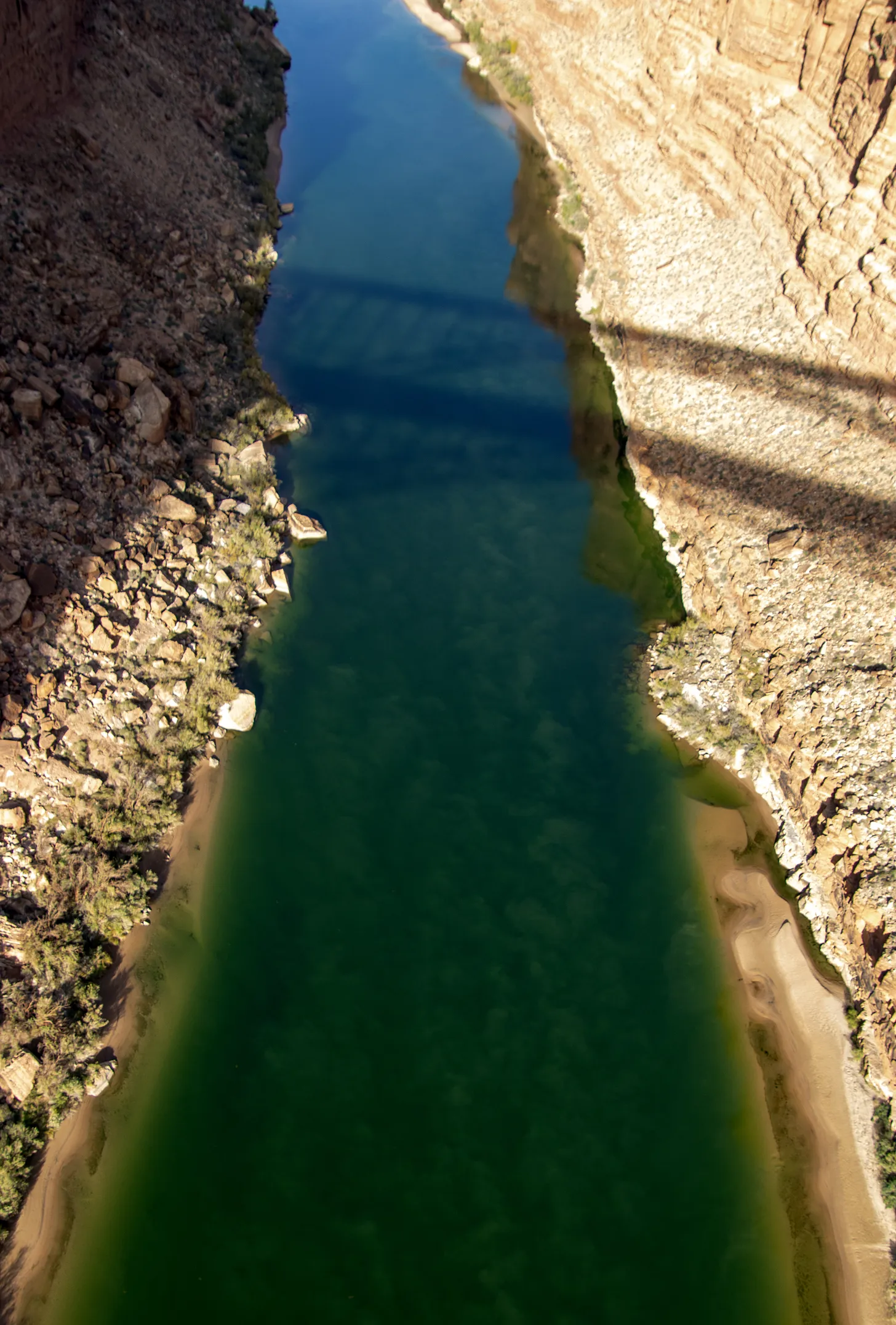
The Evans all-of-the-above tour was arranged by a former Republican state senator, Greg Brophy. Brophy grows watermelons north of Wray and operates an organization called The Western Way. Brophy has been a strong supporter of renewable energy for eastern Colorado and also has a presence on the Western Slope.

Brophy told me that he has organized a similar tour for another member of Congress from Colorado, but it has not been scheduled. He declined to identify the representative.

What if Trump succeeds in rolling back the federal energy tax credits? Energy Innovation, a think tank, estimates increased average household energy costs in Colorado of $180 per year by 2030.

Will other Republicans in Colorado’s congressional delegation join Evans and Hurd? After all, renewable energy didn’t start out as a partisan issue.

Colorado’s energy industry has had a slightly rougher go of it, mainly because it specializes in natural gas, not crude oil, and methane prices have been low since the 2009 crash. Note to Jeff Hurd: Revenues were substantially higher under Biden than under Trump I. Just sayin’. Source: ONRR via The Land Desk/Jonathan P. Thompson