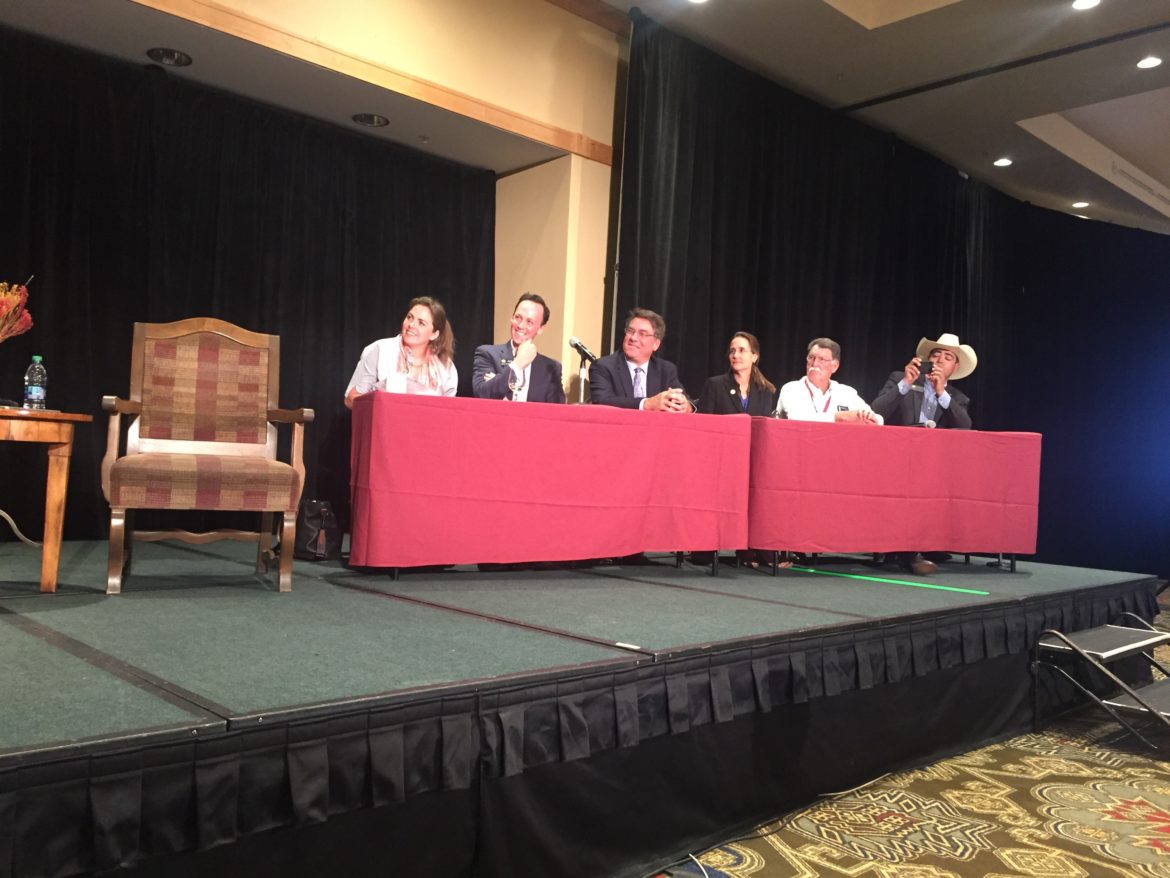
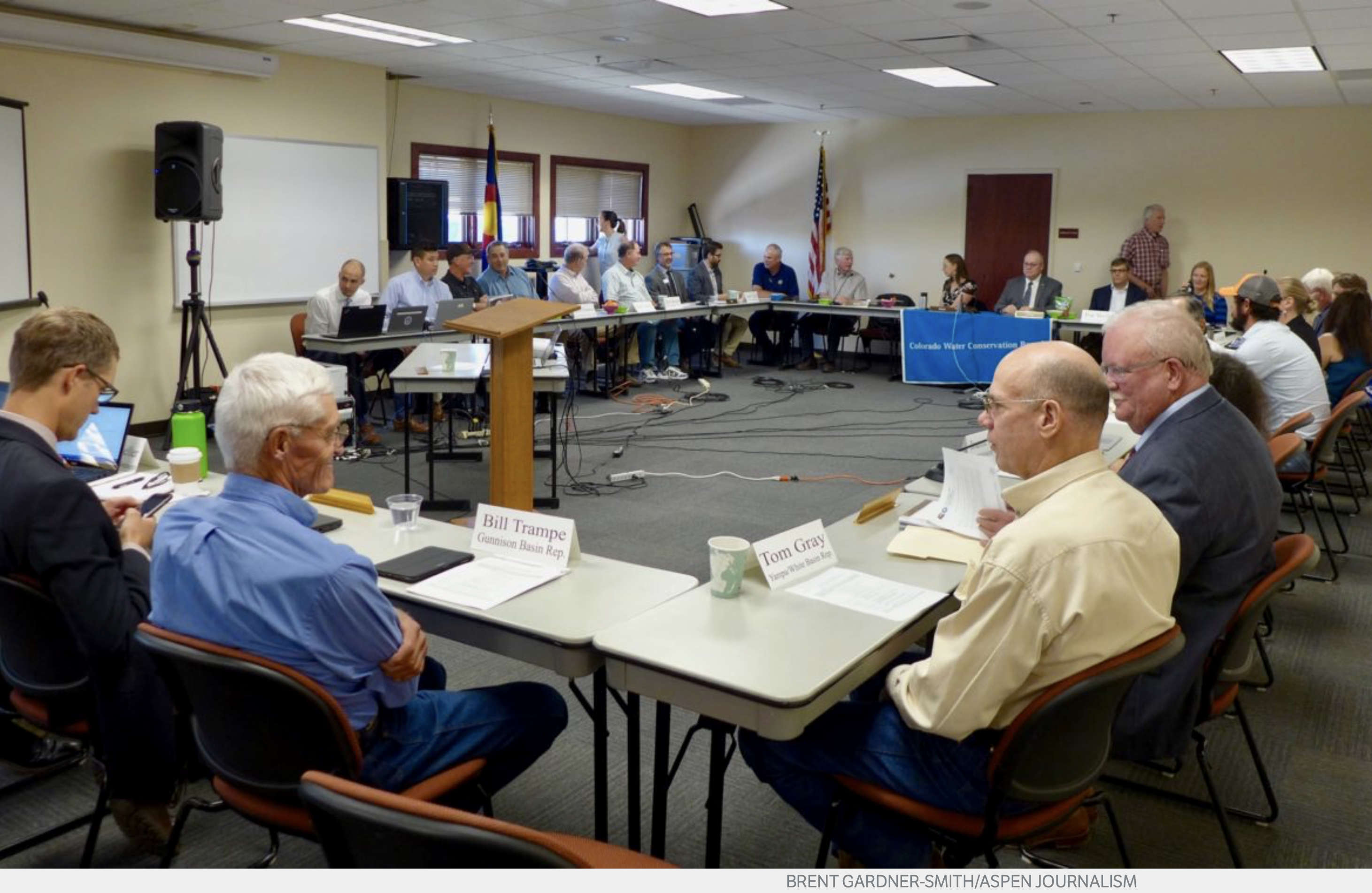
Colorado River Water Conservation District (CRWCD) board member Bill Trampe spoke to the county commissioners this past fall on behalf of the neighboring river district. Kathleen Curry, the chairman of the Gunnison Basin Roundtable, also spoke with commissioners during that meeting.
Trampe reported that the transfer of ownership of Wolford Mountain reservoir near Kremmling in Grand County occurs on January 1, 2020. “So at that point in time Denver Water gets 40 percent of the ownership,” he said.
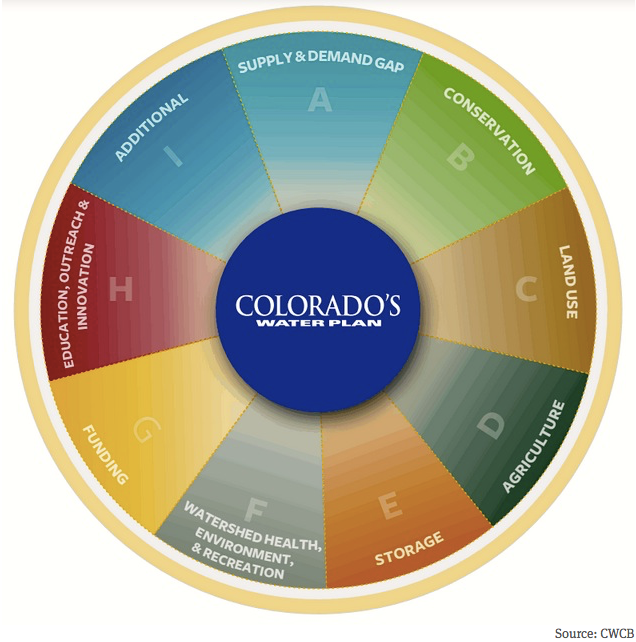
Trampe said demand management and drought contingency planning is always front and center for the board, and said the board is frustrated with the state process moving forward and its slowness putting the nine working groups involved in the state water planning process (Colorado’s Water Plan) to work…
Trampe described issues relating to water resource demand management, with “interests” on the Western Slope trying to make deals with Front Range entities.
Trampe said the district felt that individual groups making those deals could lead to a lot more “working the market and eventual condemnation rather than purchase—meaning condemnation by force rather than a deal between parties. If condemnation starts, I think that’s going to ruin everything.”
The solution, he said, is to work together with Western Slope entities and keep a strong base in the river district to negotiate more collectively. “If there’s one pot of money under state control to pay for demand management, then that’s the way it ought to be. There shouldn’t be individual groups out there doing their own thing.”
County commissioner John Messner asked if there’s been discussion among river districts about a de-Gallagherizing measure to open up current tax funding constraints. De-Gallagherizing refers to ballot measures that freeze the residential property tax rate as a way to stabilize budgets of rural governments.
Messner asked if the CRWCD has an opinion on whether a measure will address special districts such as this one.
“We considered a ballot issue for this fall, but didn’t think we were ready,” replied Trampe. He said the reason to wait was to start more outreach to the public in terms of what the districts are and what they do beforehand. He said the districts are hoping to do this in 2020.
“Whether it’s de-Gallagherization, or TABOR issues, we’re still trying to decide. But yes, we’re going to do something. We’ve got to do something,” he said.
Looking to support a water survey on the Crystal River basin
Commissioner Jonathan Houck reported that during a fall Gunnison Basin Roundtable meeting, members discussed the Upper Crystal River watershed at length.
That watershed has an application in with the state to conduct a water study, because the 2018 drought demonstrated that several subdivisions in that basin, some of which are in Gunnison County, had no water plan or storage without the Crystal River’s regular flow.
The Water Supply Reserve Fund (WSRF) is managing that application, and the Gunnison Roundtable considered and ultimately decided on drafting a letter of support…
Curry noted that a project in a different river basin asking an adjacent roundtable to write a letter is “a little out of the ordinary. So that threw our roundtable a little bit, wondering if that was even the right role. But I put it on our agenda since, if it involved looking at storage feasibility near Marble, in Gunnison County, I thought [commissioners] might be interested in that,” said Curry.
Houck responded that the county should send a message as well. “We want to see good, thoughtful water planning per all residents within the county. Due to the size and geography of our county we actually span two watersheds. And it’s important for us to advocate for that but understand that the funding needs to come from the appropriate basin,” he said…
Last, Curry said that the roundtable is preparing to submit a Basin Implementation Plan (BIP) in contribution to Colorado’s Water Plan, and that will include an updated project list. “This is our opportunity to change our project list,” she suggested, with additions or deletions as appropriate. The roundtable formed a subcommittee to begin the process, and its first meeting was this fall.
Saving water on the Colorado River system, funding the state water plan, and preserving more water for streams are expected to top lawmakers’ water agenda when the Colorado General Assembly begins its work Jan. 8
Saving Water on the Colorado River
Last May the seven Colorado River Basin states signed a drought contingency plan that requires the three lower basin states, Arizona, Nevada and California, to cut water use. It also gives the four upper basin states — Colorado, New Mexico, Utah and Wyoming — the option to create a large-scale water conservation program that would add more water to storage in Lake Powell. That water would be credited to the Upper Basin states and protect them from cutbacks if levels in Powell start to fall below those needed to generate power and to meet water delivery obligations to the Lower Basin. Colorado and other Upper Basin states are exploring whether such a conservation program, known as demand management, is feasible. Any water users who contributed to the new Powell storage account would do so voluntarily and would be paid for their participation.
Where would that water come from? Since irrigated agriculture is the largest user, most of it is likely to come from farmers and ranchers. That troubles Colorado Rep. Marc Catlin, R-Montrose, former manager of the Uncompahgre Valley Water Users Association in southwest Colorado. “We’re still looking at agriculture as a living reservoir that we don’t have to build,” he says.
But Catlin sees “some shifting in the conversation” about sharing water cuts with East Slope communities, where there’s a growing recognition that “if it hurts western Colorado, it hurts the whole state.” That’s because East Slope urban water providers rely on transmountain diversions for much of their water supply. Denver Water, for example, counts on Colorado River imports for half its water. And since most of those rights are junior — acquired after the 1922 Colorado River Compact was signed — the metro area, along with irrigators in the South Platte and Arkansas River valleys that receive water via transmountain diversions, would also be affected by any cutbacks in Colorado River water deliveries. It is anticipated that those entities and regions would participate in conservation alongside West Slope irrigators.
While the Colorado Water Conservation Board (CWCB) is now examining whether to create such a program, lawmakers this year will consider a bill that would require CWCB to involve the public and the state’s nine river basin roundtables in developing a demand management program. Although CWCB would have final say, it would have to submit any draft program to the Water Resources Review Committee and consider its feedback.
Funding Colorado’s Water Plan
Implementing Colorado’s Water Plan is projected to cost $3 billion over the next 30 years, or $100 million annually. The CWCB and the General Assembly have provided some funding for the water plan, but those amounts cover only a fraction of the water plan’s estimated costs.
Enter Proposition DD, approved by voters in November. It legalizes sports betting and assesses a 10 percent tax on casinos’ net proceeds. The state can collect up to $29 million per year, with more than 90 percent of that going into a newly created Water Plan Implementation Cash Fund run by CWCB. Experience with sports betting in other states suggests that no more than $16 million in tax revenue will be generated annually, and during the first year just $7 million is expected.
Lawmakers are expected to discuss options giving them some say in how CWCB allocates that revenue, but those talks may not result in legislation this year.
Sen. Bob Rankin, R-Carbondale, a member of the Joint Budget Committee (JBC) and prime sponsor of the general fund water appropriations last year, does not expect Proposition DD to affect JBC’s water plan funding recommendations this year. Last year, for the first time, lawmakers approved $10 million in general fund money for the water plan. But Rankin cautions that appropriating another $10 million in general funds to support water plan implementation and demand management development will depend on how revenue forecasts shake out.
Instream Flows
Rep. Dylan Roberts, D-Avon, said he plans to introduce a bill that would expand the existing instream flow loan program. Under current law, a water right holder can loan water to the CWCB to further preserve water for rivers on stream segments where the board already holds an instream flow water right. The loan may be exercised for no more than three years in a single 10-year period. Roberts’ bill would increase the number of years the loan could be exercised from three to five, and allow for two additional 10-year periods.
The proposed bill is similar to one that passed the House of Representatives but was defeated in Senate committee last year. Opposition to that bill centered on the potential impact on historical irrigation return flows from leaving water in the stream rather than applying it on the land, the effects on soils fallowed for long periods, and the tight comment period allotted after a loan application is filed in which opponents can make their case. Those issues were discussed during the interim session, but the Water Resources Review Committee took no action.
Roberts says that recommendations developed by a Colorado Water Congress working group to provide water right holders with more opportunities to comment and protect downstream users will be incorporated into the new bill. With those changes, he’s optimistic that “we have arrived at a place where more of the water community feels comfortable with the program’s expansion.”
Other Issues
The Water Resources Review Committee recommended three other bills for consideration this session. One would address water speculation, with concerns raised that agricultural water rights are being sold to entities with no real interest in farming that are holding those rights for future, profitable transactions. The bill would create a working group to explore ways to strengthen anti-speculation laws and report its findings and recommendations to the committee next year.
Another bill would task the University of Colorado and Colorado State University’s Colorado Water Center with studying new technologies to improve monitoring, management, conservation, and trading of water rights and report back to the committee in 2021.
The final bill would increase the number of state water well inspectors and require rulemaking to help the state engineer identify high-risk wells for inspection.
And although no legislation has yet been drafted, Sen. Kerry Donovan, D-Wolcott, said she anticipates discussion of how to better dovetail water planning with land use development to ensure large new communities have sustainable water supplies.
Larry Morandi was formerly director of State Policy Research with the National Conference of State Legislatures in Denver, and is a frequent contributor to Fresh Water News. He can be reached at larrymorandi@comcast.net.
Fresh Water News is an independent, non-partisan news initiative of Water Education Colorado. WEco is funded by multiple donors. Our editorial policy and donor list can be viewed at http://www.wateredco.org.
George Washington addresses the Continental Congress via Son of the South
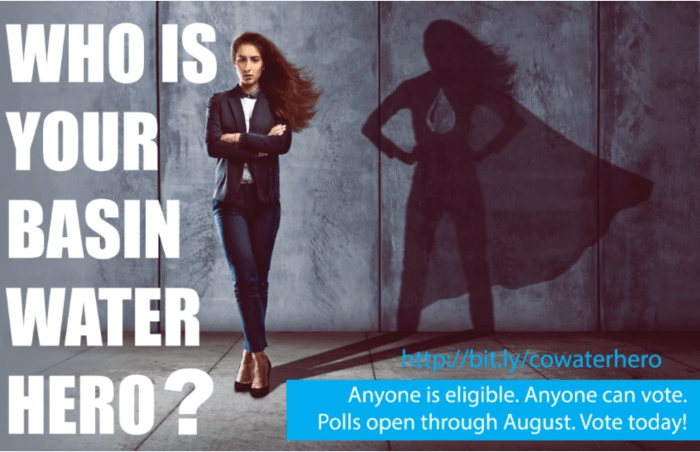
Once the proceedings were underway, Wayne Schwab of the Trinchera Irrigation Company recognized Emma Reesor, Vice-Chair of the Roundtable, for being named “Basin Hero” for the Rio Grande Basin by the Colorado Water Conservation Board.
Later, Bethany Howell of the Rio Grande Watershed Conservation and Education Initiative gave a funding request preview to add a staff position to the Public Education and Public Outreach (PEPO) program in the Basin. Howell pointed out that PEPO is becoming increasingly important because there is a growing lack of local and statewide water knowledge and a lack of communication between various entities that have the potential to collaborate. Also, she mentioned that PEPO could promote the work in the Basin along with highlighting “cutting edge” projects such as the new Doppler Radar System. Howell’s final presentation and the request will come at the January meeting.
Following Howell’s remarks, Virginia Christensen of the Terrace Irrigation Company also gave a funding preview and request. The Terrace Irrigation Company is seeking to replace diversions that makeup its canal system in 2020. Upon approval, the project anticipated to improve the administration of the system’s water along with numerous other benefits.
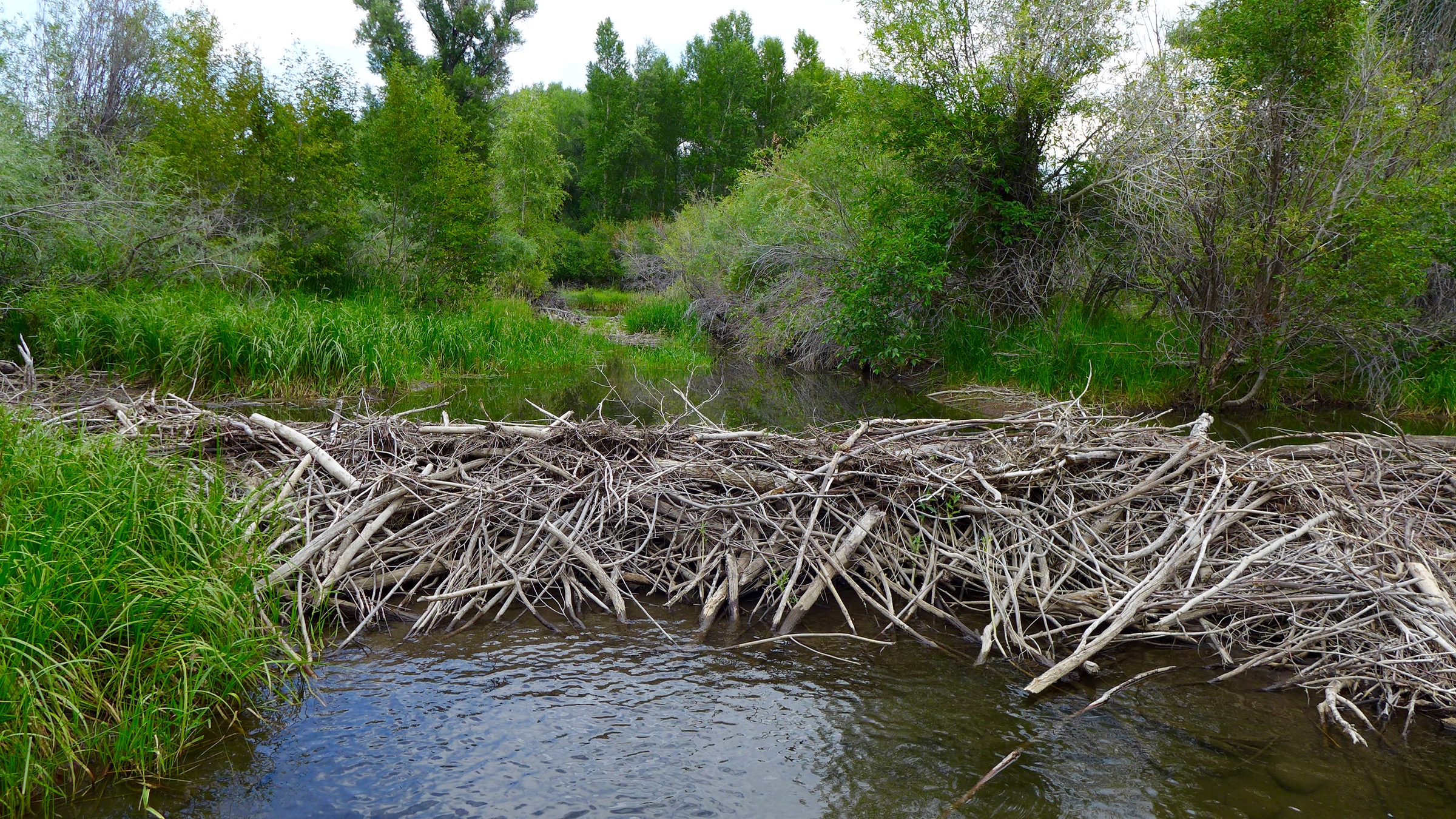
A beaver dam on the Gunnison River. Photo: Brent Gardner-Smith/Aspen Journalism
From the Colorado Department of Natural Resources (Megan Holcomb/Tracy Kosloff):
Water Year 2019 was characterized by a near average temperature and was the 34th wettest year in a 125-year period. Multiple state records were established in 2019, such as the March 13th bomb cyclone, the July 19th 115°F record at John Martin Dam, and the August 13th hail storm over eastern Colorado.
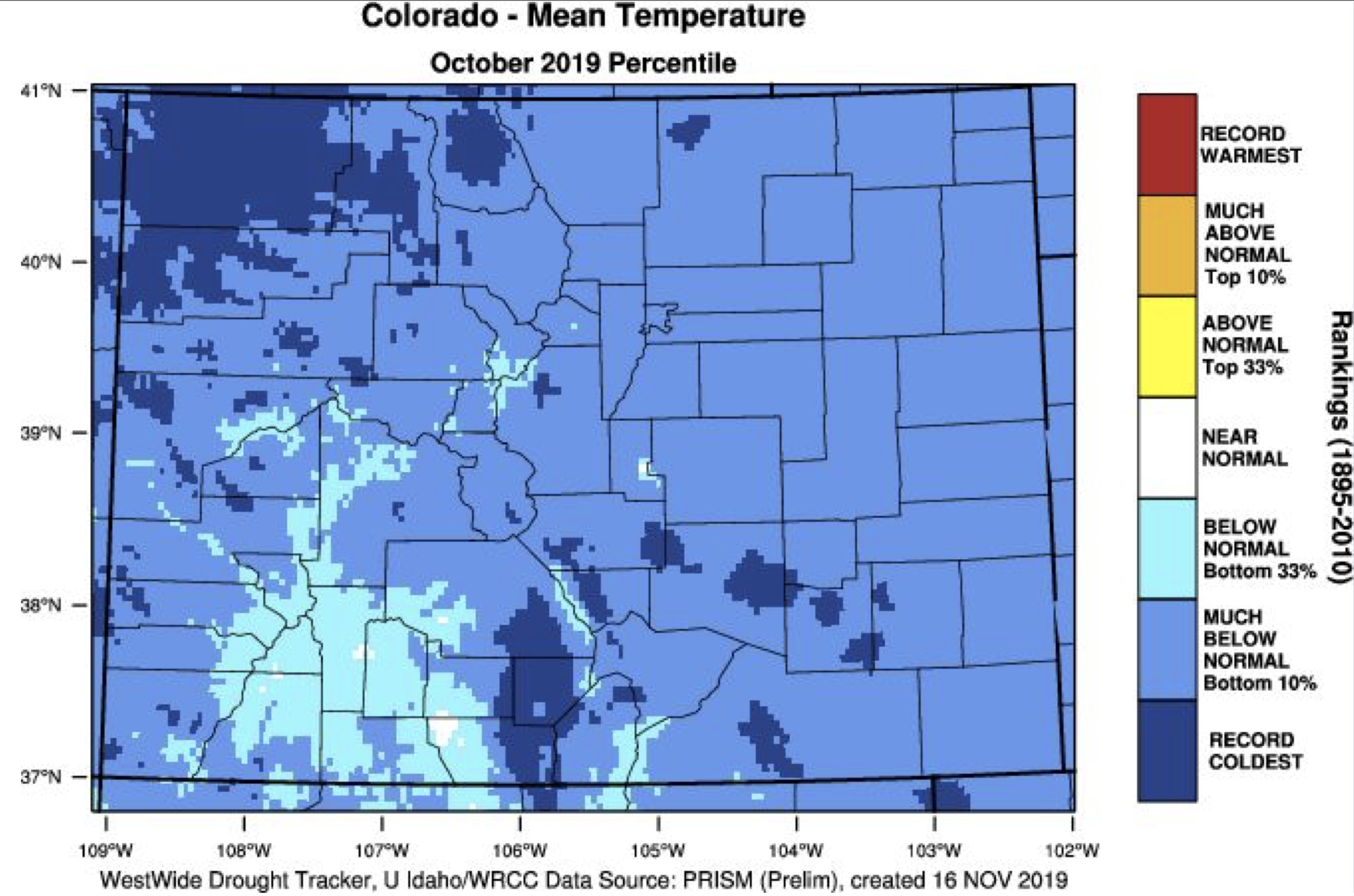
The start of Water Year 2020 (WY2020) saw dramatic temperature swings statewide: from the warmest September on record (Sep. 2019) to the 4th coldest October on record (Oct. 2019), marking one of the largest rank jumps on record and one of the state’s biggest changes in monthly average temperature. Grand Junction experienced the coolest Oct. on record while Alamosa and Pueblo experienced the 2nd coolest Oct. on record.
The 90-day Standardized Precipitation Index (SPI) from August 26 – November 23 shows notable precipitation deficits in the western half of the state.
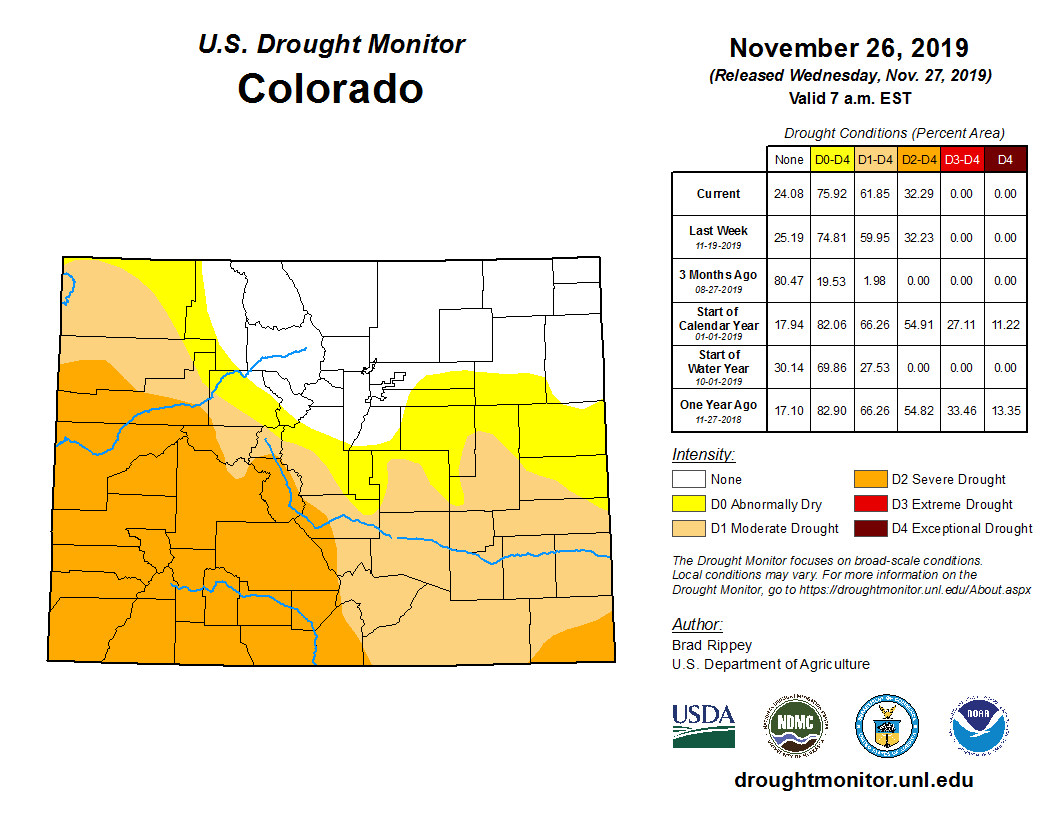
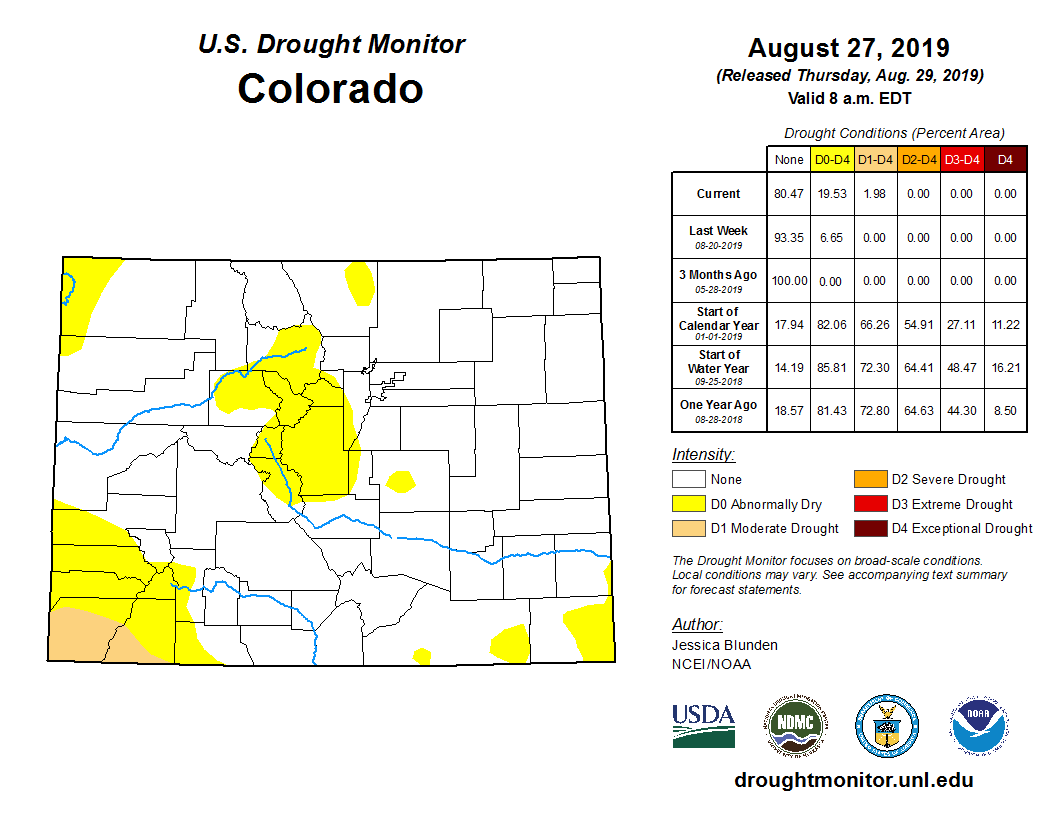
According to the U.S. Drought Monitor, released November 21, D0 (abnormally dry), D1 (moderate drought), and D2 (severe drought) collectively cover 75% of Colorado. Compared to the start of the Water Year 2020 (Oct. 1) the drought monitor shows degregations of 1-2 classes in the southern and western quadrants of the state.
The long term ENSO forecasts are trending toward neutral conditions remaining into the summer (entirety of WY2020). With no El Niño or La Niña forecast to dominate large-scale patterns, the outlook remains a bit more uncertain for the winter.
Colorado Drought Monitor November 26, 2019.
NOAA’s Climate Prediction Center shows warmer than average temperature outlooks December through February, and near-normal precipitation outlooks for the majority of the state. Northern basins may lean toward slightly above average precipitation these next three months.
Reservoir storage remains near to above normal (95 to 126% of average) in all major basins and is 109% of average statewide.
Water providers and water users did not report any unusual impacts or concerns at this time.
This four-part series contrasts the processes behind the Colorado Water Plan with four other recent western water plans: California, Texas, Montana and Oregon.
The production cycle of the Colorado Water Plan is a three-phase process, which involves regional engagement and project planning through basin roundtables and Basin Implementation Plans; statewide modeling, published in the Technical Update, and the publication of a comprehensive statewide plan. Not all states directly involve regional groups in state water plan development. Within the five Western water plans researched for this series, two states mandated the production of a high-level statewide policy document; while three states, including Colorado, mandated a regional or “basin” planning effort to inform statewide processes.
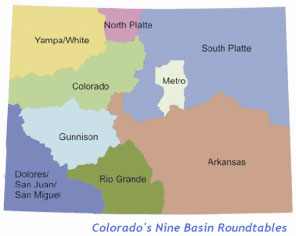
These approaches can be described as “top-down” and “bottom-up.” A top-down approach produces a water plan entirely directed and developed through state agencies, with designated periods for public comment. The final product of a top-down approach, exemplified by the California and Oregon state water plans, is described by state agencies as a high-level policy plan. In contrast, a bottom-up approach is rooted in the recruitment of regional planning groups. These groups develop unique basin plans that directly inform the content and directives of the state water plan. Examples of this planning approach include Colorado, Montana and Texas. The product of a regional approach constitutes multiple products: multiple basin plans and a single comprehensive state water plan. This idea is embodied in the figure below, which features Colorado’s nine Basin Roundtable boundaries.
This figure distinguishes two types of water plan production: a “top-down” process, executed and directed by state agencies; and a “bottom-up” process, where the production of regional plans informs the content and policy directives of a comprehensive statewide document.
A legacy of collaboration
The choice to pursue one strategy or another is rooted in the history of each states’ water governance, as well as contemporary policy and budgetary requirements. The Colorado Water Plan’s mandate for regional planning directly builds on the legacy of the basin roundtable process. The basin roundtable process was established in 2005 by the passage of House Bill 05-1177, “Colorado Water for the 21st Century Act.” This bill codified a deeply collaborative approach to addressing regional water concerns and visions for the future. This legislation also established the Interbasin Compact Committee to operate as a statewide forum for basin roundtables. The success of these volunteer groups directly informed the engagement efforts mandated in the 2013 gubernatorial executive order that called for the production of Colorado’s first statewide water plan.
Trends across Western water plans: expanding regional engagement, water education, and data accessibility
Regardless of the degree of regional authorship within a state water planning process, there is interest across Western state water plans in investing in locally identified water projects. For example, documents associated with California’s most recent “2018 Update” underscore a state interest in funding regional priorities. The report “Funding Mechanism Inventory and Evaluation” identifies watershed or river basin assessments as a potential vehicle for the state of California to fund locally-identified management actions.
This trend in regional engagement is concurrent with an effort to expand water education programming and water policy accessibility. To this end, state water plans including Texas, California, and Colorado have developed (or are currently developing, in the case of Colorado!) interactive online components that will accompany their water plans. While the 2019 Utah Water Plan was not explicitly examined for this blog series, it will notably prioritize a new webpage interface over traditional printing.
Recently published Western state water plans reflect an increasing emphasis on data transparency and accessibility, as well as state planning processes that better integrate stakeholder and regional perspectives into state water policy.
Hannah O’Neill. Credit: Water Education Colorado
Our next post, to be published the week of December 9, will contrast how uncertainty is incorporated across Western water plans. Read the first post in our Western Water Plans series, “How does the Colorado Water Plan compare to our neighbors,” here.
Hannah O’Neill is a graduate student at CU-Boulder studying environmental policy and western water management. Hannah is a fifth generation Coloradan and Denver native, who has a professional background in fossil exploration and National Environmental Policy Act compliance. Hannah obtained a BS in Geology-biology from Brown University in 2014.
This figure captures when the most recent water plan was published for each of these five Western states, as well as the length of the planning cycle. Colorado’s first comprehensive state plan was published in 2015, and set a seven-year planning cycle. Graphic credit: Water Education Colorado
From Water Education Colorado (Hannah O’Neill, Bianca Valdez and Jakki Davison):
This four-part series contrasts the processes behind the Colorado Water Plan with four other recent western water plans: California, Texas, Montana and Oregon.
State water plans account for contemporary water resource challenges, detail supply projections and future demands, and catalyze community discussions around cooperative management. How does the Colorado Water Plan—both the final document and the planning processes involved—compare to other Western states?
As we approach the second iteration of the Colorado Water Plan (set to begin in 2020, per the schedule outlined in the 2015 water plan), this blog series will explore a diversity of water planning processes. There are currently 17 U.S. states with water plans. Here, we explore five Western state plans that were all published in the last five years: Colorado, Oregon, Montana, Texas and California.
What’s in a water plan?
State water plans identify current water demands, project future water supply, and explore potential water projects that will close the gap between projections of future needs and availability. Every state water plan is unique and is largely rooted in the political context of an individual state. Creating a state water plan involves an enormous amount of stakeholder engagement and number crunching in order to understand statewide trends in population, climate and hydrology; articulate state and regional values with regards to water consumption and diversion; and identify both broad regional goals and local water projects to meet those goals.
Unique Western states; unique water resource challenges
Importantly, the states featured in this blog series represent two different legal frameworks in how water rights are administered: Colorado, Oregon and Montana operate under prior appropriation, while Texas and California operate under a dual regime of riparian rights and prior appropriation. Prior appropriation, or “first in time, first in right,” allocates water based on the chronology of water diversions for “beneficial use,” or the public good. In contrast to prior appropriation, riparian rights governance associates the ownership of water rights with the ownership of land adjacent to water bodies. Proposed water policies and projects are fundamentally shaped by how water rights are defined; in this manner, the legal framework within a given state provides essential context for how planning processes are applied.
Each state planning process is informed by the state’s unique combination of legal doctrine of water governance, history of water planning and development, and current statewide priorities. Every state is working to meet unique planning and regulatory requirements in the implementation of water projects and programs; the discussion of differences within this blog series is not intended to imply differences in plan quality. Like any good policy, the water plans reviewed here all aim to keep pace with emergent environmental, social and fiscal needs.
In the following three blog posts, we will contrast distinguishing components of these five Western water plans in order to better understand the planning process in Colorado. The focus of our discussion will contrast various strategies for executing regional engagement, modeling future scenarios, and incorporating uncertainty; all across our five states of interest: Colorado, Texas, Montana, Oregon and California.
Our next post, to be published the week of December 2, 2019, will contrast regional engagement strategies across Western water plans.
This series was developed by Hannah O’Neill, Bianca Valdez, and Jakki Davison, three graduate students studying environmental policy at the University of Colorado at Boulder’s Masters of the Environment program.
From the La Plata County Board of Commissioners via The Durango Herald:
The La Plata County Board of County Commissioners is seeking applicants to serve on the board of the Southwest Basin Roundtable.
There are nine basin roundtables in Colorado, each of which facilitates local discussion about water issues and encourages locally driven, collaborative solutions on interstate water issues and works with other roundtables on interbasin and interstate water issues.
Applicants with education and/or experience with local and state water concerns are preferred.
Term length is five years, and meetings are held quarterly, alternating between Durango and Cortez.
This position is advisory only and is not monetarily compensated.
The Colorado River Water Conservation District and the West Divide Conservancy District gave up their conditional water rights in 2011 that could have allowed for a reservoir on the Crystal River at Placita. A proposed back-up water supply study has some groups worried that the idea of dams on the Crystal could be resurrected. Photo credit: Brent Gardner-Smith/Aspen Journalism
The fight over damming the Crystal River has been resurrected, this time before there are even any dam projects to fight over.
The Colorado Basin Roundtable voted Monday to recommend the state give $25,000 toward a water study in the Crystal River basin, despite calls from some to deny the Water Supply Reserve Fund request because of concerns that a study might conclude there is a need for water storage.
The Colorado River Water Conservation District and the West Divide Water Conservancy District brought the grant request to the roundtable in Glenwood Springs in an effort to solve a long-acknowledged problem on the Crystal: In dry years, there may not be enough water for both irrigators and some residential subdivisions.
On Nov. 18, the Gunnison Basin Roundtable gave its unanimous support to the grant application, even though its support was not necessary. Although the Crystal is in the Colorado River basin, its headwaters are in Gunnison County, and so the Gunnison roundtable decided to voice its support.
The feasibility study would look at water demands and options for creating a basinwide backup water supply plan, known as an augmentation plan. The study will look at small storage alternatives, probably off the main stem of the Crystal. Until the study is completed, it’s unclear how much water is needed for a basinwide backup supply.
But some fear that the plan could include dams and reservoirs on the free-flowing Crystal, and they opposed the grant unless storage was off the table.
Pitkin County Commissioner Kelly McNicholas Kury requested two amendments to the grant application: that any reservoir would be off the main stem of the river and would only be located downstream of the Sweet Jessup Canal diversion (about 2 miles downstream of Avalanche Creek) to preserve the possibility of designating 39 miles of the Crystal River as Wild and Scenic.
“We are not going to support this application as it’s currently written,” McNicholas Kury told roundtable members Monday. “The county continues to support Wild and Scenic designation on the Crystal.”
McNicholas Kury and two other roundtable members voted against the funding: recreation representative Ken Ransford and Eagle County representative Chuck Ogliby, who owns the Avalanche Ranch Cabins & Hot Springs in the Crystal River Valley.
The Crystal River Caucus, which doesn’t have a seat on the roundtable, also objected to the grant application and passed a resolution at its Nov. 14 meeting to that effect. In a letter to the roundtable, the caucus said it does not support the grant and urged voting roundtable members to deny the request. The caucus would, however, support a study and augmentation plan that evaluates options other than storage.
But others downplayed the threat of dams, insisting they won’t happen.
“You’re not going to see a dam on the main stem of the Crystal,” said Colorado River District President Dave Merritt. “It’s not going to happen. The river district is not predisposed to dams. There is a need for a small amount of augmentation water up there. We are talking tens of acre-feet, probably.”
The Sweet Jessup Canal’s diversion structure is on the Crystal River about two miles downstream from Avalanche Creek. Pitkin County wants any storage on the Crystal that an augmentation study might recommend to be located below the Sweet Jessup to keep open the possibility that the upper portion of the Crystal can one day qualify as Wild and Scenic. Photo credit: Brent Gardner-Smith/Aspen Journalism
No backup supply
During the historic drought of late summer of 2018, the Ella Ditch, which irrigates agricultural land south of Carbondale, placed a call on the river for the first time ever. This means, in theory, that junior-rights holders upstream have to stop taking water so that the Ella Ditch, which has water rights dating to 1885, can receive its full decreed amount.
Most junior-rights holders have what’s known as an augmentation plan, which lets them continue using water during a call by replacing the called-for water with water from another source, such as a reservoir or exchange. The problem on the Crystal is that several residential subdivisions don’t have augmentation plans.
Without an augmentation plan, these entities — which are the town of Carbondale, the Marble Water Company, Chair Mountain Ranch, Crystal River Resort, Crystal View Heights and Seven Oaks Commons — could be fined for every day they are out of priority and could potentially have their water shut off, if there is a call on the river.
Colorado Division of Water Resources Division 5 engineer Alan Martellaro said instead of each subdivision coming up with its own augmentation plan, a basinwide approach makes more sense.
“We think it would save everyone money if we had a reasonable regional solution,” he said. “It looks a lot to us that a call from the Ella Ditch is going to be more common in the future.”
The Ella Ditch, which irrigates agricultural land south of Carbondale, placed a call on the Crystal River for the first time ever in 2018. Water managers are seeking solutions in the form of a basin-wide augmentation study, which the Colorado River Basin Roundtable recommended for grant money. Photo credit: Brent Gardner-Smith/Aspen Journalism
Contentious history
To understand why some groups are opposed to even just a study whether storage is an option, it helps to review the contentious history of water development in the Crystal River Valley.
In 2011, the West Divide district and the Colorado River District abandoned their conditional water rights for nearly 200,000 acre-feet of water storage on the Crystal River after local groups — Crystal River Caucus, Pitkin County and Crystal Valley Environmental Protection Association — opposed the reservoirs tied to the conditional rights. Known as the West Divide project, the now-defunct conditional water rights were tied to a dam on the Crystal just downstream from Redstone, which would have created Osgood Reservoir, and a dam on the Crystal at Placita, which is at the bottom of McClure Pass.
To try to prevent the specter of dams coming back to haunt the Crystal in the future, Pitkin County and other local groups have pushed for a federal designation under the Wild and Scenic River Act of 1968, which requires rivers to be free-flowing. The Colorado River District opposes the designation.
“With our challenging history with both the river district and West Divide … this is why we are very nervous whenever we hear discussion of any dams on the Crystal River,” said Bill Jochems, Redstone resident and member of the Pitkin County Healthy Rivers board.
In the end, the roundtable approved the grant request. A motion to amend the request with a no-storage requirement failed.
“Obviously, storage is not the first choice,” said Ken Neubecker, the roundtable’s environmental representative and Colorado project director for environmental organization American Rivers. “But you have to look at all the options, including storage, or you’re just not being responsible.”
The two conservation districts plan to ask for a $50,000 grant from the Colorado Water Plan grant fund in early 2020 to fund the roughly $100,000 project. West Divide plans to contribute $15,000 and the Colorado River District $10,000.
Aspen Journalism collaborates with The Aspen Times and other Swift Communications newspapers on coverage of water and rivers. This story appeared in the Nov. 29 issue of The Aspen Times.
A river project, partially funded by the CWCB on the Arkansas River at Granite. The project was removing a river-wide diversion structure and replacing it with a new diversion structure that will allow unimpeded boating through Granite. Photo credit: Brent Gardner-Smith/Aspen Journalism
FromThe Chaffee County Times (Max R. Smith) via The Leadville Herald:
In the mid-1960s, a partnership between the cities of Colorado Springs and Aurora installed a diversion dam in the Arkansas River south of Granite near Clear Creek Reservoir as part of a pipeline system bringing water from the western slope of the Continental Divide to the Front Range.
The presence of the diversion dam caused that portion of the river to be non-navigable, requiring portaging of one’s raft or kayak.
By the end of this year, however, Colorado Springs Utilities is on schedule to complete a three-year project to build a new river diversion that will allow boaters to float right through, meaning that the 2020 rafting season will be the first in over 50 years in which the entirety of the Arkansas can be travelled without portage.
“We’ll see how the snow treats us over the next couple weeks, but we’re really down to some final boulder work in the river and general site cleanup at this point,” said CSU project manager Brian McCormick.
The intake that pumped water out of the Arkansas (which, legally speaking, comes from the Eagle River Basin as part of the Homestake Project), destined for Aurora and Colorado Springs, “as with anything in the river for 50-plus years, it took some wear and tear,” McCormick said. “By about the mid-2000s, the cities recognized we needed to rehabilitate this structure to keep it as a reliable facility and ensure safety of the river users.”
Construction on the new $9.1 million diversion project began in 2016 after a number of years of planning, budgeting, and engineering. Support for the project included $1.2 million in grant funding from the Arkansas Headwaters Recreation Area, Colorado Parks and Wildlife and the Colorado Water Conservation Board…
Significant to water consumers in Colorado Springs and Aurora, the project utilizes a new intake and piping structure to send water to the Otero pump station, he said.
Significant to boaters is a chute constructed of boulders and mortar with six two-foot drops that will allow them to pass the intake facility without exiting the river. McCormick said that CSU put the call out to members of Colorado’s river recreation community to participate in a trial run down the chute in November, testing the Arkansas’s newest whitewater feature…
Significant to the scaled, Omega-3 rich denizens of the Arkansas who swim upstream to spawn every year, the new diversion also features a fish ladder: a sequence of weirs and pools that give brown and rainbow trout a route to move up the river to their spawning grounds.
Water sufficient for more than 1 million homes on the Front Range could be lost, and thousands of acres of farm land on both the Eastern and Western Slopes could go dry, if the state can’t supply enough water from the drought-stricken Colorado River to downstream states as it is legally required to do, according to a new study.
Among the study’s key findings:
+ In the next 25 years, if the state does nothing to set more water aside in Lake Powell, the Front Range could lose up to 97 percent of its Colorado River water.
+ All but two of the state’s eight major river basins, under that same “do nothing” scenario, also face dramatic water cutbacks.
+ If Colorado, Wyoming, Utah and New Mexico increase their water use by as little as 11.5 percent, as predictions indicate they will by 2037, the risk of a legal crisis spurring such cutbacks on the river doubles, rising from 39 percent to 78 percent, under one scenario, and 46 percent to 92 percent under another.
“Every water user in every river basin [linked to the Colorado] faces some risk,” said Andy Mueller, general manager of the Glenwood Springs-based Colorado River Water Conservation District, one of the sponsors of the Colorado River Risk Study, as it is known. The Durango-based Southwestern Water Conservation District also sponsored the work.
Palisade peach orchard
“That’s an important takeaway because when you begin to realize the extent of potential damage, whether it is on the West Slope or the Front Range, then we all come to the realization that we have a shared risk,” Mueller said.
Under the 1922 Colorado River Compact, the river’s supplies are divided between the four Upper Basin states (Wyoming, Utah, Colorado and New Mexico) and three Lower Basin states (California, Nevada and Arizona). The compact dictates that cities and farmers in the Upper Basin whose water rights were obtained after the compact was signed would have to give up some or all of their water to the Lower Basin if there isn’t enough water in Lake Powell to meet the terms of the compact. Colorado uses the most water of all the Upper Basin states and therefore faces the most risk.
The study was conducted by Boulder-based Hydros Consulting and released in June. It looked at different scenarios for the way river conditions and reductions to diversions could play out, as well as ways to reduce the risk cities and farms face, including spreading the cutbacks proportionately among all the river basins, something that isn’t typically done.
Scare tactics
Front Range water utilities are wary of the study and have begun a new round of analysis to determine if they agree with the results.
Alex Davis is a water attorney for the City of Aurora. At a recent forum on the risk study, she said that the chances of a Colorado River crisis were being exaggerated. And the study acknowledges that under some scenarios the risk of such a legal crisis is low.
“All of this talk is helpful to get people to think about the issue, but it also seems like a bit of scare tactics. If the Lower Basin states did try to do something, there would be a whole number of reasons [they would not get far],” she said.
Including the fact that they continue to overuse their share of the river by about 1.2 million acre-feet a year. Before Colorado and its northern neighbors were asked to cut back, the Lower Basin would have to do additional cutbacks as well, she said.
If drought and climate change continue to sap the river’s flows, and a legal crisis erupts with downstream states, six of the state’s eight major river basins could be forced to give up water. The Front Range and Eastern Plains are most vulnerable if shortages hit the river downstream and could lose as much as 97 percent of their Colorado River supplies. Credit: Chas Chamberlin via Water Education Colorado
West meets east
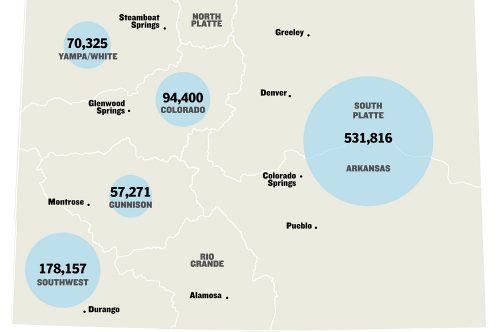
Though the Colorado River flows west, and originates in Colorado’s Never Summer Mountains in Rocky Mountain National Park, a large chunk of its flows, more than 530,000 acre-feet, are pumped east over the Continental Divide to the state’s Front Range cities, including Denver, Colorado Springs, Pueblo, Boulder, Fort Collins and Broomfield, among others. That’s enough water to supply 1.06 million homes or to irrigate more than one-half million acres of crops.
Because these water users built their tunnels and reservoirs decades after the 1922 Compact was signed, they could be among the first to be cut off. Denver’s largest storage pool, Dillon Reservoir, was completed in the 1960s. East Slope cities and farmers would lose 97 percent of their Colorado River supplies if those diversions were completely shut down, according to the study.
“You have to start with the fact that 50 percent of the water on the Front Range comes from the West Slope. Should the Upper Basin fail to meet its delivery obligation, half of water use on the Front Range would be curtailed. That’s an enormous problem,” said Brad Udall, a senior climate and water scientist at Colorado State University’s Colorado Water Center.
Other parts of the state also face risk, some more than others. The Yampa River Basin, home to Steamboat Springs, would lose slightly more than 70,000 acre-feet of water, or 30 percent of its Colorado River supplies.
The Gunnison Basin, where agriculture controls historic water rights that pre-date the compact, is better protected, with the potential to lose just over 57,000 acre-feet of water, or 10 percent of its share of the river.
But a large swath of the southwestern part of the state would also be hard hit. Despite the historic farm water rights in this region, several small communities and irrigation districts built reservoirs after the compact was signed, just as cities did on the Front Range, meaning that those stored water supplies are also at high risk. In this basin, 178,000 acre-feet of water, roughly 36 percent of its Colorado River supplies, could be lost, according to the study.
The likelihood of ongoing drought and hotter summers only deepens the uneasiness over the river’s ability to produce the amount of water the state once relied on.
“We don’t expect to see cooler temperatures in the future, we expect to see warmer temps,” Mueller said. “If that is true, then we have to plan on reduced water supplies within our state.”
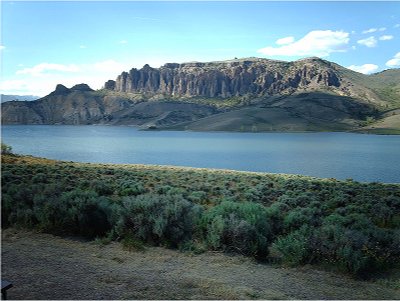
Blue Mesa Reservoir
Saving more water?
The study comes as the Colorado Water Conservation Board (CWCB), the lead water policy agency in the state, is examining whether to launch a massive, voluntary conservation program that would allow the state and its neighbors to save some 500,000 acre-feet of water and store it in a newly authorized drought pool in Lake Powell. The pool, to be used only by the Upper Basin states, could help protect Colorado and its neighbors if drought and climate change continue to sap the river’s flows.
Michelle Garrison is a modeler with the CWCB who has analyzed the study’s results. She said the scenarios it considered are important for comparative purposes and may help the West Slope and Front Range collaborate on any water cutbacks, something that hasn’t always occurred in the past.
“It’s a tough one,” she said. “The hydrology in the Colorado River has always been extremely variable and it’s predicted to become even more variable. But I’m really pleased to see them sharing their results.”
In places like the Yampa Basin, if the state cut back water use based strictly on prior appropriation, where water right dates determine who gets water first in times of shortage, Stagecoach Reservoir, the most significant storage pool in the valley, could be shut off because its storage rights date only to the 1980s. And residents would be hard pressed to cope if another long-term drought drained the river and their only source of stored water was no longer able to refill.
Kevin McBride is manager of the Upper Yampa Water Conservancy District, which owns Stagecoach. He, like dozens of other water managers across the state, is still contemplating the options. (Editor’s note: McBride serves on the board of Water Education Colorado, which houses Fresh Water News.)
“Generally being safe from drought is what it’s all about,” McBride said. “But how do you get there?
“It’s complicated and it comes down to how it’s done.”
McBride and others on the West Slope are asking for another round of modeling that would examine more equitable ways to cut back water use, so that no one takes the brunt of the reductions.
With insurance, or without?
Others have suggested that the state should let the rules embedded in the 1922 Compact and Colorado’s water rights system play out, rather than creating an expensive, legally complex water conservation program.
Anne Castle is a senior fellow at the University of Colorado’s Getches-Wilkinson Center for Natural Resources who specializes in Colorado River issues. Going without a major conservation program carries its own set of very high risks, such as decades of expensive lawsuits or unplanned water shortages.
Over the next several months, the state will continue to examine how best to protect its Colorado River water as part of drought planning work it is engaged in with the other Upper Basin states. Late next year, all Colorado River Basin states will begin negotiating a new set of operating guidelines for the entire river system, designed to bring it back into balance and slash the risk of major cutbacks.
“Truly one of the points of this risk study is to make sure that anyone who is at risk understands the risk,” Mueller said. “If you’re a water planner, it may set off some alarm bells. But we don’t want people to panic. The hope is people will look at this and say, ‘Our community is at risk…what are we going to do about it?’”
Jerd Smith is editor of Fresh Water News. She can be reached at 720-398-6474, via email at jerd@wateredco.org or @jerd_smith.
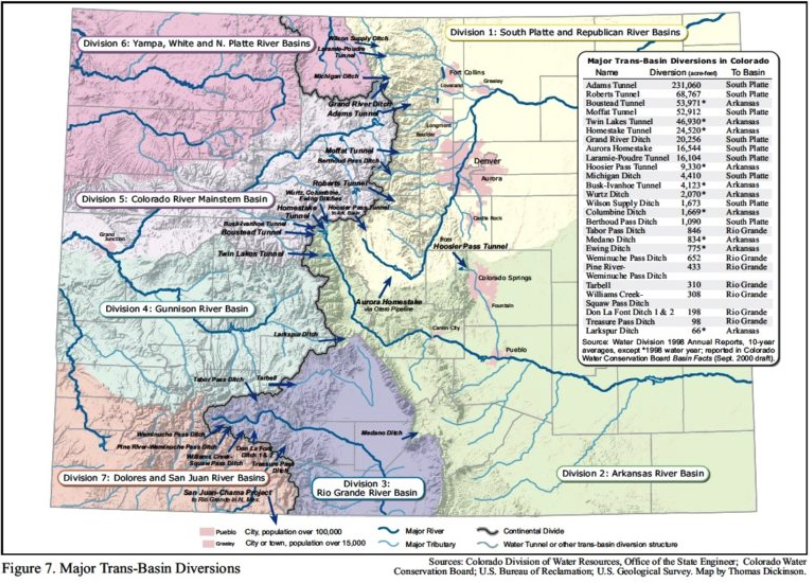
This graphic shows the transmountain diversions in Colorado.
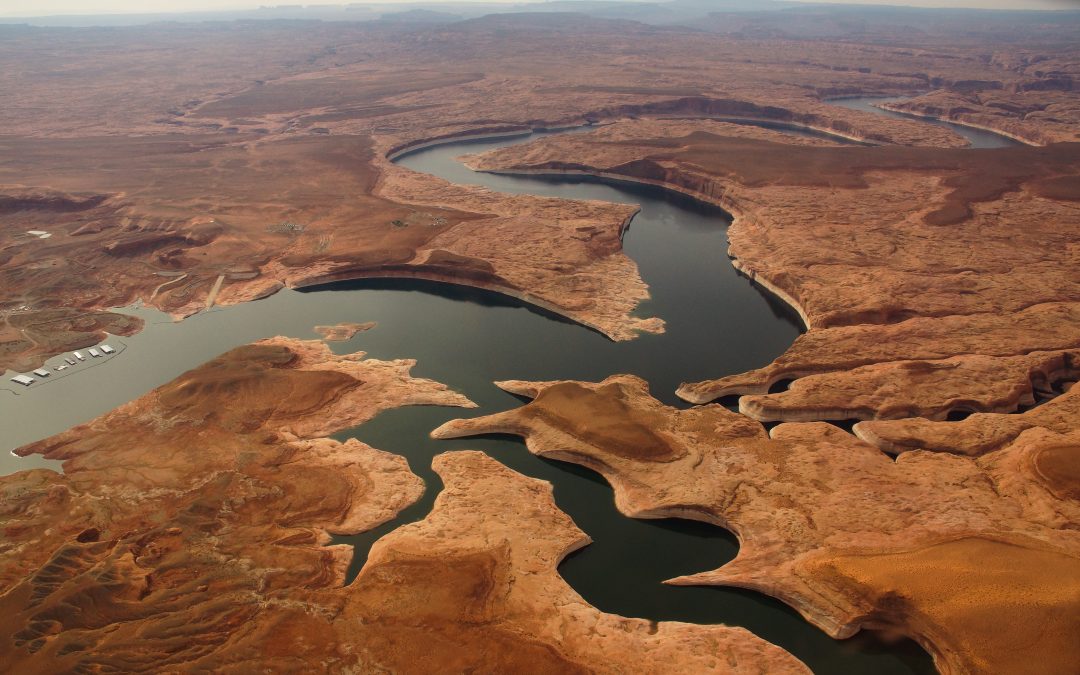
Lake Powell, created with the 1963 completion of Glen Canyon Dam, is the upper basin’s largest reservoir on the Colorado River. But 2000-2019 has provided the least amount of inflow into the reservoir, making it the lowest 20-year period since the dam was built, as evidenced by the “bathtub ring” and dry land edging the reservoir, which was underwater in the past. As of October 1, 2019, Powell was 55 percent full. Photo credit: Eco Flight via Water Education Colorado From Water Education Colorado (Lindsay Fendt):
While the ink was still drying on the final draft of the Colorado River Drought Contingency Plan (DCP), policy makers in Colorado were turning their attention to the bigger challenge ahead.
With the agreement’s signing in May 2019, the state and its neighboring upper Colorado River Basin states of New Mexico, Utah and Wyoming were granted the ability to bank conserved water in Lake Powell and other upper basin reservoirs in case of a future water crisis—but only if the states agree on an upper basin demand management program. Getting all the parties on the Colorado River to agree to that so-called “drought pool” in Lake Powell was difficult, but designing the demand management program to get water into the pool will be much harder. Determining when to release water from the pool could also prove challenging.
Demand management is water conservation on such a large scale that it reduces the amount of water drawn from the river in a significant, measurable way. If the upper basin states develop a demand management program, they will collectively use less water, then track, deliver and bank those savings in upper basin reservoirs. That water could be sent downstream when flows are low to meet the upper basin’s commitment to the lower basin states and Mexico, as outlined under the 1922 Colorado River Compact and subsequent agreements.
The compact stipulates that the upper basin states must not deplete the flow of the river at Lee Ferry below 75 million acre-feet based on a 10-year running average. Although the upper basin is a long way from running out of water, if the future brings more dry years and low reservoir levels, as is projected, it will become increasingly difficult to send water downstream while still meeting upper basin water needs. If the lower basin does not receive its share of water, a legal battle could ensue, threatening water rights in the upper basin—so the upper basin complies with the compact to maintain control over its own water supply.
The DCP lays out processes for how this might be achieved but is only in effect through 2026, at which time the federal government, in consultation with all Colorado River Basin states, will reconsider how the system should be operated.
Exploring demand management is just one of the upper basin’s commitments under the DCP—the other two elements include a new plan to move water from smaller upper basin reservoirs to Lake Powell, and finally, water supply augmentation. As a whole, the upper basin’s DCP aims to maintain storage volumes at Lake Powell, enabling continued hydropower generation, thereby funding continued operation of the reservoir system and use of Colorado River water in the upper basin. But demand management could be part of the upper basin’s strategy. So work is underway to determine what demand management might look like, if a program is developed. “There are still a lot of big ifs,” said Brent Newman, the former interstate and federal section leader for the Colorado Water Conservation Board, during a presentation in August.
Newman was addressing about a dozen people gathered in the Summit County Library in Silverthorne for the first meeting of the Economic and Local Governments Working Group on demand management. The group of county commissioners, lawyers, consultants and utility managers will spend the next year identifying critical issues for the feasibility of a demand management program.
As the meeting closed, the group filled three large boards with sticky notes of questions and possible problems with demand management, issues to be hashed out in the coming months. Similar brainstorming sessions are playing out across the state in eight other working groups, each dedicated to exploring demand management from a different perspective, like agriculture and the environment. Simultaneously, each of the other upper basin states is also examining how it could approach demand management. Unless all four upper basin states agree, there will be no demand management program.
This massive planning effort from four different states will cost millions of dollars and require tough negotiations. And while each upper basin state is putting its best foot forward to create a plan, there is no guarantee that conditions will get bad enough that it will be needed. There’s also no guarantee that a demand management plan will be adopted—and even if adopted, will it be adopted in time to make a difference?
The DCP and Colorado
Over the last 20 years, the Colorado River has experienced extreme drought, unprecedented in modern history. Now, states throughout the West are planning for a future with less water, and for good reason—modeling shows an increasing likelihood of water shortage in the basin. According to Phase III of the Colorado River Risk Study, an effort completed in June 2019, the upper basin faces a 45 percent chance of a water shortage in the next 25 years at current water use levels. If upper basin water use increases by just 11.5 percent, that risk doubles, creating a 90 percent chance of coming up short, the study says. Instead of tumbling unprepared into shortage, representatives from the seven states that rely on the Colorado River created the DCP to stave off a future water crisis by readying for dry times.
The objective of the DCP, which is really two plans, one for the upper basin and one for the lower, is to prevent water in the river system and its two primary reservoirs—Lake Powell and Lake Mead —from dropping too low. Reaching these critical levels would trigger a crisis-level response in the region with some states taking significant reductions in their water allocations and some areas losing access to clean power due to the loss of production from the reservoirs’ hydroelectric dams. The revenue earned from hydropower contracts is used to fund conservation for rivers and programs like endangered fish recovery. The loss in funding would also limit the government’s ability to run the dams and distribute any water remaining in storage.
The lower basin’s DCP laid out cuts in lower basin water use that are tied to projected reservoir levels. But the upper basin is in a different position. Its DCP gives the upper basin tools to manage its water supply in case of shortage, which should help it meet its obligations under the 1922 compact and avoid involuntary cutbacks. The first of these tools, which is really the basin’s first line of defense in protecting Lake Powell’s storage levels, is a new mechanism to move water from upstream reservoirs down to Powell when Lake Powell is facing a critically low level, what is known as the Drought Response Operations Agreement. The second is a 500,000 acre-foot storage pool in upper basin reservoirs, which the basin can use to store water from a demand management program, if such a program is deemed feasible and adopted. The third, known as augmentation, which is already in use, is a combination of cloud seeding to stimulate precipitation, and the control of phreatophytes like tamarisk and Russian olive, which are deep-rooted non-native plants that soak up water from riverways.
Over the next several years, the upper basin will use these tools and determine whether to bank water for shortage. While the upper basin’s work is just beginning, it could shift the way water has been managed in the West for more than a century.
This possible shift matters to water users across Colorado, that’s why the scene of the demand management workgroup in Summit County yielded three boards covered in questions and concerns. The Colorado River starts as snow high in Colorado’s Rocky Mountains. In the spring, it melts down into a web of tributaries that flow across the upper basin states into the river’s mainstem. Each of the basin states relies heavily on water from the river, but Colorado, in particular, plays an outsized role in how the Colorado River water system works. Colorado snowmelt contributes about 70 percent of the total flow of the Colorado River.
But Colorado also gets the lion’s share of the upper basin’s water—it can use 51.75 percent of the upper basin’s allocation per the Upper Colorado River Basin Compact of 1948. Colorado’s average annual consumptive use of Colorado River water is about 2.5 million acre-feet, according to the Colorado River Risk Study. And though only about 20 percent of the state’s population lives in the greater Colorado River Basin—which in Colorado includes not only the Colorado Basin but all West Slope rivers such as the Gunnison, Yampa, White, San Juan, San Miguel, and other smaller tributaries—more than 570,000 acre-feet of Colorado River water is piped across the Continental Divide each year, reaching the Rio Grande, South Platte and Arkansas basins. More than 80 percent of the state’s population lives along the Front Range, where transbasin diversion water accounts for about 60 percent of water use. Users of Colorado River water range from municipalities to farmers to industrial users like oil and gas operations.
If a severe water shortage resulted in the upper basin not meeting its compact obligations, water rights across the state would be at risk of curtailment. Although no curtailment procedure has been decided upon, water rights adjudicated after 1922, the year the compact was signed, are often considered to be more at risk than pre-1922 rights. In Colorado, transbasin diversions serving the state’s population center constitute more than half of the state’s post-compact depletions, which means that Front Range municipal water users, though geographically disconnected from the Colorado, have an extreme interest in protecting the river and Lake Powell reservoir levels—thus in seeing the upper basin DCP succeed. If the actions in the upper basin’s DCP aren’t sufficient to protect reservoir levels in Lake Powell and if releases below Lee Ferry were too low and violated the compact, a compact deficit could result and lead to involuntary curtailment.
Drought Response Operations Agreement
Rather than a step-by-step plan, the upper basin’s DCP is all about process. The new elements of the DCP, the Drought Response Operations Agreement and demand management, are plans to create a plan if conditions warrant it. The plan first lays out strategies to maintain water levels in Lake Powell during a drought. If those operations are not enough, the agreement describes how water from the three federal storage projects in the upper basin—Fontenelle in Wyoming, Flaming Gorge in Wyoming and Utah, Navajo in New Mexico and Colorado, and the Aspinall Unit which is composed of Blue Mesa, Crystal and Morrow Point reservoirs in Colorado—could be used to bolster storage volumes in Lake Powell.
The agreement does not designate how much water will be sent downstream or specify which reservoir will make the release, it simply says those negotiations will begin once the Bureau of Reclamation’s 24-month study models indicate that Lake Powell might fall below the target elevation of 3,525 feet mean sea level.
The three reservoir units, along with Glen Canyon Dam in Arizona, were authorized with the Colorado River Storage Project (CRSP) Act in 1956 to stabilize the upper basin’s water supply against variability in the Colorado River. Since the CRSP units were built, their water has been used to fulfill water rights throughout the upper basin, satisfy increasing water demand, and meet environmental standards for river flows. The U.S. Interior Secretary oversees the reservoirs and determines their operations every year.
While the original CRSP Act was designed with the idea of storing and releasing water to meet the compact agreements, it does not clarify the states’ roles in this process. By laying out this process in the Drought Response Operations Agreement, the upper basin states and the federal government clarified how they would interact—hopefully avoiding future conflict—if reservoir releases become necessary to protect Lake Powell storage.
“But if we have 10 years of hydrology just like this [year], it may never come to pass”, says Amy Haas, the executive director and secretary of the Upper Colorado River Commission.
The agreement also sets ground rules for how those negotiations would play out. First, any water releases from the reservoirs would need to fit within the existing records of decision and biological opinions, including each reservoir’s existing environmental impact study in accordance with the National Environmental Policy Act (NEPA). Any reservoir releases also must come with a plan to refill the water that was released to Lake Powell once hydrological conditions improve. The agreement also stipulates that if a facility makes a release one year, the other two facilities will be considered first if further need arises, before tapping the same reservoir twice.
The Drought Response Operations Agreement is the first plan of attack for the upper basin in case of a shortage. While this could be executed without too much controversy, there are still some concerns with the agreement.
The first concern is that while the agreement places three of the upper basin’s federal water storage projects on the table for water releases, both the Aspinall Unit and Navajo Reservoir have very little additional water available each year. This puts a burden on Flaming Gorge as the reservoir most likely to make a release. The second issue is that, while all of the states’ attorney general’s offices call for actions taken under the Drought Response Operations Agreement to fit in existing NEPA permitting, some believe that a new environmental impact study under NEPA might be required before releases can be made to Lake Powell. Even with these issues, the Drought Response Operations Agreement is mostly uncontested. It’s the second element of the Upper Basin DCP—demand management—that could mark a paradigm shift in Western water law.
Demand Management
When people think of water conservation, they typically think of home-grown efforts to take shorter showers. But with a demand management program, the upper basin states would work collectively to use less water and bank those savings in Lake Powell or other CRSP reservoirs. If necessary, that water could be sent to the lower basin to comply with the compact. Although this may seem like a common-sense solution, it’s complicated by the laws surrounding water rights.
“The reason that it is a problem legally is that our whole water law framework is set up to encourage maximum utilization of water,” says Anne Castle, senior fellow at the University of Colorado’s Getches-Wilkinson Center for Natural Resources, Energy, and the Environment and former assistant secretary for water and science with the Department of the Interior. “So the way our laws work is that if you’re not using your full entitlement of water then other people get to use it.”
Because of the legal framework surrounding Western water, water conservation is not simply a matter of turning off the taps. Large-scale conservation only occurs when conserved water is accounted for and, in the case of demand management, that water must also reach its target area without being diverted by a downstream user, a process known as shepherding. This is more complicated when moving water through multiple states, as the water authorities in each state must shepherd the water downstream. Calculating the quantity of conserved water is also challenging. Some of the water saved through demand management will evaporate or be lost through transit as it moves down the river, and lost water isn’t considered conserved.
These legal and technical issues must be solved before a demand management program is implemented, but the DCP didn’t create a program, the DCP simply makes exploring such a program possible.
Before diving into the details of how to conserve water, the upper basin needed the ability to bank its savings in a CRSP reservoir. While there is room in Lake Powell—which has been hovering at around 50 percent full—prior to the DCP, any water in Lake Powell was considered unused by the upper basin and therefore was subject to release to the lower basin. But the DCP authorized a pool of up to 500,000 acre-feet for the upper basin to store water in CRSP reservoirs to be used, if needed, to comply with the compact. This water can be tracked and accounted for, and cannot be called for by the lower basin.
“This is a big change to the Law of the River, and a new wrinkle in the way the river is managed,” says Newman, who was leading the demand management work for the CWCB. “But there is a lot to do before one drop of water can be stored in that pool.”
First, each state must assess the feasibility of a demand management program. The states are considering everything from specifying how much water each state would need to contribute to the pool, to identifying what laws to modify, if any. Each state also needs to ensure that water users participating in the program can do so voluntarily and temporarily and will be compensated for the water they conserve. The costs of such a program are still unclear, but the four-year System Conservation Pilot Program, which ended in 2018 and can be likened to demand management, paid an average of $205 per acre-foot for conserved water. The pilot program was implemented on the ground in various places, including with the Grand Valley Water Users Association, where 10 members took more than 1,000 acres of land out of production and, in 2017, received $560 per acre to help make up for the crops they would have grown otherwise. That year, the project returned an estimated 3,200 acre-feet of water to the Colorado River—a drop in the bucket.
That program and the Colorado River Water Bank Workgroup, which started in 2009 and has since evolved, gave Colorado a head start into considering some of these questions. But there’s more to learn, says Taylor Hawes, Colorado River Program Director for The Nature Conservancy, who has long been involved with these water banking discussions.
Taylor Hawes, Colorado River Program director for the Nature Conservancy, has been involved with water banking discussions and studies since 2009 via Water Education Colorado.
Even after years of studies, the workgroup made the most significant progress when the System Conservation Pilot Program put water banking to the test on the ground. So Hawes recommends piloting demand management. “It’s in our best interest to have a program up and running, to see what the kinks are and what the critical needs are, to be in a better position to negotiate for that,” Hawes says. Negotiations to determine what will happen in 2026 could begin next year, so there’s reason for Colorado and the other upper basin states to get practice. “We could easily overcomplicate it. We need to be really systematic in our thinking on how to work through these issues. It is feasible so I hope we can put a plan in place and start to test it a little bit to make sure it can work for all sectors in the long run.”
In addition to the technical logistics, the upper basin states must account for attitudes about demand management. “There’s a general curiosity about what demand management will or could be,” says Kelsea Macilroy, a Ph.D candidate in Sociology at Colorado State University. Macilroy, in a project for The Nature Conservancy, spoke with 34 West Slope agricultural stakeholders in May 2019 to hear about perceptions and barriers to demand management. She heard from an equal number of people who said they would never participate in a demand management program and people who were excited about it. She heard people question if demand management is an opportunity, a burden, or both.
She also unveiled cultural beliefs that shape how the West Slope responds to the idea of demand management. “When the demand management conversation arises, it triggers these historical injustices,” Macilroy says, like loss of other natural resource industries such as logging in southwestern Colorado, for example. “I heard, almost unanimously, people referencing buy and dry. Not only that water could be taken away but that a way of life is under attack. That this is just the next thing that threatens the way that we live that’s coming from the Front Range,” she says.
Brent Newman, head of the Colorado Water Conservation Board’s Interstate and Federal Section, is coordinating nine work groups around the state to discuss, study, and determine whether Colorado will develop a demand management program. Pictured here, the Economic and Local Governments Working Group first met in August 2019 at the Summit County Library and came away with a slew of questions via Water Education Colorado.
But Front Range water managers are eager to share in demand management. “From a Front Range perspective, this problem of reducing demand is not a Front Range [versus] West Slope issue. It’s a whole state issue. It’s an upper basin issue,” said Jim Lochhead CEO/manager of Denver Water at the Society of Environmental Journalists conference in October 2019. Denver Water, which receives about 50 percent of its supply from Colorado River sources developed after the 1922 compact and serves about a quarter of the state’s entire population, has a lot to lose if supplies are curtailed without a plan in place. Thus, the utility plans to cut water use along with other water users if a demand management program is created. “Our participation is not just funding someone else to use less water,” Lochhead says. “Our obligation is to participate equitably with other geographic regions in Colorado to create wet water that will get to Powell.”
Questions around demand management are deep and many, but for the time being, each state has separated to internally assess whether a program is feasible. In Colorado, the process is with the CWCB’s nine workgroups. The CWCB has $1.7 million for demand management at its disposal, which will be used for meeting logistics, for commissioning some consulting work to study feasibility for demand management, and for other relevant needs. This first round of funding expires in June 2020.
As every state conducts its own process, interstate issues are also being discussed through the Upper Colorado River Commission. If any one state decides that demand management is not feasible, it could serve as a veto for the entire basin.
While there is no hard deadline for the formation of a demand management program, the DCP agreements expire in 2026, and the availability of the 500,000 acre-foot conservation pool arrangement for upper basin use is only guaranteed until then.
If the states reach consensus and create a program, it will be reviewed by the lower basin, and subject to approval from the Upper Colorado River Commission and the Department of the Interior. The DCP also requires the upper basin to create a plan for verifying the amount of water conserved by demand management. The plan could then move forward only if the Upper Colorado River Commission determines that conservation is necessary in order to maintain compact compliance.
If the region has another series of wet years, the plan may never go forward. But in the face of climate change, many believe demand management is critical.
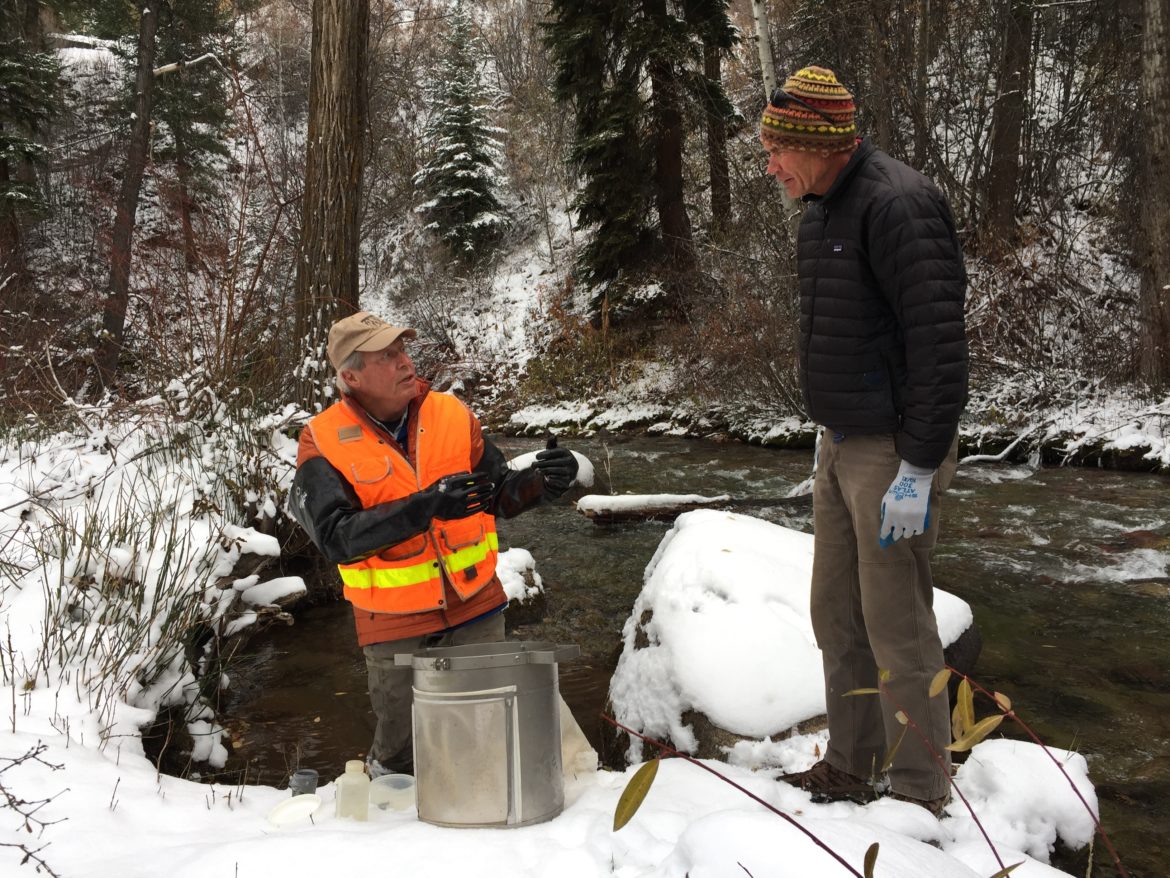
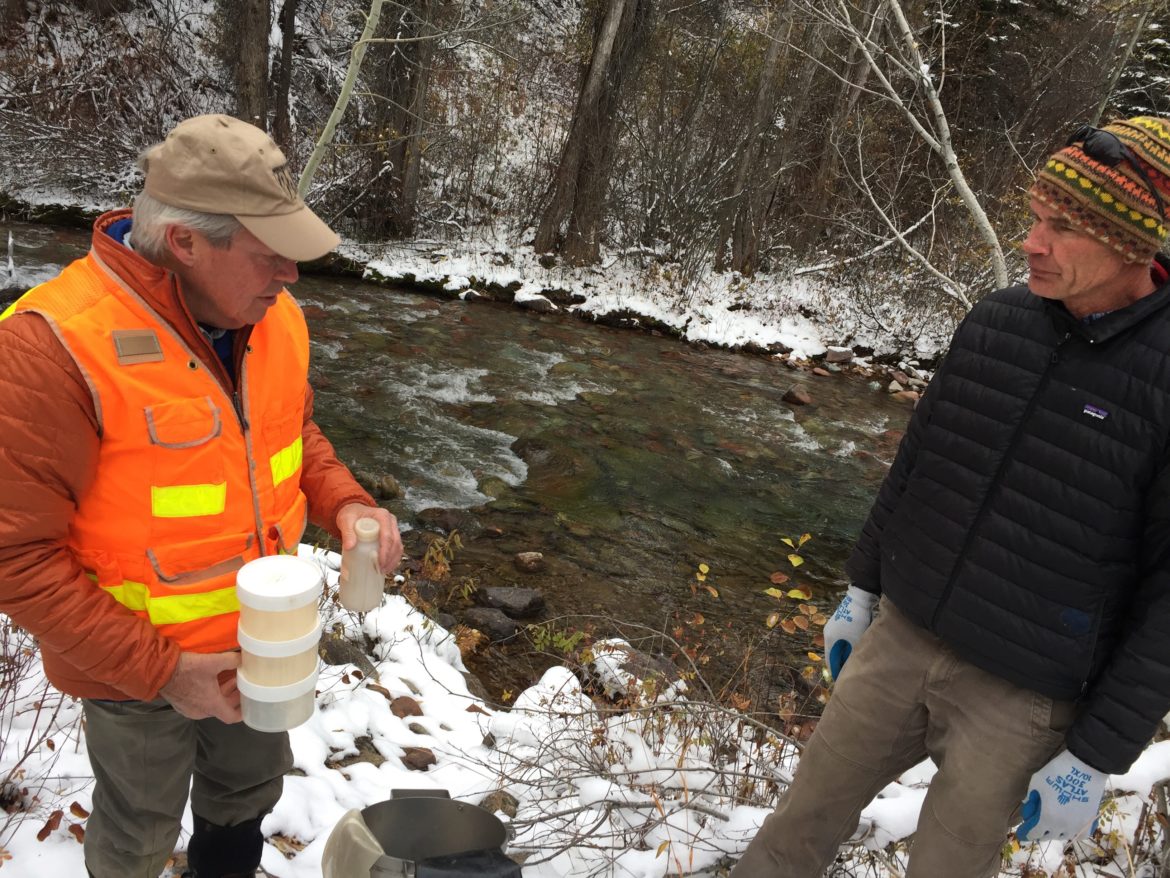
Aquatic ecologist Bill Miller, left, and chair of the Pitkin County Healthy Streams Board Andre Wille stand on the banks of Castle Creek as Miller prepares to take macro-invertebrate samples. The county hired Miller to collect baseline data to ensure increased snowmaking on Aspen Mountain won’t harm the health of the stream. Photo credit: Heather Sackett/Aspen Journalism
On a recent snowy morning, aquatic ecologist Bill Miller dipped what’s known as a Hess sampler into the frigid waters of Castle Creek near Aspen.
Miller stirred up the streambed with his hands, funneling the rocks, sediment and leaves — along with macro-invertebrates such as insects and worms — into the collection container.
After putting the organic material into smaller jars and giving each one a squirt of alcohol as a preservative, heferried them to a lab in Fort Collins. Scientists there will count the number and types of bugs in each sample.
“By the different species that are there, you can get a good indication of stream and water quality, and overall ecological function,” Miller said.
Miller’s work is part of a program that will monitor the health of Castle and Maroon creeks, ensuring that Aspen Skiing Co.’s increased water use for snowmaking on Aspen Mountain won’t harm the aquatic environment of the creeks. The stream-monitoring program was set out in September as a condition of Pitkin County’s approval of Skico’s Aspen Mountain Ski Area Master Plan.
“I think the idea of this is we don’t want the snowmaking to cause significant harm to the creeks,” said Andre Wille, chairman of Pitkin County Healthy Rivers board.
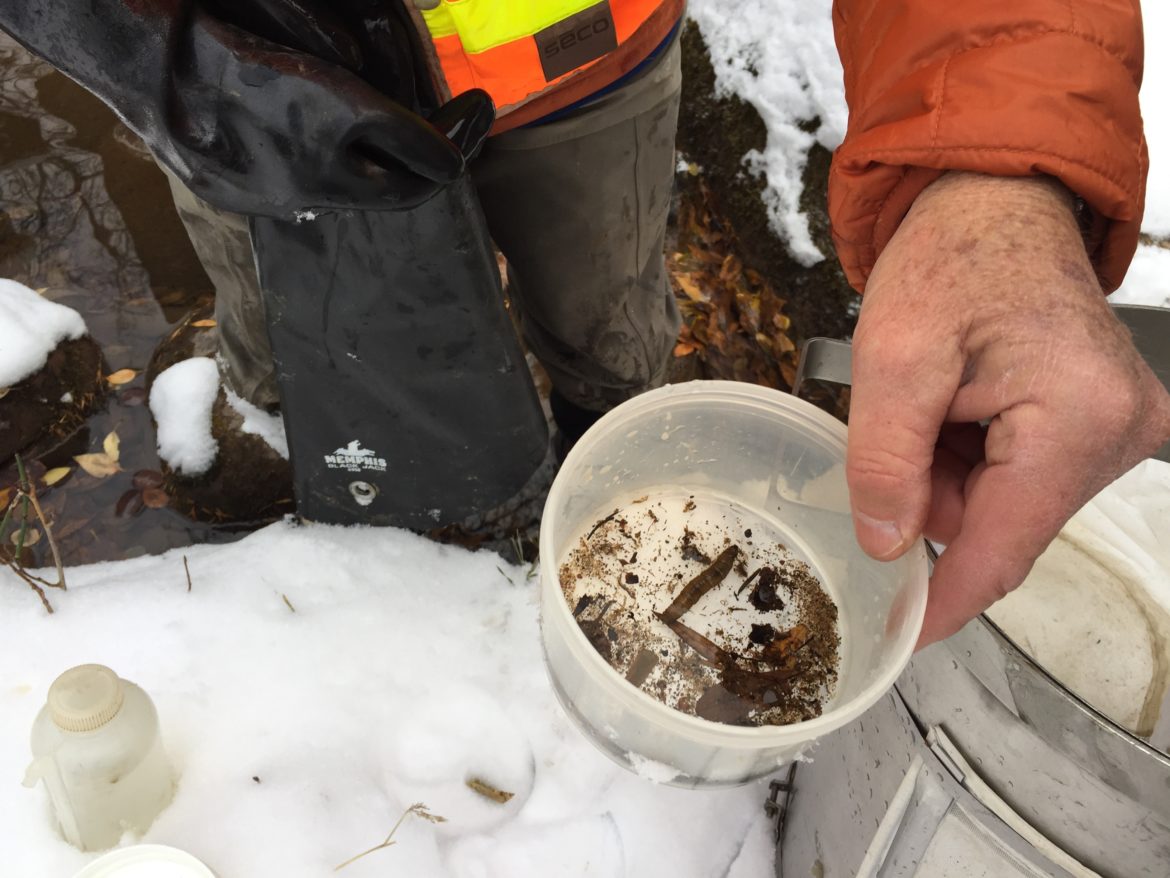
Aquatic ecologist Bill Miller shows the bugs and worms from Castle Creek that he collected with a Hess sampler. Starting in the 2020-21 season, Aspen Mountain will use an additional 57 acre-feet of water from city supplies, which come from Castle and Maroon creeks, for snowmaking per season. Photo credit: Heather Sackett/Aspen Journalism
Aspen Mountain expansion
As part of its planned expansion, Aspen Mountain will use an additional 57 acre-feet of water per season, bringing the total average snowmaking water use to roughly 257 acre-feet. For context, Wildcat Reservoir, which is visible from the Snowmass Ski Area, holds about 1,100 acre-feet of water.
Skico is expanding its snowmaking for the 2020-21 season on 53 acres near the summit of Aspen Mountain, which will make it easier to have reliable and consistent snow coverage to ensure a Thanksgiving opening. Skico draws its water for snowmaking on Aspen Mountain from the city’s treated municipal supply, which is from Castle and Maroon creeks.
When Skico makes snow in November and December, the upside is there are fewer municipal water users pulling from local streams — outdoor irrigation season is over and holiday crowds have yet to arrive —but snowmaking uses water when natural streamflows are at some of their lowest points of the year.
“We were definitely concerned with the possibility of too much water being taken out in those early months of the winter,” Wille said.
Miller collected samples from above and below the city’s diversion dams on both lower Castle and Maroon creeks. His samples will act as a baseline against which the condition of the streams in future — and perhaps drier — years will be measured.
According to the resolution approving Aspen Mountain’s master plan, if the county’s aquatic ecologist determines, in future years, that the additional water usage is having a negative effect on stream health, the county could limit Skico’s water use to historical levels — about 200 acre-feet a year.
Aquatic ecologist Bill Miller, left, shows chair of Pitkin County Healthy Streams Board Andre Wille the three samples of macro-invertebrates he collected from Castle Creek. Some say the instream flow water rights held by the Colorado Water Conservation Board don’t necessarily go far enough to protect stream health. Photo credit: Heather Sackett/Aspen Journalism
Instream flows
There is another safeguard to keep water in the river, but some say it may not go far enough to ensure stream health.
The Colorado Water Conservation Board, a state agency, holds instream-flow water rights on both Castle and Maroon creeks. And the state has determined that it requires at least 12 cubic feet per second of flowing water to protect the environment to “a reasonable degree” on lower Castle Creek and 14 cfs on lower Maroon Creek.
“We don’t feel it’s advisable to look at what the CWCB may have decreed in the past for a minimum instream flow,” said John Ely, Pitkin County attorney. “That’s not necessarily indicative from a scientific point of view of what is actually needed to maintain a healthy stream.”
That’s why the county hired Miller — who also is the longtime consulting biologist for the city of Aspen — to do its own assessment of stream health.
Ely said stream samples may not need to be taken every year — just in dry years when snowmaking could exacerbate already low flows. He estimated the annual cost of the monitoring program at about $5,000 to $10,000.
Jeff Hanle, Skico’s vice president of communications, said the company is taking steps to increase the efficiency of its on-mountain storage for snowmaking, such as adding two new ponds on Gent’s Ridge, so it won’t need to pull as much water from the city’s supply during the early season.
Although Skico and Pitkin County still need to work out the details of the stream-monitoring program, Hanle said the company is on board with preserving the ecological health of Castle and Maroon creeks.
“We would not make snow if it’s harming the stream, even if it could shorten a season,” he said. “We aren’t going to damage our home.”
Aspen Journalism collaborates with The Aspen Times and other Swift Communications newspapers on coverage of rivers and water. This story ran in the Nov. 11 edition of The Aspen Times.
Serene corner on the Yampa River. Photo: Brent Gardner-Smith/Aspen Journalism
From the Yampa/White Basin Roundtable (Gena Hinkemeyer) via The Craig Daily Press:
The Yampa-White-Green Basin Roundtable is one of nine basin roundtables in Colorado established to address the ever-increasing water challenges facing our state.
As part of its mission and to meet the Colorado Water Plan, the roundtable is developing an Integrated Water Management Plan for the Yampa River Basin that best represents the interests and needs of all water users. These interests include agricultural, recreational, environmental, municipal, industrial and water providers. The first phase of the Management Plan focuses on the Yampa River main stem and the Elk River basin.
In order to make the Management Plan a success, the roundtable seeks to provide the community with meaningful opportunities to participate and provide valuable input for the Management Plan. To do this, two subcommittees where formed — stakeholder and technical — to complete related tasks.
The stakeholder subcommittee is working to implement a community outreach program designed to listen and learn in an open communication process. This subcommittee will provide a forum for dialogue on water related issues for all water users, including agriculture, recreational, municipal and environmental aspects of a healthy river.
The technical subcommittee was formed to look at the science-based river health for each of the identified geographic segments. One of the many related tasks is working with a private engineering contractor to conduct 40 to 50 voluntary water diversion assessments within the Yampa River Basin.
The goal is to learn more about the diversion effectiveness and incorporated environment aspects at the diversion site. Ultimately, this may help identify water projects that have positive impacts for the water diversion and broader river health.
The Management Plan recognizes the importance of agriculture to the Yampa River Basin. One of the roundtable priorities is to protect and maintain agricultural water rights in the region in consideration of increasing water demands and water availability fluctuations. Another goal is to help identify potential funding for water infrastructures that have multiple benefits and are in need of improvement for interested and volunteering agricultural stakeholders.
Two segment coordinators, Gena Hinkemeyer and Jerry Albers, are working as contractors on this project to listen, learn and seek input from agricultural stakeholders. Hinkemeyer has lived in the Yampa Valley for most of her life and will be working in the lower and middle Yampa River regions. Albers has lived in Stagecoach for the last 15 years and will be working in the Upper Yampa and the Elk River Basin.
The coordinators will be reaching out to members of the agricultural community to better understand water related issues confronting agriculture and seek input on planning efforts. If you are interested and would like to learn more visit the Yampa-White-Green Basin Roundtable site at yampawhitegreen.com or contact Gena Hinkemeyer gena@yampawhitegreen.com.
The four-year-old Colorado Water Plan—the Centennial State’s proactive response to drought, flood, unpredictable water supplies, climate change, and a booming population that is likely to rise from 5.7 million today to nearly 9 million Coloradans in the next 30 years—is now guaranteed some of the annual $100 million needed to implement the plan. This month, Colorado voters narrowly approved Proposition DD to legalize sports betting (and a 10% tax on these casino revenues) which will result in an estimated $12 million to $29 million annually, the majority of which will go toward the Water Plan.
While we likely won’t see $29 million for the first several years, DD revenues bring Colorado’s first dedicated funding source to Water Plan implementation. The sports-betting tax money will flow into a new fund overseen by the Colorado Water Conservation Board. Revenues from DD are a drop in the bucket that renew every year, and represent a much-needed down payment toward the full $100 million per year for the Water Plan.
Revenues from DD could be used for a variety of Water Plan purposes including: stream and watershed management improvements, urban water conservation and efficiency, improved irrigation infrastructure for farms and ranches, and storage projects. At this point, it is not clear how the state will spend these dollars given the various priorities and the considerable funding gap. The language in DD was vague and will need refinement, and transparency. Stakeholders will likely explore options with the legislature to guide how DD funds are spent on Water Plan implementation.
Audubon will engage to advocate for spending that supports healthy rivers for the birds and people that depend on them—as we support a fully funded Water Plan. But even with the revenues DD will provide, additional dollars, heightened public awareness, and action will be critical to ensure healthy rivers—and the sustainable water future they enable for Colorado’s birds, economies, communities, recreation, agricultural heritage, and quality of life.
Audubon is proud to have supplied nearly 20 percent of the nearly 30,000 public comments that informed Colorado’s inaugural Water Plan, and Audubon will be there every step of the way through Water Plan implementation. Colorado cannot thrive unless its rivers do too.
Everything we love about Colorado is connected to water. We need your help in raising awareness about water and healthy rivers throughout Colorado. Spread the word. Join us as Audubon works across the state for a water-secure future for people and the environment.
The Colorado Farm Bureau, Colorado Cattlemens’ Association and most agriculture organizations are celebrating the measure approved by voters to allow sports betting in the state. But it’s not a cure-all for what ails us.
The Farm Bureau’s Shawn Martini says it was a given they would support Proposition DD, as it is a way to guarantee future funding for the state’s Water Plan. The Water Plan – a blueprint for ensuring stable water supplies in the years and decades to come.
Martini: “And thus far it has not been funded anywhere close to what it needs. That initial figure of about 100 million dollars a year we need to fully fund the state’s water plan. While this doesn’t get us up to a 100 million a year, it at least provides us a dedicated revenue stream of maybe even up to 30 million a year to help continue to implement and build the projects that are a key part of the state’s water plan.”
Martini says they are waiting to see how much the state legislature will add to the Water Plan funding on a yearly basis. But with the passage of Prop. DD there is now a dedicated stream of funding that will allow the state to begin to chip away at the backlog of projects that need to be done to fulfill the state’s future water supply.
DD will legalize sports betting in Colorado and create a 10 percent tax on casinos’ house winnings that would largely benefit the Water Plan. Colorado’s 33 casinos will be able to offer in-person and online wagering on professional, collegiate, motor and Olympic sports beginning in May 2020.
Urban areas and ski counties say yes to sports-betting, water initiative. Source: Colorado Secretary of State. Nov. 6, 2019 via Water Education Colorado
Colorado voters narrowly approved a new sports-betting tax whose proceeds will help fund water projects across the state, including conservation programs, stream restoration, and new reservoirs.
The vote is a major victory for the bi-partisan coalition that backed the measure and represents the first voter-approved effort to fund the four-year-old Colorado Water Plan.
The nail-biter margins, 1.5 percent at press time, provide a cautionary tale on how much support exists for water funding and how much more will be needed in the future, backers said.
“I was surprised. It was super close,” said Alec Garnett, D-Denver, the lead sponsor of the bill that referred Proposition DD, as it was known, to voters. “But it’s a reminder to everyone that Colorado is a fiscally conservative state.”
Proposition DD legalizes sports betting and imposes a 10 percent tax on casino revenue derived from this new form of gambling. A statewide map of the vote count showed voters on the Front Range and in ski counties, such as Eagle, Summit and Ouray, had the most enthusiasm for the measure, while rural counties on the West Slope and Eastern Plains rejected it.
Garnett said he was proud of the consensus on water demonstrated by the win, and the power of the bi-partisan coalition of politicians, environmentalists, water utilities, and agriculture groups that came together to back the campaign.
“Any legislator will say, ‘You’re electing me to go in to help solve problems and bring people together,’ and I’m proud of how we did that here,” he said.
The vote sends an important signal to lawmakers and others, according to political pollster Floyd Ciruli.
“There is no better conversation to have than a ballot issue. You get everyone’s attention. This vote shows people do believe water is important and that this is a good way to [fund] it,” Ciruli said.
Early on, Prop DD was barely showing up on voters’ radar, with early polls indicating little support. But a digital and TV ad campaign launched last month helped turn the tide, Ciruli said.
Sen. Jerry Sonnenberg, R-Sterling, opposed the measure and said he remains concerned that there isn’t enough transparency in how the money will be managed and that it is improper to use a so-called “sin tax” to pay for something as fundamental as water resources.
“Water is such an important issue we should pay for it out of the general fund or out of severance taxes,” Sonnenberg said, adding that he will continue to fight in the Legislature to ensure the money is used for the water plan.
Estimated to total between $12 million to $29 million annually, the sports-betting tax money will flow into a new fund overseen by the Colorado Water Conservation Board (CWCB). It could be used for a variety of purposes, including water-saving programs for cities and farms, habitat restoration programs, storage projects, land use planning, and environmental water supplies for water-short streams.
Since 2015, the CWCB has financed the water plan using income derived from severance taxes, the state’s general fund, and other sources. Those amounts have varied widely, with the state setting aside $30 million this year, up from $5 million in 2015, according to the CWCB.
Backers characterize DD as a valuable down payment on the water plan. Assuming the tax is able to eventually generate $29 million a year, that’s still less than one-third of the $100 million a year the state has previously estimated it will take to protect scarce water resources and to prevent future water shortages.
This year, another group emerged whose intent is to raise additional money for the water plan. For The Love of Colorado, backed by the Walton Family Foundation (also a funder of Fresh Water News) and the Gates Family Foundation, is preparing to run a large public awareness campaign about the critical nature of the state’s water challenges and the need for funding.
The group’s executive director, Tim Wohlgenant, said the close vote demonstrates how much more work is needed.
“It’s great that voters did this. But I need to emphasize it’s literally only a drop in the bucket. And even though it passed, it barely passed. We have more work to do.”
David Nickum, executive director of Colorado Trout Unlimited, said he hopes Prop DD will stimulate environmental and water conservation programs, much like Great Outdoors Colorado has. GOCO is the 1992 ballot initiative that has helped preserve hundreds of thousands of acres of historical ranches and open space across Colorado, protecting them from development. It is funded with state lottery proceeds.
“We’re pleased that Colorado voters are making a decision to invest in our resources, using the water plan as a road map for that,” Nickum said.
“Hopefully it will lead to a proliferation of projects, much like GOCO did,” he said.
Jerd Smith is editor of Fresh Water News. She can be reached at 720-398-6474, via email at jerd@wateredco.org or @jerd_smith.
From Western Resource Advocates (Jennifer Talhelm):
DD secures an important down payment for Colorado’s Water Plan, but full funding is still needed
Credit: Cattleman’s Ditches Pipeline Project II Montrose County, Colorado EIS via USBR.
A coalition of environmental and sportsmen groups today hailed passage of Colorado Proposition DD to help conserve and protect the state’s rivers and streams and drinking water. The coalition – which includes Conservation Colorado, Environmental Defense Fund, Trout Unlimited, Western Resource Advocates, American Rivers, Business for Water Stewardship, and the Colorado Water Trust issued the following joint statement:
“Passage of Proposition DD is a big win for Colorado and the quality of life we enjoy here. Taxing the revenue from legalized sports betting will create a dedicated down payment to help ensure that Colorado has healthy rivers and enough water for all. Still, it’s important to remember that this is just the first step toward addressing the growing gap between the water we have and the water we need.
“Four years ago, Coloradans came together to create Colorado’s Water Plan to protect all the things we love about our Colorado way of life – from healthy flowing rivers, to farming and ranching, and even beer. Our rivers contribute over $9 billion annually to the state’s economy, yet Colorado has not lined up adequate funding for the plan, despite overwhelming bipartisan support from across the state.
“Proposition DD will help generate a much-needed revenue stream to improve wildlife habitat, protect our agricultural heritage and the open spaces that come with it, and strengthen our economy. But the plan estimates the total need to be $100 million a year for the next 30 years, and we must keep working to ensure Colorado fully funds our water future.”
Proposition DD places a 10 percent tax on casinos’ profits from sports wagers, up to $29 million annually, and the majority of the revenue raised will go to implementing Colorado’s Water Plan. The annual funding is expected to be between $10 million and $15 million annually in the first few years.
It was a squeaker, but sports betting will be legal in Colorado beginning in May 2020.
Voters on Tuesday approved a ballot measure 51% to 49% to legalize and tax betting on certain professional and collegiate games at casinos and online, according to results from the Colorado secretary of state. The vote was too close to call until mid-afternoon Wednesday. The Associated Press called the race at 2:33 p.m.
Revenue from a 10% tax on the net proceeds companies make on sports betting will help pay for some of the state’s critical water needs. It is, in other words, a narrowly focused tax targeted for a widespread need.
The vote was far from the slam dunk many expected. While the success of its sister ballot measure, Prop CC, was always uncertain, Colorado voters have historically been more receptive to so-called sin taxes.
But the measure had critics on both sides of the political spectrum. For conservatives, the question about raising taxes may have been a non-starter. And for liberals, a regressive tax paid by gamblers, some of whom may struggle with addiction to gambling, perhaps was too problematic to support.
“This has always been a white-knuckles job,” said Josh Penry, a former Republican state Senator and political strategist who worked on the Prop DD campaign. “There is real skepticism. It’s not a traditional right-vs-left issue.”
More than 90% of that new tax revenue, estimated at an average of $16 million per year, and as much as $29 million, would help pay for managing the state’s dwindling water supplies. That tax revenue alone is not enough to meet the state’s water needs, but in the minds of most of its supporters, it represents the best shot yet to pay for the general projects outlined by the 2015 Colorado Water Plan.
“The Colorado Water Plan will have a permanent, dedicated funding source,” said Becky Mitchell, the director for the Colorado Water Conservation Board, in a statement. “Sports betting tax revenue for the Water Plan will support critical environmental, agriculture, and storage projects as well as promote outdoor recreation opportunities across the state.”
Coming up with the money to help better manage Colorado’s water supplies is seen as critical to maintaining the state agriculture and recreation industries and preserving healthy river ecosystems threatened by slow flows and warming waters. The estimated cost of implementing the water plan is $100 million a year.
Lawmakers have struggled to find that money. They pulled together nearly $30 million in one-time money for water projects and planning last session, a historic yet insufficient amount. Prop DD, which was referred to the ballot by state lawmakers, was seen as the best shot at getting at least some funding and getting it fast.
“This is not the best way to fund such an important need, but we have to take the opportunities that come to us,” said Scott Wasserman, the president of the Bell Policy Center, a left-leaning think tank.
Opponents had concerns about paying for the Colorado Water Plan because it calls for possibly damming rivers to build reservoirs. The margins of victory in Boulder and Larimer counties were tight, areas where projects to expand or build reservoirs are planned. The Water Plan also calls for lining irrigation ditches, upgrading flood gates and paying farmers to use less water.
The measure struggled despite a $2.4 million campaign to promote it. FanDuel Group, a New York City-based sports betting company, spent $1 million backing the measure, according to campaign finance records with the secretary of state. Other top donors include DraftKings, a Boston-based sports betting company, Twin River Casino Hotel from Rhode Island and the Colorado Gaming Association.
A coalition of environmental groups backed DD, including American Rivers, Business for Water Stewardship, Colorado Water Trust, Conservation Colorado, Environmental Defense Fund, Trout Unlimited, and Western Resource Advocates. The Colorado Farm Bureau also supported the measure.
Colorado already allows limited stakes gambling — under $100 — in the towns of Black Hawk, Central City and Cripple Creek. Some supporters saw Prop DD as a way to regulate underground sports betting.
“Black markets aren’t conservative and they aren’t good for Colorado. Bringing sports betting into the daylight, regulating it, and leveraging it for the benefit of our water future is a common-sense approach,” said House Minority Leader Patrick Neville, a Republican from Littleton, in a statement.
A wetland area along Homestake Creek. Photo credit: Brent Gardner-Smith/Aspen Journalism
From the Environmental Defense Fund (Brian Jackson):
Water in Colorado — one of the state’s most important natural resources — scored a major win today when voters approved Proposition DD. Prop. DD will provide up to $29 million a year for water projects from revenue raised by legalizing and taxing sports betting.
This funding will support critical projects to implement Colorado’s Water Plan and keep Colorado the state we know and love, with healthy rivers, clean drinking water, productive agriculture and abundant recreation.
EDF and EDF Action were key advocates for Prop. DD. We are thrilled voters approved the measure because it shows Coloradans across the political spectrum care deeply about building a more resilient future for our state.
Closing the water funding gap
Colorado’s Water Plan identified a funding gap of $100 million a year for 30 years to conserve and protect key elements of the state’s water system, including the environment, in the face of climate change and a growing population. Prop. DD will provide an impactful down payment to fill this funding gap.
Achieving voter approval of tax measures is always challenging, especially in Colorado, but EDF, EDF Action and our partners in the state worked hard to earn broad support for Prop. DD. Every major newspaper in Colorado endorsed it, and there was strong bipartisan support among state leaders and lawmakers who referred the measure to the ballot.
Uncommon partners rally around common-sense water solutions
The list of Prop. DD supporters was long and diverse, including the Colorado Cattlemen’s Association, Colorado Municipal League, Colorado River District, Colorado Farm Bureau, Denver Metro Chamber of Commerce, Conservation Colorado and Western Resource Advocates, among many others. Working side by side with some of these unlikely allies paves the way for more collaboration to deploy the funding to Colorado’s highest water priorities and best projects.
The success of Prop. DD clearly demonstrates to our state lawmakers that water is a priority issue for Coloradans, and we hope policymakers will continue to focus on ensuring our water system meets our state’s needs for decades to come.
We can’t wait to roll up our sleeves to help effectively implement Prop. DD and usher in this important new era for water funding and resilience in Colorado.
From the Colorado Cattlemen’s Ag Water NetWORK (Phil Brink) via The Fence Post:
The Colorado Water Plan includes twin goals of having 80 percent of the state’s critical watersheds covered by watershed management plans and 80 percent of the locally prioritized streams covered by stream management plans by 2030. Successful watershed and stream management planning involves people representing all local water interests, and that nearly always includes the agricultural community. Through ownership and leasing, agricultural producers control most of the water and land in Colorado. Agricultural input and cooperation is essential to achieving needed improvements in our streams and watersheds.
Irrigation water is a vital component of Colorado’s agricultural industry. Without it, crop and forage yields are dramatically lower. Colorado agricultural statistics indicate that an irrigated field of corn, for example, will produce almost three times more grain than a non-irrigated field of corn. Irrigation water is a big part of the reason Colorado agriculture contributes $41 billion to our state’s economy.
We often say that agriculture provides food, fiber and fuel, but Colorado agriculture accomplishes much more. It preserves open space and extraordinary vistas, provides wildlife habitat — including habitat for threatened and endangered species — and connects us with our agricultural heritage, helping to create a sense of place and community. Consider the farmer’s markets and Colorado-made foods and beverages we enjoy. Much of it would not be possible without irrigation water.
Agricultural producers want to engage on local water-related planning activities. Colorado Cattlemen’s Ag Water NetWORK’s 2019 state-wide survey of agricultural producers found almost one-fourth of respondents were “very interested” in participating (see chart). Eighty-eight percent of respondents said they were at least “somewhat interested” in getting involved in local watershed management planning efforts.
Like other stakeholders, agricultural producers have specific interests around water. Farmers need to utilize their water rights to grow crops and forage and to water livestock. For surface water users this means diverting water from rivers and streams and other surface water bodies and conveying it to fields for application.
The top three water-related challenges expressed by survey respondents were all irrigation-related (see chart below). Note that the survey allowed producers to select more than one challenge, so the percentages exceed 100 percent when totaled. Not having enough water (“amount of water”) was closely followed by water delivery infrastructure. These two challenges along with “water storage” — which was the fourth most frequently cited challenge — are often interrelated and addressing them can be capital intensive. Demand for grant and cost-share funding chronically exceeds available financial resources.
MULTI-BENEFIT
Through the watershed and/or stream management planning process, funding for irrigation water diversion and delivery infrastructure and source water protection can be obtained from a wider range of sources than is typically available to agriculture as long as projects are multi-benefit in nature. One example is the combination of stream channel and embankment improvements with a diversion dam replacement — which may also incorporate a fish passage that allows aquatic life to move past the diversion structure. Projects like these help wildlife, aquatic life, water quality and irrigators alike. Because this type of project benefits multiple uses, it can garner more funding and reduce the cost to irrigators.
The third greatest challenge cited by ag producers was irrigation efficiency. One of the benefits of watershed and stream management planning is that the process involves assessment and analysis of prioritized problems. This helps to ensure that solutions fix existing problems without creating unintended negative consequences. For example, how should individual farmers and ranchers best address irrigation ditch seepage and irrigation efficiency?
Increasing irrigation efficiency — like switching from flood irrigation to sprinkler — can reduce or even eliminate deep percolation of water as well as runoff from the edge of the field. Lining earthen ditches with concrete improves the delivery of water to fields by eliminating seepage. This can also improve water quality in streams by reducing the selenium and salinity content of seep water in areas where shale is near the surface.
However, leaky irrigation ditches also provide watering spots and seasonal wetlands — serving as an oasis for wildlife and birds in otherwise dry areas. Also, flood and furrow irrigated fields and meadows release water slowly back to streams and rivers later in the summer and fall, enhancing flows after snowmelt and summer rains have dwindled. This supplemental flow helps sustain fish and wildlife, and extends recreational use in some cases. So, a thorough evaluation of a canal or ditch system is crucial to understanding how to help agricultural producers and other stakeholders achieve multi-benefit solutions.
The ultimate goal of watershed and stream management planning is to implement actions that benefit watersheds and streams, as well as the stakeholders that use and rely upon them. Engaging agricultural producers and getting to know them and their water-related challenges will help achieve outcomes that benefit all stakeholders.
Click here to read the newsletter. Here’s an excerpt:
CO DEMAND MANAGEMENT GROUPS
The state-led work groups investigating feasibility and technical issues related to a potential program to trim upper basin demands on the Colorado River are continuing to meet. You can find the schedule of upcoming meetings and reports from past meetings here.
Although it went down in Montrose County, statewide, voters lifted Prop DD to victory; 712,405 yes, to 692,377 no, according to unofficial results from the Colorado Secretary of State.
The revenue from taxing sports betting, estimated at about $30 million, is to be used to implement the Colorado Water Plan — a drop in the bucket, so to speak, of the billions implementation is expected to cost over the next few decades.
The Colorado River District, which supported Prop DD, viewed it as help with a “downpayment” for plan implementation. The water plan is a longer range strategy to balance water supply against growing needs; its provisions include more infrastructure for water storage, as well as conservation methods.
State Rep. Marc Catlin, R-Montrose, who represents House District 58, and who also represents Montrose County on the river district, left the county courthouse Tuesday night assuming DD was going down in defeat; after an initially favorable showing, the “no” votes began to dominate. But, by early Wednesday, the final unofficial results showed a win.
“We kind of raised the profile of water, but it had to come on gambling. I think people voted against gambling, rather than against water,” Catlin said.
“Now it’s up to the state of Colorado, and me — all of us in the state that have anything to do with this. Now is the time for a good project to be picked up in rural Colorado.”
Although to Catlin, urban areas seemed to support DD more than did voters in rural areas, a need for such projects is on the Western Slope and other non-metro areas, he said, and it’s time for the state to “square up” by offering feasible projects that will assure water plan success.
“It certainly is not going to fix all issues Colorado has with water, but it does prime the pump. That doesn’t mean the Legislature can now ignore it. Now is the time we really take it on in the state,” Catlin said.
He acknowledged the money DD is supposed to raise will not come close to fully funding the water plan.
Colorado voters have narrowly passed a measure that will legalize sports betting and use the taxes raised to fund projects outlined in the Colorado Water Plan.
As votes trickled in Tuesday night, the measure remained too close to call; at some points, the margin was just a few hundred votes. But by Wednesday evening the “yes” votes had decisively pulled ahead.
The unofficial results from the Colorado Secretary of State website show that 50.81 percent of voters supported Proposition DD and 49.19 percent were against it — a difference of more than 23,000 votes.
Pitkin, Eagle and Summit counties passed the measure, with 61 percent, 59 percent and 58 percent of voters, respectively, supporting it. Fifty-two percent of voters in Garfield County voted against Proposition DD.
Beginning May 1, 2020, the state is authorized to collect a 10 percent tax up to $29 million (but probably closer to $15 million) a year from casino’s sports-betting proceeds. The money will go toward funding projects that align with the goals outlined in the water plan, as well as toward meeting interstate obligations such as the Colorado River Compact.
The funds would be administered by the Colorado Water Conservation Board, a statewide agency charged with managing Colorado’s water supply.
District 5 State Sen. Kerry Donovan, who was a sponsor of the legislation behind Proposition DD, said going into Election Day she wasn’t sure whether it would pass. With Colorado’s growing population and the looming threat of climate change, the Western Slope will see an increasingly large burden when it comes to water supply, she said.
“As a rancher and a Western Slope native, I am really excited the state has decided to invest in the future of water in Colorado,” she said.
Wolford Mountain Reservoir. An aerial view of Wolford Reservoir, formed by Ritschard Dam. The Colorado Water Plan outlines many different types of projects, including reservoirs and dams, that need funding.
Water Plan funding
Funding the water plan could mean a number of things. Outlined in a 567-page policy document, the water plan does not prescribe or endorse specific projects, but, instead, sets Colorado’s water values, goals and measurable objectives. According to the water plan, there is an estimated funding gap of $100 million per year over 30 years, but CWCB officials have said that number is an estimate and not precise.
Some of the projects outlined in the water plan stand in opposition to one another — for example, stream-restoration projects with an emphasis on environmental health and building or expanding dams and reservoirs that would divert and impound more Colorado River water.
CWCB director Becky Mitchell highlighted that the money could indeed go toward many different types of projects.
“I think the most exciting thing for us is that we will have a more permanent pool of funding and it will support all types of projects,” Mitchell said. “So, whether it’s a watershed health or agricultural project or storage project or recreational project, the benefit of a more permanent source of funding is to have secure funding for all types of projects.”
In addition to being distributed in the form of water-plan grants, the revenue could also be spent to ensure compliance with interstate compacts and to pay water users for temporary and voluntary reductions in consumptive use. That could mean a demand-management program — the feasibility of which the state is currently studying — in which agricultural water users would be paid to leave more water in the river.
Pitkin County is using this irrigation system to grow potatoes for vodka on county open space land. The state is exploring how a voluntary, temporary and compensated water-use reduction plan, known as demand management, could incentivize irrigators to leave more water in the river. Photo credit: Brent Gardner-Smith/Aspen Journalism
Broad support
The measure had received broad support from environmental organizations, agriculture interests, water-conservation districts and even Aspen Skiing Company.
Glenwood Springs-based Colorado River Water Conservation District also supported Proposition DD. While the estimated $15 million a year is a good start, river district community affairs director Jim Pokrandt stressed it’s not enough to implement all the projects outlined in the water plan.
“What this does is creates a funding stream,” he said. “And it’s really only a down payment. What we don’t want to see is the other funding streams diminish because everybody will say ‘Oh, you got (Proposition DD).’”
Although there wasn’t much organized opposition to Proposition DD, the measure asked voters to consider three complex topics in one question: a new tax, legalizing sports betting and funding the water plan.
Political Action Committee Yes on Proposition DD spent more than $2.3 million, which came mostly from casino and gaming interests, on its campaign. The only registered group in opposition was small-scale issue committee Coloradans for Climate Justice, which argued that fossil-fuel companies should pay for the damage to water-supply systems caused by climate change.
Editor’s note: Aspen Journalism collaborates with The Aspen Times and other Swift Communications newspapers on coverage of rivers and water. This story appeared in the Times Nov. 6 edition.
From email from the Colorado Water Conservation Board (Sara Leonard):
Colorado voters have officially passed ballot measure Prop DD (50.71% Yes to 49.29% No), which will legalize sports betting in the state and create a tax of 10% on proceeds to fund the Colorado Water Plan Grant Program.
Official statement from Colorado Water Conservation Board Director Rebecca Mitchell:
“Thanks to Colorado voters’ approval of Proposition DD, the Colorado Water Plan will have a permanent, dedicated funding source. Sports betting tax revenue for the Water Plan will support critical environmental, agriculture, and storage projects as well as promote outdoor recreation opportunities across the state.”
The South Platte River runs by a utility plant near I-25 in Denver.
It took until Wednesday afternoon, but Colorado’s Water Plan is getting a significant financial boost.
Proposition DD, the statutory measure that institutes a 10%, $29 million tax on recently legalized casino sports betting, was still too close to call Tuesday night, but by Wednesday afternoon around 2:30 p.m., the ayes had it. DD won a 50.7% approval with about 12% of the vote left to count.
A yes vote means the water plan, a multi-faceted, highly complex living document that seeks to implement measures to conserve and protect Colorado’s precious water resources, would receive some much-needed funding.
Proposition DD received broad bi-partisan support across the state, from the Colorado Farm Bureau and the Colorado Cattlemen’s Association to Democratic and Republican legislators and environmental groups.
But there were detractors. Some Weld County farmers felt the water plan left them out, and at least one local state senator, Jerry Sonnenberg, didn’t feel gamblers should have to pay for a tax that benefited all Coloradans.
Proponents admitted that the water plan isn’t perfect, and that there are some crucial compromises made in the implementation, but said that the nature of its construction, which uses local roundtables to build and develop the plan for the sake of each distinct basin in the state, is the best way to achieve the kind of broad and dynamic action needed to save the resource in the growing state long-term.
Bill Jerke, a former Weld County commissioner and former statehouse representative, has said that Proposition DD is a win for bipartisanship. Cattlemen’s Association executive vice president Terry Frankhauser invited those concerned to get involved.
It was a nail-biter, but Proposition DD has passed, ushering in the state’s first legal sports bets.
Colorado has joined 19 other states in jumping on the bandwagon after the U.S. Supreme Court threw out the near-nationwide ban on sports gambling in 2018…
Where do the taxes for sports gambling go?
Casinos will essentially pay a 10 percent tax on profits from sports gambling wagers. That is expected to raise about $15 million annually by the second full year of taking wagers. The bulk of the collections will go to the Colorado Water Plan, a long list of projects agreed to by lawmakers to help prepare for future population growth and make the state more resilient to climate change. It’s not a lot of tax revenue, but advocates say it’s a start to handling some of the $3 billion shortfall for the plan. Some of the money will also go to behavioral health services and addiction hotlines for gamblers.
View along Main Street in early Montrose (between 1905 and 1915). Shows a horse-drawn carriage, bicycles, and two men talking. Signs include: “The Humphries Mercantile Co. Dry Goods, Clothing, Hats & Shoes” “Montrose National Bank” and C. J. Getz, Pharmacist, Druggist.” via http://photoswest.org
While there is always noise from the Front Range about water, and there is always concern about a Front Range run on Western Slope water, Coram is less concerned about that than he is a threat from the other direction, specifically downstream on the Colorado River and the Rio Grande.
“I am not as worried about the Front Range, I am more nervous about the possibility that people will use fear (about drought) and Colorado will try to cut deals with the Lower Colorado Basin states,” Coram says. “But the water here doesn’t belong to the state, it belongs to the people. The people (who own the rights) need to be involved.”
The Colorado Water Plan is five years old. Is it functional?
“No,” says Coram. “And it won’t until it retains sustainable funding.”
The Colorado Water Plan names any number of sources for funding within the pages of the plan. One of the main sources should be the severance tax. Colorado severance tax is imposed on nonrenewable natural resources that are removed from the earth in Colorado. The tax is calculated on the gross income from oil and gas and carbon dioxide production. Anyone who receives taxable income from oil or gas produced in Colorado pays the tax.
“Water is supposed to get severance tax funds,” says Coram. “But the governor and legislators always seem to find other needs for the money. In the good years, some senator or assemblyman gets a good idea and they rob money from the severance tax.”
At this point in history Coram says the state legislature owes $300 million to the Water Plan. When the subject comes up in the halls of the Capitol, Coram says that since it appears that when water comes out of the tap, nobody seems to really care about the Water Plan funding.
Water from the Roaring Fork River basin heading east out of the end of the Twin Lakes Tunnel (June 2016), which is operated by the Twin Lakes Reservoir and Canal Co., a member of the Front Range Water Council. The FRWC recently declined to meet with members of a Colorado Basin Roundtable group about demand management. Photo: Brent Gardner-Smith/Aspen Journalism
The state of Colorado’s investigation into the feasibility of a demand-management program has spawned the spinoff of several additional groups to study the issue, underscoring persistent tensions between the Western Slope and Front Range water managers.
In June, the Colorado Water Conservation Board named 74 people — most of them experts in their fields — to nine workgroups charged with helping the state study whether a water-use reduction plan is right for Colorado. Now, some roundtables and conservation districts are forming their own grassroots stakeholder groups to study demand management outside of the state’s formal process.
One of those is the Colorado River Basin Roundtable. The stakeholder group, chaired by Kirsten Kurath, who is general counsel for the Grand Valley Water Users Association, invited Front Range water providers to an informal meeting on Monday to discuss demand management and address some assumptions about the contentious topic.
Although representatives from Northern Water and Aurora Water initially accepted the invitation, a subsequent letter from the Front Range Water Council made it clear that Front Range water interests were circling the wagons and closing ranks. The FRWC is an ad-hoc group made up of representatives from Front Range urban water providers.
In a letter signed by FRWC chair and Denver Water CEO James Lochhead, the group declined Kurath’s invitation to the meeting.
“We feel it is best at this point not to have ‘official’ side meetings regarding demand management and what a demand management process/program may look like because, particularly with press present, such conversations may lead to confusion and may undermine the state process,” the letter reads.
“It seemed like a great opportunity as part of our workgroup to invite folks from the Front Range Water Council and chat with them about what we are thinking about demand management,” Kurath said. “We do need to work at relationship-building between these historically adverse parties.”
This field is irrigated with water from the Roaring Fork River, under a senior water right. Some on the Western Slope worry that water savings from a water-use-reduction plan known as demand management could fall disproportionately to the agriculture sector. Photo credit: Brent Gardner-Smith/Aspen Journalism
Contentious topic
So, why is demand management a touchy subject that highlights tensions between Colorado’s West Slope and Front Range? It may be because some in Western Slope agriculture worry that Front Range water providers, backed by a reliable pot of money from their rate-paying customers, can simply pay ranchers to fallow fields without having to reduce their own water consumption. Some Western Slope agricultural water users have voiced concerns about how to create a demand-management program that reduces water use equitably across all sectors, not just agriculture.
On top of that, some fear that if fields are no longer producing crops, a cascade of unintended consequences for the local economy could be the result. The Colorado River Water Conservation District and the Southwestern Water Conservation District are studying the secondary economic impacts of demand management.
“What are the economic impacts should someone decide not to grow a crop?” said Frank Kugel, executive director of the Durango-based Southwestern Water Conservation District. “What about the tractor-supply store, the feed stores, the restaurants and the workers that work on those farms?”
Adding to the controversial nature of demand management is Colorado’s social and cultural backdrop. At the heart of a demand-management program is a reduction in water use on a temporary, voluntary and compensated basis in an effort to send as much as 500,000 acre-feet of water downstream to Lake Powell to bolster water levels in the giant reservoir and, indirectly, to meet Colorado River Compact obligations. Under such a program, ranchers and farmers could get paid to leave more water in the river.
But Andy Mueller, general manager of the CRWCD, said the concept of intentionally saving water goes against the age-old Western water adage of “Use it or lose it.” Some irrigators believe their water right, which is seen as a property right, could be considered abandoned if they don’t use their entire share of the water all the time, although it is rare in Colorado for this aspect of the law to be enforced by the state.
“We are asking people to change 150 years of cultural, family, political traditions,” Mueller said. “What we need to do in the water-policy world is help provide people with security and confidence they are not unintentionally damaging themselves for the future and that they are protected and have economic certainty.”
To this end, the river district also is forming a demand-management stakeholder group of its own. Mueller said the goal is to convene a group of roughly 30 water users to figure out how their interests would be protected if a demand-management plan is implemented.
“It’s a really critical thing for our actual water users to be driving the train because they know how their farms work,” Mueller said. “If you get ideas from them, they are much more likely to work in the long run.”
The Government Highline Canal, near Grand Junction, delivers water from the Colorado River, and is managed by the Grand Valley Water Users Association. Representatives from the Grand Valley Water Users Association invited members of the Front Range Water Council to discuss demand management, but the FRWC declined. Photo credit: Brent Gardner-Smith/Aspen Journalism
Water from ag?
Although some might assume that the easiest way to save a large amount of water in a demand-management program is to take it from Western Slope agriculture, Front Range water providers say that isn’t the case. Lochhead said that Denver Water would participate in a demand-management program along with everyone else using “wet water,” not just by throwing money at the problem.
Brad Wind, general manager of Northern Water, agreed that water savings solely from Western Slope agriculture isn’t the solution.
“I get the impression from some West Slope entities … that they think the whole burden of demand management is going to come on the backs of the West Slope,” he said, “and honestly, I don’t think anybody on the Front Range Water Council is saying that.”
These were some of the issues Kurath was hoping to clear up in a meeting with her stakeholder group and Front Range water providers.
“We just wanted to explore that with folks,” she said. “It was a real disappointment to me to have them decide they didn’t want to participate.”
Editor’s note: Aspen Journalism collaborates with the Aspen Times and other Swift Communications newspapers on coverage of rivers and water. This story ran in the Oct. 30 edition of the Times.
In 2016, the CWCB launched an update and upgrade of the state’s supply and demand projection data and tools underpinning Colorado’s Water Plan. The process has come to be known as the Analysis and Technical Update to Colorado’s Water Plan (or simply, Technical Update, formerly “SWSI”). This statewide supply study serves two primary purposes to: (1) provide a consistent statewide framework for examining future water supply and demand under different scenarios and (2) provide tools and data for Basin Roundtables to update their Basin Implementation Plans and develop detailed local solutions to supply and demand gaps.
The July 2019 CWCB Board and IBCC joint meeting marked the preliminary release of the Techincal Update. The final report was presented to the Board September 2019. The full July presentation was recorded and remains available for viewing on the CWCB YouTube channel.
The 2019 Technical Update replaces the document known as the Statewide Water Supply Initiative 2010 (SWSI).
The broad priorities of the Colorado Water Plan as put forward by Becky Mitchell in a June 20, 2017 presentation to three Front Range roundtables. The slide reflects the competing priorities in Colorado when it comes to water and rivers.
Glen Canyon Dam on the Colorado River in April 2017. The dam is 15 miles upstream from Lees Ferry, Arizona. Photo by Alexander Stephens/courtesy Bureau of Reclamation.
Republicans worry the process has been too ‘secretive’ and could hurt the agriculture industry
by John Herrick, The Colorado Independent October 29, 2019
Colorado lawmakers want a greater say in how the state manages its Colorado River water supplies.
The legislative Water Resources Review Committee has endorsed a bill proposal that requires the Colorado Water Conservation Board (CWCB) to consider the committee’s feedback before finalizing a plan to slash the state’s water use in order to send more of it downstream. The Republican-backed proposal won bipartisan support last week from all 10 committee members.
Overuse and climate change is causing a decline in the flow of the Colorado River, which 40 million people, not to mention a major agricultural industry, depend on. The seven states that share Colorado River water supplies are working to ensure enough water makes it downstream to satisfy legal obligations under the 1922 Colorado River Water Compact.
Here in Colorado, water managers are creating a so-called “demand management” plan to reduce the amount of water siphoned off from the river so that more can be stored in Arizona’s Lake Powell and sent downstream during dry years.
But where that water will come from is yet to be decided and figuring it out has been controversial from the start. The water cuts are intended to be equitable, but agriculture accounts for more than 80% of the state’s water use and part of the state’s demand management plan will include paying farmers to irrigate less. Lawmakers worry land will be leased and permanently taken offline for farming, a process dubbed “lease and cease.”
“A lot of us that are still out there running a shovel are concerned that we are going to have to change the way we live so that people that just run a sprinkler head and try to grow more sidewalks in town don’t have to change theirs,” said Rep. Marc Catlin, a Republican from Montrose, during a committee hearing last week.
Volunteers are no longer required to sign non-disclosure agreements. The tension over the plan is illustrative of a much larger and longer tug-of-war between the executive and the state legislature over how to manage the state’s water supplies in the coming years. GOP Sen. Don Coram, a Republican from Montrose, was visibly steamed at last week’s meeting and his distrust resulted in the drafting of a bill that explicitly requires the CWCB to gather public feedback before coming up with a plan. The proposed bill also requires the Water Resources Review Committee to tour the state and gather feedback on CWCB’s draft of a plan.
“We have to develop trust among the general public. And when we started hearing early on (about) non-disclosure agreements and everything else, it kinda reminded me of … the Colorado Water Plan. It was called the ‘governor’s water plan,'” Coram told the committee. He continued, “It is imperative that the general public be involved in this most important process.”
Water managers are concerned such involvement could slow down critical and urgent multi-state negotiations. Arizona lawmakers almost derailed a major agreement on how to share water cuts earlier this year. A deal was struck just hours before the Bureau of Reclamation said it would step in an issue mandatory water cuts.
James Eklund, a former CWCB director who represented Colorado on the Upper Colorado River Commission during last year’s drought negotiations, said climate change is forcing managers to act more swiftly. Efforts by lawmakers to gather more public input, he told The Colorado Independent, could make acting quickly more difficult.
“If there’s another 2002- or 2003-type drought this year or next year, the [demand management] program is going need to be stood up very quickly,” Eklund said. “It’s hard for me to see that happening if you’re scheduling outreach meetings.”
CWCB Director Mitchell was not available for comment. The CWCB declined to comment on how the proposed bill would affect drought contingency planning. Sara Leonard, the marketing and communications director for the CWCB, said the board recognizes the importance of public comments and is committed to stakeholder engagement.
Coram dismissed concerns his bill will slow down multi-state negotiations. “Bullshit,” he responded. He told The Colorado Independent the process fits within the timelines already suggested by the CWCB. There is no hard deadline for finalizing the demand management program. The CWCB plans to issue a status update in July 2020.
The committee also approved a bill that would make it harder to speculate on the state’s water supplies — buying up water rights with the intention of selling them at a profit later — and another dealing with new technologies.
The proposed bills still require committee approval, a vote in the House and Senate, and the signature of Gov. Jared Polis. The legislative session begins Jan. 8.
Niche ag, along the Yampa River. Photo: Brent Gardner-Smith/Aspen Journalism
From the Community Agriculture Alliance (Patrick Stanko and Mark Williams) via Steamboat Today:
The Yampa-White-Green Basin Roundtable is one of nine basin roundtables in Colorado established to address the ever-increasing water challenges facing our state.
As part of its mission and to meet the Colorado Water Plan, the roundtable is developing an Integrated Water Management Plan for the Yampa River Basin that best represents the interests and needs of all water users. These interests include agricultural, recreational, environmental, municipal, industrial and water providers. The first phase of the Management Plan focuses on the Yampa River main stem and the Elk River basin.
In order to make the Management Plan a success, the roundtable seeks to provide the community with meaningful opportunities to participate and provide valuable input for the Management Plan. To do this, two subcommittees where formed — stakeholder and technical — to complete related tasks.
The stakeholder subcommittee is working to implement a community outreach program designed to listen and learn in an open communication process. This subcommittee will provide a forum for dialogue on water related issues for all water users, including agriculture, recreational, municipal and environmental aspects of a healthy river.
The technical subcommittee was formed to look at the science-based river health for each of the identified geographic segments. One of the many related tasks is working with a private engineering contractor to conduct 40 to 50 voluntary water diversion assessments within the Yampa River Basin.
The goal is to learn more about the diversion effectiveness and incorporated environment aspects at the diversion site. Ultimately, this may help identify water projects that have positive impacts for the water diversion and broader river health.
The Management Plan recognizes the importance of agriculture to the Yampa River Basin. One of the roundtable priorities is to protect and maintain agricultural water rights in the region in consideration of increasing water demands and water availability fluctuations. Another goal is to help identify potential funding for water infrastructures that have multiple benefits and are in need of improvement for interested and volunteering agricultural stakeholders.
Two segment coordinators, Gena Hinkemeyer and Jerry Albers, are working as contractors on this project to listen, learn and seek input from agricultural stakeholders. Hinkemeyer has lived in the Yampa Valley for most of her life and will be working in the lower and middle Yampa River regions. Albers has lived in Stagecoach for the last 15 years and will be working in the Upper Yampa and the Elk River Basin.
We will be reaching out to members of the agricultural community to better understand water related issues confronting agriculture and seek input on planning efforts. If you are interested and would like to learn more visit the Yampa-White-Green Basin Roundtable site at http://yampawhitegreen.com.
Patrick Stanko and Mark Williams are with the Community Agriculture Alliance.
Here’s an interview with Becky Mitchell Director of the Colorado Water Conservation Board, from Abby Burk, that’s running on the Audubon Rockies website:
Interview with Becky Mitchell, director of the Colorado Water Conservation Board and Colorado commissioner on the Upper Colorado River Commission.
Rebecca Mitchell was named to the Colorado Water Conservation Board on July 5, 2017. Photo credit the Colorado Independent.
October 1st kicked off the new water year. This is when water managers and water wonks focus on existing water supplies and precipitation predictions. Water years run from October 1st through the following September 30th, and Water Year 2020 is poised to be one we will all be talking about for years to come. During it, we’ll see the start of discussions around the agreement that needs to be reached in 2026 to replace the Colorado River Interim Operating Guidelines, further investigation of a potential Upper Colorado River Basin demand management program after the adoption of the Drought Contingency Plans in 2019, and the launch of the first update to Colorado’s Water Plan. It’s a dynamic time for both Colorado River and Colorado water management!
Abby Burk, western rivers regional program manager for Audubon Rockies, reached out to Becky Mitchell—director of the Colorado Water Conservation Board (CWCB) and Colorado commissioner on the Upper Colorado River Commission—to ask six key questions and learn how she’s leading Colorado through these water milestone moments.
Q: Water is such a broad issue that connects all of us. Colorado’s Water Plan, completed in 2015, is four years old. What have been the plan’s successes and challenges? What is your most celebrated Water Plan implementation project?
A: At the CWCB, we work every day to implement the Water Plan, and because of that, I would call the plan’s biggest success its ability to bring all of the important projects and programs that the agency does into better focus with a cohesive whole. In fact, far beyond the CWCB, the Water Plan continually helps to unite countless efforts occurring throughout the state at every level of the public, private, and nongovernmental sphere. While it will always be an ongoing and iterative process, the concrete goals and objectives of the Water Plan have really helped to motivate our community to collectively address our (many) water challenges, which include maintaining momentum, coordinating efforts at every level, and continually funding the innovative and effective projects.
While it’s hard to pick just one example of a celebrated project, the first one that comes to mind is the Homestake Arkansas River Diversion Project. Currently under construction, this project is managed by the City of Aurora and Colorado Springs Utilities to improve the reliability of a major aging diversion structure while at the same time removing the last critical barrier to boat and fish passage on the Upper Arkansas River and restoring important habitat. The CWCB contributed $700,000 to help fund the project, along with funding from Colorado Parks and Wildlife, various other project supporters, and donated easements from the Pueblo Board of Water Works, totaling $7.7 million.
Q: Water is a critical issue for all Coloradans. Whether you play in/around our world class rivers, irrigate your crops, or take a sip of our abundant clean drinking water, our valuable and limited water supply impacts each of us every day. How will the Water Plan keep pace with a growing Colorado and protect what makes Colorado so special: our rivers?
A: From day one, the Water Plan has been a living document. The plan is fundamentally a broad ongoing effort to collectively meet our state’s evolving water challenges in the most effective and mutually beneficial ways. To keep pace with a growing Colorado, Chapter 11 of the plan sets the process for continually refreshing the plan. We have now unified all of the Water Plan components into three main pillars: the main Water Plan (the primary policy document), the Basin Implementation Plans (the local application of the plan), and the Analysis and Tech Update (the plan’s technical foundation). In summer 2019, we finalized the Tech Update and are now updating the Basin Implementation Plans and the Water Plan to support the Tech Update.
A critical aspect of all of these efforts is protecting our special rivers. The Tech Update included the development of an environmental flow tool to help interpret how potential future stream conditions may change, and how to plan for those impacts. We hope this tool and the wealth of other data in the Tech Update will better inform local efforts to address environmental needs, starting with updated analyses in the Basin Implementation Plans.
Q: This is an exciting time for Colorado River water management with the passage of the Drought Contingency Plan (DCP) and the ramp up to the renegotiation of the 2007 interim guidelines in 2026. Considering the DCP, how are you leading Colorado’s place in exploring a possible demand management program? How is Colorado working with other Upper Basin states in looking at options for demand management?
A: The CWCB has taken two major policy actions regarding a potential demand management program. First, the board passed a support and policy statement back in November, 2018. This statement took into account public comments, stakeholder and water user concerns, as well as board guidance and support for the draft DCPs. This was aimed at guiding the assessment of demand management feasibility.
The board also adopted the 2019 Work Plan in March of this year. This Work Plan represents the first steps toward assessing demand management feasibility as identified in the support and policy statement. The Work Plan tasks CWCB with setting up workgroups to help identify priority issues regarding demand management and holding public regional workshops to garner input and discussion. It also directs the legal, technical, and policy investigations that will inform the Board’s next moves in determining whether a demand management program is appropriate for Colorado.
We communicate regularly with our Upper Basin state partners on their own intrastate efforts to assess demand management feasibility, who are all engaged in similar processes within their borders. As the intrastate investigations continue, the Upper Basin states will share information through the auspices of the Upper Colorado River Commission and their committees to further assess the feasibility of demand management across borders and throughout the Upper Basin.
Q: We have to acknowledge that storage is a part of our water portfolio future. However, none of us have an appetite for big new reservoirs. What are ways that storage can be leveraged for fulfilling the growing needs of water certainty while still supporting Colorado’s healthy rivers?
A: Without sufficient water storage, the vast majority of our current population could not live in this environment; and with a growing population, we will very likely need some additional storage. However, we also need to more effectively manage our existing infrastructure to support healthy rivers.
Examples of this include iterative efforts to re-operate the Ruedi and Chatfield Reservoirs to meet multiple needs, and in the case of Chatfield, to increase storage without raising the dam. Another example is the South Platte Regional Opportunities Water Group, which is currently conducting a feasibility study to examine aquifer storage and recharge, off channel reservoirs, and storage of municipal reuse water, among other things.
Q: What’s your message for people who care about Colorado’s rivers, and the birds and wildlife they support? How will the state take care of its rivers as climate change increases the frequency and intensity of droughts?
A: The takeaway message here is healthy rivers are vital to Colorado’s conservation efforts and quality of life, and the CWCB is committed to maintaining those stream flows for all fish and wildlife that depend on them as well as for the enjoyment of our outdoor recreationists.
More specifically, the CWCB works with partners on appropriating new instream flow water rights to maintain stream flows that support Colorado’s fish, birds, and wildlife and the food and habitat that they need. Particularly in dry years, we work with the Colorado Water Trust, other nonprofit organizations, and water rights owners on leases and other mechanisms for providing and protecting stream flows.
The Tomichi Water Conservation Program involves regional coordination between six water users on lower Tomichi Creek to reduce consumptive use on irrigated meadows as a watershed drought management tool. The project will use water supply as a trigger for water conservation measures during one year in the three-year period. During implementation, participating water users would cease irrigation during dry months. Water not diverted will improve environmental and recreational flows through the Tomichi State Wildlife Area and be available to water users below the project area. Photo credit: Business for Water.
In last year’s example of the Coats Brothers Ditch temporary lease on Tomichi Creek, the ditch owners used the water right for irrigation until July 1, when the CWCB started using it for the Tomichi Creek instream flow water right. This lease provided approximately 202 acre-feet of water to the stream during low flow conditions while providing an economic benefit to the ditch owners. This type of flexible tool is very effective at addressing low flow conditions.
In the face of climate change, which we know will present unique challenges to protecting our rivers and streams, we are committed to finding ways to address those challenges, including working with groups who have identified needs and opportunities in their stream management plans to implement additional stream protection.
Q: What is the one thing that gives you the most hope about where we are heading with water in Colorado?
A: We have engaged stakeholders who care deeply about maintaining the Colorado way of life and the values in the Colorado Water Plan. These stakeholders work with the CWCB, the basin roundtables and communities every day to collaboratively plan for our future and implement projects that drive the Colorado Water Plan forward. These efforts forge partnerships, remove barriers, inspire new generations and encourage a spirit of cooperation that is so important to building multi-purpose, multi-benefit initiatives that meet multiple water needs for farms, urban communities and the environment.
For the Water Plan to be successful, we need to balance all of these needs. Our stakeholders are the lifeblood of Colorado water planning and they serve as a shining example of what public engagement can accomplish.
Click here to read the newsletter. Here’s an excerpt:
Funding opportunities in the Gunnison River Basin
Funding opportunities for water projects that help improve and conserve water and land resources can be found on http://gunnisonriverbasin.org, including:
US Department of Agriculture federal grants and loans
Colorado Water Conservation Board state grants and loans
Additional Grant Funding Opportunities
Click here to view a table of grand funding opportunities.
Upper Gunnison watershed May 2019. Photo credit: Greg Hobbs
Here’s the release from the Southeastern Colorado Water Conservancy District (Chris Woodka):
District Supports Sports Betting for Water Projects
The Southeastern Colorado Water Conservancy District Board of Directors [September 17, 2019] voted to support a measure that would allow sports betting in Colorado as a revenue source for water projects.
Proposition DD would provide money for water projects by collecting a tax of 10 percent on net proceeds from sports betting operations at casinos in Central City, Black Hawk and Cripple Creek. Proponents say this could amount to $10 million to $16 million annually. The money would be part of the funding package for Colorado’s Water Plan.
“It ties into the water plan, but would be just one of the methods to generate revenues,” said Alan Hamel, a member of the Southeastern board.
The board voted 10-3 to support Proposition DD.
The water plan calls for $3 billion in new revenue for water projects over a 30-year period beginning in 2020.
Proposition DD was placed on the Nov. 5 ballot as a referendum by the Colorado General Assembly under HB1327.
The Southeastern District is the sponsor for one of the state’s largest pending water projects, the Arkansas Valley Conduit, a pipeline project that will provide clean drinking water to 50,000 people in 40 communities east of Pueblo. The Bureau of Reclamation estimates the AVC will cost $600 million, of which 35 percent will be paid by sources within Colorado.
A coalition of agricultural groups announced their support [October 13, 2019] for Proposition DD, which asks voters this fall to tax casinos’ sports-betting profits to help conserve and protect the state’s water supplies.
The coalition includes the Colorado Association of Wheat Growers, the Colorado Cattlemen’s Association, the Colorado Corn Growers Association, Colorado Dairy Farmers, the Colorado Farm Bureau, Colorado Pork Producers, and the Rocky Mountain Farmers Union…
“The Farm Bureau and farmers across Colorado are proud to support Proposition DD. Most farmers and ranchers could care less about sports betting. But this is a smart way to pay for the critical water infrastructure that Colorado’s future needs,” said Chad Vorthmann, Executive Vice President of the Colorado Farm Bureau.
“With dedicated funding through Proposition DD, we can ensure that Colorado’s Water Plan is implemented to secure a water future for the benefit of our businesses, our communities and our rivers and streams,” said Brad Erker, Executive Director of the Colorado Wheat Growers.
“This measure is an important step to ensuring adequate water supplies for agriculture amid our state’s growing population,” said David Eckhardt, Colorado farmer, and President of the Colorado Corn Growers Association.
“The common denominator linking all of agriculture in Colorado is water. Colorado’s dairy farmers support Proposition DD because it will provide funding for critical water projects in our state helping to ensure we maximize the use of this precious natural resource,” said Chris Craft, Chairman of the Board of the Colorado Dairy Farmers.
“We’re pleased to endorse Proposition DD, which is a dedicated funding stream for water storage and conservation in Colorado in the face of increased population and growing demands for this limited resource,” said Joyce Kelly, Executive Director of the Colorado Pork Producers.
A view of the headgate on the Robinson Ditch and the boulder structure in the Roaring Fork River that maintains the grade of the river so water can reach the headgate. Pitkin County has received a water-plan grant to help repair the diversion structure and improve boating passage. Photo credit: Brent Gardner-Smith/Aspen Journalism
Click here to read the newsletter. Here’s an excerpt:
Leaders Across the 9 Colorado Basins Collaborate on Water Plan in Winter Park
On September 25 – 26, the Colorado Water Conservation Board (CWCB) hosted a statewide summit of Colorado’s nine basin roundtables (the C-9 Summit) at the Headwaters Center in Winter Park, which brought together over 200 water stakeholders to discuss the process for updating each basins’ implementation plans and, ultimately, the Colorado Water Plan.
CWCB recently released the Analysis and Technical Update to the Colorado Water Plan (Technical Update), which includes state of the art approaches to analyzing state water needs and includes impacts from climate change. The C-9 Summit provided a forum for sharing Technical Update findings and highlighting key goals for the upcoming Basin Implementation Plans.
Prior to the panel presentations and discussions, the CWCB organized three water project tours for attendees, which featured Fraser River enhancements, watershed health research in the Experimental Forest, and an innovative education and outreach exhibit called the Headwaters Center River Journey.
Additionally, the C-9 Summit served as a platform to present Basin Water Hero Awards to peer-nominated individuals who have shown continued commitment for water initiatives in their basins. Congratulations to the following winners:
Arkansas: Chelsey Nutter, Colorado: Paul Bruchez, Gunnison: Julie Nania, Metro: Emily Hunt, North Platte: Kent Crowder, Rio Grande: Emma Reesor, South Platte: Mike Shimmin, Southwest: Mike Preston, Yampa-White-Green: Jackie Brown
The Colorado River near the Colorado/Utah state line. Proposition DD could allocate tax revenue to a demand management program with the aim of leaving more water in the river. Photo credit: Brent Gardner-Smith/Aspen Journalism
Proposition DD’s supporters — including environmental organizations, agriculture interests, conservation districts and Aspen Skiing Co. — say the measure will be used to close a $3 billion state funding gap in implementing the Colorado Water Plan. The frequently cited figure of a $100 million annual shortfall for 30 years is written in the water plan itself.
But where did the authors of the water plan get this number and what kinds of projects and programs might the measure fund? According to the legislation, money raised from Prop DD could go toward an agricultural water-use reduction program that doesn’t yet exist.
In the following explainer, Aspen Journalism unpacks the ballot question, which will be posed to voters Nov. 5, and what the tax revenue may actually end up funding.
The Colorado River in fall light. Proposition DD allows for tax revenue raised through sports betting to fund a future demand management program, which would pay agricultural water users to leave more water in the river. Photo credit: Brent Gardner-Smith/Aspen Journalism
How will Proposition DD work?
Gov. Jared Polis signed House Bill 19-1327 into law in May. But voters must still pass Proposition DD for it to take effect.
According to the 2019 State Ballot Information Booklet, Proposition DD would authorize the state to collect a 10% tax up to $29 million a year (but the projected average amount is $16 million) from casinos’ sports-betting proceeds. The Colorado Division of Gaming and the Colorado Limited Gaming Control Commission will be responsible for regulating sports betting operations.
Of the money raised, a projected $130,000 would go to gambling addiction services and $960,000 would go into a “hold harmless” fund. Entities that receive tax revenue from traditional gambling such as horse racing could apply for funding from the hold harmless fund if they can prove they lost money due to the legalization of sports betting.
The remaining projected average annual $14.9 million (but up to $27.2 million) in tax revenue would go to funding projects that align with the goals outlined in the water plan, as well as toward meeting interstate obligations such as the Colorado River Compact. Under the compact, the Upper Basin states, which include Colorado, must deliver 7.5 million acre-feet of water annually to Lake Powell.
If voters pass Proposition DD, it will take effect May 1.
The orange machine is a combine used to harvest grains. The yellow machine in front is a land plane used to level fields, clarification via Larry Vickerman. Photo credit: Brent Gardner-Smity/Aspen Journalism
What does the legislation say?
The legislation creates a special Water Plan Implementation Cash Fund, which would be administered by the Colorado Water Conservation Board, a statewide agency charged with managing Colorado’s water supply. The money could be spent on water-plan grants, but may also be spent “to ensure compliance with interstate water allocation compacts … including … compensation to water users for temporary and voluntary reductions in consumptive use.”
A hayfield near Grand Junction, irrigated with water from the Colorado River. Under demand management pilot programs, the state could pay irrigators to fallow fields in an effort to leave more water in the river. Photo credit: Brent Gardner-Smith/Aspen Journalism
What is demand management?
At the heart of a demand-management program is a reduction in water use by agriculture on a voluntary, temporary and compensated basis, all in an effort to send up to 500,000 acre-feet of water downstream to bolster water levels in Lake Powell to meet potential obligations under the Colorado River Compact. Under pilot programs the state could pay ranchers and farmers to leave more water in the river.
District 5 State Sen. Kerry Donovan, whose district includes Aspen and who was a sponsor of the bill, acknowledged that as Colorado gets a handle on demand management, money from Proposition DD could go toward funding a future program.
“Most water experts would say demand management in some form will be part of addressing the Colorado River Compact obligations,” Donovan said. “Maybe in five years, maybe in the next generation, but somewhere in the long-term planning strategy of the Colorado River, demand management will be part of the puzzle.”
District 5 State Sen. Kerry Donovan, left, speaks on a panel with other lawmakers at the Colorado Water Congress legislative session in Steamboat Springs in August. Donovan asked water managers for their support of Proposition DD, which would fund water projects grants and, potentially, a demand management program. Photo credit: Heather Sackett/Aspen Journalism
At the behest of then-Gov. John Hickenlooper, water managers from across Colorado collaboratively created the water plan, which was unveiled in 2015. The plan, which is more of a policy document, says Colorado faces a looming water “gap” across all sectors — municipal, industrial, agriculture, recreation and environment — because of the state’s growing population and increasing water demands.
The 567-page plan does not prescribe or endorse specific projects but instead sets Colorado’s water values, goals and measurable objectives, which are set out in a critical action plan. For example, the plan sets a measurable objective of storing an additional 400,000 acre-feet of water in reservoirs by 2050 and covering 80% of local rivers with stream-management plans by 2030, but it does not say how water managers should go about doing this.
The Colorado Water Conservation Board, after unveiling the Colorado Water Plan in Denver in November 2015. Revenue from Prop DD could go toward funding water plan grants. Photo credit: Colorado River District
What about water plan grants?
According to the legislation, revenue from Proposition DD will also go toward water-plan grants. Local water managers apply to the CWCB’s Water Plan Grant Program to fund projects that advance critical actions laid out in the water plan from the following categories: agricultural, engagement and innovation, environmental and recreation, water conservation and land-use planning, or water storage and supply.
Water-plan grants are a 50% matching grant, meaning that the local entities applying for the grant must match from their own coffers the amount they are requesting in state funds.
For fiscal year 2019-20, $10 million will be available for the Water Plan Grant Program. Funding from Proposition DD could add roughly $15 million a year to this grant program.
Many of the projects that the water-plan grants fund come from each of the nine basin roundtables’ Basin Implementation Plans. The BIPs identify how each basin’s water needs will be met through existing or new projects, policies and processes. But many of the local water projects included in the BIPs don’t specify how much funding is needed to implement them and many roundtables’ projects lists have only partial and inconsistent information.
For example, 14 of the 31 top projects outlined in the Colorado BIP have “TBD” in the Funding Needs column.
“In the Basin Implementation Plans, some of those projects are pretty rough and it was a best guess at the time with limited information,” said CWCB Deputy Director Lauren Ris.
Roundtables will soon embark on an update to their BIPs, with the goal of refining project details, including cost.
A view of the headgate on the Robinson Ditch and the boulder structure in the Roaring Fork River that maintains the grade of the river so water can reach the headgate. Pitkin County has received a water-plan grant to help repair the diversion structure and improve boating passage. Photo credit: Brent Gardner-Smith/Aspen Journalism
What is the funding gap?
According to the water plan, there is an estimated funding gap of $100 million per year over 30 years. These figures, according to Ris, came from data in the 2010 Statewide Water Supply Initiative. That technical analysis found that Colorado needed $20 billion worth of water projects to meet the water supply gap by 2050. Of that $20 billion, $17 billion is expected to be paid for by existing funding sources, including rate payers of water utilities and federal money.
The state is investigating options to fund the remaining $3 billion gap. Proposition DD is one of these options. But the $3 billion figure, based on decade-old data, is not precise.
“($100 million per year over 30 years) was an estimate,” Ris said. “I don’t think it was ever really intended to be an exact figure. It’s more to say, we know there’s going to be a big need and we will work to refine that estimate going forward … We are just trying to point out it’s an expensive endeavor going forward.”
Supporters of Proposition DD say they realize that the estimated $15 million raised per year is still a far cry from the estimated $100 million needed per year, instead calling the money a “down payment” on implementing the water plan.
The 2015 Colorado Water Plan, on a shelf, at the CU law library. Photo: Brent Gardner-Smith/Aspen Journalism
Who is endorsing Proposition DD?
Proposition DD has received broad endorsement from environmental groups such as Conservation Colorado and American Rivers, agriculture organizations such as the Colorado Cattlemen’s Association and the Colorado Corn Growers Association, and several chambers of commerce.
Matt Rice of American Rivers said his organization is endorsing the measure because it wants to see some projects fully funded, including stream-management plans, urban water-conservation programs and modernization of agriculture irrigation infrastructure.
Rice said American Rivers “unabashedly and unequivocally” supports a demand-management program in Colorado, which Proposition DD could help fund.
“We deeply believe a demand-management program needs to be one of the tools that we have in our toolbox as we plan for water scarcity or prolonged drought because of climate change,” Rice said.
A river project, partially funded by the CWCB on the Arkansas River at Granite. The project was removing a river-wide diversion structure and replacing it with a new diversion structure that will allow unimpeded boating through Granite. Photo credit: Brent Gardner-Smith/Aspen Journalism
Who is opposed to Proposition DD?
Environmental group Save the Colorado and the political action committee Coloradans for Climate Justice oppose the measure. According to the Coloradans for Climate Justice Facebook page, the group believes fossil fuel companies should pay for the damage to water-supply systems caused by climate change. So far, the group has not filed any reports for contributions or expenditures.
The Colorado River in fall near Loma. Proposition DD could allocate tax revenue to a demand management program with the aim of leaving more water in the river. Photo credit: Brent Gardner-Smith/Aspen Journalism
Who is funding Proposition DD?
Despite broad support from many organizations, the political action committee Yes on Prop DD is funded primarily by the gambling industry. According to filings with the Secretary of State, as of Sept. 30, casinos and online sports betting organizations have spent nearly $1 million to support the measure. The Colorado Farm Bureau and the Environmental Defense Fund have contributed $10,000 each.
Editor’s note: Aspen Journalism is collaborating with The Aspen Times, Vail Daily, Summit Daily, Glenwood Springs Post-Independent and other Swift Communications newspapers on coverage of water and rivers. This story appeared in the Oct. 10, 2019 edition of the above papers or on their websites.
Here’s the September 2019 Drought Update from the Colorado Water Conservation Board and Colorado Division of Water Resources (Ben Wade, Tracy Kosloff):
August and September to date have both been warm, although the water year as a whole is the coldest since 2010. Above normal temperatures are predicted to continue in October. Recent months have also been dry although for the water year as a whole, precipitation ranges from average to above average statewide. The North American monsoon season was disappointing in Colorado and other parts of the Southwestern U.S. The monsoon season sometimes results in beneficial rainfall for Colorado, particularly in the southern portion of the state.
The map of Snotel precipitation for the last 90 days (June 27- September 24) compared to the average for that time period shows how dry the summer has been in Colorado’s mountain areas.
Colorado Drought Monitor October 1, 2019.
● The weak El Niño has officially ended in favor of neutral conditions. The long term ENSO forecasts are trending toward neutral conditions remaining through the winter.
● Reservoir storage across the state (as of the end of August) is 116% of average and 70% of capacity. At this time last year, statewide reservoir storage was at 82% of average.
● According to the U.S. Drought Monitor, released September 24, D0, abnormally dry, and D1, moderate drought, now cover 66 percent of Colorado.
● Water providers reported their systems are in good shape but water demand was high in August and September and they hope for beneficial moisture over the winter to avoid high demand next spring before runoff has refilled storage supplies.
Here’s a guest column that’s running in the Colorado Springs Gazette:
Proposition DD isn’t a tax increase on citizens or most businesses. DD requires that casinos pay a tax on the profits from sports betting in a similar way they pay taxes on other casino earnings. It allows Colorado Mountain Casinos to offer sports betting, which is something they aren’t able to participate in.
In 1992, Congress gave Las Vegas a monopoly on sports betting, through an ill-conceived measure in an omnibus package. Thankfully, the Supreme Court overturned this ridiculous law, last year, in the case of Murphy v. The National Collegiate Athletic Association. Justice Alito wrote in the majority opinion that the regulation of sports betting should be left to the states. Our response to this opportunity: Proposition DD.
Proposition DD authorizes operating mountain casinos to offer sports betting, so Las Vegas doesn’t maintain their monopoly. It also allows for a small tax on these same casinos’ profits. The revenue from this tax goes to regulation costs, gambling addiction services, and the Colorado Water Plan.
While Colorado’s population continues to explode, competition for water is reaching a fevered pitch. It’s time for Colorado to take action to preserve the future of our water. Proposition DD will address water infrastructure needs.
Proposition DD would provide an estimated $29 million in funding to expand reservoirs, invest in water quality, manage watersheds decimated by wildfires, and protect access to flowing rivers and streams for fishermen and rafters. Conservatives and citizens who recognize the importance of water to the future of our great state — should vote yes.
DD will provide the funding necessary to protect Colorado’s water. It addresses core challenges like the need for water infrastructure with targeted approaches that do not increase taxes on the general public. By doing this, we keep the pressure for new taxes off the taxpayers in our great state.
Colorado must seek ways to address infrastructure needs without resorting to major tax hikes or the weakening of your Taxpayer Bill of Rights. There is zero need to resort to these measures to fix Colorado’s infrastructure needs. That is why Proposition DD is a reasonable proposal that engages our needs while maintaining low taxes.
Sports betting would be a new enterprise for Colorado, but Proposition DD would limit this enterprise to existing casinos and gambling establishments. It is a modest approach to the gambling industry, while still being viable enough to address our state’s obligations. If the voters approve Proposition DD in November, it is a win for agriculture, a win for the environment, and a win for all Coloradoans.
That’s why, as conservative Republicans, we are proud to join the Colorado Cattlemen’s Association, the Farm Bureau, the Colorado Dairy Farmers, the Colorado River Water Conservation District, the Colorado Water Trust, Club 20, Action 22, the Grand Junction, Rangeley, and Denver Chambers, and dozens of key water leaders in rural, urban and suburban Colorado in supporting Proposition DD.
The following Colorado legislators contributed to this column: Senate: John Cooke, Owen Hill, Rob Woodward, Don Coram. House: Patrick Neville, Mark Catlin, Matt Soper, Janice Rich, Dave Williams, Kevin Van Winkle, Rod Pelton, Shane Sandridge, Colin Larson.
Coloradoans are being asked to decide two statewide ballot issues this fall, and we encourage voters to approve both measures, which have garnered widespread bipartisan support.
Proposition CC
Proposition CC proposes to eliminate the state’s revenue cap and reallocate that excess revenue to fund transportation and education. It is not a new tax but instead, would allow the state to retain tax revenue rather than refunding it back to taxpayers. The retained revenue would be equally divided and specifically spent on public schools, higher education and transportation projects.
The proposition mandates that the third of the revenue earmarked for transportation be divided between the Colorado Department of Transportation, counties and cities. According to Steamboat Springs City Council member Kathi Meyer, who serves on the executive board of the Colorado Municipal League, which has endorsed Proposition CC, Steamboat and Routt County stand to gain millions of dollars in revenue that can be spent on local roads and bridges during years when there is a Taxpayers Bill of Rights — or TABOR — excess.
In addition to helping to fund Colorado’s crumbling transportation infrastructure, Proposition CC would also boost funding for education, which we think is crucial to the future of our state, which currently ranks in the bottom third of the nation when it comes to per-pupil funding at the K-12 level.
Proposition CC also requires an annual audit of funding, which ensures transparency and allows taxpayers to know exactly how money is being spent.
We realize that Proposition CC is a De-Brucing at the state level, but we believe TABOR needs to be addressed due to the unintended consequences it has had on the state’s ability to fund core services. Proposition CC provides a mechanism to address TABOR’s flaws, and that is one of the reasons why we believe it deserves voter support.
Proposition DD
With broad support from across the state and at the capitol, Proposition DD seems like a no-brainer. The proposition is asking voters to legalize casino sports betting and tax profits to fund the Colorado Water Plan, and we think the measure deserves a resounding “yes” vote.
DD, if approved, will provide a dedicated, predictable revenue stream to help address Colorado’s future water needs. Funding from DD will help keep water in rural Colorado through the support of projects that are prioritized by the state’s various basin roundtables. And with the Yampa River flowing through downtown Steamboat, our communities know first-hand how important water and water quality are to recreation and our local agriculture community.
Sports betting is going to happen whether DD is approved or not, and we believe it’s smart for Colorado to tax it and use that revenue to fund water projects. The proposition also will create a regulated betting market as opposed to the black market, and a small portion of the revenue will be used to support resources to combat gambling addiction — an amount that was established with input from key stakeholders.
Supporters of Proposition DD offer a great analogy for how they believe the proposition will impact Colorado. They think DD will do for water what Great Outdoors Colorado, funded by the Colorado Lottery, did for open space across the state.
DD won’t provide the $20 billion needed to meet all of Colorado’s water demands, but it does create a significant down payment that can be leveraged in a big way.
Ninety percent of the revenue will be placed in a cash fund for Colorado Water Plan implementation. This fund will support the allocation of grants to support projects that focus on water storage, supply, water conservation, land use, agriculture, the environment and recreational uses, which all have the potential to positively affect our local community.
A screenshot from the website for Colorado’s Water Plan.
The group Yes on Proposition DD said the coalition of ag interests in support includes the Colorado Association of Wheat Growers, the Colorado Cattlemen’s Association, the Colorado Corn Growers Association, Colorado Dairy Farmers, the Colorado Farm Bureau, Colorado Pork Producers and the Rocky Mountain Farmers Union…
“Most farmers and ranchers could care less about sports betting. But this is a smart way to pay for the critical water infrastructure that Colorado’s future needs,” Chad Vorthmann, the executive vice president of the Colorado Farm Bureau, said in a statement.
The broad priorities of the Colorado Water Plan as put forward by Becky Mitchell in a June 20, 2017 presentation to three Front Range roundtables. The slide reflects the competing priorities in Colorado when it comes to water and rivers.
With just weeks left before the Nov. 5 election, a proposal that would legalize sports betting in casinos, then use the proceeds to help pay for water infrastructure and environmental programs, has yet to win widespread recognition from the public.
Backers say that could change this week with the launch of a wave of television ads touting Proposition DD, as the sports betting proposal is known.
As of Sept. 17, Yes on Proposition DD had raised more than $433,000, according to filings at the Colorado Secretary of State’s office. It is money that analysts said could be enough to push it to a successful vote in November. The funds came from some Central City casinos, a New York-based gaming company, FanDuel, and the Environmental Defense Fund, among others.
But much work remains to be done to educate voters on what the measure would accomplish, backers said.
“It’s not a slam dunk,” said Colorado House Majority Leader Alec Garnett, D-Denver, who was a sponsor of the bill that referred the measure to the ballot so that voters could weigh in. “There’s a lot on the line here.”
As written, DD would impose a 10 percent tax on sports betting in casinos and dedicate the tax revenue to helping fund the Colorado Water Plan, launched at the end of 2015. Initial estimates by the legislature indicate DD could raise $10 million to $20 million a year to go toward implementing the water plan. The money would flow into a new fund overseen by the Colorado Water Conservation Board (CWCB). It could be used for a variety of purposes, including water-saving programs for cities and farms, habitat restoration programs, storage projects, and legal and planning work.
Since 2015, the CWCB has financed the water plan using income derived from severance taxes, the state’s general fund and other sources. Those amounts have varied widely, with the state setting aside $30 million this year, up from $5 million in 2015, according to the CWCB.
Even as lawmakers were sending Proposition DD to the ballot, another group, For the Love of Colorado, was examining ways to secure even more funding for water projects. It hopes to sponsor a second statewide ballot initiative in future years, say in 2020 or 2021, that would raise far more than DD will generate.
They look at DD as a sort of down payment on the $3 billion in additional funding the state has previously estimated it needs to fully implement the water plan between now and 2050, including projects to protect streams and rivers even as new water supply projects are developed to meet looming shortages.
“Tax measures are really hard in Colorado,” said Brian Jackson, a western water specialist with the Environmental Defense Fund and a key architect of DD. “They all die, even for things people care deeply about — roads, children, education. But DD is an opportunity that couldn’t be missed, so we’re not missing it. It’s a good down payment. But we have a lot of hard work to do.”
Key among the tasks backers must accomplish is to clarify, despite ballot language that describes a statewide increase in taxes, that the measure would actually raise taxes only on casinos who implement sports betting programs, Garnett said.
Polls conducted last month in Adams County by pollster and political analyst Floyd Ciruli showed 40 percent of likely Adams County voters supported the measure, with 42 percent opposing it and 18 percent undecided.
Gary Wockner, founder of Save the Colorado, is chair of the issue committee opposing DD. In an email, Wockner said his group would battle any effort that raises money for environmentally damaging water projects.
“We oppose DD because it would pay for new river-destroying dams and diversions,” Wockner said in an email. Coloradans for Climate Justice, as the anti-DD campaign is known, also states on its Facebook page that it sees DD as a tax on Coloradans to pay for damage caused by climate change on the state’s river systems, and that “if taxes are to be raised, they should be raised on entities which caused climate change, principally the fossil fuel corporations.”
Ciruli and others said that Coloradans for Climate Justice will have difficulty defeating DD without cash to launch a statewide opposition movement. The committee had not raised any money according to its last finance filing. Wockner did not respond to a question regarding his committee’s fundraising to date.
With campaign coffers full, DD could get a yes from Coloradans, Ciruli said.
“The public, over the years, has demonstrated that water is very valued and the water plan itself was popular,” Ciruli said. “Right now, beyond extreme environmental interests, [DD] isn’t generating much opposition. It could be a good sell.”
Jerd Smith is editor of Fresh Water News. She can be reached at 720-398-6474, via email at jerd@wateredco.org.
The river district, which represents 15 western Colorado counties, including Montrose, recently announced its board backs Proposition DD. The ballot proposition would both legalize sports betting in the state and direct most of the revenue from it to implementing the water plan, including a possible water-demand management program to address the multi-state Colorado River Compact.
Prop DD also places a 10-percent tax on net proceeds of casinos that offer sports betting…
As described by the river district, revenues from sports betting could then be used for Water Plan Implementation Grants that fund water projects in: agriculture; conservation and land use; water supply and infrastructure; engagement and innovation and environmental and recreation. The revenues could also be used to ensure compliance with interstate water compacts.
Prop DD is estimated to bring in between $10 and $15 million per year — falling well short of the estimated $100 billion annual funding gap for water plan implementation.
Despite the focus on water in these DD spots, money for the campaign is barely trickling in from water-industry stakeholders. Instead, 97.5 percent of the $403,000 donated to the Yes on Proposition DD campaign in the first eleven days of September has come from the gaming industry, though betting is largely an afterthought in these commercials…
The Proposition DD ballot question reads: “Shall state taxes be increased by twenty-nine million dollars annually to fund state water projects and commitments and to pay for the regulation of sports betting through licensed casinos by authorizing a tax on sports betting of ten percent of net sports betting proceeds, and to impose the tax on persons licensed to conduct sports betting?”
Asked why the ads focus on the water plan, Hubbard says that the commercials are designed to help make up for what he considers confusing wording on the ballot proposal. “One of the challenges we’ve seen is that it’s unclear if you just read the ballot language that this is a tax that casinos pay and that the vast majority of the money raised goes to fund Colorado’s water plan. That’s what we’re trying to highlight for people,” Hubbard notes.
Although the ballot language may be a bit convoluted, it’s clear where the Yes on Proposition DD campaign money is coming from.
Dangling money, the developers at Renewable Water Resources — which counts former Gov. Bill Owens as a principal — contend that because the urban Front Range is the richest part of the state, it has the potential to give the most to the poorest.
They envision pumping 22,000 acre-feet per year from 14 wells drilled 2,000 feet deep at the foot of the Sangre de Cristo mountains, building a pipeline costing $250 million to $600 million, and then pumping water at least 40 miles northward over Poncha Pass toward Front Range cities.
“We need between 300,000 acre-feet and 500,000 acre-feet of new water for the Front Range. The question is: Where’s that going to come from?” said Sean Tonner, managing partner of Renewable Water Resources.
“We can take it out of the Colorado River, but we know what the stresses are there. The Poudre River? The Arkansas? The South Platte is already the most over-appropriated river. Folks are looking at moving water from the Mississippi River back to Colorado,” he said. “These are the lengths people are looking to for adding water.”
Exporting San Luis Valley water would be “fairly easy” compared with other options, Tonner said…
The San Luis Valley retort? “There is no win-win,” said Cleave Simpson, manager of the Rio Grande Water Conservation District and a farmer, who has been traveling statewide to make the case against this trans-basin diversion of water…
The intensifying water battle here reflects the rising tensions and inequities across the arid western United States, where water and control over water looms as a primary factor of power. Thirsty Castle Rock, Parker, Castle Pines and other south metro Denver suburbs, where household incomes top $110,000 and development has depleted the groundwater, can marshal assets that dwarf those of farmers in the San Luis Valley, where families’ average income is less than $35,000…
State officials in Denver say they will study Renewable Water Resources’ proposal once the developers file it at the state water court in Alamosa.
“We’ll have to have a perspective of being open to anything,” said Colorado Department of Natural Resources director Dan Gibbs, declining to take a position…
A Renewable Water Resources diagram provided to The Denver Post presented details of a water-siphon project that would begin near Moffat on a company-owned ranch with 14 wells spaced 1 mile apart. A pipeline, 24 inches to 32 inches in diameter, would convey no more than 22,000 acre-feet of water per year northward at least 40 miles over Poncha Pass to Salida, and also to a point west of Fairplay, Tonner said.
San Luis Valley water then could be diverted into the Arkansas River, the Eleven Mile Reservoir used by Colorado Springs and the upper South Platte River that flows into a series of Denver Water reservoirs, he said.
The exported valley water purchased by south Denver suburbs ultimately would be stored in the newly enlarged Chatfield Reservoir southwest of Denver and Parker’s Rueter-Hess Reservoir, still barely half full. Suburban water users would pay the cost of the pipelines, Tonner said, and Renewable Water Resources would use $68 million raised from investors to purchase water rights in the valley — rights to pump 32,000 acre-feet of water for irrigation. But the developers would export no more than 22,000 acre-feet a year. The difference would mean a net gain for the aquifer…
At least 40 farmers have inquired about selling water rights, some of them meeting with former Gov. Owens and other Renewable Water Resources officials. Tonner also declined to identify those farmers…
The ethics of siphoning water away from low-income areas toward the richest parts of the state would have to be considered as part of the state’s water project planning process, said Rebecca Mitchell, director of the Colorado Water Conservation Board.
“That is definitely something that has to be looked at. Is that the way we want to grow as a state? Is that what the value structure is?” Mitchell said. “There are cases where those (trans-basin diversions) can be win-win. But without the buy-in of the local community, there are going to be struggles.”
In recent months, Renewable Water Resources’ principals have been working quietly in the valley, meeting with farmers and proposing the creation of a $50 million “community fund” and possibly other payments. Just the annual interest income from such a fund could exceed Saguache County’s current budget, Tonner said.
By paying farmers for a portion of their water rights, Renewable Water Resources could help them stay on their land, perhaps growing different crops that require less water such as hemp, and infuse the valley with the $50 million and possibly other payments while also retiring wells to ensure a net gain of water in the aquifer.
With bipartisan support, the bill soon made it through the full House and Senate; Governor Jared Polis signed it at the end of May. Now voters will have the final say on Proposition DD in November — not because the legislature thinks that the people should have the right to decide whether sports betting is allowed in Colorado, but because the Taxpayer Bill of Rights, the 1992 voter-approved constitutional amendment known as TABOR, requires that any proposed new taxes be authorized by the people, and there will be a tax on these bets.
In this case, though, the tax won’t be paid by all the people of Colorado. Instead, it will come from a 10 percent tax on the revenues generated by sports bettors at casinos and through mobile-app companies authorized to allow such bets. But the vast majority of the tax money collected will go to the state’s water plan.
If DD passes, that plan will be one of the big winners in the push for legalized sports betting…
“You can’t send a measure to voters that is just a blank check to government,” says Brian Jackson of the Environmental Defense Fund. “It has got to go somewhere.”
In August 2018, Jackson met with Garnett at a cafe near the Capitol, where he made his pitch that most of the tax money should be allocated to the state’s water plan, which had gone largely unfunded since it was completed by the Colorado Water Conservation Board and approved by Governor John Hickenlooper in November 2015.
“Garnett was looking for something that had bipartisan support, something that had statewide appeal, something that needed money. And we fit all those,” Jackson recalls.
Early in Hickenlooper’s tenure, his administration had recognized that if the state didn’t change its approach to water, it would be looking at a shortage in the future; the Colorado Water Plan was created to ensure that the state would have water for decades to come. It focuses on river health, drinking water, agriculture and recreation, and is designed to both keep up with Colorado’s population boom and balance the needs of the more heavily populated Front Range and Western Slope.
The plan also created a mechanism for funding water projects. For example, if municipalities along the Front Range are considering a water-reuse project, they can apply for funding from the Colorado Water Conservation Board, explains Jackson: “The more water you reuse, the less you pull from the Western Slope or from other river sources. But it costs money. This is the type of activity that could benefit from dedicated resources.”
The kind of dedicated resources that would come from a sports-betting tax.
While the state has put some money into the plan, Jackson estimates that it would need something in the range of $100 million a year to make a true, long-lasting impact. Right now, he says, “it changes year to year. In the last four years, it’s been as low as $5 million and as high as $15 million.” He thinks that sports betting could pour another $5 million to $15 million into the plan every year to start, and maybe more once the market matures.
Garnett recognized that water was a concern for both sides of the legislature, and making the Colorado Water Plan the beneficiary of much of the sports-betting tax could be a winning proposition for Democrats and Republicans alike.
“We actually know where the revenue is going,” points out Representative Patrick Neville, a Republican who sponsored the bill with Garnett. “This can’t be a honey pot for politicians to steal money from.”
The bill’s sponsors cautioned lawmakers that sports betting wouldn’t be the entire solution for the state’s water woes, but every drop helps.
“It’s not sufficient to satisfy all of the water demand and projects across the state,” says Gaspar Perricone, a lobbyist for Freestone Strategies who worked on the bill. “It’s a good down payment.”
…scarcity is the mother of invention, and western states are coming up with innovative ways to save water. One was a pilot program which ran from 2015 to 2018 and paid farmers—including [Paul] Kehmeier—about $200 for every acre-foot of water that they had the right to but did not use…
Over the course of four years, the pilot program sponsored 64 projects, conserving an estimated 46,000 acre-feet of water. There was so much interest in some districts that participants had to be selected via a lottery system. Participating farmers closed off some of their irrigation canals, allowing water that would normally go to their fields to flow downstream; at the same time, water administrative agencies and environmental groups like The Nature Conservancy and Trout Unlimited helped monitor flow rates.
The pilot cost about $8.5 million, with funding coming almost entirely from the major municipalities that rely on the Colorado River, including Denver, Las Vegas and Los Angeles. Now the states in the upper Colorado River basin are exploring how to scale it up. Colorado has formed a series of working groups, set to meet for the first time in September, which will tackle questions like who will foot the bill for a large-scale program (which could run in the hundreds of millions of dollars), how to ensure participating farmers are legally allowed to lease out their water rights, and what sort of mechanisms can safeguard conserved water as it makes its way to reservoirs…
Not everyone is thrilled about the possibility of a water market in the upper Colorado River. “Let’s be honest about what it is that we’re doing here: paying farmers not to farm, and drying up land to buy water,” says David Harold, a sweet-corn farmer from Olathe, Colorado, who participated in the pilot program for one year. “This is ‘buy-and-dry’ with another name,” he says, referring to the practice of cities buying land purely for the water rights tied to them, leaving rural communities parched and jobless…
Harold isn’t the only skeptic. “Every single person I interviewed mentioned ‘buy-and-dry,’” says Kelsea MacIlroy, a PhD student at Colorado State University who interviewed 34 irrigators and water experts in western Colorado to understand local perceptions of a demand management program, which is a technical name for a water market where farmers can lease out their water. “People said ‘maybe it’s not exactly the same thing, but we’re afraid that demand management could lead to ‘buy and dry.’’’
[…]
Some, like Harold, see a water market as putting their counties on the road towards becoming another Crowley. But others view a demand management program as a way to avoid the fate of Crowley County. As the pressure mounts along the Colorado River, something’s got to give, and a water market—in which farmers choose to lease their water out for a set period, regaining it again when the program times out—is a more palatable option than selling their water entitlements outright. “Demand management is different than ‘buy and dry’ because it leaves the water in the hands of the farmer,” says Kehmeier…
For a demand management program to significantly reduce water security risks along the Colorado River, it will need to attract a lot of farmers and funding. Policymakers are envisioning a scaled-up version of the pilot that could lease out as much as half a million acre-feet of water by 2026, costing around $100 million. But even that won’t keep the Colorado River from over allocation. That’s why, MacIlroy says, some of the irrigators she spoke with felt demand management “was a Band-Aid and that there’s no point in continuing that conversation unless there are efforts being made to address the larger issues in the Colorado River.”
FromColoradoPolitics.com (Marianne Goodland) via The Colorado Springs Gazette:
The Colorado Water Availability Task Force, which meets monthly, took a look this week at reservoir levels, precipitation and the all-important drought forecast.
Last week, the U.S. Drought Monitor reported low-level drought in a sliver of southeastern Colorado, the northwestern corner of the state, and a bigger chunk of southwestern Colorado.
Reservoirs in southeastern and south-central Colorado were draining quickly because of dry conditions.
Average capacity for the seven reservoirs in the upper Rio Grande basin, which serves the San Luis Valley, was down to 40%.
The basin’s largest reservoir, Sanchez, near the town of San Luis, is well below 25% of capacity.
In the Lower Arkansas basin, reservoirs also have been drained; John Martin, where the 115 temperature was reported and the area’s largest reservoir, was just above 20% of capacity. Pueblo Reservoir was just above 60% of capacity.
This week, the central mountains were added to the list of areas headed back into drought, and the southwestern region went from the lowest-level drought to a slightly worse condition.
Colorado Drought Monitor August 27, 2019.
Russ Schumacher of the Colorado Climate Center at Colorado State University reported that precipitation in July was below normal for much of the state, save the Front Range, northeastern Colorado and small pockets around the state.
The typical monsoons expected in July and August have been something of a letdown except for some “very rainy spots on the plains,” the report said.
For August, however, temperatures are creeping up above normal for much of the Front Range, all the way to the New Mexico state line. Pueblo County has seen the brunt of that a heat, with a six-day run in August when the temperature exceeded 99 degrees every day.
The Climate Center is investigating a temperature of 115 degrees, recorded at John Martin Reservoir in Bent County. If it bears out, it would be the highest recorded temperature in state history. It could take a month to verify the reading, the center’s Noah Newman said.
The late start to summer is taking a toll on crops.
“Some agricultural producers are reporting that corn is behind schedule due to a late start to the season. They are optimistic that frost will not occur before the crops reach maturity,” the water task force reported…
There’s good news amid the dry summer: Most state reservoirs remain at or near capacity thanks to a heavy winter snowpack.
Don’t lose sight of what is happening across the western U.S. and particularly in the Colorado River Basin.
Click here to read the update (Ben Wade, Tracy Kosloff):
August has been warmer than average across the majority of the state and each basin, except for the Republican basin, has experienced below average precipitation. The North American monsoon season has been disappointing in Colorado and other parts of the Southwestern U.S. The monsoon season sometimes results in beneficial moisture for south central Colorado and the eastern half of the state. Despite not receiving monsoon moisture, statewide precipitation for the Water Year, at mountain SNOTEL sites, is at 114% of average. After being the last state to experience a drought free U.S. Drought Monitor Map, which lasted eight weeks from late May through mid July, D0 has been introduced in various parts of the state (see map below). A portion of southwestern Colorado was downgraded to D1, moderate drought conditions. Reservoir storage across the state continues to be a bright spot at 116% of average.
Colorado Drought Monitor August 27, 2019.
According to the U.S. Drought Monitor, released August 29, D0, abnormally dry has been introduced in the central mountains and has expanded in the southwest part of the state. D0 has shown up in pockets in Las Animas, El Paso & Larimer counties. D1, moderate drought, has been introduced back in La Plata & Montezuma counties.
The weak El Niño has officially ended in favor of neutral conditions. The long term ENSO forecasts are trending toward neutral conditions remaining through the winter.
Statewide monthly precipitation as of August 26 at mountain SNOTEL sites has been 56% of average. For the Water Year, statewide precipitation is 114% of average. The Climate Prediction Center’s one month outlook is predicting above average precipitation and temperature for most of the state for September.
Reservoir storage across the state (as of the end of July) is 116% of average and 78% of capacity. At this time last year, statewide reservoir storage was at 86% of average. The Gunnison basin has seen significant recovery after storage was depleted last year. The South Platte basin reservoirs are in the best shape since the late 1990s.
Water providers in attendance report their systems are in decent shape but water demand has increased due to above average temperatures in the past several weeks.
Some agricultural producers are reporting that corn is behind schedule due to a late start to the season. They are hopeful that frost will not occur before the crops reach maturity.
Click here to read the newsletter. Here’s an excerpt:
Nominate A Local Water Hero
Vote for your local basin water hero! Do you know someone that deserves to be recognized for their water industry service, outstanding contributions, or innovative thinking? Anyone is eligible. Anyone can vote. Winners will be recognized at the C-9 Statewide Summit of Colorado’s 9 Basin Roundtable in September. Vote here today!
Rebecca Mitchell was named to the Colorado Water Conservation Board on July 5, 2017. Photo credit the Colorado Independent.
Detailed Colorado River Basin map via the U.S. Bureau of Reclamation.
Here’s the release from the Colorado Department of Natural Resources (Chris Arendt):
Governor Jared Polis appointed Rebecca Mitchell as the Colorado Commissioner to the Upper Colorado River Commission today. The Upper Colorado River Commission is an interstate water agency consisting of the Upper Colorado River Basin States of Wyoming, Colorado, Utah and New Mexico.
“The Colorado River is the lifeblood of the American West and is critically important for Colorado’s economy, agriculture, outdoor recreation and our way of life,” said Governor Polis. “Rebecca Mitchell will bring experience, leadership and a thorough knowledge of Colorado River issues and will enhance the shared mission of the Upper basin states of comity and collaboration as the Colorado River Commissioner.”
The Upper Colorado River Commission’s function is to ensure compact compliance with the 1922 Colorado River Compact. The Commission was established so states work together and in partnership to meet their obligations to the lower basin states while safeguarding the Upper basin states’ Colorado River water rights and allocations. The Commission is comprised of one representative appointed by the Governor of each Upper basin state and one member appointed by the President to represent the United States.
“The Colorado River faces unique future challenges with increased population, persistent drought, and impacts of climate change,” said Dan Gibbs, Executive Director, Colorado Department of Natural Resources. “We appreciate the service of outgoing Commissioner James Eklund, and Becky is ready to take the reins. She has been an incredible leader at the Colorado Water Conservation Board and her experience is needed now more than ever as the Upper basin states’ enact their provisions of the Colorado River drought contingency plans signed earlier this year.”
“It’s an honor to serve as the Colorado Commissioner for the Upper Colorado River Commission,” said Rebecca Mitchell, Director, Colorado Water Conservation Board. “There is no more important river than the Colorado both here and across the American West. In Colorado we have built a strong culture of collaboration, innovation, and smart policy to drive future water planning and I plan on bringing the same cooperative spirit and leadership to the Upper Colorado River Commission.”
“I am so proud to have represented Colorado in achieving interstate and international solutions for the Colorado River,” said outgoing Commissioner James Eklund. “The innovative tools we created and put in place are ready for implementation to the benefit of the entire basin. Colorado is now well-positioned to continue its legacy of leadership under the Polis Administration collaboratively and inclusively.”
Rebecca Mitchell (Becky) serves as the Director of the Colorado Water Conservation Board (CWCB). She is an accomplished water leader with over 17 years experience in the Colorado water sector and highly knowledgeable in the water laws of the State. Mitchell played a significant part in working with the State’s Basin Roundtables, the Interbasin Compact Committee, the public at large and CWCB staff in producing Colorado’s Water Plan. Becky has worked in the public and private sector as a consulting engineer; she received both her B.S. and M.S. from the Colorado School of Mines.
Governor Polis also appointed John McClow, General Counsel for the Upper Gunnison River Water Conservancy District and David Robbins, Hill & Robbins, P.C. to serve as alternate commissioners.
David Robbins photo via Hill and Robbins P.C.
Sean Cronin and John McClow at the 2014 CFWE President’s Award Reception
FromThe Grand Junction Daily Sentinel (Dennis Webb):
Gov. Jared Polis on Wednesday named Rebecca Mitchell as Colorado’s representative to the Upper Colorado River Commission, replacing Mesa County native James Eklund.
Mitchell also is director of the Colorado Water Conservation Board.
The Upper Colorado River Commission works to ensure compact compliance with the 1922 Colorado River Compact, the Colorado Department of Natural Resources said in a new release. Wyoming, Colorado, Utah and New Mexico are represented on the commission, with the goal of partnering to meet obligations to Lower Basin states while safeguarding Colorado River water rights and allocations in Upper Basin states.
Eklund, who has deep family roots in the Plateau Valley, is a former CWCB director who in that position led the effort to create Colorado’s first water plan.
He stepped down as director in 2017 to take a job as an attorney at a law firm, but remained as Colorado’s representative on the Upper Colorado River Commission, serving without compensation.
Both Eklund and Mitchell played roles in Colorado reaching agreements with other basin states for drought contingency planning…
Mitchell got her bachelor’s and master’s degrees from the Colorado School of Mines, has worked as a consulting engineer, and has more than 17 years of experience in Colorado’s water sector. She also played a significant part in the development of Colorado’s water plan.
On Monday, the city announced that it is the recipient of $186,356, which will go toward establishing “alternative transfer methods” with area farmers. ATMs allow water-right holders to share a portion of their claims without giving them up entirely. The state has a goal to assist in 50,000 acre feet of water transfers through the use of ATMs by 2030.
The program allows creative solutions to water sharing in a way that was not previously accessible, according to Margaret Medellin, city of Aspen’s utilities portfolio manager.
“Traditionally in Colorado water law, if you don’t use your water right you’ll eventually lose it,” Medellin said, “so before this ATM concept came about you would want to use your water rights as much as you can at all times.”
This tactic is counterintuitive to what the state needs from its water holders, though. Colorado’s population growth projections show that the demand for water will increasingly outmatch the supply. By 2050, the state’s population is estimated to reach 10 million — double 2008’s figure — creating a water shortage for about 2.5 million families.
In attempting to preserve its own water rights on Castle and Maroon Creeks, the city found itself headed to state water court with 10 separate opponents last year. It was during those pretrial negotiations that the city decided to partner with two plaintiffs to explore the ATM solution locally.
“This project is one of a few good things that came out of that effort,” Medellin said. “It really is just us as different advocates for different parts of the community coming together to try and get creative.”
Wilderness Workshop and Western Resource Advocates have assisted the city in seeking out partners who would be willing to forfeit claims on diversions at different times. Over the last year, the city has held stakeholder meetings and consulted with experts, but they realized they would need assistance in identifying good partnerships.
“The thing we realized is that there was no clear project up here,” Medellin said.
The state grant allows the city to hire outside consultants who can continue the work of finding water-rights holders who would be willing to temporarily divert their claims to the city in exchange for fees.
Todd Doherty is the president of Western Water Partnership, the consultant who helped the city with the grant application and will continue to work on securing ATM agreements. He has identified 2,800 irrigated acres that use water diverted at or above the city. His team will be reaching out to farmers to explain the program and gauge interest.
Colorado residents sobered by years of drought are learning to take shorter showers and use low-flow toilets, water-saving habits that have helped the state reduce its domestic water use 5 percent, according to a new report released last week by the state’s lead water agency.
The report, a technical update to the Colorado Water Plan, shows that household water use statewide has dropped from an average of 172 gallons per person per day in 2010 to 164 gallons per day in 2015, the latest year for which data was analyzed.
Those numbers could continue to drop under various planning scenarios developed by the Colorado Water Conservation Board, with one scenario indicating that the statewide average for individual water use could fall as low as 143 gallons per person per day by 2050 as the public continues to embrace conservation and as water-saving technologies improve.
The idea behind the new water study is to help better guide the state’s efforts via the state water plan to stave off water shortages over the next 30 years, and to understand the impact of climate change on various population growth scenarios.
Despite the decline in average daily use, the state still faces future water shortages that could surge to more than 750,000 acre-feet annually if the economy and climate heat up dramatically.
But under a hypothetical scenario where the economy slows significantly and climate change moderates somewhat, Colorado’s urban areas could face shortages of just 245,000 acre-feet each year.
“We looked at five different scenarios, taking into effect climate change,” said Becky Mitchell, executive director of the Colorado Water Conservation Board, which sets state water policy. “It’s a creative and innovative way to be looking at our [water supply] gaps,” she said.
So how much water do these shortage forecasts represent? A lot.
Right now, most urban households in Colorado use about ½ acre-foot a year, so a 245,000 acre-foot shortfall equals the amount 490,000 homes would use annually, while a 750,000 acre-foot shortfall equals the amount 1.5 million homes would use in that same time period.
Shortages are also projected for the state’s farms, with irrigated agriculture facing massive shortfalls ranging from 2.2 million acre-feet to 3.4 million acre-feet, depending on how population, economic growth and climate change play out.
But that’s not the case in the South Platte River Basin, where 85 percent of Colorado residents live. Though agricultural water use statewide is growing overall, in the South Platte that use is projected to shrink as cities expand onto neighboring farm lands. According to the new forecast, the South Platte’s farm economy uses about 774,000 acre-feet of water annually. But under all five planning scenarios, that number drops. Under the most extreme, “hot growth” scenario, for instance, agricultural water use in that river basin would decrease to 665,400 acre-feet annually.
In the Arkansas Basin, which is home to Colorado Springs and the state’s second-largest farm economy, agricultural water use is projected to drop under two scenarios, and increase under three. Under the “hot growth” scenario, for instance, demands for farm water are expected to surge to 819,500 acre-feet, up from 617,300 currently, a 33 percent jump, primarily because crops will consume more water as conditions become drier and growing seasons lengthen.
The report also examines how Colorado’s fish and rivers will cope as water shortages become more pronounced. Streams across the state are likely to see spring runoff from snowmelt come earlier, leaving the late summer months much drier than they are now.
And that’s bad news for fish, increasing the risk to both cold water and warm water species, the report said. But on streams where dams and reservoirs exist, some of the damage could be offset by intentional releases from reservoirs.
The state has been criticized in the past for failing to focus adequately on the water needs of the environment in its planning. A new tool the state has developed, which is designed to help analyze stream water needs by region and season, among other things, is a step in the right direction, but will need more refinement, according to Mely Whiting, an attorney for Trout Unlimited.
“I’m pleased that the tool and the review of the environmental and recreational [E&R] needs continues to be updated. But we still have a lot of catching up to do in understanding those needs,” Whiting said.
That understanding, she said, “will help us focus our efforts on cooperative projects that benefit not only E&R, but agricultural, and municipal and industrial needs as well.”
Still to come in the effort to quantify looming water shortages is work at the local level, where nine public river basin roundtables will now take the new data and tools and determine how best to reduce any forecasted regional shortages. Their work will eventually feed into an update of the Colorado Water Plan, first released at the end of 2015 and scheduled to be updated by 2022.
Jerd Smith is editor of Fresh Water News. She can be reached at 720-398-6474, via email at jerd@wateredco.org or @jerd_smith.
Here’s the release from the Colorado Department of Natural Resources (Ben Wade, Tracy Kosloff):
July has seen above average temperatures across the state and below average precipitation. In contrast, the month of June was cool and wet. The North American monsoon season has been slow to start in Colorado, but is anticipated to bring moisture to Colorado in the next one to three weeks. July historically has been a wet month for the eastern half of the state. Reservoir storage across the state has grown considerably through June with well above average streamflows. The U.S. Drought Monitor Map of Colorado shows that a majority of the state is still free of D0-D4, despite below average precipitation and warmer than average temperatures through July 21 but D0, abnormally dry, has been introduced in the southwest corner of the state.
According to the US Drought Monitor, released July 25, Colorado’s 8 week streak of being free of D0-D4 drought ends as D0 has been added in the southwest part of the state.
A weak El Niño remains in effect and is tilted in favor of wetter than normal conditions. The long term ENSO forecasts are trending toward a return to neutral conditions later this year.
Statewide precipitation for July 1 to 21 at mountain SNOTEL sites has been 39% of average. For the Water Year, statewide precipitation is 119% of average. The Climate Prediction Center’s one month outlook is predicting above average precipitation for most of the state for August.
Reservoir storage across the state (as of the end of June) is 105% of average and 76% of capacity. At this time last year,
statewide reservoir storage was at 92% of average.
The western and Southwest basins have seen significant recovery after storage was depleted last year. The Rio Grande basin reservoir storage levels are as high as they have been since 2000.
The corn crop is approximately three weeks behind due to cooler temperatures into late spring. Producers are hoping for
normal temperatures and a late frost to ensure a viable crop.
Water providers in attendance report their systems are in good shape and water demand is down compared to this time last year.
Flooding due to monsoonal moisture in the next 2-3 weeks in post wildfire burn scars remains a concern and is being monitored closely. The daily flood threat bulletin can be accessed May 1 through September 30 HERE.
The U.S. Drought Monitor on Thursday announced in its monthly update that southwestern Colorado is back in low-level drought, or D0.
The folks who keep an eye on drought conditions at the Colorado Water Conservation Board (CWCB) didn’t have anything good to say about it.
“Hi D0. You have not been missed,” the CWCB said in a tweet Thursday.
The news means the state is 97% drought-free rather than 100%, which is where Colorado has been for the past month…
Still, according to a Tuesday presentation for the CWCB’s Water Availability Task Force, Colorado’s snowpack has done the state well this year by every measure, and spring precipitation means many of the state’s reservoirs are full or close to capacity.
The seven reservoirs in southwestern Colorado, tracked by the Natural Resources Conservation Service (NRCS), are at 100% full or nearly so. That’s water from the San Miguel, Dolores, Animas and San Juan rivers.
Reservoirs, however, in southern and southeastern Colorado are still well below capacity, according to the NRCS data. Of the 13 reservoirs served by the Arkansas River in southeastern Colorado, seven are at 50% of capacity or below. For the reservoirs served by the Rio Grande, including those in the San Luis Valley, average capacity of its eight reservoirs is around 50%. Rainfall in the Rio Grande basin was 83% of average in June and doesn’t show much improvement for July, according to NRCS data.
The NRCS data also showed precipitation has remained strong for most of the state. The most moisture has hit northwestern Colorado, home to the Yampa, White and North Platte River basins, with precipitation at 214% of average…
The Colorado, the state’s largest river and supplier to 40 million people in seven states and Mexico, also had precipitation well above average in June, at 151%. The 10 reservoirs served by the Colorado are nearly full, averaging well above 80% of capacity in June.
June ended with above average precipitation statewide, but July has been very dry across the state, the NRCS reported this week.
The Colorado Climate Center reported Tuesday that June’s average temperature was the 42nd coldest for that month on record. The 2018-19 water year, which runs Oct. 1 to Sept. 30, is now the 8th wettest in state history.
Among the standouts: Grand Junction, which is experiencing its wettest year in history, according to the Colorado Climate Center. The state is still in an El Niño weather pattern, meaning above average precipitation for the the next three months for all but the southwestern portion of the state. And summer heat, which held off during June, is now in full force, Climate Center data shows.
Here’s the update from the Colorado Water Conservation Board (Brent Newman):
The Colorado Water Conservation Board (CWCB) Project Management Team will release periodic updates on progress and accomplishments relating to the 2019 Work Plan for Intrastate Demand Management Feasibility Investigations. In this Update, we will discuss changes to the Workgroup process, the Orientation Webinar, and upcoming opportunities for engagement.
Workgroups to Proceed without Disclosure Agreement: After careful consideration of the comments and input received to date, CWCB and DNR leadership have decided that the Workgroup process will move forward without the proposed Ground Rules and Disclosure Agreement.
From Director Mitchell:
“The CWCB staff and Board have been moving forward in a process to investigate the feasibility of a demand management program in alignment with the Upper Basin Drought Contingency Plan. The Board and its staff have been in an ongoing conversation with stakeholders across Colorado about how to conduct this investigation transparently in the spirit of the Colorado Water Plan, while also providing space for a deliberative process where participants feel comfortable to freely consider complex, legally sensitive ideas and information.
“While the CWCB was contemplating asking participants to adhere to disclosure agreements out of an abundance of caution, after hearing feedback from our constituents across Colorado, the CWCB will adjust course and move forward without requesting that workgroup participants sign any disclosure agreements. Additionally, the workgroup meetings will be open to members of the public, with an opportunity for comment. As appropriate and dependent on the relevance of the workgroup discussion to interstate considerations, a non-disclosure setting may be necessary for elements of particular workgroup subject matter discussion.
“Each of the groups will work with CWCB staff to develop expectations around participation and communication in this effort. Through this investigation, I have high hopes that the groups will identify the relevant issues associated with the details of a potential demand management program and provide thoughtful feedback for staff and the CWCB Board to consider as we work through a public process with stakeholders to determine if and how demand management should be implemented in Colorado.
“The CWCB Board and State of Colorado will benefit from the workgroup participants’ expertise in Colorado River issues and water management. I have great appreciation for all of the individuals who have generously agreed to participate in the process.
“I recognize the need to maintain transparency and public participation throughout the activities of the CWCB. I appreciate those who reached out to the staff and Board with comments about our initial proposal. I sincerely hope this decision to adjust our direction provides clarity and simplifies the process for those involved in the workgroups. I look forward to continuing a meaningful public process and productive dialogue about the future of water management in Colorado.”
Online Resources: The CWCB hosted an Orientation Webinar for workgroup membership to provide an overview of the Drought Contingency Plan (DCP) process, and how demand management feasibility aligns with other efforts under the Upper Basin DCP. The Webinar also discussed the kickoff of the Workgroup process, and provided information to Workgroup membership about process and procedures. The Webinar was co-hosted in partnership with Colorado Water Congress (thanks, CWC!) The Webinar was open to the public, and the recording can be viewed here.
On July 18, CWCB staff presented on the 2019 Work Plan to the CWCB and the IBCC at the July Joint Meeting. A recording of the presentation can be found here.
First Regional Workshop Scheduled: The first regional workshop has been scheduled for Thursday, August 22nd. This workshop will be held in conjunction with the summer conference of Colorado Water Congress, at the Steamboat Grand Hotel in Steamboat Springs, Colorado. More information about CWC’s Summer Conference can be found here.
Upcoming Events: Colorado River Drought Contingency Planning and demand management feasibility investigation will be on the agenda at the following events:
Colorado Water Congress’ Summer Conference, August 20-22, 2019 in Steamboat Springs.
As always, keep an eye on basin roundtable agendas. Drought Contingency Planning and demand management feasibility are frequent topics. Roundtable schedules and agendas are available here.
For questions, comments, or more information, visit the CWCB website or email demandmanagement@state.co.us.
The Yampa River Core Trail runs right through downtown Steamboat. Photo credit City of Steamboat Springs.
A meeting on Thursday, July 18, 2019 in Leadville between the members of the Colorado Water Conservation Board and the Interbasin Compact Committee, in a meeting room on the Colorado Mountain College campus. The CWCB members discussed the unfolding demand-management workgroup process in an unscheduled executive session, and then were challenged to explain their process. Photo credit: Brent Gardner-Smith/Aspen Journalism
State agency drops requirement for volunteer workgroup participants to sign non-disclosure agreements
After a week filled with pushback from water managers and users, especially on the Western Slope, the director of the Colorado Water Conservation Board has decided to hold upcoming workgroup meetings about a potential water-demand management effort in public and will no longer ask the workgroup volunteers to sign non-disclosure agreements or always meet behind closed doors.
“The CWCB will adjust course and move forward without requesting that workgroup participants sign any disclosure agreements,” director Becky Mitchell said in an update on the workgroup process released Sunday. “Additionally, the workgroup meetings will be open to members of the public, with an opportunity for comment.”
But Mitchell also reserved the option to shield from public view sensitive information and discussions that came up during the process.
“As appropriate and dependent on the relevance of the workgroup discussion to interstate considerations, a non-disclosure setting may be necessary for elements of particular workgroup subject matter discussion,” Mitchell wrote.
Mitchell said it was most likely that sensitive information would come up in the law and policy workgroup, which includes eight current or former water attorneys.
CWCB staff members, working closely with lawyers in the attorney general’s “defense of the Colorado River” subunit, have been crafting a process for months to investigative the feasibility of a voluntary, temporary and compensated demand-management, or water-use reduction, program in order to stay in compliance with the 1922 Colorado River Compact.
The CWCB intends to set up eight workgroups, each exploring a different aspect of a potential demand-management program in Colorado: law and policy; monitoring and verification; water-rights administration and accounting; environmental considerations; economic considerations and local government; funding; education and outreach; and agricultural impacts.
Each of the work groups is slated to meet four times over the next year, meaning there could be 32 work group meetings.
“The workgroups are kind of an extension of staff at this point. That’s how we’re seeing them,” Brent Newman, the head of CWCB’s section on Colorado River issues, told the CWCB directors in May. “They’re here to help inform staff about these solutions from a more technically diverse perspective. And then we’re going to bring those solutions to you guys.”
Asked if CWCB directors should attend the closed-door workgroup meetings, Newman advised against it.
“When you have a decision-making body like this board, having you all directly participate in some of the conversations of these working groups, it contravenes some open-meeting requirements, and we don’t want to do that,” Newman said.
The open-meetings law says that if two or more officials of a state public body, such as the CWCB, attend a meeting, then it’s a public meeting.
Steve Zansberg, an attorney at Ballard Spahr in Denver, is an expert on the state’s open-meetings law and the president of the Colorado Freedom of Information Coalition.
He said advisory committees, such as the CWCB’s proposed workgroups, are considered public bodies subject to the open-meetings law if they are appointed directly by the members of a public body, such as the CWCB directors.
But if staff members form such committees, and the committees report directly to staff members and not to a board, then they may meet behind closed doors.
“They are probably being very crafty and careful, and with the advice of the attorney general’s office, trying every which way to set these workgroups up as not being public bodies, and they are probably succeeding,” Zansberg said Friday, before Mitchell at the CWCB had changed course and opened up the meetings, or at least most of them.
Zansberg also said the Colorado Supreme Court stated in a 2008 case, Town of Marble v. Darien, that “the open-meetings law prohibits bad-faith circumvention of its requirements.”
“I’m not going to ascribe bad faith here, but it is an effort to evade or circumvent the requirements of the open-meetings law,” he said of the CWCB’s staff-meeting approach.
During the River District’s quarterly meeting in Glenwood Springs last week, the district’s general manager, Andy Mueller, brought up the CWCB’s proposed workgroup process with his board of directors, who represent 15 Western Slope counties.
Some of the directors voiced strong opposition to the CWCB’s requirement of a non-disclosure agreement and closed-door meetings, and unanimously passed a motion asking the CWCB to explain its process.
“In all my years of participating in policymaking at the state level, at the local level, I’ve never seen anything like this,” said Steve Aquafresca, who represents Mesa County on the River District board and is a former Mesa County commissioner and a former state legislator.
Marc Caitlin, a state legislator and the Montrose County representative on the River District board, said, “This idea of putting this behind closed doors, putting a gag in your mouth and having us be surprised, so wonderfully surprised, when this comes out is not going to make sense to me. I can’t believe that the CWCB believes that they can actually pull this off.”
He added: “I can’t believe the attorney general would even go along with this.”
Colorado Attorney General Phil Weiser explained his support for the CWCB’s process in a July 8 memo to the CWCB board.
He said the proposed nondisclosure agreement was meant to “strike a balance between the need for the CWCB to lead the investigative process in a manner that considers and protects the state’s ongoing strategies in interstate forums” while also “honoring the roles and perspectives of the subject matter experts” asked to participant in the workgroups.
The first version of the CWCB’s non-disclosure agreement — a six-page “confidentiality agreement” — ran into opposition from many invited workgroup members when it was released in June.
In July, a second proposed agreement — this time labeled as a “disclosure agreement” — was circulated. It was shorter but still contained two key provisions from the first proposal.
First, participants needed to agree to not attribute anything said in the closed-door workgroups. Second, the participants couldn’t share in a public setting what was said at the workgroups, unless they got permission from the CWCB.
The 74 invited participants are still being asked to volunteer as individuals and “subject-matter experts, and not as representatives of their organizations or clients, which also troubled some River District board members.
On Thursday, during a CWCB meeting in Leadville, Mueller told the CWCB directors that the River District board was seeking an explanation about the process, and that he and his staff could not participate until his board had learned more.
Mueller made his comments shortly after the CWCB directors held a long and unscheduled executive session to discuss the non-disclosure agreements.
CWCB chair Heather Dutton, who represents the Rio Grande River basin, responded by saying the board’s position on the workgroup process was still evolving.
Also during the meeting, the CWCB had invited the members of the state’s Interbasin Compact Committee to join them at the table to discuss aspects of demand management.
And Bill Trampe, a rancher from the upper Gunnison River basin who serves on the IBCC, the Gunnison Basin Roundtable, and the River District board, told the CWCB board members that their approach to the workgroup process was raising a lot of questions about demand management among his constituents on the Western Slope.
“Everybody is starting to think about how they might participate, because they like the voluntary, compensated, temporary part,” Trampe said. “And they recognize the fact that we probably better show up and participate in some fashion, so that our brethren on the east side of the mountain will also be willing to participate.
“But we know it’s going to hurt us like heck if we participate very deeply, and we’re trying to figure out how we can do it. And we feel like we’ve been shut out of this initial process. If you’re going to go behind closed doors and develop these ideas, we feel that that’s the wrong way to do it, that it should be open from the very beginning, and we can’t figure out why these different workgroups have things that they think they need to do behind closed doors,” Trampe said.
On Friday, Mitchell issued a workgroup update that said the non-disclosure agreements had been eliminated and that the meetings would be public.
That update took a softer approach to the remaining potential need for closed-door meetings and agreements to not discuss sensitive information, saying “each of the groups will work with CWCB staff to develop expectations around participation and communication in this effort.”
On Sunday, she issued a revised update that did not include that statement, but did include the new provision that some meetings could still occur, if necessary, in a “non-disclosure setting.”
In response the overall course change by the CWCB, the River District said, “We look forward to working with CWCB as they move forward with this important public-policy process. And we appreciate the deliberation that went into considering how the workgroups will do their work.”
Aspen Journalism covers rivers and water in collaboration with The Aspen Times and other Swift Communications newspaper. The Times published a version of this story on Monday, July 22, 2019.