
Stormwater proposal = $12.8 million to protect utilities’ infrastructure and operations while benefitting the region. #ubmtg
— Colorado Springs Utilities (@CSUtilities) October 17, 2012
Category: Fountain Creek
Buy a water bottle from regrowco.org and help restore the Waldo Canyon Fire burn scar

From Fox21News (Sade Malloy):
The Colorado Springs firefighters that worked tirelessly to spare our community from the most devastating fire in Colorado history are now working to replant and regrow the area it destroyed.
“I’m new to the community and it really just meant a lot to see how the community came together and helped support,” Laura Trivett a Colorado Springs resident said.
Colorado Springs locals have shown their support for the cause, and bought 1,000 water bottles off of http://www.regrowco.org.
But now that they’re narrowing in on their goal of selling 1,600 water bottles, a two-man crew with the Colorado Springs Professional Firefighters Local 5, worked the Women’s Expo Saturday to help push their sales and spread the world.
“I just think they did amazing work and I wanted to support them,” Bruce Roderick, a Colorado Springs resident said.
Colorado Springs to pony up $15.5 for infrastructure protection and stormwater projects in 2013

From The Pueblo Chieftain (Chris Woodka):
While Colorado Springs continues to meet with El Paso County and other communities on stormwater solutions, some of the money in its general fund and utilities budgets will be going to meet stormwater needs.
The city budget includes $2.5 million for critical stormwater projects, basically maintaining drainage systems to meet permit requirements.
Meanwhile, Colorado Springs Utilities has included $13 million in its budget to protect infrastructure from flooding.
However, until the stormwater task force completes its assessment, it’s unknown how much of the funding could be applied toward the $500 million backlog in stormwater projects. “It is our understanding that the primary purpose of most of the projects that make up the city’s backlog is to improve local drainage conditions and repair and improve local infrastructure, for example, bridges, streets and culverts,” said Janet Rummel, spokeswoman for Utilities.
About $6 million of the money for stormwater projects in Utilities’ budget would go toward protecting infrastructure from runoff from the Waldo Canyon Fire burn area. Another $2.4 million would go toward realignment of Fountain Creek near Pikes Peak International Raceway, a condition of the Pueblo County SDS permit. Utilities would spend $2.7 million to fortify lines within waterways.
“Utilities does not have direct oversight for stormwater management in Colorado Springs,” Rummel said. “However, we have a history of investing in improvements along area waterways, while partnering with the city, when there is a nexus to protecting utilities infrastructure.” Mayor Steve Bach, who has proposed that Utilities could find $15 million for stormwater in its $1 billion budget. Utilities, which is governed by City Council, maintains that its services are limited to water, wastewater, gas and electric, but not stormwater.
More Colorado Springs Utilities coverage here.
Fountain Creek: Colorado Springs Utilities $2 million 2013 budget for stormwater ‘woefully inadequate’ — Jeff Chostner

From The Pueblo Chieftain (Chris Woodka):
Pueblo County commissioners are concerned that Colorado Springs is not spending enough money on stormwater
issues, as it promised to do when obtaining county permits for the Southern Delivery System. “I was given information at the Fountain Creek district meeting Friday that Colorado Springs is looking at only $2 million in its budget next year,” said Commissioner Jeff Chostner. “That’s woefully inadequate.”Chostner said part of the reason for that may be because restoration for the Waldo Canyon Fire in June and July is estimated to be $10 million-$15 million. “That money will have some impact on stormwater, but we need solutions for the long-term welfare of the watershed,” he said. The concern is that flows on Fountain Creek will increase when SDS goes online.
Commissioner Anthony Nunez, who also sits on the Lower Arkansas Valley Water Conservancy District board, agreed with Chostner that Colorado Springs needs to be spending more on stormwater mitigation. “We have not seen the Colorado Springs budget, but we’ve got to force it to where they’re going to do something,” Nunez said.
The Lower Ark board has sent two letters to the Bureau of Reclamation requesting a supplemental environmental impact study to look at stormwater.
“We’re telling Colorado Springs that until you have stormwater, you The Colorado Springs City Council eliminated its stormwater enterprise in 2009, following voter approval of a Doug Bruce measure protesting a “rain tax.” City Attorney Chris Melcher told council earlier this year that the city is obligated by SDS requirements to spend $13 million-$15 million annually toward its $500 million backlog in stormwater projects.
Funding running out for the Fountain Creek Watershed Greenway and Flood Control District — mill levy vote needed?

From The Pueblo Chieftain (Chris Woodka):
Efforts to fund a district devoted to improving Fountain Creek have to be stepped up, Pueblo County commissioner Jeff Chostner said Friday. “I’m trying to push this, because this district has such potential,” Chostner told the Fountain Creek Watershed Flood Control and Greenway District board. “I’m trying to start the discussion because I feel like we’re treading water.”
Chostner, who won the Democratic primary for district attorney and faces no competition in the November election, will likely leave the Fountain Creek board in January. That’s given him a sense of urgency in working toward his goal, announced earlier this year, of developing a mill levy proposal to take to voters.
The district faces the prospect of operating in the red by the end of next year if more funding cannot be found.
The Colorado Springs Gazette is sifting through receipts from Colorado Springs Utilities’ water tours

From The Colorado Springs Gazette (Daniel Chacón):
Other purchases included:
• $140 for 100 zippered pencil cases
• $47 for prizes for a water tour quiz
• $286 to rent two fans to keep participants cool during a lunchtime barbeque at what Utilities calls an SDS warehouse
Utilities defended the trip, saying the water tour gave participants an up-close look at the city’s water system that couldn’t be replicated with charts and graphs or in one day.
“Colorado Springs is not like cities such as Denver or Pueblo, which have local, in-town major waterways. Our community’s vast, complex water system includes 25 reservoirs and dams, more than 200 miles of pipes, four major pump stations, and facilities and infrastructure in 11 counties,” Utilities spokeswoman Patrice Lehermeier said in an email.
“The water tour gives leaders and officials first-hand knowledge of the massive work, equipment, facilities and people it takes to deliver water to Colorado Springs, as well as the ongoing construction of the Southern Delivery System,” she said. “It would be difficult to give people this level of information and insight in such an important investment using another forum. And despite all the talk of pipes and wires, a business, even in utilities, is about building relationships.”
The water tour started about 25 years ago, Lehermeier said.
The most recent tour cost $20,200, not $25,000 as originally reported by Utilities.
More Colorado Springs Utilities coverage here.
Fountain Creek: Uncontrolled Colorado Springs stormwater funneled to Pueblo
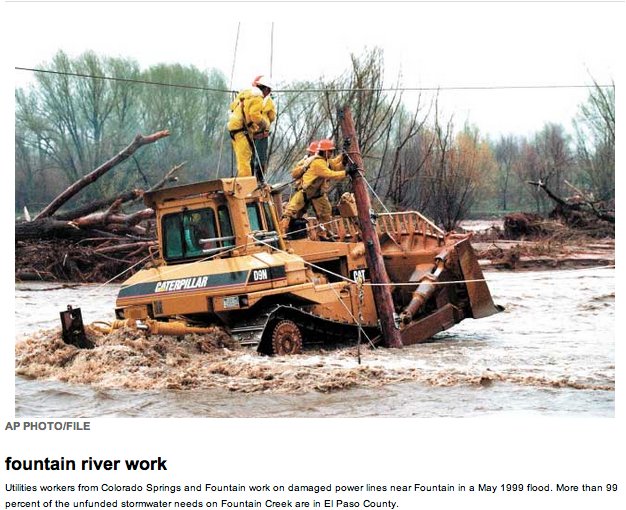
From The Pueblo Chieftain (Chris Woodka):
New rule of thumb: An inch of rain in Colorado Springs equals a foot rise for Fountain Creek in Pueblo. And corresponding demands for stormwater control.
“It’s one big funnel,” said Jay Winner, manager of the Lower Arkansas Valley Water Conservancy District. “Because Colorado Springs is unable to control its stormwater, it all flows very quickly into that narrow area we call Fountain Creek. Geographically, it’s a tight funnel that fills up very fast.”
Sites throughout Colorado Springs received anywhere from 0.7 to 1.4 inches of rain that fell throughout the city, heaviest over the Waldo Canyon burn scar, which increases the amount of mud. About 12 hours later, Fountain Creek changed from a meandering stream to a full-blown dirty river in Pueblo, with the level increasing by one foot.
The Fountain Creek Watershed Flood Control and Greenway District hopes to set up a funding mechanism for the district
Good luck. Here’s a report from Chris Woodka writing for The Pueblo Chieftain. From the article:
The Fountain Creek Watershed Flood Control and Greenway District followed up on a suggestion by board member Richard Skorman and voted unanimously Friday to ask the Trust for Pueblo Land for technical advice on how to set up a funding mechanism for the district.
El Paso County Commissioner Sallie Clark brought up the possibility that the district could be the funding mechanism for stormwater efforts in that county, if different mill levies could be assessed for the two counties. She acknowledged that Pueblo County does not want to, and should not have to, pay for projects that are El Paso County responsibilities.
Executive Director Larry Small said those types of questions are what the district would ask the land trust to sort out.
From The Pueblo Chieftain (Chris Woodka):
This week, the Waldo Canyon Burned Area Emergency Response team began aerial mulching with straw and shredded wood, which is expected to reduce runoff and sediment by 20 percent on about 3,000 acres in the most badly burnt areas. “This treatment should reduce the immediate response following a storm to give people time to safely get to higher ground in areas that could be impacted by increased water and sediment flows,” said hydrologist Mary Moore.
The team, which includes the U.S. Forest Service, Colorado Springs, El Paso County and other agencies, is also working on long-term restoration efforts, Mark Shea of Colorado Springs Utilities told the Fountain Creek board.
SDS: ‘It seems like Colorado Springs Utilities and city officials are doing a lot of talking’ — Jay Winner
From The Pueblo Chieftain (Chris Woodka):
The Lower Arkansas Valley Water Conservancy District has made a formal request to the Bureau of Reclamation to reopen environmental studies for the Southern Delivery System because the 2008 study assumed a Colorado Springs stormwater enterprise was in place…
“It seems like Colorado Springs Utilities and city officials are doing a lot of talking,” said Jay Winner, general manager of the Lower Ark district Wednesday. Forming a regional task force isn’t enough, he said. “They talk as if this could be done by the end of the year, but that’s not going to happen. While they meet with a task force, we’re the ones who suffer.”
Last week’s letter identified broad concerns about the repeal of the stormwater enterprise, while this week’s letter from Peter Nichols, attorney for the district, deals with more specific points related to SDS documents. The letter points out that the $15 million annually generated by the former stormwater enterprise would have been sufficient to cover the nearly $500 million in backlog of stormwater projects and maintenance identified in Colorado Springs. “Reclamation has a continuing duty to analyze significant changes in conditions that affect the environment and that call into question the original decision,” the letter stated.
It turns out that Colorado Springs did need a stormwater enterprise after all: The search for $millions continues

From The Pueblo Chieftain (Chris Woodka):
Chris Melcher, city attorney for Colorado Springs, reiterated Tuesday that he believes the city needs to fund $13 million-$15 million annually in stormwater maintenance or improvements to meet the conditions of 2009 SDS agreements with Pueblo County and the federal Bureau of Reclamation. Those agreements are embodied in the 2010 SDS contract. Since March, when Melcher first gave that opinion, the Pueblo County commissioners have asked for at least $15 million in next year’s budget, and the Lower Arkansas Valley Water Conservancy District suggested $18 million$20 million is needed…
Mayor Steve Bach has asked Utilities to find $15 million in its budget for stormwater next year. Utilities, which answers to City Council, not the mayor, does not operate a stormwater utility, but maintains that some of its budget goes to stormwater projects.
The Lower Ark Board asks Reclamation to cancel SDS contract until Colorado Springs finds adequate stormwater funding
From The Pueblo Chieftain (Chris Woodka):
The Lower Arkansas Valley Water Conservancy District board voted Wednesday to send a letter to the Bureau of Reclamation that asks it to immediately revoke the contract.
“We are asking Reclamation to revoke the contract immediately until Colorado Springs provides evidence that institutional mechanisms, rather than empty political promises, will be used to implement stormwater improvements and maintenance,” the letter states.
The letter says Colorado Springs should be spending $18 million-$20 million annually on stormwater projects…
The Lower Ark district insisted on a stormwater enterprise for SDS to reduce impacts on Fountain Creek during earlier rounds of negotiations over water issues with Colorado Springs. The letter also points out how Colorado Springs leaders gave assurances in 2009 that stormwater projects would be funded, despite a decision by City Council to abolish the stormwater enterprise.
Southern Delivery System: Reclamation’s EIS incorporated Colorado Springs’ stormwater enterprise which is now defunct
From The Pueblo Chieftain (Chris Woodka):
“As I view it, there were firm commitments made on stormwater and the (SDS) contract requires that the environmental commitments are met,” Mike Connor, commissioner of the Bureau of Reclamation said Wednesday, meeting with the editorial board of The Pueblo Chieftain.
In the SDS environmental impact statement, Reclamation states a stormwater enterprise is in place for Colorado Springs. The EIS laid the foundation for the 2010 contract for the project. The contract also incorporates all environmental conditions of Pueblo County’s 1041 landuse permit and state water quality measures. Connor’s goal is to assure the conditions are being met before 2016, when SDS is scheduled to go online. The $1 billion project would pipe water from Pueblo Dam to Colorado Springs, Security, Fountain and Pueblo West. Because Colorado Springs abolished its stormwater enterprise in 2009, no fees have been collected for the past three years. Meanwhile, Colorado Springs faces a $500 million backlog of stormwater projects and should be paying up to $15 million annually, according to City Attorney Chris Melcher.
“A plan is not enough,” Connor said. “We need to make sure the resources are there.”
Meanwhile, Colorado Springs is not alone in needing to fund stormwater improvements. El Paso County faces similar problems. Here’s a report from Scott Harrison writing for KRDO.com. From the article:
Andre Brackin, the El Paso County Engineer, said the area, specifically the communities of Security and Widefield, have only a few drainage channels for runoff to drain into Fountain Creek.
Those communities were established in the 1950s and have grown since then, said Brackin. He estimated that addressing the area’s stormwater needs would cost $10 million — an amount the county can’t afford…
The lack of funds means the county also can’t afford to clear vegetation and rubbish out of the few existing drainage channels, such as the one along Widefield Boulevard…
Ultimately, said Brackin, local leaders must consider enacting some type of regional fee or tax to pay for stormwater improvements. He said the county has a backlog of as much as $100 million in needed improvements.
Pueblo County (Commissioner Jeff Chostner) rattles its sabers over Colorado Springs’ stormwater policies
From The Pueblo Chieftain (Chris Woodka):
“When I looked at Fountain Creek this morning, I thought, ‘Here we are about to be hit by another flood, possibly this week, and they are doing nothing,’ ” Chostner said. “We need to see a good outline of next year’s (Colorado Springs) city budget that has $15 million directed toward stormwater funding.” When commissioners approved the 1041 permit for SDS in 2009, Colorado Springs had a stormwater enterprise in place. Council voted to end the enterprise in late 2009 after voters approved a ballot issue promoted by Doug Bruce, who called the stormwater fee a “rain tax.”
More coverage from Chris Woodka writing for The Pueblo Chieftain. From the article:
A Chieftain editorial Monday asked Pueblo County commissioners to insist on a surcharge to Colorado Springs water rates on water provided by the Southern Delivery System that would raise $18 million a year to address the city’s $500 million in stormwater needs. Commissioners have some control through the county’s 1041 land-use regulations.
There are practical, but not insurmountable, hurdles to implementing a stormwater fee through water bills.
Colorado Springs Utilities policies, set by the Colorado Springs City Council, do not allow for a surcharge for stormwater fees. Fees for water service have to directly affect the water system, said spokesman Steve Berry.
“Utilities would not be able to do what the editorial suggested,” he said. “Stormwater would have to be a separate service, which we are open to if our customers and board directed us to do so.”
Fountain Creek: Runoff from Waldo Canyon Fire could affect stormwater flows for years
From The Pueblo Chieftain (Chris Woodka):
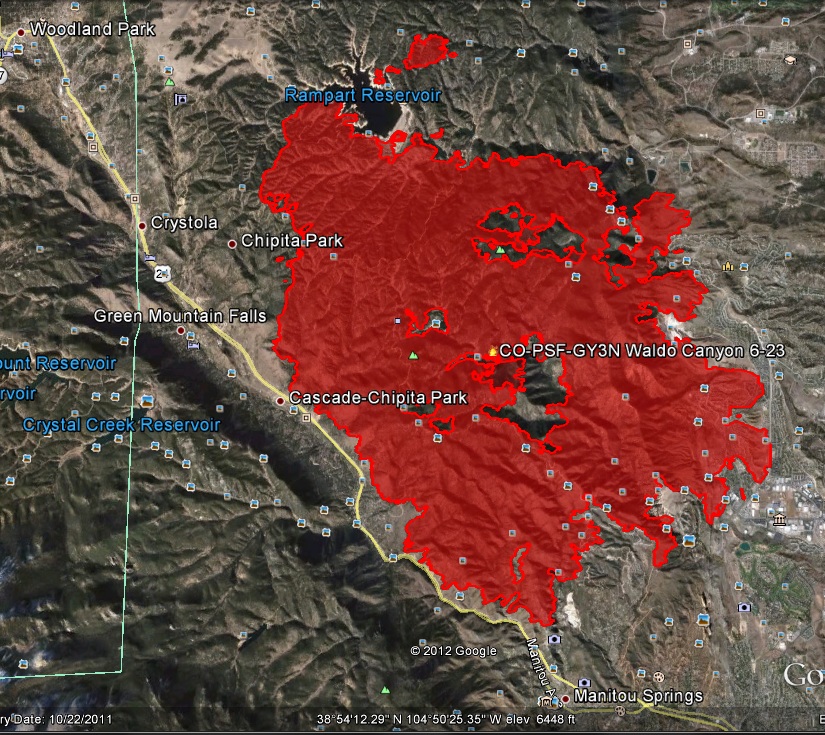
The Fountain Creek Watershed Flood Control and Greenway District heard a report on the potential flood, mudflows and landslide impacts that could follow the Waldo Canyon Fire, which burned near Colorado Springs from June 26 to July 10. A small storm event could send up to 12 times as much water down canyons and into Fountain Creek, while larger storms such as a 10-year event might bring five times as much water because vegetation has been stripped away and soils hardened…
Jamie Prochno, an engineer and community assistance coordinator for the Colorado Water Conservation Board, told the Fountain Creek board that residents near the burn and even those downstream should consider flood insurance…
The Fountain Creek board is planning to play a role in Waldo recovery efforts. Its technical advisory committee and citizens advisory group have begun discussions about what that should be. The district was formed in 2009 by the state Legislature to sort out Fountain Creek issues between Pueblo and El Paso counties.
Fountain Creek: Lower Ark board declines opportunity to fund study of Waldo Canyon Fire effects on water quality

From The Pueblo Chieftain (Chris Woodka):
The Lower Arkansas Valley Water Conservancy District board voted unanimously not to fund the request by Colorado State University-Pueblo scientists, saying it’s time for other agencies to step up on water quality studies. “The biggest problem is that there need to be more funding partners,” said Lynden Gill, acting chairman of the board. “We have limited resources and are in a situation where we feel uncomfortable.”[…]
[Scott Herrmann] said the water in Upper Monument Creek, near Cascade where the fire started, was as black as charcoal, turning grayer downstream. Further analysis also could detect whether there are higher levels of phosphorus in the water, a byproduct of ammonia phosphate and sulfate ions, the chief ingredients of the slurry dumped on wildfires. The researchers previously told the Lower Ark board they would like to expand the Fountain Creek study to the reach of the Arkansas River from Pueblo Dam to Baxter.
However, the Waldo Canyon Fire presented unique opportunities to study Fountain Creek, [Del Nimmo] said. “The fire has already had a profound impact,” Nimmo said. “There have been incredible changes on the Upper Fountain.”
Southern Delivery System update: Next Pueblo County DA promises to continue lawsuit over the project water quality permit
From The Pueblo Chieftain (Chris Woodka):
Jeff Chostner, who beat District Attorney Bill Thiebaut in the June 26 Democratic primary, said he will pursue a lawsuit now under appeal by the state and Colorado Springs. “It would not be judicially efficient to drop it,” Chostner said Thursday. “We will have the expertise to handle the case within our office.”[…]
“Assuming that it’s not resolved by the end of Bill’s term, we will continue with the case,” Chostner said.
Would he take the case to the state Supreme Court if the appeal goes in the state’s favor? “Let’s handle that one when the contingency arises,” Chostner said.
‘Every time Secretary Salazar sees me, he bugs me about Fountain Creek’ — GOCo Executive Director Lise Aangeenbrug

From The Pueblo Chieftain (Chris Woodka):
Fountain Creek Watershed Flood Control and Greenway District board member Richard Skorman recognized his former boss, Secretary of Interior Ken Salazar, both for his concern about Fountain Creek and for his role in establishing the Great Outdoors Colorado program that funded a $2.5 million grant to benefit the creek this week.
“Ken Salazar was one of our regional leaders,” said Skorman, a former Colorado Springs councilman and mayoral candidate who served as a U.S. Senate aide to Salazar. “He talked about how we should stop turning our backs on our rivers, and learn to face them and embrace them.”
“You’re right,” laughed GOCo Executive Director Lise Aangeenbrug, who came to Friday’s Fountain Creek district board meeting to formally announce the grant. “Every time Secretary Salazar sees me, he bugs me about Fountain Creek.”
Fountain Creek: Fort Carson reports spill into the creek
From The Pueblo Chieftain (Chris Woodka):
A spill of 10,000 gallons from a sanitary sewer lift station at Fort Carson, including small amounts of petroleum, was reported to the Environmental Protection Agency on June 7, according to information provided by the Colorado Water Quality Control Division…
The spill occurred at a pre-treatment plant meant to separate oil from water before water is routed through a sewer plant. The EPA is evaluating corrective actions and steps that must be taken to prevent future overflows, said David Gwisdalla, environmental engineer with the EPA. The cause of the spill was an extreme rain that caused a manhole to overfill, sending 10,000 gallons of untreated sewage into a ditch leading into Fountain Creek, according to the report.
Southern Delivery System: Reclamation is testing the newly constructed North Outlet Works at Pueblo Dam
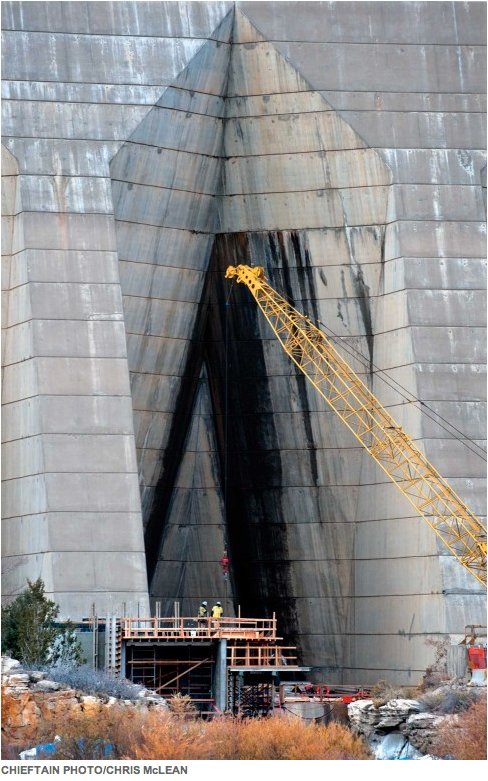
From The Pueblo Chieftain (Chris Woodka):
Flows ranging from 5-1,100 cubic feet per second will be released from the new outlet works during the tests. It’s the first time the outlet has been used since construction.
The Arkansas River has been fed by releases from flood gates in the central portion of the dam during construction. River flows have been in the 400 cfs range below the dam recently.
The first test occurred Wednesday afternoon, and more tests are planned Friday and Tuesday, said spokeswoman Kara Lamb.
The Y-shaped outlet is being constructed by Colorado Springs Utilities as part of the Southern Delivery System. It will connect to a 90-inch diameter pipeline leading to a Pueblo West tap and the Juniper Pump Station, which will be constructed near the dam. The other pipeline will serve as the river outlet.
Southern Delivery System: State Representative Sal Pace calls on Colorado Springs Utilities to halt construction
From The Pueblo Chieftain (Chris Woodka):
Pace sent a letter to Colorado Springs Mayor Steve Bach Monday calling for a halt to the $986 million SDS, now under construction…
“According to your own environmental documents, the SDS will increase Fountain Creek flows by 40 percent,” Pace wrote in the letter. “That increase will now take place without the protections in place that your city promised when you submitted the project to the Bureau of Reclamation for environmental review.”
As part of its 1041 land-use permit with Pueblo County, Colorado Springs agreed to meet requirements in a record of decision by the Bureau of Reclamation, which included a fully funded stormwater enterprise. “Temporarily stopping the project is the least that your city can do to guarantee the protections downstream communities morally and legally deserve,” Pace wrote.
Fountain Creek: Dredge-less sediment removal demonstration project up and running and slurping sediment from the creek
From The Pueblo Chieftain (Chris Woodka):
A mining screw was depositing a steady slurry of about 10 gallons of material per second onto a conveyor belt that stacked sand and gravel into a large pile. The sediment is pumped from the stream through pipes in an effort to clean the channel near the confluence with the Arkansas River. The project also will demonstrate the impact of sediment removal on water quality.
Pueblo County leaders are beating the drum for Colorado Springs to re-establish a stormwater enterprise
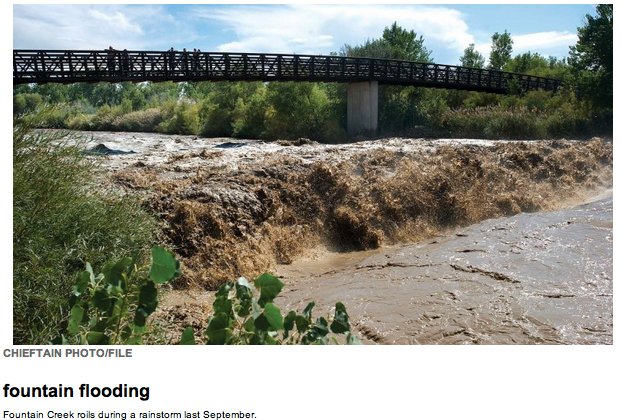
From The Pueblo Chieftain (Chris Woodka):
While the storm [Wednesday], centered over Colorado Springs for three hours, did little to impact Pueblo County, it caused internal problems. At a news conference Thursday, [Colorado Springs] Mayor Steve Bach said $7 million in city funds would be transferred to stormwater needs. About 40 people had to be rescued. Some comments from frustrated citizens on the Internet early Thursday, chided the City Council for dropping the stormwater enterprise in 2009…
“There has to be a steady stream of revenue,” said [Jay Winner, general manager of the Lower Arkansas Valley Water Conservancy District], who worked to convince Colorado Springs to adopt the stormwater enterprise in 2005. “I don’t see how $7 million does anything to address the $500 million in capital needs that have been identified.”[…]
State Rep. Sal Pace, DPueblo, agreed, saying the enterprise was providing $12 million-$15 million a year before the City Council eliminated it. Pace is drafting a letter to Colorado Springs demanding action on the stormwater question…
Pace said Colorado Springs voters are seeing the problems that resulted from the 2009 passage of Issue 300, which was interpreted by City Council as a mandate to repeal what tax-crusader Doug Bruce called a “rain tax.”[…]
County Commissioner Jeff Chostner, who chairs the Fountain Creek Watershed Flood Control and Greenway District board, said Colorado Springs has to address its stormwater problems immediately.
More coverage from Chris Woodka writing for The Pueblo Chieftain. From the article:
A rainstorm parked itself over [Colorado Springs] for about three hours Wednesday, dropping up to 4 inches of rain. Areas to the north and south of the city received less rain, anywhere from 0.5-2 inches. About 40 people and one dog had to be rescued from high water that collected in Colorado Springs, according to news reports. Mayor Steve Bach called it a “100-year flood,” but it wasn’t even close. It was about a 10-year event on Fountain Creek at Security, and the threat diminished as water traveled downstream, according to the U.S. Geological Survey.
While Pueblo braced for possible flooding, the effects were fairly minor by the time the water traveled 40 miles down the Fountain Creek channel. “It did not take away the hot tub that the flood last September deposited in my pasture, so I am very disappointed,” quipped Bill Alt, whose home is on Fountain Creek just north of Pueblo. “On the upside, it irrigated the pasture, which was good since we’ve had no moisture this year.”
More coverage from Daniel Chaćon writing for The Colorado Springs Gazette. From the article:
Pueblo County is threatening to suspend a permit for the Southern Delivery System water pipeline unless Colorado Springs spends more money on stormwater improvements next year. A condition of the so-called 1041 permit requires Colorado Springs to have an adequate stormwater management plan, Pueblo County Attorney Dan Kogovsek said Thursday…
Pueblo County is “very concerned” that Colorado Springs’ capital improvements to prevent stormwater damage have fallen by the wayside since the demise of the Stormwater Enterprise more than two years ago, Kogovsek said. When the enterprise was in operation, the city was spending about $13.3 million annually on maintenance, capital improvement projects and required permits. This year, the city budgeted $3.3 million for maintenance and permits but nothing for capital improvements. Kogovsek said the county will keep a close eye on the city’s 2013 budget to see how much Colorado Springs plans to spend on stormwater…
Mayor Steve Bach, who marked his first year in office Thursday, has sounded the alarm about the city’s stormwater needs. As part of his funding solution, he wants the City Council to direct Utilities to come up with $12 million to $15 million from its existing budget and rate base. “Why should Colorado Springs Utilities be involved in this? In my view, because Utilities will be bringing Southern Delivery System water here from down at the Pueblo Dam and the Arkansas River,” Bach said during a news conference Thursday in the wake of Wednesday’s storm. “Utilities will thereby be, frankly, exacerbating our stormwater challenges because after that water is used locally — whether it’s domestic consumption or irrigation or other purposes – it will be returned. It’s called return flow and that water will be additive to Fountain Creek flow going back down south. At least that’s a pragmatic reason that I see that Utilities should partner with us,” he said.
From the Colorado Springs Utilities twitter feed (@CSUtilities) yesterday:
Unmanaged storm flows outside of Colorado Springs city limits can jeopardize investments made within the city.
And:
We believe stormwater flows must be managed regionally, to fully protect our community’s investments.
Southern Delivery System: The CWQCC joins Colorado Springs Utilities in appeal of recent ruling about the project water quality permit

From the Colorado Springs Independent (Pam Zubeck):
Colorado Springs Utilities isn’t alone in thinking Pueblo County District Judge Victor Reyes made a mistake.
The Colorado Water Quality Control Commission has voted unanimously to stand with Utilities in opposing Reyes’ decision to overturn the state’s 401 water quality certification for the Southern Delivery System. Reyes had ruled the state commission didn’t adequately account for Fountain Creek pollution caused by the SDS pipeline, which will increase Colorado Springs’ water supply by a third by 2016 by delivering water from Lake Pueblo. After certification in 2010, the Rocky Mountain Environmental Labor Coalition and Pueblo County District Attorney Bill Thiebaut sought judicial review, resulting in Reyes’ ruling.
State Commissioner John Klomp, a former Pueblo County commissioner, made the motion to appeal the ruling, noting that sufficient controls are in place and that Colorado Springs complies with the rules, the Pueblo Chieftain reports. Utilities spokesperson Janet Rummel says SDS construction continues.
Southern Delivery System: Colorado Springs Utilities appeals recent permit decision by Judge Reyes
From KRDO.com (Rana Novini):
Colorado Springs Utilities says the April ruling is unfortunate and they have always met water quality standards. They joined the City of Colorado Springs, and the State of Colorado in filing an appeal against that ruling.
On Friday, Pueblo County District Attorney Bill Thiebaut stood near the Fountain Creek Flood Control marker in Pueblo and vowed he would not stop fighting against SDS. He held up two jars of water: one he said was from Lake Pueblo, the other from Fountain Creek. “You can see (the latter jar) is rather muddy and contaminated as compared to the Lake Pueblo water,” Thiebaut said. He attributes the pollution to Colorado Springs’ development projects, saying the runoff ends up in Fountain Creek. He says that Colorado Springs takes the clean water in Pueblo Reservoir and returns used, dirty water to Fountain Creek.
Mark Pifher of Colorado Springs Utilities works directly with water quality regarding SDS. He tells KRDO NewsChannel 13 that the pollution in Fountain Creek has nothing to do with SDS. “At this point in time, Southern Delivery is not yet operational. So that’s the ambient condition, if you will, of Fountain Creek,” Pifher said.
In a written statement from the Tenth Judicial District, Thiebaut claims the pollution in Fountain Creek has caused illness to Pueblo County residents. But Pifher says Utilities has never been made aware of any illnesses.
From The Pueblo Chieftain (John Norton):
In April, District Judge Victor Reyes ruled on a suit filed by Thiebaut and threw out a state water quality permit the Colorado Water Quality Control Commission gave the project.
Reyes ruled that the commission ignored potential impacts of growth on Fountain Creek water quality and failed to follow its own procedures in upholding a 2010 permit under section 401 of the Clean Water Act.
Friday afternoon, Thiebaut called on the state and Colorado Springs to give up the appeal. He held up jars of clear Pueblo Reservoir water and cloudy water from Fountain Creek.
Standing near the flood control marker across from the El Centro del Quinto Sol community center, he said, “Now, Colorado Springs wants to take this pristine (lake) water, use it in Colorado Springs and then discharge more of its used wastewater and stormwater into Fountain Creek.
From the Colorado Springs Independent:
…a new study from Summit Economics LLC says Colorado Springs residents pay less ($4.63 per capita annually) than those of every other Front Range city. The average is $52.11. To reach that average, El Paso County would have to impose a half-percent sales tax (50 cents on a $100 purchase), a property tax of 5.8 mills ($93 on the tax bill of a $200,000 house) or a $5.35 per month fee per home. Any of those taxing methods would yield the roughly $36 million a year needed to tackle a $600 million backlog for the county, Colorado Springs, Manitou Springs, Fountain and Monument, the study says.
And the issue lies here, not downstream in Pueblo County, which accounts for only 1 percent of the region’s stormwater infrastructure needs, the study found.
The Fountain Creek Watershed Flood Control and Greenway District, which covers portions of Pueblo and El Paso Counties, funded the study, and its manager Larry Small says the board is eying a November 2013 election if a tax increase is sought.
From the Colorado Springs Gazette (Daniel Chaćon):
Bach said his administration inherited “upwards of a billion” dollars in unfunded capital needs, including stormwater, and that the city needed to “come to grips” with the problem. “The day of reckoning is in front of us,” Bach said.
The lack of stormwater funding has other consequences that City Attorney Chris Melcher has said obligates Utilities, a billion-dollar-plus enterprise of the city. Stormwater is a crucial element of the 62-mile Southern Delivery System water pipeline that Utilities is building between Colorado Springs and Pueblo…
The Board of Pueblo County Commissioners, which issued the so-called 1041 permit for SDS, is now applying pressure on the city, too. The board sent Bach and the council a letter May 3, saying it was “encouraged” by reports that the city was exploring ways to fund stormwater but that it needed to act fast…
“A key component was the Stormwater Enterprise,” they wrote. “Unfortunately, in December 2009, only a few months after it obtained its SDS permits, Colorado Springs Council voted to abolish its Stormwater Enterprise fees.”
SDS spokeswoman Janet Rummel said the city’s stormwater issue is much broader than SDS. “Not only is utilities infrastructure impacted by stormwater run-off, but City and County roads and bridges are also affected for example,” she said in an email.
More coverage from the Colorado Springs Independent (Pam Zubeck):
After the enterprise was dismantled in 2009, the Springs City Council assured Pueblo County that a replacement funding source would be developed, Pueblo County commissioners note, but more than 2.5 years later, no such funding has been secured.
Pueblo County issued a construction permit for SDS, and that permit could be rescinded if Colorado Springs doesn’t live up to its promises.
County President Pro Tem Jan Martin wrote a letter to Pueblo County dated May 10, two days after Bach talked of a stormwater-related “day of reckoning” awaiting the Springs. In it, Martin says, “Protecting our watershed is a high priority for City Council …”
Really? Where’s the evidence? Rather, the Council is busy getting its package of road projects together to be included in an extension of a sales tax for the Pikes Peak Rural Transportation Authority. The tax doesn’t sunset until the end of 2014, but Councilors and others are rabid to get it renewed and want it on this November’s ballot.
Southern Delivery System: The CWQCC will appeal judge’s ruling for project water quality permit

From The Pueblo Chieftain (Chris Woodka):
The Colorado Water Quality Control Commission voted unanimously Monday to appeal the decision. The commission approved staff certification under section 401 of the federal Clean Water Act in 2010, after the decision was protested by Pueblo District Attorney Bill Thiebaut and the Rocky Mountain Environmental Labor Coalition…
“The 401 certification was fully discussed and we’re convinced we made the right decision, controls are in place and that Colorado Springs is in compliance,” said John Klomp, a former Pueblo County commissioner who sits on the state water quality board. Colorado Springs Utilities will join the state in the appeal, said spokeswoman Janet Rummel.
“We agree with the state of Colorado that the Pueblo district court decision was erroneous and believe the court of appeals will affirm the Colorado Water Quality Control Division’s issuance of the 401 water quality certification for SDS,” Rummel said…
Ross Vincent, of the local Sierra Club and the coalition, said the state decision is not appropriate. “The Water Quality Control Commission’s decision makes no sense to me,” Vincent said. “The state did a really sloppy job in its first review of the water quality impacts of SDS. The facts are pretty clear, and that’s why Judge Reyes ruled the way he did. It would be simpler, faster, and a whole lot less expensive for the state to go back to the drawing board and do the thorough water quality review that the law requires.
More Southern Delivery System coverage here.
Southern Delivery System: ‘Colorado Springs remains in compliance, and is in regular contact with Reclamation’ — Kara Lamb via the Chieftain
Here’s a report from Chris Woodka writing for The Pueblo Chieftain. [ed. The link does not take you to the article in the Chieftain’s new format as of 5:11 AM. I had to scroll through the online paper to find it.] Here’s an excerpt:
Colorado Springs remains in compliance, and is in regular contact with Reclamation, spokeswoman Kara Lamb said this week. “Reclamation has not issued a permit. We are not a regulating agency,” Lamb explained. “What we have done is enter into a series of contracts with Colorado Springs Utilities and the other SDS participants.
“The contracts are based on the environmental compliance measures outlined in the final Environmental Impact Statement and associated record of decision and permits issued by other entities which do have regulating authority.”
‘It just speaks to how increasingly difficult it is to get a project like this put on line’ — Janet Rummel (Colorado Springs Utilities)
From the Colorado Springs Independent (Pam Zubeck):
Even with recent good news regarding interest rates, SDS is going to cost ratepayers about $1.6 billion, including interest. Complications, of course, could drive the cost higher. And quite a few have been popping up lately.
A contrary court ruling. A competing reservoir plan. Skirmishes over access to engineer the 60-mile line from Pueblo Reservoir. Unresolved deals for real estate and trenching.
Utilities thought it was home-free last year after negotiating a long-term storage deal in Pueblo Reservoir with the federal government. It’s already installed 20 miles of pipe and acquired 63 percent of the roughly 300 parcels it needs. So what could go wrong?
Plenty, apparently.
“It just speaks to how increasingly difficult it is to get a project like this put on line,” Utilities spokeswoman Janet Rummel says. “At this time, we believe we can continue to manage these risks within the approved budget.”
More coverage from Chris Vanderveen writing for 9News.com. From the article:
The Southern Delivery System will, when completed in 2016, bring 78 million gallons of water a day from the Pueblo Reservoir to Colorado Springs.
Major construction began on the 60-mile pipeline last year.
“Colorado Springs Utilities has been planning on the Southern Delivery System since really the late 80s,” SDS spokesperson Janet Rummel said. “It’s really going to help insulate us from a drought like we saw in 2002.”
It’s impossible not to notice the massive project in Pueblo West. Construction crews are feverishly digging trenches to house the pipeline. It’s often grueling work, requiring crews to dig into land that is flush with rock…
What is clear is that the project is providing much-needed relief for a construction industry that has been hit hard by the economic downturn. Jared Nessler works for HCP Constructors and is based out of Pueblo West. “We started working on SDS early in 2011,” he said. This job, he said, is right in his backyard.
Pueblo County officials plan to hold Colorado Springs Utilities feet to the fire for stormwater improvements for Fountain Creek
From The Pueblo Chieftain (Chris Woodka):
SDS, a pipeline under construction from Pueblo Dam to El Paso County, needs the federal permit in order to take water from Lake Pueblo.
The federal permit also is a key element of the Pueblo County 1041 permit issued in March 2009. In a letter to Colorado Springs Mayor Steve Bach and City Council President Scott Hente, the commissioners point out that council assured Pueblo County it would develop a replacement source of funding when it abolished the stormwater enterprise in December 2009.“Now 2 1/2 years later, the city has yet to establish assured stormwater funding,” Commissioners Anthony Nunez, Jeff Chostner and John Cordova wrote in the letter sent Thursday. “Colorado Springs is the largest municipality in the state of Colorado without a stormwater enterprise or other assured mechanism to maintain and improve stormwater infrastructure.”
The letter makes it clear that there could be implications for the 1041 permit, a warning that Colorado Springs City Attorney Chris Melcher told the mayor and council about last month.
It turns out that Colorado Springs did need a stormwater enterprise after all, where is Douglas Bruce?
From The Pueblo Chieftain (Chris Woodka):
A Summit Economics study, now being reviewed by communities in El Paso County, identifies $752.5 million in unfunded stormwater management needs on Fountain Creek. Only $3.2 million of those are in Pueblo, although no assessment has been made of the parts of the creek in unincorporated Pueblo County. There are also about $13 million in annual funding needs that have not been addressed…
Nearly $500 million in projects are needed in Colorado Springs, with about $86 million considered critical needs, the study stated. That’s a significantly higher amount than reported to Colorado Springs City Council in 2005, when it created a stormwater enterprise. The enterprise was dissolved by council after the 2009 municipal election. A 2005 stormwater study identified about $300 million in Colorado Springs projects, with $66 million considered critical were presented.
In Pueblo, at that same time, there were about $65 million in needs. Pueblo instituted a stormwater fee in 2003 that generates about $2.8 million per year to begin addressing those problems. Puebloans pay about $25 per capita monthly into the fund…
Colorado Springs, with nearly four times the population, spends about $1.9 million, or $4.63 per capita monthly to address stormwater issues, mainly compliance with state or federal permits. The Front Range average is $52 per capita monthly.
Southern Delivery System: ‘Pueblo will not pay for the failure of the Colorado Springs stormwater enterprise’ — Jeff Chostner
From The Pueblo Chieftain (Chris Woodka):
“We’re paying five times per capita in Pueblo County, while El Paso County has five times the resources,” Chostner said. “Pueblo will not pay for the failure of the Colorado Springs stormwater enterprise. This has implications for the 1041 permit.”
The Fountain Creek board got its first look at a regional stormwater study by Summit Economics that suggests a coordinated regional approach is needed to meet a backlog of more than $750 million in stormwater management needs. The study, which will be finalized after the sponsors have a chance to review it, also points out that Colorado Springs pays only $4.63 per capita for stormwater protection, less than one-tenth of the Front Range average. Pueblo pays $25.81 per capita.
Chostner, who guided the Fountain Creek board away from contributing any money to the study, was adamant that it is not Pueblo’s responsibility to pay for stormwater projects in Colorado Springs, which abolished its stormwater enterprise in 2009. As part of 2009 Pueblo County 1041 conditions, Colorado Springs agreed to provide $50 million to the district over five years after SDS goes online in 2016. Chostner balked at the economists’ suggestion that some of that money could defray stormwater costs. “This board decides how to spend that,” he said.
Southern Delivery System: Did Colorado Springs violate their federal permit when they abolished their stormwater enterprise?
From The Pueblo Chieftain (Chris Woodka):
A district formed to protect water in the Lower Arkansas Valley instructed its water attorney to investigate whether Colorado Springs violated a federal permit when it abolished its stormwater enterprise. “This is irresponsible behavior by Colorado Springs. They owe the rest of the area a service,” said Melissa Esquibel, who represents Pueblo County on the Lower Arkansas Valley Water Conservancy District board. “It’s unconscionable.”[…]
The board approved Esquibel’s motion to have Peter Nichols investigate whether Colorado Springs is in violation of a record of decision by the federal Bureau of Reclamation for SDS. The federal permit makes the assumption that Colorado Springs would have a certain level of funding annually under the former enterprise. Instead, Colorado Springs has spent about $1.2 million annually since voters instructed City Council to disband it in 2009. Stormwater funding is listed at $1.9 million this year, according to a budget comparison of Front Range cities distributed at the meeting. Colorado Springs spends $4.63 per capita on stormwater funding, less than 10 percent of the Front Range average. Pueblo is at half the average, at $25.81 per capita…
Last month, Colorado Springs Attorney Chris Melcher said Colorado Springs is obligated to spend $13 million-$15 million annually for stormwater improvements. At a Fountain Creek meeting last month, Councilwoman Brandy Williams said the council is working on a plan of how to come up with the money.
Southern Delivery System: Colorado Springs Utilities plans to file appeal of Judge Victor Reyes’ decision about water quality permit
From The Colorado Springs Gazette (Daniel Chaćon):
While the Colorado Department of Public Health and Environment evaluates its next move, Colorado Springs Utilities said Tuesday it plans to appeal the ruling. “Construction is proceeding,” SDS spokeswoman Janet Rummel said…
The court ruling came after a request for a judicial review from Pueblo District Attorney Bill Thiebaut and the Rocky Mountain Environmental Labor Coalition. Thiebaut argued that SDS will lead to potentially damaging water flows back to Pueblo, worsening “the existing flooding and contamination in Fountain Creek and the Arkansas River.” Thiebaut has a long history of opposing SDS, and during the permitting process, the labor coalition tried unsuccessfully to get Utilities to promise to use union labor for the construction of SDS…
Rummel said the 401 certification was meant to assure the U.S. Army Corps of Engineers that the SDS project would follow all applicable state water quality regulations and procedures. The certification was a condition of the 404 permit issued by the Army Corps of Engineers for SDS. That permit is required under the U.S. Clean Water Act because the project will have permanent and temporary impacts on jurisdictional wetlands.
Thiebaut told the Pueblo Chieftain newspaper this week that Utilities doesn’t have a valid permit for SDS. “In order for the SDS system to proceed, the owners need to obtain one from the state,” Thiebaut told the newspaper. “Approval of a new 401 certification will require a comment period and opportunity for appeal. In the alternative, the defendants can appeal to a higher court. We are prepared either way.”[…]
Rummel said the judge’s ruling means that if the appeal is unsuccessful, the state may be required to do additional water quality evaluation. “That may result in additional mitigation for the project. That is what we believe the worst case scenario to be,” she said.
More coverage from John Hazelhurst writing for the Colorado Springs Independent. From the article:
…thanks to SDS, we’ll have more water than we’ll ever need. Our future is assured: Our urban forest won’t die, we can keep our lawns green, and sustain ourselves indefinitely … right?
Not quite. Even with some surprising decreases to cost projections, SDS will still run about $1.6 billion total, and has already affected our water rates. To help mitigate costs, Utilities would like to make “temporary” deals with users outside the city.
That’s nuts. Doing so will just enable sprawl, further hollow out our tax base, and put us at risk in the years to come. Temporary deals have a way of becoming permanent. It’s best not to make such deals, and use the water to fuel our infill growth.
More coverage from Pam Zubeck writing for the Colorado Springs Independent. From the article:
Instead of a 120 percent increase [ed. in Colorado Springs water rates] between 2011 and 2017, the hike could be less than half that under a new rate forecast being drafted. The change stems in part from the recession creating more competition among contractors — thus, lower construction costs. But the biggest reason is lower interest rates, which could save $700 million from previous estimates. While officials won’t release new projections until the May 16 Utilities Board meeting, chief financial officer Bill Cherrier says, “What I can tell you is, we probably lopped off several years of rate increases. That would be four years of 12 percent increases, instead of six or seven. Even the ones we need, we believe, will be less than 12 percent. Once we get up to a certain level of rates, we’re likely to see virtually no water increases for quite some time.”[…]
Cherrier says the city will issue more debt for SDS in August, and in 2013 and 2014 to finish Phase 1 funding for the pipeline, construction of three pump stations and a water treatment plant, which continues even as the city spars with opponents over a water quality permit.
In 2010, City Council raised rates by 12 percent for 2011 and 2012. Under the initial plan, the typical residential customer’s average monthly bill would have leaped by 120 percent, from $37 in 2010 to $82 in 2017. If the last three years of 12 percent rate hikes aren’t imposed, the typical increase would be 57 percent, to $58.
Southern Delivery System: Colorado Springs Utilities plans to file appeal of Judge Victor Reyes’ decision about water quality permit

From The Pueblo Chieftain (Chris Woodka):
“We do plan to appeal the ruling,” said Janet Rummel, a spokeswoman for Utilities. “We will need to consult with the state on the timing, but anticipate it will be filed as soon as is practical.”
The city also would have the option of following Reyes’ order and seeking another set of guidelines from the Colorado Water Quality Control Division, presumably with another hearing before the commission. The state is evaluating which course to take…
Pueblo District Attorney Bill Thiebaut said SDS does not have a valid permit, but needs one for the project to continue. “In order for the SDS system to proceed, the owners need to obtain one from the state,” Thiebaut said. “Approval of a new 401 certification will require a comment period and opportunity for appeal. In the alternative, the defendants can appeal to a higher court…
Reyes ruled that the adaptive management plan Colorado Springs, the state and other agencies have agreed to is not a reasonable safeguard against contamination of Fountain Creek.
Southern Delivery System: ‘They have to meet the level of commitments in the record of decision’ — Kara Lamb
From The Pueblo Chieftain (Chris Woodka):
Colorado Springs voters in 2009 disbanded the stormwater enterprise approved by council in 2005. Since then, only about $1.2 million has been spent annually to meet federal mandates.
“They have to meet the level of commitments in the record of decision,” Reclamation spokeswoman Kara Lamb said this week. “If any requirement in the record of decision is not met, there has to be new mitigation. That’s the commitment they made.” Lamb clarified that, even once the SDS pipeline, pumping stations and treatment plant are constructed, Reclamation still may decide whether the project may use Lake Pueblo, a federal facility, to deliver the water.
Colorado Springs intends to fulfill its requirement with continued monitoring of conditions on Fountain Creek and the impact caused by SDS. There are regional issues that will play a role, too, as population grows in Colorado Springs and the surrounding communities, said Janet Rummel, a spokeswoman for the utilities agency. The city also will meet stormwater commitments in the 1041 permit for SDS issued by Pueblo County in 2009, Rummel said.
The Norris Family plans to build the reservoir at the site eyed by both the Flaming Gorge Pipeline and the Southern Delivery System

From The Pueblo Chieftain (Chris Woodka):
The Norris family, owners of T-Cross Ranches, has filed a plan for the Marlboro Metropolitan Water District with El Paso County. “I’m going to build the reservoir,” said Steve Norris…“There has been lots of interest throughout the region for creating a regional storage reservoir.” Norris said it would hold nearly 30,000 acre-feet of water and would be built on land owned by the family and the State Land Board southeast of Colorado Springs. The application was filed earlier this month. The dam would be just south of the site targeted for the second phase of the Southern Delivery System. Colorado Springs Utilities, Security, Fountain and Pueblo West are building the SDS pipeline from Pueblo Dam, along with three pumping stations and a treatment plant. It is expected to be complete in 2016.
The reservoir on Upper Williams Creek is contemplated several years after the first phase of SDS…
The reservoir is also identified as terminal storage in Aaron Million’s plan to build a pipeline from Flaming Gorge Reservoir and the Green River in Wyoming. Million and Norris are longtime friends.
More Arkansas River basin coverage here.
It turns out that Colorado Springs did need a stormwater enterprise after all — where is Douglas Bruce?

From The Colorado Springs Gazette (Daniel Chacón):
Melcher gave Mayor Steve Bach and the City Council five options, including making stormwater a responsibility of Colorado Springs Utilities and asking voters to pass a tax.
Melcher emphasized that Utilities should play a big role in the solution because he said the future of the $2.3 billion Southern Delivery System water pipeline is at stake. “Utilities right now has a shared interest with the city for a number of reasons, but particularly because their SDS project is contingent on a permit that requires the city, which includes Utilities, the entire city, to have a functioning stormwater system,” Melcher said during the monthly Mayor’s Counsel Meeting between Bach and council members. The 62-mile pipeline from the Pueblo Dam to Colorado Springs is under construction.
Colorado Springs is falling woefully behind on its stormwater needs.
The city should be spending $13 million to $15 million annually on stormwater, and the unfunded capital needs for stormwater are estimated at $500 million. The city is spending only about $1.2 million to pay for the federally mandated stormwater component of the National Pollutant Discharge Elimination System program.
At least two council members — Tim Leigh and Angela Dougan — said the city should try to find a way to pay for stormwater through Utilities’ budget of more than $1 billion.
More coverage from Chris Woodka writing for The Pueblo Chieftain. From the article:
Colorado Springs Council, in a meeting with Mayor Steve Bach this week, was told by City Attorney Tim Melcher that it should be spending $13 million-$15 million a year for stormwater projects, rather than the bare minimum it now spends, about $1.2 million a year, to satisfy federal requirements…
There is a $500 million backlog of stormwater projects dating back to the 1980s. Options to fund improvements include raising water rates, already expected to double to pay for the $2.3 billion cost of SDS; shifting Utilities’ payments to the city; finding more money somewhere in general fund; or asking citizens to vote on creating a stormwater enterprise. Colorado Springs had a stormwater enterprise from 2005-09, but eliminated it after a campaign led by tax activist Doug Bruce against a “rain tax.”[…]
The option to vote on the enterprise could conflict with the Fountain Creek Watershed Flood Control and Greenway District’s plans to ask voters in El Paso and Pueblo counties to approve a mill levy. The district, formed in 2009, will run out of money at the end of this year, and no other source of funding is in sight until SDS is completed in 2016. At that time, Colorado Springs Utilities will begin making five annual payments totalling $50 million.
The [Fountain Creek Watershed Flood Control and Greenway District] will hear a report at its April 27 meeting from Summit Economics on a regional stormwater solution. The study was commissioned by El Paso County communities to come up with a unified approach to stormwater management.
More coverage from J. Adrian Stanley writing for the Colorado Springs Independent Indy Blog. From the post:
Really, this was inevitable. Drainage problems aren’t going away. In fact, neglecting them too long will get the city in trouble with the feds, piss off [Colorado Springs Utilities], and probably lead to a few streets caving in.
According to City Attorney Chris Melcher, who spoke on the issue at today’s Mayor’s Counsel meeting, the city has a few options. City Council could simply write a law making Stormwater, or at least parts of Stormwater, the responsibility of Utilities. Alternately, Council could ask for a tax increase, or simply ignore the problem.
One thing’s for sure, the city general fund can’t pay for what needs to be done — about $15 million a year in work.
Both Council President Pro Tem Jan Martin and Councilor Brandy Williams responded by saying the city should cooperate with the Fountain Creek Watershed board, which is working on a regional solution to Stormwater. When that process wraps up, voters will likely be asked to approve a tax to cover project costs.
The Fountain Creek Watershed Flood Control and Greenway District will discuss asking voters to approve a mill levy for the creek on April 27

From The Pueblo Chieftain (Chris Woodka):
The Fountain Creek Watershed Flood Control and Greenway District on Friday agreed to discuss the timing of a mill levy for the district at its April 27 meeting, when it expects to review a comprehensive report on stormwater and related issues being developed by Summit Economics. The stormwater study was suggested after Colorado Springs City Council eliminated its stormwater enterprise fee in 2009, saying it was the will of voters. It is being paid for by El Paso County communities along Monument and Fountain creeks…
“We should have a discussion of the scope (of district funding) and what the mill levy should be,” said Pueblo County Commissioner Jeff Chostner, who serves as president of the Fountain Creek board. Chostner has said the mill levy is the district’s top priority this year…
Under the legislation that formed the district, it may levy up to a 5-mill tax with voter approval. While its primary responsibility is the flood plain of Fountain Creek, it is also charged to make drainage recommendations throughout the entire watershed. All of Pueblo and El Paso counties are included in the district for property tax purposes, however.
Fountain Creek: Stormwater detention/management and other improvements subject of seminar
From The Pueblo Chieftain (Chris Woodka):
Balancing flood protection, water quality concerns and water rights will be necessary to develop projects on Fountain Creek and other areas. A crowd of about 100, mostly regulators or developers whose work involves stormwater control, attended a seminar last week at the Pueblo Convention Center to discuss those issues…
A study of dams on Fountain Creek by the U.S. Geological Survey will determine how effective dams at various locations would be at controlling flows, but a further study of water rights is needed, Witte said. “A big dam would be easier to regulate and easier to analyze,” he said. “There are a lot of advantages to a single flood control structure. There are also negatives to consider, like the loss of riparian habitat.” Gates at Pueblo Dam can be shut when flows exceed 6,000 cfs at Avondaleto avoid flood conditions. There is no similar mechanism on Fountain Creek, Witte said…
The seminar, now in its second year, was staged to acquaint people from Pueblo and the surrounding area with policies and laws affecting stormwater, said Louise Bosché, stormwater quality inspector for the city of Pueblo. “Stormwater is a huge issue for Fountain Creek and the city of Pueblo,” said Ross Vincent, of the Pueblo Sierra Club. “If we hope to hold Colorado Springs to high standards to protect the Arkansas River, we have to do at least as well or better here in Pueblo.
The Fountain Creek Watershed Flood Control and Greenway District may go to voters to approve mill levy in the next twelve to twenty-four months
From The Pueblo Chieftain (Chris Woodka):
“I really want to work on getting a mill levy proposal before voters in the next 12 to 24 months,” [Jeff Chostner, chairman of the Fountain Creek Watershed Flood Control and Greenway District] said. The district can assess property in El Paso and Pueblo counties at up to a 5-mill rate under the legislation, but it would require approval from voters in both counties. No decisions have been made on the size of mill levy that would be initially requested, and that would be one of the purposes of establishing a committee to look at the issue, Chostner said. The district has primary land-use authority in the 100-year flood plain from Fountain to Pueblo, and an advisory role in decisions throughout the watershed.
Chostner, a Pueblo County commissioner, was elected chairman at the Friday meeting of the district’s board, replacing El Paso County Commissioner Dennis Hisey. The chairmanship rotates between the two counties, and goes to an elected official under bylaws. The board also reappointed Larry Small, a former Colorado Springs councilman, as executive director.
Here’s a report about the possible effects on senior rights from proposed Fountain Creek projects from Chris Woodka writing for The Pueblo Chieftain. From the article:
“If you change the timing, you change the water right,” Bill Tyner, assistant division engineer, told the Lower Arkansas Valley Water Conservancy District board last week. The state Division of Water Resources denied a substitute water supply plan for a side detention pond in Pueblo last fall because a wave of water that roared down Fountain Creek showed the pond did not work as intended. Tyner showed a slide of water still in the pond one month after mid-September rains inundated the pond. “This was not the intent of the original design,” he said…
All water rights in the Lower Arkansas Valley could be satisfied if flows at Avondale gauge on the Arkansas River were maintained at 6,000 cubic feet per second, Tyner said. Right now, the gates at Pueblo Dam are used to reduce flows above the Fountain Creek confluence to reduce flooding risk when flows at Avondale reach the 6,000 cfs mark. Fountain Creek structures in the future might detain flows as well, reducing the likelihood of downstream flooding. However, artificially prolonging that level could change the relationship of junior and senior water rights, as well as having an impact on the river call upstream from Pueblo, Tyner said.
The Fountain Creek Watershed Flood Control and Greenway District has plans to spend $15 million on the stream corridor
From The Colorado Springs Gazette (R. Scott Rappold) via OutThereColorado.com. From the article:
Local officials will apply for $8 million in grants from state lottery funds, to be matched by $7 million in local money, for trails, open space, bridges, tubing and other amenities along the creek between Colorado Springs and Pueblo.
“What we want to do is get people to the creek,” said Larry Small, executive director of the Fountain Creek Watershed District, formed in 2009 to address environmental issues. “We decided it’s important to get people to the creek so they can get an appreciation for it and an understanding of what we’re trying to do and get an attachment to the creek.”
(Take a look at the Fountain Creek Watershed Master Plan.)
Long regarded as an urban drainage channel, unnaturally straightened and eroded by runoff from development in Colorado Springs, Fountain Creek received renewed attention when Colorado Springs Utilities sought approval to build the Southern Delivery System pipeline from Pueblo Reservoir. The city-owned utility agreed to pay for a host of measures to restore the creek’s natural state, to ease concerns in Pueblo about downstream flooding and water quality.
Some of these, such as $3 million for wetland and wildlife habitat in southern El Paso County, are incorporated into the grant proposal.
Southern Delivery System update: Construction of two Pueblo County sections of the pipeline are underway
From The Pueblo Chieftain (Chris Woodka):
A 6.4-mile pipeline section through Pueblo West and a 7.6-mile line through Walker Ranches are under way. Later this month, crews will begin construction on a 4.3-mile line from Pueblo Dam to Pueblo West. Construction on the entire 66-inch-diameter line through Pueblo County is expected to be complete by the end of this year. Pueblo City Council this week approved a $198,000 payment from Colorado Springs for an easement across the Honor Farm land. That will include about 27 acres of temporary easements, 16 acres of permanent easements and continuing access to the pipeline for maintenance and repairs. Work along the Pueblo West section has been going on for several weeks, although not all claims have been settled.
“They’ve already dug two big holes in my backyard,” said Dwain Maxwell, one of about seven property owners who are awaiting court action on how much they will be paid for SDS easements…
Construction has begun on Walker Ranches as well. Gary Walker has allowed access, and said he is working with contractors on construction details. But his lawyers are still negotiating the price of that access. Construction also has begun on the North Outlet Works connection at Pueblo Dam, 4.3 miles of raw pipeline in El Paso County and treated water pipelines in Colorado Springs. A contract for the Juniper Pumping Plant was recently awarded as well.
The Fountain Creek Watershed Flood Control and Greenway District board approves a $568,000 budget for 2012
From The Pueblo Chieftain (Chris Woodka):
The Fountain Creek Watershed Flood Control and Greenway District board approved a $568,000 budget for 2012 Friday, but only $37,250 will be spent in the general fund. The remainder of the money will be basically pass-through costs for studies under grants the district manages. The U.S. Geological Survey is currently completing a study of the effects of building dams on Fountain Creek or its tributaries. Another study, funded by El Paso County cities, is looking at stormwater and parks options that could reduce the impact of minor floods on Pueblo. The district’s funds so far have come entirely from a $1.2 million master plan project by Colorado Springs Utilities and the Lower Arkansas Valley Water Conservancy District. The district received $200,000 of the money to pay administrative costs, and has managed to stretch the funds over several years…
Under the 2009 legislation that formed the district, it could collect up to 5 mills in property tax in Pueblo and El Paso counties, but that would require approval of voters in both counties. The district has, informally, discussed the timing of a mill-levy election, but no plans have been made.
More coverage from Chris Woodka writing for The Pueblo Chieftain. From the article:
The Fountain Creek Watershed Flood Control and Greenway District board Friday reviewed the decision earlier this week by Great Outdoors Colorado to invite the district to submit an application for a River Corridor Initiative grant. “This could really help move these projects ahead,” said Dennis Hisey, an El Paso County commissioner who chairs the Fountain Creek board.
Executive Director Larry Small told the board that the cooperative approach could help the Fountain Creek projects survive a competitive bid process for the GOCo grants. The GOCo grant was submitted by Pueblo, on behalf of Colorado Springs, Fountain and El Paso and Pueblo counties. The grant is asking for $7 million in lottery revenues to be applied toward a series of projects to build trails and preserve land on Fountain and Monument creeks…
The district approved spending $25,000 to pay THK consultants to complete the application. The money comes from the Corridor Master Plan fund.
The Fountain Creek Watershed Flood Control and Greenway District technical advisory committee is looking at water rights with respect to flood mitigation projects
From The Pueblo Chieftain (Chris Woodka):
“Stormwater is a make or break situation,” said Dan Henrichs, superintendent of the High Line Canal. “The question is: Whose water is it, and how do you get it to them?” Storms on Fountain Creek can affect water rights on the entire Arkansas River, because the call — the most recent priority date for diversion of water — changes once the water enters the Arkansas River at the confluence in Pueblo…
The Fountain Creek District anticipates building several flood control projects on Fountain Creek, and is awaiting the results of a U.S. Geological Survey study — expected in draft form by the end of 2012 — of the impact of dams or diversions on storm water detention, said Larry Small, executive director of the district…
Some of the projects are under way as demonstration projects, and water rights are being administered by substitute water supply plans. Kevin Rein, deputy state engineer for the Division of Water Resources, said any large project on Fountain Creek would require such a plan, and eventually would require a decree from water court so it could be administered. The state now has a “passively” administered accounting system for small, site-specific detention ponds that allows them to hold water and release it over 72 hours. That standard has been discussed in Fountain Creek projects that create wetlands and side detention ponds. But a more thorough accounting for water rights will be needed for projects on Fountain Creek, he said.
“We have an obligation to see that the Arkansas River Compact (with Kansas) is upheld,” added Alan Hamel, a member of the Colorado Water Conservation Board…
In a spirited discussion with about 40 people in attendance — including some farmers — the group was unable to come to a specific conclusion about what sort of agreement could be reached on Fountain Creek. How much water would be detained, and where, remain unknown.
The USGS is gearing up for a $500,000 Fountain Creek flood control dam study
From The Pueblo Chieftain (Chris Woodka):
The $500,000 study will look at up to 14 scenarios and develop a draft report by late 2012. A final report won’t be done until September 2013, said David Mau, head of the Pueblo USGS office. The study is funded in part by $300,000 from Colorado Springs as payment under Pueblo County 1041 conditions for Southern Delivery System. When SDS goes on line in 2016, the Fountain Creek district will receive the balance of $50 million in payments over a five-year period. Some of that money could go toward dams…
The technical committee will work with the USGS to identify where dams might be placed, and which type of flood events should be studied. The USGS also will attempt to predict how much erosion occurs and sediment is deposited in certain types of storms. The scenarios will be identified in February or March, after the USGS finishes calibrating existing data…
“We have a lot of information for smaller storm events, but where are you going to get information for the big storms?” asked Dennis Maroney, who represents Pueblo on the committee. Large floods in 1999 and 1965 may have provided enough data to make reasonable assumptions of the impact, said Karl Winters, a hydrologist from Austin, Texas, who specializes in stream hydrology.
The average Colorado Springs Utilities rate payer will see an $8.32 increase in 2012
From The Colorado Springs Gazette (Daniel Chacón):
Including a previously approved 12 percent water rate increase to help pay for the massive Southern Delivery System water pipeline, the typical residential bill next year would go up $8.22 a month, or 4.3 percent. Wastewater rates are proposed to stay the same…
Bill Cherrier, Utilities’ chief planning and finance officer, said the key drivers for the proposed rate adjustments are primarily capital projects. “The largest of these capital projects is Southern Delivery System, and it has a $141 million increase in capital for 2012,” he said. “Also included with 2012 is the NeuStream scrubbers for the Drake Power Plant. That is approximately $44 million, or 14.5 percent of the capital budget. These two projects represent nearly 60 percent of the capital budget.”
More infrastructure coverage here.
Southern Delivery System update: Over $100 million in contracts for construction of the project have been awarded by Colorado Springs Utilities
From The Pueblo Chieftain (Chris Woodka):
“Approximately 75 contractors and vendors with operations in Southern Colorado are working on SDS. More than 30 of these companies are from Pueblo County, and about $50 million in contracts have been committed to Pueblo County contractors so far,” said Janet Rummel, spokeswoman for Colorado Springs Utilities.
Southern Delivery System update: Construction for the new stainless steel liner for the Pueblo Dam north outlet works starts up
From The Pueblo Chieftain (Chris Woodka):
“We have poured more than 2,500 cubic yards of concrete to form the foundation for the new connection,” said Janet Rummel, spokeswoman for Colorado Springs Utilities. The $6 million project is being done by ASI Constructors of Pueblo West and is on target to be completed in mid-2012…
One line from the North Outlet Works will feed the Juniper Pump Station, which will be built nearby. The other will feed the Arkansas River. There is also the potential to interconnect the new outlet with the existing South Outlet Works, which serves Pueblo, Pueblo West and the Fountain Valley Authority. It would also serve the future Arkansas Valley Conduit, which is now under environmental review.
Trenching has begun in Pueblo West for the 66-inch-diameter pipeline that will be installed as part of the project.
Two Fountain Creek meetings coming up, dam study progress — November 30, flood control and water rights — December 7
From The Pueblo Chieftain (Chris Woodka):
Progress on a study of dams on Fountain Creek will be presented at 10 a.m. Nov. 30 at the Pikes Peak Area Council of Governments, 15 S. Seventh St., in Colorado Springs. The study is funded in part by $300,000 from the city of Colorado Springs as a condition of its 1041 land use permit from Pueblo County for the Southern Delivery System. It is sponsored by the Fountain Creek Watershed Flood Control and Greenway District. The U.S. Geological Survey will look at the hydrological impact of dams at various points along Fountain Creek to measure the impact they would have on flows at various levels…
A second forum is scheduled at 1 p.m. Dec. 7 at Fountain City Hall. It will look at how water rights could be affected by flood control projects on Fountain Creek. The Fountain Creek district’s citizen advisory group and technical advisory committee will attend. Panelists include Kevin Rein, deputy state engineer; Mark Shea, attorney for Colorado Springs Utilities; Carol Baker, Fountain Creek specialist for Colorado Springs Utilities; Larry Small, executive director of the Fountain Creek district; Dan Henrichs, superintendent of the High Line Canal; Alan Hamel, executive director of the Pueblo Board of Water Works and a member of the Colorado Water Conservation Board; and Gary Barber, who has worked with Fountain Creek communities on water issues and served at the Fountain Creek district’s first executive director.
The panel will be moderated by Chris Woodka, an editor who reports on water issues for The Pueblo Chieftain.
Fountain Creek: The federal appeals court in Denver refuses to grant a rehearing for Pueblo DA’s lawsuit over Springs’ sewage spills
From The Pueblo Chieftain (Robert Boczkiewicz):
In a petition for rehearing, Thiebaut’s attorneys listed several reasons why he thought the decision was wrong. Judges of the Denver-based appeals court were not persuaded and last week denied the petition. In accord with their standard practice, they gave no reason in their three-sentence order. Thiebaut wanted to have October’s decision overturned on rehearing so he could revive a 2005 lawsuit he filed against Colorado Springs. It alleged the city violated the Clean Water Act numerous times from at least 1998 by discharging raw sewage, nonpotable water and excessive chlorine into the creek.
The Woodmoor Water and Sanitation District October 17 board meeting — lots of questions about the JV Ranch purchase

Here’s the link to the Q&A session at the meeting. Here’s an excerpt:
Why did the Board decide on revenue bonds instead of voter-approved general obligation bonds?
Through several meetings with the JV Ranch sellers, the District and the Sellers negotiated the terms and conditions of the contract. Throughout that process the District determined that the Sellers would not enter into a contract with Woodmoor if the sale was contingent on a general obligation bond vote. Ultimately, the Board has the authority to issue revenue bonds and set rates to repay those bonds. The Board, when presented the merits and value of the JV Ranch, decided to proceed with revenue bonds in order to finalize the purchase of this unique asset for the District.
What is the timeline and current cost estimates for delivery of the JV Ranch water?
Phase I of Woodmoor’s Renewable Water Plan is to acquire the renewable water asset. Until the District is ready to embark upon construction of the delivery infrastructure, the JV Ranch will continue to operate as a cattle ranch. It is critical for Woodmoor to own and control its renewable water rights, and acquiring senior renewable water rights has always been the Board and staff’s first priority.
After the District closes on the JV Ranch water rights and completes the necessary water court processes, the water rights will be available for the District to use. The District will continue to refine all available options for the infrastructure portion of its Renewable Water Plan. These options include pump stations, pipeline and water-treatment facilities. This infrastructure can be viewed as Phase II of our plan.The District staff anticipates updates to the Long Range Planning documents in 2012 that will continue to explore and evaluate all options and alternatives available for delivering the JV Ranch water to our customers. Some of the alternatives to be evaluated will include continued discussions with neighboring water districts and entities including Colorado Springs Utilities (CSU) to share in the cost of water delivery, storage, and treatment facilities or the potential to utilize CSU infrastructure for water delivery instead of Woodmoor constructing the necessary infrastructure on its own.
Cost estimates for water delivery have ranged from $30 million to over $100 million. At this point, it would be premature to assign any further cost estimates to Phase II. Every option that is evaluated during current and future planning processes will have specific costs, benefits, and drawbacks. The Woodmoor staff will perform the same level of diligence for this planning as it did on the JV Ranch water rights to ensure that District customers are provided with the most cost effective and reliable option for its renewable water infrastructure. Current estimates for when Phase II would be needed indicate sometime between the years 2020 and 2030.
What happens if the water court does not approve the transfer of water from agricultural use to municipal use?
Changes of water rights have been denied by the water courts only if the applicant does not have actual end users for the water or if the water rights proposed to be changed have not been historically used for their decreed purposes. The District has end users for the water – its customers – and the District’s due diligence has confirmed that the JV Ranch water rights have historically been used for their decreed agricultural purposes. In addition, the historical use of the majority of the JV Ranch water rights has already been quantified in previous water court proceedings. Under these circumstances, it is not likely that the water court would completely disapprove the transfer of the water rights from agricultural use to municipal use. However, if that were to occur, the District would take the steps needed to remedy any deficiencies noted by the water court and then file another application to change the water rights.
What is the reliability and quality of the water from JV Ranch?
The JV Ranch water is diverted from Fountain Creek, south of Colorado Springs. The District and its water quality consultants have reviewed the water quality along Fountain Creek and have determined that treatment technology is available to treat this water to meet all State and Federal drinking water regulations.