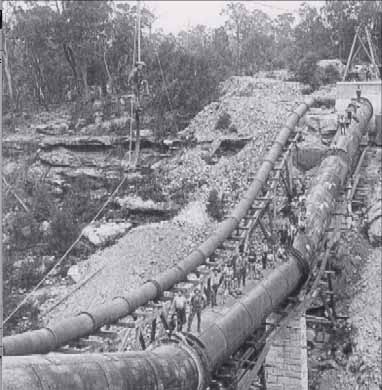
Colorado Springs Utilities unveils $87 million budget increase, the Southern Delivery System causes 12% increase in water rates

southerndeliverysystemconstructioncelebration08192011.jpg

From The Colorado Springs Gazette (John Schroyer):

Utilities’ budget is projected to jump by 8.6 percent in 2012, an increase made possible by a 12 percent increase in water rates, a 5 percent increase in natural gas rates, and about a 1 percent increase in electricity rates.

Roughly three-quarters of the $87 million will be devoted to SDS work, and the remainder will go to other projects, such as the installation of new emissions-cleaning technology at Drake Power Plant, said Utilities Finance and Planning Chief Bill Cherrier.

The 187-page budget, which the Utilities Board is analyzing, also predicts that water, electricity and natural gas usage will remain flat throughout 2012. Hence the need for the rate increases. The budget likely will be approved by the board, comprised of City Council members, in December without any substantive changes…

Utilities plans to spend $333 million on coal and natural gas to power both Drake and other power plants, and will spend $310 million on capital projects, such as SDS. “That’s more than 60 percent of our budget,” Cherrier pointed out.

Water rates will continue to increase by 12 percent every year until SDS is completed, which is slated for 2016. After that, Cherrier said, rates should even out, and may even decrease. Utilities board and city council member Tim Leigh suggested Colorado Springs may even become a water broker for other Front Range municipalities once SDS is finished. “Not everyone has a pipeline to the Arkansas River,” Leigh said.

More Southern Delivery System coverage here and here.

The Fountain Creek Master Plan was the topic of discussion at Friday’s meeting of the Fountain Creek Watershed Flood Control and Greenway District

fountaincreek.jpg

Here’s a in-depth report from Chris Woodka writing for The Pueblo Chieftain. Click through and read the whole article. Here’s an excerpt:

A corridor master plan Friday was combed over by the citizens advisory group to the Fountain Creek Watershed Flood Control and Greenway District board. The panel could not agree on whether a dam or series of dams is needed to protect projects that beautify the creek with trails and parks on Fountain Creek, a normally gentle stream prone to occasional violent floods. There also was no consensus on whether water quality should be improved before or after people are encouraged to enjoy the water…

The corridor plan addresses just the area in the flood plain between Pueblo and Colorado Springs, and is aimed at projects that will fit within the $50 million the district expects to receive five years from now. The district also needs to have projects that could convince voters to approve a mill levy when the time comes, said Larry Small, general manager of the district…

A dam on Fountain Creek could require moving railroad tracks and Interstate 25 or acquiring private land. A series of dams could be built on any of 21 tributaries along Fountain Creek and would be easier to clear as they periodically filled with sediment, Ready said. “You need a greenway so the creek can meander to slow down the water,” [Tom Ready, a Pueblo member of the committee] said. “You need to keep construction away from the creek. But no big dam will ever work.”[…]

[Larry Howe-Kerr of Better Pueblo] questioned the wisdom of drawing people to the creek if the water quality remains impaired. Small, Ready and others on the committee said the corridor plan does recommend actions that would improve water quality. They said recreation on the creek would get people to care about it, and does not necessarily mean coming in contact with the water…

The district is awaiting information from a U.S. Geological Survey study of the impact dams would have on Fountain Creek. In addition, Colorado Springs is developing a stormwater criteria manual which the district wants other communities to consider as well. It won’t be finalized until 2013. A white paper that looks at a comprehensive stormwater plan for El Paso County communities also is being drafted and should be presented to the district in the near future.

Meanwhile, two technical advisory committee meetings are on the horizon to discuss dam proposals and water rights issues on the creek, according to Chris Woodka writing for The Pueblo Chieftain. From the article:

The technical advisory committee of the Fountain Creek Watershed Flood Control and Greenway District will discuss the U.S. Geological Survey study of Fountain Creek dams at 10 a.m. Nov. 30 at the Pikes Peak Area Council of Governments office, 15 S. Seventh St., Colorado Springs.

The committee will have a panel discussion of water rights by experts from various organizations at 1 p.m. Dec. 7 at Fountain City Hall.

The USGS study is looking at the impacts of putting dams at various points along Fountain Creek to control floods. The study would not design or recommend dams, but is designed to measure the effectiveness of single projects or combinations of projects. The study is expected to be ready for review late next year and completed in 2013. The study is funded, in part, by $300,000 from Colorado Springs Utilities as a condition of the Pueblo County 1041 permit for the Southern Delivery System.

The water rights discussion is needed as the district and its partners develop demonstration projects for Fountain Creek, said Dennis Maroney, chairman of the technical committee.

More Fountain Creek coverage here and here.

Fountain Creek: Lower Arkansas River irrigators are speaking out about the effect of potential flood control projects on junior water rights

fountaincreek1999floodcwcb.jpg

From The Pueblo Chieftain (Chris Woodka):

“It’s the same question I kept asking on the Vision Task Force,” said Dan Henrichs, superintendent of the High Line Canal and secretary of the Arkansas Valley Ditch Association. “Whose water is it [ed. flood water/storm water], and how do you get it to them?”

While the September rainfall was heavy in Colorado Springs, it was light or nonexistent in the farmlands along the Arkansas River. In addition, the native flows from the Arkansas River were held back during the high-water event on Fountain Creek to avoid worsening flood conditions. Flows at Avondale were only briefly above the flood limit of 6,000 cfs. The return flows from the banks and side channels along Fountain Creek lasted for two weeks…

While Pueblo’s side detention pond may have had a negligible impact on the September stormwater, a whole series of them could have a much bigger impact. Water rights must be incorporated into the current U.S. Geological Survey study of the impact a dam or series of dams would have on Fountain Creek, Henrichs added. There are indications many others agree. The technical advisory committee of the Fountain Creek Watershed Flood Control and Greenway District wants to better understand how water rights would be affected by projects the district is coordinating, according to comments at last week’s meeting by Executive Director Larry Small…

Henrichs said he would prefer a more detailed analysis of the historic timing of Fountain Creek flows and development of a way to release flows to the appropriate users — like the winter water program that allows irrigators to store during winter months when irrigation is impractical or unnecessary.

More Fountain Creek coverage here and here.

The Fountain Creek Watershed, Flood Control and Greenway District reviewed the Corridor Master Plan at Friday’s meeting

fountaincreekwatershed.jpg

From The Pueblo Chieftain (Chris Woodka):

The district Friday reviewed the progress of the newly completed Fountain Creek Corridor Master Plan and an El Paso County stormwater study. In addition, the district suggested areawide flood plain regulations developed by Colorado Springs and reviewed a U.S. Geological Survey study of the impact of building a dam or a series of dams on Fountain Creek. It also looked at a more immediate plan by communities throughout the watershed to apply for a $7.5 Great Outdoors Colorado grant that would support 20 separate projects. The district is still developing the application.

While the master plan is done, the others are at various stages of development and acceptance in communities throughout the watershed. And, although those in the district have been involved for years with the creation of plans, there are worries that the communities they represent know little about the work they have been doing. For instance, a recent press release about the completion of the master plan was published by only The Pueblo Chieftain, and some members of the public weren’t sure how it fits in…

In presenting the master plan, Kevin Shanks of THK Associates said it is heavy on demonstration projects that bring people to Fountain Creek rather than treat it simply as a polluted waterway prone to flooding. “If people can come out and enjoy it, they will be more receptive to a mill levy later on,” Shanks said. “I have a strong feeling that people need to be out there now.”

The district has delayed asking for a mill levy — the 2009 legislation that created it allows for up to 5 mills, but initially would look at much less than that — because of the economy. Voters would have to approve the tax, and the board wants something to show before asking for a tax…

Not everyone was happy about the discussion of only small flood control projects and recreational improvements, particularly landowners whose property was damaged during last month’s flooding. “Someday, someone has got to do something to keep the water from flooding and doing us all in,” said Jane Rhodes, who owns farmland on Fountain Creek in Pueblo County. “Every time, it’s everywhere else but us. There are no detention ponds or reservoirs.”

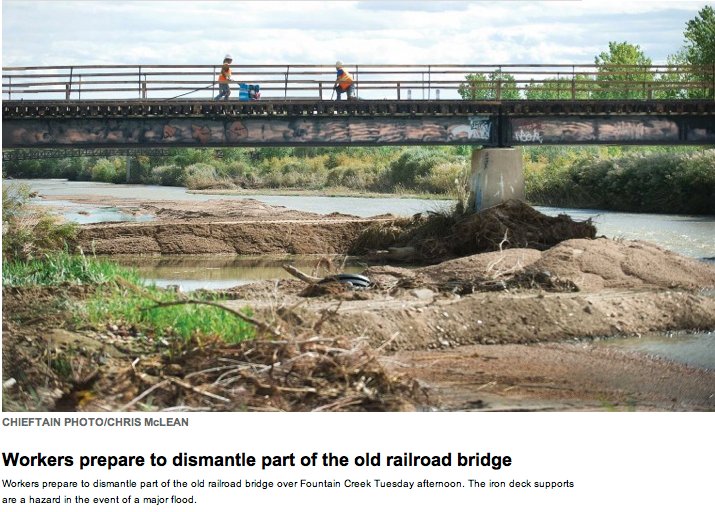
Meanwhile, the Union Pacific Railroad has removed the deck of an abandoned trestle across the creek near Pueblo but the piers remain. Here’s a report from Chris Woodka writing for The Pueblo Chieftain. From the article:

The Union Pacific Railroad hired contractors to remove iron deck supports from the bridge. The job was completed last week. “The railroad did not commit to removing the piers, but the trusses were a flood issue,” said Scott Hobson, assistant city manager for community development. “It would look better with the piers removed, but we need to look at options to remove them. For the short term, we were able to take the trusses down.”

The piers are 50-60 feet apart and collected piles of trees and debris during last month’s elevated creek levels — the U.S. Geological Survey called it a 10-year flood event. Large logs moved through the openings under the bridge, but there is still potential for large amounts of material to collect during a heavier flood, Hobson acknowledged.

More Fountain Creek coverage here and here.

The Fountain Creek Watershed, Flood Control and Greenway District is awaiting a stormwater assessment and management study due in December

fountaincreek1999floodcwcb.jpg

From the Colorado Springs Independent (Pam Zubeck):

That September deluge provided the latest evidence of the need to control stormwater runoff. The question is how, considering the backlog of projects in the Springs alone amounts to as much as $500 million, and efforts to collect the now-defunct stormwater fee have been a nightmare.

[Larry Small, manager of the district] believes the first step is overseeing a study to identify the region’s drainage costs and funding options. It’s funded by Colorado Springs Utilities ($20,000), El Paso County ($10,000) and the Pikes Peak Regional Water Authority ($7,500), a coalition of water users outside the city. “I think we have to get this study put together first,” Small says, “and then get the governments together in the region and say, ‘How do we want to tackle this, and how do we tell people the benefits?'”[…]

Small says the study will quantify costs regionally (including Pueblo County), report timeframes for building projects, and suggest funding mechanisms, such as a stormwater authority that might rely on property taxes over a wide area, possibly two counties…

Lisa Ross, the city’s acting stormwater manager, says the EPA is getting tougher on pollutants and monitoring. She encourages flood-control projects such as detention ponds that allow pollutants to drop out of the water before flowing to creeks…

Stormwater has always been a loser. In 2005, City Council, in part to placate Pueblo, formed the Stormwater Enterprise and followed in 2007 with fees levied on all property owners. Many refused to pay the “rain tax,” and the city has had trouble collecting since. The enterprise was dismantled in 2009. Collection letters, court judgments and “till taps,” wherein deputies seize money from businesses in satisfaction of court orders have only brought ill will.

More stormwater coverage here.

The Fountain Creek Corridor Restoration Master Plan is hot off the press from the Fountain Creek Watershed Flood Control and Greenway District

fountaincreekwatershed.jpg

From The Pueblo Chieftain (Chris Woodka):

The plan builds on past studies of Fountain Creek by recommending specific actions and strategies for reaches south of Colorado Springs to the confluence with the Arkansas River in Pueblo. The plan includes the 100-year floodplain for about 46 miles of the creek. The plan is the completion of efforts to improve Fountain Creek that began in 2007 with negotiations between Colorado Springs and the Lower Arkansas Valley Water Conservancy District. The Fountain Creek district signed a partnership with those entities in 2009 to complete the plan…

A total of $1 million has been spent on the plan, which was financed equally by Colorado Springs and the Lower Ark district. THK Associates was the primary contractor. “This plan defines the elements that are included in a healthy reach of the creek versus an unhealthy reach of the creek,” said Larry Small, executive director of the Fountain Creek district. “The plan establishes a series of restoration techniques, including conservation, that are intended to be the toolbox of techniques used as a part of revitalizing Fountain Creek.”

The plan notes that most of the land in the unincorporated areas along Fountain Creek is privately owned, and generally healthy. The problem areas in Fountain and Pueblo, on mostly public land, receive the most attention. To improve the health of the stream, the plan recommends bank restoration, side detention ponds, wetlands and removal of invasive species that choke out other vegetation. The plan also seeks ways to connect communities to Fountain Creek to treat it as an asset rather than a problem…

The U.S. Geological Survey, in connection with the district, is studying the impact of a dam or series of dams on Fountain Creek. Results from that study are expected next year.

Comments on the corridor master plan may be made to fountainck dist@aol.com.

More Fountain Creek coverage here and here.

Woodmoor Water and Sanitation District rate-payers are worried about the district’s debt load

denveraquifer.jpg

From the Tri-Lakes Tribune (Lisa Collacott):

During the Oct. 17 meeting board members voted unanimously to purchase the ranch east of Fountain Creek. It is estimated that the cost of the ranch’s decreed water rights — 3,500 acre-feet annually — will range between $25 and $31 million. More than 100 residents attended the meeting and many were in opposition to the purchase of the ranch.

Woodmoor resident Bob Gountanis agrees that the water district needs to look at renewable water but is opposed to this particular decision. “I think the idea is OK, but the way they went about it is not,” he said. Gountanis said there is not a contract to convert the water from agricultural use to commercial use and there are no estimates on how much it will cost to deliver the water up to Woodmoor.

The water district hosted three public meeting — Sept. 27, 29 and Oct. 8 — to discuss the need for renewable water and the impact it will have on customer’s water bills. Jessie Shaffer, general manager for the water district, said the expected cost for the ranch is expected to be between $25 and $31 million but that is dependent on the water rights that are still to be determined in water court. The cost of delivery is estimated to be between $30 and $100 million.

The water district is looking at a 25-year revenue bond to pay for the purchase of the ranch. The average homeowner will see a $48.50 water investment fee beginning in January 2012 which comes out to an increase of $600 per year. Gountanis said an extra $600 a year may not seem like a lot to some people, however it is a lot for families who are having a tough time because of the economy.

More Denver Basin Aquifer System coverage here and here.

Fountain Creek: Colorado appeals court rules that the Pueblo District Attorney is not authorized to sue Colorado Springs for pollution under the Clean Water Act

fountaincreek.jpg

From The Pueblo Chieftain (Chris Woodka):

The decision by the 10th U.S. Circuit Court of Appeals nixes Thiebaut’s intention to sue the city again for discharging pollutants from its sewage system into the creek. Thiebaut said, however, his 2005 lawsuit, under the federal clean water law, prompted Colorado Springs to improve its sewage system, which discharges into the creek. “It is important to take stock of what this suit has accomplished for our community,” Thiebaut said. “No one has ever stood up against Colorado Springs on behalf of Pueblo before this suit was filed.”[…]

Thiebaut said Wednesday his lawsuit “woke up Colorado Springs to the fact that they would no longer get away with their shoddy practices and cheap stream crossings. “To avoid the full power of the court, they began to spend a lot of money to clean up their act, improving their sewage treatment system and stream crossings — and they need to do even more,” he said…

The Denver-based appeals court’s 3-0 decision said Thiebaut had conceded he, as an individual citizen, was entitled to have sued Colorado Springs under the federal water law. He chose, instead, to sue in his official capacity as district attorney. The appeals court agreed with [U.S. District Court judge, Walker Miller, who threw out Thiebaut’s lawsuit in 2007] that the Colorado law which outlines the duties of district attorneys does not give them authority to sue under the Clean Water Act.

Here’s the order from Leagle.com.

More coverage from Associated Press via The Durango Herald:

Thiebaut’s lawsuit in 2005 argued that discharges of sewage between 1998 and 2007 were violating the Clean Water Act, hurting Fountain Creek and affecting Pueblo County’s economy. His lawsuit sought civil penalties. On Wednesday, a three-judge panel of the 10th U.S. Circuit Court of Appeals sided with a district court that found Thiebaut couldn’t file a citizen Clean Water Act lawsuit in his official capacity. Thiebaut said his office was reviewing the ruling before deciding what’s next…

The Sierra Club also sued over the spills. A judge fined the utility $35,500 to settle the Sierra Club’s claims.

Colorado Springs Utilities’ pipes cross creeks dozens of times, leaving them somewhat at risk in times of rainstorms, utility spokesman Steve Berry said. He said that since 2004, before Thiebaut sued, the municipal utility has invested more than $147 million in improving its wastewater collection system, which he said is now among the best-performing systems in the state. It expects to have spent $250 million by 2018, he said.

More Fountain Creek coverage here and here.

Fountain Creek: Removal of old railroad bridge near the confluence with the Arkansas River for flood mitigation has begun

oldrailroadbridgeoverfountaincreekbeforedemo.jpg

From The Pueblo Chieftain (Chris Woodka):

Edward Kraemer & Sons will perform the work under contract with the Union Pacific Railroad, and completion is expected in a few weeks, said Daryl Wood, stormwater utility supervisor for the city of Pueblo. The bridge is located just upstream of the confluence of Fountain Creek at the Arkansas River. “The lower part of the bridge is the problem,” Wood said.

During a large flood, debris could hang up on the iron deck supports and act as a dam. Water potentially could top the levee system in that area and flood nearby neighborhoods. Last month’s flood, described as a 10-year event, left some tree limbs hung up on the piers of the bridge, but most of the debris passed through and settled somewhere downstream. There were problems with sediment deposits and trees on parts of the pedestrian-bicycle trail along Fountain Creek as well.

More Fountain Creek coverage here and here.

Colorado Springs Utilities has a new design for retention ponds, they hope to save $64 million in the Jimmy Camp Creek drainage

jimmycampcreek.jpg

From The Colorado Springs Gazette (John Schroyer):

Colorado Springs would save an estimated $64 million on construction expenses for stormwater retention ponds in the Jimmy Camp Creek watershed, under a new design compiled by the city engineer’s office.

The plan, outlined in a manual that must be approved by City Council by next May, would direct homebuilders to include a series of smaller retention ponds for stormwater runoff as they develop subdivisions, retail parks and the like…

Currently, stormwater runoff is controlled by dozens of much larger ponds, each of which covers about 45 acres. The problem is that with such large bodies of water, it’s hard to prevent large-scale erosion and watershed flooding. With smaller ponds, both of those problems are significantly reduced, said Dan Bare, senior civil engineer for the city.

The ponds — which are basically small dams — trap storm and spring runoff and moderates the flow of the water into local tributaries, such as Fountain Creek, to prevent flooding and erosion as much as possible. The smaller ponds would range from five to 10 acres, and would be much less obtrusive, Bare said during a presentation to city employees on Sept. 15. And because the smaller ponds are easier to maintain, require smaller channels and wouldn’t have to absorb as much runoff all at once as the larger ponds, the city would save millions in capital costs as Colorado Springs grows.

More stormwater coverage here.

10th Circuit Court of Appeals hear Pueblo District Attorney’s appeal of decision over Fountain Creek pollution case exclusion

fountaincreekwatershed.jpg

From The Pueblo Chieftain (Robert Boczkiewicz):

The 10th Circuit Court of Appeals heard arguments [September 14] on Thiebaut’s contention that a lower court judge should not have thrown out Thiebaut’s lawsuit against Colorado Springs Utilities. The 10th Judicial District covers Pueblo County.

Senior U.S. District Judge Walker Miller concluded in 2007 that Colorado district attorneys do not have authority under state law to use the federal Clean Water Act to sue in federal court. That is what Thiebaut did in 2005 when he sued Colorado Springs. The appeals court will decide whether it will reinstate Thiebaut’s lawsuit…

An attorney for the city argued Wednesday that Miller’s decision should not be overturned. “We urge you to sustain a very thorough and thoughtful order by Judge Miller,” attorney David Robbins told the appellate judges. Robbins said “all the issues were resolved” in a lawsuit against Colorado Springs Utilities by the Sierra Club environmental organization that was very similar to Thiebaut’s lawsuit.

More Fountain Creek coverage here and here.

The Woodmoor Water and Sanitation District is acquiring the JV Ranch for renewable sources

denveraquifer.jpg

From The Tri-Lakes Tribune (Lisa Collacott):

The water district has been working to acquire renewable water from the JV Ranch east of Fountain Creek and board members will decide at their Oct. 13 board meeting if they will finalize the purchase and the issuance of bonds to finance the purchase. If approved, the district expects to close on the purchase in late October or early November.

Jessie Shaffer, general manager for the water district, discussed the purchase and what impact it will have on water bills at two recent public meetings on Sept. 27 and 29. A third meeting is scheduled for Oct. 8.

The cost of the ranch’s decreed water rights, which is 3,500 acre-feet annually, is expected to cost between $25 and $31 million, dependent on the outcome of water court. Bonds will be used to finance the purchase of the ranch however that means an increase on customer’s water bills. They can expect to see a rate increase as early as January 2012…

Shaffer said the average residential customer pays $75.21 in the winter and $206.82 in the summer. In 2012 they can expect to pay $106.69 in the winter and $240.08 in the summer…

The next public meeting will take place at 8 a.m. Oct. 8 at the Mozaic Restaurant located at the Inn at Palmer Divide. The public is also welcome to attend the Woodmoor Water and Sanitation District’s board of directors meeting Oct. 13.

More Denver Basin aquifer system coverage here.

Ben Noreen: ‘A sustainable future costs money’

denveraquifer.jpg

From The Colorado Springs Gazette (Ben Noreen):

The [Woodmoor Water and Sanitation District] plans informational meetings during the next several days for its 3,300 ratepayers, but Manager Jesse Shaffer said information about the deal began to be mailed to customers months ago. As early as Oct. 16 the district’s board may decide to spend between $25 million and $31 million for the JV Ranch and the 3,500 acre feet of Fountain Creek water that go with it. Shaffer said the final purchase price will depend upon how much of that water can be converted to municipal use; it’s now used as agricultural water. A water court case would determine those numbers, but Woodmoor customers would see about $48 a month in additional charges to pay off revenue bonds sold by the district…

…a sustainable future costs money and the general notion of any water district reducing its dependence on disappearing groundwater in favor of annually renewable supplies is good for the entire Pikes Peak region. At some point, our nonrenewable water in the ground will be gone and long before that happens, cities towns and districts have to figure out how to avoid being left high and dry. “The JV Ranch purchase represents the greatest milestone in our district’s quest for renewable water,” Board President Barrie Town said…

Woodmoor customers can hear more details about the proposal at a meeting Thursday at 5:30 p.m. at Monument Town Hall, 645 Beacon Lite Road, or on Oct. 8 at 8 a.m. at The Mozaic Restaurant at the Inn at Palmer Divide, 443 S. Highway 105, Palmer Lake.

More Arkansas River basin coverage here. More Denver basin aquifer system coverage here.

The Woodmoor Water and Sanitation District is finalizing purchase of El Paso County ranch to change the water rights to municipal uses

denveraquifer.jpg

From The Pueblo Chieftain (Chris Woodka):

The district’s board will look at finalizing the purchase of the JV Ranch near Fountain in Southern El Paso County at its Oct. 13 meeting, and has dropped contracts to purchase water rights on the High Line Canal and Excelsior Ditch. Woodmoor still has active contracts on the Holbrook Canal, as well as an application in Division 2 Water Court to exchange water from Holbrook up the Arkansas River and Fountain Creek. A trial in that case has been scheduled for June 2013. Woodmoor announced its intent to purchase the 3,500-acre JV Ranch, which has water rights of 2,500 to 3,500 acre-feet of water per year as well as a 70-acre reservoir. The purchase price will be $25 million to $35 million, depending on the historic average amount of water determined when a water rights change case is filed.

Woodmoor, which serves about 3,200 homes near Monument, has been hunting for water rights since 2009, to find renewable water supplies. It relies on 16 wells in the Denver Basin aquifers, which are being overtapped by new development…

If the JV Ranch can produce the full 3,500 acre-feet annually, it would provide nearly the full amount identified in the 2009 water plan, but [Woodmoor Manager Jessie Shaffer] said the district is looking to strengthen its water holdings…

The district has scheduled three meetings in the next two weeks to explain the JV Ranch purchase to its customers.

Here’s a Woodmoor Association letter to residents dated today:

In May, I updated you on the latest developments in the Woodmoor Water and Sanitation District’s ongoing efforts to acquire renewable water to transition the District away from dependence on the Denver Basin aquifers. That update included a Board decision to enter into a contract to purchase water rights from the JV Ranch, a parcel of land in southern El Paso County.

The Board at its October 13 meeting will consider finalizing the District’s purchase of the JV Ranch and the issuance of bonds to finance the purchase of this important asset. The cost for JV Ranch’s decreed water rights (approximately 3,500 acre-feet annually), land and reservoir will be between $25 million and $31 million, with the final cost dependent upon the outcome of Water Court processes that will change these agricultural water rights to be used in the District’s municipal system. The District is currently in the final stages of the purchase contract and is moving forward on the financing and closing of this purchase—currently scheduled for late October or early November 2011.

This purchase represents the greatest milestone in the District’s Renewable Water Plan. The JV Ranch will provide long-term water security and protect the value of properties in Woodmoor. As you know, acquiring renewable water to meet current and future needs is the District’s highest priority, and the Board and staff continually work to implement the District’s Renewable Water Plan.

Most likely, you are wondering how this purchase will impact your water bill. The Board and staff have been working diligently with the District’s financial and engineering consultants to finance this purchase while limiting the financial impact to customers. The purchase will be financed through revenue-anticipation bonds and repaid through a modest increase in water rates and the implementation of a monthly “Renewable Water Investment Fee.”

The implementation of the Renewable Water Investment Fee and water-rate change are anticipated to begin January 1, 2012. At the same time, property taxes in the District will actually decline as the WWSD mill levy expires on December 31. This mill levy allowed the District to develop water and wastewater infrastructure and fund the District’s portion of expanding the Tri-Lakes Wastewater Treatment Plant back in 1996.

[Click here for a brochure about the Renewable Water Plan, which includes a discussion of the January 1 changes in rates and an explanation of how the rates will be computed. Additionally, an interactive calculator for estimating the change in residential rates is available on the District’s web site at http://www.woodmoorwater.com/water/renewable-water-plan.html. For information on commercial rate impacts, please contact me at 719-488-2525 x14.

The District has scheduled three public meetings to discuss the JV Ranch purchase, financial impacts on customer water bills and a general update on the District’s Renewable Water Plan. Please join us at one of the following public presentations.

More Arkansas River basin coverage here. More Denver basin aquifer system coverage here.

Fountain Creek: Recent flooding took out ditches, roads, fences, land and flood control dikes on farms between Fountain and Pueblo

fountaincreek.jpg

From The Pueblo Chieftain (Chris Woodka):

…on the night of Sept. 14. Up to 5 inches of rain had fallen in parts of El Paso County in a short time, creating a wave that crested at 13,000 cubic feet per second at Pinon on the morning of Sept. 15…

…the [Fountain Creek Flood Control and Greenway District’s] responsibility, as defined by the 2009 law that created it, is specifically for land use in the 100-year flood plain between Fountain and Pueblo. “The good news is that in 4-5 years, we will have $50 million,” said Pueblo County Commissioner Jeff Chostner. “Every day we get closer to receiving the $50 million, and this board will closer to implementing solutions. . . . Engineers are looking at the best way to slow the water down before it hits you.”

In its 1041 land-use permit issued in 2009, the Pueblo County commissioners put a condition on Colorado Springs to pay the $50 million over a five-year period after SDS is completed in 2016. Of the amount, $300,000 has been paid for a dam study on Fountain Creek, and another $300,000 has been provided for interim district expenses. The board will hear an update on the dam study at its Oct. 28 meeting.

Chostner also mentioned the $75 million Colorado Springs will spend under the 1041 agreement to protect sewer lines from flooding. “This is more reason for the public to support the Fountain Creek district,” Chostner said. “We need the financial muscle on the legal framework that’s already there.”

More coverage from Chris Woodka writing for The Pueblo Chieftain. From the article:

Larry Small, the [Fountain Watershed] district’s executive director, attended the March meeting of the board. He was term-limited as a [Colorado Springs] councilman in April elections. Seven new council members were elected, in addition to Mayor Steve Bach, Colorado Springs’ first strong mayor. The new council apparently appointed Tim Leigh to the Fountain Creek board, with Brandy Williams named as an alternate. So far neither has shown up for a meeting or even talked to Small about the district. While several staff members or representatives for Colorado Springs or Colorado Springs Utilities have attended the meetings or district events since March, the chair reserved for the board member has been empty since April.

More Fountain Creek coverage here and here.

Colorado Springs Utilities tells the state legislature Water Resources Review Committee that the Southern Delivery System is a regional economic stimulus project

sdspreferredalternative.jpg

From The Pueblo Chieftain (Patrick Malone):

“It’s our own regional stimulus project,” John Fredell, SDS program director, told the Water Resources Review Committee.

Already $330 million of the anticipated $880 million sum the project is expected to cost has been committed. Colorado Springs Utilities’ customers will pay for the project with 12 percent rate hikes annually from now through the project’s completion in 2016. Fredell said SDS was parceled into several efforts in order to spread the wealth between Southern Colorado contractors. He referred to a Colorado Springs Chamber of Commerce study of the economic impact of the project that estimates construction of SDS will generate 780 jobs a year. Fredell said Colorado Springs Utilities hopes that the water it is securing through the pipeline to Pueblo Reservoir will yield fruitful economic development that transcends the immediate construction jobs.

More Southern Delivery System coverage here.

Fountain Creek Watershed Flood Control and Greenway board meeting recap: The district is trying to stretch their seed money until the Southern Delivery System bounty hits in 2016

fountaincreekwatershed.jpg

From The Pueblo Chieftain (Chris Woodka):

“I just want to make sure we can stretch this money as far as we can until 2016,” Executive Director Larry Small told the Fountain Creek Watershed Flood Control and Greenway district board Friday. “Financially, we are in good shape.”[…]

When the Southern Delivery System comes on line, scheduled in 2016, the district gets the balance of $50 million, paid by Colorado Springs under its 1041 land-use permit with Pueblo County. Until then, the district will continue to live on $200,000 provided to it through an agreement with Colorado Springs and the Lower Arkansas Valley Water Conservancy District…

Although its operating budget is tiny, the district manages about $500,000 of funds through the agreement with Colorado Springs and the Lower Ark. The Fountain Creek Corridor Master Plan will be completed this year, and the U.S. Geological Survey is working on a study of potential dams on Fountain Creek.

More Fountain Creek coverage here and here.

Southern Delivery System update: Denver companies are playing a large role in the construction of the pipeline

sdspreferredalternative.jpg

The Denver Business Journal (Cathy Proctor) is running profiles of 5 Denver area companies that are involved in the design and construction of the project. She lists Reynolds, Inc., Garney Construction Company, CH2M Hill, Northwest Pipe Company and MWH Global.

More Southern Delivery System coverage here and here.

Fountain Creek: Various restoration and flood control projects require substitute water supply plans to be filed with the state engineer

fountaincreekwatershed

From The Pueblo Chieftain (Chris Woodka):

Substitute water supply plans, which cover impacts from changes of water use that last less than five years, already have been filed on two of three projects that have begun on Fountain Creek. The plans are filed with the Division of Water Resources and can be forerunners of eventual court decrees, as uses continue over longer periods of time…

“We’re pleased (project sponsors) recognize there is a water rights component that needs to be addressed,” Water Division 2 Engineer Steve Witte said. Plans have been filed on the Clear Spring Ranch and Pueblo North Side wetlands restoration projects. The sediment collector project also would need a plan if it continues beyond a year.

More Fountain Creek coverage here and here.

Fountain Creek: ‘Dirt-A-Tracter’ sediment collector is working as planned so far, Colorado Springs plans more installations if evaluation project is successful

sedimentcollector.jpg

From the Colorado Springs Independent (Pam Zubeck):

Located just above the confluence of Fountain Creek and the Arkansas River, the collector is designed not only to remove clogs that contribute to flooding, but also to improve conditions for aquatic life. The 400 cubic yards a day of sandy material it removes will be used to extend the Palo Verde Trail and expand levees in Pueblo.

If it’s successful during its one-year test period, others could be installed along the creek, says Larry Small, former Springs City Councilman and executive director of the Fountain Creek Watershed, Flood Control and Greenway District, which spearheaded the project. And it might help to improve relations between Pueblo and Colorado Springs…

The collector, dubbed the “Dirt-A-Tracter,” is the Watershed District’s first tangible project. The second is a detention pond in northeast Pueblo, funded with $700,000 in state and federal grants, that’s to become operational in September. But the district faces $200 million worth of projects, as outlined in a soon-to-be-released long-range master plan.

“There’s a lot of work that needs to be done,” Small says. “That 44-mile corridor is in pretty bad shape.”

He notes the district has authority to levy up to 5 mills in property tax, with approval of voters in both El Paso and Pueblo counties, but any ballot measure would be years away. The district also can impose fees, but there’s no talk of doing so within the 692-square-mile watershed. As Small says: “You know how successful the stormwater fee was in Colorado Springs.” (The city’s Stormwater Enterprise was dismantled following a 2009 ballot measure.)[…]

Small says Colorado State University-Pueblo will monitor the collector system’s impact on sediment and aquatic life over the next year.

More Fountain Creek coverage here and here.

Fountain Creek: Sediment collector project rolled out Friday, Union Pacific will remove part of abandoned trestle over the creek

dirtatracterfountaincreekchieftain07302011

From The Pueblo Chieftain (Chris Woodka):

The railroad will take out six spans — the iron and lumber that form a deck across the creek — by May. The city of Pueblo would be responsible for the iron truss bridge on the west side, Pueblo stormwater consultant Dennis Maroney told the Fountain Creek Watershed Flood Control and Greenway District board Friday.

He said the Technology Test Center may be interested in taking out the truss section of the bridge as a training exercise, but those talks are still in progress. “The piers would remain in the river,” Maroney said, adding they do not represent a serious impediment to flows.

The fear is that during a major flood the bridge would act as a dam as debris from upstream clogged the passage. That would cause water to back up over levees and flood commercial or residential areas…

The city of Pueblo, Pueblo County, the Fountain Creek district and numerous state and federal agencies launched a demonstration project Friday of an in-stream sediment collector that could be a less expensive alternative to dredging, if the technology works as advertised.

More coverage from Chris Woodka writing for The Pueblo Chieftain. From the article:

The name [Dirt-A-Tracter] for a sediment collector in Fountain Creek was chosen by children at the Boys & Girls Club, beating out “Hoovanator” and “Dr. Sandy Cheeks” in a contest sponsored by the Fountain Creek Watershed Flood Control and Greenway District…

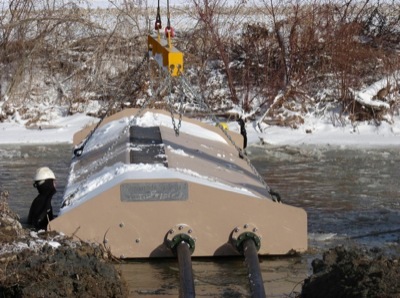
Basically, it works by attracting sand and small gravel that fall through a screen and are extracted with a pump to a storage site by the side of the creek…

The collector is equipped with a variable speed motor capable of pumping up to 800 gallons per minute of slurry that is 30 to 60 percent solids. A mining screw and conveyor belt pile up material pumped from the collector, while a second hose returns water to the collector. At maximum capacity, the collector is capable of removing 130 12-yard truckloads of sediment in a 24-hour period. Of course, it won’t be operated 24 hours a day, and flows will vary. One purpose of the yearlong project is to see how it performs under various conditions, and engineers were hoping for a cloudburst later in the afternoon. “Really, it will produce only what the river delivers,” said Streamside Systems CEO Randy Tucker.

More coverage from John Schroyer writing for The Colorado Springs Gazette. From the article:

The machine, which took only three months to construct, is surprisingly simple — as creek water passes through a bottleneck in the creek, sediment is sucked down out into a pipe and then carried roughly 600 feet away from the creek, where it’s piled and then lugged away by dump trucks.

The point, said Fountain Creek Watershed Executive Director Larry Small, is to prevent sediment from building up at any one place. In the past, sediment buildup has led to flash flooding, which happens when a sudden rush of water down the creek is diverted into a neighborhood or town…

The $836,000 machine is the result of a partnership between Pueblo, Pueblo County and the Fountain Creek Watershed. All three had a hand in the design, construction and implementation of the Dirt Attractor.

Of the cost, $353,000 was covered by Colorado Springs Utilities, which paid $2.2 million to the county of Pueblo as part of the deal to allow it to build the Southern Delivery System, said Pueblo’s Assistant City Manager Scott Hobson.

The Colorado Department of Public Health and Environment chipped in another $250,000, and the city of Pueblo paid the rest, said Hobson. The city also will supervise the ongoing operation of the Dirt Attractor and pay its electricity bill.

The machine will require minimal oversight and will operate almost exclusively via electronic monitors that sense the water level of the creek.

The Dirt Attractor also has environmental benefits, said Hobson. The sediment pulled from the creek probably will be used by the city’s wastewater plant to dilute the chemical content of the plant’s leftover “sludge.” That way, the material can be reused naturally instead of buried in a landfill.

More Fountain Creek coverage here.

Wastewater: Colorado Springs Utilities is using a UV array to disinfect effluent prior to releases into Fountain Creek

uvdisinfection.jpg

From The Colorado Springs Gazette (John Schroyer)

[Colorado Springs Utilities] had been using UV to help purify wastewater at its J.D. Phillips treatment plant, on the north side of Colorado Springs, since the plant was built in 2007. And the 540-bulb UV purification system there has been working “extremely well,” said plant superintendent William Hoyt.

So Utilities took the next step and built an even bigger UV array in its Las Vegas Street plant, almost twice the size of the one at the Phillips plant. The new 972-bulb system at the plant near Interstate 25 and South Nevada Avenue took a year to construct. The system began operating on Jan. 5, and since then, UV lights have treated an average of 30 million gallons of Colorado Springs wastewater per day, all of which leaves the plant cleaner than ever before. “What we’re putting into the creek, it has less bacteria in it than the creek does,” said Dean Cohrs, the plant’s interim operations supervisor. Specifically, the UV system kills far more E. coli, as per the new regulations, than chemicals ever did…

One of the biggest benefits of the UV purification process for both plants is that it’s astonishingly simple. Water flows into one of three channels at the end of the treatment process, churns in chambers illuminated by five-foot-long ultraviolet lightbulbs, and after a few seconds, is pumped out…

…the enterprise spent just under $13 million for the new UV array, which officials say is well worth the cost because it’s quicker, more environmentally friendly, and safer for employees.

More wastewater coverage here.

Fountain Creek: Crews are installing a sediment collector in the creek just upstream of the confluence with the Arkansas River

A picture named sedimentcollector.jpg

From The Pueblo Chieftain (Chris Woodka):

The collector, which is sort of like a giant vacuum cleaner, was to be installed Monday, but one of two track hoes being used to move the collector into place broke down. Work should be completed today. A crowd of people, mostly city employees or contractors on the $835,000 project, came and went throughout the day. It was like watching kids with big toys playing in a sandbox as the equipment scooped out a hole to fit specifications for the collector.

The sediment collector is a 30-foot-long, 24,000-pound piece of machinery that has a variable speed motor capable of pumping up to 480 gallons of slurry per minute. It will be installed near the out-of-service railroad bridge just upstream from the Arkansas River confluence. The variable speed motor inside the collector will operate at speeds in sync with information provided over a satellite relay from the Fountain Creek stream gauge at the north end of Pueblo. The machine connects to two pipelines, one which suctions out the muddy sediment and another which injects water so that sand doesn’t plug up the machine. The high-capacity design represents a substantial boost in capability from other units made by [Streamside Systems]…

The project is needed to restore the capacity of Pueblo’s levee system, which was constructed in the 1980s to prevent the sort of costly flooding seen in the 1965 flood, said Dennis Maroney, a stormwater consultant…

In the event of a major flood, the unit would not be lost — Fountain Creek has swallowed railroad cars and bridges in the past. The collector will be anchored to the banks by cables that are designed to keep it from washing out, being swept away or being covered in mud, Tucker said…

In the event of a major flood, the unit would not be lost — Fountain Creek has swallowed railroad cars and bridges in the past. The collector will be anchored to the banks by cables that are designed to keep it from washing out, being swept away or being covered in mud, Tucker said…

The collector should be up and running within a couple of weeks.

More Fountain Creek coverage here and here.

Pueblo County has allocated $350,000 for Fountain Creek projects

A picture named sedimentcollector.jpg

From The Pueblo Chieftain (Chris Woodka):

The money will come from a $2.2 million payment to Pueblo County from Colorado Springs in lieu of dredging Fountain Creek. Colorado Springs agreed to the dredging as a condition of Pueblo County’s 1041 permit for the Southern Delivery System. “This is not a commitment by Pueblo County to spend the remaining $1.9 million,” said County Commissioner Jeff Chostner. “This is only a demonstration project.”[…]

The money will help pay for an in-stream dredging system that will remove sediment from Fountain Creek in a demonstration project. If the project is successful, more of the devices would be installed along the creek through Pueblo to preserve the effectiveness of levees…

Sediment collectors in Fountain Creek would remove the sediment while allowing particles suspended in water, which are beneficial to agriculture, to continue to the Arkansas River. The total cost of the sediment collection system demonstration project will be $835,000, said Larry Small, executive director of the Fountain Creek Watershed Flood Control and Greenway District…

The site for the collector, at an out-of-service railroad bridge near the confluence of Fountain Creek at the Arkansas River, is being prepared. The collector will installed in mid-July.

Meanwhile, here’s an update on the water quality study of Fountain Creek from Chris Woodka writing for The Pueblo Chieftain. From the article:

[Del Nimmo, a research associate at Colorado State University-Pueblo] updated the Fountain Creek Watershed Flood Control and Greenway District on water quality studies that CSU-Pueblo has been conducting for more than five years. While there are practical applications, like improving the fishing, the main thrust of the studies has been to measure water quality, especially in light of changes that will be caused by the Southern Delivery System, Nimmo said. “If you don’t have an emphasis on water quality, it seems to us we’ve missed the mark if we want to have some semblance of improving Fountain Creek,” Nimmo said. “It’s an effluent-driven stream and likely to be more so with the development of SDS.”[…]

Nimmo, along with CSU-Pueblo biology Professor Scott Herrmann, explained that fish habitat on Fountain Creek could be expanded with the creation of deeper pools, wetlands and trees to control temperatures. They found large brown trout, some up to seven years old, in Upper Fountain Creek, above the confluence with Monument Creek in Colorado Springs, and said the fish could spread farther downstream if the right conditions are maintained.

More Fountain Creek coverage here and here.

Southern Delivery System update: Construction starting in earnest this summer

A picture named sdspreferredalternative.jpg

From The Denver Post (Bruce Finley):

Construction crews this week began work on the $2.3 billion Southern Delivery System. It is designed to pump water uphill and north from Pueblo Reservoir — through a 62-mile pipeline — to sustain Colorado Springs, which owns the rights to the river water, and other growing Front Range cities. The cities embarked on this project because water supplies have emerged as a constraint on population growth.

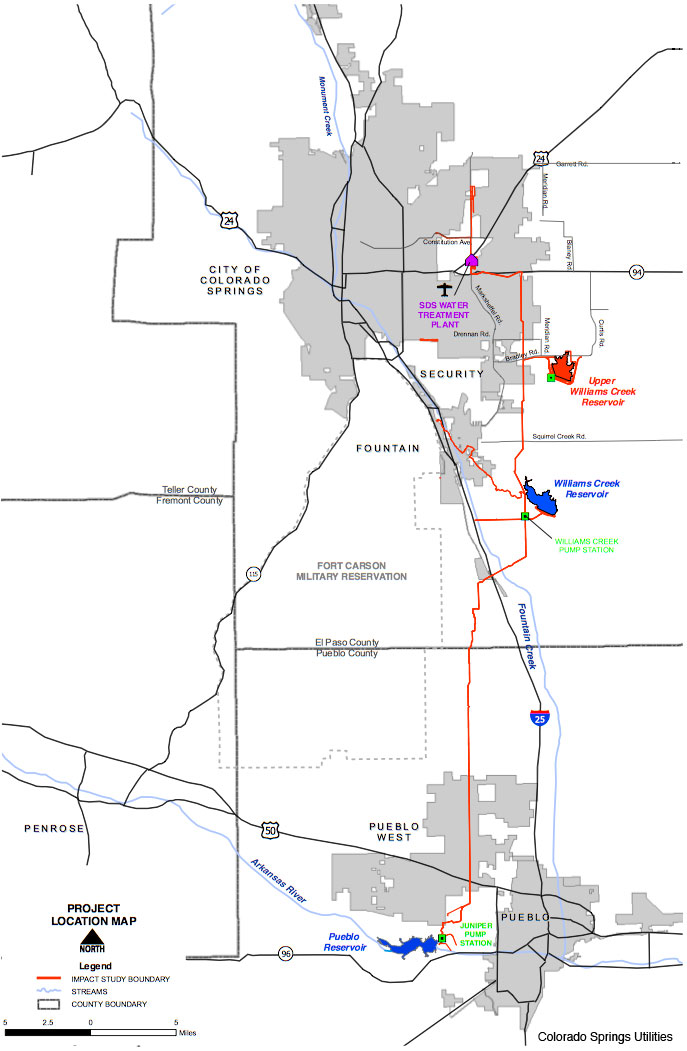
CH2MHill project engineers and construction chiefs at Pueblo Reservoir this week re-channelled the river below the 240-foot-high dam using sandbags. They’re adjusting dam valves to dry an area so that digging crews can start laying the pipeline without relying on expensive underwater divers. Three 15,000-horsepower pumps are to propel the water through a pressurized 66-inch-diameter steel pipeline. Moving water to the planned end points — two 30,000 acre-foot reservoirs to be built east of Colorado Springs — requires an elevation gain of 1,600 feet…

The Pueblo Reservoir, built in 1975, holds 357,000 acre-feet of water, and the diversion is expected to lower the average water level by about six feet…

Meanwhile, the $50 million for cleaning and restoration of Fountain Creek could enable new recreation, reservoirs and fishing, [Pueblo County Commissioner John Cordova said. “We could have trout,” he said…

Environmental groups “are generally satisfied,” as long as Colorado Springs live up to its commitments to ensure appropriate water levels in the Arkansas River above and below the reservoir, Trout Unlimited water project director Drew Peternell said.
Huge amounts of energy required to pump water uphill, however, looms as “a greenhouse gas issue,” Peternell said. “We’d encourage them to consider renewable sources” of electricity, he said.

More Southern Delivery System coverage here and here.

Southern Delivery System: Construction to take off in earnest over the summer

A picture named sdspreferredalternative.jpg

From The Pueblo Chieftain (Chris Woodka):

Engineers and crews have already begun staging work at the Pueblo Dam where a new North Outlet Works will be constructed. Underground pipeline will be placed beginning in June through the first 9 miles through Pueblo West. And some work has already begun on laying finished pipeline under Marksheffel Road in El Paso County…

“In terms of land acquisition, we are halfway there, mostly in Pueblo County,” SDS Project Director John Fredell told the Southeastern Colorado Water Conservancy District board Thursday…

“It will be a boost to the regional economy, with $80 million-$100 million in construction costs this year, much of that in El Paso, Pueblo and Fremont counties,” Fredell said. “Over the life of the project, there will be $150 million in labor earnings alone.” There are expected to be an average of 380 jobs per year until SDS is completed in 2016, with a peak of 700 SDS jobs in 2014. The peak construction period will be in 2013-15, when the El Paso County treatment plant and three pumping stations will be constructed…

Reed Dils, a Buena Vista director, said the Pueblo route is preferable to an early proposal to build a dam near Buena Vista. The idea for an Elephant Rock Reservoir was kicked out in the early 1990s, as Colorado Springs was formulating plans for SDS, and protest signs remain in the area. “Thank you for the wisdom in not selecting Elephant Rock,” Dils told Fredell. “By not building in Chaffee County, you preserved the recreational economy in Chaffee and Fremont counties.”

More Southern Delivery System coverage here and here.

Southern Delivery System update: Colorado Springs Utilities inks the final contracts with the Bureau of Reclamation

A picture named sdspreferredalternative.jpg

From The Colorado Springs Gazette (Debbie Kelley):

The U.S. Bureau of Reclamation on Wednesday signed final contracts with Colorado Springs Utilities, the city of Fountain, Pueblo West Metropolitan District and the Security Water District, Kara Lamb, a Bureau spokeswoman said Friday. “All of the issues have been resolved, and the construction of the pipeline can go forward,” she said…

Construction for the pipeline’s first phase is expected to cost $880 million, plus financing costs of 40-year bonds, Rummel said. Utilities issued $180 million in Build America Bonds in September, to pay for construction for this year and 2012. Water rate hikes will help fund the project. Two 12 percent increases, one of which took effect in January, have been approved so far. The connection to two new man-made reservoirs, Upper and Lower Williams Creek reservoirs, is in a future phase and expected to raise the cost of the system…

The final sign-off by participants comes after a 60-day public comment period for 38-year storage, conveyance, and exchange contracts. The period ended April 25.

More Southern Delivery System coverage here and here.

Arkansas River Basin Water Forum recap: Some of Fountain Creek’s problems were front and center in the discussion

A picture named fountaincreekwatershed.jpg

From The Pueblo Chieftain (Chris Woodka):

While Fountain Creek is a tributary midway between Leadville and the Kansas border, the growth in its basin has had consequences up and down the river. El Paso County has about 80 percent of the Arkansas River basin’s population and Colorado Springs has taken extraordinary measures to move flows from both the Arkansas and Colorado rivers into the Fountain Creek watershed. As a result, the return flows — water that comes out of sewage treatment plants or that percolates off lawns — have increased. Flows into Fountain Creek have been altered as ground where water once soaked in has been paved to accommodate urban lifestyles…

One of the major reasons the [Fountain Creek Watershed Flood Control and Greenway District.] was formed was a proposal by Colorado Springs to divert even more water for itself and its neighbors through the Southern Delivery System. Leaders in Pueblo hammered out a series of agreements to protect the Arkansas River and Fountain Creek as SDS moved through its permitting. “There are serious questions about how to manage the return flows on Fountain Creek and these workshops have brought out many things that we need to take into account as we develop the master plan,” said Larry Small, the executive director of the Fountain Creek district. “I think we have to start with taking care of the eroded areas, and shore up the creek starting from those areas.”[…]

Water rights also will come into play on Fountain Creek as projects progress, Division Engineer Steve Witte said. “Is our prior [appropriation] system flexible enough to accommodate wetlands?” Witte asked, addressing a demonstration project on Fountain Creek in north Pueblo that proposes to create a flood detention pond. “Vested water rights are entitled to a continuation of stream conditions that existed at the time of their water rights appropriations,” he said…

Tougher water quality environmental regulations are coming into play over the next decade that will affect sewage and stormwater discharges into rivers, said Dick Parchini of the Colorado Water Quality Control Division. New standards are being developed for phosphorus, nitrogen and chlorophyll, which are byproducts of both urban and agricultural uses of water. Many come from “non-point” sources which cannot be easily identified or regulated. There are conflicting ideas about what the right standards should be. Water full of nitrogen isn’t good for drinking, but benefits crops. A lake with healthy amounts of algae is good for fish, but too much can choke off oxygen supplies as the algae die, and municipalities like their supplies “gin clear,” he said.

More Fountain Creek coverage here and here.

Larry Small hired to lead the Fountain Creek Watershed Flood Control and Greenway District

A picture named fountaincreekwatershed.jpg

From The Pueblo Chieftain (Chris Woodka):

Larry Small, a former board chairman, was hired Friday as executive director of the Fountain Creek Watershed Flood Control and Greenway District…Small will receive a monthly stipend of $2,500 — half of what interim director Gary Barber was paid. Barber resigned earlier this year for budgetary reasons…

In other action, the board:

– Agreed to administer a regional stormwater solutions white paper by Summit Economics. The district opted not to pay any of the $38,000 study itself, after Chostner maintained it is an El Paso County issue. Cities in El Paso County will bear the cost.

– Approved upgrades to a power line for Tri-State Generation and Transmission Association because one of the towers is in the Fountain Creek flood plain. District committees determined there would be no impact to the creek.

Meanwhile, Colorado Springs is revising the city’s rules on development in the Fountain Creek floodplain, according to Chris Woodka writing for The Pueblo Chieftain. From the article:

[Dan Bare, senior engineer with the Colorado Springs stormwater department] spoke to the Fountain Creek Watershed Flood Control and Greenway District at its monthly meeting Friday. The district’s technical advisory committee, developers and other interests have been working with Bare for two years in rewriting the drainage manual for Colorado Springs. When complete, it could be applied throughout the watershed to provide uniform protection to Fountain Creek through land-use policies.

One key idea is to build smaller, more effective drainage detention ponds, rather than more costly large basins that quickly fill with sediment, Bare said. “The developers are aware of what we’re doing and are pleased with the concept,” he said. Detention ponds would be designed to be multipurpose and more natural. “What we’re doing today just isn’t working.”

The new regulations also would provide for low-impact designs on new development that do not increase runoff into Fountain Creek. “What this does is change the way we develop so we don’t have the problems we do today with Fountain Creek,” said Dennis Maroney, stormwater consultant for the City of Pueblo.

More Fountain Creek coverage here and here.

Southern Delivery System: The Colorado Springs city council is looking at speeding up the project to take advantage of favorable contractor pricing

A picture named sdspreferredalternative.jpg

From the Colorado Springs Independent (Pam Zubeck):

Colorado Springs Utilities officials gave an update of SDS, along with several other utilities matters, to a Council that contains six new faces after the April 5 election: Angela Dougan, Lisa Czelatdko, Tim Leigh, Merv Bennett, Brandy Williams and Val Snider. During the presentation, the Council was told the city is getting good prices on SDS construction because of the gloomy state of the economy and intense contractor competition. That led Leigh to suggest that if it’s cheaper to build now, the city might think about pushing forward now, even if it means higher water rates for customers in the short run. In response, SDS program manager John Fredell told the Council that Utilities officials will “be ready to talk more detail in July about the project,” including, he said, “about accelerating” it.

More Southern Delivery System coverage here and here.

Southern Delivery System update: The Colorado Springs city council green-lights condemnation for property owners that won’t settle

A picture named pipeline.jpg

From The Colorado Springs Gazette (Dave Phillips):

The council voted 7-1 to grant the utility power to acquire four property easements in Pueblo West that are standing in the way of a nearly seven-mile stretch of pipeline scheduled for construction this summer. Councilman Tom Gallagher, a longtime SDS critic, cast the lone dissenting vote. “This is an unfortunate necessity,” said Councilman Sean Paige. “We never want to take this step if we can avoid it.” Utilities has been negotiating with 170 landowners in Pueblo County for permission to bury a 66-inch pipe since September 2009, according to Keith Riley, the head of planning and permitting for the project. So far, 120 land owners in Pueblo County gave permission in exchange for payments roughly equivalent to 90 percent the appraised value of the land. Another 12 properties had liens or judgements against them, so Utilities had to use eminent domain to clear the land titles. Another 12 property owners remain unwilling to accept Utilities’ offers, although negotiations continue. “I’m hopeful we will still reach agreement, but based on how it is going, it does not look like that will occur,” Riley told Council.

More Southern Delivery System coverage here and here.

Southern Delivery System update: Comments on the contracts to use Fryingpan-Arkansas project facilities close April 25

A picture named sdspreferredalternative.jpg

From The Pueblo Chieftain (Chris Woodka):

The contracts will allow Colorado Springs, Fountain, Security and Pueblo West to store water in Lake Pueblo, connect a pipeline to Pueblo Dam and change the operation of the Fountain Valley Conduit. Colorado Springs also will have the ability to move water upstream through a paper trade.

“We have not received any comments on the draft contracts,” said Kara Lamb, spokeswoman for the Bureau of Reclamation. Deadline for comments is April 25.

Colorado Springs Utilities expects to begin construction of the SDS project in Pueblo County beginning next month. While SDS was raised as a campaign issue in Colorado Springs elections, all seven council candidates elected last week, as well as the two other members, are supporters of SDS…

Construction on the North Outlet Works, a new connection to the dam, will begin in May. The lead contractor is ASI Constructors of Pueblo West. Construction on pipelines through Pueblo West and through Walker Ranches in northern Pueblo County is scheduled to begin in late summer. Some construction has begun in El Paso County, and fabrication of parts for the dam connection is nearly complete…

As part of SDS, however, each community will store water in excess-capacity accounts in Lake Pueblo beginning this year. Lake Pueblo was built as part of the Fryingpan-Arkansas Project, authorized by Congress in 1962. Nonproject water can be stored in most years. Excess capacity space in Lake Pueblo will be allocated at $36 per acre-foot with an increase of 1.79 percent annually over the 40-year life of the contract with the four communities. For the first seven years of storage, the bills will be reduced by a total of $6 million in recognition of oversizing the initial quarter-mile of pipeline from Pueblo Dam to the Juniper Pump Station. Once that section of pipeline is completed, it will be deeded to Reclamation. Consequently, payments through 2017 will total about $760,000. Payments from the four communities will total more than $1.25 million in 2018, and will increase each year by terms of the contract and as more water is stored.

More Southern Delivery System coverage here and here.

Pueblo County: Sediment collector for Fountain Creek to be placed over the next few weeks

A picture named sedimentcollector.jpg

From The Pueblo Chieftain (Chris Woodka):

Bedload sediment is the stuff that forms sandbars and clogs the channel during floods. As it passes over the collector, it will drop into a chamber where a vacuum will periodically suck it out. Left in the water will be fish — yes, there are fish in Fountain Creek — and the fine silts that farmers downstream rely on to seal ditches. “It will harvest and beneficially reclaim what the river delivers,” said John McArthur, president of Streamside Systems…

The Findlay, Ohio, company is building the 30-foot collector for a demonstration project in Pueblo that already has gained the attention of the U.S. Army Corps of Engineers for its potential to deal with problems throughout the West. There already are smaller collectors in New Mexico, to improve fish habitat, and Silverthorne, where the Colorado Department of Transportation is using one to remove traction sand (used on icy roads) from mountain streams. The Fountain Creek project will be the first large collector installed west of the Mississippi River, however. If successful, it could lead to as many as three others placed along Fountain Creek in Pueblo to deal with the large piles of material constantly moving downstream…

The high-capacity collector will be able to remove up to 130 12-cubic-yard truckloads of sediment from Fountain Creek after it is installed, probably in mid-May. The collector should arrive in Pueblo within the next two weeks, and will be installed just upstream of an out-of-service railroad bridge near the confluence with the Arkansas River. Contract arrangements for installation are being worked out. The collector can pump up to 800 gallons per minute. But it won’t run at full tilt all the time. “It’s variable frequency, so it depends on what’s going on in the creek,” McArthur said. “The motor will turn on once or twice a day, when it needs to pump.”

More Fountain Creek coverage here and here.

Current chair of the Fountain Creek Watershed Flood Control and Greenway District hopes to be reappointed — he’s stepping down due to Springs city council term limits

A picture named fountaincreekwatershed.jpg

From The Pueblo Chieftain (Chris Woodka):

Colorado Springs will elect seven of its nine council members and a mayor on April 5, creating uncertainty about who will replace Small on the Fountain Creek board. “I have been proud to be a part of this,” Small said at Friday’s meeting. “I can envision a band of life along this creek in the future.”

Small was praised by several board members for his hard work on the board and as a member of the Vision Task Force to resolve differences over Fountain Creek between El Paso and Pueblo counties…

The Lower Arkansas Valley Water Conservancy District and Colorado Springs Utilities presented a competing plan to have its employees run the district. They are working on a Fountain Creek Corridor Master Plan under a four-year $1.2 million agreement. Part of that agreement has been to provide $100,000 annually to fund the district. The three groups jointly are administering about $3.6 million in grants and other payments that have been leveraged for projects along Fountain Creek…

The Fountain Creek board also:

Heard an update on a study by Summit Economics to look at an approach to finding a regional stormwater solution. The demise of the Colorado Springs stormwater enterprise in 2009 has created questions about promises made during negotiations for Southern Delivery System permits. In February, Chostner successfully argued against putting district money toward the study, because it remains solely an El Paso County issue…

Learned about the progress of Fountain Creek dredging in Pueblo from Dennis Maroney, Pueblo stormwater consultant and head of the technical advisory committee. A bid has been awarded for work on a side detention pond, while an in-stream sediment removal system is still being negotiated.

More Fountain Creek coverage here and here.

Fryingpan-Arkansas Project: Lake Pueblo master storage contract update

A picture named puebloreservoir.jpg

Here’s an in-depth look at what it’s going to take to get a contract in place, including an environmental impact statement, from Chris Woodka writing for The Pueblo Chieftain. Click through and read the whole thing. Here’s an excerpt:

The EIS will study the cumulative impacts of storing non-project water in Fry-Ark reservoirs, which could total close to 100,000 acre-feet in the next 50 years. A 2006 Reclamation study determined there is about 130,000 acre-feet of storage space available annually. Current contracts account for about 50,000 acre-feet of storage annually, and Southern Delivery System contracts now under final review would amount to 40,000 acre-feet. Security, Fountain and Pueblo West are in both the SDS and Arkansas Valley Conduit contract processes. Many other current users who rely on one-year contracts are in the Southeastern’s master contract proposal.

Thursday’s meeting was primarily about the cost of the EIS to each participant, and there was some wrangling about how some participants had reduced the amount requested, thus increasing bills for smaller districts…

Joe Kelley, La Junta water superintendent, asked if communities could expect to see as much or more of the water they signed up for in determining their share of the EIS cost. [Southeastern Colorado Water Conservancy District general manager Jim Broderick] and [Southeastern attorney Lee Miller] said the numbers used for the EIS are most likely a minimum that communities can expect to receive if they participate in the later phases of building and operating the conduit. Some communities may drop out, and the final decision will be made by future Southeastern boards. “We have spent four to five years in this process to determine use,” said Bill Long, president of the Southeastern board. “It’s not likely that the board would make changes.”

More Lake Pueblo coverage from Chris Woodka writing for The Pueblo Chieftain. From the article:

Under operating guidelines, an estimated 12,800 acre-feet of water would have to be released from the dam beginning April 15 to maintain flood storage capacity in the reservoir. But the Corps has agreed to allow 25,000 acre-feet of the flood control pool to be used to store water until May 1, and 12,500 acre-feet until May 15, said Roy Vaughan, U.S. Bureau of Reclamation manager of the Fryingpan-Arkansas Project. “Unless something unusual happens, we shouldn’t have to release anyone’s water,” Vaughan told the Southeastern Colorado Water Conservancy District board Thursday.

Here’s a look at the Arkansas Valley’s winter water program from Chris Woodka writing for The Pueblo Chieftain. From the article:

The winter water program was first envisioned in the 1930s, and began after completion of Pueblo Dam in 1975. It was formalized in a Water Court decree in 1987. It allows irrigators to store water from Nov. 15 to March 15. “One of the multiple purposes of the Fryingpan-Arkansas Project was to store . . . irrigation water for summer use,” attorney Alix Joseph told the Southeastern Colorado Water Conservancy District board Thursday. The southeastern district oversees the operation of the program, which benefits most of the major ditches between Pueblo and John Martin Reservoir, as well as the Amity Canal. The glaring exception is the Rocky Ford Ditch, which is now almost largely owned and controlled by Aurora. Rocky Ford always had the opportunity to join the winter water program, but Aurora’s decrees have changed how it uses the water.

The use of winter water, or Fry-Ark water, is frequently referenced in Water Court applications, which is always a red flag for southeastern district lawyers. When water changes from agricultural to urban uses, the accounting becomes complicated. “Any decree that uses winter water for purposes other than agriculture cannot store in Pueblo Reservoir,” Joseph said. That provision relates to the repayment of the Fry-Ark Project.

More Fryingpan-Arkansas Project coverage here.

Southern Delivery System: Colorado Springs Chamber of Commerce calls the project an economic driver for El Paso County

A picture named pikespeak.jpg

From the Colorado Springs Independent Indy blog (Pam Zubeck):

The study sets the cost at $880 million for phase one, to be completed by 2016, and up to $740 million for subsequent phases. Those costs don’t include financing charges, which drive the cost of the first phase up to more than $2 billion.

But researchers emphasize the great deal we’re getting by noting that bonds issued per capita for the Homestake transmountain project during the 1960s cost more than $4,000, compared to $1,600 for SDS. Homestake drove water bills up by 141 percent in eight years, while water bills will double for SDS within six years (by 2016). However, the study notes that only 75 percent of that increase is due to SDS, with the balance paying for upkeep and upgrades to the existing system.

The bottom line is we can’t all get as rich as we are hoping without SDS, the study says. “Without additional water capacity, economic friction surfaces; thereby limiting growth and opportunity by creating economic drag,” the study notes, and then says without SDS, we’d see 35 percent less population growth by 2050, leading to less personal income — $866 million by 2020 and increasing to $6.7 billion by 2050.

More Southern Delivery System coverage here and here.

Southern Delivery System: Colorado Springs Chamber of Commerce calls the project an economic driver for El Paso County

A picture named sdspreferredalternative.jpg

Update From The Colorado Springs Gazette (Daniel Chacón):

“The findings of this report indicate new water supply capacity is critical to support future economic development,” according to Summit Economics, LLC, which prepared the report. The report, which cost $15,000 was funded primarily by Colorado Springs Utilities, which is building SDS, a 62-mile pipeline between the city and Pueblo Reservoir. The Center for Regional Advancement, an arm of the pro-SDS Greater Colorado Springs Chamber of Commerce, and the Pueblo Board of Water Works also contributed money, said Stephannie Finley, the chamber’s president of governmental affairs and public policy…

…the report also found that the project will come at a heavy price. “While the financial impact of SDS on water rates is consistent with past water projects in Colorado Springs, it is a large amount of money that impacts area households, companies and organizations,” the report states. “Lower income homeowner households and water intensive businesses are impacted disproportionately. This creates hardships, especially with a utility rate structure that cannot discriminate between economic classes or business types.”

From The Pueblo Chieftain (Chris Woodka):

The Center for Regional Advancement commissioned a report on the economic impacts of SDS by Summit Economics LLC that shows water demand by 2050 would increase about 125 percent without SDS, compared with 175 percent with SDS. Summit Economics partners include Dave Bamberger, Tucker Hart Adams, Mike Anderson, Tom Binnings and Paul Rochette…

The report was released this week partly because of concern about upcoming mayoral and council elections, said Stephanie Finley, executive director of the center…

“The Southern Delivery System has been two decades in the making, and we believed it was time for an independent analysis of the economic impact of SDS, now and for the future,” added Martin Wood, chairman of the center’s board…

The center concluded that SDS is necessary for reliability of water supply for the future growth of Colorado Springs, which affects the entire region. Without SDS, the reduced water demand would mean a reduction in the rate of growth by about 41 percent…

The Summit Economics analysis predicts that Colorado Springs would gain 107,000 less people without SDS by 2050. That still implies there would be some population growth, just not as rapidly as what would occur if SDS is built. The growth rate would decline because of reduced jobs for current families, fewer military retirees, manufacturers locating elsewhere, fewer small business opportunities and slowdown in construction and home-building industries, according to the report…

The Summit Economics Report stresses the interconnected nature of El Paso County with its neighbors. While Colorado Springs dominates the economic landscape with $50.3 billion in sales — compared with $10.3 billion in Pueblo County, $2.4 billion in Fremont County, and $1.3 billion in Teller County — there is about $1.5 billion in trade among the four counties…

Colorado Springs’ demand for water peaked at 85 million gallons per day in 2000, but has slowed to around 70 million gallons per day since the drought of 2002. The capacity of the system is rated at about 90 million gallons per day. Colorado Springs Utilities estimates its needs will exceed supply by 2016, when it is scheduled to complete SDS. Work already has started on some portions of the project. However, if the rate of growth in demand for water follows the track for the past 25 years, demand would remain under the 90 million gallon-per-day threshold until at least 2030, according to the report. Utilities’ projection more closely follows the steep increase that the city experienced in the 1995-2000 period.

More Southern Delivery System coverage here and here.

Southern Delivery System: Pueblo County D.A. Thiebaut files appeal over the Colorado Water Quality Control Division’s issuance of a water quality certification permit for the project

A picture named fountaincreek.jpg

From The Pueblo Chieftain (Jeff Tucker):

The appeal, which was filed in Pueblo District Court, names Colorado Springs Utilities, the Colorado Water Quality Control Commission and Steven H. Gunderson, director of the water quality control division, as defendants. Thiebaut claims their actions to approve a certification for SDS were arbitrary, capricious and contrary to law. He has asked the court to reverse the decisions by the division and commission, and declare they exceeded their jurisdiction or abused discretion in issuing the certification. The appeal also asks the court to issue an injunction prohibiting the water quality division and the commission from taking any action contrary to the court’s order…

It also claims the approval of the certificate by the Water Quality Control Division and its commission failed to comply with public notice requirements and anti-degradation requirements. The division’s certificate and the commission’s affirmation of the permit” was not based on a reliable scientific or quantitative methodology or competent evidence,” the suit stated…

Further, the appeal claims that the determinations SDS would cause no significant degradation to water quality on the Arkansas and Fountain or that water quality standards would be met weren’t supported by any facts, data or analysis in the record…

Finally, the appeal claims the Water Quality Control Division failed to conduct a full analysis of whether SDS would degrade water quality or whether the degradation was necessary to accommodate important economic or social development in the area.

More Southern Delivery System coverage here and here.

Southern Delivery System update

A picture named sdspreferredalternative.jpg

Here’s an in-depth look at the problems Colorado Springs Utilities faces in acquiring easements for the pipeline, from Pam Zubeck writing for the Colorado Springs Independent. From the article:

So far, Utilities has secured 126 signed agreements of the 170 needed in Pueblo County. That leaves 44, including 13 in Pueblo West, which covers nearly 50 square miles and is home to roughly 32,000 people. While 120 property owners in Pueblo West signed on the dotted line without raising a stink, Maxwell and 11 others refused — and face condemnation of their land after a stalemate in negotiations triggered Colorado Springs City Council last week to authorize court action. This isn’t the first time Springs Utilities has gone to court over SDS. Previous legal bills tally $2.7 million of the $115.5 million spent on SDS as of Dec. 31. Those costs include a dispute over Pueblo County’s ability to impose construction guidelines on the project. (Pueblo County won.)

Now Utilities will pay more legal bills for eminent domain — the public taking of private property for a public purpose, for fair compensation — though officials say they’d rather not. “Our intent is to try to find common ground without going to court,” says SDS planning and permitting manager Keith Riley…

If and when Utilities drives the line through Pueblo County, the job is only half-done. The city needs 130 parcels in El Paso County but so far has acquired only 43.

Meanwhile CSU has appointed Gary Bostrom to lead the utilities water sector. Here’s a report from the Colorado Springs Independent. From the article:

Gary Bostrom, general manager for Colorado Springs Utilities’ planning, engineering and resource management in water services, will take over as top water officer, vacated by the promotion last fall of Bruce McCormick to chief energy officer. Bostrom has spent his entire career at Springs Utilities and now takes over a water system that includes 25 reservoirs, more than 1,700 miles of distribution pipe, seven water treatment plants and a transmountain raw water system. He also oversees the city’s wastewater treatment and collection system. A Springs native, Bostrom received a 15 percent pay bump, to $224,390 a year, to assume his new role.

More Southern Delivery System coverage here and here.

Arkansas River basin: Woodmoor exchange case update

A picture named arkansasriverbasin.jpg

From The Pueblo Chieftain (Chris Woodka):

The exchange case was referred to Chief District Court Judge Dennis Maes on Monday, after the Pueblo Board of Water Works refused to settle the case in conferences with the water referee. The objections from the water board include the speculative nature of the exchange filing and concerns that water could be used outside the Arkansas River basin — Woodmoor, located in northern El Paso County, straddles the Palmer Divide.

Two other major El Paso County Water Court cases involving the transfer of water rights from the Upper Arkansas River basin are moving ahead as well.

A 2008 application seeking to change the use of water from the H2O Ranch in Custer County purchased for $3.5 million by Fountain and Widefield has been stayed pending the outcome of a 1996 Custer County water rights case that is being appealed to the state Supreme Court. Oral arguments in the case could either increase or decrease the yield of the water from the ranch, according to Curtis Mitchell, water conservation and supply manager for Fountain. The water rights were initially projected to yield 600 acre-feet of water or less annually, but that estimate was shelved until the other case is decided…

A 2009 application involves the change of water rights from the Mount Massive Ranch, purchased by the Donala Water and Sanitation District. While all but four of the 18 objectors in the Water Court case have settled, the Donala case is scheduled to move to trial Tuesday. Donala paid $4.7 million for the ranch and expects about 300 acre-feet annually from the water rights associated with the ranch. The district just north of Colorado Springs envisions a number of ways to use the water, including becoming a future partner in the Southern Delivery System.

More Arkansas River basin coverage here.

Southern Delivery System update

A picture named sdspreferredalternative.jpg

From the Cañon City Daily Record (Charlotte Burrous):

“(The project) will provide water through 2050, depending on growth and potentially a decade or two beyond that,” said Colorado Springs Utilities SDS program director John Fredell, who spoke at the Fremont County Engineering Scholarship Foundation annual fundraiser dinner Thursday at the Abbey. “One key fact about Colorado Springs is more than half of our growth is from within. And we have a lot of military expansion.”[…]

“The majority of our water is transmountain water so it comes from the Western Slope,” Fredell said. “Under water law, when we have water pumped into another basin, we’re taking water from the west slope that wasn’t in the Fountain Creek-Arkansas River Basin, you actually have a right to use that water to extinction that wasn’t on this side of the Divide to start with so it gives us a real opportunity.” What the organization can do is treat the water, release it down Fountain Creek, trade that water with an agricultural interest east of Pueblo. The communities and farmers get that water and SDS takes its share of water from the Pueblo Reservoir, Twin Lakes or Turquoise Lake then run the water through a pipeline to complete the process again. “We found we can get two to two and a half uses out of that water,” Fredell said. “As you can imagine, that water is very valuable versus water that is native to this basin which by law you can only use it once.” Currently, the water runs down Fountain Creek 24/7, but it can not be exchanged all the time. Instead, SDS can store the water to coincide with releases from the reservoirs as it needed.

More Southern Delivery System coverage here and here.

Fountain Creek Watershed Flood Control and Greenway District board meeting recap

A picture named fountaincreekwatershed.jpg

From The Pueblo Chieftain (Chris Woodka):

“This is an El Paso County problem, and I’m reluctant to give a penny to solve a problem caused when your voters rejected the stormwater enterprise,” Pueblo County Commissioner Jeff Chostner said Friday. Chostner was addressing Colorado Springs Vice Mayor Larry Small, who heads the Fountain Creek Watershed Flood Control and Greenway District board and supported the idea. The request for funding was pulled before the board had a chance to vote.

Summit Economics, a Colorado Springs firm, has submitted a proposal to look at an integrated stormwater plan that would address a complex web of issues tied to the future water supply of El Paso County through Southern Delivery System. Colorado Springs already has committed $20,000; El Paso County, $10,000; and four other communities $1,000 each to fund the study. The study would look at setting up a stable source of funding for stormwater projects in El Paso County, compliance by future SDS partners with Pueblo County 1041 regulations and an integrated solution that also involves parks. One of the study’s goals is to avoid impacts on water rates as well.“We need a watershed-wide integrated approach to stormwater management,” [Colorado Springs Vice Mayor Larry Small] said, in arguing for funding the study. “The only way to do it is watershed-wide.”

Chostner objected, however, saying that when Pueblo County commissioners negotiated the 1041 land-use agreement with Colorado Springs, the stormwater enterprise was in place. The 1041 conditions require future users of SDS to have “a funding mechanism similar to the Colorado Springs Stormwater Enterprise.”

More Fountain Creek watershed coverage here and here.

Southern Delivery System update

A picture named puebloreservoir.jpg

From email from Reclamation (Kara Lamb):

The final review of the proposed excess capacity contracts for the Southern Delivery System is now open, Reclamation announced today. Reclamation will be accepting written comments on the proposed final version of the contracts through Monday, April 25, 2011.

The excess capacity contracts were publicly negotiated between Reclamation and the SDS Participants.

To receive a copy of the draft contracts or to provide written comments, contact Carmen Boggs via mail, fax, or e-mail:

Bureau of Reclamation
11056 West CR18E
Loveland, CO 80537
(fax) 970-663-3212
cboggs@usbr.gov

SDS is a water delivery project designed to provide the communities of Colorado Springs, Pueblo West, Fountain and Security a reliable way to deliver water. The system consists of 62 miles of pipeline, a water treatment plant, three water pump stations, and two reservoirs. The project is scheduled to deliver water to these communities in 2016.

The draft contracts are available at www.usbr.gov/gp/ecao.

More coverage from Chris Woodka writing for The Pueblo Chieftain. From the article:

As part of SDS, however, each community will store water in excess-capacity accounts in Lake Pueblo beginning this year. Lake Pueblo was built as part of the Fryingpan-Arkansas Project, authorized by Congress in 1962. Non-project water can be stored in most years. During negotiations last year, a rate of $36 per acre-foot was negotiated, with an increase of 1.79 percent annually over the 40-year life of the contract. Participants have spent the last few months deciding the timing of storage and other minor details. For the first seven years of storage, the bills will be reduced by a total of $6 million in recognition of oversizing the initial quarter-mile of pipeline from Pueblo Dam to the Juniper Pump Station. Once that section of pipeline is completed, it will be deeded to Reclamation. Consequently, payments through 2017 will total about $760,000. Payments from the four communities will total more than $1.25 million in 2018, and will increase each year by terms of the contract and as more water is stored…

Construction on the North Outlet Works will begin in May. ASI Constructors of Pueblo West is the lead contractor. The first section of pipeline will be 7 miles through Pueblo West, beginning in July. The pipe will be 5-feet in diameter, buried in a 12-foot deep trench. The total construction easement will be about 100 feet wide, with a permanent 50-foot easement. The Pueblo County north section of the line, mostly through 7 miles of Walker Ranches, will begin in September. The line from Pueblo Dam will begin in October. Construction on the Juniper Pump Station will begin by October 2013, Fredell said.

Meanwhile, rancher Gary Walker is concerned that Colorado Springs Utilities is bullying landowners along the SDS route, including Walker, who still holds out hope of keeping the pipeline away from his family’s holdings. Here’s a report from Chris Woodka writing for The Pueblo Chieftain. From the article:

The Colorado Springs officials said there have been discussions with Walker about moving cattle and conducting revegetation tests along the route of the Fountain Valley Conduit, another buried water line that cuts across Walker Ranches. They said the tests are being conducted on Walker’s recommendation by the Colorado Natural Heritage Program at Colorado State University and the U.S. Fish and Wildlife Service. “There have been delays to getting on the property,” [Project Manager Keith Riley] said, adding that the delays have been on Walker’s end. “At a meeting yesterday, he showed excitement to get going.”

From Walker’s point of view, it’s more like agitation than excitement. He said he wants the revegetation tests done if he loses his bid to keep SDS off his property. He wants Colorado Springs to pay the costs of relocating his cattle to a nearby location, and he bristles at an offer by Colorado Springs to move them to a site owned by Utilities several miles away during construction. “The purchase of the land is just a small part of this transaction,” Walker said, when told about the meeting. “They are liars. They have never tried to meet with me on doing what needs to be done to protect the environment and Walker Ranches.” Some delays with the test plots have occurred because of weather or the availability of Colorado Springs contractors, Walker said. “We never allow them to enter if it’s muddy or snow-covered,” he said. “We’ve had several meetings and they’ve been productive.” Walker said he wants Colorado Springs to pay for moving the cattle to his Turkey Creek Ranch during construction because it would be less expensive than relocating operations to another site. “There’s $1 million worth of cattle out there,” Walker said. “That’s our livelihood.” Walker also objects to the route of the pipeline. The existing Fountain Valley Conduit jogs to the west after entering Walker Ranches, while the SDS route cuts straight across the land, crossing several deep arroyos. “The route is the wrong way to go,” Walker said. “It’s going to be causing problems for the rest of my lifetime and for the rest of Colorado Springs’ lifetime. If they had followed the old route, there probably wouldn’t have been a problem.”

Pueblo County is looking closely at appraisals done on behalf of Colorado Springs Utilities and the Southern Delivery System pipeline, according to Chris Woodka writing for The Pueblo Chieftain. From the article:

“There’s a moral obligation to treat people in Pueblo County the same as in El Paso County,” Commissioner Anthony Nunez told officials for the Southern Delivery System during an update of commitments Colorado Springs agreed to under a 1041 land-use permit. “If you’re willing to pay more in El Paso County, why can’t Pueblo County be treated the same?” Nunez said the project largely benefits El Paso County, so the values in Pueblo County should be on a par all along the line. Instead, Colorado Springs is offering more in many El Paso County cases. Easements or purchases are needed along the route of a buried pipeline from Pueblo Dam to Colorado Springs.

Nunez’s comments came after County Attorney Dan Kogovsek asked SDS Project Director John Fredell about how property values were determined. “When you say you’ve offered 30 cents a square foot, is it one size fits all?” Kogovsek asked, adding that homeowners who live on the property would have to live with construction impacts. “Your contracts on the El Paso County, are they 30 cents a square foot?”

Some El Paso County contracts have been for more money, because comparable property sales in that area are higher. Sales in the immediate area were used, Fredell replied. He also defended the 30 cents per square foot offer, saying real estate professionals hired by Colorado Springs used actual sales data. Utilities has also worked with property owners who had fences, buildings, trees or pets on the lots by increasing the amount offered.

More Southern Delivery System coverage here and here.

Southern Delivery System update

A picture named sdspreferredalternative.jpg

Colorado Springs Utilities and some 13 property owners in Pueblo West are still dealing with respect to easements for the Southern Delivery System. Not everyone is happy with the situation, including the Pueblo County Commissioners. Here’s a report from Chris Woodka writing for The Pueblo Chieftain. From the article:

Commissioners on Feb. 8 wrote a letter to SDS project Director John Fredell that pointed to conditions in the 1041 land-use permit requiring Colorado Springs to pay for a second appraisal if any landowner disagrees with the SDS appraisal. Colorado Springs is expected to discuss issues raised in the letter at the commissioners meeting at 9 a.m. today, said John Cordova, Pueblo County Commission chairman…

On Tuesday, Fredell told Colorado Springs City Council that Utilities had agreed to pay for second appraisals in any case, but Maxwell made a point of bringing up the letter from commissioners. Council members indicated they had copies of the letter as well. All three of the property owners spoke at Tuesday’s council meeting and said Colorado Springs had offered to pay for new appraisals only in the past few days, telling them that up until that time they were told the option wasn’t available…

Commissioners indicated Colorado Springs may not be in compliance with the land acquisition portion of the [1041 permit from Pueblo County]. In his reply to commissioners, Fredell said all of the concerns brought up by commissioners have been addressed. In the case of the action that already was filed, he said Utilities has tried for more than a year to contact the heirs of the deceased landowner…

This is the second time in recent months commissioners have contacted Colorado Springs about 1041 issues. In December, the commissioners asked Colorado Springs to pay almost $150,000 in legal fees for a Pueblo West lawsuit against the county over SDS issues. Colorado Springs declined to pay.

More coverage from Daniel Chaćon writing for The Colorado Springs Gazette. From the article:

A reluctant City Council authorized the use of eminent domain Tuesday to acquire 15 property easements in Pueblo West that Colorado Springs Utilities needs to build the 62-mile Southern Delivery System water pipeline. The council voted 7-1 to move forward with condemnation proceedings but instructed the city-owned utility to continue to negotiate with property owners until after appraisals on their land have been completed…

Despite a month of phone calls, letters and two group meetings with property owners to try to reach agreement, including an explanation on how the offers were developed, Utilities officials said the two sides were at an impasse. “We need to move forward,” Fredell said. “There has to be a point where we decide we can’t reach agreement.”

More Southern Delivery System coverage here and here.

Southern Delivery System update

A picture named sdspreferredalternative.jpg

From The Pueblo Chieftain (Chris Woodka):

[Colorado Springs City Council] voted 7-1 to proceed with eminent domain, believing Utilities staff has exhausted all other avenues to solve the problem. Even at that, Mayor Lionel Rivera questioned Project Director John Fredell after it was revealed that Colorado Springs could spend up to $5,000 to help settle disputes of easement payments as low as $1,550. “There has to be flexibility in the real estate manual,” Rivera said. “You, the project director, can use your discretion.”

Fredell earlier explained that 120 of 133 properties or easements in Pueblo West are under contract, with new settlements on Monday with 2 of the 15 holdouts. All of the remaining properties are for easements valued at $1,550-$5,000. While Utilities will continue to work with the remaining 13, Fredell said they appear to have reached a dead end. There has already been one condemnation filed, approved at a meeting last October. “I believe we’ve reached a point where we cannot agree on compensation with the remaining properties,” Fredell said.

More coverage of the city council meeting, and the opposition to SDS, from Chris Woodka writing for The Pueblo Chieftain. From the article:

Councilman Tom Gallagher, who has been at odds with the rest of council for years over SDS, took the opportunity to call SDS, “The greatest boondoggle that’s ever been conceived by this community.” At one point Gallagher, who is running for mayor in the April election, called SDS Project Director John Fredell to task for not including options to locate the pipeline in a less disruptive manner during the Bureau of Reclamation’s Environmental Impact Statement that evaluated the project. Fredell started to defend the EIS process, which determined the ultimate route of the pipeline from Pueblo Dam to Colorado Springs, when Gallagher cut him off. “This is a case of you deciding where you wanted it to go,” Gallagher said.

Dwain Maxwell, a property owner in Pueblo West whose Kirkwood Drive property is likely to be condemned for an SDS easement, goaded council by saying they were in a hurry to wrap up land deals quickly because the makeup of the council could change dramatically in the April elections. There are nine candidates for a new position of strong mayor and 22 candidates for seven open council seats. “I know you’re trying to get this done before the first of April,” Maxwell said…

[Sean Paige] later said Colorado Springs has gone out of its way to make accommodations on all parts of SDS. The first phase of the project will cost $880 million, including more than $133 million in concessions during the Pueblo County 1041 process. Scheduled for completion in 2016, the project will cost ratepayers $2.3 billion over the next 40 years in financing.

More Southern Delivery System coverage here and here.

Southern Delivery System update

A picture named sdspreferredalternative.jpg

From The Pueblo Chieftain (Chris Woodka):

Pueblo West landowners who are unhappy with offers for easements as part of the Southern Delivery System have been unable to reach settlements with Colorado Springs. Next week, Colorado Springs Utilities is expected to report to City Council on the progress in dealing with holdouts on 15 of 133 properties it must acquire to build SDS…

Colorado Springs City Council told utilities to make another attempt to negotiate with Pueblo West property owners last month, and is scheduled to review progress at its meeting Tuesday. The city has offered residents payments for easements across part of their property. Landowners say the amount is too small for the inconvenience they expect to endure as SDS is being built…

Colorado Springs committed to use eminent domain only as a last resort in obtaining property or easements for SDS under its 1041 land-use permit with Pueblo County in 2009. Utilities wants to begin building the water pipeline from Pueblo Dam soon in order to meet a projected completion date in 2016. Last month, Dan Higgins, SDS construction delivery manager, said Colorado Springs will continue to work with landowners even if condemnation actions begin in court.

More Southern Delivery System coverage here and here.

Fountain Creek: The City of Pueblo is asking Pueblo County to throw some dough at a sedimentation mitigation test

A picture named sedimentcollector.jpg

From The Pueblo Chieftain (Chris Woodka):

The $350,000 request is part of a $1 million project that includes a test of a 30-foot collector near the confluence with the Arkansas River to remove sediment from flowing water in Fountain Creek in order to preserve the ability of the levee system to protect homes and businesses from flooding.

The larger project also includes a detention pond in north Pueblo that is designed to reduce the peak flow of moderate floods. City, state and federal funds are being used to finance the effort. On Thursday, Pueblo stormwater consultant Dennis Maroney presented commissioners with a list of projects that could qualify for funding under a $2.2 million settlement reached by the county with Colorado Springs Utilities last year. The money fulfilled the commitment by Colorado Springs to pay for dredging Fountain Creek through Pueblo under the 1041 permit for the Southern Delivery System. The sediment collection system is the most immediate need. Maroney requested about $350,000 to cover costs to complete site preparation, install the collector and haul sediment to nearby land the city owns on Joplin Avenue.

More Fountain Creek coverage here and here.

Southern Delivery System update

A picture named sdspreferredalternative.jpg

From The Pueblo Chieftain (Chris Woodka):

While 118 agreements have been reached in Pueblo West, 15 property owners are holding out, saying the offers made for easements across their land are too low. Colorado Springs City Council last week told Utilities officials to try to reach a compromise with Pueblo West landowners who are not happy with what they’ve been offered so far. “We have written each of the property owners asking them to provide a proposal for counteroffers and information to substantiate the compensation,” said Dan Higgins, SDS construction delivery manager. “We will carefully consider that information once we receive it. New offers will be considered if the property owners can provide information or documentation that would support additional compensation.”

More coverage from Chris Woodka writing for The Pueblo Chieftain. From the article:

“They did send a proposal that was laughable, even if we did want to sell,” Walker said. “We’re sitting in limbo, not knowing what they’re going to do. If they cut through the middle of the ranch, I’ll have to move all the cattle over to Turkey Creek.”

Southern Delivery System would follow a route through about 7 miles of Walker Family Ranches, located north of Pueblo West, and west of Interstate 25. “We have had ongoing discussions with Mr. Walker and his attorney,” said Dan Higgins, SDS construction delivery manager for Colorado Springs Utilities.

Walker and his wife Georgia also own the Turkey Creek Ranch to the west. Between the two ranches, there should be about 2,000 mother cows, but he is holding the size to half of that. “It takes years to put together a herd of quality black Angus cattle,” Walker said.

More Southern Delivery System coverage here and here.

Fountain Creek Watershed Flood Control and Greenway District board meeting recap

A picture named fountaincreekwatershed.jpg

From The Pueblo Chieftain (Chris Woodka):

The Fountain Creek Watershed Flood Control and Greenway District board Friday voted not to interview any of the 17 applicants for the director’s job and to give 30-day notice to interim director Gary Barber. “It’s a money decision and we’ll do the best we can to keep grants and projects moving, given the limited resources,” said Pueblo County Commissioner Jeff Chostner, who represents the county on the Fountain Creek board…

…the district will be managed by the board’s executive committee — Vice Mayor Larry Small, chairman; Pueblo City Councilman Larry Atencio, vice-chairman; Fountain Mayor Pro-tem Gabe Ortega, secretary; and Fountain Creek resident Jane Rhodes, treasurer. “I think it will be helpful to have Gary Barber stay on during the transition,” Chostner said. Winner and Barber will remain on a steering committee under the terms of an agreement, working with the executive committee to make day-to-day decisions on grants and projects. There are about $3.5 million in projects along Fountain Creek now, some of which are being done in cooperation with the City of Pueblo. The agreement calls for the Fountain Creek district to take the lead on managing the grants…

The Fountain District had about $175,000 in its general fund at the end of 2010. After making final payments to Barber, its only expenses will be to retain Elise Bergsten, who has done the district’s clerical work for the past year. The district is currently using donated legal services from Pueblo and El Paso counties.

More Fountain Creek coverage here and here.
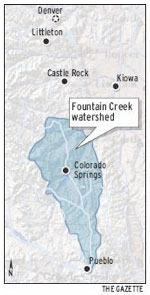
Lower Arkansas Valley Water Conservancy District board meeting recap

A picture named fountaincreekwatershed.jpg

From The Pueblo Chieftain (Chris Woodka):

The board is concerned that the Fountain Creek Watershed Flood Control and Greenway District is contemplating diverting money from the Corridor Master Plan and concentrating more on land-use review rather than completing projects to improve Fountain Creek. “If you aren’t seeing any progress, you won’t have people going forward with you,” said Leroy Mauch, the Lower Ark board member who also sits on the Fountain Creek board…

Under an intergovernmental agreement, the district is using $100,000 annually from Colorado Springs Utilities and the Lower Ark district to fund its activities. Those two sources are also funding the master plan at $200,000 annually. Funding ends this year. The district has no other source of funding until at least 2016, when Colorado Springs would pay the balance of $50 million pledged to the district under conditions of the Pueblo County 1041 permit for the Southern Delivery System…

The district board will look at the Lower Ark’s response at its next meeting, 1 p.m. Jan. 28 at Fountain City Hall, said Pueblo County Commissioner Jeff Chostner, chairman of the Fountain Creek board.

More Lower Arkansas Valley Water Conservancy District coverage here.