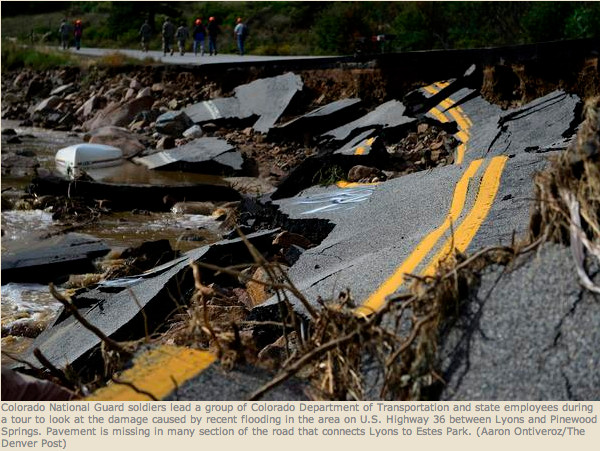
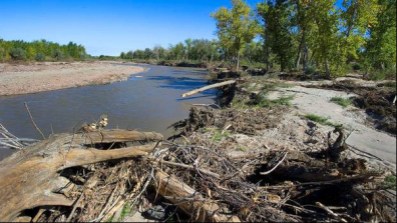
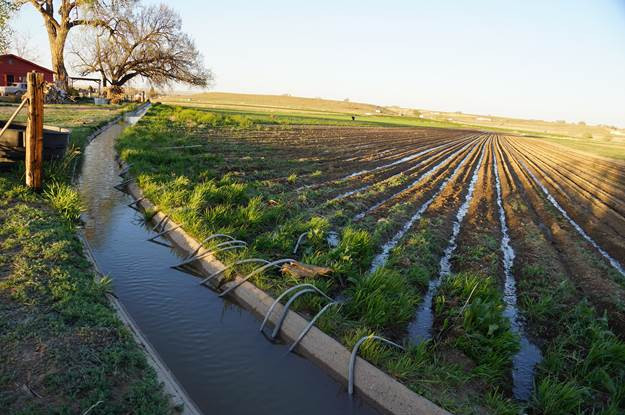
Pueblo County is in line for a little shelter from the storm.
Colorado is requesting disaster designation for 11 counties after heavy rainfall and flooding caused extensive damage in May and June.
Gov. John Hickenlooper signed the declaration Thursday based on initial assessments of about $20 million in damage from the storms. That request goes to the Federal Emergency Management Agency, which will forward it to President Barack Obama for final approval.
The bulk of damage was reported in El Paso County, which claimed $13.9 million. Pueblo County was assessed at $685,000 in damage, with about $280,000 of that in city limits, according to the state Division of Homeland Security and Emergency Management.
“The amount could go up, and it’s not guaranteed,” said Chief Mark Mears of the Pueblo County sheriff’s emergency services bureau.
The major areas of damage in Pueblo County were Overton Road on Fountain Creek about 10 miles north of Pueblo and North Creek Road in Beulah. Funds for those projects could also come through a federal highway fund, Mears said.
Damage assessments in other Southeastern Colorado counties were Fremont, $626,000; Baca, $140,000; and Saguache, $22,000. Other counties were Elbert, Logan, Morgan, Sedgwick and Yuma.
The money is for debris removal, emergency protective measures and the repair, replacement or restoration of disaster-damaged, publicly owned facilities and infrastructure. Private claims aren’t covered.
According to state documents submitted to FEMA, Pueblo County reported rainfall on 54 of 70 days from April 20-June 28, with up to 13 inches cumulative at one reporting station.
County commissioners declared a disaster on May 22, after losing part of Overton Road to Fountain Creek.
There was also damage to North Creek Road in Beulah.
The city of Pueblo reported damage to flood control structures and trails along Fountain Creek.
El Paso County’s request included damage in Manitou and Colorado Springs, as well as in the county.
In Fremont County, the towns of Coal Creek, Rockvale and Williamsburg also reported damage.
Colorado Springs Mayor John Suthers is asking for $19 million a year to mitigate the flow of Fountain Creek as it goes downstream. He told 11 News $8 million would come from bonds, $3 million from Springs Utilities and $3 million from the city’s general fund. That still leave $5 million for the plan to work, meaning there could be budget cuts…
“We’re prepared to make budget cuts and sacrifices as necessary to resolve this issue. We’ve got to get this issue behind us and move on with relations between Pueblo and Colorado Springs,” said Suthers.
He told 11 News cutting city employee salaries could be how they make up the rest of the money needed for the plan, although nothing is set in stone yet and there is a lot of work to be done before the plan is finalized.
Colorado Springs sent something other than rushing water, logs and mud Pueblo’s way Monday.
Springs Mayor John Suthers and City Council President Merv Bennett met with the Pueblo City Council at its work session to backfill trust that has been eroding when it comes to Fountain Creek.
“We are going to fund our stormwater requirements,” Bennett said. “We will resolve this. We owe it to all the people in the Arkansas Valley.”
Suthers said it was not fair to Pueblo and other communities downstream that Colorado Springs City Council yanked funding from its stormwater utility in 2010 on a split decision after a murky 2009 vote. That meant funding of about $16 million annually washed away.
“At one time Colorado Springs was committed to funding stormwater and then it went away,” Suthers said. “That was flat unfair to Pueblo.”
Colorado Springs voters last year again rejected a regional stormwater fee and Suthers doesn’t want to keep going back to the same well. Instead, he and the current council want to put a road tax to a vote and find the money for flood control in the Colorado Springs general fund.
“Selling roads to the voters is easier than stormwater,” Suthers said.
The plan is to shift funding to provide $19 million a year for stormwater, which Suthers said could strain other departments, but is necessary for Springs to uphold its commitments.
Pueblo Councilman Bob Schilling called the presentation “a breath of fresh air,” but reminded Suthers and Bennett that Colorado Springs also has a $50 million commitment to fund flood control on Fountain Creek when Southern Delivery System goes online early next year.
That money will be controlled by the Fountain Creek Watershed Flood Control and Greenway District, which has both El Paso and Pueblo counties members.
“The most important thing is that the $50 million cannot benefit Colorado Springs, and don’t split hairs,” said Schilling, the only council member who was serving in 2004 when intergovernmental agreements were signed to protect Arkansas River flows through Pueblo. “I hope you’re real serious and have a way to follow through.”
Bennett and Suthers gave assurances that Colorado Springs plans to incorporate the needs of downstream communities, including Pueblo County and the Lower Arkansas Valley Water Conservancy District, into planning, hinting that future agreements are in the works.
“This is an issue that needs to be dealt with, that needs to be put behind us,” Suthers said.
Pueblo Councilman Chris Nicoll said Springs appears to be more concerned with containing the flows off the Waldo Canyon burn scar than living up to past commitments on Fountain Creek.
“The water from the burn scar doesn’t stop at Colorado Springs,” Bennett said, but added the city must address downstream concerns. “We’ve been investing $20 million a year, and a lot of that is from grants. These dollars are not grant money, but coming out of our general fund.”
Mayor John Suthers presented a plan to fund a permanent storm water enterprise. He says with this plan he is committed to the people of Pueblo and solving the flood problems.
A shake of the hand. This is how City Council President Steve Nawrocki ended tonight’s presentation from Colorado Springs Major John Suthers.
“We have an obligation to the folks in Pueblo to do the best job we can to mitigate some of those impacts caused by Fountain Creek on Pueblo,” Suthers said…
Mayor Suthers presented an idea to Pueblo City Council that would use $19 million a year of Colorado Springs city revenue to mitigate the devastating flow of Fountain Creek into Pueblo.
“We’re prepared to make budget cuts and sacrifices that’s necessary to resolve this issue. We’ve got to get this issue behind us and move on,” he said.
News5 has been tracking much of the Fountain Creek flood damage as beds along this creek have been deteriorating for the past several weeks. And Suthers knows this problem needs immediate attention.
“That’s just part of being responsible and being a good neighbor,” Suthers said.
Pueblo City Councilman Bob Schilling asked Suthers for reassurance that Colorado Springs is on board.
“You’re going to have to stand tall and get your people to care enough about Pueblo to tax themselves on it. And that’s going to be a real project,” Schilling said.
But Schilling sees this as a step in the right direction.
“I truly believe that you all are, hopefully, what I see as a breath of fresh air as far as commitment,” he said.
This is far from a done deal. Suthers must also approach Pueblo County Commissions in hopes of avoiding legal action.
Moving forward, they must decide how to hold Colorado Springs accountable if the city doesn’t come up with the annual minimum payment to Pueblo and, how much input Pueblo will have on these mitigation efforts.
Large chunks of the bank plunked into Fountain Creek Wednesday evening as Pueblo County Commissioner Terry Hart got a close-up look at the damage to Overton Road.
Two large wooden utility poles floated in the muck below, as the river cut back from the west base of the old Pinon Bridge, which washed out in the 1999 flood. After it slammed back into the east bank, it ran along the channel into a clump of trees. By morning the trees and part of the road would be gone.
“This is unbelievable,” Hart said. “The engineers tell us that Fountain Creek acts like a firehose, the way it moves around.”
Neighbors soon gathered at the spot. One of them was Tony Faxon, bringing his two children home to his 90-acre farm on Overton Road. He was worried about his well, which he had fortified a few days earlier after the last round of floods.
“It looks like the Washington Monument now,” Faxon said on Friday.
He explained the well is now a pole sticking 30 feet into the air — about half of its total depth.
He’s lost a chunk of land 80 by 500 feet and 30 feet deep so far this year.
While the house is on higher ground, he’s now faced with putting in a new well.
The Faxons have lived on Overton Road for four years.
“It’s been an ongoing struggle, but this has been the worst year,” Faxon said. “We couldn’t have anticipated this would happen.”
He’s not alone.
‘We need help’
At Friday’s meeting of the Fountain Creek Watershed Flood Control and Greenway District, which Hart chaired, a litany of damage was recited.
“We need some sort of help,” said Tracy Tolle, who farms for Frank Masciantonio in Pueblo County and Clear Springs Ranch in El Paso County.
“That’s our livelihood.”
Tolle has fought Fountain Creek for years and has seen it through higher water than what was flowing last week.
But the sustained midrange flows for weeks on end and saturated ground are taking their toll.
From his perspective, the actions of one landowner to wall off water just moves the river to the other bank, where the damage is amplified.
John Browning, who has a place on the east side of Fountain Creek in El Paso County, agrees.
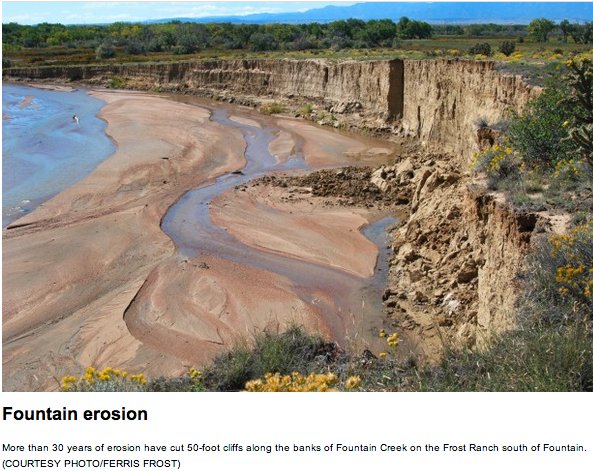
He said fortifications on the west bank have created 50-foot cliffs where children play on the other side.
“You need to take care of both sides of the creek,” Browning said.
“Something needs to be done several decades ago.”
Jane Rhodes, Masciantonio’s sister and a Fountain Creek board member, brought pictures and descriptions of damage at a dozen places along Fountain Creek in Pueblo and El Paso counties.
Irrigation headgates are gone, acres of pasture and fields have vanished and wells wiped out by the whipsaw motion off the water over the past few weeks. Water snaked around one end of the new Pinon Bridge, setting up the possibility of future erosion.
Down the drain?
Up in El Paso County, a demonstration project sponsored by the Fountain Creek district — a showpiece that would show landowners how to use natural materials to turn the current — is gone, landowner Ferris Frost said.
Barriers set up to protect an organic gardening spot are washing away.
“The main channel is cutting through our headgates,” Frost said.
“It’s huge and fast . . . really extreme.”
The Fountain Creek board had few answers for landowners seeking help.
The district has no money, as it is awaiting $50 million from Colorado Springs Utilities when Southern Delivery System goes online. Ironically, SDS has permit issues ahead related to Colorado Springs’ failure to provide a stable source of funding for stormwater control.
Three weeks of rain have also cast clouds over some of the district’s activities, not just the Frost Ranch demonstration project.
“There is debris everywhere,” Hart said, telling the Fountain Creek board he has been watching the damage daily. “There is a lot of destruction going on and this is just the beginning.”
The city of Pueblo was getting ready to fire up its sediment collector again before the rains hit. The collector, installed four years ago when Fountain Creek was behaving itself, ran for a few weeks before a big wave buried it. It’s now under about three feet of sediment.
“We wanted to see if we could make it work without having to build coffer dams,” said Jeff Bailey, stormwater superintendent for the city of
Pueblo. The district also pushed for a demonstration project behind the North Side Walmart, where a detention pond and wetlands was constructed. The pond’s embankment partially washed out in the 2013 flood — and is probably eroding this time around — it’s been difficult to check. The pond has not had an impact on really large flows through Pueblo.
“Right now, it’s a money pit for us,” Bailey said. The city has to augment water stored in the area as well as maintain the pond.
There have been some things that work on Fountain Creek.
Things that work
At Clear Springs Ranch, which is owned by Colorado Springs Utilities on the east side of Interstate 25 near the Ray Nixon Power Plant, a ditch diversion structure across Fountain Creek was built in the 1970s. It survived the 1999 flood, but posed a problem for small native fish. A million-dollar fish ramp was constructed to help the fish get through.
In Pueblo, the city built rock jetties several years ago behind the Target Store on the North Side after Fountain Creek cut perilously close to the area in 1999. Those have held up through high water events as well.
The district still is studying construction of a dam or series of detention ponds along Fountain Creek to hold back the water and release it at more opportune times, but that effort is mired in a study of how to satisfy downstream water rights. In the meantime, Fountain Creek is playing ping-pong with land along its banks. Shoring up one side sends the water to the other and new channels are constantly being cut. While cities and counties have applied for disaster aid as roads, parks, trails and homes are threatened, the farmers are losing ground they’ll never get back. There’s no clear path for financial aid to the property owners.
“There’s a domino effect,” Tolle said, saying he thinks a multimilliondollar project built by Colorado Springs at Clear Springs Ranch may have breached in recent flooding. “Those ponds are not going to work.
You’ve got to give us help or there won’t be any farms.”
Meanwhile, Colorado Springs is looking at changing building codes to help minimize runoff into Fountain Creek. Here’s a report from Chris Woodka writing for The Pueblo Chieftain:
After the recent stomping by Mother Nature, the Fountain Creek technical team dug out the playbook Wednesday.
Like any team, the group is focused more on future victories and overcoming challenges than dwelling on past mistakes.
The team in this case is the technical advisory committee of the Fountain Creek Watershed Flood Control and Greenway District. It includes planners and engineers from Pueblo and El Paso counties, including the cities of Pueblo and Colorado Springs.
A big part of reducing future damage from flooding on Fountain Creek will be requiring future development — whether it’s a new project or redeveloping areas — to make sure flooding is not intensified by new hard surfaces such as streets, parking lots, sidewalks and roofs that prevent water from soaking into the ground.
“So often the developers design the development and tell the engineers, ‘Here, make it work.’ But urbanization almost always spurs the need for channel stabilization,” Steve Gardner, of the Colorado Springs stormwater department, told the group.
Gardner was explaining a drainage criteria manual Colorado Springs has developed in response to years of meetings that have improved understanding of Fountain Creek’s destructive nature. The earlier versions of the drainage manual supported projects that dumped water as quickly as possible into the waterway from flooded streets.
The new approach is to mimic natural conditions with techniques that encourage infiltration, move water through wetlands where possible and build detention projects that will handle a full spectrum of floods, Gardner said.
But it’s difficult to make up for the mistakes of the past, when many of the hills in Colorado Springs were paved as the city grew. One of the tough realities is that stormwater detention projects require land. Apparently, the government will take ground so the water won’t.
“Land allocation is a critical component,” Gardner said. “To get the water to spread out, you need more land. Urbanization results in taller peaks.”
That was seen during the May floods on Fountain Creek, the most recent of events where the creek turned into a river that ate banks, ripped away roads and changed course. With the ground saturated by weeks of rain, there was no opportunity for infiltration.
In that case, the drainage criteria manual recommends detention ponds to hold back the water, which also require land. A series of smaller ponds on tributaries would cost less to build and require less maintenance, Gardner said.
Such a system would allow localized storms to be contained, while reducing the cumulative effect on the creek. Among options studied by the U.S. Geological Survey, that system does not provide as much protection to Pueblo as larger detention ponds or a big dam.
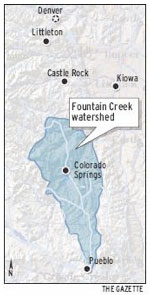
Like any game plan, it has to be executed well to work. Issues still remaining include incorporating the drainage criteria manual with site planning, floodplain management on a larger scale, project phasing to make sure each project fits with others and adopting the same criteria throughout the entire 932-square-mile Fountain Creek watershed. Colorado Springs also faces challenges for funding a backlog of more than $500 million in stormwater projects in a way that satisfies Pueblo County and the Lower Arkansas Valley Water Conservancy District.
But standards for future development are an important step. Gardner said some developers are talking with the city and finding that things like natural infiltration channels can become amenities that increase property values.
“A lot of folks are stuck in the old way of doing things,” Gardner said.
It’s going to take a lot of dough and some big projects to fix problems on Fountain Creek. Here’s a report from Chris Woodka writing for The Pueblo Chieftain:
It’s going to take big projects to tame Fountain Creek. Even a $4.2 million project by Colorado Springs Utilities to redirect Fountain Creek into a less damaging course suffered damage from the June 15 storm surge after holding up reasonably well during relentless rain in May.
But a series of smaller attempts to protect property by armoring it with piles of concrete or a living shield of plants were swept away in the raging waters.
And the district that was formed to find the best way to fix Fountain Creek has no money and unfinished plans on how to mend the monster.
“There’s good news and bad news,” said Pueblo County Commissioner Terry Hart. “The good news is that the district has the authority to handle the entire watershed. The bad news is that there’s a lot to study and we’re still trying to understand how this works.”
Even when the Fountain Creek Watershed Flood Control and Greenway District figures out the best way, there remains the question of money.
“There isn’t an unlimited source of money,” said Pueblo City Councilman Dennis Flores. “Our task is to find out what will work with the amount of resources we have.”
So far, not much is working, the Fountain Creek board learned from presentations Friday.
As part of its commitment to the Bureau of Reclamation and Pueblo County for the Southern Delivery System, Utilito ties is required to restore wetlands, and its $4.2 million Clear Springs Ranch project was the way to achieve that. In fact, the Army Corps of Engineers certified the work in January, said Allison Moser, an engineer for Utilities.
The project covered 6 acres, fixed a past erosion cut and routed Fountain Creek away from the bluff to the west, which it had been undercutting. Thousands of plants were just getting established after being planted last year. The spreading wetlands were designed to handle the overflow of Fountain Creek during high water without sacrificing ground.
But the May storms deposited silt over much of the area and began to damage the bank of a channel that had been reinforced with 2-foot boulders.
“We really saw a lot of sedimentation, but the wetlands were designed to handle sedimentation,” Moser said. “The intention was to have the plants fill in over 10-15 years, but it took it in just two weeks (of high water). It left a lot of debris.”
The June 15 storm, which caused peak flows of 20,000 cubic feet per second at Fountain the next day, ripped through the new bank and left the river in its old course and sent the main flow of Fountain Creek to the west bank again.
“There’s still some evidence the structures held,” Moser said. “We have not been able to get our guys back down there to look at it.”
Utilities has the kind of resources unavailable to most landowners to undertake such a large project, and from Moser’s description it may not be enough to keep Mother Nature under control.
“One of the things we learned is that you need a big footprint to make a difference,” Moser said.
That was borne out by comments from Ferris Frost, whose family’s ditches and a district demonstration project were destroyed in the May floods. The June flooding added more silt to injury.
She showed slides of the damage, as well as how concrete rip-rap installed by her neighbor Jane Green after the September 2011 flood was obliterated this year. Green had put in the bank armor after a 2011 flood cut through an old levee and added even more material when the 2013 flood took a second bite.
Some of the slides showed a large island with mature cottonwoods that had developed years ago from the constant erosion of a 50-foot bluff that Frost calls “The Great Wall.”
“This is terrible,” said Jane Rhodes, a Pueblo County landowner who sits on the Fountain Creek board. “It looks this way all down the creek.”
Pueblo County is still assessing the damage to see if disaster aid is available, Hart said in response to questions from Frank Masciantonio, Rhodes’ brother and one of the owners of land that has been severely eroded.
The district has master plans for Monument Creek and Fountain Creek south of Colorado Springs, and is in the process for developing another for Upper Fountain Creek, which has its own set of problems stemming from the 2012 Waldo Canyon Fire, General Manager Larry Small explained.
What it does not have is money. It will begin receiving $50 million in five annual installments in 2016 if SDS comes on line. That’s on schedule, but Pueblo County commissioners are lining meetings later this year to determine if Utilities is complying with all of its commitments under the county’s 1041 permit for SDS.
“What we’re trying to get our minds around are these two projects (Clear Springs Ranch and Frost Farms) and how well they survived or didn’t survive,” Hart said. “The question is whether we stabilize stream banks or do we need to look at the source of the water?”
A move by Colorado Springs to try for federal money to cover costs from storm damage earlier this month got no crocodile tears from Pueblo officials.
“Don’t you think it’s disingenuous that we have the same problems downstream and Colorado Springs is not willing to pay for it?”
said Jay Winner, general manager of the Lower Arkansas Valley Water Conservancy District.
“I really hope the new mayor (John Suthers was elected Tuesday) puts a higher priority on this issue.”
Colorado Springs announced Monday it will seek reimbursement of up to 75 percent of its estimated damage of $8.2 million from heavy rain from May 3-12.
The initial assessment recorded $5 million damage from landslides or erosion, $2.9 million to parks and trails and $281,000 in sinkholes.
Greater amounts are anticipated as assessments of damage continue, according to a worksheet released by Colorado Springs.
Outgoing Mayor Steve Bach is requesting disaster relief from the Federal Emergency Management Agency through the Colorado Department of Local Affairs and Gov. John Hickenlooper.
“They’ve got to have somebody fund stormwater,” Winner said.
The Lower Ark district is working toward a federal lawsuit that charges Colorado Springs has violated the federal Clean Water Act by failing to control stormwater after its City Council abolished a stormwater enterprise and fee in 2009. The lack of a stable source of funding for controlling periodic storms is a sore point.
“I’d bet that when they show us an accounting of stormwater payments, they include the federal money that they were unwilling to provide,” Winner said.
That, in fact, is what Bach did in 2013, when he sent Pueblo County commissioners a letter claiming $46 million in stormwater expenditures. Much of the money was from federal grants for multiyear projects.
“I have to commend Colorado Springs for their ability to get federal money,” Winner said. “I do wish the city of Pueblo was as good at getting money.”
Pueblo, which has a stormwater enterprise and fee in place, is not planning on filing for FEMA money from the storm, but is still assessing damage on Fountain Creek.
“Pueblo would apply if the damage is greater than the normal scope of our stormwater repair budget,” said Pueblo City Manager Sam Azad. “We had damages at the airport from hail, but that is outside of what FEMA will cover.”
Pueblo has taken care of much worse problems on Fountain Creek on its own in the past, so it is unlikely the city would apply for assistance as Colorado Springs has done, Azad acknowledged.
El Paso County voters, including Colorado Springs, rejected a plan that would have established a regional stormwater district that would generate nearly $40 million in funding annually.
Stormwater also is an issue for Pueblo County commissioners, who are conducting an investigation now to determine if Colorado Springs is living up to its commitments under the county’s 1041 permit for Southern Delivery System.
Meanwhile, Fountain Creek has been flowing high and causing damage this week. Here’s a report from Chris Woodka writing for The Pueblo Chieftain:
Fountain Creek churned again on Tuesday following a night-long rain over much of Southern Colorado.
By early afternoon, flows through Pueblo had peaked at 6,500 cubic feet per second, bringing with them debris such as large tractor tires, conduits and trees from the north.
At Avondale, east of Pueblo, the Arkansas River reached flood stage Tuesday evening. “Fountain Creek’s a mess,” said Van Truan of the local U.S. Corps of Engineers office.
“It’s such an active stream and has been for years.”
Rainfall in the region totaled anywhere from 1-3 inches, with the heaviest storms in El Paso County in the foothills west of Colorado Springs.
This is the second-wettest May on record, with 13 days left and more rain forecast through the weekend. “With the pattern we’re in, it’s possible this will be the wettest May ever,” said Mark Wankowski, a meteorologist with the National Weather Service at Pueblo Memorial Airport.
Fountain Creek washed out parts of the trail alongside the river, including at 13th Street where the creek has been temporarily diverted for Army Corps of Engineers work along the west bank to protect railroad tracks and an Interstate 25 interchange.
The trail has been closed from the trailhead at U.S. 50 east to Runyon Lake, the city of Pueblo announced in a press release. Some parts that have not washed out are covered with 3-4 inches of mud.
The creek also finished off structures in the flood plain at Belmont Stables on Overton Road. About five stables and a large metal pen were in danger from earlier high flows on Fountain Creek and now have been swept downstream. A swath about 25 yards wide has been cut in the past 10 days, in addition to land that disappeared earlier this month.
“It took it all,” said Cathy Todd, owner of Belmont Stables. The horses that were in the lower stables were all moved to higher ground.
Fountain Creek now is undercutting the bluffs on her property, she said. Fountain Creek shifted toward the east several years ago and began eroding the site, but it has accelerated with the rains in recent weeks.
Elsewhere in Pueblo County, the rain was making its presence known, but was manageable.
“I haven’t been over to the SDS scar; we’ve got our own problems on Turkey Creek to worry about Colorado Springs’ problems today,” said rancher Gary Walker, who is in a legal fight with Colorado Springs over the Southern Delivery System pipeline across his property.
“I was up at 1:30 a.m. releasing water so we wouldn’t have problems,” said Mike Hill, superintendent of the Bessemer Ditch. He said there were not any weather-related problems with the ditch from the storm.
Even though the rain-barrel bill got dunked in the Colorado Legislature this year, another measure that could help conserve and reuse urban water on a much larger scale passed without much controversy.
Senate Bill 212 could make it easier for places like Denver to start designing new stormwater management systems that would reduce the demand for water from rivers and reservoirs. Instead of simply letting stormwater run down the drain, the water could potentially be slowed down to water parks and ballfields.
The bill was sponsored in the Senate by Sen. Jerry Sonnenberg, a Republican representing a rural agricultural district in northeastern Colorado. Sonnenberg opposed the rainbarrel bill partly because he feared that a boom in the urban rain-barrel biz could cut flows to rivers that supply water for farms farther downstream.
But [SB15-212 (Storm Water Facilities Not Injure Water Rights)], the stormwater bill, doesn’t pose the same threat because it doesn’t specifically allow people to capture and use water, Sonnenberg said, explaining that his bill was aimed at ensuring that cities don’t have to apply for water rights when they design and build stormwater systems.
In a comment letter on the Colorado water plan, Denver Water explained the history of the stormwater runoff issue. Most senior water rights were established in a time when there weren’t a whole lot of paved surfaces to channel water into drains. Instead, the water from big rainstorms spread out evenly over the land.
The idea that cities should have to apply for water rights for the stormwater they manage is “shortsighted, unnecessary and in conflict with the goals and values” of Gov. John Hickenlooper’s executive order for the plan, Denver Water wrote.
Colorado Springs Utilities has filed notice that it intends to appeal a jury’s $4.6 million judgment in favor of rancher Gary Walker, who let Utilities build a 5.5-mile pipeline on his land for the Southern Delivery System.
Walker and Utilities had agreed that the easement was worth $82,900, and the pipeline was installed on his northern Pueblo County land in 2012 as a conduit for the Southern Delivery System, or SDS.
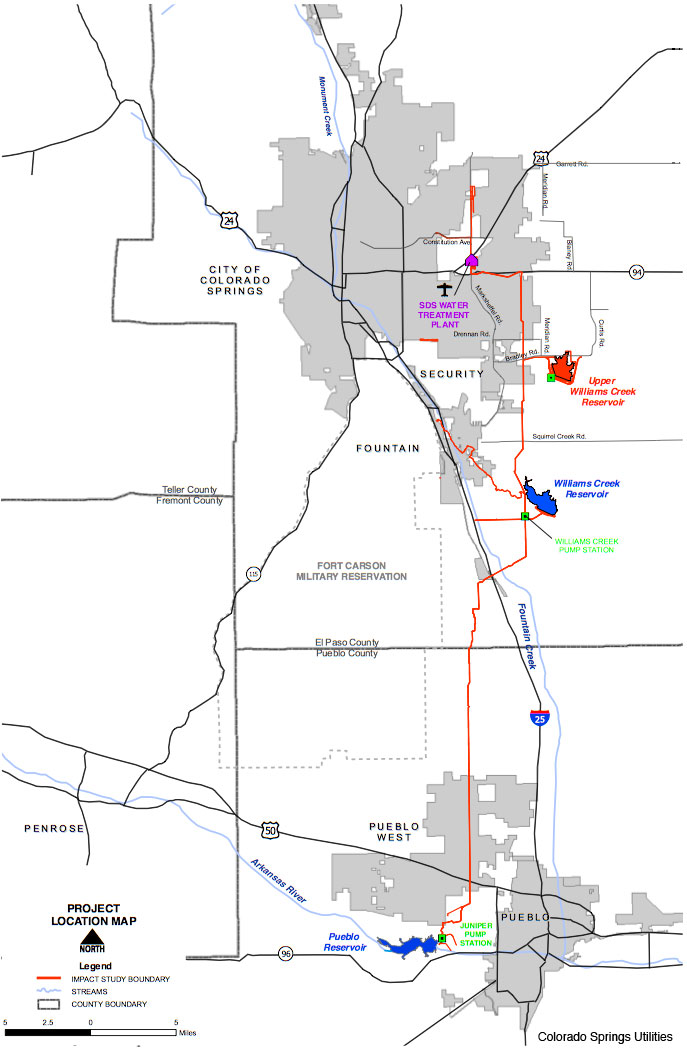
That regional project is designed to pump Arkansas River water from the Pueblo Reservoir to Colorado Springs, Fountain, Security and Pueblo West, delivering up to 96 million gallons a day to those communities. Water delivery was expected to begin in 2016.
At trial, Walker’s counsel said Walker was negotiating a conservation easement worth more than $30 million with the Nature Conservancy, but degradation of the utility easement destroyed those prospects.
Colorado Springs, which owns Utilities, “had no opportunity to prepare a rebuttal to this surprise, unprecedented argument,” said the notice of intent to appeal filed late Thursday.
The notice questions, among other things, how a property value can be agreed upon at $82,000 and then valued at more than $30 million before a jury, and whether it was appropriate to deny the jury an opportunity to view the property.
The Pueblo County District Court jury deliberated for nine days before rendering its verdict April 23.
Neither Walker and his attorneys nor the Nature Conservancy returned calls Friday.
But SDS spokeswoman Janet Rummel said storms on the land drained water onto the pipeline alignment, causing erosion after the easement had been restored.
“We’ve been working ever since to fully restore it,” Rummel said. “His attorney was claiming actually not as much about the reclamation, but really about his lack of ability to ensure future conservation easements on his property. We really saw no evidence presented that that was the case. That was changing the big concern at the 11th hour of this trial. We need to take into account the effects on our ratepayers.”
Utilities paid Walker about $720,000 to move his cattle and laid irrigation lines along the easement to ensure that plants for restoration would survive, she said.
“From our perspective, we’ve gone above and beyond to address the concerns raised.”
The Fountain Creek Watershed, Flood Control and Greenway District isn’t taking a position on the legal battle, said Executive Director Larry L. Small. But the district is supposed to receive $10 million every year for five years to mitigate the extra flow that Fountain Creek will experience.
“If this drags on, it could impact SDS from becoming operational – and our revenue. That wouldn’t be too good because we’re waiting for that money to begin doing the work we need to do.”
Rains along the Southern Delivery System pipeline scar through Walker Ranches is again causing flooding problems in northern Pueblo County.
“Prior to the SDS crossing Walker Ranches, we never had floods like these from that area,” said ranchver Gary Walker. “Mother Nature’s defenses took care of it.”
Walker is involved in litigation with Colorado Springs over the 5.5-mile stretch of buried 66-inch diameter pipeline. A jury in April awarded Walker $4.665 million in damages, which Colorado Springs is appealing.
On Friday, rains created a river of mud along the pipeline route, causing some flooding in adjacent areas. Walker supplied aerial photos to The Pueblo Chieftain that show water crossing and sheet off the pipeline scar, with several hundred feet of plastic irrigation pipe — used for revegetation — hanging above a chasm of rushing water.
Walker said this is a violation of Colorado Springs Utilities’ commitments under Pueblo County’s 1041 permit for SDS because the area has not been returned to pre-construction conditions.
He first raised the issue of the pipeline route, which crosses arroyos, in 2008. He wanted the pipeline to follow the route of the Fountain Valley Conduit, constructed in the 1980s, which he said would be less damaging to his ranchland.
“Now Walker Ranches will become part of the flooding problem to downstream residences of Fountain Creek and the Arkansas River,” Walker said. “These are not Biblical events. Our weather is just returning to normal and our drought is ending, as any ‘old-timer’ like me will tell you.
Colorado Springs Thursday appealed a $4.665 million jury award for damages to Walker Ranches by the Southern Delivery System water pipeline.
The appeal was made in Colorado Court of Appeals in Denver.
The city’s lawyers said the April 23 verdict was delivered after a nine-day trial without any other findings or calculations.
The city’s lawyers added they had no chance to rebut the closing argument of Walker Ranches’ lawyers that the SDS pipeline across 5 miles of the property had diminished the value of surrounding land and that testimony did not support the verdict.
They also claimed the basis for diminished value of the property was not revealed until opening arguments and the value itself only in closing arguments.
A court judgment on the $4.665 million award was entered Wednesday by Pueblo District Judge Jill Mattoon.
Gary Walker, whose family owns the land, said the Nature Conservancy was negotiating with him to buy conservation easements for $1,680 per acre on about 15,000 acres, about $25 million.
“The city had no opportunity to reply to this surprise, unprecedented argument,” Colorado Springs attorneys wrote in the appeal.
Neither side disputed the value of the $82,900 150-foot-wide utility easement for a buried 66-inch diameter pipeline which Colorado Springs offered $1,400 an acre.
Colorado Springs’ filing lists 14 points of law, as well as a catch-all “any other issues” that were not covered by crossappeal.
Among the points raised by Colorado Springs lawyers is whether conservation can be considered the highest and best use for property, a topic Walker elaborated on in an interview with The Pueblo Chieftain after the trial.
Walker explained that conservation is the main purpose for Walker Ranches and illustrated that by pointing out that the millions of dollars from previous conservation easements was used to purchase more land with the intent of preserving ranch land and open spaces for future generations.
Colorado Springs’ attorneys also raised the question of whether Mattoon erred by denying the jury an opportunity to view the property.
When tackling a big job, success often depends on good information. Cleaning up Gore Creek is one of those big jobs, and people in charge of that task are still working to find out exactly what they’re facing.
To that end, the town of Vail this year has hired SGM, a Glenwood Springs-based engineering, surveying and consulting company, to do some of the most basic research — locating all of the town’s storm sewers and finding out exactly where they go.
That’s a more complicated job than it sounds. At the moment, town officials know the location of no more than 70 percent of the existing storm drainage system.
Kristen Bertuglia, the town’s environmental sustainability manager, said knowing where all of the town’s storm drains are, and where they go, is an important part of the bigger cleanup effort.
VAIL’S VAULTS
Most of the town’s storm drains flow into vaults, essentially big tanks where sand, oil and other pollutants are separated out before water ends up in the creek.
Bertuglia said knowing where those vaults are, and which parts of the drainage system flow into them — along with good mapping of the system — will help town officials develop a schedule for cleaning the vaults, thus keeping them working as they should.
“As soon as the inventory’s done, we can do a better schedule,” Bertuglia said.
Channel erosion Colorado Springs July 2012 via The Pueblo Chieftain
From the Colorado Springs Business Journal (Bryan Grossman):
According to a news release issued by the city, the stormwater program for the city of Colorado Springs has included substantial spending over the past 15 years on “new flood control and conveyance infrastructure, maintenance and repair of existing infrastructure, and water quality protection and compliance.” Expenditures for the city’s stormwater program, the release states, have come from the city’s general fund, bonds (Springs Community Improvement Program, or SCIP), grants (FEMA and others), and, for a period of time in the mid-2000s, stormwater program fees collected by the city’s stormwater enterprise, also called the “SWENT.”
“Substantial portions of the city’s stormwater infrastructure have also been constructed by the development community and as part of large transportation projects that have stormwater components,” the release states. “However, stormwater program expenditures historically did not appear in a single comprehensive financial report until now.”
This report highlights more than $240 million spent on stormwater program management and projects in Colorado Springs from 2004 through 2014.
Closing arguments are expected to wrap up sometime today in a jury trial to determine the value of the Southern Delivery System easement across Walker Ranches in Pueblo County.
Expert witnesses for Colorado Springs testified Tuesday, the seventh day of the trial.
Attorneys for both sides indicated the testimony would wrap up soon and they were preparing to present closing arguments today. After that, the jury will begin its deliberations.
Court records indicate Gary Walker was offered $100,000 for easements on a 150-foot wide strip 5.5 miles long through Walker Ranches in northern Pueblo County. Colorado Springs, which is building SDS, also paid Walker $720,000 to relocate cattle during three years of construction.
Construction on SDS began in 2011, and includes 50 miles of underground pipeline 66 inches in diameter in Pueblo and El Paso counties. The final phase of construction in Pueblo County is the Juniper Pump Station being built near Pueblo Dam.
Walker claims the choice of pipeline route has contributed to erosion and diminished the value of his land. His court records claim SDS has caused $25 million worth of impact on his ranches, which total 65,000 acres. He’s also claiming damages under Pueblo County’s 1041 permit for SDS, which protects landowners from out-of-pocket expenses and requires Colorado Springs to use eminent domain only as a last resort.
District Judge Jill Mattoon is presiding over the trial.
A bill that would allow flood water to be stored regardless of the impact on water rights would not affect a proposal to build flood control structures on Fountain Creek.
The Fountain Creek Watershed Flood Control and Greenway District board has taken a neutral position on the legislation, and would not interrupt its study of flood control and water rights even if SB212 passes, said Larry Small, executive director.
“We have no intention to infringe on water rights,” Small said Tuesday. “We live and operate in this basin, and whatever we do has to be mutually beneficial.”
Small was speaking to a technical committee Tuesday studying how water rights can be protected while constructing flood control structures on Fountain Creek.
The Denver Urban Drainage District and other water interests are pushing SB212, which is scheduled to be heard today in the Senate agriculture committee.
Farmers in the Lower Arkansas Valley are interested because of its impact on junior water rights. Several testified last week against the bill. The Lower Arkansas Valley Water Conservancy District offered amendments to the bill that would exempt Fountain Creek or the Arkansas River basin from the bill.
“Once again, it looks like the Legislature wants to put all the mitigation for these projects on the backs of farmers,” said Jay Winner, general manager of the Lower Ark district.
It also was suggested that fire mitigation basins, which are needed in areas such as Colorado Springs to deal with the aftermath of large wildfires, be allowed but to postpone action on flood control basins.
The state of Kansas also wrote an April 10 letter to Mike King, director of the Colorado Department of Natural Resources, and Dick Wolfe saying the [bill] could have a negative impact on the Arkansas River Compact. It said a proposed notification system is not sufficient to protect its interests.
Small said that it might not be possible to move the legislation this year, since it would face more of a challenge in the House and the Legislature is set to adjourn on May 6.
FromThe Colorado Springs Gazette (Ryan Maye Handy):
More than two dozen El Paso County water basins that hold back flood debris and ensure local water quality are caught up in an unforeseen battle over water rights, putting the basins at the mercy of state lawmakers.
Colorado Springs utility and stormwater managers, along with nonprofits charged with managing recovery in the Waldo Canyon fire burn scar, were taken aback last fall when the state declared that 25 of the 30 major basins violate a state statute that prevents stored water from affecting other water rights. In a January follow-up letter, the Colorado Division of Water Resources said unless the handful of entities that manage the basins can afford to replace some of the lost water, they could face legal action from the state.
But the letter could all be for naught, if a bill clarifying water use in basins passes through the Colorado Legislature this spring. Senate Bill 212, sponsored by Sen. Jerry Sonnenberg, R-Sterling, would allow retention basins to hold water for 72 hours without requiring agencies to make up for lost water.
But this is more than a tiff over water rights. The letter jeopardizes some of the most effective life-saving tools in western El Paso County, said Theresa Springer, environmental education coordinator for the Coalition for the Upper South Platte, known as CUSP. The 25 basins listed in the letter catch flood debris coursing off the Waldo Canyon burn scar – debris that has claimed lives and damaged homes and roadways in the county since the 2012 fire.
“This is the biggest tool in our tool box,” Springer said of the basins. “Right now, we’ve got all of our hopes on this bill.”
Although the basins have become a key part of post-fire flood mitigation in the county, some were built without taking into consideration state requirements, said Steve Witte, a division engineer with the state who sent the letter.
Witte toured the basins with Springer last summer, and Springer had no idea the basins were in violation until she read the letter, she said.
Witte determined that the basins violate state guidelines because they do not make provisions for lost water to downstream junior rights users.
“We outlined some parameters under which these basins could be constructed,” Witte said. “But when we investigated, we found those parameters had not been observed. That’s what created some concerns for us.”
The majority of the basins inspected hold water for 72 hours, during which time they slowly drain. When it comes to basins, that’s a practice that Colorado has always allowed, although it wasn’t officially on the books, said Tim Mitros, the stormwater engineer for the city of Colorado Springs, which also received a copy of the letter from Witte. To his knowledge, this is the first time that the de facto 72-hour rule has been challenged, Mitros added.
The letter also calls into question state-mandated detention basins that are required to ensure water quality, Mitros said.
According to the letter, those kinds of basins are also in violation of junior water rights.
Springer said CUSP cannot afford to buy extra water rights to make up for what its basins hold.
In Colorado, “water is more valuable than gold,” Mitros joked.
Witte said he is protecting the water rights of those who live in a drought-stricken watershed. The basins have no right to hold water, particularly from junior water rights holders who depend on excess water.
“They are among those who are entitled to receive water when there is a shortage, and there is always a shortage,” Witte said.
There are a variety of fixes for the situation, Witte said, but none strikes a perfect balance between the needs of recovery managers and junior water rights holders, he added.
“The ponds could be filled in, but that doesn’t afford any flood protection. Not every solution is a satisfactory one for everybody,” he said.
The most typical solution would be for agencies like CUSP and Colorado Springs Utilities, among several others, to purchase water rights. While it might be the simplest solution for Witte, buying more water would be expensive and probably not feasible for others, Mitros said.
“There is no water available to purchase to offset that,” Springer said. “We are in the business of saving lives. Why would we spend the money to buy that water?”
Sonnenberg could not be reached for comment Tuesday.
Although Witte requested that action be taken by April 1, he said he will wait to act until the legislative session is over. CUSP, along with the city of Colorado Springs, the U.S. Forest Service and Colorado Springs Utilities, will also be waiting to see if the bill passes.
As for what will happen if the bill gets killed, no one had a guess.
“I don’t know what will happen,” Mitros said. “I think the state needs to get that figured out between itself first.”
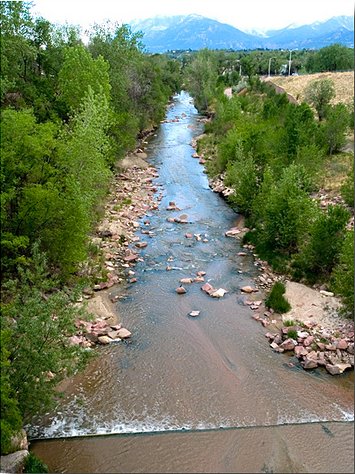
Fountain Creek through Colorado Springs. FromThe Pueblo Chieftain (Chris Woodka):
Pleas to reconsider a federal lawsuit over water quality fell on skeptical ears Wednesday.
The Lower Arkansas Valley Water Conservancy District board listened patiently to Colorado Springs Councilman Merv Bennett’s assessment of stormwater protection progress, but in the end voted to continue to pursue a federal court filing charging that Colorado Springs is violating the Clean Water Act.
The board instructed attorney Peter Nichols to continue building a case.
Bennett urged the Lower Ark board to stay out of court, saying money would be better spent elsewhere. Still the board voted 7-0 to continue the lawsuit.
“Nothing’s binding on this council, the next council or the next mayor,” board member Melissa Esquibel said, clearly frustrated by Bennett’s promises. “It’s the same conversation, the same lack of movement that we’ve had. What’s going to happen?”
Colorado Springs City Council last month commit ted $19 million annually to stormwater projects, shuffling existing funds in the city’s general fund and adding $3 million from Colorado Springs Utilities beginning in 2016.
But Jay Winner, general manager of the Lower Ark, asked Bennett if other funds in the city would be shorted in the process and political pressure would again lower stormwater as a priority.
Bennett countered that the current council is committed to funding stormwater control, as well as the candidates for mayor in the April municipal election. He said the city’s other problems, such as potholes, would be settled in some other way not related to stormwater. He maintained the city currently is spending the required amount on stormwater and council’s action makes the funding permanent.
“I believe in the integrity of the people running,” Bennett said in response to Esquibel’s comments. “I feel we’ve made progress and we’ll continue to make progress.”
But he acknowledged that three to five new members may be elected to the nine-member council, and he could not personally guarantee that the stormwater money would remain in place.
“I can’t solve it by myself and we can’t solve it overnight,” Bennett said.
Winner pressed Bennett on several issues, including the council’s 2009 decision to dissolve its stormwater enterprise, stormwater funding that has been missing in the intervening years and whether the money would go toward projects identified when the enterprise was formed in 2005.
Bennett agreed that council made the wrong decision in response to Doug Bruce’s Issue 300 in 2009. He said Colorado Springs is working on a report that would show its funding level for stormwater projects has been higher than the $17 million the stormwater enterprise would have generated each year.
He pledged to have city staff develop a side-by-side comparison of projects.
The stormwater issue is tied to Pueblo County’s 1041 permit for Southern Delivery System, which was negotiated earlier in 2009, before the stormwater enterprise was abolished. Flood control is needed because growth in Colorado Springs has elevated flows on Fountain Creek, increasing the danger of flooding in Pueblo.
A judge in Adams County ruled Monday in favor of the county in a lawsuit filed by residents who opposed the stormwater utility fee that was approved by the county commissioners in 2012.
The lawsuit was filed in August 2013 by the Stop Stormwater Utility Association, which argued that the fee was really a tax and therefore a violation of the Taxpayer’s Bill of Rights in the Colorado Constitution because the collection was not approved by voters.
“Throughout this process the county has maintained the belief that the stormwater utility is a fee, not a tax and is necessary to provide storm water related services and facilities,” Commissioner Chaz Tedesco said.
In his ruling, Judge Mark Warner said “The utility is a government-owned business that receives less than 10 percent of its funds from state and local authorities combined, and is therefore an “enterprise” that is exempted from TABOR. Further, defendant has not engaged in an unconstitutional “bait and switch” by imposing the fee and using it, in part, for administrative and personnel costs.
“Further, the Court concludes the stormwater utility fee is reasonably related to the overall cost of providing services related water drainage and water related activities in the service area. Thus, based upon the foregoing interpretation of Colorado law, the stormwater utility charge is a fee, not a tax and not subject to TABOR.”
Fountain Creek Watershed FromThe Pueblo Chieftain (Chris Woodka):
Pueblo city and county officials are at odds over water quality regulations that could add millions of dollars to city sewer expenses.
The rift was great enough that the Pueblo Area Council of Governments backed down from a vote Thursday to support a variance for selenium and sulfates the city is seeking from the Colorado Water Quality Control Commission.
PACOG delayed its vote one month, after putting it off in December as well, in order to allow Pueblo County Commissioner Terry Hart to participate in debate.
Hart, along with Commissioners Sal Pace and Liane “Buffie” McFadyen, raised concerns that the county’s ability to insist on standards from upstream communities in El Paso County under the 1041 permit for Southern Delivery System would be compromised if they agreed to support a variance for Pueblo.
“Commissioner Hart is not here, and he wants to have a say,” McFadyen said. “In our future, we will have water quality issues in this county and we need to be consistent.”
That means the city will have to go into a state pre-hearing on Feb. 4 without support from other local governments. The variance itself will be considered by the state in April.
Pueblo City Manager Sam Azad said sewer fees could double or triple if the city is forced to meet numeric standards.
The reach of the Arkansas River below the Pueblo wastewater treatment plant has naturally high levels of selenium and sulfates. If numeric standards are enforced, no additional releases would be allowed.
Pueblo would have to pay up to $92 million and $9 million annually to seal its wastewater lines from collecting groundwater and to treat water released from the plant to remove all traces of contaminants, said Wastewater Director Gene Michael.
Sealing the lines from collecting groundwater, $35 million of the total, would actually increase selenium because existing treatment removes some of it from water that’s released. The disposal of waste from reverse-osmosis treatment would compound environmental damage, Michael said.
“Let me be crystal clear, the county is not in favor of spending $92 million,” Pace said.
One of the conditions of the delay was to give environmental attorneys John Barth of the county and Gabe Racz of the city time to work out a way to gain county support for the resolution without jeopardizing future SDS deliberations.
While Pace said that agreement was close, the city disagreed.
“It’s unlikely John Barth and the city would agree to anything,” said Dan Kogovsek, city attorney.
After an hour of discussion, City Council President Steve Nawrocki agreed to back off a vote until the February meeting in hopes of getting unanimous support from PACOG before the April state rule-making hearing. Pace and McFadyen promised the vote would not be delayed again.
More water pollution coverage here. More Fountain Creek watershed coverage here. More wastewater coverage here. More stormwater coverage here. More Southern Delivery System coverage here.
From the Estes Park Trail Gazette (David Persons):
The job of creating a master plan for the recovery and future flood mitigation of the heavily-damaged Fish Creek corridor wasn’t going to be easy.
And, it hasn’t been. It’s been hard work by a lot of well-meaning professionals and concerned individuals.
But, as it almost always is with any significant flood mitigation plan, some parts are going to rub some people the wrong way.
Count many of those living at or near Scott Ponds in the Carriage Hills subdivision on the upper reaches of Fish Creek as suitably rubbed.
When they found out that the current draft of the Fish Creek Resiliency (Master) Plan included a recommendation to remove the two dams (and related ponds) south of Scott Avenue and restore the area to historic beaver ponds, they quickly spoke out.
“I chose this (home) because of the location,” said Joe Holtzman, 1130 Scott Avenue. His home overlooks the northernmost of the Scott Ponds, the one whose dam failed and contributed greatly to a surge during the September 2013 flood.
“I’m a 50-year flyfisherman. I love it here. I have had over 250 elk go through by backyard. I’ve had numerous deer and a plethora of birds. I have seen osprey plucking fish out of those ponds. I’ve even seen bald eagles here.”
Now, he fears, he may lose all that if the Scott Ponds are removed.
Holtzman said he wasn’t aware of the recommendation to remove the ponds – one of five high priority projects recommended – until November when there was an open house presented by a representative of Walsh Environmental, the firm that has been tasked to oversee and complete the Fish Creek Master Plan.
Once completed, the Fish Creek Resiliency Plan will provide recommendations for numerous projects that may be undertaken when funding is available. If funding becomes available, for each project there will be another opportunity for public participation during the design process, town officials say.
They also point out that the master plan is just a draft and not complete yet.
“The Fish Creek master plan is still being reviewed, and even the final document will be just a recommendation from a resiliency standpoint,” said Estes Park Public Information Officer Kate Rusch. “There will be more public involvement before anything happens at Scott Ponds.”[…]
Although town officials are on record saying they would like to repair the dam as part of flood restoration work, they won’t be allowed to restore it to its former state. The state now requires that repairs and designs of dam replacements must meet current state regulations. And, that means a lot more money.
Holtzman believes that a better idea would be to reduce the size and depth of the ponds which would require a smaller dam.
He and his neighbors will get a chance to voice that opinion on Jan. 26, when the town holds a public meeting to discuss the Fish Creek Resiliency (Master) Plan. The meeting will be held at 6 p.m. at the Estes Park Event Center, 1125 Rooftop Way, at the Fairgrounds at Stanley Park…
Shafer did praise the formation of the Estes Valley Watershed Coalition, which was formed from residents in the Fall River and Fish Creek areas. The coalition, which has two voting members from the Fall River area, two from the Fish Creek area, two from the Black Canyon area, and two from the Big Thompson River area, and three at-large members will seek grants and other funding once the Fish Creek Resiliency (Master) Plan has been adopted.
Shafer said the coalition, working as a non-profit under the umbrella of the Estes Valley Land Trust, should be able to secure the needed funding to implement the plan.
Among the many funding sources available for the coalition are the Colorado Water Conservation Board; Colorado Healthy Rivers Fund; Colorado Watershed Restoration Grant; Colorado Department of Local Affairs (DOLA); Colorado Drought and Flood Response Fund; Colorado Department of Public Health and Environment; Colorado Watershed Assembly; Basin Roundtables; and the El Pomar Foundation.
Bohn Park was flooded by the St. Vrain River in Lyons, CO September 18, 2013 via Getty Images From the Boulder Daily Camera (Alex Burness) via the Longmont Times-Call:
Lyons has selected the Boulder County Housing Authority as the master developer for the town’s recovery housing project, which aims to provide up to 70 affordable housing units for residents displaced by the September 2013 flood.
The town had sent out a request for proposals for a master developer for the project earlier this month and heard back from only two offices: BCHA and the privately owned firm Element Properties.
Dan Greenberg, a town trustee, said reliability was key in the board’s unanimous vote Tuesday to hire BCHA.
“I think the long-term viability of the housing authority was big. We know they’re going to be around for a long time,” he said…
The board’s selection came on the heels of a Jan. 5 resolution, in which the trustees named Lyons’ Bohn Park as the site for the proposed housing development.
Both decisions could be nullified in March, however, if voters deny the ballot measure to make the recovery housing project a reality. Colorado statute requires cities and towns to get voter approval before selling parkland.
Lyons, BCHA and the rest of the housing project’s design team will now be hosting a series of “open house and visioning workshops,” beginning Saturday, from 10 a.m. to 2 p.m. at Rogers Hall, at the intersection of Fourth and High streets.
New Saint Vrain River channel after the September 2013 floods — photo via the Longmont Times-Call
Colorado Springs is trying to talk its way out of its stormwater commitment, and the Lower Arkansas Valley Water Conservancy District is losing its patience.
“You can talk the talk, but you’ve got to walk the walk. That’s not what I’m hearing,” Jay Winner, Lower Ark manager, told his board Wednesday. “When they talk to us about stormwater, all we get is fuzzy math.”
The board will consider whether to proceed with the federal lawsuit next month.
Winner is frustrated because his discussions with Colorado Springs Utilities have been similar to 2005 and 2007, when he was assured by Utilities the city would live up to its commitments to control drainage into Fountain Creek caused by increased runoff from development. When enumerating stormwater projects, Colorado Springs points to street projects that Winner said have nothing to do with controlling the flow into Fountain Creek.
In November, the Lower Ark board voted to prepare a lawsuit under the federal Clean Water Act over violations of its stormwater permit. Since then, the district has hired a firm to sample water quality and has been moving toward a lawsuit.
“Everybody seems to say the right things,” Winner said. “But I keep getting told, ‘Nothing happens until we get a new mayor.’’’ In November, Colorado Springs Councilman Merv Bennett asked the Lower Ark to have patience just days after voters in El Paso County rejected a drainage authority that would have raised nearly $40 million annually to improve Fountain Creek stormwater issues.
Colorado Springs council has made no overtures since then to address Lower Ark’s concerns.
“I’m not hopeful we’ll get anywhere,” Winner said.
Colorado Springs had a stormwater utility in place in 2009, when Pueblo County commissioners approved a 1041 permit for the Southern Delivery System.
The Lower Ark district lobbied Colorado Springs City Council in 2005 for creation of a stormwater utility, specifically to address past stormwater issues on Fountain Creek.
Colorado Springs has a backlog of about $535 million in stormwater projects, according to its most recent accounting.
More Lower Arkansas Water Conservancy District coverage here.
Controlling stormwater on Fountain Creek has surfaced as a key issue for use of the Southern Delivery System in light of the rejection of the Pikes Peak Drainage Authority by El Paso County voters in November.
A proposal to use the SDS pipeline to deliver water to a system just north of Colorado Springs could be a test of Pueblo County’s 1041 regulations for SDS.
Donala Water and Sanitation District has asked for an exemption or finding of no significant impact from Pueblo County 1041 conditions on its plan to move water from rights it purchased in 2009 on the Willow Creek Ranch south of Leadville.
A Pueblo County analysis of votes in the Donala district shows its residents rejected stormwater control by a 60-40 margin.
“Serious concerns over compliance with (1041 conditions) are raised by the failed efforts in El Paso County, including within the city of Colorado Springs and Donala, at establishing, financing and maintaining stormwater controls,” Pueblo County Planner Joan Armstrong wrote in a letter to Donala last week.
“The recent failure of the November ballot proposal in El Paso County on stormwater fees only heightened those concerns.”
Donala plans to use excess capacity in the SDS pipeline from Pueblo Dam to Colorado Springs and a conveyance agreement with Colorado Springs Utilities to move an average of about 436 acre-feet (143 million gallons).
SDS is not expected to come on line until at least 2016, and Donala is not the only community interested in using it. Colorado Springs has the majority of capacity in the line, which won’t reach its full volume of 78 million gallons daily for several decades.
The move would provide about one-third of the water for 2,600 taps serving 8,000 people in the Donala district. It also would reduce Donala’s dependence on non-renewable groundwater from the Denver Basin aquifer.
Donala asked for the exemption because the amount of water falls short of the 500-acrefoot threshold that normally would trigger a 1041 permit review.
Armstrong asked Donala to address the question of whether larger amounts of water could be moved through the pipeline.
She also explained that the county also is interested in the maximum — not just the average — flows that could be moved to Donala through SDS, and in complying with certain conditions of the 1041 permit for SDS, including stormwater control.
The county asked Donala if it still intends to amend its service plan to control stormwater, as manager Kip Peterson indicated in a 2013 interview with The Pueblo Chieftain.
The county also wants to know which of the projects identified in the 2013 El Paso County Stormwater Needs Assessment by CH2MHill would serve Donala and whether the district intends to fund or construct any of those projects.
In Lyons the challenge around housing centers on building more affordable residences. The town lost two trailer parks which held about 50 homes. Few of those residents have yet to return to Lyons.
To change the picture, the Lyons board of trustees voted Jan. 5 to move forward with one project to build a 50-70 unit housing project using a few acres of Bohn Park south of downtown. Lyons Mayor John O’Brien said the project is vital in replenishing 20 percent of the housing stock lost in the 2013 flood.
“This is an attempt to just partially rebuild some of that stock,” O’Brien said. “It’s a very important step to bring some of our people back and provide affordable housing.”
The project is encountering some opposition from a resident group called Save Our Parks and Open Space. Residents are expected to give the final thumbs-up or down on the project March 31.
Meantime in Jamestown, about 90 percent of residents have returned. Mayor Tara Schoedinger said bringing home the last 10 percent will be more difficult because most are in the midst of applying to federal home buyout programs. The process is posing a financial burden to participants.
“If they’re going to have their property bought out, they really need to do that as soon as possible because they’re paying mortgage payments on a property that doesn’t exist,” Schoedinger said.
The next challenge comes in the form of finding new property for these homeowners. Help could come from federal Community Development Block Grant for Disaster Recovery dollars, which started flowing toward new home construction projects.
Jamestown continues to repair its infrastructure with fixes scheduled for the town square, its water distribution system and replacement of a key bridge on the south side of town in 2015.
Boulder County commissioners on Tuesday approved Longmont’s proposal to build a relief channel intended to prevent a recurrence of the September 2013 sheet of stormwaters that flooded several westside city subdivisions.
In that flood, a breach on the north bank of the St. Vrain River resulted in floodwaters filling and overtopping ponds in Boulder County’s Pella Crossing open space area south of Hygiene, with the sheet of water eventually crossing Airport Road north of the river and the entering the city’s Longmont Estates Green, Champion Greens and Valley subdivisions.
Those neighborhoods are in an area that was never anticipated to flood during a 100-year flood event and that’s outside the previously mapped 100-year floodplain, county land use planner David Beasley said.
The Heron Lake Drainage Project getting the commissioners’ approval on Tuesday will include construction of a spillway on Heron Lake, the easternmost pond on the county open space, intercepting and deflecting floodwaters in the area and carrying them south toward the St. Vrain River rather than having them flow east into Longmont.
Dale Rademacher, the city’s general manager for public works and natural resources, said a contractor for the $700,000 project is expected to be chosen soon, with construction to begin by early February and completed by May 1.
Once that’s completed, the city will remove the temporary concrete flood-prevention barriers it installed along Airport Road…
The county’s approval of the joint application from Longmont, Boulder County Parks and Open Space and the Golden Land Company has several conditions attached, including the revegetation of the area once the work is done.
That revegetation is expected to comply with U.S. Fish and Wildlife Service standards to ensure that it will provide suitable riparian habitat in the future and “provide connectivity with an adjacent Preble’s Meadow Jumping Mouse habitat area, according to the county staff.
County commissioners congratulated the city, the county’s Open Space Department and the Golden Land Company for agreeing on a flood mitigation project the commissioners said will protect the environment, as well as residents of westside Longmont neighborhoods.
It’s been more than 15 months since Boulder County was wracked by historic rainfall that caused area creeks to jump their banks, and, in some cases, create new channels entirely, resulting in extensive damage to homes and infrastructure along the way.
Following an exhaustive public process, Boulder County officials announced earlier this month that they have finalized post-flood master plans for three local creeks: Fourmile, Left Hand and the St. Vrain.
The plans are meant to be comprehensive guides outlining how best to restore and stabilize the watersheds for each body of water, including recommendations for bank stabilization, debris removal, re-vegetation and even channel realignment on public and private properties.
While many of the individual projects contained in the plans are not funded, charting them out is expected to give stakeholders, especially municipalities, a leg up in securing the money needed.
“If we identify the improvements in the plans it makes it much more likely they will be funded by grants coming from the state and federal government,” Boulder County Transportation Director George Gerstle said.
Gerstle’s was among many county departments, including Land Use, Open Space, and Health and Environment, that contributed to drafting the master plans, but he credited the property owners and other groups concerned with the county’s environment with spurring the process forward.
“Though we lead the efforts it really was a coalition of all the property owners and all of the interest groups that really made this possible,” he said. “It was a pretty intensive effort by a lot of people to put together, but I think some pretty great documents have come out of it.”
The county also employed the services of engineering consulting firm Michael Baker for the process.
Naturally, there are many property owners who want to get to work on when the county’s various creeks and streams pass through their land, and Gerstle said the master plans are an important tool to make sure all work that is done has the entire watershed in mind.
“A lot of property owners want to do something to stabilize the creek and this provides guidance on how to do it while maintaining the environmental integrity,” he said. “One thing we learned is we can look at (the creeks) bit by bit, we have to see how it all works together.”
A creek of particular importance is the St. Vrain.
Gerstle pointed out that the stream completely changed its traditional alignment just west of Longmont, leading to heavy damage in the city. The master plan outlines steps to put it back in its channel and keep it there in a way the respects the natural environment.
Dale Rademacher, Longmont’s general manager of public works and natural resources, said he appreciated the opportunity for collaboration presented by the master planning process and the way it looked at the St. Vrain as a whole from it origins near the Great Divide down to it confluence with Boulder Creek.
“We’re pretty happy with the outcome. This is a foundational document necessary to go forward for state and federal funding and we think it serves that purpose pretty well,” he said.
Rademacher highlighted one project in the St. Vrain plan that he said could be underway next month. It involves creation of an overflow channel for Heron Lake that would direct flood waters away from Airport Road, an important street that still has flood barriers sitting alongside it just in case.
Rademacher said the Heron Lake project is intended to “intercept flood flows that may come through the area again,” and protect property nearby. He said the project, which is the subject to an intergovernmental agreement between city and county officials, is expected to cost around $700,000 and is being put out to bid within the next week with construction hopefully beginning in January.
Pueblo water board members [Tuesday, December 16] made it clear to Colorado Springs Utilities that they expect full compliance with all permits for the Southern Delivery System.
SDS Project Director John Fredell made it clear that Utilities has been spending millions to make sure that happens.
After Fredell’s update of progress on the SDS pipeline, water board members had a couple of pointed questions about the details.
“Stormwater is a terrific concern in Pueblo,” said board member Nick Gradisar. “What I hear in the community is that Colorado Springs had a stormwater enterprise in place when the 1041 permit was granted. I would think county commissioners would say there should be at least the same amount of money before SDS is allowed to be turned on.”
Gradisar said he and City Council member Dennis Flores are among those discussing Pueblo community options following the failure of a vote in November to establish a drainage district.
Fredell agreed stormwater funding is needed, not only to satisfy Pueblo, but to benefit Colorado Springs. That said, he also pointed out that both Pueblo County and Utilities knew the enterprise could be threatened by voters during SDS negotiations.
“In 2008, Doug Bruce took his first run at the stormwater enterprise,” Fredell said. “We could not control the vote.”
So, the negotiations for the 1041 permit focused on achieving standards for new development that would not exacerbate flood conditions, Fredell said.
“It doesn’t matter how you do it, you just have to do it,” he added.
Water board member Tom Autobee expressed concern that Lake Pueblo will drop 6 feet when SDS reaches its full capacity.
Fredell said that would not be for many years. During its first year, probably starting in 2016, SDS will pump about 5 million gallons per day. At full tilt, it would pump 78 million gallons per day.
Fredell walked the board through a laundry list of multimillion dollar commitments and benefits to Pueblo County, Fountain Creek, Lake Pueblo and the Arkansas River that Colorado Springs is paying for as a result of SDS.
They total $400 million.
Included in the list are $150 million toward wastewater system improvements since 2000 to prevent sewer lines from breaking as they cross drainages. Colorado Springs had numerous breaks in its sewer system after the 1999 flood and faced state and federal fines. There have not been any breaks for several years.
Utilities has spent $37.5 million in additional sewer line fortification toward meeting a $75 million commitment to fortify more sewer lines by 2024.
Colorado Springs also is partially funding and providing technical support for a study of water rights protection if flood-control structures are built on Fountain Creek, Fredell said.
Meanwhile, Colorado Springs Utilities is appealing a judge’s ruling that would compensate the Walker Ranches with $500,000 for mitigation along the pipeline route. Here’s a report from Chris Woodka writing for The Pueblo Chieftain:
The city of Colorado Springs is appealing a decision by Pueblo District Judge Victor Reyes that would require it to pay Pueblo County rancher Gary Walker more than $500,000 in costs in a legal dispute over value of the Southern Delivery System easement across Walker Ranches.
Reyes issued an order last week that Colorado Springs pay costs of $387,000 dating back to May 2011, plus 8 percent annual interest.
Reyes on Thursday issued another order saying the first order is binding because Colorado Springs signed an intergovernmental agreement with Pueblo County that it would cover Walker’s costs.
A condition in the 1041 permit for the SDS pipeline tates: “Private property owners shall be treated fairly by (Colorado Springs) and the SDS project shall not create undue financial burdens on existing or future residents of Pueblo County. No landowner should have out-of-pocket expenses from the project.”
Reyes went on to cite Colorado Springs’ actions in paying for second appraisals for some Pueblo West homeowners affected by the pipeline showed that the 1041 permit is binding.
Walker’s attorneys asked for the payment because a condemnation trial on the value of the 5.5-mile SDS easement has been continued several times. The trial was supposed to begin in November, but has been pushed back to April.
According to court documents, Walker’s attorneys intend to prove at trial that the value of the 97 acres involved in the easement and the damage to the rest of Walker Ranches amounts to $25 million.
Colorado Springs appraisers valued the property at less than $100,000.
“By the time of trial, this case will have been pending for approximately four years. Given the extended duration of this case, and considering that the sheer size and scope of the taking has required numerous experts, Walker Ranches requests reimbursement for its reasonable costs incurred through September 2014,” Walker Ranch’s motion for costs says.
“Granting Walker Ranches its reasonable costs now would prevent (Colorado Springs) from gaining an unfair advantage through the granting of the trial continuance. (Colorado Springs) should not be allowed to bleed Walker Ranches dry by dragging this case out even further.”
In a petition filed Wednesday with the Colorado Supreme Court, Colorado Springs argued that the payment of costs was ordered without a hearing or specific findings. Interest was included for years before any actual costs were incurred, the appeal said. It also argues that court costs can’t be granted before a trial has started.
“(Reyes’) order has ignored the controlling law on costs in at least five substantial areas, and this court should protect the citizens and ratepayers of Colorado Springs from paying $509,713.52 based on such an exceptional and unjustified order,” the appeal stated.
Fountain Creek Watershed From the Bent County Democrat:
The Lower Arkansas Valley Water Conservancy Board ran out of patience with Colorado Springs at last Wednesday’s monthly public meeting. Merv Bennett, brother to the late Alan Bennett of La Junta, came to present the case for Colorado Springs. Although the Storm Water Enterprise did not pass, he expressed the hope that the 48 percent of the vote it gathered portends a change in the vote next fall. He said many storm control projects have been undertaken in the city, developing holding ponds to take out the ash from the forest fires and control future flooding. A measure has passed whereby all new subdivisions must add no runoff to the present conditions.
Attorney Melissa Esquibel led off the barrage of non-acceptance of Bennett’s reasoning that conciliatory methods would be much better than litigation. Regarding Bennett’s mention of the $50 million to support the Southern Deliver System might be harder to produce, Esquibel said, “$50 million is not enough to hold us hostage.”
Bennett’s argument that internal methods could accomplish flood control without a storm water enterprise was questioned by board members Leroy Mauch, Lynden Gill, Reeves Brown and Manager Jay Winner. The Board passed a motion to instruct Attorney Peter Nichols to send a letter of intent to sue Colorado Springs under the Clean Water Act. Many expressed the hope that Pueblo would follow suit. The letter of intent had already been prepared.
Colorado Springs Mayor Steve Bach’s solution for stormwater control falls far short of what Pueblo was promised in the years leading up to the approval of Southern Delivery System, local leaders say.
“I think it’s tragic and sad the city of Colorado Springs would treat its neighbors this way,” said Jay Winner, executive director of the Lower Arkansas Valley Water Conservancy District, which is planning to sue Colorado Springs following the defeat of a regional drainage fee in the Nov. 4 election.
Bach on Monday proposed an extension of tax revenue bonds that would provide $40 million for stormwater over five years. That’s short of the critical $160 million and total $535 million in stormwater needs identified by Colorado Springs.
“The regional drainage fee would have raised nearly $40 million in one year,” Winner said.
Pueblo County Commissioner Terry Hart agreed that the amount is not sufficient. Bach’s proposal just aggravates the situation, given the mayor’s opposition to the regional drainage question, he said.
“Under his proposal, stormwater is lumped in with other issues. Our critical needs get lost in the excitement of other projects,” Hart said.
The commissioners hold the fate of Colorado Springs’ 1041 permit for SDS in their hands. Those conditions, written in 2009, are predicated on the existence of a stormwater enterprise to address flows on Fountain Creek.
“It’s too little money,” Hart said. “The ballot question was too little for the amount of work that needs to be done, but it was a good compromise.” Both Winner and Hart said Pueblo City Council needs to get involved as well, given that it is a party in a 2004 intergovernmental agreement that obligated Colorado Springs to support Pueblo issues if SDS were built.
“Where is the city of Pueblo during this? They have the most to lose from the continued mismanagement of Fountain Creek,” Winner said.
Meanwhile, a district dedicated to protecting Fountain Creek likely will bring up the topic at its Dec. 12 meeting in Pueblo.
“I don’t even call it a plan. It’s not even touching the problem,” said Larry Small, a former Colorado Springs City Council member who now is the executive director of the Fountain Creek Watershed Flood Control and Greenway District. “The mayor’s proposal is absolutely irresponsible and does nothing to address the needs of the city.”
The district supported the regional drainage question and works with both Colorado Springs and Pueblo in flood control projects. The drainage fee was needed not only to meet the identified $700 million in backlogged projects, but new projects that are being identified on Monument Creek,” Small said.
“We’re still interested in a regional solution,” Small said. “The mayor’s proposal goes after non-needs, not prospective needs of the city.”
Last week, Colorado Springs City Council member Merv Bennett told the Lower Ark board that the council also is interested in reviving the regional approach.
Former Lower Ark board chairman John Singletary said Colorado Springs’ attempts to smooth the waters ring hollow. Singletary pushed the Colorado Springs Council in 2005 to institute a stormwater enterprise, then to fund it in 2007 and finally tried to urge the council not to abolish it in 2009.
“What their mayor’s talking about is a joke,” Singletary said. “It’s the same old problem. They need to be responsible and make sure the water quality is acceptable to Pueblo and everyone else downstream to the Kansas state line. This is just insulting to Pueblo.”
Southern Delivery System route map — Graphic / Reclamation
From the Colorado Springs Independent (John Hazlehurst):
Let’s consider the Southern Delivery System, which, according to a 2013 white paper from Colorado Springs Utilities, will cure our water worries.
“SDS is more than a pipeline,” wrote CEO Jerry Forte. “SDS will serve as an engine driving more efficiency, effectiveness and reliability in our system, while protecting water rights from future threats. SDS makes our entire water system more than the sum of its parts.”
And if SDS isn’t available? Forte predicted higher rates, permanent watering restrictions and, as other systems age, the risk of long-term outages.
“A future without SDS,” Forte concluded, “could jeopardize our ability to meet future water demand, the reliability of our system, our valuable permits and approvals, and our community’s economic stability.”
There’s a tiny little cloud on the horizon — the lawsuit Pueblo County may be preparing to file over Colorado Springs’ inability to fund reliable flood control in Fountain Creek. And that’s to say nothing of a similar lawsuit threat from the Lower Arkansas Valley Water Conservancy District, which isn’t related to SDS directly but still could imperil the project.
CSU has issued a harrumphing press release, claiming a lawsuit from Pueblo would be without merit. But is it possible that Pueblo, and/or its ally, could prevail?
I’m not a distinguished attorney (you’ve confused me with my daughter, Melanie Hazlehurst Gavisk). But although the law’s nuances may elude me, I’m not encouraged by CSU’s (or the city’s) track record in litigation…
So here we are again. What happens if we lose, and local voters refuse once again to fund stormwater infrastructure?
So far, we’ve spent about $600 million on SDS, most of it borrowed. We’ll still have to pay it back. Worst-case scenario: Drought intensifies in California and the entire Colorado River Basin, our existing sources of supply are threatened, and we have to fund a reuse/recycle system. Desirable as that may sound to some environmentalists, it’d be hugely expensive, and would drive water rates into the stratosphere. Lawns? Gardens? Trees? Forget ’em.
There’s a solution at hand, though. If Council agrees to refer to the ballot Mayor Steve Bach’s proposal to issue $160 million in capital improvement bonds to fund stormwater and other infrastructure for the next five years, and our flighty voters approve — problem solved for now.
Colorado Springs Chief of Staff Steve Cox presented a capital improvement and stormwater funding plan to the City Council on Monday that he’s hoping will go to voters in April.
He’s asking that the City Council put a question on the ballot seeking voter approval to issue $160 million in sales and use tax revenue bonds to pay for street improvement, parks, public safety and stormwater projects. The plan would not increase taxes or fees, he said. Instead, the bonds would be paid back from the city’s general fund.
“This bonding proposal will allow the city to accelerate spending on key capital improvement projects,” Cox said.
The plan would allow the city to spend $15 million a year to improve streets, $8 million a year on flood control projects, $4 million a year on public safety equipment and structures and $2 million a year on parks. The projects would be completed in five years and paid for over the next 20 years, city officials said.
Cox said it is a way to address the city’s highest priority needs.
“It’s not meant to solve the problem,” he said to the City Council. “But it is meant to make headway.”
The council will decide in December whether to put the question on the April ballot.
The council had endorsed a regional stormwater funding plan that went to voters Nov. 4 and would have created a partnership with El Paso County, Manitou Springs, Green Mountain Falls and Fountain to plan and fund flood control projects. It would have assessed a fee on every property owner in those four communities and most of El Paso County. Voters turned down the plan.
Cox said this bonding plan would provide $145 million and pay for about 70 capital improvement projects that have been on the high-priority list, including bridge rehabilitation on Fillmore over Monument Creek, citywide tree trimming, emergency generators, and improvement on the Fountain Creek channel.
“The executive branch sees this as an intermediate, half-decade action plan to get us moving on high-priority, backlogged CIP (capital improvement projects) in all four function areas,” Cox said.
Council member Jan Martin called the plan a temporary fix. The backlog of flood control projects has been estimated at $700 million.
“What is the longer-term solution?” she asked Cox.
Cox said the long-term plan is still to be developed. The city has identified a backlog of capital improvement projects that total $1.3 billion.
“The longer solution is obviously going to involve property tax increases or sales tax increases,” he said.
Council member Merv Bennett called the plan a step in the right direction. Bennett was on the hot seat this month when he faced the Lower Arkansas Valley Water Conservancy District board members, who accused the city of Colorado Springs of violating the Clean Water Act because of its lack of permanent stormwater and flood control programs. The board sent Colorado Springs a letter Nov. 19 of its intent to sue over the matter.
“I appreciate you putting these issues together,” Bennett told Cox. “But I hope everyone doesn’t believe this solves the problem.”
Cox would not comment on the potential lawsuit, but he said the city has been working on flood control issues beyond spending. It recently updated its drainage criteria manual, which has stricter, rules for developers issues that affect water quality and water flow.
In 1999, Colorado Springs voters approved the Springs Community Improvements Program, which was the sale of $88 million in municipal bonds to pay for 29 capital improvement projects. The projects were completed in 2004 and the debt, paid for from the general fund of about $7.9 million a year, is scheduled to be paid off in 2016.
“With the SCIP bonds retiring in 2015 and 2016, the cash flow currently dedicated to those bond payments can be re-purposed to the proposed bond payments,” a handout from Cox to the City Council said. Under the proposal, the city would spend $11 million a year out of the general fund to pay back the bonds – about $3 million more than the current bond payments.
Council member Don Knight said it’s a finance plan that raises concerns.
“This year’s (2015) budget includes $1.5 million from reserve to balance the budget,” he said. “Now this is another $3 million liability on us. We are increasing the debt payment by $3 million instead of staying at $7.9 million.”
The city would take the $3 million from its Capital Improvement Project fund, said Kara Skinner, the city’s CFO. “That would still leave $8.1 million in the general fund CIP budget for other pay-as-you-go CIP projects and emergency projects,” she said.
Colorado Springs Mayor Steve Bach Monday presented his proposal to City Council to address the backlog of high-priority, unfunded capital improvement projects including stormwater control.
Voters in El Paso County turned down a regional drainage district fee that would have raised $37 million annually to address a $700 million backlog in projects.
The issue of stormwater control on Fountain Creek has become central to a pending lawsuit by the Lower Arkansas Valley Water Conservancy District in federal court over Colorado Springs’ violations of the Clean Water Act.
Pueblo County commissioners are looking into whether Colorado Springs is in violation of its 1041 permit for the Southern Delivery System.
Bach wants to place a proposal on the April municipal ballot that would extend tax revenue bonds funded by sales and use taxes over the next five years. Voters would be asked to approve up to $160 million in Sales and Use Tax Revenue bonds to succeed the maturing Springs Community Improvement Program bonds. Bond proceeds will provide funding of $145 million to complete more than 70 capital improvement projects, which includes $75 million in neighborhood streets, $40 million for stormwater, $20 million for public safety and $10 million in parks. The balance of the proceeds would provide for the required bond reserve fund and the costs of issuance, according to a press release from Bach.
“This is a holistic approach to address all capital improvement needs in our community without raising taxes or imposing a new fee,” Bach said. “Specific projects are planned in each of the five years based on professional staff recommendations as well as input by the community and City Council.”
The $40 million over five years would address only about one-fourth of the $162 million in high-priority stormwater projects identified in a Colorado Springs study earlier this year. The city’s total backlog is $534 million.
At $8 million per year, the amount dedicated to stormwater would be just half of the estimated $17 million generated by a stormwater enterprise fee abolished by City Council in 2009.
Fountain Creek for years ate away at its banks about 15 miles north of Pueblo on a site that never fully recovered from decades of raging floods.
“There were 15-foot drop-offs,” explained Mark Pifher, a consultant with Colorado Springs Utilities who coordinates Southern Delivery System permits. “That railroad bridge acted as a dam every time there was a flood.”
Utilities restored the 28-acre site on its Clear Springs Ranch property as one of the conditions of Pueblo County’s 1041 permit for SDS.
Tied into a trail system that could one day connect Pueblo with Colorado Springs, the site features an interpretive sign that explains the ecosystems of Fountain Creek. The project also created about 6 acres of wetlands designed to absorb some of the punch from future floods.
“In the 2013 floods, we lost a couple of acres of land here,” Pifher said. “Now, Fountain Creek has a more meandering bank. It’s cut down on the constant destruction we saw before construction and improved the habitat for numerous species.”
More than 27,000 rocks 2 feet or larger in diameter were installed under the wetlands, with a foundation of 6,500 larger than 3 feet in diameter. That prevents the bed of the creek from being chewed out by floodwaters.
“Most of the investment we made, you can’t see,” Pifher said. “In August, it held up well to a flow of about 8,400 cubic feet per second. It worked like it was supposed to.”
Keyway structures — basically ridges of rock — were added to guide the creek within its channels. The area is designed to hold up to a 15,000 cfs flood.
Crews hand-planted more than 50,000 plugs of plant species, 144,000 willow stakes and 5,000 cottonwood or ash poles on the grounds to help dampen storm effects.
The project was included in Pueblo County’s 1041 permit both to improve one of the worst sections on Fountain Creek and to demonstrate methods that might be used elsewhere.
It’s not the type of flood control structure that would protect Pueblo from a monster flood such as the one in 1965, but it does prevent smaller floods from causing even bigger problems downstream if left unchecked.
At a cost of more than $4 million, it’s not the type of project that could be easily replicated by other landowners along the creek, Pifher acknowledged. But it does provide an example of what can be done.
Utilities is committed to providing broader flood protection as well, Pifher said.
Another condition requires $50 million to be paid by Colorado Springs to the Fountain Creek Watershed Flood Control and Greenway District when SDS comes online. That money would help build the more significant flood-control structures that protect Pueblo. For that to occur, questions concerning whether holding back water could occur without injuring water rights have to be answered.
“We want to make that happen, and CSU is providing technical assistance to the district,” Pifher said.
Colorado Springs is facing a lawsuit over the failure of voters to approve a drainage district in the Nov. 4 election. The Lower Arkansas Valley Water Conservancy District board voted to give Colorado Springs notice that it would file a federal lawsuit over violations of its stormwater permit under the Clean Water Act. The lawsuit could be filed in 60 days, although the district is willing to discuss “effective remedies” during that time.
The board also voted to ask Pueblo County commissioners to investigate whether Colorado Springs has violated its 1041 permit for the Southern Delivery System because it has not adequately funded stormwater protection for Fountain Creek.
“We’re frustrated about to our limit,” Lower Ark Chairman Lynden Gill told Colorado Springs Councilman Merv Bennett, utility board chairman, who spent an hour explaining how Colorado Springs intends to deal with the stormwater question after the failure of a regional drainage district in the election.
“We’re not going to give up. We’ll keep moving forward,” Bennett told the board.
Bennett argued that Colorado Springs is in compliance with the 1041 permit, but is obligated to fund stormwater as well. He was optimistic that voters eventually would approve a drainage district, acknowledging that a two-year effort with the support of political and business leaders had not been enough to convince voters this year.
He received a chilly reception.
“We had a meeting two years ago, and other than the dates, nothing has changed,” said Melissa Esquibel, a Lower Ark board member from Pueblo.
Esquibel asked Bennett if the city still has a $535 million backlog of projects without a stable source of funding. The total for El Paso County is $700 million.
Bennett said that $140 million-$160 million of that total is critical, but noted that the regional approach, which would have generated $40 million annually to deal with that. Other measures, including the Drainage Criteria Manual, have been taken as well, and the city is in compliance with its 1041 permit, he said.
Bennett pleaded for more time and cooperation.
“I don’t see us working together,” said Lower Ark General Manager Jay Winner. He said talks between the district and Colorado Springs on water issues ended shortly after SDS permits were issued.
“If there have been sins of the past, I’d like to correct them,” Bennett said. “Our infrastructure is not just behind, it is decaying.”
That failed to sway the Lower Ark board, which had been teeing up the lawsuit for nearly two years. The board did not revive an earlier approach to sue the Bureau of Reclamation for failure to enforce its permit, opting instead to go after Colorado Springs directly.
“This was the more productive approach,” said Peter Nichols, Lower Ark’s water attorney.
The notice to sue cites Colorado Springs’ reduction in stormwater funding, deterioration of infrastructure, failure to control structures, failure to reduce discharge of pollutants and failure to prevent discharges that could affect public health as bases for the lawsuit.
Colorado Springs City Councilman Merv Bennett threw himself on the mercy of the Lower Arkansas water board Wednesday asking for more time for the city to develop a permanent stormwater funding plan.
Colorado Springs has had plenty of time, said Melissa Esquibel, a board member of the Lower Arkansas Valley Water Conservancy District. It’s time to sue, she said.
The board voted unanimously to put Colorado Springs on notice for a lawsuit over its lack of a stormwater funding program.
Colorado Springs is violating its Municipal Stormwater National Pollutant Discharge Elimination System Permit, “as a result of its failure to provide adequate funding to support stormwater, to properly maintain its stormwater facilities and to reduce the discharge of pollutants from the MS4 (permit) to the maximum extent practicable,” says the Wednesday letter sent to Mayor Steve Bach, City Council President Keith King and City Attorney Wynetta Massey.
The violations adversely affect human health and the environment and are resulting in worsening water quality on Fountain Creek, the letter says.
“What it boils down to is we are frustrated,” said Lynden Gill, water district board chairman. “It’s about to our limit.”
The water district board, which includes Pueblo, Otero, Crowley, Bent and Prowers counties, had contemplated litigation two years ago. But Colorado Springs elected officials promised to find a permanent source of funding, instead of annually piecing together money from the general fund and federal grants, which are not guaranteed, to pay for flood control projects, said Jay Winner, the water district’s general manager.
The lawsuit talk was tabled, he said.
Folks in the Arkansas Valley were hopeful that El Paso County, Colorado Springs, Manitou Springs, Fountain and Green Mountain Falls voters would approve a 20-year plan to fund a stormwater program. But the ballot measure, which included the creation of a governmental entity and the collection of a fee from all property owners, was defeated 53 percent to 46.7 percent this month.
Massey said through a city spokeswoman that she did not have time to review the letter of intent to file suit, which arrived late Wednesday afternoon.
King dismissed the threat of litigation and said it would be difficult to distinguish if pollutants in Fountain Creek originated from Colorado Springs or from Pueblo.
“I don’t think they have grounds,” King said.
Colorado Springs earmarked $18 million for stormwater projects in 2013 and $26 million in 2014, Bennett said. The bulk of that money is federal grants. For example, in the proposed 2015 budget, the city expects to spend $38 million on stormwater projects. Of that, $5 million is from the general fund. The rest is money carried over from the previous year and $18 million in grants.
Arkansas Valley water board members were not impressed with the numbers.
“A couple of years ago we had a meeting in Pueblo, and other than the date, nothing has changed,” Esquibel said. “I don’t see significant action.”
The issue with the Arkansas Valley water district is different from one raised by Pueblo County commissioners, who said Colorado Springs Utilities promised to make flood control improvements on Fountain Creek as part of an agreement to pump water out of the Pueblo Reservoir to Colorado Springs in the $1 billion water pipeline project called Southern Delivery System. When the permits for SDS were inked, Colorado Springs had a stormwater fee in place and a list of projects designed to head off floodwaters going south. But the fee ended in 2009 and left Pueblo officials wondering if the promised flood control projects would be built.
Bennett told the water board that Utilities has committed to spending $131 million to mitigate flooding and improve water quality on Fountain Creek, including $50 million scheduled to be paid to the Fountain Creek District to mitigate the impacts of SDS to Fountain Creek in Pueblo County.
“We are taking responsibility for improvements on Fountain Creek,” Bennett told the board.
He fears that litigation would hold up work on the SDS project and the $50 million payment to Fountain Creek District, he said.
Esquibel said the Arkansas Valley water board won’t be held hostage by the threat of holding up the $50 million payment. Instead, the board voted unanimously to urge Pueblo County commissioners to review its permits with Colorado Springs Utilities related to water flow in Fountain Creek and take its own legal action.
The letter of intent to sue puts Colorado Springs on notice of a possible lawsuit, said Peter Nichols, the attorney for the Arkansas Valley water board. The board has 120 days to decide if it wants to go forward with the suit.
“Maybe a notice of intent to sue will wake up the people in Colorado Springs,” board member Wayne Whittaker said.
Pueblo County commissioners are mulling their response to Colorado Springs in light of the Nov. 4 rejection of a regional drainage authority by El Paso County voters.
“What we’re doing is looking at all the legal options, including the 1041 permit,” said Terry Hart, chairman of the commission. “Our best approach is using the leadership of all the governments in Pueblo County to do the right thing. We want to do this as professionally and swiftly as possible.”
On Wednesday, the Lower Arkansas Valley Water Conservancy District board voted to sue Colorado Springs for violation of the federal Clean Water Act.
The board also voted to ask Pueblo County commissioners to look at whether Colorado Springs violated the conditions of its 1041 permit for Southern Delivery System. Among those conditions are adherence to a Bureau of Reclamation contract which was negotiated on the premise that a stormwater control authority and fee were in place. The stormwater authority would address flooding issues on Fountain Creek caused by development in Colorado Springs, which has an estimated $535 million in backlogged projects.
Colorado Springs City Council eliminated the authority in late 2009, based on its interpretation of a public vote, and in 2012 helped create a task force to look at a regional stormwater authority.
Voters in El Paso County rejected that by a 53-47 percent margin.
Last week, District Attorney Jeff Chostner, a former Pueblo County commissioner, threw his weight behind the county effort. Both Hart and Jay Winner, general manager of the Lower Ark district, say they would like Pueblo City Council to get involved as well.
Commissioners on Monday discussed options with their attorneys in executive session. In addition to the 1041 permit, the county is looking at the Clean Water Act, the Reclamation contract and the legal rights of downstream vs. upstream water users.
“We hunkered down with our lawyers to look at what options we have going forward,” Hart said.
Funding for flood control projects on Fountain Creek that protect Pueblo has been jeopardized by last week’s rejection of a drainage district in El Paso County.
That’s the opinion of District Attorney Jeff Chostner, who worked diligently to advance funding opportunity for the Fountain Creek Watershed Flood Control and Greenway District while he was a Pueblo County commissioner.
“I had talked about the best way to get flood control passed would be to have a vote of the entire district (Pueblo and El Paso counties),” said Chostner. “Combined with Pueblo County, there would have been enough support.”
The Fountain Creek District is authorized by state law to collect up to a 5-mill tax, and the district’s board was seriously discussing how and when to approach voters. The district also had looked at forming a subdistrict within just the Fountain Creek watershed and charging a fee.
In June 2012, the Waldo Canyon Fire destroyed more than 18,000 acres and 347 homes. It also left behind ground baked hard as concrete, worsening the potential for floods.
That shifted the focus of public officials, who had already formed a stormwater task force, to looking at flood control projects to protect Colorado Springs and away from the obligation to protect Pueblo from increased development on Fountain Creek, Chostner said.
“As a former county commissioner, I’m disappointed that the stormwater measure did not pass. We counted on the goodwill of voters, and it failed,” Chostner said.
“I am looking to see if there’s a way the district attorney’s office can work with the Pueblo County commissioners and their attorneys.”
It would not be the first time the DA has gotten involved. Chostner’s predecessor, Bill Thiebaut, challenged Colorado Springs in federal and district courts on the issues of sanitary sewer spills and water quality. Chostner inherited and pursued the water quality case.
“I kept trying to expand it to Pueblo County,” Chostner said of his last year on the Fountain Creek board, where he served as chairman.
The downside of trying to sell the vote in Pueblo County would have been the perception that Pueblo would be paying to fix Fountain Creek problems mainly caused by rampant growth in El Paso County.
“I don’t blame El Paso County for concentrating on Waldo Canyon.
They chose to look inward, and this should have been a two-county vote,” Chostner. “I think people would understand these are problems we all share.”
Chostner puts a lot of the blame on Colorado Springs Mayor Steve Bach, who campaigned against the drainage district. Bach acknowledges Colorado Springs needs to do something about stormwater, but has tried to bundle it with other capital needs. Bach also wants Colorado Springs to take care of its own needs, rather than join in the regional effort promoted by the stormwater task force.
That grates at Chostner, who as a commissioner told the Colorado Springs City Council it had a “legal and moral obligation” to fund stormwater.
Bach was sitting just a few feet away and kept silent at that meeting.
“If the mayor would have gotten behind this, it would have passed,” Chostner said. “Now, Colorado Springs is the only major Front Range community without a source for stormwater funding. There’s no political courage in El Paso County.”
So when would be the best time for another vote?
“It should be at the earliest feasible time,” Chostner said.
Fountain Creek swollen by stormwater in 2011 — photo via The Pueblo Chieftain
Fountain Creek flood debris May 2014 via The Pueblo Chieftain
Fountain Creek erosion via The Pueblo Chieftain
Fountain Creek
Old railroad bridge over Fountain Creek near Pueblo
From the Colorado Springs Independent (J. Adrian Stanley):
Last week, voters turned down the Pikes Peak Regional Drainage Authority, to be funded by nearly $40 million a year in fees, despite a series of devastating floods in the area and concerns that a lack of stormwater maintenance could put Colorado Springs Utilities’ $841 million Southern Delivery System pipeline project in jeopardy.
“I wasn’t surprised,” Small says of the 53-percent-to-47-percent defeat. The public is resistant to taxes in general, he says, but there’s also the feeling that stormwater really shouldn’t be its problem, because developers should have installed adequate systems in the first place. And for most of the city, stormwater isn’t a problem. Floods tend to concentrate in certain neighborhoods.
“It’s all localized issues,” Small says, “and unless you experience those issues, you don’t relate to the need to manage that stormwater.”
The leading candidates in the April city mayoral election agree that stormwater will need to be addressed with new taxes or fees, and that the key will be communicating better with voters.
El Paso County Commissioner and mayoral candidate Amy Lathen says she sees no reason to throw away two years of work that went into the Authority proposal, including public input, engineering studies and project lists. Lathen was a key player in putting the Authority forward, and she stands by the proposal. But she says the ballot question was only approved a month before the election, leaving little time for a campaign, and misinformation was widespread.
Lathen wants to keep the task force that created the Authority proposal, but explain that proposal more clearly and tweak it to make it more palatable. She also says the task force needs to better explain that while stormwater may not flood your backyard, it can threaten the bridges you drive over daily, or even put access to clean water at risk.
Former mayor and current candidate Mary Lou Makepeace feels similarly. One difference: While Lathen says the plan and money must be regional, Makepeace is willing to consider setting aside city funds for stormwater, though she calls that option undesirable because it could mean cutting back on other city services. Like Lathen, she’d also like to try again for a regional solution, this time with better communication…
Outgoing Colorado Attorney General and mayoral candidate John Suthers, who also prefers a regional solution, says he feels a measure could pass if leaders explain to voters that stormwater infrastructure affects the economy. As attorney general, he says, he was contacted by representatives of major companies “that everyone would recognize” who said they had long considered expanding into the Springs but were dissuaded by political turmoil and poor infrastructure. He says Mayor Steve Bach should have been involved in the Authority early on, and then used his position to champion it. Not doing so, he says, echoing the other candidates, was a “failure of leadership.”
Bach, who has not yet said whether he will run again, has his own plans for stormwater. He hopes to pass a funding mechanism, perhaps a sales tax, that would pay for city infrastructure, including stormwater improvements.
Whether a stormwater program in the Springs is a requirement to operate the Southern Delivery System in early 2016 is debatable. John Fredell, SDS program director, says the permits for the projects only refer to containing additional water, which he says should be fully controlled by new drainage requirements the city set. He notes that Colorado Springs Utilities is committed to spending more than $100 million to repair and protect utility infrastructure from stormwater damage and flooding, and is on track to do so.
But Terry Hart, Pueblo County commissioner and the Pueblo County representative on the Fountain Creek District board, says stormwater work is a requirement of the permits. Pueblo County was meeting with lawyers on Monday, Hart says, to decide what legal action to pursue. That action could include suing to prevent the operation of SDS until a stormwater system is in place.
In a statement to the Independent, influential Pueblo Chieftain publisher Bob Rawlings said, “Colorado Springs and its voters have not been supportive of finding and funding solutions for flood control on Fountain Creek throughout the discussions about Southern Delivery System. It should not have been built and should not be turned on until those questions are answered.”
A failed stormwater proposal could trigger legal action from Pueblo County and is expected to become a campaign issue in the race for Colorado Springs mayor. Voters rejected a proposal Tuesday to create a regional stormwater authority that would have collected annual fees from property owners to pay for flood control projects in Colorado Springs, Manitou Springs, Green Mountain Falls, Fountain and parts of El Paso County.
Now, the lack of a stormwater funding program has one Pueblo County commissioner wondering how promised flood control projects that affect his county will be paid for.
“It’s not an option not to address flooding and stormwater issues,” said Pueblo County Commissioner Sal Pace, who was re-elected to a four-year term Tuesday. “Colorado Springs owes us legally. I expect Colorado Springs to find the money somewhere else.”
Voters rejected a proposal that would have generated about $40 million a year for 20 years to pay for 114 flood control projects. Proponents ran a $200,000 campaign with billboard, television and radio advertisements. But it wasn’t enough to sway opponents, who said the proposal lacked a guarantee that the new money, collected in fees, would be in addition to what each city and the county already spend on stormwater projects, a provision called “maintenance of effort.”
“You give government more money to solve the problem and they spend the money on something else and the problem gets worse,” said Steve Durham, who runs the group Citizens for Cost Effective Government, which spent about $25,000 on radio advertisements opposing the measure. “There is a lack of confidence created by city of Colorado Springs when they ceased their maintenance of effort.”
Pace said by his estimation controlling the water flow in Fountain Creek was part of the deal Colorado Springs Utilities agreed to in 2009 when Pueblo signed off on permits needed for a projected $1 billion Southern Delivery System project to bring Arkansas River water stored in Pueblo Reservoir to Colorado Springs.
When the permits for SDS were inked, Colorado Springs had a stormwater fee in place and a list of projects designed to head off floodwaters going south, Pace said. But the fee ended in 2011 and left Pueblo officials wondering if the promised flood control projects would be built. He had hoped voters would approve the regional stormwater fee proposal.
Pace said he will consult the county’s attorney and look into legal action to ensure the agreements in the permits are followed.
“If Pueblo County believes that Colorado Springs has not lived up to its end of the bargain on the permit, we can take action to revoke the permit,” Pace said. [ed. emphasis mine]
Utilities officials said they are living up to the negotiated terms with Pueblo. They say the stormwater proposal that voters rejected this week was aimed at the backlog of flood control projects while the negotiated permits with Pueblo address future growth in the city.
City Councilman Merv Bennett, who chairs the Utilities Board, said Utilities has committed to spending $131 million to mitigate flooding and make improvements along Fountain Creek.
“We will continue to work closely with Pueblo County commissioners,” Bennett said. “I will call the commissioners and hear their concerns so we can work to address those.”
However, Bennett, who will be up for re-election in April in an at-large City Council seat, said he was disappointed the stormwater fee proposal failed. He hopes stormwater will be a 2015 campaign issue.
“It’s such a critical issue for our city and for our neighbors,” he said.
It may be too soon to start proposing alternative solutions, said Attorney General John Suthers, who announced in September that he intends to run for mayor of Colorado Springs.
“I think we have to be totally open-minded,” he said. “We need to come back. This has to be dealt with but we need to go back through the process of consensus building.”
Mayor Steve Bach issued a proclamation before the election detailing his opposition to the stormwater ballot proposal. Among his concerns were the number of Colorado Springs representatives on the stormwater authority board; whether Colorado Springs would get to spend the money its residents contributed; and whether the authority could make changes to projects and spending without public input. Bach did not return a phone call Wednesday seeking comment.
Suthers agreed that stormwater will become an election issue and expects it to be discussed.
He believes the stormwater proposal was rejected because there was “a failure of collaborative leadership.”
“You had a group of incredibly hard-working citizens that went to work on this for two years, and they had a lot of public hearings and they fashioned a proposal that took into account what they heard,” he said. “Then along comes the mayor, who had every opportunity to participate in this process, and he did not participate in a meaningful fashion.”
Suthers declined to comment on how the lack of a stormwater program affects Pueblo and the permits related to the SDS project.
“This might involve potential litigation that Colorado Springs might be involved in,” he said.
El Paso County Commissioner Amy Lathen, who was on the stormwater task force that brought the issue to the ballot, said the group will talk with voters about what they did not like in the proposal.
“Forty-six percent of the voters believed in our plan,” she said. “That’s a great place to start.”
Lathen was the first to announce her intention to run for Colorado Springs mayor, and said she expects stormwater to be a campaign issue.
“Now, we go back to the drawing board and figure out what is going to be successful,” she said.
Pueblo County officials are considering legal options after a two-year effort to form an El Paso County drainage authority for Fountain Creek went down the drain Tuesday. Particularly irritating for them was the decision by voters to approve keeping $2 million in tax money for parks while rejecting a plan to fund more than $700 million in flood control backlog.
“They may develop some nice parks, and hopefully they’ll have water to put on those parks,” said Jay Winner, general manager of the Lower Arkansas Valley Water Conservancy District. “They’re selfish and the vote shows they don’t care about their neighbors downstream. The vote on Tuesday was very divisive to Southern Colorado.”
“I’m angry and disappointed,” added Pueblo County Commission Chairman Terry Hart. “They’ve put the question to voters twice and stormwater has failed twice. With these votes, it’s clear the people in El Paso County value entertainment more than honoring their commitments.”
The vote could have repercussions for the Southern Delivery System, an $841 million water pipeline from Pueblo Dam to Colorado Springs.
“Colorado Springs and its voters have not been supportive of finding and funding solutions for flood control on Fountain Creek throughout the discussions about Southern Delivery System,” said Pueblo Chieftain Publisher and Editor Bob Rawlings. “It should not have been built and should not be turned on until those questions are answered.”
The Lower Ark District voted last year to sue the Bureau of Reclamation over its approval of the SDS contract despite the lack of a steady stream of funding for stormwater, which Colorado Springs had indicated was in place during a study. The district asked for a supplemental study monitoring SDS impacts without stormwater funding in place. The lawsuit was put on hold until after the election.
“We did not want to be blamed for the failure of the stormwater vote,” Winner said. “To me, this is not unexpected. I just don’t think they care.”
The Lower Ark board will consider its legal options at its Nov. 19 meeting.
Pueblo County also will huddle with lawyers on potential violations of its 1041 permit for SDS, which includes stormwater controls. Hart said the county also is concerned about the Reclamation permit for use of Lake Pueblo and a state water quality permit in light of Tuesday’s vote.
“Every conversation we’ve had with our friends to the north has been ‘be patient.’ We told them we would sit back and watch,” Hart said. “Our patience is at an end. In fact it may be gone.”
The other commissioners had similar views.
“They’re obligated legally and morally to control stormwater,” said Commissioner Sal Pace. “If they have to dry up some parks or not pave some streets, they need to figure it out.”
“I would share my dismay with Colorado Springs Council President Keith King (who was quoted on the radio Tuesday night),” said Commissioner Liane “Buffie” McFadyen. “They need to regroup and secure funding for flood control on Fountain Creek. I would add that it’s up to their leadership to inform the voters.”
A two-year effort to get El Paso County rowing in one direction on Fountain Creek flood control fell apart like a sandy bank falling into the stream Tuesday. But Colorado Springs officials have not given up on finding a way to fund flood control.
“I think that it’s unfortunate that the stormwater initiative didn’t pass here in El Paso County, particularly considering the storms, floods and issues we’ve had in the last couple of years,” said Larry Small, a former Colorado Springs council member who now manages the Fountain Creek Watershed Flood Control and Greenway District. “Hopefully the people will become more aware and reconsider the issue at some future point.”
A task force started by Colorado Springs council members and El Paso County commissioners in 2012 became a private organization promoting the Pikes Peak Drainage Authority in this year’s election. But its efforts to promote were counteracted by signs in Colorado Springs front yards that read: “No rain tax.”
Council voted 7-2 and commissioners 5-0 to put the measure on the ballot last summer.
But Colorado Springs Mayor Steve Bach in August issued a proclamation claiming the fee was too high and tied up money for 20 years. He has promoted other ways to fund stormwater control, bundling it with other capital needs. On the day after the election, Bach announced stormwater would be added to the topics at a series of community meetings that will begin next week. In any case, the soonest another election would be held is next April.
“Everything from Mayor Bach to date has grossly underfunded stormwater,” said Pueblo County Commissioner Terry Hart, who added that the county is looking at legal action as a result of the failed vote. “I need to see something concrete.”
Colorado Springs Utilities continues to take the position that the 1041 permit applies to future development, not the historic needs that were listed in the stormwater initiative, said Gary Bostrom, chief of water services. However, Utilities wants to see stormwater control succeed.
“We will remain focused on doing our part to support a longterm solution to fund stormwater infrastructure needs,” Bostrom said. “In addition to our many efforts underway to improve Fountain Creek, Colorado Springs Utilities will continue to work with community leaders to develop a stormwater solution that our residents can support.”
In El Paso County, voters strongly supported issue 1A for a revenue retention to help fund county parks. Voters rejected a proposal to create a regional drainage authority to fund storm water repairs. In Manitou Springs, issue 2G, which would have prohibited marijuana sales, was soundly defeated.
The campaign on stormwater has become a David vs. Goliath match in terms of spending and visible support.
Proponents of El Paso County Measure 1B, which would spend $40 million a year to plan, build and maintain drainage and flood control projects in four cities and portions of the county, have raised nearly $200,000 for their messaging, including television and radio commercials and billboards. The proposal has endorsements from the Regional Business Alliance, local construction and development companies, the Housing and Building Association and the Downtown Partnership.
“We are very pleased with the support we’ve gotten from the community,” said Kevin Walker, co-chairman of the regional stormwater task force that led the charge in developing the proposal. “It’s a lot of people who recognize there is a need to address this issue, and it’s past time to do that.”
The opposition is tougher to gauge. There is no splashy television campaign against 1B – just a handful of signs placed near the billboards. Douglas Bruce, the author of the Taxpayer’s Bill of Rights and the man who coined the phrase “No Rain Tax” in 2008, has a website and has been handing out fliers at events and around downtown.
Bruce said the stormwater proposal is flawed because it attempts to catch up on an estimated $700 million in backlogged projects but does not require future development to pay for flood control. Further, he said, no price tags are attached to the 114 projects listed as part of the plan, and there’s no guarantee that the projects will be built or in which order.
“In my 50 years of being involved in political activity, I have never seen a worse ballot issue,” he said.
Voters in Colorado Springs, Manitou Springs, Fountain, Green Mountain Falls and parts of El Paso County will be asked to create the Pikes Peak Regional Drainage Authority, a governmental entity that would collect fees to pay for planning, building and maintaining flood control projects such as channels, detention ponds and curbs and gutters. The proposal would allow the authority to collect fees based on the size of a property and its impervious surface, meaning driveways, parking lots and rooftops.
This month, the El Paso County Commission approved a resolution of “advocacy” in favor of the stormwater proposal.
“This plan has gone through an arduous development process to make it the most responsible plan possible. Ultimately, the people will decide, but we have to stand up as elected officials to explain to them how big the stormwater problem has become and how important it is to our to public safety, to our roads and bridges, to the protection of private property and to economic development,” said Commissioner Amy Lathen, who was a member of the stormwater task force.
The key question organizers of the proposal have been asked is, “how much is this going to cost me?” The proposed ballot question says the average residential property owner would pay $7.70 per month – $92.40 per year on the residential property tax bill.
The problem with the proposal is that fees would apply to nonprofit agencies and schools, said Vince Rusinak, a retired Air Force civil engineer and member of the Pikes Peak Area Council of Governments. He has been on the board of directors for nonprofit agencies such as the Boys and Girls Club and said that the proposed stormwater fees would take money from programs. A chart of estimated rates shows nonprofits could pay from $41.58 a year to $3,750 a year depending on the amount of impervious surface.
“That is a huge amount to those organizations,” Rusinak said.
It’s true that a stormwater fee would dip into program budgets for nonprofit organizations, said Dave Somers, executive director at the Center for Nonprofit Excellence. But the proposed fee structure, he said, is fair to nonprofit groups and schools and is lower than fees that would be imposed on commercial, industrial and government properties.
In an unprecedented move, the Center for Nonprofit Excellence weighed in on the election issue, giving the proposal its endorsement.
“With the last few years of floods, our board and staff and members recognized the importance of the community coming together in identifying a solution,” Somers said.
Organizers of the initiative believe the authority could collect about $40 million a year. Fifty-five percent of the money collected would be spent on capital projects and that portion of the fee would sunset after 20 years. However, 45 percent of the money, which would be used for administration, maintenance and emergency needs, would continue on until the authority retired it, organizers of the initiative said.
Mayor Steve Bach, who issued a proclamation in August detailing his opposition to the stormwater proposal, is uncomfortable with a never-ending portion of the fee. In his proclamation, he also said the authority could raise fees without voter approval.
Bach, who had been the most visible opponent of the proposal but recently stepped back from public comments on the issue, has said the proposal creates an unnecessary layer of government. Colorado Springs Councilwoman Helen Collins agrees. She said the city of Colorado Springs spent $46 million on stormwater projects in the past two years. An authority, she said, would shave 1 percent of the money collected off the top for administration costs.
Bruce, who finds himself aligned politically with Bach for the first time, applauded the mayor’s proclamation and added that if voters approve the stormwater fee, it will be attached to their annual property tax bill and a property owner could not refuse to pay it or the county would put a lien on their property.
“It’s on a property tax bill,” he said. “If you don’t pay the bill, it’s a threat to your home.”
Colorado Springs tried to solve its stormwater issue in 2008 when the City Council approved the creation of a Stormwater Enterprise – a property fee used to pay for drainage projects. The enterprise was phased out and ended by 2011 after voters approved the Bruce-sponsored Issue 300, and the enterprise was viewed as an illegal tax imposed without voter approval.
In August 2012, El Paso County commissioners and the council convened a summit to talk about flooding and drainage problems across the region and how to pay for them. The November ballot issue is modeled after the Pikes Peak Rural Transportation Authority, created in 2004 by voters in Colorado Springs, El Paso County, Manitou Springs and Green Mountain Falls. The PPRTA collects a 1 percent sales tax for transportation and transit improvements.
In November, the stormwater task force commissioned the Washington, D.C.-based WPA opinion research firm to survey 400 registered voters – 80 percent in Colorado Springs and 20 percent elsewhere in El Paso County – to find out if flood control is on residents’ radar. Ninety-five percent of respondents said flood control is important, and two-thirds of those said it is very important. An additional 81 percent said there should be a dedicated funding source to pay for drainage projects.
Bruce said that same survey showed that 44 percent of the respondents agreed with the fee.
“Any ballot issue that starts out under 50 percent before the opposition even surfaces is doomed,” Bruce said. “Ballot-issue support always slides; it doesn’t rise.”
Walker said the 44 percent is the amount of survey respondents who said they would prefer a fee compared with a sales tax or a property tax. It was meant as a research question and not a ballot question, he said. Once the task force settled on a fee structure, it did not conduct another survey.
“We are optimistic that we can win,” Walker said. “But it’s not over until it’s over.”
More, from The Gazette:
5 things to know about Measure 1B
1. If the measure is approved, Colorado Springs, Manitou Springs, Fountain, Green Mountain Falls and parts of El Paso County would form the Pikes Peak Regional Drainage Authority. The governmental agency would have an 11-member board of directors made up of elected officials from each entity.
2. The authority would collect fees on all property. The fee is based on the amount of impervious surface – driveways, rooftops and parking lots.
3. The authority expects to collect about $40 million a year. Of that, 55 percent of the money would be used for a list of 114 projects identified as high priority for the region; 35 percent of the money would be used for maintenance and operations; and 10 percent would be set aside for emergencies. At the end of 20 years, the portion of the fee – 55 percent – used for capital projects would sunset. The rest of the fee would remain in place until the authority dissolved it.
4. Fees would be added to annual property tax bills. Unpaid property tax bills trigger a lien process.
A district formed to improve Fountain Creek last week made an appeal for those with water rights to get involved in the early stages of a study to build flood control structures.
“Water rights protection is something we should do before we get into any other aspect of flood control on Fountain Creek,” Larry Small, executive director of the Fountain Creek Watershed Flood Control and Greenway District told ditch company board members Friday.
Small spoke during the annual meeting of the winter water storage program, bringing experts in to talk about the issue of public safety vs. water rights.
“We’re not working in a vacuum,” said Mark Pifher, who represents the Arkansas River basin on the state Water Quality Control Commission.
Denver’s regional Urban Drainage Authority and the city of Aspen have raised questions with the Colorado Division of Water Resources over how floodwater detention rules work in the state, Pifher explained.
State Engineer Dick Wolfe has adopted policies that say that single-site developments can hold water for 72 hours, but that regional floodwater control projects must augment any water detained with equivalent releases under a substitute water supply plan. That same principle was applied to Fountain Creek when the city of Pueblo built a detention pond behind the North Side Walmart as part of a demonstration project. The city learned it needed an augmentation plan after the project was well underway. Urban Drainage and Aspen officials are not pleased with the policy and are looking at potential state legislation to force a change in that policy, Pifher said.
Short of a blanket change that would allow the 72-hour rule to apply, the Fountain Creek district wants to study whose rights would be affected by holding back a large flood.
A study by the U.S.
Geological Survey completed last year provided solid numbers about how much water dams or detention ponds would hold back at certain points on Fountain Creek. That in turn can be applied to the flows at the Avondale gauge on the Arkansas River, which is upstream from every major ditch except the Bessemer below Pueblo Dam.
Flood stage
After Pueblo Dam went into operation 40 years ago, it was determined that flood stage at Avondale was 6,000 cubic feet per second. Floods upstream of Pueblo Dam are contained by curtailing releases to that level.
The last time flood control protection from that type of event was in 1999. Flows on Fountain Creek are measured and Pueblo Dam can be cut back to prevent that flooding from affecting Avondale as well, said Bill Tyner, assistant division engineer.
“You can have those huge flashy flows on Fountain Creek and find ways to cut back at Pueblo Dam to protect downstream communities,” Tyner said.
Reservoirs on Fountain Creek would have to perform differently, because there would not be Bureau of Reclamation staff on hand to open or shut release gates, he said.
Quenching all thirst
Several storm events that occurred in the past four years caused the Avondale gauge to top 6,000 cfs for several hours.
“Those spot events did not satisfy everyone’s needs downstream,” Tyner said.
That doesn’t matter if you’re a farmer.
“If I have 24 hours of floodwater on the Colorado Canal, I’m going to take it. I need it,” said Matt Heimerich of Crowley County.
“Those floods are the only way we get water in storage,” said Donny Hansen, president of the Holbrook Canal.
The direct rights downstream from Avondale and above John Martin Reservoir can be met with about 4,115 cfs, but storage rights on the canals total 3,631 cfs, he explained. Water rights below John Martin require another 1,534 cfs to be met.
So, all water rights below Avondale on the Arkansas River total about 9,282 cfs.
The 6,000 cfs at Avondale might be enough to satisfy all those rights, since the return flows of one ditch are reused downstream, a factor of about 1.5 times, he said.
But the envisioned dams on Fountain Creek are aimed at stopping monster 100-year floods — the type where heavy rain falls for several days. In the USGS study, a large dam or series of dams upstream of the Fountain Creek confluence would cut in half the peak flow of a 100-year flood — 44,000 cfs, or five times the amount of water needed to fulfill all downstream water rights.
The 100-year flood flow at Avondale, coincidentally, is 44,000 cfs, according to the USGS.
Moving ahead
The Fountain Creek district is not the only agency working at flood control in the Pueblo area. The Pueblo Conservancy District, in the headlines recently for its plan to rebuild the Arkansas River levee through Pueblo, also is responsible for the flood plain from Pueblo to the Otero County line.
“The high flows on Fountain Creek are a source of erosion that affects the land in our district down below,” said Bud O’Hara, a retired water engineer who is on the Pueblo Conservancy District board.
O’Hara showed graphs that point out about a dozen smaller events this year that created the potential for minor erosion events.
Farmers, on the other hand, generally like the erosion on Fountain Creek because it is part of the process that carries sediment downstream to help seal ditches. Many still grumble about the “clear water” that resulted from the construction of Pueblo Dam. In effect, it meant the erosive properties of the river were transferred downstream as more erosion occurred within ditch systems.
Abby Ortega, an engineer for Colorado Springs Utilities working with the Fountain Creek district, asked the farmers to provide suggestions for consultants to study the issue.
“We’re looking at how to build structures and not injure water rights,” she said. “We’re asking for your input.”
“I think the model we should use is the irrigation efficiency rules that was hosted by Dick Wolfe,” Heimerich responded. In that process, farmers and others affected by proposed rules guiding ditch improvements met for 18 months and were able to give immediate feedback. “It’s just too important not to do it right.”
While the decision of how to spend $50 million for flood control on Fountain Creek to benefit Pueblo will be made by the parties directly involved, other input will be needed.
“Anyone who wants to come to the table and says, ‘We want to find out where money for these projects will be available,’ is welcome,” Pueblo County Commissioner Terry Hart said.
Last week, Hart made a pitch to the Fountain Creek Watershed Flood Control and Greenway District to begin planning now for the arrival of $50 million in payments from Colorado Springs Utilities after Southern Delivery System goes online in 2016. That money is seen as seed money for projects that could amount to $150 million or more identified in a corridor master plan. The money was negotiated by Pueblo County under its 1041 agreement with Utilities in 2009 for the construction of the SDS water supply pipeline through the county. It is to be used for flood control projects on Fountain Creek that benefit Pueblo County. When the district was established later in 2009, it became the recipient of the money.
“At a minimum, Pueblo County, CSU and the Fountain Creek district need to be involved, and they will have the final say,” Hart said.
But the city of Pueblo and the Lower Arkansas Valley Water Conservancy District also should have input about how the money will be used, Hart said.
The greatest potential damage from Fountain Creek flooding is within the city of Pueblo and in the communities of the Lower Ark Valley downstream from Fountain Creek.
“The Lower Ark District was instrumental in developing the corridor plan, and we definitely need the technical input from the city of Pueblo,” Hart said.
The corridor plan, a joint effort of Utilities and the Lower Ark district, identifies projects between Fountain and Pueblo that could cost several times the $50 million that was earmarked under the 1041 agreement. Pueblo already has participated in pilot projects to demonstrate flood control techniques.
In addition to technical assistance, Pueblo County’s attorneys will have to be involved to determine whether projects meet the conditions of the 1041 permit. This will be important to avoid the kinds of dispute that developed when the Lower Ark raised objections about how its contributions to the district were being spent.
“I see this new committee working in concert with the steering committee (Utilities, Lower Ark and the Fountain Creek District),” Hart said.
The leading version of the South Boulder Creek flood mitigation project would remove 893 homes in southeast Boulder from the 100-year floodplain, but it would also involve building a 23-foot berm through a recognized state natural area with endangered tall-grass prairie habitat.
That was a step too far for Boulder City Council members, and on Tuesday night, they asked the city’s flood engineers to take up discussions with the University of Colorado about using land the university owns for its future south campus instead.
The council heard an update Tuesday on the city’s flood mitigation efforts in the aftermath of 2013’s damaging floods. Boulder remains one of the cities at highest risk for flash flooding in Colorado.
The most likely flood scenarios — and the ones the city’s mitigation efforts are designed to limit — involve intense rainfall over a short period of time, not the days of sustained rain the city experienced last year.
Several council members asked what the city could do about flooding from groundwater, which caused 47 percent of the damage last year, either directly or indirectly in the form of sanitary sewer backups.
The city’s wastewater utility has developed plans to line older clay pipes to reduce groundwater infiltration during large rain events, but there’s no practical or legal way to lower the groundwater table, Jeff Arthur, director of public works for utilities, told the council…
But Arthur stressed that the flood scenarios modeled by the city’s engineers and reflected in floodplain maps are both more likely to occur than an event like the 1,000-year rain of 2013 and more likely to produce significant damage and loss of life.
The flooding in most of Boulder’s major drainageways in 2013 was the equivalent of a 10- to 25-year flood event. Only Twomile Canyon Creek experienced a greater than 100-year flood, while South Boulder Creek, Goose Creek and Fourmile Canyon Creek experienced 50- to 100-year flooding.
The city is in the planning stages of four flood mitigation efforts: Boulder Creek, Bear Canyon Creek, Gregory Canyon Creek and South Boulder Creek.
Mitigation planning efforts on Upper Goose and Twomile creeks, Skunk Creek, King’s Gulch and Bluebell Creek will start in 2016, after floodplain map revisions along those watersheds are complete.
Gregory Canyon will present significant challenges because so many homes are so close to the creek, and it will be impossible to do a mitigation plan that takes those homes out of the 100-year floodplain, short of simply removing the homes, engineers told the council. Instead, engineers are looking for ways to break up the channels to reduce the impact of flooding there.
The South Boulder Creek mitigation planning process has been underway for several years, and consultants and the city’s Water Resources Advisory Board had settled on a $46 million recommendation that would involve a major regional detention area south of U.S. 36 and smaller detention areas near Manhattan Middle School and on the Flatirons Golf Course.
Modeling of likely flood scenarios indicate a 100-year flood of South Boulder Creek would cause $215 million in damage. City Council members watched an animated simulation that showed much of southeast Boulder filling with water.
However, the large detention facility would have a significant impact on open space owned by the city that includes endangered tall grass prairie habitat, wetlands areas and a number of endangered and threatened plant and animal species.
The open space board officially objected to the plan as proposed, and the water resources board revised its position, recommending that the upstream and downstream pieces of the project be separated.
The two smaller detention areas could be built for $23 million with relatively few regulatory hurdles and would still take 294 dwelling units out of the floodplain…
Councilman George Karakehian said building the berm through open space was not politically feasible.
“I think that would be a tough one to get built in our community,” he said.
A revised version of the South Boulder Creek mitigation plan is expected to be presented to the City Council later this fall.
The question of how flood control projects on Fountain Creek can be built without harming water rights will be taken up next month in the heart of farm country.
The Fountain Creek Watershed Flood Control and Greenway District will host the first of a series of meetings to discuss the issue during the winter water meeting set for Oct. 17 at Otero Junior College in La Junta.
The winter water meeting will be hosted by the Southeastern Colorado Water Conservancy District and will bring together some of the largest ditch companies east of Pueblo.
The group determines how a court-decreed program that allows farmers to store water in Lake Pueblo or ditch company reservoirs outside the growing season will operate.
That’s similar to the issue at hand on Fountain Creek, where flood control dams have been proposed, primarily to protect property in Pueblo.
At the July meeting of the Arkansas Basin Roundtable, a grant that proposed to look at the feasibility of Fountain Creek dams was rejected out of hand because several farmers objected to altering water rights to accommodate the dams.
They argued that junior water rights would be injured by such storage.
The timed release of water at more useful times in programs such as the winter water program could actually enhance water rights, however. Some have said this is possible with flood control dams.
In fact, the Denver Urban Drainage District is attempting to work through the same issue, Executive Director Larry Small told the board.
“We need to make it clear we have no intention of harming anyone’s water rights,” Pueblo County Commissioner Terry Hart said.
Several other meetings are planned by the Fountain Creek district to determine if flood control can be done in a way that keeps junior rights whole.
Meanwhile, the district is starting to prioritize spending prior to Colorado Springs’ $50 million payment as part of the Southern Delivery System. Here’s a report from Chris Woodka writing for The Pueblo Chieftain:
A district formed to improve Fountain Creek wants to start planning how it will use $50 million in funding that will begin arriving when the Southern Delivery System pipeline comes on line.
“We have to get an idea of what our priorities are before a dime arrives,” said Pueblo County Commissioner Terry Hart, a member of the Fountain Creek Watershed Flood Control and Greenway District board.
The $50 million will be paid to the district over five years by Colorado Springs Utilities as part of its 1041 agreement with Pueblo County. The money is for building flood control projects that primarily benefit Pueblo, such as a dam or series of dams.
SDS is projected to be fully permitted and online as soon as 2016, so the checks could begin coming in early 2017.
The district does not want to be put in a position of having to directly spend the money, but wants to use it to leverage funding from other sources.
“The projects identified so far exceed $100 million,” Hart said. “There could be even more as we branch out of the core area. We need to find the best ways to leverage other grants.”
Hart asked the board to form a committee specifically to look at how the money would be spent. It would include representatives from Pueblo County, the district and Utilities.
That conversation comes even as the district watches the progress of a stormwater vote in El Paso County this November and sets its budget for next year.
The vote will determine whether Colorado Springs and its neighbors will agree to fund stormwater improvements to the tune of $39 million annually beginning in 2016. That would satisfy other requirements of the 1041 agreement.
The district also is looking at whether its own budget could be paid with advance interest payments from Colorado Springs Utilities or if it’s time to pass the hat again among member governments.
At the meeting, Hart noted that the district is relying heavily on voluntary contributions and must start looking at its real operating costs if it is to become sustainable.
Finally, water quality is a concern and responsibility on Fountain Creek as well. Here’s a report from Chris Woodka writing for The Pueblo Chieftain:
While the focus lately has been on reining in water on Fountain Creek, the quality of that water is important too.
“We have a statutory duty to clean up the Fountain Creek watershed,” said Pueblo County Commissioner Terry Hart Friday at the meeting of the Fountain Creek Watershed Flood Control and Greenway District. “There are significant problems that we still don’t know enough about.”
So the board caught up on the science of water quality from Del Nimmo and Scott Herrmann, who have spent years studying water quality on Fountain Creek, the Arkansas River and Lake Pueblo.
The three are interconnected, Nimmo explained.
“We have tremendous resources and they are all connected,” Nimmo said. “They are tied to the reservoir.”
Lesson 1: Invasive species in Lake Pueblo will have more opportunity to spread to Fountain Creek and reservoirs in Pueblo County when the Southern Delivery System pipeline is completed, Herrmann explained.
Lesson 2: Mercury has accumulated in the water and fish in the headwater areas of Fountain Creek and Monument Creek, where the scientists did not expect to find it. Nimmo’s theory is that emissions from power plants or from former smelters in both Pueblo and El Paso counties contributed to this, but that’s not been proved. He suggested the district think in terms of an “airshed” as well as a watershed.
Lesson 3: The researchers have baseline data about water quality prior to the large, destructive Waldo Canyon and Black Forest fires. They also collected samples of the charcoal-laden water after the first big rainfall following the Waldo Canyon Fire in 2012.
“This study needs to be repeated about now, in the next year, to see what effect the fire had,” Herrmann said.
Nimmo and Herrmann have headed up numerous Fountain Creek studies at Colorado State University-Pueblo over the past decade. Herrmann has studied aquatic life in Lake Pueblo since its construction in the early 1970s. Nimmo was involved in other studies on the Upper Arkansas River near Leadville as well.
“We need to continue this type of study,” Hart said. “It should be a district project.”
A year after the city was grappling with the potentially enormous cost of improving its aging stormwater system, the city has started to revamp its stormwater maintenance program without busting its budget or assessing property owners a new fee to help cover the cost.
The city also is earning kudos as it starts to adopt the recommendations of a much-praised citizen task force that spent more than 500 volunteer hours analyzing the city’s storm water infrastructure.
“We’ve historically maintained maybe a dozen culverts per year, and typically we’re just chasing problems and complaints,” Kelly Heaney, the city’s new water resources manager, said last week as she briefed the council on the improvements. “This year with the additional resources we were able to maintain 45 culverts in less than two months.”
Steamboat City Council members liked what they heard.
The biggest changes the city has made this year include hiring Heaney, increasing the streets maintenance budget and adding two seasonal employees dedicated to drainage maintenance.
All of the stormwater improvements in 2014 cost $302,000 and included $47,000 for capital improvements, according to Public Works Director Chuck Anderson.
The total cost of the improvements this year was far less than some of the multi-million dollar options the city was presented with last year for improving its neglected stormwater system.
Early last year, a Minnesota consulting firm that was paid $180,000 to study the city’s stormwater infrastructure, which includes bridges, culverts and dams, called for the city to possibly spend more than $10 million in new capital projects to upgrade its stormwater system and help manage future flooding and problems associated with annual spring runoff.
Faced with the high cost, city officials at one point floated the idea of assessing a fee to property owners to help pay for the improvements.
Before that, city officials were bracing for recommendations carrying a price tag even higher than the $10 million.
The city assembled the stormwater task force to look over the master plan and make recommendations for how to implement and fund it.
While several other communities in Colorado have turned to new fees on property owners to pay for expensive upgrades, the task force here recommended against that option at this time.
Instead, they called on the city to add more money in the annual budget for personnel to more proactively maintain the system.
Sean Cronin and John McClow at the 2014 CFWE President’s Award Reception
When asked back in January of 2014 to put something together for Coyote Gulch I responded “am really short on time, my calendar frees up in March”. Well spring came and went, summer was a blur and now it is a full year since the devastating floods of September 2013. To be honest, if I wrote something in January, I think it would have been a bit pessimistic, as often times the recovery efforts were all consuming and really challenged any sense of hope. Ironic that it was the workload of the flood recovery that prevented me from writing and it was the flood that taught me yet another lesson, let things ferment and breath; given time even dire situations will eventually show you an encouraging future.
In September 2013, St. Vrain Creek experienced a catastrophic flood event which uprooted roadways, severely eroded private property, ruined homes, dramatically changed the creek corridor, and significantly damaged or destroyed public and private raw water infrastructure. Because there were limited federal, state and local jurisdictions to modify the post-flood stream condition, it became clear to many that private/public partnerships and multi-agency cooperation was critical for a successful recovery.
During the early weeks of the September 2013 Flood recovery, repairs were occurring in some locations, though in other areas property owners were asking “who is going to fix this?” The St. Vrain and Left Hand Water Conservancy District immediately recognized that the property owners’ rights needed to be a top priority. However, the scale of the flooding disaster and the interconnectivity of a living steam and associated ecosystem presented some financial and interdependency challenges. For example, it was not a stretch to imagine that there would likely be instances of individual efforts to restore specific segments of the stream that would then create problems downstream.
To minimize recovery challenges and maximize limited resources, many agencies, including Boulder County, City of Longmont, Town of Lyons, and the St. Vrain and Left Hand Water Conservancy District, promoted and implemented a strategy of collaboration. The collaboration along St. Vrain Creek started in the weeks following the flood and was quickly viewed by impacted citizens as safe, un-bureaucratic, nimble, and effective. In the months to follow, the Colorado Water Conservation Board (CWCB) provided significant financial assistance to ditch companies, in addition to numerous agencies for the furtherance of collaboration. Today these collaborative efforts are now known as “Coalitions”, and one is occurring in each of the flood impacted tributaries of the South Platte River.
Through vision, leadership, hard work, multi-agency and nonprofit support, and Ditch Company and property owner persistence the recovery effort has far surpassed the expectations of many who stood in awe of the flood ravaged areas. For example, within the boundaries of St. Vrain and Left Hand Water Conservancy District (DWR District 5) 44 of the 94 local ditches suffered damaged infrastructure from the flood at an estimated cost of $18.4M.
Through FEMA, CWCB, and grants administered by Northern Water, financial assistance was provided and as of August 28, 2014, 91% of the 44 damaged ditches are now back online, with 93% expected back online after 2014. Furthermore, many ditch companies recognized the need to rebuild their infrastructure with consideration given to the ecosystem and to design elements that would withstand future high-flow events. In the St. Vrain Creek alone, there are three new diversions that pre-flood were fish impediments, and are now fish passable, with an additional four diversions under consideration or design. Although the collaborative Coalitions didn’t lift a shovel, their collective expertise, continual internal and external communications, and identification of financial and technical resources played a key role in the recovery.
A full report and executive summary of the ditch infrastructure repairs, maps, and photos are available on the website of St. Vrain and Left Hand Water Conservancy District (http://www.svlhwcd.org), under the “2013 Flood” tab.
One year later, the work is still not complete. Each of the Coalitions are actively working on producing their own watershed specific “Master Plans” that when complete will promote a holistic healthy riparian corridor and a stream system that will be better able to handle future floods, while preserving critical infrastructure, including that used for agricultural production. If successful, these Master Plans will be embraced by affected property owners, water rights owners, ditch companies, and government agencies.
As water mangers we are trained to manage around the extremes of drought and spring runoff. September 2013 reminded me that Mother Nature is letting us manage, but when she wants to change the rules, we are pretty much at her mercy. It is said that over time memories of disasters wane resulting in some people rebuilding in a manner that does not mitigate future disaster risk. Time will tell – for now I am hopeful that our professional water community learned from this disaster and those lessons can be passed on to future water managers.
For me, the events that transpired in September 2013 will shape my approach to water management. As I look back, I am confident the water system we rebuilt is reflective of our societal values and a wonderful legacy for future caretakers of our natural resources. Everyone involved in this recovery should be very proud to be in a profession that cares so deeply about “managing” a resource that provides for the incredible quality of life we all enjoy. I will just continue to be mindful who is really in charge.
Below is a gallery of then and now photos of the irrigation infrastructure along the St. Vrain River. Credit to the ditch companies.
Plans are being made to clean up litter throughout the Fountain Creek watershed during Creek Week, Sept. 27-Oct. 5 in Pueblo and El Paso counties.
The event is sponsored by the Fountain Creek Watershed Flood Control and Greenway District, which was formed five years ago to improve the drainage.
At its last meeting, the Fountain Creek board learned more than 20 groups already have committed time, materials or money to the effort.
Trash that makes its way into Fountain Creek can degrade water quality, harm wildlife, create safety hazards and clog irrigation or drainage structures.
Businesses, churches, schools, nonprofits, neighborhood associations, youth groups, service clubs and individuals are encouraged to form work groups, pick a work date within the time frame, pick a location and pick it up.
Information about Creek Week and how to register a crew is available at http://fountain-crk.org.
A discussion about water rights, the first step to looking at building dams or detention ponds on Fountain Creek, is moving ahead. The project is being coordinated by the Fountain Creek Watershed Flood Control and Greenway District, and would fit in with a larger study looking at flood control on Fountain Creek.
It’s a hot-button issue with farmers in the Lower Arkansas Valley, who see the capture of flood flows on Fountain Creek as a threat to junior water rights. At an Arkansas Basin Roundtable meeting last month, the need for a water rights study killed a proposal to look at the feasibility of building dams.
A $58,000 program by the Fountain Creek district will look at just the water rights issue. It will be funded by Colorado Springs Utilities, Pueblo West, Security, Fountain, the Pueblo Board of Water Works and the Southeastern Colorado Water Conservancy District, with in-kind support from Utilities and the Fountain Creek district. The process will bring together downstream water rights holders and state officials in a series of meetings to identify how water rights could be harmed by projects meant to provide public safety and what action could be taken to mitigate the damage.
All of the questions about how water moves throughout the Arkansas River basin would not be answered, but some ways to provide water through releases from Lake Pueblo or by timing releases from Fountain Creek structures would be explored, said Mark Shea, Fountain Creek point man for Utilities.
“There could be other beneficial uses, providing waterfowl or fish habitat, and allowing flood flows to be exchanged up Fountain Creek,” Shea said.
Melissa Esquibel, Pueblo board member of the Lower Arkansas Valley Water Conservancy District, said the Lower Ark also should be involved in the project.
“There is a lot mistrust and misinformation, so we need to take the right path,” she said. “There are legitimate concerns that arise from past issues.”
Pueblo County Commissioner Terry Hart agreed.
“If we are perceived as an 800-pound gorilla, we’ll get nowhere,” Hart said. “We’re talking about people and their livelihoods.”
Pueblo City Councilwoman Eva Montoya, who chairs the Fountain Creek board, said the dialogue is an opportunity to balance public safety and the need to protect water rights.
El Paso County voters will decide in November whether to implement a fee to provide $39 million annually for stormwater protection by creating the Pikes Peaks Regional Drainage Authority. Commissioners Tuesday finalized an intergovernmental agreement and placed the issue on the ballot on a 5-0 vote.
“It’s a well thought out proposal that we’ve been working on for two years,” said Dennis Hisey, chairman of the commissioners. “It’s a vehicle that will put our stormwater protection on track with other communities throughout the state.”
The 11-member authority would include the mayor of Colorado Springs, five members appointed by Colorado Springs City Council, two members appointed by commissioners and one each from Fountain, Manitou Springs and Green Mountain Falls.
The authority would collect up to $39 million in 2016 through fees collected on property within the Fountain Creek watershed. The fee would be determined based on impervious surface area, density, land use and ownership, according to the IGA. Over the next 20 years, the money would go toward a $700 million list of projects, and after that, a smaller fee would pay for maintenance. The average homeowner would pay about $7.70 per month.
Mayor Steve Bach opposes the fee, which he calls a tax, and has suggested alternative ways to finance improvements Colorado Spring needs and is obligated to make under its permits for the Southern Delivery System. Colorado Springs City Council supported the IGA by a 7-2 vote.
“We’re expecting a robust campaign,” Hisey said. “Any time you ask for money, there’s a need to educate the voters and make your case.”
Building dams to slow down the pace of floodwater could save lives and reduce the destruction of property. But, it might also deprive a farmer of irrigation water or even deliver more to neighbors with more senior water rights. It could cause conflicts with neighboring states that have entered into compacts with Colorado.
Dams, detention ponds and even debris basins meant to trap sediment while allowing water to flow freely in areas ravaged by wildfire could be subject to state water rights administration. That’s the opinion of officials at the Colorado Division of Water Resources.
“I think we’ve clearly articulated how we view the law and there are not any gaps from an administrative standpoint,” said State Engineer Dick Wolfe.
But districts formed to control stormwater are discussing whether state water law could block efforts to stem the worst effects of floods. And they’re looking at changing the law to give more weight to arguments to detain water.
The Urban Drainage and Flood Control District, which was formed to assist Denver metro area counties with stormwater protection, has asked the state to clarify its position on whether flood control would have priority in any instance. Meanwhile, the Fountain Creek Flood Control and Greenway District is preparing a series of conversations with water rights holders on the same topic.
“If we as a district are going to be successful, we have to become involved,” Executive Director Larry Small told the Fountain Creek board at its August meeting.
The state’s position is that detaining water in a regional project could injure junior water rights.
In 2011, the state explained that its policy of allowing 72-hour detention of floodwater applies only to single-site projects, rather than regional detention ponds, said Kevin Rein, deputy state engineer. The rule has often been invoked in flood control discussions and usually misinterpreted. The Fountain Creek district found out about this firsthand when it constructed a demonstration project along Fountain Creek in Pueblo behind the North Side Walmart. It was required to file a substitute water supply plan.
But there are no hard and fast rules governing flood detention.
“We do not find a legal basis to make an absolute finding that diversions of stormwater into regional water quality detention are allowable, nor do we find a basis to determine that such diversions would cause no injury,” Rein concluded in his letter to the Urban Drainage district.
Even the debris basins built by Colorado Springs after the Waldo Canyon Fire have the potential to run afoul of state water law, said Steve Witte, Division 2 engineer. “If they encounter groundwater, they have to be augmented with a SWSP,” Witte said. “If it’s in a normally dry stream, it may qualify as an erosion control dam, which if it holds less than 2 acre-feet of water is statutorily exempt.”
So far, the state has looked at about 30 of those structures in the Colorado Springs area.
Flood control is not impossible. One of the stated benefits of Pueblo Dam under the Fryingpan-Arkansas Project is to provide protection from floods. The operating rules of the dam allow holding back water if the Arkansas River is above 6,000 cubic feet per second at the Avondale gauge — a level that satisfies most water rights downstream.
However, Fountain Creek officials know they could have a tough time trying to unravel the water rights questions that will accompany any dam or detention pond project.
“It’s going to be a tough fight, but the best way is to confront it,” said Pueblo County Commissioner Terry Hart. “We have to put an effort together to try to negotiate it up front. The only way to identify the issues is to speak to those who might be hurt downstream.”
Colorado Springs City Council Tuesday approved an intergovernmental agreement connected with a ballot issue to form the Pikes Peak Regional Drainage Authority. The vote was 7-2.
The issue is expected to be placed on the ballot by El Paso County commissioners at their meeting next week. It would establish the authority to include the county, Colorado Springs, Fountain, Green Mountain Falls and Manitou Springs. The authority would raise about $39 million annually through fees to address a $700 million backlog in stormwater projects.
Stormwater control on Fountain Creek was one of the premises Colorado Springs Utilities used to obtain permits from Pueblo County and the federal government in order to build the Southern Delivery System.
Colorado Mayor Steve Bach immediately opposed the measure. He said the average bill of $92.40 per year would be 77 percent higher than the fee for the former stormwater enterprise and roughly the same amount homeowners now pay (in property taxes) for all city services combined.
“I believe this IGA is not fair to the citizens of Colorado Springs,” Bach said in a statement.
More 2014 Colorado November election coverage here.
From the Colorado Springs Independent (J. Adrian Stanley):
These are the facts accepted by all parties: Last summer and this summer, Green Mountain Falls has seen destructive floods following unusually heavy rains. The town was not affected by the Waldo Canyon Fire. The floods are not the result of runoff from a burn scar. And Woodland Park, located up the pass, has added major developments in recent years, including some alongside Fountain Creek.
Public officials interviewed for this story said they weren’t ready to start playing the blame game. But some people in Green Mountain Falls, especially those who live or own businesses along the creek, are getting edgy. A few have seen bridges washed out multiple times. Mayor Lorrie Worthey says even her home, which is located on a hill, recently had a flooded mudroom.
“There is more water coming down from Woodland; Woodland has grown a lot,” Worthey says carefully. “With that, we are going to get more water.”
Bill Alspach, Woodland Park’s public works director and city engineer, also is cautious when speaking of the Green Mountain Falls flooding. “Woodland Park has strived to be a good steward of the headwaters,” he says.
Woodland Park development affects two watersheds, Fountain Creek and the South Platte. Since the 1990s, the Fountain Creek side has seen the building of Walmart and Safeway stores, each with sprawling parking lots. An apartment complex is also currently under construction.
Alspach says Green Mountain Falls shouldn’t be affected by such development because Woodland Park has had strict stormwater development requirements since 1994. Driving behind the Walmart, he points out two large, grassy retention ponds that slowly release runoff during storms. He’s checked those ponds during downpours, he says, and they’ve been doing their job.
The Safeway doesn’t have such ponds, but Alspach says that’s on purpose, because allowing the water to run off there was found to reduce peak flows in the creek. The apartment complex also has retention ponds, and sits next to a $2.1 million stormwater project that was recently completed by the city and the Federal Emergency Management Agency. Water flows in an underground box culvert, and is slowed by barricades before it hits a large channel.
He also points out private and public retention ponds that dot the town, especially in newer developments.
Woodland Park just forked over $100,000 for stormwater repairs needed after a damaging July storm, and is still paying off bonds from major stream work in 1998 and 1999. Alspach says he’s working his way west-to-east along Fountain Creek, doing upgrades. By the end of next year, he hopes to be close to finishing all the improvements in the city area, and to have a study in hand of what needs to be done on private and Teller County land that stretches between the eastern edge of the city and the Walmart.
All this work has been done, Alspach notes, with money from grants, Woodland Park’s limited general fund budget, a special streets fund and stormwater fees. It’s been done despite the fact that the town is too small to be bound by state permits for water quality.
“We have really endeavored to do the right thing for a long time,” he says.
It’s the end of the third quarter in the proposed stormwater funding plan, and a group of residents who have been working on the issue for two years have their game faces on. They saw a contract approved by the El Paso County Board of Commissioners on Tuesday that outlines how a regional stormwater authority would work and be governed should voters approve it in November.
But as the task force members and their consultants huddled after the meeting, there was little time to feel cocky about the victory. It’s a milestone, said Dave Munger, co-chair of the regional stormwater task force, but the game isn’t finished – or won – yet.
“The fourth quarter will be the election,” he said.
Munger’s co-chair and consultant to the group Kevin Walker added: “Nov. 4 is when it will be over.”[…]
If the committee work was the first two quarters of the game, then the third quarter got rough and tumble in recent meetings as [Colorado Springs Mayor] Bach, council members and the rest of the task force hashed out the details of the stormwater contract, called an intergovernmental agreement. The council approved the contract, without most of Bach’s proposed changes.
Bach held a news conference Aug. 13, announcing that he would not support the proposed stormwater authority. The same day the task force held a news conference to tout its plan.
And now the campaign season, or the fourth quarter, begins, Walker said.
Voters will be asked to OK an annual stormwater fee, which would be roughly $92 a year for a home with 3,000 square feet of impervious surface. If approved, a regional authority expects to collect about $39.2 million a year for 20 years.
Most of the money would be spent on construction projects and maintenance and operations of existing flood control projects.
About 10 percent of the fees collected would be set aside for flooding emergencies.
More 2015 Colorado November election coverage here.
Pikes Peak with Garden of the Gods in the foreground FromThe Pueblo Chieftain (Chris Woodka):
El Paso County commissioners Tuesday voted 4-0 to put an issue on November’s ballot that would create the Pikes Peak Regional Drainage Authority to pay for storm water control. Voting for the measure were Chairman Dennis Hisey, Amy Lathen, Darryl Glenn and Peggy Littleton. Commissioner Sallie Clark was absent.
The authority would raise $39.2 million annually to address a $700 million backlog in stormwater projects in the Fountain Creek watershed.
Stormwater control is one of the premises Colorado Springs Utilities used in gaining approval from the Bureau of Reclamation and Pueblo County to build the Southern Delivery System, a pipeline to ship water from Lake Pueblo to El Paso County.
“With this step, the hard part’s over,” Hisey said.
Last week, Colorado Springs City Council approved, on a 7-2 vote, an intergovernmental agreement with El Paso County and other cities in the Fountain Creek drainage.
The next day, Mayor Steve Bach said he opposed the authority. proposals for ways to fund stormwater control within Colorado Springs.
A list of projects, which will be attached to the ballot proposal has yet to be approved, and will probably be in place by the El Paso County commission’s Sept. 2 meeting, Hisey said.
That would give Colorado Springs City Council time to review the list.
The approval is a huge step in “controlling stormwater,” said Commissioner Amy Lathen, who has played a major role in the regional stormwater task force that first met in August 2012. Dave Munger, co-chairman of the task force, was at Tuesday’s meeting and joined a small contingent who let out a smattering of applause after the commission’s vote.
Munger echoed Lathen about the need to solve stormwater issues regionally.
“Everyone, just about everyone, is aware of stormwater and its significance. Everyone agrees that it is a regional problem,” he said, noting that governments working together will create “a synergy that we’ve never realized.”
The decision appeared to be an easy one for the commissioners. But some debate arose after Colorado Springs Deputy City Attorney Tom Florczak gave the commissioners 18 projects the city insists be added to a list attached to the county’s resolution.
Florczak said the City Council did not include a project list in its resolution that passed on a 7-2 vote Aug. 12.
“The concern of the administration was that by having the list, it is limited,” Florczak said.
“It boils down to one word, flexibility,” said Steve Gardner, the Colorado Springs director of public works who was with Florczak on Tuesday.
After the City Council’s vote on the PPRDA, Mayor Steve Bach held a news conference announcing that he would not support the stormwater initiative.
More 2014 Colorado November election coverage here.
A project to restore a small portion of Fountain Creek could have benefits for longer reaches.
“There are 51 miles of bank on each side of the creek from Colorado Springs to Pueblo,” said Larry Small, executive director of the Fountain Creek Watershed Flood Control and Greenway District. “Now we know a method to use to control erosion.”
Small was giving a report to the Arkansas Basin Roundtable, which gave the green light to a $146,000 state grant toward the $189,000 project last year to undertake the project on Frost Ranch, located in El Paso County about 25 miles north of Pueblo.
The project restored the channel and fortified the bank along 480 feet of the Frost Ranch. Past floods had eaten away about 70 feet of the bank, including vegetation. Three tiers of dirt secured by netting rising about 4 feet were chosen as the way to restore this particular area. About 7,500 willow plants, along with grasses and other vegetation to hold the shore.
Work began in April and was completed in mid-May.
The first test of the work came on May 23, when the creek swelled to 3,000 cubic feet per second, rising nearly to the top of the newly constructed embankment, Small said. The work held, and the moisture spurred plant growth. About 75 percent of the plants survived.
A larger wave of water, 5,000 cfs, came on July 23. While some of the water overtopped the bank and deposited sand along the top, the bank stayed in place.
The roundtable applauded the district’s efforts.
“Frost Ranch has been an excellent neighbor to the creek,” said SeEtta Moss of Canon City, who was appointed to the roundtable to represent environmental interests. “I’m delighted to see what’s been done.”