Fountain Creek Watershed FromThe Pueblo Chieftain (Chris Woodka):
Colorado Springs Utilities claims that violations of federal stormwater standards are not related to permits for the Southern Delivery System being contested by the Lower Arkansas Valley Water Conservancy District.
“Documents for the (Bureau of Reclamation’s) Record of Decision refer to the stormwater enterprise numerous times, so to me there’s a tie,” Lower Ark General Manager Jay Winner told the board Wednesday.
The Lower Ark board agreed, and fired off two letters to regulatory agencies requesting to delay SDS until stormwater issues are solved. They ask for protection for Pueblo and other downstream communities from Fountain Creek flows that have been increased by decades of growth in Colorado Springs.
The first — brought to the board by Winner and Pueblo County board members Melissa Esquibel and Anthony Nunez — asks Reclamation to review its contract for SDS and suspend it until Colorado Springs proves it has a stormwater control plan in place.
The second letter — drafted by attorney Peter Nichols at Winner’s request — is to Pueblo County commissioners and cites provisions in the Record of Decision and Pueblo County’s 1041 permit for SDS that require Colorado Springs to meet all federal, state and local permits, regulations and laws. John Fredell, the director of the SDS project, tried to make the case Tuesday to the Pueblo Board of Water Works that the enforcement action by the Environmental Protection Agency against Colorado Springs has nothing to do with SDS.
That viewpoint was echoed Wednesday by Mark Pifher, a Colorado Springs consultant, at the same time as he enumerated renewed efforts by Colorado Springs to beef up stormwater control.
Pifher touted that new leadership in Colorado Springs is committed to correcting the errors that led up to the EPA action.
Winner wasn’t buying it.
“We listened to ‘there is a real commitment’ in 2005, when (water chief) Gary Bostrom, (council members) Lionel Rivera, Larry Small and Richard Skorman came here and told us the same thing,” Winner said. “We tried to get an IGA so there would be an enforceable document.”
Winner said the commitment appears to come and go depending on who is elected, and doubted whether the current plan to fix stormwater control would stay in place after the next cycle.
Nichols questioned whether the $19 million Colorado Springs has committed to stormwater control would come close to the $600 million in needs identified by one study.
Pifher tried to deflect that by saying many of the projects identified fall into the category of a “wish list,” while the action plan now under consideration addresses the most critical projects.
“We’re skeptical,” Nichols said.
Both letters tie the current EPA enforcement action to the Record of Decision and 1041 permit, saying the violation of the federal stormwater permit alone should trigger denial of use of SDS by Colorado Springs.
Winner added that there is no acknowledgement by Colorado Springs that flooding on Fountain Creek is a result of unchecked growth upstream.
Colorado Springs city and Utilities officials on Tuesday fended off another in a rash of recent challenges to the massive Southern Delivery System water project, scheduled to start operating April 27.
The Pueblo Board of Water Works agreed to table for one month a resolution supporting Pueblo County efforts to require guaranteed stormwater funding if the SDS is to keep its hard-won 1041 permit.
Pueblo County issued that permit only after Colorado Springs Utilities spent years negotiating and crafting complex agreements with county, local, state and multiple federal agencies.
It’s the key to the $829 million SDS, one of the biggest modern-day water projects in the West, geared to deliver up to 50 million gallons of water a day to Pueblo West, Colorado Springs, Fountain and Security.
But Utilities’ massive project and its 1041 permit are not to be confused with the city of Colorado Springs’ beleaguered MS4 permit, SDS Director John Fredell told the Water Works board.
The city’s MS4, or Municipal Separate Storm Sewer System permit, is vulnerable since longtime neglect of critical stormwater controls led the U.S. Environmental Protection Agency to cite the city in October with multiple violations.
For years, Colorado Springs hasn’t properly enforced drainage regulations, conducted adequate inspections, required developers to provide enough infrastructure or maintained and operated its own stormwater controls adequately, EPA inspections in August concluded. [ed. emphasis mine]
Now city officials are negotiating with the EPA and the Department of Justice to maintain the MS4 permit. They don’t deny the EPA’s claims. Indeed, they had discussed the problems and started scrambling for solutions shortly after John Suthers was sworn in as mayor last June, months before the EPA inspections.
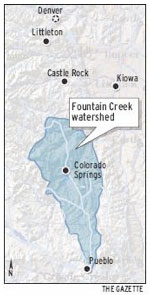
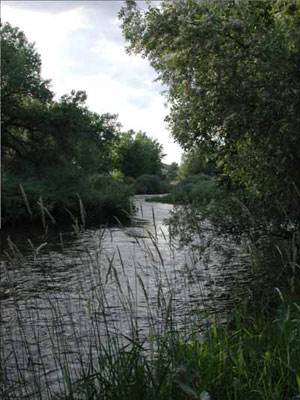
Fountain Creek Watershed
But downstream Pueblo County has been a prime victim of Colorado Springs’ failure to control stormwater surging through Fountain Creek and its tributaries. And the county holds the 1041 permit, which some believe could be used as leverage.
As Colorado Springs development has sprawled farther, more sponge-like land has morphed into impermeable pavement, leaving stormwater roiling across the terrain.
Sediment in Fountain Creek has increased at least 278-fold since the Waldo Canyon fire in 2012, pushing water levels far higher, reported Wright Water Engineers Inc. of Denver, contracted by the county. [ed. emphasis mine]
Sediment grew from 90 to 25,075 tons per year while water yields increased from 2,500 to 4,822 acre-feet, the engineers found. [ed. emphasis mine]
City and Utilities officials have been meeting with those engineers and their own consulting engineering firm, MWH Global, to prioritize projects.
They’ve developed a list of 73, including 58 projects recommended by Wright Water, said city Public Works Director Travis Easton. Work on the first of those commences next week, with detention ponds to be developed along flood-prone Sand Creek near the Colorado Springs Airport.
But skepticism lingers in Pueblo County, despite that effort plus creation of a new Stormwater Division, more than doubling the number of city inspectors and enforcement staff and the vow to dedicate $19 million a year to stormwater solutions.
They’ve heard promises before, Water Works board members noted Tuesday. They want a guaranteed, ironclad source of funding to stanch the stormwater that inundates their communities. And they want it yesterday.
“History’s important,” said Dr. Thomas V. Autobee, a Water Works board member.
Jay Winner, executive director of the Lower Arkansas Valley Water Conservancy District, had threatened in August to file a federal lawsuit against Colorado Springs for violations of the Clean Water Act.
Tuesday, Winner reminded the water board of how the then-Colorado Springs City Council eradicated its stormwater enterprise fund in 2009 – soon after the 1041 permit was issued – “the definition of hoodwink.”
Voters had just passed Issue 300, requiring payments to city-owned enterprises to be phased out. The subsequent council vote still rankles downstream Fountain Creek denizens.
Still, that fund never provided more than $15.8 million, Fredell noted. By contrast, the city and Utilities now are determined to spend more than $19 million a year on stormwater for at least 10 years.
They’re working on an intergovernmental agreement that would provide the guarantees Pueblo County seeks.
“Enforceablity is always an issue,” Mark Pifher, SDS permitting and compliance manager, told the Water Works board. “But we’re in discussion with the EPA and Department of Justice. The handwriting is on the wall. There will be either a consent decree or a federal order, and nothing is more enforceable.”
“If we can work this draft into something sustainable,” Autobee said, “that’s what I’d like to see.”
Board Chairman Nicholas Gradisar said he’s encouraged by the city and Utilities’ concerted efforts and swift action. “What I’m not encouraged by is the inability to come to agreement with Pueblo County.”
Gradisar said the funding must be guaranteed in perpetuity, not only 10 years, with an enforcement mechanism that doesn’t require a federal lawsuit.
Suthers, City Council President Merv Bennett and Utilities officials will meet with the Pueblo County Board of Commissioners at 1:30 p.m. Monday to continue discussions on the fate of the 1041 permit.
That meeting is in commission chambers at the old downtown Pueblo County Courthouse, 215 W. 10th St.
That night, the Pueblo City Council is to decide on a resolution similar to that tabled by the Water Works Board. It would support the county’s efforts to obtain sustained stormwater funding from Colorado Springs.
The council meets at 7 p.m. Monday at City Hall, 1 City Hall Place, in Council Chambers on the third floor.
More coverage from Chris Woodka writing for The Pueblo Chieftain:
The Pueblo Board of Water Works decided to wait a month before dipping its toes into the fray between Colorado Springs and Pueblo County over the Southern Delivery System.
The board tabled a resolution demanding a permanent funding mechanism for stormwater control on Fountain Creek in connection with Pueblo County’s 1041 permit with SDS, after testimony muddied the waters.
After SDS Project Director John Fredell tried to convince the water board that the two issues are not related, Jay Winner, general manager of the Lower Arkansas Valley Water Conservancy District cried foul.
“When you talk about stormwater, it’s not about the law or politics,” Winner said, turning to Colorado Springs ocials and inviting them to look at the damage along Fountain Creek in Pueblo. “The people are the ones getting injured. You need to do something about stormwater. You people are causing the issue.”
Winner said the Lower Ark district has tried for more than a decade to get Colorado Springs to agree to permanent funding.
Colorado Springs City Council President Merv Bennett, under questioning by water board President Nick Gradisar, admitted that Colorado Springs has not been in compliance with its stormwater permit. He, along with Colorado Springs Councilman Andy Pico and Public Works Director Travis Easton, explained in detail how the city would spend $19 million annually to address stormwater control.
About $12 million would go toward capital costs and $7 million to maintenance.
“It’s not only for downstream users, but for the benefit of Colorado Springs,” Bennett said. “We’re not waiting.
We’re moving forward.”
Colorado Springs is trying to negotiate a 10-year agreement with Pueblo County to ensure the funds stay in place.
Part of the water board’s resolution was to support Pueblo County in the bargaining.
Gradisar questioned whether that would go far to cover $500 million in identified stormwater projects, and blamed politics for the failure of past efforts to fund flood control.
“Left to its own devices, Colorado Springs Utilities would have taken care of these problems,” Gradisar said.
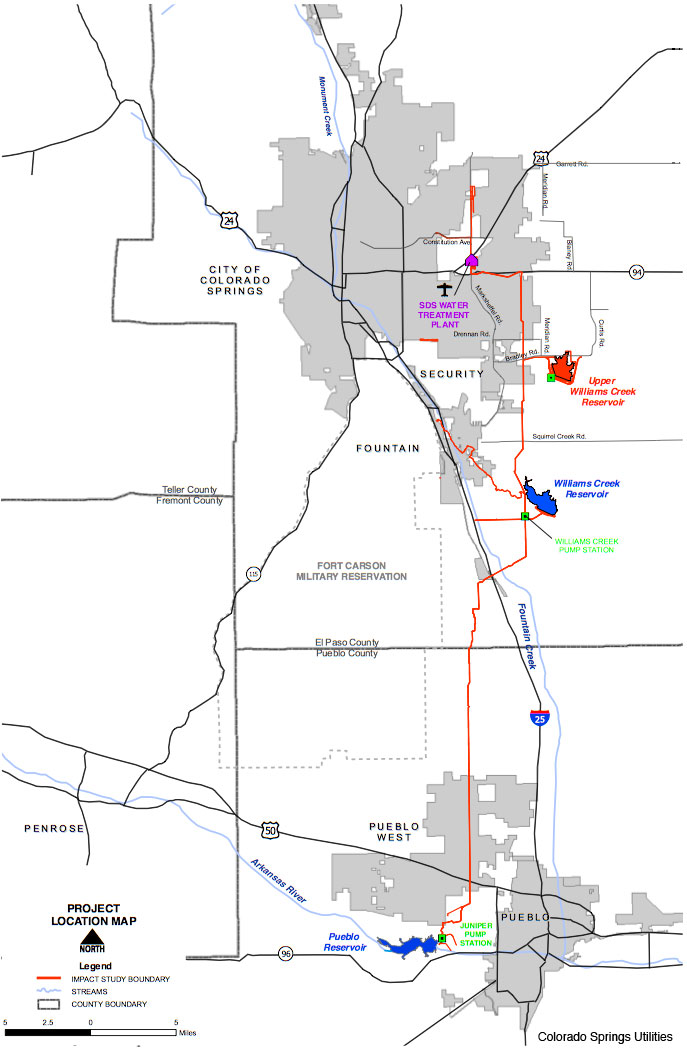
Southern Delivery System route map — Graphic / Reclamation
“But your voters . . . they probably wouldn’t have passed SDS.”
Water board member Tom Autobee brought up the issue of the $50 million Colorado Springs Utilities promised to pay to the Fountain Creek Watershed Flood Control and Greenway District when SDS goes on line.
Fredell explained that the SDS pipeline, pumps and treatment plant still are in testing, so Utilities does not believe the payment is due until 2017 under the 1041 agreement. Fountain Creek district Executive Director Larry Small, a former Colorado Springs councilman, said it should have been paid last week.
Fredell argued that stormwater control is not a condition of the 1041 permit, since the permit deals with new growth related to SDS.
Since SDS is not serving customers, it does not apply, he said.
“But the damage is being caused now, what happens with SDS,” Gradisar replied?
That drew a reaction from Pueblo West Metropolitan District board member Mark Carmel, who questioned whether SDS was just a speculative venture for Colorado Springs. He called for reopening the entire 1041 permit to incorporate new concerns.
Water board member Mike Cafasso said the draft resolution presented at Tuesday’s meeting could be improved and moved to table it. Other board members agreed to take it up again at the board’s February meeting.
Another attempt to allow Coloradans to collect rain water that falls on their roofs has started with a drizzle of legislation.
Reps. Jessie Danielson, D-Wheat Ridge, and Daneya Esgar, D-Pueblo, introduced the first piece of legislation on the subject Wednesday, the first day of the new legislative session.
The measure is written similar to legislation last year, which died on the second-to-last day of the session after it never received a Senate floor vote.
“It’s so simple. You’ve got rain that falls on your roof. You want to store it in a barrel to put it, instead of on your lawn or on your sidewalk, on your tomato plants or your flowers,” said Danielson, the daughter of a Weld County farmer. “It’s really straightforward, and it makes a lot of sense.”
The bill would allow people to capture rain from their roof in up to two 55-gallon barrels for use in their garden or on their lawn…
Sen. Ellen Roberts, R-Durango, found herself stuck in the middle of the debate last year, working to convince her fellow Republicans, who control the Senate, to give the bill a floor vote, where it would have passed with her support.
Sen. Jerry Sonnenberg, R-Sterling, chairman of the Senate Agriculture, Natural Resources and Energy Committee, led opposition to the bill, raising concerns over eroding the state’s prior appropriations system, in which water rights are granted to the first person to take water from an aquifer or river, despite residential proximity.
Sonnenberg suggested requiring rain-barrel users to register their barrels with the state and requiring local water providers to replace water taken from rooftops.
“It was extremely burdensome and regulatory in nature, and I couldn’t support it, but I certainly appreciated him spending some time to think about what would be a path forward from his perspective,” Roberts said of Sonnenberg’s effort. “I don’t want a police state over rain barrels.”
For his part, Sonnenberg said on Friday that he is open to a new discussion this year. He is holding off on introducing his own measure on the subject to see if he can secure a compromise with the bill that has been introduced.
At the top of his list, Sonnenberg would like the Office of the State Engineer, which handles water resources, to study the issue to determine whether there would be an impact to water rights, or if the result would be too minor to merit consideration.
He would also like the legislation to consider impacts to all bodies of water in the state – such as a groundwater basin – instead of just streams.
Proponents feel vindicated after researchers with Colorado State University in September reported that allowing 100 gallons of rainwater storage per household would not decrease surface runoff by any detectable amount on a typical lot.
But Sonnenberg remains skeptical, stating that the study took into account only runoff with or without rain barrels. He said it’s possible that barrels would lead to less runoff.
“The CSU study is flawed,” he said. “CSU … has lost some credibility for not doing their due diligence with regard to water and bringing us numbers. They did not bring us numbers that add up.”
Sonnenberg has, however, backed off on the registration requirement, stating that the proposal was just a starting point.
“All I need is someone responsible and a solid legislative declaration, and I think I can convince my other folks in the water community that do not like this, that absolutely hate this, that this is a good compromise,” he said.
Channel erosion Colorado Springs July 2012 via The Pueblo Chieftain FromThe Pueblo Chieftain (Chris Woodka):
The Pueblo Board of Water Works Tuesday will consider a resolution that calls for Colorado Springs to find a permanent source of funding for stormwater control of Fountain Creek.
The resolution was provided to The Pueblo Chieftain by board President Nick Gradisar. It ties a recent Environmental Protection Agency audit of stormwater violations to a 2004 intergovernmental agreement among the board, Colorado Springs Utilities and the city of Pueblo as well as the 2009 Pueblo County 1041 permit for Southern Delivery System.
The action would direct Executive Director Terry Book to contact the EPA to relay the community’s concern over the stormwater permit violations, which were revealed in November.
It also supports Pueblo County in its enforcement of the 1041 permit, which could delay the expected operation of the SDS pipeline in April.
The water board resolution also says Utilities, which was the lead agency for obtaining the 1041 permit, should have more of a role in the stormwater negotiations.
“Pueblo Water believes any revised 1041 permit or agreement must provide an adequate enforcement mechanism such that future funding of stormwater infrastructure is no subject future funding of stormwater infrastructure is no subject to the whims of different political leaders in Colorado Springs or the other SDS participants,” the proposed resolution reads in part.
It also suggests the stormwater regulations need to be in place for as long as the SDS pipeline is in operation.
That echoes concerns expressed last year by Jay Winner, general manager of the Lower Arkansas Valley Water Conservancy District, who suggested stormwater should be a fifth utility for Colorado Springs along with water, sanitary sewer, gas and electric service.
Colorado Springs had a stormwater enterprise in place in 2009 when it received federal and Pueblo County approval to build SDS, a 50-mile, $841 million water delivery pipeline from Pueblo Dam to Colorado Springs.
After a vote to sever utility payments from the city’s general fund in November 2009, Colorado Springs City Council chose to abolish the stormwater enterprise, but left other revenuesharing mechanisms in place.
The Lower Ark has placed its proposed federal court action on hold until EPA enforcement of the state stormwater permit under the federal Clean Water Act is complete.
Pueblo County is still contemplating whether Colorado Springs has met its stormwater obligations under the 1041 permit.
Pueblo City Council is scheduled to vote on a resolution requiring Colorado Springs stormwater compliance at its Jan. 25 meeting.
Colorado Springs Mayor John Suthers and City Council have proposed a plan to redirect $19 million annually from other city and Utilities funds.
Meanwhile, here’s the view from upstream via The Colorado Springs Gazette (Billie Stanton Anleu):
Colorado Springs is revving up its stormwater program, more than doubling its staff of inspectors and engineers to deflect lawsuit threats and fix problems cited by Pueblo County and the U.S. Environmental Protection Agency.
Mayor John Suthers vowed from the start of his tenure in June to address the city’s long-neglected stormwater problems, and he soon started carving $16 million from the city’s 2016 budget to add to $3 million from Colorado Springs Utilities.
“I can’t emphasize enough, this money wasn’t easy to come by,” Suthers said. “I’ve got a lot of unhappy police officers and firefighters out there,” because raises and staff additions were frozen for the year.
That $19 million dedicated to stormwater issues this year compares with $5 million from the city’s general fund in 2015, though federal grants bolster expenditures yearly. But Pueblo County officials are lamenting the loss of the Stormwater Enterprise Fund, which the City Council dismantled in 2009. They’re pointing to the eradication of that fund as cause to possibly rescind the 1041 permit they issued to Utilities to build and operate the $829 million Southern Delivery System.
The timing of the threat couldn’t be worse. The enormous project is scheduled to start pumping April 27, delivering up to 50 million gallons of water a day to Pueblo West, Fountain, Security and Colorado Springs.
Meanwhile, the EPA has threatened to sue Colorado Springs for not meeting terms of its Municipal Separate Storm Sewer System permit, better known as the MS4. After inspections in August, the EPA reported that the city didn’t have enough resources, inspections or internal controls to maintain and operate its stormwater infrastructure properly. The city also doled out too many waivers and failed to hold developers’ “feet to the fire,” the inspectors found.
Water, of course, flows downstream. So unrestrained stormwater, excessive sedimentation and degraded water quality become problems for the people in Pueblo County.
Neither Suthers nor the City Council has denied the magnitude of those problems. Indeed, the city and Utilities have proposed an intergovernmental agreement that would guarantee a minimum of $19 million a year in floodwater projects for 10 years. Utilities would be on the hook if the city experienced an economic downturn.
In addition, the city is creating a Stormwater Division to be staffed by 58 full-time employees compared with the current 28, adding inspectors and engineers.
The budget for MS4 compliance alone is increasing from $3 million to about $7.1 million. The total comes to $8.56 million if you include the cost of MS4 responses by street sweepers, firefighters and Utilities.
Current funds not certain, but state plan calls for more
With funding for current water projects drying up, Arkansas Basin Roundtable members are curious about where the flood of future money will come from.
By 2020, the Colorado Water Plan calls for investigating options to provide $100 million annually for water projects over a 30-year period. Several members questioned how that could be done, but others were worried about more immediate funding.
The roundtable studied the state water plan at its monthly meeting Wednesday.
“The Legislature always wants to take water funding from the Colorado Water Conservation Board,” said Jay Winner, general manager of the Lower Arkansas Valley Water Conservancy District. “It’s easy if we don’t say anything.”
The Water Supply Reserve Account, which funds roundtable projects, is expected to receive less money this year because it is funded through mineral severance taxes. The falling price of oil and gas is expected to reduce those revenues by 25-30 percent in Colorado this year, Brent Newman of the CWCB staff said.
“At the state level, they can take the whole ball of wax,” warned Don Ament, a former lawmaker and state commissioner of agriculture, who is now a consultant. He said past raids on CWCB funding have been slow to be repaid.
Lawmakers in past years have raided the CWCB’s funds to meet shortfalls in other budget areas. That could happen again if budget pressures tighten.
Alan Hamel, the Arkansas River basin’s representative to the CWCB, said the board intends to implement the state water plan by requiring all funding requests for water projects to be tied to some part of the plan.
“We want to know where it fits into the Colorado Water Plan,” Hamel said.
Funding is slowly being deposited in an effort to determine the best way to stop flooding on Fountain Creek.
The Arkansas Basin Roundtable this week approved $41,800 for the next phase of the Fountain Creek Watershed Flood Control and Greenway District’s investigation into flood control.
The Colorado Water Conservation Board must still approve the request at its March meeting.
“We proved that water rights would not be injured,” Larry Small, the executive director of the district told the roundtable Wednesday.
In 2014, Small ran into flak from the roundtable when he proposed a large project to investigate what type of flood control project — either a dam or series of detention ponds — would be most effective.
Although water rights protection was one of the tasks of that grant request, the roundtable insisted answering the question of whether flood storage would injure downstream users.
The district hired engineer Duane Helton last year and completed a study showing it was possible to measure the amount of water temporarily impounded and replace it with water stored elsewhere.
The next phase of the project will prepare graphics to visualize the effects of implementing flood control measures for 10-, 50-. 100- and 500-year floods, Small said. That will allow more evaluation of alternatives than the earlier conceptual study of a 100-year flood by the U.S. Geological Survey.
There are still a series of other steps that must be completed before construction of flood control facilities can begin. The Fountain Creek district wants to fully evaluate the effective-ness of structures before deciding which course to pursue.
There is also the matter of funding.
Under Pueblo County’s 1041 permit for Southern Delivery System, Colorado Springs Utilities is obligated to make $50 million in payments for flood control over five years when water is delivered through the pipeline from Pueblo Dam to Colorado Springs.
Those payments should begin this year, Small believes. However, Utilities has taken the position that water must be delivered to customers before payments begin.
Colorado Springs did not make the payment Friday, so the district will determine at its meeting next Friday which course of action to pursue, Small said.
Flood-related issues were just part of a package of topics that Domenico and Commissioners Elise Jones and Deb Gardner covered in their “State of the County” review of what they identified as Boulder County’s accomplishments in 2015 — and what residents can expect from their county government in 2016.
They led off their annual report by noting that it may take another couple of years to complete flood recovery efforts and get more of Boulder County’s flood victims permanently resettled.
Last year, Boulder County spent about $11 million on flood-related road and bridge work. This year, repairs and replacements of county government’s transportation infrastructure are expected to cost another $41 million.
This year’s flood recovery projects on county parks and open space lands are to include work at Pella Ponds south of Hygiene and the Walden Ponds Wildlife Habitat southwest of North 75th Street and Jay Road, as well as continuing repairs to the Anne U. White Trail that runs through the Fourmile Creek Canyon.
Boulder County will be continue providing flood-survivor case management services to connect residents with available funding toward their still-unmet needs after the 2013 devastation. The commissioners said the county expects to be responsible for trying to close about 235 of those still-open cases.
The commissioners also highlighted numerous non-flood-related projects and services planned for the coming year. Among them:
The Parks and Open Space Department will continue working toward a goal of having at least 20 percent of the croplands it leases to private farmers be certified as organic, or in transition to organic, by the year 2020.
From the Estes Park Trail-Gazette (David Persons):
It’s been over two years since the September 2013 flood ravaged the Fish Creek area, washing away roads, destroying homes and property, and making a mess of miles of water and sewer lines.
It also destroyed Scott Ponds, a wildlife and recreation area that is a big part of the quality of life for those who live in the nearby Carriage Hills subdivision.
The flood waters actually caused the dam on the lower, or eastern-most pond (Carriage Hills No. 2) to be breached, sending an additional surge of water that resulted in significant damage along the creek area below the dam.
Since then, local officials and residents have worked closely together on a resiliency plan for the Fish Creek area and a plan to restore the Scott Ponds.
Throughout 2015, plans moved forward to that end.
First, the town hired consultant Cornerstone Engineering and Surveying, Inc. in May to begin a public process to design repairs to the dams and/or ponds.
Then it obtained funding for the project. The town was awarded a $925,000 conditional Community Development Block Grant for Disaster Recovery by the Colorado Office of Emergency Management. It requires the completion of the project within one year. The award also was partnered with another grant of $146,000 for river restoration near the Fall River power plant.
Public input was then sought in early July. The general consensus was to repair the dams rather than restore the area as a wildlife/wetlands natural area.
The Estes Park Town Board agreed with residents in mid-July and authorized town staff to move forward with plans to restore the dams. An additional public review of the plans was held in August.
In late August, the Scott Ponds dams restoration project went out to bid. That’s when the project was dealt a serious setback, or as Estes Park Public Works Director Greg Muhonen called it, “a complicated twist.”
Muhonen, addressing the Estes Park Town Board in early November, told the trustees that problems had arisen with the two companies that had submitted bids — Kelly Trucking of Golden and Dietzler Construction of Berthoud.
Muhonen said that both companies submitted bids over budget. Muhonen said Public Works staff worked with Kelly officials to reduce the scope of the project to a level that would meet the state engineer’s requirements and also meet the town’s grant funding amount. However, Kelley Trucking officials notified the town on Nov. 4 that it was withdrawing from the project due to budget constraints, redesign plan approval, and a postponed construction start date.
Not many cities can claim their infrastructure was of leading concern from the beginning, but Colorado Springs is one of them. Concrete evidence was left in a time capsule by one of the city’s founding engineers, Edwin W. Sawyer, via documents dated in 1901 which state, “It seems to me that nothing except the lack of water can stop the growth of a city so desirable for residence as this…Our people are becoming aroused to the need of securing at once all the available reservoir sites and water rights…”
Southern Delivery System route map — Graphic / Reclamation
Continuing in the same water-conscious spirit as those earlier citizens, three different mayors and at least eight previous city councils have been involved and invested in the planning of the Southern Delivery System, American Infrastructure magazine’s Water Project of the Year.
Awarded for its forward-thinking and comprehensive approach to water management, the regional project will be built in phases through 2040 based on customer demands, and will bring water from Pueblo Reservoir to Colorado Springs and partner communities, Fountain, Security, and Pueblo West.
The project is more than a simple fix for major pipelines that are now over 50-years-old and nearing capacity; Jerry Forte, the current CEO of Colorado Springs Utilities, hopes that this project “will serve as an engine, driving more efficiency, effectiveness, and reliability in our system.”
The new north outlet works at Pueblo Dam — Photo/MWH Global
Phase I, which is now under construction, will transport water from Pueblo Reservoir through approximately 50 miles of underground pipeline, and is on schedule for April 2016. The project is estimated to cost $841 million at completion (thus far, under budget by $156 million)…
The four-part Water Resource Plan, of which the SDS is the major component, includes conservation, non-potable water development, existing system improvements, and major water delivery systems (the SDS itself). After the 2002 drought heightened public awareness of water scarcity, Colorado Springs has been able to make improvements to increase the efficiency of the existing water system before constructing SDS. Today, their per capita residential water use is among the lowest in the region. Colorado Springs also has the second-largest nonpotable water system in the state and has expanded their use of non-potable water in recent years.
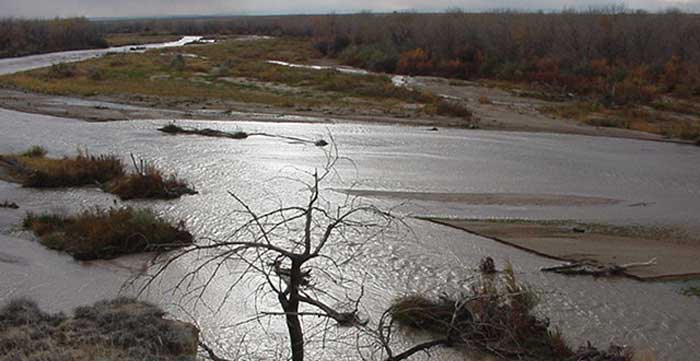
Fountain Creek Watershed
Like any other project, this process hasn’t gone without headaches. However, clearing some of these hurdles was no easy feat, including dozens of permits and an Environmental Impact Statement that took almost six years to complete. In order to mitigate concerns that the proposed SDS would cause damage to Fountain Creek and surrounding wetland areas, a significant portion of the $1.4 billion overall cost of the project is a $75 million in wastewater system improvements to help prevent wastewater spills into Fountain Creek, a $50 million payment to the newly formed Fountain Creek Watershed Flood Control and Greenway District; additional payments will be allocated towards various mitigation and flow maintenance programs on Fountain Creek in the future.
Little Brown Bat diagram via Shari Ansel and ExlploringNature.org
Big Brown Bat diagram via Shari Ansel and ExlploringNature.org
Here’s the release from the Colorado Department of Transportation:
December 22, 2015 – Northeastern Colorado/CDOT Region 4 – Local mosquitoes won’t be so pleased with boxes built under new bridge on US 34.
As the project to permanently repair US 34 east of Greeley finishes up, the Colorado Department of Transportation installed a special gift under the bridge for area bats!
Four large bat box houses were installed under the new bridge on US 34, each one capable of housing hundreds of bats. The installation is not a requirement, but it is something CDOT tries to do when possible in areas that are suitable for bat populations.
The boxes were built using scrap material, but it’s the thought that counts. And according to Larry Rogstad, Colorado Parks and Wildlife manager, this is a gift that will keep on giving.
“A single brown bat can eat over 1,000 mosquito-sized insects per hour. Just think what a colony of 100 bats could do in a night,” he said. “This is typical of CDOT, an agency that is always mindful of good stewardship in natural resources, including wildlife. CPW is proud of the relationship we have with CDOT on many habitat protection projects along our public highways.”
Frequently when CDOT replaces older wood bridges, bat boxes are installed to provide new homes for the local bats. The US 34 project, east of Greeley, is a particularly good one for the bat boxes. First, there was no bridge in the area previously. This section of road was wiped out during the flood of 2013 and the bridge was put in place to ensure that doesn’t happen in future high-water events.
Just like with humans, bat “real estate” is all about location. And bats love to have a safe, dry area near readily available water supplies where their main food (those annoying mosquitoes and biting gnats) hang out.
Ryan Idler, the CDOT project engineer on US 34 east, said, “If you have ever been out in this area in the spring or summer, you know there are a lot of bugs out here and that made me think about the bats. I mentioned it to our contractor (Flatirons Constructors) and they found the time to build and install the houses.”
Crews working on the US34 project installed the boxes and even added a little Batman decoration to help the new occupants feel more at home. Previous bat box installations are visited to see if there is any evidence that anyone has moved in and the results have been so successful that future installations will be planned as well.
Arkansas River Basin — Graphic via the Colorado Geological Survey
From the La Junta Tribune-Democrat (Bette McFarren):
Jeanette Meyers appeared before the City Council on Monday night to ask the support of the City of La Junta for the North La Junta Water Conservancy District project for flood control on the Arkansas River. The project already has the support of the Lower Arkansas Valley Water Conservancy District ($40,000), Otero County ($10,000), Arkansas Valley Round Table ($25,000). Malouff said the value to the City of La Junta manifests itself in lowering the ground water table during the flooding conditions, helping relieve storm sewer backup and improving issues with wastewater. Meyers said the Bureau of Reclamation and the Corps of Engineers are in favor of the project.
Basically, the islands in the river need to be removed so the river may flow more smoothly downstream. A pinch point exists just east of the bridge at La Junta which contributes to flooding in North La Junta, La Junta in the lower areas and downstream. Meyers pointed out this is a matter of some urgency, since the Pueblo Reservoir is now at 200,000 acre-feet and at 250,000 acre-feet will have to start releasing water. All of the reservoirs except Queens are full or half full and the Fort Lyon Ditch is out of commission because of repairs. On the motion of Ed Vela, the council took the matter under advisement until the next meeting, for the purpose of working out the finances. The work must be completed by the end of March.
Bud Quick, who has helped North La Junta dodge some of the worst flooding the last couple of years, explained that we are sitting on top of an aquifer. If we can let the river widen out, it will flush itself out and slow down.
Engineering Department Director Dan Eveatt asked permission to accept a $50,000 grant from the Colorado Department of Local Affairs. The grant is for the purpose of comprehensive planning for the city along the lines discussed with Downtown Colorado in recent public meetings. The council agreed to accept the grant.
Next year’s budget in Colorado Springs includes $16 million for stormwater repairs. Colorado Springs Utilities will also spend $3 million. Much of those funds are likely to go toward improving the Fountain Creek Watershed, which runs through Colorado Springs and down into Pueblo; and the list of projects that need to be done along Fountain Creek is long and expensive.
The Fountain Creek Watershed Flood Control and Greenway District funds projects in watersheds in El Paso and Pueblo Counties. Executive director Larry Small holds up a building under construction near Monument Creek, which is part of the Fountain Creek watershed, as an example of damages that seem to go unchecked.
“That development has created runoff, comes down the slopes, carries with it sediment,” says Small. “It’s more pronounced down here in this cut bank where the stream gets higher, undercuts the bank and the bank collapses into the creek.”
Up until 2010, Colorado Springs had a stormwater fund that was used to pay for damage like this. But the fund was eliminated and projects stopped. Small says that’s created an enormous backlog.
“[The Monument Creek watershed] is the largest watershed in the Fountain Creek watershed… Many streams are tributaries to Monument Creek and each of these have issues.”
For the entire Fountain Creek watershed, the needed work compiled by the district has a price tag of about $1 billion. Small says about half of that is in Colorado Springs.
In front of a Colorado Springs Utilities wastewater treatment plant downstream are projects completed by the utility. Small says they’re the same sorts of projects that were completed before the stormwater fund was eliminated.
“They would put in rip-rap like this to stabilize the banks,” says Small. “So those were capital improvements they would make. They would also maintain areas that had been eroded, where they had facilities and they’ve been damaged – for instance sediment collection ponds may have been filled in need to be cleaned.”
There is pressure on Colorado Springs to get back to work on these projects. The permit authorizing the Southern Delivery System, a pipeline carrying water north from Pueblo Reservoir, requires that Colorado Springs do more to control stormwater runoff before water deliveries begin. Pueblo County nearly voted to find the city in violation of that provision earlier this year, potentially closing down the whole pipeline. The Environmental Protection Agency and the state’s Department of Public Health and Environment will also review the city’s stormwater plans. The city faces a court injunction and fines.
Here’s the release from Colorado State University (Anne Ju Manning):
There’s a lot of potential benefit to capturing graywater and stormwater to supplement traditional water supplies, but it doesn’t make sense for everyone, and there are plenty of legal, regulatory and climate-related hurdles in doing so, says Colorado State University’s Sybil Sharvelle.
Sharvelle, associate professor of civil and environmental engineering and head of CSU’s Urban Water Center, served on a 12-member national committee charged with addressing the benefits and challenges of stormwater and graywater as supplemental water sources, as the nation faces widespread water shortages and droughts. The National Academies report, released publicly Dec. 16, was two years in the making and provides information on the costs, benefits, risks and regulations associated with capturing these alternative water sources.
According to the report, stormwater is “water from rainfall or snow that can be measured downstream in a pipe, culvert or stream shortly after the precipitation event.” Graywater is “untreated wastewater that does not include water from the toilet or kitchen, and may include water from bathroom sinks, showers, bathtubs, clothes washers and laundry sinks.”
The report recommends best practices and treatment systems for the use of water from these sources; for example, in many locations with heavy rainfall, it’s possible to store excess water in aquifers for use during dry seasons. In some cases, stormwater captured at neighborhood and larger scales can substantially contribute to urban water supplies.
Graywater is best for non-potable uses like toilet flushing and subsurface irrigation. It has potential to help arid places like Los Angeles achieve substantial savings, and it serves as a year-round, reliable water source, according to the report. Larger irrigation systems and indoor reuse systems would require complex plumbing and treatment retrofits that are typically most appropriate for new, multi-residential buildings or neighborhoods for future urban planning.
The report cites the Eloy Detention Center in Arizona, which reuses graywater from showers and hand-washing to flush toilets. The facility has observed water savings of 20 gallons per day per inmate.
Sharvelle said the need for the report arose before the onset of widespread drought in the western United States.
“The use of these resources has been hindered by a lack of national guidance and ambiguous regulations for water quality targets,” Sharvelle said.
Sharvelle led an analysis of residential stormwater and graywater use in Los Angeles; Seattle; Newark; Madison, Wis.; Lincoln, Neb.; and Birmingham, Ala., and calculated potential savings for conservation irrigation and toilet flushing.
The bottom line is there’s no single best way to use these resources, because whether they’re successful or economically viable depend on a host of factors: legal and regulatory constraints, climate, and source water availability.
The report is online, and a webinar is planned for early 2016 to further detail the findings. The study was sponsored by the U.S Environmental Protection Agency, National Science Foundation and other agencies.
CSU’s Urban Water Center is part of the university’s One Water Solutions Institute, which seeks to connect CSU’s world-class research with real-world water challenges.
Last section of pipe for Southern Delivery System photo via The Colorado Springs Gazette FromThe Pueblo Chieftain (Chris Woodka):
Plans for a federal lawsuit against Colorado Springs over Clean Water Act violations are being shelved until state and federal agencies show how stormwater violations will be handled.
But the Lower Arkansas Valley Water Conservancy District still intends to be active and urge the city and county of Pueblo to join in assuring that Colorado Springs controls stormwater pollution of Fountain Creek, possibly by blocking the startup of the Southern Delivery System — the $841 million water pipeline scheduled to go online next year.
“We can’t sue, because both the state and federal government are taking enforcement action,” attorney Peter Nichols told the Lower Ark board Tuesday in a work session. “They’re not going to go away. This is not going to be a slap on the wrist.”
The Environmental Protection Agency last month revealed Colorado Springs is in violation of its state permit to discharge stormwater into Fountain Creek. The EPA said Colorado Springs is not spending enough or enforcing its own policies when it comes to stormwater after an audit showed the city made no progress in a two-year period.
“It may be a coincidence, but the EPA did an audit and found everything we found and more. They have more resources,” Nichols said. “When you look at the appendices (to the audit), there’s some egregious [stuff] in there.”
Most likely, that will lead to a federal court case with compliance from Colorado Springs or the possibility of daily fines of up to $37,500 for each violation. It’s unusual for a city to be cited, said Nichols, who was once director of the Colorado Water Quality Control Commission, which enforces permits.
“There are aggressive and tight requirements of what a city has to do,” Nichols said. “The penalties are held in abeyance so long as the violator complies with them.”
Nichols provides a memorandum showing similarities between the Lower Ark’s findings, compiled over the past five years, and the EPA audit, which include lack of funding, maintenance and enforcement of basic stormwater measures.
“We were a voice in the wilderness several years ago, but when we filed an intent to sue, the EPA paid attention,” Nichols said.
“So we care about it, but the city and county of Pueblo don’t?” asked Lower Ark board Chairman Lynden Gill.
One of the provisions of Pueblo County’s 1041 agreement in 2009 with Colorado Springs for SDS requires compliance with all county, state and federal regulations. It’s also one of the provisions in a 2004 intergovernmental agreement (Article VI, No. 8) among Pueblo, Colorado Springs and the Pueblo Board of Water Works.
General Manager Jay Winner pointed out that the district’s criticism has fallen on deaf ears with federal agencies related to SDS as well.
Those include the Bureau of the Reclamation, which approved the use of Lake Pueblo for SDS. Winner wants to reopen the federal process, which was mostly completed prior to abolishment of the stormwater enterprise by Colorado Springs City Council in late 2009.
Reclamation approved a contract for SDS in 2010, even after objections were raised that there was no stormwater enterprise. The only remedy suggested in the documents related to the contract, such as the environmental impact statement, is a vague “adoptive management plan” that is supposed to kick in when violations for things such as water quality violations occur.
“We’ve seen these happening for a long time,” Winner said. “It seems to me the EIS is based on bad information.”
Nichols added the district also can remain involved in questioning whether the violations cited by the EPA could aect the Clean Water Act Section 401 and 404 federal permits issued for SDS.
City officials in Steamboat Springs say some high water temperature readings taken in the Yampa River just west of Hayden in recent years could soon lead to a big change in how a 57-mile stretch of the river is regulated by the state.
The stretch of the Yampa that runs from the confluence of Oak Creek south of Steamboat to the Moffat County border is poised to be listed by the Colorado Department of Public Health and Environment as an impaired waterbody.
City officials are concerned that the listing could eventually lead to some costly, multi-million upgrades to such things as the wastewater treatment plants that discharge water into the river.
They are questioning the methodology used to arrive at the listing and are hoping a proposal to monitor the health of the river in more areas will help municipalities along the river avoid costly new regulations.
“Given the variability of altitude, temperature, and aquatic life throughout the 57-mile segment, the City questions whether the standard applied to such a long reach is appropriate,” city officials recently wrote in a memo to the Steamboat Springs City Council.
Kelly Heany, the city’s water resources manager, said the Water Quality Control Commission will consider whether to list the Yampa as an impaired waterbody at its Dec. 14 meeting.
“It could potentially have a costly impact n the wastewater treatment plants in Hayden, Milner and ours,” Heaney said.
She said the added regulations could call for such things as the installation of expensive cooling towers at these wastewater treatment facilities.
The classification could also add more regulations to construction de-watering permits, industrial discharge permits and stormwater permits.
Heaney will attend the Dec. 14 hearing to outline the city’s plans and the extensive efforts it has undertaken already to protect the water quality of the Yampa.
Heaney said the city does not have enough temperature data from the entire stretch of the Yampa to oppose the listing on the impaired waterbody list.
So city officials are proposing to invest more in monitoring the quality of the Yampa at more locations to better understand what impacts the temperature changes.
Yampa/White/Green/North Platte river basins via the Colorado Geological Survey
From the Glenwood Springs Post Independent (Ryan Summerlin):
As the Federal Emergency Management Agency redraws Garfield County’s floodplain boundaries, residents and local businesses may end up paying bigger insurance bills.
The latest revisions to FEMA’s floodplain maps — reviewed Thursday in a forum for local government, residents and businesses — show that several businesses and neighborhoods will be enveloped in the new 100-year floodplain boundary.
However, since the 2011 revision of those maps, several appeals have succeeded in pushing back the boundaries in some locations, such as Glenwood Hot Springs Lodge and Pool, the confluence of the Roaring Fork and Colorado rivers, El Rocko Mobile Home Park, Riverside Cottages north of Cardiff and Mitchell Creek just north of Sixth Street.
In these locations, residents found errors in FEMA’s elevation data.
But in many of these locations and others, the most recent revised maps still show growing floodplain boundaries.
For example, the floodplain running down a horseshoe street off of Center Drive in West Glenwood has expanded to encompass the entire neighborhood.
Ryan Pietramali, FEMA’s risk analysis branch chief, said these updates have come along as mapping technology has advanced — bringing data collected with technology from the 1960s and ’70s into “the digitized world.”
Glenwood Hot Springs Lodge and Pool has already begun protesting. In a Nov. 12 letter to FEMA, the Hot Springs’ attorney disputed whether the newest maps were indeed more comprehensive and accurate.
FEMA’s current floodplain shows Glenwood Hot Springs is outside the 100-year flood boundary. But it was included in the floodplain in the 2011 revision. And while the boundary around the springs has receded after successful appeals, the tourist attraction is still encompassed in the 100-year boundary…
The sudden change came with a change in policy, Pietramali said. Prior floodplain maps had considered Interstate 70 as a flood mitigation structure. But under its new policy, FEMA cannot consider the interstate as such.
Pietramali said FEMA is dealing with the issue of non-levy embankments all over the country since the implementation of that policy.
But the interstate was designed and built for transportation, not to restrain flood waters, said Pietramali.
FEMA, therefore, treats the area as though the interstate is not there at all, extending the floodplain as far as the water would go without the interstate as an obstacle.
So regardless of whether I-70 would block floodwaters from the Colorado River, Glenwood Hot Springs could get stuck with much higher insurance costs.
Pietramali noted that while the floodplain maps are used by lenders to determine where to make flood insurance mandatory and how to set insurance rates, they’re also used for land management decisions.
Following the forums Thursday, FEMA will open a 90-day period during which residents and businesses can submit appeals. That period is slated to begin in February.
Following that process, FEMA prepares the final floodplain maps, a flood insurance study and flood insurance rate maps. Those maps and reports go into effect 10 months after they’re finalized, and local governments are required to have passed ordinances adopting those maps beforehand.
Here’s the abstract from the United States Geological Survey:
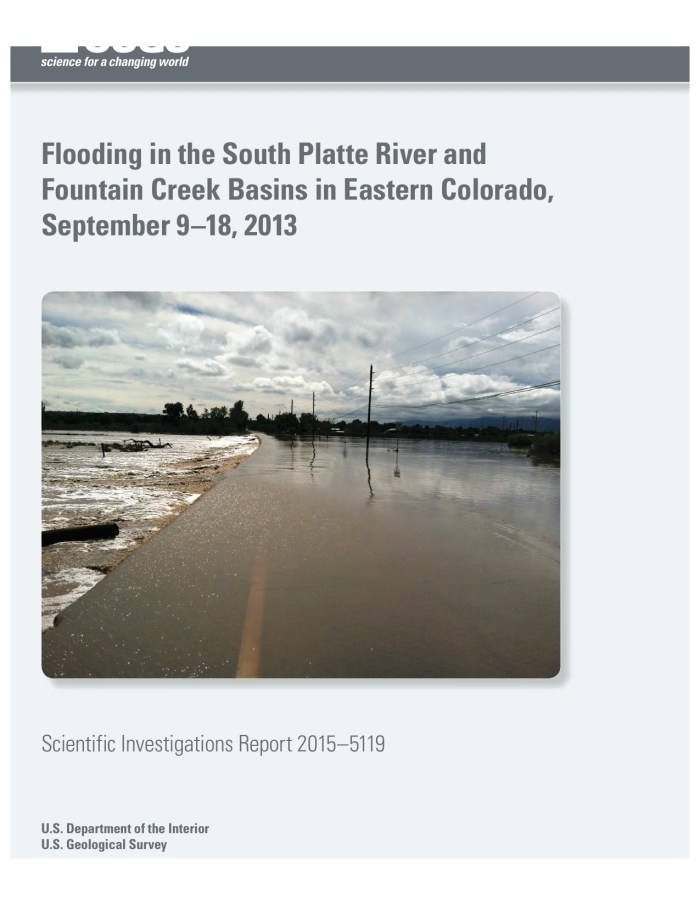
On September 9, 2013, rain began to fall in eastern Colorado as a large low-pressure system pulled plumes of tropical moisture northward from the Pacific Ocean and the Gulf of Mexico. By September 16, 2013, as much as 12 to 20 inches of rain had fallen in the foothills of the Front Range of the Southern Rocky Mountains and adjacent plains near Colorado Springs, Colorado, north to the Colorado-Wyoming border. The rain caused major flooding during September 9–18, 2013, in a large part of the South Platte River Basin and in the Fountain Creek Basin. The floods resulted in several fatalities, more than 31,000 damaged or destroyed structures, and an estimated 3 billion dollars in damages. The U.S. Geological Survey (USGS) documented peak stage, streamflow, or both from the flood event for 80 sites located on selected rivers and streams in the South Platte River and Fountain Creek Basins and on the Platte River in Nebraska. The majority of flood-peak streamflows occurred on September 12 or 13, 2013, coinciding with the period of maximum rainfall. The flood resulted in new record peak streamflows at 17 streamgages having at least 10 years of record; 13 in the South Platte River Basin and 4 in the Fountain Creek Basin.
Flooding in the South Platte River Basin was primarily contained to select streams in Aurora and the Denver metropolitan area, most of the mountain tributaries joining the main stem South Platte River from Denver to Greeley, and in the main stem South Platte River from Denver to the Colorado-Nebraska State line. In Aurora, where about 15 inches of rain fell, streamflow peaked at 5,470 cubic feet per second (ft3/s) in Toll Gate Creek, a tributary to Sand Creek. Downstream from Aurora near the confluence with the South Platte River, Sand Creek peaked at 14,900 ft3/s, which was the highest streamflow since at least 1992, but less than the peak of 25,500 ft3/s in 1957 that occurred 4 miles upstream from the mouth. Flood-peak streamflows in the Denver metropolitan area were generally below historic records. The peak of 3,930 ft3/s on September 12 at the State of Colorado streamgage South Platte River at Denver ranked 59 out of 116 peaks and was less than the 1965 peak of 40,300 ft3/s. Ten of the 13 streamgages in the South Platte River Basin with new record peak streamflows were located on the mountain tributaries; Bear Creek, Fourmile Creek, Boulder Creek, St. Vrain Creek, the Big Thompson River, and the Cache la Poudre River. A daily average streamflow of 8,910 ft3/s on September 13 in Boulder Creek at the confluence with St. Vrain Creek was more than twice the previous instantaneous peak of 4,410 ft3/s from 1938. The USGS calculated a peak streamflow of 23,800 ft3/s for the St. Vrain Creek at Lyons; the highest streamflow on record at this State of Colorado streamgage (122 years of record) is 10,500 ft3/s from 1941. A peak streamflow of 16,200 ft3/s was calculated for the Big Thompson River at mouth of canyon near Drake streamgage, which is the second highest peak in 90 years of record and about one-half the magnitude of the peak of 31,200 ft3/s from July 31, 1976. A streamflow of 60,000 ft3/s in the South Platte River at Fort Morgan (September 15, 2013) suggests that a new record streamflow occurred in the main stem in the Greeley area, about 45 miles upstream from Fort Morgan. The current peak of record at a State of Colorado streamgage at Kersey, about 6.5 miles downstream from Greeley, is 31,500 ft3/s from 1973. Given that there was minimal inflow between Kersey and Fort Morgan, the USGS estimates there was probably at least 60,000 ft3/s at Kersey, which would be almost double the peak streamflow of record from 1973.
Flooding in the Fountain Creek Basin was primarily contained to Fountain Creek from southern Colorado Springs to its confluence with the Arkansas River in Pueblo, in lower Monument Creek, and in several mountain tributaries. New record peak streamflows occurred at four mountain tributary streamgages having at least 10 years of record; Bear Creek, Cheyenne Creek, Rock Creek, and Little Fountain Creek. Five streamgages with at least 10 years of record in a 32-mile reach of Fountain Creek extending from Colorado Springs to Piñon had peak streamflows in the top five for the period of record. A peak of 15,300 ft3/s at Fountain Creek near Fountain was the highest streamflow recorded in the Fountain Creek Basin during the September 2013 event and ranks the third highest peak in 46 years. Near the mouth of the basin, a peak of 11,800 ft3/s in Pueblo was only the thirteenth highest annual peak in 74 years. A new Colorado record for daily rainfall of 11.85 inches was recorded at a USGS rain gage in the Little Fountain Creek Basin on September 12, 2013.
Recent revelations about deficiencies in stormwater control could snag Colorado Springs plans to expand its water system.
The Bureau of Reclamation and Pueblo County need to take a second look at the environmental impact statement that cleared the way to build the $841 million Southern Delivery System, and the newly constructed water pipeline from the Pueblo dam to El Paso County should not be turned on until the issue is settled, said Jay Winner, general manager of the Lower Arkansas Valley Water Conservancy District.
“We’ve been saying this for years,” Winner said. “We need to get past the talk from Colorado Springs and stop them from flushing all their crap down Fountain Creek. They need to walk the walk.”
Winner was reacting to an inspection report released this week by the Environmental Protection Agency that could be the basis for a federal lawsuit over inadequate stormwater control in Colorado Springs.
Among other things, the report says the city failed to correct problems identified two years earlier, that it knowingly violated the terms of its municipal separate storm sewer system permit and that it is not enforcing its own guidelines for new development.
Reclamation’s EIS was done in 2009, when Colorado Springs had a stormwater enterprise in place that generated millions of dollars annually to take care of the very problems outlined in the inspection. The assumption by Reclamation was that since it was in place, the only issue were future flows generated by new development related to SDS.
If that created problems, Reclamation relied on a vague “adaptive management” concept to rectify problems.
Reclamation failed to answer political calls to reopen the EIS in 2010 after Colorado Springs City Council torpedoed the stormwater enterprise on a split vote after a city election.
The EPA’s inspection report shows problems continue to worsen as Colorado Springs ignores its stormwater infrastructure. The Colorado Springs City Council and Mayor John Suthers have devised a plan to provide $19 million in funding toward complying with the MS4 permit and addressing a more than $500 million backlog in projects.
Winner said a more permanent funding source is needed, which the EPA concurs with in its inspection report. This needs to be a consideration for Pueblo County commissioners, who are negotiating with Colorado Springs over compliance on the stormwater issue as it relates to the 1041 permit for SDS.
“I think we’ve been hoodwinked long enough by their City Council,” Winner said. “I would hope the new (Pueblo) City Council will become more engaged and not put up with these shenanigans.”
One of the new Pueblo City Council members is Winner’s wife, Lori Winner.
Winner also is uneasy that the Arkansas Basin Roundtable this month endorsed a Colorado Springs Utilities employee, Mark Shea, for a seat on the Colorado Water Quality Control Commission. Winner, a member of the roundtable, urged caution at the meeting. Recently, another Utilities executive, Mark Pifher, (now a consultant for Utilities) served on the commission.
“The Water Quality Control Commission has ignored the problems,” Winner said. “It’s like asking the fox to guard the henhouse.”
More coverage from Chris Woodka writing for The Pueblo Chieftain:
Turns out the bare minimum that Colorado Springs said it was doing to prevent contaminated water from its streets flowing into Fountain Creek was not enough to satisfy the federal government.
The one constant that Colorado Springs officials had assured Pueblo County and the Lower Arkansas Valley Water Conservancy District was being met was the MS4 permit with the Environmental Protection Agency.
MS4 stands for municipal separate storm sewer system, and the existence of the permit itself has been held up for years in presentations by Colorado Springs as evidence that the city was doing basic work to regulate stormwater.
But according to an EPA report finalized in August, little progress has been made to rectify problems identified in a February 2013 audit. The inspection could be the basis for a federal lawsuit over Colorado Springs stormwater deficiencies.
In fact, city officials were aware of shortcomings, as the EPA stated: “During the inspection, city representatives stated they were fully aware of the lack of resources to adequately implement the MS4 program, and cited the termination of the city’s SWENT (stormwater enterprise) in 2009 and overall lack of political, managerial and community support for the city’s MS4 program as contributing factors.”
Photographs in the report show severe erosion, crumbled drop structures, vegetation growing in concrete ditches and cracked channels clogged by logs and trash throughout the city.
Colorado Springs also has assured Pueblo County and the Lower Ark that new development that benefits from the soon-to-be-completed Southern Delivery System would be regulated to avoid any additional impact on Fountain Creek.
There has also been a lot of talk about how the city has developed a design criteria manual to protect Fountain Creek.
The EPA inspection, however, notes that Colorado Springs is doing very little to make new development comply with regulations after looking at more than 600 plans reviewed by the city. The report stated: “It was unclear at the time of the inspection how the city would ensure submittal of appropriate design elements in the future. … The city did not ensure that public and private permanent BMPs (best management practices) were properly designed, approved and installed.”
Work is resuming on a dangerous portion of Fountain Creek through Pueblo.
The Army Corps of Engineers is overseeing a $750,000 project to install articulated concrete blocks — held together by cable in a mat and anchored to the ground — along the Fountain Creek bank near the 13th Street Exit on Interstate 25.
Work should be complete within three months and Pueblo contractor Pate Construction is doing the work while flows are low.
The project started in April, but was interrupted by heavy rains in May and June that increased flows on the Fountain to well above normal for more than six weeks. Waters only recently receded to the point where workers could get in the channel.
Fountain Creek will be temporarily rechanneled to the east of the area while work is underway, said Jeff Bailey, assistant city manager for stormwater.
The area had been secured by a gabion — wire-wrapped rock — which washed out during the September 2013 flood on Fountain Creek.
Fountain Creek hits the bank at a right angle at 13th Street, threatening railroad tracks and roadways in the area. While the Corps is responsible for the work and funds it, the city is the sponsoring agency and coordinates such things as local permits and access, Bailey explained.
There are several other projects still in the planning stages to repair damage from this spring’s flooding, Bailey said.
The city will be removing the debris such as large trees that were deposited at the Eighth Street bridge in the near future. “We need to get that clear so the water doesn’t start undermining the supports,” Bailey said.
The city is also working on restoring trails and repairing the berm at the flood detention pond behind the North Side Walmart.
Meanwhile, the Colorado Department of Transportation is working on projects to repair the Colorado 47 bridge and the trail in that immediate area, as well as clearing debris at the East Fourth Street bridge.
Colorado Springs repeatedly has violated its water quality permit and now faces a potential federal lawsuit, the U.S. Environmental Protection Agency has warned the city.
The EPA inspected 14 sections of the city’s stormwater system Aug. 18-19 and found “continuous failure” to meet standards or remediate problems highlighted in a state audit conducted Feb. 4-7, 2013.
Problems cited include inadequate funding, infrastructure problems, insufficient inspections, “not holding developers’ feet to the fire,” a lack of internal controls and too many waivers, Mayor John Suthers said Monday.
The city’s federal MS4 permit (for Municipal Separate Storm Sewer System) requires adherence to water quality standards. While drinking water is not at issue in this report, Suthers said, heavy sedimentation and other problems were reviewed in detail.
No city official denies the long-term neglect. But the irony is rich.
Since he took office six months ago, Suthers repeatedly has vowed that $19 million a year will be spent on stormwater improvements. That has the City Council’s full support, and $16 million for stormwater has been carved out of the mayor’s proposed 2016 budget, with $3 million to come from Colorado Springs Utilities.
So the city finally is poised to address a problem that has been worsening since at least 2008. The recession kicked in that year, and the city’s Stormwater Enterprise Fund was dismantled a year later, “a bad, bad combination,” Suthers noted.
Voters in 2009 backed Issue 300, a measure weakening the city’s use of enterprise funds. In response, City Council eliminated the stormwater fund. It had six inspectors at the time; today the staff has about three.
The timing couldn’t have been worse. The Waldo Canyon Fire struck in 2012, and the burn scar contributed to widespread flooding in 2013 that exacerbated already severe problems with Fountain Creek, Monument Creek and other tributaries.
Tim Mitros, until recently the city’s Stormwater Division manager, has been widely lauded for his response to those disasters and for his diligence on stormwater issues.
Homeowners cited his vigilance and daily visits in May, when record-breaking rainfall led to landslides that endangered two Rockrimmon houses. He also oversaw updates last year to the city’s antiquated, two-volume Drainage Criteria Manual for developers.
Now the city is advertising for a new stormwater manager. Why? “I don’t know. You’ll have to talk to Travis Easton,” Mitros said.
“We’ll be introducing accountability where it wasn’t before,” said Easton, who became Public Works director in August 2014. “We recognized long before this report came out that we had issues to address.”
Said Suthers, “We need to up our game in stormwater, and that’s what’s going on there.”
But he also noted: “If you really dig deep (in the report), the problem of inadequate manpower doing inspections” is evident.
The city has retained Broomfield-based MWH Global consulting engineers to review the EPA report and “propose how to move forward to settle this,” Suthers said.
The EPA encourages settlement discussions but says any settlement must be done through a consent decree by U.S. District Court with a schedule for injunctive relief and payment of an appropriate civil penalty.
In January, city officials will meet to negotiate with representatives of the EPA, U.S. Department of Justice and Colorado Department of Public Health and Environment. (EPA and CDPHE officials working on the issue referred calls to their communications staff representatives, who did not return requests for comment.)
Suthers said the city hopes to obtain a waiver on penalties and avoid litigation.
The city has been negotiating for months with Pueblo County, which has threatened legal action, too, over the severe problems downstream users have experienced because of Colorado Springs’ inadequately controlled stormwater.
At risk is the 1041 permit that the county issued to city-owned Colorado Springs Utilities for its Southern Delivery System, a massive water project set to deliver up to 50 million gallons a day of Arkansas River water to Colorado Springs, Fountain, Security and Pueblo West.
Without the permit, CSU can’t turn on the tap for SDS.
But downstream users have incentive to let the project begin: $10 million a year for five years that the system will pay to the Fountain Creek Watershed, Flood Control and Greenway District to build even more stormwater projects.
Instead of lawsuits and penalties, Suthers said, “We would rather spend money trying to solve the problem. We’re hoping both Pueblo and the EPA have some realization that we have a council and mayor that realize you can’t kick the can down the road any farther.”
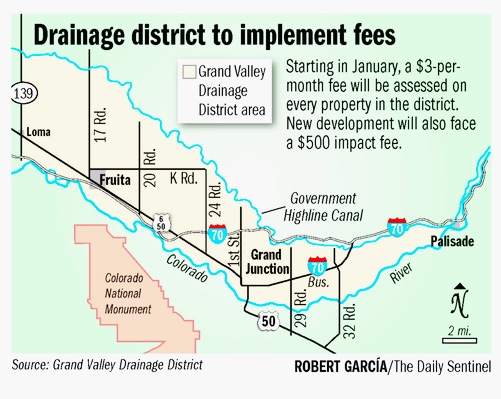
Grand Valley Drainage District boundaries — Robert Garcia The Grand Junction Daily Sentinel
FromThe Grand Junction Daily Sentinel (Gary Harmon):
Several thousand Mesa County businesses and governments received notices this week of the bills they will get in January from the Grand Valley Drainage District.
Many of them promptly put in calls to the Grand Junction Area Chamber of Commerce, which as it happens has scheduled a roundtable on Friday with the district about those very fees.
“It’s a job-killer,” chamber President Diane Schwenke said of the district’s plans.
Actually, said Tim Ryan, general manager for the district, the bills were tailored to be “palatable, but still generate revenue” the district needs to manage storm water.
While the chamber doesn’t question the need to control storm water filling the district’s pipes and ditches, the district’s plans for fees are an unnecessary damper on an already struggling local economy, Schwenke said.
While some businesses might be able to absorb the fees, for many others the costs will be significant, Schwenke said.
“They’re solving a problem by creating a problem,” Schwenke said.
The drainage district this summer put in motion plans to collect a $3-per-month base fee on the more than 44,000 tax parcels within its boundaries, and a $500-per-unit impact fee on new development. The $3 fee is based on parcels containing 2,500 square feet of impervious surface — which describes most of the affected residential parcels.
The fee schedule, however, makes no accommodation for large properties.
The biggest bill, for $14,000, will go to Halliburton, Ryan said, who noted that when the company received notification, it starting making arrangements for payment.
Many of the 100 most-substantial bills will go to companies with headquarters outside the county, so, “We’re actually bringing in outside money and hiring local people to do the construction,” Ryan said.
A major problem is that the $500 fee on new construction could damper business expansion, said Schwenke, who contends that the district should look at how other communities are collecting storm water fees.
The district’s fees, however, are minor in comparison with water, sewer and traffic fees, Ryan said.
It’s difficult to offer reduced fees to businesses or other entities with large, impervious surfaces, such as parking lots, because the size of the surfaces contributes to the runoff issues the district is trying to control, Ryan said.
The chamber is hosting a business roundtable from noon to 2 p.m. on Friday at Ute Water Conservancy District’s office, 2190 H 1/4 Road, to discuss the drainage district fees.
The Larimer County Commission on Monday put the brakes on floodway regulations that focused on a Laporte neighborhood but that would have been felt county-wide.
The Laporte neighborhood, known as Cottonwillow, led a push to reform floodway regulations after residents learned stringent re-build rules cut resale values of their home to a quarter of their value, if they were able to secure an offer at all. Several of those residents lined the public seating at a non-voting work session for the county commissioners Monday.
“I want to make sure we know what we’re getting into here,” Commissioner Tom Donnelly said, regarding the regulations, which would have impacted canyon communities and county riverbank residents. “That we’re not pushing the balloon in here to see it bulge out over there.”
Donnelly was the only commissioner physically present. Commissioner Steve Johnson was attending another meeting on child welfare and Commissioner Lew Gaiter was called into the meeting.
The commission amended the county land use code earlier this year to allow property owners in floodways — areas where floods are expected to be most severe — to rebuild in cases where their buildings are substantially damaged by non-flood activities. But two of the three members balked at further action that would essentially create different tiers and regulations of floodway.
A proposal to classify floodways based on severity of anticipated flooding, one that took into account depth and flow speeds, would remove up to 93 percent of properties in a Laporte neighborhood that bumps against the Poudre River.
Ongoing or in-the-pipeline projects could cost as much as $76.8 million in 2016. Most of these projects are aimed at repairing the September 2013 floods’ damages to county roads, bridges, parks, open space areas — as well as services and programs to assist Boulder County residents and property owners still recovering from the floods.
That estimate, from a recent county staff report to the Board of County Commissioners, would be on top of more than two years of flood recovery spending that’s expected to have totaled nearly $97.9 million by the end of this year.
And 2016 won’t be the final year that county officials expect to devote a major portion of their spending on flood recovery.
The county staff is sticking by its late 2013 estimates that flood recovery projects and services will have a total cost of more than $217 million by the time they are completed, so another $43.2 million might be needed beyond 2016.
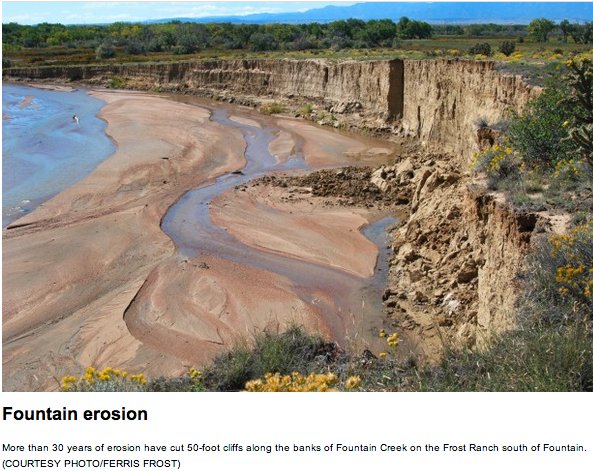
Fountain Creek erosion via The Pueblo Chieftain FromThe Pueblo Chieftain (Chris Woodka):
Pueblo officials are encouraged that Colorado Springs voters overwhelmingly passed a sales tax Tuesday to improve roads, saying it should keep the city to the north on track to fulfill its obligation to control stormwater on Fountain Creek.
“I’m glad it passed, but the proof is in the pudding,” said Jay Winner, general manager of the Lower Arkansas Valley Water Conservancy District. “Colorado Springs is doing the right thing, and a lot of the credit goes to (Mayor) John Suthers.”
The Lower Ark teed up a federal lawsuit over violation of the Clean Water Act following years of foot-dragging on the stormwater issue. Prior to Suthers’ election in May, the former Mayor Steve Bach resisted efforts to find a permanent source for stormwater control funding. Bach campaigned against creating a regional drainage district that failed in a vote last year.
Shortly after taking office, Suthers and Colorado Springs City Council President Merv Bennett gave assurances to Pueblo City Council that $19 million annually would be funneled into stormwater control. Opponents of the street tax suggested that the money targeted for stormwater could be used for streets instead.
Voters disagreed, passing the sales tax by a 65-35 margin. The 0.62 percent tax is expected to generate $260 million over the next five years for Colorado Springs streets.
“I never had any doubt they would do everything they could to get it passed,” said Pueblo City Council President Steve Nawrocki, praising the leadership of Suthers and Bennett. “This gives me a lot of confidence. We plan to meet with (Colorado Springs City Council) more often as we pursue this in the future.”
“I’m very pleased voters passed the roads tax measure,” Pueblo County Commissioner Terry Hart said. “It takes care of one of their two major infrastructure problems and frees up money for stormwater.”
All were inspired in different ways by the Colorado Springs vote.
For Winner, it could mean better reception for partnerships between the Lower Ark district and Colorado Springs. While they have worked together on Fountain Creek issues, the Lower Ark has also pushed for agreements on things such as Super Ditch and conservation easements.
“I think once the leadership within Colorado Springs Utilities has stabilized, we will be able to again have productive discussions,” Winner said. Hart said it paves the way for clearer negotiations over the remaining issues in the 1041 permit for Southern Delivery System.
“It makes it easier because traditionally streets have been a competing need with stormwater. This pays for that competing need,” Hart said.
For Nawrocki, it’s more of a call to look inward, and attempt to pass a tax similar to Colorado Springs to address infrastructure needs, including streets, in Pueblo.
“As president of City Council, I am interested in finding a funding source to do those sorts of things here in Pueblo,” Nawrocki said.
Colorado Springs Utilities tried to assure a district that has threatened federal court action that it fully intends to fund stormwater control on Fountain Creek.
“We have been working with Pueblo County on an intergovernmental agreement that deals with one topic: stormwater,” Colorado Springs spokesman Mark Pifher told the Lower Arkansas Valley Water Conservancy District board Wednesday.
He said there have been three drafts of the IGA, which was initiated shortly after John Suthers was elected mayor.
“We’re meeting again next Tuesday, and hope to reach an understanding of what our commitments are,” Pifher said.
Colorado Springs had a stormwater enterprise in place in 2009 when Pueblo County approved a 1041 permit for the Southern Delivery System.
The enterprise was initiated in 2005 with the participation of the Lower Ark District. The district had a larger portfolio of water issues it wanted to address with Colorado Springs, but made headway only with Fountain Creek flood control issues.
Over the next few years, they spent a combined $1.2 million to develop a plan and keep the newly formed Fountain Creek Watershed Flood Control and Greenway District afloat.
After the Colorado Springs City Council voted to abolish the stormwater enterprise, the Lower Ark district began to prepare a federal lawsuit, first against the Bureau of Reclamation and now against Colorado Springs, claiming violation of the federal Clean Water Act.
For the last year, Colorado Springs has asked the Lower Ark to hold off on filing the suit, and with Suthers’ election, the district has returned to a wait-and-see mode.
Pifher presented documentation that Suthers supports a 10-year program to fully fund stormwater control and permitting at $19 million annually in his budget request to City Council. Council made a similar proposal last year that was shot down by the former mayor, Steve Bach.
The upcoming vote on a sales tax to fund street repairs will not affect stormwater funding, Pifher claimed.
“They’re two separate issues,” he said.
However, Americans for Prosperity, a group funded by the billionaire Koch Brothers, is challenging that position, saying that some of the bonds being eyed for flood control could be used for streets.
Colorado Springs is working with the EPA and Colorado Department of Public Health and Environment on the best places to spend the money. It also intends to start up SDS early next year, which would release $50 million in flood control payments over five years to the Fountain Creek district, Pifher noted.
Grand Valley Drainage District boundaries — Robert Garcia The Grand Junction Daily Sentinel
FromThe Grand Junction Daily Sentinel (Mike Wiggins):
Tens of thousands of Grand Valley residents and business owners will begin paying an annual fee next year to manage stormwater that drains off their properties.
The Grand Valley Drainage District board voted unanimously Wednesday to institute a $3-per-month base fee on the more than 44,000 tax parcels within its boundaries and a $500-per-unit impact fee on new development. The $3 fee is based on a parcel containing 2,500 square feet of impervious surface.
Property owners will begin receiving bills from the drainage district in January and will have 60 days to pay them or face potential legal action.
“Once people see that (bill) is collectible, we expect the issue (of not paying) will go away,” said Dan Wilson, the attorney for the drainage district.
The district had asked Mesa County Assessor Ken Brownlee to include the charges in tax bills his office mails out, but he declined, so the district will spend $120,000 next year to mail the bills itself.
$2 million in damage remains in Pueblo’s Fountain Creek after unrelenting flooding earlier this year. It will cost much more to repair. The rain fell throughout southern Colorado, but the southern part of the river has arguably the most visible effects…
The rushing water coursed its way wherever it could find a path, destroying cement trails and creating a vast wasteland of dead trees and silt. Those from farther north say they now understand why Pueblo is asking for millions of dollars to help fix it. Colorado Springs city council president Merv Bennett says, “This is important for us in Colorado Springs to come down and see this. They’ve come up to Colorado Springs. That’s what neighbors do. We come and share in this and share in a dialogue as to finding solutions.”
The Springs council members admit there is a difference between driving down I-25 and looking at the creek, and actually getting up close to see it firsthand. The add, however, that their lack of stormwater management is not totally to blame. “A lot of this damage, a lot of this water comes in above Colorado Springs, and some of it comes in below Colorado Springs, so this is a regional issue,” says Bennett.
What they took away from the tour is a sense of cooperation. Looking to the future, Colorado Springs and Pueblo plan to work together in finding and creating the best solutions to keep this from happening again.
“It was just good to have them down here so they could see firsthand the devastation and they reassured us about their commitment,” says Pueblo city council vice president Ed Brown.
Colorado Springs mayor John Suthers told Pueblo city council in July that he plans to restart the city’s stormwater management enterprise program, and dedicated $19 million a year for mitigation efforts in Fountain Creek.
The District Engineer, U.S. Army Engineer District, Omaha, Nebraska is evaluating a Department of the Army Section 404 Permit application from Urban Drainage and Flood Control District, 2480 West 26th Avenue, Suite 156-B, Denver, CO 80211. Permits are issued under Section 404 of the Clean Water Act (Section 404) which regulates the placement of dredged or fill material in the nation’s waters. Urban Drainage and Flood Control District (District) is requesting authorization for river channel work along approximately 3,000 linear feet of the South Platte River. The channel improvements are proposed to improve aquatic, wetland, and riparian habitat; provide boat passage through this section of river; and maintain flood conveyance and grade control. This reach of the South Platte River is part of a Flood Risk Reduction Project implemented by the Corps in the 1970s following the devastating flood of 1965. The reach has been channelized because of encroachment by development.
Mayor Suthers released his proposed 2016 budget Monday. The big focus will be on storm water. A problem that’s plagued Colorado Springs for years.
“Several years ago, we had a storm water enterprise,” Suthers said. “With the demise of that, defunding of the storm water enterprise, for the most part we’ve been spending minimal amounts [of money] over the last several years in terms of storm water.”
The city is setting aside $16 million, with an additional $3 million from Springs Utilities for a total of $19 million.
That plan had some tax payers wondering why isn’t that money going toward the roads.
“There were times I felt like I was going to get pulled over for swerving so much even though it was just because of the pot holes,” Mackenzie Tennison said.
The mayor said through all their surveys, roads were the top priority for voters so he expects them to pass the proposed tax increase of 0.62 percent in November. That will give the city the money it needs to fix our roads.
“I don’t agree with, you know, us getting taxed more,” Leafner Tan said. “I’m pretty sure there’s enough money there, and I’m pretty sure there’s also money going somewhere we don’t need to spend money on.”
“You cannot do storm water and roads,” Suthers said. “Storm water is within reach because it’s a relatively less amount of money.”
Suthers added, that unlike previous years, he’s been working with city council on this budget and that nothing about it should surprise them.
There will be a meeting at City Hall on October 20 from 5-7:30 p.m.
The $268.1 million general fund budget is up $9.4 million, or 3.6 percent, but Suthers said that when adjusted for inflation, the city today spends $86 a year less on each resident than it did in 2000…
Suthers’ priority remains the city’s infamously atrocious roads, most of which need overlays or complete reconstruction. But the mayor is banking on passage of a Nov. 3 ballot issue to provide $50 million a year for five years through a 0.62 percent sales tax increase.
The other overriding need is stormwater projects to ameliorate Fountain Creek flooding effects on downstream Pueblo. Past city stormwater funds have been eliminated, and a federal lawsuit has been threatened by the Lower Arkansas Valley Water Conservancy District.
If the issue isn’t addressed, it also could threaten the 1041 permit Colorado Springs Utilities got for its $829 million Southern Delivery System, soon to pump water from Pueblo Reservoir to Colorado Springs, Pueblo West, Fountain and Security.
So Suthers is squeezing $16 million out of the budget, which would be augmented by $3 million from Utilities, for stormwater projects…
In order to make ends meet, staffing requests, raises and capital projects were left unfunded, Suthers said.
Click here to read the Mayor’s news release and letter to City Council — via Pam Zubeck and the Colorado Springs Independent.
Kansas has concerns that the effects of a large dam on Fountain Creek are not adequately modeled in a study of flood control and water rights that is nearing completion.
But comments from Kevin Salter of the Kansas Division of Water Resources indicate the modeling done by the Fountain Creek Watershed Flood Control and Greenway District is “reasonable” when it comes to side-detention ponds.
Kansas is an important player because its 1985 federal lawsuit over the Arkansas River Compact raised storage issues along with wells. The Supreme Court ruled in Colorado’s favor on the storage questions, but new dams would be untested waters.
“The methodology in this draft report appears reasonable to protect water rights below the confluence of Fountain Creek and the Arkansas River for the scenario involving side-detention facilities,” Salter said.
“As for the scenario to construct a multipurpose reservoir on Fountain Creek; Kansas is concerned.”
In an email to a committee looking at engineer Duane Helton’s draft report, Salter said more study is needed to look at the full impact of a 52,700 acre-foot reservoir that would include a 25,700 acre-foot pool for recreation and water supply and 27,000 acre-feet for temporary flood storage.
“Should the actual implementation of detained flood flows on Fountain Creek impact compact conservation storage Kansas would fully expect that those flows be restored,” Salter said.
Larry Small, executive director of the Fountain Creek district, said a more complete evaluation would be made of water rights if a large reservoir is pursued.
“The district will complete a full evaluation of alternatives and a feasibility study of the preferred alternative in the future before any decision is made on flood control facilities, to include multipurpose facilities,” Small said in an email reply.
Helton’s study shows there would be little impacts on water rights if flood control structures allowed a flow of 10,000 cubic feet per second to flow through Pueblo during large floods. Water would be released as quickly as possible following the peak flow.
The study discounted extremely high flows, such as the 1999 or 1965 floods, saying there would be little damage to water rights because the high volume would fill John Martin Reservoir, creating a free river.
Division Engineer Steve Witte said Kansas concerns must be treated carefully, so a new round of litigation isn’t triggered.
Witte would like the 2015 flooding to be studied. Flows on Fountain Creek exceeded the 10,000 cfs mark on three occasions during six weeks of elevated flows. John Martin Reservoir did not fill, so it would be an ideal opportunity to explore how flood storage could be administered, he said.
“I think we need to be careful in any scenario to make sure there isn’t some material depletion,” Witte said.
After the 1999 flood, when Kansas and Colorado were in litigation over the Arkansas River Compact, Kansas raised questions about how such large flows should be divided. Those issues have not been resolved, Witte said.
Another downstream party, Tri-State Generation and Transmission Association which owns half of the Amity Canal in Prowers County, said more study is needed to determine the damage if water is detained at lower flows and how water would be allocated after a flood.
The committee looking at the report, which includes some downstream farmers, Kansas, Colorado Springs Utilities, Tri-State and others, will meet again at 10 a.m. Oct. 14 at the Southeastern Colorado Water Conservancy District offices.
Pueblo County commissioners say the state should be a referee, rather than a sponsor, in future water projects and they want to emphasize local regulation.
“The county’s experience has been that federal and state regulations and enforcement alone have been inadequate to protect against local impacts of water projects,” the commissioners wrote in comments on the state water plan filed last week.
The deadline for comments was Thursday. Commissioners Liane “Buffie” McFadyen, Terry Hart and Sal Pace jointly signed the letter to Gov. John Hickenlooper and the Colorado Water Conservation Board, who are working to finish the plan by December.
The commissioners want to make sure that the state water plan does not undermine the authority of the state’s counties and cities to regulate water projects under laws such as HB1034 and HB1041, both passed in 1974 to provide local regulation of statewide activities, including water projects.
Pueblo County has used the 1041 process most notably in obtaining mitigation for the Southern Delivery System, an $840 million project that is designed to bring water from Pueblo Dam to Colorado Springs.
SDS is scheduled to go online in 2016, and under the 2009 permit for the project, Colorado Springs has been required to spend an additional $75 million to fortify sewer lines, $50 million for Fountain Creek flood control, $15 million for roads, $4 million for wetlands restoration and $2.2 million for Fountain Creek channel dredging, among other conditions.
“To avoid confusion as to the local government’s authority to deny a permit for a specific project, we recommend that the following sentence be added: ‘A permit may be denied for a specific water project that does not meet the standards or criteria of the local regulations,’ ” the commissioners wrote.
The county also wants the state to remain neutral in water projects.
“Pueblo County does not believe that it is appropriate for the state of Colorado to endorse or become a sponsor of a water project in most cases,” they said.
The board also wants to include stormwater control in the state definition for watershed protection. Most of the efforts in the last three years in watershed health have focused on mitigating the damage from large wildfires, but Pueblo County said equal attention has to be given to the effects on water quality from increased stormwater caused by development, such as what has occurred on Fountain Creek.
Stormwater has been a key issue in regulation of SDS as well. A recent study for the county by Wright Water Engineers found that 370,000 tons of sediment are deposited each year between Colorado and Pueblo, decreasing the effectiveness of Fountain Creek levees.
Finally, the county wants water reuse to get more emphasis in the state water plan.
“The benefits to Pueblo County of promoting reuse are twofold,” commissioners said. “First, municipal reuse would reduce the need for dry-up of agricultural lands and transfers of agricultural water rights to municipal use. Second, reuse in El Paso County would reduce and control damaging flows in Fountain Creek through Pueblo County.”
Pitkin County and the city of Aspen will roll out preliminary floodplain maps to the public at an open house next week.
The new maps, also known as flood insurance rate maps, had not been updated since 1987. The latest effort was the result of an extensive, multiyear study of the Roaring Fork watershed, and surrounding creeks and drainages, according to a Pitkin County press release.
“Floodplains change over time, and with that the risk of flooding can change for people who own property in floodplains,” said Lance Clarke, the county’s assistant director of community development.
The unveiling of the maps is scheduled for Tuesday, Sept. 29, from 5 to 7 p.m. in the Plaza 1 meeting room, 530 East Main St. in Aspen.
At the public event, participants will be able to see their properties online using GIS technology with a floodplain map overlay. Property owners will have the opportunity to review the maps with advice and counseling by FEMA, Colorado Water Conservancy officials and flood insurance experts.
The new maps are preliminary, and FEMA has not yet adopted them. Officials want local residents and business owners to review the drafts to identify any concerns or questions.
Experts will be available to explain what should be done if properties are located in a floodplain and what property owners can do to protect their home or business from the consequences of a flood.
“This is a rare opportunity for local property owners to meet one-on-one with FEMA officials and insurance experts to find out how these new maps may affect their property,” Clarke said.
In 2009, officials with the Federal Emergency Management Agency recommended the new study to the city and county. FEMA contributed 75 percent of the $517,220 price tag. The remainder of the cost was funded by grants from Pitkin County Healthy Rivers, the city of Aspen, Pitkin County Open Space and Trails, the Colorado Water Conservation Board and an in-kind contribution from the Pitkin County GIS Department.
A legislative committee Tuesday approved drafting a bill that would legalize rain barrels. Colorado is the only state where they are illegal.
The Water Resources Review Committee won’t officially vote on whether to introduce the measure as a committee until October. If the committee approves the bill, then it would be introduced at the start of the next session in January. There’s also the option for a lawmaker to carry the measure separate from the committee, or run a completely separate bill.
While the legislation signals that the issue is far from dried-up, certain caveats in the measure could cause an outcry. For one, the bill would require users to register their barrels with the state. Another provision would require water providers to replace water taken from rooftops.
Rain-barrel supporters worry that the current proposal is burdensome to water providers, and that would result in failing to approve barrel collection. They point out that rain barrels help with conservation, and that 97 percent of water falling on residential property never ends up in a river or stream.
But it may be their best shot after a similar effort drowned during the previous legislative session. That legislation was stalled in committee after concerns from Sen. Jerry Sonnenberg, R-Sterling, over water rights. Had the bill received a floor vote, it likely would have passed thanks to support from Republican Sen. Ellen Roberts of Durango.
Just when it looked like the bill had a chance to receive a late floor vote in the Senate, sponsors and legislative leaders agreed to let the bill die so that discussions could continue for future compromise legislation. Enter Sonnenberg’s current proposal.
“This is more about process,” Sonnenberg said Tuesday during the committee hearing. “This is more about honoring the prior appropriations system and saying, ‘If we’re going to have rain barrels, the right thing to do is to figure out how we replace that water.’”[…]
Under Sonnenberg’s proposal, Coloradans would be allowed to use up to two containers with a maximum capacity of 55 gallons each. A consumer’s residence would need to contain four or fewer residential units.
Rain-barrel supporters say legislation should make it easy.
“Numerous studies have consistently shown that rain barrels have no impact on downstream users,” said Pete Maysmith, executive director of Conservation Colorado. “Any proposals to put additional red tape and bureaucracy on a rain-barrel program disregard these studies and will only serve to dissuade and burden Coloradans.”
Colorado Springs Mayor John Suthers made a strong statement for stormwater funding in his state of the city speech Wednesday.
In doing so, he prominently highlighted the reason it is needed is to reduce the harmful impact to Pueblo from increased flows on Fountain Creek caused by growth in Colorado Springs. Spring rains caused millions of dollars in damage in both counties this spring.
“As recently as the late 1960s, our neighbor to the south, Pueblo, was larger than Colorado Springs. Since then Colorado Springs has grown to be about four times the size of Pueblo and that means considerably more impervious surfaces contributing to stormwater flow into Fountain Creek, with impacts on Pueblo,” Suthers said.
The mayor carefully reviewed the history of the stormwater enterprise approved by Colorado Springs City Council in 2005. It generated about $15 million per year until 2009, when council abolished the fee on a 5-4 vote in an interpretation of a public vote.
In the meantime, Colorado Springs negotiated a 1041 permit with PuebloCounty for the Southern Delivery System that included reliance on the stormwater enterprise.
“Pueblo contends that in issuing the permit they were relying on the fact Colorado Springs would continue funding a stormwater enterprise and is considering a lawsuit to revoke or amend the permit,” Suthers said. “I and members of the City Council, which also serves as the utility board, have been negotiating with Pueblo in an attempt to resolve the matter.”
Pueblo County has hired Wright Water Engineers to document the relationship of higher impact flows on Fountain Creek and growth in Colorado Springs.
“We would like to avoid litigation that would delay SDS from going online in 2016,” Suthers said.
Suthers and council are proposing a plan to provide $19 million annually for at least 10 years, and highlighted specific budget areas where the money would come from. He also referred to last year’s vote where Colorado Springs and El Paso County voters narrowly rejected a regional drainage authority.
“While Pikes Peak area voters declined to pass a stormwater proposal in November 2014, this is a complex problem that is not going away and needs to be addressed,” Suthers said. “And I emphasize that this is a public safety issue for the citizens of Colorado Springs as well as those of Pueblo.”
Evans Colorado September 2013 via TheDenverChannel.com
FromThe Denver Post via the Loveland Reporter-Herald (Joey Bunch/John Aguilar):
As Colorado hits the two-year mark since a historic deluge swelled rivers and creeks to overflowing, killing 10 and causing nearly $4 billion in damage across 24 counties, frustration is a theme for a surprisingly large group of folks still dealing with the storm’s aftermath. Hundreds of mobile home park residents in Evans, a city of 20,000 south of Greeley, are unable to return to communities that have been effectively scraped off the map.
The major access road into Glen Haven is still being put back together, causing repeated daily hour-long delays that result in unending headaches for locals and drive away tourist traffic headed to or from nearby Estes Park.
Only three of 17 homes in James town destroyed by a manic James Creek have been completely rebuilt, and a part of the population has relocated or hasn’t yet moved back to the tiny mountain town.
And then there are the dozens of Lyons residents, locked in a seemingly endless bureaucratic arm-wrestling match with town officials over attempts to get permits to rebuild their homes.
They confronted town leaders at a public meeting earlier this month demanding a more streamlined process for evaluating and approving their engineering and hydrology plans so they can move forward.
“We’ve spent a lot of money on this project, and we haven’t laid a shovel in the ground,” said Kitty Wang, who with her husband has lived in Lyons for 13 years and still awaits a floodplain development permit for a new house. “It’s a nightmare we keep trying to wake up from.”[…]
Molly Urbina, the state’s chief recovery officer, acknowledged that despite the billions spent to make repairs and provide compensation to victims of Colorado’s most costly natural disaster, problems remain.
The state, she said, has not forgotten about those still suffering.
“When we talk about disasters, we talk about a marathon, not a sprint,” Urbina said. “We continue to coordinate with local communities to assess and evaluate needs and priorities and to advocate for additional resources.”
Some of those resources have come from groups like Foothills United Way in Boulder County, which has raised $4.9 million in donations and spent about $363,000 for mental health services. The charity still sits on nearly $2 million to help cover the costs of at least 333 open cases in Colorado’s hardest-hit county…
Urbina said estimating costs for a disaster the size of the 2013 floods, which destroyed 1,852 homes and 203 businesses and created more than 18,000 evacuees over a five-day period starting Sept. 10, 2013, is a “complex, long-term process.”
“We understood that this would evolve as recovery priorities and projects became more clear,” she said.
The dynamic nature of the floods’ impact has played out in dramatic fashion since the one-year anniversary, with the cost of rebuilding in Colorado swelling by a third to nearly $4 billion.
The $1 billion spike, Urbina said, reflects the fact that initial cost estimates done in the months following the flood were rough. In the past year, more detailed estimates of what it would cost to fully repair and restore roads and watersheds in the state were made.
Specifically, watershed recovery master plans performed over the last year revealed that the true cost of improving flood-impacted watersheds would amount to some $600 million.
Last February, Gov. John Hickenlooper announced $56.9 million will come from a federal program to help restore stream corridors and prevent future flooding.
The remainder of the increased cost estimate since last year — around $400 million — came about as the result of detailed design and engineering work, which more clearly outlined the cost of building roadways that can better withstand future flooding, Urbina said.
Work will begin soon to redesign U.S. 36 from Estes Park to Lyons at an estimated cost of $50 million.
Also, individuals and local governments have found damage they initially didn’t know about or thought private insurance would cover, according to the Colorado Resiliency and Recovery Office…
A new normal is also being pieced together in Evans, where the Eastwood Village and Bella Vista mobile home parks were turned from once-vibrant low-income neighborhoods to empty, weed-choked lots by the floods. It’s not certain what will happen to the two properties, though Bella Vista’s owner is working with the city to re-establish itself at the same spot on 37th Street.
Here’s a look at several survivors from Isa Jones and Pam Mellskog writing for the Longmont Times-Call via the Loveland Reporter-Herald.
Meanwhile the Big Dam repairs are nearly complete. Here’s a report from Saja Hindi writing for the Loveland Reporter-Herald. Here’s an excerpt:
Crews are putting the finishing touches on repairs to the Nelson Big Dam and expect to have them completed in the next few weeks.
The masonry arch dam, built in 1895, is located west of Loveland’s water treatment plant, and was significantly damaged in the September 2013 flood.
The dam diverts raw water to the city’s water treatment plant, provides drinking water for the Johnstown water treatment plant, and irrigates about 20,000 acres of farmland in Larimer and Weld counties.
The Consolidated Home Supply Ditch and Reservoir Co. owns the 60-foot-plus dam, which didn’t suffer major damages in the 1976 flood, but the 2013 waters left a lot of damage.
The dam is also identified as a Colorado Historic Civil Engineering Landmark, so crews had to make sure not to change the historic aspects of the dam substantially. That included using stones from the same quarry as the original stones.
Crews are working on Phase II of repairs now, according to Home Supply board member Gary Gerrard, which encompass the pointing or refacing of the dam (grouting stones on the face of the dam), a need caused by years of erosion. Once that’s completed, he said, crews will close the gate.
The dam was operational April 1, 2014, in time for the spring runoff, and repairs continued while it was in use, aside from taking a break in the winter months…
Some of the repairs after the flood damaged the dam, Gerrard said, included restoring the crest elevation, mitigating future flood effects by strengthening the dam with concrete abutments and installing a new spillway that configures water to go around instead of on top and updating to 21st century technology such as an automatic gate that fluctuates with river flow.
Because the flood damaged the dam’s main gate, the company was also able to replace other gates not damaged by the flood that were almost unusable and rusting because they were first put in 1915.
Funding for the repairs came from the city of Loveland, the Home Supply board, the Colorado Water Conservation board and the Federal Emergency Management Agency. The city committed to paying 50 percent of the costs not covered by federal and state grants. The conservation board committed to covering uncovered costs through long-term low-interest loans.
The total cost of repairs, Gerrard said, is about $3 million. Of that, $2.2 million is expected to be covered by federal aid.
Gerrard said the entities were able to keep costs low through “the methods of construction and the ability we had to be able to make decisions in the field, and the cooperation we had from all the entities to react to the things we found out in the field.”
Because officials could make decisions quickly, there weren’t a lot of construction holdups, he said.
“That’s the main thing to reach out for help. They (Larimer County Long Term Recovery Group) connect you with the people you need (Loveland Housing, in particular). We had volunteers from Lyons, Minnesota, Wisconsin, Florida,” said Aleta.
Today, the Hammond’s have a little less privacy. The flood took out about half the trees and bushes along this road. And what was a pasture with a barn now looks like an outcropping of rocks.
That creek that once rushed with danger is nearly dry, but the family’s gratitude is overflowing.
People lost their homes, a few lost their lives. So we were very, very fortunate,” said Aleta…
The state repositioned U.S. 36 and Little Thompson River to prevent a tragedy like this from ever happening again.
The Hammonds say they still have work to do on their property, like foundation work, and cleaning off grit inside tools and motorcycles.
From the Loveland Reporter-Herald (Jessica Benes):
Where the Little Thompson River used to be 70 feet wide in places, it was blasted to 300 yards, according to Gordon Gilstrap of the Little Thompson Watershed Restoration Coalition.
The September 2013 flood devastated areas along Front Range rivers and streams, and while not nearly as many houses were lost on the Little Thompson River, landowners still are recovering from the deluge that destroyed vegetation, wildlife habitat and landscapes.
Some landowners along the Little Thompson call it “the forgotten river.”
“It’s been an interesting journey,” said Gilstrap, who helped set up the Little Thompson Watershed Restoration Coalition after the flood. “The Little Thompson has been an unknown river because no county or state roads run along it for any distance. It is all privately owned.”
Deirdre Daly, president of the coalition, said that because the river isn’t in a town or county that is leading the charge for river repair, the restoration has been almost entirely driven by the people who live on it…
The Little Thompson headwaters come in from several areas but are mostly above Big Elk Meadows below Estes Park, separate from the Big Thompson.
“It was a small working river,” Gilstrap said. “It provides drinking water to Big Elk Meadows and Pinewood Springs, irrigation to a lot of farmland. It has always been a small, quiet little river.”
The water pushed woody debris down the river, knocking out everything for hundreds of feet on both sides of the river.
Gilstrap said the land along the river was heavily wooded, with a lot of wildlife habitat, especially in the Big Elk Meadows, Pinewood Springs and Blue Mountain areas. Much of that habitat area was lost.
The number of homes lost in the flood was small — two to four — but there was a lot of other damage such as water in basements, homes partially damaged and agricultural fields that were made useless with sediment and garbage debris accumulation.
“A lot of agricultural equipment was lost, and the irrigation ditches took a real hit,” Gilstrap said. “An interesting fact most people don’t know is the Little Thompson was the river that shut down every county bridge between Big Elk Meadows and Milliken — seven public bridges and many other private bridges — so it cut off Northern Colorado from southern Colorado.”[…]
Watershed coalition
Gilstrap helped found the Little Thompson coalition in December 2013, starting with nothing. The group had no money and no knowledge of how to run a coalition.
“Thanks to an amazing group of volunteers that stepped forward to be a part of it, we established the Little Thompson coalition as one of the most effective coalitions in Colorado,” Gilstrap said.
With grant funding, the coalition oversaw the successful completion of a master plan for the watershed, started having meetings, published an active website and Facebook page and coordinated volunteer projects.
“We secured over $1.2 million in government and private-sector grants with a potential of $3 plus million to come,” he said.
The coalition also was able to hire a full-time watershed coordinator, Keith Stagg, and assistant coordinator. Erin Cooper, this summer to oversee grant raising and volunteers, which meant the hard workers such as Gilstrap who had volunteered so much of their time were able to step back.
“We all learned together (at the beginning),” Gilstrap said. “We even learned to say ‘fluvial geomorphic transition’ and other big words like that.”
He said there were two reasons for their success: the volunteers who stepped forward to be on committees while also working day jobs, and support from the state and counties involved.
“Everyone worked together, and that spirit is ongoing more than ever. The volunteers came in from everywhere and did the dirtiest, grungiest work imaginable and were happy as can be if you gave them water and cookies,” he said.
Work still to be done
One of the big problems the river still faces is sediment.
Gilstrap said the Big Thompson River has a rock base, while the Little Thompson has more of a soil base.
When the flood swept down the river from just below Estes Park, sediment traveled down, blocking irrigation canals and changing the bed of the river.
One of the private bridges in Berthoud — called the Green Monster bridge by locals — used to have a space large enough to walk under, and now a person can barely crawled under because of all the new sediment. Julie Moon used to walk her horse beneath the bridge.
“That all plugs up irrigation ditches, rechannels the river,” Gilstrap said. “It’s a long-term fight to understand what will happen with the sediment, how to fight it, how to do restoration so we don’t aggravate the problem.”
He said there is still a lot of farmland with sediment covering valuable cropland.
Natural Resources Conservation Service representatives walked the river and filled out disaster survey reports to define the work to be done. The restoration work will carry on for the next five or more years, he said. The river is also being analyzed for flood and fire resiliency, to be more resilient the next time a flood passes through.
“We’re trying to think during restoration how we can bounce back from them more quickly and not put people in as much peril,” Gilstrap said.
Stagg said the silver lining of the flood is that people are aware of the need for resiliency.
“Everyone wants to see the system put together,” he said.
Gilstrap said wildlife is coming back, and the coalition is looking at revegetation options to establish more wildlife habitat. They plan to use willow cuttings and other “ecotypical” seeds from Daly’s property and neighbors’ to vegetate other areas along the river with native plants.
Finding funding
Major sources of grants for restoration work has come from the U.S. Department of Housing and Urban Development, and from the Emergency Watershed Protection Program through USDA.
Gilstrap said a new round of grant funding from several sources will deliver possibly $47 million across Colorado, and he believes the Little Thompson might see $2 million to $3 million of that. Stagg and Cooper were hired through funding jointly from the state Department of Local Affairs and the Colorado Water Conservation Board.
“We’re one of (several) watersheds that received funding for professional staff,” Stagg said.
Each year, the coalition will receive grants and work on different pieces of the restoration project for many years to come.
“We will get a couple projects done in each round. Each year we will go find another source of money, and do a little bit of project as the years go on,” Daly said.
The Little Thompson even has a “Little Thompson Watershed” sign posted near the headwaters.
“We’ve never had that before,” Daly said. “Before, the river was there and hidden by trees and no one knew what river it was.”
It has been two years since the catastrophic Colorado floods of 2013. The outstanding visitation and tax revenue numbers from this summer suggest that most guests could not guess that the recovery is ongoing.
We’ve come a long way in those two years, but much work remains…
The impact in places like downtown Estes Park and Lyons will be substantial, as flood insurance premiums could skyrocket for some businesses.
In addition, Larimer County Commissioner Tom Donnelly announced to Glen Haven residents that $2 million in federal money is being allocated for restoration of bridges and roads in Larimer County.
Under existing federal regulations, money could not be allocated to privately owned roads or bridges that exist in much of rural Larimer County. The presence of second homes in many of these areas was also a barrier to obtaining any federal assistance. Cooperation among our Congressional delegation and Larimer County officials was necessary to obtain an exception to federal rules, which were not designed with our region in mind.
Cooperation has been another key to getting us back on track. No one person or organization can take all the credit. For example, the Fish Creek Road restoration requires cooperation among the town, county, Upper Thompson Sanitation District and Estes Valley Recreation and Park District. The United Way created a unique fund that delivered over $1 million in grants to local businesses for flood recovery. Mountain Strong for Nonprofits evolved from community members who banded together to help their neighbors. Crossroads Ministries received and distributed substantial assistance.
The Community Foundation of Northern Colorado provided grant monies to a host of local recovery efforts, including a grant to Estes Park EDC and the Town of Estes Park for a flood recovery coordinator. Through that program, Estes Park EDC assisted over 50 businesses in successfully obtaining $1.9 million in Recover Colorado business grants.
Our dedicated staffing and partnership with Larimer SBDC greatly benefited local businesses. As of this summer, over 60 percent of the statewide Recover Colorado grants had come to Estes Park, Glen Haven, Drake and southwest Larimer County.
For Estes Park EDC, assisting local businesses is always a top priority, but this was just the first step. The recent completion of the NEO Fiber Consulting plan for competitive broadband is a major step toward addressing both the cost and speed of local Internet services. Assuming the plan goes forward, it will greatly benefit both our residents and guests, our existing businesses and businesses to come.
Finding long-term resources for resiliency is another key. Two weeks ago, we received good news. After receiving an application from Larimer County, the Colorado Economic Development Commission accepted Southwest Larimer County as an Enterprise Zone. Thus provides local businesses with the opportunity to obtain a number of different tax credits designed to expand and support your business. We are an Enterprise Zone because census data revealed that Estes Park is lagging the state in population growth.
In 2013, we spoke about the 28 percent decline in 35 to 44 year old residents that occurred between the 2000 and 2010 Decennial Censuses. The 2012 Census data estimated that we have lost 46 percent of our 35 to 44 year olds since 2010. The loss of working age families can be attributed to less workforce housing availability and fewer year-round job opportunities compared to Front Range communities.
The flood has exacerbated such concerns, as demonstrated by the large number of job ads that continued to appear in July and August. The size of this population decline threatens funding for our schools, due to long-term declines in enrollment.
Later this fall, Avalanche Consulting will meet with the Town Board to present a regional economic development strategy for the Estes Park region. There will also be public meetings to discuss the plan and its implementation. The plan combines the results of extensive community meetings and outreach earlier this year with the experience of a national consulting firm.
This summer has been a record year for tax revenues. Despite our successes, the recovery is ongoing. Long-term resiliency against future events is an important goal. With leadership and collaboration, we ensure we remain a vibrant, multi-generational community in the decades to come.
The storm that upended the lives of thousands of Front Range residents almost two years ago was nearly unprecedented for the area, so much so that it largely confounded the best efforts of those charged with forecasting its scope and impact.
But the lessons learned from the 2013 event could go a long way toward ensuring that should a similar storm strike this area — and in a changing global climate, it could — the forecasting community would be better prepared for it.
Those are key findings from “The Great Colorado Flood of 2013,” a paper accepted for publication soon by the Bulletin of the American Meteorological Society. It is one of the most comprehensive analyses to date on a memorable storm that may only have the September 1938 flood as close precedent in the past century for the Boulder area.
The 71-page paper features no fewer than 26 contributing authors, representing the University of Colorado, Colorado State University, the National Center for Atmospheric Research, the National Oceanic and Atmospheric Administration and CU’s Cooperative Institute for Research in Environmental Sciences…
Colorado behaving like the tropics
The record-breaking dimensions of the 2013 storm were born of a confluence of climatological factors, including a significant tropical influence flowing into a charged atmosphere flush with water vapor, over a landscape that was already well saturated.
Recapping the way the system had set up, the paper states: “The large-scale atmospheric pattern that supported persistent heavy rainfall in northern Colorado during 10-16 September 2013 consisted of a blocking ridge over the Canadian Rockies and a slow-moving, cutoff, upper-level cyclonic circulation to its south over the western U.S. The blocking anticyclone assisted in keeping the western-U.S. cutoff circulation in place for several days, and to the east and southeast of this circulation, moist air was transported northward and westward toward the Front Range in Colorado.”
That’s far different from the usual variety of flood-prone events for which most local forecasting models are geared — such as a slow-moving thunderstorm that might camp out over a localized river basin, like that which triggered the tragic Big Thompson flood of 1976.
And just as the tuning of a musical instrument can be adjusted for the music it is expected to play, the forecasting tools of the National Weather Service are calibrated for conditions they expect to see — not the outlier that invaded Colorado two years ago.
“Weather forecasting models are tuned to observe the weather in the entire United States year-round, and they are tuned to typical weather, not atypical weather,” Friedrich said.
“Then, because the models didn’t forecast the rain correctly, the radars didn’t measure the rain correctly, and that had trickle-down so the hydrological forecast was basically lagging, due to the incorrect input data. And the reason the radars did not observe it correctly was the nature of the storm. It was very tropical.”
Weather blogger Bob Henson stated in an email, “This paper reiterates how challenging it is to accurately predict and measure heavy rain and flooding. This was a Colorado storm that behaved like a tropical downpour, from the microphysics within the clouds to the phenomenal rainfall they produced.”
Meteorologist Matt Kelsch, a co-author on the report, said atmospheric models are always evolving, using past storms as guidance.
“When a storm occurs that is so far removed from the historic experience, our forecasts, both computer and human, struggle,” Kelsch said. “The modeled atmosphere leading up to the second week of September 2013 was strongly suggesting an unusually wet period — but not 12 to 20 inches.”
As bad as things were for the 24 Colorado counties socked by more than $2 billion in damage, Henson said it could have been worse.
“We are lucky to have far better modeling and observing technology at hand than we had in 1976, when the Big Thompson flood took almost everyone by surprise and killed more than 100 people,” he said. “Neither humans nor models fully anticipated the scope and power of the 2013 disaster, but we knew heavy rains could affect a wide area, and we had much better tools for responding quickly and saving lives when the threat materialized.”
The paper concludes by offering the hope that new research weather forecast models such as NOAA’s High Resolution Rapid Refresh model could improve precipitation forecasts, and that new generations of spatially continuous hydrological models could produce better information on timing and location of floods — presuming that more accurate rainfall estimates and forecasts are available to feed into those models.
The storm was such that it stretched historical superlatives in the moment, and some endure. Most notably, the paper supports the contention that in some pockets in a corridor stretching from Boulder northwesterly toward the St. Vrain, Little Thompson and southern half of the Big Thompson watersheds, rain fell during one 24-hour period at a clip qualifying as a 1,000-year-rain — meaning that in any given year there is a 1-in-1,000 chance of it occurring.
“We don’t have the data to say otherwise,” Gochis said. “It’s all a fit to what you have seen before. Otherwise, you’re just kind of extrapolating.”
Gochis added, “If we had 1,000 years of data, we could have a lot more confidence in saying that. …
“I don’t really like that (1,000-year) term. The flood was definitely unprecedented in its scale — not just in local amounts, but in its widespread extent.”
‘Do we know what actually fell?’
Many might be surprised to know that even now, two years later, it still isn’t known exactly how much rain came down.
“Do we know what actually fell? No, but we certainly have a very good estimate, much better than what we would have had even 15 years ago,” Kelsch said. “The struggle is in low-population mountainous areas. Low-population areas have fewer rain-gauge reports, and mountainous areas have less radar-based measurement of what is happening between the cloud and the ground. This was most apparent in parts of northwestern Boulder and western Larimer counties.”
Friedrich noted in an interview last week that a question that remains prominent in her mind is “whether this is an outlier event and whether these types of events might occur more often. Is this a response to climate change? Is this something we might experience in the near future?
While noting that there is not yet enough data to draw a solid conclusion, she referred to a paper published in June by NCAR distinguished senior scientist Kevin Trenberth. The Trenberth paper, published in the journal Nature Climate Change, didn’t assert that climate change caused the 2013 flood, but that it likely enhanced its severity.
The 2013 storm was extraordinary, Trenberth said, as demonstrated by the fact that records were “not just broken but smashed.”
“And yet we are seeing more and more of these sorts of things around the U.S. and around the world,” he said. “They are hard to connect because every one is different; the atmosphere has infinite variety, and the weather never repeats. But climate change is altering the odds.”
Currently, hurricanes in the east Pacific and a record-breaking El Niño boosting sea-surface temperatures over large areas are examples of the Earth’s natural variability which, coupled with climate change, “puts us outside the previous experience,” Trenberth said.
“There are many phenomena involved in all these different events, but the environment in which they occur has changed to make the extremes more extreme — the rainfalls heavier, and the droughts hotter and drier and with wildfire a consequence,” he said.
Whatever the future might hold, Gochis said the fact that “Boulder, itself, didn’t receive a lot of catastrophic damage” suggests much of its floodplain planning and flood strategizing has paid dividends — and should continue to, in the face of future events.
Gochis was less sanguine about other areas of concern, mentioning as an example the restoration of foothills roadways.
“Transportation corridors were put back where they were,” Gochis said. “I think we’re still vulnerable there. But to make them more flood resilient would take a lot of money.”
Plume of subtropical moisture streaming into Colorado September 2013 via Weather5280
Concrete barriers along the eroded creek bank in downtown Evergreen are still in place nearly two years after the 2013 flood that caused the damage.
Evergreen businessman Jeff Bradley, manager of the property, said he has obtained a permit from Jefferson County for the project, and has plans to restore the bank. Bradley said he also needs a permit from the federal government, although the project does not involve funds from the Federal Emergency Management Agency.
A few miles down Highway 74 at Lair O’ the Bear Park, a bridge restoration project dating from the 2013 flood is scheduled for this fall…
Another major bridge project is in the works at Evergreen Lake Park, which is owned by Denver Mountain Parks. The aging bridge that provides the only vehicle access to the park is scheduled for replacement next year. The Evergreen Park and Recreation District and the Evergreen Metropolitan District are each contributing $40,000 for the project, which is estimated to cost $790,000. The park district has added an additional $40,000 from Jeffco grant funding it received to assist with the bridge replacement cost.
The 2013 flood contributed to the deterioration of the bridge at the Lake Park, EPRD board member Peter Lindquist noted.
A $600,000 project to produce a flood restoration master plan for Monument Creek is in the works.
The Fountain Creek Watershed Flood Control and Greenway District at its August meeting agreed to manage the project, which will be funded by the Colorado Department of Local Affairs, Colorado Springs, El Paso County and the Air Force Academy.
A team headed by Matrix Design Group will identify areas of concern within the Monument Creek watershed that are at greater risk for flooding after the 2012 Waldo Canyon Fire and damage from heavy flooding in 2013.
“When we get this finished, this will completely develop a master plan for the entire Fountain Creek Watershed,” said Larry Small, executive director of the Fountain Creek district. “If all the plans are implemented, this will be a big benefit to lower Fountain Creek area as well.”
It will look at mitigating damage from the AFA, where tributaries were most heavily affected in the 2012 fire, to the confluence with Fountain Creek.
The Waldo Canyon Fire burned 346 homes in western Colorado Springs, leaving much of the 18,000 acres it destroyed susceptible to increased flooding and erosion. That has also created problems in Upper Fountain Creek watershed as well as Monument Creek.
Those two waterways join in Colorado Springs and flow to Pueblo through Fountain Creek.
A $437,500 study of Upper Fountain Creek and Cheyenne Creek restoration was launched last year and completed on June 30.
The Cheyenne Boulevard drainage improvement demonstration project, a $367,000 effort to reroute floodwater, has started as a result of the study. It will be managed by the district.
The master plan for Fountain Creek south of Colorado Springs was completed in 2011.
The Fountain Creek district was formed in 2009 to deal with problems throughout the entire 932-square-mile watershed. Pueblo and El Paso counties jointly form the district.
The master plan would attempt to identify areas of concern in the watershed that affect public health, safety, infrastructure or critical habitat for Preble’s meadow jumping mouse. It would develop a plan for restoration, including preliminary design and cost estimate.
The project is expected to be complete by the end of 2016.
Next year, the Fountain Creek Watershed Flood Control and Greenway District could receive the first of five $10 million annual payments.
But the district still may be forced to pass the hat among El Paso and Pueblo County governments to scrape together its operating revenue.
“We’ve limped along for years,” said Pueblo County Commissioner Terry Hart. “But the $50 million is not going to answer everything. We can’t use the $50 million to hold the district together, although it should pay its share.”
The $50 million is a commitment by Colorado Springs Utilities to Pueblo County under the 1041 permit for the Southern Delivery System, an $841 million pipeline from Pueblo Dam to Colorado Springs. The pipeline is scheduled to come online by early 2016, triggering the payment.
The money must be used for flood control projects on Fountain Creek that provide a “significant and not merely incidental” benefit to Pueblo.
On Friday, the board continued to contemplate its cash-flow problems.
Executive Director Larry Small has worked for just $2,500 monthly — half the salary of his predecessor — since 2011 has patched together the budget during that time. His own payment includes the use of project management fees as part of the austerity program.
Under the language of the 1041 permit, all of the $50 million is to be used for flood control to benefit Pueblo, so there is no cushion for general operations. The district intends to use that money to leverage other grants, which would be administered through its enterprise, not the general fund.
Meanwhile, the district has the ability to levee a 5-mill tax on El Paso and Pueblo counties. Each mill would raise more than $7 million, and voters in both counties would have to approve it.
The district put the brakes on its mill levy investigation in 2012 in order for El Paso County to consider forming a regional drainage authority. That failed to pass in a vote last November.
More coverage of the district from Chris Woodka writing for The Pueblo Chieftain:
Merely proving that water rights would be a relatively minor issue compared with the benefits of flood control on Fountain Creek is not enough.
“Negative comments will continue, but science is science,” Pueblo County Commissioner Terry Hart said Friday. “I think we will still have concerns regardless of what the science shows.”
The Fountain Creek Watershed Flood Control and Greenway District Friday briefly discussed the progress of its study to assess water rights impacts of dams or retention ponds built on Fountain Creek. The study by engineer Duane Helton was released for review last week.
It shows there would have been minor impacts if projects were designed to allow 10,000 cubic feet per second of water to flow during certain storm events. In larger storm events, there would be almost no impact to water rights because the river call would be John Martin Reservoir storage. The report also describes steps to mitigate water rights that are injured.
The bigger political problem is to reassure doubters that it can be done.
State Sen. Larry Crowder, R-Alamosa, earlier this month yanked his support for a dam on Fountain Creek after listening to opposition from some downstream farmers and counties.
The Arkansas Basin Roundtable last year refused to advance a state grant until water rights issues were resolved.
Even the state Legislature failed to include Fountain Creek in a bill that allowed floodwater storage for three-five days depending on the size of the event.
“It helps to continue the conversation that junior water rights can be protected, and that will help us with the design (of flood control projects),” Hart said.
Melissa Esquibel, a member of the Lower Arkansas Valley Water Conservancy District board, said the results of the study need to be presented to a wider audience at a future meeting of that board in Rocky Ford.
Executive Director Larry Small noted that representatives from downstream ditch companies have been attending the technical meetings that were part of the study.
“We need to be proactive in sharing the information,” Esquibel said. “We have people from Otero all the way down to Prowers County. It would be a slightly different turnout.”
There would be little impact on water rights if flood control structures on Fountain Creek were designed to allow 10,000 cubic feet per second of water to pass through Pueblo.
That’s the conclusion of a draft report by engineer Duane Helton commissioned by the Fountain Creek Watershed Flood Control and Greenway District, released this week.
The district is looking at the issue as part of its investigation into the feasibility of building either a large dam or series of detention ponds on Fountain Creek. A U.S. Geological Survey study shows those are the most effective way to stop high flows from inflicting more damage on the waterway through Pueblo.
A study for Pueblo County by Wright Water Engineering indicates those flows have been worsened by development in Colorado Springs for the past 35 years — from both more impervious surfaces and the introduction of imported water. About 363,000 tons of additional sediment each year are deposited between Colorado Springs and Pueblo.
Helton’s study, which is now under review by interested parties, indicates that water rights during extremely large floods would not be affected because water would be stored in John Martin Reservoir. That same situation occurred this year during six weeks of moderate, but prolonged flows on Fountain Creek.
“Although the owners of the ditches and reservoirs on the Arkansas River are appropriately concerned about the effects of the Fountain Creek flood remediation project on their diversions under the priority system, a conclusion from this analysis is that the operation of the Fountain Creek Flood Remediation Project will not have significant effects on the diversions into the ditches and reservoirs on the Arkansas River in at least some of the years,” Helton’s report states.
Helton analyzed data since 1921, with about 75 years of flow records for Fountain Creek. The records were unavailable for some years. There were 18 years where the peak flow exceeded 10,000 cfs.
He modeled floods in 1999 and 2011, concluding that about 5,291 acre-feet would have been impounded during the 1999 flood and 368 acre-feet in the 2011 event if flood control was managed for everything above 10,000 cfs. In the 1999 flood, there would have been little if any impact on downstream rights, since John Martin storage was active.
The report also concluded that a method could be developed to ensure downstream water users would get water they otherwise would have been entitled to receive.
People are “bored and frustrated” by what is going on in Washington, D.C., so U.S. Sen. Michael Bennet was very happy to be in the Colorado mountains Wednesday…
Although there is gridlock in the nation’s Capitol, Bennet has recently toured the state with his Republican counterpart Sen. Cory Gardner. Common ground most often has been found on water issues.
In his opening remarks, he noted that his first legislation was a bill to provide a funding mechanism for the Arkansas Valley Conduit, and among his most recent was creation of the Browns Canyon National Monument.
“We take water seriously in Colorado,” Bennet said. “We know that it is a limited resource that is fundamental to every aspect of our economy and our way of life.”
Bennet hit the key points that are driving Colorado to develop a water plan by December: agriculture, recreation, the environment and continued urban growth.
“Water sustains our agriculture industry.
It sustains the rivers, wildflowers and wildlife that bring in $13.2 billion in outdoor recreation spending every year. Water fuels the existence and growth of businesses throughout the state that have helped us build one of the strongest economies in the country,” Bennet said.
His message on this year’s ample rainfall was mixed.
“We are thankful for the rain we’ve had this year in Colorado. It’s helped our economy and decreased the threat of catastrophic wildfire,” he said. “But we know we are part of a much larger water system. We know that the Colorado River basin as a whole remains in a record drought.”
Lake Powell is just 53 percent full, and inflows will be about 88 percent of normal this year. Lake Mead is only 38 percent full.
“It’s incredible to think that the water level in Lake Mead has dropped by about the height of a 15-story building since 1983 over the surface of the lake. That’s about 18 million acre feet of water, potentially enough for 70 million families for a year,” Bennet said.
Bennet supports working with other states in the Upper Colorado River basin (New Mexico, Utah and Wyoming) as the lower basin states (Arizona, California and Nevada) continue to rely more heavily on the Colorado River.
“We need to stay ahead of this continuing drought,” he said. “Colorado River security is not a west slope issue or an east slope issue — it’s a Colorado issue.”
Fountain Creek isn’t the only area of the state where storm control and water rights have collided, the Colorado Water Congress learned Wednesday.
But it is unique in being the only area omitted from SB212, state legislation that allowed stormwater to be stored for up to 72 hours or 110 hours in an exceptional storm. That decision was applauded by some, but derided by one water attorney as “Monkey Business.”
As in the Marx Brothers classic movie.
Law-makers have overstepped their responsibility and subjected water law to “death by a thousand small cuts” by passing SB212 and HB1016, said Alan Curtis, a water lawyer with White and Jankowski.
Curtis lampooned the bills, along with failed legislation to allow rain barrels (SB1259) by showing video clips from “Monkey Business” — including Harpo’s antics in the crowded cruise ship cabin, jumping out of line in port and roiling the lemonade by splashing his legs in it. He ended by asking “which Marx Brother are you?” He declared he is Groucho and those who passed the legislation are more like Karl. Curtis’ point was that the new laws that passed, like the rain barrel bill that did not, jump some water rights ahead of others that have been in line for 150 years of water law, amounting to a taking of property rights. They also put the responsibility to prove damage on the party who is injured, which is the opposite of most water law, which requires proof of no injury or mitigation.
Engineer Jim Wulliman and Alan Searcy, of the Colorado Stormwater Council, argued that stormwater retention ponds are useful both to enhance water quality, by settling water, and to restore channel flows to pre-development conditions.
Wulliman detailed how paving urban surfaces sets up a scenario for damage to waterways as more water drains more quickly, causing erosion.
Finally, Steve Vandiver, general manager of the Rio Grande Water Conservation District, said the state Legislature moved too fast to pass the stormwater bill, saying junior water rights holders could be injured.
“I’d just like to slow the process down,” Vandiver said. “The science is not exact.”
Fountain Creek has been struggling with the stormwater control/water rights issue for years. It was removed from SB212, with the exception of Colorado Springs, which has a stormwater discharge permit.
This year, a preliminary study by the Fountain Creek Watershed Flood Control and Greenway District attempted to quantify the damage at certain flows and suggested ways to mitigate the damage.
Pueblo County has hired Wright Water Engineers to quantify the damage caused by development in Colorado Springs to Fountain Creek.
Fountain Creek Watershed FromThe Pueblo Chieftain (Chris Woodka):
A state lawmaker who voiced support for a dam on Fountain Creek after this spring’s flooding says downstream opposition has changed his course.
“A dam on Fountain Creek was, still is, a good idea. But when I went down there to talk to people about it, there was opposition from three counties and several groups of farmers,” state Sen. Larry Crowder, R-Alamosa, said. “There’s a heavy mistrust of government.”
Crowder made waves in July when he voiced support for a flood-control dam on Fountain Creek in light of the constant erosion caused by heavy flooding in May and June.
On paper, having three dams in the Lower Arkansas Valley — Pueblo, John Martin and Fountain Creek — could allow for better water management to supply water to farmers, Crowder said Tuesday.
“I still believe having three dams would have extended water rights,” he said.
But commissioners in Otero, Prowers and Kiowa counties have voiced opposition, saying a dam on Fountain Creek would harm junior water rights.
Preliminary results from a study by the Fountain Creek Watershed Flood Control and Greenway District earlier this year show that damage would be relatively small and that slowing down water could actually prolong the time some junior rights are in priority.
“The way I see it, we are always playing defense,” Crowder said. “I thought a dam would be a good way to play But after several meetings and letters of opposition to a dam, Crowder said he is no longer interested in pushing for state support of a Fountain Creek dam. He was also dissuaded from supporting it by comments last week that made at a joint meeting of Pueblo and Colorado Springs city councils.
“It’s a quandary for me, but I have to go with what people in my district want,” Crowder said. “I can’t fight everybody.”
Click here to go to the History Colorado website for “Where were you when the dam broke?”: Castlewood Canyon Booklet Collects Flood of Memories. Here’s an excerpt:
On the evening of August 3, 1933, Elsie Henderson’s urgent voice raced down the Sullivan Telephone Exchange’s wires, outpacing Cherry Creek’s northbound floodwaters. Notified by a Douglas County sheriff that Castlewood Dam had burst and that everything along the stream’s path from Franktown to Denver was in danger, the operator told farmers and ranchers to gather their families and head for higher ground.
At that time, rural telephone customers often shared single wires called “party lines.” The telephone company assigned phone numbers made up of unique ring patterns to each customer (for example, one short ring followed by two long rings). Elsie, one of only two people available to operate the Sullivan switchboard that night, alerted people with one long ring, the universally recognized sound for an emergency. She and fellow Sullivan Exchange employee Ingrid Mosher worked through the night and into the following afternoon, saving lives, livestock, and property. Though five thousand fled the lowlands, only two people died in one of the worst floods in Colorado history.
In time, Elsie’s deeds might have been washed downriver and forgotten. The story survives thanks to George Madsen, a friend who took the time to answer a 1994 letter from Castlewood Canyon State Park staff requesting personal reminiscences about the flood. Madsen, a former telephone company employee, wrote down his own memories, along with the stories told to him by Elsie and Ingrid years earlier. Dozens of other Coloradans answered the call too, typing their recollections on legal-sized sheets of paper headed by the question, “Where Were You When the Dam Broke?” In 1997 Castlewood Canyon State Park staff members assembled these memories into a compelling book called, The Night the Dam Gave Way: A Diary of Personal Accounts.
A City Council resolution approved Tuesday lets Mayor John Suthers start funneling city money to the Fountain Creek Watershed, Flood Control and Greenway District.
“It’s a big deal,” says district Executive Director Larry Small.
It’s a big deal because farmers and ranchers along Fountain Creek lose farmland with every storm. The Air Force Academy is being inundated, too.
Without stormwater mitigation upstream, a 100-year storm could overtop east Pueblo levees and flood neighborhoods there.
Downstream, the Arkansas Valley suffers when Fountain Creek flows too high, such as the 20,000 cubic feet per second it reached on June 15, and Pueblo Reservoir stops releasing water. Then Fountain Creek gushes into the Arkansas River.
Colorado Springs is the watershed’s biggest city with the most impervious area.
“So it generates a huge amount of runoff,” Small said. “Then when you have fire in Black Forest and Waldo Canyon – a two-year storm in that area is equivalent to a 100-year storm – it’s just creating huge flows in that creek.”[…]
The City of Colorado Springs will provide $150,000 toward creating a flood restoration master plan for Monument Creek, the third and last tributary in the watershed without such a plan.
Cheyenne and Upper Fountain creeks’ plans are done. But Monument Creek is the biggest part of the Fountain Creek Watershed and has the most tributaries.
Its plan, like the others, will prioritize projects, identify conceptual designs and estimate budgets.
“The next step will be finding a way to implement those projects and getting funding for those projects,” Small said.
That work is expected to restore the watershed after 2013 floods associated with the Waldo Canyon and Black Forest fires, as well as the May rains and high flows on June 15.
The flood district has built a coalition of El Paso and Teller counties, multiple cities, the Coalition for the Upper South Platte, Colorado Springs Utilities and the Air Force Academy, all working to obtain state grants to remedy the fire- and flood-caused damage.
In addition to the $150,000 Colorado Springs now can provide to match a $300,000 state grant, for example, the Monument Creek restoration plan will get $50,000 each from El Paso County, the Air Force Academy and Colorado Springs Utilities.
“I hope the relationships are going to get better between Pueblo and Colorado Springs with the initiatives John Suthers has proposed,” Small said.
That appears to be happening already. Pueblo threatened to sue Colorado Springs but rescinded that threat after repeated visits by the mayor and Council President Merv Bennett.
“We’re in negotiations with Pueblo County commissioners as to putting together an intergovernmental agreement that puts some teeth into this so they have confidence we’ll follow through with it,” he said.
Suthers has vowed that $19 million a year will be spent on stormwater problems: $8 million from retiring bonds in the Springs Community Improvement Program, $3 million from Colorado Springs Utilities and $8 million he says he’ll squeeze out of city coffers.
“The problem is, as you’ve seen, there’s about $500 million of need. So $20 million a year – you can do the math and see how many years it would take,” Small said.
Colorado Springs Utilities agreed in 2009 to spend $50 million on waterway improvement projects, $75 million to upgrade its own wastewater or water-reuse systems and $2 million to dredge the creek at Pueblo’s levees.
Those promises were made in conjunction with getting a 1041 permit from Pueblo County to build the Southern Delivery System to pump water from Pueblo Reservoir to residents of Colorado Springs, Fountain, Security and Pueblo West.
The $50 million comes when SDS starts operating in 2016. But $50 million “is just a drop in the bucket for taking care of the corridor from Colorado Springs to the Arkansas.”
Nonetheless, said Councilman Don Knight, “Any progress is a move in the right direction. … We’re all moving in the same direction. We don’t have a stormwater task force and mayor with different solutions. We realize we have to come together with one solution.”
Fountain Creek erosion via The Pueblo Chieftain FromThe Pueblo Chieftain (Chris Woodka):
It may be time to pass the hat again for the district trying to fix Fountain Creek.
The Fountain Creek Watershed Flood Control and Greenway District Friday looked again at a dismal funding picture or a model for government austerity, depending on point of view.
The discussion came up as Cole Emmons, El Paso County’s assistant attorney, reviewed the formation and operation of the district for new board members. One key point was the district’s reliance on member governments to get things done. For example, Emmons’ time are legal fees donated by El Paso County.
But even in this administrative barter system, real cash is sometimes needed.
In 2013, a plan to collect $50,000 by Executive Director Larry Small worked fairly well. The largest members of the district — El Paso and Pueblo counties, Colorado Springs and Pueblo — each contributed $10,000. Fountain, a mid-sized city, chipped in $5,000. Four smaller incorporated communities in El Paso County contributed $1,400 of the $5,000 expected from them.
Prior to that, the district had been on life support under a master corridor agreement jointly funded by Colorado Springs and the Lower Arkansas Valley Water Conservancy District.
“These are anemic funds for the work we have to do,” Pueblo County Commissioner Terry Hart said.
The district is waiting for $50 million from Colorado Springs Utilities to begin arriving once the Southern Delivery System is turned on. But Hart pointed out that money is required to be spent on flood control projects that exclusively benefit Pueblo County.
“The real focus is taking on projects that are larger than the $50 million can fund,” Hart said. “We are in the sixth year, and we are doing the best we can. Sometimes we discount the work we’ve done. It’s been spectacular.”
The district has channeled $1.5 million in grants into Fountain Creek projects in the past two years, as well as cooperating with its members to line up other projects since being formed in 2009. But it has backed off its role in commenting on land-use decisions because it lacks qualified staff to review applications, Small said.
In its first year, the district held hearings on projects that could impact the flood plain of Fountain Creek. Small now reviews applications filed in either county, although most come from El Paso County.
The district could do more.
It has the authority to levy up to 5 mills in property taxes on all residents in El Paso and Pueblo counties, if voters approve the tax. Discussions on a strategy to obtain approval were shelved in 2012 as El Paso County moved toward an unsuccessful attempt to form a regional stormwater authority last year.
“At the last two meetings, we got an earful from landowners on Fountain Creek,” Hart said. “I’d like to take a realistic look at what we should be doing.”
In order to ensure stormwater control in Colorado Springs in the future, Colorado Springs Utilities needs to take over the job, or the city will face further legal action over the issue.
“Everything’s in place to do this,” said Jay Winner, general manager of the Lower Arkansas Valley Water Conservancy District. “If this were an enterprise of Utilities, the work would be brought up to speed immediately.” Utilities controls water, sewer, gas and electricity in Colorado Springs.
Winner is suggesting adding stormwater as a fifth utility. The idea has been discussed, but has not had a champion until now.
Attorneys for the Lower Ark are wrapping up the final draft for a federal district court complaint over alleged violations of the Clean Water Act by Colorado Springs. The lawsuit has been contemplated for two years, based on Colorado Springs’ inability to find a permanent stormwater funding source. A filing is expected within 60 days.
Making stormwater a fixture within Utilities might be a way of avoiding the lawsuit, Winner said.
Colorado Springs Mayor John Suthers and City Council President Merv Bennett on July 6 gave assurances to Pueblo City Council that the city would find ways to fund $18 million in stormwater control activities annually from its general fund.
Winner, who attended that meeting, was not convinced.
“They’re constantly telling us how they are doing these wonderful things,” Winner said. “But their political leaders can be recalled or choose not to run again. There is not consistent political leadership in Colorado Springs. One of the things Utilities is good at is leadership.”
Bennett also has made appeals to the Lower Ark board to hold off on the lawsuit while Colorado Springs gets its house in order. But Winner said there are no actions to back up the rhetoric.
“Merv Bennett turned it over to Colorado Springs staff. I’ve had no meaningful conversations with them in the last six months,” Winner said.
Colorado Springs voters last November turned down a regional stormwater fee concept that sprung from two years of political meetings in El Paso County.
Colorado Springs City Council eliminated its stormwater fee following a 2009 vote on a proposal launched by Doug Bruce, a tax activist who became an El Paso County commissioner and state lawmaker before he was convicted for tax evasion.
Funds totaling about $29.6 million for six Colorado Springs enterprises, and transfers from Utilities to the general fund, were to be phased out over eight years under Issue 300 on the 2009 Colorado Springs ballot. Before the election, council members had talked about making about $3.7 million in cuts annually until the total was reached. After the election, council has opted only to eliminate the stormwater enterprise, which would have generated about $15.4 million in 2010.
“Springs City Council made the wrong decision,” Winner said. “If there’s one thing that Utilities knows how to do, it’s make good decisions.
They would not have made that decision to eliminate the stormwater enterprise.”
Council in August 2010 made the determination that Colorado Springs could keep “surplus payments” from Utilities without violating Issue 300. Those payments have totaled more than $30 million annually since that time, according to a 2014 bond rating statement filed by Utilities.
“Seems like there would already be some funding available for stormwater,” Winner said. “Plus, Utilities has the engineering, equipment and experience to do the sorts of projects that need to be done.”
While council oversees Utilities, future members would be less likely to arbitrarily end stormwater funding, any more than they would remove water, sewer, gas or electric service, he added.
Here’s a report from Chris Woodka writing for The Pueblo Chieftain (Click through for the photo gallery):
On June 16, nearly 50 years to the date from its biggest wallop, Fountain Creek jarred Pueblo’s collective memory of just how destructive it can be.
The flood of 1965, which built in intensity from June 14-17, was the largest recorded storm event on Fountain Creek, although it ranks second to the 1921 Arkansas River flood in terms of the destruction it caused. While the response to the Arkansas River flood was almost immediate — levees and a barrier dam were complete within five years — relief for Fountain Creek languished for 24 years, until an $8.6 million levee system was completed in 1989. Even then, it was a half-measure. The U.S. Army Corps of Engineers in 1970 said the best protection from Fountain Creek for Pueblo would be a dam.
But then, Fountain Creek returned to its typical state — a meandering trickle in a sandy bed, largely hidden from view by a forest of vegetation. The city of Pueblo slowly removed development from the major flood plain. There were occasional alerts, but Fountain Creek behaved and stayed within its banks.
Until 1999, when a moderate flood nearly took out Pueblo’s Target store and conversations began about how much worse large-scale development in Colorado Springs would make the next flood on Fountain Creek.
Part of the answer to that question arrived this year, when six weeks of wet weather softened the banks and the river — after all, that’s what it became — punch through places it shouldn’t have. Things happen slowly on Fountain Creek, and the call for a dam hasn’t washed away.
Widespread, dangerous
Many Puebloans still remember driving over to Fountain Creek to view the roaring water 50 years ago. The Pueblo Chieftain reported that thousands flocked to high ground east of the “Fountain River” to view the flood. Pueblo police reported traffic problems, but were more concerned about people who did not realize they were in danger zones.
Precipitation was widespread, with heavy rainfall of up to 16 inches over the four days in both the South Platte and Arkansas River basins. No place in the eastern half of the state escaped. Pueblo, Lamar and Trinidad were all in the path of the storms. Up north, Denver, Greeley and Sterling all felt the effects of torrential rains.
Danger accompanied the drama, with 21 deaths statewide attributed to the 1965 floods, most by drowning.
Three who died were from Pueblo, including James Oznowitz, 22, a recent graduate of then-Southern Colorado State College and intern for The Chieftain, whose sports car plunged into Plum Creek between Monument and Castle Rock; Ralph Cooper, 40, whose truck was swept into Plum Creek as well; and Robert V. Reutter, 15, who was electrocuted while he helped clean a flooded feed yard on South La Crosse Avenue a few days after the flood.
Statewide, more than 2,500 homes were destroyed and 250,000 acres of farmland were inundated. The total damage was estimated to be more than $500 million.
Tension remains
Controversy on Fountain Creek, particularly the tension between Pueblo and El Paso counties, never really went away.
A plan to build a dam north of Pueblo failed in the early 1970s because of a lack of funding. The idea was never supported by Colorado Springs, whose officials said there could never be enough water to fill a recreational pool that was part of the benefits package.
Part of the planning for the dam included a commitment by the city of Pueblo to the Army Corps of Engineers to maintain the channel, first negotiated less than a month after the flood in exchange for levee repairs, renewed in 1969 when promise for a dam remained alive and continued forward when new levees were completed in 1989.
A water quality controversy began in the late 1970s and continues to this day. Repeated spills into Fountain Creek from Colorado Springs Utilities sewage treatment plants from 19992005 resulted in state penalties, remedial action and federal lawsuits. Steps to assure water quality were written into the federal contract for the Southern Delivery System in 2010, based on the environmental impact study.
Colorado Springs committed to spending $75 million to fortify its wastewater treatment system to prevent Fountain Creek spills in its 2009 1041 permit for SDS with Pueblo County.
The levee system on Fountain Creek took nearly the entire decade of the 1980s to complete. After it became clear that a dam would not be funded, the levees became Pueblo’s main push for congressional funding. Finally, in 1988 funding was approved.
Not ‘flood proof’
Local officials deemed Pueblo “flood proof” at the 1989 dedication, but by 2006, sedimentation from Fountain Creek flows that had increased fourfold since the 1960s threatened the effectiveness of the levees.
Subsequently, Colorado Springs agreed to dredge the Fountain Creek channel in Pueblo as part of its 1041 commitments for SDS, but later paid Pueblo County $2.2 million instead, at the request of the city of Pueblo, which sought the funds at the time to remove an obstructive railroad bridge.
Politically, the 1999 flood on Fountain Creek brought El Paso, Pueblo and Teller counties together to fix problems on Fountain Creek. Technical meetings continued through 2005, when most of the public officials who created the effort were not fully engaged.
That effort led to the Army Corps’ Fountain Creek Watershed Plan, which set priorities for projects on Fountain Creek. A dam got low scores, in favor of wetlands and bank stabilization projects, many of which proved ineffective in the 2015 flooding.
After a year of tension, the Fountain Creek Vision Task Force was formed in 2006, with Pueblo and El Paso county and municipal officials, along with private landowners.
At the same time, the Lower Arkansas Valley Water Conservancy District and Colorado Springs collaborated on creating a Fountain Creek Corridor Master Plan, which recommended smaller detentions up and down Fountain Creek.
In 2007, then-U.S. Sen. Ken Salazar, D-Colo., introduced the Fountain Creek Crown Jewel Project, which culminated in the introduction of legislation that would include multipurpose dams on Fountain Creek. The legislation failed to advance.
Finally, in 2009, the Colorado Legislature created the Fountain Creek Watershed Flood Control and Greenway District to fix Fountain Creek. The district is now studying how to protect downstream water rights if a dam or flood detention ponds are built. The district delayed its deliberations on developing property tax funding until El Paso County was able to have a vote on regional stormwater funding in 2014. The vote failed.
Subsequently, Colorado Springs officials have tried to assure Pueblo funding for stormwater control will be secured annually, even though its city council eliminated a stormwater fee in 2009.
The only source of major funding for flood control on the horizon is $50 million paid to the Fountain Creek district over five years once SDS begins delivering water in 2016. The district hopes to use that to leverage other money, but still must complete studies on the best method and location for dams, as well as deal with water rights issues.
After the most recent round of damaging floods, Pueblo and El Paso counties are seeking federal relief to the tune of $15 million, most of that in El Paso County.
Sources for this story included Chieftain archives, U.S. Army Corps of Engineers reports and U.S. Geological Survey data.
WORST FLOODS
Here is a list of the most intense floods in Pueblo on Fountain Creek:
June 17, 1965: 53 city blocks were inundated with water up to 8 feet deep, damaging 370 homes and 59 businesses. Damage estimated at $3.7 million. Peak flow of the flood was estimated at 47,000 cubic feet per second.
June 11, 1864: Flow of 45,000 cfs. Waters rose 20-30 feet, sweeping away Colorado City.
May 30, 1894: Flow of 40,000 cfs. Five lives lost and $2 million in property damage.
May 30, 1935: Flow of 35,000 cfs. Damages in Colorado Springs were $1.8 million, and four people died. In Pueblo, damages were $500,000.
June 3-4, 1921: Fountain Creek’s flows were 34,000 cfs, adding to the worst flood in Pueblo history on the Arkansas River, where flows were 110,000 cfs. After the flood, 78 bodies were recovered. More than 500 homes and 100 commercial buildings were destroyed. Damage was more than $10 million.
April 30, 1999: Peak flow of 18,900 cfs. A highway bridge at Pinon was swept away by the waters. Pueblo’s Target store was threatened. Damages in Pueblo and El Paso County totaled more than $30 million. Extensive damage in North La Junta as well. By comparison, the most recent flood on Fountain Creek peaked at 13,800 cfs in Pueblo on June 16.
Note: Damage amounts listed at the time of floods, not adjusted for current values.
Upper Colorado River Basin precipitation as a percent of normal May 2015
FromThe Colorado Springs Gazette (Ryan Maye Handy):
President Barack Obama issued a disaster declaration Thursday for 11 Colorado counties that were heavily damaged by more than a month of unprecedented rain this spring.
The declaration ensures that millions of dollars will reach the counties – including El Paso – but the funds are still several steps away from hitting county coffers, said Randy Welch, a spokesman for the Federal Emergency Management Agency (FEMA), which distributes the money. An initial damage assessment by FEMA determined if counties were eligible for the declaration, but another assessment must be done to identify how much each project will need, Welch said…
El Paso County had the highest cost of damages, at least $24 million, to include infrastructure damages in the county and cities of Colorado Springs and Manitou Springs, as well as Colorado Springs Utilities.
The presidential disaster declaration is the fourth for El Paso County in three years – since 2012 the county has had two wildfires and flooding, all of which were federally declared disasters.
The declaration opens the doors to millions in federal funding to help the 11 counties pay for repairs. But the FEMA money is not a hand-out, and comes with a match requirement from every entity that takes federal funding. FEMA will pay for 75 percent of a project’s costs, leaving the remaining 25 percent to be picked up by the state or others. During recent disasters, the state often split this 25 percent match with a county, each paying 12.5 percent.
The money is eligible to repair any damages incurred between May 4 and June 16, a period that brought severe storms, flooding, mudslides and tornadoes to the state. The other counties included in the declaration are Baca, Elbert, Fremont, Logan, Morgan, Pueblo, Saguache, Sedgwick, Washington, and Yuma.
The money, however, is only for public infrastructure and cannot be used to help private property or individual citizens.
President Barack Obama Thursday issued a major disaster declaration for severe weather that occurred from April 16 through June 20 in 11 Colorado counties, including Pueblo.
Preliminary assessments showed nearly $20 million in damage in the affected counties, but the amount of assistance available could change.
Gov. John Hickenlooper requested the declaration last week, supported by U.S. Sens. Cory Gardner, R-Colo., and Michael Bennet, D-Colo., and U.S. Reps. Scott Tipton, Ken Buck and Doug Lamborn, all Colorado Republicans.
The damage in Pueblo County was assessed at $685,000.
Other area counties were El Paso, $13.9 million; Fremont, $626,000; Baca, $140,000; and Saguache, $22,000. Other counties were Elbert, Logan, Morgan, Sedgwick, Washington and Yuma.
Pueblo’s damage occurred mainly along Fountain Creek, including a washout of Overton Road and extensive damage within the city of Pueblo, as well as damage to roads in Beulah.
Federal funding is available to state, tribal, and eligible local governments and certain private nonprofit organizations on a cost-sharing basis for emergency work and the repair or replacement of facilities damaged by the severe storms, tornadoes, flooding, landslides, and mudslides in the counties of Baca, Elbert, El Paso, Fremont, Logan, Morgan, Pueblo, Saguache, Sedgwick, Washington, and Yuma.
In requesting the funds, Colorado’s emergency management office said that since 1995, Colorado has had nine major disaster declarations and five emergency declarations. In addition, four declarations, including the Royal Gorge and Black Forest wildfires and the High Park and Waldo Canyon fires, remain open.
Of the $20 million, El Paso County, which had the Black Forest and Waldo Canyon fires, said its estimated damage from this spring’s weather was almost $14 million.
Federal funding is also available on a cost-sharing basis for hazard mitigation measures statewide, The White House said on Thursday.
Even though Fountain Creek has settled down a bit, flows are going to have to drop a whole lot more before repairs along the channel can be made.
And money will have to start flowing as well.
Oh, and other problems from the storm elsewhere in the city need to be addressed.
This week, flows in Fountain Creek are about 500 cubic feet per second, or about one-fifth of the intensity that ripped away banks and cut new channels in May and June. That’s still above normal, but not supposed to be damaging, according to experts who’ve talked about the situation over the past few years.
The receding water has revealed more dead trees, new sand bars and new alignments of Fountain Creek within the channel.
In numerous meetings on Fountain Creek, increased base flows have been presented by experts as somewhat innocuous in the grand scheme of things. It’s the big floods that scoop and scour, they say.
The problem is, those higher base flows still are creating problems as well as making it difficult to get into the creek even to see what needs to be done, said Jeff Bailey, Pueblo stormwater director.
“We won’t be able to get in until it gets lower,” Bailey said. “I don’t want to jeopardize our equipment.”
He explained that the piles of sand that showed up in Fountain Creek could easily collapse under the weight of heavy machinery, and right now there’s no way of knowing how deep the bottom of the channel is.
The city is most concerned about the bike trail on the northeast corner of the highway bridge at Colorado 47. Fountain Creek continues, even at lower flows, to eat away the bank under the concrete trail. “It’s undermined the area and now the trail is starting to tip,” Bailey said. “We notified CDOT (Colorado Department of Transportation) that it’s starting to undercut the riprap on the bridge abutment.”
A visual inspection of the area by The Pueblo Chieftain Tuesday confirmed that the sidewalk is literally on the brink, about 20 feet above a still-hungry river chopping at the bank. Directly across the creek lies the ravaged bank of a stormwater detention pond where a 10-foot tall, 15-foot wide roadway is gradually disappearing.
Higher water also will continue to delay the Army Corps of Engineers project to protect railroad tracks near the Interstate 25 interchange at 13th Street. It was started in April, but interrupted by the charging waters.
The city’s other priority is removing all the trees and logs which piled up against bridges in the city all along Fountain Creek during the continuous flooding.
“That’s money-oriented,” Bailey said.
The city did request disaster relief through the state and federal government, but the process takes a while, and the amount uncertain and not guaranteed. Grants for damage from 2013 floods in the South Platte River basin are still being processed two years later, and the latest round of requests by Colorado was made just last week.
Meanwhile, the city is scrambling to deal with other stormwater problems. There are hundreds of inlets throughout the city’s stormwater system that need to be checked, many of which have become clogged with debris because of recent storms or, in a few cases, negligent construction practices.
The heavy rains also created more demand for mowing the city’s stormwater basins and ditches. “We don’t have a lot of people, but we do our darndest,” Bailey said. “You have to tackle the biggest fire on your desk and just keep plugging away.”