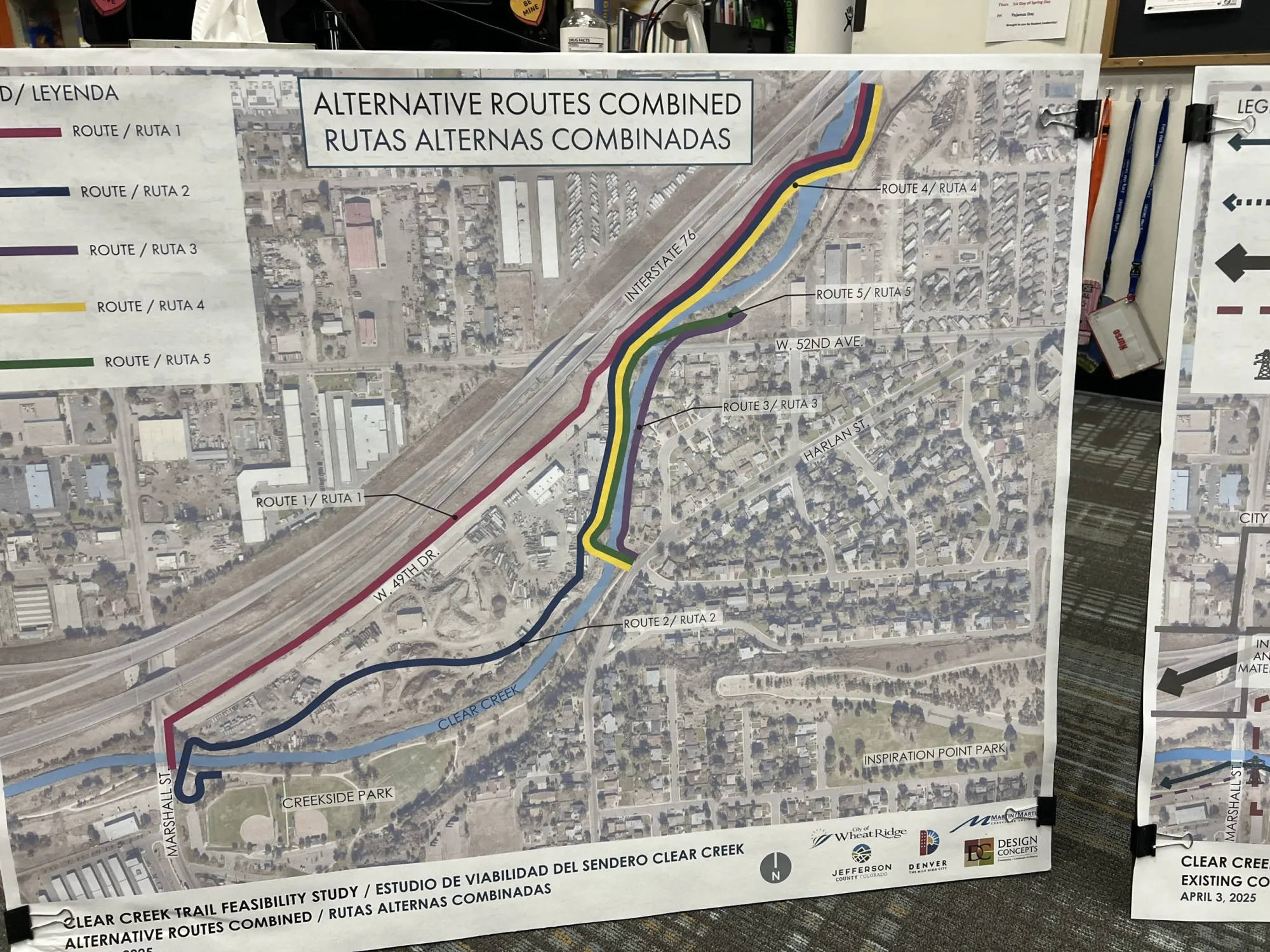
The city of Denver along with Jefferson County, The Mile High Flood District and the city of Wheat Ridge presented options for potential upgrades to the Clear Creek Trail during an open house in early April at Centennial Elementary School.
A section of the trail near Inspiration Point may get an upgrade for people that bike and walk. Currently, trail-users headed west must cross over West 52nd Avenue and then travel down about 1,100 feet of Gray Street, a residential street, before reaching the trail again.
The new plans unveiled at the open house offered five different options for new routes to avoid going down Gray Street, and all of them included under passes or bridges so trail users won’t have to cross West 52nd Avenue at grade anymore.
All of the options presented include new bridges or underpasses and involve several different routes that meander between Marshall Street and West 53rd Avenue. All of the proposed routes are west of the residences on Gray Street and south of Interstate 76. A study of the trail is expected to be completed in the fall.
At the meeting, residents were given the option to rank the five options and pick their favorites and least favorites. To learn more and give input on the potential routes, people can visit https://bit.ly/ClearCreekTrail. A current survey is open until April 18. [ed. emphasis mine]
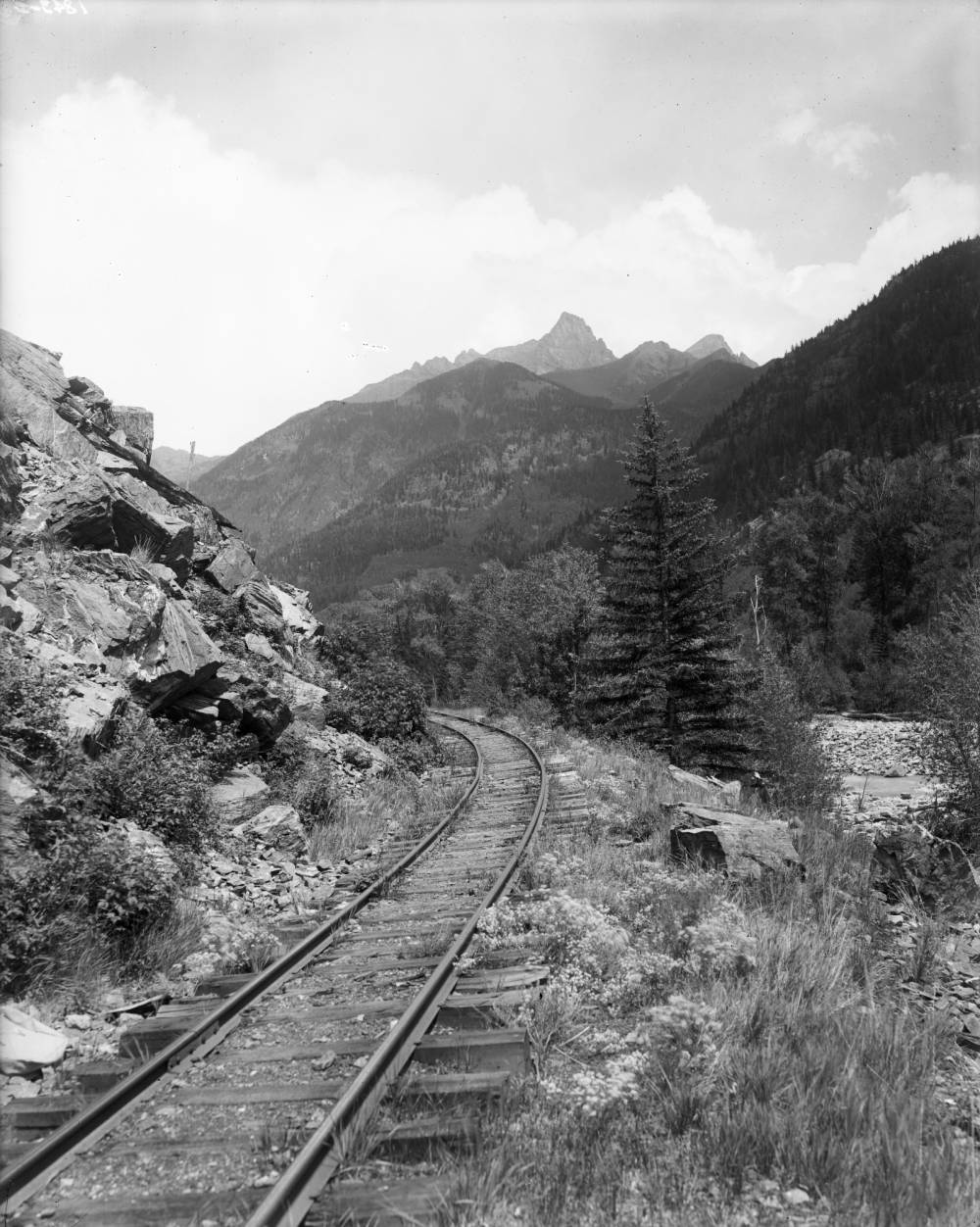
View of Denver and Rio Grande (Silverton Branch) Railroad tracks and the Animas River in San Juan County, Colorado; shows the Needle Mountains. Summer, 1911. Denver Public Library Special Collections
Water and environmental groups in southwestern Colorado have not heard a peep from the federal government since their $25.6 million grant got caught up in a widespread funding freeze, officials say.
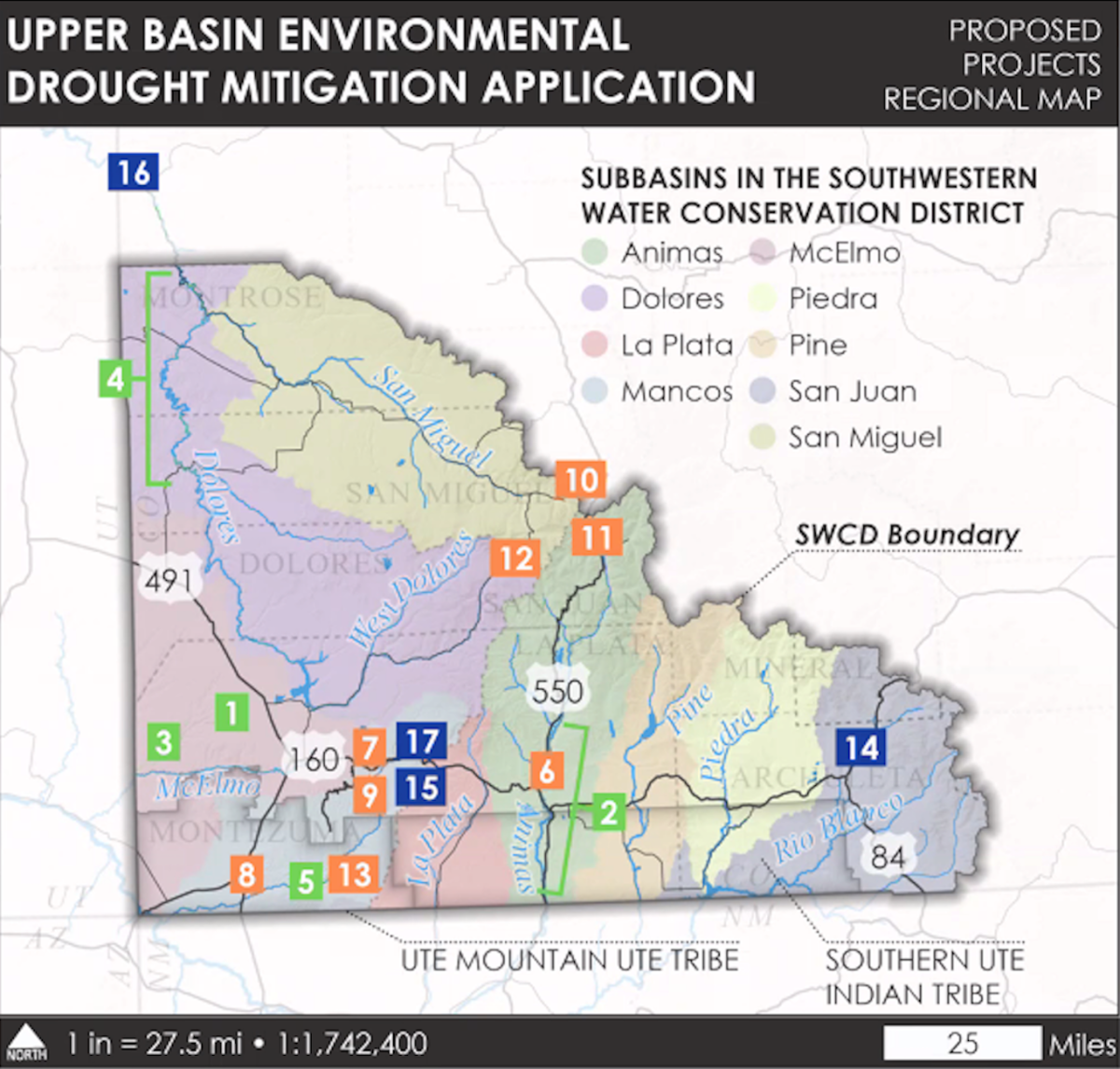
Southwestern Water Conservation District pulled together a unique collection of partners in 2024 to tap into an immense stack of federal cash for environmental projects in the Colorado River Basin. The partners were “ecstatic” Jan. 17 when they found out their application to fund 17 projects was accepted, Steve Wolff, district manager, said.
Three days later, President Donald Trump paused spending, and the district’s partnership has been in limbo ever since. Other Colorado groups are in the same boat with millions of dollars of awarded grant funding on the line.
“Everybody had heard that they were going to be looking at the funding … so it was no big surprise,” Wolff said March 26. “The confusion was nobody knew what was in or out of all these freezes, or pulled back, at all. We still have not heard officially anything.”
The Bureau of Reclamation, which awarded the grant, declined to comment and referred questions to its parent agency, the Department of the Interior. Interior did not respond to questions from The Colorado Sun about the funding’s status.
“Under President Donald J. Trump’s leadership, the Department is working to cut bureaucratic waste and ensure taxpayer dollars are spent efficiently,” an unnamed Interior spokesperson said in an emailed response from the Bureau of Reclamation. “Projects are being individually assessed by period of performance, criticality and other criteria.”
The uncertainty has impacted a slew of environmental projects across the Upper Colorado River Basin — Colorado, New Mexico, Utah and Wyoming.
Under the Biden administration, the Bureau of Reclamation awarded $388.5 million for water and drought-related projects across the Upper Basin on Jan. 17. Of that, Coloradans secured $177 million.
Coloradans wanted to use that money to help fish find shelter when the state’s rivers are at their lowest. They wanted to help farmers and ranchers have a more reliable water supply by fixing decades-old irrigation ditches. Some projects planned to remove dams or turn wastewater lagoons into wetlands.
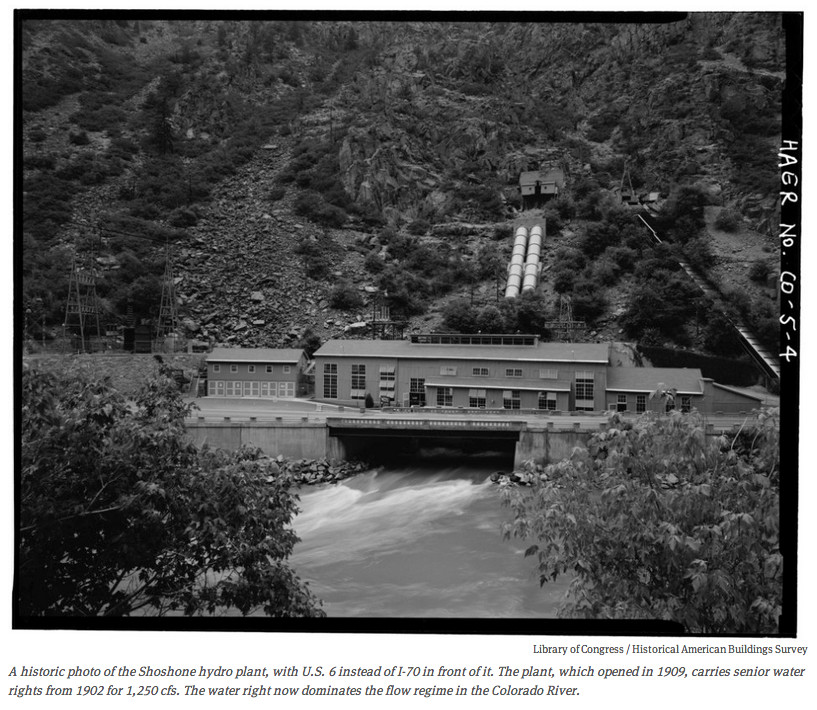
Shoshone Hydroelectric Plant back in the days before I-70 via Aspen Journalism
One award for $40 million to help a Western Slope water district buy an old and powerful Colorado River water right tied to the Shoshone Power Plant.
In southwestern Colorado, the organizations that were awarded funding were wondering if they should try to wait it out to see what happens or seek funding elsewhere.
“It’s incredibly stressful,” said Danyelle Leentjes with the Upper San Juan Watershed Enhancement Partnership. “It’s really hard to move forward in this landscape. It’s super, super hard.”
A new collaboration
Southwestern Water Conservation District started pulling together partners in 2023. Staff knew a load of federal funding was coming down the pike, and they wanted to build collaborations so local groups could access it, Wolff said.
“I don’t think the district’s ever been involved in anything like this before,” he said.
Water districts, ditch companies, environmental organizations and others often have small staffs in the rural district, which spans nine counties. The groups have little extra time to take on the application or little experience with federal grants. They might not have extra funding to hire a grant writer. Some, like nonprofits, weren’t eligible to apply for the funding without a governmental agency — like Southwestern — to manage the money as a fiscal agency.
Southwestern Water Conservation District and its partners identified 17 projects in their federal funding application in fall 2024. The projects aimed to remove blockages from rivers and irrigation ditches to help fish and farmers; stabilize river banks; turn waste lagoons into wetlands and more. (Southwestern Water Conservation District, Contributed)
“We’d repeatedly seen places where individuals or small groups didn’t have the capacity to work on federal funding or even state funding,” Wolff said.
So the conservation district stepped in: It asked organizations to add ready-to-go water projects to a centralized list, dubbed the “pipeline.” About 30 entities joined the effort. The district got grants from the state of Colorado and the Theodore Roosevelt Conservation Partnership to hire people to organize the process and write the grant application.
Without the grants, the application never would have gotten off the ground, Wolff said.
“There’s two of us here. Our plates are full,” he said, referring to the district’s full-time staff. “We could’ve never done it.”
And when the federal funding application finally opened in fall 2024, the partnership could whip together a successful 17-project application for $25.6 million in weeks.
Wolff didn’t think any of the partnering organizations had applied for a grant that size, he said.
“I was ecstatic we got the full award,” Wolff said. “It seemed like the previous 18 months of effort had just paid off.”
Funding uncertainty
The uncertainty for Southwestern, however, is tied to the funding source for their grant: the $740 billion Inflation Reduction Act.
The law included $4 billion to mitigate drought and prioritized the Colorado River Basin, the water supply for 40 million people. Of that total, $500 million was for projects that would address drought impacts or cut water use in the Upper Basin.
One executive order, called Unleashing American Energy, paused spending to give federal agencies 90 days to review whether funded projects aligned with the administration’s energy policies.
Past regulations have been burdensome and impeded the development of the country’s energy resources, according to the executive order.
That 90-day period ends April 20, but it was unclear Friday whether that deadline is still in effect or applies to the funding awarded to Colorado. Interior and Reclamation did not respond to clarifying questions from The Colorado Sun.
U.S. Rep. Jeff Hurd, a Colorado Republican, has generally supported the efforts to cut spending at the federal level, according to news reports. He did not respond to a request for comment Friday, but he has called for freeing up funding to purchase the historic Shoshone water rights on the Colorado River.
U.S. Sens. John Hickenlooper and Michael Bennet, both Colorado Democrats, have advocated for federal funds meant for Colorado to be released.
“Sen. Bennet believes President Trump’s shortsighted cuts to commonsense Colorado projects jeopardize rural communities, agricultural producers, and businesses across the state,” Bennet’s staff said in a prepared statement. “Grantees should receive the resources that were appropriated by Congress and promised by the Administration to complete their work.”
In early March, Southwestern and its partners had an open conversation about what to do with the regional director of Bennet’s office, John Whitney.
The strategy at the time, given the bipartisan support for the funding, was to have quiet conversations with Reclamation and Interior, Whitney told the gathering at the Southwestern Water Conservation District’s office in Durango.
“There may come a time when we have to stand up and raise our hand to be the squeaky wheel, to demand the money be released,” he said. “We don’t think that’s where we stand right now. We think an approach of quiet advocacy and outreach is the best.”
Mancos and the Mesa Verde area from the La Plata Mountains.
Impacts in southwestern Colorado
Members of the Southwestern partnership have stuck to that strategy so far, but the uncertainty has been hard to bear.
The Bureau of Reclamation awarded $2.2 million to the Upper San Juan Watershed Enhancement Partnership for a project that would clear concrete slabs and steel out of an irrigation ditch to help the agricultural community; fix damage to the Upper San Juan River from a landslide; and plant willows and reshape the river channel to help aquatic ecosystems.
“You can’t really proceed on anything. You can just hope that it goes,” Leentjes said.
Leentjes is paid to keep these projects moving forward — and without funding to make that happen, she spent a month wondering if she needed to look for jobs.
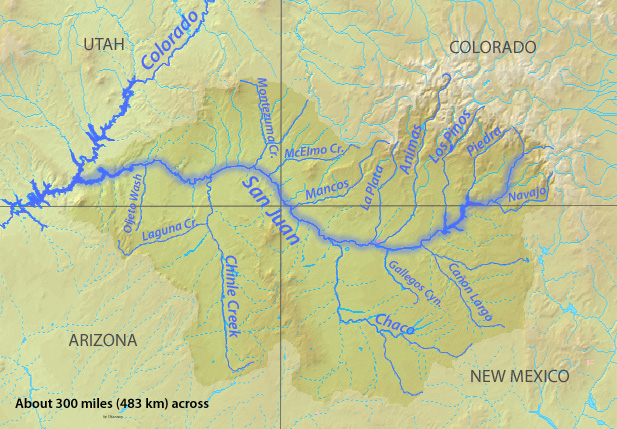
San Juan River Basin. Graphic credit Wikipedia.
It is also one of the first big projects for the Upper San Juan partnership after months of working with community members to identify which priorities should come first.
Their reputation is on the line, she said.
The Webber Ditch Company asked for $2.1 million to finally repair a 113-year-old diversion that sends water from the Mancos River to about 75 farmers and ranchers. The ditch company has been doing quick fixes on the rickety headgate for decades, Mike Nolan, company vice president, said.
“It could fail us in a season. That’s always been our biggest fear. Say we get wild monsoon rains and the river picks up, we could potentially lose that structure,” Nolan said. “That could happen at a critical time for our water users. We could Band-Aid it, but that’s not something we want to happen.”
The Mancos Conservation District had several projects in mind. Staff wanted to cut back thirsty invasive plants, like Russian olive trees, and improve a river put-in next to a local school in Mancos. They had projects to help with fish passage when the river is low, district executive director Danny Margoles said.
“It’s been a complicated number of months for us,” he said. The district had to lay off an employee and halt work on a project after the Trump administration canceled a different federal grant that was already contracted, confirmed and paying out.
The organizations were concerned about rippling impacts to state grants. Local organizations often use federal grants to cover their funding “match” for state grants. Now those federal grants are uncertain, and they’re not sure what the impact will be.
Margoles said he can sense the feelings of stress and uncertainty among his staff.
“Everyone’s hanging in there,” Margoles said. “Everyone does believe in the work they’re doing, so that’s what is keeping everyone going right now too. But there’s a lot of uncertainty.”
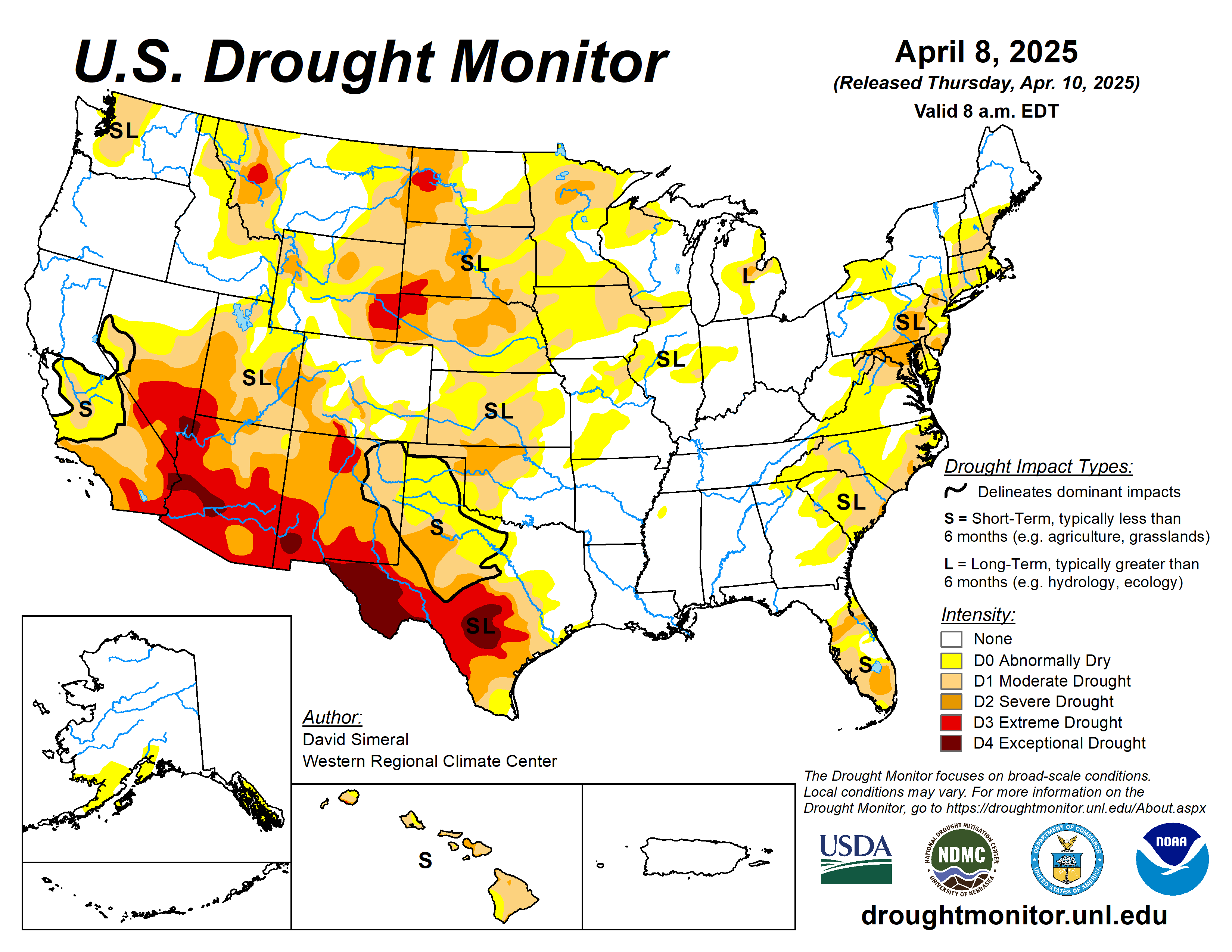
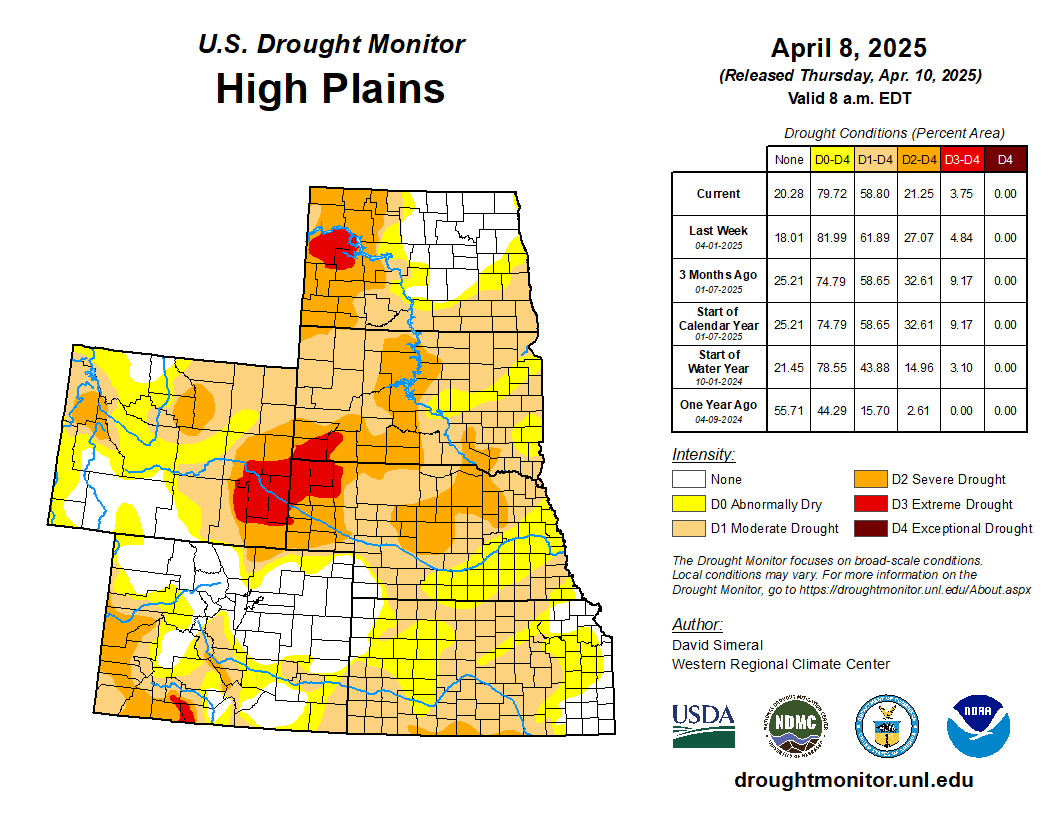
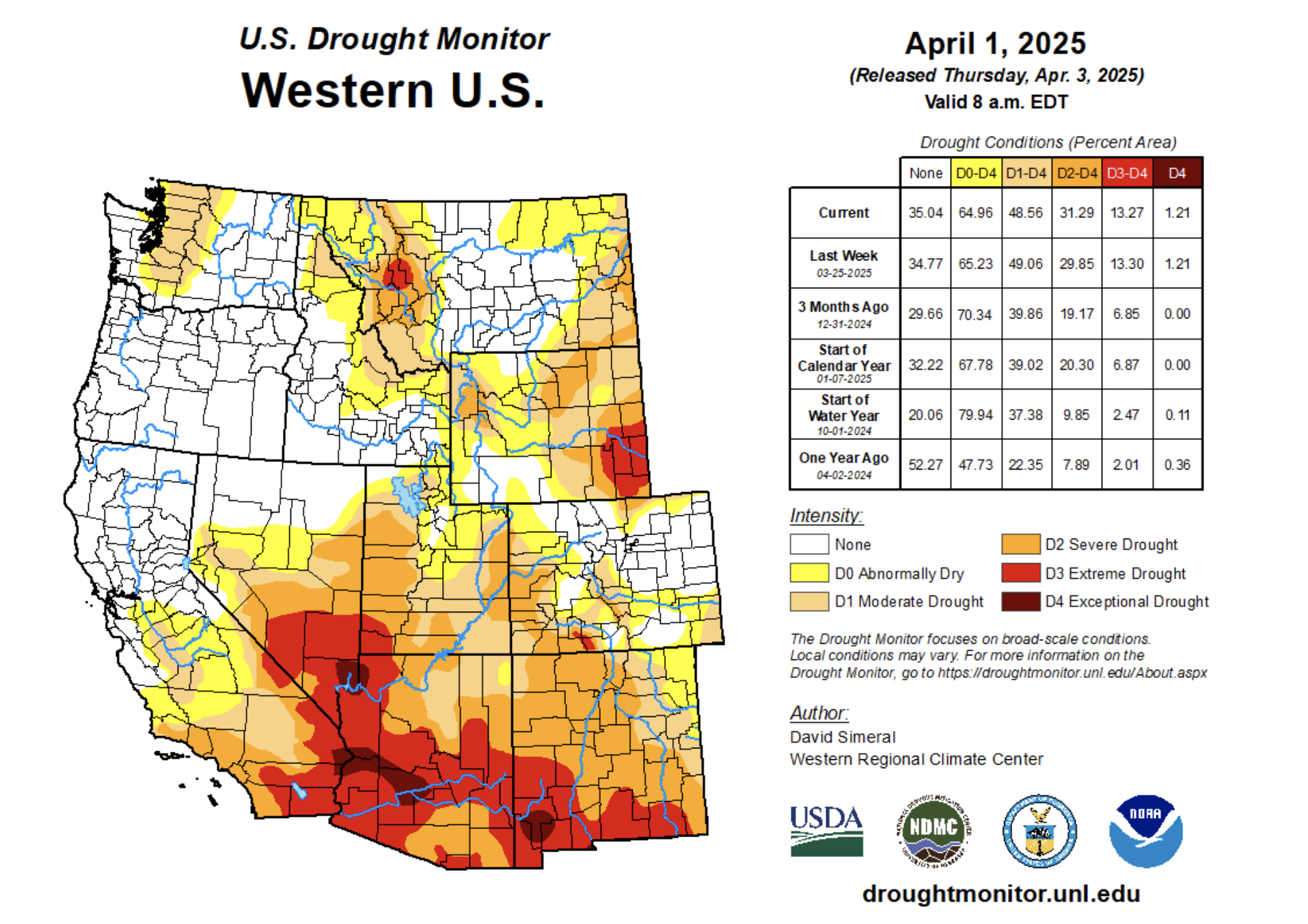
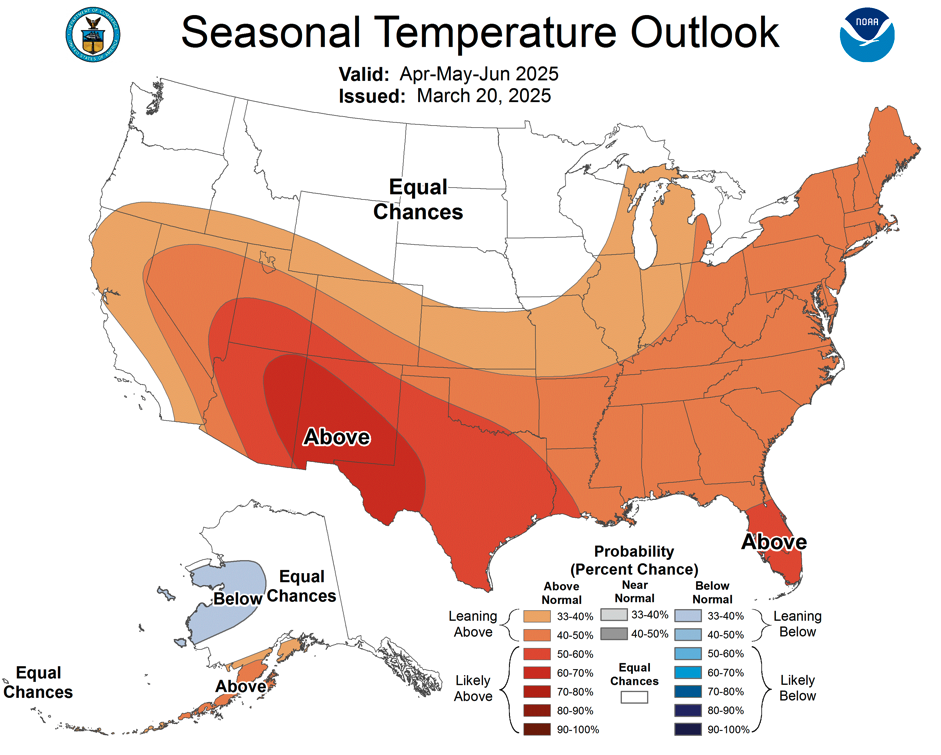
During the week of April 8-14, temperatures across the Contiguous U.S. were split into above-normal readings in the western U.S., below-normal readings east of the Mississippi River, and near-normal temperatures in the Mississippi River Valley. Temperatures across the western Great Plains, the Rocky Mountains, and the Intermountain West ranged from 3-12 degrees warmer than normal. In the Upper Ohio River Valley and Appalachian Mountains, temperatures from 6-12 degrees cooler-than-normal were widespread. Dry weather occurred over much of the Great Plains and western U.S., except for parts of North Dakota, Montana, northern Idaho and western Washington. Some moderate precipitation amounts, locally exceeding an inch or two, occurred in parts of the eastern U.S., especially in the Mid-Atlantic, though precipitation was mostly light east of the Mississippi River otherwise.
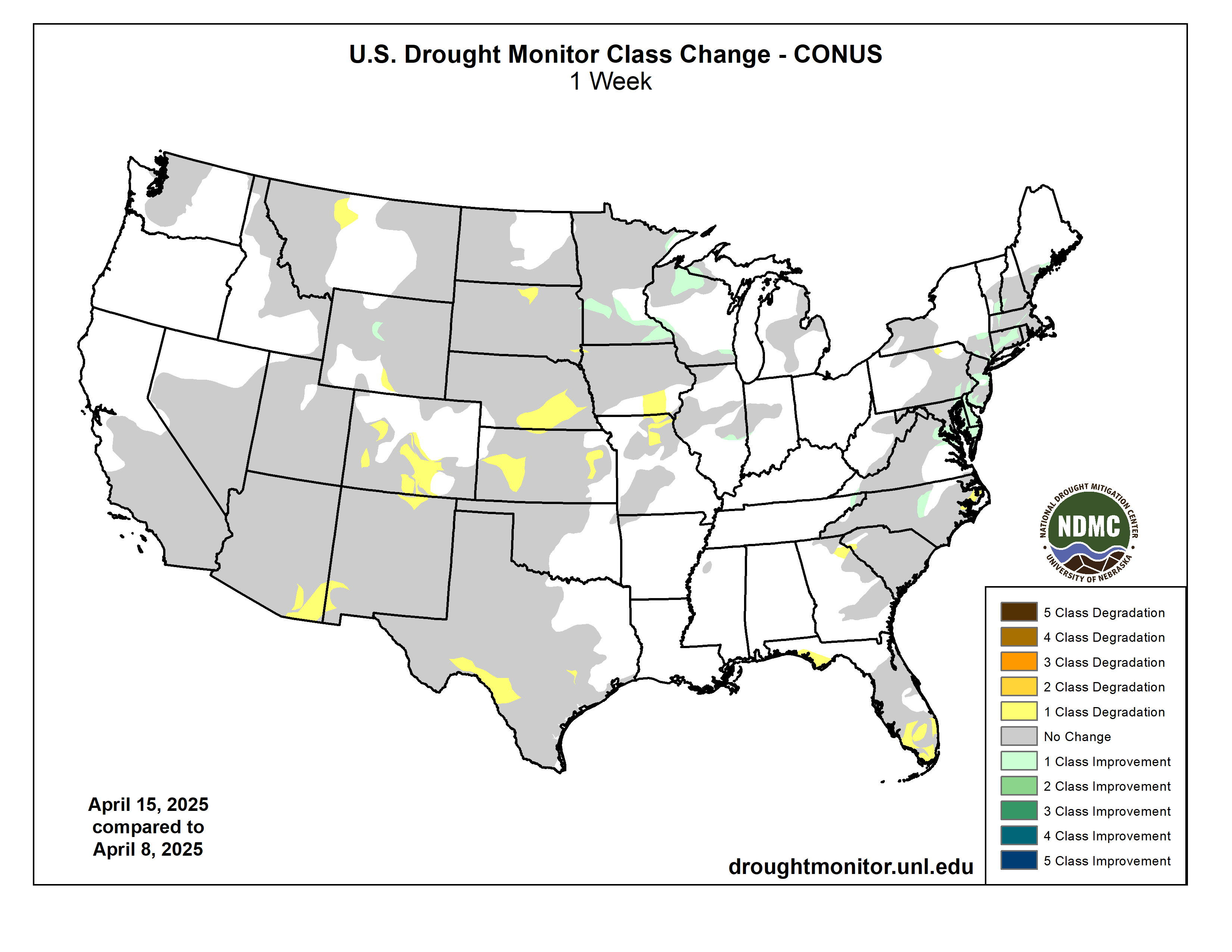
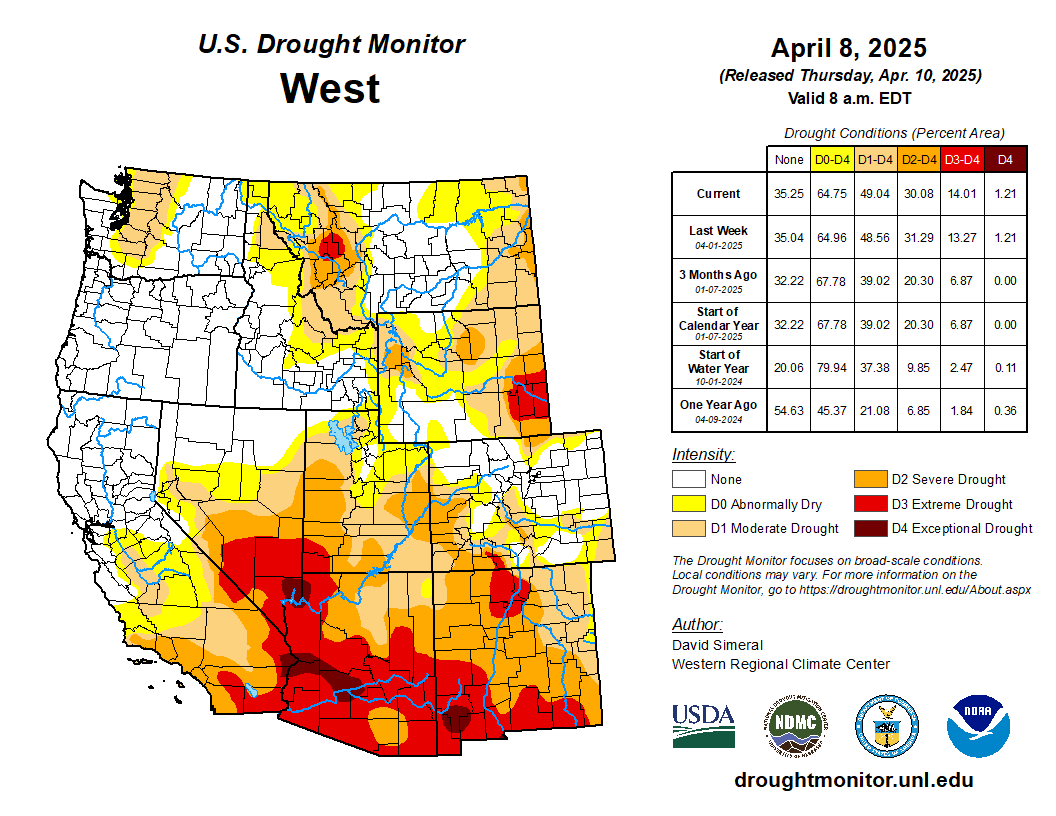
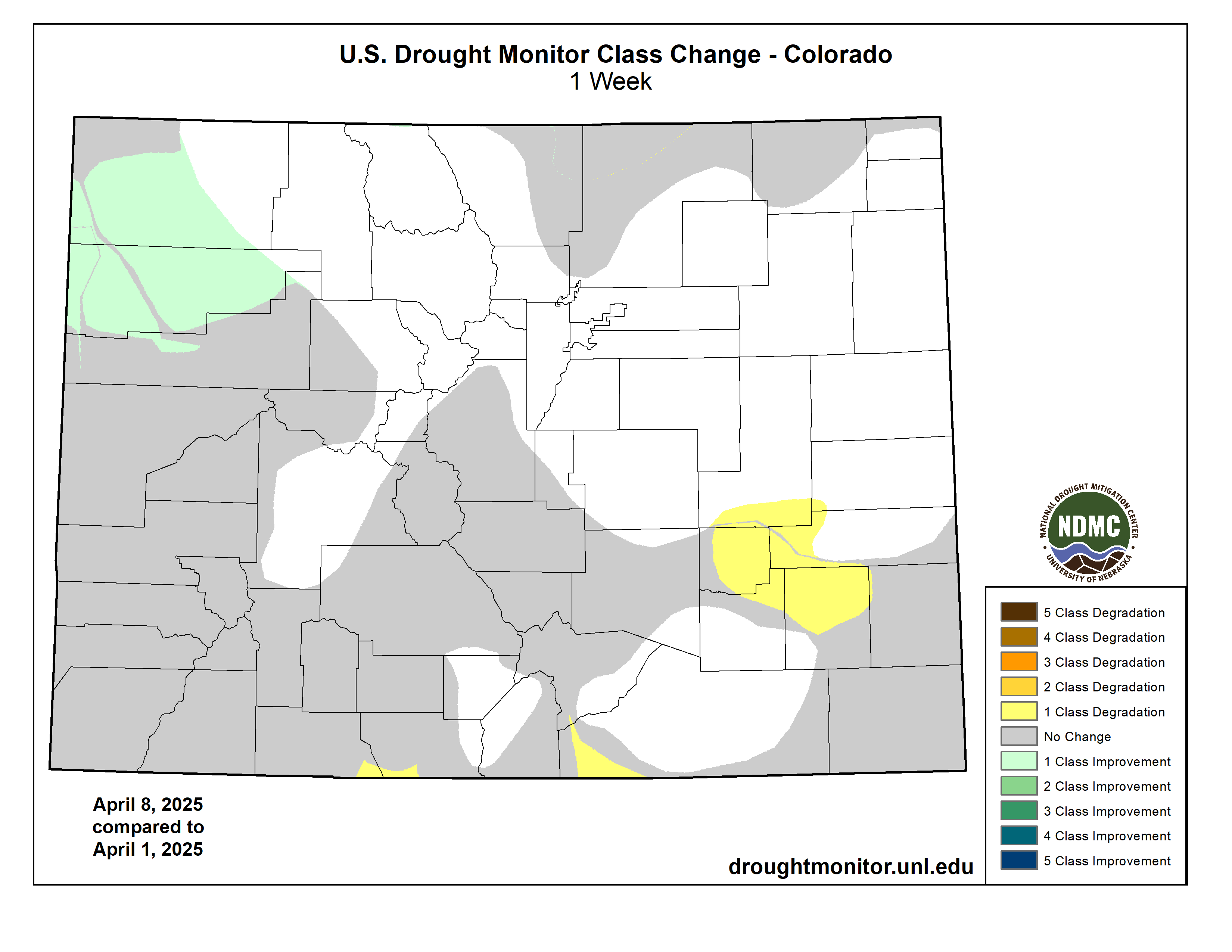
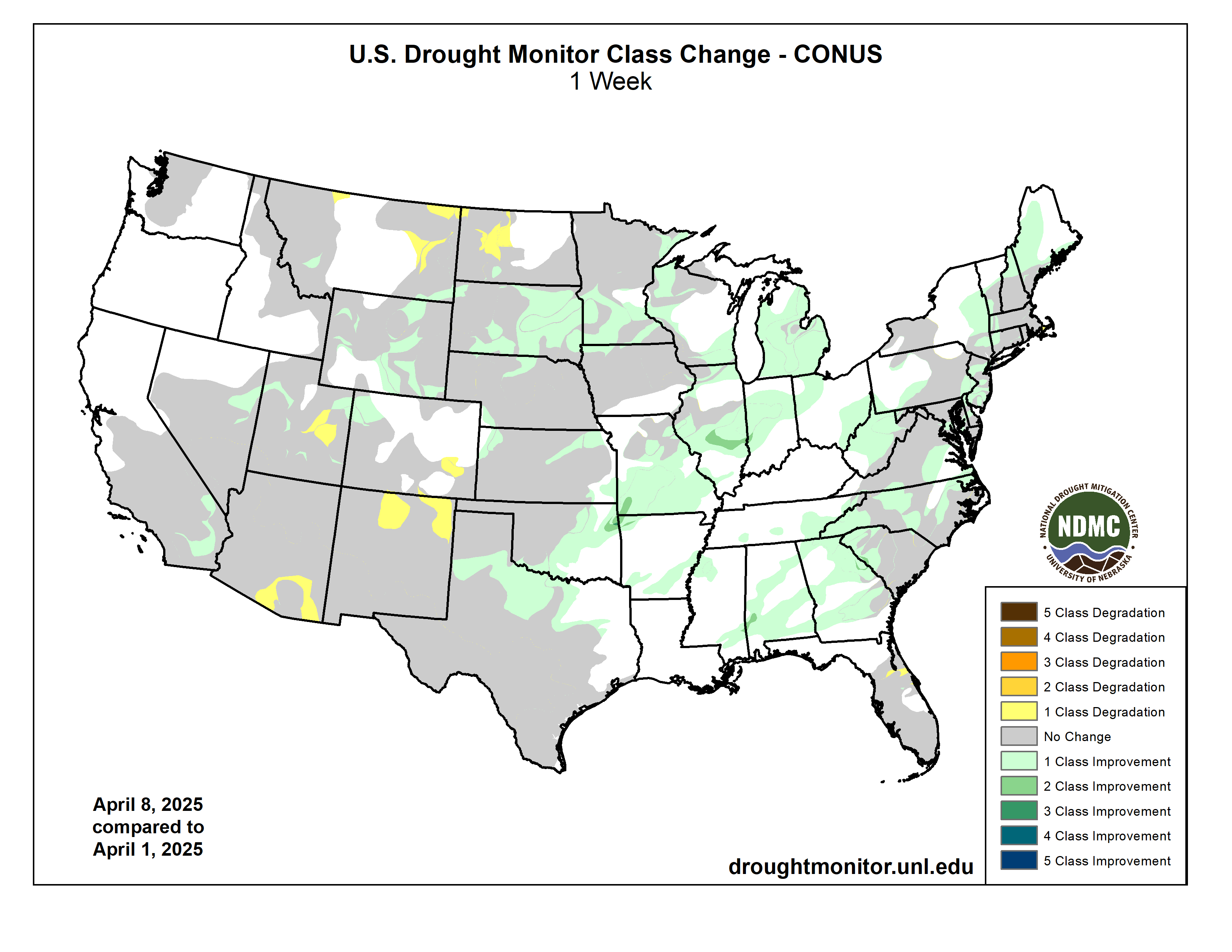
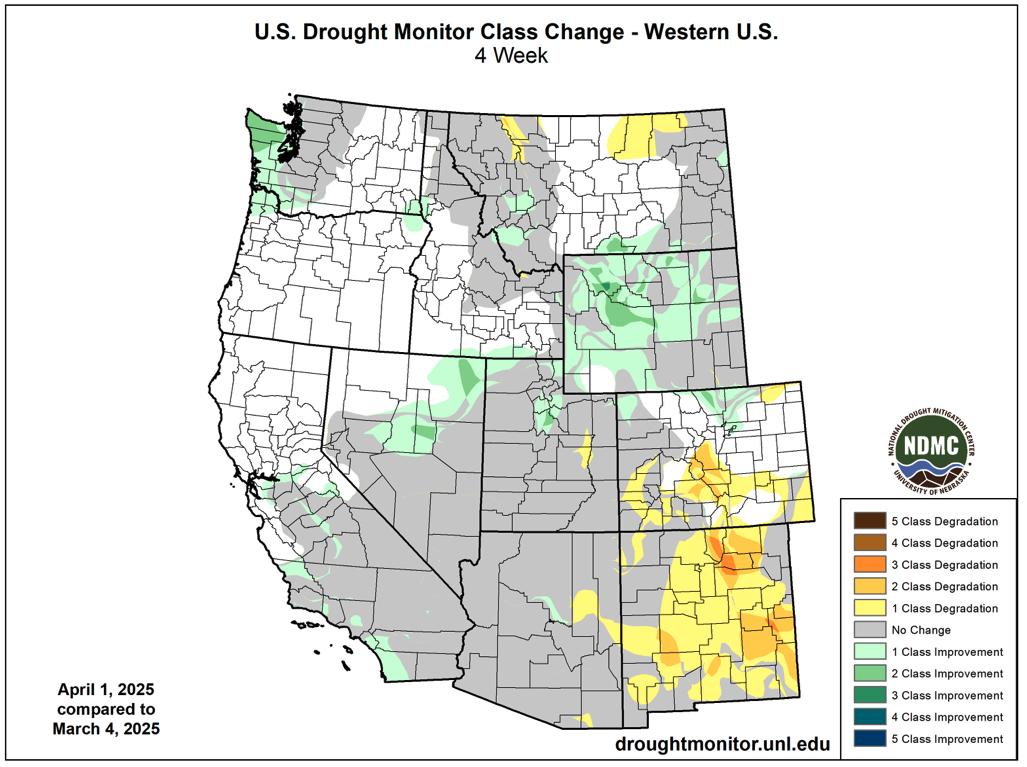
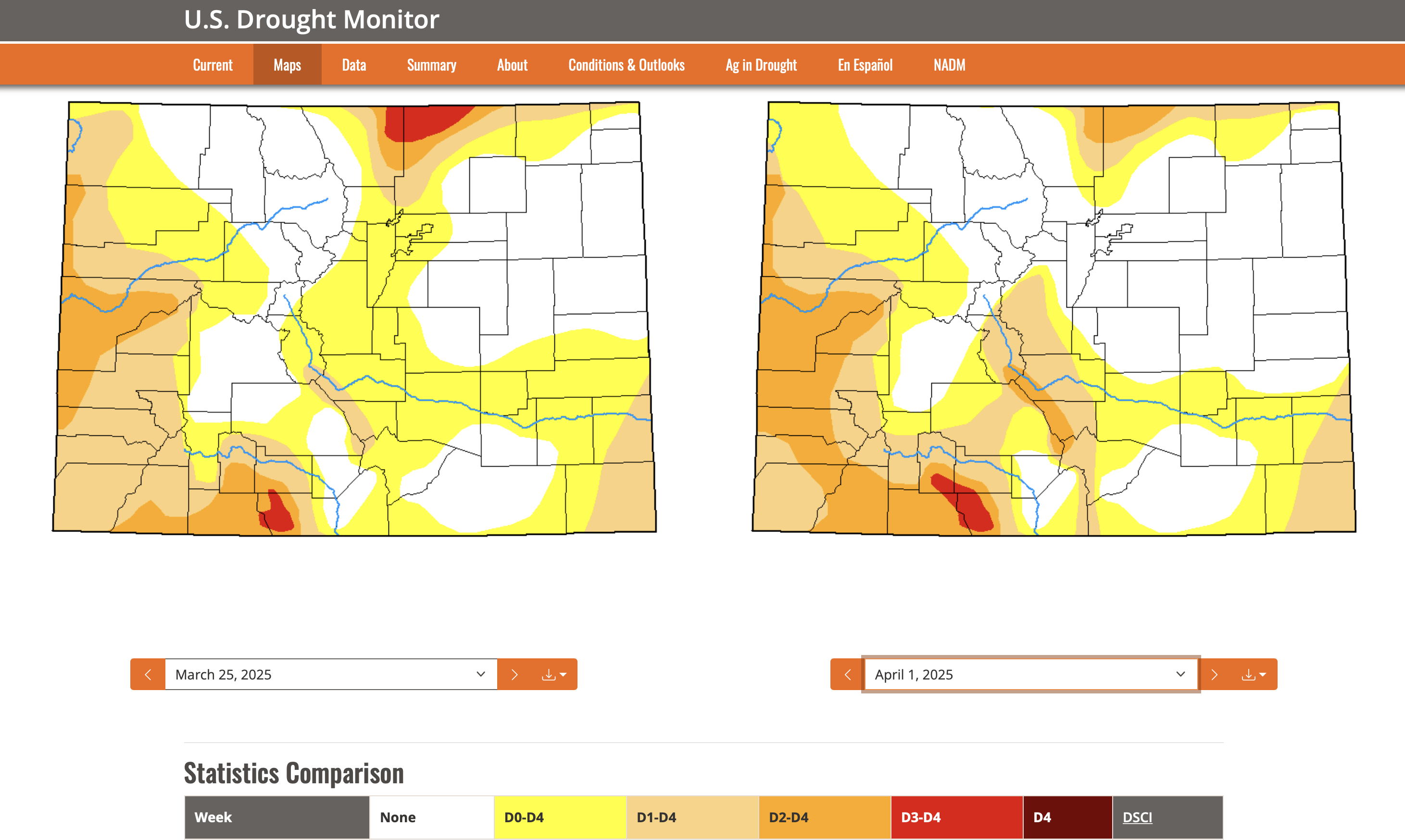
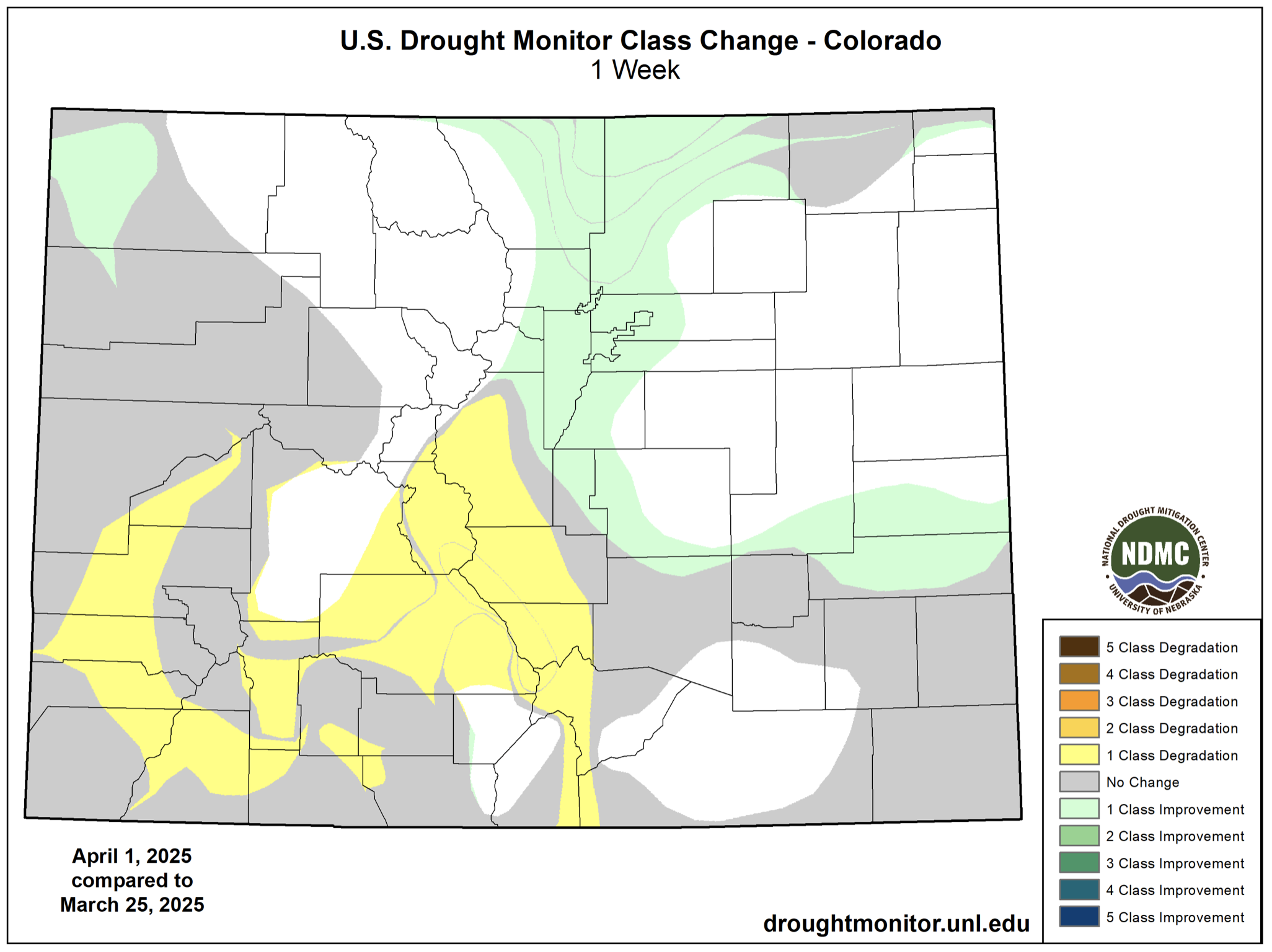
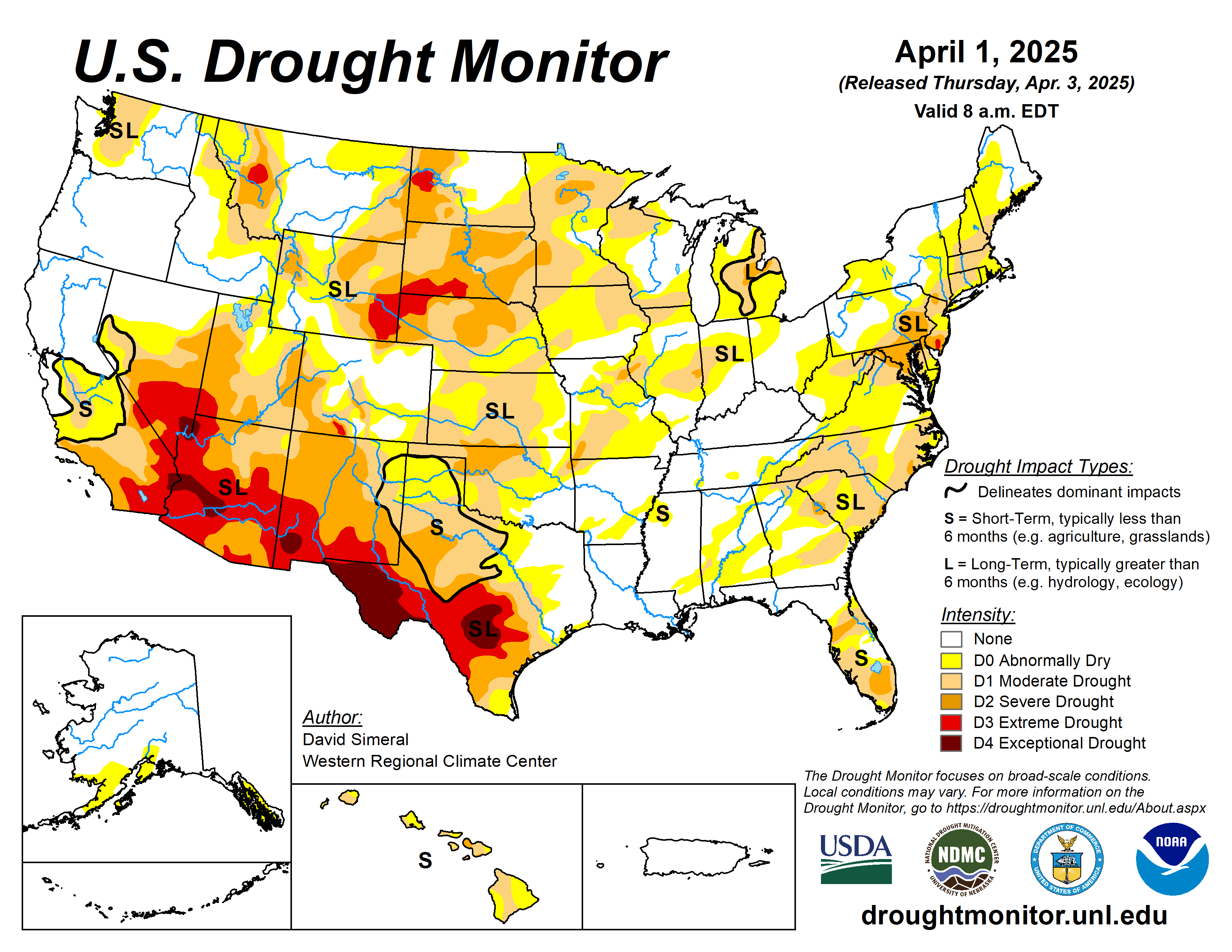
Changes to the U.S. Drought Monitor depiction were somewhat limited this week compared to the last few. Increases in drought coverage occurred in parts of southern Texas, New Mexico, much of Colorado, and parts of Kansas, Nebraska and northern South Dakota. Dry weather and high fire danger continued in south Florida this week, leading to further degradation and the development of localized extreme drought. The higher precipitation amounts in the Mid-Atlantic and Northeast led to some localized improvements in ongoing drought and abnormal dryness. Heavier precipitation over the last month has quickly improved conditions in this region, with lessened precipitation deficits and increasing groundwater in many areas…
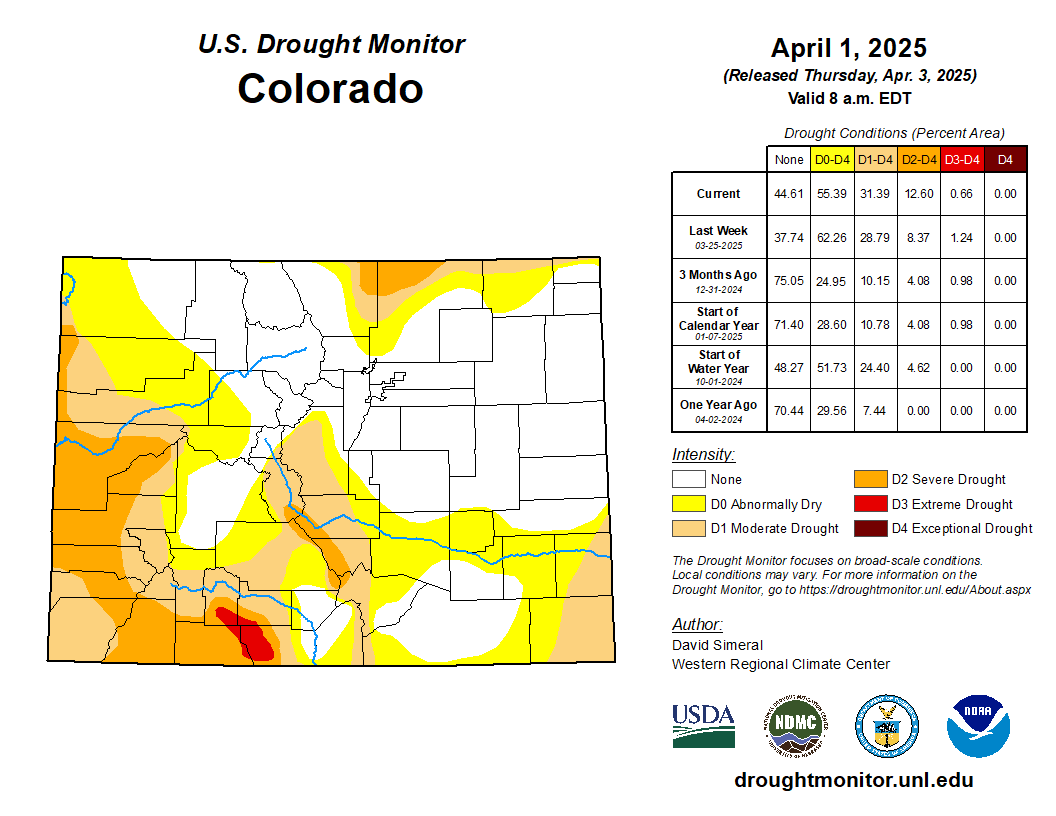
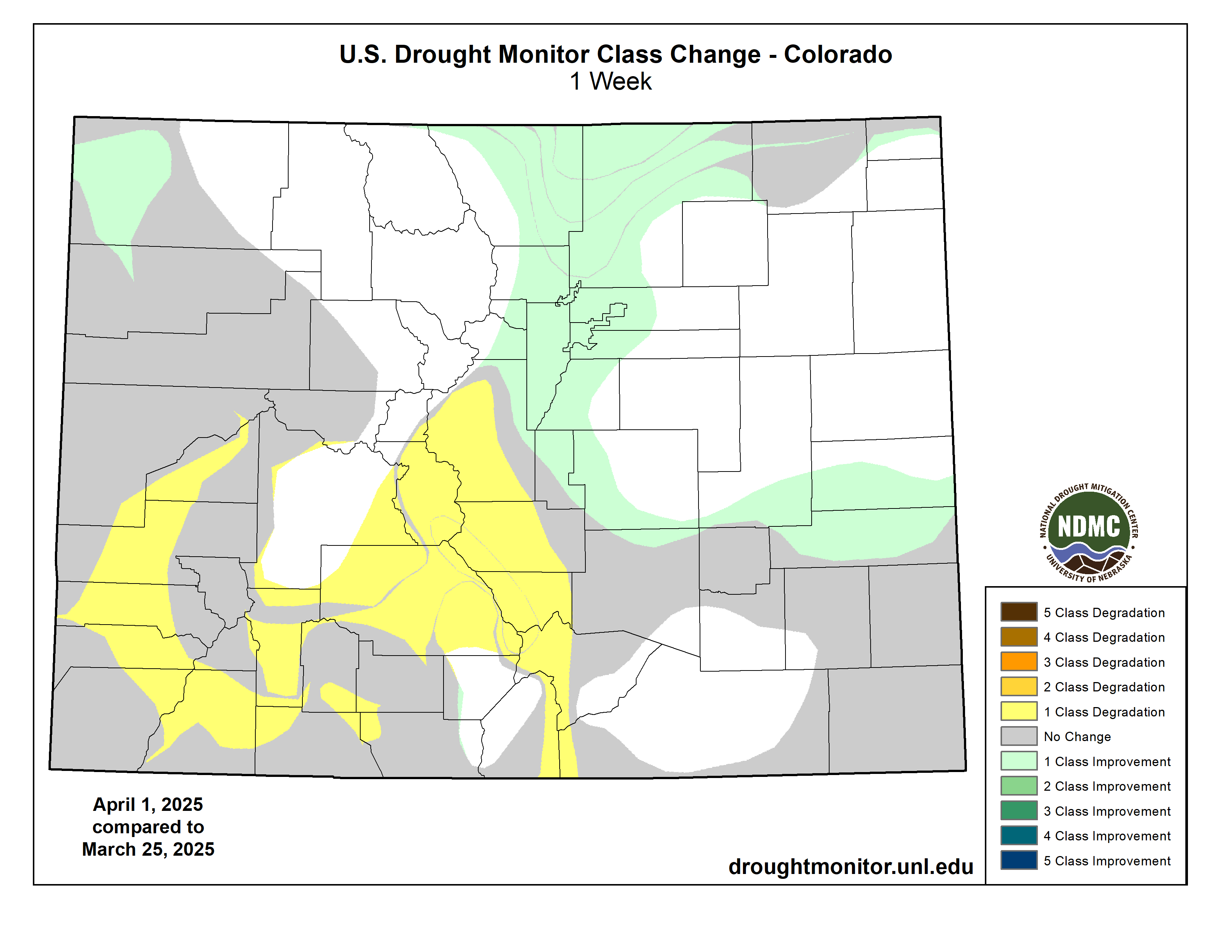
Across the High Plains, ongoing drought or abnormal dryness mostly stayed the same or worsened after dry weather occurred across the region (excluding North Dakota) and warmer-than-normal temperatures overspread the Great Plains and central Rocky Mountains. Temperatures from 3-12 degrees above normal occurred across the region, with the warmest readings occurring in the western Great Plains and in the Colorado Front Range area. Widespread degradation in drought conditions, due to low snowpack and short- and long-term precipitation deficits, occurred in the central and southern Rocky Mountains in Colorado. Moderate drought expanded in western and east-central Kansas this week, where streamflow and soil moisture dropped amid growing precipitation deficits. Similar conditions existed from south-central into eastern Nebraska, where moderate drought became re-established. Localized degradations to drought conditions occurred in north-central South Dakota amid growing precipitation deficits, though conditions across most of the Dakotas remained unchanged this week. Moderate drought coverage decreased slightly southwest of the Bighorn Mountains in Wyoming, where precipitation deficits lessened and soil moisture conditions improved…
Colorado Drought monitor one week change map ending April 15, 2025.
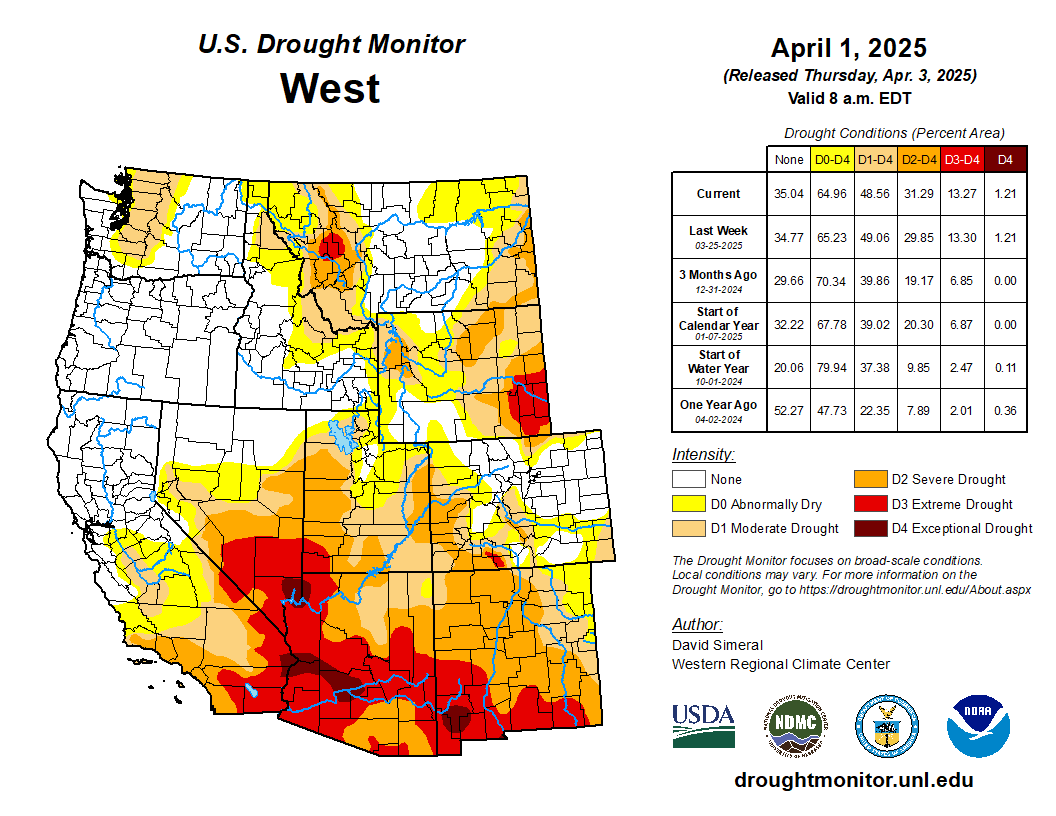
A mix of near-, below- and above-normal temperatures occurred in northern Idaho and in Washington. Otherwise, temperatures across the West were warmer than normal this week, with widespread readings of 6-12 degrees above normal in parts of central and eastern California, Nevada, Utah, Arizona and New Mexico. Mostly dry weather, with a few exceptions in Montana, northern Idaho, western Washington and northwest Oregon, occurred across the West this week. In northern New Mexico, soil moisture levels dropped and short-term precipitation deficits grew, leading to an expansion of severe drought (concurrent with expansions of drought coverage in Colorado). Extreme and exceptional drought grew in coverage in far southwest New Mexico and southeast Arizona, where very dry surface conditions and high evaporative demand continued amid severe precipitation deficits…
Mostly dry weather occurred across the South region this week, aside from eastern Tennessee and scattered light rain amounts in northern Mississippi and central and western Tennessee. Temperatures ranged from 3-9 degrees below normal in areas east of the Mississippi River and in southern Louisiana and southeast Texas, to 3 to locally 9 degrees or more above normal in western parts of Oklahoma and Texas. Given recent very wet weather in the eastern half of the region, no changes occurred in drought or abnormal dryness in the eastern part of the region other than a slight reduction in abnormal dryness in eastern Tennessee after recent rains. In southern Texas, severe drought expanded in a small area between San Antonio and Houston where streamflow and soil moisture decreased and short-term precipitation deficits grew. Exceptional drought grew in coverage from near Eagle Pass to northwest of Del Rio in southern Texas, where short- and long-term precipitation deficits worsened, soil moisture and groundwater levels worsened, and reservoir levels were at or near record-low levels. Stage 3 restrictions were in effect for the San Antonio Water System, and Stage 4 restrictions were present for farmers and pumpers operating in the Edwards Aquifer…
Looking Ahead
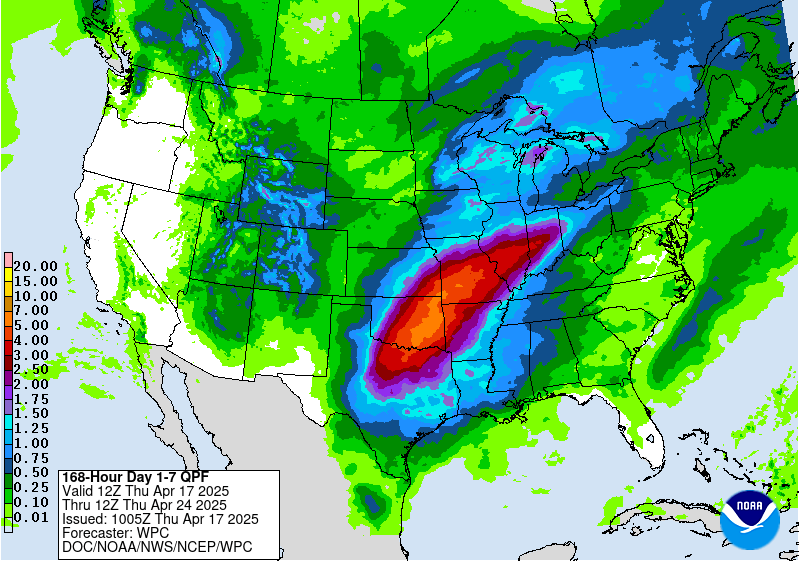
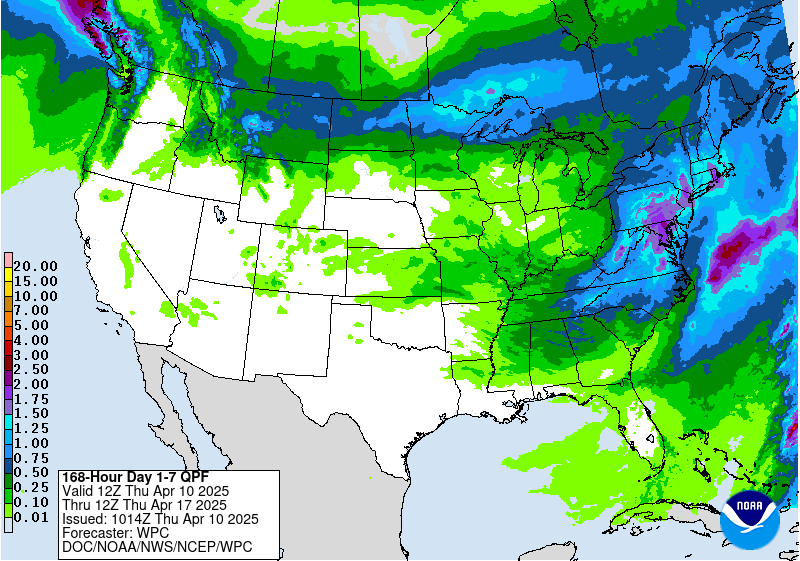
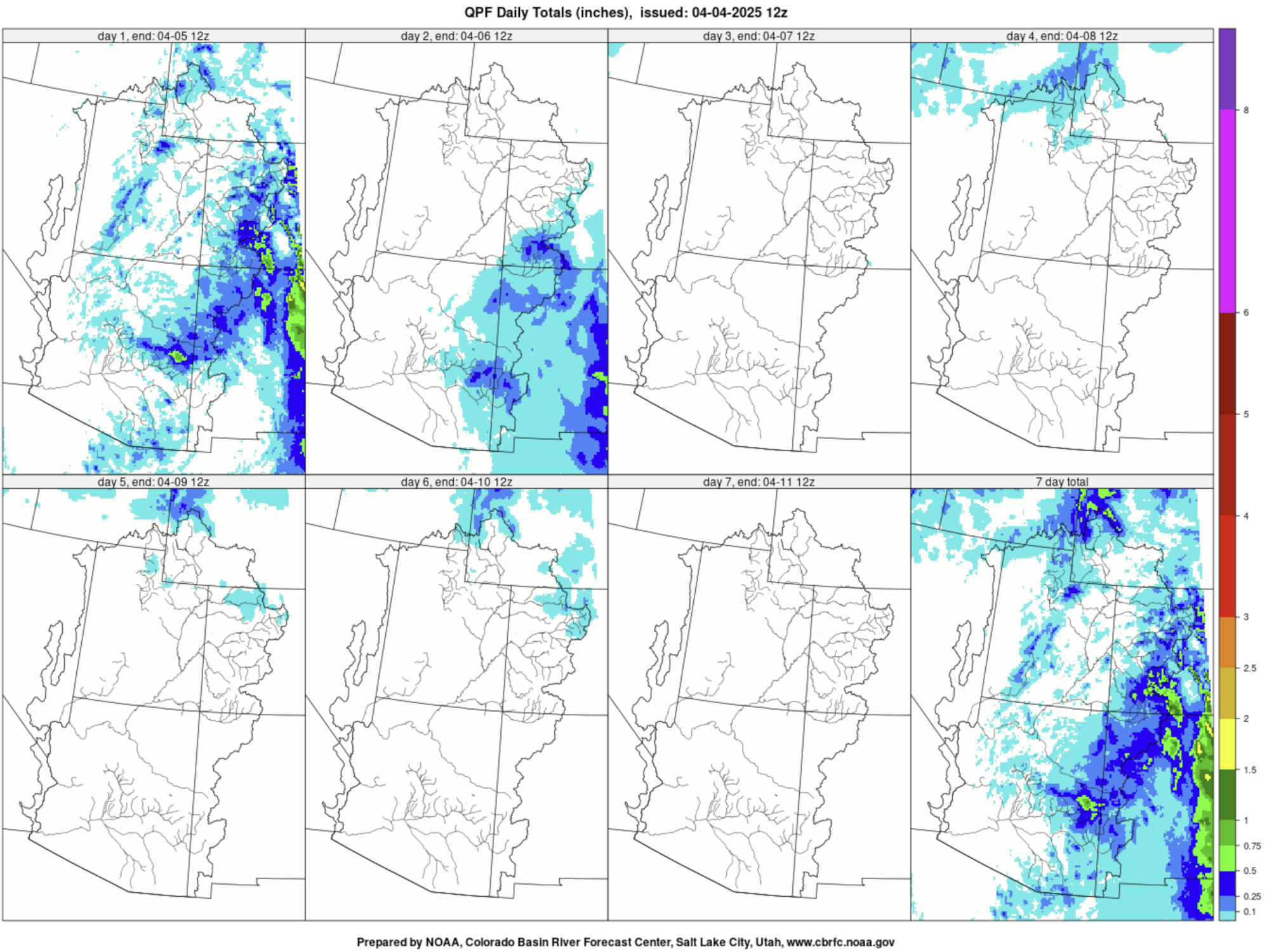
Between Wednesday, April 16 and the evening of Monday, April 21, the National Weather Service Weather Prediction Center is forecasting widespread heavy rainfall in parts of the central U.S., especially along east and south of the Interstate 44, 35 and 70 corridors in Oklahoma, Kansas, Missouri, Arkansas, Illinois and Indiana. Precipitation amounts may reach or exceed 3 inches from eastern Oklahoma northeast through St. Louis into eastern Illinois. The forecast calls for precipitation amounts from 0.25-1 inches in parts of the Rocky Mountains, with locally higher amounts possible, especially from far northern New Mexico north to southern Montana. Precipitation amounts from 0.5-1.25 inches, with localized higher amounts, are forecast from southeast Minnesota east through Wisconsin and Michigan. Farther east, weather along the Atlantic Coast is forecast to be mostly dry.
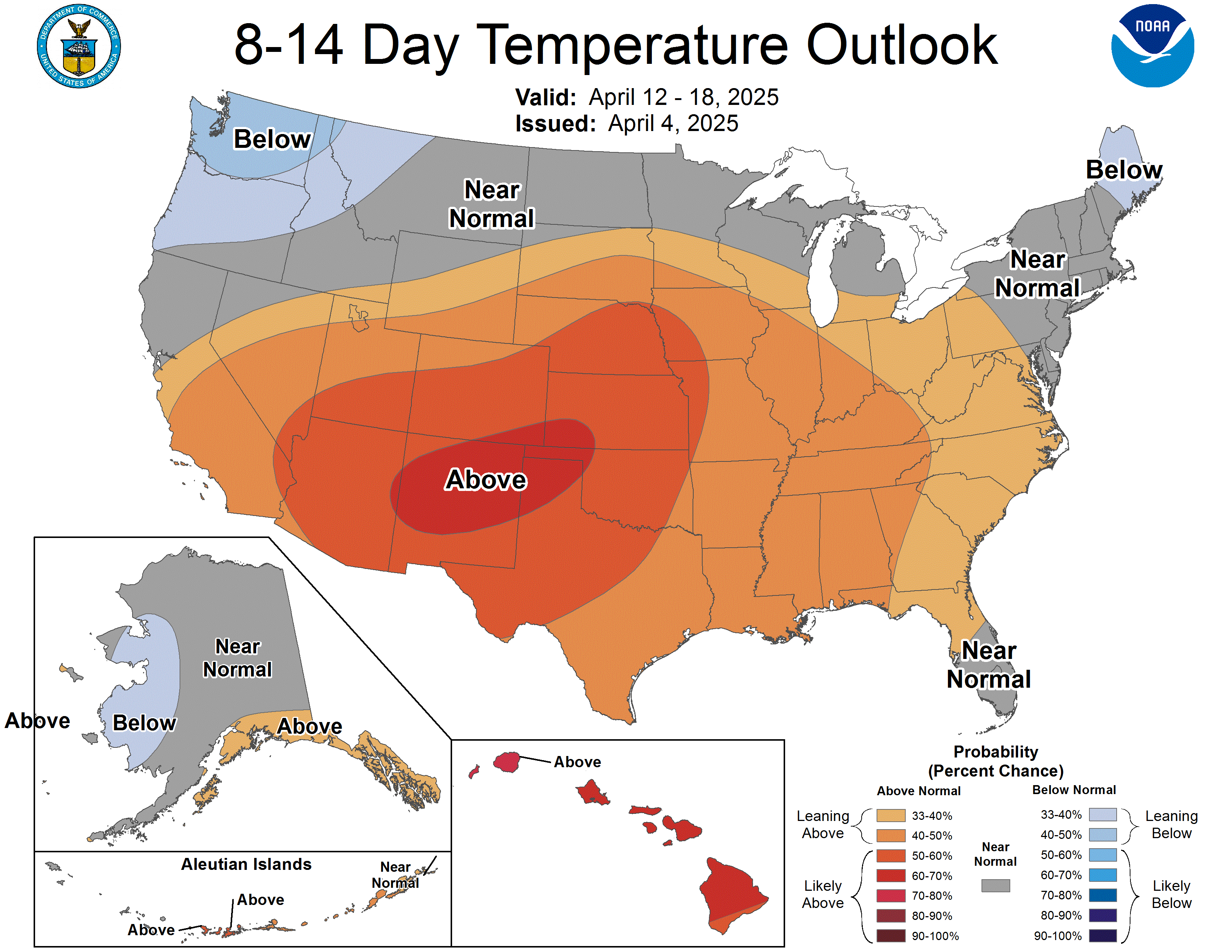
For the period from April 22-26, the National Weather Service Climate Prediction Center forecast favors above-normal precipitation in much of the central and southern U.S., especially in Oklahoma, Texas, Arkansas and Louisiana. Warmer-than-normal temperatures are also favored across most of the contiguous U.S., especially in the Southeast. Drier-than-normal weather is slightly favored in northwest California and coastal areas of Oregon and Washington.
In Hawaii, warmer- and wetter-than-normal weather is strongly favored from April 22-26. In Alaska, above-normal precipitation is favored for April 22-26 in most areas outside of the North Slope. Colder-than-normal temperatures are favored in the central and eastern thirds of Alaska, while warmer-than-normal temperatures are likelier in southwest Alaska and the Aleutian Islands.
US Drought monitor one week change map ending April 15, 2025.
To save a dying aquifer – or at least their piece of it – a group of roughly 60 farmers in northwest Kansas decided on a self-imposed diet.
The move a dozen years ago to voluntarily restrict the water they pumped from the Ogallala Aquifer, the lifeblood of the High Plains, was seen by some as a risky proposition. In the semi-arid region, farmers might have gone bankrupt without water drawn from deep underground. But they were skilled and savvy land managers, and thought they could survive a 20 percent water cut.
Years of scholarship and economic analysis have proved them correct – in more ways than one.
The farmers in northwest Kansas not only remain profitable. They are practicing irrigated agriculture with a significantly lighter environmental footprint. Fewer carbon emissions, less fossil energy use. Annual groundwater declines of 1.5 to 2 feet before the restrictions are now a half foot or less. In some years, the groundwater level has inched up. Their part of the Ogallala is not quite stable, but a balance between recharge and extraction is closer than it has been in generations.
In light of these successes, the experiment in little Sheridan County is instructive, illustrating a plan of attack for other areas of the planet where agriculture – the biggest consumer of water – is exceeding the limits of a finite resource. Northern India, California’s Central Valley, Iran, and the North China Plain – all are arid and semi-arid farming hot spots and epicenters of groundwater depletion that could learn from Kansas, where four additional groundwater management areas with varying conservation targets have been established following the Sheridan model. For an ag industry that can be leery of untested practices and new methods, the undisputed achievement on the High Plains is a compelling proof of concept.
“I think it’s been pretty transformational, particularly in the area of Kansas water policy and management, but certainly in adjacent states as well, because I think it helped to allay fears of the producers of trying to tackle change,” said Jean Steiner, an adjunct professor of agronomy at Kansas State University.
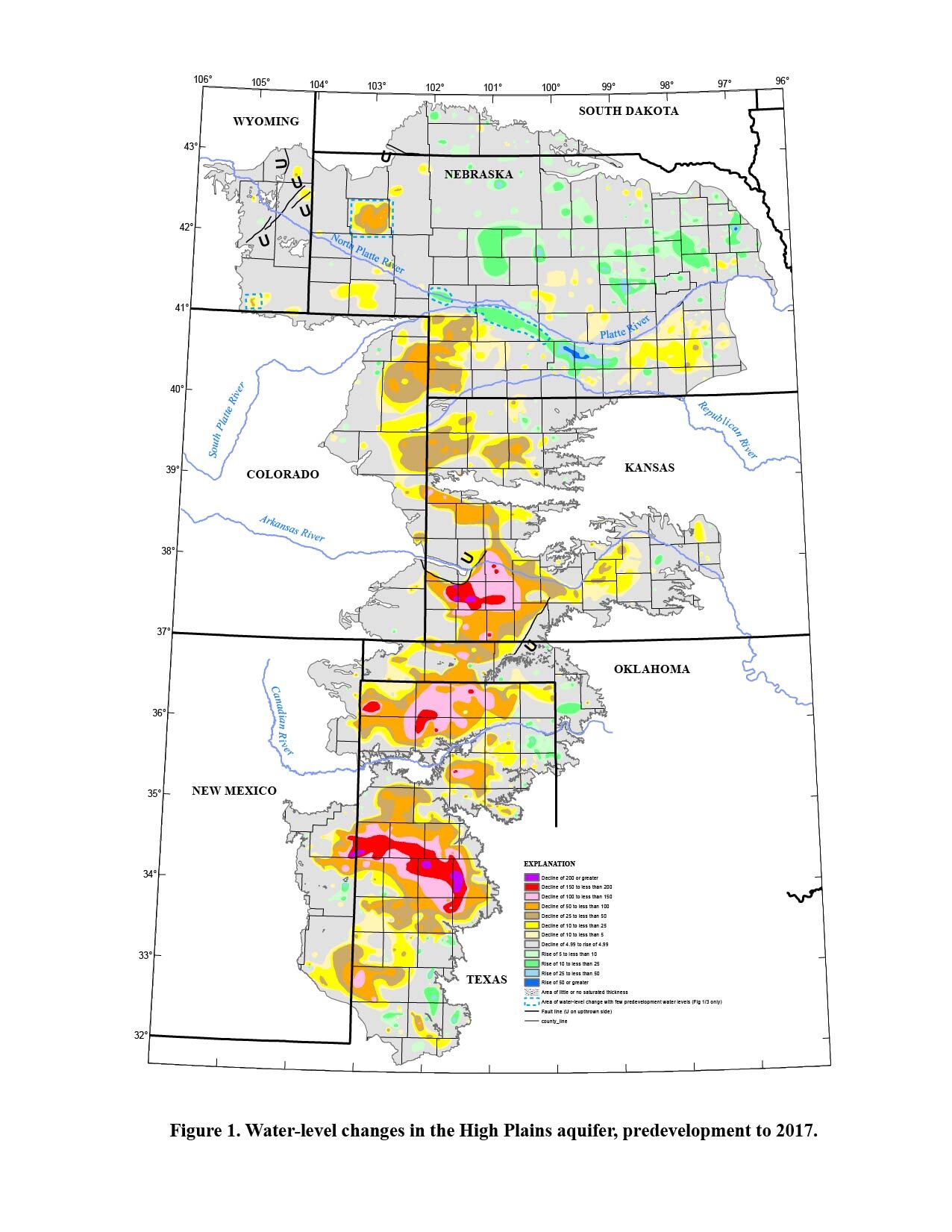
McGuire, V.L., and Strauch, K.R., 2022. Data from U.S. Geological Survey.
The importance of the Ogallala Aquifer to the economy of the High Plains is difficult to understate. Spanning eight states from South Dakota in the north to Texas in the south, the Ogallala is North America’s largest source of underground fresh water. In a region with few flowing rivers and sporadic rain, its groundwater nurtures vast harvests of cotton, corn, soybeans, and wheat, in addition to some of the nation’s biggest cattle feedlots. All told, the Ogallala supports an agriculture industry worth $35 billion.
Because of limited precipitation, the Ogallala as it has been managed is essentially a finite resource, a bank account slowly being drawn down to produce immense quantities of grain. Some areas on the aquifer’s fringe are already too depleted for irrigation.
Seeing the trend lines and wanting to delay or avoid that fate, farmers in Sheridan County said enough. In 2013, they became the first group in the state to adopt a new conservation tool, called a Local Enhanced Management Area.
The LEMA was locally designed but came with the force of law. It bound farmers in the 99-square-mile management area to a 20 percent cut in groundwater pumping. To help farmers cope, the volume restrictions were paired with more flexible rules for water use. If they did not need a portion of their water allocation one year – because of sufficient rain or a different crop mix – farmers could carry it over to the next. The change allowed them to take advantage of a wet year by saving their pumping for a drier period in the future.
What benefits did this bring? Previous studies found that pumping restrictions did not hurt farm profitability. Farmers cut their operational costs – less money spent on seeds, fertilizer, energy – or shifted from corn to less water-intensive crops, and were less wasteful with the water they had, producing yields that were a bit smaller than before but not drastically so. The dollars and cents penciled out.
“We can safely say it’s not economically detrimental to reduce water use,” said Bill Golden, a Kansas State University agricultural economics professor who conducted the research.
The Ogallala Aquifer crosses eight states and is North America’s largest underground source of fresh water. Map: Erin Aigner for Circle of Blue
To the economic gains, now add ecological benefits.
Steiner is a co-author on a new study that is the first to assess the LEMA’s effect on the environment. The study, using computer models that simulated resource inputs and crop outputs, found a host of co-benefits to reducing water use.
Compared to nearby farmland that had no water limits, the Sheridan LEMA came out ahead. Fossil energy use – natural gas is the most common fuel source for the groundwater pumps – was 22 percent lower. Greenhouse gas emissions were 20 percent lower. Losses of reactive nitrogen, linked to fertilizer use, were down 1.4 percent.
Because yields were smaller in the LEMA, the numbers were slightly less impressive when measured per unit of grain produced. Reactive nitrogen losses were even a touch higher than the control group without water limits. Still, the benefits were impressive overall, Steiner said.
“Replicating LEMA-type policies more widely across the region can be a viable solution (environmental and economic) to stabilize the Ogallala Aquifer water levels for the next few decades, as demonstrated by this and previous research,” the study concluded.
Stabilizing the aquifer is a main reason the Sheridan farmers went on their water diet. They wanted to preserve the aquifer for their children and grandchildren. That outcome appears to be happening.
Before the LEMA went into effect in 2013, annual water level declines in the area averaged 1.5 feet, sometimes as much as 3 feet, said Brownie Wilson of the Kansas Geological Survey, which conducts annual groundwater monitoring. Now the declines are roughly a half foot, and some years the water level has increased.
“You can definitely see a shift in water use and a shift in water level,” Wilson said.
Shifting behaviors are another measurement of the LEMA’s success. The concept is spreading through the state. Sheridan County farmers have twice extended their LEMA agreement, which now runs through 2027. Four other LEMAs have been established, including all of Groundwater Management District 4, which is the district that contains Sheridan County.
Golden is working on an economic analysis for Wichita County, which established a LEMA in 2021. He is finding similar results as in Sheridan County: no decrease in net revenue.
State officials are also looking for ways to reward this locally driven conservation. Last year representatives from the office of Gov. Laura Kelly and the Kansas Water Authority held public meetings to gather suggestions for a state water infrastructure funding program. The blueprint, published in December, recommends that farmers participating in a LEMA should have top priority for irrigation funding.
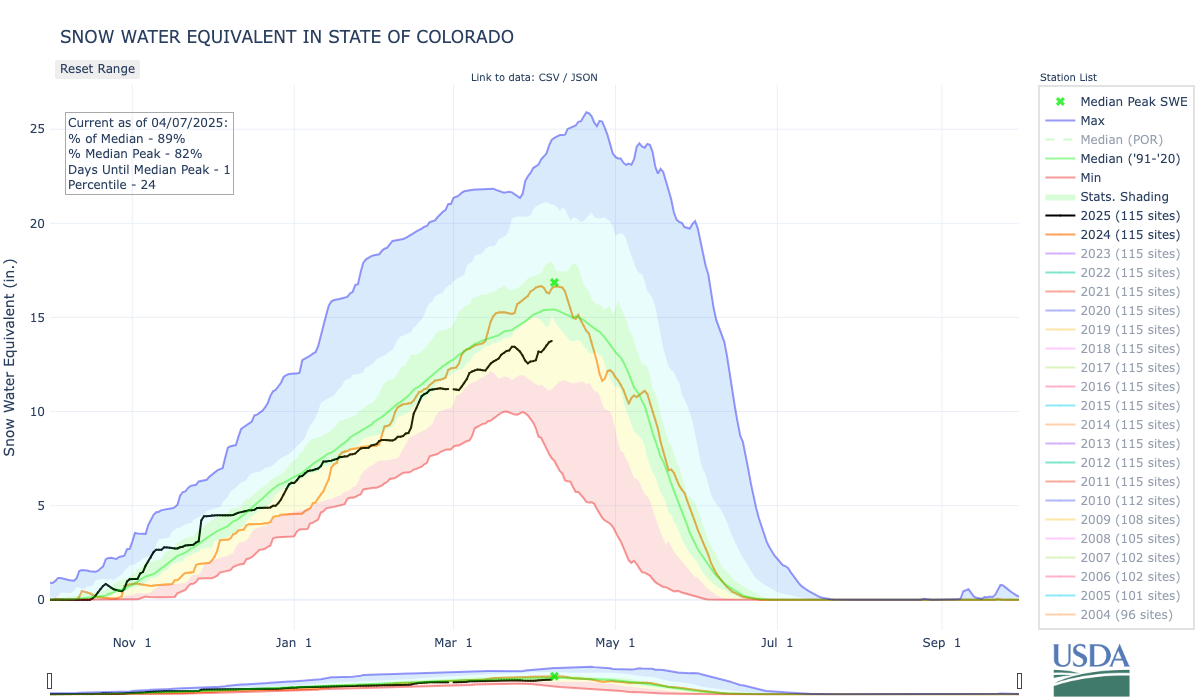
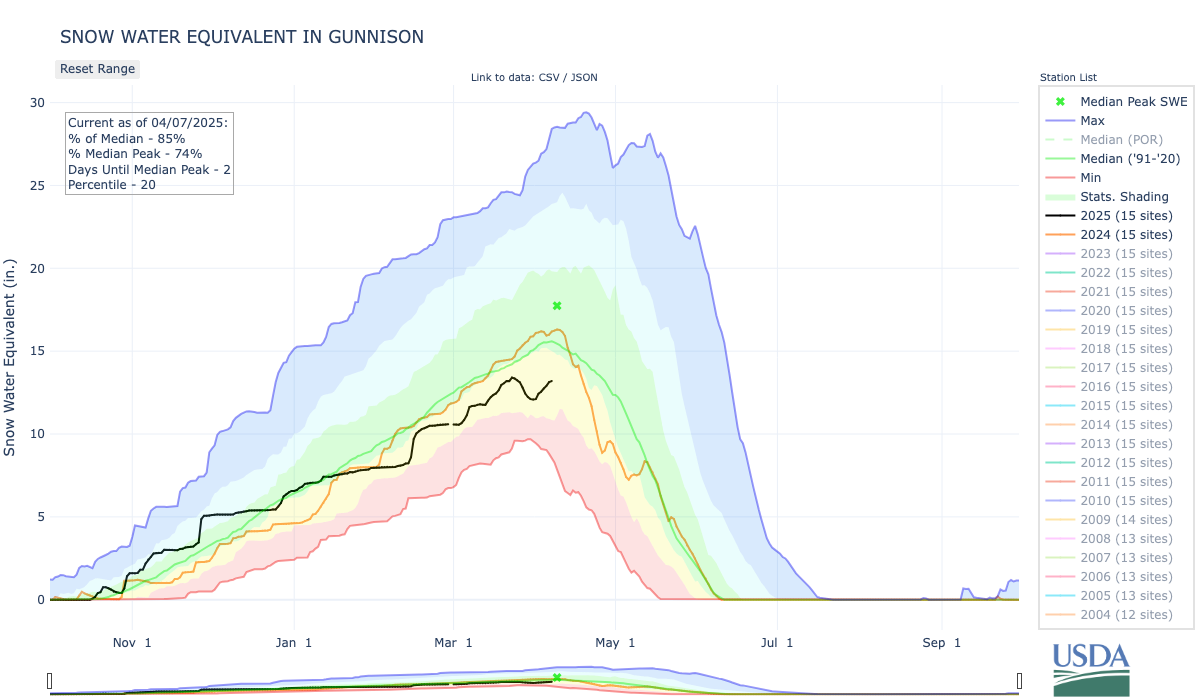
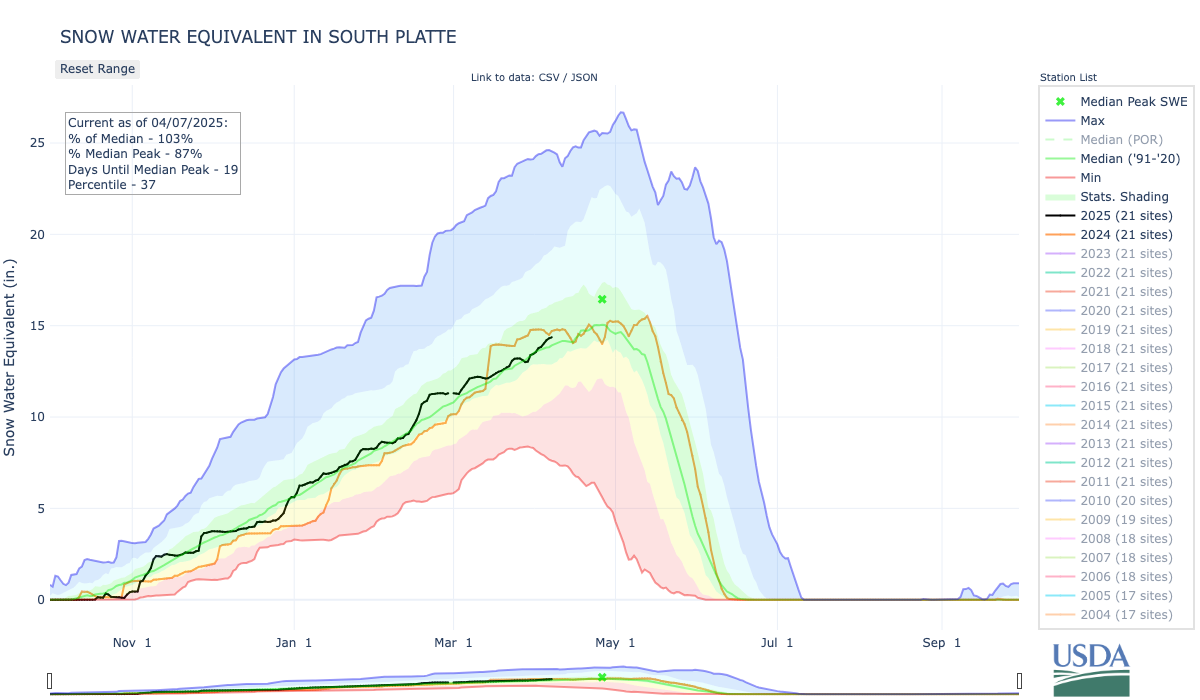
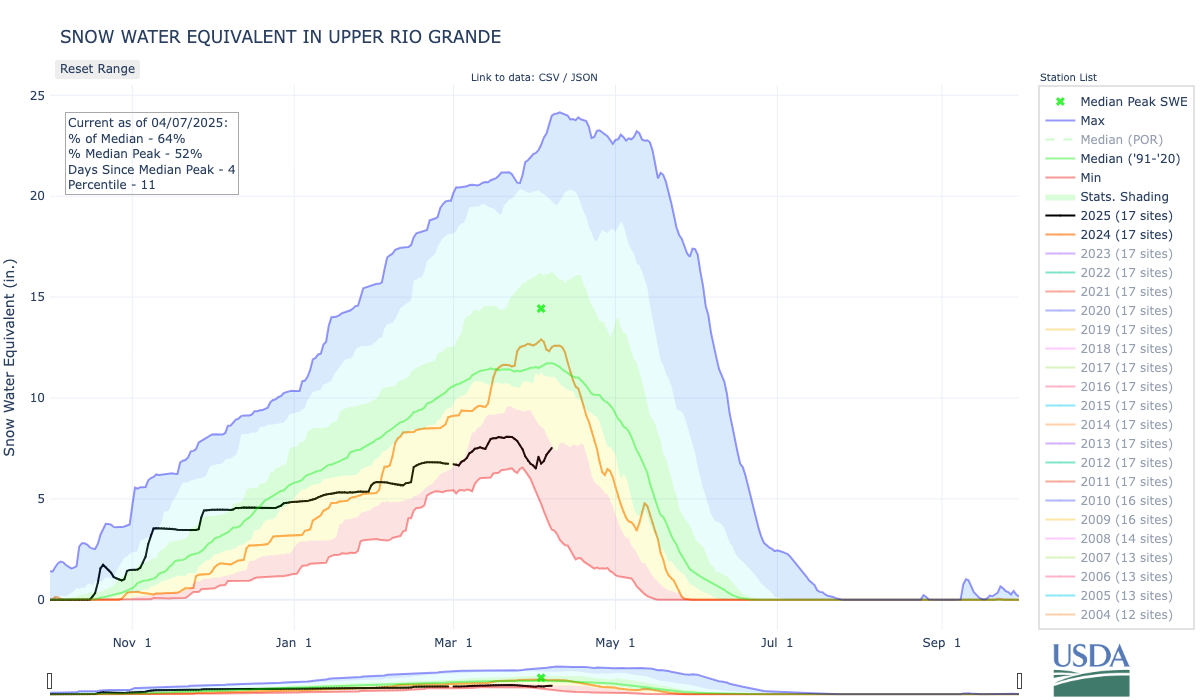
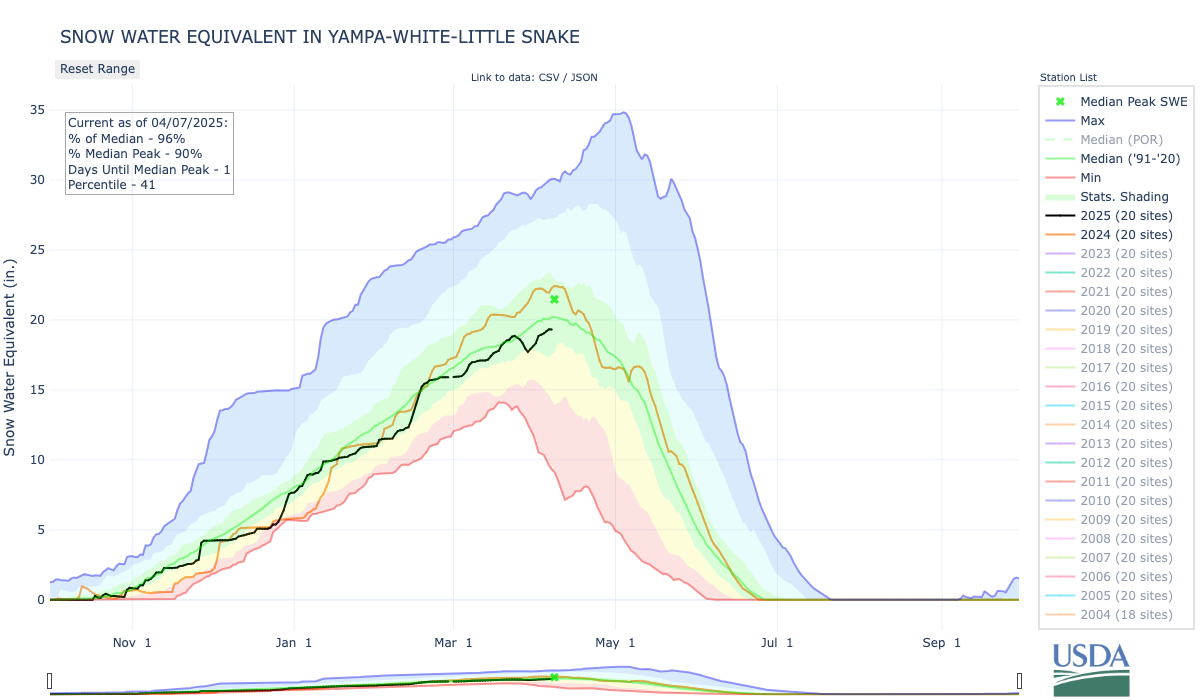
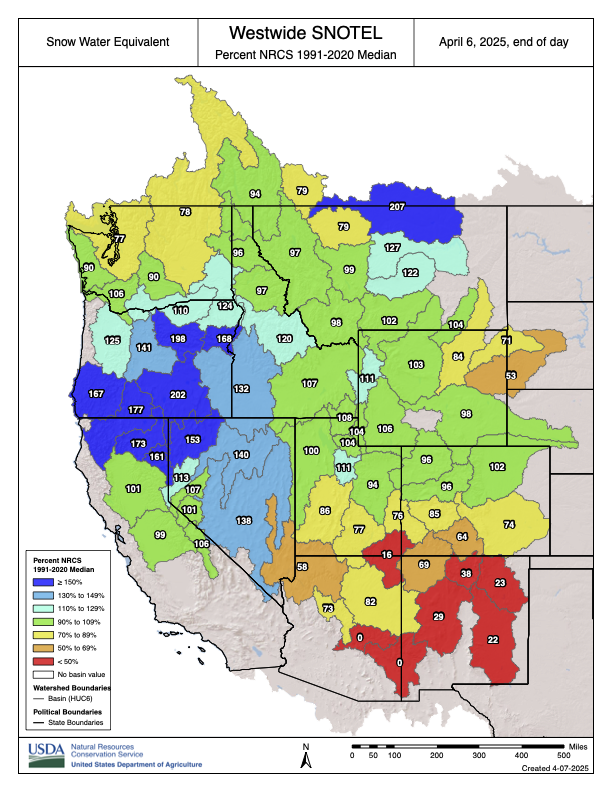
The peak in mountain snowpack (the amount of water stored in the snow) is typically in early April in Colorado’s southern mountains, and later in April in the north. Looking at the conditions right now, we’ve almost certainly passed the peak for this year. And the numbers don’t look good, especially in the southern part of the state.
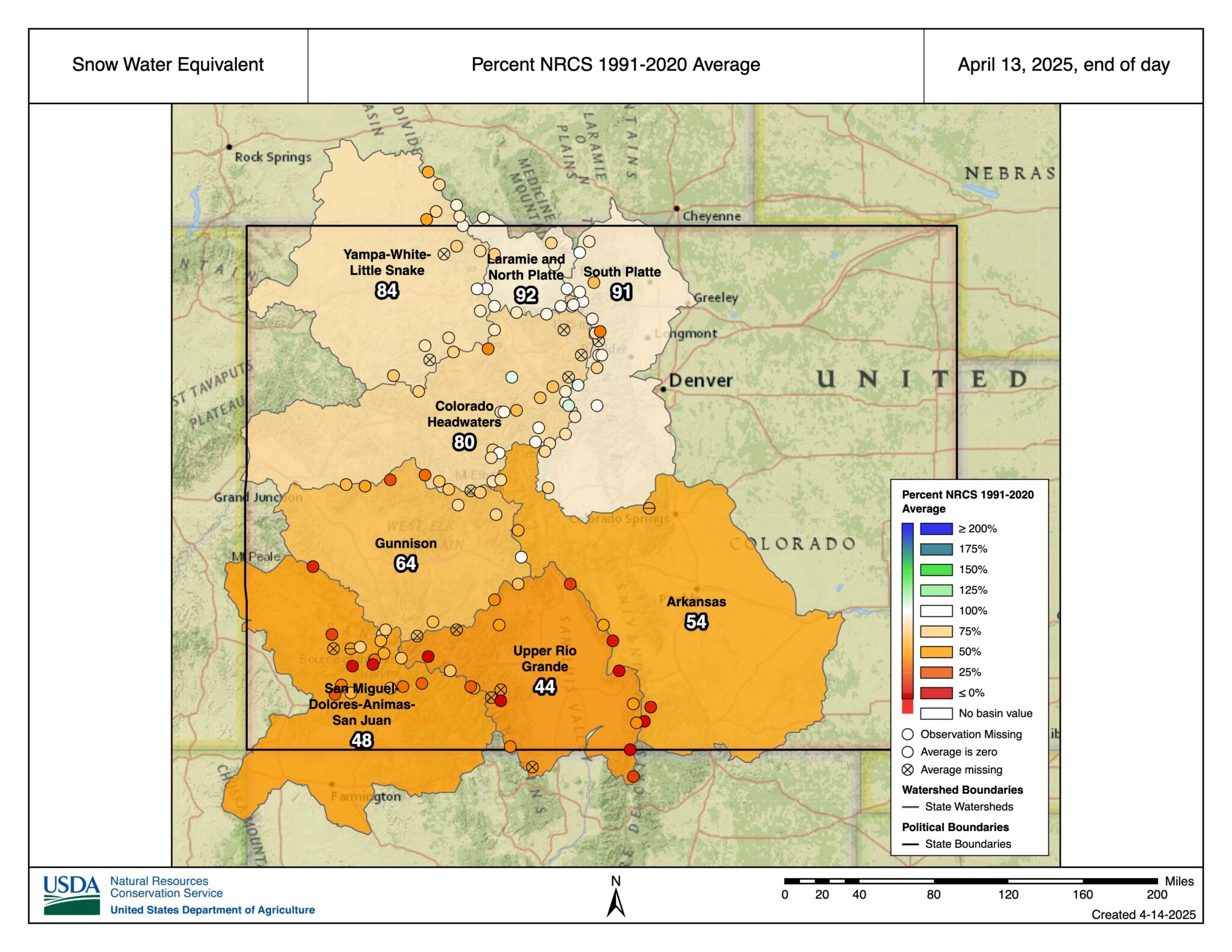
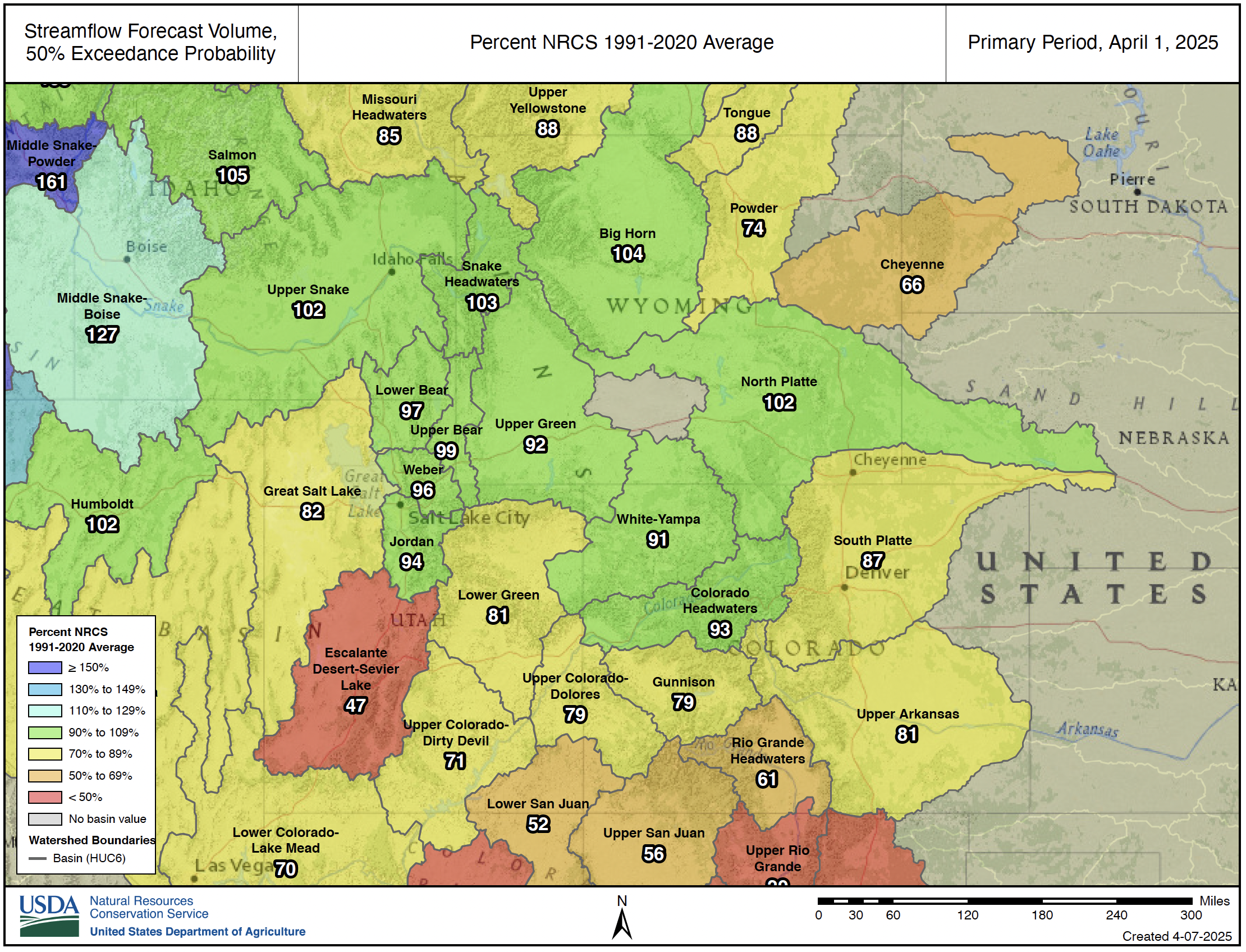
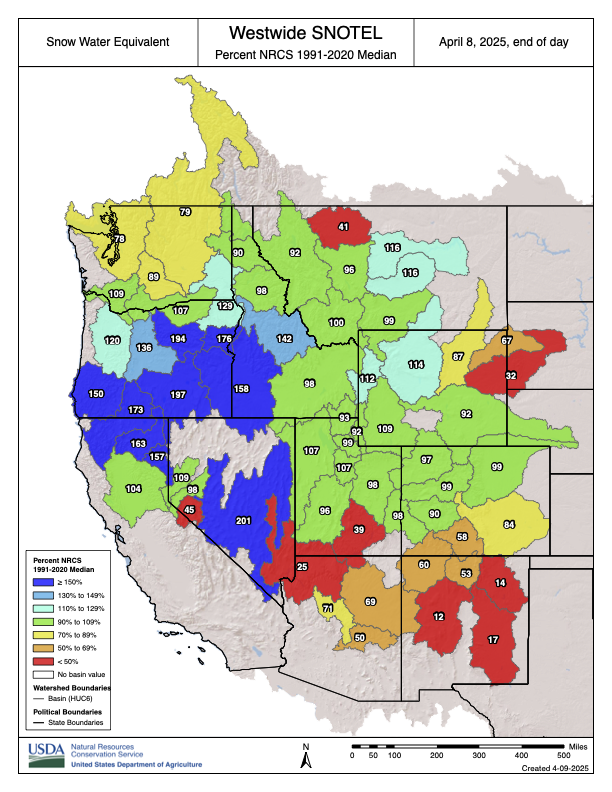
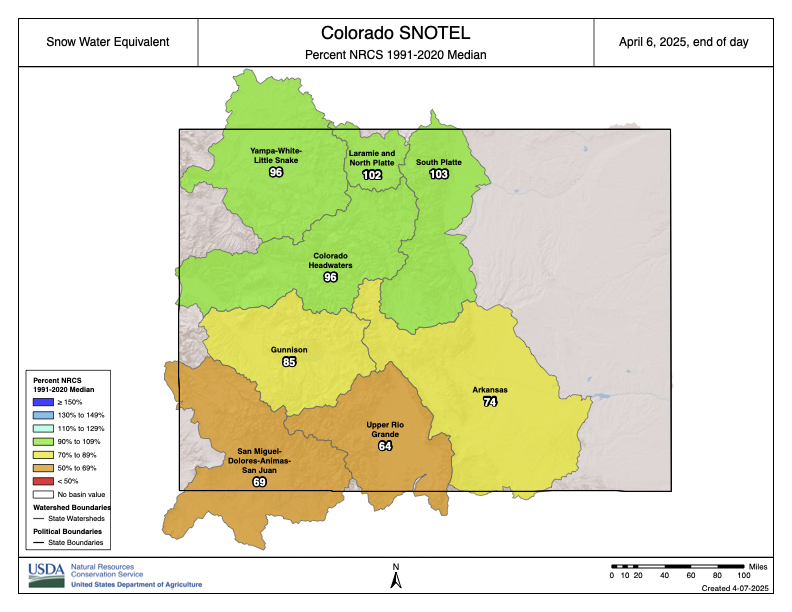
As of April 13, the mountains that feed water into the southern river basins had less than half of the usual snowpack they would usually have on that date. The numbers aren’t as bad in the northern mountains, with 80-90% of average snowpack. But keep in mind that in the northern basins, the average is still going *up* in mid-April, but the snow this year is already starting to decline. So with warm, sunny days and no new snow falling, these numbers are also going to get smaller as April goes on. From the perspective of “snow drought” and water supply for the coming summer, this is not what you want the snowpack map to look like in mid-April.
Snow water equivalent as a percent of the 1991-2020 median for the major river basins in Colorado as of April 12, 2025. Source: USDA/NRCS interactive map.
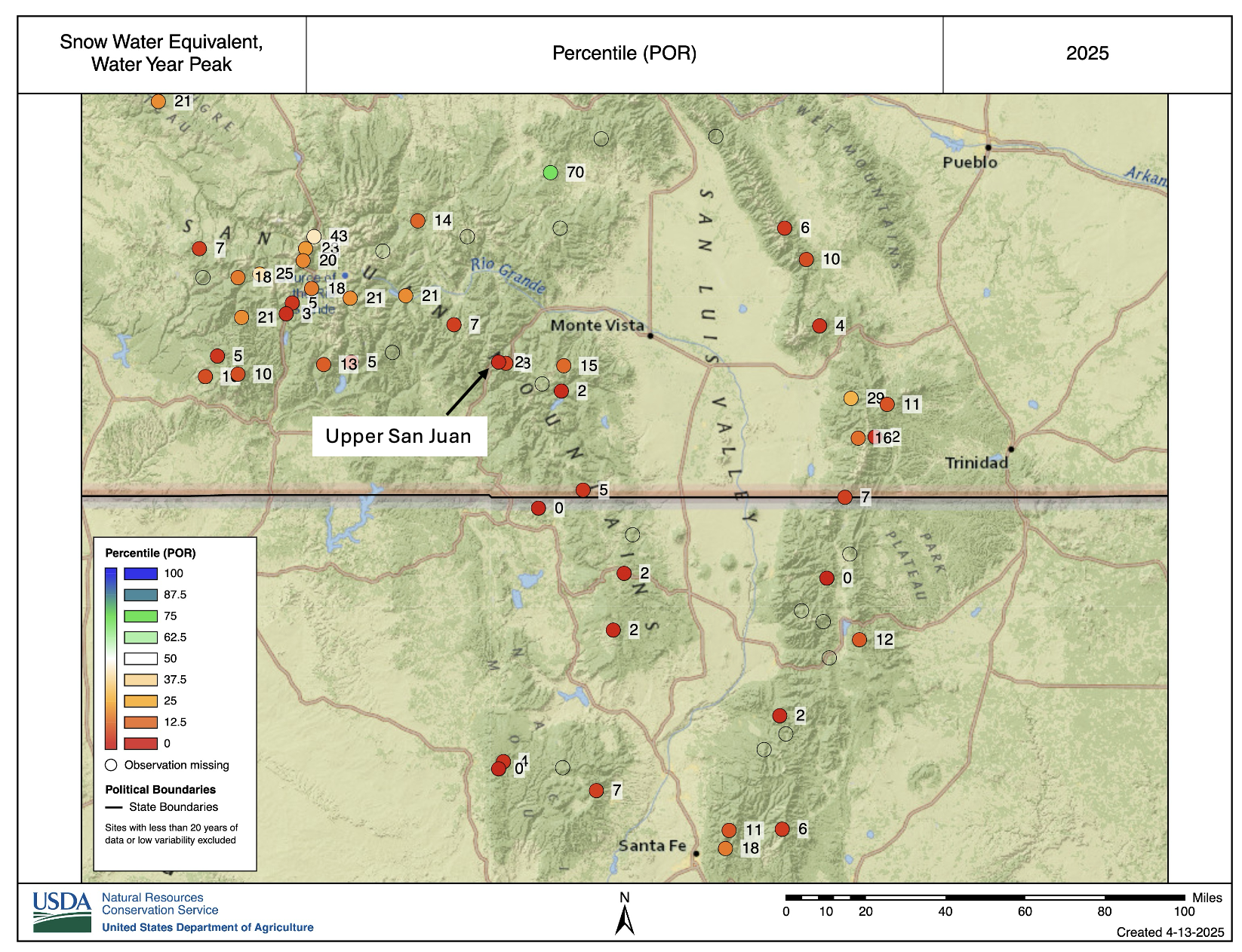
Since we’re almost certainly past the peak, we can also see how this year’s peak stacks up compared to past years. In many locations, these numbers make the picture look even worse. This map shows the percentile rank of the peak snow water equivalent (SWE) compared to all past years at each SNOTEL station, focusing on southern Colorado and northern New Mexico. On this map, if you see 50 it means it’s right in the middle of the historical distribution; 100 means the highest on record, and 0 the lowest. Through the San Juan and Sangre de Cristo mountains, many stations are below the 10th percentile, and several had their lowest or 2nd-lowest peak snowpack since they were installed (most were established in the late 1970s or early 80s).
Water year peak snow water equivalent percentile ranking in southern Colorado and northern New Mexico. Source: USDA/NRCS interactive map.
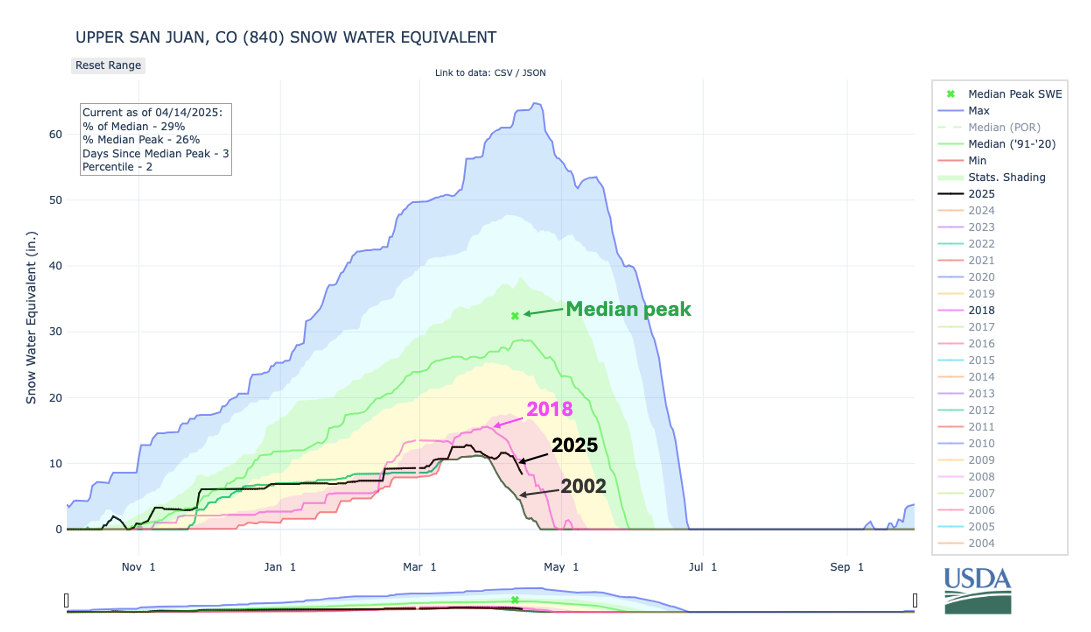
For example, at the Upper San Juan SNOTEL station near Wolf Creek Pass, it’s the 2nd-lowest peak SWE since the station was established in 1979, worse than even 2018 (which was a terrible drought and wildfire year in southwestern Colorado), though still ahead of the historic 2002 drought year. With record-warm conditions in recent days and sunny conditions that increase sublimation, what snowpack remains is going to continue declining rapidly.
Time series of snow water equivalent at the Upper San Juan SNOTEL station in southwestern Colorado. The 2025 time series is shown in black, with comparison to other very bad snow years of 2018 (magenta) and 2002 (gray). The median peak is shown in green. Source: USDA/NRCS.
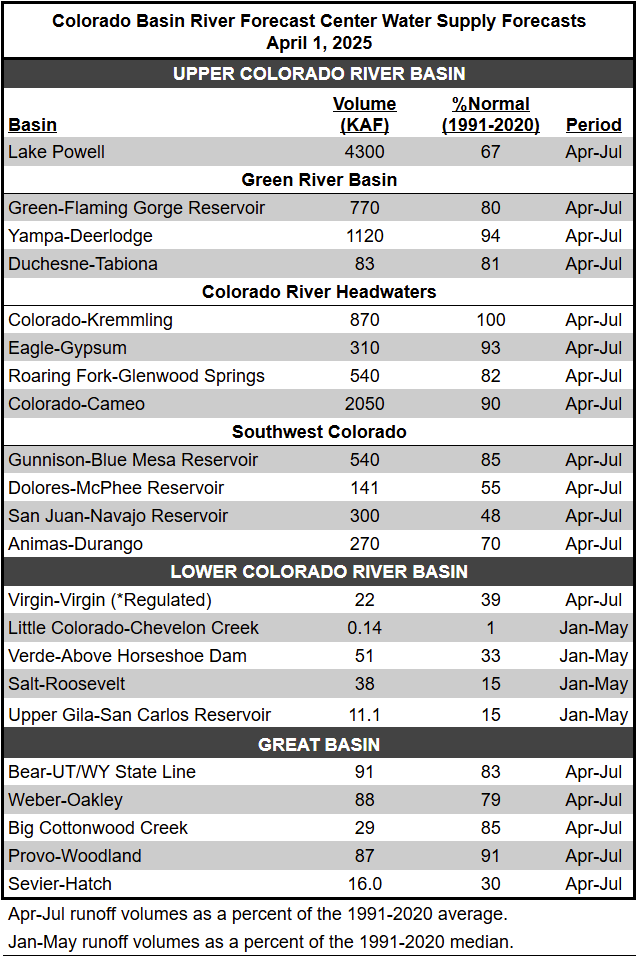
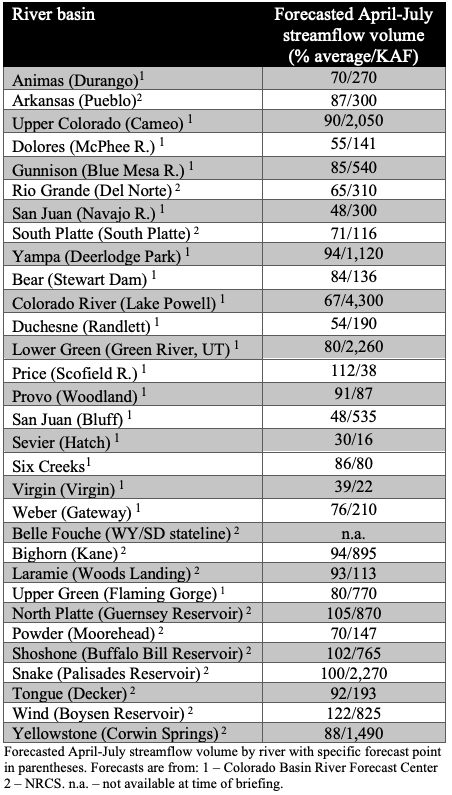
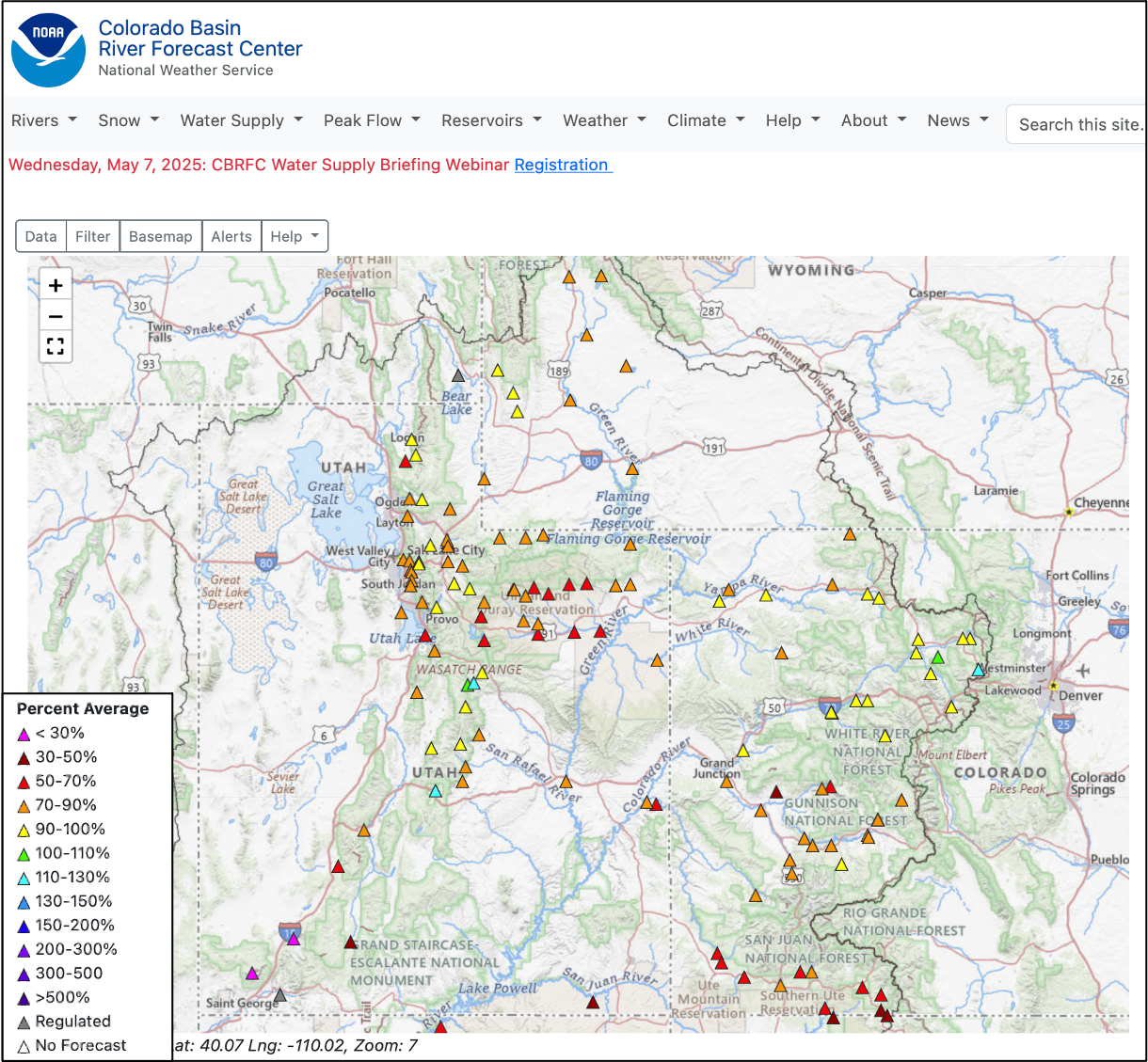
In the northern parts of the San Juan mountains, the snowpack numbers aren’t quite as bleak, but overall it is shaping up to be a very poor year for streamflow and water supply in southwest Colorado (and throughout the southwest US). The water supply forecasts from the Colorado Basin River Forecast Center bear this out. The predicted river flows for April through July (when the vast majority of the annual flow occurs) are not so bad in the headwaters of the Colorado River in Colorado, where the projection is for 80-100% of average water supply. But in the southwestern Colorado rivers like the Animas, San Juan, and Dolores, flows will be much lower than average, and Lake Powell is expected to see less than 70% of its average inflow. Lake Powell levels aren’t quite at the historic lows from a few years ago, but the lake is still far lower than its historical average and will likely see further declines this year with poor inflows and continued high demand for water.
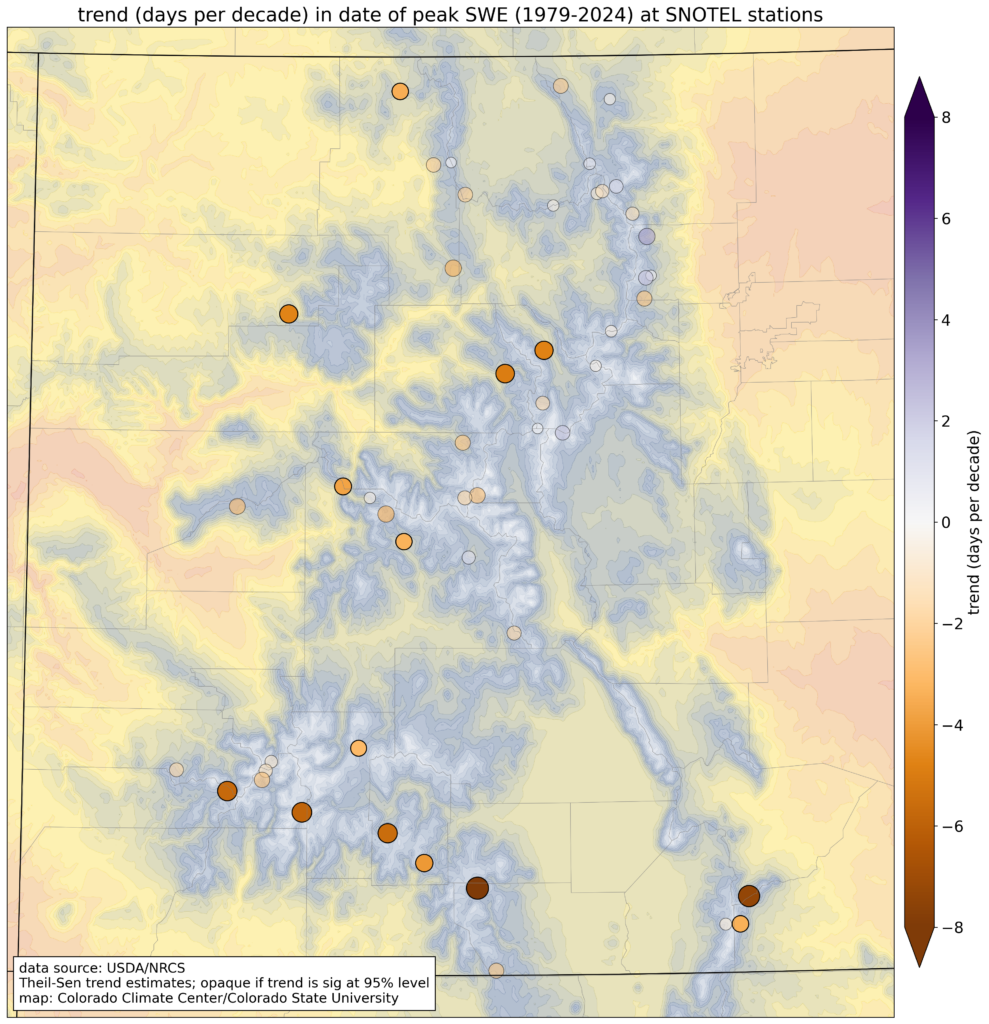
The poor mountain snowpack and early melt-out this year align with the trends in Colorado’s southern mountains over the last 40+ years. We’ve analyzed the trends at the SNOTEL stations that have data back to at least 1979, for both the peak SWE and the date of the peak SWE. If you see opaque circles on the maps below, there is a statistically significant trend over this time period; if the circles are transparent the trend is not significant. In Colorado’s northern mountains, trends over the last 45 years are fairly modest overall, with some mixed signals. But in the southern mountains, the data make a very clear statement: snowpack is declining, and the peak is happening earlier. At many of the stations in the San Juan and Sangre de Cristo mountains, the peak SWE has declined by 3-5% per decade, and the peak has shifted 2-4 weeks earlier. (When this year’s poor snowpack gets incorporated, these trends might look even steeper.) A combination of factors are responsible for these trends, including that the 1980s were unusually wet, so the recent declines look even worse; rising temperatures globally and especially in the interior west, and increases in dust-on-snow that reduces the ability of snow to reflect sunlight. Heat waves in April, like the one we’ve experienced in recent days, don’t help the situation either, as discussed in this paper about a similar heatwave in April 2021. You might recall that we had one last year too.
Trends in snow water equivalent at Colorado SNOTEL stations from 1979-2024. Trend in water year peak SWE, as a change in the percent of median per decade. Credit: Colorado Climate Center
Trend in the date of the peak SWE, in days per decade. The size of the circles is proportional to the magnitude of the change (i.e., it provides the same information as the color shading). Trends are calculated using the Theil-Sen slope; if the trend is statistically significant at the 95% confidence level, the circle has opaque color shading, otherwise the shading is semi-transparent. Background shading is elevation, with blue and white colors indicating higher elevation. Credit: Colorado Climate Center
The overall downward trend doesn’t mean we can’t still get years with big snowpack — some of the same locations that are near record lows this year were near record *highs* in 2019 and 2023. But the bad years are outnumbering the good ones over time.
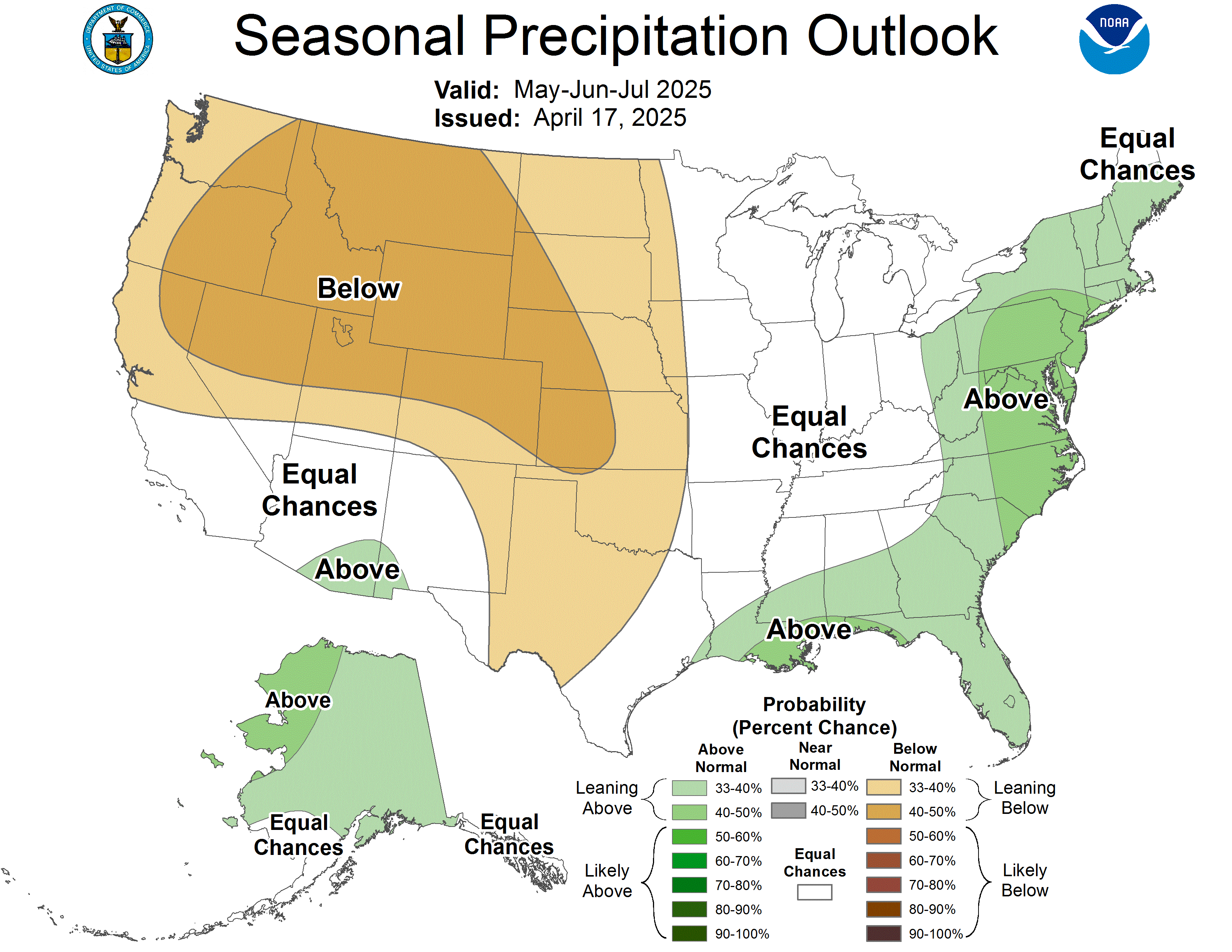
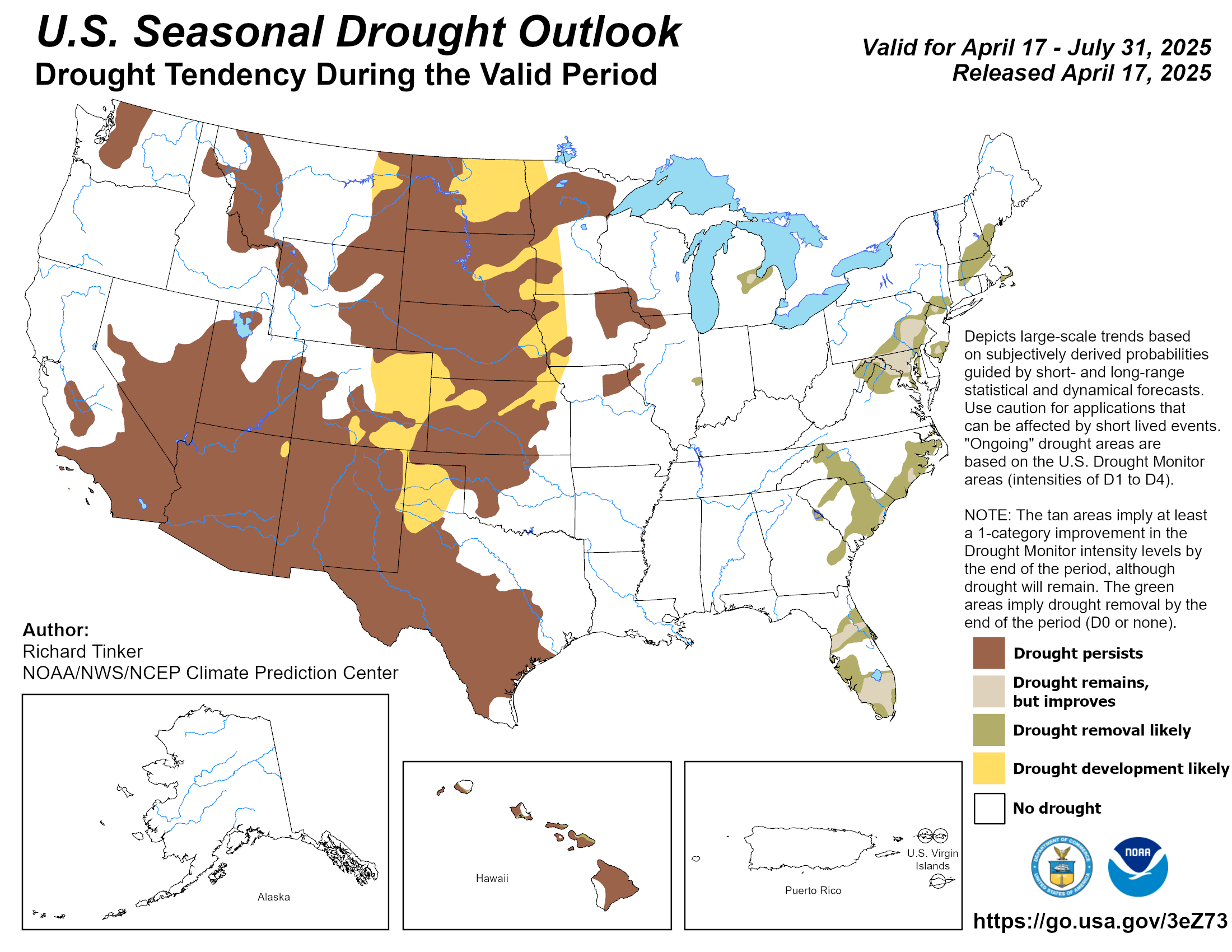
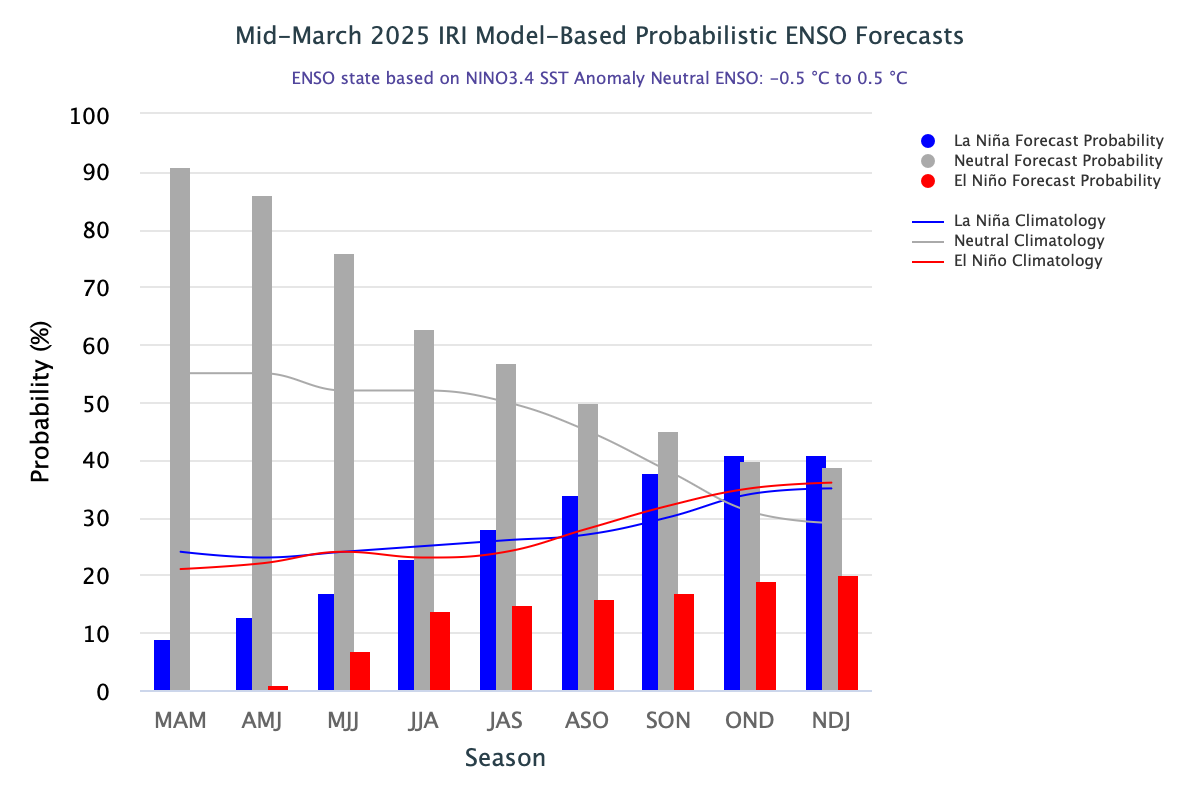
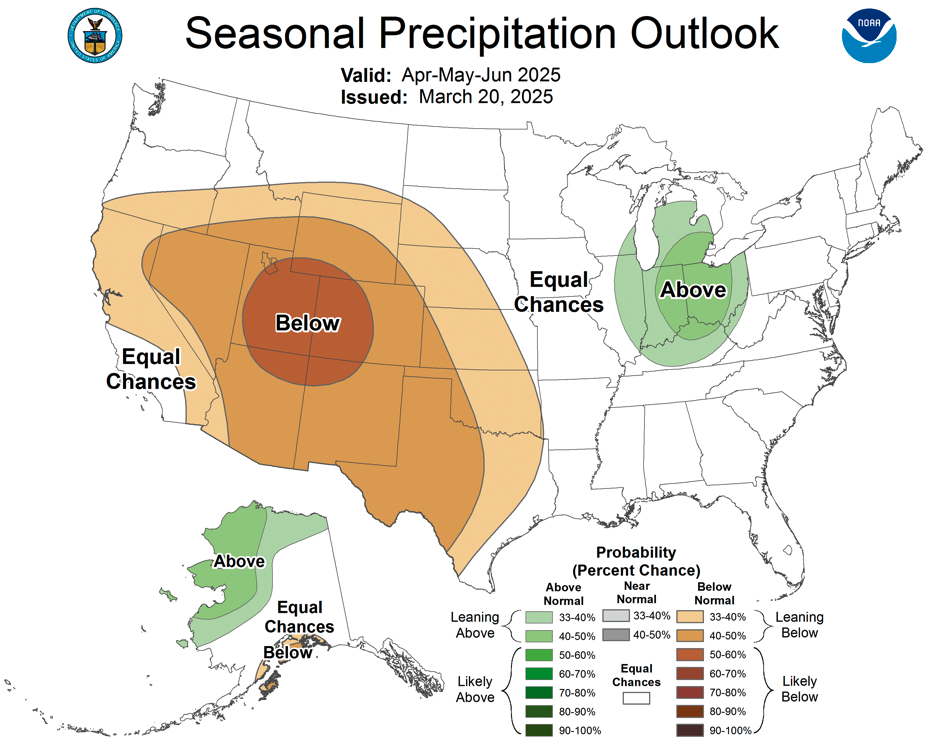
Could there be a “Miracle May” to improve the situation like what happened in 2015? In western US weather and climate, anything is possible! But it does not appear to be very likely. Although La Niña conditions that have been in place through the winter are waning, the NOAA Climate Prediction Center outlook shows high confidence for continued drier-than-average conditions through the spring and early summer. It would be nice if we could find some better news about drought and water in Colorado to share, but right now unfortunately there isn’t much good news to find.
In summary: Gov. Gavin Newsom and Attorney General Rob Bonta announced the lawsuit Wednesday, saying the tariffs hurt “states, consumers and businesses.”
This story was originally published by CalMatters. Sign up for their newsletters.
With the state budget hanging precariously in the balance, Gov. Gavin Newsom filed a lawsuit today to block President Donald Trump’s tariff powers.
The lawsuit, which Newsom and Attorney General Rob Bonta filed in federal court in San Francisco, argues that Trump does not have the constitutional authority to unilaterally enact tariffs. Trump cited the United States’ large trade deficit to declare a national emergency earlier this month and impose sweeping import taxes on the rest of the world.
Visiting an almond farm in Turlock, which stands to lose export business to retaliatory tariffs, Newsom expressed anger over the “toxic uncertainty” of the president’s trade policy. He said the policies are harming California more than any other state and called the tariffs a betrayal of the voters who supported Trump because of his promise to bring down the cost of living.
“This is recklessness at another level. The geopolitical impacts are outsized. The trade impacts are outsized,” Newsom said. “No rationale, no plan, no conscience to what it’s doing to real people.”
In a matter of days in early April, Trump invoked the International Emergency Economic Powers Act of 1977 to establish a universal 10% tariff on all countries importing goods to the United States, with even higher reciprocal tariffs on some nations, then abruptly reversed course hours after they took effect, pausing most of the reciprocal tariffs while ratcheting up the import tax on China to 145%.
The chaos tanked the stock market, a huge risk for California’s forthcoming budget, which depends disproportionately on income tax revenue from capital gains earned by the wealthiest taxpayers. The state is also particularly vulnerable to other economic pain from the tariffs, because China is California’s largest trading partner, propping up manufacturing, agriculture, tourism and major ports in Los Angeles, Long Beach and Oakland.
Other significant potential impacts for California include driving up the cost of construction materials just as Los Angeles begins rebuilding from a series of devastating fires that flattened several neighborhoods in January.
California’s economic outlook is declining
Newsom said today that, anticipating higher inflation and higher unemployment from the tariffs, he has downgraded California’s economic outlook in a revised budget proposal that he plans to unveil next month. Though did not speak to Trump about the lawsuit, he said he gave the White House a heads up.
In a statement, the White House slammed Newsom for undermining Trump’s efforts to rescue American industry.
“Instead of focusing on California’s rampant crime, homelessness, and unaffordability, Gavin Newsom is spending his time trying to block President Trump’s historic efforts to finally address the national emergency of our country’s persistent goods trade deficits,” spokesperson Kush Desai said.
The state contends that the International Emergency Economic Powers Act specifies many remedies a president can take in response to a foreign economic threat, but tariffs are not among them. Without this specific authorization from Congress, the lawsuit argues, Trump’s actions are “unlawful” and “unprecedented.”
Joining Newsom in Turlock, Bonta said Trump was “attempting to override Congress and steamroll the separation of powers” and that his “rogue and erratic tariffs” must be stopped to prevent further damage to California’s economy.
“Trump has had to resort to creating bogus national emergencies that defy reason,” Bonta said. “Bottom line: Trump doesn’t have the singular power to radically upend the country’s economic landscape. That’s not how democracy works.”
Alan Sykes, who teaches international trade law at Stanford Law School, told CalMatters that California’s case has merits, but it may be difficult to win.
He said the international powers act is ambiguous about tariffs; they are not explicitly mentioned in the law, though there is language allowing for the regulation of imports and exports. But Congress has also passed other laws over the years giving away their constitutional power to set tariffs. Sykes noted that Trump could shift to citing those statutes instead if his tariffs are struck down.
“Congress has badly over-delegated authority to the president in this regard,” Sykes said. “I’m not terribly optimistic that the courts are going to rein that in.”
The lawsuit continues Newsom’s shift back toward a more aggressively confrontational stance against the Trump administration. After the Los Angeles wildfires, the governor sought to reset his relationship with Trump as he lobbied for federal disaster aid.
But even though Congress has yet to approve any further assistance for Los Angeles, Newsom has begun more vocally opposing the president’s economic policies in recent weeks.
Newsom was unusually harsh when speaking about Trump’s tariffs in Turlock, calling them the “poster child” for stupidity and an example of “crony capitalism” because of the president’s willingness to exempt products from favored industries such as electronics manufacturing.
“This is the personification of corruption,” Newsom said. “How in the hell are we sitting by and letting this happen?”
Straight line diagram of the Lower Arkansas Valley ditches via Headwaters Magazine
Click the link to read the article on The Denver Post website (Elise Schmelzer). Here’s an excerpt:
April 6, 2025
Colorado Springs’ latest annexations, now under challenge, have left Arkansas River communities wary
As a worker maneuvered a massive leveler in the fields behind their house, Alan and Peggy Frantz pondered the future of their Rocky Ford farm — and their larger agricultural community strung along the Lower Arkansas River east of Pueblo. The collapse of it all doesn’t feel too far out, too improbable, Alan Frantz said. Maybe not in their lifetimes, the couple said, but they’ve made sure to send their kids to college in case it all goes away.
“At some point, the cities just have to stop growing,” Alan Frantz said. “If you want a Dust Bowl like the ’30s, go ahead and take all the water, dry this all up.”
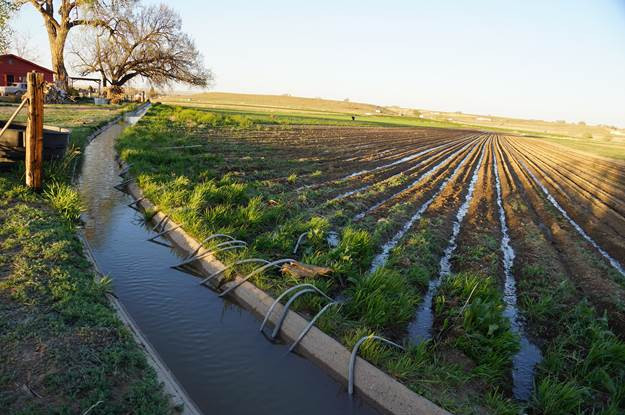
Flood irrigation in the Arkansas Valley via Greg Hobbs
Colorado Springs is one of the cities Frantz and many of his neighbors worry most about — and now they fear a proposed 6,500-home annexation to that city will increase pressure on its utilities to source more water from the Arkansas. The farmers use the river to irrigate more than 220,000 acres of farmland, the economic backbone of the region. Already, Colorado Springs Utilities estimates it will need 34,000 more acre-feet of water — or 11 billion gallons — annually to meet population growth for when the city fully develops inside its current boundaries, estimated to occur around 2070. Every annexation of land into the state’s second-largest city adds to that future gap. Without water, there is no farming. And without farming, Frantz said, there would be no towns along the Lower Arkansas as it stretches from Pueblo to the Kansas border…
The controversy around the Colorado Springs annexation is the most recent flashpoint illustrating one of the central tensions in the state: Colorado’s cities do not have enough water to meet projected growth and climate change is shrinking the finite amount of water available. Where should the cities go for more supply? Who will give up their water? The decades-old battle plays out across the state as growing Front Range communities seek new water sources. Communities on the Western Slope fear more of their water will be routed east across the Continental Divide, especially as the region’s largest river shrinks. Farmers and ranchers in the San Luis Valley successfully fought off an attempt by a company to pipe water from the valley’s depleting aquifer to ever-growing Douglas County. Aurora’s $80-million purchase of Otero County water rights last year rankled water leaders in southeastern Colorado, prompting threats of litigation.
Colorado transmountain diversions via the State Engineer’s office
From email from the Upper Gunnison Water Conservancy District (Sue Uerling):
The Colorado River District and the Upper Gunnison River Water Conservancy District are sponsoring the State of the Upper Gunnison River dinner and presentation. This event will be held on April 17, 2025, beginning at 6:00 p.m. at the Fred Field Center. The Colorado River District requires that you pre-register for the event using this link https://form.jotform.com/250417068418154. Hope to see you there.
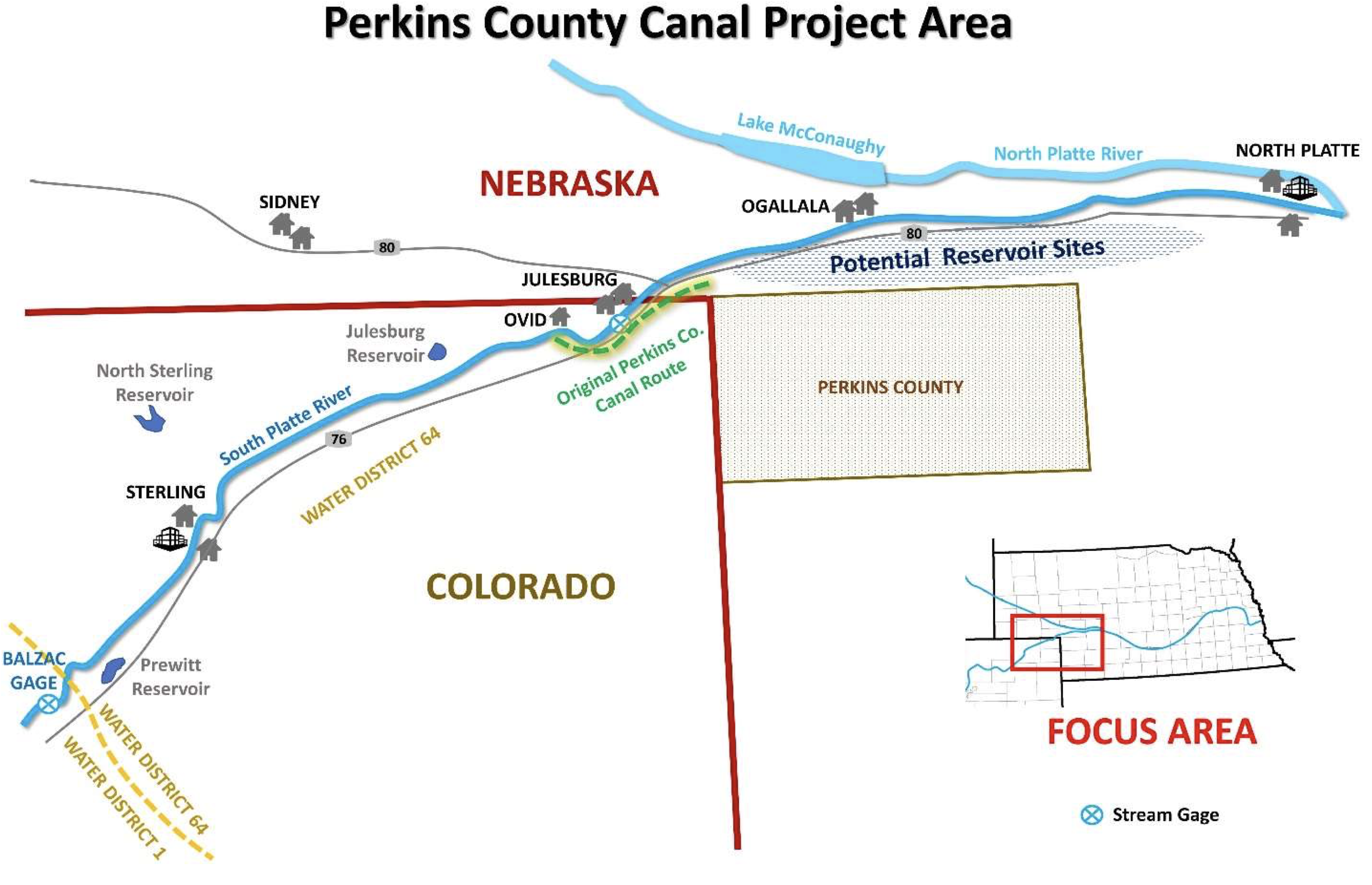
Perkins County Canal Project Area. Credit: Nebraska Department of Natural Resources
Click the link to read the article on the Colorado Politics website (Marianne Goodland). Here’s an excerpt:
April 7, 2025
On or around April 17, six landowners in Sedgwick County will face a decision: whether to sell their land to the state of Nebraska for a canal that will be at least partially constructed in Colorado, or face what is likely to be an unprecedented land grab…The history of the proposed canal dates back more than 100 years, to the compact between Colorado and Nebraska regarding water from the South Platte River. Article VI of the compact states that Nebraska can divert 500 cubic feet per second during the non-irrigation season, as well as any additional available flows, into the canal. That non-irrigation season runs from Oct. 15 to April 1…
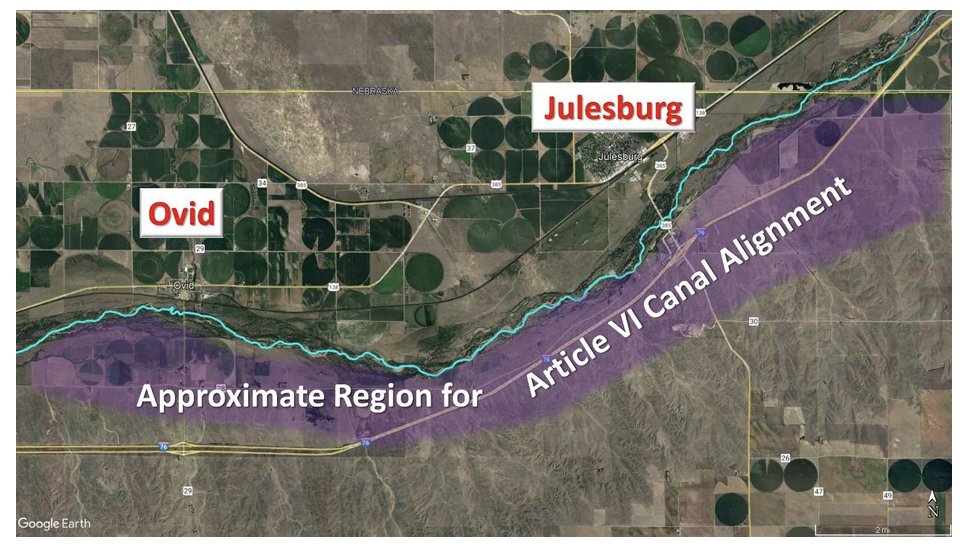
However, Nebraska claims that Colorado has increased its own diversions and related water uses during the non-irrigation season, leaving Nebraska with no choice but to construct the canal and claim its non-irrigation season water. The canal would start just east of Ovid, in Sedgwick County, and continue into Perkins County, just across the state line in Nebraska. The 1923 compact allows Nebraska to build the canal, using eminent domain, and to seek it in federal court if necessary.
People work on the Perkins County Canal in the 1890s. The project eventually was abandoned due to financial troubles. But remnants are still visible near Julesburg.
Perkins County Historical Society
For one state to grab the land of another is unprecedented, Attorney General Phil Weiser told Colorado Politics earlier this year. While Colorado agreed to the canal in 1923, that’s not how Weiser sees it now. Weiser sent a letter to the Sedgwick County commissioners in January, stating that he is opposed to Nebraska’s potential action. He wrote that he had advised Nebraska’s attorney general that the project would provide little to no benefit to the state of Nebraska. However, if Nebraska moves forward, Colorado will defend its rights, he added.
Perkins canal drawing showing the Colorado portion, courtesy Nebraska Department of Natural Resources.
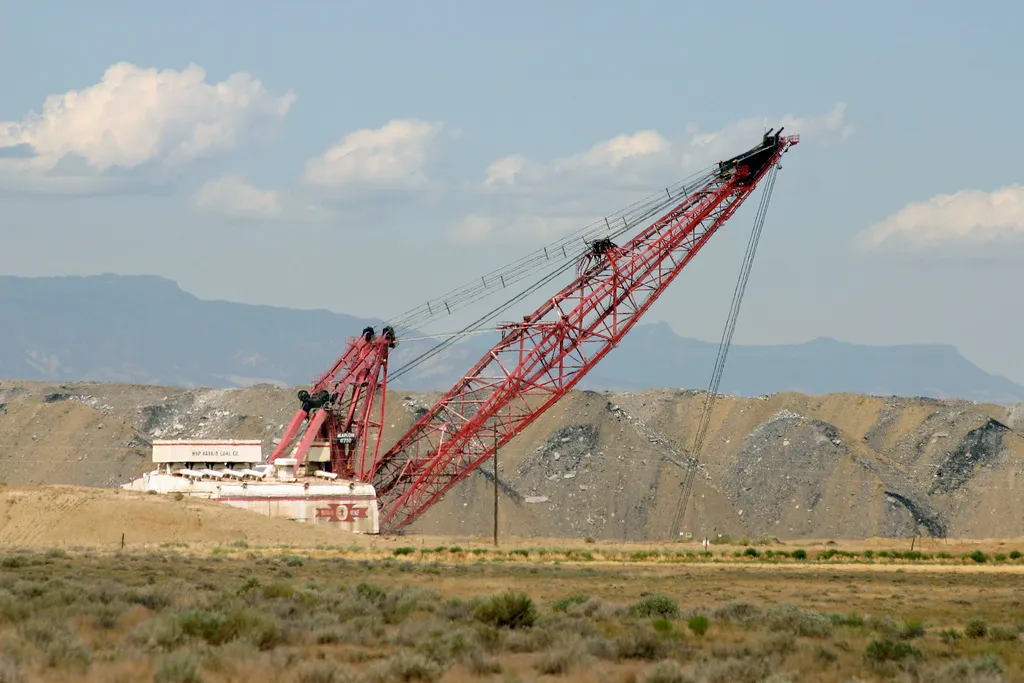
Dragline at the Navajo Mine in New Mexico. The Navajo Nation-owned Navajo Transitional Energy Company owns the mine along with two mines in the Powder River Basin. Navajo Nation Buu Nygren was on hand to cheer on Trump as he signed the pro-coal executive orders. Jonathan P. Thompson photo.
The News: This week, President Donald Trump signed a slew of executive orders that wipe away environmental protections in the name of saving “beautiful, clean” coal from what Trump and his minions call a regulatory “war on energy.” The purpose, he says, is to make the grid more reliable and to ensure there is adequate generating capacity to meet AI-powering and cryptocurrency mining data centers’ burgeoning power demand.
The orders:
Designate coal as a “mineral” so that it qualifies for regulatory relief under Trump’s pro-mining executive order, and suggest designating coal as a “critical material” due to its use in steel making. (As if that’s going to do anything?)
Orders the secretaries of Interior, Agriculture, and Energy to identify coal resources on federal lands and any impediments to extracting them, and propose “policies to address such impediments and ultimately enable the mining of such coal resources by either private or public actors.” (Public actors? Does this mean what I think it means: The feds are going to start coal mining? Maybe they’ll just nationalize the industry — Hello comrade Trump! — to wipe away all so-called impediments, of which there are very few, by the way.)
Orders the Interior Secretary to lift barriers to mining coal on federal lands, including definitively ending an Obama-era moratorium on new coal leasing and the Biden-era halting of new leases in the Powder River Basin. (These are only speculative “barriers” because existing leases hold enough coal to meet current levels of demand for another 40 years — and demand is likely to keep dropping, meaning coal companies probably would never be affected by the leasing freeze).
Encourages coal exports. (Umm, yeah, you should have thought about that before all of this tariff talk, dude.)
Looks to identify regions where “coal-powered infrastructure is available and suitable for supporting AI data centers and assess … the potential for expanding coal-based infrastructure to power data centers … .”
Exempts some coal power plants from Biden-era Mercury and Air Toxics Standards for two years.
Looks to prevent large power sources “from leaving the bulk-power system or converting the source of fuel of such generation resource if such conversion would result in a net reduction in accredited generating capacity.” (He wants to block utilities from retiring or converting or old coal plants to run on cheaper, cleaner fuels.)
The Context: Let’s just get a couple things straight right off the bat. First, there are no significant regulatory barriers to mining coal. Arch, Peabody, Navajo Transitional Energy Company, and a handful of other companies have leases on and essentially unfettered access to billions of tons of coal at their gargantuan Powder River Basin mines. They could continue tearing apart the earth for decades before needing to lease more land, making Biden’s freeze on future leasing — and Trump’s unfreezing of it — speculative and symbolic.
In Biden’s case, it symbolized his desire to do something about the climate crisis and to cement a legacy as an environmentally minded president; for Trump it’s all about fossil fuel fetishization.
Coal mine production has been dropping due to declining demand: Utilities simply aren’t burning as much coal as they used to, in part because it’s dirty, but mostly because the shale revolution — i.e. “fracking” — has resulted in a natural gas supply glut, bringing the cost of the slightly cleaner-burning fuel below that of coal. More recently, increasingly affordable wind and solar power have also been displacing coal — and gas — generation from the grid.
So rolling back regulations on mining is useless if you’re trying to spur production. The only way to do that is get utilities to go against their own financial interests and burn more coal.
That’s where some of the other provisions in the orders come in. By exempting coal plants from the MATS rule for two years, Trump is opening the door for facilities such as the Colstrip coal plant in Montana to continue to operate without expensive new pollution control equipment. Colstrip is considered one of the dirtiest facilities in the nation, spewing harmful emissions from its smokestack and in the form of coal combustion waste.
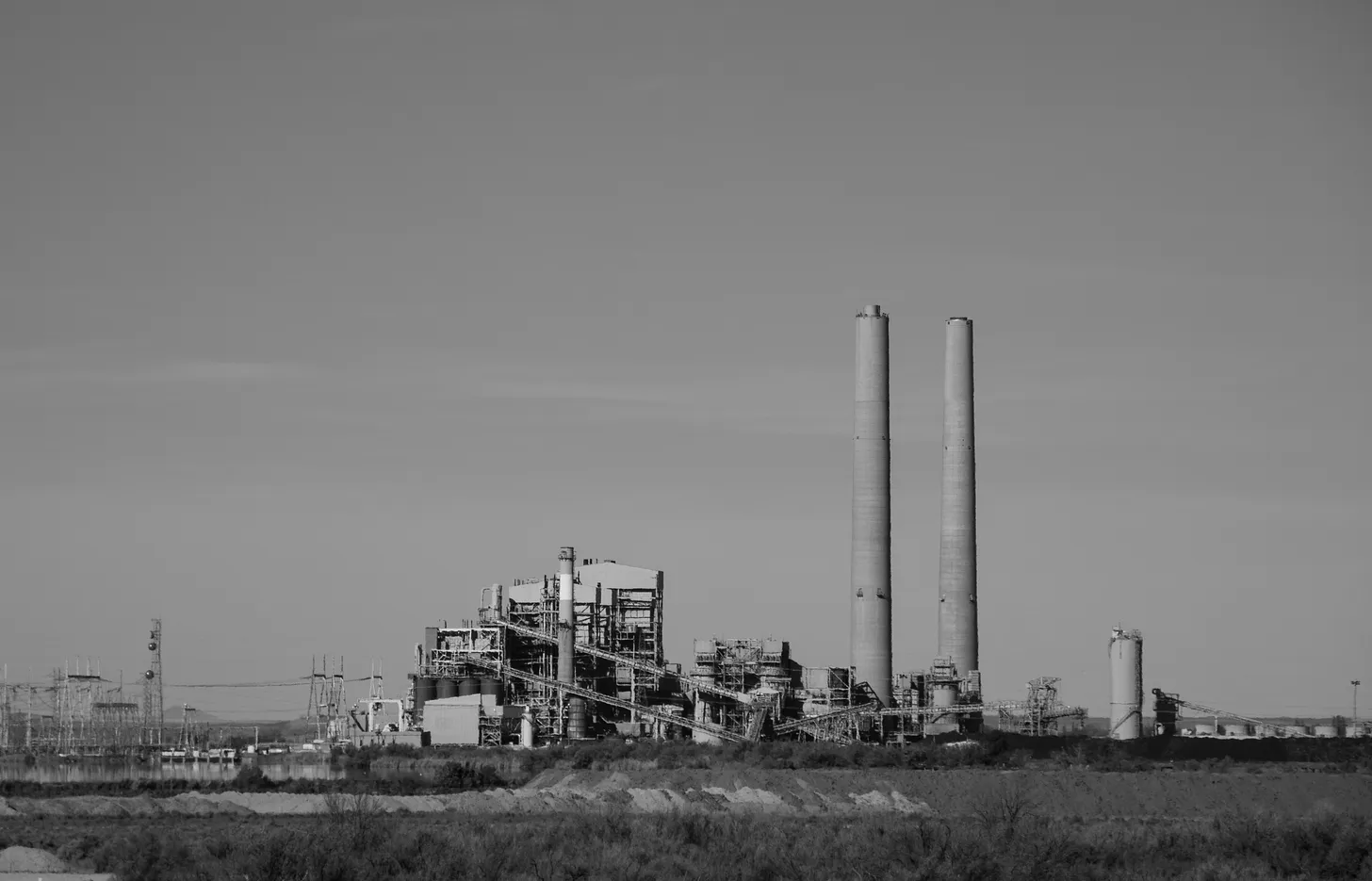
The Cholla coal plant near Joseph City, Arizona. Trump said his executive order would save it from destruction. But its operator has already shut it down and shows no interest in burning coal there. Jonathan P. Thompson photo.
Trump mentioned the Cholla coal plant near Holbrook, Arizona, as one that he would “save” from “destruction,” adding, “We’re going to have that plant opening and burning the clean coal, beautiful clean coal, in a very short period of time.” But its operator, Arizona Public Service, said it has already procured cleaner, cheaper replacement generation for the plant, and indicated it has no desire to keep burning coal there. Meanwhile, even before the orders, PacifiCorp backed off on plans to retire some of its coal plants in the next several years, citing projected increased demand and easing regulations.
The big question mark is how the provision aiming to prevent coal plants from shutting down will play out. It seems illegal to force a utility to keep a power plant running, but then that hasn’t gotten in Trump’s way before. Still, the most all of these efforts can hope to achieve is to slow the decline of the coal industry for a few years. It’s certainly not going to bring back the Navajo Generating Sation, the Nucla Station, the San Juan Generating Station, the Escalante coal plant, or the Mohave plant from the dead.
Now for the data! Click on the images to see a larger version.
The rise and fall of the U.S. thermal coal industry. For five decades, coal consumption was directly tied to electricity generation, with both peaking in 2007. But the financial crisis slowed electricity demand, and opened the door for burgeoning new supplies of increasingly affordable natural gas to dethrone King Coal from the energy mix, decoupling coal consumption from electricity demand, and it’s been downhill for the industry ever since, with the steepest declines coming during the first Trump administration. Data source: Energy Information Administration. Graphic: Land Desk.
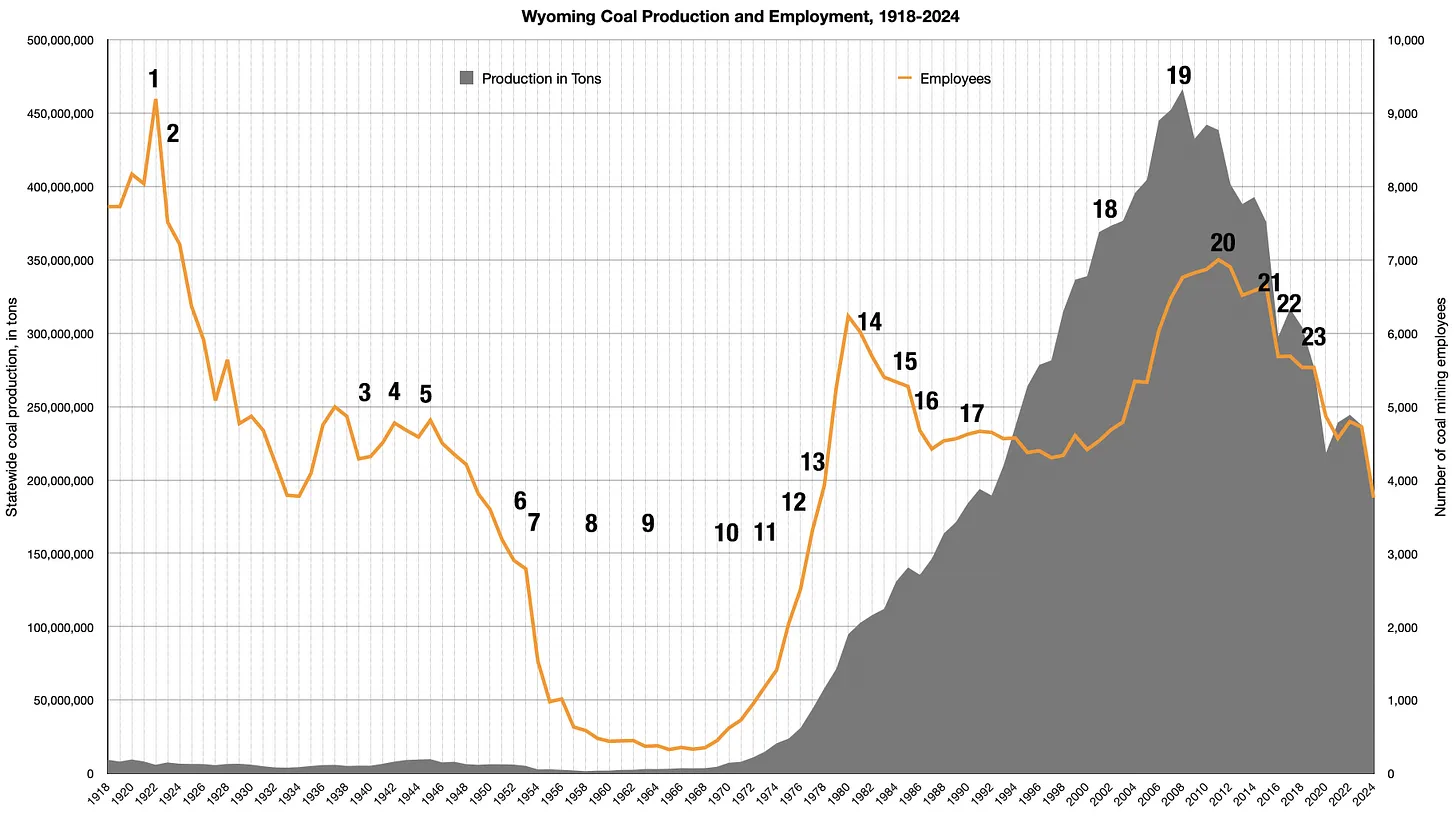
Coal fueled the colonization and industrialization of the Western U.S., but by the 1950s it was in serious trouble as locomotives switched to diesel, homes and businesses chose to cook and heat with natural gas, and utilities opted for hydropower. Government intervention helped spur coal’s revival (see next graph for Wyoming figures and annotations). Source: USGS and EIA. Graphic: Land Desk.
One of the reasons folks like coal is because it’s labor intensive and offers relatively stable, high-wage employment to a lot of people in rural areas without too many other opportunities. But coal industry employment doesn’t always match up with production thanks to automation and efficiency upgrades. Annotations are below. Data Sources: Wyoming State Geological Survey, EIA, Wyoming Workforce Services. Graph: Land Desk.
1920: Wyoming coal industry hits peak employment, with 9,000 employees working in coal mines during a time when less than 200,000 people lived in the state. A few years later, a Wyoming newspaper noted: “Next to food, coal and iron are of first importance to mankind.”
Drilling for natural gas gets underway in New Mexico and Texas, and the gas is piped into towns for heating and cooking, displacing coal. A 1927 Steamboat Pilot headline about a gas pipeline from Texas to Denver, Colorado, read: “Natural gas would injure coal industry.”
1940: Electro Motive Division of General Motors unveils a diesel freight locomotive, but it is slow to catch on and in 1944 the steam engine still dominated, with the railroad industry consuming 152 million tons of coal per year.
Heightened industrial activity during World War II briefly drove up coal consumption and production.
Late 1940s: Development of high-voltage transmission lines that can carry electricity long distances, which will ultimately be a boon for coal power.
1950s: Coal consumption in the West plummets by 40 percent as highways replace rails, and diesel locomotives replace coal-fired ones. More long-distance gas pipelines are built from Texas and New Mexico oil fields to population centers, making it easier for residents and institutions to ditch coal for heating and cooking. More than half of the West’s electricity is generated by hydroelectric dams, with coal only providing 10%. The coal industry had made a lot of cash and built up a lot of political power over the years, however, which they used to lean on government to look for new markets for their product.
1952: Bureau of Reclamation releases A Study Of Future Power Transmission in the West, calling for the buildup of large coal-fired power plants in the Interior West, which would then send electricity to faraway population centers. It said, “… the growth of power in the West will be so great that increasing dependence on its main fuel resource, coal, is inevitable.”
1960: Congress establishes the Office of Coal Research “to encourage and stimulate the production and conservation of coal in the United States…” and to “maximize the contribution of coal to the overall energy market.”
Sierra Club, Friends of the Earth and other environmental groups join with the coal industry and coal-state leaders in opposition to new hydroelectric dams. The Sierra Club actively supports the construction of Navajo Generating Station as a preferable alternative to a new dam in the Grand Canyon. Several other coal-fired plants are built across the West.
The Clean Air Act is passed, actually helping Western coal because it’s low in sulfur, and therefore emits less sulfur dioxide when burned.
Energy Crises erupt, spurring calls for “energy independence.” This includes mining for coal and government subsidies to develop synfuels, or gasoline or diesel from coal and other materials, like oil shale.
1977: ARCO opens Black Thunder mine in the Powder River Basin. It will become the largest coal mine in the world and the first to transport 1 billion tons of coal.
1978 Industrial Fuels Power Act more or less kills the construction of new natural gas power plants, locking in coal as the fuel of choice for electricity generation for the long-term.
Even as coal production climbs, the number of employees in the industry drops due to mechanization and the migration of coal-mining from more labor-intensive underground mines to larger, surface strip mines such as those in the Powder River Basin.
Reagan opens up foreign markets, kills subsidies, stops price controls and government prop-ups. Oil, natural gas, and uranium development crash, spreading economic malaise across the West. Coal falters in many parts of the West, including Wyoming, but the mines of the Powder River Basin continue to produce steadily.
1987: The Industrial Fuels Act is repealed, allowing for the buildup of natural gas plants. This doesn’t have an immediate effect on coal because natural gas is still far more expensive, but it sets the stage for utilities to switch fuels in the decades to come.
Clean Air Act amendments of 1990, which limit emissions of acid rain-causing sulfur dioxide, give a big boost to Western coal because of its relatively low sulfur content. Wyoming surpasses Appalachia as the nation’s number one coal producer.
2001: Demand for electricity, and therefore for coal, climbed steadily nationwide for 50 years, experiencing just a few small hiccups in 1982, 1986 and, most dramatically, in 2001, due to a national recession. But it quickly recovered.
2008: The national financial crisis hits, putting a huge dent in consumption of both electricity and coal. At the same time, the price of natural gas plummets when the market is glutted with newly accessed gas from shale formations in Texas, North Dakota and the East.
2011: Wyoming hits peak coal-mine employment, even though electricity demand and coal consumption has yet to rebound.
2012-2016: Although electricity demand has plateaued, coal production goes into freefall as utilities start getting more and more power from natural gas plants and solar and wind. Mass layoffs hit Wyoming’s coal industry, including in the Powder River Basin.
2018: U.S. electricity demand finally bounces back to pre-2008 levels. It doesn’t help coal at all.
2017-2024: Despite the efforts of the Trump administration to prop up the coal industry by meddling in markets and rolling back environmental, public health and worker safety regulations, coal consumption, production and employment continue to fall. Biden’s “war on coal” doesn’t affect the slide.
Wyoming leaders cheered Trump’s pro-coal executive orders, in part because the industry plays such a large role in its economy. But things are changing, even in the Cowboy State. Construction, retail trade, health care, government work, and leisure and hospitality all outpace mining and drilling in terms of employment numbers. Graphic credit: The Land Desk
🤯 Crazytown Chronicle 🤡
Yesterday, Kathleen Sgamma withdrew her name from consideration to run the Bureau of Land Management. Was it because the oil and gas lobbyist and advocate had a conflict of interest? Nope. Was it because she has spent much of her career battling the very agency she was chosen to helm? Nope.
Sgamma resigned because a watchdog group scandalously revealed that she actually has an inkling of morality. In the days following the Jan. 6, 2021, riots and invasion of the U.S. Capitol, Sgamma wrote that she was “disgusted by the violence” and “President Trump’s role in spreading misinformation that incited it.” She was hoping for a “resurgence of sanity.” That right there is enough to disqualify you from serving in this administration.
I’m anxiously awaiting to see whom Trump picks now.
White House moves to cut funding for keystone federal climate change report and targets “unlawful” regulations.
President Trump signs an order to relax showerhead water efficiency standards.
Another order opposes state laws that impede his “energy dominance” vision and seeks to invalidate them.
Yet another order requires agencies to put maximum 5-year expiration dates into existing energy and environmental laws.
EPA says it will review new studies of health outcomes from fluoridated drinking water.
Mexico says it will immediately release some water in the Rio Grande basin.
April 1, 2025 seasonal water supply forecast summary. Credit: Colorado Basin River Forecast Center
And lastly, federal forecasts indicate a down year for Colorado River runoff and the river’s already depleted reservoirs.
“These State laws and policies are fundamentally irreconcilable with my Administration’s objective to unleash American energy. They should not stand.” – Executive order from President Donald Trump that takes aim at state climate change laws that limit carbon-emitting energy production. The order instructs the attorney general to identify state laws and policies that the Justice Department believes illegally impede energy projects, and then attempt to halt implementation of the laws. The order mentions nearly every type of energy source except solar and wind.
“The attorney general will prioritize investigating state laws that mention one of the administration’s many ideological bugbears: climate change; environmental, social, and governance initiatives; environmental justice; greenhouse gas emissions; and carbon taxes.:
Any merit to all this? No, says Ted Lamm of UC Berkeley School of Law. Accusations of state overreach in this arena are a “mirage.”
By the Numbers
67 Percent of Average: Most probable runoff into Lake Powell this year from the Colorado River, according to a federal forecast. The report covers the April-July period. The down year is not good news for Lake Powell (33 percent full) or Lake Mead (34 percent).
4.1 Million Barrels Per Day: U.S. crude oil exports in 2024, a new annual record. Europe is now the biggest export market, after its decision in 2022 to ban Russian imports.
News Briefs
Rio Grande Water Negotiations President Claudia Sheinbaum said Mexico would carry out “immediate delivery” of some water to the Rio Grande basin, an instance of trade politics influencing water policy, The Hill reports.
Under a 1944 treaty, Mexico is required over five years to deliver 1.75 million acre-feet from its side of the basin. It is far behind in the current cycle, even as deliveries have picked up this year in response to political pressure.
As of April 5, Mexico had delivered 512,604 acre-feet in this cycle.
Eliminating “Unlawful” Regulations Recent Supreme Court decisions – Sackett (wetlands), Ohio (air emissions), Loper Bright Enterprises (deference to agency expertise), among others – have curtailed the executive branch’s regulatory powers. The White House now wants to institutionalize those rulings.
It will be action by subtraction, quickly.
Trump signed an executive order giving agencies 60 days to draw up a list of current “unlawful and potentially unlawful” regulations and devise a plan to repeal them.
The order directs agencies to repeal these rules without public notice and comment periods, which are generally required by law. The order claims that because these unnamed rules are unlawful, getting rid of them merits an exemption from notice and comment.
Pressure Politics Ticking a favored topic, Trump also signed an order to rescind Biden-era water conservation regulations for certain high-end showerheads.
The rule restricted multi-nozzle showerheads to a total flow rate of 2.5 gallons per minute, which has been the federal standard for showerheads since 1992. The flow rate could not apply to each nozzle individually, which would multiply water use.
The Trump administration’s previous attempt to allow multi-nozzle showerheads to flow at higher rates was criticized by the plumbing industry. IAPMO, a trade group, argued that plumbing systems in new buildings, which are built for conservation, could be undersized if higher water volumes are allowed.
Sunset Provisions Another order seeks to cut existing and future regulations in a different way: by adding “sunset provisions” that set an expiration date.
The order directs agencies to insert sunset provisions into bedrock environmental and energy laws such as the Energy Policy Act, Mining Act, Federal Power Act, and Endangered Species Act. The sunset dates are to be between one and five years after the provision is finalized. Regulations can be renewed “as many times as is appropriate, but never to a date more than 5 years in the future” if they are deemed worthy.
Studies and Reports
Cutting Climate Research Funding The Trump administration is cutting funding for the federal government’s keystone report on climate change in the United States and its impacts, Politico reports.
The White House is cancelling a contract with the firm that oversees the U.S. Global Change Research Program, which conducts the National Climate Assessment. Ending the contract “forever severed” interagency climate change work, one senior official told Politico.
The National Climate Assessment is mandated by Congress, written by hundreds of academic and federal researchers, and summarizes the most recent science on climate change and its consequences for the country.
Coal Executive Order To assist the dying U.S. coal industry, Trump signed a proclamation that gives coal-fired power plants a two-year reprieve from stricter air pollution standards.
U.S. coal production has fallen off a cliff, down more than half from its peak in 2008, according to government data. The reasons are structural and interrelated: higher production costs, stricter environmental controls, and cheaper competitors.
On the Radar
Fluoride Lee Zeldin, the EPA administrator, said the agency will review scientific information about the health effects of fluoride as it considers potential regulatory action under the Safe Drinking Water Act.
The agency will produce “an updated health effects assessment for fluoride.”
A federal judge ruled last year that the agency must update its fluoride regulations due to new research into health risks.
Cybersecurity Drill The EPA will host a nationwide drill next month to prepare drinking water utilities for a cyberattack.
Federal Water Tap is a weekly digest spotting trends in U.S. government water policy. To get more water news, follow Circle of Blue on Twitter and sign up for our newsletter.
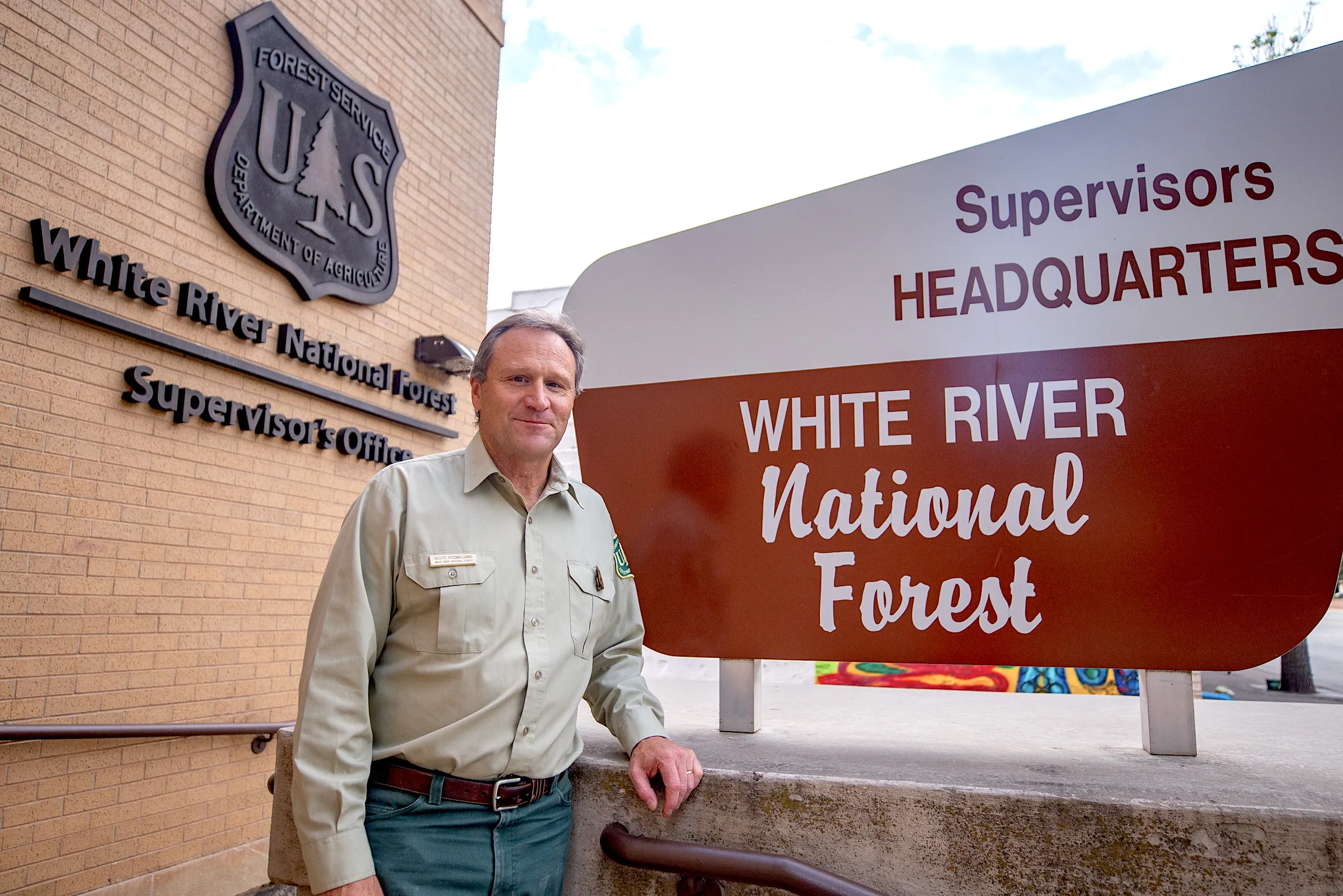
Scott Fitzwilliams at White River National Forest supervisor’s office in Glenwood Springs. Fitzwilliams left his job on March 21 after accepting the Trump administration’s deferred resignation offer. Credit: Courtesy photo
Since his early retirement just over three weeks ago, former White River National Forest Supervisor Scott Fitzwilliams has been soaking up his favorite activities on public lands.
“The public lands are my life,” Fitzwilliams said. “Not just because I worked there. That’s where I get my sense of wellbeing and quality of life.”
Fitzwilliams, who led the 2.3 million acre White River National Forest for 15 years, left his position in late March as part of the Trump administration’s deferred resignation program. He said when he left, the White River was down 27 or 28 positions since Jan. 1, 2025, and just over 50 fewer positions in the past 12 months. The cuts account for nearly a third of the forest’s workforce, which by his count stood at 155 positions about a year ago.
“It’s pretty bleak right now,” Fitzwilliams said.
The Forest Service announced last fall that it would not be hiring any non-fire, seasonal workers for summer 2025 and it saw an additional round of cuts involving thousands of positions nationwide on Feb. 14, led by the Department of Government Efficiency. Even more drastic cuts are expected as the Trump administration moves to consolidate operations.
“Pretty much across the country, there will not be any of our normal seasonal workforce that cleans the bathrooms, that clears the trails, that maintains our recreational facilities, that enforces regulations. Across the country, we won’t have those people this year,” Fitzwilliams said.
While the current administration’s cuts have made exceptions for federal firefighters, Fitzwilliams is concerned that firefighting efforts will be hampered by the reduced workforce.
Those Forest Service employees who work out in the field “are also the people that often are the first to spot or respond to a fire,” Fitzwilliams said.
The organizational structure and support for fighting fires on the White River National Forest has been cut, too; drivers and those who buy supplies and food for firefighters are among the lost positions, Fitzwilliams said.
Local White River National Forest officials declined to comment and requested any questions be sent in writing. Aspen Journalism received a response from an unnamed spokesperson at the U.S. Department of Agriculture.
“Wildland firefighting positions continue to be exempt from the hiring freeze a (sic) operational readiness is not impacted,” the statement read. “The U.S. Forest Service, along with our other federal, state, tribal and local partners continue to prepare for and respond to wildfire incidents as needed.”
Fighting and preventing major wildfires is often top of mind for those living in the drought-prone, arid West, but it’s far from the only job with which the Forest Service has been tasked. The agency is responsible for managing forests for multiple uses, including wilderness, wildlife, recreation, logging, grazing and clean water.
“Our public lands, when we live amongst them, we do tend to take them for granted,” Fitzwilliams said. “But they cannot be anymore.”
Public lands are where “I get my sense of wellbeing and quality of life,” says Scott Fitzwilliams, who took an early retirement offer and stepped down last month as supervisor of the White River National Forest after a 15-year tenure. But he fears that actions undertaken by the new administration may lead to neglect of treatured public lands. Credit: Courtesy Scott Fitzwilliams
‘Part of the strength of America’ at risk
The U.S. Forest Service oversees 193 million acres of land, including the 2.3 million acres of the White River National Forest, with its 11 ski resorts, eight wilderness areas and five ranger districts. And Fitzwilliams thinks the value of public lands far exceeds what can be tracked on paper.
“I believe public lands in America are part of the strength of America,” he said. “It’s a uniquely American ideal.”
Fitzwilliams noted that this ideal is not one enshrined in the Constitution; it relies on public engagement.
“Public lands provide so much to so many and it’s not easy to manage them for all the different uses. National forest management is hard,” Fitzwilliams said. “You have to manage for wilderness and logging and grazing and mining and recreation and all these things, and clean water and wildlife — it’s hard, and so people get frustrated. It may not align perfectly with everyone’s values.
“But it’s a system of public lands in the public trust that, thank god, we have the ability to argue over them. I’m worried that if they’re dismantled, what appears to be organizationally dismantled, we could lose this incredible part of America.”
While there are indications that the Trump administration may sell off public lands, Fitzwilliams said he’s more concerned at this point that neglect and a lack of maintenance and staffing will effectively dissolve federal land management organizations.
“I just think it’s a devastating thing to think of a future that we don’t have this system,” he said.
The Forest Service was facing budget shortfalls prior to the current cuts. The budget for the White River National Forest for this fiscal year is “abysmal,” Fitzwilliams said.
There are 2,800 miles of roads across the forest. “Our road maintenance budget this year, when I left three weeks ago, was a whopping zero. Zero.”
There is no funding to support the work that it takes to rebuild culverts when they are blown out by spring thaws, for example. Instead, Fitzwilliams said there’s a three-person crew with one piece of machinery that can try to address emergencies.
The White River National Forest attracts about 18 million visitors every year; Fitzwilliams said the forest regularly collects more money than it spends through the appropriated budget. Nevertheless, the recreation budget is bare.
“Our recreation budget — the most profitable, most efficient, most visited forest in the entire country — I think the recreation budget was $150,000,” Fitzwilliams said. “That’s not enough money to pump the toilets this year.”
The Department of Agriculture’s statement to Aspen Journalism — received after we sent questions to local forest officials — acknowledged that “recreation services and public access are vital to local economies.”
“The Forest Service remains committed to ensuring public health and safety while balancing access to recreation areas during this transitional time. … It is our intent to maintain access to recreation opportunities to the greatest degree possible,” the statement said.
Such a response reflects what Fitwilliams described as an agency directive that requires all interactions with the media to be cleared by top officials in Washington D.C.
“This is the biggest gag order anyone has ever seen,” Fitzwilliams said. “In 35 years, I’ve never seen anything like it.”
Aspen Journalism also filed a request for information about budget and staff cuts through the Freedom of Information Act in early April and has not received a response.
There are places, Fitzwilliams said, where the Forest Service could certainly improve efficiency and cut costs. He said he shares concerns about the federal debt and would welcome the opportunity to work on efficiency and cost savings.
“It should be a systematic, collaborative approach, by focusing on mission-critical work first,” Fitzwilliams said.
Instead, in the mass cuts on Valentine’s Day, the White River National Forest fired 16 people, 15 of whom were permanent part-time workers whose job was in the field, out on the 2,500 miles of trails in the forest. They earned about $19,000 per season, Fitzwilliams said, and six of the positions were paid for by other agencies or governments, like Pitkin or Eagle counties. The rest were funded through fees collected by the White River National Forest.
“The United States taxpayer saved zero dollars in the initial firings,” Fitzwilliams said.
Finding ways to reduce spending and become more efficient would involve detailed analysis and hard work, which Fitzwiliams said he would welcome.
“I don’t think the hard work is sending out a note on Valentine’s Day saying a bunch of people are fired, with no analysis whatsoever of who these people were. None. There was none. It was low hanging fruit and they took it,” he said.
Fitzwilliams had been planning to retire in about a year, but decided to take the buyout offered to federal employees under the deferred resignation program, and receive full pay and benefits through Sept. 30. He sent a letter to White River employees and partners announcing his resignation on Feb. 25.
“Quite frankly, I didn’t have the energy to be part of what is looking more and more like the dismantling of the agency,” Fitzwilliams said. “That last month or two at work was — I’ve never been that stressed out ever. I was feeling hopelessness, having to fire people for no reason and trying to figure out how we would get the work done, serve the public and meet the agreements with our partners. It was stressful.”
Brian Glaspell, who previously was director of strategic planning for the Forest Service’s Rocky Mountain region, is the acting supervisor of the White River National Forest.
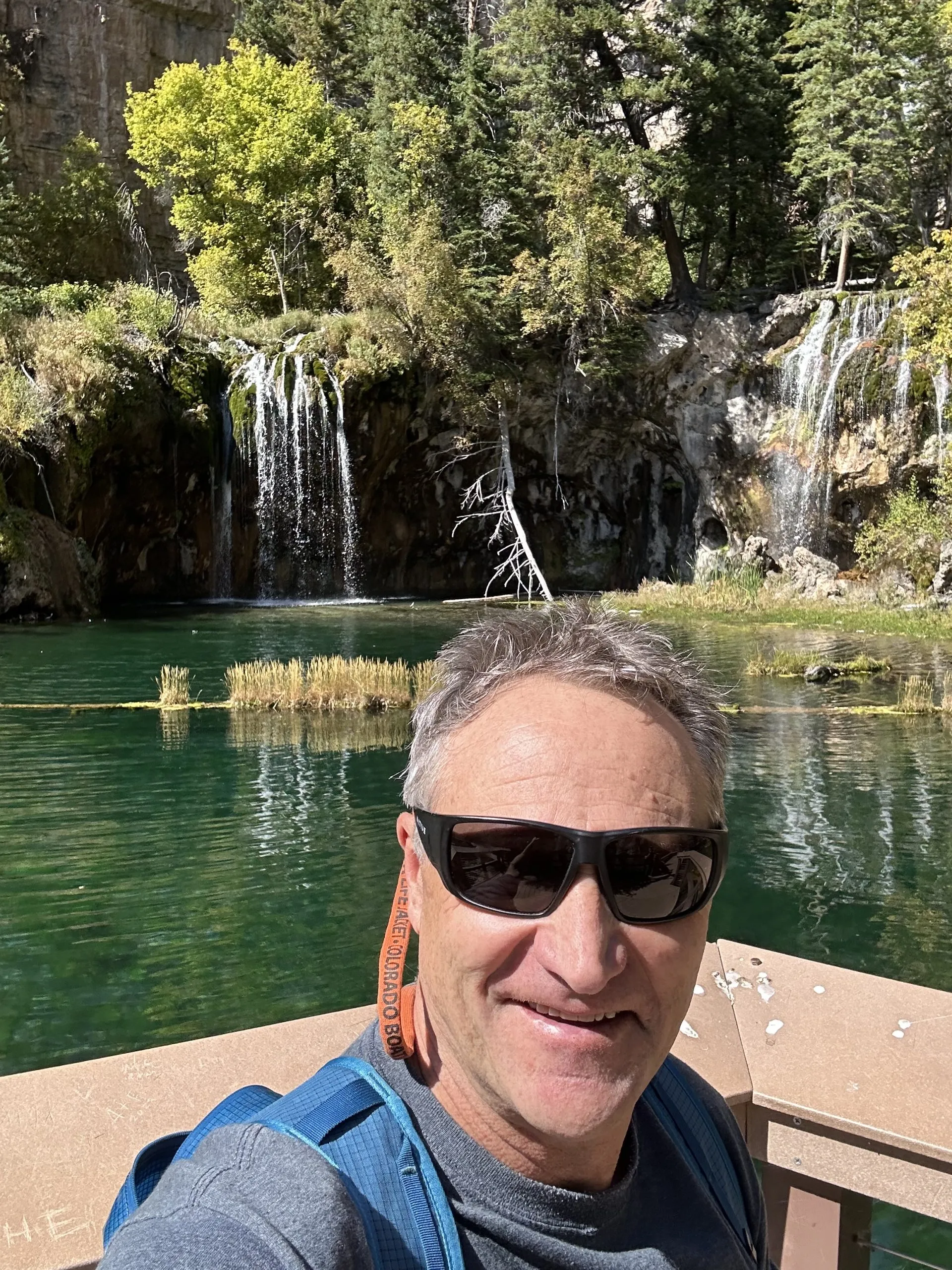
Scott Fitzwilliams at Hanging Lake. Partnerships with local communities developed under his tenure as White River National Forest supervisor include a reservation and shuttle system to access the popular hike to the lake in Glenwood Canyon. Credit: Courtesy Scott Fitzwilliams
Forest health depends on partnership, public involvement
The White River National Forest is the largest national forest in Colorado, spanning parts of nine counties and bordering communities including Aspen, Glenwood Springs, Vail, Breckenridge and Leadville. Much of the identity and economy of these communities is tied to the forest.
“Aspen isn’t Aspen without the forest around it,” Fitzwilliams said.
These communities rely on the forest in other ways, too, including for a healthy water supply and air quality.
“Every single community on the West Slope gets its drinking water off of national forest,” he said. “We ought to have people taking care of that.”
In his time with the White River National Forest, Fitzwilliams built partnerships with local governments, nonprofits and other agencies that helped to share stewardship of the forest as recreation numbers boomed in the past decade. For example, Pitkin County has provided funding for forest protection officers at North Star Nature Preserve and works in partnership with the agency on several other properties that share boundaries with the White River National Forest.
“These partnerships were the epitome of efficiency,” said Gary Tennenbaum, director of Pitkin County Open Space and Trails.
The Forest Service worked with Pitkin County, the city of Aspen and the Independence Pass Foundation to bring more rangers to heavily trafficked areas like Independence Pass, Wildwood, Richmond Ridge, Pearl Pass and the Castle Creek area.
The county’s public works and open space and trails departments pay for two, full-time seasonal Forest Service employees; for now, those positions remain intact. A third position, paid for by a partnership between Pitkin County, the city of Aspen and the Independence Pass Foundation, has been cut by the Forest Service because the employee was in their probationary period.
Fitzwilliams is proud of his legacy of cross-agency work.
“It’s the part of the job I’m going to miss the most. We roll up our sleeves and figure out how to solve problems with only one objective: how do we serve the public?” he said. “It’s a symbiotic, shared stewardship. We’re doing this work together. We’re leveraging in a very innovative, creative, efficient way.”
But he’s concerned that the Forest Service now has less to bring to the table in terms of staffing and funding.
“I don’t know how long we think that local governments can support this, and the scary part that keeps me up at night is then what happens afterwards,” Fitzwilliams said.
In many respects, the White River National Forest is fortunate and unique in the level of support it receives from surrounding communities. According to a 2019 economic analysis of national forests, the White River contributed more than 22,000 jobs, bringing in $960 million to local communities and workers.
Local organizations, like the Independence Pass Foundation and Roaring Fork Transportation Authority, provide labor, funding and support that enhances public lands management of the White River National Forest as well.
“We’re fortunate around here, we have those organizations. That’s not the case everywhere,” Fitzwilliams said. “There is no one to step up and fill the gaps. That’s worrisome.”
The health of the White River National Forest in the upcoming summer season will depend deeply on the partnerships that Fitzwilliams and his colleagues have built over the past decade.
“This summer, we’re going to need the public to care more than ever about their public lands,” Tennenbaum said. “People need to have an ethic this summer that is very respectful of the land. You come across a campsite, don’t just walk by it. Make sure the campfire is out. Think about how you deal when you have to go to the bathroom. There’s going to be some impacts; we have to recognize that and not make it worse.”
The White River National Forest is not alone in facing a summer season with large numbers of crowds and little ability to manage those crowds to prevent ecological damage. Fitzwilliams notes that public lands are deeply valuable to many Americans, and he retains hope in the public’s ability to speak up for a national treasure.
“I think the American public, not excluding anyone, they’re going to stand up for their public lands,” Fitzwilliams said. “Unfortunately we’re going to see some hurt in the meantime.”
F Street in Salida February 2025. Photo credit: Allen Best/Big Pivots
Click the link to read the article on the Big Pivots website (Allen Best):
April 8, 2025
Federal funds for climate-change-related projects in Colorado have started arriving in almost perfect concert with the spring thaw.
Among the applications for the hundreds of millions of dollars will be:
energy efficiency work in southwestern Colorado communities,
curbing methane emissions from old coal mines west of Carbondale, and,
preparation of a climate action plan for the Yampa Valley.
Among the smaller grants, $187,605 went to Salida and Chaffee County. The money will fund a staff position shared by the two jurisdictions to create a greenhouse gas inventory, a climate action plan, and then the means to implement what the city and county decide to do.
That grant and seven others for rural Colorado jurisdictions from the U.S. Department of Energy totaling $1.865 million were announced in August 2024. The federal program had received key funding from the Infrastructure Investment and Jobs Act of 2021.
The awards were temporarily frozen by President Donald Trump.
The money is largely to be used for staffing for climate action planning but also for workforce training in communities where extraction and combustion of fossil fuels has been fading.
“Capacity is an essential component of local climate action, and these new awards will play an important role in enabling this work in Colorado’s rural and mountain communities,” Christine Berg, senior policy advisor for local governments in the Colorado Energy Office, said in the August 2024 announcement.
A far larger grant of $200 million to the Denver Regional Council of Governments, or DRCOG, had been announced in July 2024.
That money, a product of the Inflation Reduction Act of 2022, was to have been used for retrofits of buildings in the nine-county metropolitan area. DRCOG did not respond to repeated requests as to whether the money has been unthawed or is expected to be.
The Colorado Energy Office had been awarded $129 million. A spokesperson confirmed the money has arrived. It will be used:
To deploy advanced methane monitoring technology to produce data that will inform regulatory policy concerning methane emissions from landfills and coal mines, including those in the Redstone-Paonia area.
For energy efficiency and electrification upgrades in large commercial buildings that are otherwise hard to decarbonize.
To help local governments to implement projects that help reduce emissions from buildings, transportation, electric power, waste and other economic sectors. The money is to be administered through a new program, the Local Government Climate Action Accelerator.
Part of the $129 million received by the Colorado Energy Office will be used to work on large commercial buildings that are hard to decarbonize. Photo/Allen Best
What melted the ice?
The Trump administration’s budget office on Jan. 20 had ordered a pause on previously promised funds if they helped advance the “green new deal,” as the Congressional laws adopted when Joe Biden was president have been called. A federal court issued a temporary restraining order in late January, but the Trump administration seemed to ignore it.
Colorado in early February joined 21 other states and the District of Columbia in asking the court to require the federal agencies to release the money.
Will Toor, the executive director of the Colorado Energy Office, at the time declared that the federal government had signed contracts granting more than $500 million to Colorado through the 2021 and 2022 federal laws. “By not meeting these contractual obligations, the federal government is inflicting real harm on our state,” he said in a statement posted on the CEO website.
The Trump administration seemed to ignore the legal requirement, and a federal court judge on March 6 ordered the administration to comply.
Judge John J. McConnell Jr., of the Federal District Court for the District of Rhode Island, said the case amounted to executive overreach. The directive from the White House budget office, he said in a New York Times story, “fundamentally undermines the distinct constitutional roles of each branch of our government.” Without his action, he said, “the funding that the states are due and owed creates an indefinite limbo.” A federal appeals court on March 26 upheld that decision.
On March 28, Colorado Energy Office spokesman Ari Rosenblum reported that the $129 million in funding announced last summer for the state agency has been unfrozen.
“We are moving forward with work on all projects funded through this grant,” he wrote in an e-mail in response to a query from Big Pivots. “We expect to launch the Local Government Climate Action Accelerator this summer.”
What melted the ice?
The Trump administration’s budget office on Jan. 20 had ordered a pause on previously promised funds if they helped advance the “green new deal,” as the Congressional laws adopted when Joe Biden was president have been called. A federal court issued a temporary restraining order in late January, but the Trump administration seemed to ignore it.
Colorado in early February joined 21 other states and the District of Columbia in asking the court to require the federal agencies to release the money.
Will Toor, the executive director of the Colorado Energy Office, at the time declared that the federal government had signed contracts granting more than $500 million to Colorado through the 2021 and 2022 federal laws. “By not meeting these contractual obligations, the federal government is inflicting real harm on our state,” he said in a statement posted on the CEO website.
The Trump administration seemed to ignore the legal requirement, and a federal court judge on March 6 ordered the administration to comply.
Judge John J. McConnell Jr., of the Federal District Court for the District of Rhode Island, said the case amounted to executive overreach. The directive from the White House budget office, he said in a New York Times story, “fundamentally undermines the distinct constitutional roles of each branch of our government.” Without his action, he said, “the funding that the states are due and owed creates an indefinite limbo.” A federal appeals court on March 26 upheld that decision.
On March 28, Colorado Energy Office spokesman Ari Rosenblum reported that the $129 million in funding announced last summer for the state agency has been unfrozen.
“We are moving forward with work on all projects funded through this grant,” he wrote in an e-mail in response to a query from Big Pivots. “We expect to launch the Local Government Climate Action Accelerator this summer.”
Projects in rural Colorado
The $1.8 million grant — this is in addition to the program for local assistance that the Colorado Energy Office created with its $129 million — funded projects for Salida and Chaffee County and these additional rural communities:
$240,000 for Lake County to support a new position to lead development of the county’s first climate action plan and implement the county’s climate initiatives in and around Leadville. These and other similar positions are for three years.
$240,000 to the Colorado River Valley Economic Development Partnership, which has representatives of municipalities from New Castle and Silt on the east and Parachute and Battlement Mesa, as well as parts of unincorporated Garfield County. The project has a strong emphasis on workforce development and new job training in a county that formerly had a strong component of fossil fuel extraction.
$264,100 to the Routt County Climate Action Plan Collaborative. The money is to scale up electrification in Hayden, Oak Creek, Steamboat Springs and Yampa as well as other parts of Rout County. As with the Colorado River communities, there will be a workforce development and job training component as two coal-burning units at Hayden will close in the next several years. The coal for the plant comes from Twentymile Mine.
$240,000 to Pueblo and Pueblo County for a staff position for implementing city and county sustainability projects.
$240,000 to the City of Durango for a staff position to be housed within the Four Corners Office for Resource Efficiency to work with La Plata Electric Association and the city government to implement energy efficiency and so forth.
$191,100 to EcoAction Partners, a consortium of San Miguel and Ouray counties along with the towns of Telluride, Mountain Village, Ophir, and Norward. This money is to provide staffing to assist the 10 jurisdiction members with climate action plan projects and programming implementation.
$262,194 to Larimer County to help with staffing to develop a climate action plan for Estes Park and ensure alignment with Larimer County climate Smart Future Ready plan.
A $240,000 grant was awarded to the City of Durango to work with the a local non-profit group, the Four Corners Office for Resource Efficiency, and La Plata Electric Association on energy efficiency. Photo credit: Allen Best/Big Pivots
Salida tree grant
Salida will also receive another $250,000 to cover the costs of planting trees in a somewhat newer but lower-income neighborhood during the next five years.
The older part of Salida that can be seen along F Street, the town’s older commercial corridor, has many tall shade trees. The town’s southeast corner, though, is an area converted from light industrial and commercial into manufactured and other housing. It has a paucity of trees.
Sara Law, Salida’s sustainability coordinator and public information officer, explained that Salida expects to get hotter during summer months in coming decades because of accumulating greenhouse gases. The goal was to get medium- to low-tree covers to help provide cooling on those hot days of summer.
Awardees of that grant program, including Salida, are now able to work on their tree projects and submit for reimbursement.
Teddy Parker-Renga, associate director of communications and communities for the Colorado State Forest Service, reported on March 31 that awardees of that particular grant program, including Salida, had become eligible that day to submit reimbursements for their work. The money comes from the U.S. Forest Service and grants are administered by the Colorado State Forest Service.
At an elevation of 7,400 feet, Salida has a climate warm enough to accommodate rattlesnakes. They can be encountered on hiking trails of nearby Methodist Mountain, the northernmost peak in the Sangre de Cristo Range. Salida’s all-time high temperature record of 102 degrees was set in July 2019.
Releases from the Aspinall Unit will be increased from 1200 cfs to 1500 cfs Monday, April 14th. Releases are being increased to coincide with increasing diversions at the Gunnison Tunnel.
Flows in the lower Gunnison River are currently above the baseflow target of 1050 cfs. After this release change river flows are expected to remain above the baseflow target for the foreseeable future.
Pursuant to the Aspinall Unit Operations Record of Decision (ROD), the baseflow target in the lower Gunnison River, as measured at the Whitewater gage, is 1050 cfs for April through May.
Currently, Gunnison Tunnel diversions are 620 cfs and flows in the Gunnison River through the Black Canyon are around 590 cfs. After this release change Gunnison Tunnel diversions will be around 1050 cfs and flows in the Gunnison River through the Black Canyon will be around 450 cfs. Current flow information is obtained from provisional data that may undergo revision subsequent to review.
This scheduled release change is subject to changes in river flows and weather conditions. For questions or concerns regarding these operations contact:
— Chinese Embassy in US (@ChineseEmbinUS) April 7, 2025
In November 1999, as the World Trade Organization convened in Seattle, some 50,000 protesters flooded the city’s streets to push back against globalization and free trade, unfettered capitalism, corporate hegemony, and, well, Starbucks. It was dubbed the Battle of Seattle and is now considered the apex of the anti-globalization movement.
The protesters were a motley mix, from labor organizers to farmers to environmentalists, anarchists, and church leaders. They were opposed to the rising tide of free trade because, on the one hand, it encouraged U.S. corporations to offshore manufacturing, thereby harming U.S. workers, and it also was a form of economic imperialism that allowed the U.S. and other wealthy countries to exploit the workers and environment of developing countries. Outsourcing made things cheaper, feeding the beast of American consumerism, while allowing the U.S. to evade accountability by offshoring its pollution and collective carbon footprint. (Although they may not have been in Seattle, there was also a sort of mirror right-wing movement that also opposed globalism, but for different reasons and in different ways.)
The Battle for Seattle was followed by similar protests around the world. But globalization and all its benefits and ills continued, with the global economy becoming almost seamlessly integrated. The protests waned, Starbucks proliferated, and the movement faded and morphed into other forms. One of the offshoots, if you could call it that, was the degrowth movement — based on the idea that capitalism’s need for expansion is wrecking the world, and only by squelching the constant craving for more can we save the planet and ourselves.
Both the anti-globalization and degrowth movements have seemed fairly hopeless, given that they are pushing against the established world order. But in the last few weeks, President Donald Trump has — it seems — handed both movements victories of sorts: He managed to short-circuit globalization and the U.S. economy in one fell swoop. I mean, he probably didn’t intend to do that, though I’m not sure anyone really knows what he’s really trying to achieve, even him.
His chaotic tariffs have upended global trade and his administration’s hostility towards non-citizens has hampered international travel. These policies, if you can call them that, have also injected uncertainty and fear into the markets, causing stocks around the globe to plummet. That, combined with mass federal employee firings, threats to detain and deport millions of workers, and freezing Inflation Reduction and Infrastructure Act funding for clean energy development, manufacturing, and research, will likely “de-grow” the U.S. economy in ways that only pandemics and global financial crises have done in the past. The turmoil has already brought oil prices below $60 per barrel for the first time since the days of COVID, which will almost certainly dampen the oil and gas drilling frenzy (in fact, the U.S. rig count is already dropping). That is, unless Trump goes to war with Iran, which will certainly shoot oil prices right back up again.
It’s difficult to know what to think about all of this, except that it feels as if we are in Bizarro world. I mean, a Manhattan real estate developer with gold-plated toilets has seemingly adopted the anarchists’ anti-globalization agenda and become the Degrowth president; Democrats and leftists are reflexively railing against old-school protectionism; Republicans are bashing free markets and free trade and driving the economy into the ditch while looking to push the federal budget deficit higher; the Chinese embassy is posting videos of Ronald Reagan condemning tariffs and praising free trade; and the president of the U.S. Oil & Gas Association is planning to buy an electric vehicle to protest against protesters. What’s next? Is Exxon’s CEO gonna start burning down gas stations?
A wise friend put it this way: “Spinoza’s wheel is out of true and the arrow is going backwards.” Okay, I admit I don’t know Spinoza well enough to totally get that, but I know wheels, and this sounds right to me.
What will become of this chaos is anyone’s guess. But I’m going to bet that it doesn’t “make America wealthy again” or restore manufacturing to the U.S. anytime soon or stop the flow of Fentanyl across borders or anything else that Trump thinks it might do. It’s more likely that the wobbly wheel will steer us all right off a cliff. There will be plenty of pain as people lose their jobs and their pensions lose their value. Nations that have rejiggered their economies to sate Americans’ hunger for fast-fashion, electronic devices, and cheap plastic items will descend into a financial slump. Coffee, bananas, avocados, chocolate, imported wine, and tequila will become more expensive.
The best we can hope for is that the economic slowdown and higher prices will stifle American consumerism and slow the environmental destruction it wreaks.
It’s tough to keep up with the Trump chaos. But a new initiative is making it somewhat easier to track the mayhem.
The Impact Project launched to provide “objective, transparent, and open-source data to help explain how federal policies, funding, and workforce changes affect our communities.” Their first tool is the Impact Map, which uses publicly available data, media reports, and first-person testimonials to better understand the impacts of federal layoffs or spending cuts. It also shows how many federal employees are in each county and how many of them are probationary, meaning they were targeted by DOGE’s first round of firings and are more vulnerable to future reductions in force.
Map showing BLM lands within 10 miles of cities. Green denotes conservation areas, red is critical habitat, and yellow is “undesignated” BLM land. Source: Center for Biological Diversity.
Last month, Interior Secretary Doug Burgum announced his plan to build housing on federal lands, and officials said they were targeting 400,000 acres within 10 miles of towns of 5,000 people or more. Now the Center for Biological Diversity has created a map showing all of the land fitting that description, as well as which parcels are in conservation areas, critical habitat, or sage grouse management areas.
While it can be a bit alarming to see where they might want houses, keep in mind that this is still only a vague proposal and the lands on the map are simply the ones that would be eligible for development if the plan were to come to fruition.
A powerful storm system that stalled over states from Texas to Ohio for several days in early April 2025 wreaked havoc across the region, with deadly tornadoes, mudslides and flooding as rivers rose. More than a foot of rain fell in several areas.
As a climate scientist who studies the water cycle, I often get questions about how extreme storms like these form and what climate change has to do with it. There’s a recipe for extreme storms, with two key ingredients.
Recipe for a storm
The essential conditions for storms to form with heavy downpours are moisture and atmospheric instability.
First, in order for a storm to develop, the air needs to contain enough moisture. That moisture comes from water evaporating off oceans, lakes and land, and from trees and other plants.
The amount of moisture the air can hold depends on its temperature. The higher the temperature, the more moisture air can hold, and the greater potential for heavy downpours. This is because at higher temperatures water molecules have more kinetic energy and therefore are more likely to exist in the vapor phase. The maximum amount of moisture possible in the air increases at about 7% per degree Celsius.
Search and rescue firefighters check on residents in a neighborhood in Frankfort, Ky., on April 6. Floodwater filled streets downtown and in several neighborhoods in the state capital. AP Photo/Jon Cherry
Warm air also supplies storm systems with more energy. When that vapor starts to condense into water or ice as it cools, it releases large amount of energy, known as latent heat. This additional energy fuels the storm system, leading to stronger winds and greater atmospheric instability.
That leads us to the second necessary condition for a storm: atmospheric instability.
Atmospheric instability has two components: rising air and wind shear, which is created as wind speed changes with height. The rising air, or updraft, is essential because air cools as it moves up, and as a result, water vapor condenses to form precipitation.
As the air cools at high altitudes, it starts to sink, forming a downdraft of cool and dry air on the edge of a storm system.
When there is little wind shear, the downdraft can suppress the updraft, and the storm system quickly dissipates as it exhausts the local moisture in the air. However, strong wind shear can tilt the storm system, so that the downdraft occurs at a different location, and the updraft of warm moist air can continue, supplying the storm with moisture and energy. This often leads to strong storm systems that can spawn tornadoes.
Extreme downpours hit the US
It is precisely a combination of these conditions that caused the prolonged, extensive precipitation that the Midwest and Southern states saw in early April.
The Midwest is prone to extreme storms, particularly during spring. Spring is a transition time when the cold and dry air mass from the Arctic, which dominates the region in winter, is gradually being pushed away by warm and moist air from the Gulf that dominates the region in summer.
This clash of air masses creates atmosphere instability at the boundary, where the warm and less dense air is pushed upward above the cold and denser air, creating precipitation.
A cold front forms when a cold air mass pushes away a warm air mass. A warm front forms when the warm air mass pushes to replace the cold air mass. A cold front usually moves faster than a warm front, but the speed is related to the temperature difference between the two air masses.
The warm conditions before the April storm system reduced the temperature difference between these cold and warm air masses, greatly reducing the speed of the frontal movement and allowing it to stall over states from Texas to Ohio.
The result was prolonged precipitation and repeated storms. The warm temperatures also led to high moisture content in the air masses, leading to more precipitation. In addition, strong wind shear led to a continuous supply of moisture into the storm systems, causing strong thunderstorms and dozens of tornadoes to form.
What global warming has to do with storms
As global temperatures rise, the warming air creates conditions that are more conducive to extreme precipitation.
The warmer air can mean more moisture, leading to wetter and stronger storms. And since most significant warming occurs near the surface, while the upper atmosphere is cooling, this can increase wind shear and the atmospheric instability that sets the stage for strong storms.
Polar regions are also warming two to three times as fast as the global average, reducing the temperature gradient between the poles and equator. That can weaken the global winds. Most of the weather systems in the continental U.S. are modulated by the polar jet stream, so a weaker jet stream can slow the movement of storms, creating conditions for prolonged precipitation events.
All of these create conditions that make extreme storms and flooding much more likely in the future.
Over the last three years, the Colorado River Basin has experienced three relatively healthy winters. But that decent snowpack, after melting, hasn’t filled reservoirs like Lake Mead and Lake Powell as much as water users across the West might like, due to years of drought and overuse. Recent forecasts show Lake Mead and Lake Powell will remain roughly one-third full after snow melts down from the mountains across the West into the Colorado River and its tributaries this year…
April 1, 2025 seasonal water supply forecast summary. Credit: Colorado Basin River Forecast Center
Winter of 2023 brought substantial snow to the parched region, with snowpack levels reaching over 150% of the 30-year median. The banner snowpack led to 10.6 million acre-feet of water flowing into Lake Powell over the spring and summer — a whopping 166% of the average runoff seen between 1991 and 2020. That helped bring Lake Powell up to 38% in July 2023 after the reservoir hit a record low of 22% in February of that year. That was followed by another good snow year for the basin basin, with levels hitting 113% of the median in 2024. But that above-average snowpack translated to a below-average runoff of 83%, or about 5.3 million acre-feet of water reaching Lake Powell. That was lower than what forecasters had predicted earlier in 2024, and the reservoir saw a smaller bump — reaching 42% full in July.
The discrepancy between snowpack and runoff was largely because soil across the Colorado River Basin was so dry, [Jack] Schmidt said. Dry soil absorbs melting snow, so less water ends up in reservoirs. And this year, soil across most of the Colorado River Basin is drier than normal — and even drier than it was this time last year.
Douglas-fir beetles killed these trees in southern Gunnison County. The Colorado State Forest Service will conduct treatments in this forest in 2025 to slow the outbreak. Photo by Dylan Eimer, CSFS
Bark beetles and other insects are spreading through Colorado’s forests, leaving dead and dying trees in their wake – a cycle that could fuel future wildfires, according to an annual Colorado State Forest Service report released March 26.
Following a wet and cool year in 2023, the shift back to near-record temperatures and below-average precipitation in Colorado last year exacerbated the proliferation of forest pests and weakened trees’ defenses against them.
“Trees in Colorado can’t catch a break as our climate becomes warmer and dryer,” said Matt McCombs, state forester and director of the Colorado State Forest Service. “This ongoing trend toward persistent drought and higher temperatures not only makes trees easier prey for insects but increases the risk of large and severe wildfires.
“Couple that with more people living in areas prone to burn, and the state faces enormous challenges,” McCombs added. “The good news is we know Colorado is on the right path to address these challenges and foster forests and communities that are resilient to wildfire and forest pests.”
The 2024 forest health assessment details which insects and diseases are the biggest threats to the state’s forests and where outbreaks are expanding. The report also describes the state forest service’s science-based management practices that are promoting wildfire-resilient forests and healthy watersheds.
The CSFS updates the Colorado General Assembly and residents annually on the health of the state’s forests based on an annual aerial survey, field inspections and information from forest landowners.
Click the link to read the research article on the AGU website (M. S. Kukal, M. Hobbins):
Abstract
Global atmospheric evaporative demand has increased, impacting agricultural productivity and water use. Traditionally, trend assessments have been limited to total evaporative demand, overlooking shifts in daily extremes, which are meaningful for agrohydrological outcomes yet largely unknown. Here, using a fully physical metric of evaporative demand, that is, standardized short crop reference evapotranspiration, we introduce the concept of thirstwaves—prolonged periods of extremely high evaporative demand—and analyze their characteristics during 1981–2021 growing seasons for the conterminous US. Findings show that long-term mean spatial patterns demonstrated by thirstwave characteristics do not follow that of total or mean evaporative demand. Weighted for cropland area harvested, thirstwave intensity, duration, and frequency have increased by 0.06 mm d−1 decade−1, 0.10 days decade−1, and 0.39 events decade−1, respectively during 1981–2021. Statistically significant trends appear across 17%, 7%, and 23% of cropland area for intensity, frequency, and duration. Not only have thirstwaves increased in severity, but the likelihood of no thirstwaves occurring during the growing season has significantly decreased. Our work proposes a novel metric to describe periods of extremely elevated evaporative demand and presents a systematic analysis of such conditions historically for US croplands.
Key Points
Regional hotspots of thirstwaves do not necessarily align with areas of high overall evaporative demand
Intensity, duration, and frequency of thirstwaves have increased significantly (p < 0.05) over 17%, 7%, and 23% of US cropland area, respectively
The likelihood of no thirstwaves occurring during the growing season has significantly decreased
Plain Language Summary
The atmosphere is getting more demanding for water around the world, and this affects water use and farming outcomes. Previously, studies mainly looked at the overall atmospheric demand for water, but little is known about changes in occurrence of very high atmospheric demand for water over consecutive days. In this study, we use introduce the idea of “thirstwaves,” which are long periods of very high atmospheric demand for water. We looked at these thirstwaves that have occurred during 1981–2021 in the US and analyzed them for how intense and how frequent they were and how many days they lasted. We found that the worst thirstwaves happened in places that do not see the highest demand. Over time, all aspects of these thirstwaves have gotten worse. It has also become much less likely that a growing season will pass without any thirstwaves. These findings suggest that in addition to monitoring overall atmospheric demand for water, it’s important to track, measure, and report thirstwaves to those managing agriculture and water resources.
.This U.S. Drought Monitor (USDM) week saw widespread improvement in drought-related conditions across areas of the South, Southeast, and Midwest, where a series of strong storms delivered heavy rainfall, damaging winds, and severe flooding. The multi-day storm event saturated soils leading to inundation of rivers, and severe flooding in low-lying areas from Arkansas to Ohio. Storm totals from the multi-day event ranged from 4 to 18+ inches, with the highest accumulations observed across central Arkansas, southeastern Missouri, and western portions of both Tennessee and Kentucky. In addition to heavy rainfall, the storm system sparked dozens of tornadoes as well as strong gusty winds in other areas, causing widespread power outages. Elsewhere, improving conditions over the past 30 to 60 days, led to reduction in areas of drought in the Northeast, from New York to Maine, as well as in areas further south including New Jersey and Virginia. In the Midwest, this week’s rainfall event pushed rainfall totals well above normal levels for the past 30-day period, leading to improvements across the Midwest in Missouri, Illinois, Indiana, and Michigan. In the Upper Midwest and portions of the Plains, drought-related conditions improved on the map across areas of Minnesota, Wisconsin, and South Dakota, where precipitation has been above normal for the past 30-90-day period and soil moisture monitoring products are showing normal to above-normal levels. In the West, above-normal springtime temperatures are causing a rapid melting of high-elevation snowpacks across the entire region. Looking at the current snowpack conditions out West, deep seasonal snowpack deficits remain across the ranges of southwestern Colorado, New Mexico, northern Arizona, and southwestern Utah. Elsewhere in the region, areas of the Great Basin and Intermountain West saw improvements on the map including parts of northeastern Nevada, Wyoming, and northwestern Colorado. In terms of reservoir storage in the West, California’s reservoirs continue to be at or above historical averages for the date (April 8), with the state’s two largest reservoirs, Lake Shasta and Lake Oroville, at 116% and 120% of average, respectively. In the Southwest, the U.S. Bureau of Reclamation is reporting (April 6) Lake Powell at 33% full, Lake Mead at 34% full, and the total Colorado system at 41% full (compared to 42% full at the same time last year)…
On this week’s map, improvements were made in the region, namely in northern Kansas, northern Nebraska, and South Dakota, where shorter-term precipitation (past 30-60 days) is normal to above normal. Additionally, these areas were showing improvements in other drought indicators including soil moisture, streamflow activity, and satellite-based vegetation health. In western North Dakota, areas of Extreme (D3), Severe (D2), and Moderate (D1) drought expanded on the map in response to a combination of factors, including numerous recent impact reports from the agricultural sector, below-normal precipitation (past 30 days), and low streamflow and soil moisture levels. For the week, generally dry conditions prevailed across western portions of the region, while eastern portions received modest accumulations of <1.5 inches (liquid). In terms of temperatures, below-normal average temperatures (ranging from 2 to 10+ degrees F) were logged across the entire region…
Colorado Drought Monitor one week change map ending April 8, 2025.
Out West, generally dry conditions prevailed over much of the region, including areas of California, the Great Basin, the Intermountain West, and the Desert Southwest (southern Arizona and southwestern New Mexico). However, some mountain locations in the Pacific Northwest and the Rocky Mountains received light-to-moderate precipitation accumulations. On the map, areas of Extreme (D3) drought were introduced in southeastern Arizona, where precipitation deficits existed at both short- and longer-term time scales. Similarly, ongoing below-normal snowpack conditions (snow water equivalent at NRCS SNOTEL stations ranging from 6 to 55% of median) in the Nacimiento, San Juan, and Sangre de Cristo ranges of New Mexico, led to the introduction of areas of Extreme (D3) drought. Elsewhere, some improvements were made on the map in drought-affected areas of northeastern Nevada, northeastern Utah, northwestern Colorado, and Wyoming. Looking at the regional snowpack, the NRCS SNOTEL network is reporting (April 8) the following region-level (2-digit HUC) SWE levels: Pacific Northwest 102%, Missouri 97%, Upper Colorado 89%, Great Basin 104%, Lower Colorado 69%, and Rio Grande 46%…
On this week’s map, widespread improvements were made in response to very heavy rainfall accumulations observed across parts of the region, with the highest totals (ranging from 5 to 15+ inches) observed in northeastern Texas, eastern Oklahoma, Arkansas, western Tennessee, and southern Mississippi. The multi-day storm event led to catastrophic flooding in parts of the region as well as tornadic activity, widespread power outages, and loss of life. However, the deluge of rains also led to significant improvements in drought-related conditions, with multiple category improvements made on the map. For the week, average temperatures were above normal in eastern areas, with anomalies ranging from 3 to 12 degrees F. Conversely, the western extent of the region, including much of Texas, Oklahoma, and Arkansas, experienced temperatures ranging from 3 to 12 degrees F below normal. Looking at Texas reservoir conditions, statewide reservoirs are reported to be 75.7% full, with many reservoirs in the eastern part of the state in good condition (over 90% full), while numerous reservoirs in the western portion of the state continue to experience below-normal levels, according to Water Data for Texas (April 9). In terms of streamflow activity (April 9), the U.S. Geological Survey is reporting well above normals streamflows (>90th percentile) across northeastern Texas, southeastern Oklahoma, Arkansas, Mississippi, and western Tennessee, while areas of central and southern Texas are experiencing below normal levels (1st to 24th percentile range)…
Looking Ahead
The NWS Weather Prediction Center (WPC) 7-Day Quantitative Precipitation Forecast (QPF) calls for relatively dry conditions across the conterminous U.S., except for light-to-moderate accumulations across areas of the Pacific Northwest, northern Plains, Lower Midwest, Mid-Atlantic, and the Northeast. The Climate Prediction Center (CPC) 6-10-day Outlook calls for a moderate-to-high probability of above-normal temperatures across the Western U.S., Plains, and areas of the South, while below-normal temperatures are expected across eastern portions of the Midwest and portions of the Northeast. Elsewhere, near-normal temperatures are favored. In terms of precipitation, there is a low-to-moderate probability of above-normal precipitation across New Mexico, Texas, and Oklahoma as well as areas of the Upper Midwest. Elsewhere, below-normal precipitation is expected across most of the West, Southeast, and Mid-Atlantic.
US Drought Monitor one week change map ending April 8, 2025.
With the snow accumulation portion of the 2025 water year drawing to a close, snowpack in much of the region was near average, except for southern Colorado, southern Utah and northeastern Wyoming where snowpack ranged from 50-80% of average. Above average precipitation in northern Utah and much of Wyoming added to snowpack during March and caused the removal of drought conditions from the Wasatch Front and northern and central Wyoming. A late-March rain/snow event produced record precipitation along the northern Front Range and Eastern Plains and alleviated drought. Seasonal streamflow volume forecasts vary from much below average in southern Utah and southwestern Colorado to near average forecasts for more northerly river basins such as the Colorado headwaters, Yampa, North Platte and Bighorn River Basins. The streamflow volume for Lake Powell’s inflow is forecasted at 67% of average.
March precipitation was near-to-above average in Wyoming and much of Utah. Below average March precipitation fell across much of Colorado and southeastern Utah. In northern Utah, March precipitation was 130-200% of average and large areas of Wyoming received 130-300% of average March precipitation. Parts of southern Colorado and southeastern Utah received less than 50% of average March precipitation, further worsening drought conditions. Six long-term weather monitoring sites in eastern Colorado received record-low March precipitation.
March temperatures were mostly above average. In Utah and southwestern Colorado, March temperatures were within two degrees of average. March temperatures in other parts of Colorado and Wyoming were two to six degrees above average.
April 1 snow water equivalent (SWE) was near average for much of Wyoming, northern Colorado and northern Utah, ranging from 90% in the Lower Green to 110% in the Upper Snake River Basins. In southern Colorado and southern Utah, April 1 SWE was below to much below average, ranging from 44% in the Virgin to 80% in the Gunnison River Basins. On a statewide basis, SWE was near average in Utah (92%) and Wyoming (100%), but below average in Colorado (84%). In southwestern Utah, eight Snotel sites at elevations ranging from 6,000-8,900 feet have completely melted, which is 14 to 34 days earlier than average.
Spatial estimates of SWE on March 31, provided by INSTAAR at the University of Colorado, show lower estimates of SWE relative to average for all river basins except Wyoming’s Bighorn, Snake and Yellowstone Basins. The lower percent average SWE from spatial SWE estimates compared to Snotel-derived SWE is largely due to the inclusion of low elevation snowpack in the spatial SWE estimates which is not well-represented in the Snotel network. Snowpack at elevations below Snotel sites was generally low in 2025 due to higher snow levels and periods of warm sunny weather in March. The entire Spatial SWE report for 3/31/25 can be downloaded here.
April 1 seasonal (April-July) streamflow volume forecasts were near-to-below average across the region. In general, seasonal streamflow volume forecasts were near average in the North and below or much below average in the South. In the Upper Colorado River Basin, near average streamflow volumes are forecasted for the Colorado Headwaters (90%) and the Yampa (94%); below average streamflow volumes for the Upper Green (80%), Lower Green (80%) and Gunnison (85%); and much below average streamflow volume for the Dolores (55%) and San Juan (48%). Seasonal streamflow is forecasted at 67% of average for Lake Powell. In the Missouri River Basin, near average seasonal streamflow volumes are forecasted for the Bighorn and North Platte River Basins, and below average streamflow is forecasted for the Arkansas, Cheyenne, Powder, South Platte and Tongue River Basins. Note: both NRCS and the Colorado Basin River Forecast Center (CBRFC) provide seasonal streamflow forecasts for the Upper Colorado River Basin and these forecasts occasionally differ due to differences in streamflow forecasting models. For example, the April 1, 2025 seasonal streamflow forecast for the Upper Green River at Flaming Gorge is 80% from the CBRFC and 94% from the NRCS.
On April 1, drought conditions covered 54% of the region, a 2% regional decline from February 25. Significant expansion of drought in Colorado during March was offset by the removal of drought conditions along the Wasatch Front in northern Utah and in northern and central Wyoming. Extreme drought conditions were removed from the Snake and Powder River Basins and the area of severe drought contracted during March. Drought conditions expanded and became more severe in western Colorado and drought conditions emerged in both central and southeastern Colorado during March.
Pacific Ocean temperatures were near average in March, ENSO is currently in a neutral phase, and there is a greater than 50% probability of ENSO-neutral conditions continuing through early fall. The NOAA monthly outlook for April suggests an increased probability of below average precipitation and above average temperatures across most of Colorado and Utah. The NOAA Seasonal Precipitation Outlook (April-June) indicates an increased probability of below average precipitation for the entire region, especially in Utah and western Colorado. There is also an increased probability of above average temperatures for Colorado, Utah and southwestern Wyoming during April-June.
Significant weather event: Record Front Range precipitation. After a dry January-March, record precipitation fell across the northern Front Range and Eastern Plains of Colorado on March 29-30. Rain fell for most of the event at lower elevations with wet snow accumulating in the foothills. Daily precipitation records were set on March 29 in Boulder (1.41”), Brighton (0.46”), Eastonville (0.70”), Greeley (0.60”), Longmont (0.66”) and Winter Park (0.76”) and two-day precipitation records were set on March 29-30 at 11 locations with more than 50 years of data. Notably, more rain fell on March 29-30 than in all of 2025 at 18 locations. The late March rain and snow event caused a one-category improvement in drought conditions, including the removal of all drought and abnormally dry conditions across a large swath of northeastern Colorado. An area of extreme drought was also removed from Larimer County.
Click the link to read the release on the NRCS website:
April 8, 2025
As Colorado approaches the seasonal peak of its snowpack, data as of April 1 show statewide snow water equivalent at 85 percent of median, down from 112 percent this time last year. March delivered 105 percent of median precipitation across the state, improving snowpack totals in many basins.
As of April 1st Colorado’s snow water equivalent (SWE) is at 85 percent of median, compared to 112 percent on this date last year. Statewide monthly precipitation for March reached 105 percent, while water year to date (WYTD) is at 92 percent of median. March brought increased storm activity, bolstering precipitation and snowpack values, especially across western, northern and central basins. The southern half of the state remains below average, reflecting the extended period of below average precipitation from December through February. However, 30-day precipitation totals through March show improvements. The Gunnison, Arkansas, Upper Rio Grande (URG) and combined San Miguel-Dolores-Animas-San Juan (SMDASJ) basins each record above to near average precipitation for the month, with values reaching 108, 77, 86 and 117 percent, respectively. Even with the recent increase in March precipitation, snowpack remains below median in the Gunnison, Arkansas, Upper Rio Grande and combined SMDASJ basins which are at 81, 74, 56 and 63 percent of median, respectively.
Throughout the final week of March, all basins in the state experienced snowmelt, most notably in the southern half of the state where accelerated melt occurred at many sites. In the Upper Rio Grande basin snowmelt is particularly pronounced with several sites showing both lower than average peak SWE and faster than normal melt rates. Statewide median peak SWE typically occurs April 8th, although actual timing varies basin to basin. The Headwaters of the Rio Grande sub-basin are days away from peak with the median date around April 11th. Following a storm over the first weekend of April the Headwaters of the Rio Grande sub-basin records a modest boost in SWE, now holding 73 percent of median and ranking in the 17th percentile.
Colorado’s northern river basins all have near to above median snowpack ranging from 93 to 103 percent. As of April 1st, the South Platte is at 98 percent of median snowpack, the Laramie and North Platte at 103 percent, Colorado Headwaters is at 96 percent and the Yampa-White-Little Snake at 93 percent. Each of these basins have reached approximately 84 to 91 percent of median peak SWE, with room to grow before their median peak dates in mid to late April.
While April has the potential to deliver meaningful snowpack accumulation, it’s worth noting that many sites in southern basins have likely already passed their seasonal peak. Median peak SWE dates in these basins range from April 2nd to April 8th. To date, the Arkansas, URG and SMDASJ reached their highest SWE around March 23-24. Current SWE as a percent of median ranges from 47 to 71 percent in southern basins. These values reflect a notably below average snowpack and while not all sites are record breaking, there are some sites among the lowest on record or near record at several locations. Of the 198 SNOTEL and snow course sites in Colorado, 40 sites (20% percent) currently fall withing the lowest 15th percentile for their respective period of records. “These values reflect how far off some sites are from their typical accumulation and highlight the larger picture of below normal snowpack in the southern basins,” says Nagam Gill, NRCS hydrologist. SNOTEL records in this group span 9 to 47 years, while manual snow course surveys extend from 42 to 88 years of data.
Statewide reservoir storage is at 92 percent of median and 58 percent of total capacity. While this is slightly below last year’s 100 percent of median at this time, most major reservoir across the state observe near 30 year medians. Dillon Reservoir is at 97 percent of median and 80 percent capacity and Lake Granby holds 101 percent of median at 58 percent capacity. Pueblo Reservoir is at 109 percent of median and 71 percent of capacity. The streamflow forecast at Pueblo Reservoir Inflow project 370,000 acre-feet for the April – September period or 94 percent of median and has stayed consistent from last months projections. Blue Mesa is at 96 percent of median and 60 percent of capacity. Notably below average is McPhee Reservoir at 76 percent of median and 56 percent of capacity.
April 1 volumetric streamflow forecasts reflect snowpack and precipitation conditions across Colorado at 86 percent of median. Forecasts are near to above average for northern basins and below to much below average for the southern half of the state. Statewide, 40 percent of forecast points are at 75 or less of median and 27 percent of those points fall in the lower 25th percentile. Navajo Reservoir Inflow forecasts a 325 kaf median departure from the period of record (POR) median. McPhee Reservoir Inflow is at 64 percent of median with a 91 kaf departure. Forecast volumes in the Colorado Headwaters, Yampa-White-Little Snake, Laramie and North Platte, and South Platte are at 96, 95, 102 and 93 percent of median seasonal streamflow volumes, respectively. In contrast, the Gunnison, Arkansas, URG and combined SMDASJ basins are forecast at 86, 87, 63 and 60 percent of median, respectively. These outlooks reflect the considerable differences in peak SWE and melt out trends already underway in the southern portion of the state. Compared to March 1 outlooks, forecast volumes decline by roughly 12 to 15 percentage points in the URG and SMDASJ basins, driven by accelerated snowmelt during late March. The variability of forecasted volumes means that relying solely on the 50% exceedance forecast may not fully capture the uncertainty in future weather. A critical consideration when reviewing these forecasts is the full suite of exceedance probabilities.
“The problem is becoming tougher to deal with and more acute,” one Western water lawyer told Denver7.
…this time of year has water experts wondering what the snowpack levels will mean for runoff into the Colorado River, a critical resource.
“Right now is exactly when we start being concerned about what our runoff is going to look like,” said James Eklund, who is a Western water lawyer. “It’s starting to get warmer, and so all that snow that everybody skied on and snowboarded on over the winter is going to start melting off and go into our rivers and our reservoirs.”
“Right now, we’re showing about 67% of average runoff, and that’s really remarkable, because our snowpack is right around 100% of average,” Eklund explained. “Even though we’ve got pretty good precipitation, and we did have really good skiing conditions in many parts of the state over much of the ski season, it’s not translating to as much runoff as we had hoped.”
Sixty-seven percent of average runoff is “not where you want to be,” according to Eklund, who considers this to be a “below average year.”
The construction site at the bottom of Gross Dam with equipment used to place concrete and build the new steps. Photo credit: Denver Water.
Click the link to read the article on The Denver Post website (Elise Schmelzer). Here’s an excerpt:
April 7, 2025
The state’s largest water utility will have two weeks to complete any necessary work on its $531 million dam expansion project before a court-ordered construction halt takes effect, a federal judge ruled Sunday. The granting of a temporary window for construction follows an order late Thursday by U.S. District Court Judge Christine Arguello blocking Denver Water’s expansion of Gross Reservoir outside Nederland and barring further construction work to raise the height of the dam…In response to the order, Denver Water asked the judge to allow dam construction to continue while the utility appealed her decision.
“Denver Water faces enormous irreparable harm from the order stopping ongoing project construction, which may threaten the safety of the half-constructed dam; require Denver Water to quickly lay off hundreds of construction workers; impose millions in additional materials and equipment costs on Denver Water and its ratepayers; and increase the risk of water shortages,” lawyers for the utility wrote in their request.
Arguello denied the utility’s request to allow construction to continue during the appeal but granted the 14-day stay on her order blocking all construction. After a yet-to-be-scheduled hearing, she will decide exactly how much more construction to allow to make the existing dam structurally sound…Arguello in her Sunday order reiterated her criticism of Denver Water’s decision to start construction even though it faced challenges to the legality of the project.
“The financial concerns argued by Denver Water do not outweigh the irreparable injury of environmental harm,” the judge wrote. “Denver Water took a calculated risk when it decided to move forward with construction despite the lawsuit.”
Click the link to read the report on the UCLA website (Noah Garrison, Lauren Stack, Jessica McKay, and Mark Gold). Here’s the executive summary:
The impacts of climate change and prolonged drought on water scarcity in the Western United States have accelerated since the end of the 20th century. The Colorado River has been strained by a history of excessive withdrawals and long-term drought. Increasingly less water is available across the seven Colorado River Basin states—Arizona, California, Colorado, Nevada, New Mexico, Utah, and Wyoming—for natural ecosystems and the 40 million people that rely, in part or in whole, on its diverted flows to cities and farms. Faced with this challenge, the importance of recycled water at a large scale has never been greater. Water recycling of treated municipal wastewater is a cost-effective source of reliable, sustainable water supply; people shower, flush toilets, and wash clothes and dishes on a regular basis even in times of fluctuating water availability, and these waste flows go to publicly owned treatment works (POTWs) in urban areas.
To assess the current state of water recycling across the Colorado River Basin and its affected states, UCLA Institute of the Environment and Sustainability, in partnership with Natural Resources Defense Council, has investigated water recycling progress and policy development across the seven states in the basin. We analyzed the amount of water entering municipal wastewater treatment plants treating an average of greater than 1 million gallons per day across the 2022 calendar year, the amount these plants reclaim or reuse, and the amount they discharge back into the environment. Our analysis demonstrates that while individual treatment facilities, cities, or even regions may be making substantial progress toward water sustainability, most basin states are falling well short of their potential to reuse wastewater. Overall, the Colorado River Basin states are missing opportunities to ensure a safe, sustainable, climate-resilient supply of water in a hotter, drier future.
While across the Colorado River Basin, an average of 26% of municipal wastewater from POTWs was recycled, there are striking differences between states that are prioritizing reuse and those that are falling behind. Arizona (reusing 52% of treated wastewater) and Nevada (as much as 85%) deserve accolades for their efforts to develop the recycled water supply. California, which produces by far the largest volume of wastewater, only recycled 22% of its treated wastewater in 2022. Of the remaining four states, New Mexico recycles a similarly modest 18%, and Colorado (3.6%), Utah (less than 1%), and Wyoming (3.4%), for a variety of state-specific reasons, have made little to no progress to date on reusing meaningful volumes of treated wastewater. Further and distinct breaks appear to exist between efforts and progress made by states in the lower Colorado River Basin (Arizona, California, and Nevada) and those of the upper basin (Colorado, New Mexico, Utah, and Wyoming). In 2022, the upper basin states as a whole recycled less than 5% of their assessed influent, as compared to more than 30% for the lower basin. (See Figure EX-1 for state-by-state results of our analysis.)
Figure EX-1. Volume of municipal wastewater effluent vs. current reuse by state across the Colorado River Basin for 2022. Totals include figures for the whole state, not only for wastewater generated in the Colorado River watershed. Credit: UCLA
In addition to the lack of progress on wastewater reuse, the overall lack of data on wastewater recycling, including volume, level of treatment, and end use of the recycled water is also glaring. California maintains the most comprehensive database of recycled water, including its end uses, through the California Open Data Portal (see SWRCB, 2022). While we were able to gather data directly from individual wastewater treatment facilities in other states, determining how much water is being recycled was a significant challenge, and determining how much recycled water is ultimately directed to municipal, agricultural, or industrial users was often limited to qualitative description, if information was available at all.
All of the state results have been achieved in the absence of strong federal recycled water policy or any federal regulation. The lack of federal support for or consistency among state programs has hampered efforts and stands as a significant impediment to further growth of recycled water use. Promoting consistent and growing national water reuse will require action at both the federal and state level.
To this end, through our investigation we have developed a set of recommendations for the U.S. Environmental Protection Agency (EPA) and other federal and state partners and stakeholders. Additional detail and guidance for these recommendations is presented in the main report body and conclusions. These recommendations include the following:
Within two years, EPA, working with state partners, water agencies, and nongovernmental organizations, should develop a model state program and ordinance for recycling of municipal wastewater with minimum elements.
EPA should improve data acquisition and management, including developing guidance for standardized facility-level reporting and state data sharing, to ensure availability of information and comparability of data between states.
EPA should further develop and disseminate the latest science and technical information on treatment processes and pathogen risk assessment for different sources of water and reuse applications.
In partnership with the states, EPA should develop wastewater reuse goals and timelines.
EPA—working with other federal agencies including the Bureau of Reclamation and the Departments of Agriculture, Energy, and Defense—should develop and implement funding strategies beyond those already in existence, including furthering the Pilot Program for Alternative Water Source grants.
In addition, our analysis uncovered that, across the Colorado Basin states, inconsistency between programs and overall lack of state-level oversight or even awareness of wastewater recycling efforts in several states is alarming. Recommended improvements needed at the state level for those states without these programs include:
Work with local water reclamation or reuse agencies to develop funding strategies to meet targets for 30%, 40%, or 50% goals.
Work with EPA to establish numeric targets for wastewater reuse for each state, with timelines and interim goals. Figure EX-2 provides a breakdown of the total water supply that would be made available for each state with targeted goals of 30%, 40% or 50% reuse by 2040, a number already exceeded by two of the basin states.
Improve data acquisition and management, as well as reporting requirements where applicable, for wastewater treatment facilities and wastewater reuse operations.
Conduct assessments of current state legal and regulatory requirements to identify barriers to wastewater reuse and develop formal state policies for overcoming those barriers.
Overall, substantial action needs to be taken to achieve sustainable water management across the Colorado River Basin. Better use of climate modeling, water pricing that does not encourage waste and unreasonable use, stronger water conservation and efficiency programs and requirements for agricultural and urban users, enhanced stormwater capture, greater and longer-term cutbacks in Colorado River water withdrawals, and, critically, a substantial increase in water reuse all must be embraced as climate resiliency solutions.
Figure EX-2. Recycled water volume created for each state at targeted reuse percentage of 30%, 40%, and 50%of the state’s total wastewater influent, with net increase in overall potential available water supply. Credit: UCLA
As shown in Figure EX-2, if the Colorado Basin states other than Arizona and Nevada were to increase wastewater reuse to even 40% of treated influent it could increase current recycled water availability by nearly 900,000 acre-feet per year (AFY) over current efforts. Reuse of 50% of influent would increase water availability by nearly 1.3 million AFY. This represent a significant percentage of the projected shortfall on the Colorado River, and a rsolution that should be pursued aggressively to ensure sustainable management of the river.
Map of the Colorado River drainage basin, created using USGS data. By Shannon1 Creative Commons Attribution-Share Alike 4.0
Milkweed, sweet peas, and a plethora of other flora billow from Farmer’s Ditch in the North Fork Valley of western Colorado. Jonathan P. Thompson photo.
“I was standing there looking at a trickle running down a very large ditch thinking, ‘Man, it’s going to be hard to irrigate with that,’” said Jesse Kruthaupt of Trout Unlimited. “It was the summer of 2012, and I was visiting with a ranch manager about options to improve his irrigation system and water delivery, while also improving flows in Ohio Creek. As many remember, the snowpack that winter was pretty lean, and by the middle of June, there wasn’t much water left in many streams or ditches in western Colorado.”
It is situations like the one above that are at the core of the Upper Gunnison River Water Conservancy District’s grant program. Since 2009, the program has provided funds to address many of the issues facing basin water users, including drought resiliency. The district’s board of directors initiated the program in 2009 with a budget of $100,000. That year, only two grant applications were awarded for a total of $45,000. Since it was brand new and many of our constituents didn’t have a good grasp of what the program was all about, we were pretty excited to see the two applications then and happy to fund a pond lining project and ditch rehabilitation project. Since then, thanks to the success of many projects we have funded, the great outreach efforts of Jesse Kruthaupt and other consultants and the district’s education efforts, triple the amount of funding is available. The grant program continues to be hugely supportive of a variety of water projects. I am pleased to see that a number of projects have been dipping into available technology to achieve the best possible results and better water management. The number of applications and the requested funding amounts have grown steadily over the past 15 years. In 2025, we received 14 applications with a whopping $470,420 in requests, and $1.94 million in total project costs (applicants are required to contribute matching funds).
The $2 billion pumped hydroelectric project proposed on private land located some 7 miles southeast of Craig would include an upper reservoir at Buck Peak. This view from the peak shows Craig Station visible in the distance. rPlus Hydro/Courtesy photo
Agency leaders and stakeholders have until May 26 to submit comments to the Federal Energy Regulatory Commission, or FERC, regarding the “pre-application document” for a proposed $2 billion pumped-hydro-storage clean energy project that could be built southeast of Craig.
On March 27, around 40 people attended or listened remotely to a meeting hosted at Colorado Northwestern Community College that provided updated information on the project proposed by Salt Lake City-based rPlus Hydro. The presentation at the joint agency meeting included an overview of the project and operations and a review of information in the FERC pre-application document. The meeting outlined proposed studies to be conducted by rPlus Hydro for the FERC licensing process and provided agency representatives and stakeholders the opportunity to give feedback. A smaller group attended an afternoon tour at the proposed site…
Shapiro said water use from the Yampa River would not be extensive at 4,000 acre-feet of initial fill for the project’s lower reservoir, plus some 600 acre-feet of water annually to account for evaporation and seepage from two new reservoirs on 170 acres. The goal would be to use a portion of the water rights already owned by the coal-fired power plants, Shapiro said…
The majority of the pumped-hydro system would be located underground, including a below-ground powerhouse with three pump-turbine units with generation capacity of 200 megawatts each. The project would consist of one upper and one lower reservoir joined by 2.5 miles of underground water tunnels, an above-ground switchyard, access tunnel, tailrace surge chamber and accessary facilities.
An electric transmission line from the project would run either 11 miles to Craig or less than 2 miles to a Western Area Power Administration line, Shapiro said. Target completion of the licensing process is estimated for 2028, with construction from 2029 to 2033, Shapiro said.
The Northern Integrated Supply Project, currently estimated at $2 billion, would create two new reservoirs and a system of pipelines to capture more drinking water for 15 community water suppliers. Credit: Northern Water project pages
Click the link to read the article on The Denver Post website (Elise Schmelzer). Here’s an excerpt:
March 5, 2025
Two new bodies of water in northern Front Range will boost water supplies for 15 communities
Plans for a $2 billion water supply project in northern Colorado will move forward after the communities supporting it agreed to pump $100 million into improving the health of the Cache la Poudre River — a settlement ending decades of dispute over the water infrastructure plans. Leaders from the Northern Integrated Supply Project and the nonprofit environmental group Save the Poudre finalized the settlement on Friday, clearing the way for two new reservoirs. The deal will funnel $100 million over 20 years into a fund to sustain 50 miles of the river from the mouth of the Poudre Canyon, northwest of Fort Collins, to the river’s confluence with the South Platte. The Poudre River Improvement Fund will pay for projects to enhance the river’s flows, water quality, ecosystem and recreational opportunities. The settlement ends Save the Poudre’s 2024 lawsuit alleging the Army Corps of Engineers did not adequately consider the environmental impacts of the Northern Integrated Supply Project when it issued a Clean Water Act permit for its construction. Environmentalists with the group have opposed the project for decades because it would drain the river and damage its ecosystems…
Northern Water, the utility that’s spearheading the project, and other water suppliers have pursued the water infrastructure improvements since 1980, stating they are critical to meeting the needs of the growing region. When complete, the Northern Integrated Supply Project will include Glade Reservoir northwest of Fort Collins, Galeton Reservoir northeast of Greeley, 50 miles of buried water pipelines and five pump plants. The project will send more than 40,000 acre-feet of water annually to the participating water suppliers in Boulder, Weld and Larimer counties — enough water for about 80,000 households.
“This is a milestone day for the communities participating in the project,” Northern Water General Manager Brad Wind said in a news release. “The settlement agreement will close the permitting process for the project, open the door to constructing a project that will deliver much-needed water supplies to vibrant communities, and allow for dozens of large-scale riverine investments in and along the Poudre River.”
Construction of Glade Reservoir is expected to begin in 2026. It will hold about 170,000 acre-feet of water from the Poudre River — a capacity slightly larger than that of Horsetooth Reservoir, according to Northern Water’s release. Construction of 45,600-acre-foot Galeton Reservoir will begin after the first reservoir is complete, and it will store water from the South Platte. An acre-foot of water is enough to support two Colorado households for a year. The project will support water supplies for 15 towns and water districts in northern Colorado, including the Fort Collins-Loveland Water District, the Left Hand Water District, Fort Morgan and Erie.
If a river running through your town is overused and underloved, it might be in line for a first-of-its-kind statewide restoration program, designed to assess and improve a river’s health, its recreational assets, and its safety.
In March, Great Outdoors Colorado and the Colorado Water Conservation Board approved a combined $417,000 in seed money to launch the program, according to Emily Olsen, regional vice president of Trout Unlimited. The fish advocacy group is helping lead the initiative, known as Colorado Rivermap, along with the U.S. Bureau of Land Management.
The project will launch this year with the selection of a technical team to identify the river segments that are most in need of help, according to Doug Vilsack, Colorado state director for the BLM.
“This is getting the big thinkers together and using the seed funding to see which reaches of rivers need our attention and how much funding we will need,” Vilsack said.
They’ll be looking for parks and river access points that are rundown and in need of repair and restoration. They’re on the hunt for stretches of river that have no access points, and those that have been used so heavily that streambanks are eroding.
Once the inventory is complete, the mapping group will turn to advocacy groups and agencies like Great Outdoors Colorado to ask for funding to make the improvements.
Colorado Rivermap has received letters of support from several local governments and counties, including Chaffee and Grand counties. And Olsen said local communities that want to be involved will be key to making sure there is main-street involvement in the work.
“We are going to think hard about where we can add value and find things local communities can support,” she said.
Other backers that will provide funding for the initiative include the Foundation for America’s Public Lands, Colorado Parks and Wildlife, and American Whitewater, Olsen said.
Colorado has eight major river basins. The waterways are a backbone of the state’s thriving tourist economy. (Colorado Water Conservation Board)
Colorado is known for its scenic waterways and is home to eight major river basins, from the South Platte on the Front Range, to the Yampa River Basin in the northwestern corner of the state, to the headwaters of the Colorado River, in Grand County.
The rivers help lure millions of tourists to the state, intent on rafting and fishing in their waters and camping along their shores.
In 2023 the state saw record-high visits, with tourist numbers hitting 93.3 million and visitors spending $28.3 billion, according to reports by visitor research firm Longwoods International.
But the state’s soaring popularity has also begun to wear on its iconic streams. The waterways, Vilsack said, “will be in tougher shape if we don’t do this.”
The initial survey of the rivers comes as Colorado launches a statewide recreation strategy, said Chris Yuan-Farrell, programs director for Great Outdoors Colorado.
“We are planning what we need for outdoor recreation, habitat and natural resources health. Rivers are obviously a big component of this,” Yuan-Ferrell said.
Initial steps include formation of the technical and mapping team. Olsen said they also plan to dramatically expand the team to include state and federal governments and private businesses with a stake in Colorado’s recreation economy. Vilsack said they expect this work to be completed within two years.
Anyone interested in the project can contact Olsen at emily.olsen@tu.org.
Last August, I wrote an incredulous and somewhat tongue-in-cheek story about then-candidate Donald Trump’s plan, as outlined a year and a half earlier on his Agenda 47 website, to build 10 “Freedom Cities” on “empty” public lands in the West.
I didn’t take it seriously. Maybe I should have. Trump hasn’t said much about Freedom Cities since being elected, but other people have taken the idea, spiffed it up a bit, and run with it. One enigmatic group, for example, wants to convert the Presidio Trust in San Francisco into a Freedom City. And the American Enterprise Institute has incorporated Freedom Cities into its audacious Homestead 2.0 plan to “make housing affordable again.”
Indeed, the cities and similar efforts to hand over federal land to housing developers may be the very tool Western right-wing activists have been looking for to finally transfer public land out of the American public’s hands.
Efforts to privatize the public domain have flared up for over a century. In the early part of the 20th century, Sen. Albert Bacon Fall, of New Mexico, urged his colleagues to turn over forest reserves to states and private interests. In the 1940s, Western lawmakers and the livestock lobby attempted to transfer all Bureau of Land Management lands to private ownership. And in the late 1970s, the Sagebrush Rebellion’s legal arm, the League for the Advancement of States Equal Rights, endeavored to convey federal lands to the respective states, at which point they could be sold off to the highest bidder.
These movements were echoed in the 1990s, the 2000s, and in the 2010s. But each conflagration was ultimately doused. Proponents realized that mining, grazing, and drilling federal lands was much cheaper than doing so on state or private lands, and that they had no support outside of a handful of Western counties.
Over the last few years, the embers have been rekindled in the form of lawsuits, state-level legislation, and far-out campaign proposals. While I certainly have taken note of and written about these bids, I also haven’t taken them all that seriously: They, too, would collapse as it became clear that their flimsy legal grounding couldn’t stand up to public opposition.
More recently, however, I’ve begun to have my doubts.
No, I don’t think Utah will ever win its land grab lawsuit, nor will the Wyoming Freedom Caucus’s bid to seize control of all federal land within its borders — even national parks — succeed, even in the state legislature. But the growing number of proposals from both Democrats and Republicans to use federal land for housing and for siting data centers and associated power generating facilities — while also using proceeds of land sales to offset tax cuts for the wealthy — seem set to come together and make the Sagebrush Rebellion fantasy a reality.
The thing that got me thinking about all of this was a video of a recent AEI conference, in which the right-leaning*, free-market think tank introduced its Homesteading 2.0 plan. In a nutshell, the plan — which is broken up into the Home Sweet Home and Freedom Cities phases — looks like this:
The Bureau of Land Management would sell off 850 square miles, or about 544,000 acres, of developable public land in or near existing metro areas. About 250 of those square miles would fall under the Home Sweet Home phase, with the remaining 600 square miles devoted to 20 Freedom Cities around the West. They say this would generate $100 billion for the U.S. Treasury, which would mean the land would sell for an average of about $183,000 per acre.
Under the Home Sweet Home phase, a total of 1.5 million new homes would be built on that newly privatized land within existing metro areas on the current urban fringe.
Another 1.5 million homes would be built in Freedom Cities, which would lie outside — but not far from — existing metro areas’ peripheries.
Screenshot from the AEI video showing developable BLM land north of Bend, Oregon.
After getting this far, I was ready to shut off the video and go back to watching reels of mountain biking wipeouts. There’s no way that such a grandiose plan could garner the necessary support to actually occur, even if it had been stripped of Trump’s nuttiest embellishments. No matter how these folks spin it, 544,000 acres is a lot of public land to transfer, especially given the fact that high profile Republicans such as Sen. Steve Daines and Rep. Ryan Zinke have come out strongly against large-scale public land transfers.
But under our current bizarro political regime, anything is possible, especially the zany and grandiose. I wouldn’t be surprised if the AEI folks threw in the Freedom Cities just to spice up their Home Sweet Home plan and to grab Trump’s attention. Because if you get Trump’s support, you automatically gain the backing of 95% of the Republicans in Congress. Get Elon Musk on board and it’s a slam dunk, especially if it raises $100 billion to offset tax cuts to the wealthy. (Zinke and Daines will back down from their stances instantly if bullied by Trump to do so).
Screenshot from AEI’s Homesteading 2.0 video.
AEI senior fellow Ed Pinto said the initiative would gain access to the land via the existing authority of the Interior Secretary to dispose of public lands, plus the congressional reconciliation bill, and “emergency” presidential powers. “We’re talking basically undesignated BLM areas,” Pinto said, “some of it may be designated as conservation areas, some of it may be ranch land …” (So much for the “undesignated” part).
One thing that struck me was the similarity between these right wing policy folks’ arguments and those made by YIMBY progressive housing advocates. Both blame the housing affordability crisis on a lack of supply, both say the solution is to build more housing, and both agree that the best way to do that is to reduce bureaucratic red tape and to up-zone land. That’s when state and local governments encourage density and multiple use by getting rid of or reducing minimum lot sizes and abolishing sprawl-friendly single-family-only zoning laws. “Zoning gets in the way of the highest and best use of land,” said Pinto.
This could help get Democrats and progressives on board with the plan, even if it means transferring public lands. After all, while almost anyone on the left eagerly pushes back against Big Oil or Big Beef land grabs, they may be far less enthusiastic about fighting Big Housing.
While progressive housing advocates are more likely to combine up-zoning with government subsidies and support, AEI is adamant about letting the market do its thing. “We’re gonna add supply, not with subsidies,” said AEI senior fellow Ed Pinto in the video. “This land is going to be sold at market rate … We’re making it more affordable the old fashioned way: build smaller houses on smaller lots and the price goes down.” Pinto added that he is not necessarily on board with Interior Secretary Doug Burgum’s similar plan to use public lands for affordable housing, because Burgum’s very vague plan is not laissez faire enough.
AEI is shooting for 13 houses per-acre, which is about twice as dense as Las Vegas currently. Yet it’s not clear how the plan would ensure that developers built the small homes AEI is looking for. Also a big question mark is who the hell is going to pay for the infrastructure for these developments, especially in Freedom Cities, which are mostly way out beyond the existing utilities and roads.
BLM lands around Las Vegas targeted for AEI’s Home Sweet Home (the multicolored parcels) and Freedom Cities initiatives (the dark green blobs).
Pinto indicated that the Freedom Cities wouldn’t be as much of a reach as they might sound. He pointed to giant master-planned communities as models, including Columbia, Maryland; Reston, Virginia; Villages, Florida; and Sun City/Georgetown, Texas. But his main example was Teravalis, a planned new city on nearly 60 square miles of land in Buckeye, about an hour’s drive outside of Phoenix, where Howard Hughes Holdings hopes to build 100,000 homes and over 50 million square feet of commercial development.
That brings up an important point that the AEI folks barely touched upon before brushing it off: water, and the increasing lack thereof. Teravalis has received its land-use approvals for the whole project. But the state has issued the required 100-year assured water supply certification for just 8,500 of the development’s homes. In 2023, Arizona halted new certifications for groundwater-reliant areas on Phoenix’s fringe, throwing the future of Teravalis’s remaining 91,500 planned homes into doubt. A new Freedom City in the same region would run up against similar limits. And the 1.27 million new homes these guys are planning for Southern Nevada? Umm … hello! They don’t have any more water, folks.
But that seems to be of no concern to the AEI folks or, for that matter, various Nevada leaders who are pushing similar, if less ambitious, plans.
U.S. Rep. Susie Lee, a Nevada Democrat, recently introduced legislation that would make 25,000 acres of BLM land in Clark County, i.e. the Las Vegas area, available for housing over the next 50 years, while also setting aside other public land as wilderness, following the model of similar legislation Congress passed in 1998. It mirrors Democratic Sen. Catherine Cortez Masto’s bill introduced last year. Nevada Republican Rep. Mark Amodei forwarded a similar bill for the northern part of the state. And last year Sen. Mike Lee, a Utah Republican introduced his Helping Open Underutilized Space to Ensure Shelter — or HOUSES Act — that would allow state and local governments to nominate tracts of “underutilized” (meaning not actively being drilled or grazed to death) public land for purchase.
These bills and Burgum’s plan lack details. The AEI plan, on the other hand, is more than just an abstract concept. The think tank has actually mapped out specific BLM parcels that would be targeted for development. It’s worth checking out the map to see for yourself, but some of the sites that stand out include:
Three potential Freedom City sites north of Grand Junction, stretching from Clifton to the Utah border;
Another one that would cover Mormon Mesa near Mesquite, Nevada, not far from the iconic land art, Double Negative;
And yet another at Fredonia, Arizona.
This whole Homesteading 2.0 thing, and especially the Freedom Cities part, is a long-shot, maybe even a pipe dream. But these days, anything’s possible.
On April 1, Gov. Jared Polis and the Colorado State Forest Service (CSFS) announced $7.04 million in wildfire mitigation grants.
In total, the CSFS will award the $7.04 million to 37 projects in 26 counties across Colorado.
Included in the funding is Wildfire Adapted Partnership for community fuels reduction in Southwest Colorado
Colorado’s diverse forests cover more than 24 million acres, and they provide crucial benefits, including clean air and water, habitat for wildlife, outdoor recreation and more.
All of these values that Colorado’s forests provide are at risk of wildfire. Since 2018, the state of Colorado has provided funding to assist communities and groups across Colorado to reduce their wildfire risk and promote forest health through the Forest Restoration and Wildfire Risk Mitigation (FRWRM) grant program, administered by the CSFS.
“Preventing wildfires is an all-hands-on-deck effort in Colorado. Wildfires continue to be a serious threat to Colorado communities, and investing in fire mitigation initiatives and helping communities create defensible spaces helps all Coloradans and firefighters to be better prepared in the event of a fire emergency. This $7.04 million in wildfire grants will provide the essential resources that are crucial to continue building resilience to wildfires across Colorado,” Polis said.
The FRWRM grant program has a matching requirement, either through cash or in-kind contributions.
Award recipients in areas with fewer economic resources, as defined by the social vulnerability index layer within the Colorado Forest Atlas, must match 25 percent of the project total, and all other award recipients must match 50 percent of the total project cost, amounting to nearly $9 million in match.
With these matching funds included, communities and groups across Colorado will invest about $16 million in efforts dedicated to forest restoration and wildfire mitigation. The projects awarded in this funding cycle will also build capacity for wildfire mitigation projects through staffing and equipment purchases.
The funding for this round of FRWRM awards will help Coloradans complete the following activities:
Build community capacity to address wildfire.
Reduce the risk of wildfire to people, property and infrastructure.
Promote forest health and restoration.
Encourage the use of wood from forest health and fuels reduction projects.
“Addressing forest health and wildfire mitigation at the local level is the most efficient and effective way to make Colorado’s forests more resilient,” said Matt McCombs, state forester and director of the CSFS. “This funding is crucial each year to protect our homes, critical infrastructure and our way of life.”
For the 2024-2025 round of FRWRM grants, the CSFS received 95 eligible applications requesting nearly $25 million. Since $7.04 million was available for this round of grants, 58 projects totaling nearly $15.4 million could not be funded. In addition, of the 37 awarded projects, the CSFS could only partially fund six of them, leaving about $2.5 million of their original requests unfunded.
“The Colorado State Forest Services FRWRM grant is a critical element in our overall state efforts to improve forest health and reduce the risk of wildfires on our landscapes, and creating fire-adapted communities,” said Dan Gibbs, executive director of the Colorado Department of Natural Resources. “Colorado is one lightning strike and one unattended campfire away from our next wildfire. With about half of all Coloradans living in the wildland-urban interface, these grants provide important capacity for locally and regionally driven wildfire prevention efforts.”
The CSFS will announce the next round of funding assistance through the FRWRM grant program in the fall. For information about the program, visit the CSFS website.
The next time a water exportation project is pitched to move water from the San Luis Valley – and there will be a next time – the speculator will learn the value of that water to the six-county region measures into the billions of dollars.
A new report by American Rivers and senior economist Claire Sheridan of One Water Econ captures for the first time the economic value of the water that runs through the San Luis Valley. It was a study prompted in 2022 by the threat of water exportation from the Upper Rio Grande Basin by Renewable Water Resources.
As part of its proposal to export and sell 20,000 acre-feet of water every year from the Valley, RWR offered to establish a $50 million community fund that it argued would fairly compensate the Valley for its water. The study, “The Economic Value of Water Resources in Colorado’s San Luis Valley,” pegs fair compensation of the RWR proposal at around $1.3 billion per year. (More on that figure below)
“It’s a really complex question to answer. What is the value of water in the San Luis Valley?” said Heather Dutton, manager of the San Luis Valley Water Conservancy District. “The value of water in the San Luis Valley is so much greater than a one-time payment of $50 million.”
Dutton, Sheridan from One Water Econ, and American Rivers’ Emily Wolf presented the findings of the report at the annual Rio Grande State of the Basin Symposium held March 29 at Adams State.
The study goes beyond putting a dollar value to water for the Valley’s agricultural purposes. It also examines the value of water as it relates to the Valley’s outdoor recreation industry and wildlife and natural habitat surroundings.
Boat ramp on the Rio Grande. Credit: The City of Alamosa
And it looks at “water-dependent” industries that are key to the Valley’s economy and their reliance on water for their customers and sanitation services. Those “water-dependent” industries like San Luis Valley Regional Medical Center and Adams State University account for approximately 21 percent of total direct economic output and 23 percent of employment in the Valley, according to the study.
“Capturing the value of water as it is used in homes, businesses, and for environmental purposes can add important information to conversations about the future of the Valley and its water resources,” noted the study’s authors.
The study puts into perspective how valuable water in the Upper Rio Grande Basin is when you apply it to the Valley’s economy and livelihood. According to the report, the San Luis Valley economy generates $4.5 billion in total annual economic output, largely driven by hospitals, electric power companies, insurance, crop farming and cattle ranching. Alamosa and Rio Grande Counties account for 60 percent of the population and 67 percent of total economic output in the region.
Sandhill Cranes
Other insights from the report:
Agriculture in the San Luis Valley, including cattle ranching, generates 10 percent of all output in the region (although this varies significantly by county) and makes up 39 percent of Colorado’s total agricultural output.
Agriculture is the single largest private employer in the SLV, and irrigated agriculture employs 8 percent of the total workforce (an estimated 2,322 jobs per year). Approximately 64 percent of these jobs are in the category of all other crop farming (which represents alfalfa and grass hay) and 34 percent are in vegetable farming (mostly potatoes).
The agriculture, forestry, fishing, and hunting sector generate over 4,000 jobs each year. This sector also leads in economic output, generating $566 million annually.
The value of clean drinking water in the San Luis Valley is estimated to be over $3,600,000 per day.
The analysis also found that water-related habitat in the Valley is valued at more than $49 million annually and the annual Crane Festival generates $4 million in direct revenue from visitor spending.
“It’s just apparent that just as water flows through this community, so do the dollars that are generated from that water,” said economist Claire Sheridan.
Sheridan did the math for the audience at the Rio Grande Symposium in explaining how far under value RWR’s $50 million community fund pitch was when considering the value of water to residents of the Valley.
She used a model FEMA goes by in its emergency management work that factors in two components in creating a value for water to a community: One component is a willingness to pay for clean and safe drinking water. “If you go to your tap and turn on your water, what are you willing to pay to make sure that you can drink that water? What is that worth to you?” The other component is “avoided replacement cost” that factors in costs if a resident has to go buy water.
For the San Luis Valley and its estimated population of 46,600, those two components combined come out to about $77.23 per person, per day, said Sheridan. When you apply $77.23 to the Valley’s population, the value for clean drinking water in the San Luis Valley is about $3.6 million per day or $1.3 billion annually.
1869 Map of San Luis Parc of Colorado and Northern New Mexico. “Sawatch Lake” at the east of the San Luis Valley is in the closed basin. The Blanca Wetlands are at the south end of the lake.
The Department of Agriculture issued an “Emergency Situation Determination” that environmental groups say will speed the cutting of old-growth trees.
The Trump administration announced Friday that it plans to remove protections on tens of millions of acres of public forest by declaring a wildfire-related emergency, a move that critics believe will lead to the destruction of massive swaths of older trees that are actually more resilient to fire.
In a memo released internally Thursday, Agriculture Secretary Brooke Rollins issued an “Emergency Situation Determination” covering more than 110 million acres of land in the National Forest System. The memo comes on the heels of an executive order issued by President Donald Trump to expand timber production in the country by 25 percent.
The agency says the declaration will authorize emergency operations to “reduce wildfire risk and save American lives and communities.”
Environmental groups say the move is the administration’s next step toward achieving its goal of increasing timber production under the guise of wildfire protection.
“Nobody should be fooled into thinking that this secretarial order or Trump’s executive order are anything more than a handout to the industry to basically log-baby-log on our public lands,” said Randi Spivak, the public lands policy director for the Center for Biological Diversity. “Nobody should be fooled that this has anything to do with wildfires.”
The most destructive and notable fires in recent years—in Lahaina, Hawaii, in 2023, and in Los Angeles earlier this year—were in urban areas, far from U.S. Forest Service land covered by the new order.
“Those weren’t forest fires,” said Anna Medema, who works on forest and public land issues for the Sierra Club. “No amount of forest management would have changed those tragedies.”
The move comes amid massive staffing cuts at the Forest Service, including of many employees certified to fight wildfires, and funding freezes that have halted projects aimed at reducing wildfire risk.
“There are a lot of shovel-ready projects ready to go, but they don’t have the staff now to do them,” Medema said. “They’re using fear and the moment, saying we need to get into the forests and log, but they’re removing the resources to fight wildfires.”
The declaration covers roughly 60 percent of the lands in the national forest system, much of it home to older trees, which are more resilient to wildfires because of their thicker bark and extensive root systems. These trees are targeted by industrial logging because of their size.
“Science shows that harvesting mature and old-growth trees can actually make wildfires worse,” Medema said.
Trump’s executive order, issued last month, demands that agency leaders “streamline” the Endangered Species Act and the National Environmental Policy Act to expedite logging operations. Environmental groups believe the administration will likely issue additional emergency orders under the ESA that would allow logging companies to bypass more rigorous review processes. The 2001 “roadless rule” that prohibits the construction of roads on Forest Service land—a rule designed to limit access—is also likely in the administration’s crosshairs.
“I don’t think this is the end of it,” Spivak said. “Trump is saying, in a nutshell: Any regulations or protections that get in the way of timber production, get them out of the way.”
The USDA did not respond to a request for comment Friday.
Click the link to read the article on the InkStain website (John Fleck):
April 4, 2025
We are heading into a remarkable year on New Mexico’s Middle Rio Grande. Here are some critical factors:
The preliminary April 1 forecast from the NRCS is for 27 percent of median April – July runoff at Otowi, the key measurement gage for New Mexico’s Middle Rio Grande.
Current reservoir storage above us is basically nothing.
Reclamation’s most recent forecast model runs suggest flow through Albuquerque peaked in February. It usually peaks in May.
We will learn a great deal this year.
What I’m Watching
New Mexico water projects map via Reclamation
City Water
At last night’s meeting of the Albuquerque Bernalillo County Water Utility Authority’s Technical Customer Advisory Committee, water rights manager Diane Agnew said the utility is planning to shut down its river diversions, shifting system operations to groundwater, by the end of April. Albuquerque invested ~half a billion dollars in its river diversion system, in order to make direct use of our San Juan-Chama Project water, to relieve pressure on the aquifer. This will be the fifth year in a row that Rio Grande flows have been so low that we can’t use the new system for a substantial part of the year.
(For the nerds, Diane’s incredibly useful slides from last night’s TCAC meeting are here, the 4/3/2025 agenda packet.)
We have groundwater. My taps will still run, and I’ll be able to water my yard. But we’ll once again be putting stress on the aquifer that we’ve been trying to rest, to set aside as a safety reserve for the future. Is that future already here?
Reclamation operates pumps to move water from the Low Flow Conveyance Channel into the Rio Grande. The LFCC acts as a drain for the lower part of the Middle Rio Grande.
Irrigation
Middle Rio Grande Conservancy District irrigators who depend on ditch water are going to have a tough year, with supplies running short very early. The impacts here are a little weird.
Most of the relatively small number of the non-Indian full-on commercial farmers have supplemental wells. Smaller operators, who farm as a second income, will have to rely on their first income, whatever that is, and hope for some monsoon rains to get more cuttings of hay. Lots of hobby farmers will just run their domestic wells, or buy hay for their horses from out of state.
Native American farming is a more complicated story that I don’t fully understand. State and federal law recognize the fact that they were here first – we really do kinda comply with the doctrine of prior appropriation here. Their priority rights – “prior and paramount” – were enshrined in federal law in the 1928 act of Congress that kicked in federal money through the predecessor of the Bureau of Indian Affairs – crucial money to get construction of the Middle Rio Grande Conservancy District started when no one else – neither the rest of the federal government, nor the bond market – was willing to pony up the money. (Buy our new book Ribbons of Green, as soon as UNM Press publishes it! It includes a deep dive into the critical role of the Pueblos in supporting the formation and early funding of the MRGCD, without which there likely would be no MRGCD.)
Is there a way to set aside some prior and paramount water for Pueblo farmers this year to keep their fields green?
Side channels were excavated by the Bureau of Reclamation along the Rio Grande where it passes through the Rhodes’ property to provide habitat for the endangered silvery minnow. (Dustin Armstrong/U.S. Bureau Of Reclamation)
River Drying
The Rio Grande through Albuquerque will go dry, or nearly so, in a way we haven’t seen since the early 1980s. That means a very tough year for the endangered Rio Grande silvery minnow. We’re testing the boundaries of the definition of “extinction”. (To understand the minnow story, I again commend you to my Utton Center colleague Rin Tara’s terrific look at the minnow past and future.)
Do people care, either about the minnow or the river itself? We’ll find out!
Birds and water at Bosque de Apache New Mexico November 9, 2022. Photo credit: Abby Burk
Bosque
Our riverside woods, a ribbon of cottonwood gallery forest that took root in the mid-20th century between the levees built by the Bureau of Reclamation, will likely stay relatively green. The trees dip their roots into the shallow aquifer. As we’ve seen with the more routine river drying that happens every year to the south, the bosque muddles through.
New Mexico Lakes, Rivers and Water Resources via Geology.com.
At Colorado Water Trust, we’ve spent more than two decades working to restore the health of Colorado’s rivers, primarily in rural and agricultural areas. But as Colorado’s population grows, as our urban spaces expand, and as our climate gets hotter and drier, our rivers and streams face new sets of challenges. These new challenges are surfacing at the same time that cities and towns across the state are reevaluating and rediscovering their relationships with their local waterways.
As part of our Strategic Plan, Colorado Water Trust is embarking on an exciting new initiative to see how we can help protect and restore river flows in more urban settings than we have historically operated in. As part of this initiative, we are thrilled to announce that we’re partnering with the University of Colorado’s Master of the Environment (MENV) capstone program to help us get a better understanding of how to do just that.
This partnership brings together a team of three talented MENV capstone students, who will work alongside Colorado Water Trust staff to help us better understand how cities and towns across the state relate to the streams and rivers that run right through their communities. Whether that’s recreation, water quality, wildlife or something else, Colorado Water Trust wants to know what residents care about most when it comes their local waterway.
Historic Arkansas Riverwalk of Pueblo, credit: Jeffrey Beall
Throughout 2025, the MENV students will be systematically analyzing the needs, opportunities, and challenges for urban river flow restoration around the state. Through their collaboration with Colorado Water Trust, these students will gain invaluable experience in water law, environmental policy, and community mapping and engagement—all while contributing to the future of urban water management in Colorado. To learn more about the MENV capstone program, check out their website. And stay tuned here, as we will also be featuring blog posts by the MENV students throughout their project to give you an inside look at who they are and what they are learning.
Why Urban River Flow Restoration Matters
In Colorado, the conversation about river health has historically centered on rural rivers and agricultural uses of water. While those concerns remain critical, urban rivers face their own set of unique challenges. With climate change, rapid urbanization, population growth, and competing demands on water resources, cities (and towns) need innovative solutions to ensure their waterways remain healthy, vibrant, and accessible to local communities. And by urban, we don’t just mean Denver and Colorado Springs, we mean towns of all sizes that have natural waterways running through their population centers.
Urban rivers provide a host of ecological, recreational, and social benefits. They help mitigate urban heat islands, improve water quality, provide green spaces for recreation, and offer an opportunity to connect with nature. Unfortunately, many of Colorado’s urban rivers are struggling with degraded water quality, reduced flows, and lack of public access. These problems are compounded by infrastructure demands, development pressures, competition from other water uses, and the complexities of managing water in urban settings.
Restoring water to urban rivers is crucial for sustaining these benefits. But to make meaningful progress, we need to develop strategies that reflect the unique needs and perspectives of urban communities. And to do that, we need to better understand the lay of the land. That’s where our community mapping approach with the MENV students comes in.
Pueblo River Walk at Night, credit: John Wark
The Power of Community Mapping
Community mapping doesn’t mean literal mapping of cities and their water ways, rather it is a process that involves identifying a community’s assets, resources, and challenges (in this case related to how residents of towns and cities interact with their local streams). Through conversations with water managers, municipal staff, residents, organizations, and local businesses, the MENV capstone students will gather insights into how these communities use and value their rivers, as well as any challenges or barriers they face in accessing or engaging with these waterways.
This participatory process will allow us to create a flow-restoration strategy that is tailored to the unique needs of each community. For example, understanding whether a river is used primarily for recreation, as a wildlife corridor, or as a local water source can help us develop solutions that not only improve river health but also meet the needs of the people who live and work alongside these rivers.
BNSF Train at The Arkansas River in Pueblo
What’s Next
With Colorado Water Trust staff support, the MENV capstone students will play the lead role in this mapping process. By conducting interviews and surveys, collecting data, and analyzing community needs, they’ll provide valuable insights that will inform the ways Colorado Water Trust supports these communities to implement their visions.
Our collaboration with the MENV capstone program offers several benefits for the students involved. The capstone project is designed to be a hands-on, real-world experience where students can apply the knowledge and skills they’ve gained throughout their academic careers to tackle complex and pressing environmental issues like urban river restoration.
Additionally, Colorado Water Trust will continue to emphasize equity and inclusion in all aspects of this project. Ensuring that the voices of historically marginalized communities are heard and incorporated into the process is critical to creating a water management strategy that works for everyone.
In the coming months keep an eye out for more blog posts as we’ll be introducing the MENV team and sharing more updates on our progress. If you are interested in being involved in this process and would be open to sharing thoughts about your local urban stream, please reach out to Josh Boissevain at jboissevain@coloradowatertrust.org.
Critics say the Trump administration’s halt to billions in conservation spending could cause long-term damage and slow hard-won progress.
For two decades, farmer John Burk has been working to improve the soil on his farm in Michigan, taking a few extra steps to make it more resilient and productive. His efforts have paid off.
“When we have the dry, hot summers or lack of rainfall, our crops can sustain the dry spells better. We don’t have huge yield decreases,” Burk said. “And when it rains and we have the freak storms, like it seems to do so much now, we don’t have the ponding and all the runoff.”
An added bonus: He needs less fertilizer, a major operating expense.
But Burk, and tens of thousands of farmers across the country like him, have learned that the Trump administration now considers these steps—which include limiting tillage, planting soil-enriching cover crops or installing water chutes to control erosion—“far left climate” activities. The administration has frozen billions of dollars in funding that pay for these activities while the U.S. Department of Agriculture (USDA) and White House conduct ongoing reviews.
The funding freeze, along with layoffs, threatened cutbacks and orders from the administration to remove climate information from the USDA’s website, have had a destabilizing effect on farmers and the agency alike. The agency, which under the Biden administration had more seriously embraced a role in addressing the climate crisis, is in chaos, former staffers say. Frustration from farmers is growing.
“I hear a lot of anger,” said Mike Lavender, policy director at the National Sustainable Agriculture Coalition.
The freeze has stoked uncertainty across farming communities at a particularly bad time. The Trump administration’s tariffs on imports from China, Canada and Mexico have sparked retaliatory tariffs that are expected to hurt American farmers already struggling with low crop prices and high fertilizer costs. Most farmers make decisions about the year ahead in the spring, but without knowing how much funding they can count on, those decisions are especially fraught this year. As extreme weather becomes the norm, the uncertainty mounts. Last year alone, farmers lost more than $20 billion to weather disasters, prompting Congress to approve $31 billion in disaster assistance.
“We’ve got an ag economy where prices are down and you’ve got increasing pressure because of Trump’s trade war—and now you’re taking away a source of income,” said Robert Bonnie, the under secretary for farm production and conservation at USDA under Biden. “You can put payments on hold. You can’t put spring on hold.”
The agency did not respond to specific questions or a request for comment for this story.
For decades, the agency has funneled support and funding for conservation projects through hugely popular programs that are so in demand each year, the agency turns away applicants. These farm practices make the soil healthier and more productive. They also help it store more carbon and are seen as significant tools for controlling climate-warming greenhouse gas emissions.
“Everyone thinks these conservation programs are about farmers,” Burk said. “But it’s way bigger than just the farmer. These don’t just help with yield. It’s helping every single person on the planet.”
The USDA oversees 20 conservation programs that are funded through the Farm Bill, the massive legislation covering farm and nutrition programs that’s negotiated every five years. Under the Biden administration these conservation and energy programs got a huge boost: $19.5 billion from the Inflation Reduction Act, Biden’s signature climate legislation.
But amid the Trump administration’s broader attacks on climate action, most of the unspent dollars remain frozen, despite the popularity of these programs and their benefits beyond addressing climate change.
One analysis, by former USDA employees, says the agency currently owes nearly $2 billion in promised grants and unpaid funds for conservation and energy efficiency programs to more than 22,000 farmers. Another, by an agricultural economist at the University of Illinois Urbana-Champaign, finds that farmers stand to lose $12.5 billion from the agency’s most popular and widely used programs. Congressional Republicans have signalled that they would shift the funds to other programs covered by the Farm Bill.
While the agency and its new secretary, Brooke Rollins, announced in February that $20 million in IRA funding will be released, it’s not clear when and how. Rollins said in a statement that the agency was concerned the dollars were being spent on programs “that had nothing to do with agriculture,” but went on to say the review was being conducted “to ensure that programs are focused on supporting farmers and ranchers, not DEIA programs or far-left climate programs.”
On March 26, the agency said it would release funding for the Rural Energy for America Program, which gives grants for farmers to install energy-efficient projects, like solar panels. In order to receive the funds, recipients of the grants will have to revise their applications to ensure that they “remove harmful DEIA and far-left climate features,” the agency said.
“The Biden administration didn’t go out and make up new practices,” Bonnie said. “These are things farmers have been doing for a long time.”
Cuts or freezes to funding aren’t the only potential challenges to climate action within the agency. The administration cut as many as 1,200 jobs from the agency’s Natural Resources Conservation Service (NRCS) and threatened to relocate offices, terminating dozens of leases. It has directed staff to remove mentions of climate change from the agency’s website (an action over which it was subsequently sued) and has threatened to defund or derail climate research, which would also impact work at universities that partner with the agency.
“Even conservative estimates have been that ag research returns $20 for every dollar spent,” said Karen Perry Stillerman, a deputy director at the Union of Concerned Scientists. “A major retrenchment would be a big deal for farms and for climate adaptation and resilience.”
For decades, environmental and farm groups pushed Congress, the USDA and farmers to adopt new conservation programs, but progress came in incremental steps. With each Farm Bill, some lawmakers threaten to whittle down conservation programs, but they have essentially managed to survive and even expand.
The country’s largest farm lobby, the American Farm Bureau Federation, had long denied the realities of climate change, fighting against climate action and adopting official policy positions that question the scientific consensus that climate change is human-caused. Its members—the bulk of American farmers—largely adhered to the same mindset.
But as the realities of climate change have started to hit American farmers on the ground in the form of more extreme weather, and as funding opportunities have expanded through conservation and climate-focused programs, that mindset has started to shift.
“They were concerned about what climate policy meant for their operations,” Bonnie said. “They felt judged. But we said: Let’s partner up.”
The Trump administration’s rollbacks and freezes threaten to stall or undo that progress, advocacy groups and former USDA employees say.
“We created this enormous infrastructure. We’ve solved huge problems,” Bonnie added, “and they’re undermining all of it.”
“It took so long,” Stillerman said. “The idea that climate change was happening and that farmers could be part of the solution, and could build more resilient farming and food systems against that threat—the IRA really put dollars behind that. All of that is at risk now.”
Burk says he plans to continue with conservation and carbon-storing practices on his Michigan farm, even without conservation dollars from the USDA.
But, he says, many of his neighboring farmers likely will stop conservation measures without the certainty of government support.
“So many people are struggling, just trying to figure out how to pay their bills, to get the fuel to run their tractors, to plant,” he said. “The last thing they want to be doing is sitting down with someone from NRCS who says, ‘If I do these things, maybe I’ll get paid in a year.’ That’s not going to happen.”
Roller-compacted concrete will be placed on top of the existing dam to raise it to a new height of 471 feet. A total of 118 new steps will make up the new dam. Image credit: Denver Water.
From email from Denver Water:
April 4, 2025
Denver Water is gravely concerned about this ruling and its ramifications for the future of metro Denver and its water supply. We plan to appeal and seek an immediate stay of this order that leaves a critical project that is 60% complete on hold and puts at risk our ability to efficiently provide a safe, secure and reliable water supply to 1.5 million people. Denver Water will do everything in its power to see this project through to completion.
It’s impossible to reconcile the judge’s order with what is clearly in the broader public interest.
We view this decision as a radical remedy that should raise alarm bells with the public, not only because of its impacts to water security in an era of longer, deeper droughts, catastrophic wildfire and extreme weather, but because it serves as an egregious example of how difficult it has become to build critical infrastructure in the face of relentless litigation and a broken permitting process. In this case, the order is even more appalling with the project so deep into construction.
Denver Water will abide by the judge’s order and temporarily halt construction on the dam pending a hearing with the judge and will rapidly appeal the decision. Work for the spring season was scheduled to begin April 10, and the final part of the dam raise was to be completed this year. Leaving the project incomplete creates ongoing safety and water supply issues, as Denver Water cannot fill the reservoir to capacity during construction and, as we have testified to the judge, the original gravity dam has been deconstructed and its foundation excavated, exposing steep rock slopes that depend on bolts to temporarily shore them up. These are among the issues that we will address with the judge in an upcoming hearing.
This order is also exacting a significant human cost, as it comes just as Denver Water and its contractors were preparing for spring construction season. With an extended freeze on construction, hundreds of men and women will be thrown out of work, many with specific skillsets who relocated to the region to work on this specific project. It also required enormous effort over years from Denver Water and its contractors to build the workforce for this complex project. All of that now stands in jeopardy, causing immediate harm to our valued workers, their families, the dozens of business partners, and our local economy.
It’s crucial to understand that Denver Water was granted all required local, state and federal permits to move ahead with the project after a regulatory oversight process stretching over nearly two decades, dating to 2002. Further, Denver Water has committed more than $30 million to over 60 environmental mitigation and enhancement projects on the Front Range and West Slope. The utility proceeded with construction on the expansion in 2022, under an order from the Federal Energy Regulatory Commission to complete the project by 2027.
On top of that legally binding FERC order, Denver Water has an enormous sense of urgency surrounding the project, considering increasingly variable weather and water supply patterns, how close we have come to falling short of water on the north side of our system in years past, our harrowing experiences with the threats and impacts of wildfire in our collection area and the need for system flexibility to ensure we can provide a critical public resource under crisis conditions.
To be clear, these are not theoretical matters. Denver has seen the impact of drought and catastrophic wildfire before. The starkest example came in 2002, when extended drought and fast-moving wildfire struck the region in dramatic fashion. Denver Water came very close to being unable to provide our northern customers with safe, clean drinking water – an absolute human health and safety priority, and the responsibility of this utility, as the region’s water provider.
Denver Water is also missing opportunities to store additional, critical water supplies. Had the expansion been complete in 2013, for example, Denver Water could have easily filled Gross Reservoir, including storing additional storm water during the catastrophic flooding that year. In 2015, water flowed out of state because existing Denver Water reservoirs were full and there was no place to capture and store it. In the hot, dry 2018 summer, we would have been able to provide extra water to the Fraser River or Williams Fork River basin to help enhance the conditions of these dry rivers.
The expansion of Gross Reservoir is intended to protect the people who rely on us, now and in the future. The Gross Reservoir expansion reduces the significant pressure on our southern system, which delivers 80% of our water supply, depends heavily on the South Platte River and has seen a series of wildfires that threaten water delivery, water quality and water treatment. In both 1996 and 2002, sediment loads from deluges following the Buffalo Creek and Hayman fires created impacts to our southern system that challenged our ability to ensure water supply to our customers; we are still addressing these impacts to this very day.
Denver Water is responsible for providing a safe and secure water supply for 1.5 million people in Denver and portions of the surrounding metro area and has understood the urgency of the Gross Reservoir expansion since the 1990s, when the environmental community recommended expansion of the reservoir as part of a plan to address future supply and water security.
To repeat: The utility began working on permitting for this project in 2002, more than 20 years ago. The project has been analyzed and permitted in various forms by no fewer than seven state and federal environmental agencies, and Denver Water has consulted extensively with environmental organizations, nonprofits, the public and other stakeholders to identify efforts to enhance and reasonably restore resources on both the West Slope and Front Range. Denver Water is operating under a legally mandated deadline for project completion in 2027 from the Federal Energy Regulatory Commission, which is not part of this current lawsuit.
Throughout the permitting process, Denver Water has been driven by these values: the need to do this expansion the right way and the safe way, by involving the community; upholding the highest environmental standards; providing a sustainable, high-quality water supply to our customers; and protecting and managing the water and natural environment that define Colorado. In keeping with these values, Denver Water designed and implemented the project to provide a net environmental benefit to impacted local watersheds.
Denver Water looks forward to working with the agencies and the courts to move this critical project toward completion.
I was chastised by a couple readers after the last post: you’re just giving the Trumpty-Mumpty dynamic duo what it wants by focusing on what it is doing. What we want to know is what this is going to mean for us out here in the arid lands, and thoughts on what we should be doing about that. What does it mean here in the Colorado River region?
This led me to wonder: is focusing too much on what nasty people are doing just another form of surrendering to them? In chess, and probably all other competitive sports, there’s the matter of the ‘impetus’: one player or team of players will achieve the point in a game where they are ‘calling the shots,’ forcing the other player(s) to react to their strategies rather than pursuing the others’ own game plan. Players with that impetus will usually win, so long as they don’t lose that impetus through some misplay of their own.
The Trumpty-Mumpties have certainly seized the impetus in America’s 250-year ‘game’ of trying to work out a collaborative governance for the American nation-state; and our response so far has been railing editorially at them, or suing them, or just kind of watching in shocked silence as they break things. ‘Roll over and play dead,’ was the recommendation of one prominent Democrat for his party; let the Repugnicans dig themselves into a hole they can’t get out of, then get up and kick the debris in on top of them. The trouble with that is the fact that the debris will be our dismantled constitutional government, and as was the case when Humpty-Dumpty had his great fall, all of us (and our horsepower) may not be able to put it back together again. When one of Mumpty’s ‘Space X’ rockets blew up shortly after blastoff a few weeks ago, his company described it as a ‘rapid unplanned disassembly,’ a wonderful bit of euphemistic language. What we are watching happen in our government is a ‘rapid barely planned disassembly,’ giving a little credit to the ‘Project 2025’ planners who knew their Repugnican wet dreams only stood a chance if they hit the ground running and ‘flooded the zone.’
So what can we do besides watch it happen, and express our dismay and horror? While we still can?
One thing we ought to do is to confront our own complicity in what is happening to us. American historian and philosopher Heather Cox Richardson started one of her daily columns (3/21/25) with the recollection of a really interesting commentary on our times reported twenty years ago by journalist Ron Suskind. A commentary that many of us may have encountered before, but it is really worth revisiting in the murky light of what’s happening today – here’s the paragraph from her column:
This is something for us to ‘study,’ the 35-40 million of us who depend to some extent on the water of the Colorado River – First River of the Anthropocene Epoch. Suskind’s unnamed presidential advisor basically articulated the attitude that drove the first century of the Early American Anthropocene – and the development of the Colorado River, one of several places where the imperial business of ‘creating a new reality’ overriding the existing ‘discernible reality’ began. (The Panama Canal and the Columbia River being two other sites for the ‘Early American Anthropocene.’)
The history of the development of the Colorado River in the first two-thirds of the 20th century is the story of how we began to ‘create our own reality,’ and that story is told in the evolution of the Bureau of Reclamation. The Bureau came into being as the ‘Reclamation Service’ as part of the ‘Newlands Act’ of 1902. The Service had a modest mission, working with communities of desert homesteaders to develop the irrigation systems that would make their land arable.
The Reclamation Service came into being as part of the United States Geological Survey – very much what Bush’s advisor called a ‘reality-based’ organization, grounded in the scientific belief that ‘people could find solutions based on their observations and careful study of discernible reality.’ The USGS had essentially been given its operating ethos by John Wesley Powell, a consummate scientist whose observations and careful study of the arid lands led him to make policy recommendations as director of the USGS that fell afoul of the West’s industrial movers and shakers, and got him fired from that agency.
The scientists who had escaped the Powell purge, however, continued the ‘reality-based’ scientific discipline Powell had established for the USGS, and that was the science-based agency into which the Reclamation Service was placed in 1902. But the mission of the Reclamation Service was to help farming communities develop irrigation systems – essentially an engineering assignment.
The challenge in the Lower Colorado River deserts, for both the scientists and the engineers in the USGS, was learning to live with a water supply that ran in a flood for two or three months of the late spring and early summer, then became a comparative trickle the rest of year. The scientists and the engineers responded to that challenge in different ways. For the scientist, it was a challenge of adapting crops and plantings to what would grow in flood-mud, and spreading the muddy flood out accordingly. For the engineer, the challenge was to change the water supply, storing it to release it in more manageable full-season flows for growing whatever the farmers wanted to grow.
In short, the challenge was perceived to be either using science to adapt the human culture to whatever nature provided (however erratically), or using engineering and other related skill sets to adapt nature to provide whatever the culture needed or wanted. And in the early 20th century, with America just really learning how to use fossil fuels to construct an industrial civilization like the world had never seen…. We are an empire now, and when we act, we create our own reality….
Perceiving that choice, the Bureau quickly grew impatient with trying to adapt local community irrigation systems to the wild Colorado River. By 1905 they and their emerging technology were ready to spread their wings, take on the imperial challenge of changing the river. In 1905 they stretched their legislated local charge by taking on three projects with a regional scale: a large (for its day) masonry dam on the Salt River to control flooding and store irrigation water for growth in the Phoenix area; an irrigation weir almost a mile wide across the Colorado mainstem above Yuma, Arizona, to keep water levels up for late-season irrigation water; and a five-mile transbasin tunnel in the upper reaches of the river, carrying water from the Gunnison River to the Uncompahgre River valley.
In 1907, halfway through those larger, more regional projects, the Reclamation Service left the Geological Survey, and became the Bureau of Reclamation, an independent agency in the Interior Department. Basically, the engineers left the scientists to their methodological study of ‘discernible reality’; they were ready to roll their own realities. They dreamed of the structures that would break the Colorado River to harness, and the other really big projects that would put the river to work making the desert bloom.
Eugene Clyde LaRue measuring the flow in Nankoweap Creek, 1923. Photo credit: USGS
This never really became a declared war between the scientists and the engineers, but there was a distinct tension. When the seven Colorado River Basin states sat down in 1922 to divide the use of the river’s waters among themselves, they found conflicting opinions on how much water actually flowed in the river on average. Bureau engineers, including Reclamation Commissioner Arthur Powell Davis, were a frequent presence at the Compact Commission meetings; they had a 25-year record of flows at Yuma going back to 1896, showing an average annual flow of just under 18 million acre-feet for that short period. Meanwhile, E.C. LaRue, a USGS hydrologist and geologist, had been working on that flow problem for years, and had done some early work on tree rings and desert evaporation, leading him to believe that flows between 12 and 14 million acre-feet of usable water were a reasonable long range expectation for the river.
LaRue volunteered his assistance to the Compact Commission, but Commission Chair Herbert Hoover (the federal representative on the Commission, and himself an engineer) thought that would be unnecessary, and the Colorado River Compact used Bureau numbers – and within a decade, certainly within the century, the willful river had demonstrated that scientist LaRue’s stodgy old researched numbers were much closer to the real river we have contended with down to the present. River ‘elder’ Eric Kuhn and journalist-historian John Fleck wrote a book, Science Be Dammed, exploring this tension between the scientists and the engineers in creating the Compact, for those interested in a more detailed account of that.
But for my story here – the Bureau did go on to ‘create its new reality.’ The 1928 Boulder Canyon Act, as it unfolded, became a lamp in the darkness of the Great Depression. Private capitalism – probably our least democratic economic engine – had failed utterly to deal with the Depression, but federal funding coupled with private initiative under the direction of the Bureau put thousands of people to work, building not one but three big structures on the Colorado River mainstem: Hoover Dam capable of storing two year’s flow of the river, Parker Dam to provide water for a huge aqueduct to the Los Angeles-San Diego metropolis, and the Imperial Weir Dam and All-American Canal to carry water to the vast reaches of the Imperial Valley – and every drop of water through the dams generating electric power for the Southwest. The desert reality was transformed for – well, maybe not forever, but for the life of the dams, ultimately proscribed by the inflow of mud as the busy river continued its mindlesstask of reducing the Southern Rockies and the Colorado Plateau to sea level peneplains.
But the Bureau did not stop there. After the second World War, under the aegis of the Colorado River Storage Project, the Bureau continued to build big storage dams with canals to carry water out into the high orographic deserts above the canyons and the hot subtropical deserts below the canyons, remaking most of the river – mountain tributaries collected the melted snowpack into rivers, as with all rivers – but then it went into desert ‘distributaries’ distributing the water to vast farms and rapidly growing cities in regions called ‘Death Marches’ by early explorers. That very little freshwater was left to ‘waste’ into the salty ocean was regarded as a victory – until it wasn’t. Another story there.
What we have to confront today, in the Colorado River region (natural basin plus out-of-basin areas served), is the extent to which the engineered new reality is ultimately dragged down and even stalled by the scientist’s dour desert realities the engineers thought could be transcended. It is unfair to blame the Bureau for the apparently unlimited growth of people moving into the river’s region, but the engineer’s ‘Can Do!’ attitude toward that growth has done little until very recently to bring us to confronting the unavoidable collision of unlimited demand on a limited resource – and now, a shrinking resource, given new concerns raised by those relentlessly reality-based scientists.
The Grand Canyon survey party at Lees Ferry. Left to right: Leigh Lint, boatman; H.E. Blake, boatman; Frank Word, cook; C.H. Birdseye, expedition leader; R.C. Moore, geologist; R.W. Burchard, topographer; E.C. LaRue, hydraulic engineer; Lewis Freeman, boatman, and Emery Kolb, head boatman. Boatman Leigh Lint, “a beefy athlete who could tear the rowlocks off a boat…absolutely fearless,” later went to college and became an engineer for the USGS. The Grand Canyon survey party at Lees Ferry in 1923. (Public domain.)
E.C. LaRue of the USGS warned us back in 1922 that storing the river’s water in big open reservoirs would reduce the supply of available water due to evaporation and bank-storage losses, but that seemed like a reasonable trade for water availability year-round over a river whose three-month flood was mostly lost to the sea anyway. The loss could be written off as ‘surplus’ – until the relentless demand ate up the fictional ‘surplus.’ Now it is suddenly necessary for the Lower Basin to count the ~800,000 acre-feet of evaporation from the Lower Basin reservoirs, canals and fields, as well as their half of the Mexican decree, against their Compact decreed 7.5 million acre-feet. Which they have reluctantly agreed to do – so long as the federal government pays them for not using what was not theirs to use anyway. (money that may be threatened by Mumpty’s DOGE).
And on top of that, there is gradual, general, reluctant acceptance of the fact that the burning of fossil fuels that powers nearly all of our civilization, plus the vast tonnage of cooling concrete that has gone into our great works, plus the gases from an increasingly vicious cycle of expanding wildfires and melting permafrost, are adding gases and heat to our atmosphere that are raising temperatures around the planet and causing changes in the global climate – oops.
I forgot; ‘climate change’ and ‘global warming’ have been officially eradicated from the public discourse. We are creating another new reality to pile on top of the old new realities we’ve created over the past century plus: We have grown so accustomed to thinking like George Bush’s advisors that we don’t really notice that our newest new reality is just the child’s belief that putting our hands over our eyes will make the real world go away.
So I think that’s what we can do, at least in the Colorado River region: uncover our eyes, and start adjusting our new realities (which are not entirely bad) with the natural realities that still constrain the engineers – as even most of the engineers seem willing to acknowledge. We need to acknowledge that Becky Mitchell’s advice is now counterrevolutionary – ‘We must learn to plan for the river we have, not the river we wish we had.’ To the Trumpty-Mumpties, that’s almost Unamerican, saints be praised.
Whatever we do along those lines, however, it seems necessary that the scientists and engineers work together on it: both acknowledging the wisdom in the scientist looking carefully before the engineers leap – but both also acknowledging that some leaps will be needed….
The main street in Nucla, located in western Montrose County. Photo credit: Allen Best/Big Pivots
Click the link to read the article on the Big Pivots website (Allen Best):
March 28, 2025
Electrical cooperatives in Colorado were informed before Joe Biden left the White House that they would be getting about $3.5 billion from the federal government via programs funded by the Inflation Reduction Act of 2022.
Will they? U.S. Secretary of Agriculture Brooke Rollins announced Tuesday that her department was releasing funds previously committed but also described a “course correction.” Just what constitutes a “course correction” will likely not become fully apparent for weeks, perhaps months.
The release said that electrical cooperatives must first revise their project plans to “remove harmful DEIA and far-left climate features.” DEIA stands for diversity, equity, inclusion and accessibility.
The announcement by the USDA —the department houses the Rural Utility Services, the agency that works with cooperatives — also said electrical cooperatives would be asked several questions and would need to provide a short narrative description of any proposed changes in their projects.
The revised projects must also align with an executive order issued by President Donald Trump on Jan. 20 called “Unleashing American Energy.” Just exactly what those revisions need to look like remains unclear. In that executive order Trump rescinded a long list of executive orders issued by former President Joe Biden, including 10 that had to do with climate change.
Trump’s order made no mention of renewable energy but did order agency heads to identify actions that “impose an undue burden on the identification, development, or use of domestic energy resources – with particular attention to oil, natural gas, coal, hydropower, biofuels, critical mineral, and nuclear energy resources…”
“We are as interested to find out as you are,” replied Alex Shelley, who has the public information job at San Miguel Power Association, when I called him Wednesday afternoon. San Miguel expected to get a $9.8 million grant from the New ERA program to construct a 20-megawatt solar project in western Montrose County. That area of Montrose County includes Nucla, Naturita, and Uravan. Tri-State Generation and Transmission Association operated Nucla Station, a coal burning plant, until 2019.
In a statement posted on Jan. 23, Brad Zaporski, the chief executive of San Miguel Power, called the project a “shining example of partnership in action to help bolster our rural communities.”
The project, said Shelley, is to be on private land that is not useful for agriculture or anything other than light industry.
Brighton-based United Power was to get $262 million for six solar projects in its service territory in northern Colorado and one other project involving hydroelectricity. About 40% of the service territory is in Wattenberg Field, Colorado’s primary oil and gas producing area.
“I think the story is that the RUS wants to get the money moving to help rural communities,” said Mark Gabriel, the chief executive. “We were given the opportunity to make any edits or resubmit, and we chose not to (make changes to our application).”
The original application, he added, made no mention of diversity or inclusion. It asserted the desire to make United’s members more reliant on local resources and with lower-cost electricity.
Tri-State G&T has the most skin in this game. It provides wholesale electricity for 40 electric cooperatives in a four-state area, including 15 in Colorado. Tri-State in 2024 said it was getting a financial package worth $2.5 billion, most of that in loans of less than 2%. Those low-interest loans will allow it to get out from under higher-interest financing as it prepares to close its coal units in Colorado and Arizona during coming years.
In an October announcement, Tri-State said New ERA funding would support financing for 1,280 megawatts of energy from solar, wind and wind-storage projects, and more than 100 megawatts of stand-alone energy storage.
The company also plans a natural gas plant, preferably in northwest Colorado or conceivably southwest Wyoming.
Tri State expects to reach 70% clean energy by 2030. Within Colorado, this will be an 89% reduction as compared to a 2005 baseline.
“We appreciate the work of Secretary Rollins and her team to advance the program, and we will be reviewing the USDA’s guidance and look forward to continuing our work through their process,” said Tri-State CEO Duane Highley in a statement posted on Wednesday.
In Fort Collins, Jeff Wadsworth was cautious about what the final tally will look like. He’s the chief executive of Poudre Valley REA, which is in line to get $9 million to help pay for two solar-and-storage projects. The grant was through Powering Affordable Clean Energy, or PACE, another program funded by the IRA.
“We are thrilled about this development and look forward to collaborating with the dedicated team at the USDA,” he said initially when asked for a response. In a telephone conversation the next day, however, he said that the full story remains to be written.
Wadsworth is optimistic that Poudre Valley will get its money. Demand for electricity has continued to grow for multiple reasons, and these projects will help Poudre Valley meet that demand. But this grant is not the end-all, be-all for Poudre Valley as it moves forward, he said.
“It helps our ratepayers, who are part of rural Colorado, We are excited about that,” said Wadsworth. “But our path is pretty clear as we move forward.”
Still another perspective comes from Eric Frankowski, the executive director of the Western Clean Energy Campaign. He believes that despite the “problematic” language of the announcement, the guidance that RUS has issued for the cooperatives has eased a lot of concerns.
“It appears that the process is completely voluntary and that co-ops do not need to do anything. The language says that RUS will NOT approve proposed modifications ‘that affect the scoring of projects that were competitively scored.’ Since community benefits, decarbonization and lowering rates were all integral to how proposals were evaluated, I think we can take that as a good sign,” he wrote in an e-mail.
“The guidance also says that if awardees do not respond within 30 days requesting a revision, ‘it will be considered that they do not wish to make changes to their proposals, and disbursements and other actions will resume after the 30 days.’ (emphasis added) It also says that awardees can respond that they are not changing their proposal and processing of payments will begin immediately. Also good signs,” said Frankowski.
“There doesn’t seem to be a pathway where co-ops are punished for staying the course on their clean energy plans,” he added. “Who knows what happens after the 30-day window, but things seem good for now.”
Granby-based Mountain Parks Electric in January announced that it had executed a letter of commitment with the U.S. Department of Agriculture for a grant prog ram of $100 million across the next 20 years. The announcement said that the money will be used to help procure power through power-purchase agreements and to advance and promote scholarships and apprenticeship programs. The announcement was made two weeks before Mountain Parks left Tri-State and began getting its wholesale power from Guzman Energy in a 20-year agreement.
Sedalia-based CORE Electric Cooperative hopes for $225 million and Steamboat Springs-based Yampa Valley Electric $50 million. Grand Junction-based Grand Valley Power Lines also expected to get federal funds.
In his statement, Highley credited the work of U.S. Representatives Jeff Hurd, Gabe Evans, Lauren Boebert, all from Colorado, and Gabe Vasquez, of New Mexico, as well as Colorado Senators John Hickenlooper and Michael Bennet. Bennet, in particular, had gone to bat for the New ERA provision for cooperatives in the IRA. He spoke in October at Tri-State’s headquarters when a finalized announcement was made.
The Colorado Basin River Forecast Center (CBRFC) geographic forecast area includes the Upper Colorado River Basin (UCRB), Lower Colorado River Basin (LCRB), and Eastern Great Basin (GB).
Water Supply Forecasts
April 1 water supply forecasts across the CRB and GB are generally below to well below normal and summarized in the figure and table below. Snowpack, soil moisture, and future weather are the primary hydrologic conditions that impact the water supply outlook.
April 1, 2025 seasonal water supply forecast summary. Credit: Colorado Basin River Forecast Center
March Weather
March brought stretches of both active and quiet weather for the CBRFC area. Overall, conditions were neither extremely wet nor extremely dry, and most of the significant runoff areas ended the month within 30% of average March precipitation. Generally, the storm track benefitted the western side of the CBRFC area (mountains of UT and central/western AZ) more than the eastern side. Most of the systems were cold in nature with precipitation falling as snow over the high terrain.
In the LCRB, March featured this season’s wettest period of weather to-date. For context, Flagstaff, AZ experienced its 16th snowiest March on record (out of 126 years) with 35.6 inches of snow. However, if the season were to end today, it would also rank as the 22nd least snowy water year on record. A similar story can be applied to much of the rest of the LCRB — while March was beneficially wet, the season as a whole remains historically dry.
Toward the end of the month, a strong ridge of high pressure resulted in well above normal temperatures for the region. Numerous record high maximum and minimum temperatures were observed. This period of warm, sunny weather led to snowmelt in many lower and middle elevation locations. A cold storm system arrived during the final days of the month that reduced snowmelt rates and brought additional snow to higher elevations.
Snowpack Conditions
Snow water equivalent (SWE) conditions as a percent of normal remained relatively steady during the past month due to near normal March precipitation. UCRB April 1 SWE conditions range between 60-110% of normal and are most favorable across northern areas including the Upper Green, White/Yampa, and Colorado River headwaters. SWE conditions across southern basins including the Dolores and San Juan are well below normal, with April 1 SWE at several SNOTEL stations ranked in the driest three on record. UCRB April 1 snow covered area is around 103% of the 2001-2024 median <superscript>1</superscript> LCRB SWE conditions this season have been at or near record low across southwest UT, central AZ, and west-central NM as a result of near record dry winter weather. GB April 1 SWE conditions range between 45-105% of normal and generally improve from south to north.
SWE is near normal across most of the GB, with the least favorable snowpack conditions in the Sevier River Basin, where April 1 SWE ranks in the driest three on record at several SNOTEL stations. UT snow covered area is around 125% of the 2001-2024 median. <superscript>1</superscript> SWE conditions are summarized in the figure and table below.
Left: April 1, 2025 SWE – NRCS SNOTEL observed (squares) and CBRFC hydrologic model.
Right: CBRFC hydrologic model SWE conditions summary.
Soil Moisture
CBRFC hydrologic model fall (antecedent) soil moisture conditions impact water supply forecasts and the efficiency of spring runoff. Basins with above average soil moisture conditions can be expected to experience more efficient runoff from rainfall or snowmelt while basins with below average soil moisture conditions can be expected to have lower runoff efficiency until soil moisture deficits are fulfilled. The timing and magnitude of spring runoff is impacted by snowpack conditions, spring weather, and soil moisture conditions.
A very dry June-October 2024 across southwest WY and UT resulted in soil moisture conditions that are below normal and worse compared to a year ago. NW CO soil moisture conditions are near to below normal and similar compared to a year ago. SW CO soil moisture conditions are closer to average and improved from a year ago due to a wetter than normal monsoon (mid-June through September). Monsoon precipitation was near/below normal across the LCRB, where soil moisture conditions are below average and similar compared to last year. CBRFC hydrologic model soil moisture conditions are shown in the figures below.
November 2024 CBRFC hydrologic model soil moisture conditions –
as a percent of the 1991-2020 average (left) and compared to November 2023 (right).
Upcoming Weather
The next two days (April 4-5) will continue to bring cool and unsettled weather across much of the region before a warming and drying trend takes hold at the beginning of next week. Precipitation amounts through Sunday, April 6, will be highest along the Continental Divide and into eastern portions of the Mogollon Rim in AZ, however, maximum precipitation totals will likely be less than an inch. Temperatures across the region are expected to warm to around 10 degrees above normal by the middle of next week, with mostly dry conditions. The only exception to this will be the far northern portions of the GB and UCRB, where a passing disturbance will bring a chance of light precipitation to higher terrain. Above average temperatures and drier than normal conditions are expected to persist into mid-April.
7-day precipitation forecast for April 4 – 11, 2025.
Climate Prediction Center precipitation probability forecast for April 12–18, 2025.
Climate Prediction Center temperature probability forecast for April 12–18, 2025.
Workers from Denver Water and contractor Kiewit Barnard stand in front of Gross Dam in May 2024 to mark the start of the dam raise process. Photo credit: Denver Water.
Click the link to read the article on The Denver Post website (Elise Schmelzer). Here’s an excerpt:
April 4, 2025
Colorado’s largest water provider must stop construction on a $531 million dam expansion already underway in Boulder County after a federal judge found that assessments of how the project would impact the environment were flawed. U.S. District Court Judge Christine Arguello in an order late Thursday blocked Denver Water from enlarging Gross Reservoir east of Nederland until major federal environmental permitting processes are redone. The judge found that allowing the reservoir expansion to continue without redoing the permits would cause irreparable environmental damage that cannot be compensated for by monetary payments. That harm would outweigh any financial costs Denver Water would incur from halting construction, she wrote.
“Environmental injury is often the very definition of irreparable harm — often permanent or at least of long duration,” Arguello wrote. “All parties agree that there will be environmental harm resulting from completion of the Moffat Collection System Project, including the destruction of 500,000 trees, water diversion from several creeks, and impacts to wildlife by the sudden loss of land.”
She issued a preliminary injunction ordering Denver Water to halt construction on the dam until a further hearing when engineers can explain how much further construction is needed to make the partially built dam safe and structurally sound. Denver Water planned to raise the height of the dam by 131 feet, allowing the utility to store more water. She will then issue a permanent injunction on how much more construction will be allowed. The order is a huge victory for environmental groups that for years have opposed the controversial project. A coalition of environmental groups first filed suit in 2018 to stop the expansion of the reservoir, which they say would harm the health of the Colorado River system — where the reservoir’s water is sourced.
U.S. Energy Secretary Chris Wright talks to reporters on April 3, 2025, at the National Renewable Energy Laboratory in Golden. (Lindsey Toomer/Colorado Newsline)
Chris Wright said blaming Marshall Fire on climate change is ‘simply to not look at the data’
U.S. Secretary of Energy Chris Wright, returning to the Denver area Thursday after he was confirmed as a member of President Donald Trump’s cabinet, repeatedly minimized the consequences of climate change when speaking to reporters during a press conference.
Wright, founder of Denver-based fracking services company Liberty Energy, spoke to employees at the Department of Energy’s National Renewable Energy Laboratory in Golden for less than 10 minutes, touching on powering artificial intelligence, electricity production and growth, and supporting national labs.
Talking to reporters after he spoke to staff, Wright said “emotional, not-fact-based stuff” like targeting hydrocarbons — the main components of climate change-causing fossil fuels — for reductions is “disruptive” and led to higher electricity and energy prices during the Biden administration.
Wright said that attributing the Marshall Fire — which in 2021 destroyed more than 1,000 homes in Boulder County, burned over 6,000 acres, caused more than $2 billion in property damage and killed two people — to climate change is “simply to not look at the data.” He said wildfires “peaked over 100 years ago” and that the U.S. government could better manage wildfire devastation through forest management to control wood fuels.
“Calling climate change a crisis is just to say ‘I’m not going to look at the science, I’m not going to look at the economics, I’m just going to run with the politics,’” Wright said.
Drier and hotter conditions in Colorado are widely viewed as having contributed to the severity of the Marshall Fire, making the potential for loss greater. Investigators said one of the fire’s origins was a spark from an Xcel Energy power line, and the utility company has since faced several lawsuits.
The Department of Energy, along with many other federal agencies, laid off probationary staff members, and a judge then ordered the department reinstate them. The Trump administration asked all department heads to plan for additional cuts through a “reduction in force” process.
Wright did not say how many more employees within his department could expect to lose their jobs, but he said downsizing is an “ongoing process” and that “it would be downright irresponsible if we weren’t doing this.” He said department staff grew by 20% over the four years before he took over, and “what we got out of it was a little bit more restrictions in energy production around the country.”
Energy Department leadership told workers this week it will undergo “restructuring.” Wright said each department will undergo “a very detailed organization, bottom up.”
“Every part of the government, we have to look at, how can we make government services as good as they are today or better, but at lower cost,” Wright said. “Like I do with my business, we have to look carefully at the business of where we are today and how can we deliver services at least as good as we are today at lower cost.”
In Wright’s talk to staff at the NREL, he applauded the work and dedication of the employees he spoke with and said their work is “critical.”
“The range of stuff I saw today, different people that spoke on different technologies, incredibly impressive, passionate, smart people that you can see from their heart that believe in what they’re doing, that love what they’re doing,” Wright said.
U.S. Energy Secretary Chris Wright, right, talks to reporters alongside National Renewable Energy Laboratory Director Martin Keller on April 3, 2025, at the NREL campus in Golden. (Lindsey Toomer/Colorado Newsline)
After he was appointed, Wright said one of his first moves was to bring together leaders of the national labs from around the country to ask what they needed to make their work more efficient. Last week, he issued a secretarial order making changes he said resulted from those conversations.
Artificial intelligence is “the next energy-intensive manufacturing industry,” Wright said in Golden, and the U.S. should not outsource that energy production to other countries. He said he issued a request for information Thursday to gauge developer interest in building on DOE land around the country to power AI.
“We have land at all of our national labs and DOE sites around the country — who wants to come build a data center, build (a) nearby energy system, use the technology and smarts we got at the national lab … Maybe donate some computing power to us, or some lease money for the lands that’ll help fund our research,” Wright said. “We’re trying to find different ways to make the labs faster, smarter, better and more self-sufficient, more funding from other sources as well.”
Wright said he would make “a commercial arrangement” with private data center companies that want to use federal land, because “that’s where the capital is.”
NREL is responsible for researching and developing renewable energy systems and improving energy efficiency in the U.S. It has another campus in Arvada, as well as one in Alaska and in Washington, D.C., with 3,675 employees across the four locations.
This U.S. Drought Monitor (USDM) week saw improvement in drought-related conditions across areas of the Intermountain West, High Plains, South, Upper Midwest, and Southeast. Meanwhile, conditions degraded on the map in the Southwest, Lower Midwest, and the Mid-Atlantic. Out West, a series of Pacific storms delivered significant rainfall to the lower elevation coastal areas and heavy mountain snow in the Klamath Mountains, Cascades, and Sierra Nevada ranges, as well as to the higher elevations of the Great Basin and the central and northern Rocky Mountains. In the coast ranges of Northern California, 7-day rainfall totals exceeded 10+ inches in some areas, according to preliminary data from the National Weather Service (NWS) California-Nevada River Forecast Center. The series of storms provided a late-season boost to mountain snowpack levels including in California, where the statewide snowpack (April 1) was 96% of normal, according to the California Department of Water Resources. In the Southwest, drought expanded and intensified across areas of southeastern and northeastern Arizona, northeastern New Mexico, and southwestern Colorado, where snowpack levels are below normal in the San Juan and Sangre de Cristo ranges. In the South, southern Texas received record-breaking rainfall (12+ inches) leading to widespread improvements in drought-related conditions. In the Upper Midwest, an ice storm impacted northeastern Wisconsin and northern Michigan, leading to widespread power outages. Precipitation from the storm event led to improvements on the map in those areas. In parts of the Northeast, some improvements occurred in response to a combination of factors, including normal to above-normal precipitation (past 30-60 days), increased streamflows, and some recovery in groundwater levels. In the Southeast, short-term dryness expanded areas of drought from North Carolina to Georgia, while Florida saw some minor improvement in drought conditions in response to recent rainfall events.
In terms of reservoir storage in areas of the West, California’s reservoirs continue to be at or above historical averages for the date (April 1), with the state’s two largest reservoirs, Lake Shasta and Lake Oroville, at 113% and 121% of average, respectively. In the Southwest, as of March 31, Lake Powell is 32% full (55% of typical storage level), Lake Mead is 34% full (54% of average), and the total Lower Colorado system is 41% full (compared to 42% full at the same time last year), according to the U.S. Bureau of Reclamation. In Arizona, the Salt River Project is reporting the Salt River system reservoirs 72% full, the Verde River system 53% full, and the total reservoir system 70% full (compared to 89% full one year ago). In New Mexico, the state’s largest reservoir along the Rio Grande is currently 14% full (30% of average). In the Pacific Northwest, Washington’s Franklin D. Roosevelt Lake is 81% full (148% of average for the date), Idaho’s American Falls Reservoir on the Snake River is 96% full (108% of average), and Hungry Horse Reservoir in northwestern Montana is 72% full (108% of average)…
On this week’s map, only minor changes were made in the region, namely in western Nebraska and areas of Kansas. In the Sand Hills of Nebraska, precipitation during the past 7-day period (1 to 2 inches) led to 1-category improvements in areas of Severe (D2) and Extreme (D3) drought. In Kansas, short-term dry conditions (past 30-60 days) led to the expansion of isolated areas of drought in the southwestern and northeastern parts of the state. Generally dry conditions prevailed across much of the region for the week, with some small accumulations (0.5 to 1 inch liquid) observed in southern and eastern South Dakota, northern Nebraska, and southeastern Kansas. In terms of temperatures, near-normal average temperatures were logged across the region…
Colorado Drought Monitor one week change map ending April 1, 2025.
Out West, a series of Pacific storms delivered heavy rain to the lower elevations and snow to the higher elevations of the Pacific Northwest and Northern California. In the Lake Tahoe area, 7-day snowfall totals ranged from 1 to 2+ feet, while areas of the Klamath Mountains of northwestern California received totals up to 3 feet. Other mountain regions, including the Cascades of Oregon, the Wasatch and Uintas of Utah, and the northern Rockies, received accumulations ranging from 6 to 24 inches. Looking at the regional snowpack, the NRCS SNOTEL network is reporting (April 1) the following region-level (2-digit HUC) SWE levels: Pacific Northwest 104%, Missouri 98%, Upper Colorado 89%, Great Basin 103%, Lower Colorado 49%, and Rio Grande 49%. In the Desert Southwest, areas of Extreme Drought (D3) expanded in northeastern and southeastern Arizona in response to very low streamflows and below-normal precipitation since the beginning of the Water Year (Oct 1). In areas of southwestern and south-central Colorado, degradations were made on the map where snowpack conditions at numerous NRCS SNOTEL stations are reporting well below-normal SWE levels. Likewise, poor snowpack conditions have been observed in the mountain ranges of southern Utah, northern Arizona, and northern New Mexico…
Generally dry conditions prevailed across areas of the region including Oklahoma, western Texas, Arkansas, and southern Mississippi. Conversely, the Gulf Coast regions of Texas and Louisiana received very heavy rainfall in some areas (5 to 15 inches based on radar estimates), with the highest accumulations observed along the southern Gulf Coast region of Texas and the South Texas Plains. The deluge of rainfall led to life-threatening flooding and loss of lives. The rains also led to significant improvements in drought-related conditions, with multiple category improvements made on the map. In contrast, short-term dry conditions continued in Arkansas, although heavy rains are expected to impact the state over the next week. For the week, average temperatures were well above normal, with anomalies ranging from 4 to 10+ degrees F. Looking at reservoir conditions in Texas, statewide reservoirs are reported to be 75.3% full, with many reservoirs in the eastern part of the state in good condition, while numerous reservoirs in the western portion of the state continue to experience below-normal levels, according to Water for Texas (April 2)…
Looking Ahead
The NWS Weather Prediction Center (WPC) 7-Day Quantitative Precipitation Forecast (QPF) calls for moderate-to-heavy precipitation accumulations ranging from 3 to 10+ inches (liquid) across areas of the South, Lower Midwest, and the Pacific Northwest (Washington), with the heaviest accumulations expected in the Middle Mississippi Valley and Ohio River Valley regions. Light-to-moderate accumulations are expected in areas of the Southeast, Mid-Atlantic, Upper Midwest, and central and southern Plains. In the central and southern Rocky Mountains, mountain snowfall is expected. The Climate Prediction Center (CPC) 6-10-day Outlook calls for a moderate-to-high probability of above-normal temperatures across the Western U.S. and Plains, while below-normal temperatures are expected across the Midwest and Eastern Tier. In terms of precipitation, there is a moderate-to-high probability of below-normal precipitation across most of the West, Plains, South, and the Midwest. Elsewhere, above-normal precipitation is expected across the Eastern Seaboard and in the Pacific Northwest (Washington).
US Drought Monitor one week change map ending April 1, 2025.
Figure 1. A bridge where the Bear River used to flow into Great Salt Lake. Photo: EcoFlight.
Click the link to read the article on The Deseret News website (Carter Williams). Here’s an excerpt:
March 26, 2025
Water levels at the Great Salt Lake’s southern arm remain a foot below where they were this time last year as the gap between it and its northern arm shrinks. The state agency tasked with managing the massive body of water is hopeful for a good spring runoff from a “remarkably average” snowpack collection season that’s nearing an end.
“We are sitting … better than I would have expected (with) where we were a month ago,” Great Salt Lake Commissioner Brian Steed said as he provided an update on lake conditions to reporters on Tuesday. “We’ve just had … a ‘miracle’ March, and we’re happy to have that ‘miracle March’ and get water levels back up where they need to be.”
The Great Salt Lake’s southern arm is now up to 4,193.3 feet in elevation, per U.S. Geological Survey data; its northern arm is at 4,192.4 feet in elevation. While the southern arm is a foot below its level this time last year, the northern arm is up about 1½ feet because more water has flowed into it since last year. It’s expected to receive a boost from the basin’s snowpack, which is up to 18.6 inches of snow-water equivalent, about 95% of its annual median average, according to the Natural Resources Conservation Service. At least one more storm is projected later this week, while long-range outlooks also favor a wet start to April, which could elevate the basin to its third straight above-normal season.
The conservation service estimates the lake will rise another 0.5 to 1.5 feet this spring, but several variables could factor into how much…On the other hand, the lake could also receive another boost from controlled releases. Utah’s reservoir system remains 82% full — about a percentage point higher than last year and well above normal before the spring snowmelt — which means there’s less water needed from spring runoff to refill the system.
Click the link to read the article on the Summit Daily website (Ryan Spencer). Here’s an excerpt:
March 29, 2025
While a federal judge has ordered the Trump Administration to unfreeze federal funds, the National Council of Nonprofits says its continues to receive reports of nonprofits struggling to access federal grant money
A habitat restoration project aimed at restoring Gold Medal fishing status along a stretch of the Blue River that flows through Silverthorne is being impacted by a federal funding freeze. The Blue River Watershed Group — a local nonprofit that received $1.8 million in grant federal funding for the restoration project in December 2023 — told the Silverthorne Town Council earlier this month that the federal government has paused disbursement of those funds.
“Grant funding for this project through the Bureau of Reclamation’s WaterSMART Aquatic Ecosystem Project grant is affected by the recent pauses in federal grant funding,” Blue River Watershed Group executive director Vanessa Logsdon said in a statement Thursday, March 28.
The Blue River Watershed Group has partnered with Trout Unlimited and the town of Silverthorne, which has provided $150,000, on the project. The $1.8 million federal grant is to complete the engineering and design for the habitat restoration project, which focuses on the stretch of the Blue River from the Dillon Reservoir to the Columbine Campground north of Silverthorne. Studies have shown that that stretch of river is impacted by unnatural temperatures from dam releases that can be too warm in the winter and too cold in the summer, disrupting the life cycles of aquatic organisms such as trout. The project aims to get the Blue River back to a more natural cycle and restore the Gold Medal fishing status that stretch of river lost in 2016.