Click the link to read the article on The Land Desk website (Jonathan P. Thompson):
February 2, 2024
A study published just last month in Science Advances finds that the last couple of decades were dry. And they were hot. Yeah, I know: We don’t need no propellor-head scientists to tell us that! And yet. The findings, while not exactly surprising, are super interesting, because they provide additional confirmation that the current megadrought (or the most recent phase of ongoing aridification, if you prefer) is intensified by human-caused climate warming.
The paper takes a look at the increasing prevalence and severity of “hot droughts,” which is when rainfall deficits and high temperatures combine to deleterious effect — as much of the Western United States has suffered through lately. Research has shown that the current drought is among the most severe of the last 1,200 years, but the relationship between temperature and severity of past droughts has been less clear.
This study, “Increasing prevalence of hot drought across western North America since the 16th century,” dives more deeply into that relationship by looking at tree rings and paleo-climate reconstructions.
The last time the Southwest experienced anything close to the current drought was back in the late 1500s, when it was as rain- and snow-starved as it is now. But there was a big difference: It wasn’t nearly as hot then as it has been now.
The phenomena are summed up in this graphic below, which I must admit I had to peer at for a while before I understood it. But once I grasped what was going on (and that the lower the Palmer Drought Severity Index, the drier it is, which seems counterintuitive to me), it popped out pretty clearly: We live in unprecedented hot, dry times.
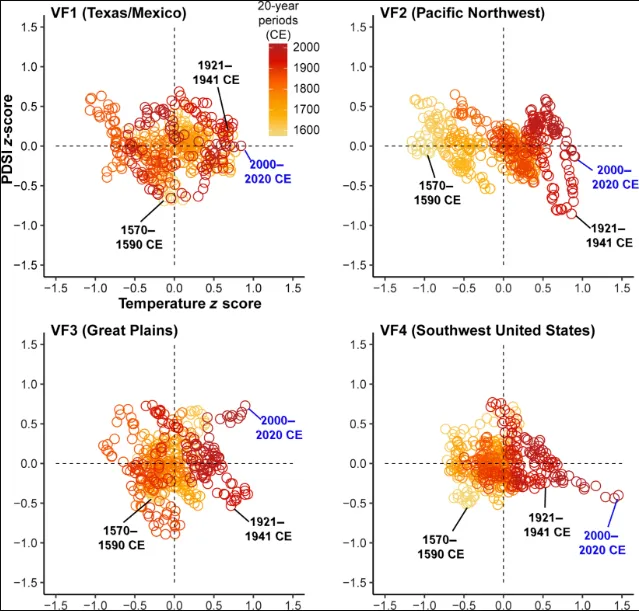
The authors note that the decades spanning the modern megadrought “exhibit the strongest negative relationships between summer maximum temperatures and soil moisture” compared to any other historical period. The heat amplifies evapotranspiration, which further dries out areas that are already suffering from a lack of rain or snow, but also can create drought conditions even when precipitation is especially scant. That can be seen in the Colorado River, where about one-third of the decline in flows can be attributed to unprecedented high temperatures. The authors go on to write: “… multidecadal drying exacerbated by high temperatures may further alter surface energy balance in ways that lead to additional warming.” Ughh. [ed. emphasis mine]
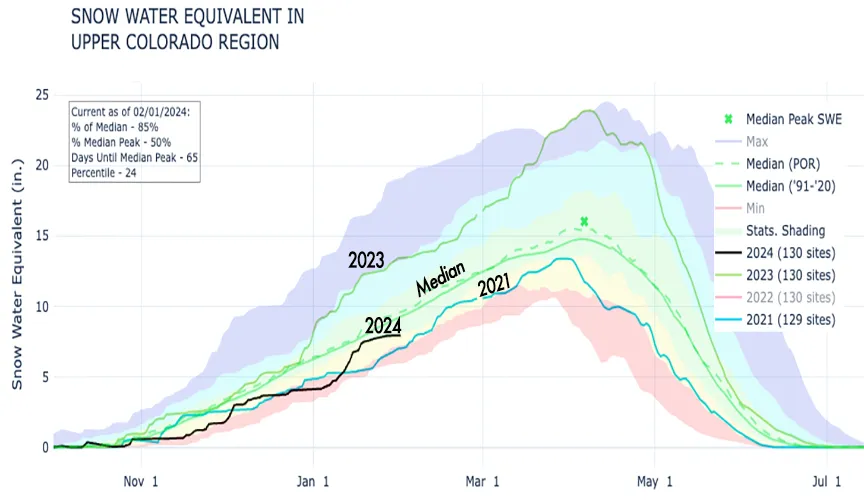
Oh, and about that 2000-2022 megadrought? I’m starting to get the bad feeling that the prolonged dry spell didn’t end in 2023, but just took a little break, and has come roaring back at us. Sure, January brought a few big storms to the West’s mountains, boosting snowpack substantially in some areas. The river basins in Utah’s Wasatch Front, for example, are mostly at or above median snowpack levels. But the snow remains thinner than the 1991-2020 normal in much of the West.
That includes the Upper Colorado River Basin.
And in the Animas-Dolores Basin in southwestern Colorado. According to this, the combined basin is actually in worse shape than it was in early February 2021.:
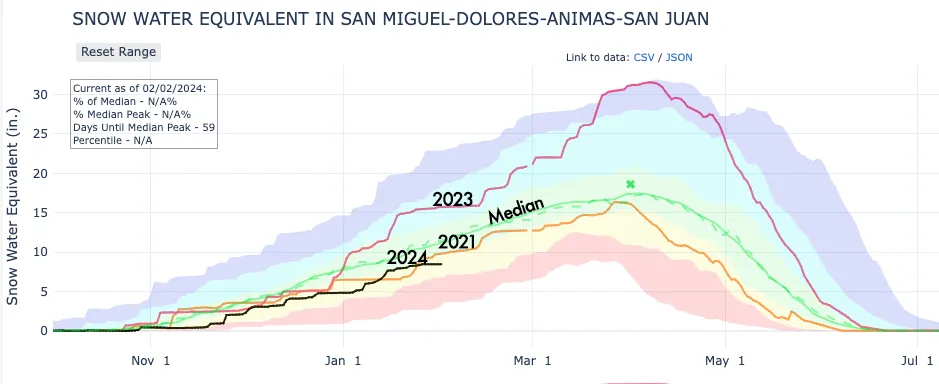
And zooming in on Columbus Basin in the La Plata Mountains, we find that this year’s snowpack is about even with this date in 2021. Better than ^^, but still …
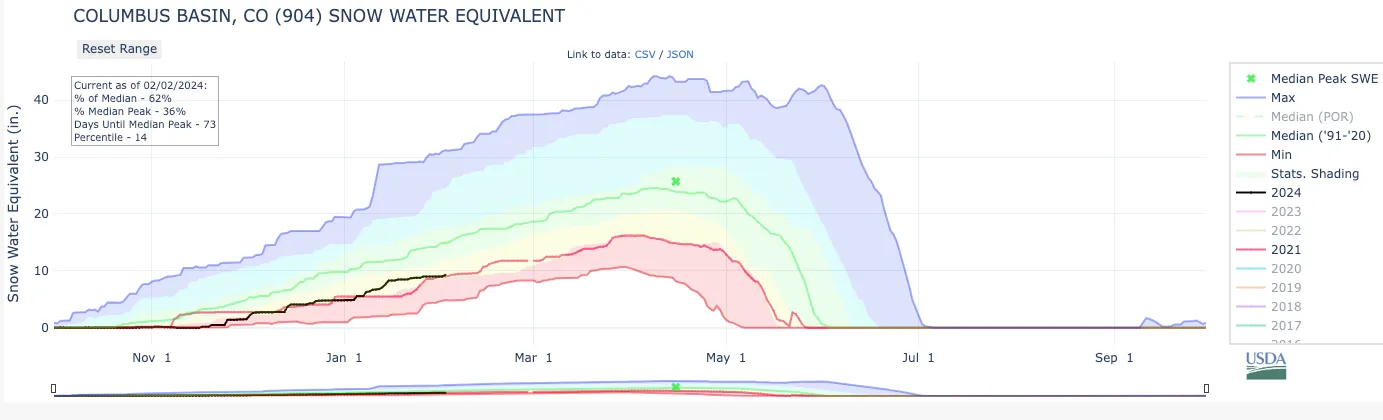
I know I always say this, but I’ll say it again: Don’t panic. Yet. Even as I write this a good-sized storm is walloping southwestern Colorado and these lines are likely to shoot upward in coming days. And we’re still in early days as far as the strongest expected effects of El Niño, so we may be in for a whopper of a spring still.