
Click the link to access the article on the Science Advances website (Karen E. King, Edward R. Cook, Kevin J. Anchukaitis, Benjamin I. Cook, Jason E. Smerdon, Richard Seager, Grant L. Harley, and Benjamin Spei). Here’s the abstract:
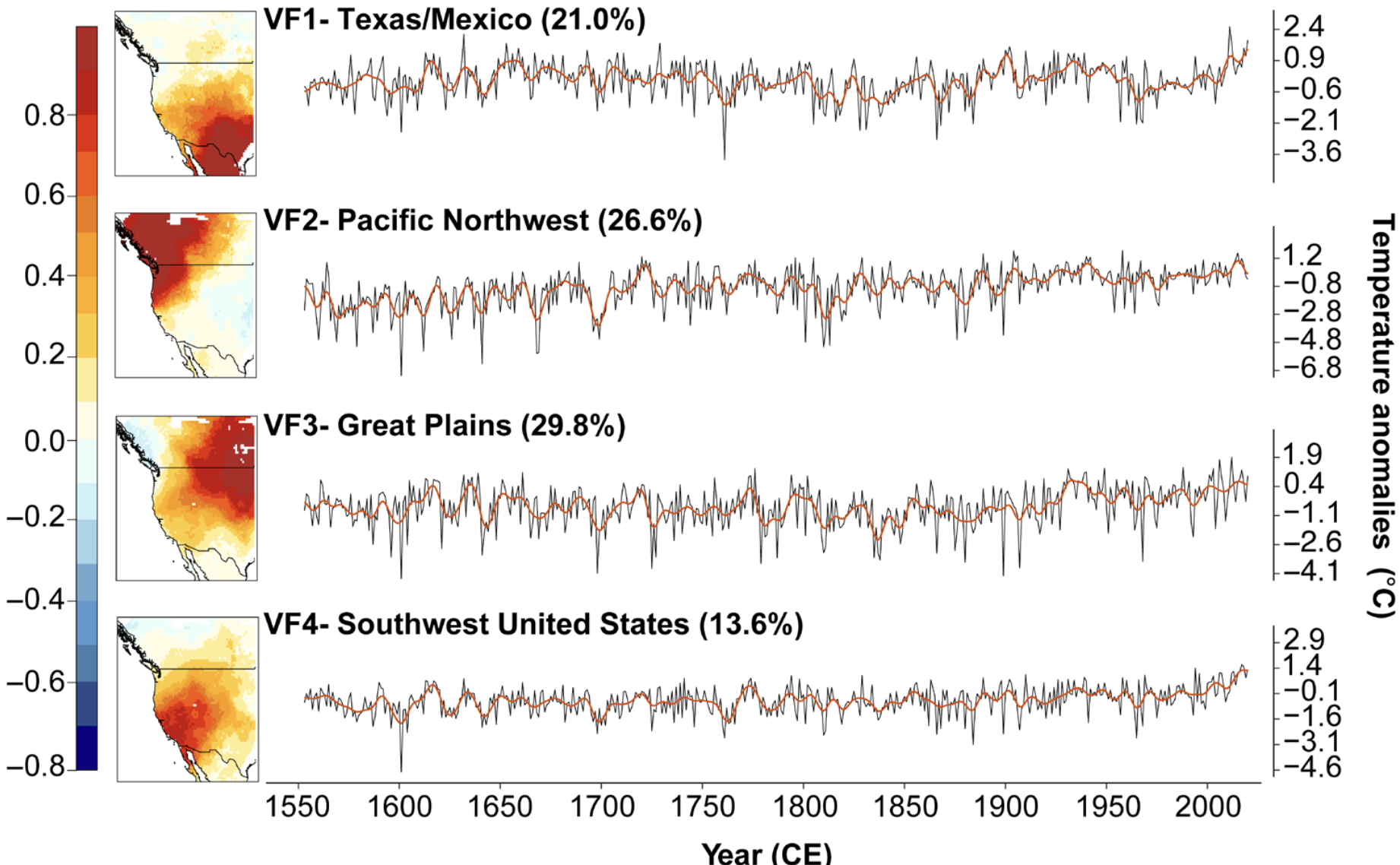
Across western North America (WNA), 20th-21st century anthropogenic warming has increased the prevalence and severity of concurrent drought and heat events, also termed hot droughts. However, the lack of independent spatial reconstructions of both soil moisture and temperature limits the potential to identify these events in the past and to place them in a long-term context. We develop the Western North American Temperature Atlas (WNATA), a data-independent 0.5° gridded reconstruction of summer maximum temperatures back to the 16th century. Our evaluation of the WNATA with existing hydroclimate reconstructions reveals an increasing association between maximum temperature and drought severity in recent decades, relative to the past five centuries. The synthesis of these paleo-reconstructions indicates that the amplification of the modern WNA megadrought by increased temperatures and the frequency and spatial extent of compound hot and dry conditions in the 21st century are likely unprecedented since at least the 16th century.