
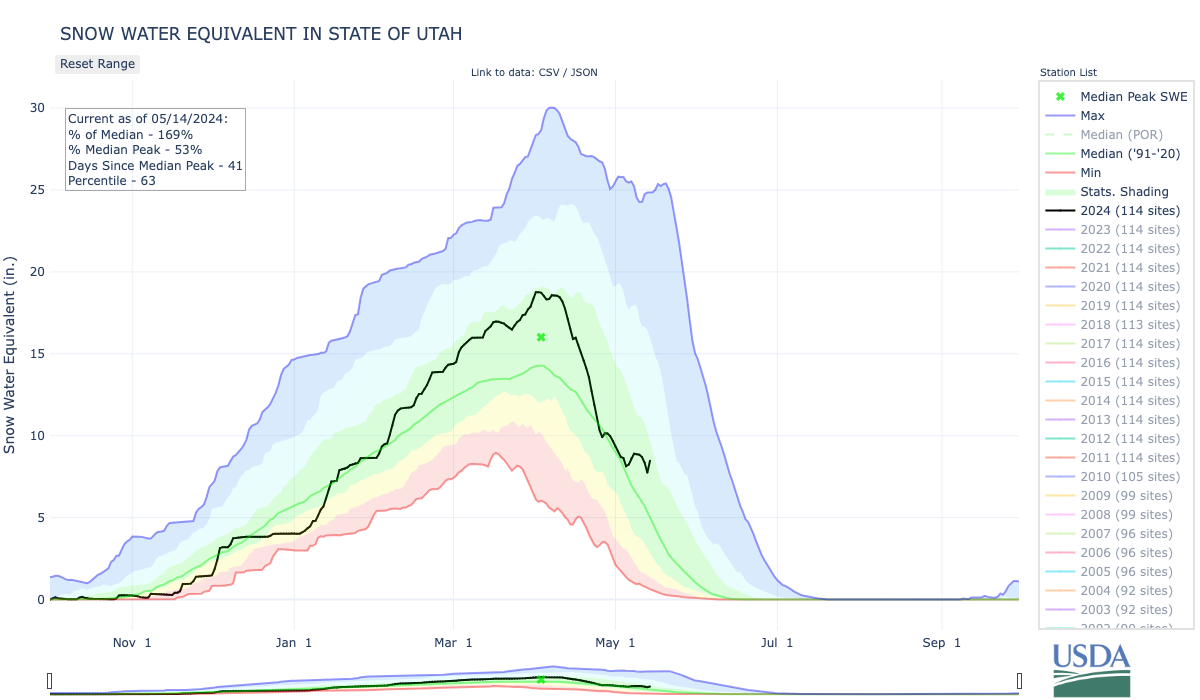
Click the link to read the article on the KUER website (David Condos). Here’s an excerpt:
May 13, 2024
Runoff from mountain snowpack is particularly precious in Utah. It provides 95% of the state’s water supply. In recent years, however, getting above-average snowpack hasn’t necessarily led to above-average runoff. Historically, water managers could count on those numbers to more-or-less match, said Colorado River Authority of Utah Chair Gene Shawcroft. This discrepancy — and the uncertainty it brings — makes the already tricky job of managing water in the West even harder, he said.
“That’s part of the challenge we have with everything we do in the water world. Not only are we pressured to make sure there’s water for the future. We’re also wrestling with, ‘What happens if our water supply is less than what we’ve anticipated?’”

When snowpack peaked in the Colorado River’s Upper Basin in early April, it was 112% of its historical normal. But the actual runoff for April was just 99% of normal. As of May 10, snowpack was still above average at 107% of normal. The most recent streamflow forecast for May-July, however, predicts runoff to only be 87% of normal. Localized examples of this gap show up in southern Utah, too. In the southwestern region, which includes St. George and Kanab, snowpack levels hit 101% of normal on May 1. But the May-July streamflow forecast expects runoff to be just 60% of normal. The Escalante-Paria basin from Bryce Canyon National Park to the southern edges of Lake Powell had snowpack levels that were 262% of normal on May 1, but the latest streamflow forecast anticipates runoff to be 101% of normal…
So, why is this happening? One big factor is how parched the ground is. Soil moisture and groundwater levels are still trying to claw their way back from the extreme drought Utah had between 2020 and 2022, said Utah Snow Survey Program Supervisor Jordan Clayton. The ground became so dried out, that it soaked up a disproportionate amount of snowmelt in the subsequent runoff seasons. Even during the past two years, the ground beneath some of that snow has remained on the dry side…
Another factor is how fast the snowpack melts. If it goes quickly, the ground will likely stay saturated and a much larger percentage of the water will make it downstream. If it happens in fits and starts, however, the ground has more chances to dry out between melting periods and could absorb more of that water…
Where the snow falls also matters. As Clayton looked at Utah’s snow conditions this winter, he noticed that the middle and lower-elevation mountains had especially high snowpack levels compared to their historical normals. The problem is that most of Utah’s water doesn’t come from those lower elevations, but from sites with an altitude of around 10,000 feet.