

Click the link to read the article on The Land Desk website (Jonathan P. Thompson):
BIG NEWS: On May 16, the Bureau of Land Management proposed ending new federal coal leasing in the Powder River Basin in Wyoming and Montana, which is by far the nation’s largest coal-producing region. The announcement comes on the heels of the finalization of a trio of more stringent rules for power plants. Together, the two moves could one day substantially diminish coal-fired electricity generation in the U.S., if not wipe it out altogether.
CONTEXT: Can we please stop accusing President Biden of “climate indifference” — and worse? I mean, seriously, folks: He may not have ended oil and gas drilling on public land, but he is standing up to the fossil fuel industry more potently than any president before him.
Granted, this is not a ban on coal mining. The gargantuan mines of the Powder River Basin will continue to churn out the carbon-intensive fuel for years. But when they deplete their current lease areas, which is expected to occur between 2035 and 2060, depending on the mine and region, they won’t be able to expand. That could potentially keep more than 48 billion tons of coal in the ground that otherwise would be mined and burned, thereby avoiding a heck of a lot of greenhouse gas emissions and other pollutant-spewing.
“This decision opens new doors to a future where our public lands are not sacrificed for fossil fuel profits and, instead, can prove a bulwark of ecological and community resilience in the face of a warming climate,” said Erik Schlenker-Goodrich, executive director of the Western Environmental Law Center, in a written statement.
The coal industry, as one might expect, is enraged, as are Wyoming and Montana leaders. Even Sen. Jon Tester, the Montana Democrat running for re-election against a full-blown climate change denier, is pushing back and considering ways to kill the plan. You can count on lawsuits challenging the plan, but keep in mind that the proposed leasing halt is the outcome of environmentalists challenging a Trump-era land-use plan.
Thing is, if the coal-burning industry continues to follow current trajectories, it may have perished on its own by the time this leasing ban kicks in. Yes, the Big Breakdown of coal has faltered somewhat in places: Rocky Mountain Power recently announced it was extending the life of some of its coal plants, for example. But it’s still underway as can be seen in the Powder River Basin, where first quarter 2024 coal production was more than 20% lower than a year earlier.
Coal-burning is going bye-bye, one way or another. Instead of trying to fend off the inevitable, local and state officials would be far better off seeking alternatives and ways to ensure that the transition is just and less painful.

On May 13, President Biden signed into law the Prohibiting Russian Uranium Imports Act, which does exactly what it says: bans imports of low-enriched uranium from Russia or Russian entities. And the domestic uranium mining industry is radiating with joy (see what I did there?) over the possibility it will boost efforts to reopen long-idled mines in the West.
Sen. John Barrasso, the Republican from Wyoming, first introduced the legislation back in 2022, shortly after Russia invaded Ukraine, as a way to cut off funding for Putin’s war machine. Sen. Ted Cruz put it on ice, purportedly to get his way with some other legislation, but finally removed his hold on it this spring. And, despite the MAGA GOP’s growing fondness for Putin, the bill finally made it through the House and Senate earlier this year before heading to Biden’s desk.
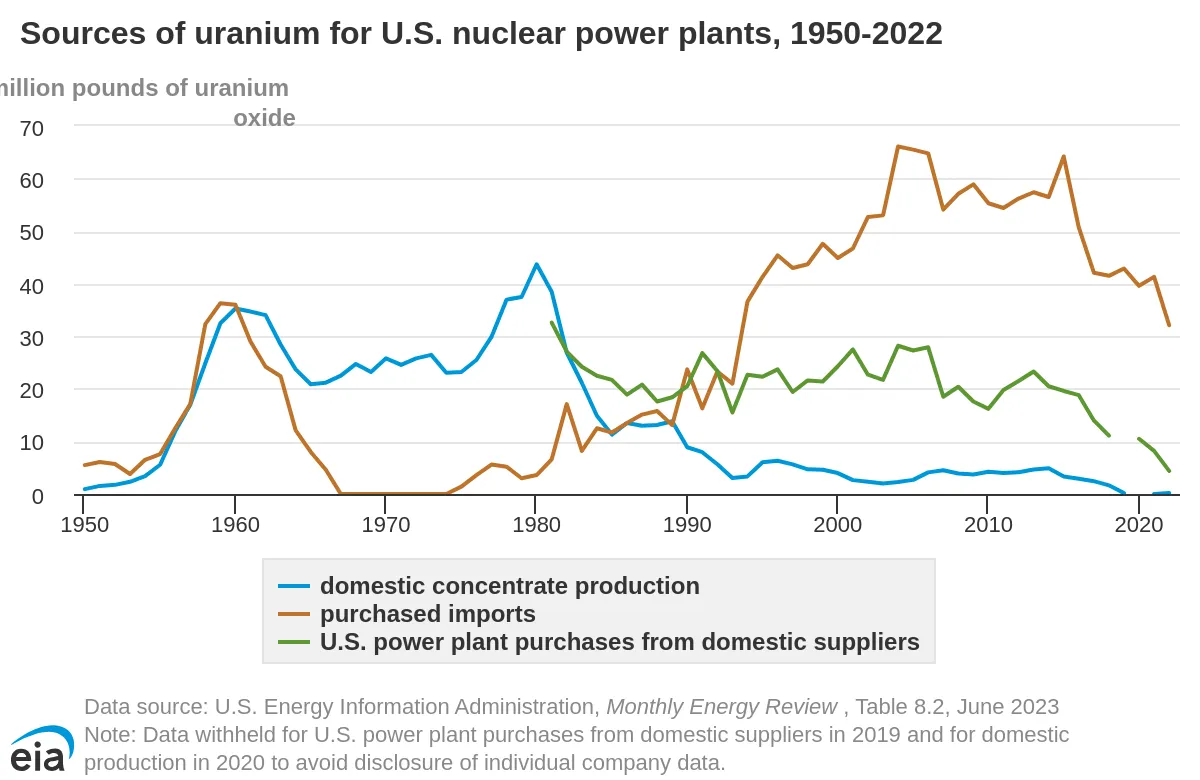
This is a big deal because U.S. utilities currently get almost all of their nuclear reactor fuel, i.e. uranium, from non-domestic suppliers. In 2022, about 12% of U.S. uranium purchases — or 4.9 million pounds of it — came directly from Russia. And another 25%, or some 10 million pounds, came from Kazakhstan, where the mines are mostly operated by Uranium One, a subsidiary of the Russian state-owned firm Rosatom. Uranium One also operates in Namibia and Tanzania. (Uranium One formerly owned mines and in-situ operations in Wyoming, too, but sold out of the U.S. in 2021).
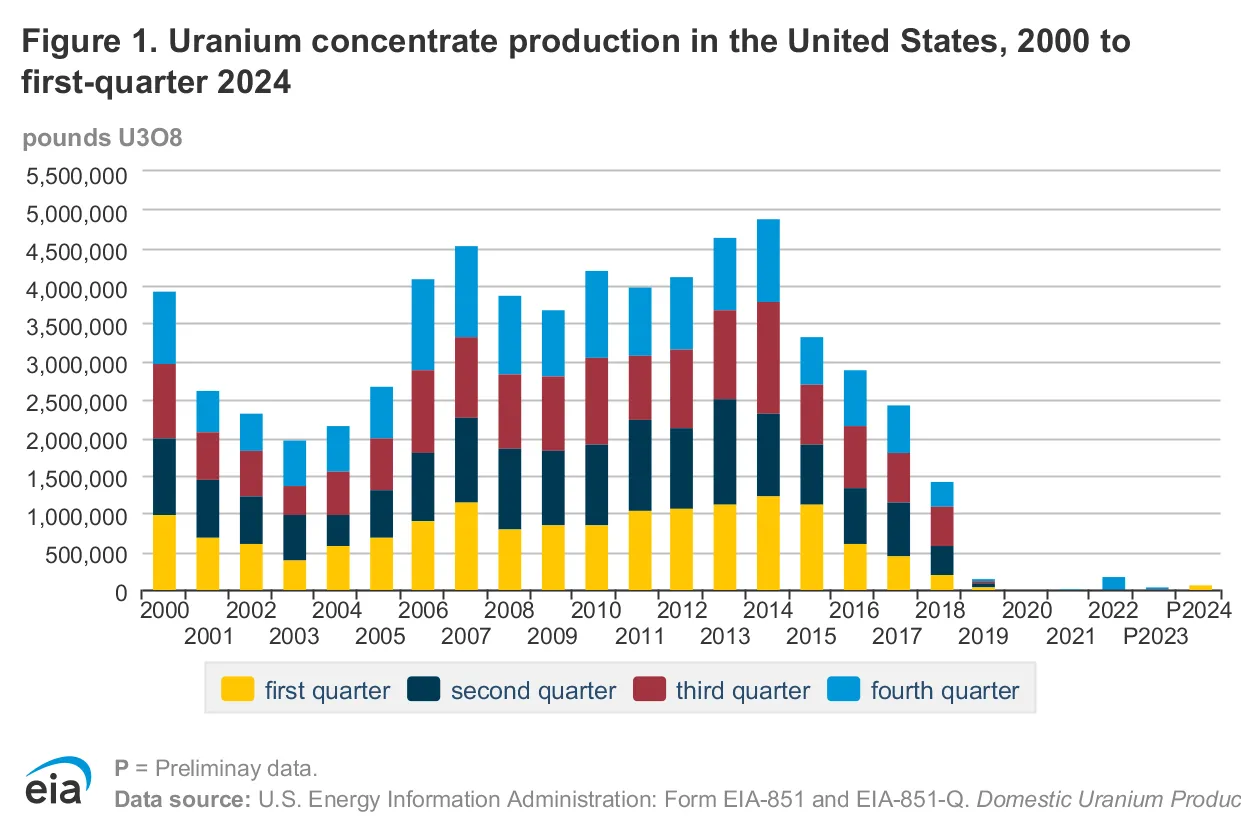
In other words, the ban potentially creates a 15-million-pound gap between supply and demand that must be filled to keep reactors running. And domestic suppliers are scrambling to fill the void by reopening long-idled mines and constructing new ones in Utah, New Mexico, Arizona, Wyoming, and Colorado. Energy Fuels — which owns the White Mesa uranium mill in southeastern Utah, the Pinyon Plain near the Grand Canyon, and several other projects in Utah, New Mexico, and Wyoming — was giddy over the ban, tweeting: “We stand ready to help supply the #nuclear market with responsibly produced US #uranium.”
As the Land Desk has written before, much of the talk of a uranium mining renaissance is merely hype intended to mine investors’ bank accounts more than to extract actual ore. And most of the press releases about this or that upcoming firm’s latest exploratory drilling results are just a bunch of ballyhoo. Even if they do pan out, it wouldn’t be until years or even decades from now.
But the import ban, paired with sustained high uranium prices — around $90 per pound for the past six months — certainly will shoot some adrenalin into the figurative veins of established producers, which have been in a zombie state for the past several years. Energy Fuels, for instance, reports that it is producing uranium ore at its Pinyon Plain (Arizona) and La Sal and Pandora (Utah) mines, though it is stockpiling the rock for now rather than shipping it to its Utah mill for processing. The company is also preparing its Nichols Ranch (Wyoming) mine for production as well as its Whirlwind Mine, which lies along the Colorado-Utah state line on the eastern slopes of the La Sal Mountains outside of Gateway.
But even Energy Fuels’ outlook is tempered: They say they’ll start shipping ore, start producing at other mines, and ramp up permitting for other projects, if market conditions remain strong. And they may not. Miners in Canada and Australia may respond to the high prices and the Russia ban by substantially ramping up production and exports to the U.S., which would dampen prices and make it once again unfeasible for American mines to operate.
But in the short-term, it appears that uranium country is going to experience at least a mild mining resurgence. And it’s happening under some of the same mining laws that failed to mitigate the devastating impacts of past booms.
See where the hype’s all about at the Land Desk Mining Monitor Map.
🏠 Random Real Estate Room 🤑
One of the ways I like to procrastinate — er, learn new things — is to cruise around the West via Zillow in search of the last affordable place to buy a home. Usually I don’t find much. But last week, the Los Angeles Times did my work for me by publishing a list of the only towns in the state where the median home sale price is $150,000 or less. LA Times staffer Terry Castleton writes:

Damn, I thought, these sound like some nice little secret gems! So I read on. These are some of the towns they came up with: Trona, Dorris, Macdoel, Tulelake, Boron, Yermo, Hinkley, Johannesburg.
Now, you might be thinking: Why is this jerk sharing this? Isn’t he worried the towns will be overrun and gentrified if the word gets out?
Well, no, I’m not too worried. First of all, it already appeared in a very big newspaper. Second of all, I’m not sure most of these towns are prime candidates for gentrification. I mean, consider Trona: a tiny little place sandwiched between an old coal plant/soda ash processing facility and a sprawling borax evaporation ponds.

Here’s a sampling of homes on the market in Trona:
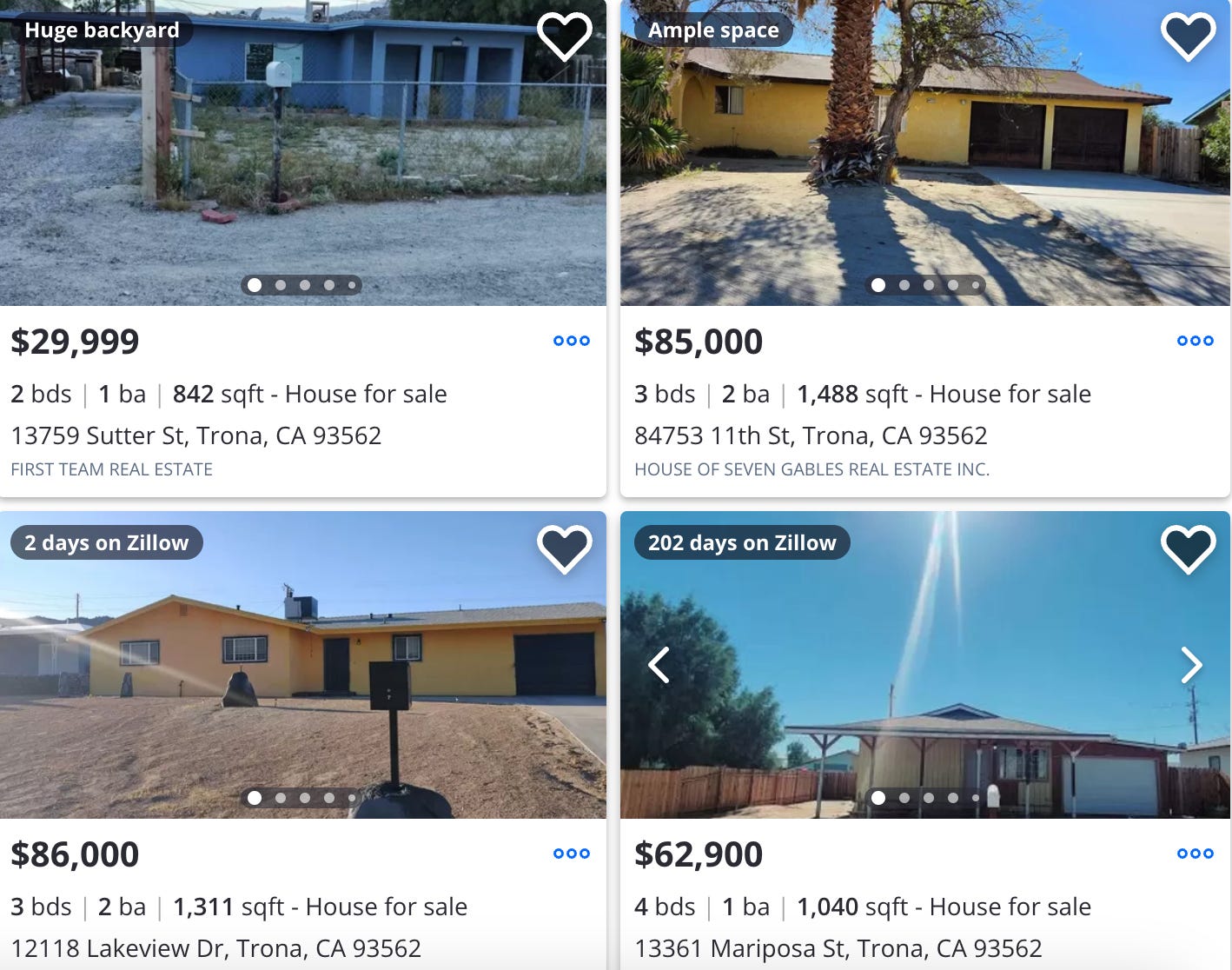
So, yeah, not bad prices, really. Especially considering that beyond the industrial facility is a bunch of desert expanse that I’m sure is beautiful.
Yermo, also on the list, looks similar, but it’s far less remote. And the LA Times story seems to have gone to its head, real estate-wise. The four homes on the market aren’t all that cheap (between $175k and $229k) — possibly due to its proximity to that desert gem of a city, Barstow. Ditto with Hinkley, famous for being the polluted place in Erin Brokovich. Yay.
I actually considered moving to Boron, another one on the list, after I graduated from college. The local high school was desperate for teachers and willing to hire folks without a teaching certificate. It was tempting, I must admit, especially for a desert rat like myself who could appreciate the sublimity of living on the edge of an open pit borax mine. Thing is, a lot of the land around there is an air force base, and the mountains are kind of far away, limiting exploration. I demurred.
Anyway, it’s worth checking out the other towns on the list if you’re seeking something affordable. They may be the only places left in all the Western U.S.