Click the link to read the article on The Land Desk website (Jonathan P. Thompson):
September 20, 2024
🤯 Annals of Inanity 🤡
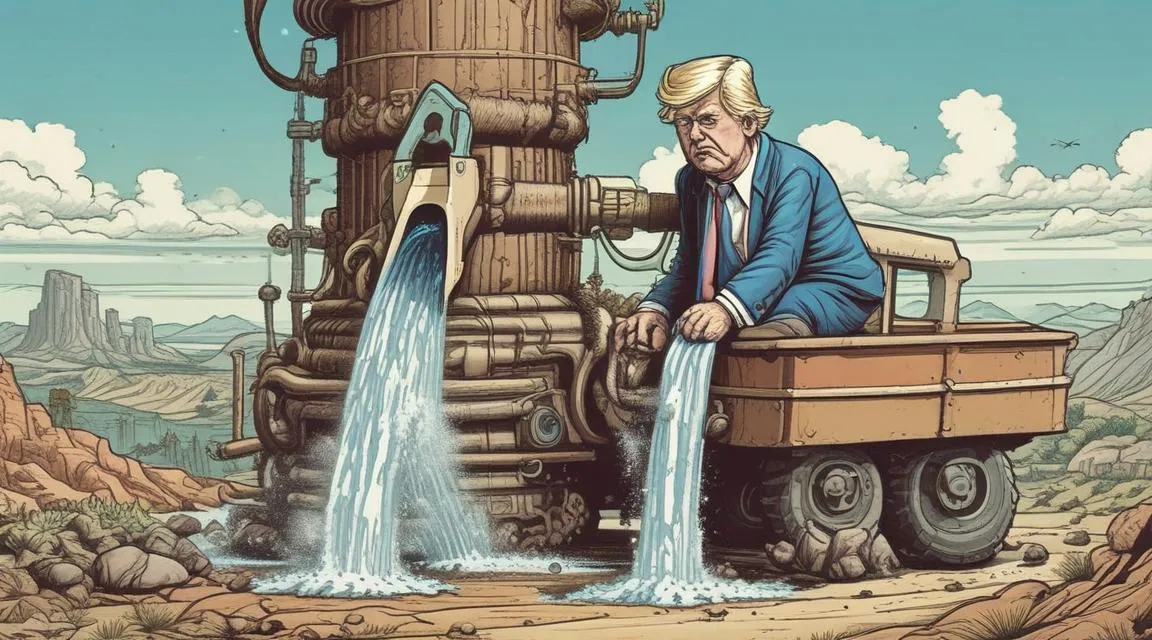
Silly me. Silly, silly me. And that goes for all of those federal and state officials who have been wringing their hands and gnashing their teeth over the West’s water situation, trying to find some way to keep the region from drying up as the Colorado River shrinks. When all along, the answer was staring us all right in the face: We just had to turn on the big faucet. You know, the big one up there somewhere that collects all the water from the snowcaps that climate change is melting. I think?
Former President Donald Trump unveiled this solution in an address in California. Seriously. You can watch it yourself on this YouTube clip Jeff Tiedrich put up on his newsletter:
And just in case the link doesn’t work or something, here’s the transcript (with punctuation added by me where it seemed to fit):

I had to watch the clip several times, and search around for the context, to make sure I wasn’t missing a lead-in or punchline to the joke. I wasn’t. He was serious.
As much as my snarky side would like to draw this whole thing out for humor’s sake, none of us have time for that. So I’m going to end the suspense: There is no faucet. There is no pipeline, canal, or other infrastructure in place that could move that water southward. And all that gibberish about the Department of Commerce, Gov. Newsom, and 30 gallons per day is nonsense. Maybe Trump believes in the Giant Faucet. Or maybe he just thinks the people listening to him are dumb enough to believe it and vote for him so that he can get someone to go up there and turn the big-as-a-wall faucet and turn California’s brittle forests into lush oases.
There are those who will get mad because I’m being too partisan by beating up on Trump. Believe me, if a Democrat said something this silly I’d be even more scathing in my response. Others will say I should just laugh it off; you can’t take anything the guy says seriously. Which is true. And yet, if Trump is elected, he or someone he appoints will be in charge of big water-related decisions. What are they going to tell him when he orders them to turn on the Giant Faucet?
As I Googled around on this one, it was interesting to see the lengths to which various water experts — especially those friendly ones from Canada — went to explain what Trump might have been talking about. Sure, there’s no faucet, but there have been proposals to ship water from the Columbia River southward — proposals that will never come to pass, because they would cost trillions of dollars and would involve a war with Canada. That’s probably what he was talking about. (It was called the North American Water and Power Alliance. Michelle Nijhuis wrote a fascinating history of the scheme in now-defunct Buzzfeed, which is preserved on the Wayback Machine).
I doubt it. More likely, he was just pulling a random assemblage of concepts out of his a&%. Maybe it’s best to just laugh it off as the ravings of a lunatic in cognitive decline, like all the talk of sharks and batteries and Hannibal Lecter. Thing is, even if it is crazy, it does come from — and reinforce — a common misconception that we can build our way out of the water crisis. It is the tragic Myth of More: If we just add a few more dams, diversions, and canals; if we just shoot some more silver iodide into the clouds; if we could just find some great big person to turn that Giant Faucet, everything will be fine.
Western water: Where values, math, and the “Law of the River” collide, Part I Jonathan P. Thompson Sep 12, 2024
***
Desalination is one of those infrastructure ideas that has long-been held up as an easy solution to the West’s water problems, but which has never caught on because of the crazy expense, energy-intensity, and the environmental impact of sucking water out of the ocean and disposing of the leftover brine. But Hannah Ritchie, at her Sustainability by the Numbers Substack, gives the technology another look. She finds that the technology has evolved, bringing energy use and operating costs down. A U.S. household would use less energy to desalinate all of its water than it does to heat the same water or to heat or cool the home. And it would end up costing the average American household about $154 per year. Not nothing, but not terrible, either.
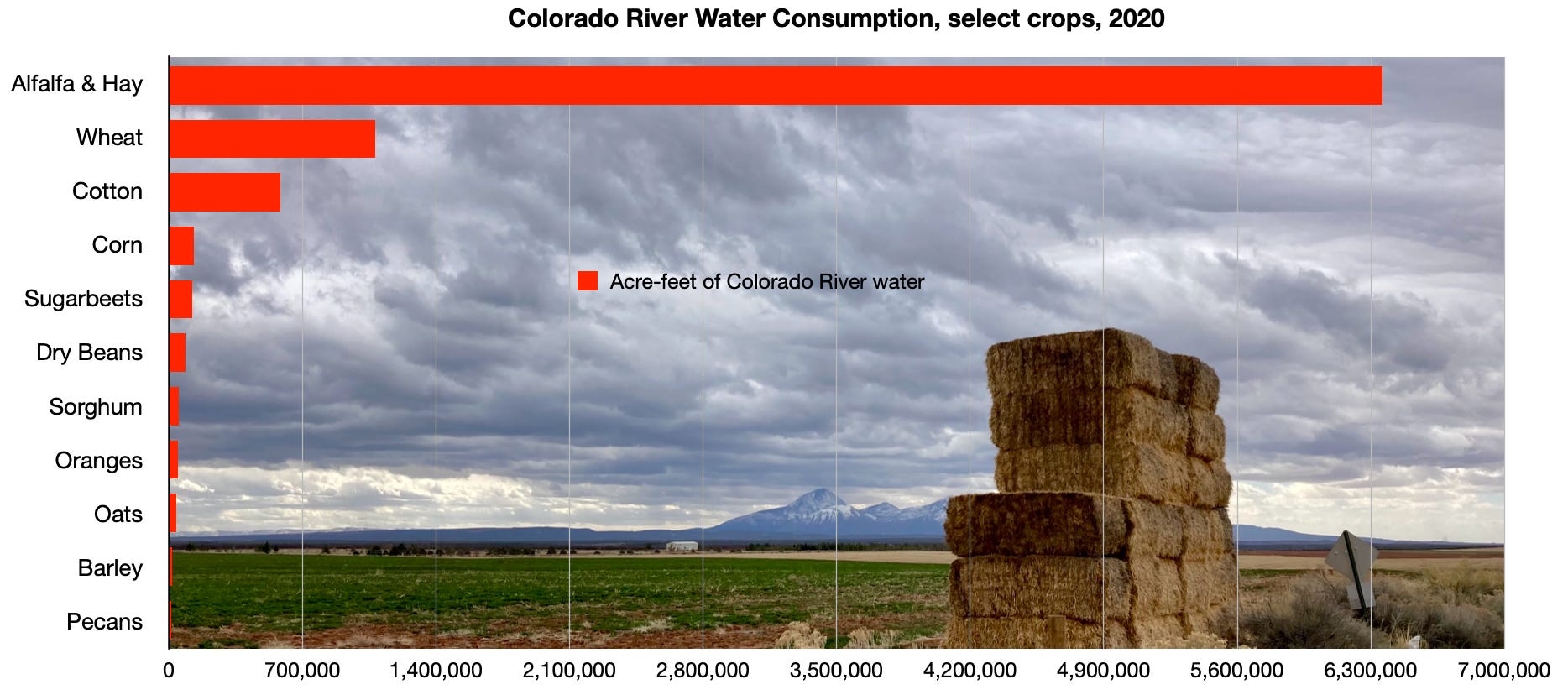
So can we solve the Colorado River shortage by desalinating seawater? Probably not. In theory, municipalities near the coasts could get most of their water from desalination. They could even pump and pipe that water further inland (which requires energy, and therefore increases cost). But relying on desalination for agricultural irrigation would be prohibitively expensive due to the huge volumes of water needed for crops. And, as you’ve read here before, agriculture takes up the lion’s share of the Colorado River.
***
📈 Data Dump 📊
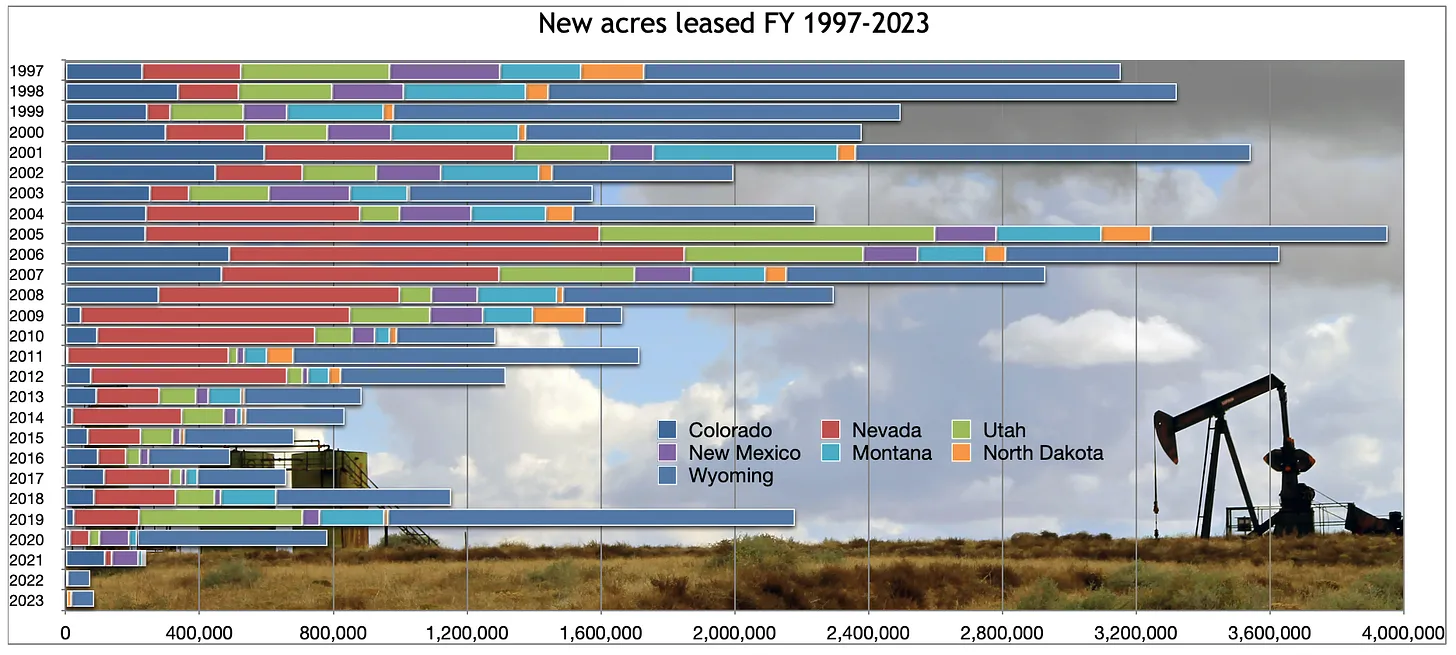
I’ve had a lot of charts on here showing how many drilling permits the Biden administration has issued vs. other administrations. It’s more than some, less than some. But perhaps more important over the long-term is how much new land is leased to oil and gas companies. And by that measure, Biden is way ahead — or behind — of everyone else, depending on your point of view. He’s leased out a record-low amount of land. The totals aren’t yet in for fiscal year 2024 (which ends at the end of this month), but I’m fairly sure they’ll look more or less the same as 2022 and 2023.
📸 Parting Shot 🎞️
Always a good sign …