Harris vs. Trump on #ClimateChange: Where they stand on the issue — The Washington Post #ActOnClimate

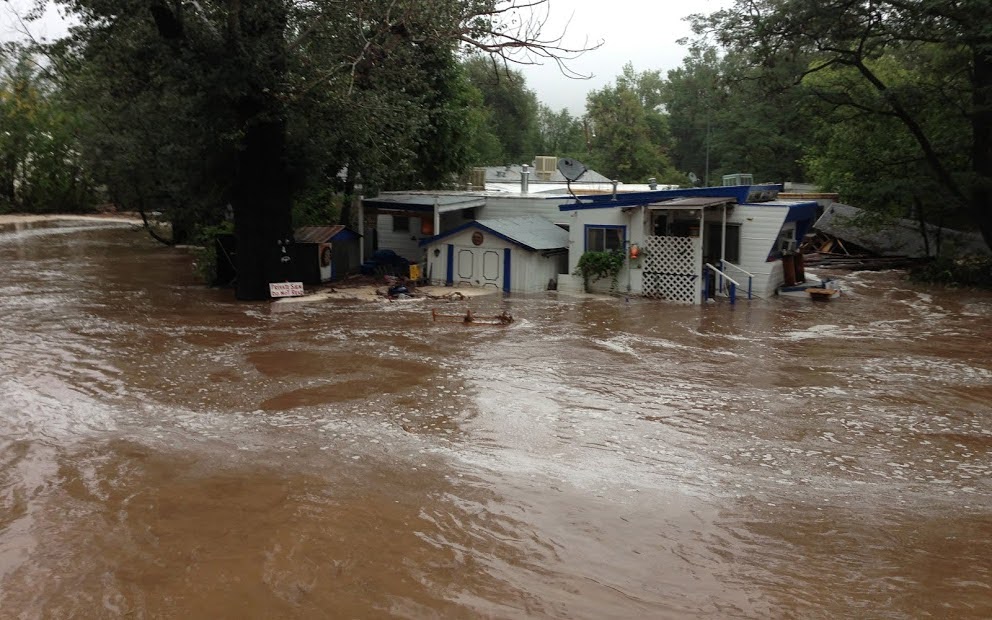
A view of Foothills Mobile Home Park, which suffered a total loss during the September 2013 flood in Lyons. (Courtesy of town of Lyons)

Click the link to read the article on The Washington Post website (Vanessa MontalbanoAbbie Cheeseman and Justine McDaniel). Here’s an excerpt:

Causes of climate change

Q: Do you believe that climate change is largely driven by human activity, including the burning of fossil fuels? If not, is there a different cause you would cite?

A: Harris calls climate change an existential threat and says the United States needs to act urgently to address it. As a presidential candidate in 2019, she released a $10 trillion climate plan that calls for investing in renewable energy, holding polluters accountable, helping communities affected by climate change and protecting natural resources. As California attorney general, she prosecuted oil companies for environmental violations. As vice president, she was the tie-breaking vote in the Senate for the Inflation Reduction Act, which provided about $370 billion to reduce greenhouse gas emissions to 40 percent below their 2005 levels by the end of this decade.

A: Trump believes human activity is just one cause of climate change, not necessarily the dominant factor. Pressed in a 2020 debate about whether human pollution contributes to warming, Trump said, “I think a lot of things do, but I think to an extent, yes.” Trump told The Washington Post’s editorial board in 2016 that he is “not a great believer in man-made climate change.” He has also long rejected climate science, sometimes calling global warming a “hoax.”

Q: Do you believe climate change is making disasters such as hurricanes, wildfires and heat waves more intense?

A: Harris has said the United States must take action to fight climate change in the face of increasing drought, floods, hurricanes, wildfires and sea level rise. As vice president, Harris announced more than $1 billion in grants in 2022 for states to address flooding and extreme heat exacerbated by climate change. “The frequency has accelerated in a relatively short period of time,” she said. “The science is clear. Extreme weather will only get worse, and the climate crisis will only accelerate.’’

A: At a rally in March 2022, Trump mocked the threat posed by sea-level rise and the nation’s concern with combating climate change. “And yet you have people like John Kerry worrying about the climate! The climate!” Trump said. “Oh, I heard that the other day. Here we are, [Russian President Vladimir Putin is] threatening us [and] he’s worried about the ocean will rise one-hundredth of one percent over the next 300 f—in’ years.” In 2019, Trump also exclusively blamed forest mismanagement for more destructive and deadly wildfires, rather than climate change. Scientists have said that no amount of forest management can stop wildfires in a more flammable world.
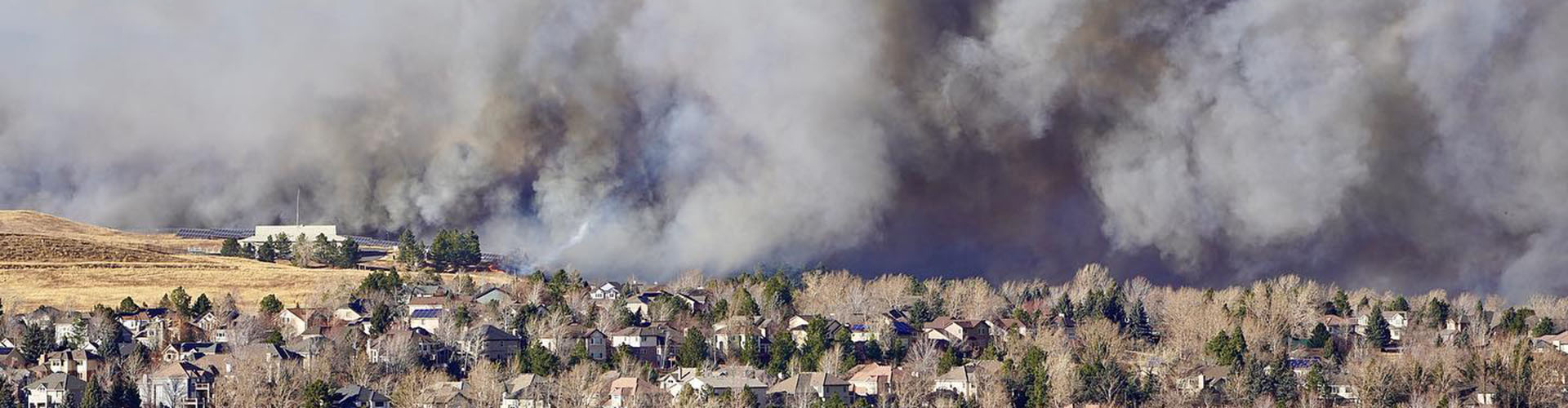
Marshall Fire December 30, 2021. Photo credit: Boulder County

#Durango sustainability manager discusses water use with panel: Marty Pool said city’s water comes predominantly from #FloridaRiver, supplemented by #AnimasRiver — The Durango Herald

Florida River near Durango airport, at Colorado highway 172. By Dicklyon – Own work, CC BY-SA 4.0, https://commons.wikimedia.org/w/index.php?curid=82546066

Click the link to read the article on The Durango Herald website (Christian Burney). Here’s an excerpt:

September 14, 2024

About 20 people attended the event. They heard the panelists discuss Florida and Animas river trends, how Southwest Colorado’s climate is changing over time and fast facts about where Durango’s water comes from. Pool said Durango’s water comes predominantly from the Florida River and is supplemented by the Animas River. The city uses about 1.5 billion gallons of water per year for all utility use types, he said…He said both the Florida and Animas rivers are trending downward in total water volume; in dry years, groundwater recedes, which affects the total amount of surface water available. But Durango’s water consumption has remained flat despite a growing population, he said.

“Per capita, water use is going down. Total water use is staying pretty flat, with some seasonal fluctuations due to irrigation,” [Marty Pool] said.

While the city uses all the water from the Florida River it has legal rights to every year, it’s not even approaching the maximum usage of water from the Animas River, he said…Durango is lucky in that not all communities have that many second or third water options, he said.

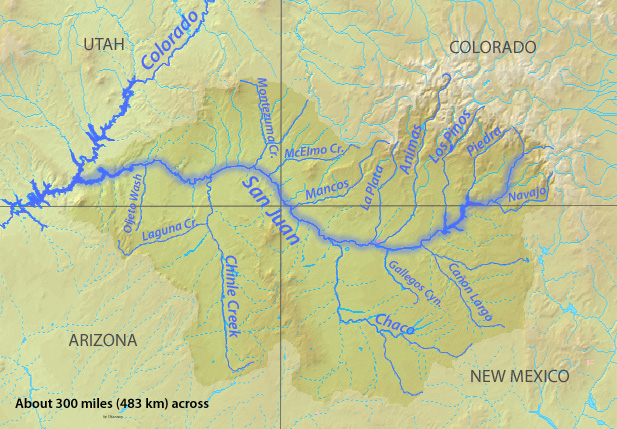
San Juan River Basin. Graphic credit Wikipedia.

Registration is open now for Water Law in a Nutshell Full Day Training — Water Information Program

Click the link for all the inside skinny and to register on the Water Information Program website:

Registration is open for the popular Water Law in a Nutshell course, presented by 
the Water Information Program

Thursday, October 17, 2024 from 8:30 am – 5:00 pm
at the Lone Cone Library, 1455 Pinion St., Norwood, CO

Continuing Education Credits available: 

Realtors CE: 8 hours
Appraiser/Assessors CE: 4 hours
Attorneys CLE: 8 hours

We are pleased to present this in-person, full day water law course. Don’t miss this rare opportunity to learn with Aaron Clay in Norwood, CO! 

This full day course will cover all aspects of the law related to water rights and ditch rights as applied in Colorado. Subject matter includes the appropriation, perfection, use, limitations, attributes, abandonment and enforcement of various types of water rights. Additional subject matter will include special rules for groundwater, public rights in appropriated water, Federal and interstate compacts and more.

Even if you have taken this course or one of the on-line short courses, it is a great refresher as there is so much information offered.

We welcome EVERONE, from anywhere in Colorado, including land owners, realtors, assessors, lawyers, water district employees, teachers, students and anyone interested in water law.

Register now to reserve your seat. General attendance is $125.00 (plus Eventbrite service fee) which includes lunch, course materials and a copy of the Citizen’s Guide to Colorado Water Law. ** $160.00 (plus Eventbrite service fee) if you wish to receive Continuing Education Credits (includes lunch, course materials and Citizen’s Guide to Colorado Water Law)

Past Participant Comments: 
“This is a great course and should be mandatory for real estate agents licensed in Colorado.”

“Excellent speaker, good explanations. Stayed on topic, stayed on schedule, good diagram, good materials.”
“Aaron is very intelligent, had answers thorough explanations for each question, and was informative on Colorado (and other state/federal) water law.”
“One of the most relevant and effective CLE presentations I’ve to over past 25 years.”:
“Very helpful. This is the 1st time it’s actually all made sense.”

10,000 Acre-Feet of Water to Benefit #GreatSaltLake, Jordan River, Birds, Habitats and Communities: Partners Work Together to Bring New Water Flows — #Utah Department of Water Resources

Figure 1. A bridge where the Bear River used to flow into Great Salt Lake. Photo: EcoFlight.

Click the link to read the release on the Utah DWR website (Shaela Adams, Kelly Good, Wade Tuft):

September 16, 2024

SALT LAKE CITY—Great Salt Lake will benefit from 10,000 additional acre-feet of water thanks to a partnership between the National Audubon Society and The Nature Conservancy—as co-managers of the Great Salt Lake Watershed Enhancement Trust—in partnership with Jordan Valley Water Conservancy District, the Church of Jesus Christ of Latter-day Saints, the Utah Division of Wildlife Resources, and the Utah Division of Forestry, Fire and State Lands. The water will be delivered from upstream storage in Utah Lake, and flow through the Jordan River to Great Salt Lake’s Farmington and Gilbert Bays through mid-October.

Jordan Valley Water Conservancy District (Jordan Valley Water) is donating 5,300 acre-feet of water, the Church of Jesus Christ of Latter-day Saints (Church) is donating 1,700 acre-feet of water, and the Great Salt Lake Watershed Enhancement Trust (the Trust) is leasing 3,000 acre-feet of water, with all water sourced from Welby Jacob Water Users Company shares. The Utah Divisions of Wildlife Resources (DWR) and Forestry, Fire and State Lands (FFSL) will place the water to beneficial use at Great Salt Lake.

“Delivering new water to Great Salt Lake is essential to preserve the health of the lake and Utah communities, as well as protect the habitats for millions of birds that rely on it,” said Marcelle Shoop, Executive Director of the Trust and National Audubon Society’s Saline Lakes Director. “We are grateful for the vision and commitment of many partners, for this innovative late season water release to diversify benefits to the lake and its wetlands, as well as the Jordan River. We look forward to future opportunities to repeat these efforts in years to come.”

While the 2024 spring season flows increased Great Salt Lake water levels, ongoing flows are needed to reach healthy levels. Now the lake will receive additional flows this fall through this key collaboration.

“This release to Great Salt Lake is made possible by four key factors: water conservation efforts of residents and businesses in Salt Lake Valley, important changes to water rights laws adopted by the legislature over the last few years, Jordan Valley’s effective use of its existing water storage and conveyance infrastructure, and a strong snowpack,” says Alan Packard, General Manager of Jordan Valley Water. 

Migrating shorebirds, waterfowl and other waterbirds will benefit as their habitats receive these additional flows. Increased water flows to the lake can also aid with salinity management in the South Arm, and in some cases improve capacity to control the spread of botulism and other diseases.

“Additional flows late in the water season are particularly beneficial during dry, warm conditions when there are risks of avian botulism,” DWR Director J Shirley said. “Over 12 million birds, represented by 339 species, utilize the Great Salt Lake and its associated wetlands. The ecosystem that the Great Salt Lake and its wetlands provide is crucial for these birds, and we applaud the ongoing efforts to conserve these habitat areas and the lake.” 

The release will take place during Jordan River Commission’s Get To the River Festival, highlighting that in addition to the benefits to Great Salt Lake, these flows will benefit Jordan River and bordering communities, ecologically and recreationally, as the water moves down some 51 river miles.

“The Church continues to look for ways to care for the Great Salt Lake and the ecosystem that depends on it. This latest donation is another step in that effort. We consider it a divine responsibility to care for the earth and be wise stewards of God’s creation,” said Bishop W. Christopher Waddell, First Counselor in the Presiding Bishopric, The Church of Jesus Christ of Latter-day Saints.

Utah Rivers map via Geology.com