On Sept. 19, the Pagosa Springs Town Council adopted new rates for the geothermal water that the town sends to The Springs Resort. The new rates are based on what the council deemed as the “fair mar- ket” values of the heat and mineral content of the water. The council decided that a fair market rate for the heat/energy of the water should reflect the same per- centage of rate increases that general customers have experienced. Geothermal utility customers saw a 100 percent rate increase in the 2022-2023 heating season and a 50 percent increase for the 2024-2025 season. The council’s calculations deem that if The Springs Resort also paid these rate increases for the geother- mal energy, its rate would be $2,084 per month or $25,007 annually, and this rate would be the fair market value for the heat/energy component of the water. On the mineral component, the council decided that the fair mar- ket value would be determined by the daily entry fee that The Springs charges its nonresident visitors. Currently, the resort charges out-of-town purchase the water at these new rates…
The council ultimately decided on $1,675 per month, or $20,100 annually, for the usage of the water’s mineral component, which was calculated by multiplying The Springs’ daily nonresident price of $67 by the number of its soaking pools (25).
The decrease in reservoir storage following the 2024 inflow season has been thankfully modest, but not as favorable as it was at this time last year. Perseverance reducing consumptive uses and losses is needed for reliability and security in the water supply and to regain reservoir storage.
Between mid-April and early July 2024, reservoir storage in the Colorado River basin increased by 2.45 million acre feet (af). Now we are in the nine-month period of progressive decline as reservoir storage supports consumptive uses and losses throughout the basin until the 2025 spring snowmelt season begins. As of 1 September 2024 basin reservoir storage was 28.9 million af, and the combined storage in Lake Mead and Lake Powell was 18.0 million af. Those amounts are similar to conditions from spring 2021 when media outlets began reporting on the emergence of a water crisis. That crisis continues.
It is useful to monitor changes in basin reservoir storage because it is the “bank account” from which we can make withdrawals during dry years. Basin water managers have little control over each year’s watershed runoff, but they have a continuing ability to reduce water consumption.
Basin water managers have a long way to go to replenish reservoir storage to amounts that ensure a secure and reliable water supply. Today’s water in the basin’s reservoirs is slightly more than a two-year supply, based on the average rate of water consumption and losses[1] in the basin. It remains in a precarious state should a string of very dry years occur, as was the case between 2002 and 2004 and between 2020 and 2022.
Although the ultimate cause of the ongoing crisis in water supply is a declining watershed runoff associated with a warming climate, the proximate cause is the inability to reduce consumptive uses to match the declining supply[2]. John Fleck summarized recent progress in reducing Lower Basin water use[3]— that is the kind of progress needed throughout the basin.
Where We Stand Today
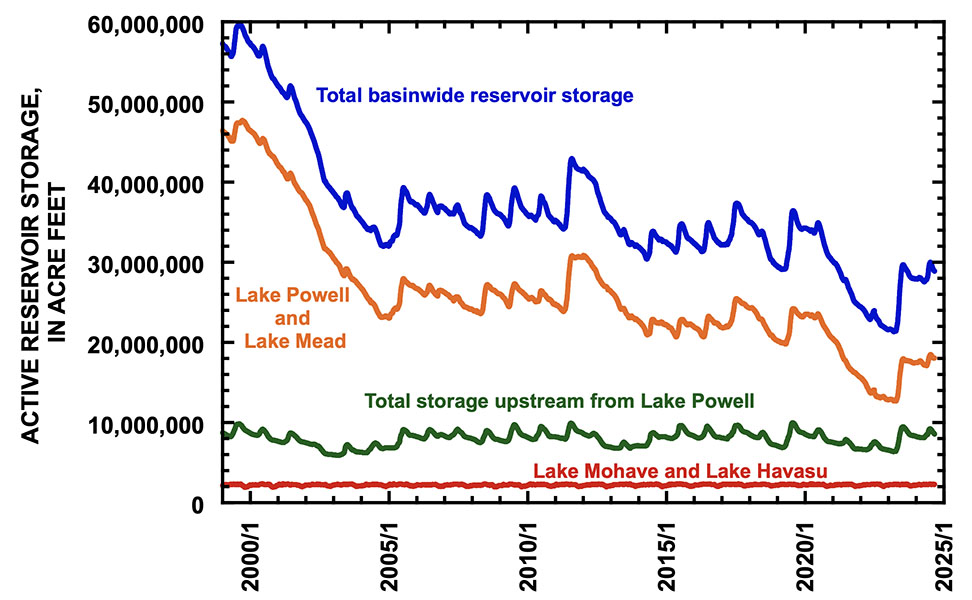
Figure 1 is a reminder that present reservoir storage remains low in relation to conditions throughout the 21st century. Today, 62% of total basin storage is in Lake Mead and Lake Powell, 30% of storage is in reservoirs upstream from Lake Powell, and 8% of storage is in Lake Mohave and Lake Havasu. Storage in reservoirs upstream from Lake Powell increases during each year’s snowmelt season, and subsequently decreases to sustain consumptive uses. Storage in Lake Mohave and Lake Havasu change little. The big changes in the basin are mostly due to changes in storage in Lake Mead and Lake Powell.
Figure 1. Graph showing reservoir storage in the Colorado River basin between 1 January 1999 and 31 August 2024.
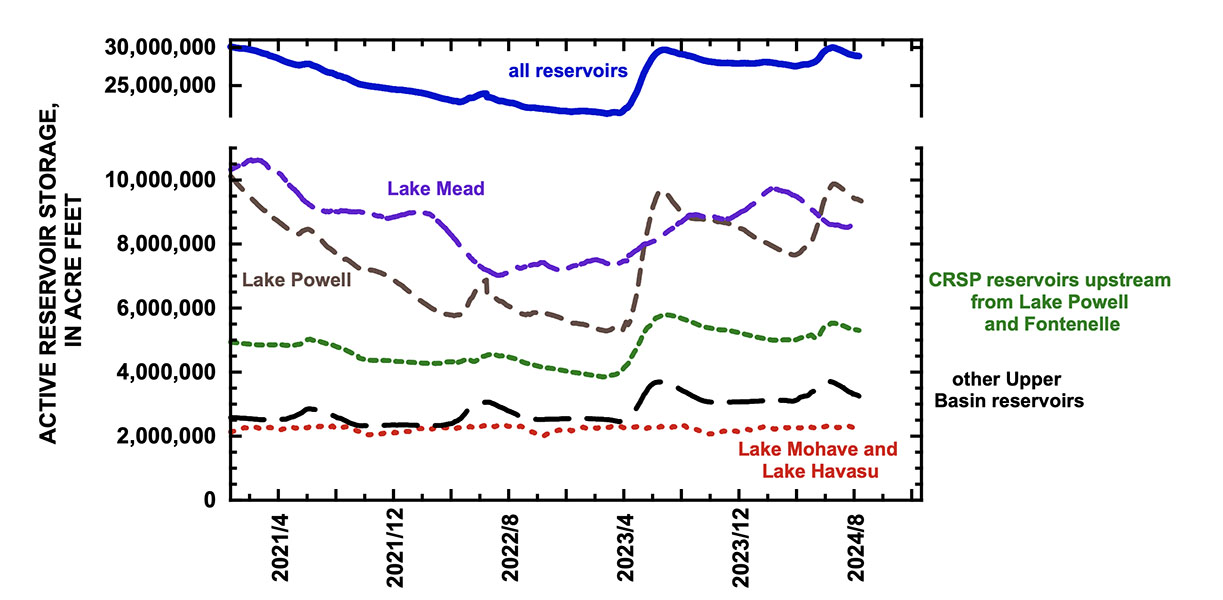
The water supply in Lake Mead and Lake Powell, as well as Lake Mohave and Lake Havasu, supports water use in the Lower Basin and in Mexico. Lake Powell is downstream from virtually all Upper Basin water use. Essentially, Lake Powell and Lake Mead are one reservoir, separated into two parts by the Grand Canyon. Nevertheless, Lake Mead and Lake Powell are operated differently, as is evident in Figure 2. In spring and early summer, snowmelt runoff is captured in Lake Powell, and storage increases there even though storage at the same time decreases in Lake Mead in some years. Once the snowmelt season ends, water is transferred to Lake Mead, and Lake Powell storage slowly declines. Figure 2 demonstrates that changes in water storage in Lake Mead occur over longer cycles than do the annual cycles of storage change that occur in Lake Powell. Because of the different operating rules of the two reservoirs, basin water storage conditions are better reflected by the combined storage contents of the two reservoirs rather than conditions in either Lake Mead or Lake Powell.
Figure 2. Graph showing reservoir storage in different parts of the Colorado River basin since 1 January 2021.Note that water storage in Lake Powell increased greatly during the 2023 inflow season, declined thereafter until the beginning of the 2024 inflow season, increased again in spring 2024, and is now declining.
Despite the modest inflow season of 2024 when unregulated inflow to Lake Powell was only 83% of average, reservoir storage increased by 300,000 af, because losses from the basin’s reservoirs between mid-July 2023 and early April 2024 were less than the gains in storage that occurred in spring 2024[4]. The total decrease in storage between mid-July 2023 and early April 2024 was the smallest in the past decade and was primarily due to reduced consumptive uses in the Lower Basin.
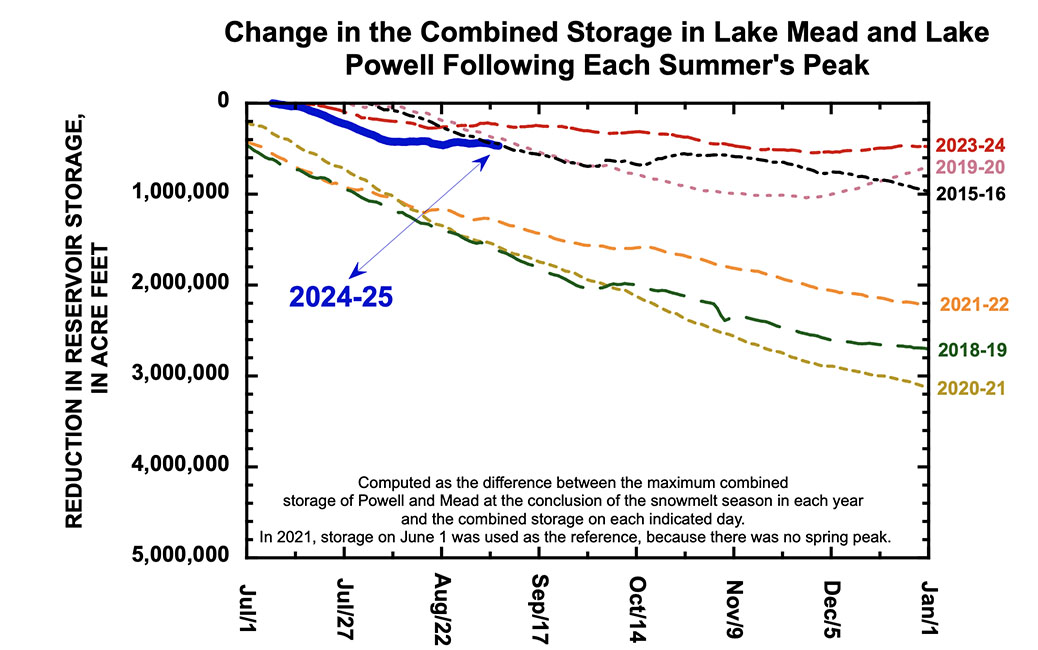
One way to keep track of the loss in reservoir storage due to consumptive uses and losses is to monitor changes in storage that occur after the early summer peak occurs, as is depicted in Figure 3. For example, the dark blue line in Figure 3 was computed by subtracting the total basin reservoir storage on each day from the peak value of 30.0 million af that occurred on 6 July 2024. On 31 August 2024, total basin storage of 28.8 million af was 1.12 million af less than the early July peak. This amount of loss is midway in the range of reservoir loss that has occurred during the past decade. Reservoir storage declined little following inflow in 2017 (2017-2018); 2019 (2019-2020); and 2023 (2023-2024). Storage declined by large amounts following inflow in 2018 (2018-2019); 2020 (2020-2021); and 2021 (2021-2022). These data demonstrate that the current rate of decrease in reservoir storage has been “average” for the last decade but is much greater than the remarkably small rate of loss last year.
Figure 3. Graph showing the decrease in total basin reservoir storage in 2024 (2024-2025) following the early summer peak, compared with the decrease in some other years of the past decade. Loss in reservoir storage was greatest following the 2020 inflow season (2020-2021) and least following the 2023 inflow season (2023-2024). This year’s loss is midway between those extremes.
The rate of decrease in the combined contents of Lake Mead and Lake Powell since early July 2024 has been comparable to the loss in other years of small decline, as is evident in Figure 4. It is especially encouraging that storage in Mead and Powell greatly slowed since mid-August.
Figure 4. Graph showing the decrease in the combined contents of Lake Mead and Lake Powell following peak storage of 18.5 million af that occurred on 8 July 2024, compared with the decrease in some other years of the past decade. Loss in reservoir storage was greatest following the 2020 inflow season (2020-2021) and least following the 2023 inflow season (2023-2024). This year’s loss is similar to years when the loss in combined storage was relatively small.
[1] Basin consumptive uses and losses averaged 13.0 million af/yr for 2021-2023, based on the latest published reports of the Bureau of Reclamation.
[2] Schmidt, J. C., Yackulic, C. B., and Kuhn, E. 2023. The Colorado River water crisis: its origin and the future. WIREs Water 2023;e1672.
[3] Fleck, J. 2024. Imperial Irrigation District’s water use on track for a record low, as is U.S. Lower Basin use. Inkstain, 9 September 2024, https://www.inkstain.net/.
[4] The gain is reservoir storage during the 2024 inflow season was 2.45 million af, and preceding decreases in storage between mid-July 2023 and mid-April 2024 were only 2.15 million af. Thus, inflows in 2024 added 300,000 af to total basin reservoir storage (Schmidt, 2024. The 2024 runoff season comes to an end- how did we do? Center for Colorado River Studies, 17 July 2024, https://qcnr.usu.edu/coloradoriver/).
The challenge, they argue, is the lack of the institutional framework we need to address evolving societal values around the river’s management in a changing world.
Cloud is Vice-Chairman of the Southern Ute Tribe and has become a major voice in the effort to rethink the role of indigenous people in management of the Colorado River. Berggren, now at Western Resource Advocates, is the author of one of the most insightful analyses of Colorado River governance we’ve had in recent years. (I hope that link works for folks, this might also.)
They catalog the remarkable efforts within the last decade or more to create new frameworks for Tribal involvement in Colorado River governance, notably the Ten Tribes Partnership and the Water and Tribes Initiative. Here’s Cloud:
The challenge, as Berggren documented in his thesis, is a set of water management institutions – by “institutions” here I mean the formal rules we wrote to manage water – which are antecedent to the government agencies and political power centers that emerged to carry them out – created to allocate water for municipal and agricultural use.
Because those rules were allocative in nature, the government agencies and political power centers that emerged to carry them out focused almost entirely on carving up the water supply and getting it efficiently to farms and cities. Which worked great, until it didn’t. As the twin challenges of climate change and evolving values emerged, those institutional structures have proven maladaptive.
But it’s a path dependence from which it is hard to dislodge ourselves as new, changing values emerge. These new values (“New” here seems weird, the indigenous communities represent the oldest values! Maybe “newly recognized”?) don’t have a seat at the table.
I don’t know if their proposed solution, is the right one:
But if not this tool, then what should we do instead?
Native America in the Colorado River Basin. Credit: USBR