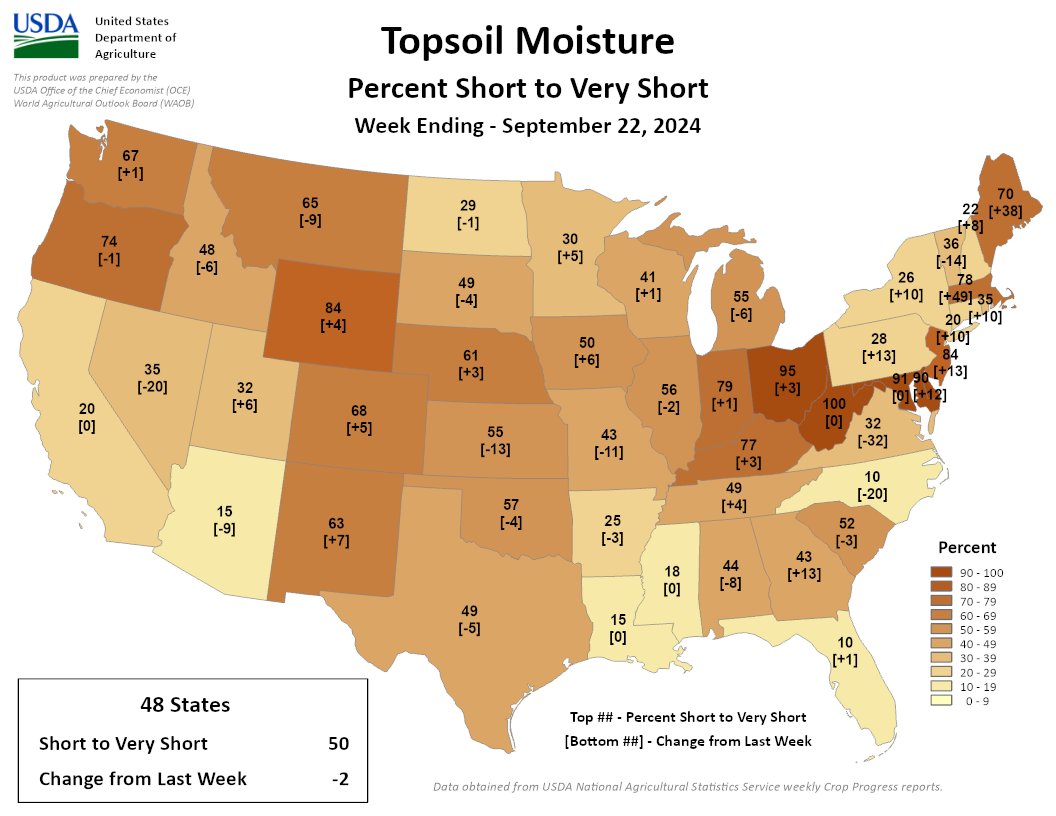
Soils dried out in much of the Northeast/Mid-Atlantic but improved in the Carolinas. 4 states are over 80% short/very short: WY, OH, WV, MD, DE, NJ

Soils dried out in much of the Northeast/Mid-Atlantic but improved in the Carolinas. 4 states are over 80% short/very short: WY, OH, WV, MD, DE, NJ
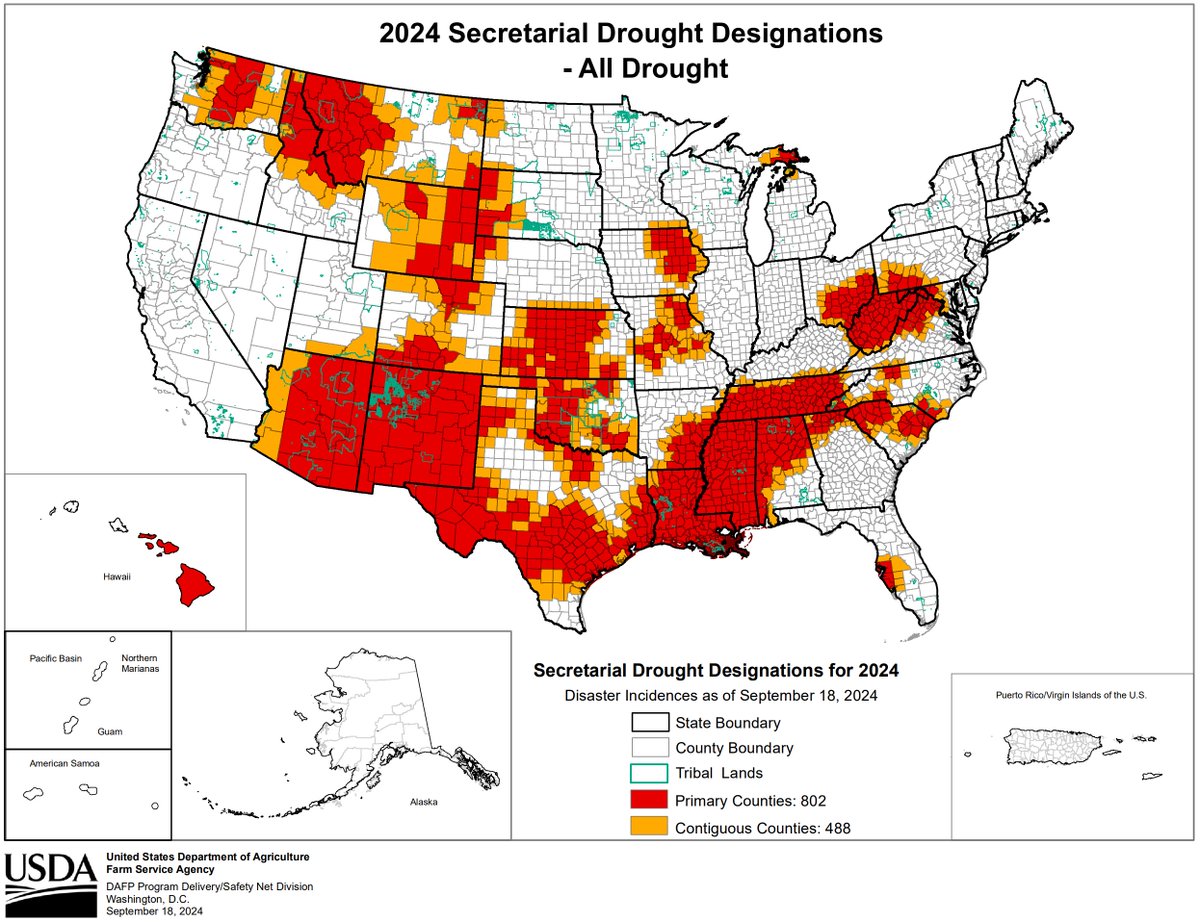
For more info, please see the Emergency Disaster Designation and Declaration Process fact sheet at https://fsa.usda.gov/Assets/USDA-FSA-Public/usdafiles/FactSheets/emergency_disaster_designation_declaration_process-factsheet.pdf…
Click the link to read the release on the Colorado State University website (Mark Gokavi):
September 2024
Megan Hill is an assistant professor of chemistry and leader of the Hill Lab in Colorado State University’s College of Natural Sciences. Her research leverages organic chemistry to design advanced polymeric materials for applications in sustainability, catalysis and soft materials. She recently sat down with SOURCE to answer some common questions.
What are microplastics?
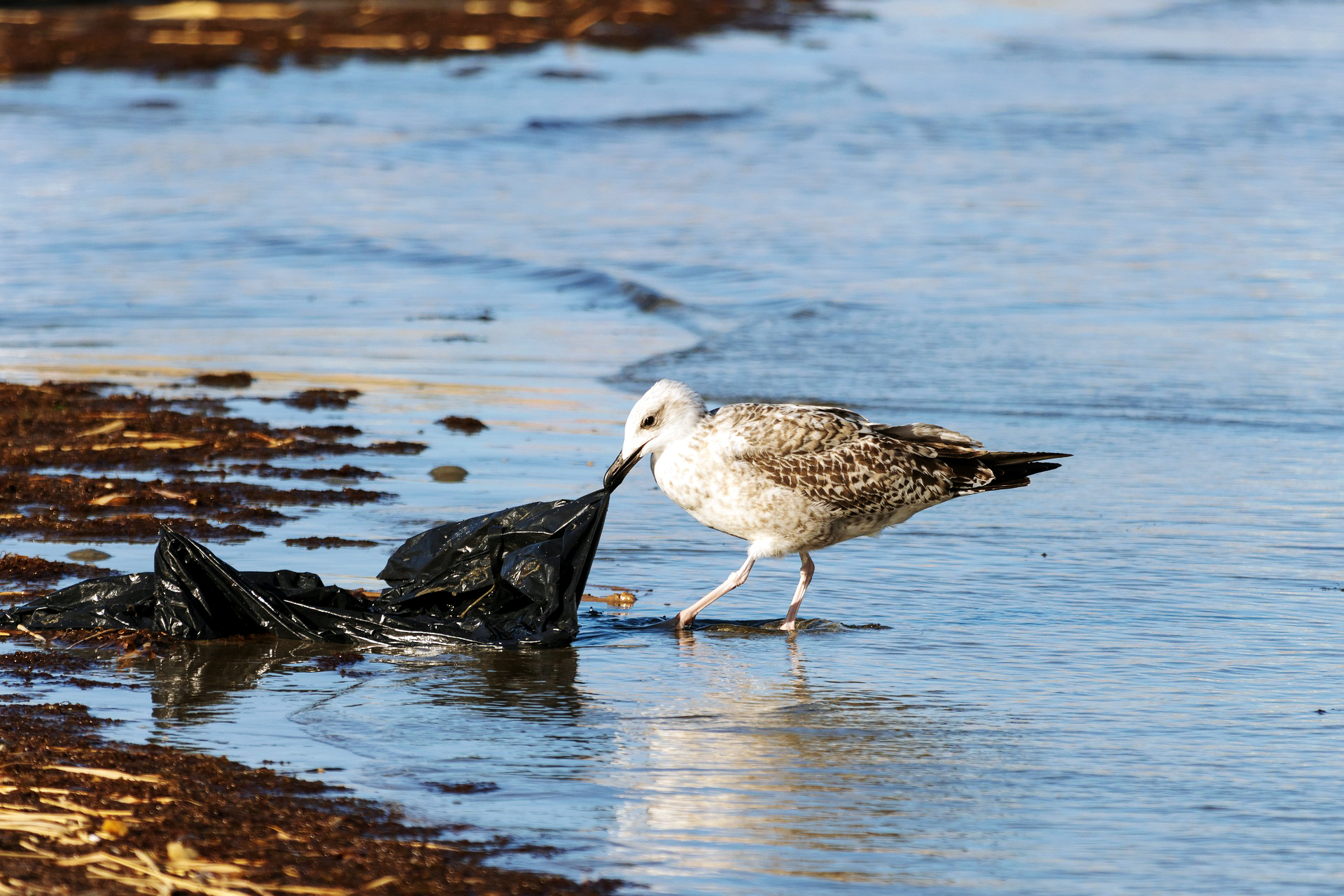
Given their name, they are micro-sized bits of plastic. There are even smaller nanoplastics that are below that (.5 mm in diameter) threshold (about the size of a grain of rice). They are pieces of plastic that have broken down but never fully degraded.
How long has synthetic, mass-produced plastic been around?
Let’s say about 100 years. Chemists spent a lot of time and effort optimizing polymerization techniques, eventually making catalysts that enabled extremely fast, cheap and easy production of plastic materials. Once the industry realized how useful these lightweight, durable and cheap materials were, then it just kind of exploded. It’s much more complex than that because there was government assistance in making these types of products more affordable. Within the last 10 to 20 years, people started to realize, “Wow, this stuff is still around, and it doesn’t seem like it’s going away anytime soon.”

Have we had better living through chemistry, i.e. plastics, in the past century?
You absolutely have to take that into account. Plastics make cars and airplanes lighter, reducing the amount of fuel that is needed. Wind turbines are made from epoxy resins, crosslinked polymer networks. Polyethylene is used in hip replacements, and Kevlar is something that saves people’s lives. These are all plastic materials.
What are the unintended consequences?
We’ve never had to deal with materials that have such a long lifetime. Every material that we’ve worked with in the past has been environmentally degradable over at least long periods of time. People didn’t realize how long it would actually take these materials to degrade. But now we are facing the fact that nearly every piece of plastic that has ever been made still exists, except for a small percentage that has been incinerated.
Is it bad that microplastics are found in virtually every part of human bodies?
We still have a lot to learn about how microplastics affect our health. Initially, it was thought that it wouldn’t be that big of an issue because particles have to be really small to pass through your esophagus or digestive tract, so we assumed microplastics would not persist in the body. But as these particles have become smaller and smaller, now they’re accumulating in tissues and throughout our bodies. We are still not sure what this means to our health. Plastics are designed to be inert, so the chemical structures are not likely interacting with anything in our body, but they are foreign objects that your body will likely react to. There’s still a lot unknown about the severity or what might actually happen as these particles accumulate more in animals and then humans as it goes up the food chain.
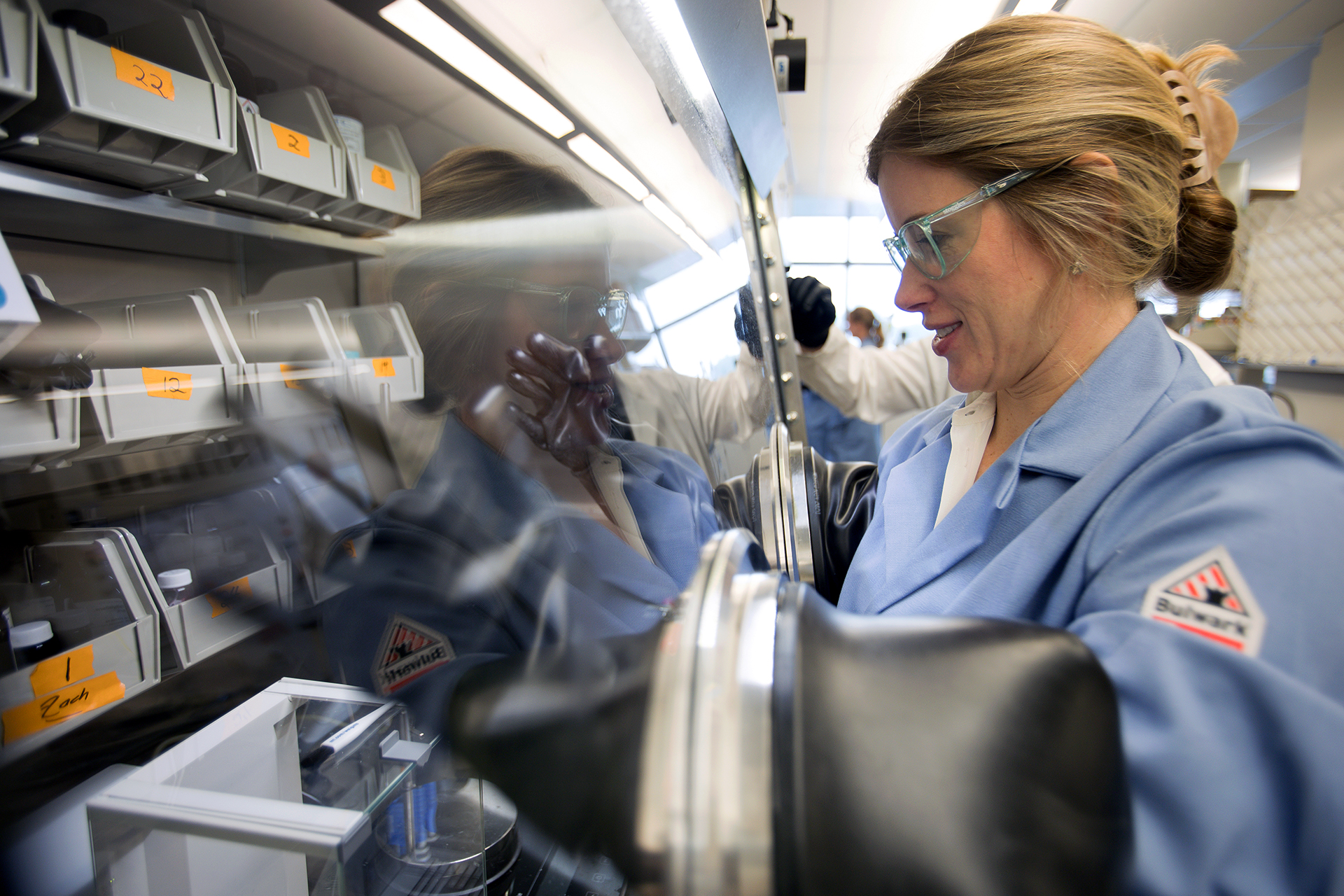
What’s an example of your lab’s research in polymers?
One area of research our lab focuses on is integrating reversible or degradable bonds into polymer networks and backbones. By making some of the bonds reversible, we can improve the ability for the materials to be broken and reformed, without compromising their material properties — a big problem plastic recycling is currently facing. Another CSU group has pioneered polymer materials that can be chemically recycled, a route that enables polymers to be broken down to their starting materials so they can be remade into the high-quality materials that are needed in industry.
What does it mean for a polymer to be sustainable?
It means finding starting materials that aren’t derived from oil. [ed. emphasis mine] It means using processes that are less energy intensive. It means thinking about the end-of-life of the materials we are making. We still aren’t exactly sure how long it’s OK for something to persist in the environment, and the answer will certainly depend on several different circumstances, but it needs to be addressed. Something I find hopeful and inspiring is how the whole polymer community, and chemistry community, has refocused our attention on these issues. I wouldn’t say that anyone’s doing research now without thinking about the end fate of the materials they are making, which is something that people just didn’t consider before.
What are some positive developments?
Scientists have teamed up and come up with some really promising solutions. They have developed new recycling methods, they have engineered enzymes that are more efficient at breaking down plastics, they have developed catalysts that can convert plastics into useful chemicals, etc. There is also funding for researchers to develop sustainable materials, figure out creative methods to tackle the abundance of plastic waste, and for people to start companies. So I see a very bright future in this. It would help if the government would make plastic a little more expensive or have some sort of incentives to get companies to stop using it. It’s incredibly difficult for individual consumers to avoid all the plastic that is cheap and easy.
What can people do to help?
Every little action helps. Support companies that try to steer away from plastics, vote for politicians who support research, and if you can, spend or give a little extra money to show it’s something you care about.

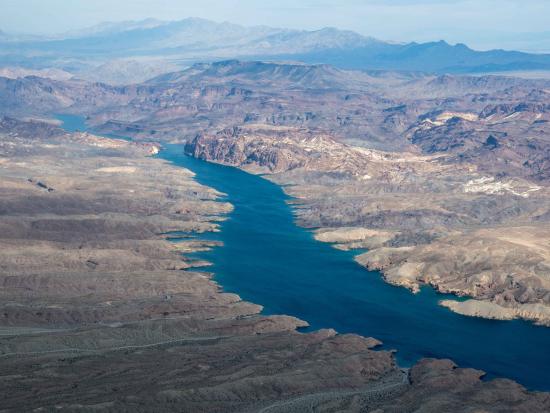
Click the link to read the release on the Department of Interior website:
September 25, 2024
The Department of the Interior today marked major progress for the short and long-term health of the Colorado River System. In Santa Fe, New Mexico, Bureau of Reclamation Commissioner Camille Calimlim Touton joined leaders from the Imperial Irrigation District (California), Bard Water District (California), Metropolitan Water District (California) and Gila River Indian Community (Arizona) to sign five water conservation agreements that will leverage funding from President Biden’s Investing in America agenda to help advance water conservation across the West.
Short-term agreements with the Imperial Irrigation District, Bard Water District and Metropolitan Water District are expected to conserve over 717,000 acre-feet of water by 2026. The agreements with the Gila River Indian Community are the first long-term agreements to be signed and have the potential to create system conservation of over 73,000 acre-feet within the next 10 years.
“The Biden-Harris administration is committed to making western communities more resilient to the impacts of climate change,” said Secretary Deb Haaland. “With transformational resources provided through President Biden’s Investing in America agenda, the Interior Department is collaborating with states, Tribes and partners to make smart investments to strengthen the stability and sustainability of the Colorado River System to support the families, farmers and ecosystems that rely on this vital basin.”
“We are proud to announce these agreements that will support the long-term health of the Colorado River System by shoring up elevations,” said Reclamation Commissioner Camille Calimlim Touton. “The agreements with the Imperial Irrigation District and the Bard Water District in partnership with the Metropolitan Water District will contribute a significant amount of system conservation through 2026 and the new agreements with the Gila River Indian Community are the beginning of our long-term investments that will improve the sustainability of our river for generations to come.”
The lifeblood of the American West, the Colorado River Basin provides water for more than 40 million people and fuels hydropower resources in seven U.S. states. It is a crucial resource for 30 Tribal Nations and two states in Mexico and supports 5.5 million acres of agriculture and agricultural communities across the West, in addition to important ecosystems and endangered species. It is currently experiencing the longest and worst drought on record, driven by hotter temperatures under climate change. The Biden-Harris administration is leading a comprehensive effort to make Western communities more resilient to climate change and address the ongoing megadrought across the region, by harnessing the full resources of President Biden’s historic Investing in America agenda.
Short Term Conservation Agreements
Conservation agreements signed today with the Imperial Irrigation District and Bard Water District in partnership with the Metropolitan Water District signify the final short-term agreements signed under “Bucket 1” of the Lower Basin System Conservation and Efficiency Program with funding from the Inflation Reduction Act. The agreement with the Imperial Irrigation District is the largest from the Bucket 1 effort, expected to provide up to 700,000 acre-feet of system conservation water to Lake Mead between 2024-2026 with a total investment of approximately $589.2 million. The agreement with the Bard Water District in partnership with the Metropolitan Water District conserves up to 17,100 acre-feet of water during the same time period at a cost of about $6.8 million. This water will remain in Lake Mead in an effort to benefit the Colorado River System and its users.
Reclamation has now executed 25 agreements that are projected to conserve more than 2.28 million acre-feet of water. The agreements are part of the three million acre-feet of system conservation commitments made by the Lower Basin states.
Long Term Conservation Agreements
An initial $700 million investment from the Inflation Reduction Act was announced in June to support long-term conservation in the system. Today’s agreements with the Gila River Indian Community represent the first agreements signed under this investment. The agreements invest approximately $107 million into three projects with the potential to create system conservation of over 73,000 acre-feet within the next 10 years. Reclamation is also working with Southern Nevada Water Authority, the Metropolitan Water District of Southern California, Coachella Valley Water District, City of Tucson, San Diego County Water Authority, Town of Gilbert, Salt River Valley Water Users’ Association & Salt River Project Agricultural Improvement and Power District and City of Phoenix in the Lower Colorado Basin to negotiate water conservation contracts for up to 10 additional proposed projects.
Overall, the funding for long-term water conservation initiatives in the Lower Basin is expected to save more than 1 million-acre-feet of water, putting the Colorado River Basin on a path to a more resilient and sustainable water future.
Historic Investments to Address the Drought Crisis
President Biden’s Investing in America agenda represents the largest investment in climate resilience in the nation’s history and is providing much-needed resources to enhance the resilience of the West to drought and climate change, including to protect the short- and long-term sustainability of the Colorado River System. Through the Bipartisan Infrastructure Law, Reclamation is investing $8.3 billion over five years for water infrastructure projects, including water purification and reuse, water storage and conveyance, desalination and dam safety. The Inflation Reduction Act is investing an additional $4.6 billion to address the historic drought.
To date, the Department has announced the following investments for Colorado River Basin states, which will yield hundreds of thousands of acre-feet of water savings each year once these projects are complete:
- Aging Infrastructure: More than $1.02 billion for infrastructure repairs on water delivery systems in the Colorado River Basin states from the Bipartisan Infrastructure Law, which will preserve ability to deliver water and power benefits to over 40 million people every year in the Colorado River Basin.
- Water Storage and Conveyance: More than $648 million in new water storage and conveyance investments in Colorado River Basin states, which will grow the supply of new water or enhance benefits from existing reservoirs within the Basin states.
- Water Recycling: $505 million for 26 water recycling projects in the Colorado Basin that are expected to increase annual water capacity by hundreds of thousands of acre-feet annually
- Water Conservation: More than $416 million in WaterSMART grants in Colorado River Basin States, which will conserve tens of thousands of acre-feet of water and make Basin water supplies more resilient.

Click the link to read the article on the Water Education Colorado website (Jerd Smith):
September 26, 2024
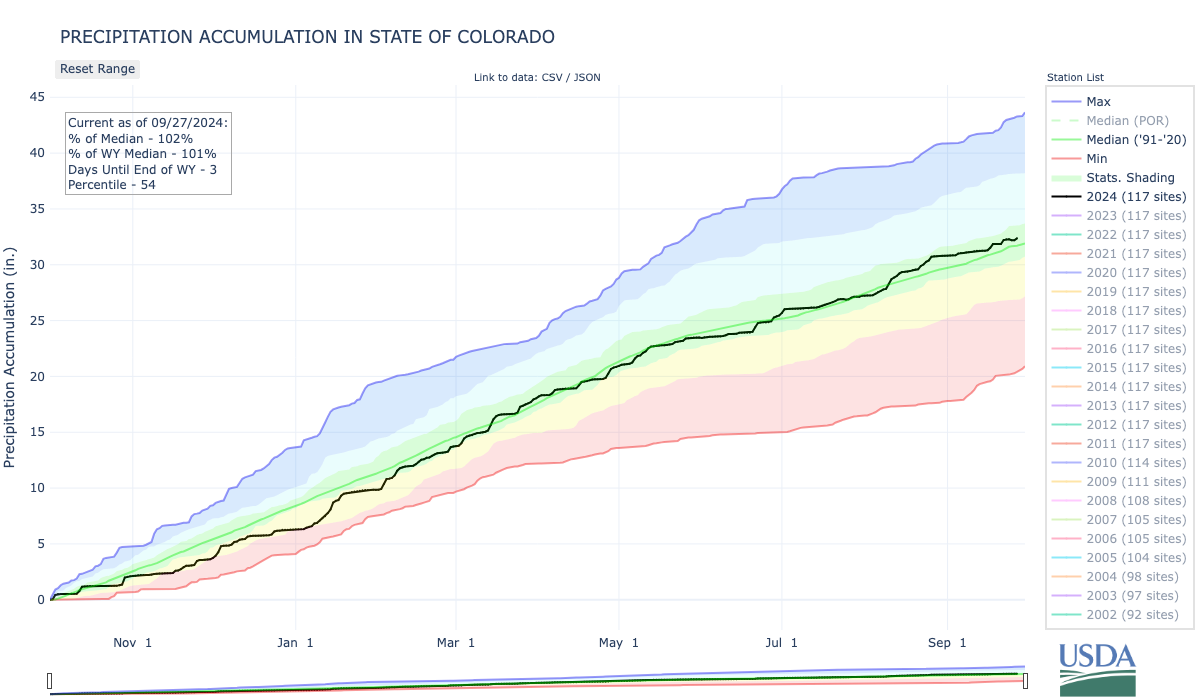
Just for a moment, forget about drought and water shortages, because this year, it’s been wet in Colorado, with precipitation hitting 102% of normal.
The wet weather hasn’t pulled the state or the American West out of its naggingly, sometimes desperate, dry existence, but it has delivered some surprises, according to experts reviewing data at the state’s water monitoring committee meeting Sept. 24.
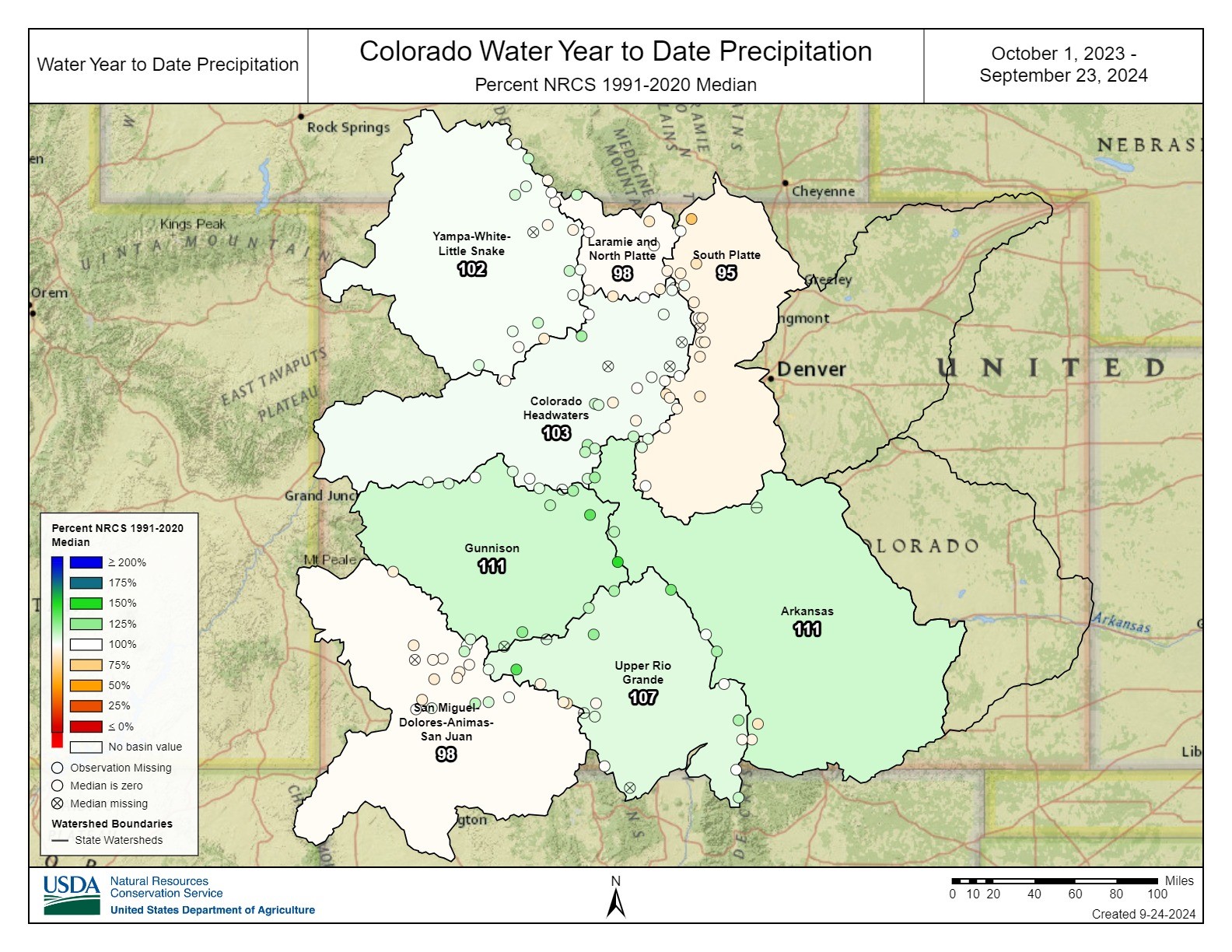
“Much of northern Colorado has been drier than normal, but areas of southern Colorado have been wetter than normal,” said Peter Goble, assistant state climatologist at Colorado State University’s climate center.
So wet, in fact, that it helped pull the statewide average above 100%.
Weather watchers, researchers and hydrologists track water based on a reporting period known as the “water year.” It begins Oct. 1 and ends Sept. 30, a time that captures the buildup of winter snowpacks and spring runoff. Most of the state’s water supplies come from these sources.
As the 2024 water year comes to a close on Monday, Peter Goble, assistant state climatologist, said the numbers were refreshingly normal, with some surprises in parts of the state normally starved for water: The Arkansas and Upper Rio Grande river basins, which routinely fall last in line when it comes to storm systems.
The Arkansas Basin, for instance, saw precipitation that topped 111% of normal, while the Rio Grande’s numbers hit 107%.
“It’s good news when we’re above average for the basin,” said Jack Goble, general manager of the Lower Arkansas Water Conservancy District in Rocky Ford in the Lower Arkansas Basin. He is not related to Peter Goble. “But as is typical, it depends on where you are. You can drive 20 or 30 miles in any direction and go from green to brown.”
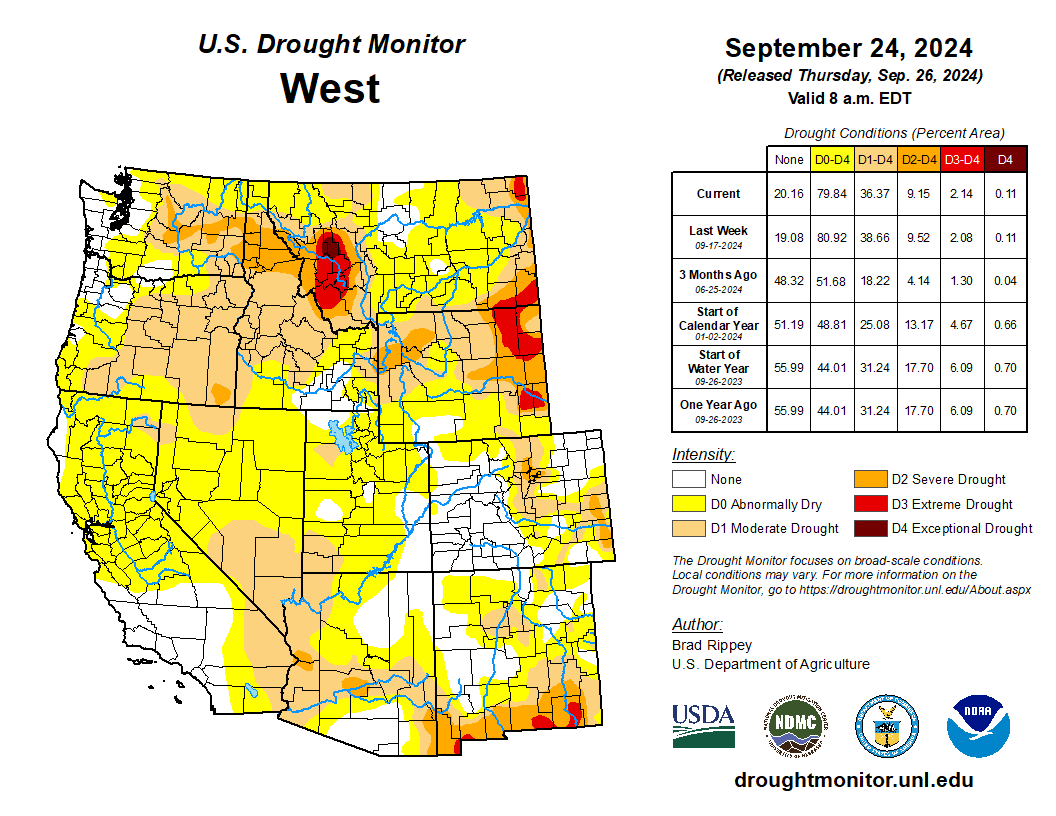
In fact, according to the U.S. Drought Monitor, drought is already beginning to reappear in parts of the Arkansas Basin and other areas on the Front Range.

Another surprise: Even with ultra hot temps in places like Grand Junction, precipitation was heavy.
“Warm and wet is a bit unusual for Colorado for the summer,” Peter Goble said. “Usually it’s warmer going drier and cooler going wetter.”
The South Platte River Basin, which includes metro Denver and Fort Collins, saw a slightly different scenario, with precipitation registering slightly below normal and temperatures coming in at record highs.
“It was a hot summer,” said Nathan Elder, Denver Water’s manager of water supply. “But Denver fared all right,” in part because customers stuck to their lawn-watering schedules and the utility, the largest in the state, had a strong spring runoff that allowed its reservoirs to fill.
In fact, reservoirs across the state have healthy supplies, coming in at 93% of normal, according to Nagam Gill, a hydrologist with the Natural Resources Conservation Service in Lakewood.
“Our reservoir storage is in good shape,” Gill said, “and many basins are reporting above-average levels.”
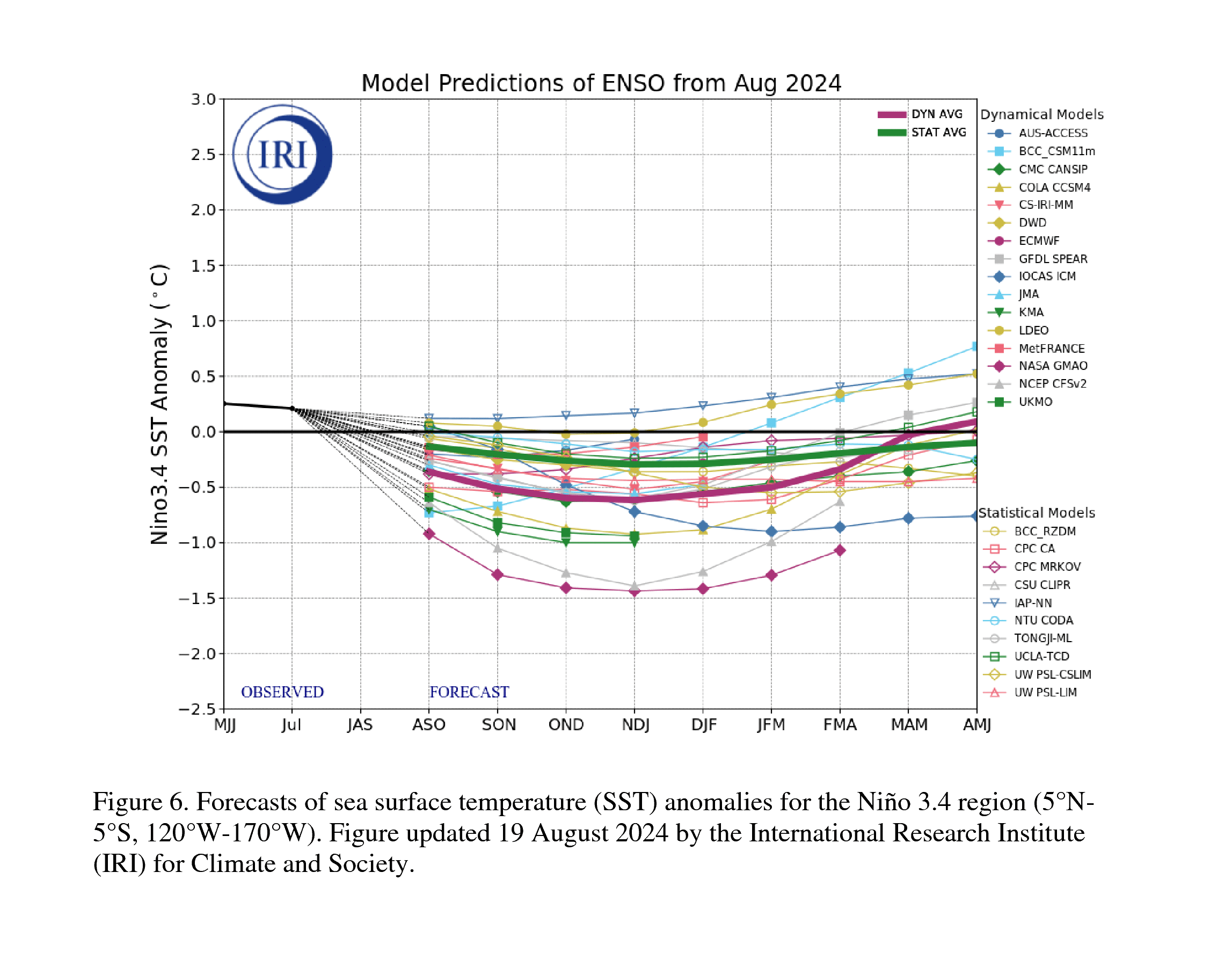
Looking ahead, Peter Goble said there is an 80% chance that a La Niña weather pattern will develop early this winter, which could mean a delayed start to the snow season but heavy snowfall eventually for the northern Rockies. La Niña refers to a time period when colder temperatures prevail in certain parts of the Pacific Ocean.
For water utilities, a La Niña doesn’t offer much predictability in terms of next year’s water supplies, and so the go-to strategy is to keep reservoirs as full as possible.
“We’ve seen wet years and we’ve seen dry years,” Denver Water’s Elder said. “To deal with the uncertainty, we set up our system this time of year so that we have an equal chance of filling all our reservoirs, and we rely on our customers to use water wisely.”
More by Jerd Smith. Jerd Smith is editor of Fresh Water News. She can be reached at 720-398-6474, via email at jerd@wateredco.org or @jerd_smith.

Click the link to read the article on the Telluride Daily Planet website (Sophie Stuber). Here’s an excerpt:
September 24, 2024
Across the state, Colorado has 23,000 abandoned mines awaiting cleanup. Untreated, these mines spread acid mine drainage into an estimated 1,800 streams. Many of these legacy mines — inoperational areas with historic mining activity — leach heavy metals into watersheds, harming aquatic ecosystems. Cleaning up mines could help improve water quality and contribute to healthier watersheds. Colorado’s Water Resources and Agriculture Review Committee recently advanced a bill to help remove dangerous mining waste. Bill 4 would establish a new permit process through the Division of Reclamation, Mining, and Safety in the Department of Natural Resources (DNR) to facilitate the removal of mining waste. The permits are intended for projects that would improve water quality by cleaning up mines that are no longer operational. Currently, Colorado laws make some cleanup efforts challenging due to strict regulations that are intended to protect the ecosystem from mining operations — not reclamation of legacy mines. The new permit type would focus on areas that are “sources of discharge,” leaking acid mine drainage or heavy metals into the watershed. Permit applicants would still be required to comply with any applicable surface or groundwater water quality conditions. If approved, the bill would help expedite “reclamation-only” permits issued starting in July 2025…

Locally, the region’s history of mining still affects water quality today. Critical headwaters in the San Juans are surrounded by old mining areas. On Red Mountain Pass between Ouray and Silverton, Red Mountain Creek runs orange. Both natural minerals and ceased mining operations contribute to the creek’s hue. Heaps of mine tailings also funnel the river in a straight line into the Uncompahgre River and down into Ridgway. Bill 4 is intended to incentivize clean up of some of these 23,000 abandoned mines across the state, while improving water quality.

Click the link to read the article on the Grand Junction Daily Sentinel website (Dan West). Here’s an excerpt:
September 26, 2024
The Town of Palisade is pursuing a federal grant that would help it fund the remediation and regrading of its sewer lagoons and turn a portion of that property into a constructed wetlands for migrating waterfowl. Town Administrator Janet Hawkinson told the Palisade Board of Trustees at its Tuesday meeting that the grant is through the Bureau of Reclamation and could provide several million dollars without requiring a match.
“We are working right now with our town engineers on a cost estimate to look at if it’s $2 million, $3 million or $6 million we’ll request for this grant application,” Hawkinson said.
The town has a grant and loan from the Department of Agriculture to build a pipeline to the Clifton Sanitation District’s wastewater facility for its sewage. Once that is complete the current lagoons will be remediated. Palisade Community Development Director Devan Aziz said the proposed plan would improve water quality, mitigate health hazards and restore habitat in the area of the sewer lagoons. The lagoons are located along the Colorado River just east of Riverbend Park.
“The proposal would be to create a constructed wetlands for migratory waterfowl, as well as removing invasives like tamarisk and Russian olive and enhancing plant biodiversity,” Aziz said. “This project directly addresses drought related habitat loss while fostering environmental regeneration.”
Click the link to read the article on The Aspen Times website (Ali Longwell). Here’s an excerpt:
September 25, 2024
Water availability on Colorado’s Western Slope is under increasing pressure and uncertainty from climate change, population growth, and ongoing negotiations.
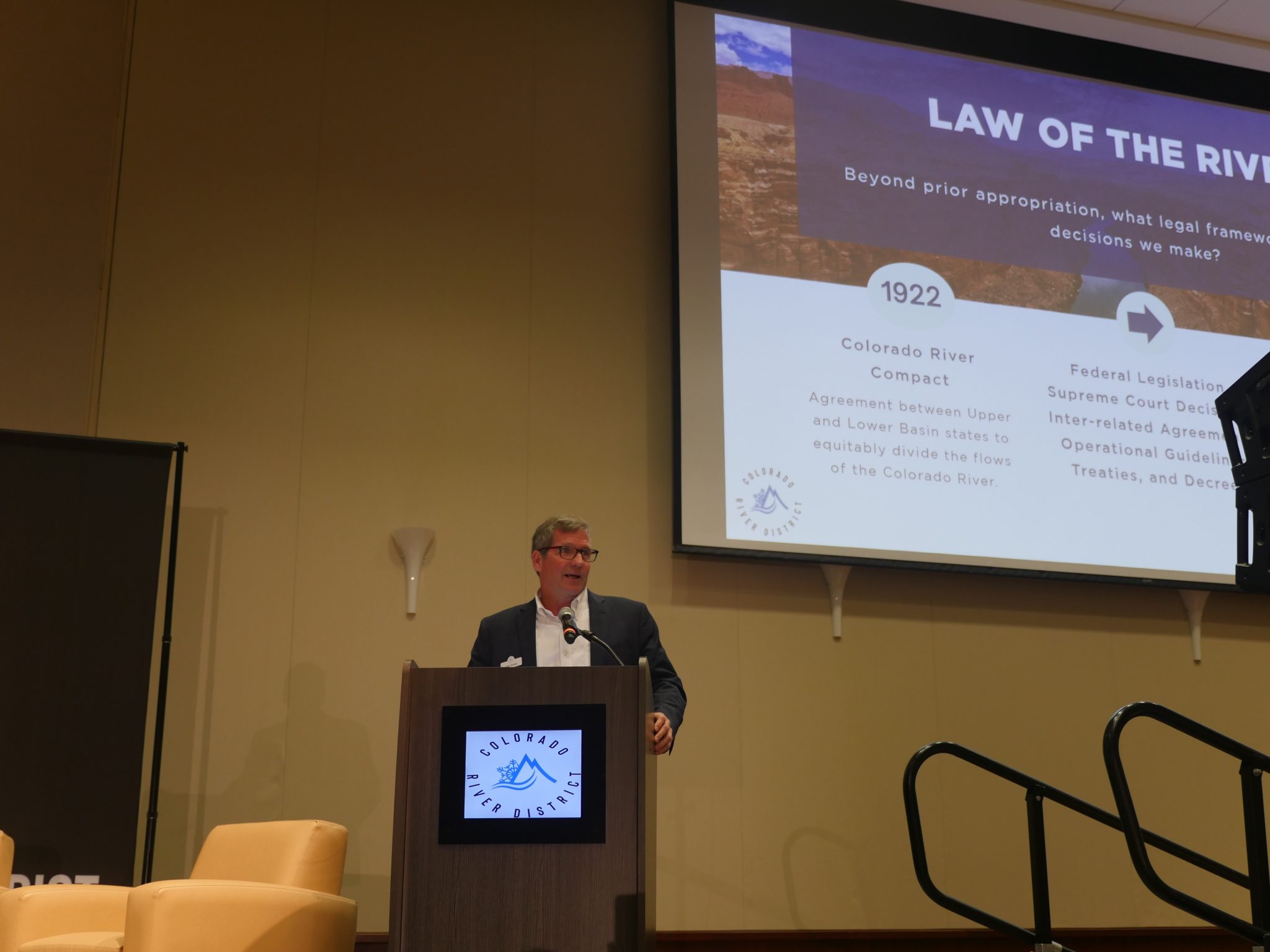
“We’re seeing a shrinking resource, and one trend that is likely to continue to accelerate whether we have more precipitation or not … is the warming temperatures are going to drive less water available for human use,” said Andy Mueller, general manager of the Colorado River District. “The question is: Can we as a society come together and plan for that? We haven’t done a great job of doing that so far, but perhaps we can.”
He posed this question to a room full of water managers, agricultural producers, and elected officials in Grand Junction on Friday, Sept. 20, for the Colorado River District’s annual water seminar. This year’s seminar encouraged attendees to “meet the moment” and to find clarity, solutions, and opportunities amid water insecurity in the West. As the event kicked off, attendees were asked to share the biggest challenge facing water management in their community. Words like “drought,” “scarcity,” “lack,” “quantity,” “politics,” “knowledge,” “climate change,” and “agreement” dominated the responses from attendees…

With these negotiations underway in the basin, conflict is likely unless stakeholders begin working together, planning, and learning from past mistakes and challenges…This collaboration includes bringing more voices to the table, particularly those left out of historic water negotiations. Lorelai Cloud, vice chairman of the Southern Ute Indian Tribal Council and director for the Colorado Water Conservation Board, said the 30 Native American tribes in the Colorado River Basin are 100 years behind on the conversations after being left out of the initial compact negotiations and many of the subsequent discussions.

Click the link to read the article on the WyoFile website (Dustin Bleizeffer):
September 25, 2024
Waking up to long-overdue system upgrades, dozens of towns that were awarded federal ARPA dollars may see them ‘clawed back’ for lack of resources to complete paperwork.
This story is part of an ongoing series between WyoFile and The Water Desk exploring water issues in Wyoming. —Ed
After a town council shakeup, Micah Foster was suddenly mayor of his tiny eastern Wyoming agricultural town. A wave of resignations last April meant that in addition to getting up at 2 a.m. each day for his regular job — delivering bread to grocery stores for Bimbo Bakeries — Foster found himself running his 400-person town.
In June, as Foster was still adjusting to his new role, he got some good news. Lingle was awarded a $1.4 million American Rescue Plan Act grant to upgrade aging sewage pipelines — a big deal for any small town, sparing it from having to borrow the money because it cannot possibly raise rates high enough to cover such an expense. Lingle even secured the required 10% match from the state, Foster said.
But there was a hitch. To complete the required engineering plan, the town still needed the cooperation of BNSF Railway to cross its tracks on the south side — a slow process and an effort that the town’s small, overworked staff struggled to accomplish.
Wyoming officials, in July, reminded town leaders that the engineering plan must be complete, contracts signed and the project “shovel-ready” by Oct. 1, or the state would be forced to revert, or claw back, the grant to pre-empt the federal government from taking the money back — from Lingle and the state.
“There’s no way we can get that done,” Foster said, adding, “We’re not Cheyenne,” referring to the capital city’s advantage in having a full professional staff. “We don’t have an engineer on staff to do this and push it. So we were happy [when initially approved for the grant] and then we were sad.
“It’s like dangling a carrot in front of you but it was never really there,” he added.

Many Wyoming towns and entities that have been awarded ARPA grant dollars administered by the state worry they may suffer the same fate. In August, the Office of State Lands and Investments hosted a webinar with municipalities and others, striking a tone of urgency as staff reiterated the Oct. 1 deadline to prove ARPA grant projects are ready for shovels to hit dirt, or lose the money.
“We want to have this opportunity to make long-term investments with these dollars,” Wyoming Grants Management Office Administrator Christine Emminger told attendees. “So create the pressure on your contractors to get these dollars obligated, get them contracted at your local government or your entity level. Because if they are not contracted, and you do not provide that evidence to the Office of the State Lands and Investments (OSLI), we will have to go back and recapture those dollars.”
More than 50 of 159 state-administered ARPA grant recipients for water and sewer projects have yet to file completed compliance documents to avoid recapture, according to state officials.
“OSLI is in regular communication with all the entities that have not yet provided the necessary information, and are making every effort to provide assistance, where possible,” Gov. Mark Gordon’s press secretary Michael Pearlman told WyoFile.
The state is also facing a tight deadline, and is at risk of losing potentially tens of millions of federal dollars that budget-strapped communities desperately need. Wyoming’s mineral royalty revenues, which used to fund such water infrastructure funds, are drying up due to the declining coal industry.
State officials, under the guidance of the governor’s office, will determine in October which ARPA grants to claw back, then rush to “redeploy” those dollars before the federal government’s Dec. 31 deadline, they say. Though Gordon has indicated his priorities for redeploying ARPA dollars, exactly who and what projects the state might choose before the end of the year is yet to be determined.
“Any funds available after the Oct. 1 deadline may be deployed to local governments to reimburse or reduce local matches for previously approved water infrastructure projects,” according to an Aug. 19 press release from the governor’s office.
Meanwhile, there’s an increasingly urgent need among Wyoming towns to update water and sewer systems.
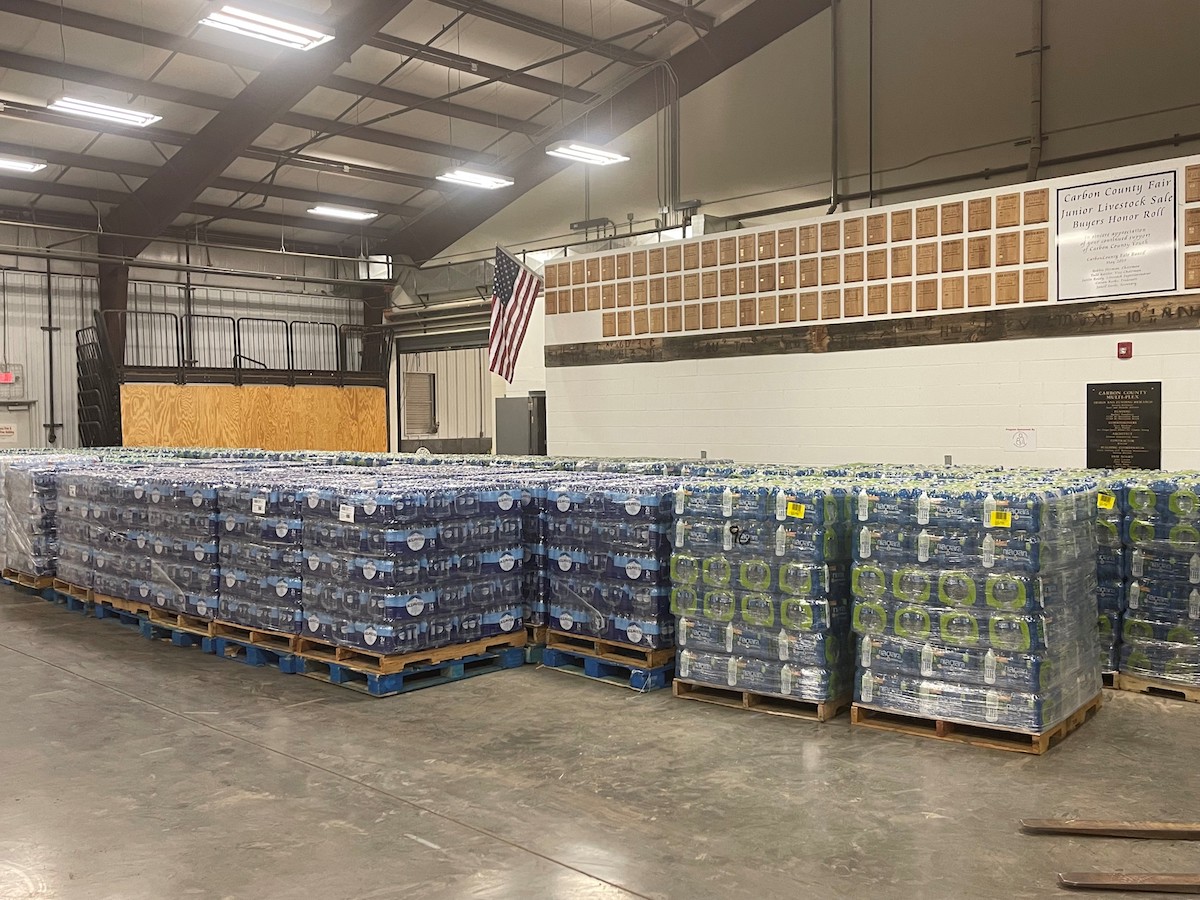
The neighboring oil boom-and-bust towns of Midwest and Edgerton in the middle of the historic Salt Creek oilfield are relying on ARPA dollars to help cover an estimated $5 million cost to replace 7 miles of potable water pipeline at risk of corrosion due to acidic soils in the oilfield.
In the neighboring towns of Kemmerer and Diamondville (with a combined population of about 3,000) in the state’s southwest corner, town officials have described a chicken-and-egg dilemma to fund long-overdue upgrades necessary to not only meet current demands, but to meet the needs of construction workers arriving for the $4 billion Natrium nuclear energy project already underway. The construction workforce is expected to peak at 1,600 in 2028, although many of the workers will commute from other nearby towns, according to officials. Project developers, backed by both the U.S. Department of Energy and Microsoft billionaire Bill Gates, say it’s up to local government entities in Wyoming or the federal government to make any needed investments.
Human-caused climate change plays a role, too, forcing many towns to consider increasing competition for secure sources of water made more scarce due to warming and drying trends.
Cascading water challenges
Sometimes when you patch a leak, you spring another one down the line. Then another, and another.
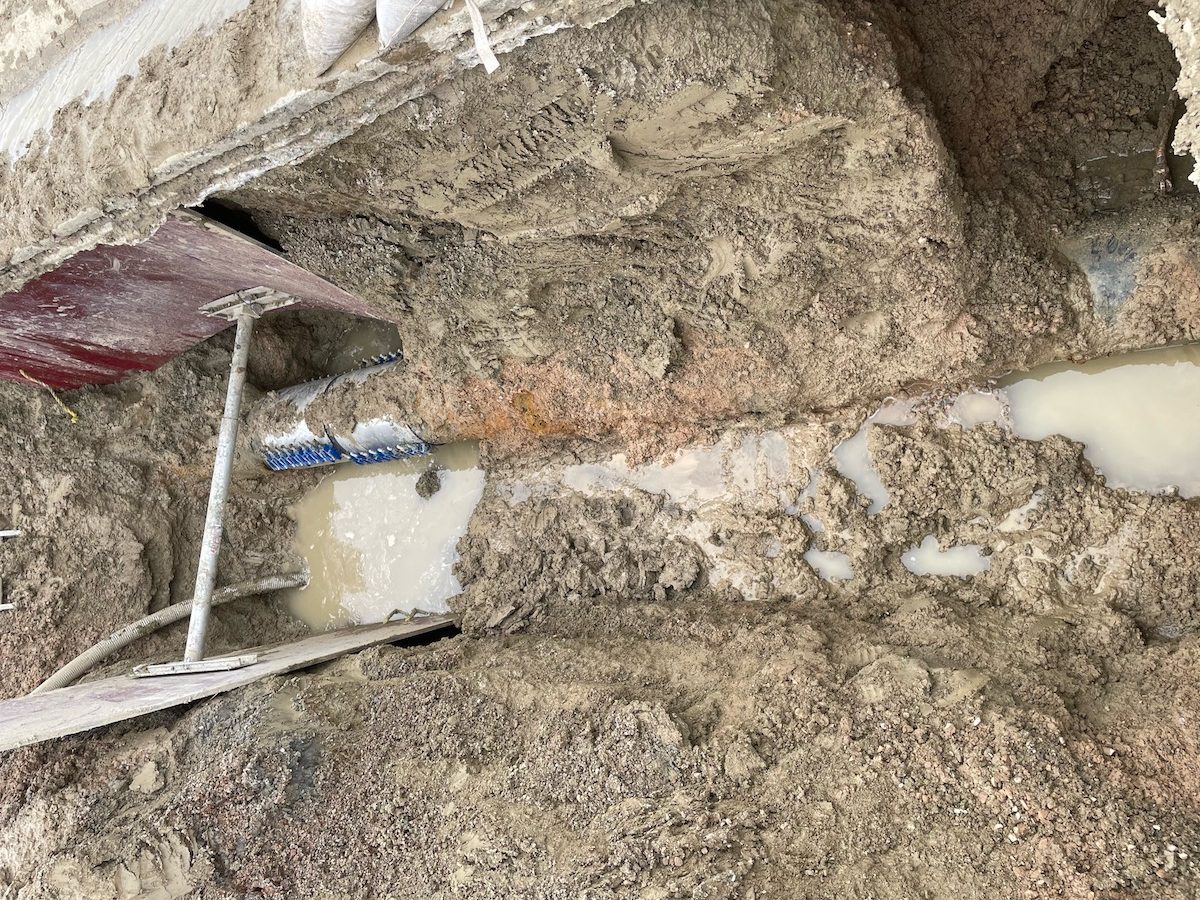
That was the challenge for city water crews in Rawlins over Labor Day weekend. They chased and patched six leaks at gushing “weak points” in the aging municipal water system that serves both Rawlins and neighboring Sinclair without major interruptions to water deliveries, according to officials.
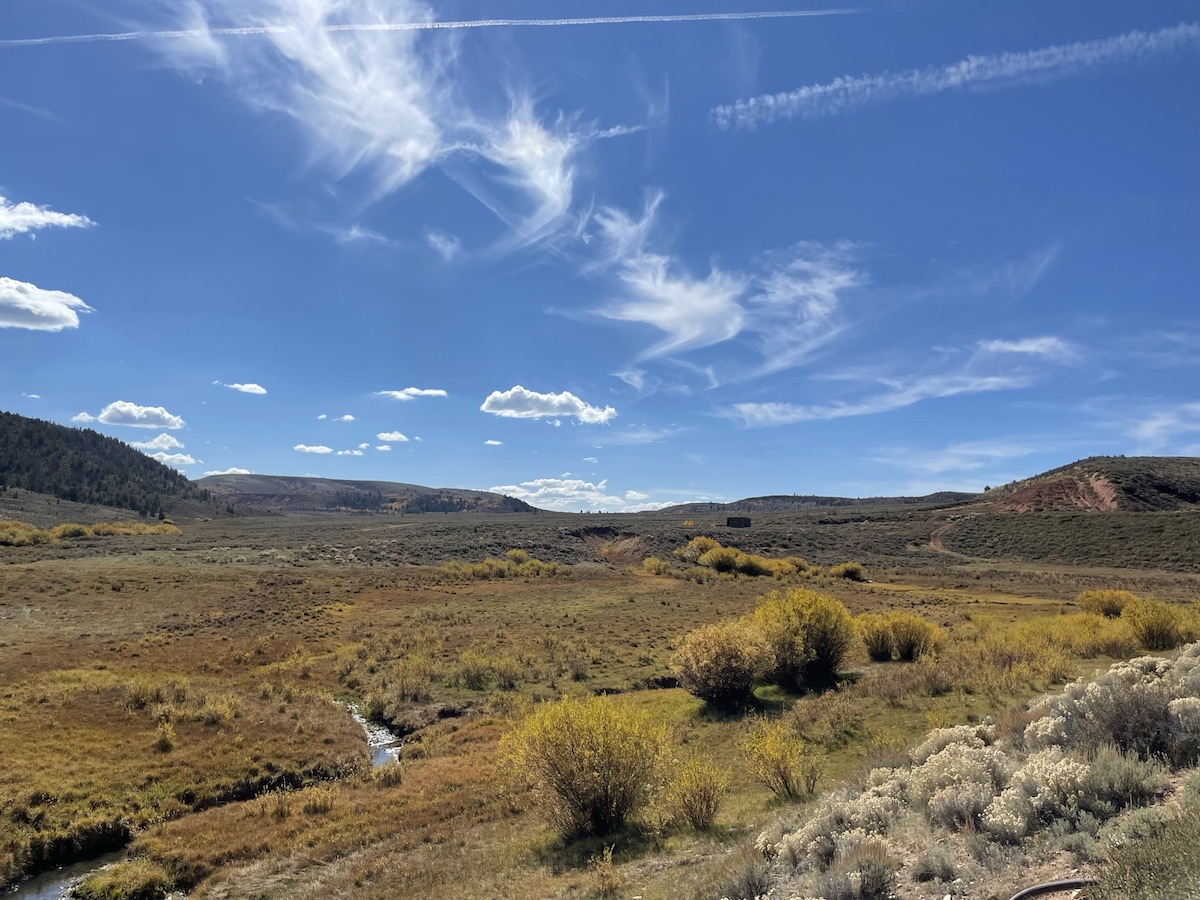
It’s a routine that many water crews in Wyoming towns have become well practiced at in recent years: Fixing one leak in a frangible network begets another — a result of depressurizing then re-pressurizing segments of pipe. The problem worsens when you’re dealing with an aging system long overdue for upgrades.
And towns like Rawlins aren’t just patching leaks. They’re looking at systemwide water and sewer upgrades vital to simply meet existing demand, not to mention potential population growth and previously unfathomed pressures of climate change.
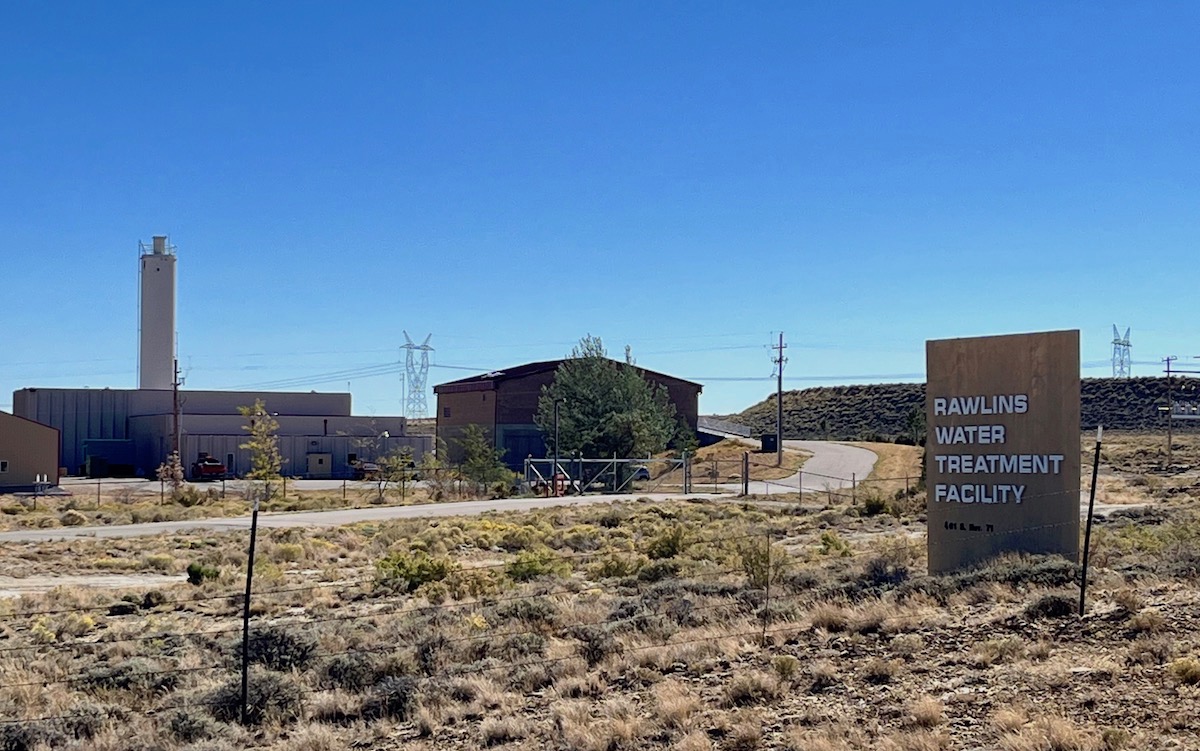
In March 2022, Rawlins residents were under a boil order for nearly a week due to a “catastrophic” failure in the 100-plus-year-old wood-stave pipelines that deliver the majority of water to the municipal system from springs 30 miles south of town.
In addition to the expense and task of gradually upgrading the wooden pipelines — nearly 2 miles have been replaced so far — the town also brought back online a long-derelict pre-water treatment plant so it can supplement its water supply by pumping from the North Platte River, as needed. Flow from the springs that provide Rawlins and Sinclair most of their water varies greatly, depending on seasonal snowpack, according to city officials. And those seasonal flows are only becoming more unpredictable.
All told, it will take nearly $60 million for necessary water system upgrades, according to Rawlins officials. They’ve already had some success landing grant dollars from state and federal sources, including ARPA dollars. But to secure those grants, and other funds in the form of loans, water users have been asked to pony up.
The average residential water utility bill has increased by about $30 per month since 2022, officials say.
“Our rates were too low to support the maintenance and the work that we have to do on our lines,” Rawlins City Manager Tom Sarvey said.
“A lot of these grants or loans require that you show community buy-in,” Rawlins spokesperson Mira Miller said. “So you can’t apply for these things if you can’t show that you are charging your customers a fair rate.”
Rawlins — because it’s been in emergency mode for the past two years — is confident about the security of its state-administered ARPA funding so far, according to officials. But many other towns with pressing water system improvement needs aren’t so sure.
Many small towns, even those that clearly qualify for federal grants, struggle to complete engineering and other required planning in the arduous process due to a basic lack of resources and expertise, Wyoming Association of Municipalities Member Services Manager Justin Schilling said.
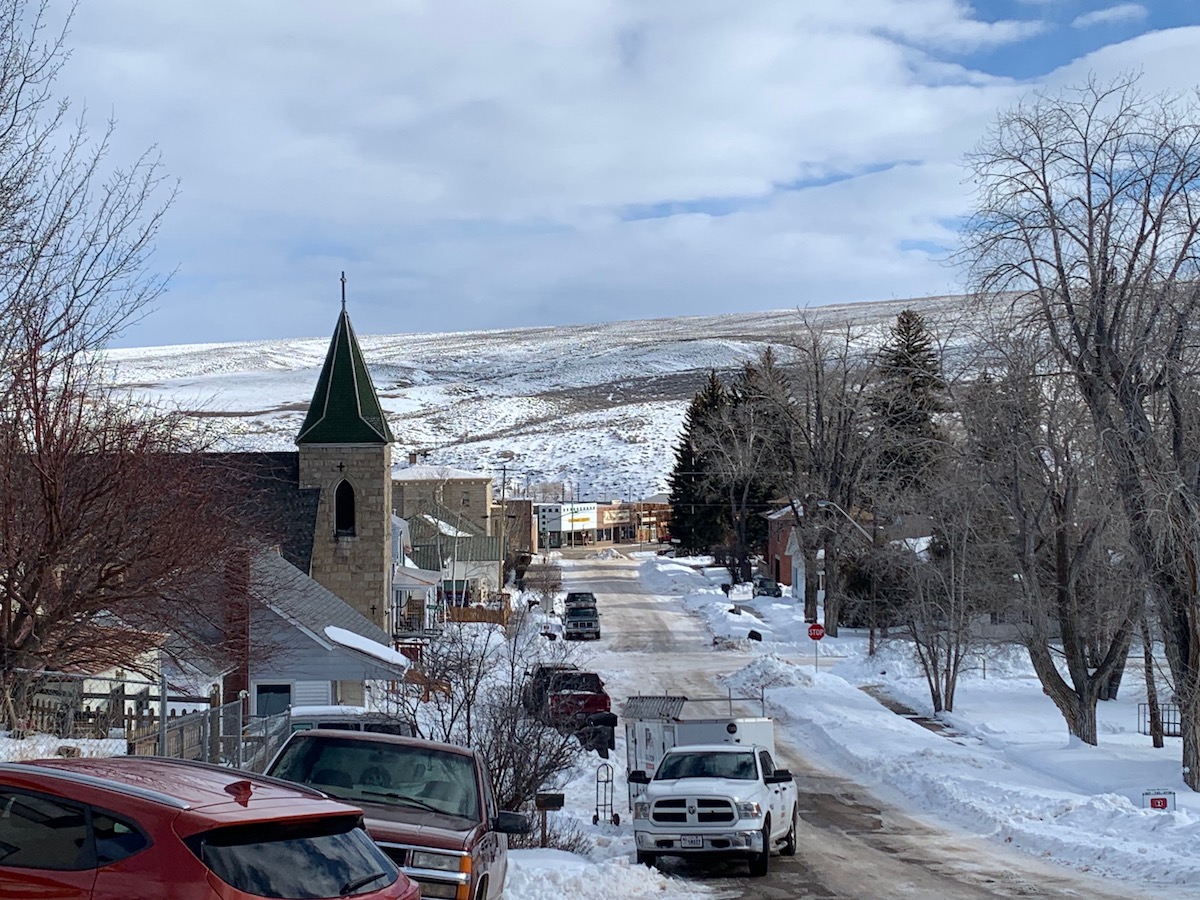
“Municipal government, it’s a constant rotation of people, so they might not have been aware how urgent [completing grant requirements] was,” Schilling said. “So, we had a bunch of these small communities that got a lifeline tossed to them, but because of engineering delays, the state’s got to pull it back and slide it to shovel-ready projects so that it doesn’t just go back to the feds.”
State officials, in their August webinar with ARPA recipients in the state, fielded about a dozen questions from concerned community leaders.
“I know the process has been cumbersome,” State Loan and Investments Grants and Loans Manager Beth Blackwell told attendees, adding that state officials knew all along that the ARPA requirements were going to be a major challenge for many small, resource-strapped towns to meet. “My staff is working extremely hard, and it’s just, we’ve got to make sure that at the end of the day, the state’s not on the hook to paying these funds back.”
In Lingle, without the ARPA grant, there’s no alternative plan in the works to fund the wastewater system upgrades, Mayor Foster said.

From email from Reclamation (Western Colorado Area Office):
With forecast sufficient flows in the critical habitat reach, the Bureau of Reclamation has scheduled a decrease in the release from Navajo Dam from 700 cubic feet per second (cfs) to 600 cfs for Friday, September 27th, at 4:00 AM.
Next week, on October 1st at 7:30 AM, Reclamation will begin a maintenance project that will necessitate a switch to the 4×4 for the release point. The release may fluctuate slightly during the switch, and the water downstream of the dam may be silty for a day or two following this release point change. The maintenance project will continue throughout October and November.
Releases are made for the authorized purposes of the Navajo Unit, and to attempt to maintain a target base flow through the endangered fish critical habitat reach of the San Juan River (Farmington to Lake Powell). The San Juan River Basin Recovery Implementation Program recommends a target base flow of between 500 cfs and 1,000 cfs through the critical habitat area. The target base flow is calculated as the weekly average of gaged flows throughout the critical habitat area from Farmington to Lake Powell.
This scheduled release change is subject to changes in river flows and weather conditions. If you have any questions, please reply to this message, call 970-385-6560, or visit Reclamation’s Navajo Dam website at https://www.usbr.gov/uc/water/crsp/cs/nvd.html.