September 2024 #ENSO update: binge watch — NOAA

Click the link to read the article on the NOAA website (Emily Becker):

September 12, 2024

The tropical Pacific is still in neutral, but nature continues giving us signs that La Niña is on the way, and our La Niña Watch remains. Forecasters estimate a 71% chance that La Niña will emerge during September–November and expect it will persist through the Northern Hemisphere winter. A weak La Niña is the most likely scenario.

Opening credits

While there are no plot twists since Tom’s August post—frequent readers could be forgiven for fast-forwarding this month’s update—that 71% chance of La Niña developing this autumn is a small upward tick. Also, the slower-than-expected development of La Niña is a great example of how the short-term (subseasonal) and very long-term (climate change) complicate seasonal outlooks. I’ll run the numbers in a minute, after a word from our sponsor.

Hello folks! Do you wish you could get a heads-up about what your winter rain, snow, and temperature conditions might be like? Ask your forecaster about ENSO, the El Niño/Southern Oscillation! This seasonal climate phenomenon is made from the surface temperature of the tropical Pacific, including warmer-than-average water (El Niño) and cooler-than-average water (La Niña), and can be predicted months in advance. ENSO changes global atmospheric circulation in known ways; common side-effects may include shifts in the jet stream and changes in global temperature and precipitation patterns, droughts, and heatwaves.

Back to our regularly scheduled program

ENSO forecasters get their information from two general areas: climate prediction models and current observed conditions in the ocean and atmosphere. Climate models are up first, today. (See footnote.)
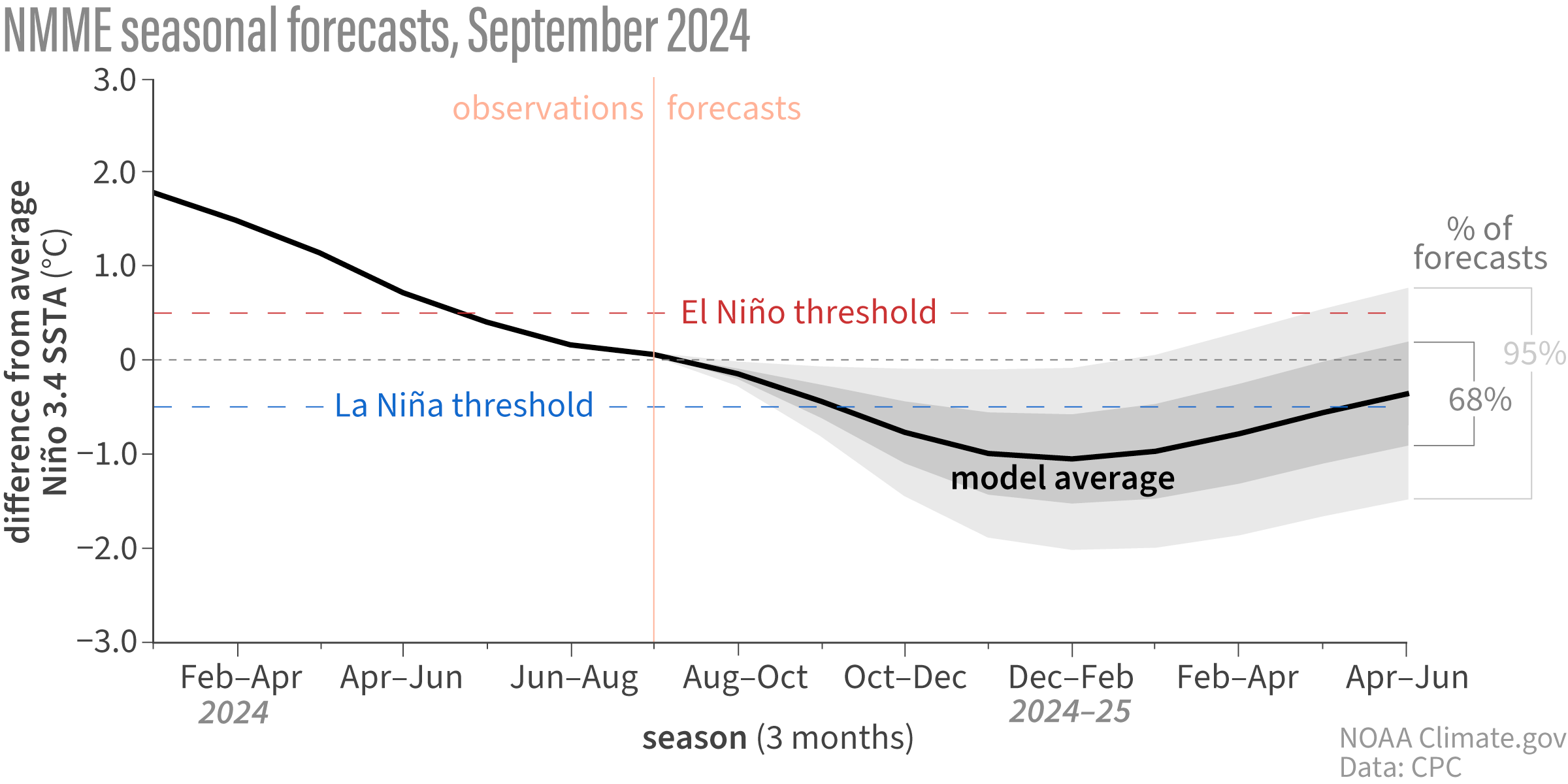
Line graph showing observed and predicted temperatures (black line) in the key ENSO-monitoring region of the tropical Pacific from early 2024 though spring 2025. The gray shading shows the range of temperatures predicted by individual models that are part of the North American Multi Model Ensemble (NMME, for short). Most of the shading appears below the dashed blue line by the fall, meaning most models predict that temperature in the Niño-3.4 region of the tropical Pacific will be cooler than average by at least 0.5 degrees Celsius (0.9 degrees Fahrenheit)—the La Niña threshold. NOAA Climate.gov image, based on data provided by Climate Prediction Center.

The North American Multi-Model Ensemble (NMME) is a collection of computer models that take information about current global conditions and apply physical equations to make predictions about upcoming weather and climate. For more about the NMME, check out this ENSO Blog post and this recent one from our friends at Seasoned Chaos.

This set of climate models has been predicting the development of La Niña since last winter, and continues to do so, although it’s taking a little longer than initially expected. This isn’t particularly surprising, since predictions made in the spring are often less accurate than predictions made at other times of the year. Overall, though, the models’ prediction of La Niña this upcoming winter has been consistent, including from last month to this month, providing continued confidence in the forecast despite the slowdown.

Reality TV

Time to check in with a few of our favorite characters. Our primary metric for ENSO, the surface temperature of the tropical Pacific Ocean in the Niño-3.4 region, was about 0.1 °C cooler than the long-term average (long-term = 1991–2020) in August, according to the ERSSTv5 dataset. This is solidly neutral—the La Niña threshold is 0.5 °C cooler than average—and only a small drop from July.
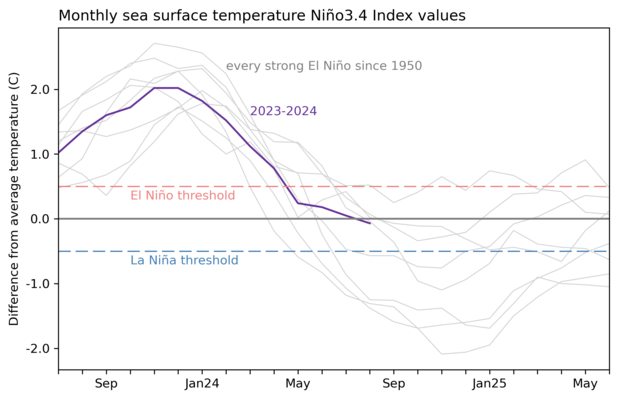
2-year history of sea surface temperatures in the Niño-3.4 region of the tropical Pacific for all strong El Niño events since 1950 (gray lines) and the recent (2023-24) event (purple line). Five of the eight gray lines dip below the dashed blue line (the La Niña threshold) in the winter following the El Niño. The 2023-24 event appears headed in the same direction. Graph by Emily Becker based on monthly Niño-3.4 index data from CPC using ERSSTv5.

The winds over the tropical Pacific play an important role in ENSO’s dramatic arc. When the near-surface winds in the tropics—the trade winds—are stronger, they cool the surface and keep warmer water piled up in the far western Pacific. They can also trigger an upwelling Kelvin wave, an area of cooler-than-average water under the surface that moves from west to east. Throughout August, the trade winds were stronger than average across most of the tropical Pacific, helping to maintain the gradual surface cooling tendency and to bolster the amount of cooler water under the surface. This cooler subsurface water will provide a source to the surface over the next few months.
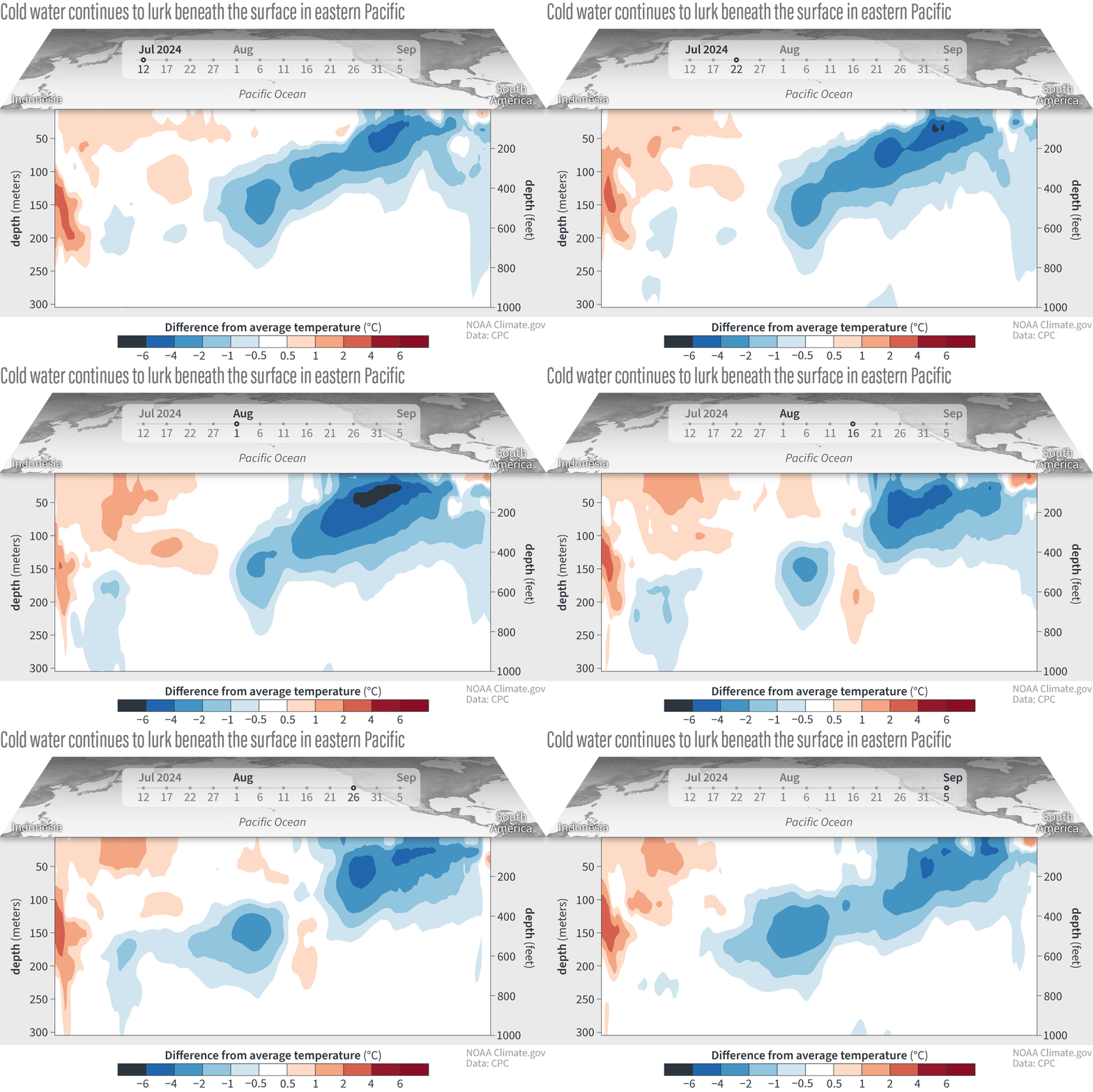
Beneath the surface of the tropical Pacific Ocean at the equator, a deep pool of cooler-than-average (blue) waters has been building up over the past couple of months (July 12–Sept. 5, 2024). This pool of relatively cool water is a key factor behind the prediction for La Niña later this fall and winter. NOAA Climate.gov image, based on analysis from Michelle L’Heureux, Climate Prediction Center.

Character development

We started this La Niña Watch party back in February. Looking back at that forecast, the probability of La Niña developing by June–August was about 55%, with about a 42% chance of ENSO-neutral during that period. These probabilities mean that La Niña’s development in June–August was favored, but there was still a good chance that neutral would linger. As it turned out, the June–August average sea surface temperature in the Niño-3.4 region, the “Oceanic Niño Index,” was 0.1 °C below average, in the neutral range.

So why is La Niña behind schedule? Honestly, nature is wild and crazy and it amazes me that we can predict anything ever, especially many months in advance. In this case, though, there are a couple of complicating factors we can point to. The first is our old frenemy, short-term variability, or, essentially, unpredictable weather events that complicate seasonal or longer predictions. For example, just a few periods of weaker trade winds can delay surface cooling.  Unfortunately, predicting such short-term variations is an ongoing challenge, and currently we can only predict these trade wind fluctuations a week or so in advance.

On the other side of the timeline, we have climate change. The global ocean temperatures are still way above average, and they are predicted to drop only slightly over the next several months. We don’t yet have a clear picture of how global warming may affect ENSO in general, or the development of La Niña this year in specific.

Coming up on La Niña Watch

That said, the most likely outcome is still that La Niña will be in place this winter, with slightly greater than 80% chance of La Niña in November–January, probably a weaker event (see strength probabilities here).
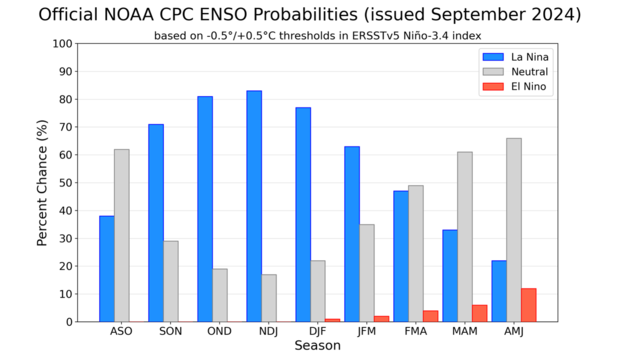
Out of the three climate possibilities—La Niña, El Niño, and neutral—forecasts say that neutral conditions are the most likely for the August–October season (tall gray bar above the ASO label, slightly over 60 percent chance). By the September-November (SON) season, La Niña has the highest chance of occurring (blue bar, 71 percent chance). NOAA Climate Prediction Center image.

A weak La Niña wouldn’t play as large a part in steering global atmospheric circulation patterns, meaning a lower chance of La Niña’s typical impacts on winter conditions. However, even a weak La Niña can nudge the winter climate and would likely factor into CPC’s winter outlook.

Stay tuned here for recaps and predictions about your favorite program, ENSO!

Footnote

There are two kinds of prediction models, dynamical and statistical. The model information I discuss in this post is from dynamical models. Statistical models use historical observations and their relationships to predict how conditions might evolve. Statistical models do not use physical equations, but rather statistical formulations that produce forecasts based on a long history of past observations of sea surface temperature, atmospheric pressure, subsurface temperature, and others. Statistical models have been around longer than dynamical models, because the dynamical ones require high performance computers. 

#Utah has a $276M bet on farms to save #ColoradoRiver water. How’s it going? — KUER #COriver #aridification

“New plot using the nClimGrid data, which is a better source than PRISM for long-term trends. Of course, the combined reservoir contents increase from last year, but the increase is less than 2011 and looks puny compared to the ‘hole’ in the reservoirs. The blue Loess lines subtly change. Last year those lines ended pointing downwards. This year they end flat-ish. 2023 temps were still above the 20th century average, although close. Another interesting aspect is that the 20C Mean and 21C Mean lines on the individual plots really don’t change much. Finally, the 2023 Natural Flows are almost exactly equal to 2019. (17.678 maf vs 17.672 maf). For all the hoopla about how this was record-setting year, the fact is that this year was significantly less than 2011 (20.159 maf) and no different than 2019” — Brad Udall

Click the link to read the article on the KUER website (David Condos). Here’s an excerpt:

September 10, 2024

“We will have less water. Forever,” Rice said. “We have to accept that and … it’s up to us to be more efficient.”

That’s why Rice applied for funding from Utah’s Agricultural Water Optimization Program — a big money push to help farmers and ranchers modernize their irrigation. With roughly three-fourths of the state’s water going to agriculture, the situation has put a bullseye on farming when it comes to stretching that H20. Utah is counting on the program — which covers half the cost of buying new, more efficient gear — to save more water for communities, rivers and reservoirs downstream.

Agricultural Irrigation Pivot. Photo credit: Colorado Springs Utilities

As he stood next to a center pivot irrigation system the program helped pay for, Rice reached for one of the dozens of spray nozzles that dangle a few feet over the ground. Compared to the equipment it replaced, he said, the difference is night and day.

“If hundreds of farms can save millions of gallons of water, I mean, we can fix it. … And do I feel like we have a responsibility to do that? Yeah, hell yeah.” — [Andy Rice]

That’s the idea behind Utah’s optimization program. If state money lowers the financial barrier for farmers to upgrade, the water savings might add up to help Utah maximize the little moisture it has…

Rice is just one example of the state’s approved projects, 551 of them and counting, said Program Manager Hannah Freeze, since the program began in 2019. The Utah Legislature has allocated $276 million so far and $108 million has gone to approved projects. A majority of that money is flowing toward the Great Salt Lake — $23 million has been approved for 112 projects in Utah’s Colorado River Basin. It’s a good start, Freeze said, but a drop in the bucket compared to what it might take to significantly improve Utah’s water outlook.

“If we were going to make a real dent or reach the majority of the farmers that we have, it’s more like a $2 billion number.”

Map of the Colorado River drainage basin, created using USGS data. By Shannon1 Creative Commons Attribution-Share Alike 4.0

A major #ColoradoRiver water transfer has some asking for more details — Alex Hager (KUNC) #COriver #aridification

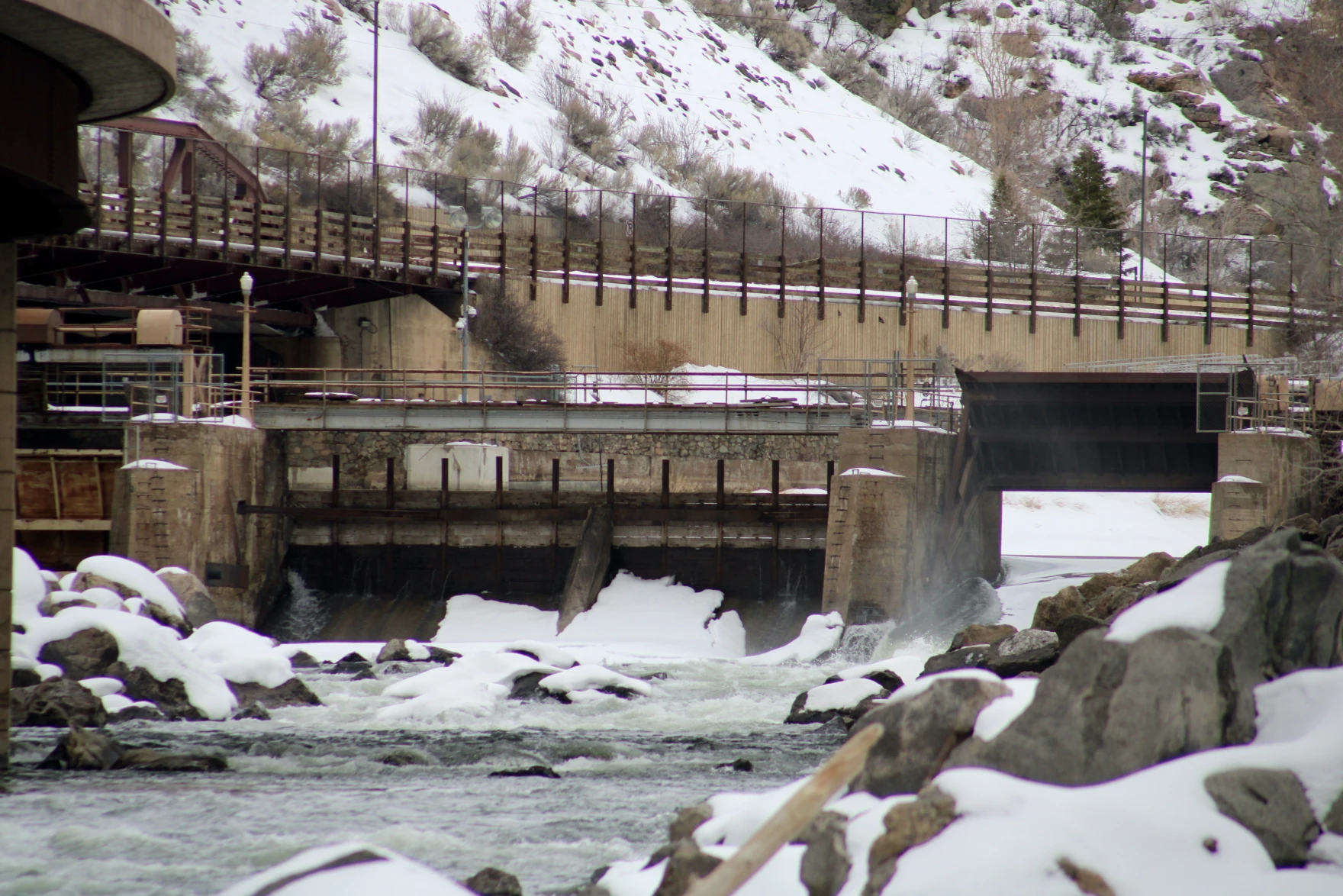
The Colorado River flows through the Shoshone diversion structure on Jan. 29, 2024. Northern Water, which supplies cities and farms on the Front Range, is asking for more data about how much water will stay on the Western Slope after the Colorado River District purchases rights to the water that flows through Shoshone. Photo credit: Alex Hager/KUNC

Click the link to read the article on the KUNC website (Alex Hager):

September 11, 2024

This story is part of ongoing coverage of the Colorado River, produced by KUNC and supported by the Walton Family Foundation. KUNC is solely responsible for its editorial coverage.

A Front Range water distributor is pushing back on a planned transfer of rights to water from the Colorado River. It has led to a disagreement between two major water agencies — a minor flare-up of longstanding tensions between Eastern Colorado and Western Colorado, which have anxiously monitored each others’ water usage for decades.

Northern Water, which serves cities and farms from Fort Collins to Broomfield, is asking for more data about the future of the Shoshone water right. Meanwhile, the Colorado River District, a powerful taxpayer-funded agency founded to keep water flowing to the cities and farms of Western Colorado, says Northern Water may be attempting to stymie its purchase of the water rights.

In early 2024, The Colorado River District announced it would spend nearly $100 million to buy rights to the water that flows through the Shoshone power plant, near Glenwood Springs. Shoshone’s water right is one of the oldest and biggest in the state, giving it preemptive power over many other rights in Colorado.

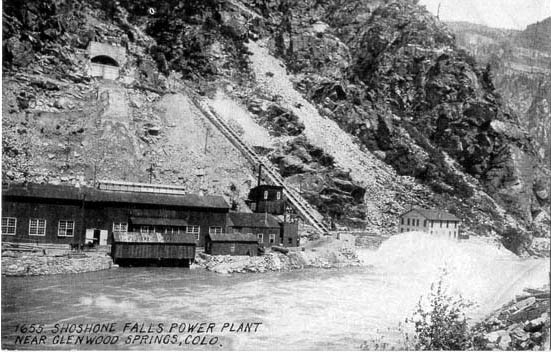
Shoshone Falls hydroelectric generation station via USGenWeb

Even in dry times, when water shortages hit other parts of the state, the Shoshone power plant can send water through its turbines. And when that water exits the turbines and re-enters the Colorado River, it keeps flowing for a variety of users downstream.

Since that announcement, the river district has rallied more than $15 million from Western Colorado cities and counties that could stand to benefit from the water right changing hands. Those governments are dishing out taxpayer money in hopes of helping make sure that water stays flowing to their region, even if demand for water goes up in other parts of the state.

The river district plans to leave Shoshone’s water flowing through the Colorado River. It’s an effort to help settle Western Colorado’s long-held anxieties over competition with the water needs of the Front Range, where fast-growing cities and suburbs around Denver need more water to keep pace with development.

The water right is classified as “non-consumptive,” meaning every drop that enters the power plant is returned to the river. The river district wants to ensure the water that flows into the hydroelectric plant also flows downstream to farmers, fish and homes. The agency plans to buy rights to Shoshone’s water and lease it back to the power company, Xcel Energy, as long as Xcel wants to keep producing hydropower.

Almost all of the $98.5 million for the river district’s purchase of Shoshone’s water will come from public funds. In addition to money from its own coffers and Western Colorado governments, the river district also plans to apply for federal funding to pay for its purchase of Shoshone’s water. It is planning to seek $40 million from the Inflation Reduction Act.

Despite decades-long tensions between water users on the Western Slope and the Front Range, leaders on the East side of the mountains have stayed mostly quiet about the Shoshone transfer.

Bicycling the Colorado National Monument, Grand Valley in the distance via Colorado.com

Northern Water’s recent statements about Shoshone perhaps mark the most notable public pushback to the pending deal. The agency supplies water to Front Range cities such as Loveland and Greeley, as well as farms along the South Platte River all the way to the Nebraska border.

The agency outlined its concerns in a letter to elected representatives, including Colorado Senators Michael Bennet and John Hickenlooper and congresspeople Joe Neguse, Lauren Boebert, Yadira Caraveo and Greg Lopez.

In short, Northern said it supports the concept of the transfer, but wants an independent study of how much water the Colorado River District plans to send down the river each year.

“We want to make sure that we’re all going into this with the same data to make sure that everyone’s interests are being addressed,” said Jeff Stahla, Northern Water spokesman.

Northern posits that the Western Slope could pull more water than the amount that has been historically used by Shoshone – enough to increase strain on upstream reservoirs that also supply the Front Range.

The River District calls that claim a “gross mischaracterization” of its plans.

“Their points ignore the stated intent of the effort and are counter to the stated values,” said Matthew Aboussie, a spokesman for the River District, “And they 100% know that.”

The River District published its own letter about the matter. The agency’s director said Northern Water’s efforts “were received as intentional obstacles intended to threaten the viability of the Shoshone Permanency Project,” and said Northern’s calls for more data collection could require a time-intensive study of the project and tie it up in litigation for up to a decade.

“We are not looking to change the historic flows,” Aboussie said. “So the intention is to protect the status quo.”

The River District is currently compiling data about the history and future of the Shoshone water right and plans to present it in Colorado’s water court, which is part of the state’s normal process to approve the transfer or sale of water rights.

Map credit: AGU